A Four-Time All Star’s Lost Weekend in San Francisco

Baseball Roundtable is drawn, at times, to unusual MLB events and box scores – the kind of things  you just don’t expect to see.  This post is about one of those times.

On this date (July 6) in 1958, Cardinals’ right-hander Larry Jackson (who would be a four-time All Star in his 14-season MLB career) put the finishing touches on what had to be a “lost” weekend in San Francisco. Here’s now it went down.

First, the Cardinals faced off against the Giants in a pair of games – Saturday, July 5 and Sunday July 6 – and would lose both by 5-4 scores in walk-off fashion.  However, there was no walk-off hit, but rather a walk-off walk and a walk-off hit by pitch, with Jackson being the victim in both games.  In fact, Jackson, coming on in relief, pitched a total of one inning and   retired just three of  11 batters he faced –  giving up two hits, five walks and one hit batter and getting charged with two losses.  (But it wasn’t all hit fault.)

Here’s how it went.

On July 5, Jackson was called to the mound in the bottom of the ninth with  the Cardinals ahead 4-3, one out and a runner (Willie Mays)  on first.  The first hitter to face Jackson was 3B Ray Jablonski, who tripled to RF scoring Mays with the tying run. Remember I said, it wasn’t all Jackson’s fault.  Jackson was then told to intentionally walk SS Daryl Spencer and LF Leon Wagner – loading the  bases (and setting up a double-play possibility.)  He then got C Bob Schmidt on a foul pop out. Next was pinch-hitter Willie Kirkland, who walked – bringing in the winning run and giving Jackson his first loss of the weekend.

Jackson got the call in the ninth inning again on Sunday, July 6, this time starting the inning – with the game knotted at 4-4. He got C Valmy Thomas on a grounder to second, then walked P Al Worthington and gave up a single to 1B Whitey Lockman – putting runners on first and second. He got the previous day’s hero – Willie Kirkland (in RF in this game) – to ground into a force at second, leaving runners on first and third with two out. CF Willie Mays was next up – and was gifted an intentional walk, loading the sacks.  Jackson then hit 3B Larry Davenport with a pitch – giving the Giants another 5-4 walk-off win and Jackson another loss.

One of the things that made this pair of box score interesting to me is that those July 5 and 6 games with the Giants last two before the All Star Game – and Jackson’s next appearance would come on July 8, when he relieved Bob Friend in the bottom of the sixth in the All Star Game and with runners on first and second, one out and Gil McDougald at the plate.  Jackson got McDougald to hit into an inning-ending double play – and was pinch hit for (by Johnny Logan) in the top of the seventh.  Note: Jackson came into that weekend in San Francisco with a 5-4, 3.40 record and eight saves in nine opportunities.

Jackson didn’t pitch after the All Star break until July 13, when he relieved in both ends of a doubleheader (Pittsburgh at St. Louis). In the first game of the twin bill, he took a third consecutive regular-season loss.  This time he came on in the bottom of the fifth with two outs, the bases loaded and the Cardinals ahead 5-1.  In that contest, Jackson faced four batters and gave up four singles (five runs scoring, two charged to Jackson). So, in three regular-season games, Jackson had now faced 15 batters, retiring just three and giving up six hits, five walks and one hit batsman (and, again, in the middle had pitched in the All Star Game). The Cardinals went right back to Jackson in the top of the ninth inning of Game Two – bringing him in with the Pirates leading 8-6. He righted his ship, pitching a scoreless frame, with one hit and one strikeout.

By the way, that lost weekend in San Francisco was not an indication of Jackson’s career.  As noted, that season, he was an All Star selection and went  13-13, 3.68 with eight saves (23 starts and 26 relief appearances). He pitched 14 MLB seasons, going 194-183, 3.40. He  was an All Star four times and won 15 or more games in six seasons – going 24-11, 3.14 in 1964 (leading the NL in wins and finishing second in the Cy Young Award voting. All that makes that weekend in SF so much more unexpected.

Primary Resource:  Baseball-Reference.com; NationalPastime.com

_____

100Baseball Roundtable is on the Feedspot list of the Top 100 Baseball Blogs.  To see the full list, click here.

I tweet baseball @DavidBaseballRT

Follow/Like Baseball Roundtable’s Facebook Page here.  More baseball commentary; blog post notifications; PRIZES.

Member: Society for American Baseball Research (SABR); The Baseball Reliquary; The Negro Leagues Baseball Museum.

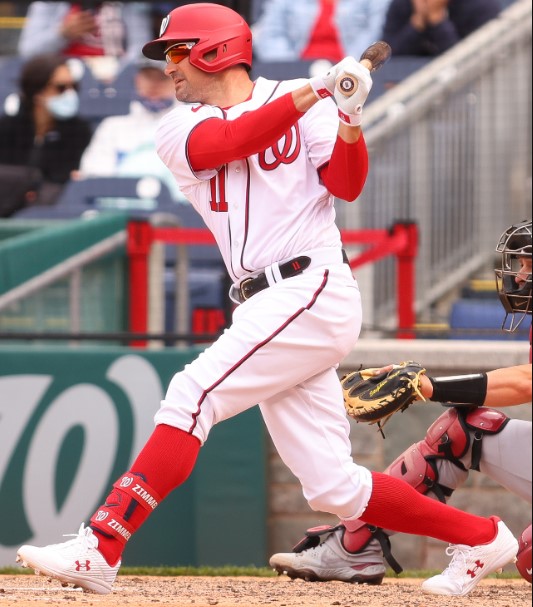
 

Baseball Roundtable Looks at MLB’s Combined No-Hitters

Yesterday (June 24, 2021), the Chicago Cubs no-hit the Dodgers 4-0 in Los Angeles.  Zach Davies started for the Cubs and went six innings, walking five and fanning four. He was followed by Ryan Tepera (one inning, one walk); Andrew Chafin (one inning, one walk); and closer Craig Kimbrel (one inning, one walk, three strikeouts). That these three should close out a no-no is no surprise, coming into the game their earned run averages, respectively, were 2.02, 1.72 and 0.61.

How the Game Has Changed

Yesterday, Zach Davies was pulled after six no-hit innings and just 94 pitches and Boston’s Nick Pivetta was yanked after 6 2/3 no-hit frames and 100 pitches. 

It was the seventh no-hitter of the 2021 season, tying the modern-era (since 1900) single-season record for no-hit games in a season and was the sixth no-hitter thrown on the road this season (also an MLB single-season record – although 2021 already had the record at five). Note:  There were seven MLB no-hitters thrown in 1990, 1991, 2012 and 2015 – and eight in 1884.

More Proof of that “In Baseball, We Count Everything.”

STATS, Inc. reported that this was the first no-hitter thrown against a lineup with three former MVP’s (Mookie Betts, Al Pujols, Cody Bellinger).

Now, a look at the other fourteen MLB combined no-hitters and the circumstances that made many of them unique.

The First-Ever Combined No-Hitter – This took place on June 23, 1917 – with the Red Sox topping the Senators 4-0 in Boston. This game is special for several reasons: it was the first MLB combined no-hitter; Babe Ruth was involved;  it involved the most meager contribution by the starting pitcher (zero innings pitched); and, finally, it is arguably the most “perfect” combined no-hitter ever.

Babe Ruth, at that time plying his trade as a left-handed starting pitcher for the Boston Red Sox, opened the game by walking Washington’s lead-off hitter Roy Morgan.  Ruth, and his catcher Pinch Thomas, took issue with umpire Brick Owens’ strike zone and, during the argument, Ruth made contact with the umpire (a glancing blow, it was reported).  The ultimate result of the confrontation was the ejection of both Ruth and Thomas (with Ruth earning a $100 fine and ten-game suspension).  Red Sox’ pitcher Ernie Shore was called in to replace Ruth and Sam Agnew took Thomas’ spot behind the plate. Morgan decided to test Agnew’s arm and was thrown out stealing, after which Shore retired the next 26 hitters in order – completing the first combined no-hitter within the minimum 27 total batters.

_________________________________________

Second Combined No-Hitter … A Long Time A-comin’ – Given the past propensity for pitchers finishing what they started, MLB’s second combined no-hitter came 50 seasons and 70 no-hitters later – on April 30, 1967, with the Tigers defeating the Orioles 2-1 in Baltimore.  This combined no-hitter is unique because:

  • It was not a “no- no” (no hits – no runs)
  • The team that threw the no-hitter lost (the only combined no-hitter loss); and
  • It involved the briefest contribution by the relief staff (one pitcher/one-third inning pitched).

Orioles’ starter Steve Barber and was effectively wild, walking ten hitters and hitting two in 8 2/3 innings. The opposing hurler was Detroit’s Earl Wilson – who matched goose eggs with Barber for seven innings. In the eighth, Baltimore pushed across a run on three walks and a sacrifice fly (Wilson gave up only two hits and four walks in his eight innings of work) and victory was there if Barber could take it. He didn’t.  Barber walked Tigers’ 1B Norm Cash to start the ninth. He then walked SS Ray Oyler. Earl Wilson, a good-hitting pitcher, bunted the runners to second and third, before Barber got the second out of the inning, inducing PH Willie Horton to pop up to the catcher.  Now, just one out away from a 1-0, no-hit win, Barber uncorked a wild pitch that brought the tying run home. He then walked CF Mickey Stanley, ending his day on the mound. Stu Miller came in to get the final out, but not until an error allowed the go-ahead run to score.

________________________________________

Combined No-Hitter Number Three … At the Last Possible Moment – This no-hitter came on September 28, 1975, with the A’s topping the Angels 5-0 in Oakland.  This game was unique in that:

  • It is one of only three no-hitters thrown on the final day of an MLB season;
  • It made starting pitcher Vida Blue the first hurler to take part in both a solo and combined no-hitter. (Blue had thrown a solo no-hitter on September 21, 1970.); and
  • It was the first time more than two pitchers were involved in a combined no-hitter.

Blue went five innings  (two walks, two strikeouts) and was followed by Glenn Abbott (one inning,), Paul Lindblad (one inning, one whiff) and Rollie Fingers (two innings, two strikeouts). Note: Blue has been joined by Kevin Millwood, Kent Mercker and Mike Witt as pitchers with both solo and combined no-hitters.)

______________________________________

Combined No-Hitter Number Four – The next combined no-hitter went back to the two-pitcher formula, as Blue Moon Odom (five innings, nine walks, three strikeouts) and Francisco Barrios (four innings, two walks, two strikeouts) of the White Sox topped the A’s 2-1 in Oakland.  In the July 28, 1976 game, Blue walked seven different players at least once in his five innings of work.

_____________________________________

Combined No-hitter Number Five –  MLB’s fifth combined no-hitter came on April 11, 1990 (again just two pitchers), with the Angels topping the Mariners 1-0 in Anaheim.  Mark Langston started the game and went seven (four walk, three strikeouts), and Mike Witt (the only pitcher to throw a perfect game – September 30, 1984 – and take part in a combined no-hitter ) threw the final two (two strikeouts.)

_______________________________________

1991 – The First “Year of the Combined No-No’s” (plural that is)

1991 saw seven MLB no-hitters including two combined no-nos. On July 13, the Orioles no-hit the A’s 2-0 in Oakland behind Bob Milacki (who threw six no-hit innings – three walks/three whiffs) and was pulled after being hit by a Willie Wilson line drive. Mike Flanagan (one inning, one walk), Mark Williamson (one inning) and Gregg Olson (one inning, two strikeouts) finished up the no-no.

Then, on September 11, the Braves no-hit the Padres 1-0 in Atlanta, led by Kent Mercker (six innings, two walks, six strikeouts), Mark Wohlers (two innings) and Alejandro Pena (one inning).  Greg Harris, who started for the Padres, threw a complete-game seven-hitter.

_______________________________________

Combined No-Hitter Number Eight … Working Overtime – Combined no-hitter number eight came on July 12, 1997 – with the Pirates topping the Astros 3-0 in Pittsburgh.  It was unique in that it was:

  • The only extra-inning combined “no-no;” and
  • Made Francisco Cordova the (still) only  pitcher to start a combined no-hitter by pitching nine full innings.

Francisco Cordova started and went nine hitless frames (two walks, ten whiffs) and Ricardo Rincon threw one hitless inning in relief (for the win).

__________________________________________

Combined No-Hitter Number Nine … Nearly the Whole Bullpen – The next combined no-hitter was a record breaker – as the then-National League Astros used a record six pitchers (since tied) to no-hit the Yankees 8-0 in an inter-league game at Yankee Stadium (the last no-hitter at Old Yankee Stadium). on June 11, 2003. Roy Oswalt started, but succumbed to a groin injury after just one completed inning (two strikeouts). Joining in the no-hitter were: Pete Munro (2 2/3 innings, three walks, two strikeouts ); Kirk Saarlos (1 1/3 innings, one strikeout); Brad Lidge (two innings, two strikeouts); Octavio Dotel (one inning, four strikeouts); and Billy Wagner (one inning, two whiffs). Notably, the no-hitter also broke up the Yankee’s record streak of 6,980 games without being held hitless. They had not been held without a safety since September 20, 1958.  The five relievers combined for eight innings pitched, with three walks and 11 strikeouts.

Four Whiffs – One Inning

In the eighth inning of this game, Octavio Dotel recorded a four-whiff frame. He struck out Juan Rivera and Alfonso Soriano on three pitches each; fanned Derek Jeter on a 3-2 pitch only to see him awarded first base on catcher’s interference; and then got Jason Giambi on a 2-2 pitch.  All four were swinging strikeouts. 

Combined No-Hitter Number Ten – Evening Up the Score – The very next combined no-hitter – another inter-league game – saw the six-pitcher record tied, as the Mariners topped the Dodgers 1-0 in Seattle on June 8, 2012.  In addition, the AL evened up the score in combined inter-league no-hitters at one apiece. Kevin Millwood started that one (six innings, one walk, six strikeouts), followed by Charlie Furbush (2/3 inning, one strikeout), Stephen Pryor (1/3 inning, two walks, one strikeout), Lucas Luetge (1/3 inning), Brandon League (2/3 inning, one strikeout) and Tom Wilhelmsen (one inning).

__________________________________________

Combined No-Hitter Number 11 – On September 1, 2014, the Phillies used four pitchers to no-hit the Braves 7-0 in Atlanta.  The pitchers involved were Cole Hamels, who started and went six innings (issuing five walks versus seven strikeouts); Jake Diekman (one inning, two strikeouts); Ken Giles (one inning, three strikeouts); and Jonathan Papelbon (one inning, no strikeouts).

__________________________________

Combined No-Hitter Number 12 … On New Turf – This one took place on May 4, 2018, as the Dodgers no-hit the Padres 4-0 in a regular-season MLB game played in Monterrey Mexico – the first official MLB no-hitter ever thrown outside the United State or Canada.

Right-hander Walker Buehler started for the Dodgers, and the 23-year-old – making just his third major league start (11th appearance) – went six innings (93 pitches), walking three and fanning eight.  He was followed by relievers Tony Cingrani (one inning, two walks, one whiff); Yimi Garcia (one inning, no walks, two strikeouts) and Adam Libertore (one inning, no walks, two strikeouts).  Buehler, by the way, also collected an unusual sixth-inning single – as his groundball hit base runner Alex Verdugo between first and second, resulting in Verdugo being called out (for the final out of the inning) and Buehler being credited with a single. That single, of course, meant Buehler outhit the entire Padres’ lineup.

_________________________________________

Combined No-hitter number 13 … A Lucky Number – Thirteen was a lucky number for the Angels.  On July 12, 2019, their staff put together MLB’s 13th combined no-hitter and their offense scored 13 runs on 13 hits. Taylor Cole started the game (in the “opener” role) and pitched two clean frames with two strikeouts.  Felix Pena the came on for the Halos and went seven innings (one walk, six strikeouts).

_________________________________________

Combined No Hitter Number 14 … An Unlikely Starter –  On August 3, 2019, four Astros’ pitcher no-hit the Mariners 9-0 in Houston. Starting pitcher Aaron Sanchez seemed an unlikely hurler to start off a no-no – he came into the game with a 3-14, 6.07 record in 23 starts (with batters hitting .290 against him – a .382 on-base percentage. Sanchez shut down the  Astros, walking two and fanning six over six no-hit innings, then giving way to Will Harris (one inning pitched, one walk); Joe Biagini (one inning pitched, one walk, one whiff); and Chris Devinski (one inning pitched, one strikeout).

It was, notably, the first appearance for the Astros for both Sanchez and Biagini – both had been included in a Blue Jays/Astros trade on July 31 (Sanchez, Biagini and minor-leaguer Cal Stevenson for OF Derek Fisher).  Thanks to this effort, 2019 became just the second season with two combined no-hitters.

Primary Resources:  Baseball-Reference,com; MLB.com

Baseball Roundtable Disclaimer:  The MLB records referenced in this (and previous) posts have the potential to change as Major League Baseball recognizes and incorporates Negro League records from 1920-46 into the MLB record book.

_____________________________________________

100Baseball Roundtable is on the Feedspot list of the Top 100 Baseball Blogs.  To see the full list, click here.

I tweet baseball @DavidBaseballRT

Follow/Like Baseball Roundtable’s Facebook Page here.  More baseball commentary; blog post notifications; PRIZES.

Member: Society for American Baseball Research (SABR); The Baseball Reliquary; The Negro Leagues Baseball Museum.


Ryan Zimmerman’s Tough Day at the Office … and Other Runners Left on Base Records

In this post, Baseball Roundtable will take a look at a handful of players who had a tough day at the old ballpark – each leaving at least a dozen runners on base during their plate appearances. Notably, only six players belong to this MLB “Club” – and three of them had their dismal days for the Red Sox (Dustin Pedroia, Trot Nixon, David Ortiz), while only two “accomplished” the feat in just nine innings (Glenn Beckert and Todd Helton).

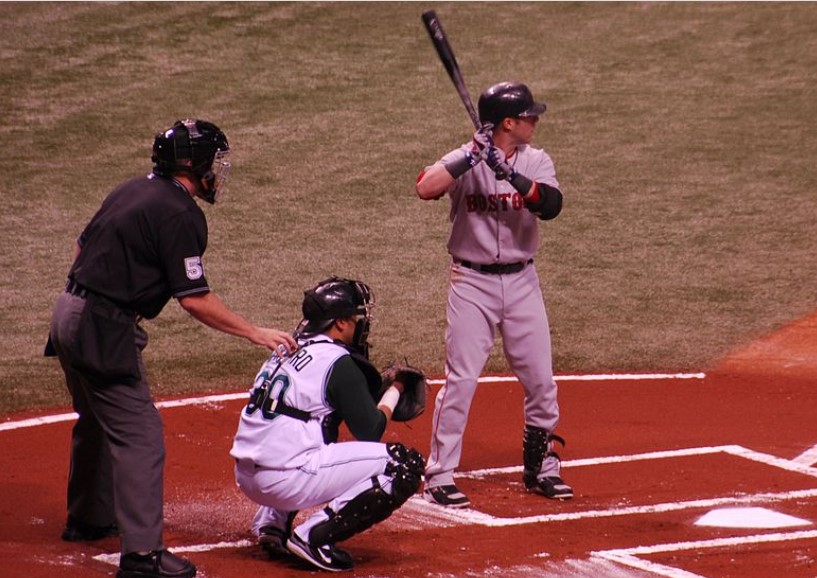
Ryan Zimmerman – MLB Record for Runners Left On Base in a Game (any length).

Photo: All-Pro Reels from District of Columbia, USA, CC BY-SA 2.0 <https://creativecommons.org/licenses/by-sa/2.0>, via Wikimedia Commons

On May 8, 2016, Nationals’ Ryan Zimmerman was playing first base and batting cleanup as Washington took on the Cubs in Chicago. He  came into the game hitting  .242, with one home run and 11 RBI – and was about to have one of the most frustrating Sunday afternoons  at the plate ever.  He would go one-for-seven, with one RBI – as the Nationals fell to the Cubs 5-4 in 13 innings.  That doesn’t sound too bad on the surface, but in the process, Zimmerman:

  • Set the MLB individual player record for men left on base in a game – leaving 14 ducks on the pond;
  • Left eight runners in scoring position;
  • Made the final out with the bases loaded in three separate innings (twice in extra frames) – each time having his out preceded by an intentional walk.

Here’s how Zimmerman afternoon at Wrigley went:

First Inning – Strikeout (looking) on three pitches with runners on first and second.

Third Inning – RBI double past third base to give the Nationals a 1-0 lead. (Looking like an okay day so far).

Fourth Inning – Swinging strikeout on five pitches to end the inning with the bases loaded (after an intentional walk to Bryce Harper). The Nationals were up 2-0 at the time.

Sixth Inning – Fly out to RF, with runners on first and second, one out and Nationals up 3-1.

Eighth Inning – Ground out to 1B to end the inning, with a runner on first base.

Tenth Inning – Fly out to CF to end the inning, with bases loaded (after an intentional walk to Bryce Harper).

Twelfth Inning –  Ground out to 3B to end the inning, with the bases loaded (after an intentional walk to Bryce Harper.)

Zimmerman ended the 2016 season with a .218-16-46 stat line.  Still active, he is in his 16th MLB season.  As of June 24, 2021, he had a .279 career average, with 278 home runs and 1.035 RBI. He is a two-time All Star, whose best season came in 2017, when he went .303-36-108.

It’s a Red Sox Ting

Baseball Almanac lists just three American League Players as having left 12 or more runners on bases in a single game – and they were all members of the Boston Red Sox – Dustin Pedroia (13 LOB on September 15, 2017 – setting a new AL record); David Ortiz (12 on May 14, 2009 – tying the then American League and MLB record); Trot Nixon (12 on June 12, 2003 – at the time, setting an AL mark and tying the MLB record).

Dustin Pedroia – AL Record Holder for Runner LOB in a Game.

Photo: Eric Kilby on Flickr, CC BY-SA 2.0 <https://creativecommons.org/licenses/by-sa/2.0>, via Wikimedia Commonsnoto:

Baseball Almanac lists Red Sox’ 2B Dustin Pedroia holding the AL record for runners LOB in a game (13 in a fifteen-inning game on September 15, 2017).  I should note, however, that  I find the record somewhat less than deserved. (I’’ll explain in a bit.) Pedroia started at DH, batting second, in the game. He came into the game hitting .314, with seven home runs and 58 RBI. That day, as the Red Sox topped the Rays 13-6 in Tampa (15 innings), Pedroia went zero-for-nine, with one run scored.  Side note: The game was tied 5-5 at the end of nine, each team was scoreless in innings ten through thirteen, each team scored one run in the fourteenth and the Red Sox put it away with seven runs in the top of the fifteenth.

Here’s a look at Pedroia’s game:

First Inning – Ground out to pitcher with a runner on first (runner went to second).

Third Inning – Fly out to RF  to end the inning with a runner on first and the game knotted at 1-1.

Fifth Inning – Fly out to center to end the inning, with runners on first and third and Boston down 3-2.

Eighth Inning – Fly out to RF leading off the inning.

Ninth Inning – Strikeout with two outs, runners on first and second and the game tied at five apiece.

Eleventh Inning – Line out to SS, with one out and the bases loaded (after an intentional walk to Xander Bogaerts) and the scored tied 5-5.

Thirteenth Inning – Strikeout with one out and a runner on first (5-5 score).

Fifteenth Inning – Safe on an error with no outs and runners on first and second – with the runner on second scoring and the runner on first going to third. (This safe on error put the Red Sox up 7-6).

Side Note:  This is point at which I am not sure about the listing of Pedroia as the record holder with 13 runners left on base. MLB.com’s Glossary lists runners left on base as the number of runners that “remain on base after that batter makes an out at the plate, as the batter has failed to do his job to score those runners – or at least put himself in a position to score.” To reach 13 runners LOB, you have to count the runner on first who went to third (but did not score on the fifteenth-inning error).  Still a run did score and – contrary to the MLB.com description – Pedroia did not “make an out at the plate.”  I think I may have to send this one to Twins’ official scorer and SABR member Stew Thornley.

Fifteenth Inning – Pedroia got a second  plate appearance in the fifteenth (by this time the Red Sox were up 13-6). He grounded out to SS to end the inning, with runners on runners on first and second.

Pedroia ended the 2017 season with a .293-7-62 stat line in 105 games. His career line (14 MLB seasons) was .299-140-725. He was a four-time All Star, four-time Gold Glover, the 2007 AL Rookie of the Year and the 2008 AL Most Valuable Player.

__________________________________________________

Now, let’s take a look at the two player who share the record of 12 runners LOB in a nine-inning game.

Glenn Beckert, Cubs – Shares the Record for Runners LOB in a Nine-Inning Game

On September 16, 1972 – as the Cubs pounded the Mets 18-5 in Chicago – Cubs’  hitters had ample opportunity to leave men on base.  And, Glenn Beckert took advantage  of those opportunties, going zero-for-six and leaving 12 runners on base. Beckert, an all Star that season, came into the game hitting .258, with three home runs and 31 RBI.   Here’s how his day went:

First InningEnded the inning with a fly out to CF, with the bases loaded and the Cubs up 1-0.

Third Inning – Popped out to the catcher, with runners on second and third, no outs and the Cubs up 4-1.

Third Inning – Beckert came up for a second time in the inning, this time with runners on second and third, two out and the Cubs up 11-1. He flied out to RF to end the inning.

Fifth Inning – Fly out to CF, with one out a runner on first and the Cubs up 13-2.

Seventh Inning – Foul out to 3B, with one out, a runner on third and the Cubs up 13-5.

Seventh Inning – For the second time in the game, Beckert batted twice in an inning. In this plate appearance, he grounded out to end the inning, with the bases loaded and the Cubs up 18-5.

Not much suspense here and the at bats clearly were not critical.  Still, it got Beckert into the record books – albeit not in a way he would have preferred.  Beckert ended the 1972 season at .283-3-43 in 120 games.  Over his 11-season MLB career, he was .283-22=360. Beckert was a four-time All Star and one-time Gold Glover.

Todd Helton – Shares the Record for Runners Left on Base in a Nine-Inning Game.

Unlike Beckert’s 12-LOB game (in which the Cubs didn’t need Beckert’s offense), the Rockies could have used some help from Helton in this one.  It came on April 11, 1998 and Helton’s Rockies lost to the Reds 12-5 Denver.  Helton, on his way to a .315-25-97 season, came into this early season contest with a .306-0-4 stat line.  He was playing 1B and batting third.  Helton ended the day zero-for five with one RBI.  It went like this;

First Inning – Strikeout with one out, runners on second and third and the Rockies already down 5-0.

Second Inning – The Rockies had scored in the inning on a leadoff  home run by Greg Colbrunn and Helton came up with the bases loaded, two outs and Colorado trailing 9-2. Helton lined out to third end the inning.

Fourth Inning – with the Rockies trailing 11-2, Helton drove in a run with a one-out sacrifice fly. Despite the run scoring (from third) a runner on first (of course) did not score – giving Helton one LOB in this plate appearance.

Sixth Inning – Ground out to SS (Fielder’s Choice) with one and runners on first and second. The Rox were down 12-4.

Seventh Inning – With the Rockies down 12-5, Helton flied out to center with the bases full to end the inning

Ninth Inning – Fouled out with a runner of first to end the game.

BBRT Extra … Yanks Strand 20 in Nine Innings

On September 21, 1956, a powerful Yankees squad (Mickey Mantle, Yogi Berra, Bill Skowron, Elston Howard and more) lost to the Red Sox 13-7 in Boston – but it was  not for the lack of scoring “opportunities.”  In the game, the Yankee stranded 20 – still the MLB record for a nine-inning game. Here;s how it went:

  • The Bombers scored three in the top of the first, but left the bases loaded when pitcher Bob Turley grounded out to end the frame);
  • They added one in the second, but left two on as Elston Howard flied out to 2B;
  • Stranded two more in the third (Enos Slaughter ground out to 1B);
  • Scored one in the fourth, but left the bases full (Irv Noren fly out to LF);
  • Left just one on base in the fifth (Yogi Berra ground out to 1B); 
  • Left the bases full again in the sixth (Jerry Lumpe made the final out);
  • Scored two in the seventh, but left two more on base (Jerry Coleman fly out to CF);
  • Left two on the eighth (Norm Siebern strikeout); and
  • Left two more on in the ninth (George Wilson fly out to LF).

Overall, the Yankees outhit the Red Sox 15-14; out-homered them 1-0); and made just one error to the Red Sox’ five – and still lost by six tallies.

Now a look at the other two AL players to leave at least 12 runners on base in a fame. Like AL record holder (at 13) Dustin Pedroia, they both “accomplished” the feat for the Red Sox.

Trot Nixon – an Even Dozen Left on Base – The Record for an Inter-league Game

On June 12, 2003, Trot Nixon started in RF for the Red Sox (batting sixth) as they lost to the Cardinals 8-7 at Fenway. Nixon came into the game hitting .305, with eight homers and 36 RBI in 55 games. He went a respectable 2-7 (both singles) with one RBI – but had many more opportunities to contribute offensively in this one-run loss.

First Inning – Nixon ended the inning with a four-pitch strikeout and the bases loaded. (Game tied 0-0 at this point).

Fourth Inning – Pop out to the catcher, with one out and a runner on first.

Fifth Inning – Nixon ended the inning with a foul pop to 1B, with runners on second and third and the Sox trailing 2-0.

Eighth Inning – Single to LF.

Ninth Inning – Foul pop out to 1B, with one out and the bases loaded (after two intentional walks to set up the double play).  The Sox had scored three in the frame to tie the game at 3-3, the third run scoring on a  Nomar Garciaparra one-out  triple. Manny Ramirez and Bill Millar were then intentionally walked to bring up Nixon, whose pop up was followed by a Bill Mueller fly out to send the game into extra innings.

Tenth Inning – Nixon ended the inning with a ground out to second,with the bases loaded and the game tied at 5-5.  This Nixon out again followed a pair of intentional walks to load the bases.

Thirteenth Inning – RBI single (no outs) to bring the score to 8-6 (the Cards scored three in the top of the inning.)

Nixon ended the season at .306-28=87 and was .274-137-555 in 12 MLB seasons.

________________________________________________

David Ortiz – Another  Dozen Red Sox Left on Base … At Least It wasn’t at Home

On May 14, 2009, David Ortiz started at DH for the Red Sox, batting third, as they faced the Angels in California. Big Papi came into the game hitting just .220, with no home runs and 15 RBI.  He didn’t break his early-season slump. On the day, he:

  • Went zero-for seven;
  • Struck out three times;
  • Made the final out of an inning in five of his seven at bats – all with at least one runner in scoring position, twice with the bases loaded.

Ortiz ended the season at .238-28-99 – a notable off year for Ortiz, who hit .286-541-1,768 in a 20 season MLB career. Ortiz was a ten-time All Star, hit 30+ home runs in ten seasons and drove in 100+ runs ten times.

Here’s how his “May Day” went:

First Inning – Strikeout looking on four pitches with one out and a runner on first.

Fourth InningEnded the inning on five-pitch strikeouts (looking) with the bases loaded and Boston training 3-2.

Sixth InningEnded the inning, striking out looking on four pitches, with a runner on second and the game tied 3-3.

Eighth InningEnded the inning with a fly out to deep LF, with runners on first and third and Boston trailing 4-3.

Tenth InningEnded the inning on a ground out to 1B, with a runner on second and the game tied 4-4.

Twelfth InningEnded the inning on a ground out in front of the plate (catcher to first bases), with the bases loaded and the game still tied 4-4. The Angels picked up a walk-off win in the bottom of the inning.

BBRT Extra – Old Guys Rule

In 2016, his final season (age 40), David Ortiz hit .315-38-127 in 151 games – leading the AL in RBI and doubles (48).

Primary Resources: Baseball-Reference.,com; Baseball-Almanac.com.


Baseball Roundtable Disclaimer:  The MLB records referenced in this (and previous) posts have the potential to change as Major League Baseball recognizes and incorporates Negro League records from 1920-46 into the MLB record book.

_____________________________________________

100Baseball Roundtable is on the Feedspot list of the Top 100 Baseball Blogs.  To see the full list, click here.

I tweet baseball @DavidBaseballRT

Follow/Like Baseball Roundtable’s Facebook Page here.  More baseball commentary; blog post notifications; PRIZES.

Member: Society for American Baseball Research (SABR); The Baseball Reliquary; The Negro Leagues Baseball Museum.


Six Hits Off Five Different Pitchers … or How About Six-for-Six Off Six

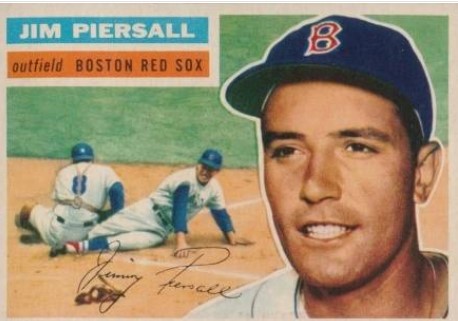
On this date (June 10) in 1953, one of the most colorful players of my youth (Red Sox outfielder Jimmy Piersall) had a six-hit game as Boston topped the Browns 11-2 in Saint Louis.

Piersall, notably, collected his six safeties against five different pitchers: a single off Max Lanier in the first inning; an RBI single off Lanier in the third; a single off Dick Littlefield in the fourth; a double off Bobo Holloman in the sixth; an RBI single off Marlin Stuart in the seventh; and a single off Bob Cain in the ninth. Piersall came into the came hitting .252 and left hitting .274. It was the first game of a doubleheader, but Piersall didn’t fare was well in Game Two – going zero-for-five in a 3-2 Boston win.  Piersall played 17 MLB seasons, going .272-104-591., with 115 stolen bases. He was a two-time All Star and two-time Gold Glover.

Anyway, the anniversary of Piersall’s six-hit, nine-inning game – still the Red Sox franchise record – sent me to thinking about six-hit performances (particularly those that occurred in nine-inning contests). Turns out, they’re not as rare as one might think. MLB has seen 120 instances of players collecting at least six hits in a nine-inning contest (National League, American League, American Association, Players League). Rarer is the seven-hit (nine-inning) game. There have been just two  of those:

  • Wilbert Robinson, Baltimore Orioles (NL) – June 10, 1892.
  • Rennie Stennett, Pirates – September 16, 1975.

So, how about games in which a player got at least six hits, while victimizing at least five different pitchers (as Piersall did)?  Ah, just 12 of those.  And even rarer – six hits against six different pitchers in a nine-inning game – just two.  (Box scores are a little sketchy prior to 1920, but I am pretty confident in this.)Notably, they both qualified as rookies in the year of their six-hit/six-pitcher performances.

—-Six Hits in a Nine-Inning Game Against Six Different Pitchers—-

Bob Oliver, Royals, May 4, 1969

The Royals’ CF went six-for-six in a 15-1 Kansas City Road win over the Angels. The Halos used six pitchers and Oliver got to them all: a single off Clyde Wright in the second inning; a double off Eddie Fisher in the fourth; a two-run home run off Pedro Borbon in the fifth; a single off Phil Ortega and a single off George Brunet in the seventh; a single off Tom Murphy in the ninth. For the day, Oliver was 6-for-6 with two runs scored and three RBI. Oliver, by the way, was a .256 hitter over eight MLB seasons and hit just .254 as a rookie in 1969.

Jesus Alou, Giants, July 10, 1964

Alou’s six-hit game came in a 10-3 Giants’ win over the Cubs in Chicago. Surprisingly, he had just one run and one RBI – but like Bob Oliver (above), Alou collected safeties against all six pitchers who took the mound for the Cubs: single off Dick Ellsworth in the first; single off Lew Burdette in the third; single off Don Elston in the fourth; home run off Dick Scott in the sixth; single off Wayne Schurr in the seventh;  single off Lindy McDaniel in the ninth. Alou was a .280 hitter over 15 MLB seasons. In 1964, he hit .274-3-28 in 115 games.  He came into his six-hit game hitting .264, left hitting .280. In his next game he went one-for-four.


A few other six-hit game tidbits:

  • Just five players have multiple six-hit (nine-inning) games (two each); Jim Bottomley (1924 & 1931 – NL); Ed Delahanty (1890 – PL & 1892 – NL); Doc Cramer (1932 & 1935, AL); Henry Larkin (1885 – AA & 1892 – NL ; Cal McVey (1876 – NL).
  • Cal McVey is the only player with two, six-hit (nine-inning) games in the same season (just three days apart) – for the National League Chicago White Stockings (July 22 & July 25, 1876). On July 22, the White Stockings topped the St. Louis Grays 30-7 and on July 25, they beat the Cincinnati Red Stockings (23-3).
  • In his May 23, 2002 six-hit (nine-inning) game for the Dodgers, Shawn Green tied the record for most home runs in a game (four) and set the record for most total bases in a game (19). Green had four home runs, a double and a single in six at bats, scoring six runs and driving in seven as the Dodgers beat the Brewers 16-23 in Milwaukee/
  • The following players hit for the cycle in their six-hi, nine-innings games: John Reilly (1883 – AA); Dave Orr (1885 – AA ); Larry Twitchell (1889 – NL ); Farmer Weaver (1890 – AA); Sam Thompson (1894 – NL); Ian Kinsler (2009 – AL).

Primary Resources:  Baseball-Reference.com; Baseball Almanac.com; MLB.com

Baseball Roundtable Disclaimer:  The MLB records referenced in this (and previous) posts have the potential to change as Major League Baseball recognizes and incorporates Negro League records from 1920-46 into the MLB record book.

_____________________________________________

100Baseball Roundtable is on the Feedspot list of the Top 100 Baseball Blogs.  To see the full list, click here.

I tweet baseball @DavidBaseballRT

Follow/Like Baseball Roundtable’s Facebook Page here.  More baseball commentary; blog post notifications; PRIZES.

Member: Society for American Baseball Research (SABR); The Baseball Reliquary; The Negro Leagues Baseball Museum.
 

Extra Inning Explosion – Rangers Plate 12 in the Fifteenth (and more)

Yesterday (May 28, 2021), the Padres broke open a tight (3-3) game against the Astro (in Houston) by plating seven runs in the top of the eleventh inning. The Padres attack that inning included five singles, a double and was aided by an Astros’ error and (unfortunately) the now obligatory free runner on second base to open the inning.

Well, that got me thinking (another Baseball Roundtable  “one thing leads to another” moment) about the record for runs scored in an extra inning.  I thought I’d share what I found.

Independence Day Fire Works Arrive a Day Early

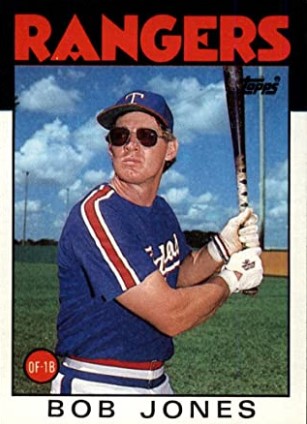
Bob Jones … two doubles in the fifteenth inning.

Turns out the record for the most runs scored in extra frames belong to the Rangers, who plated 12 runs in the fifteenth inning of a July 3, 1983 game against the A’s – giving the Rangers a 16-4 win.

In that frame, which I detail later in this post, the Rangers:

  • Sent 16 batters to the plate;
  • Collected five singles and three doubles;
  • Benefited from four walks (one intentional), a wild pitch and one A’s error;
  • Had one batter (LF Bob Jones) hit two doubles; and
  • Had seven players drive in at least one run.


Bob Jones’ Day in the Sun

Rangers’ LF Bob Jones went five-for-eight in that July 3, 1983 game, collecting three doubles, scoring twice and driving in four runs. On the season, he hit .222 (16-for-72) with four doubles, one home runs, five runs scored and 11 RBI. In nine  MLB seasons, Jones hit .221 (314 games), with 20 home runs and 86 RBI.

Here’s a look at how the Rangers’ record-setting extra inning went:

  • SS Bucky Dent draws a leadoff walk off reliever Dave Beard.
  • 3B Buddy Bell singles, Dent goes to second.
  • RF Larry Parrish grounds out weakly to the pitcher, Dent and Bell move up.
  • CF George Wright is walked intentionally.
  • LF Bob Jones hits a two-run double to right.
  • Wright, who has gone to third on the Jones double, scores on a wild pitch with C Bob Johnson at the plate.
  • Johnson walks – putting runners on first and third.
  • Bill Callahan replaces Beard on the bump.
  • 1B Larry Biittner hits a run-scoring single.
  • 2B Jim Anderson walks, loading the bases.
  • Mickey Rivers reaches on an error by second baseman Tony Phillips as Biittner scores.
  • Dent hits a run-scoring single in his second plate appearance of the inning.
  • Bell hits his second single of the inning – this one scoring Rivers.
  • Parrish hits a two-run double.
  • Wright flies out to left.
  • Jones hits a run-scoring double, his second two-bagger of the frame.
  • Johnson singles in Jones.
  • Biittner flies out to left to end the carnage.

Note: Odell Jones put down the A’s (strikeout-strikeout-fly out) in the bottom of the inning.

The Rare Dozen Tallies

Only twice in the 1983 season did the Rangers scores as many runs in a game as they did in the 15th innings on July 3,  On July 2, they topped the A’s 13-3 and on August 8, they defeated the Red Sox 12-7.

____________________________________________________

In Contrast

On May 1, 1920, the Brooklyn Robins (Dodgers) and Boston Braves  played to a 26-innings 1-1 tie.  Yep, 17-consecutive scoreless extra innings. (In fact, not a single runner crossed the plate after the bottom of the sixth.)  Notably, starting pitcher Leon Cadore (Robins)  and Joe Oeschger (Braves) both went the distance.

More Contrast

The Astros and Mets hold the record for the longest-ever string of consecutive scoreless innings from the start of a game (or consecutively at any point in a single game) at 23. .  On April 15, 1968 – after 23 scoreless frames, the Astros pushed across a run in the bottom of the 24th on a single  by RF Norm Miller, a balk by Les Rohr, an intentional walk to LF Jimmy Wynn,  ground out by 1B Rusty Staub (that moved the runners to second and third), an intentional walk to PH John Bateman and then a run-scoring error (on a 3B Bob Aspromonte grounder) by Mets’ SS Al Weis. In contrast to the Robins/Braves game (above) which saw only two pitchers take the mound and took just three hours and fifty minutes to complete, this one saw 13 hurlers make an appearance and took six hours and six minute.

_________________________________________________

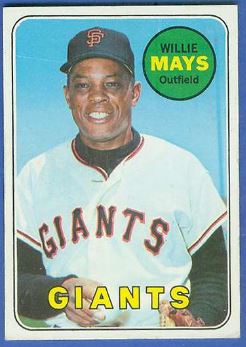
As usual, when I began to look into the runs scored in an extra frame once again “one thing led to another – and another,” all related to extra innings, of course. I was drawn to the Braves/Giants game of July 2, 1963. That was a matchup between a pair of future Hall of Famers – 42-year-old Warren Spahn (in his 18th MLB season) and 26-year-old Juan Marichal (in his fourth MLB campaign). The two matched up in a 16-inning duel – that was still scoreless (with both starters in the game) going into the bottom of the sixteenth inning.  That’s when Willie Mays took Warren Spahn deep to left for a game-winning home run. Why was that notable?

  1. It was one of Mays’ career MLB-record 22 extra-inning homers.
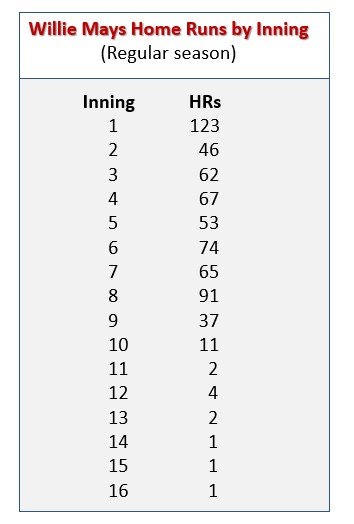
  2. Thanks to that round tripper, May is the only player to homer in every inning one-through-sixteen. (More #InBasedballWeCountEverything.)
  3. It created a nice “bookend.” On May 28, Mays hit his first career home run, which was also his first first-inning homer – and it came off Spahn. The July 2, 1963 long ball (again off Spahn) was his first (and only) 16th-inning blast.

Primary Resources:  Stathead.com; Baseball-Almanac.com; Extra Inning Home Runs, Baseball Research Journal (1976), Ray Gonzalez.

______________________________________________

100Baseball Roundtable is on the Feedspot list of the Top 100 Baseball Blogs.  To see the full list, click here.

I tweet baseball @DavidBaseballRT

Follow/Like Baseball Roundtable’s Facebook Page here.  More baseball commentary; blog post notifications; PRIZES.

Member: Society for American Baseball Research (SABR); The Baseball Reliquary; The Negro Leagues Baseball Museum.
 

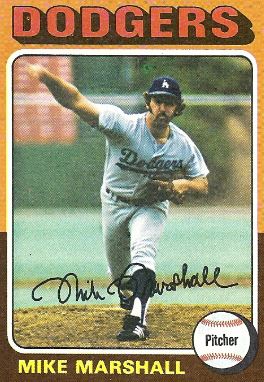
Mike Marshall … Very Good at Retiring Batters Late – Less Proficient (fortunately) at Retiring Early

On this date (May 15) in 1978, Mike Marshall made his first appearance on the mound for my hometown Minnesota Twins.  He came on in the ninth inning (in relief of Greg Thayer) with a runner on first, one out and the Twins and Orioles  tied at 6-6. Marshall closed out the ninth, tossed a scoreless tenth and got the win on a Willie Norwood walk-off, three-run homer in the bottom of the tenth inning.

Mike Marshall pitched a record 208 1/3 innings in relief in 1974.

That Marshall would be successful in relief was no surprise, nor was the fact that the “closer” would pitch more than an inning.  However, his appearance on the mound was in itself a bit unexpected. Marshall had endured a disappointing 1977 (which included a mid-season team change) and had also undergone back surgery late in the year (as well as knee surgery before the 1977 season). He let it be known that he was retiring as a player.  Marshall was, however, coaxed out of retirement  (in May of 1978) by Twins’ Manager Gene Much.   Was it a good decision? Well, Marshall saved 21 games (and won ten) for the Twins over the remainder of the season – and the following year (as a Twin) led the American League in saves and set the still-standing AL record for appearances in a season by a reliever (89).

But I’m getting ahead of myself.  Before, we get a look at Mike Marshall’s overall career on the bump, let me note that 1978 wasn’t the only time Mike Marshall contemplated “early retirement.” And, if he had followed through on either occasion, the MLB record books would look a bit different,

Mike Marshall – A Career that was “One for the Books.”

Marshall was a multi-sport (baseball, football and basketball) athlete in high school.  He was offered a baseball scholarship by Michigan State University, but signed (in 1960) as a free agent with the Phillies. (Reportedly there was some contention over the size of the scholarship.)

Marshall  started his professional career as a shortstop, where he showed promise at the plate.   Between 1961 (at age 18) and 1964, he was promoted every season, moving form Class D to AA. His best season was 1963, for the Class A Magic Valley Cowboys, where he hit .304, with 14 home runs, 76 RBI and ten stolen bases in 107 games.

The grind of everyday play, however, put significant stress on a childhood back injury and, in 1965, Marshall took his shortstop’s arm to the mound – which proved to be a fortuitous  move.  On May 31, 1967, Marshall made his major-league debut – for the Detroit Tigers. That season, he pitched in 37 games, going 1-3, with 10 saves and a nifty 1.98 earned run average.

Thus began Mike Marshall’s major-league odyssey. One that would last 14 seasons, put him on the mound for nine teams, survive one contemplated retirement and one announced retirement, and etch his name into the record books. Oh, and along the way, he would pursue his education part-time. (He would eventually earn a trio of degrees including a Ph.D. in Kinesiology.  Ironically, from the same university whose scholarship he declined.)

By the end of 1973, Marshall had six MLB seasons on his resume (Tigers, Pilots Astros, Expos) – as well as a reputation for being both opinionated and outspoken. At this point in his MLB career, he had a 40-48 record with 85 saves and a 3.21 earned run average. In the 1973 season (Expos), he had led the NL in games pitched (a then modern-era record 92), games finished (73) and saves (31).    Still, after the season, Marshall indicated he was contemplating retirement in order to work full-time on his doctorate.  That, and perhaps his attitude (more than his aptitude), were among the likely factors that contributed to his trade to the Dodgers.  The rest, as they is history – and historic.

A Diverse Repertoire, Particularly for a Reliever

Mike Marshall had a live fastball, slider, sinker and the pitch that built his career – a killer screwball.

In 1974, as a Dodger, he put up the grand-daddy of all relief seasons – becoming the first reliever to win the Cy Young Award and setting the still-standing record for appearances with 106 and innings pitched in a season in relief at 208 1/3. He finished the season 15-12, with a league-topping 21 saves and a 2.42 ERA.  Marshall was called on to go more than one inning in 74 games (68.5 percent of the time); and toiled three or more innings 22 times. A few other facts about Marshall’s remarkable season:

  • In 1974, Mike Marshall pitched 208 1/3 innings in relief.  In 2019, only six MLB starting pitchers toiled for more innings (led by Justin Verlander with 223).  And, in 2019, no MLB relief pitcher reached 100 innings.
  • Marshall’s longest stint came on August 19, when he came on in the seventh inning of a 7-7 game against the Cubs – and went six innings, earning the win as the Dodgers topped the Cubs 8-7 in twelve innings.
  • From June 18 to July 3, Marshall relieved in 13 consecutive regular-season games –an MLB record later tied (1986) by the Rangers’ Dale M0horcic.

How the Game Has Changed

In 1876 (according the Baseball-Reference.com), Jim Devlin pitched (started) all but the final game of the National League’s Louisville Grays’ season (a record 68 consecutive games pitched in) and finished 66 of them.  One season later, he started and finished all 61 of the Grays’ games – the only pitcher ever to pitch all of a team’s innings in a season.  In those two seasons, Devin logged a total of 1,181 innings. Side Note: Sadly, Devlin’s career was cut short when he was banned after the 1877 season, as the result of a game-fixing scandal.

  • From May 17-24, 1974, Marshall pitched eight straight days (no off days in that period).
  • On July 7, Marshall picked up a pair of saves, as the Dodgers swept a doubleheader from the Expos. Marshall pitched 1 2/3 innings in Game One and came back to go three innings in Game Two.

By the end of the 1977 season, it appeared Marshall’s MLB career was over.  His saves were down (just 28 saves over the 1975-77 seasons); his ERA was up (from 2.42 in 1974 to 3.29 in 1975, 3.99 in 1976 and 4.75 in 1977); he had endured a rib cage injury, as well as knee and back surgery; and there was speculation that his vaunted screwball had taken a n irreversible toll on his arm,   After the 1977 season he decided  to retire as a player.  That is until a call from Gene Mauch – who Marshall respected as a manager (and who had proven, while managing Marshall in Montreal, that  he could deal with Marshall’s at times contentious personality and unorthodox approach to the game). As Marshall said later, Mauch was the one baseball man he couldn’t say no to.

Earlier, I touched on Marshall’s first (1978) season in Minnesota.  In his second Twins’ campaign (1979), Marshall – at age 36 – made the record books again, setting  the AL record for appearances by a reliever (89 -tied by Mark Eichhorn in 1987) and total appearances in a season (90). Yes, he started one game. He led the AL in saves (32) and put up a 2.65 ERA.  He pitched 142 2/3 innings and pitched more than one  inning in 50 of his 89 relief appearances; three or more innings ten times.  After that AL record-setting campaign, Marshall pitched just two more MLB seasons (Twins/Mets) appearing in a total of 38 games (4-5, with one save and a 4.41 ERA).

Thus is the saga of Mike  Mike Marshall,  whose final MLB line as 97-112, 3.14, with 188 saves, 724 appearances (24 starts), 1,386 2/3 innings pitched, 52 walks, 880 strikeouts, two All Star selections and one Cy Young Award.  He led his league in mound appearances four times, games finished five times and saves three times. He finished in the top five for the Cy Young Award four times and  in the top-ten for league MVP three times.  He pitched at a time when relievers arrived early and stayed late – and he set the standard for closers willing to work overtime.

For a past post on other MLB fireman who came to work early and stayed late, as well as some statistics that illustrate the changing role of relievers, click here.

Primary Resources:  Baseball-Reference.com; “Mike Marshall, the Best and the Brightest,” Ron Fimrite, Sports Illustrated, July 2, 1979; “43 Years Ago:  Mike Marshall Wins Cy Young,” David Schoenfield, ESPN, November 6, 2014.

Baseball Roundtable Disclaimer:  The MLB records referenced in this (and previous) posts have the potential to change as Major League Baseball recognizes and incorporates Negro League records from 1920-46 into the MLB record book.

_______________________________________________

100Baseball Roundtable is on the Feedspot list of the Top 100 Baseball Blogs.  To see the full list, click here.

I tweet baseball @DavidBaseballRT

Follow/Like Baseball Roundtable’s Facebook Page here.  More baseball commentary; blog post notifications; PRIZES.

Member: Society for American Baseball Research (SABR); The Baseball Reliquary; The Negro Leagues Baseball Museum.
A Hero for Zeroes … Backstop Curt Casali’s Shutout Streak

Baseball photoYesterday, the Giants started Curt Casali (signed as a free-agent this January) behind the plate for the seventh time this season – and the acquisition continued to pay off.   The Giants shut out the Marlins 3-0 (on two hits).  Notably, in Casali’s last five starts behind the plate (between April 11 and April 22), Giants’ pitchers have turned in five shutouts. According to the Elias Sports Bureau, that makes Casali just one of five catchers to backstop shutouts in at least five consecutive starts.  The other are:

  • Francisco Cervelli, Pirates (June 10-June 16, 2015)
  • Chris Hoiles, Orioles (September 26-October 1,1995)
  • Alan Ashby, Astros (September 23-October 1, 1986) Ashby’s streak included two games which he started, but did not finish.
  • Record-holder Ed Phelps, Pirates, who started six consecutive shutouts between June 2 and June 8, 1903. One of Phelps’ shutouts was a six-inning complete game.

Put Me In Coach …

Curt Casali has started seven games behind the plate for the Giants this season. In those contests, San Francisco is 6-1, with a 1.21 earned run average.  In games not started by Casali at catcher, the Giants are 6-6, with an ERA of 4.04. 

Casali’s five start shutout streak included:  a 4-0 win over the Rockies on April 11; a 3-0 win over the Reds on April 14; a 1-0 win over the Marlins on April 18; a 2-0 win over the Phillies on April 19; and a 3-0 win over the Marlins on April 22.  Mid-streak, Casali did catch the final 3 2/3 innings of a April 17 10-inning 7-6 loss to the Marlins.

A few other tidbits:

  • Casali is the first catcher to start five consecutive shutouts by a different starting pitchers (Anthony DeSclafini, Johnny Cueto, Alex Wood, Kevin Gausman, Aaron Sanchez.
  • A bit of how the game has changed. There were 19 pitching changes in Casali’s five consecutive shutouts started. In Ed Phelps ‘record six consecutive shutouts started, all were complete games and only four pitchers were used (Deacon Phillips and Sam Leever with two shutouts each, Kaiser Wilhelm, and Ed Doheny).

As of April 22, the 32-year-old Casali, who is in his eighth MLB season (Rays, Reds, Giants), has played 336 MLB games (a high of 84 in 2016 & 2019).

Primary Resource: Baseball-Reference.com.; Elias Sports Bureau

100Baseball Roundtable is on the Feedspot list of the Top 100 Baseball Blogs.  To see the full list, click here.

I tweet baseball @DavidBBRT

Follow/Like Baseball Roundtable’s Facebook Page here.  More baseball commentary; blog post notifications; PRIZES.

Member: Society for American Baseball Research (SABR); The Baseball Reliquary; The Negro Leagues Baseball Museum.
MLB’s Least Likely Perfect Game – Nine Years Ago … and Other “Perfecto” Tidbits

Photo by Keith Allison

Photo by Keith Allison

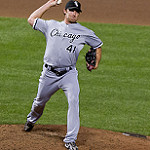
On this date (April 21) in 2012, the White Sox’ Philip Humber threw what is arguably the most unlikely perfect game in MLB to date – as his White Sox topped the Mariners 4-0 in Seattle. In the game, Humber fanned nine and did not reach a three-ball count on any batter until the bottom of the ninth, when he recorded a pair of swinging strikeouts on 3-2 pitches.

Why does BBRT see this “perfecto” as so unlikely?  For one thing it was the only complete game in Humber’s eight-season MLB career. In addition, if you look at his overall numbers, his 15 career wins (versus 23 losses) are the fewest career victories of any of MLB’s 23 perfect game pitchers – and his 5.11 career earned run average is the highest among those hurlers. (See chart at the end of this post.) Further, in that 2012 season, Humber went 5-5 with a 6.44 ERA.

As long as we are on the topic of perfect games, here are a few additional tidbits.

  • No pitcher threw fewer pitches than the Indians’ Addie Joss, who needed just 74 pitches to complete nine perfect frames against the White Sox in a 1-0 win on October 2, 1908. Notably, Joss may not have had the best “stuff” from the mound that day. Ed Walsh, who started and tossed an eight-inning complete game for the White Sox gave up just one run on four hits – while fanning 15 batters to Joss’ three.
  • A little competition is apparently a solid motivator. Eight of MLB’s 23 perfect games have ended in a 1-0 score – the most common perfect-game outcome.
  • Eleven perfect games have seen the winning pitcher strike out ten or more batters – with Sandy Koufax (September 9, 1965) and Matt Cain (June 13, 2012) sharing the record at 14 whiffs.
  • The most pitches thrown in a perfect game is 125 – by the Giants’ Matt Cain in his 10-0 perfect-game win over the Astros on June 13, 2012. The high pitch count is mainly attributable top Cain’s 14 strikeouts (he only went to a three-ball count on four batters in the game).  The Giants’s ten tallies, by the way, are the most ever by a team in a game in which their starter was perfect.
  • John (Monte) Ward (perfect game on June 17, 1880) appeared as a pitcher in just seven of his 17 MLB seasons and in just 293 of his 1,827 MLB games. He also appeared at 2B, SS, 3B and OF.
  • Charlie Robertson holds the record for tossing a perfect game the earliest in his career. His April 30, 1922 perfect outing came in just his fourth career game and third career start.
  • Since 1900, the largest attendance record at a perfects game is 64,519 – for Don Larsen’s perfecto in the 1956 World Series. The smallest recorded crowd at a perfect outing is 8,375 for Mike Witt’s perfect game (for the Angels) on September 30, 1984.
  • The youngest pitcher to toss a perfect game is John Ward, who was just twenty when he fashioned a perfect game for the Providence Grays (a 5-0 win over the Buffalo Bisons) on June 17, 1880.
  • The oldest pitcher to complete a perfect outing was 40-year-old Randy Johnson (May 18, 2004).
  • Catfish Hunter had three hits and three RBI at the plate the day he retired 27 consecutive batters from the mound (May 8, 1968).
  • Len Barker (May 15, 1981) threw the first perfect game with a designated hitter in the lineup.
  • David Cone (Yankees verso Expos – July 18, 1999) threw the first perfect game in inter-league play.

perfectpo

Baseball Roundtable Disclaimer:  The MLB records referenced in this (and previous) posts have the potential to change as Major League Baseball recognizes and incorporates Negro League records from 1920-46 into the MLB record book.


Primary Resources: Baseball-Reference.com; Baseball-Almanac.com; MLB.com

100Baseball Roundtable is on the Feedspot list of the Top 100 Baseball Blogs.  To see the full list, click here.

I tweet baseball @DavidBBRT

Follow/Like Baseball Roundtable’s Facebook Page here.  More baseball commentary; blog post notifications; PRIZES.

Member: Society for American Baseball Research (SABR); The Baseball Reliquary; The Negro Leagues Baseball Museum.
Rodon Throws a No-Hitter… and Baseball Roundtable’s Mind Wanders

Baseball Roundtable Disclaimer:  The MLB records referenced in this (and previous) posts have the potential to change as Major League Baseball recognizes and incorporates Negro League records from 1920-46 into the MLB record book.

Carlos Rodon photo

Carlos Rodon – Photo by rchdj10

I began the day seeking inspiration for a topic for this post – and was immediately drawn to yesterday’s (April 14, 2021) no-hitter by White Sox’ southpaw Carlos Rodon.  As readers know, when I begin digging into a baseball topic, my mind can wander and “one thing often leads to another.”  Rodon’s no-no took me on  a journey of inspiration that did not lead in the direction I expected.

Here’s kind of how my though process went.

First, there was the fact that this was the second no-hitter this April.  Turns out that ties the record for April no-hitters, but it’s been done eight times. Maybe a topic if the record is broken over the next couple of weeks.

Photo by Keith Allison

Philip Humber – Photo by Keith Allison

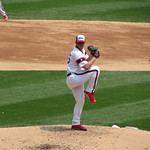
Then, I latched on to the fact that the no-hitter came in what was just Carlos Rodon’s second MLB complete game.  Then again, in April of 2012 (April 9), the White Sox’ Philip Humber threw not  just a no-hitter, but a perfect game, in the first-and-only complete-game in his eight-season MLB career.   Time to keep looking.

Next , I noted that Rodon lost a perfect game – on a hit batsman with one out in the ninth and final inning. (Rodon completed the no-hitter for an 8-0 win.) Plunking an opposing hitter – a tough way to lose a perfecto, even if you save the no-hitter.  Well, the Nationals’ Max Scherzer (on June 20, 2015) had a perfect game with two outs and two strikes on the batter in the ninth, when he plunked Pirates’ pinch-hitter Jose Tabata on a 2-2 pitch (in a tough eight-pitch at bat). Like Rodon, he completed the no-hitter (for a 6-0 win). I’d already written about that one, so I kept looking.

Plunking the Pitcher – Ouch.

On July 4, 1980, The Giants’ George “Hooks” Wiltse (Guess what his signature pitch was?) had a perfect game going with two outs in the top of the ninth and two strikes (a 2-2 count) on the batter  – Phillies’ starting pitcher George McQuillan.  On that 2-2 pitch, Wiltse hit McQuillan – ending the perfecto.  (Umpire Cy Rigler later said he missed the call on a 1-2 pitch to McQuillan and should have rung him up).  Wiltse retired the next batter, but his day was not done – since the score was 0-0.  The Giants (and Wiltse) eventually won in ten frames and Wiltse recorded a ten-inning no-hitter. Nickname note:  Hooks Wiltse’s brother – Lewis “Snake” Wiltse – also pitched in the major leagues. 

At this point, my mind wondered to hit batsmen and to a game earlier in the week (April 13), when the Pirates topped the Padres in Pittsburgh by an 8-4 score. The game featured 20 hits, 17 walks, three wild pitches and seven hit batsmen.  Maybe there was inspiration there? Those seven hit batters sent Baseball Roundtable to the record books, where I learned that the record for hit batsmen (both teams) in a single game is nine (Washington Senators versus Pittsburgh Pirates on May 9, 1896) – and the post-1900 record is eight (Cubs versus Reds on July 27, 2020). In that game, the victims were:  Cubs – Anthony Rizzo (twice), Kris Bryant, Willson Contreras, and Albert Amora; Reds – Curt Casili, Jesse Winker and Freddy Galvis.  Still not quite the inspiration I needed. So, my mind (and research) wandered further.

I discovered that while 56 players have hit two home runs in an inning (five of them twice), only eight players have been hit by a pitch twice in one frame.  That was it! In this post,  I’d like to look at those who share that painful record – as well as a few other HBP tidbits.

—–Players Hit by A Pitch Twice in One Inning—–

Willard Schmidt, Reds … April 26, 1959

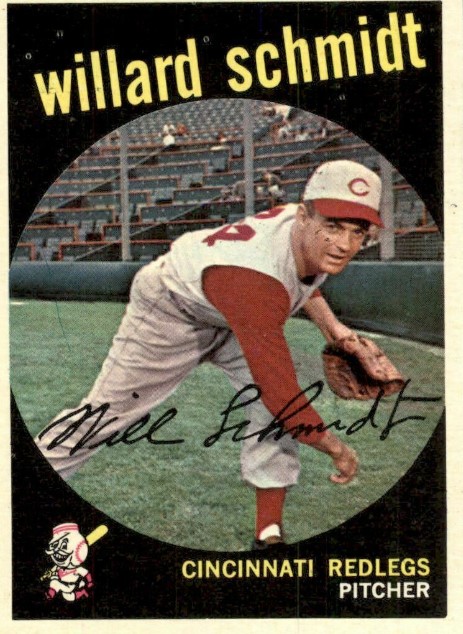
SchmidtIronically, the first MLB player to be hit by a pitch twice in one inning was a pitcher – and one who was on the mound for just two-thirds of an inning in that game and in the batter’s box in only one inning. Willard Schmidt replaced Reds’ starter Joe Nuxhall with two on, one out and the Braves ahead 3-0 in the top of the second.  (Nuxhall had just walked two batters in a row.) Schmidt got Braves’ C Del Crandall to hit into a double play to end the inning.

After Reds’ SS Roy McMillan led off the bottom of the third with a single off Lew Burdette, Schmidt was hit by a Burdette offering. Two pitchers and six runs later, Schmidt found himself facing reliever Bob Rush with two on and two out.  Rush hit Schmidt with a pitch, loading the bases and then retired 2B Johnny Temple to end the inning.  After Braves’ SS Johnny Logan singled to open the top of the fourth, Schmidt was replaced by Orlando Pena. Schmidt the way, was one of eight Reds’ pitchers used in the 11-10 Reds’ win.  (The Braves used six, including Warren Spahn, who took the loss in relief.)  Schmidt went 31-29, 3.93 in seven MLB seasons. As a batter he was .163-0-7 and was hit by a pitch just four times – three in 1959.

Frank Thomas, Mets … April 29, 1962

Frank Thomas (not the “Big Hurt” Thomas) suffered a hurtful afternoon as his Mets topped the Phillies 8-0 in New York.  Thomas was in LF batting cleanup. In the seven-run fourth inning, Thomas first faced Phillies’ starter Art Mahaffey with one on and no out. To this point, Mahaffey had been cruising, with the only damage one by Thomas.  In the first two frames, Mahaffey had given up just one hit and fanned four.  The only hit was a home run by Thomas. In his second plate appearance versus Mahaffey,  Thomas was hit by a pitch. By the time the lineup made a full turn, Mahaffey was gone, the Mets were up 8-0 and Frank Sullivan was on the mound for Philadelphia.  To make a long story short, Thomas was plunked again. Thomas ended the day one-for-two with two runs scored and one RBI. He ended the season .266-34-94, with eight HBP’s.  Over his career (16 MLB seasons), Thomas was .266-286-962, with 51 HBPs, leading the league with ten HBP in 1954. In his record-tying HBP game, no other batter was hit.

Andres Galarraga, Rockies … July 12, 1996

The Rockies topped the Padres 13-12 (in Colorado) in the game in which Andres Galarraga was plunked twice in one inning.  Galarraga was playing 1B and batting sixth.  He came up with one out and no one on in the bottom of the seventh,  with the Rockies trailing 9-2. Reliever Bryce Florie hit him with an 0-2 pitch, which would prove to be the start of an 11-run rally. By the time, Galarraga came to the plate again, there was still only one out, the Padres were on their third pitcher of the frame and nine runs had crossed the plate. This time, Galarraga was hit on a 0-0 pitch from Willie Blair. The Rockies would go on to send five more batters to the plate before the half inning ended. Galarraga finished the game one-for-two, with two runs scored and one RBI. He finished the season with a .304 average, a league-leading 47 home runs and a league-topping 150 RBI. He was hit by a pitch 17 times. For his 19-season MLB career, Galarraga was .288-399-1,424 – and was hit by a pitch 179 times (leading the league twice).  In his record-tying game, Rockies’ pitchers also notched two HBPs.

Brady Anderson, Orioles … May 23, 1999

Anderson’s punishing afternoon began as he led off the very first inning of an Orioles’ 15-6 victory over the Rangers (in Baltimore). The Orioles’ CF was plunked by Rangers’ started Mike Morgan to open the bottom of a ten-run first frame. Three singles, two doubles, a walk, a sacrifice fly and a fly out later (not necessarily in that order), Anderson faced Morgan for a second time and was plunked a second time, ending Morgan’s day. There was, by the way, no retaliation. Anderson was the only batter hit in the contest. Anderson ended the day one-for-three, with two runs scored and one RBI. He finished the season with a .263-13-66 stat line and was hit by a pitch ten times. In his 15-season MLB career, Anderson would be plunked 154 times, leading the league in that category three times.

Mike Hessman, Tigers …. September 8, 2008

Hessman was playing third and batting eighth in the Tigers’ 14-8 win over the A’s in Detroit. He led off the bottom of what would be a six-run second inning and was hit by a 1-2 pitch from A’s starter Gio Gonzalez. He came up later in the inning with Josh Outman on the mound and was plunked again, this time on an 0-2 pitch. There were four HBPs in the game – three by the A’s and one by the Tigers. Hessman was one-for-three in the contest, with a home run, two runs scored and one RBI. He finished the season hitting .296-5-7 in just 12 games. The two September 8 HBP that gave him a share of the record were his only plunkings of the season.  Hessman played 109 MLB games over five seasons – going .188-14-33, with a total of five HBPs.

Jose Guillen, Giants … September 23, 2010

Guillen started in RF, batting sixth, as the Giants defeated the Cubs 13-0 in Chicago.  It was pretty much total domination behind seven shutout innings from Madison Bumgarner (seven hits, one walk, nine strikeouts).  Overall, Giants’ pitchers fanned 12 and walked one, while Cub’s hurlers walked three, three fanned five and gave up four home runs (among the Giants 19 hits) to the Cubs’ seven safeties. Guillen was the only batter hit in the game. Guillen’s plunkings came in the nine-run second. He led off the inning by getting hit on a 1-1 pitch from starter Ryan Dempster, whose inning then went home run, strikeout, single, double, RBI single, strikeout, RBI single, run-scoring wild pitch, walk – and then the second plunking of Guillen (on the first pitch of this plate appearance). That ended Dempster’s day. Thomas Diamond (good baseball name) came on and immediately gave up a Grand Slam to SS Juan Uribe.  Guillen finished the game one-for-one with two runs scored. He finished the season (the last of his 14 MLB campaigns) at .258-19-77, with 14 HBPs.  For his career, Guillen was .270-214-887 and was hit 145 times, leading the league once.

David DeJesus, Cubs, … June 18, 2012

David DeJesus led ff and played CF when the Cubs topped the Dodgers 12-3 on June 12, 2012. He led off the Cubs’ six-run seventh inning by getting hit on a 2-1 pitch from reliever Will Ohman. When DeJesus’ turn at the plate came around again, the Cubs had scored six times and Hector Santiago was on the mound.  He hit DeJesus with a 2-2 offering. Those were the only two HBPs in the game.  For the contest, DeJesus was zero-for-three with a run scored.  He finished the season, .263-9-50, with nine HBP.  For his 13-season MLB career, DeJesus was .275-99-573, with 103 HBP, leading the AL with 23 in 2007.

Brandon Moss, A’s …  April 25, 2014

Moss was playing LF and batting in the five-hole as the A’s topped the Astros 12-5 in Houston – and he almost escaped that evening’s game unscathed.  His two-HBP inning started as he led off the top of the ninth (against reliever Josh Fields, who had just entered the game) with the game knotted at 5-5. In that first ninth-inning plate appearance, Fields hit Moss on a 1-2 pitch. By the time, Moss came up again in the inning, seven runs were in and Anthony Bass was on the mound.  Bass hit Moss on an 0-2 pitch.  (It’s surprising how many of the plunkings among these record sharers came with two strikes on the batter.) Moss finished the game two-for-four with one run scored. He finished the season at .234-25-81, with ten HBP’s.  In an 11-season MLB career, Moss hit .237, with 160 home runs, 473 RBI and 36 HBP. One other batter was hit in Moss’ record-tying game (Jason Castro of the Astros).

A few other HBP Tidbits:

  • The MLB career record for hit-by-pitch goes to Hughie Jennings (who played 17 seasons between 1891 and 1918 – and was plunked 287 times). He led the league in HBP five times and was hit an MLB-record 51 times in 1896.
  • The post-1900 record for HBP belongs to Craig Biggio – hit 285 times in a 20-season career (1988-2007). Like Jennings, he led his league in HBP five times.
  • No MLB player led the league in HBP in more seasons than Minnie Minoso, who topped the AL in plunkings ten times in a 17-season MLB career.
  • Ron Hunt holds the MLB record for consecutive seasons leading the league in HBP at seven (1968-74).
  • Ron Hunt was hit fifty times in 1971, the only player post-1900 to be hit more than 37 times in a season – and the only MLB player other than Hughie Jennings to be plunked 50 or more times in a campaign (Jennings – 51 in 1896).
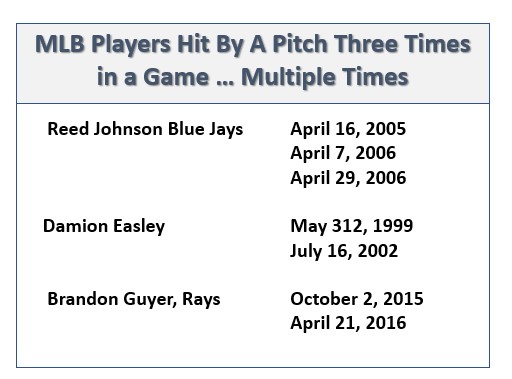
  • Twenty-six players have been hit by a pitch three times in a game – three of those have suffered this punishment more than once.  A few notable names that have been plunked three times in a game include: Bill Freehan, Nomar Garciaparra, Nap Lajoie, Sherm Lollar,  Mel Ott, Manny Ramirez.  (For Minnesota readers, Corey Koskie and Craig Kuscik make this list.)HBP

Coming in the future, a look at HBP stats from the pitchers’ point of view.


Primary Resources:  Baseball-Almanac.com; Baseball-Reference.com; MLB.com

100Baseball Roundtable is on the Feedspot list of the Top 100 Baseball Blogs.  To see the full list, click here.

I tweet baseball @DavidBBRT

Follow/Like Baseball Roundtable’s Facebook Page here.  More baseball commentary; blog post notifications; PRIZES.

Member: Society for American Baseball Research (SABR); The Baseball Reliquary; The Negro Leagues Baseball Museum.

When Wally Moon Bested Hank Aaron and Ernie Banks

 On this date (April 13) in 1954, a 24-year-old outfielder named Wally Moon made his debut for the St.Louis Cardinals – playing CF and batting second against the Cubs on Opening Day in St. Louis. Moon got his MLB career off to a good start, hitting a solo home run (off Paul Minner) in his first MLB plate appearance. He book-ended a solid rookie campaign by also going yard in his final plate appearance of the season – a two-run shot off the Braves’ Ernie Johnson (a game-winner) in the top of the eleventh inning in Milwaukee. His did pretty well in between those two dingers, finishing his rookie season with a .304 average, 12 home runs, 76 RBI, 106 runs scored and 18 stolen bases.
 
So, how did Moon “best” Hank Aaron and Ernie Banks? In the NL Rookie of the Year balloting, Moon emerged the winner with 71 percent of the vote – followed by Ernie Banks (17 percent), Gene Conley (8 percent) and Hank Aaron (4 percent). 
Moonfinal
Later in his career, Moon would gain (positive) notoriety for his “Moon Shots”- home runs launched (for the Dodgers)  into the left field seats at the LA Coliseum (were the transplanted Dodgers played from 1958-61).  The Coliseum clearly was not an ideal location for baseball – with its 440-foot distance to right-center and 250-foot distance (with a 40-foot high screen) down the left field line. It was 300-feet down the right-field line, but the fence angled out quickly to 400-foot-plus distances. A left-handed hitter, Moon adjusted his swing to hit looping fly balls off of or over that left field screen – popularly termed “Moon Shots” by fans and media.
Moon enjoyed a 12-season MLB career (Cardinals – 1954-58/Dodgers – 1959-65).  He ended with a stat line of .289-142- 661, was a two-time All Star (1957 & 1950), won a Gold Glove in 1960 and, of course, was the NL Rookie of the Year in 1954. He led the National League in triples and on-base percentage once each; hit .295 or better in seven seasons (a high of .328 in 1961) and hit a career high 24 home runs in 1957.
Closing It Out in Minnesota
For BBRT’s Minnesota readers, Wally Moon’s final major-leaguer plate appearance came against the Twins’ Mudcat Grant   at Metropolitan Stadium on October 13, 1965 (Game Six of the 1965 World Series). Moon pinch hit and grounded out second-to-first.) That, of course, is the game in which Grant pitched a complete-game six-hitter (one run surrendered) and also knocked a three-run home run. (More #WhyIHateTheDH). 
Primary Resources:  Baseball-Reference.com; “Coliseum’s dimensions affected the play on the field,” Rob Neyer, ESPN, March 29, 2008.

100Baseball Roundtable is on the Feedspot list of the Top 100 Baseball Blogs.  To see the full list, click here.

I tweet baseball @DavidBBRT

Follow/Like Baseball Roundtable’s Facebook Page here.  More baseball commentary; blog post notifications; PRIZES.

Member: Society for American Baseball Research (SABR); The Baseball Reliquary; The Negro Leagues Baseball Museum.