It’s May 1, and that means it’s time for Baseball Roundtable’s April Wrap Up – statistics and stories that caught BB Roundtable’s eye in April; leader boards for the month; BBRT’s Players and Pitchers of the Month; and the monthly Trot Index.
Here’s a hint at the kind of things you’ll read about – if you make it to the end of this post.
- The season’s first no-hitter, first triple play and first Immaculate Inning;
- A total of one complete game, and it wasn’t the no-hitter;
- Miguel Cabrera’s 3,000th base hit;
- A bases-loaded intentional walk;
- A walk-off home run by a player named Beer on National Beer Day.
- A pitcher pulled after 80 pitches, while seven innings into a perfect game.
For all this and more, read on. If the stats don’t grab you, you can scroll to the Players/Pitchers of the Month and Highlights sections.
BASEBALL ROUNDTABLE PLAYERS AND PITCHERS
OF THE MONTH FOR APRIL
—–Players of the Month—–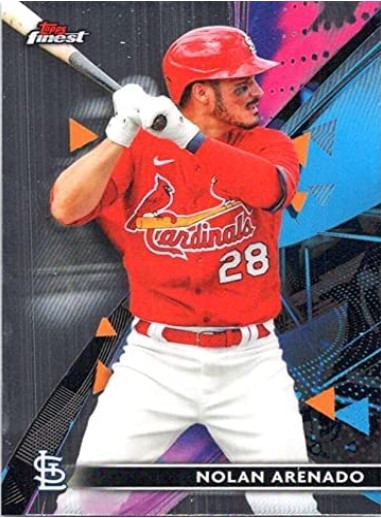
National League – Nolan Arenado, 3B, Cardinals
Arenado hint .375-5-17, with nine walks for the month (second in the NL in RBI, fifth in home runs and third, among qualifiers, in batting average.) He led NL qualifiers in slugging percentage (.681) and was also in the top five in in on-base parentage (.444), Arenado started the month with an eight-game hitting streak and, ultimately, hit in 16 of 19 games; with seven multi-hit contests. And, let’s not forget, he also flashed some pretty good leather at the hot corner.
Starting his tenth MLB season, the 31-year-old Nolan Arenado has won nine Gold Gloves at the hot corner.
Honorable Mentions: Eric Hosmer, 1B, Padres, led all MLB qualifiers with a .389 average (three home runs, 14 RBI). His 28 hits (in 20 games) tied for third-highest in MLB this April. Manny Machado, 3B, Padres hit 386 for the month, with four home runs, 15 RBI and an MLB-best 20 runs scored. His 32 April hits led MLB; Rockies’ first-sacker C.J. Cron led the NL with seven home runs (.273 average and 19 RBI) – a 21-to-5 ratio of strikeouts-to-walks hurt his standing. Really, for me, it was pretty much a toss up among Arenado, Machado and Hosmer.
American League … Jose Ramirez, 3B, Guardians
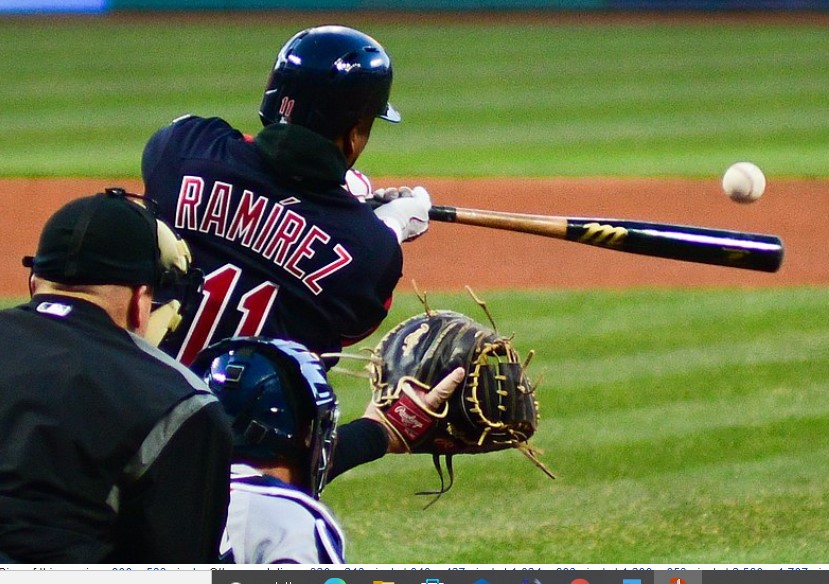
Photo: Erik Drost, CC BY 2.0 <https://creativecommons.org/licenses/by/2.0>, via Wikimedia Commons
Ramirez is a hitting machine. In April, he led MLB in RBI with 28, was second in MLB and led the AL in home runs with seven, led MLB qualifiers in slugging percentage at .722 and hit a robust .342. He also showed good plate discipline with nine walks and nine strikeouts. During the month, he had a six-RBI game and a pair of four-RBI contests. He collected hits in 17 of 21 games played,with seven multi-hit games.
Honorable Mentions: Yankees’ 1B Anthony Rizzo, whose nine April home runs led MLB (a .273 average and 21 RBI); Red Sox’ SS Xander Bogaerts, who hit .375-1-9 for the month, collecting 30 hits (second in MLB) and scoring 12 runs.
—–Pitchers of the Month—–
National League – Pablo Lopez, RHP, Marlins
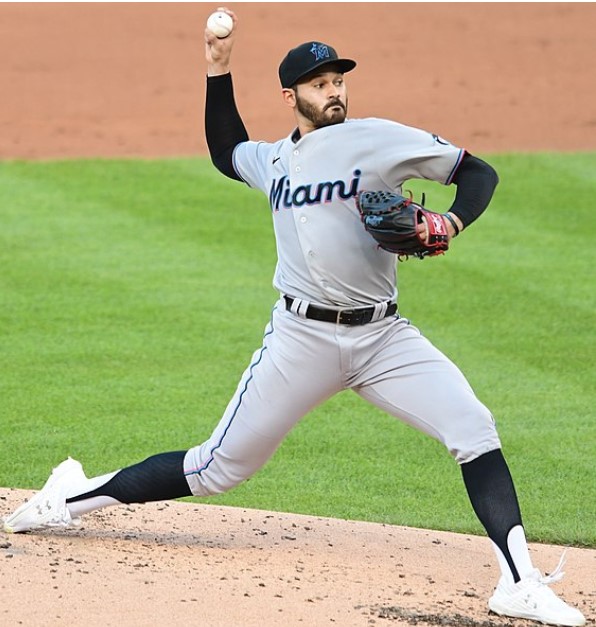
Photo: All-Pro Reels from District of Columbia, USA, CC BY-SA 2.0 <https://creativecommons.org/licenses/by-sa/2.0>, via Wikimedia Commons
Wow! Pablo Lopez put up a 3-0 record, with an MLB-lowest (among qualifiers) 0.39 earned run average. He also fanned 23 hitters and walked just four in 23 1/3 innings and didn’t give p a single home run. In his one no-decision, he gave up one run in five innings against the Giants (his first start, April 9). It was the only run he gave up in four April starts. His best game came against the tough Cardinals on April 21. He went seven innings, giving up just three hits and no walks, while fanning nine. The 26-year-old, out of Venezuela, came into the season with an MLB record of 18-21, 4.04, but was 5-5, 3.07 in 2021.
On July 11, 2021, Lopez started against the Braves (in Miami) and set an MLB record by fanning the first nine batters in a game – using just 35 pitches (30 strikes, including foul balls) to record the nine whiffs. He got the win, as the Marlins topped Atlanta 7-4. Lopez gave up three runs over six innings (five hits, two walks, nine strikeouts).
Honorable Mentions: Carlos Rodon went 3-0 in four starts (pitching 23 innings). His 1.17 ERA was third in the NL (among qualifiers). Rodon, however, impressed by leading the NL with 38 April strikeouts; Josh Hader, Mets, was 10-for 10 in save opportunities, fanned 15 batters in 9 1/3 innings and did not allow an earned run; Kyle Wright, Braves, went 3-0. 1.13 in four starts, fanning 34 and walking just six in 24 innings; the Met’s Tylor Megill gets a nod as the NL’s only four-game winner (4-0. 1.93 … 27 whiffs and only six walks); finally, there is tough-luck Corbin Burnes. He pitched 25 2/3 innings, walked only six and posted a 1.75 ERA – yet had only one win (no losses) to show for it. In his final three starts in April, Burnes threw 20 2/3 innings and gave up just two runs (29 whiffs) -and got a win and two no-decision for his efforts.
American League – Logan Gilbert RHP, Mariners
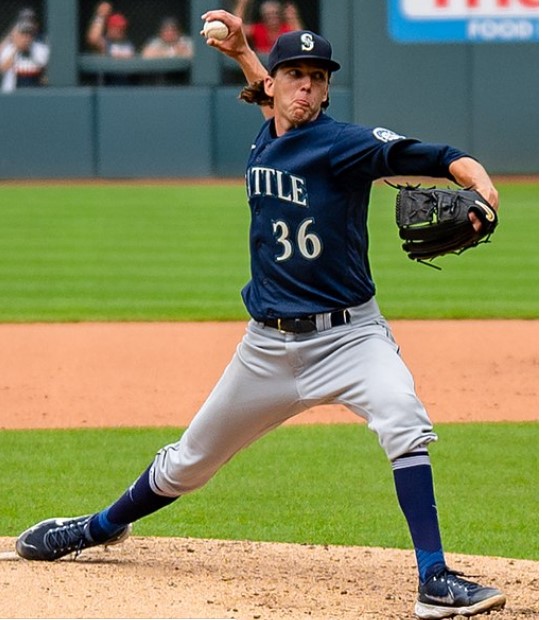
Photo: Erik Drost, CC BY 2.0 <https://creativecommons.org/licenses/by/2.0>, via Wikimedia Commons
Okay, maybe I’m a sucker for ERA (see Pablo Lopez above), but 24-year-old righty Logan Gilbert went 3-0 with an AL-best 0.40 earned run average in four April starts. In 22 1/3 innings, he fanned 22 and walked just four. He gave up a homer run to the second batter he faced this season – the Twins’ Luis Arreaz – and then didn’t surrender another earned run for the rest of the month (22 innings). (He did give up one unearned run). Gilbert, by the way, was a first-round draft choice in the 2018 MLB draft (out of Stetson University, where he went 23-3, 2.48 over three seasons). He went 11-5, 2.12 in two minor-league seasons, before being called up to the Mariners last May. In 2021, he went 6-5, 4.68 in 24 starts for Settle.,
Honorable Mentions: Alek Manoah, RHP, Blue Jays was one of just three MLB four-game winners in April – going 4-0, 1.44 in four starts (25 innings pitched), fanning 25 and walking seven; Joe Ryan, RHP, Twins, who went 3-1, with a 1.17 ERA (second in the AL), 0.70 WHIP (second) and fanned 25 batters in 23 innings; and you have to give a shout out to Astros’ 39-year-old veteran Justin Verlander, who went 2-1. 1.73 in four starts (26 innings) and recorded the lowest WHIP among MLB qualifiers at 0.69.
—–Surprise Player of the Month—-
Ty France , 1B, Mariners
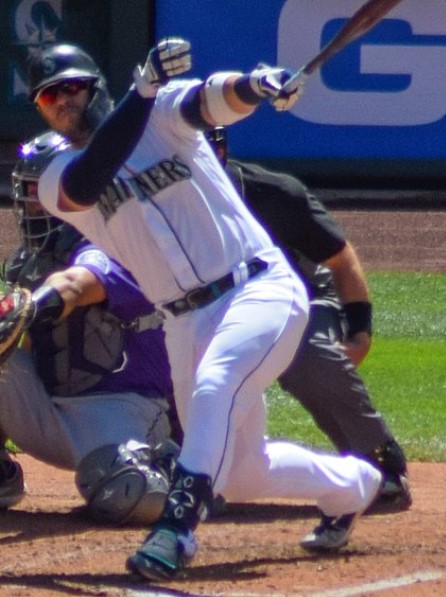 Mariners’ 27-year-old 1B Ty France closed out April with a .337-5-21 line – which placed him fifth in the AL (among qualifiers) in average, eighth in home runs and second in RBI. He was also second in the AL in hits. In April, he recorded seven multi-it games – including a five-for-six performance, with one home run and five RBI, as the Mariners topped the Royals 13-7 on April 23. He was especially tough in Seattle, hitting .474 at home – and even tougher with runners in scoring positions (11-for-19, .550). France’s emergence rates as a Baseball Roundtable surprise, but not for the reasons you might think. After all, in 2021, his first full MLB season, he put up a .291-18-73 line. What surprises The Roundtable is: 1) How was he available in the 34th round of the 2015 MLB Draft – the 1,017th overall pick (Padres), especially after putting up a .337 average in three seasons (189 games) at San Diego State? and 2) Why were the Padres were willing to trade him to the Mariners during the 2020 season? The Padres traded France, P Andres Munoz, C Luis Torrens and OF Taylor Trammell to the Mariners for P Austin Adams, P C/INF Dan Altavilla and 1B Austin Nola.
When Ty France was called up to the Padres in August of 2019, he was hitting a robust .399 in 76 games for the Triple-A El Paso Chihuahuas (118-for-296, one hit shy of .400+), with 27 home runs and 89 RBI.
Honorable Mention: Angels’ outfielder Taylor Ward came into the season as a .230 career MLB hitter (four seasons/159 games), but put up a .392-5-13 line in 14 April contests. (He started the season on the IL with a groin strain). On April 27, Ward nearly hit for the cycle – ironically missing just the single – as he went three-for-four with a walk, double, triple, home run and four RBI versus the Guardians. This may be the Taylor Ward the Angels were expecting when they made him a first-round pick (out of California State University in Fresno) in the 2015 MLB draft. (Ward did put up a .299 average in six minor-league seasons … 490 games). In 2021, Taylor hit .250-8-33 in 65 games with the Angels.
________________
TROT INDEX … A REGULAR BBRT FEATURE
Through April, 35.5 percent of the MLB season’s 23,462 plate appearances ended in a trot (back to the dugout, around the bases, to first base). We’re talking about strikeouts, home runs, walks, hit by pitch and catcher’s interference – all outcomes that are, basically, devoid of action on the base paths or in the field. Here’s the breakout: strikeouts (23.0%); walks (8.9%); home runs (2.4%); HBP (1.1%); catcher’s interference (less than 1%).
Now, to provide a little context (a more detailed post on this topic coming soon). Here are a few selected annual Trot Index scores since I began watching baseball in earnest: 1950 – 22.8 %; 1960 – 25.1%; 1970 – 27.0%; 1980 – 23.1%; 1990 – 26.1%; 2000 – 29.9%; 2010 – 30.3%; 2021 – 36.3%.
______________
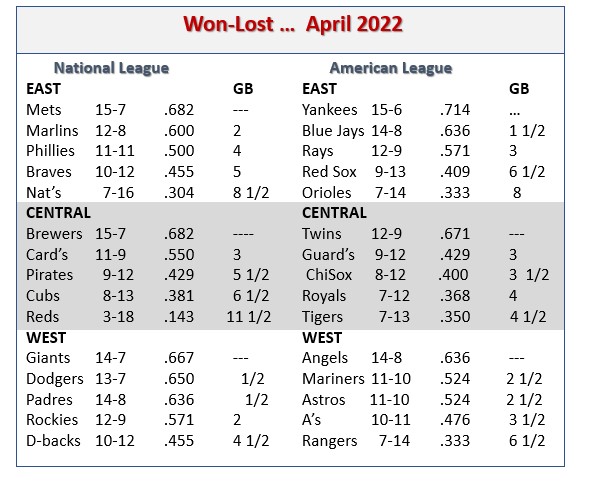
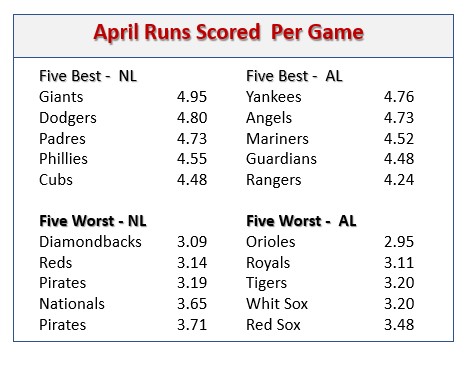
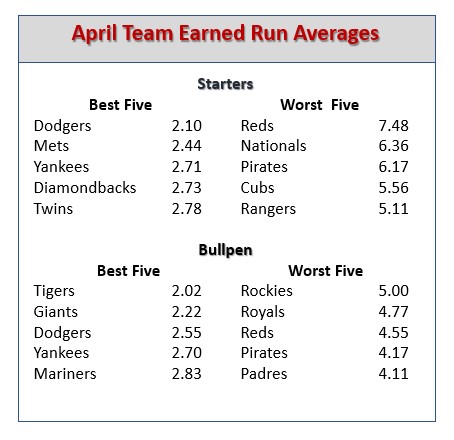
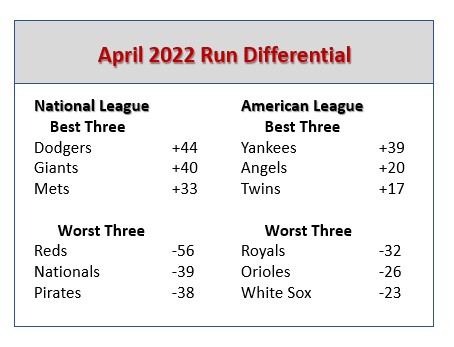
It’s a bit early to to make any judgments about how this season is going, but here are a few observations, as well as a trio of charts that may shed some light on April.
- It’s no surprise that Mets’ starters racked up 11 April wins; but it’s a little surprising that they did it without Jacob deGrom.
- It’s surprising that the Pirates did not have a single victory from a starter in April.
- It’s surprising (only just a little) that April saw only one complete-game in MLB; but not surprising that a Dodger threw it.
- It’s a little surprising to see the Angels leading the NL West and a lot surprising to see the Marlins in second place in the NL East.
- It’s not surprising to see four NL West teams playing .570+ ball, but it is surprising to see all bu tone AL Central team below .450.
- It’s surprising that the Reds have won only three games, but still have more saves (3) than the Rangers (2).
 \
\
——-Team Statistical Leaders for April ———-
RUNS SCORED (average 85)
National League – Padres (104); Giants(104); Phillies (100)
American League – Angels (104); Yankees (100); Mariners (95)
The fewest April runs were scored by Royals at 59. The Red were at the bottom of the NL with 66.
AVERAGE (average .231)
National League – Rockies (.261); Mets (.255); Cubs (.250)
American League –Angels (.255); Guardians (.251); Yankees (.250)
The lowest team average for April belonged to the Diamondbacks at .181 – the only team under.200.
HOME RUNS (average 19)
National League – Braves (28); Giants (24); Brewers (24)
American League – Blue Jays (30); Yankees (29); Angels (27)
The Tigers had the fewest home runs in April, just 8. Lowest in the NL were the Nationals and Pirates as 12 each.
STOLEN BASES (average 10)
National League – Cardinals (22); Dodgers (16);
American League – Angels (16); Rays (16); Mariners (14); Royals (14)
The Tigers stole the fewest April bases – two (in five attempts). The Cardinals were safe on 22 of 23 attempts.
WALKS DRAWN (average 69)
National League – Padres (92); Diamondbacks (82); Dodgers (82)
American League – Mariners (86); Angels (77); Twins (76)
The Mets led MLB in on-base percentage for April at .341. The Angels led the AL at .338. In slugging percentage, the Rockies on top at .426, while the Guardians led the AL at .330.
BATTER’S STRIKEOUTS (average 180)
National League – Diamondbacks (198); Brewers (198); raves (198)
American League – Orioles (208); A’s (197); Angels (193)
Royals’ batters went down on strikes the fewest times in April (138).
EARNED RUN AVERAGE
National League – Dodgers (2.29); Mets (2.85); Giants (2.87)
American League – Yankees (2.70); Twins (3.16); Rays (3.18)
Four teams had April ERAs of 5.00 or higher– Reds (5.97); Pirates (5.09); Nationals (5.08). Those three teams went a combined (19-46). Conversely, the three teams with the lowest April ERAs went a combined 43-20.
STRIKEOUTS (average 180)
National League – Brewers (222); Mets (219); Braves (207)
American League – Yankees (199); Rays (196); Red Sox (196)
The Brewers averaged an MLB-best 10.3 strikeouts per nine innings in April. The White Sox averaged an AL-best 9.7.
FEWEST WALKS SURRENDERED (average 69)
National League – Dodgers (46); Giants (52); Cardinals (59)
American League – Guardians (53); Tigers (55); Rays (57)
The Dodgers walked a stringiest 2.3 batters per nine frames. The Reds walked an MLB’s highest 5.0 per nine innings for the month.
SAVES (average 6)
National League – Brewers (11); Rockies (10); Marlins (9)
American League – Blue Jays (11); Yankees (8); A’s (7); Angels (7)
Bonus Stats – In the Field
The White Sox and Orioles made the most April errors (21 each); while the Yankees were guilty of just five April Miscues.
—-APRIL HIGHLIGHTS—-
Climbing the Ladder
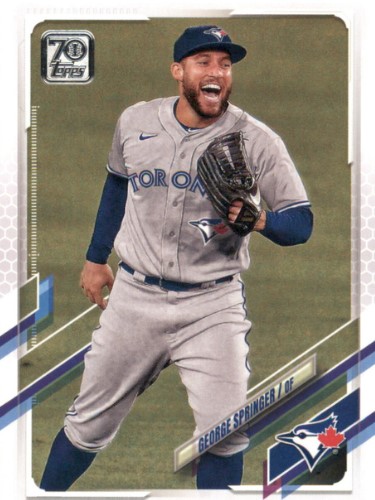 On April 30, Blue Jays’ DH and leadoff hitter George Springer led off the bottom of the first inning with a solo home run off the Astros’ Luis Garcia. He added a second long ball with one out in the third inning, but it was the first-inning shot that drew Baseball Roundtable’s attention. It was 46th leadoff home run of Springer’ career – moving him into a tie for sixth all-time in leadoff dingers. Of course, atop that leaderboard is Rickey Henderson with 81. (Side note: Springer made his lead-off home run more Henderson-like by adding a stolen base after being hit by a pitch in the fifth frame.) Springer is now in position to move further up the ladder this season. Here is the list of players with the most career leadoff home runs:
- Rickey Henderson … 81
- Alfonso Soriano … 54
- Craig Biggio … 53
- Ian Kinsler …48
- Curtis Granderson … 47
- Jimmy Rollins and George Springer …46
Welcome To The Show
On April 29, 32-year-old Jason Krizan started in LF for the Giants – and his appearance was a tribute to perseverance in following a dream. It came in his twelfth professional season, after 1,132 minor-league games. Krizan was drafted in the eighth round of the 2011 MLB Draft (Tigers) – out of Dallas Baptist University, where, in 2011, he hit .413-10-81 in 62 games. Over his 1,000+ minor league games, he hit .275-83-541. On his lengthy journey to the “show,” Krizan had several solid seasons – including .293-7-56 at Double-A in 2014; .294-10-65 at Double- and Triple-A in 2016; and .316-16-73 at Triple-A in 2021. In his first MLB game, Krizan went 0-for-3 with a walk.
First No-Hitter of 2022 A Team Effort
On April 29, the Mets recorded the first no-hitter of 2022, as they topped the Phillies 3-0. It was a true team effort, as five Mets’ pitchers combined to in a no-hit/no-run performance, giving up six walks and fanning 12. Starter Tylor Megill got the win and Edwin Diaz the save. For more on this contest, click here.
Sacrifice Hit (Bunt) Still A Weapon
We hear a lot these days about how hitters have lost the art of the bunt. Apparently, fielders have seen a decline in a related skill set. On April 29, with the Twins facing the Tigers in Minnesota, the Twins executed two sacrifice bunts in a game for the first time since August 31, 2018. It came in the fifth inning of a 2-1 game (Twins ahead). DH Trevor Larnach led off with a groundball single (off Tarik Skubal). The next hitter, CF Gilberto Celestino dropped a sacrifice bunt down the third base line. Detroit third sacker Harold Castro fielded the bunt, but his throw hit Celestino (safe on an error) putting runners on first and second with no out. Next up was 2B Jorge Polanco, who also dropped down a bunt. This time, Detroit C Tucker Barnhardt made the play – and his throw hit Polanco (safe on an error) – loading the bases (on a single and a pair of “sacrifices”). The next batter, SS Carlos Correa doubled home all three runners. The Twins eventually won 7-1.
350 – a Round and Crooked Number
More of #InBaseballWeCountEverything. On April 27, in a Yankees’ 5-2 win over the Orioles in New York, Yankee DH Giancarlo Stanton his his 350th MLB home run. I remember a time when we only saw reports on round numbers (300th, 400th, 500th home runs). Now, we’re getting updates on round-and-crooked numbers – like 350. We even learned that Stanton was the seventh fastest major leaguer (in terms of games played) to reach 350 long balls. For those who like to know such things, Mark McGwire was the fastest, reaching 350 dingers in his 1,280th contest. Stanton is in his 13th MLB season. He has topped 30 home runs in six seasons – a high of 59 in 2017, when he was National League Most Valuable Player for the 77-85 Marlins; edging Reds 1B Joey Votto by a 302-to-300 tally. Side note: The Reds were 68-94 that season.
Leave Me In Coach
On April 25, Dodgers’ righty Walker Buehler started against the Diamondbacks (in Arizona). Walker pitched well and got the win (which, in itself, is not big news.) But, in a reflection of how the game has changed, he pitched a complete-game, shutout – the only MLB complete-game outing in April. It was also Buehler’s first career shutout (six seasons, 98 starts) and third complete game. (Side note: Again, on how the game has changed. In 2019, Buehler tied for the NL lead in complete games with two.) In the April 25 game, Buehler threw 108 pitches (75 strikes). giving up three hit and no walks, and fanning ten. He ended April at 2-1, 2.55 in four starts.
Gotta Love Trivia
You can build a host of trivia questions off this situation (plus it’s more of #HowThe GameHasChanged). In 2008, CC Sabathia led all of MLB in complete games with ten. He also led the NL with seven complete outings. In addition, he led MLB in shutouts with five and tied for both the NL lead in shutouts with three and AL lead with two. More trivia, C.C.’s given name is Carsten Charles Sabathia, Jr. He was a six-time All Star, the 2007 AL Cy Young Award winner and twice led the AL in wins. He finished with a career line of 251-161, 3.74.
Cabrera Continues to Constructs First Ballot Resume
Photo by Kevin.Ward 
On April 23. the Tigers’ Miguel Cabrera added another line to his Hall of Fame resume. In the bottom of the first inning of Detroit’s 13-0 home win over Colorado, Cabrera singled off Antonio Senzetal for his 3,000th major-league hit. That made the 39-year-old Cabrera, in his 20th MLB season:
- The 33rd player in MLB history to reach 3,000 safeties; and
- The seventh player to reach 3,000 hits and 500 home runs;
He also set himself up to (eventually) become one of one of just three players to retire with 3,000 hits, 500 home runs and a .300+ batting average (joining the lite company of Hank Aaron and Willie Mays).
Cabrera is also:
- One of just 14 players with four or more batting titles;
- One of 22 players to win the hitter’s Triple Crown (Avg.-HR-RBI); and
- One of just 32 players with multiple MVP Awards.
Technology Changes the Game – in Many Ways
A first for me at the ballpark. In the top of the eighth inning of the Twins’ April 23 game against the White Sox (in Minnesota), the game was delayed briefly (and the players pulled from the field) due to “a drone in the area.”
Also in the category of how the game has changed, I miss real pasteboard tickets, vendors in the aisles and using cash at the ballpark.
A Nice Three-for-One Deal
On April 20,the Mariners (at home) were looking to jump on the Rangers early. 2B Adam Frazier opened the bottom of the first inning by drawing a four-pitch walk from Rangers’ starter Dane Dunning. 1B Ty France followed with a single to left, with Frazier moving up to second base. LF Jesse Winker was up next and, on a 3-2 pitch, hit a hard liner that seemed headed for right field – putting both base runners on the move. Rangers’ first baseman Nathaniel Lowe snagged the liner for the first out, stepped on the first base bag to retire France and fired to SS Corey Seager, covering second, to retire Frazier – completing 2022’s first triple play. Seattle, however, did go on to win the game by a 4-2 score
He Didn’t Bobble That One
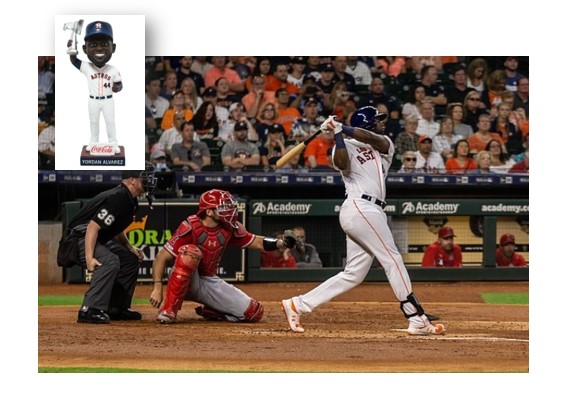
Alvarez Photo: Flickr user thatlostdog–, CC BY 2.0 <https://creativecommons.org/licenses/by/2.0>, via Wikimedia Commons
April 18th was the Astros’ home opener and Yordan Alvarez Bobblehead Night at Minute Maid Park. Alvarez was in the lineup for the first time in more than a week (illness/fever), but he gave the fans what they were looking for.
Alvarez, who came into the game hitting .143 (two-for-14, with one home run and two RBI), celebrated his bobblehead in style – going three-for-five with two home runs, three runs scored and four RBI, as the Astros topped the Angels 8-3. The Astros’ DH hit a two-run homer in the first inning; singled (and scored) in the fourth; struck out in the fifth; hit a two-run homer in the seventh; and struck out again in the eighth.
A Feel-Good Story
On April 25, Tyler Zombro took the mound for the Durham Bulls (against the Norfolk Tides) in Norfolk,Virginia – and it was a big moment. Early last June, also against the Tides, Zombro was struck above his right ear by a 100+ m.p.h. line drive – an injury that resulted in emergency surgery and the placement of 16 plates and 36 screws to stabilize his skull. On April 25, He came on in the second inning and pitched a scoreless frame (one double).
An Immaculate Inning in a Good Outing
On April 17, Yankees southpaw Nestor Cortes had quite an outing against the Orioles (in Baltimore). While he only went five innings, he held the O’s scoreless (three hits, one walk) and fanned a dozen. He threw 88 pitches (62 strikes). In the bottom of the fourth, he became the first pitcher of 2022 and the 94th pitcher overall, to throw an Immaculate Inning – nine pitches, nine strikes, three strikeouts. Note: Sandy Koufax, Chris Sale and ax Scherzer have thrown three Immaculate Innings each, Lefty Grove, Nolan Ryan, Randy Johnson, Kevin Gausman, two each. Cortes’ victims were DH and cleanup hitter Anthony Santander, CF Ryan McKenna and C Robinson Chirinos.
Walk Don’t Run
On April 15th, in the bottom of the fourth inning, with one out and the bases loaded, in a close game (Angels down 3-2), Angels’ manager Joe Maddon elected to call for an intentional walk to Rangers’ left-handed swinging SS Corey Seager – forcing in a run and bringing up righty C Mitch Garver to face righty Austin Warren. (Note: after the unorthodox move, the Rangers scored two more runs on a sacrifice fly and a balk. The Angels, however, came back to win the game 9-6.)
The most recent bases-loaded intentional walk? Also called by Maddon, who was managing the Rays at the time. On August 17, 2008, the Rays were leading the Rangers 7-3 with two outs in the bottom of the ninth (with Rangers on all three bases), when Maddon called on Grant Balfour (appropriate name for this situation) to give an intentional run-producing pass to hot-hitting Rangers’ ‘CF Josh Hamilton. He then brought in Dan Wheeler to face Rangers’ RF Marlon Byrd – and Wheeler struck out Byrd on five pitches to end the game.,
Swing and a Miss, Now that’s Rare
On April 13, Guardians’ rookie outfielder Steven Kwan did something her hadn’t done in his entire MLB career (to that point), he swung and missed a pitch. It came in his sixth MLB game, in his 25th MLB plate appearance and his sixteenth at bat, 117th pitch and 40th swing. (And actually, he did make some contact, foul tipping the pitch into the catcher’s glove – which counts and a swing and miss.) For those who like to know such things, the first MLB pitcher to get a ball past Kwan was Nick Lodolo of the Reds, the pitch was a low-80s curveball and Kwan ended up striking out in a six-pitch at bat. As April came to a close, Kwan was hitting .354-0-7, with ten runs scored.
More “In Baseball We Count Everything””
In his first four MLB games, Steven Kwan collected nine hits (two doubles, one triple), five walks and one hit-by-pitch (a .692 batting average and .790 on-base percentage). He is the only player in the modern era (since 1900) to get on base 15 times in his first four MLB games.
Kwan was a fifth round draft choice (2018) out of Oregon State University, where he hit .329 over three seasons (156 games). In three minor-league seasons (217 games), he stroked the ball at a .301 pace – including .328-12-44 in 77 games at Double- and Triple-A last season.
Fan Disappointment Up Close and Personal
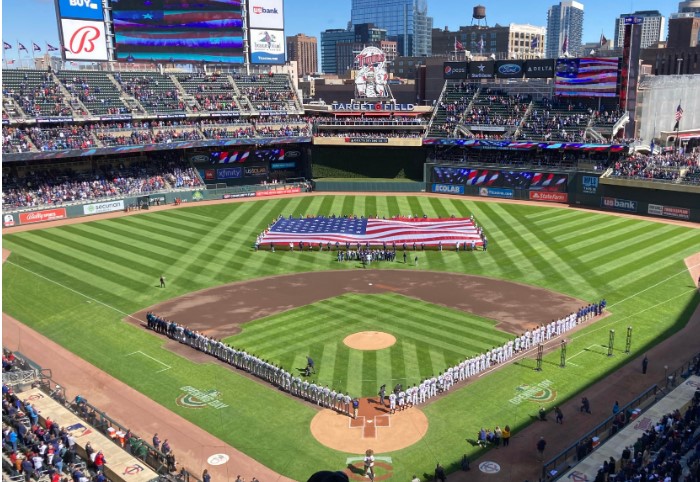
 On April 13, I braved Minnesota’s uber-chilly spring to take in the Twins-Dodgers at Target Field. Despite the fact that the Twins were down 3-0, there was plenty of drama on the field and plenty of excitement in the crowd – as many of us anticipated a chance to see Dodgers’starter Clayton Kershaw try for MLB’s 24th-ever Perfect Game. At the time, Kershaw had thrown just 80 pitches (53 strikes) and had fanned 13 batters – and only three balls had been hit out of the infield. He was cruising and it was a masterful performance to watch.
Kershaw, however, did not come out to pitch the eighth. Dave Roberts instead put in Alex Vesia. I might add the change was met with a chorus of boos, from Twins fans and a large contingent of Dodger Faithful seated behind the third base dugout.
Now, there’s never been a combined Perfect Game, so I had a bit of hope. One out and five pitches after Vesia took the mound, Twins’ catcher Gary Sanchez lined a single to right and the Perfect Game and even the no-hitter were gone. (The Twins, ultimately, lost 7-0 and Sanchez’ single was their only safety.)
Later, I learned, via the Elias Sports Bureau, that only twice since 1900 has an MLB pitcher been pulled after the seventh inning with a Perfect Game intact. Both times, Roberts was the manager. (The first was on September 10, 2016, when he pulled Rich Hill – a reported finger issue – after seven innings with Perfect Game intact against the Marlins (and the Dodgers up 5-0). Hill had thrown 89 pitches (62 strikes) and fanned nine. Hill was replaced by Joe Blanton and ten pitches and two outs later, Marlins’ LF Jeff Francoeur collected the first of two Miami hits in the game.
Now, I should make it clear that Kershaw agreed with Roberts’ decision. And, we’ve heard about the impact of the lockout (short Spring Training) and the arm issues that had Kershaw on the shelf for about two months last season. So,it was probably the right decision. Still, I was disappointed when Kershaw didn’t take the mound in the eighth. And, I found myself trying to imagine what would have happened in the same situation with the likes of Jack Morris, Bob Gibson or Don Drysdale on the bump.
It’s a family affair
On April 11, as the Padres topped the Giants 4-2 in San Francisco, new Padres’ closer Taylor Rogers picked up his third save of the season. It may have come with somewhat mixed emotions in the larger Taylor household, as – in the same game – Taylor’s twin brother Tyler was saddled with his first loss of the season. Tyler pitched a scoreless ninth (one hit, two strikeouts), while Taylor came on in relief in the seventh inning of a 2-2 game and gave up one run on two hits (with one strikeouts).
Hunter Greene Was Made for Statcast
Reds’ number-one prospect Hunter Greene picked up his first MLB victory in his first MLB appearance (and start) on April 10. While he gave up three earned runs on four hit and two walks over five innings – he made quite an impression. The 22-year-old right-hander looks like a flame thrower at 6’5” and 230 pounds. And, he throws like on as well. Greene threw 20 of his 92 pitched at 100 MPH or more (a high of 101.6 MPH). His fastball averaged 99.7 mph. Perhaps just as important, he mixed in a slider and change up and threw first strike pitches to 15 of 21 hitters. In his first three MLB innings, Greene faced just ten batters and fanned six. And, he was just getting started.
In his second outing, against the hard-hitting Dodgers in LA, Greene threw 39 of 80 pitches at 100 mph or better, setting a single-game MLB record (since tracking began in 2008) for triple-digit offerings. In that game, he went 5 1/3 innings, giving up three hits, no walks and two earned runs – taking the loss as the Reds fell 5-2.
Greene garnered plenty of attention as a high schooler, regularly hitting triple-digits with his fastball. He was the number-two overall pick in the 2017 MLB draft )out of Notre Dame High School in Sherman Oaks, California). In his first full minor-league season (Class A Dayton Dragons), he went 3-7, 4.48, but fanned 89 hitters in 68 1/3 innings (and he was just 18-years-old). He did give the Reds brass a scare – needing Tommy John Surgery in 2019. He came back in 2021 and went 10-8, 3.30 with 139 whiffs in 106 1/3 innings at Double- and Triple-A.
How Fast Is Hunter Greene?
Reds’ rookie Hunter Greene has shown major-league hitters a 91-mph change up.
Could He Be More Perfect?
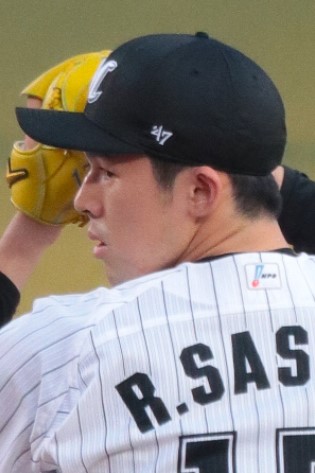
Photo: 飯生琉久 at the Wikimedia Commons, CC BY-SA 4.0 <https://creativecommons.org/licenses/by-sa/4.0>, via Wikimedia Commons
On April 10, 20-year-old righty Roki Sasaki, in just his second season in Japan’s top professional league, tossed a perfect game – with 19 strikeouts – as his Chiba Lotte Marines topped the Orix Buffaloes 6-0. He fanned 13 straight at one point during the game, in which he used just 105 pitched to dispatch the Buffaloes. Sasaki now holds the Nippon Professional Baseball League record for total strikeouts in a game and consecutive strikeout within a game.
Just a week later, Sasaki (who reportedly can hit triple digits with his fastball and who’s splitter “drops ff the table” ) pitched eight perfect innings (fanning fourteen) against the Nippon Ham Fighters before being pulled with the score knotted at 0-0. (Chiba Lotte lost the game 1-0 in ten frames.) In his next start, April 24 against the Buffaloes, the string of perfection was broken on as he gave up a single on his first pitch of the game. He went on to pitch five less-than-perfect innings (six hits, three walks, two hit batters and two earned runs) in getting the victory. In his 2021 rookie season, Sasaki was 4-2, with a 1.84 ERA and 87 whiffs in 83 1/3 innings. Sasaki’s record at the end of April was 3-0, 1.50, with 60 whiffs. 13 hits, five walks ad three hit batters in 36 innings.
It’s About Time! Congratulations!
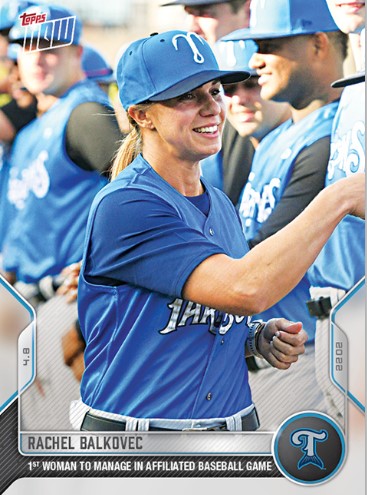 On April 8, Rachel Balkovec, managed her first game for the Yankees Single-A affiliate Tampa Tarpons – leading the team to a 9-6 win over the Lakeland Flying Tigers. – winning her first game as the first full-time female manager in affiliated history. The 34-year-old has been a coach in professional baseball for a decade and, in 2019, was the first female full-time hitting coach in an MLB organization (coaching the Rookie-Level Yankees of Florida Complex League). Her selection as Tampa Tarpons manager was announced in mid-January.
In another first, on April 12, Alyssa Nakken became the first women to take to the field as a coach in an MLB game, as she took over for San Francisco Giants’ First Base Coach Anton Richardson (ejected in the third inning). Nakken was hired as an assistance coach with the Giants in January of 2020.
A Big First Week For a Japanese Import
Seiya Suzuki was already a star when the Cubs signed him this March. At age 27, he had already played nine seasons in Japan and was a five-time All Star, carrying a .315 professional average. Over his most recent three seasons in the Japan, his stat lines were : .317-38-88; .300-25-75; and .335-28-87.
In his first week with the Cubs (April 7-13), Suzuki hit a nice round .400 (15-for-21, with five walks), had an on-base percentage of .524, with three home runs and nine RBI (all in five games). Though April, he was .279-4-14,
Hi, Mom. Hi,Dad.
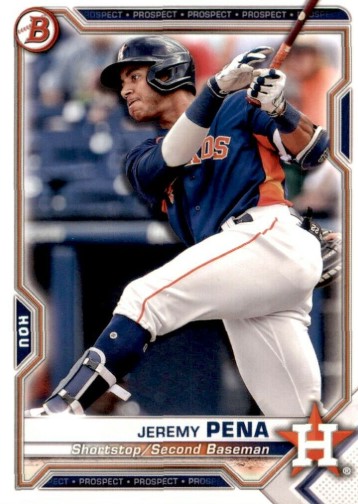
Astros’ rookie shortstop Jeremy Pena has some big cleats to fill – those of All Star and Gold Glover Carlos Correa. Fortunately, he’s got a good cheering section to wish him well. As the seventh inning of the Astros’ 13-6 win over the Angels opened on April 8, Jeremy’s parents – Cecilia and Geronimo Pena – were being interviewed on the AppleTV+ live broadcast of the game. At that moment, Pena, leading off the inning, hit the first pitch from the Angel Mike Mayers to deep left center for his first MLB home run – with his parents’ elated reaction captured for the audience. Pena ended up three-for-five on the night.
Ouch!
Only one team went scoreless on Opening Day. On April 7, the Pirates failed to score as they opened in St. Louis, losing by a 9-0 tally – despite only being outhit 8-6. In the game, Pittsburgh pitchers gave up eight hits (three home runs) and seven walks and the Pirates added a pair of errors. It was also the only shutout among this year’s openers.
Getting that First Free Pass Out of the Way
Last season, the Brewers’ Cy Young Award winner Corbin Burnes tallied 49 strikeouts before his first walk of the season – which came on May 13. He pitched 34 innings and faced 126 batters before issuing that first free pass. In this season’s April 7 Brewers’ opener, he walked the first batter he faced – the Cubs’ Rafael Ortega. Burnes got a no-decision, pitching five innings and giving up three runs on four hits and three walks, while fanning four. Last season, Burnes didn’t give up his third walk until his eighth start.
Old Guys Rule
Photo by bk1bennett
40-year-old Adam Wainwright started the Cardinals’ opener (April 7) in Pittsburgh and pitched six scoreless frames as the Cardinal won 9-0. Wainwright is the fifth oldest player on Opening Day rosters this season. Here are the oldsters:
- Albert Pujols, DH, Cardinals, turned 42 on January 16;
- Rich Hill, LHP, Red Sox, turned 42 on March 11;
- Nelson Cruz, DH, Nationals, will turn 42 July 1;
- Oliver Perez, LHP, Diamondbacks, will turn 41 august 15;
- Adam Wainwright, RHP Cardinals, will turn 41 on August 30.
A Bit More Old Guys Rule
In is second outing of the season, 39-year-old Justin Verlander – coming back from Tommy John surgery – pitched eight innings of three-hit ball, walking none and fanning eight as his Astros topped the Mariners 4-0 in Seattle. It was his just his second appearance and first win since July 24, 2020. Verlander threw 87 pitched (64 strikes) and got first-pitch strikes on 19 of the 27 batters he faced. In the seventh inning of the April 16 game, the two-time Cy Young Award winner reached 3.000 career innings pitched.
Finding Opening Day Very Special
On April 7, the Astros topped the Angels 3-1, becoming the second team in MLB history and the first since 1896, to win ten consecutive Opening Day games. The NL Boston Beaneaters won ten straight from 1887-1896. A few tidbits. In their still-alive streak, the Astros:
- Have won five openers at home, five on the road;
- Have had the starting pitcher record each of the ten wins (Dallas Keuchel and Justin Verlander three each, Zack Greinke, Scott Feldman, Bud Norris and Framber Valdez);
- Have outscored their opponents 44-13.
- Scored five or more runs six times, while giving up as many as three runs just once.
A Fistful of Firsts
Photo by shinya
In the April 7 Angels’ game, Shohei Ohtani became the first MLB player to throw his team’s first pitch of the season and also be in the batter’s box to take his team’s first pitch of the season – as he started on the mound and lead off at DH. He also recorded his team’s first strikeout of the season getting the first batter he faced and made his team’s first out of the season, grounding our short-to-first on the first pitch he saw in the first inning (remember, he was batting first.)
On April 21, Ohtani added to his list of firsts, becoming the first starting pitcher in MLB history to bat twice in a game before throwing his first pitch pitch. (More #InBasseballWeTrackEverything.) Ohtani started on the mound for the Angels and at DH, batting in the leadoff spot. He led off the game with a six-pitch walk. The Rangers batted around and, by the time Ohtani batted again in the first, were up 4-0. Ohtani punched a two-run double in his second plate appearance of the inning. The Angels went on to win the game 6-0, with Ohtani going two-for-four with a walk and two RBI – and pitching six innings, giving up one hit, one walk and fanning 12.
The Ohtani Rule
MLB has recognized Shohei Ohtani ‘s unique skills with a new rule for 2022. Basically, it says a team can start a player at pitcher and designated hitter and pull him from the game in one of those roles, while leaving him in the game in the other. Basically, if Ohtani is pulled as a pitcher, he can stay in the game at DH. I assume – and this would be rare – the Angels could pinch hit for him (as DH) and leave him in a game at pitcher. Pretty nice to be talented and popular enough that they change the rules for you.
Seth Beer Lives Up to His Name
April 7 was National Beer Day – and guess what? Diamondbacks’ DH Seth Beer (gotta love that baseball name) hit a walk-off home run to put the Diamondbacks past the Padres 4-1. It was his second career homer and first career walk-off long ball.
A Beer and a Burger
I was at an April Twins game (versus the White Sox) in which Jake Burger started at the hot corner for Chicago. I’d like to see the Diamondback’s Seth Beer traded to the Sox (or the ChiSox’ Jake Burger to Arizona), so we could have a Beer and a Burger in the lineup together.
——-Individual Statistical Leaders for April———
AVERAGE (50 April at bats minimum)
National League – Eric Hosmer, Padres (.389); Manny Machado, Padres (.386); Nolan Arenado, Cardinals (.375)
American League – Xander Bogaerts, Red Sox (.375); Andrew Benintendi, Royals (.373); J.P. Crawford, Mariners (.360)
The lowest April average (among qualified players) belonged to the Twins’ Miguel Sano at 0.93 (5-for-54).
HOME RUNS
National League – C.J. Cron, Rockies (7); Ozzie Albies, Braves (6); Joc Pederson, Giants (6); Austin Riley, Braves (6)
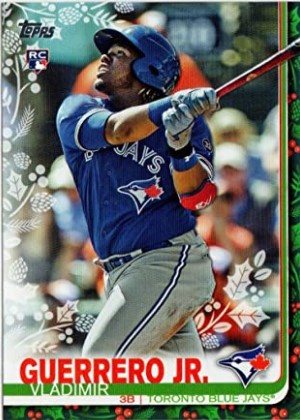
American League – Anthony Rizzo, Yankees (9); Jose Ramirez, Guardians (7); Yordan Alvarez, Astros (6); Vlad Guerrero, Blue Jays (6); Aaron Judge, Yankees (6); Byron Buxton, Twins (6); George Springer, Blue Jays (6)
The Indians’ Jose Ramirez had the highest April slugging percentage (among qualifiers) at .722. The NL leader was the Cardinals’ Nolan Arenado at .681.
RUNS BATTED IN
National League – C.J. Cron, Rockies (19); Pete Alonso, Mets (17); Nolan Arenado, Cardinals (17). Trea Turner, Dodgers (17)
American League – Jose Ramirez, Guardians (28); Ty France, Mariners (21); Anthony Rizzo, Yankees (21)
RUNS SCORED
National League – Manny Machado, Padres (20); Mookie Betts, Dodgers (19); Bryce Harper Phillies (17)
American League – Shohei Ohtani, Angels (17); Miles Straw, Guardians (17); George Springer, Blue Jays (15)
HITS
National League – Manny Machado, Padres (32); Eric Hosmer, Padres (28); Nolan Arenado, Cardinals (27)
American League – Xander Bogaerts, Red Sox (30); Ty Frances, Mariners (28); three with 27
The Nationals’ Josh Bell led MLB qualifying players in on-base percentage at .460.
DOUBLES
National League – Matt Olson, Braves (9); Eduardo Escobar, Mets (8); six with seven
American League – Yuli Gurriel, Astros (9); Owen Miller, Guardians (9); Wander Franco, Rays (8); Enrique Hernandez, Red Sox (8); J.D. Martinez, Red Sox (8)
TRIPLES
National League – Jazz Chisholm, Marlins (3); Jake Cronenworth, Padres (2); Jesus Sanchez, Marlins (2); Kolten Wong, Brewers (2)
American League – Andres Gimenez, Guardians (2); Josh Lowe, Rays (2); Austin Meadows, Tigers (2)
STOLEN BASES
National League – Harrison Bader, Cardinals (6); Tommy Edman, Cardinals (5); six with four
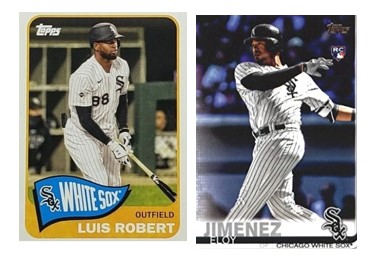
American League – Julio Rodriguez, Mariners (9); Jorge Mateo, Orioles (7); Aldaberto Mondesi, Royals (5) ; Luis Robert, White Sox (5)
The Mariners’ Julio Rodriguez was 9-for 9 in April steal attempts. .
WALKS
National League – Juan Soto, Nationals (21); Max Muncy, Dodgers (16); Eduardo Escobar, Mets (15); Matt Olson, Braves (15)
American League – Jesse Winker, Mariners (17); Anthony Santander, Orioles (16); three with 14
BATTER’S STRIKEOUTS
National League – Dansby Swanson, Braves (30); Adam Duvall, Braves (29); Patrick Wisdom, Cubs (28)
American League – Franmil Reyes, Guardians (35); Julio Rodriguez, Mariners (30); Joey Gallo, Yankees (29)
PITCHING VICTORIES
National League – Tyler Megill, Mets (4-0); ten with three wins
American League – Adam Cimber, Blue Jays (4-0); Alek Manoah, Blue Jays (4-0); four with three wins.
Adam Cimber picked up four April wins, despite pitching just 11 innings (in ten games). He also had four holds and a save – and put up a 1.64 ERA. On the reverse side of the coin, the Royals’ Jake Brentz was charged with three April losses (0-3), despite pitching just 5 1/3 innings. In those innings, he gave up 11 hits and ten walks, 15 runs (14 earned) and fanned nine.
EARNED RUN AVERAGE (qualifying pitchers)
National League – Pablo Lopez, Marlins (0.39); Kyle Wright, Braves (1.13); Madison Bumgarner, Diamondbacks (1.17)
American League – Logan Gilbert, Mariners (0.40); Joe Ryan, Twins (1.17); Alex Manoah, Blue Jays (1.44)
Among qualifying pitchers, the Senators’ Joe Adon had the highest April ERA (1-4, 7.33 –19 earned runs, over 23 1/3 innings in five stats.
STRIKEOUTS
National League – Carlos Rodon, Giants (38); Eric Lauer, Brewers (34); Aaron Nola, Phillies (34)
American League – Shane McClanahan, Rays (42); Nathan Eovaldi, Red Sox (32); Kevin Grossman, Blue Jays (31); Frankie Montas, A’s (31)
Among qualifiers, Carlos Rodon of the Giants had the highest K/9 rate at 14.87. The Rays’ Shane McClanahan led the AL at 14.00.
SAVES
National League – Josh Hader, Brewers (10); Taylor Rogers, Padres (8); Daniel Bard, Rockies (6); Anthony Bender, Marlins (6); Kenley Jansen,Braves (6)
American League – Jordan Romano, Blue Jays (10); Raisel Iglesias, Angels (6); Aroldis Chapman, Yankees (5)
WHIP (Walks + Hits per Inning Pitched – among qualifiers)
National League – Clayton Kershaw, Dodgers (0.70); Pablo Lopez, Marlins (0.73); Corbin Burnes, Brewers (0.74)
American League – Justin Verlander, Astros (0.69); Joe Ryan,Twins (0.70); Brad Keller, Royals (0.77)
BONUS STAT
Among qualifying pitchers, the Mets’ Max Scherzer held opponents to the lowest April batting average (.131 )
Primary Resources: Baseball-Reference.com; ESPN.com; MB.com; Elias Sports Bureau
SPOILER ALERT — THE MAY WRAP UP WILL BE A LITTLE LATE. IN LATE MAY AND EARLY JUNE, I WILL BE ON MY 32ND BALLPARK TOURS BASEBALL JOURNEY.
BASEBALL ROUNDTABLE ON THE TOP 100 BASEBALL BLOG LIST
 Baseball Roundtable is on the Feedspot list of the Top 100 Baseball Blogs. To see the full list, click here.
I tweet baseball @DavidBBRT
Follow/Like Baseball Roundtable’s Facebook Page here. More baseball commentary; blog post notifications; PRIZES.
Member: Society for American Baseball Research (SABR); The Baseball Reliquary; The Negro Leagues Baseball Museum.





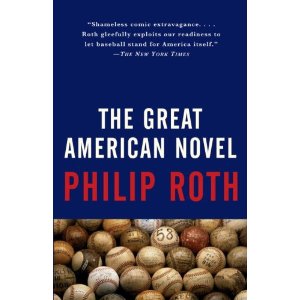 Written from the perspective of retired sport journalist “Word” Smith,” The Great American Novel takes you into the hearts and (often dark) souls of a team made up of ex-cons, alcoholics, amputees, veteran players well beyond their primes, 90-pound adolescents not ready for the big-time, and even extremely vindictive Lilliputians – and into Patriot League (the third major league) ballparks in places like Asylum, Ohio; Terra Incognita, Wyoming; and Kakoola, Wisconsin. It also takes you from the dugout to an asylum (for an exhibition game) to the House Un-American Activities Committee. The prologue includes Word Smith’s encounter with Earnest Hemingway and the book wraps up with a letter written by Smith to China’s Chairman Mao.