Baseball Roundtable Predictions and Preferences … MVP, CYA, ROY. MOY

Tomorrow (November 6), the finalists for four key 2023 Baseball Writers Association of America Awards (AL & NL Most Valuable Player, Cy Young Award, Rookie of the Year and Manager of the Year) will be announced. As a warm up to that announcement, Baseball Roundtable will dedicate this post to its predictions of the eventual winners, as well as who would get The Roundtable’s votes (if I had votes). Hence the blog title “Predictions and Preferences.” As usual, my choices are up for discussion and debate.  I would anticipate that some will find one or two of “preferences” a bit old school.  In any case, I will provide the reasoning behind my selections.  So, Let’s get on with it.

MOST VALUABLE PLAYER

NATIONAL LEAGUE…

Prediction:  Ronald Acuna Jr., RF, Braves

Roundtable Preference: Ronald Acuna Jr., RF, Braves
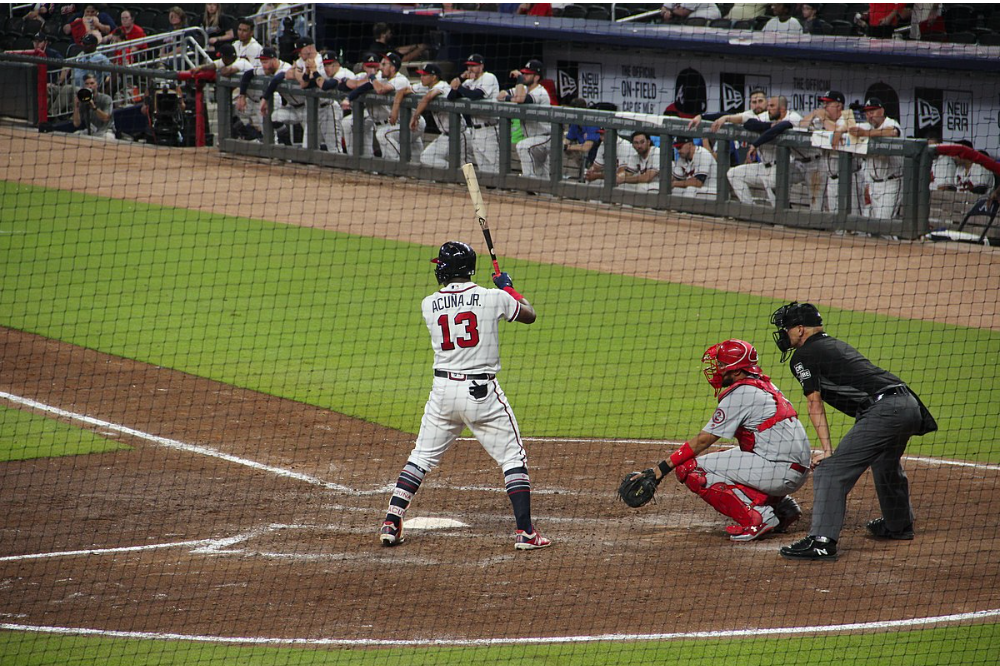
Photo: Thomson200, CC0, via Wikimedia Commons

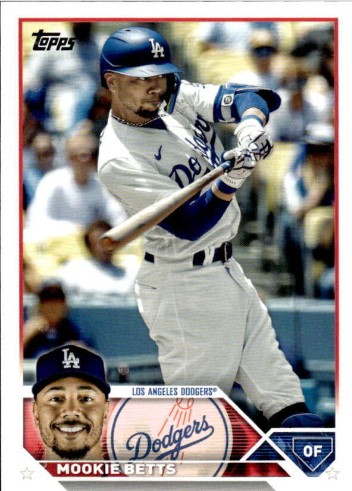
Well, this one looks like a two-player race – the Braves’ Ronald Acuna, Jr. and Dodgers’ Mookie Betts.  Both put up MVP-worthy numbers.  I was drawn to Betts because he put up some outstanding numbers for a leadoff hitter (his 107 RBI are the MLB record for runs driven in from the leadoff spot) and he popped 40 doubles and 39 homers to go with a .307 average. Just as important, he filled in (admirably) wherever the Dodgers needed him – starting 107 games in RF, 70 at 2B and 12 at SS.  That versatility (and defensive skills) helped the Dodgers overcome injuries and disappointments. Had the Dodgers won their division by six games instead of 16, Betts probably would have been The Roundtables’ choice.

However, I have to go with the Acuna.  As the chart below shows, he edged Betts in most traditional offensive statistical categories.  Then, there are those 73 stolen bases – which meant a host of singles turned into doubles; opposing pitchers distracted and under pressure; and an increased number of fastballs for those hitting behind him.  In my consideration, those factors balanced out the versatility brought to the field and the lineup by Betts.  Then of course, there is Acuna’s first-ever MLB 40-70 (HR/SB) season and the fact that down the stretch (September/October), Acuna hit .340-11-23 to Betts’ .244-1-9.  (To be fair, Betts had an outstanding August (.455-11-30).

AMERICAN LEAGUE… 

Prediction: Shohei Ohtani, DH/P, Angels

Roundtable Preference:  Shohei Ohtani, DH/P, Angels
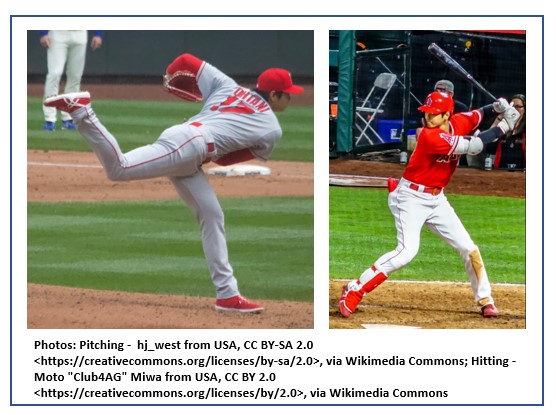
What can you say? Shohei Ohtani led the American League in home runs with 44 (despite playing in just 135 games), while hitting .304, driving in 95 runs, scoring 102, legging out eight triples and stealing 20 bases.  He also went 10-5, 3.14 on the mound (23 starts) and fanned 167 batters in 132 innings. And, he ran up these numbers despite going down due to an oblique injury in early September. Those missed games and the fact that Angels finished 73-89, 17 games off the pace in the AL West do work against him.  (Some would argue that Angels could have finished fifth without him.) The Roundtable considered that the Angels were 14-9 (.609 ball) in games he started on the mound and 59-80 (.424) in games he didn’t pitch. In games in which Ohtani appeared in the lineup, the Angels  played .459 ball; as opposed to .407 when he wasn’t on the field.

Shohei Ohtani is the first MLB player with 40 or more home runs and ten or more pitching victories in a single season.

I might add that – if you find it difficult to accept an MVP from a fourth-place team – I would look to Rangers’ middle infield for a candidate.   Texas shortstop Corey Seager raked at .327-33-96 pace, with 88 runs scored and a league-topping 42 doubles. Second baseman Marcus Semien also had an outstanding year, going .276-29-100. He was fourth in the AL in RBI and led the league in runs scored with 122.

CY YOUNG AWARD 

NATIONAL LEAGUE…

Prediction: Blake Snell, Padres

Roundtable Preference: Spencer Strider, Braves
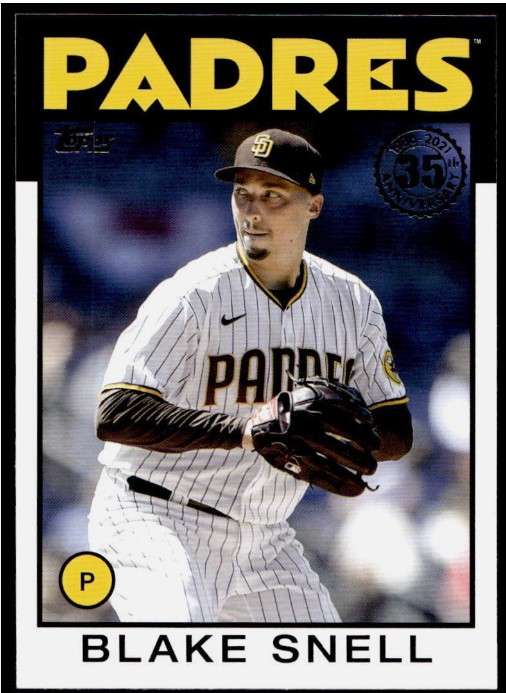
The Roundtable believes the “bright and shiny thing” that will sway enough BBWAA voters toward Blake Snell is his MLB-low (among qualifiers) 2.25 earned run average.  For The Roundtable (and this may be some of that “old school” mentality), a 20-win season is still a key measure of value. So, my preference is the Braves’ Spencer Strider, who put up 20 wins (three more than any other pitcher and six more than Snell).  In comparing these two front runners, each had 32 starts. In those starts Strider pitched 186 2/3 innings to Snell’s 180 innings (had Snell gone notably deeper into games than Strider, he may have gotten the Roundtable nod).
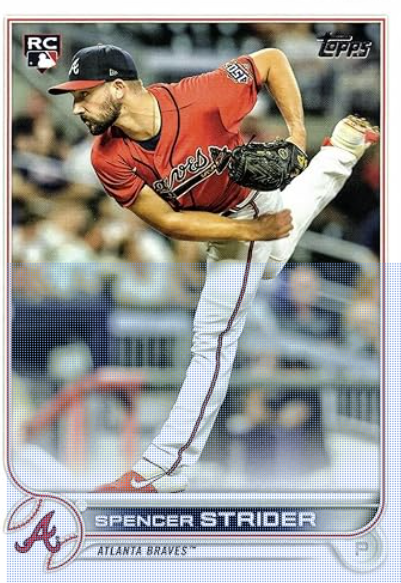
A few other factors.  In this strikeout-focused aera, Strider fanned an MLB-high 281 batters (Snell was fourth at 234). Strider also walked just 58 batters to Snell’s 99, while Snell gave up 31 fewer hits (115 to 146). Notably, Snell and Strider had very similar WHIPs (1.09 for Strider versus 1.19) for Snell. Snell, however, proved more adept at avoiding damage (as witnessed by his 2.25 ERA to Strider’s 3.86).  For those favoring Snell, being fair requires that I note Snell held hitters to an MLB-low (among qualifiers) .181 average, while Strider was fifth at .210. Still, I just can’t get past MLB’s only 2023 20-game winner.

Blake Snell was the only qualifying pitcher to hold opposing hitters to an under .200 average in 2023. 

 AMERICAN LEAGUE…

Prediction: Gerrit Cole Yankees

Roundtable Preference: Gerrit Cole, Yankees

Photo: All-Pro Reels from District of Columbia, USA, CC BY-SA 2.0 <https://creativecommons.org/licenses/by-sa/2.0>, via Wikimedia Commons

Hard to find a reason for debate here.  Gerrit Cole went 15-4 (in 33 starts) and had the AL’s lowest qualifying earned run average (2.63). He also led the league (among qualifiers) in WHIP (0.98) and average against (.206).  And, he topped the league in shutouts (two); innings pitched (209); and winning percentage (.789).  He was third in strikeouts (220). Cole averaged 6 1/3 innings per start and went seven or more innings in ten outings. And, his record could have been better. He had six no-decisions in which he gave up zero or one run.  Overall, he gave up two or fewer runs in 26 of his 33 starts


ROOKIE OF THE YEAR

NATIONAL LEAGUE…

Prediction: Corbin Carroll, OF, Diamondbacks

Roundtable Preference: Corbin Carroll, OF, Diamondbacks
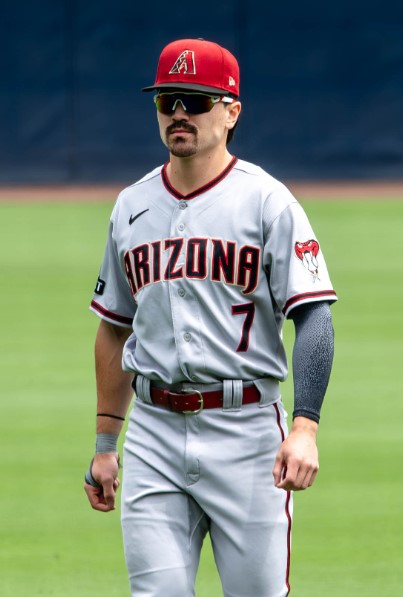
Photo: Casey Aguinaldo, CC BY-SA 4.0 <https://creativecommons.org/licenses/by-sa4.0> via Wikimedia Commons

Arizona’s 23-year-old rookie Corbin Carroll brought power and speed to the table – putting up a .285 average, with 25 home runs, 76 RBI, 116 runs scored and 54 stolen bases in 59 attempts. He led all 2023 MLB rookies in runs; hits (161); triples (10); and stolen bases. Among rookies, he was fourth in doubles (37) and second in home runs. His .285 average was second among qualifying rookies and first among NL qualifying rookies. Carroll played in 155 games (second-most among  for NL rookies).  Carroll also showed outfield versatility, starting 53 games in LF, 57 in RF and 34 in CF. (Note: Carroll did get in 32 Diamondback’s games in 2022, keeping his rookie status intact.)

If I had to pick a runner-up(s), I would go with:

  • Reds’ 25-year-old 1B Spencer Steer, who played in 156 games, hitting .271-23-86, with 15 steals and 74 runs scored.
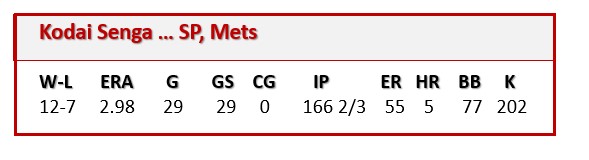
  • Mets’ starting pitcher Kodai Senga , who went 12-7, 2.98 in 29 starts. He led all rookie pitchers in wins, strikeouts (202) and innings pitched (166 1/3 )and led qualifying rookies in earned run average. Notably, the thirty-year-old had 11 seasons in Nippon Professional Baseball before making his NL debut. Over those seasons, he went 87-44, 2.59.

AMERICAN LEAGUE…

Prediction: Gunnar Henderson, 3B, Orioles

Roundtable Preference: Gunnar Henderson, 3B, Orioles
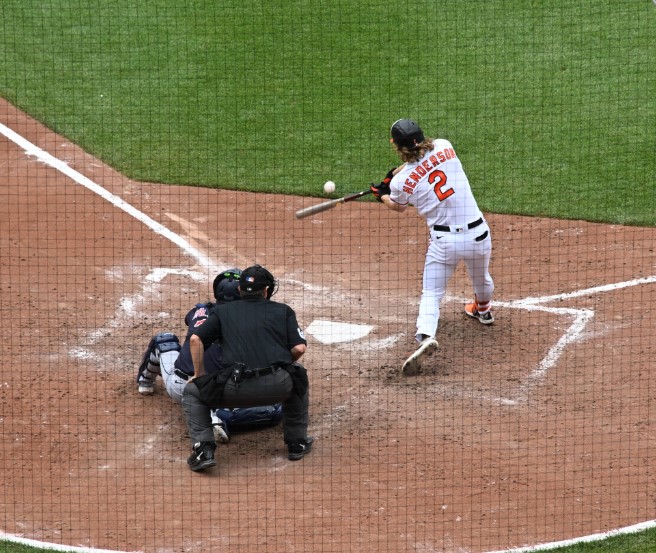
Photo: Maryland GovPics, CC BY 2.0 <https://creativecommons.org/licenses/by/2.0>, via Wikimedia Commons

Another easy pick.  Henderson appeared in 150 games for the Orioles, hitting .255-28-82, with 100 runs scored and 10 steals.  His 28 home runs topped all 2023 MLB rookies; his 82 RBI were second (first among AL rookies); his 100 runs scored second (first among AL rookies). He was also among the top five among MLB rookies in hits, doubles, triples. Like Carroll (above), Henderson showed versatility in the field, starting 68 games at 3B and 64 at shortstop.

A runner-up?  A couple of Roundtable choices:

  • The Guardians’ 24-yr-old righty Tanner Bibee, who went 10-4, 2.98 in 25 starts, fanning 141 batters in 142 innings.
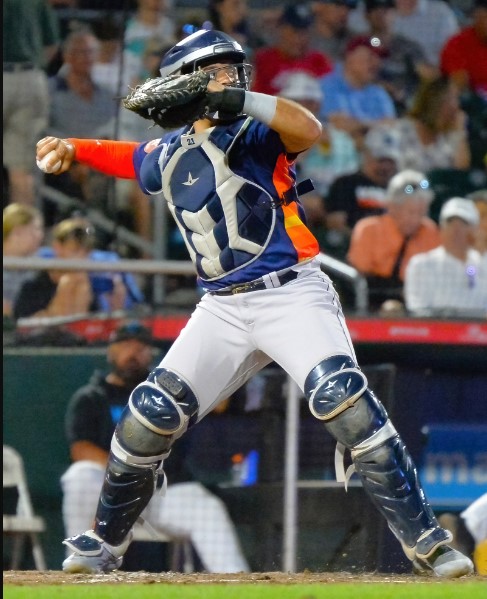
  • Astros’ C Yainer Diaz, who Went .284-23-60 in 104 games.

For a look at Baseball Roundtable’s full 2023 All-Rookie Lineup (and All-Time, All-Rookie Team), click here.

MANAGER OF THE YEAR

NATIONAL LEAGUE…

Prediction:  Craig Counsell, Brewers

Roundtable Preference: (Tie) Craig Counsell, Brewers and  and Skip Schumaker, Marlins

Okay, a tie is a cop out – but I could find good reasons to split my vote among these two.
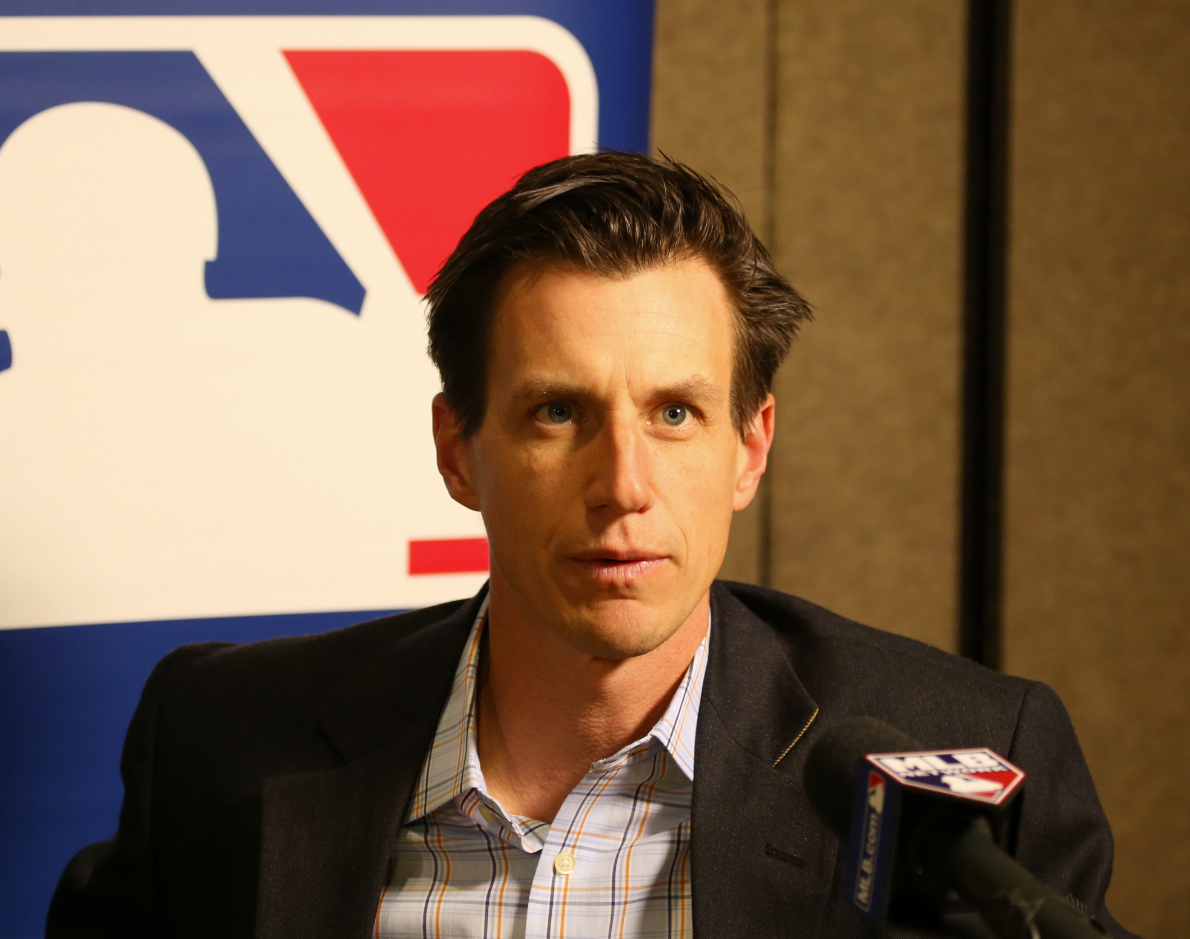
Photo: Arturo Pardavila III from Hoboken, NJ, USA, CC BY 2.0 <https://creativecommons.org/licenses/by/2.0>, via Wikimedia Commons

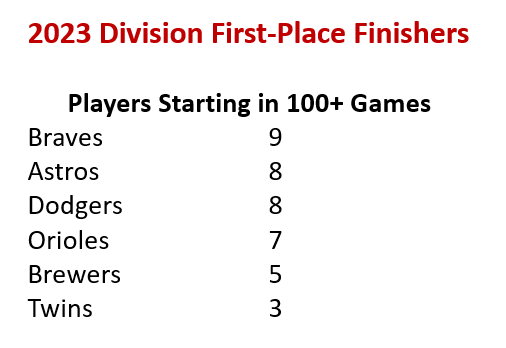
Craig Counsell has consistently brought the Brewers in with wins totals above what analysts (and analytics) project.  This year, he brought the Brewers in at 92-70 – capturing the NL Central title. His solid record as a manager is evidenced by the fact that in the five seasons between 2018 and 2022, he finished second in the NL Manager of the Year voting three times. Having spent 16 years on the field as a player, Counsell has gained a reputation as a players’ manager – tough, but fair – who understands the game and how to position players for success. This is likely the year when the writers will give Counsell his due (and recognize his body of work).  As an additional note:  The chart below provides some evidence of the lineup maneuvering Counsell did as compared to other division winners.
During Craig Counsell’s eight full seasons as manager of the Brewers, the only National League teams with better regular-season won-loss percentages are the Dodgers and Braves.

Photo: U.S. Navy photo by Mass Communication Specialist 2nd Class Zachary D. Behrend, Public domain, via Wikimedia Commons

Skip Schumaker brought the Marlins home in third place in the NL East with an 84-78 record. – earning an unexpected Wild Card spot in the post-season. What puts him in this spot in terms of The Roundtable’s preferences is that he did it, despite being outscored by 57 runs over the course of the season.  It has been said that a manager can have the most impact on close games – where each move has the potential to be critical to success (or failure).  (Side note:  I would argue the manager can have an equally potent impact in the clubhouse – shaping the attitude and approach to the game of his players)

But, back to those close games. Well, Shumaker led the Marlins to a 7-3 record in extra innings and a 33-14 record in one-run games.  (The only team to win more one-run games than the Marlins this season was the Reds – with 34 one-run wins – but the Reds also had 29 one-run losses.) Schumaker led the Marlins 2023 success despite a down season from 2022 Cy Young Award winner (Sandy Alcantara), as well as some key injuries.

Just behind Counsell an Schumaker is the Dodgers’ Dave Roberts, who fashioned a 100-win season, despite having to almost totally change his pitching plans. At the start of the season, the projected rotation was Julio Urias, Clayton Kershaw, Tony Gonsolin, Dustin May and Noah Syndergaard.  Those five started just 87 of the Dodgers 162 games. In fact, the Dodgers were the only division leader that did not have a single pitcher with 25 2023 starts (nine pitchers starter at least nine games for LA). Among the players who moved through the rotation were Emmet Sheehan, Lance Lynn, Michael Grove and Bobby Miller.

AMERICAN LEAGUE…

Prediction: Brandon Hyde, Orioles

Roundtable Preference:  Brandon Hyde, Orioles

Photo: (NASA/Joel Kowsky), Public domain, via Wikimedia Commons

No ties here. In the tough AL East, the Orioles were predicted by many prognosticators to finish behind the Yankees, Rays and Blue Jays. Manager Brandon Hyde led the young Baltimore squad to a 101-61 season and the AL East title. He produced an 11-6 record in extra inning games and a 30-16 record in one-run games (the most one-run victories in the AL).

Of the Orioles top ten players in terms of 2023 games started, only one had reached age 30.   In addition, only one of their top six pitcher in games started (those pitchers with double-digit starts) had reached age 30, and only one of their six most-called-upon relivers had reached age 30.

Need a runner-up?  I’d look to the Twins’ Rocco Baldelli, who overcame injuries to key players Byron Buxton and Carlos Correa to bring home an NL Central title.


Baseball Roundtable – Blogging Baseball Since 2012.

100Baseball Roundtable is on the Feedspot list of the Top 100 Baseball Blogs.  To see the full list, click here.

Baseball Roundtable is also on the Anytime Baseball Supply Top 66 Baseball Sites list.  For the full list, click here

I tweet (on X) baseball @DavidBaseballRT

Follow/Like Baseball Roundtable’s Facebook Page here.  Find More baseball commentary; blog post notifications; PRIZES.

Member: Society for American Baseball Research (SABR); Negro Leagues Baseball Museum; The Baseball Reliquary.

P10010

Baseball Roundtable Ranks World Series Walk-Off Home Runs

Yesterday, two teams many (most?) fans and analysts did not expect to see in the Fall Classic (The Rangers and Diamondbacks) gave us a perhaps equally unexpectedly exciting Game One of the 2023 World Series. Yes, these two Wild Card squads gave us a wild first game.

Texas jumped out to a 2-0 lead in the bottom of the second on a walk to SS Corey Seager (on a 3-2 pitch), an RBI double by  LF Evan Carter and an RBI single by RF, cleanup hitter and hot post-season batter Adolis Garcia.

The Diamondbacks bounced right back in the top of the third on a pair of singles by CF Alek Thomas and 3B Evan Longoria, a sacrifice bunt – remember those?) by SS Geraldo Perdomo, a two-run triple (on an 0-2 pitch) by RF and leadoff hitter Corbin Carroll, with Carroll later safe on close play at the at the plate on a ground  ball to first by 2B Ketel Marte.

Texas tied it in the bottom of the inning. After CF and number-nine hitter Leody Taveras and 2B Marcus Semien both struck out to open the inning, Seager drew a five-pitch walk, Carter doubled him to third, Garcia walked (on a 3-2 pitch) to load the bases and DH Mitch Garver walked (again on a 3-2 pitch) to force in a run.

Jumping ahead, going into the bottom of the ninth, the Diamondbacks enjoyed a 5-2 lead, with lights-out closer Paul Sewald taking the mound. After getting strike one on Taveras, Sewald lost the plate and threw four straight balls to put him on. Sewald then fanned Semien on three pitches, bringing up Seager, who homered to right – tying the game.  A HBP (Garcia on an 0-2 pitch), a stolen base, and intentional walk (Garver) added some excitement, but Sewald fanned C Austin Hedges to get out of the inning with a tie.

After a scoreless tenth and top of the eleventh, Garcia came up  (against Kyle Nelson) with one out and no one on in the bottom of the eleventh and poled a 3-1 pitch to right field for a game-winning, walk-off homer.

For Those Who Like To Know Such Things

Adolis Garcia’s was just the 17th walk-off homer in World Series history, the fourth to win Game One and the eleventh in extra innings.  

Garcia’s big hit should come as no surprise. He led the Rangers in 2023 regular-season home runs (39) and RBI (107). It also was the fifth straight post-season game in which he has gone deep (one short of the MLB record) and the seventh straight post-season contest in which he has recorded an RBI (also one short of the record).  Can’t wait to see what he does in Game Two.  Clearly, he put an exclamation point on an exciting Game One.

As usual, with Baseball Roundtable “one thing leads to another” and Garcia’s blast gives The Roundtable a reason to revisit its  ranking of World Series walk-off long balls. Keep in mind, this is a subjective ranking and subject to debate.  (In that ranking I looked at such factors as the inning in which the winning long ball was launched, the number of outs in the inning, the overall course of the game, whether the game was needed to stave off elimination, the creation of “iconic” moments or images and the likelihood of heroics by the particular player involved.)

A bit of a spoiler alert, of the 17 World Series walk-off home run:

  • six came in the bottom of the ninth – 11 in extra innings;
  • the latest of any of the extra-inning walk-off came in the 18th inning;
  • six were hit by players now in the  Hall of Fame.
  • just one came in a Game Seven;
  • two came when the winning team was behind on the scoreboard;
  • one was hit by a pinch hitter; and
  • two were hit in cases where the winning team was on the brink of elimination – three if you include the Game Seven walk-off.

NUMBER ONE – Bill Mazeroski, Pirates – 10th Inning, 1960 World Series Game Seven– October 13, 1960

If I am going to pick this as my number-one World Series walk-off home run, I better set the stage.

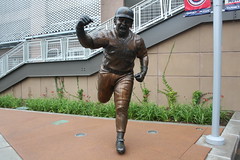
Mazeroski's 1960 home run trot earned him a immortalized at PNC Park.

Mazeroski’s 1960 home run trot earned him a statue at PNC Park.

I was thirteen and an avid baseball fan.  The television Game of the Week, the radio – especially the radio – and an occasional trip to the ballpark were my tickets to the national past time.

At the time, the Yankees were baseball’s dynasty.  Since my birth in 1947, the Bronx Bombers had been to 11 World Series (including the 1960 Series) and had won eight World Championships.   The opposing Pirates had last appeared in the Fall Classic in 1927 and last won it in 1925.

Fans from pretty much everywhere but New York had made Yankee-hating a tradition.  I was no exception.  Milwaukee-born, I was a steadfast Braves fan, still smarting from the Yankees’ 1958 World Series comeback, when they downed my Braves after trailing three games-to-one. The Yankees were in the 1960 Series – and I had an emotional interest in seeing them lose.

Put all of this together and you can see why I looked to the 1960 World Series with excitement – and why I was rooting for the underdog Pirates.

The prognosticators foresaw a Yankee win in five or six games.  They pointed out that the Yankees came into the Series with the momentum of a 15-game, season-closing winning streak, while the Pirates lost four of their final seven.  They also lauded the Yankees’ post-season experience and heralded the Yankees’ power (the Yankees led the AL with 193 home runs and 746 runs scored, while the Pirates led the NL with 734 runs scored, but had only 120 round trippers). The Yankees’ Game-One starting lineup had belted 152 regular season homers to 98 for the Pirates’ starters.  When it came to mound work, things appeared more balanced, maybe even a shade in favor of the Pirates.  While the Yankees’ 3.52 ERA was the lowest in the AL, the Pirates’ NL third-best ERA (at 3.49) slightly bettered the Bombers’ mark.  The Pirates did have the clear advantage in strikeouts (811-712) and fewest walks allowed (an NL-low of 386 to an AL-worst 609 for the Yankees).

To the surprise of many fans (and analysts), the Series was tied after six games – despite the fact that the Bronx Bombers had outscored the Pirates 46 to 17, outhit them .341 to .232 and out-homered them 8 to 1.  (The Yankees had won Game Two 16-3, Game Three 10-0 and Game Six 12-0.  The Pirates had prevailed in Game One 6-4, Game Four 3-2 and Game Five 5-2).

Then came Game Seven and Bill Mazeroski’s historic home run.

The Pirates started Vernon Law, 20-9, 3.08 on the season and the winner of Games One and Four.  The Yankees countered with Bob Turley, 9-3, 3.27 on the season.  Turley had won Game Two, despite giving up 13 hits and three walks in 8 1/3 innings.  The Pirates had their top left-handed hitter, Bob Skinner (injured in Game One), back at the number-three spot in the order, while the Yankees were missing Elston Howard (broken finger, Game Six).  An upset did seem possible.

Pittsburgh jumped out to a 4-0 lead after two innings, a score that held until the fifth.

Casey’s Goodbye

Casey Stengel, despite ten pennants and seven World Series titles in 12 seasons as manager of the Bronx Bombers, was fired by the Yankees five days after the 1960 Game Seven loss to the Pirates.

Law handcuffed the Yankees through four innings, giving up only two singles.  In the fifth, Yankee first sacker Moose Skowron made the score 3-1 with a lead-off homer just inside the right field foul pole.  Law did not let the round tripper upset him, retiring C Johnny Blanchard, 3B Clete Boyer and P Bobby Shantz (who came on to pitch for New York in the third) in order.

The Yankees closed the gap – and then some – in the top of the sixth.  Pesky 2B Bobby Richardson (who already had nine hits in the series) led off with a single to center, and SS Tony Kubek followed with a walk.  With the Bombers appearing on the verge of a rally, Murtaugh replaced Law  with Elroy Face,  his top reliever.   Face got RF Roger Maris on a foul pop to Don Hoak at third base, but CF Mickey Mantle followed with a “seeing eye” single up the middle, scoring Richardson. LF Yogi Berra followed with an upper deck home run (like Skowron’s just inside the right field foul pole) to give New York a 5-4 lead.

In the top of the eighth, the Yankees seemed to dash the Pirates’ upset hopes – using a walk, two singles and a double to produce two more runs and a 7-4 lead.   Notably, Stengel’s pitching decisions again came into play.  He let reliever Bobby Shantz bat with two out and runners at second and third (Boyer and Skowron) and a chance to extend the Yankee lead.  Shantz flied out and the press-box managers were quick to point out:  1) the lost scoring opportunity; 2) the fact that Stengel left Shantz in for a sixth inning of work, despite the fact that Shantz had not gone more than four innings in the regular season.

So, that was the situation as the game went into the bottom of the eighth – when the Pirates (and Forbes Field) proved they still has some life left in them.  Gino Cimoli pinch hit for Face and stroked a single to right-center.  Shantz, who had already induced two double plays, appeared to have worked his magic again, as CF Bill Virdon hit a hard ground ball right at Yankee shortstop Tony Kubek.  Just as Kubek was ready to field the ball and begin the sure twin killing, it appeared to hit a pebble (the Yankees had already been critical of the condition of the Forbes Field infield) and ricocheted into Kubek’s throat.  Kubek went down, gasping for air and spitting up blood.  The end result?  Kubek sent to the hospital and replaced by Joe DeMaestri and the Pirates had two on and no outs, instead of none on and two outs.

Pirates’ shortstop Dick Groat took advantage of Kubek’s mishap and lined singled to left, scoring Cimoli.  Stengel came to the mound and replaced Shantz with right-hander Jim Coates (despite the fact that left-handed hitting LF Bill Skinner was coming to the plate).  The righty-lefty match-up made little difference, as Skinner sacrificed the runners up one base.  Next was 1B Rocky Nelson, who flied out to medium right, with the Pirates choosing not to test Roger Maris’ powerful arm.   So, two outs, two on and the Yankees still in front 7-5.   That brought up the Pirates’ best hitter, RF Roberto Clemente, who had been held hitless in his first three at-bats. Coates made a good pitch, getting Clemente to hit a weak ground ball toward first.   A hustling Clemente beat both Coates and Skowron’s throw to the bag, while Virdon scored and Groat moved to third.  Now, 7-6 and the Pirates still had life.

Pitching to Contact

Neither team recorded a strikeout in the seventh game of the 1960 Series.  Think about that. A ten-inning game in which 77 hitters come to the plate,  19 runs are scored and not a single batter goes down on strikes.  #HowTheGameHasChanged.

That brought up backup catcher Hall Smith, who took a 2-2 Coates’ pitch over the left-field wall for a 9-7 Pittsburgh lead.  The Pirates, with only one round tripper in the first six games had homered twice for five runs in Game Seven.

To protect the lead in the ninth, Pirates’ Manager Danny Murtaugh called on starter Bob Friend, who had lost Games Two and Six, giving up seven earned runs in six innings (and had pitched in relief only once all season).  Yankee leadoff hitter Bobby Richardson started off the ninth with a single to left.  Veteran and former-Pirate Dale Long, pinch hitting for Joe DeMaestri (who had replaced the injured Kubek) singled to right and Friend was gone, replaced by Game Five starter Harvey Haddix.  Haddix got Maris on a foul out, but Mantle drove in Richardson with a single to right center.   Berra followed with a ground ball down the first base line.  Rocky Nelson made a nice backhanded stop, but was out of position for a first-to second-to first, game-ending double play.   Nelson took the sure out, stepping on the first base bag and retiring Berra, while Gil McDougald (pinch running for Long) headed toward home.  It was at this point that Nelson realized Mantle had not run to second.  Mantle, sizing up the situation, was returning to first (with the force at second now off). It was an unorthodox base-running move, but as Mantle dove head first back to the bag (avoiding Nelson’s desperate attempt to tag him), McDougald scored the tying run.  Skowron then grounded out to Mazeroski (forcing Mantle) to end the inning in a 9-9 tie.

Stengel, like Murtaugh, was now using starters in relief, bringing Game Four-loser Ralph Terry in to pitch the ninth.  Number-eight hitter 2B Bill Mazeroski led off the inning.  Terry’s first pitch was a high and inside fastball.  The second pitch, another fastball, was in the strike zone and Mazeroski deposited it over the 406-foot marker in left center.  Not sure the ball would carry out in the deep part of the park, Mazeroski ran full speed with his head down to first and toward second, before seeing the umpire making the circular home run signal.  Mazeroski removed his helmet, waving his way to home plate, where his team mates awaited the first player in major-league history to end the World Series with a Game Seven walk-off home run.  This one had it all – a Game Seven, an underdog winner, a see-saw Series and final game and an unlikely hero.

Mazer0ski More Leather than Lumber

Future Hall of Famer Mazeroski was an unlikely “home run hero” – known more for his glove (1960 was his third straight Gold Glove season and he would pick up eight GG in his 17-season MLB career) than his bat (.273-11-64 in 1960 and a career .260 hitter with just 138 regular-season long balls). In that 1960 Fall Classic Game Seven, Mazeroski was batting eighth in the Pirates’ lineup. 

Bill Mazeroski played 17 MLB seasons (.260-138-853). He was an All Star in seven seasons and a Gold Glover in five. Despite that .260 career regular-season average, he hit .323-2-5 in 12 post-season games. He led NL second baseman in assists nine times, putouts five times and double plays eight times.

For a look at the entire 1960 World Series and “signs of the times,” click here here.  

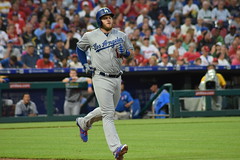
NUMBER TWO – Max Muncy, Dodgers – 18th inning, 2018 World Series Game Three – October 27, 2018

Max Muncy photo

Photo by IDSportsPhoto 

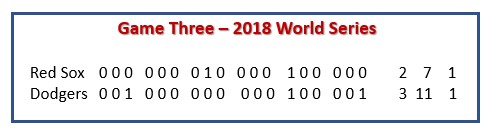
Some may dispute the date of Max Muncy’s walk-off World Series blast.  The game actually started on October 26, but ended – with Muncy’s long ball – at approximately 12:40 a.m. October 27.  Muncy’s heroics makes number-two on this list by virtue of putting an exclamation mark on the ending of the longest World Series game ever – both in terms of innings (18) and time (seven hours and twenty minutes).

How the Game Had Changed

Game Three of the 2018 World Series involved more total playing time (seven hours and twenty minutes) than the entire 1939 Fall Classic. In the 1939 Series (seven hours and five minutes), the Yankees topped the Reds in four straight games.  Game one went to New York 2-1 in one hour and 33 minutes; Game Two ended 4-0 in one hour and 27 minutes; Game three, a 7-3 Yankee win, took two hours and one minute; and the finale, a 7-4 Yankee win in ten innings, took  a whopping two hours and four minutes.

The Dodgers struck first on a third-inning home run (off Rick Porcello) by LF Joc Pederson. The Red Sox tied it on an eighth inning homer by starting CF Jackie Bradley, Jr.

Moving About in the Red Sox’ Garden

Red Sox’ starting CF Jackie Bradley Jr. moved to LF in the eighth; back to CF to open the ninth; back to LF with two outs in the ninth; back to CF to open the tenth; back to LF with two outs in the tenth; back to CF to open the eleventh.  Starting RF Mookie Betts made an equal number of moves between RF and CF; J.D. Martinez, who started in LF, bounced bounced between LF and RF; and starting 2B Brock Holt also saw time in LF and RF.

Neither team scored again until the top of the 13th inning, when The Red Sox’ Brock Holt opened with a walk (on a 3-2 pitch) off Scott Alexander, stole second and scored on a single (and an Alexander throwing error) by 3B Eduardo Nunez. The Dodgers retied the score in the bottom of the inning which – like the Red Sox half-inning – started with a 3-2 walk. Muncy drew a walk from Nathan Eovaldi, advanced to second on a foul pop out by CF Cody Bellinger and scored on a single by RF Yasiel Puig.  The score remained 2-2 until the bottom of the eighteenth, when Muncy led off the inning by launching  a 3-2 pitch from Eovaldi over the fence in left-center for the game-winning home run – sending the LA faithful home tired but happy. Muncy finished the game two-for-six, with two runs scored, one RBI and two walks in eight plate appearances. The long ball accounted for his only home run and only RBI in the Series. (He hit .263 with 35 home runs during the regular season).  The 18-inning triumph was the Dodgers only win in the Series. Muncy, who started the game at first base, played the final four innings at second base. 18

Trivia Tidbits:

  • The Dodgers and Red Sox used a World Series’ record 46 players in the game.
  • The top four spots in the Red Sox lineup went a combined zero-for-28.
  • Dodgers’ pitcher Clayton Kershaw, a three-time Cy Young Award winner, did not take the mound in the game. He was, however, used as a pinch hitter in the 17th inning – lining out to right field.
  • There were a record 35 strikeouts in the contest (19 by the Boston hitters).

Max Muncy has played five MLB seasons (2015-16, 2018-20). His career stat line is .236-87-221 in 432 games.  In 2018, he hit .251-35-98 (his second consecutive season with 35 home runs).

NUMBER THREE – Kirby Puckett, Minnesota Twins – 11th inning, 1991 World Series, Game Six – October 26, 1991

Kirby Puckett photo

Photo by compujeramey  

The Twins went into the Sixth Game of the World Series down three games-to two … and CF Kirby Puckett took the must-win contest in hand.  In the first inning, Puckett hit an RBI triple and later scored the inning’s second run. Then, in the third frame, he leapt high, glove above the Plexiglas(r) fence in deep left center, to rob Braves’ CF Ron Gant of a two-run home run.   In the fifth, after the Braves had tied the game 2-2 in the top of the inning on a home run by 3B Terry Pendleton, a Puckett sacrifice fly brought in Twins’ LF Dan Gladden to regain the lead. The Braves retied it at three in the top of the seventh and that’s where the score stayed until the until Puckett led off the bottom of the twelfth inning with a game-ending home run off Charlie Liebrandt (on a 2-1 pitch).   The Twins went on to win Game Seven and the Series 1-0, as Jack Morris threw a ten-inning, complete game shutout in the “winner-takes-all” finale.

The 1991 World Series saw five games decided by one run – three of those in extra innings.

Hall of Famer Kirby Puckett played 12 MLB seasons – retiring at age 35 due to eye issues (glaucoma). He finished with a .318 career average, 207 home run and 1,085 RBI. He was a ten-time All-star, collected 200+ hits in five seasons, leading the AL in safeties four times. He earned one batting title, hitting .300 or better in eight seasons, and earned six Gold Gloves.

Puckett’s home run edges out the next two “iconic” blasts because of its importance in keeping the Twins alive  in the Series, the tight nature of the 1991 Fall Classic, the overall way in which Puckett took over the game and the fact the the Twins won Game Seven to take the title.

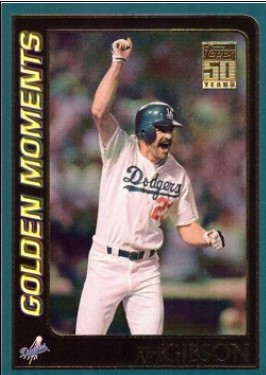
NUMBER FOUR (tie) – Kirk Gibson, Dodgers – Ninth inning, 1988 World Series Game One – October 15, 1988

GibsonHow many times have we seen the iconic video of the injury-hobbled Dodgers’ Kirk Gibson moving gingerly to the plate to pinch hit in the ninth inning of Game One of the 2018 World Series – with the Dodgers trailing 4-3 and down to their last out. How serious were Gibson’s injuries? Well, he was suffering from a severe left hamstring pull and a swollen right knee. The pain was serious enough that Gibson – the key to the Dodgers’ lineup, who would be voted the 1988 National League Most Valuable Player – got only one at bat in the entire 1988 World Series. But it was a big one – a game-winning, walk-off, two-run home run in the bottom of the ninth.

MVP, But Not an All Star

While Kirk Gibson was the 1988 NL Most Valuable Player (.290-25-76, with 31 steals), he was not selected to the All Star Team that season.  In fact, in his 17-season MLB career, Gibson never made an All Star Squad.

So, here’s how it went down – or up and out, if you prefer.  While the Dodgers were falling behind the favored A’s, Gibson spent a great deal of time not on the field, not even in the dugout, but in the trainer’s room – watching the game on TV and taking physical therapy (although, as the game progressed he did, reportedly, spend a bit of time in the batting cage).

Gibson’s chance to create a lasting World Series memory came, as one might expect, in the bottom of the ninth. The A’s led 4-3 and starter Dave Stewart was relieved by All Star closer Dennis Eckersley, who had the led the majors in saves with 45, while winning four games, losing two and putting up a 2.35 earned run average (a record that would earn him a second-place finish in AL Cy Young Award voting).  Eckersley quickly got Dodgers’ catcher Mike Scioscia on a pop out to shortstop and 3B Jeff Hamilton on a called third strike. Dodgers’ manager Tommy Lasorda then brought in Mike Davis to pinch hit for SS Alfredo Griffin.  Davis drew a five-pitch free pass from the usual walk-stingy Eckersley, which brought up the pitcher’s spot in the lineup and – to the surprise of fans and broadcaster alike – a limping Kirk Gibson emerged from the dugout to pinch hit.

In what all could see was a painful experience, Gibson fouled off the first two pitches – and the Dodgers were down to their last strike. Gibson fouled off another pitch, took a a ball, fouled off another tough Eckersley offering, took ball two and ball three (while Davis stole second). Then on a 3-2 pitch, Gibson lined a home run to deep right and did a limp-laden, arm-raising and fist-pumping trot around the bases as the Dodgers won 5-4. (One of only two World Series gamers featuring a walk-off home run while the winning team was trailing on the scoreboard.) While Gibson would not come to the plate again in the Series, his dramatic long ball set the tone – and the Dodgers topped the favored A;s in five games.

Baseball Roundtable Rant

Dodgers’ pitcher Orel Hershiser won the 1988 World Series MVP Award after giving up just two runs (seven hits, six walks, 17 strikeouts) in two nine-inning, complete-game wins.  BBRT always thought one of my favorite players – the energetic Mickey Hatcher – should have at lease been co-MVP of the Series.  Hatcher, called upon to play a key role due to Kirk Gibson’s injuries – responded by hitting .368 in the Series and leading all hitter in base hits (7), runs scored (5), home runs (2) and RBI (5). During the 1988 season, Hatcher had hit .293, with one home run and  25 RBI in 88 games.

Kirk Gibson played 17 MLB seasons. He hit .268, with 255 home runs, 870 RBI and 284 stolen bases. He hit 20+ home runs in six seasons and stole 20+ bases in six campaigns. Gibson’s best season was 1985, when he hit .287, with 29 home runs, 97 RBI and thirty stolen bases for the Tigers.   The 29 homers and 97 RBI were his career highs. In 21 post-season contests, Gibson hit .282, with seven home runs and 21 RBI. He was MVP of the 1984 ALCS.

NUMBER FOUR (tie) – Carlton Fisk, Red Sox – 12th inning, 1975 World Series Game Six – October 21, 1975

FiskLike Kirk Gibson’s limping, fist-pumping home run trot, Carlton Fisk’s 1975 World Series walk-off homer gave fans a lasting video image – this time of Fisk frantically waving the ball, which hit the Fenway Park left field four pole, fair.  It came about in the twelfth inning of Game Six of the 1975 World Series – a game the Red Sox needed to stay alive in the Fall Classic.

It had been a tense first five games, with the Reds holding a three games-to-two lead over the Red Sox and three of the first five contests decided by one run (one in extra innings). In Game Six, the Red Sox struck first on a three-run home run by CF Fred Lynn (off Gary Nolan) in the bottom of the first. The Reds came back to tie it with a trio of runs in the top or the fifth – highlighted by a (RF) Ken Griffey Sr. two-run triple and an RBI single by C Johnny Bench (both off Red Sox’ starter Luis Tiant). The Reds then pushed ahead 5-3 on a seventh-inning, two-run double by LF George Foster and grew the lead to 6-3 on a Cesar Geronimo (CF) solo homer in the eighth.  The see-saw battle continued as the Red Sox came back to tie it in the bottom of the eighth inning on two-out, three-run homer by pinch hitter Bernie Carbo.  (Carbo stayed in to play left field.)

The score was still 6-6 when Fisk led off the bottom of the twelfth against reliever Pat Darcy (the Reds’ eighth pitcher of the game). Fisk who already had a single and two intentional walks (in five plate appearances) hit a 1-0 pitch (at precisely 12:35 a.m. October 22) off the foul pole high above the “Green Monster” in left field – creating a lasting image of him leaping up and down and frantically waving the high fly fair.  Fisk’s walk-off led to a Game Seven, which Boston lost 4-3 (the Series had five one-run games). In 2005, the Red Sox named the foul pole the “Fisk Foul Pole” in honor of the blast.

Fisk hit .240 in the series with two home runs, four RBI, five runs scored and seven walks (three intentional).

Rookie of the Year

In 1972, Carlton Fisk was the American League’s first unanimous Rookie of the Year selection. That season, he went .293-22-61 in 131 games and led the AL in triples with nine. 

Hall of Famer Carlton Fisk had a 24-season MLB career (1969, 1971-93) during which he was an 11-time All Star. He hit .269-376-1,330 for his career.

A Hard Day’s Night

On May 8, 1985, Carlton Fisk set a record by catching all 25 innings of his Chicago White Sox’ 7-6 win over the Milwaukee Brewers. Actually, he set the record on May 9, since the game – which took eight hours and six minutes to complete – was suspended at 1:05 a.m. (after 17 innings) and completed before the regularly scheduled May 9 Brewers/White Sox matchup.  Fisk went three-for-eleven, with a walk, in the 25-inning game.  Notably, while Fisk did not start the regularly slated May 9 game, he he came in as a pinch runner in the bottom of the seventh and caught the final two innings of that contest.  

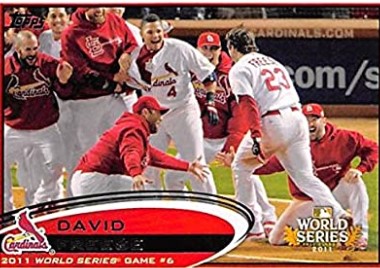
NUMBER SIX – David Freese, Cardinals – 11th inning, 2011 World Series Game Six – October 27, 2011

fREESEThe Cardinals were down three games-to-two to the Rangers, when Game Six of the 2011 Series opened in St. Louis.  As they went into the bottom of the ninth, the Redbirds were trailing 7-5 and on the verge of losing the Series. Facing the Rangers’ hard-throwing closer Neftali Feliz, 2B Ryan Theriot went down swinging to open the frame – putting the Cardinals just two outs from elimination. 1B Albert Pujols followed with a double to CF. The next batter, RF Lance Berkman, drew a walk, putting the double play on the board. While he didn’t get the DP, Feliz did get the out, fanning LF Allen Craig to bring up 3B David Freese with the Cardinals one out from losing the Series.  Freese got down in the count 1-2 (now the Cards were one strike from going home for the winter) and then laced a triple to right – scoring Pujols and Berkman and tying the game. The Rangers took the lead again with two-run home run by LF Josh Hamilton in the top of the tenth.  The Cardinals, however, refused to fold and prolonged their season with two runs on three singles and a walk in the bottom of the inning.

Everybody Gets to Play

Game Six of the 2011 World Series saw the Rangers and Cardinals use a combined 42 players (15 pitchers). 

Then, after reliever Jake Westbrook held the Rangers scoreless in the top of the eleventh, David Freese came up big again, hitting a 3-2 pitch from reliever Mark Lowe for a 10-9 Cardinals’ win.  The Cardinals went on to take Game Seven by a 6-2 score.

MVP-MVP

David Freese was the MVP in both the 2011 NLCS (when he hit .545-3-9) and the 2011 World Series (.348-1-7), Between Game Two of the 2011 NL Division Series and Game Four of the 2011 World Series, Freese ran up a 13-game, post-season hitting streak.

Freese played 11 MLB seasons, hitting .277-113-535. His best season was 2012, when he went .293-20-79 (career highs in HR and RBI). In 2011, he went .297-10-55 in 97 games.

NUMBER SEVEN – Eddie Mathews – 10th inning, 1957 World Series Game 4 – October 6, 1957

The 1957 World Series Game Four is one that  that I recall fondly, It took place  took place at Milwaukee’s County Stadium on October 6.  The Braves (my Braves, I am Milwaukee-born) were down two games-to-one and the highly-favored Bronx Bombers had trounced them the day before by a 12-3 score behind two home runs by Milwaukee-native Tony Kubek and one by Mickey Mantle. Sadly, my Braves had not only given up 12 runs on nine hits, they had walked 11 batters (the Braves had used six pitchers and every one had given up at least one free pass).  Now, at the time, my favorite player was Eddie Mathews. (He still is, by the way. True boyhood heroes last.) Happily, Mathews was destined to provide one of my most exciting childhood “big-league memories.”

The game was played on a Sunday and my mother made sure ten-year-old me was ready for the action.  There was buttered popcorn (which I was allowed, for this day, to eat on the good couch in front of the TV).  There was also A&W Root Beer (an upgrade from the usual Kool Aid).

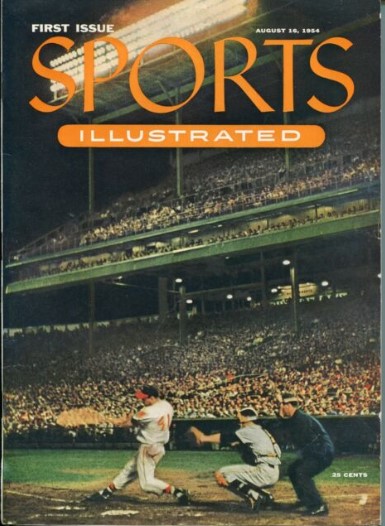
Eddie Mathews was on the cover of the inaugural issue of “Sports Illustrated. “

To make this long story a bit shorter, the Braves went into the ninth inning with a 4-1 lead behind the pitching of Warren Spahn and h0me runs by CF Hank Aaron (Aaron started in CF, with phenom Bob “Hurricane” Hazel in RF) and 1B Frank Torre.   Spahn retired Yankee RF Hank Bauer and CF Mickey Mantle to open the ninth and the Braves were one out away from tying the Series.  I was in baseball heaven.  However, the bubble quickly burst as Spahn gave up singles to C Yogi Berra and SS Gil McDougald and a game-tying three-run homer to 1B Elston Howard.    The Braves went down in order in the bottom of the ninth and in the top of the tenth a single by LF Tony Kubek and a triple by RF Hank Bauer gave the Yankees the lead. My heart sank.  Little did I know, one of the best moments of my hardball childhood was soon to come. Nippy Jones pinch hit for Spahn to open the Braves’ tenth and was hit by a pitch (the now immortalized “shoe polish-proven” plunking). This was, by the way, Jones’ last-ever MLB trip to the plate. With Felix Mantilla running for Jones, 2B Red Schoendienst sacrificed him to second and SS Johnny Logan doubled him home.  That tied the game and brought up my hero – Eddie Mathews – who popped a two-run home run to right on a 2-2 pitch from Bob Grim (appropriate name if you are going to give up a walk-off) to win the game.

Special thanks to reader Andy Moursund for a correction to this description. 

Thanks for the Stick, Joe

When Ed Mathews came to the plate in the tenth inning of Game Four of the 1957 World Series, he was not using his own bat.  He hit the walk-off home run with teammate Joe Adcock’s stick.  Mathews had come into the game zero-for-eight (but with five walks) in the Series and thought a change of lumber might help.  He doubled and homered with the borrowed weaponry.

Mathews’ game-winning blast should not have come as a big surprise.  The future Hall of Famer was the 1953 NL home run champion at age 21; had hit 222 home runs over his first six MLB seasons; and had just completed his fourth consecutive season with 30 or more round trippers (a streak that would eventually run to nine seasons, with four of those of forty or more long balls). Mathews’1957 stat line was .292-32-94.  Over his 17-season career, Mathews hit .271-512-1,453, was an All Star in mine seasons, led the NL in home runs twice and in walks four times.

Seeing Double

Hank Aaron and Eddie Mathews, while Braves teammates, hit more combined home runs than any other pair of teammates in MLB history (863). Second place?  Babe Ruth and Lou Gehrig at 859.

NUMBER EIGHT  – Adolis Garcia, Rangers – Eleventh Innings , 2023 World Ser4eis, Game One – October 27, 2023

See the opening paragraphs for this one.

NUMBER NINE– Tommy Heinrich, Yankees – 9th inning, 1949 World Series Game One – October 5, 1949

HenrichGame One of the 1949 World Series pitted two tough New York rivals – the Yankees and Dodgers. It also showcased stars like Duke Snider, Jackie Robinson, Pee Wee Reese, Carl Furillo, Gil Hodges. Roy Campanella, Phil Rizzuto, Joe DiMaggio and Yogi Berra.  And, it featured a pitching duel between Dodgers’ rookie and 17-game winner Don Newcombe and the Yankees ’32-year-old veteran (also 1949 17-game winner) Allie Reynolds.  The ultimate star of the game – at Yankee Stadium – would be Yankees ‘1B Tommy Henrich.  (Note: Henrich got extra credit in BBRT’s rankings for hitting the first-ever World Series walk-off home run.)

As the game went into the bottom of the ninth, both teams were scoreless and both starting pitchers were still at work. Reynolds had pitched nine frames, giving up just two hits and walking four, while fanning nine. Newcombe may actually have been just a bit more dominating.  In eight innings, he had surrendered just four hits, while walking none and fanning eleven.

Tommy Henrich put an end to the contest leading off the bottom of the ninth and taking a 2-0 Newcombe fastball over right-field wall for a 1-0 Yankees win. The Yankees went on to win the Series four games-to-one. Henrich hit .263 in the Series and his walk-off represented his only home run and RBI.

Henrich played in 11 MLB seasons (1937-50, missing three seasons for military service), all for the Yankees. The first-baseman-outfielder hit .282-183-795 and led the American League in triples twice and runs scored once (138 in 1948). He was a five-time All Star. Henrich played in four World Series (1938-41-47-49) and hit one home run in each (.262-4-8 in 21 World Series games).

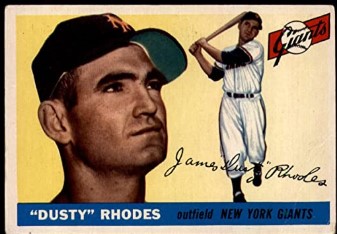
NUMBER TEN –  Dusty Rhodes, New York Giants – 10th inning, 1954 World Series Game One – September 29, 1954

rHODESWhen fans think about Game One of the 1954 World Series, they generally focus on “The Catch” – Willie Mays’ spectacular eighth-inning, over-the-shoulder, running grab of the Indian’s Vic Wertz’ long drive to deep center field.  Mays’ stunning catch and equally spectacular spinning throw back to the infield (holding Indians’ runners on first and second) preserved a 2-2 tie.

The game stayed knotted at two runs apiece until the bottom of the tenth inning, when Dusty Rhodes was called on to pinch hit for LF Monte Irvin (who was zero-for-three) with runners on first and second and one out.  Rhodes hit the first pitch from Indians’ starter and future Hall of Famer Bob Lemon (23-7, 2.72 that season) just over the Polo Grounds’ right-field wall – 257-feet from home plate – giving the Giants a 5-2 win. Rhodes got points in this ranking for knocking the only pinch-hit, World Series, walk-off home run.

Rhodes, who hit .253-54-207 in a seven-season MLB career (1952-57 and 1959) hit .667 in the 1954 Fall Classic (won by the Giants in a sweep), going four-for-six with two home runs and seven RBI. Often coming off the bench. Rhodes played in 100 or more games in only one season.   1954 was his best campaign, he hit .341-15-50 in 82 games (164 at bats) – and .326 as a pinch hitter.

Your Guy in a Pinch

Dusty Rhodes was known as a guy who could come off the bench and deliver a big hit. In fact, 21 percent of his regular-season 1,316 plate appearances came in a pinch-hitting role. 

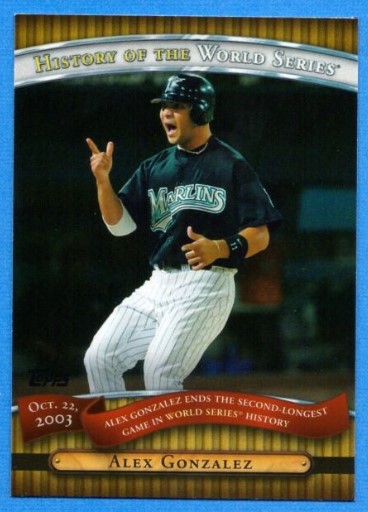
NUMBER ELEVEN – Alex Gonzalez, Marlins – 12th inning, World Series Game Four, October 22, 2003

gONZALEZThe underdog Marlins came into Game Four of the 2003 World Series trailing the Yankees two games-to-one and facing Roger Clemens.

How deep was the 2003 Yankee pitching staff? Roger Clemens (17-9 in the regular season) didn’t get a start in the World Series until Game Four.  Preceding him were: David Wells; Andy Pettitte and Mike Mussina.

The Marlins jumped on Clemens for three runs in the bottom of the first inning on a two-run home run by RF Miguel Cabrera and a run-scoring single by 1B Derrek Lee.  Clemens settled down after that and held the Marlins scoreless over the next six innings.  The Marlins, in fact, would be held without a run for 10 straight frames.  In the meantime, the Yankees scored one in the top of the second (the only run surrendered by Marlins’ starter Carl Pavano over eight innings) and two in the top of the ninth on a two-strike (3-2 count), two-run triple by pinch hitter Ruben Sierra (off Marlins’ closer Ugueth Urbina).

The Marlins’ escaped a two-on, nobody-out Yankee threat in the top of the eleventh and, as the game went into the bottom of the twelfth, it was still 3-3.  Gonzalez led of the Marlins’ half of the twelfth inning, by going yard on a 3-2 from Jeff Weaver.  That win seemed to turn the Series on end – as the Marlins won the next two games to take home the championship.

Gonzalez played 16 MLB seasons, hitting .245-157-690. He was an All Star just once, in his first full MLB season (age 22), when he hit .277-14-59 in 136 games. His walk-off homer in the World Series was his only long ball in 83 post-seasons at bats (24 games).

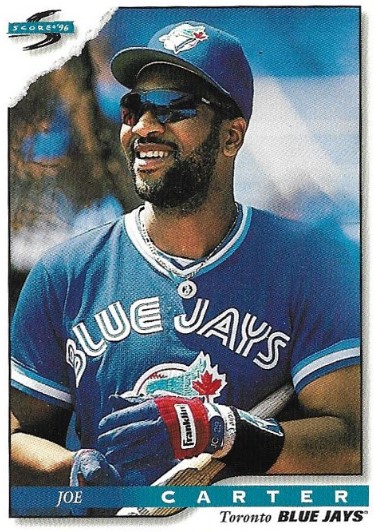
NUMBER TWELVE – Joe Carter, Blue Jays – 9th inning, 1993 World Series, Game Six – October 23, 1993

carterJoe Carter’s World Series’ walk-off is one of only two in which the home team was trailing (rather than tied) at the time of the blast (and would have finished higher on this list if it had come late in extra innings or if the Blue Jays had needed the win to stay alive in the Series). Carter’s Blue Jays, up three games-to-two, looked to have the game in hand early – leading the Phillies 5-1 after six innings.  The Phillies, however, shocked the home crowd with a five-run top the seventh. Jays’ starter Dave Stewart, who had given up just one run over the first six innings, walked SS Kevin Stocker (in a ten-pitch at bat) to start the inning, then gave up a single to  2B Mickey Morandini (the number-nine hitter) and a three-run home run to CF Lenny Dykstra. That brought on reliever Danny Cox, who got just one out, while surrendering three singles and a walk – leaving with one run already in and the bases loaded. Next to the mound was Al Leiter, who gave up a sacrifice fly before recording the final out of the frame.  Suddenly, a 5-1 Blue Jays’ advantage had turned to 6-5 Phillies.

It stayed that way until the bottom of the ninth, when Phillies’ closer Mitch Williams walked Blue Jays’ LF Rickey Henderson on four pitches to start the inning.  CF Devon White then flied to left for the first out.  DH Paul Molitor followed with a single, which set up RF Carter’s game-winning three-run home run – giving the Blue Jays a four game-to-two Series win – and creating a memory that lives on in Blue Jays’ lore.

Power and Speed

Joe Carter had six seasons of 30 or more home runs and six campaign of 20 or more stolen bases.  In 1987, he had a 30-30 season – .264-32-106, with 31 steals.

Carter payed 16 MLB seasons, going .259-396-1,445, with 231 stolen bases.  He was a five-time All Star and ten times drove in 100+ runs. In 1993, he hit .254, with 33 home runs and 121 RBI in the regular season and .280-2-9 in the World Series.

NUMBER THIRTEEN –  Derek Jeter, Yankees – 10th inning, 2001 World Series Game Four – October 31, 2001

dEREK jETER photo

Photo by Pat Guiney 

The Yankees came into Game Four of the 2001 World Series down two games-to-one to the Diamondbacks – and facing Curt Schilling, who had gone 22-6 and fanned 293 batters in the regular season and had held the Yankees to two hits and one run in seven innings (picking up the win) in Game One.

The Yankees jumped out on top 1-0 in the bottom of the third on a home run by LF Shane Spencer. The Diamondbacks came right back with a home run by 1B Mark Grace (off Orlando Hernandez) in the top of the fourth and took a two-run lead in the top of the eighth on a single, double and fielder’s choice. The Bronx Bombers, in danger of falling behind three games-to-one, tied it on a two-run home run by 1B Tino Martinez (off Byung-Hyun Kim) with two outs in the bottom of the ninth.

Mariano Rivera pitched a 1-2-3 top of the tenth – and Derek Jeter ended it by taking Kim deep on a 3-2 pitch with two out in the bottom of the inning. (The Diamondbacks eventually won the Series four games-to-three.)

Hall of Famer Derek Jeter played 20 MLB seasons – going .310-260-1,311, with 358 steals. He was a 14-time All Star and the 1996 AL Rookie of the Year.  Jeter scored 100 or more runs in 13 seasons, hit .300 or better 12 times, had 200+ hits in eight seasons and 20+ stolen bases in eight campaigns.  He was also a five-time Gold Glover.


NUMBER FOURTEEN –  Scott Podsednik, White Sox – 9th inning World Series Game Two – October 23, 2005

While White Sox’ LF Scott Podsednik’s home run didn’t come in extra innings or in a Series-winning or Series-extending game, it did come as a surprise.  That’s because during the 2005 season, Podsednik had gone without a single round tripper (507 at bats). The White Sox, who had topped the (then) National League Astros 5-3 in Game One of the Series, carried a 6-4 lead into the ninth inning of Game Two. They brought in closer Bobby Jenks to seal the deal, but a pair of singles and a walk (and two outs) later, Jenks was gone and the game was tied.  The Astros brought in Brad Lidge in the bottom of the inning to keep it there.  After getting number-nine hitter SS Juan Uribe to fly out, Lidge gave up a surprising home run to the power-starved Podsednik to end the contests and send the White Sox on the way to a four-game sweep. Podsednik by the way, had put up a .290 average and stolen 59 bases during the regular season.

Dangerous on the Base Paths

In the four seasons from 2003 through 2006, Scott Podsednik stole 212 bases, including a league-leading 70 in 2004.

Podsednik played 11 MLB seasons, hitting .281-42-812 with 309 stolen bases. Despite not showing a lot of regular-season power, Podsednik’s 14 post-season hits (in 12 games) included one double, three triples and two home runs.  His post-season slugging percentage was .551, compared to a regular-season career slugging percentage of .379.

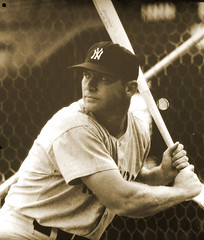
NUMBER FIFTEEN – Mickey Mantle, Yankees – 9th inning, 1964 World Series, Game Three – October 10, 1964

You had to expect Mickey Mantle to appear on this list. After all, he hit 18 World Series home runs in his career. His only walk-off Fall Classic long ball came against the Cardinals in Game Three of the 1964 Series. The Cards and Yankees had split the first two contests in a couple of lopsided slugfests. The Cards won Game One 9-5, while the Yankees prevailed 8-3 in Game Two. Moving to New York for Game Three, a pair of 18-game winners (Curt Simmons of the Cards and Jim Bouton of the Yankees) held the opposing offenses in check – with the game tied 1-1 after eight innings. Simmons had given up one run on four hits – in the second inning, 3B Clete Boyer had plated C Elston Howard with an RBI single.  Bouton have given up one run on six hits, as Simmons helped his own cause, driving in C Tim McCarver with a fifth-inning single.

In the top of the ninth, Bouton pitched around an error by SS Phil Linz on a McCarver grounder and a walk to pinch hitter Carl Warwick – holding the score at 1-1. Barney Schulz came on in relief of Simmons and Mantle hit his first offering for a walk-off homer to right. The Cardinals went on to win the Series four games-to-three, despite Mantle hitting .333, with three home runs and 8 RBI.

The World Series Belong to Mick

Mickey Mantle, who played in 65 World Series Games, holds the career records for World Series walks (43); extra-base hits (26); home runs (18); runs batted in (40); runs scored (42); total bases (123); and strikeouts (54). He hit .257 in Fall Classic play.

The Hall of Famer played in 18 MLB seasons and was an All Star in all but two of them. (1951 & 1956). He was a three-time AL MVP and four-time AL home run leader. Hi collected 2,415 career hits (.298 average); 536 home runs; and 1,509 RBI. Mantle won the AL Triple Crown in 1956 with a .353-52-130 line and was a three-time AL Most Valuable Player.

NUMBER SIXTEEN – Mark McGwire, A’s – 9th inning, 1988 World Series, Game 3 – October 18, 1988

mACThe Oakland A’s went into the 1988 World Series as favorites, but ended up losing to the Dodgers four games-to-one.  Mark McGwire’s walk-off home run in Game Three gave the A’s their only victory.

With the low final score (2-1), you might expect that the game was a classic pitching duel between the Dodgers’ John Tudor (10-8, 2.32 during the season) and A’s Bob Welch (17-9, 3.64). Not the case, as Tudor was gone after just 1 1/3 innings – pulled due to an elbow injury after retiring the first four batters he faced.  Welch fared a bit better giving up just one run in the first five innings– but having thrown a lot of pitches under stress (four hits and two walks over the first five frames).  Welch was pulled after the sixth inning started with the A’s loading the bases (double, single, walk) with no outs.

The bullpens pretty much took care of business in this one, with the score knotted at one run apiece after eight innings. In the top of the ninth, the A’s Rick Honeycutt set the Dodgers down in order (he retired six straight batters in his two-inning stint).  Jay Howell came on for the Dodgers in the bottom of the inning and, after getting Jose Canseco to pop out, gave up a game-ending home run to McGwire on a 2-2 pitch (in a tough eight-pitch at bat).

The 1988 World Series is the only Fall Classic with two games ending on walk-off home runs – Games One and Three.

McGwire’s walk-off home run in Game Three of the 1988 World Series was his only hit in the Series (17 at bats).

In 1988, Mark McGwire hit .260-32-99 – a season after a .289-49-118 rookie campaign (and the American League Rookie of the Year Award). McGwire played 16 MLB seasons, was a 12-time All Star and four-time league home run champ. His final MLB stat line was .263-583-1,414.  In 1998, McGwire hit 70 round trippers. He followed that up with 65 long balls in 1999.

On the Move, In the Groove

In 1997, Mark McGwire led all of M LB with 58 home runs, but did not win a league home run championship. He hit 34 home runs in 105 games for the A’s, before being traded to the Cardinals, for whom he hit 24 home runs in 51 contests.

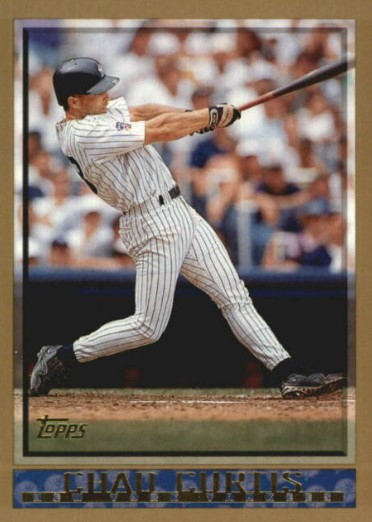
NUMBER SEVENTEEN –  Chad Curtis, Yankees – 10th inning, 1999 World Series Game Three – October 26, 1999

CURTISThe Yankees were already up two games-to-none on the Braves going into Game Three of the 1999 World Series, but the Braves came out of the gate hot, building a 5-1 lead over the first four innings. The Yankees, however, tightened up on the mound (getting 6 1/3 scoreless innings from three relievers) and slowly chipped away.  LF Chad Curtis got one back with a home run off Tom Glavine in the fifth. 1B Tino Martinez added a solo shot off Glavine in the seventh. And 2B Chuck Knoblauch hit a two-run homer in the eighth. Not so suddenly, the game was tied.  Both teams were scoreless in the ninth to send the contest into extra innings. The Braves pulled out all the stops in the top of the tenth, using a trio of pinch hitters (among four batters) – Ozzie Guillen, Ryan Klesko and Greg Myers, but did not score.  Curtis led of the bottom of the tenth with his second home run of the game – joining the list of players with walk-off World Series dingers.

Curtis played 10 MLB seasons, hitting .264-101-461, with 212 stolen bases. He stole 20+ bases five times and hit a career-high 21 home runs for the Tigers in 1995.

Chad Curtis stole 91 bases in his first two MLB season (1992-93) with the Angels. 

Primary Resources: Baseball-Reference.com; Retrosheet.org; Baseball-Almanac.com; The World Series (Dial Press/Sports Products, Inc.); Society for American Baseball Research. Note: I used Baseball-Reference.com; Retrosheert.com, and  SABR to search for Negro League World Series walk-off home runs in the period added to MLB records, but found none (although Negro League records are still incomplete in some areas. 

Baseball Roundtable – Blogging Baseball Since 2012.

100Baseball Roundtable is on the Feedspot list of the Top 100 Baseball Blogs.  To see the full list, click here.

Baseball Roundtable is also on the Anytime Baseball Supply Top 66 Baseball Sites list.  For the full list, click here

I tweet (on X) baseball @DavidBaseballRT

Follow/Like Baseball Roundtable’s Facebook Page here.  Find More baseball commentary; blog post notifications; PRIZES.

Member: Society for American Baseball Research (SABR); Negro Leagues Baseball Museum; The Baseball Reliquary.

P1009

2023 Baseball Roundtable All-Rookie Team and All-Time, All-Rookie Team

In this post, you’ll get a look at Baseball Roundtable’s 2023 All-Rookie Team, as well as review The Roundtable’s All-Time, All-Rookie Squad.  The 2023 team includes:

  • A player who played 30 or more games at three different positions;
  • A player who led all rookies in runs scored, hits and triples and was among the top three in home runs, RBI and stolen bases;
  • A player who hit .636 in his senior year in high school;
  • A player whose 19 outfield assists led MLB;
  • A 30-year-old import from Nippon Professional Baseball; and
  • A player who tied the rookie record for Grand Slams in a season (four).

But enough teasers, let’s get to it.

CATCHER – Yainer Diaz, Astros

Photo: Rickmunroe01, CC BY-SA 4.0 <https://creativecommons.org/licenses/by-sa/4.0>, via Wikimedia Commons

In his age-24 season, Diaz appeared in 104 games for the Astros, 60 of those behind the plate – hitting .282 with 23 home runs and 60 RBI. His homers and RBI were second-highest among rookie catchers.   His 100 base hits led all rookie backstops. Signed as an International Free Agent by the Indians in 2016, he was traded to the Astros in 2021.  Diaz hit well at every level in the minors (.321-52-275 over five minor-league seasons). He earned a brief callup in 2022 (just eight at bats) –  making his MLB debut on September 2, after a .306-25-96 season at Double-A/Triple-A.  After a slow start in 2023, hitting just .226-2-5 through May, Diaz turned it up, hitting .287-16-43 from June 1 through October 1.

Honorable Mention: While Francisco Alvarez hit only .209 for the Mets, he did lead all rookie catchers with 25 home runs and 63 RBI.

_________

FIRST BASE – Spencer Steer, Reds

Steer was a Twins’ third-round draft pick (out of the University of Oregon) in 2019.  In August of 2022, he was traded to the Reds as part of the deal for pitcher Tyler Mahle. Steer hit well enough for the Reds’ Triple-A Louisville Bats (.294-3-13 in 23 games) to earn a late-season callup, making this MLB debut on September 2, 2022. He hit just .211-2-8 in 28 games for Cincinnati.

In 2023, rookie status still intact, Steer was a fixture in the Reds’ lineup (156 games) and hit .271-23-86. Notably, he moved around, starting at 1B (53 games); 3B (42 games); LF (36 games): 2B (13 games); RF (two games); and DH (six games).  He gets the nod at 1B here, since he had the most starts there. Steer’s 86 RBI and 37 doubles led all MLB rookies, while his 158 base hits were second, his 23 home runs tied for fifth and his 74 runs scored were sixth.

Honorable Mention:  Tristan Casas of the Red Sox went .263-24-65 in 132 games.

_________

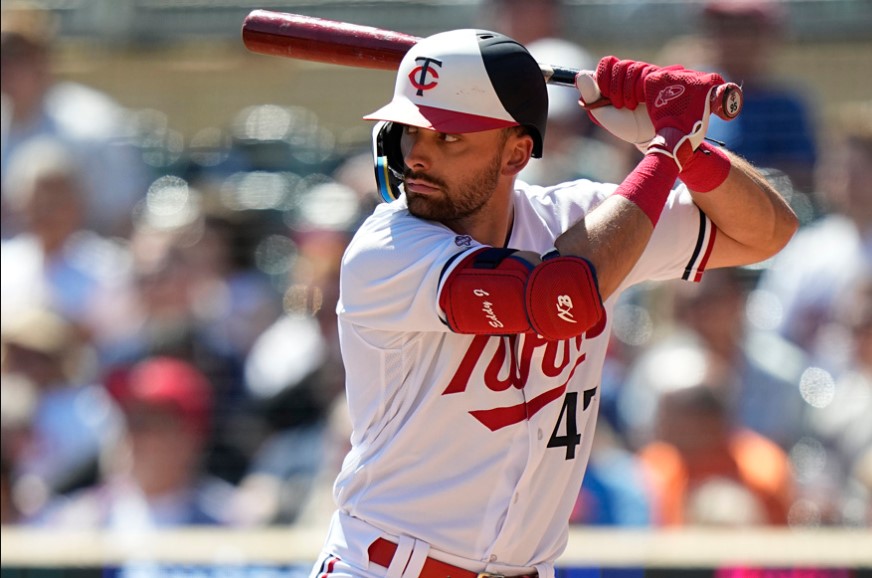
SECOND BASE – Edouard Julien, Twins

Photo: ThisizQ, CC BY-SA 4.0 <https://creativecommons.org/licenses/by-sa/4.0>, via Wikimedia Commons

Julien was  drafted by the Twins in the 18th round of the 2019 MLB Draft (out of Auburn University).  Over three minor-league campaigns, he went .285-40-161 in 263 games. The 24-year-old made his MLB debut on April 12 of last season. He went on to hit .263-16-37, with 89 hits (most among rookie 2B) and 60 runs scored (also leading rookie 2B) in 109 games.


Honorable Mention: Oakland’s Zack Gelof went .267-14-32, with 40 runs scored and 14 steals in 69 games.

__________

THIRD BASE – Gunnar Henderson, Orioles

Photo: Maryland GovPics, CC BY 2.0 <https://creativecommons.org/licenses/by/2.0>, via Wikimedia Commons

In reality, Henderson (the favorite for AL Rookie of the Year) could be slotted at 3B or SS.  He started 68 games at 3B and 64 at SS, so I will stick to using the position most often played. On the season, the 22-year-old (a second-round 2019 draft pick out of John T. Morgan Academy in Selma, Alabama) hit .255-28-82, with 152 base hits, 100 runs scored, nine triples and 10 steals  in 150 games. His 28 homers and 86 RBI led all rookies, his nine triples and 100 runs scored were second.

Henderson made his MLB debut on August 31, 2022 and played in 34 games for the Orioles that season (.259-4-18). In three minor-league seasons, he hit .276-37-161 in 246 games. In 2022, Henderson hit .297-19-76, with 22 steals at Double-A/Triple-A.

Honorable Mention:  Josh Jung of the Rangers hit .266-23-70, with 75 runs scored in 122 games.

_________

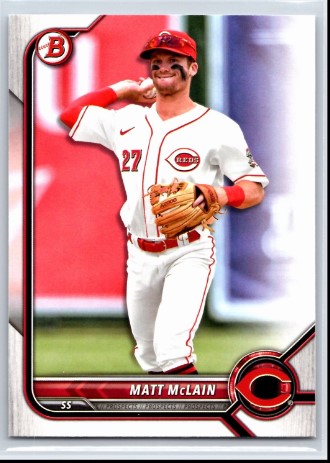
SHORTSTOP – Matt McLain, Reds

The 23-year-old McLain showed average, power and speed in his debut season – going .290-16-50, with 65 runs scored and 14 steals in 89 games. Like Gunnar Henderson ( above), McLain could have been slotted at multiple positions, starting 52 games at SS, 33 at 2B and three at DH.  I, again, chose to go with the positions played most often.

McLain was a  first-round pick in the 2021 MLB Draft (out of the University of California, Los Angeles, where he hit .280-16-85 in 121 games over three seasons). In his final  season at UCLA, McLain hit .333-9-36, with nine steals in 47 games.  When McLain was called up (in Mid-May), he was hitting .348-12-40 at Triple-A Louisville.  As noted, in 89 games for the Reds, he went .290-16-50 and tossed in 14 steals.  His 16 home runs were second among rookie shortstops, his 50 RBI third and his 14 steals third.

Honorable Mention: The Rockies’ Ezequiel Tovar hit .253-15-73 in 153 games.

__________

OUTFIELD – Corbin Carroll, Diamondbacks

Photo: Casey Aguinaldo, CC BY-SA 4.0 <https://creativecommons.org/licenses/by-sa/4.0>, via Wikimedia Commons

The 22-year-old Carroll seems a shoe-in for NL Rookie of the Year Award after playing in 155 games for the Diamondbacks and putting up aa .285-25-76 stat line with 161 hits, 30 doubles, 10 triples, 116 runs scored and 54 steals in 59 attempts.  He led all MLB rookies in hits, runs and triples and was second in steals and third in home runs and RBI.

Carroll was a first-round draft pick in 2019 (right out of high school) and he began “raking” immediately. At Rookie and A-Ball in 2019 (as an 18-year-old), he hit .299-2-20, with 18 steals in 42 games. In an injury-shortened 2021 season (no season in 2020 –  pandemic), he hit .435 in seven games at High-A.  Then in 2022, in  Rookie, Double-A and Triple-A, he hit .307-24-62, with 31 steals in 93 games.  That earned him an  August callup and he hit .260-4-14 in 32 games (keeping his rookie status intact).  Then came 2023 and his first full season (and an All Star Game start).  Certainly looks like there’s more to come.

_________

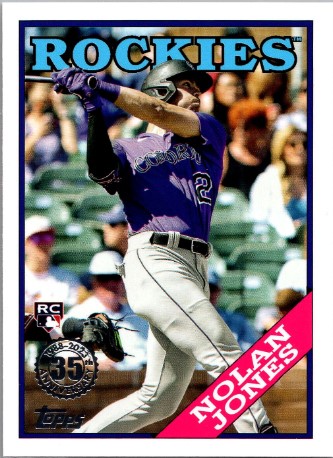
OUTFIELD – Nolan Jones, Rockies

Jones was drafted by the Guardians (out of Holy Ghost Prep High School in Philadelphia) in the second round of the 2016 MLB Draft.

_____

Nolan Jones hit .636-5-24 in 19 games in his senior season and was First Team Rawlings All American.

_____

In his first six minor-league seasons, Jones hit .273-60-262 in 497 games. He was called up to the Guardians in July 2022 and hit .244-2-13 in 28 games. After the season, he was traded to the Rockies for minor-league infielder Juan Brito. The trade worked out pretty well for the Rox. When he was called up to the Rockies in late May, Jones was hitting .356-12-42 at Triple-A. He went on to hit .297, with 20 home runs and 62 RBI in 106 games for Colorado. He also stole 20 bases (in 24 tries) and led all NL outfielders in assists (19).

_________

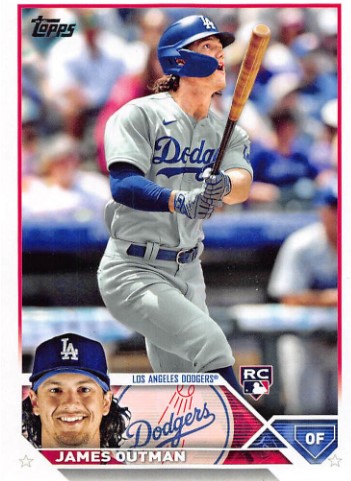
OUTFIELD – James Outman, Dodgers

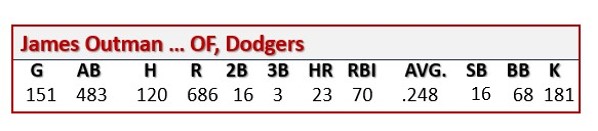
Okay, my first two outfielders were corner men.  I needed a CF and Outman was the logical choice. The 26-year-old Outman (who had a brief callup to the Dodgers last season – four games) played in 151 games for the 2023 Dodgers, hitting .248-23-70, with 16 steals.

Outman was a seventh-round 2018 draft pick out of California State University, Sacramento. In four minor-league seasons, he hit .263-23-79 in 403 games. He showed good power in the minors (double-digit homers each season), but really upped his game in 2022 – .294-31-106 in 125 games and Double-A/Triple-A.

Outman’s 86 runs scored were second among MLB rookie outfielders, and  his  20 homers were third, as were his 70 RBI. His 16 steals were sixth.


Outfield Honorable Mentions: The Red Sox’ Masakata Yoshida went .289-15-72 in 140 games; The A’s Esteury Ruiz hit .254-4-47 and stole 67 bases in 132 contests.

_________

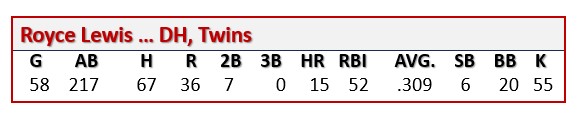
DH- Royce Lewis, Twins

Had to make a spot for the Twins’ 24-year-old rookie infielder. Lewis played in just 58 MLB games, but went .309-15-52 and poled four Grand Slams (tying the MLB rookie single-season record). Lewis did earn a 2022 callup (.300-2-5 in 12 Twins games that season). 2023 was a bit of an up-and-down season for Lewis, interrupted by injury – but when he was in the lineup, he produced.

Lewis was a first round pick (right out of high school) in the 2017 MLB Draft.  In five minor-league seasons, he has hit .273-41-178, with 85 steals.

You Can Make A Case

You could make a case for casting a vote for Royce Lewis as AL Rookie of the Year.  In 1959, Giants’ 1B Willie McCovey was unanimously voted NL Rookie of the Year, despite playing in only 52 MLB games. He went .354-13-38 in those contests.


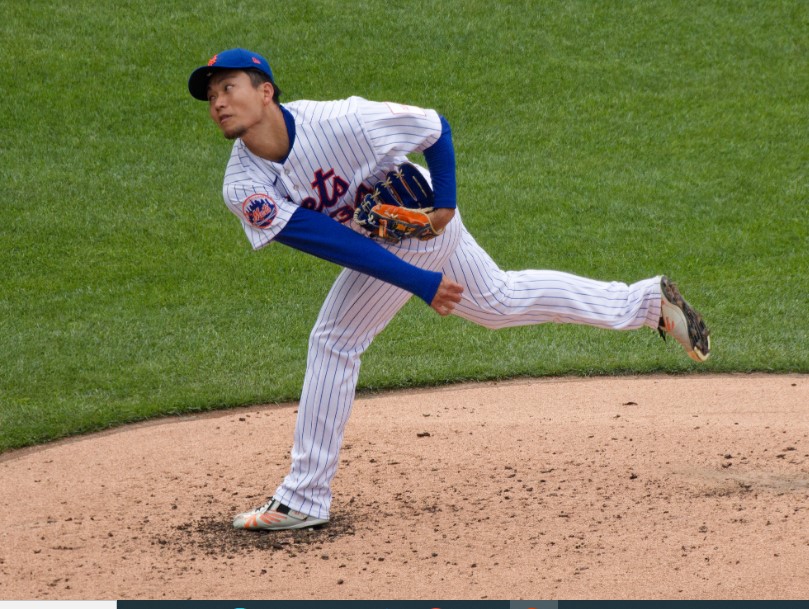
STARTING PITCHER – Kodai Senga, Mets

Photo: D. Benjamin Miller, CC0, via Wikimedia Commons

The Mets’ 30-year-old righty is the most experienced member of this All-Rookie lineup. Senga went 12-7, 2.79 in 29 starts for New York – fanning 202 batters in 166 1/3 innings. He led all MLB rookie pitchers in wins, led qualifying rookies in earned run average, and led all rookies in strikeouts. The Mets signed Senga in December of 2022 – when he already had 11 seasons in the Nippon Professional Baseball League under his belt. Over those seasons, he went  87-44, with a 2.59 ERA and 10.3 strikeouts per nine innings.

Honorable Mention: Tanner Bibee of the Guardians went 10-4, 2.98 in 25 starts (141 strikeouts in  142 innings).

_________

RELIEVER – Yennier Cano, Orioles

Cano went 1-4, put up a stingy 2.11 earned run average over 72 appearances (72 1/3 innings).  He tied for the MLB lead in holds (31)  and his eight saves were second among rookies.

Cano signed (out of Cuba as an International Free Agent) with the Twins in 2019. Among his credentials was an 18-6, 2.12 record in three seasons in the Cuban National Series. In August of 2022, Cano was traded to the Orioles with three other minor-leaguers) for pitcher Jorge Lopez and cash. Cano went 0-1, 4.32 in 11 games for the Orioles’ Triple-A club and got in three late-season games for the Orioles . Between Minnesota and Baltimore, Cano was 1-1, 11.50 in 13 2022 MLB appearances.

Why his 2023 success?  It’s credited to a tweak in his delivery and improved focus that have helped him overcome past command issues.

Honorable Mention: The Padres’ Tom Cosgrove, went 1-2, 1.75 in 54 appearances.

Now, let’s move on to a review of The Roundtable All-Time, All-Rookie Squad.

Baseball Roundtable All-Time, All-Rookie Squad

CATCHER – Josh Gibson, 1933 Pittsburgh Crawfords

Photo: Harrison Studio, Public domain, via Wikimedia Commons

As a 21-year-old rookie in 1933, Josh Gibson helped lead the Pittsburgh Crawfords to the Negro National League title. He played in 68 of the Crawfords’ 89 games and was behind  the plate in 48 of them.   In the process, he led the league in hits (94), triples (7), home runs (18), RBI (74), total bases (177), on-base percentage (.442), and slugging percentage  (.774).  He finished second in batting average, and third in runs scored, doubles and walks.

Side: note: MLB rules indicate a player qualifies as a rookie unless he has exceeded 130 at bats or 50 innings pitched in the major leagues. From 1930-32, Gibson played primarily  for independent clubs.

Gibson went on to play a total of 14 seasons in the Negro Leagues (MLB now considers the Negro Leagues from 1920-to -948 to be major leagues) – putting up a .374-165-730 line. He twice won the Triple Crown (1936 and 1937), led the league in home runs 11 times, RBI seven times, runs scored five times, hits twice, batting average three times and total bases six times.

Honorable  Mentions:  Mike Piazza, 1993 Dodgers (.318-35-112); Benito Santiago, 1987 Padres, who went .300-18-79 and swiped 21 bases in 146 games; Carlton Fisk, 1972 Red Sox  (.293-22-61, with a league-leading nine triples).

_________________________________________

Special Mention – Mike Piazza

Who could have predicted that the 1,390th player selected in the 1988 MLB draft would not only be the 1993 Rookie of the Year, but would also earn a spot in the National Baseball Hall of Fame? Mike Piazza was also an All Star and Silver Slugger winner in his 1993 rookie campaign (Dodgers). In his 24-year-old rookie season, Piazza finished seventh in the AL in batting average (.318); sixth in home runs (35) and fourth in RBI (112).

Piazza hit .308, with 427 home runs and 1,335 RBI in 16 MLB seasons (Dodgers, Marlins, Mets, Padres, A’s). He was a two-time All Star, won ten Silver Slugger awards, topped 20 home runs nine times, 100 RBI six times, produced a .300+ average in nine campaigns and four times finished among the top four voter getters for MVP. Not bad for a 62nd-round draft pick.

_____________________________________________________

FIRST BASE – Mark McGwire, 1987 A’s

Photo: Silent Sensei from Santa Cruz, USA, CC BY 2.0 <https://creativecommons.org/licenses/by/2.0>, via Wikimedia Commons

Mark McGwire’s original call up was not an eye-opener (18 games in 1986, with a .189-3-9 stat line.) However, he made good on his promise in his first full season – going .289-49-118 for the A’s as a 23-year-old in 1987; and setting a rookie HR record that stood for three decades.  In 1987, McGwire led the American League in home runs and slugging percentage, was third in RBI and second in total bases. He finished sixth in the AL MVP balloting. McGwire went on to a 16-season MLB career in which he hit .263, with 583 long balls and 1,414 RBI. McGwire led his league in home runs four times (a high of 70 in 1998) and in RBI once (147 in 1999).

McGwire was drafted by the A’s in the first round (tenth overall) of the 1984 MLB Draft (out of the University of Southern California).

From Pitcher to First Base … Not a Bad Move

In three seasons (1982-84) at the University of Southern California, Mark McGwire hit .358, with 51 home runs and 139 RBI in 120 games (with all those hits coming in his final two campaigns). Some might be surprised to learn that, in 1982, McGwire was a pitcher (and did not come to the plate). He went 4-4, 3.04 in 20 games (four starts). McGwire was the Sporting News College Player of the Year in 1984, when he put up a .387-32-80 stat line in 67 games.

Honorable Mentions: Pete Alonso, 2019 Mets (.260-53-120), the AL leader in home runs, while setting a new MLB rookie record for round trippers); Dale Alexander, 1929 Tigers (.343-25-137,  with a league-leading 215 hits); Buck Leonard, 1935 Homestead Grays, who hit a league-leading .389 (40 games).

Special Mention – Jackie Robinson

You could not post about an All-Time, All-Rookie Lineup with a shout out to Jackie Robinson (after all, the Rookie of the Year Award is now known as The Jackie Robinson Award). Robinson won the award as a first baseman in 1947 – the season he broke MLB’s color line. Robinson hit .297, with 12 home runs, 48 RBI, 125 runs scored and a league-topping 29 steals – while dealing with the pressures of an historic season.  While his offensive numbers do not match those of some of the others rookies at this traditionally offensive-focused position, there is no doubt about his character courage and performance under pressure. And there is no double any post focusing on outstanding rookies would be incomplete without him. 

____________________________________________________

 SECOND BASE – Joe  Morgan, 1965 Astros

Photo: Unknown author, Public domain, via Wikimedia Common

This one was a tough call. I  found myself comparing speed (like Bump Wills’ 28 steals and 87 runs scored in 1997) to power (like Gleyber Torres’ 24 home runs and 77 RBI in 2018).  Ultimately, I went for a rookie second baseman who gave me some of each. Joe Morgan hit .271 as a 21-year-old rookie in 1965.  He tossed in 14 home runs, 20 steals and 100 runs scored.  In addition, his 97 walks led the league (helping him to a .373 on-base percentage, tenth in the league) – and he fanned just 77 times.

Morgan played basketball and baseball in high school, but was not recruited by four-year colleges – perhaps due to his size (5’7”).   He schooled and played instead at Oakland City College (a two-year institution), where he began to attract some  attention from scouts.  (In his second year at Oakland City College, he hit .367 and led the team in average, home runs and stolen bases.)

Morgan signed with the Astros (as an amateur free agent) in 1962 and was a major-league regular by 1965. He, in fact, made his MLB debut in as a 20-year-old in September of 1963.  (Morgan played in 18 MLB games in 1963-64.) In his final minor-league campaign, Morgan hit .323-12-90, with 47 steals in 140 games for the 1964 Double-A San Antonio Bullets.

Morgan went on to a 22-season MLB career. Hitting .271-268-1,133, with 689 stolen bases and 1,650 runs scored. He was a ten -time All Star, two-time Most Valuable Player and five-time Gold Glover.

Honorable Mentions:  Gleyber Torres, 2018 Yankees (.271-24-77); Del Pratt, 1912 Browns (.302-5-69, with 24 steals and 76 runs scored); Bump Wills, 1977 Rangers  (.287-9-62, with 28 steals and 87 runs scored); Dustin Pedroia, 2007 Red Sox (.317-8-50, with 86 runs scored).

Does This Seem Fair?

In 1965, Baseball Roundtable’s choice for second base on this All-Time, All-Rookie Lineup (Joe Morgan) finished second in the National League ROY balloting to another second baseman. Jim Lefebvre of the Dodgers got 14 first-place votes to Morgan’s four. Each played in 157 games with Morgan outhitting  Lefebvre .271 to .250, outscoring him 100 to 57, hitting 14 home runs to Lefebvre’s 12, stealing 20 bases to Lefebvre’s three, drawing 97 walks to the Dodgers’ second sacker’s 71 – and outdistancing  him in both on-base percentage and slugging percentage. Lefebvre did best Morgan in RBI (69-to-40). Their fielding stats were fairly equal, with Morgan making 27 errors in 867 chances and Lefebvre making 24 errors in 802 chances (Lefebvre’s fielding percentage was  .970 to Morgan’s .969).  

Side note: Jim Gilliam’s 1953 season for the Dodgers  (.278-6-63, with 125 runs scored and a league-topping 17 triples) would have made this list a few years ago.  But now that the Negro Leagues (1920-48) are considered major leagues, his rookie season would be with the Baltimore Elite giants in 1947.

__________________________________________

THIRD BASE – Ryan Braun, 2007 Brewers

Photo: Ian D’Andrea from Philadelphia, PA, CC BY-SA 2.0 <https://creativecommons.org/licenses/by-sa/2.0>, via Wikimedia Commons

Ryan Braun put up a .324-34-97 line, with 91 runs scored, 15 steals and a league-topping .634 slugging percentage in 2007. Notably, he started 112 games at third base that season – and did not start there again in his 14 MLB seasons (defensive issues at the hot corner led to a move to the outfield).

Braun was  a first-round pick (fifth overall) of the Brewers in the 2005 draft – after three seasons at the University of Miami, where he was .365-45-195 over 165 games.

Ryan Braun College Stardom

In 2003 (while playing for the University of Miami), Ryan Braun was Baseball America’s National Freshman of the Year after going .364-17-74. He was also a 2005 All American (and Atlantic Coat Conference Player of the Year) – after a .388-18-76 season. (College Stats from TheBaseballCube.com)

Braun rose quickly through the minor-league ranks – hitting .352-10-45 in 47 games at Rookie- and A-Ball in 2005; .289-22-77, with 26 steals at High-A and Double-A in 2006; and  .342-10-22 in 34 games at Triple-A in 2007.  He made his MLB debut, at the age of 23, May 25, 2007.

Braun went on to a 14-season MLB career (.296-352-1,154, with 216 stolen bases).  He was the 2007 NL Rookie of the Year, a six-time All Star and the 2011 National League MVP.

Honorable Mentions: Dick Allen, 1964 Philllies (.318-29-91, with a league-leading 125 runs scored.);  Al Rosen,  1950 Indians  (.287-37-116, with 100 runs scored); Kevin Seitzer, 1987 Royals (.323-15-83, with 12 steals and 105 runs scored); Pete Ward, 1963 White Sox (.295-22-84).

__________________________________________

SHORTSTOP – Nomar Garciaparra, 1997 Red Sox

Photo: Jon Gudorf Photography, CC BY-SA 2.0 <https://creativecommons.org/licenses/by-sa/2.0>, via Wikimedia Commons

Nomar Garciaparra’s rookie season saw the 23-year-old lead the American League in at bats, hits, and triples, while scoring 122 runs and putting up a .306-30-98 stat line, with 22 stolen bases. Garciaparra was drafted (by the Brewers) in the first round of the 1994 draft (out of the Georgia Institute of Technology, where he had hit .372-23-166 with 66 steals over three seasons – 174 games).

Like most players on this list, Garciaparra’s rise to the major leagues was swift – coming in just his third professional season. He was called up  in late 1996 and got in 24 games for the Red Sox, hitting .241-4-176 (and keeping his rookie status for 1997).

All Star on the Field and in the Classroom

Nomar Garciaparra was a two-time, first-team All American and a two-time Academic All American.

Garciaparra went on to a 14-season MLB career, hitting .313-229-936.  He was a six-time All Star and won back-to-back AL batting titles in 1999 (.357) and 2000 (.371).

Honorable Mentions: Corey Seager, 2016 Dodgers (.308-26-72, with 105 runs scored); Hanley Ramirez, 2006 Marlins (.292-17-59, with 51 steals and 119 runs scored); Troy Tulowitzki, 2007 Rockies (.291-24-99, with 104 runs scored); Johnny Pesky, 1942 Red Sox, (.331-2-51, with 205 hits, 12 steals and 105 runs scored); Harvey Kuenn, 1953 Tigers (308-2-48, with a league-leading 209 hits).

_____________________________________________

LEFT FIELD – Wally Berger, 1930 Braves

Wally Berger made his major-league debut for the Boston Braves on April 15, 1930 – after three minor-league seasons over which he hit .352, with 144 home runs in 499 games. As a 24-year-old MLB rookie, he finished third in the National League in home runs – and his 38 long balls were the record for an MLB  rookie that stood for 57 years.

Berger went on to play 11 MLB seasons, hitting .300, with 242 home runs and 898 RBI. He was a four-time All Star and led the NL in home runs (34) and RBI (130) in 1935.

Honorable Mentions: Mitchell Page, 1977 A’s (.307-21-75, with 42 steals and 85 runs scored); Frank Robinson, 1956 Reds (.290-38-83, with a league-leading 122 runs scored – at the ripe young age of 20); Jeff Heath, 1938 Indians (.343-21-112, with 104 runs scored); Kiki Cuyler, 1924 Pirates (.354-9-85, with 32 seals and 94 runs scored).

______________________________________________

CENTER FIELD – Fred Lynn, 1975 Red Sox

Photo: Unknown author, Public domain, via Wikimedia Commons

The first player to win Rookie of the Year and a Most Valuable Player Award in the same season, Lynn had shown his promise the season before. Called up from the Triple-A Pawtucket Red Sox (where he hit .282-21-68 in 124 games), Lynn closed out the 1974 season hitting .419 in 15 games for Boston.  In 1975, the 23-year-old hit .331 (second in the AL), with 21 home runs, 105 RBI (third in the AL) and an AL-leading 103 runs scored  – and he won a Gold Glove for his defensive play in center field.

Lynn was selected by the Red Sox in the second round of the 1973 MLB draft. He played his college ball at the University of Southern California, where he hit .320-28-111 over three seasons and was a first-team All American in 1972.

Lynn went on to a 17-season career during which he was an All Star in nine seasons and a four-time Gold Glover. His career stat line was .283-306-1,111 .

Honorable Mentions: Mike Trout, 2012 Angels (.326-30-83, with 49 steals and 129 runs scored); Turkey Stearnes, 1923 Detroit Stars (.362-17-85); Oscar Charleston, 1920 Indianapolis ABCs (.353-5-59, with a league-leading 122 hits, 80 runs scored and 11 triples); Cristobal Torriente, 1920 Chicago American Giants – the Negro National League batting champions as a rookie (.411-2-58); Kenny Lofton, 1992 Indians (.285-5-42, with 96 runs scored and 66 steals).

__________________________________________________

RIGHT Field – Tie … Shoeless Joe Jackson, 1911 Indians,  Ichiro Suzuki, 2001 Mariners & Ted Williams, 1939 Red Sox

Yes, I know a three-way tie is kind of a cop-out, but there was so much to choose from here – a .400+ hitter; a batting champ who, in 2001,  put up (at the time) the ninth-most hits ever in an MLB season (and the most since 1930) and a 20-year-old who drove in 145 runs and scored 131.

Photo: Miscellaneous Items in High Demand, PPOC, Library of Congress, Public domain, via Wikimedia Commons

Joe Jackson … The 23-year-old Indians’ outfielder had been called up for the proverbial MLB “cup of coffee” in 1908, 1909 and 1910, but had seen action in only 30 games – retaining his rookie status. After a 1910 season that saw Jackson hit .354 in 136 games for the Class-A New Orleans Pelicans and then .387 in 20 contests for the Indians, Jackson had cemented a spot with the 1911 AL Indians’ squad.  That season, he started 96 games in right field and 50 in center.

In 147 games, he hit .408, with 233 hits, 126 runs scored, 45 doubles, 19 triples, seven home runs, 83 RBI and 41 stolen bases.   In 1911,  Jackson was second in MLB in batting average (to Ty Cobb’s .420); first in on-base percentage (.468); second (to Cobb) in slugging percentage at .590; second in runs scored (again to Cobb); second in hits (Cobb); second in doubles (Cobb); and second in total bases with 337 (Cobb, 367). He finished fourth in the MVP voting.

If it took Ty Cobb in his prime to outhit you in your rookie season, you’ve earned a spot in this lineup.

Jackson – caught up in the Black Sox scandal of 1919 – went on to a 13-year career in which he  averaged .356, three times led the AL in triples, twice led the AL in hits, twice topped the league in total bases and racked up single seasons leading the AL in doubles, on-base percentage and slugging percentage. By the way, Jackson hit .375 in that infamous 1919 World Series.

Photo: Jeffrey Hayes, CC BY 2.0 <https://creativecommons.org/licenses/by/2.0>, via Wikimedia Commons

Ichiro Suzuki … Like Fred Lynn in this outfield, Suzuki was the Rookie of the Year and League MVP in the same season. As a 27-year-old MLB rookie, he led the AL with a .350 average and 242 hits – and added a league-leading 56 stolen bases and a Gold Glove. Keep in mind, that Suzuki had nine seasons in Japan before making the “major leagues” (.353 average and seven batting championships in Japan).

Like Elvis, Cher and Madonna, Ichiro became a a star who needed only one name.  After a spectacular rookie season in MLB, Ichiro just kept on hitting.  He amassed  200+ hits in each of his first ten MLB seasons, leading the league in safeties seven times – and picked up a pair of batting titles along the way.  He was also a Gold Glover in each of his first ten seasons. Ichiro retired with  a .311 MLB average, 3,089 hits, 117 home runs, 780 RBI, 1,420 runs scored. And 509 steals.

Photo: Apex Photo Company, Public Domain, via Wikimedia Commons

Ted Williams …   Teddy Ball Game broke into the big leagues in 1939 – a 20-year-old rookie. It was his fourth professional season and, in three minor-league campaigns, his average had gone from .271 to .291 to .366. In 1939, Williams hit .327, banged out 31 home runs, led all of MLB with 145 RBI, led the American League with 344 total bases and scored 131 times. He finished seventh in the AL in batting average; fifth in hits (185); first in total bases (344); second in doubles (44); fifth in triples (11); and third in home runs (31).

Williams went on to a Hall of Fame career that included 19 All Star selections, two MVP Awards and two Triple Crowns.  He led his league in batting average six times; home run four times; runs scored six times; RBI four times; total bases six times; on-base percentage 12 times; slugging percentage nine times; and, not surprisingly, walks eight times and intentional walks nine times.  He set the tone for this remarkable career in his rookie season.

A Hero On and Off the Field

Ted Williams lost approximately five years of MLB playing time while serving in the U.S military – as a combat fighter pilot –  in World War II and the Korean War. 

Honorable Mentions: Aaron Judge, 2017 Yankees (.284-52-114, with 128 runs scored); George Watkins, 1930 Cardinals (.373-17-87, with 85 runs scored);  Tony Oliva, 1964 Twins (,323,-32-94, with 109 runs scored and 12 steals and the AL leadership in hits and average).

__________________________________________

DH/UTILITY – Albert Pujols, 2001 Cardinals

Photo: SD Dirk on Flickr (Original version)  UCinternational (Crop), CC BY 2.0 <https://creativecommons.org/licenses/by/2.0>, via Wikimedia Commons

Some may be surprised that Albert Pujols is not at first base in this lineup. The reason is that in his rookie season (2001), the 21-year-old Pujols started just 31 of 161 games played (19.2%) at first base. In his rookie season, Pujols started 52 games at 3B; 38 in LF; 33 in RF; 31 at 1B; and 2 at DH.

In 2001, Pujols put up the first in a string of remarkable seasons –  hitting  .329, with 37 home runs, 130 RBI and 112 runs scored and earning Rookie of the Year Award and a fourth-place finish in the MVP balloting. Over the first ten seasons of his career, he topped a .300 average, 30 home runs and 100 RBI every season.

Pujols scores points for making a .300-30-100 season seem a bit mundane – right from his rookie season.  He also gets extra credit for versatility.

Pujols was drafted by the Cardinals in the 13th round of the 1999 MLB Draft (out of Metropolitan Community College -Maple Woods, Kansas City). Pujols hit .461, with 22 home runs in his only college season.

That’s a Good Start

In his first college game, Albert Pujols started at shortstop and hit a Grand Slam Home Run AND turned an unassisted triple play.

One That Got Away,” Gordon Edes, Boston Globe, October 11, 2006

Retiring after the 2022 season, Pujols’ stat line is .296-703-2,218 (with 3,384 hits).   The 11-time All Star and three-time MVP led his league in runs scored five times, home runs twice, RBI once and average once. He also picked up a pair of Gold Gloves along the way. As a rookie, he got a Hall of Fame career off to a great start

_________________________________________

STARTING PITCHER – Russ Ford,  1910 Yankees

Photo: Bain News Service (publisher), Public domain, via Wikimedia Commons

Unlike many of the players on this list, after a spectacular rookie season, right-handed hurler Russ Ford did not go on to a long and illustrious MLB career. Before making the New York Highlanders (Yankees) roster in 1910, Ford did get a somewhat disappointing  “cup of major-league coffee” in 1909 – one game, three innings pitched, four hits, four walks, three hit batsmen, three earned runs, two strikeouts.

Still a rookie in 1910, the 27-year-old righty went 26-6 with a 1.65 ERA. In his initial full campaign, Ford was second in the AL in wins (26); second in winning percentage (.813); seventh in ERA (1.65); fourth in strikeouts (209); fifth in games started (33); fourth in complete games (29); second in shutouts (8); allowed the fewest hits per nine innings (5.89); and had the second-lowest Walks and Hits per Innings Pitched (0.88).  On a Highlanders’ team that finished second with an 88-63 record, Ford led the team in virtually every positive pitching category.

Ford followed that rookie season with a 22-11, 2.27 record in 1911, but then led the AL in losses (13-21, 3.55) in 1912 and lost 18 games (versus 12 wins) in 1913. He jumped to Buffalo of the Federal League in 1914, going 21-6, 1.82 – and  then 5-9, 4.52 in 1915. Historians report that Ford’s career was cut short (he did not pitch in the majors after 1915) with the banning of his signature pitch – the well-scuffed “emery ball.”  His final MLB line, over seven seasons, was 99-71, 2.59.

Honorable Mentions: Grover Cleveland (Pete) Alexander, 1911 Phillies (28-11, 2.57 – leading the league in wins, complete games with 31 and shutouts with seven);  Dwight Gooden, 1984 Mets (17-9, 2.60, while leading the NL in complete games with 16, innings pitched with 276 2/3 and strikeouts with 276); Fernando Valenzuela, 1981 Dodgers ( 13-7 in the strike-shortened 1981 season – winning both Rookie of the Year and the Cy Young Award – and leading the league in complete games with 11, shutouts with eight, innings pitched with 192 1/3 and strikeouts with 180); Mark Fidrych, 1976 Tigers (19-9, 2.34 – leading the league in ERA, complete games with 24, throwing complete games in 11 of his first 12 MLB starts and topping the league in talking to baseballs).

__________________________________________________

RELIEF PITCHER – Craig Kimbrel, 2010 Braves

Photo: LWY on Flickr (Original version) UCinternational (Crop), CC BY 2.0 <https://creativecommons.org/licenses/by/2.0>, via Wikimedia Commons

In 2011, 23-year-old Craig Kimbrel set the rookie record for saves, with 46 – leading the National League. He put up a 2.10 ERA in a league-leading 64 appearances (fanning 127 in 77 innings).
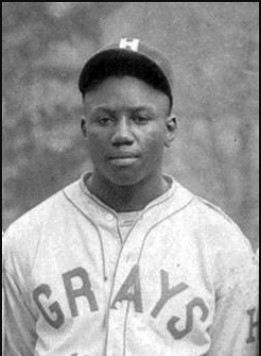
Kimbrel was  selected (by the Braves) in the third round of the 2008 MLB draft (out of Wallace State Community College). In his freshman season at Wallace State (2007), Kimbrel went 8-0, 1.99. He followed that up with a 9-3, 2.88 record in 2008.

After being drafted by the Braves, Kimbrel went 8-7, 1,85 with 51 saves and 242 whiffs in 151 innings over three minor-league seasons. He did pitch for the Braves in 2010, going 4-0, with a 0.44 ERA in 21 appearances (his 20 2/3 innings pitched enabled him to retain his rookie status into 2011.)

Kimbrel, still active in 2022, is an eight-time All Star and has led his league in saves four times. His career record at the end of the 2022 season was 41-36, 2.31, with 394 saves and 1,098 strikeouts in 688 1/3 innings pitched.

Honorable  Mentions: Neftali Felix, 2010 Rangers (4-3, 2.73 with 40 saves in a league-leading 59 appearances); Andrew Bailey, 2009 A’s (6-3, 1.84 with 26 saves); Huston Street, 2005 A’s (5-1, 1.71 with 23 saves); Kaz Sasaki, 2000 Mariners (2-5, 3.16 with 37 saves).
Primary Resources:  Baseball-Reference.com; TheBaseballCube.com

Baseball Roundtable – Blogging Baseball Since 2012.

100Baseball Roundtable is on the Feedspot list of the Top 100 Baseball Blogs.  To see the full list, click here.

Baseball Roundtable is also on the Anytime Baseball Supply Top 66 Baseball Sites list.  For the full list, click here

I tweet (on X) baseball @DavidBaseballRT

Follow/Like Baseball Roundtable’s Facebook Page here.  Find More baseball commentary; blog post notifications; PRIZES.

Member: Society for American Baseball Research (SABR); Negro Leagues Baseball Museum; The Baseball Reliquary.

P1007


Carroll


Senaxga

Who’s Your Daddy? … Episode 18 … Hoyt Wilhelm

Welcome to  the 18th post in the Baseball Roundtable’s “Who’s Your Daddy?” series, where we take a look at Roundtable-selected lineups that performed exceptionally well against some of MLB’s greatest pitchers.

As always, I would stress that the pitchers included in the Who’s Your Daddy? series are among the “best in the business.”  They are selected not because of the players who performed well against them, but rather because success among hitters when they were on the mound was the exception rather than the rule.  We’ve looked at pitchers from a wide range of eras – from Carl Hubbell to Bob Feller to Nolan Ryan to Justin Verlander. Note:  For those unfamiliar with the series, it’s origins are explained at the end of this post.

___________________________

Before we get started on this edition,  here are links to the previous editions of this series.

Please note: For still active pitchers, the stats are as they stood on the date of the post.

  • Nolan Ryan, click here.
  • Sandy Koufax, click here.
  • Pedro Martinez, click here.
  • Bob Gibson, click here.
  • Randy Johnson, click here.
  • Greg Maddux, click here.
  • Justin Verlander, click here.
  • Bob Feller, click here.
  • Roger Clemens, click here.
  • Max Scherzer, click here.
  • Tom Seaver, click here.
  • Mariano Rivera, click here.
  • Warren Spahn, click here.
  • Lefty Grove, click here.
  • Steve Carlton, click here.
  • Robin Roberts, click here.
  • Carl Hubbell, click here. 

If you go back through past editions of “Who’s Your Daddy?”, you may find a few surprises – like how Will Clark owned Nolan Ryan; Jerry Lynch‘s .714 average versus Sandy Koufax; the fact that Brian Harper faced Roger Clemens 23 times and never struck out; how Ival Goodman (who averaged one home run each 47 at bats over his 10-season MLB career) poked six home runs in just 64 at bats against Carl Hubbell; or that Magglio Ordonez hit .500 in his career versus Mariano Rivera and never fanned against him.

____________________________

As I looked back at past posts in the series, I realized the pitchers featured in these posts had been known for a variety  of pitches – blazing fastballs, sweeping curveballs, devastating change ups, wicked screwballs, darting splitters and more.  However, this series has yet to feature a knuckleball specialist. Well, that time has come.  Today, we feature Hall of Famer, and premier knuckleballer, Hoyt Wilhelm.

As Usual, One Things Led to Another

In keeping with the Baseball Roundtable tradition – “When I begin looking into something one thing always seems to lead to another,” the selection of Hoyt Wilhelm for this series was prompted by a report that, when Padres’ rookie knuckleballer Matt Waldron picked up a win  over the A’s on September 16, it was the first MLB win for knuckleball pitcher in nearly five years (since September 20, 2018).  That started me thinking about MLB’s best-ever knuckleballer and led me to feature Wilhelm in the “Who’s Your Daddy?” series.  

Before we get into the lineup of players who fared especially well against Wilhelm, let’s take a look at his unique career.

Photo: Public domain, via Wikimedia Commons

Hoyt Wilhelm was less than 100 days shy of his thirtieth birthday when he made his major-league debut.  Yet, he still fashioned  a 21-season, 1,070-appearance MLB pitching career – making his last MLB appearance (two scoreless inning in relief) just 16 days shy of his fiftieth birthday. But I’m getting ahead of myself.  There is a lot more to the Wilhelm story.

At a time when the knuckleball was primarily used by pitchers who had “aged out” of effective curves and heaters, Wilhelm began using the pitch (actually a fingertip-ball in his case) as his mainstay as a teenager. In 1942, after high school, Wilhelm signed with the Class-D North Carolina State League Mooresville Moors,  who played just 12 miles from his home town of Huntersville. North Carolina. He went 10-3 for Mooresville before being drafted into the Army. He spent three prime years in the military, seeing plenty of combat and receiving a Purple Heart for wounds he suffered in the Battle of the Bulge.

Hoyt Wilhelm pitched his entire MLB career with a piece of shrapnel (from the Battle of the Bulge) lodged in his back.

After his release from the service, Wilhelm returned to  Mooresville, where he went 41-15 over two seasons and, in 1947, he was signed by the New York Giants.  And, the rest, as they say, is history. Working primarily as a starter, he worked his way up from Class-B to Triple-A between 1948 and 1951 – going 56-46 and pitching to a 3.68 earned run average over 813 innings.  For my home state (Minnesota) readers, Wilhelm spent the 1950-51 seasons with the Triple-A Minneapolis Millers – going 26-15, 4.41, primarily as a starter.

In 1952, Wilhelm stuck with the Giants and had a stellar rookie season – appearing in a league-leading 71 games, going 15-3 (his .833 winning percentage led the NL) and putting up a league-leading (among qualifiers – a minimum of 154 innings pitched) 2.43 earned run average. Surprisingly he finished a distant second in the Rookie of the Year balloting to another reliever, Joe Black of the Dodgers.  Black got 19 votes to three for Wilhelm and one each for the Pirates’ Dick Groat and the Braves’ Eddie Mathews.  As the chart below show, it seems like it should have been a lot closer.

A Unicorn

Hoyt Wilhelm remains the only MLB pitcher to win an earned run title in a season in which he did not start a single game. 

To make a long story short, Wilhelm and his knuckler stayed in the big leagues through 1972.  He pitched in 1,070 games (52 starts, more than half of them  in 1959). His 1,018 relief appearances are fifth all-time and his 1,871 relief innings are first all-time, as are his 124 career wins in relief.

How Much Did Hoyt Wilhelm’s Knuckleball Flutter?

In his first 16 years in the major leagues, the teams Wilhelm suited up for led their league in passed balls in 15 campaigns. A couple of other indicators:

  • In 1958, with Wilhelm on the staff, Indians’ catchers committed a league-topping 35 passed balls. In 1959, without Wilhelm in the fold, that number dropped to six.
  • In 1959, Orioles’ catcher Gus Triandos had 28 passed balls – 24 of them came with Wilhelm on the mound.

Side Note:  The statistics for the Hoyt Wilhelm “Who’s Your Daddy?” lineup are not as telling as for the starting pitchers who have been featured in these posts – primarily because batters did not rack up at bats at the same frequency (given Wilhelm’s role as a reliever). For example, 89 MLB batters had 50 or more at bats versus Bob Feller in his 18 MLB seasons, while just ten opposing batters reached up at least 50 at bats versus Wilhelm in 21 seasons. Still, the group featured here makes for an interesting lineup.

Wilhelm was an  All Star in five seasons (eight All Star selections due to the playing of two All Star games from 1959 through 1962) and led the AL in earned run average, appearances and winning percentage twice each.  (Notably, he led the AL in ERA once as a reliever and once as a starter.) Wilhelm finished in the top three in pitching appearances in six times, and in the top three in saves five times. From 1964 through 1968 he pitched in 306 games, with a 1.74 ERA

While Wilhelm was used primarily as a starter in just one of his 21 MLB seasons (1959 Orioles).  He proved he could go the distance. In 32 games that season (27 starts), he went 15-11, led the AL with a 2.19 ERA. Made the All Star team, threw 13 complete game and delivered  three shutouts.

Seeing Floaters? Just Swing.

On September 20, 1958, Hoyt Wilhelm started on the mound for the Orioles (in Baltimore) versus a tough Yankee lineup that included the likes of Mickey Mantle, Bill Skowron, Elston Howard, Bobby Richardson and Hank Bauer. At the time, the Yankees were in first place at 89-58, while the Orioles were in seventh at 68-77. Wilhelm proved up to the task, no-hitting the Yankees in a 1-0 victory. (The only run coming on a seventh inning Gus Triandos’ home run.) Wilhelm walked two and fanned eight in the 99-pitch outing.


—The Hoyt Wilhelm -Who’s Your Daddy? ” Lineup—

Let’s start with a few statistics.

Put Me In Coach

Hoyt Wilhelm faced Giants’ 3B  Al Gallagher five times in his career – and never got him out (the most plate appearances for any player with a 1.000 on-base percentage versus Wilhelm). From 1970-72, Gallagher had five plate appearance versus Wilhelm and delivered three singles and two walks.  Gallagher was a .263 hitter over four MLB seasons (1970-73 … Giants, Angels).

On the flip side, you find another 3B – the Red Sox’ Joe Foy.  Foy faced Wilhelm 13 times over four seasons and never reached base against him (the most plate appearances versus Wilhelm for a hitter with 0.000 OBP versus the knuckleballer).  Foy only got the ball out of the infield three times versus Wilhelm.  Foy hit .248-58-291 over six MLB campaigns (1966-71 … Red Sox, Royals, Mets, Senators).

Now for the lineup that best handled Wilhelm’s flutterball.

Catcher – Roy Campanella

Photo: Bowman Gum, Public domain, via Wikimedia Commons

The knuckleball may have been hard to catch, but for at least a couple of catchers, it was not so hard to hit. Our starter at catcher is Hall of Famer  Dodger Roy Campanella, who hit .469-2-12 versus Wilhelm over 33 games (1952-57). Campanella’s .469 average versus Wilhelm was the highest among any player with at least 20 career at bats against him.  His fifteen hits were the third-highest against the knuckleballer, as were his 12 RBI. Campanella did not get his first hit against Wilhelm until his ninth plate appearance against him (two walks, a sacrifice, five outs).  From that point on, he went 15-for-15-28, with five walks.


Campanella played ten years with the Dodgers (1948-57), hitting .276-242-856 and making eight All Star teams. He played  ten years in the Negro National League II (1937-42, 1944-45), hitting .316-18-163, making three All Star squads and winning the 1944 Negro National League II batting title with .388 average.

Campanella was the National League MVP in 1951, 1953 and 1955.

Going Yard Twice

On August 13, 1953, Hoyt Wilhelm came on to relieve Al Worthington with his Giants leading the Dodgers 8-4, two men on and one out. Wilhelm got Jackie Robinson on an easy fly to second base, before Roy Campanella took a 2-1 pitch to deep RF for a three-run home run – cutting the margin to one. It stayed that way (8-7) until Campanella faced Wilhelm again with two outs in the top of the ninth.  This time Campanella took Wilhelm yard to LF.  The Giants eventually won 9-8 in ten innings.

Have to also give a shoutout to another catcher, Earl Battey, whose .414 average (12-for-29) versus Wilhelm was the second-highest among players with at least 20 at bats against him.

_______________________________________________________

First Base – Stan Musial

Hall of Famer Stan Musial hit .375 against Wilhelm over 24 games. His four home runs tied for second (career) against Wilhelm. Like Campanella above, Musial had a two-home run game against Wilhelm.  It came on May 2, 1954 in the second game of a doubleheader between Musial’s Cardinals and Wilhelm’s Giants (in St. Louis). In that game, Wilhelm came in to open the bottom of the fourth, with the Giants up 8-3. Musial connected off him for a two-run homer in the fifth and a solo shot in the seventh (his only two at bats versus Wilhelm in the game). The Giants did hang on to win 9-7.


They Call Him The Streak

Stan Musial’s record against Hoyt Wilhelm was a streaky one. From June 12, 1953 through May 2, 1954, Musial faced Wilhelm seven times and collected  five hits (one single, one double and three home runs) and two walks (one intentional).  Immediately after that streak of success, from June 20, 1954 through May 20, 1956, Musial faced Wilhelm nine times and got on base just once (an intentional walk). In those nine plate appearances, he got the ball out of the infield just once.

Musial was an All Star in 20 of his 22 MLB seasons. He was a three-time NL MVP, seven-time batting champion and led the league in a range of offensive categories: games (five times); runs scored (five times); hits (six times); doubles (eight times); triples (five times); RBI (twice); total bases six times); on-base percentage (six times); slugging percentage (five times); walks (once); and intentional walks (five times). He had a career batting average of .331 (3,630 hits in 10,972 at bats) and, despite 475 home runs, never led the league in homers.

An honorable mention at first base has to go to Steve Bilko, who hit .409 (9-for-22), with two homers and six RBI in 19 games versus Wilhelm. Bilko went  .249-76-276 in ten MLB seasons (1949-54, 1958, 1960-62 … Cardinals, Angels, Dodgers, Reds, Cubs, Tigers).

______________________________________

Second Base – Tie: Jackie Robinson & Gene Baker

Hall of Famer Jackie Robinson hit .344 versus Wilhelm and drove in five runs in 34 games.  Robinson also drew nine walks (tied for fourth all-time against Wilhelm) for  a .500 on-base percentage versus the knuckleballer – second among MLB batters with at least 20 at bats versus Wilhelm.

Can’t Touch That

In Jackie Robinson’s first six plate appearances versus Hoyt Wilhelm not a ball was put in play – yet he was on base four times.  (three walks, one hit by pitch and two strikeouts.) 

Robinson played in 11 MLB seasons – 1945 with the Kansas City Monarchs and 1947-58 with the Dodgers. He hit .313-141-761, with 200 stolen bases in 1,416 games. He was the 1949 NL MVP, when he led the league with a .342 average and 37 steals – to go with 122 runs scored, 203 hits, 16 home runs and 124 RBI.

Gene Baker hit .467 (7- for-13) versus Wilhelm – with his one walk versus Wilhelm, he matched Robinson’s .500 on-base percentage. In  nine MLB seasons (1948, 1953-58, 1960-61 … Monarchs, Cubs, Pirates), Baker hit .263-42-255. He was an All Star in 1955 (with the Cubs), when he hit .268-11-52 and played in all 154 games.

_____________________________________

Third Base – Rich Rollins

Rich Rollins hit Wilhelm for a .353 average in 33 games, with one home run and six RBI. His best game against the knuckler came on September 7, 1963 – when Rollins went three-for-four with an RBI versus Wilhelm), who pitched the first eight innings of a game his Orioles lost to Rollins’ Twins 4-2 in 12 innings. A Rollins’ two-run single in the twelfth (off Bruce Howard) was the winning hit in the contest.

Rich Rollins played in 10 MLB seasons (1961-70 …  Twins, Pilots, Brewers, Indians).  He hit .269-77-399 in 1,002 games.  His best season was 1962, when he went .298-16-96, with 96 runs scored and made his only All Star team.
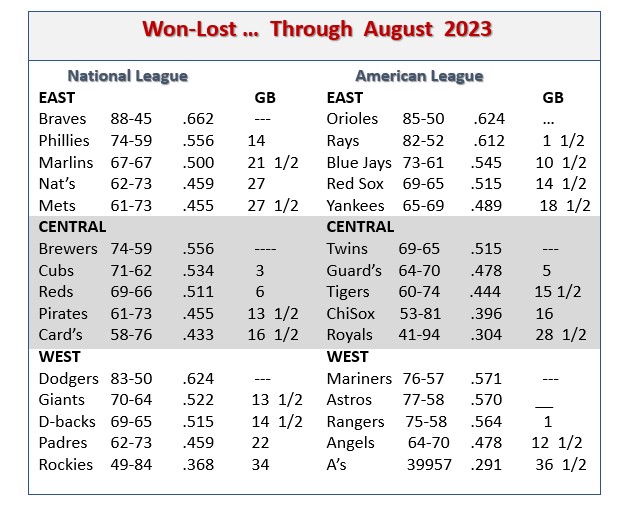
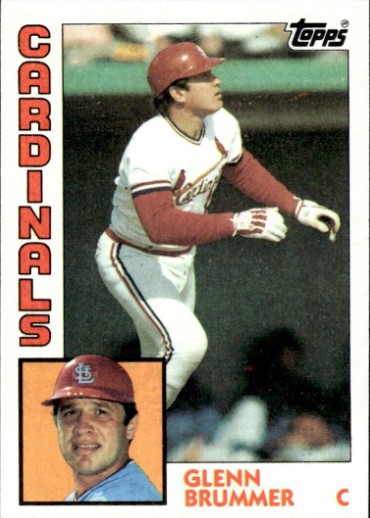
_______________________________________

Shortstop – Dick Groat

Photo: Groat:  Public domain, via Wikimedia Commons

Dick Groat hit Hoyt Wilhelm at a .364 pace (8-for-22).  Notably all eight hits were singles and he had just one RBI versus Wilhelm.  That .364 average, however, puts Groat among the top ten batters with at least 20 at bats versus Wilhelm.  (He’s also one of the most interesting “athletes” on this list – which may have swayed my selection slightly.)

Groat was an All-America at Duke University in both baseball and basketball.  In fact, his best sport made have been hoops. As a senior (1951-52 college basketball season), he averaged 26 points and 7.6 assists per game (leading the NCAA in both categories) and was named the National Collegiate Player of the Year.  In 1952, he also hit .370 and led the Duke baseball squad in hits, doubles, RBI and steals. Duke went 31-7 and made their first College World Series appearance that season.

Dick Groat was the first player elected to both the National Collegiate Basketball and Baseball Halls of Fame.

In 1952-53, Groat (finishing his senior year at Duke) signed (and played) with the NBA’s Fort Wayne Pistons. Shuttling  back and forth between classes at Duke during the week and Pistons games on weekends. He averaged 11.9 points, 3.3 rebounds and 2.7 assists as a pro. In later interviews, Groat t noted “I never had to practice, just play on the weekend.”

That same year, Groat also signed a contract with the Pittsburgh Pirates. He played 95 games for the Pirates in 1952 – going straight from campus to the majors – hitting .284-1-29, providing superior defense and finishing third in the Rookie of the Year voting.

A stint in military service, then disrupted his athletic career(s). After Groat retuned from serving two years in the military, Pirates’ GM Branch Rickey convinced him to focus solely on baseball.  Groat rejoined the Pirates – and the rest is history.

Groat played 14 MLB seasons (1952, 1955-67 … Pirates, Cardinals, Phillies, Giants), hitting .286-39-707, earning All Star honors in five seasons and being selected the 1960 NL Most Valuable Player (that season, he won the NL batting title with a .325 average). Groat also led NL shortstops in putouts in four seasons, assist twice and double plays turned at shortstop five times.


____________________________

OF – Al Kaline

Photo: From collection of User: JGHowes, self-scanned for Wikipedia. JGHowes at en.wikipedia, Public domain, via Wikimedia Commons

Hall of Famer Al Kaline hit .348 against Wilhelm in 48 games (66 at bats/77 plate appearances). His four home runs tied for the second most versus Wilhelm, his 17 RBI were first, as were his 23 hits.  In addition, his ten walks ranked second against Wilhelm (a tie with Bob Allison). Overall, he put up a .429 on-base percentage and a .606 slugging percentagte against the crafty knuckleballer.

That’s The Way To Wrap It UP

In his final five seasons against Wilhelm (1965-69), Kaline reached base in 15 of 20 plate appearances: six singles, one double, one triple, one home run, five walks, one safe on an error, five outs.

Kaline played 22 MLB seasons (1953-74) – all for the Tigers. He was an All Star in 15 of those seasons and led the AL in batting in one (1955 at .340). He retired with a .297 average, 3,007 hits, 399 home runs, 1,582 RBI and 1,622 runs scored – as well as 10 Gold Gloves. He hit over .300+ in nine seasons and had 25 or more home runs in seven.

_____________________________________

OF …  Gary Geiger

Gary Geiger hit .379 (11-for-29), with a triple, three home runs (fifth-highest versus Wilhelm) and six RBI  in 17 games versus Wilhelm – and I needed someone with CF experience in the Garden.

Happy Fourth of July

Gary Geiger celebrated Independence Day 1960 by collecting a walk, a surprise bunt single and a two-run home run versus Wilhelm – who had come on in relief of Steve Barber – as Geiger’s Red Sox topped Wilhelm’s Orioles 10-7 in Boston.

Geiger played in 12 MLB seasons (1958-67, 1969-70 … Indians, Red Sox, Braves, Astros).  He career stat line  was .246-77-283 in 954 games.

Photo: Manny’s Baseball Land via tradingcarddb.com, Public domain, via Wikimedia Commons

Geiger, notably, started his professional career primarily as a pitcher (but with some time in the outfield as well). In 1955, Geiger went 20-7, 1.98 with the Class-D Hilton Cardinals, leading the league in complete games (26 in 27 starts), strikeouts (177) and shutouts (8). (All this, despite control problems: 115 walks in 236 innings). The Cardinals’ organization had pretty solid pitching depth and, in 1956 (at Triple-A), Geiger  went 3-2, 3.78 in 29 games on the mound, but also hit .327 in 39 games.  (He also walked 77 batters in 100 innings). The die was cast and Geiger’s  professional career moved forward as an outfielder.

He made it to the major leagues in 1958 (with the Indians) and played 12 often injury-marred  MLB seasons (1958-67, 1969-70 … Indians, Red Sox, Braves, Astros) – hitting .246-77-283 in 954 games.


_____________________________

OF … Carl Furillo

Carl Furillo hit Hoyt Wilhelm at a .333 pace (15-for-32) and, with five walks, had a .409 on-base percentage against him. Furillo’s ten RBI versus Wilhelm tied for the fourth-most against him and his three doubles tied for second (he also had two homers against Wilhelm).  On August 19,1953, Dodgers’ Furillo faced Wilhelm (who came on for the Giants in the third inning, with New York up  5-2) three times. In his three at bats versus Wilhelm that day, Furillo delivered a two-run single to center; a double to left; and an RBI double (also to left).

Catching Up to the Old Master

Carl Furillo had just one hit (a single) in his first 13 career at bats versus Hoyt Wilhelm (July 3, 1952 through July 12, 1953) and, in fact, got just one ball out of the infield during that time (and even that was ground ball that reached left field).  Then (beginning in his second at bat versus Wilhelm on July 12, 1953 through his last at bat versus the knuckleball master on July 18, 1957, Furillo  went 12-for-26 (.462) against him with three doubles, two homers and ten RBI.

________________________________________

Pitcher – Hal Jeffcoat

Okay, I found an interesting one for this spot. Hal Jeffcoat, who played in 12 MLB seasons (1948-59 … Cubs, Reds Cardinals). Over those12 campaigns he made 245 mound appearances and 559 in  outfield. His best season on the mound was probably 1956, when he went 8-2, 3.84 in 38 games (sixteen starts, two complete games).  His best season at the plate was his rookie campaign (1948), when he hit .279-4-42 in 132 games.

Jeffcoat went 6-for-11 (.545) in 11 games versus Wilhelm  (Jeffcoat played CF in eight of the 11, pitched in three).

Hal Jeffcoat  wen .248-26-188 over 12 MLB seasons (1948-59 … Cubs, Reds, Cardinals) and 39-37, 4.22 as a pitcher.

Like Hoyt Wilhelm, Hal Jeffcoat earned a Purple Heart in World War II. (He was a paratrooper with the 101st airborne. )

Jeffcoat was first recruited as a pitcher, with the endorsement of his brother George Jeffcoat, who made it to the major leagues ahead of him as moundsman. Hal’s three older brothers  all pitched professionally and young Hal had had shown promise in high school and semi-pro ball before serving in the military.

After competing military service Hal signed with the Cubs’ Double-A Nashville Volunteer, who (on the word of his brother George) were expecting a pitching prospect.  Hal  showed up in minor-league camp and  informed his new bosses that he was an outfielder, not a pitcher – and he quickly proved it  – hitting .291-15-75 at Class B and Double-A in 1946 and .346-4-118 at Double -A in 1947, also showing hustle (36 steals in two seasons) and defensive prowess and powerful arm. In 1948, he was with the Cubs (a 23-year-old rookie) and hit .279 in 134 games, while  leading NL centerfielders in outfield assists with 11. (Jeffcoat finished in the top two in CF assists in three of his first four MLB seasons

After a few seasons marked by injuries and  less than stellar offensive production, Jeffcoat agreed to tryout his stuff on the major-league mound.  He made his first MLB pitching appearance in his seventh MLB seasons (1954). And from that time on made just four more outfield appearances.

And, that is how he came to be the pitcher in this Hoyt Wilhelm, “Who’s Your Daddy/”  Lineup.

Primary Resrouces for this post: Baseball-Referene.com; Pirates Star Dick Groat, who also played in the NBA, dies at 92, Will Graves, April 27, 2o23, Associated Press;  Hoyt William Society for American Baseball Research Bio, by Mark Armour; Gary Geiger, SABR Bio, by Norm Ginsberg;  Hal Jeffcoat, SABR Bio, by Andrew Sharp.

_______________________________________

Who’s Your Daddy?  The Inspiration.

On September 24, 2004, in the middle of a tight pennant race, the Yankees handed future Hall of Famer Pedro Martinez and the Boston Red Sox a tough 6-4 loss.  Martinez went 7 1/3 innings giving up nine hits and five earned runs.  The game came just five days after (in his previous start) Martinez had lasted just five frames against the Bronx Bombers (eight hits, eight earned runs) in a 16-7 loss.

After that second loss, Martinez candidly commented, “What can I say? I just tip my hat and call the Yankees my daddy.”  Little did he know that his comment – and a Yankee fans’ chant of “Who’s your daddy?” would follow him into future starts in New York (all the way to his final MLB start – against the Yankees for the Phillies – in Game Six of the 2009 World Series).

The concept of “Who’s your daddy?” became the inspiration for Baseball Roundtable to take a look at the players who “had the number” of some of MLB’s premier pitchers.  Again, you can find links to the previous “editions” of “Who’s Your Daddy?” near the top of this post.

Baseball Roundtable – Blogging Baseball Since 2012.

100Baseball Roundtable is on the Feedspot list of the Top 100 Baseball Blogs.  To see the full list, click here.

Baseball Roundtable is also on the Anytime Baseball Supply Top 66 Baseball Sites list.  For the full list, click here

I tweet baseball @DavidBaseballRT

Follow/Like Baseball Roundtable’s Facebook Page here.  Find More baseball commentary; blog post notifications; PRIZES.

Member: Society for American Baseball Research (SABR); Negro Leagues Baseball Museum; The Baseball Reliquary.

P1003

Tucker’s Triples …. Not A Good Day To Be On The “Hill”

No one would have been surprised if Astros’ RF Kyle Tucker was calling for oxygen after yesterday’s (September 10, 2023) 12-2 win over the Padres (in Houston). Tucker not only collected two hits, drove in two runs, scored twice  and stole two bases – he also tied one of MLB’s most unique records, hitting two triples in one inning. (Side note:  They were Tucker’s first two triples of the season.

The San Diego Padres have two pitchers named Hill (Tim and Rich) on their active 2023 roster and, on September 10, the Astros Kyle Tucker tripled off both of them – in the same inning.

Tucker came up against the Padres’ Tim Hill in the bottom of the sixth , with a runner on second no outs and the Astros up 4-1. He drove a 1-1 pitch to deep right field for a triple.  By the time Tucker came up again in the frame, the Astros had scored seven times in the inning and Rich Hill had replaced Tim Hill on the mound.  With one runner on and two outs, Tucker took an 0-2 pitch to deep right-center for his second triple of the inning.

How rare is a two-triple inning? Rare enough that there seem to be some disagreement on just  how rare.  Tucker was reported as the eleventh and twelfth major leaguer to accomplish the feat by various news sources and Baseball-Almanac.com provides a list of players with two triples in an inning and that would make Tucker number thirteen.  (Baseball Roundtable will use Baseball Almanac’s number.)  Eleven, twelve or thirteen (and only six since 1901), it’s pretty darn rare.  For example: There have been two dozen  Perfect Games in MLB; more than 50 fifty players have hit two homers in an inning (five of them twice);  nearly four dozen players have stolen second, third and in an inning (two of them four times);  and MLB has seen more than 300 no-hitters.

The 26-year-old Tucker was hitting .290-26-103 at the close of play September 10 – leading the AL in RBI. He also had 28 steals (in 32 attempts)and 86 runs scored.  The two-time All Star has a career line of .274-99-359, with 81 steals (six MLB seasons.) He has 13 career triples, leading the AL with six in 2020.

Players Pre-1901 with a two-triple inning:

  • Harry Wheeler, Cincinnati (American Association) … July 28, 1882;
  • Joe Hornung, Boston (NL) … May 6, 1882;
  • Harry Stovey, (Philadelphia Athletics (American Association) … August 18, 1884;
  • Heinie Peitz, St. Louis Browns (NL) … July 2, 1895;
  • Frank Shugart, Louisville Colonels (NL) … July 30, 1895
  • Buck Freeman, Boston (NL) … July 25, 1900;
  • Bill Dahlen, Brooklyn Superebas (NL) … August 30, 1900

Primary Resources:  Baseball-References.com;  Baseball-Almanac.com


Baseball Roundtable – Blogging Baseball Since 2012.

100Baseball Roundtable is on the Feedspot list of the Top 100 Baseball Blogs.  To see the full list, click here.

Baseball Roundtable is also on the Anytime Baseball Supply Top 66 Baseball Sites list.  For the full list, click here

I tweet (on X) baseball @DavidBaseballRT

Follow/Like Baseball Roundtable’s Facebook Page here.  Find More baseball commentary; blog post notifications; PRIZES.

Member: Society for American Baseball Research (SABR); Negro Leagues Baseball Museum; The Baseball Reliquary.


P1003

Baseball Roundtable August Wrap – Little Leaguers Meeting Big Leaguers, Weddings, Grand Slams, Triple Plays, No-Hitters and More

The Dog Days of August are behind us and we’ve moved into September.  That means it’s time for Baseball Roundtable’s August Wrap Up – a look at the stories and statistics the caught Baseball Roundtable’s attention over the past month, as well as the standings, The Roundtable’s Players and Pitchers of the Month, the Trot Index and more.

And, there was plenty to see around MLB in August:

  • Two no-hitters;
  • A cycle;
  • A pitcher surrendering home runs on each of his first two MLB pitches;
  • A player getting married and hitting a Grand Slam on the same day;
  • A player stroking a record 17 hits in a four-game stretch;
  • A player becoming the first member of the 30-60 Club (HR-SB), with a month to go;
  • A team winning a game despite giving up a Grand Slam with the game tied and later hitting into a triple play with the game tied;
  • A team stealing 39 bases in 28 games and another stealing just one base (in just one attempt) over the entire month;
  • One team playing .800+ ball and one under ,300 for the month;
  • Two qualifying hitters hitting over .400 for the month; and
  • More.

For these tales – and the more – read on.  As usual, we’ll start with a look at Baseball Roundtable’s Players and Pitchers of the Month.

BASEBALL ROUNDTABLE PLAYERS AND PITCHERS OF THE MONTH

AUGUST 2023

NATIONAL LEAGUE

PLAYER OF THE MONTH – Mookie Betts, RF, Dodgers

Easy choice here,  The Dodgers’ Mookie Betts hit (literally) a whopping .455, leading all MLB players with at least 75 August at bats (he had 112). He also led MLB with 50 August safeties and, for the month, was first in runs scored (35),  first in home runs (11); and second in RBI (30). He also led all MLB players (with at least 75 August at bats) in on-base percentage (.516) and slugging percentage (.839). His month included a 15-game hitting steak (August 10-27), during which he hit .542 (32-for-59), with four home runs, 16 RBI and 17 runs scored. In the course of the month, he raised his average from .277 to .317. Betts, who was the AL MVP (with the Red Sox) in 2018, put himself into the race for NL MVP in 2023. He  finished August at .317-36-98, with 116 runs scored on the season.


Honorable Mentions:   Cubs’ CF Cody Bellinger led MLB in August RBI with 31, while hitting .324 with five home runs and six steals in seven attempts. Braves’ DH Marcell Ozuna put up similar numbers with a .358-9-25 month – tied for fifth in NL HRs and was fourth in RBI. The Phillies’ Bryce Harper rapped an MLB second-best (tied) ten August home runs, while hitting .361, with 24 RBI. The fact is, there were plenty of outstanding Augusts in the NL  – Ronald Acuna, Jr.; Trea Turner; Freddie Freeman and more – but Betts .400+  month clearly rates the top spot.

PITCHER OF THE MONTH – Freddy Peralta, RHP, Brewers

This was a close call. Freddy Peralta and the Braves’ Spencer Strider were the only MLB pitchers to record five wins this August and they also tied for the NL lead in August strikeouts (46). Peralta got his wins in five starts (5-0), which edged Strider’s six starts and 5-1 record.  Peralta also put up a 2.10 earned run average (second-lowest in the NL among pitchers with at least 25 August innings) to Strider’s 2.97. Peralta  had a stingy 0.90 WHIP (third among NL pitchers with at least 25 innings) and held hitters to a .162 average (tied for first). After giving up three runs in six innings in his first start of the month (a 6-4 win over the Nationals), Peralta gave up just four runs over his next four starts (24 innings).

Honorable Mentions: The Braves’ Spencer Strider (5-1, 2.97) and  Charlie Morton  ( 4-1, 1.91 in five August starts) were both solid.  The Nationals’ righty Kyle Finnegan pitched in 14 August games and went 2-0, 2.63 with ten saves in ten opportunities.

AMERICAN LEAGUE

PLAYER OF THE MONTH – Julio Rodriguez, CF, Mariners

Another easy choice – another .400+ hitter.  Mariners’ 22-year-old CF (and 2022 AL Rookie of the Year) Julio Rodriguez hit .429 for the month (highest among AL players with at least 75 at bats). His 45 hits led the American League, as did his 30 RBI (in 23 games). He also popped seven round trippers and led the AL with 11 stolen bases (in 15 tries) in August. He also led the AL (minimum 75 at bats) in on-base percentage (.474) and slugging percentage (.724). From August 17 through August 28, he  put together a 13-game hitting streak – during which he hit .516 (32-for-62), with five home runs and 21 RBI. The streak included a five-for-five, five RBI day on August 17. Rodriguez finished August at .286-24-87, with 35 steals on the season.

Honorable Mentions: Rangers’ SS Corey Seager led the AL with ten August home runs, to go with a .337 average, 22 RBI and 21 runs scored. Royals’ SS Bobby Witt, Jr. combined speed and power, hitting .324 for the month, with nine homers, 22 RBI, 20 runs scored and nine steals (in ten attempts).  Finally, Mariners’ RF Teoscar Hernandez went .365-7-22 in 26 games.

PITCHER OF THE MONTH – Cole Ragans, LHP, Royals

Royals’ southpaw Cole Ragans could also have qualified as the MLB surprise of the month, but it made more sense to slot him here. Ragans, pitching for the last-place Royals, went 3-1, 1.72 in six starts. That ERA was the lowest among major leaguers with at least 25 August innings (he had 36 2/3). Ragan also led MLB with 53 August strikeouts, gave up just one home run and walked only nine. Ragans fanned nine or more batters in four of his six August starts  and only once walked more than two. So why did I also think Ragans could have qualified for the Surprise of the Month? He came into August with a 2-3, 5.22 record on the season (after a 0-3, 4.95 record in his MLB debut 2022 season). The Royals acquired the 2016 First Round Draft pick (by the Rangers, out of North Florida Christian High School) in the June trade that sent Aroldis Chapman to the Rangers.  Looks like it’s working out for both squads.

Honorable Mentions: Orioles’ RHP Kyle Bradish went 3-0, 2.12 in five August starts (with the Orioles winning all five games), fanning 35 batters in 29 1/3 innings. Sonny Gray of the Twins only went 3-2 for the month, but he put up a 2.04 ERA (second in the AL among pitchers with at least 25 August innings) and fanned 41 batters (third in the AL) in 39 2/3 innings (second). He put up a 0.86 WHIP (second among AL pitchers with 25 August innings) and held hitters to a .189 average.

______________________________________

SURPRISE OF THE MONTHN …. Nolan Schanuel, 1B, Angels

Okay, the fact the Nolan Schanuel is in the major leagues should be  no surprise.  He was, after all, a First Round Draft choice (Angels, out of Florida Atlantic University) and he did hit .386-46-176 over three college seasons (172 games).   What is surprising is how fast he made to the majors. Schanuel was a first rounder THIS JUNE and made his MLB debut August 18  – after just 22 minor-league games,

How has he done?  Well, ten games into his MLB career, he has yet to be held hitless in any contest. In August, he was 12-for-37 (.324), with two home runs, seven RBI and 11 runs scored. Further, his walks (7) outnumbered his whiffs (6) – a .457 on-base percentage. That’s a  pretty surprising  start.  And, of course, that start-of-career hitting streak is still alive.

Honorable Mention:  Tigers’ outfielder Kerry Carpenter had a booming August – going .347-9-20, with 21 runs scored in 27 games. He came into the month hitting .258-11-35 on the season (53 games played), after going .242-6-10 in 31 games for the Tigers in 2022.  Why the surprise?  After all, the 25-year old outfielder did hit .313-30-75 at Double-A and Triple-A a year ago.   The surprise comes because Carpenter (a .272 hitter in his only college season) was a rather unheralded and unnoticed 19th Round pick in the 2019 MLB Draft.

________________________________________

THE TROT INDEX … A REGULAR BASEBALL ROUNDTABLE FEATURE

Through August,  35.6 percent of the MLB season’s 151,954 plate appearances ended in a trot (back to the dugout, around the bases, to first base). We’re talking about strikeouts, home runs, walks, hit by pitch and catcher’s interference – all outcomes that are, basically, devoid of action on the base paths or in the field. Here’s the breakout: strikeouts (22.7%); walks (8.5%); home runs (3.2%); HBP (1.1%); catcher’s interference (less than 1%). Strikeouts, by the way, outnumbered base hits 3,4519 – 33,761.

The 35.6 percent figure is up from 2022’s full season 34.6 percent.  Other recent seasons: 2021 – 36.3 percent; 2020 –  37.3 percent;  2019 – 36.2 percent; and 2018 – 34.8 percent.  By further comparison, in 1990, the Trot Index was 26.1 percent.  

____________________________________

A few observations,  The Dodgers, Braves and Mariners were the teams to watch in August – all winning 20+ games.

The Dodgers pretty much blew up the NL West race – playing .800+ ball and expanding their Divisi0n lead from 2 1/2 games to 13 1/2.  They were led by the bats of Mookie Betts (.455-11-30) and Freddie Freeman (.374-4-16), but a balanced lineup saw nine players contribute 12 or more RBI during the month (and nine scoring ten or more runs). On the mound, they got four wins each out of starters Lance Lynn and Julio Urias, but just as important, solid work out of the bullpen: Evan Phillips (2.89 ERA and eight saves in eight opportunities);  Brusdar Graterol (0.00 ERA in 11 appearances); Ryan Brassier (0.79 ERA in 11 appearances); Ryan Yarbrough (1.86 ERA and three wins in six appearances).

The AL West Mariners played .777 ball, but they were catching up not running away.  Thanks to a 21-6 month, they moved from fourth place (five games out ) at the end of July to a tie for the Division lead with the Astros. It looks like a good race (Mariners, Astros, Rangers) to the finish. Key contributors to the Mariners’ surge were CF Julio Rodriguez (.429-7-30) and RF Teoscar Hernandez (.365-7-22).  They also got nine homers and 21 RBI out of catcher Cal Raleigh, despite a .221 average for the month. Starters Luis Castillo (4-0, 3.55) and Logan Gilbert (3-0, 2.97) led the mound staff – which also got contributions from Justin Topa (3-1, 0.73 in 14 relief appearances); Isaiah Campbell (3-0, 2.31 in ten relief stints): and Andres Munoz (nine saves and a 1.93 ERA).

Then there are the Braves (21-8 in August), padding a comfortable lead in the NL East. What can you say about a team with Spencer Strider (5-1, 2.92 in August); Charlie Morton (4-1, 1.91);  Max Fried (3-0 3.58); and Raisel Iglesias (7-for-7 in save opportunities and a 0.00 ERA in 13 appearances)? Then there’s that offense: DH Marcell Ozuna (.358-9-25 for the month); 1B Matt Olson (.290-7-23); RF Ronald Acuna, Jr. (.352-6-22) and more;. The Braves had five players with six or more homers in August; eight with 16 or more RBI; five with 20+ runs  scored; and six players who played 15 or more games and.310 or better.

Other notes:

  • The Twins were the only AL Central above .500 for the month (but the Guardians made some interesting waiver moves);
  • The Cardinals and Yankees continue to flounder;
  • The Brewers/Cubs race has gotten interesting; and
  • The Orioles continue to surprise, leading the AL East.

——-Team  Statistical Leaders for August  2023 ———-

RUNS SCORED

National League –  Braves (194); Philllies (176); Dodgers (176)

American League – Astros (170); Mariners (159); Rays (152)

The fewest  runs in August  were scored by the Marlins and A’s (96). The only other team under 100 was the Cardinals (98).

AVERAGE

National League – Braves (.299); Dodgers (.292); Phillies (.285)

American League – Astros (.286); Mariners (.285); Rays (.281)

The lowest team average for August belonged to the Yankees at .220. The lowest in the NL was the Reds (.225). 

HOME RUNS

National League – Phillies (59); Braves (53); Dodgers (44)

American League –  Twins (46); Mariners (46); Yankees (44)

The Guardians had the fewest home runs in August at 21.  The Giants were at the bottom of the NL at 22.

The Phillies led MLB in slugging percentage for August at .547.  The Mariners led the AL at .493. 

STOLEN BASES

National League – Reds (35); D-backs (29); Braves (27)

American League – Royals (39); Mariners (31); Guardians (25)

The Giants  stole the fewest sacks in August   – just one  in one  attempt.   The Rangers were at the bottom of the AL, with 11  in 14  attempts. 

WALKS DRAWN

National League –   Pirates (113); Dodgers (107); Braves (105)

American League  Astros (118); Yankees (108); Mariners (107)

The Mariners led MLB in on-base percentage for August at .371. The Braves led the NL  at .368.  The Angels had MLB’s lowest  OBP for August  at .279.  The Marlins were at the bottom of the NL at .288.

BATTER’S STRIKEOUTS

National League – Rockies (286); Reds (285); Pirates (271)

American League – Tigers (275); Yankees (275); Twins (275)

Brewers’ batters fanned the fewest times in August (192). The only other team under 200 was the Nationals at 195.

Bonus Stats

  • Braves’ batters racked up the most total bases in July at 533.  The Giants were at the bottom of MLB at 311.
  • Four teams (Rays, Yankees, Twins and Brewers) recorded zero sacrifice bunts in August. The Braves have recorded an MLB-lowest two sacrifice bunts all season. Five teams have fewer than five.
  • The Mariners had 26 hit batters in August to lead MLB. The Phillies led the NL with 20.  The Mariners have had an MLB-high 94 hit batters this season. The Tigers have the lowest total at 36.

_______________________________________

Earned Run Average

National League – Dodgers (3.00); Brewers (3.36); Braves (3.60)

American League –  Mariners (3.03); Blue Jays (3.43); Rangers (3.53)

The Angels had the highest August ERA at 6.14.  Eight teams were over  5.00 including the Angels and:  White Sox (5.95); Rockies (5.87): Red Sox (5.33); A’s (5.30); Cardinals (5.28); Royals (5.23); Reds (5.03).

STRIKEOUTS

National League – Braves (279); Pirates (256); Brewers (252)

American League –  Ranges (264); Yankees (259); Angels (250)

The Braves averaged an MLB-best 9.85 strikeouts per nine innings in August. The Rangers averaged an AL-best 9.70.  Ten teams averaged nine whiffs per nine or better (down from 12 in July).

FEWEST WALKS SURRENDERED

National League  – Dodgers (67); Giants (68); Cardinals (69)

American League – Rays (47); Mariners (50); Blue Jays (63)

The Mariners  walked an MLB-lowest 1.83 batters per nine innings in August.  The Angels walked an MLB-worst 4.88 batters per nine frames.

SAVES

National League – Dodgers (14); Cubs (11); Nationals (11)

American League – Mariners (14); Blue Jays (10); Red Sox (9); Tigers (9)

Bonus Stats:

  • The Nationals gave up an MLB-high 51 home runs in August – The  Braves gave up an MLB-low 25.  On the season, the Nationals have given up an MLB-high 204 long balls, the Cardinals  an MLB-low (136).
  • The Brewers held opponents to an MLB-low .206 average in August; the Rockies’ staff was touched for an MLB-high .300 during the month.
  • The Mariners’ strikeouts-to-walks ratio for August topped MLB at 4.82. The White Sox had MLB’s worst ratio at 1.79.

——AUGUST 2023 HIGHLIGHTS——

Another No-Hitter

Astros’ southpaw Framber Valdez got August off to a good start, tossing a no-hitter on August 1, as the Astros topped the Guardians 2-0. It was the third no-hitter of the 20232 MLB season. Valdez threw 93 pitches (65 strikes), while walking one and fanning seven.  He actually faced the minimum 27 batters, the only baserunner (walk) was erased on a double play. The first (and only batter) to reach a three-ball count was SS Gabriel Arias (leading off the ninth). Arias  grounded out on a 3-2 pitch. Valdez ended August with a 10-9, 3.38 record on the season,

We Really Do Count Everything

On August 4, Bobby Witt, Jr. went two-for-five with one run scored, two RBI, a stolen base and a home run (his 20th ). MLB later reported that the home run made Witt the first AL/NL player to have at least 20 home runs and at least 30 stolen  bases in each of his first two seasons. (The Royals, by the way, bested the Phillies 7-5. ) Witt ended August at .276-27-82, with 38 steals on the season. (Headed for the 30-30 club.)

A Great Start

Davis Schneider made his MLB debut with the Blue Jays  on August 4 – being called up after going  .275-21-64 in 87 games for the Triple-A Buffalo Bisons. The 24-year-old 2017 28th-Round Draft pick (out of Eastern High School in Voorhees, NJ) did not disappoint. Starting at 2B versus the Red Sox (in Boston), he homered off James Paxton in his first MLB plate appearance, joining a host of players to accomplish that feat.

What he did after that, however, set Schneider apart. In his first three MLB games, Schneider went 9-for-13  (.692), with two home runs, three runs scored and five RBI – becoming the first player to collect nine hits and two home runs in his first three MLB games.  (Yes, #InBaseballWeCountEverything.) He’s cooled off a bit, but at the end of August he was still hitting .426, with six homers and 14 RBI in 14 games.

Side note:  In six minor-league seasons, Schneider hit .253-59-218.  Apparently, he likes major-league pitching. 

Bring Those Ducks On Home

On August 5, Mariners’ 3B Eugenio Suarez went zero-for-three as Seattle bested the Angels 3-2.  The O-Fer was notable because it marked the first time since July 24 that Suarez went without an RBI.  In the ten games from  July 25 through August 4, Suarez went 13-for-42 (.310), with tw0 home runs and 13 RBI (at least one RBI in each game), setting a new franchise record for consecutive games with an RBI. I wanted to note this achievement because gives me a chance to give a shout out to  Cubs’ 1B Ray Grimes, who holds the MLB record for consecutive games with an RBI at 17.  From  June 27 through July 23, 1922, Grimes played in 17 games, going 29-for-66 (.439), with three home runs and 27 RBI (at least one ribby in 17-straight contests.  Grimes finished the season with 99 RBI (his highest single-season total). In an injury-interrupted  six-season MLB career, Grimes hit .329-27-263 in 433 games.

A Nice Round Number

On August 5, Orioles’ righty Kyle Gibson picked up is 100th career win, as the O’s topped the Mets 7-3 in Baltimore.  Gibson went seven innings, giving up three runs on four hits and a walk, while fanning nine.  Gibson picked up two more wins in August, running his record to 13-8, 5.15 and his 11-season MLB career record to 102-99, 4.58. The 13 wins leads the AL and also ties Gibson’s single-season career high.

A Not So Great Start

On August 6. Reds’23-year-old righty Lyon Richardson made his MLB debut – starting against the Nationals in Cincinnati.  His performance, while not what he had hoped for, did attract the attention of baseball trivia buffs. Richardson started his MLB career by giving up home runs on each of his first two MLB pitches – to Nationals’ shortstop CJ Abrams (his 11th HR of the year) on a 95.5-mph fastball and to RF Lane Thomas (his 19th) on a 96.7-mph heater.  Ultimately, Richardson went three innings and gave up four hits, three walks and four runs, while fanning two, in the Reds’ 6-3 loss.

According to STATS, Richardson is the only pitcher in the past fifty years to give up homers on his first two MLB pitchers.  Baseball Roundtable took another step and searched box scores of the for the 79 pitchers listed by Baseball-Almanac.com as having allowed a home run to the first MLB batter they ever faced and found only one other pitcher who allowed home runs to the first two batters he faced – the Yankees’ Danny Rios on  May 30, 1997 – and he did it in a span of nine pitches.  For more on Richardson, Rios  and a few pitchers who gave up dingers to the first MLB batter they faced, click here.

Yandy is Dandy On His Birthday

On August 8, Rays’ first baseman Yandy Diaz celebrated his 32nd birthday in style – going four-for-four (tying his career high for hits in a game) with a run scored and an RBI as the Rays beat the Cardinals 4-2 in Tampa Bay. Diaz finished August with a .327-17-66 stat line on the season.

Another Feel-Good Debut

Phillies’ left fielder Westin Wilson made his MLB debut on August 9 – after seven minor-league seasons (713 games, 2,866 trips to the plate).  The 17th-round 2916 Draft pick (out of Clemson University) had an enjoyable first MLB outing.   In his first MLB plate appearance – leading off the bottom of the second inning, Wilson hit a 1-1 pitch off McKenzie Gore for a home run to left-center. Two innings later he drew a walk off Gore and picked up his first MLB stolen base four pitches later.  For the game, Wilson was one-for-three, with two walks, three runs scored and one RBI.  Oh yes, and his two outfield putouts, were part of Mike Lorenzen’s no-hitter. (Over his seven minor-league seasons, Wilson hit .255-97-372, with 80 steals.)

Welcome Home, Mike

On August 9, Mike Lorenzen picked up by the Phillies (from the Tigers) in an August 1 trade, made his first home start in a Phillies’ uniform. (He had picked up a road win as a Phillie on August 3.)  In that first start in front of Philadelphia fans, Lorenzen pitched the fourth no-hitter of the 2023 season (the third single-pitcher no-no). He threw 124 pitches (76 strikes), walking four and fanning five as the Phillies won 7-0. It was, by the way, the first complete game  of Lorenzen’s nine MLB seasons (335 games/66 starts).  As August came to a close, Lorenzen was 8-8, 3.73 on the season and 3-1, 4.22 with the Phillies.

Obligatory Ohtani News

On August 9, the Angels’ Shohie Ohtani  picked up his tenth mound win of the season – going six innings and giving up just one run (unearned), as the Angels topped the Giants 4-1 in Los Angeles. In the process, Ohtani recorded another first – becoming the first MLB player to get ten pitching victories and slug 40 or more home runs in the same season.  Side note:  A elbow injury (August 23) will keep Ohtani off the mound for the remainder of this season, but he’ll still be in the lineup at DH.  

More #InBaseballWeCountEverything

Photo: D. Benjamin Miller, Public domain, via Wikimedia Commons

In the sixth inning of the Padres August 14  4-1 loss to the Orioles, Padres starter Yu Darvish fanned Orioles’  3B Ramon Urias for his sixth strikeout of the game, 131st of the season and 1,919th of his career. That final number made Darvish the All-Time MLB Strikeout Leader  among players born in Japan (surpassing Hideo Nomo). Darvish, now in his 11th MLB season, ended August with a career record of 103-85, 3.59 – with 1,929 strikeouts in 1,624 1/3 innings pitched.  He took the loss in that August 14 game, giving up four runs over seven innings.

Oops, My Bad!

Cardinals’ top prospect, 21-year-old SS Masyn Winn, made his MLB debut on August 18, as the Redbirds faced the Mets in St. Louis. Winn connected for his first MLB hit (an infield single) in the fifth frame.  Unfortunately, the Cardinals lost the game 7-1. Fortunately, Winn did not lose the ball he tagged for his first hit – but he almost did. Apparently not knowing it was Winn’s first MLB hit, Mets’ 1B Pete Alonso threw the ball (which the umpire indicated would be taken out of play) into the stands. (As Alonso often does with scuffed balls taken out of play.) Goodbye first hit memento. All turned out well, as Cardinals’ security traded the lucky fan an autographed ball, jersey and hat for Winn base-hit horsehide.

The One That Didn’t Get Away

There are a lot of ways to blow the opportunity to win a ball game.  If you have a flair for the dramatic, you might give up a Grand Slam with the game tied or muff a scoring opportunity (with the game tied) by hitting into a triple play. On August 18, the  Rays did both – and still came away with a 9-6 win (over the  Angels).

In the bottom of the second, with the game tied at one apiece, Rays’ starter Erasmo Ramirez gave up a two-out Grand Slam to Angels’ DH Shohei Ohtani (who else?).The Rays fought back and finally retied the game at five apiece in the fifth frame – and even took the lead 6-5 in the top of the seventh.  The Angels retied it at six in the bottom of the inning.  Then, the Rays opened the ninth with a pair of singles (1B Yandy Diaz and LF Randy Arozarena) and seemed poised to move back into the lead (runners on first and second and no outs). A triple play ended the threat. DH Harold Ramirez grounded to SS Luis Rengifo, who tossed to second (Brandon Drury) to force Arozarena, the relay to first retired Ramirez and Diaz, who tried to score from second  on the play, was tossed out 1B Nolan Schanuel  to C Logan O’Hoppe.   Boom – inning and rally over. The Rays, however, held the Angels scoreless in the bottom of the ninth and then scored three in the top of the tenth, earning a 9-6 win.

The Elias Sport Bureau reported that the Rays were only the second team  in AL/NL history to allow a Grand Slam and hit into a triple play in the same  game and still win the contest. (The other was the Indians on September  7, 1979.)

Trea Turner Tees (off) for Two

On August 19, as the Phillies topped the Nationals 4-3 in Washington, Phillies’ SS Trea Turner hit his 13th and 14th home runs of the season.  The two blasts were especially memorable since they both came in the eighth inning and made Turner just the third Phillie ever to homer twice in one frame. Turner led off the eighth inning by raking a 2-0 from Cory Abbott for a home run to left field. By Turner’s second at bat of the inning (with Abbott still on the mound), the Phillies had added six more runs and had a 10-3 lead. This time, Turner took knocked a 1-1 pitch from Abbott for another left field round tripper. (The Phillies eventually won 12-3.) For those who like to know such things, the other Phillies with two-homer innings are: Von Hayes (June 11, 1985) and Andy Seminick (June 2, 1949).

Two-for-Two

Andre Dawson, Edwin Encarnacion, Jeff King, Willie McCovey and Alex Rodriguez are the only AL/NL players to homer twice in one innings twice in their careers – and only Encarnacion accomplished the feat for two different teams (Blue Jays – 2013 & Mariners – 2019).  The others: Rodriguez (Yankees (2007 & 2009); Dawson (Expos 1978 & 1985); King (Pirates 1995 & 1996); and McCovey (Giants 1973 & 1977).

When You’re Hot, You’re Hot

On August 19, the Mariners’ 22-year-old CF  Julio Rodriguez went four-for-six with a stolen base and two runs scored as  Seattle topped  the Astros 10-3 in Houston. It marked Rodriguez’ fourth straight game with at least four hits and gave him  a new (#InBaseballWeCountEverything) MLB record for hits in four consecutive games (17). Rodriguez’s stat line for the four games? He was 17-for-22 (.773) with two doubles, two home runs, five runs scored, eight RBI and five steals (in six attempts). Surprisingly, at least to The Roundtable, he did not draw a single free pass over the four contests.

The four games were part of a 10-game hitting streak (August 13-25), during which Rodriguez hit .500 (25-for-50), with eight  runs scored, 14 RBI ands eight steals.

Little League Classic … An Annual Highlight

Okay, the highlights of the August 20 Sixth Annual Little League Classic took place more off the field than on … as players from the Phillies and Nationals were greeted at the Williamsport Regional Airport on arrival Sunday morning (and rode buses to the Little League World Series Fields with the Little Leaguers); mingled with Little Leaguers and fans (playing catch, signing autographs, taking selfies and more); took to the stands to watch the youngsters play; and took part in the traditional slide down the hill beyond the outfield fences on cardboard boxes.  When big leaguers and Little Leaguers get together, it’s always a joy to behold.

During the big-league game itself, played that evening at Muncy Bank Ball Park at Historic Bowman Field;  several players used custom-decorated bats (allowed just for this event) to commemorate the occasion. Among the more popular models: Phillies Bryson Stott and Weston Wilson used bats painted to look like a number-two pencil (right down to a red eraser at the top of the bat and a black handle to represent the pencil lead); the Nationals’ Joey Meneses had a bat designed to look like a blue Crayon; and Phillie Bryce Harper used a unique green Phillie Phanatic bat.  Among the nearly 20 custom bats, you could also find aliens, liberty bells, stars and stripes and more.

The Nationals prevailed in the actual MLB game (played in front of a crowd of about 2,500 Little leagues and their families) by a 4-3 score.

A Shoutout to the California Little League Squad

Congrats to the Little League squad from El Segundo, California, which defeated Curacao 6-5 in the Little League World Series Final.

Minor-League Extra – More Grand Clam News

On August 27th, Tai Peete –  the Mariners 2023 first-round draft pick –  hit his first two home professional home runs as his Single-A Modesto Nuts topped the San Jose Giants 12-11.  Why are they mentioned in this wrap up.? Those long balls came in consecutive innings (seventh and eighth) and were both Grand Slams.  As of August 31, Peete’s minor-league record was .339-2-18 in 16 games.  Not a bad start for the young man.

More #InBaseballWeCount Everything

On August 27, Diamondbacks’ Rookie of the Year Candidate RF Corbin Carroll went two-for-three and scored a pair of runs as the D-backs topped the Reds 5-2 in Arizona.  Notably, he also swiped his 40th base of the seasons (in 45 tries) – which made him just the  fourth rookie with a 20-homerun, 40-steal season.  (Corbin had 23 home runs and 41 steals to go with a .279 average at the end of August). Other rookies with 20-40 campaigns include: Mike Trout (2012); Mitchell Page (1977); and Tommy Agee (1966).

Now Isn’t That Grand?

The  Minnesota Twins have had a host of home run hitters grace their lineup – Harmon Killebrew, Jim Thome, Nelson Cruz, Bob Allison and  Jimmie Hall  to name a few.  But only one player has ever hit a Grand  Slam in consecutive games while wearing a  Twins’ uniform. Royce Lewis – Twins 24-year-old rookie infielder – hit his ninth and tenth career home runs in games on August 27th and 28th and both were Grand Slams (and crucial to Twins’ victories). In the process, Lewis, with just 50 MLB games under his belt, became the first  MLB rookie  and the first Twin to hit a four-run blast in consecutive games.

Another String of Zeros

On August 28, Pirates’ righty John Oviedo pitched his first MLB complete game – and it was a two-hit shutout, as Pittsburgh topped the Royals 5-0 in Kansas City. Oviedo now 8-13, 4.20 on the season and 12-24, 4.27 over four seasons, notched the the third MLB single-pitcher shutout this August and the 18th of the season. By comparison, there were a total of 16 complete game shutouts in all of the 2022 campaign.

Altuve Hits For The Cycle

Photo: Keith Allison from Hanover, MD, USA, CC BY-SA 2.0 <https://creativecommons.org/licenses/by-sa/2.0>, via Wikimedia Commons

On August 28, as the Astros topped the Red Sox 13-5 in Boston, Houston second baseman Jose Altuve hit for the cycle – although it didn’t look that way as the game opened.  Altuve led off the contest with a five-pitch strikeout against Chris Sale. But things got better. Altuve:

  • Doubled to right (later scoring) on the first pitch he saw from Sale leading off the third frame;
  • Singled to left on a 2-0 pitch from Sale leading off the fifth;
  • Came up with two on and one out in the sixth and tripled to center (later scoring) off the first pitch from Kyle Barraclough;
  • Popped out to first off Barraclough on an 0-1 pitch in the seventh;
  • Completed the cycle in the ninth, with a one-out, two-run home run off a 1-1 offering form Barraclough.

Just as a reminder of how good Altuve has been.  He is a three-time batting champion, four-times led the NL in hits and twice led in steals, is an eight-time All-star and was the NL MVP in 2017 (when he hit .346-24-81, with 32 steals and 112 runs scored).

Rolling  a 300

On August 30, as his Phillies lost to the Angels 10-8, Phillies’ 1B Bryce Harper popped his 15th home run of the year – and the 300th of his career.  (Harper finished August at .308-15-55 on the season.) In his 12th MLB season, the 30-year-old Harper has logged four seasons of 30+ home runs (a high of 42, when he was the NL MVP for the Nationals in 2025 – going .330-42-99).

Betts Hits Number 250

On August 31, as the Braves topped the Dodgers 8-7 in LA, Mookie Betts continued his drive toward the NL MVP Award, going two-for-four with two home runs, two runs scored and four RBI.  They were Betts 37th and 38th long balls of the season.  Of note is the fact the his first homer of the game – a three-run shot off Spencer Strider in the fifth inning – was the 250th of his 10-season MLB career.  His 38 homers thus far in 2923 represent his career high.

Ronald Acuna Celebrates A Grand Day in Grand (Slam) Fashion

Ronald Acuna Jr. –
Photo by IDSportsPhoto

Apparently, marriage agrees with Ronald Acuna, Jr.   The Braves’ star got married early on the morning of August 31.  Then, that evening, he hit a Grand Slam home run to help the Braves topple the Dodgers 8-7 in LA. Acuna was three-for-four in the contest, with a stolen base and a walk.  The home run was Acuna’s 30th of the season. Coupled with his 62 stolen bases, it makes Acuna the first-ever member of the 30-60 club (At least 30 homers and 60 stolen bases in a season. )


——Individual Statistical Leaders for August 2023———

AVERAGE (minimum 75 August at bats)

National League – Mookie Betts, Dodgers (.455); Freddie Freeman, Dodgers (.374); Bryce Harper, Phillies (.361)

American League –  Julio Rodriguez, Mariners (.429); Donovan Solano, Twins (.368); Teoscar Hernandez (Mariners (.365)

The lowest August average (among players with at least 50 at bats in the month)  belonged to the Giants’ Paul DeJong  at .086 (6-for-70).

HOME RUNS

National League – Mookie Betts , Dodgers (11); Bryce Harper, Phillies (10); Kyle Schwarber, Philllies (10); Jorge Soler, Marlins (10)

American League – Corey Seager, Rangers (10); six with nine

The Dodgers’ Mookie had the highest August slugging percentage (at least 75 at bats) at .839.  The AL leader was the Mariners’ Julio Rodriguez at .724.

HITS

National League – Mookie Betts, Dodgers (51); Ronald Acuna, Jr., Braves (43); Freddie Freeman, Dodgers (43)

American League –  Julio Rodriguez, Mariners (45); Jose Altuve, Astros (40); Teoscar Hernandez, Mariners (38)

RUNS BATTED IN

National League – Cody Bellinger, Cubs (31); Mookie Betts, Dodgers (30); Trea Turner, Phillies (26)

American League –  Julio Rodriguez, Mariners (30); Kyle Tucker, Astros (25); three with 22

The Dodgers’ Mookie Betts led MLB (at least 75 August at bats) players in on-base percentage at .516. The AL  leader was the Mariners’ Julio Rodriguez at  .474.  

DOUBLES

National League –   Freddie Freeman, Dodgers (16); Spencer Steer, Reds (11); Mookie Betts, Dodgers (10); William Contreras, Brewers (10)

American League – Julio Rodriguez, Mariners (10); Alex Bregman, Astros (9); Teoscar Hernandez, Mariners (9); Nathaniel Lowe, Rangers (9)

TRIPLES

National League – Corbin Carroll, Diamondbacks (3); Elly De La Cruz, Reds (3); eight with two

American League –  Steven Kwan, Guardians (3); six with two

The Dodgers’ Mookie Betts led MLB in August extra-base hits with 21. The  Red Sox’ Adam Duvall and Mariners’ Julio Rodriguez led the AL in August with 17.

STOLEN BASES

National League –  CJ Abrams, Nationals (13); Ronald Acuna, Jr., Braves (11); Nico Hoerner, Cubs (9)

American League – Julio Rodriguez, Mariners (11); Esteury Ruiz, A’s (10); Dairon Blanco, Royals (9); Bobby Witt, Jr., Royals (9)

The Guardians’ Jose Ramirez stole the most August bases without being caught (8).

WALKS

National League –  Kyle Schwarber, Philllies (25); Matt Olson, Braves (23): Pete Alonso, Mets (18)

American League –  Aaron Judge, Yankees (20); Alex Bregman, Astros (18); Shohei Ohtani, Angels (18); Jorge Polanco, Twins (18)

The Nationals’ Ildemaro Vargas  led in walks/strikeouts ratio (among batters with at least 75 August plate appearances)  at 1.20 … 6 walks versus 5 whiffs in 26 games.

BATTER’S STRIKEOUTS

National League – Elly De La Cruz, Reds (44); Brenton Doyle, Rockies (39); Christian Encarnacion-Strand, Reds (37); Nolan Jones, Rockies (37)

American League – Eugenio Suarez, Mariners (43); Adolis Garcia, Rangers (39);  Mickey Moniak, Angels (38)

PITCHING VICTORIES

National League – Freddy Peralta, Brewers, (5-0);  Spencer Strider, Braves (5-1); six with four

American League –  Luis Castillo, Mariners (4-0); Pablo Lopez, Twins (4-1); Justin Verlander, Astros (4-1)

The Cardinals’ Adam Wainwright (0-5, 10.89) led MLB in August losses. 

EARNED RUN AVERAGE (minimum 25 July innings pitched)

National League –  Charlie Morton, Braves (1.91); Freddy Peralta, Brewers (2.10); Jake Irvin, Nationals (2.35)

American League – Cole Ragans, Royals (1.72); Sonny Gray, Twins (2.04); Kyle Bradish, Orioles (2.12)

The Braves’ Raisel Iglesias  threw the most August innings without giving  up an earned run (13). In 13 August appearances, he gave up 7 hits and no runs, while walking four and fanning 17.  

STRIKEOUTS

National League – Freddy Peralta, Brewers (46K / 30 IP); Spencer Strider, Braves (46K / 36 1/3 IP); Justin Steele, Cubs (41K / 34 1/3 IP)

American League – Cole Ragan, Royals (53K  / 36 2/3 IP); Dane Dunning, Rangers (43K / 33 2/3 IP); Sony Gray, Twins (41K / 39 2/3 IP)

SAVES

National League – Adbert Alzolay, Cubs (10); Kyle Finnegan, Nationals (10); David Bednar, Pirates (8); Evan Phillips, Dodgers (8)

American League – Andres Munoz, Mariners (9); Emmanuel Clase, Guardians (8); three with six

The Nationals’  Kyle Finnegan had the most saves without a blown save in August at ten.

WHIP (Walks +  Hits per Inning Pitched – minimum 25 August innings)

National League – Brandon Woodruff, Brewers (0.80), Julio Urias, Dodgers (0.87); Freddy Peralta, Brewers (0.90)

American League – George Kirby, Mariners (0.80); Sonny Gray, Twins (0.86); Grayson Rodriguez, Orioles (0.91)

Three pitchers with at least 25 August innings pitched held hitters to an MLB -low .162 average: Freddy Peralta, Brewers (30 IP); Charlie Morton, Braves (28 1/3 IP); Brandon Woodruff, Brewers (28 2/3 IP).

________________________________________

If the season ended August 31, you playoff teams would be:

National League: Braves, Dodgers, Brewers.  Wild Cards: Phillies, Cubs, Giants.

American League: Orioles, Mariners, Twins.  Wild Cards: Rays Astros, Rangers.

Primary Resources:  Baseball-Reference.com; ESPN.com; MLB.com; Baseball-Almanac.co

Baseball Roundtable – Blogging Baseball Since 2012.

100Baseball Roundtable is on the Feedspot list of the Top 100 Baseball Blogs.  To see the full list, click here.

Baseball Roundtable is also on the Anytime Baseball Supply Top 66 Baseball Sites list.  For the full list, click here

I tweet (on X) baseball @DavidBaseballRT

Follow/Like Baseball Roundtable’s Facebook Page here.  Find More baseball commentary; blog post notifications; PRIZES.

Member: Society for American Baseball Research (SABR); Negro Leagues Baseball Museum; The Baseball Reliquary.


P1001

Baseball Roundtable 1,000th Post – a Potpourri of MLB Unexpected Occurrences and Coincidences

This day (August 22) in 1982, Cardinal’s backup catcher Glenn Brummer  produced an unexpected performance that still stands as a unique moment in Redbird lore. Let’s start this tale with a bit of  a bit of background.

First, Brummer was not just the Cardinals’ backup catcher, he was the backup to the backup – with starter Darrell Porter and backup Gene Tenace ahead of him.  He had, in fact, spent part of the early season as a backup catcher at Triple-A until an injury to Porter led to Brummer’s callup (when Porter recovered, the Cardinals kept Brummer on the team as a third-string backstop and defensive replacement).

Second, Brummer did not start behind the plate that day. In fact, he didn’t enter the game (Giants at Cardinals) until the bottom of the eighth, when he came on as a pinch runner for pinch hitter Steve Braun (who had hit for Tenace) and stayed in at catcher.  (Keep that pinch runner designation in mind, it will play later in this tale.)

Coming into the game, Brummer had one career stolen base (it had come on June 4 of that year) and he had notched just one plate appearance (in nine game appearances) since June 23 (when he delivered a single after coming in as a defensive replacement).

In that August 22 game, the Cardinals trailed 4-3 when Brummer entered, but tied it at four in the bottom of the ninth, which – ultimately – set up Brummer to deliver the unexpected (as a runner).

Brummer opened the bottom of the tenth with a strikeout (versus Gary Lavelle) and when his spot in the lineup came around in the twelfth inning, it was still 4-4 and Lavelle was still on the mound.  Brummer delivered a one-out single, then moved to second on a single by CF Willie McGee. After a foul pop out by 3B Julio Gonzalez, an infield single by SS Ozzie Smith loaded the bases (Brummer on third) with two outs. Brummer noticed that Lavelle didn’t seem to be paying much attention to him. (Drummer after all had one career MLB stolen base at the time.) So, he worked to extend his lead. Then, with a 1-2 count on LF David Green, Brummer made a successful straight steal of home to win the game. (It was his second and final steal of the season.)

The play, by the way , was not without controversy. As Brummer broke for home, Giants’ catcher  Milt May stepped in front of the plate to catch the pitch and attempt a tag on Brummer and umpire  Dave Pallone stepped to the side to better see and make the call. The Giants argued that Pallone had not made a “call” on the pitch – which would have been out number-three and negated the run if it was a strike. The Cardinals argued that since the pitch never reached the plate, it could not be a strike (or even a pitch). Pallone then called the pitch ball to end the debate and the steal became part of Redbirds’’ lore.

Brummer, by the way, played in 178 games in five MLB seasons (1981-85) – during which he hit .251-1-27 in 347 at bats and stole just four bases in 12 tries (including one memorable swipe for a 12trh inning victory).

So, why is this story her today?  Because, I’m pretty sure anyone would have given you odds of 1,00-to-one or better against Brummer swiping home (particularly with two outs and two strikes on the batter and the bases loaded) to win an extra-inning game. And I like that 1,000 number because this is the 1000th Baseball Roundtable post.

With that, I’m going to dedicate this post to some unexpected on-field occurrences or coincidences that I have particularly enjoyed coming across while researching the previous 999 offerings. These tidbits are presented in no particular order – like looking  at a series of unrelated slides (remember slides) – but I hope readers find some of them interesting or entertaining.

I Call Your Steal of Home and Raise You One

On August 14, 1958, the Indians’ Vic Power tied an MLB record by stealing home an MLB record-tying twice in one game – the second of which came in the bottom of the tenth inning, giving the Indians a “run-off” 10-9 win over the Tigers.  Why does this feat find a place on my unexpected list?   Power stole only three bases during the entire 1958 season.

Do You Want Fries With That?

On Opening Day, April 7 – 2022, Diamondbacks’ DH Seth Beer hit his second MLB home run – a walk-off, three-run shot in the bottom of the ninth (as  the Diamondbacks topped the Padres 4-2 in Arizona). Notably, Beer’s blast came on National Beer Day.  About a month-and-a half later, on National Hamburger Day (May 28), White Sox’ 3B Jake Burger hit his fifth career home run (as the White Sox lost to the Cubs 3-1 at Guaranteed Rate Field). Hmmm.  When is the next National French Fry Day?

An Oddly Even Game

On August 13, 1910, the Pittsburgh Pirates and Brooklyn Superbas (Dodgers) played perhaps the most “even” MLB game ever.  The first game of that day’s twin bill was pretty tight – a 13-inning,3-2 Pirates’ win.  Game Two put Game One  to shame.  It ended after nine frames in an 8-8 tie (called due darkness).  In the game:

  • Each team scored 8 runs;
  • Each team recorded 13 hits in 38 at bats;
  • Each team made two errors;
  • Each team recorded 13 assists and 27 putouts;
  • Each team gave up three walks;
  • Each team suffered one hit batsman;
  • Each team fanned five times;
  • Each team was charged with one passed ball;
  • Each team was awarded five RBI among their eight runs scored.

Another Oddly Even Game

On April 15, 1968, The Astros topped the Mets 1-0 in 24 innings.  In that one:

  • Each team had 11 hits in 79 at bats;
  • Each team had ten singles and one double;
  • Each team left 16 men on base;
  • Each squad made on error;
  • Each team threw two wild pitches;
  • Each team turned one double play.
  • Each team used four pinch hitters.

Oh, and by the way, the wining tally scored on a groundball error.  So, each team scored zero “earned” runs.

Won’t See This Again. Probably Wasn’t Expected Even Then.

On May 1, 1920 The Brooklyn Robins and Boston Braves played the longest game (in innings) in MLB history – a 26-inning 1-1 tie.  The unexpected?  Both starting pitchers (Brooklyn’s Leon Cadore) and Boston’s Joe Oeschger) went the distance.

Probably Won’t See This Either

Photo: Bowman, Public domain via WikiCommons

From 1950-59, The Phillies’ Robin Roberts averaged just over 300 innings pitched per season (3011 2/3 innings pitched in ten seasons). Further, in a six-year span (1950-55), he averaged 323 innings pitched per season and led the NL in innings logged five times  – never throwing less than 304 1/3 innings in a season.

Timing is Everything

Sammy Sosa is the only player to  hit 60 or more home runs in three seasons 1998, 1999 and 2001 – and he didn’t lead his league in home runs in any of those campaigns. In 1998, as a Cub,  he finished with 66 home runs to the Cardinals’ Mark McGwire’s 70. In In 1999, it was Sosa with 63 homers and McGwire with 65. In 2001,Sosa had 64 homers to the Giants’ Barry Bonds 73.

More timing – Shortest Solo Reign as MLB Home Run King

On September 25, 1998 Sammy Sosa hit his 66th homer of the season off Jose Lima – taking sole possession of the all-time lead for home runs in an MLB season.  Just 45  minutes later, Mark McGwire tied Sosa for the lead with his 66th homer  of the season and the very next day McGwire took sole possession of the record with his 67th.

As ESPN Classic reports,  at 8:39 p.m. (CDT) Sosa hit his 66th longball of the1998 season (fourth inning off Astros Jose Lima) – moving one ahead of McGwire as the all-time single-season record holder.  At 9:24 p.m. that same night, McGwire moved back into a tie with a home run off Nationals’ Shayne Bennett.   (McGwire eventually hit 70 that season, a record that stood until 2001, when Barry Bonds hit 71.) Note: Babe Ruth held the single-season  home run crown from September 28 1919 until October 1, 1961 (breaking his own record several times that span).

An Unexpectedly Tense Game

On September 9, 1965 future Hall of Famer Sandy Koufax pitched a perfect game against the Cubs (in LA). Unexpectedly, he pretty much needed to be that good.  His mound opponent that day was Bob Hendley (who would go on to a 48-52, 3.97 record in seven MLB seasons). Hendley gave up just one hit and one walk in the game – surrendering just one unearned run. Thus Hendley, perhaps unexpectedly, shares the record with Koufax for the fewest (combined) hits ever allowed in an MLB game (one).

Some Milestone Homers

  • Brothers B.J. and Justin Upton both hit their 100th career home runs on the same day – August 3, 2012.
  • On April 13, 2009. White Sox RF Jermaine Dye and 1B Paul Konerko each hit their 300th career home runs – and they did it back-to-back in the top of the second inning.

Stan and Nate – The Grandaddy of  All MLB Coincidences

This story has been told often, but it remains The Roundtable’s favorite baseball coincidence. On May 2, 1954, Stan “The Man” Musial had one of the greatest days at the plate in major-league history.  That day, the New York Giants faced Musial’s Cardinals in a double header before 26,662 fans at Busch Stadium (I). Game One, a 10-6 Cardinal win, saw Musial go four-for-four with three home runs (his first-ever three-homer game) and six RBI. In Game Two, a 9-7 Cardinals’ loss, Musial went two-for-four, with two home runs and three RBI – becoming the first player ever to hit five home runs in a doubleheader. 

Among the 26,662 fans witnessing Musial’s feat was eight-year-old Nate Colbert – who, on August 1, 1972, would become the second player in MLB history (and there are still only two) to hit five round trippers in a double header. In Game One of that doubleheader (Padres at Braves), Colbert went four-for-five, with two home runs and five RBI, as the Padres won 9-0.   In Game Two, an 11-7 Padres’ win, Colbert went three-for-four with three home runs and eight RBI.  Stan Musial, however, was not in the crowd.  (Now, that would really have been a coincidence.)

 A Royal Coincidence?

The Kansas City Royals  were the first AL expansion team to win a Division Title; a League Championship; and a World Series Crown – and they did it in three different seasons –  1976, 1980 and 1985, respectively.

Like Father, Like Son

Cecil  (father) and Prince (son) Fielder were both big-league power hitters.  Cecil enjoyed a 13-season MLB career, while Prince played in 12 MLB season. Cecil’s career stat line was .255-319-1,008, while Prince was .283-319-1,028.  The key coincidence for me here is that home run number.

Father and son:

  • Each hit 319 carer homers;
  • Each had one season of 50 or more homers;
  • Each had one season of 40-49 homers;
  • Each had four seasons of 30-39 home runs.

And, they were “closers:”

  • Each hit 97 home runs with two outs;
  • Each hit 18 ninth-inning long balls.

Are You Sure about That?

The winning pitcher in the first and only MLB Hispanic American All-star game was Alvin O’Neal McBean.  Click here for the full story on that one.

Consistently Is Not always A Hobgoblin

In 1996, the Rockies’ Vinny Castilla’s’ stat line was .304-40-113.  In 1997?  .304-40-113.

Statistics Can Be Fun

Placido Polanco is the all-time leader (Minimum 500 games) in fielding percentage at third  base and second base.

A Good Day To Be Born

In 1994, White Sox’ 1B Frank Thomas was the American League MVP and Astros’ 1B  Jeff Bagwell was the National League MVP – both were born on  May 27, 1968.

By George, That’s a Good one

Hall of Famers Tom  Seaver, Sparky Anderson, Ken Griffey, Jr., Babe  Ruth and Rube Waddell are all “Georges.”  George Thomas Seaver; George Lee Anderson; George Kenneth, Griffey, Jr.; George Herman Ruth; and George Edward Waddell.

That’s Your Uncle Bob

Bob Lemon, who made the Hall of Fame as pitcher, played CF when the Indians’ Bob Feller  no-hit the Yankees (1-0) – marking the first time the Yankees were no hit at Yankee Stadium. (Lemon started his career  as a 3B-OF. ) Makes a good trivia question:  What Hall of Famer played CF in Bob Feller’s second career no-hitter?

That was Fun, Let’s Do It Again.

On May 2, 2002 2B Brett Boone and CF Mike Cameron were batting in the two and three holes in the Mariners’ lineup, as they faced off against the White Sox in Chicago. After Mariners’ RF Ichiro Suzuki was hit by a pitch (on the first pitch) to open the game, Boone took the very next pitch from White Sox starter Jon Rauch to deep RF for a two-run home run.  It took four pitches, but Cameron followed up with a solo home run – a couple of back-to-back blasts.  Six runs and two outs later, Boone came up again and delivered another two-run home run (this time off Jim Parque) and Cameron followed with a solo shot to center.  Back-to-back twice in the same inning – an unexpected MLB first and still only.  Cameron, by the way, went on to hit an MLB single-game, record- tying four home runs in the contest – won by the Mariners 15-4.

Let Me Show You How its Done

Photo by gomarky

On June 18, 1999, the Yankees’ David Cone pitched a perfect game, as New York downed Montreal 6-0 at Yankee Stadium. It came on Yogi Berra Day and the ceremonial first pitch was thrown by Don Larsen – who pitched a Perfect Game in the 1956 World Series – to  Berra.

Perfectly Unexpected

The White Sox’ Phil Humber pitched eight seasons in the big leagues – going 16-23, with a 5.31 earned run average.  He made 51 starts and tossed just one career complete game.  It as a good one though – a perfect game against the Mariners (in Seattle). Humber completed the masterpiece in 96 pitches (67 strikes) with nine strikeouts. In the game, Humber did not go to a three-ball count on any batter until the ninth (two 3-2 counts) and only  seven balls were hit out of the infield.

I Like The Pressure

Twenty-year-old righty Francisco Rodriguez made his MLB (with the Angels)  on September 18, 2002. He pitched in just five games – 5 2/3 innings, three hits, two walks, 13 whiffs – but he made it the post-season roster. In the 2002 post-season he pitched in 11 games, 18 2/3 innings, giving up ten hits and two runs, while walking five and fanning 28. More importantly, he had five post-season wins – all before he recorded a regular-season decision (win or save).  He went on to pitch in 16 MLB seasons, going 52-53, 2,86, with 437 saves (leading the league three times) with 1,142 strikeouts in 976 innings.

On A Last Place Team. Kind Of Unexpected,  But It Was Lefty.

On (August 21, 1972, Phillies’ lefty Steve Carlton, on his way to his first Cy Young Award, lost a heartbreaker to the Braves (2-1 in 11 innings) in Philadelphia. Carlton went all 11 innings (two runs, seven hits, three walks, ten whiffs, as did his mound opponent Phil Niekro (one run, nine hits, three walks, ten strikeouts.) So, why does a Carlton loss appear in this post?

Because it broke a string of 15 consecutive winning decisions (with four no-decisions tossed in) since his last loss (which came on May 30).   In those 19 starts. Carlson had gone 15-0 and the Phillies had gone 17-2.  What attracted The Roundtable’s attention was that during that same time period between Carlton losses (June 1 – August 21), the Phillies had gone  27-47 … 17-2 in games Carlton started and 10-45 in those he didn’t. For the season, Carlton went 27-10, 1.97 and the Phillies went 29-12 in Carlton’s starts and 30-85 when he didn’t take the mound. Carlton, while pitching for the last-place Phillies led the NL in wins (27), ERA (1.97), starts (41), complete games (30); innings pitched (346 1/3); and strikeout 310. It earned him the Cy Young Award.

Getting A Late Start On A Strikeouts Lead

Had there been a Cy Young Award in 1902, Rube Waddell – like Steve Carlton above, would have won it.  And, his accomplishment would have been as unlikely as a pitcher on a last place club capturing that honor. Waddell started the 1902 season in the California League and didn’t make his first MLB start of the season until June 26 – for the fourth place Philadelphia Athletics (who were just one game over .500 at 26-25).

Despite missing more than 40 percent of the MLB season, Waddell went on to lead the league in strikeouts (210) and finish second in wins (24 versus seven losses); while putting up the league’s second-best ERA at 2.05. Oh, and he led the Athletics to the AL pennant. For more on the amazing and zany career of Waddell, click here.

Don’t Worry Boys, I’ll Handle This

In 1920, Babe Ruth, hit 54 home runs for the Yankees  Not a surprise – unless, of course, you factor in the fact that no other American League  team hit more than 50 and Ruth also outhomered all but one of the National teams (the Phillies had 64 team homers.)  The second-most home runs by any player in 1920 was the Browns’ George Sisler’s  19.

Ray Caldwell Hit By  Lightning  – Finishes Game

On August 24, 1919 hard-nosed righty Ray Caldwell made his first appearance on the mound for the Cleveland Indians (he had been released the Red Sox) – and it was electrifying (even death-defying) .  He started  against the Philadelphia Athletics – under threatening skies.  He got to the bottom of the ninth with a 2-1 lead.  With two outs and the A’s number-five hitter Joe Dugan at the plate, the skies delivered on their threat.  As witnesses reported, a lightning bolt blazed from the sky, hit near the press box, traveled down the ballpark railing, exited and crossed the field, dropping Caldwell (some said it hit him in the top of the cap).  Caldwell was on the ground for about five minutes, then slowly sat up, got to his feet, shook his head to clear the cobwebs (or perhaps th eclectic buzz), demanded the ball and promptly retired Dugan on a ground out to third.  For the full story on Caldwell unexpected finish to this game, click here.

Gotta Love them Zeroes

In 1968, Dodgers’ righty Don Drysdale pitched a record six consecutive complete-game shutouts between May 14 and June 4. In those 54 innings, he gave up just 27 hits and nine walks, while fanning 42. Surprisingly, the Big D finished the season at just 14-12 (but with a 2.15 ERA), despite the six straight whitewashings.  In all, eight of his 14 wins were shutouts.

Who Says Pitchers Can’t Hit?

The first National Leaguer (any position) to hit two Grand Slams in a game was a pitcher – Tony Cloninger, who did it in a Braves 17-3 win over the Giants  on July 3, 1966.  Cloninger collected a pitchers’ record nine RBI in the game – and also threw a complete-game seven-hitter. This tidbit gets “extra credit”  when you add the fact that, after retiring from MLB, Cloninger became a world-class slow-pitch softball player. In 1978 (six years after his MLB retirement), playing  for the United States Slow-Pitch Softball Association’s Slow-Pitch World Series Champion Howard & Carroll team, Cloninger was selected as the third baseman on the Series All-World Team.

Got Any More Bob millers Out in the Pen?

On August 15, 1962, as the Philllies topped the Mets 9-3 in the first game of a twin bill, Phillies’ starting left fielder Don Demeter touched up starting pitcher right-hander Bob Miller (Robert Lane Miller) for a third-inning, solo home run. In the ninth frame, Demeter (who had now moved to CF) hit a three-run home run, this time off  left-handed reliever Bob Miller (Robert Gerald Miller). So, two home runs in one game off two Bob Millers, one southpaw and one righty, one starter and one reliever, while in the lineup at two different positions.

The Jim and Chuck Show

In 1961, the Orioles’ Jim Gentile tied the MLB record and set a new AL mark (both since broken) for Grand Slams in a season with five bases-loaded long balls.  Every one of Gentile’s five four-run blasts was hit in a game started by  Orioles’ righty Chuck Estrada (who, as you would expect, picked up a victory in all four contests).  Added credit for the fact that Gentile hit only one other Grand Slam in his career (June 26, 1960) and – you guessed it – the starting and winning pitcher in that contest was Chuck Estrada.


More Grand Slam Surprises

In 1987, Yankees’ first baseman Don Mattingly set an MLB single-season record (since tied) with six Grand Slams. Despite a 14-season career that included 163 bases-loaded plate appearances, Mattingly did not hit another Grand Slam before or after those record-setting six.

Wha-a-at?

Babe Ruth had more inside-the-park home runs and more steals of home than Ricky Henderson.

A Couple Of Bookends

John Miller hit just two home runs in his MLB career – one for the Yankees in 1966 and one for the Dodgers in 1969.  Those blasts made him one of just two MLB players to homer in their first and last MLB plate appearance.

This Seems Unlikely, I Guess.

Only five times in MLB history has a pitcher fanned 20 batters in nine innings  – Roger Clemens (twice); Kerry Woods; Max Scherzer; and Randy Johnson. (Johnson was the only non-complete game. He fanned twenty in nine innings, but was relieved by Byung-Hyun Kim in the top of the tenth with the score tied 1-1.) The tidbit that attracted me here is that is that in those five nine-inning, 20-strikeout outings, these dominating pitchers did not walk a single batter. That’s right, 100 whiffs and not a single walk.

Side Note; Om  September 12 1962, Tom Cheney of the Washington Senators set the MLB record for strikeouts in a single game at 21. Cheney pitched a 16 -inning complete game, one run on ten hits and four walks, with 21 strikeouts – as the Senators won 2-1.

It’s Good To Have Backup

In 1961, when Roger Maris hit 61 homers to break Babe Ruth’s  homerun record, he drew zero intentional  walks. (He was batting in front of Mickey Mantle.)

Casey Got A Good Start at Yankee Stadium

Casey Stengel, while a member of the New York Giants, hit the first-ever inside-the-park and over-the-fence post-season home runs in Yankee Stadium, (Games One and Three of the 1923 World Series.)

Just Start Me In Twin Bills

In August of 1903, the Giants’ Joe McGinnity started both games of a double header three times (August 1, 8 and 31), pitched six complete games and won them all, giving up just ten runs.  What puts this on this list is, that same month, McGinnity pitched just one game on six other occasions – going 1-5 and giving up 28 runs. Apparently, he liked a full day’s work.

Primary Resources:  Baseball-References.com; Baseball-Almanac.com; MLB.com; ESPN.com

_________________________________________________

About Baseball Roundtable:  Over the span of 1,000 posts, Baseball Roundtable has published a combination stats and stories,  observation and opinion (mine and the readers’).   On these pages, The Roundtable has launched:

The Annual John Paciorek Award – honoring players with brief, but in some way notable, baseball careers. For the latest JPA post – with a link to all the JPA offerings, click here.

The “Who’s Your Daddy?” Series – presenting position-by-position lineups of players who performed exceptionally well against some of the best pitchers of all time. For the latest “Who’s You Daddy?” post, which includes links to the entire series, click here.

The Baseball Roundtable Trot Index – tracking the percentage of plate appearances that result in a “trot” – around the bases (home run); back to the dugout (strikeout); or to first base (walk, hit by pitch, catcher’s interference.)

The annual Baseball Roundtable Unofficial Fan Hall of Famed Ballot, as well as fan surveys on the baseball experiences (time of game, concessions, etc.), proposed rule changes and the general state of the game.

Lists covering topics from Baseball Roundtables’ favorite baseball quotes, nicknames and baseball cards.

Baseball Roundtable has also offered month-by-month MLB season summaries – with stats, stories (highlights) and Baseball Roundtable’s Players, Pitchers and Surprise of the Month.  Baseball Roundtable has also featured guest posts by former players; coaches; sportswriters; writers from such websites as LiftYourGame.net, CatcherHome.com; The BaseballReviews.com; OldSportCards.com; I70Baseball.com; and even an Emmy Award Winner.

Looking forward to the next 1,000 posts.  Thanks to all for reading The Roundtable.


Baseball Roundtable – Blogging Baseball Since 2012.

100Baseball Roundtable is on the Feedspot list of the Top 100 Baseball Blogs.  To see the full list, click here.

Baseball Roundtable is also on the Anytime Baseball Supply Top 66 Baseball Sites list.  For the full list, click here

I tweet (on X) baseball @DavidBaseballRT

Follow/Like Baseball Roundtable’s Facebook Page here.  Find More baseball commentary; blog post notifications; PRIZES.

Member: Society for American Baseball Research (SABR); Negro Leagues Baseball Museum; The Baseball Reliquary.


From Bob Gibson to Jason Dickson … Some Stories about Pitchers Who Gave Up Homers to the First MLB Batters They Faced

On Sunday (August 6). Reds’23-year-old righty Lyon Richardson made his MLB debut – starting against the Nationals in Cincinnati.  His performance, while not what he had hoped for, did attract the attention of baseball trivia buffs. Richardson started his MLB career by giving up home runs on each of his first two MLB pitches – to Nationals’ shortstop CJ Abrams (his 11th HR of the year) on a 95.5-mph fastball and to RF Lane Thomas (his 19th) on a 96.7-mph heater.  Ultimately, Richardson went three innings and gave up four hits, three walks and four runs, while fanning two, in the Reds’ 6-3 loss.

Now for that trivia “hook.” According to STATS, Richardson is the only pitcher in the past fifty years to give up homers on his first two MLB pitchers.  Taking it a step further, it appears he is the only MLB pitcher ever to “accomplish” that feat.

Baseball Roundtable searched box scores of the for the 79 pitchers listed by Baseball-Almanac.com as having allowed a home run to the first MLB batter they ever faced and found only one other pitcher who allowed home runs to the first two batters he faced – the Yankees’ Danny Rios on  May 30, 1997 – and he did it in a span of nine pitches.  More on that in a bit, but first  some background Richardson.

Richardson was a second-round Reds’ draft pick in 2018 (out of Jensen Beach, FL, High School – where he was 7-0, 0.58 as a senior). Richardson got off to a bit of a rocky start and missed the 2022 season after Tommy John surgery. He came back strong this season, working his way up through A, Double-A and Triple-A – going a combined 0-2, 1.86 with 81 strikeouts in 58 innings over 19 starts. In those 58 minor-league frames, Richardson gave up just two home runs. As far as the rough start to his MLB career, two observations:  1) He is now officially a major-leaguer and that puts him at the highest level of his profession; 2) a fellow name Bob Gibson gave up a home run to the first MLB batter he ever faced and he did pretty well as a major-leaguer.

Now back to the only other player I could find who had  given up long balls to the first two MLB batters he faced.  Danny Rios, a 72nd Round pick in the 1990 Draft, made his MLB with the Yankees on May 30, 1997. He relieved starter Ramiro Mendoza in the top of the fourth inning, with New York trailing Boston 4-0, two-on and one out.  The first batter Rios faced was SS and number-three batter Will Cordero, who hit a three-run homer on a 2-0 pitch.  Next up was 1B Mo Vaughn, who went deep on a 3-2 offering. Rios ended up pitching 1 2/3 innings, giving up three runs on four hits (three home runs), walking two and fanning one. Rios pitched in just two MLB seasons (1997 Yankees & 1998 Royals). He went 0-1, 9.31 in seven appearances.

As I noted, Rios and Richardson are the only two pitchers I could find who gave up long balls to the first two MLB batters they faced, but along the way I did find some interesting things about a few of  the pitchers who gave up a home run to the first MLB batter they faced.

Turn About Is Fair Play

Dave Eiland made his MLB debut with the Yankees on August 3, 1988 – starting on the mound against the Brewers In Milwaukee. The first batter he faced was Milwaukee 2B and future Hall of Famer Paul Molitor. Molitor welcomed Eiland to the big leagues with a home run to center on a 1-2 pitch. That  home run would be the only run Eiland gave up in seven innings of work (three hits, two walks, three whiffs). Eiland went on to pitch in ten MLB seasons (1988-93, 1995, 1998-2000), going in 12-27,  5.74.  The reason he caught The Roundtable’s eye was for something that happened four seasons after his MLB debut.

It was on August 10, 1992, when Eiland was with the Padres.  They were facing the Dodgers, in San Diego, and Eiland drew the start against Bob Ojeda. This was back when pitchers came to the plate in the National League and Eiland got his first MLB at bat with two out and one on in the bottom of the second inning. He drove a 2-2 offering from Ojeda to deep left center for a two-run homer.  In the process, Eiland became the only player to give up a home run to the first batter he faced as a pitcher and hit a home run the first time he came to the plate as a hitter.  It was, by the way, Eiland’s only career MLB home run (he had just 27 MLB plate appearances)>

Boom!  Then on to the All Star Game. Two Times.

Only two players have made an MLB All Star team in the same season they gave up home run to the first MLB batter they faced in their careers.

Hideki Okajima made his MLB debit for the Red Sox on April 2, 2007 (after 12 seasons in Japan).  He came on to open the bottom of the sixth, with the Red Sox down 5-1 to the Royals. Royals’ C John Buck laced Okajima’s first major-league pitch to deep CF for a home run. Okajima went on to pitch 1 2/3 innings that game, giving up just one more hit.  Why does he rate a mention here? Okajima may have given up a home run on his  first MLB pitch – but after that booming 2007 start to hit MLB career- he went on to make the 2007 American League All Star team. (He was 2-0, 0.83 with four saves -in 39 games – at the break.) Okajima pitched in six MLB seasons (2007-11, 2013, going 17-8, 3.09 with six saves (266 appearances).

Like Okajima, Masahiro Tanaka came to MLB after starting his career in Japan (seven seasons). He made his MLB debut with the Yankees on April 4, 2014 – starting against the Blue Jays in Toronto. Blue Jays’ leadoff hitter LF Melky Cabrera took Tanaka deep on a 1-1 pitch to welcome Tanaka to the majors.  Tanaka was unfazed by the rude introduction to MLB.  He went on to pitch seven innings of three-run (two earned), six-hit, eight-strikeout ball to pick up the win. Tanaka, who made the All Star team that season, was a sparkling 12-4, 2.51 at the break. He suffered elbow pain that July and went on the disabled list. He returned in September and finished the season at 13-5, 2.77. He pitched in seven MLB seasons (2014-20 … Yankees), going 78-46, 3.74. He made one more All Star team, (2019).

Oh, Come On, I have to Start My Career Against This Guy

Okay, if your story has Babe Ruth in it, it’s probably a good one.

Philadelphia A’s righty Bobby Coombs took to an MLB mound for the first time on June 8, 1933 – and the first batter he faced was none other than Babe Ruth.

Coombs came on in the top of the ninth, with the Athletics up 14-10. The Bambino took him to  deep to right for his 664th career round tripper. After Ruth’s blast, Coombs retired 1B Lou Gehrig, RF Ben Chapman and 2B Tony Lazzeri in order (all on ground outs).

Coombs had an unusual, career. He went directly from Duke University – where he had excelled in football, basketball, track and baseball (where he was 19-1 on the mound) – to the major leagues.  So, Ruth was also the first batter Coombs ever faced as a professional. After going 0-1, 7.47 in 21 games for the 1933 Athletics, Coombs opened the 1934 season at Double-A Syracuse. He did not return to the major leagues for ten seasons (a 122-124, 4.06 minor-league record, primarily at Double-A). In 1943, he was back in the majors, this time with the Giants, where he went 0-1, 12.94 in nine games. Coombs went on to  coach baseball at Williams College from  1946-73.

Williams College plays its home baseball games at Bobby Coombs Field.

Bob Gibson – Yeah, He Did Okay

Bob Gibson made his MLB debut with the Cardinals on April 15, 1955 – relieving in the seventh inning, with the Cardinals trailing the Dodgers (in LA) 3-0. The first batter he faced was the number-eight hitter, 3B Jim Baxes, who lashed a 2-0 pitch for a home run to left-center.  Baxes, by the way, went .246-17-39 in 88 games in 1959, his only MLB season. Gibson, of course, went on to the Hall of Fame. Gibson was 251-174, 2.91 over his 17-season MLB career – with 255 complete games, 56 shutouts and 3,117 strikeouts in 3,884 1/3 innings. He was a two-time Cy Young Award winner and the 1968 NL MVP.

Bert Blyleven – Maybe Less of a Surprise Than Gibson

Bert Blyleven, like Gibson, pitched his way into the Hall of Fame after giving up a dinger to the first MLB batter he faced.  It came on June 5, 1970, with the 19-year-old Blyleven starting for the Twins in Washington. The first MLB batter he faced was Senators’ RF Lee Maye, who homered to right. Blyleven seem unperturbed, as he pitched seven five-hit, one-run innings for the win. He walked one and fanned seven. The Maye homer would be one of 430 (ninth all-time in MLB) Blyleven would surrender in his 22-season MLB career.  Blyleven holds the record for the most home runs allowed in an MLB season at 50 (1986 Twins). Over his career, Blyleven went 287-250, 3.31, with 3,701 strikeouts in 4,970 innings. He also notched 242 complete games and 60 shutouts.

Bill Macdonald – Turned Things Around Pretty Quickly

Righty Bill Macdonald made his MLB debut for the Pirates on May 6, 1950. He came on in eighth inning, facing the Giants’ Bobby Thomson, who would (of course) become known for a different home run.  Anyway, Thomson touched Macdonald for a three-run homer. Macdonald was then replaced on the mound by Woody Main.  Macdonald is mentioned here because, in his next appearance – a May 23 start at Philadelphia – he twirled three-hit shutout (one walk – seven whiffs), lowering his MLB earned run average from infinity to 1.00. The righty pitched in two MLB seasons (1950 & 1953 Pirates), going 8-11, 4.66.

Not a Pretty Scorecard

John Wasdin made his MLB debut for the A’s on August 24, 1995. The A’s, playing the Red Sox in Oakland, trailed 8-2, with two-on and one out in the top of the third.  That’s when the call went to Wasdin in the pen.  The first four MLB batters Wasdin faced went like this:

  • SS John Valentin – three-run home run;
  • 1B Mo Vaughn – walk;
  • DH Jose Canseco – two-Run home run;
  • LF Mike Greenwell – walk.

Wasdin then fanned RF Troy O’Leary and got 3B Tim  Naehring on a pop fly. He  settled down nicely and ended up giving up three runs on four hits and three walks over 6 2/3 innings. (No runs after that the first three batters he faced.)

In and Out of Trouble

Jason Dickson broke into the majors with the (then) California Angels on August 21, 1996, He started against the Yankees in New York) and the first batter he faced was SS Derek Jeter, who popped a home run to left.  Despite that beginning, Dickson was around into the seventh pitching  in and out of trouble.  In 6 1/3 innings, he gave up ten hits and two walks, but only that lone first-inning run. Dickson left the game with a 2-1 lead and got the win as the Angels prevailed 7-1.

Dickson pitched in four MLB seasons (1996-98, 200) and went 26-25, 4.99. He was an All Star in 1997,  when he went 13-9, 4.29.

Primary Resources: Baseball-Reference.com; Baseball-Almanac.com; Bobby Coombs Obituary, Berkshire Eagle, October 23, 1991 .


Baseball Roundtable – Blogging Baseball Since 2012.

100Baseball Roundtable is on the Feedspot list of the Top 100 Baseball Blogs.  To see the full list, click here.

Baseball Roundtable is also on the Anytime Baseball Supply Top 66 Baseball Sites list.  For the full list, click here

I tweet (on X) baseball @DavidBaseballRT

Follow/Like Baseball Roundtable’s Facebook Page here.  Find More baseball commentary; blog post notifications; PRIZES.

Member: Society for American Baseball Research (SABR); Negro Leagues Baseball Museum; The Baseball Reliquary.


Starting With A Bang – First-At Bat Home Runs

Yesterday (August 4, 2023), the Toronto Blue Jays’ 24-year-old rookie 2B Davis Schneider, became the 138th major-leaguer to hit a home run in his very first MLB at bat.  Note:  I expect this list to expand as Negro Leagues’ records from 1920-48 are further documented and incorporated into the MLB record books.  The 138 include 79 National Leaguers, 57 American Leaguers and two from the old American Association. 

Schneider’s call up from the Triple-A Buffalo Bisons followed a recent injury to Blue Jays’ SS Bo Bichette. The Blue Jays – in a tight AL-East battle for a playoff spot –  responded by trading for  Cardinals’ SS Paul DeJong, as well as adding Schneider (who can play 2B, 3B and LF), who appears ready to add some offense in Bichette’s absence. Schneider was hitting .275-21-64 in 87 games at Buffalo. He also drew 72 walks – for a .416 on-base percentage. Schneider was a 28th Round pick (number 894 overall) in the  2017 MLB draft (out of Eastern High School, Voorhees, NJ). The versatile defender has steadily worked his way up the Jays’ minor-league system and, as he matured, has shown surprising power for a 5’9″, 190-pounder.

In that August 4 game – Jays versus Red Sox in Boston – Schneider got his first MLB at bat with one out in the second inning and the Blue Jays up 2-0. He drove  a 1-1 pitch from southpaw Jame Paxton high into the seats above the left field green monster.  Davis went on to line out to CF (off Paxton) in the third inning; strikeout in the fifth (Paxton); single in the seventh (Mauricio Liovera); and foul out in the ninth (Richard Bleier). The Blue Jays won the game 7-3.

Now, how about some more first-at bat homer tidbits.

Start a Season and a Career with a Bang – Change Sides and Repeat

On April 19, 1938, the Dodgers opened the season against the Phillies in Philadelphia.  Yes, that’s right, Opening Day on April 19 (How the times have changed).   That day a couple of rookies showed they truly knew how to “get a party started” – hitting home runs in their first MLB at bats on Opening Day.

Batting third for Brooklyn was 28-year-old rookie left fielder Ernie Koy. In his first-ever MLB at bat, he took Phillies’ starter Wayne LaMaster deep to give the Dodgers a 1-0 lead.  Leading off for Philadelphia in the bottom of the inning was 25-year-old rookie second baseman Heinie Mueller.  In his first MLB at bat, Mueller homered off Dodgers’ starter Van Lingle Mungo to tie the game.  It was the first time in MLB history that two players homered in their first MLB at bat in the same game – a feat that would not be matched for nearly 80 years (2016).

The Dodgers, by the way, won 12-5; with Koy going 3-for-5 with two runs scored and an RBI. Mueller went 2-for-3, with two walks, three runs scored and one RBI. In that rookie season, Koy hit .299, with a career-high 11 home runs.  He played six MLB seasons (558 games) and put up a .279-36-260 line. Mueller finished 1938 with a .250-4-34 stat line and went .253-17-127 in four MLB seasons.

How About Starting Back-to-Back, Jack(s)?

Aaron Judge photo

Aaron Judge. Photo by Keith Allison

Photo by slgckgc

Tyler Austin. Photo by slgckgc

On August 13, 2016, MLB saw two players homer in their first MLB at bat in the same game for just the second time. This time, they were on the same team – and accomplished the feat back-to-back. It came in the bottom of the second inning, with the Yankees facing the Rays. With two outs and the bases empty, Yankee rookie 1B Tyler Austin took Rays’ starter Matt Andriese deep to right field to give the Bronx Bombers a 1-0 lead.  Rookie RF Aaron Judge immediately followed up with a home run of his own (also in his first MLB at bat); this one to straight-away center.  Austin ended the season with five home runs in 31 games, while Judge got in just 17 games and hit just .179 with four home runs.  Note: By virtue of that limited playing time, Judge kept his rookie status for 2017 – when he went .284-52-114, setting a new MLB rookie record for home runs (since broken) and leading the AL in runs scored (128), home runs, walks (127) and whiffs (208), while winning the AL Rookie of the Year Award. 

Here are a few other first-at bat home run factoids.

  • Thirty players hit a home run on the very first MLB pitch they ever saw.

For a deep dive into those first-pitch-ever homers, click here. 

  • Just four players have hit a Grand Slam home run in their first MLB at bat: Bill Duggleby, Phillies, April 21, 1898; Jeremy Hermida, Marlins, August 31, 2005; Kevin Kouzmanoff, Indians, September 2, 2006; and Danial Nava, Red Sox, June 12, 2010. Notably, Kouzmanoff and Nava put a little icing on the cake, hitting their Grand Slams on the first MLB pitch they ever saw.
  • Twenty pitchers, including the first player to hit a Grand Slam in his first at bat, homered in their first-ever MLB at bat.

PitcherHr

  • Only two players have homered in their first two at bats: Bob Nieman, Browns, 1952 and Keith McDonald, Cardinals, July 4, 2000. Note: McDonald collected just three base hits in his MLB career – and they were all home runs.  For that story, click here.

A COUPLE OF BOOKENDS

Only two players have gone deep in their first and last MLB at bats, Paul Gillespie and John Miller.

Gillespie hit his first-at bat homer for the Cubs on September 11, 1942 and his last-at bat homer for for the Cubs on September 30, 1945.  In three MLB seasons, he hit .283, with six home runs and 25 RBI (in 75 games).

Miller Hit his first-at bat homer (for the Yankees) on September 11, 1966 and his last-at bat long ball for the Dodgers on September 23, 1969,  He played in 32 MLB games and those were his only MLB homers (.164-2-3). For more on Miller, click here. 

  • The first recorded/documented instances of a player homering in their first MLB at bat came on (American Association) Opening Day (April 16) in 1887 – Orioles’ OF Mike Griffin and Red Stockings’ OF George Tebeau (in separate games).
  • Twenty-three of the players to homer in their first MLB at bat ever have only one MLB home run on their resumes (three are still active).


Primary Resources: Baseball-Reference.com; Baseball-Almanac.com; MLB.com


Baseball Roundtable – Blogging Baseball Since 2012.

100Baseball Roundtable is on the Feedspot list of the Top 100 Baseball Blogs.  To see the full list, click here.

Baseball Roundtable is also on the Anytime Baseball Supply Top 66 Baseball Sites list.  For the full list, click here

I tweet (on X) baseball @DavidBaseballRT

Follow/Like Baseball Roundtable’s Facebook Page here.  Find More baseball commentary; blog post notifications; PRIZES.

Member: Society for American Baseball Research (SABR); Negro Leagues Baseball Museum; The Baseball Reliquary.


Some August 4 Musings Focused on Travel and Trades

It seemed appropriate to celebrate my (76th) birthday (August 4) with a blog post. So, I looked for some kind of theme from baseball events that took place on August 4 in years past – at least as a starting point.  As regular readers know, when The Roundtable starts looking into an event or topic “one thing always seem to lead to another.”

At any rate, the most unique baseball event to take place on August 4 relates to travel and trades. So, that was my starting point.

What’s That Starting Time Again?

On August 4, 1982, outfielder Joel Youngblood made MLB history by becoming the only player to collect a base hit for two different major-league teams in two different cities – on the same day.

Youngblood started the day with the Mets, playing an afternoon game against the Cubs at Wrigley Field. Youngblood opened the game in center field, batting third in the order.  After striking out in the first inning, Youngblood drove in two runs with a single in the top of the third.

Youngblood was then replaced in centerfield by Mookie Wilson in the bottom of the fourth – and was told by Mets’ manager George Bamberger that he had been traded to the Expos (for a player to be named later), who were scheduled to play the Phillies in Philadelphia that night.

Youngblood immediately set out to join his own team – catching a 6:05 flight to Philadelphia – eventually arriving at Veterans Stadium with the game in progress. To his surprise, there was an Expos uniform, with his name already sewn on the back, waiting for him.  And, the Expos wasted no time getting their newest player into the game. Manager Jim Fanning sent Youngblood into right field and the number-two spot in the batting order (replacing Jerry White) in the sixth inning. In the top of the seventh, Youngblood singled in his first Expos’ at bat.

Two hits, for two different teams in two different cities in one day – an historic accomplishment.  Youngblood’s day was even more amazing when you consider the pitchers he touched for his two safeties. In Chicago, it was future Hall of Famer Fergie Jenkins, while in Philadelphia, it was future Hall of Famer Steve Carlton. So, base hits for two different teams, in two different cities, off two future Hall of Famers in one day.

Youngblood played in 14 MLB seasons (1976-89 … Reds, Cardinals, Mets, Expos, Giants). He was also a true utility player, making 100 or more MLB appearances at second base, third base, left field, center field and right field – as well as 402 pinch-hitting appearances. His final stat line, in 1,408 games, was .265-80-422.

He made one All Star team (in the strike-shortened 1981 season, when he hit .350 in 43 games for the Mets).  He best season was 1983, when he hit .292, with 17 homers and 53 RBI in 124 games (at four positions) for the San Francisco Giants.  Youngblood was an All Star in the strike-shortened 1981 season, when he went .350-4-25 for the Mets.

Just Point Me Toward The Mound.  I’ll Find It.

In another travel/trade-related August 4 event, when southpaw Jaime Garcia started on the mound for the Yankees (in Cleveland) on August 4, 2017, he became the first pitcher in the modern era to make a series of three consecutive pitching starts – each one for a different MLB team (and he did it in a span of 15 days).

  • On July 21, Garcia, who opened the season with Braves, started for Atlanta (at Los Angeles) and went seven innings in a 12-3 Braves’ victory.
  • On July 24, Garcia was traded to the Twins.
  • On July 28, Garcia started for the Twins at Oakland) and went 6 2/3 innings in a 6-3 victory.
  • On July 30, the Twins traded Garcia to the Yankees.
  • On August 4, Garcia started for the Yankees (at Cleveland) and went 3 2/3 frames in a 7-2 loss.

Overall, Garcia was 5-10, 4.41 in 27 games (all starts) in 2017. He played 10 MLB seasons (2008, 2010-18 … Cardinals, Braves, Twins, Yankees, Blue Jays, Cubs).  His final stat line was 70-62, 3.85 and his best season was 2010, when he went 13-8, 2.70 for the Cardinals.

Side note: In 1895, Gus Weyhing was on the mound for the Phillies, Pirates and Louisville Colonels in consecutive  starts.  Of interest to me, was that prior to that well-traveled 1895 season, Weyhing had an MLB record of 216-154, 3. 55 with 242 complete games in eight seasons – averaging and apparently arm-draining 407 innings pitched per campaign. From 1895 through his retirement  in 1901, he went 48-78, 4.90 with 107 complete games.

Now, for the one thing leads to another portion of our programming.

Five Tams in One Campaign

Oliver Drake with the Rays. Photo: Keith Allison, CC BY-SA 2.0 <https://creativecommons.org/licenses/by-sa/2.0>, via Wikimedia Commons

In 2018, 32-year-old right-hander Oliver Drake set a major-league mark by playing for five MLB teams in a single season.

Drake began the season with the Brewers (where he finished the previous campaign).  After going 1-0, 6.39 in eleven appearances, he was designated for assignment on May 2 and, on May 5, purchased from the Brewers by the Indians.

He was with the Tribe until the final week in May – going 0-0,with a 12.46 ERA in just four appearances – before again being designated for assignment.

May 31, he was selected off waivers by the Angels. Sixteen days (and 0-1, 10.13 record) later, he was again designated for assignment.  He went unclaimed and reported to the Angels’ Salt Lake City Triple-A affiliate – where he was pretty much lights out.  That earned him a trip back to Anaheim, where he added four more appearances, with an 0-0, 3.00 record – and was again designated for assignment.

He was picked up (off waivers) by the Blue Jays on July 26 and was there for just two appearances (giving up three runs in 1 2/3 innings) before again being designated for assignment.

On August 3, he was selected off waivers by the Twins – his fifth MLB team of the season – where he found a bit more success and stability. Pitching for his fifth MLB team of the year, Drake finished the season with Minnesota, getting in 19 games and posting a 2.21 earned run average and  fanning 22 batters in in 20 1/3 innings pitched. What did that get him?  In the off-season, he was again designated for assignment.

Drake finished the 2018 season with an 1-1 record, a 5.29 ERA and 51 strikeouts in 47 2/3 innings.  Drake pitched in six MLB seasons (2015-20 … Orioles, Brewers, Indians, Twins, Angels, Blue Jays, Rays). Over those six campaigns, he went  10-10, 4.27, with five saves in 196 appearances.

Changing Clubhouses in Mid-Doubleheader

Clliff and MaxAnd, finally, Joel Youngblood does not stand alone in playing for two teams in a single day. On May 30, 1922, the Cubs and Cardinals made a trade that made MLB history. The two squads were facing off (in Chicago) in a Memorial Day doubleheader. Remember those?

The Cubs won Game One 4-2 – and batting fifth in their lineup (collecting one RBI, despite going 0-for-4) was RF Max Flack.  The CF for the Cardinals that game (batting seventh) was Cliff Heathcote – who went 0-for-3. Flack was in his ninth season for the Cubs, while Heathcote was in his fifth season for the Cardinals.

In between Games of the twin bill, Flack and Heathcote were traded for each other. The two outfielders each crossed over to their new team’s clubhouse and  suited up against their previous team for Game Two – becoming the first two players to take the field for two major-league teams in a single day.  Both collected hits for their new teams in the second game (Flack a single in four at bats, Heathcote a pair of singles in four trips to the plate).

Flack played in 12 MLB seasons (1914-25 … Chicago Chi Feds of the Federal League, Cubs, Cardinals) and went .278-35-391 in 1,411 games. Heathcote played in 15 MLB seasons (1918-32 … Cardinals, Cubs, Reds, Phillies), going .275-42-448 in 1,415 games.

The trade, by the way, seem to be a positive for both teams and both players. Prior to the exchange, Flack was hitting .222-0-6 in 17 games for  the Cubs,  Post-trade, he hit .292-2-21 in 66 games for the Cardinals. Heathcote was hitting .245 (in 34 games) for the Cardinals. After the trade, he went .280-1-34 in 76 games for the Cubs

Primary Resources:  Baseball-Reference.com; NationalPastime.com.

Baseball Roundtable – Blogging Baseball Since 2012.

100Baseball Roundtable is on the Feedspot list of the Top 100 Baseball Blogs.  To see the full list, click here.

Baseball Roundtable is also on the Anytime Baseball Supply Top 66 Baseball Sites list.  For the full list, click here

I tweet (on X) baseball @DavidBaseballRT

Follow/Like Baseball Roundtable’s Facebook Page here.  Find More baseball commentary; blog post notifications; PRIZES.

Member: Society for American Baseball Research (SABR); Negro Leagues Baseball Museum; The Baseball Reliquary.