Hamilton’s Streak – Memories of “Hondo”

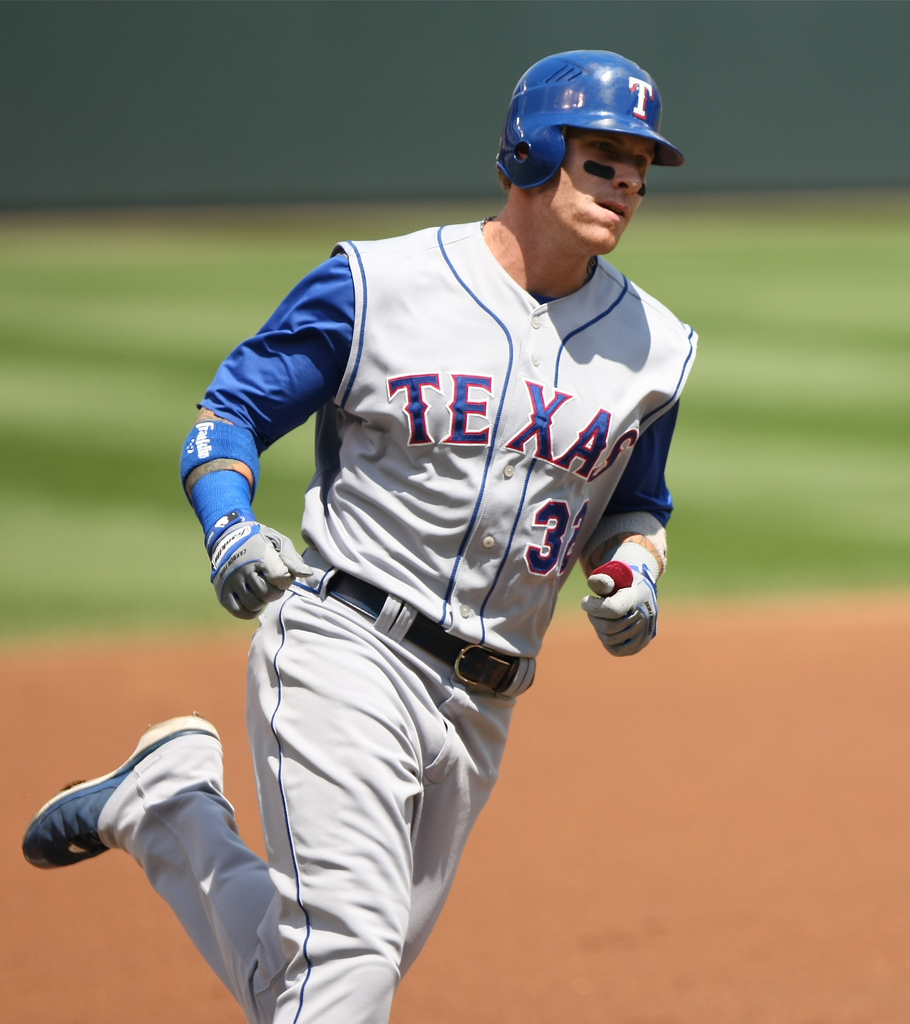
Josh Hamilton trotting home - a familiar site in Texas ... and parks north.

Josh Hamilton’s recent one-week home run binge – 9 homers in seven days, brought back memories of Frank “Hondo” Howard, who holds the record for homers in a week with 10.  Not to take anything away from Hamilton’s dramatic performance, but Hondo’s run may have been even more spectacular.  It came in 1968 – known as the “Year of the Pitcher” for the lack of offensive achievement.   It also was achieved in one less game, primarily on the road (only one home game) and with considerable more travel (Howard’s week included games Washington D.C., Boston, Cleveland and Detroit).

Let’s look at these two momentous long-ball achievements.

Hamilton’s week stretched from May 7-13 (7 games, one doubleheader) and included 14 hits in 30 at bats (.467), 9 HRs, 10 Runs, 18 RBIs, 4 walks and 11 strikeouts.  Hamilton’s total included six two-run homers, and three solo shots.  He homered in 5 of the 7 games, including May 8’s record-tying four-homer performance.  His victims included:  Jason Berken; Jake Arrieta (2); Zach Philips; Darren O’Day; Tommy Hunter; Jerome Williams (2); and C.J. Wilson.

The Ranger slugger’s run included four road games (at Baltimore) and three at home (vs. the Angels) – with the Rangers winning four of six.  In the streak, the Rangers scored a total of 61 runs, with Hamilton driving in 29.5% of that total.

Frank Howard’s 1968 streak also came in May, from the 12th through the 18th.  His week included only six games and he collected 13 hits in 20 at bats (.650); 10 HRs (the one-week record); 10 runs; 17 RBIs; just one walk; and four strikeouts.  He homered in all six games, with 4 solo homers, three 2-run dingers and one 3-run shot.  His victims included:  Fred Lasher;  Mickey Lolich (3); Lee Stange; Ray Culp; Jose Santiago; Sam McDowell (2); and Joe Sparma.

The streak included just one home game (Tigers) and five on the road at Boston (2), Cleveland (1) and Detroit (2).  The Senators went 3-3 and scored 29 runs in the six games (Howard drove in 58.5% of the Senators runs in the streak).


Hamilton’s 2012 streak

Date                      Hits-At Bats        HR             R             RBI         BB           K

May 7                       3-4                    1              1              2              2            2

May 8                       5-5                    4              4              8              0            0

May 10 (1)              1-4                       0              0              0              0            2

May 10 (2)              1-4                       1              1              2              1            2

May 11                    3-4                       2              3              2              1            0

May 12                    1-4                       1              1              1              0            3

May 13                    2-5                       0              0              3              0            2


Howard’s 1968 streak

Date                      Hits-At Bats        HR              R             RBI         BB             K

May 12                   2-4                       2              2              2              0              0

May 13 (off)

May 14                    3-4                       2              2              3              0              0

May 15                    2-4                       1              1              2              0              1

May 16                    2-3                       2              2              4              1              1

May 17                    1-4                       1              1              2              0              1

May 18                    3-5                       2              2              4              0              1

Three-Homer Jump Start – Another 2012 Rarity

J.J. Hardy - Twice the middle man in a three-homer start.

As we move through the 2012 season, rarities abound. A perfect game (one of only 21 in baseball history); a four-homer game (one of just 16 – also making 2012 the only season in which we saw a perfect game AND a four-homer game), and yesterday, for just the fourth time ever, a team started off a game with back-to-back-to-back home runs.

The team was the surprising Orioles, with Ryan Flaherty, J.J. Hardy and Nick Markakis leading off a 6-5 home victory over the Rangers with long balls (number one of the season for Flaherty, number eight for Hardy and number five for Markakis).

Here’s some tidbits about the contests in which a team has started off with three straight dingers.

The first three-homer jump start came on April 13, 1987, as the Padres’ Marvelle Wynn, Tony Gwynn and John Kruk pulled off the feat in a 13-6 home loss to the Giants. The Padres remain the only team to start with three long balls and still lose. They also had the least likely trio to pull of the accomplishment, as Wynn, Gwynn and Kruk (sounds like a law firm to me) totaled only 29 homers for the year. Wynn, in fact, finished the 1987 season with only 2 roundtrippers. It was also the first homer of the 1987 season for all three players.

The second three-homer start came on May 28, 2003, courtesy of the Braves’ Rafael Furcal, Mark DeRosa and Gary Sheffield – in a 15-3 home victory over the Reds. Furcal, DeRosa and Sheffield totaled 60 homers for the year.

The third group of long-ball initiators was made up of the Brewers Rickie Weeks, J.J. Hardy and Ryan Braun. They joined the list on September 9, 2007,  in a 10-5 road win over the Reds – making the Brewers the only team to achieve the feat on the road; the Reds the only team to be victimized by a three-homer start at home, as well as the only team to have the feat accomplished against them twice. (Weeks, Hardy and Braun totaled 76 homers for the year).

Notably, by being part of yesterday’s three-homer Orioles’ start, J.J. Hardy became the only player to twice be part of an event that has occurred only four times in MLB history. (Boy, don’t we keep track of everything in baseball.)

DH Can’t Get a Hit? Send Him to the Mound.

In the category of box scores we like to see, BBRT is adding Sunday’s Baltimore/Boston contest, won by the Orioles 9-6 in 17 innings – a game in which both teams sent their designated hitters to the mound (and each got a decision).

In that game, Baltimore’s designated hitter Chris Davis’ went 0-8 with five strikeouts at the plate, but redeemed himself by taking to the mound (Baltimore’s ninth pitcher of the day) and tossing two scoreless inning (with two hits, a walk and two strikeouts.)  Davis’ sinking fastball, in the high 80s, reportedly touched 91 mph at its fastest.   His strike out victims were Jarrod Saltalamachhia and Adrian Gonzalez – both swinging.

The losing pitcher was also a position player, Boston outfielder Darnell McDonald, who entered the game as a pinch runner (and scored) for DH David Ortiz in the eighth inning, became the DH and finished up as Boston’s ninth pitcher, giving up 3 runs in the top of the 17th.  He position line is interesting: PR-DH-P.   McDonald had a single in four at-bats at DH.

Harper HBP + Harper Steals Home + Hamels HBP + No whining = Good “Old-Fashioned” Hardball

Ouch! Good old-fashioned hardball!

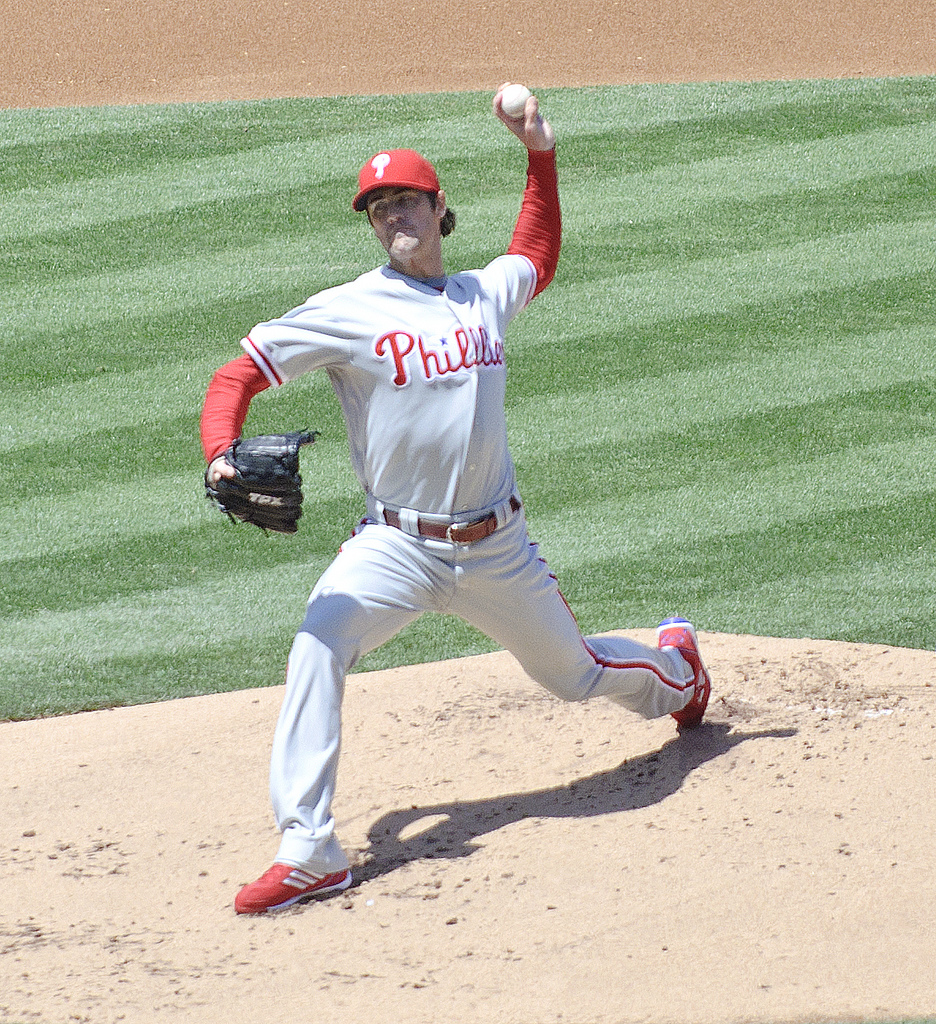
Phillies’ Hurler Cole Hamels gave Nationals’ phenom Bryce Harper an old-style welcome to the big leagues Sunday – drilling the 19-year-old outfielder with a 93-mph fastball (on his first pitch to the rookie) in the bottom of the first inning.  Harper handled it in what BBRT considers true major league fashion.  His didn’t charge the mound, he didn’t glare out at Hamels, he just dropped his bat and took first base.   He then went on to extract his revenge, moving to third on a Jayson Werth single and then taking a big lead and stealing home when Hamel attempted to pick Werth off first.

It all reminded BBRT of when MLB featured “good old-fashioned hardball” – a time when rookies were welcomed to the big leagues by spending time on their backsides in the batter’s box, when a home run by the hitter in front of you meant you were going to hit the dirt, and when a multi-homer game was usually rewarded with a baseball-sized bruise  (and they didn’t wear batting helmets … Yes, I’m that old.)

And, Sunday’s game got even more old school in the third inning when Nationals’ pitcher hit Jordan Zimmerman hit Hamels with a pitch.

After the game, Hamels confirmed his intentions, admitting he meant to hit Harper.  In his own words,  “I was trying to hit him. I’m not going to deny it. It’s something I grew up watching. That’s what happened. I’m just trying to continue the old baseball.”

As Hamels even more succinctly put it, “It’s just, ‘Welcome to the big leagues.”‘  It may cost Hamels (dollars and days off) when the NL reviews his remarks, but BBRT appreciates the honesty and the intent (Hamels indicated he was not trying to injure Harper and he did not go headhunting.)

Still, there will be those who are offended by Hamels action.  Interestingly Harper is not among them. After the game, about the worst thing Harper had to say about Hamels was that he’s a great pitcher – and reports are that he said it with a smile.  Hamels returned the compliment noting that he sees Harper as a player with a lot of talent and energy who’s “going to make a really good name for himself.”

As far as the revenge taken by the Nationals (although Zimmerman denied purposefully hitting Hamels), Hamels was willing to take as good as he gave, saying, “I think they understood the message and they threw it right back. That’s the way, and I respect it.”

Well, BBRT now has two new heroes … Hamels and Harper, who together brought some good old-fashioned hardball to the Phillies 9-3 win.

Mariano Rivera – Pretty Darn Close to Perfect

“As a pitcher, I like to be — I don’t want to say perfect, but I want to know what the ball is going to do.”

Mariano Rivera

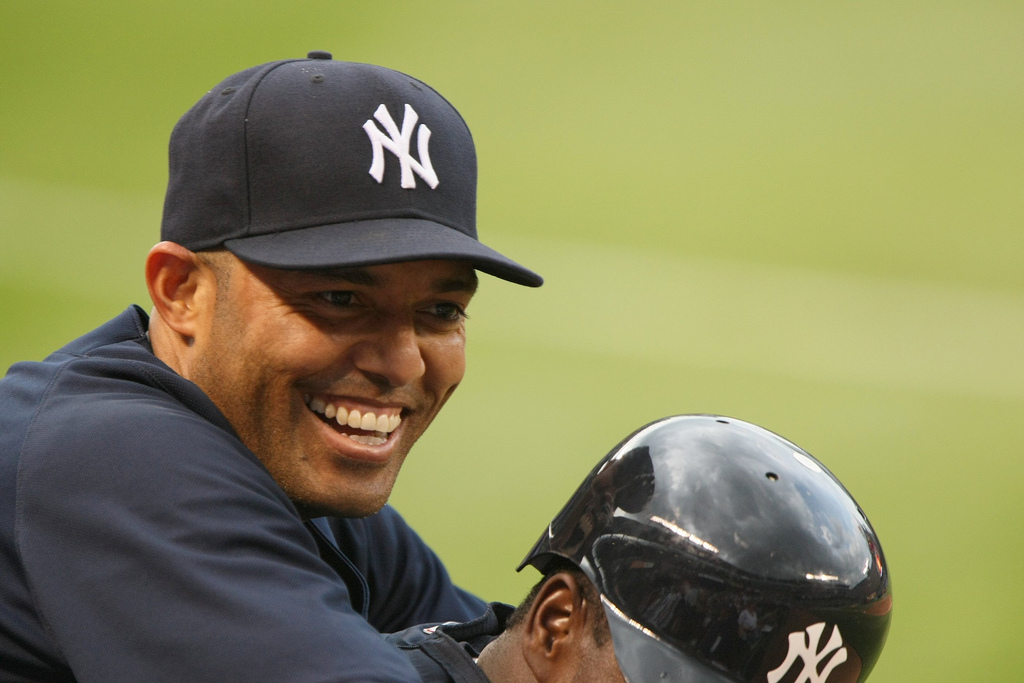
Mariano Rivera ... one of MLB's true heroes ... a great guy, a great player!

When it comes to being perfect at his job, probably nobody in baseball comes closer (no pun intended) than Mariano Rivera, who can throw his primarily one-pitch repertoire (cut fastball) wherever he wants, pretty much whenever he wants.

Batters have long known the cutter was coming at them more than 80 percent of the time and still have not been able to hit it. Not in 1997, at age 27, when Rivera first became a full-time closer for the Yankees and saved 43 games. Not in 2004, at age 34, when he saved a career high 53 games. Not in 2011, at age 41, when he notched 44 saves. And not this season, when he a picked up a win and five saves in 9 appearances (with a 2.16 ERA). And, through all of this stardom, Rivera has been a class act on the field and off – showing respect for the game, the Yankee pinstripes, his team mates, the opposition (even as he was breaking their bats off in their hands) and the fans.

Now as every fan already knows, Mariano Rivera – 12-time all-star closer and career leader in saves – yesterday proved that (despite popular opinion) he is not Superman. Rivera, at age 42, suffered a torn ACL doing something he truly loved, “playing” baseball. He didn’t go down on the mound, but rather while shagging flies in the outfield. Somehow, BBRT feels closer to this future HOFer because of those circumstances. All of us who love the game have spent time shagging flies, taking grounders and just enjoying being out on the ball field. We know Rivera was having fun, and that’s what the game is all about. While few of us have been on the mound with the game on the line, BBRT hopes to see Rivera on the hill closing out games again. If we don’t, however, we’ll see this “as- close-to-perfect” as you can get closer, team mate and gentleman at his Hall of Fame induction.

As we close out this get well card to Rivera, let’s look at just how close to perfection he really is. First, there are the saves: 608, top figure all-time. Then there’s his ERA, at 2.21 thirteenth all-time (among pitchers with at least 1,000 career innings pitched). Moreover, everyone ahead of him on the list retired before 1930. The closest active pitcher is Giants’ starter Tim Lincecum at number 178 (3.05). Rivera is also in the top five (fifth) in strikeouts to walks – a 4.04 – 1 ratio.

For those who like to look a little deeper, how about WHIP (Walks and Hits to Innings Pitched)? Rivera ranks second all-time (again among those with 1,000 or innings) at 0.998. Only two other players have a career WHIP below 1.0 – Ed Walsh (who retired in 1917) and Addie Joss (who left the game in 1910.)

And there’s the post season (30 innings or more pitched), where Rivera is number one in ERA (0.70); number one in saves (42, with second place at 15); number three in WHIP (0.758); and has an 8-1 won-loss record.

Mariano, we wish you well in your recovery. Your presence elevates the game.

Weaver Tosses 2012’s Second No-Hitter … and a bit of history

 Jered Weaver yesterday tossed a no-hitter against the Minnesota Twins, which raises the question – Which is more surprising?

 1) That the Angels’ ace no-hit the 6-18 Twins (who were shut out on 3-hits by Jerome Williams the day before and now haven’t had a hit in 15 innings);

2) That the Angels remain in last place despite the three-game sweep of the Twins;

3) That Albert Pujols (of the 11 consecutive 30+ homer seasons) is hitting .208 with no home runs and only 5 RBIs after 25 games in the American League?  

We’ll go with “3” and send our congratulations out to Weaver, who walked one and struck out nine in his 9-0 win.   

BBRT likes to provide a little history in each post, so here some factoids for today – which, as you will see later, are only one degree of separation from Jered Weaver. 

While Weaver’s no-no was the classic complete game, there have been 9 “combined” no-hitters in MLB history, including 2 in 1991 (when there were a total of 7 no-hitters).  1991’s seven no-hitters is the record for a single season, tied with 1990, when there were also 7 no-hitters, including one combined effort.   For historic reference, 1990-91 saw as many no-hitters as 1927-44. 

The most pitchers used in a combined no hitter was six, on June 11, 2003, when a parade of Houston Astros’ hurlers shutdown the Yankees 8-0 at Yankee Stadium.  It all started out normally enough as the Astros’ Roy Oswalt sent the Yankees down 1-2-3 in the first (Alfonso Soriano-fly out, Jeter- strikeout swinging, Jason Giambi-strikeout swinging). Things took a turn toward baseball history two pitches into the Yankee second, as Oswalt aggravated a groin injury and the Astros were forced to go to the bullpen.  In succession, Pete Munro tossed 2.2 innings; Kirk Saarloos 1.1; Brad Lidge 2.0 (for the win); Octavio Dotel (1.0); and Billy Wagner 1.0.   When it was over 13 Yankees had gone down on strikes, there Bombers had no hits and had put only 5 runners on base (3 walks, an error and on a wild pitch strikeout.)

And, the game was both unusual and meaningful.  The Yankees came into the game with a 36-27 record, just ½ game ahead of the Red Sox, while the Astros were 36-28 and tied for first place with the Cubs.  Oh, and that one degree of separation?  The Yankees’ starting (and losing) pitcher was Jered Weaver’s brother Jeff, whose major league pitching career spanned 1999-2010.  Jeff went 6.1 innings, giving up 5 runs on ten hits in the loss.  

How did the Yankees take the unusual no-hitter?

“We should be embarrassed,” Jeter said after the contest. “If you’re not embarrassed something’s wrong with you.”

The Yankees did take the loss with class. When they got to the clubhouse after the game, each of the six participating pitchers found a bottle of champagne, courtesy of the Yankees, at his locker.

Happy 40th Chipper – A 4-Bagger Celebration

Happy 40th Chipper!

Yesterday, when Chipper Jones celebrated his 40th birthday with a home run during the Braves 4-3 win over the Dodgers, he joined an elite club – only four other players have hit a home run on their 40th birthday:

Bob Thurman, Reds, on May 14, 1957 … an unusual case, since Thurman didn’t make the major leagues until he was 37 and then played until he was 42 (1955-59).

Joe Morgan, Phillies, on September 19, 1983 … Morgan played from 1963-84.

Wade Boggs, Devil Rays, on June 15, 1998 … Boggs played from 1982-99.

Tony Phillips, As, on April 25, 1999 … Phillips played from 1982-99.

Jones, retiring after this season, will not have the chance to move to the next level … a homer on his 41st birthday. That birthday club has two members:

Darrell Evans, Tigers, May 26, 1988 … Evans played from 1969-89.

Jim Thome, Indians, August 27, 2011 … Thome, still playing for the Phillies, began his ML career in 1991. He rejoined the Indians (from the Twins) the day before his birthday blast.

And, of course, there is also the Mets’ Julio Franco. Maybe not a birthday bash but, on May 4, 2007, at 48-years-old (and 254 days), Franco established the current mark for the oldest major leaguer to hit a round-tripper. Note: Franco is also the oldest player to have a multi-homer game, hit a grand slam and hit a pinch-hit home run. Franco’s career stretched from 1982-2007.

Congrats Phil Humber – Light Up A “Perfecto”

On April 21, Phil Humber tossed a perfect game in a 4-0 victory over the Seattle Mariners in Seattle.  Humber finished off the Mariners in 95 pitches, 67 for strikes, going to a three-ball count on only three batters.  In his gem, Humber struck out nine (including the final batter) and there were only six outfield putouts.

While BBRT raves about Humber’s masterpiece, we register a bit of a rant at the Mariners’ shortstop Munenori Kawasaki’s sixth-inning bunt attempt.  The first hit, after 17 batters have been retired in a no-hitter, should be legitimate.

The 4-0 score is the second most popular perfect game final count.  Six of MLB’s 21 perfect games have resulted in the narrowest of victories, ending by the score of 1-0.  Five perfect games have ended at 4-0 and four at 2-0.  The highest score in a perfect game?  6-0, twice: In Yankee David Cone’s July 18, 1999, perfect game against the Expos – and in Phillie Jim Bunning’s June 21, 1964, masterpiece against the Mets.

Another perfecto fact.  The largest attendance for a perfect game was 65,519 for Don Larsen’s 1956 World Series perfect game (the only ever in a World Series).  The smallest – 6,298, when Catfish Hunter shut down the Twins in Oakland on May 8, 1968, although tens of thousands claim to have been there.  The announced attendance for Humber’s perfecto was 22,472.  Final piece of trivia:  Of the 21 perfect games, 15 were at home.

Looking back to Larsen’s game, probably the most famous perfecto:  It came on October 8, 1956, at Yankee Stadium as the Bronx Bombers bested the rival Brooklyn Dodgers 2-0.  Larsen struck out 7 (including, like Humber, the last out), went to a three-ball count only once and saw 9 outfield putouts.

Perhaps the most dominant perfect game performance (if such a distinction can be brought to perfection) belongs to Dodger lefty Sandy Koufax, who tossed his perfect game against the Cubs in LA – winning 1-0 on September 9, 1965.  Koufax struck out 14 Cubbies in that outing, including the last six batters.

Addie Joss of the Cleveland Naps used the fewest pitches to log a perfect nine-innings – 74 pitches – just three strikeouts – as he beat the White Sox (in Cleveland) on October 2, 1908.  The most pitches in a perfecto?  120 by Yankee David Wells, as he shut down the Minnesota Twins 4-0 at Yankee Stadium on May 17, 1998.

Perfect game record least likely to be broken?  When Jim “Catfish” Hunter tossed his perfect game against the Twins (May 8, 1968, at Oakland), he not only notched 11 strikeouts (including the last batter) – he added insult to injury by collecting three hits in four at bats (a double and two singles) and driving in three of Oakland’s four runs.  The best offensive performance ever by a perfect hurler.


BBRT Declares Unofficial Record – 38 straight strikes.

Talk about being in the groove.  On April 18, while beating the Angels 4-0, Oakland A’s  pitcher Bartolo Colon threw 76 percent of his pitches for strikes, including one streak of 38 strikes in a row (second pitch of the fifth inning to the seventh pitch of the eighth inning).  BBRT is going to declare the 38 straight strikes an “unofficial” record until someone proves it wrong.  Colon pitched 8 scoreless innings in the game, with 4 hits, no runs and 5 strikeouts.  The win brought the 2005 Cy Young winner’s 2012 record to 3-1, 2.63 ERA, with 2 walks in 27.1 innings pitched.

Pretty much everything Bartolo Colon threw was over the plate Wednesday.

In an understatement, A’s catcher Kurt Suzuki said after the game, “Bartolo knows where the ball is going and he knows what he wants to do.”

BBRT likes to reminisce, so here’s the look backward.  In 1962, Kansas City Athletics hurler Bill Fischer put together a record streak of 84.1 innings pitched without a base on balls (August  4- September 30).  Fischer, who ended the year 4-12 with a 3.95 ERA, tossed 127 innings with only 8 walks that season.   Ironically, Fischer – in his later coaching career – became known as “Walking Wisdom.”

2012 Early Season Surprise – Albert Who-Jols? And a bit of history … the last .300 hitting team.

Eleven games into the season, the now Pujols-less Cardinals are riding high (8-3, first place) and leading the National League in Batting Average (.293), Hits (114), Runs (59), HRs (16) and RBI (59), as well as On Base and Slugging Percentage.  Pujols, meanwhile, is hitting .267 with no HRs and 4 RBI in 45 at bats (his longest streak of season-opening at bats without a long ball).  BBRT thinks this puts Pujols on a pace for 37 HRs – realistic math versus actual math.

Among the key Cardinal contributors:  Matt Carpenter (.409-1-11); David Freese (.371-3-11); Carlos Beltran (.351-4-5); and Yadier Molina (.324-3-10).  Clearly these Redbirds have picked up the slack.

A little bit of history from the BBRT “Baseball Geezer.”

Even a .300-hitting team couldn't bring a pennant to Fenway.

Hot hitting does not always bring pennants.  Consider the 1950 Boston Red Sox – the last major league team to average .300 for a season (.302).  On any given day, that line-up featured 7 or 8 .300 hitters, and the lowest average among regulars was .294.   And there was Billy Goodman, who won the league batting title with a .354 average, but did not have a “regular” spot in the field.  In the course of the season, Goodman played OF, 1B, 2B, 3B and SS.   The Sox finished first in Batting Average, led the league in Runs Scored, finished second in HRs and finished third (behind the Yankees and Tigers) at 94-60.

The hard-hitting line-up:

C             Birdie Tebbets                   .310

1B           Walt Dropo                        .322

2B           Bobby Doerr                      .294

3B           Johnny Pesky                    .312

SS           Vern Stephens                  .295

LF            Ted Williams                     .317

CF           Dom DiMaggio                  .328

RF           Al Zarilla                           .325

UT          Billy Goodman                   .354


The team closest to .300 in the .2000s?  Only 3 teams have reached the .290 mark – the 2000 Rockies (.294); 2001 Rockies (.292); and the 2007 Yankees (.290).