A Very Dashing Play – A Look at MLB Three-Baggers


The triple is the most exciting play in baseball.  Home runs win a lot of games, but I never why fans are so obsessed with them.

                                                                                                    Hank Aaron

On this date (May 6) in 1934, the Boston Red Sox gave approximately 30,000 fans gathered at Fenway Park some real excitement – particularly if measured by Hank Aaron’s standards. Trailing 2-1 (to the Tigers) with one out and no one on in the bottom of the fourth inning, the Red Sox launched an MLB  record-setting four consecutive triples (all to right center).  The three-baggers were hit by CF Carl Reynolds (who had already tripled in the second inning), RF Moose Solters, C Rick Ferrell and 3B Bucky Walters.   The Red Sox would have five singles, two doubles, a walk and a safe-on-an-error in the 12-run inning – ultimately, winning the contest 14-4.

A Season’s Worth of Triples in an Inning

On September 15, 1901, the Chicago White Sox hit five triples in one inning. That equaled the total number of triples for the Toronto Blue Jays in the 2017 season – the fewest three-baggers ever in a season for an MLB team.

In this post, Baseball Roundtable would like to take a look at some record-setting statistics, trivia and stories surrounding the most exciting of offensive plays – the triple. (Side note:  I apologize for the narrow column width.  After a recent WordPress upgrade, my page layout went a little wonky.  I’m working on it – and will continue to generate content while the fix is underway.)

Sadly, the fans’ opportunity to see a player dashing around the bases for a three-bagger seems to be fading.  For example, in 1930, you were about three times more likely to see a triple during an MLB game than you were in 2019 (last full season.)


S0, let’s take a look at some BBRT triples tidbits. 

  • The most triples ever hit in a game by an MLB team is eight– by the Pirates (against the Cardinals) on June 30, 1925. In that game, each of the first six hitters in the Pirates’ batting order had at least one triple. The three baggers were hit by: LF Clyde Bernhardt (2): CF Max Carey (2); SS Glenn Wright; 3B Pie Traynor. RF Kiki Cuyler; and 2B Eddie Moore.

The 1925 Pirates , who won the NL pennant, led MLB in triples with 105. The team had five players with at least ten three-baggers and fifteen players (including four pitchers) with at least one triple.

  • The most triples by a team in a season is 153, by the 1894 (NL) Orioles.
  • The Washington Senators hold the record for the most consecutive years leading their league in triples at seven (1931 through 1937). The Pirates set the NL record (6) with a nearly parallel streak (1932-37).
  • The most triples ever hit by a team in an inning is five by the by the Chicago White Sox (in the seven-run eighth inning of a 9-4 win over the Milwaukee Brewers on September 15 1901).

How about some individual triples’ records?

  • Only two players have hit four triples in a single game: George Strief of the American Association Philadelphia Athletics on June 25, 1885 and Bill Joyce, NY Giants, on May 18, 1897. (Strief hit just five triples in 44 games in 1885, but four in one game.  Unlike Strief, Joyce was a triples machine, with 106 three-baggers in eight seasons.)
  • In the Modern Era (post-1900), the record for triples in a game is three – shared by  51 players.

Three-for-Two – Or Something Like That

The only player to hit three triples in a game twice was Dave Brain, who smartly had a pair of three-triple games in 1905 – one each for two different teams. He accomplished the feat as a Cardinal on May 29.  Then, after being traded to the Pirates on July 4, he had another three three-bagger game on August 8.  Brain hit .247 on the season, with 11 triples in 129 games.  For trivia buffs, Brain led MLB  in home runs in 1907 with 10. 

  • Lance Johnson holds the record for consecutive seasons leading his league in triples (four); 1991-1994 – all for the Chicago White Sox. In 1996, Johnson – then with the Mets – also led the NL in triples with 21. 
  • Sam Crawford led his league in three-baggers a major-league record six times. Crawford led the AL in triples five times while with the Tigers (1903, 1910, 1913, 1914, 1915) and the NL once (1902) with the Reds. Crawford holds the career triples record at 309.
  • Sam Crawford and Willie Wilson share the American League record for seasons leading the league in triples (5), while Stan Musial holds the National League record (5). 
  • Eleven major league players have hit a record  two triples in one inning – the most recent being the Rockies’ Cory Sullivan, in the fifth inning of a Colorado 10-4 win over the Padres in San Diego (April 9, 2006). Sullivan, playing CF and batting leadoff, tripled to open the inning (and later scored), then tripled again with none on and two out as the Rockies scored seven times in the frame.
  • #InBaseballWeCountEverything …. Three players hit a record eight bases-loaded triples in their careers. Shane Collins (MLB career – 1910-25), all eight for the White Sox; Jose Cruz (MLB career – 1970-88), all for the Astros; Steve Finley (MLB career – 1989-2007), who had sacks-full triples for the Astros (1), Padres (2), Diamondbacks (3), Angels (1) and Giants (1). 

And, now a couple of triples-related stories BBRT found interesting – if not totally historic.

One Game – Three Bags – Two Times – For a Career

The first player to strike a pair of triples (strike is a key word here) in his MLB debut was Detroit Tigers’ 3B Ed Irwin – a 30-year-old rookie who played his first MLB game on May 18, 1912.  A few facts that make Irwin’s story unique: 1) His first MLB game was also his last; 2) His two triples were his only MLB hits; 3) He was on the field as a result of a players’ walk-out/strike.

The story really started on May 15, 1912, when Tigers’ CF Ty Cobb went into the stands in New York and pummeled a (one-handed) fan who had been heckling him.  This earned Cobb an indefinite suspension by AL President Ban Johnson (appropriate first name in this situation) – and led his teammates to go on strike (announced May 17) in his support. On May 18, the Tigers showed up for a game against the Athletics at Philadelphia’s Shibe Park. When told Ban’s ban would be enforced and Cobb could not play, the Tigers’ squad went back to the clubhouse. In their place, Detroit fielded a lineup made up of semi-pro and amateur ballplayers (all signed to one-day MLB contracts) – along with two of the Tigers’ coaches (Deacon McGuire and Joe Sugden, both in their forties).  

This hastily assembled bunch included the 30-year-old Irwin, who at least had some minor-league experience (Class D and C).  The Athletics ultimately won the contest 24-2.  The Tigers’ replacement squad got only four hits – one each by coaches Sugden (at 1B) and McGuire (at C) and two triples in three at bats by Irwin.  As an aside, the Tigers’ starting pitcher Al Travers reportedly earned a $50 bonus for pitching a complete game – a nifty 24-hitter.  After some threats and haggling, a cancelled game and an off day, the Detroit regulars returned to the field on May 21. 

________________________________________________________

John Sipin – Started with Triples … Starred in Japan

John Sipin made his major league debut for the San Diego Padres on May 24, 1969.  The 22-year-old second baseman batted second and went two-for-four (tripling in each of his first two at bats), as the Padres lost to the Cubs 7-5 in San Diego.  Sipin would play in 68 games for the Padres in 1969, hitting .223 with two triples, two home runs, 22 runs scored, nine RBI and two stolen bases. It was his only major-league season – so those two debut-game triples were his only career three-baggers.  Sipin is one of just four players with two triples in their first MLB game.  The others include the already noted Ed Erwin, the Indians’ Roy Weatherly (June 27, 1936) and the Giants’ Willie McCovey (July 30, 1959). 

In 1970, Sipin was back at Triple A, where he hit .301, with 20 home runs in 135 games. He followed that with a .318-20-77 season at AAA in 1971.  The call to the majors didn’t come, however, and Sipin went on to make a name for himself in Japan – where he played from 1972-1980. Sipin hit .297 in nine seasons in Japan, with 218 home runs and 625 RBI – and was the first foreign player to win a Japanese Gold Glove Award (1972 and 1973).  Sipin hit over .300 five times and topped 20 home runs seven times (a high of 34 in 1975) in Japan.

Primary Resources:  Baseball-Almanac.com; Baseball-Reference.com; MLB.com

__________________________________________________

Baseball Roundtable Disclaimer:  The MLB records referenced in this (and previous) posts have the potential to change as Major League Baseball recognizes and incorporates Negro League records from 1920-46 into the MLB record book.

_________________________________________________

100Baseball Roundtable is on the Feedspot list of the Top 100 Baseball Blogs.  To see the full list, click here.

I tweet baseball @DavidBBRT

Follow/Like Baseball Roundtable’s Facebook Page here.  More baseball commentary; blog post notifications; PRIZES.

Member: Society for American Baseball Research (SABR); The Baseball Reliquary; The Negro Leagues Baseball Museum.
 

Baseball Roundtable April 2021 Wrap UP

The first month of MLB’s 2021 regular season has come to an end and it’s time for Baseball Roundtable’s traditional monthly wrap up:

  • A look at the April stories and stats that caught BBRT’s eye;
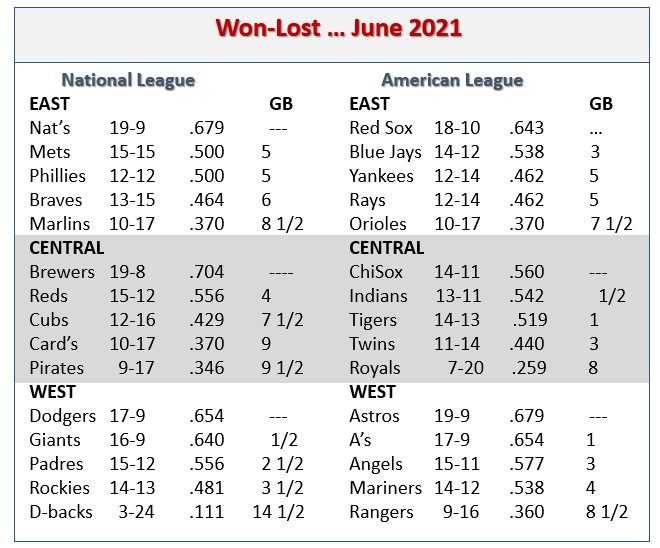
  • April won-lost records (future Wrap Ups will include the most recent month and year-to-date stats and standings);
  • BBRT’s Players and Pitchers of the Month; and
  • BBRT’s “Trot Index.”

Note: If you are more into stories than stats, you can scroll down to the “Highlights” section. 

Just Try to Sneak One past Nicky “Two-Strikes”

Two strikes?  No problem. This April, White Sox’ 2B Nick Madrigal hit hit .355 in at bats where he had two strikes on him – and, within that set of at bats, hit .364 on 0-2 counts.  Small sample size?  Yes, but consider that, in his two MLB seasons, Madrigal has hit .333 in 87 at bats which stretched to a two-strike count, has hit .529 (9-for-17) on 0-2 pitches and has hit .405 after falling behind 0-2 in an at bat (15-for-37). 

Before we get into the details, here are a few events that helped shape April 2021 in MLB (more on these and other April “happenings” in the “Highlights” section).  In April, we saw:

  • Two no-hitters (Carlos Rodon & Joe Musgrove);
  • A triple play (Reds);
  • Three three-homer games (J.D. Martinez, Ryan McMahon, Vlad Guerrero, Jr.);
  • A player (White Sox’ rookie Yermin Mercedes) start a season with a record eight straight hits;
  • A starting pitcher (Corbin Burnes) strikeout 49 batters without giving up even one walk; 
  • Angels’ two-way player Shohei Ohtani do something that hasn’t been done in 100 seasons – start a game on the mound when he was also leading MLB in home runs on the season.  (Last done by, of course, Babe Ruth – back in 1921.);
  • Two qualifying batters hit .400 for the month (Mike Trout and Yermin Mercedes) and a third (Byron Buxton) outhitting them both, but one plate appearance short of qualifying for the leader board;
  • Two qualifying pitchers (Jacob deGrom and Carlos Rodon) turning in April ERA’s under 1.00 and a third (Danny Duffy) turning in an even lower ERA than deGrom and Rodon, but falling one inning short of qualifying for the leader board;
  • One player (Joey Votto) notching his 300th career home run; 
  • One team (Tigers) averaging below .200 for the month;
  • One division, the NL East with no team over .500 – and the only team in the Division (Marlins) with a positive run differential was in last place at the end of April;
  • The Padres swiping 33 bases; the Mets just three;
  • Despite the DH taking pitchers’ whiffs out of the mix, we saw that the top three teams in batters’ strikeouts in April were all from the AL (Rangers, Tigers, Rays). 

Hmm.  How About Those Record Books?

There were 14 complete games recorded in April 2021 – six of them in seven-inning doubleheader contests.  Of the ten complete-game shutouts that went into the record books, four were part of seven-inning doubleheaders. 

Again, more on these and other April “stories” in the Highlights section.  Before we get deeper into April stats, let’s look at BBRT’s Players and Pitchers of the Month.

—–PLAYERS AND PITCHERS OF THE MONTH (SEPTEMBER)—–

NATIONAL  LEAGUE

Player of the Month – Ronald Acuna Jr., OF, Braves

Ronald Acuna, Jr. – just 23-years-old – continues to make his presence known on the field.  His .341 April average was second among NL (qualifying) players, his eight home runs tied for tops in the NL (one behind the Red Sox’ J.D. Martinez overall), his 25 runs scored were the most in MLB and  his 18 RBI were seventh in the NL.  Add in his 15 walks and two HBP and his .443 on-base percentage was third among NL qualifying hitters. .  During the month, Acuna scored two or more runs in eight games. Acuna also stole three bases in April.

Honorable Mention(s): Jesse Winker of the Reds provided average and power with a .370-6-16 line, with his average leading NL qualifiers and his 30 hits tied for third in the NL.  BBRT also looked at the Dodgers’ Justin Turner, who put up a .330-6-20 stat line in April. 

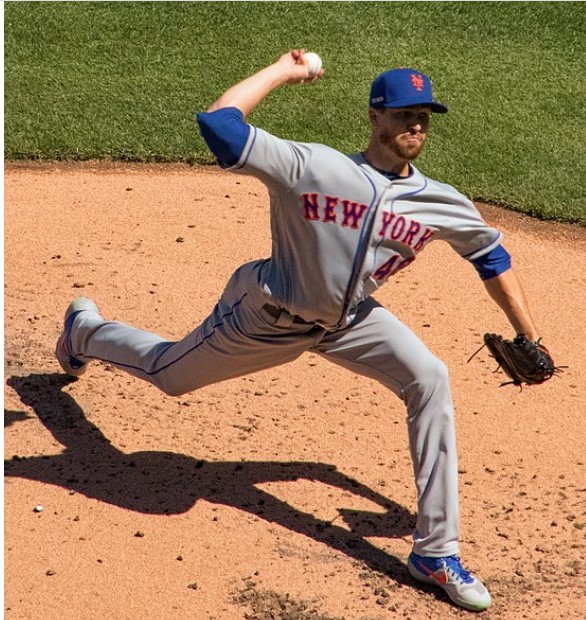
Pitcher of the Month –Jacob deGrom,  LHP, Mets

Photo by slgckgc

 Jacob deGrom, started five games in April, putting up (among qualifiers) an MLB-best 0.51 ERA,   and second-lowest WHIP (0.57), while fanning an NL-tops 59 batters in 35 innings (tying Nolan   Ryan’s record for the most whiffs in the first five starts of a season (1978).   In his five starts,   deGrom gave up   just 16 hits and only two earned runs (one earned run in each of his two   losses  – over 14 innings).  On April 23, he tossed a two-hit, 15-strikeout, complete-game shutout against the Nationals. 

Honorable Mention(s): Joe Musgrove of the Padres pitched to a 2-2 record, with a 1.24 ERA (second only to deGrom among NL qualifiers).  He also tossed the first no-hitter in Padres’ history and fanned 41 batters (five walks) in 29 innings.  The Brewers’ Corbin Burnes also deserves mention, after going 2-2 with a 1.53 ERA during the month, striking out 49 batters (without a single walk) in 29 1/3 innings.  Unfortunately, Burnes was on the Injured list when April closed, so we’ll have to wait to see how much farther he can take the streak. 

Life Just Isn’t Always Fair

While Jacob deGrom’s 0.51 April ERA resulted in a 2-2 record for the month, Steven Matz (Blue Jays) translated a 4.00 ERA into a 4-1 April record. 

AMERICAN LEAGUE

Player of the Month – Byron Buxton, OF, Twins

This was a tough decision, with an eight-time All Star and three-time MVP (Mike Trout), a rookie (Yermin Mercedes) and a often-injured, seven-season MLB veteran (Byron Buxton) having his best start ever all in the running.  All three offered one of those “bright and shiny things” that grab BBRT’s attention – a .400+ average (although Buxton fell one plate appearance short of qualifying for the leader board).  BBRT’s is going with Buxton, who put it all together in April with a .426 average, eight home runs (second in MLB only to J.D. Martinez’ nine), 14 RBI, 15 runs scored, three stolen bases, an .897 slugging percentage and Gold Glove caliber defense. Buxton was held hitless only twice in 18 games. He did it all. 

Honorable Mention(s): In April, Mike Trout played like – Well, like Mike Trout. In fact, he may be having the best April start in his already storied career. His .425 average was tops among MLB qualifiers and he added six home runs, 14 RBI and 18 runs scored (in 21 games). White Sox’ rookie Yermin Mercedes (.415-5-16) pretty much kept pace with Buxton and Trout at the plate, but serves primarily as a DH (which costs him a “point” or two).  You’ll find more on Mercedes in the Surprise Player of the Month recognition.  I also considered the Red Sox’ primary DH  J.D. Martinez, who hit .333-9-25.  Martinez’ nine April homers and 25 RBI each led all of MLB, his 33 hits were third and he had a three-homer game and ten multi-hit games.

Pitcher of the Month – Carlos Rodon, LHP, White Sox

Photo by rchdj10

 Going with White Sox’ starter Carlos Rodon, whose April was nothing short of remarkable. His   four victories (no losses) tied for the most in MLB.  His 0.72 ERA was  the lowest among Al   qualifiers and second only the Mets’ Jacob deGrom  He also fanned 36 batters in 25 innings and,   of course (another bright and shinny thing), threw a no-hitter. In addition, Rodon gave up a total   of seven hits in four starts and held hitters to a MLB-low (among qualifiers) .085 batting average.   His WHIP of 0.64 was the lowest among AL qualifiers. 

Honorable Mention(s); The Yankees’ Gerrit Cole was  4-1 in six starts, with a  1.43 ERA (second among AL qualifiers). In addition, Cole’s had 0.72 WHIP in April and his 62 strikeouts (in 37 2/3 innings) were (second only to Shane Bieber’s 68.  The Indians’ Shane Bieber finished the month with an MLB-leading 68 whiffs in 42 1/3 frames.  Still, he had two fewer wins (3-2) than Rodon; a higher ERA (2.76); and a higher WHIP (0.99).  Similarly, while the Royals’ Danny Duffy’s ERA was a minuscule 0.39, his WHIP of 1.04 was higher than Rodon’s, he pitched fewer innings (23 – one short of qualifying for the leader board ) and recorded only about half as many strikeouts (27).  Overall, Rodon – in BBRT’s view – had a slight edge over these three Honorable Mentions (and then, there’s that no-hitter).  

Surprise Player of the Month – Yermin Mercedes, DH, White Sox 

Soxsox14, CC BY-SA 4.0 <https://creativecommons.org/licenses/by-sa/4.0>, via
Wikimedia Commons

 A rookie as Player of the Month, in his first full month in the major leagues?  That would   be White Sox’ DH Yermin Mercedes, who came out of the gate smokin’ – becoming the   first MLB player in the modern era to collect a hit in each of his first eight plate   appearances of a season.  The 27-year-old Mercedes didn’t drop below .500 until his tenth   game of the season and finished the month at .415. His 34 hits tied for the most in MLB   this April and he also popped five home runs and drove in 16 tallies.  His month included   seven multi-hit games and he was held hitless in only three of 22 games played. 

Honorable Mention(s): Coming into the 2021 season, Orioles’ OF Cedric Mullins‘ career MLB average was .225 (115 MLB games over three seasons).  He ended this April tying for the MLB lead in base hits (34 in 26 games), with a .337 average. BBRT also wants to recognize Brewers’ catcher Omar Narvaez. The 29-year-old came into this season with a career .267 average and had hit just .176 in 40 games for the Brewers in 2020. This April, he put up a .368-3-11 line in 22 games.

How About a Surprise At Bat of the Month

On April 27, Brewers’ right-handed pitcher Adrian Houser started for the Brewers (against the Marlins in Milwaukee. He went 5 1/3 innings (three runs on five hits and one walk,with seven strikeouts) for the win.  But the surprise of the game came not when Houser was on the mound, but when he was at the plate.  He came into the game just 2-for-28 in his career with 21 strikeouts. In his first at bat of the game, on the first pitch he saw from Daniel Castano, Houser smacked his first MLB home run – a 418-foot blast to center.

______________________________________________________

TROT INDEX … A REGULAR BBRT FEATURE

In April 2021, 37.7 percent of the MLB season’s 28,326 plate appearances ended in a trot (back to the dugout, around the bases, to first base). We’re talking about strikeouts, home runs, walks, hit by pitch and catcher’s interference – all outcomes that are, basically, devoid of action on the base paths or in the field. Here’s the breakout: strikeouts (24.4%); walks (8.8%); home runs (3.1%); HBP (1.3%); catcher’s interference (less than 1%). Personally, I’d like more action in the field of play.

The 37.7 percent figure is up slightly from 2020’s (full season) 37.3 percent;  2019’s (full season) 36.2 percent and 2018’s 34.8 percent Trot Index. See a trend there? 

_________________________________________________

There were some surprises in April.  How about the Royals sitting atop the Al Central Division? How they got there adds to the surprise.  Consider that the Royals were outscored by opponents in April, while the second place White Sox has a plus-29 run differential. The Royals did it partly by going 6-1 in one-run games.  The team was led on offense by 2B Whit Merrifield (.274-3-15), 1B Carlos Santana (.247-6-20) and C Salvador Perez (.268-5-13). That trio was responsible for 14 of the team’s 22 home runs and 45 or the squad’s 99 RBI. Danny Duffy led the starting rotation (3-1, 0.39, 27 strikeouts in 23 innings).  Those one-run wins really reflect the handling of the bullpen – six different pitchers recorded saves during month.  At the other end of the AL Central Division, The Tigers were the only MLB team with a winning percentage under .300 (.296), as well as the only squad with a batting average under .200 (.199). 

Other AL surprises saw the Red Sox in first place in the NL East.  The Red Sox relied heavily on their offense – which recorded April’s third-highest team average, and scored the second-most runs  in the AL (trailing only the Astros). The BoSox’ offense was led by DH J.D. Martinez (.351-9-25) and 3B Rafael Devers (.293-7-21).  The BoSox were the only MLB team with two 20-RBI players in April. Among the table setters was OF Alex Verdugo (.300 with 19 runs scored). 

On the Road Again

The AL East-leading Red Sox were 8-8 at home and 9-2 on the road. 

Oakland stood atop the AL West, despite a negative-four run differential.  Houston, with the AL’s largest positive run differential (+31), ended April in third place – but trailed the A’;s by just 1 1/2 games.  Power played a role the A’s April success.  While Oakland had the AL’s fourth-worst April team batting average, they had the league’s third-most home runs and seventh-most runs scored.   Matt Olson led the team with seven April homers (.296-6-17) and the A’s had six additional hitters with at least three April  long balls.  

Talk About a Turn Around

The Oakland A’s lost seven of their first eight games this season – being outscored 59-19.  Then they turned it around, running up a 13-game winning streak in which they outscored the opposition 81-36 – while outhitting opponents .259 to .233, out-homering them 24 to 8 and putting up a 2.69 ERA to their opponents 6.31. 

Over in the National League, the West was “The Division of the Pitcher.” The Giants, Dodgers and Padres were in a tight race and those three were among only four MLB team’s with April earned run averages under 3.00.  The surprising Giants were in first place, and they have benefited from outstanding performance by their rotation.   Five of the six starters they have used have ERA’s under 2.50: Alex Wood – 1.50; Anthony DeSclafani – 1.50; Johnny Cueto (1.80); Kevin Gausman – 2.14; and Aaron Sanchez – 2.22. A revitalized Buster Posey (.361 with six homers in 17 games) has helped the attack – which features seven players with three or more April home runs. 

Over in the Central, the Brewers at 16-10 held sway through April – despite an injury-ravaged first month of the season. They entered May with a MLB-leading 14 players on the Injured List – not a category you really want to lead in. Like the West’s leaders, pitching is taking a key role. (The Brew Crew had NL’s lowest team batting average in April and scored the leagues’s fifth-fewest runs, but also gave up the third-fewest tallies.) Key contributors have been Corbin Burnes (2-2, 1.53); Brandon Woodruff (2-0, 1.55); Freddy Peralta (3-0-2.45) and, out of the bullpen, Josh Hader has notched five saves, sports a 0.93 ERA and has fanned 19 pf the 36 batter he has faced.

Run That By Me Again

No team in the National League played better than .500 ball in April – and the only NL East team with a positive run differential (the Marlins at +11) ended the month in last place. 

What can you say about the NL East?  It had no team over .500, was home to three of the of NL’s four lowest scoring teams and housed two of the NL’s most scored upon teams.  The Phillies, who sit atop the Division as of May 1, had a .500 record, were outscored through April by 15 runs, scored the NL’s third-fewest April runs and were in the middle of the pack (seventh) in April ERA. One bright spot,  It is MLB’s tightest division race, with just 1 1/2 games separating the five teams.  

————-April 2021  Team Statistical Leaders August——————-

RUNS SCORED. … MLB Average 108

National League – Diamondbacks (136); Reds (136); Dodgers (127)

American League –  Astros (131); Red Sox (129); White Sox (127)

The Mets scored the fewest runs in April (58); while the Tigers were at the bottom of the American league at 75.  The only other team to score fewer than 90 April runs was the Nationals (77). When you look at Runs Per Game in April, the Reds led at 5.44, while the Tigers were at the bottom at 2.78 (the only team under 3.00). Joining the Reds in scoring 5+ runs per game in April were the Diamondbacks (5.23); White Sox (5.08); and Astros (5.04).

BATTING AVERAGE … MLB Average .232

National League – Reds (.249);  Nationals (248); Diamondbacks (.237)

American League – White Sox (.265);  Angels (.262); Red Sox (.258)

The Tigers averaged an MLB-low .199 for the month.  The Brewers had the lowest average in the AL at .215. 

ON-BASE PERCENTAGE … MLB Average .309

National League – Dodgers (.340); Diamondbacks (.324); Braves (324)

American League – White Sox (.343); Red Sox (.325); Astros (.322)

Dodgers’ batters suffered through more HBP’s than any other team (23), followed by the Brewers (21). Rockies’ batters were plunked just three times  in April. 

HOME RUNS … MLB Average 29

National League –  Braves (38); Reds (38); Diamondbacks (36)

American League – Yankees (37); Blue Jays (35); A’s (33); Angels (33)

Despite the presence of the DH in the AL, NL teams held the top two spots in April home runs.  For those who like less “punch,” the Mets were at the bottom of the April HR list with just 15 homers.

WALKS DRAWN … MLB Average 84

National League – Dodgers (126); Padres (110);  Diamondbacks (106)

American League – Yankees (113); Rays (93); A’s (92)

The Padres hit into an MLB-high 29 double plays in April, the Royals into just ten 

STOLEN BASES …. MLB Average 12

National League – Padres (33); Marlins (18); Cubs (16); Phillies (16)

American League – Royals (22); Rangers (19); A’s (19)

I thought the pace was faster in the Big Apple.  The Mets stole the fewest stolen bases in April – just three in seven attempts.  The Yankees were next lowest – four steals in five April attempts.  

BATTER’S STRIKEOUTS … MLB Average 222

National League – Brewers (262); Cubs (260); Dodgers (259)

American League –  Rangers (285); Tigers (280); Rays (273)

Mets’ batter fanned the least often in April – 172 times.  

EARNED RUN AVERAGE … MLB Average 3.98

National League – Padres (2.87); Mets (2.90); Giants (2.95); Dodgers (2.98)

American League – Yankees (3.09); Blue Jays (3.42); Red Sox (3.55)

The highest ERA for April belonged to the Angels at 5.13. In the National League that “high” (low?) mark for April went to the Braves at 4.97. 

STRIKEOUTS … MLB Average 231

National League – Padres (304); Dodgers (270); Brewers (268)

American League – Yankees (276); Red Sox (257); White Sox (251)

Whiff-Masters

Seven teams fanned at least ten batters per nine frames in April, led by the Padres at 11.2. 

WALKS (fewest) …. MLB Average 84

National League – Mets (54); Dodgers (70); Phillies (72)

American League – Twins (64);  Blue Jays (66); Yankees (67)

The Dodgers and Yankees walked the fewest batters per nine innings (2.6).

SAVES … MLB Average 6

National League – Giants (11); Padres (11); Dodgers (9)

American League – Rays (9); Royals (9); Mariners (8); Indians (8)

The Mets had just two saves in April. 

——-Individual Statistical Leaders for April ———-

Note:  In stats for which MLB has set qualifying standards, a must have accummulated at least 3.1 plate appearances for each game his team has played and a pitcher’s innings pitched must be at least equal fo one inning for each game his team has played.

AVERAGE (qualifying hitters)

National League – Jessie Winker, Reds (.370); Ronald Acuna, Jr.,Braves (.341): Brandon Nimmo, Mets (.339)

American League –  Mike Trout, Angels (.425); Yermin Mercedes (.415); J.D. Martinez, Red Sox (.351)

The lowest August average (among qualifiers) belonged to the Reds’ Eugenio Suarez at .130 (12-for-92). Twenty-two qualifying hitters hit under .200 for the month. 

HOME RUNS

National League – Ronald Acuna, Jr., Braves (8); Rhys Hoskins, Phillies (8); Ryan McMahon, Rockies (8)

American League –  J.D. Martinez (9); Byron Buxton, Twins (8); Shohei Ohtani, Angels (8)

No player had more at bats without a long ball in April than Angels’ 2B David Fletcher (106). Fletcher, in fact, had only two extra-base hits in the month (out of 27 hits) – both doubles.

RUNS BATTED IN

National League – Jesus Aguilar, Marlins (22); David Peralta, Diamondbacks (22); Justin Turner, Dodgers (20); Javier Baez Dodgers (20) 

American League – J.D. Martinez, Red Sox (25);  Nate Lowe, Rangers (22); Rafael Devers, Red Sox (21): Javier Baez, Cubs (20)

HITS

National League – Eric Hosmer, Padres (31); Justin Turner, Dodgers (31); Ronald Acuna, Jr. Braves (30)

American League – Yermin Mercedes, White Sox (34); Cedric Mullins, Orioles (340; J.D. Martinez, Red Sox (33)

DOUBLES

National League –  Ozzie Albies, Braves (9); Kris Bryant,Cubs (9); Nolan Arenado, Cardinals (8)

American League – Michael Brantley, Astros (10); J.D. Martinez, Reds Sox (10); Xander Bogaerts, Red Sox (9); Cedric Mullins, Orioles (9); Luis Robert, White Sox (9); Kyle Seager, Mariners (9) 

TRIPLES

National League – David Peralta, Diamondbacks (4); Chris Owings, Rockies (3);  many with 2

American League – Akil Baddoo, Tigers (3); many with two

Mike Trout of the Angels led qualifying players in slugging percentage at .781, Ronald Acuna led NL qualifiers at .705.

STOLEN BASES

National League –  Jazz Chisholm, Jr., Marlins (7); seven with five.

American League – Ramon Laureano, A’s (8);  Whit Merrifield, Royals (8); Marcus Semien, Blue Jays (6)

Jazz Chisholm, Jr. of the Marlins had the most stolen bases without being caught in April (7).. 

WALKS

National League – Max Muncy, Dodgers (27); Freddie Freeman, Braves (19); Bryce Harper, Phillies (16); Asdrubal Cabrera (16); Anthony Rizzo,Cubs (16)

American League – Joey Gallo, Rangers (24); Vlad Guerrero, Jr., Blue Jays (20); Robbie Grossman, Tigers (18)

Mike Trout had the highest on-base percentage among qualifying hitters at  .523.  

BATTER’S STRIKEOUTS

National League – Eugenio Suarez, Reds (40); Rhys Hoskins, Phillies (37); Javier Baez, Cubs (36); 

American League – Joey Gallo, Rangers (40); Matt Chapman, A’s (37); Randy Arozarena, Rays (35); 

PITCHING VICTORIES

National League – Jack Flaherty, Cardinals (4-0); Clayton Kershaw, Dodgers (4-2)

American League – Aaron Civale, Indians (4-0); Carlos Rondon, White Sox (4-0); Eduardo Rodriguez, Red Sox (4-0); Gerrit Cole Yankees (4-1): Steven Matz, Blue Jays (4-1); Nathan Eovaldi, Red Sox (4-2)

The Cardinals’ Carlos Martinez, Indians’ Logan Allen  and Tigers’ Tarik Skubal led MLB in April  losses. Martinez went 1-4, 4.76; Skubal was 0-4, 6.14) and Allen was 1-4, 9.19. 

EARNED RUN AVERAGE (qualifiers, one inning pitched for each team game played)

National League – Jacob deGrom, Mets (0.51); Joe Musgrove, Padres (1.24); Trevor Rogers, Marlins (1.29)

American League – Carlos Rodon, White Sox (0.72); Gerrit Cole, Yankees (1.43); Tyler Glasnow, Rays (1.67)

STRIKEOUTS

National League – Jacob deGrom, Mets (59 / 35 IP); Trevor Bauer, Dodgers (52 / 40 IP); Colin Burnes (49 / 29 1/3 IP)

American League – Shane Bieber, Indians (68 / 41 1/3 IP); Gerrit Cole, Yankees (62 / 37 2/3 IP); Tyler Glasnow, Rays (56 / 37 2/3 IP)

SAVES

National League – Mark Melancon, Padres (9); Josh Hader, Brewers (7); Jake McGee, Giants (7)

American League – Matt Barnes, Red Sox (6); Diego Castillo, Rays (6); Cesar Valdez, Orioles (6)

Tyler Rogers (Giants), Tim Hill (Padres) and J.P. Feyereilsen (Brewers) made the moar mound appearances in April at 15. 

—–APRIL 2021 HIGHLIGHTS —-

Just a Walk in the Park

FraleyOn Opening Day (April 1), The Mariners went into the bottom of the tenth inning tied at seven with the Giants.  The Mariners had scored six in the bottom of the eighth to come back from a 6-1 deficit – and the Giants tied it in the top of the ninth.  As per the goofy (that’s an editorial comment) MLB rule, the Mariners’ 1B Evan White started the bottom of the tenth inning at second base. Reliever Jose Alvarez walked CF Taylor Trammel and 2B Dylan Moore to load the bases with no outs. He then walked LF Jake Fraley – to give Fraley and the Mariners a true walk-off win – with the wining run scored by the only player who not only didn’t draw a walk that inning, but never saw a pitch.. Fraley, by the way had five plate appearances that day, drawing three walks, being hit by a pitch and lining out.  End of day, batting average .000, on-base percentage .800 and a game-winning RBI.

Not A Bad Way to Start the Season

Merce4desOn April 4, Tigers’ 22-year-old rookie outfielder Akil Baddoo (a Rule Five pickup form the Twins) made his major league debut – and became just the 31st player in MLB history to hit a home run on the very first MLB pitch he ever saw (off Indians’ starter Aaron Civale) For more on that homer, click here.  Baddoo went one-for-three in the game, which the Tigers lost 9-3.  The very next day (April 5), Baddoo had a two-for-four game and hit his first MLB Grand Slam (as the Tigers lost to the Twins 15-6). The, on the very next day (April 6), Baddoo came on as a pinch runner in the eighth, stayed in the game and got a single at bat – producing his first-ever walk-off hit (an RBI single). as the Tigers topped the Twins 4-3 in ten frames.   Baddoo ended the month at .222-4-13.

The White Sox Yermin Mercedes had just one at bat (2020) coming into the 2021 season (a pinch hit round out.).  The 28-year-old, with an eight-season minor league average of .302, got his first MLB start on April 2 (at DH) and made the most of it.  His day?  It went like this: single; two-run single; single; single; two-run double.  A nice five-for-five on the day and season.  But he wasn’t done yet, he started at DH again on April 3 and went: solo home run; single, RBI double – before making his first out of the season on a fly ball to deep center.  Mercedes, according the the Elias Sports Bureau, is the first player in the modern era (post-1900) to being a season with base hits in his first eight at bats.  Mercedes finished April at ..415-5-16.

Kent Emanuel made his major-league debut for the Astro on April 25. The 28-year-old southpaw had toiled in the minor league since 2013 (after being drafted out of the University of North Carolina).  In seven minor-league campaigns he had gone 35-25, 4.77.  On April 25, he took a spot in the Astros’ bullpen hoping to make his MLB debut (he had been called up to the big club the day before).  He didn’t have to wait long.  Astros’ starter Jake Ordorizzi left after just one out and five pitches (forearm tightness) and Emanuel was heading to the mound. He acquitted himself well. Emanuel finished the game – tossing 8 2/3 innings of two-hit, two-run ball (no walks and five strikeouts) for the win.  In the process, he became just the fourth pitcher (according to STATS) in MLB history to pitch at least 8 2/3 innings of relief in their first MLB appearance.  (More proof of that “In baseball, we count everything.”)

Let Me Take Care of This

On April 6. 27-year-old right-hander Matt Peacock made his MLB debut for the Diamondbacks, coming on the eleventh inning of the Rockies/D-backs contest in Colorado. Peacock gave up two runs in his three innings of work – both unearned due to the rule starting each extra inning with a runner on second.  Still, he got the win in that first appearance – also contributing to the victory with his bat, singling and scoring as the Diamondbacks pushed across three runs in the top of the thirteenth (to earn a 10-8 win).

Three-for-Fourteen … In a Good Way

  On April 6, Rockies’ 3B Ryan McMahon collected three homers and a double (for 14 total   bases), scored three times and drove in four. The 14 total bases tied the Rockies’ single-game     record. Despite McMahon’s heroics, the Rockies lost 10-8 to the Diamondbacks in 13 innings.   McMahon hit a solo home run when given the green light on a 3-0 pitch from Luke Weaver in   the bottom of the second;  launched another solo shot (on a 1-1 pitch) off Weaver in the fourth   inning; and poked solo homer (on a 1-2 pitch) off reliever Alex Young in the seventh. He got   three more at bats in the game and produced a line out to second base, a ground out to   shortstop and an RBI double.

No Foolin’ … Two April No Hitters

April 2021 saw two MLB no-hitters – there has never been more than two no-hitters in April in any MLB season.  (There have been two April no-hitters in eight different seasons.)

On April 9, right-hander Joe Musgrove tossed the first no-hitter in San Diego Padres’ history (at the time, the Padres were the only MLB team to never have a pitcher toss a no-hit game). The only runner to reach base in the Padres’ 3-0 victory over the Rangers was Texas’ RF Joey Gallo, who was hit by a pitch in the fourth inning. Musgrove fanned ten batters in the 112-pitch outing. Musgrove was traded by the Pirates to the Padres this past January.

The second 2021 no-hitter was fashioned on April 14 by White Sox’ southpaw Carlos Rodon – who came within two outs of a perfect game as his White Sox topped the Indians 8-0 in Chicago.  Rodon – who fanned seven in the 114-pitch outing – hit Indians’ C Roberto Perez with a pitch (on a one ball-two strike count) with one out in the ninth inning.  It was the White Sox’ 20th no-hitter, the most by any American League team (three short of the Dodgers’ overall MLB mark).

Long and Short Tales

The San Diego Padres played their first official MLB game on April 8, 1969.  The team didn’t have a pitcher toss a no-hitter until Joe Musgrove’s April 9, 2021 gem – 52 seasons and 20,506 games (including that Opening Day contest) later.  The Montreal Expos, on the other hand, played their first official MLB game on the same day as the Padres (April 8, 1969) and waited only nine games (ten days – including Opening Day) until their first no-hitter (tossed by Bill Stoneman on April 17).

Two – N0 three – For the Road

https://creativecommons.org/licenses/by-sa/2.0/
Photo:: Sports Crazy on Flickr

  On April 11 – as the Red Sox topped the Orioles 14-9 in Baltimore – Red Sox’ DH J.D. Martinez         notched 2021’s second three-homer game – with solo shots in the third, sixth and eighth innings.  It   was Martinez’ third three-homer contest – the previous two were for the Tigers and Diamondbacks.   In the process Martinez became one of just five players with three-homer games for three different   teams (Johnny Mize, Dave Kingman, Mark Teixeira and Alex Rodriguez).

ThreHomerGames

Baseball Roundtable (No) Hit Parade Extra

On April 11, fast-pitch hurler Hope Trautwein tossed a “perfect” perfect game – striking out all 21 batters she faced in The University of North Texas’ 3-0 win over The University of Arkansas-Pine Bluff. 

On the Move

On April 14, as the Twins topped Boston 4-3 in Minnesota, Luis Arreaz collected four hits (in five at bats) out of the leadoff spot.  In the game, Arreaz was consistently “on the move” – taking the field in left field and at both third base and second base.

A Long Time A’Coming

On April 17, 36-year-old middle infielder Sean Kazmar, Jr. appeared as a pinch-hitter for the Atlanta Braves in a 13-4 loss to the Cubs in Chicago.  It was a big moment for Kazmar – his last at bat in the major leagues had come on September 23, 2008 – 12-years, six-months and 25 days (and 1,106 minor-league games) ago.  Kazmar – signed by the Padres in 2004 MLB draft (out of the College of Southern Nevada) – appeared in 19 games for San Diego as a 23-year-old in the 2008 season (hitting .205-0-2). As of April 17, his pro career consisted of 20 MLB games and 1,670 minor league contests.  Kazmar was called up after an injury (HBP) to the Braves’ 2B Ozzie Albies.

The all-time record (post-1900), according to the Elias Sport Bureau, for time between MLB appearances belongs to pitcher Paul Schreiber, who went 22 years and two days between appearances for the 1923 Dodgers (September 2) and 1945 Yankees September 8).  Schreiber’s career included 301 minor-league pitching appearances and 12 in the majors.  He pitched a total of 20 1/3 MLB innings to a 0-0 record and a 3.98 ERA. Schreiber had retired as a player in 1932, and had gone on to a coaching (and batting practice pitching) role for the Yankees.  He was activated (as a player) by the Yankees in 1945 when the World War II depleted the Yankee pitching staff.

Just Try to Hit My Change

TortugoOn April 16, Twins’ utility man Willians “la Tortuga” Astudillo (primarily a catcher, but who has played every position except SS in his four-season MLB career) took the mound for the Minnesota Twins (down to the Angels 10-3) in the bottom of the eighth inning.  He pitched a clean (1-2-3) inning, retiring the Angles on just seven pitches. His fastball topped out at an unimpressive 72.5 mph, but the difference in speeds he delivered was solid.  His change up (we assume it was an intentional change up) was clocked at 46 mph – a true change from  his “heater.” Side note:  46 mph was the slowest Astudillo pitch measured. Reportedly, he tossed a couple of pitches too slow for Statcast to track.

Burnes Brings the Heat – and Applies It Right on the Spot

Photo: Ian D’Andrea on Flickr, CC BY-SA 2.0 <https://creativecommons.org/licenses/by-sa/2.0>, via Wikimedia Commons

 Brewers’ righty Corbin Burnes opened the 2021 season on a roll. Not only did he     fan 49 batters in his five April starts (29 1/3 innings).  He accomplished all those   whiffs without issuing a single base on balls. Burnes faced a total of 106 batters   without issuing a free pass – striking out 46.2 percent of those batsmen. According   to the Elias Sport Bureau, the previous record (for a starter) for strikeouts before       issuing a first walk of the season was 35 (Adam Wainwright, 2013).  Burnes finished   April with an 2-2  record, a 1.53 ERA and a microscopic  0.55 WHIP. He now holds   the record for strikeouts before the first walk of the season for a starting pitcher   and is within one whiff of reliever Kenley Jansen’s season-opening record for a   pitcher in any role.  Unfortunately, Burnes begins May on the IL. 

Three-for-One!

In the eighth inning of the Reds’ April 17 win against the Indians (in Cincinnati), Reds’ first baseman Joey Votto started the first triple play of the 2021 season – and it came at a most opportune time. The Reds were trailing 2-1 and the Indians were looking to extend the margin (runners on first and third and no outs).  Indians’ 1B Josh Naylor nailed (pun intended) a liner that Votto snatched on the fly. Votto then dove to the bag to double off Indians’ RF Franmil Reyes, who had been on first. Indians’ LF Eddie Rosario (on third), who mistakenly thought Votto made the catch after the ball hit the ground, had crossed the plate during the play at first and was on his way to the Indians’ dugout. Votto tossed to Reds’ 3B Max Schrock to complete the triple killing. The play held the score at 2-1 and the Reds went on to win 3-2 in ten innings.

Put Me in Coach

Between April 11 and April 22, the Giants started Curt Casali (signed as a free-agent this January) behind the plate five times – and all five contests resulted in zero tallies for the opponents.  According to the Elias Sports Bureau, that made Casali just one of five catchers to backstop shutouts in at least five consecutive starts.   Curt Casali started nine games behind the plate for the Giants this April.  In those contests, San Francisco is 8-1, with a 1.37 earned run average.  In games not started by Casali at catcher, the Giants are 8-8, with an ERA of 3.76.  For more on Casali’s streak, click here.

Whiff ‘N Poof

Photo by slgckgc 

 On April 18, the Indians’ Shane Bieber fanned 13 batters in eight innings as the Indians topped   the Reds 6-3 in Cincinnati, (Bieber gave up three runs on six hits and two walks.) In the process,   he tied the record for strikeouts in the first four starts of a season (Yes, as I’ve said before … In   baseball, we count everything)  fanning 48 batters in 29 1/3 innings. (Nolan Ryan fanned 48 in   his first four 1978 starts.)  Well, on April 23, the Mets’ Jacob deGrom pushed Ryan and Bieber off   the top of the record books. In a complete-game, two-hit shutout (over the Nationals) deGrom   fanned 15 batters – giving him 50 whiffs in his first four 2012 starts (29 innings).

It’s in The Genes

On April 23, 1999, Cardinals’ 3B Fernando Tatis set an MLB record by hitting two Grand Slams in one inning (the third) – as the Cardinals topped the Dodgers 12-5 in Los Angeles. (Most surprising to BBRT is that Chan Ho Park was in the game long enough to give up both blasts.) On April 23 of this season, Fernando Tatis, Jr. – SS for the Padres – hit a pair of homers (off Dodgers’ ace Clayton Kershaw). Although they were solo shots and not in the same inning, they did seem to reflect a family tradition.

A Four-by-Four

On April 23, the Rays’ Tyler Glasgow became the 88th pitcher to notch four strikeouts in an inning.  It’s been done 92 times – with the only Chuck Finley (three times), A.J. Burnett (twice) and Zack Greinke (twice) “accomplishing” the feat more than once. (There was one additional four-strikeout inning, but it involved two pitchers.  The Mets’ Jerry Blevins and Addison Reed combined for four whiffs in the ninth inning of a Mets game on April 17, 2016,.) Glasnow accomplished the feat in the top of the first inning of the Jays/Rays game. His victims were Cavan Biggio, Bo Bichette, Lourdes Gurriel, Jr. (who reached first after swinging at a wild pitch) and Danny Jansen. Despite the four whiffs, Glasnow had a tough inning – giving up four runs on four hits and a walk.  According to STATS, that tied the MLB record for most runs surrendered in a four-whiff frame (joining Doc White, Phillies, July 21, 1902). Glasnow settled down after the first inning, going six innings (five hits, two walks, five runs and ten strikeouts) – but taking the loss as the Blue Jays prevailed 5-3.

That’s a No-NO …. No, No, It Isn’t

On April 25, Madison Bumgarner (now of the Diamondbacks, that doesn’t seem right) tossed a complete game, no-hit shutout against the potent Braves’ lineup.  But wait, it was the second game of one of those seven-innings each doubleheaders – which meant is didn’t qualify under MLB rules as a no-hitter (has to be nine innings). So, despite facing the minimum number of hitters (in this case 21, one batter reached on an error but was erased on a double play), Bumgarner’s gem will not be listed among MLB no-no’s.  

Move Over Babe

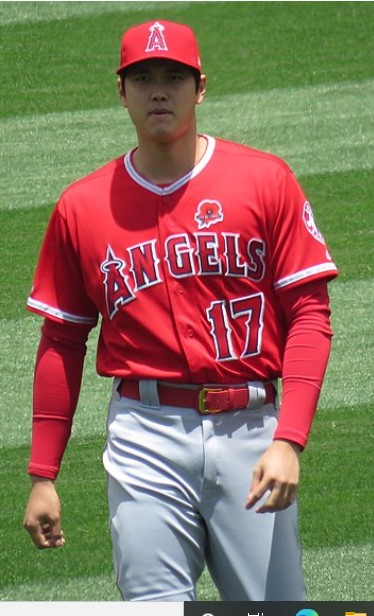
On April 26, the Angels Shohie Ohtani started on the mound for the Angels (against the Rangers) – and batted second in the lineup.  On that day he also happened to be the MLB 2021 co-leader in home runs with seven.  The last time a pitcher started a game while leading MLB in long balls?  Babe Ruth on June 13, 1921 (according to the Elias Sports Bureau).  Ohtani, by the way, went two-for-three, with three runs scored and two RBI – and got the pitching victory, giving up four runs in five innings (three hits, two walks and nine strikeouts). 

Three-for-Three

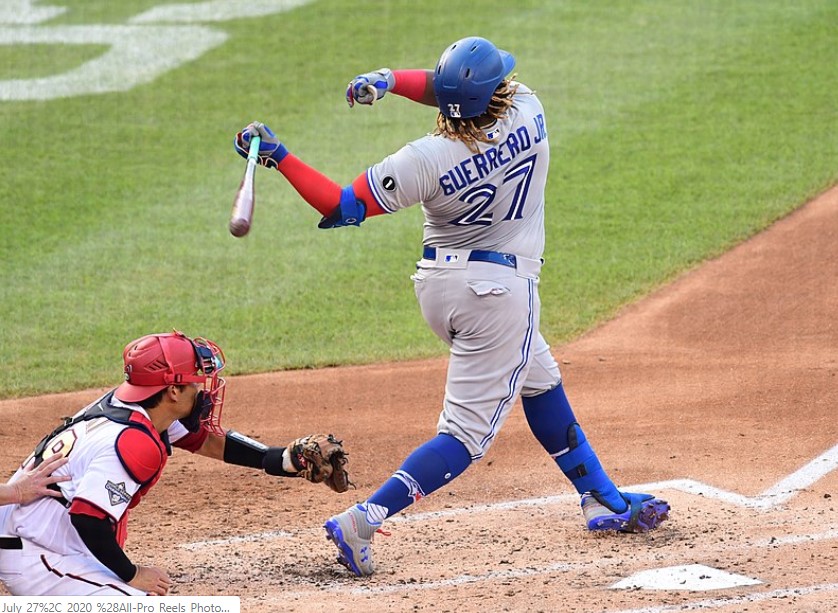
On April 27, Blue Jays ‘ 1B Vlad Guerrero, Jr. personally demolished the Washington Nationals – as the Blue Jays topped the Nats 9-5 in Toronto.  Guerrero enjoyed a three-homer, seven-RBI day – becoming the third player to have a three-homer day this April. Notably, the 22-year-old Guerrero did not “prey on the weak.”  After grounding into a double play to end the first inning, he hit a Grand Slam (on a 2-1 pitch) off Washington ace Max Scherzer in the bottom of the third; took Scherzer deep again (on a 3-2 pitch) leading off the fifth; and hit a two-run shot off Kyle Finnegan (on a 1-1 offering) in the seventh

The Three-Homer Tidbits

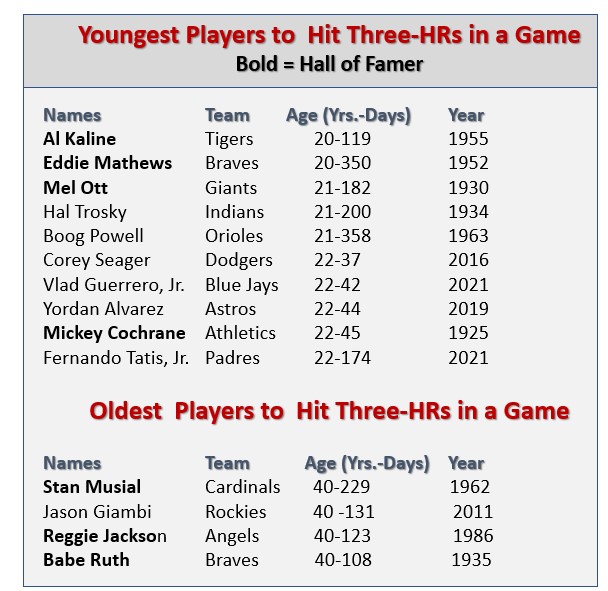
The youngest player ever to hit three homers in a game was the Tigers’ Al Kaline, who accomplished the feat on April 17, 1955 at the age of 20 years-119 days.  The oldest was Stan Musial (on July 8, 1962) at 41 years-229 days. 

Nice Round Numbers

On April 30,  as the Reds topped the Cubs 8-6 in Cincinnati, Reds’ 1B Joey Votto hit his fifth home run of the season and 300th of his career – a two-run shot in the bottom of the third inning  that gave the Reds their first lead.  Votto finished the game three-for-four, with one run scored and three RBI.  

Primary Resources:  MLB.com; Baseball-Reference.com; MLB.com; ESPN.com

Baseball Roundtable Disclaimer:  The MLB records referenced in this (and previous) posts have the potential to change as Major League Baseball recognizes and incorporates Negro League records from 1920-46 into the MLB record book.

100Baseball Roundtable is on the Feedspot list of the Top 100 Baseball Blogs.  To see the full list, click here.

I tweet baseball @DavidBBRT

Follow/Like Baseball Roundtable’s Facebook Page here.  More baseball commentary; blog post notifications; PRIZES.

Member: Society for American Baseball Research (SABR); The Baseball Reliquary; The Negro Leagues Baseball Museum.

A Hero for Zeroes … Backstop Curt Casali’s Shutout Streak

Baseball photoYesterday, the Giants started Curt Casali (signed as a free-agent this January) behind the plate for the seventh time this season – and the acquisition continued to pay off.   The Giants shut out the Marlins 3-0 (on two hits).  Notably, in Casali’s last five starts behind the plate (between April 11 and April 22), Giants’ pitchers have turned in five shutouts. According to the Elias Sports Bureau, that makes Casali just one of five catchers to backstop shutouts in at least five consecutive starts.  The other are:

  • Francisco Cervelli, Pirates (June 10-June 16, 2015)
  • Chris Hoiles, Orioles (September 26-October 1,1995)
  • Alan Ashby, Astros (September 23-October 1, 1986) Ashby’s streak included two games which he started, but did not finish.
  • Record-holder Ed Phelps, Pirates, who started six consecutive shutouts between June 2 and June 8, 1903. One of Phelps’ shutouts was a six-inning complete game.

Put Me In Coach …

Curt Casali has started seven games behind the plate for the Giants this season. In those contests, San Francisco is 6-1, with a 1.21 earned run average.  In games not started by Casali at catcher, the Giants are 6-6, with an ERA of 4.04. 

Casali’s five start shutout streak included:  a 4-0 win over the Rockies on April 11; a 3-0 win over the Reds on April 14; a 1-0 win over the Marlins on April 18; a 2-0 win over the Phillies on April 19; and a 3-0 win over the Marlins on April 22.  Mid-streak, Casali did catch the final 3 2/3 innings of a April 17 10-inning 7-6 loss to the Marlins.

A few other tidbits:

  • Casali is the first catcher to start five consecutive shutouts by a different starting pitchers (Anthony DeSclafini, Johnny Cueto, Alex Wood, Kevin Gausman, Aaron Sanchez.
  • A bit of how the game has changed. There were 19 pitching changes in Casali’s five consecutive shutouts started. In Ed Phelps ‘record six consecutive shutouts started, all were complete games and only four pitchers were used (Deacon Phillips and Sam Leever with two shutouts each, Kaiser Wilhelm, and Ed Doheny).

As of April 22, the 32-year-old Casali, who is in his eighth MLB season (Rays, Reds, Giants), has played 336 MLB games (a high of 84 in 2016 & 2019).

Primary Resource: Baseball-Reference.com.; Elias Sports Bureau

100Baseball Roundtable is on the Feedspot list of the Top 100 Baseball Blogs.  To see the full list, click here.

I tweet baseball @DavidBBRT

Follow/Like Baseball Roundtable’s Facebook Page here.  More baseball commentary; blog post notifications; PRIZES.

Member: Society for American Baseball Research (SABR); The Baseball Reliquary; The Negro Leagues Baseball Museum.
Burnes Brings the Heat … Corbin Burnes’ Remarkable 2021 Start(s)

BurnesIn his first four starts of 2021, the Brewers’ Corbin Burnes has fanned 40 batters in just 24 1/3 innings – on his way to a 2-1 record and a 0.37 earned run average.  In the process he set a record for the most strikeouts recorded (by a starter) from the opening of a season before issuing a walk.  (Yes, as I’ve said before, in baseball we count everything.) The previous record, according to Elias Sports Bureau was 35 whiffs before a walk (Adam Wainwright in 2013).

A few tidbits about Burnes remarkable start(s):

  • He has faced a total of 83 batters – fanning 48.2 percent.
  • Through his first four starts, he has thrown 67.7 percent of his pitches for strikes.
  • He has gone to a three-ball count on only ten batters – and fanned six of them (five looking). The other four produced plus two ground outs, a triple and a single.
  • While he hasn’t walked anyone, he has hit three batters.
  • The only run he has given up came in his first start (April 3), a home run to the Twins’ Byron Buxton. That lone run resulted in a loss, as his Brewers were shut out.
  • Coming into the 2021 season, Burnes had averaged 3.4 walks and 11.8 whiffs in three MLB campaigns (12-6, 4.48 in 146 2.3 innings pitched. 13 starts and 61 relief appearances.
  • As of this post, Burnes leads MLB in earned run average (0.37); WHIP (0.33); and his NL-leading forty strikeouts trail only the Indians’ Shane Bieber.

Burnes2


Primary Resource:  Baseball-Reference.com

Baseball Roundtable Disclaimer:  The MLB records referenced in this (and previous) posts have the potential to change as Major League Baseball recognizes and incorporates Negro League records from 1920-46 into the MLB record book.

Primary Resources: Baseball-Reference.com; Baseball-Almanac.com; MLB.com

100Baseball Roundtable is on the Feedspot list of the Top 100 Baseball Blogs.  To see the full list, click here.

I tweet baseball @DavidBBRT

Follow/Like Baseball Roundtable’s Facebook Page here.  More baseball commentary; blog post notifications; PRIZES.

Member: Society for American Baseball Research (SABR); The Baseball Reliquary; The Negro Leagues Baseball Museum.
 

MLB’s Least Likely Perfect Game – Nine Years Ago … and Other “Perfecto” Tidbits

Photo by Keith Allison

Photo by Keith Allison

On this date (April 21) in 2012, the White Sox’ Philip Humber threw what is arguably the most unlikely perfect game in MLB to date – as his White Sox topped the Mariners 4-0 in Seattle. In the game, Humber fanned nine and did not reach a three-ball count on any batter until the bottom of the ninth, when he recorded a pair of swinging strikeouts on 3-2 pitches.

Why does BBRT see this “perfecto” as so unlikely?  For one thing it was the only complete game in Humber’s eight-season MLB career. In addition, if you look at his overall numbers, his 15 career wins (versus 23 losses) are the fewest career victories of any of MLB’s 23 perfect game pitchers – and his 5.11 career earned run average is the highest among those hurlers. (See chart at the end of this post.) Further, in that 2012 season, Humber went 5-5 with a 6.44 ERA.

As long as we are on the topic of perfect games, here are a few additional tidbits.

  • No pitcher threw fewer pitches than the Indians’ Addie Joss, who needed just 74 pitches to complete nine perfect frames against the White Sox in a 1-0 win on October 2, 1908. Notably, Joss may not have had the best “stuff” from the mound that day. Ed Walsh, who started and tossed an eight-inning complete game for the White Sox gave up just one run on four hits – while fanning 15 batters to Joss’ three.
  • A little competition is apparently a solid motivator. Eight of MLB’s 23 perfect games have ended in a 1-0 score – the most common perfect-game outcome.
  • Eleven perfect games have seen the winning pitcher strike out ten or more batters – with Sandy Koufax (September 9, 1965) and Matt Cain (June 13, 2012) sharing the record at 14 whiffs.
  • The most pitches thrown in a perfect game is 125 – by the Giants’ Matt Cain in his 10-0 perfect-game win over the Astros on June 13, 2012. The high pitch count is mainly attributable top Cain’s 14 strikeouts (he only went to a three-ball count on four batters in the game).  The Giants’s ten tallies, by the way, are the most ever by a team in a game in which their starter was perfect.
  • John (Monte) Ward (perfect game on June 17, 1880) appeared as a pitcher in just seven of his 17 MLB seasons and in just 293 of his 1,827 MLB games. He also appeared at 2B, SS, 3B and OF.
  • Charlie Robertson holds the record for tossing a perfect game the earliest in his career. His April 30, 1922 perfect outing came in just his fourth career game and third career start.
  • Since 1900, the largest attendance record at a perfects game is 64,519 – for Don Larsen’s perfecto in the 1956 World Series. The smallest recorded crowd at a perfect outing is 8,375 for Mike Witt’s perfect game (for the Angels) on September 30, 1984.
  • The youngest pitcher to toss a perfect game is John Ward, who was just twenty when he fashioned a perfect game for the Providence Grays (a 5-0 win over the Buffalo Bisons) on June 17, 1880.
  • The oldest pitcher to complete a perfect outing was 40-year-old Randy Johnson (May 18, 2004).
  • Catfish Hunter had three hits and three RBI at the plate the day he retired 27 consecutive batters from the mound (May 8, 1968).
  • Len Barker (May 15, 1981) threw the first perfect game with a designated hitter in the lineup.
  • David Cone (Yankees verso Expos – July 18, 1999) threw the first perfect game in inter-league play.

perfectpo

Baseball Roundtable Disclaimer:  The MLB records referenced in this (and previous) posts have the potential to change as Major League Baseball recognizes and incorporates Negro League records from 1920-46 into the MLB record book.


Primary Resources: Baseball-Reference.com; Baseball-Almanac.com; MLB.com

100Baseball Roundtable is on the Feedspot list of the Top 100 Baseball Blogs.  To see the full list, click here.

I tweet baseball @DavidBBRT

Follow/Like Baseball Roundtable’s Facebook Page here.  More baseball commentary; blog post notifications; PRIZES.

Member: Society for American Baseball Research (SABR); The Baseball Reliquary; The Negro Leagues Baseball Museum.
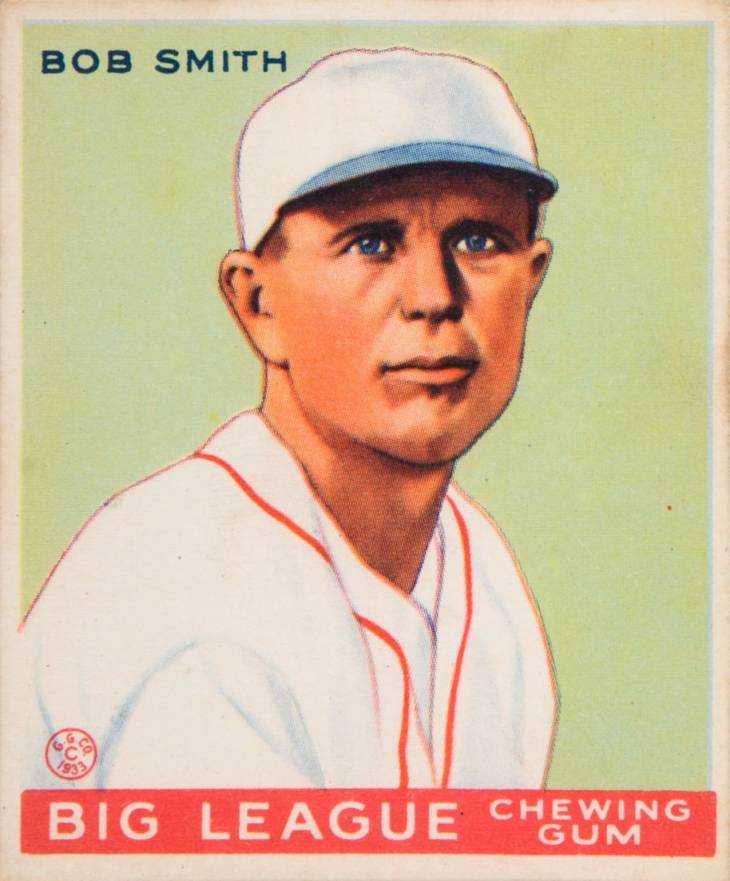
2021 Baseball Roundtable John Paciorek Award … Henry Schmidt

JPAFIn 2014, Baseball Roundtable launched the John Paciorek Award (JPA). The JPA recognizes players who have had short, sometimes very short, major-league careers, but whose accomplishments, nonetheless, deserve recognition.  Past winners have included a player whose every MLB hit (three in nine career at bats) was a home run;  a player who had only one MLB at bat, but earned  a World Series ring and a Purple Heart; a player who had just two home runs in 61 MLB at bats (for the vaunted Yankees and Dodgers), but whose “body of work” made him one of just two players in MLB history to homer in their first and final official appearances in a major league batter’s box; a war hero who pitched in the majors on one leg; and more.  (Note: Information on John Paciorek’s career – the inspiration for the JPA – can be found at the end of this post. Paciorek’s day in the sun constitutes arguably the best one-game MLB career ever.)

For 2021, BBRT’s Paciorek Award goes to the only pitcher ever to win twenty or more games in his only major-league season.

—-BASEBALL ROUNDTABLE 2021 JOHN PACIOREK AWARD HONOREE —-

HENRY SCHMIDT

SchmidtpnotoHenry Martin Schmidt didn’t make it to the big leagues until eight seasons after his professional (minor-league) debut.  In fact, he was just two months shy of his 30th birthday, when he first took the major-league mound.   Why did it take so long?  Simple answer – location.  He had considerable difficulty “locating” his pitches (more on that in a bit).  While it took a long time for Schmidt to make it to the major leagues, it didn’t take him long to leave MLB. He lasted just one season.  Why was his MLB career so short? Simple answer – location.  He did not care for the geographic “location” of major league baseball.

So why is Henry Schmidt joining the Baseball Roundtable list of John Paciorek Award honorees?  Because, like many of  those recognized before him, Schmidt’s brief MLB career had some long-ranging statistical significance.

Henry Schmidt is the only pitcher in MLB history

who was a 20-game winner in his only major league season.

In Schmidt’s only MLB season, for the 1903 Brooklyn Superbas (Dodgers), Schmidt went 22-13, 3.83.  That season, Schmidt was fifth in the National League in wins, sixth in innings pitched (301), fourth in starts (36), tenth in complete games (29) and second in shutouts (five). Remember what I noted earlier about location?  While minor-league stats for the era are sometimes a bit sketchy, by all accounts Schmidt had considerable difficulty with pitch location – walking more batters than he struck out in every minor-league season leading up to his signing with Brooklyn.  And, that didn’t change at the MLB level, In his sole MLB season, Schmidt walked 120 and fanned 96. For the season, Schmidt was second in the NL in walks (120), first in hit batsmen (21) and sixth in wild pitches (8). (Side note: Schmidt’s 3.83 eared run average was slightly above the National League overall mark of 3.26.)   Schmidt, however, earned considerable respect as a gritty performer, known for pitching into – and out of – trouble.

SchmidtStat

Let’s take a look at how Schmidt got to the majors, as well as how he fared after he chose to leave.

Schmidt began his professional career, as a 20-year-old, in the independent Blue Grass League.  He bounced around the minors (Southern Association, Atlantic League, Western League) showing potential – 20-13. 1.32 at Class B Richmond in 1897), but also consistently walking more batters than he struck out.   Even in that 20-win Class B season, Schmidt walked 133 and hit 36 batters, while striking out 108.

Then, in 1902 came the season that paved the way for Schmidt’s move to the majors – as well as for his quick exit from that lofty status.  In 1901, after a not particularly satisfying minor-league stints with Kansas City and Denver, Schmidt headed west to join Oakland in the long-season California League – where he showed late-season promise.  That move to the West Coast seemed to spark Schmidt’s career. He re-signed with Oakland for 1902 and went 35-20 (Oakland played a 182-game schedule, winning 108 and capturing the league title).  At season’s end, Schmidt was much in demand, ultimately signing with the National League’s Brooklyn Superbas (Dodgers).

Schmidt got off to a blazing start in his rookie (and final) major league season. In his first five starts, he went 4-1 and threw three consecutive complete-game shutouts.  Typical of Schmidt, even in those three shutouts, he gave a total of 18 hits and 11 walks, hit two batters and fanned just four. His only loss in his first five decisions came in his second start, when he faced off against the Giants’ Christy Mathewson. Schmidt and Mathewson both went the distance, with Matty emerging on the positive end of a 2-1 score (it was tied 1-1 after eight frames). Schmidt suffered a bit of a mid-season slide and was 13-13 by mid-August, but then won his last nine decisions to finish as 22-13.  Schmidt pitched ten complete games in those final ten starts (one ended in a tie), including two shutouts.  (On the season, he had nine starts in which he walked five or more batters. and 17 starts in which he walked two of fewer batsmen. )

So, why wasn’t Schmidt, Brooklyn’s winningest pitcher in 1903, back with the club in 1904.  It was Schmidt’s choice. Brooklyn did offer Schmidt a contract for 1904, but he returned it unsigned, with a note stating “I do no like living in the East and will not report.”  Schmidt then signed multi-year contract with the Oakland Oaks of the Pacific Coast League.

Back on the West Coast, Schmidt failed to recapture his past glory. He went 26-28 in 1904 and, as he pitching went south, so reportedly did his temper.  He began to build a reputation for fiery combativeness both on and off the fields. According to a Society of American Baseball Research article by Bill Lamb, Schmidt’s dust-ups included a battle in which he nearly bit off two of his opponent’s fingers, disputes with team executives, legal action and an altercation over an unpaid bar bill, as well as an off-the-field scrape that ended in gun play.  By 1909, Schmidt had slipped from the A-level Pacific Coast League to the D-Level Carolina Association (that’s where the shooting incident occurred).  In 1909, he pitched for the Hutchinson Salt Packers in the Class D Kansas State League – and that’s the last playing season noted for Schmidt in baseball-reference.com. Schmidt passed away (complications from chronic myocarditis) in 1926 at age 52.

Despite his issues with “location,” Henry Schmidt is firmly located in the MLB record book as the only pitcher whose only MLB campaign resulted in a twenty-win season.

Primary Resources:  Baseball-Reference.com; “Henry Schmidt,” by Bill Lamb, Society for American Baseball Research; “The Ballplayers,” edited by Mark Shatzkin, Arbor-House, William Morrow, 1990.

—- PAST JOHN PACIOREK AWARD HONOREES (with links) —-

2014 – Brian Scott Dallimore

In his first start (not his first game) for the 2004 Giants, Dallimore had two singles, a Grand Slam (his first MLB hit and only MLB home run), a walk and a hit by pitch.  For the full JPA take on Dallimore’s 27- game MLB career, click here.

2015 – Roy Gleason

Gleason played in just eight MLB games, had a double in his only MLB at bat – but also earned a World Series ring (1963) and a Purple Heart. Ultimately, he was the only ballplayer with MLB experience to serve on the front lines in Vietnam. For the full JPA take on Gleason, click here. Note: Gleason’s life is detailed in the book “Lost in the Sun – Roy Gleason’s Odyssey from the Outfield to the Battlefield.”

2016 – John Allen Miller

Miller played just 32 MLB games (during the 1966 and 1969), taking the field (at 1B/LF/3B/2B) for the Yankees and Dodgers. Miller collected ten hits in 61 MLB at bats (.164 average) and hit just two home runs – but he made those long balls count.  Miller made his MLB debut with the Yankees on September 11, 1966 and hit a two-run homer in his first big league at bat – making him (surprisingly) the first Yankee ever to homer in his first MLB at bat. (Little did Miller know he would not get another home run or RBI until the final at bat of his MLB career.)  Miller’s final at bat came as a Dodger (September 23, 1969) and he stroked a solo home run.  That narrow “body of work” made Miller one of just two players in MLB history to homer in their first and final official appearances in a major league batter’s box. For more on Miller, click here.

2017 – Chris Saenz

RHP Chris Saenz’ big day came on April 24, 2004 – when he was called up from Double A Huntsville (where he was 1-1, 3.86) to make a spot start against the Saint Louis Cardinals, whose powerful lineup included the likes of Albert Pujols, Scott Rolen, Jim Edmonds and Reggie Sanders.   The rookie went six innings, giving up just two hits, three walks and no runs, while fanning seven. There was some speculation (primarily among sportswriters and fans) that Saenz’ performance might earn him another start or two, but two days after his debut, he was on his way back to Huntsville.  Unfortunately, his minor league season included a September elbow injury that required Tommy John surgery and he never returned to the majors. Statistics before 1900 can be sketchy, but baseball-reference.com shows that Saenz is the only pitcher to complete a one-game MLB career of at least five innings pitched, without giving up a single run (earned or unearned). For more details on this JPA honoree, click here.

2018 – Keith McDonald

Keith McDonald’s MLB career (Cardinals 2000-2001) covered just eight games and 11 plate appearances (nine at bats) and three hits – but he made them count.  All of McDonald’s safeties were home runs – making him the only MLB player with more than one career hit who can look back on major league career in which his every hit was a home run.  McDonald is also one of only two players – and the only National Leaguer – to homer in his first two major league plate appearances.  For the full story, click here.

2019 – Harley Hisner

Harley Hisner’s MLB tenure encompassed the day of September 30, 1951. That’s when the 24-year-old righty faced the New York Yankees – and a lineup that included five future Hall of Famers: Mickey Mantle in RF; Joe DiMaggio in CF; Phil Rizzuto at SS; Johnny Mize at 1B; and Yogi Berra behind the plate. In is very first MLB inning, Hisner faced five batters, four of them future Hall of Famers, and gave up two singles and no runs.  His place in history? One of those singles was Joe DiMaggio’s last MLB safety. He faced Mickey Mantle four times in the game – walking him once, fanning him twice and getting him to hit into a double play.  Hisner’s final career stat was 0-1, 4.50, with six innings pitched, seven hits, three earned runs, four walks and three strikeouts. For more on Harley Hisner and his ongoing involvement in and love of the game (he went on to earn the Northeast Indiana Baseball Association Colin Lister Award for “dedication to the game of baseball and its historic legacy,” click here.

2020 – Bert Shepard

Bert Shepard set aside his baseball mound dreams in 1943 – after four minor-league seasons – to enlist in the U.S. Army, where he became a P-38 Lightning fighter pilot. Shepard was shot down on his 34th combat mission and, while a prisoner of war, his wounds resulted in the amputation of his right leg below the knee.  Upon his release (a prisoner exchange), Shepard did not surrender his dreams and fought his way back to the major leagues. He made one major-league appearance (for the Washington Senators), pitching 5 1/3 innings of three-hit, one-run ball.  While Shepard’s MLB career consisted of that sole appearance, he did continue to pitch, coach and manage in minor leagues – and his story proved an inspiration for disabled veterans.  For the full Bert Shepard story, click here.

—-INSPIRATION FOR THE JPA—–

PaciorekYOungJohn Paciorek – signed out of Saint Ladislaus High School in Hamtramck, Michigan (where he had starred in football, basketball and baseball) – appeared in his first major league game on the final day of the 1963 season (September 29) at the age of 18.  The 6’ 1”, 200-pound outfielder had spent the 1963 season with Class A Modesto Colts. The Colts’ parent club, the Houston Colt .45s (that was the current Astros’ franchise name back then), was suffering through a difficult season. The team was 65-96 going into that final game.  Looking to the future, Houston had, in fact, fielded an all-rookie lineup (average age 19) on September 27. Youth was still being served two days later when John Paciorek started his first MLB game. The results were surprising – and worthy of recognition.

pACIOREKPlaying right field and batting seventh in a 13-4 win over the NY Mets, Paciorek ended up with three hits and two walks in five plate appearances, with four runs scored and three runs batted in.  Perhaps equally surprising is that it was not only Paciorek’s first major-league appearance, it was to be his only MLB appearance.  Back pain the following spring, followed by surgery (he played 49 minor league games in 1964 and missed all of the 1965 season), put an end to his MLB playing days. (Paciorek did play in four more minor-league seasons.)  Still, you will find John Paciorek in the Baseball Encyclopedia and his is arguably the greatest one-game MLB career ever.  Among one-gamers, he holds the record for times on base and runs scored, and shares the record for batting average, on base percentage and RBIs.

BooksPaciorek, by the way, went on to become a high school teacher and multi-sport coach and is the author of the books (Plato and Socrates – “Baseball’s Wisest Fans;”  “The Principles of Baseball: And All There Is To Know About Hitting;” and “If I Knew Then What I Know Now.” You also can enjoy Paciorek’s prose (and expertise) directly at his blog “Paciorek’s Principles of Perfect Practice” by clicking here. You can find out even more about Paciorek in Steven Wagner’s 2015 book “Perfect: The Rise and Fall of John Paciorek, Baseball’s Greatest One-Game Wonder.”  (See the review of “Perfect” by clicking here.)

If I only Knew

A final note. John Paciorek’s insight into the national pastime should come as no surprise. Paciorek comes from a true “baseball family.”  He was the first born of eight siblings and was followed to the big leagues by younger brothers Jim and Tom Paciorek.  (Like John, Jim’s MLB career was short – 48 games for the Brewers in 1987. Brother Tom, however, achieved a .282 average over an 18-season MLB career.

100Baseball Roundtable is on the Feedspot list of the Top 100 Baseball Blogs.  To see the full list, click here.

I tweet (on X) baseball @DavidBaseballRT

Follow/Like Baseball Roundtable’s Facebook Page here.  More baseball commentary; blog post notifications.

Member: Society for American Baseball Research (SABR); The Baseball Reliquary; The Negro Leagues Baseball Museum.

Rodon Throws a No-Hitter… and Baseball Roundtable’s Mind Wanders

Baseball Roundtable Disclaimer:  The MLB records referenced in this (and previous) posts have the potential to change as Major League Baseball recognizes and incorporates Negro League records from 1920-46 into the MLB record book.

Carlos Rodon photo

Carlos Rodon – Photo by rchdj10

I began the day seeking inspiration for a topic for this post – and was immediately drawn to yesterday’s (April 14, 2021) no-hitter by White Sox’ southpaw Carlos Rodon.  As readers know, when I begin digging into a baseball topic, my mind can wander and “one thing often leads to another.”  Rodon’s no-no took me on  a journey of inspiration that did not lead in the direction I expected.

Here’s kind of how my though process went.

First, there was the fact that this was the second no-hitter this April.  Turns out that ties the record for April no-hitters, but it’s been done eight times. Maybe a topic if the record is broken over the next couple of weeks.

Photo by Keith Allison

Philip Humber – Photo by Keith Allison

Then, I latched on to the fact that the no-hitter came in what was just Carlos Rodon’s second MLB complete game.  Then again, in April of 2012 (April 9), the White Sox’ Philip Humber threw not  just a no-hitter, but a perfect game, in the first-and-only complete-game in his eight-season MLB career.   Time to keep looking.

Next , I noted that Rodon lost a perfect game – on a hit batsman with one out in the ninth and final inning. (Rodon completed the no-hitter for an 8-0 win.) Plunking an opposing hitter – a tough way to lose a perfecto, even if you save the no-hitter.  Well, the Nationals’ Max Scherzer (on June 20, 2015) had a perfect game with two outs and two strikes on the batter in the ninth, when he plunked Pirates’ pinch-hitter Jose Tabata on a 2-2 pitch (in a tough eight-pitch at bat). Like Rodon, he completed the no-hitter (for a 6-0 win). I’d already written about that one, so I kept looking.

Plunking the Pitcher – Ouch.

On July 4, 1980, The Giants’ George “Hooks” Wiltse (Guess what his signature pitch was?) had a perfect game going with two outs in the top of the ninth and two strikes (a 2-2 count) on the batter  – Phillies’ starting pitcher George McQuillan.  On that 2-2 pitch, Wiltse hit McQuillan – ending the perfecto.  (Umpire Cy Rigler later said he missed the call on a 1-2 pitch to McQuillan and should have rung him up).  Wiltse retired the next batter, but his day was not done – since the score was 0-0.  The Giants (and Wiltse) eventually won in ten frames and Wiltse recorded a ten-inning no-hitter. Nickname note:  Hooks Wiltse’s brother – Lewis “Snake” Wiltse – also pitched in the major leagues. 

At this point, my mind wondered to hit batsmen and to a game earlier in the week (April 13), when the Pirates topped the Padres in Pittsburgh by an 8-4 score. The game featured 20 hits, 17 walks, three wild pitches and seven hit batsmen.  Maybe there was inspiration there? Those seven hit batters sent Baseball Roundtable to the record books, where I learned that the record for hit batsmen (both teams) in a single game is nine (Washington Senators versus Pittsburgh Pirates on May 9, 1896) – and the post-1900 record is eight (Cubs versus Reds on July 27, 2020). In that game, the victims were:  Cubs – Anthony Rizzo (twice), Kris Bryant, Willson Contreras, and Albert Amora; Reds – Curt Casili, Jesse Winker and Freddy Galvis.  Still not quite the inspiration I needed. So, my mind (and research) wandered further.

I discovered that while 56 players have hit two home runs in an inning (five of them twice), only eight players have been hit by a pitch twice in one frame.  That was it! In this post,  I’d like to look at those who share that painful record – as well as a few other HBP tidbits.

—–Players Hit by A Pitch Twice in One Inning—–

Willard Schmidt, Reds … April 26, 1959

SchmidtIronically, the first MLB player to be hit by a pitch twice in one inning was a pitcher – and one who was on the mound for just two-thirds of an inning in that game and in the batter’s box in only one inning. Willard Schmidt replaced Reds’ starter Joe Nuxhall with two on, one out and the Braves ahead 3-0 in the top of the second.  (Nuxhall had just walked two batters in a row.) Schmidt got Braves’ C Del Crandall to hit into a double play to end the inning.

After Reds’ SS Roy McMillan led off the bottom of the third with a single off Lew Burdette, Schmidt was hit by a Burdette offering. Two pitchers and six runs later, Schmidt found himself facing reliever Bob Rush with two on and two out.  Rush hit Schmidt with a pitch, loading the bases and then retired 2B Johnny Temple to end the inning.  After Braves’ SS Johnny Logan singled to open the top of the fourth, Schmidt was replaced by Orlando Pena. Schmidt the way, was one of eight Reds’ pitchers used in the 11-10 Reds’ win.  (The Braves used six, including Warren Spahn, who took the loss in relief.)  Schmidt went 31-29, 3.93 in seven MLB seasons. As a batter he was .163-0-7 and was hit by a pitch just four times – three in 1959.

Frank Thomas, Mets … April 29, 1962

Frank Thomas (not the “Big Hurt” Thomas) suffered a hurtful afternoon as his Mets topped the Phillies 8-0 in New York.  Thomas was in LF batting cleanup. In the seven-run fourth inning, Thomas first faced Phillies’ starter Art Mahaffey with one on and no out. To this point, Mahaffey had been cruising, with the only damage one by Thomas.  In the first two frames, Mahaffey had given up just one hit and fanned four.  The only hit was a home run by Thomas. In his second plate appearance versus Mahaffey,  Thomas was hit by a pitch. By the time the lineup made a full turn, Mahaffey was gone, the Mets were up 8-0 and Frank Sullivan was on the mound for Philadelphia.  To make a long story short, Thomas was plunked again. Thomas ended the day one-for-two with two runs scored and one RBI. He ended the season .266-34-94, with eight HBP’s.  Over his career (16 MLB seasons), Thomas was .266-286-962, with 51 HBPs, leading the league with ten HBP in 1954. In his record-tying HBP game, no other batter was hit.

Andres Galarraga, Rockies … July 12, 1996

The Rockies topped the Padres 13-12 (in Colorado) in the game in which Andres Galarraga was plunked twice in one inning.  Galarraga was playing 1B and batting sixth.  He came up with one out and no one on in the bottom of the seventh,  with the Rockies trailing 9-2. Reliever Bryce Florie hit him with an 0-2 pitch, which would prove to be the start of an 11-run rally. By the time, Galarraga came to the plate again, there was still only one out, the Padres were on their third pitcher of the frame and nine runs had crossed the plate. This time, Galarraga was hit on a 0-0 pitch from Willie Blair. The Rockies would go on to send five more batters to the plate before the half inning ended. Galarraga finished the game one-for-two, with two runs scored and one RBI. He finished the season with a .304 average, a league-leading 47 home runs and a league-topping 150 RBI. He was hit by a pitch 17 times. For his 19-season MLB career, Galarraga was .288-399-1,424 – and was hit by a pitch 179 times (leading the league twice).  In his record-tying game, Rockies’ pitchers also notched two HBPs.

Brady Anderson, Orioles … May 23, 1999

Anderson’s punishing afternoon began as he led off the very first inning of an Orioles’ 15-6 victory over the Rangers (in Baltimore). The Orioles’ CF was plunked by Rangers’ started Mike Morgan to open the bottom of a ten-run first frame. Three singles, two doubles, a walk, a sacrifice fly and a fly out later (not necessarily in that order), Anderson faced Morgan for a second time and was plunked a second time, ending Morgan’s day. There was, by the way, no retaliation. Anderson was the only batter hit in the contest. Anderson ended the day one-for-three, with two runs scored and one RBI. He finished the season with a .263-13-66 stat line and was hit by a pitch ten times. In his 15-season MLB career, Anderson would be plunked 154 times, leading the league in that category three times.

Mike Hessman, Tigers …. September 8, 2008

Hessman was playing third and batting eighth in the Tigers’ 14-8 win over the A’s in Detroit. He led off the bottom of what would be a six-run second inning and was hit by a 1-2 pitch from A’s starter Gio Gonzalez. He came up later in the inning with Josh Outman on the mound and was plunked again, this time on an 0-2 pitch. There were four HBPs in the game – three by the A’s and one by the Tigers. Hessman was one-for-three in the contest, with a home run, two runs scored and one RBI. He finished the season hitting .296-5-7 in just 12 games. The two September 8 HBP that gave him a share of the record were his only plunkings of the season.  Hessman played 109 MLB games over five seasons – going .188-14-33, with a total of five HBPs.

Jose Guillen, Giants … September 23, 2010

Guillen started in RF, batting sixth, as the Giants defeated the Cubs 13-0 in Chicago.  It was pretty much total domination behind seven shutout innings from Madison Bumgarner (seven hits, one walk, nine strikeouts).  Overall, Giants’ pitchers fanned 12 and walked one, while Cub’s hurlers walked three, three fanned five and gave up four home runs (among the Giants 19 hits) to the Cubs’ seven safeties. Guillen was the only batter hit in the game. Guillen’s plunkings came in the nine-run second. He led off the inning by getting hit on a 1-1 pitch from starter Ryan Dempster, whose inning then went home run, strikeout, single, double, RBI single, strikeout, RBI single, run-scoring wild pitch, walk – and then the second plunking of Guillen (on the first pitch of this plate appearance). That ended Dempster’s day. Thomas Diamond (good baseball name) came on and immediately gave up a Grand Slam to SS Juan Uribe.  Guillen finished the game one-for-one with two runs scored. He finished the season (the last of his 14 MLB campaigns) at .258-19-77, with 14 HBPs.  For his career, Guillen was .270-214-887 and was hit 145 times, leading the league once.

David DeJesus, Cubs, … June 18, 2012

David DeJesus led ff and played CF when the Cubs topped the Dodgers 12-3 on June 12, 2012. He led off the Cubs’ six-run seventh inning by getting hit on a 2-1 pitch from reliever Will Ohman. When DeJesus’ turn at the plate came around again, the Cubs had scored six times and Hector Santiago was on the mound.  He hit DeJesus with a 2-2 offering. Those were the only two HBPs in the game.  For the contest, DeJesus was zero-for-three with a run scored.  He finished the season, .263-9-50, with nine HBP.  For his 13-season MLB career, DeJesus was .275-99-573, with 103 HBP, leading the AL with 23 in 2007.

Brandon Moss, A’s …  April 25, 2014

Moss was playing LF and batting in the five-hole as the A’s topped the Astros 12-5 in Houston – and he almost escaped that evening’s game unscathed.  His two-HBP inning started as he led off the top of the ninth (against reliever Josh Fields, who had just entered the game) with the game knotted at 5-5. In that first ninth-inning plate appearance, Fields hit Moss on a 1-2 pitch. By the time, Moss came up again in the inning, seven runs were in and Anthony Bass was on the mound.  Bass hit Moss on an 0-2 pitch.  (It’s surprising how many of the plunkings among these record sharers came with two strikes on the batter.) Moss finished the game two-for-four with one run scored. He finished the season at .234-25-81, with ten HBP’s.  In an 11-season MLB career, Moss hit .237, with 160 home runs, 473 RBI and 36 HBP. One other batter was hit in Moss’ record-tying game (Jason Castro of the Astros).

A few other HBP Tidbits:

  • The MLB career record for hit-by-pitch goes to Hughie Jennings (who played 17 seasons between 1891 and 1918 – and was plunked 287 times). He led the league in HBP five times and was hit an MLB-record 51 times in 1896.
  • The post-1900 record for HBP belongs to Craig Biggio – hit 285 times in a 20-season career (1988-2007). Like Jennings, he led his league in HBP five times.
  • No MLB player led the league in HBP in more seasons than Minnie Minoso, who topped the AL in plunkings ten times in a 17-season MLB career.
  • Ron Hunt holds the MLB record for consecutive seasons leading the league in HBP at seven (1968-74).
  • Ron Hunt was hit fifty times in 1971, the only player post-1900 to be hit more than 37 times in a season – and the only MLB player other than Hughie Jennings to be plunked 50 or more times in a campaign (Jennings – 51 in 1896).
  • Twenty-six players have been hit by a pitch three times in a game – three of those have suffered this punishment more than once.  A few notable names that have been plunked three times in a game include: Bill Freehan, Nomar Garciaparra, Nap Lajoie, Sherm Lollar,  Mel Ott, Manny Ramirez.  (For Minnesota readers, Corey Koskie and Craig Kuscik make this list.)HBP

Coming in the future, a look at HBP stats from the pitchers’ point of view.


Primary Resources:  Baseball-Almanac.com; Baseball-Reference.com; MLB.com

100Baseball Roundtable is on the Feedspot list of the Top 100 Baseball Blogs.  To see the full list, click here.

I tweet baseball @DavidBBRT

Follow/Like Baseball Roundtable’s Facebook Page here.  More baseball commentary; blog post notifications; PRIZES.

Member: Society for American Baseball Research (SABR); The Baseball Reliquary; The Negro Leagues Baseball Museum.
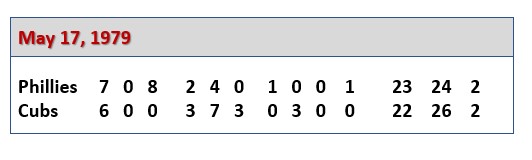
When Wally Moon Bested Hank Aaron and Ernie Banks

 On this date (April 13) in 1954, a 24-year-old outfielder named Wally Moon made his debut for the St.Louis Cardinals – playing CF and batting second against the Cubs on Opening Day in St. Louis. Moon got his MLB career off to a good start, hitting a solo home run (off Paul Minner) in his first MLB plate appearance. He book-ended a solid rookie campaign by also going yard in his final plate appearance of the season – a two-run shot off the Braves’ Ernie Johnson (a game-winner) in the top of the eleventh inning in Milwaukee. His did pretty well in between those two dingers, finishing his rookie season with a .304 average, 12 home runs, 76 RBI, 106 runs scored and 18 stolen bases.
 
So, how did Moon “best” Hank Aaron and Ernie Banks? In the NL Rookie of the Year balloting, Moon emerged the winner with 71 percent of the vote – followed by Ernie Banks (17 percent), Gene Conley (8 percent) and Hank Aaron (4 percent). 
Moonfinal
Later in his career, Moon would gain (positive) notoriety for his “Moon Shots”- home runs launched (for the Dodgers)  into the left field seats at the LA Coliseum (were the transplanted Dodgers played from 1958-61).  The Coliseum clearly was not an ideal location for baseball – with its 440-foot distance to right-center and 250-foot distance (with a 40-foot high screen) down the left field line. It was 300-feet down the right-field line, but the fence angled out quickly to 400-foot-plus distances. A left-handed hitter, Moon adjusted his swing to hit looping fly balls off of or over that left field screen – popularly termed “Moon Shots” by fans and media.
Moon enjoyed a 12-season MLB career (Cardinals – 1954-58/Dodgers – 1959-65).  He ended with a stat line of .289-142- 661, was a two-time All Star (1957 & 1950), won a Gold Glove in 1960 and, of course, was the NL Rookie of the Year in 1954. He led the National League in triples and on-base percentage once each; hit .295 or better in seven seasons (a high of .328 in 1961) and hit a career high 24 home runs in 1957.
Closing It Out in Minnesota
For BBRT’s Minnesota readers, Wally Moon’s final major-leaguer plate appearance came against the Twins’ Mudcat Grant   at Metropolitan Stadium on October 13, 1965 (Game Six of the 1965 World Series). Moon pinch hit and grounded out second-to-first.) That, of course, is the game in which Grant pitched a complete-game six-hitter (one run surrendered) and also knocked a three-run home run. (More #WhyIHateTheDH). 
Primary Resources:  Baseball-Reference.com; “Coliseum’s dimensions affected the play on the field,” Rob Neyer, ESPN, March 29, 2008.

100Baseball Roundtable is on the Feedspot list of the Top 100 Baseball Blogs.  To see the full list, click here.

I tweet baseball @DavidBBRT

Follow/Like Baseball Roundtable’s Facebook Page here.  More baseball commentary; blog post notifications; PRIZES.

Member: Society for American Baseball Research (SABR); The Baseball Reliquary; The Negro Leagues Baseball Museum.
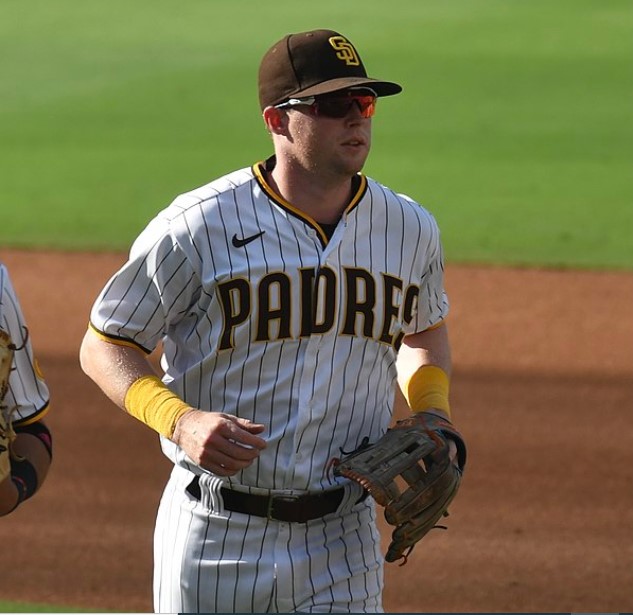
April Fool(ishness) … The Zany Start to Cleveland’s 1992 Home Season

A 24-Hour Turn Around … 20 hits for a Loss – No Hits for a Win

On this date (April 12) in 1992, the Cleveland failed to get a single hit against the Reed Sox in the opening game of a Sunday doubleheader (remember those?) – and yet came away with the win.  What makes this just a little zany is that the day before – the Indians’ 1992 home opener – the Indians collected 20 hits off the Red Sox’ pitching staff and lost.

Matt Young ... Eight no-hit innings for the loss.

Matt Young … Eight no-hit innings for the loss.

Here’s how it all went down.  Let’s start with the April 12 victory.  Matt Young started for the Red Sox, while Charles Nagy took the mound for the Indians. Young pitched an eight-inning complete game – holding the Indians without a hit and fanning seven.

Unfortunately, Young walked seven – which led to two earned runs and a 2-1 Red Sox loss. In fact, the very first batter Young faced scored.  Cleveland CF Kenny Loft0n led off the bottom of the first with a four-pitch walk (a portent of things to come). While DH Glenallen Hill was at the plate (ultimately striking out), Lofton stole second and third. He then scored as Carlos Baerga was safe at first on an error by Red Sox SS Luis Rivera.  In the third inning, the Indians pushed across a second run as Young walked Mark Lewis and Lofton (again) on a total of nine pitches.  The Lofton was forced at second on a Hill ground out – sending Lewis to third. Lewis then scored on a grounder to short by Baerga.  Lofton, by the way, was a thorn in Young’s  side all afternoon. He walked again in the fifth inning – and, just like in the first frame, stole second and third – giving him three walks and four steals in the game.

The Red Sox only run came in the top of the fourth inning on a single by CF Ellis Burks, a walk to 1B Mo Vaughn and an RBI single by  SS Luis Rivera.  Winning pitcher Nagy went seven innings, gave up eight hits and one run, while walking four and fanning ten. Brad Arnsberg and Derek Lilliquist each tossed an inning of scoreless relief.

So, the Indians collected no hits, but still got a win.  This just a day after the Indians’ home opener, when they collected 20 hits (to the Red Sox’ 14) and suffered a 7-5 loss.  That one went 19 innings with the Red Sox winning on a two-run home run by SS Tim Naehring (one of only three homers he would hit that year). A few side notes, in this game:  14 pitchers were used; Carlos Baerga had six hits, but no RBI an just one run scored; Mo Vaughn, Jody Reed and Naehring homered for Boston; there were a total of 16 walks and 29 strikeouts.

Okay, so the Cleveland hoe season starts with a game in which the Indians smack 20 hits and take a loss, followed by a game in which no Cleveland batter this safety and they get a win.  What more could happen?  Well, in game two of that April 12 doubleheader, Roger Clemens held the Indians to just two singles s in a 3-0 Boston win. That gave the Indians the  MLB record for the fewest hits ever in a doubleheader – yet they still got a split.  Side note:  The Red Sox had nine hits in this game and, as with the Indians, they were all singles.

For a look at the last single-admission double header I ever was privileged to attend, as well as stories on MLB’s 32-inning doubleheader, the only pitcher to throw complete-game shutouts in both ends of the same twin bill, the team that played nine consecutive doubleheaders and more … click here.

100Baseball Roundtable is on the Feedspot list of the Top 100 Baseball Blogs.  To see the full list, click here.

I tweet baseball @DavidBBRT

Follow/Like Baseball Roundtable’s Facebook Page here.  More baseball commentary; blog post notifications; PRIZES.

Member: Society for American Baseball Research (SABR); The Baseball Reliquary; The Negro Leagues Baseball Museum.
 

Baseball Roundtable – So Great to be Back in the Ballpark

BallparkAh, back in the ballpark.  I attended my first MLB game since the October 7, 2019 Twins/Yankees Playoff Game – a contest I had to leave in the second inning due to an Atrial Fibrillation incident that sent me to a five-hour Emergency Room visit.  But, that’s a story for another day.  Today it’s the joy of being back in the ballpark.

A few observations about the day and season and then, in honor of the return of fans to MLB parks, a look back at one of my earliest Baseball Roundtable posts – “Why I Love Baseball.”

So, how about a look at yesterday’s game?  First, given COVID attendance limits (with seasons ticket holders getting preference) and the timing of my second Pfizer vaccine, I was not able to get to Opening Day this season.  It’s long been my strategy to make sure I get to Opening Day and the final day of the season (and others along the way, of course) – a strategy designed to guarantee me the fewest possible days without baseball in the off season.  I did miss the Opening Day “hoopla” – team intros, fireworks, celebrity National Anthem performance, flyovers and the like.  However, thanks to a good friend and fellow fan (Connie), I was able to score good seats for yesterday’s second Twins home game of the season.

TixNow, we (I went with another good friend, Scott), arrived at the ballpark about an hour before game time.  My bad. I gauged my expected drive time and parking search by past experience (crowds of 35,000-40,000).  With COVID-era attendance of just under 10,000, getting to the park was a lot less time-consuming.  Getting through the gate with e-tickets on my phone was also a snap; just scan them and walk on in. It was convenient, but I have to admit, I miss the old stiff paper tickets – with their graphics and “memory value.”

Once in the park, I picked up the Twins free scorecard (Note: If you keep score and prefer to use you own scorebook, pick up a scorecard anyway.  It’s is a great way to have players’ names and numbers at your fingertips – and it’s FREE.)

Ballpark Hot dog photo

Nothing like a dog and a beer at the ballpark. Photo by permanently scatterbrained

On the way to my seat, I stopped for my first ball park sausage (a Polish), I like to get my snacking in before the game (and my score-keeping) starts.  Okay, it wasn’t a gourmet treat (and there are some of those at Target Field), but as Humphrey Bogart was once quoted “A hot dog at the ballpark beats roast beer at the Ritz.”  Side note:  1) Some sources quote Bogart as comparing “steak” at the Ritz to a dog at the game, but I found many more citing “roast beef.” 2) This quote may be expiring, you can get roast beef and/or steak at MLB parks these days. 3) I know I should have started the season with a hot dog, but when you name is Karpinski, you have to upgrade to a Polish.

It was a chilly day at Target Field although: 1) Mid- to high-40’s is not that chilly for Minnesotans. 2) The green grass, sound of the crowd and the game, smiling children (and adults) and live interactions were heartwarming enough to counteract the weather.

As for the game, my Twins lost 4-3 in ten innings.  I did, however, get to see a tight and exciting game; a two-run home run from the apparently ageless Nelson Cruz; my first 6-4-3 double play (the 6-4-3 and 4-6-3 twin killings are my favorite baseball plays); the speed of Byron Buxton turn what looked like a fairly routine ground out into an infield single, with an advance to second on a misguided, rushed throw to first; and three stolen bases.  On the other side of the coin, I also saw two of my least favorite current baseball rules come into play – the wave -‘em-to-first intentional walk and the opening of extra innings with a runner on second.

Rules

———————-Let’s Get This Party Started————————

Clearly, the baseball spirits are committed to making up for 2020’s short, strange and (for many fans) somewhat lost season.  Here were are just ten days into the new season and not only have we seen fans back in the ball park.  We’ve seen:

  • The season’ first no-hitter of the season (April 9 by the Padres’ Joe Musgrove) – which was also just one hit batsman away from a perfect game and the very first no-hitter in Padres’ history.
  • A rookie, Rule-Five Draft pick – Detroit ‘s Akil Baddoo – hit a home run on the very first MLB pitch he ever saw, smack his first Grand Slam and collect his first, walk-off game winning hit – all in his first three MLB games.
  • Another rookie, the White Sox Yermin Mercedes – collect eight hits (five singles, two doubles and a home runs) in his first eight at bats of the season. (He had one previous MLB at bat, a ground out, in 2020.) Just a few days later, in just his sixth game of the season and seventh MLB game, Mercedes thrilled fans with a 485-foot home run – the longest HR of the MLB season thus far.
  • Reds’ outfielder Tim Locastro stealing two bases in two tries – giving him 28 stolen bases in 28 career (2017-2012, 154 games) attempts; setting the record for the most consecutive stolen base attempts to start an MLB career.
  • Trey Mancini’s 427-foot home run (April 10) – not just his first long ball of the season, but his first since returning to the Orioles after a bout with Stage Three colon cancer.  (Mancini missed the 2020 season.)
  • The Angels’ pitcher/DH Shohei Ohtani starting on the mound on April 4 against the White Sox, throwing nine pitches of 100+ mph and fanning seven in 4 2/3 innings and popping a 451-foot home run ( his second dinger of the season) – to give himself a lead in the bottom of the first.

I could go on, but you get the idea.  Once again, baseball is giving fans the opportunity to see something special during every game.   So, Let’s enjoy.

And, with that, I’d like to open my season by revisiting  the ten reasons I love the national pastime.

———TEN REASONS I LOVE BASEBALL———

1.  Baseball comes along every spring – a new beginning – accompanied by sunshine and optimism.

Opening Day ... A Gift Waiting to be Opened!

Opening Day … A Gift Waiting to be Opened!

Baseball is the harbinger of better times.  It signifies the end of winter (not a small thing if you’re from Minnesota) and the coming of spring – a season of rebirth, new life and abundant optimism.   Each season, you start with a clean slate.   Last year’s successes can still be savored, but last year’s failures can be set aside (although rival fans may try to refresh your memory), replaced by hope and anticipation.   On Opening Day, in our hearts, we can all be in contention.

People ask me what I do in winter, when there’s no baseball. 

I’ll tell you what I do.  I stare out the window and wait for spring.

 Honus Wagner, Hall of Famer

 2.  The pace of the game invites contemplation.

Between innings, between batters or pitchers, and even between pitches, baseball leaves us time to contemplate what just occurred, speculate on what might happen next and even share those thoughts with nearby spectators.  Baseball is indeed a thinking person’s game.

3.  Baseball is timeless and, ultimately, fair in the offering of opportunity.

The clock doesn’t run out.  There is no coin flip to determine who gets the ball first in sudden death overtime.  No matter what the score, your team gets its 27 outs and an equal opportunity to secure victory.  What could be more fair?   And then there is the prospect of endless “extra” innings, bonus baseball for FREE.

When I was young my heroes didn't wear capes or cowboy hat. They wore stirrups and baseball caps. Many still do.

When I was young my heroes didn’t wear capes or cowboy hat. They wore stirrups and baseball caps. Many still do.

4.  Plays and players are distinct (in space and time).

Baseball, while a game of inches, is also a game of considerable space.   The players are not gathered along an offensive line or elbow-to-elbow under a basket. They are widely spaced, each with his own area of responsibility and each acting (as part of a continuing play) in their own time frame.  (The first baseman can’t catch the ball, for example, until after the shortstop throws it.)   This enable fans to follow, understand  and analyze each play (maybe not always accurately) in detail.   And, baseball’s distinct spacing and timing makes it possible to see the game even when you are not there.  A lot of people grinned at President Gerald Ford’s comment that he “watched a lot of baseball on the radio.”  In my view, he was spot on.  You can see baseball on the radio – you can create a “visual” of the game in your mind with minimal description.    That’s why on summer nights, in parks, backyards and garages across the country, you’ll find radios tuned to the national pastime.

 5. The scorecard.

Can there be anything more satisfying than keeping an accurate scorecard at the ball park?  It serves so many purposes.  The keeping of a scorecard ensures your attention to the happenings on the field.

Boxscore photo

Photo by mwlguide

Maintaining the score card also makes you, in a way understandable only to fellow fans, more a part of the game.   That magical combination of names, numbers and symbols also enables you to go back and check the progress of the game at any time.  “Oh, Johnson’s up next.  He’s walked and grounded out twice.”  It’s also a conversation starter, when the fan in the row behind you asks, “How many strikeouts does Ryan have today?”   And, it leaves you (if you choose to keep it) with a permanent record of the game, allowing you to replay it in your mind (or share it with others) at will.  Ultimately, a well-kept score card enhances the game experience and offers a true post-game sense of accomplishment.

6.  The long season.

Baseball, so many have pointed out, is a marathon rather than a sprint.  It’s a long season with ample opportunity to prove yourself and lots of chances to redeem yourself.  For fans, the long season also represents a test of your passion for the game.  Endurance is part of the nature of the true baseball fan.  And, and in the end, the rigors of a 162-game season prove your mettle and that of your team.   Not only that, but like a true friend … baseball is there for you every day.

 7.  Baseball invites, encourages, even demands , conversation.

Reason number two hinted at the importance of conversation, noting that the pace of the game offers time to contemplate the action (past and future) and share those thoughts with others.   I love that about the game, but I also love the fact that whenever baseball fans gather, their passion comes out in conversation – and they find plenty to talk about:

  •  Statistics,  statistics, statistics.  Baseball and its fans will count anything.  Did you know that Yankee Jim Bouton’s hat flew off 37 times in his 2-1, complete-game victory over the Cardinals in game three of the 1964 World Series?  More seriously, statistics are part of a common language and shared passion that bring baseball fans together in spirited conversation.  As best-selling author Pat Conroy observed “Baseball fans love numbers.  They love to swirl them around in their mouths like Bordeaux wine.”  I agree, to the fan, statistics are intoxicating.
  • Stories, stories, stories.  Baseball and its fans celebrate the game’s history.  And, I’m not talking just about statistics.  I’m talking about the stories that give this great game color, character and characters.  Ty Cobb sharpening his spikes on the dugout steps, Babe Ruth’s called shot, Louis Tiant’s wind-up, Willie Mays’ basket catch, Dock Ellis’s LSD-fueled no-hitter.
  • Trivia, trivia, trivia.  This may fall close to the “stories, stories , stories” category, but fans cherish the trivia that surrounds our national pastime – whether that trivia is iconic or ironic.  For example, it’s ironic that the iconic Babe Ruth holds the best winning percentage against the Yankees of any pitcher with 15 or more decision against them (17-5, .773). And, it’s ironic that the more recent player to steal home twice in one game (Vic Power, August 14, 1958) did it in a season when he only stole a total of three bases).  Then there is the iconic performance of Ralph Kiner, who led the NL in home runs as a rookie in 1948 – and successfully defended that title in each of the next six seasons – the most consecutive home runs titles by any major leaguer ever.

Basically, I took a long time to say I love the fact that baseball fans will talk with passion about something that happened in today’s game, yesterday’s game, over time or even in a game that took place on May 30, 1894 (Bobby Lowe of the Boston Beaneaters records MLB’s first four-homer game).  And, as a bonus, all this conversation – all the statistics, stories and trivia – make the games, moments within the games and the characters of the game (heroes, goats and mere participants) as timeless as baseball itself.

I am looking forward to the time when fans will be again be able  to again meet and trade baseball facts and opinions in close quarters. 

 8.  The box score. 

Today's box score - a thing of beauty.

Today’s box score – a thing of beauty.

BBRT editor’s  mother used to refer to an accordion as “an orchestra in a box.”  That’s how I view the daily box score – the symphony of a game recorded in a space one-column wide by four inches deep.   Some would say the box score reduces the game to statistics, I would say it elevates the game to history.  What do you want to know about the contest?   Who played where, when?  At bats, hits, stolen bases, strikeouts, errors, caught stealing, time, attendance, even the umpires’ names?   It’s all there and more – so much information, captured for baseball fans in a compact and orderly space.  I am, of course, dating myself here, but during baseball season, the morning newspaper, through its box scores, is a treasure trove of information for baseball fans.  (In today’s game, baseball-reference.com provides all that information and more.)

 9. The irony of a team game made up of individual performances.

While baseball and baseball fans live for individual statistics and, while the spacing of the players drives individual accountability, the game is, ironically, deeply dependent on the concept of “team.”

Consider the offense.  Unlike other sports , where you can deliver victory by giving the ball or puck – time and time again (particularly as the clock runs down) –  to your best runner, skater, receiver or shooter, in baseball, your line-up determines who will be “on the spot” and at the plate when the game is on the line.  It may be your .230-hitting second basemen, rather than your .320-hitting outfielder.  Yet, even as the team depends on the hitter, he is totally alone in his individual battle with the pitcher.  And, achieving individual statistics that signify exceptional performance also demands a sense of team.  You don’t score 100 runs without a team mate to drive you in (although the statistic remains your measure of performance) …  and, you don’t drive in 100 runs if no one gets on base in front of you.   And, can you think of any other sport that keeps track of – and honors – the team-oriented “sacrifice.”

On defense, the story is the same.  A ground ball pitcher, for example, needs a good infield behind him to optimize his statistical presence in the “win” column.  And the six-four-three double play requires masterful teamwork as well as individual performance –  duly recorded in the record books as an assist for the shortstop, a putout and an assist for the second baseman and a put out for the first baseman.  Then there is the outfield assist – a perfect throw from a right fielder to nail a runner at third earns an assist – even if the third baseman drops the ball and earns an error.  Two individual results (one good / one bad) highlighted, but without the necessary team work – a good play on both ends – a negative outcome in terms of the game.

Ultimately, baseball is a game of individual accomplishments that must be connected by the thread of “team” to produce a positive outcome.

10. Baseball’s assault on the senses.  (Indoor ballparks fall a bit short here).

The sight of a blue sky and bright sun above the ballpark or a full moon over a black sky above a well-lit stadium.  The feel of the warm sun or a crisp evening breeze.  The scent of freshly mowed grass or steaming hot dogs.  The taste of cold beer and peanuts.  The sound of the crack of the bat, the cheers (or moans) of the crowd, the musical pitch of the vendors.  Even the taste of today’s ballpark gourmet offerings.

Baseball assaults all the senses ―  in  a good way.  

Now, I could go on and on, there are lots more reasons to love this game: its combination of conformity (all infields are laid out the same) and individualism (outfield configurations not so much); its contributions to culture (literature and movies); its strategy (hit-and-run, run-and-hit, sacrifice bunts, infield / outfield positioning, pitching changes, etc.); triples; the 6-4-3 double play; knuckleballs; and more.  But to protect myself – and BBRT’s readers – I’ve limited myself to ten.   I probably could have saved a lot of time and words  had I just started with this so-perfect comment from sportscaster Bryant Gumbel, “The other sports are just sports.  Baseball is love.”  That says it all.


100Baseball Roundtable is on the Feedspot list of the Top 100 Baseball Blogs.  To see the full list, click here.

I tweet baseball @DavidBBRT

Follow/Like Baseball Roundtable’s Facebook Page here.  More baseball commentary; blog post notifications; PRIZES.

Member: Society for American Baseball Research (SABR); The Baseball Reliquary; The Negro Leagues Baseball Museum.