Ryan Zimmerman’s Tough Day at the Office … and Other Runners Left on Base Records

In this post, Baseball Roundtable will take a look at a handful of players who had a tough day at the old ballpark – each leaving at least a dozen runners on base during their plate appearances. Notably, only six players belong to this MLB “Club” – and three of them had their dismal days for the Red Sox (Dustin Pedroia, Trot Nixon, David Ortiz), while only two “accomplished” the feat in just nine innings (Glenn Beckert and Todd Helton).

Ryan Zimmerman – MLB Record for Runners Left On Base in a Game (any length).

Photo: All-Pro Reels from District of Columbia, USA, CC BY-SA 2.0 <https://creativecommons.org/licenses/by-sa/2.0>, via Wikimedia Commons

On May 8, 2016, Nationals’ Ryan Zimmerman was playing first base and batting cleanup as Washington took on the Cubs in Chicago. He  came into the game hitting  .242, with one home run and 11 RBI – and was about to have one of the most frustrating Sunday afternoons  at the plate ever.  He would go one-for-seven, with one RBI – as the Nationals fell to the Cubs 5-4 in 13 innings.  That doesn’t sound too bad on the surface, but in the process, Zimmerman:

  • Set the MLB individual player record for men left on base in a game – leaving 14 ducks on the pond;
  • Left eight runners in scoring position;
  • Made the final out with the bases loaded in three separate innings (twice in extra frames) – each time having his out preceded by an intentional walk.

Here’s how Zimmerman afternoon at Wrigley went:

First Inning – Strikeout (looking) on three pitches with runners on first and second.

Third Inning – RBI double past third base to give the Nationals a 1-0 lead. (Looking like an okay day so far).

Fourth Inning – Swinging strikeout on five pitches to end the inning with the bases loaded (after an intentional walk to Bryce Harper). The Nationals were up 2-0 at the time.

Sixth Inning – Fly out to RF, with runners on first and second, one out and Nationals up 3-1.

Eighth Inning – Ground out to 1B to end the inning, with a runner on first base.

Tenth Inning – Fly out to CF to end the inning, with bases loaded (after an intentional walk to Bryce Harper).

Twelfth Inning –  Ground out to 3B to end the inning, with the bases loaded (after an intentional walk to Bryce Harper.)

Zimmerman ended the 2016 season with a .218-16-46 stat line.  Still active, he is in his 16th MLB season.  As of June 24, 2021, he had a .279 career average, with 278 home runs and 1.035 RBI. He is a two-time All Star, whose best season came in 2017, when he went .303-36-108.

It’s a Red Sox Ting

Baseball Almanac lists just three American League Players as having left 12 or more runners on bases in a single game – and they were all members of the Boston Red Sox – Dustin Pedroia (13 LOB on September 15, 2017 – setting a new AL record); David Ortiz (12 on May 14, 2009 – tying the then American League and MLB record); Trot Nixon (12 on June 12, 2003 – at the time, setting an AL mark and tying the MLB record).

Dustin Pedroia – AL Record Holder for Runner LOB in a Game.

Photo: Eric Kilby on Flickr, CC BY-SA 2.0 <https://creativecommons.org/licenses/by-sa/2.0>, via Wikimedia Commonsnoto:

Baseball Almanac lists Red Sox’ 2B Dustin Pedroia holding the AL record for runners LOB in a game (13 in a fifteen-inning game on September 15, 2017).  I should note, however, that  I find the record somewhat less than deserved. (I’’ll explain in a bit.) Pedroia started at DH, batting second, in the game. He came into the game hitting .314, with seven home runs and 58 RBI. That day, as the Red Sox topped the Rays 13-6 in Tampa (15 innings), Pedroia went zero-for-nine, with one run scored.  Side note: The game was tied 5-5 at the end of nine, each team was scoreless in innings ten through thirteen, each team scored one run in the fourteenth and the Red Sox put it away with seven runs in the top of the fifteenth.

Here’s a look at Pedroia’s game:

First Inning – Ground out to pitcher with a runner on first (runner went to second).

Third Inning – Fly out to RF  to end the inning with a runner on first and the game knotted at 1-1.

Fifth Inning – Fly out to center to end the inning, with runners on first and third and Boston down 3-2.

Eighth Inning – Fly out to RF leading off the inning.

Ninth Inning – Strikeout with two outs, runners on first and second and the game tied at five apiece.

Eleventh Inning – Line out to SS, with one out and the bases loaded (after an intentional walk to Xander Bogaerts) and the scored tied 5-5.

Thirteenth Inning – Strikeout with one out and a runner on first (5-5 score).

Fifteenth Inning – Safe on an error with no outs and runners on first and second – with the runner on second scoring and the runner on first going to third. (This safe on error put the Red Sox up 7-6).

Side Note:  This is point at which I am not sure about the listing of Pedroia as the record holder with 13 runners left on base. MLB.com’s Glossary lists runners left on base as the number of runners that “remain on base after that batter makes an out at the plate, as the batter has failed to do his job to score those runners – or at least put himself in a position to score.” To reach 13 runners LOB, you have to count the runner on first who went to third (but did not score on the fifteenth-inning error).  Still a run did score and – contrary to the MLB.com description – Pedroia did not “make an out at the plate.”  I think I may have to send this one to Twins’ official scorer and SABR member Stew Thornley.

Fifteenth Inning – Pedroia got a second  plate appearance in the fifteenth (by this time the Red Sox were up 13-6). He grounded out to SS to end the inning, with runners on runners on first and second.

Pedroia ended the 2017 season with a .293-7-62 stat line in 105 games. His career line (14 MLB seasons) was .299-140-725. He was a four-time All Star, four-time Gold Glover, the 2007 AL Rookie of the Year and the 2008 AL Most Valuable Player.

__________________________________________________

Now, let’s take a look at the two player who share the record of 12 runners LOB in a nine-inning game.

Glenn Beckert, Cubs – Shares the Record for Runners LOB in a Nine-Inning Game

On September 16, 1972 – as the Cubs pounded the Mets 18-5 in Chicago – Cubs’  hitters had ample opportunity to leave men on base.  And, Glenn Beckert took advantage  of those opportunties, going zero-for-six and leaving 12 runners on base. Beckert, an all Star that season, came into the game hitting .258, with three home runs and 31 RBI.   Here’s how his day went:

First InningEnded the inning with a fly out to CF, with the bases loaded and the Cubs up 1-0.

Third Inning – Popped out to the catcher, with runners on second and third, no outs and the Cubs up 4-1.

Third Inning – Beckert came up for a second time in the inning, this time with runners on second and third, two out and the Cubs up 11-1. He flied out to RF to end the inning.

Fifth Inning – Fly out to CF, with one out a runner on first and the Cubs up 13-2.

Seventh Inning – Foul out to 3B, with one out, a runner on third and the Cubs up 13-5.

Seventh Inning – For the second time in the game, Beckert batted twice in an inning. In this plate appearance, he grounded out to end the inning, with the bases loaded and the Cubs up 18-5.

Not much suspense here and the at bats clearly were not critical.  Still, it got Beckert into the record books – albeit not in a way he would have preferred.  Beckert ended the 1972 season at .283-3-43 in 120 games.  Over his 11-season MLB career, he was .283-22=360. Beckert was a four-time All Star and one-time Gold Glover.

Todd Helton – Shares the Record for Runners Left on Base in a Nine-Inning Game.

Unlike Beckert’s 12-LOB game (in which the Cubs didn’t need Beckert’s offense), the Rockies could have used some help from Helton in this one.  It came on April 11, 1998 and Helton’s Rockies lost to the Reds 12-5 Denver.  Helton, on his way to a .315-25-97 season, came into this early season contest with a .306-0-4 stat line.  He was playing 1B and batting third.  Helton ended the day zero-for five with one RBI.  It went like this;

First Inning – Strikeout with one out, runners on second and third and the Rockies already down 5-0.

Second Inning – The Rockies had scored in the inning on a leadoff  home run by Greg Colbrunn and Helton came up with the bases loaded, two outs and Colorado trailing 9-2. Helton lined out to third end the inning.

Fourth Inning – with the Rockies trailing 11-2, Helton drove in a run with a one-out sacrifice fly. Despite the run scoring (from third) a runner on first (of course) did not score – giving Helton one LOB in this plate appearance.

Sixth Inning – Ground out to SS (Fielder’s Choice) with one and runners on first and second. The Rox were down 12-4.

Seventh Inning – With the Rockies down 12-5, Helton flied out to center with the bases full to end the inning

Ninth Inning – Fouled out with a runner of first to end the game.

BBRT Extra … Yanks Strand 20 in Nine Innings

On September 21, 1956, a powerful Yankees squad (Mickey Mantle, Yogi Berra, Bill Skowron, Elston Howard and more) lost to the Red Sox 13-7 in Boston – but it was  not for the lack of scoring “opportunities.”  In the game, the Yankee stranded 20 – still the MLB record for a nine-inning game. Here;s how it went:

  • The Bombers scored three in the top of the first, but left the bases loaded when pitcher Bob Turley grounded out to end the frame);
  • They added one in the second, but left two on as Elston Howard flied out to 2B;
  • Stranded two more in the third (Enos Slaughter ground out to 1B);
  • Scored one in the fourth, but left the bases full (Irv Noren fly out to LF);
  • Left just one on base in the fifth (Yogi Berra ground out to 1B); 
  • Left the bases full again in the sixth (Jerry Lumpe made the final out);
  • Scored two in the seventh, but left two more on base (Jerry Coleman fly out to CF);
  • Left two on the eighth (Norm Siebern strikeout); and
  • Left two more on in the ninth (George Wilson fly out to LF).

Overall, the Yankees outhit the Red Sox 15-14; out-homered them 1-0); and made just one error to the Red Sox’ five – and still lost by six tallies.

Now a look at the other two AL players to leave at least 12 runners on base in a fame. Like AL record holder (at 13) Dustin Pedroia, they both “accomplished” the feat for the Red Sox.

Trot Nixon – an Even Dozen Left on Base – The Record for an Inter-league Game

On June 12, 2003, Trot Nixon started in RF for the Red Sox (batting sixth) as they lost to the Cardinals 8-7 at Fenway. Nixon came into the game hitting .305, with eight homers and 36 RBI in 55 games. He went a respectable 2-7 (both singles) with one RBI – but had many more opportunities to contribute offensively in this one-run loss.

First Inning – Nixon ended the inning with a four-pitch strikeout and the bases loaded. (Game tied 0-0 at this point).

Fourth Inning – Pop out to the catcher, with one out and a runner on first.

Fifth Inning – Nixon ended the inning with a foul pop to 1B, with runners on second and third and the Sox trailing 2-0.

Eighth Inning – Single to LF.

Ninth Inning – Foul pop out to 1B, with one out and the bases loaded (after two intentional walks to set up the double play).  The Sox had scored three in the frame to tie the game at 3-3, the third run scoring on a  Nomar Garciaparra one-out  triple. Manny Ramirez and Bill Millar were then intentionally walked to bring up Nixon, whose pop up was followed by a Bill Mueller fly out to send the game into extra innings.

Tenth Inning – Nixon ended the inning with a ground out to second,with the bases loaded and the game tied at 5-5.  This Nixon out again followed a pair of intentional walks to load the bases.

Thirteenth Inning – RBI single (no outs) to bring the score to 8-6 (the Cards scored three in the top of the inning.)

Nixon ended the season at .306-28=87 and was .274-137-555 in 12 MLB seasons.

________________________________________________

David Ortiz – Another  Dozen Red Sox Left on Base … At Least It wasn’t at Home

On May 14, 2009, David Ortiz started at DH for the Red Sox, batting third, as they faced the Angels in California. Big Papi came into the game hitting just .220, with no home runs and 15 RBI.  He didn’t break his early-season slump. On the day, he:

  • Went zero-for seven;
  • Struck out three times;
  • Made the final out of an inning in five of his seven at bats – all with at least one runner in scoring position, twice with the bases loaded.

Ortiz ended the season at .238-28-99 – a notable off year for Ortiz, who hit .286-541-1,768 in a 20 season MLB career. Ortiz was a ten-time All Star, hit 30+ home runs in ten seasons and drove in 100+ runs ten times.

Here’s how his “May Day” went:

First Inning – Strikeout looking on four pitches with one out and a runner on first.

Fourth InningEnded the inning on five-pitch strikeouts (looking) with the bases loaded and Boston training 3-2.

Sixth InningEnded the inning, striking out looking on four pitches, with a runner on second and the game tied 3-3.

Eighth InningEnded the inning with a fly out to deep LF, with runners on first and third and Boston trailing 4-3.

Tenth InningEnded the inning on a ground out to 1B, with a runner on second and the game tied 4-4.

Twelfth InningEnded the inning on a ground out in front of the plate (catcher to first bases), with the bases loaded and the game still tied 4-4. The Angels picked up a walk-off win in the bottom of the inning.

BBRT Extra – Old Guys Rule

In 2016, his final season (age 40), David Ortiz hit .315-38-127 in 151 games – leading the AL in RBI and doubles (48).

Primary Resources: Baseball-Reference.,com; Baseball-Almanac.com.


Baseball Roundtable Disclaimer:  The MLB records referenced in this (and previous) posts have the potential to change as Major League Baseball recognizes and incorporates Negro League records from 1920-46 into the MLB record book.

_____________________________________________

100Baseball Roundtable is on the Feedspot list of the Top 100 Baseball Blogs.  To see the full list, click here.

I tweet baseball @DavidBaseballRT

Follow/Like Baseball Roundtable’s Facebook Page here.  More baseball commentary; blog post notifications; PRIZES.

Member: Society for American Baseball Research (SABR); The Baseball Reliquary; The Negro Leagues Baseball Museum.



Remember that Time in 2002 When There was No DH?

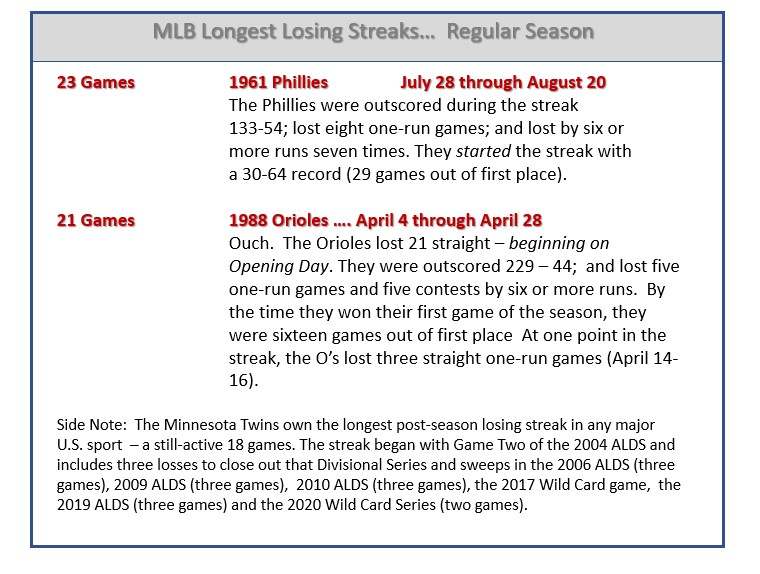
The 2021 season has been one of streaks.  The Arizona Diamondbacks and Baltimore Orioles have endured, respectively,  a  (recently-ended) 17-game losing streak and a 14-game string of losses.   On the other side of the coin, the Oakland A’s have enjoyed a 13-game winning streak and the Rays have put up an 11-game win string,

Side note:  For those who are interested in such things, the D-backs’  recent losing streak lasted from June 2 through June 20. Over that time, they were outscored 119-64; outhit .297 to .215; and out-homered 29 to 10.  The D-backs staff pitched to a 6.88 ERA, compared to the opponents’’ 3.39 and fanned 125 batters, compared to the opponents’ 152.  The D-backs have also suffered a 13-game losing streak this season and, between May 16 and June 20, lost 31 of 33 games. 

In this post, I’d like to reflect on a 10-day streak from June of 2002.  That streak., the product of inopportune scheduling, ran from June 14 to June 23.  It was a streak during which 134 major-leagues gamers were played – without a single contest taking place in an American League Park.  There were 125 inter-league games and nine all-NL matchups. The NL-had the edge over that ten-day span – winning 67 inter-league matchups to the AL’s 58.

What makes this streak unique (at least in a recent history sense) is that for ten days, not a single designated hitter stepped up to the plate. That got me to thinking about how the pitchers from the two leagues matched up – not on the mound, but at the plate.  AL pitchers, it turned out, made it to the plate more often than their NL counterparts (2.4 plate appearances per game to 2.0).  The stats are in the chart below, but perhaps most striking is that  the NL pitchers (who obviously get to the plate more often over a season) proved  clearly more adept at putting the ball in play. AL pitchers struck out in 39 percent of their plate appearances, while NL hurlers fanned 30.1 percent of the time.

There were a few games in that streak in which a pitcher’s performance at the plate caught my eye.

Woody Williams’ day inlcuded a GR 2B; SH; SF; and HBP.

June 16Woody Williams of the Cardinals checked a lot of scorekeeper’s boxes as St. Louis topped the Royals 5-1.  Williams had a ground-rule double in the third (and later scored); laid down a successful sacrifice bunt in the fifth; drove in a run with a sacrifice fly in the sixth; and was hit by a pitch in the eighth – a pretty productive day at the plate for a pitcher. He also pitched a complete-game five-hitter (one run, one, one walk, six whiffs).  Williams had a decent season at the plate in 2002 – hitting .207 with one home run and three RBI (29 at bats). He had three doubles, but only one  HBP and Sacrifice Fly. He was 9-4, 2.53 on the mound. In his 15-season MLB career he was 132-116, 4.19 on the bump and .194-4-43 at the plate.

June 18Jeff Weaver of the Tigers had the worst offensive game for a pitcher during the streak – going zero-for-four with four strikeouts. He made up for it on the mound, however, tossing a complete-game shutout (five hits, two walks, seven strikeouts) as the Tigers topped the Braves 6-0. Weaver came to the plate in only one other game that season – and went two-for-three with an RBI. He finished the season 11-11, 3.52 with an AL-leading three shutouts. In 11 MLB seasons, he went 104-119. 4/71 and hit .207-0-13,

Mike Hampton did more at the plate than on the mound for the Rockies/.

June 20 … In the Rockies’ 14-11 win over the Yankees, the Rox used pitcher Mike Hampton as a pinch hitter for pitcher Dennis Reyes. Hampton singled to open the eighth inning (the Rockies were up 10-9), moved to second on a bunt that turned into a single, advanced to third on a sacrifice bunt and scored on a sacrifice fly. Hampton’s use as a pinch hitter was not really a surprise – he was a good hitting pitcher (.246 average with 16 home runs and 79 RBI in 725 career at bats). In 2002, in  fact, Hampton was a better hitter than pitcher. He was 7-15, 6.15 on the mound and .344-3-5 at the plate. For his 16-season MLB career, Hampton was 148-115, 4.06 on the mound. (In 1999, he went 22-4, 2.90 for the Astros – leading the league in wins, winning percentage and finishing second in the Cy Young balloting. He also hit .373 that season.

Mike Hampton won five Silver Slugger Awards as the National League’s best-hitting pitcher.  (The Silver Slugger Awards were established in 1980.) Hampton earned his handful of Silver Slugger recognitions in five consecutive seasons – from 1999 through 2003.  Notably, he won them with four different teams: Astros (1999); Mets (2000); Rockies (2001 & 2002); and Braves (2003).

In 2003, Hampton was a leather and lumber guy, becoming the first pitcher to win both a Silver Slugger and a Gold Glove in the same season.  (Zack Greinke matched that feat in 2019.) 

In 2001, Hampton homered in three consecutive at bats – his final two trips to the plate in a June 5 start, and his first plate appearance in his next outing (June 10.) That season he hit .291, with seven home runs and 16 RBI in 79 at bats. 

Hampton was two-time All Star during his 16-season MLB career. He retired with a 148-115, 4.06 record on the mound and a .246-16-79 batting line (423 games).  He hit over .300 in four seasons.  While he didn’t hit a homer in his first eight MLB seasons, he went deep 16 times in his final eight campaigns.

Primary Resource: Baseball-Reference.com


Baseball Roundtable Disclaimer:  The MLB records referenced in this (and previous) posts have the potential to change as Major League Baseball recognizes and incorporates Negro League records from 1920-46 into the MLB record book.

_____________________________________________

100Baseball Roundtable is on the Feedspot list of the Top 100 Baseball Blogs.  To see the full list, click here.

I tweet baseball @DavidBaseballRT

Follow/Like Baseball Roundtable’s Facebook Page here.  More baseball commentary; blog post notifications; PRIZES.

Member: Society for American Baseball Research (SABR); The Baseball Reliquary; The Negro Leagues Baseball Museum.


Six Hits Off Five Different Pitchers … or How About Six-for-Six Off Six

On this date (June 10) in 1953, one of the most colorful players of my youth (Red Sox outfielder Jimmy Piersall) had a six-hit game as Boston topped the Browns 11-2 in Saint Louis.

Piersall, notably, collected his six safeties against five different pitchers: a single off Max Lanier in the first inning; an RBI single off Lanier in the third; a single off Dick Littlefield in the fourth; a double off Bobo Holloman in the sixth; an RBI single off Marlin Stuart in the seventh; and a single off Bob Cain in the ninth. Piersall came into the came hitting .252 and left hitting .274. It was the first game of a doubleheader, but Piersall didn’t fare was well in Game Two – going zero-for-five in a 3-2 Boston win.  Piersall played 17 MLB seasons, going .272-104-591., with 115 stolen bases. He was a two-time All Star and two-time Gold Glover.

Anyway, the anniversary of Piersall’s six-hit, nine-inning game – still the Red Sox franchise record – sent me to thinking about six-hit performances (particularly those that occurred in nine-inning contests). Turns out, they’re not as rare as one might think. MLB has seen 120 instances of players collecting at least six hits in a nine-inning contest (National League, American League, American Association, Players League). Rarer is the seven-hit (nine-inning) game. There have been just two  of those:

  • Wilbert Robinson, Baltimore Orioles (NL) – June 10, 1892.
  • Rennie Stennett, Pirates – September 16, 1975.

So, how about games in which a player got at least six hits, while victimizing at least five different pitchers (as Piersall did)?  Ah, just 12 of those.  And even rarer – six hits against six different pitchers in a nine-inning game – just two.  (Box scores are a little sketchy prior to 1920, but I am pretty confident in this.)Notably, they both qualified as rookies in the year of their six-hit/six-pitcher performances.

—-Six Hits in a Nine-Inning Game Against Six Different Pitchers—-

Bob Oliver, Royals, May 4, 1969

The Royals’ CF went six-for-six in a 15-1 Kansas City Road win over the Angels. The Halos used six pitchers and Oliver got to them all: a single off Clyde Wright in the second inning; a double off Eddie Fisher in the fourth; a two-run home run off Pedro Borbon in the fifth; a single off Phil Ortega and a single off George Brunet in the seventh; a single off Tom Murphy in the ninth. For the day, Oliver was 6-for-6 with two runs scored and three RBI. Oliver, by the way, was a .256 hitter over eight MLB seasons and hit just .254 as a rookie in 1969.

Jesus Alou, Giants, July 10, 1964

Alou’s six-hit game came in a 10-3 Giants’ win over the Cubs in Chicago. Surprisingly, he had just one run and one RBI – but like Bob Oliver (above), Alou collected safeties against all six pitchers who took the mound for the Cubs: single off Dick Ellsworth in the first; single off Lew Burdette in the third; single off Don Elston in the fourth; home run off Dick Scott in the sixth; single off Wayne Schurr in the seventh;  single off Lindy McDaniel in the ninth. Alou was a .280 hitter over 15 MLB seasons. In 1964, he hit .274-3-28 in 115 games.  He came into his six-hit game hitting .264, left hitting .280. In his next game he went one-for-four.


A few other six-hit game tidbits:

  • Just five players have multiple six-hit (nine-inning) games (two each); Jim Bottomley (1924 & 1931 – NL); Ed Delahanty (1890 – PL & 1892 – NL); Doc Cramer (1932 & 1935, AL); Henry Larkin (1885 – AA & 1892 – NL ; Cal McVey (1876 – NL).
  • Cal McVey is the only player with two, six-hit (nine-inning) games in the same season (just three days apart) – for the National League Chicago White Stockings (July 22 & July 25, 1876). On July 22, the White Stockings topped the St. Louis Grays 30-7 and on July 25, they beat the Cincinnati Red Stockings (23-3).
  • In his May 23, 2002 six-hit (nine-inning) game for the Dodgers, Shawn Green tied the record for most home runs in a game (four) and set the record for most total bases in a game (19). Green had four home runs, a double and a single in six at bats, scoring six runs and driving in seven as the Dodgers beat the Brewers 16-23 in Milwaukee/
  • The following players hit for the cycle in their six-hi, nine-innings games: John Reilly (1883 – AA); Dave Orr (1885 – AA ); Larry Twitchell (1889 – NL ); Farmer Weaver (1890 – AA); Sam Thompson (1894 – NL); Ian Kinsler (2009 – AL).

Primary Resources:  Baseball-Reference.com; Baseball Almanac.com; MLB.com

Baseball Roundtable Disclaimer:  The MLB records referenced in this (and previous) posts have the potential to change as Major League Baseball recognizes and incorporates Negro League records from 1920-46 into the MLB record book.

_____________________________________________

100Baseball Roundtable is on the Feedspot list of the Top 100 Baseball Blogs.  To see the full list, click here.

I tweet baseball @DavidBaseballRT

Follow/Like Baseball Roundtable’s Facebook Page here.  More baseball commentary; blog post notifications; PRIZES.

Member: Society for American Baseball Research (SABR); The Baseball Reliquary; The Negro Leagues Baseball Museum.
 

Baseball Roundtable May Wrap Up … No-Hitters, Triple Plays, Streaks and “Brain Freeze”

It’s June 1 and that means it’s time for Baseball Roundtable’s traditional previous month wrap up – statistics, standings and stories that caught BBRT’s eye over the previous month, as well as the BBRT Players and Pitches of the Month and the BBRT Trot index.  Here’s the kind of thing you’ll read about – if you last to the end of the post. 

  • One player (Nick Castellanos, Reds) hit over .400 for the month;
  • Four teams with earned run averaged under 3.00 for the month and ten starting pitcher with ERA’s under 2.00 for may.
  • An 11-game winning streak and a 14-game losing streak.
  • The third, fourth, five and sixth no-hitters of the young season.
  • The fourth and fifth three-homer games of the season.
  • A player end the month leading his league in home runs and stolen bases.

Changing of the Guard… and It’s Good to be a Junior

At the close of play May 31, four players were tied for the major league-lead in home runs with 16: Ronald Acuna, Jr., Braves (age 23); Adolis Garcia, Rangers (age 28, only 24 MLB games before this season); Vlad Guerrero, Jr., Blue Jays (age 22); Fernando Tatis, Jr., Padres (age 22).

  • The second triple play of the season;
  • A player strike out in his first eight MLB at bats (a record) and then collect his first hit, first extra-base hit, first RBI and first run scored – all in the same inning;
  • A on-the-field “Brain Freeze;”
  • The scoring of MLB’s 2,000,000th run.
  • An AL pitcher get is first MLB plate appearances – and go three-for-three; and
  • More

You can read more about these events (and more May stories) in the Highlights Section. First, Baseball Roundtable’s Players and Pitchers of the Month.

——Baseball Roundtable Players and Pitchers of the Month——

National League

Player of the Month … Nick Castellanos  3B/OF, Reds

Castellanos led MLB in May batting average (among players with at least 75 May at bats) at a lofty .409. His 38 hits were third (second in the NL). He also had five home runs, 15 RBI and 18 runs scored.  In addition, he drew 12 walks for a .476 on-base percentage (tops in the majors). Castellanos got hits in all but three of his 24 May games and finished the month on a 17-game hitting streak that included 11 multi-hit games. He also had a five-hit, two-homer game on May 2 – and his Reds needed all of that production, winning 13-12 in ten innings.

Honorable Mentions: The Dodgers’ Max Muncy was also in the running after a .337-10-19 month in which he also moved from first base to second base to accommodate the acquisition of Albert Pujols. (Muncy’s ten May homers led the NL.)  I also gave strong consideration to Padres’ SS Fernando Tatis, Jr.  and his .353-9-26 May stat line.  His homers were second in the NL, his RBI first and he also stole a May-best eight bases. Castellanos’ .400+ average, however, was just too hard to deny.

Pitcher of the Month – Kevin Gausman, RHP, Giants

Photo by IDSportsPhoto

Gausman led all pitchers (tied) with five May wins (no losses) in six starts.  He threw 37 innings and gave up just three earned runs. His 0.73 May earned run average was the lowest among pitchers toiling at least 25 innings during the month. (And he did it without tossing a no-hitter.) His 37 innings pitched were eighth in MLB and his 49 strikeouts tied for third. During May, he never gave up more than one earned run in his six starts.  On May 14, he went eight innings against the Pirates,  giving up one run on five hits while fanning 12.

Honorable Mentions: The Nationals’ Max Scherzer went 3-2, 1.83 in six May starts, with an MLB-leading 57 strikeouts in 39 1/3 innings (13.04 whiffs per nine). In his two May losses, Scherzer pitched 13 innings giving up just four earned runs (2.77 ERA), while fanning 19 (walking just two). The Nationals scored a total of one run in those two contests. The Brewers’ Brandon Woodruff also earned a look after putting up a 1.07 ERA in May (two wins and two losses), while fanning 49 batters in 42 innings. He could have used a bit more support. Woodruff gave up just five earned runs in six starts – never more than two in an outing.  In his two wins, he held the opposition scoreless for a total of 14 innings. The Phillies’ Zack Wheeler also earned consideration. Although he was only 2-0 in May, he deserved better. His May ERA was 2.08 and his 57 strikeouts (43 1/3 innings) tied for the MLB lead.

American League

Player of the Month …. Marcus Semien, SS, Blue Jays

Marcus Semien hit .368 for the month (second only to Nick Castellanos in MLB), with eight home runs (tied for fourth in MLB) and 22 RBI ( tied for sixth).  His 42 May hits led the majors and his 23 runs scored tied for third. The versatile infielder hit in all but three of 28 games played and had 12 multi-hit games.

Honorable Mentions: Rangers’ outfielder Adolis Garcia put up a .312-11-27 line in May – leading the major in May homers and tied for second in RBI for the month. He ran neck-and-neck with Semien for this recognition and was edged out primarily due on on-base percentage of .348 to Semien’s .429). BBRT also considered the Blue Jays’ Vlad Guerrero, Jr., who put up a .302-9-22 stat line in 28 games – and also drew 12 walks, while fanning only 16 times.

Pitcher of the Month … Lance Lynn RHP, White Sox

Lynn led the AL (and tied for the MLB lead) with five May victories (5-0, 1.64 in six starts.). He may not have been as overpowering as some of the competition (30 strikeouts in 33 innings), but he kept runners away from the plate. After giving up three runs in his first May start, he gave up only three more earned runs over his next five starting assignments.  He’s a big part of why the White Sox reside in first place.

Honorable Mentions: How can you not mention the Rays’ veteran southpaw Rich Hill?  The 41-yea-old, in his 17th MLB season, was downright stingy in May – pitching to a 0.78 ERA in five starts (three wins- one loss). This followed an April when he produced a 7.25 ERA in five starting assignments.  Quite the turnaround.  I also looked at the White Sox Lucas Giolito, 4-2, 2.41 with 45 whiffs (fifth-best in MLB) in May.

Surprise Player of the Month … Adolis Garcia, OF, Rangers

Adolis Garcia (also an honorable mention for Player of the Month) came into the season with a 0.87 average in 24 MLB games and then hit .242-5-14 in April. Garcia really turned it on in May. In 28 games, he hit .312, while leading MLB with 11 May home runs. His 27 May RBI were second only to the Rays’ Austin Meadow 28.  For good measure, he also tossed in five stolen bases in five attempts. He was a positive surprise for the Rangers.  He could use a bit more plate discipline (six walks and 30 whiffs in May), but Garcia earned surprise recognition for May.

Honorable Mention: More a comeback than a surprise, but still a very pleasant surprise of sorts. The Orioles’ Trey Mancini returned to the major this season after a bout with Stage 3 colon cancer. How is it going?  Mancini’s May stat line was .320-6-25.


Now how about, BBRT’s regularly featured “Trot Index.”

______________________________________________________

TROT INDEX … A REGULAR BBRT FEATURE

Through May 2021, 37.4 percent of the MLB season’s 59,398 plate appearances ended in a trot (back to the dugout, around the bases, to first base). We’re talking about strikeouts, home runs, walks, hit by pitch and catcher’s interference – all outcomes that are, basically, devoid of action on the base paths or in the field. Here’s the breakout: strikeouts (24.2%); walks (8.9%); home runs (3.0%); HBP (1.8%); catcher’s interference (less than 1%). Personally, I’d like more action in the field of play.

The 37.7 percent figure is up slightly from 2020’s (full season) 37.3 percent;  2019’s (full season) 36.2 percent and 2018’s 34.8 percent Trot Index.  

_________________________________________________

N0w, how about a look at May. Here’s how the teams fared last month. As you can see, a couple of teams played .700+ ball in May – the Rays and Cubs.  The Cubs put together a solid month with MLB’s best May earned run average and the NL’s best batting average.  (Their solid May showing included eight one-run victories.) Meanwhile, the NL West remained the closest MLB division race – and, appropriately, the three front runner (Giants, Padres, Dodgers) each scored 155 runs during the month.

The Rays played .786 ball, fueled in part by an 11-game winning streak (May 18-24). During the streak they outscored their opponents 95-43, outhit them .292 to .209 and out-homered them 22 to 15. Rays’ hurler put up a 3.20 earned run average during the streak, compared to the opponents 7.51,  Seven of the eleven games were on the road. When the streak started, the Rays were in fourth place (three games out); When it ended, they were in first place (a half-game ahead of the Red Sox).

Over in the National League, the Padres put together a nine-game winning streak at about the same time (May 14 through May 23). Notably the streak consumed the entirety of a nine-game home stand, and was book-ended by a May 12 3-2 loss at Colorado (second game of a double header) and a May 24 5-3 loss at Milwaukee. During  the streak, the Padres outscored their opponents 66-18 and out hit them .288 to .196 (home runs were even at nine apiece).  The Padres mound staff pitched to a 1.65 earned run  average over the nine games, as compared to their opponents 7.00, and notched 95 strikeouts to the opponents’ staffs’ 61. When the streak started, the Padres were in second place (1 1/2 games behind the Giants). After the ninth win, they were in first place with a one-game lead over the Dodgers.

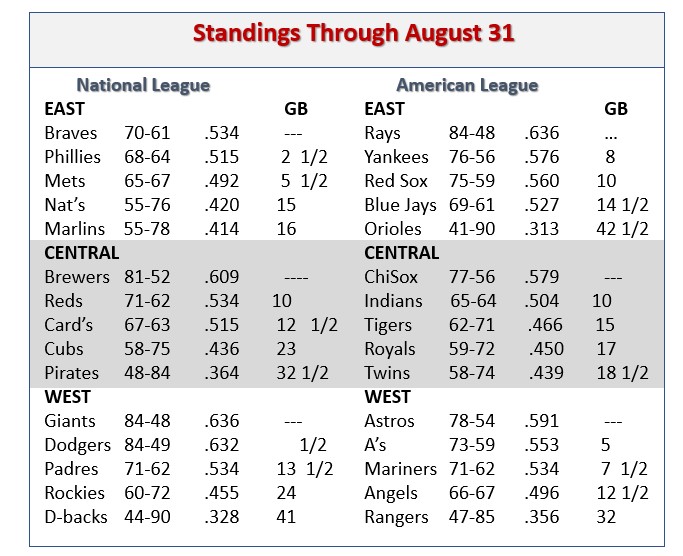
On the other side of the coin, the Orioles finished May in a (still active) 14-game losing streak – in which they were outscored 93-48.  (I’ll let the stats below tell the story.

——-Individual Statistical Leaders For  May———-

RUNS SCORED

National League –Giants (155); Padres (155); Dodgers (155)

American League – Rays (160); Blue Jays (154); Astros (153)

No one scored fewer runs in May than the Pirates, who plated just 81 tallies.  Others under 100 runs for the month included the Mariners (96) and Marlins (97).

AVERAGE

National League – Cubs  (.262); Nationals (.251); Dodgers (.249)

American League – Blue Jays (.279); Astros (.275); Red Sox (.260)

The lowest May team average belonged to the Mariners at a meager .199. The Brewers were the lowest in the National League at .207.

HOME RUNS

National League – Giants (46); Braves (43); Dodgers (38)

American League –  Blue Jays (42); Twins (41); Rays (40)

The Pirates had the fewest May home runs at 17.  In the American League, the Tigers were at the bottom with 20 May homers. The Rockies (19) and Diamondbacks (18) also finished under 20 home runs in May.

STOLEN BASES

National League –  Padres (26); Cardinals (20); Rockies (19)

American League – Rays (23); Tigers (19); Rangers (18)

The A’s stole the fewest bases in May – just four (in seven attempts).

WALKS DRAWN

National League –  Giants (123); Padres (110); Dodgers (109)

American League – White Sox (123); Rays (120); Twins (109)

BATTER’S STRIKEOUTS

National League – Phillies (290); Giants (287); Brewers (276)

American League – Rays (311); Tigers (269); Yankees (268)

Astros’ batters fanned the fewest times in May (180).

EARNED RUN AVERAGE

National League –  Cubs (2.52); Padres (2.69); Mets (3.18)

American League – Rays (2.70); White Sox (2.89); Yankees (3.33)

Two teams had ERA’s over 5.00 in May: Orioles (5.89) and Diamondbacks (5.46).

STRIKEOUTS

National League – Brewers (286); Dodgers (276); Phillies (273)

American League – White Sox (279); Indians (278); Angels (276)

The Brewers had the highest strikeouts per nine innings in May at 10.38. The White Sox led the AL at 10.21.

SAVES

National League – Cardinals (12); Mets (11); Cubs (10); Giants (10)

American League – White Sox (9); Indians (9); Red Sox (9); Yankees (9); Mariners (9)

No, a look at some of the players and plays that caught my eye in May.

—-MAY 2021 HIGHLIGHTS—-

A Different Kind of RBI Machine

Once again proving #InBaseballWeCountEverything, Mets’ rookie Patrick Mazeika – between May 7 and May 11  – became the first major leaguer in more than fifty years to collect three RBI before his first hit.  He collected those RBI on a pair of fielder’s choices and a bases-loaded walk.

On May 7, pinch-hitting for P Aaron Loup in the bottom of the tenth in a 4-4 game against the Diamondbacks, Mazeika came up with the bases loaded and one out. Mazeika hit a dribbler in front of the plate, the pitcher went for the play at the plate (to stop the winning run), the tag was not made and Mazeika had a walk-off fielder’s choice and his first MLB RBI.

On May 9, he came up as a PH in the bottom of the sixth with the Mets up 2-1 on the Diamondbacks, two outs and the sacks full.  This time, he drew a five-pitch walk for his second MLB RBI.

On May 11, the rookie came up – again as a PH – in the bottom of the ninth with one out, the Mets and Orioles tied at two and runners on first and third.  He hit a slow grounder to first, the Orioles unsuccessfully tried to cut down the winning run at the plate.  End result: Run scored and Mazeika’s  got his third MLB RBI and second “walk-off fielder’s choice.”
On May 16, Mazeika finally got his first MLB hit – and it was a home run, giving him his fourth MLB RBI.

DH? We Don’t Need No Stinkin’ DH

On May 4, Braves’ 23-year-old -year-old Huascar Ynoa threw seven strong innings (one unearned run on four hits and two walks) to earn his third win of the season as the Braves topped the Nationals 6-1. He also went one-for-three at the plate – stroking a sixth inning Grand Slam. Notably, it was his second straight start in which he homered (a solo shot on April 28 versus the Cubs) and the third straight start in which he collected an RBI.  At the close of May, Ynoa was hitting .353-2-6 in 17 at bats  and had a 4-2, 3.02 record on the mount.

Ynoa Update – Ouch

After a poor outing on May 16 (five runs surrendered in 4 1/3 innings versus the Brewers), Brave’s righty Huascar Ynoa punched a dugout bench (with his pitching hand). The broken right hand is likely to keep him out for a couple of months, the Braves reported.

More #WeDon’tNeedNoStinkin’DH

Okay, how about an American League pitcher wielding the bat (other than Shohei Ohtani, of course)? On May 4, The White Sox ’25-year-old righty Dylan Cease found himself at the plate for the first time in his MLB career (2019-21). He made the most of it, collecting two singles and a double in three at bats.  Oh yes, he also three six scoreless innings, giving up one hit, three walks and fanning eleven – as the White Sox topped the Reds 9-0. Cease now has an MLB average of 1.000 and a slugging percentage of 1.333.

Or, #WhyNotHaveADH, if he’s a pitcher.

In May, the Angels’ Shohei Ohtani (bats left/throws right) got four starts on the mound and went 1-1, 2.38, with 27 strikeouts in 22 2/3 innings. At the plate the P/DH hit .245, with seven home runs and 21 RBI in 27 games.

_________________________________________________

Four No-Hitters In May.  Wow. Just. Wow.

May 2021 saw four MLB no-hitters – only the second time in MLB history that we’ve seen for no-hitters in a single calendar month.  (June of 1990 saw no-hitters by Randy Johnson – June 2; Nolan Ryan – June 11; Dave Stewart – June 29; Fernando Valenzuela – June 29).

The four May no-hitters bring this season’s total no-hit games to six – one shy of the modern-era record of seven (1990, 1991, 2912, 2015)  and two short of the all-time record of eight (1884).

Here’s a look at this May’s “no-no’s.”

May 5, John Means, Orioles

Means no-hit the Mariners – and it was the most dominating performance among May’s no-no’s. The only runner to reach base was Mariners’ LF Sam Haggerty, who struck out swinging in the fourth, but reached when the catcher couldn’t handle the third-strike wild pitch. Haggerty was then caught stealing, so Means faced the minimum 27 batters, fanning 12.  He tossed 113 pitches (79 strikes).) The 28-year-old Means is in his fourth MLB season and, at the end of May , he was 4-1, 2.05 on the season and 18-16, 3.47 in his MLB career.  The no-hitter was his first complete game (48 starts).

May 7, Wade Miley, Reds

The 34-year-old southpaw shut down the Indians 3-0 – giving up no hits and just one walk (eight strikeouts). He threw 114 pitches (72 strikes). Miley is in his eleventh MLB season and the no-hitter was his third complete game and first shutout in 261 starts. Through May he was  5-4, 3.26 for the Reds. His career record is 90-89, 4.21.

May 18, Spencer Turnbull, Tigers

Turnbull no-hit the Mariners as the Tigers won 5-0. He walked two (leadoff walks in the seventh to CF Jarred Kalenic and in the fourth to 1B Jose Marmolejos) and fanned nine, tossing 117 pitches (77 strikes).  This may be the season’s most surprising no-hitter thus far.  Coming into the 2021 campaign, Turnbull had an MLB record of 7-23, 4.55. The no-hitter was the 28-year-old right-hander’s first complete game in his four MLB seasons (52 starts). At the end of May, his 2021 record was 4-2, 2.93.

May 19, Corey Kluber, Yankees

The 35-year-old righty no-hit the Blue Jays – giving up just one walk (a four-pitch free pass to 3B Charlie Culberson in the fourth frame), while fanning nine.  He tossed just 101 pitches (71 strikes).  The Yankees prevailed 2-0.  This one was no surprise, Kluber is in his eleventh MLB season, is a two-time Cy Young Award winner and has led his  league in wins twice, complete games three times and shutouts three times.

A couple of no-hit tidbits:

  • This season’s six no-hitters have seen three teams no-hit twice each (Rangers, Indians, Mariners). Just 19 teams have been no-hit twice in a season in MLB history.
  • Seattle third baseman Kyle Seager has been on the field for nine no-hitters (five as a player on the team that was no-hit, four on the team tossing the no-hitter). That’s a record for no-hitter appearances for a single franchise. Bert Campaneris holds the overall record for appearing in no-hitters at 11.

________________________________________________

Grabbing Some Air and a Seat on the Bench

On May 8, Brewer’s reliever Josh Hader  fanned the side in the bottom of the ninth (giving up a single in the midst of the whiffs), as the Brewers toppled the Marlins 6-2.  The first batter of the inning, Corey Dickerson, fanned on three pitches, giving Hader 400 career strikeouts and making him the the quickest ever to 400 whiffs– 234 2/3 innings.

I’m in Control Here

With two outs in the top of the fifth inning of a Brewers’ May 13 2-0 loss to the Cardinals, Brewers’ starter Corbin Burnes walked Cardinals’ SS Tommy Edman on five pitches.  That might not have been significant – except it was Burnes’ first walk of the 2021 season (coming in his sixth start).  It completed a streak that left Burnes holding the record for the most batters struck out before giving up the first walk of a campaign (58) – as well as for the most batters fanned between walks at any point in the season.  Burnes faced 125 batters in his streak and fanned 46.4 percent of them. (For more on Burnes’ streak, click here.)

While Burnes’ still holds the record for strikeouts before a walk from the start of a season, his record for most strikeouts between walks in a season has already fallen to the Yankees’ Gerrit Cole. Cole walked the Blue Jays’ LF Lourdes Gurriel, Jr. leading off the second inning of his start on April 12 and didn’t walk another batter until he issued a free pass to Rangers’ RF Joey Gallo in the fifth inning of the Yankees/Rangers Game of May 17. In between those walks he faced 150 batters and fanned 61 (the new record for strikeouts between walks at any point in a season). Ironically, Gallo ended May leading the AL not in walks, but whiffs at 73). In the midst of his streak, Cole notched his 1,500th MLB strikeout (The Rays’ Brett Phillips on May 12).

250 … That has a Ring to It

This May, the Red Sox’ J.D. Martinez and Braves’ Freddie Freeman each hit their 250th MLB home run. Freeman’s came on May 15 and was his tenth of the season. Martinez’ came on May 20 and was his twelfth of the season.

Zero-to-Fifty in a Hurry

On May 21, Padres’ shortstop Fernando Tatis, Jr. had a four-for-four day as the Padres pounded the Mariners 16-1. In the course of the game, Tatis popped his eleventh home run of the season – the 50th of his career. Reaching the 50-homer milestone in his 171st MLB game meant he reached the marker faster than any other MLB shortstop and quicker than all but four other major leaguers (any position).  Those ahead of Tatis? Pete Alonso (152 games); Rudy York (153 games); Gary Sanchez (161 games); Mark McGwire (161 games).Making that first solid contact count.

Power and Speed

At the close of May, the Padres’ Fernando Tatis Jr. was tied for the NL lead in home runs (16) and stolen bases. Only three MLB players have led their league in those two categories in the same campaign: Jim Sheckard, Superbas (Dodgers), in 1903; Ty Cobb,Tigers, in 1909; Chuck Klein, Phillies, in 1932. 


Well, That’s a First

On May 21, Mets’  22-yer-old rookie outfielder Khalil Lee, who made his MLB debut May 17,  rapped a pinch-hit double in the top of the 12th inning that drove in the go-ahead run as the Mets topped the Marlins 6-5 in Miami. (Lee also scored in the inning – on a triple by another rookie –  CF Johneshy Fargas.  (The Mets plated three runs in the fop of the twelfth, the Marlins got two in the bottom of the frame.)  In the inning, Lee notched a host of personal MLB “firsts”  – his first hit, first extra-base hit, first RBI and first run scored. Not only that, he snapped a record-setting streak of futility. To that point in his MLB career, Lee had come to the plate eight times and struck out all eight (four looking/four swinging) – a record for the beginning of an MLB career.

Baseball Roundtable Extra

University of Nevada infielder Tyler Bosetti set a new Division One NCAA record, hitting home runs in nine straight games between April 24 and May 11. Notably, now in his fourth college season, Bosetti had a total of five homers in his first three campaigns. 

Grand Slam Bookends and More #InBaseballWeCountEverything

On May 21, as the Braves thrashed the Pirates 20-1 in Atlanta, Atlanta popped seven home runs – including two Grand Slams. STATS reports they are the first team to collect seven or more home runs and two Grand Slams in the same game. Here is the long ball tally: RF Ronald Acuna, Jr. – Grand Slam in the second; 2B Ozzie Albies – two-run homer in the fifth; 3B Austin Riley – solo home runs in the fifth and seventh; CF Marcell Ozuna – solo in the sixth; SS Dansby Swanson – solo in the seventh; PH Ehire Adrianza – Grand Slam in the eighth.

Winker Going Wild

On May 21, as the Reds topped the Brewers 9-4, Reds’ leadoff hitter and LF Jesse Winker had a four-for-four day – and his first MLB three-homer contest.  Winker popped solo home runs in the third, fifth and eighth innings.  Winker ended the game hitting .356-11-26. It was the fifth three-homer game this season.  The others belong to: The Rockies’ Ryan McMahon (April 6); Red Sox’ J.D. Martinez (April 11); Blue Jays Vlad Guerrero, Jr. (April 27); Twins’ Miguel Sano (May 18).

Like Father Like Son

Two father and son duos have three-homer games on their MLB resumes:

Ken Griffey Sr. and Jr. and Cecil and Prince Fielder

Three Can Be a Lucky Number

On May 21, not only did we see the 2021 season’s fifth three-homer game (see above), but also the season’s second triple play – and it was a crucial triple killing, helping the Yankees to a 2-1 win over the White Sox, The score was 1-1 in the top of the ninth, when Yankees’ closer Aroldis Chapman started the inning by walking DH Yermin Mercedes on five pitches (Mercedes was replaced by pinch runner Billy Hamilton) and then mishandling a bunt by CF Leury Garcia  – putting runners on first and second with none out.  Next up was LF Andrew Vaughn, who hit a hard grounder to 3B Gio Urshela (playing near the bag), Urshela stepped on third, fired to 2B Rougned Odor for the second out and the watched as Odor relayed the ball to 1B Luke Voit for out number three. The Yankees then scored in the bottom of the inning to give Chapman the win.

Double Your Pleasure

On July 17, 1990 the Minnesota Twins became the first (and still only) team to turn two triple plays in one game. Both were classic third (Gary Gaetti) to second (Al Newman) to first (Kent Hrbek) triple killings.  The Twins, by the way, lost the game (to the Rd Sox) 1-0.

Major League Brain Freeze

On May 27, the Cubs stole a run from the Pirates during a run-down – between first base and home plate. Here’s how it went down. There were two outs in the top of the third inning with Cubs’ catcher Wilson Contreras on second base. Chicago SS Javier Baez hit a ground ball to third base, but Pirates’ 3B Erik Gonzalez’ throw pulled 1B Will Craig off the bag.  Then, the fun began.

Contreras, of course, was running on the play, approaching third base. Baez instead continuing toward first after Craig caught the ball up the line, retreated back toward home plate.  At this point, all Craig needed to do was go back and touch first and the inning was over, with no run scoring.  Oops! Instead, he chased Baez back toward home. By this time, as Baez approached home plate from the first-base side, Contreras was approaching the plate from the third-base side. Quite a crowd was gathering. Still, Craig just needed to return to first base and touch the bag to end the inning.  Instead, he tossed the ball to Pirates’ catcher Michael Perez (with Contreras sliding under the tag). Still, all that needed to happen was for a Pirate defender to tag first base and retire Baez, with the run not scoring.  (Baez was now again headed toward first and Pirates’ second baseman Adam Frazier was coming over to cover the bag.) Perez, however, threw the ball past Frazier into right field and Baez ended up on second base (later scoring on an Ian Happ single).  Those two odd runs proved important as  the Cubs emerged with a 5-3.  Want to see how it all went down.  Enjoy this YouTube video from MLB.


Baseball Roundtable Extra

On May 24, 17-year-old high schooler Frank Mozzicato (Manchester East Catholic High School) – possessor of a low-90’s fastball – tossed his fourth consecutive no-hitter. After the game, his season total included 101 strikeouts and just 15 walks (in 42 innings) and a 0.21 earned run average (just one earned run allowed).

The Two-Million Run Man (apologies to Lee Majors)

On May 29, in the first inning of a game against the Royals, Twins’ DH Nelson Cruz drove in 3B Josh Donaldson to give Minnesota a 1-0 lead.  As Donaldson touched the plate, he scored the two millionth run in MLB history (as verified by the Elias Sports Bureau. (Side note:  That designation may change once the Negro League statistics are officially incorporated into MLB’s stat lines.)

——Individual Statistical Leaders for May———-

AVERAGE (75 May at bats minimum)

National League – Nick Castellanos, Reds (.409); Adam Frazier, Pirates (.360): Max Muncy, Dodgers (.330)

American League –  Marcus Semien , Blue Jays (.368); Teoscar Hernandez, Blue Jays (.343); Andrew Benintendi, Royals (.340)

The lowest May average (among players with at least 75 at bats) belonged to the Royals’ Jorge Soler at .154 (14-for-91). Eleven hitters with at least 75 May at bats hit under .200 for the month. 

HOME RUNS

National League – Max Muncy, Dodgers (10); Fernando Tatis, Jr., Padres (9); Eugenio Suarez, Reds (8); Ronald Acuna, Jr., Braves (8)

American League –  Adolis Garcia, Rangers (11): Vlad Guerrero, Jr., Blue Jays (9); Mitch Haniger, Mariners (8); Jared Walsh, Angels (8); Ramon Laureano, A’s (8); Marcus Semien, Blue Jays (8); Austin Meadows, Rays (8)

RUNS BATTED IN

National League – Fernando Tatis, Jr. Padres (26); Eduardo Escobar, Diamondbacks (23); Brandon Crawford, Giants (22)

American League – Austin Meadow, Rays (28); Adolis Garcia, Rangers  (27);  Jose Abreu, White Sox (26)

The Dodgers’ Max Muncy had the highest slugging percentage (75 at bat minimum) for May at .714  The only other player at .700+ was the Blue Jays’ Marcus Semien (.702)

HITS

National League – Adam Frazier, Pirates (40); Nick Castellanos, Reds (38); Trea Turner, Nationals (35)

American League – Marcus Semien, Blue Jays (42); Teoscar Hernandez, Blue Jays (37); Jose Altuve, Astros (36)

DOUBLES

National League –  Josh Rojas, Diamondbacks (10): Bryan Reynolds, Pirates (10); Nick Castellanos, Res (9); Adam Frazier, Pirates (10)

American League – Marcus Semien, Blue Jays (12); Rafael Devers, Red Sox (11); Randal Grichuk, Blue Jays (10)

TRIPLES

National League – Ozzie Albies, Braves (3); Garrett Hampson, Rockies (3)

American League –Amed Rosario, Indians (3)

The Reds’ Nick Castellanos led players with at least 75 May at bats  in on-base percentage at .476.

STOLEN BASES

National League –  Fernando Tatis, Jr., Padres (8); Trea Turner, Nationals (7); Jonathan Villar, Mets (6); Story, Rockies (6); Tommy Edman, Cardinals (6)

American League –Niko Goodrum, Tigers (7); Whit Merrifield, Royals (7); Isiah Kiner-Falefa, Rangers (6); Cedric Mullins, Orioles (6); Randy Arozarena, Rays (6)

Whit Merrifield was seven-for-seven in May steal attempts.

WALKS

National League – Tommy Pham, Padres (19); Juan Soto, Nationals (19); several with 16

American League – Yasmani Grandl, White Sox (29); Yoan Moncada, White Sox (24);  Carlos Santana, Royals (22)

BATTER’S STRIKEOUTS

National League – Javier Baez, Cubs (34); Andrew McCutchen, Phillies (33); Austin Riley, Braves (33)

American League –Miguel Sano, Twins (38); Michael Taylor, Royals (38); Brandon Lowe, Rays (37); Rafael Devers, Red Sox (37)

The top seven players in batters’ strikeouts for May were in the American League.

PITCHING VICTORIES

National League – Kevin Gausman, Giants (5-0); Kyle Hendricks, Cubs (4-1); Jack Flaherty, Cardinals (4-1); Julio Urias, Dodgers (4-2)

American League – Lance Lynn, White Sox (5-0); Hyun Gin Ryu, Blue Jays (4-0); Yusmeiro Petit, A’s (4-0); Josh Fleming, Rays (4-1); Lucas Giolito, White Sox (4-2)

The Redss Luis Castillo had the most May losses (0-6, 8.04).

EARNED RUN AVERAGE (at least 25 innings pitched)

National League – Kevin Gausman, Giants (0.73); Brandon Woodruff, Brewers (1.07); Taijuan Walker, Mets (1.52)

American League – Rich Hill, Rays (0.78); Kris Bubic, Royals (1.52); Lance Lynn, White Sox (1.64).

STRIKEOUTS

National League – Max Scherzer, Nationals (57 / 39 1/3 IP); Zack Wheeler, Phillies (57 / 36 1/3 IP); Kevin Gausman, Giants (49 / 37 IP); Brandon Woodruff, Brewers (49 / 42 IP).

American League – Lucas Giolito, White Sox (45 / 37 1/3 IP); Carlos Rodon, White Sox (44 / 29 2/3 IP); Shane Bieber, Indians (42 / 29 2/3 IP); Tyler Glasnow, Rays (42  / 32 1/3 IP)

Among pitcher with at least 25 May innings, the White Sox’ Carlos Rodon  led in whiffs per nine innings at 13.35. Also, above 13 were The Padres’ Blake Snell (13.33);  Nat’s Max Scherzer (13.04) and Tigers’ Tarik Skubal (13.00). Thirty-four pitchers with at least 25 May innings average 10 or more whiffs per nine.  

SAVES

National League – Alex Reyes, Cardinals (9); Craig Kimbrel, Cubs (8); Mark Melancon, Padres (8)

American League: Liam Hendriks, White Sox (8):  Aroldis Chapman, Yankees (7); Matt Barnes, Red Sox (6); Ian Kennedy, Rangers (6)

_____________________________________________

If the season ended at the close of play May 31, your post-season team would be:

AMERICAN LEAGUE – Rays, White Sox, A’s.  Wild Cards: Red Sox.  Indians/Astros (tie).

NATIONAL LEAGUE – Mets, Bubs, Giants.  Wild Cards: Padres, Dodgers.

——Team  Statistical Leaders through  May———-

RUNS SCORED (average 231)

National League –  Dodgers (282); Padres (264); Giants (261)

American League – Astros (284); Rays (273); Red Sox (269)

AVERAGE (average .236)

National League – Nationals (.249); Reds (.246); Dodgers (.246)

American League – Astros (.267); Red Sox (.259); Blue Jays (.258)

The lowest team average through  belonged to the Mariners at a meager .205. The Brewers were the lowest in the National League at .211.

HOME RUNS (average 60)

National League – Braves (81); Giants (78); Reds (73)

American League –  Blue Jays (77); Twins (72); A’s (70)

The Pirates had the fewest home runs through May at 37. In the AL, the Tigers and Royals were at the bottom with 48.

STOLEN BASES (average 25)

National League – Padres (59);  Phillies (33); Cubs (32); Marlins (32)

American League – Royals (39); Rangers (37); Rays (32)

The Yankees  and Reds  stole the fewest bases in  through May (12). The Yankees attempted the fewest steals through May at 16. By contrast, the Padres attempted 74 steals.

WALKS DRAWN (average 177)

National League – Dodgers (235); Padres (220); Giants (215)

American League – Rays (213); Yankees (213); White Sox (214)

The White Sox led MLB  in on-base percentage through  May at .343. The Dodgers led the NL at .338.

BATTER’S STRIKEOUTS (average 479)

National League – Phillies (544); Brewers (538); Giants (530)

American League – Rays (584); Tigers (549); Rangers (527)

Hmm. What do strikeouts mean? The Rays have the most wins (through May) in the AL and also the most whiffs.  The Tigers have the third-most losses and the second-most  whiffs. In the NL, the Giants have the most wins through May and the third-most whiffs, while the Phillies with the most strikeouts have the fourth-most losses.

EARNED RUN AVERAGE (average 4.02)

National League – Padres (2.77); Mets (3.06); Dodgers (3.19)

American League –Yankees (3.20); White Sox (3.23); Rays (3.38)

The highest  ERA through May belonged to the Angles at 5.06. 

STRIKEOUTS (average 479)

National League – Padres (572); Brewers (555); Dodgers (544)

American League – White Sox (530); Yankees (526); Angels (524)

The Padres, Brewers and White Sox all averaged 10.4 whiffs per nine innings through May. Other teams at 10 or more: Mets (10.2); Dodgers (10.1); Angels (10.0); Indians (10.0). The MLB average was 9.2.

WALKS SURRENDERED (average 177)

National League – Cardinals (240); Reds (222); Rockies (204)

American League – Angels (222); Royals (211); Indians (201)

SAVES (average 13)

National League – Giants (21); Padres (20); Cardinals (19)

American League – Indians (17); Mariners (17); Rays (17)

——Individual Statistical Leaders through May 31———-


BATTING AVERAGE (qualifying players – 3.1 plate appearance for each team game played)

National League – Nick Castellanos, Reds (.356); Jesse Winker, Reds (.348); Adam Frazier, Pirates (.332)

American League –  J.D. Martinez, Red Sox (.323); Vlad Guerrero, Jr. , Blue Jays (.323); Xander Bogaerts, Red Sox (.321)

The lowest average through May  (among qualifiers) belonged to the Brewers’ Jackie Bradley at .150 (24-for-160).

HOME RUNS

National League – Ronald Acuna, Jr. Braves (16); Fernando Tatis, Jr. (16); five with 13.

American League –  Adolis Garcia, Rangers (16): Vlad Guerrero, Jr., Blue Jays (16); Shohei Ohtani, Angels (15)

RUNS BATTED IN

National League –Eduardo Escobar, D-backs (39);  Jesus Aguilar, Marlins (38); Fernando Tatis, Jr., Padres (37)

American League – Jose Abreu, White Sox (46); Rafael Devers, Red Sox (43); Vlad Guerrero, Jr.. Blue Jays (42); Trey Mancini, Orioles (42)

The Braves Nick Castellanos had the highest slugging percentage (among qualifiers) through  May at .638.  The only other player at .600+ were the Reds’ Jesse Winker (.635); Blue Jays’ Vlad Guerrero, Jr. (.634); Braves’ Ronald Acuna, Jr. (618); and Cubs’ Kris Bryant (.611),

HITS

National League – Adam Frazier, Pirates (69); Nick Castellanos, Reds (67); Jesse Winker, Reds (62)

American League – J.D. Martinez, Red Sox (62); Marcus Semien, Blue Jays (62); Isiah Kiner-Falefa,Rangers (611); Cedric Mullins, Orioles (61)

DOUBLES

National League –  Nolan Arenado, Cardinals (17); Adam Frazier, Pirates (17); Mookie Betts, Dodgers (16); Bryan Reynolds, Pirates (16)

American League – Rafael Devers, Red Sox (17); Joey Wendle, Rays (16); Yuli Gurriel, Astros (15); Austin Meadows, Rays (15)

TRIPLES

National League – Dave Peralta, D-backs (5); Garrett Hampson, Rockies (4)

American League –Akil Badoo, Tigers (4); Nick Madrigal, White Sox (4)

The most extra-bases hits (among qualified players) through May was 31 for the Red Sox’ Rafael Devers. The Cardinals’ Nolan Arenado led the NL with 29. The fewest extra-base hits among qualifiers was seven (by six players).

STOLEN BASES

National League –  Fernando Tatis, Jr., Padres (12); Trea Turner, Nationals (12); Tommy Edman, Cardinals (10); Barrett Hampson, Rockies (10)

American League –Whit Merrifield, Royals (15); Isiah Kiner-Falefa, Rangers (10); Tim Anderson, White Sox (9)

The most stolen bases without being thrown out through May was eight by the Blue Jays’ Marcus Semien.  MLB SB leader Whit Merrifield (Royals) was 15-for-16 in steal attempts.

WALKS

National League – Max Muncy, Dodgers (43); Freddie Freeman, Braves (35); Andrew McCutchen, Phillies (31)

American League – Yasmani Grandl, White Sox (42); Joey Gallo, Rangers (39); Carlos Santana, Royals (38)

BATTER’S STRIKEOUTS

National League – Javier Baez, Cubs (70); Eugenio Suarez, Reds (70); Willy Adames, Brewers (61); Rhys Hoskins, Phillies (61)

American League – Joey Gallo, Rangers (73); Matt Chapman, A’s (70); Nate Lowe, Rangers (67)

The best walks-to-strikeouts ratio through May (among qualifiers) belonged to the Nationals’ Juan Soto at 1.318 (29 walks and 22 whiffs in 40 games).

PITCHING VICTORIES

National League –Jack Flaherty, Cardinals (8-1); Julio Urias, Dodgers (7-2); Clayton Kershaw, Dodgers (7-4)

American League – Yusmeiro Petit, A’s (7-0); Aaron Civale, Indians (7-2); five with six

The Reds’ Luis Castillo had the most losses through May (1-8, 7.22 in 11 starts). Coming into this season, the 28-year-old Castillo was 32-33, 3.62, 

EARNED RUN AVERAGE (qualifying players … at least one inning pitched for each team game played)

National League – Jacob deGrom (0.71); Brandon Woodruff, Brewers (1.27); Kevin Gausman, Giants (1.40)

American League – Gerrit Cole, Yankees (1.78); Carlos Rodon, White Sox (1.98); John Means, Orioles (2.05)

Among qualifying pitchers Jacob deGrom held batters to the lowest average through May at .129.

STRIKEOUTS

National League – Trevor Bauer, Dodgers (96 / 76 1/3 IP); Max Scherzer, Nationals (95 / 69 1/3 IP); Zack Wheeler, Phillies (92 / 75 IP)

American League – Shane Bieber, Indians (110 / 72 IP); Tyler Glasnow, Rays (98  / 70 IP); Gerrit Cole, Yankees (97 / 70 2/3 IP)

Among qualifying pitchers, the Mets’ Jacob deGrom had the best strikeouts/nine innings ratio through May at 14.47. Shane Bieber led the AL at 13.75. Two others were at 13+: The Brewers’ Freddy Peralta (13.18) and White Sox’ Carl Rodon (13.17). deGrom also had the best strikeouts-to-walks ratio at 11.14. The only other qualifier with a ratio of 10+ through May was the Yankees’ Gerrit Cole (10.78).

Among qualifying pitchers,  the Phillies’ Zack Elfin had the best walks per nine innings ratio at 1.06.

SAVES

National League – Mark Melancon, Padres (17); Alex Reyes, Cardinals (15); Josh Hader, Brewers (12); Kenley Jansen, Dodgers (12); Craig Kimbrel, Cubs (12); Jake McGee, Giants (12)

American League: Liam Hendriks, White Sox (13):  Matt Barnes, Red Sox (12); Ian Kennedy, Rangers (11); Aroldis Chapman, Yankees (11)

The Cardinals’ Alex Reyes and Brewers’ Josh Hader  are the only pitchers with ten or more saves and no blown save opportunities. Reyes is 15-for-15, Hader 12-for-12.

Primary Resources:  Stathead.com; Baseball-Almanac.com; ESPN.com; MLB.com

Baseball Roundtable Disclaimer:  The MLB records referenced in this (and previous) posts have the potential to change as Major League Baseball recognizes and incorporates Negro League records from 1920-46 into the MLB record book.

_____________________________________________

100Baseball Roundtable is on the Feedspot list of the Top 100 Baseball Blogs.  To see the full list, click here.

I tweet baseball @DavidBaseballRT

Follow/Like Baseball Roundtable’s Facebook Page here.  More baseball commentary; blog post notifications; PRIZES.

Member: Society for American Baseball Research (SABR); The Baseball Reliquary; The Negro Leagues Baseball Museum.
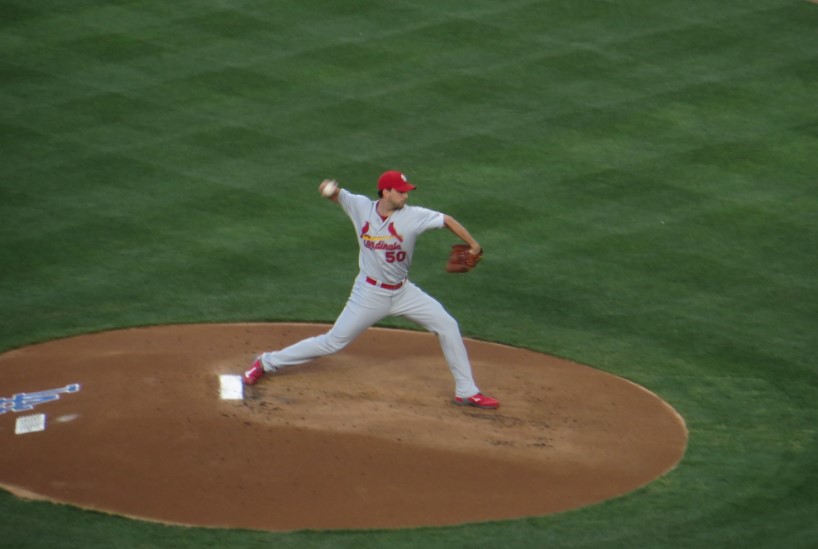


Extra Inning Explosion – Rangers Plate 12 in the Fifteenth (and more)

Yesterday (May 28, 2021), the Padres broke open a tight (3-3) game against the Astro (in Houston) by plating seven runs in the top of the eleventh inning. The Padres attack that inning included five singles, a double and was aided by an Astros’ error and (unfortunately) the now obligatory free runner on second base to open the inning.

Well, that got me thinking (another Baseball Roundtable  “one thing leads to another” moment) about the record for runs scored in an extra inning.  I thought I’d share what I found.

Independence Day Fire Works Arrive a Day Early

Bob Jones … two doubles in the fifteenth inning.

Turns out the record for the most runs scored in extra frames belong to the Rangers, who plated 12 runs in the fifteenth inning of a July 3, 1983 game against the A’s – giving the Rangers a 16-4 win.

In that frame, which I detail later in this post, the Rangers:

  • Sent 16 batters to the plate;
  • Collected five singles and three doubles;
  • Benefited from four walks (one intentional), a wild pitch and one A’s error;
  • Had one batter (LF Bob Jones) hit two doubles; and
  • Had seven players drive in at least one run.


Bob Jones’ Day in the Sun

Rangers’ LF Bob Jones went five-for-eight in that July 3, 1983 game, collecting three doubles, scoring twice and driving in four runs. On the season, he hit .222 (16-for-72) with four doubles, one home runs, five runs scored and 11 RBI. In nine  MLB seasons, Jones hit .221 (314 games), with 20 home runs and 86 RBI.

Here’s a look at how the Rangers’ record-setting extra inning went:

  • SS Bucky Dent draws a leadoff walk off reliever Dave Beard.
  • 3B Buddy Bell singles, Dent goes to second.
  • RF Larry Parrish grounds out weakly to the pitcher, Dent and Bell move up.
  • CF George Wright is walked intentionally.
  • LF Bob Jones hits a two-run double to right.
  • Wright, who has gone to third on the Jones double, scores on a wild pitch with C Bob Johnson at the plate.
  • Johnson walks – putting runners on first and third.
  • Bill Callahan replaces Beard on the bump.
  • 1B Larry Biittner hits a run-scoring single.
  • 2B Jim Anderson walks, loading the bases.
  • Mickey Rivers reaches on an error by second baseman Tony Phillips as Biittner scores.
  • Dent hits a run-scoring single in his second plate appearance of the inning.
  • Bell hits his second single of the inning – this one scoring Rivers.
  • Parrish hits a two-run double.
  • Wright flies out to left.
  • Jones hits a run-scoring double, his second two-bagger of the frame.
  • Johnson singles in Jones.
  • Biittner flies out to left to end the carnage.

Note: Odell Jones put down the A’s (strikeout-strikeout-fly out) in the bottom of the inning.

The Rare Dozen Tallies

Only twice in the 1983 season did the Rangers scores as many runs in a game as they did in the 15th innings on July 3,  On July 2, they topped the A’s 13-3 and on August 8, they defeated the Red Sox 12-7.

____________________________________________________

In Contrast

On May 1, 1920, the Brooklyn Robins (Dodgers) and Boston Braves  played to a 26-innings 1-1 tie.  Yep, 17-consecutive scoreless extra innings. (In fact, not a single runner crossed the plate after the bottom of the sixth.)  Notably, starting pitcher Leon Cadore (Robins)  and Joe Oeschger (Braves) both went the distance.

More Contrast

The Astros and Mets hold the record for the longest-ever string of consecutive scoreless innings from the start of a game (or consecutively at any point in a single game) at 23. .  On April 15, 1968 – after 23 scoreless frames, the Astros pushed across a run in the bottom of the 24th on a single  by RF Norm Miller, a balk by Les Rohr, an intentional walk to LF Jimmy Wynn,  ground out by 1B Rusty Staub (that moved the runners to second and third), an intentional walk to PH John Bateman and then a run-scoring error (on a 3B Bob Aspromonte grounder) by Mets’ SS Al Weis. In contrast to the Robins/Braves game (above) which saw only two pitchers take the mound and took just three hours and fifty minutes to complete, this one saw 13 hurlers make an appearance and took six hours and six minute.

_________________________________________________

As usual, when I began to look into the runs scored in an extra frame once again “one thing led to another – and another,” all related to extra innings, of course. I was drawn to the Braves/Giants game of July 2, 1963. That was a matchup between a pair of future Hall of Famers – 42-year-old Warren Spahn (in his 18th MLB season) and 26-year-old Juan Marichal (in his fourth MLB campaign). The two matched up in a 16-inning duel – that was still scoreless (with both starters in the game) going into the bottom of the sixteenth inning.  That’s when Willie Mays took Warren Spahn deep to left for a game-winning home run. Why was that notable?

  1. It was one of Mays’ career MLB-record 22 extra-inning homers.
  2. Thanks to that round tripper, May is the only player to homer in every inning one-through-sixteen. (More #InBasedballWeCountEverything.)
  3. It created a nice “bookend.” On May 28, Mays hit his first career home run, which was also his first first-inning homer – and it came off Spahn. The July 2, 1963 long ball (again off Spahn) was his first (and only) 16th-inning blast.

Primary Resources:  Stathead.com; Baseball-Almanac.com; Extra Inning Home Runs, Baseball Research Journal (1976), Ray Gonzalez.

______________________________________________

100Baseball Roundtable is on the Feedspot list of the Top 100 Baseball Blogs.  To see the full list, click here.

I tweet baseball @DavidBaseballRT

Follow/Like Baseball Roundtable’s Facebook Page here.  More baseball commentary; blog post notifications; PRIZES.

Member: Society for American Baseball Research (SABR); The Baseball Reliquary; The Negro Leagues Baseball Museum.
 

A Walk in the Park … Ranking MLB’s Bases-Loaded Intentional Passes

On this date (May 22) in 1962, the Yankees’ Roger Maris set an MLB record (since broken) by drawing four intentional walks in a single game. As the Yankees topped  the Angels 2-1 in 12 innings (in New York), Maris drew five walks (four intentional) in six trips to the plate.

A Bit of Irony

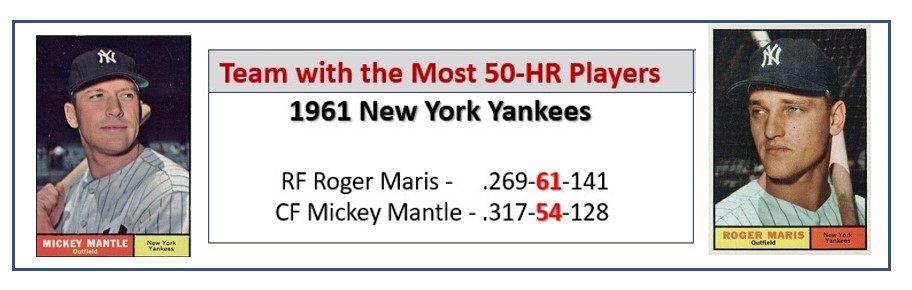
in his 12-season MLB career, Roger Maris had only one season in which he did not draw a single intentional walk. That was in 1961, when he won his second consecutive AL MVP Award,  broke Babe Ruth’s  long-standing single-season home run record – bashing 61 long balls – and led  the American League in runs scored (132) and RBI (141 – tied with Jim Gentile). It clearly didn’t hurt to be batting in front of Mickey Mantle.

Now, I’ve written about intentional walks (and specifically about Roger Maris’ 1961 lack thereof) in this blog before, but (as often happens) as I reflected that topic, one thing led to another – and I decided to rate the six bases-loaded intentional walks in MLB history.  The rating is based on factors such the intensity and outcome of each.  For example, a bases-loaded intentional  pass that moves the tying run to third base would be worth more than one that puts the tying run on at first base.  Similarly, a bases-loaded free pass with no outs (so three batters must be retired to escape with no further damage) would be worth more than a bases-loaded walk with two outs already recorded (given a similar situation in relation to the score).  Results also played a role, with extra credit if the strategy worked.

Nothing Like Few Walks in the Park

The Cubs’ Andre Dawson drew an MLB-record five intentional passes in a 16-inning game on May 22, 1990.  (Roger Maris still holds a share of the AL record at four.) The Giants’ Barry Bonds is the only MLB player with four intentional passes in a nine-inning contest – and he did it twice in 2004 (May 1 and September 22). The record for total walks of any kind in a game of any length is six: Cubs’ Walt Wilmot (August 22, 1891 – nine innings); Red Sox’ Jimmie Foxx (June 16, 1938 – nine innings); Nationals’ Bryce Harper (May 8, 2016 – 13 innings); Indians’ Andre Thornton (May 2, 1984 – 16 innings); Astros’ Jeff Bagwell August 20, 1999 – 16 innings).


———–Rating the Bases-Loaded Intentional Walks—————

Note:  In this post, BBRT assumes credit/responsibility for implementing the Intentional Walk rests with the manager(s) – even if the pitcher(s) may (or may not) agree with the move. 

Number one (Tie)  … Del Bissonette, Brooklyn Robins (Dodgers),  May 2, 1928

The Dodgers trailed the Giants 2-0 in the top of the ninth inning, when they loaded the bases with two outs (thanks to a pair of singles and a walk). That brought up 1B and number-six hitter Del Bissonette, who had come into the game hitting .345-4-15 (in 15 games). Manager John McGraw had Giants’ pitcher Larry Benton intentionally walk Bissonette, cutting the margin to one run. Benton then pitched to 2B Henry Riconda, who came into the contest with a .220 average and just one home run. While the IBB cost him a shutout, the strategy worked, as Benton went on to fan Riconda to end the game and get the win. Benton, by  the way, had his best MLB season in 1928 (his sixth MLB campaign), leading the league in wins (25 versus nine losses), winning percentage (.735) and complete games (28) – with a 2.73 ERA.  He pitched 13 MLB seasons, going 128-128, 4.03. The other principal in this mini-drama, Bissonette, played five MLB  seasons, going .305-66-391 in 604 games.

This one is at the top for the willingness to allow a run in a two-run game and move the tying tally to third base (and go-ahead run to second) – and delivering the win.

Load ‘Em Up, I’m Ready

Del Bissonette is credited with (on April 21, 1930) being the first MLB player to hit a bases-loaded home run and a bases-loaded triple in the same game.  

Number One (tied) … Barry Bonds, Giants, May 28, 1998

Photo by kevinrushforth

The Giants trailed the Diamondbacks 8-5  in the bottom of the ninth with Gregg Olson on the mound. Olson fanned CF Darryl Hamilton on three pitches  to open the frame, then walked 3B Bill Mueller on four pitches, before giving up a double to 2B  Jeff Kent (Mueller to third) and walking 1B  Charlie Hayes  to load the bases.  Olson then got RF Stan Javier to ground out (second-to-first) with Mueller scoring and Kent and Hayes each moving up a base.   J.T Snow then came on as a pinch hitter and drew a five-pitch walk again loading the bases.  Now, up by two  runs,  manager Buck Showalter ordered Olson to intentionally walk Barry Bonds  (who had drawn an unintentional  walk as a pinch hitter in the eighth inning and stayed in the game in LF) – forcing in a run and putting the tying  tally at third base and the go-ahead run at second. Olson then got C  Brent Mayne on a liner to right-center to end the contest and give the Diamondback an 8-7 win.  Bonds was hitting .305-13-41 at the time, while Mayne was no slouch at  .290-2-12 coming into the game.

Top of the List

Barry Bonds led his league in Intentional Walks a record 12 times – the last time in his final season, at age 42. 

Number Three … Napoleon Lajoie, Philadelphia Athletics, May 23, 1901

Nap Lajoie’s Athletics were down 11-7 to the White Sox in the top of the ninth inning, when they mounted a comeback – loading the bases with none out and bringing cleanup hitter 2B Napoleon Lajoie – who came into the game hitting .525 and was on his way to a  .426-14-125 triple crown  season – to the plate. White Sox player-manager Clark Griffith put himself into the game and intentionally  walked Lajoie, forcing in a run and cutting the lead to three. Griffith then got RF Socks Seybold (who would lead the AL in home runs in 1902) and 1B Harry Davis (who would lead the league in round trippers four times  in his career) on ground outs (one run scoring) to save an 11-9 win.  This intentional  walk got extra points for the courage of manager Griffith to take the responsibility on himself – and for setting up a situation in which the bases were loaded, the tying run was at first and he had to get three outs to save the game.

Clark Griffith … A Role(s) Player

Clark Griffith managed the 1901 White Sox to an 83-53 record and first  place in the National League. As a player-manager, he went 24-7, 2.67 on the mound and .303-2-14 (in 35 games) at the plate. .

Number Four … Josh Hamilton, Texas Rangers, August 17, 2008

This  game  saw RF Josh Hamilton and his Rangers trailing  the rays 7-2 in the bottom of the ninth.  With Juan Salas on the mound for Tampa, Rangers’ DH Jarrod Saltalamacchia opened the inning with a single, followed by a Chris Davis (1B)  walk. Salas then fanned 3B Travis Metcalf on three pitches. before giving way to Grant Balfour on the mound. Balfour walked 2B Ramon Vazquez  to load the bases, before getting LF Brandon Boggs to hit into a fielder’s choicer (second-to-shortstop) with one run scoring. A walk to SS Michael Young loaded the bases – and Devil Rays ‘manager Joe Maddon ordered Hamilton intentionally walked,  pushing across another run, putting the tying run at first base and bringing  Dan Wheeler in from the bullpen. Wheeler ended the game by fanning Marlon Byrd on five pitches.  Hamilton has come into the game hitting .302 with 28 homers and 112 RBI, while Byrd came in at .290-8-34.

Going Four-for-Two

Josh Hamilton is one of just eighteen MLB players to hit four home runs in a single game. He did it on May 8, 2012 – hitting four two-run home runs and a double in five at bats as his Rangers topped the Orioles 10-3. 

Number 5 … Bill Nicholson, Cubs, July 23, 1944 (second game)

The Giants led the Cubs 10-7 in the top of the eighth inning, but the Cubs were mounting a comeback. Giants’ righty Ace Adams (on in relief of Bill Voiselle) walked Cubs’ 3B  Stan Hack and SS Bill Schuster to open  the inning – and was replaced on the mound by southpaw Ewald Pyle, who issued an unintentional walk to 1B Phil Cavarretta to load the bases. That brought up RF and cleanup hitter Bill Nicholson – who was having quite a  day. In the first game of the Sunday twin bill (remember those), Nicholson had banged out three home runs (three homers and a walk for the game)  as the Cubs won 7-4.   He had already homered in the second inning the second game (his 21st of the season) and Giants’manager Mel Ott wanted no part of the hot hitter. Ewald issued the free pass, plating one run.  Ewald was then replaced by right-hander Andy Hansen who retired LF  Ival Goodman (holding the runners) and then hit CF Andy Pafko with a pitch, bringing in the second run of the inning and keeping the sacks full. 2B Don Johnson then grounded into a force at second,  plating another run – and tying the contest. Righty Bob Barthelson came in to pitch and got PH Billy Holm on a pop out to at least preserve the tie.  The Giants scored twice in the top of the ninth and won the game 12-10. The bases-loaded free pass, however, did not stop the Cubs from tying the game.

Taking the Lead

Bill Nicholson led the National League in home runs and RBI in both 1943 and 1944 … finishing second and third, respectively, in the NL Most Valuable voting in those years.  

Number Six … Abner Dalrymple, Chicago White Stockings (NL), August 2, 1881

The White Stockings, already up  5-0 over the Buffalo Bisons, opened the eighth inning  by loading the bases on consecutive hits by P Fred Goldsmith, C Silver Flint and 2B Joe Quest. Bisons’ manager Jim O’Rourke (presumably) wanted nothing to do with Dalrymple (on his way to a .323 season and the 1878 NL batting champ) and had Joe Flinch walk him intentionally – forcing in a run.  The White Sox eventually won the contest 11-2. The intentional pass was of little consequence in the outcome, but is generally accepted as the first IBB with the sacks full in MLB history.

Double Your Pleasure, Double Your Fun

On July 3, 1883, Abner Dalrymple hit four doubles in a nine-inning game tying an MLB single-game record that he still shares.

________________________________________________________

Barry Bonds – King of the Intentional Walk

Notably, when you talk intentional walks, the conversation pretty much starts and ends Barry Bonds. (We need to keep in mind, however, that IBB’s did not become an official statistic until 1955.)   Bonds holds the records for:

  • IBB in a season – 120 with the Giants in 2004.  That’s an intentional  walk in 19.4 percent – or nearly one in five – of Bonds’ plate appearances that season. His record 232 total walks for the season made up 37.6 percent of his plate appearances that campaign.
  • IBB in a career – 688. Second place goes to the still active Albert Pujols of the Angels with 313 as this is written.
  • Most seasons leading the league in IBB – 12.

Primary Resources: Baseball-Almanac.com; Baseball-Reference.com; MLB.com. Note:  The Baseball-Almanac Resource included information from research by Bill Deane, Everett Parker and Trent McCotter.  

Baseball Roundtable Disclaimer:  The MLB records referenced in this (and previous) posts have the potential to change as Major League Baseball recognizes and incorporates Negro League records from 1920-46 into the MLB record book.

______________________________________________

100Baseball Roundtable is on the Feedspot list of the Top 100 Baseball Blogs.  To see the full list, click here.

I tweet baseball @DavidBaseballRT

Follow/Like Baseball Roundtable’s Facebook Page here.  More baseball commentary; blog post notifications; PRIZES.

Member: Society for American Baseball Research (SABR); The Baseball Reliquary; The Negro Leagues Baseball Museum.
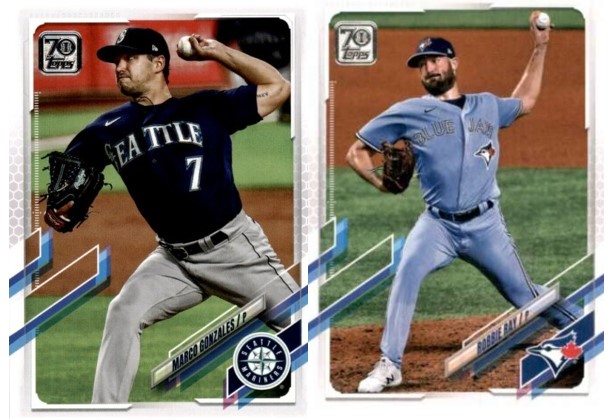
 

Mike Marshall … Very Good at Retiring Batters Late – Less Proficient (fortunately) at Retiring Early

On this date (May 15) in 1978, Mike Marshall made his first appearance on the mound for my hometown Minnesota Twins.  He came on in the ninth inning (in relief of Greg Thayer) with a runner on first, one out and the Twins and Orioles  tied at 6-6. Marshall closed out the ninth, tossed a scoreless tenth and got the win on a Willie Norwood walk-off, three-run homer in the bottom of the tenth inning.

Mike Marshall pitched a record 208 1/3 innings in relief in 1974.

That Marshall would be successful in relief was no surprise, nor was the fact that the “closer” would pitch more than an inning.  However, his appearance on the mound was in itself a bit unexpected. Marshall had endured a disappointing 1977 (which included a mid-season team change) and had also undergone back surgery late in the year (as well as knee surgery before the 1977 season). He let it be known that he was retiring as a player.  Marshall was, however, coaxed out of retirement  (in May of 1978) by Twins’ Manager Gene Much.   Was it a good decision? Well, Marshall saved 21 games (and won ten) for the Twins over the remainder of the season – and the following year (as a Twin) led the American League in saves and set the still-standing AL record for appearances in a season by a reliever (89).

But I’m getting ahead of myself.  Before, we get a look at Mike Marshall’s overall career on the bump, let me note that 1978 wasn’t the only time Mike Marshall contemplated “early retirement.” And, if he had followed through on either occasion, the MLB record books would look a bit different,

Mike Marshall – A Career that was “One for the Books.”

Marshall was a multi-sport (baseball, football and basketball) athlete in high school.  He was offered a baseball scholarship by Michigan State University, but signed (in 1960) as a free agent with the Phillies. (Reportedly there was some contention over the size of the scholarship.)

Marshall  started his professional career as a shortstop, where he showed promise at the plate.   Between 1961 (at age 18) and 1964, he was promoted every season, moving form Class D to AA. His best season was 1963, for the Class A Magic Valley Cowboys, where he hit .304, with 14 home runs, 76 RBI and ten stolen bases in 107 games.

The grind of everyday play, however, put significant stress on a childhood back injury and, in 1965, Marshall took his shortstop’s arm to the mound – which proved to be a fortuitous  move.  On May 31, 1967, Marshall made his major-league debut – for the Detroit Tigers. That season, he pitched in 37 games, going 1-3, with 10 saves and a nifty 1.98 earned run average.

Thus began Mike Marshall’s major-league odyssey. One that would last 14 seasons, put him on the mound for nine teams, survive one contemplated retirement and one announced retirement, and etch his name into the record books. Oh, and along the way, he would pursue his education part-time. (He would eventually earn a trio of degrees including a Ph.D. in Kinesiology.  Ironically, from the same university whose scholarship he declined.)

By the end of 1973, Marshall had six MLB seasons on his resume (Tigers, Pilots Astros, Expos) – as well as a reputation for being both opinionated and outspoken. At this point in his MLB career, he had a 40-48 record with 85 saves and a 3.21 earned run average. In the 1973 season (Expos), he had led the NL in games pitched (a then modern-era record 92), games finished (73) and saves (31).    Still, after the season, Marshall indicated he was contemplating retirement in order to work full-time on his doctorate.  That, and perhaps his attitude (more than his aptitude), were among the likely factors that contributed to his trade to the Dodgers.  The rest, as they is history – and historic.

A Diverse Repertoire, Particularly for a Reliever

Mike Marshall had a live fastball, slider, sinker and the pitch that built his career – a killer screwball.

In 1974, as a Dodger, he put up the grand-daddy of all relief seasons – becoming the first reliever to win the Cy Young Award and setting the still-standing record for appearances with 106 and innings pitched in a season in relief at 208 1/3. He finished the season 15-12, with a league-topping 21 saves and a 2.42 ERA.  Marshall was called on to go more than one inning in 74 games (68.5 percent of the time); and toiled three or more innings 22 times. A few other facts about Marshall’s remarkable season:

  • In 1974, Mike Marshall pitched 208 1/3 innings in relief.  In 2019, only six MLB starting pitchers toiled for more innings (led by Justin Verlander with 223).  And, in 2019, no MLB relief pitcher reached 100 innings.
  • Marshall’s longest stint came on August 19, when he came on in the seventh inning of a 7-7 game against the Cubs – and went six innings, earning the win as the Dodgers topped the Cubs 8-7 in twelve innings.
  • From June 18 to July 3, Marshall relieved in 13 consecutive regular-season games –an MLB record later tied (1986) by the Rangers’ Dale M0horcic.

How the Game Has Changed

In 1876 (according the Baseball-Reference.com), Jim Devlin pitched (started) all but the final game of the National League’s Louisville Grays’ season (a record 68 consecutive games pitched in) and finished 66 of them.  One season later, he started and finished all 61 of the Grays’ games – the only pitcher ever to pitch all of a team’s innings in a season.  In those two seasons, Devin logged a total of 1,181 innings. Side Note: Sadly, Devlin’s career was cut short when he was banned after the 1877 season, as the result of a game-fixing scandal.

  • From May 17-24, 1974, Marshall pitched eight straight days (no off days in that period).
  • On July 7, Marshall picked up a pair of saves, as the Dodgers swept a doubleheader from the Expos. Marshall pitched 1 2/3 innings in Game One and came back to go three innings in Game Two.

By the end of the 1977 season, it appeared Marshall’s MLB career was over.  His saves were down (just 28 saves over the 1975-77 seasons); his ERA was up (from 2.42 in 1974 to 3.29 in 1975, 3.99 in 1976 and 4.75 in 1977); he had endured a rib cage injury, as well as knee and back surgery; and there was speculation that his vaunted screwball had taken a n irreversible toll on his arm,   After the 1977 season he decided  to retire as a player.  That is until a call from Gene Mauch – who Marshall respected as a manager (and who had proven, while managing Marshall in Montreal, that  he could deal with Marshall’s at times contentious personality and unorthodox approach to the game). As Marshall said later, Mauch was the one baseball man he couldn’t say no to.

Earlier, I touched on Marshall’s first (1978) season in Minnesota.  In his second Twins’ campaign (1979), Marshall – at age 36 – made the record books again, setting  the AL record for appearances by a reliever (89 -tied by Mark Eichhorn in 1987) and total appearances in a season (90). Yes, he started one game. He led the AL in saves (32) and put up a 2.65 ERA.  He pitched 142 2/3 innings and pitched more than one  inning in 50 of his 89 relief appearances; three or more innings ten times.  After that AL record-setting campaign, Marshall pitched just two more MLB seasons (Twins/Mets) appearing in a total of 38 games (4-5, with one save and a 4.41 ERA).

Thus is the saga of Mike  Mike Marshall,  whose final MLB line as 97-112, 3.14, with 188 saves, 724 appearances (24 starts), 1,386 2/3 innings pitched, 52 walks, 880 strikeouts, two All Star selections and one Cy Young Award.  He led his league in mound appearances four times, games finished five times and saves three times. He finished in the top five for the Cy Young Award four times and  in the top-ten for league MVP three times.  He pitched at a time when relievers arrived early and stayed late – and he set the standard for closers willing to work overtime.

For a past post on other MLB fireman who came to work early and stayed late, as well as some statistics that illustrate the changing role of relievers, click here.

Primary Resources:  Baseball-Reference.com; “Mike Marshall, the Best and the Brightest,” Ron Fimrite, Sports Illustrated, July 2, 1979; “43 Years Ago:  Mike Marshall Wins Cy Young,” David Schoenfield, ESPN, November 6, 2014.

Baseball Roundtable Disclaimer:  The MLB records referenced in this (and previous) posts have the potential to change as Major League Baseball recognizes and incorporates Negro League records from 1920-46 into the MLB record book.

_______________________________________________

100Baseball Roundtable is on the Feedspot list of the Top 100 Baseball Blogs.  To see the full list, click here.

I tweet baseball @DavidBaseballRT

Follow/Like Baseball Roundtable’s Facebook Page here.  More baseball commentary; blog post notifications; PRIZES.

Member: Society for American Baseball Research (SABR); The Baseball Reliquary; The Negro Leagues Baseball Museum.
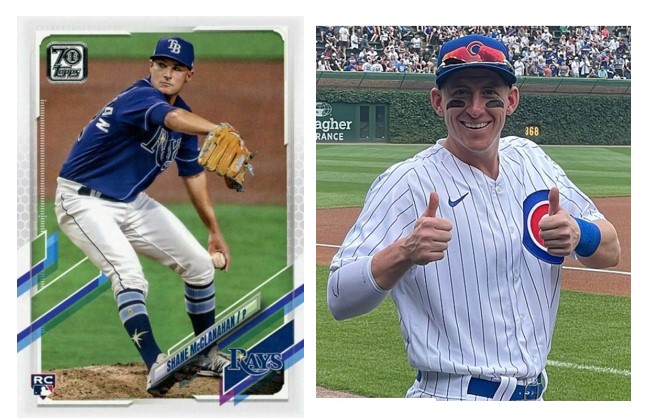
Baseball Roundtable Looks at Corbin Burnes’ Walk-Free Streak … or “What’s a guy go to do to get a win around here?”

This season, we’ve seen the two longest streaks of pitcher’s strikeouts without surrendering a walk and one is still active.  In this post, we’ll look a little bit deeper into the less likely of the two streaks – the one that just ended.

Brewers’ 26-year-old righty Corbin Burnes fanned 58 batters without issuing his first walk this season – which gave him the record for most strikeouts without a walk from the start of a season, as well as for the most strikeouts between walks for anywhere within a season.  Burnes didn’t walk his first batter until the fifth inning of his sixth 2021 start.

So far this season (through May 14), Burnes has a 1.57 earned run average in six starts. In 34 1/3 innings, he’s surrendered just 21 hits and six earned runs.  His efforts have not been rewarded in the W-L columns, however. He has two wins, three losses and one no-decision on the season. The Brewers have been shutout in all three of Burnes’ losses.  Through May 13, the Brew Crew had been shutout four times, and they were averaging  just 3.66 tallies per game, fifth-lowest in MLB.


Over the course of his streak, Corbin Burnes faced 125 batters and fanned 58 (46.4 percent) of them,

Here’s is a look at Burnes’ streak:

  • On April 3, Burnes pitched 6 1/3 innings versus the Twins and gave up just one run on one hit, while fanning 11. (The run came on a Byron Buxton home run in the seventh.)  Burnes left trailing 1-0 and the Brewers lost 2-0, getting just one hit off four Twins’ pitchers. (Loss for Burnes.)
  • On April 8, Burnes tossed six shutout innings versus the Cardinals, again giving up just one hit, while fanning nine. He left with a 1-0 lead, but the Brewers eventually lost 3-1.  (No decision for Burnes.)
  • On April 14, Burnes pitched six scoreless frames against the Cubs, giving up just two hits and fanning ten. He left with a 3-0 lead and the Brewers won 7-0, with Burnes getting the win.
  • On April 20, Burnes pitched six shutout frames against the Padres (four hits, ten whiffs). He left with a 5-0 lead and got the win as the Brewers prevailed 6-0).
  • Burnes had a bit of a hiccup on April 26, giving up five runs (four earned) on eight hits versus the Marlins (striking out nine). He took the loss as the Brewers fell 8-0. Burnes went on the IL after the game and didn’t return to the mound until May 13.
  • On May 13, Burnes pitched five innings versus the Cardinals, giving up one earned run (and, in the fifth inning, his first walk of the season), while fanning nine. He got the loss as the Brewers fell 2-0.

In Burnes’ streak, he went to three-ball counts on just 16 batters – retired 14 of them, ten on strikeouts (including the only two batters he started at 3-0).

Burnes came into the 2012 season with a career MLB record of 12-6, with a 4.48 earned run average and 3.4 walks (versus 11.8 strikeouts) per nine innings (146 2/3 innings pitched).

—-A new Streak to Watch —-

The Yankees’ Gerrit Cole, riding a zero-walk streak of his own, has been considerably more fortunate than Burnes. Cole has a still-active, within-a-season, streak of 56 strikeouts since his last walk. The streak began in the second inning of an April 12 game against the Blue Jays. Cole walked the leadoff batter that inning, gave up a single and then fanned the side (for the first three strikeouts of the 56-whiff, walk-free). Since that frame, he has pitched another 38 1/3 innings and fanned 53 more batters without giving up a free pass. Including the April 12 win, Cole has gone 4-1. With one no-decision in his streak. On the season, he is 5-1, 1.37 with 78 strikeouts (three walks) in 52 2/3 innings.  We’ll have to see if Cole passes Corbin’s streak in his next start.

Primary Resource:  Baseball-Reference.com


________________________________________________

100Baseball Roundtable is on the Feedspot list of the Top 100 Baseball Blogs.  To see the full list, click here.

I tweet baseball @DavidBBRT

Follow/Like Baseball Roundtable’s Facebook Page here.  More baseball commentary; blog post notifications; PRIZES.

Member: Society for American Baseball Research (SABR); The Baseball Reliquary; The Negro Leagues Baseball Museum.


Craig Anderson’s (Two-Victory) Day in the Sun

–Two Wins in One Day. and Then a Career-closing String of 19 Losses–

On this date (May 12) in 1962, the Mets’ Craig Anderson had his best day ever in the big leagues. The 23-year-old righty, in his second MLB season, notched a pair of major-league victories in a single day. It was part of a Mets/Braves doubleheader in New York – with both of his victories coming in relief and both ending  with Mets’ “walk-off.”  What Anderson didn’t know at the time is that those would be the last two wins of his MLB career.

In the first game, Anderson came on in relief of starter Roger Craig in the top of the eighth with the Mets trailing 2-1.  (Craig had been pinch hit for in  the  bottom of the seventh.) Anderson gave up an inning-opening double to Braves’ starter Warren Spahn, but then got LF Howie Bedell on a grounder back to the mound, 1B Tommie Aaron on a foul pop and RF Mack Jones on a strikeout. The Mets didn’t score in the bottom of the inning, and in the ninth Anderson walked CF Hank Aaron before retiring C Del Crandall on a ground out (Aaron to second); getting 2B Frank Bolling to hit into a fielder’s choice (Aaron out at third); and retiring 3B Denis Menke on a grounder to the mound.  In the bottom of the ninth, a single by Mets’ 1B Gil Hodges and a C Hobie Landrith walk-off two-run homer gave Anderson the win.

Did You Know ….

The Cubs’ Ed Reulbach (on September 28, 1908) started both games of a doubleheader against the Dodgers – and threw two complete-game shutouts.  Or that the Giants’ Joe “Iron Man” McGinnity started both ends of a double header three times in the month of August in 1903 … and won (and completed) all six games.  For these stories and more about pitchers with two complete-game wins in a single day, click here.

Game Two was less of a pitchers’ duel and, when Anderson came on  (with one on and no one out in the top of the ninth in a 7-7 game), he was the Mets’ sixth pitcher of the contest. Anderson again stifled the Braves’ offense and when Gil Hodges popped a walk-off home run in the bottom of the inning, Anderson had his second victory of the day.

After that May 12 game, Anderson’s career mark was 7-4 (one save), with a 2.82 ERA in 35 appearances.  Over the remainder of his MLB career, he would make 47 more  appearances for the Mets and go 0-19, with a 5.98 ERA – to finish at 7-23, 5.10 over four MLB campaigns. That streak of nineteen consecutive L’s in the decision line tied the major-league record at the time.  It was later broken by another Met (Anthony Young, who lost a record 27 consecutive decisions).   For that story and a look at other “lost” records, click here.

Let’s Shut this Thing Down

Craig Anderson started (and lost) the last MLB game ever played in the Polo Grounds (September 18, 1963). Anderson lasted 3 2/3 innings, giving up five hits and three runs (all unearned) as the Phillies  topped the hometown Mets 5-1 (bringing the Mets record to 49-104. ) Only 1,752 fans attended – the smallest attendance ever at an MLB game at the Polo Grounds.

A little more about Anderson and his career. He was signed by the Cardinals in 1960 – after starring on the mound for Lehigh University.  Anderson got off to an auspicious start, going 6-4 with a 1.68 ERA for the Double Tulsa Oilers in 1960. In 1961, he moved up to Triple A (Portland Beavers), where he was 6-3, with a 2.06 ERA – and, by  June of that season, he was pitching in the major league. He got in 25 games for the Cardinals (all in relief) that season and went 4-3, 3.26 with one save.  His performance (perhaps unfortunately) was noticed by the expansion Mets who selected him in the October,1961 MLB Expansion Draft.  (Of course, when we consider Anderson’s record with the Mets, we need to keep in mind the Mets went 40-120 in 1962 and had two twenty-game losers on their pitching staff (Roger Craig (10-24) and Al Jackson (8-20) – and Jay Hook was close at 8-19.)

As you’ve already read, Anderson got off to a good start with the Mets. After that may 12, 1962 doubleheader, he was 3-1, with 2.16 ERA (and probably never imagined he would never again see the MLB win column).  As of May 30, of that season, Anderson was still 3-1, had picked up two saves, and had a 2.38 ERA.  Then, between May 24 and June 2, he added four appearances and took three losses (and one blown save). As the season progressed and the losses mounted, the Mets even tried Anderson as a starter, which proved to be no favor.  (Anderson made 17 starts in his career and was 0-14, 7.05.  In 65 relief appearance, he was 7-9, five saves, 3.66 ERA.)

Anderson pitched in his last MLB game on May 31, 1964. He pitched in the minors until 1966.  After retiring as a professional baseball player, Anderson stayed with the game he loved – serving more than three decades as a pitching coach and administrators at Lehigh University.

Lehigh Hall of Fame

Craig Anderson is a member of the Roger S. Penske/Lehigh University Athletics Hall of Fame – recognizing his record as a collegiate pitcher (among those accomplishments were a 1.89 earned run average, an 18-strikeout game and a no-hitter); his status as the first Lehigh player to pitch in the major leagues; and his 34 years of service to Lehigh as a pitching coach, Athletics Department Business Manager and Lehigh’s first Director of Athletics Partnership. 

The fact is, no matter the final stat line, Craig Anderson pitched at the national pastime’s highest level and on May 12, 1962, truly had a day in the sun – a day which was preceded and followed by many more sunny afternoon and rightly lit nights at the ballpark.

Primary Resources:  Baseball-Reference.com; lehighsports.com


________________________________________________

100Baseball Roundtable is on the Feedspot list of the Top 100 Baseball Blogs.  To see the full list, click here.

I tweet baseball @DavidBBRT

Follow/Like Baseball Roundtable’s Facebook Page here.  More baseball commentary; blog post notifications; PRIZES.

Member: Society for American Baseball Research (SABR); The Baseball Reliquary; The Negro Leagues Baseball Museum.


No-Hitters …. Musings About the Iconic and the Ironic

This past week, Orioles’ southpaw John Means and Reds’ lefty Wade Miley threw the third and fourth no-hitters of the young 2021 season (May 5 and May 7, respectively) – which put us halfway to the all-time record of eight MLB no-hitters in a season (1884) and also led Baseball Roundtable to muse on the topic of no-hitters and the iconic and ironic facts that surround this year’s no-hitters and many of those that preceded them.
Did you know, for example, that:

  • Only two brothers have thrown MLB no-hitters?
  • Babe Ruth started on the mound in the first-ever combined MLB no-hitter?
  • One pitcher hit two home runs in a no-hitter and later that same season pitched a game in which he retired 32 consecutive batters and drove in the winning run with a walk-off single?
  • Only one pitcher has thrown a no-hitter in his very first start – and he went on to put up a earned run average north of ten for the rest of his career?

(Side note:  I apologize for the narrow column width.  After a recent WordPress upgrade, my page layout went a little wonky.  I’m working on it – and will continue to generate content while the fix is underway.)
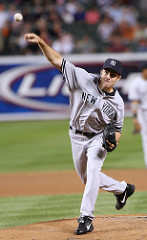
For these no-hitter stories and more, read on.

Baseball Roundtable Disclaimer:  The MLB records referenced in this (and previous) posts have the potential to change as Major League Baseball recognizes and incorporates Negro League records from 1920-46 into the MLB record book.

Let’s start off easy. Miley fanned eight batters in his May 7 no-hitter – well short of  the iconic no-hitter record of 17 strikeouts (the Angels’ Nolan Ryan on July 15, 1973 and the Nationals’ Max Scherzer on October 3, 2015).

Pitching to Contact

There have been  three no-hitters thrown in which the achieving pitcher did not fan a single batter: the Browns’ Earl Hamilton (August 30, 1912); Yankees’ Sam Jones (September 4, 1923); and Cubs’ Ken Holtzman (August 19, 1969). 

Miley threw 144 pitched in his no-hitter, 72 for strikes.

That’s a Lot of Pitches, but Who’s Counting?

The most pitches tossed in a no-hitter is 149, by the Diamondbacks’ Edwin Jackson (June 25, 2010). Jackson’s pitch count was up to 70 after three innings – during which he gave up seven walks, thew one wild pitch and fanned two.  In those first three frames, he went to a 3-2 or 3-1 count on nine of 17 batters faced.   For the game, Jackson walked eight and fanned six.

In Means’ no hitter, he delivered a first-pitch strike to 26 of the 27 batters he faced. His 96.4 percent first-pitch strike rate is the best ever in a no-hitter and the second best by any pitcher in a game when they faced at least 27 batters. (A comment on the record holder below.)

Getting Over Getting It Over

On June 30, 2004, the Twins’ Brad Radke faced 28 White Sox’ batters and recorded a first pitch strike on 27 of them (96.4 percent). Ironically, Radke (unlike Means) didn’t fare very well.  He lasted only six innings, giving up eight runs on eight hits (no walks though). These stats further illustrate a couple of things I’ve said often in this post: 1) In baseball, we count everything; and 2) When BBRT starts looking at a topic, “one thing often leads to another.”

Means’  no-hitter was his first MLB complete game.

Making Those Complete Games Count

Philip Humber threw just one complete game in his career – but it was “perfect.”

The White Sox’ Philip Humber three just one complete game in his eight-season  MLB career – a perfect game against Seattle on April 21, 2012.  Mike Fiers has thrown just two complete games in 11 MLB seasons (to date) – and they were both no-hitters. 

Joe Musgrove’s no-hitter on April 9 of this season was the first-ever for a Padre – removing their distinction as being the only franchise without a no-hitter in their history.

It’s a Start

The Padres, Mets, Brewers, Rockies, Blue Jays, Rays, are tied for the fewest no-hitters in a franchise’s history at one each.  The Dodgers’ franchise has the most MLB no-hitters at 26.

When the Whites Sox’ Carl Rodon pitched his no hitter (this April 14) all that stood between him and a perfect game was one hit batsman. The Elias Sports Bureau reports this it was just the sixth time (modern era) that a pitcher has missed a perfect game by one HBP. It was also the second time this season (Joe Musgrove).

Far From Perfect

In A.J. Burnett’s May 12, 2001 no-hitter for the Marlins, a 3-1 win over the Padres, every starting position player for the Padres reached base at least once.  (Burnett walked nine and hit one batter). Burnett threw 65 strikes and 64 balls in the game – his 50.4 percent strike-to-ball ratio is the worst ever in a no-hitter.

Here are a few more historic no-hitter tidbits.

  • Ouch!  In his June 9, 2015 no-hitter, the Giants’ 27-year-old rookie Chris Heston set an MLB no-hitter record by hitting three batters in the course of his 5-0 no-hit win over the Mets.  Ironically, control did not seem to be a problem for Heston – who didn’t walk a single better, while striking out 11.
  • Even More Painful!  On April 23, 1964, Houston Colt .45’s pitcher Ken Johnson tossed a no-hitter against the Reds – walking two and fanning nine.  However, his Colts didn’t score and, in the top of the ninth, two errors led to an unearned run and Johnson painfully lost the game 1-0. The only other no-hitter loss came on April 30 , 1967, when Steve Barber and Stu Miller of the Orioles tossed a combined no-hitter against the Tigers,  Detroit, however, turned three walks, a wild pitch and two Orioles’ errors into a 2-1 win.
  • And, Yet Even More Painful. On May 26, 1959, the Pirates’ Harvey Haddix tossed 12 perfect innings against a powerful Milwaukee Braves’ lineup and lost the “perfecto”, no-hitter, shutout and game in the unlucky thirteenth –   thanks, in part, to an inning-opening error.  For details on that contest, click here. 

Good Genes

Bob Forsch and Ken Forsch are the only brothers to both throw an MLB no-hitter.

  • Celebrating in a Big Way. On July 4, 1912, the Tigers’  George Mullin celebrated Independence Day by tossing a no-hitter against the Browns  (a 7-0 win).  Oh yes, he was also celebrating his birthday  – and is still the only MLB pitcher to toss a no-hitter on his birthday. (Again, in baseball, we count everything.)
  • That’s  Why We Have Two Leagues. There are some big names among pitchers who have thrown a no-hitter in both the AL and NL:  Cy Young (Cleveland Spiders/NL and Boston Americans and Red Sox/AL);  Jim Bunning (Detroit Tigers/Philadelphia Phillies); Hideo Nomo (LA Dodgers/Boston Red Sox); Randy Johnson (Seattle Mariners/Arizona Diamondbacks); Nolan Ryan (Houston Astros/California Angels/Texas Rangers).
  • Let’s get this Party Started. On April 16, 1940, the Indians’ Bob Feller threw the only Opening Day no-hitter, topping the White Sox 1-0 at Comiskey.

Bob Feller threw three no hitters in his MLB career.

  • Postscript.  Yankee Don Larsen’s October 8, 1956, perfect game against the Dodgers in game five of the 1956 Series is the only World Series no-hitter.  The Phillies’ Roy Halladay threw the only other post season no-hitter to date, as he topped the Reds in game one of the 2010 NL Division Series (October 6, 2010).  Side note: Just three days before is perfect game, the Dodgers’ had knocked Larsen from the mound after 1 2/3 innings.
  • I Get By with a Little Help from My Friends. There have been 13 combined no-hitters and the most pitchers used in a combined no-hitter is six  On June 11, 2003,  Roy Oswalt started for the Astros against the Yankees, but aggravated a groin injury in the second inning (having not given up a hit).  Oswalt was followed to the mound by Pete Munro, Kirk Sarloos, Brad Lidge, Octavio Dotel and Billy Wagner – and the six hurlers combined to no-hit the “Bombers” 8-0.  The Seattle Pilots matched the Astros’ no-hit pitcher count on June 8, 2012, when Kevin Millwood, Charles Furbush, Stephen Pryor, Lucas Luetge, Brandon League and Tom Wilhelmsen combined to no-hit the Dodgers 1-0.

Iconic and Ironic

On June 23, 1917, the iconic Babe Ruth took part in the first-ever (and perhaps most ironic) combined no-hitter. Ruth started the game on the mound and – after walking the first hitter – was tossed from the contest for arguing with the umpire. Ernie Shore relieved Ruth and, after Ruth’s base runner was erased on a stolen base attempt, Short retired 26 in a row to complete the no-hitter.

  • A (Going) Deep Commitment to Victory. On June 23, 1971 Rick Wise of the Phillies went two-for-four, with two homers and three RBI, while no-hitting the Reds 4-0 in Cincinnati.  Wise is the only hurler to go deep twice while tossing a no-hit game.  And this was no easy no-no.  It was against the “Big Red Machine,” with a lineup featuring such hitters as Pete Rose, George Foster, Johnny Bench, Tony Perez, Lee May. Other pitchers to homer (once) in the midst of a no-hit game are the Indians’ Wes Ferrell, in a April 29, 1931, 9-0 no-hit win over the Saint Louis Browns; the Braves’ Jim Tobin in an April 27, 1944, 2-0 no-hit win over the Dodgers;  and the Tigers’ Earl Wilson, in a June 26, 1962, 2-0, no-hit victory over the Angels.

More #WhyIHateTheDH

On June 23, 1971, the Phillies Rick Wise hit two home runs in a game in which he also tossed a no-hitter (see paragraph immediately above.)  On September 18 of that same season, he started against the Cubs and gave up three runs on four hits (two home runs) to the first eight batters he faced.  He then settled down and retired thirty-two consecutive batters – until giving up s s single in the top of the twelfth inning. With the game tied at three, Phillies’ RF Willie Montanez singled to open the bottom of the twelfth frame and was sacrificed to second (bunt by 1B Greg Luzinski). The Cubs then intentionally walked 2B Don Money and RF Ron Stone, bringing up Wise – who singled on the first pitch he saw to plate the winning tally. 

My, how the game has changed – a starter going 12 innings, a slugger like Luzinski laying down a bunt and a pitcher left in to hit in a crucial situation. Gotta love old school baseball.  Wise, by the way, hit .236, with six home runs and 15 RBI (97 at bats) on the season. 

  • Not Exactly a Walk in the Park. The most walks in a no-hitter is eleven by Blue Moon Odom and Francisco Barrios (combined), as the White Sox topped the A’s (Odom was with the White Sox by then) 2-1 on July 28, 1976.  Odom lasted just five innings, walking nine of the 22 batter he faced.  He was relieved – holding a 2-1 lead – after walking the lead-off hitter in the bottom of the sixth (and going 1-0 on the next batter).  Francisco Barrios came on and finished the game, allowing no hits, but walking two more in four innings of work.

No-Hit Pitchers Gone Wild

The most walks in a no-hitter by one pitcher is ten by Steve Barber in a combined no hitter.  Barber took a no-hitter, albeit with seven walks, and a 1-0 lead into the top of the ninth as his Orioles played the Tigers in Detroit on April 30, 1967.  Barber walked the first two batters in the final inning. Then a sacrifice moved them to second and third.  A wild pitch followed, plating the tying run.  Barber walked the next hitter, and was relieved by Stu Miller. Miller finished up the no-hitter, but the go-ahead run scored on an error, giving the Tigers a 2-1 win without the benefit of a hit.   The Reds’ Jim Maloney also walked ten (and struck out twelve) in no-hitting the Cubs 3-0 in ten innings on August 19, 1965.  The most walks in a nine-inning “solo” no-hitter:  Nine by A.J. Burnett, as his Marlins topped the Cubs 3-0 on May 12, 2001.

  • Most Unlikely No-hitters.  Twenty-two year old rookie Bumpus Jones is the only player to toss a no-hitter in his first-ever MLB appearance (October 25, 1892 for the Reds) – others have tossed one in their first start, but not first appearance.  Jones pitched in just seven more games in MLB (one more season) and in those contests went 1-4, with a 10,19 earned run average.  Then there is the Tigers’ Virgil Trucks, who tossed two no-hitters for the Tigers in the 1952 season, when he won just five games (19 losses), with a 3.97 ERA.  Finally, you have to include the White Sox’ Philip Humber on this list,  Not only was his his 2012 perfect game his only complete game in eight MLB seasons, he finished the season with a 5-5 record and a 6.44 eared run average, and was 16-23, 5.31 for his MLB career.
  • Most unlikely name for a no-hit pitcher. The Reds’ Homer Bailey tossed a pair of no-hitters.

Most Necessary No-Hitter?

When Dodgers’  icon Sandy Koufax tossed a perfect game on September 9, 1965, he pretty much needed it. He was opposed by Cubs’ right-hander Bob Hendley (who went 48-52, 3.97 in a seven-year MLB career), who was on top of his game as well.

After eight innings, Hendley had given up just one hit and one walk (versus three strikeouts). The only hit had been a harmless double by Dodgers’ LF Lou Johnson in the bottom of the seventh. Hendley had allowed just one run in eight frames – and even that wasn’t his fault.  The pesky Johnson had led off the fifth with a walk; moved to second on a sacrifice by RF Ron Fairly; stole third; and scored as Cubs’ C Chris Krug made a wild throw past third baseman Ron Santo.  

Hendley’s efforts, however, weren’t nearly enough that day. Koufax, who came into the game already a 20-game winner (21-7 on the season), threw a perfect game – striking out 14 Cubs.  While his ill-timed one-hitter didn’t even get Hendley a win, he does share the record (with Koufax) for pitching in the MLB game with the fewest combined hits ever.

  • Most no-hitters thrown under the influence of LSD.  One by Dock Ellis, June 12, 1970. For more on that game, click here.
  • Most no-hitters by a one-handed pitcher.  One each by: Hugh Daily (Cleveland Blues) September 13, 1883 and Jim Abbott (Yankees) on September 4, 1993.
  • Keep the ball rolling. The Reds’  Johnny Vander Meer is the only player to throw no-hitter in consecutive starts June 11 and June 15, 1938.
  • Working Overtime. Only three pitchers have successfully thrown complete-game no-hitters of more than nine innings.  All three – fashioned ten-inning,complete-game no-hitters; George Wiltse, Giants (July 4, 1908); Fred Toney, Reds (May 2, 1917); and Jim Maloney, Reds (August 19, 1965).

Double Your Pleasure … 

On May 2, 1917, the Reds’ Fred Toney and Cubs’ Hippo Vaughn hooked up in an epic and iconic duel. Over nine innings neither hurler had surrendered a hit (each had given up two walks). Vaughn faltered in the top of the tenth, when two singles and an error led to a Reds’ run – driven in on a single by Jim Thorpe.  Toney had a 1-2-3 bottom of the ninth for the win and the no-no. 

  • Old Guys Rule. The oldest player to toss a no-hitter is Nolan Ryan at age 44 (and 90 days) on May 1, 1991 (for the Rangers); the youngest is Amos Rusie at 20 years (and 62 days) on July 31, 1891 (for the Giants).  The 44-year-old Ryan, notably, fanned 16 batter and walked just two in his 1991 no-hitter.

Photo by tonystl

Lucky Number Seven

Nolan Ryan holds the record for no-hitters with seven. 

Primary Resources:  Baseball-Reference.com; Baseball-Almanac.com; MLB.com

________________________________________________

100Baseball Roundtable is on the Feedspot list of the Top 100 Baseball Blogs.  To see the full list, click here.

I tweet baseball @DavidBBRT

Follow/Like Baseball Roundtable’s Facebook Page here.  More baseball commentary; blog post notifications; PRIZES.

Member: Society for American Baseball Research (SABR); The Baseball Reliquary; The Negro Leagues Baseball Museum.