The Baseball Reliquary 2018 Shrine of the Eternals Electees – They Came to Play

ReliquaryNewOn May 3, Baseball Roundtable featured the 2018 Negro Leagues Baseball Museum’s 2018 Hall of Game honorees – Dick Allen; Eddie Murray; Jim “Mudcat” Grant; and J.R. Richard. (See that post here.) In this post, we will look at the recently announced 2018 electees to the Baseball Reliquary’s Shrine of the Eternals – which takes a more eclectic approach to the national pastime.  Let me add that I am proud to be a card-carrying member of both organizations.

I’ve asked a version of the following question on this page before, but it remains the best way to introduce the Baseball Reliquary and its Shrine of the Eternals.

What do the following have in common – a pitcher who once threw a no-hitter while high on LSD; a team owner who sent a midget to the plate; a man in a chicken suit; a member of Major League Baseball’s 3,000-hit club; a MLB catcher who one season led the National League in passed balls, despite starting only 59 games behind the plate; another backstop known as much for his malapropisms as his record 71 World Series base hits; an MLB manager who won eight World Championships; a one-armed outfielder; a one-handed  pitcher; a cartoon character who  managed and pitched his team to more than 1,000 losses (and just a handful of wins); a baseball card designer; a surgeon; a labor leader; a statistical wizard;  and more than one best-selling author?

These diverse individuals are all among the past electees to The Baseball Reliquary’s Shrine of the Eternals – an honor that recognizes individuals who have had impact on our national pastime that goes beyond statistics and touches upon the culture and character of the game.  In essence, the Shrine of the Eternals is our national pastime’s fan-focused Hall of Fame. (This year, you can add a crafty southpaw, a red-headed raker and a true player to the list)

The Baseball Reliquary this week announced its latest (2018) Shrine of the Eternals electees, who will be enshrined during ceremonies slated for 2:00 p.m., Sunday July 22nd, at the Donald R. Wright Auditorium, Pasadena Central Library, 285 E. Walnut Street, Pasadena, California.  If there is one thing this year’s honorees share, it’s a long tenure of excellence.  Together the three have played more than 80 combined seasons in major league ballparks.  Here are the electees:

Tommy JohnLed all nominees – named on 44 percent of the ballots.

Southpaw Tommy John won 288 major league games in 26 MLB seasons (1963-89), 164 of those victories after undergoing the ground-breaking surgery that now bears his name – and which also earned surgeon Frank Jobe a spot in the Shrine of the Eternals in 2012.

Rusty Staub …

Daniel Joseph Staub’s red hair earned him the nickname Rusty and, in Montreal, the title Le Grand Orange. The first baseman/outfielder’s potent bat earned him a 23-season MLB career, six All Star selections and a special spot in the hearts of Expos’ and Mets’ fans.

Nancy Faust …

Nancy Faust played lively, relevant and witty organ music at sporting events for four decades (1970-2010) and was a fixture at Old Comiskey and New Comiskey (U.S. Cellular field) Parks.

Before taking a closer look at this year’s electees, the full roster of Shrine of the Eternals inductees and my own 2018 ballot, I’d like to provide a brief overview of both the Baseball Reliquary and its Shrine of the Eternals.

Spoiler Alert: Unabashed membership recommendation to follow.  If you are a baseball fan, I would highly recommend you consider membership in the Baseball Reliquary – a truly free-spirited (if somewhat eccentric) organization dedicated to celebrating the human side of baseball’s history and heritage.  The Baseball Reliquary is an open and fan-focused organization, committed to recognizing baseball’s place in American culture and to honoring the character and characters of the national pastime. It pursues that mission through its collection of artifacts, traveling exhibitions, ties to the Whittier College Institute for Baseball Studies and its own version of the Baseball Hall of Fame – the Baseball Reliquary Shrine of the Eternals.  For more on the Baseball Reliquary, and why you should become a member, click here.

Now, to the Shrine of the Eternals. Here’s what the Reliquary has to say about this honor.

The Baseball Reliquary Shrine of the Eternals

Similar in concept to the National Baseball Hall of Fame, the Shrine of the Eternals differs philosophically in that statistical accomplishment is not the principal criterion for election. The Baseball Reliquary believes that the election of individuals on merits other than statistics and playing ability will offer the opportunity for a deeper understanding and appreciation of baseball than has heretofore been provided by “Halls of Fame” in the more traditional and conservative institutions.

Criteria for election shall be: the distinctiveness of play (good or bad); the uniqueness of character and personality; and the imprint that the individual has made on the baseball landscape. Electees, both on and off the diamond, shall have been responsible for developing baseball in one or more of the following ways: through athletic and/or business achievements; in terms of its larger cultural and sociological impact as a mass entertainment; and as an arena for the human imagination.

Each year, the Baseball Reliquary submits a list of candidates to its members and the top three vote-getters are honored.  (Each member may vote for up to nine nominees.) With that background behind us, let’s take a look at the 2018 honorees.  After we look at this year’s electees, I’ll also comment on BBRT’s ballot – and the nominees I voted for who did not make the final three.   Note: voting percentages for all the 2018 candidates can be found at the end of this post. 

_____________________________________________________________
2018 SHRINE OF THE ETERNALS HONOREES


Tommy John – LHP … (1943 – * )

Tommy John ... Courtesy of The Bsseball Reliquary

Tommy John … Courtesy of The Bsseball Reliquary

Southpaw Tommy John signed with the Cleveland Indians right out of high school (Gerstmeyer High School in Terre Haute, Indiana), where he was already known for finesse, guile, heart, work ethic and about as good a high school curve ball as the scouts had ever seen. Note: John had not only gone 28-2 on the high school mound, the 6’3”, 185-pound lefty was also a highly-recruited basketball star.

John began his pro baseball career at age 18, showing his promise by going 10-4, 3.17 in 14 games (13 starts) for the Dubuque Packers of the Class D Midwest League. Just two seasons later – at age 20 – he would make his major league debut; called up to the Indians in September (John was 15-10 at Double A/Triple A). He went 0-2, 2.21 in six games – and, most likely, did not expect he would still be pitching in the major leagues a quarter of a century later.

From 1963-74 – pitching for the Indians, White Sox and Dodgers – John went 124-106, with a 2.97 ERA.  His reputation as a crafty and gutsy lefty is supported by the fact that he fanned just 1,273 batters in 2,165 2/3 innings. In 1973 and 1974, John seemed to be hitting his peak as a pitcher.  In 1973, he went 16-7 – with an NL-leading .696 winning percentage and a 3.10 ERA. In 1974, by mid-July, John was 13-3, with a 2.50 ERA.  (His .813 winning percentage would eventually lead all of MLB that season.)

Then, in the third inning of a July 17 start against the Montreal Expos – with the Dodgers leading 4-0 and John seemingly on his way to a 14th pre-All Star break win – disaster struck.  John heard and felt a pop in his left elbow, accompanied by a sudden loss of strength in his arm. It was originally thought that John’s dead arm – his throws could no longer even reach the plate – was the result of long-term stress and might respond to rest. When more than a month passed with no improvement, John learned that he had torn the ligament in his elbow – and the general consensus was that it was beyond repaid and he would never pitch again.

Dodgers’ physician Dr. Frank Jobe suggested a new surgical procedure – replacing the torn ligament with one from another part of his body (in this case, John’s right wrist). It was a procedure no pitcher had undergone and neither Jobe nor John new exactly what to expect. During a long and arduous post-surgery rehab (John missed the entire 1975 season), John showed the same grit and tenacity that had made him a winner on the mound – and the results exceeded expectations.

The development of what is now termed “Tommy John Surgery” helped Tommy John to 14 additional major league seasons (164 additional victories).  The surgery is now considered a routine procedure and has helped prolong the careers of a host of major leaguers. And, Dr. Jobe beat Tommy John to a spot in the Shrine of the Eternals by six years.

John came back in 1976 to go 10-10, 3.09 in 31 starts (207 innings). The rest, as they say, is history.  John, who had 124 wins and one All Star selection in 12 seasons before the surgery, earned another 164 victories and three more All Star selections in 14 seasons after the surgery. His post-surgery record included three 20-win seasons (a high of 22 wins in 1980). He also made all of his 14 post-season appearances post-surgery – compiling a 6-3, 2.64 post-season record.

John pitched until age 46 – racking up 288 wins (231 losses), a 3.34 earned run average, 162 complete games, 46 shutouts and 2,245 strikeouts in 4,710 1/3 innings pitched.  The left arm that in 1974 was thought to be damaged beyond repair, pitched more than 2,500 post-surgery innings.  BBRT says “Well-played, Tommy John” – and, of your election to the Shrine of the Eternals, “Well-earned.”

Rusty Staub – 1B/OF … (1944-2018)

Rusty Staub ... Courtesy of The Baseball Reliquary

Rusty Staub … Courtesy of The Baseball Reliquary

Rusty Staub was part of the expansion Houston Astros’ youth movements and played in 150 games for the Astros as a 19-year-old (1963). While he hit only .224-6-45 that season, there was plenty of major league baseball – 22 more seasons – in his future.

In a major-league career that stretched from 1963 to 1985 – and saw Staub don the uniforms of the Astros, Expos, Mets, Tigers and Rangers – the left-handed hitter was a six-time All Star (five seasons consecutively from 1967 through 1971). He hit .300 or better five times, topped 20 home runs four times and had 100+ RBI three times.  Staub joined the expansion Montreal Expos in 1960 and became the first star of the first MLB franchise located outside the United States. As an Expo from 1969 to 1971 (when he was traded to the Mets for Tim Foli, Mike Jorgensen and Ken Singleton), Staub was an All Star each season and put up a stat lines  of: .302-29-79; .274-30-94; and .311-19-97.  He scored 271 runs over that span. Staub was an instant fan favorite in Montreal, earning the nickname – thanks to his red hair and fan-friendly attitude (even working to learn the French language) – of Le Grande Orange.  His number 10 was the first number ever retired by the Expos’ franchise.

In 1962, 18-year-old Rusty Staub starred as a member of the Durham Bulls in the Class B Carolina League.  Staub led the league with 149 hits, batting .293, with 23 home runs, 93 and 115 runs scored in 140 games.

Over the course of his career, Staub played 23 MLB seasons and 2,951 games.  He put up a .279 average and collected 2,716 base hits, 499 doubles, 47 triples and 292 home runs.  He also scored 1,189 times and drove in 1,466 tallies.

Rusty Staub is the only MLB player to collect at least 500 base hits with four different teams – Mets, Astros, Expos, Tigers).

Staub was a fan favorite wherever he played, noted for a combination of strong baseball skills and personal character. The New York Mets (Staub played for the Mets from 1972 to 1975 and 1981 to 1985)) held Rusty Staub Day in 1986. He has been inducted into the Mets Hall of Fame; Louisiana Sports Hall of Fame; Texas Baseball Hall of Fame; and Canadian Baseball Hall of Fame.

Staub was also an acknowledged humanitarian. He established the New York Police and Fire Widows’ and Children’s Benefit Fund which, since 1986,  has raised over $150 million for families of policemen, firefighters, emergency service, and port authority officers killed in the line of duty. He also established The Rusty Staub Foundation which, since 1985, (working with Catholic Charities) has raised over $17 million in support of emergency food pantries. Staub died of a heart attack on March 29, 2018, at age 73.

Nancy Faust – Chicago Sports Scene Icon …  (1947 – *)

Nancy Faust may be the only person to play for the Chicago Bulls, Blackhawks and White Sox.

Nancy Faust - Courtesy of The Baseball Reliquary

Nancy Faust – Courtesy of The Baseball Reliquary

Nancy Faust is arguably the most noted  ball park organist of all time, entertaining White Sox fans with her musical talents and wit (in song selection) from 1970 to  2010.

A Chicago native, Faust began playing the organ as a youngster, under the tutelage of her mother, a professional musician. After earning a degree in psychology, Faust supported herself by playing at sporting events – while searching for a position in her chosen field.  That temporary avocation turned into a life-long vocation – and psychology’s loss was Chicago baseball’s gain.

In 1970, when the White Sox went looking for a successor to Comiskey Park organist Bob Creed, the 23-year-old Faust got the job. She was an immediate hit with the fans – for both her musical talent and wit. She added rock music and popular culture (musical lines from popular television ads or shows) to the traditional ball park musical fare.  For example, Faust is credited with being the first ball park organist to play snippets from the tune “Na, Na, Hey, Kiss Him Goodbye” when an opposing pitcher was vanquished from the field.  It also was her version of “Take Me Out to the Ball Game” that prompted  White Sox’ (and future Cubs’) announcer Harry Caray to begin leading the fans in a rousing version of the tune – a tradition he carried with him to the Cubs.

Faust’s reputation as the most notable organist in the game even earned her as story  in Sports Illustrated – where she was referred to as baseball’s “Most Valuable Organist.” Recognizing her tenure and contributions, the White Sox honored her before their September 18, 2010 game at U.S. Cellular Field – which was also Nancy Faust Bobblehead Night.

Welcome to the Shrine of the Eternals, Nancy Faust – Clearly, you came to play.

__________________________________________

2018  SHRINE OF THE ETERNALS BALLOTING

Tommy John – 44%

Rusty Staub – 29%

Nancy Faust – 26.5%


Bob Costas – 25.5%

Leo Durocher – 25%

Effa Manley – 25%

J.R. Richard – 25%

John Young – 24%

Denny McLain – 23.5%

Chet Brewer – 22.5%

Fred Merkle – 21%

Lisa Fernandez – 20%

Rube Foster – 20%

Bill White – 20%

Charles M. Conlon – 19.5%

Mamie Johnson – 19.5%

Octavius V. Catto – 18%

Pete Reiser – 18%

Jim Thorpe – 18%

Rube Waddell – 18%

Dr. Mike Marshall – 17.5%

John Thorn – 17.5%

Mike Veeck – 17.5%

Rocky Colavito – 16%

Ernie Harwell – 16%

Hideo Nomo – 16%

Bing Russell – 15.5%

Janet Marie Smith – 15.5%

Tug McGraw – 14.5%

Vic Power – 14.5%

Charlie Finley – 14%

Joe Pepitone – 14%

Shorty Perez – 14%

Charley Pride – 14%

Luke Easter – 13%

Ted Kluszewski – 13%

Dave Parker – 13%

Phil Pote – 13%

Annie Savoy – 13%

Chris Von der Ahe – 13%

Kurt Bevacqua – 12.5%

Bert Campaneris – 12.5%

Masanori Murakami – 12.5%

Mo’ne Davis – 11.5%

Doris Sams – 11.5%

Oscar Gamble – 8%

Jim Creighton – 4.5%

Lenny Randle – 3.5%

George Stovey – 3%

Adolfo Phillips – 0.5%

___________________________________________

BASEBALL ROUNDTABLE’S SHRING OF THE ETERNALS BALLOT

Now, here’s a look (in alphabetical order) at the 2018 candidates BBRT voted for who didn’t make the final three. (I did vote for Tommy John.)

Rube Foster (1879-1930)

Andrew “Rube” Foster was an outstanding hurler, confined – by history – to pitching primarily for Black teams; such squads as the Chicago Union Giants,  Cuban X-Giants and Philadelphia Giants. How good was Foster on the mound? Records are sketchy, but the  Baseball Hall of Fame reports that, in 1902, Foster  ran off a streak of 44 straight victories and the Negro League Baseball Museum credits Foster with a 54-1 record that season.

Rube Foster’s tireless efforts earned him the unofficial title of “The Father of Black Baseball.”

Foster’s contributions to the national pastime, however, went beyond the mound. In 1911, he partnered with John Schorling (son-in-law of Charles Comiskey) to establish the Chicago American (Black) Giants – who, under Foster’s leadership, became Black baseball’s most dominant team.. But Foster wasn’t done yet.  In 1920, he was a key player (cited by many as THE key player) in the founding of the Negro National League.  As the league flourished, Foster wore many hats. He served not only as the league’s president and treasurer, but also was the owner and manager of the Chicago American Giants – winning the NNL’s first three pennants.  By 1926, his demanding schedule had taken a toll and Foster suffered a nervous breakdown. He never fully recovered and passed away prematurely in 1930. Fans might enjoy Larry Lester’s book “Rube Foster in His Time: On the Field and in the Papers with Black Baseball’s Greatest Visionary.”

Rube Foster was elected to the National Baseball Hall of Fame in 1981.

________________________________

Mamie “Peanut” Johnson (1935 – 2017)

Mamie Johnson was one of three females to play for the Indianapolis Clowns during the declining days of the Negro Leagues (and the only woman ever to pitch in the Negro Leagues).  Johnson took the mound to the Clowns for three seasons (1953-55), running up a 33-8 record.  Her exploits are chronicled in the children’s book “A Strong Right Arm: The Story of Mamie ‘Peanut’ Johnson,” by Michelle Y. Green.

________________________

Ted Kluszewski (1924-1988)

I love to recognize players who do something we are not likely to see again. Therefore, I again cast a ballot for Ted “Big Klu” Kluszewski – perhaps the last of the true power hitters who also practiced exceptional plate discipline.  In 1954, for example, Big Klu hit .326, with 49 home runs and 141 RBI – a season made even more remarkable by the fact the Kluszewski struck out only 35 times (versus 78 walks). I doubt if we’ll ever see another player top 40 home runs without reaching 40 whiffs.  Kluszewski, in fact, had a streak of four seasons (1953-56) when he hit over .300, drove in 100+ runs, bashed 35+ home runs – and struck out no more than 40 times in any season.  In those four seasons, Kluszewski hit 171 home runs – and fanned 140 times. It should also be noted that Kluszewski led NL first baseman in fielding percentage every year from 1951 through 1955.  Unfortunately, a back injury in 1956 hampered his performance in the later years of his career (he played until 1961).

Ted Kluszewski is noted for adding a bit of style and flair to the game, making his own intimidating fashion statement. Klu complained that his uniform jersey was too tight for his large and powerful biceps. He went on to have the sleeves cut from his jersey – exposing his bare arms from the shoulder.  (This was considered a bold move at that very conforming time in the game’s history.)

Kluszewski only appeared in one post-season – hitting .391, with three homers and ten RBI in the 1958 World Series (for the White Sox).  True to his form – Big Klu did not strike out even once (25 plate appearance) in the Series.  For trivia buffs, left unprotected in the 1960 expansion draft, Kluszewski hit the first-ever home run for the expansion Angels (a two-run shot in the first inning of the Angels’ first game – April 11 versus the Orioles). He added a punctuation mark, by hitting the Angels’ second–ever home run (a three-run shot) the very next inning. The Angels won 7-2, and (of course) Kluszewski did not strikeout.

____________________________

Mike Marshall (1943 –  *)

I should probably say Doctor Mike Marshall, since this former major league reliever (14 seasons … 1967, 1969-81) earned three college degrees, including a Ph.D. in Kinesiology from Michigan State University. Kinesiology is the study of muscle movement and Marshall used his knowledge to develop his own exercise program focused on minimizing stress, reducing injury and accelerating recovery time.  While his unorthodox methods, advanced education and outspoken approach often had him at odds with baseball’s traditionalists (and may be part of the reason he pitched for nine teams in 14 seasons), they did get the job done.

The fact is, we never saw a closer quite like Mike Marshall before he came along – and we’re not likely to see one like him again. In 1974, as a Dodger, he put up the grand-daddy of all relief seasons – setting the single-season MLB records for appearances with 106 and innings pitched in relief at 208 1/3. He finished the campaign 15-12, with a league-topping 21 saves and a 2.42 ERA.  That season, Marshall was called on to go more than one inning in 74 games (68.5 percent of the time); and he toiled three or more innings 22 times. He also relieved in 13 consecutive regular-season games – an MLB record later tied (1986) by the Rangers’ Dale Mohorcic. His efforts won him the 1974 Cy Young Award and Sporting News NL pitcher of the year.

Marshall holds the MLB and NL record for games pitched in relief in a season (106 – Dodgers, 1974), as well as the AL record (89 in relief – Twins, 1979 – he also had one start that year).  The Blue Jays’ Mark Eichhorn tied Marshall’s AL record in 1987. Marshall led his league in games pitched four times and saves three times – finishing 97-112, 3.14 with 188 saves.

A true “fireman” from an era when closers came in to put out fires and stayed on the mound to ensure they were no flare ups, Marshall got my vote for the Shrine.

______________________________________

Pete Reiser (1919-1981)

Combine Willie Mays’ skill set (younger folks, think Mike Trout) with Pete Rose’s hustle and on-field abandon and you have Pete Reiser. In his first full MLB season (CF, Dodgers), a 22-year-old Reiser dazzled defensively and led the NL in runs scored (117), doubles (39), triples (17), batting average (.343), total bases (299) and hit by pitch (11) – tossing in 14 home runs and 76 RBI for good measure. Unfortunately, unpadded outfield walls, helmet-less at bats (the fiery Reiser was a frequent bean ball target) and aggressiveness on the base paths (Reiser twice led the NL in stolen bases and holds the NL record for steals of home in a season at seven) took their toll.

In his ten-season career, the switch-hitting Reiser endured five skull fractures, a brain injury, a dislocated shoulder and a damaged knee.  He was carted off the field 11 times during his career (six times unconscious) and once actually given last rites at the stadium – and he played on. The three-time All Star retired as a player with a .295 career average, playing in 861 games over ten seasons. No telling what he might have done with padded outfield walls and batting helmets.  Pete Reiser was a true – and talented – gamer. For more on Reiser, try “Pete Reiser: The Rough and Tumble Career of the Perfect Ballplayer,” by Sidney Jacobson.

____________________________________

Rube Waddell (1876-1914)

Rube Waddell is almost universally recognized as the zaniest player in MLB history – but he also was one of the best (at least when he was focused on the game). Waddell was known to: leave a ball game to chase fire engines; miss a game he was scheduled to start because he was fishing or playing marbles with neighborhood kids; bring his outfielders in to sit on the grass and then proceed to fan the side; wrestle alligators in the off-season; and (frequently) do battle with owners and managers.  Waddell simply was more interested in the freedom to enjoy life and do things his way than in money or professional stability.  But, when Waddell was on his game, he was arguably the best pitcher of his time. The 6’1”, 195-lb. lefty led the AL in strikeouts six consecutive seasons (1902-1907) – by a wide margin.

How good was Rube Waddell?  In 1902, he joined the Philadelphia Athletics in June – making his first start on June 26 (with just 86 games left in the season). Waddell proceeded to win 24 games (the league’s second-highest total) against seven losses, with a 2.05 ERA.  Despite his shortened season, he led the AL with 210 strikeouts, fifty more than the runner-up (none other than Cy Young).

In 1904, Waddell set a modern (post-1900) MLB record with 349 strikeouts that stood until 1965.  Waddell, elected to the National Baseball Hall of Fame in 1946, finished with a 193-143, 2.16 stat line – leading the AL in strikeouts six times, ERA twice, wins once and complete games once. For more on Waddell, BBRT suggests: “Rube Waddell: The Zany, Brilliant Life of a Strikeout Artist,” by Allan Howard Levy and “Just a Big Kid: The Life and Times of Rube Waddell,” by Paul Proia.

_____________________________________

Bill White (1934 – *)

Bill White broke into the major leagues in 1956, as a 22-year-old first baseman/outfielder with the New York Giants. He hit .256 in 138 games and showed a combination of speed and power – 22 home runs and 15 stolen bases. After missing the 1957 season (military service), he played in the major leagues from 1958 thought 1969 (Giants, Cardinals, Phillies). Over his 13 MLB seasons, he was an All Star in five seasons and won seven Gold Gloves (1960-66) at first base. He hit .286 for his career, with 1,706 hits, 843 runs, 202 home runs, 870 RBI and 103 stolen bases. White hit 20 or more home runs in seven seasons, topped .300 four times and drove in 100+ runs four times.

After leaving the playing field, White went on to become the first African-American doing MLB play-by-play broadcasting. His broadcasting career stretched from 1970 through 1988 – one year in Philadelphia and the remainder (1971-88) with the Yankees (radio and television). He also worked several World Series for CBS radio and Monday Night Baseball for ABC Television.

White was unanimously elected to succeed A. Bartlett Giamatti as President of the National League in 1989 – the first African-American to serve in that capacity. He held that position until 1994.

White’s on-field success in the early days of baseball’s integration, as well the advances he made both in the broadcast booth and executive offices served (and can continue to serve) as an inspiration and role model for the Black athletes (and executives) that followed him. He earned my vote for his impact on the “culture” of the game. For more on Bill White, go to his autobiography: “Uppity: My Untold Story of the Games People Play.”

_____________________________________

John Young (1949-2016)

A 6’3”, 210-pound, left-handed first baseman, John Young hit .325, with four home runs, 60 RBI and 26 stolen bases (in 29 attempts) in 99 games at Single A Lakeland (Tigers’ farm team) as a twenty-year-old (in 1969). The first-round draft choice (16th overall in the 1969 draft) looked like a player with great promise – and, in fact, enjoyed a big league cup of coffee with the Tigers in 1971 (two games, four at bats, two hits, one run, one RBI, one double). A wrist injury derailed his playing career, but didn’t dampen his love for the game and he went on to a long career as a scout.

It was during his scouting days that Young developed a concern for the decline of baseball among young people – particularly in the inner cities.  In response, Young came up with the concept for the RBI (Reviving Baseball in Inner Cities) program. Officially launched in 1989, the RBI program is now supported by all thirty MLB clubs and is active in approximately 200 communities.  Overall, MLB teams have donated more than $30 million to the program. (The program also includes educational and life skills components.) A few RBI alumni in the major leagues include: Carl Crawford, Justin Upton, CC Sabathia, James Loney, Manny Machado and Yovani Gallardo.  His good works on behalf of baseball’s future earned my vote.

_____________________________________

FULL ROSTER OF SHRINE OF THE ETERNALS INDUCTEES – INCLUDING 2018

Following is an alphabetical list of individuals who have been inducted into the Shrine of the Eternals between 1999 and 2017.  Year of induction in parenthesis.


Jim Abbott (2003)

Dick Allen (2004)

Roger Angell (2010)

Emmett Ashford (2008)

Moe Berg (2000)

Sy Berger (2015)

Yogi Berra (2007)

Steve Bilko (2015)

Ila Borders (2003)

Jim Bouton (2001)

Jim Brosnan (2007)

Charlie Brown (2017)

Bill Buckner (2008)

Glenn Burke (2015)

Roberto Clemente (2004)

Steve Dalkowski (2009)

Dizzy Dean (2014)

Rod Dedeaux (2005)

Jim Eisenreich (2009)

Dock Ellis (1999)

Nancy Faust (2018)

Eddie Feigner (2013)

Mark Fidrych (2002)

Curt Flood (1999)

Ted Giannoulas (2011)

Josh Gibson (2006)

Jim “Mudcat” Grant (2012)

Pete Gray (2011)

Arnold Hano (2016)

William “Dummy” Hoy (2004)

Bo Jackson (2016)

Shoeless Joe Jackson (2002)

Bill James (2007)

Dr. Frank Jobe (2012)

Tommy John (2018)

Bill “Spaceman” Lee (2000)

Roger Maris (2009)

Marvin Miller (2003)

Minnie Minoso (2002)

Manny Mota (2013)

Don Newcombe (2016)

Lefty O’Doul (2013)

Buck O’Neil (2008)

Satchel Paige (2001)

Jimmy Piersall (2001)

Pam Postema (2000)

Jackie Robinson (2005)

Rachel Robinson (2014)

Lester Rodney (2005)

Pete Rose (2010)

Vin Scully (2017)

Rusty Staub (2018)

Casey Stengel (2010)

Luis Tiant (2012)

Bob Uecker (2017)

Fernando Valenzuela (2006)

Bill Veeck, Jr. (1999)

Maury Wills (2011)

Kenichi Zenimura (2006)

Don Zimmer (2014)


Primary Resources:  The Baseball Reliquary; The Society for American Baseball Resarch; The Negro Leagues Museum; Baseball-Reference.com

I tweet baseball @DavidBBRT

Follow/Like Baseball Roundtable’s Facebook page here.

Member: Society for American Baseball Research; The Baseball Reliquary; The Negro Leagues Baseball Museum.
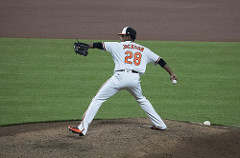
Combined No-Hitters … I’ll Take an Even Dozen, Please.

Walker Buehler got the win in the Dodgers' combined no-hitter.

Walker Buehler got the win in the Dodgers’ combined no-hitter.

Yesterday – May 4, 2018 – the Dodgers no-hit the Padres 4-0 in a regular-season MLB game played in Monterrey Mexico – the first official MLB no-hitter ever thrown outside the United State or Canada.

It was also a rarity among no-hitters, being just the twelfth combined (more than one pitcher) no-hitter in MLB history, as well as the Dodgers’ MLB-best 23rd no-no. (The Padres, by the way, remain the only MLB that has never had a no-hitter thrown in their cause.)  let’s take a look at yesterday’s white-washing, as well as the other eleven combined no-hitters in the national pastime’s past times.

Yesterday, right-hander Walker Buehler started for the Dodgers, and the 23-year-old – making just his third major league start (11th appearance) – went six innings (93 pitches), walking three and fanning eight.  He was followed by relievers Tony Cingrani (one inning, two walks, one whiff); Yimi Garcia (one inning, no walks, two strikeouts) and Adam Libertore (one inning, no walks, two strikeouts).  Buehler, by the way, also collected an unusual sixth inning single – as his groundball hit baserunner Alex Verdugo between first and second, resulting in Verdugo being called out (for the final out of the inning) and Buehler being credited with a single. That single, of course, meant Bueghler outhit the entire Padres’ lineup.

MORE PROOF THAT, IN BASEBALL, WE COUNT (AND TRACK) EVERYTHING

Yesterday, it was reported, was the first time in MLB history that a no-hitter and a 3,000th MLB hit (Albert Pujols) occured on the same day. 

Now, a look at the other eleven MLB combined no-hitters and the circumstances that made many of them unique.

The first-ever combine no-hitter took place on June 23, 1917 – with the Red Sox topping the Senators 4-0 in Boston. This game is special for several reasons: it was the first MLB combined no-hitter; Babe Ruth was involved;  it involved the most meager contribution by the starting pitcher (zero innings pitched); and, finally, it is arguably the most “perfect” combined no-hitter ever.

Babe Ruth, at that time plying his trade as a left-handed starting pitcher for the Boston Red Sox, opened the game by walking Washington’s lead-off hitter Roy Morgan.  Ruth, and his catcher Pinch Thomas, took issue with umpire Brick Owens’ strike zone and, during the argument, Ruth made contact with the umpire (a glancing blow, it was reported).  The ultimate result of the confrontation was the ejection of both Ruth and Thomas (with Ruth earning a $100 fine and ten-game suspension).  Red Sox’ pitcher Ernie Shore was called in to replace Ruth and Sam Agnew took Thomas’ spot behind the plate. Morgan decided to test Agnew’s arm and was thrown out stealing, after which Shore retired the next 26 hitters in order – completing the first combined no-hitter and facing the minimum 27 batters.

Given the past propensity for pitchers finishing what they started, MLB’s second combined no-hitter came 50 seasons and 70 no-hitters later – on April 30, 1967, with the Tigers defeating the Orioles 2-1 in Baltimore.  This combined no-hitter is unique because it was not a “no- no” (no hits – no runs), the team that threw the no-hitter lost (the only combined no-hitter loss) and it involved the briefest contribution by the relief staff (one pitcher/one-third inning pitched).

Orioles’ starter Steve Barber and was effectively wild, walking ten hitters and hitting two in 8 2/3 innings. The opposing hurler was Detroit’s Earl Wilson – who matched goose eggs with Barber for seven innings. In the eighth, Baltimore pushed across a run on three walks and a sacrifice fly (Wilson gave up only two hits and four walks in his eight innings of work) and victory was there if Barber could take it. He didn’t.  Barber walked Tiger 1B Norm Cash to start the ninth. He then walked SS Ray Oyler. Earl Wilson, a good-hitting pitcher, bunted the runners to second and third, before Barber got the second out of the inning, inducing PH Willie Horton to pop up to the catcher.  Now, just one out away from a 1-0, no-hit win, Barber uncorked a wild pitch that brought the tying run home. He then walked CF Mickey Stanley, ending his day on the mound. Stu Miller came in to get the final out, but not until an error allowed the go-ahead run to score.

Combined no-hitter number three came on September 28, 1975, with the A’s topping the Angels 5-0 in Oakland.  This game was unique in that it is one of only three no-hitters thrown on the final day of an MLB season – and it made starting pitcher Vida Blue the first hurler to take part in both a solo and combined no-hitter. (Blue had thrown a solo no-hitter on September 21, 1970.) Blue went five innings and was followed by Glenn Abbott (one inning), Paul Lindblad (one inning) and Rollie Fingers (2 innings). This was also the first time more than two pitchers were involved in a combined no-hitter.  Note: Blue has been joined by Kevin Millwood, Kent Mercker and Mike Witt as pitchers with both solo and combined no-hitters.)

The next combined no-hitter went back to the two-pitcher formula, as Blue Moon Odom (5 innings) and Francisco Barrios (4 innings) of the White Sox topped the A’s 2-1 in Oakland.  In the July 28, 1976 game, Blue walked five and gave up one run in his five frames, and Barrios added two walks in his four.

Combined no-hitter number-five came on April 11, 1990 (again just two pitchers), with the Angels topping the Mariners 1-0 in Anaheim.  Mark Langston started the game and went seven, and Mike Witt (the only pitcher to throw a perfect game – September 30, 1984 – and take part in a combined no-hitter ) threw the final two.

1991 saw seven MLB no-hitters including two combined no-nos. On July 13, the Orioles no-hit the A’s 2-0 in Oakland behind Bob Milacki (five innings), Mike Flanagan (one IP), Mark Williamson (one IP) and Gregg Olson (one IP). Then, on September 11, the Braves no-hit the Padres 1-0 in Atlanta, led by Kent Mercker (six innings), Mark Wohlers (two innings) and Alejandro Pena (one inning).

Combined no-hitter number eight came on July 12, 1997 – with the Pirates topping the Astros 3-0 in Pittsburgh.  It was unique in that it was the only extra-inning combined “no-no.” Francisco Cordova started and went nine hitless frames (two walks, ten whiffs) and Ricardo Rincon threw one hitless inning in relief (for the win).

The next combined no hitter was a record breaker – as the Astros used a record six pitchers (since tied) to no-hit the Yankees 8-0 in an inter-league game at Yankee Stadium (the last no-hitter at Old Yankee Stadium). Roy Oswalt started, but succumbed to a groin injury after just one completed inning. Joining in the no-hitter were: Pete Munro (2 2/3 IP); Kirk Saarlos (1 1/3 IP); Brad Lidge (2 IP); Octavio Dotel (1 IP); and Billy Wagner (1 IP). Notably, the no-hitter also broke up the Yankee’s record streak of 6,980 games without being held hitless. They had not been held without a safety since September 20, 1958.

The very next combined no-hitter – another interleague game – saw the six-pitcher record tied, as the Mariners topped the Dodgers 1-0 in Seattle. Kevin Millwood started that one (six innings), followed by Charlie Furbush (2/3 IP), Stephen Pryor (1/3 IP), Lucas Luetge (1/3 IP), Brandon League (2/3 IP) and TomWilhemson (one IP).

In combined no-hitter number 11 – September 1, 2014- the Phillies used four pitchers to no-hit the Braves 7-0 in Atlanta.  The pitchers involved were Cole Hamels, who started and went six innings (issuing five walks versus seven strikeouts); Jake Diekman (one inning, two strikeouts); Ken Giles (one inning, three strikeouts); and Jonathan Papelbon (one inning, no strikeouts).


Primary Resources:  MLB.com; ESPN.com; Society for American Baseball Research.

I tweet baseball @DavidBBRT

Follow/Like the Baseball Roundtable Facebook page here.

Member: Society for American Baseball Research; The Baseball Reliquary;  The Negro Leagues Baseball Museum.

Twin Killings – They Can Be Murder on the Offense

The ballet of the double play ... a beautiful thing. Photo by roy.luck

The ballet of the double play … a beautiful thing.
Photo by roy.luck

If you follow Baseball Roundtable – and I hope you do – you know that I am particularly appreciative of the on-the-diamond ballet of a 4-6-3 or 6-4-3 double play.  With that in mind, I wish I had been in the Astrodome back on this day (May 4) in 1969 – when the Astros turned a record seven double plays, while topping the Giants 3-1. Seven twin-killings by a team in nine-innings, that’s a record that still stands.  Here’s how it went:

  • In the top of the first inning, the Giants had one run in, the bases loaded and just one out – and had knocked Houston starter Denny Lemaster out of the game – when reliever Dooley Womack (love that name) got Giants’ left fielder Jim Ray Hart to ground into a 6-4-3 (SS Denis Menke to 2B Joe Morgan to 1B Curt Belfary) double play to end the inning.
  • In the third inning, with the game tied 1-1, the Giants threatened again, with runners on first and second with one out; when Womack  induced a groundball (C Dick Dietz batting) 5-4-3 (3B Doug Rader to 2B Menke to 1B Blefary) twin killing – again ending the inning.
  • The top of the fourth started with a Jim Ray Hart single off Womack, followed by the Astros’ second groundball 6-4-3 double play. The inning ended when the next Giants’ hitter (SS Hal Lanier) grounded out second-to-first.
  • The top of the fifth looked a lot like the top of the fourth – with one less exchange of the baseball. Giants’ P Juan Marichal opened with a single off Womack. Next up was Giants’ RF Frank Johnson, who grounded into a second-to-first twin killing. The inning ended when the next batter,  2B Ron Hunt, grounded out third to first.
  • In the top of the seventh (after a 1-2-3 sixth by Womack), the Giants (now down 2-1) put two men on with one out – and the Astros brought Fred Gladding to the mound. The Giants let Marichal hit for himself –and he grounded into a 6-3 double play to end the threat.
  • In the top of the eighth, now down 3-1, the Giants opened with a single (off Gladding) by pinch hitter Bob Burda. Gladding then got Ron Hunt to ground into a tougher 3-6 double play, before getting CF Willie Mays on a 6-3 groundout.
  • Finally, in the ninth, with Giants’ runners on first and third and one out, Gladding appropriately ended the game by getting 3B Bobby Etheridge to hit into a 4-6-3 double play.

A couple of notes:  1) Despite only four strikeouts by Giants’ batters, Houston outfielders recorded only one put out on the afternoon – which included 18 infield assists by the Astros.  2) The Giants turned one double play in the game, when 1B Jack Haittt speared a line drive by the Astros’ Gary Geiger and doubled Curt Blefary off first.

Lots of Multiple Killings – and Still No Wins

The record for turning double plays in game by both teams is ten – in a 6-4 Red Sox home win over the Twins on July 18, 1990. Six of those were turned by the Twins – four by the Red Sox.  That double play record came just one game after the Twins became the first (and still only) team to turn two triple plays in a single game.  On July 17, the Twins turned a pair of groundball, around-the-horn (3B Gary Gaetti to 2B Al Newman to 1B Kent Hrbek) triple plays in a 1-0 loss to the Red Sox.

A couple of other bits of twin-killing trivia.

  • The 1990 Red Sox hold the team record for GIDP in a season at 174, as well as a share of the AL single-game record six (which has been done 14 times in the AL, four by Boston). The only other AL team to achieve this negative record more than once is the Blue jay (twice).
  • Albert Pujols (still active) holds the individual career GIDP record at 365); while the single season record belongs to the Red Sox’ Jim Rice at 36.
  • Miguel Tejada holds the record for the most seasons leading his league in GIDP at five (2004-05-06 with the Orioles and 2008-09 with the Astros).
  • The record for most GIDP in a game is four, shared by the Tigers’ Goose Goslin, Tigers’ Victor Martinez and Mets’ Joe Torre.

ONE OF EACH PERSUASION

Only three MLB batters have played in more than 150 games in a season without grounding into a double play – one lefty (Dick McAuliffe, Tigers – 1968); one righty (Craig Biggio, Astros – 1997); and one switch-hitter (Augie Galan, Cubs – 1968).

Primary Resources: Baseball-Reference.com; Baseball-Almanac.com; MLB.com

I tweet baseball @DavidBBRT

Follow/Like the Baseball Roundtable Facebook page here.

Member: Society for American Baseball Research; The Baseball ReliquAry; The Negro Leagues Baseball Museum.

2018 Negro Leagues Baseball Museum “Hall of Game” Honorees Announced

HOGSeventy-seven MLB seasons – 24 All Star selections – 7 Gold Gloves – 5 Stolen Base Titles – 3 Home Run Crowns – 3 Twenty-Win Seasons – 2 Rookie of the Year Awards – One MVP Award.  Those are the considerable – and well-earned – credential of the Negro Leagues Baseball Museum (NLBM) 2018 “Hall of Game” class.

_________________________________________

On May 1, the Negro Leagues Baseball Museum (NLBM) announced the lineup for its Fifth Annual Hall of Game inductions:

  • Power-hitting Dick Allen – a two-time league HR champion and 1972 American League MVP.
  • Eddie Murray – one of the greatest switch-hitters in MLB history, with more than 3,000 base hits and 500+ MLB home runs.
  • Speedster Kenny Lofton – who not only led the American League in stolen bases five straight seasons, but also earned four consecutive Gold Gloves in center field.
  • Jim Mudcat Grant– owner of 145 major league victories and the first Black pitcher to win 20 games in the American League, as well as the first Black hurler to win a World Series game for an AL team.
  • Fireballer J.R. Richard – whose career was cut short (10 seasons) by a stroke, but who can still look back on a twenty-win season, 74 wins over a four-span and two consecutive 300+ strikeout campaigns.

This group will join previous honorees (listed alphabetically): Lou Brock; Orlando Cepeda; Roberto Clemente; Andre Dawson; Ricky Henderson; Fergie Jenkins; Joe Morgan; Tony Oliva; Al Oliver; Tony Perez; Tim Raines; Lee Smith; Ozzie Smith; Louis Tiant, Jr.; Maury Wills; and Dave Winfield. Ceremonies are scheduled for 8:00 p.m., June 9 at the Gem Theatre, 1615 18th Street, Kansas City, Missouri.

NEGRO LEAGUES BASEBALL MUSEUM HALL OF GAME

The NLBM established its Hall of Game in 2014 to recognize MLB greats “who competed with the same passion, determination, skill and flair exhibited by the heroes of the Negro Leagues.”

Now, let’s take a look at the 2018 Hall of Game class.

Dick Allen – MLB career, 1963-1977

aLLENDick Allen made a name for himself early in his career. In his first full MLB season (1964 –  after a 10-game call up in 1963), the 22-year-old Allen played in all 162 Phillies’ games (at third base) – hitting .318, with 201 hits, 29 home runs and 91 RBI.  He also led the league in triples (13) and runs scored (125).  That performance earned him the 1964 NL Rookie of the Year Award (and a seventh-place finish in the MVP balloting.) The 5’11”, 187-pound Allen went on to live up to that early promise.

In four minor league seasons, Dick Allen hit .306 with 82 home runs and 342 RBI (in 482 games). When he was called up to the Phillies in September of 1963, Allen was hitting .289-33-97 for the International League (AAA) Arkansas Travelers.

Playing for the Phillies, Cardinals, Dodgers. White Sox and A’s, Allen led his league in slugging percentage three times, on-base percentage twice, home runs twice, as well as in RBI and total bases once each.  In 1972, playing with the White Sox, Allen earned the  AL MVP award, hitting .308 and leading the AL in home runs (37), RBI (113), walks (99), on-base percentage (.422) and slugging percentage (.603).

For his MLB career, the seven-time All Star hit .292 (1,848 hits), with 351 home runs, 1,099 runs scored and 1,119 RBI.

Dick Allen collected 79 triples over his MLB career – and had one stretch of four consecutive seasons of ten or more three-baggers.

Jim “Mudcat” Grant – MLB career 1958-71

gRANTIn 1965, while with the Minnesota Twins, Jim Mudcat Grant became first Black pitcher to have a twenty-win season in the American League – as his 21-7 campaign led the Twins to the American League pennant.  Grant led the American League in wins (21), winning percentage (.750) and shutouts (6), while putting up a 3.30 ERA and fanning 142 battersin 270 1/3 innings.

He followed that performance with a pair of victories (versus the Dodgers) in the 1965 World Series – becoming the first Black pitcher to win a World Series game for an American League club.

In a clutch performance in Game Six of the 1965 Fall Classic, Jim “Mudcat” Grant not only earned a complete-game, six-hit, 5-1 victory, but also cracked a sixth-inning, three-run home run to put the game out of reach.

During his career, Grant appeared in 571 MLB games (293) starts, picking up 145 wins (119 losses) and 54 saves, while pitching to a 3.63 earned run average. He fanned 1,267 batters in 2,442 MLB innings. He was a two-time America League All Star (1963 & 1965) was named The Sporting News Pitcher of the Year in 1965.  Grant pitched for the Indians, Twins, Expos, Cardinals, Pirates and A’s.

Jim “Mudcat” Grant was the starting pitcher for the Montreal Expos in their first-ever official MLB game.

Following his retirement from the playing field, Grant dedicated himself to promoting the rich history of Blacks in baseball. In 2006, he released released his book The Black Aces, Baseball’s Only Black Twenty-Game Winners – which included a chapter on each of MLB’s Black twenty-game winners and also featured a number of Negro League players Grant felt would have been twenty-game winners had they been allowed to pitch in MLB.

Kenny Lofton – MLB career 1991-2007

lOFTONAfter five minor league seasons during which he hit .300 and stole 168 bases (363 games), Kenny Lofton came to the major leagues ready to run. Lofton joined the Houston Astros in a brief late-season call up in 1991 (20 games, .203 average). Then, in the off-season, the 5’11”, 190-pound outfielder was traded by the Astros to the Indians (along with infielder Dave Rhode) for pitcher Willie Blair and catcher Ed Taubensee– a trade the  appropriately, paid off for the Indians “very fast.”

In his first full MLB season (1992), the new Cleveland center fielder hit .285, with five home runs, 42 RBI, 96 runs scored and a league-topping 66 stolen bases.  Lofton would not relinquish that stolen base title until 1997 – running up totals of 66, 70, 60, 54 and 75 steals between 1992-96.

Kenny Lofton finished second to the Brewers’ Pat Listach (SS/2B/CF) in the 1992 AL Rookie of the Year balloting. You could hardly have slipped the proverbial “piece of paper” between the stats of the two players.  Listach played in 149 games, Lofton 148.  Listach hit .290 with 168 hits, Lofton .285 with 164 safeties. Lofton hit five home runs and stole 66 bases to Listach’s one home run and 54 steals. Lofton scored 96 runs to Listach’s 93, but Listach drove in 47 to Lofton’s 42.  Lofton collected 68 walks to 55 for Listach, and fanned just 54 times to Listach’s 124.

During his career, Lofton played for the Astros (1991), Indians (1992-2001 & 2007); White Sox (2002); Giants (2002); Pirates (2003); Cubs (2003); Yankees (2004); Phillies (2005); Dodgers (2006); Rangers (2007).

In his final MLB season (2007), at age 40, Lofton hit .296 and stole 23 bases in 136 games.

In his career, Lofton earned six All-Star appearances (1994-99) and four Gold Glove Awards (1993-1996). His final regular season stat line: 2,103 games played, .299 average, 2,428 hits, 383 doubles, 116 triples, 130 home runs, 1,528 runs scored, 781 RBI and 622 stolen bases (15th all-time). He hit over .300 in seven campaigns and topped 50 stolen bases in six seasons.  He also played in 95 post-season games, hitting .247-7-34, with 34 stolen bases in 40 attempts.

Eddie Murray – MLB career 1977-97

MLB Players with 500 home runs AND 3,000 hits. Hank Aaron, Willie Mays, Eddie Murray, Rafael Palmeiro and Alex Rodriguez.

mURRAYWhen you are one of just five MLB players to hit 500 home runs and collect 3,000 hits – you are something special.  When you are the only switch-hitter in the club, you also know you will be included in any conversation about the “the greatest switch hitters of all time.” That’stheEddie Murray legacy.

First baseman/DH Eddie Murray spent 21 years in the major leagues – primarily with the Baltimore Orioles (1977-88 and 1996).  He also took the field for the Dodgers, Mets, Indians, Angels and Dodgers. While his career included just one home run title and one RBI crown, Murray was as steadily excellent as they come.  In his first ten MLB seasons, he earned seven All Star selections (he garnered eight overall), three Gold Glove Awards and 1977 AL Rookie of the Year honors.

Eddie Murray drew 222 career intentional walks – tenth all time – leading his league three times.

In a 21-season MLB career, Murray hit 25 or more home runs 12 times, collected 100 or more RBI six times and hit .300 or better seven times. It  all added  up to 3,026 games played (sixth all-time), a .287 average,  3,255 hits (12th), 504 home  runs (27th), 1,627 runs scored (41st) and 1,917 RBI (11th).

Eddie Murray was a first-ballot inductee into the Baseball Hall of Fame in 2003.

J.R. Richard – MLB Career 1971-80

rICHRDFlamethrower J.R. Richard’s career was cut short by a stroke in 1980. By that time, the big (6’8”, 220-pounts) right-hander had made a name for himself as one of the most feared pitchers in MLB.

When the 21-year-old Richard was called up to the Astros in September of 1971, he was 12-7, 2.45 with 202 strikeouts in 173 innings at Triple A. He made four starts tat month, going 3-1, 3.43 and fanning 29 in 21 innings.

In his very first MLB start – September 5, 1971 – J.R. Richard beat the Giants 5-3, throwing a complete-game seven-hitter and fanning a record-tying (for a first MLB appearance) 15 batters.

Richard was up-and-down (minors/major) until 1975 – as he worked to master control and command of his electric “stuff.”  He had his first full MLB season in 1975, going 12-10, 4.39 – and fanning 176 in 203 innings. (He also led the NL in walks with 138) and wild pitches with 20). The following season, he lived up to his full promise, winning 20 games (15 losses), lowering his earned run average to 2.75 and fanning 214 batters in 291 innings.  But, the best was yet to come.

Richard won 18 games in each of the next three seasons, put up earned run averages of 2.97, 3.11 and a league-best 2.71 (1979). In 1978 and 1979, he also topped the NL in strikeouts, with 303 and 313, respectively.

Richard looked to be getting even better in 1980.  He was 10-4, with a 1.90 ERA and 119 strikeouts in 113 2/3 innings before suffering a career-ending stroke on July 30.   For his career, Richard was 107-71 – a .601 winning percentage – with a 3.15 ERA and 1,493 strikeouts in 1,606 innings pitched. He gave up just 6.87 hits per nine innings – three times posting the league’s lowest hits-per-nine figure.

J.R. Richard’s career 6.87 hits allowed per nine innings is the fifth-lowest among pitchers with at least 1,000 MLB innings – trailing only Nolan Ryan, Clayton Kershaw, Sandy Koufax and Sid Fernandez.

________________________________________________

In announcing the 2018 Hall of Game honorees, Negro Leagues Baseball Museum President Bob Kendrick said, “Each of these players was a phenomenal athlete who achieved remarkable stats and records. Buck O’Neil once said of the Negro Leagues that fans couldn’t go to the concession stands because they were afraid they’d miss something they’d never seen before. That’s how these guys played. Fans couldn’t take their eyes off them because they might miss an incredible play. This year’s honorees embody that wonderful Negro Leagues spirit, and we are delighted to welcome as our fifth induction class of our Hall of Game.”

In addition to the Hall of Game inductions, the NLBM will be presenting the Jackie Robinson Lifetime Achievement Award for “career excellence in the face of adversity” to the award namesake’s daughter, Sharon Robinson – who serves as an educational consultant for Major League Baseball and manages Breaking Barriers: In Sports, In Life, a baseball-themed national character education curriculum that helps empower students to face obstacles in their lives.

“There’s no one we would rather honor on this special anniversary year than Sharon Robinson,” Kendrick said. “She’s been a phenomenal voice and champion for diversity in sports and is carrying on her father’s legacy in a powerful and effective way.”

THE NEGRO LEAGUES BASEBALL MUSEUM

Satchel Paige pitches to Martin Dihigo, with Josh Gibson catching - on the Field of Legends at the Negro Leagues Baseball Museum.

Satchel Paige pitches to Martin Dihigo, with Josh Gibson catching – on the Field of Legends at the Negro Leagues Baseball Museum.

The Negro Leagues Baseball Museum is the world’s only museum dedicated to preserving and illuminating the rich history of black baseball. The museum, built in conjunction with the adjacent American Jazz Museum at the famous 18th & Vine Jazz District, has become an iconic piece of Kansas City’s social and entertainment culture. The NLBM is a privately funded, 501c3 not-for-profit organization incorporated in 1990. The museum’s inception brought together the vision of a group of Kansas City business leaders, historians and former baseball players, headed by the legendary John “Buck” O‘Neil. For more information, visit www.nlbm.com, and follow the Negro Leagues Baseball Museum on Twitter @nlbmprez

HY-VEE – Hall of Game Presenting Sponsor

Hy-Vee, Inc. has been the presenting sponsor for the Hall of Game awards since their inception. Hy-Vee is an employee-owned corporation operating more than 245 retail stores across eight Midwestern states with sales of $10 billion annually. Hy-Vee ranks in the Top 10 Most Trusted Brands and has been named one of America’s Top 5 favorite grocery stores. For additional information, visit www.hyvee.com.

Primary Resoures:  Negro Leagues Baseball Mueum; Society for American Baseball Research; Baseball-Reference.com; MLB.com

I tweet baseball @DavidBBRT

Follow/Like the Baseball Roundtable Facebook page here. 

Member: Society for American Baseball Research; The Baseball Reliquary; The Negro Leagues Baseball Museum

Baseball Roundtable April Wrap – Home Runs, Strikeouts and a Seven-Defender Double Play

HOW THE GAME HAS CHANGED …

On this date (May 1) in 1920, Brooklyn and Boston played to a 26-inning 1-1 tie. Both starting pitchers – Brooklyn’s Leon Cadore and Boston’s Joe Oeschger – went the distance.  For the full story, click here.

APRIL PLATE APPEARANCES, BRING MAY RANTS

May is upon us, and that means it’s time for Baseball Roundtable to look back at the previous month’s highlights and lowlights.  Before I get into the specificS, however, a brief comment (rant?) on the game as it’s played today. In that May 1, 1920 contest noted above, not only did we see no pitching changes, there were only 22 plate appearances that ended in a trot (back to the dugout, to first base or around the bases) – nine walks, 14 strikeouts, no home runs and no hit batsmen.  That’s 11.8 percent of the total plate appearances.  Through April of this season, 35.6 percent of all plate appearances have ended in a trot – 22.7 percent by strikeout, 10.1 percent with a walk or hit by pitch and 2.8 percent via the home run.

Of course, it’s not fair to compare to a single-game more than 95 years ago to today’s contests.  So, here are a few more recent figures:  In 1980, 26.1 percent of all MLB regular-season plate appearances ended in a trot (home run, strikeout, walk, HBP).  In 2000, it was 29.9 percent and, last season, it was 34.4 percent.   Not sure how most of you feel, but I would prefer a trend toward more – rather than less – action in the field and on the basepaths.  (BBRT invites your comments.)

———A LOOK BACK AT 2018 MARCH/APRIL———

Now, on to a look at March/April.  The 2018 MLB season started off with a BANG! In 2017, MLB saw a record 6,105 home runs.  On Opening Day, March 29, the Cubs’ 23-year-old center fielder Ian Happ hit the very first pitch of the 2018 season (thrown by the Marlins’ José Urena) for a home run. Later that day, White Sox’ DH Matt Davidson became just the fourth player in MLB history with a three-homer Opening Day game.  He joined George Bell (1988), Tuffy Rhodes (1994) and Dmitri Young (2005) in that limited membership club.

Over the course of March/April, MLB treated us to such sights as the A’s  Sean Manaea throwing 2018’s first no-hitter; Twins’ Joe Mauer collecting his 2,000 MLB base hit; Adrian Beltre passing Rod Carew as the all-time hits leader among Latin-American players; and much, much more.

There were plenty of notable acheivements and performances – but before we dive deep, let’s look at BBRT’s players and pitchers of the month.

________________________________________________

AL PLAYER OF THE MONTH … Didi Gregorius, SS, Yankees

Didi Gregorius photo

Photo by apardavila

Maybe it should be Didi Degre-Glorious! When you are a middle infielder, batting in the heart of a lineup that includes Giancarlo Stanton, Aaron Judge, and Gary Sanchez – and pretty much outpowering them all – you;’ve got a good thing going.   In March/April, Gregorius put up a .327-10-30 line – leading MLB in RBI and  home runs (10, tied with the Angels’ Mike Trout and Mariners’ Mitch Haniger).  His 24 runs scored tied for MLB’s third-best and  he drew 18 walks to just 16 strikeouts.

Other Contenders: Manny Machado , SS, Orioles … Machado slid over from 3B to SS and didn’t miss a beat. His .361 average going in to May leads all of MLB and he also has nine home runs, 22 RBI, 14 runs scored and is two-for-two in stolen bases. His 39 base hits are second only to the Astros’ hit machine Jose Altuve (41). Machado is giving beleaguered Orioles’ fans a reason to come to Camden Yards.  Jed Lowrie, 2B, A’s … Lawrie, who came into this season with a career (10-season) batting average of .261, has been Gregorius-lite.  Another middle infielder hitting in the heart of the lineup, L0wrie went into May with a .339-6-27 line.  Like Machado, he has 39 base hits.

AL PITCHER OF THE MONTH …  Sean Manaea, A’s

Sean Manaea, a 6’5″, 245-pound southpaw, was big on the mound in March/April – tossing 2018’s first no-hitter (against the then red hot Red Sox) and putting up the AL’s lowest earned run average (among qualifiers) at 1.03. In six starts, Manaea went 4-2, 1.03, with 37 strikeouts in 43 2/3 innings (just 20 hits and seven walks). He went at least seven innings in five of his six starts and never gave up more than two runs in an outing (one shutout, four games of one run, one game of two runs).

Other Contenders: Edwin Diaz, Mariners … With an MLB-leading 11 saves (in 11 opportunities) a 0.63 ERA and 27 strikeouts in 14 1/3 innings, the 24-year-old closer (who saved 34 games a year ago) earns a spot here. Justin Verlander, Astros … Verlander ended April 4-0, with a 1.36 ERA (second in the AL) and 48 strikeouts (third in the AL) in 39 2/3 innings.  Since coming to the Astros last August, Verlander’s regular-season record with Houston is 9-0, 1.22, with 91 whiffs in 73 2/3 innings (post-season; 4-1, 2.21).

NL PLAYER OF THE MONTH … (Tie) Javier Baez, 2B/SS, Cubs & Ozzie Albies, 2B, Braves

Middle infielders seem to be all the rage this season – and a couple of second baseman tied (at least in BBRT’s estimation) for BBRT NL Player of the Month.  Javier Baez,  the NL leader in RBI with 26 – who, this season, has already batted in every spot in the order except leadoff and cleanup – put up a .280-7-26 line in March/April, with 20 runs scored (ninth in the NL) and three steals.  Note: Javier has recorded the most games in the number-two and number eight spots in the lineup – ten and eight appearances, respectively. Baez, just 25-years-old, is in his fifth season with the Cubs and is coming off a .273-23-75, 10 stolen bases campaign in 2017.

Then there is Braves’ rookie Ozzie Albies … This 21-year-old MLB freshman is tied for the MLB lead in runs scored (29) and tied for the NL lead in home runs (9).  He also has 20 RBI and three steals. Really, you could hardly squeeze a piece of paper between the performances of Baez and Albies.

Other Contenders: Asdrubel Cabrera, SS, Mets … Another middle infielder off to a great start, the veteran Cabrera goes into May hitting .340, with five home runs, 17 RBI and 20 runs scored.  His 34 base hits ties him for the NL lead.  A.J. Pollock, OF, D-backs … The Diamondbacks’ center fielder has been doing it all. In March/April, he hit .291, with a NL-leading (tied) nine home runs; 24 RBI (third in the NL) and 20 runs scored. He also swiped six bags in eight attempts.

NL PITCHER OF THE MONTH … Max Scherzer, Nationals

Photo by apardavila

Photo by apardavila

Max Scherzer came into May as the only MLB pitcher with five victories (5-1) and an NL-topping 57 strikeouts (39 innings). In addition, his 1.62 ERA was the NL’s third-best. That was enough to make the three-time Cy Young Award winner the BBRT pitcher of the month.

Other Contenders: Patrick Corbin, D-backs … Corbin was hot on Scherzer’s trail with a 4-0, 2.25 line and 55 whiffs in 40 innings;  Johnny Cueto, Giants … I couldn’t leave off Johnny Cueto.  Yes, he has only 26 strikeouts (in 32 innings), but he finished March/April at 3-0 (in five starts) and his earned run average was an MLB-lowest 0.84 – just  three earned run in 32 innings. Cueto can’t help it if the Giants failed to score for him in two starts in which he pitched seven shutout before giving way to the pen.

______________________________________________

IF THE SEASON ENDED APRIL 30 … YOUR PLAYOFF TEAMS WOULD BE

Note:  Full standings (as of April 30) can be found at the end of this post.

THE BOOKENDS

Only two teams played .700 or better ball through April – the Red Sox at .750 (21-7) and the Diamondbacks at .714 (20-8). The Astros were the only other team with 20 wins.

On the opposite side of the coin, three teams played under-.300 ball – the Reds at .241 (7-22);  Royals at .250 (7-21); and Orioles at .286 (8-20). 

Again, if the season ended April 30, your post-season participants …

American League:  Boston, Cleveland, Houston.  Wild Cards: New York, Seattle.

The most interesting race may be the Red Sox/Yankees – what a surprise. The Red Sox got off to a blazing 17-2 start before a no-hitter by the A’s Sean Manaea seem to take a bit of the wind out of their sails (they went 4-5 from the no-no on.) The Red Sox have excelled on both sides of the game – scoring the second-most runs through April (164) and and giving up the third-fewest (96).  The Yankees, on the other hand, while fourth in the AL in earned run average (3.62), in true Bronx-Bomber form, led the junior circuit in home runs (41), runs scored (164).  Houston clearly ran the best pitching out there – with a 2.54 ERA through April. The Astros have three of the four lowest American League earned run averages (among qualifying pitchers) through April – Justin Verlander (1.36); Charlie Morton (1.72); Gerrit Cole (1.73).

The worst division appears to be the AL Central – with only the Indians above .500.  Overall, the senior circuit’s Central Division’s record is 50-83.

APRIL SHOWERS BRING …

MLB set a new record for weather-related postponements before May 1, with 28.  The Twins were hardest hit and played a total of just 24 games between March 29 and April 30.  By comparison, the Astros, Rangers, Brewers, Rockies and Padres each played 30 contests. 

National League: New York, Chicago, Arizona.  Wild Cards: Atlanta  Pittsburgh.

In the NL, the most interesting race seems to be in the Central – where the Cardinals, Brewers, Pirates and Cubs are all over .500 and  separated by just 1 1/2 games.  Meanwhile, Arizona has built up the biggest lead in the NL – 5 1/2 games ahead of the second-place West Division Giants.  The Diamondbacks, in fact, won all nine series they completed in March/April. (Note: The Diamondbacks were the only NL team with a March/April ERA under 3.00.)

WHAT A DIFFERENCE …

No team outscored their opponents in March/April by more runs than the Astros (+64).  the only other team above +50 was the Red Sox (+63). The NL leader in this category was the D-backs (+39.) On the reverse side of the coin: The Royals ended April at -65.  The only other team with a negative run differntial worse than -50 was the Orioles (-54). The largest negative run differential in the NL went to the Marlins at -47.


—–LEAGUE LEADERS – TEAMS—–

RUNS SCORED … MLB Team Average – 125

AL: Yankees (164); Red Sox (159); Astros (149)

NL: Braves (151); Pirates (142); Cubs and Dodgers (133)

The Royals scored an MLB-low 95 runs in March/April. The Marlins were at the bottom of the NL with 96.  Other teams scoring fewer than 100 runs through April were the Twins and Orioles (both at 98). 

BATTING AVERAGE … MLB Team Average – .244

AL: Red Sox (.273); Rays (.266); A’s (.267); Yankees

NL: Braves (.268); Pirates (.258); Cubs (.252)

The Rockies and Orioles each hit an MLB-low .224 for March/April, The Marlins were at the bottom of the NL at .228. Surprisingly,  the AL Central-leading Indians had the AL’s second worst average at .227 and scored the fourth-fewest runs at 102. (They did have the AL’s third-best earned run average.)

HOME RUNS … MLB Team Average – 30

AL: Yankees (41); Blue Jays (40); Angels (38)

NL: Rockies (34) and Diamondbacks (34);  Cardinals (33)

The Marlins and Reds were the most power-starved clubs in March/April (20 homers each). The Royals hit just 22 in the AL.

STOLEN BASES … MLB Team Average – 14

AL: White Sox (25); Indians, Red Sox and Mariners (17)

NL: Nationals (31); Braves and Brewers (24)

The Cubs stole and A’s each stole only six bags in March/April (lowest MLB total); the Cubs in 11 attempts, the A’s in eight.  The Cubs had the worst stolen base percentage – 54.5 percent.

STRIKEOUTS … MLB Team Average -245

AL: Rangers (281); Orioles (274); Yankees (266)

NL: Padres (309); Phillies (279); Rockies (277)

WALKS DRAWN … MLB Average – 97

AL: Yankees (126); Astros (121); Blue Jays (107)

NL: Nationals (127); Phillies (125); Mets (111)

No team grounded into more double plays in March/April than the White Sox (29). The Blue Jays hit into an MLB-low 12 twin-killings. 

EARNED RUN AVERAGE … MLB Average – 4.12

AL:  Astros (2.54); Red Sox (3.34); Indians (3.59)

NL:  D-backs (2.96); Brewers (3.20); Cubs (3.33)

Four teams finished March/April with ERA’s over 5.00: Royals (5.33); Reds (5.32); Twins (5.29); White Sox (5.06).  No surprise, these same four teams were among the five squads with fewer than ten wins in that span. 

STRIKEOUTS … MLB Average – 245

AL:  Astros (316); Yankees (285); Red Sox (268)

NL: Dodgers (285); Nationals (284); ; D-backs (280)

WHO’S YOUR DADDY?

Cubs pitchers have combined to toss five shutouts through April – all five against the Milwaukee Brewers. The Cubbies record against the Brewers is 7-1, with a 1.01 earned run average. 

SAVES … MLB Average – 7

AL: Mariners (11); Red Sox (9); Angels (8)

NL: Diamondbacks (11); Mets and Rockies (10)

Arizona (11 saves) is the only team without a blown save this season.  The Dodgers have the worst save percentage (saves versus save opportunities) at 36.6 percent (four saves in 11 opportunities).

FEWEST WALKS SURRENDERED … MLB Average – 97

AL: Indians (63); A’s (67); Astros (75)

NL: D-backs (79); Mets (85); Dodgers (88)

The Astros went into May leading MLB with 10.55 strikeouts per nine innings.  Two additional teams finished March/April averaging 10+ strikeouts per nine: The Mets (10.06); and the Yankees (10.02). 

FEWEST ERRORS IN THE FIELD … MLB average – 17

AL: Astros and Red Sox (8); Angels (10)

NL: Diamondbacks (10); Rockies and Nationals (11)

The Yankees and Rangers led MLB in March/April errors with 25 each, with the Yankees having the lowest fielding percentage at .975. 

__________________________________________

—–LET’S TAKE A LOOK AT SOME  MARCH/APRIL HIGHLIGHTS—–

Back-to-Back, Jack!

On April 3, The Cardinals opened the game against the Brewers with back-to-back jacks (Dexter Fowler and Tommy Pham) on the game’s first three pitches. Then, with two outs in the bottom of the ninth inning, the Brewers (trailing 4-3) closed out the game with back-to-back home runs from Christian Yelich and Ryan Braun.  MLB.com reported it was the first time in MLB history a game opened and closed with back-to-back long balls.

This One’s Gone Platinum

StantonOn April 3 and April 8, the Yankees’ Giancarlo Stanton earned the Platinum Sombrero – recognition for fanning five times in a game. Quite a feat, when you consider that only one other player has notched two five-strikeout games in his career.  (That unfortunate was the Blue Jays’ Alex Rios – June 4, 2004 and July 29, 2006.)

Another One Bites the Dust  … April 3

Leading off the top of the second inning of the April 3 Rangers/A’s game, Texas 3B Adrian Beltre rapped a single to center off the A’s Kendall Graveman.  It was hit number 3,053 for Beltre, tying him with seven-time batting champion Rod Carew for the most hits ever by a player from Latin America. Beltre would pick up the tie-breaking hit on April 5 – a second inning double off the A’s Daniel Mengden.

Youth Not Wasted on the Young

On April 10, Blue Jays’ closer Roberto Osuna picked up his fifth save of the season as the Jays topped the Orioles 2-1 at Camden Yards. The save made Osuna – who became the Blue Jays’ closer at age 20 – the youngest player to reach the 100-save mark (23 years – 62 days), well ahead of the previous holder of that distinction (Francisco Rodriguez at 24-years – 246 days).

One is the Loneliest Number- Especially for the Padres

On April 12, the Giants toppled the Padres 7-0 on a combined one-hitter (Chris Stratton, seven innings/Derek Law, two innings). The one hit came early – in the bottom of the third.  The clean single to right field took any potential suspense out of the game, but it was still historic in its own way. The hit came off the bat of Padres’ left-handed pitcher Clayton Richard, who was pinch-hitting for the Padres’ starting pitcher Bryan Mitchell (who, in his three innings on the mound, had already given up four hits, five walks and three runs). What was historic?  Elias Sports reports that it marked the first time that a pinch-hitting pitcher got his team’s only hit. (Note: Richard did not take the mound in the contest.)  Just one more reason #WhyIHateTheDH.”

On April 20 – a day before the A’s Sean Manaea threw the first no-hitter of the 2018 season, the Padres’ Tyson Ross was working on a no-hitter for 7 2/3 innings.  Then with two-out in the eighth inning of a 1-1 ball game, Walker gave up his first hit of the day – a game-tying double to Diamondbacks’ pinch hitter Christian Walker.  The hit ended his no-no and his day on the mound.  Brad Hand got the last four outs in the one-hitter, and picked up the win after the Padres plated three runs in the top of the ninth.

Why report that as an April highlight?  Walker’s lone hit ensured the Padres remained the only team in MLB that has never recorded a no-hitter.

The Family Business

On April 9, during a Double A game between the Trenton Thunder and New Hampshire Fisher Cats – Vlad Guerrero, Jr. hit a home run off Jose Mesa Jr.  Now, I really feel old.

Home Town Glory … Say it is so, Joe.

JOe Mauer photo

Photo by Keith Allison

Twins’ first baseman (former catcher) Joe Mauer – a native of the Twin Cities – captured a little home town glory on April 12. The three-time batting champion (and 2009 AL MVP) collected his 2,000th MLB hit in front of the home town fans in the seventh inning of a 4-0 Twins win over the White Sox – making him just one of three players with 2,000 hits for the Twins (joining Rod Carew and Kirby Puckett).  The hit was a productive one – a two-run single up the middle.  While I chose Adele’s “Home Town Glory” to celebrate this April highlight, the Twins went with Prince’s “Party Like It’s 1999.


In Baseball We Count EVERYTHING

On April 9, as the Nationals topped the Braves 2-0 in Washington, Max Scherzer became only the second pitcher in MLB history to pitch a shutout, fan ten batters AND STEAL A BASE in the same game. The other?  Nolan Ryan.


Bartolo colon Rangers photo

Photo by Keith Allison

I’m Too Sexy – For this Game

Bartolo “Big Sexy” Colon gave Rangers’ fans a thrill on April 15, when the 44-year-old took a perfect game into the eighth inning – against the vaunted Astros’ offense. Unfortunately, a walk to Carlos Correa leading off the eighth ended the perfecto and a Josh Reddick double ended he no-hitter and Colon’s time on the mound – and his opportunity to become the oldest pitcher to complete an MLB no-hitter. True to form, Big Sexy relied on locating his fast(?)ball – with 83 fastballs out of 96 total pitches.  By the way, the Rangers won 3-1 in ten innings and, “I’m Too Sexy” was recorded by Right Said Fred in back in 1991 – when Colon was 18-years-old.

Knock Three Times – And Join a Pretty Elite Crowd

Remember the old Tony Orlando and Dawn classic “Knock Three Times” (on the ceiling if you want me)? Well on April 17, the Angels should have wanted no part of Red Sox’ RF Mookie Betts – who knocked three home runs against Halo’s pitching. Batting in the lead-off position, Betts opened the game (in Anaheim) with a solo shot to left-center off early-season sensation Shohei Ohtani.  He added another solo dinger – to left – off reliever Luke Bard in the third. Then – after a walk in the fifth – Betts led off the eighth with another round tripper, this one off Cam Bedrosian. Betts joined a pretty good Red Sox hitter – Ted Williams – as the only Sox’ players with three, three-HR games. For those who track such things, Johnny Mize and Sammy Sosa share the MLB career record for three homer games at six – and Betts is just 25-years-old (in his MLB fifth season). Note: BoSox topped the Angels 10-1.

Happy Birthday to You Two

On April 18, the Twins topped the  Indians in Puerto Rico (for the story on Hiram Bithorn stadium, click here) in a game that went 16 innings and five hours and 13 minutes.  How long was the game?  Twins’ 1B Joe Mauer and Twins’ reliever Zach Duke both started the game at age 34 and ended the contest at age 35.

An Inside Job

Carlos Martinez of the Cardinals is (apparently) not afraid to “go inside.” Martinez leads MLB pitchers (through April) in hit batsmen with 8 (next is Toronto’s Aaron Sanchez with six).  Still, Martinez is 2-1, with a 1.43 ERA and 40 strikeouts in 37 2/3 innings.  Martinez, by the way, is well down the leader board in wild pitchers, with just one – putting him at no higher than 86th.

A Seven-Player Double Play

On April 19, the Pirates turned – and the Phillies ran (not hit) into – a double play in which no hitter put the ball in play, seven of the Pirates’ nine defenders handled the horsehide and the final out was a tag of a baserunner by the left fielder.   The play started with a pick-off attempt and, on the scorecards, looked like this 1-3-4-2-5-8-7.  For those who don’t keep score, that pitcher-to first baseman-to second baseman-to catcher-to third baseman-to center fielder-to left fielder.  Too hard to explain, so just watch the video below.


https://youtu.be/BsXK6jjTfow

2018’s First No Hitter

On April 21, the A’s Sean Manaea threw the first no-hitter of the 2018 season – and he did it in style.  Manaea no-hit the Boston Red Sox, who were 17-2 at the time and were leading MLB in runs scored (123) and batting average (.293). In the 3-0 win, Manaea walked just two and fanned ten.

Put Me In Coach …

Pablo Sandoval photo

Photo by Rob Shenk

Giants’ 3B Pablo Sandoval – in his eleventh season, took the mound for the first time on April 28 (against the rival Dodgers). The Giants were down 15-6 (the regular pitching staff had taken quite a “hit”).  Sandoval threw a 1-2-3 ninth (three ground outs) and tossed eight strikes in his 11 pitches.

Three weeks earlier, Mariners’ catcher Bryan Holaday and Rays’ 2B Daniel Robertson also drew late-game assignments – and responded equally well. Holaday’s mound appearance came in the top of the ninth inning with Seattle down 20-1 to the Phillies. Like Sandoval, Holaday “shut’em down,” getting three straight outs (including a strikeout of  Rhys Hoskins). He needed just 8 pitches (six strikes). Robertson came on in the bottom of the eighth inhis outing, with the home town Red Sox up 10-3. Robertson also tossed a 1-2-3 inning (three pop/fly outs), tossing seven strikes in eleven pitches. 

Other position players to pitch in April (less successfully) included: the Phillies’ Pedro Florimon; Twins’ Ryan LaMarre; Mariners’ Taylor Motter; Reds’ Cliff Pennington; and Brewers’ Herman Perez.  Overall, these “hurlers” tossed six innings and gave up five runs on four hits and three walks (three strikeouts) – and saved a few bullpen arms. 

Youth Will Be Served

When the Braves called up 20-year-old Uber-Prospect Ronald Acuna in late April, 21-year-old Atlanta 2B Ozzie Albies moved from the youngest player in the majors to the second-youngest.  How excited are they in Atlanta about these two?  Albies got in 27 March/April  games – hit .293 and led the league hits (34), runs (29), doubles (12) and home runs (9). Oh, and  Acuna? In his first five games, the young outfielder hit .421 (8-for-22), with four doubles, a home run and four RBI.

—INDIVIDUAL LEADERS FOR MARCH/APRIL—

BATTING AVERAGE (qualifying hitters)

AL:  Manny Machado, Orioles (.361); Jose Altuve, Astros (.347); Mookie Betts (.344)

NL: Odubel Herrera, Phillies (.343); Tommy Pham, Cardinals (.341); Asdrubel Cabrera, Mets (.340)

The lowest average among players with at least 75 plate appearances belongs to the Blue Jays’ Randal Grichuk (.106 … 7-for-66). Note: Grichuk went on the DL in late April with a sprained knee. In the NL, surprisingly, the Cubs’ Anthony Rizzo has the lowest March/April average among players with 75 plate appearances at .149.

HOME RUNS

AL: Mike Trout, Angels (10); Didi Gregorius, Yankees (10); Mitch Haniger, Mariners (10)

NL: Charlie Blackmon, Rockies (9); Ozzie Albies, Braves (9); A.J. Pollock, D-backs (9)

Padres’ outfielder Jose Pirela had the most March/April at bats without a home run (123).

RUNS BATTED IN

AL: Didi Gregorius, Yankees (30); Jed L0wrie, A’s (27); Mitch Haniger, Mariners (27)

NL: Javier Baez, Cubs (26); Yeonis Cespedes, Mets (25); A.J. Pollock (24)

RUNS SCORED

AL: Mookie Betts, Red Sox (29); five with 24

NL: Ozzie Albies, Braves (29); Bryce Harper, Nationals (23); Charlie Blackmon, Rockies (22); Tommy Pham, Cardinals (22)

STOLEN BASES

AL: Dee Gordon, Mariners (10); Tim Anderson, White Sox (8); eight with five

NL: Ender Inciarte, Braves (13); Trea Turner, Nationals (12); Michael Taylor, Nationals (9)

Trea Turner and Michael Taylor of the Nationals are 2-3 in NL stolen bases (combined total of 21) – and neither has been caught stealing this season. 

BATTER’S STRIKEOUTS

AL:  Yoan Moncada, White Sox (47); Giancarlo Stanton, Yankees (43); Carlos Gomez, Rays (40)

NL: Yeonis Cespedes, Mets (43); Trevor Story, Rockies (38); Lewis Brinson, Marlins (37); Paul DeJong, Cardinals (37)

 Joe Mauer of the (my) Twins had MLB’s best ratio of walks-to-strikeouts at 2.09 (23 walks and 11 whiffs) among qualifying hitters. The NL leader was Bruce Harper at 1.81 (38 walks and 21 strikeouts).

WALKS DRAWN

AL:  Aaron Judge, Yankees (25); Joe Mauer, Twins (23); Mike Trout, Angels (20); Alex Bregman, Astros (20)

NL: Bryce Harper, Nationals (38); Rhys Hoskins, Phillies (24); Cesar Hernandez, Phillies (24)

In March/April, no one saw more pitches per plate appearance (among qualifying hitters) than the Cardinals’ Matt Carpenter (4.61).  The AL leader was the White Sox’ Matt Davidson (4.50). 

PITCHING VICTORIES

AL:  Twelve with four – Those at 4-0 are: Justin Verlander, Astros; Charlie Morton, Astros; Rick Porcello, Red Sox; Hector Valazquez, Red Sox

NL:  Max Scherzer, Nationals (5-1); five with four

Kendall Graveman of the A’s (optioned to Triple A April 26) had the most losses in March/April with an 0-5 record.

EARNED RUN AVERAGE (qualifying)

AL: Sean Manaea, A’s (1.03); Justin Verlander, Astros (1.36); Charlie Morton, Astros (1.72)

NL:  Johnny Cueto, Giants (0.84); Carlos Martinez, Cardinals (1.43); Max Scherzer, Nationals (1.62)

The highest ERA among pitchers with at least 20 March/April innings or four March/April start belongs to the Rangers’ Martin Perez at 9.67. Others that meet those criteria and logged ERA’s over 8.00 were: Kendall Graveman, A’s (8.89); Marcus Stroman, Blue Jays (8.88); Lance Lynn, Twins (8.37). 

STRIKEOUTS

AL:  Gerrit Cole, Astros (61 – 41 2/3 innings pitched);  J.A. Happ, Blue Jays (50 – 36 IP); Justin Verlander, Astros (48 – 39 2/3 IP)

NL: Max Scheerzer, Nationals (57 – 39 IP); Patrick Corbin, D-backs (55 – 40 IP); Jacob deGrom, Mets (48 – 39 1/3 IP)

Among pitchers with at least 20 inning pitched in March/April, D-backs’ starter Robbie Ray had the highest rate of strikeouts per nine innings at 14.64 (45 strikeouts in 27 2/3 innings). Note: Ray went on the Disabled List in late April – strained obliique.  If you drop the qualifying  down to 15 innings, Brewers’ reliever Josh Hader comes in at 19.50  – 39 whiffs in 18 frames. 

SAVES

AL:  Edwin Diaz, Mariners (11); Craig Kimbrel, Red Sox (7); Robert Osuna (7)

NL: Wade Davis, Rockies (10); Jeurys Familia, Mets (9); Brad Boxberger, D-backs (9)

INNINGS PITCHED

AL: Corey Kluber, Indians (45 1/3); Sean Manaea, A’s (43 2/3); Gerrit Cole, Astros (41 2/3)

NL: Patrick Corbin, Diamondbacks (40); Stephen Strasburg, Nationals (39 2/3); Jacob deGrom, Mets (39 1/3)

GAMES PITCHED

AL: Jose Alvarez, Angels (16); Alex Claudio, Rangers (16); Chris Martin (16)

NL: Bryan Shaw, Rockies (17); Sam Freeman, Braves (16); Dan Jennings, Brewers (16)

________________________________________

Stsandings

Primary Resources:  Baseball-reference.com; MLB.com; ESPN.com

I tweet baseball @ DavidBBRT

Follow/Like the Baseball Roundtable Facebook page here. 

Member:  Society for American Baseball Research; The Baseball Reliquary; The Negro Leagues Baseball Museum


BBRT’s Top-Three First MLB Mound Appearances

KionghamYesterday, April 29, Pirates’ 26-year-old rookie Nick Kingham – who had his professional career interrupted by Tommy John Surgery (2015) – made his first MLB appearance.  He made it a memorable one.

The 6’5”, 225-pound right-hander, called up from Triple A the day before, retired the first 20 MLB batters he ever faced – fanning nine of them.  That’s right; Kingham was “perfect” through the first 6 2/3 innings of his major league career.  The perfect game was broken up on a groundball single by Cardinals’ SS Paul DeJong with two outs in the seventh. Kingham got LF/cleanup hitter Marcell Ozuna on a ground out to third base to end the inning.  The rookie righty was then replaced on the mound by Michael Feliz. For his inaugural game, Kingham got the win, throwing seven innings, giving up just one hit and no runs and fanning nine.  He threw 98 pitches, 72 for strikes.

One of the best first pitching appearances ever – and given that segue – here are Baseball Roundtable’s choices for the three best first pitching appearances of all time.

  1. Charles “Bumpus” Jones, Reds … October 15, 1892

Bumpus Jones – we do need more nicknames in MLB today – made his MLB debut for the Reds (versus the Pirates) on the final day of the 1892 season.  (Coincidentally, it was also the final MLB game to be played with the pitching box just fifty feet from home plate.) Jones appeared to have first-game jitters, walking the first two Pirate batters, then benefitting from a double play (with the second out made at the plate) and getting out of the inning without giving up a hit or a run.

Jones issued another free pass in the second, but the Reds turned another twin killing behind him. He didn’t fare quite as well in the third. After another walk and a stolen base, Jones made a wild throw on a play at first base that let in an unearned run.  After that, the rookie settled down and did not allow a base runner over the final six frames – earning a 7-1 victory.  In the process he became the first – and still only – MLB pitcher to throw a no-hitter in his first MLB game.

It may have been the change in the pitching distance, but Jones did not live up to that first-game promise. He appeared in only seven more major league games (for the Reds and Giants in 1893) and had a career record of two wins, four losses and a 7.99 earned run average. Still, his status as the only pitcher to throw a no-hitter in his MLB debut outs Jones in the number one position on this brief list.

Jones

  1. Karl Spooner, Dodgers … September 22, 1954

spooner2Karl Spooner truly looked like he was going to be a “pitching phenom” for the Brooklyn Dodgers. In 1954, Spooner went 21-9, 3.14 at Fort Worth (Double A Texas League), fanning 262 batters in 238 innings – despite missing a month of the season with a knee injury.  That performance earned him a call up to the “show” and a start against the league-leading (and already pennant-clinching) rival New York  Giants. How did he do?  Spooner went the full nine innings, gave up just three hits and no runs – and set the record for strikeouts in an inaugural game by fanning 15 Giants. Not only that, the 6’, 185-pound, 23-year-old -year-old southpaw got one more start that season (September 26 against the Pirates) and notched a second complete-game shutout, this time fanning a dozen.  So, after 18 MLB innings, he had given up just ten hits and six walks, no runs, and fanned 27.

spoonr

Unfortunately, Spooner suffered a shoulder injury in Spring Trailing the following year – finishing his first (and last) full MLB season with an 8-6, 3.65 record in 29 appearances (14 starts). He made 28 minor league appearances between 1956 and 1958, but never returned to the majors.

  1. Juan Marichal, Giants … July 19, 1960

Marichal2On July 19, 1960, 22-year-old Juan Marichal made his first MLB appearance – as his San Francisco Giants faced off against the Philadelphia Phillies. The high-kicking right-hander – whose minor league record (three seasons) was 50-26, with a 2.35 ERA and 575 strikeouts in 655 innings – quickly made it clear he would not be going back to the minors.

In that first MLB appearance, Marichal went the distance – tossing a one-hit shutout, walking just one batter and fanning a dozen.  Unlike the first two pitchers on this list, Marichal did live up to his early potential – earning 243 MLB victories over 16 seasons, nine All-Star Selections and a spot in the Baseball Hall of Fame.


Marichal

Primary Resources:  Society for American Baseball Research; Baseball-Reference.com


I tweet baseball @DavidBBRT

Follow/Like the Baseball Roundtable Facebook page here.

Member:  Society for American Baseball Research; The Baseball Reliquary; The Negro Leagues Baseball Museum.

Before Ohtani, There Was – Van Atta

Much has been made this season of MLB rookie (and Japanese-league) sensation Shohie Ohtani – as a hitter and a pitcher.  As of today (April 25), Ohtani is 2-1, 4.43 in four games on the mounds and .333-3-11 in eleven contests at the plate.

April 25 is a good day to reflect on Ohtani’s prowress as a hurler and a hitter, since on this date in 1933, a 26-year-old rookie southpaw named Russ Van Atta took the mound for the defending World Champion New York Yankees – and made quite an impression on the mound and at the plate.

Van Atta was facing the Washington Senators in Washington’s Griffith Stadium.   It significant to note that this was not the Washington Senators later described as “First in War. First in peace. Last in the American League.”   This was the Washington Senators that had finished in the American League’s first division in each of the previous three years – averaging 93 victories per season – and would go on to win the 1933 AL pennant with a 99-53 record.  On the day the 6′, 184-pound Van Atta made his debut, three future Hall of Famers were in the Senators’ lineup: left fielder Heinie Manush, right fielder Goose Goslin and shortstop Joe Cronin.

Van Atta had some pretty good players behind him as well.  The New York lineup that day featured future Hall of Famers: Babe Ruth (right field); Lou Gehrig (first base); Earle Combs (center field); Joe Sewell (third base); Tony Lazzeri (second base); and Bill Dickey (catcher). The Yankees were the defending AL and World Series  Champions and, in the previous seven seasons, had never finished lower than third (capturing four AL pennants). Their 91 wins in 1933, would land them in second place.

With nine future Hall of Famers on the field, it is somewhat surprising that the star of the game – both on the mound and in the batter’s box – was a rookie pitcher making his very first major league appearance.  Van Atta not only pitched a complet-game shutout, he collected four hits of his own – and still holds a share of the American League record for most hits in an MLB debut. 

In his fifth season of professional baseball (after playing college ball at Penn State),Van Atta earned his chance at breaking into the Yankees’ rotation with a 22-win season for the American Association Saint Paul Saints the year before. He made the most of it.  

Van AttaIn his debut, Van Atta threw a complete-game, five-hit shutout.  That in itself is a pretty spectacular first MLB appearance, when you consider he was facing the eventual AL Champions.  But Van Atta did more than that, he also went four-for-four at the plate, scored three runs, drove in one and recorded a successful sacrifice bunt.  (The Yankees won 16-0.)  Van Atta went on to have a pretty good rookie season overall.  He won 12 games and lost only four (tying for the AL lead in winning percentage), posting a 4.18 ERA and ten complete games.  He also hit .283 (17-for-60), with eight runs scored and seven RBI.)

It would, unfortunately, prove to be the best season of what was a short (seven-season) MLB career. In the winter following his rookie performance, Van Atta injured his pitching hand breaking a window to save his family dog (trapped in a house fire) – and the feeling never fully returned to his fingers.  Van Atta left MLB with a 33-41 record (5.60 ERA) and a .228 average (47-for-208), with 24 runs scored and 17 RBI.   But, oh, that sparkling debut. And he did save the family dog.

Principal Resources: Baseball-Reference.com; Baseball-Almanac.com.

I tweet baseball @DavidBBRT

Follow/Like Baseball Roundtable’s Facebook page here.

Member:  Society for American Baseball Research; The Baseball Reliquary; The Negro League’s Baseball Museum.


Eleven Runs on One Hit – Revisiting a Most Peculiar Inning

On this Date (April 22) in 1959, the Chicago White Sox completed what may be the weirdest MLB offensive inning ever – an event Baseball Roundtable feels is worth revisiting.

In the seventh inning of a 20-6 road win over the Kansas City A’s, the Chicago White Sox scored 11 runs on just one base hit. In fact, they got only one ball out of the infield.

Nellie Fox drew two bases-loaded walks in the seventh inning of a White Sox 20-6 win.

Nellie Fox drew two bases-loaded walks in the seventh inning of a White Sox 20-6 win.

This unique offensive “outburst” would prove to be a portent of things to come. The 1959 AL pennant-winning White Sox were became known as the “Go-Go Sox” for their ability to manufacture runs despite a punchless offense. (The Sox finished last in the league in home runs and sixth – out of the eight AL teams – in batting average and runs scored, but first in stolen bases and second in walks).

Still, it would have been hard to predict an inning in which the boys from Chicago would plate eleven runs on just one hit (a single) – or to anticipate a frame which included ten walks, a hit batsman, and three opposition errors. Here are few “numbers” from that 11-run inning:

  • The Sox sent 17 batters to the plate, but collected just one hit – and, in fact, got only one ball out of the infield.
  • Sox’ hitters stepped into the box with runners in scoring position 14 times.
  • Sox hitters batted with the bases loaded 12 times and never got the ball past the pitcher.
  • Eight different White Sox’ players drew walks.
  • The Sox drew eight bases-loaded walks (and had one bases-loaded hit batsman). and

White Sox 2B Nellie Fox walked twice with the bases loaded in the inning.

Here’s how it went that inning (per baseball-reference.com):

  • 1B Ray Boone is safe on a throwing error by A’s shortstop Joe DeMaestri.
  • RF Al Smith attempts to sacrifice Boone to second (score was 8-6 at the time) and reaches safely on an error by A’s third baseman Hal Smith.
  • LF Johnny Callison singles to right. Scoring Boone and Smith (with the help of an error by A’s right fielder Roger Maris). Callison ends up on third.
  • SS Louis Aparicio walks – steals second (runners now on second and third).
  • P Bob Shaw walks (loading bases).
  • PH Earl Torgeson (batting for 3B Sammy Esposito) walks (scoring Callison).
  • 2B Nellie Fox walks (scoring Aparicio).
  • CF Jim Landis reaches on fielder’s choice – grounding back to pitcher Mark Freeman, who takes the force at home (bases still loaded).
  • C Sherman Lollar walks (scoring Torgeson, bases still loaded).
  • Ray Boone makes his second plate appearance of the inning and walks (scoring Nellie Fox).
  • Al Smith makes his second plate appearance of the inning and walks (scoring Landis).
  • Johnny Callison, who had the only hit of the inning in his first plate appearance, is hit by a pitch (scoring Lollar, bases still loaded). Lou Skizas comes in to run for Callison.
  • Louis Aparicio draws his second walk of the inning (scoring Boone, bases still loaded).
  • Bob Shaw strikes out.
  • PH Bubba Phillips (batting for Torgeson, who batted for Esposito earlier in the inning) walks (scoring Smith, bases still full).
  • Nellie Fox draws his second bases loaded walk of the inning (scoring Skizas).
  • Jim Landis grounds out pitcher to first to end the inning.

The 20-runs the White Sox scored that day were the most they plated in any game that season.  Another side note: It did not start out like it was going to be a good day for the White Sox.  The A’s knocked Chicago’s starting pitcher Early Wynn – who would go on to lead the AL in wins with 22 – out of the game with six runs on six hits and two walks in the first 1 2/3 innings. The Sox actually trailed 6-1 after two frames. A few other stats:

  • The Sox collected a total of 16 hits and 13 walks in the contest; which also saw four Kansas City errors.
  • In addition, to scoring 20 times, Chicago left eleven runners on base.
  • Nellie Fox was the offensive star of the game – with four hits (five at bats), two walks and five RBI.
  • The A’s used six pitchers in the contest, three in the seventh inning.

Primary Resource:  Baseball-Reference.com


100Baseball Roundtable is on the Feedspot list of the Top 100 Baseball Blogs.  To see the full list, click here.

I tweet baseball @DavidBBRT

Follow/Like Baseball Roundtable’s Facebook Page here.  More baseball commentary; blog post notifications; PRIZES.

Member: Society for American Baseball Research (SABR); The Baseball Reliquary; The Negro Leagues Baseball Museum.

Today, MLB in Puerto Rico Brings Back the Life, Times and Mysterious Death of Hiram Bithorn

Sandy Alomar (Jr. & Sr.), Roberto Alomar, Carlos Baerga, Carlos Beltrán, José Berríos, Orlando Cepeda, Roberto Clemente, Carlos Correa, Carlos Delgado, Francisco Lindor, Javy López, Felix Mantilla (Lamela), Edgar Martínez, Yadier Molina, José Morales, José Pagán, Juan Pizarro, Iván Rodríguez, Eddie Rosario.   Those are just a few of the more than 200 Puerto Ricans who have played Major League Baseball.  BUT, BEFORE, THEM ALL CAME PUERTO RICO’S FIRST MAJOR LEAGUER – HIRAM BITHORN.

Now, you may wonder why Baseball Roundtable is focusing this post on Hiram Bithorn, particularly since I have touched upon his historic MLB “first” in the past.  A confluence of factors contributed to this decision – a perfect storm, if you will.

My patio TODAY ... where I should be grilling steaks and listening to the Twins on the radio. Thankfully, they are playing in Puerto Rico.

My patio TODAY … where I should be grilling steaks and listening to the Twins on the radio. Thankfully, they are playing in Puerto Rico.


First, here in Minnesota, we are starving for spring weather – and for baseball.  Hit by an historic snowstorm this weekend, we have seen the past three Twins’ home games snowed out.  Yes, an April weekend without Twins’ baseball – a shock to the system. We look out our windows now and we see not the green grass upon which the national pastime is played, but 10+ inches of cold, white snow.

Second, thankfully, our Twins are playing the Cleveland Indians in Puerto Rico – where the temperature is expected to reach the mid-80’s and the passion for baseball runs even higher.

Third, the Twins and Indians will be playing in sold out – standing room only –Hiram Bithorn Stadium.

In anticipation of this event – and the return of baseball-watching for Minnesota fans (even if it is just on television) – BBRT would like to present an updated look at Puerto Rican hero Hiram Bithorn.

THE LIFE, TIMES AND MYSTERIOUS DEATH OF HIRAM BITHORN

Hiram_Bithorn_Stadium_2Today and tomorrow, the Twins and Indians will be playing in Estadio Hiram Bithorn – Puerto Rico’s largest baseball stadium (18,000 capacity – with a reported 39,000 tickets sold for the two-game set). The ballpark is home to the Santurce Crabbers of the Puerto Rico Baseball League.  The ballpark is no stranger to major league ball.  Hiram Bithorn Stadium also hosted the opening game of the 2001 Major League season (Texas Rangers vs. Toronto Blue Jays); 44 Montreal Expos home games in the 2003/04 seasons; and, in 2010, a Florida Marlins/New York Mets three-game series.

The ballpark is, as noted earlier, named after Hirzam Bithorn – whose major-league career has made him hero in his country and to the Puerto Rican players who followed him to the big league diamonds.   So, with the Twins/Indians tilt coming up, let’s take a look at the short baseball career and life of “Hi” Bithorn – who died under mysterious circumstances in Mexico at the age of 35.

Bithorn was born March 18, 1916 in Santurce, Puerto Rico.  As he grew up, Bithorn proved a talented athlete.  In 1935, the 19-year-old, 6’ 1” 200-pound Bithorn played in the Central American and Caribbean Games on Puerto Rico’s Silver Medal-winning volleyball team and Bronze Medal-winning basketball team.  Bithorn’s game, however, was baseball – and he was already making a name for himself on the mound,  drawing crowds wherever he unleashed his high leg kick, blazing fastball and effective curve. Note: While Latino players already had appeared in the major leagues, it has been reported that most Puerto Ricans were considered to be too “dark” for the still “all-white” major leagues. The Puerto-Rican born Bithorn, of mixed descent – primarily listed as Dutch and Spanish – was light-skinned and also spoke English.

A rising star on the ball fields of his native country, Bithorn got a chance to show his stuff to a broader audience in 1936, when the Negro League’s Newark Eagles traveled to Puerto Rico for an exhibition series against MLB’s Cincinnati Reds. The Eagles prepared for the Reds’ matchup by playing against local teams – and Bithorn performed well against them.  Well enough that when one of their top moundsmen, Leon Day, went down with an illness, the Eagles recruited Bithorn to fill in on their squad.  On March 1, 1936 – pitching for the Newark Eagles – Bithorn (then just 20-year-old) faced the National League Cincinnati Reds.  He held the Reds to one run over the first seven frames, but had to be relieved when he ran into trouble in the eighth.  Still, Newark won the game and Bithorn made enough of an impression that the 1937 season saw him pitching in the Yankees’ farm system.

He went 16-9 in his first season (with the Norfolk Tars of the Class B Piedmont League) and started 1937 with ten wins against just one loss at Norfolk, before being promoted to Binghamton Triplets of the Class A NY/Penn League – where he won seven more games (against eight losses).

Bithorn continued his move toward the major leagues, playing with Oakland Oaks and Hollywood Stars of the then AA Pacific Coast League, where his best season was 1941, when he went 17-15, 3.59 with 16 complete games and two shutouts for the Stars (while also hitting .286 in 77 at bats).

During his stint in the Pacific Coast League Hiram Bithorn picked up the nickname “The Tropical Hurricane.”

HIRAM BITHORNUnfortunately, for Bithorn, the Yankees were loaded with talent and the big leagues seemed far away – until the Cubs acquired him from the Bronx Bombers in the fall of 1941.  On April 15, 1942, Bithorn became the first Puerto Rican to appear in a major league game, pitching two scoreless innings in relief (no-hits, one walk, no strikeouts) for the Cubs against Cardinals in Saint Louis.  He ended the season 9-14, with two saves, a 3.68 ERA and nine complete games in sixteen starts (Bithorn also made 22 relief appearances) for the sixth-place Cubs.

While playing professional ball in the United States, Bithorn would return to Puerto Rico to play in the Winter League for the San Juan Senators – who made the 22-year-old Bithorn the team’s manager during the 1938 season.

In 1942, Bithorn showed his full potential.  With the Cubs finishing fifth (74-79), Bithorn went 18-12, 2.60, with 19 complete games (30 starts) and a league-leading seven shutouts.  For the season, Bithorn, in fact, finished in the NL’s top ten in wins, winning percentage, earned run average, WHIP, innings pitched, strikeouts, complete games and shutouts. Clearly, Bithorn was on his way – until World War II intervened and Bithorn lost two MLB seasons to military service.

BASEBALL ROUNDTABLE ALL-TIME PUERTO-RICAN MLB SQUAD

                                      C – Iván Rodríguez

                                     1B – Orlando Cepeda

                                     2B – Roberto Alomar

                                     3B – Edgar Martínez

                                     SS – Francisco Lindor

                                    LF – Carlos Beltrán

                                   CF – Bernie Williams

                                    RF – Roberto Clemente

                                    DH – Carlos Delgado

                                     SP – Javier Vázquez

                                    RP – Roberto Hernández

Bithorn was discharged from the service in September of 1945 and pitched for San Juan in the Puerto Rican championships the following February, where he suffered a hand injury during a play at the plate. As a result, he reported late for Cubs’ Spring Training.  Bithorn reportedly had gained about 20 pounds, was having arm problems and didn’t seem to have the same “stuff” as he displayed in that successful 1943 season.   The then 30-year-old finished the 1946 season 6-5, 3.84 in 26 games (seven starts). He was sold to the Pirates in January 1947 and selected on waivers (from the Pirates) by the White Sox before the 1947 season opened. He pitched just two innings in relief for the White Sox – picking up what was to be his last major league win.

CATCHER COUNTRY …

Here are just a few of the major-league catchers from Puerto Rico: Iván Rodríguez; Jorge Posada; Yadier Molina; Sandy Alomar, Jr.; Benjie Molina; Geovany Soto. Martín Maldanado; Christian Vazquez; Héctor Ortiz; Héctor Villaneuva; Orlando Mercado.

After his release, Bithorn underwent surgery and missed the 1948 season. He attempted a comeback in 1949, going 4-3 in 13 games at AA Nashville and Oklahoma City. He did not make it back to the major leagues and finished with a MLB line of 34-31, with 5 saves and a 3.16 ERA in 105 games. In his four MLB seasons, Bithorn completed 30 of 53 starts, with eight shutouts.

AN UNTIMELY DEATH

In December of 1952, at the age of 35, Bithorn was shot to death by a police officer under mysterious circumstances in El Mante, Mexico. Various reports indicate the date of his death as anywhere from December 27, 1951 to January 1, 1952.  They indicate Bithorn was on his way to visit his mother Mexico (some reports also say he was considering a comeback in the Mexican League).   Initial reports said Bithorn had been trying to sell his car when Ambrosio Castillo Cano of the El Mante police force questioned Bithorn and found him unable to produce the paperwork required of such a sale.   Cano reported that, at some time during the questioning, Bithorn became violent and he was forced to shoot him. (Bithorn died a few hours later of a gunshot wound to the stomach).   Cano also reportedly said Bithorn admitted to being part of a “communist cell.”   The details of the incident remain mysterious, but after an investigation, Cano was indicted and sentenced to eight years in the state prison for Bithorn’s homicide.

In 1962, Bithorn’s status as Puerto Rico’s first major-leaguer was honored with the naming of Hiram Bithorn Stadium.

Primary Resources: Society for American Baseball Research; Baseball-Reference.com; Early Latino Ballplayers in the United States, Nick Wilson, 2005).

I tweet Baseball @DavidBBRT

Follow/Like the Baseball Roundtable Facebook page here.

Member: Society for American Baseball Research; The Baseball Reliquary; The Negro Leagues Baseball Museum.
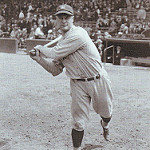
The Joy of the Small Sample Size -MLB Stats that Caught My Eye

Photo by Keith Allison

Photo by Keith Allison

Now that we’ve reached Tax Day, Baseball Roundtable would like to take a look at a few MLB statistics – through April 15 – that you probably don’t see much of in regular baseball coverage.  Admittedly, we are looking at a pretty small sample size, but the box below illustrates the kind of early-season “numbers” that caught BBRT’s eye.

  • Rays’ righty Yonny Chirinos, as of April 15, had pitched more innings (14 1/3 innings in two starts and one relief appearance) without giving up a run this season than any other pitcher.
  • The Mets’ Jose Reyes had the most at bats (16) of any player who had yet to get a hit this season.
  • The Padres’ Jose Pirela has the most at bats (74) and the most hits (24) without a home runs this season.  The other players with at least 60 at bats without a long ball through April 15:  D-backs’ Ketel Marte; Reds’ Scooter Gennett; Marlins’ Starlin Castro; Astros’ Jose Altuve; Marlins’ Lewis Brinson.

Then, of couse, there are some team numbers that stand out.

THROUGH APRIL 15 …

  • The Angels have scored an MLB-best 103 runs in 16 games – the Royals have plated MLB-worst 39 in 13 contests.  No surprise, the Angels are 13-3, the Royals 3-10.
  • The Indians are averaging right on the Mendoza Line (.200) – as a team. Despite the lowest average in the majors, the Tribe is 8-6 on the season.
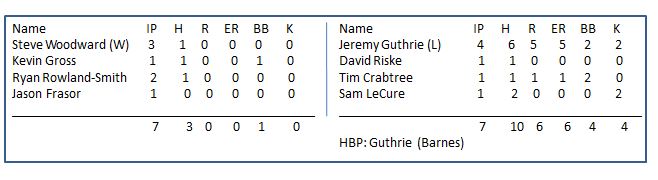
  • The Angels have hit more home runs (26) than the Royals (5), Tigers (5), Rays (7) and Marlins (8) COMBINED.
  • The Brewers blew an MLB-leading seven saves (in just 11 opportunities) – and are still playing .500 ball (8-8).  The Braves, meanwhile, have had only two save opportunities – and blew them both – but are 8-6 on the season.  

_______________________________________

Here’s a few other stats that caught my attention – all through April 15.

  • No player has grounded into more double plays than the Marlins’ Starlin Castro – seven times in 15 games. Still, Castro is hitting .295 over 61 bats.

GDP – Through April 15 …

Starlin Castro, Marins – 7; Stephen Piscotty, A’s – 5; Aaron Judge, Yankees – 5.

The Angels’ Albert Pujols led MLB in grounding into double plays in 2017 – with 26.  That was 0ne more than the NL leader, Matt Kemp of the Braves.

  • The Mets’ Yoenis Cespedes and Rockies’ Trevor Story are tied for the most strikeouts by a batter at 26 (in 58 and 62 at bats, respectively). Notably, both are hitting under .200 through April 15.

Most Strikeouts – Through April 15 …

Yeonis Cespedes, Mets – 26; Trevor Story, Rockies – 26; Drew Robinson, Yankees – 25; Giancarlo Stanton, Yankees  – 25; Paul DeJong, Cardinals – 25.

BBRT note:  Cespedes, despite leading in K’s and hitting just .190, has 12 RBI.  Robinson is the only one among these leaders who has fanned in more than half his at bats (25 whiffs in41 at bats).

The 2017 MLB strikeout leader was Yankee rookie Aaron Judge who, last season, set MLB rookie records in both strikeouts (208) and home runs (52).

  • No one has averaged more pitches seen per plate appearance so far this season than the Twins’ Miguel Sano (4.96) – who is hitting .250-3-8 in ten games.

Pitches Per Plate Appearance – Through April 15 …

Miguel Sano, Twins – 4.96; Jose Ramirez, Indians – 4.73; Matt Davidson, White Sox – 4.67; Todd Frazier, Mets – 4.57; Trevor Story, Rockies – 4.57

Curtis Granderson (Dodgers/Mets) saw the most pitches per plate appearance (among qualifiying hitters) in 2017 at 4.52. Overall, he hit .212-26-64 in 147 games.

  • The Cubs’ Javier Baez leads the major leagues in intentional walks this season with four, while the Nationals’ Bryce Harper – hitting ,300 with an MLB-best seven home runs – leads in overall walks with 20. 

Intentional Walks – Through April 15 …

Javier Baez, Cubs – 4; Freddie Freeman, Braves – 3; Jody Mercer, Pirates – 3; Michael Conforto, Mets – 3.

Total Walks – Through April 15 ….

Bryce Harper, Nationals – 20; Freddie Freeman, Braves – 17; Matt Carpenter, Cardinals – 14; Trea Turner, Nationals – 14.

The Reds’ Joey Votto led MLB with 20 intentional walks in 2017. He also led in total walks with 134. 

  • The Cubs’ Kris Bryant has already been hit by a pitch an MLB-leading five times.

Hit-By-Pitch – Through April 15 …

Kris Bryant, Cubs – 5; Martin Machado, Angels – 4; Robinson Chirinos, Rangers – 4; Jose Abreu, White Sox – 4.

Last season’s MLB hit-by-pitch leader was the Mets’ Anthony Rizzo with 24. The Rangers’ Carlos Gomez led the AL with 19.

  • Looking at players with at least 10 at bats with runners in scoring position – The Braves’ Dansby Swanson has the best RISP average at .615 (8-for-13).

Average with RISP – Through April, minimum 10 RISP at bats) … Dansby Swanson, Braves – .615 (8-for-13); Freddie Freeman, Braves – .600 (9-for-15); Jose Pirela, Padres – .571 (8-for-14).

Among players with at least 75 at bats with runners in scoring position in 2017, the Nationals’ Daniel Murphy had the highest average with RISP at .409 (47-for-115).

  • The Dodgers’ Chase Utley, Dodgers’ Kyle Farmer and Cubs’ Tommy La Stella share the lead in pinch hits with four reach. Utley got his in just five pinch-hit at bats, Farmer in six at bats and La Stella in eleven. 

The Marlins’ Ichiro Suzuki led all MLB players in pinch hits in 2017 with 27 (in 100 pinch-hit at bats). Looking at players with at least 20 pinch-hit at bats, The Cardinals’ Jose Martinez put up the highest pinch-highest average at .462 (12-for-26).

  • The Mariners’ Dee Gordon leads MLB in stolen bases through April 15 with seven – and also had the most stolen bases through April 15 with being caught. The leaders in caught stealing – all with three through April 15 – are the Padres’ Freddy Galvis (3 attempts); Rays’ Mallex Smith (five attempts); and Cardinals’ Tommy Pham (8 attempts).
  • Among pitchers with at least 15 innings pitched, the Astros’ Gerrit Cole has fanned the most batters per nine-inings at 15.43.

Strikeouts Per Innings – Through April 15 (minimum 15 innings pitched) …

Gerrit Cole, Astros – 15.93 (36 K/21 IP); Patrick Corbin, D-backs – 14.24  (29K/18 1/3 IP); Noah Sundergaard, Mets – 13.92 (33K/21 1/3IP).

In 2017, among pithchers with at least 100 innings pitched, Chris Sale led the way with 12.93 strikeouts per nine innings. Among pitchers with at least 40 innings pitched, the leader was the Red Sox’ Craig Kimbrel at 16.43 (126 K in 69 IP).

  • The Angels’ Garrett Richard leads MLB in walks allowed with 15 (20 innings pitched/24 strikeouts). Special mention goes to the Padres’ Bryan Mitchell, second in walks with 14, but in just 13 2/4 innings.

Most Walks Allowed – Through April 15 …

Garrett Richards, Angels – 15 (20 innings pitched/24 strikeouts); Bryan Mitchell, Padres – 14 (13 2/3 IP/3 K); Carlos Martinez Cardinals – 14 (25 2/3 IP/ 30 K).

  • The highest earned run average among pitchers with at least two starts in 2018 is 12.00 – A.J. Cole of the Nationals. Chris Tillman has an 11.91 ERA in three starts. At the other end of the spectrum, Yonny Chirinos of the Rays has two starts and one relief appearance and has yet to give up a run (14 1/3 innings).

The highest ERA among qualifyng pitchers (162 innings pitched) in 2017 was 5.52 (Matt Moore, Giants).  Note: Jordan Zimmerman had a 6.08 ERA in 29 starts – but only 160 innings pitched. 

Primary Resources: ESPN.com; MLB.com; Baseball-Reference.com.

I tweet baseball @DavidBBRT

Follow’Like the Baseball Roundtable Facebook page here.

Member: Society for American Baseball Research; The Baseball Reliquary; Negro Leagues Baseball Museum.