Ballpark Tours Rocky Mountain High Redux (Day Five) – Charlie Blackmon’s 1000th Hit … Don Drysdale’s 1961 Dodgers uniform … Taco Tuesday … and more.

busDay Five (Game Four) of the Rocky Mountain High Redux started with the familiar complimentary hotel breakfast – and moved on to a trip to the National Ballpark Museum. Before I get to that, however, a couple of observations on Denver and our tour group.

In Denver (on a visit) the 16th Street Mall is the place to be (stay near there if you visit).  As noted earlier, the free up-and-down the Mall shuttle runs from 5 a.m. until 2 a.m. – and most of the eating, drinking and entertainment locations remain open until 2 a.m.  There are also plenty of shopping opporunities for luxuries, souvenirs and even essentials. (Hey, Minnesotans, there’s a Target right on 16th Street.)  Near the 16th Street Mall you will also find a host of museums – ranging from the National Ballpark Museum to the American Museum of Western Art to the Colorado History Center. (More on museums coming.)  The Holiday Inn Express our Ballpark Tours stayed at was within walking (or free shuttle) distance of all of the above. That’s one of the advantages of BPT’s lodging philsophy of always staying near the action and attractions.

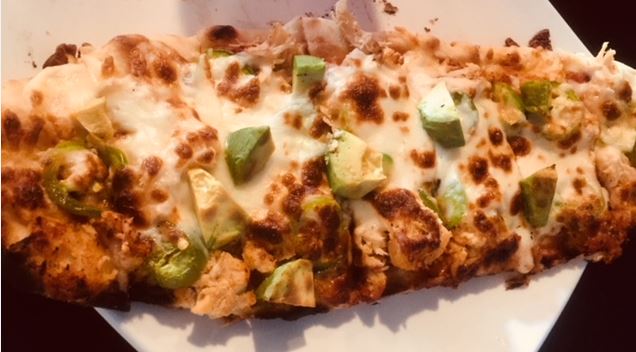
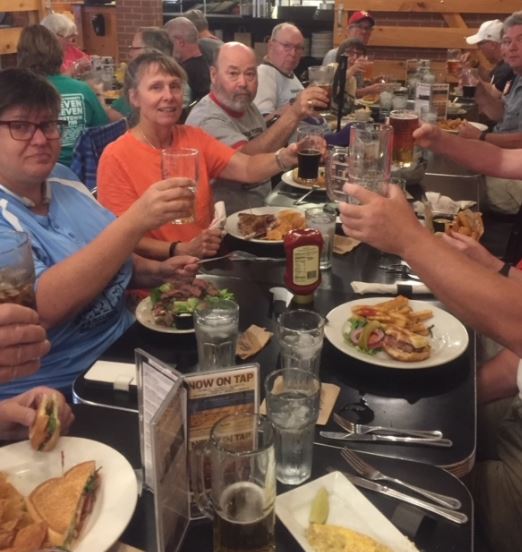
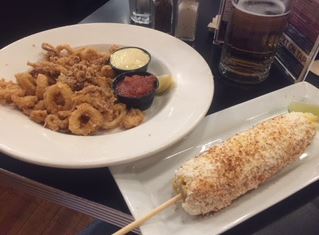
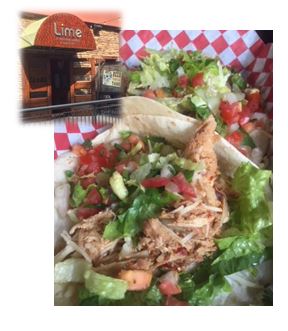
limeThere are other advantages when traveling with a group like BPT. For example, yesterday – at about lunch time – I received a text from a fellow BPT trekker that informing me of Taco Tuesday at a nearby Mexican Taverna – great tacos for a dollar, and walking distance.  My roomate and I were there to enjoy this “find” within 20 minutes.  To your left, is an example of the dollar tocos, which were available in hard or soft, flour or corn and beef, chicken, carnitas, seafood and vegetable.  The only requirement?  You had to buy a beverage – which was no problem for our group.


THE GAME – PIRATES 10 – ROCKIES 2

coors outzsideNow, we did go to the National Ballpark Museum before the Pirates/Rockies game, but let’s take a look at the game first.  Viewing baseball is, after all, the number-one purpose of this trek.

Game four of our seven-game trip was another 6:40 p.m. Pirates at Rockies contest.  Contest may be a misnomer, as the Pirates jumped out 10-0 lead after five innings and held on to win 10-2. A few observations and highlights (or low-lights) from the game:

  • Power was the order of the day. Both teams had ten hits, but the Rockies had eight singles (two doubles), while the Pirates had six singles, a double and three home runs (Starling Marte – solo in the first; Jody Mercer – three-run shot in the fourth; Josh Harrison – two-run dinger in the fifth).
  • We did see a 2018 rarity, Pirates’ starter Jameson Taillon pitched a complete game, despite giving up ten hits. (He finished off the Rockies on 107 pitches (70 strikes), walking just one and fanning three, while allowing two runs.)

HOW THE GAME HAS CHANGED

Last night, Jameson Taillon became the first National League pitcher to log two complete games in 2018. 

  • I got to see a pair of double plays (1-4-3 and 5-4-3) both off the bat of Rockies’catcher Chris Ianetta.
  • Pittsburgh scored ten times and left just two men on base.
  • The game – despite 20 hits and 12 runs – moved right along, wrapping up in two hours and 34 minutes. The pitchers deserve the credit.  For the most part, they practiced a “get-the-ball, throw-the-ball” mound style.
  • Despite ten hits, the Rockies were a woeful one-for-twelve with runners in scoring position.

CHARLIE BLACKMON’S 1000th SAFETY

Rockies’ CF Charlie Blackmon lined a single to right with one out in the top of the sixth inning (eventually coming around to score the Rockies’ first run).  It was Blackmon’s 1,000th career base hit. Blackmon had been zero-for-twelve since collecting his 1, 999th hit.  The Rockies’ leadoff hitter and 2017 NL batting champion (.331) ended the game hitting .279-21-49 on the season and .302 over is eighth-season MLB  career. He got a nice standing ovation that he seemed reluctant to bask in. (The Rockies were down 10-0 when he got the base hit and he is “gamer.”)


You can buy "outside" food, beverages and souvenirs at bargain prices right up to the main gate. Just look for the vendors tall signs.

You can buy “outside” food, beverages and souvenirs at bargain prices right up to the main gate. Just look for the vendors tall signs.

A few additional thoughts.  You can save a lot of money on snacks if you buy them outside the game – and the Rockies have few rules about outside food or beverage.  In fact, amateur vendors work the area right up to the main gates.

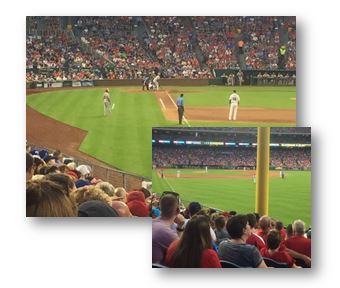
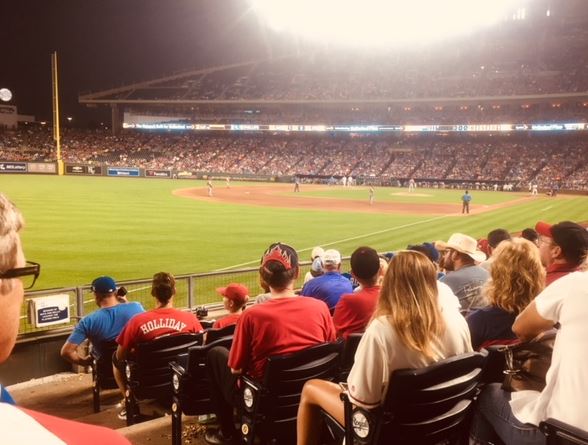
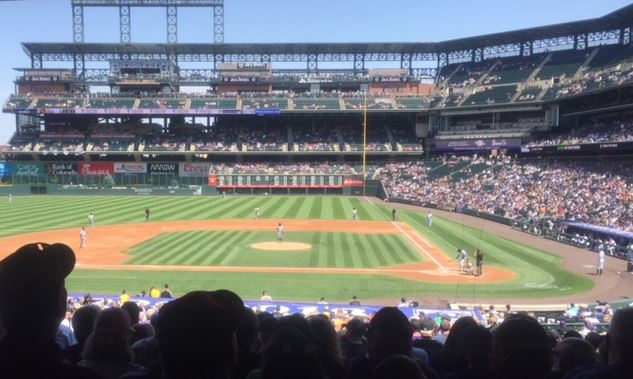
For this game, our seats were in right field and (for those Minnesotans who remember sitting above the RF “baggie” at the HHH Metrodome) we did miss a two or three plays in deep right or center.

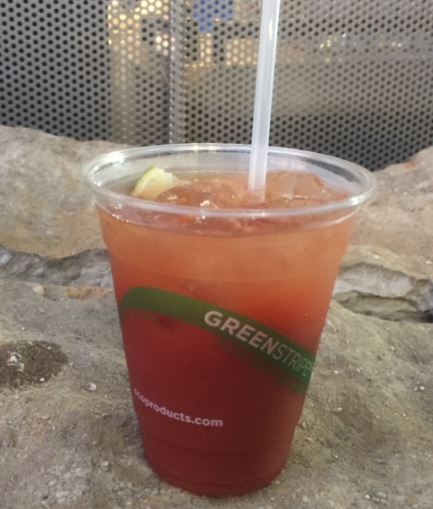
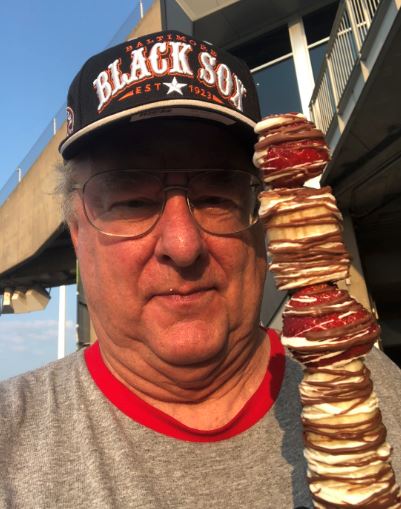
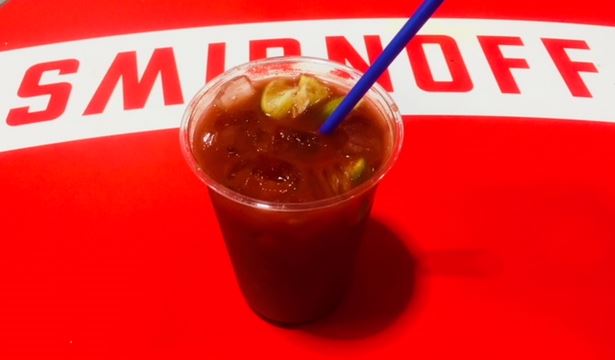
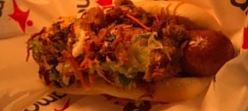
tripleplaydogBBRT’s new, semi-official correspondent Mike Bailey tried one of the Rockies’ newest concessions – the Triple Play Dog (hot dog topped with pulled pork bacon bit and purple slaw). Just $7, he said it was a meal in itself and gave it two thumbs up.  “It was so good, I didn’t even want to put mustard on it. I just wanted to enjoy the taste.” The sweet Berry Kabobs ($8) also drew kudos.  More on concession in my next post; when I will look at (consume) the Rocky Mountain Oyster Po’ Boy and Baseball Roundtable’s traditional ballpark Bloody Mary.

Now, let’s step back in time to BBRT’s pre-game visit to the National Ballpark Museum.

The National Ballpark Museum

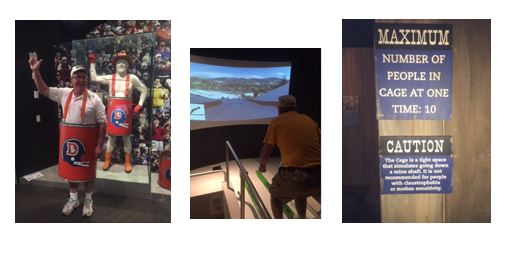
We made it down to the National Ballpark Museum – 1940 Blake Street, just a half-block from the stadium. A great visit ($10 Adults – $5 Seniors – Kids under free). Here, you enter through a 1909 entrance turnstile from Shibe Park and are treated to artifacts from 14 classic ballparks and more. Among the most prominent displays are: Shibe Park/Connie Mack Stadium (Philadelphia); Crosley Field (Cincinnati); Tiger Stadium (Detroit); Comiskey Park (Chicago); Sportsman’s Park (Saint Louis); Fenway Park (Boston); Yankee Stadium and The Polo Grounds (New York City); and Ebbetts Field (Brooklyn).  And that’s just the tip of the iceberg in this store front-sized museum.

Minnesota Fans May be Interested in this Harmon Killibrew Item

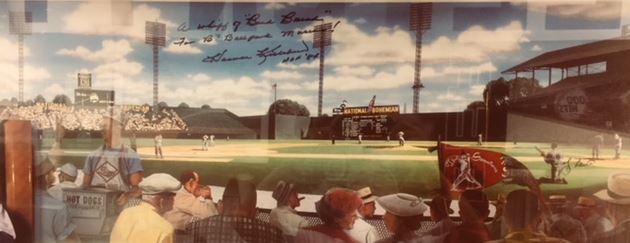
KillerMuseum Manager Raelee Frazier, who you are likely to find on site, is a knowledgeable historian and adept story teller.  I came across a poster of old Griffith Stadium (one-time home of the Washington Senators) signed by Harmon Killebrew.  It read “A whiff of ‘Bond Bread’ for B’s Ballpark Museum, Harmon Killebrew, HOF ’84.” Ms. Frasier filled me in on the notation.  The “B” was for Bruce (B or Mr. B) Hallerstein, who created the museum.  The reference to a whiff of Bond Bread was noting Killebrew’s appreciation of the  sweet smell of the product of the General Baking Company, which was located near Griffith Stadium.

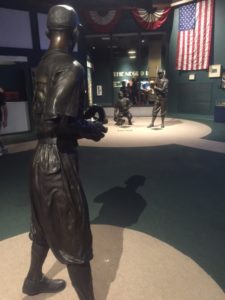
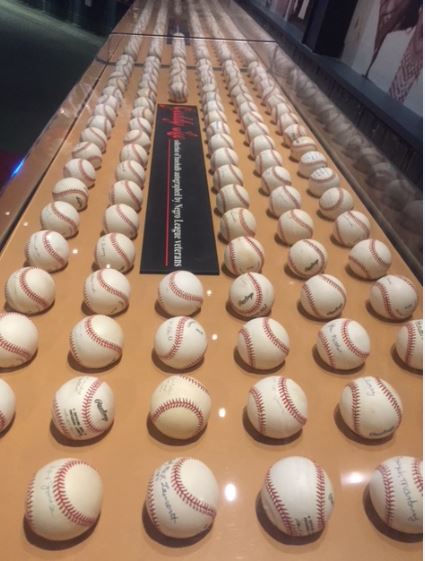
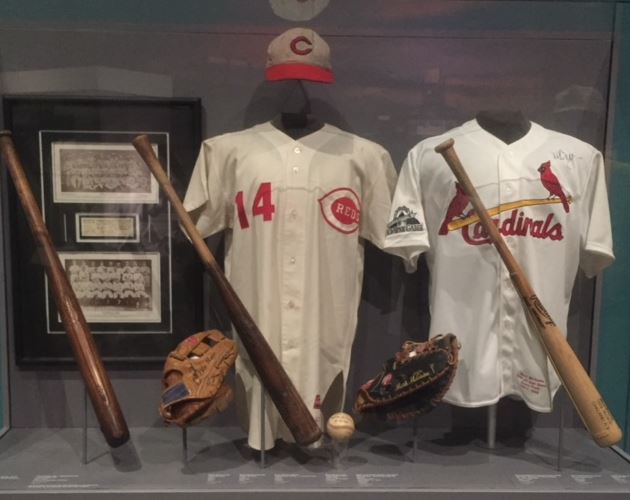
The museum visit was a wild and wonderful trip back in a baseball time machine, thanks to the museum’s creator and curator Bruce “B” Hallerstein. You’ll find such items as seats and usher uniforms from classic (and, in many cases, long-gone ballparks); concourse lights from Ebbetts Field; and a piece of the Fenway Wall.  You can also spot more personal items like autographed baseballs and bats from stars of the past, like Don Drysdale’s 1961 Dodgers uniform and a Reggie Jackson commemorative bat.  And, there are unique and quirky items like a commemorative statue of Don Larsen’s World Series perfect game; a Chicago Cubs pinball machine; and menus from Mickey Mantle’s New York City restaurant.

There is all of this and much more.  Definitely worth a visit if you are a baseball fan or a history buff.  You should leave yourself plenty of time to peruse this jam-packed, but well-organized and labeled collection.  Here are a few photos to help tell the story.

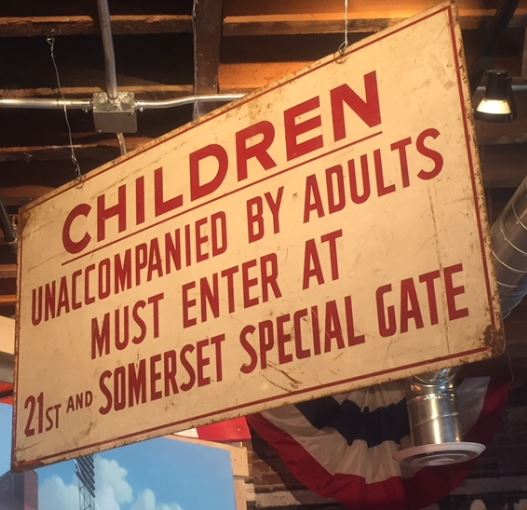
Sign from Shnibe Park from the days when kids of all ages came to the ballpark on thier own,

Sign from Shnibe Park – from the days when kids of all ages came to the ballpark on their own,

These usher's uniforms were once a common sight at Fenway Park.

These usher’s uniforms were once a common sight at Fenway Park.


Concourse lights from Ebbetts Field.

Concourse lights from Ebbetts Field.


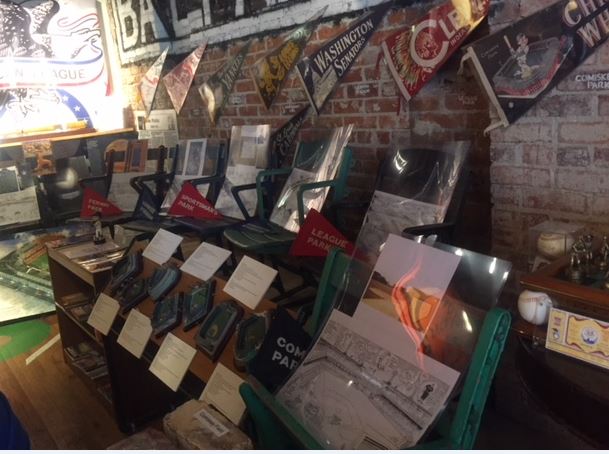
seats

Seats and histotic information from parks long gone. Did you know, for example, that exactly 11,111 home runs were hit at old Tiger Stadium?


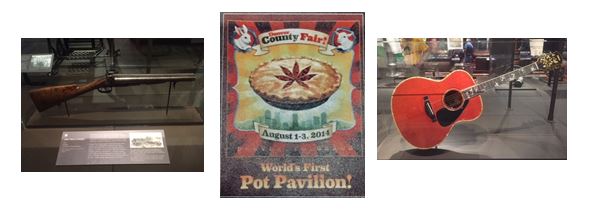
Tomorrow, another Pirates-Rockies game, food and beverage reviews and a a museum visit that covers everything from Babe Ruth’s baseball glove to John Denver’s guitar to the 2014 Denver County Fair’s “World’s First Pot Pavilion.”


I tweet baseball @DavidBBRT

Follow/Like the Baseball Roundtable Facebook page here.

Member: Society for American Baseball Research; The Baseball Reliquary; The Negro Leagues Baseball Museum. 

Ballpark Tours Rocky Mountain High Redux – Day Four – Going Yard in LoDo

ROCKY MOUNTAN HIGH REDUX – MEET “BREAKFAST AND A SHOW” REDUX

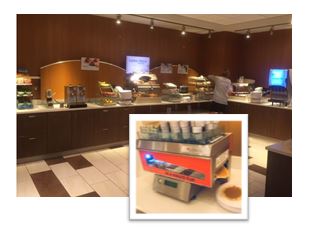
cakesThe day started with the complimentary breakfast at the Denver Downtown Holiday Inn Express.  And, as Yogi Berra said, “It was deja vu all over again.” First, the breakfast was solid.  All the usuals: omelets, biscuits and gravy, bacon, sausage, fruit – you get the idea.  There was also the pancake machine, which spit out pancakes, like a copy machine, at the press of the button.  BBRT first wrote about the pancake machine while on a June 2012 Ballpark Tours trip (click here for that post); lauding the joy of starting the day with “breakfast and a show.”  Now, it’s even better.  They’ve added a window on the side, so you can watch as your (pancake) batter prepares to come to the plate. 

LUNCH – GOING YARD BEFORE THE GAME

Dozens of taps keep the beer flowing at The Yard House.

Dozens of taps keep the beer flowing at The Yard House.

There are about 400 bars and restuarants within walking distance (depending on your stamina and stride length) from out hotel, so various BPT groups planned lunch (it was a night game) at varying distances. Our small contingent made it just over a block to The Yard House – which boasts an interesting menu and 137 beer choices.  (Note: It turned out to be 136; my first choice – Boulder Hazed and Infused – was unavailable. I settled for Colorado Native Lager.)

Yard House has great atmosphere and outdoor seating for even better people watching. You can buy your brew by the glass, goblet or half-yard.

Lunch

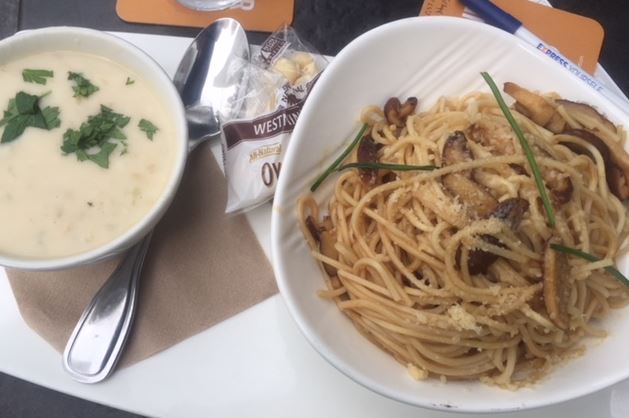
Shitake and Garlic Noodles with a Clam Chowder side – delicious and just $9.95.

Me Beer


Guess what I went for? Well, aren’t volume purchases the most economic? Again, I had the Colorado Native Lager – nice and hoppy, with a crisp, fresh taste. ($14.00 a half-yard.) Another of our group had the House Honey Blonde goblet and gave it postivie reviews ($6.50).  The lunch menu was both extenive and interesting.  I went with a house lunch special (Shitake Mushrooms over Garlic Noodles, with clam chowder as my selected side). Out table also had a Philly Steak sanwich with a salad side – both of these lunches were $9.95; while the final member of our group had the Blackened Chicken Torta ($12.45).  We were all impressed.

A ROCKY MOUNTAIN BLOODY

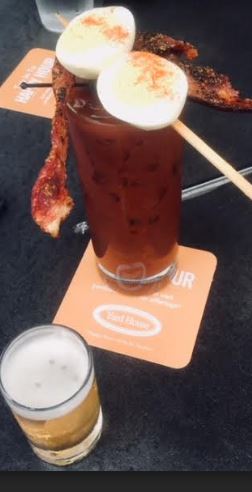
BloodyEggAt Denver’s Yard House, my roomate started lunch with a Bacon and Egg (Bloody) Mary (sounds like breakfast to me): Tito’s handmade vodka, filthy Bloody Mary Mix, spiced and candied bacon, seasoned boiled eggs, olive, lime and a five-ounce Honey Blonde chaser.  Just $11.50 and rated as worth every penny. It was given an 8.5 on a ten-point scale. Kudos, Yard House.


We headed out for the ballpark at about 5:00 p.m. for a 6:40 game – many of riding the free Mall Shuttle  which takes you down 16th Street through the hopping LoDo (lower downtown) shopping and entertainment area to within about four blocks of Coors Field.  Who says theres no such thing as a free ride.

REstroomDenver has come up with a new solution for public restrooms downtown. Movable “facilities” built into what appears to have been horse trailers.   At times, there were lines. Emptied daily (I hope.)


THE GAME – WELL PLAYED … EVEN IF THERE WAS ONLY ONE DOUBLE PLAY

coors1We got to Coors Field at about 5:30 p.m. for a 6:40 game, plenty of time to cruise the concourse, pickup (and fill in) a scorecard and soak up some atmosphere.  It was Dollar-A-Dog Night and I had enjoyed a rather large beverage at lunch, so I won’t get into concessions in this post.  (However, I will note that the Dollar-A-Dog promo was sponsored by Nathan’s, so that bargain-priced wiener was pretty good quality – especially after adding raw onions and ketechup.)

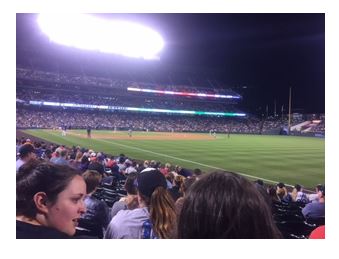
The brick façade of the ballpark is impressive as you approach – and entry lines move quickly. Once inside, you see there are plenty of concession stands, but they are set a bit deep in the enclosed (a bit dark) concourse. Game watching while in line is not an option. Don’t know if it was our seat location, but I did not see a single vendor busking the aisles the whole game.  Our seats were in row 11, lower deck, right-field corner. Good sight lines.

I should again note that we traveled through Denver’s LoDo (Lower Downtown) area to get to the park – and passed literally dozens of dining and shopping opportunities.  It is a very lively area that deserves multiple visits. (I’m thinking Uncle Joe’s Honk Kong Bistro and the 5280 Burger Bar on this trip.)

It promised to be a good contest – two teams over .500 (a plus if you’re from Minnesota) and in the post-season hunt.  In addition, both starting pitchers had earned run averages under 3.75 – Pirates’ righty Joe Musgrove (4-5, 3.63) and Rockies’ southpaw Kyle Freeland (9-7, 3.20). Neither the teams nor the pitchers disappointed.

Side note:  I stopped for a program and scorecard on the way to our seats. I got in line and most of those ahead of me were purchasing a program ($5) and a scorecard ($1.50) – so, I had my $6.50 ready when I “approached the bench.” On a hunch, my request was “I’ll have a program and a scorecard. (Pause) Unless, of course, there is a scorecard IN the program.” The vendor pulled back the scorecard and replied. “That’ll be five-dollars and our little secret.”

Spoiler alert:  It was my kind of game … a 2-0 final with some sweet tension along the way.

Over the first 4 ½ innings, the pitchers dominated. Musgrove had retired 12 in a row with one strikeout, Freeland had fanned four.  He’d also allowed two walks and two hits (one a double to Musgrove – more #WhyIHateTheDH), but pitched out of trouble, inducing: 1) a nice pitcher-to-second to first double play (RF Starling Marte, not an easy guy to double up) batting after Pirates’ LF Corey Dickerson opened the game with a single; and 2) a pop up to first by catcher Elias Diaz with two on and two out in the fourth.

By the time we got to the fifth, we seen a handful of very nice fielding plays – a sliding catch and a Rockies’ CF David Dahl for the second out in the second; Rox’ SS Trevor Story ranging far to snag a Jody Mercer ground ball headed for center in the third and making a nice “spin-move” throw to get him at first and then later in the inning making a charging play on a low roller by Dickerson. On the Pirates’ side, second baseman Josh Harrison made a diving stop on grounder by Rox’ RF Carlos Gonzalez, nailing him at first to end the inning.

BBRT observation:  Perhaps the biggest difference I consistently see between minor league ball and “the show” is the quality of the defense.

NO!!!

In the seventh inning – of a tight 2-0 game – Colorado fans apparently lost interest, starting an annoying (isn’t it always) wave. It made the rounds at least a half dozen times.

sgtormIn the bottom of the fifth, the rain (which had been anticipated) began and it seemed to affect Musgrove, who (as noted earlier) was perfect through four. He gave of single to the first two batters (Rox star 3B Nolan Arenado and Trevor Story). Then with runners on first and third, CF Gerrardo Parra hit what looked like a sure double play grounder to Pirates’ 2B Harrison. Don’t know if the now wet (the rain was picking up) ball and field contributed, but Harrison booted is and Arenado scored. Then the storm came on in earnest, drenching fans scurrying for cover and leading to a half hour (32 minute it was reported later) rain delay.

Once play resumed, Musgrove hit Rox first-sacker Ian Desmond with a pitch (loading the bases). Catcher Chris Ianetta’s sacrifice fly to left scored Story. Freeland then popped up a bunt for the second out, bringing up Rox’ leadoff hitter CF Dahl, who singled to left.  We then saw another of those defensive plays that separate the major from the minors. Pirates’ LF Dickerson charged the ball and threw a one-hop strike to the plate to nail Parra (trying to score from second) for the final out.

Over the final three innings, Rockies’ starter Freeland and relievers Seunghwan Oh and Wade Davis (who got the save) held the Pirates to two walks, while fanning four. On the other side of the ball, Musgrove and Edgar Santana held the Rox to a Dahl double. We did see one more sparkling defensive play. This one by Pirates’ SS Mercer, who handled a tough short hop off the bat of Rockies’ 2B DJ LeMahieu.

Side note:  It’s been awhile since I’ve seen both starting pitchers make it through the seventh inning. Musgrove did it on 87 pitches (65 strikes), while Freeland used 103 pitches (65 strikes). As you might expect the pitch count difference can be attributed to walks and whiffs. Freeland fanned five and walked three. Musgrove whiffed two and didn’t walk a batter. Overall, the game saw just seven hits (two doubles and five singles, plus three walks and two hit batters).

After the game it was back to the hotel, to rest up for the Tuesday (August 7) Pirates/Rockies rematch and a pre-game visit to the National Ballpark Museum.  Four games left on the trip, two here in Denver and two in Kansas City.  Life on the baseball highway is great.

Watch this space for more from the road with Ballpark Tours.

For the tour Day One wrap, click here.

For Days Two and three, here.

I tweet baseball @DavidBBRT.

Follow/Like the Baseball Roundtable Facebook page here.

Member: Society for American Baseball Research; The Baseball Reliquary; The Negro Leagues Baseball Museum.
BALLPARK TOURS ROCKY MOUNTAIN HIGH REDUX – DAYS TWO AND THREE

DAY TWO – BLUES, BREWS AND BASEBALL

Rocky Mountain High Redux Day Two featured another game at Omaha Werner Park … the big, little ballpark in the soybean sea.  This time, it was the Las Vegas 51s (Angels) visiting the Omaha Storm Chasers (Royals) in a 6:05 p.m. tilt.  But wait, I’m getting ahead of myself.

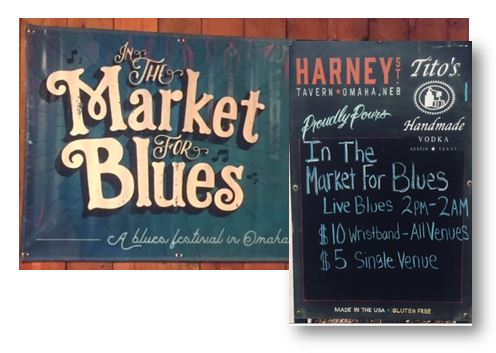
In the marketOur dedicated trekkers started the day with the complimentary DoubleTree breakfast buffet and then headed out on the town.  The most popular destination? Old Market Street for the “In the Market For Blues” festival. Eight venues and more than thirty blues bands from around the country (as well as Canada and even Italy) – with live music from 2 p.m. to 2 a.m.  Not to mention ice cold beer and, of course, Rye Manhattans.  A happy coincidence or great planning by our tourmaster?  We may never know.

TitaniumBut the music was great – with plenty of BPT folks found in the Old Market taverns before and after the game.  One of the hottest bands -playing at the Dubliner Pub – was Kurt Allen & Titanium Blue from Kansas City (and they will be back in KC when our group is there).  Our cadre was also impressed with a group of local high schoolers – Blue Sunday –  who could really bring the blues.  A member of the wait staff informed us that the group “really packs them in, but they have to leave by 9 o’clock.”  

PS: Julian found a cigar bar.

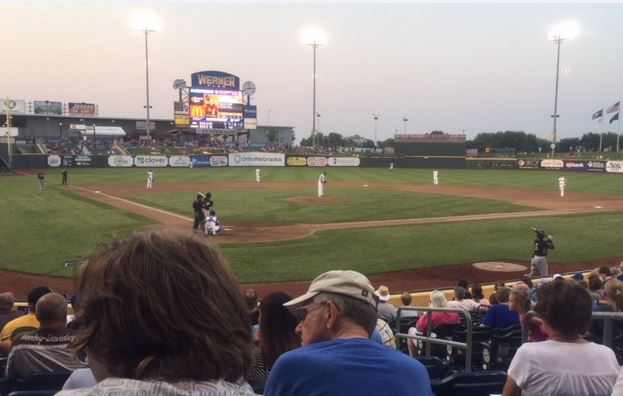
Good seats great view.

Good seats great view.

At 5:00 p.m., it was back on the bus to Werner Field, where the Las Vegas squad topped the Storm Chasers 4-3 in a game that was closer to what BBRT expects of the national pastime. (More on that to come).  We had even better seats than yesterday – right behind home plate, less than ten rows from the field. It was Dad-Daughter Princess Night and all the Disney princesses were there and even one of our BPT group was spotted wearing a tiara.

A few observations on contest number-two of our trip:

  • There were a total of 17 ceremonial “first” pitches (ouch);
  • Unlike last night, with its 23 runs, 32 hits and nine home runs; this contest featured just 15 hits and 13 of them were singles.
  • There were four wild pitches in the game, three by  Las Vegas hurlers.
  • Our group sang a hearty Happy Birthday to me – as I celebrated 71 at the ballpark.

As regular BBRT readers know, I love the 6-4-3 or 4-6-3 double play – and that combination provided the highlight of the game for me. The game went into the bottom of the eighth with Las Vegas up 4-1, when a bit of wildness (more than a bit, actually) by Las Vegas’ reliever Williams Jerez contributed to a rally. To start the inning Las Vegas reliever Sean Isaac walked Omaha SS Nicky Lopez and then fanned number-three hitter (DH) Paulo Orlando. Las Vegas brought in Jerez to face cleanup hitter and local hero (lots of chants of “I Like Frank” followed by the reply “Me, too.”) 1B Frank Schwindel.  Then things got a little ugly. Sczhwindel doubled putting runners on second and third. This was followed by two singles and a pair of wild pitches (one on a third strike that let the batter reach first) and suddenly it was 4-3 and Omaha had the bases loaded, just one out and Jerez – who had already let two runs score on wild pitches – facing LF Donnie Dewees (four-for-five the night before, but zero-for-two in this game). Dewees grounded to Vegas’ 2B Luis Rengifo, who flipped to SS Alberto Triunfel, who relayed to 1B Matt Theiss for a rally-killing, game-saving double play. My day was made.

Overall, a much crisper game than Friday night and,  once again followed by fireworks and a concert. (We skipped the concert and headed back to town for the Blues Fest. (I actually cashed in for the night.)

More Why I hate the DH

On this day (August 5) in 1953, St. Louis Browns’ rookie pitcher Don Larsen – yes, that Don Larsen – rapped three singles in three at bats in a game against the Red Sox. While he lost the game (a complete-game 5-0 defeat), Larsen’s three singles gave him base hits in seven consecutive at bats – the MLB record for pitchers. On the season,  the rookie hurler hit .284 (11-for-82), with three home runs and ten RBI. 

Hot Dpogs finalI had better luck with food at this game (see my first trip post for the Pop Tart Ice Cream Sandwich).   The Pulled Pork,  Bacon, Cheese hot dog (Hot Dog Nation – $10) was delicious, but also messy to eat. (Plenty of napkins are recommended.) Other BPT trekkers gave solid ratings to the Chicago Dog from the same stand – rating it 70 percent “Chicago.” (The lack of a poppy-seed bun and a little too much relish sweetness brought the score down.) Overall, the food concessions were rated fairly solidly for taste and price by our group.

A few other observations: 1) The ballpark has a nice “walk-all-the-way-around” concourse; 2) a great family play area (complete with carousel) beyond the outfield; and 3) even mini-golf, basketball and Wiffleball.


BLOODY MARY TIME

Here, BBRT will rate a pair of Bloody Marys. One from Day Two and one from Day Three.

FinalBMDay Two’s Bloody Mary was from the Downdraught Bar, beyond centerfield at the ballpark. The price was right at $8.50, the vodka pour was good.  However, there were no spices (no pepper, celery salt or Tabasco) and no “garnishes” (no celery stick, olive, pickle, etc.) The limited combination of just bottle mix and vodka did not stand up to the competition.

Day Three’s Bloody Mary came from Pals Brewery in North Platte, Nebraska (more on the location later). Slightly higher priced at $10, but worth it. Again a good pour, but garnished with squeaky cheese curds, locally made beef stick, olives and pickle – plus a 5-ounce beer chaser. (It was served at a brewery after all.) And, of course, it was delivered to your table.    My tour roomate, who ordered it, gave it thumbs up. 


___________________________________________

50

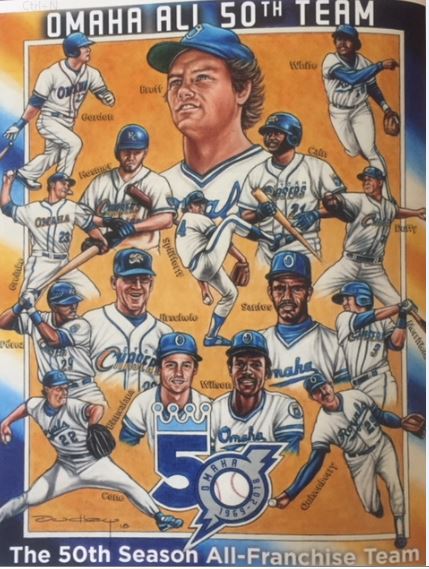
A final look back at Omaha, where they were celebrating 50 years of minor league baseball.  Here is their all-time team – a lot of whose names may ring a bell for our veteran crew.

C – Salvador Perez

1B – Eric Hosmer

2B – Frank White

3B – George Brett

SS –  Buddy Biancalana

OF – Lorenzo Cain

OF – Willie Wilson

OF – Alex Gordon

DH – Luios de le Santo

Utility – Whit Merrifield

P – David Cone

P – Danny Duffy

P -Paul Splittorff

RP – Dan Quisenberry

Manager – Mike Jirschele

DAY THREE – BREAKFAST, BUS RIDE, BEER, PIZZA and MUSIC

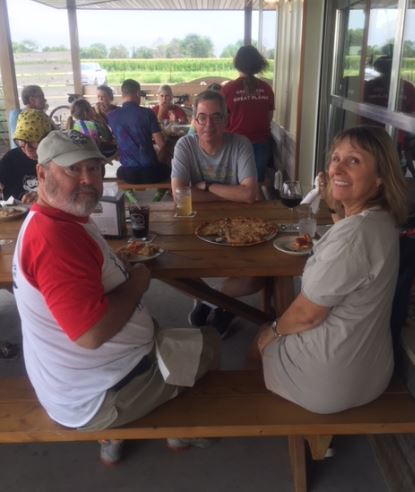
PalslogoLots of bus time today, as we made the ride from Omaha to Denver. We started with the complimentary breakfast buffet and today they substituted Kielbasa for pork sausage links and French toast for pancakes – great for this Polish kid. Left Omaha about 9 a.m. Central Time, got to Denver at about 6 p.m. Mountain Time. Pretty quiet time on the bus, but a great stop at Pals Brewery North Platte – where we enjoyed craft beers, spirits, wine and homemade pizza – as well as live music (Mark Daniels Three Wring Circus).  The pictures that follow tell the story.  Oh yes, I had the Jalapena Light Cream Ale (highly recommended.) Others were fond of the Irish Stout.

Tomorrow, the Pirates at the Rockies – and time in Lodo.  More reports to come.  Oh yes, and Julian has already found a Denver cigar bar.


Pizza and beer - always a hit with ballpark tours.

Pizza and beer – always a hit with ballpark tours.


gROUP 2

The smoking section was a bit far from the bar.

The smoking section was a bit far from the bar.


Much as the Omaha ballpark was in a soybean field, Pals brewery was surrounded by corn fields. Here my "Is this heaven?" t-shirt seems to fit right in.

Much as the Omaha ballpark was in a soybean field, Pals brewery was surrounded by corn fields. Here my “Is this heaven?” t-shirt seems to fit right in.

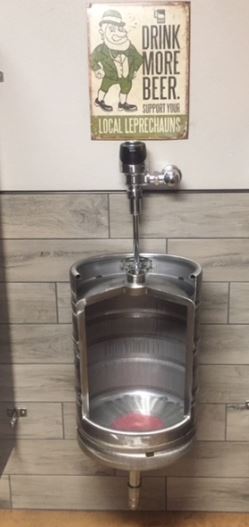
urinal

Nuff’ said.

Ballpark Tours Rocky Mountain High Redux – 2018 BPT Trek – Day One

Yesterday, it was all hands (well, 24 pair anyway) on deck as our Ballpark Tours group began our westward bus trek – two minor league games in Omaha, three Pirates/Rockies tilts in Denver and a pair of Cardinals/Royals contests in Kansas City.  Along the way, there are also such opportunities as: the Omaha “In the Market for Blues” festival; the National Ballpark Museum in Denver; the Negro Leagues Baseball Museum in Kansas City; and much more. We expect ten great days (and nights) of blues, brews, barbeque and baseball.  We also expect all the usual comedy and comaraderie that are part of BPT’s 36-year tradition.  And, BPT started to deliver on that tradition even before we left Saint Paul.

Busy hands make a good "Breakfast Bloody."

Busy hands make a good “Breakfast Bloody.”

We rolled out right on time (9;35 a.m.) and, since we do keep track of things in baseball, it should be noted that the first beer was opened while we were still “in port” (9:17 a.m. to be precise. Shortly thereafter, the mid-bus Bloody Mary Bar opened for breakfast and the music began to blare from “the back of the bus.”

A bit later, our intrepid (he likes to be called that) tour leader announced that the BPT “Tequila for Breakfast” tradition would have to be delayed, as he had left the spirits at home.  He said he would have the bottle delivered to the hotel in Omaha via Fed Ex. (Apparently unaware that there would be liquor stores along the way.) Ah, but one of our resourceful trekkers saved the day.  He just happened to have a “spare” bottle of tequila in his carry-on. Soon the tequila, lime, lemon and salt were making the usual rounds through the carraige.  And, as usual, cookies, Chicago Mix and the like circulated through the bus all morning.  It was kind of a “not very good for you” roundabout. (Although there was some gluten-free stuff.)

Other early activities included: delivery of this tour’s K-Kwiz; announcement of the “how many runs will be tallied” contest; explanation of the rules of travel; distribution of the “Port O’ Call” guide; and other announcements from the tour leader that were largely ignored.

The "Rev" delivers the sacred fish to the tour operator - offically blessing our journey.

The “Rev” delivers the sacred fish to the tour operator – offically blessing our journey.

A couple hours into the trip, the Reverend/Associate Pope/Vatican Lunch-master distributed meat, cheese and cracker snacks to all those hungry souls making this hardball pilgrimage. That was followed by the Rev’s personal delivery of the sacred fish to tour participants – each tidbit (pickled herring) was accompanied by the solemn blessing “Nomar Garciaparra” – which I believe is Latin  for “Travel in peace, lay off the curve and enjoy the free fish.”

At around noon, we enjoyed a picnic (bring your own), rest-stop lunch in brisk 93-degree weather.  I did note, later, that age seems to be taking its toll on this all-veteran crew.  About 25 percent (we love statistics) of the bus were seen napping after lunch.


IN OMAHA

As we rolled into Omaha and up to the DoubleTree (by Hilton), a few things caught my attention:

  • Our bus (driver) had to displace a group of Hell’s Angels parked in front of the hotel. (We all assured him later, after the bikers were long gone, that we had his back the whole time.  He might even have believed us.)
  • After arriving, we were directed to the other side of the hotel and a manager let us in through what appeared to be a basement door (one floor below the public lobby).  Perhaps a bit of a slight, but he gave us each a free cookie (and the hotel bar is open until 2 a.m.), so all is forgiven.
  • With our room keys we each received complimentary tickets to the $17.50 breakfast buffet – which turned out to be quite tasty: eggs, bacon, sausage, waffles, pancakes, potatoes, biscuit and gravy, fruit, sweetbreads and more. Good move, Julian.

As usual with BPT – fine rooms, located near the heart of the action. Thanks, Julian.

THE GAME

Yes, I’m getting to it.  There was a ballgame – Triple A – Omaha Storm Chasers (Royals) hosting the Las Vegas 51s (Mets).

gibbyAt 6 p.m., we bussed to the ballpark – about a 30-minute ride – located on the outskirts of Omaha, basically in a soybean field. Not sure why, but we did do a “victory lap” around the entire facility before deboarding. On the way into the park, we had a chance to see the team’s tribute to Omaha-native Bob Gibson, as well tributes to the 50th anniversary of the team (under various names).

We had great seats, just beyond third base about a half-dozen rows from the field.  BPT delivers again. The seats were, perhaps, better then the ball game.  It was in fact, hard to believe this was Triple A – one step from the majors.  I won’t go into a lot of detail, but we witnessed (and may be called to testify to):

  • 23 runs – Omaha lost 12-11, but it didn’t seem that close.
  • 32 hits – the batters averaged .381 for the game. The two starting pitchers lasted a combined 7 1/3 innings and surrendered 15 runs (ten pitchers were used, but none were harmed in the making of this game … except for, perhaps, their egos and prospects for a call-up).
  • 20 extra-base hits, including nine home runs.
  • 10 walks.
  • 21 strikeouts.
  • 2 errors.
  • 2 wild pitches.

If you like Nintendo, this was the game for you.

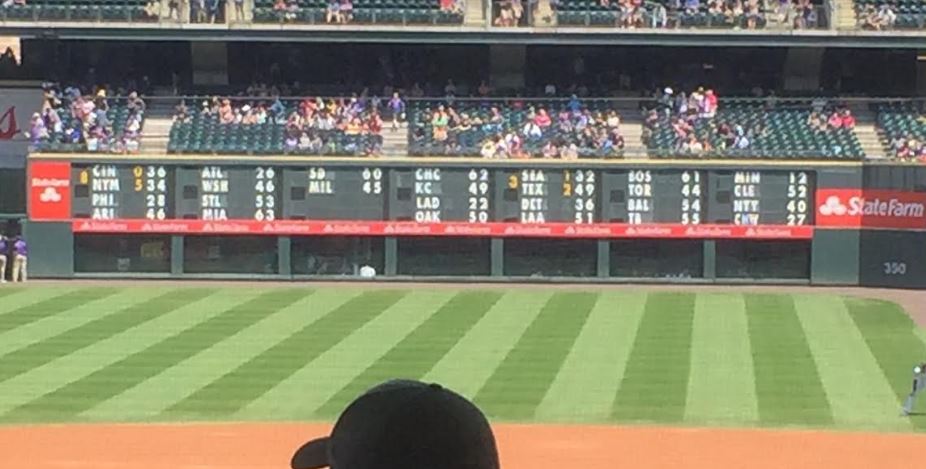
SCOREBOARDStill, it was baseball, watched with a group of friends and fellow fans – and there was, indeed, plenty of excited,  Here are a few more photos. What follows is a few more photos from the evening.

NO POST TOMORROW

I should add here that today’s schedule includes the Omaha Blues Fest (good timing for our visit and walking distance from the hotel) and a ball game.  We have an early departure, so I probably won’t post an update on the tour until Monday.


Nice ballpark, even if itx was located in a corn field.

Nice ballpark, even if it was located in a corn field.


There were fireworks and a country concert after the game.

There were fireworks and a country concert after the game.


Concession were generally good - the pulled pork hot dog got raves - but I'd avoid the Pop Tart Ice Cream Sandwich. It's two frosted, sprinkled, jelly-filled, cold Pop Tarts with ice cream in the middle. So sweet that it will make your teeth hurt (and spoil the taste of beer). Not recomended for eaters over nine-years-old. Yes, I had one.

Concession were generally good – the pulled pork hot dog got raves – but I’d avoid the Pop Tart Ice Cream Sandwich. It’s two frosted, sprinkled, jelly-filled, cold Pop Tarts with ice cream in the middle. So sweet that it will make your teeth hurt (and spoil the taste of beer). Not recomended for eaters over nine-years-old. Yes, I had one.


I felt this coach needed a shorter name or broader shoulders.

I felt this coach needed a shorter name or broader shoulders.


Woke up this a.m. to my 71st birthdya and this was at the top of my emails.

Woke up this a.m. to my 71st birthday and this was at the top of my emails.

I tweet baseball @ DavidBBRT

Follow/Like Baseball Roundtable on Facebook here.

Member: Society for American Baseball Research; The Baseball Reliquary; The Negro Leagues Baseball Museum.
July MLB – Led By Kiké and the Babe

Well, we’ve reached August  – and with July’s games,  the All Star Game, the Hall of Fame ceromonies and the trade deadine behind us, it’s time for Baseball Roundtable’s monthly wrap-up.  So, let’s take a look at the MLB stats and stories that caught BBRT’s eye in the month of July, as well as BBRT’s Players and Pitchers of the month, the standings and 2018’s batting and pitching leaders.  But first a look at the July connection between Kiké Hernández and Babe Ruth.

Kiké and The Babe … Sharing the Record Book

HernandezRegular readers know how BBRT loves an iconic or ironic coincidence.  Well, on July 24, a truly “bad day at the office” for Dodgers’ utility man Enrique “Kiké” Hernández led to just that. So, Hernández will lead off BBRT’s July Wrap.

Hernández started the game (at home against the Phillies) at 2B , moved to RF in the 14th inning and ended up on the mound (as the Dodgers’ ninth pitcher of the game) in the 16th.  The results?  Hernandez went zero-for-seven at the plate – AND got the loss, giving up a three-run, walk-off home run to Trevor Plouffe, as the Dodgers went down 7-4 in 16 frames. That long ball made Hernández the first MLB full-time position player ever to give up a walk-of home run. (How often are position players on the mound with the game still on the line?)

So, what does this have to do with The Babe?

RuthOnly two players in MLB history have played the infield, outfield and given up at least three runs on the mound all in one game.  Hernández and George Herman “Babe” Ruth (LF-1B-P on October 1, 1921).

Ironically, Hernández shares another record with the iconic Ruth. They are both among the 10 players top launch a record three-home runs in a post-season game. Babe Ruth (who did it twice) was the first – in Game four of the 1926 World Series. Hernández is the most recent – in Game Five of last year’s NCLS.

Side note:  In that 1921 game, Ruth started in LF, later moved to 1B and then took the mound in the top of the eighth, protecting a 6-0 Yankee lead over the Philadelphia Athletics.  The Bambino gave up a game-tying six runs in the eighth frame, but pitched a scoreless ninth, tenth and eleventh to get the win (7-6).

_______________________________________________________

Now it’s time to move on a look at BBRT Players and Pitchers of the Month.

AL PLAYER OF THE MONTH … Jose Ramirez, 3B Indians

Photo by Keith Allison

Photo by Keith Allison

It was a close contest for BBRT American League player of the month, but – appropriately – speed won the race. The Indian’s Jose Ramirez hit .322 for the month, bashed eight round trippers (fourth in the league), tied for second in July RBI (25) and was third in runs scored (21).  The other two top contenders had similar number across all those categories, but did not match Ramirez in the speed department, as the Indians’ third sacker stole an MLB-tops 11 bases (12 attempts) in July.

Other contenders: A’s RF Khris Davis. Whoa. Where did that come from? The A’s Khri Davis came into July hitting just .231 (but with 20 home runs). Davis raked at a .323 pace for the month, launching nine (second in the AL) home runs and driving in an MLB-tops 29. Davis also scored 18 times.  And he did all this while striking out in in nearly one of every three at bats (32 whiffs in 99 at bats).   The Angels’ Kole Calhoun earned consideration by putting up a .322 average, an AL-leading ten June home runs, 25 RBI (second only to Davis) and 20 runs scored (fourth in the AL).

AL PITCHER OF THE MONTH … Chris Sale, LHP, Red Sox

Chris Sale REd Sox photo

Photo by Keith Allison

Chris Sale tossed 25 innings in four July starts – and gave up just one (yes, one) earned run. That amounted to an MLB-best (among qualifiers) 0.36 July earned run average.  Sale won three games (no losses). In his one no-decision, he went six innings, giving up no runs on three hits and two walks while fanning ten. For the month, the dominating southpaw also fanned 43 batters, while walking just four. All of this made him a pretty easy choice for BBRT AL Pitcher of the Month.

Other contenders:  Indians RHP Carlos Carrasco went 4-0 for July, with a 2.59 earned run average and 32 strikeouts in 24 1/3 innings. He started four games and even came on in relief for one appearance – a clean two-strikeout eighth inning against the Yankees on July 15 (that earned him a win). Also considered was Mariners’ closer Edwin Diaz, who saved nine games (tied for the AL lead); pitched ten innings (in ten appearances); fanned 19; gave up just two hits and two walks (one unearned run, which cost him a loss). Diaz now leads MLB with 40 saves; seven more than the next best (Craig Kimbrel).

NL PLAYER OF THE MONTH …  Christian Yelich, CF, Brewers

YelichYou simply can’t ignore the fact that Brewers’ outfielder Christian Yelich hit at a .400 pace for the month of July (the highest average among players with at least 75 plate appearances). While he popped just four home runs, his 23 RBI tied for the most in the NL for the month and his 20 runs scored were the NL’s third-best. Yelich had an MLB-tops 42 hits in July, and he had 15 multi-hit games (out of 26). In the process, he raised his season average from .289 to .321. Yelich also swiped three bases in four attempts.

Cardinals’ 1B Matt Carpenter’s bat came alive in July. After hitting .259, with 15 home runs through June (76 games), Carpenter upped his game in July (in 26 contests). He hit .333 for the month and led the league in July home runs (11, which led all of MLB), topped the NL in runs scored (22), and was fifth in RBI (21). Nineteen of his 31 hits went for extra bases, and his .774 slugging percentage for the month led MLB.

Other contenders: BBRT also looked at Cubs’ 2B Javier Baez (.343-6-23, with six stolen bases) and the Rockies’ slick-fielding, hard-hitting 3B Nolan Arenado (.307-8-22).

NL PITCHER OF THE MONTH … Zack Greinke, RHP, Diamondbacks

Zack Greinke photo

Photo by jnashboulden

Zack Greinke went 4-0 in five July starts for the D-backs. He 1.60 earned run average was the lowest among NL qualifiers (at least one inning pitched for each game his team played) and his 35 strikeouts (33 2/3 innings) ranked fourth in the NL. He walked just five hitters.

Other contenders: Phillies’ RHP Aaron Nola only went 2-1 in five starts for the month, but he tied for fourth with 35 strikeouts (33 innings), while walking just seven and also put up a nifty 1.91 earned run average.  BBRT also considered the Brewers’ Jhoulys Chacin, who went 4-0 for the month (five starts), with 27 strikeouts (30 2/3 innings) and a 2.64 earned run average.

_________________________________________________ 

Let’s move on to bit of a July overview.

AMERICAN LEAGUE

Nobody outplayed the Boston Red Sox in July, as they went an MLB-best 19-6 for the month – holding off the Yankees who had the league’s third-best record at 15-10.  The A’s had the second-best month in the AL at 17-8.

The Red Sox scored the AL’s fourth -highest run total for July at 134 and gave up the league’s fewest runs (87). Their  July offense was led by the likes of Mookie Betts (.330-5-15) and J.D. Martinez (.310-7-22); while Chris Sale (with his July ERA of 0.36) and closer Craig Kimbrel  (with an AL-best nine saves) led the mound staff. The Yankees relied heavily on power, launching a league-topping 37 July home runs (scoring 140 times); while surrending the fifth-lowest AL run total (102).  Surprisingly, despite leading the AL in home  runs for the month, the New York squad had no one in July’s top-ten.  Topping New York in home run sfor the month was Aaron Hicks with six, followed by Giancarlo Stanton and Aaron Judge  with five each. The A’s surrended the sixth-fewest runs in the AL, and scored the fifth most (133).  Critical to the A’s success was Khris Davis with a .323 July average, nine home runs and an MLB-best 29 RBI.

Those closest races in the AL see the Red Sox out in front of the Yankees by 5 games in the East and the Astros, Mariners and A’s separated by five games in the West. The Orioles go into August 42 games off the pace in the tough AL East.

NATIONAL LEAGUE

In the NL, the Rockies and Pirates were July’s hottest teams, each winnnig 17 contests. (The Rockies lost just six gameS, the Pirates nine.)

Pittsburgh scored the fourth-most July runs in the NL, topped the league in home runs (36) and were second only to the Rockies in batting average (.275 to .278).  Key to their attack were Starling Marte (.341-7-20) and Gregory Polanco (.301-8-18). The Rockies, as noted, led in batting average and popped the third-most July homers  in the league (34). The Rockies spread the offense around, with three players at .345 or above for July – Trevor Story (.358-4-11); Charlie Blackmon (.351-7-14); and Carlos Gonzalez (.345-6-18) – and Nolan Arenado chipped in with .307-8-22.  The Rocks also surprised with July’s second-lowest NL earned run average (3.16) – led by Jon Gray (2-0, 1.66 for the month); Tyler Anderson (1-0, but 2.16 in five starts); and Kyle Freeland (2-0, 2.54).

The NL West is the race to watch, as the D-backs, Rockies and Dodgers entered August separated by just 1/2 game. The Wild Card could also be a fight to the finish.  We entered August  with the Braves,  Rockies and Cardinals basically tied for the final NL Wild Card spot.

The Least Successful Squads

The Padres had MLB’s worst July record, winning just five and losing 20. No other team in the NL won fewer than ten games. In the AL, four teams failed to win ten games in July: Rangers (8-17); Royals (8-16); Orioles (9-16); Blue Jays (9-15).

If the season ended July 31, your playoff teams would be:

American League: Red Sox, Indians Astros.  Wild Cards: Yankees, Mariners.

National League: Phillies, Cubs, D-backs. Wild Cards: Brewers and Braves, Rockies or Cardinals.

___________________________________________

TROT INDEX … A REGULAR BBRT FEATURE

Through July 31, more than one-third (34.8 percent) of all MLB 2018 plate appearances have ended in a trot (back to the dugout, around the bases, to first base). We are talking about strikeouts (we’ve still seen more strikeouts than base hits this season), home runs, walks, hit by pitch and catcher’s interference – all outcomes that are, basically, devoid of action on the base paths or in the field (unless of course a hit batsman should charge the mound). Here’s the breakout: strikeouts (22.2%); Walks (8.6%); home runs (3.0%); HBP (1.0%); Catcher’s Interference (less than .001%).  

 ________________________________________________________

HOW ABOUT SOME TEAM STATS FOR JUlY?

TEAM STATISTICS (leaders) FOR THE MONTH OF JUlY

RUNS SCORED … MLB Team Average – 117

AL: Indians (153); Twins (142); Yankees (140)

NL: Nationals (140); Cardinals (131); D-backs (131)

The Mariners scored an MLB-fewest 77 runs (23 games) in July, while the Padres put up the fewest tallies in the NL (89 in 25 games).

BATTING AVERAGE … MLB Team Average – .255

AL: Indians (.284); Yankees (.281); Rays (.274)

NL: Rockies (.278); Pirates (.275); Nationals (.273)

HOME RUNS … MLB Team Average – 29

AL: Yankees (37); Indians (36); three  with 35

NL: Pirates (36); Nationals (35); Rockies (34)

The Giants, with just 16 dingers, were one of only two teams with fewer than 20 long balls in July.  (The Mariners had 19.)

STOLEN BASES … MLB Team Average – 12

AL: Indians (26); Red Sox (18); Rangers (17)

NL: Brewers (21); Pirates (19); Padres (17)

The Dodger did not do Maury Wills proud in July, swiping an MLB-low two bags in just seven attempts.

STRIKEOUTS … MLB Team Average – 207

AL: Rangers (257); Royals (230); Twins (227)

NL: Brewers (259); Phillies (251); Padres (247)

The Indians fanned the fewest timesin July at 139, while the Rockies were the most “on the ball” in the NL with a league-low 182 whiffs. 

WALKS DRAWN … MLB Average – 81

AL: A’s (101); Yankees (97); Twins (91)

NL: Dodgers (109); Nationals (106); D-backs (102)

The Rays led in the “Ouch Factor,” with 24 hit by pitches – the next highest was 16 (Marlins) and the MLB average was 11.

EARNED RUN AVERAGE … MLB Average – 4.41

AL:  Red Sox (3.36); A’s (3.88); Astros (3.95)

NL:  Dodgers (3.01); Rockies (3.16); Phillies (3.26)

ERAs North of Five

The White Sox put up July’s worst team earned run average at 5.98. Five other teams were north of five: Royals (5.63); Rangers (5.54); Padres (5.46); Blue Jays (5.31); Marlins (5.03).  The six teams mentioned went a combined 51-96 for the month.

STRIKEOUTS … MLB Average – 207

AL: Astros (263); Red Sox (245); Twins (232); Yankees (232)

NL: Dodgers (257); D-backs (239); Brewers (236)

The Astros had MLB best strikeouts per nine inning ratio for July at 10.94. Seven of MLB’s 30 teams recorded a strikeout or more per inning for the month,

SAVES … MLB Average – 6

AL: Red Sox (9); Yankees (9); Mariners (9)

NL: Dodgers (12); Cubs (8); Brewers (8); Rockies (10)

____________________________________________

A FEW JULY HIGHLIGHTS

Here arfe a few things that cuaght BBRT’s eye in July.

 More #Why I hate the DH

 On July 2, the Red Sox’ Rick Porcello was matched up in a pitching duel with Nationals’ ace Max Scherzer. Porcello not only went seven innings (Two earned runs on seven hits, two walks and five strikeouts) for the win, his bases-loaded, bases-clearing double in the second inning sparked the 4-3 Boston win.

Double-digit RBI

On July 7, Nationals’ 1B-3B Mark Reynolds became just the 15th major league player to drive in ten or more runs in a game – as the Nationals pounded the Marlins 18-4 n Washington  D.C.

Reynolds’ five-for-five, two-homer, ten-RBI night at the ball yard went like this:

  • Bottom of the second inning – Two-run home run
  • Bottom of the fourth – RBI double
  • Bottom of the fifth – Two-run single
  • Bottom of the sixth – Three-run home run
  • Bottom of the seventh- Two-run single

TEN OR MORE RBI IN A GAME

12 RBI IN A GAME

Jim Bottomley, Cardinals – September 16, 1924

Mark Whiten, Cardinals  – September 7, 1993

11 RBI

Tony Lazzeri, Yankees – May 24, 1936

Phil Weintrub, Giants – April 30, 1944

10 RBI

Rudy York, Red Sox – July 27, 1946

Walker Cooper, Reds – July 6, 1949

Norm Zauchin, Red Sox – May 27, 1955

Reggie Jackson, A’s – July 14, 1969

Fred Lynn, Red Sox – June 18, 1975

Nomar Garciaparra, Red Sox May 10, 1999

Alex Rodriguez, Yabnkees – April 26 2005

Garret Anderson, Angels – August 21, 2007

Anthony Rendon, Nationals – April 30, 2017

Scooter Gennett, Reds – June 6, 2017

Mark Reynolds, Nationals – July 7, 2018

 Pujols Move Up The Line

On July 25, as the Angels bested the White Sox 11-3, Angels’ 1B Albert Pujols hit his 17th home run of the season – which was also the 631st of his career – moving him past Ken Griffey, Jr. and into sixth place all time.  Next up is Willie Mays at 660.

The Diamondbacks had three starters finish in the top four in the NL for strikeouts in July.  Zack Godley (first); Robbie Ray (third); Zack Greinke (fourth).

An even dozen – just to get there.

ArciaIt took Angels’ catcher Francisco Arcia a dozen seasons to get to the major leagues, but only two games to reach double-digits in RBI.   And, that is significant.  In fact,  Arcia’s ten runs plated in his first two MLB games is a major-league record.

The 28-year-old left-handed hitter (throws right, he is a catcher, after all) went two-for-five with a three-run home runs and a run-scoring single in his first MLB game (a 12-8 Angels’ win over the White Sox on July 26) and then (after sitting out a July 27 game) rapped another three-run homer, as well as a pair of doubles – while driving in six runs – in four at bats in a July 28 Angels’ 11-5 win over the Mariners.

The record-setting outburst was hardly expected from Arcia, who put up a .244 average, with 25 home runs, over a dozen minor-league seasons (584 games). At the time of his call up, he was hitting .283-3-26 at Triple A Salt Lake (42 games). Arcia was originally signed by the Yankees , out of Venezuela, as a 16-year-old, in 2006 and granted free agency in 2015. He then signed with the Mariners, who released him after one minor-league season.  The Angels picked him up in 2016, granted him free agency in 2017 and re-signed him in 2018.

It’s All About the Long Ball

On July 27, Nationals’ 19-year-old rookie right fielder Juan Soto joined some pretty heady company – rapping his 13th home run of the season and tying Mickey Mantle for sixth place in MLB history for home runs hit as a teenager. (It was also Soto’s third straight contest with a long ball.)  Soto ended the month .313-13-36 on the season. .

The Red Sox’ Tony Conigliaro holds the record for MLB home runs as a teenager with 24. Bryce Harper is the only other player with at least 20 long balls as a teen – with 22.

Also on July 27, Oriole’s second baseman Jonathon Schoop hit his 16th home run of the season, as the O’s pounded the Rays 15-5.  In the process, Schoop tied the record for consecutive games with a home run by a second baseman at five. The streak ended on the 28th, when Schoop (who hit 32 home runs in 2017) had a single in five at bats versus the Rays. In his five-game long-ball streak, Schoop went 11-for-24 (.458), with five home runs, 11 RBI and sevcn runs scored.

Zack Godley, who led the NL in July strikeouts with 34, kept batters loose – leading MLB in July hit batters with seven.

Or maybe it’s all about the strikeout

On July 27, Red Sox’ ace Chris Sale pitched six shutout innings, with three hits, two walks and ten strikeouts – as the Red Sox topped the Twins 4-3 (Sale got a no-decision). Notably, Sale recorded all three first-inning outs via the K – giving him 200 on the season and giving him (yes, another instance in which baseball counts everything) the record for the fewest innings pitched to reach 200 whiffs in a season (136). Of course, it wasn’t as momentous as one might think.  Sale broke his own record of 141 1/3 innings, set just last season.

Photo by Corn Farmer

Photo by Corn Farmer

On the same night as Sale’s gem, Max Scherzer of the Nationals celebrated his 34th birthday by picking up his 14th win of the season (9-1 over the Marlins)   The eleven K’s Scherzer notched in the game gave him 200 whiffs for the seventh consecutive season – tying him for the second-longest such streak in MLB history. (Walter Johnson and Roger Clemens also have seven straight 200K campaigns, pretty good company)  Scherzer went eight innings, giving up just one run (unearned) on three hits, a walk,


Tom Seaver accumulated a record streak of nine straight seasons of at least 200 strikeouts).

Strong and Swift  … and more “We count everything”

On July 31, Mike Trout belted his 30th home run of the season, joining Willie Mays as one of only two players to hit 30 home runs and steal 20 bases in three seasons before their 26th birthday.

Justin Verlander fanned 46 batters in 30 July innings – and walked just three.

A Moving Experience

A report from baseball analyst Scott Lindholm indicated more than 130 players changed MLB organizations in July – as we approached the MLB trade deadline.  There is not space to look at all those moves, but here’s a few BBRT thinks are pretty significant (from the buyers point of view) in terms of the post-season.

  • The Dodgers picking up Manny Machado and Brian Dozier – more than making up for the (injury) loss of Corey Seager.
  • The Pirates adding starter Chris Archer and reliever Keone Kela.
  • The Brewers adding Joakim Soria to bolster their bullpen and Mike Moustakas to add a little power to the lineup.
  • The Red Sox adding Ian Kinsler (Dustin Pedroia injury); a starting pitcher in Nathan Eovaldi; and Ryan Pressley for late-inning relief.
  • The Diamondbacks bolstering the infield and lineup with the versatile Eduardo Escobar.
  • The Indians patching the outfield defense with Leonys Martin and the Mariners doing the same with the pickup of Cameron Maybin.

___________________________________________

Aug1Standings

________________________________________________

—–LEAGUE LEADERS – TEAMS –  YEAR-TO-DATE (through July)—–

RUNS SCORED ... MLB Team Average – 481

AL: Red Sox (572); Indians (547); Yankees (546)

NL: Cubs (531); Rockies (510); Dodgers (506)

The Royals scored the fewest runs through July at 388 – making them the only team to score under 400 tallies on the season.  The lowest total in the NL went to the Padres at 405.

BATTING AVERAGE … MLB Team Average – .248

AL: Red Sox (.268); Indians (.259); Astros (.257)

NL: Cubs (.266); Braves (.261); Reds (.257)

The Mets had the lowest team batting average through July (.229); while the Orioles were at the bottom of the AL’s (.234).

HOME RUNS … MLB Team Average – 123

AL: Yankees (168); Indians (150); Angels (148)

NL: Dodgers (144); Rockies (138); Brewers (135); Cardinals (135)

Only four teams had fewer than 100 home runs through July: Tigers (87); Marlins (88); Royals (92); Padres (93).

STOLEN BASES ... MLB Team Average – 52

AL: Indians (84); Red Sox (82); White Sox (77)

NL: Brewers (84); Nationals (76); Padres (63)

The A’s swiped the fewest bases through July (25). The A’s also had the worst success rate at 58.1 percent (25 steals in 43 attempts). The Angels had the highest success rate at 83.1 percent (54-for-65).

BATTERS’ STRIKEOUTS … MLB Team Average – 910

AL: Rangers (1,047); White Sox (1,004); Yankees (936)

NL: Padres (1,043); Phillies (1,028); Brewers (1,000)

The Indians make a practice of putting the ball in play, recording the fewest batters’ whiffs through July at 802.

EARNED RUN AVERAGE … MLB Average – 4.15

AL:  Astros (3.08); Red Sox (3.47); Yankees (3.56)

NL:  Dodgers (3.47); Brewers (3.60); D-backs (3.65)

Two teams carried ERAs over 5.00 through July: the Royals (5.30) and the White Sox (5.03). Not surprisingly, those two squads finished July a combined 72 games under .500.

PITCHERS’ STRIKEOUTS … MLB Average – 910

AL:  Astros (1,151); Red Sox (1,055); Yankees (1,050)

NL: Dodgers (1,039); Phillies (972); D-backs (959)

Through July, the Astros were averaging an MLB-high of 10.55 strikeouts per nine innings – the only team averaging 10 or more. Seven teams were averaging at least one whiff per inning.

SAVES … MLB Average – 28

AL: Mariners (42); Red Sox (36); Yankees (33)

NL: Dodgers (36); Rockies (36); Cubs (31)

BULLPEN AND STARTING STAFF ERAS

The best bullpen earned run average through July belonged to the Yankees at 2.91. The D-backs bullpen ERA was the NL’s best at 3.05. Bullpens putting up ERAs of 5.00 or higher included the: Royals (5.35); Rockies (5.12); Marlins (5.09); Mets (5.07); Indians (5.00).

The Astros put up the best ERA among starters (through July) at 3.03, while the Dodgers’ starters were the NL’s best at 3.35. Six starting staffs put up ERAs over 5.00 through July: White Sox (5.27); Rangers (5.26); Orioles (5.26); Royals (5.26); Reds (5.14); Padres (5.09).

__________________________________________

—INDIVIDUAL LEADERS FOR YEAR TO DATE (through June) —

BATTING AVERAGE (qualifiers)

AL:  Mookie Betts, Red Sox (.338); Jose Altuve, Astros (.329); J.D. Martinez, Red Sox (.323)

NL: Christian Yelich, Brewers (.321), Nick Markakis, Braves (.319); Corey Dickerson, Pirates (.318)

The lowest average (through July) among qualifying players belonged to the Orioles’ Chris Davis at .157 (51-for-324).   Just three more qualifying players had averages below “The Mendoza Line” (under .200): Joey Gallo, Rangers (.187); Logan Morrison, Twins (.193); Alcides Escobar, Royals (.197).

HOME RUNS

AL: J.D. Martinez, Red Sox (32): Jose Ramirez, Indians (32); Mike Trout, Angels (30)

NL: Nolan Arenado, Rockies (28); Matt Carpenter, Cardinals (26); Jesus Aguilar, Brewers (25);; Bryce Harper, Nationals (25)

The most at bats for any player without a home run is 130 –the Marlins’ J.B. Shuck. Honorable mention should go to the Mariners’ Dee Gordon, who has just one round tripper among his 403 at bats and 117 hits (98 singles). Side note: In 1972, The Twins; Rod Carew won the AL batting crown (.318) and had zero – yes, zero – home runs in 535 at bats.

RUNS BATTED IN

AL: J.D. Martinez, Red Sox (89); Khris Davis, A’s (84) Jose Ramirez, Indians (78)

NL: Javier Baez, Cubs (82); Eugenio Suarez, Reds (81); Nolan Arenado, Rockies (79)

Among players with at least 25 plate appearances with runners in scoring position, the Red Sox’ (former Blue Jay) Steve Pearce had the best average in those spots through July at .464 (13-for-28). The Padres’ Wil Myers topped the NL in this category at .406.  Others hitting over .400 with RISP through July were the Twins’ Joe Mauer (.418) and the Astros’  Yuli Gurriel (.416).

RUNS SCORED

AL: Francisco Lindor, Indians (92); Mookie Betts, Red Sox (84); Mike Trout, Angels (82)

NL: Charlie Blackmon, Rockies (80); Ozzie Albies, Braves (77); Christian Yelich, Brewers (72)

HITS

AL: Jose Altuve, Astros (134) Jean Segura, Mariners (130); Eddie Rosario, Twins (128)

NL: Nick Markakis, Braves (130); Freddie Freeman, Braves (128); Scooter Gennett, Reds (123)

The Angels’ Mike Trout had an MLB-best .461 on base percentage (among qualifiers) through July; while the Reds’ Joey Votto topped the NL at .423.  Just five players were at .400 or above.

STOLEN BASES

AL: Dee Gordon, Mariners (25); Jose Ramirez, Indians (25); Whit Merrifield, Royals (23)

NL: Trea Turner, Nationals (26): Sterling Marte, Pirates (25); Michael Taylor, Nationals (24)

War, Good God, What is it Good For?

Not a big fan of all the new stats, but I know some readers are.  So, your leader in WAR (Wins Above Replacement) through July is the Angels’ Mike Trout at 7.9. The Brewers’ Lorenzo Cain leads the National League at 5.3.

BATTER’S STRIKEOUTS

AL:  Joey Gallo, Rangers (144); Yoan Moncada, White Sox (141); Giancarlo Stanton, Yankees (138)

NL: Paul Goldschmidt, D-backs (126); Chris Taylor, Dodgers (125); Bryce Harper, Nationals (117)

Andrelton Simmons of the Angels drew an MLB leading 1.40 walks per strikeout through July (28 walks versus 20 K’s in 398 plate appearanes).  Only seven players drew more walks than whiffs. After Simmons are: Jose Ramirez, Indians (1.37); Carlos Santana, Phillies (1.25); Joey Votto, Reds (1.15); Jesse Winker, Reds (1.07); Alex Bregman, Astros (1.03); Mike Trout, Angels (1.02).

WALKS DRAWN

AL:  Mike Trout, Angels (98); Jose Ramirez, Indians (70); Shin-Soo Choo, Rangers (68); Aaron Judge, Yankees (68)

NL: Bryce Harper, Nationals (85); Joey Votto, Reds (82); Carlos Santana, Phillies (81)

Mike Trout led all MLB players through July in intentional free passes with 20 – six more than any other player.

PITCHING VICTORIES

AL:  Luis Severino, Yankees (14-4); Rick Porcello, Red Sox (13-4); Corey Kluber, Indians (13-6)

NL:  Max Scherzer, Nationals (14-5); Jon Lester, Cubs (12-3); Aaron Nola, Phillies (12-3); Zack Greinke, D-backs (12-5)

The Nationals’ Max Scherzer led MLB in quality starts through July at 19.  The Astros’ Justin Verlander; Indians’ Corey Kluber; and Indians’ Trevor Bauer tied for the AL lead with 18 QS. each.

EARNED RUN AVERAGE (qualifiers)

AL:  Chris Sale, Red Sox (2.04); Justin Verlander, Astros (2.24); Blake Snell, Rays (2.27)

NL:  Jacob deGrom, Mets (1.82); Max Scherzer, Nationals (2.30); Aaron Nola, Phillies (2.35)

STRIKEOUTS

AL:  Chris Sale, Red Sox (207 – 141 IP); Gerrit Cole, Astros (194 – 141 1/3 IP); Trevor Bauer, Indians (192 – 147 1/3 IP)

NL: Max Scherzer, Nationals (200– 148 2/3 IP); Patrick Corbin, D-backs (166 – 135 1/3 IP); Jacob deGrom, Mets (164 – 138 1/3 IP)

Among pitchers with at least 80 innings pitched through June, the Red Sox’ Chris Sale had the highest ratio of strikeouts per nine innings at 13.21. The only other hurlers above 12.00 were Gerrit Cole of the Astros (12.35) and Max Scherzer of the Nationals (12.11).   Thirty-six qualifying hurlers struck out at least nine batters per nine innings.

SAVES

AL:  Edwin Diaz, Mariners (40); Craig Kimbrel, Red Sox (33); Aroldis Chapman, Yankees (28)

NL: Wade Davis, Rockies (30); Kenley Jansen, Dodgers (30): Brad Boxberger, D-backs (25)

The Wins Above Replacement (WAR) leader through July (among starting pitchers) was the Phillies’ Aaron Nola at 6.7. The AL leader was the Red Sox’ Chris Sale at 6.4. Among closers with at least ten saves, the WAR leader was the A’s Blake Treinen at 2.6. The Nationals’ Sean Doolittle topped the NL at 2.2.

Primary resources for this post: MB.com; ESPN.com; Baseball-reference.com; Society for American Baseball Research.

I tweet baseball @DavidBBRT

Like/Follow Baseball Roundtable on Facebook here.

Member: Society for American Baseball Research; The Baseball Reliquary; The Negro Leagues Baseball Museum.

Newcomb Loses No-Hit Bid With Two Outs in the Ninth – Joins a Pretty Big Club


There have been (at least) 67 MLB no-hitters lost with two outs the ninth inning.

*Note:  Five of these were in games tied in the ninth, so the no-it bid did not end with two outs in the final inning.

newkYesterday (July 29, 2018), Braves’ southpaw Sean Newcomb, went into the top of the ninth inning having fanned eight and allowed just one Dodgers’ base runner – on a sixth inning, five-pitch walk to Dodgers’ RF Yasiel Puig. Newcomb was just three outs away from his tenth victory of the season, his very first MLB complete game, a shutout and, of course, a no-hitter.  Note: For a look at pitchers whose first complete game was a no-hitter, click here.  He would get only one of those rewards.

Newcomb started the ninth on a roll, getting LA second baseman Logan Forsythe to fly out to left in a two-pitch at bat. Things then got a little tougher, as it took nine pitches to get the next batter (1B Cody Bellinger) on a fly to short right. At this point, Newcomb, one out away from a complete-game, no-hit shutout had tossed 128 pitches. Next up was leadoff hitter/SS Chris Taylor.  On a 2-2 count, Taylor shot a mid-90s fastball from Newcomb into the hole between third and short to end both the no-hit bid and Newcomb’s outing (Dan Winkler came on in relief). Winkler got the final two outs, but gave up a run-scoring single (run charged to Newcomb) to 3B Manny Machado.

Now, losing a no-hitter with two outs in the ninth may seem an unusual occurrence, but it’s really not.  In fact, there have been (at least) 67 no-hitters lost in the ninth – 13 of them perfect games. (These are instances BBRT has been able to document.)

A total of 13 perfect games have been lost with two outs in the ninth inning – although three of those ended as no-hitters.

Here are a few other stories about no-hitters lost with two down in the final frame.

It’s Tough being You … Especially in a Year that ends in “13.”

The number 13 keep coming up as you look at lost no-hitters and perfect games. In 2013, two guys names “Yu” actually lost perfect games with two-outs in the final frame.

.

.

April 2,2013, the Rangers’ Yu Darvish went into the ninth inning of a game against Houston with a 7-0 lead and a perfect game in progress. He started the inning in fine form, getting DH Jason Castro and catcher Carlos Corporan on ground outs (to SS and 2B, respectively).  Then Astros’ shortstop Marwin Gonzalez hit the first pitch in his at bat (and Darvish’s 111th pitch) up the middle for a ground ball single.  With that safety, Darvish’s day was done, as Rangers’ Skipper Ron Washington brought in Michael Kirkman to close it out (which he did with a single and a strikeout).

On September 6, 2013, the San Francisco Giants’ Yusmeiro (Yu) Petit joined the unlucky “almost perfect” rotation. With two out in the ninth, Petit – with a 3-0 lead over the Diamondbacks – had retired all 26 batters he had faced, fanning seven.  The Diamondbacks sent up pinch hitter Eric Chavez, who worked the count full. Then, just one strike away from a perfect game, Petit gave up a single to right field.  Petit retired the next hitter CF A.J. Pollock on a grounder to third – settling for a one-hit shutout.

The Consolation Prize -Perfect Games that Became No-Hitters

Of the  thirteen perfect games broken up with two outs in the ninth inning, three did end up as no-hitters.

On July 4, 1908, New York Giants’ hurler Hook Wiltse (who would win 139 games in 12 MLB seasons), retired the first 26 Phillies before hitting Philadelphia pitcher George McQuillan with a pitch on a 2-2 count.  It was a scoreless game through nine, and Wiltse went on to pitch a hitless tenth (preserving the no-hitter) as the Giants won 1-0.

On September 2, 1972, Milt Pappas of the Cubs had an 8-0 lead over the Padres – and a perfect game in progress – as San Diego batted in the top of the ninth.  After retiring the first two batters, Pappas walked pinch hitter Larry Stahl on a 3-2 pitch.  Pappas retired the next hitter, so while he lost the perfect game, he did save the no-hitter.

On June 20, 2015, Nationals’ right-hander Max Scherzer came within one out – within one strike actually – of pitching a “perfecto.” He entered the top of the ninth with a 6-0 lead over the Pittsburgh Pirates – having retired the first 24 batters, striking out 10.  In the ninth, Scherzer retired the first two batters (RF Gregory Polanco on a pop out to the catcher and SS Jordy Mercer on a liner to center) and then worked the 27th hitter (pinch hitter Jose Tabata) to a 2-2 count.  Tabata fouled off three 2-2 pitches before Scherzer lost the perfect game in perhaps the most painful way (in more ways than one) possible – by hitting Tabata with a pitch (a breaking ball to the elbow).  Scherzer then got Pirates’ second baseman Josh Harrison on a fly ball to left, completing the no-hitter.


Another Unlucky 13 – 12 Perfect Innings for the loss

For a real hard luck story, consider the Pittsburgh Pirates’ Harvey Haddix, who took a perfect game into the 13th inning – AND LOST.

HaddixOn May 26, 1959, Haddix took the mound against the power-laden Milwaukee Braves (who had won the National League pennant the previous two seasons and came into the game again leading the league).  Haddix retired the first 36 hitters in order – fanning eight, carrying a perfect game into the bottom of the 13th. A 20-game winner in 1953, the 33-year-old Haddix had come into the game 4-2, with a 2.67 ERA in seven starts – and had thrown complete games in his two previous outings. (He would end up 12-12, 3.13 on the year.)

Unfortunately, the Braves’ Lew Burdette, despite giving up 12 hits and fanning only two, had held the Pirates scoreless. (Like Haddix, Burdette had not issued a single free pass.) Milwaukee 2B Felix Mantilla led off the 13th by reaching on error by Pirates’ third baseman Don Hoak. Slugging 3B Eddie Mathews bunted Mantilla over to second, which led to an intentional walk to RF Hank Aaron, bringing up 1B Joe Adcock.

Adcock rapped a 1-0 pitch over the right field fence for what appeared to be a three-run home run.  However, the Braves, in celebrating the tension-filled victory, forgot how to run the bases. Adcock passed Aaron between second and third and, after some deliberation, Adcock was called out – ultimately changing his three-run homer to a one-run double. So, despite 12 perfect innings, Haddix lost the no-hitter, the shutout and the game itself.  But he did etch his name forever into baseball lore; and countless trivia quizzes.

No-Hitter Lost with Two Out in Ninth in the World Series

Only one of the no-hitters lost with two outs in the ninth came in post season play.  On October 3, 1947, Yankees’ right-hander Bill Bevens was on the verge of World Series history.  Bevens went into the ninth with a 2-1 lead over the Dodgers and had yet to yield a hit (the Dodgers had scored one run in the fifth inning on two walks, a sacrifice bunt and a fielder’s choice). Bevens sandwiched a fly out and foul out around a walk to Dodgers’ center fielder Cal Furillo (Bevens’ ninth walk of the game), and so was just one out from a World Series win and no-hitter.  That’s when the wheels came off. The dangerous Pete Reiser was sent in to pinch hit for pitcher Hugh CaseyAl Gionfriddo, pinch-running for Furillo, stole second and Reiser was walked intentionally – putting runners on first and second with two outs, the Yankees still with a one-run lead, the no-hitter intact and Cookie Lavagetto pinch hitting for Eddie Stanky (Eddie Miksis was also brought in to run for Reiser). Lavagetto doubled to right on Bevens’ second pitch, both runners scored and Bevens lost the no-hitter and the game.

Dave Steib’s Hard Luck – Three No-Hitters Lost with Two Outs in the Ninth

Two In Consecutive Starts

Dave Stieb photo

Photo by Bobolink

The Blue Jays’ Dave Stieb took the mound on September 24 and September 30, 1988 (consecutive starts) against the Indian and Orioles, respectively, and produced the same result. In both games, he lost a no-hitter with two outs in the ninth (and a two-ball/two-strike count on the batter). Stieb did get two complete-game shutouts, 1-0 over the Indians and 4-0 over the Orioles. The games were his final two starts of the season, so he had the entire off-season to contemplate his bad luck. 

The following season (on August 4, 1989), Stieb found himself again on the brink, this time taking a perfect game in the ninth inning, holding a 2-0 over the Yankees.  He started the inning as though ready to make history, striking out pinch hitters Hal Morris and Ken Phelps on nine pitches.  Then the number-nine hitter, center fielder Luis Polonia, broke up the “perfecto” and no-hitter with a double to left.  Second baseman Steve Sax followed with a run-scoring single, before left fielder Polonia grounded out to end the game. Stieb did finally get his no-hitter on September 2, 1990.

Perfect Game Lost on a Bad Call

Photo by Kevin.Ward

Photo by Kevin.Ward

Perhaps the most heartbreaking “no-hitter breakup” took place on June 2, 2010, when Detroit Tigers’ righty Armando Galarraga found himself on the mound in the top of the ninth 26 outs into a perfect game (three strikeouts).  The Tigers had a 3-0 lead and Galarraga was facing Indians’ second baseman Jason Donald. Galarraga induced Donald to ground to right side of the infield and first-sacker Miguel Cabrera moved to his right to make a fine play, spinning and throwing to Galarraga covering first (who clearly beat Donald to the bag). Umpire Jim Joyce called Donald safe, a mistake he admitted and apologized for after the game. (Talk about a bad time for a bad call.) The official scorekeeper gave Donald and infield single, ending both the perfect game and the no-hitter. Galarraga retired the next batter – CF Trevor Crowe – on a groundout. Joyce’s call, despite the post-game mea culpa, stood, and Galarraga joined the list of pitchers losing a perfect game with two outs in the ninth.

Primary Resources:  Baseball-reference.com; Society for American Basebal Research; MLB.com

LIKE/FOLLOW Baseball Roundtable’s Facebook page here.

Member:  Society for American Baseball Research (SABR); The Baseball Reliquary; The Negro Leagues Baseball Museum

I tweet baseball @DavidBBRT

My Chilly Evening At AT&T Park … And A Bit Of Old-Style Hardball

Yesterday, I added the 29th entry to my list of MLB parks in which I have enjoyed a ballgame – the San Francisco Giants’ AT&T Park; the beauty by the Bay.  Unfortunately, it was pretty much an “in (for one game) and out” experience, since I was in the Bay Area on family rather than baseball business.  Still, I would like to share just a few observations.

You’re as Cold As Ice … Foreigner

Foreigner music photo

Photo by RalphArvesen

There are three things I will always remember about my first experience at AT&T Park – the Juan Marichal, high-kicking statue, the view of McCovey Cove and the shiver-inducing wind chill (All the people with hoodies, multiple layers and stadium blankets I saw heading into the park should have been a hint.)


Location-Location-Location … The Bay

First, this is one beautiful ballpark – thanks primarily to its location on San Francisco Bay.  The views of the Bay Bridge and McCovey’s Cove are spectacular(ly) unique. The ships, boats and kayaks that dot McCovey Cove, many waiting to join in spirited competition over long balls that splash down beyond the right field wall, just add to the ambiance.  (AT&T is one of the few parks that justify the word ambiance over atmosphere.)

History-History-History

Make sure you take in the statues – Willie Mays, Juan Marichal, Willie McCovey, Orlando Cepeda, Gaylord Perry — on the approach and at the entrances to the ballpark. Also visit the Giant Vault, lots of great Giants’ memorabilia.  Located just inside the Lefty O’Doul Gate entrance, the rotating exhibit currently includes such items as a Willie Mays’ 1957 jersey, the last home plate from the Polo Grounds, the first home run ball hit in San Francisco and much more.

Picture This-Picture This-Picture This … Photo Ops

maricha;Lots of great photo ops.  Just a few: With one of the Giants’ stars statues – Juan Marichal’s is located near the main park entrance and you can get a nice shot with the ATT&T Park “gateway” in the background; the #44 Cable Car on the right-center field concourse; from the second deck behind home plate with the field, Bay Bridge and McCovey Cove in the background. I’m sure you’ll find other photo-worthy spots (like seated on the park bench with “” in the bar area below the left-center bleachers.)

Location-Location-Location … Your Seats

If you want the full panoramic experience of “Baseball By the Bay” get a seat in the infield area of the grandstand, second deck. (The pictures below show the difference in what you see from lower-level outfield (bleacher) seats versus (infield) View seats. (View seats on the top.) Also, if you have back issues avoid going for the bleacher bargain.  These are true bleacher seats (although reserved), with no seat backs. Locals providing free advice say to avoid Arcade Level seats in the 150’s and Left Field Reserve in the mid-330s due to difficult views.  (I didn’t get there to check them out.)

ATT1


att2


THERE WAS A GAME …and it was a bit old style.

We took in the Brewers and the Giants – won by the Brew Crew 3-1.  With today’s game dominated by strikeouts and home runs, this contest was a bit old-style (great for me, I’m a bit OLD-style myself). Consider these observations:

  • No home runs and only eleven strikeouts.
  • The game moved briskly, only two hours and 33 minutes.
  • The starting pitchers each had two at bats.
  • Giants’ starter (and losing pitcher) Madison Bumgarner went eight innings (before being lifted for a pinch hitter).

Old-style small ball made the difference.

After the Gaints took the lead in the second on a pair of doubles (C Buster Posey and SS Brandon Crawford), the Brewers tied it in the sixth – without getting the ball out of the infield. It went: Leadoff hitter/CF Keon Broxton was safe on a throwing error by Giants’ 3B Evan Longoria; RF  Christian Yelich walked; 1B Jesus Aguilar grounded out short-to-first (with runners going) and Broxton and Yelich each moved up a base; LF Ryan Braun grounded out second-to-first, Broxton scoring and Yelich taking third. 3B Tyler Saladino flies out. The Brewers manufactured a run on no hits, a walk, an error, a stolen base and a couple of ground outs.

The Brewers then further used small ball to take the lead in the top of the seventh. Hernan Perez rolled a ground single through the right side to open the inning; Manny Pina sacrificed Perez to second (nice bunt to the right side, with Pina thrown out by Bumgarner with 2B al Nansen covering first); Perez then stole third and scored on an Orlando Arcia ground out (third to first).  A successful sacrifice – now that’s old-style hardball.

Milwaukee added an insurance run in the eighth on a Christian Yelich double and a Ryan Braun run-scoring single.

Those who follow BBRT know how much I love the 6-4-3 and 4-6-3 double killing.  Well, I got one in the bottom of the seventh, as the Giants’ 1B Pable Sandoval hint into a nifty second-to-short-to first, inning-ending double play (with Evan Longoria, who had walked on first).

The crowd (40,000+) had been pretty quiet – perhaps literally frozen in their seats –  until the Giants tried to rally in the eighth, loading the bases (two ground ball singles and a walk) for Buster Posey (with two out). Chants of “Posey – Posey” rippled across the stadium. Posey is clearly an SF favorite. Unfortunately, he ended the threat, grounding out third-to-first.

Food-Food-Food … But bring your wallet.

This IS San Francisco, where the locals love to eat, so there are plenty of great options – from sausage to sushi to … clam chowder to caramel corn (hand tossed) … and Ghirardelli chocolate to garlic fries.  Again, this IS San Francisco, so you can expect a little sticker shock.  I recommend walking the concourse (they are a bit narrow by the way), to take in the sights and smells before making your decision. A few recommendations:  Garlic Fries are really an AT&T staple; Crazy Crab’s Dungeness Crab sandwich on sourdough is a local favorite; clam chowder in a sourdough bread bowl is perfect for cold, breezy SF evenings (aren’t they all); and, if you have a sweet tooth, you cannot beat the Ghirardelli Chocolate’s Hot Fudge Sundae.  There are some bargains to be found. For example, hot dogs, brats and the like are grilled (not steamed or boiled) around the park and can be reasonably priced.  I tried the Giant Dog – grilled and served with fried onions – form The Doggie Diner for just $6.50.  Also, you’ll see lots of “independents” selling grilled sausages and other treats on the way into the park. Well worth a try and you can bring food into AT&T.

Service-Service-Service … Now that’s an usher.

Okay, one bit of gripe – maybe the Twins have spoiled me – no free scorecards (the Twins scorecard is inside the free Twins Magazine.) I searched for a scorecard for about 20 minutes and with game time getting close, I asked an usher where I could find one.  I learned that the scorecard is included in the five-dollar program. I was about to look for a souvenir booth offering programs, but the usher (seeing we were close to game time and not wanting me to miss any action) took down my section and seat number and said he would find one, bring it to me and I could pay him then. Three batters into the contest, he showed up with my program and I was good to go.  Now that is fan-friendly service.

Wind-Wind-Wind … Bring your jacket

A night game on the Bay can get pretty cold.  After my AT&T experience, I’ll never complain about a Twins’ Opener again.  It was in the low 50’s with a chilly breeze off the Bay.  Lots of blankets, hoodies and jackets in use throughout the game – and after the sun set, it was shivering cold.

Fans-Fans-Fans … Did you lose your watch?

Okay, a watch is old school and, maybe, showing up for the first inning is as well.  The stands were only about half-full at game time and not looking like the announced 40,000 until by the fourth.  A few of other general observations: I saw literally no one near me keeping score; the crowd didn’t really seem to get into the game until the Giants loaded the bases late; and, at one point, I looked down my row and saw fiveof the eight people closest to me looking at the cell phones (mid-inning). Seemed like a subdued crowd – possibly a combination of recent World Series Championships and this years around-.500 squad?  Anecdotally, I’ve heard that Giants’ fan are a good crowd, might just have been the chill of the eventing.  Yes, I’m back to that again. 


Photo by mvmarconi

Photo by mvmarconi

Lou Seal … the Giants’ mascot … have a very mininmal presence during the game (a blessing for us old-school fans.  In fact, I only recall one t-shirt tossing trip around the field. As a side note, my daughter and I actually thought Lou was a mouse.  Look at the photo, what do you think. 


Beverages-Beverages-Beverages – For Adults that is.

danilesPlenty of wine, spirits and brews around the park – but again, bring your wallet.  One person in our group, for example, paid $19.25 for a 24-ounce craft beer. (Team Marketing Report found the Giants had MLB’s fourth-highest average beer cost.) As usual, I tried a ballpark Bloody Mary – from the Jack Daniels Barrel House under the left-center field bleachers (a very cozy social area worth a visit. It ran $14, included a generous pour of vodka, spicy mix with added tobacco, three olives, a wedge of lemon and a wedge of lime.  It could have used a bit more seasons (celery salt and pepper, for example), but was still a solid (not spectacular) Bloody Mary.  Kind of in the middle in terms of my ballpark Bloody Mary experiences, but near the top in terms of price.


Getting There-Getting There-Getting There .. Use public transit.

Parking is a bit difficult (and expensive), but public transit options abound.  I’d use them.


I tweet baseball @DavidBBRT

Follow/Like Baseball Roundtable’s Facebook page here.

Members: Society For American Baseball Research; The Baseball Reliquary; The Negro Leagues Baseball Museum

Tyrone Horne and Pro Baseball’s First (and for a long time only) “Home Run Cycle.”

Time to celebrate “Tyrone Horne Day” … and professional baseball’s first “Home Run Cycle” (solo, two-run, three-run and Grand Slam homer all in one game).

Tyrone Horne - Sultan of Swat on this day 20 years ago.

Tyrone Horne – Sultan of Swat on this day 20 years ago.

It was on this date (July 27) in 1998 that (Roger) Tyrone Horne, playing for the Double-A Arkansas Travelers, became the first professional player to hit for the “Home Run Cycle” – bashing a solo, two-run, three-run and grand slam home run all in the same game (a 13-4 win over the San Antonio Mission).  (Update:  This record was tied by the Springfield Cardinals’ Chandler Redmond in 2022. They were the only home runs in the game, in which Arkansas collected 13 hits.  Horne ended the day four-for-five, with four runs scored and ten RBI.

Horne hit three of his four dingers off San Antonia starter Pete Zamora – a two-run shot in the first inning, a grand slam in the second and a solo homer in the fifth. His final homer, a three-run long ball, came in the sixth off reliever Miguel Garcia.  The Cardinals’ farmhand came up once more, with two on, in the eighth, but reliever Jeff Kubenka struck him out.

Horne’s feat was the highlight of an outstanding Double-A season, in which the 27-year-old outfielder would go .312 with 37 home runs, 139 RBI, 94 runs scored and even throw in 18 stolen bases in 123 games for Arkansas. His performance at Double-A earned Horne a call up to the Triple-A Memphis Redbirds at the end of the season, where ht hit .364 (four-for-eleven) in three games, with one double, one run scored and one RBI. (The 5’10”, 185-pounder showed good speed throughout his minor-league career, racking up 185 steals in 13 seasons, hitting double digits in steals eight times and topping 20 twice.  He also hit double digits in home runs seven times, but only topped 20 twice.)

Appropriately, right after his historic “homer cycle” game, Horne headed off to the Texas League All-Star Game where he proceeded to win the Home Run Derby.

Horne never made it to the major leagues – completing a 13-year (1,286 games; 1989-2001) minor-league career (in the Expos, Yankees, Mets, A’s, Marlins, Cardinals and Phillies systems) with a .288 average and 143 home runs.  The bat he used on his historic day with Arkansas, however, has made it to the Baseball Hall of Fame in Cooperstown.

Here’s the line score of the game.

July 27, 1998

Arkansas      2 5 0  0 2 3  0 1 0       13  13  0

San. Ant.      2 0 0  0 0 0  0 2 0        4   8   3

Time: 2:40   Attendance:  5,010

100Baseball Roundtable is on the Feedspot list of the Top 100 Baseball Blogs.  To see the full list, click here.

I tweet baseball @DavidBaseballRT

Follow/Like Baseball Roundtable’s Facebook Page here.  More baseball commentary; blog post notifications; PRIZES.

Member: Society for American Baseball Research (SABR); The Baseball Reliquary; The Negro Leagues Baseball Museum.


All Star Game …. More Whiffs and Wacks … BBRT “Trot Index” 49.5%

Baseball Roundtable has been providing a monthly “Trot Index” … tallying MLB plate appearances that involve no action on the basepaths or in the field, but rather end in a trot (to first base on a walk, hit by pitch or catcher’s inteference – back to the dugout on a strikeout – around the bases on a home run). Through June, a full 35 percent of all 2018 MLB plate appearances were “trotters.”  The 2018 All Star Game was even more of the same  with 49.5 percent of the 91 plate appearances ending in a trot.  It went like this:

  • Strikeouts – 27.5% of plate appearances
  • Home runs  11.0%
  • Walks – 9.9%
  • Hit by pitch – 1.1%

A few other observations:  In line with the hard-throwing/free-swinging trend in MLC,  All Star Game strikeouts (25) outpaced hits (20) and half of the base hits in the game left the yard.

And now, we will have a short break from baseball, as Chili Pepper and I attend the annual Vintaqe Triumph Register convention/show/competition in LaCrosse, Wisconsin.

THE BRITISH ARE COMING!  THE BRITISH ARE COMING!

TRLogoTR6TR2tr4TR5

It Can Get a Little Uggla Out There

UgglaIn thus date (July 15) ten years ago (2008), Marlins’ All Star second baseman Dan Uggla had a tough day at the ballpark 0 in front of a pretty large audience.

It was during the 2008 MLB All Star Game, played in front of 55,632 fans at Yankee Stadium.  Uggla came into the All Star break with a first-half average of .286, with 23 home runs, 59 RBI and 58 runs scored. He entered the game – won by the American League 4-3 in 15 innings – in the bottom of the sixth inning, replacing starter Chase Utley at second base.  During his nine-innnig stint, Uggla came to bat four times, going down on strikes (swinging) three times and hitting into a short-to-second-to first double play. In four at bats, Uggla accounted for five outs – and saw just 13 pitches (11 for strikes). In the field, Uggla (who had made just six errors in 81 regular-season games), had seven chances, putting up one putout, three assists and an All Star Game-record three errors.
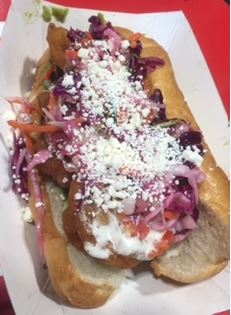
On September 28, 2008, Dan Uggla hit the last home run ever at Shea Stadium. It came in the eighth inning of a 4-2 Marlins win over the Mets. 
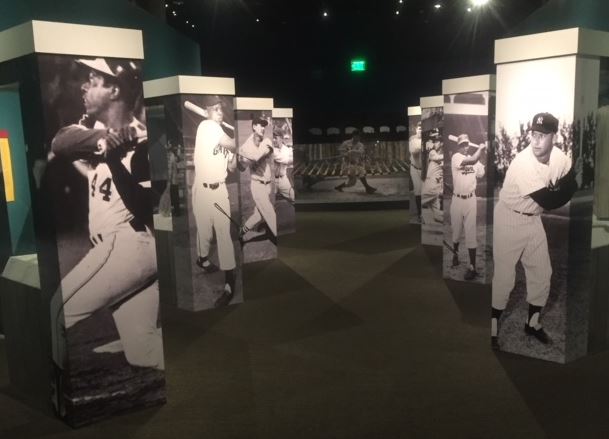
A tough day at the office … but still, it was the MLB All Star Game.

In a ten MLB seasons (2006-15 – Marlins, Braves, Giants and Nationals), Uggla was a three-time All Star and hit .241, with 235 home runs, 706 RBI, 759 runs scored. He topped 30 home runs  five times (consecutively, 2007-11), and drove in at least 90 runs in four season.  His best campaign was 2010 (Marlins) – when he hit .287, with 33 home runs, 105 RBI and 100 runs scored.

Dan Uggla first MLB stolen base was a theft of home in the sixth inning of a April 21, 2006 Marlins 4-3 win over the Phillies.Uggla stole a total of 26 bases in ten MLB seasons. 

I tweet baseball @DavidBBRT

Follow/Like the Baseball Roundtable Facebook page here.

Member: The Society for American Baseball Research; The Baseball Reliquary; The Negro Leagues Basehall Museum.