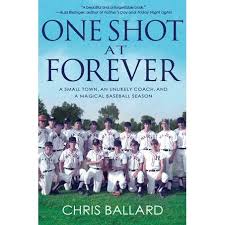
 One Shot At Forever
A Small Town, An Unlikely Coach, And A Magical Baseball Season
By Chris Ballard
Hyperion Books, 2012, $14.99
One Shot At Forever is appropriately subtitled: A Small Town, An Unlikely Coach, And A Magical Baseball Season. If you didn’t know it was true, the tale told in this spirited (and thoroughly enjoyable) book by Sports Illustrated senior writer Chris Ballard would be unbelievable – instead, it is unforgettable. BBRT thinks readers – and not just baseball fans – will find One Shot At Forever easy to read, hard to put down and impossible to forget.
Like most classic sports tales, it’s a story of overcoming great adversity. But it’s much more than that, it’s also an extraordinary story about relationships, rebellion and loyalty – for Macon, Illinois, is no ordinary community, their coach is no ordinary coach and their team is no ordinary team. And, Ballard captures it all in compelling prose that pulls you along through the action that takes place on the field and off.
Overcoming adversity? The Macon high baseball team – the Ironmen – makes its improbable way all the way to the 1971 Illinois State Championship game. In that pursuit, Macon faces schools with enrollments not just ten, but as much twenty, times Macon High’s 250 students. And, the budget and equipment – and even administrative support – disparities are just as large. (This was back in 1971, before Illinois high school tournaments placed schools in various classes by size.)
The community? Macon is a town of about 1,200 – conservative, rural and (as Ballard puts it) stuck in the Eisenhower era. and facing not only a drought that threatens the local economy, but an emerging social era that troubles many residents (antiwar protests, the 18-year-old vote, the founding of Greenpeace, hippies, communes.)
The coach? Lynn Sweet ( coach and English teacher) is not exactly a fit with Macon’s attitudes and values. His long hair, fu Manchu mustache and progressive approach to life, learning and baseball earn him comparisons with Frank Zappa, an unkempt Beatle, Abbie Hoffman in a ball suit and, by one sportswriter “a pinch of bad Mexican hombre, a fun-loving Joe Pepitone and a collegiate peacenik.” Further, in attempts to oust him (as teacher and coach) at more than one school board meeting, community members label sweet everything from hippie to peacenik to a communist.
The team? I don’t want to spoil the reader’s fun, so here are just a few snapshots of what makes the Macon Ironmen of 1970-71 different (and establishes them as Coach Sweet’s team). Due to a limited budget, they wear well worn, mismatched uniforms from three different Macon High eras; as they arrive at games, they can usually be heard singing “Yellow Submarine” on the bus; a number of players choose to wear peace symbols on their hats (which do not disguise their ever-lengthening hair); and they take pregame warm-ups to the sounds of the rock opera “Jesus Christ Superstar” blaring from a boom box on the sidelines. Getting the picture? And, remember, this is a true story.
Coach Sweet is the protagonist of One Shot at Forever and his approach to authority – and life in general – is established early. The day (in 1965) he is hired to teach English at Macon High (his first teaching job), the principal warns Sweet “There are three taverns in town and, as teachers, we don’t drink in them. To set a good example, you understand.” Sweet nods in understanding and then manages to sample the cold brew at Cole’s Tavern, Claire’s Place and the Nite Owl all in that same afternoon.
Sweet’s approach to authority and convention extend into the classroom, where he quickly replaces traditional desks with round tables and chairs (better exchange of ideas); decorates the walls with posters of the Rolling Stones, Grace Slick and Bob Dylan; scraps the traditional grammar books, announces unconventional assignments (like having the youngsters write their own obituaries) and develops a reading list that for many Macon parents seems a bit too progressive (or even subversive). He even sets up a barbeque grill outside his class, so students can join him in grilling over lunch. As a teacher, Sweet, proves to be a polarizing force (key members of the administration and many parents are suspicious of his methods, while some parents are pleased that their children are learning, while having fun). This class room controversy is just a foreshadowing of what is to come on the baseball diamond.
Sweet’s turn to coach the baseball team (he will be their third coach in three years) comes in 1970. On the day of their first practice under their new coach, only fourteen players show up (by contrast, one of the teams they will eventually play in the 1971 state tournament has more than 400 freshman show up for annual team tryouts.). Looking over the team, a couple of facts became clear, “Those that weren’t small were scrawny. And those that weren’t scrawny were small.”
Given the turnout, Sweet makes a quick judgment. “I’ve got good news, boys, you’ve all made the team.” He also outlines his approach to coaching: few, if any, rules; practice is optional; no wind sprints, punishments or speeches; steal when you want; and decide among yourselves who will play where. (It should be noted that Sweet, while without previous coaching experience, is not without baseball acumen. He is a long time fan of the Cubs and played baseball on military bases as a boy and on a local semipro team while in college.)
Coach Sweet soon finds that this team of farm boys (as the team develops under Sweet, they are alternately referred to as hippies or hicks) are smooth and talented. They have been neighbors, school mates and team mates all their lives and they play well together. All they need, in Sweet’s view is “Someone to believe in them.” And as the season(s), and the book progress, we learn about the strengths, weaknesses and motivations that each player brings to the Ironmen, as well as how Sweet works to build and protect their sometimes fragile teenage egos. Sweet’s belief in, and genuine affection for his team (and their true commitment to each other, their school and town), are what carries the Macon Ironmen to success in the face significant odds.
BBRT won’t give away the whole story, it is just too much fun to read, but here are just a few examples of the adversity the Ironmen must face:
– After a successful 1970 season, the team is dropped from the playoffs due to a roster technicality (while no culprit is ever identified, some believed was deliberate sabotage).
– Sweet is fired as coach before the 1971 season, rehired as parents and players protest.
– Devoid of budget and low on equipment, the team usually has no more than four or five bats (this in in the age of wooden bats). In one playoff game, against a talented, big school fast-baller, the team has three bats break. Down to just one bat, the principal and student equipment manager rush (during the game) to a local hardware store to purchase four more bats. As the Ironmen await more equipment, Sweet has each upcoming hitter return the lone bat to the equipment bag and then rummage around in the bag (as if searching for the right stick), so as not to alert the opposition to their predicament.
– Steve “Shark’ Shartzer, the team’s best player and most energizing field leader, is forced to play the final games of the 1971 Illinois State Tournament with a well-taped broken hand.
The Ironmen’s remarkable run is well-documented, with each player – expertly handled by Coach Sweet – making unique contributions to the team’s success along the way. Ballard manages to give us a meaningful look not just into the players’ performance, but their personalities as individuals and, maybe even more important, their role in shaping the personality of the Ironmen as a team.
In the final section of the book, Ballard returns to Macon four decades after that magical season and visits with the coach and players, providing further evidence of how much they all mean to each other and to the community and how that “magical season” had a lasting impact on their lives. Even this part of the book offers insight and inspiration, as the later life activities range from Sweet’s turning his land into a wildlife refuge under a state program called “Acres for Wildlife” to Ironmen outfielder Brian Snitker’s rise to third base coach for the Atlanta Braves.
One Shot at Forever is an entertaining and inspiring read. The story and its telling (in Ballard’s prose) have joyous momentum. Notably, that momentum continues. Ballard’s story of Coach Sweet and the Macon Ironmen originally appeared as a Sport Illustrated article (The Magical Season of the Macon Ironmen, June 2010 issue), it surged forward as Ballard’s 2012 book and has continued its momentum with Legendary Entertainment (which gave us the Jackie Robinson film “42”) purchasing the movie rights.
BBRT’s advice – buy the book, see the movie, enjoy and share the story (and the stories within the story).






David,
What a great summary/review of One Shot at Forever. I was 11 in 1971, growing up in Macon. These guys were my heroes and I looked up to all of them. It is an amazing story, an amazing article, amazing book and will be an amazing movie. Let me predict that a TV show will be spawned from the film based on Coach Sweet and his philosophies.
Chris Collins
Class of 77, Macon High School
Living in the community of Bethany, Illinois, a community just a few miles from Macon and whose Bethany High School Baseball Team played the Macon Ironmen because we were both in the Meridian Conference, one of the best conferences in Illinois, I knew the players, the coach, some of the teachers, and the superintendent; therefore, reading the book was one of the most enjoyable books I have ever read. I also know CHRIS COLLINS who brought the inspiration AND INFORMATION TO Ballard WHO WROTE THE BOOK. Chris played Legion Ball with my son, Mike, and both of them were ‘great’ players. I admire and respect Chris for actually bringing the idea of the book, … the hope of making it into a movie, etc., about. It would never have happened without his hard work and inspiration. THANKS CHRIS.
Thanks for the comment. I agree, what a great book – as I’ve noted to others, it takes our minds (as fans) off of issues like PED and payroll and back onto the character of the game. I totally enjoyed this read, gotta love coach Sweet’s approach to motivating his young players.
I enjoyed reading the book because I knew Chris Collins who worked hard to put the information together for Ballard to write the book which is being made into a movie. I have always known about this team from Macon because Bethany High School and Macon High School competed in sports being in the same Meridian Conference, one of the best conferences in Illinois. Chris and my son Mike played legion ball together and were ‘great’ players. I am grateful to Christ for his hard work and his dream that the adventures of the Macon Ironmen would someday be made into a movie, actually equal to or better than the movie Hoosiers. Anyone who loves baseball will love the book, and the movie. THANKS CHRIS.
Thanks for commenting. I agree, this is a baseball lover’s story – and will take our minds of PEDs and payroll – and back to the character of the game.
I agree that the book is great, but I also believe that credit should be given where credit is due. While it is true that Chris Collins did initially bring the story to the author, Chris Ballard’s, attention, it is not factual to say that Collins gathered information for Ballard. I know how hard Chris Ballard worked on the book, as well as the original piece published in Sports Illustrated, and feel that it’s only right to clear up any misconceptions there may be about who did the work to make this book the masterpiece that it really is.
What a great book!Growing up just outside of Chicago,and being 11 at the time,the win over Lane Tech in the semi’s was unbelievable! Memories of a simpler time live on in this great read..
I’m a baseball fan but I thought this book was boring. It tol the same story twice exept they win the next time.
Read the SI article when it came out and read the book this past April. The review is spot on. The book is fantastic. I couldn’t wait to read more each time I had to stop.
Also worth noting is that you should read the footnotes at the end. They provide even more insight and humor!