A Ballplayer’s Dream … as Shared by Former Major Leaguer John Paciorek

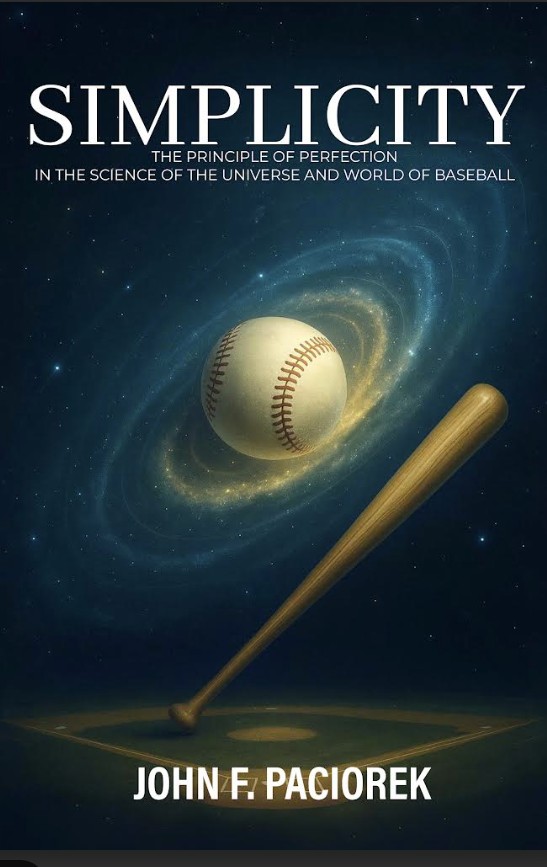
Most of us, as baseball fans, have shared a dream – a dream of what it would be like to get that one game, that one at bat or that one trip to the mound in the major leagues – and to see our name and “stats” on the back of a baseball card.   Did you ever wonder what a player who actually lived that MLB dream would move on to dream about?  Well, John Paciorek, who had that day in the sun we all dream about, has answered that question for us – in the final chapter of his soon to be released book “Simplicity: The Principle of Perfection – in Science the Universe and World of Baseball”- which explores that idea that simplicity –  identified, understood, visualized and harnessed through practice and meticulous repetition –  is the key to success across all fields (from  the most complicated science to the hitting, throwing and catching of a baseball.

That chapter details Paciorek’s dream about another memorable day in the big-league sun, told in a way that only a former major leaguer with an ongoing passion for the national pastime could (dream it or) tell it.  Paciorek, who has shared his experiences and expertise with Baseball Roundtable readers in the past, has agreed to share his major-league dream with us.

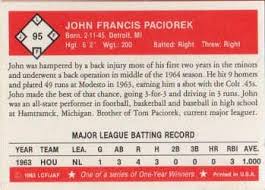
First, by way of background, Paciorek made his major-league debut with the Houston Colt .45’s, as an 18-year-old on September 29, 1963.  And, it was like a dream come true. Starting in right field and batting seventh, he came to the plate five times and delivered three singles and two walks, scored four runs and drove in three. Paciorek’s MLB career was cut short by a back injury (that, ultimately, required surgery) and he lived his MLB dream for just that one 1963 game.

For more on the life, times and literary works of John Paciorek, see the bio at the end of this post.

Now here for your enjoyment is “An Imaginative ‘Real Life”’ Dream” … John Paciorek’s pitch-by-pitch and play-by-play dream of a perfect MLB Game Number Two.

_____________________________________________

An Imaginative “Real-Life” Dream

By John Paciorek

When I am at my “best,” I must be consciously aware I AM within a “high vibration,” as well as being stimulated at a “high frequency.” It would take “highest aspiration,” as well as “consistent focus,” to perform at a level I have desired. How else would it be possible to hit a home run every time I swung my bat?

 As I realized the extent of Batting Imperfection, I knew and felt a humbling sense of simplified perfection. “The Home Run Principle” now offers the ultimate satisfaction of Batting Excellence.

The Dream

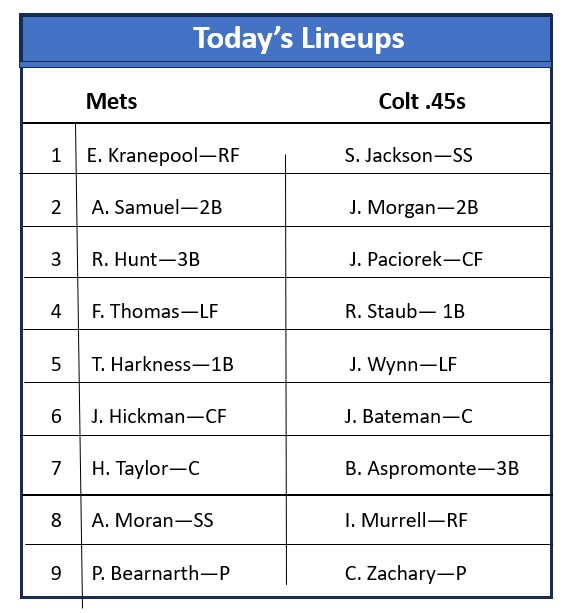
The starting lineups for both teams were basically the same in the spring of 1964, with the exception of a few players missing from last year’s Mets team (Sept 29, 1963) or at different positions on the field or in the batting order.

“How perfect will this day and game be?” I asked myself as I raced over to my defensive position in centerfield. A perfect first inning was pitched by Chris Zachary and we were coming up to bat.

With my bat and helmet in hand, I walked to the front end of the dugout, thinking about that scorching Sunday afternoon in Houston, September 29, 1963. I batted five times, walked twice, and got three hits. (That would have been considered, by any casual observer, as an impressive show of batsmanship, unless put into the context of ultimate efficiency – although the results were admirable: three RBI and four runs scored proceeded from those five at bats. Not bad for an 18-year-old Prospect!)

I was genuinely excited to be playing in this “rematch,” but for reasons that far exceeded my original purpose. I was/am appreciative for all that has happened and is happening. But now, I am eagerly anticipating even greater things to occur. I already knew that my first at-bat today was going to be a little different than my first at-bat last fall, six-and-a- half months earlier.

Sonny jumped on Bearnarth’s first pitch and roped it to center field. Joe walked on six pitches, and I came to the plate with two runners on base. It was a good opportunity to drive in a run or two (or three). I didn’t want to walk again (like last year), so if he tries to pitch me in the same manner as last time, I’d better jump on the first “good strike” he throws me.

The first pitch he threw last time was a fastball, over the middle of the plate. I was late on it and fouled it back and to the right. If he throws that pitch again, I’ll be ready and considerably more capable of handling it. As I assumed my new stance, new catcher Hawk Taylor said, “Hmmm, that’s not what I was told. We might have to make an adjustment.” I didn’t know if he was referencing my former “high, open stance,” or what? But after Bearnarth shook off two signs from Taylor, I figured he already knew what he wanted to throw.

 From my lower, stable, crouched position, I could see the ball leave his hand as the fingers snapped downward. It was definitively a fastball, and its trajectory was leading it over the middle-outside part of the strike zone. It may have been identical to his first pitch last time, but in my lower stance, the pitch appeared higher and more within my “wheelhouse.”  With my front foot pointed at 45 degrees to the pitcher, I merely had to press down while driving my back bent-knee forward with all the power of my backside and let my front leg straighten, without fear of twisting my ankle or knee and allowing for maximum and precise contact.

I fouled off that same pitch last time because my high stance and high bat swung down to the ball, slicing too much under the front of it. This time, I intended for my bat to be in a position under the ball as my swing would commence. This time, I could see and feel my bat hit the ball solidly in the direction of center field, on a high ascending line drive. After my “follow-through,” I began sprinting because I didn’t know for sure if it would carry over the fence.

 When I reached first base, Jimmy (Adair) was applauding my “blast,” and I could see it sail over the 410-foot mark. It quickly occurred to me that I was now one-for-one and already had three RBI. As I was stepping onto home plate, the Mets’ catcher smiled and said, “I told Pete that pitch wasn’t a good idea.”

 After Rusty and Jimmy flew out consecutively, John Bateman and Aspro hit consecutive singles, but Ivan struck out to end the inning. In the bottom of the second inning, Bearnarth struck out Zachary and Jackson. Joe got a base hit, and I was coming up for the second time in two innings.

 His first pitch to me was a fastball, about six inches outside. He was intent on not throwing me another strike over the outside part of the plate.  My first major-league hit, last September, was a bloop single that drove in two runs, when Bearnarth “jammed” me on an inside fastball. He had me set up for another one, right now. What he probably didn’t know was that today I knew how to hit that pitch more effectively.

 As I saw his second pitch being released, I knew it was another fastball, this time burrowing onto the inside part of the plate and waist-high. After “gathering,” I waited for the precise instant, then as my front shoulder shrugged, my back bent knee drove forward. I could feel my front foot plant as my front leg began to straighten.

 My vertical axis was intact as my hips turned quickly on stable vertical and horizontal planes. My shoulders followed in rapid succession. As my belly button reached its ultimate frontal position, the muscles of my front leg contracted vigorously to straighten at the knee. The oblique muscles of my abdomen did the same to complete the action of the hips.

Then, in perfect synergy, the coordinated action of the shoulders, arms, and hands propelled my bat into the ball with absolute synchronization and maximum centrifugal force. The point of contact occurred as my arms drew my hands and bat across my body, and the bat head struck the ball as my arms were extending in the direction of its flight.

 My wrists remained intact until well after contact. Then they rolled over with the action of the shoulders at “follow-through.” The ball’s flight pattern had already been determined. An ascending, non-hooking line drive was the resultant effect that eventually sailed over the left field fence, for a “two-run bomb.”

 An indescribable sense of elation blanketed the core of my being as I again circled the bases. I seemed “half stupefied” by what seemed a phenomenal mortal accomplishment. But a clearer perception graciously accepted the entire situation and circumstance as a natural consequence of a high-vibrational frequency applied attentively to the maximum intent of conscientious desire/prayer.

 As this seemed like only the beginning, what would I tell the “press corps” at the end of this day? I feel so good, was my thought as I reached the dugout. As hands and voices applauded the feat(s), I recalled my angel saying, “The better you feel, the better you get; the better you get, the better it gets!”  Oh, boy! How much better can it get?” I asked myself. I was two-for-two, had two home runs, five RBI, two runs scored, and it’s only the bottom of the second inning! Oops! It’s now the top of the third; Rusty just flew out to center field.

 Chris Zachary was still on the mound for us. We’re winning 5–0, so it looked like he’d go for a while. I wondered how long Bearnarth would go.   I saw Ed Bauta loosening up in the bullpen. Zachary gave up four hits in row, to begin the inning, but only gave up one run before getting three outs.

 In the bottom of the inning, Jimmy, Bateman, and Aspromonte would be facing a new pitcher since John Stephenson pinch-hit for Bearnarth and struck out.

 The new pitcher was Ed Bauta. I faced him once in my “debut game.” I got a cheap single, off the handle of the bat, that drove in my third run. He was a tall right-hander, whose fastball had a good “tailing” action in on right-hand batters.

 Jimmy got a base hit to left. Bateman hit a grounder in the “hole,” on which shortstop, Al Moran, made a good backhand play. He fired to second for one, but they couldn’t double up on Bateman.

 Aspro lined a single to right, moving Bateman to second. Ivan then singled to left, but the “slow-footed” Bateman had to stop at third. With bases loaded, Al Spangler pinch-hit for Zachary and immediately sliced a hard-liner toward third base. Third baseman Ron Hunt made a nice backhand play and instantly stepped on third to double off Bateman, who didn’t have time to get back to the bag.

 Larry Dierker then took the mound for the top of the fourth inning. He’d be facing the Mets’ second, third, and fourth batters in the lineup. Second baseman Amado Samuel was Larry’s first batter.

 Samuel tried to push a bunt past the gangly right-hander. As the ball was speeding toward Morgan at second, Dierker’s quick and graceful movement to his left stabbed it with his mitt and easily underhanded the ball to first baseman, Staub. Second batter Ron Hunt laced a low-liner into the gap in right-center. Because I got another “great jump” on the ball, I prevented his initial intent of getting to second base.

 With one out, a runner on first, hard-hitting left fielder Frank Thomas came to the plate. Larry proceeded with two fastballs on the outside part of the plate, which Thomas “fouled back” for two quick strikes. A fastball inside made the count one ball and two strikes. A slider off the outside part of the plate made the count two-and-two. Larry’s next pitch was a fastball on the inside corner—a good pitch—but Thomas must have been looking for it!

 I could see the pitch and his swing synchronize, and I took off immediately in the direction of its flight. Jimmy and I were both racing toward deep left-center field. The grass I threw up before the pitch told me the wind was blowing in slightly. I figured I might have a chance for it. I could see the ball descending on a gradual arc, but could still make it to the fence. As my right foot hit the warning track, I leaped diagonally, extended my left arm, and felt the ball imbed into the pocket of my glove.

 After the catch, I immediately turned to see where Hunt was. Jimmy was already yelling for me to hit the cutoff man. Hunt had rounded second but had to scamper back. He was making his way back to first as my relay reached Sonny. He quickly turned and fired to first. His throw was just in time to nail the sliding Hunt for a “double play.”

 Larry had been backing up both home and third, until he saw me make the catch. Then with his arms held high, waiting for the results at first base, he jumped ecstatically with the realization of the third out of the inning.

 Everyone raced jubilantly back to the dugout, where the rest of players enjoined with a chorus of congratulatory affection and a clear sense of “teamwork” and “team spirit.” In that moment, I couldn’t help but feel that Houston was formulating a team that was destined to make its mark, not only in this spring training’s undefeated “mini season,” but in the upcoming “regular season,” as well as in the unforeseeable future. Sonny, Joe, and I were coming up in the bottom of fourth, and Bauta was still on the mound. Chris Cannizzaro was the new catcher. (Choo- Choo Coleman was no longer on the team—from last season.)

 Sonny grounded out to second baseman Samuel, and Joe lined out to shortstop Moran. I was coming up with two outs, nobody on, with us ahead five to one. As I was approaching the batter’s box, Cannizzaro, glancing to his left, looked in my eyes and emphatically stated, “You’re not getting three today (referring to the 3 homers I hit in our previous game with the Dodgers)!”

 I smiled and asked, “What if the ‘handwriting is’ already ‘on the Wall?’” His expression seemed puzzling, but umpire Nestor Chylak chuckled with amusement.

 Regaining his composure, Mr. Chylak reasserted his official decorum and shouted, “Play ball!” I readied myself to the rhythm of Bauta’s “wind-up,” half-expecting, but not fully attentive to any deliberate prospect of disturbing my “comfort zone.” I was just looking for a pitch in my “wheelhouse” so I could get my best swing. It was still just spring training, so I didn’t think any pitcher or team would be fully engaged in “ultimate strategic deployment.”

 But after Bauta’s first pitch, “all bets were off.”

 In our first ever meeting, he started me with a slider, low and away. Then a fastball, low. A curveball over the plate caught me off guard since I was looking for a fastball to drive, off a 2–0 count. Then I blooped a single off a tailing, inside-corner fastball.  It must have pissed him off since it drove in a run (my third)!

This time, when he released his pitch, I immediately detected the ball’s inside trajectory. I waited briefly for any noticeable change of direction, then quickly realized there would be none. The pitch was slightly above my shoulder, starting inside the plate. Its tailing action meant it would soon be burrowing in on me. If I straightened my legs and turned inwardly, I would either be hit or somehow evade contact.

 Recently, because of my still head and eyes, I would simply lean forward to the plate when a pitch was behind my head, and backward if the pitched ball was on the “face side” of my head. With a “tailing” fastball, I would run the risk of my head running into the ball, whichever way I decided.  So, I simply ducked under it—quickly! Our dugout erupted in protest but quieted quickly because of seemingly little effect on my demeanor. His second pitch was a hard slider, low and away, for another ball and a 2–0 count.

 Could I expect a fastball, like I did last time? Or would he come back with another curve? I watched carefully for the release point. The ball came out of his hand slightly higher than previously. As I waited, I could detect the gradual change of direction. It looked to be proceeding into the outside part of the strike zone.

 After “gathering,” I waited for the precise moment to explode to the “outside.” Even though the pitch was “away,” it was in a perfect position to be hit to right-center field if I waited long enough. My “mechanical advantage” was the same as usual. At the last second, I drove my body, arms, and bat toward right field. Contact was made with perfect synergy, and the ball exploded off the bat on an ascending line drive, toward the right-center field fence.

 Again, after my follow-through, I sprinted out of the box, not knowing if the ball would carry over the fence. Rounding first base at full speed, I only slowed down as I observed Kranepool and Hickman curtail their trek and helplessly watch the ball disappear over the embankment.

 “The moving finger writes, and having writ, moves on.”

 Bauta completed the inning by getting Rusty to fly out to Kranepool in right field. Larry completed two more innings while giving up three hits, but no runs. The Mets had Lefty Ron Locke pitch the bottom of the fifth, giving up only a single to Jimmy (Wynn).

 Tom Parsons, Mets’ six-foot-seven-inch right-hander, came in to pitch the sixth. Steve (Hertz) pinch-hit for Larry and laced a single to center. Nellie batted for Sonny and hit a grounder between first and second, putting two runners on base. Joe scorched a line drive off the first base bag that bounced high into the air, and no one could make a play. Bases were now loaded, and I was coming up for my fourth at bat of the day.

 I thought they might bring in another pitcher, but Casey decided to leave Parsons in. I didn’t know what anyone else was thinking, but I didn’t think they would walk me. Another thought that came to mind was, A grand slam here, and I will have hit for the cycle—the big cycle! Why not?

 Cannizzaro was still behind the plate and, in what appeared to be a more pleasant mood, offered a modest question, “What kind of dream world are you living in?” I chuckled, along with Nestor, and replied, “One in which I desire not to awaken too soon!”

 He retorted, “Well, let’s see if you can keep it alive with this offering.” As I watched Parson’s hand deliver the pitch, I could see it was a fastball descending from his seven-foot frame, right over the heart of the plate. I thought at first it was too good to be true.

 As I intuitively calculated its trajectory, I propelled my bat to an approximate 180-degree angle. My body’s torquing action supplied the power for its ultimate force to contact the ball just as I intended, most efficiently.

 As the ball ascended high into left-center field on a trajectory that left no doubt as to its final destination, at least fifty feet beyond the 380-foot sign, I circled the bases, thinking, did he (Cannizzaro) think I wouldn’t get all of that perfect pitch? Or was he simply wondering if I would?  He just stared at me as I was approaching home plate. As I was stepping on it, Casey was walking toward the mound, giving a signal to “bring in the lefty.”

 “What a wonderful day!” I thought as I made my way to the dugout. At least one more at-bat—maybe I’ll go five-for-five?

 Left-hander Steve Dillon finished his warm-ups then proceeded to get the next three outs. Gordon Jones came in to pitch the seventh inning for us.

 Steve stayed in the game, replacing Aspro, and Walt went to left field to replace Jimmy. Grote batted for Bateman earlier and stayed in to catch. Jones gave up one run, on three hits, and a walk while facing seven batters. The score was 10–2, and Galen Cisco was coming in for the Mets to pitch the bottom of the seventh.

 Since a “double switch” was made in the sixth inning, Steve would be batting in the ninth position, while Jones would have batted in Aspromonte’s seventh position in the order. Pete Runnels came up to bat for Jones and would play first base. Then Walt Bond would bat for Ivan and play right field. Rusty and Ivan were out of the game.

 The seventh inning ended as Cisco retired all three batters he faced: Runnels, Bond, and Steve. And Don Larsen (former Yankee “No-Hit Perfect Game” hero in Game Five of the 1956 World Series) came in to pitch the top of the eighth inning for the Colts. After Nellie entered the game in the sixth, he then replaced Joe at second base, and Eddie (Kasko) replaced Sonny at shortstop.

 After getting the first two batters out, Larsen walked Ron Hunt. He immediately gave up a two-run homer to George Altman, who had previously replaced Frank Thomas in left field. Don then struck out Dick Smith, who had replaced Harkness earlier at first base.

 In the bottom of the eighth inning, Tracy Stallard came in to face the top of our batting order. Stallard pitched briefly in our game last September, but I didn’t get to face him. He was most prominently known as the pitcher who, in the last regular game of 1961 season, threw the ball that Roger Maris hit to beat Babe Ruth’s home run record. It was Tracy’s pitch that set the new record for home runs at 61. Was it a coincidence, or fate, that he would be facing me in the bottom of the eighth inning, in our last Spring Training game of 1964?

 With the score 10–4, Nellie stepped-in to bat against Stallard. He worked the count to two -and-two, then hit a sharp ground ball past the diving Larry Burright (earlier replacement for Samuel at second base) into right field. Eddie walked on five pitches, setting the stage for my last at-bat of the day (and spring).

 As I was approaching the batter’s box, I could imagine the contrasting thoughts of players from both teams, as well as the spectators witnessing what could be a memorable occurrence. I knew of a few players who had hit four home runs in a single game, but I wasn’t sure if anyone ever hit five.

 Willie Mays hit four a few years ago. I knew that Rocky Colavito had hit four, with the Cleveland Indians in 1959, before he was traded to the Tigers. And I thought Gil Hodges and Joe Adcock had hit four homers in the early ’fifties. Of course, “they all” did it during the “regular season.” But this is where I am now! So, I am just appreciating the present opportunity to do the “best that I am capable of doing.” Even if I don’t hit a home run, I will be satisfied with whatever I do — it will be my best effort! But my intent is to wait for “my home run pitch” and “nail it” when I get it.

 Tracy’s first pitch was a fastball, way outside, for ball one. The fans booed when they may have sensed the prospect of an unintentional “intentional pass.”

 I stepped out and pondered my options. Let’s see what they do next, I conferred with myself. The next pitch was identical with the first, so my only option was “of necessity.”

 Stallard’s third pitch was directed in the same area as the first two, so I swung at it, even without any intent to hit it. The count was two balls and one strike. The next pitch was the same, so I swung again, putting me in my most “unenviable position” of a “two-strike” count.

 With a two-strike count, everyone knew I wouldn’t swing at another “outside pitch” and deliberately strike out. But could I induce the two “battery mates” to think they had a chance to get me out? Jesse Gonder, catching replacement for Cannizzaro, called “time-out” to confer with Stallard.

 “Casey” decided to bring his “ancient wisdom” into the fray, and the three seemed to concur on a course of action. Throwing his hands in the air, Stengel shuffled back to his lair. I had hoped that I would convince them to pitch to me, but Stallard’s next pitch proffered only doubt. The pitch was a hard slider—that, if it were meant to induce me to swing, failed miserably, since it was at least six inches outside.

 With the count now three-and-two, Gonder stood up and extended his right arm perpendicular to his body, indicating that an “intentional pass” was the order of business. The fans booed, with unrelenting passion, and I momentarily relegated my high ambitions to the lower aspirations of an inevitable “base-on-balls.”

 Then I listened to a familiar voice beckoning me to step “outside of the box.” An inspired thought suddenly recalibrated the masterful intent of “Stengelesean Wizardry.”

 I reentered that “rarefied cubicle” with a heightened alertness to the prospect of “duplicity.” Stallard again went through his motions on the mound, and Gonder again was standing, right arm extended out to his right. This time, instead of flaccid futility, my body “gathered” all forceful energy in eager anticipation of an abrupt change of strategy. Gonder stepped briefly to his right, as he synchronized his choreography to the rhythm of his “battery mate.”

 As Stallard lifted his front leg and turned his left hip toward home plate, Gonder abruptly repositioned himself down into the “catcher’s box” while Tracy redirected his momentum flow toward the “strike zone.”

 While in my normal “gathering mode,” I could see clearly the “release point” at which Tracy’s fingers snapped through the ball. His altered intention was obviously to blaze a fast one past me before I could recognize the subtlety of its strategic deployment. The plan was one of incomparable genius and should have enjoined itself to the effects of a successful conclusion.

 But my attentive ear heard the “clarion call,” and Wisdom proceeded to avert the entangled web of conspiracy with a “masterful stroke” of its own. The pitch was fast-approaching the strike zone, and the entire Met bench would consider it a moral victory to record a strikeout, or any out for that matter—anything other than a home run!

However, even with “The Mighty Casey” at the helm to administer a credible stratagem, the “gods” of highest vibrational essence were not to be denied. From my body’s low, balanced position, my eyes followed the ball’s flight path as if the ninety-two-mile-per-hour fastball were moving in slow motion.

 When it got to within the “swinging zone,” my back bent knee drove forward as the front shoulder “shrug” ignited the simultaneous circular actions of the elbows, hands, and bat. My front leg began straightening, after its foot planted, to counterbalance the forward momentum produced by the synergistic action of both hips and back bent knee.

 The integrity of both the “vertical axis” and horizontal plane was thus maintained. As the hips brought my belly button to a full-frontal turn, the oblique muscles of the abdomen concluded their contracting force by pulling my torso and shoulders to a position of optimum readiness. My arms kept my hands and bat just behind my right shoulder. My right elbow was riding the circular wave of the centripetal force produced by the body’s rapid turn, around an intact “vertical axis.”

 The shoulder turn sped up to catch up to the rotating hips. The front leg straightened while my back muscles contracted viciously to pull the left side of my upper body across and backward, to further facilitate the forward momentum of the right side of the body  While the shoulders were turning, the front and back elbows began their synchronized extensions to bring the hands, wrists, and flattened bat to the contact point. The entire body was rotating perfectly within the parameters of an intact “vertical axis.”

 Around and under a stationary head, a “tsunami effect” of incrementally induced centrifugal force provided an explosive impact of bat to ball. I watched as the flat bat struck the high-velocity projectile at the angle that facilitated an ascending line drive.

 My hands and wrists had locked their grip tightly an inch above the bat’s handle as the ball contacted the “sweet spot” of its head. When the bat proceeded through the point of contact, my arms extended while the shoulders rolled. This allowed my hands and wrists to follow suit as the arms, hands, and bat ended up over and across my left shoulder, in its naturally efficient “follow-through.”

 At the instant of contact, the ball’s trajectory was marked by an ascending line drive in the direction of deep left-center field. Almost mesmerized by an awareness of what I had just done, I circled the bases with a feeling of “otherworldliness.” I seemed to be floating with each elongated stride.

 The spectators seemed jubilant, but quietness saturated the atmosphere with their silent mutterings. Opposing players watched in solemn reverence (admiration) as I passed their faces of uncommitted smiles.

 My circular trek persisted in sustained, inestimable glory, as I remembered a passage from the “Belated Farewell” to a “master batsman”: Hitting a baseball most effectively would have to be construed as both an Art and a Science. And that is why it would be easy to remember this “Master of the Bat” for his scientific artistry in hitting a baseball. When a pitched ball approached the area of home plate that coincided with the coordinates determining the flight pattern of Ted’s bat, the poetic beauty of rhythm and timing of his majestic swing reflected an incomparable synergy that resounded with an impact of solid communication. Bat united with ball for a brief-instant to echo a glorified exuberance that resonated throughout the ballpark to sustain an illustrious piece of bats-man-ship. From the beginning of “gathering” body momentum, to the point where hickory and leather ignited a hint of scorching scent, the culmination of which transpired to a distinctively magnificent follow-through, the subjugated projectile took flight most often on a trajectory close to 180 degrees (and climbing). (To hit the ball in any other manner would be to mishit it and therefore denigrate any true artistic and scientific confluence.)

 After stepping onto home plate, I could hear Gonder mutter, “I guarantee that won’t happen during the season.” I turned right and proceeded to a dugout of applauding teammates. But while their hands were clapping loudly, their faces indicated sheer disbelief.

 “I can’t believe you swung and missed at two pitches,” Joe joked in sardonic tone. Casey, with arms folded while sitting stoically at the end of his dugout bench, nodded to Stallard that he would finish the inning. Tracy retired the final three batters, and Hal Woodeshick came in for us, to finish the game.

 The final score was 13–4. Joe was quick to mention that it was the same score as after the last time we played against the Mets. It would have been hard not to notice that I had five at-bats. I was five-for-five. I hit five home runs, scored five runs, and produced thirteen RBI. If anyone thought I had a “good game” in 1963, what would they think of today’s performance? If they weren’t at the game, they wouldn’t believe it! Who would? Who could? Only in One’s Dream????

_______________________________________________

John Paciorek Bio

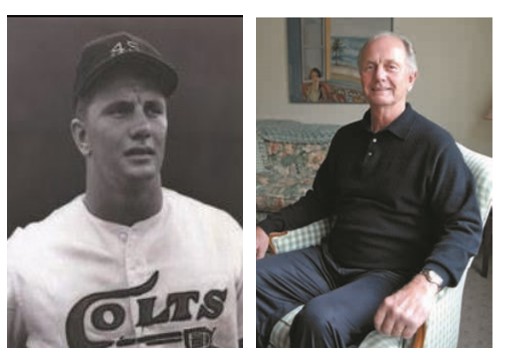
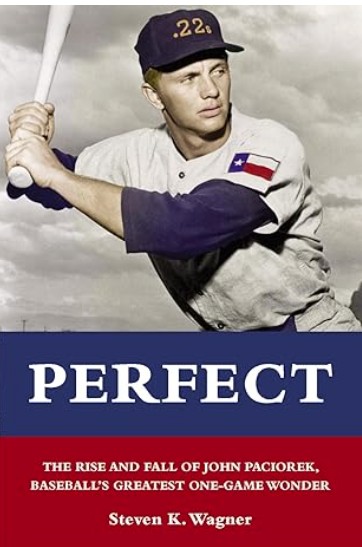
John Francis Paciorek (born February 11, 1945, in Detroit, Michigan) is an American baseball player who made it to the major leagues with the Houston Colt .45’s on September 29, 1963 (as an 18-year-old) – and (in what world prove to be his only major league game – back injury) proceeded to deliver three singles, two walks, four runs scored and three RBI.  It was day so perfect, it inspired Steve Wagner’s book “Perfect: The Rise and Fall of John Paciorek, Baseball’s Greatest One-Game Wonder.”  Perfect was the perfect title, as Paciorek has spent considerable time since then considering, theorizing and writing about perfection on and off the ball field.

Side note: There is no doubt that baseball is a seriously approached Paciorek family  passion. John is one of three Paciorek brothers (along with Jim and Tom) who made it to the major leagues. 

After leaving the professional baseball ranks, John was a teacher and coach for forty-one years at Clairbourn School in San Gabriel, California, until his retirement in 2017.

In the past sixty-plus years since his “big league” debut, he has devoted himself to understanding the principle(s) through which the most efficient means to applying the proper mechanics for hitting and throwing a baseball can be taught and implemented.

While teaching, he began studying the lives and careers of prominent and brilliant minds whose exploits forged ways of improvement in all walks of life. The works of Albert Einstein, Plato, Socrates, Aristotle, and other prominent Historical figures saturated his time and effort until he was able to utilize their expertise in endeavors of his own, usually in applying their brilliance to an area of life most interesting to him, notably sports and especially baseball.

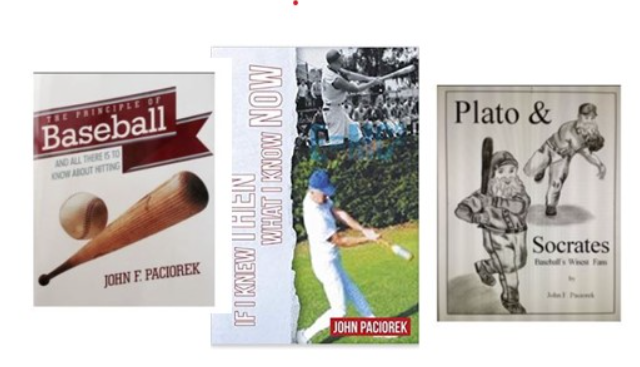
Among his books are: Plato and Socrates – Baseball’s Wisest Fans; The Principle of Baseball and All There Is to Know About Hitting; and If I Knew Then What I Know Now.

His soon-to-be-released book (Simplicity) illustrates in detail that only with artistic and scientific confluence can the display of masterful throwing, fielding, pitching and batsmanship be found in the likes of any aspiring prospects to big-league success.

Scientific understanding and application of the Simple principles for batting and throwing will most certainly provide a competency that would supersede the level of proficiency of most batsmen and throwers of the ball. But without the supplementary metaphysical prerequisite to absolute application, maximum productivity will not be forthcoming, even in the best of good hitters and throwers.

This simplicity-minded former baseball player, rather than continuing to apply himself to playing the game, preferred to learn and teach the fundamentals of the game to aspiring youth by pursuing the secret but simple components to batting and throwing a baseball Perfectly by eliciting help from works of the brilliant minds of Einstein and others.

Final Notes:

Here are Links to Paciorek’s past contributions to The Baseball Roundtable:

John Paciorek Looks at Kirk Gibson’s Iconic World Series Home Run, click here.

John Paciorek on the Art and Science of Perfect Batsmanship, click here.

If I only Knew Then What I Know Now … A Look at John Paciorek’s New Book and an Interview with the Author, click here.

You can also find Paciorek’s thoughts on baseball on his blog – at johnpaciorek.com.

Paciorek was the inspiration for Baseball Roundtable’s Annual John Paciorek Award, recognizing players with brief, but in some way significant, MLB careers. This link (here) will take you to a post on the most recent JPA (that post includes links to bios of previous award winners.


Baseball Roundtable – Blogging Baseball Since 2012.

Baseball Roundtable is on the Feedspot list of the Top 100 Baseball Blogs. For the full list click here

I tweet (on X) baseball @DavidBaseballRT

Follow Baseball Roundtable’s Facebook Page here.  More baseball commentary; blog post notifications; PRIZES.

Member: Society for American Baseball Research (SABR); Negro Leagues Baseball Museum; The Baseball Reliquary.

P 1114

Baseball Roundtable Tuesday Trivia(l)) Tidbit – Save the Last Dance (inning) For Me

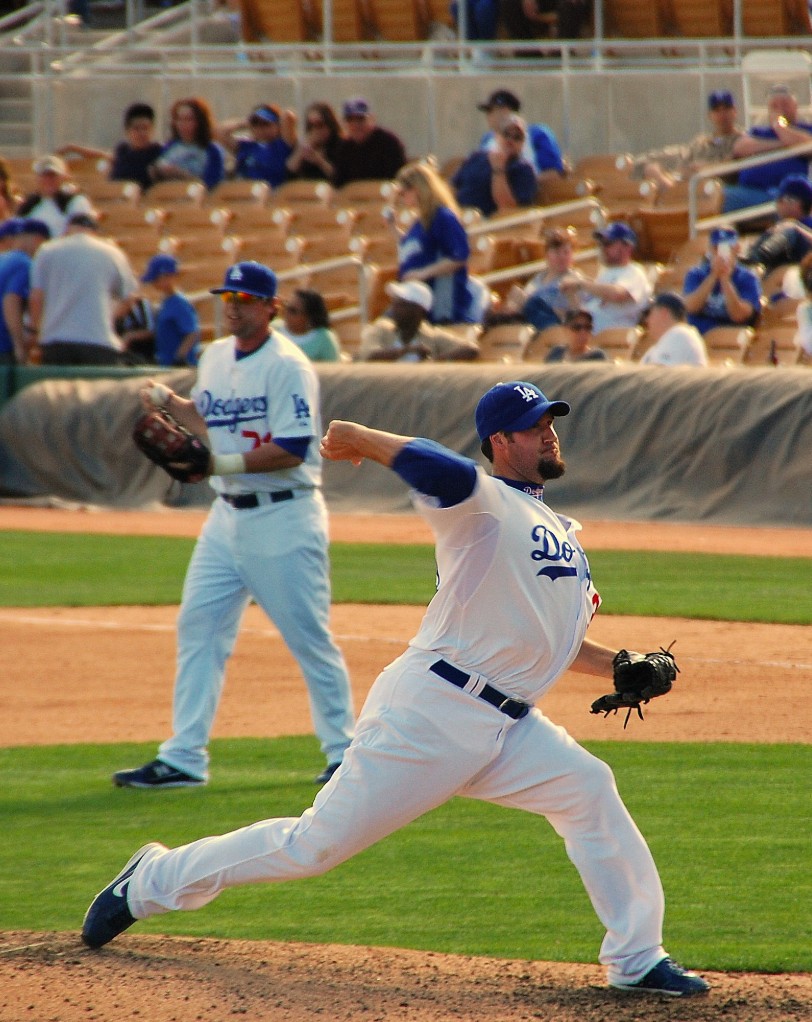
Once again, it’s time for Trivia(l) Tidbit Tuesday. I hope you are enjoying this weekly presentation of baseball occurrences that for some reason caught The Roundtable’s eye.  (I’m particularly fond of unexpected performances and statistical coincidences.) These won’t necessarily be momentous occurrences, just events, statistics or coincidences that grabbed my attention. I’m also drawn to baseball “unicorns,” those one-of-a-kind accomplishments or statistics.  Today, we are looking relief pitchers – in particular the Dodgers’ Eric Gagne, who holds the record for the longest streak of converted save opportunities (84). That gives him unicorn status and, as for coincidence, read on.

Photo: OctopusHat, CC BY-SA 2.0 <https://creativecommons.org/licenses/by-sa/2.0>, via Wikimedia Commons

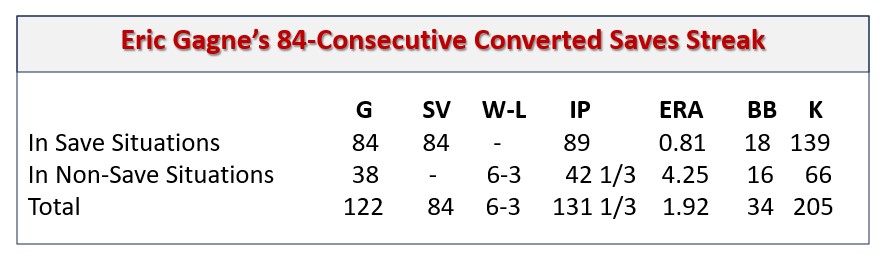
On August 26, 2002, Gagne came on (in relief of Paul Quantrill) in the top of the eighth inning of a Diamondbacks/Dodgers tilt in Dodger Stadium. There was a runner on first, one out and the Dodgers were up 3-2. Gagne quickly fanned LF (cleanup hitter) Luis Gonzalez and 1B Erubiel Durazo to preserve the lead. In the ninth frame, however, he gave up a run (single by CF Steve Finley/double by PH David Deluccia – both on 3-2 pitches), allowing the Diamondbacks to tie the game and earning Gagne a blown save. (Guillermo Moto took over for Gagne in the tenth and the Dodgers eventually lost 6-2 in 12 innings.)

Gagne did not suffer another blown save until July 5, 2004 – 123 appearances and 85 save opportunities later. The coincidence?  The Diamondbacks delivered the blown save “bookends” for Gagne’s 84-save streak.  Just as with his previous blown save two seasons previously, the game featured the Dodgers and Diamondbacks at Dodger Stadium and once again the game went extra innings. (The Dodgers won in ten innings by a 6-5 score.) This time, Gagne came on in the top of the ninth, with LA holding a 5-3 lead. Gagne gave up the tying runs on three one-out nits – a single by 1B Shea Hillenbrand, a double by PH Luis Gonzalez and a single by 3B Chad Tracy.

Sidenote: Luck of the draw – or a statistical definition. Gagne did take three losses during his streak (each, of course, occurring in a non-save situations).  For example, on May 12, 2003, he came into a 4-4 tie game in the top of the ninth (Braves at Dodgers) and gave up seven runs on five hits to take a loss. However, since he was not protecting a lead, it was not a save opportunity and not a blown save.

During his 84-save streak, Gagne recorded saves against 21 different teams. The most saves he recorded against any one team was ten (against the Padres).  He recorded nine saves each against the Diamondbacks and Rockies. He had two 11-save months – May and August of 2003. He recorded 51 saves at home and 33 on the road. Thirty-seven of his saves came in one-run ball games.

Perhaps the most unusual save in the streak came on May 6, 2004 when Gagne came into a game against the Marlins with two outs in the bottom of the ninth and the Dodger up 9-4.  He retired one batter, preserving the five-run lead and got the save.  Explanation: When Gagne came in the bases were loaded and the save rule allows for a save in situations in which the pitcher:

  • Enters the game with a lead of no more than three runs and pitches at least one inning;
  • Enters the game with the tying run on base, at the plate or in the on-deck circle;
  • Pitches at least three innings.

By way of background, Gagne started his professional career (in 1996) as starter.  And, he showed promise.  In 1999, for the Double-A San Antonio Mission, he went 12-4, 2.63 in 26 starts and was the Texas League Pitcher of the Year. From 1996 through 2001, Gagne went 36-18, 3.35 in 87 minor-league appearances (85 starts), but 11-14, 4.61 in 58 appearances (48 starts) with the Dodgers. In 2002, the Dodgers converted Gagne to a reliever and, as they say, the rest is history.  For three seasons, he was arguably the best closer in the game. From 2002-04, Gagne: made three straight All Star teams; won a Cy Young Award (2003, NL); notched 152 saves (leading the NL with 55 in 2003); put up a 1.79 earned run average; and fanned 365 batters in 247 innings. Gagne’s career was dampened and cut short by elbow surgery in 2005 and back surgery in 2006, and his final stat line (1999-2008 … Dodgers, Rangers, Red Sox, Brewers) was 33-26, 3.47, with 187 saves.

I always Liked the Fifties

A few other saves records for considerations. We all know that Hall of Famer Mariano Rivera holds the record for career saves at 652. Only slightly less well known is the record for saves in a season – Francisco Rodriguez’ 62 saves (in 69 opportunities) for the Angels in 2008.  That season, Rodriguez was 2-3, 2.24 in 76 appearances.    Rodriguez, by the way, is sixth all-time in saves, with 437 over sixteen seasons.

For those who like to know such things, there have been 17 player-seasons of fifty or more saves and only three players have recorded two such seasons:

  • Eric Gagne, Dodgers (2002 – 52 & 2003 – 55);
  • Jim Johnson, Orioles, 2012 – 51 & 2013 – 50);
  • Mariano Rivera, Yankees (2001 – 50 & 2004 – 53)

No June Swoon Here

Three players share the record for saves in a calendar month at 15 – “More of #InBaseballWeCountEveryting.”  By way of coincidence, they all did it in the month of June.

Lee Smith, 1993 Cardinals

In June of 1993, Lee Smith appeared in 15 games for the Cardinals and finished them all – picking up 15 saves. Over that span, he pitched 14 2/3 innings and gave up seven runs (4.30 ERA). At one point in the month (June 25-28), Smith saved four games in four days. Notably, Smith did not finish the season with the Cardinals. He was traded to the Yankees on August 31 for a pitcher Rich Batchelor , who went on to play in three MLB seasons (Cardinals, Padres), going 5-1, 5.03.  At the time of the trade, Smith was 2-4, 4.50 with 43 saves in 50 opportunities for the Cardinals. Hall of Famer Smith pitched in 18 MLB seasons (1980-97 … Cubs, Red Sox, Cardinals, Yankees, Orioles, Angels, Reds, Expos), going 71-92, 3.03, with 478 career saves (third all-time). The seven-time All Star led the league in saves four times and ten times recorded 30 or more saves in a season (four times topping forty).

A second-round draft pick right out of high school, Smith – like Gagne (above) – began his pro career as a starter. In his first four pro seasons (1975-78 – Class-A and Double -A), he went 25-27, 5.22 in 92 appearances/71 starts). A move to the bullpen in 1979 paid off and he made his major-league debut with the Cubs on September 1, 1980.

John Wetteland, 1996 Yankees

In June of 1996, John Wetteland appeared in 15 games for the Yankees and closed them all – 15 saves (15 1/3) IP, a 3.52 ERA and three walks versus 15 strikeouts. Wetteland finished the 1996 season with a 2-3, 2.93 record and AL-leading 43 saves (tying is career high, achieved in 1993, 1996 and 1999).

Wetteland was a second-round (secondary phase) draft pick (out of the College of San Mateo) in 1985. He worked primarily as a starter until his 1989 call up to the Dodges. In the minors, from 1985-89, he went 32-29, 4.60 in 100 games (88 starts). After his call up, in 1989, he went 2-6, 4.97 as a starter (12 games) and 3-2, 1.83, with one save in 19 relief appearances. Wetteland split 1990 between Triple-A and the Dodgers, again finding more success coming in from the bullpen. (With the Dodgers, he was 0-3, 7.23 as a starter and 2-1, 2.96 as a reliever).  To make a long story (maybe too long already) short, Wetteland went on to a 12-season MLB career (1989-2000 … Dodgers, Expos, Yankees, Rangers), going 48-45, 2.93, with 330 saves (618 appearances, 17 starts).  The three-time All Star saved forty-plus more games in four seasons and thirty-plus in three more.

Chad Cordero, 2005 Nationals

In June 2005, Chad Cordero appeared in 16 games, and picked up 15 saves. He pitched 16 1/3 innings and did not give up a single earned run (one unearned). He walked two and fanned 14.   On the season, Cordero went 2-4, 1.82 with a league-leading 47 saves.  Cordero pitched in seven MLB seasons (2003-08, 2010), going 20-15, 2.89, with 128 saves. From 2005-2007 he averaged 73 appearances and 38 saves per season for the Nationals.

One of these is not like the others.  Cordero was an Epos first-round draft pick – out of California State (Fullerton) in 2003. Unlike the other pitchers on this list, Cordero did not start out as a starter.  At Cal State, he went 12-8, 2.09, with 34 saves in 111 games – all in relief – over three seasons.  In 2003, he was fast-tracked to the majors. Cordero went 1-1. 2.05 with 13 saves in 19 games (all in relief) at High-A before an August call up to the Expos (where he went 1-0, 1.64 with one save in 12 appearances – all in relief).

Cordero pitched in seven MLB seasons (2003-08, 2010 … Expos/Nationals, Mariners), going 20-15, 2.89 with 128 saves in 314 appearances (all in relief). He led the NL in saves win 2005, when he went 2-4, 1.82, with 47 saves in 74 appearances. His career was shortened by a torn labrum (2008).  After 2008 shoulder surgery  Cordero had a brief stint with the Mariners (2010), going 0-1, 6.52 in nine relief appearances. He pitched in the minor- and independent- leagues in 2009-11 and 2013). (He got his first professional start  with Mariners rookie-league squad in 2009.

Primary resources: Stathead.com; Baseball-Almanac.com.


Baseball Roundtable – Blogging Baseball Since 2012.

Baseball Roundtable is on the Feedspot list of the Top 100 Baseball Blogs. For the full list click here

I tweet (on X) baseball @DavidBaseballRT

Follow Baseball Roundtable’s Facebook Page here.  More baseball commentary; blog post notifications; PRIZES.

Member: Society for American Baseball Research (SABR); Negro Leagues Baseball Museum; The Baseball Reliquary.

P 1113


Baseball Roundtable Trivia()) Tidbit Tuesday –  No Clemency for Hitters Today

Once again, it’s time for Trivia(l) Tidbit Tuesday. I hope you are enjoying this weekly presentation of baseball occurrences that for some reason caught The Roundtable’s eye.  (I’m particularly fond of unexpected performances and statistical coincidences.) These won’t necessarily be momentous occurrences, just events, statistics or coincidences that grabbed my attention. I’m also drawn to baseball “unicorns,” those one-of-a-kind accomplishments or statistics.

Once again, the usual pair of declaimers: Given statistical accuracy and game formats, I am restricting myself to the Modern Era (post-1900) and not all Negro League game stats have been fully documented and incorporated into the MLB record books. (In 2020, the Negro Leagues from 1920-48 were designated major league.)

Boston Red Sox Photo Cards, Public domain, via Wikimedia Commons

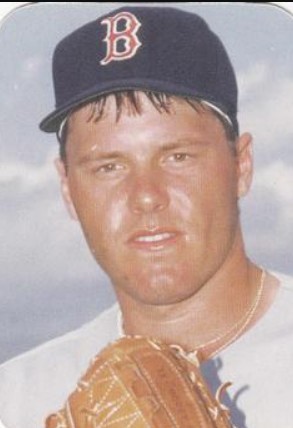
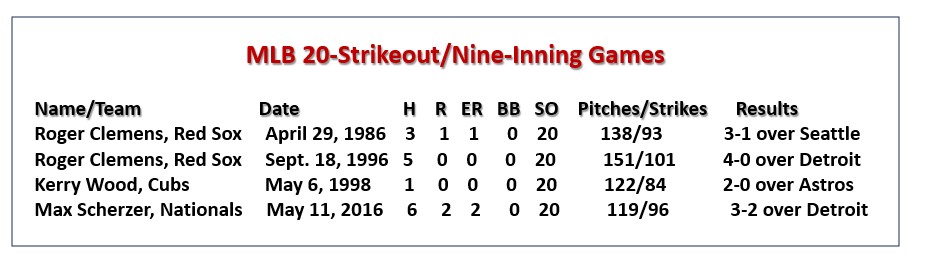
Today we’re focusing on nine-inning games in which a starting pitcher fanned a record 20 batters – largely because today is the 39th anniversary of the first such contest.  On April 29, 1986, the Red Sox’ Roger Clemens fanned 20 batters in a nine-inning, three-hit, 1-0 win over the Mariners (in Boston). Since that time, we have seen three more nine-inning contests that featured 20 strikeouts by the winning pitcher/starter. We’ll get to this in a bit, but I should note here that there was also one 11-inning game in which the starter went nine and fanned 20 batters.
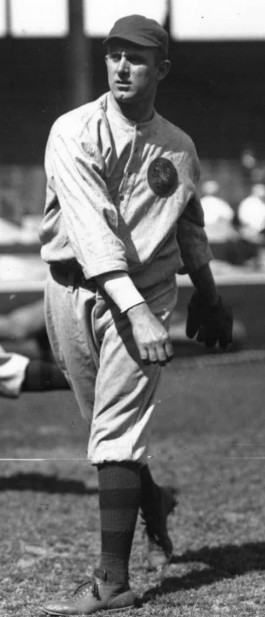
What has always struck me about these 20-whiff games is a unique common denominator. As the chart shows, there was not a single free pass issued by the record-tying hurler in any of the games.


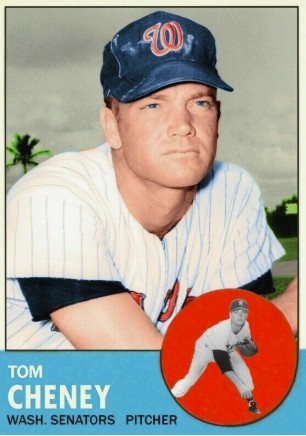
Now, you know how The Roundtable likes “unicorns,” so before we go any further, I’d like to drop one into this post.  There has been only one occasion when an MLB pitcher fanned more than 20 batters in a game. On September 12, 1962, Senators’ righty Tom Cheney started on the mound versus the Orioles (in Baltimore). Sixteen innings later, he was still on the mound – striking out Orioles’ pinch-hitter Dick Williams (yes, that Dick Williams) for the final out and his 21st strikeout (on Cheney’s 228th pitch) in a 2-1 victory. Sixteen innings and 228 pitches!  Shows how times have changed. Also, a sign of the times, reports are that Cheney chain-smoked cigarettes between innings. In his Society for American Baseball Research article “September 12, 1962: Tom Cheney strikes out a record 21 batters,” Andrew Sharp related a quote from Cheney teammate Chuck Hinton: “That game, he (Cheney) must have gone through three packs of cigarettes.”

The victory ran Cheney’s record on the season to 6-8, 3.01 and he would finish the season at 7-9, 3.17. Cheney  pitched in eight MLB seasons (1957, 1959-64, 1966 … Cardinals, Pirates, Senators), going 19-29, 3.77, with 13 complete games and eight shutouts in 71 starts (155 total appearances). His career was interrupted and cut short by a 1963 elbow injury.  (There has been speculation about the impact on Cheney’s arm of the 228-pitch outing the previous season.)

Now, back to our scheduled programming. Clemens, whose August 29, 1962 accomplishment triggered this post, is a bit of a unicorn himself – the only pitcher with two 20-strikeout, nine-inning games. Oh, and that starter who went nine-innings and fanned 20 in an extra-inning game?  That was Randy Johnson. On May 9, 2001, Johnson started for the Diamondbacks (versus the Reds) in Arizona. After nine innings, he had recorded 20 strikeouts, while giving up one run on three hits.  And, like the other 20-whiff pitchers, he had walked no one. Sadly, for Johnson, the score was knotted at 1-1 and he was relieved in the tenth by Byung-Hyun Kim.  (The Diamondbacks eventually won 4-3 in 11 innings.)

A couple of other tidbits.

  • Before Clemens’ record-breaking performance, the mark for strikeouts in a nine-inning game was 19 – shared by Steve Carlton (1969 Cardinals); Tom Seaver (1970 Mets); and Nolan Ryan (1974 Angels).
  • Ryan threw four 19-strikeout games in his career – going more than nine innings in three of them (10, 11 and 13 innings). Three of his 19-strikeout games came in 1974.
  • The list of players with 19-strikeout games is an impressive one: Nolan Ryan; Randy Johnson; Tom Seaver; Luis Tiant; Steve Carlton; and David Cone.
  • Carlton, Ryan and Johnson are the only pitchers to fan 19 batters in a game and take a loss.

Side Note:  Of the ten nineteen-strikeout outings (games of any length) only two have been walk-free.

Primary Resource:  Stathead.com


Baseball Roundtable – Blogging Baseball Since 2012.

Baseball Roundtable is on the Feedspot list of the Top 100 Baseball Blogs. For the full list click here

I tweet (on X) baseball @DavidBaseballRT

Follow Baseball Roundtable’s Facebook Page here.  More baseball commentary; blog post notifications; PRIZES.

Member: Society for American Baseball Research (SABR); Negro Leagues Baseball Museum; The Baseball Reliquary.

P 1111

Let’s Get The Ball Rolling … Pitchers With The Best First Ten MLB Starts

Once again, it’s time for Trivia(l) Tidbit Tuesday. I hope you are enjoying this weekly presentation of baseball occurrences that for some reason caught The Roundtable’s eye.  (I’m particularly fond of unexpected performances and statistical coincidences.) These won’t necessarily be momentous occurrences, just events, statistics or coincidences that grabbed my attention. I’m also drawn to baseball “unicorns,” those one-of-a-kind accomplishments or statistics.

On March 25, The Roundtable’s Trivial(l) Tidbit Tuesday focused on batters’ accomplishments over their first ten MLB games … most hits, most HRs, most runs, etc. (For that post, click here.)  This week, we’re going to move from the batter’s box to the mound and look at some hurlers’ “mosts” over their first ten MLB starts. I’ll give you the stats on these leaderboards and some background on players on the lists.

Once again, the usual pair of declaimers: Given statistical accuracy and game formats, I am restricting myself to the Modern Era (post-1900) and not all Negro League game stats have been fully documented and incorporated into the MLB record books. (In 2020, the Negro leagues form 1920-48 were designated major leagues.)

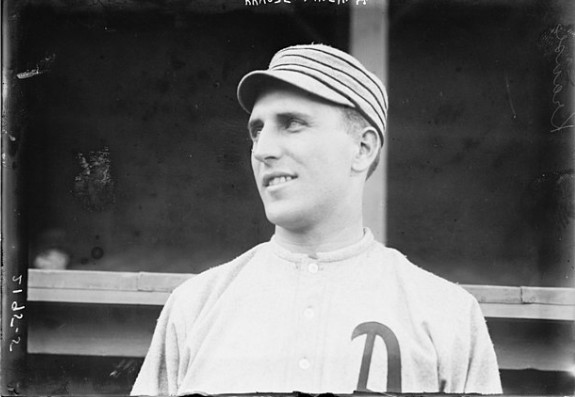
Before I get into individual statistical lists, let me just declare Harry Krause the “king” of this post. Krause appears among the top five in nearly all of the categories covered: number-one in shutouts over the first ten MLB starts; number-two in wins; number-two in fewest runs allowed; number-four in innings pitched; and, if they had tracked earned runs in his day, he would be in the top five in earned run average as well.  More on King Krause later, let’s get into the charts, stats and stories.

LOWEST ERA OVER FIRST TEN MLB STARTS

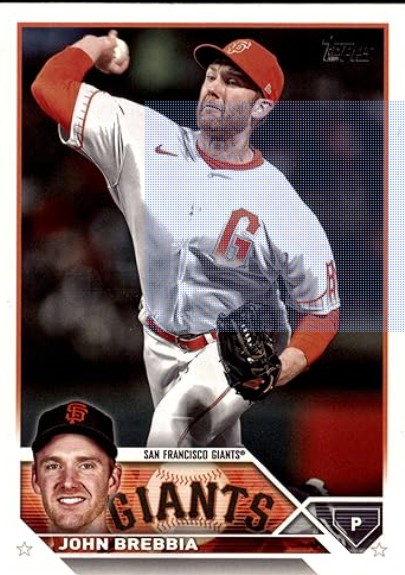
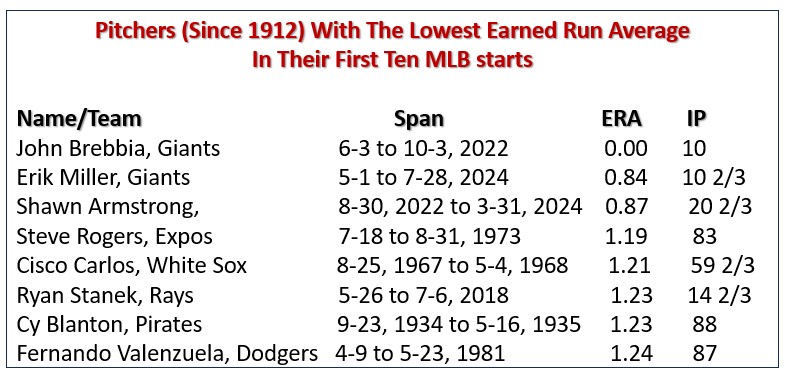
Let’s start with an MLB unicorn and a pretty good trivia question. Which MLB pitcher recorded the lowest earned run average over his first ten starts?  It’s kind of a trick question.  The answer is John Brebbia of the 2022 Giants, who made 76 appearances that season – 65 in relief and eleven as the “designated opener.” Remember when those were really popular? (Still around, but not seen as often.) Brebbia, in fact, made 201 relief appearances before his first “opening/game-starting” assignment. In his ten “starts,” Brebbia pitched ten innings gave up zero runs – for an easily computed 0.00 ERA.

Brebbia remains active (Tigers).  Through 2024, he had played in seven MLB seasons (2017-19, 2021-24), going 15-21, 3.80, with four saves in 354 appearances (21 starts). In those 21 starts, he pitched 22 2/3 innings. This season (as I key this post), the 34-year-old righty has made eight appearances (all in relief), with a 1-0, 1.00 record.

Three other “openers” made this list:

Erik Miller (still active, Giants), who made ten starts and 63 relief appearances as a Giants’ rookie in 2024 – while putting up a 4-5, 3.88 record, with 87 strikeouts over 67 1/3 innings. As I write this, Miller has appeared in nine 2025 games in relief, giving up one run in seven innings.

Shawn Armstrong (still active, Rangers), who made his first “start” in 2022 – in his eighth MLB season and after 192 career relief appearances. Armstrong’s first ten MLB starts were stretched over three seasons.  Through 2024, Armstrong had pitched in 11 MLB seasons (Indians, Mariners, Orioles, Rays, Marlins, Cardinals, Cubs, Rangers), going 11-8, 4.15, with eight saves in 299 games (16 starts). As I key this post, he is 1-0, 3.38 in eight 2025 relief appearances.

Ryne Stanek (still active, Mets) made 29 starts as an opener for the Marlins in 2028 (pitching a total of 40 innings in those starts). Stanek is now in his ninth MLB season (Rays, Marlins, Astros, Mariners, Mets).  Through 2024, his record was 17-17, 3.64, with 11 saves in 402 appearances (56 starts). In those 56 starts, he pitched a total of 83 innings. As I write this, he had made nine relief appearances in 2025, with a 1.08 EERA in 8 1/3 innings.

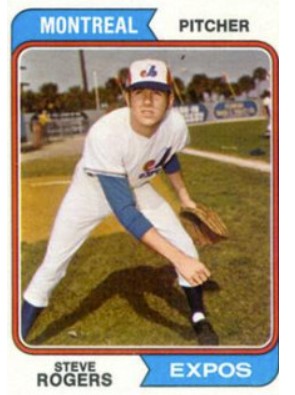
The Expos’ Steve Rogers is the first traditi0nal starter on this chart. Rogers made it to the big leagues as a 23-year-old in the middle of his third professional season – and got right down to business, giving up just two runs in his first three starts (26 innings, two shutouts). Over his first ten starts, he gave up just 11 earned runs (13 total) in 83 innings for a 1.19 ERA. Rogers went 6-3 over those ten first starts, with his three losses coming by scores of 2-1, 3-1 and 4-2). He finished his rookie campaign at 10-5, 1.54 in 17 starts (seven complete games, three shutouts), finishing second to Gary Matthews (.300-12-58, 17 steals) in the NL Rookie of the Year voting.  Rogers went on to a 13-season MLB career (1973-85 … Expos), going 158-152, 3.17. He was a five-time All Star and won 15 or more games in five seasons.

Cisco Carlos is a bit of a surprise here, after a 3-2, 1.21 record in his first ten MLB starts (1967-68) for the White Sox, he went on to an 11-18 3.72 record (73 games, 36 starts) over four MLB seasons (1967-70 … White Sox, Senators).

Cy Blanton was in his fifth professional season when he got a September call up to the Pirates (1934). He got one start (eight innings, five hits, three runs and a loss). His next MLB appearance would be in April 19, 1935 – and he would twirl a one-hit shutout, as the Pirates beat the Cardinals 3-0 in Pittsburgh. Over his first ten starts, Blanton would go 7-3, 1.23, with nine complete games and two shutouts.  He finished his first full MLB season at 18-13 leading the NL in ERA (2.58) and shutouts (4). The two-time All Star would pitch in the majors for nine years, going 68-71, 3.55.

Fernando Valenzuela. Okay, I would find it hard to believe that anyone reading this post does not know about Fernando-mania which took Los Angeles and MLB by storm in 1981 – when Valenzuela was both Rookie of the Year and the NL Cy Young Award winner (in his age-20 season).  After 10 relief appearances in a 1980 call up to the Dodgers, Valenzuela won a starting role out of Spring Training in 1981.  His very first MLB start was five-hit shutout (a 2-0 win over the Astros) – and he was just getting started. In his first seven starts, he went 7-0, with a 0.29 ERA – six complete games and five shutouts. After ten starts, he was 8-1, 1.24 and he finished the (strike-shortened) season at 13-7, 2.48,  leading the league in starts (25), CG (11), shutouts (8), strikeouts (180) and admirers (countless).  Valenzuela went on to a 17-season MLB career (1980-91, 1993-97 … Dodgers, Angels, Orioles, Phillies, Padres, Cardinals). Note: He played with the Dodgers his first 11 seasons. Valenzuela was a six-time All Star (1981-86) and his final stat line was 173-153, 3.54.

Since MLB didn’t tracks earned versus unearned runs before 1912, I thought it would be fair to include a chart of total runs allowed in a pitchers first ten MLB starts.

Only one new name appears in the top three.

Photo: Bain News Service, publisher, Public domain, via Wikimedia Commons

Harry Krause started his streak as 19-year-old rookie – making two starts, among five appearances in 1908.  (Krause was 1-1, in four 1908 appearances, giving up 11 runs in 21 innings pitched, nine in his two starts).  He completed his first-ten-starts streak in 1909 with eight starts in his first 11 appearances. In his first ten MLB starts, he tossed six shutouts and ten complete games. In 94 innings, he gave up just 60 hits and 15 walks (61 strikeouts). As an aside, had the distinction between earned versus unearned runs been made in 1908-09 – and even if all 12 of Krause’s runs over his first ten starts were earned – he would have made the lowest earned run average list with a 1.14 ERA.  In his first full MLB season (1909), the 20-year-old Krause went 18-8, with 16 complete games and seven shutouts. Despite the fast break out of the gate, Krause pitched in just five MLB seasons (1908-1912 … Athletics, Indians), going 36-26 in 85 games (57 starts). Krause did develop a sore arm in 1912 and was sent down to the Double-A Toledo Mud Hens. A native-Californian (San Francisco-born), who began his professional career in the California State League, Krause returned to his home state in 1913 and pitched in the Pacific Coast League until 1929 (winning more than 200 games and earning a spot in the Pacific Coast League Hall of Fame.)

AT LEAST NINE WINS IN FIRST TEN STARTS

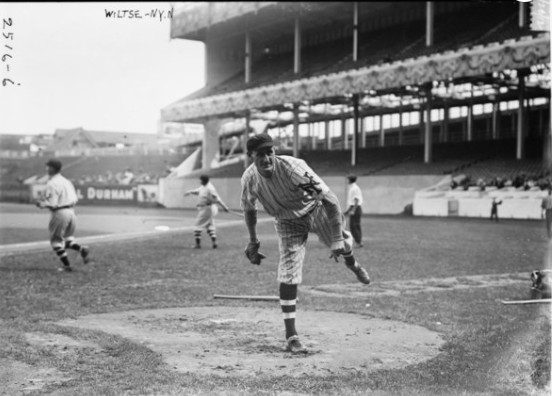
Photo: Bain News Service, publisher, Public domain, via Wikimedia Commons

White Sox’ southpaw George “Hooks” Wiltse is the only MLB pitcher to win all ten of his first ten MLB starts, going 10-0, giving up 22 runs in 82 innings.  His ten-start run included eight complete games (two shutouts). The 24-year-old’s streak began after he opened his MLB career with three relief appearances. Wiltse went 13-3, 2.85 in 1904 (24 games/16 starts) and 139-90, 2.47 over a 12-season MLB career (1904-15 … all with Giants except 1915, when he played with Brooklyn of the Federal League). Wiltse was a two-time 20 game winner (23-14 in 1908 and 20-11 in 1909).

“Hooks” Wiltse earned his nickname with an effective, hard-breaking curveball.  Notably, in the realm of nicknames, Hooks’ brother Lewis (also a major leaguer) was known as “Snake” Wiltse for is contorted pitching motion.


Here’s a brief look at the pitchers who recorded nine wins in their first ten MLB starting assignments.

Lefty Joe Boehling got an MLB “look-see” with the Nationals in 1912, at gave up four runs over five innings of relief in three games.  He got his first start in June of 1013, after 10 relief appearances (2-0, 4.44). In his first ten starts, he put up a 1.48 ERA.  Boehling pitched in seven MLB seasons (1912-17, 1920 … Nationals, Indians), going 56-50, 2.97. 1913 was his best season (17-7, 2.14).

Paul “Daffy” Dean broke into the major leagues with a bang, recording nine wins in his first ten starts (9-0, 3.61). He finished his debut season at 19-11, 3.43 in 39 appearances, (26 starts) and followed up with a 19-12, 3.37 season in 1935.   Dean suffered a shoulder injury in 1936 and never regained his early form, winning just 12 more MLB games after his first two seasons. He pitched in nine MLB seasons (1934-41, 1943 … Cardinals, Giants), going 50-34, 3.75 in 159 games (87 starts).

Dave “Boo” Ferris played for the Mississippi State University varsity in 1941 and 42 (pitcher/first base) and was signed by the Red Sox in 1942. He played at Class B Greensboro in 1943 (7-7, 2.22), before missing two seasons while in the Army (where he served as a physical training instructor and played military-league baseball). He returned to professional baseball in 1945 and was an instant success, pitching a five-hit shutout in his MLB debut (a 2-0 win over the Athletics), four shutouts in his first six games and going the distance in each of his first ten starts. The 23-year-old finished his inaugural MLB season at 21-10, 2.96, with 26 complete games in 31 starts.  He followed that up with a 25-6, 3.25 season in 1946. Ferriss suffered a serious shoulder injury during the 1947 seasons and pitched just three more seasons.  His final MLB stat line (1945-50 … Red Sox) was 65-30, 3.64.

Mark “The Bird” Fidrych burst on the scene as an energetic and eccentric 21-year-old in 1976 – after just two minor-league campaigns. After two brief relief appearances, he made his first start on May 15 and went the distance in a 2-1 win over the Indians (two-hits, one walk, five strikeouts). In his first ten starts, he went 9-1, 1.87, with nine complete games. (He went eight innings in his only non-complete start.) Fidrych finished his rookie season at 19-9, 2.34, with 24 complete games in 29 starts. During Spring Training 1977, Fidrych suffered a knee injury (that required surgery) while shagging flies. He was back on the mound by late May and pitched well (6-2, 1.83 with seven complete gams in eight starts) until arm issues surfaced early July. He pitched in just three more games that season (going 0-2 and giving up 13 runs in 12 innings). To keep a short story short, Fidrych won just four more MLB games (going 4-6, 5.67 in 1978-80) and finished his MLB career (1976-80 … Tigers) at 29-19, 3.10. His mound antics and early brilliance, however, have assured “The Bird” a sport in baseball lore.


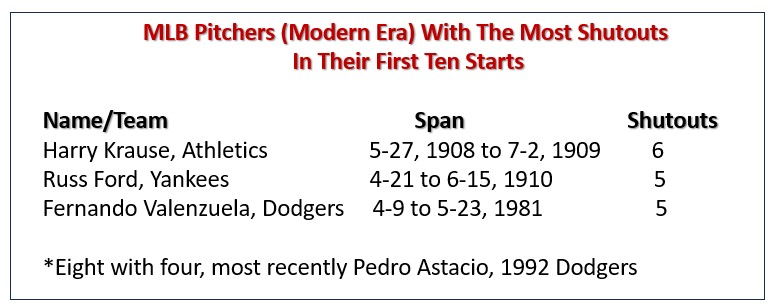
MOST SHUTOUtS  SHUTOUT IN FIRST TEN MLB STARTS

Harry Krause leads the way here (see MORE bio information under the Fewest Runs Given Up In First Ten MLB Starts chart. In his first two MLB starts (May 27 and June 12, 1908), Krause was touched up for nine runs in 17 innings.  But he came back with a vengeance in 1909. In his first eight starts of that season, he picked up eight wins, tossed eight complete games, threw six shutouts and gave up a total of three runs over 78 innings. As noted earlier, he finished the 1909 season at 18-6, surrendering just 49 runs in 213 innings. Remember, earned versus unearned runs weren’t officially tracked until 1912.

Russ Ford made his MLB debut with the New York Highlanders (Yankees) on April 28, 1909 – a three-inning relief stint in which he gave up six runs to the Red Sox (part of 12-2 Highlander loss) on four hits, four walks and three hit batsmen.  Not an auspicious beginning. In fact, it got him sent down to the Jersey City Skeeters of the Class A Eastern League, where he went 13-13 in 32 starts. Ford, however, was working on a new pitch that would turn the tide.  He came back   came to the Highlanders with an “emery ball.”  Using a piece of emery board (hidden in his glove), he would scuff the ball on one side which enabled to create a range of baffling breaking pitches. Ford disguised the new offering as a, then legal, spitball.  (The scuffed ball pitch, by the way, was banned in 1915.)

On April 21, 1909, four days before his 27th birthday, Ford (using his new pitch) threw a shutout for the New York Squad in his first MLB start – a tight 1-0 win over the Athletics in Philadelphia.  He gave up five hits, walked none and fanned nine (a high total for the time).  He went on to throw nine complete games and five shutouts over his first ten games – giving up a total of just 15 runs. Ford picked up eight wins, one loss and one no decision.  Over his first full MLB season, Ford went 26-6, recorded eight shutouts and 29 complete games in 33 starts (36 appearances), fanned 209 batters and gave up only 69 runs in 299 2/3 frames. His 26 wins remain the rookie record (post-1900). Ford pitched in seven MLB seasons (1909-1915 … Yankees and Buffalo of the Federal League), going 100-71 and winning 20 or more games in three seasons.

Fernando Valenzuela (check out is bio info in the Lowest ERA In First Ten MLB Starts section). Suffice it to say, Valenzuela tossed five shutouts (and gave up just two total runs) in his first seven MLB starts (Dodgers, 1981). Included in that run were four games of ten or more strikeouts.  Again, lots more on Fernando in the ERA section.

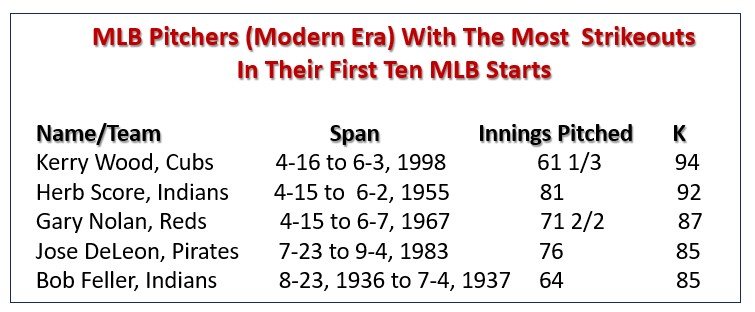
MOST STRIKEOUTS FIRST TEN STARTS

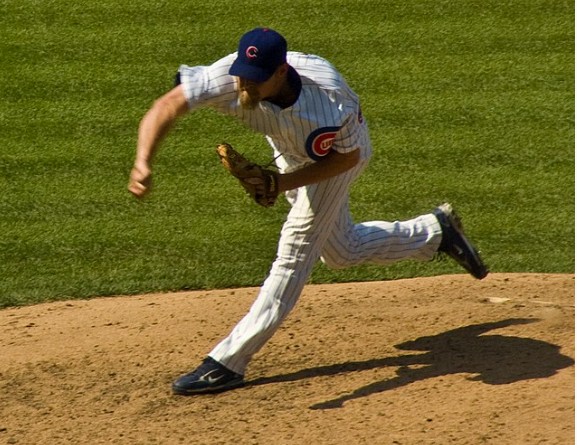
Photo: bryce_edwards on Flickr (Original version)  User UCinternational (Crop), CC BY 2.0 <https://creativecommons.org/licenses/by/2.0>, via Wikimedia Commons

Kerry Wood made his MLB debut (at age 20) on April 12, 1996 – and he took a loss (lasting 4 2/3 innings giving up four bits, three walks and four runs). He did, however, fan seven batters in his stint – the first step on his way to the top of this list. Over his first ten starts, Wood would go 6-2, 2.79, and would fan 94 batters in just 61 1/3 innings.

Wood went 13-6, 3.40, with 233 strikeouts in 166 2/3 innings in his rookie season (winning the Rookie of the Year award). Wood missed the 1999 season (Tommy John surgery).  He came back and from 2000 through 2005 went 57-48, 3.72 … in 159 games (148 starts), although he was beset by series of injuries (triceps, rotator cuff, knee).  After shoulder surgery in 2005, he returned as a relief pitcher (257 relief appearances and four starts from 2006-2012), saving a career-high 34 games for the Cubs in 2008. Wood pitched in 14 MLB seasons (1998-99, 2000-2012 … Cubs, Indians, Yankees), going 86-75, 3.67, with 63 saves (178 starts/268 relief appearances).

Twenty at Age Twenty

On May 6, 1998, the Cubs Kerry Wood (at age 20 and in just his fifth MLB appearance) threw a one-hit shutout in a 2-0 win over the Astros. In the game, he did not walk a batter and tied the record for strikeouts in a nine-inning game with 20. It would be the only game that season when he did not walk a single batter.

Herb Score made his MLB debut, in his fourth professional season, as a 21-year-old in 1955 – when he won the Rookie of The Year award with a 16-10, 2.85 season (leading the AL in strikeouts with 245). In his first ten starts, he went 6-3, 2.89, with five complete games and 92 strikeouts in 81 innings. He followed that up with a 20-9, 2.53 season in 1956, again leading the AL in whiffs with 263.  He started his 1957 season in same form (2-1, 2.04, with 39 strikeouts in 35 1/3 innings after four starts).  Then, on May 7, disaster struck.  In the top of the first inning of a start against the Yankees, New York SS Gil McDougald lined a fastball back at Score (that struck him between the nose and right eye) ending Score’s season and, at the time, many thought his career.

Score returned in 1958 and went 2-3, 3.95 with 48 strikeouts in 41 innings over 12 starts before an elbow injury curtailed his season and eventually did end his career.   Some speculated that Score altered his delivery after the line-drive injury, but Score rejected that theory. Whatever the cause, Score was not the same. In 1955-57, he had gone 38-20, 2.64 in 73 games. From 1958 through 1962, he went 17-26, 4.43.  The two-time All Star’s final stat line (1955-62 … Indians, White Sox) was 55-46, 3.36.

Gary Nolan made his debut with the Reds on April 15, 1967 at the age of 18 and picked up a win (against the Astros) with 7 1/3 innings of three-run, six-hit ball (two walks and eight strikeouts). In his first ten starts, he went 3-1, 2.64 with two complete games and one shutout. Nolan pitched in ten MB seasons (1967-73, 1975-77 … all for the Reds, except part of his final season with the Angels). He went 110-70, 3.08, with 45 complete games and 14 shutouts. He was an All Star in 1972, when he went 15-5, 1.99.

Jose DeLeon debuted with the Pirates on July 23, 1983 – picking up a win over the Giants with eight innings of two-run ball (four hits, four walks, nine strikeouts).  When called up, he was 11-6, 3.04 at Triple-A.  In his first ten MLB starts, he went 6-2, 2.37, with 85 strikeouts in 76 innings. He finished the season at 7-3, 2.83 in 15 starts, with 118 strikeouts in 108 innings. DeLeon pitched in 13 MLB seasons (1983-95 … Pirates, White Sox, Cardinals, Phillies, Expos), going 86-119, 3.76 in 415 games (264 starts).

Bob Feller deserves special recognition, he made his MLB debut, as a 17-year-old, on July 19, 1936 (one inning of relief for the Indians versus the Nationals).  He made five more relief appearances before his first MLB start – August 23, versus the St. Louis Browns. It was a pretty good game for a 17-year-old (who would return home to finish high school after the season). Feller threw a complete game, giving up one run on six hits, while walking four and fanning 15. In his first ten starts, Feller went 5-5, 3.38, with 85 strikeouts in just 64 innings.

One for the Books

On September 13, 1936, 17-year-old Bob Feller fanned 17 batters (two hits, two runs, nine walks) in a 5-2 win over the Athletics. The 17 strikeouts tied the MLB record (since broken).

Feller spent his entire MLB career with the Indians – 18 MLB seasons (1936-41, 1945-56, with 3+ years lost to military service). He went 266-162, 3.25 and fanned 2,581 batters in 3,837 innings pitched. The Hall of Famer was an eight-time All Star, six times won 20 or more games in a season (leading the AL in wins each time) and seven times led the AL in strikeouts (348 in 1946).


A LITTLE BONUS – THE BIG SIX’S FIRST TEN

Christy “The Big Six” Mathewson – but for one start in 1900 – would have had his name written all over these lists.  September 26, 1900, Mathewson made his first MLB start – and gave up eight runs in an 8-7 Giant’s loss to the Braves. (That season, the 19-year-old Mathewson would go 0-3 and give up 32 runs in 33 2/3 innings over six appearances (one start) with the Giants. Then in 1901, Mathewson went 20-17 for the New York club.  In his fist ten starts that season (career starts 2-11), Mathewson went 8-2, pitched nine complete games, tossed four shutouts and gave up nine total runs in 85 innings.


MOST INNINGS PITCHED OVER FIRST TEN MLB STARTS

Photo: The Sporting News via [1], Public domain, via Wikimedia Commons

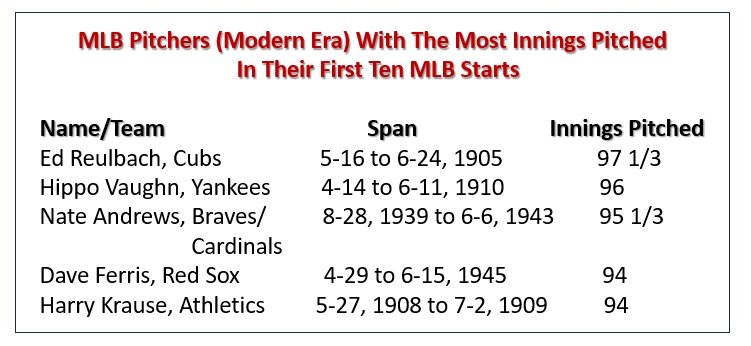
Ed Reulbach opened his MLB career with an eight-inning, complete game Cubs’ loss to the Giants on May 18, 1950.  He followed up with another complete-game loss. This time, pitching 8 1/3 innings as his Cubs lost to the Superbas 4-3 in Brooklyn. He then won nine straight before his next loss. In his first ten starts, Reulbach pitched eight complete games (three shutouts), but the one that put him at the top of this chart came in his tenth start – on June 24, 1905 (versus the Cardinals). In that one Reulbach, went the distance as his Cubs beat the Cardinals 2-1 in 18 innings (in St. Louis). Surprisingly, that was not the rookie’s best (or even longest) performance of the season. On August 24, 1905, Reulbach went the distance in a 20 innings 2-1 win over the Phillies (in Philadelphia). His mound opponent (Tully Sparks) also went 20 innings that day (and got a loss to show for his body of work). Surprisingly (again), that 20-inning masterpiece also was not Reulbach best day on a major-league mound. (See the highlight below.)

Oh-For-Two, The Hard Way

On September 26, 1908, Ed Reulbach – with his Cubs clinging a slim ½ game lead in the NL Pennant race – became the first (and still only) MLB pitcher to record shutout victories in both ends of a doubleheader. In a twin bill in Brooklyn, he shutout the Superbas 5-0 in Game One (a five-hitter) and came back to shut them down 3-0 in Game Two (a four-hitter).    

Reulbach finished his rookie (age-22) season at 18-14, 1.42, with 28 complete games in 29 starts. Over the next three seasons, he went 19-4, 17-4 and 24-4 – leading the NL in winning percentage each time. He pitched in 13 MLB seasons (1905-17 … Cubs, Dodgers, Braves and Newark of the Federal League), going 182-106, 2.28 with 200 complete games (300 starts) and 40 shutouts. He won 16 or more games in seven seasons (20+ twice).


Jim “Hippo” Vaughn’s MLB Cup-O-Coffee came in the form of two mid-season relief appearances with the 1908 Highlanders (Yankees), as a 20-year-old, in 1908, giving up one run in 2 1/3 innings. It was back to the minors until Opening Day (April 14) 1910, when he started for the Highlanders and pitched 14 innings in a 4-4 tie with the Red Sox.  Over his first ten MLB starts, Vaughn went 5-1 and gave up just 20 runs (nine complete games, four shutouts). Notably, his nine complete games saw three ending in ties – including one of 14 innings and one of 12.

Vaughn pitched in 13 MLB seasons (1908, 1910-21 … Highlanders, Nationals, Cubs), going 178-137 with 214 complete games and 41 shutouts in 332 starts (390 total appearances).   He won 20 or more games in five seasons. In 1919, he led the NL with 22 wins, a 1.74 ERA, 33 complete games, eight shutouts, 290 1/3 innings pitches and 148 strikeouts

Nate Andrews made his MLB debut with the Cardinals on May 1, 1937 (four innings of relief). He did not make his first MLB start until August 28, 1939 (his eighth career MLB appearance) – going just four innings and giving up seven runs, as his Cardinals lost to the Braves 10-5.  He got his next start on April 25, 1943 (his 24th MLB appearance) and things went quite a bit better ( a complete games 8-3 win for his Braves over the Giants) .  In his first nine 1943 starts, he tossed seven complete games and went ten or more innings in four. Andrews, bouncing from the majors to the minors and back (He spent only three full campaigns in the majors … 1943-45), pitched in eight MLB seasons (1937, 1939-41, 1943-46 … Cardinals, Indians, Braves, Reds Giants). He went 41-54, 3.46 with 97 starts in 127 appearances. He was an All Star in 1944, when he went 16015, 3.22.

Dave “Boo”  Ferriss … See detail on Ferriss the section on Pitchers With At Least Nine Wins in Their First Ten MLB Starts. Suffice to say here that Ferriss threw ten complete games (one of 14 innings) and four shutouts in his first ten starts.

Harry Krause …  Details on Krause are included in the section on Pitchers With At Least Nine Wins in Their First Ten MLB Starts.  Just to repeat a relevant stat here, his first ten starts included ten complete games and six shutouts

Primary Resources:  Statehead.com; Dave Ferriss SABR Bio by Bill Nowlin; Kerry Wood SABR Bio by Steve Dunn; Russ Ford SABR Bio by T. Kent Morgan and David Jones. 

Baseball Roundtable – Blogging Baseball Since 2012.

Baseball Roundtable is on the Feedspot list of the Top 100 Baseball Blogs. For the full list click here

I tweet (on X) baseball @DavidBaseballRT

Follow Baseball Roundtable’s Facebook Page here.  More baseball commentary; blog post notifications; PRIZES.

Member: Society for American Baseball Research (SABR); Negro Leagues Baseball Museum; The Baseball Reliquary.

P 1110

Trivia(l) Tidbit Tuesday: Getting Right To It … The Long Ball That Is

Once again, it’s time for Trivia(l) Tidbit Tuesday. I hope you are enjoying these weekly presentations of baseball occurrences that for some reason caught The Roundtable’s eye.  (I’m particularly fond of unexpected performances and statistical coincidences.) I’ve noted in the past that these won’t necessarily be momentous occurrences, just events, statistics or coincidences that grabbed my attention. I’m also drawn to baseball “unicorns,” those one-of-a-kind accomplishment or statistics.

Here are usual pair of declaimers: Given statistical accuracy and game formats, I am restricting myself to the Modern Era (post-1900) and not all Negro League game stats have been fully documented and incorporated into the MLB record books. (In 2020, the Negro leagues form 1920-48 were designated major leagues.)

This is one of those “With Baseball Roundtable, one thing always seems to lead to another” tidbits.  What first caught my attention was the fact that, on this date (April 15) in 1959, 23-year-old Bob Gibson made his first-ever MLB mound appearance and gave up a home run to the first MLB batter he ever faced.

Turns out that’s not exactly a rarity.  Since 1900, seventy-nine pitchers have given up a home run to the first MLB batter they faced (18 of those on the first pitch to the first MLB batter they ever faced).  Not rare enough to be a Trivia(l) Tidbit. In rarer air, we find that only two pitchers have given up a home run on to the first MLB batter they faced and gone on to earn a spot in the Baseball Hall of FameBob Gibson and Bert Blyleven.  Not quite a unicorn status, but getting close.  We’ll get to Gibson and Blyleven later in the post, but first a look at this Tuesday’s unicorn.

Right-hander Dave Eiland was the first, and is still the only, MLB player, to give up a home run to the first batter he ever faced AND hit a home run in his first MLB plate appearance. Now, there’s a unicorn that likely to last. Eiland made his MLB mound debut with the Yankees, as a 21-year old, on August 3, 1988. He started a game against the Brewers in Milwaukee, and – in the bottom of the first inning – Brewers’ 3B and leadoff hitter Paul Molitor welcomed Eiland to “The Show” with a home run to center on a 1-2 pitch. Eiland was unfazed and went on to pitch seven strong innings (three hits, two walks, three strikeouts and just the one run). He left with a 5-1 lead, but Yankee reliever Dave Righetti gave up five runs in the eighth to give Eiland a no-decision.

Eiland went 5-9, 5.16 over four seasons for the Yankees (bouncing between the minors and majors), before being released by New York and signing with the Padres in January of 1992. During his Yankee tenure, thanks to the Designated Hitter rule (adopted by the AL in 1973), he did not come to the plate.

In 1992, Eiland made his first appearance as a Padre (remember, the NL didn’t adopt the DH rule until 2022), starting against the Dodgers (in San Diego). He got his first MLB plate appearance in the bottom of the second inning, with one on and two out, and took a Bob Ojeda 2-2 pitch to left-center for a two-run home run. It would be the only home run and one of only two career hits for Eiland. (He went 2-for-22 as a hitter over his MLB career.)

Eiland pitched in 10 MLB seasons (1988-93, 1995, 1998-2000 … Yankees, Padres, Devil Rays), going 12-27, 5.74. In 14 minor-league seasons (he spent part of each of his MLB campaigns in the minors), Eiland went 109-58, 3.42.  After retiring from the playing field, Eiland served a pitching coach (at the major-league level for the Yankees, Royals and Mets).

Now back to Gibson and Blyleven.

Bob Gibson

April 15, 1959 was a bit of a taxing day for Gibson. In his first MLB appearance, he came on in the top of the seventh with his Cardinals trailing the Dodgers 3-0. The first batter he faced was Dodgers’ 3B and number-eight hitter, 30-year-old rookie Jim Baxes. Gibson fell behind 2-0 and then – on the first MLB pitch he threw for a strike – Baxes homered to left-center. (Baxes would record just one MLB season – coming after 10 minor-league campaigns – and he would end up .246-17-39 for the Dodges and Indians.) Gibson pitched two innings in the contest (two runs on two hits, no strikeouts). He made two more appearances in April before returning to Triple-A and then was back with the Cardinals in late July – ending the season with a 3-5, 3.33 record for the Redbirds. Gibson split the 1960 season between Omaha and St. Louis, before having his first full season in St. Louis in 1961. And the rest is history.

Gibson went on pitch his way into the Hall of Fame – a two-time Cy Young Award winner, one time NL Most Valuable Player, two-time World Series MVP, nine-time All Star and nine-time Gold Glover.  He pitched in 17 MLB seasons (1959-75 … Cardinals), going 251-174, 2.91 and winning 20 or more games in five campaigns. He threw 255 complete games in 482 starts and his 56 shutouts are 13th all-time. His 3,117 strikeouts rank 16th.

A Different Kind of Ball

A superb all-around athlete, Bob Gibson starred in basketball and baseball at Creighton University and was the first member of the Creighton Athletics Hall of Fame (1968). Over the winter of 1957-58, Bob Gibson played for the Harlem Globetrotters.

Bert Blyleven

On June 5, 1970, 19-year-old Blyleven made his first MLB appearance – a start for the Twins, against the Senators, in Washington D.C. He had been called up from Triple-A Evansville after an injury to Twins’ starter Luis Tiant. At the time, Blyleven had just 21 minor-league appearances (Rookie-, A- and Triple-A), with an 11-4, 2.27 record).

The first MLB batter Blyleven faced was RF Lee Maye (a veteran in his 12th MLB season).  Maye worked a 3-2 count and then smacked a homer to right. The teenage rookie took the blast in stride, and did not give up another run in his seven innings of work (five hits, one walk, seven strikeouts). He would end the season with a 10-9, 3.18 record for the Twins – and would not appear in a minor-league game again until his final professional season (1992). Blyleven “enjoyed” (he had a reputation as a prankster) a 22-season MLB career (1970-1990, 1992 … Twins, Rangers, Pirates, Indians, Angels), going 287-250, 3.31, with 242 complete games and 60 shutouts in 685 starts. Blyleven was a two-time All Star and ten times won 15 or more games in a season. His 3,701 strikeouts are fifth all-time, his 60 shutouts ninth, his 287 wins 27th and his 4,970 innings pitched 14th. (His 430 home runs surrendered are ninth, his 250 losses tenth).

Primary Resources: Stathead.com; Baseball-Almanac.com; Creighton Athletics Hall of Fame.

Baseball Roundtable – Blogging Baseball Since 2012.

Baseball Roundtable is on the Feedspot list of the Top 100 Baseball Blogs. For the full list click here

I tweet (on X) baseball @DavidBaseballRT

Follow Baseball Roundtable’s Facebook Page here.  More baseball commentary; blog post notifications; PRIZES.

Member: Society for American Baseball Research (SABR); Negro Leagues Baseball Museum; The Baseball Reliquary.

P 1109

The Baseball Reliquary Shrine of the Eternals 2025 Ballot Has Arrived – Here Are The Roundtable’s Choices

Early this week, a welcome sign of spring appeared in the mail – my 2025 Baseball Reliquary Shrine of the Eternals Ballot – which means I can look forward to some joyous time pondering the character and characters that helped shape the history of our grand game (as presented in the always informative and creative biographies included with the ballot).

I’ll take a look at my choices from this year’s ballot in a bit, but first – for those not familiar with The Baseball Reliquary – a little background.

The Baseball Reliquary is an organization of fans dedicated to the free-spirited celebration of the human side of baseball’s history and heritage. The Reliquary defines itself as “an educational organization dedicated to fostering an appreciation of American art and culture through the context of baseball history and to exploring the national pastimes’ unparalleled creative possibilities.”

Reliquary (rel′ə kwer′ē)

Noun- a container or shrine in which sacred relics are kept and displayed for veneration.

While its “home” is at Whittier College (also home to the Institute for Baseball Studies), the Reliquary is more than just a place.  The Reliquary really resides in the hearts of its founders, members, contributors and honorees – who all are important parts of the organization’s joyful (often irreverent, but always well-informed and fan-centric) celebration of all things baseball.  This celebration is fueled through The Reliquary’s Shrine of the Eternals, collection of historic artifacts, exhibitions and extensive baseball-related research collection – books, periodicals and papers from distinguished authors, historians and journalists.

The Whittier (CA) College Institute for Baseball Studies is the first humanities-based baseball research center associated with a U.S. college or university,

The Shrine of the Eternals

The Shrine of the Eternals is the Reliquary’s best-known element and its honorees include (among others) a one-armed major league outfielder, a pitcher who once threw a no-hitter while high on LSD, a team owner who sent a midget to the plate, a man in a chicken suit, a member of Major League Baseball’s 3,000-hit club, a manager who won eight World Championships, a surgeon whose pioneering work has extended the life of many arms, a cartoon character who pitched his team to more than 1,000 losses, more than one best-selling author, a statistical wizard and a bevy of  “Jims” (Abbott, Bouton, Brosnan, Grant,Piersall). The honorees are each unique in their roles in – and contributions to – the national pastime, but they all share the distinction of having made a significant impact on the game.

It’s a shrine to “our” great game that connects:

  • Mark “The Bird” Fidrych and the San Diego Chicken;
  • Dr. Frank Jobe and Dr. Mike Marshall (not to mention Dock Ellis  (Oh, I just did);
  • Backstops Bob Uecker and Yogi Berra;
  • Moundsmen Luis Tiant and Charlie Brown;
  • Outfielders Roberto Clemente and Pete Gray;
  • Characters Rube Waddell and Bill “Spaceman” Lee.

This year’s candidates include players like Rube WaddellMike Marshall, Julio Franco, Gravy Cravath, Luke Easter and Mamie Johnson; such  luminaries as renowned baseball photographer Charles M. Conlon, WIFFLE(R) Ball inventor David Nelson Mullany and Country Music Hall of Fame member Charlie Pride;  authors W.P. Kinsella and Jack Kerouac;  Morganna “The Kissing Bandit” Roberts; the fictional Annie Savoy; and the dual mother-son candidacy of All American Girls Professional Baseball League star Helen Callaghan and nine-season, major-league utility player Casey Candaele.

You get the idea.

Note: The Reliquary also recognizes distinguished service to baseball by a fan (The Hilda Award) and contributions to the preservation of baseball history (The Tony Salin Award).

Artifacts

The Baseball Reliquary’s Collection of what The Roundtable would term “art-ifacts” is as diverse as its roster of Shrine honorees.  The collection includes (but is “oh-so not limited” to) the Walter O’Malley Tortilla, the Roger Bresnahan Potato, the Eddie Gaedel Jock Strap, a Babe Ruth cigar, a Mother Teresa autographed baseball (a whole case actually), a heat-twisted 45-rpm record from the White Sox’ ill-fated Disco Demolition Night and a San Diego Chicken game-worn costume.

Exhibits

The Baseball Reliquary’s Exhibits have covered such varied topics as Latino and Black baseball history, baseball in foreign policy, baseball literature and art, a celebration of baseball cards, and even the self-defining “Lasordapalooza.”

Join Now 

Sound like an organization you’d like to belong to? Just go to The Baseball Reliquary website – click here.


—–THE SHRINE OF THE ETERNALS 2025 BASEBALL ROUNDTABLE BALLOT—–

Now, on to the Shrine of the Eternals. Before I share my ballot, here’s what the Reliquary has to say about this honor.

“Similar in concept to the National Baseball Hall of Fame, the Shrine of the Eternals differs philosophically in that statistical accomplishment is not the principal criterion for election. The Baseball Reliquary believes that the election of individuals on merits other than statistics and playing ability will offer the opportunity for a deeper understanding and appreciation of baseball than has heretofore been provided by “Halls of Fame” in the more traditional and conservative institutions. 

“Criteria for election shall be: the distinctiveness of play (good or bad); the uniqueness of character and personality; and the imprint that the individual has made on the baseball landscape. Electees, both on and off the diamond, shall have been responsible for developing baseball in one or more of the following ways: through athletic and/or business achievements; in terms of its larger cultural and sociological impact as a mass entertainment; and as an arena for the human imagination.”

Each year, the Baseball Reliquary submits a list of candidates to its members and the top three vote-getters are honored.  Reliquaries can vote for up to nine nominees.

Here’s a look at those who are getting my votes for this year.

Helen Callaghan (1923-92)  & Casey Candaele (1961 –  ) … A Two-Fer

Ah, the sight of a father and son having a game of catch, it’s a part of baseball lore.  For me, it’s time we considered the mother-son (and, hopefully, someday soon, the mother-daughter) baseball connection. (Side note: I fondly remember my mother willingly participating  in a game of catch or a bit of batting practice in the front yard as we waited for the school bus to arrive –  and Hall  of Famer Eddie Mathews once recalled that , in his youth, “My mother used to pitch to me and my father would shag balls.  If I hit one up the middle close to my mother, I’d have some extra chores to to do.  My m0ther was instrumental in making me a pull hitter.”)  It seems the right time to recognize, as noted in the Reliquary ballot booklet,  the “only mother/son combination to play professional baseball.” 

The fact is, I probably would have voted for Callaghan even without the mother-son connection. A superb athlete (in high school she played softball, soccer, roller hockey, basketball, lacrosse, track and field), she was an instant star in the All American Girls Professional Baseball League (1944-49). As noted in the Reliquary ballot booklet, as a rookie with the 1944 Minneapolis Millerettes, she hit .287 (second in the league) and swiped 112 bases in 111 games. In 1945, with the Fort Wayne Daisies, she led the league in average, home runs, hits, total bases and doubles – and was second in runs scored and steals.

Her son Casey Candaele followed  in her footsteps.  Candaele played baseball in high School and was part of the 1980 College World Series Champion University of Arizona squad. He played professionally for 17 seasons, nine in the major leagues (.250-11-139 in 754 games), where he appeared in 50 or more game at 2B, 3B, SS, LF and CF). After retiring from the playing field, he served as a coach with the Blue Jays and Mariners and currently manages the Blue Jays Triple-A affiliate Buffalo Bisons. 

Side note: Adding to the worthiness of this vote, Helen Callaghan’s older sister Margaret also played on the Millerettes and their sisterhood and rivalry became part of the basis for the  film “A League of Their Own,” (written by Callaghan’s son/Casey Candaele’s brother) Kelly Candaele.

CHARLES M. CONLON (1868-1945) … Picture Perfect

Charles M. Conlon is responsible for some of the most iconic images from baseball history.  From 1904 to 1942, he documented the course of the national pastime (as a hobby), while working as a proofreader for the New York Evening Telegram (later the World-Telegram). Carrying a large Graflex camera and cumbersome glass plate negatives to the ballpark, Conlon produced at least 30,000 portraits and action photos, capturing history in black and white.

Although his photos appeared regularly in the Spalding and Reach Base Ball Guides, The Sporting News, and Baseball Magazine, Conlon’s contribution to the images and history of the game really came to the fore with the publication of Neal and Constance McCabe’s books: Baseball’s Golden Age: The Photographs of Charles M. Conlon (1993); and The Big Show: Charles M. Conlon’s Golden Age Baseball Photographs (2011).

The McCabes, making the case that Conlon ranks among the masters of documentary photography, asserted: “The ballpark was Conlon’s universe, an inexhaustible source of unforgettable images: a catcher’s mangled hand, a madman kicking up his heels, an umpire lost in thought. He documented baseball obsessively at a time when critics of photography—had they known of his existence—would have questioned his sanity for taking thousands of photographs of so trivial and ephemeral a subject.”

Conlon gets my vote for contributing so significantly to the visual history of the game.

______________________________________

LUKE EASTER (1915-79) – Scrambling Some Eggs

“Luscious” Luke Easter was one of the most prodigious home run hitters of all time. His titanic blasts were known as “Easter Eggs.” Among his notables, Easter:

  • Was the first player to a homer into the farthest reaches of center field in the Polo Grounds;
  • Hit the longest home run in the history of old Cleveland Municipal Stadium – clearing the distant right field scoreboard; and
  • Was the first player to hit a drive over the CF scoreboard in Buffalo’s Offerman Stadium (at age 42), proving it was no fluke by hitting the second drive to ever to clear the scoreboard just a month later.

Easter began his baseball career in 1937, as an OF/1B and cleanup hitter for the St. Louis Titanium Giants (a company team) – and didn’t play his final game until 27 years later.  Everything about the 6’4”, 240-pound Easter was big – his stature, his bat, his love of the game, his love of life, his relationship with teammates and the fans and, later, even his Buick.

While he began showing his prowess at the plate in the late 1930’s, he really began carving his name into baseball history after getting out of the military in 1943. In 1945, he starred with the barnstorming Cincinnati Crescents (for whom he hit the Polo Grounds home run noted above).

In 1947, he joined the Homestead Grays, where he hit .311, with 10 home runs in 219 at bats.  Research by Society for American Baseball Research member Justin Murphy indicates Easter followed that up by hitting .363 for the Grays and tying teammate Buck Leonard for the Negro National League (NNL) lead in home runs (13) – helping the Grays to the NNL World Series Championship.

In 1949, Easter signed with the Cleveland Indians and made (what was then considered) his major-league debut on August 1 of that season – at age 34 – just the eleventh black player in the major leagues. (MLB has since declared the Negro Leagues from 1920-48 to be major leagues.) While he hit only .222 in 54 games for the Indians, due in part to an injured knee, Easter showed his (already long-proven) power by going .363-25-92 in 80 games at Triple-A San Diego.

Then, in 1950, he hit .280-28-107 in 141 games for the Indians – earning recognition from the Sporting News as the AL’s Most Outstanding Player.  In 1951, he went .270-27-103 for the Tribe and, in 1952, .263-31-97. Age and injuries were already taking their toll, however, and on May 4, 1954, the 38-year-old Easter played his final MLB game.

Ah, but Luscious Luke was not done. He played on in the minor leagues until 1964 – putting up four seasons of 30 or more home runs and 100+ RBI – earning his way into the International League Hall of Fame.

Over his career, Easter also played winter ball in Puerto Rico, Venezuela, Mexico and Hawaii. A Winter-League star, Easter hit .402 for Mayaguez in the Puerto Rican League in 1948-49 (winning league MVP honors); led the Mexican Pacific Coast League (for Hermosillo) in homers in 1954-55; and lead the Puerto Rican Winter League in homers in 1955-56 and 1956-57.

Why does Luke Easter get my vote? Consider that none-other than Bill James rated him the second-best Negro Leagues’ first baseman of all time (behind only Buck Leonard) and Al Rosen (a teammate of Easter on the Indians, as well as a four-time All Star, two-time AL home run leader, 1953 American League MVP and 1989 National Executive of the Year) maintained, “Had Luke come up to the big leagues as a young man, there’s no telling what numbers he would have had.”

____________________________

JULIO FRANCO (1958 –) … One For The Ages (Aged?)

If you believe “Old Guys Rule” – Julio Franco should be your king.

Franco is the oldest player to homer in an MLB game. Franco went deep at age 48 years, 254 days, hitting a two-run shot off Arizona’s Randy Johnson as Franco’s Mets topped the Diamondbacks 5-3 on April 26, 2006. In that same game, Franco also became the second-oldest MLB player to steal base – and, thus, the oldest player to homer and steal a base in the same game.

Franco is also the:

  • Oldest player to hit a grand slam (46 years, 308 days) – connecting as a pinch hitter for the Atlanta Braves in a 7-2 win over the Marlins on June 27, 2005;
  • Oldest player to record a multi-homer game, belting a pair of homers on June 18, 2005 (age 46 years, 299 days), as his Atlanta Braves topped the Reds at Great American Ball Park. Franco started at first base and went two-for-four with two homers and three RBI;
  • Oldest player to hit a pinch-hit home run, in the eighth inning of a Mets’ 7-2 win over the Padres at San Diego (April 20, 2006 – 47 years, 240 days);
  • Oldest player to steal two bases in a game (and in an inning) – (June 16, 3005 – 46 years, 297 days); and
  • Oldest player to be put into a game as a pinch runner (July 29, 2006 – 47 years, 340 days) … he delivered, promptly stealing second base, going to third on an errant throw.

From 1982 to 1994, Franco played primarily as a middle infielder and DH for the Phillies, Indians, Rangers and White Sox – making three All Star teams (MVP of the 1990 All Star Game), earning five Silver Slugger Awards and leading the American League in hitting at .341 for the Rangers in 1991. In that 1991 campaign, Franco collected 201 hits, 15 homers, 78 RBI, 108 runs scored and 36 steals in 45 attempts. At season’s end, he had hit .300+ in five of the previous six seasons – the lone exception being .296 in 1990.

In 1994, when the remainder of the MLB season was lost to a strike, Franco was in the midst of possibly his best campaign.  After 112 games, he was hitting .319, with 138 hits, 20 home runs, 98 RBI, 72 runs scored, and eight steals.  Franco was determined to keep swinging the bat and signed to play in Japan with the Pacific League Chiba Lotte Marines.  In the 1995 Japanese season, Franco hit .306 and won the Pacific League’s equivalent of the Gold Glove at first base.

Franco returned to MLB in 1996, joining the Cleveland Indians, hitting .322-14-76 in 112 games. In August of the following season, the Indians released Franco – who was hitting .284-3-25 at the time. He finished the 1997 campaign with the Brewers, hitting .241 in 14 games with Milwaukee.

In 1998, at age 39, Franco was back in Japan playing for Chiba Lotte; where he hit .290, with 18 home runs and 77 RBI in 131 games. Then, in 1999, he celebrated turning 40 (when most ballplayers are retired or coaching) by hitting for a .423 average in the Mexican League and getting one late-season MLB at bat with Tampa Bay.

As he moved into his forties, Franco was far from finished as a player. He played in South Korea in 2000 (age 41), hitting .327-22-110.  In 2001, the well-traveled batsman was back in the Mexican League (Mexico City Tigers), where stellar play (a .437 average in 110 games) earned him a spot on the Atlanta Braves’ roster in September. Franco hit .300, with three home runs and 11 RBI over the final 5 ½ weeks of the MLB season.

From 2001 to 2007, the ageless wonder – professional hitter and pretty darn good first sacker – played for the Braves and Mets.  From 2001 through 2006 – ages 42 to 47 – Franco averaged .290 over 581 games.  He hit .222 in 55 games in his final MLB season – 2007 with the Mets and Braves.

Even at 49, Franco was not done battering baseballs. In 2008, he could be found at first base with the Tigres de Quintana Roo of the Mexican League (where he hit .250 in 36 games). That season, Franco – after 23 Major League seasons and 30 years after his first professional baseball game – announced his retirement as a player.

Oops? Not so fast. In 2014, at the age of 55, he appeared in seven games for the Fort Worth Cats of the independent United League – going six for 27.   Then in 2015, Franco was signed as player-manager of the Ishikawa Million Stars of the Japanese independent Baseball Challenge League (identified as a semi-pro league).

In 23 MLB seasons, Franco hit .298, with 2,586 hits, 173 homers, 1,285 runs, 1,194 RBI and 281 stolen bases. He also collected 618 minor-league (U.S) hits, 316 in the Mexican League, 286 in Japan, 267 in the Dominican Winter League and 156 in South Korea and six in independent ball (U.S.).

Forever young, Mr. Franco – baseball’s Energizer Bunny – got my vote.

_____________________________________________

MAMIE “Peanut” JOHNSON (1935 – 2017) … Playing Big

Mamie Johnson was one of three females to play for the Indianapolis Clowns during the declining days of the Negro Leagues (and the only woman ever to pitch in the Negro Leagues). At 5’3” Johnson looked a little small for the baseball diamond, but she played above her height. Johnson took the mound to the Clowns for three seasons (1953-55), running up a 33-8 record – utilizing a deceptive fastball, curve, change, screwball and knuckleball.   Her exploits are chronicled in the children’s book “A Strong Right Arm: The Story of Mamie ‘Peanut’ Johnson,” by Michelle Y. Green.

________________________________

W.P. Kinsella (1935-2016) … The Write Stuff

I have to throw my support behind the author who gave us“Shoeless Joe,” which, of course, led to the movie “Field of Dreams” – combining fantasy, the lure of the diamond and a bit of baseball history. What fan does not immediately recognize the phrase “Build it and they will come” or relate to the father-son game of catch that captured the enduring, generation-leaping spirit of the national pastime?    While Shoeless Joe may be Kinsella’s most famous baseball work, he also brought readers the “magic” of the game with such works as  The Iowa Baseball Confederacy, The Thrill of the Grass, Go  The Distance, The Further Adventures of Slugger McBatt, Box Socials. 

_________________________

MIKE MARSHALL (1943 – 2021) … Is There A Doctor in The House?

This former major-league reliever (14 seasons … 1967, 1969-81) earned three college degrees, including a Ph.D. in Kinesiology from Michigan State University. Kinesiology is the study of muscle movement and Marshall used his knowledge to develop his own exercise program focused on minimizing stress, reducing injury and accelerating recovery time.  While his unorthodox methods, advanced education and outspoken approach often had him at odds with baseball’s traditionalists (and may be part of the reason he pitched for nine teams in 14 seasons), they did get the job done.

The fact is, we never saw a closer quite like Mike Marshall before he came along – and we’re not likely to see one like him again. In 1974, as a Dodger, he put up the granddaddy of all relief seasons – setting the single-season MLB records for appearances with 106 and innings pitched in relief at 208 1/3. He finished the campaign 15-12, with a league-topping 21 saves and a 2.42 ERA.  That season, Marshall was called on to go more than one inning in 74 games (68.5 percent of the time) and he toiled three or more innings 22 times. He also relieved in 13 consecutive regular-season games – an MLB record later tied (1986) by the Rangers’ Dale Mohoric. Marshall’s efforts won him the 1974 Cy Young Award and recognition as The Sporting News NL Pitcher of the Year.

Marshall led his league in games pitched four times and saves three times – finishing 97-112, 3.14 with 188 saves.

A true “fireman” from an era when closers came in to put out fires and stayed on the mound to ensure they were no flare ups, Marshall gets my vote for the Shrine.

_____________________________________

DAVID NELSON MULLANY (1908-1990) … A New Meaning To Going Yard

Everyone who has ever swung a plastic bat at a whistling WIFFLE® Ball owes a debt of gratitude to David Mullany.

It all started in 1953, when Mullany saw his 12-year-old son trying to use a plastic golf ball for a game of baseball in their Connecticut backyard. Mullany saw the possibilities (and need) for a ball that could be put in play in a confined area without the risk of damage. He set about developing a light, hollow, plastic ball with eight oblong slots cut into one side (which allowed pitchers to fashion a curve, slider, or knuckleball that could produce a great many a good number of swings and misses or “whiffs.”

Mullany, (by the way played baseball for the University of Connecticut) went on to form WIFFLE® Ball, Inc. in 1954 and was granted a patent for the innovative sphere in 1957.

Has the Wiffle Ball impacted the game and those who play it (particularly in their backyards)?  Well, there has been no change in the basic product over time and more than 60 million wiffle balls have been sold since it came to the market. There are now even Wiffle Ball tournaments and leagues around the country.  More than 60 million Wiffle Balls sold. How many millions of hours of baseball pleasure does that equate to?  Enough for my vote.

In 2017, the WIFFLE® Ball was inducted into the National Toy Hall of Fame at The Strong National Museum of Play in Rochester, New York.

. ______________________________________

Rube Waddell (1876-1914) … Walk On The Wild Side

Rube Waddell is almost universally recognized as the zaniest player in MLB history (that alone should earn him a spot in the Shrine).  Add the fact that he also was one of the best pitchers (at least when he was focused) in the game and Waddell seems a perfect fit for Reliquary honors.

Waddell was known to:

  • Leave a ball game to chase fire engines;
  • Miss a game he was scheduled to start because he was fishing or playing marbles with neighborhood kids;
  • Bring his outfielders in to sit on the grass and then proceed to fan the side;
  • Wrestle alligators in the off-season; and
  • Much too frequently do battle with owners and managers.

Waddell simply was more interested in the freedom to enjoy life and do things his way than in money or professional stability.  But, when Waddell was on his game, he was arguably the best pitcher of his time. The 6’1”, 195-lb. lefty led the AL in strikeouts six consecutive seasons (1902-1907) – by a wide margin.

In 1902, Waddell joined the Philadelphia Athletics in June – making his first start on June 26 (with just 86 games left in the season). Waddell proceeded to win 24 games (the league’s second-highest total) against seven losses, with a 2.05 ERA.  Despite his shortened season, he led the AL with 210 strikeouts, fifty more than the runner-up (none other than Cy Young).

In 1904, Waddell set a modern (post-1900) MLB record with 349 strikeouts that stood until 1965.  Waddell, elected to the National Baseball Hall of Fame in 1946, finished with a 193-143, 2.16 stat line – leading the AL in strikeouts six times, ERA twice, wins once and complete games once. For more on Waddell, BBRT suggests: “Rube Waddell: The Zany, Brilliant Life of a Strikeout Artist,” by Allan Howard Levy.

Honoring the zaniest player in history – a title it appears Waddell will hold into eternity – just seems right for the Shrine of the Eternals. Rube gets my vote.

A Few Other Candidates, I’d Like To Vote For

There really isn’t room to look at all the 2025 candidates, but here are a few more I would have cast votes for (if I had more than nine votes.)  As we most often hear in late September, “Maybe next year.”

Chet Brewer (1907-1990)

One of the Negro Leagues great moundsmen (consider a 15-2, 1.93 record with the 1929 Kansas City Monarchs), Brewer’s baseball career spanned three decades (1923-53) – playing (per LADodgerTalk.com) in the U.S., Canada, China, Cuba, the Dominican Republic, Japan, Mexico, Panama, the Philippines, and Puerto Rico. However, his legacy was built and after his playing days, when Brewer dedicated himself to working (unpaid) with Los Angeles inner-city you. He organized and funded a youth baseball program in Los Angeles and was known for teaching not only the basic of the game, but imparting the work habits, values and attitudes to help hundreds young men become good citizens. He has been referred to as the “soul of Black baseball in Los Angeles.” Among Brewer-mentored youth to to make it the big leagues were Bobby Tolan, Reggie Smith, Ellis Valentine (and more).

Roy Campanella (1921-93)

  Campanella is a Member of the Baseball Hall of Fame in Cooperstown, whose career was cut short by a tragic auto accident. Campy was a three-time National League Most Valuable Player and an All Star in eight of his ten National League seasons, as well as in three Negro League Campaigns.  And, his accomplishments are amplified by the fact that he faced the pressure of being among the earliest Black ballplayers to play in the major leagues.

Gravy Cravath (1881-1963)

Cravath was the deal ball era’s “Sultan of Swat. Cravath led the NL in home runs six times. (In 1915, when his 24 home runs led the major leagues, no other player had more than 17 and only nine players hit ten or more.)

Morganna Roberts (1947 – )

Becoming known as “The Kissing Bandit) of baseball, Roberts rushed onto ball fields to plant kisses on more than three dozen major leaguers (including such notables as Cal Ripken, Jr. Johnny Bench, Pete Rose and George Brett), as well as managers, umpires and the San Diego Chicken).  With today’s ballpark security, it is unlikely will see the likes of that again.  Despite her more prominent attributes and qualifications for the Shrine – young folks go ahead and “Google” her – Roberts also became a part-owner of the Utica Blue Sox, was pictured on baseball cards and endorsed her own brand of peanuts.  She also appeared on the Today Show, The Tonight Show.and To Tell The Truth (again, younger fans, Google it).

Bill White (1934 – )

A little of everything for this candidate: Eight-time MLB All Star, seven-time Gold Glover; 18 years as a baseball broadcaster (first Black major-league play-by-play announcer); (first Black) President of the National League.


Primary Resources: Baseball Reliquary 2025 Shrine of the Eternals Ballot; Baseball-Reference.com


Baseball Roundtable – Blogging Baseball Since 2012.

Baseball Roundtable is on the Feedspot list of the Top 100 Baseball Blogs. For the full list click here

I tweet (on X) baseball @DavidBaseballRT

Follow Baseball Roundtable’s Facebook Page here.  More baseball commentary; blog post notifications; PRIZES.

Member: Society for American Baseball Research (SABR); Negro Leagues Baseball Museum; The Baseball Reliquary.

P 1108


Left Field – A Giant Revolving Door

The last time the San Francisco Giants started the same leftfielder on Opening Day in consecutive seasons was 2006-07 (Barry Bonds).  They have , in fact, started 19 different players in LF over the past 19 Opening Days.  No big message here, just thought some readers might like the foll0wing chart.


Primary Resources:  Stathead.com

Baseball Roundtable – Blogging Baseball Since 2012.

Baseball Roundtable is on the Feedspot list of the Top 100 Baseball Blogs. For the full list click here

I tweet (on X) baseball @DavidBaseballRT

Follow Baseball Roundtable’s Facebook Page here.  More baseball commentary; blog post notifications; PRIZES.

Member: Society for American Baseball Research (SABR); Negro Leagues Baseball Museum; The Baseball Reliquary.

P 1107

Baseball Roundtable Trivia(l) Tidbit Tuesday – The Old Switcheroo

Once again, it’s time for Trivia(l) Tidbit Tuesday. I hope you are enjoying this weekly presentation of baseball occurrences that for some reason caught The Roundtable’s eye.  (I’m particularly fond of unexpected performances and statistical coincidences.) These won’t necessarily be momentous occurrences, just events, statistics or coincidences that grabbed my attention. I’m also drawn to baseball “unicorns,” those one-of-a-kind accomplishments or statistics. Today’s tidbit is focused on switch hitters and the long ball.

As usual, keep in mind that not all Negro League game stats have been fully documented and incorporated into the MLB record books. (In 2020, the Negro leagues from 1920-48 were designated major leagues.)

I consider today’s tidbit a “timely” one. On this date (April 8) in 1993, Indians’ 2B Carlos Baerga had an historic day, as Cleveland topped the Yankees 15-5 (in Cleveland). Not only did Baerga enjoy a four-for-five day, but in the nine-run bottom of the seventh, he did something no other major leaguer had done before – the switch-hitting Baerga homered from both the left-handed and right-handed batters’ boxes in the same inning.  

The bottom of the seventh started with Yankee southpaw Steve Howe on the mound and the Indians holding a 6-5 lead.  After a leadoff single by 3B Alvaro Espinoza, Baerga (batting righty) homered to right-center on a 3-2 offering from Howe.   And, the Indians just kept on hitting. By the time Baerga came up again in the frame, the Indians had scored eight runs on seven hits (and one hit batsman); the score was 14-5; the bases were empty (Espinoza had just hit a three-run homer); there were two outs; and right-hander Steve Farr had replaced Howe on the mound. This time, Baerga was in the left-handed batter’s box and he found the second “Steve” he faced in the inning to again be to his liking – knocking another homer to right-center (this time on a 2-0 pitch). That knocked Farr out of the game, and Neal Heaton came on to get the final out of the inning. (Side note: Steves Howe and Farr had combined to surrender eight hits, one HBP, three homers and nine runs in 2/3 of an inning.)  For the game, Baerga was three-for-four with five RBI.

Baerga’s accomplishment remained an MLB unicorn until 2002, when it was tied by Mark Bellhorn. Since that time, Kendry Morales has joined this club of three.  (More of these to in a minute, but first, back to Baerga.)

The two long balls were Baerga’s first of the season (It was just April 8, after all) – in which he would hit 21 long balls (.321-21-114 … ultimately career highs for Baerga across the board).  That season, Baerga would hit 15 home runs in 405 right-handed at bats and six long balls in 214 left-handed at bats.

Baerga played in 14 MLB seasons (1990-99, 2002-05 … Indians, Mets, Padres, Red Sox, Diamondbacks, Nationals). His career stat line was .291-134-774, with 731 runs scored and 59 steals.  The three-time All Star hit 20 or more homers twice, drove in 100 or more runs twice and hit .300 or better in five seasons.

Mark Bellhorn matched Baerga’s homers from both side of the plate in one inning on August 29, 2002, as his Cubs topped the Brewers 13-10 in Milwaukee.  Cubs’ SS Alex Gonzalez opened the top of the fourth (a scoreless tie at the time) with a walk off Brewers’ southpaw Andrew Lorraine.  Next up was Bellhorn (playing first base and batting in the six hole). Bellhorn, batting righty, took a 1-0 offering from Lorraine to left-center for a two-run Cubs’ lead. Bellhorn found himself at the plate again in the inning, with the Cubs up 6-0, two-runners on, two outs and righthander Jose Cabrera on the hill. Now batting lefty, Bellhorn hit a 2-2 pitch for a homer to right, expanding the lead to 9-0.

The home runs were Bellhorn’s 22nd and 23rd – in a season in which he would hit a career-high 27 (.258-27-56 in 146 games). For the game, he would go two-for-four, with five RBI. That season, Bellhorn hit 17 home runs in 323 at bats left-handed and 10 home runs in 122 at bats right-handed.  He would have just one other two-homer game in his MLB career.  For his career, he hit 42 homers in 1,462 at bats hitting left-handed and 27 homers in 645 at bats hitting right-handed.

Bellhorn played in 10 MLB seasons (1997-98, 2000-007 … A’s, Cubs, Rockies, Red Sox, Yankees, Pads, Reds), going 230-69-246, with 324 runs scored (in 731 career games).

Kendrys Morales had his two-homer/righty-lefty inning on  July 30, 2012, as his Angels topped the Rangers 15-8 in Texas. The two long balls came in the top of the sixth inning. Morales, at DH and batting cleanup, came up to the plate batting left-handed versus right Roy Oswalt.  Albert Pujols, who had just doubled, was on second with n0 outs and the scored tied at three apiece. Morales untied the game with a two-run home run on a 1-2 pitch. He came up again in the frame with two outs, the Angles up 8-3 and lefty Robbie Ross on the mound.  Batting right-handed, Morales hit a 3-2 pitch for a Grand slam to right-center. Ross ended the game two-for-five with six RBI.  The two homers were his tenth and eleventh of the season (during which he would go .273-22-73).

Morales played 13 MLB seasons (2006-10, 2012-19 … Angels, Mariners, Twins, Royals, Blue Jays, A’s, Yankees), going .265-213-740, with 584 runs in 1,363 games. His best season was 2009, when he hit .306-34-108 for the Angels (all career highs). Over his career, he hit 164 home runs in 3,437 left-handed at bats and just 49 long balls in 1,419 right-handed at bats.  He had 22 multi-homer games.

For those who like to know such things:

  • Per Baseball-Almanac.com, there have been 377 instances in which a player homered from both sides of the plate in an MLB game;
  • Mark Teixeira and Nick Swisher share the record for most regular-season games with homers from both sides of the plate with 14;
  • Carlos Beltran and Nick Swisher each homered form both sides of the plate in a game with a record five different MLB teams;
  • The Yankees’ Bernie Williams is the only player to homer from both sides of the plate in two post season games (ALDS in 1995 & 1996). Chipper Jones and Milton Bradley did it once each.

Primary Resources:  Stathead.com; Baseball-Almanac.com

Baseball Roundtable – Blogging Baseball Since 2012.

Baseball Roundtable is on the Feedspot list of the Top 100 Baseball Blogs. For the full list click here

I tweet (on X) baseball @DavidBaseballRT

Follow Baseball Roundtable’s Facebook Page here.  More baseball commentary; blog post notifications; PRIZES.

Member: Society for American Baseball Research (SABR); Negro Leagues Baseball Museum; The Baseball Reliquary.

P 1106

It Could be A Maddux or Smitty – No April Foolin’

Note: MLB began officially tracking pitch counts as a stat in 1988. In this post, I will use statistics from 1988 forward (stathead.com does provide some pre-1988 numbers).  

Tuesday (April Fool’s Day, 2025), Rangers’ righty Nathan Eovaldi pitched a “Maddux” – a shutout of at least nine innings, while throwing fewer than 100 pitches. Eovaldi came in just under the wire, using 99 pitches (four hits, no walks, eight strikeouts) in a 1-0 win over the Reds in Cincinnati).  In the contest, Eovaldi faced 30 batters. In 11 of those instances, the plate appearance lasted two pitches or less (two one-pitch plate appearances.)  Only one batter saw a ball three and only eight saw a ball two.  It was just Eovaldi’s fifth complete game and third shutout in 277 starts over 14 MLB seasons (2011-16, 2018-25 … Dodgers, Marlins, Yankees, Rays, Red Sox, Rangers).  To date, he has a 92-81, 4.04 stat line.  Side note:  It may surprise you to learn that we saw five “Madduxes” in 2024: Max Fried (92 pitches); Joey Estes (92); Tanner Houck; (94); Braxton Garrett (95 pitches); Keider Montero (96).   Since 1988, there have been 327 Madduxes.

Longest Maddux Ever

Roy Halladay threw the only extra-inning Maddux, using 99 pitches in a Blue Jays’ ten-inning 1-0 win over the Tigers on September 6, 2003.  

Now, while Eovaldi’s gem prompted this post, I really want to take a look at the career of Zane Smith – and whether a case can be made for calling Eovaldi’s accomplishment a “Smitty.”   Greg Maddux is clearly the King of the “Madduxes” by volume.  Maddux threw 13 career shutouts that met the criteria. However, he did it over 23 seasons and 740 starts (one every 56.9 starts).   Next on the list is southpaw Zane Smith with seven Maddux-qualifying shutouts – and he did it over 13 seasons and 281 starts (one every 40.1 starts).

Maddux threw his first “Maddux” on April 29, 1990, Smith on September 5 of the same season.

When it comes to “Madduxes” thrown in a season (again looking at stats since 1988), Maddux and Smith are tied at the top of the list with three and Smith did it first (Smith-1991, Maddu -1998).

The fewest pitches Maddux ever thew in a shoutout of at least nine innings was 84 (July 2, 1997 versus the Yankees).  For Smith, it was 89 (May 29, 1991 versus the Cardinals.

Fewest Pitches in a Maddux

Jon Lieber of the Cubs threw the fewest pitches in a shutout of at least nine innings (since 1988) at 78 – in a 3-0 win over the Reds (May 24, 2001). Lieber tossed a one-hitter, with one walk and two strikeouts. Thanks to two double plays, he faced the minimum 27 batters – and retired seven on the first pitch of the plate appearance. As an aside, with one out in the ninth, Lieber had tossed just 65 pitches, but then gave up a six-pitch walk, before getting the final batter to ground into a double play on the seventh pitch of the at bat.

A few other tidbits:

  • There were more Madduxes thrown in 1988 (25) than in any other season. By comparison, we’ve seen a total of 23 Madduxes since 2018.
  • 13 of the 327 Madduxes tossed since 1988 have been no-hitters another 29 were one hitters.
  • The fewest number of pitches thrown in a no-hitter  in the pitch-tracking era is 88 – by Yankee David Cone in a 6-0 win over the Expos on July 7, 2018. He fanned ten in that contest.
  • The first officially tracked Maddux (before the term was coined) was thrown by Roger Clemens, who shut out the Brewers on 94 pitches in a 4-0 Red Sox win on April 24, 1988.
  • Strikeouts use a lot of pitches. Still, the most strikeouts in a Maddux are 12: The Phillies’ Cliff Lee (April 14, 2011) and Indians’ Carlos Carrasco (September 17, 2014).  Note: Stathead does show a 12-strikeout Maddux by Sandy Koufax in 1964). 
  • Jamie Moyer threw four Madduxes … with the first and last coming 18 seasons apart (1988 & 2006). He is the oldest pitcher to toss a Maddux (again pitch counts have been officially tracked since 1988) at 43-years-196 days of age.

Getting a Maddux the Hard Way

The most hits allowed in a Maddux are 11.  The Twins’ Carlos Silva gave up 11 hits and two walks in a 10-0, 99-pitch win over the Angels on August 3, 2004. His effort was aided by six double plays.  Silva also allowed the most baserunners in a Maddux (14 – 11 hits, two walks, one safe on an error).

Primary Resource:Stathead.com.

Baseball Roundtable – Blogging Baseball Since 2012.

Baseball Roundtable is on the Feedspot list of the Top 100 Baseball Blogs. For the full list click here

I tweet (on X) baseball @DavidBaseballRT

Follow Baseball Roundtable’s Facebook Page here.  More baseball commentary; blog post notifications; PRIZES.

Member: Society for American Baseball Research (SABR); Negro Leagues Baseball Museum; The Baseball Reliquary.

P 1105

Baseball Roundtable Trivia(l) Tidbit Tuesday – Not the Greatest (New) Home Opener; But a Bit of History.

Once again, it’s time for Trivia(l) Tidbit Tuesday. I hope you are enjoying this weekly presentation of baseball occurrences that for some reason caught The Roundtable’s eye.  (I’m particularly fond of unexpected performances and statistical coincidences.) These won’t necessarily be momentous occurrences, just events, statistics or coincidences that grabbed my attention. I’m also drawn to baseball “unicorns,” those one-of-a-kind accomplishment or statistics. Today’s tidbit was prompted by Carson Kelly’s career day in the first MLB game ever at Sutter Health Park in West Sacramento.

Once again, the usual pair of declaimers: Given statistical accuracy and game formats, I am restricting myself to the Modern Era (post-1900) and not all Negro League game stats have been fully documented and incorporated into the MLB record books. (In 2020, the Negro leagues from 1920-48 were designated major leagues.)

Yesterday (March 31), marked the first-ever MLB game at Sacramento’s Sutter Health Park.  The fans didn’t have much to cheer for as the Cubs drubbed the A’s 18-3, but they did see a bit of history.  Chicago catcher Carson Kelly had a career day – or, perhaps, a career in a day.  A .224 career hitter (in his tenth MLB season) coming into the game (with just two triples in 558 games), Kelly went four-for-four, with two walks, five RBI and three runs scored.  Perhaps more important – in his eighth-inning, sixth and final plate appearance, he tripled to right field, completing the first cycle (single, double, triple, home run in the same game) of the 2025 season (and, of course, the first-ever MLB cycle at Sutter Health Park).

By Way of MLB Unicorns

While there have been 305 MLB cycles, Carson Kelly can claim first (and, of course, currently only) MLB cycle completed in the month of March.

His day went like this:

Second Inning – Walk (off Joey Estes);

Fourth Inning – Solo home run (Estes);

Fifth Inning – Two-run single (off Mitch Spence);

Sixth Inning – Double (off Noah Murdock) and bases-loaded walk (off Jose LeClerc);

Eighth Inning – Triple (off Mike Macfarlane).

A few other tidbits about Kelly’s cycle:

  • It was the Cubs’ first cycle since 1993 (Mark Grace).
  • He is one of just 16 catchers to hit for the cycle (Mickey Cochrane is the only catcher with two cycles – 1932 & 1933).
  • Kelly is just the fourth MLB player to hit for the cycle out of the nine spot in the batting order; joining Charlie Moore, 1980 Brewers); Jeff Frye (2001 Blue Jays) and Chone Figgins (2006 Angels). Moore, like Kelly, was a catcher.
  • Kelly is just the twelfth MLB player to have a 1.000 on-base percentage in a game in which they hit for the cycle and had at least six plate appearances (#InBaseballWeCountEverything).
  • Kelly is just the third MLB player with two walks in a game in which they hit for the cycle (joining Joe Gordon, 1940 Yankees) and fellow catcher Mickey Cochrane (1933 Athletics).  Again, more #InBaseballWeCountEverything.

Now for the obligatory chart, here are the 305 MLB cycles, by frequency based on starting positions or spot in the batting order.

Final Tidbit, might make a good trivia tavern trivia question: Seven players have had multiple home runs (two each) while completing a cycle.  Who is the only player to do it twice?  Answer Joe DiMaggio (1937 & 1948).  Others to homer twice in a cycle are: George Brett (1979); Greg Colbrunn (2002); Gil Hodges (1949); Ralph Kiner (1950); Carl Yastrzemski (1965); and Ed Lennox (1914).

Baseball Roundtable – Blogging Baseball Since 2012.

Baseball Roundtable is on the Feedspot list of the Top 100 Baseball Blogs. For the full list click here

I tweet (on X) baseball @DavidBaseballRT

Follow Baseball Roundtable’s Facebook Page here.  More baseball commentary; blog post notifications; PRIZES.

Member: Society for American Baseball Research (SABR); Negro Leagues Baseball Museum; The Baseball Reliquary.

P 1104