Baseball Roundtable Trivia(l) Tidbit Tuesday – Maybe Not Unicorn, but Clearly a Unicycle.


Once again, it’s time for Trivia(l) Tidbit Tuesday. I hope you are enjoying this weekly presentation of baseball occurrences that for some reason caught The Roundtable’s eye.  (I’m particularly fond of unexpected performances and statistical coincidences.) These won’t necessarily be momentous occurrences, just events, statistics or coincidences that grabbed my attention. I’m also drawn to baseball “unicorns,” those one-of-a-kind accomplishment or statistics. Today, we are looking not at a unicorn, but at an achievement that (for The Roundtable) qualified as a unicycle.

On September 18, 1980, Twins’ rookie Gary Ward – in his fourteenth MLB game, hit his first MLB home run. Ward, playing LF and leading off for the Twins in an eventual, nine-inning 9-8 win over the Brewers in Milwaukee:

  • Doubled to lead off the first inning (off Mike Caldwell);
  • Singled to lead off the third inning (off Caldwell);
  • Hit a solo home run with two out in the fifth (off Caldwell);
  • Hit an RBI triple in the seventh (off Reggie Cleveland);
  • Lined out to SS in the eighth (off John Flinn).

Ward’s cycle was unique in the number of boxes it checked.

  • It made Ward just the fifth player whose first MLB home run was part of a cycle. (It’s happened three more times since.)
  • It gave him the earliest career cycle (14th career game) in a nine-inning game. (The Cardinals’ Cliff Heathcote hit for a cycle in his sixth career MLB game – June 13, 1918 – but that was a 19-inning contest. He finished his cycle in the 11th)
  • Twenty-four seasons later (May 26, 2004), Ward’s son Daryle Ward – starting at 1B and hitting third for the Pirates – hit for the cycle in a 11-8 Pirates’ win over the Cardinals. This made Gary Ward part of the first father-son duo to both hit for an MLB cycle. (Craig and Cavan Biggio have since joined that list.)

Gary Ward was signed, at the age of 19, as an amateur free-agent (Twins) on August 29, 1972, and got his first call up to the major leagues in 1979 (hitting .286-0-1 for the Twins in ten September games after .263-13-67, with 17 steals in 139 games at Triple- A Toledo). It was back to Triple-A in 1980, where a .282-13-66, 26-steal season got him another September call up.  This time, he went .463-1-10 (including his cycle) and was in the major leagues to stay.

Ward played 12 MLB seasons (1979-90 … Twins, Rangers, Yankees, Tigers). He was a two-time All Star. His best season was 1982 (Twins), when he went .289-28-91, with 13 steals.  His career MLB stat line was .276-130-597, with 83 steals and 594 runs scored. For those who like to know such things, his son Daryle played in 11 MLB campaigns (1998-2008 … Astros, Pirates, Nationals, Braves, Cubs), going .263-90-379.

For inquiring minds:

  • The oldest player to hit for an MLB cycle is Dave Winfield, who did it at 39 years – 264 days of age. (June 24, 1991 for the Angels);
  • The youngest player to hit for an MLB cycle was Mel Ott (20 years – 75 days), for the Giants on May 16, 1920;
  • The most cycles in an MLB career is three –  Bob Meusel, Babe Herman, Adrian Beltre, Trea Turner and Christian Yelich;
  • The most cycles in a season is two – Babe Heerman (1931 Dodgers); Aaron Hill (2912 Diamondbacks) and Christian Yelich (2018 Brewers).

As Always, One Things Leads to Another – or The Yellow Jersey of Cycles

On June 18, 2000, Colorado Rockies’ 2B Mike Lansing completed the quickest MLB cycle ever – accomplishing the feat in just four innings. Lansing, hitting second in the order, hit an RBI triple to right in the first inning (getting the most difficult leg of the cycle out of the way ) on a 1-2 pitch, added a two-run home run (0-1 pitch) in the bottom of the second, hit a two-run double (2-2 pitch) in the bottom of the third (as the Rockies scored nine times to take a 14-1 lead), and then completed the cycle with a single (another 1-2 offering) to right in the fourth. Lansing then struck out in the sixth, before being lifted for a pinch-hitter in the eighth. Lansing ended the day four-for-five, with three runs scored and five RBI, as the Rockies torched the Diamondbacks 19-2 in Denver.  Lansing played nine mLB seasons (1993-2001 … Expos, Rockies, Red Sox), going .271-84-440, with 119 steals and 554 runs scored (in 1,110 games). 

More one thing lead to another.  On June 27, 2003 Red Sox’ CF (and leadoff hitter) Johnny Damon nearly completed a cycle in the first inning of a game against the Marlins (in Boston). He led off the bottom of the first with a double to right (on a 2-2 pitch from Carl Pavano). Eight batters, seven hits, one walk and seven runs later, Damon hit a two-run triple to right (on a 2-2 pitch Michael Tejera). Eight batters, three hits, three walks, two outs and four runs after that, Damon hit a single to left on a 1-2 pitch from Allen Levrault), The bases were loaded at the time and the runner from second was thrown out trying to score (ending the inning, with the score Red Sox 14 – Marlins 1). Damon came to the plate four more times in the game and collected a pair of singles (but no cycle). Boston’s 14 first-inning runs tied AL the record for runs scored in the first inning of a game. The BoSox eventually won 25-8. Damon, a two-time All Star, played 18 MLB seasons (1995-2012 … Royals, A’s, Red Sox, Yankees, Rays, Indians), going .284-235-1,139, with 408 steals and 1,668 runs scored in 2,490 games. He scored 100 or more runs in ten seasons (nine consecutively … 1998-2006); hit .300+ in five seasons and stole 25 or more bases ten times. 

Primary Resources: Stathead.com; Baseball-Almanac.com


Baseball Roundtable – Blogging Baseball Since 2012.

100Baseball Roundtable is on the Feedspot list of the Top 100 Baseball Blogs. For the full list click here

I tweet (on X) baseball @DavidBaseballRT

Follow Baseball Roundtable’s Facebook Page here.  More baseball commentary; blog post notifications; PRIZES.

Member: Society for American Baseball Research (SABR); Negro Leagues Baseball Museum; The Baseball Reliquary.

P 1098

Baseball Roundtable Trivia(l) Tidbit Tuesday – Youth Will Be Served

Once again, it’s time for Trivia(l) Tidbit Tuesday. I hope you are enjoying this weekly presentation of baseball occurrences that for some reason caught The Roundtable’s eye.  (I’m particularly fond of unexpected performances and statistical coincidences.) These won’t necessarily be momentous occurrences. At times they may even be inconsequential. They’ll just be  events, statistics or coincidences that grabbed my attention. I’m also drawn to baseball “unicorns,” those one-of-a-kind accomplishments or statistics.

Now, most readers will know that: Tony Conigliaro is MLB’s youngest-ever home run leader (32 dingers for the 1965 Red Sox at 20 years-269 days of age); Al Kaline is MLB’s youngest-ever batting champion (.340 for the Tigers in 1955 at 20 years-280 days of age); and Dwight Gooden is the youngest MLB 20-game winner (1985 Mets (20 years-282 days of age). Twenty seems like a magic number there.  Well, that led me (with The Roundtable doesn’t one thing always lead to another) to think about teenage major-leaguers – those who accrued the most MLB playing time before their twentieth birthday. I found four players who appeared in 200 or more major-league games before turning twenty:

  • Robin Yount: – 243 games;
  • Mel Ott – 241;
  • Phil Cavarretta – 220; and
  • Ed Kranepool – 208.

Here are their stats and stories.- plus a (more than) Honorable Mention – Bob Feller.

Robin Yount – 243 MLB Games Before His Twentieth Birthday

Date of Birth: September 16, 1955

MLB Debut: April 5, 1974 (18 years-201 days of age)

Photo: Hostess via tradingcarddb.com, Public domain, via Wikimedia Commons

Yount may be a significantly underrated player – which is a lot to say when you consider he was a first-ballot Hall of Fame Electee (1999) and is Number 66 all time in Joe Posnanski’s “Baseball 100.”  I just don’t hear him talked about with the same level of frequency or reverence as a lot of other first-ballot HOFers (or other members of the 3,000-hit club).  Side note: Yount’s three All Star sections are the fewest among any MLB hitter with 3,000 hits whose MLB career occurred primarily after the first All Star Game (in 1933).

Yount was a First-Round (third overall) pick (Brewers) in the 1973 MLB draft – after hitting .455 and being name the Los Angeles City Player of the year in his senior (high school) season. He was assigned to the Class-A Newark Co-Pilots, where he hit .285-3-25 in 64 games.  It would be his only taste of the minor leagues, as he made the Brewers out of Spring Training in 1974 and embarked on a 20-season MLB career (1974-1993 … all with the Brewers) primarily at shortstop through 1984 and then in CF.

As a Brewer, Yount appeared in 243 MLB games before his twentieth birthday.

Over his 20 MLB seasons, Yount appeared in 2,856 games, going .285-252-1,406, with 1,632 runs scored and 271 steals. He collected 3,142 career regular-season hits (21st all-time), was a three-time All Star, one-time Gold Glover and the National League MVP in 1982 and 1989. He was inductee into the National Baseball Hall of Fame in 1999.

Yount hit .300 or better in six seasons, scored 100+ runs five times, topped 100 RBI three times, hit 20+ home runs four times and stole 15 or more bases in nine seasons. He hit .344 in 17 post-season games.

———————————–

Mel Ott – 241 MLB Games Before His Twentieth Birthday

Date of Birth: March 2, 1909

MLB Debut: April 27, 1926 (17 years-56 days of age)

During his high school years, Ott, who started out as a catcher) played for both his high school team and a local semi-pro team. At the age of 16, he was playing for a lumber company’s semi-pro team in Patterson, Louisiana (about 90 miles from his home in suburban New Orleans).  The owner of the lumber company – Harry Palmerston Williams – happened to be of friend of Giants’ Manager John McGraw. Long story short: Williams arranged a tryout with the Giants for the young Ott. A nervous Ott, still in high school at the time, balked.  Williams then personally put Ott on a train to the Big Apple – and the rest, as they say, is history.

After the tryout, McGraw made three decisions: 1) Ott was a keeper; 2) He was not about to send Ott to the minors, where some manager or coach might mess with his swing; 3) Ott was too small to be a catcher and would be converted to an outfield.

Ott made his MLB debut with the Giants at the age of 17 – and stayed with the big club for 22 seasons (1926-47) – and he justified Williams’ recommendations and McGraw’s decision(s) by batting his way into the Hall of Fame.

Mel Ott was the first National League player to reach 500 career home runs.  

Over his career, Ott played in 2,730 games and went .304-511-1,860, with 1,859 runs and 89 steals.  He was an All Star in 11 consecutive seasons (1934-44); led the league in home runs six times; runs scored twice; RBI once; and walks six times.  He topped 100 runs scored in nine seasons; had 100+ RBI in nine campaigns; hit 30 or more home runs eight times; and walked 100 or more times in ten seasons.

___________________________

Honorable Mention – Bob Feller

Most MLB Games MLB Pitched Before Twentieth Birthday (M0dernEra)

Date of Birth: November 3, 1918

MLB Debut:  July 19, 1936 (17-years-259 Days)

Bob Feller was very good – very early.  As a pitcher, particularly a starter, the 200-game qualifying stat for this list was a bit out of reach for a teenager. Still, his MLB record as a teenager demands recognition.  He didn’t just go directly from high school to the major leagues; he went to the major leagues while he was still in high school.  In fact, he earned a share of the major league single-game strikeout record before he earned his high school diploma.

In Feller’s formative years (in a baseball sense), he played for his local American Legion team, the local Farmers Union team, his high school team and the “Oakviews” – a team of semi-pro and high school players that played on a field, complete with scoreboard and bleachers, built on the Feller family farm.

In 1935, Feller, sixteen-years-old and still in high school, was signed by the Cleveland Indians – reportedly for one dollar and an autographed baseball. The next year, Feller made his major league debut as a 17-year-old, pitching one scoreless inning in relief on July 19, 1936. In his first six games, all in relief, Feller totaled eight innings pitched, giving up 11 hits, seven runs, eight walks, and notching nine strikeouts. Despite those stats, the Indians felt the youngster – who had shown a blazing fastball and knee-buckling curve – was ready for his first major-league start.  It came on August 23, 1936, against the St. Louis Browns.  In that initial start, the 17-year-old threw a complete game 4-1 victory, giving up six hits and four walks and striking out 15. The teenager suffered a pair of losses (to the Red Sox and Yankees) before evening his record at 2-2 with another complete game win over the Browns in which he fanned ten.  Then, on September 13, Feller bested the Athletics 5-2, throwing a complete game two-hitter, walking nine, but striking out seventeen – which, at that time, tied the MLB single-game strikeout record.  Feller finished the 1936 season with a 5-3 record, 3.34 ERA and five complete games in eight starts.  He walked 47 and fanned 76 in 62 innings. And, of course, he had yet to complete high school.

In his first start of the 1937 season (April 24 against the Browns), the teenage phenom – who had been featured on the cover of the April 19, 1937 issue of Time magazine – came up with a sore elbow.  Feller ended up pitching six innings, striking out 11, in a 4-3 loss and didn’t appear in another game until mid-May, then was shelved again until June 22.  The break did give Feller time to complete high school (his graduation was broadcast live on NBC Radio).  He finished the year, 9-7, 3.39, with 106 walks and 140 strikeouts in 148 2/3 innings. Not bad for an 18-year-old, but the best was yet to come. In 1938, as a 19-year-old, Feller went 17-11, 4.08 and led the American League in strikeouts with 240.

Feller went on to an 18-season MLB career (1936-41, 1945-56), all with the Indians.  He racked up 266 wins (162 losses), a 3.25 ERA, 3,827 innings pitched, 279 complete games, 44 shutouts and 2,581 strikeouts. He made eight All Star teams, threw three no-hitters (12 one-hitters), led the AL in strikeouts seven times, wins six times, innings pitched five times, shutouts four times, complete games three times and ERA once.

And, had World War II not interrupted those numbers would be even more impressive. Two days after the Japanese attack on Pearl Harbor brought the U.S. into World War II, Feller became first professional athlete to enlist in the U.S. armed forces; eventually serving as a Gun Captain aboard the USS Alabama. Feller was discharged from the Navy in late August, 1945, having missed 3 ½ MLB seasons. He immediately rejoined the Indians and finished up the season with a 5-3, 2.50 record, completing seven of nine starts and striking out 59 in 72 innings.

In his first full season after his discharge, Feller picked up right where he left off before the war, leading the league in wins (26), complete games (36), shutouts (10), innings pitched (371 1/3) and strikeouts (a then MLB-record 348), while posting a 2.18 ERA.   In the first three full seasons after his post-war return, Feller led the league in wins twice, complete games once, shutouts twice, innings pitched twice, and strikeouts three times.

Side N0te: The record for most games pitched before a twentieth birthday pre-1900 is 1o7,  share by Willie McGill  (49-42, 3.99 from 1890 through 1893) and John Ward  (69-32, 1.92 … 1878-79). McGill went 71-73 in a seven-season MLB career (1890-96); while Hall of Famer Ward, went 164-103, 2.10 in seven pitching seasons (1878-84). Ward, also an outfielder/ infielder, has a 17-season MLB career (1878-1894 – hitting .275-26-869. (Of course, it was a very different game back then. In 1879. Ward’s National League Champion Providence Grays played in 85 games and Ward appeared in 70 of them (starting 60). 

——————————–

Phil Cavarretta – 220 MLB Games Before His Twentieth Birthday.

Date of Birth: July 19, 1916

MLB Debut: September 16, 1934 (18 years-59 days of age)

Photo: Los Angeles Daily News, Public domain, via Wikimedia Commons

As a teenager, Cavarretta (at the time a pitcher and first baseman) led his high school squad to a city championship and his American Legion team to a national title. Then, at 17 years of age, at the height of the Great Depression, Cavarretta dropped out of high school to help support his family by doing what he did best – playing baseball. Cavaretta tried out with the Cubs, whose Wrigley Field home was less than five miles from Cavarretta’s Chicago home and high school.

Cavarretta signed with the Cubs and began the 1934 season with the Class-B Peoria Tractors. That season, in 108 minor-league games (at Class-B and Class-A, Cavarretta hit .308, with seven home runs – earning a late-season call up to the Cubs, where he went .381-1-6 in seven games. He spent the next 21 seasons in the major leagues in Chicag0 (19 of those seasons with the Cubs, two with the White Sox).

Phil Cavarretta hit for the “cycle” (single, double, triple and home run in the same game) and drove in four runs in his first-ever professional baseball games (for the Peoria Tractors on May 15, 1934).

Cavaretta (1B/OF) played in 22 MLB seasons (1934-55 … Cubs, White Sox), hitting .293-95-920, with 990 runs scored and 65 steals, over 2,030 games. He was the 1945 NL MVP, when he led the league with a.355 average. Cavarretta was a three-time All Star. In addition to his 1945 batting championship, he led the NL in hits in 1944, with 197 safeties. He hit .317 in 17 World Series games.

____________________________________

Ed Kranepool – 208 MLB Games Before His Twentieth Birthday

Date of Birth: November 8, 1944

MLB Debut:  August 22, 1962 (17 years-318 days)

Photo: Public domain, via Wikimedia Commons

Back in 1962, Kranepool – a 17-year-old “phenom” for James Monroe High School in New York City (where he starred in baseball and basketball) – seemed a good match for the fledgling (and woeful) New York Mets.

Kranepool signed with the Mets in June of 1962, and after about a week on the Mets’ major-league bench was sent to the minor leagues, where a .301 average in 41 games (at three levels) earned the 1B/OF a September call-up to the major-league club (three games, six at bats, one hit).  Kranepool.  was up-and-down between Triple-A Buffalo and the Mets in 1963. In 1964, he started the season with New York, but an early slump sent him back to Buffalo in May, where a solid couple of weeks (.352 in 15 games) got him back with the big club to stay. He finished the season with a .253-10-45 line in 119 games for the Mets.

In a Pinch? Ask Ed!

In 1974, Ed Kranepool had 28 pinch-hitting plate appearances (35 at bats) and collected 17 hits for a .486 pinch-hitting average – the highest “pinch” batting average in a season for a player with at least 30 pinch-hit at bats. In the five seasons from 1974 through 1978, as his career was winding down (Kranepool’s final MLB season was 1979), he thrilled Mets’ fans with a  .396 average as a pinch hitter.

Kranepool enjoyed an 18-season MLB career (1962-79), all with the Mets.  He hit .261-118-614, with 536 runs scored over 1,853 games. He was an All Star in 1965.

Primary Resources: Stathead.com; Baseball-Almanac.com; The Baseball 100, by Joe Posnanski, Avid Reader Press (2021); Phil Cavarretta bio, by Lawrence Baldassaro, Society for American Baseball Research (SABR);Ed Kranepool bio, by Tara Krieger, SABR.

Baseball Roundtable – Blogging Baseball Since 2012.

100Baseball Roundtable is on the Feedspot list of the Top 100 Baseball Blogs. For the full list click here

I tweet (on X) baseball @DavidBaseballRT

Follow Baseball Roundtable’s Facebook Page here.  More baseball commentary; blog post notifications; PRIZES.

Member: Society for American Baseball Research (SABR); Negro Leagues Baseball Museum; The Baseball Reliquary.

P 1097

BASEBALL ROUNDTABLE TRIVIA(L) TIDBIT TUESDAY – Rookie Earned Run Average Leaders

Once again, it’s time for Trivia(l) Tidbit Tuesday. I hope you are enjoying this weekly presentation of baseball occurrences that for some reason caught The Roundtable’s eye.  (I’m particularly fond of unexpected performances and statistical coincidences.) These won’t necessarily be momentous occurrences, just events, statistics or coincidences that grabbed my attention. I’m also drawn to baseball “unicorns,” those one-of-a-kind accomplishment or statistics.

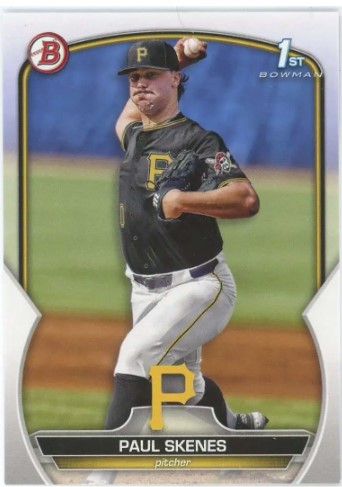
Photo: Johnmaxmena2, CC BY 4.0 <https://creativecommons.org/licenses/by/4.0>, via Wikimedia Commons

This week’s Trivial(l) Tidbit was spurred by the 2024 performance of Pirates “phenom” Paul Skenes.  The 22-year-old righty – the first overall pick (Pirates) in the 2023 MLB draft – made his way to the majors after just 12 minor-league appearances (and no minor-league decisions).  (For those who like to know such things, Skenes was 24-6, 2.18 in three college seasons – Air Force Academy and Louisiana State.)

Skenes made his MLB debut on May 1, 2024, giving up three runs (six hits, two walks, seven strikeouts) in a four-inning outing against the Cubs (in Pittsburgh). In his next appearance, a May 17 start against the Cubs at Wrigley, Skenes got the win with six no-hit, one-walk, 11-whiff shutout innings – and the rest is history.

By the All Star break, Skenes was 6-0, 1.90. He made a bit of history becoming the first player to be named to an MLB All Star Team in the first season after being drafted and just the fifth rookie moundsman to start an All Star Game – joining: Hideo Nomo – 1995; Fernando Valenzuela -1981; Mark Fidrych – 1976; and Dave Stenhouse -1962). Skenes finished the season at 11-3, 1.96. That earned run average would have been enough to win the ERA title, but Skenes’ 133 innings pitched were 29 short of qualifying.

Well, as usual with The Roundtable, one thing led to another and I began to dig into rookie earned run averages. Turns out the lowest earned run average among rookies with at least 100 innings pitched in their season belongs to Hall of Famer Tim “Smiling Tim”  Keefe (6-6, 0.86 in 105 innings for the 1880 National League Troy Trojans). Sign of the Times: Keefe logged his 105 innings in just 12 appearances. If you want to limit yourself to the Modern Era (post-1900), the honor goes to CharlesBabe” Adams of the 1909 Pirates (12-3, 1.11 in 13o innings). Keep in mind that the league average ERA was 2.37 in 1880 and 2.53 in 1909.

Keefe pitched in 14 MLB seasons (1880-93), going 342-225, 2.63 and topping 30 wins in five seasons. Adams pitched in 19 MLB seasons (1906-07, 1909-16, 1918-26), going 194-140, 2.76 and twice topping 20 wins in a campaign.

Photo: MLB / Detroit Tigers, Public domain, via Wikimedia Commons

As usual, I kept looking, this time focusing on MLB rookie pitchers who won an earned run title. As the chart at the end of this post shows, there have been 25 – the most recent was the Tigers’ very colorful and uber-talented Mark “The Bird” Fidrych in 1976 (19-9, 2.34).  To illustrate how times have changed, the 21-year-old Fidrych threw a league-leading 24 complete games in 29 starts. Well as usual, one thing led to another, and I looked a little deeper. Fidrych recorded those 24 complete games even though he did not make the first start of his rookie season until May 15. In his first 13 MLB starts (May 15-July 20), Fidrych pitched 12 complete games, including two 11-inning outings – and logged 120 1/3 innings.   Despite the truly “phenom-enal” start to his MLB career, after his 19 wins in 1976, Fidrych won only 10 more MLB games. From 1977 through 1980, he went 10-10, 4.28, wth tencompletre games in 27 starts.   It could have been overwork in his rookie campaign or the impact of a 1977 Spring Training knee injury on his pitching motion, but in mid-1977 he began to deal with arm problems. He made his final MLB start October 1, 1980 (and, in 1985, underwent surgery for a torn rotator cuff).    I used the word “colorful” to describe Fidrych. For younger “post-Fidrych “ readers, I suggest you check out YouTube for videos of his eccentric mound presence. He was a treasure.

Photographer and Author Joe McNally in “Goodbye Bird …”, a tribute to Fidrych, who passed away at the age of  54  in 2009 (an accident on his farm), wrote that as a  young star, Fidrych “threw strikes, talked to the ball and skipped around the mound like a three-year-old in an FAO Schwartz.”

Side Note: Of the 25 MLB rookies to win an Era title (as listed in stathead.com), 11 were in the Negro Leagues (1920-48), with its much shorter schedules and qualifying limitations.  For example, Gene Richardson of the Kansas City Monarchs, is credited with the 1947 Negro American League ERA crown with a 3-0, 1.33 record (just three starts). As Negro League stats from 1920 through 1948 are further explored and documented some of these numbers could change. 

Fidrych, by the way is not the youngest rookie to win an ERA title. Henry Krause of the 1909 Athletics (18-8, 1.39) and Chet Nichols of the 1951 Braves (11-8, 2.88) both captured ERA titles in their age-20 seasons.  On the other end of the spectrum, Jim Turner was 33-year-old rookie (Boston Bees) when he went 20-11, with a National League-best 2.38 ERA in 1937. He also led the league in complete games (24) and shutouts (five). Turner was in his fifteenth professional season (with 218 minor-league wins on his resume) when he finally made the big leagues. He went on to pitch in nine MLB seasons (1937-45), going 69-60, 3.22.

Jim Turner (above is one of just four rookie ERA leaders who also won 20 games in that rookie campaign).  Joining Turner are: the 1948 Indians’ Gene Bearden (20-7, 2.43); 1911 Naps’ Vean Gregg (23-7, 1.80); and 1910 Cubs’ LeonardKing” Cole (20-4, 1.80).

For My Minnesota Readers – A Minneapolis Birthday Present

In a 1978 SABR Baseball Research Journal article, Randolph Linthurst noted that the Minneapolis Millers played a role in Jim Turner’s getting to the show.  After years of toiling in the minors, Turner started a game on August 6, 1936 – his 32nd birthday – or the American Association Indianapolis Indians against the Minneapolis Millers. A Boston Bees scout happened to be in the stands as Turner tossed a shutout and earned a shot at the big leagues.

I was a bit surprised to see that, since the MLB Rookie of the Year Award was established in 1947, the AL and NL have seen six rookie pitchers win the ERA title and only two of those won Rookie of the Year Honora: Mark Fidrych in 1976 and Gary Peters in 1973.

Every Post Needs a Unicorn

The unicorn in this post is Hall of Famer Hoyt Wilhelm, when won the NL ERA Crown as a rookie in 1952 (Giants), with a 15-3, 2.43 season, with 11 saves. In the process, Wilhelm became the first – and still only – MLB pitcher to win an ERA title in a season in which he did not make a single start. For more on Wilhelm, click here.

A few other tidbits.

  • Hoyt Wilhelm had the longest career of any of the rookie ERA leaders – 21 seasons (1952-72) and 1,070 appearances.
  • Wilhelm also had the most career wins of any pitcher on this list – 143 (122 losses). He edged out Mike Garcia at 142-91 over 14 seasons (1948-61).
  • The fewest career wins by any rookie ERA leader is five by Jimmy Shields (5-7 over two seasons – 1928-29) and Gene Richardson (5-3 over seasons – 1947-48). Both pitched in the Negro Leagues.
  • The only players on the list to make it into the Hall of Fame are Hoyt Wilhelm and Bill Foster.


Primary Resource: stathead.com.

Baseball Roundtable – Blogging Baseball Since 2012.

100Baseball Roundtable is on the Feedspot list of the Top 100 Baseball Blogs. For the full list click here

I tweet (on X) baseball @DavidBaseballRT

Follow Baseball Roundtable’s Facebook Page here.  More baseball commentary; blog post notifications; PRIZES.

Member: Society for American Baseball Research (SABR); Negro Leagues Baseball Museum; The Baseball Reliquary.

P 1096

BASEBALL ROUNDTABLE TRIVIA(L) TIDBIT TUESDAY – When There’s Ducks on the Pond

Once again, it’s time for Trivia(l) Tidbit Tuesday. I hope you are enjoying this weekly presentation of baseball occurrences that for some reason caught The Roundtable’s eye.  (I’m particularly fond of unexpected performances and statistical coincidences.) These won’t necessarily be momentous occurrences, just events, statistics or coincidences that grabbed my attention. I’m also drawn to baseball “unicorns,” those one-of-a-kind accomplishment or statistics.

This week, I am looking at a statistic that came as a little bit of a surprise to me.  It comes in the answer to the question: Which active player, with at least 100 career plate appearances with runners in scoring position (RISP) has the highest career batting average with RISP?

Looking at active players with at least 100 MLB plate appearances with runners in scoring position, the player with the highest batting average in such situation is not an acknowledged run producer like Aaron Judge (.295 in 991 plate appearances with RISP) or even Freddie Freeman (.333 in 2,220 plate appearances with RISP). Nope, it’s three-time batting champion Luis Arraez, who currently sits at .369 in 540 plate appearances with RISP.)  Okay, I admit, those batting crowns make him a potential candidate for this spot, but he is not among the first names that came to mind when I thought about this list.  (I think of Arraez as more of a table-setter than a bases clearer.) Perhaps even more surprising is number-two on the list, A’s speedy centerfielder Esteury Ruiz (a .243 overall average in his 178 games, but .354 in 130 plate appearances with RISP.


Of course, a lot of things come into play here – and there is a need for caution when evaluating the impact of this particular stat.  You need to consider such factors as the player’s overall average (and how his average with RISP compares), how often the player comes to the plate with RISP and how likely a pitcher is to give the particular player “something to hit” with ducks on the pond. (I did have to refer back to the title of the post at some point).

For example, I took at look at Judge (.295 with RISP) versus Arraez (.369 with RISP) and found a few stats that deserve consideration. To date, Judge has walked in 21.3 percent of his plate appearances with RISP, as opposed to 9.8 percent for Arraez.  Judge’s on-base percentage with RISP is slightly higher (.443 to .423) than Arraez’. When it comes to delivering runs, Judge has driven in 0.38 runs per plate appearance with RISP to 0.37 for Arraez (pretty close). Take out those walks, however, and Judge has delivered 0.53 runs per non-walk plate appearance (at bats and sacrifices), versus 41.3 for Arraez.  Dang, I do love statistics.

Ultimately, though, how can you not be impressed by Arraez’ .369 average with RISP or the fact that Ruiz’ average with RISP is 111 points higher than his overall average?

An MLB Unicorn

Luis Arraez is the only MLB player to win three consecutive batting titles with three different teams (Twins – 2022; Marlins – 2023; Padres – 2024) – and the only player to win an AL and NL batting title I consecutive seasons.

As usual with Baseball Roundtable, “one thing led to another,” and I looked at 2024 averages with RISP and career averages with RISP.

When it came to 2024, I set a minimum of 50 at bats with Runners in Scoring Position.  The leader was Reds’ outfielder Stuart Fairchild, a .215 hitter overall in 2024 (with a four-season MLB career average of .224). Fairchild came to the plate with RISP 53 times in 2024 – and delivered a eye-opening .465 average (20 hits in 43 at bats, six walks, one HBP, two bunts and one sacrifice fly).   Fairchild might be considered a bit of a surprise here.  In his first three MLB seasons, (2021-23), he had 98 plate appearances with RISP and hit .200 (17-for-85).  Here are the 2024 top ten.

I then moved on to career average with RISP, upping the minimum number of plate appearances with RISP to 500 (I wanted to keep Arraez in the mix). Another word of caution here.  The chart below is to provide a general point of comparison only.  The fact is, for all but Arreaz on this chart, the numbers are incomplete, due to fact (as stathead.com notes, play-by-play data for some – many, depending on the year – games in those early years is not be available). Still, the chart gives us a look into some of the best hitters with RISP, and indicates, to this point in his career, Arraez still fares pretty darn well.

Note:  Just missing the chart above is Tony Gwynn, with a career average of .349 in 2,547 plate appearances with RISP (and Gwynn’s play-by-play records are complete).

Baseball fans love numbers.  They like to swirl them around in their mouths like Bordeaux wine.

Pat Conroy – Author

Statistics can be an invaluable tool, but they can also deceive.  They can tell one story, while the truth lies in the nuances of the game.

Bill James –  Baseball writer, historan, statistician

 Baseball statistics are like a girl in a bikini. They show a lot, but not everything.

Toby Harrah, – MLB infielder


Primary Resource: Stathead.com


Baseball Roundtable – Blogging Baseball Since 2012.

100Baseball Roundtable is on the Feedspot list of the Top 100 Baseball Blogs. For the full list click here

I tweet (on X) baseball @DavidBaseballRT

Follow Baseball Roundtable’s Facebook Page here.  More baseball commentary; blog post notifications; PRIZES.

Member: Society for American Baseball Research (SABR); Negro Leagues Baseball Museum; The Baseball Reliquary.

P 1095

BASEBALL ROUNDTABLE TRIVIA(L) TIDBIT TUESDAY – We Need a Bigger Bullpen

Once again, it’s time for Trivia(l) Tidbit Tuesday. I hope you are enjoying this weekly presentation of baseball occurrences that for some reason caught The Roundtable’s eye.  (I’m particularly fond of unexpected performances and statistical coincidences.) These won’t necessarily be momentous occurrences, just events, statistics or coincidences that grabbed my attention. I’m also drawn to baseball “unicorns,” those one-of-a-kind accomplishments or statistics.  Today, we are looking at a two-team “unicorn” – on September 24, 2019 the Rockies and Giants combined to use a record 25 pitchers in a single game (13 by the Giants and 12 by the Rockies).  Thanks to rules changes put in place the following season, this is likely to remain an MLB unicorn.

The Kind of Statistical Oddies The Roundtable Likes

Only four teams have used a record 13 pitchers in a single game. Yet:

  • While a team has used 13 pitches in a single game just four times in MLB history, the Giants did it twice in eight days: in that September 24, 2019 (25 combined pitchers) contest versus the Rockies and on September 17 in a 7-6., 15-inning win at Boston.
  • All three teams that have used 13 pitchers in a game hail from the National League West – Giants twice, Rockies and Diamondbacks.
  • On the same day that the Giants used 13 pitchers in their game against the Rockies, the Diamondbacks used a record-tying 13 pitchers in a 19-inning, 3-2 win (at home) against the Cardinals. The Diamondbacks and Cardinals used a combined 24 pitchers in that one.
  • The Rockies (against whom the Giants used a record-tying 13 pitchers) were the first team to ever use 13 pitchers in a game (September 15, 2015 – in a 16-inning 5-4 win versus the Dodgers in LA).

—–September 24, 2019 – Giants Versus Rockies – Pitchers Used—–

Not Likely to See A Team Use 13 pitchers in a Game Again

Three of the four 13-pitcher games took place in 2019 – the year before the following rules took effect:

  • Relievers required to pitch to at least three batters or the end of an inning;
  • A runner placed on second at the start of each regular-season extra inning;
  • September active roster size limited to 28 players (from 26 for April through August), as opposed the limit of 40 in effect in September of 2019.

Inquiring Minds Want to Know

The record for pitchers used in a nine-inning game also belongs to the Giants.  On October 4, 2015, in a 7-3, nine-inning loss to the Rockies (in San Francisco), the Giants used 11 hurlers – nine of them for less than one inning.

The procession to the mound went:

Matt Cain                5 innings

Jeremy Affeldt      2/3 inning

Cory Gearin           1/3

Sergio Romo          2/3

Brett Bochy            1/3

Mike Broadway     2/3

Josh Osich              1/3

Javy Lopez              1/3

George Kontos        0 (three batters faced)

Cody Hall                   0 (three batters faced).

Yusmeiro Petit        2/3

For your entertainment 

The most pitchers used in a nine-inning shutout is eight (five teams) and the moss in a nine-inning no-hitter is six (two teams).

Primary Resource: Stathead.com

Baseball Roundtable – Blogging Baseball Since 2012.

100Baseball Roundtable is on the Feedspot list of the Top 100 Baseball Blogs. For the full list click here

I tweet (on X) baseball @DavidBaseballRT

Follow Baseball Roundtable’s Facebook Page here.  More baseball commentary; blog post notifications; PRIZES.

Member: Society for American Baseball Research (SABR); Negro Leagues Baseball Museum; The Baseball Reliquary.

P 1093

BASEBALL ROUNDTABLE TRIVIA(L) TIDBIT TUESDAY – Streaks of Multi-Hit Games

Once again, it’s time for Trivia(l) Tidbit Tuesday. I hope you are enjoying this weekly presentation of baseball occurrences that for some reason caught The Roundtable’s eye.  (I’m particularly fond of unexpected performances and statistical coincidences.) These won’t necessarily be momentous occurrences, just events, statistics or coincidences that grabbed my attention. I’m also drawn to baseball “unicorns,” those one-of-a-kind accomplishments or statistics.  Today, we are looking at streaks of multi-hit games … with a few unicorns tossed in.

Everybody (well, everybody likely to read this post) is familiar with Joe DiMaggio’s 56-game hitting streak – an MLB “unicorn.”  Well, Baseball Roundtable decided to take hitting streaks a step or two further – focusing consecutive game streaks in which a batter collected at least two hits, at least three hits, at least four hits and at least five hits. This, by the way, will bring up names from the past like Rogers Hornsby and names from the present like Julio Rodriguez.  It will also put a focus on familiar names like Roberto Clemente and George Brett, as well as lesser-known major leaguers like Milt Stock and Hi Myers. So, let’s get to it.

The Longest Streak of Consecutive Games with at Least Two Hits … 13 Games

Rogers Hornsby, 2B, Cardinals … July 5 – July 18, 1923

Photo: Charles M. Conlon, Public domain, via Wikimedia Commons

Hall of Famer Hornsby was in his ninth MLB season when he ran off a 13-game streak of games with two or more hits – hitting .589 and driving in 22 runs as his Cardinals went 10-3. The streak included just one extra-inning game – a 10-inning, 2-1 Cardinals’ win at Philadelphia on July 17 (Game 12 of the streak).  Hornsby collected his second hit in the ninth inning of that contest.)

Hornsby’s streak (part of a 20-game overall hitting streak) included four three-hit games and one five-hit contest.

Hornsby won the batting title that season, hitting .384, despite playing part of the season on an ailing knee (he played in just 107 games). It was the fourth of six consecutive (and seven total) batting titles for Hornsby.

.400 Looks Good To Me

In the five seasons from 1921 through 1925, Rogers Hornsby hit a cumulative .402 over 696 games.

In his 23-season MLB career (1915-37 … Cardinals, Giants, Cubs, Browns), Hornsby went .358-301-1,584, with 1,579 runs scored and 135 steals.  He led his league in average seven times, runs scored five times, hits four times, RBI four times, doubles four times, triples twice, home runs twice.  He had six seasons of 200+ hits. Side note: I’m not a big fan of the new analytics (Okay, they’re not that new), but (looking retroactively) Hornsby did lead positions players in Wins Above Replacement – WAR- a record 11 times.  Other at 11 are Honus Wagner, Babe Ruth and Barry Bonds). 

A Roundtable Unicorn

In 1922, Rogers Hornsby became the first – and still only – MLB player to hit at least .400 and launch at least 40 home runs in the same season. He hit .401-42-152. He nearly matched that feat in 1925, with .403-39-143 season.

 The Longest Streak of Consecutive Games with at Least Three Hits … Six Games

George Brett, 1976 Royals and Jimmy Johnston, 1923 Robins

George Brett, 3B, Royals … May 8-May 13, 1976

Photo: SW (via MissouriStateArchives, on Flickrderivative work: Delaywaves talk, No restrictions, via Wikimedia Commons

Hall of Famer Brett hit .692 during his streak, collecting three hits in each of the six games. He walked twice did not strike out even once during the steak. Brett’s Royals won five of the six games, which included one extra-inning contest (a ten-inning 5-4 loss to the Twins in Kansas City on May 10). Brett collected his third safety in the eighth inning of that game.

That season Brett led the AL with a .333 average – the first of three career batting titles. He also led the AL in hits (215) and triples (14).

Another Roundtable Unicorn

George Brett is the only player to win an MLB batting title in three different decades: .333 in 1976; .390 in 1980; and .329 in 1990.

Brett played in 21 MLB seasons (1973-93 … Royals), going .305-317-1,596, with 1,583 runs scored and 201 stolen bases. The 13-time All Star led the league in average three times, hits three times, triples three times, doubles once and total bases once.

A True Winning “Run”

On August 17, 1976, George Brett stole home with two outs in the bottom of the tenth inning to give the Royals a walk-off (run-off) 4-3 win over the Indians. Brett singled to left with one out (off Dave LaRoche). Stole second with John Mayberry at the plate and went to third on a catcher’s throwing error. After Mayberry fanned, Brett stole home on a 1-1 pitch to Dave Nelson.

Jimmy Johnston, SS, Robins … June 25-30, 1923

Johnston hit .821 during his streak, which included one five-hit game and three four-hit contests.  Surprisingly, his Robins won just three of the six games. The streak included a June 30 doubleheader in which Johnston went eight-for-nine, with three doubles and a home run.

Photo: Bain News Service, publisher, Public domain, via Wikimedia Commons

Johnston played 13 MLB seasons (1911, 1914, 1916-26 … White Sox, Cubs, Robins, Braves, Giants), hitting .294-22-410, with 754 runs and 169 steals.  While he played primarily at SS during his streak, Johnston moved around then diamond during his career: 1B (49 games); 2B (24 games); 3B (448 games); SS (179 games); LF (776 games); CF (130 games); RF (165 games).  In his five peak seasons (1920-24 Robins), he averaged 136 games a season, with a .313 batting average, 173 hits, 93 runs scored and 49 RBI per campaign.  In those seasons, he appeared in 344 games at 3B, 172 at SS, 147 at 2B, eight in RF and four at 1B.


The Longest Streak of Consecutive Games with at Least Four Hits – Four Games

Julio Rodriguez, 2023 Mariners & Milt Stock, 1925 Robins

Julio Rodriguez, CF, Mariners … August 16-19, 2023

Rodriguez, the 2022 AL Rookie of the Year (at age 21), ran off a four-game streak of at least four hits per game in just his second MLB season. Rodriguez hit .772  during his streak, as the Mariners won all four games. The streak included one five-hit and three four-hit contests. The highlight was a 6-4 Mariners win over the Royals (in Kansas City), when Rodriguez went five-for-five, with a double and a home run – and drove in five of the Mariners’ six runs.

In just three seasons, Rodriguez has been the 2022 AL Rookie of the Year (.284-28-75, with 25 steals) and a two-time All Star. His career stat line (2022-23 … Mariners) is .277-80-246, with 262 runs scored and 86 stolen bases.


Taking It On Down The (first base) Line

In 2023, Julio Rodriguez led MLB with 29 infield hits.


Milt Stock, 2B, Robins … June 30-July 3, 1925

Photo: Bain News Service, publisher, Public domain, via Wikimedia Commons

Stock was in his thirteenth MLB season when he ran off his four-game streak of games with four or more hits. He had four hits in each of his games and the Robins won three of the four.  The streak included one extra-inning contest (a 10-9 loss to the Phillies (in Philadelphia) on June 30. Stock got his fourth hit in the eleventh inning in that game,

Stock played 13 MLB seasons (1913-26 … Giants, Phillies, Cardinals, Robins), hitting .289-22-696, with 839 runs scored and 155 steals. He hit .300+ in five seasons and, in the four seasons from 1919 through 1922 averaged .310.


The Longest Streak of Consecutive Games with at Least Five Hits … Two Games

Roberto Clémente, 1970 Pirates & Hi Myers 1917 Robins

Roberto Clemente, RF, Pirates … August 22-23, 1970

Photo: Public Domain ia WikiCommons

Hall of Famer Clemente was in his 16th (and age-35) season when he put together consecutive five-hit games. He went ten for 13 in the two contests, both won by the Pirates (versus the Dodgers in Los Angeles). The first of the two games – a 2-1 Pirates win – went 16 innings and Clemente got his fifth hit in the top of the 16th.

Clemente played 18 MLB seasons (1955-72) all for the Pirates. He was an All Star in 12 seasons, the 1966 NL MVP, a four-time batting champion and a 12-time Gold Glover.  Clemente hit .300+ in 13 seasons, collected 200+ hits twice (both times leading the league). His career stat line was .317-240-1,305, with 1,416 runs scored and 83 steals.


An Ultimate Unicorn

An Ultimate Grand slam is defined as a walk-off Grand Slam in which all four runs are needed to overcome a three-run deficit.  On July 25, 1956, Roberto Clemente hit the first – and still only – Inside-the-Park Ultimate Grand slam. It came off the Cubs’ Jim Brosnan and erased an 8-5 deficit in the bottom of the ninth.  

Hi Myers, 2B/CF, Robins … August 21-22, 1917

Photo: Bain News Service, publisher, Public domain, via Wikimedia Commons

Both of the contests in which Myers collected five hits went extra innings (a 13-inning 3-3 tie and a 22-inning 6-5 Robins win). The Pirates provided the opposition in each case. In the first game, Myers got his fifth hit (a triple) in the bottom of the tenth. In the second game, hit number-five came in the bottom of the 21st frame.   Myers started in CF in both games, but moved to 2B in the 13th inning of the second contest.

Myers played in 14 MLB seasons (1909, 1911, 1914-1925 … Robins, Cardinals, Reds), hitting .281-32-559, with 555 runs scored and 107 stolen bases, In 1919, he hit .307 and led the NL in triples (14), RBI (73) and total bases (223). Myers hit .300 or better in four seasons and twice led the league in triples.  In his five peak seasons (1919-23, he averaged 136 games per campaign, .304, with four home runs, 72 RBI and 61 runs scored per season.

Note: There have been 120 games in which player collected six or more hits, but no player has recorded two such games consecutively.  The only players with at last two games with six or more hits in their careers are: Jim Bottomley (1924 & 1931); Doc Cramer (1932 & 1935); Jimmie Foxx (1930 & 1932); and Kirby Puckett (1987 & 1991). The most recent player with a six-hit game  is Shohei Ohtani (September 19, 2024).


Primary Resource:  Stathead.com


Baseball Roundtable – Blogging Baseball Since 2012.

100Baseball Roundtable is on the Feedspot list of the Top 100 Baseball Blogs. For the complete list click here

I tweet (on X) baseball @DavidBaseballRT

Follow Baseball Roundtable’s Facebook Page here.  More baseball commentary; blog post notifications; PRIZES.

Member: Society for American Baseball Research (SABR); Negro Leagues Baseball Museum; The Baseball Reliquary.

P 1092


BASEBALL ROUNDTABLE TRIVIA(L) TIDBIT TUESDAY – The Century Club … Teams with 100 Wins

Once again, it’s time for Trivia(l) Tidbit Tuesday. I hope you are enjoying this weekly presentation of baseball occurrences that for some reason caught The Roundtable’s eye.  (I’m particularly fond of unexpected performances and statistical coincidences.) These won’t necessarily be momentous occurrences, just events, statistics or coincidences that grabbed my attention. I’m also drawn to baseball “unicorns,” those one-of-a-kind accomplishment or statistics.  Today, the Roundtable is looking at MLB teams with 100 or more wins in a season.

Overall, there have been a total of 119 100+ win seasons, with 38 of those teams going on to win the World Series.

No team has recorded more 100+ win seasons than the New York Yankees – with 21 such campaigns (ten more than the runner-up Dodgers). The Yankees won 12 World Series in seasons in which they won at least 100 games.

Only six franchises have never had a season of 100 or more victories: Rockies; Marlins; Brewers; Padres; Rangers; Blue Jays; Nationals.


Three-peats

There have been eight instances of a team/franchise recording three consecutive seasons of 100 or more wins.

Here they are, using current franchise names.

  • Athletics 1929-39-31 (WS Champions 1929, 1930, 1931)
  • Cardinals 1942-43-44
  • Orioles 1969-70-71 (WS Champions 1969. 1970, 1971)_
  • Braves 1997-98-99
  • Astros 2017-18-19 (WS Champions 2017, 2019)
  • Yankees 2002-03-04 (WS Champion 2003)
  • Dodgers 2021-22-23

A String Quartet

There have been two seasons in which four teams notched 100 or more victories.

2019

Astros:  107-55, won the AL West by ten games over the second place A’s. Lost the World Series to the 93-69 Nationals.

Dodgers:  106-56, won the NL West by 21 games over the second-place Diamondbacks. Lost to the Nationals in the NL Championship Series.

Yankees:  103-59, won the AL East by seven games over the Rays. Lost to the Astros in the American League Championship Series.

Twins: 101-61, won the AL Central by eight games over the Indians. Lost in the AL Division Series to the Yankees.

2022

Dodgers:  111-51, won the NL West by 22 games over the Padres. Lost the NL Division Series to the 89-73 Padres.

Astros:  106-56, won the AL West by 16 games over the Marlins. Won the World Series  4-2 over the Phillies.

Braves: 101-61. Tied for the NL East Lead with the Mets (won Division on a tie breaker).  Lost to the 87-75 Phillies in the NL Division Series.

Mets:  101-61, tied for NL West lead with Braves. Lost to the Padres in the Wild Card Round.

_____________________________________

What the “L” Is That On Our Record?

The fewest losses by any team winning 100+ games is 36: 1906 Cubs (116-36) and 1902 Pirates (103-36).

Man, What Do You Have to Do to Win This Thing? 

Those Two 116-Win Seasons

Those most wins in an MLB season is 116 – 1906 Cubs (116-36) and 2001 Mariners (116-48). The Cubs finished 20 games ahead of the second-place Giants and lost the World Series (four games-to-two to the 93-58 White Sox).  The Mariners finished 14 games ahead of second-place A’s in the West Division. Seattle was eliminated from the post-season (in the American League Championship Series) by the 95-65 Yankees.

On the 1906 Cubs, no pitcher appeared in more than nine games in relief and that was Ed Reulbach, who also started 24 games.

A few similarities:

  • Both teams lead their league in runs scored and fewest runs surrendered;
  • Both topped their league in batting average and earned run average;
  • Both showed game-changing speed – The Mariners finished first in their league in stolen bases, the Cubs second. The Cubs finished first in triples, the Mariners second.

Here’s a bit of a breakout on these two squads.

1906 Cubs

Led the NL in runs scored (704); average (.262); triples (71). They were second in doubles (181); HR (20); and SB (283).  On the mound, Chicago gave up the fewest runs (381); boasted the lowest ERA (1.75); the most strikeouts (702); and most shutouts (30).

First baseman Frank Chance was an offensive key, leading the NL in runs scored (103) and stolen bases (57), while hitting .319 in 136 games. Third baseman Harry Steinfeldt led the league in hits (176) and RBI (83), while hitting .327. Mordecai Brown led the staff with 26 wins and led the NL with a 1.04 ERA and nine shutouts.

2001 Mariners

Led the AL in runs scored (927); average (.288); hits (1,637); and stolen bases (174). The Mariners finish second in walks (614) and triples (38). On the mound, surrendered the fewest runs (627); had the lowest ERA (3.54); and recorded the most shutouts (14). Finished second in saves (56)

Key players on offense included Ichiro Suzuki, who led the league average (.350); hits (242); and stolen bases (56); Brett Boone, who went .331, with 37 homers, 118 runs scored and a league-leading 141 RBI; Edgar Martinez (.306-23-116); and Mike Cameron (.267-25-119).  Thirty-eight-year-old Jamie Moyer led the mound staff with 20 wins (six losses) Kazuhiro Sasaki chipped in with 45 saves.

Primary Resource:  Stathead.com

Baseball Roundtable – Blogging Baseball Since 2012.

100Baseball Roundtable is on the Feedspot list of the Top 100 Baseball Blogs. 

I tweet (on X) baseball @DavidBaseballRT

Follow Baseball Roundtable’s Facebook Page here.  More baseball commentary; blog post notifications; PRIZES.

Member: Society for American Baseball Research (SABR); Negro Leagues Baseball Museum; The Baseball Reliquary.

P 1091

Thirty Or More Homers in a Season – Players Who Made a Habit of It

In this post, Baseball Roundtable is taking a look at what has always seemed to me like a “magic” number (and the definition of a true power hitter)– 30 home runs in a season. The Roundtable is taking that look from the angle of players with the most 30+ home run seasons both overall and by position. Why thirty?  Well, in my baseball lifetime (which I think of as beginning in 1953, when I was six-years old and the Braves moved to my home town of Milwaukee), thirty home runs has seemed to a popular measure of true power hitters.  To confirm that, I looked at the relation of power hitters (as defined by the 30+ homer measure) to teams in a few key (to me) seasons.

Consider:

  • In 1953, when there were sixteen MLB teams, there were 11 30+ homer players (0.69 per team);
  • In 1962, after expansion to 20 teams, there were 14 30+ homer players (0.70 per team);
  • In 1993, after expansion to 28 teams, there were 22 30+ homer players (0.79);
  • In 2024, with 30 teams, three were 23 30+ homer players (0.77 per team).

That seems to make the 30-homer benchmark rare enough to qualify for examination.

When you look at the list of players with the most season of 30 or more home runs, you’ll pretty much find “all the usual suspects.”   In fact, among the top five totals (six players – a tie for fifth), you will find the top five career home runs leaders (Barry Bonds, Henry Aaron, Babe Ruth, Albert Pujols and Alex Rodriguez). The sixth player on the list is Mike Schmidt, who stands at number 16 in career roundtripppers.  Schmidt is also the only one of this group with less than 22 MLB seasons – 18; but he ranks second in the number of seasons leading his league in home runs (8).

Rodriguez is unique on this list in that he is not only atop (tied) the total 30+ HR seasons list, but is also number-one at SS (7) and number-three at 3B (7). He is the only player among the top five at more than one position. Side note: He also had one season of 30+ home runs, 33 in 2015, when he was used primarily at DH (136 of 151 games).

Now, a brief diversion, in the spirit of how in Baseball Roundtable “one thing always seems to lead to another.”  As I looked at the above list, I got to wondering about the balance of “swinging for the downs” and making contact. Turns out, the list above pretty much matches a list of players with the most seasons of 30+ home runs coupled with  a .300+ batting average. Ruth tops the 30/.300 cadre, hitting .300 or better in all 13 of his 30+ homer campaigns.  Next are Bonds (11 seasons at .300+ out of 14 seasons at 30+ HR) and Henry Aaron (11 out of 15).  Pujols shows up at 10 out of 14; Rodriguez comes in at 8 out of 15 and Schmidt was a bit of an outlier at just 1 out of 13.  (Schmidt, in fact, had just one career season in which hit.300 or better. Two players in double figures  in 30/.300 seasons are not among the top five in 30+ homer seasons, but deserve a mention here:   (Lou Gehrig (10 out of  10) and Manny Ramirez (10 out of 12).

Here is a chart that will help you make some of your own comparisons.

Among active players, five players tie for the most 30+ homer seasons at seven: Nolan Arenado; Paul Goldschmidt; Manny Machado; Giancarlo Stanton; and Mike Trout.

30+ Home Run Season Leaders by Primary Position

Now let’s look by position.  Qualifier Note: The list is based on players who played at least 50 percent of their games at the selected position in their 30+-home run seasons.  It is also based on total home runs for the season, not home runs hit only in games at their primary position.  

CATCHER

Hall of Famer Mike Piazza is the runaway at catcher with nine seasons of 30 or more home runs – out of 16 MLB seasons – not bad for a player who was the 1,390th selection in the 1988 MLB draft. The 12-time All Star retired in 2007 with 427 long balls. Piazza appeared as a catcher in 85.2 percent of his 1,912 MLB games.  Piazza played in MLB seasons (1992-2007 … Dodgers, Marlins, Mets, Padres, A’s), going .308-427-1,335.

I’m Going Where?

In 1998, Mike Piazza had a 30+ home run season (.328-32-111) – despite playing for three different teams. On May 15, he was traded to the Marlins (along with Todd Zeile) for Gary Sheffield, Charles Johnson, Bobby Bonilla. Jim Eisenreich and Manuel Barrios. Piazza (who had been an All Star for the Dodgers in each of the previous five seasons) was hitting .282-9-30 and had played in 37 of the Dodgers 40 games. A week later, he was traded from the Marlins to the Mets for Preston Wilson, Ed Yarnall and Geoff Goetz.  

Two more Hall of Famers, Johnny Bench and Roy Campanella, round out the top three at four 30+ homer seasons each.  They belted 389 and 260 career home runs, respectively.  Campanella’s totals were dampened a bit by eight seasons in the Negro Leagues (with their shorter schedules) and a tragic car accident that ended his career early.  Bench is the only one of the top three to lead his league in home runs (45 in 1979 and 40 in 1972). Bench was an All Star in 14 seasons, Campanella in 11 (three in the Negro Leagues, eight in the National League). Campanella played in 18 MLB seasons (1937-42, 1944-57 … Washington Elite Giants, Baltimore Elite Giants, Philadelphia Stars , Dodgers), hitting .283-260-1,019.  Bench played in 17 MLB seasons (1967-83), all for the Reds. His career line was .267-389-1,376.

The record for home runs in a season in which a player played at least 50 percent of his games at catcher, belongs to the Royals’ Salvador Perez (48 in 2021, when he took a place behind the plate in 124 of 161 games). To date, that is the only 30+ homer season in Perez’ 13-season MLB career (2011-2018, 2020-24 … Royals).

FIRST BASE

Hall of famer Jimmie Foxx tops this list of power hitters, with 12 campaigns of thirty or more homers – five of those forty or more and a high of 58 in 1932. Foxx won four home run titles during his 20-season MLB career (1925-42, 1944-45 … Athletics, Red Sox, Cubs, Phillies) and hit a total of 534 regular-season home runs. Foxx was a nine-time All Star (but the first All Star Game wasn’t held until Foxx’ ninth MLB season). His career stat line was .325-534-1,922. Side note: Despite his high average, Foxx did lead the AL in strikeouts seven times.) 

If there is an underrated player among these top five, it’s probably two-time All Star Carlos Delgado (tied at number-two with 11 seasons of 30+ home runs). Delegado ran off a string of ten straight 30+ HR seasons from 1997 through 2006). He never won a home run title, but did hit 473 long balls in 17 MLB seasons (1993-2009 … Blue Jays, Marlins, Mets). He finished his career at .280-473-1,512 in 2,035 games.

The Roundtable also has to give a shoutout to Albert Pujols, whose 703 career home runs are fourth all-time. He had ten of his 14 30+ homer seasons in years in which he was primarily first baseman and won both of his HR titles as a first sacker (47 in 2009 & 42 in 2010). In 22 MLB seasons (2001-2022 … Cardinals, Angels, Dodgers), Pujols hit .296, with 703 home runs and 2,218 RBI.

Reaching Double Figures (season-wise)

In his first ten MLB seasons (2001-2010), Albert Pujols hit at least .300, rapped at least 30 home runs and drove in at least 100 runs each and every campaign.  That’s unicorn territory.  (He just missed in the eleventh season – .299-37-99).  Over those first ten seasons, Pujols averaged .331, with 41 homers and 123 RBI and was: National League Rookie of the Year; a nine-time All Star; three-time NL MVP; one-time batting champ; and two -time home run leader.

Tied with Pujols for third on this list are a pair of Hall of Famers who each hit 493 career homers:  Lou Gehrig (.340-493-1,995 over 17 seasons) and Fred McGriff (.284-493-1,550 over 19 seasons).

Mark McGwire hit the most home runs in a season by a player to play at least 50 percent to his games at 1B (70 in 1998).

Balancing Those Singles and Homers

In 2000, while playing for the Cardinals, Mark McGwire had a season in which he bashed 32 home runs, while collecting just 72 hits. (32 singles, 8 doubles, 32 homers). Hampered by knee issues, McWire played in just 89 games (.305-32-73). That 72 hits is tied for the fewest hits ever in an MLB 30+ home run season. In 2021, Rays’ catcher Mike Zunino (in his only season of 30 or more homers) collected 33 home runs among 72 hits in 109 games  (.216-33-62).  Zunino actually had more home runs than singles (26 singles, 11 doubles, 2 tipels, 33 homers). 

SECOND BASE

I expected Jeff Kent to be at the top of this chart, but that spot goes to Dan Uggla, with five seasons of 30 or more home runs in a ten-season MLB career (2006-2015 … Marlins, Braves, Giants, Nationals). Uggla hit 190 of those home runs in the first five season of his career. In his MLB debut season (2006 Marlins), Uggla went .282-27-90, setting the record for home runs by a rookie second baseman.  For his career, the three-time All Star was .241-235-706 in 1,346 games.

An Unexpected Streak

In 2001, Dan Uggla (Braves) got off to a terrible start. At the end of play on July 4, he was hitting just .173 (55-for-318), with 12 home runs and 29 RBI (86 games).  On July 5, he started a hitting streak that would extend through August 13 – 33 games, during which he hit .377-15-32.  The 33-game streak ties for the 19th longest in MLB history.

The most career homers among the six players on this list is 412 by Alfonso Soriano (16 seasons), although he played more career games in LF than at 2B. Rougned Odor had 178 long balls in ten seasons; Chase Utley, 259 in 16 seasons; and Jeff Kent, 377 in 17 seasons.  The only player on the chart with a home run title is Hall of Famer Rogers Hornsby with two (42 homers in 1922 & 39 in 1925). Hornsby hit a total of 301 dingers in 22 seasons.

A 40/.400 season – Or More One Thing Leads To Another

The Cardinals’ Rogers Hornsby is the only MLB player to hit 40 or more home runs in a season in which he hit .400 or better (.401-42-152 in 1922).  And, he almost did it twice.  In 1925, Hornsby hit .403-39-143. Only two other players have hit 30 or more home runs in a .400 or better average season. The Saint Louis Stars’ Mule Suttles in 1926 (.425-32-130 in just 89 games played)   and the Red Sox’ Ted Williams .406-37-120 in 1941. 

The most home runs in a season by a player who suited up in at least half his games at second base in 45, by Marcus Semien, for the Blue Jays in 2021. Still active (2013-24 … White Sox, A’s, Blue Jays, Rangers), Semien has only one other season of 30+ homers (33 for the 2019 A’s).

THIRD BASE

Some big names and big home run totals at the hot corner, led by Hall of Famer Mike Schmidt with 12 seasons of 30 or more home runs in years he played at least 50 percent to his games at third. (He had a 13th 30+ homer season – 33 in 1985 – when he played the majority of his games at 1B.)  A 12-time All Star (and 10-time Gold Glover) Schmidt has eight HR titles (all as a third baseman) to his credit. Schmidt was the NL Most Valuable Player in 1980, 1981 and 1986.  He had  a final stat line of .267-548-1,595 in 18 seasons (1972-90 … Phillies).

Another Hall of Famer, Eddie Mathews, is second on this list. He had ten 30+ home run seasons in his 17 seasons MLB career (1952-68 … Braves, Astros, Tigers). The nine-time All Star’s final stat line was .271-512-1,453.) Mathews won two home run titles (47 in 1953 & 46 in 1959).

Dynamic Duo

Eddie Mathews and Hank Aaron hit more combined home runs as teammates (863) than any other one-two MLB combination.

Alex Rodriguez is tied for third on this list with seven seasons of 30+ home runs as a primary third baseman. (He has 15 such seasons total) and you’ll read more about him at shortstop. The 14-time All Star won two home run titles as a third baseman (48 in 2005 & 54 in 2007).  Rodriguez also holds the record for the most home runs in a season by a player with at least 50 percent of his games at third base (54 in 2007.)

It’s a pretty good bet (but not a sure thing) that Nolan Arenado will take over sole possession of third place in the near future. The still active Arenado has seven 30+ homer seasons (and ten Gold Gloves) in his 12 MLB seasons (2013-24 … Rockies, Cardinals). His last 30+ home run campaign, however, was in 2022. Arenado has three HR titles on his resume (43 in 2025, 41 in 2016 and 38 in 2018). He’s an eight-time All Star.  As of 2024, his career stat line is .285-341-1.132.

SHORTSTOP

More Alex Rodriguez, as he tops shortstops with seven 30+ HR seasons in which he played at least half his games at the position.  Rodriguez won three home run titles as a shortstop (52 in 2001; 54 in 2002; and 47 in 2003). His 696 career log balls rank fifth all-time. (Enough said here already, since A-Rod has been discussed among all-time leaders and leaders at third base.) His 57 long balls in 2002 are the single-season high for a player with at least 50 percent of his season’s games at shortstop. His career stat line is .295-696-2,086.

Close on RodrIguez’ heels is the still active Francisco Lindor, with five 30+ homer seasons in his ten MLB seasons (2015-24 … Indians, Mets). Lindor’s 30+ homer seasons came in 2017, 2018, 2019, 2023 and 2024. The four-time All Star has a career MLB stat line of .274-248-770.   Also at five 30+ homer season as a shortstop is Hall of Famer Ernie Banks – an All Star in eleven seasons, with 512 career homers. Banks had a total of seven career 30+ homer seasons, two as a first baseman.  He had five seasons of forty or more long balls and two two home run titles (47 in 1958 and 41 in 1960.) He played 19 MLB seasons (1953-71), all for the Cubs, going .274-512-1,636.  Miguel Tejada, a six-time All Star is next on the SS list at four 30+ homer seasons in 16 career seasons (1997-2011, 2013 … A’s, Orioles, Astros, Padres, Giants, Royals) – and a .285-307-1,302 stat line.  Still-active Corey Seager has a chance to move up since his three 30+ homer campaigns came over the past three seasons. A five-time All Star, Seager has 200 career homers in ten seasons (2015-24 … Dodgers, Rangers) to go along with a .290 average and 617 RBI.

LEFT FIELD

No contest in left field, as Barry Bonds recorded 14 30+ homer seasons as a left fielder and also holds the single-season record of 73 homers (also the MLB single-season record any position) for a player with at least 50 percent to his season’s games played in left.  A 14-time All Star, Bonds, despite being MLB All-time career leader in home runs (762), captured just two HR titles in 22 MLB seasons (1986-2007 … Pirates, Giants). Thirteen of his 30+ homer season came consecutively 1992-2004. During that stretch he averaged 43 home runs (with a .316 batting average and 107 RBI) per season. His career stat line:  .298-762-1,996.

Walk, Don’t Run

Barry Bonds not only trotted around the bases more times than any other player, he also walked to first base more times than any other player (a record 2,558 career walks, 368 more than number-two Rickey Henderson). Bonds’ 688 career intentional walks are also an MLB record (372 more than number-two Albert Pujols).   

Ralph Kiner deserves a shout out at number-two (tie) with seven 30+ home run seasons in only ten career MLB seasons (1946-55 … Pirates, Cubs, Indians).  His numbers might have been even more spectacular had not a back injury forced him into early retirement.

Lucky Number Seven

Ralph Kiner won the NL home run title with 23 in his rookie season (1946) and the six-time All Star didn’t relinquish it until 1953 – winning seven straight HR titles in his first seven MLB seasons (twice topping 50 HR). During those seven seasons, he averaged 42 home runs and 110 RBI.

Hall of Famer Kiner retired with 369 career homers on his MLB resume:  .279-369-1,015 over ten seasons (1946-55… Pirates, Cubs, Indians).

Tied for the third spot among left fielders is another Hall of Famer – Ted Williams. An all Star in 17 seasons (keep in mind there were two All Star Games from 1959 through 1962, so Williams is on the books as a 19-time All Star).   Williams won four home run titles and hit 521 long balls in his 19-season MLB career (1939-42, 1946-60), all with Boston.  His numbers (and spot on this list), would have been higher if he had not lost three seasons to military service.  Williams hit .344 and drove in 1,839 runs to complement those 521 long balls. He was the AL MVP in 1946 & 1949.

Getting It ON!

Ted William career on-base percentage is an MLB record .482 (2,654 hits, 2,021 walks and 39 HBP in 9,792 plate appearances. 

Tied for fourth are Manny Ramirez – 12-time All Star, one home run title and 555 home runs (.312 average, 1,831 RBI) in 19 MLB seasons (1993-2011 … Indians, Red Sox, Dodgers, White Sox, Rays) and Albert Belle – five-time All Star, one home run title, 381 career homers (.295 average, 1,726 RBI) in 12 MLB seasons (1989-2000 … Indians, White Sox, Orioles).

CENTER FIELD

Wow!  Lots of accolades here.  The top four on the 30+-homer season list for center field (Willie Mays, Mickey Mantle, Ken Griffey, Jr. and Joe DiMaggio) are all in the Hall of Fame. (DiMaggio is in a three-way for the fourth spot.)  Among the other two on the list, the still-active Mike Trout looks like a good bet to go into the Hall someday and Andruw Jones was at 66.2 percent support in this year’s BBHOF balloting (with two years left on the ballot). Surprisingly, none of the players on this list holds the single-season record for home runs by a primary center fielder. Well surprisingly, until you realize that honor goes to the Yankees’ Aaron Judge with 58 home runs in 2024, when he appeared in CF in 105 of 158 games played. Note: Judge hit 62 long balls in 2022, when he played more games in CF than any other position – but his 78 games in CF was one short of the 50 percent or more qualifier. Judge also spent time in RF and at DH that season.

Say hey, Willie Mays’ 11 30+ homer seasons as a center  fielder tops the list. Mays was an All Star in 20 of his 23 MLB seasons (1948, 1951-52, 1954-73 … Birmingham Black Barons, Giants, Mets). (Again, there were two All Star Games each season from 1959 through 1962.) Mays hit 660 career homers and won four home run titles. It makes sense to note here that he also led the NL in stolen bases four times and earned 12 Gold Gloves and two Most Valuable Player Awards.  Mays’ final MLB stat line: .301-660-1,909.

Mickey Mantle is second with nine 30+ homer season as a primary center fielder.  Mantle was an All Star in 16 seasons and a three-time AL Most Valuable Player.  He hit 536 home runs in his 18-season MLB career (1951-68 … Yankees).  He won four home run titles and was a Triple Crown (HR-RBI-Avg.) winner in 1956 (.353-52-130). Mantle was the AL Most Valuable Player three times 1956, 1957, 1962  and finished second in the MVP voting in three seasons. His final stat line was .298-536-1,509.

Ken Griffey, Jr., with eight 30+ homer seasons played in 22 MLB seasons (1989-2010 … Mariners, Reds, White Sox). He was a 13-time All Star and won four home run titles, twice reaching a career high of 56 home runs in a season. He also earned ten Gold Gloves. From 1996 through 2000, he averaged .290, with 50 home runs (49.8, but I rounded up) and 137 RBI per season. He retired with a.284-630-1,836 stat line.

The tie for fourth (at seven 30+ homer seasons) includes Joe DiMaggio (who lost three prime seasons to military service) – 361 home runs,  .325 average, 1,537 RBI, two home run crowns, three MVP Awards and 13 All Star Selections in 13 MLB seasons (1936-42, 1946-51 … Yankees); Andruw Jones with a .254-434-1,289 stat line, one home run title, ten Gold Gloves and five All Star selections in 17 seasons (1996-2012 … Braves, Dodgers, Rangers, White Sox, Yankees).  Also in the fourth-place tie, but likely to move up, is still active Mike Trout with a .299-378-954 stat line, three Most Valuable Player awards and 11 All Star Selections in 14 seasons (2011-2024 …. Angels.) Injuries have cut into Trout’s playing time recently and he’s had just one 30+ home run season since 2019 (40 in 2022).

RIGHT FIELD

Plenty of Hall of Famers in this top five: Henry Aaron, Babe Ruth, Vlad Guerrero, Reggie Jackson, Mel Ott.

It takes 11 30+ homer seasons to top this list – a tie between Hall of Famer Henry Aaron and Sammy Sosa.  Aaron’s 23-season resume (1954-76 … Braves, Brewers) includes 755 home runs, four home run titles, three Gold Gloves and a Most Valuable Player Award.  He was an All Star selection in 21 seasons. Final line: .305, 755 home runs and an MLB record 2,297 RBI.  Sosa played in 18 MLB seasons (1989-2005, 2007… Rangers, White Sox, Cubs, Orioles). He hit 609 home runs, won two home run crowns (50 in 2002 and 49 in 2002), was the 1998 NL MVP and made seven All Star teams. He finished at .273-609-1,667.  In the five seasons from 1998-2002, Sosa averaged .306-58-141 per season.)

A Unicorn of Sorts

Sammy Sosa is the only MLB player with three seasons of 60 or more home runs – and he didn’t lead his league in any of them.  He hit 66 home runs for the Cubs in 1998, when Mark McGwire hit 70 for the Cardinals; 63 for the Cubs in 1999, when McGwire hit 65 for the Redbirds; and 64 for the Cubs in 2001, when Barry Bonds hit 73 for the Giants. 

Third on this list is Babe Ruth with nine (out of 13 total) 30+ home run seasons as a right fielder (50 percent or more of games played in RF). He has a whopping (pun intended) 12 home run titles in his 22 seasons (1914-35 … Red Sox, Yankees, Braves), as well as a 94-46, 2.28 record as a pitcher (with two seasons of 20 or more wins).  He was the 1923 AL MVP. Ruth’s career stat line is .342-714-2,214.

Rounding out the top five are Vlad Guerrero, who played 16 MLB seasons (1996-2011 … Expos, Angels Rangers, Orioles) and hit .318-449-1,496 (no home run titles), made nine All Star teams and was the 2004 AL MVP; Reggie Jackson, who played in 21 MLB seasons (1967-87 … Athletics/A’s, Orioles, Yankees,  Angels), hitting .262-563-1,702, winning four home run crowns, making 14 All Star teams and winning the 1973 AL MVP Award; and Mel Ott, who played in 22 MLB seasons (1926-47 … Giants), hit .304-511-1,860, won six home run crowns, made 11 All Star Teams (remember there was no All Star Game until 1934).

Sosa holds the record for home runs in a season by a player who played at least fifty percent of his games in RF (66 in 1998).

DESIGNATED HITTER

As expected, David Ortiz tops this list with ten 30+ homer seasons. (Let’s face it, pretty much any list that has the words “Designated Hitter” in the title would have Big Papi at or near the top.  Hall of Famer Ortiz recorded ten seasons of 30 or more home runs – including a final (and age-40) season of .315-38-127.   The 10-time All Star played in 20 MLB seasons (1997-2017 … Twins, Red Sox) and hit .286-541-1,768.  Ortiz won one home run title, with 54 long balls in 2006. He appeared as a DH in 84.3 percent of his MLB games.

Please Release Me, Let Me go

David Ortiz played his first six MLB seasons with the Twins (1997-2002) and never hit more than 20 home runs nor drove in more than 75 runs in any campaign (just two seasons of 125 or more games played). He was released by the Twins in January 2003 and signed with the Red Sox. Over the next 14 seasons (with Boston) he never hit fewer than 23 home runs; had ten seasons of 30 or more dingers; drove in 100 or more runs ten times; and played in 140 or more games ten times.

Nelson Cruz had eight seasons of 30+ home runs six (2014, 2016-19, 2021) while playing 50 percent or more of his games as a DH.  He also had 30+ homer seasons in 2009 and 2015 (as primarily a right fielder). Cruz was a seven-time All Star and won one home run title (40 for Baltimore in 2014).  He played 19 MLB seasons (2005-2023 … Brewers, Rangers, Orioles, Mariners, Twins, Rays, Nationals, Padres) and hit .274-464-1,325. He appeared as a DH in 50.9 percent of his MLB games.

Coming in third on this list is a name that surprised me – and a player who probably is not “given his due.” Edward Encarnacion recorded five seasons of 30 or more home runs in season in which he played at least 50 percent of his games at DH. He had another three seasons of 30+ homers (2012-14, 2019) as primarily a first baseman. At his peak, he recorded eight straight 30+-homer seasons (2012-2019).  The three-time All Star played in 16 MLB seasons (2005-2020 … Reds, Blue Jays, Indians, Mariners, Yankees, White Sox), batting .260, with 424 home runs and 1,261 RBI. In a seven-year stretch from 2012 through 2018, he averaged 38 home runs and 109 RBI per campaign.

It a three-way tie for third on this list, but one that will not last.  Hall of Famer Frank Thomas (1990-2008 … White Sox, A’s, Blue Jays) recorded four of his nine 30+ homer seasons while serving at least 50 percent of the time in the DH role. The five-time All Star and two-time MVP hit .301-521-1,704 over his 19 MLB seasons. You can expect Thomas to soon be passed (at least on the DH list) by two active players: Shohei Ohtani, who has four 30+ homer seasons (.282 average and 567 RBI, plus 38-19, 3.01 on the mound) in just seven MLB campaigns (2018-24 … Angels, Dodgers) – and is already a three-time MVP, with two home run crowns on his MLB resume; and Yordan Alvarez (2019-24 … Astros), a three-time All Star, who  has four 30+ homer seasons in just six MLB campaigns (.298-164-466). Over the past four  seasons, Alvarez has averaged .296-34-96.  Ortiz’ ten-spot atop this list is a ways off, but Cruz and Encarnacion are likely to be caught/passed in short order.

Primary  Resources: Baseball-Reference.com; Stathead.com


Baseball Roundtable – Blogging Baseball Since 2012.

100Baseball Roundtable is on the Feedspot list of the Top 100 Baseball Blogs. 

I tweet (on X) baseball @DavidBaseballRT

Follow Baseball Roundtable’s Facebook Page here.  More baseball commentary; blog post notifications; PRIZES.

Member: Society for American Baseball Research (SABR); Negro Leagues Baseball Museum; The Baseball Reliquary.

P 1090

Hall of Fame Voting – Readers Versus Writers

The Hall of Fame results are in and congratulations go out to Ichiro Suzuki, CC Sabathia, Billy Wagner – who all got the nod from the Baseball Writers Associations of America. Plenty is being written about these well-deserving electees.  This post will focus on a comparison of the BBWAA official results and Baseball Roundtable’s unofficial fan/reader balloting.

A few quick observations (followed by supporting charts):

  • The top five vote getters in both the BBWAA and Roundtable balloting were the same – just in a different order.
  • Readers were a little stingier with their support than the BBWAA. Only two players got the necessary 75 percent in the unofficial Roundtable ballot – Suzuki and Wagner.
  • Ichiro got 99.7 percent of the writers’ votes and 95.1 percent in the Roundtable balloting.
  • Nine players failed to make the five  percent necessary to stay on the ballot another year in the official voting, 12 in the Roundtable balloting. Four players missed the cutoff by one vote in the Roundtable balloting.
  • Three players got zero votes in the official balloting, six in the Roundtable vote.


A Few Noteworthy Differences 

Torii Hunter got only 5.1 percent of the BBWAA vote, but 24.4 percent on the Roundtable unofficial ballot. (The Roundtable does have a lot of Minnesota readers.)  Conversely, Jimmy Rollins got 18.0 percent of the BBWAA vote and just 4.9 percent from readers. Felix Hernandez was a more popular choice among readers (53.7 percent to the writers’ 20.6 percent); while Chase Utley did better among writers than among readers (39.5 percent on the writers’ ballot, 14.6 percent among readers).

Most Support Gained/Lost

The biggest gainers on the BBWAA ballots were Andy Pettitte (up 14.4 percentage points), Carlos Beltran (up 13.2) and Chase Utley (up 11.0).  This bodes well for  Beltran – at a solid 70.3 percent in just his third year on the ballot.   On the reader ballots, moving up the farthest were Andy Pettitte (up 11.4 percentage points) and Andruw Jones (up 11.6).

Torii Hunter was the only returnee losing ground on the official ballots (down 2.2 percentage points).  Among readers it was Jimmy Rollins (-10.8) and Omar Vizquel (-7.5).


Finally, on the open-ended question – about players not in the Hall that readers thought should be.  Most often mentioned was Roger Clemens, followed by Jeff Kent and Barry Bonds.  Others mentioned were Pete Rose; Lou Whitaker; Bill Freehan; Mark McGwire; Dwight Evans; and Joe Torre (as a player).

Thanks again to all those readers who took the time to vote in the annual Baseball Roundtable (unofficial) Fan/Reader balloting.


Baseball Roundtable – Blogging Baseball Since 2012.

100Baseball Roundtable is on the Feedspot list of the Top 100 Baseball Blogs. 

I tweet (on X) baseball @DavidBaseballRT

Follow Baseball Roundtable’s Facebook Page here.  More baseball commentary; blog post notifications; PRIZES.

Member: Society for American Baseball Research (SABR); Negro Leagues Baseball Museum; The Baseball Reliquary.

P 1089

BASEBALL ROUNDTABLE TRIVIA(L) TIDBIT TUESDAY – A Couple of Field Good Stories

Once again, it’s time for Trivia(l) Tidbit Tuesday. I hope you are enjoying this weekly presentation of baseball occurrences that for some reason caught The Roundtable’s eye.  (I’m particularly fond of unexpected performances and statistical coincidences.) These won’t necessarily be momentous occurrences, just events, statistics or coincidences that grabbed my attention. This week, we’re looking at a couple of fielding records – MLB’s longest error-free streaks.

On July 10, 2022 in the eighth inning of a Tigers/White Sox game in Chicago, Detroit LF Robbie Grossman apparently lost a fly ball in the sun and had it bounce off his glove for an error. That would not be a big thing except for the fact that it was his first error since June 13, 2018 – a span of more than four years and an MLB record of 440 consecutive errorless games.   

During his streak, Grossman suited up for the Twins, A’s and Tigers; cleanly handled 816 chances; and appeared in 302 games in LF, 152 in RF and 3 in CF. (I know this adds up to more than 440 games, but he played multiple position in some contests.)  Surprisingly, despite the long string of errorless games, Grossman’s .983 career fielding percentage as an outfielder, ranks 362nd among players with at least 500 OF games played.  For those who like to know such things, the current leader in OF fielding percentage is Myles Straw at .9967 – four errors in 1,268 chances over seven seasons (2018-24).

Still active, Grossman has played 12 MLB seasons (2013-24 … Astros, Twins, A’s, Tigers, Braves, White Sox, Royals) going .242-93-41 as a hitter. In 951 games in the field, he has made 28 errors.

Grossman’s was an impressive streak, but how about Casey Kotchman, who holds the MLB record for consecutive chances handled without an error at 2,379.  As you might expect Kotchman was a first baseman. His errorless streak began with an assist in the ninth inning of a June 21, 2008 Angels/Phillies games (Kotchman was with the Angels). Ironically, Kotchman had made two errors earlier in the contest.  The error-free string of chances stretched until Kotchman mishandled a ground ball in the eighth inning of a game against the Yankees on August 21, 2010 (Kotchman was a Mariner at the time).  The 2,379-chance errorless streak included 274 consecutive errorless games.

Kotchman played in 10 MLB seasons (2004-2013 … Angels, Braves, Red Sox, Mariners, Rays, Indians, Marlins), hitting .260-71-388 in 939 games.  In the field, he made 18 errors in 870 games and his .9975 fielding percentage currently ranks first among first baseman with at least 500 MLB games at the position.  From 2009 through 2011, Kotchman played in 376 games and made just three errors in 3,161 chances.

Neither Grossman nor Kotchman ever won a Gold Glove.

Primary Resources: Baseball-Reference.com; Baseball-Almanac.com

Baseball Roundtable – Blogging Baseball Since 2012.

100Baseball Roundtable is on the Feedspot list of the Top 100 Baseball Blogs. 

I tweet (on X) baseball @DavidBaseballRT

Follow Baseball Roundtable’s Facebook Page here.  More baseball commentary; blog post notifications; PRIZES.

Member: Society for American Baseball Research (SABR); Negro Leagues Baseball Museum; The Baseball Reliquary.

P 1088