Baseball Roundtable 2022 All-Rookie Lineup

Today, MLB will announce its 2022 Rookie of the Year finalists, so this seems an appropriate time to unveil Baseball Roundtable’s 2022 All-Rookie Lineup.  Coming soon will be the Roundtable’s All-Time, All-Rookie Lineup.) Side note: If I had to make a prediction on the final  2022 ROY results, it would be Julio Rodriguez in the AL and Spencer Strider in the NL – with the finalists splitting the vote more evenly in the AL than the NL.

Now to The Roundtable’s 2022 All-Rookie Lineup.

Catcher –  Adley Rutschman, Orioles

Photo: Keith Allison: Flickr, e-mail, Twitter, Instagram, website, CC BY-SA 2.0 <https://creativecommons.org/licenses/by-sa/2.0>, via Wikimedia Commons

Adley Rutschman was a first-round pick (out of Oregon State University, by the Orioles) in the 2019 MLB draft. He made his MLB debut, as a 24-year-old, on May 21, in a season that also saw him play at High-A, Double-A and Triple-A.

Rutschman showed superior defensive skills behind the plate, as well as sound offensive skills.   He had the sixth-most runs scored by a 2022 rookie,  10thmost hits and 15th-most RBI.

In three seasons at Oregon State University, Adley Rutschman hit .353-28-174 (185 games). In 2019, Collegiate Baseball Newspaper named him the Collegiate Baseball Player of the Year – after a .411-17-58 season (57 games).

_______________________________________________

First Base – Joey Meneses, Nationals

Good things come to those who wait – or, more accurately, to those who persevere. Joey Meneses made his MLB debut August 2 – at the age of 30, more than a decade after his professional debut as a 19-year-old in the Braves’ minor-league system.  In between his pro debut and his MLB debut, Meneses played in more than 1,300 games – in the Braves’, Phillies’, Red Sox’ and Nationals’ minor-league systems, as well as in Mexico and Japan.  At the time the call up finally came, he was hitting .296-20-64 for the Triple-A Rochester Red Wings.

Joey Meneses was selected as the 2018 International League (Triple-A) Most Valuable Player after a .311-23-82 season.

In his first 13 MLB games, Joey Meneses was held hitless just once – hitting .347 with five home runs.

___________________________________________

Second Base – Vaughn Grissom Braves

21-year-old Vaughn Grissom was called up from Double-A in early August, when Orlando Arcia (who was filling in for the injured Ozzie Albies) went on the IL.  At the time, Grissom was hitting .363 at Double-A Mississippi.  Grissom, who was selected in the 11th round of the 2019 MLB Draft, had put up a .315-24-133 line in three minor-league seasons before making  the jump from Double-A to the majors. He responded well, hitting .291-5-18 in 41 games for the Braves.

In his first 14  MLB games, Vaughn Grissom recorded eight multi-hit games.  

______________________________________

Special Recognition – Brendan Donovan, Utility, Cardinals

Brendan Donovan of the Cardinals deserve special recognition here.  Not only did  the 25-year-old rookie put up a solid .281-5-45 stat line in 126 games, he picked up a Gold Glove (utility), while starting ten or more games each  at 2B, 3B, RF and LF (as well as  six game each at SS and 1B and 11 at DH).

Donovan was selected in the seventh round of the 2018 MLB draft (out of the University of South Alabama, where he hit .311 over three seasons).  In four minor-league seasons, he hit .285-21-127 (in 242 games), while taking the fields in RF, LF and at 1B, 2B, 3B and SS. Donovan finished seventh in base hits and runs scored among 2022 rookies.

———————————————————

Shortstop – Jeremy Pena, Astros

Like enough already hasn’t been said and written  about the 24-year-old 2022 World Series MVP. The fact is, Jeremy Pena had some mighty big cleats to full –  replacing departing two-time All Star, 2015 Rookie of the Year and 2021 Gold Glover Carlos Correa. I think it’s pretty safe to say he exceeded the Astros’ expectations.

Pena finished second among 2022 MLB rookies in home runs, fourth in base hits, fifth in RBI, fifth in runs scored and ninth in stolen bases – and also won a Gold Glove at shortstop.  

Pena was selected in the third round of the 2018 MLB draft (by the Astros,  out of the University of Maine).  Over three college seasons, he hit .305-12-75, with 30 steals (163 games). In three minor-league campaigns, he went .291-18-85, with 29 steals, in 182 games. – while delivering Gold Glove-caliber defense.

_______________________________________________

Third Base – Bobby Witt, Jr., Royals

Photo: Notorious4life (talk) (Uploads), CC0, via Wikimedia Commons

The 22-year-old Witt, a  first-round (fifth overall) pick in the 2019 MLB Draft, could be slotted in at shortstop (where he played 98 games) or 3B (55 games). Witt earned his spot on the 2022 Royals’ roster after a 2021 season, during which  he hit .290-33-97, with 29 steals at Double-A and Triple-A.

Witt’s 80 RBI led all MLB rookies in 2022, as did his 30 stolen bases. His 20 home runs were third, his 150 hits second and his 82 runs third.

As a High School Senior, Bobby Witt, Jr. was named the Gatorade National (High School) Player of the Year, after putting up a .515-15-54 line.

_______________________________________


Outfield – Steven Kwan, Guardians

Photo: Erik Drost, CC BY 2.0 <https://creativecommons.org/licenses/by/2.0>, via Wikimedia Commons

Steven Kwan was selected in the fifth round of the 2018 MLB drat (by the Guardians, out of Oregon State University).  In three minor-league seasons, he hit .301-15-88, with 20 steals in 217 games – including a .328-12-44 season at Double-A and Triple-A in 2021.  The 24-year-old slashed at a .298-6-52 pace for the Guardians in 2022.

Kwan led all 2022 MLB rookies in hits and run scored and had the highest batting average of any rookie qualifying for the batting title. Over his first four MLB games, Kwan got on base 18 times in 24 plate appearances (ten hits, seven walks, one hit by pitch), with no strikeouts.

In three seasons at Oregon State University, Steven Kwan hit .329-3-66 in 156 games.

______________________________________

Outfield – Julio Rodriguez, Mariners

Julio Rodriguez was signed by the Mariners as an International Free Agent  in 2017 (at the age of 16). Between 2018 and 2021, he played in 217 minor-league games, hitting .331-30-152, with 32 steals.  In 2021, at High-A and Double-A, he raked at a .347-13-47 pace (74 games).

Julio Rodriguez’  MLB career got off to a slow start.  In his first five games, he went 1-for-21 (.056 average), with ten strikeouts;  and he ended April with a .206 average, with no home runs and just six RBI (in 20 games). He had his first multi-hit game on May first and, from that point on, went .297-28-69.

Rodriguez was first among all MLB 2022 rookies in home runs (28) and  second among all MLB rookies in 2022 RBI. His .284 average was second among rookies with enough plate appearances to qualify for the batting title.

______________________________________

Outfield – Michael Harris, Braves

21-year-old Michael Harris made his MLB debut on May 28 – being called up after a strong start (.305-5-33, with 11 steals, in 43 games) at Double-A. Drafted in the third round of the 2019 MLB Draft, Harris hit .292 over three minor-league seasons.

Harris recorded the fourth-most RBI among 2022 rookies, the fourth-most home runs,  fourth-most runs scored and fifth-most base hits.


___________________________________________

Designated Hitter – Oscar Gonzalez, Guardians

PHOTO: Erik Drost, CC BY 2.0 <https://creativecommons.org/licenses/by/2.0>, via Wikimedia Commons

Oscar Gonzalez signed with the Indians (now Guardians) as an International Free Agent in 2014 (at 16-years-old).  He made his MLB debut on May 26 of last season at age 24.  In seven minor-league seasons, Gonzalez hit .280-77-337 in 572 games. In 2021, Gonzalez hit .293-31-83 in 121 games at Double-A and Triple-A.

Gonzalez had the eighth-most hits Among 2022 rookies. His .296 batting average was the fourth-best among MLB rookies with at least 100 2022 at bats.

Oscar Gonzalez hit .417 (25-for-6) in his first 15 MLB games.  

________________________________________

Starting pitcher – Spencer Strider, Braves

Righty Spencer Strider was drafted in the fourth round of the 2020 MLB Draft (out of Clemson University, by the Braves).  After a solid freshman season for Clemson, he missed the 2019 season following Tommy John Surgery. He came back in 2020,  but pitched just 12 innings for Clemson that season.

In 2021, fully recovered, Strider worked his way up, through  A-ball,  High-A, Double-A and Triple-A, to the major leagues (where he went 1-0, 3.86 for the Braves in two appearances totaling 2 1/3 innings).  His minor-league numbers were 3-7, 4.71, with 153 strikeouts in 94 innings pitched.

The  23-year-old opened the 2022 season on the Braves’ roster and on May 30 – after putting up a 2.22 ERA and 37 strikeouts in 24 1/3 relief  innings pitched – was moved into the starting rotation. As a starter, he went 10-4, 2.77 with 165 whiffs in 107 1/3 innings pitched.

In 2018, Spencer Strider was a college Freshman All American, as well as an All Atlantic Coast (ACC) Freshman in baseball and an ACC Academic Honor Roll member.

Strider led all 2022 MLB rookies in strikeouts and  was second only to the Twins’ Joe Ryan in wins.

________________________________________

Relief Pitcher – Felix Bautista, Orioles

Felix Bautista, like Joey Meneses (see 1B in this all-rookie lineup), had a long road to the major leagues.  He  was signed an International Free Agent by the Miami Marlins as a 17-year-old in 2012.  Released by the Marlins in January 2015, he did not play professionally that season – before signing with the Orioles in August of  2016. Between 2016 and 2019, he rose no higher than Class-A in the Orioles’ system. After the Covid-cancellation of the 2021 minor-league season,  Bautista really came into his own. In 2021, he put up a 1.54 ERA, with 77 strikeouts in 46 2/3 innings at High-A, Double-A and Triple-A.

Bautista made 65 2022 appearances for the Orioles and led all rookie relievers in saves with 15.

Side note (to Reds’ fans): I could easily have selected Alexis Diaz for this spot.  He went 7-3, 1.84 with ten saves.  Bautista got a slim edge due to fewer walks and five more strikeouts (in two more innings).

Primary Resource:  Baseball-Reference.com

COMING SOON:  Baseball Roundtable’s All-Time, All-Rookie Lineup. 


Baseball Roundtable … blogging baseball since 2012. 

100Baseball Roundtable is on the Feedspot list of the Top 100 Baseball Blogs.  To see the full list, click here.

I tweet (on X) baseball @DavidBaseballRT

Follow Baseball Roundtable’s Facebook Page here.  More baseball commentary; blog post notifications.

Member: Society for American Baseball Research (SABR); The Baseball Reliquary; The Negro Leagues Baseball Museum.


The Fall Classic – The True Octoberfest – Some Targets for Players to Shoot for

We now know the 2022 Fall Classic will feature the Astros and the upstart Phillies. As we contemplate that matchup, it’s time for Chapter Two of Baseball Roundtable’s “Octoberfest” – a look at some World Series targets that players from these two squads will look to match, surpass or avoid. My last post looked a single-game World Series records and you can find those stories by clicking here.  (I’ll include the link again at the end of this post.)

This post will move from single-game Fall Classic records to single-season World Series marks. Next up will be a post on a handful of World Series Baseball Roundtable remembers fondly: three I attended, one i followed on the radio, one I watched on TV.

—–WORLD SERIES BATTING RECORDS—–

Single World Series Highs – Batting Average ( .750) & On-Base Percentage (.800.)

Billy Hatcher, Reds, 1990 (9-for-12).

In the 1990 World Series, as the Reds swept the heavily favored  A’s, Cincinnati CF  Billy Hatcher touched up Oakland A’s pitching for a .750 average (nine hits in 12 at bats). Overall, Hatcher made 15 plate appearance in the Series and got on base 12 times (.800 on-base percentage).

In Game One …  Hatcher walked in his first plate appearance and then added two doubles and a single.

In Game Two … He tacked on a single, two doubles, a triple and an intentional walk.

In Game Three … In the first inning,  A’s starter Mike Moore retired Hatcher on a ground out  (double play) – stopping Hatcher’s streak of getting on base at nine consecutive World Series plate appearances. He finished the contest two-for-five.

In Game Four … Hatcher was hit by a pitch in his first plate appearance (on an 0-2 pitch from Dave Stewart). Hatcher  was caught attempting to steal second and then was pulled from the game (taken for x-rays related to the HBP).

As noted, the Reds swept the series, outscoring the A’s 22-8, with Hatcher scoring six runs and driving in two. Hatcher, by the way, was not selected as MVP of the Series.  That honor went to Reds’ RHP Jose Rijo, who picked up two wins in two starts, going 15 1/3 innings and giving up just one run – on nine hits and five walks, while fanning 14.

Billy Hatcher, a career (12-seasons … 1984-95) .264 hitter, was pretty darn good in the post season. In 14 post-season games, he hit .404.

______________________________________

Most Hits in a Single World Series – 15

William “Judy” Johnson 1924 Hilldale Club

Judy Johnson, Hilldale Club … In 1924 – as the Eastern Colored League Champion Hilldale Club faced off against the Negro National League Champion Kansas City Monarchs (in the first Negro League World Series) – third  baseman Judy Johnson of the Hilldale Club smacked a World Series record 15 hits in ten games. (The Series was a best-of-nine affair and featured one-tie.) Johnson went 15-44 (.341) in the series, with five doubles, one triple, one home run, seven runs scored and seven RBI – as Hilldale lost the Series to the Monarchs five  games-to-four.

Johnson, a Baseball Hall of Famer, was considered one of – if not the best – third baseman in the Negro Leagues  – an excellent fielder and slashing hitter.   Johnson played 11 Negro League seasons (1923-27, 1929, 1932-36), putting up a .304-25-457 line (709 games). He hit .325 or better in five of his first seven seasons.

__________________________________________

Most hits in a World Series Best-of Seven Format – 13

Bobby Richardson, Lou Brock, Marty Barrett

Thirteen – Not a Lucky Number

All three players who collected 13 hits in a seven-game World Series rapped those safeties in a losing cause (as did best-of-nine format record-holder Judy Johnson.

Bobby Richardson, Yankees … In 1964, as the Yankees faced the Cardinals in the Fall Classic, Yankees’ 2B Bobby Richardson rapped out a seven-game Series record 13 hits – hitting .406, with three runs scored and three RBI. Richardson, batting second, had at least one hit in every game and multiple hits in Games One, Two, Five, Six and Seven.

Despite Richardson’s work at the plate, the Cardinals won the Series four games-to-three. The victory was due, in large part, to the pitching of Series MVP Bob Gibson, who started three games and went 2-1 with a 3.00 ERA and 31 strikeouts in 27 innings. Gibson’s success did not come at Richardson’s expense. The Yankee second-sacker went seven-for-fourteen against Gibson in the Series.

Richardson hit .267-4-50 in 159 1964 regular-season games.

—–

Marty Barrett, Red Sox … Red Sox’ 2B Marty Barrett collected 13 hits in 30 at bats (.433) versus Mets’ pitchers in the 1986 World Series – scoring once and driving in four runs, as the Red Sox lost to the Mets four games-to-three. Barrett had a least one hit in every game and multiple hits in all but Games One and Seven. In Game Six, a 6-5 ten-inning loss to the Mets, Barrett got on base five times in six plate appearances – three singles and two walks, scoring one run and driving in two.

Barrett hit .286-4-60 in 158 1986 regular-season games.

—–

Lou Brock, Cardinals …  Cardinals’  LF and leadoff hitter Lou Brock went 13-for-28 (.464) in the 1968 World Series, as the Redbirds lost to the Tigers four games-to-three. Brock scored six runs, drove in five. His 13 hits included three doubles, a triple and two home runs. He also swiped a Series record seven bases.  Brock hit safety in every contest.

A Single Short of a Cycle

In Game Four of the 1968 World Series, Lou Brock nearly hit for the cycle, missing just the single.  Brock led off the game with a home run to center off Denny McLain; grounded out in the second; tripled in the fourth off Joe Sparma; grounded out in the sixth; and hit a three-run double (and stole third) off John Hiller in the eighth.  The Cardinals won that one 10-1.

In the 1968 regular season, Brock hit .279-6-51, with a league-leading 62 steals.

—–

Most Home Runs in a World series – Five

Reggie Jackson, Chase Utley, George Springer

Photo: Public Domain via WikiCommons

Reggie Jackson, YankeesYankees’ RF Reggie Jackson earned Series MVP honors in 1977, as the Yankees topped the Dodgers in six games.  Jackson hit .450 for the Series, with a World Series record-setting five home runs. He led all batters with eight RBI. Jackson etched his name into World Series history in the Series final game, as the Yankees won 8-4. Jackson poled a Series record-tying three home runs in the game – on successive at bats and on the first  pitch of each at bat (from three different pitchers).

Jackson  had gone .286-32-100 in the regular season.

—–

Photo: Googie man, CC BY-SA 3.0 <http://creativecommons.org/licenses/by-sa/3.0/>, via Wikimedia Commons

Chase Utley, Philllies … In the 2009 World series, Phillies’ 2B Chase Utley rapped five home runs  in a losing cause (the Phillies fell to the Yankees in six games). Utley’s  stat line for the Series was .286-5-8. He homered twice in each of the Philllies’ wins (Games One and Five) and once in  Game Four.

During the regular season, Utley it .282-31-93.

_____

Photo: Keith Allison on Flickr, CC BY-SA 2.0 <https://creativecommons.org/licenses/by-sa/2.0>, via Wikimedia Commons

George Springer, Astros … Astros’ CF George Springer was a dynamo in the 2017 World Series (and was the Series MVP). He hit .379-5-7, with eight runs scored and seven RBI, as the Astros topped the Dodgers four games-to-three. Springer homered in  Games Two, Four, Five, Six and  Seven.

During the regular season, Springer hit .283-34-85.

In the 2017 World Series George Springer also set a World Series record for total bases, with 29 – on five home runs, three doubles and three singles.


____________________________

Most RBI in a World Series – 12

Bobby Richardson

Bobby Richardson, YankeesYankees’ 2B Bobby Richardson drove in a record 12 runs in the 1960 World Series, as his Yankees lost to the Pirates four games-to-three – despite outscoring the Pittsburgh squad 55-27. Richardson hit .367-1-12 in the loss – leading all players in runs scored (eight, tied with Mickey Mantle), as well as RBI. In Game Three of the Series, Richardson went two-for-five, with a Grand Slam and a World Series Record (since tied) six RBI.  Richardson’s performance earned him World Series MVP honors and he is still the only Series MVP from a losing team.

Richard played 12 MLB seasons (was an All Star in seven seasons), hitting .266-34-390. He hit .305 in 36 World Series games.

__________________________________

Most Runs Scored in a World Series – 10

Monte Irvin, Paul Molitor, Reggie Jackson

Monte Irvin, Newark Eagles … In the 1946 Negro League World Series (Newark Eagles of the Negro National League versus Kansas City Monarchs of the Negro American League), Newark SS Monte Irvin scored ten runs, crossing the plate in every game but the opener. (The Monarchs won the Series four games -to-three.) Irvine hit .462-3-8 for the Series.  His big game came in Game Six, when he collected three hits (two home runs), scored four runs and drove in three in a 9-7 Newark win.

In 1946, Irvin hit a league-leading .369, with six home runs and 54 RBI in 57 games. In 18 MLB seasons, Irvine hit .305-137-687.

—–

Paul Molitor, Blue Jays… In the 1993 World Series (as the Blue Jays topped the Phillies in six games), Blue Jays’ DH Paul Molitor went 11-for-24 (.458), with two home runs and seven RBI. He scored a Series record-tying ten runs. He did the bulk of his  damage in Games Three and Six. In Game three, he went three-for-four, with a single,  triple and  home run, three RBI and three runs scored.  In Game Six, Molitor again had a single, triple and home run, with two RBI and three runs scored.

For the regular  season, Molitor  hit .322-22-111, with 121 runs scored – leading the league with 211 hits.

—–

Reggie Jackson, Yankees … Yankees’ RF Reggie Jackson scored ten runs in the 1977 World Series, as his Yankees bested the Dodgers in six games. Notably, he drove himself in on half of those run-scoring occasions (he had a record five home runs in the Series). On the season, Jackson was .286-32-100. In the World Series, he went .450-5-8.

__________________________

WAY TO GO SLUGGER

Yankees’ 1B Lou Gehrig set the World Series slugging record in 1928 (as the Yankees topped the Cards in four games). He had six hits in 11 at bats, with five going for extra bases (one double and  four home runs) for a 1.727 slugging percentage. Gehrig scored five times and drove in nine runs over the four games.  In the regular season, the Yankee slugger went .374-47-147, leading the league in home runs and RBI.

Most Doubles in a World Series – Seven

Newt Allen

Newt Allen, Monarchs … As the Kansas City Monarchs prevailed in the 1924 Negro Leagues World Series five games-to-four (with one tie),  Monarchs’ 2B Newt Allen hit .282 (11-for-39, with eight runs scored and two RBI). Seven of his eight safeties, however, were two-baggers. That might have been a bit of a surprise. During the regular season, Allen hit .258-2-32 – and had only eight doubles in 73 games (298 at bats). Allen hit .289 in 19 Negro League seasons (1923-32, 19370, 44, 1947), hitting over .300 seven times.

Most Doubles in a World Series Best-of-Seven Format – Six

Pete Fox

Pete Fox, Tigers … The record for doubles in a World Series under the best-of-seven format is six, by Tigers’ RF Pete Fox. The two-baggers came in  the 1934 Series, which the Tigers lost to the Cardinals four games-to-three. Fox  went 8-for 28 in the Series (.286), collecting six doubles and two singles.  During the regular season Fox went .285-2-44. He played in 13 MLB seasons, hitting .298-65-693 in 1,461 games. Fox hit over .300 in five seasons, with a high of .331 in 1937, In 13 seasons, he hit .285 or better in 11.

__________________________________

THIS ONE’S ON US

 In the 2002 World Series (Angels/Giants), the Giants’ Barry Bonds drew a single-World Series’ record 13 walks (in 30 plate appearances).

Most Triples in a World Series – Four

Tommy Leach

Tommy Leach, Pirates … 3B Tommy Leach of the Pirates  hit a record four triples in the 1903 World Series, as his Pirates’  squad lost to  the Boston Americans five games-to-three in a best-of-nine matchup. Leach hit .273 (9-for-33) in the Series, with three runs scored and Series-leading eight RBI.   In the regular season, Leach hit .298-7-87, with 17 triples. Over 19 MLB seasons, he hit .269-63-812, with 172 three-baggers.


Most Triples in a World Series Best-of-Seven Format – Three

Billy Johnson, Mark Lemke

Billy Johnson, Yankees … Yankees’ 3B Billy Johnson legged out three triples as the Yankees topped the Dodgers four games-to-three in 1947.   Johnson hit .269 (7-for-26) in the Series. In the regular season, he was .285-10-95, with eight triples.  In nine MLB seasons 1943, 1946-53, Johnson hit .271-61-487.

Mark Lemke, Braves… After hitting just two triples in 136 1991 regular-season games, Braves’ 2B Mark Lemke hit three in seven games, as the Braves lost the 1991 World Series to the Twins four games-to-three. Lemke, who hit .234-2-23 on the season, hit .417-0-4 in the Series. In 11 MLB seasons, Lemke hit .246-32-270.

_______________________________

Most Stolen Bases in a World Series  – Seven

Lou Brock

Lou Brock, Cardinals … Lou Brock of the Cardinals is the only player to steal seven bases in a single World Series – and he did it twice. In the 1967 World Series, Brock stole seven bases in seven attempts.  He tied his own record with seven steals (in nine attempts) in the 1968 World Series.

___________________________________

Most Strikeouts in a World Series – 17

Cody Bellinger

Cody Bellinger, Dodgers … The Dodgers’ Cody Bellinger, 2017 NL Rookie of the Year, struck out a World Series’ record 17 times (28 at bats) in the 2017 World Series (versus the Astros). This included two games in which he fanned four times. For the Series, Bellinger hit .143 (4-for-28), with one home run and five RBI. In six seasons, the Dodgers’ 1B/OF has hit .248-152-422.  In 2019, a .305-47-115 earned him NL MVP honors.

Ouch!

In 1968, Cardinals’ SS/2B Dal Maxvill went 0-for-22 in the World Series (versus the Cardinals).  It’s the most at bats without a hit in a World Series. He did walk three times and score one run. In his defense, it was “The Year of the Pitcher.”

—–WORLD SERIES PITCHING RECORDS—–

Most Wins in a World Series – Three

Deacon Phillippe, Bill Dinneen, Nip Winters, Christy Mathewson, Babe Adams, Jack Coombs, Smoky Joe Wood, Red Faber, Stan Coveleski, Harry Brecheen, Lew Burdette, Bob Gibson, Mickey Lolich, Randy Johnson

Photo by trialsanderrors

Christy Mathewson … While 14 pitchers have recorded three wins in a single World Series, only the Giants’ Christy Mathewson threw three complete-game shutouts in single World Series (1905 against the Philadelphia Athletics). In his three starts, Mathewson threw 27 innings, giving up just 13 hits and one walk, while fanning eight.


_________________________________

Most Games Started (5), Most Complete Games (5) and Most Innings Pitched (44) in a World Series

Deacon Phillippe

Photo:American Tobacco Company, sponsor, Public domain, via Wikimedia Commons

Deacon Phillippe. Pirates … The 1903 World Series (Boston Americans versus Pirates) was a best-of-nine affair and (as far as the record books go)  the Pirates’ Deacon Phillippe made the best of it – setting the World Series records for Games Started (five– Games One, Three, Four, Seven and Eight); Complete Games (five); and Innings Pitched (44). And, he did it all in the span of 13 days (October 1-13). Phillippe went 3-2, 3.07 in the Series, Notably, he walked just three batters in his 44 innings, while fanning 22.

Phillippe pitched in 13 MLB seasons (1899-1911), going 189-109, 2.59 and completing 242 of 289 regular-season starts. In 1903, he was 25-9, 2.43 for the Pirates and completed 31 of 33 starts.


_______________


Most Starts World Series Best-of-Seven Format – Four

Johnny Wright

Johnny Wright, Homestead Grays … Johnny Wright started  four games and relieved in one, as the Homestead Grays topped the Birmingham Black Barons four games-to-three (with one tie) in the 1943 Negro League World Series. Retrosheet.org indicates Wright started Games One,  Two, Four, Six, and Eight and relieved in Game Two,   He went 2-1, 1.16 over 31 innings.

Wright pitched 10 MLB seasons (1937-45, 1947) and went 42-20, 3.09  His 1943 year was far and away his best – leading the Negro National  League in wins (18), ERA (2.54), starts (22), complete games (15), innings pitched (181) and strikeouts (94). It was the only season in which he won more than four games.

_________________________________________

Most Complete Games in a World Series Best-of-Seven Format – Three

George Mullin, Babe Adams, Jack Coombs, Christy Mathewson (twice) Charles Bender, Hippo Vaughn, Stan Coveleski, Waite Hoyt, Carl Mays, Art Nehf, Walter Johnson,  Bobo Newsom, Lew Burdette, Bob Gibson, Mickey Lolich

We won’t seeing this again.

_______________________________

Most Strikeouts in a World Series  – 35

Bob Gibson


Bob Gibson, Cardinals … In the 1968 World Series, as his Cardinals lost to the Tigers four games-to-three, Bob Gibson went 2-1, 1.67 tossing three complete games and fanning a Series record 35 in 27 innings.  In Game One of the Series, he showed why 1968 was The Year of the Pitcher – fanning a World Series single-game record 17 batters – shutting  out the Tigers 4-0. During the regular season, Gibson had gone 22-9, 1.12 and tossed 13 complete-game shutouts.

_________________________________

Games Pitched In a World Series – Seven

Darold Knowles, Brandon Morrow

Darold Knowles, A’s … In 1973, the A’s Darold Knowles became the first pitcher to appear in all seven games of a World Series. While he threw high-leverage innings, he wasn’t overworked. Knowles threw 6 1/3 innings, walking five, fanning five and giving up one (unearned) run. He earned two saves – as did Rollie Fingers, who pitched in six of the seven contests (13 2/3 innings.  For the Series, A’s relievers pitched 31 of the 66 innings.

Knowles pitched in 16 MLB seasons (1965-80), going 66-74, 3.12 with 143 saves.

Brandon Morrow, Dodgers … Brandon Morrow appear in all seven games of the 2017 World Series (which the Dodgers lost to the Astros four games-to-three). It was a bit of an up-and-down ride, as Morrow gave up five runs in 5 1/3 innings. On the season, Morrow had gone 6-0, 2.06, with two saves.

In a 12-season MLB career, Morrow went 51-43, 3.96 with 40 saves. In 2018, he recorded 22 saves and a 1.47 ERA for the Cubs.

______________________________________

YOU’VE GOT TO EARN YOUR WAY ON

Carl Mays (1921 Yankees) pitched the most innings in a single World Series without issuing a walk – 26. That series, he went 1-2, 1.73 in thee complete-game starts, as the Yankees lost to the Giants five games-to-three. Just six pitchers have walked zero batters while pitching at least ten innings in a World Series.

Earned Run Average In  A World  Series  – 0.00 (at least 15 innings pitches).

Christy Mathewson, Waite Hoyt, Carl Hubbell, Whitey Ford, Joe McGinnity, Dusty Mails

A few tidbits on each:

Christy Mathewson, Giants … Mathewson, as noted earlier, threw three complete-game shutouts in the 1905 Series. He’s the only pitcher to accomplish that feat – and it seems like a pretty safe record.

Waite Hoyt, Yankees … Like Mathewson, Hoyt pitched 27 innings in the Series (1921) without giving up an earned run. He did  give up two unearned runs. One of those came in Game Eight (It was a best of nine format) – and Hoyt took a 1-0 loss.

Carl Hubbell, Giants … In the 1933 Series, Hubbell pitched 20 innings in two starts (over four days) and gave up three unearned runs. He got the victory in both games – 4-2 in Game One and 2-1 (11 innings) in Game Six.

Whitey Ford, Yankees … Whitey Ford pitched a pair of complete-game shutouts (18 innings) in the 1960 World Series. It was pretty smooth sailing. The Yankees won the games by scores of 10-0 and 12-0

Joe McGinnity, Giants … Joe McGinnity gave up three unearned runs in two 1905 Series starts (17 innings pitched). He started Game Two of the Series and gave up three unearned run, taking a 3-0 loss to the Athletics. In Game Four, He twirled a complete-game shutouts, topping the A’s 1-0.

Duster Mails, Indians … Duster Mails is the unicorn on this list – the only one not in the Hall of Fame.  Mails started one game and relieved in two games in the 1920 Series. His one start was a complete game shutout over the Brooklyn Robins (a 1-0 win). Mails added 6 2/3 innings of scoreless relief. Mails pitched in seven MLB seasons (1915-16, 1920-22, 1925-26), going 35-25, with a 4.10 ERA. In 1920, the Indians traded for him (a minor-league deal in late August)– and he was key to their AL pennant. (The Indians finished two games ahead of the White Sox.)

Not a Bad Move

From September 1 through October 1, 1920, Duster Mails made nine appearances for the Indians (eight starts). He went 7-0, 2.13, with six complete games (two shutouts) Mails pitched professionally from 1914-1935.  In 17 minor-league seasons, he went 207-193.

Primary Resources:  Baseball-Reference.com; Baseball-Almanac.com; Retrosheet.org; The World Series, The Dial Press, 1976.

For a look at World Series single-game records, click here. 

For past posts ranking the World Series Top Ten Shutouts (click here) and Ranking the Top World Series Walk-Off Home Runs click here.

Baseball Roundtable … blogging baseball since 2012. 

100Baseball Roundtable is on the Feedspot list of the Top 100 Baseball Blogs.  To see the full list, click here.

I tweet (on X) baseball @DavidBaseballRT

Follow Baseball Roundtable’s Facebook Page here.  More baseball commentary; blog post notifications.

Member: Society for American Baseball Research (SABR); The Baseball Reliquary; The Negro Leagues Baseball Museum.


Celebrating October … Some World Series Targets

Once again, when Baseball Roundtable looks into hardball stories and statistics, one thing leads to another.  For this post, the approaching 2022 World Series and Albert Pujols retirement combined to drive me toward a look at single-game and single World Series targets for this year’s combatants to shoot for. (Did I take that analogy too far?) Along the way, we’ll also look at a few single-game World Series records that player would prefer to escape and evade.

In an homage to Pujols, this post will focus on World Series single-game records.  Following shortly will be a post on World Series single-series records and, then, one on a handful of World Series I recall with particular fondness.

Albert Pujols – Possibly the Best World Series Game at the Plate … Ever

Photo by Dirk DBQ

On October 22, 2011 – in Game Three of the Cardinals/Rangers World Series matchup – Redbirds’ 1B Albert Pujols went five-for-six with four runs scored and six RBI.  In the process, he established a new (and still-standing record for total bases in a World Series game (14) and also earned, and still holds, a share of the World Series’ single-game records for hits (5), runs scored (4), RBI (6) and home runs (3). Ironically, in the other six games, he went one-for-nineteen, with six walks, four runs scored and no RBI.

Now, let’s look at the Fall Classic record book.  Note: Some of these records could change over time.  The Negro League single-game records have not yet been incorporated.  The full-series records have.

SOME SINGLE-GAME WORLD SERIES MARKS TO SHOOT FOR (or avoid)

Home Runs in a World Series Game – Three

Babe Ruth, Reggie Jackson, Pablo Sandoval

Babe Ruth … While three players have hit three home runs in a World Series game, the Yankees’ Babe Ruth is the only player to accomplish the feat twice – October 6, 1926 and October 9, 1928. In Game Four of the 1926 Series, as the Yankees topped the Cardinals 10-5, Ruth went three-for-four, with three home runs, two walks, four runs scored, four RBI and, of course, three dingers. The long-ball victims were Redbirds’ starter Flint Rhem (twice) and reliever Herman Bell. In Game Four of the 1928 World Series (a Yankees’ sweep over the Cardinals), Ruth went three-for-five with three solo home runs – two off Bill Sherdel and one off Grover ClevelandPete” Alexander.

—–

Reggie Jackson … The Yankees’ Reggie Jackson’s feat was unique in that he hit his three long balls (October 18, 1977) off three consecutive pitches offered up by three different pitchers. After drawing a walk to lead off the bottom of the second inning of Game Six (versus Dodgers’ starter Burt Hooton), Jackson hit the first pitch he saw from Hooton in the fourth inning for a two-run home run. He came up again in the fifth, facing Elias Sosa, and hit the first pitch in that at bat for another two-run homer. In his next at bat, leading off the eighth frame, Jackson hit the first pitch from Charlie Hough for a solo home run. A three-for-three day with four runs scored and five RBI.

—–

Albert Pujols … Albert Pujols hit his three home runs in Game Three of the 2011 World Series (versus the Rangers) in Texas – as part of a five-for-six day. He hit a three-run homer on a 1-1 pitch from Alexi Ogando in the top of the sixth; a two-run shot on the first pitch he saw from Mike Gonzalez in the seventh; and a solo shot homer a 2-2 pitch from Darren Oliver in the ninth. Those six RBI – which tie for the World Series single-game record – were the only runs driven in by Pujols in the seven-game Series – won by the Redbirds four games-to-three.

—–

Pablo Sandoval … In Game One of the 2012 World Series (October 24), the Giants’ Pablo Sandoval  went four-for-four, with three home runs, three runs scored and four RBI. He homered in the first and third innings off the Tigers’ Justin Verlander and in the fifth off Al Alburquerque before adding a single off Jose Valverde in the seventh – as the Giants triumphed 8-3.

Pablo Sandoval hit just 12 home runs in 108 games during the 2012 season and only 153 in 14 MLB seasons. In the 2012 post-season, however, he hit six home runs in 18 games.

________________________________________________

Base Hits in a World Series Game – Five

Paul Molitor, Albert Pujols

Paul Molitor … Brewers’ third baseman and leadoff hitter Paul Molitor – who hit .302 with 201 hits in the 1982 regular season – grounded out to second base leading off the 1982 World Series (Inning One, Game One, in St. Louis on October 12). It would be the only time he was retired in the game, as the Brewers triumphed 10-0. Molitor followed with a single in the second inning; an RBI-single in the fourth; a single in the sixth; a single in the eighth; and an RBI single in the ninth.

Taking It One Base at a Time

When the Brewers’ Paul Molitor hit .355 (11-for-31) in the 1982 World Series, every one his safeties was a single. The Brew Crew  lost the Series to the Cardinals four games-to-three.

—–

Albert Pujols … Cardinals’ first baseman Albert Pujols had his five-hit World-Series contest in Game Three (October 22) of the 2011 Series (in Texas). Like Molitor (above), Pujols grounded out in his first at bat – and then went on to record five straight hits. Unlike Molitor, his safeties were not all singles. He led off the fourth inning with a single (off Matt Harrison); led off the fifth with a single off Scott Feldman; popped a three-run home run off Alexi Ogando in the sixth; homered off Mike Gonzalez in the seventh; and homered off Darren Oliver (solo) in the ninth.  The Cardinals won the contest 16-7 and won the Series four game-to-three.

________________________________________

Runs Batted in a World Series Game – Six

Bobby Richardson, Hideki Matsui, Albert Pujols, Addison Russell

Bobby Richardson … In Game Three of the 1960 World Series (October 8), the Yankee trounced the Pirates 10-0. Despite a lineup that included the big bats of Mickey Mantle, Roger Maris, Yogi Berra, Bill Skowron and Elston Howard, little  5’9” second baseman Bobby Richardson  (a .252 hitter with just one home run and 26 RBI in 150 1960 regular-season games) did the most damage to the Pirates’ pitching staff.  His day included a Grand Slam home run in the first frame and a tw0-run single in the fourth (part of a two-for-five day). Richardson’s six RBI set a new MLB single-game World Series RBI record (since tied). How unlikely was the Richardson Grand Slam? In 12 MLB seasons (1,412 regular-season games), he had  just 34 home runs and one regular-season Grand Slam. Despite the Yankees losing the Series four games-to-three, Richardson, who drove in a World Series’ record 12 RBI in the seven games, was named the Series MVP – the only player from the l0sing team ever granted that honor.

—–

Hideki Matsui … In the final game of the 2009 World Series (Game Six on November 4), Yankee DH Hideki Matsui filled the DH role well – driving in six runs in the Yankees’ 7-3 win over the Phillies. His three-for-four day included a two-run home run (off Pedro Martinez) in the second inning; a two-run single off Martinez in the third; and a two-run double off J.A. Happ in the fifth. Matsui had quite a series, leading the Bronx Bombers in average (.615); home runs (3); and RBI (8) – and winning World Series MVP Honors. Matsui was coming off a .274-28-90 regular season.

Put Me In, Coach

In Hideki Matsui’s first  three seasons with the Yankees (2003-05), he played in every Yankee Game – going .297-70-330. Matsui joined the Yankees (and MLB) after playing ten seasons in Japan, where he hit .304-332-889.

—–

Albert Pujols … Yep, Albert Pujols is here again – thanks to his three-home run, six-RBI game in the 2011 World Series (Game Three, October 22). As noted earlier, in that 16-7 win, Pujols set the World Series single-game record for total bases and tied the World Series single-game records for hits (5), home runs (3), RBI (6) and runs scored (4).

—–

Addison Russell … The Cubs faced elimination for the second game in a row as they came into Game Six of the 2016 World  Series. (The opposing  Indians had won three of the first four games.) Cubs’ SS Addison Russell lashed a two-run double in the top of the first to put the Cubbies ahead 3-0 and, two innings later, smacked a Grand Slam to push the edge to 7-0. The Cubs eventually won 9-3 and ended  up taking the Series four games-to-three, with a ten-inning, 8-7 win in Game Seven. Russell hit just .222 for the Series, but drove in a Series-leading nine runs. Over a five-season MLB career, Russell hit .242-60-253 in 615 games. 2016 was his only All Star year and he reached career highs in runs (67), home runs (21) and RBI (95).

____________________________________________

Runs Scored in a World Series Game – Four

Babe Ruth, Earle Combs, Frankie Crosetti, Enos Slaughter, Reggie Jackson, Kirby Puckett, Carney Lansford, Lenny Dykstra, Jeff Kent, Albert Pujols, Lance Berkman

This is a mark, I ‘d like to seek broken, if only to end an 11-player tie.

______________________________________

Stolen Bases in a World Series Game – Three

Honus Wagner, Willie Davis, Lou Brock, B.J. Upton, Rajai Davis

Lou Brock … Lets’ just note here, that Lou Brock remains the only player to steal three bases in a World Series game twice in his career. The fleet Cardinals’ outfielder accomplished the feat against the Red Sox in Game Seven of the 1967 World Series (October 12) and in Game Three of the 1968 World Series (October 5) against the Tigers.

___________________________________________

Intentional Walks in  World Series Game – Three

Rudy York, Barry Bonds, Albert Pujols, David Ortiz

Rudy York, Red Sox … October 11, 1946 –  Game Five of the Red Sox/Cardinals World Series.

Barry Bonds, Giants …   On October 23, 2002 – Game Four of the Angels/Giants World Series.

Albert Pujols, Cardinals … On October 24, 2011 – in Game Five of the Cardinals/Rangers World Series.

David Ortiz, Red Sox … On October 30, in Game Six of the Cardinals/Red Sox World Series.

__________________________________

Grounded into Double Plays in a World Series Game – Three

Willie Mays

PHOTO: New York World-Telegram and the Sun staff photographer, William C. Greene, Public domain, via Wikimedia Commons

Willie Mays … On October 8, 1951 – in Game Four of the Yankees/Giants World Series – Giants’ rookie CF Willie Mays came to bat four times and not only was held hitless, but grounded into a Series single-game record three double plays.

Baseball Roundtable Extra – Whiff and Poof

While 17 players have fanned four times in a World Series Game – including position players Josh Devore, Mickey Mantle, Joe Collins, Wayne Garrett, Devon White, Brad Hawpe, Ryan Howard, Pat Burrell Mike Napoli, George Springer and Cody Bellinger:

  • Only pitcher George Pipgras has fanned five times in a World Series Game. The Yankee righthander did it in Game Three of the 1932 Cubs/Yankees World Series – whiffing in all five of his plate appearances. Pipgras, a career .163 hitter, did get the win in a 7-5 Yankee triumph.
  • Only Cody Bellinger has fanned four times in a World Series Game twice – and he did it in a span of five days. The Dodgers’ rookie 1B did it in Game Three of the 2017 Dodger/Astros World Series (October 27) – fanning four times in four at bats on fourteen pitches. He repeated the “feat” in Game Six (October 31) fanning four times in four plate appearances – this time on 24 pitches. Seager was coming off an All Star season in which he hit .2667-39-97. (In the 2017 World Series Bellinger struck out a World Series record 17 times (in 29 plate appearances.)

Doubles in a World Series Game – Four

Frank Isbell

Frank Isbell … In Game Five of the 1906 World Series (Cubs/White Sox), White Sox’ 2B Frank Isbell went four-for-five, rapping four doubles, as the White Sox topped the Cubs 8-6. Isbell scored three times and drove in two.  Isbell was not exactly a doubles machine.  In the 1906 regular season he hit just 18 doubles in 617 plate appearances.

________________________________________

Triples in a World Series Game – Two

Tommy Leach, Patsy Dougherty, Dutch Reuther, Bobby Richardson, Tommy Davis, Mark Lemke

Tommy Leach, Pirates … Game One 1903 World Series (Pirates/Boston Americans). Notably, both three-baggers were hit off Cy Young.  Part of a four-for-five day.

——

Patsy Dougherty, Boston Americans … Game Five 1903 World Series, part of a three-for-six, three-RBI day.

——

Dutch Reuther, Reds … Game One, 1919 World Series (Reds/White Sox). Reuther gets special mention as the only pitcher on the list. He collected two triples, a single and a walk in four plate appearances – and also pitched a one-run, six-hit complete game as his Reds triumphed 9-1. Reuther was a solid-hitting pitcher, putting up a .258 average, with seven home runs and 111 RBI over 11 MLB seasons.

—–

Bobby Richardson, Yankees … Game Six 1960 World Series (Pirates/Yankees). The Yankee second-sacker went two-for-three with one run and three RBI in the game.

—–

Tommy Davis, Dodgers – Game Two, 1963 World Series (Dodgers/Yankees). The Dodgers’  CF went two-for-four, with one run and two RBI.

—–

Mark Lemke, Braves … Game Six, 1991 World Series (Braves/Twins). A two-for-three day with two runs and three RBI for the Braves’ 2B.

_______________________________

Now Let switch to the moundsmen

Perfect Games in the World Series – One

Don Larsen

Don Larsen, Yankees …. Game 6 1960 World Series (October 8). Don Larsen, coming off a 11-5, 2.36 season, pitched the World Series’ only Perfect Game – retiring all 27 Dodger batters on a total of 97 pitchers as the Yankees won 2-0. Larsen, who fanned seven, reached ball three on only one Dodger hitter (Dodgers’ shortstop Pee Wee Reese in the first inning). Dodgers’ pitcher Sal Maglie had the longest at bat versus Larsen – a seven-pitch at bat before fanning on a 2-2 pitch to end the sixth inning.

_______________________________

No-Hitter (not a Perfect Game) in a World Series – One

Red Grier

Red Grier … Red Grier of the Atlantic City Bacharach Giants (Eastern Colored League) tossed a no-hitter versus the Chicago American Giants (Negro National League) in a 10-0 win in Game Three of the 1926 Negro Leagues World Series. Retrosheet.org shows that Grier walked six and fanned eight in the outing – and also collected three hits (a double and two singles) and a walk.

____________________________________

Complete Game Shutouts – 49

While there have been 49 complete-game shutouts in the World Series, Baseball Roundtable will give special mention to the three pitchers who threw extra-inning, complete-game shutouts.

Christy Mathewson, Giants … In Game Two of the 1913 World Series (Giants/Athletics), Christy Mathewson pitched a ten-inning, eight-hit, one-walk, five-strikeout shutout as his Giants won 3-0.  Mathewson himself drove in the game’s first run with a single off Athletics’ starter Eddie Plank. (The Giants scored three times in the top of the tenth.)

—–

Clem Labine, Dodgers … In Game Five of the 1956 World Series (Dodgers/Yankees), Clem Labine went ten innings and shutout the Yankees on four hits, two walks and five strikeouts. Bob Turley went the distance for the Yankees, giving up just one run on four hits, with eight walks and 11 whiffs.  Jackie Robinson drove in the only run of the game plating Jim Gilliam with a single with two outs in the bottom of the tenth.

—–

Jack Morris, Twins …  Jack Morris tossed a ten-inning, complete-game shutout as the Twins won Game Seven of the 1991 Series 1-0. Ironman Morris tossed 126 pitches in shutting out the Braves on seven hits, with two walks and eight whiffs.

____________________________________________

Most Innings pitched in a World Series Game -14

Babe Ruth

Babe Ruth … Babe Ruth pitched 14 innings for the Red Sox in a World Series complete-game, six-hit, 2-1 win ( over the Brooklyn Robins) on October 9, 1916. Ruth gave up just six hits (three walks/four strikeouts) over the 14 frames. He also picked up an RBI on a third-inning ground out.

________________________________________

Most Strikeouts in a World Series Game – 17

Bob Gibson

Bob Gibson … In the Opening Game of the 1968 World Series (October 8), the Cardinals’ Bob Gibson (facing the Tigers) struck out a World Series’ single-game record 17 hitters – getting each of the nine players in the Tigers’ starting lineup at least once. Gibson threw a five-hit shutout, as St. Louis won 4-0.


_____________________________

Batters Hit-by-Pitch in a World Series  – Four

Lance McCullers Jr.

Lance McCullers, Jr.  … in Game Seven of the 2017 World Series (November 1), Lance McCullers of the Astros plunked four Dodgers in 2 1/3 innings. Surprisingly, despite giving up three hits and hitting four batters in 2 1/3 innings, McCullers did not surrender a run.

It went like this:

  • Bottom of the first – Astros up 2-0. Dodgers’ CF Chris Taylor opens with a double; McCullers fans SS Corey Seager on a 3-2 pitch; 3B Justin Turner is hit by a 1-2 pitch; 1B Cody Bellinger fans on a 1-2 pitch; RF Yasiel Puig is hit by a 3-1 pitch loading the bases. LF Joc Pederson grounds out on an 0-2 pitch to end the inning.
  • Second Inning – 2B Logan Forsythe leads off with a single to left (on a 1-0 pitch); C Austin Barnes grounds out, Forsythe moving to second; PH Enrique Hernandez is it by a 3-1 pitch; Taylor lines into a double play.
  • Third Inning – Seager singles to center on a 1-2 pitch; Turner is hit by an 0-0 pitch; Bellinger strikes out on a 2-2 pitch. Brad Peacock relieves McCullers and retries Puig and Pederson with no damage., The Astros go on to win the Game 5-1 and the Series four games-to-three.

________________________________


Strikeouts by A Reliever in a  World Series Game  – 11

Moe Drabowsky

Moe Drabowsky … In the Opening Game of the 1966 World Series (October 5) between the Orioles and Dodgers. Moe Drabowsky came on in the bottom of the third inning with the Orioles up 4-1.  The Dodgers, however, had the bases loaded with one out (starter Dave McNally had walked RF Lou Johnson, LF Tommy Davis and 2B Jim Lefebvre in succession. Drabowsky got 1B Wes Parker on a strikeout; walked 2B Jim Gilliam to force in a run; and retired got C Johnny Roseboro on a foul pop up.

Drabowsky went on to fan the side in order in the fourth and fifth innings. Ultimately, he finished the game, pitching 6 2/3 frames – giving  up one hit and two walks and fanning 11, as the Orioles won 5-2. Those two runs would be the Dodgers only tallies in the four-game Series.  They lost the final three games by scores of 6-0, 1-0 and 1-0.

The Baltimore Orioles used only four pitchers Dave McNally, Wally Bunker, Jim Palmer and Moe Drabowsky in winning the 1966 World Series four games-to-one over the Dodgers.  

_____________________________________

Most Hits Allowed in a World Series Game – 15

Walter Johnson

Walter Johnson – In Game Seven of the 1925 World Series (October 15) between the Pirates and Senators, the Senators’ Walter Johnson pitched a complete-game (eight innings) – giving up 15 hits, nine runs (five earned), with one walk and three strikeouts – as his Senators lost 9-7.

______________________________________

Most Home Runs Allowed in a World Series Game – 4

Charlie Root, Gene Thompson, Dick Hughes

Charlie Root, Cubs  … In Game Three of the 1932 Yankees/Cubs World Series, Cubs’ starter Charlie Root lasted just 4 1/3 innings (five hits, six runs).  Among the five hits were two home runs apiece by Babe Ruth and Lou Gehrig. The Yankees won the game 7-5, with Ruth and Gehrig driving in six runs.

—–

Gene Thompson, Reds  …  In Game Three of the 1937 Yankees/Reds World Series (October 7), Reds ‘starter Gene Thompson lasted 4 2/3 innings (five hits, four walks, seven runs). The five hits  included home runs by RF Charlie Keller (2); CF Joe DiMaggio; and C Bill Dickey. The Yankees won the contest 7-3.

_____

Dick Hughes, Cardinals … In Game Six of the 1967 Cardinals/Red Sox World Series ( October 11), Cardinals’ starter Dick Hughes lasted just 3 2/3 innings (five hits, four runs) giving up home runs to SS Rico Petrocelli (2); LF Carl Yastrzemski and CF Reggie Smith. The Red Sox prevailed 8-4.

________________________________________

Most Walks Allowed in a Word Series Game – Ten

Bill Bevens

Bill Bevens … On October 3, 1947, the Yankees’ Bill Bevens gave up just one hit (8 2/3 innings) in a 3-2 World Series loss to the Dodgers. Bevens, unfortunately, walked a World Series single-game record ten batters (one intentional), and free passes contributed to all the scoring.

____________________________________________

Most Runs Given Up in a World Series  – Ten

Brickyard Kennedy

Bill “Brickyard” Kennedy … Bill Kennedy gave up a World Series single-game record ten runs on October 7, 1903, as his Pirates lost to the Boston Americans (AL) 11-2. Kennedy was matched up in a scoreless duel with Cy Young through five innings, before giving up six runs – all unearned – on three hits and three errors in the sixth and another four runs (all earned) in the seventh.

_______________________________

Earned Runs Given Up – Eight

Grover Cleveland (Pete) Alexander, Jay Witasick

Grover Cleveland Alexander … On October 5, 1928, Grover Cleveland  (Pete) Alexander (16-9, 3.36 in the regular season) lasted only 2 1/3 innings against the Yankees – giving up eight runs on six hits (one home run) and four walks, in a game the Yankees won 9-3. The 41-year-old Alexander, with 364 regular-season wins under his belt, pitched just five innings in the Series (a Yankee sweep), giving up 11 runs.

—–

Jay Witasick … On November 3, 2001 – in Game Six of the World Series –  Yankees’ reliever Jay Witasick came on in the third inning against the Diamondbacks, who already had roughed up starter Andy Pettitte for six runs (on seven hits and two walks) in just two innings. Witasick gave up a record-tying eight earned runs (plus one unearned) in 1 1/3 innings. While he gave up ten hits, Witasick walked none and recorded all four of his outs on strikeouts. Eight of the first nine batters Witasick faced collected base hits (six single and two doubles).

For past posts ranking the World Series Top Ten Shutouts (click here) and Ranking the Top World Series Walk Off Home Runs (click here)

Primary Resources: Baseball-Reference.com; Baseball-Almanac.com; The World Series (Dial Press/Sports Products, Inc.)


Baseball Roundtable … blogging baseball since 2012. 

100Baseball Roundtable is on the Feedspot list of the Top 100 Baseball Blogs.  To see the full list, click here.

I tweet (on X) baseball @DavidBaseballRT

Follow Baseball Roundtable’s Facebook Page here.  More baseball commentary; blog post notifications.

Member: Society for American Baseball Research (SABR); The Baseball Reliquary; The Negro Leagues Baseball Museum.

Baseball Roundtable Musings – Driven by the Guardians’ Wild Card Win

On Saturday (October 8), the Cleveland Guardians, with the youngest team in the major leagues this season, upset the favored Rays to move on the next round of the 2022 MLB post season. They did it with a 1-0, 15-inning win – in  game in which the two squads combined for just 11 hits (a combined .117 average), all but one of them singles.

Through 14 innings, it was the longest scoreless game in MLB post-season history and the contest prompted me to examine the path taken to the 1-0 final.  As is usual with Baseball Roundtable “one thing led to another” and I ended up looking at topics ranging from rookies with walk-off post-season dingers, to how Saturday’s game might have looked under regular-season rules to trivia tidbits related to intentional walks. So, while this post may, at times, seem like looking at a series of unrelated slides, there is an (admittedly thin) tying thread.

And, The Oscar Goes To …

Fittingly, the winning blow for the youthful Guardians  – the only extra-base hit of the game – was a 15th-inning, leadoff, walk-off home run by 24-year-old rookie RF Oscar Gonzalez.  It made Gonzalez just the fourth rookie to record a walk-of home run in the post-season.

________________________________________

Post Season Walk-Off Home Runs by MLB Rookies

Alfonso Soriano, 2B, Yankees – 2001 AL Championship Series, Game Four

The 25-year-old Alfonso Soriano, batting ninth, came up in the bottom of the ninth (against the Mariners’ Kazuhiro Sasaki) with one on, one out and the game knotted one-to-one.  He then won the game by taking took a 1-0 pitch from Sasaki deep to right-center for a 3-1 Yankee win.

Soriano had gone .268-18-73, with 43 steals in his first full season in pinstripes. Still qualifying as a rookie, he had taken then field for the Yankees in 31 games over the previous two season.  Soriano went on to go .270-412-1,159 over 16 MLB seasons – and was a seven-time All Star.

Chris Burke, LF, Astros – 2005 NL Division Series, Game Four

Chris Burke’s walk-off put an end to an 18-inning contest between the Braves and Astros – a game that the 25-year old utility player didn’t even enter until the bottom of the tenth – when he pinch-ran for Lance Berkman and then stayed in the game in CF. (He moved to LF in the 13th frame). Burke came up in the bottom of the 18th inning with the scored tied at 6 -6.  With no one on and one out, he launched a game-winning, walk-off home run off Joey Devine.

During the 2005 season, Burke went .248-5-26 in 108 games. (He had appeared in 17 games for the Astros in 2004.)  Burke played in six MLB seasons (477 games), hitting .239-23-111. During his career he started 25 or more game at SS and 2B, and in each of the OF positions.

Kolten Wong, 2B Cardinals – 2014 NL Championship Series, Game Two

The 23-year-old Kolten Wong started Game Two of the 2014 NLCS at 2B, batting seventh. He led off the bottom of the ninth of a 4-4 game (versus the Giants), facing Sergio Romo.  Kolten’s solo shot (on an 0-1 pitch) ended the contest in favor of St. Louis. Wong, still active in 2022, has played in 10 MLB seasons, going .261-82-378. He has hit just .188 in 35 post-season games, but does have five post-season home runs.

Oscar Gonzalez. RF, Guardians – 2022 AL Wild Card Series, Game Two

The 24-year-old Oscar Gonzalez’ home run -as noted earlier – came in the bottom of the 15th inning of a scoreless tie between Hernandez’ Guardians and the Rays. It came on a 1-0 pitch from Corey Kluber.

In his rookie campaign, Gonzalez hit .296-11-43 in 91 games.

__________________________________________

After Saturday’s Guardians/Rays game, I saw a notable number of comments on Twitter and Facebook somewhat critical of the length of the game (particularly when it remained scoreless), with some indicating baseball may very well have wished they hadn’t suspended the ghost or placed runner rule for the post -season. I disagree with that train of  thought.  I am no fan of ghost runners. In fact, although  I keep a scorecard at all the games I attend, I quit scoring after the ninth frame, due to my belief that a runner who didn’t earn his spot on the bases has not earned a spot on my scorecard.

This consideration then led me to contemplate how different the Guardians/Rays game might have been with the ghost-runner rule in place. That took me back to a Dodgers/Pirates game that took place on August 25, 2021. Looking at that game, it seems to me that  if Saturdays’ game had been played under current regular-season rules, we may very well have been “treated” to more than a handful of intentional walks.

Let’s look back to August 25, 2021. The Dodgers won that contest 5-3 in 16-innings and, in the process, set a new MLB record for Intentional Walks in a game.  All those intentional free passes, notably, came after the ninth inning (which ended with the game tied 1-1) – likely an unintended (or at least unanticipated) consequence of the ghost-runner rule.  Side note: the Padres’ Manny Machado and Jake Cronenworth were intentionally walked back-to-back in the tenth and  thirteenth innings. Here’s the game’s Intentional Walking Path:

  • Bottom of the tenth – With Alex Vesia pitching and the Padres’ Ha-Seong Kim placed at second base, 1B Eric Hosmer grounded out, moving Kim to third base; then Tommy Pham was intentionally walked (likely to put the double play in play). The Dodgers escaped on a pop up and strikeout (2B Adam Frazier, C Victor Caratini).
  • Bottom of the eleventhCaratini was placed at second base. Phil Bickford then retired the first two Padres’  batters on a muffed sacrifice (CF Trent Grisham) and a strikeout (RF Fernando Tatis, Jr. ). With only the placed runner having any importance, 3B Manny Machado and SS Jake Cronenworth (the number-three and -four hitters in the lineup) were intentionally walked, bringing pitcher Joe Musgrove to the plate. The Dodgers escaped as Bickford fanned Musgrove.
  • Bottom of the twelfth – Cronenworth was placed at second base. Hosmer flied out against Justin Bruihl. Pham was intentionally walked setting up a force or double play possibility. The Dodgers escaped with a fly ball (Fraser) and ground out (Caratini).
  • Bottom of the thirteenthCaratini was placed at second base. Brusdar Graterol retired Grisham (ground out, with Caratini to third base) and Tatis, Jr. (strikeout). Machado and Cronenworth were again intentionally walked back-to-back. The Dodgers escaped as Graterol got pinch-hitter Ryan Weathers on a ground out.
  • After the Dodgers scored two in the top of the fifteenth (including ghost runner Chris Taylor), Padres’ ghost runner Caratini scored on a one-out Tatis. Jr. home run (off Corey Knebel) to tie the game. Machado then popped out and Cronenworth was intentionally walked, before Knebel fanned P  Daniel Camarena.
  • Top  of the sixteenth, the Dodgers scored two (including ghost runner 2B Justin Turner) on a home run by LF AJ Pollock.
  • Bottom of the sixteenth, Cronenworth was placed at second base. The Dodgers’ Shane Greene got the Padres in order (strikeout, Hosmer; strikeout,  Pham; ground out, Frazier). Dodgers win 5-3.

The Dodgers/Padres game, by the way, took 5 hours and 19 minutes, saw 19 pitchers strand 35 base runners, saw 47 players participate and involved ten pinch-hitting appearances.

You Be The Judge

Photo: DR. Buddie, CC BY-SA 4.0 <https://creativecommons.org/licenses/by-sa/4.0>, via Wikimedia Commons

Now for some more of that “one thing leads to another.”  Contemplating  intentional passes. I checked to see how many intentional walks Aaron Judge was issued on his way to a new-single season  American League record 62 home runs this past  campaign.  The number was 19.  Why is that of interest?  Because, in 1961, when Roger Maris’ 61 home runs broke Babe Ruth’s record of 60 home runs in a season, Maris had zero intentional free passes.

Hmm?

In 1961, when Roger Maris was the AL MVP, hit a then-record 61 homers and drove in a league-leading 141 runs, he drew no free passes.  (Of course, Mickey Mantle often batted behind Maris.)

On May 2, 1962, Roger Maris –  on his way to a 33-homer, 100-RBI season, set an MLB record (since broken) by drawing four intentional walks in a single game (a 12-inning Yankee 2-1 win over the Angels). As the Yankees squeezed by the Angels 2-1 in 12 innings.  Maris drew five walks (four intentional) in six trips to the plate. 

Don’t Want Anything to Do with Dawson

Andre Dawson, Cubs, drew a single-game record five intentional passes in a 16-inning game (versus the Reds) on May 22, 1990.  Dawson came into the game with a .346-13-41 line on the season and had gone 8-for-16, with two home runs and nine RBI in his previous four games. As the marathon game went on, it became apparent Reds’ manager Lou Piniella wanted nothing to do with Dawson’s hot bat. Here’s how the Cubs’ RF and cleanup hitter’s day went:

  • First inning – With the score at 0-0, two out and a runner on third, Reds’ starter Tom Browning intentionally walked Dawson The next batter – LF Lloyd McClendon– was  retired to end the inning.
  • Fourth inning – Score still 0-0, Dawson led off with a ground out on a 0-2 pitch from Browning.
  • Sixth Inning – With the score still 0-0, one on and one out, Dawson lined out to left on an 0-2 pitch from Browning.
  • Eighth Inning – Still 0-0, Dawson came up with a runner on third and two-out and Browning intentionally walked him.   The next batter (McClendon) grounded out to end the frame.
  • Eleventh Inning – Still 0-0, Dawson came to bat with a runner on first and no outs. He singled off reliever Norm Charlton, sending the runner to second – but the Cubs failed to score.
  • Twelfth Inning – Still 0-0, Dawson faced Tim Birstsas with runners on first and second and two out. He was again intentional walked and the strategy again worked, as McClendon grounded out to end the inning.
  • Fourteenth Inning – With the game tied 1-1 (both teams scored in the thirteenth), Dawson came up with a runner on first and two out (against Scott Scudder). A wild pitch sent the runner to second and Dawson was intentionally walked. Dave Clark, pinch hitting for McClendon then struck out to end the inning.
  • Sixteenth Inning –  Scudder faced Dawson with runner on first and third and one out. Dawson was intentionally walked. Clark followed with a single to end the game.

Dawson finished the 1990 season with a .310-27-100 stat line – leading the league with 21 intentional passes.

Barry Bonds – King of the Intentional Walk

Notably, when you talk intentional walks, the conversation pretty much has to focus on Barry Bonds. (We need to keep in mind, however, that IBB’s did not become an official statistic until 1955.)   Bonds holds the records for:

  • IBB in a season – 120 with the Giants in 2004. Bonds, in fact, holds the top-three single-season spots. The first non-Barry on the list is the Giants’ Willie McCovey with 45. In 2004, Bonds also set the single-season mark for total walks with 232.

Only three players had as many total walks as Barry Bonds had intentional walks in 2004 – Bobby Abreu, Lance Berkman, and Todd Helton (127 each).

  • IBB in a career – Bonds recorded 688. Second place goes to the future Hall of Famer Albert Pujols of the Angels with 316.
  • Most seasons leading the league in IBB – 12.
  • Most IBBs in a nine-inning game – four, done twice by Bonds … May 1 and September 22, 2004. Although, IBB were not yet an official MLB statistic, the Indians’ Jeff Heath has been credited with drawing four intentional walks in a nine-inning game on July 14, 1941.

Barry Bonds hit .362 with 45 home runs and 101 RBI the year he drew an MLB record 120 intentional walks (2004). The season he hit 73 home runs (2001), he drew only 35 intentional free passes.

A Walk in the Park

A few other free-pass marks:

  • Most IBB in a season in the American League – 33 by Ted Williams in 1957 and John Olerud in 1993.
  • Most IBB to a rookie – 16 to Mariners’ OF Al Davis in 1984, when he hit ..284-27-116 and was the AL Rookie of the Year.
  • Most at bats in a season without an intentional walk … Jose Reyes, Mets, 696 in 2005.  In the AL. it’s the Twins’ Kirby Puckett, 691 in 1985.

______________________________________

WHAT SKIPPER? PUT HIM ON?  THERE’S NO PLACE TO PUT HIM?

On April 15, 2022, Rangers’ SS Corey Seager became just the seventh major leaguer documented to have been intentionally waked with the bases loaded.  It came in the fourth inning of a Rangers/Angels game (in Texas). At the time, the Rangers were leading 3-2 and had the bases loaded with one out – Austin Warren on the mound and Seager at the plate. Rangers’ manager Joe Maddon  chose to intentionally walk Seager – forcing in a run – and pitch to Mitch Garver, who drove in another tally with a sacrifice fly. (The Angels, by the way, ultimately won the game 9-6.)

After the contest , Maddon said he was just trying to avoid the “big blow.” And “stir the group up.”  Adding “I thought by just going out there and doing something like that, the team might respond.”

Six additional players have received documented intentional walks with the bases loaded: Abner Dalrymple (August 2, 1881); Nap Lajoie (May 23, 1901); Del Bissonette (May 2, 1928); Bill Nicholson (July 23, 1944); Barry (of course, he did) Bonds (May 28, 1998); and Josh Hamilton (August 17, 2008). For more detail and Baseball Roundtable’s rating of those based-loaded IBB’s click here.

Primary Resources: Baseball-Almanac.com; Baseball-Reference.com; MLB.com; Why did Joe Maddon walk Corey Seager intentionally with the bases loaded? Angels manager had his reasons, by Tom Gatto, Sporting News, April 16, 2022.


Baseball Roundtable … blogging baseball since 2012. 

100Baseball Roundtable is on the Feedspot list of the Top 100 Baseball Blogs.  To see the full list, click here.

I tweet (on X) baseball @DavidBaseballRT

Follow Baseball Roundtable’s Facebook Page here.  More baseball commentary; blog post notifications.

Member: Society for American Baseball Research (SABR); The Baseball Reliquary; The Negro Leagues Baseball Museum.

Baseball Roundtable September Wrap Up – Stats and Stories from the Past Month

September has rolled into October and that means it’s time for Baseball Roundtable’s final 2022 monthly wrap up  – a look at The Roundtable’s Players and Pitchers of the month, the Trot Index, September’s leaderboards and the stats and stories that caught Baseball Roundtable’s eye during September. And, there was plenty going on this past month.  Here are just a few attention-grabbers (at least for me):

  • Two players (Aaron Judge and Bo Bichette) hit over .400 for the month;
  • Mike Trout homered in seven straight games;
  • We saw 2022’s fifth and sixth triple plays and fifth, sixth and seventh “Immaculate Innings“;
  • MLB’s youngest team, the Guardians, responded to the pressure of a tight Division race by playing .700+ ball and walking away with the AL Central;
  • Albert Pujols hit his 700th career home run and Aaron Judge hit his 61st dinger of the seasons (tying the AL record);
  • We saw three balks committed during a single  batter’s plate appearance;
  • 32-yer-old Fernando Cruz made his MLB debut in his 16th professional season;
  • We witnessed MLB’s first All-Latino batting lineup – on Roberto Clemente Day;
  • The Yankees’ Gleyber Torres hit two home runs in one inning.
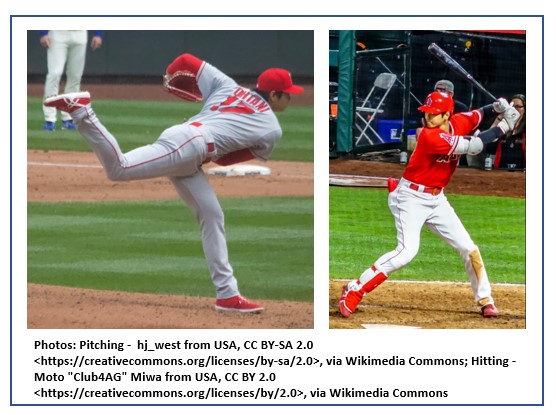
  • Shohei Ohtani played like – well, Shohei Ohtani, becoming the first player to hit 30+ home runs and fan 200+ batters in the same season.
  • We saw the fastest and slowest pitches of the season (by pitchers, position-players excluded) in the same game.

More on these and other stories as you read on.

Roundtable Note: Some of these records may change as Negro League statistics are more fully incorporated into MLB record books.

—–Baseball Roundtable Players and Pitchers of the Month—–

NATIONAL LEAGUE

Player of the Month – Eduardo Esc0bar, 3B, Mets

Eduardo Escobar had a .340-8-24 month for the Mets, notching the NL’s third-most home runs, second-most RBI, second-most hits (33), sixth-most run scored (16) and third-highest average (among NL players with at least 60 September at bats). He authored a ten-game hitting streak (September 2-12), during which he hit .500 (18-for-36), with five homers, nine RBI and eight runs scored. He had ten multi-nit games. Over the course of the month, he raised his average from .218 to .242.

Honorable Mentions: Nationals’ 1B Joey Meneses – the 30-year-old MLB rookie put up a .315-6-18 line and led the NL with 34 September hits. Dodgers’ 1B Freddie Freeman recorded a .337-4-16 and led the NL with 22 runs scored.

Pitcher of the Month – Yu Darvish, RHP, Padres

Yu Darvish gets the nod as MLB’s only five–game winner in September. – going 5-1, 1.85 in six starts. He fanned 44 batters (fourth in the NL) in 39 September innings (third in the NL) and had the third-best WHIP (Walks and Hits Per Inning Pitched) among NL hurlers with at least 25 September innings.  He held batters to a .198 average over his six starts and walked just eight in 39 innings. On September 2, he held the tough Dodgers’ lineup to just two hits (no runs) over seven innings (two walks, nine strikeouts).

Honorable Mentions: The Dodgers’ Clayton Kershaw, who went 4-0 with a tidy 1.50 ERA in six starts. The Cardinals’ Jose Quintana, who only went 2-1, but whose 0.89 ERA was the best among NL pitchers with at least 25 September innings,

AMERICAN LEAGUE

Player of the Month – Aaron Judge, OF, Yankees

Photo by Keith Allison

This was almost too close to call, as Baseball Roundtable looked at both Aaron Judge and Blue Jays’ SS Bo Bichette. Consider:

  • Both hit over .400 for the month. Judge at .417 and Bichette at .403 – the top two September averages in MLB (among players with at least 60 st bats for the month).
  • Judge tied for the MLB lead in home runs (10); Bichette was ninth with seven.
  • Bichette led MLB in September RBI with 27 (to Judge’s 17), while Judge led MLB in runs scored with 26 (to Bichette’s 22).
  • Bichette led MLB with 48 hits for the month, Judge was sixth with 35, while Judge drew an MLB-highest 30 September walks to Bichette’s eight. Conversely, Judge fanned 26 times to 17 for Bichette.

So, why the thinnest of nods to Judge? He did all this while dealing with the pressures of chasing Roger Maris’ single-season American League home run record and inserting himself in the AL batting race (raising the possibility of a Triple Crown season).  Need more justification? Judge also led MLB qualifying batters in On-Base Percentage (.565) and Slugging Percentage (.869) – and by wide margins.

Honorable Mentions:  Bo Bichette, of course (see above). I also looked at a couple of Angels: RF Taylor Ward, who put up a .370-6-16 line and had 34 September hits (seventh in the AL) and Mike Trout, who went .301-10-20.

Pitcher of the Month – Alek Manoah, RHP Blue Jays

A second tough call this month. This time  between Alek Manoah and the Angels’ superstar Shohei Ohtani, who both went 4-0 (Manoah in six starts, Ohtani in five).

Manoah put up the MLB-best ERA among pitchers with at least 25 September innings at a minuscule 0.88. He was second in the AL in innings pitched (41), second in WHIP among pitchers with at least 25 September innings (0.85). He was eighth in strikeouts with 33. He gave up no more than two runs in any start (and that only once). The Blue Jays won five of his six starts and, in the one game the Jays lost, Manoah gave up just one run over six innings.

Honorable Mentions:  The Angels’ Shohei Ohtani, who went 4-0. 1.09 in five starts, with 37 strikeouts in 33 innings pitched and a 0.91 WHIP.  Guardian Shane Bieber, who went 4-1, 2.51 with 42 strikeouts (second in the AL) and 43 innings pitched (first).

________________________________

Surprise Player of the Month – Bryan De La Cruz, OF, Marlins

Bryan De La Cruz signed with the Astros as an International Free Agent – at the age of  16 – in 2013.  From 2014 through 2021, he worked his way up through the Astros’ system, reaching  Triple-A (Sugar Land Skeeters) in 2012 – where he hit .324-12-50 in 66 games before being traded to the Marlins in late July. The Marlins brought him right to the big-league roster and he  made his MLB debut on July 31, 2012. He hit .296-5-19 in 58 games for the Marlins and seemed set to be a fixture in the outfield for 2022.

De La Cruz got off to a rocky start in 2022, hitting just .205-7-21 in 90 games before being sent back down to the minors in mid-August – where the demotion appeared to wake up his bat.  De La Cruz was called back up when the rosters expanded in September – and went .375-5-17 in 20 September games. From September 18-28, he ran off a nine-game hitting streak, in which he hit .514 (18-for-35), with three home runs and 11 RBI.  For Baseball Roundtable, it was a surprising late-season turnaround.

Honorable Mention: Joey Meneses (1B/OF) made his debut for the Nationals in August – at age 30 and in his 12th professional season.  He hit .333-6-11 in 24 August games and followed up with a .330-7-22 September. Meneses was a .281 hitter in ten minor-league seasons – and also played in Mexico and Japan.

______________________________________________________

TROT INDEX … A REGULAR BBRT FEATURE

Through September  34.6 percent of the MLB season’s 176,344 plate appearances ended in a trot (back to the dugout, around the bases, to first base). We’re talking about strikeouts, home runs, walks, hit by pitch and catcher’s interference – all outcomes that are, basically, devoid of action on the base paths or in the field. Here’s the breakout: strikeouts (22.4%); walks (8.2%); home runs (2.9%); HBP (1.1%); catcher’s interference (less than 1%). Strikeouts, by the way, outnumbered base hits by an even 1,000 –  39,465 to 38,465.

The 34.6 percent figure is down from 2021’s full season 36.3 percent.  Other recent seasons: 2020 –  37.3 percent;  2019 – 36.2 percent; and 2018 – 34.8 percent.  By further comparison, in 1990, the Trot Index was 26.1 percent.  

__________________________________________

Among the notable developments in September was that the Guardians, with MLB’s youngest 2022 roster, did not fold under the pressure of a tight pennant race.  Instead, they played .700+ ball and turned a tight race into a walk-away. During the month, the Guardians  scored the AL’s third-most runs (behind only the Yankees and Blue Jays) and recorded the League’s second-lowest ERA (behind the Astros). Among the key contributors were 25-year-old LF Steven Kwan (.325 with 25 runs scored for the month); 24-year-old RF Oscar Gonzalez .298-6-20); 24-year-old 2B Andres Gimenez (.305 with 16 runs scored); 27-year-old RHP Shane Bieber (4-1, 2.51); 27-year-old RHP Cal Quantrill (3-0, 3.06); and 24-year-old closer Emmanuel Clase (10 saves).

The Mets and Braves kept things interesting, with the Braves gaining three games on the Mets in September and  the two squads going into October tied for the Division lead. This is really the only race left to be decided.

The Dodgers continued to roll, scoring the NL’s most runs in September and putting up the league’s lowest ERA. On the season, they have scored MLB’s most runs 831 and given up MLB’s fewest tallies (497).  Full-year (through September ) team stat leaders later i this post.

——-Team  Statistical Leaders for September  ———-

RUNS SCORED

National League –  Dodgers (140); Mets (134); Giants (126)

American League – Blue Jays (145); Yankees (134): Guardians (131)

The Cubs scored the fewest runs in September (86); The lowest tally in the AL was the Tigers at 98.

AVERAGE

National League – Mets (.263); Nationals (.257); Phillies (.253)

American League – Blue Jays (.266); Guardians (.264); Red Sox (.260)

The lowest team average in September  belonged to the Reds  at .211.   

HOME RUNS

National League – Braves (43); Dodgers (37); Giants (33)

American League –  Yankees (39); Mariners (39); Astros (37); Angels (37)

The Rays had the fewest September home runs at 17. The only other team under 20 was the Cubs (19).

STOLEN BASES

National League – Diamondbacks (31); Pirates (22); Cubs (20)

American League – Guardians (31); Rangers (25); Yankees (20)

The Giants stole the fewest bags in September with four in eight attempts.  The Angels were 11-for-12 in steal attempts.

WALKS DRAWN

National League – Dodgers (103); Mets (98);  Brewers (88); Giants (88)

American League – Mariners (111); Red Sox (107); Blue Jays (97)

The Met led MLB in on-base percentage in September  at .349. The Red Sox led the AL at .348. In slugging percentage, the Braves were on top at .446, while the Blue Jays  led the AL at .441.

BATTER’S STRIKEOUTS

National League – Giants (282); Pirates (264); Brewers (259)

American League – Rangers (262); Twins (254); A’s (251)

Astros’ batters went down on strikes the fewest times in September  (174).

____________________________

Bonus Stat

The leaders in September hit by pitch were the Mets (23) and the Guardians (22). No other team had more than 15 HBP in the month. Angles’ batter were plunked the fewest times (4).

__________________________________

EARNED RUN AVERAGE

National League – Dodgers (2.65); Braves (2.88); Cubs (3.03)

American League – Astros (2.53); Guardians (2.75); White Sox (3.29)

One  team had an ERA at 5.00 or higher in September – the A’s at 6.22.

STRIKEOUTS

National League – Mets (281); Braves (266); Brewers (261)

American League – Astros (281); Guardians (267); White Sox (250)

FEWEST WALKS SURRENDERED

National League – Mets (64); Giants (71); Padres (73)

American League – Astros (66); Mariners (67); Rays (69)

The Guardians walked an MLB-stingiest 2.42 batters per nine frames in September. The Reds walked an MLB-high 4.10 batters per nine frames during the month.

SAVES

National League – Giants (12); Cubs (11); three with 8

American League – Guardians (15); Astros (9); Blue Jays (9)

STRIKEOUTS PER NINE INNINGS

National League – Mets (11.00); Braves (10.35); Brewers (9.50)

American League – Astros (10.60) Yankees (9.31); White Sox (9.23)

_____________________________
Bonus Stat

The Mets led MLB in September strikeout-to-walk ratio at 4.39.  The only other team over 4.00 was the Astros at 4.26.

________________________________

—–SEPTEMBER HIGHLIGHTS —–

Feel Good Tale

Fernando Cruz started his professional career as an infielder in the Royals organization as a 17-year-old in 2007 – hitting .210 in the Arizona Rookie League. On September 2, Cruz made his MLB debut (as a 32-year-old pitcher) for the Reds, coming on in relief (versus Colorado) and pitching a 1-2-3, two-strikeout inning.  He made 12 appearances in September, fanning 16 and putting up a 0.75 ERA.  On his long path to the majors, Cruz played for teams in the Arizona Rookie League, Appalachian League, Puerto Rican Winter League, Midwest League, Pioneer League, Pacific Coast League, Southern League, Carolina League, Canadian-American Association, Venezuelan Winter League, Mexican League, Dominican Winter League, Mexican Pacific Winter League and International League.

Unlucky 13.  Lucky Seven?

Photo by A.Rutledge

On September 13, Angels’ CF  Mike Trout went zero-for-three (with one walk), as the Angels lost to the Guardians 3-1 in Cleveland. I have a hunch at least a few Cleveland fans were hoping for more from Trout. Trout came into the game having hit a home run in seven straight games – one game shy- of the record shared by: Dale Long (May 19-28, 1956); Don Mattingly (July 8-18, 19877); Ken Griffey Jr. (July 20-28, 1993).

During his seven-game homer streak, Trout hit .393 (11-for-28), with seven home runs and 11 RBI. For more on home run streaks, click here.,

He Ain’t Heavy … He’s My Brother

On September 14, Adam Wainwright took the mound against the Brewers in St. Louis – and he saw a familiar face (mask?) behind the plate  in catcher Yadier Molina. It was the 325th time, the two were together as a regular-season starting battery, breaking the all-time MLB record of 324 such starts, held by Bill Freehan and Mickey Lolich.  It worked out pretty well, as the 41-year-old Wainwright picked up the win with five innings of eight-hit, one-run ball, while the 40-year-old Molina went one-for-four with an RBI. Side note: Molina was  the catcher for Wainwright’s first MLB start (April 6, 2006) –  a 4-2 Cardinals’ win over the Astros. Wainwright got the victory with seven one-run innings. By the way, when Wainwright and Molina have started together, the Cardinals are 213-112.

Celebrating Clemente Day

Although he said afterward it wasn’t an intentional  move, it certainly seemed an appropriate one.  On September 15 – Roberto Clemente Day – Tampa Bay Rays’ manager Kevin Cash sent an all-Latino lineup to the plate (Shane McClanahan was the starting pitcher).  The lineup – all wearing number 21 in honor of Roberto Clemente –  went like this:

Yandy Diaz – 3B (Cuba)

Randy Arozarena – RF (Cuba)

Wander Franco – SS (Dominican Republic)

Harold Ramirez – 1B (Columbia)

Manuel Margot – DH (Dominican Republic)

David Peralta – LF (Venezuela)

Isaac Paredes – 2B (Mexico)

Rene Pinto – C (Venezuela)

Jose Siri – CF (Dominican Republic)

How did it work out?  The Rays topped the Blue Jays 11-0, with three RBI apiece from Diaz and Margot.

For a look at MLB’s one and only All-Latino All Star Game, click here.

On Making Great Strides

Braves’ 23-year-old rookie right-hander Spencer Strider took to the mound on September 18 with a 10-5, 2.72  record – not knowing he was about to make history. Strider went six innings in a 5-2 win over the Phillies, giving up one run on one hit and three walks – and, most important, fanning ten.

The eighth strikeout of the game came in the fourth inning, when he fanned three Phillies – and gave Strider 200 whiffs on the season  (and for his career). It also gave him 200 strikeouts in 130 MLB innings, making him the fastest ever to reach 200 MLB strikeouts– edging out Hall of Famer Randy Johnson, who reached 200 strikeouts in his first 130 2/3 innings.

Strider finished September with an 11-5, 2.67 record on the season – with 202 strikeouts in 131 2/3 innings pitched – relying primarily on a fastball that tops out in the triple-digits  and sharp slider. (Note: Striker is currently on the IL with a strained left oblique  muscle.)

Strider was a fourth-round draft pick (out of Clemson University) in 2020. In two college seasons, he was 5-2, 4.71 – with 89 strikeouts in 63 innings. In 2021, he was 3-7, 3.64 at four minor-league levels. He started the 2022 season in the Braves’ bullpen, putting up a 2.22 ERA, with 37 strikeouts in 24 1/3 innings (11 appearances) before being moved to the rotation – where he has gone 10-4, 2.77 fanning 165 in 107 1/3 innings (34 walks), while holding hitters to a .183 average.

Three for Two – or Maybe Two for Three

September saw the fourth and fifth triple plays of the 2022 season. On September 18, with the score knotted at 0-0 in the bottom of the third inning, Toronto starter Dean Kremer hit the Blue Jays’  DH and leadoff hitter George  Springer on a 2-2 pitch, then walked  1B Vlad Guerrero Jr. and gave up a single to SS Bo Bichette to load the bases. Third baseman Matt Chapman was up next and smashed a line drive to Orioles’ SS  George Mateo, who snatched it for the out and flipped to 2B Tarrin Vavra to double off Guerrero. Vavra then fired to first to “triple-off” Bichette and end the frame.  The Orioles went on to win the game 5-4.

On September 20, as the Rangers turned a triple play in an inning in which the Angels had already plated three runs (to take a 5-3 lead). Angels’ DH Shohei Ohtani led off with a single to right off the Rangers’ Dennis Santana. RF Taylor Ward then doubled Ohtani home and 3B Matt Duffy singled, with Ward moving to third.  That was all for Santana, with John King taking the mound. He gave up an RBI-single to 1B Mike Ford, followed by another RBI-single to LF Jo Adell – leaving Adell at first and Ford (replaced by pinch runner Magneuris Sierra) at second. C Max Stassi hit a sharp grounder to third for a triple play – 3B Josh Jung to 2B Marcus Semien to 1B Nathan Lowe. Still, the Angels left the inning with a 5-2 lead and won the game by that score.

A Throwback? Well Kind Of.

On September 18, as the Marlins topped the National 3-1 in Washington D.C., Marlins’  starter Sandy Alcantara threw his fifth complete game of the 2022 season. Eight days later (September 30), he closed out the month with his sixth 2022 complete game – a 1-0 loss to the Brewers.  Why does that make the highlights? Because, Alcantara has more complete games than any other team in the major leagues. (The Boston Red Sox are second to Alcantara with four complete games. For a recent post on Alcantara, click here.

For those Who Like To Know … 

Between May 14 and June 4 of 1968, the Dodgers’ Don Drysdale threw six consecutive complete-game shutouts.

The Whiff-N-Poof Song

On September 18, Mets’ pitchers tied the MLB record for strikeouts in a nine-inning game (20). It’s been done eight times – seven in the AL and once in the  NL.  The Mets’ “Whiff Team:”

  • Jacob deGrom – 13 strikeouts in five innings.
  • Seth Lugo – one strikeout in one inning.
  • Joely Rodriguez – five strikeouts in two innings.
  • Trevor May – One strikeout in one inning.

Taking Control of the Situation

In MLB history, there have been four instances when a single-pitcher recorded twenty strikeouts in a nine-inning game: Roger Clemens (twice); Kerry Wood; and Max Scherzer. Not a single walk was issued by any of those pitchers in their 20-whiff performances. Randy Johnson once fanned 20 batters in the first nine innings of an 11-inning game (he was relieved after nine). Johnson also did not walk a batter in his nine-inning stint.

It Took You Long Enough or more “#InBaseballWeCountEverything”

On Tuesday, September 20, the Yankees went into the bottom of the ninth innings trailing Pittsburgh 8-5. RF Aaron Judge opened the bottom of the ninth with a home run off reliever Wil Crowe to cut the margin to three. 1B Anthony Rizzo followed with a double, 2B Gleyber Torres walked and 3B Josh Donaldson singled, loading the bases. Then, Giancarlo Stanton hit a home run to deep left, plating four runs and giving the Yankees a 9-8 walk-off win.

The very next day – about 21 hours later – in the bottom of the first inning, the Yankees loaded the bases on a Judge double, Torres walk and Stanton walk) with two outs. Then LF  Oswaldo Cabrera hit a Grand Slam off Pirates’ starter Roansy Contreras. Why “counting everything?”

For the answer, we go back to July 6 – Yankees at Pirates. In the eighth  inning of that game (an eventual 16-0 Yankee win), Judge hit a grand Slam off Manny Banuelos. Then, one inning later, Aaron Hicks took Josh Van Meter deep to left center for another Grand Slam.

In true #InBaseballWeCountEverything fashion, the Yankees are now the only MLB team to hit Grand Slams in back-to-back innings twice in one season.

More Yankee Power

On September 21, the Yankees routed the Pirates 14-2, largely on the strength of an eight-run eighth inning.  That included a pair of home runs by 2B Gleyber Torres (his 22nd and 23rd of the season). Torres led off the frame with a homer to RF off the Pirates Miguel Yajure and, later in the frame, added a three-run blast  (with two outs) off Eric Stout.  That made Torres the 59th major leaguer to hit two home runs in an inning. A few other two-homer inning facts:

  • Fernando Tatis (Cardinals) is the only player to hit two Grand Slams in one inning. He did it on April 23, 1999. – in the third inning of a Redbirds’ 12-5 win over the Dodgers (in LA). Surprisingly, both Grand Slams came off the same pitcher – Dodgers’ starter Chan Ho Park. Yep, they left Park in to take the thrashing. Park, by the way, finished the season 2-10, with a 7.43 ERA.
  • Alex Rodriguez, Edwin Encarnacion, Andre Dawson, Jeff King and Willie McCovey are the only players to hit two home runs in an inning twice in their career.
  • Switch hitters Carlos Baerga, Mark Bellhorn and Kendrys Morales all hit home runs from both side of the plate in the same inning.

Baseball Roundtable FlashBack-to -Back

In the top of the first inning of a game (May 2, 2002) between the Mariners and White Sox (in Chicago),  White Sox’ starter Jon Rauch hit Mariners’  RF Ichiro Suzuki with the first pitch of the game.  Second baseman Bret Boone followed with a home run on the very next pitch, and  CF  Mike Cameron followed with another dinger on a 1-2 pitch.  The Mariners batted around and, by the time Boone came up for a second time that inning, held a 7-0 lead. 

In his second at bat of the frame, Boone homered again (another two-run shot), this time on a 1-2 pitch from Jim Parque. Next up was Cameron, who hit the first pitch he saw from Parque for another home run.  This remains the only time that two players have homered twice, back-to-back, in the same inning. The Mariners, by the way, won the contest 15-4.

Pujols – Padding the HOF Resume

Photo by Dirk DBQ

On September 23, Cardinals’  DH Albert Pujols went two-for-four, with two home runs and five RBI, as the Cardinals  topped the Dodgers 11-0 in LA. The long balls were number 699 and 700 of his career. Side note: Baseball-References’ home run log shows that Pujols has homered off a record 455 different pitchers, in 40 different MLB parks. For those who like to know such things, number 700 came in the top of the fourth on a 1-1 pitch from Phil Bickford.

At the end of September, Pujols was  in the top five all-time (in MLB)  in total bases (second); doubles (fifth); home runs (fourth); RBI (third);  extra-base hits (third) ; and  intentional bases on balls (second).  Start working on the plaque now.

Business As Usual

As usual, there is more Shohei Ohtani news.  On September 23, Ohtani won his 14th game of the season, going five innings (two earned runs) in a 4-2 Angels’ win against the Twins (in Minnesota). Along the way, he fanned seven Twins’ hitters, giving him 203 whiffs on the season – and making him the first player in MLB history with 30 or more home runs as a hitter and 200 or more strikeouts as a pitcher in the same season.

A Nice Round Number

On  September 23, Brewers’ Andrew McCutchen had a three-RBI game, as Milwaukee topped the Reds 5-3 in Cincinnati. The first of those three RBI was the 14-season MLB veteran’s 1,000th major league run driven in. While McCutchen has never driven in 100 runs in a season, the five-time All Star has collected 80 or more RBI in seven campaigns.  As of September 30, his career stat line was .277-287-1,002.

20-20 Vision

On September 25, Braves’ 26-year-old right-hander Kyle Wright became 2022’s first (still only) 20-game winner. The win came in a 5 1/3-innings (two earned runs, two hits, two walks, six whiffs) performance in a 6-3 Braves’ win over the Phillies in Philadelphia. Wright’s record at the end of September was 20-5, 3.18; with 171 strikeouts in 175 1/3 innings.  Coming into the 2022 season, Wright – a 2017 first-round draft choice out of Vanderbilt –  had a major-league record of 2-8, 6.56 in 50 game (43 starts), with 59 strikeouts in 70 innings pitched.  (He did have a 29-19, 3.47 record in four minor-league seasons.) Side Note: On October 1, Wright picked up his 21st 2022 win.

You Balkin’ To Me?  A Different Kind of RBI (Run Balked In)

On September 27, in the eighth inning of a Marlins-Mets game (in New York), Mets’ 1B Pete Alonso came to the plate with  two outs and Mets’ 2B Jeff McNeil on first base.  McNeil scored during Alonso’s at bat, but no RBI was awarded.  Had an RBI been assigned it could have gone to Mets’ pitcher Richard Bleier who – during Alonso’s plate appearance – was charged with three balks (sending McNeil, to second, third and, finally, home).  Hence an RBI – Run Balked In. (Bleier and Marlins’ skipper Don Mattingly would argue –  and did – so, maybe, the RBI should go to the umpires.) Bleier, by the way, had not committed a single balk to that point in his seven MLB seasons. The Marlins won the contest 6-4, but neither Bleier nor Mattingly were around to see it.  Both were ejected.

An Immaculate Month – and Season

September saw three  pitchers throw Immaculate Innings – bringing the total of nine-pitch/three-whiff 2022 innings to seven.  This month’s pitchers (and victims).

September 16, Bottom of the ninth  – Ryan  Helsley, Cardinals. Victims: The Reds’ SS Kyle Farmer, DH Jake Fraley and 1B Donovan Solano (all swinging). Three, four and five in the lineup.

September 22, Bottom of the Fifth  – Hayden Wesneski, Cubs. Victims: The Pirates’ CF Jack Suwinski (looking), 1B Zack Collins (looking) and C Jason Delay (swinging). Seven, eight and nine in the lineup.

September 27, Top of the Seventh – Enyel De Los Santos, Guardians. Victims: The Rays’  C Christian Bethancourt (swinging), CF Jose Siri (looking) and 2B Taylor Walls (swinging). Seven, eight and nine in the lineup.

The Fast and the Slow of It

On September 27, the Cardinals’ 27-year-old closer, Ryan Helsley scorched a 104.2-mile per hour fastball to the Brewers’ 1B Rowdy Tellez – recording the fastest pitch of the 2022 season (which Tellez hit for a ground out, shortstop to first.). It might have been a bit anticlimactic, however, as the pitch Helsley pushed off the top of the list was a 104.0 MPH fastball that he threw five days earlier (September 22) to Padres’ DH Josh Bell (Bell fouled it off).

In the September 27 game, Cardinals’ starter  Miles Mikolas did a kind of reverse Helsley – tossing a 60.2-mph curveball (in the fifth frame) to the Brewers’ CF Garrett Mitchell – setting the mark for the slowest pitch this season by a non-position player.

Helsley, by the way, finished September with a 9-1, 1.26 record -with 19 saves –  on the year – 94 whiffs in 64 1/3 innings.

Here Comes The Judge

On September 28, in the top of the seventh inning, with the Yankees and Blue Jays tied at 3. Yankees’ DH Aaron Judge hit a 3-2 pitch from the Blue Jays’ Tim Mayza to deep left – for a two-run home run.  It was his 61st of the year, tying Roger Maris for the all-time American League single-season record. To date, only three American League players have hit 60 or more home runs and, of course, they were all Yankees: Babe Ruth, Roger Maris and Judge.  Judge, by the way, had a bashing  September – going .417-10-17.

A Painful Way to Make The Record Books

In September, Mets batter were hit by a pitch 23 times. That brings their total for the season to 111 plunkings (a modern era – post 1900) record. Through September, the MLB team average for HBP was 66. The previous modern-era mark for team HBP belonged to the Reds at 105.  Again, for those who like to know such things: The 1889 Orioles hold the overall MLB record with 160 plunkings.

Here are the top Mets’ HBP contributors:

Mark Canha – 27 HBP.

Brandon Nimmo – 16

Starling Marte – 13

Pete Alonso – 12

Jeff McNeil – 11

Francisco Lindor – 10


——-Individual Statistical Leaders for September  2022———

AVERAGE (60 September at bats minimum)

National League – Bryan De La Cruz, Marlins (.375); Justin Turner, Dodgers (.342); Eduardo Escobar, Mets (.340)

American League –  Aaron Judge, Yankees (.417); Bo Bichette, Blue Jays (.403); Julio Rodriguez, Mariners (.383)

The lowest September  average (among players with at least 60 at bats in the month)  belonged to Marlins JJ Bleday at .133 (10-for-75).

HOME RUNS

National League – Pete Alonso, Mets (9); Daulton Varsho, Diamondbacks (9; Eduardo Escobar, Mets (8)

American League – Aaron Judge, Yankees (10); Anthony Santander, Orioles (10); Mike Trout, Angeles (10)

The Yankees’ Aaron Judge  had the highest September slugging percentage (among players with at least 60  at bats) at .869.  The NL   leader was the Marlins’ Bryan De La Cruz at .734.

RUNS BATTED IN

National League – Pete Alonso, Mets (26); Eduardo Escobar, Mets (24); three with 19

American League –  Bo Bichette, Blue Jays (27); Eloy Jimenez, White Sox (23); Gleyber Torres, Yankees (23)

HITS

National League – Joey Meneses, Nationals (34); Eduardo Escobar, Mets (33); Michael Harris, Braves (33); Jeff McNeil, Mets (33)

American League –  Bo Bichette, Blue Jays (48); Steven Kwan, Guardians (39); Carlos Correa, Twins (38)

The Yankees’ Aaron Judge led MLB (players (with at least 60 September at bats) in on-base percentage at .565. The NL leader was the  Dodgers’ Freddie Freeman at .473.

DOUBLES

National League –  Willy Adames, Brewers (10); Mookie Betts, Dodgers (10); Garrett Cooper, Marlins (9)

American League –  Bo Bichette, Blue Jays (11); Randy Arozarena, Rays (10); Marcus Semien, Rangers (10)

TRIPLES

National League – Joc Pederson, Giants (3); nine with two

American League – Nine with two

The Blue Jays Bo Bichette led MLB in September extra-base hits with 19.  He had 11 double, one triple and seven home runs (29 singles).

 STOLEN BASES

National League –  Jake McCarthy, Diamondbacks (10); Jon Berti, Marlins (6); Daulton Varsho, Diamondbacks (6)

American League –Bubba Thompson, Rangers (10); Nate Eaton, Royals (9); Elvis Andrus, White Sox (8)

The White Sox’ Elvis Andrus had the most September steals without getting caught (8).

WALKS

National League – Freddie Freeman, Dodgers (23); Juan Soto, Padres (21); Brandon Nimmo, Mets (18)

American League – Aaron Judge, Yankees (30); Tristan Casas, Red Sox (18); J.P. Crawford, Mariners (18); Jose Ramirez, Guardians (18)

The Mets’ Jeff McNeil led in walks/strikeouts ratio (among batters with at least 60 September  at bats)  at 1.83 …11  walks versus 6  whiffs in 26 games.

BATTER’S STRIKEOUTS

National League – Oneil Cruz, Pirates (36); Willy Adames, Brewers (34); Michael Toglia, Rockies (34)

American League – Giancarlo Stanton, Yankees (37); Matt Chapman, Blue Jays (35); Dermis Garcia, A’s (34)

PITCHING VICTORIES

National League – Yu Darvish, Padres (5-1); Clayton Kershaw, Dodgers (4-0); Chris Bassitt, Mets (4-1); Logan Webb, Giants (4-1); Brandon Woodruff, Brewers (4-1)

American League – Shohei Ohtani, Angels (4-0); Alex Manoah, Blue Jays (4-0); Shane Bieber, Guardians (4-1)

The Marlins’ Steven Okert (0-4, 8.44); Rockies’ Chad Kohl (0-4, 7.76), and White Sox’ Johnny Cueto  (1-4, 5.20) tied for the most September losses.

 EARNED RUN AVERAGE (at least 25 September innings pitched)

National League –  Jose Quintana, Cardinals (0.89);Julio Urias, Dodgers (1.19); Clayton Kershaw, Dodgers (1.50)

American League – Alex Manoah, Blue Jays (0.88); Shohei Ohtani, Angels (1.09); Dylan Cease, White Sox (1.13)

Among pitchers with at least four September starts or 20 September  innings, the Phillies’ Kyle Gibson  had the highest ERA at 9.53 (24 earned runs in 22 2/3 innings in five starts).

STRIKEOUTS

National League – Brian Woodruff, Brewers (51 / 38 2/3 IP); Jacob deGrom, Mets (47 / 28 IP); Carlos Rodon, Giants (46 / 26 2/3 IP)

American League – Gerrit Cole, Yankees (44 / 30 IP); Shane Bieber, Guardians (42 / 43 IP); Logan Gilbert, Mariners (412 / 36 IP)

SAVES

National League – Camilo Doval, Giants (9); Kenley Jansen, Braves (8); Ryan Helsley, Cardinals (7)

American League – Emmanuel Clase, Guardians (10); Jordan Romero, Blue Jays (7); three with six

WHIP (Walks +  Hits per Inning Pitched – 25 innings minimum)

National League – Zac Gallen, Diamondbacks (0.69); Jose Quintana, Cardinals (0.76); Yu Darvish, Padres (0.79)

American League – Shane Bieber, Guardians (0.81); Alex Manoah, Blue Jays (0.88); Triston McKenzie, Guardians (0.89)

_____________________________________

——-Team  Statistical Leaders Through Sept 2022 ———-

RUNS SCORED … Average 673

National League – Dodgers (831); Braves (769); Mets (746)

American League – Yankees (786); Blue Jays (745); Astros (719)

The fewest  runs (through September) were scored by the Tigers – 529. The Marlins tallied the fewest runs in the NL at 561. Others under 600 were the A’s (547), Pirates (566) and Nationals (583).

AVERAGE  …  Average .243

National League – Dodgers (.258); Mets (.258); Rockies (.255)

American League – Blue Jays (.261); Red Sox (.258); White Sox (.257)

The lowest team average through September  belonged to the A’s at .216. The Pirates  were at the bottom of the NL at .221

HOME RUNS …  Average 169

National League – Braves (237); Brewers (213); Dodgers (207)

American League –  Yankees (244); Astros (209); Blue Jays  (193)

The Tigers  had the fewest home runs through September at 102. Surprisingly the AL Central Champion Guardians were second lowest at 124.  The Nationals were at the bottom of the NL at 131.

The Dodgers led MLB in slugging percentage through September at .445.  The Blue Jays led the AL at .429.  The average team slugging percentage was .395.

STOLEN BASES … Average 80

National League – Marlins (118); Cubs (106); Phillies (101)

American League – Rangers (126); Guardians (114); Royals (101)

The Twins stole the fewest sacks through September (37 in 54 attempts).   The Rockies were at the bottom of the NL with 43 in 63 attempts. 

WALKS DRAWN … Average 479

National League –   Dodgers (588); Padres (559); Brewers (555)

American League  Yankees (595); Astros (520); Twins (498)

The Dodgers  led MLB  in on-base percentage through September at .335. The Yankees led the AL  at .324.  The A’s had MLB’s lowest  OBP through September at .281.  

BATTER’S STRIKEOUTS … Average 1,316

National League – Pirates (1,469);  Braves (1,446); Giants (1,416)

American League – Angels (1,508);  Rangers (1,394); Tigers (1.362)

Guardians’ batters fanned the fewest times through September  (1,082).

EARNED RUN AVERAGE … Average 3.97

National League – Dodgers (2.78);  Braves (3.42); Mets (3.59)

American League – Astros (2.94); Yankees (3.33); Rays  (3.38)

Just one  team had  an ERA through August of 5.00  or higher – Rockies (5.12).

STRIKEOUTS … Average 1,316

National League – Mets (1,516); Braves (1,511); Brewers (1,478)

American League –  Astros (1,463); White Sox (1,407); Yankees (1,404)

The Mets averaged  an MLB-best 9.8 strikeouts per nine innings through September. The Astros averaged an AL-best 9.4.  Nine teams average at least nine  whiffs per nine innings.

FEWEST WALKS SURRENDERED… Average 479

National League  – Dodgers (397); Mets (421);Giants (427)

American League –  Rays (373); Blue Jays (415); Orioles (425); Guardians (425)

The Rays walked an MLB-lowest 2.4 batter per nine innings through September.  The Dodgers were best in the NL at 2.5.  The Reds and Royals walked an MLB-worst 3.8 batters per nine frames.

SAVES … Average 40

National League – Braves (52); Brewers (51); Padres (46)

American League – Astros (50);  Guardians (49); White Sox (46)

________________________________

Bonus Stats:

  • The Nationals gave up an MLB-high 231 home runs through September – an even 100 more than they hit. The Astros gave up an MLB-low 130.
  • There were 35 complete games through September. The Marlins had the most complete games at six.  Thirteen of the 30 MLB teams have yet to record a complete game.
  • There were 333 team shutouts through September (fifteen of those single-pitcher complete-game shutouts). The Mets had the most shutouts with 18.
  • The Mariners and Cardinals committed the fewest errors through September (47) and had the top fielding percentage at .989. The Pirates committed an MLB-high 115 fielding miscues through September, contributing to 75 unearned runs.   The Cardinals, in contrast, gave up just 32 unearned runs.
  • The Nationals grounded into the most double plays through September at 136, the Rangers grounded into the fewest twin killings at 79.
  • Rays’ pitchers had the best strikeout-to-walk ratio at 3.62 and the Dodgers had the best WHIP at 1.047.

______________________________________________

Primary Resources: Baseball-Reference.com; Baseball-Almanac.com; MLB.com


Baseball Roundtable … blogging baseball since 2012. 

100Baseball Roundtable is on the Feedspot list of the Top 100 Baseball Blogs.  To see the full list, click here.

I tweet (on X) baseball @DavidBaseballRT

Follow Baseball Roundtable’s Facebook Page here.  More baseball commentary; blog post notifications.

Member: Society for American Baseball Research (SABR); The Baseball Reliquary; The Negro Leagues Baseball Museum.

Some Doubleheader Musings … I do miss those Sunday Twin Bills

Yesterday (September 4) marked the anniversary of the day in 1928 when the Boston Braves began an MLB-record streak of  nine consecutive doubleheaders (over as 12-day span). Pretty sure we’ll never see that again.  I was going to commemorate that anniversary with a post on doubleheaders, but I had to delay that for a day because I was taking part (as a spectator) in a doubleheader of my own yesterday – taking in the number-four ranked University of Minnesota (volleyball) Gophers’ victory over number-13 Florida and the Triple-A Saint Paul Saints loss to Omaha.  So, I’ll revisit some doubleheader trivia a day late.

Note: Some of these records/lists may change as the Negro League records from  1920-48 are further documented and incorporated into MLB records. 

18 Games in 12 Days

The 1928 Boston Braves played a record nine consecutive doubleheaders over a 12-day span (September 4-15). During the streak, they swept one doubleheader, were swept six times and split two – for a four win-fourteen loss record.  Notably,  six players played every inning of those games (RF  Lance Richbourg; LF Eddie Brown; 1B George Sisler; 2B Rogers Hornsby; 3B Les Bell; SS Doc Farrell). The team used eight different starting pitchers during the 18-game stretch – none more often than Bob Smith, who started four contests (including both ends of one doubleheader).

The stretch of twin bills may have been taxing on the hurlers’ arms. The Braves got just five complete games during the span (27.8 percent of the starts) – well below the MLB average for the year of 50.7 percent and short of the Braves’ average for the rest of the season  (36.2 percent). Smith’s record may be indicative of that wear and tear. In his first start of the stretch (September 5), he tossed a complete-game two-hitter as Boston topped Brooklyn 7-1. On September 10, he tossed a second complete game, a seven-hitter, as Boston lost to the Giants 4-1.  Then on September 14, he failed to make it out of the first inning of the first game against the Giants, giving up four runs without recording an out.  Undeterred, the Braves sent him back out to start the second game of the twin bill – in which he gave up  five runs (three earned) in 6 1/3 innings – taking his second loss of the day.  Side note:  Smith recovered from that tough two-loss day. He had three more starts that season, pitching 31 1/3 innings in those games (1-2, 2.87). He finished the season 13-17, 3.87 for a Braves team that went 50-103.

Nearly 60 percent doubleheaders … Now, that’s a Tough Schedule

The 1945 Boston Braves played an MLB-record 46 doubleheaders. Let’s put that in perspective – 59.7 percent of the games they played that season were part of doubleheaders. How did they do?  They won 42 of those games, lost 48 and tied two.  Basically, they played .466 ball in twin bills, a bit better than their .403 winning percentage on days when they played just one game.  By the way, just so you don’t think those 46 doubleheaders were a one-off event, the 1943 White Sox hold the AL record for doubleheaders in a season at 44.

Let’s Play …. Three?

While, there have been three occasions in which major-league teams have played three games in a single day, research by Society for American Baseball Research (SABR) member Bill Nowlin indicates there has been only one “true”  (read single-admission) triple header.  That came on October 2, 1920, with the 80-69 Reds facing the 77-73 Pirates at Pittsburgh’s Forbes Field.  With four contests left in the season, the previous two Pirates-Reds games cancelled due to weather and third place (and a World Series’ share) at stake, the teams faced off in a one-day, three-game  series starting at noon. Long story short, the Reds won the first two games (13-4 and 7-3), while the Pirates took the final game 6-0 (called – darkness – after six innings).

Only five players played in all three games (making them all, of course, single-day MLB record holders). They were the Reds’ Morrie Rath (2B-RF) and Pat Duncan (LF) and the Pirates’ Cotton Tierney (2B-SS), Clyde Barnhart (3B) and Fred Nicholson (PH-RF-LF).

The two other instances of three-games-in-a-day matchups have occurred – on September 1, 1890 (Brooklyn Bridegrooms versus Pittsburgh Innocents) and September 7, 1896 (Baltimore Orioles versus Louisville Colonels). In both of those, the first contest was a separate-admission morning game, with a second admission required for the afternoon doubleheader.

Putting Up Crooked Numbers

The record for runs scored in a doubleheader – both teams – is 54.  It has been done twice.  On August 21, 1894,the National League Boston Beaneaters swept a doubleheader from the Cincinnati Reds by score of 18-3 and 25-8. Then, on Independence Day in 1939, there were lots of fireworks on the field in Philadelphia, as the Red Sox topped the Athletics 17-7 and 18-12.

Well, That Didn’t Take Long

The fewest runs scored in a doubleheader? It may surprise you (because it’s not two.)   The answer is one.  On September 4, 1902, the Pittsburgh Pirates and Boston Beaneaters matched up in a doubleheader in Boston. Game One went to Boston 1-0 (in one hour and twenty minutes). Game Two ended in a nine-inning 0-0 tie (one hour and 30 minutes).

A Hero’s Performance

Ted Williams, the fighter pilot, was a true hero – earning the Presidential Medal of Freedom and  three Air Medals, among other decorations. Teddy Ballgame demonstrated a different kind of bravery in a doubleheader on September 28, 1941.  It was the final day of the season and William was hitting .3995 – which, when rounded, would make him the first Al or NL .400 hitter since 1930. Offered the chance to sit it out and sit on the .400 average, Williams declined. Williams went four-for five in Game One of the twin bill, helping Boston top the Athletics in Philadelphia 12-11, (He had three singles, a home run, two runs scored and two RBI. ) He now had a .404 average and another chance to rest on his laurels, Instead, he went out and produce  a two-for-three second games (in a 7-1 Red Sox loss) finishing the season at .406.

A Good Day’s Work

On September 26, 1908, Cubs’ righty Ed Reulbach started both games of a doubleheader against Brooklyn (Superbas).  He went the distance in both contests, giving up just nine hits – and no runs –  over the 18 innings.  Reulbach is the only MLB pitcher ever to record two complete-game shutouts in a single day. The final scores were 3-0 and 6-0.

Another Good Day’s Work – and Baseball Roundtable’s Favorite “Coincidence”

On May 2, 1954, Cardinals’ right fielder Stan Musial hit five home runs in doubleheader (versus the Giants in Saint Louis). Sitting in the stands that day was eight-year-old Nate Colbert who – On August 1, 1972 – would become just the second player ever to hit five home runs in a twin bill. Colbert was playing first base for the Padres, who were taking on the Braves in Atlanta. In his five-homer twin bill, Colbert set the record for RBI in a doubleheader (13). The Cardinals, by the way, split their doubleheader on Musial’s big day, beating the Giants 10-6 in Game One and losing the second game 9-7. The Padres swept the Braves (9-0 and 11-7) on Colbert’s record-tying day.

I Call Trade-Zees

On May 30, 1922, the Cardinals and Cubs matched up in a Memorial Day doubleheader in Chicago. The Cubs took Game One by a 4-1 score – with one of the four tallies driven in by RF Max Flack. Playing CF for the Cardinals was Cliff Heathcote, who went zero-for-three.  In Game Two,  Heathcote and Flack were both starting in the garden – but for the teams they had opposed in Game One.  Traded between games, Flack started in RF, leading off, for the  Cardinals, while Heathcote started in RF, batting fifth for the Cubs. The Cubs won this one 3-1, with Heathcote going two-for-four.  Flack went one-for-four for his new team.

Don’t Worry – I Got This

In August of 1903, the Giants’ Joe McGinnity started  both games of a doubleheader three times – August 1, Augusts 8 and August 31.  In those starts, he picked up six complete-game victories – giving up a total of 10 runs in the six contests. By the way, the Giants played 11 doubleheaders that month. Surprisingly, on the August days when he pitched only one game (another six starts), McGinnity went 1-5 and gave up 28 runs. For the season, he was 31-20, 2.43, with 44 complete games in 48 starts.  No wonder his nickname was “Iron Joe.”

Way Too Much Overtime

On May 31, 1964, Mets fans faced a long day of suffering.  Not only did the New Yorkers lose both ends of a doubleheader to the San Francisco Giants – it took them a doubleheader-record 32 innings (9 hours and 52 minutes) to do it. The Giants won game one 5-3 in a brisk 2:29.  The second game, however, went 23 innings (7:23), with the Giants winning 8-6.   This is the longest doubleheader by innings and the longest in time –  without a weather delay.

On July 2, 1993, the Padres and Phillies split a twin bill in Philadelphia that kept the fans (who stayed on) in the park for more than 12 hours. Consider the patience needed.  The first game was delayed one hour and ten minutes before the first pitch; another one hour and 56 minutes in the fourth inning; and two hours and 48 minutes in the sixth. The teams began play at 4:35 p.m. on Friday, July 2 and wrapped up at 4:40 a.m. Saturday – a doubleheader record 12 hours and five minutes.

Nine-for-Nine

Nine players have a record collected nine hits in a doubleheader. Here’s the list.

Lee Thomas, Angels …. September 5, 1961

Lee Thomas collected his nine hits as the Angels were swept  in a doubleheader by the Athletics  (in Kansas City) – losing Game One by 7-3 score and Game Two 13-12.  Thomas (playing right field  and batting second) went five-for-five in the first game (four singles and a double) without scoring or driving in a run. He had half of the Angels’ ten hits. Thomas was more productive in Game Two, going  four-for-six – with three home runs, three runs scored and eight RBI. He took the field in right field batting second in that contest. The Athletics won the game on a two-run walk-off home runs by CF Bobby Del Greco with two outs in the bottom of the ninth.

Thomas played eight MLB seasons (1961-68 … Yankees, Angels, Red Sox, Braves, Cubs, Astros). He went .255-106-428 in 1,027 games., His best season was as an Angel in 1962, when he was an AL All Star and hit .290-26-104 (all career highs).

Pete Runnels, Red Sox …. August 30, 1960

Pete Runnels was on his way to the 1960 AL batting championship when he had his nine-hit doubleheader on August 30 – as the Red Sox swept the Tigers (in Boston), winning the first game 5-4 (15  innings) and taking  the night cap 3-2 (10 innings). Runnels, started Game One batting seventh and playing 2B (he later moved to first base). He went six-for-seven, with one double, one RBI and one run scored. Three of his hits came in extra innings and his RBI double with one out in the fifteenth frame was a walk-off game winner. Runnels was at 2B batting sixth in Game Two and went 3-4 with two doubles and one run scored.

Runnels finished the 1960 season with a .320-2-35 stat line (80 runs scored) – winning the first of two career batting titles. (He won again with a .326 average for the Red Sox in 1962), The three-time All Star played 14 MLB seasons (1951-64), hitting .291-49-630 in 1,799 games.

Roundtable Extra – More #OneThingLeadsToAnother”

I interrupt this list to once again show how, when Baseball Roundtable begins looking at one thing, it often lead to another. As I was looking at players who had a record nine hits in a doubleheader, I (of course) came across the record for hits in a nine-inning game (seven) shared by Wilbert Robinson (who is on this list) and Rennie Stennett.  I also came across another nine-hit record. On July, 10, 1932, as the Athletics topped the Indians in 18 innings, Indians’ SS Johnny Burnett set a record with nine hits in a game (of any length). Ironically, the 18 innings played match up with the innings in most doubleheaders. Burnett went 9-for-11, with two doubles, four runs scored and two RBI. 

Burnett, a utility player, played nine MLB seasons (1927-35) – eight for the Indians and one for the Browns. His final stat line was .284-9-213 in 588 games. He played 100 or more games at 2B, SS and 3B; but only twice topped 100 games in a season. 

George Case, Senators … July 4, 1940

George Case had a big day for the Senators on Independence Day 1940 – lashing out nine hits as the Senators swept a doubleheader from the Philadelphia Athletics 5-1 and 9-5. Case went four-for-five in Game One, with a triple and a run scored. He did even better in Game Two – five-for-five, with a double, two runs scored  and two RBI. Surprisingly, despite all those times on base, Case (a CF known for his speed) did not steal a  base in the twin bill. (He would lead the AL with 35 steals that seasons, one of six stolen base titles he would earn.)

Case was a three-time All Star who played 11 MLB seasons (1937-47 … all but his 1946 season with the Senators). He hit .282-21-377 (785 runs scored and 349 steals) in 1,226 games.

Bill Terry, Giants…. June 18, 1929

Bill Terry’s Giants managed to lose both ends of a double header to the Robins (Dodgers) in Brooklyn – despite a nine-for-ten day by Terry. The Giants lost Game One 8-7 and dropped Game Two 7-6. In Game One, Terry – playing first base and batting fifth – went five-for-five, with a home run, run scored and three RBI. In Game Two, he went four-for-five (all singles) with two RBI.

Hall of Famer Terry should be no surprise on this list. He was a career .341 hitter over 14 MLB seasons (1923-36), all with the Giants. He had 154 career home runs, 1,078 RBI and 1,120 runs scored. He hit over .300 in 11 seasons, hitting .350 or better four times (a high of .401 when he won the 1930 batting title).

Freddie Lindstrom, Giants …  June 25, 1928

Freddie Lindstrom’s nine-hit twin bill came as the Giants topped the Athletics 12-4 and 8-2 in Philadelphia. Lindstrom, batting third and playing third base, went five-for-six (all singles), with three runs scored and three RBI in Game One and four-for-five (three singles and a double), with one run and one RBI in Game Two.

A Hall of Famer, Lindstrom hit .358 and led the league with 231 hits in 1928. He played in 13 MLB seasons (1924-36 … Giants, Pirates, Cubs, Dodgers) and hit .311-103-779 in 1,438 games.

Ray Morehart, White Sox … August 31, 1926

Ray Morehart may be the least known player on this list. He picked up nine hits as his White Sox played  a doubleheader with the Tigers (in Detroit), winning Game One 19-2 and losing Game Two 7-6. Morehart, batting second and playing second base, went five-for-six with a double, a stolen base, a hit-by-pitch , two runs scored and six RBI in Game One. He came back to go four-for-four, with a double, a walk, one run and two RBI in Game Two.  So, for the day, he reached bases 11 times in 12 plate appearances. Why is he a surprise?  Morehart played in just three MLB seasons (1924, 1926-27 … White Sox, Yankees), going .269-1-47 in-177 games.  His claim to fame may be playing in 73 games for the 1927 Yankees (considered by many to be the best team of all time). Then, of course, there was the 1926 doubleheader.

Joe Kelly, Baltimore Orioles … September 3, 1894

Joe  Kelly celebrated Labor Day 1894 with nine hits in a doubleheader – as his  Baltimore Orioles topped the Cleveland Spiders 13-2 and 16-3. In the second game of that twin bill, he laced four doubles off none other than Cy Young. In that 1894 season, the 22-year-old outfielder hit  .393-6-11, with 46 steals. Kelly, a Hall of Famer, played 17 MLB seasons (1891-1906, 1908) and hit .317-65-1,194.

Wilbert Robinson, Baltimore Orioles… June 10, 1892

Wilbert Robinson collected nine hits in a doubleheader, as his Orioles topped the St. Louis Browns 25-4 and 9-3.  While Robinson still shares the record for hits in a doubleheader, he is better known for a record he set in the first game of the twin bill – seven hits in a nine-inning game. That record has been matched just once in MLB history, by the Pirates’ Rennie Stennett in a 22-0 Pittsburgh win over the Cubs (in Chicago) on September 16, 1975. Robinson also drove in a then-record 11 runs in the first game of his nine-hit doubleheader – a record that stood until September 16, 1924, when Jim Bottomley drove in 12 runs in a Cardinals’ 17-3 win over the Brooklyn Robins in Brooklyn. (Another Cardinal, Mark Whiten, matched Bottomley’s 12 RBI on September 7, 1993, in a 15-2 Cards win over the Reds in Cincinnati.)

Robinson, who went on to become a Hall of Fame Manger, played 17 MLB seasons (1886-1902), hitting .273-18-722 in 1,371 games.

Fred Carroll, Pittsburgh Alleghenies … July 5, 1886

Fred Carroll collected nine hits in a doubleheader as his Alleghenies swept the Baltimore Orioles 15-1 and 13-2 in Pittsburgh. The 21-year-old Carroll hit .288-5-64 for the American Association (major league ) that season. He enjoyed an eight season MLB career – going .284-26-366 in 754 games (C-OF-1B).

Primary Resources:  Baseball-Reference.com; Baseball-Almanac.com; MLB.com; Joe Kelly, SABR Biography by Jimmy Keenan; Seven Hits in Seven Tries for Wilbert Robinson, SABR, by Jimmy Keenan; This Week in Pittsburgh Sports History, July 5, 2017, by Charles Dietch; The Last Triple Header, by A.D. Suehsdorf, SABR Research Journals Archive.

BASEBALL ROUNDTABLE

BLOGGING BASEBALL SINCE 2012


BASEBALL ROUNDTABLE ON THE TOP 100 BASEBALL BLOG LIST

100Baseball Roundtable is on the Feedspot list of the Top 100 Baseball Blogs.  To see the full list, click here.

I tweet (on X) baseball @DavidBaseballRT

Follow Baseball Roundtable’s Facebook Page here.  More baseball commentary; blog post notifications.

Member: Society for American Baseball Research (SABR); The Baseball Reliquary; The Negro Leagues Baseball Museum.


Baseball Roundtable August Wrap – An Ultimate Slam, A Triple Play, A “Maddux” and More

It’s September 1, and regular readers of this blog know it’s time for Baseball Roundtable’s look at the standings, stats and stories that captured The Roundtable’s attention over the previous month, as well Baseball Roundtable’s Players and Pitchers of the Month (August) and the ongoing Trot Index.

Here’s just a teaser of the things that caught Baseball Roundtable’s eye in August:

  • The Nationals got their first win from a starting pitcher since July 6;
  • The Twins turned their second triple play of the season;
  • The Rangers’ Adolis Garcia had a 21-game hitting streak;
  • Mariners’ rookie pitcher George Kirby started a game and didn’t throw a called ball until his 25th pitch;
  • The Yankees’ Josh Donaldson hit an”Ultimate Grand Slam;”
  • The Angels’ Pablo Sandoval channeled “The Professor” and threw a “Maddux;”
  • Shohei Ohtani became the first MLB player to hit at least 30 home runs and collect at least ten pitching victories in the same season;
  • 42-year-old Albert Pujols put up a .361-8-17 stat line in 23 games;
  • The Phillies had a game in which they put up 18 runs on 22 hits – without a single home run;
  • The Cardinals hit the most home runs in August and gave up the fewest round trippers;
  • The Angels, who hit the AL’s fewest home runs in July, led the AL in August round trippers.

You’ll find more on all this – and more – as you read through this post. Not into stats? Skip ahead to the Highlights Section. 

That Makes Sense

The Dodgers Guardians and Rays all put up earned run averages under 3.00 for August – and went a combined 56-26.  The Rockies, Red Sox and Nationals all put up earned run averages 0f 5.00+ – and went 31-52 for the month. 

_______________________________________

—-August Players and Pitchers of the Month—-

National League

Player of the Month – (Tie) Paul Goldschmidt, 1B, Cardinals & Nolan Arenado, 3B, Cardinals. Let’s look at these two Redbirds.

It’s no wonder the Cardinals went 22-7 in August (and moved to the top of the NL Central). The team boasted three solid candidates for NL Player of the Month:  Nolan Arenado; Paul Goldschmidt; and Albert Pujols.  Baseball Roundtable thinks it’s appropriate that Arenado and Goldschmidt share the recognition. Let’s look at the August offensive contributions of this this pair of corner infielders, who both also have multiple Gold Gloves on their resumes.

  • Arenado had the edge in August average – .364 to Goldschmidt’s .343. They were, respectively, second and fifth in the NL among players with at least 60 August at bats. (Pujols, by the way, was third at .361)
  • Goldschmidt and Arenado each hit nine August home runs – tying for the major-league lead. (Pujols had eight.)
  • Arenado led MLB with 29 August RBI, Goldschmidt was third with 27.
  • Goldschmidt’s 25 August runs were second in the NL; Arenado scored 19 times.
  • Arenado’s 39 hits were third in the NL, while Goldschmidt’s 35 August safeties were seventh
  • Goldschmidt’s .448 on-base percentage topped NL hitters with at least 60 August at bats. Arenado was at .410. On the other hand, Arenado’s slugging percentage for August was .729 (second only to Pujols’ .803 among NL players with at least 60 August at bats), while Goldschmidt was fourth at .667.

Goldschmidt had nine multi-hit games (five three-hit contests) and eight multi-RBI games (including a five-RBI contest in an 8-3 win over the Cubs on August 25. In a four-game stretch from August 17-20, he went 11 -for-17 (plus two walks), with two home runs and eight RBI.

Arenado had ten multi-hit games. He had eight multi-RBI contests – and only once went two consecutive games without a hit.

Honorable Mentions: The Cardinals’ 1B/DH Albert Pujols – at age 42 – had a tremendous month (as he climbed up the All-Time offensive charts. He put up a .361-8-17 line in 23 games. Mets’ 2B Jeff McNeil also deserves mention. His .385 average was the highest among NL players with at least 60 August at bats (he had 109) and  his 42 hits tied for the MLB August lead. McNeil had two home runs, 11 RBI and 14 runs scored for the month,  Finally, a shout out to Mookie Betts of the Dodgers for his .330-9-17 month, which include an MLB-best 30 runs scored and five steals in five attempts.

Pitcher of the month – Zac Gallen, RHP Phillies

Zac Gallen went 5-0 (the only National Leaguer with five August wins), with a minuscule 0.68 earned run average in six starts (the lowest ERA among MLB pitchers with at least 25 August innings). His 40  innings pitched were second in MLB and his 44 strikeouts third . In four of his five wins, he went at least seven innings without surrendering a run. He put up a 0.75 WHIP and held hitters to a .154 average.

Zac Gallen ended August with an active steak of 34 1/3 consecutive scoreless innings.


Honorable Mentions: The Mets’ Jacob deGrom, who was also in the running, led MLB in August strikeouts with 55 (in 36 1/3 innings) putting up a 4-1, 1.98 record.  I also considered Tony Gonsolin, RHP, Dodgers. He put up a 4-0, 0.76 line in four August starts.The fact that he threw just 23 2/3 innings (20 strikeouts) was the difference maker.   And, I looked at  Dodgers’ southpaw Julio Urias, who went 4-1, 0.90 in five starts.

Baseball Roundtable Extra – August’s Mr. No-Decision

Cubs’ southpaw Justine Steele put up a nifty 0.96 ERA in five August starts – with 39 strikeouts (eight walks) in 28 innings. And, while the Cubs eventually won four of those five games, Steele did not pick up a single win. (All five were no-decisions).  

____________________________________

American League

Player of the Month – Alex Bregman, 3B, Astros

Photo: D. Benjamin Miller, Public domain, via Wikimedia Commons

Alex Bregman hit .362 for the month (fourth in the AL among players with at least 60 at bats) with seven homers (tied for fourth in the AL) and 22 RBI (tied for third.) He also scored a league-leading 27 August runs and drew 17 walks to just ten whiffs (giving him a .452 on-base percentage (third among AL players with 60 or more August at bats).  Bergman’s month included ten multi-hit games – including a four-hit, two-home run, six-RBI game (against the White Sox) on August 21.

Honorable Mentions: Rangers’ 1B Nathaniel Lowe’s .389 average led all MLB hitters (with at least 60 August at bats), his seven August home runs tied for fourth in the AL, and his 21 RBI were seventh. He led the league with 42 August hits. For Baseball Roundtable, the difference (that gave Bregman the edge) was that Lowe walked  ten times times and fanned 21; versus Bregman’s 17 walks and ten whiffs.  (Bregman also had the edge in both on-base percentage and slugging percentage.)


Pitcher of the Month – Framber Valdez, LHP, Astros

Framber Valdez was just the only AL pitcher to win five games this August (and one of just two in MLB). Valdez went 5-0 2.04 in five starts. He went at least seven innings in four of his five starts and fanned 33 batters in 35 1/3 innings. Valdez ended August with a 14-4, 2.63 record on the season.

Honorable Mentions: The Guardians’  Shane Bieber went 3-1, 1.62 in five starts, fanning 35 and walking just four in 33 1/3 innings. He put up a 0.90 WHIP, fifth among AL pitches with at least 25 August innings. He pitched  at least seven innings in three of his five starts and, in his one loss, he gave up just one earned run in 6 1/3 frames.  Drew Rasmussen of the Rays had the best August WHIP (0.67) among AL pitchers with at least 25 innings pitched, while going 3-1, 1.59, walking just four and fanning 29 in 28 1/3 innings.

Baseball Roundtable Extra – Life Is Just Not Fair

The White Sox’ Lucas Giolito went 4-2 in six August starts – despite a 5.68 earned run average.  The Yankees’ Gerrit Cole went 1-4, despite a 3.20 ERA. 

_____________________________________________

Surprise Player of the Month – Mariners RHP George Kirby

Mariners’ 24-years-old rookie righty George Kirby – who made his MLB debut in May – came into August with an MLB career record of  2-3, 3.56 (but with just 11 walks, versus 73 strikeouts in 73 1/3 innings pitched).  In August, he turned it up a notch. In four starts, he went 4-0, 2.15, with just three walks and 34 strikeouts in 29 1/3 innings. (You’ll find more on this 2022 surprise in the Highlights section.)


______________________________________________________

TROT INDEX … A REGULAR BBRT FEATURE

Through August, 34.4 percent of the MLB season’s 146,364 plate appearances ended in a trot (back to the dugout, around the bases, to first base). We’re talking about strikeouts, home runs, walks, hit by pitch and catcher’s interference – all outcomes that are, basically, devoid of action on the base paths or in the field. Here’s the breakout: strikeouts (22.3%); walks (8.2%); home runs (2.8%); HBP (1.1%); catcher’s interference (less than 1%). Personally, I’d like more action in the field of play.

The 34.4 percent figure is down slightly from 2021’s full season 36.3 percent.  2020’s 37.3 percent;  2019’s 36.2 percent and 2018’s 34.8 percent.  By further comparison, in 1990, the Trot Index was 26.1 percent.  

_________________________________________________

The Dodgers went 21-7 and  were hitting on all cylinders.  Their 2.29 earned run average for the month was easily the best in MLB and they were second in runs scored (to the Cardinals).  A few tidbits:

  • They didn’t loses their first August game until the 14th;
  • In August,  they held opponents to two or fewer runs 13 times and scored eight or more runs 12 times;
  • They had eight players with 12 or more August RBI and  six with 13 or more runs scored;
  • Key starters Julio Urias and Tony Gonsolin went a combined  8-1, 0.83.

Now, we hear a lot about the Dodgers’ (22-game winners in August) potent lineup (Mookie Betts, Freddie Freeman, Trea Turner and more) and their lights-out starting rotation.  But what caught Baseball Roundtable’s attention was the work of a group of lessor-known (except for one) relievers, who each appeared in a dozen August games.  Together they pitched 46 innings and went a combined 3-0, with two saves and a 0.78 ERA, Their names and August records? Evan Phillips (0-0, 0.00 ERA and one save in 11 2/3 innings); Alex Vesia (0-0, 0.00 in 11 innings); Chris Martin (3-0, one save, 1.59 in 11 1/3 innings); and the better-known David Price (2-0, 1.50 in 12 innings.)

The Cardinals also won 22 August games. Despite the NL’s fifth-best earned run average, their hitting is what stood out. They led MLB in August  runs scored, home runs, average, RBI, total bases, on-base percentage and slugging percentage. The Cardinals had five players with at least 50 at bats hit over .335 in August; three players among the top four NL August home run hitters; and two of the top three in RBI (three Cardinals drove in 20 or more runs in August). For more on the Cardinals’ offense, check the August NL Players of the Month section.  Jordan M0ntgomery may have been the Redbirds’ mound surprise of the month – going 4-0, 1.76 in five starts. Closer Ryan Helsley picked up four wins and three saves (2.45 ERA in nine appearances). The other 14 wins were split among nine pitchers.

——Team  Statistical Leaders for August  2022 ———-

RUNS SCORED

National League – Cardinals (173); Dodgers (165); Braves (160)

American League – Astros (132); Rays (130);  Rangers (124); Mariners (124)

The fewest August  runs were scored by the Marlins – 62. The A’s tallied the fewest runs in the AL at 89.

AVERAGE

National League – Cardinals (.281); Dodgers (.273); Phillies (.273)

American League –White Sox (.270); Red Sox (.268); Astros (.265);

The lowest team average for August  belonged to the Marlins   at .196.

Notably, the top seven MLB teams in August run production were from the National League. 

HOME RUNS

National League – Cardinals (51); Brewers (41); Dodgers (40)

American League –  Angels (40); Mariners (39); Rangers (33)

Bonus Stats

  • The Angels had the fewest home runs for July  at 15 – then led the AL in long balls in August with 40.
  • The fewest August home runs belonged to the Tigers, just 13.  
  • The Cardinals led MLB in August slugging percentage at .503 – the only team over .500. The Astros  led the AL at .411. 

STOLEN BASES

National League – Marlins (25); Phillies (24); Diamondbacks (22)

American League – Royals (23); Guardians (21); Rangers (21)

The White Sox  stole the fewest sacks in August  – two (in six attempts).

WALKS DRAWN

National League –   Padres (120); Cardinals (109); Brewers (106)

American League – Twins (96);  Mariners (95); Rays (94)

The Cardinals  led MLB  in on-base percentage for August at .361. The White Sox led the AL at .334.

BATTER’S STRIKEOUTS

National League – Cubs (263); Reds (261); Braves (257)

American League – Angels (279); Tigers (270); Red Sox (252)

Bonus Stats

  • The Cardinals  led MLB in total bases in August with 504. By contrast, the Marlins were 30th, with 287 total bases for the month.
  • The Red Sox grounded into an MLB-high 33 double plays in August; the Marlins hit into an MLB-low 11.
  • Five of the thirty teams did not put down a single successful sacrifice bunt in August. The Diamondbacks led in successful sacrifice bunts with ten.

Earned Run Average

National League – Dodgers (2.29); Braves (3.27); Mets (3.41)

American League – Guardians (2.80); Rays (2.85); Astros (3.00)

Three  teams had August ERAs of 5.00  or higher– Rockies (5.70); Red Sox (5.36); Nationals (5.00). 

STRIKEOUTS

National League – Mets (275); Braves (262): Dodgers (254)

American League – Twins (265); Astros (262); Guardians (256)

Bonus Stats

  • The Astros averaged an MLB-best 9.47 strikeouts per nine innings in August.  The Braves had the highest ratio in the AL at 9.42.
  • The Rays walked a stringiest 1.96 batters per nine frames in August. The Padres were best in the NL at 2.27.
  • The Pirates walked an MLB-highest 3.99 per nine innings for the month.
  • The Rays has MLB’s best strikeouts-to-walks ratio in August at 4.70. The Padres led the NL at 3.94.

SAVES

National League – Cubs (10); Phillies (9); three with 8

American League – White Sox (10); Astros (10); Orioles (9); Red Sox (9)

The Pirates recorded just three saves in seven August opportunities. The Cubs,  despite leading MLB in August saves, also flubbed the most save opportunities (10 saves in 20 save opportunities). 

WALKS AND HITS PER INNING PITCHED (WHIP)

National League – Dodgers (0.94); Braves (1.18); Mets (1.20);  Brewers (1.20)

American League –  Guardians (0.99); Rays (1.06); Yankees (1.10)

Bonus Stats

  • The Dodgers held opposing batters to an MLB-lowest .183 average (the only team to hold opposing hitters under .200)
  • The Nationals  and Cubs gave up an MLB-high 45 home runs in August; the Cardinals gave up an MLB-low 19 dingers. (Notably, the Cardinals hit the most August homers at 51.)
  • There were only nine complete games pitched in August: three by the Phillies (two for Aaron Nola, Noah Syndergaard) and one each by the White Sox (Johnny Cueto), Angels (Patrick Sandoval), Marlins (Sandy Alcantara), Cardinals (Jordan Montgomery) and Nationals (Paolo Espino).  
  • The Marlins staff shutout their opponents an MLB-high five times in August.

______________________________________

—-August 2022 Highlights—-

Lucky Seven? Maybe Not So Much.

On August 4, the Angels became just the sixth team to homer seven times in a loss – as they hammered seven solo home runs in an 8-7 loss to the A’s.  It was also reported that it was the first time (at least since 1900) that a team hit seven solo home runs – without scoring any other runs in the game. The dingers belonged to:

  • First Inning – DH Shohei Ohtani
  • Second Inning – C Kurt Suzuki
  • Third Inning – RF Taylor Ward
  • Fourth Inning – LF Jo Adell
  • Sixth Inning – 1B Jared Walsh
  • Seventh Inning – Ohtani
  • Ninth Inning – CF Mickey Moniak

More of the Shohei Show

Photo: hj_west from USA, CC BY-SA 2.0 <https://creativecommons.org/licenses/by-sa/2.0>, via Wikimedia Commons

As usual, the Baseball Roundtable monthly update includes a tidbit about Shohei Ohtani – the Angels’ two-way star. In the Angels’ August 9 game against the A’s in Oakland, Ohtani started on the mound and in the lineup (batting second) at designated hitter.

Ohtani pitched six scoreless innings (four hits, three walks, five strikeouts) for his tenth win of the season.  He also went two-for-three, with his 25th home run.  That pitching victory made Ohtani just the fourth  MLB player to hit at least ten home runs and record at least ten pitching victories in the same season. The only others?  Babe Ruth, for the Red Sox,  back in 1918  (13-7, with 11 long balls)  and two Negro League stars – Ed Riles (11-6, with 11 home runs) for the 1927 Detroit Stars and Bullet Rogan (14-8, with 15 home runs) for the Kansas City Monarchs in 1922.  Ohtani ended August at 11-8, 2.67, with 176 strikeouts in 128 innings on the mound and .260-30-82 on 469 at bats.

Shohei Ohtani hit his 30th home run of the 2022 season in an August 31 Angels’ 3-2 win over the Yankees. Coupled with his 11  pitching wins (thus far this season) that made him the first MLB player ever to earn at least ten pitching victories and hit at least 30 home runs in a season, 

Field of Dreams

On August 11, the Cubs and Reds played the second annual MLB at Field of Dreams Game in the MLB-built ballpark, in a cornfield outside of Dyersville, Iowa.  The Cubs prevailed 4-2, but this one (although it counted) was more about nostalgia and atmosphere than the outcome. The highlights – other than the locale – were probably Ken Griffey, Sr. and Ken Griffey Jr. walking out of the cornfield to “have a catch” and  the pregame ceremonies that included Hall of Famers Billy Williams, Andre Dawson, Fergie Jenkins, Ryne Sandberg, Lee Smith, Johnny Bench, Ken Griffey, Jr. and Barry Larkin.

Nelson Cruz Putting Up a Nice Round Number

On August 13, as the Nationals  topped the Padres 4-3 in Washington, 42-year-old Nelson Cruz went two-for-three, with a walk and a run scored.  His second hit of the night, an eighth-inning single, marked his 2,000th MLB safety.

Pete Alonso also Putting Up Some Round Numbers

Photo by slgckgc

On August 19, as the Mets topped the Philllies 7-2 in Philadelphia, Pete Alonso drove in the first run of the game on a fielder’s choice in the first inning– notching his 100th RBI of the season. Then, in his next at bat (third inning), he added another round number hitting a two run home run for his 30th round tripper of the year. The 2019 home run leader as a rookie (with a rookie-record 53 home runs) finished August with a .271-31-105 line on the season.


So Close and Yet …

On August 14, the Drew Rasmussen pitched a gem – taking a perfect game into the ninth inning in just his 30th major-league start (67th MLB appearance in three seasons).  Rasmussen reached the ninth inning (against the Orioles in Tampa) having retired the first  24 Orioles to come to the plate on a total of 79 pitches (56 strikes). Six Orioles had gone down on strikes.

In the top of the eighth, Rasmussen retired the Orioles on two ground outs and a strikeout, but needed 16 pitches to record the three outs (the most pitches he had thrown in any inning of the game).  Over the first seven innings, he needed more than ten pitches to the retire the Birds in just one frame (12 in the second). Despite striking out, Orioles’ 2B Rougned Odor made Rasmussen work – with an eight-pitch at bat in the eighth (the longest Orioles’ at bat of the contest).

Orioles’ SS Jorge Mateo, who came into the game hitting .231, put an end t0 the suspense by hitting Rasmussen’s first pitch in the ninth for a double to left. Rasmussen, still working toward his first MLB complete game and first MLB shutout, then got PH Terrin Vavra on a ground out (second-to-first), with Mateo moving to third. Next up was CF Brett Phillips. With the count 1-2, Rasmussen tossed a wild pitch for ball two, with Mateo scoring from third.  Two pitches later, Phillips swung and missed (for strike three) on another wild pitch, but gained first base. That ended Rasmussen’s day.  After eight perfect frames, no perfecto, no no-hitter, no shutout, no complete game – but his seventh win (four losses) on the season. For more on perfect games lost late (with two outs in the ninth or later), click here.

Rasmussen, by the way, went 3-1, 1.57 in six August starts – running his 2022 record to 9-4, 2.70. It looks like a solid future ahead.

Baseball Roundtable Extra – Space Cowboys Launch a Big Inning

On August 19, the Triple-A Sugar Land Space Cowboys faced off against the Oklahoma City Dodgers. The game was tied 4-4 in the bottom of the sixth  inning, when the Space Cowboys scored 17 runs on  ten hits, nine walks and one hit-by-pitch.  Eight of the nine Space Cowboy hitters reached base two or more times in the frame. The inning lasted just two minutes shy of an hour. 

Note: The MLB record for runs scored in an inning is 18, set by the Chicago White Stockings in the seventh inning of 26-6 win  against the Detroit Wolverines on September 6, 1883. In the seventh inning of that game, the White Stockings launched 18 hits and had three players get an MLB-record three hits in an inning –  Tom Burns (two doubles and a home run); Fred Pfeffer (a double and two singles); and Ned Williamson (a double and two singles). For more on players with three-hit innings, click here.

Patrick Sandoval Channels the Master

On August 19, Angels’ southpaw Patrick Sandoval channeled Professor Greg Maddux – tossing what MLB has come to term “A Maddux” – a complete-game shutout in less than 100 pitches. It was Sandoval’s first career complete-game (four seasons, 50 starts).   After the game, Sandoval joked that  “Usually, I’m like through four innings on 97.” In the 1-0 win, over the Tigers in Detroit, Sandoval gave up just four hits and no walks, while fanning nine. Of his 97 pitches, 73 were strikes. Notably, nine of those pitches came in a single at bat – Tigers’ CF Riley Greene grounded out  second-to-first to end a nine-pitch at bat for then final out in the sixth inning. It as the only three-ball count in Sandoval’s outing. Sandoval closed August with  5-9, 3.02 record on the season.

Donaldson Posts Ultimate Grand Slam

On August 17, Yankees’ DH Josh Donaldson joined the ranks of the MLB players who have launched an “Ultimate Grand Slam” – a Grand Slam, Walk-Off Home Run with their team down by three runs. Note: This list may change as the Negro League records from 1920-48 are fully documented and incorporated into the MLB records.

Donaldson’s blast came in the bottom of the  tenth inning, with his Yankees trailing the division-rival Rays 7-4. The Rays had plated three runs in the top of the inning (placed runner, two walks and a double) off New York closer Aroldis Chapman to set up the need for the four-run shot.  The Yankees opened the bottom of the inning with RF Aaron Judge placed at second base and Jalen Beeks on the mound for the Rays.   New York 2B Gleyber Torres greeted Beeks (on an 0-1 pitch) with a single to right, with Judge moving to third. 1B Anthony Rizzo then walked on four pitches, loading the sacks  for Donaldson, who hit a Grand Slam, Walk-off home run down the right field line.

Donaldson is no surprise on this list.  He’s a long-standing legitimate power threat.  The dinger was the four-time All Star’s 12th home run of the season and 263rd regular season long ball of his career. It was also his seventh career Grand slam and eighth career walk-off home run.

Below is a list of the AL/NL players who have poked an Ultimate Grand Slam since 1900. There are some expected names (like Donaldson, Travis Hafner, Adam Dunn, Babe Ruth and Roberto Clemente), and some surprises (like David Bote, Brian Bogusevic and Danny Kravitz). Note: Baseball-Almanac.c0m also credits Roger Connor of the 1881 Troy Trojans with a UGS.

Prince Albert Passes Stan the Man

Photo by Dirk DBQ

Albert Pujols, in  what he has announced will be his final season as a player, proved he can still handle the dog days of August– putting up a .361-8-17 line in 23 August  games for the Cardinals. During August, Pujols passed Stan Musial for second all-time in total bases. As the month ended, he stood among the top-five all time in games played (fifth); total bases (second); doubles (fifth); home runs (fifth); RBI (third); extra-base hits (third), and intentional walks (second). His career stat line was 296-694-2,191 at the close of August.

Another Notch in Pujols’ Belt

On August 29, in the third inning of a Cardinals 13-4 win over the Reds (in Cincinatti), Redbirds’ 1B Albert Pujols hit his 15th home run of the season – a two-run shot off he Reds’ Ross Detwiler.  In another of those #InBaseballWeCountEverything moments, it marked the MLB-record 450th pitcher Pujols has taken deep in his 22-season MLB career. 

Not a Path to the Majors You Could Bank On

In 2019, southpaw Nate Fisher had his best college season (7-3, 3.27) – in his senior year with the University of Nebraska. Surely, the scouts would come calling.  Fisher, however, went undrafted and signed a minor-league deal with the Mariners. In 2019, he went 0-2, 4.10 in 12 games (six starts) at Low-A.  Then, when COVID resulted in cancellation of the 2020 season and Fisher was released by the Mariners in May, the 24-year-old took a position as a commercial lending analyst at a bank in Omaha. But his baseball dream was not  yet over.

In June of 2021, he signed another minor-league deal with the Mariners and put up a 3-0, 2.89 line  in 21 games –  working his way from rookie ball to High-A to Double-A to Triple-A. .   He became a free agent that November  and signed another minor-league deal (Mets) that same month.  He went 1-3, 3.38 at Double- and Triple-A before an August call up to the Mets – who were facing an injury-depleted pitching staff and a heavy schedule.

On August 21, Fisher came on in the fifth inning of a game in which the Mets trailed the Phillies 7-4. He  pitched three scoreless (one hit, two walks, one whiff) innings and left with the game tied 7-7. (The Mets eventually own 10-9). Just as a stint in banking interrupted his baseball career, his MLB debut was also interrupted 45-minute rain delay after his first inning of work.  What lies ahead for the pitcher/banker? Hard to say, the day after his MLB debut, he was designated for assignment. Somehow, I expect he will persevere and Baseball Roundtable opes (and expects) to see him back in an MLB uniform.

Little League Classic – Big Success

On August 21, the Red Sox and Orioles traveled to Williamsport, Pennsylvania to play in the fifth Little League Classic – a game played (in the minor-league home of the Williamsport Crosscutters) in conjunction with the Little League World Series. This year’s game was won by the Orioles 5-3, but the real  highlight was the interaction between the Little Leaguers and their big-league counterparts – autographs, selfies, high-fives, fist bumps, impromptu games of catch between major leaguers and little leaguers, the sharing of big and little baseball stories and, of course, the cardboard sliding down the hill beyond the center field fence of Lamade (Little League) Field.  As is usual for this great event – a good time was had by all.  Of all the “events” MLB has created recently to boost the game (think Field of Dreams Game and Players Weekend), the Little League Classic is by far my favorite.

Three IS a Crowd

On August 22, the Twins turned their second triple play of 2022. (There have been four triple-killings this season). It came in the top of the fourth inning of a Twins 2-1 loss to the Rangers.  At the time, the game was scoreless and Twins’ starter Sonny Gray had given up a single to 2B Marcus Semien, followed by a four-pitch walk to SS Corey Seager. The next batter, 1B Nathaniel Lowe, lined the first pitch he saw from Gray to Twins’ 1B Jose Miranda. The runners were moving on the hot smash and Miranda tagged first to double off Seager) and tossed to shortstop Carlos Correa, who stepped on the second base bag to retire Semien.

Three for Two

The Twins remain the only team to turn two triple plays in one game. They  came on July 17, 1990, in a 1-0 Twins’ loss to the Red Sox in Boston. Both triple plays (in the fourth and eighth innings) were the most  traditional of triple plays – ground ball  third base (Gary Gaetti, steps on bag); relay to  second (Al Newman); relay to  to first (Kent Hrbek).

More #InBaseballWeCountEverything

On August 24, Mariners’ 24-year-old rookie right-hander George Kirby started against the Nationals in Seattle.  And, he got off to  quite a “start.”  Kirby opened the game by throwing 24 straight strikes (before his first called ball). According to STATS, that represents a record number of strikes to start off a game (at least since the initiation of pitch tracking in 1988). Kirby did not throw a called ball until he was facing his eleventh batter – with two out in the bottom of the third.  Over that span, he fanned three batters, and gave up five singles and one run. While the Mariners eventually lost the game 3-1, Kirby had a solid outing – seven innings (eight hits, one run, no walks and nine strikeouts). He threw 85 pitches (69 for strikes).

Kirby, a first round pick in the 2019 MLB draft (out of  Elon University), has a well-earned reputation as a strike thrower. In 30 minor-league outings, he went 7-4, 2.26 and walked just 21 batters in 117 1/3 innings (139 strikeouts). Thus far in 2022, his MLB record is 5-3, 3.32, with just 13 walks (102 whiffs) in 97 2/3 innings.

Baseball Roundtable Extra … Bartolo Colon Goes on the Record on Strike(s)

On April 18, 2012, the Oakland A’s Bartolo Colon started on the mound against Ervin Santana and the Angels.  During one stretch of that game, won by A’s 6-0, Colon threw 38 consecutive strikes.  (The longest such streak since pitch-by-pitch data began being accurately tracked in 1988.) Were all 38 offerings in the strike zone? Perhaps not, but all those pitches that were outside the zone were close enough that the batters offered at them.

Overall, the streak lasted from the second pitch of the fifth inning until the seventh pitch of the eight frame.  Surprisingly, Colon struck out just two batters during the streak.  He also gave up two hits during the streak of strikes. A few notes:

  • 35 of the 38 pitches were fastballs (two change ups and one slider).
  • There was only one swing and miss (17 strikes looking).
  • There were ten foul fouls and ten balls put in play.

Another Mariners’ Shining Rookie

On August 24, Mariners’ 21-year-old rookie CF Julio Rodriguez popped his 20th home run of the season (the only Seattle score in a 3-1 loss to the Nationals). Matched up with his 23 stolen bases, Rodriguez became just the fourth AL/NL rookie to notch a 20-20 season. The others are: Mitchell Page, 1977 A’s (21 home runs/42 steals); Marty Cordova, 1985 Twins (24 HR/20 SB); Ellis Burks, 1987 Red Sox (20 HR/27 SB).  Rodriguez ended August with a .266-21-65, 23 stolen bases stat line.

More Old Guys Rule

Being and “old guy” myself, I always enjoy it when some of MLB’s most veteran players make the highlights (like Nelson Cruz, Justin Verlander, Albert Pujols and Adam Wainwright). Well, you can add Rich Hill to that list. On August 27, the 42-year-old southpaw – in his 18th MLB season – picked up his sixth win of 2022 (6-5, 4.32) – going seven scoreless innings (three hits, one walk and 11 strikeouts) in a Rays 5-1 win over the Red Sox at Fenway Park.  In the process, he became the first Red Sox pitcher in his 40’s to record at least 11 whiffs in a game.

They Call Him the Streak

From August 3 through August 27, Rangers’ outfielder Adolis Garcia put up a 21- game hitting streak – going 30-for-95 (.316), with three home runs and 16 RBI.

Decisions… Decisions

On August 27, Nationals’ starting pitcher Patrick Corbin pitched six solid innings (four hits, two runs – one earned – one walk and five strikeouts) and picked up the win as the Nationals topped the Reds in Washington D.C. It was Corbin’s fifth win against 17 losses. Why does it make the Highlights? It was the first win by a Nationals’starting pitcher since July 6;  an MLB-record 43 consecutive games without a win from a starter. Over that time, the Nationals’ starters went 0-26.  Here’s a breakdown. (Note: decisions and earned run averages are only as starters, an asterisk indicates the pitcher also had relief appearances during the streak.

  • Patrick Corbin … 0-7, 9.82 in eight starts
  • Anibel Sanchez – 0-5, 5.72 in eight starts
  • Paolo Espino … 0-4, 5.53 in nine starts
  • Erik Fedde … 0-3, 7.50 in four starts
  • Josiah Gray … 0-3, 6.94 in seven starts
  • Cory Abbott* … 0-2, 5.78 in four starts
  • Joan Adon* … 0-1, 9.00 in one start
  • Cade Cavalli… 0-1, 14.54 in one start

Who got that July 6 win?  That was Josiah Gray, who fanned 11 batters in six innings (four hits, two earned runs, one walk) in a 3-2 win over the Phillies.

Soon to Join the 60’s Club

On August 29, the Yankees’ Aaron Judge, in a 4-3 New York loss to the Angels, rapped his 50th home run of the 2022 season – making him one of just two Yankees to have multiple 50-homer seasons (the others – Babe Ruth and Mickey Mantle are fairly well known) – and putting him in good position to join Ruth and Roger Maris as the only Yankees with 60-homer campaigns.  Here are your players with at least one 60 or more homer seasons: Barry Bonds (73 in 2001); Mark McGwire (70 in 1998, 65 in 1999); Sammy Sosa (66 in 1998, 64 in 2001, 63 in 1999); Roger Maris (61 in 1961); Babe Ruth 60 in 1927). Note: Judge ended August with 51 home runs on the season.

Jhoan Duran – On Fire

On August 29, Twins 24-year-old rookie reliever  Jhoan Duran – known for his 103 mph+ fastball – unleashed  100.8 MPH “splinker” (his combination of a splitter/sinker) – reported by STATCAST to be the first documented 100-MPH+  “offspeed” pitch of the pitch-tracking era.  Duran, by the way, pitched the seventh inning of the game – a Twins 4-2 win over the Red Sox – retiring the heart of the Boston batting order on two strikeouts and a ground out. On the season, the rookie is 2-3, 1.91 with six saves and 73 strikeouts in 56 2/3 innings.

Probably Won’t See That Again

On August 31, the Phillies closed out the month with a bang – collecting 22 hits and scoring 18 runs – in an  18-2 win over the Diamondbacks,.  We may see 18 runs again, but these 18 tallies came without the benefit of a single home run. A few other notes:

  • Nine Phillies had multi-hit games;
  • Ten Phillies drove in at least one run;
  • Ten Phillies scored at least one run;

_______________________________________

——-Individual Statistical Leaders for August 2022——

AVERAGE (60 August  at bats minimum)

National League – Jeff McNeil, Mets (.385); Nolan Arenado, Cardinals (.364); Albert Pujols, Cardinals (.361)

American League –  Nathaniel Lowe, Rangers (.389); Eloy Jimenez, White Sox (.371);  Alex Bregman Astros (.362)

The lowest August  average (among players with at least 60 at bats in the month)  belonged to the Guardians’ Myles Straw at .093 (7-for-75).

HOME RUNS

National League – Paul Goldschmidt, Cardinals (9); Nolan Arenado, Cardinals (8); Mookie Betts, Dodgers (9)

American League – Aaron Judge, Yankees (9); Eugenio Saurez, Mariners (9); Shohei Ohtani (8)

The Cardinals’ Albert Pujols had the highest August  slugging percentage (among players with at least 60  at bats) at .803.  The AL  leader was the Astros’ Alex Bregman at .681.

RUNS BATTED IN

National League – Nolan Arenado, Cardinals (29);  Manny Machado, Padres (28); Paul Goldschmidt, Cardinals (27)

American League –  Randy Arozarena, Rays (23); Eugenio Suarez (23); four with 22

HITS

National League – Jeff McNeil, Mets (42); Manny Machado, Padres (40); Nolan Arenado, Cardinals (39)

American League –  Nathaniel Lowe, Rangers (42); Jose Abreu, White Sox (37); Eloy Jimenez, White Sox (36)

The White Sox’ Eloy Jimenez led MLB (players (with at least 60 August at bats) in on-base percentage at .461. The NL leader was the  Cardinals’ Paul Goldschmidt at  at .448.

DOUBLES

National League –  Manny Machado, Padres (14); Jeff McNeil, Mets (13);  Nolan Arenado, Cardinals (12); Michael Harris, Braves (12)

American League –  Alex Verdugo, Red Sox (12); Jose Altuve, Astros (12); Yandy Diaz, Rays (10)

TRIPLES

National League – Lars Nootbaar, Cardinals (3); J.T. Realmuto, Phillies (3); six with two

American League – Shohei Ohtani, Angels (3); Magneuris Sierra, Angels (3); six with two

The Dodgers’ Mookie Betts and Cardinals’ Nolan Arenado tied for the MLB lead in August extra-base hits with 21 each.  

STOLEN BASES

National League –  Jake McCarthy, Diamondbacks (8); Starling Marte, Mets (6); Josh Rojas, Diamondbacks (6)

American League –Bubba Thompson, Rangers (8); Andres Gimenez, Guardians (7); Adolis Garcia, Rangers (7); Cedric Mullins, Orioles (7); Randy Arozarena, Rays (7)

The Diamondbacks’ Jake McCarthy and Rangers’ Bubba Thompson was eight-for-eight in August steal attempts.

WALKS

National League – Juan Soto, Padres (25); Lars Nootbaar, Cardinals, (23); Paul Goldschmidt, Cardinals  (19)

American League – Aaron Judge, Yankees (25); Adley Rutschman, Orioles (22); Carlos Correa, Twins (18)

The Padres’ Juan Soto led in walks/strikeouts ratio (among batters with at least 60 August  at bats)  at 1.92 … 25  walks versus 13 whiffs in 24 games.

BATTER’S STRIKEOUTS

National League – Jose Barrero, Reds (41); Oneil Cruz, Pirates (41); Dansby Swanson, Braves (35); Kyle Schwarber, Phillies (35)

American League – Riley Greene, Tigers (41); Matt Chapman, Blue Jays (35); Adolis Garcia, Rangers (35)

PITCHING VICTORIES

National League – Zac Gallen, Diamondbacks (5-0); Chris Bassitt, Mets (4-0); Tony Gonsolin, Dodgers (4-0): Ryan Hensley, Cardinals (4-0); Jordan Montgomery , Cardinals (4-0); Julio Urias, Dodgers (4-1); Kyle Wright, Braves (4-10; Jacob deGrom, Mets (4-1)

American League – Framber Valdez, Astros (5-0); George Kirby, Mariners (4-0); Cal Quantrill, Guardians (4-0); Michael Wacha, Red Sox (4-0);  Lucas Giolito, White Sox (4-2); Marco Gonzalez Mariners (4-2)

 EARNED RUN AVERAGE (at least 25 innings pitched)

National League –  Zac Gallen, Diamondbacks (0.61); Drew Smyly, Cubs (0.90); Julio Urias, Dodgers (0.90)

American League – Patrick Sandoval, Angels (1.39); Drew Rasmussen, Rays (1.57); Shane Bieber, Guardians (1.62)

Among pitchers with at least four August starts or 20 August innings, the Diamondback s’ Madison Bumgarner  had the highest ERA at 9.23 (27 earned runs in 26 1/3 innings in five starts).

STRIKEOUTS

National League – Jacob deGrom, Mets (55 / 36 1/3 innings); Blake Snell, Padres (46 / 32 innings); Zac Gallen, Diamondbacks (44 / 40 innings); Max Scherzer, Mets (44 / 40 2/3 innings)

American League – Triston McKenzie, Guardians (43 / 38 2.3 IP); Lance Lynn, White Sox (42 / 36 2/3 IP); Kevin Gausman, Blue Jays (42 / 36 2/3 innings); Gerrit Cole, Yankees (42 / 39 1/3 IP)

SAVES

National League – Daniel Bard, Rockies (6); Edwin Diaz, Mets (6); Kenley Jansen, Braves (6)

American League – Lam Hendriks, White Sox (9); Felix Bautista,Orioles (7); Emmanuel Clase, Guardians (7)

WHIP (Walks +  Hits per Inning Pitched – 25 innings minimum)

National League – Jacob deGrom, Mets (0.55); Zac Gallen, Diamondbacks (0.75); Freddy Peralta, Brewers (0.81)

American League – Drew Rasmussen, Rays (0.67); Cal Quantrill, Guardians (0.76); Justin Verlander, Astros (0.79)

__________________________________

If the season ended August 31, the post-season teams would be:

National League: Dodgers, Mets, Cardinals   Wild Cards: Braves, Phillies, Padres

American League: Astros, Yankees, Guardians   Wild Cards: Rays, Mariners, Blue Jays

—–Statistical Leaders Through August 2022 ———-

RUNS SCORED … Average 561

National League – Dodgers (691); Braves (646); Cardinals (644)

American League – Yankees (652); Blue Jays (600); Astros (593)

The fewest  runs (through August) were scored by the Tigers – 431. The Pirates tallied the fewest runs in the NL at 463.

AVERAGE  …  Average .243

National League – Dodgers (.261); Rockies (.261); Cardinals (.258)

American League – Blue Jays (.260); White Sox (.260); Red Sox (.258)

The lowest team average through August  belonged to the A’s at .215. The Pirates  were at the bottom of the NL at .220.

HOME RUNS …  Average 139

National League – Braves (194); Brewers (181); Dodgers (170)

American League –  Yankees (205); Astros (172); Rangers  (159)

The Tigers  had the fewest home runs through August  at 76 … the only team under 100 dingers.

The Dodgers led MLB in slugging percentage through July at .449.  The Blue Jays led the AL at .426.  The average tam sluggiung percentage was .395.

STOLEN BASES … Average 66

National League – Marlins (108); Phillies (86); Cubs (86)

American League – Rangers (101); Royals (85) ; Guardians (83)

The Twins stole the fewest sacks through August (27 in 42 attempts).   The Rockies were at the bottom of the NL with 36 in 52 attempts.  The White Sox stole 41 bases through August and were caught just eight times.

WALKS DRAWN … Average 399

National League –   Dodgers (485); Padres (476); Brewers (467)

American League  Yankees (500); Mariners (464); Astros (439)

The Dodgers  led MLB  in on-base percentage through August at .337. The Yankees led the AL  at .323.  The A’s had MLB’s lowest  OBP through August at .280.  

BATTER’S STRIKEOUTS … Average 1,086

National League – Braves (1,211); Pirates (1,205); Reds (1,145); Cubs (1,157)

American League – Angels (1,264);  Tigers (1,140); Rays (1,134)

Guardians’ batters fanned the fewest times through August  (887).

Earned Run Average … Average 3.98

National League – Dodgers (2.82); Mets (3.51); Braves (3.53)

American League – Astros (3.03); Yankees (3.31); Rays  (3.32)

Two teams had  ERAs through August of 5.00  or higher – Nationals (5.11) and  Rockies (5.05).

STRIKEOUTS … Average 1,086

National League – Braves (1,245); Mets (1,235); Brewers (1,217)

American League –  Astros (1,182); Yankees (1,172); White Sox (1,157)

The Braves, Mets and Brewers averaged an MLB-best 9.5 strikeouts per nine innings through August. The Astros averaged an AL-best 9.2. Eight teams average at least nine  whiffs per nine innings.

FEWEST WALKS SURRENDERED… Average 399

National League  – Dodgers (320); Giants (356); Mets (357)

American League –  Rays (304); Blue Jays (342); Yankees (342)

The Rays walked an MLB-lowest 2.4 batter per nine innings through August.  The Dodgers were best in the NL at 2.5.  The Royals walked an MLB-worst 3.9 batters per nine frames.

SAVES … Average 33

National League – Braves (44); Brewers (43);  Padres (42)

American League – Astros (41); White Sox (39); Yankees (38);

Bonus Stats:

  • The Nationals gave up an MLB-high 195 home runs through August. By contrast, the Astros and Giants gave up an MLB-low 111.
  • There were 26 complete games through August. The Marlins had the most complete games at four.  Sixteen of the 30 MLB teams have yet to record a complete game.
  • There have been 275 team shutouts (ten of those single-pitcher complete game shutouts). The Mets have the most shutouts with 17.
  • The Mariners committed the fewest errors through August (47) and had the top fielding percentage at .990. The Pirates committed an MLB-high 95 fielding miscues through August. 

Primary Resources: Baseball-Reference.com; ESPN.com; MLB.com


100Baseball Roundtable is on the Feedspot list of the Top 100 Baseball Blogs.  To see the full list, click here.

I tweet baseball @DavidBaseballRT

Follow/Like Baseball Roundtable’s Facebook Page here.  More baseball commentary; blog post notifications.

Member: Society for American Baseball Research (SABR); The Baseball Reliquary; The Negro Leagues Baseball Museum.

Baseball Roundtable, blogging baseball since 2012. 

Guest Post … Looking at Some Top Baseball Walk-Up/Walk-In Tunes

GUEST POST

Baseball Roundtable is pleased to present this guest post from Paul Hall, who operates the popular Little Ballparks blog (LittleBallparks.com); covering diverse baseball and softball topics – ranging from “Why do Baseball Games Start at Odd times?” to “Best Baseball Board Games” to “Best Baseball Radar Guns” (and a lots of topics in between). If you want something that may spark a little debate, you might try “The Most Important Position in Baseball,” in which Hall share his view on baseball’s most and least important positions. Here’s a link to that post.

In this guest post, Hall looks at his favorite Walk-Up/Walk-In songs.

 ——————————————————-

 My Favorite baseball Walk-Up Songs

Guest Post

By Paul Hall

Enter Sandman – Metallica

Photo by Keith Allison

My mind is so infected with baseball that, more often than not, the first association when hearing some song is the player who uses it as a walk-up song.

Among all those songs and players, no mental connection is stronger than the one between Metallica’s Enter Sandman and Yankees’ icon Mariano Rivera.

It’s come to the point that it’s impossible for me to hear that long-building Kirk Hammet guitar intro and not picture Rivera coming out the bullpen and slowly jogging towards the mound.

I had the good fortune to attend a couple of Yankees games in the early days and witness the crowd go crazy for Rivera.  To this day, the old Yankee Stadium, as Mariano came in to the intro of Enter Sandman, is for sure the loudest place I’ve ever been.  Surely louder than any rock concert.

At these moments, it was hard not to feel for the opposing batters.  It’s not enough that you have to face probably the best closer ever, but he comes out to the field accompanied by one of the most menacing songs ever.

Big Poppa – The Notorious B.I.G


Photo by Keith Allison

Big Poppa is hugely popular and used as a walk-up song by a number of players.  However, this is another number that will forever in my mind be connected with just one player.

Moreover, because of that player, it’s a walk-up song that’s particularly near and dear to my heart. “Big Papi” David Ortiz is one of my favorite players ever, even though I’m the farthest a man can be from a Red Sox fan.

He just had something special about him and the swagger he played and carried himself with made this classic rap banger a perfect fit for his character.

The slow and groovy jam seemed to perfectly capture the essence of Ortiz as a player and as a public persona.

Other players, even some rather prominent ones such as CC Sabathia, also used this song as they walked up on the field.  Still, I feel that none of them managed to own it in the way Big Papi did.

Can’t Stop – Red Hot Chili Peppers

As a boy ( and as an adult, to be honest), I used to spend countless hours dreaming about playing in the MLB.  A fair share of that daydreaming went to thinking about what would be my walk-up song if I ever got a chance to step onto the Major-League field.  I considered literally hundreds of songs, but it always came down to the same one – Can’t Stop by the Red Hot Chili Peppers.

It’s one of my favorite songs by one of my favorite bands and it has everything a good walk-up song should have.  The song checks all the boxes – upbeat intro, rhythm bursting with energy, immaculate vibe, catchy melody, and inspiring lyrics.

Plus, it’s played by probably some of the coolest dudes on the planet.  So, it’s no wonder that plenty of players, including All-Stars such as Anthony Rizzo, love to have Can’t Stop blasting through the loudest baseball speakers as they enter the game.

Careless Whisper – Wham

Photo: Keith Allison from Hanover, MD, USA, CC BY-SA 2.0 <https://creativecommons.org/licenses/by-sa/2.0>, via Wikimedia Commons

I’ve always loved players who didn’t take themselves too seriously. Players who knew how to have fun, and made jokes at their own expense.  And, what better way to prove you’re all this than choosing one of the corniest songs ever as your walk-up song?

The 80s classic, Careless Whisper, is in many ways, the opposite of what a walk-up song should be. With its sensual saxophone intro, slow-dance atmosphere, and romantic lyricist, the song would be better fitting for a beauty pageant or a cheesy nightclub than a baseball field.

Still, some players, such as Josh Reddick, embraced the irony and managed to make it one of the greatest walk-up songs ever.  It even came to the point that fans began carrying their own prop saxophones to the games.

However, despite all of the above, I feel that there’s another perspective to this.

When a player chooses Careless Whisper, in my eyes, he’s a total bad-ass who doesn’t care about looking cool and his only worry is how to annihilate the opponents.

Halloween Theme – John Carpenter

Photo: Johnmaxmena2, CC BY-SA 4.0 <https://creativecommons.org/licenses/by-sa/4.0>, via Wikimedia Commons

One of the things I enjoy the most is when baseball goes beyond the boundaries of sport and intersects with popular culture. Choosing a movie theme as your walk-up song certainly falls into this category. These songs don’t just draw from the sound, but also have another layer of meaning that’s familiar to every movie buff.

Obviously, Mike Mayers, a former Cardinals’ (current Angels) pitcher, didn’t have to think too hard when choosing his walk-up song. (Those of you familiar with the Halloween movie franchise movie villain will recognize that Mayers only had to add a vowel.)

He may not have reached the star level of others in this post, but Mayers certainly has a “household” name and his choice of walk-in music readily leans into the notoriety of his namesake from the Halloween franchise.

Now, Mayers has not reached the level of intimation attributed to many of today’s relievers. Nevertheless, I certainly wouldn’t want to be in the batter’s shoes when he comes out of the bullpen to the sound that used to announce the arrival of one of the scariest villains in movie history.

God’s Gonna Cut You Down – Johnny Cash

Photo: Erik Drost, CC BY 2.0 <https://creativecommons.org/licenses/by/2.0>, via Wikimedia Commons

Although I’m all for peace and love on the baseball field, I love when things get a little dark. Without it, it’s difficult to achieve the much-needed intimidation factor of the walk-up song. Besides pumping up the player and the crowd, the song should also send chills down the spines of opposing players. That’s probably why pitchers like Cody Allen and Drew Storen (among others) have taken the mound to this Cash tune.

And, it’s hard to think of anyone better for sending a chill down the spine than the Man in Black himself. Hearing Johnny Cash’s harrowing lyrics, accompanied by the dark country twang and stomp-clap beat, is enough to creep me out even when I’m sitting safely at home.

I can only imagine how intimidated the players may feel when they hear the words “You can run on for a long time/Sooner or later God’ll cut you down” as their opponent steps onto the field.

——————————–

About Post Author Paul Hall

Throughout his whole life, Paul Hall has been, in one way or the other, involved in baseball.

Growing up in a baseball-obsessed family, he caught the bug early from his father and spent countless hours playing and watching the game, dreaming of making it big.  Even though his playing career ended in high school, Paul never veered too far from the baseball field.

Over the last 25 or so years, he has traveled the country, trying to visit as many ballparks as possible and talk baseball with fellow enthusiasts.

Paul even managed to combine baseball with his other passion, writing, and runs a blog at littleballparks.com, providing a helpful resource for everyone looking for useful and actionable information about the game.

The blog covers a wide range of topics, including how-to guides, explanations of niche baseball slang, recommendations for the best baseball gear, and fun trivia articles.

Recent posts include diverse subjects such as Why Do Baseball Players Wear Arm Sleeves, USA vs USSSA Bats, How Much Does A Baseball Weigh, and How Much Money Does A Baseball Stadium Make Per Game.

Baseball Roundtable Q&A with Paul Hall

Q: Why did you decide to start a baseball blog?

A: In my group of friends, I was always known as “the baseball guy.” Any time anyone had a question about baseball, they would turn to me for an answer, as they knew I was a living encyclopedia of weird baseball facts and obscure game rules.

As much as I love talking about baseball and as much as I love my friends, this can get tiring after a while.

So, I decided to create a one-stop spot for everyone who might have similar questions and gather all my knowledge in one place.

Q: What positions did you play in Little League and High School?

A: Initially, I roamed around and played every position except the catcher.

However, as I grew older, I got rather tall, so the coach would usually put me on  first base. I remained at  first base throughout high school,  when my competitive baseball career ended. I like to think that it was due to the incompetence of college scouts, but it probably had more to do with the lack of talent.

Q: How many ballparks have you been to?

A: By my account, I have visited 17 MLB ballparks and almost 60 Minor-League fields.

Of course, some of them are no longer in use, and it makes me happy that I was able to make my pilgrimage there while they were still active.

The first stadium I visited and the site of the first ballgame I saw in person was the old Tiger Stadium in Detroit.  My father took me to the Opening Day of the 1985 season, and we watched the Tigers beat the Indians.

I don’t remember much from the game except how enamored I was with the atmosphere, and that the pitcher for the Tigers was my childhood hero and still one of my favorite players ever, Jack Morris.

Out of current MLB stadiums, I would like to visit the “new” ballpark in Atlanta and the Marlins’ stadium in Miami next.


100Baseball Roundtable is on the Feedspot list of the Top 100 Baseball Blogs.  To see the full list, click here.

I tweet baseball @DavidBaseballRT

Follow/Like Baseball Roundtable’s Facebook Page here.  More baseball commentary; blog post notifications; PRIZES.

Member: Society for American Baseball Research (SABR); The Baseball Reliquary; The Negro Leagues Baseball Museum.

Baseball Roundtable, blogging baseball since 2012. 

Perfect Games Lost At the Last possible Moment – Two Outs in the Ninth (or later)

In recognition of the Rays’ Drew Rasmussen’s loss of a perfect game in the ninth inning (yesterday), Baseball Roundtable revisits perfect games lost at the last possible moment – with two outs in the ninth innings (or later).   But first a look at Rasmussen’s near-perfecto.

Drew Rasmussen pitched a gem – taking a perfect game into the ninth inning in just his 30th major-league start (67th MLB appearance in three seasons).  Rasmussen reached the ninth inning (against the Orioles in Tampa) having retired the first  24 Orioles to come to the plate on a total of 79 pitches (56 strikes). Six Orioles had gone down on strikes.

In the top of the eighth, Rasmussen had retired the Orioles on two ground outs and a strikeout, but had needed 16 pitches to record the three outs (the most pitches he had thrown in any inning of the game).  Over the first seven innings, he had needed more than ten pitches to the retire the Birds in just one frame (12 in the second). Despite striking out, Orioles’ 2B Rougned Odor had make Rasmussen work – with an eight-pitch at bat in the eighth (the longest Orioles’ at bat of the contest).

Orioles’ SS Jorge Mateo, who came into the game hitting .231, put an end t0 the suspense by hitting Rasmussen’s first pitch in the ninth for a double to left. Rasmussen, till working toward his first MLB complete game and first MLB shutout, then got PH Terrin Vavra on a ground out (second-to-first), with Mateo moving to third. Next up was Brett Phillips. With the count 1-2, Rasmussen tossed a wild pitch for ball two, with Mateo scoring form third.  Two pitches later, Phillips swung and missed (for strike three) on another wild pitch, but gained first base. And that ended Rasmussen’s day.  After eight perfect frames, no perfecto, no no-hitter, no shutout, no complete game – but his seventh win (four losses) on the season.

Now a look at Perfect Games lost with two outs in the ninth or latter – as ranked by Baseball Roundtable.

NUMBER ONE – I’m “Calling” This the Toughest Perfect Game “Missed” Ever …  or “So Close and Yet So Far.”

Armando Galarraga, Tigers … June 2, 2010

Photo by Kevin.Ward

Photo by Kevin.Ward

Perhaps the most heartbreaking “no-hitter breakup” took place on June 2, 2010, when Detroit Tigers’ righty Armando Galarraga found himself on the mound in the top of the ninth 26 outs into a perfect game (three strikeouts).  The Tigers led 3-0 and Galarraga was facing Indians’ second baseman Jason Donald. Galarraga induced Donald to ground to right side of the infield. Detroit first baseman Miguel Cabrera moved to his right to make a fine play, spinning and throwing to Galarraga covering first (who clearly beat Donald to the bag). Umpire Jim Joyce called Donald safe, a mistake he admitted and apologized for after the game. (Talk about a bad time for a bad call.)

The official scorekeeper gave Donald an infield single, ending both the perfect game and the no-hitter. Galarraga retired the next batter – CF Trevor Crowe – on a ground out. Joyce’s call, despite the post-game mea culpa, stood, and Galarraga, painfully, joined the list of pitchers losing a perfect game with two outs in the ninth.

Galarraga had a five-season MLB career (2007-2012), going 26-34, 4.78 for the Rangers, Tigers, Diamondbacks and Astros. His near-perfect game was one of only two complete games in 91 career starts.

_________________________________________

NUMBER TWO – Unlucky 13, Indeed … or “So Far and Yet So Close.”

HaddixFor another hard-luck story involving near-perfection, consider the plight of Pittsburgh Pirates’ southpaw Harvey Haddix, who took a perfect game into the 13th inning – AND LOST.

On May 26, 1959, Haddix took the mound against the first-place and defending NL Champion Milwaukee Braves.  Haddix retired the first 36 hitters in order – fanning eight, carrying a perfect game into the bottom of the 13th. A 20-game winner in 1953, the 33-year-old Haddix had come into the game 4-2, with a 2.67 ERA in seven starts – and had thrown complete games in his two previous outings. (He would end up 12-12, 3.13 on the year.)

Unfortunately,  the Pirates’ lineup had given him no support. Braves’ righty Lew Burdette, despite giving up 12 hits and fanning only two, had held the Pirates scoreless. Milwaukee 2B Felix Mantilla led off the 13th by reaching on a throwing error by Pirates’ third baseman Don Hoak. Future Hall of Famer 3B Eddie Mathews bunted Mantilla over to second, which led to an intentional walk to another future Hall of Famer (RF Hank Aaron), bringing up 1B Joe Adcock.

Adcock launched a 1-0 pitch over the right field fence for what appeared to be a three-run home run.  However, the Braves, in celebrating the tension-filled victory, forgot how to run the bases. Adcock passed Aaron between second and third and, after some deliberation, Adcock was called out – ultimately changing his three-run homer to a one-run double. So, despite 12 perfect innings, Haddix lost the no-hitter, the shutout and the game itself.  But he did etch his name forever into baseball lore; and countless trivia quizzes. He still holds the record for the most consecutive hitters retired from the start of a game – and the second spot on this heartbreak, near-perfect list. 

Haddix spent 14 seasons (1952-65) in the major leagues (Cardinals, Phillies, Reds, Pirates, Orioles), going 136-113, 3.48.  His best seasons were with the Cardinals in 1953-54. In those two campaigns, Haddix put up lines of 20-9, 3.06 and 18-13, 3.57.  The 5’9”, 170-pounder was a three-time All Star and led the NL in shutouts (six) in 1953.

_____________________________________

NUMBER THREE – Not Just One Out, One Strike, Away.

Max Scherzer, Washington Nationals … June 20, 2015 

Photo by Corn Farmer

Photo by Corn Farmer

Washington Nationals’ right-hander Max Scherzer came within one out – within one strike actually – of a perfect outing on June 20, 2015. Missing by just one swing and miss – and having four chances to sneak that final strike by – earns him number-three on the hard-luck, near-perfect roster.

Scherzer entered the top of the ninth with a 6-0 lead over the Pittsburgh Pirates – having retired the first 24 batters, striking out ten.  In the ninth, Scherzer retired the first two batters (RF Gregory Polanco on a pop out to the catcher and SS Jordy Mercer on a liner to center) and then worked the 27th hitter (pinch hitter Jose Tabata) to a 2-2 count.  Tabata fouled off three 2-2 pitches before Scherzer lost the perfect game in perhaps the most painful way (in more ways than one) possible – by hitting Tabata with a pitch (a breaking ball to the elbow).  Scherzer then got Pirates’ second baseman Josh Harrison on a fly ball to left, completing the no-hitter – and earning a 6-0 victory.  Scherzer, by the way, was not the first pitcher to lose a perfect game by hitting the 27th batter (see George Wiltse, next in this post).

Scherzer, still active, is in his fifteenth major league season (Diamondbacks, Tigers, Nationals, Dodgers, Mets).  He is a eight-time All Star, two-time twenty-game winner and three-time Cy Young Award winner (2013, 2016, 2017). In 2015, he went 14-12, 2.79, but led the NL with four complete games and three shutouts.  As this post is written his career record is 198-99, 3.11 – with 12 complete games, five shutouts and two no-hitters.

______________________________________________________

NUMBER FOUR – Another Bad “Call” – Another “Missed” Perfecto – Another “Not Missed” Batter.

George “Hooks” Wiltse, New York Giants … July 4, 1908

Giants’ southpaw curveballer George Wiltse – like Max  Scherzer (above) – got not just within one out, but within one strike, of perfection.  And, as in the Armando Galarrago near-perfect game, the umpire later admitted that Wiltse threw that strike, and had the out, he just didn’t get the call.

It looked, for the longest time, like Wiltse was going to have plenty to celebrate on Independence Day 1908. The Giants’ southpaw retired the first 26 Phillies before hitting Philadelphia pitcher George McQuillan with a pitch on a 2-2 count (after not getting the call on a very close pitch on his previous delivery – a call umpire Cy Rigler later admitted he missed).  Wiltse retired the next batter. However, despite nine no-hit/no-run innings, he wasn’t done yet.  He and McQuillan were embroiled in a 0-0 duel (like Harvey Haddix, Wiltse got little support in his near-perfecto).  Wiltse went on to pitch-a 1-2-3 tenth (preserving the no-hitter) and the Giants managed to push across a run to give Wiltse a 1-0, no-hit victory. Wiltse is one of only three pitchers to date to complete a no-hitter of more than nine innings. Wiltse finished the 1908 season 23-14, with a 2.34 ERA. He was also a twenty-game winner in 1909 (20-11, 2.00) and went 139-90, 2.47 in twelve MLB seasons.  He finishes a spot behind Scherzer’s two-strike hit batsman only because, even if he had gotten the strike out, the perfect game would not have been completed (since the game itself was not completed). Given his 1-2-3 tenth, however, that missed call cost him a perfect outing.

___________________________________________________

NUMBER FIVE – Another One-Strike-Away Performance

Mike Mussina, Yankees … September 2, 2001 

Photo by Keith Allison

Photo by Keith Allison

Fifth-place on the list goes to another one-strike-away, near-perfect performance. On September 2, 2001, the Yankees’ Mike Mussina squared off against the rival Red Sox at Fenway Park. After eight innings, Mussina and Red Sox starter David Cone were locked in a 0-0 duel. Mussina hadn’t allowed a base runner, striking out twelve. Cone had given up just four hits and three walks (fanning eight), while holding New York scoreless.  The Yankees pushed across a run in the top of the ninth on a single, an error and a double by 3B Enrique Wilson. Mussina, looking for his 14th victory of the campaign, went to work on his perfect game (which would have been the first ever at Fenway) – notching a ground out (pinch hitter Troy O’Leary) and a strikeout (2B Lou Merloni) and taking pinch hitter Carl Everett to a 1-2 count before Everett singled to left. Mussina retired Trot Nixon for the final out, in a 1-0 one-hit win.

Mussina finished the season 17-11, 3.15. In an 18-season MLB career (1991-2008), Mussina went 270-153, 3.68 with 57 complete games and 23 shutouts. The five-time All Star won 17 or more games eight times and, ironically, had only one 20-win season – his last. As a 39-year-old, Mussina went 20-9, 3.37 for the Yankees in 2008. In the major leagues from 1991 to 2008, Mussina pitched for the Orioles and Yankees.

_________________________________________________

NUMBER SIX

Dave Stieb, Blue Jays … August 4, 1989 … Worked Really Hard for a No-Hitter

Dave StiebOn August 4, 1989, Blue Jays’ right-hander Dave Stieb took a 2-0 lead and a perfect game into the top of the ninth inning against the Yankees. Stieb started the inning as though ready to make history, fanning pinch hitters Hal Morris and Ken Phelps on nine pitches (his tenth and eleventh strikeouts of the game).  Then Stieb fell behind the number-nine hitter – CF Roberto Kelly – 2-0. Stieb had to throw a strike and Kelly knew it – and hit it. He broke up the perfect game and the no-hitter with a double to left.  Second baseman Steve Sax followed with a run-scoring single, before left fielder Luis Polonia grounded out to end the game.  So, Stieb lost the perfect game, the no-hitter and the shutout – but did get the win.

Stieb ended the season 17-8, 3.35 – one of six seasons in which the seven-time All Star logged 16 or more wins.  In a 16-season MLB career (1979-1992, 1998), Stieb went 176-137, 4.83 for the Blue Jays and (for one season) White Sox.   Stieb takes sixth-place on this list based not solely on that 1989 game – but also on the fact that it came after he lost two no-hitters (not perfect games) with two outs and two strikes on the batter the previous season. (See box below.)

ROUNDTABLE EXTRA:   DAVE STIEB – So, So-o-0 Close 

In 1988, Dave Stieb – who would lose a perfect game with two outs in the ninth on August 4, 1989 – twice came within one strike of a no-hitter – and in consecutive starts. On September 24, 1988 (against the Indians) and September 30. 1988 (versus the Orioles), he lost no-hitters with two outs in the ninth inning and two strikes on the hitter (2 and 2 counts both times).  Stieb did get two complete-game shutouts, 1-0 over the Indians and 4-0 over the Orioles. The games were his final two starts of the 1988 season, so he had the entire off-season to contemplate his bad luck. Stieb did finally get his no-hitter – the first in Toronto Blue Jays’ history – a 3-0 win (four walks/nine strikeouts) over the Indians in Cleveland on September 2, 1990.

___________________________________

NUMBER SEVEN – Unfortunately, A Walk In The Park.

Milt Pappas, Cubs … September 2, 1972

On September 2, 1972, the Cubs’ Milt Pappas held an 8-0 lead over the San Diego Padres – and had a perfect game going (with six strikeouts) as the Padres batted in the ninth.  After retiring the first two batters in the final frame, Pappas walked pinch hitter Larry Stahl on a very close 3-2 pitch.  Pappas then retired pinch hitter Garry Jestadt on a pop out to second base. So, while he lost the perfect game, he did save the no-hitter. Pappas – who went 209-164, 3.40 in 17 MLB seasons (1957-73) – had his best year in 1972, going 17-7, 2.77. It was the 33-year-old’s 16th MLB campaign (he retired after the 1973 season). The two-time All Star (1962 and 1965) spent time with the Orioles, Reds, Braves, and Cubs.

______________________________________________

NUMBER-EIGHT – Once Again, One Strike Away.

Ron Robinson, Reds … May 2, 1988

Reds’ right-hander Ron Robinson was one strike away from a perfect game on May 2, 1988. He had a 3-0 lead, two outs in the ninth, nary a base runner allowed (three strikeouts) and a 2-2 count on Expos’ pinch hitter Wallace Johnson – and then hung a curveball that Johnson hit for a single. Tim Raines followed with a two-run home run, and Red’s closer John Franco was brought in to get the final out.  So, on the verge of a perfect game (with two out and two strikes in the ninth), Robinson lost the no-hitter, the shutout and the complete game. (He did get the win.)

In his nine MLB seasons (1984-92 – Reds and Brewers), Robinson recorded eight complete games and two shutouts – and had a respectable 48-39 record, with a 3.63 ERA and 19 saves. His best season was 1990, split between the Reds and Brewers, when he went 14-7, 3.26 and notched three seven of his complete games and both of his career shutouts.

BASEBALL ROUNDTABLE  EXTRA … Perfect game lost on a strikeout.

On May 5, 2021, Orioles’ southpaw John Means pitched a no-hitter (12 strikeouts) in a 6-0 win over the Mariners in Seattle.  Means lost his chance for a perfect game on a strikeout. It came in the third inning (with one out) on a 1-2 pitch to Mariners’ LF and number-eight hitter Sam Haggerty. Haggerty swung (and missed) Means’ fourth offering of the plate appearance – in the dirt – for strike three. The wild pitch got by catcher Pedro Severino and Haggerty reached first base.  Haggerty was thrown on stealing on the next pitch (to Mariners’ SS J.P. Crawford) and proved to be Seattle’s only base runner of the game.  Means faced the minimum 27 batters, but missed the perfect game on “strike three” to Haggerty.  Means, who underwent Tommy John surgery this April,, is 20-24, 3,81 over five MLB seasons.  The no-hitter is his only complete game in 65 starts. 

_____________________________________________

NUMBERS NINE & TEN (tie) … Yu Can’t Always Get What You Want

Yu Darvish and Yusmeiro Petit

Ninth and tenth place tie – double Yu’s; and as much irony as heartbreak.  In 2013, two pitchers named Yu – Yu Darvish and Yu Petit lost perfect games with two outs in the ninth.  Those two share ninth place, just for the irony of having two “Yu’s” lose a perfect game with two outs in the ninth in the same season.

Yu Darvish, Rangers … April 2, 2013

In his first start of the 2013 season (April 2), Rangers’ Ace Yu Darvish stifled the Houston Astros without a base runner for 8 2/3 innings – fanning 14. All he had to do to gain perfection was retire the Rangers’ number-nine hitter, Marwin Gonzalez. (Gonzalez had hit .234 in 80 games as a rookie in 2012, and would hit .221 in 72 games in 2013.)

Gonzalez hit Darvish’s first pitch up the middle – through Darvish’s legs – for a single. It was Darvish’s 111th pitch and he was relieved by Michael Kirkman, who finished off the 7-0 win. So, despite a sterling effort, Darvish was denied a perfect game, a no-hitter, a complete game and even a personal shutout.  He did get the win.  Darvish, still active, finished the 2003 season 13-9, 2.83. As this post is written, his career record is 89-4, 3.55 and he has two complete games and one shutout in 234 starts (2012-14, 2016-22 … Rangers, Dodger, Cubs, Padres).

Yusmeiro “Yu” Petit, Giants … September 6, 2013

On September 6, 2013, the San Francisco Giants’ Yusmeiro (Yu) Petit joined the unlucky “almost perfect” rotation. With two out in the ninth, Petit – with a 3-0 lead over the Diamondbacks – had retired all 26 batters he had faced, fanning seven.  The Diamondbacks sent up pinch hitter Eric Chavez, who worked the count full. Then, just one strike away from perfection, Petit gave up a single to right field (that dropped just out of the reach of a diving Hunter Pence).  Petit retired the next hitter CF A.J. Pollock on a grounder to third – settling for a one-hit shutout.  This made Petit the second pitcher name “Yu” to get within one out of a “perfecto” during the 2013 season.  Petit finished the season a 4-1, 3.86 (eight games, seven starts). In 14 MLB seasons (2006-09, 2012-2012 … Marlins, Diamondbacks, Giants, Nationals, Angels, A’s), Petit is 50-44, 3.93 with 59 starts in 515 appearances. He has two complete games and one shutout.  Petit started the 2022 season in the Padres’ minor-league system.

______________________________________________

HONORABLE MENTIONS

THE REMAINING HURLERS WHO LOST NO-HITTERS WITH TWO OUTS IN THE NINTH INNING.

Brian Holman, Mariners … April 20, 1990

On April 20, 1990, the Mariners’ Brian Holman retired the first 26 hitters (six strikeouts), shutting down the defending World Champion Oakland A’s. Holman had a perfecto and a comfortable 6-0 lead with two outs in the bottom of the ninth, before giving up a first-pitch home run to pinch hitter Ken Phelps (and, of course, losing the perfect game, no-hitter and shutout).  It was Phelps only home run of the 1990 season and the last of his 123 career round trippers. Holman then struck out Rickey Henderson for the final out in a 6-1 Mariners’ win.  It was one of only two complete games in Holman’s four MLB seasons (37-45, 3.71). Holman finished the 1990 season 11-11, 4.03 – the only season he finished at .500 or better. He played for the Expos and Mariners (1988-91).

———-

Milt Wilcox, Tigers … April 15, 1983

With two outs in the bottom of the ninth – in an early-season game (April 15, 1983) –  Tigers’ right-hander Milt Wilcox had yet to allow a White Sox hitter to reach base (and had struck out eight). Pinch hitter Jerry Hairston ended that with his first hit of the season – a clean single. (As with the hit that broke up Brian Holman’s perfect game, Hairston’s came on the first pitch of his at bat.) Wilcox retired the next batter (CF Rudy Law) for a 6-0 (one-hitter) win. Wilcox finished the season 11-10, 3.97. He won 119 games (113 losses) in 18 MLB seasons (1970-75, 1977-86) with the Reds, Cubs, Tigers, Mariners. His career ERA was 4.07, with 73 complete games and 10 shutouts. Wilcox’ best season was 1984, when he went 17-8, 4.00.

———-

Billy Pierce, White Sox … June 27, 1958

White Sox’ lefty Billy Pierce was on a roll when he faced the Senators on June 27, 1958.  Despite a slow start to the season (his record was 6-5 on the year), Pierce was coming off back-to-back complete-game shutouts of the Red Sox and Orioles.  Pierce retired the first 26 hitters he faced (eight strikeouts) and then gave up a double to Senators’ pinch hitter Ed FitzGerald before striking out AL 1958 Rookie of the Year Albie Pearson to gain a 3-0 win (and his third consecutive,complete-game shutout).

Pierce finished the season 17-11, 2.68.  He was a seven-time All Star and two-time twenty-game winner and won 211 games (versus 169 losses) with a 3.27 in 18 MLB seasons (1945, 1948-64). He threw 193 complete games and 38 shutouts.

———-

Tommy Bridges, Tigers … August 5, 1932

On August 5, 1932, the Tigers’ Tommy Bridges was coasting along with a 13-0 lead, seven strikeouts and a perfect game with two outs in the ninth, when he gave up a single to Washington Senators’ pinch-hitter Dave Harris.  Bridges then got the final out for a 13-0 win. Bridges went 14-12, 3.36 that season, but hit his stride two years later – winning 20+ games in 1934, 1935 and 1936. The six-time All Star finished a 16-season MLB career (1930-43, 1945-46) with a 194-138, 3.57 record. He pitched 200 complete games and recorded 33 shutouts.

Primary Resources:  Baseball-Reference.com; Society for American Baseball Research; MLB.com.


100Baseball Roundtable is on the Feedspot list of the Top 100 Baseball Blogs.  To see the full list, click here.

I tweet baseball @DavidBaseballRT

Follow/Like Baseball Roundtable’s Facebook Page here.  More baseball commentary; blog post notifications; PRIZES.

Member: Society for American Baseball Research (SABR); The Baseball Reliquary; The Negro Leagues Baseball Museum.


Ed Linke- A “Heads Up” Start to an Unusual Double Play and a Head Start on his Best MLB Season

On this date (July 26) in 1935, Ed “Babe” Linke – in a truly “heads up” play – started one of the most unusual double plays in MLB history. Not only that, the play seemed to give him a head start (or jump start) to his best-ever MLB campaign.

That day, the 23-year-old started (in New York) on the mound for the Senators (fighting to stay out of last place)) versus the Yankees (trailing the first-place  Tigers by 1 1/2 games).  Linke came into the game 3-6, 7.60), while his mound opponent,  Johnny Broaca was 8-3, 3.15.     He had no idea he was soon to start a unique double play – with his head.

Linke was wild from the start, walking the bases loaded with one out  in the first frame (3B Red Rolfe, RF George Selkirk, 1B Lou Gehrig), but escaping without a Yankee run (striking out C Bill Dickey and getting SS Tony Lazzeri on a ground out.)  The Senators had tallied once in the top of the first and added a second run in the top of the second, so Linke was staked to a 2-0 lead as he took the mound in the bottom of the second inning.  Little did he know where his afternoon was headed.  If he had, he might have left the mound.

In the bottom of the second, with one out, Yankee lead-off hitter and left fielder Jesse Hill smashed a line drive off Linke’s forehead.  The ball hit the right-handed hurler with such force it ricocheted back to Senators’ catcher Jack Redmond, who caught it on the fly and fired to Senators’ shortstop Red Kress, catching a surprised Yankee base-runner (CF Ben Chapman) off the bag for a 1-2-6 double play – completed as Linke lay semi-conscious on the mound.  Linke was carried off the field on a stretcher and spent two days in the hospital before returning to the Senators – to begin the most successful pitching streak of his six-season MLB career. (He was back on the mound just eight days later.)

At the time of the beaning – including that game – Linke’s record on the season was 3-6, with a 7.41 ERA. (He would complete his MLB career at 22-22, 5.61.) However, for the remainder of 1935, after being felled by the Hill liner, Linke went 8-1, 3.18 in 11 starts and three relief appearances.  During that time, he also threw seven of his 13 career complete games – including a ten-inning, two-run (one earned) performance against the Indians on August 18 and a twelve-inning, three-run (two earned) outing against the Tigers on September 11.

Linke finished up the 1935 season 11-7, 5.01. (Note; Baseball-References lists Linke’s ERA at 5.01 in his career overview and 5.06 in his 1935 game logs.)  The following year,  he would go 1-5, 7.10; and would be out of the major leagues by age 27.) The knock on the noggin’ didn’t seem to hurt Linke’s batting eye either, Hitting .259 at the time of the injury, Linke finished the season at .294, with one home run and nine RBI.  Clearly, Linke got a head start on his best season on this date 87 years ago.

Primary Resources: Baseball-Reference.com; BaseballRulesAcademy.com; NationalPastime.com


100Baseball Roundtable is on the Feedspot list of the Top 100 Baseball Blogs.  To see the full list, click here.

I tweet baseball @DavidBaseballRT

Follow/Like Baseball Roundtable’s Facebook Page here.  More baseball commentary; blog post notifications; PRIZES.

Member: Society for American Baseball Research (SABR); The Baseball Reliquary; The Negro Leagues Baseball Museum.