10K Games and Shutouts … Youth Will Be Served and Old Guys Rule – or a Tale of Two Nolans

From Bob Feller to Nolan Ryan and Joey Jay to Jamie Moyer, Baseball Roundtable looks t some mound accomplishments for the “ages,” as I wait for the first Spring Training box scores.

YOUTH WILL BE SERVED

Youth was never served (on the diamond) quite like it was for hard-throwing teenager Bob Feller.  As the chart below shows, if you make a list of the youngest pitchers to fan ten or more batters in an MLB game, Bob Feller holds the first nine positions.

How remarkable was “Feller’s Feat” at the time?  Consider that, in Feller’s rookie season, MLB pitchers averaged 3.5 strikeouts per nine innings and there were only 24 double-digit strikeout games notched by MLB pitchers. Feller, who had yet to graduate from high school, had four of them.  By comparison, in 2023 there were an average of 8.9 strikeouts per nine innings and there were 225 games in which a pitcher recorded ten or more whiffs.

Note:  For this post, Baseball Roundtable is using Modern Era (post-1900) National League and American League statistics.  An explanation of the reasoning behind that decision can be found at the end of this post.

Photo: 2003 Topps All Time Favorites


Feller’s four double-digit-strikeout games in 1936 were second only to the six by Van Lingle Mungo (gotta love that name) of the Dodgers. Mungo, however, had 37 starts that season, while Feller (who made his first start on August 23) had just eight. (In his first start, Feller threw a complete game, in a 4-1 win over the Browns.  He gave up just six hits and one-run, while walking four and fanning 15. He faced 11 batters (including pitchers and pinch hitters) in the game and fanned nine of them at least once.  Before that first start, Feller had pitched in six games, going a total of eight innings, giving up 11 hits and seven runs, walking eight and fanning seven. Starting seemed to agree with him more.

Four weeks and four starts later, Feller fanned 17 Athletics in a Cleveland 5-2 win over Philadelphia – setting (at the time) the American League record for strikeouts in a nine-inning game and tying the MLB mark., (Both since broken.)  Side note:  Intimidation may have played a role in that win.   “Rapid Robert” walked nine and hit a batter in that game, whole giving up just two hits.  For more about Feller, as well as a look at a lineup of batters who fared well against “The Heater from Van Meter,” check out the Bob Feller edition of the Roundtable’s “Who’s You Daddy?” series.  Just click here.

Bob Feller had 51 double-digit strikeout games in his career, 16 before his 20th birthday.

Now, if you go 20 games deep in your look at the youngest pitchers to record ten strikeouts in a game, you’ll find:

  • Bob Feller – ten times;
  • Gary Nolan – five times;
  • Bert Blyleven – twice;
  • Felix Hernandez;
  • Dwight Gooden; and
  • Harry Harper.

Bob Feller threw three no hitters in his MLB career.

Hall of Famer Feller pitched in 18 MLB seasons (1936-41, 1945-56), all for the Indians.  He went 266-162, 3.25 and lead the AL in victories six times and strikeouts seven times. If he hadn’t lost three prime years to military service (WWII), he very likely would be among MLB’s 300-gamer winners.

I’d be remiss here if I didn’t give a shout out to Gary Nolan – the only pitcher other than Feller to crack the top ten list (above). Nolan was a teenage phenom and first-round draft choice (Reds), lucky 13th overall, in 1966. He had won more than 30 games as a high schooler, leading his high school team to three straight league titles. He also led his American Legion team to three state titles and had had games of 23 and 25 strikeouts for the squad.

Photo: Hostess via tradingcarddb.com, Public domain, via Wikimedia Commons

Nolan started his professional career in 1966, going a combined 14-8, 2.58 with 229 strikeouts in 176 innings at Rookie- and A-Ball. In 1967,  about six weeks before his 19th birthday, he made his MLB debut in a start for the Reds (versus the Astros) in Cincinnati.  His first MLB inning went: SS Sonny Jackson (strikeout); RF Jim Landis (strikeout): 2B Joe Morgan (walk); CF Jimmy Wynn (strikeout). Nolan got the win, going 7 1/3 innings, (six hits, three runs, two walks, eight whiffs), as the Reds prevailed 7-3.  In his very next outing, he made the double-digit strikeout list.  Facing the Dodgers in Los Angeles, Nolan got a no-decision, going nine innings, giving up eight hits and one run, while walking two and fanning 12.  Over the course of his rookie season, he would record one fifteen-strikeout game, three twelve-whiff games and one ten-strikeout contest.

Say Hey, Willie

On June 7 of his rookie season, Gary Nolan notched 15 whiffs in 7 2/3 innings of a 4-3 Reds’  loss to the Giants. Nolan left with the game tied at 3-3.  At that point, he had faced Giants’ star Willie Mays four times in the game and fanned him four times. (One of just four, four-whiff games in Mays’ career.)

Nolan finished his rookie season at 14-8, 2,58, with 206 strikeouts in 226 2/3 innings.  Since 1901, only Dwight Gooden (276) and Bob Feller (240) have fanned more batters in a “teenage” season.  For those who like to know such things,  Amos Rusie holds the All-time record for strikeouts in a teenage season at 341 (in 548 2.3 innings) for the 1890 Giants.

 Nolan, who faced arm and shoulder issues during his career, pitched in ten MLB seasons (1967-73, 1975-77), almost all with the Reds  (245 appearances with the Reds, five with the Angels).  He went 110-70, 3.08, with 1,039 strikeouts in 1,674 2/3 innings.  He was an All star in 1972, when he went 15-5, 1.99 in 25 starts. Ironically, his highest strikeout ratio (8.2 per nine innings) came in his rookie season. (Nolan did suffer a shoulder injury the following spring.)  Over his career, he had four seasons of 15 or more wins.

OLD GUYS RULE

When you look at the oldest hurlers with ten-strikeout games, as you might expect Nolan Ryan (here’s that second Nolan, mentioned in the header) and Randy Johnson dominate the chart. Ryan has seven of the top ten spots, and is the only MLB pitcher with a ten-whiff game after his 45th birthday.  Johnson’s last double-digit strikeout game came 18 days before his 45th birthday. For the Nolan Ryan edition of “Who’s Your Daddy?,” click here.  For Randy Johnson, click here.

You have to go down to number 13 before you find anyone not named Ryan or Johnson on this “Old Guys Rule” list – and that would be Gaylord Perry, with an 11-tsrikeout game at age 43 years-243 days.

Looking at the top twenty, you would see:

  • Nolan Ryan – 14 times,
  • Randy Johnson – four times; and
  • Gaylord Perry – twice.

I went all the way down to number 50 and found:

  • Nolan Ryan – 34 times
  • Randy Johnson – seven times;
  • Roger Clemens – four times;
  • Gaylord Perry – twice;
  • Rich Hill;
  • Steve Carlton; and
  • Johnny Niggerling.

Johnny Niggeling, the least familiar name on this list, tossed a 13-inning, 12-strikeout game for the Washington Senators on June 15, 1945 – at the age of 41 years-340 days (which puts him at 48 in the top 50). He gave up nine hits, two walks and four runs in a 4-4 tie with the Red Sox.   Knuckleballer Niggeling made his MLB debut at age 34, in his ninth professional season. He went on to pitch in nine MLB seasons (1938-46 … Senators, Browns, Reds, Braves) and went 64-69, 3.22. He had just five double-digit strikeout games – four of them after his 40th birthday.

Nolan Ryan had 215 double-digit strikeout games (the MLB record), with 53 after turning forty.  Randy  Johnson had 212 double-digit whiff contests, with 23 after turning 40.

 Of course, with Baseball Roundtable #OneTningAlwaysLeadsToAnother.

Delving into the youngest and oldest pitchers to record double-digit strikeout games, led me to consider the youngest and oldest pitcher to record a shutout.

Youngest Pitchers to Throw an MLB Shutout


Photo: 1958 Topps

The Youngest pitcher to throw a (Modern Era) shutout is the Reds’ Joe (we called him J0ey) Jay at 18 years-36 days of age.  Jay was signed right out of high school by the Braves in 1953 and (under the bonus rule of the time) because of the amount of his bonus had to be kept on the Brave’s major-league roster for at least two seasons or be exposed to the waiver wire. The youngster (players in his situations were often referred to as “bonus babies”) rode the bench most of the season.  As of mid-September, he had made just one MLB appearance – two-innings of scoreless relief in a 10-0 Braves loss to the Phillies on July 21.  On September 20, with the pennant race pretty much resolved, the Braves gave the teenager his second MLB appearance and his first start. He responded with a seven-inning (rain-shortened, but official) shutout – becoming the youngest MLB pitcher in the Modern Era to complete a whitewashing.  As you might expect the “bonus baby” rule somewhat dampened Jay’s development.  In 1953-54, he appeared in just 18 games (two starts) and went 2-0, 4.18. In 1955-57, Jay spent most of his time in the minor leagues and a 17-10, 3.31 record at Triple-A Wichita in 1957 set him up for a full-time return to the majors in 1958. Jay went on to complete a 13-season MLB career (1953-55, 1957-66 … Braves, Reds), going 99-91, 3.77. For the Reds, he went 21-10, 3.53 in 1961 (his lone All-Star campaign) and 21-14, 3.76 in 1962.


Joey Jay was he first former Little Leaguer to make the major leagues.

The youngest player to throw nine-inning shutouts was Lew Krausse, Jr. of the 1961 Kansas City Athletics.

Lew Krausse, Jr.’s father, Lew Krausse, Sr.,  pitched for the Athletics in 1931 and 1932, going 5-1, 4.50. It was Krausse Senior who signed Krausse Junior to his MLB contract.

Krausse Jr.  went straight from high school to the majors.  In his first professional mound appearance (ten days after his high school graduation) on June 16, 1961, Krausse pitched three-hit shutout over the Angels.  He finished that season at 2-5, 4.85 in 12 appearances (eight starts).

Graduating With Honors

Research by Society for American Baseball Research member Larry DeFillipo shows that in his last two high school seasons, Lew Krause, Jr. went 13-1, 0.09, fanning just over 20 hitters per nine innings. (And yes, that ERA is 0.09.)

Control issues and elbow surgery delayed Krause’s MLB progress and it wasn’t until 1966 that he found a full-time spot on the A’s staff, going 14-9, 2.99. He ultimately pitched in 12 MLB seasons (Athletics, Brewers, Red Sox, Cardinals, Braves), going 68-91. 4.00

There have been (since 1901) 57 shutouts thrown by teenagers, just nine of those by 18-year-olds. Of those nine, only Von McDaniel and Gary Nolan have two shutouts as 18-year-olds.

The leaders in shutouts before a twentieth birthday:

Smokey Joe Wood – five;

Gary Nolan – five;

Pete Schneider – three;

Dwight Gooden – three;

Oldest MLB Pitcher (Modern Era) to Throw a Shutout

Photo: Chamber of Fear on Flickr (Original version)  UCinternational (Crop), CC BY-SA 2.0 <https://creativecommons.org/licenses/by-sa/2.0>, via Wikimedia Commons

Jamie Moyer threw his first MLB shutout for the Cubs (a a 24-yer-old) on August 16, 1986. Twenty-four seasons later, on May 7, 2010, while with Phillies, he shutout the Braves in a 7-0 win in Philadelphia.  At 47 years-170 days of age, it made him the oldest pitcher to record an MLB shutout (Modern Era).  Moyer, by the way, threw only ten shutouts in his 25-season ML:B career (1986-91, 1993-2010, 2013 … Cubs, Rangers, Cardinals, Orioles, Red Sox, Mariners, Phillies, Rockies). Moyer retired with a 269-209, 4.25 record over 696 games (638 starts). He won ten or more games in 15 seasons and was twice a 20-game winner (21-7, 3.27 in 2003 and 20-6, 3.43 in 2001 – both for the Mariners).

There have been 169 shutouts thrown by pitchers forty years old or older.  Here are the leaders:

Cy Young – 15;

Jack Quinn – 12;

Warren Spahn – 12;

Phil Niekro – 11;

Early Wynn – seven;

Nolan Ryan – seven;

Johnny Niggeling – seven; and

Dennis Martinez – seven.


Note: This post looks at leaders from the NL and AL in the Modern Era (post-1900) due partially to the availability and reliability of pre-1900 box scores/game logs and player birth dates.  Further, pre-1900 rules changes make 1901 a logical break when looking at pitchers’ performance.  For example, prior to 1888, a walk required, at varying times, nine, eight, six or five errant pitches. Prior to 1893, the pitching distance was notably less than today’s 60’6” (45-feet, 50-feet and 55-feet, six-inches at times). Foul balls began being counted as strikes in the NL in 1901 and the AL in 1903.  

A second note on the charts.  They may change as Negro League game statistics from 1920-48 are further documented and incorporator into the LB record books.

Primary resources: Baseball-Reference.com; Baseball-Almanac.com; The aaseballCube.com

Baseball Roundtable – Blogging Baseball Since 2012.

100Baseball Roundtable is on the Feedspot list of the Top 100 Baseball Blogs.  To see the full list, click here.

Baseball Roundtable is also on the Anytime Baseball Supply Top 66 Baseball Sites list.  For the full list, click here

I tweet (on X) baseball @DavidBaseballRT

Follow Baseball Roundtable’s Facebook Page here.  More baseball commentary; blog post notifications.

Member: Society for American Baseball Research (SABR); Negro Leagues Baseball Museum; The Baseball Reliquary. 

P1024

The Day Bryce Harper Could Have Left His Hot-Pink Bat in the Dugout … and other On-base Oddities

Well, here are some more Baseball Roundtable musings, as we wait for Spring Training to open. This time it’s rare occurrences and oddities (unicorns, if you will) in some way relate to getting on base or on-base percentage.  I hope you find them interesting and entertaining.

Bryce Harper and an Unblemished Hot-Pink Bat

Photo: Keith Allison, CC BY-SA 2.0 <https://creativecommons.org/licenses/by-sa/2.0>, via Wikimedia Commons

It was Mother’s Day (May 8) 2016 and the Nationals were facing the steaking Cubs at Wrigley Field. (The Cubs were 23-6 and were on a six-game wining streak.)  Bryce Harper was batting in the three-hole and playing right field.

Like most players that day, he was using a special hot-pink Mother’s Day bat.  Little did he know that he would never even swing that stick over the thirteen innings of play that afternoon – or that he was about to become the first (still only) player with seven plate appearances in a game and not a single at bat.  And, to make this more of an MLB unicorn, Harper would reach base in every plate appearance for a 1.000 on-base percentage making him the first (still only) MLB player with seven plate appearances in a game, a 1.000 OBP for the game and not a single at bat.  (Yes, in baseball, we count everything.)

It went like this:

  • First Inning – One on, one out … Four-pitch walk off Cubs’ starter Jake Arrieta;
  • Third Inning – One out, no one on … Five-pitch walk (one called strike) off Arrieta;
  • Fourth Inning –Two runners on, two outs, score knotted 1-1 … Intentional Walk from Arrieta (the only IBB Arrieta would issue all season);
  • Sixth Inning – One on, one out, Nationals up 3-1 … Hit by the first pitch from Trevor Cahill;
  • Eighth Inning – No one on, score tied three apiece … Five-pitch walk from Cahill (one called strike);
  • Tenth Inning – Two on, two out, score still 3-3 … Intentional Walk from Adam Warren;
  • Twelfth Inning – Two on, two out, 3-3 score – Intentional walk from Justin Grimm.

(The Cubbies, by the way, won the game in the bottom of the 13th on a solo, walk-off home run by Javier Baez.

So, Harper came to the plate seven times, got on base seven times, saw 27 pitches (just two strikes) and never swung the bat. In that May 8, 2016 game, Harper also tied the MLB record for the most walks in a game (six).

An In-Post Diversion (more #OneThingLeadsToAnother)

Of the players with six walks in a game only Jimmie Foxx accumulated six walks in just six plate appearances and only Foxx did it in a nine-inning contest.  It happened in a 12-8 Red Sox win over the Saint Louis Browns on June 16, 1938. The Hall of Famer came into the game hitting .350-19-71 over 49 games. (Some places report it at .349.) He finished the season at .349-50-175, leading the league in average and RBI. Over his career, Foxx was a nine-time All Star, Triple Crown winner and three-time MVP.  

In the four-game Nationals/Cubs Series (May 5-8, 2016), Chicago clearly wanted little to do with Harper – no matter what color his bat. In 19 plate appearances, they walked Harper 13 times and hit him once. He ended up with one hit in four at bats for the series (he had a sacrifice fly) – which the Cubs swept.

In his first 12 MLB seasons, Harper, still active, has hit .281-306-889. He was the 2012 NL Rookie of the Year (his age-19 season), going .270-22-59, with 18 steals.  He has been an All Star in seven seasons and he NL Most Valuable Player twice (2015 Nationals & 2021 Phillies).

_____________________________________________________

As always, at the Baseball roundtable, “one thing seems to lead lead to another.”

The Most Time on Base in A Game (9) – With Ties to a 1.000 On-Base Percentage

Max Carey Photo: Bain News Service, publisher, Public domain, via Wikimedia Commons

Max Carey

On July 7, 1922 – Pirates’ CF Max Carey came to the plate nine times in a Pittsburgh 9-8, 18-inning loss to the Giants (in Pittsburgh). Carey collected six hits (five singles and a double) and drew three walks.  In the process, he set a (still standing) record for times on base in a single game and also set the record for most plate appearances for a batter with a 1.000 on-bae percentage for the game. Carey, a Hall of Famer, played 20 MLB seasons (1910-29 … Pirates, Dodgers) and hit .285-70-802, with 1,545 runs scored and 738 steals.  He led the league in stolen bases ten times.

Stan Hack

On August 9, 1942, in the first game of a Sunday Twin Bill (Remember those?), Cubs’ 3B Stan Hack tied Max Carey’s record for most times on base in a single game (nine) and set the record for the most plate appearances in an MLB game in which the batter had a 1.000 on-base percentage.

Hack came to the plate ten times in a 10-8 Cubs’ 18-inning win over the Reds. He collected five hits (four singles and a double) and drew four walks.  Although he had a 1.000 OBP for the game, unlike Max Carey (above), Hack did not reach base in every plate appearance. He also had a run-scoring sacrifice fly. Hack played 16 MLB seasons (1932-47), all for the Cubs.  He hit .301-57-642, with 1,239 runs scored and 165 steals for his career, hitting .300 or higher in seven seasons. He led the NL in hits in 1940 and 1941.

Johnny Burnett

On July 10, 1932, Indians’ SS Johnny Burnett tied the record for times on base in a single game and did it without the benefit of a single free pass – setting the (still standing) MLB record for base bits in an MLB game at nine. In 11 plate appearances, Burnett collected nine hits (seven singles and two doubles), as the Indians lost to the Athletics 18-17 in 18 innings.

Burnett played nine MLB season seasons (1927-35 … Indians, Browns), hitting .284-9-213. 1932 was one of just two seasons in which he played at least 100 games (129). He went .297-4-53. Over his career, Burnett played 263 games at SS, 132 at 3B, 105 at 2B, one in LF and one in RF. Burnett’s nine-hit game came during a 12-game hitting streak (July 4-14), during which he hit .417 (25-for-60), with 21 singles and four doubles (just two walks).


_________________________________________


This Little Piggy Went to First Base – Eight Times

Thanks to some in depth research by Trent McCotter, we know that on June 18, 1893, as the Reds topped the Louisville Colonels 30-12 in Cincinnati, Fred “Piggy” Ward set a record for a nine-inning game by getting on base eight times – and he did it in eight plate appearances.  As McCotter reports. “Although newspaper accounts of the specifics of the game are scant due to Cincinnati scoring 30 runs, all sources agree Ward was two-for-two with five walks and a hit-by-pitch.”  Ward played in six National League seasons (1883, 1889, 1891-94 … Philadelphia, Pittsburgh, Baltimore, Cincinnati, Washington). He went .286-1-90, with 172 runs scored in 221 games.


Most Hits In A Nine Inning Game – Seven

Wilbert Robinson, Baltimore Orioles, June 10, 1892

Photo: https://sabr.org/bioproj/person/wilbert-robinson/, Public domain, via Wikimedia Commons

Baltimore Orioles’ catcher Wilbert Robinson seems an unlikely candidate to collect seven hits in a nine-inning game. Robinson was a .273 hitter over 17 MLB seasons (1886-1902).  Coming in to the 1892 season, his career average was .226 and in 1892, he hit .267 for the campaign.

On the day of his seven-hit performance, Robinson was catching and batting eighth in the Orioles’ lineup. The Orioles apparently had on their hitting shoes that day, as they led the St, Lous Browns 25-2 by the end of the sixth inning – eventually winning 25-7.

Robinson’s day:

First Inning – Single; Second Inning – Single; Third Inning – Single; Fourth Inning – Double; Fifth Inning – Single; Seventh Inning – Single; Ninth Inning – Single.

While Robinson scored just one run in the contest, he drove in a (then-record) 11 runs in his seven-hit game.  In his 89 other 1892 appearances, he drove in 35 runs.

Robinson was inducted into to the Baseball Hall of Fame – as a manager – in 1945. In 19 managerial seasons, his teams went 1,399-1,398. He won a pair of pennants (1916 and 1920) with the Brooklyn Robins. As a player, Robinson hit .273-18-722, with 637 runs scored and 196 stolen bases over 17 seasons (1,371 games).

Picking Up The Pace

In the first six years of his MLB career (1886-91, with the Philadelphia Athletics and Baltimore Orioles of the American Association), Robinson hit .226-9-205, with 107 steals (in 479 games).  From 1892 through 1902 (Baltimore and St. Louis in the NL and Baltimore in the AL), he hit an even.300, with nine homers and 517 RBI in 892 games. He topped .300 in five of those 11 campaigns.


Rennie Stennett, Pittsburgh Pirates – September 16, 1975

Photo: Hostess via tradingcarddb.com, Public domain, via Wikimedia Commons

Wilbert Robinson seven-hit record would stand alone for more than 80 years.  Then on September 16, 1975 – as the Pirates topped the Cubs 22-0 in Chicago – Pittsburgh leadoff hitter and 2B Rennie Stennett would go seven-for-seven. That day, Stennett tied an MLB record by collecting two hits in one inning twice in the same game.

Stennett’s day went:

First Inning – Lead-off double off Rich Reuschel and an RBI single off Tom Dettore. Stennett scored on a single by 3B Richie Hebner and later in the inning on a single by 1B Willie Stargell.

Third Inning – One out Single off Dettore. Stennett scored on a Hebner home run.

Fifth Inning – Leadoff double off Dettore and an RBI-single off Oscar Zamora. Stennett scored a run on a single by CF Al Oliver.

Seventh Inning – Leadoff single off Buddy Schultz, later scoring on a single by RF Dave Parker.

Eighth Inning – Two-out triple off Paul Reuschel.

In the game, Stennett scored five times and drove in two.

Brotherly Love

In Rennie Stennett’s seven-for-seven, nine-inning game, he collected his first hit of the game off Ric Reuschel and his final (and seventh) hit off the game off Paul Reuschel.

Stennett came into the game hitting .279 on the season (138 games).  He raised his average to .287 that day – and would finish the season sat .286-7-62, with 89 runs scored.

Stennett played in 11 MLB seasons (1971-81 … Pirates, Giants), hitting .274-41-432 in 1,237 games. He was signed as an amateur free-agent (out of Panama) in 1969 and called up to the Pirates in 1971, after hitting .344 at Triple- A. He made his MLB debut July 10 and hit .353-over 50 games for the Pirates that season.

Also, a Lucky Seven-for-Seven

The Tigers Cesar Gutierrez also had a seven-for-seven day – on June 21, 1970 against the Indians.  His Lucky Seven came in a 12-ining 9-8 Tigers’ victory.


Two Hits In A Single Inning – A Rare Occurrence

In the paragraphs on Rennie Stennett’s seven-hit, nine-inning game, it was  noted that Stennett tied an MLB record with two hits in an inning twice in one game. Statistics from before 1900 can be a bit sketchy, but since 1900, three additional players have officially recorded two hits in an inning twice in a game.  Here they are:

Max Carey, June 22, 1925

On June 22, 1925 – as his Pirates topped the Cardinals 24-6 in St. Louis – CF and leadoff hitter Max Carey went four-for-five with four singles, a walk, a hit by pitch, four runs scored and one RBI.  Carey got his day off to a good start, opening the game with a single off Flint Rhem. Later in the initial inning, with the Pirates already up 6-0, Carey collected a second single off Rhem (knocking him from the game).  In his next at bat, in the third inning, Carey was hit-by-a pitch (Johnny Stuart). Carey then grounded out off Stuart in the fifth and walked off Stuart in the seventh before collecting a pair of singles off Stuart in a ten-run Pirates’ eighth.  Carey’s career numbers have already been discussed earlier in this post.

Johnny Hodapp, July 29, 1928

On July 29, 1928, as the Indians rapped the Yankees 24-6 in Cleveland, Cleveland 3B and cleanup hitter Johnny Hodapp went five-for-seven, with a double, four runs scored and four RBI. In the game, Hodapp collected two hits in the second and sixth innings.

Hodapp led off the second inning with a single off Wilcy Moore and, later in the inning, delivered an RBI single off Hank Johnson (making the score 15-1). The inning ended with Cleveland holding a 17-1 lead.

It quieted down over the next three frames, but – as Cleveland added six runs in the sixth – Hodapp singled off Johnson to open the inning and had a two-out RBI single (off Archie Campbell) to cap the scoring.

Hodapp played nine MLB seasons (1925-27 … Indians, White Sox, Red Sox), going .311-28-429 in 791 games (He played in 100 or more games in just four campaigns, suffering a broken ankle in 1926, knee injury in 1929 and more knee issues in 1931.)  In his final MLB season – for the 1933 Red Sox – at ag 27, Hodapp hit .312-3-54 in 115 games.

A Season In The Sun

In 1930, Johnny Hodapp played in 154 games (19.4 percent his MLB career total) and led the AL in base hits with 225 and doubles with 51, while hitting .354, with nine home runs, 121 RBI and 111 runs scored.   That stellar season represented 25.6 percent of his career MLB hits, 29.4 percent of his runs scored; 28.2 percent of his RBI; 30.2 percent of his doubles; and 32.1 percent of his home runs.

Sherm Lollar   April 23, 1955

Photo: Jay Publishing via tradingcarddb.com, Public domain, via Wikimedia Commons

On April 23, 1955, as his White Sox drubbed the Athletics 29-6 in Kansas City, Chicago catcher Sherm Lollar, batting eighth, went five-for-six, with two-home runs, a walk, four runs scored and five RBI.  It was a career day for the career .264 hitter.  Lollar also tied an MLB record by collecting two hits in one inning twice in the game. He led off the second inning with a home run off Bobby Shantz and, later that frame, added a two-run single off Lee Wheat (making the score 9-3). He led off the sixth inning (the White Sox were up 16-6 by this time) with a single off Moe Burtschy and, later that inning, added an RBI single off Bob Spicer.  Lollar played 18 MLB seasons (1946-63 … Indians, Yankees, Browns and White Sox). He was an All Star in seven seasons and a three-time Gold Glover.  His final stat line was .264-155-808.


Primary Resources for this post:  Baseball-Reference.com; Baseball-Almanac.com; “Consecutive times Reaching Base: Ted Williams Dethroned by an Unlikely Record Holder,” by Trent McCotter, 2006 Baseball Research Journal (Society for American Baseball Research); “June 10, 1892: Seven hits in seven tries for Wilbert Robinson,” by Jimmy Keenan (Society for American Baseball Research).


A BASEBALL ROUNDTABLE REQUEST … I COULD USE YOUR INPUT

As some of you may be aware, Facebook recently has removed considerable number of my posts (as far back as 2018) from my own FB Page and from FB pages of baseball-focused groups I belong to. Those posts typically included a synopsis of or highlights from a Baseball Roundtable blog article and a link to the article.  (It is an important method I use to notify fellow baseball fans of new posts.) The links seem to be the issue for Facebook, as Facebook now seems to reject new posts that include a link to the blog site or to a specific article on the blog.  Note: the blog site at baseballroundtable.com is not affected, nor are new post notifications on X (formerly twitter) – just the notification Facebook posts.

I am confident the removals are in error and have appealed the removals multiple times in multiple appeal avenues provide by FB, but have received no reply.  The process is daunting.

To aid in my response, I have developed a brief survey that addresses the FB Guidelines that FB says it “looks like” the removed content violated. Reader responses will help me better understand/appeal/respond to this situation.  The more responses, the better prepared I will be to continue my appeal FB’s actions or correct any issues that surface.

I sincerely appreciate your taking the time to respond. This is the only time I will post the survey link here.  (I will call for responses once more from members of the baseball -focused Facebook groups I post with.)

Note:  The survey is anonymous. I will receive no information regarding any respondents.  Click here to access the survey.


Baseball Roundtable – Blogging Baseball Since 2012.

100Baseball Roundtable is on the Feedspot list of the Top 100 Baseball Blogs.  To see the full list, click here.

Baseball Roundtable is also on the Anytime Baseball Supply Top 66 Baseball Sites list.  For the full list, click here

I tweet (on X) baseball @DavidBaseballRT

Follow Baseball Roundtable’s Facebook Page here.  More baseball commentary; blog post notifications.

Member: Society for American Baseball Research (SABR); Negro Leagues Baseball Museum; The Baseball Reliquary. 

P1023

2024 Baseball Roundtable John Paciorek Award … Irv Waldon

Each year, since 2014, Baseball Roundtable has announced a John Paciorek Award (JPA) honoree. The JPA recognizes players who have had short, sometimes very short, major-league careers, but whose accomplishments, nonetheless, deserve recognition.  Past winners have included:  a player who collected at least one base hit in every MLB game he played; a player whose every MLB hit (three in nine career at bats) was a home run;  a player who had only one MLB at bat, but earned  a World Series ring and a Purple Heart;  a war hero who pitched in the majors on one leg; and much more.  There are links to the bios of past honorees later in this post.

(Note: Information on John Paciorek’s career – the inspiration for the JPA – can be found at the end of this post. Paciorek’s day in the sun constitutes arguably the best one-game MLB career ever.)

This year’s John Paciorek Award honoree is 5′-5″, 155-lb. outfielder Irv Waldron, whose MLB career lasted just one season (1901) and who still holds the record for base hits (186), runs scored (102) and total bases (226) by a player who played just one MLB campaign.   In fact in his “first-and-only” major-league season, the “bats-left/throws-right” outfielder led the American League in games, at bats, plate appearances – and finished sixth in times on base and  seventh in total bases

A Leap, But Not Too Far

In 1901, Irv Waldron made his “jump” from the minor leagues to the majors without changing cities, teams or even leagues.

Waldron got a late start on his MLB career making the big leagues with the American League Milwaukee Brewers after after six minor-league campaigns (Pawtucket Phenoms, St. Joseph Saints, Milwaukee Brewers/Creams).  He was pretty comfortable with the AL Brewers.  He had played with the Brewers/Creams in the Western League from 1898-1899) and also as part of the the renamed American League (still a minor league) in 1900.  The AL was designated a major league in 1901, making Waldron’s record-setting “one-and-only” season possible.  In 1900, when the American League was still considered a minor-league, Waldron hit .294 for the Brewers. In 1901, Waldron (in the now major-league American League) was hitting .297 when he was released by the Brewers in early July (July 7) and immediately (July 8) signed by the Senators. As of July 7 , Milwaukee was in last place (22-41) and the Senators were in fifth place (26-26).

Let’s Multi-Task

During the 1901 AL season, Waldron had 56 multi-hit games, including six games of at least four bits. On April 28, in just his fourth MLB game (a Brewers 12-11 loss in Detroit), he collected three singles, two doubles, scored once and drove in three in six at bats. During his lone MLB season, Waldron had three hitting streaks of at least ten games. 

In 1902, Waldron found himself back in A-Ball (Kansas City Blue Stockings of the Western League),  where he hit .322 in 132 games). He played in the minors  for nine seasons after his one MLB year (1902-1906, 1908-11), suiting up for the KC Blue Stockings, San Francisco Seals, Denver Grizzlies, Lincoln Railsplitters, Utica Utes, Scranton Miners and Meridian White Ribbons. Not a lot has been written or documented about Waldron’s quick departure from the majors.  A 2014 article (Why Irv Waldron may have left the majors) by Graham Womack (baseballpastandpresent.com) offers some interesting and plausible insights.  He notes that Waldron did have some defensive issues (third in errors by an outfielder in that 1901 season) and that,  in those early years of baseball, players (even with a “flaw or two”) could often make better money in the minors than in the majors.  There was also that attraction of playing in the sunny West, even if it meant the minor leagues.  Consider 2021 JPA honoree pitcher Henry Schmidt, who, in his lone MLB season (1903), went 22-13 for the NL Brooklyn Superbas (Dodges).  Schmidt then turned down Brooklyn’s contract offer and signed with the Oakland Oaks of the then Class-A Pacific Coast League (becoming the only MLB pitcher whose only major-league season was a 20-win campaign).

More #InBaseballWeCountEverything … Or Sometimes Short Can Be Sweet

Some fun research by Christopher Pellerito shows that with his one-season of 186 hits, Irv Waldron has the third-highest average number of hits per season among MLB players who have finished their careers – trailing  just Kirby Puckett (192.0 hits per season over 12 seasons) and George Sisler (187.5 hits per season over 15 campaigns). Waldron’s 186 outdistances such luminaries as Pete Rose (177.3); Ty Cobb (174,5); and Ichiro Suzuki (171.6).  

Finally, some Baseball Roundtable “one things leads to another.” 

In putting together his post, I came across this tidbit. In Irv Waldron’s first MLB game – on April 25, 1901 – he led off and played RF for the Milwaukee Brewers versus the Tigers in Detroit.  In that game, he was on the field for the greatest ninth-inning comeback in MLB history. Trailing 13-4 in the bottom of the ninth,  the Tigers scored ten runs in the bottom of the inning on ten hits (five doubles), one walk,  one wild pitch and one Milwaukee error.

Primary Resources: baseball-reference.com.

____________________________________

Here’s a look at – and links to – past JPA Award honorees:

2014 – Brian Scott Dallimore

In his first start (not his first game) for the 2004 Giants, Dallimore had two singles, a Grand Slam (his first MLB hit and only MLB home run), a walk and a hit by pitch.  For the full JPA take on Dallimore’s 27- game MLB career, click here.

2015 – Roy Gleason

Gleason played in just eight MLB games, had a double in his only MLB at bat – but also earned a World Series ring (1963) and a Purple Heart. Ultimately, he was the only ballplayer with MLB experience to serve on the front lines in Vietnam. For the full JPA take on Gleason, click here. Note: Gleason’s life is detailed in the book “Lost in the Sun – Roy Gleason’s Odyssey from the Outfield to the Battlefield.”

2016 – John Allen Miller

Miller played just 32 MLB games (during the 1966 and 1969 seasons), taking the field (at 1B/LF/3B/2B) for the Yankees and Dodgers. Miller collected ten hits in 61 MLB at bats (.164 average) and hit just two home runs – but he made those long balls count – becoming one of just two players in MLB history to homer in their first and final official appearances in a major-league batter’s box. For more on Miller, click here.

2017 – Chris Saenz

RHP Chris Saenz’ big day came on April 24, 2004 – when he was called up from Double-A Huntsville (where he was 1-1, 3.86) to make a spot start against the Saint Louis Cardinals, whose powerful lineup included the likes of Albert Pujols, Scott Rolen, Jim Edmonds and Reggie Sanders.   The rookie went six innings, giving up just two hits, three walks and no runs, while fanning seven. Two days after this debut, he was on his way back to Huntsville, where he suffered an elbow injury and never returned to the majors. Statistics before 1900 can be sketchy, but baseball-reference.com shows that Saenz is the only pitcher to complete a one-game MLB career of at least five innings pitched, without giving up a single run (earned or unearned). For more details on this JPA honoree, click here.

2018 – Keith McDonald

McDonald’s MLB career (Cardinals 2000-2001) covered just eight games and 11 plate appearances (nine at bats) and three hits – but he made them count.  All of McDonald’s safeties were home runs – making him the only MLB player with more than one career hit who can look back on major league career in which his every hit was a home run. .For the full story, click here.

2019 – Harley Hisner

Hisner’s MLB tenure encompassed the day of September 30, 1951. That’s when the 24-year-old righty faced the New York Yankees – and a lineup that included five future Hall of Famers: Mickey Mantle in RF; Joe DiMaggio in CF; Phil Rizzuto at SS; Johnny Mize at 1B; and Yogi Berra behind the plate. In his very first MLB inning, Hisner faced five batters, four of them future Hall of Famers, and gave up two singles and no runs.  His place in history? One of those singles was Joe DiMaggio’s last MLB safety. For more on Hisner and his ongoing involvement in and love of the game (he went on to earn the Northeast Indiana Baseball Association Colin Lister Award for “dedication to the game of baseball and its historic legacy,” click here.

2020 – Bert Shepard

Shepard set aside his baseball mound dreams in 1943 – after four minor-league seasons – to enlist in the U.S. Army, where he became a P-38 Lightning fighter pilot. Shepard was shot down on his 34th combat mission and, while a prisoner of war, his wounds resulted in the amputation of his right leg below the knee.  Upon his release (a prisoner exchange), Shepard did not surrender his dreams and fought his way to the major leagues. He made one major-league appearance (for the Washington Senators), pitching 5 1/3 innings of three-hit, one-run ball.  While Shepard’s MLB career consisted of that sole appearance, he did continue to pitch, coach and manage in minor leagues – and his story proved an inspiration for disabled veterans.  For more of Bert Shepard story, click here.

2021 – Henry Schmidt

Henry Martin Schmidt didn’t make it to the big leagues until eight seasons after his professional (minor-league) debut.  In fact, he was just two months shy of his 30th birthday when he first took the major-league mound.   Why did it take so long?  Simple answer – location.  He had considerable difficulty “locating” his pitches.  While it took a long time for Schmidt to make it to the major leagues, it didn’t take him long to leave MLB. He lasted just one season – and is the only pitcher in MLB history who was a 20-game winner in his only major league season. Why was his MLB career so short? Simple answer – location.  He did not care for the geographic “location” of major-league baseball. For more on Henry Schmidt’s unusual career, click here.

2022 – Karl Spooner

Southpaw Spooner holds a share of the record for strikeouts in an MLB debut (15) and also threw complete-game shutouts in each of his first two starts.  After earning a late September (1954) call-up (to the Dodgers), the 23-year-old rookie was thrown right into the fire – starting on September 26 against the league-leading and Dodgers’ chief rival Giants.  His  27 strikeouts in his first two appearances also remain an MLB record.   A shoulder injury suffered in 1955 Spring Training cut Spooner’s career short. He  didn’t get his first start of the 1955 season until May 15 and finished the season, his last in the major leagues, 8-6, 3.65 in 29 games (14 starts).   Spooner pitched for three more seasons in the minors, but never recaptured 1954 glory.  For the full Karl Spooner story, click here.

2023 – Glenn Williams

Williams had a 13-game major-league career – all in June of 2005 and all with the Minnesota Twins.  Over his 13-games in “The Show,” Williams hit a robust .425 and collected at least one hit in every game he played.  Williams holds the MLB record for the longest MLB career for a player who was never held hitless in any MLB game he appeared in.  For the full Glenn William story, click here.

—–INSPIRATION FOR THE JPA—–

John Paciorek – signed out of Saint Ladislaus High School in Hamtramck, Michigan (where he had starred in football, basketball and baseball) – appeared in his first major-league game on the final day of the 1963 season (September 29) at the age of 18.  The 6’ 1”, 200-pound outfielder had spent the 1963 season with Class-A Modesto Colts. The Colts’ parent club, the Houston Colt .45s (that was the current Astros’ franchise name back then), was suffering through a difficult season. The team was 65-96 going into that final game.  Looking to the future, Houston had, in fact, fielded an all-rookie lineup (average age 19) on September 27. Youth was still being served two days later when John Paciorek started his first MLB game. The results were surprising – and worthy of recognition.

Playing right field and batting seventh in a 13-4 win over the NY Mets, Paciorek ended up with three hits and two walks in five plate appearances, with four runs scored and three runs batted in.  Perhaps equally surprising is that it was not only Paciorek’s first major-league appearance, it was to be his only MLB appearance.  Back pain the following spring, followed by surgery (he played 49 minor league games in 1964 and missed all of the 1965 season), put an end to his MLB playing days. (Paciorek did play in four more minor-league seasons.)  Still, you will find John Paciorek in the Baseball Encyclopedia and his is arguably the greatest one-game MLB career ever.  Among one-gamers, he holds the record for times on base and runs scored, and shares the record for batting average, on base percentage and RBIs.

Paciorek, by the way, went on to become a high school teacher and multi-sport coach and is the author of the books (Plato and Socrates – Baseball’s Wisest Fans;  The Principles of Baseball: And All There Is To Know About Hitting; and If I Knew Then What I Know Now. You also can enjoy Paciorek’s prose (and expertise) at his blog “Paciorek’s Principles of Perfect Practice” by clicking here. You can find out even more about Paciorek in Steven Wagner’s 2015 book Perfect: The Rise and Fall of John Paciorek, Baseball’s Greatest One-Game Wonder.

A final note. John Paciorek’s insight into the national pastime should come as no surprise. Paciorek comes from a true “baseball family.”  He was the first born of eight siblings and was followed to the big leagues by younger brothers Jim and Tom Paciorek.  (Like John, Jim’s MLB career was short – 48 games for the Brewers in 1987. Brother Tom, however, achieved a .282 average over an 18-season MLB career.

Baseball Roundtable – Blogging Baseball Since 2012.

100Baseball Roundtable is on the Feedspot list of the Top 100 Baseball Blogs.  To see the full list, click here.

Baseball Roundtable is also on the Anytime Baseball Supply Top 66 Baseball Sites list.  For the full list, click here

I tweet (on X) baseball @DavidBaseballRT

Follow Baseball Roundtable’s Facebook Page here.  More baseball commentary; blog post notifications.

Member: Society for American Baseball Research (SABR); Negro Leagues Baseball Museum; The Baseball Reliquary. 

P1022

Roundtable Readers versus Baseball Writers – The 2024 Baseball Hall of Fame Results

The 2024 Baseball Writers of America Baseball Hall of Fame ballots have been announced – and congratulations to Adrian Beltre, Todd Helton and Joe Mauer – worthy candidates all.  In this post, I’ll be taking a look at the differences (and similarities) between the official BBWAA results and Baseball Roundtable’s unofficial reader/fan balloting.  YOu’ll find some (handy?) charts at the end of the post.

Spreading Out the Love

The 83 reader respondents and the 385 official BBWAA voters voted for about an equal number of players per ballot.  The writers averaged 7.0 players per ballot, the readers 6.9 (a year ago, those figures were 5.9 and 6.2, respectively). The readers, however, spread out their support a bit more. Among readers 14 of the 26 players on the ballot (53.8%) got at least 20 percent of the vote, as compared to ten (38.5%) for the writers.

Getting that Magic 75 Percent

Among readers, only two players received the 75-percent support required in the BBWAA voting – First-time candidate Adrian Beltre (90.4%) and Todd Helton (79.7% in his sixth year on the ballot). Coming very close were first-timer Joe Mauer (73.5%) and nine-timer Billy Wagner (74.7%.) The most significant difference, of course, was that Mauer got the necessary 75-percent support among the writers, but fell short among Roundtable readers.  In reality, it was not much of a difference.  Mauer got 76.1 percent of the writer vote and 73.5 percent among Roundtable reader respondents. (Two more reader votes would have put him at 75.9%.)

The top four players on both tabulations were: Beltre, Helton, Joe Mauer and Wagner (although Wagner and Mauer finished 3-4 with the writers and flipped to 4-3 for the readers.)

The biggest variable came at number five, where Gary ‘Sheffield got a boost from the writers in his final year on the ballot, going from 55,0% to 63.9, but still falling short. Sheffield finished ninth on the reader voting at 32.5%.

Other notable variations:

  • First-timer Bartolo Colon long a fan favorite, got 21.7 percent of the reader vote to just 1.3 percent from the writers;
  • Chase Utley got 28.8 percent support from the writers, but just 12.5 percent from readers.
  • Matt Holliday fell of the ballot with only 1.0 percent the writers, but got 20.5 percent of the reader vote.

Gainers and Losers

The biggest gainers on the fan ballot were Billy Wagner (up 17.1 percentage points) and Andy Pettitte (up 12.9).  The largest declines were Francisco Rodriguez  (down 30.1 percentage points) and Alex Rodriguez (down 19.8).  Note: Francisco Rodriguez was a bit outlier in 2023, with 42.4 percent in the reader balloting and just 10.8 percent from writers. Things were more aligned in 2023, 7.8 percent  from the writers and 11.3% from the readers.   

In the official BBWAA voting the movement was not as notable.  biggest gainers were Carlos Beltran (up 10.6 percentage points) and Gary Sheffield (up 8.9) while the largest decline was attributed to Andy Pettitte (down 3.5 percentage points).

Off The Ballot

Things were pretty even here.  Eight players receive less than the five percent needed to stay on the official ballot, while seven fell below that mark on the reader ballot. A couple of differences:

  • David Wright made the cut on the writers’ ballot (6.2%), but fell just short on the readers’ poll (4,9);
  • Bartolo Colon, as noted earlier, did well with readers, but  got only 1.3 percent from writers. The same was true of Matt Holliday, with 20.5 percent from readers, just one percent from writers.

Who Missing?

When asked which players no longer on the ballot, they would like to see in the Hall of Fame, readers named 33 different players. Here’s a list of the players mentioned on more than one reader ballot (number of mentions in parentheses).

Barry Bonds (9)

Roger Clemens (9)

Jeff Kent (9)

Lou Whitaker (6)

Pete Rose (5)

Don Mattingly (3)

Mark McGwire (3)

Dick Allen (2)

Dwight Evans (2)

Bobby Grich (2)

Ron Guidry (2)

Keith Hernandez (2)

Thurman Munson (2)

Luis Tiant (2)

Players with one mention: Ken Boyer, Jim Creighton, Bill Dahlen, Rap Dixon, Curt Flood, Steve Garvey, Joe Jackson, Tommy John, Kenny Lofton, Roger Maris, Dale Murphy, Joe Nathan, Al Oliver, Rafael Palmeiro, Dave Parker, Johan Santana, Curt Schilling, Urban Shocker, Sammy Sosa.

Side Note: Still waiting for confirmation, but the winner of the prize drawing was a Pennsylvania reader.  The prize includes a 1990 Topps Set; A 1986 Topps Traded Set; a Bill Murray minor-league (in uniform) bobblehead; a “The Wizard” replica Cardinals’ Nickname Day jersey; and 1960’s Coke and Fresca bottlecaps with Willie Mays and Bill Mazeroski on the inside.

Primary resources:  baseball-reference.com

Baseball Roundtable – Blogging Baseball Since 2012.

100Baseball Roundtable is on the Feedspot list of the Top 100 Baseball Blogs.  To see the full list, click here.

Baseball Roundtable is also on the Anytime Baseball Supply Top 66 Baseball Sites list.  For the full list, click here

I tweet (on X) baseball @DavidBaseballRT

Follow Baseball Roundtable’s Facebook Page here

Member: Society for American Baseball Research (SABR); Negro Leagues Baseball Museum; The Baseball Reliquary.

P1021

100-RBI Season Rarities … the Stories and the Stats

Photo: Tuh22823, CC BY-SA 4.0 <https://creativecommons.org/licenses/by-sa/4.0>, via Wikimedia Commons

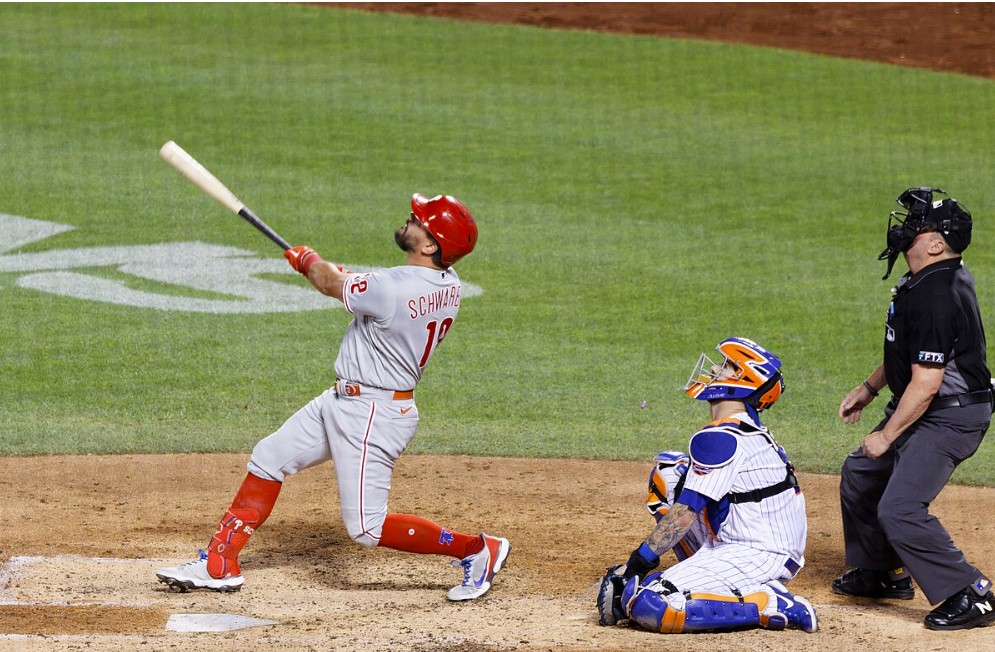
Major League Baseball, in its long history and from A-to-Z (Henry Aaron to Richie Zisk), has had 2,029 player-seasons of 100 or more RBI (Baseball-Reference.com). In 2023, we saw a 100-RBI season like never before. Phillies’ LF Kyle Schwarber became the first MLB player ever to drive in 100 or more runs in a season when his batting average was below.200. (As a sidenote: Three of the five lowest averages in 100+ RBI season occurred in 2023.)

 It was Schwarber’s first 100-RBI season in a nine-season MLB career (2015-23 … Cubs, Nationals, Red Sox, Phillies). During the season, he went .197-47-104, with 108 runs scored – reaching career highs in home runs, RBI and runs (and leading the NL with a career-high 215 strikeouts).

Over his career, the two-time All Star has put up a .227-246-548 stat line.

Another Schwarber Oddity

Kyle Schwarber has a share of the record for most home runs in a season without reaching 100 RBI. In 2022, Schwarber went .218-46-94 for the Phillies, joining Alfonso Soriano who went .277-46-95 for the Nationals in 2006.
Overall, there have been 31 MLB seasons of forty or more homers and fewer than 100 MBI. Just five players have two such seasons:

  • Henry Aaron – 1969 Braves (.300-44-97) & 1973 Braves (.301-40-96).
  • Adam Dunn – 2006 Reds (.234-40-92) & 2012 White Sox (.204-41-96).
  • Joey Gallo – 2017 Rangers (.209-41-80) & 2018 Rangers (.206-40-92).
  • Mickey Mantle – 1958 Yankees (.304-42-97) & 1960 Yankees (.275-40-94).
  • Mike Trout, 2015 Angels (.299-41-90) & 2022 Angels (.283-40-80).

Well, as always, with Baseball Roundtable “one thing led to another,” and I began a search for more 100-RBI seasons rarities and oddities. (No baseball, too much time on my hands.)

First Up, Another 2023 Rarity – Fewest Base Hits in a 100-RBI Season – 102

In 2023, Dodgers’ third baseman Max Muncy put up a .212-36-105 season – collecting just 102 base hits (the fewest ever in an MLB 100-RBI campaign). It was Muncy’s first-ever 100-RBI season (in eight MLB seasons). To date, Muncy’s career stat line is .227-180-489.

A few other tidbits:

  • Barry Bonds, Bryce Harper, Christian Yelich, Ken Griffey Jr., Mickey Mantle, Shohei Ohtani, Nelson Cruz and Henry Aaron are the only MLB players to combine a 40-homer/sub-100 RBI season with a .300 or better batting average.
  • Joey Gallo is the only player with two consecutive 40-homer/sub-100 RBI seasons.
  • The only 40-homer/sub-90 RBI seasons belong to Joey Gallo (.209-40-80 for the 2017 Rangers) and Mike Trout (.283-40-80 for the 2022 Angels).
  • In 11 of the seasons of 40 or more homers and fewer than 100 RBI, the player led the league in long balls, in seven the player led in strikeouts.

The Highest Batting Average in a Sub-100 RBI Season (some qualifiers) … .424

The highest batting average (using a minimum of 400 plate appearances) in sub-100 RBI season is .424 by Willie Keeler, 1897 Baltimore Orioles (.4237) and Rogers Hornsby 1924 Cardinals (.42350).  Keeler had 74 RBI in 129 games, Hornsby had 94 RBI in 143  contests.  Note: I used 450 at bats because of the discrepancy in season lengths. For example, if you used players qualifying for the batting title, the highest average without 100 RBI would be Levi Meyerle of the 1871 National Association Philadelphia Athletics. However, the Athletics played just 28 games that season. Meyerle had a .492 average and 40 RBI in 26 games, 132 plate appearances. 

Rookies Hitting Cookies

Ted William holds the all-time MLB rookie-season RBI record with 145 in 1939. Photo: wild mercury

There have been 44 players who have driven in 100 or more runs in a “rookie” season, with 22 of those in their debut season. (Rookie status can roll over to another season based on days on the roster, number of at bats or number of innings pitched.)  Twelve of those rookies have won the Rookie of the Year award. (Twenty players have recorded 100 or more RBI in their rookie season since the ROY Award was established.)

As the chart below shows, their 100-RBI rookie season was the only career 100-RBI season for 11 of the 44 players who recorded 100 or more RBI in a rookie campaign.


Going Out On Top … Or Not

On November 18, 2015, Red Sox DH David Ortiz (on his fortieth birthday) announced that the 2016 MLB season would be his last as a player. The following year, he went out on top – with a .315-38-127, becoming one of just five players to record 100 or more RBI in their final MLB campaign. Here is the list:


The not so much on top? Joe Jackson and Happy Felsch had their careers cut short due to the 1919 Black Sox scandal. Injuries also played a role in adding two players to this list: Albert Belle (osteoarthritis – hip) and David Orr (Stro9ke).

Fewest Games Played in a 100-RBI Season – 69

JOSH GIBSON Photo: Harrison Studio, Public Domain, via Wikimedia Commons

In 1943, Josh Gibson went .466-20-109 in 69 games for the Negro National League II Homestead Grays. That season, the Hall of Famer led the league in runs (93), hits (116), doubles (22), home runs (20), RBI (109) walks (52) and total bases (216).

 Something Old Something New

The oldest player to record a 100-RBI season was 42-year-old Cap Anson of the 1894 Chicago Cubs.

Six players recorded season of of 100 or more RBI in their age-20 season: Ty Cobb, Al Kaline, Mel Ott, Alex Rodriguez,  Juan Soto and Ted Williams.  Moving on to months and days, the youngest of those was Ott, who went .328-42-151 for the 1929 Giants. It was, by the way, Ott’s fourth MLB season. Ott played 209 MLB games before his twentieth birthday – going .318-19-100 over three seasons.

The Saga of Jack Reed … One RBI/106 Games … One Memorable Home Run

In 1963, 30-year-old Jack Reed was in his third MLB season as a reserve outfielder/defensive replacement for the New York Yankees.  He replaced Mickey Mantle in the field often enough that he was known in some circles as “Mickey Mantle’s Caddie.”  In 1963, he played in 106 games, had just 82 plate appearances (73 at bats) and hit .205-0-1 … recording the fewest RBI ever for a player who appeared in 100 or more games.  

However, Reed’s brightest moment in the major leagues came at the plate, not in the garden. On June 24, 1962, Reed hit the only home run of his MLB career (1961-63). It was a two-run shot off Tigers’ reliever Phil Regan in the top of the 22nd inning – the game winner in the longest game in Yankee history. Reed had replaced Joe Pepitone (who had earlier replaced Mickey Mantle) in RF in the thirteenth inning. Reed’s career stats line (222 games) was .233-1-6. Often used as a pinch runner, he scored 39 runs and stole seven bases. In that 1962 season, Reed went .302-1-4 in 88 games (48 plate appearances.)  

Most hits in a Sub-100 RBI Season – 262

Photo by Matt McGee

In 2004, Mariners’ RF Ichiro Suzuki rapped out an MLB single-season record 262 base hits – but collected just 60 RBI, He hit .373 for the season and 225 of his 262 hits were singles.  Suzuki, who had ten MLB seasons of 200 or more hits and 3,089 hits in 19 MLB seasons, never drove in more than 69 runs in a season.

In MLB history, there have been 539 player-seasons of 200 or more hits, with 54 percent (292) of those seasons seeing the player record fewer than 100 RBI.
In a combined 100 seasons, the players on the above list had 43 seasons of 200 or more hits and just one 100-RBI campaign. (In 1999, Derek Jeter had 219 hits and 102 RBI).

Lloyd Waner of the 1927 Pirates recorded the fewest RBI in an MLB season of 200 or more hits. That season, he hit .355, with 223 hits, but recorded only 27 RBI.

Most Strikeouts in a 100-RBI Season – 223

Just five players have recorded 200 or more whiffs in a 100-RBI season:

  • Mark Reynolds, 2009 Diamondbacks – .260-30-102, with 223 strikeouts (which is the MLB single-season record for batter’s strikeouts).
  • Kyle Schwarber, 2023 Phillies – .197-47-104, with 215 whiffs.
  • Giancarlo Stanton, 2018 Yankees – .266-38-100, with 211 strikeouts.
  • Chris Davis, 2015 Orioles – .262-47-117, with 208 strikeouts.
  • Aaron Judge, 2017 Yankees – .284-52-114, with 208 whiffs.

Fewest Strikeouts in a 100-RBI Season – Three

In 1894, The Giants’ Jack Doyle drove in 103 runs in 103 games. He hit .368-3-103 and fanned just three times in 471 plate appearances.

Post-1900:  The 1902 Athletics’ Lave Cross hit .342-0-108 and whiffed just four times in 597 plate appearances.

Get ‘Em On – I’ll Bring ‘Em Home

Among players with at least 100 RBI in a season, Al Simmons (1930 Athletics) had the highest batting average with runners in scoring position at .436 (85-for-195). When he came to the plate without runners in scoring position, he hit .351. His overall stat line .381-36-165.

Fewest Home Runs in a 100-RBI Season  – Zero

Hughie Jennings (.401-0-121 for the 1896 Baltimore Orioles) and Lave Cross (.342-0-108 for the 1902 Athletics) are the only MLB players to record a 100-RBI season with zero round trippers.

Most Players with 100 or More RBI on a Team in the Same Season – Five 

1936 Yankees: C Bill Dickey (107);  1B Lou Gehrig (152); 2B Tony Lazzeri (109); RF George Selkirk (107); CF Joe DiMaggio (125)

1894 Orioles (NL): 1B Dan Brouthers (128); 2B Henry Reitz (105); SS Hughie Jennings (109); CF Steve Brodie (113);  LF Joe Kelly (111).

1894 Boston (NL); 1B Tommy Tucker (100); 2B Bobby Lowe (115); OF Jimmy Bannon (114); OF  Hugh Duffy (145); OF Tommy McCarthy (126).

 The Most 100-RBI Seasons

Primary Resource:  Baseball-Reference.com

A REMINDER … .

There is still time to cast your vote(s) in the Baseball Roundtable (unofficial) 2024 Baseball Hall of Fame Fan Balloting (and qualify for the prize drawing).  Click here to go directly to the ballot.  Click here for a post taking a look at the careers of the players on the ballot.


Baseball Roundtable – Blogging Baseball Since 2012.

100Baseball Roundtable is on the Feedspot list of the Top 100 Baseball Blogs.  To see the full list, click here.

Baseball Roundtable is also on the Anytime Baseball Supply Top 66 Baseball Sites list.  For the full list, click here

I tweet (on X) baseball @DavidBaseballRT

Follow/Like Baseball Roundtable’s Facebook Page here.  Find More baseball commentary; blog post notifications; PRIZES.

Member: Society for American Baseball Research (SABR); Negro Leagues Baseball Museum; The Baseball Reliquary.

P1016


Baseball Roundtable Musings on 20-Win Seasons … Stats and Stories

Baseball Roundtable was recently reflecting on that fact that the Braves’ righty Spencer Strider was MLB’s only 2023 20-game winner, which led me to the fact that MLB has had just one twenty-game winner in each of the past three seasons. In the vein of  “In Baseball Roundtable one thing always seem to lead to another,” this led me to the fact that only five pitchers (one of them being Strider) have recorded 20 or more wins in a season in which they pitched fewer than 190 innings:

  • 2022 – Kyle Wright, Braves (21-5, 3.19 in 180 1/3 innings);
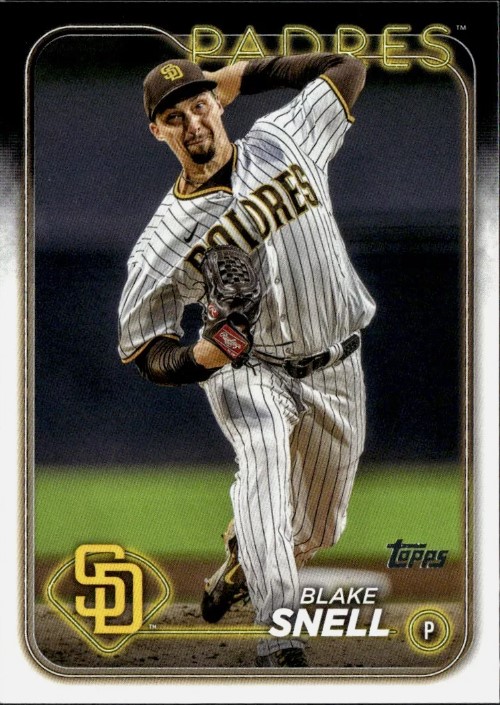
  • 2018 – Blake Snell, Rays (21-5, 1.89 in 180 2/3 innings);
  • 2021 – Julio Urias, Dodgers (20-3, 2.96 in 185 2/3 innings);
  • 2023 – Spencer Strider, Braves (20-5, 3.86 in 186 2/3 innings;
  • 2012 – Jered Weaver, Angels (20-5, 2.81 in 188 2/3 innings).

Anyway, that sent me down a research rabbit hole, searching out stats related to 20+ win seasons that interested me (and I hope some of them interest you, as fans and readers).

Of course, one thing led to another and those low inning totals led me to look at complete-game totals.  As the chart below snows. Strider joined a (rather impressive) recent and growing list of pitchers to record twenty wins in a season without throwing a single complete game.

_____________________________________

BEFORE WE RETURN TO OUR REGULAR PRORAMMING/POSTING …

There is still time to cast your vote(s) in the Baseball Roundtable (unofficial) 2024 Baseball Hall of Fame Fan Balloting (and qualify for the prize drawing).  Click here to go directly to the ballot.  Click here for a post taking a look at the careers of the players on the ballot.

_________________________________________________


Before, getting into single-seasons and records, here a few numbers to show how the times have changed.  Baseball-Reference.com shows 1,219 seasons of 20 or more wins since 1871. Within that statistic:

  • MLB averaged 13.5 20+ game winners per season before 1900 and 9.8 since 1900.
  • Since 2010, the average number of pitchers winning 20 or more games per season is down to 1.9

Side note:  Those numbers provide even more contrast when you consider the increase in the number of teams and games played per season.

  • There has been just one 60-win season (Old Hoss Radbourn … 60-12, 1.38 for the 1884 Providence Grays.) Note: Some sources credit Radbourn with 59 wins, but the Elias Sports Bureau and Baseball-Reference.com list 60, and that’s good enough for me.
  • There were four seasons of between 50-59 wins – the most recent in 1885 (John Clarkson. Chicago White Stockings, NL, 53-16, 1.85).
  • There were 37 seasons of 40-49 wins – the most recent in 1908 (Ed Walsh, White Sox … 40-15, 1.42).
  • There were 117 seasons of 30-39 wins, the most recent in 1968 (Denny McLain, Tigers … 31-6, 1.96) and just 19 since 1900.

The above bullet points explain why, in some cases, I have broken out findings by pre-1900 and 1900 and beyond. So, let’s get on with it.

Highest Earn Run Average for a Pitcher Winning 20 or More Games in a Season – 5.08

I started with a look for “rarities” among 20-game winners – and I quickly found one. In MLB history, only two pitchers have had an earned run average of 5.00 or higher in a twenty-win season:

  • Bobo Newsom, 1938 Browns, 5.08;
  • Ray Kremer, 1930 Pittsburgh Pirates, 5.02.

Louis “Bobo” Newsom – In 1938, righty Newsom went 20-16, with a 5.08 ERA, for the St. Louis Browns. (The league ERA was 4.79.) Newsom had an up-and-down campaign. In his 20 wins, he put up a 3.13 ERA; in his 16 losses, his ERA was 8.11; and in his seven no-decisions, it was 5.65. His career somewhat mirrored that season.  Newsom won 20 or more games in three seasons (consecutively,  1938-40) and also lost 20 games in three seasons (1934-35 and 1941). He pitched in 20 MLB seasons (1929-30, 1932, 1934-48, 1952-53 … Robins/Dodgers, Cubs, Browns, Nationals, Red Sox, Tigers, Athletics, Yankees, Giants).  His final stat line was 211-222, 3.98.

Ray Kremer – In 1930, righthander Ray Kremer went 20-12, 5.02 for the Pirates. It was Kremer’s second 20-win season.  In 1926, he had gone 20-6, 2.61 for the Pirates – leading the NL in wins, winning percentage and ERA (2.47). Kremer had a solid 10-year MLB career (1924-33), all with the Pirates. He had only one sub-.500 season and won 15 or more games in seven of his ten MLB campaigns.  Kremer’s final line was 143-85, 3.76.

_______________________

This look at the highest earned run average among 20-game winners, led me (as one would expect) to search out the lowest ERA among 20-game winners.

Lowest Earned Run Average in a Season of 20 or More Wins – 1.04

Mordecai “Three Finger” Brown, 1906 Cubs

Photo: Paul Thompson, Public domain, via Wikimedia Commons

In 1906, righthander Mordecai Brown went 26-6 for the Cubs – and put up the lowest ERA ever in a season of 20 or more wins (1.04).  He made 36 appearances, completed 27 of 32 starts and led the NL in shutouts with nine.  Over the course of the season, Brown gave up more than two runs in just four games. From July 28 through September 13, he appeared in 14 games (11 starts) and went 11-0 with three saves (awarded retroactively). Over that span, He completed ten of his 11 starts and the eight runs he surrendered were all unearned.

The Hall of Famer went 239-130, 2.06 in 14 MLB seasons (1903-1916 … Cardinals, Cubs, Reds, and the Federal League St. Louis Terriers & Brooklyn Tip Tops).  He won 20 or more games in six seasons (consecutively from 1906 through 1911).


Honorable Mention … Bob Gibson, 1908 Cardinals

Bob Gibson came the closest to Mordecai Brown (above) among 20+ game winners, posting a 1.12 earned run average, while going 22-9 for the 1968 Cardinals. Gibson led MLB that season in ERA, as well as in shutouts (13).  He completed 28 of 34 starts. From June 6 through July 30 of that season, Gibson started, completed and won 11 games, throwing eight shutouts and giving up just one run in each of three other starts. 

The Hall of Famer pitched in 17 MLB seasons (1959-75), all for the Cardinals. He was an All Star in eight seasons, won 20 or more games in five and was a two-time Cy Young Award winner. He finished at 251-174, 2.91.  


Fewest Games Pitched in a Season of 20 or More Wins – 26

Fred Goldsmith & Jesse Tannehill

Fred Goldsmith, 1880, Cubs

In 1880, 24-year-old righty Fred Goldsmith – one of professional baseball’s earliest curveball specialists – went 21-3, 1.75 for the National League Champion Cubs (67-17-2). He pitched in just 26 games (24 starts) and put up a 1.75 Earned Run Average over 210 1/3 innings. (The National League ERA was 2.37 that season.) Goldsmith won 20 or more games four times in a six-season MLB career (112-68, 2.73 from 1879 through 1884).  A sign of the times: He threw 174 complete games in 185 starts.

Jesse Tannehill, 1902, Pirates

Southpaw Jesse Tannehill went 20-6 for the 1902 Pirates, pitching in 26 games (starting 24) and completing 23. He put up a 1.95 ERA in 231 innings pitched. (The 1992 NL average ERA was 2.78.) The Pirates went 103-36-3, finishing first in the National League. Tannehill pitched in 15 MLB seasons (1894, 1897-1909, 1911 … Reds, Pirates, the AL Boston Americans, Nationals). He won 20 or more games in six seasons – a high of 25 (13 losses) for the 1898 Pirates.

Pretty Darn Close

In 2014, Dodger lefty Clayton Kershaw came close to this record, going 21-3, 1.77 in 27 games (all starts). He led the NL in wins, winning percentage (.875), ERA and complete games. During the season, Clayton threw five complete games and pitched seven or more innings in 22 of his 27 starts and only gave up more than three runs once. Thus far, in his 16-season MLB career, Kershaw has won 20 or more games in two seasons, won three Cy Young Awards and been al All Star ten times.

______________________________

Fewest Starts in a Season of 20 or More Wins – 20

Bob Grim, 1954 Yankees

Photo: Jay Publishing via tradingcarddb.com, public domain, via Wikimedia Commons

In 1951, As a 21-Year-old in the Yankee farm System, righthander Bob Grim went 16-5, 2.58 at A and Double-A.  After this breakout year, his professional career was interrupted by military service. Although, as a Marine, he did pitch in 1952 and 1953 for the Camp Lejeune baseball team.

Grim’s service experience apparently served him well. In 1954, Grim made the Yankee squad out of Spring Training. He went on to a 20-6, 3.26 record and the 1954 AL Rookie of the Year Award. In the process, he compiled the fewest starts ever for an MLB 20-game winner (20 starts out of 37 appearances). That season, he went 12-6, 3.50 (with eight complete games) as a starter and 8-0, 2.70 in 17 games in relief.

Grim enjoyed an eight-season MLB career (1954-60, 1962 … Yankees, Athletics, Indians, Reds, Cardinals), going 61-41, 3.61 in 268 appearances (60 starts). That rookie season was his only 20-win campaign (his next high was 12 wins in 1957) and also marked his single-season highs in starts (20), complete games (8), innings pitched (199), and strikeouts 108).

_____________________________________


How About Those Rookies?  And a Rarity.

The fact that Bob Grim won 20 games in his rookie season led me to examine other rookie twenty-game winners.  On this one, I just took a look at rookie 20-game winners since 1900. (From 1872 through 1899 – 28 seasons – 48 rookies won 20 or more games in a season.  Since 1900, just 32 rookies have achieved that feat.)

I found another rarity – in the major-league career of Henry Schmidt.  Schmidt not only was a 20-game winner (22-13, 3.83) as a 30-year-old rookie for the 1903 Brooklyn Superbas, he is the only pitcher to win 20 or more games in his only MLB season.

Schmidt had been a star in the minor- and independent-leagues before he signed with the Superbas for the 1903 season. In 1902, he had gone 35-20 for the California League Oakland Clamdiggers. A gutsy performer (perhaps effectively wild), known for his ability to get into and out of trouble, Schmidt was the ace of the Brooklyn staff, despite having the highest ERA among the main pitchers in the rotation. After the season, Brooklyn offered Schmidt a healthy raise for 1904, but he returned the contracts unsigned, telling the team Eastern living was not for him. He instead signed with the Oakland Oaks of the Pacific Coast League. He never returned to the major leagues.

Schmidt is included in the chart below, which lists all rookies (since 1900) to win twenty or more games in a season – and notes which ones accomplished the feat in their debut seasons (rookie status can carry over if a pitcher logs less than 50 innings), as well las which rookies recorded just the one campaign of 20 or more wins.

______________________________________________


Special Mention – Something Old/Something New – Something Worth the Wait 

Photo by Keith Allison

In 2008, the Yankees’ Mike Mussina – at 39 years of age and in his 18th major-league season – tried something new.  The Hall of Famer won 20 games in a season for the first time in his career.  In the process he became the oldest MLB player to win 20 games for the first time, as well as setting the mark for the most seasons in the major leagues before recording a first 20-win campaign.  But wait, the story gets better. Mussina picked up that 20th win with a six -inning scoreless stint on September 28, as New York topped the Red Sox 6-2. It came in his 537th and last-ever MLB mound appearance. (Mussina retired after the season.) He finished the season at 20-9, 3.37 – and ended his MLB career with as 270-153, 3.68 record. 

_________________________________________________


How About a Look at Some Striking Statistics?

Most Strikeouts in a season of 20 or more wins – 513

Matt Kilroy, 1886 Baltimore Orioles, American Association

Matt Kilroy went 29-34, 3.37 as a 20-year-old rookie for the 1886 Baltimore Orioles. In the process, he started 68 games, completed 66 and fanned 513 batters in 583 innings.

Matt Kilroy’s 513 strikeouts in 1886 are the most ever in an MLB season.

Kilroy provides a prime example of the impact of overwork on pitchers’ arms in the early days of baseball.  In his first four seasons, he averaged 30 wins, 25 losses, 494 innings pitched, a 3.26 ERA and 270 strikeouts per campaign. In his final six seasons, he averaged just three wins (six losses), 77 innings pitched, a 4.37 ERA and 15 strikeouts.

 Since 1900 – Nolan Ryan, 1973 Angels, 383

Hall of Famer Nolan Ryan went 21-16 for the 1973 Angels and fanned 383 batters in 332 2/3 innings. – tossing 26 complete games in 39 starts. Ryan pitched in 27 MLB seasons, going 324-292, 3.19. He fanned a record 5,714 batters in 5,386 innings and topped 300 whiffs in six seasons.

 Fewest Strikeouts in a Season of 20 or More Wins – 18

William Cherokee Fisher, 1875 Philadelphia Whites

In 1875, Cherokee Fisher went 22-9. 1.99 for the National Association’s Philadelphia Whites. He fanned just 18 batters in 358 innings. Note:  In 1875, the NA’s overall ERA was 2.23 and pitchers averaged just one whiff per nine innings. (If he had fanned batters at the league-average rate, Fisher would have recorded 40 strikeouts.) Fisher pitched in seven MLB seasons (1871-76, 1887) in the National Association and National League – going 56-84, 2.61. 1875 was his only 20-win season.

 Since 1900 – 24 – Harry “Slim” Sallee, 1919 Reds

At 6’3” and 180-pounds, Slim Sallee earned his nickname. In 1919, in his 12th MLB season, at the age of 34, he had his only 20-win season (21-7, 2.60 for the Reds). He fanned just 24 batters in 227 2/3 innings. That season, NL pitchers averaged 2.9 whiffs per nine innings – which means had he fanned batters at the league-average pace, Sallee would have whiffed 73 batters. Sallee pitched in 14 MLB seasons (1908-1921 … Cardinals, Giants, Reds), going 174-143, 2.56.

In his lone 20-win campaign, Slim Sallee fanned just 0.9 batters per nine innings, the lowest figure of his MLB career (he averaged 2.7 whiffs per nine over his 14 MLB seasons).


Winning Percentage. It was the Best of Times – It was the Worst of Times.

The best and worst winning percentages among pitchers wining 20 or more games in a season both occurred before 1900.

Photo: Boston Red Stockings, Public domain, via Wikimedia Commons

Best – .915 – Al Spalding, 1875, Red Stockings. In 1875, Al Spalding of the National Association Boston Red Stockings went 54-5. 1.59 for a .915 winning percentage (the best ever among pitchers winning 20 or more games in a season.) Spalding pitched in 72 of the Red Stockings’ 79 games, starting 62 of them (52 complete games). Hall of Famer Spalding pitched in seven MLB seasons (1871-77).  He finished 251-65, 2.13 – with five seasons of 38 or more wins.

Worst – .333 – Jim McCormick, 1879 Cleveland Blues. Jim McCormick went 20-40 for the 1879 Cleveland Blues (NL) for a .333 winning percentage – the worst ever for a pitcher winning 20 or more games in a season. McCormick pitched in ten MLB seasons (1878-87, going 265-214, 2.43). He nearly reversed his W-L record in 1880, going 45-28, 1.85 for the Blues. Overall, he won 20 or more games in ten seasons (40 or more twice).

  • Best Since 1900 – .893  – Ron Guidry, 1978 Yankees. Now, if you want to look at the high and lows since 1900, the best winning percentage among 20-game winners belongs to the Yankees’ Ron Guidry, who went 25-3 (an .893 percentage), 1.74 in 1978. Guidry went 170-91, 3.29 over 14 seasons (1975-88), all with the Yankees. He won 20 or more games in three campaigns.

Worst Since 1900 – .488 – Irv Young, 1905 Boston NationalsJim Scott, 1913 White Sox. Young and Scott put up 20-21 records in those seasons. Young’s came in his rookie year (and was his only season with 20 or more wins). He pitched in six MLB seasons (1905-08, 1910-11 … Boston Nationals, Pirates, White Sox) and went 63-95, 3.11. Scott pitched in nine MLB seasons (1909-1917), all with the White Sox He went 104-114, 2.30 and twice won 20 or more games in a season. His career stat line was 107-214, 2.30.

 20-20 Vision – An Eyeful of Wins & Losses

Photo: Texas Rangers via tradingcarddb.com, public domain, via Wikimedia Commons

Looking at those 20-21 seasons (Irv Young & Jim Scott, above) got me to thinking about players who won and lost twenty or more games in the same season. Not a rarity early on. It happened 141 times before 1900.  Rare since 1900 though – only 11 such seasons. As the chart below shows, the most recent such instance is credited to the Braves’ Phil Niekro, who went 21-20, 3.39 in 1979, leading the NL in wins and losses in the same season. Notably, Phil’s brother Joe tied Phil for the NL lead in wins, with 21 (11 losses) for the Houston Astros. A Hall of Famer, knuckleballer Phil pitched in 24 MLB seasons (1964-87 … Braves, Yankees, Indians, Blue Jays), going 318-274, 3.35. He won 20 or more games twice and lost 20 or more twice.  From 1977 through 1980, he led the NL in losses four consecutive season.  In each of those seasons, the Braves finished last.


More one thing leads to another: Phil Niekro’s season of winning and losing at least 20 games and doing it for a last-place squad led me down another rabbit hole: Pitchers with at least 20 wins for a last-place team. It’s happened a lucky 13 times.  Here’s the list.


How About 40-40 Vision? Quite a Turnabout.

Only three pitchers recorded (separate) seasons of 40 wins and 40 losses during their MLB careers.

Will White won 43 games for the 1879 Reds (43-31, 1.99) and the very next season lost 42 games for the Reds (18-42, 2.14).  White pitched in 10 MLB seasons (1877-1886 … NL Boston, Reds and Wolverines and the American Association Cincinnati franchise). He won 229 and lost 166, with a 2.28 ERA. He won 20 or more games five times, including three seasons of 40 or more wins. He led the American Association with 40 wins in 1882 and 43 in 1883.

Jim McCormick lost 40 games (20 wins) for the 1879 Cleveland Blues and turned around to win 45 games (28 losses) for the Blues the following season. McCormick pitched in ten MLB seasons (1878-87 … NL Indianapolis Blues, NL Cleveland Blues, Union Association Cincinnati Outlaw Reds, NL Providence Grays, NL Cubs, NL Allegheny City). He won 20 or more games in eight of those seasons and lost 20 or more in six.

George Bradley, won 45 games (19 losses) for the 1876 St. Louis Brown Stockings (NL) and lost 40 (13 wins) for the 1879 Troy Trojans (NL). Bradley pitched in nine MLB seasons (1875-77, 1879-1884 …  the NL St. Louis Brown Stockings, Troy Trojans, Providence Grays, Detroit Wolverines and Cleveland Blues; the American Association Philadelphia Athletics; the Union Association Cincinnati Outlaws). He went 172-151, 2.43, with three seasons of 20 or more wins and three seasons of 20 or more loses.

A few Other 20-win factoids:

  • As you might guess, Cy Young holds the record for the most twenty-win seasons in a career (16) and the most consecutive seasons of 2o or more wins (14). Young pitched in 22 MLB seasons and went 511-315, 2.63.
  • Al Atkinson is the only MLB pitcher to have a season of 20 or more wins while pitching for three different teams. In his 1884 rookie season, he went 20-26, 3. 36 for the Union Association Baltimore Monumentals (3-5); Chicago/Pittsburgh of the Union Association (6-10); and Philadelphia Athletics of the American association (11-11).
  • Grover Alexander (1916 Phillies) and George Bradley (1876 St. Lous Brown Stockings) share the record for the most shutouts thrown in a season of 20 or more wins (16). Alexander went 33-12, 1.55 and Bradley went 45-19, 1.23) in their record-setting seasons.
  • Denny McLain (1966 Tigers) gave up the most home runs in a season of 20 or more wins (42). He went 20-14, 3.92 that season.
  • The fewest hits allowed per nine innings in a season of 20 or more wins is 5.3 – Luis Tiant, 1968 Indians, in a 21-9, 1.60 season.
  • The youngest-ever 20-game winner was 17-year-old Willie McGill, who went 20-14 for the American Association Cincinnati Kelly’s Killers and St. Louis Browns in 1891. McGill went 2-5 for Cincinnatti and 18-9 for St. Louis.
  • The oldest pitcher to log a season of 20 or more wins was the Braves’ Warren Spahn, who went 23-7, 2.60 – as  a 42-year-old – in 1963.  Spahn tossed 22 complete games in 33 starts that season.

Primary Resources:  Baseball-Reference.com; Elias Sports Bureau; Baseball Maniac’s Almanac Sixth Edition, Bert Randolph Sugar, Sports Publishing, 2023.

Remember, There is still time to vote in The Baseball Roundtable Fans’ Hall of Fame Balloting (and qualify for the prize drawing). Click here to go directly to the ballot.  Click here for a post taking a look at the career of the player on the ballot.


Baseball Roundtable – Blogging Baseball Since 2012.

100Baseball Roundtable is on the Feedspot list of the Top 100 Baseball Blogs.  To see the full list, click here.

Baseball Roundtable is also on the Anytime Baseball Supply Top 66 Baseball Sites list.  For the full list, click here

I tweet (on X) baseball @DavidBaseballRT

Follow/Like Baseball Roundtable’s Facebook Page here.  Find More baseball commentary; blog post notifications; PRIZES.

Member: Society for American Baseball Research (SABR); Negro Leagues Baseball Museum; The Baseball Reliquary.

P1013

Lucky Number Seven … It’s a Hit

In a recent post, Baseball Roundtable focused on the number four – and its significance in the career of Hall of Famer Henry Aaron.  Click here for that post. In this post, we’ll look at the significance of number seven – particularly as it related to hits by a single batter in a single MLB game.

Why the number seven?  It seems to be an appropriate and notable cut off point. Only six times in MLB history has a batter logged seven (or more) hits in a game. By contrast, there have been 170 six-hit games. (Note: These numbers may change as Negro League stats from 1920-48 are further documented and incorporated into the MLB record books).  So, let’s look at some of baseball’s lucky sevens – as well as a pretty significant nine and a remarkable six.

__________________________________________

Most Hits in a Nine-Inning game  – Seven

Wilbert Robinson, Baltimore Orioles, June 10, 1892

Photo: https://sabr.org/bioproj/person/wilbert-robinson/, Public domain, via Wikimedia Commons

Baltimore Orioles’ catcher Wilbert Robinson seems an unlikely candidate for the seven-hit club. Robinson was a .273 hitter over 17 MLB seasons (1886-1902).  Coming in to the 1892 season, his career average was .226 and in 1892, he hit .267 for the campaign.

On the day of his seven-hit performance, Robinson was catching and batting eighth in the Orioles’ lineup. The Orioles apparently had on their hitting shoes that day, as they led the St, Lous Browns 25-2 by the end of the sixth inning – eventually winning 25-7.

Robinson’s day:

First Inning – Single.

Second Inning – Single.

Third Inning – Single.

Fourth Inning – Double.

Fifth Inning – Single.

Seventh Inning – Single.

Ninth Inning – Single.

While Robinson scored just one run in the contest, he drove in a (then-record) 11 runs in his seven-hit game.  In his 89 other 1892 appearances, he drove in 35 runs.

Robinson was inducted into to the Baseball Hall of Fame – as a manager – in 1945. In 19 managerial seasons, his teams went 1,399-1,398, He won a pair of pennants (1916 and 1920) with the Brooklyn Robins. As a player, Robinson hit .273-18-722, with 637 runs scored and 196 stolen bases over 17 seasons (1,371 games).

In the first six years of his MLB career (1886-91, with the Philadelphia Athletics and Baltimore Orioles of the American Association), Robinson hit .226-9-205, with 107 steals (in 479 games).  From 1892 through 1902 (Baltimore and St. Louis in the NL and Baltimore in the AL), he hit an even.300, with nine homers and 517 RBI in 892 games. He topped .300 in five of those 11 campaigns.

We Won’t See That Again

On Monday (Labor Day) September 7, 1896, the National League saw the Baltimore Orioles sweep triple header from the Louisville Colonels. The very next day, the Orioles swept a doubleheader from those same Colonels. Wilbert Robinson caught all five games for Baltimore.

____________________________________

Rennie Stennett, Pittsburgh Pirates – September 16, 1975

Photo: Hostess via tradingcarddb.com, Public domain, via Wikimedia Commons

Wilbert Robinson seven-hit record would stand alone for more than 80 years.  Then on September 16, 1975 – as the Pirates topped the Cubs 22-0 in Chicago – Pittsburgh leadoff hitter and 2B Rennie Stennett would go seven-for-seven. That day, Stennett collected two hits in both the first and fifth innings.

Stennett’s day went:

First Inning – Lead-off double off Rich Reuschel and an RBI single off Tom Dettore. Stennett scored on a single by 3B Richie Hebner and later in the inning on a single by 1B Willie Stargell.

Third Inning – One out Single off Dettore. Stennett scored on a Hebner home run.

Fifth Inning – Leadoff double off Dettore and an RBI-single off Oscar Zamora. Stennett scored a run on a single by CF Al Oliver.

Seventh Inning – Leadoff single off Buddy Schultz, later scoring on a single by RF Dave Parker.

Eighth Inning – Two-out triple off Paul Reuschel.

In the game, Stennett scored five times and drove in two.

Brotherly Love

In Rennie Stennett’s seven-for-seven, nine-inning game, he collected base hits off brothers Rick and Paul Reuschel.

Stennett came into the game hitting .279 on the season (138 games).  He raised is average to .287 that day – and would finish the season sat .286-7-62, with 89 runs scored.

Stennett played in 11 MLB seasons (1971-81 … Pirates, Giants), hitting .274-41-432 in 1,237 games. He was signed as an amateur free-agent (out of Panama) in 1969 and called up to the Pirates in 1971, after hitting .344 at Triple- A. He made his MLB debut July 10 and hit .353-over 50 games for the Pirates that season.

__________________________________


History Made

On September 1, 1971, Rennie Stennett led off for the Pirates – atop the first-ever MLB all black and Latino lineup:

Rennie Stennett 2B

Gene Clines CF

Roberto Clemente RF

Willie Stargell LF

Manny Sanguillen C

Dave Cash 3B

Al Oliver 1B

Jackie Hernández SS

Dock Ellis P

The Pirates topped the Phillies 10-7 in Pittsburgh. 

____________________________________________


Most Hits In An Extra-Inning Game

Johnny Burnett, Indians – July 10 1932- Nine Hits (18 innings)

Photo: Goudey, Public domain, via Wikimedia Commons

Indians’ SS Johnny Burnett came into Cleveland’s July 10, 1932 contest versus the Athletics hitting .298 on the season.  A solid contact hitter, Burnett had hit .300 in 111 games the previous season, fanning just 25 times in 470 plate appearances. In that July 10, 1932 game, Burnett would come to the plate 11 times and collect nine hits. Despite this record-setting performance, the Indians lost the see-saw game 18-17 in 18 innings. Over the contest, Burnett’s Indians would trail 2-0; lead 3-2; trail 5-3; lead 6-5; trail 13-8; lead 14-13; and trail 15-14, before tying the game at 15 in the bottom of the ninth.  Both teams would score two runs in the sixteenth inning, and the Athletics would finally prevail 18-17 in 18 frames.

Burnett, batting second and playing shortstop, had this day:

First Inning – Single off Lew Krausse – later scoring on a home run by CF  Earl Averill.

Second Inning – One-out single off Ed Rommel.

Fourth Inning – Single off Rommel, later scoring on a sacrifice fly off the bat of 1B Ed Morgan.

Fifth Inning – RBI double off Rommel.

Seventh Inning – Leadoff single off Rommel, later scoring on a LF Joe Vosmik double.

Seventh Inning – Strikeout (versus Rommel) to end the inning.

Ninth Inning – Game tying (15-15), two-out RBI single off Rommel.

Eleventh Inning – Double off Rommel.

Thirteenth Inning – Single off Rommel.

Sixteenth Inning – Single off Rommel, later scoring on an Ed Morgan single (tying the game at 17-17).

Seventeenth Inning – Flyout to CF off Rommel.

Burnett played nine MLB seasons (1927-35 … Indians Browns), hitting .284-9-213, with 288 runs scored (in 558 games). He played at least 100 games in only two of his nine MLB seasons.  In his two 100+ game campaigns (1931-32, he hit .298-5-105 and scored 166 runs (240 games).

____________________________________

Ed Rommel’s Final MLB Win – One For The Record Books

Photo: Bain News Service, publisher, public domain, Wikimedia Commons

In his 171st and final MLB victory, Athletics’ righty Eddie Rommel gave up the most hits ever surrendered by a pitcher in an MLB game – and it happened In Johnny Burnett’s record-setting nine-hit game.  The Athletics’ knuckleball specialist gave up a single-pitcher, single-game record 29 hits (as well as nine walks) in 17 innings of relief.

Rommel’s 17-inning relief outing was the product of scheduling quirks. Rommel’s Philadelphia Athletics found themselves slated to play nine games in five days – double headers on July 7, 8 and 9 in Chicago, a makeup single game on July 10 in Cleveland and a double header (versus Cleveland) in Philadelphia on July 11. Reportedly to save a beleaguered pitching staff (as well as travel expenses for the one-game stand in Cleveland), Athletics’ owner Connie Mack opted to send just two pitchers to Cleveland, starter Lew Krausse and Rommel. Unfortunately for Rommel, Krause got knocked around early, setting up Rommel’s 17-inning, 29-stint.   In a bit of irony, the victory was Rommel’s final MLB win.

Rommel’s pitched in five more games in 1932 (his final MLB season) picking up two losses to go 1-2, 5.51 (in 17 relief appearances) on the year.  Over a 13-season MLB career (1920-32, all with the Athletics,) Rommel went 171-119, 3.54, twice leading the AL in wins (and twice leading the league in losses).   In 1922, Rommel went 27-13, 3.28 for an Athletics team that went 65-89-1 and finished seventh in the eight-team American League. After retiring as a player Rommel spent time as an Athletics coach and minor-league manage, before beginning a long career as an umpire (21 seasons in the major leagues).

__________________________________


Rocky Colavito, Tigers … June 24, 1962 – Seven hits (22 innings)

When the Tigers faced the Yankees (in Detroit) on June 24, 1962, Detroit LF Rocky Colavito – an established power hitter – was hitting .268-14-43 on the season (65 games).  On that day, Colavito raised his average 17 points – getting seven hits and a walk in eleven trips to the plate. Surprisingly, all those hits produced just one run scored and one RBI, as the Yankees prevailed 9-7 in 22 innings.

In the game, the Yankees scored first – plating six runs in the top of the first inning off noted Yankee Killer Frank Lary. (For his career Lary would go 28-13, 3.32 versus the Bronx Bombers, with 24 complete games in 49 starts.)

Here’s a look at Colavito’s Day:

First Inning – Yankee starter Bob Turley walked Tigers’ 3B Steve Boros and CF Billy Bruton and then gave up a three-run homer to RF Purnal Goldy to put the Tigers back in the game. Colavito, batting cleanup and playing LF, popped out to SS for the first out of the inning.

Third Inning – Colavito drew a one-out walk from Jim Coates, later scoring on a single by SS Chico Fernandez to bring the scores to 7-4.

Fourth Inning – A one-out, one-on single to CF off Bill Stafford.

Sixth Inning – An RBI single to CF off Stafford, bringing the score to 7-6 Yankees.

Seventh Inning – A leadoff ground out to SS off Tex Clevenger.  (The game was tied at seven at the time.)

Eleventh Inning – It looked like Colavito might have gotten the hit to end the contest, as he tripled to CF off Clevenger to open the frame. 1B Norm Cash and 2B Dick McAuliffe were intentionally walked to load the bases with no outs. Colavito did not attempt to score on a liner to short left by Fernandez and then C Dick Brown popped up on a bunt attempt, which was turned into a catcher-to-third base double play

Thirteenth Inning – One-out groundball single off Clevenger.

Fifteenth Inning – With a runner on first and one out, Colavito hit a ground ball single (left side) off Bud Daley. No run scored.

Eighteenth Inning – Fly out to center to open the frames, off Jim Bouton.

Twentieth Inning – Two-out, bases empty groundball single off Bouton.

Twenty-second Inning – Two-out single to center off Bouton.

Colavito played 14 MLB seasons (1955-68 … Indians, Tigers, Athletics, White Sox, Dodger Yankees), going .266-374-1,159 in 1,841 games.  He was an All Star in six seasons, led the AL in home runs once (and had three seasons of 40+ homers), led the league in RBI once (with six seasons of 100+ RBI, including 140 in 1961) and twice led the league in total bases. His best season was 1961, when he hit .290-45-140, with 129 runs scored in 163 games.

An Energizing Day

Rocky Colavito’s seven-for-ten day (June 24, 1962) started an 18-game stretch in which he hit .417-6-16. (Colavito hit .273-37-112 on the season).

______________________________________

 Cesar Gutierrez, Tigers … June 21, 1970 – Seven Hits (12 innings)

Cesar Gutierrez may have had the most unexpected seven-hit game. Gutierrez played in just four MLB seasons (1967,1969-71 … Giants Tigers), hitting .235-0-26 in 223 games.  His 1970 season was the only one in which he played more than 38 games at the major-league level. In his MLB career Gutierrez had more than one hit in only 24 games.

On June 21, 1970, however, Gutierrez was pretty much unstoppable, collecting seven hits in seven trips to the plate, scoring three runs and driving in one – as Detroit edged the Indians 9-8 in 12 innings in Cleveland.

Gutierrez, who started at SS batting second, came into the game hitting .218 on the season (in 51 games played).   When it was over, he was hitting .249.

Here’s how his day went:

First Inning – Single to RF off Rick Austin, later scoring on a groundout by RF Jim Northrup.

Second Inning – One-out single off Austin, scoring on home run by 1B Al Kaline.

Fifth Inning – Leadoff single off Dennis Higgins.

Seventh Inning – Leadoff double off Higgins, later scoring on a Northrup home run.

Eighth Inning – RBI single (tying the game at 8-8) off Fred Lasher.

Tenth Inning – Two-out single off Dick Ellsworth.

Twelfth Inning – Single off Pat Hennigan.

In 1970, Gutierrez hit .243-0-22, with 40 runs scored in 135 games.

__________________________________

 Brandon Crawford, Giants – August 8-2016 – Seven Hits (14 Innings)

Photo: Jeff Marquis from San Carlos, CA, USA, CC BY 2.0 <https://creativecommons.org/licenses/by/2.0>, via Wikimedia Commons

Brandon Crawford came into the Giants August 18, 2016 game versus the Marlins (in Miami) hitting .265-10-68 in 108 games. On that day, as the Giants edged the Marlines 8-7 in 14 frames, the San Francisco SS went seven-for-eight (raising his average 13 points).

Second Inning – Lead off groundball single to 2B off Jose Fernandez;

Fourth Inning – Lead off groundball double to RF off Fernandez;

Fifth Inning – Inning-ending strikeout (Fernandez), with a runner on second and the Giants trailing 2-1.

Seventh Inning – One out, one-on groundball single to RF off Nick Wittgren.  

Side Note: Crawford’s single was the fifth of six straight hits to open the inning, as the Giants scored five times to take a 6-5 lead.

Eighth Inning – Two- out, RBI single to RF off Kyle Barraclough to tie the game at seven.

Eleventh Inning – None-out, one-on single to CF off Mike Dunn, putting runners on first and third. A strikeout, intentional walk and two groundouts kept the Giants from scoring.

Thirteenth Inning – One-out triple to RF off Dustin McGowan.  (Followed by an infield groundout, with Crawford having to hold, two intentional walks and a strikeout.)

Fourteenth Inning – A two-out, two-on RBI singe to CF off Andrew Cashner that proved to be the game winner.

2023 was Crawford’s 13th MLB season (2011-23 … Giants). His career stat line (1,654 games) reads .250-146-744. Crawford is three-time All Star and four-time Gold Glover. His best year at the plate was 2021, when he hit .298-24-90 – reaching career highs in all three categories, as well as in runs scored (79), stolen bases (11) and total bases (252).

_________________________________________

Honorable Mention- The Best Ever Six-Hit Game

Yes, the cutoff line was seven-hit games – but out of those 170 six-hit games one really stands out. On May 23, 2002 – as the Dodgers trounced the Brewers 16-3 In Milwaukee, Dodgers’ RF Shawn Green had a day to remember. He went six-for-six, with four home runs, a double and a single – six runs scored and seven RBI. Green hit an RBI double in the first inning; a three-run homer in the second; a solo home run in the fourth; a solo homer in the fifth; a single in the eighth; and a solo home run in the ninth.  In the Game, Green: 


  • Set a new MLB record for total bases in a game with 19;
  • Tied the MLB record for home runs in a game with four; and
  • Tied the MLB record for extra-base hits in a game with five.

Green by then way, is on The Roundtable’s list of underrated (or at least under talked about) major leaguers.  Just a two-time All Star, he put up a .283-328-1,070 line in 14 seasons. He had three seasons of 40+ home runs (a Dodger franchise record 49 in 2001); four seasons of 100 or more RBI; four seasons of 100+ runs scored; and 11 seasons of 30 or more doubles (three of 40+). While he only hit .300+ in one season, he hit .280 or better in nine  campaigns. He also stole 20 or more bases in four seasons- a high of 35 in 1998.

_______________________________________

Primary Resources:  Baseball-Reference.com; Baseball-Almanac.com; MLB.com


Baseball Roundtable – Blogging Baseball Since 2012.

100Baseball Roundtable is on the Feedspot list of the Top 100 Baseball Blogs.  To see the full list, click here.

Baseball Roundtable is also on the Anytime Baseball Supply Top 66 Baseball Sites list.  For the full list, click here

I tweet (on X) baseball @DavidBaseballRT

Follow/Like Baseball Roundtable’s Facebook Page here.  Find More baseball commentary; blog post notifications; PRIZES.

Member: Society for American Baseball Research (SABR); Negro Leagues Baseball Museum; The Baseball Reliquary.

P1011

Henry Aaron – The 4rce Was With Him.

Photo: Texas Rangers via tradingcarddb.com, Public domain, via Wikimedia Commons

Okay, apologies up front.  This is what happens when a baseball geek has too much time on his hands. (It is the off-season, after all.) Regular readers know how much Baseball Roundtable loves a coincidence. Well, here’s a handful of coincidences surrounding Hank Aaron and the number four.

Side note: As a youngster living in Milwaukee, I was just six-years old when the Braves moved to Milwaukee from Boston. Very quickly Hank Aaron (we often referred to him as Henry and later “Bad Henry” … in a good way) and Eddie Mathews became my heroes.  In the Milwaukee Braves’ early seasons, the debate around our household focused on who was the bigger star – Aaron or Mathews?  Both, of course, made the Hall of Fame (Aaron did pull ahead in the debate) and I followed both their careers closely (even after the Braves left for Atlanta).  

Hank Aaron first came up to the Braves in 1954, he was assigned number five (the number he had worn in Spring Training).   On September 5 of that season, Aaron fractured his ankle – ending the 20-year-old’s season with .280-13-69 stat line (in 122 games).  Aaron finished fourth in the Rookie of the Year balloting, behind ROY winner Cardinals’ outfielder Wally Moon (.304-12-76, with 106 runs and 18 steals); Cubs’ SS Ernie Banks; and Braves’ pitcher Gene Conley. The next season, Aaron selected number 44 (which he wore for the remainder of his career) – and the foundation for this post was laid.

So, let’s look at the link between Aaron and the number 4.

Passing the Babe

This is perhaps the most publicized numerical coincidence of Aaron’s career. Aaron broke Babe Ruth’s long-standing record of 714 career home runs on the eighth day of the fourth month of the 1974 season. The record-breaking blow came in the fourth inning of the Braves’ fourth game of the campaign.  Aaron, of course, was wearing number 44 – and he hit the landmark homer off Al Downing, who was wearing number 44 for the Dodgers.

Tying the Babe

This one is perhaps less publicized. Aaron hit his record-tying 714th long ball on Opening Day 1974 – which happened to be April fourth, the fourth day of the fourth month of the year. It came off of the Reds’ Jack Billingham in Aaron’s first at bat of the season. It was Aaron’s first regular-season game after turning 40-years-old.

Now, for a few, less-dramatic coincidences.  Let’s not 4-get:

  • Aaron hit 44 home runs in a season more times than any other total. How many times?  You guessed it – four different seasons – winning three of his four home run titles with that number of long balls.  (He won another title with 39.) Aaron also hit 40 or more home runs in four additional seasons (40, 40, 45, 47), but did not top the league in any of those years.
  • Aaron led the NL in home runs four times; RBI four times; doubles four times; and slugging percentage four times.


  • Aaron, with Eddie Mathews, holds the record for the most regular -season home runs by teammates at 863 – no fours, but they are exactly  four home runs ahead of the number-two combination (Babe Ruth and Lou Gehrig).
  • Despite his storied career, Aaron won only one Most Valuable Plyer Award.  It came in his fourth MLB season – 1957 when he went .322-44-132 for the Braves and led the NL in runs, homers, RBI, and total bases.
  • In Joe Posnanski’s acclaimed book “The Baseball 100,” he rates Hank Aaron as the (Yes, you guessed it.) fourth-greatest ballplayer of all time (behind Willie Mays, Babe Ruth and Barry Bonds).

A 4ce On And Off The Field

In 2010, Henry Aaron’s Chasing the Dream Foundation established its 4-for-4 scholarship program annually providing at least $4,000 per year for four years to 12 students.  Twelve, by the way, is the number of times number 44 went f0ur-for-four in his career.  

  • On June 8, 1961, Aaron was part of the first four MLB teammates ever to homer back-to-back-to-back-to back in an inning (a record that has been tied but not broken). The quartet included Eddie Mathews, Aaron, Joe Adcock and Frank Thomas.
  • Aaron collected 293 Intentional (four-ball) walks, fourth all-time.
  • Aaron won one Player of the Week Award, for the week ending April 14, 1974 – or 4-14-74.

An All Star Quirk of Fate

Henry Aaron appeared in a record-tying 24 All Star Games – and fate intervened a couple of times to make that 24 possible. (Aaron played 23 seasons and was an All Star in 21  – all but his first and last campaigns. However, in the four seasons from 1959 through 1962, MLB experimented with two All Star Games. Aaron was selected to all eight squads, giving him 25 All Star selections in 23 seasons. However, he was replaced for the first All Star Game in 1962 (injury), which resulted in his total of 24 All Star Games played. 

  • Aaron was born in 1934, made his MLB debut in 1954 and broke Babe Ruth’s all-time HR record in 1974.
  • The most doubles Aaron ever hit in a season was 40, the most triples 14; the most total bases and even 400 (He led the NL in total bases eight times and in four of those seasons, there was at least one four in his total; (400, 344, 340, 334.) Okay, I’m getting in a little deep, so I’ll stop here. (But you can see where my mind wanders in the off-season.)  Oh heck, maybe one more line.  His 2,174 games appearing in right field are fourth all-time, as are his 4,161 putouts as a right fielder.

Coming soon, a Baseball Roundtable Hall of Fame lineup – and the pitchers who “owned” them.

Primary Resources: Baseball-Reference.com; Baseball-Almanac.com

Baseball Roundtable – Blogging Baseball Since 2012.

100Baseball Roundtable is on the Feedspot list of the Top 100 Baseball Blogs.  To see the full list, click here.

Baseball Roundtable is also on the Anytime Baseball Supply Top 66 Baseball Sites list.  For the full list, click here

I tweet (on X) baseball @DavidBaseballRT

Follow/Like Baseball Roundtable’s Facebook Page here.  Find More baseball commentary; blog post notifications; PRIZES.

Member: Society for American Baseball Research (SABR); Negro Leagues Baseball Museum; The Baseball Reliquary.

P1010

Baseball Roundtable Predictions and Preferences … MVP, CYA, ROY. MOY

Tomorrow (November 6), the finalists for four key 2023 Baseball Writers Association of America Awards (AL & NL Most Valuable Player, Cy Young Award, Rookie of the Year and Manager of the Year) will be announced. As a warm up to that announcement, Baseball Roundtable will dedicate this post to its predictions of the eventual winners, as well as who would get The Roundtable’s votes (if I had votes). Hence the blog title “Predictions and Preferences.” As usual, my choices are up for discussion and debate.  I would anticipate that some will find one or two of “preferences” a bit old school.  In any case, I will provide the reasoning behind my selections.  So, Let’s get on with it.

MOST VALUABLE PLAYER

NATIONAL LEAGUE…

Prediction:  Ronald Acuna Jr., RF, Braves

Roundtable Preference: Ronald Acuna Jr., RF, Braves

Photo: Thomson200, CC0, via Wikimedia Commons

Well, this one looks like a two-player race – the Braves’ Ronald Acuna, Jr. and Dodgers’ Mookie Betts.  Both put up MVP-worthy numbers.  I was drawn to Betts because he put up some outstanding numbers for a leadoff hitter (his 107 RBI are the MLB record for runs driven in from the leadoff spot) and he popped 40 doubles and 39 homers to go with a .307 average. Just as important, he filled in (admirably) wherever the Dodgers needed him – starting 107 games in RF, 70 at 2B and 12 at SS.  That versatility (and defensive skills) helped the Dodgers overcome injuries and disappointments. Had the Dodgers won their division by six games instead of 16, Betts probably would have been The Roundtables’ choice.

However, I have to go with the Acuna.  As the chart below shows, he edged Betts in most traditional offensive statistical categories.  Then, there are those 73 stolen bases – which meant a host of singles turned into doubles; opposing pitchers distracted and under pressure; and an increased number of fastballs for those hitting behind him.  In my consideration, those factors balanced out the versatility brought to the field and the lineup by Betts.  Then of course, there is Acuna’s first-ever MLB 40-70 (HR/SB) season and the fact that down the stretch (September/October), Acuna hit .340-11-23 to Betts’ .244-1-9.  (To be fair, Betts had an outstanding August (.455-11-30).

AMERICAN LEAGUE… 

Prediction: Shohei Ohtani, DH/P, Angels

Roundtable Preference:  Shohei Ohtani, DH/P, Angels

What can you say? Shohei Ohtani led the American League in home runs with 44 (despite playing in just 135 games), while hitting .304, driving in 95 runs, scoring 102, legging out eight triples and stealing 20 bases.  He also went 10-5, 3.14 on the mound (23 starts) and fanned 167 batters in 132 innings. And, he ran up these numbers despite going down due to an oblique injury in early September. Those missed games and the fact that Angels finished 73-89, 17 games off the pace in the AL West do work against him.  (Some would argue that Angels could have finished fifth without him.) The Roundtable considered that the Angels were 14-9 (.609 ball) in games he started on the mound and 59-80 (.424) in games he didn’t pitch. In games in which Ohtani appeared in the lineup, the Angels  played .459 ball; as opposed to .407 when he wasn’t on the field.

Shohei Ohtani is the first MLB player with 40 or more home runs and ten or more pitching victories in a single season.

I might add that – if you find it difficult to accept an MVP from a fourth-place team – I would look to Rangers’ middle infield for a candidate.   Texas shortstop Corey Seager raked at .327-33-96 pace, with 88 runs scored and a league-topping 42 doubles. Second baseman Marcus Semien also had an outstanding year, going .276-29-100. He was fourth in the AL in RBI and led the league in runs scored with 122.

CY YOUNG AWARD 

NATIONAL LEAGUE…

Prediction: Blake Snell, Padres

Roundtable Preference: Spencer Strider, Braves

The Roundtable believes the “bright and shiny thing” that will sway enough BBWAA voters toward Blake Snell is his MLB-low (among qualifiers) 2.25 earned run average.  For The Roundtable (and this may be some of that “old school” mentality), a 20-win season is still a key measure of value. So, my preference is the Braves’ Spencer Strider, who put up 20 wins (three more than any other pitcher and six more than Snell).  In comparing these two front runners, each had 32 starts. In those starts Strider pitched 186 2/3 innings to Snell’s 180 innings (had Snell gone notably deeper into games than Strider, he may have gotten the Roundtable nod).

A few other factors.  In this strikeout-focused aera, Strider fanned an MLB-high 281 batters (Snell was fourth at 234). Strider also walked just 58 batters to Snell’s 99, while Snell gave up 31 fewer hits (115 to 146). Notably, Snell and Strider had very similar WHIPs (1.09 for Strider versus 1.19) for Snell. Snell, however, proved more adept at avoiding damage (as witnessed by his 2.25 ERA to Strider’s 3.86).  For those favoring Snell, being fair requires that I note Snell held hitters to an MLB-low (among qualifiers) .181 average, while Strider was fifth at .210. Still, I just can’t get past MLB’s only 2023 20-game winner.

Blake Snell was the only qualifying pitcher to hold opposing hitters to an under .200 average in 2023. 

 AMERICAN LEAGUE…

Prediction: Gerrit Cole Yankees

Roundtable Preference: Gerrit Cole, Yankees

Photo: All-Pro Reels from District of Columbia, USA, CC BY-SA 2.0 <https://creativecommons.org/licenses/by-sa/2.0>, via Wikimedia Commons

Hard to find a reason for debate here.  Gerrit Cole went 15-4 (in 33 starts) and had the AL’s lowest qualifying earned run average (2.63). He also led the league (among qualifiers) in WHIP (0.98) and average against (.206).  And, he topped the league in shutouts (two); innings pitched (209); and winning percentage (.789).  He was third in strikeouts (220). Cole averaged 6 1/3 innings per start and went seven or more innings in ten outings. And, his record could have been better. He had six no-decisions in which he gave up zero or one run.  Overall, he gave up two or fewer runs in 26 of his 33 starts


ROOKIE OF THE YEAR

NATIONAL LEAGUE…

Prediction: Corbin Carroll, OF, Diamondbacks

Roundtable Preference: Corbin Carroll, OF, Diamondbacks

Photo: Casey Aguinaldo, CC BY-SA 4.0 <https://creativecommons.org/licenses/by-sa4.0> via Wikimedia Commons

Arizona’s 23-year-old rookie Corbin Carroll brought power and speed to the table – putting up a .285 average, with 25 home runs, 76 RBI, 116 runs scored and 54 stolen bases in 59 attempts. He led all 2023 MLB rookies in runs; hits (161); triples (10); and stolen bases. Among rookies, he was fourth in doubles (37) and second in home runs. His .285 average was second among qualifying rookies and first among NL qualifying rookies. Carroll played in 155 games (second-most among  for NL rookies).  Carroll also showed outfield versatility, starting 53 games in LF, 57 in RF and 34 in CF. (Note: Carroll did get in 32 Diamondback’s games in 2022, keeping his rookie status intact.)

If I had to pick a runner-up(s), I would go with:

  • Reds’ 25-year-old 1B Spencer Steer, who played in 156 games, hitting .271-23-86, with 15 steals and 74 runs scored.
  • Mets’ starting pitcher Kodai Senga , who went 12-7, 2.98 in 29 starts. He led all rookie pitchers in wins, strikeouts (202) and innings pitched (166 1/3 )and led qualifying rookies in earned run average. Notably, the thirty-year-old had 11 seasons in Nippon Professional Baseball before making his NL debut. Over those seasons, he went 87-44, 2.59.

AMERICAN LEAGUE…

Prediction: Gunnar Henderson, 3B, Orioles

Roundtable Preference: Gunnar Henderson, 3B, Orioles

Photo: Maryland GovPics, CC BY 2.0 <https://creativecommons.org/licenses/by/2.0>, via Wikimedia Commons

Another easy pick.  Henderson appeared in 150 games for the Orioles, hitting .255-28-82, with 100 runs scored and 10 steals.  His 28 home runs topped all 2023 MLB rookies; his 82 RBI were second (first among AL rookies); his 100 runs scored second (first among AL rookies). He was also among the top five among MLB rookies in hits, doubles, triples. Like Carroll (above), Henderson showed versatility in the field, starting 68 games at 3B and 64 at shortstop.

A runner-up?  A couple of Roundtable choices:

  • The Guardians’ 24-yr-old righty Tanner Bibee, who went 10-4, 2.98 in 25 starts, fanning 141 batters in 142 innings.
  • Astros’ C Yainer Diaz, who Went .284-23-60 in 104 games.

For a look at Baseball Roundtable’s full 2023 All-Rookie Lineup (and All-Time, All-Rookie Team), click here.

MANAGER OF THE YEAR

NATIONAL LEAGUE…

Prediction:  Craig Counsell, Brewers

Roundtable Preference: (Tie) Craig Counsell, Brewers and  and Skip Schumaker, Marlins

Okay, a tie is a cop out – but I could find good reasons to split my vote among these two.

Photo: Arturo Pardavila III from Hoboken, NJ, USA, CC BY 2.0 <https://creativecommons.org/licenses/by/2.0>, via Wikimedia Commons

Craig Counsell has consistently brought the Brewers in with wins totals above what analysts (and analytics) project.  This year, he brought the Brewers in at 92-70 – capturing the NL Central title. His solid record as a manager is evidenced by the fact that in the five seasons between 2018 and 2022, he finished second in the NL Manager of the Year voting three times. Having spent 16 years on the field as a player, Counsell has gained a reputation as a players’ manager – tough, but fair – who understands the game and how to position players for success. This is likely the year when the writers will give Counsell his due (and recognize his body of work).  As an additional note:  The chart below provides some evidence of the lineup maneuvering Counsell did as compared to other division winners.

During Craig Counsell’s eight full seasons as manager of the Brewers, the only National League teams with better regular-season won-loss percentages are the Dodgers and Braves.

Photo: U.S. Navy photo by Mass Communication Specialist 2nd Class Zachary D. Behrend, Public domain, via Wikimedia Commons

Skip Schumaker brought the Marlins home in third place in the NL East with an 84-78 record. – earning an unexpected Wild Card spot in the post-season. What puts him in this spot in terms of The Roundtable’s preferences is that he did it, despite being outscored by 57 runs over the course of the season.  It has been said that a manager can have the most impact on close games – where each move has the potential to be critical to success (or failure).  (Side note:  I would argue the manager can have an equally potent impact in the clubhouse – shaping the attitude and approach to the game of his players)

But, back to those close games. Well, Shumaker led the Marlins to a 7-3 record in extra innings and a 33-14 record in one-run games.  (The only team to win more one-run games than the Marlins this season was the Reds – with 34 one-run wins – but the Reds also had 29 one-run losses.) Schumaker led the Marlins 2023 success despite a down season from 2022 Cy Young Award winner (Sandy Alcantara), as well as some key injuries.

Just behind Counsell an Schumaker is the Dodgers’ Dave Roberts, who fashioned a 100-win season, despite having to almost totally change his pitching plans. At the start of the season, the projected rotation was Julio Urias, Clayton Kershaw, Tony Gonsolin, Dustin May and Noah Syndergaard.  Those five started just 87 of the Dodgers 162 games. In fact, the Dodgers were the only division leader that did not have a single pitcher with 25 2023 starts (nine pitchers starter at least nine games for LA). Among the players who moved through the rotation were Emmet Sheehan, Lance Lynn, Michael Grove and Bobby Miller.

AMERICAN LEAGUE…

Prediction: Brandon Hyde, Orioles

Roundtable Preference:  Brandon Hyde, Orioles

Photo: (NASA/Joel Kowsky), Public domain, via Wikimedia Commons

No ties here. In the tough AL East, the Orioles were predicted by many prognosticators to finish behind the Yankees, Rays and Blue Jays. Manager Brandon Hyde led the young Baltimore squad to a 101-61 season and the AL East title. He produced an 11-6 record in extra inning games and a 30-16 record in one-run games (the most one-run victories in the AL).

Of the Orioles top ten players in terms of 2023 games started, only one had reached age 30.   In addition, only one of their top six pitcher in games started (those pitchers with double-digit starts) had reached age 30, and only one of their six most-called-upon relivers had reached age 30.

Need a runner-up?  I’d look to the Twins’ Rocco Baldelli, who overcame injuries to key players Byron Buxton and Carlos Correa to bring home an NL Central title.


Baseball Roundtable – Blogging Baseball Since 2012.

100Baseball Roundtable is on the Feedspot list of the Top 100 Baseball Blogs.  To see the full list, click here.

Baseball Roundtable is also on the Anytime Baseball Supply Top 66 Baseball Sites list.  For the full list, click here

I tweet (on X) baseball @DavidBaseballRT

Follow/Like Baseball Roundtable’s Facebook Page here.  Find More baseball commentary; blog post notifications; PRIZES.

Member: Society for American Baseball Research (SABR); Negro Leagues Baseball Museum; The Baseball Reliquary.

P10010

Baseball Roundtable Ranks World Series Walk-Off Home Runs

Yesterday, two teams many (most?) fans and analysts did not expect to see in the Fall Classic (The Rangers and Diamondbacks) gave us a perhaps equally unexpectedly exciting Game One of the 2023 World Series. Yes, these two Wild Card squads gave us a wild first game.

Texas jumped out to a 2-0 lead in the bottom of the second on a walk to SS Corey Seager (on a 3-2 pitch), an RBI double by  LF Evan Carter and an RBI single by RF, cleanup hitter and hot post-season batter Adolis Garcia.

The Diamondbacks bounced right back in the top of the third on a pair of singles by CF Alek Thomas and 3B Evan Longoria, a sacrifice bunt – remember those?) by SS Geraldo Perdomo, a two-run triple (on an 0-2 pitch) by RF and leadoff hitter Corbin Carroll, with Carroll later safe on close play at the at the plate on a ground  ball to first by 2B Ketel Marte.

Texas tied it in the bottom of the inning. After CF and number-nine hitter Leody Taveras and 2B Marcus Semien both struck out to open the inning, Seager drew a five-pitch walk, Carter doubled him to third, Garcia walked (on a 3-2 pitch) to load the bases and DH Mitch Garver walked (again on a 3-2 pitch) to force in a run.

Jumping ahead, going into the bottom of the ninth, the Diamondbacks enjoyed a 5-2 lead, with lights-out closer Paul Sewald taking the mound. After getting strike one on Taveras, Sewald lost the plate and threw four straight balls to put him on. Sewald then fanned Semien on three pitches, bringing up Seager, who homered to right – tying the game.  A HBP (Garcia on an 0-2 pitch), a stolen base, and intentional walk (Garver) added some excitement, but Sewald fanned C Austin Hedges to get out of the inning with a tie.

After a scoreless tenth and top of the eleventh, Garcia came up  (against Kyle Nelson) with one out and no one on in the bottom of the eleventh and poled a 3-1 pitch to right field for a game-winning, walk-off homer.

For Those Who Like To Know Such Things

Adolis Garcia’s was just the 17th walk-off homer in World Series history, the fourth to win Game One and the eleventh in extra innings.  

Garcia’s big hit should come as no surprise. He led the Rangers in 2023 regular-season home runs (39) and RBI (107). It also was the fifth straight post-season game in which he has gone deep (one short of the MLB record) and the seventh straight post-season contest in which he has recorded an RBI (also one short of the record).  Can’t wait to see what he does in Game Two.  Clearly, he put an exclamation point on an exciting Game One.

As usual, with Baseball Roundtable “one thing leads to another” and Garcia’s blast gives The Roundtable a reason to revisit its  ranking of World Series walk-off long balls. Keep in mind, this is a subjective ranking and subject to debate.  (In that ranking I looked at such factors as the inning in which the winning long ball was launched, the number of outs in the inning, the overall course of the game, whether the game was needed to stave off elimination, the creation of “iconic” moments or images and the likelihood of heroics by the particular player involved.)

A bit of a spoiler alert, of the 17 World Series walk-off home run:

  • six came in the bottom of the ninth – 11 in extra innings;
  • the latest of any of the extra-inning walk-off came in the 18th inning;
  • six were hit by players now in the  Hall of Fame.
  • just one came in a Game Seven;
  • two came when the winning team was behind on the scoreboard;
  • one was hit by a pinch hitter; and
  • two were hit in cases where the winning team was on the brink of elimination – three if you include the Game Seven walk-off.

NUMBER ONE – Bill Mazeroski, Pirates – 10th Inning, 1960 World Series Game Seven– October 13, 1960

If I am going to pick this as my number-one World Series walk-off home run, I better set the stage.

Mazeroski's 1960 home run trot earned him a immortalized at PNC Park.

Mazeroski’s 1960 home run trot earned him a statue at PNC Park.

I was thirteen and an avid baseball fan.  The television Game of the Week, the radio – especially the radio – and an occasional trip to the ballpark were my tickets to the national past time.

At the time, the Yankees were baseball’s dynasty.  Since my birth in 1947, the Bronx Bombers had been to 11 World Series (including the 1960 Series) and had won eight World Championships.   The opposing Pirates had last appeared in the Fall Classic in 1927 and last won it in 1925.

Fans from pretty much everywhere but New York had made Yankee-hating a tradition.  I was no exception.  Milwaukee-born, I was a steadfast Braves fan, still smarting from the Yankees’ 1958 World Series comeback, when they downed my Braves after trailing three games-to-one. The Yankees were in the 1960 Series – and I had an emotional interest in seeing them lose.

Put all of this together and you can see why I looked to the 1960 World Series with excitement – and why I was rooting for the underdog Pirates.

The prognosticators foresaw a Yankee win in five or six games.  They pointed out that the Yankees came into the Series with the momentum of a 15-game, season-closing winning streak, while the Pirates lost four of their final seven.  They also lauded the Yankees’ post-season experience and heralded the Yankees’ power (the Yankees led the AL with 193 home runs and 746 runs scored, while the Pirates led the NL with 734 runs scored, but had only 120 round trippers). The Yankees’ Game-One starting lineup had belted 152 regular season homers to 98 for the Pirates’ starters.  When it came to mound work, things appeared more balanced, maybe even a shade in favor of the Pirates.  While the Yankees’ 3.52 ERA was the lowest in the AL, the Pirates’ NL third-best ERA (at 3.49) slightly bettered the Bombers’ mark.  The Pirates did have the clear advantage in strikeouts (811-712) and fewest walks allowed (an NL-low of 386 to an AL-worst 609 for the Yankees).

To the surprise of many fans (and analysts), the Series was tied after six games – despite the fact that the Bronx Bombers had outscored the Pirates 46 to 17, outhit them .341 to .232 and out-homered them 8 to 1.  (The Yankees had won Game Two 16-3, Game Three 10-0 and Game Six 12-0.  The Pirates had prevailed in Game One 6-4, Game Four 3-2 and Game Five 5-2).

Then came Game Seven and Bill Mazeroski’s historic home run.

The Pirates started Vernon Law, 20-9, 3.08 on the season and the winner of Games One and Four.  The Yankees countered with Bob Turley, 9-3, 3.27 on the season.  Turley had won Game Two, despite giving up 13 hits and three walks in 8 1/3 innings.  The Pirates had their top left-handed hitter, Bob Skinner (injured in Game One), back at the number-three spot in the order, while the Yankees were missing Elston Howard (broken finger, Game Six).  An upset did seem possible.

Pittsburgh jumped out to a 4-0 lead after two innings, a score that held until the fifth.

Casey’s Goodbye

Casey Stengel, despite ten pennants and seven World Series titles in 12 seasons as manager of the Bronx Bombers, was fired by the Yankees five days after the 1960 Game Seven loss to the Pirates.

Law handcuffed the Yankees through four innings, giving up only two singles.  In the fifth, Yankee first sacker Moose Skowron made the score 3-1 with a lead-off homer just inside the right field foul pole.  Law did not let the round tripper upset him, retiring C Johnny Blanchard, 3B Clete Boyer and P Bobby Shantz (who came on to pitch for New York in the third) in order.

The Yankees closed the gap – and then some – in the top of the sixth.  Pesky 2B Bobby Richardson (who already had nine hits in the series) led off with a single to center, and SS Tony Kubek followed with a walk.  With the Bombers appearing on the verge of a rally, Murtaugh replaced Law  with Elroy Face,  his top reliever.   Face got RF Roger Maris on a foul pop to Don Hoak at third base, but CF Mickey Mantle followed with a “seeing eye” single up the middle, scoring Richardson. LF Yogi Berra followed with an upper deck home run (like Skowron’s just inside the right field foul pole) to give New York a 5-4 lead.

In the top of the eighth, the Yankees seemed to dash the Pirates’ upset hopes – using a walk, two singles and a double to produce two more runs and a 7-4 lead.   Notably, Stengel’s pitching decisions again came into play.  He let reliever Bobby Shantz bat with two out and runners at second and third (Boyer and Skowron) and a chance to extend the Yankee lead.  Shantz flied out and the press-box managers were quick to point out:  1) the lost scoring opportunity; 2) the fact that Stengel left Shantz in for a sixth inning of work, despite the fact that Shantz had not gone more than four innings in the regular season.

So, that was the situation as the game went into the bottom of the eighth – when the Pirates (and Forbes Field) proved they still has some life left in them.  Gino Cimoli pinch hit for Face and stroked a single to right-center.  Shantz, who had already induced two double plays, appeared to have worked his magic again, as CF Bill Virdon hit a hard ground ball right at Yankee shortstop Tony Kubek.  Just as Kubek was ready to field the ball and begin the sure twin killing, it appeared to hit a pebble (the Yankees had already been critical of the condition of the Forbes Field infield) and ricocheted into Kubek’s throat.  Kubek went down, gasping for air and spitting up blood.  The end result?  Kubek sent to the hospital and replaced by Joe DeMaestri and the Pirates had two on and no outs, instead of none on and two outs.

Pirates’ shortstop Dick Groat took advantage of Kubek’s mishap and lined singled to left, scoring Cimoli.  Stengel came to the mound and replaced Shantz with right-hander Jim Coates (despite the fact that left-handed hitting LF Bill Skinner was coming to the plate).  The righty-lefty match-up made little difference, as Skinner sacrificed the runners up one base.  Next was 1B Rocky Nelson, who flied out to medium right, with the Pirates choosing not to test Roger Maris’ powerful arm.   So, two outs, two on and the Yankees still in front 7-5.   That brought up the Pirates’ best hitter, RF Roberto Clemente, who had been held hitless in his first three at-bats. Coates made a good pitch, getting Clemente to hit a weak ground ball toward first.   A hustling Clemente beat both Coates and Skowron’s throw to the bag, while Virdon scored and Groat moved to third.  Now, 7-6 and the Pirates still had life.

Pitching to Contact

Neither team recorded a strikeout in the seventh game of the 1960 Series.  Think about that. A ten-inning game in which 77 hitters come to the plate,  19 runs are scored and not a single batter goes down on strikes.  #HowTheGameHasChanged.

That brought up backup catcher Hall Smith, who took a 2-2 Coates’ pitch over the left-field wall for a 9-7 Pittsburgh lead.  The Pirates, with only one round tripper in the first six games had homered twice for five runs in Game Seven.

To protect the lead in the ninth, Pirates’ Manager Danny Murtaugh called on starter Bob Friend, who had lost Games Two and Six, giving up seven earned runs in six innings (and had pitched in relief only once all season).  Yankee leadoff hitter Bobby Richardson started off the ninth with a single to left.  Veteran and former-Pirate Dale Long, pinch hitting for Joe DeMaestri (who had replaced the injured Kubek) singled to right and Friend was gone, replaced by Game Five starter Harvey Haddix.  Haddix got Maris on a foul out, but Mantle drove in Richardson with a single to right center.   Berra followed with a ground ball down the first base line.  Rocky Nelson made a nice backhanded stop, but was out of position for a first-to second-to first, game-ending double play.   Nelson took the sure out, stepping on the first base bag and retiring Berra, while Gil McDougald (pinch running for Long) headed toward home.  It was at this point that Nelson realized Mantle had not run to second.  Mantle, sizing up the situation, was returning to first (with the force at second now off). It was an unorthodox base-running move, but as Mantle dove head first back to the bag (avoiding Nelson’s desperate attempt to tag him), McDougald scored the tying run.  Skowron then grounded out to Mazeroski (forcing Mantle) to end the inning in a 9-9 tie.

Stengel, like Murtaugh, was now using starters in relief, bringing Game Four-loser Ralph Terry in to pitch the ninth.  Number-eight hitter 2B Bill Mazeroski led off the inning.  Terry’s first pitch was a high and inside fastball.  The second pitch, another fastball, was in the strike zone and Mazeroski deposited it over the 406-foot marker in left center.  Not sure the ball would carry out in the deep part of the park, Mazeroski ran full speed with his head down to first and toward second, before seeing the umpire making the circular home run signal.  Mazeroski removed his helmet, waving his way to home plate, where his team mates awaited the first player in major-league history to end the World Series with a Game Seven walk-off home run.  This one had it all – a Game Seven, an underdog winner, a see-saw Series and final game and an unlikely hero.

Mazer0ski More Leather than Lumber

Future Hall of Famer Mazeroski was an unlikely “home run hero” – known more for his glove (1960 was his third straight Gold Glove season and he would pick up eight GG in his 17-season MLB career) than his bat (.273-11-64 in 1960 and a career .260 hitter with just 138 regular-season long balls). In that 1960 Fall Classic Game Seven, Mazeroski was batting eighth in the Pirates’ lineup. 

Bill Mazeroski played 17 MLB seasons (.260-138-853). He was an All Star in seven seasons and a Gold Glover in five. Despite that .260 career regular-season average, he hit .323-2-5 in 12 post-season games. He led NL second baseman in assists nine times, putouts five times and double plays eight times.

For a look at the entire 1960 World Series and “signs of the times,” click here here.  

NUMBER TWO – Max Muncy, Dodgers – 18th inning, 2018 World Series Game Three – October 27, 2018

Max Muncy photo

Photo by IDSportsPhoto 

Some may dispute the date of Max Muncy’s walk-off World Series blast.  The game actually started on October 26, but ended – with Muncy’s long ball – at approximately 12:40 a.m. October 27.  Muncy’s heroics makes number-two on this list by virtue of putting an exclamation mark on the ending of the longest World Series game ever – both in terms of innings (18) and time (seven hours and twenty minutes).

How the Game Had Changed

Game Three of the 2018 World Series involved more total playing time (seven hours and twenty minutes) than the entire 1939 Fall Classic. In the 1939 Series (seven hours and five minutes), the Yankees topped the Reds in four straight games.  Game one went to New York 2-1 in one hour and 33 minutes; Game Two ended 4-0 in one hour and 27 minutes; Game three, a 7-3 Yankee win, took two hours and one minute; and the finale, a 7-4 Yankee win in ten innings, took  a whopping two hours and four minutes.

The Dodgers struck first on a third-inning home run (off Rick Porcello) by LF Joc Pederson. The Red Sox tied it on an eighth inning homer by starting CF Jackie Bradley, Jr.

Moving About in the Red Sox’ Garden

Red Sox’ starting CF Jackie Bradley Jr. moved to LF in the eighth; back to CF to open the ninth; back to LF with two outs in the ninth; back to CF to open the tenth; back to LF with two outs in the tenth; back to CF to open the eleventh.  Starting RF Mookie Betts made an equal number of moves between RF and CF; J.D. Martinez, who started in LF, bounced bounced between LF and RF; and starting 2B Brock Holt also saw time in LF and RF.

Neither team scored again until the top of the 13th inning, when The Red Sox’ Brock Holt opened with a walk (on a 3-2 pitch) off Scott Alexander, stole second and scored on a single (and an Alexander throwing error) by 3B Eduardo Nunez. The Dodgers retied the score in the bottom of the inning which – like the Red Sox half-inning – started with a 3-2 walk. Muncy drew a walk from Nathan Eovaldi, advanced to second on a foul pop out by CF Cody Bellinger and scored on a single by RF Yasiel Puig.  The score remained 2-2 until the bottom of the eighteenth, when Muncy led off the inning by launching  a 3-2 pitch from Eovaldi over the fence in left-center for the game-winning home run – sending the LA faithful home tired but happy. Muncy finished the game two-for-six, with two runs scored, one RBI and two walks in eight plate appearances. The long ball accounted for his only home run and only RBI in the Series. (He hit .263 with 35 home runs during the regular season).  The 18-inning triumph was the Dodgers only win in the Series. Muncy, who started the game at first base, played the final four innings at second base. 18

Trivia Tidbits:

  • The Dodgers and Red Sox used a World Series’ record 46 players in the game.
  • The top four spots in the Red Sox lineup went a combined zero-for-28.
  • Dodgers’ pitcher Clayton Kershaw, a three-time Cy Young Award winner, did not take the mound in the game. He was, however, used as a pinch hitter in the 17th inning – lining out to right field.
  • There were a record 35 strikeouts in the contest (19 by the Boston hitters).

Max Muncy has played five MLB seasons (2015-16, 2018-20). His career stat line is .236-87-221 in 432 games.  In 2018, he hit .251-35-98 (his second consecutive season with 35 home runs).

NUMBER THREE – Kirby Puckett, Minnesota Twins – 11th inning, 1991 World Series, Game Six – October 26, 1991

Kirby Puckett photo

Photo by compujeramey  

The Twins went into the Sixth Game of the World Series down three games-to two … and CF Kirby Puckett took the must-win contest in hand.  In the first inning, Puckett hit an RBI triple and later scored the inning’s second run. Then, in the third frame, he leapt high, glove above the Plexiglas(r) fence in deep left center, to rob Braves’ CF Ron Gant of a two-run home run.   In the fifth, after the Braves had tied the game 2-2 in the top of the inning on a home run by 3B Terry Pendleton, a Puckett sacrifice fly brought in Twins’ LF Dan Gladden to regain the lead. The Braves retied it at three in the top of the seventh and that’s where the score stayed until the until Puckett led off the bottom of the twelfth inning with a game-ending home run off Charlie Liebrandt (on a 2-1 pitch).   The Twins went on to win Game Seven and the Series 1-0, as Jack Morris threw a ten-inning, complete game shutout in the “winner-takes-all” finale.

The 1991 World Series saw five games decided by one run – three of those in extra innings.

Hall of Famer Kirby Puckett played 12 MLB seasons – retiring at age 35 due to eye issues (glaucoma). He finished with a .318 career average, 207 home run and 1,085 RBI. He was a ten-time All-star, collected 200+ hits in five seasons, leading the AL in safeties four times. He earned one batting title, hitting .300 or better in eight seasons, and earned six Gold Gloves.

Puckett’s home run edges out the next two “iconic” blasts because of its importance in keeping the Twins alive  in the Series, the tight nature of the 1991 Fall Classic, the overall way in which Puckett took over the game and the fact the the Twins won Game Seven to take the title.

NUMBER FOUR (tie) – Kirk Gibson, Dodgers – Ninth inning, 1988 World Series Game One – October 15, 1988

GibsonHow many times have we seen the iconic video of the injury-hobbled Dodgers’ Kirk Gibson moving gingerly to the plate to pinch hit in the ninth inning of Game One of the 2018 World Series – with the Dodgers trailing 4-3 and down to their last out. How serious were Gibson’s injuries? Well, he was suffering from a severe left hamstring pull and a swollen right knee. The pain was serious enough that Gibson – the key to the Dodgers’ lineup, who would be voted the 1988 National League Most Valuable Player – got only one at bat in the entire 1988 World Series. But it was a big one – a game-winning, walk-off, two-run home run in the bottom of the ninth.

MVP, But Not an All Star

While Kirk Gibson was the 1988 NL Most Valuable Player (.290-25-76, with 31 steals), he was not selected to the All Star Team that season.  In fact, in his 17-season MLB career, Gibson never made an All Star Squad.

So, here’s how it went down – or up and out, if you prefer.  While the Dodgers were falling behind the favored A’s, Gibson spent a great deal of time not on the field, not even in the dugout, but in the trainer’s room – watching the game on TV and taking physical therapy (although, as the game progressed he did, reportedly, spend a bit of time in the batting cage).

Gibson’s chance to create a lasting World Series memory came, as one might expect, in the bottom of the ninth. The A’s led 4-3 and starter Dave Stewart was relieved by All Star closer Dennis Eckersley, who had the led the majors in saves with 45, while winning four games, losing two and putting up a 2.35 earned run average (a record that would earn him a second-place finish in AL Cy Young Award voting).  Eckersley quickly got Dodgers’ catcher Mike Scioscia on a pop out to shortstop and 3B Jeff Hamilton on a called third strike. Dodgers’ manager Tommy Lasorda then brought in Mike Davis to pinch hit for SS Alfredo Griffin.  Davis drew a five-pitch free pass from the usual walk-stingy Eckersley, which brought up the pitcher’s spot in the lineup and – to the surprise of fans and broadcaster alike – a limping Kirk Gibson emerged from the dugout to pinch hit.

In what all could see was a painful experience, Gibson fouled off the first two pitches – and the Dodgers were down to their last strike. Gibson fouled off another pitch, took a a ball, fouled off another tough Eckersley offering, took ball two and ball three (while Davis stole second). Then on a 3-2 pitch, Gibson lined a home run to deep right and did a limp-laden, arm-raising and fist-pumping trot around the bases as the Dodgers won 5-4. (One of only two World Series gamers featuring a walk-off home run while the winning team was trailing on the scoreboard.) While Gibson would not come to the plate again in the Series, his dramatic long ball set the tone – and the Dodgers topped the favored A;s in five games.

Baseball Roundtable Rant

Dodgers’ pitcher Orel Hershiser won the 1988 World Series MVP Award after giving up just two runs (seven hits, six walks, 17 strikeouts) in two nine-inning, complete-game wins.  BBRT always thought one of my favorite players – the energetic Mickey Hatcher – should have at lease been co-MVP of the Series.  Hatcher, called upon to play a key role due to Kirk Gibson’s injuries – responded by hitting .368 in the Series and leading all hitter in base hits (7), runs scored (5), home runs (2) and RBI (5). During the 1988 season, Hatcher had hit .293, with one home run and  25 RBI in 88 games.

Kirk Gibson played 17 MLB seasons. He hit .268, with 255 home runs, 870 RBI and 284 stolen bases. He hit 20+ home runs in six seasons and stole 20+ bases in six campaigns. Gibson’s best season was 1985, when he hit .287, with 29 home runs, 97 RBI and thirty stolen bases for the Tigers.   The 29 homers and 97 RBI were his career highs. In 21 post-season contests, Gibson hit .282, with seven home runs and 21 RBI. He was MVP of the 1984 ALCS.

NUMBER FOUR (tie) – Carlton Fisk, Red Sox – 12th inning, 1975 World Series Game Six – October 21, 1975

FiskLike Kirk Gibson’s limping, fist-pumping home run trot, Carlton Fisk’s 1975 World Series walk-off homer gave fans a lasting video image – this time of Fisk frantically waving the ball, which hit the Fenway Park left field four pole, fair.  It came about in the twelfth inning of Game Six of the 1975 World Series – a game the Red Sox needed to stay alive in the Fall Classic.

It had been a tense first five games, with the Reds holding a three games-to-two lead over the Red Sox and three of the first five contests decided by one run (one in extra innings). In Game Six, the Red Sox struck first on a three-run home run by CF Fred Lynn (off Gary Nolan) in the bottom of the first. The Reds came back to tie it with a trio of runs in the top or the fifth – highlighted by a (RF) Ken Griffey Sr. two-run triple and an RBI single by C Johnny Bench (both off Red Sox’ starter Luis Tiant). The Reds then pushed ahead 5-3 on a seventh-inning, two-run double by LF George Foster and grew the lead to 6-3 on a Cesar Geronimo (CF) solo homer in the eighth.  The see-saw battle continued as the Red Sox came back to tie it in the bottom of the eighth inning on two-out, three-run homer by pinch hitter Bernie Carbo.  (Carbo stayed in to play left field.)

The score was still 6-6 when Fisk led off the bottom of the twelfth against reliever Pat Darcy (the Reds’ eighth pitcher of the game). Fisk who already had a single and two intentional walks (in five plate appearances) hit a 1-0 pitch (at precisely 12:35 a.m. October 22) off the foul pole high above the “Green Monster” in left field – creating a lasting image of him leaping up and down and frantically waving the high fly fair.  Fisk’s walk-off led to a Game Seven, which Boston lost 4-3 (the Series had five one-run games). In 2005, the Red Sox named the foul pole the “Fisk Foul Pole” in honor of the blast.

Fisk hit .240 in the series with two home runs, four RBI, five runs scored and seven walks (three intentional).

Rookie of the Year

In 1972, Carlton Fisk was the American League’s first unanimous Rookie of the Year selection. That season, he went .293-22-61 in 131 games and led the AL in triples with nine. 

Hall of Famer Carlton Fisk had a 24-season MLB career (1969, 1971-93) during which he was an 11-time All Star. He hit .269-376-1,330 for his career.

A Hard Day’s Night

On May 8, 1985, Carlton Fisk set a record by catching all 25 innings of his Chicago White Sox’ 7-6 win over the Milwaukee Brewers. Actually, he set the record on May 9, since the game – which took eight hours and six minutes to complete – was suspended at 1:05 a.m. (after 17 innings) and completed before the regularly scheduled May 9 Brewers/White Sox matchup.  Fisk went three-for-eleven, with a walk, in the 25-inning game.  Notably, while Fisk did not start the regularly slated May 9 game, he he came in as a pinch runner in the bottom of the seventh and caught the final two innings of that contest.  

NUMBER SIX – David Freese, Cardinals – 11th inning, 2011 World Series Game Six – October 27, 2011

fREESEThe Cardinals were down three games-to-two to the Rangers, when Game Six of the 2011 Series opened in St. Louis.  As they went into the bottom of the ninth, the Redbirds were trailing 7-5 and on the verge of losing the Series. Facing the Rangers’ hard-throwing closer Neftali Feliz, 2B Ryan Theriot went down swinging to open the frame – putting the Cardinals just two outs from elimination. 1B Albert Pujols followed with a double to CF. The next batter, RF Lance Berkman, drew a walk, putting the double play on the board. While he didn’t get the DP, Feliz did get the out, fanning LF Allen Craig to bring up 3B David Freese with the Cardinals one out from losing the Series.  Freese got down in the count 1-2 (now the Cards were one strike from going home for the winter) and then laced a triple to right – scoring Pujols and Berkman and tying the game. The Rangers took the lead again with two-run home run by LF Josh Hamilton in the top of the tenth.  The Cardinals, however, refused to fold and prolonged their season with two runs on three singles and a walk in the bottom of the inning.

Everybody Gets to Play

Game Six of the 2011 World Series saw the Rangers and Cardinals use a combined 42 players (15 pitchers). 

Then, after reliever Jake Westbrook held the Rangers scoreless in the top of the eleventh, David Freese came up big again, hitting a 3-2 pitch from reliever Mark Lowe for a 10-9 Cardinals’ win.  The Cardinals went on to take Game Seven by a 6-2 score.

MVP-MVP

David Freese was the MVP in both the 2011 NLCS (when he hit .545-3-9) and the 2011 World Series (.348-1-7), Between Game Two of the 2011 NL Division Series and Game Four of the 2011 World Series, Freese ran up a 13-game, post-season hitting streak.

Freese played 11 MLB seasons, hitting .277-113-535. His best season was 2012, when he went .293-20-79 (career highs in HR and RBI). In 2011, he went .297-10-55 in 97 games.

NUMBER SEVEN – Eddie Mathews – 10th inning, 1957 World Series Game 4 – October 6, 1957

The 1957 World Series Game Four is one that  that I recall fondly, It took place  took place at Milwaukee’s County Stadium on October 6.  The Braves (my Braves, I am Milwaukee-born) were down two games-to-one and the highly-favored Bronx Bombers had trounced them the day before by a 12-3 score behind two home runs by Milwaukee-native Tony Kubek and one by Mickey Mantle. Sadly, my Braves had not only given up 12 runs on nine hits, they had walked 11 batters (the Braves had used six pitchers and every one had given up at least one free pass).  Now, at the time, my favorite player was Eddie Mathews. (He still is, by the way. True boyhood heroes last.) Happily, Mathews was destined to provide one of my most exciting childhood “big-league memories.”

The game was played on a Sunday and my mother made sure ten-year-old me was ready for the action.  There was buttered popcorn (which I was allowed, for this day, to eat on the good couch in front of the TV).  There was also A&W Root Beer (an upgrade from the usual Kool Aid).

Eddie Mathews was on the cover of the inaugural issue of “Sports Illustrated. “

To make this long story a bit shorter, the Braves went into the ninth inning with a 4-1 lead behind the pitching of Warren Spahn and h0me runs by CF Hank Aaron (Aaron started in CF, with phenom Bob “Hurricane” Hazel in RF) and 1B Frank Torre.   Spahn retired Yankee RF Hank Bauer and CF Mickey Mantle to open the ninth and the Braves were one out away from tying the Series.  I was in baseball heaven.  However, the bubble quickly burst as Spahn gave up singles to C Yogi Berra and SS Gil McDougald and a game-tying three-run homer to 1B Elston Howard.    The Braves went down in order in the bottom of the ninth and in the top of the tenth a single by LF Tony Kubek and a triple by RF Hank Bauer gave the Yankees the lead. My heart sank.  Little did I know, one of the best moments of my hardball childhood was soon to come. Nippy Jones pinch hit for Spahn to open the Braves’ tenth and was hit by a pitch (the now immortalized “shoe polish-proven” plunking). This was, by the way, Jones’ last-ever MLB trip to the plate. With Felix Mantilla running for Jones, 2B Red Schoendienst sacrificed him to second and SS Johnny Logan doubled him home.  That tied the game and brought up my hero – Eddie Mathews – who popped a two-run home run to right on a 2-2 pitch from Bob Grim (appropriate name if you are going to give up a walk-off) to win the game.

Special thanks to reader Andy Moursund for a correction to this description. 

Thanks for the Stick, Joe

When Ed Mathews came to the plate in the tenth inning of Game Four of the 1957 World Series, he was not using his own bat.  He hit the walk-off home run with teammate Joe Adcock’s stick.  Mathews had come into the game zero-for-eight (but with five walks) in the Series and thought a change of lumber might help.  He doubled and homered with the borrowed weaponry.

Mathews’ game-winning blast should not have come as a big surprise.  The future Hall of Famer was the 1953 NL home run champion at age 21; had hit 222 home runs over his first six MLB seasons; and had just completed his fourth consecutive season with 30 or more round trippers (a streak that would eventually run to nine seasons, with four of those of forty or more long balls). Mathews’1957 stat line was .292-32-94.  Over his 17-season career, Mathews hit .271-512-1,453, was an All Star in mine seasons, led the NL in home runs twice and in walks four times.

Seeing Double

Hank Aaron and Eddie Mathews, while Braves teammates, hit more combined home runs than any other pair of teammates in MLB history (863). Second place?  Babe Ruth and Lou Gehrig at 859.

NUMBER EIGHT  – Adolis Garcia, Rangers – Eleventh Innings , 2023 World Ser4eis, Game One – October 27, 2023

See the opening paragraphs for this one.

NUMBER NINE– Tommy Heinrich, Yankees – 9th inning, 1949 World Series Game One – October 5, 1949

HenrichGame One of the 1949 World Series pitted two tough New York rivals – the Yankees and Dodgers. It also showcased stars like Duke Snider, Jackie Robinson, Pee Wee Reese, Carl Furillo, Gil Hodges. Roy Campanella, Phil Rizzuto, Joe DiMaggio and Yogi Berra.  And, it featured a pitching duel between Dodgers’ rookie and 17-game winner Don Newcombe and the Yankees ’32-year-old veteran (also 1949 17-game winner) Allie Reynolds.  The ultimate star of the game – at Yankee Stadium – would be Yankees ‘1B Tommy Henrich.  (Note: Henrich got extra credit in BBRT’s rankings for hitting the first-ever World Series walk-off home run.)

As the game went into the bottom of the ninth, both teams were scoreless and both starting pitchers were still at work. Reynolds had pitched nine frames, giving up just two hits and walking four, while fanning nine. Newcombe may actually have been just a bit more dominating.  In eight innings, he had surrendered just four hits, while walking none and fanning eleven.

Tommy Henrich put an end to the contest leading off the bottom of the ninth and taking a 2-0 Newcombe fastball over right-field wall for a 1-0 Yankees win. The Yankees went on to win the Series four games-to-one. Henrich hit .263 in the Series and his walk-off represented his only home run and RBI.

Henrich played in 11 MLB seasons (1937-50, missing three seasons for military service), all for the Yankees. The first-baseman-outfielder hit .282-183-795 and led the American League in triples twice and runs scored once (138 in 1948). He was a five-time All Star. Henrich played in four World Series (1938-41-47-49) and hit one home run in each (.262-4-8 in 21 World Series games).

NUMBER TEN –  Dusty Rhodes, New York Giants – 10th inning, 1954 World Series Game One – September 29, 1954

rHODESWhen fans think about Game One of the 1954 World Series, they generally focus on “The Catch” – Willie Mays’ spectacular eighth-inning, over-the-shoulder, running grab of the Indian’s Vic Wertz’ long drive to deep center field.  Mays’ stunning catch and equally spectacular spinning throw back to the infield (holding Indians’ runners on first and second) preserved a 2-2 tie.

The game stayed knotted at two runs apiece until the bottom of the tenth inning, when Dusty Rhodes was called on to pinch hit for LF Monte Irvin (who was zero-for-three) with runners on first and second and one out.  Rhodes hit the first pitch from Indians’ starter and future Hall of Famer Bob Lemon (23-7, 2.72 that season) just over the Polo Grounds’ right-field wall – 257-feet from home plate – giving the Giants a 5-2 win. Rhodes got points in this ranking for knocking the only pinch-hit, World Series, walk-off home run.

Rhodes, who hit .253-54-207 in a seven-season MLB career (1952-57 and 1959) hit .667 in the 1954 Fall Classic (won by the Giants in a sweep), going four-for-six with two home runs and seven RBI. Often coming off the bench. Rhodes played in 100 or more games in only one season.   1954 was his best campaign, he hit .341-15-50 in 82 games (164 at bats) – and .326 as a pinch hitter.

Your Guy in a Pinch

Dusty Rhodes was known as a guy who could come off the bench and deliver a big hit. In fact, 21 percent of his regular-season 1,316 plate appearances came in a pinch-hitting role. 

NUMBER ELEVEN – Alex Gonzalez, Marlins – 12th inning, World Series Game Four, October 22, 2003

gONZALEZThe underdog Marlins came into Game Four of the 2003 World Series trailing the Yankees two games-to-one and facing Roger Clemens.

How deep was the 2003 Yankee pitching staff? Roger Clemens (17-9 in the regular season) didn’t get a start in the World Series until Game Four.  Preceding him were: David Wells; Andy Pettitte and Mike Mussina.

The Marlins jumped on Clemens for three runs in the bottom of the first inning on a two-run home run by RF Miguel Cabrera and a run-scoring single by 1B Derrek Lee.  Clemens settled down after that and held the Marlins scoreless over the next six innings.  The Marlins, in fact, would be held without a run for 10 straight frames.  In the meantime, the Yankees scored one in the top of the second (the only run surrendered by Marlins’ starter Carl Pavano over eight innings) and two in the top of the ninth on a two-strike (3-2 count), two-run triple by pinch hitter Ruben Sierra (off Marlins’ closer Ugueth Urbina).

The Marlins’ escaped a two-on, nobody-out Yankee threat in the top of the eleventh and, as the game went into the bottom of the twelfth, it was still 3-3.  Gonzalez led of the Marlins’ half of the twelfth inning, by going yard on a 3-2 from Jeff Weaver.  That win seemed to turn the Series on end – as the Marlins won the next two games to take home the championship.

Gonzalez played 16 MLB seasons, hitting .245-157-690. He was an All Star just once, in his first full MLB season (age 22), when he hit .277-14-59 in 136 games. His walk-off homer in the World Series was his only long ball in 83 post-seasons at bats (24 games).

NUMBER TWELVE – Joe Carter, Blue Jays – 9th inning, 1993 World Series, Game Six – October 23, 1993

carterJoe Carter’s World Series’ walk-off is one of only two in which the home team was trailing (rather than tied) at the time of the blast (and would have finished higher on this list if it had come late in extra innings or if the Blue Jays had needed the win to stay alive in the Series). Carter’s Blue Jays, up three games-to-two, looked to have the game in hand early – leading the Phillies 5-1 after six innings.  The Phillies, however, shocked the home crowd with a five-run top the seventh. Jays’ starter Dave Stewart, who had given up just one run over the first six innings, walked SS Kevin Stocker (in a ten-pitch at bat) to start the inning, then gave up a single to  2B Mickey Morandini (the number-nine hitter) and a three-run home run to CF Lenny Dykstra. That brought on reliever Danny Cox, who got just one out, while surrendering three singles and a walk – leaving with one run already in and the bases loaded. Next to the mound was Al Leiter, who gave up a sacrifice fly before recording the final out of the frame.  Suddenly, a 5-1 Blue Jays’ advantage had turned to 6-5 Phillies.

It stayed that way until the bottom of the ninth, when Phillies’ closer Mitch Williams walked Blue Jays’ LF Rickey Henderson on four pitches to start the inning.  CF Devon White then flied to left for the first out.  DH Paul Molitor followed with a single, which set up RF Carter’s game-winning three-run home run – giving the Blue Jays a four game-to-two Series win – and creating a memory that lives on in Blue Jays’ lore.

Power and Speed

Joe Carter had six seasons of 30 or more home runs and six campaign of 20 or more stolen bases.  In 1987, he had a 30-30 season – .264-32-106, with 31 steals.

Carter payed 16 MLB seasons, going .259-396-1,445, with 231 stolen bases.  He was a five-time All Star and ten times drove in 100+ runs. In 1993, he hit .254, with 33 home runs and 121 RBI in the regular season and .280-2-9 in the World Series.

NUMBER THIRTEEN –  Derek Jeter, Yankees – 10th inning, 2001 World Series Game Four – October 31, 2001

dEREK jETER photo

Photo by Pat Guiney 

The Yankees came into Game Four of the 2001 World Series down two games-to-one to the Diamondbacks – and facing Curt Schilling, who had gone 22-6 and fanned 293 batters in the regular season and had held the Yankees to two hits and one run in seven innings (picking up the win) in Game One.

The Yankees jumped out on top 1-0 in the bottom of the third on a home run by LF Shane Spencer. The Diamondbacks came right back with a home run by 1B Mark Grace (off Orlando Hernandez) in the top of the fourth and took a two-run lead in the top of the eighth on a single, double and fielder’s choice. The Bronx Bombers, in danger of falling behind three games-to-one, tied it on a two-run home run by 1B Tino Martinez (off Byung-Hyun Kim) with two outs in the bottom of the ninth.

Mariano Rivera pitched a 1-2-3 top of the tenth – and Derek Jeter ended it by taking Kim deep on a 3-2 pitch with two out in the bottom of the inning. (The Diamondbacks eventually won the Series four games-to-three.)

Hall of Famer Derek Jeter played 20 MLB seasons – going .310-260-1,311, with 358 steals. He was a 14-time All Star and the 1996 AL Rookie of the Year.  Jeter scored 100 or more runs in 13 seasons, hit .300 or better 12 times, had 200+ hits in eight seasons and 20+ stolen bases in eight campaigns.  He was also a five-time Gold Glover.


NUMBER FOURTEEN –  Scott Podsednik, White Sox – 9th inning World Series Game Two – October 23, 2005

While White Sox’ LF Scott Podsednik’s home run didn’t come in extra innings or in a Series-winning or Series-extending game, it did come as a surprise.  That’s because during the 2005 season, Podsednik had gone without a single round tripper (507 at bats). The White Sox, who had topped the (then) National League Astros 5-3 in Game One of the Series, carried a 6-4 lead into the ninth inning of Game Two. They brought in closer Bobby Jenks to seal the deal, but a pair of singles and a walk (and two outs) later, Jenks was gone and the game was tied.  The Astros brought in Brad Lidge in the bottom of the inning to keep it there.  After getting number-nine hitter SS Juan Uribe to fly out, Lidge gave up a surprising home run to the power-starved Podsednik to end the contests and send the White Sox on the way to a four-game sweep. Podsednik by the way, had put up a .290 average and stolen 59 bases during the regular season.

Dangerous on the Base Paths

In the four seasons from 2003 through 2006, Scott Podsednik stole 212 bases, including a league-leading 70 in 2004.

Podsednik played 11 MLB seasons, hitting .281-42-812 with 309 stolen bases. Despite not showing a lot of regular-season power, Podsednik’s 14 post-season hits (in 12 games) included one double, three triples and two home runs.  His post-season slugging percentage was .551, compared to a regular-season career slugging percentage of .379.

NUMBER FIFTEEN – Mickey Mantle, Yankees – 9th inning, 1964 World Series, Game Three – October 10, 1964

You had to expect Mickey Mantle to appear on this list. After all, he hit 18 World Series home runs in his career. His only walk-off Fall Classic long ball came against the Cardinals in Game Three of the 1964 Series. The Cards and Yankees had split the first two contests in a couple of lopsided slugfests. The Cards won Game One 9-5, while the Yankees prevailed 8-3 in Game Two. Moving to New York for Game Three, a pair of 18-game winners (Curt Simmons of the Cards and Jim Bouton of the Yankees) held the opposing offenses in check – with the game tied 1-1 after eight innings. Simmons had given up one run on four hits – in the second inning, 3B Clete Boyer had plated C Elston Howard with an RBI single.  Bouton have given up one run on six hits, as Simmons helped his own cause, driving in C Tim McCarver with a fifth-inning single.

In the top of the ninth, Bouton pitched around an error by SS Phil Linz on a McCarver grounder and a walk to pinch hitter Carl Warwick – holding the score at 1-1. Barney Schulz came on in relief of Simmons and Mantle hit his first offering for a walk-off homer to right. The Cardinals went on to win the Series four games-to-three, despite Mantle hitting .333, with three home runs and 8 RBI.

The World Series Belong to Mick

Mickey Mantle, who played in 65 World Series Games, holds the career records for World Series walks (43); extra-base hits (26); home runs (18); runs batted in (40); runs scored (42); total bases (123); and strikeouts (54). He hit .257 in Fall Classic play.

The Hall of Famer played in 18 MLB seasons and was an All Star in all but two of them. (1951 & 1956). He was a three-time AL MVP and four-time AL home run leader. Hi collected 2,415 career hits (.298 average); 536 home runs; and 1,509 RBI. Mantle won the AL Triple Crown in 1956 with a .353-52-130 line and was a three-time AL Most Valuable Player.

NUMBER SIXTEEN – Mark McGwire, A’s – 9th inning, 1988 World Series, Game 3 – October 18, 1988

mACThe Oakland A’s went into the 1988 World Series as favorites, but ended up losing to the Dodgers four games-to-one.  Mark McGwire’s walk-off home run in Game Three gave the A’s their only victory.

With the low final score (2-1), you might expect that the game was a classic pitching duel between the Dodgers’ John Tudor (10-8, 2.32 during the season) and A’s Bob Welch (17-9, 3.64). Not the case, as Tudor was gone after just 1 1/3 innings – pulled due to an elbow injury after retiring the first four batters he faced.  Welch fared a bit better giving up just one run in the first five innings– but having thrown a lot of pitches under stress (four hits and two walks over the first five frames).  Welch was pulled after the sixth inning started with the A’s loading the bases (double, single, walk) with no outs.

The bullpens pretty much took care of business in this one, with the score knotted at one run apiece after eight innings. In the top of the ninth, the A’s Rick Honeycutt set the Dodgers down in order (he retired six straight batters in his two-inning stint).  Jay Howell came on for the Dodgers in the bottom of the inning and, after getting Jose Canseco to pop out, gave up a game-ending home run to McGwire on a 2-2 pitch (in a tough eight-pitch at bat).

The 1988 World Series is the only Fall Classic with two games ending on walk-off home runs – Games One and Three.

McGwire’s walk-off home run in Game Three of the 1988 World Series was his only hit in the Series (17 at bats).

In 1988, Mark McGwire hit .260-32-99 – a season after a .289-49-118 rookie campaign (and the American League Rookie of the Year Award). McGwire played 16 MLB seasons, was a 12-time All Star and four-time league home run champ. His final MLB stat line was .263-583-1,414.  In 1998, McGwire hit 70 round trippers. He followed that up with 65 long balls in 1999.

On the Move, In the Groove

In 1997, Mark McGwire led all of M LB with 58 home runs, but did not win a league home run championship. He hit 34 home runs in 105 games for the A’s, before being traded to the Cardinals, for whom he hit 24 home runs in 51 contests.

NUMBER SEVENTEEN –  Chad Curtis, Yankees – 10th inning, 1999 World Series Game Three – October 26, 1999

CURTISThe Yankees were already up two games-to-none on the Braves going into Game Three of the 1999 World Series, but the Braves came out of the gate hot, building a 5-1 lead over the first four innings. The Yankees, however, tightened up on the mound (getting 6 1/3 scoreless innings from three relievers) and slowly chipped away.  LF Chad Curtis got one back with a home run off Tom Glavine in the fifth. 1B Tino Martinez added a solo shot off Glavine in the seventh. And 2B Chuck Knoblauch hit a two-run homer in the eighth. Not so suddenly, the game was tied.  Both teams were scoreless in the ninth to send the contest into extra innings. The Braves pulled out all the stops in the top of the tenth, using a trio of pinch hitters (among four batters) – Ozzie Guillen, Ryan Klesko and Greg Myers, but did not score.  Curtis led of the bottom of the tenth with his second home run of the game – joining the list of players with walk-off World Series dingers.

Curtis played 10 MLB seasons, hitting .264-101-461, with 212 stolen bases. He stole 20+ bases five times and hit a career-high 21 home runs for the Tigers in 1995.

Chad Curtis stole 91 bases in his first two MLB season (1992-93) with the Angels. 

Primary Resources: Baseball-Reference.com; Retrosheet.org; Baseball-Almanac.com; The World Series (Dial Press/Sports Products, Inc.); Society for American Baseball Research. Note: I used Baseball-Reference.com; Retrosheert.com, and  SABR to search for Negro League World Series walk-off home runs in the period added to MLB records, but found none (although Negro League records are still incomplete in some areas. 

Baseball Roundtable – Blogging Baseball Since 2012.

100Baseball Roundtable is on the Feedspot list of the Top 100 Baseball Blogs.  To see the full list, click here.

Baseball Roundtable is also on the Anytime Baseball Supply Top 66 Baseball Sites list.  For the full list, click here

I tweet (on X) baseball @DavidBaseballRT

Follow/Like Baseball Roundtable’s Facebook Page here.  Find More baseball commentary; blog post notifications; PRIZES.

Member: Society for American Baseball Research (SABR); Negro Leagues Baseball Museum; The Baseball Reliquary.

P1009