May Wrap – A Two-Homer Inning; 13 Consecutive Strikeouts; Six Bases-Loaded Walks; and More

It’s June 1, and that means it’s time for the Baseball Roundtable monthly Wrap Up for May – a look at the stories and statistics that caught The Roundtable’s attention over the past month, as well as the standings, Roundtable Players and Pitchers of the Month, the Trot Index and more.

As usual, there a few things unusual over the past thirty days. We saw:

  • Luis Arreaz rack up  eight consecutive multi-hit games and Rafael Devers going yard in six consecutive contests;
  •  Jeremiah Estrada‘s record-setting run of thirteen consecutive strikeouts broken by a batter to whom he did not throw a single pitch;
  • Jose Altuve‘s 300th steal;
  • Luis Gil setting a new Yankee-franchise record for strikeouts in a game by a rookie – in a game where the previous recordholder (Orlando Hernandez) threw out the ceremonial first pitch;
  • Jarren Duran hitting a home run and stealing home in the same game;
  • Mookie Betts‘ 50th leadoff home run;
  • A two-homer inning by Brent Rooker;
  • A half-inning that “featured” six bases-loaded walks; and
  • M0re.

Read on for these highlights – and the more. As usual, we’ll start with Baseball Roundtable’s Players and Pitchers of the Month.

BASEBALL ROUNDTABLE PLAYERS AND PITCHERS OF THE MONTH – MAY 2024

NATIONAL LEAGUE

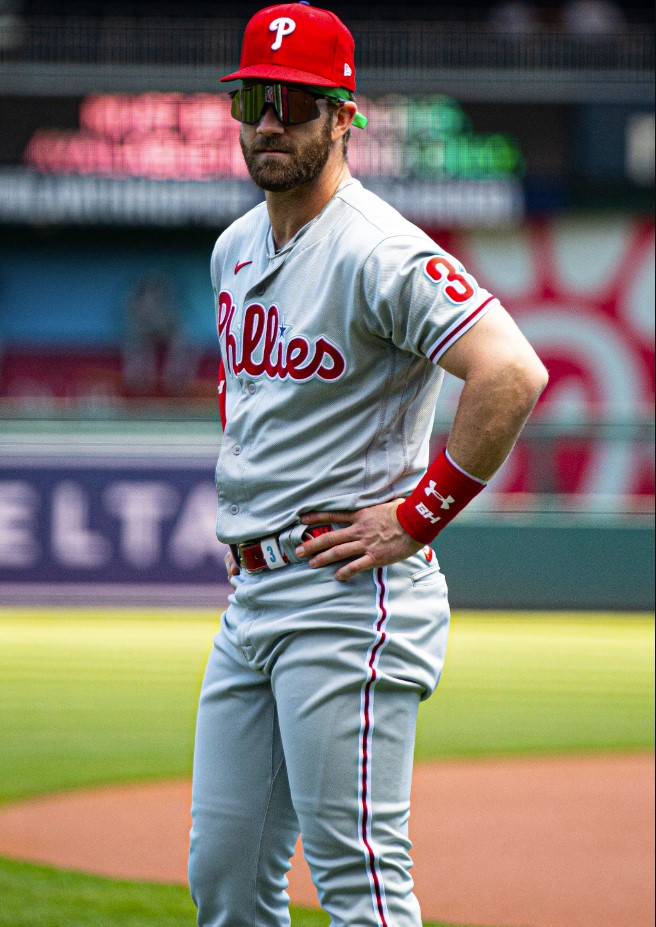
Player of the Month – Bryce Harper, 1B, Phillies & Luis Arreaz, 2B,Padres
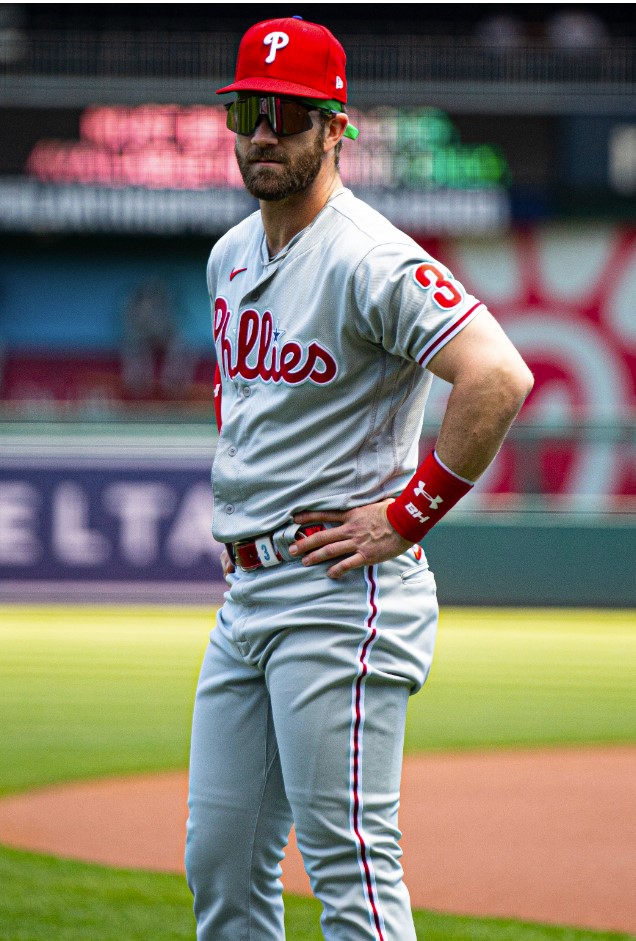
Photo: All-Pro Reels from District of Columbia, USA, CC BY-SA 2.0 <https://creativecommons.org/licenses/by-sa/2.0>, via Wikimedia Commons

Bryce Harper had a solid May, hitting .313, with an NL-leading (tied) seven home runs, as well as a league-leading 24 RBI. His 19 May runs scored tied for third in the NL. Harper had nine multi-hit games and six multi-RBI games during the month. In a three-game span from May 5 through May 7, Harper went seven -for-twelve, with three home runs and ten RBI. The Phillies won all three contests. Harper ended May at .270-13-42 on the season. Harper also drew 16 free passes, giving him a .407 on-base percentwge for the month.
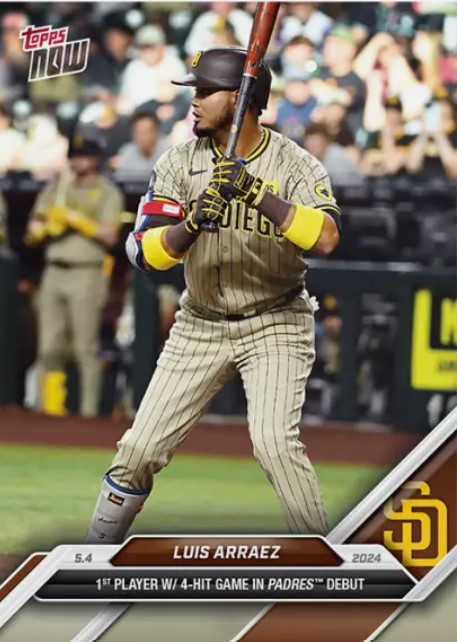
You can’t talk May without lookin at Luis Arreaz’ trade from the Marlins to the Padres.  At the time of the trade (May 4), Arreaz (the 2022 AL batting champion and 2023 NL batting champ) was hitting “just” .299 on the season.  After the trade, he hit .398 over the remainder of May – raising his average to .342 and taking the lead in the NL batting race. From May 14 through May 23, Arreaz had eight straight multi-hit games – going 20 for 38 (.526), with two doubles, a home run, four RBI and four runs scored. Over the course of the month, he had 13 multi-hit games, including four four-hit contests. He had an MLB-high 44 hits in 26 contests. Arreaz’ stat line for the full month was .389-1-11, with 16 runs scored.

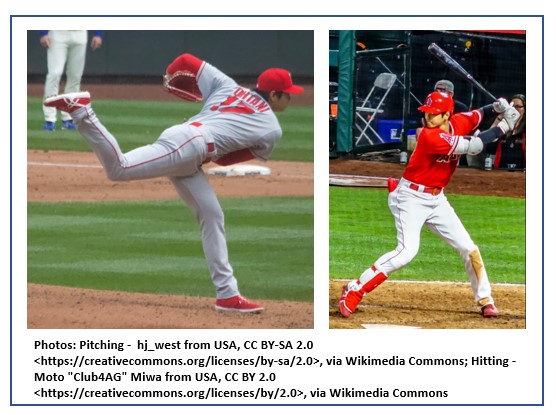
Honorable Mention: Dodgers’ DH Shohei Ohtani put together a .312-7-19, month – and stole eight bags in eight tries.

Pitcher of the Month – Chris Sale, LHP, Braves
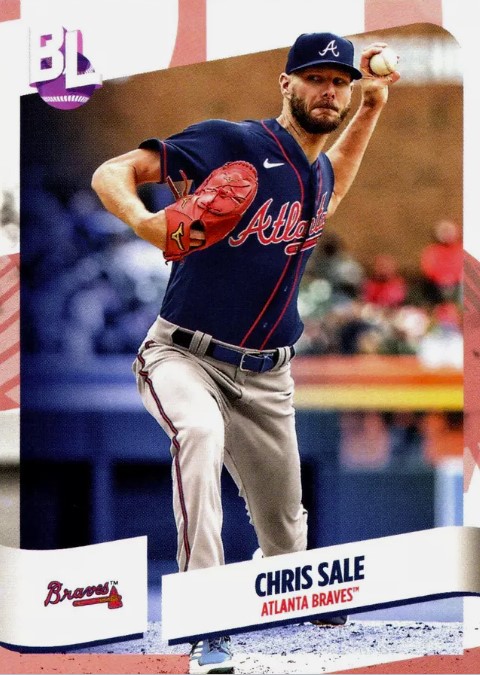
Chris Sale went 5-0 in five May starts and his 0.56 earned run average was lowest among MLB pitchers with at least 25 May innings). The southpaw was second in  the NL in strikeouts (45 in 32 innings), while walking just two batters. Between his May 8 start and the second inning of his start on May 26, Sale pitched 21 consecutive scoreless innings. He had a 0.78 WHIP for the month (second in the NL among pitchers with at least 25 May innings), held hitters to a .193 average and did not give up a single home run. At the close of May Sale was 8-1, 2.12 on the season.

Honorable Mentions: A shoutout goes to Rockies’ righty Carl Quantrill who went 4-0, 1.71 in five starts, with 32 strikeouts 31 2/3 innings. Quantrill’s month included two starts at hitter-friendly Coors Field (where he gave up three runs in 12 innings).  Quantrill came into the month 0-3, 5.34 on the season and improved his 2024 line to 4-3, 3.53. Mitch Keller also deserves recognition, going 4-0, 1.30 for the Pirates, including a complete-game, five-hitter in a May 6 4-1 win over the Angels. Another Rockie, Austin Gomber only picked up one win (1-0) in four May starts, despite a sparkling 0.68 eared run average in 26 2/3 innings pitched.  Gomber’s May performance was a bit of an eye opener. He came into the season with a 30-28, 4.90 record over five MLB seasons and was  0-2, 4.50 in April.

AMERICAN LEAGUE

Player of the Month – Aaron Judge, CF, Yankees
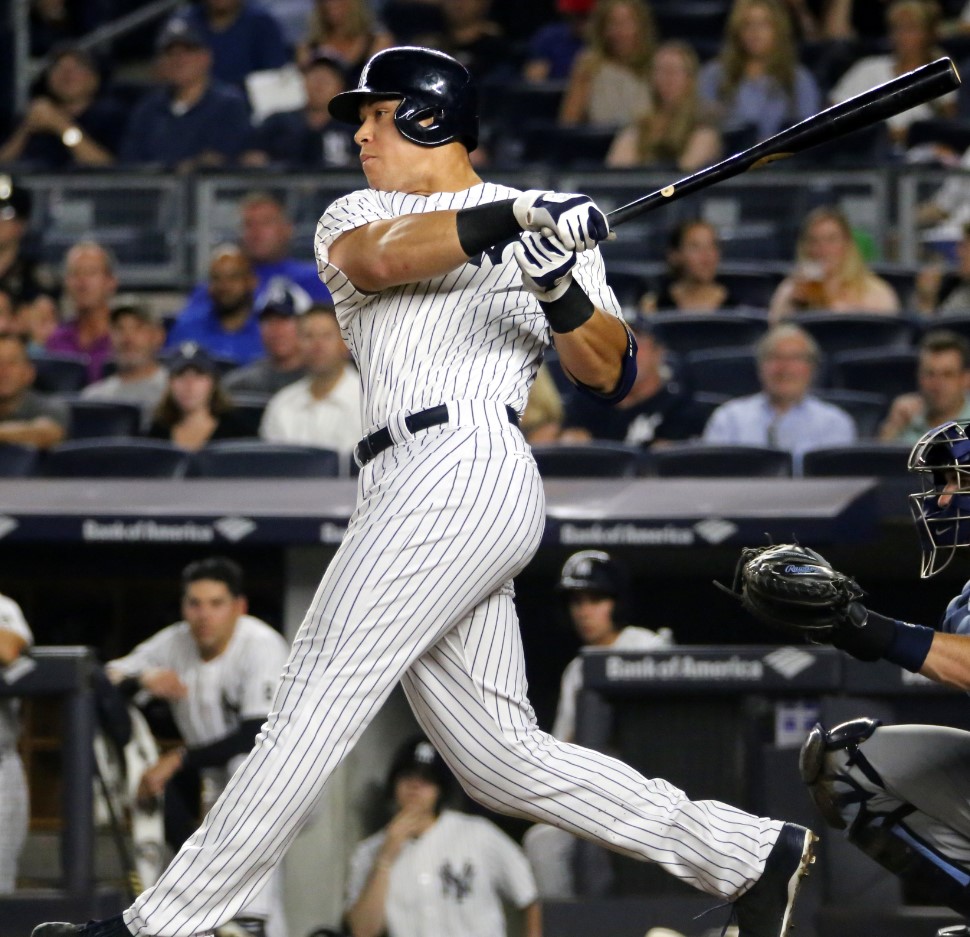
Photo: Arturo Pardavila on Flickr (Original version)  UCinternational (Crop), CC BY 2.0 <https://creativecommons.org/licenses/by/2.0>, via Wikimedia Commons

Aaron Judge’s bat literally exploded in May (okay, maybe not literally, but this is a blog not a novel). Judge hit .371 for the month (second among MLB players with at least 75 May at bats), with an MLB-leadings 14 home runs and an MLB-leading 24 extra-base hits. His 23 May RBI were second in MLB and his 28 runs scored first. He also drew 22 walks (second in MLB).  His On-Base + Slugging percentage of 1.416 far outdistanced the runner-up (among MLB players with at least 75 May at ats) –  Jose Ramirez at 1.061. Heck, Judge even stole a base.  Judge collected hits in all but six of his 27 May games and had ten multi-hit games. Over the course of the month, he raised his 2024 season average from .207 to .282.

Honorable Mentions:  Guardians’ 3B Jose Ramirez drove in an MLB-leading 33 runs in 28 May games.  He also finished (tied)  second in home runs with 11, while hitting .295 and scoring 23 runs. Ramirez had ten multi-RBI games in May and stole four bases in five tries.  Royals’ SS Bobby Witt. Jr. gave Kansas City fans a bit of everything, hitting .315-5-25, and tossing in two triples, seven doubles, seven steals and 26 runs scored.  He’s a major reason the Royals are one of the surprise teams of 2024.

Pitcher of the Month – Luis Gil, RHP, Yankees
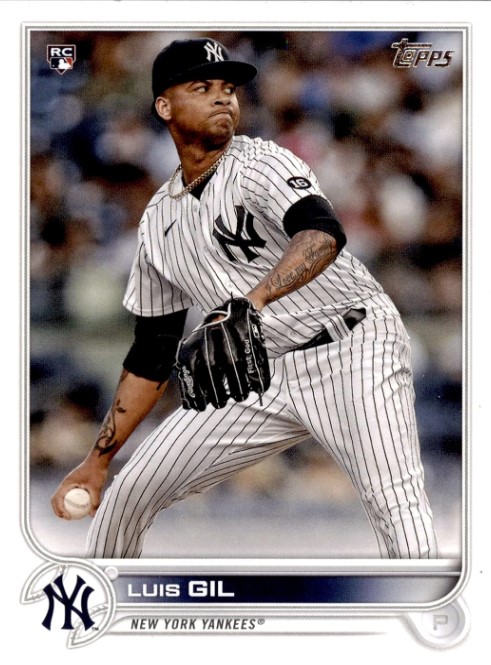
Wow!!! Luis Gil went 6-0 (the only MLB pitcher with six May wins) in six starts and delivered a 0.70 earned run average (second-lowest among AL pitchers with at least 25 May innings).  He also notched a league-leading 44 strikeouts (38 2/3 innings) and a stingy 0.67 WHIP and .109 batting average against.  In his six May starts, Gil never went less than six innings and never gave up more than one run. At the end of May, Gil’s record on the season was 7-1, 1.99. Gil was originally signed by the Twins in 2015 and traded to the Yankees in 2018. He’s coming off Tommy John surgery in 2022.  Side note: In seven minor-league seasons, Gil never won more than five games in a season and in two callups before this season, he went 1-1, 3.78 for the Bronx Bombers.

Honorable Mentions. Royals’ righty Seth Lugo went 5-0, 1.79 in six May starts, fanning 43 batters in 40 1/3 innings. At the end of May, Lugo, who had never won more than eight games in any of his eight previous MLB seasons, was 9-1, 1.72. White Sox’ southpaw  Garrett Crochet, went 4-1, 0.93 in May, fanning 38 batters in 29 innings.  He gave up just three runs in 29 May innings.


Surprise Player of the Month – Ben Brown RHP, Cubs
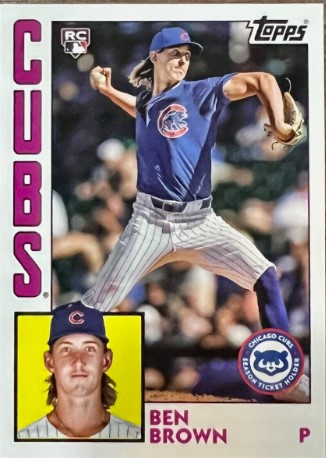
Ben Brown was signed out (Phillies) of Ward Melville High School (East Setauket, NY) in the 33rd round of the 2017 MLB draft. He was traded to the Cubs in November of 2022.  In six minor-league seasons – interrupted by Tommy John surgery in 2019 – he was 19-17, 3.67. Brown made his first MLB appearance on March 30 0f this season – giving up six earned runs in 1 2/3 innings.  At the end of April, he was 0-1, 4.30.  Then came May.  Brown made six appearances, three starts, and went 1-0.  The surprise? A 1.16 ERA. In his final two starts (May 23 & May 28) Brown went 11 innings and gave up just 1 hit, no runs, with four walks and 16 strikeouts.

Honorable Mentions: Bryan Woo of the Mariners went 2-0, 1.30 in five May starts, fanning 18 and walking just two in 27 2/3 frames.  I saw him as a little less of a surprise than Brown because he was a  sixth-round draft choice (in 2021) to Brown’s 33rd round. In 2023, Woo was 4-5, 4.21 in 18 start for Seattle.  Tigers’ 2B Colt Keith hit .342 for the month, with two home runs, 14 RBI and ten runs scored. This follows an April in which he hit .154-0-5 in 26 games. Maybe the April should be more of a surprise than the strong May. Keith, who signed as a teenager (fifth round, 2020 draft), did hit .306-27-101 at Double-A and Triple-A in 2023, after .301-9-31 at High-A in 2022.

__________________________________________

THE TROT INDEX … A REGULAR BASEBALL ROUNDTABLE FEATURE

Through May 31,  34.6% of the MLB season’s 64,638 plate appearances ended in a trot (back to the dugout, around the bases, to first base). We’re talking about strikeouts, home runs, walks, hit by pitch and catcher’s interference – all outcomes that are, basically, devoid of action on the base paths or in the field. Here’s the breakout: strikeouts (22.3%); walks (8.4%); home runs (2.7%); HBP (1.1%); catcher’s interference (less than 1%). Strikeouts, by the way, outnumbered base hits 14,422 to 13,875. 

The 34.6% figure is down  from 35.6% through May in 2023. I also looked into full-year Trot Index figures for the years I have been a fan: in 2023; 30.3% in 2010; 29.9% in 2000; 31.7% in 1990; 23.1% in 1980; 27.0% in 1970; 25.1% in 1960; and 22.8% in 1950.

________________________________________
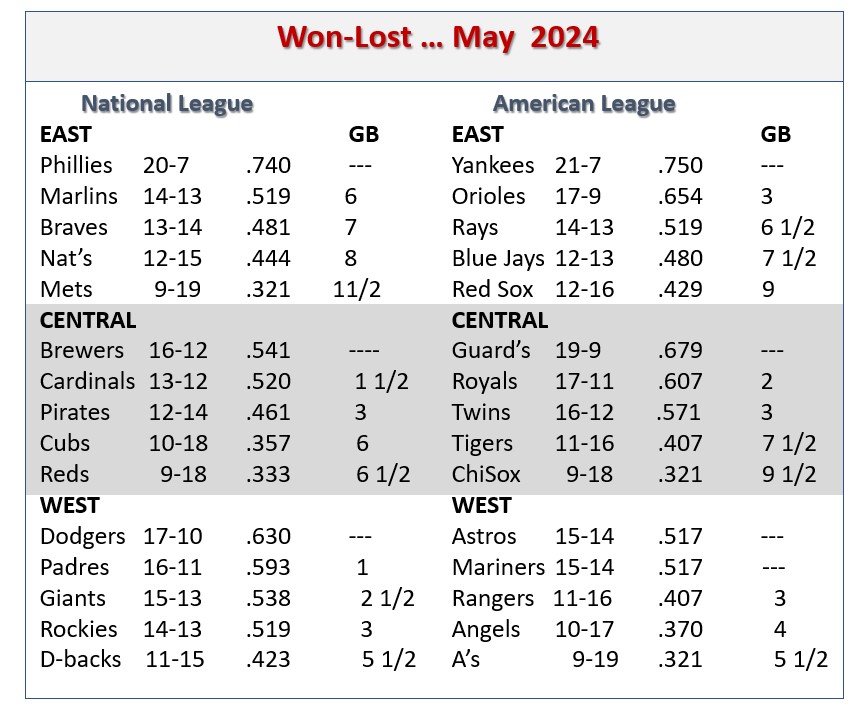
 

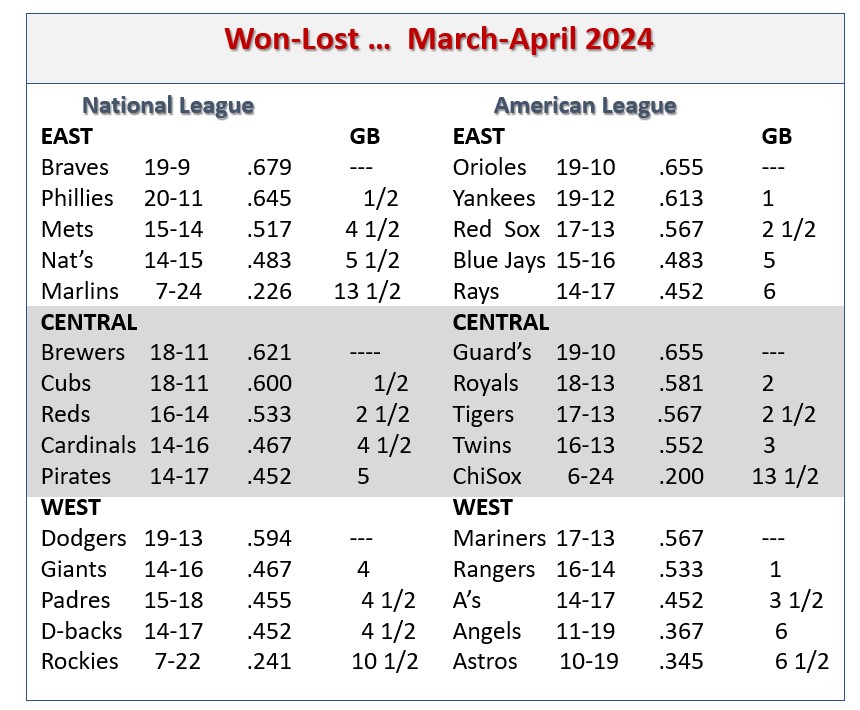
The Phillies Run (20-7)

The Phillies were one of MLB’s hottest teams in May – putting up a 20-7 record, after going 20-11 in March/April. They moved from second place 1/2-game behind the Braves to first place with a six-game edge on the Marlins. And, the Phillies were hitting on all cylinders.  They scored the most May runs in MLB (156), led by the likes of : 1B Bryce Harper (.313-7-24); DH Kyle Schwarber (.297-3-18); and SS Edmundo Sosa (.306-3-13). Overall, they had six players with 15 or more May RBI.

Just as – or even more -important was the Phillies’ status as the May NL ERA leaders (and one of just four teams with earned run averages under 3.00 for the month). The Phillies’ staff put up a 2.62 ERA in May and gave  up the fewest earned runs in the NL (72).  The Phillies’ total runs surrendered of 87 was second (fewest) only to the Dodger’ 82 in May.  Key contributors included: starters Ranger Suarez (4-1, 2.32); Zack Wheeler (4-0, 2.72); Aaron Nola (3-1, 2.84); and Christopher Sanchez (2-0, 2.03).  Out of the bullpen, Matt Strahm went 2-1 in 13 games, giving up just one (unearned) run in 12 frames; Jose Ruiz put up a 1.04 ERA in nine appearances; Jeff Hoffman had a 0.84 ERA and four saves); and Jose Alvarado was 2.13 with five saves.  Overall, the Phillies used 13 pitchers and ten put up earned run average south of 3.00.

The Yankees (21-7)

Like the Phillies, the Yankees pitching was dominant (see a pattern here). The teams 2.40 ERA was MLB’s lowest, as were their 66 earned runs and 73 total runs surrendered. It all starts with Luis Gil (6-0, 0.70 in six starts). They were also strong contributions from veteran starters Marcus Stroman (3-1, 1.91); Carlos Rodon (5-1, 3.67). Those three accounted for 14 of the Yankees 21 wins (seven losses). Clay Holmes saved seven games in nine chances (3.67 ERA).  The Yankee offense put up 135 runs (third in the AL) led (as your would expect) by CF Aaron Judge (.371-14-27) and RF Juan Soto (.296-7-24).  The Yankees moved from one game behind the Orioles at the end of April to three games up on the Birds at the end of May.

Pitching-Pitching-Pitching

The four teams with ERA’s below  3.00 (Yankees, Phillies, Orioles and Dodgers) went a combined 75-33 in May. The five teams with ERA’s north of 4.50 (Mets, D-backs, White Sox, A’s and Tigers) went a combined 49-88).

A Royals Surprise

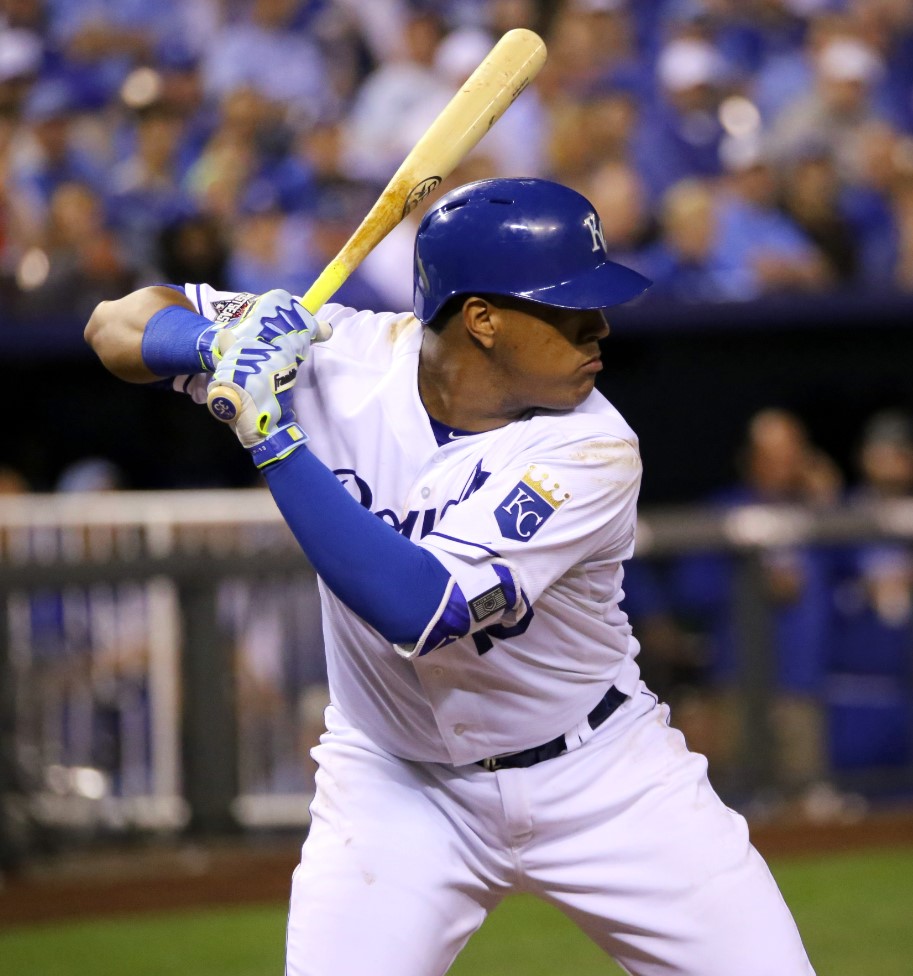
The Kansas City Royals (17-11 in May, led the AL in scoring for the month, with 148 runs – and showed a balanced offense: SS Bobby Witt, Jr. (.315-5-25); 2B Michael Massey (.333-5-18); 3B Maikel Garcia (.305-1-15); C Salvador Perez (.284-3-15).  Overall, they had three players with 50 or more at bats hit .300; five players with 15 or more RBI; and six with 12 or more runs scored.  Their 3.85 ERA was 11th in MLB and fifth in the AL. Seth Lugo was the heart of the staff at 5-0, 1.79.

See full year-to-date standings at the end of this post. 

——-Team Statistical Leaders for May 2024 ———-

RUNS SCORED

National League – Phillies (156); Brewers (144); Giants (133)

American League – Royals (148); Guardians (141); Yankees (135)

The fewest runs in May were scored by the White Sox (82). In the National League it was the Reds at 84.  Also under 100 runs were the  Braves (93); Diamondbacks (97); and Cubs (99).

AVERAGE

National League – Padres (.269); Brewers (.260); Phillies (.259)

American League –Royals (.269); Yankees (.261); Astros (.251)

The lowest team average for May belonged to the Reds at .213. The lowest in the AL was the White Sox (.217). 

HOME RUNS

National League – Dodgers (39); Brewers (30); Cardinals (30)

American League – Yankees (47); A’s (35); Angels (35); Guardians (35)

The Nationals, Rays and White Sox tied for the fewest home runs in May at 20.  

The Yankees led MLB in slugging percentage for at .470.  The Dodgers led the NL at .424.

Hmm? Does This Mean Anything?

Eight of the top nine teams in May home runs were in the AL. By comparison, the top eight spots in slugging percentage were split evenly among AL and NL teams.

TOTAL BASES

National League – Brewers (403) ; Phillies (384); Dodgers (383)

American League – Yankees (437); Royals (414) A’s (391)

STOLEN BASES

National League – Nationals (40); Brewers (36); Phillies (36)

American League – Rays (29); Royals (24); Guardians (24)

The Giants stole the fewest sacks in May   – six in eight attempts.   The Tigers were at the bottom of the AL, with eight  in 14 attempts. 

WALKS DRAWN

National League –   Phillies (103); Cubs (96); Brewers (94)

American League – Rays (105); Blue Jays (93); A’s (93); Guardians (93)

The Phillies led MLB in May On-Base percentage at .337. The Yankees led the AL at .330.

BATTER’S STRIKEOUTS

National League –  Pirates (251); Cubs (249); Mets (249)

American League – Mariners (288); A’s (275); Red Sox (263)

Padres’ batters fanned the fewest times in May (174). The Blue Jays had the fewest whiffs in the AL at 176.  They were the only two team under 200 strikeouts for May. 

Bonus Stats

  • Three teams (Braves, Twins and Mariners) recorded zero sacrifice bunts in May. No team recorded more than seven (Royals).
  • The Braves are the only team to not record a single sacrifice bunts since Opening Day.
  • Mariners’ batters were hit by a pitch an MLB-leading 18 times in May. The Angels suffered the fewest HBP – four.
  • Year-to-date, Guardians hitters have bene plunked an MLB-highest 44 times, nine ahead of the second-place Twins.
  • The Giants grounded into an MLB-highest 32 double plays in May. The Cardinals hit into an MLB-low eight.

_______________________________________

EARNED RUN AVERAGE

National League – Phillies (2.62); Dodgers (2.93); Braves (3.30)

American League – Yankees (2.40); Orioles (2.86); Guardians (3.53)

The Mets had the highest May  ERA at (4.85).

STRIKEOUTS

National League – Padres (265); Cubs (263); Giants (262)

American League – Astros (246); Yankees (241); Red Sox (239))

The Padres averaged an MLB-best 9.94 strikeouts per nine innings in May. The Yankees averaged an AL-best 8.78.  Four teams averaged nine whiffs per nine or better – all in the NL (Padres, Cubs, Giants, Braves).

FEWEST WALKS SURRENDERED

National League – Padres (61); Dodgers (66); Cardinals (68)

American League – Twins (60); Blue Jays (64); Tigers (67)

The Twins walked an MLB-lowest 2.18 batters per nine innings in May.  The Rangers walked an MLB-worst 4.22 batters per nine frames.

SAVES

National League – Brewers (9); Cardinals (9); Rockies (9)

American League – Twins (11); Guardians (10); Orioles (10)

The Mets blew the most saves in May  – recording seven  blown saves in 12 opportunities.

Walks+ Hits/Innings Pitched (WFIP)

National League – Dodgers (1.05); Padres (1.12): Phillies (1.15)

American League:  Yankees (1.02); Orioles (1.11); Mariners (1.13)

Bonus Stats:

  • The White Sox. Astros and Mets each gave up an MLB-high 35 home runs in May. (The Orioles gave up an MLB-low 15 home runs.
  • The Yankees held opponents to an MLB-low .196 average in May. The Diamondbacks’ staff was touched for an MLB-high .277 average.
  • The Padres’ strikeouts-to-walks ratio for May topped MLB at 4.34. The Rockies had MLB’s worse ratio at 1.76.

 – MAY HIGHIGHTS –  

Roundtable Extra Observation – Not an On-Field Highlight

The biggest thing that happened in May (at least for followers of MLB history) may not have been on the field at all. It may have come on May 27, when MLB announced the further (overdue) documentation and incorporation of Negro League records into the MLB record books. (In 2020, MLB announced seven Negro Leagues from 1920-48 would be recognized as major leagues). Given that Negro League seasons were shorter than AL and NL seasons, the Roundtable expects the greatest impact on the leader boards will be on percentage statistics as opposed to raw number stats (i.e. batting average versus number of hits). For example, Josh Gibson’s career .372 batting average, has supplanted Ty Cobb’s .367 as MLB’s highest career average; Gibson’s .718 career slugging percentage is now the MLB’s highest; moving Babe Ruth’s .690 to second place; and Gibson’s  .466 batting average in 1943 is now the single-season mark.   Another example, is Negro League pitcher Dave Brown, now atop the career winning percentage list at .738 over six seasons.

There are also some changes for AL/NL players who begam their careers in the Negro Leagues.  Hall of Famer Minnie Minoso is now a member of the 2,000-career-hits club and Joe Nuxhall is no longer the only 15-year-old to play in the major leagues.  He’s been joined by Roy Campanella, who began his career with the Baltimore Elite Giants as a 15-year-old (awaiting confirmation, but it appears Campanella is now the youngest major leaguer ever).

Don’t want to belabor the point, but it exploring the impact of this change in recordkeeping – and incorporating it into blog articles – should be interesting.

Jose Ups His Game

On May 3, as the Astros edged the Mariners 5-3, Astros 2B Jose Altuve showed that there is still some speed left in his 34-year-old legs. In the bottom of the seventh, with the score knotted at three-three, one out and a runner on third, Altuve laid down, and beat out, a perfect bunt on a suicide squeeze – plating the go-ahead run. Two pitches later, he stole second and later scored an insurance run. The steal, by the way, was Altuve’s seventh of the season and 300th of his career. 

Now in his 14th MLB season (all with the Astros, Altuve has a .307-218-767 career line, with 301 steals and 1,096 runs scored (as of close of play May 31).  The eight-time All Star has led the league in hits four times (over 200 hits each time), steals twice and batting average three times.  At the end of May, Altuve was .291-9-20, with 34 runs on the season.

When It Rains, It Pours, Just Ask Brent Rooker
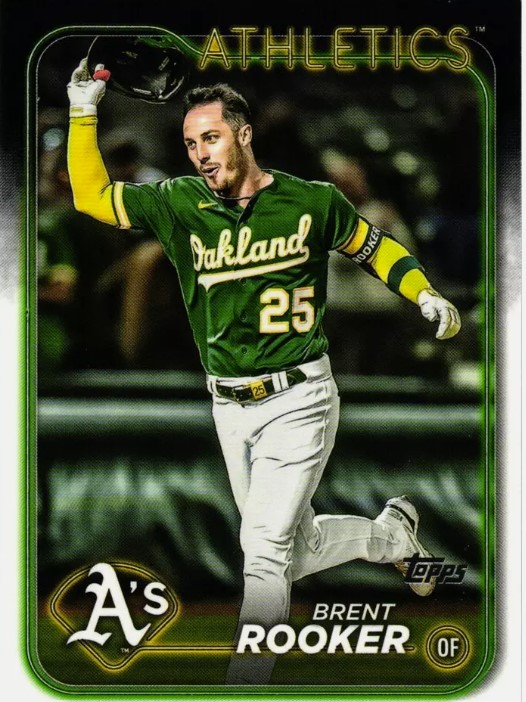
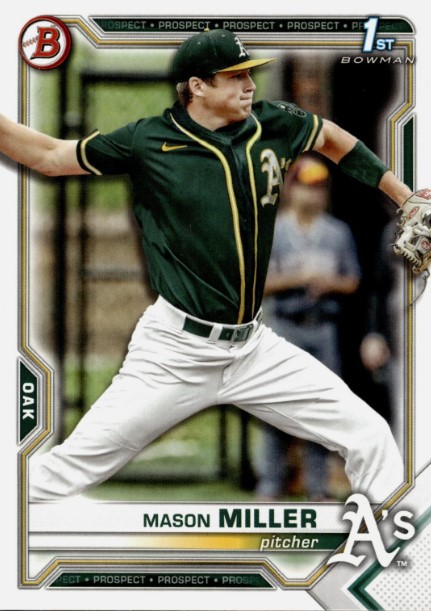
The Oakland A’s May 4 game (in Oakland) against the Marlins was delayed for nearly 3 ½ hours by a pouring rain.   For A’s DH Brent Rooker, it was worth the wait, as he poured on the power in the third inning. With the A’s up 2-0, no outs and a runner on first, Rooker homered on a 3-2 pitch from Marlins’ starter Trevor Rogers.  Eight batters later (or nine, depending on how your count it), Rooker was again at the plate, this time against reliever Darren McCaughan, with two-on and one out and the A’s up by a 9-0. This time, he homered on an 0-1 pitch.  This made Rooker the 60th player to smack two homers in one inning – the first A’s player to do so since Mark McGwire on September 22, 1996.  At the end of May, Rooker was .280-11-35 on the season.

Muncy Shoots a Three

May 4, as the Dodgers toppled the Braves 11-2, LA 3B Matt Muncy went four-for-five, with three runs scored and four RBI.  It makes the highlights because three of Muncy’s hit were home runs, the power hitter’s first-ever three-homer game. Muncy ended May hitting .223-9-28 on the season..

Double Your Pleasure –  Double Your Fun

On May 8. The A’s and Rangers faced off in a doubleheader in Texas. At the time, A’s catcher Shea Langeliers was hitting .179, with seven long balls and 16 RBI in 32 games. Playing two, however, seemed to agree with Langeliers. in Game One, a 9-4 Oakland win, he went three-for-four with a double, a triple a home run and five RBI.  Then in Game Two, now serving as DH, Langeliers went two-for-five, with another home run and three RBI.  (The Rangers prevailed 12-11.) The eight runs driven is set a record for RBIs in a doubleheader for a player in an Oakland A’s uniform (the A’s moved to Oakland in 1968).  At the end of May, Langeliers was hitting .211-12-29 on the season.

I’m a Travelin’ Man

Luis Arraez won the American League batting champion (.316 average) with the Twins in 2022.  Then, in January of 2023, he was traded to the Marlins. He went on to win the 2024 NL batting crown (.354) with the Marlins – making him the first MLB player to win a batting title in the AL and NL in consecutive seasons.    On May 4 of this season, he was traded to the Padres from the Marlins – he was hitting .299 at the time – giving him a chance to be the first MLB player to win a batting title with three different teams – and he could do it in consecutive seasons.

Since joining the Padres, he has hit .398 (through May 311), raising his overall season average to .342.  A couple of other notes:

  • In his first game as a Padre (May 4), he collected four hits in six at bats.
  • In his first home game as a Padre (May 10), he had a ninth inning, walk-off, game-winning RBI single in a 2-1 win over the rival dodgers.
  • He recorded ten multi-hit games in his first 17 games as a Padre, hitting .419.

Third-to Home?  It’s a Walk in the Park

The Cubs came into the top of the fifth inning of their May 11 games versus Pirates trailing 6-1.  By the end of the inning, they would enjoy an 8-6 lead – scoring seven runs on just three hits. Spoiler alert: All seven runs scored after two outs and there were six based-loaded walks.  It went like this:

DH Mike Tauchman … Double off Paul Skenes.

RF Seiya Suzuki … Ground ball double, Tauchman holds at second.

Kyle Nicolas replaces Skenes on the mound.

CF Cody Bellinger … Strikes out on four pitches.

3B Christopher Morel … Strikes out on six pitches.

LF Ian Happ … Hit-By-Pitch, loading the bases.

SS Nico Hoerner … Four-pitch walk, forcing in a run.

1B Michael Busch … Four-pitch walk, forcing in a run.

2B Miles Mastrobuoni … For -pitch walk, forcing in a run.

Josh Fleming replaces Nicolas on the mound.

C Yan Gomes … Five-pitch walk, forcing in a run.

Tauchman … RBI single, bases still loaded.

Two-Hour and 20-minute rain delay.

Colin Holderman replaces Josh Fleming on the mound.

Suzuki … Four-pitch walk, forcing in a run.

Bellinger … Five-pitch walk, forcing in a run.

PH Nick Madrigal … Lineout to center.

In a bit of irony, the Pirates actually came back to win the game 10-9.

Seth (Lu)go-ing Strong … 12 on the 12th
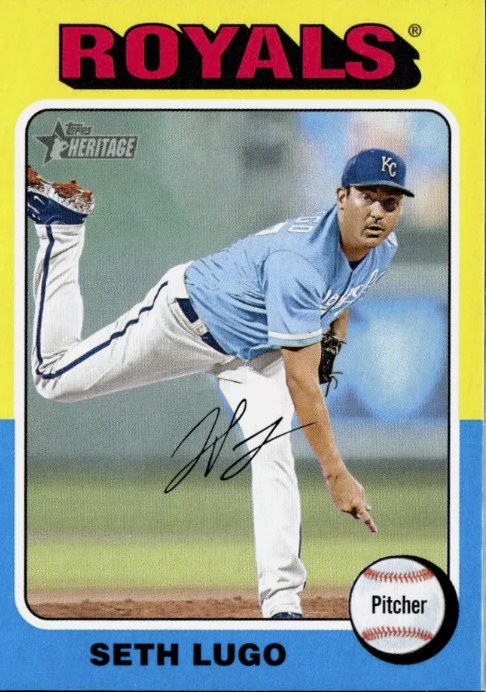
Coming into the 2024 seasons, 34-year-old Royals’ right-hander Seth Lugo had never won more than eight games in a season (8-7, 3.57 for the Padres in 2023). That changed this season, as Lugo closed May with a 9-1, 1.72 record on the season. His performance needs to be highlighted, so we’ll give him a shoutout for his May 12 game against the Angels (a 6-1 Royals win). Lugo went eight frames, giving up just one run on five hits, walking no one and putting up a career-high 12 strikeouts.

 Lucky 13
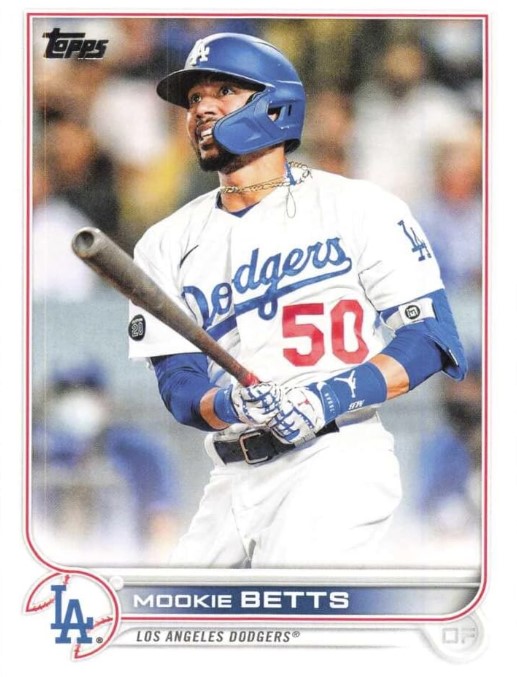
On May 13, as the Dodgers topped the Giants 6-4 in ten innings (in San Francisco), Dodgers’ SS (and leadoff hitter) Mookie Betts went two-for-five with two runs scored and one RBI. It was his first hit that helped make the game memorable. It came as Betts leadoff the top of the first – on a 1-2 pitch from Jordan Hicks – and it was Betts’ 50th leadoff home run. That gave him the fifth-most MLB leadoff homers all-time. He trails only Rickey Henderson (81); still-active George Springer (57); Alfonso Soriano (54); and Craig Biggio (53).

A Freak Injury Leads to a Memorable First Bingle

On May 7, during the second inning of a 7-5 Cardinals’ loss to the Mets, Saint Louis’ veteran catcher Willson Contreras suffered a fractured forearm when hit on the swing by Mets’ DH J.D. Martinez. To add insult to injury, Contreras was called for catcher’s interference on the play, and Martinez was awarded first base.   Contreras’ injury, indirectly, led to rookie catcher Pedro Pages first big MLB hit.

The 25-year-old pages started the season as the third catcher for the Redbirds, but was optioned back to the minors on May (after just five games and four plate appearances). He was called back up after Contreras’ mishap – to serve an expanded role as the number-two backstop.  On May 14, in his second game in the lineup after his return to the Cardinals, Pages collected his first MLB hit.  It was a third-inning, three-run double off the Angels’ Reid Detmers – part of a 7-6 Cardinals’ victory. #InBaseballWeCoutEverything … Elias Sports Bureau reported that Pages is the first Cardinal to record at least three RBI on his first MLB hit since Tim Worrell in 2008.

For those who like to know such things, Pages was a sixth 2019 Round MLB Draft choice out of Florida Atlantic University (where he hit .295-14-98 in 143 games over three seasons). In five minor-league seasons, he has hit .256-38-178 in 340 games.

Four-for-Four … and Four-for Five … in The Same Game

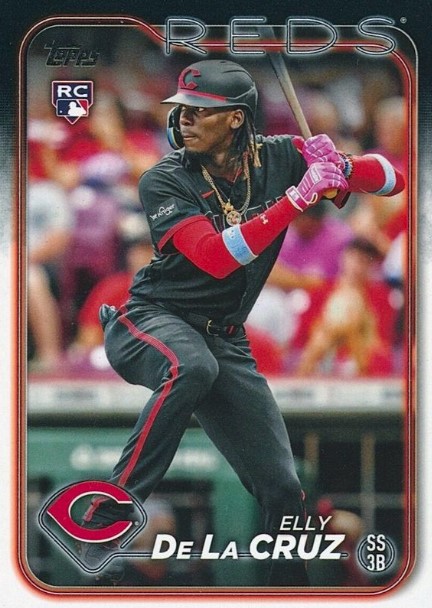
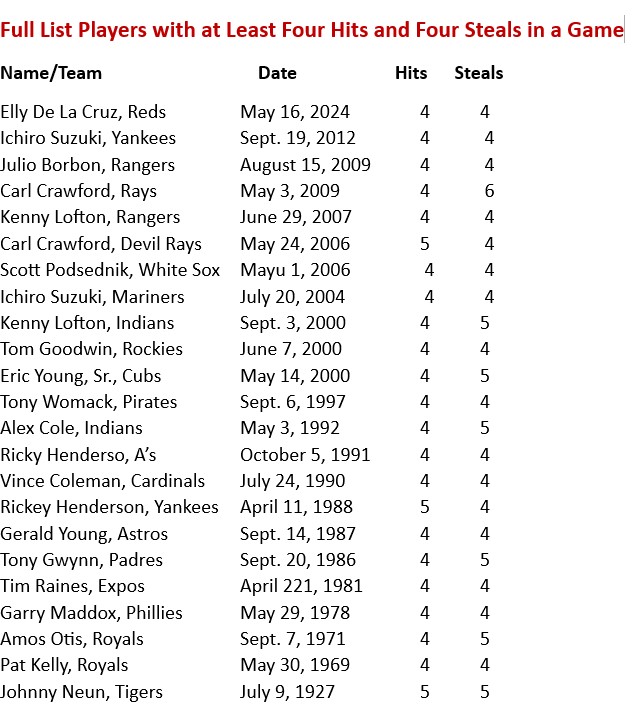
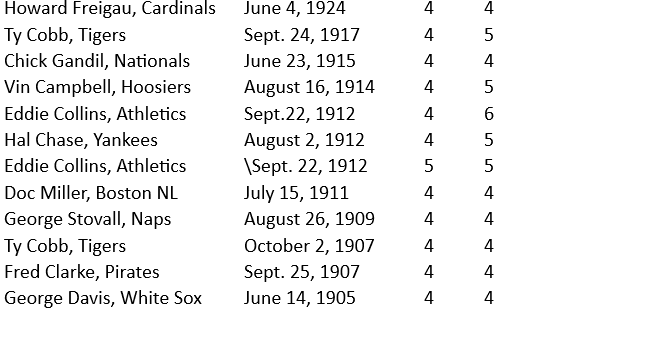
On May 16, the Reds’ dynamic (21-tar-old) SS Elly De La Cruz went four-for-four at the plate (three doubles and a single) AND four-for-five on the bases (four steals/one caught stealing) to become just the 29th player in the Modern Eras (post-1900) to collect four hits and four steals in a single game. For more on De La Cruz (and the others who have had a four-hit-four steal game), link here.

Let’s Put Up Some Numbers

Coming into the Giants/Rockies game on May 17, San Francisco’s 22-year-old CF Lui Matos had .250-1-6 on the season and had driven in a total of 20 runs in 81 major-league games.  That was about to change. On the 17th, as the Giants topped the Rockies 10-5, Matos set a career-high for RBI in a game – going two-for-three with two doubles and five runs driven in. The very next day, in a 14-4 triumph over the Rockies, he did himself one better, going three-for-five, with a double, a homer and six RBI. So, at the close of play on May 18, Matos had recoded 64.5 percent of his career RBI in 2.4 percent of his MLB games. #InBaseballWeCountEverythning – Those 11 RBI tied Matos for the Giants’ franchise record for RBI in any two-game span.

More #InBaseballWeCountEveything
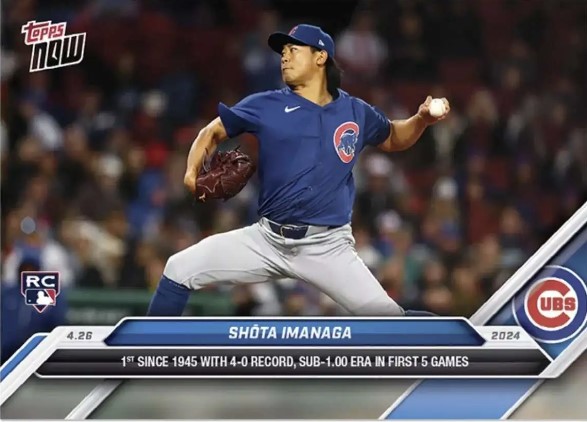
On May 18, Cubs’ southpaw Shota Imanaga may have gotten a no-decision – despite seven scoreless innings (four hits, one walk, seven whiffs) – in Chicago’s 1-0 win over Pittsburgh, but he also earned a little bit of history. During the outing, his ninth MLB start, Imanaga lowered his earned run average from an already minuscule 0.96 to 0.84 – the lowest mark over a pitcher’s first nine starts since ERA became an officially reported MLB statistic (1913).

The previous “record holder” Fernando Valenzuela, had a 0.91 ERA over his first nine starts.

There are some differences:

  • The nine starts span represented Imanaga’s first nine MLB appearances. Valenzuela had made ten relief appearances with a 0.00 earned run average the previous season.
  • Imanaga is a 30-year-old, in his first MLB season, but with eight seasons in Japan under his belt; while Valenzuela was 20-years-old, in just his third professional season.
  • Valenzuela’s span of nine starts included 79 innings pitched. seven complete games, five shutouts and only one outing of less than nine frames; Imanaga’s nine-start span included 53 2/3 innings pitched and no outing of more than seven innings.

When You Count Counts

In his first nine MLB starts, Shota Imanaga gave up just five earned runs in 53 2/3 innings.  In start number-ten, he surrendered seven earned runs in 4 1/3 frames.

Here’s a look at their ERA’s along the way;

                               Imanaga    Valenzuela

After Game One             0.00             0.00

After Game Two`           0.00             0.50

After Game Three `       0.00             0.33

After Game Four           0.84             0.25

After Game Five            0,98             0.20

After Game Six              0.78             0.33

After Game Seven        1.08             0.29

After Game Eight          0.96             0.50

After Game Nine           0.84             0.91

After Game Ten             1.86             1.24

Taking One for the Team

The May 18 Angels-Rangers tilt (in Texas) seemed like a lesson in futility. The two teams were tied 2-2 after nine frames and despite the placed runners (at second base) in innings 10,11 and 12, were still knotted at two in the thirteenth. In fact, going into the bottom of the thirteenth the two teams were one-for-29 with runners in scoring position and had left a combined 20 runners on base. The Rangers walked-it-off in the bottom of the 13th, when 1B Nathaniel Lowe took one for the team. The inning started with Travis Jankowski placed at second. Pinch hitter Ezequiel Duran singled him to third. 2B Marcus Semien then lined out and SS Corey Seager was walked to load the bases. Lowe was then hit by a pitch to bring home the winning tally.

Way to Go Rook

On May 18, Yankees righty Luis Gil pitched a gem in a New York 6-1 win over the White Sox.  The rookie (he appeared in seven games for the Yankees in 2020-21 (1-1, 3.78) went six innings, giving up five hits and one earned run -while fanning 14. Those strikeouts, according to Elia Sports Bureau, were a record for a Yankee rookie.

The Roundtable Loves a Good Coincidence

On May 18, when Luis Gil set a new Yankee record for strikeouts by a rookie in a game at 14, he broke Orlando Hernandez’ record for K’s by a rookie (13). Coincidentally, Hernandez threw the ceremonial first pitch that day.

In his six frames, Gil threw 98 pitches (65 strikes) and seemed to get stronger as the game progressed (he faced seven of his total of 24 batters in the first inning, when he gave up his only run). Gil fanned the side in order in the fourth and fifth innings and in the top of the sixth (his final inning) he went strikeout, single, strikeout, strikeout.  Of his 14 whiffs, 12 came on swings and misses.

A Handful of Homers – Plus One

On May 20, in an 5-0 Boston win over Tampa Bay, Rafael Devers set a new Red Sox franchise record by homering in his sixth consecutive game. Over the six-game span, Devers had seven hits (one single, six dingers) in 24 at bats, scoring eight runs and driving in nine.  Despite Devers’ power display, the Red Sox lost four of the six games:  For those who like to know such things:

  • The previous Red Sox record of homering in five consecutive games was shared by Jimmie Foxx, Ted Williams, Dick Stuart, George Scott, Jose Canseco, and Bobby Dalbec.
  • The MLB record for homering in consecutive games is eight, shared by Dale Long, Pirates (May 19-28, 1956); Don Mattingly, Yankees (July 8-18, 1987); and Ken Griffey Jr. (July 20-28, 1993).

Shut ‘Em Down – Then Light ‘em Up

On May 14, the Marlins shutdown the Tigers (in Detroit) holding the Bengal’s to four nits in a 1-0 ten-inning Marlin’s win. They followed that up with a 2-0 win over the Tigers on the 15th and an 8-0 win over the Mets (in Miami) on the 17th. It was the first time the Marlins had recorded three straight shutouts since 2005 (and the third time overall). The Marlins changed their approach on the 18th – recording their fourth straight win (their longest win streak of the season), topping the Mets 10-9 in ten innings.

For Those Who like to Know Such Things

The most consecutive shutout win by a team is six, by the Pirates from June 1, 1903 through June 9, 1903. All six games were home contests and the Pirates prevailed by a combined 32-0. The wins, all complete games (Deacon Phillipe 2; Sam Leever 2; Irvin Wilhelm and Ed Dohey) started a 14-game win streak that included eight shutouts.

Skenese on the Scene
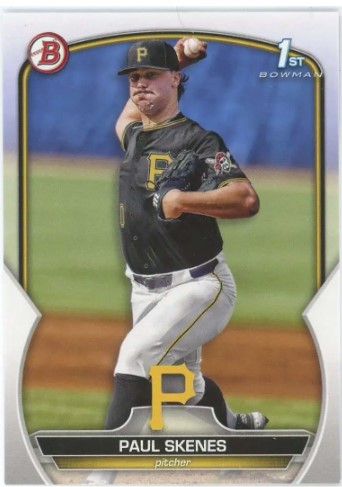
You often here about “the long-awaited arrival” of ballyhooed (always wanted to use that word in a post) MLB rookies.  Well, that’s not the case with the Pirates’ Paul Skenese – the number-one overall pick in the 2023 MLB draft, who made it to the majors after just 12 minor-league appearances  In that dirty dozen outings, he went 0-0-1.85, with 55 strikeouts (just ten walks) in 34 innings.

Skenese wasted no time making his mark on the MLB scene. He made his MLB debut on May 11 (versus the Cubs) and, while he lasted only four innings (six hits, three runs, two walks, seven strikeouts) he made an impression – reaching 100 MPH or higher on 17 pitches.

In his second start – again against the Cubs – on May 17, Skenes struck out the first seven batters he faced and a total of 11 (one walk) in six hitless, scoreless innings (picking up his first MLB win as the Pirates prevailed 9-3). Elias Sports Bureau reported that Skenese became the first Pirate to fan the first seven batters in a game – just one short of the longest streak to open a game (since 1920), by Jacob deGrom (Mets – September 15, 2014) and Jim Deshaies (September 23, 1986).

Skenese closed out May with a 2-0, 2.45 record in four starts – with 30 strikeouts and just five walks in 22 innings.

Skenese played college ball at the Air Force Academy and Louisiana State where, in three seasons, he was a combined 24-6, 2.18 – with 335 strikeouts in 235 innings. Over his college career, he also hit .367-24-81 in 100 games.

We Recognize You

In 2023, with Louisiana St University, Paul Skenese was the Division One National Baseball Player of the Year, The College Baseball Foundation’s National Pitcher of the Year, SEC Pitcher of the Year, a first-team All American the Dick Howser Trophy winner and the College World Series Most Outstanding Player. 

More #InBaseballWeCountEvrythning. On May 29, Skenese picked up his second MLB win, going six innings and giving up just three hits and two runs in a 10-2 Pirate win over the Tigers.  That happened to be his 22cnd birthday and his nine strikeouts that day were the most strikeouts by a Pirates’ pitcher on his birthday.  A little deep into the woods there?

Power AND Speed

Red Sox speedy CF Jarren Duran really came into his own in 2023 – when he played in 102 games for the Red Sox and hit .295-8-40, with 24 steals in just 26 attempts. As May closed, he had played in 58  games, hitting .253-3-23, with 32 runs scored and 11 steals.  He also had a league-leading eight triples.

On May 21, Duran flashed a bit of power and speed, as the BoSox topped the Rays 5-2 in Tampa Bay. Duran went one-for-four, with two runs scored and on RBI – but it was how he scored those runs that made this game specials.

Duran led off the sixth frame (versus Zack Littell, with a game- tying (2-2) solo home run to deep center field. Then in the eighth inning, after drawing a walk off Jason Adam (with CF Ceddanne Rafaela on first), Duran moved to third on a run-scoring single by RF Wilyer Abreu. Later in the frame, with two outs, and 3B Rafael Devers on first and Duran on third, the Red Sox pulled off a double steal. Rays’ C Ben Rortvedt tried to throw out Devers at second and Duran headed for home. He beat the return throw to the plate with a headfirst slide. (It was, by the way, the first Red Sox steal of home since the 2016 season – and was made all the sweeter by coming in a game when Duran also had a dinger).

Happy Birthday Zebby … From a Twins Fan

As a Minnesotan, I’d be remiss if I didn’t mention how darn controlling Zebby Mathews can be.  On May 22, the Twins farmhand celebrated his 24th birthday by taking the mound for the Wichita Windsurge.   In the fifth inning, a rare thing happened. Mathews issued a walk.  Why rare? It was his first walk of the 2024 minor-league season – in his seventh start and after facing 141 batters and recording 49 strikeouts. Mathews’ last walk had come in his final start of 2023 (High-A Cedar Rapids).  At the close of his birthday start, Mathews was 4-0, 1.34 on the season, with 51 strikeouts and one walk in 40 1/3 innings. Looking over the longer span.  At those close of play on May 30, Mathews had 153 2/3 minor-league innings on his professional resume – and was 11-4, 3.10, with 173 strikeouts and just 76 walks.  Hope to see in in the Twin Cities so9n,  Zebby.

Mathews, by the way, was taken by the Twins in the Eighth Round of the 2022 MLB draft.  He played college ball at Western Carolina University, where he went 13-9, 3.49 -with 211 strikeouts and just 30 walks over 183 1/3 innings.  This kid is stingy.

Over Almost Before It Started

On May 22, Marlins’ CF Jazz Chisholm led off the bottom of the first inning by taking a 3-1 pitch from the Brewers Freddie Peralto deep to right field for a home run.  And, offensively that was pretty much it, as the Marlins triumphed 1-0. Well, remember #InBaseballWeCountyEverything and the Elias Sports Bureau reported that it was just the 30th time (since 1900) that a leadoff home run accounted for the only run in an MLB game.  If you are counting, it was Chisholm’s seventh home run of the season.

On the Way to Unicorn Status

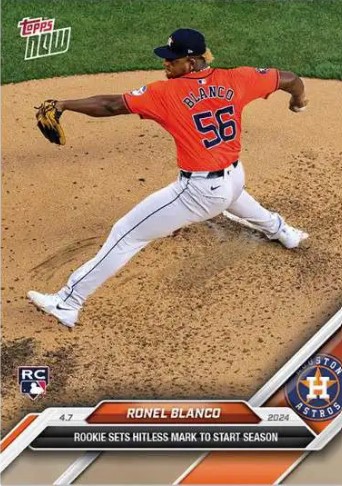
Let’s face it, in today’s game, a one-pitcher shutout is a rarity – on its way to unicorn status. In fact, through May of this season, there have only been six such whitewashings (the Astros’ Ronel Blanco’s no-hitter and shutouts by the Phillies’ Ranger Suarez and Aaron Nola, Red Sox’ Tanner Houck, Braves’ Max Fried and, most recently, the Marlins’ Braxton Garrett.

Garrett’s shutout makes the highlights because (like Blanco and Houck before him), it was also his first major-league complete game – and of, of course, it came in May (May 24 to be exact) and this is the May Wrap Up.

Garrett shut down the Diamondbacks (in Arizona) on four hits (no walks, six strikeouts) in a 3-0 win. It was the 26-year-old’s first win of the season, coming in his third start. And, it may have been a bit of a surprise.  In his first two starts, he had lasted a combined total of 9 2/3 innings and had given up 11 earned runs (10.24 ERA).  (Over his first four MLB seasons – 2020-23 – Garrett was 14-17, 3.86 in 58 games – 56 starts.)

The Sultan of Swing

On May 23, the Padres brought in righty Jeremiah Estrada to face the Reds in the bottom of the eighth of a tie (4-4) game.  After giving up a flyout and a single, Estrada fanned the next two batters (RF Nick Martini and 2B Jonathan India to close out the frame. Estrada came out to the mound again in the ninth and fanned C Luke Maile, LF Will Benson and CF Stuart Fairchild in order. The Pirates scored two in the top of the tenth and Robert Suarez came on to get the save for the Pirates.

Three days later (May 26), Estrada was called in to replace Joe Musgrove in the top of the sixth inning – with the Pirates down 1-0 to the Yankees and a runner on second with one out. Estrada fanned CF Aaron Judge and LF Alex Verdugo on seven pitches to get out of the inning. He got a second inning of work in the top of the seventh, fanning DH Giancarlo Stanton, 1B Anthony Rizzo and 2B Gleyber Torres in order. Wandy Peralto replaced Estrada in the top of the eighth,

Estrada’s next outing came on May 28, against the Marlins (in San Diego). He came on in the top of the ninth with the Padres up 4-0. You guessed it – 12 pitches, three strikeouts (RF Jesus Sanchez, 3B Jake Burger, LF Nick Gordon).

At this point, Estrada had fanned 13 batters in a row – all swinging – which MLB.com writer AJ Cassavell reports is the longest string of consecutive whiffs by a pitcher since at least 1961.

Then on May 31, the streak came to a screeching (and unfair) halt. Estrada was called to the mound in the sixth inning (replacing Dylan Cease) with  the Padres and Royals tied at two, runners on second and third and one out. C Salvador Perez was up and was waived to first on the Intentional Walk.  So, the streak was broken, by a batter Estrada never threw a pitch to. Estrada got the next two batters on a sac fly and pop out.

Estrada finished May with a 2-0, 0.53 record on the season – with 28 strikeouts (just five walks) in 17 innings. Not bad for a 2023 Waiver Wire addition.  Prior to joining the Padres, his MLB stat line (17 games with the 2022-23 Cubs) was 0-0, 5.51 with 21 strikeouts and 15 walks in 16 1/3 innings.

Climbing the Ladder

On May 24, the Astros’ Justin Verlander picked up his third win of the season (at 41-years-old proving old guys can still rule). He went six innings, giving up two runs (one earned) on eight hits and no walks.  He also fanned nine batters. His fourth strikeout of the game – Abraham Toro in the bottom of the second – gave him 3,372 for his career – putting him past Greg Maddux for number-ten all-time for career strikeouts. He ended the contest with 3,377 career whiffs.  Next up in the chase?  Walter Johnson at 3,509.

A Feel Good Story for May

On May 31, 27-year-old righthander Justin Sterner made his MLB debut for the Rays (versus the Orioles at Camden Yards). His path to the majors was not an easy – nor a predictable – one. It was, however, a feel-good tribute to determination. When Sterner graduated from Dana Hills (CA) High School he he went undrafted by MLB and had no college offers.  He was then away from the diamond for two years, completing a Mormon mission in Samoa. Upon his return, Sterner enrolled in Brigham Young University and “walked on”  to the baseball squad. Over three seasons, he went 8-4, 2.86 (27 games, 17 starts), with 103 strikeouts in 100 2/3 innings.   He remained undrafted and, in 2020, signed with the Marlins as an undrafted free agent. Then, of course, Covid led to the cancellation of his first minor-league season.

Sterner played for four teams, in two organizations in four leagues in 2021.  He suited up for the Marlins’ Class-A Jupiter Hammerheads and High-A Beloit Snappers and then, after a trade to the Rays, for the High-A Bowling Green Hot Rods and Double-A Montgomery Biscuits.   He continued in the Rays’ minor-league system, rising to Triple-A, until being called up to Tampa Bay to relieve an overworked bullpen. The 27-year-old made his first MLB appearance May 31 and pitched two scoreless innings (two hits, one walk, two strikeouts). For those who like to know such things, his first two strikeout victims were Anthony Santander (on a 2-2 pitch) and Gunnar Henderson (on 0-2 offering.

More Than Defense

Okay, you gotta like a player with two double consonants in his first name and three a’s in his last name.  That would be the Red Sox’ rookie CF/SS Ceddanne Rafaela (he did get in 28 games for the BoSox last season). Rafaela is known for his sparkling defense, but the 23-year-old has also shown some sparkle with his bat.  In May, he hit .239-5-16 – and he leads the Red Sox with 33 RBI on the season. He makes these highlight for his May 31 game: two-for-four with two home runs and five RBI in a 7-3 Red Sox win over Detroit. It was his first MLB multi-homer game.  The five RBI were not a career high for him, however.  On April 27, he logged a four-hit, seven-RBI game against the Cubs. In both games he delivered that production out of the nine-hole.  This season, Rafaela has taken the field at CF,SS, 2B and 3B for the Red Sox.

Rafaela’s growing offensive output should no be a surprise In 2023 he hit .302-20-79, with 36 steals at Double-A and Triple-A.

–INDIVIDUAL LEADERS FOR MAY—

BATTING AVERAGE (at least 75 at bats)

American League:  Aaron Judge, Yankees (.371); Vlad Guerrero, Jr., (.357); Brent Rooker, A’s (.330)

National League: Luis Arreaz, Marlins/Padres (.389); Jurickson Profar, Padres .(344); Christian Yelich, Brewers (.321)

The lowest average among players with at least 75 at bats belonged to the Diamondbacks’ Jo Adell at .144 (13-for-90.) The Angels’ Niko Goodrum and Yankees Trent Grisham had the most May at bats without a hit (17).

HITS

American League:  Abraham Toro, A’s (39); Maikel Garcia, Royals (36); Aaron Judge, Yankees (36)

National League: Luis Arreaz, Marlins/Padres (44); Ezequiel Tovar, Rockies (36); William Contreras, Brewers (34)

The Yankees’ Aaron Judge led all MLBers in May extra-base hits with 26 – 12 doubles and 14 home runs (he had ten singles).  

HOME RUNS

American League: Aaron Judge, Yankees (14); Jose Ramirez, Guardians (11); Corey Seager, Rangers (11); Kyle Tucker, Astros (11)

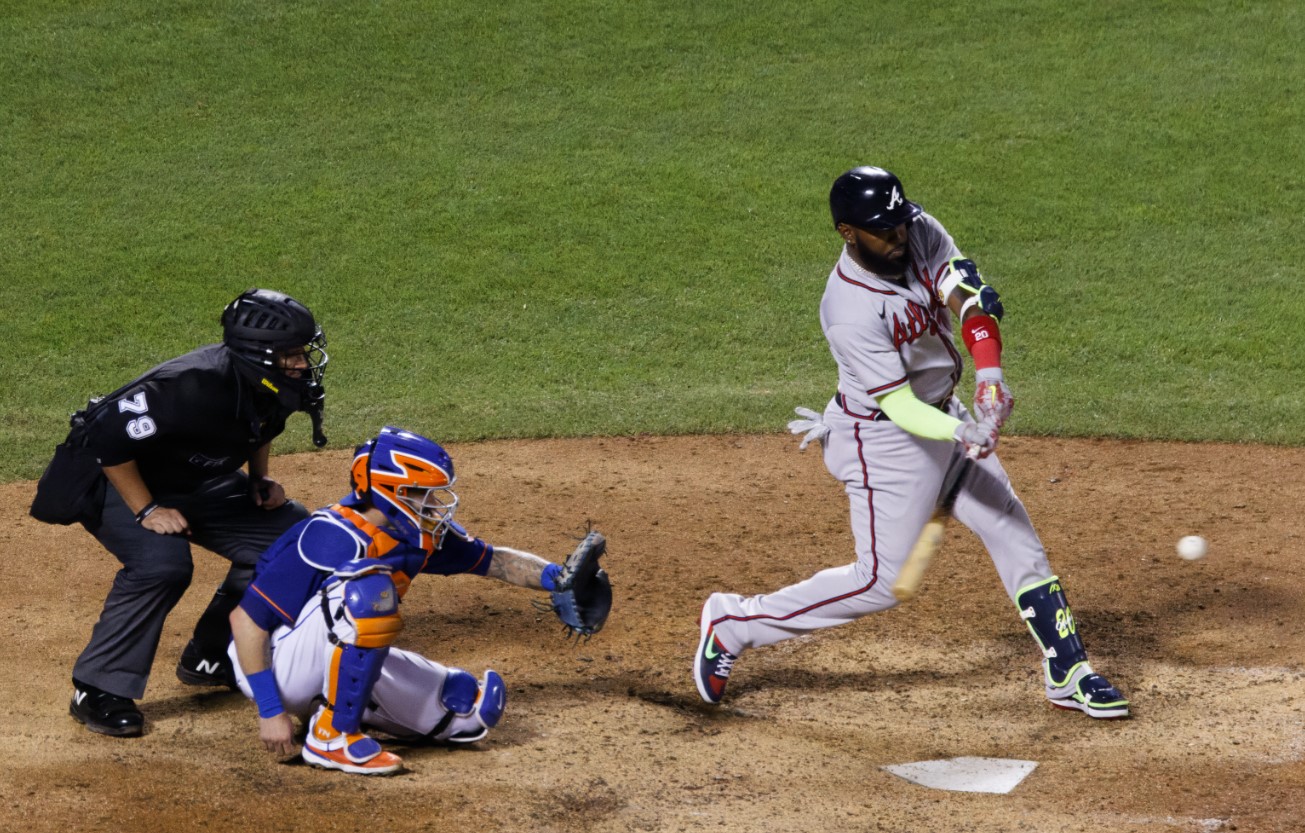
National League:  Bryce Harper, Phillies (7); Shohei Ohtani, Dodgers (7); Marcell Ozuna, Braves (7)

RUNS BATTED IN

American League: Jose Ramirez, Guardians (33); Aaron Judge, Yankees (27); Bobby Witt, Jr. Royals (25)

National League: Bryce Harper, Phillies (24); Willy Adames, Brewers (22); William Contreras, Brewers (21); Christopher Morel, Cubs (21)

RUNS SCORED

American League:  Aaron Judge, Yankees (28); Bobby Witt, Jr., Royals (26); Jose Ramirez, Guardians (23)

National League: Matt Chapman, Giants (23); Thairo Estrada, Giants (20): three with 19

DOUBLES

American League:  Aaron Judge, Yankees (12); Max Kepler, Twins (11); three with ten

National League: Alec Bohm, Phillies (10): Ezequiel Tovar, Rockies (10); Willy Adames, Brewers (10); Pete Alonso, Mets (10)

TRIPLES

American League:  Jarren Duran, Red sox (5); Wenceel Perez, Tigers (3); Matt Vierling, Tigers (3); Anthony Volpe, Yankees (3); Willi Castro, Twins (3)

National League: Corbin Carroll, Diamondbacks (4); Edmundo Sosa, Phillies (4); Jazz Chisholm, Marlins (3)

The leader in slugging percentage, among players with at least 75 May at bats, was the Yankees’ Aaron Judge at .928). The Dodgers’ Shohei Ohtani led the NL at .591.

STOLEN BASES

American League: José Caballero, Rays (11); Julio Rodriguez, Mariners (7); Bobby Witt, Jr., Royals (7); David Hamilton, Red sox (7)

National League: Elly De La Cruz, Reds (14); Brenton Doyle, Rockies (10); Bryson Stott, Phillies (9)

The Phillies’ Bryson Stott stoles the most May bases without getting caught (9).

BATTER’S STRIKEOUTS

American League:  Tyler O’Neill, Red Sox (36);  Cal Raleigh, Mariners (36); Joe Adell, Angels (33)

National League: Elly De La Cruz, Reds (40); Andy Pages, Dodgers (37) ; Ezequiel Tovar, Rockies (35)

The Red Sox’ Tyler O’Neill  fanned 36 times in just 73 May at bats.

WALKS

American League:  Kyle Tucker, Astros (23); Aaron Judge, Yankees (22); Gunnar Henderson, Orioles (21)

National League: Kyle Schwarber, Phillies (22); LaMonte Wade, Giants (19); Christopher Morel, Cubs (17); Brenton Doyle, Rockies (17)

 PITCHING VICTORIES

American League:   Luis Gil, Yankees (6-0); Seth Lugo, Royals (5-0); Carlos Rodon, Yankees (5-1)

National League:  Chris Sale, Braves (5-0); Mitch Keller, Pirates (4-0); Hector Neris, Cubs (4-0); Cal Quantrill, Rockies (4-0); Zack Wheeler, Phillies (4-0); Sonny Gray, Cardinals (4-1); Ranger Suarez, Phillies (4-1)

Four players lost four games in May: Patrick Sandoval, Angels (1-4, 4.54 in six starts); Ross Stripling, A’s (1-4, 7.17 in five starts); Richard Lovelady, Rays (1-4, 9.90 in 12 appearances); and Fernando Cruz, Reds (1-4, 5.65 in 14 appearances. 

EARNED RUN AVERAGE (minimum 25 May innings)

American League: Reese Olson, Tigers (o.64); Luis Gil, Yankees (0.70); Garrett Crochet, White Sox (0.93)

National League: Chris Sale, Braves (0.56); Austin Gomber, Rockies (0.68); Mitch Keller, Pirates (1.30)

The highest ERA among pitchers with at least 25 May innings or four May starts  was 9.49 by the Angels’ Reid Detmers (0-3, 4.49 in five starts, 24 2/3 innings.

STRIKEOUTS

American League: Luis Gil, Yankees (44 in 38 2/3 IP); Seth Lugo, Royals (43 in 40 1/3 IP); Jack Flaherty, Tigers (40 in 31 2/3 IP)

National League:  Dylan Cease, Padres (47 in 35 1/3 IP); Chris sale, Braves (45 in 32 IP); Tyler Glasnow, Dodgers (42 in 31 IP);

Among pitchers who faced at least 100 batters in May, Chris Sale of the Braves had the highest strikeouts-per nine innings ratio at 12.66, as well as the highest strikeouts-to-walks ratio at 22.50.  

WALKS + HITS/INNINGS PITCHED (at least 25 May innings)

American League: Bryan Woo, Mariners (0.78); Luis Gil, Yankees (0.67); Garrett Crochet, White Sox (0.72)

National League: Ryan Weathers, Marlins (0.73); Chris Sale, Braves (0.78); Austin Gomber, Rockies (0.83)

SAVES

American League:  Emmanuel Clase, Guardians (10); Clay Holmes, Yankees (9); Jhoan Duran, Twins (8)

National League:  Ryan Helsley, Cardinals (8); Trevor McGill, Brewers (7); Raisel Iglesias, Braves (7)

Jhoan Duran of the Twins and Ryan Helsley of the Cardinals tied for the most May games saved without a blown save with eight.
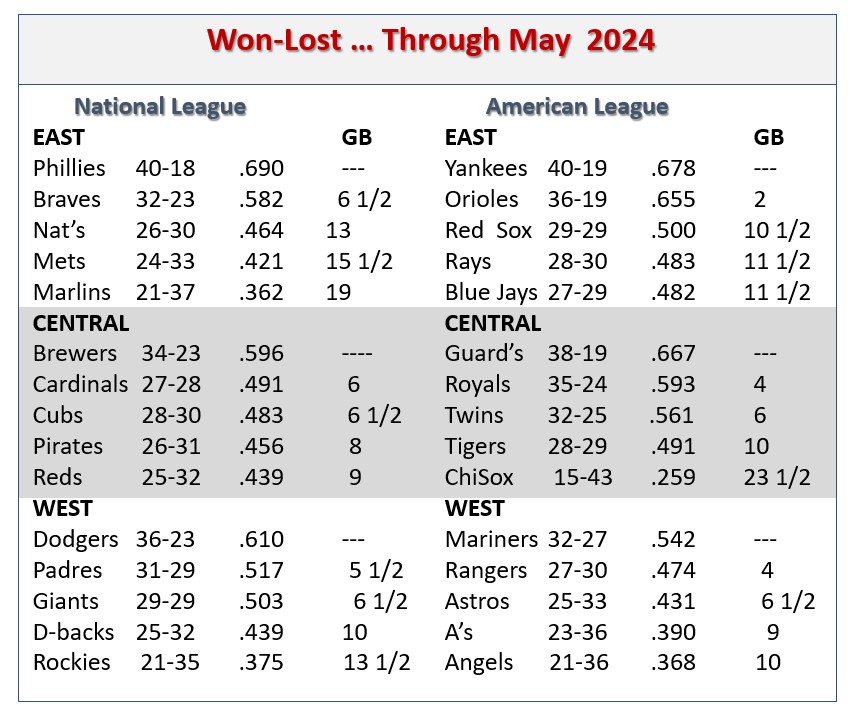
If the season ended May 31, your post-season team would be:

National League: Phillies; Dodgers; Brewers  Wild Cards: Braves; Padres; Giants

American League:  Yankees; Guardians; Mariners   Wild Cards: Orioles; Royals, Twins

Primary Resources:  Baseball-Reference.com; Baseball-Almanac.com; MLB.com


Baseball Roundtable – Blogging Baseball Since 2012.

100Baseball Roundtable is on the Feedspot list of the Top 100 Baseball Blogs.  To see the full list, click here.

Baseball Roundtable is also on the Anytime Baseball Supply Top 66 Baseball Sites list.  For the full list, click here

I tweet (on X) baseball @DavidBaseballRT

Follow Baseball Roundtable’s Facebook Page here.  More baseball commentary; blog post notifications.

Member: Society for American Baseball Research (SABR); Negro Leagues Baseball Museum; The Baseball Reliquary. 

P1039

Three Homers/Ten RBI … Not a Bad Day for a Rookie

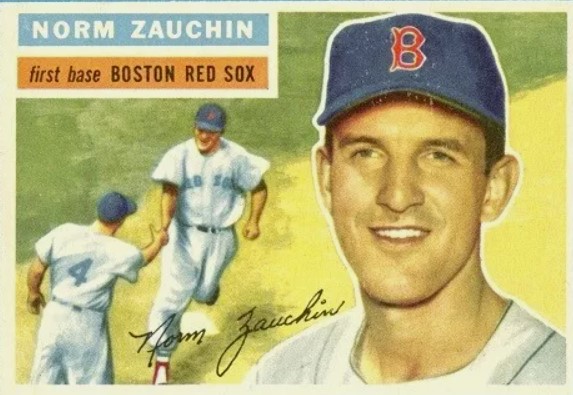
On this date *May 27) in 1955, Red Sox rookie 1B Norm Zauchin had a rare – very rare – day at the plate.  As the Red Sox prevailed 16-0 over the Nationals (in Boston), Zauchin smacked:

  • a two-run home run in the first inning (off Bob Porterfield);
  • A Grand Slam in the second frame (off Dean Stone);
  • An RBI double in the fourth (off Ted Abernathy); and
  • A three-run home run in the fifth (off Abernathy).

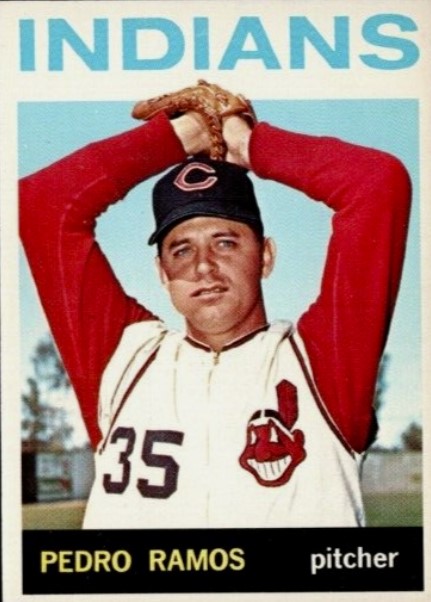
Five innings, three-homers and a double, ten RBI. (In his final at bat, Zauchin struck out versus Pedro Ramos.)

In the process, Zauchin set the MLB rookie record for RBI in a game (ten) – later tied by the Red Sox Fred Lynn (on June 18, 1975). That, by the way, was the season Lynn won both the American League’s Rookie of the Year and Most Valuable player Awards.

Norm Zauchin and Fred Lynn remain the only AL/NL rookies to record ten RBI in a game. Side note: Ten-RBI games are an MLB rarity, with just 15 games of ten or more RBI in the MLB record books.  (Negro League game records from 1920-48 are no yet fully incorporate into the MLB record books.)

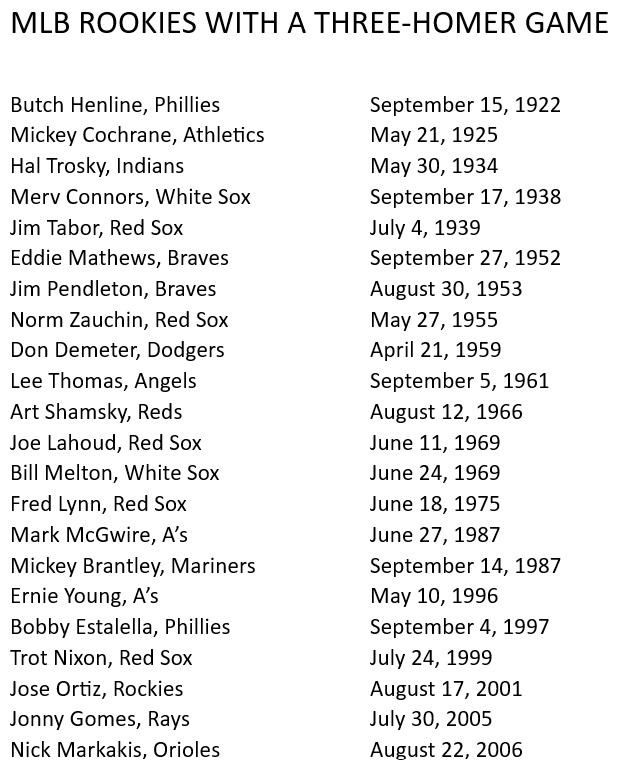
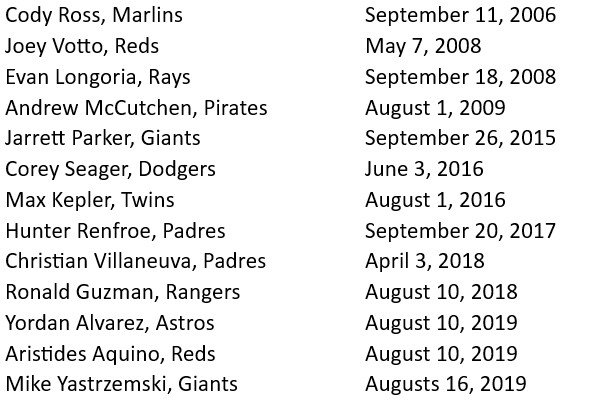
In his ten-RBI game, Zauchin also tied the rookie record for home runs in a game (three).   Zauchin was the eighth AL/NL rookie to accomplish that feat.  (The count is now 35. See the list at the 3end of this post.)  Side Note:  Ten-RBI games are a relatively rare MLB feat, with just 16 such games on the books (per Basebalk-Almanac.com).  By contrast, there have been 24 MLB perfect games pitched and 18 players have launched four homers in a game.  The single-game RBI record is 12, shared by two Cardinals: Jim Bottomley (1924) and Mark Whiten (1993). 

Zauchin signed with the Red Sox as a teenager and, in 1948, the eighteen-year-old hit .353-33-138 for the Class D Milford Red Sox, leading heh league in home runs and RBI. By 1951, he had established himself as a run producer, having logged seasons of 100+ RBI at Class D; Double-A and Triple-A. His 1951 Triple-A (Louisville Colonels) season of .267-12-104 earned him a September call up to the Red Sox (just 12 games, keeping his rookie status intact).

In 1952, military service interrupted Zauchin’s professional career and he didn’t return to the Red Sox system until Spring Training 1954 (although he did play service ball while in the Army).  Zauchin didn’t miss a beat on his return, hitting .289-18-118 at Triple-A in 1954.

In 1955, Zauchin was plying his trade for the Red Sox and he put up a .239-27-93 season.   As a result of a combination of injuries, competition for the first base job and a low batting average (.233 in six MLB seasons with the Red Sox and Senators), 1955 proved to be Zauchin’s’ best season.  In his remaining four MLB campaigns, he played in just 211 games, with 23 home runs and 66 RBI. Ultimately, in that 1955 season, Zauchin collected 54 percent of his career MLB homers and 58 percent of his career RBI.

Fred Lynn, of course, had a more successful MLB run – 17 Seasons, nine All Star Selections, and a .283-306-1,111 stat line. In his three-homer, ten-RBI rookie games, Lynn had five hits in six at bats – including a two-run homer in the first inning; a three-run homer in the second; a two-run triple in the third; a lineout in the fifth; a single in the eighth and a three-run homer in the ninth.

Primary Resources:  Baseball-Reference.com; Baseball-Almanac.com

Baseball Roundtable – Blogging Baseball Since 2012.

100Baseball Roundtable is on the Feedspot list of the Top 100 Baseball Blogs.  To see the full list, click here.

Baseball Roundtable is also on the Anytime Baseball Supply Top 66 Baseball Sites list.  For the full list, click here

I tweet (on X) baseball @DavidBaseballRT

Follow Baseball Roundtable’s Facebook Page here.  More baseball commentary; blog post notifications.

Member: Society for American Baseball Research (SABR); Negro Leagues Baseball Museum; The Baseball Reliquary. 

P1038

HBP … That’ll Leave a Mark – in more ways than one.

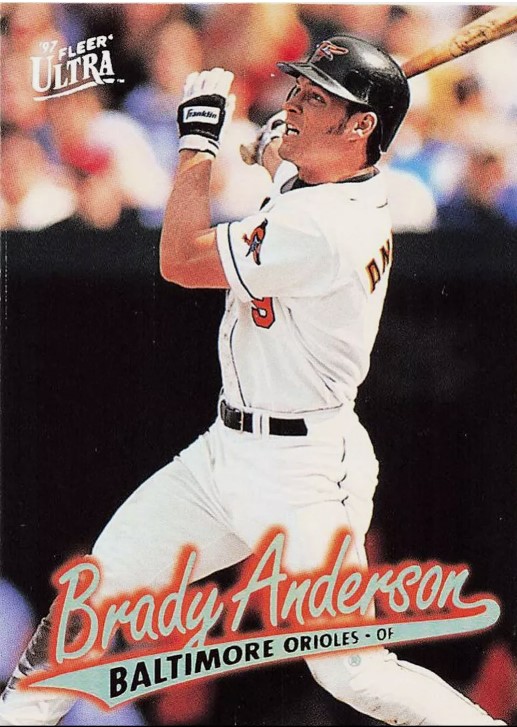
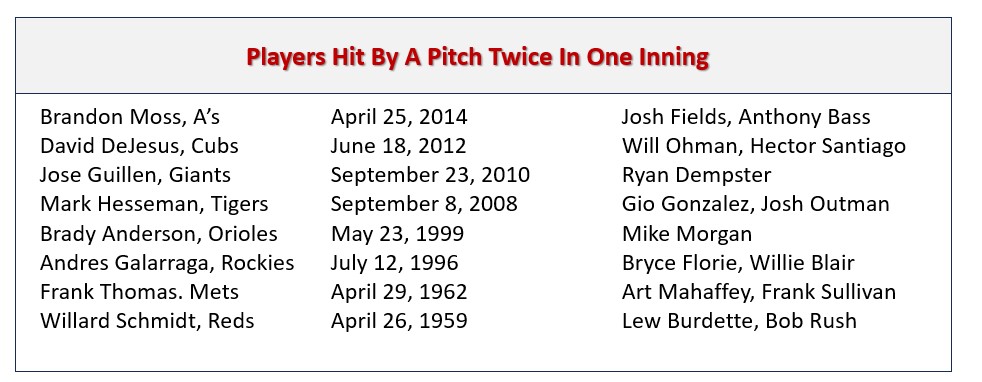
On the date (May 23) in 1999, Orioles’ CF and leadoff hitter Brady Anderson’s day got off to a rather painful start, In the bottom of the first inning, Rangers’ starter Mike Morgan hit Anderson with a 1-2 pitch (Anderson scored two batters later, on a B.J. Surhoff sacrifice fly.)  As luck (perhaps bad luck) would have it, Anderson came up against Morgan again in the inning (by that time the Orioles had scored five times), this time with runners on first and second and two out. History repeated itself, as Anderson was hit by Morgan’s first pitch. (Anderson would be the last batter Morgan faced). Anderson scored again, this time on a Surhoff home run.  Thanks to the double plunking, Anderson is one of only eight MLB players (Modern Era) to be hit by a pitch twice in one inning – and one only two to by nailed twice in an inning by the same pitcher

The Orioles, by the way, won 15-6 and Anderson went one-for-three in five plate appearances. Anderson would go on to a .282-24-81 season – leading the league with 24 hit-by-pitches.   Anderson played in 15 MLB seasons (1988-2002, primarily with Baltimore. He was a three-time All Star and hit .256-210-761, with 315 steals over 1, 834 games. He led the AL in HBP three times.


As always, as I looked into Brady Anderson, one thing led to another.  So, here’s a bit more on HBP records.  (Keep in mind, Negro League game records from 1920-48 have not yet been fully documented and incorporated into the MLB record books.)

Two Different Paths for Lots of Bumps and Bruises

Photo: The Sporting News via [1], Public domain, via Wikimedia Commons

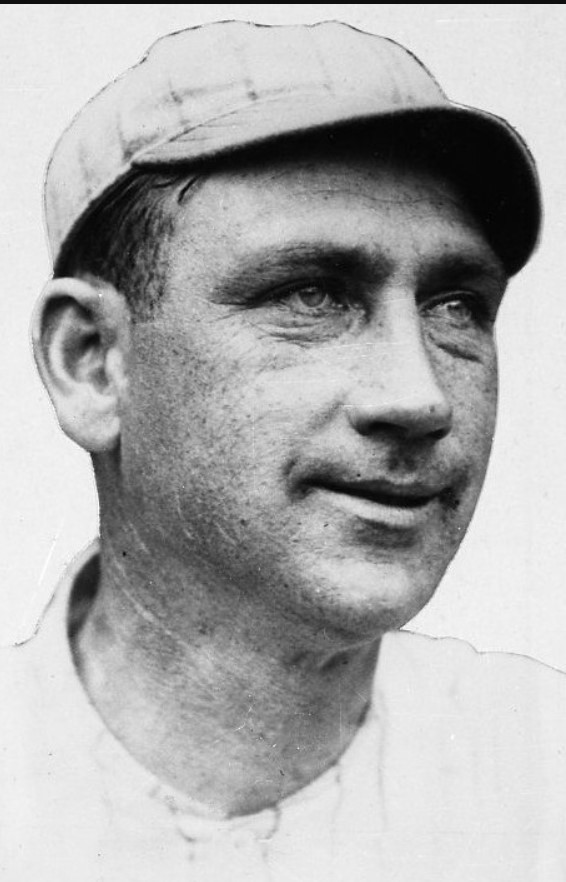
The top two players in terms of career HBP started their careers nearly a century apart.  Hughie Jennings is numb-one on the list with 287 plunkings.  Jennings (SS/1B) played 18 MLB seasons (1891-1903, 1907, 1909-1910, 1912, 1918). He had a circuitous path to his 287 HBP, suiting up for the American Association and National League Louisville Colonels; The NL Baltimore Orioles; the NL Brooklyn Superbas; the NL Philadelphia Phillies; and the AL Detroit Tigers.  He put up a career stat line of .312-18-840, with 992 runs scored and 359 steals over 1,284 games. H led his league in HBP in five seasons (consecutively, 1894-1898) and had a high of 51 HBP in 1896.

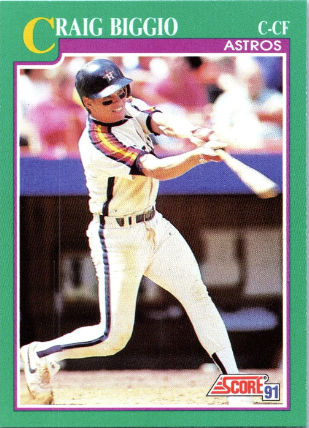
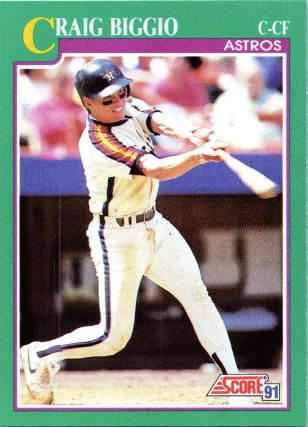
Second on the list, only two HBP behind Jennings with 285, is Craig Biggi0 (C/2B/CF). Biggio played 20 MLB seasons (1988-2007), but unlike Jennings, played for only one team (the Astros). The seven-time All Star hit .281-291-1,175, with 1,844 runs scored and 414 stolen bases over 2,950 games. Like Jennings, he led his league in HBP five times, but not consecutively (1995-97, 2001, 2003).


Nifty Fifty

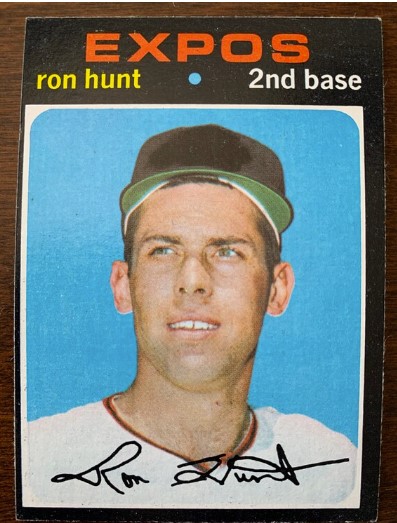
Only two players have been hit by a pitch at least 50 times in one season. The NL Orioles’ Hughie Jennings (51 in 1897) and the Expos’ Ron Hunt (50 in 1971).


Over Two Dozen Bruises to Make This List

There have been 55 player seasons with 25 or more HBP – “accomplished” by 26 different players. The most recent was the Mariners’ Ty France with 34 HBP last season. The first was the American Association Baltimore Orioles’  Tommy Tucker with 29 in 1887.

Here are the players with the most seasons of 25 or more HBP (tied at five):

  • Ron Hunt … 1968-72 … Giants, Expos;
  • Tommy Tucker … 1887, 1889-92 … AA Orioles, NL Boston;
  • Hughie Jennings … 1894-98 … NL Orioles.

Something Old/Something New

The oldest player to lead the league in HBP is Don Baylor, who led the AL with 28 plunkings in 1987 (at the age of 38), splitting the season with the Red Sox and Twins). Baylor also holds second place on the list, with a league-leadings 35 HBP as a 37-year-old in 1986 (Red Sox).

The youngest player to lead the league in HBP was Victor Robles, who was nailed 25 times, as a 22-year-old, with the  2019 Nationals. The youngest player to lead the league in HBP was 23-year-old Andres Gimenez (for the Guardians in 2022). Like Robles, he had 25 HBP.

But Who’s  Counting?

The fewest plate appearances by a player who was HBP 25 or more times in a season is 306, by the Red’s Derek Dietrich in 2019 (25 HBP). Dietrich didn’t lead the league in HBP that season, but he did lead the NL with 24 HBP in 2016, with the Marlins).   By contrast, the most plate appearance in a season without a single HBP is 739, by the Angels’ Sandy Alomar in 1971. There have, in fact, been 48 seasons of 700 or more PA with an HBP, accomplished by 47 different players.

Probably pretty Good at Dodge Ball

Roy White of the Yankees is the only player with two seasons of 700+ plate appearance without a HBP: 1970 (712) and 1976 (728).  

Follow the Leader

Photo: Bowman Gum, Public domain, via Wikimedia Commons

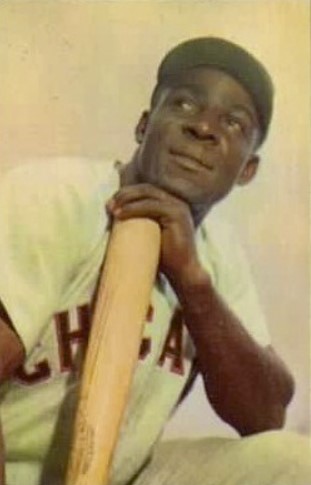
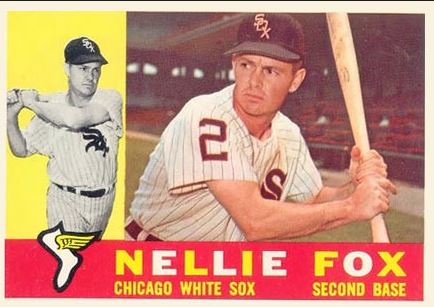
No player led his league in HBP in more season than the White Sox’ Minnie  Minoso – ten seasons (1951-54, 1956-610.  Despite this record, Minoso was never hit more than 23 times in a season.  Minoso’s consecutive string was broken in 1955 by teammate Nellie Fox (17 HB).  That season Minos0 was hit 10 times in 139 games, tying for fourth in the AL.  Ron Hunt holds the record for consecutive seasons leading his league in HBP at seven 1968-74 (Giants, Expos, Cardinals).


Three Times The Charm

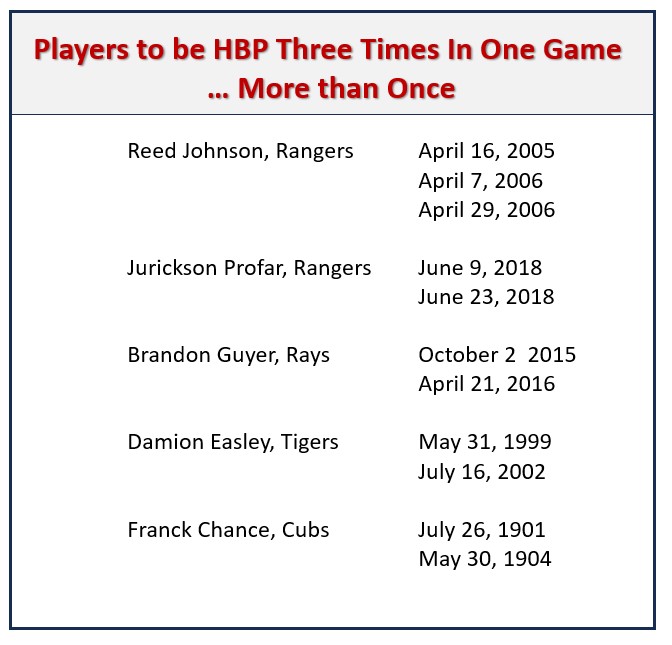
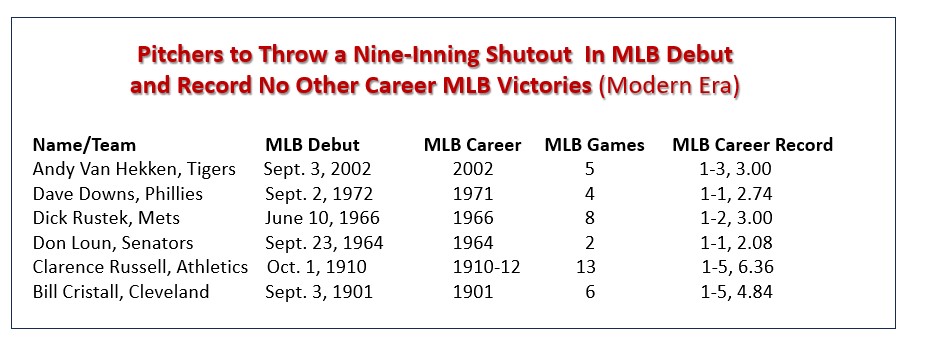
The record for HBP in a game (Modern ERA) is three – which has occurred 36 times (by 30 different players) in the Modern Era (since 1901).

Three X Three

Reed Johnson is the only player to be HBP in a game three times – three times … all while he was with the Blue Jays. Johnson played 13 MLB seasons (2003-2015 … Blue Jays, Cubs, Dodgers, Braves, Marlins, Nationals). He was HBP a total of 134 times and led the AL in HBP in 2006 with 212.  His final stat line was .279-65-408 in 1 320 games.  

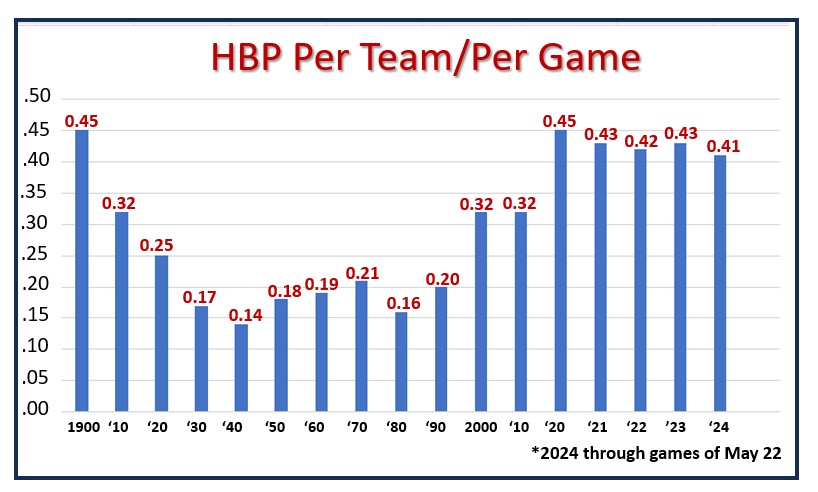
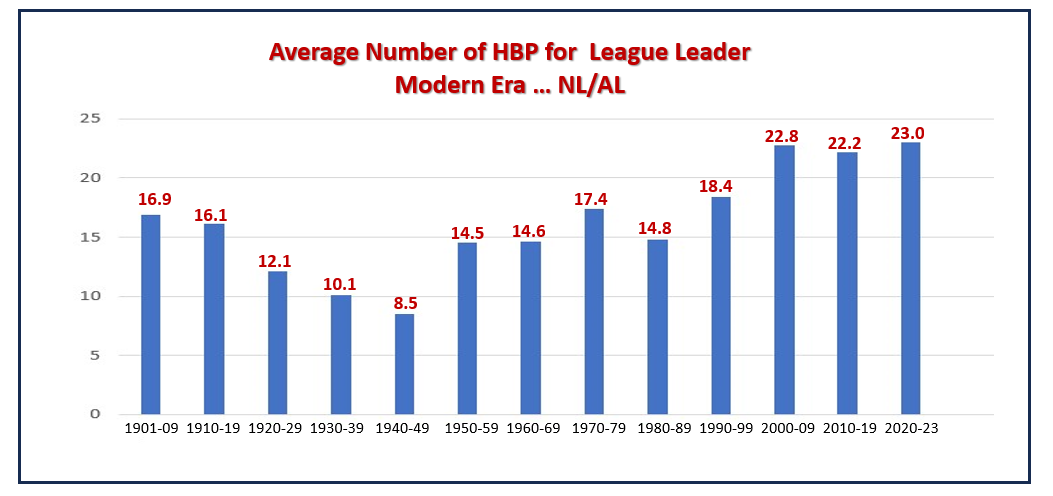
A Couple of Obligatory Charts

Below you will find a couple of charts that shed some light on how HBP has changed over time – which seem to indicate batters may be more at risk  these days.  This will be a future blog topic (it needs more research), but my first inclination is that the shift from finesse and pitch-to-contact to overpowering batters with velocity and spin rate is a driving force.  Feel free to share your thought on this in the comments section.

Primary Resources:  Baseball-Reference.com; Baseball-Almanac.com.


Baseball Roundtable – Blogging Baseball Since 2012.

100Baseball Roundtable is on the Feedspot list of the Top 100 Baseball Blogs.  To see the full list, click here.

Baseball Roundtable is also on the Anytime Baseball Supply Top 66 Baseball Sites list.  For the full list, click here

I tweet (on X) baseball @DavidBaseballRT

Follow Baseball Roundtable’s Facebook Page here.  More baseball commentary; blog post notifications.

Member: Society for American Baseball Research (SABR); Negro Leagues Baseball Museum; The Baseball Reliquary. 

P1036

Four Hits and Four Steals in a Game … And More

Yesterday (May 16), the Reds’ dynamic (nine homers and 30 steals as of this morning), young (22-year-old) shortstop Elly De La Cruz became just the 29th AL/NL player in the Modern Era (post-1900) to collect at least four hits and steal at least four bases in a game. (Note: Negro Leagues game records from 1920-48 – now considered major-league, have not been fully documented incorporated into the MLB record book).  The performance came in a Reds’ 7-2 win over the Dodgers In LA.  De La Cruz had three singles, a double and a walk; scored three runs; and drove in one. He stole second base twice and third base twice.

As usual, the events of the day sent Baseball Roundtable to the record books and “one thing led to another.” Here’s a look at what grabbed my attention.


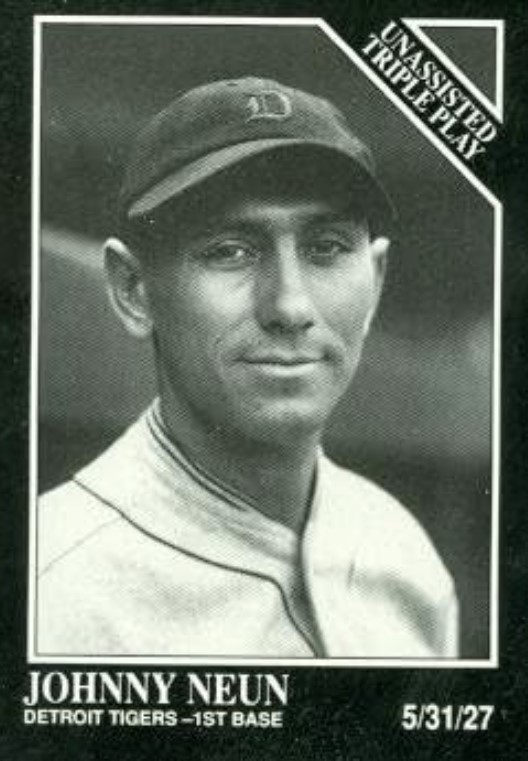
Johnny Neun, an MLB Unicorn

On July 9, 1927 Tigers’ 1B Johnny Neun became just the second – and there are still two still only – MLB player credited with at least five hits and at least five steals one one game. He accomplished the feat on July 9, 1927 in a 14-4 Tigers’ win over the vaunted 1927 Yankees.

Photo: Bain News Service, publisher., Public domain, via Wikimedia Commons

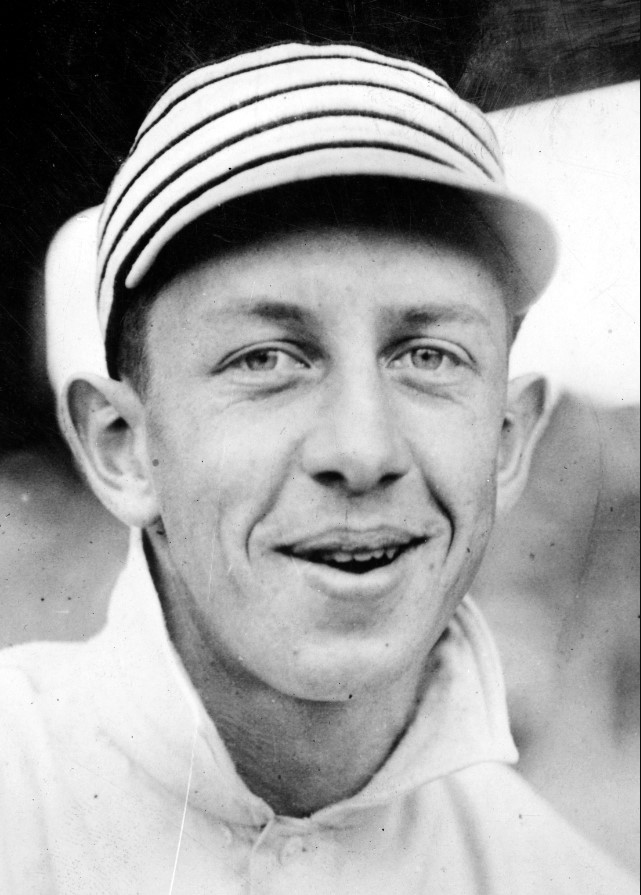
The other to meet this criteria was Athletics’ 2B Eddie Collins, who had a 5-5 game in a 24-2 Athletics’ win over the Tigers on May 18, 2012.  Collins had five singles, scored four runs and drove in one.  He stole second base three times and third base twice.  Side note: Three of his hits were bunt singles.

Why give Neun “unicorn” status?  In a bow to #InBaseballWeCountEverything, Neun is the only   player to collect five hits and five steals (or even four hits and four steals) in a game of less than nine innings.  His five-and-five came in the second game of a doubleheader – a contest that went only seven innings. (Most likely called due to darkness.) All five of Neun’s safeties were singles and he scored four times and drove in three. He stole second base three times and third base twice.

Neun, who played in just 432 games over six MLB seasons (1925-28, 1930-31) had a career stat line of .289-2-85, with 41 steals and 171 runs scored.  Despite the short career, he made another mark or two on the record books.

  • Neun is one of only two MLB first baseman (Modern Era) to turn an unassisted triple play. The other 13 were turned by shortstops (8) or second basemen (5).
  • Neun is also of just one of two players whose unassisted triple play notched the final three outs of the game – and the only one whose triple-killing ended a 1-0 victory.

Johnny Neun’s Society for American Baseball Research bio – written by Cort Vitty – paints a picture of a versatile athlete. Neun and his partner were the Baltimore city tennis doubles champions in 1920. Neun was also  a founding member of the Baltimore Soccer Club  and captain of it 1918-20 championship teams.

Neun started his professional baseball career in 1920 (age 19) and made it to the major leagues after a .353 season with the double-A Saint Paul Saints in 1924. Neun hit .320 or better in all but the one (the first) of his five minor-league seasons before making the Tigers’ roster.

After his final MLB season (1931), Neun played in the minors from 1932 through 1937 and managed in the minors from 1935 through 1943. He did a brief stint as manager of the Yankees( 14 games) in 1946 before managing the Reds for 1947 season and 100 games in 1948,

By The Numbers

In addition to Johnny Neun’s and Eddie Collins’ five hit-five steal games, two additional players have had games of five hits and four steals:

  • Carl Crawford, Rays … May 24, 2006
  • Rickey Henderson, Yankees … April 11, 1988

Two players have had games of four hits and six steals:

  • Carl Crawford, Rays …. May 3, 2009
  • Eddie Collins, Athletics … September 22, 1912


Doubling Up on a Four-By-Four

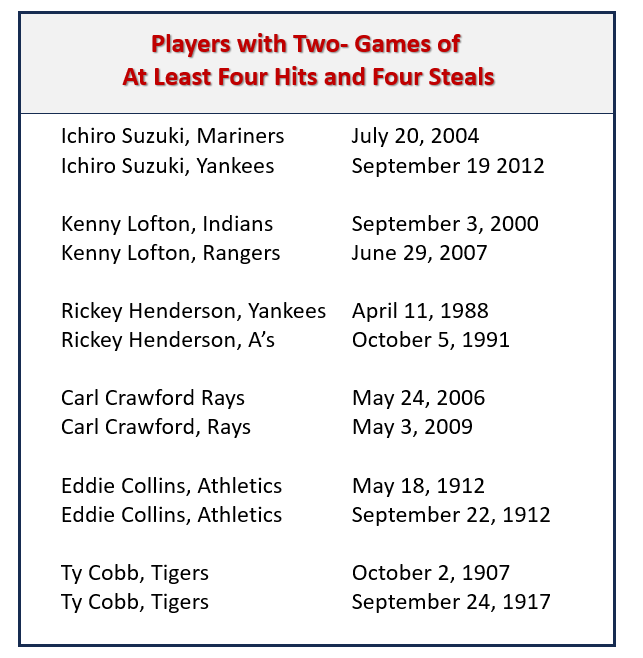
Just six players have had two games of at least four-hit and at least four-steals (see chart below) and only Athletics’ 2B Eddie Collins did it twice in one season (1912).

Something Old – Something New

The oldest player to record a four-hit/four-steal games is the Rangers’ Kenny Lofton – at age 40 (and 29 days) – in a 2-1 loss to the Red Sox on June 29, 2007.

The youngest?  Who else?  The Tigers’ Ty Cobb at age 20 (and 288 days) in a 9-5 win over the Nationals on October 2, 1907.

Speed and Power

Only four players had had a home run as part of a game of at least four hits and at least four steals:

  • The Indians’ Kenny Lofton – four hits (three singles and a homer) and five steals in a September 3, 2000, 13-inning, 12-11 win over the Orioles;
  • The A’s Rickey Henderson – four hits (two singles, a double and a home run) in a 12-5 win over the Rangers on October 5, 1991;
  • The Cardinals’ Vince Coleman – four hits (two singles, a triple and a home run) and four steals in a 9-4 win over the Cubs on July 24, 1990; and
  • The Rays’ Carl Crawford – five hits (four singles and a homer) and four steals in a 10-8 win over the Blue Jays on May 24, 2006.

Positioned for Success

As you might guess, 14 of the 35 games of at least four hits and at least four steals were accomplished by leadoff hitters.  The lowest spot in the batting order for anyone on the list goes to Ichiro Suzuki, who had a four-for-four game with four steals (as a 38-year-old), while batting in the eight-hole for the Yankees in a 2-1 win over the Blue Jays on September 19, 2012. His fourth hit of the day, an eighth inning single, drove in the winning run. Side note: 2012 was his 38-year-old season – and he had seven more MB campaigns ahead of him.

The only positions to not place a player on the four-by-four list are catcher and DH. Left Field ranks number-one (10) and CF number-two (9).

Primary Resources:  Baseball-Reference.com; Baseball-Almanac.com


Baseball Roundtable – Blogging Baseball Since 2012.

100Baseball Roundtable is on the Feedspot list of the Top 100 Baseball Blogs.  To see the full list, click here.

Baseball Roundtable is also on the Anytime Baseball Supply Top 66 Baseball Sites list.  For the full list, click here

I tweet (on X) baseball @DavidBaseballRT

Follow Baseball Roundtable’s Facebook Page here.  More baseball commentary; blog post notifications.

Member: Society for American Baseball Research (SABR); Negro Leagues Baseball Museum; The Baseball Reliquary. 

P1035


Double Your Pleasure – Not During These Batters’ Plate Appearances

Disclaimer:  This is a cautionary tale.   Grounded Into Double Play (GIDP) records should be taken with a “grain (or several grains) of salt.”  I’ll explain as the post goes on.

Baseball Roundtable’s favorite play is the 6-4-3 or 4-6-3 double play.  Here are some musings about players who would deny me the opportunity to “double my pleasure.”

Photo: Bowman, Public domain, via Wikimedia Commons

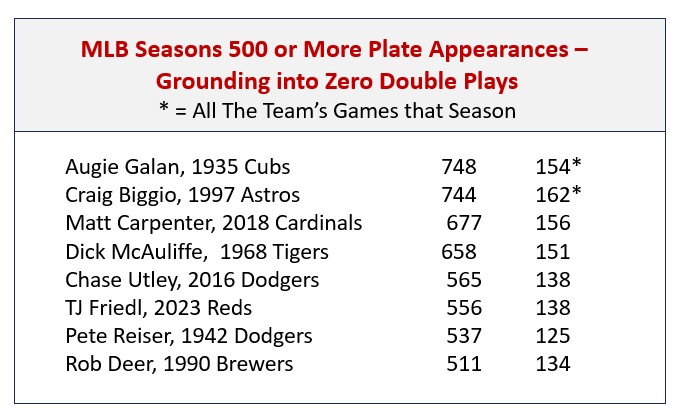
On September 16, 1934, as the Cubs took on the Dodgers in the second game of a doubleheader (in Brooklyn), Cubs’ rookie second baseman Augie Galan hit into a first-inning, short-to-second-to first double play. The twin killing was not really significant in the final outcome – 5-4 Dodgers.  The game itself, Galan’s 55th MLB appearance, was not significant in Galan’s career … except for one interesting (to The Roundtable) fact: Galan did not ground into another double play until April 18, 1936, a span of 168 games and 819 plate appearances. In the process, Galan became the first player to go into the record books as having played in every one of his team’s games in a season (1935) without grounding into a twin killing.

Side note: The “go into the record books” qualifier is that first grain of salt. It reflects the fact that the National League did not begin tracing grounded into double plays (GIDP) until 1933; the American League began keeping that statistic in 1939; and Negro Leagues’ (now major leagues for the years 1920-48) GIDP have not been documented/incorporated.  

As part of his overall GIDP-free streak, in 1935, Galan (then the Cubs’ left fielder) played in all 154 Cubs games, coming to the plate 748 times and never grounding into a double play. On the season, he hit .314, with 203 hits, a league-topping 133 runs scored, 12 homers, 79 RBI and a league-leading 22 steals.

To this date, Galan remains just one of two players to play in every one of their team’s games in a non-shortened season without grounding into a double play and one of just four players to play in 150 or more games in a season without grounding into a double play (again, noting when MLB began tracking GIDP). In the 1935 season, Galan came to the plate in a double play-conducive situation (less than two outs’ runners on first, first and second, first and third or bases loaded) 103 times.  Hit batting average in those situations was .310, his on-base percentage .383.  (Side note: Galan did line into a triple play in 1935).

It wasn’t until 1997 that another player played in all his team’s games without recording a GIDP. This time, it was a future Hall of Famer Craig Biggio, in his tenth MLB season. Biggio had four fewer plate appearances than Galan, but thanks to MLB’s expanded schedule, played in eight more games (162). He hit .309-22-81, with a league-leading 146 runs scored and 47 steals. He also led the league in HBP with 34 plunkings.  Biggio’s 162-game, GIDP-free season was part of a streak of 172 games and 789 plate appearance without grounding into a double play.  In 1997, he came to the plate in 78 of those GIDP-conducive situations. In those spots, he hit a robust  .403, with a .487 on-base percentage.


Of the top three players in terms of games played or plate appearances in a season with zero GIDP: One batted from the right-side Craig Biggio; one from the left, Matt Carpenter; and one was a switch hitter – Augie Galan.

Short, But Still Sweet

If you include shortened seasons, Braves’ shortstop Dansby Swanson would join this list.  In the 2020 (Covid) season, Swanson played in all 60 Braves’ games (264 plate appearances) without grounding into a double play.

Now, A little background on the “stars” of this post. – and them more grains of salt.

Augie Galan played his entire MLB career unable to fully straighten his right arm, due to a childhood elbow injury that he never had treated.  In a February 1982, article in Baseball Digest, “Augie Galan Overcame Handicap to Star in Majors” by Le Pacini, Galan explained it this way.  “There was almost no power in my right arm. Even batting lefty, the chips I had developed caused the arm to swell to twice its size. I had to freeze the elbow a half hour before every game. By the sixth or seventh inning, the feeling would come back, and if I had to make a throw it would be like somebody sticking needles in me.”

Galan began his professional career right out of high school with the 1931 Class-D Globe Bears of the Arizona-Texas League.  In 1932 and 1933, he played for the Pacific Coast League (then Double-A) San Francisco Seals. He made to the Cubs in 1934, after a .356 season at San Francisco in 1933.

In his 16-season MLB career (1934-49 … Cubs, Dodgers, Reds, Giants, Athletics), Galan hit .287-100-830, with 1,004 runs scored and 123 stolen bases.  He was a three-time All Star and led the NL in steals twice, walks twice and runs scored once (four times topping 100 runs). He hit .300+ in six seasons. He was a switch-hitter from 1934-44 (hitting .276). In 1943, due to his damaged right arm, he began to hit solely from the left side.  From 1943-49, he hit .305. Galan grounded into fewer than ten double plays in all but two of his MLB seasons (ten was his highest total) – with five seasons of 500 or more plate appearances and fewer than ten GIDP.

Craig Biggio was a first round (22nd overall) pick (Astros) in the 1987 MLB Draft. He was selected after a .407-15-68 1987 season as a Seton Hall Junior. He hit .342 in three seasons at Seton Hall and was a two-time All Big East selection and a 1987 All American.

In two minor-league seasons, primarily as a catcher (199 at catcher, 18 in the OF), Biggio hit .344-12-90, with 50 steals in 141 games.  He made his MLB debut, at age 22, on June 26, 1988 – starting behind the plate. Catcher remained his primary position from 1988 through 1991.  From 1992 through 2002, he was primarily at 2B, then he moved to CF-LF from 2003-04, before moving back to 2B for 2005 through 2007. He played his entire career 1988-2007 with Astros – hitting .281-291-1,174, with 1,844 runs scored, 414 stolen bases and 3,060 hits.

Biggio, inducted into the Hall of Fame in 2015, was a seven-time All Star and four-time Gold Glover (all at 2B).  He led the league in runs scored twice, doubles three times, steals once and hit-by-pitch five times. He had ten MLB seasons in which he grounded into less than ten double plays in more than 500 plate appearances.

Eight Is Enough

Eight was a pretty good number for Biggio. He scored 100+ runs in eight seasons, hit 20 or more homers in eight seasons and stole 25 or more bases in eight campaigns.

Of course, every coin has a second side, So, here’s list of the players who have grounded into 30 or more double plays in a season. Of interest (to me anyway) is the fact that seven of the 17 are from the Red Sox and only Jim Rice is on the list more than once (three times).


More Grains of Salt

Grain Two – The Lineup Matters.  Where in the batting order you are placed has an impact on the opportunities you have to ground into a DP.  The number-one and two-hitters tend to have fewer opportunities. 1) The impact in inning one is obvious. Later in the game, they are preceded by the number 8 & 9 hitters (less likely to be on the bases) as the lineup comes around. 2) The number 7-8-9 hitters come up after the middle-of-the order (2-6) have more likely taken care of any plate setters on the bases. You get the idea.

A look at the four hitters with season of 150 games or more with zero GIDP seem to back this up.  Augie Galan led off in all his games in his zero-GIDP season; Craig Biggio lee off in 156 of his 162; Matt Carpenter led off in 155 of 156 and batted in the two hole in 15; and Dick McAuliffe led off in 135 of 151. Meanwhile, Jim Rice, who holds the top two seasonal GIDP records, batted third or fourth in 290 of the 299 games he played in those seasons.,

Grain Three – Stats can be Deceptive.  In 16 MLB seasons (1,742 games). Augie Galan hit grounded into 72 double plays.  In 1984-85 (199 games), Jim Rice grounded into 71 double plays.

Yet, 1984, when Rice set the recognized MLB record for GIDP in season at 36, he came to the plate in 202 GIDP-conducive situations. So, he avoided the DP 166 times (63 more times than Galan even came to the plate in GIDP-conducive situations in his 1935 season.)  Then again, Rice did ground into a double play in one of every 5.61 GIDP-conducive plate appearances – not an inspiring number. The point is, there are different ways to look at stats.  Note: On the season Rice hit .323 in GIDP conducive situations, with an on-base percentage of ,332.  

In addition, accuracy can be an issue.  Baseball-Reference.com lists Augie Galan as grounding into 72 double plays  over his career. On his “Overview” page. However, on his “Batting Splits” page,  they list just 68 GIDP.

Grain Four – Wouldn’t You Take These Guys? The top five  top five in career GIDP are  Albert Pujols; Miguel Cabrera; Cal Ripken, Jr., Pudge Rodriguez; and Henry Aaron. I could build a team around that.

Grain Five – Strikeouts can help you out here.  You can’t ground into a double play without putting the ball in play. So, of course, can walks.

A few other tidbits I ran across in putting this post together:

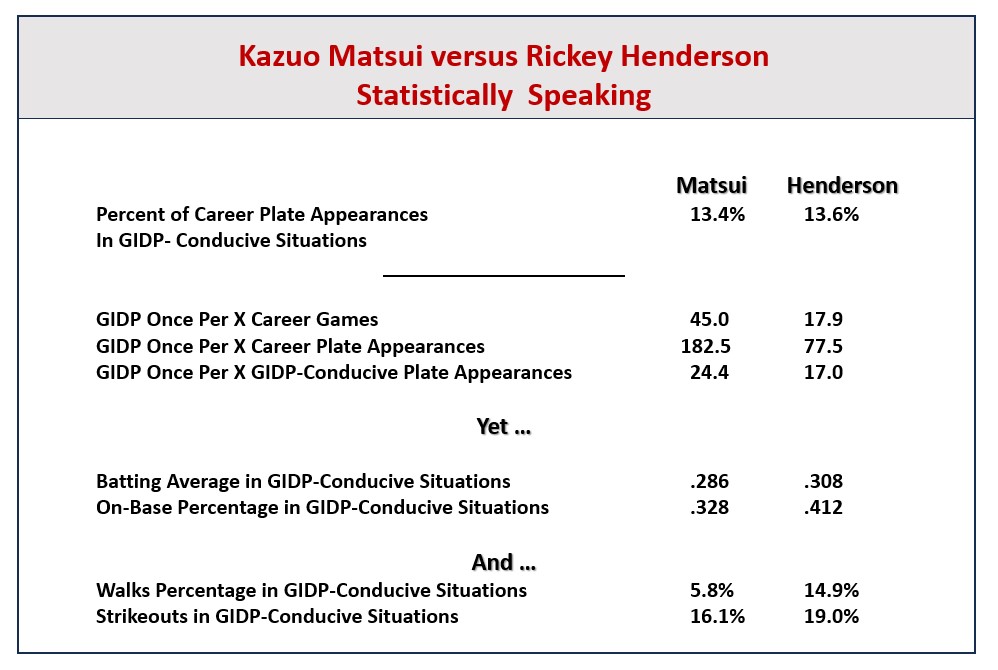
  • Kazuo Matsui, over a seven-season MLB career (2004-2010), grounded into just 14 double plays (one every 45 games; one every 182.5 plate appearances; and once in every 24.4 GIDP-conducive plate appearances. For his career, he hit .286 in GIDP-conducive situations, with a .328 on-base percentage.
  • In 2010, Pudge Rodriguez hit into 25 double plays in 111 games – a rate of one every 4.44 games, one every 16.8 at plate appearances; and one in every 3.5 GIDP-conducive plate appearances.  In those situations, he hit .265, with a .279 on-base percentage.
  • Albert Pujols is the career leader in GIDP, with 426 in 22 seasons. He grounded into double play at a rate of once every 7.2 games, once every 30.6 plate appearances; and once in every 6.8 GIDP-conducive plate appearances. In those situations, he hit .313, with a .363 on-base percentage.
  • Miguel Tejada led his league in GIDP a record five times. For his career, he grounded in  a double play once in every 7.8 games, once in every 33.4 plate appearances; and once in every 6.9 GIDP-conducive plate appearances. For his career, Tejada hit .313, with a .348 on-base percentage in such situations.
  • Among qualifying hitters, Richie Ashburn recorded the fewest GIDP in his league six times. In the 13 MLB seasons in which he had 500 or more plate appearances, Ashburn grounded into fewer than five double plays nine times. For his career, he grounded into a double play once every 26.4 games; once every 117.3 plate appearances; and once in every 17.3 GIDP-conducive plate appearances.  He hit 318, with a .378 on-base percentage in such situations.

A Final Grain of Salt – Sometimes you need a deeper look. 

As I embarked on this blog post, I expected to learn something – maybe even something important – about the significance of the GIDP statistics.  As I complete this post, I am reminded of two quotes:

“It’s not the journey, it’s the destination.”

                   Ralph Waldo Emerson

and

“99 percent of statistics only tell 49 percent of the story.”

Ron De Legge II


What I learned, after putting together this post, is that I am probably less than 49 percent of the way to the story when it comes to GIDP.  The chart below puts that view into perspective.

Remember, Kazuo Matsui and his 14 double plays over seven MLB seasons? Well, here’s is a comparison of Matsui and Hall of Famer Rickey Henderson when it comes to GIDP.  The sample sizes are vastly different (seven seasons to 25), but they were remarkably close in the percentage of MLB career plate appearances in GIDP-conducive situations (13.4% for Matsui and 13.6% for Henderson).   As you can see, Matsui was significantly less likely to ground into a double play, yet Henderson was significantly more likely to get a hit or get on base in those situations. Clearly, I need to put in some more work. So, while I have not yet reached the destination, the continuing journey has been interesting. I’d love to hear from readers on additional factors you think I should include in my efforts.

Primary Resources: Baseball-Reference.com; Baseball-Almanac.com; Baseball Digest; Set0n Hall University Athletics; Double Play Cafe by Joe Posnanski (medium.com/joeblogs/gidp-7547e93e0732 )


Baseball Roundtable – Blogging Baseball Since 2012.

100Baseball Roundtable is on the Feedspot list of the Top 100 Baseball Blogs.  To see the full list, click here.

Baseball Roundtable is also on the Anytime Baseball Supply Top 66 Baseball Sites list.  For the full list, click here

I tweet (on X) baseball @DavidBaseballRT

Follow Baseball Roundtable’s Facebook Page here.  More baseball commentary; blog post notifications.

Member: Society for American Baseball Research (SABR); Negro Leagues Baseball Museum; The Baseball Reliquary. 

P1035


Baseball Roundtable March/April Wrap Up – A No-hitter, A National Siblings Day Celebration, A “Save” for a Beekeeper & More

It’s May 1, and that means it’s time for the Baseball Roundtable monthly Wrap Up for March/April – a look at the stories and statistics that caught The Roundtable’s attention over the past month, as well as the standings, Roundtable Players and Pitchers of the Month, the Trot Index and more.

As usual, there a few things unusual over the past thirty days. We saw:

  • The Astros’ Ronel Blanco tossing MLB’s first 2024 no-hitter (in his first MLB complete game);
  • Brothers Josh and Bo Naylor homering in the same inning for the same team (Guardians) on National Siblings Day;
  • The Red Sox’ Tyler O’Neill homering for a record fifth consecutive Opening Day;
  • The Phillies’ Bryce Harper‘s 1,000th run scored and the Astros’ Alex Bregman’s 1,000th base hit;
  • TWO “Madduxes” –  one-pitcher shutouts of less than 100 pitches;
  • A beekeeper leaving a T-Ball game to “save” a Diamondbacks” game;
  • Tigers’ rookie Wenceel Perez homering from both sides of the plate in the same game; and
  •  Much more.

Read on for these highlights – and the more. As usual, we’ll start with Baseball Roundtable’s Players and Pitchers of the Month.

—BASEBALL ROUNDTABLE PLAYERS AND PITCHERS OF THE MONTH—

National League

Player of the Month – Tie: Mookie Betts, SS, LA Dodgers & Marcell Ozuna, DH, Braves     

Mookie Betts: Talk about a team player (and superior athlete) Mookie Betts came to the Dodgers (from the Red Sox) in 2020 with four All Star selections, four Gold Gloves as an OF, one batting title and one MVP Award. In his first season in Dodger blue, he added another outfield Gold Glove. In 2021-22, Betts was an All Star (in RF and CF). Then, in 2023, when the Dodgers had a need at second base, he started 77 games in RF, 62 at 2B and 12 at SS. As the 2024 season opened, the Dodgers asked Betts to take a larger role at SS.  Thus far, he has started 22 games at SS and 10 at second base. How has all this moving around the field to help the team affected Betts?

In March/ April, Betts led MLB in hits with 46, batting average (among qualifiers) at .368, walks (26), on-base percentage (among qualifiers) at .477;   and runs scored with 29, while also hitting six home runs, and driving in 23 (third-highest in the NL) and stealing eight bases in eight attempts., In March/April,  he had a eleven multi-hit games (including a five-for-five on April 16); hit in 25 of 32 gams and never went more than two consecutive gams without a hit.

Marcell Ozuna: Braves’ LF Marcell Ozuna hit an NL- leading nine home runs and drove in an MLB-topping 31 runs in 28 games, while putting up a .327 average. His month included nine multi-RBI games. Ozuna also enjoyed a 17-game hitting streak March 30-April 19 during which he went .377-8-24.

Oh, if you don’t like ties, go with Betts. since he also plays defense.

Honorable Mentions: Reds’ SS Elly De La Cruz delivered power and speed, with a .279 average, eight homers (19 RBI) and an MLB-leading 18 steals (21 attempts); and the Brewers’ C William Contreras provided exceptional production from the catcher’s spot, with a .345-5-23 line (and tossed in a pair of stolen bases).

Pitcher of the month: Ranger Suarez, LHP, Phillies

Photo: Ian D’Andrea on Flickr, CC BY-SA 2.0 <https://creativecommons.org/licenses/by-sa/2.0>, via Wikimedia Commons

I could have gone with Phillies’ southpaw Ranger Suarez or Dodgers’ righty Tyler Glasnow. Both won an MLB-high five games.  Suarez was 5-0 to Glasnow’s 5-1.  Suarez also had a nifty 1.32 earned run average and 0.63 WHIP – to Glasnow’s 2.72 and 0.93.  Glasnow had the edge in innings pitched (43 to 41, but with one more start) and strikeouts (an MLB-high 53 to Suarez’ 40).  Overall, I just felt Suarez has a slight edge – plus you gotta like the name “Ranger.”

Suarez got off to a bit of a slow start, giving up five earned run in his first two starts (11 innings) – a win and a no-decision. He then reeled off four more straight wins giving up just one earned run (30 innings), including a shutout versus Colorado on April 16. At one point in March/April, Suarez had thrown 32 consecutive scoreless innings.

Honorable Mentions:  As noted above, Tyler Glasnow; also the  Cubs’ Shota Imanaga, who went 4-0, with a 0.98 earned run average, also deserves a shoutout.  Although he logged only 27 2/3 innings in five starts and The Roundtable likes a little more length.

_________________________________________________

American League

Player of the Month – Salvador Perez, C, Royals

Photo: Arturo Pardavila III on Flickr, CC BY 2.0 <https://creativecommons.org/licenses/by/2.0>, via Wikimedia Commons

Salvador Perez had the third-highest batting average among AL players with at least 75 March/April at bats at .355, his seven home runs tied for sixth in the league and his 26 RBI topped the junior circuit. After going zero-for-seven in the season’s first two games, he never went hitless in consecutive games again. He had eleven multi-hit games (four three-hit contests). His 38 hits were fourth in the AL.  Not bad for a Gold Glove-caliber catcher.

Honorable Mentions: Orioles’ SS Gunnar Henderson put together a nice 291-10-24 March/April – tying for the MLB lead in homers. He also scored 25 runs (second in the AL) and stole six bases. Another SS, the Royals’ Bobby Witt, Jr. hit .315 for March/April with four home runs and 167 RBI.  He tied Henderson for second in the AL in runs scored with 25 and also shared the league lead with nine steals.  Finally, Guardians’ LF Steven Kwan led the AL with 42 hits and 27 runs scored, while hitting .350-3-9.

Pitcher of the Month – Tyler Skubal, LHP, Tigers

Tarik Skubal went 4-0 in six starts (tying for the AL lead in victories) and put up a 1.72 earned run average, minuscule 0.74 WHIP (lowest among AL pitchers with at least 20 March/April innings).  He held hitters to a .162 average (third-best in the AL among pitchers with at least 20 innings) and fanned 41 (just six walks) in 36 2/3 innings.

Honorable Mentions: Jose Berrios (he’s been around so long, it’s hard to believe he’s just 29) went 4-2, with a 1.44 earned run average for the Blue Jays. He fanned 31 batters in 43 2/3 innings.  The Royals’ Seth Lugo went 4-1, with a tidy 1.66 ERA.  Like Berrios, he did not rely on the strikeouts, fanning 23 in 38 innings.

________________________________________

Surprise Player of the Month: Tie:  Ronel Blanco, RHP, Astros & Mason Miller, RHP, A’s

You can read more about Ronel Blanco in the “Highlights” section, however, you should know that he came into the 2024 MLB season as a 30-year-old, in his eighth professional season, with just 24 MLB appearances (seven starts) and a 2-1, 4.78 stat line on his MLB resume. However, in his first 2024 start (versus the Blue Jays) for the Astros, he twirled the first no-hitter of 2024. Now that was a surprise. Then, in his second start, he went 5 2/3 frames before giving up his first hit of the season.   He now stands at 3-0, 1.65, and that no-no (his only MLB complete game) remains a surprise.

Mason Miller signed with the A’s (third round of 2021 MLB Draft) out of Gardner-Webb University, where he was 8-1, 3.30 in 14 starts (121 strikeouts in 92 2/3 innings) in his senior year.  By 2023, the 100-mph+  flamethrower was in the A’s rotation, with the promise of “ace” status down the road.  Then, elbow issues put him on the shelf for about four months, (He missed most of May and all of June, July and August.)  When, Miller returned in September, he was handled with extreme caution, never pitching more than three innings.  He was moved into a new role in 2024, closer – and he adapted surprisingly well.   In eleven March/April appearances, he picked up eight saves and put up a 1.35 ERA, with 28 strikeouts and just four walks in 13 1/3 innings. He closed out the period with ten consecutive scoreless appearances.

Honorable Mentions: The Red Sox’ Kutter Crawford only went 1-1, but he put up a 1.35 ERA – giving up just five earned runs in 33 1/3 innings, with 34 strikeouts.  A big part of the surprise was his ability to avoid the gopher ball. Coming into this season, the 28-year-old had given up 30 home runs in 208 2/3 MLB innings. He has yet to give up a homer this season. Crawford was signed in the 16th Round of the 2017 MLB draft (out of Florida Gulf Coast University – where he had gone 7-1, 1.71 in three seasons). Coming into this season, he was 9-15, 4.74 in 53 games (36 starts) for the Red Sox between 2021 and 2023.

The Roundtable also should shine a light on rookie SS Blaze Alexander, who won a spot on the Diamondbacks roster after posting a .400 batting average in Spring Training (two homers, eight RBI and five steals in 24 games). An 11th round draft choice out of high school, Alexander had gone .276-52-244 in five minor-league seasons. He was .290-10-58 primarily at Triple-A in 2023.  In March/April, the hit .311-3-13 in 22 games.  (I had to find a place to mention these two:  Kutter and Blaze, great baseball names.

____________________________________________

THE TROT INDEX … A REGULAR BASEBALL ROUNDTABLE FEATURE

Through April 30,  35.1 percent of the MLB season’s 34,079 plate appearances ended in a trot (back to the dugout, around the bases, to first base). We’re talking about strikeouts, home runs, walks, hit by pitch and catcher’s interference – all outcomes that are, basically, devoid of action on the base paths or in the field. Here’s the breakout: strikeouts (22.5%); walks (8.7%); home runs (2.7%); HBP (1.2%); catcher’s interference (less than 1%). Strikeouts, by the way, outnumbered base hits 7,656 to 7,294. 

The 35.1 percent figure is down  from 36.1% through April in 2023. I also looked into full-year Trot Index figures for the years I have been a fan: in 2023; 30.3% in 2010; 29.9% in 2000; 31.7% in 1990; 23.1% in 1980; 27.0% in 1970; 25.1% in 1960; and 22.8% in 1950.

_______________________________________________

If the season ended April 30, the playoff teams would have been:

National League: Braves, Brewers, Dodgers  Wild Cards: Phillies, Cubs, Reds

American League: Guardians, Orioles, Mariners  Wild Cards: Yankees, Royals and Red Sox or Tigers

A few observations on the March/April results:

National League

Braves: No team has a higher wining percentage March/April than the Braves at 19-9, .679.  The Guardians, Orioles, Yankees, and Dodgers also all won 19 games, but each had more losses than the Braves.   And, the Bravos did it:  1) Without Cy Young Award favorite Stephen Strider  (2o23’s only 20-game winner and the 2923MLB strikeout leader) due to season ending elbow surgery); and 2) With a slumping Ronald Acuna, Jr. (an expected MVP candidate who went .337-41-106, with 73 steals a year ago), who hit .255, with just one home run and six RBI in March/April). If I had to name a couple of players who were key to picking up the slack.  They would be DH Marcell Ozuna, who led the NL in home runs (9) and RBI (31) through April and Chris Sale, who was 3-1, 3.69 in five starts. Thirty-year-old veteran RHP Reynaldo Lopez (who started just one game, in 129 appearances, over the 2022-23 seasons) also went 2-0, 0.72 in four starts for the Braves. In addition, reliever A.J. Minter picked up five wins out of the pen (5-2, 2.63 in 15 appearances).  Ozuna did get help on offense, with three additional Braves picking up 15 or more March/April RBI.

Marlins: On the other end of the spectrum, the Miami Marlins (84-78 a year ago and a Wild Card team, finished March/April at an NL-worst 6-24. If you look at the Marlins who played in at least 20 March/April games, only two hit at least .250. Overall, the Marlins scored the second-fewest runs in the NL (111), ahead of only the Cardinals (108) and gave up the second-most runs (174), with only the Rockies, at 183, allowing more).

The Dodgers, as expected, are out in front in the NL West, the Phillies are hot on the Braves tail in the East and it looks like a scramble in the Central.

Hmmm?

The Diamondbacks had a +26 run differential in March/April –  third-best in the NL – but were three games below .500 (14-17).

American League

Guardians: The Guardians surprised a lot of people with their 19-10 start.  Like the Braves above, they are missing their staff ace Shane Bieber (60-day Injured list).   What should be scary for the rest of the Division is that only one player in their starting lineup has celebrated his 28th birthday (3B Jose Ramirez – 31 – who is hitting .252-5-24).  The offensive leaders are a pair of 27-year-olds:  1B Josh Naylor at .282-7-24; and LF Steven Kwan at .350, with 27 runs scored. On the mound, a pair of 25-year-old starters (Logan Allen and Tanner Bibee) have gone a combined 5-1, 4.45 in 12 starts. Then, of course, there is lights out closer 26-year-old Emmanuel Clase (1-1, 0.63 with eight saves).

White Sox: On the downside of the standings, you’ll find the White Sox, with a league-worst 6-24 record. Like the Marlins in the NL, the White Sox offense has had trouble finding its way.  Of the eight White Sox players with at least 20 games played, only two are hitting  at least .250 and the overall team average .212. Only two White Sox have ten or more RBI – LF Andrew Benintendi (13) and utility player Gavin Sheets (11). The pitching hasn’t fared any better. On the starting staff, after Erick Fedde’s 2-0, 2.60, you have earned run averages that read: Garrett Crochet – 5.97 in seven starts; Michael Soroka – 6.48 in seven starts; Chris Flexen – 6.38 in four starts; Jonathan Cannon – 7.24 in three starts; Nick Nastrini – 7.88 in two starts; and Tanner Banks – 4.50 in one start. To date, the White Sox have an MLB-worst negative-79 run differential.

Now, I didn’t expect that:  The biggest surprise in the AL may the Astros at 10-19 and in last place in the AL West – particularly given the strong starts of RF Kyle Tucker (.300-7-20); DH Yordan Alvarez (.263-7-18); 2B Jose Altuve (.345-7-9); and C Yainer Diaz (.871-3-13).  If you had to pinpoint the issue, you can look to injuries to the pitching staff (on the IL at the end of April were Cristian Javier; Kendall Graveman; Jose Urquidy; Luis Garcia; Lance McCullers, Jr.  And, there are some issues in the bullpen. Usually reliable Josh Hader and Ryan Pressley have earned run averages of 76.39 and 6.17, respectively,

In March/April, the Astro had the AL’s highest batting average (.265) and third–highest earned run average (5.01).

As expected the Orioles and Yankees are battling it out in the East and the Central is developing into a scramble.  In the West, at least for now, the  the Mariners and Rangers are taking advantage of the Astros fall from grace.

A few bullets. In March/April:

  • The teams with the six lowest earned run averages were all in the AL: Red Sox, Mariners; Yankees; Tigers; Royals, Guardians.
  • The Astros were the only team to strikeout fewer than 200 times (187).
  • The top three run-scoring  teams were  in in the NL West: Dodgers (169); Diamondbacks (162); Padres (157 – tied with the Orioles).
  • The Twins were the only team to average ten or more strikeouts (by their pitchers) per nine innings.
  • Nine of the top 11 teams in walks drawn were in the NL.
  • The Red Sox were the only team with an ERA under 3.00 (2.59)


——-Team Statistical Leaders for March/April  2024 ———-

RUNS SCORED

National League – Dodgers (169); Diamondbacks (162); Padres (157)

American League – Orioles (157); Guardians (152); Yankees (150);

The fewest runs in March/April were scored by the White Sox (84). In the National League it was the Cardinals at 108.  Beside the White Sox, the A’s were also under 100 runs at 94. 

AVERAGE

National League – Dodgers (.271); Braves (.269); Brewers (.257)

American League – Astros (.265); Orioles (.254); Rangers (.250); Red Sox (.250)

The lowest team average for March/April belonged to the A’s at .207. The lowest in the NL was the Cardinals (.220). 

HOME RUNS

National League – Phillies (40); Dodgers (36); Brewers (35)

American League – Orioles (45); Yankees (39); Red Sox (36)

The White Sox and Cardinals had the fewest home runs in March/April at 20.  

The Orioles led MLB in slugging percentage for at .450.  The Dodgers led the AL at .437. 

TOTAL BASES

National League – Dodgers (484); Padres (437); Phillies (435)

American League – Orioles (453) ; Red Sox (427); Astros (427)

STOLEN BASES

National League – Reds (54); Nationals (53); Brewers (40)

American League – Guardians (32); Rays (31); Royals (31); Angels (31)

The Cubs stole the fewest sacks in March/April   – nine in 16 attempts.   The Rangers were at the bottom of the AL, with 13  in 17 attempts. 

WALKS DRAWN

National League –   Dodgers (135); Pirates (126); Diamondbacks (116)

American League – Yankees (135); Blue Jays (110); Mariners (101); Red Sox (101)

The Dodgers led MLB in March/April on-base percentage at .351. The Yankees led the AL at .337. The Marlins and White sox anchored their leagues at .278. 

BATTER’S STRIKEOUTS

National League – Pirates (295); Reds (294);  Rockies (290)

American League – Mariners (311); A’s (303); Red Sox (296)

Astros’ batters fanned the fewest times in March/April (187). The Mets fanned the fewest times in the NL at 212.

__________________________________________________ 

Bonus Stats

  • The Tigers were successful on 15 of their 16 March/April steal attempts. The only team with only one caught stealing.
  • Three teams (Braves, Mariners, Tigers) recorded zero sacrifice bunts in March/April. No team recorded more than eight (White Sox & Cardinals).
  • Guardians batters were hit by a pitch an MLB-leading 27 times. The only other team with at least 20 HBP was the Twins at 26. The Phillies suffered the fewest HBP – six.

_______________________________________

EARNED RUN AVERAGE

National League – Phillies (3.44); Mets (3.48); Braves (.357)

American League – Red Sox (2.59); Mariners (3.03); Yankees (3.06)

The Rockies  had the highest March/April ERA at 6.05.  Also over 5.00 were the Angels (5.08) and White Sox (5.05)

STRIKEOUTS

National League – Phillies (292); Dodges (269); Mets (265)

American League – Twins (287);  Mariners (284); Guardians (283)

The Twins averaged an MLB-best 10.04 strikeouts per nine innings in March/April. The Phillies averaged an NL-best 9.49.  Five  teams averaged nine whiffs per nine or better. 

FEWEST WALKS SURRENDERED

National League –   Braves (80); Giants (81); Cardinals (85); four with 92

American League – Mariners (69); Red Sox (75); Orioles (74)

The Mariners walked an MLB-lowest 2.32 batters per nine innings in March/April.  The Mets walked an MLB-worst 4.34 batters per nine frames.

SAVES

National League – Dodgers (11) ; Cardinals (11); Brewers (10); Padres (10)

American League – Yankees (13); Guardians (10); Tigers (10)

The Pirates, Marlines, Rays, and White Sox  blew the most saves in March/April  – eight each in  in 17, 12, 17 and  12 opportunities, respectively.  The Cardinals blew the fewest saves, just two in 13 opportunities. 

Walks+ Hits/Innings Pitched (WHIP)

National League – Phillies (1.15); Dodgers (1.18); Braves (1.18)

American League:  Mariners (1.02); Tigers (1.10); Red Sox (1.12)

_________________________________________

Bonus Stats:

  • The White Sox gave up an MLB-high 42 home runs in March/April. (The Mets gave up an MLB-low 17 home runs.
  • The Mariners held opponents to an MLB-low .208 average in March/April. The Rockies’ staff was touched for an MLB-high .296 average.
  • The Mariners strikeouts-to-walks ratio for March/April topped MLB at 4.12. The Rockies had MLB’s worse ratio at 1.64.

_________________________________________________

–March April Highlights—

Too Early for Me

The Dodgers and Padres opened the 2024 season on March 20 in the Gocheck Skydome in Seoul South Korea.  The two teams split a two-game series a two-game series (May 20-21), with the Dodgers winning Game One 5-2 and the Padres taking Game Two 15-11.  It was a tale of two different games, with zero extra-base hits in Game One and six doubles, a triple and two home runs in Game Two. I f there were standout performances, I’d point to Mookie Betts playing shortstop for the Dodgers and going four-for-five with a double, a home run, two runs scored and six RBI in Game Two and the Padres’ Jake Cronenworth’s four-for-four, with a triple, two runs scored four RBI in the same game.  The biggest surprise? Dodgers’ signee Yoshinobu Yamamoto (12-year, $325-million contract) lasting just one inning (five earned runs) in his first Dodger start. That’s all I’ll say about these games – largely because I am not a fan of the “overseas” openers, particularly when they occur so many days before a full slate of games.  It just doesn’t seem like Opening Day to me.

Like to Get Off to A Good Start

On March 28, with the Red Sox facing the Mariners in Seattle, Boston RF Tyler O’Neill went one-for-three, with a walk – scoring two runs and driving in one as the Crimson Hose prevailed 6-4.  O’Neill’s one hit was a home run, marking the fifth consecutive Opening Day on which he homered.  The Elias Sports Bureau reported that his March 28 long ball made O’Neill the first player to homer on five consecutive (2020-24) MLB Opening Days – breaking a tie with (three catchers) Yogi Berra, Gary Carter and Todd Hundley.  Notably, the 2020-to-2024 Openers are the only five Opening Day games that O’Neill has been in the starting lineup up for during his seven-season MLB career.  (He did get into the Cardinal’s 2019 Opening Day game as a pinch hitter.)

Let’s Try Something Different

In case, you missed it, Sarah Langs (@SlangsOnSport) reported on March 28th that the Giants have used a different left fielder on Opening Day in each of the past eighteen seasons – an MLB record (per the Elias Sports Bureau) for consecutive years starting a different player, on Opening Day, at any specific position, with no repeaters.  Is this more #InBaseballWeCountEverything? Langs gave us the names, the chart below adds a bit of detail (trivia?).

It was by, the way, the final MLB season for six of those leftfielders; 12 of the group were in their age-30 or later season; and, of those, six were in their age-35 or later campaign.


Ouch!

On Thursday, March 28, the Rockies opened their 2024 season on the road against the Diamondbacks. By the end of the third inning, I am sure they were yearning for home.  The Diamondbacks scored twice in the first and then, in the bottom of the third inning, plated 14 more runs (without the aid of a home run). The Elias Sports Bureau reported that the 14 tallies were the most (in the Modern Era) in a single inning for any team on an Opening Day. In the inning:

  • eight of the nine players in the Diamondbacks’ lineup collected hits (Corbin Carroll, who did not get a hit collected two walks) and five had two safeties;
  • eight of the nine eight of the nine Diamondbacks scored and six scored twice;
  • eight of the nine recorded an RBI, with two notching three RBI;
  • Rockies’ pitchers threw 62 pitches, 42 strikes (of, course plenty of those strikes were struck for base hits.

It went like this:

SS Geraldo Perdomo … single off Kyle Freeland;

2B Ketel Marte … single;

RF Corbin Carroll … walk, loading the bases;

LF Lourdes Gurriel, Jr. … RBI single ;

1B Christian Walker …  two-run double;

C Gabriel Moreno … RBI single;

3B Eugenio Suarez …  RBI single;

DH Blaze Alexander … fly out;

CF Alek Thomas … RBI double;

Anthony Molina replaced Freeland on the mound.

Perdomo … RBI single;

Marte …  RBI single;

Carroll … walk, loading the bases;

Gurriel, Jr. … two-run single;

Walker … single, loading the bases;

Moreno … two-run double;

Suarez … sac fly;

Alexander … RBI single;

Jalen Beeks replaced Molina on the mound.

Thomas … groundout, pitcher -to-first;

It might have bene a sign of things to come, The Rockies finished April with a 7-22 record.

#InBaseballWeCountEverything

This event makes the highlights section simply because it provides another solid example of #InBaseballWeCountEverything.  On March 31, the Reds’ DH Jonathan India was at the plate in the bottom of the ninth – with two outs, no one on base and the Reds trailing 5-2.  India logged a tough 10-pitch at bat against Nationals’ closer Kyle Finnegan (who closed April with nine saves) delivering a double to left.  Next up was CF Wil Benson, who hit the first pitch he saw from Finnegan to deep left-center for a game-tying home run. Then 1B Christian Encarnacion-Strand tagged an 0-1 pitch from Finnegan to deep left for a walk0off game winning homer.

Now here’s that “counting” example.  Elias Sports Bureau noted that the homer came in Encarnacion-Strand’s 66th MLB game and that in those 66 games, Encarnacion-Strand has three walk-off hits – a walk-off in 4.5 percent of his games played, That, at the time, was the highest walk-off percentage of any player who debuted in the Expansion Era and had played at least 50 games.  Are we getting a little deep into the weeds here?

Blanco Blanks the Blue Jays – No April Foolin’

On April 1, Astros’ righthander Ronel Blanco threw the first no-hitter of the 2024 season – blanking the Blue Jays 10-0 in Houston.  The 30-year-old Blanco – in just his third MLB season – gave up two walks and fanned seven in the no-no. A few trivia tidbits:

  • The no-hitter was Blanco’s first-ever MLB complete game;
  • It came in just his eighth career MLB start (25th appearance);
  • It was his first appearance of more than six innings;
  • It was the first time he struck out more than four batters in a game;
  • Measured by date, it was the earliest no-hitter in an MLB season (remember, the season starts earlier these days);
  • Blanco and his catcher that day (Yainer Diaz) became just the first all-Dominican-born battery to deliver a no-hitter.

In his first outing after the no-no (April 7 versus Texas), Bianco went 5 2/3 innings before giving up his first hit (of the season).  He got the win in that one after tossing six innings of one-hit (four walks, four whiffs) ball.

Blanco signed with the Astros, out of the Dominican, as an international free agent, in 2016 and made his MLB debut as a 28-year-old on April 8, 2022. He ended this April 3-0, 1.65 on the season and  with a career MLB record at the end of April stood at 5-1, 3.66.

More #InBaseballWeCountEverything

The Elias Sports Bureau reports that Ronel Blanco’s no-hitter made new Astro’s manager Joe Espada the first major-league manager to have his first MLB victory marked by a no-hitter.  

Harper Bats a Thousand – Kind of

Harper Photo: All-Pro Reels from District of Columbia, USA, CC BY-SA 2.0 <https://creativecommons.org/licenses/by-sa/2.0>, via Wikimedia Commons

On April 2, Bryce Harper came into the Phillies game against the Reds looking for his first hit of the 2024 season (he was 0-for-13, with two walks and five whiffs).  He got it – and then some. Harper went three-for-four with three home runs and six RBI. Harper’s second homer of the game was a significant one, as he drove himself in for his 1,000th career run scored. The third round tripper, in the seventh, was a Grand Slam.  It was Harpers’ second career three-homer game and seventh Grand Slam. The Phillies won the game 9-4.

Three is Not Necessarily a Crowd

On April 2, the Phillies’ 1B Bryce Harper recorded the 2024 season’s first three-homer game.  He was later joined by The A’s C Shea Langeliers (April 9) and Braves’ C Travis d’Arnaud (April 19).  On April 12,  Astros’ RF Kyle Tucker became the first player to have two multi-homer games in 2024 (April 1 & April 12).  He was later joined by the Twin’s 2B Edouard Julien and Astro’s OF/DH Yordan Alvarez. Overall, the month saw 42 players record at least one multi-homer game in March/April.

A True Walk-off Win

On April 5, the Brewers came to the plate in the bottom of the ninth, tied 5-5 with the Mariners.  On the mound was righty Andres Munoz.  Brewers’ CF Sal Frelick opened the inning by drawing a five-pitch walk. PH Jake Bauers followed with a six-pitch walk. Next up was 2B Brice Turang. You guessed it, five-pitch walk.  Munoz then fanned RF Jackson Chourio on five pitches, before C William Contreras walked on five offerings, plating the winning run.  Yes, a Walk-Off – without ever putting a ball in play.

The Naylors Nail National Siblings Day

April 10 was National Siblings Day – and, in Cleveland, the Guardians starting lineup included brothers Josh and Bo Naylor, at 1B and C, respectively.  The siblings did not disappoint. In the fourth inning – for the second time in their MLB careers – they went deep in the same frame.  Josh with a solo shot and, three batters later, Bo with a two-run blast (both off Erick Fedde). The pair continued their celebration of Siblings Day in the bottom of the tenth (and final) inning. With the Guardians trailing the White Sox 6-5, Josh drove in the tying run with an RBI double and Bo later rapped a walk-off single to win the contest.


30-30 Vision

On April 10, as the Yankees lost to the Marlins 2-5 in New York, Giancarlo Stanton contributed a solo home run (sixth inning) off Bryan Hoeing. It was Stanton’s fourth home run of the season and a bit of a history maker. It was Stanton’s first-ever home run off against the Marlins and made him the 78th MLB player to homer against all 30 MLB franchises. (Stanton played his first eight seasons … 2010-17 …  for the Marlins.)

Now, this used to be more of a “feat” before the advent of interleague play in 1997 – and we can expect more players to join this list given MLB’s 2022 decision to have each team play all 29 other teams during the season beginning in 2023.

For Those Who Like to Know Such Things

Orlando Hudson has the fewest career home runs of any player to homer against all 30 MLB franchises – with just 93.  (He notched the 30th franchise with a homer versus the Toronto Blue Jays on July 7, 2010 – just his 83rd career homer, coming in his 1,083rd MLB game.  Hudson hit just one career homer each against the Twins, Cardinals, Yankees, Phillies and Blue Jays.   By contrast, Giancarlo Stanton marked going deep against all thirty teams with his 406th homer, in his 1,543rd game and, by that time, he had multiple home runs against each the other 29 franchises.

Over his career, Hudson hit .273-93-542 in 1,345 games.  He played for the Blue Jays (2002-05); Diamondbacks (2006-08); Dodgers (2009); Twins (2010); Padres (2011-12); and White Sox (2012).

 Milestone Homer for Perez

On April 13, Royals’ catcher Salvador Perez hit his fourth home run of the 2024 season, as the Royals swamped the Mets 11-7.  The long ball came in the fourth inning, a two-run shot off Sean Manaea.  It was the 250th career home for the eight-time All Star and five-time Gold Glover.

 Gift of the Maddi?

What is the plural of Maddux?  Madduxes? Maddi?

Subhead:  Houck Hobbles Guardians – Fried Fries Marlins

On April 17, Red Sox righty Tanner Houck took the mound against the Guardians (n Boston) at 7:10 p.m. Just one hour-and-49 minutes later, he had a shutout 2-0 win under his belt – producing what has become popularly known as a Maddux, a nine-inning shutout of fewer than 100 pitches (named after Hall of Famer Greg “The Professor” Maddux).

Houck gave up just three hits in the gem, walked none and fanned nine. He threw 94 pitches over nine innings – 69 (73.4 percent) strikes. Houck faced a total of 29 batters in the game, and only eight saw more than one pitch out of the strike zone. It was Houck’s first MLB complete game (coming in his fifth MLB season).  He ended April with a 3-2, 1.60 record on the season.

Less than one week later, on April 23, the Braves’ Max Fried used just 92 pitches to complete a 5-0 shutout versus the Marlins in Atlanta. Fried gave up three hits and no walks, while fanning six in the one-hour and 54-minute contest. In Fried’s outing – his third career “Maddux” – only one runner got as far as second base.  Fried ended April with a 2-0,  4.02  stat line.

Rare, But Not a Unicorn

Since 2020, there have been just ten MLB ”Madduxes” – nine-inning, one-pitcher shutouts of less than 100 pitches.   Max Fried has three of them. The others belong to Domingo German, Tanner Houck; German Marquez; Jordan Montgomery; Patrick Sandoval; Ranger Suarez; and Framber Valdez.

A Handful of Three-Homer contents

From April 13-17, the Baltimore Orioles enjoyed five consecutive three-homer games.  During the streak, the Orioles outscored their opponents 33-24, and won four of the five games. The home runs were hit by:

Cedric Mullins – 3

Gunnar Henderson – 3

Ryan O’Hearn – 3

Colton Cowser -2

Jordan Westburg – 2

Adley Rutschman – 1

Ryan Mountcastle – 1

For those who like to know such things, the record for consecutive games with three or more home runs is six – Baltimore Orioles, May 8-13, 1987. The Orioles outscored their opponents 49-41 during the streak and actually lost two of those six contests.

The homers went to:

Eddie Murray – 7

Larry Sheets – 4

Fred Lynn – 3

Jim Dwyer – 2

Lee Lacy – 1

Terry Kennedy – 1

Cal Ripken, Jr. – 1

Dave Van Gorder – 1

 Moving On Up

On April 20, as Boston topped Pittsburgh 4-2, closer Kenley Jansen picked up his fifth save of the season – and he did it in prime fashion, fanning SS Oneil Cruz, CF Michael A. Taylor and DH Edward Olivares in order on 14 pitches. It was an important moment, as its marked Jansen’s 425th career save, moving him past John Franco into sole position of fifth place on the All-time list behind Mariano Rivera (652), Trevor Hoffman (601), Lee Smith (478) and Francisco Rodriguez (437). Jansen is a four-time All Star, twice led his league in saves and, over 15 seasons, has put up a 2.52 ERA with 1,171 strikeouts in 821 1/3 innings.

Worth The Wait

On April 22, the Orioles’ Albert Suarez picked up his first MLB victory since June 23, 2016.  The 34-year-old Suarez, in fact, came into the 2024 season having not made an MLB appearance since September 26, 2017 and having not made an MLB start since September 23, 2016.  Suarez, a 6’3”, 235-pound righty, has had an interesting career. He signed with the Tampa Bay Rays in July of 2006 and between 2006 and 2017 was granted free agency by the Rays, Angels, Giants and Diamondbacks. During that time, He appeared in 40 MLB games (12 starts) for the Giants (2016-17) and went 3-8, 4.51, with one save.

Between 2008 and 2018, he went 28-37, 3.65 in the minor leagues (150 appearances, 117 starts). Then from 2018-23, he played in Japan and Korea, before signing with the Orioles in September 2023. After pitching in the Venezuelan Winter League, Suarez started the 2024 season with the Triple-A Norfolk Tide.  He was called up to the Orioles (who had three starters on the injured list) and started against the Twins on April 17.

At the time of his call up, Suarez was 1-1. 5.87 at Norfolk. He quickly, however, exceeded expectations. On April 17, he got a n0-decision, but held the Twins scoreless for 5 2/3 innings, as the Orioles won 4-2.  Then on April 22, he got his first MLB win since 2017 (a span of seven years, nine months and 30 days), holding the Angels scoreless for 5 2/3 innings in another 4-2 Orioles’ win.  Looks like he may be around for a while.

Shohei Ohtani … Move Over Matsui

On April 21st, Dodgers’ DH Shohei Ohtani hit his fifth home run of the 2024 season, as the Dodgers topped the Mets 10-0 in Los Angeles. It was a two-run, third-inning shot off Adrian Houser.  It also happened to be Ohtani’s 176th MLB round tripper, enabling him to pass Hideki Matsui for the most MLB career home runs by a Japanese-born player.  Matsui hit his 275 MLB round trippers over 10 seasons (2003-12 … Yankees, Rays, Angels, A’s), putting up a .282-175-760 line in 1,236 games. Ohtani reached 276 early in his seventh MLB season – in his 725th game.  Ohtani finished April at .336-7-19 on the season.


Baseball Roundtable Extra – Move Over Ohtani … Another Two-Way Star

Photos: Courtesy University of Florida Athletic Association

On Friday, April 19, University of Florida two-way star (1B-P) Jac Caglianone smacked his 23rd home run of the season – at the same time, tying an NCAA record by going yard in his ninth consecutive game.  (The home run came in a 5-2 loss to Vanderbilt.)

Caglianone’s home run streak stopped on April 20, when he went one-for-three, with two walks in a 6-2 Florida win over Vanderbilt. Caglianone started on the mound in that game, picking up the win – going five innings and giving up six hits and two runs, while walking three and fanning six.  The mound appearance ran his 2024 record to at 5-0, 3.86, with 54 whiffs in 44 1/3 innings.

Caglianone closed out April 5-0, 4.10 the mound and .402-26-53 in 44 games at the plate. In 2023, his sophomore season, Caglianone went .323-33-90 in 71 games and 7-4, 4.34 in 18 starts on the mound.   

For those who like to know such things. The NCAA record for home runs in a season belongs to Pete Incaviglia, who went .464-48-143 for Oklahoma State in 1985. Incaviglia went on to a 12-season MLB career, hitting .246-206-655 in 1,284 games.

 Streak Stopped

On April 24, the Phillies’ Trea Turner was retired on a rundown between third base and home plate – ending a string of 41 consecutive successful steal attempts that stretched back to September 6, 2022.  The MLB record of 50 consecutive successful steal attempts (at least since 1951, when CS records were first being kept by both the NL and AL) belongs to the Cardinals’ Vince Coleman (September 18, 1988-July 26, 1989).

 Baseball Roundtable Extra

 I wouldn’t’ want to be the broadcaster introducing Jurrangelo Cijntje (pronounced SAIN-ja) as he took the mound.  Then there’s the issue of which arm he’s likely to throw with. As reported by Matt Monagan, Cijntje, a Mississippi State sophomore, pitches from both sides – topping out at 99 mph as a righty and 95 mph as a southpaw. As of April 24, Cijntje’s record on the year was 6-1, 3.50, with 69 strikeouts in 54 innings (ten starts).  

Another “Grand Day” at the Ballyard

On April 25, Astros’ 3B Alex Bregman popped a bloop single to right field in the sixth inning of a 3-1 loss to the Cubs – for his 1,000th MLB it. It came in the two-time All Star’s 989th career game, in his ninth MB season (all with the Astros).

Pete Alonso Rushed to 200

On April 27, Mets’ 1B Pete Alonso went one-for-four in a 7-4 Mets loss to the Cardinals.  His lone hit was a fifth-inning, two-run home run off Sonny Gray. It was Alonso’s eighth home run of 2024 and the 200th round tripper of his career. It came in Alonso’s 710th MLB game, making him the fourth-fastest player to reach that milestone in MLB history (Ryan Howard – 658 games); Aaron Judge – 671 games; Ralph Kiner – 706 games).

Now that Could Be Embarrassing

The White Sox came into Tampa Bay on April 26, sporting a dismal 3-22 record. (The Rays were [playing .500 ball at 13-13). The ChiSox proceeded to sweep the Rays (three games) outscoring them 21-13.

A Big Day (bright future) for Rookies in Boston

On April 27, as the Red Sox trounced the Cubs 17-0 in Boston, a couple of rookies captured the limelight. Rookie defensive whiz Ceddanne Rafaela, (who has played CF, SS and 2B this season) went four-for-four with a home run, two doubles, a stolen base, three runs scored and seven RBI.  Rafaela, who hit .241-2-5 in 28 games with the Red Sox in 2023, came into this contest with a .156-1-10 stat line in 27 2024 games.  The Red Sox have expressed confidence in the future of the 23-year-old – who hit .302-20-69, with 36 steals at Double- and Triple-A in 2023. The Red Sox, in fact, signed Rafaela to an eight-year extension, at a rumored $50 million, early this season. Rafaela finished April at .186-2-17.

Almost lost in the excitement over Rafaela’s seven-RBI game was the fact that rookie RF Wilyer Abreu became the first Red Sox rookie to record an RBI in eight straight games. (Note: Abreu’s rookie status was intact for 2024 after going .316-2-14 in 28 games for the BoSox lasts season.) In the April 27 game, he went two-for-six, with two runs scored and one RBI.  In the eight-game RBI streak, Abreu went ,441-2-9.  A zero-for-four against the Cubs on April 28 ended the streak. He finished April at .316-2-12.

He’s Part of the “In” Crowd

Rangers’ 22-year-old rookie LF Wyatt Langford smacked his first MLB home run in a Ranges 4-3 win over the Reds. It came in the first inning (of his 27th MLB game) and it was an Inside-the-Parker off the center field wall. IN another ode to #InBaseballWeCountEverything. The Elias Sports Bureau noted that Wyatt’s first MLB hit, which came on March 28, in a 4-3 win over the Cubs also invoked a display of speed. It was an INfield single to short.  Elias reported that the ITP homer made Langford the first MLB player in 30 years to have his first career hit be an infield single and his first career home run an inside-the-parker, Langford was signed out of the University of Florida, where he went .363-47-120, with 16 steals (over 134 games in three seasons). He made his MLB debut after just 44 minor-league games – playing at Rookie, High-A, Double-A and Triple-A in 2023 – going .360-10-30, with 12 steals. The Rangers expect him to bring speed and power to the lineup. Langford closed April at .238-1-11.

Mexico City Series

On April 27-28. The Astros and Rockies played a two-game set at Alfredo Harp Helu Stadium in Mexico City (7,349 feet above season level, as compared to Denver’s 5.280 fee.  At this new all-time “High” for MLB, we expected to see the ball flying equally high. No surprise – a total of 26 runs were plated and seven home runs hit in the two games (Astros winning 12-4 and 8-2).  The highlight came in Game One, when Astros DH Yordan Alvarez poked a pair of 461-foor home runs (per Statcast projections).

Had to Bee There to Bee-lieve it

On April 30, as the Dodgers and Diamondbacks prepared to face off in Phoenix, a huge swarm (reportedly thousands) of bees commandeered a vantage point at the top of netting behind home plate (they did not have tickets).  For fan and player safety, the Diamondbacks delayed the start of the game, and a call was placed to Blue Sky Pest Control.  Eventually, the request was relayed to bee-removal extraordinaire Matt Hilton, who was (appropriately) attending his son’s tee-ball game some 23 miles from Chase Field.  Hilton hopped into his truck and headed for Chase Field,  where he donned his protective gear and safely (and humanely) removed the bees (for later release). All in all, it was about a two-hour delay (or bee-lay); fans took up an” MVP-MVP” chant as Hilton removed the bees; and when the game was ready to begin, Hilton was asked to throw out the first pitch. (I am sure he “buzzed” it in there.) The Diamondbacks, prevailed, four-to-bee (er, three) in ten innings.

Lucky Number Seven

On April 30, Tigers starter Jack Flaherty tied an AL record by striking out out the first seven batters of the game (the first of a doubleheader against the Cardinals) in order. He accomplished the feat on 31 pitches, reaching a tw0-ball count on only one batter.  It should not have been a great surprise, Flaherty has been a strike-throwing machine this season – through April, fanning 50 batter with just five walks. In this game, he went 6 2/3 scoreless  innings, giving up two hits,  fanning 14 and walking one.  For his efforts, he go a no-decision. as the Tigers lost 2-1.  That no-decision should also not be a surprise.  In six starts this season, he is 0-1 (five no-decisions), 4.00.

From Both Sides Now

On April 30, in the second game of a doubleheader (versus the Cardinals), Tigers’ rookie OF Wenceel Perez went three-for-four with two homers, three runs scored and three RBI (the Tigers won 11-6). Perez makes it here because:  he hit his second-inning home run (off Steven Matz), right-handed and hit his fifth-inning tater (off Ryan Fernandez) left-handed.  They were Perez’ second and third MLB homers – and he finished April at .302-3-8. Perez, who signed out of the Dominican as a teenage, hit .273-34-245 in seven minor-league seasons (573 games).  For those who like to know sch things: Mark Teixeira and  Nick Swisher share the record for most games with homers from both side of the plate at 14.

Okay, I’m a Homer

Being from Minnesota, I have to get this one in. The Twins went into May with an active nine-game winnings streak – the longest in MLB this season.  During the streak, they have outscored opponents 60-28.  Being a realist, I also must note, the wins came against the Angels and White Sox – with a combined won-lost record of 17-43 through April.


–INDIVIDUAL LEADERS FOR MARCH/APRIL—

BATTING AVERAGE (at least 75 at bats)

American League:  Salvador Perez, Royals (.355); Steven Kwan, Guardians (.350); Jose Altuve, Astros (345)

National League: Mookie Betts, Dodgers (.368); Alec Bohm, Phillies (.366); Will smith, Dodgers (.362)

The lowest average among players with at least 75 March/April at bats belonged to the A’s Ryan Noda  at .133 (11-for-83.) 

HITS

American League: Steven Kwan, Guardians (42); Jose Altuve, Astros (41); Bobby Witt, Jr., Royals (39)

National League: Mookie Betts, Dodgers (46); Trea Turner, Phillies (45); Shohei Ohtani, Dodgers (44)

When it came to extra-base hits, your March/April  leader was the Dodgers; Shohei Ohtani with 22.

HOME RUNS

American League: Mike Trout, Angels (10); Gunnar Henderson, Orioles (10); Tyler O’Neill, Red sox (9)

National League:  Marcell Ozuna, Braves (9); Pete Alonso, Mets (8); Elly De La Cruz, Reds (8); Kyle Schwarber, Phillies (8)

Luis Arreaz of he Marines has the most at bats this season without a home run (127), but the two-time batting champions does carry a  .299 average.

RUNS BATTED IN

American League: Salvador Perez, Royals (26); Adolis Garcia, Rangers (25); Juan Soto, Yankees (25)

National League: Marcell Ozuna, Braves (31); Alec Bohm, Phillies (30); Mookie Betts, Dodgers (23)

RUNS SCORED

American League:  Steven Kwan, Guardians (27);  Gunnar Henderson, Orioles (25); Bobby Witt, Jr., Royals (25;)

National League: Mookie Betts, Dodgers (29); Ronald Acuna, Jr., Braves (27); William Contreras, Brewers, (27); Elly De La Cruz (27); Trea Turner, Phillies (27)

DOUBLES

American League:  Jose Altuve, Astros (9); Anthony Santander, Orioles (9); Josh Smith;, Rangers (9); Spencer Torkelson, Tigers (9); Bobby Witt, Jr., Royals (8)

National League: Shohei Ohtani, Dodgers (14); Alec Bohm, Phillies (12); four with 10

TRIPLES

American League: Bobby Witt, Jr., Royals (4); Gunnar Henderson, Orioles (3); Alex Kirilloff, Twins (3); Jarren Duran, Red Sox (3)

National League: CJ Abrams, Nationals (4); six with two

The leader in slugging percentage, among players with at least 75 March April at bats, was the Guardians’ Tyler O’Neill at .693.

STOLEN BASES

American League: José Caballero, Rays (9); Jarren Duran, Red Sox (9); Luis Rengifo, Angels (9)

National League: Elly De La Cruz, Reds (18); Brice Turang, Brewers (14); Ronald Acuna, Jr., Braves (13)

The Brewers’ Brice Turang stole the most March/April bases without getting caught (14).

BATTER’S STRIKEOUTS

American League:   Jose Siri, Rays (41); Julio Rodriguez, Mariners (40); Aaron Judge, Yankees (38)

National League:  Kyle Schwarber, Phillies, (46); Will Benson, Reds (45); Oneill Cruz, Pirates (45)

Joey Gallo fanned 43 times in just 74 March/April at bats.

WALKS

American League:  Juan Soto, Yankees (25); Riley Greene, Tigers (23); Aaron Judge, Yankees (23)

National League: Mookie Betts, Dodges (26); Freddie Freeman, Dodgers (23);  Brandon Nimmo, Mets (21); Kyle Schwarber, Phillies (21)

Only five batters with at least 75 at bats had more walks than strikeouts in March/April –  led by the Dodgers Mookie Betts with 26 walks and 16 whiffs (1.63 BB/K.) 

PITCHING VICTORIES

American League:   Tarik Skubal, Tigers (4-0); Seth Lugo, Royals (4-1); Grayson Rodriguez, Orioles (4-1); Jose Berrios, Blue Jays (4-2);

National League:  Reed Garrett, Mets (5-0); Ranger Suarez, Phillies (5-0); Tyler Glasnow, Dodgers (5-1); A.J. Minter, Braves (5-2)

Ross Stripling of the A’s lost the most games in March/April (0-5, 4.98)

EARNED RUN AVERAGE (minimum 20 March/April innings)

American League:  Kutter Crawford, Red sox (1.35 in 33 1/3 innings); Jose Berrios, Blue Jays (1.44 in 43 2/3 P); Cristian Javier, Astros (1.54 in 23 1/3 IP)

National League: Shota Imanaga, Cubs (0.98 in 27 2/3 IP); Sonny Gray, Cardinals (1.16 in 23 1/3 IP) Ranger Suarez, Phillies (1.32 in 41 IP)

The highest ERA among pitchers with at least 20 March/April innings was 12.00 by the Cubs Kyle Hendriks (0-3, 12.00 in five starts, 21 innings.

STRIKEOUTS

American League:  Jack Flaherty, Tigers (50 in 36 IP); Luis Castillo, Mariners (49 in 41 2/3 IP); Garrett Crochet, White Sox (47 in 34 2/3 IP)

National League:  Tyler Glasnow, Dodgers (53 in 43 IP); Zack Wheeler, Phillies (46 in 37 1/3 IP);  Freddy Peralta, Brewers (45 in 33 2/3 IP)

Among pitchers with at least 20 innings pitched in March/April, the highest strikeouts-per nine innings ratio belonged to the Yankees Luis Gil at 12.8 (35 whiffs in 24 2/3 IP)and the highest strikeouts-to-walks ratio belonged to Jack  Flaherty at 10.0 (50K/5BB)

WALKS + HITS/INNINGS PITCHED (at least 20 March/April innings)

American League: Tarik Skubal, Tigers (0.74); Logan Gilbert, Mariners (0.80); Ryan Pepiot, Rays (0.87)

National League: Ranger Suarez, Phillies (0.62); Ryan Yarbrough, Dodgers (0.74); Shota Imanaga, Cubs (0.80)

SAVES

American League: Jason Foley, Tigers (9) Clay Holmes, Yankees (9); Emmanuel Clase, Guardians (8); Mason Miller (8)

National League:  Ryan Helsley (Cardinals (10); Robert Suarez, Padres (10); Kyle Finnegan, Nationals (9)

Robert Suarez of the Padres saved the most games without a blown save with nine.

Primary Resources:  Baseball-Reference.com; Baseball-Almanac. com; MLB.com

Baseball Roundtable – Blogging Baseball Since 2012.

100Baseball Roundtable is on the Feedspot list of the Top 100 Baseball Blogs.  To see the full list, click here.

Baseball Roundtable is also on the Anytime Baseball Supply Top 66 Baseball Sites list.  For the full list, click here

I tweet (on X) baseball @DavidBaseballRT

Follow Baseball Roundtable’s Facebook Page here.  More baseball commentary; blog post notifications.

Member: Society for American Baseball Research (SABR); Negro Leagues Baseball Museum; The Baseball Reliquary. 

P1034

Off to a Good Start – A Look at Pitchers Who Threw Shutouts in their MLB Debuts

As of the morning of April 17, 55 players had made their MLB debut thus far in the 2024 season. Twenty-nine of those were pitchers and eight were starters. Of those eight, Shota Imanaga had the most impressive debut outing, going six innings, giving up just two hits and fanning nine (no walks) in a 5-0 win over the Rockies. Six innings is the longest MLB debut outing by any pitcher so far  this season.

That got to me to thinking about debut mound outings and how expectations and results have changed over time, I found that, in the Modern Era (post-1900), 472 pitchers have thrown a complete game of at least eight innings in their first MLB mound appearance. (I chose eight innings because, with a loss, you can throw a complete – non-weather or darkness-shortened – game – of eight innings. My choice of the Modern Era reflects issues with the availability and reliability of pre-1901 game logs.) The chart below shows how the handling of pitchers has changed over time. (At least as measured by MLB debut complete games.) Note:  These numbers and the list at the end of this post may change a bit once Negro League game stats from 1920-48 are fully documented and incorporated into the MLB record books.

Now, 472 outings seemed like a lot of ground to cover.  So, for this post, I limited myself to a look at pitchers who threw a shutout (of at least nine innings) in their first MLB trip to the mound.  There were 67 of those.  (There were also seven MLB debut shutouts of 5-to-7 innings.) The debut-game shutout list includes some familiar names, like Luis Tiant, Dave McNally, Juan Marichal and Schoolboy Rowe, as well as some less well-known monikers like Andy Van Hekken, Tot Pressnell, Tom Tuckey and Vitautis “Vito” Tamulis. I might add that a debut shutout does not offer much in the way of a prediction for the future.  Of the 67 pitchers who three a nine-inning shutout in their debut, 30 finished their MLB career with more wins than losses; 29 with more losses than wins and eight with an even number of wins and losses. (Side note: Vito Tamulis pitched in six MLB seasons (1934-35, 1938-41 … Yankees, Browns, Dodgers, Phillies), going 40-23, 3.97. In his MLB debut – September 25, 1934 – for the Yankees – he shut out the Athletics 5-0, with a seven hitter (one walk/five strikeouts.)

Notably, for six of those pitchers, that debut shutout proved to be their only MLB victory.

The most recent MLB debut shutout was tossed by The Tigers’ 23-year-old southpaw Andy Van Hekken on September 3, 2002 (yes, more than twenty years ago), as the Tigers topped the Indians 4-0 in Detroit.  Van Hekken went nine innings, gave up eight hits and two walks and, surprisingly, fanned just one.  Notably, Van Hekken is also the most recent pitcher to open his MLB career with a complete game of any kind.

Van Hekken’s gem was not a portent of things to come.  In 2002, he pitched in four more games (all starts), going 0-3, 4.29. He was back in the minors to open the 2003 season and never pitched in the major leagues again (although he did pitch professionally (minor leagues, independent, Japan, Korea, China). In 2023, he was hired as pitching coach for Calvin University.

In 13 minor-league seasons, Van Hekken went 105-72, 3.89, logging more than 1,500 innings. He also pitched more than 1,000 frames in foreign leagues.  He is one of just six pitchers to throw a shutout in their MLB debut and never log another MLB victory.

Among the hurlers tossing debut whitewashes, Juan Marichal logged the most MLB wins – going 243-142 over 16 seasons.


—Baseball Roundtable Rates the Most Impressive/Interesting MLB Debut Shutouts—

Here are Baseball Roundtable’s favorite debut shutouts.

One: Doing It All – On the Mound and At the Plate … Jason Jennings

On August 23, 2001, Colorado Rockies’ 22-year-old rookie right-hander Jason Jennings made his first MLB appearance – a start on the mound against the New York Mets (in New York). Jennings – a 1999 first-round draft pick – did not disappoint. After a slow start (a single and a walk to the first two batters he faced), Jennings settled in.  In that first big-league appearance, he went the distance – tossing a complete-game, five-hit (four walks/eight strikeouts) shutout.

He did alright at the plate, as well, again after a slow start.  The left-handed hitter popped up to third in his first at bat (ending the first inning, when the Rockies gave him a three-run cushion). Then, in the top of the fourth, he singled to left; in the fifth, he grounded to first; in the seventh he stroked an RBI single to center; and he topped of his first game with a leadoff home run in the top of the ninth. His day? Three-for-five, one run scored, two RBI and a home run – and, of course, that shutout.


The Rockies’ Jason Jennings is the only Modern-Era pitcher to toss a shutout and hit a home run in his MLB debut. 

Jennings ended his first MLB campaign 4-1, 4.58 in seven starts and .267-1-2 at the plate. He continued to deliver on that first impression in 2012, when he went 16-8, 4.52 in 32 starts for the Rockies – and won the National League Rookie of the Year Award.  That made him 20-9, 4.53 for his first two MLB seasons. He also improved his results at the plate in 2002, raking at a .306 pace (19-for-68), with four doubles and 11 RBI in 30 games.

Jennings’ run, however, did not continue – as he went on to face some control issues as well as elbow problems. The 2002 season was his final .500 or better campaign and, over his final seven seasons (Rockies, Astros, Rangers), Jennings went 42-65, with a 5.06 earned run average. He did notch five more complete games, two more shutouts and a second home run.  His final stat line for nine seasons? Pitching: 62-74, 4.95. Batting: .207-2-26.

Doing It All In Other Ways

Jason Jennings, selected by the Rockies in the first round of the 1999 MLB draft (16th overall), was a star in both high school and college.  He was All-District in high school (Poteet HS –Mesquite, TX) football as a punter/place-kicker and an outstanding pitcher and hitter in baseball (named District Most Valuable Player as a senior when he hit .410 and went 10-3, 0.92 on the mound). He played baseball at Baylor University from 1997-99 and, in 1999, was named the National College Player of the Year by “Baseball America” and “Collegiate Baseball.”  A three-time All-American, Jennings was elected to the Baylor University Hall of Fame (2009).


Two: A Whiff Master …  Karl Spooner

Southpaw Karl Spooner was called up to the Dodgers in late 1954 – after going 21-9, 3.14 for the Double-A Fort Worth Cats.  He was an immediate sensation – pitching a complete-game, three-hit shutout against the rival Giants in his September 22, 1954 debut.  In the 3-0 win, Spooner walked three and fanned 15 batters – still the MLB record (since tied) for a pitcher in his first MLB appearance.

Spooner, notably, did not get off to a great start – giving up a single and two walks in the first frame – but pitching out of trouble. Not a single batter reached second base after the first inning and in the seventh and eighth, Spooner faced the minimum six batters and fanned them all (swinging) on a total of 29 pitches.  Spooner cemented the number-two spot on this list (whether it’s a fair way to “score” or not) with his second MLB appearance – another complete-game shutout. This time a four-hit, 1-0 win over the Pirates (September 25) in which he walked three and fanned a dozen.  So, in his first two MLB appearance, Karl Spooner did not give up a run and fanned 27 batters in 18 innings – in a season in which the average strikeouts per nine innings among MLB pitchers was 4.2.   Side note: The Astros’ J.R, Richard tied Spooner’s record of 15K in an MLB debut (September 5, 1971), but gave up three runs (two earned) in his outing.

Clearly, with Spooner, it looked like the Dodgers had an “ace” in the making. That, however, was not to be.  In 1955, a Spring Training shoulder injury took its toll and Spooner pitched only 98 2/3 innings that season – going 8-6, 3.65 in 29 appearances (14 starts). He spent the next three seasons in the minor leagues, before retiring at age 27.  His MLB career (1954-55 … Dodgers) stat line was 10-6, 3.09, with 105 strikeouts in 116 2/3 innings.

A Roundtable Extra – Pre-1900

Charles “Bumpus” Jones is the answer to a baseball trivia question – “Who is the only major leaguer to throw a complete-game, no-hitter in his very first MLB appearance?”  At first glance, one might be tempted to reply “Bobo Holloman” – but, while Bobo threw a no-no in his first MLB start, it was preceded by four relief appearances.  Bumpus, however, threw a no-hitter in his first-ever MLB mound appearance.  It came on October 15, 1892 (the final day of the season) against the Pittsburgh Pirates. Jones walked four and struck out three in the game – a 7-1 Reds’ win. The only Pirates’ run scored in the third inning on a walk, a stolen base and an error by Jones


 Three: One Strike Short of History … Billy Rohr

Red Sox’ lefty Billy Rohr finishes this high on this list based on the pressure of the moment. The 21-year-old made his debut (April 14, 1967) against the Red Sox’ rival Yankees, at the New Yorkers’ 1967 home opener, and his mound opponent was Yankee ace, hero and future Hall of Famer Whitey Ford.

How did the rookie handle the pressure? Well, with two out in the bottom of the ninth, he was protecting a 3-0 lead and had yet to give up a hit (five walks, two strikeouts). In addition, he was dealing with the effects of a sixth-inning line drive off the bat of Yankee’s RF Bill Robinson that had ricocheted off Rohr’s shin to third baseman Joe Foy who threw to first for the out. Rohr had to argue with manager Dick Williams to stay in the game.  Now, with two down in the ninth, all that stood between Rohr and a no-hitter was Yankee catcher Elston Howard.  Rohr got ahead of Howard 1-2 and was one strike away from a no-hitter in his first MLB appearance. The next pitch was called a ball (Red Sox catcher Russ Gibson would forever maintain it was a strike). Then, on a 2-2 count, Howard hit a soft, looping liner over second baseman Reggie Smith – putting an end to the no-hitter. On the very next pitch, Yankees’ 3B Charley Smith flied out to right and Rohr had a one-hit shutout in his MLB debut.

One week later (April 21), Rohr made his second major-league appearance.  Again, he faced the Yankees, this time in Boston. He sparkled once more, holding a 6-0 lead after seven innings. The New Yorkers finally scored off the rookie in the eighth, on an RBI single by Rohr’s debut nemesis Elston Howard.

So, after two MLB appearances, Rohr was 2-0, with two complete games and 0.50 earned run average. It looked like the youngster was on his way. He was not.  Rohr made eight more appearances (six starts) through June 1, going 0-3, 7.71, before being sent back down to Triple- A. (He did make one more appearance, in relief, for Boston in September.) Early in the 1968 season, he was sold to the Indians, where he went 1-0, 6.87 in 17 relief appearances. He made his last MLB appearance on June 26, 1967, although he did toil in the minors until 1972.  After that 2-0, 0.50 start, Rohr ended with an MLB line (1967-68 … Red Sox) of 3-3, 5.64.  Rohr, by the way, was originally signed by the Pirates out of Bellflower (CA) High school, where he went 23-6 with four no-hitters.


Four: Youth Will Be Served … Lew Krausse Jr.

The youngest player to throw nine-inning shutout was Lew Krausse, Jr. (18 years-52 days) of the 1961 Kansas City Athletics – and he did it in his MLB debut, just ten days after graduating from high school.  That made plenty of noise on the impression-meter for me. In his June 16, 1961 MLB debut, Krausse pitched three-hit, five-walk, six-whiff shutout in a 4-1 win over the Angels.  He finished that season at 2-5, 4.85 in 12 appearances (eight starts).

Graduating With Honors

Research by Society for American Baseball Research member Larry DeFillipo shows that in his last two high school seasons, Lew Krausse, Jr. went 13-1, 0.09 (yes, the decimal point is in the right place), fanning just over 20 hitters per nine innings.

Control issues and elbow surgery delayed Krausse’s MLB progress and it wasn’t until 1966 that he found a full-time spot on the A’s staff, going 14-9, 2.99. He ultimately pitched in 12 MLB seasons (Athletics, Brewers, Red Sox, Cardinals, Braves), going 68-91. 4.00


Five: Russ Van Atta, LHP, Yankees April 25, 1933 … A Shutout and Four Hits

Russ Van Atta was a pitching star at Penn State, where he reportedly lost only one game in four college seasons (before signing with the Yankees in 1928). Van Atta pitched in the minors from 1928 through 1932 (four years with the Double-A American Association Saint Paul Saints, where he went 22-17 in 1932). He made his debut for the Yankees on April 25, 1933, facing the Washington Senators.  (Note: These were not the Senators of later years. In 1933, the Senators went 99-53-1 and finished first in the American League.)

In his debut, Van Atta threw a five-hit shutout (three walks, five strikeouts) as his Yankees won 16-0.  Not only that, he went four-for-four (all singles) at the plate, scoring three runs and driving in one. Van Atta had as many hits in the game as teammates Babe Ruth and Lou Gehrig combined.

Van Atta finished his rookie season 12-4, 4.18, in 26 games (22 starts) with ten complete games – and with a .283 average in 60 at bats.

Van Atta looked to be on the cusp of a solid MLB career, only to see it derailed by a “unique” injury. Between the 1933 and 1934 seasons, he injured the index finger on his pitching hand rescuing a dog from a home fire – and it affected his mound performance. He went 3-5, 6.34 in 1934 (28 games, nine starts).  After that season, he was primarily a relief pitcher – leading the AL in appearances in 1935 and 1936.  Van Atta had a seven-season MLB career (1933-39 … Yankees, Browns) and went 33-41, 5.60. As a batter, he went .228-2-17 in 206 at bats.


Six: Taking a Perfect Game into the Seventh … Juan Marichal

Juan Marichal was signed by the Giants in 1958 as a 20-year-old out of the Dominican Republic – and made his MLB debut (at age 22) on July 19, 1960.  When called up, he was 11-5, 3.11 in 18 Triple-A starts for the season. The future Hall of Famer showed his credentials as “The Dominican Dandy” right from that very first appearance. He tossed a complete-game, one-hit shutout against the Phillies in San Francisco. Allowing just one walk and fanning a dozen (the Giants won 2-0). He retired the first 19 MLB batters he ever faced (until a seventh-inning error by SS Eddie Broussard put Phillies’ 2B Tony Taylor on base). The first hit against Marichal didn’t come until there were two outs in the eighth (a single by catcher Clay Dalrymple). In the game, only one Phillie reached second base. In his first three MLB starts, Marichal tossed three complete-game victories (one a ten-inning contest) and gave up just three runs in 29 frames.

Marichal pitched 16 MLB seasons (1960-75 … Giants, Red Sox, Dodgers), going 243-142, 2.89.  He was an All Star in nine seasons and a seven-time winner of 20+ games.  Despite seasons of 25-8, 2.41 (1963), 25-6, 2.23 (1966) and 26-9, 2.43 (1968), he never won a Cy Young Award.  In fact, he did not get a single CYA vote in any of those three seasons. The unanimous winners were Sandy Koufax in 1963 and 1966 and Bob Gibson in 1968.


Seven:   Up to the Task …  Elmer Myers

Elmer Meyers had a big hill to climb (see what I did there) in his October 6, 1915 MLB debut.  The right-handed Philadelphia Athletics’ rookie was facing the Washington Nationals, with an 85-67 record, while his Athletics were 42-109.    The 21-year-old rookie, called up for a start after a 29-10 season for the Class-D Raleigh Capitols proved up to the task. Myers tossed a nifty two-hit (five walks), 12-strikeout shutout, as Philadelphia prevailed 4-0.  Meyers went on to an eight-season (1915-22 … Athletics, Indians, Red Sox) MLB career, going 55-72, 4.06.


 Eight:  Start with a Shutout, Follow Up with a Shutout … Al Worthington

Al Worthington made a name for himself in the major leagues as a reliever – running off a string of seven seasons of double-digits in saves and leading the AL with 18 saves for the Twins in 1969. Worthington gets irony points here, since the respected reliever made this list by virtue of throwing two, complete-game shutouts in his first two MLB appearances. The 24-year-old was in his third pro season and was 9-5, 2.90 for the Minneapolis Millers when he was called up by the Giants. In his MLB debut game on July 6, 1953, he shut down the Phillies on two hits (four walks, six whiffs) as his Giants won 6-0 in New York. Five days later he started again and shut out the Dodgers 6-0 on four hits (one walk, seven strikeouts). It was the only time the NL Champion Dodgers were shutout that season. Things went a little south after that, as his next eight decision were all losses (0-8, 5.13 in that span). He ended his rookie campaign at 4-8, 3.44. Worthington went on to a 14-season MLB career, going 75-82, 3.39 with 111 saves (533 relief appearances, 69 starts).  He was 16-31, 3.99 as a starter and 59-51 (with those 111 saves), 3.11 as a reliever


Nine: Slow Joe Off to a Fast Start – Joe Doyle

Known as Slow Joe Doyle for his pace on the mound, Doyle made his MLB debut for the Highlanders (Yankees) on August 25, 1906, shutting out the Indians 2-0 (in New York) on six hits (two walks, five strikeouts). He followed it up August 30 with another complete-game shutout.  This time a two-hitter (no walks, six strikeouts) as the Highlanders beat the Senators 5-0. He finished his rookie season at 2-1, 2.38 and went on to a five-season MLB career (1906-10) with a 22-21, 2.85 line.


Ten: Whew. That was a Close One … Jim Scott

Only a” lucky” 13 Modern-Era rookies have faced the tension of a 1-0 shutout victory in their MLB debut. only three of those had to wait until the ninth inning for their team to sore and only one – Number Ten on this list – saw the winning run cross the plate in the bottom of the ninth.

Jim Scott debuted for the White Sox, against the Browns, on April 25, 1909. Scott gave up just three singles and wo walks in his debut, fanning six. His white Sox managed just four singles (six walks) and that lone run in the bottom of the ninth – scored by Freddy Parent on a Browns’ fielding error.

Scott went on to pitch in nine MLB seasons (1909-17) all for the White Sox He went 107-114, 2.30, with his best season coming in 1915, when he went 24-11, 2.03. He was better than his W-L record would indicate, finishing in the league’s top ten: three-times in earned run average; four times in strikeouts; five times in strikeouts per nine innings; four times in shutouts; twice in Walk+Hits Per Nine innings; four times in games started; and twice in complete games.

A Tough Loss

On May 14, 1914, Jim Scott pitched nine no-hit innings for the White sox (versus Nationals, but gave up two hits and one run in the tenth to take a loss.


Eleven:  A Pair of Five-Hitters … Johnny Marcum

The Philadelphia Athletics called up 23-year-old Johnny Marcum in September of 19-33 – after a 20-13, 3.74 season for the Double-A Louisville Colonels.  He showed his “stuff” right away. In his first appearance, September 7, he tossed a five-hit (six walks, four whiffs) shutout, as the Athletics topped the Indians 6-0 in Philadelphia. He started again on the 11th and tossed another five-hit shutout (three walks, three whiffs) as the Athletics topped with White Sox 8-0. He finished his rookie season at 3-2, 1.70 and went 65-63 in a seven-season (1933-39) MLB career.


Primary Resources: Baseball-Reference.com; Baseball-Almanac.com; the following SABR bios: Bumpus Jones, by Chris Rainey; Fred Clarke, by Angelo Luisa; Billy Rohr, by Alexander Edelman;  “A Most Spectacular Debut” (Russ Van Atta), by Randolph Linthurst.” June 16, 1961: Lew Krausse twirls debut shoutouts 10 tens after High-school graduation”, Larry Defillipo, Society for American Baseball Research.


Baseball Roundtable – Blogging Baseball Since 2012.

100Baseball Roundtable is on the Feedspot list of the Top 100 Baseball Blogs.  To see the full list, click here.

Baseball Roundtable is also on the Anytime Baseball Supply Top 66 Baseball Sites list.  For the full list, click here

I tweet (on X) baseball @DavidBaseballRT

Follow Baseball Roundtable’s Facebook Page here.  More baseball commentary; blog post notifications.

Member: Society for American Baseball Research (SABR); Negro Leagues Baseball Museum; The Baseball Reliquary. 

P1032

John Buzhardt – Phillies’ Stopper … Coincidentally

This is not an earthshaking blog topic, but the kind of hardball coincidence that catches Baseball Roundtable’s attention.

On July 28, in the second game of a doubleheader, Phillies’ righty John Buzhardt picked up a victory – going the distance as the Phillies topped the Giants 4-3 in Philadelphia.  Over the next 22 days, the Phillies lost a still-MLB record 23 consecutive ballgames. (Remember single-admission doubleheaders).

Then, on August 20, again in the second game of a doubleheader, they broke the losing streak.  And, again, the winning pitcher was Buzhardt – who gave up four runs in a nine-inning complete game as Philly prevailed 7-4 over the Braves in Milwaukee. So, Buzhardt’s two wins were the bookends holding the 23-game losing streak in the middle.  Oh, and what number was Buzhardt wearing? Twenty-three, of course.

Buzhardt’s August 20th win, not only marked the end of the Phillies’ record losing streak, it also marked the beginning of the 1961 Phillies’ longest winning streak. From August 20-25, the Phillies won four in a row.  The last winner in that Phillies 1961-best winning streak?  You got it. Once again,  John Buzhardt with a 9-4 complete-game victory over the Braves.

Buzhardt, by the way, finished the season as 6-18, 4.49. (Those six victories, however, were second most on the team (Art Mahaffey went 11-19, 4.10).  And Buzhardt did take three of the losses in the 23-game streak.  It was not all his fault, however.

A few points to consider.

That 23-game losing streak – during which the Phillies were outscored 133-54 – was part of a 47-107 season that saw the Phillies finish in last (eighth) place – 46 games off the pace.  In the campaign, they scored the NL’s fewest runs (584), and gave up the second most (796) – versus the league average of 700 in each category. They also had the league’s highest earned run average (4.61 vs. the league average of 4.03) and lowest team batting average (.243 vs. the league average of .262).  During the 23-game losing streak itself, the Phillies scored two or fewer runs 16 times.  A few other notables about the streak, it included:

  • 18 road games and just five home games;
  • Seven one-run losses;
  • Three doubleheader sweeps;
  • Four shutouts’ losses, three in consecutive games;
  • and a 31-inning scoreless streak.

Side note: During the season, the Phillies lost 35 one -run games (19 wins), were shut out 15 times and were held to two runs or less 67 times.

The Phillies finished the dismal 1961 season with a phlourish. In their final four games, all at home, they were outscored 33-6, but still managed one win – a 2-1 victory over oaf all pitchers), the Dodgers’ Sandy Koufax.

Now, let’s get back to John Buzhardt.  In his two seasons with the Phillies, the team went 106-202-1. In those two seasons (1960-61, Buzhardt went 11-34, 4.18 (and those 34 losses represented just over 35 percent of his total losses over an 11-season MLB career). Pitching “not for the Phils,” Buzhardt was 60-62, 3.47. For his career (1958-68 … White Sox, Phillies, Cubs, Astros, Orioles) Buzhardt he was 71-96, 3.66. Buzhardt’s two best seasons were 1964-65, when he went 10-8, 2.98 and 13-8, 3.01 for the White Sox.

Again, not a particularly earthshaking post, but I do like the fact that victories by number-23 bookended the Phillies’ record 23-game losing streak.

Primary Resource:  Basevall-Reference.com


Baseball Roundtable – Blogging Baseball Since 2012.

100Baseball Roundtable is on the Feedspot list of the Top 100 Baseball Blogs.  To see the full list, click here.

Baseball Roundtable is also on the Anytime Baseball Supply Top 66 Baseball Sites list.  For the full list, click here

I tweet (on X) baseball @DavidBaseballRT

Follow Baseball Roundtable’s Facebook Page here.  More baseball commentary; blog post notifications.

Member: Society for American Baseball Research (SABR); Negro Leagues Baseball Museum; The Baseball Reliquary. 

P1031

Pitchers with Multi-Homer Games as Hitters … Down the Rabbit Hole

Welcome to another of Baseball Roundtable’s “When I start looking into a topic one thing always seem to lead to another” posts.  This one started out the “Where is the asterisk when you need it?” and ended up with a look at players who had multi-homer games when they also took the hill as a pitcher.  This took me down a research rabbit hole that included 71 multi-homer games by 58 different pitchers – with names and credentials ranging from Babe Ruth and Shohei Ohtani to Garland Buckeye and Elon Hogsett (and a lot in between, like “DonsCardwell, Drysdale and Newcombe and even Phil Collins).  But I’m betting ahead of myself.

Note: Given statistical accuracy and game formats, I am limiting myself to the Modern Era (post-1900). Also, not all Negro game stats (1920-48) have been fully documented and incorporated into the MLB record books.

Another Ruth/Ohtani Comparison

Let me explain how this all started. Browsing through Baseball-Reference.com, I noted that, while Shohei Ohtani has had 16 multi-homer games in his seven MLB seasons (171 total homers), he has had only one two-homer game in a contest in which he also pitched. That came in a June 27, 2023, 4-2 Angels win over the White Sox. In that game, Ohtani hit his second home run in the bottom of the seventh inning – after being replaced on the mound in the top of the inning (remaining in the lineup at DH). So, technically, that separates him from players who hit two (or more) homers in a game while in the lineup as a pitcher. Perhaps not a big “difference,” but (for The Roundtable) a statistical “distinction.”

This led me to look for any other pitchers/players who also had a multi-homer game in which at least one homer came after they had been pulled from the mound. I found one.  Babe Ruth, who had 72 multi-homer games, had just one multi-homer contest in which he also pitched.  That came on June 13, 1921, when Ruth made a rare start on the mound for the Yankees. Ruth homered to lead off the third inning (off Howard Ehmke). He was pulled from the mound in the top of the sixth, with two-on, no outs and the Yankees up 10-4. But, he didn’t’ go to the dugout. He moved to CF.  In the bottom of the seventh, now-centerfielder Ruth hit his second homer of the game (a two-run shot of Ehmke). So, like Ohtani, Ruth’s sole game in which he pitched and hit two home-runs also featured one homer after he left the mound. The Yankees, by the way, prevailed 13-8.

______________________________

For those who like to know such things.

In 1918, when Babe Ruth won 13-7, 2.22 for the Red Sox and won his first home run title (with 11 dingers), he hit two homers as a pitcher, six as a centerfielder, two as a first baseman and one as a left fielder. In 2023, when Shohei Ohtani went 10-5, 3.14 and won the AL home run title with 44, he hit seven home runs in games in which he pitched (four of those while he was still in the game at pitcher). He was in the lineup as DH for all 44 long balls.  

________________________________


Now for some additional pitcher’s multi-homer game tidbits.

A Handful of Multi-Homer Games

No pitcher had more multi-homer games than Wes Ferrell with five. (Five is officially a handful, isn’t it?)

We Ferrell: Photo – Acme Newspictures via Yi Auctions, Public domain, via Wikimedia Commons

In his fifteen-season MLB career (1927-41 … Indians, Red Sox, Nationals, Yankees. Dodgers, Braves), Ferrell went 193-128, 4.04 – with six seasons of 20 or more wins – leading the AL with 25 wins (14 losses) in 1935. As a hitter, he went .280-38-208 in 548 games.  Ferrell, notably, appeared in 157 games as a pinch-hitter and 13 in left field.  His 37 home runs as a pitcher are a record for MLB moundsmen (he hit one homer as a pinch hitter).

Other pitchers with multiple, multiple-homer games are:

Don Newcombe      3

Jack Harshman        2

Dick Donovan          2

Tony Cloninger         2

Lew Burdette           2

Rick Wise                  2

Red Ruffing             2

Pedro Ramos           2

_________________________________________

Thirteen Can Be a Lucky Number

On May 13, 1942, as the Braves topped the Cubs 6-5, Braves’ pitcher Jim Tobin became the first (still only) modern-era pitcher to hit three home runs in a single game. Tobin hit a solo shot leading off the fifth (off Jake Mooty) to tie the game at two; a solo shot off Mooty to open the seventh (with the Braves trailing 4-2); and a two-run shot in the eighth, breaking a 4-4 tie, off Hiram Bithorn.  Tobin went the distance in the game, giving up five runs (three earned) on five hits and three walks.

Tobin pitched in nine MLB seasons (1937-45 … Pirates, Braves, Tigers), going 105-112, 3.44 (287 games/227 starts). As a hitter, he went .230-17-102 in 396 games. He appeared in 92 games as a pinch-hitter and four at 1B.

_____________________________________

Come On Home, Boys

Photo: See page for author, Public domain, via Wikimedia Commons

The Braves’ Tony Cloninger had a pair of multi-homer games, but the one he enjoyed on July 3, 1996 (in a 17-3 win over the Giants in San Francisco) was a record-setter. On that day, he not only racked up his second multi-homer game of the season, but also became the first and still only pitcher to hit two grand slams in a game and set the (still-standing) MLB record for RBI in a game by a pitcher at nine. Here was Cloninger’s game:

First Inning – Grand Slam off Bob Priddy (the Braves scored seven runs in the top of the first);

Third inning – Ground out to short off Priddy;

Fourth Inning – Grand Slam off Ray Sadecki;

Sixth Inning – Flyout to left off Sadecki;

Eighth Inning – RBI single off Sadecki.

Cloninger pitched a complete-game, seven-hitter (three runs, two walks, five whiffs).

Notably, Cloninger’s two-home game came just 17 days after he enjoyed a two-homer contest in a 17-1 Braves’ win over the Mets.

___________________________________

Pitchers with Two Multi-Homer Games in a Single Season

Wes Ferrell, Red Sox                      1934

Don Newcombe, Dodgers            1955

Jack Harshman, Orioles                1958

Dick Donovan, Indians                  1962

Tony Cloninger, braves                  1966

Rick Wise, Phillies                           1971

____________________________________________

Cloninger pitched in 12 MLB seasons (1961-72 … Braves, Reds, Cardinals), going 113-97, 4.07.  His best season was 1965, when he went 24-11, 3.29 for the Braves. As a hitter, he went .192-11-67 in 366 games.

Inquiring Minds Want to Know

After retiring from MLB, Tony Cloninger became a world-class, slow-pitch softball player. In 1978 (six years after his MLB retirement), playing for the United States Slow-Pitch Softball Association’s Slow-Pitch World Series Champion Howard & Carroll team, Cloninger was selected as the third baseman on the Series All-World Team.

_______________________________

Wisely Done, Rick

The Roundtable does like MLB unicorns – and, like Cloninger’s two-Grand Slam game, this one. On June 23, 1971, the Phillies’ Rick Wise became the first (and still only) MLB pitcher to hit two home runs and throw a no-hitter in the same game. Wise shut down the Reds in Cincinnati by a 4-0 score – giving up no hits, walking one and fanning three. He also rapped a two-run homer (off Ross Grimsley) in the fifth inning and a solo shot off Clay Carroll in the eighth.  Only a one-out, sixth-inning walk (to the Reds SS Dave Concepcion kept Wise from a perfect game on this day. And, consider the opposition. The Reds’ Lineup included the likes of: RF Pete Rose; CF George Foster; 1B Lee May; C Johnny Bench; and 3B Tony Perez.

Wise played in 18 MLB seasons (1964, 1966-82 … Phillies, Cardinals, Red Sox, Indians, Padres), going 188-181, 3.69. He won 15 or more games in six seasons. As a hitter he went .195-15-66 in 341 games.

Let’s get this Party Started

Another unicorn. On April 2, 2017, the Giants’ Madison Bumgarner became the first (still only) pitcher to hit two home runs on Opening Day. It came against the Diamondbacks (in Arizona) and MadBum homered to lead off the fifth inning (off Zack Greinke) and went deep again (a solo shot with one out, that gave the Giants a 4-3 lead) in the seventh off Andrew Chapin. He also drew a seven-pitch walk in the second inning. Bumgarner got a no-decision in the game – going seven innings, giving up three runs on six hits, while walking none and fanning 11.

In 15 MLB seasons (2009-2023 … Giants, Diamondbacks), Bumgarner went 134-124, 3.47 and was an All Star four times.  As a hitter his stat line is .172-19-65 in 313 games.

Side Note; April 2 is the earliest date for a two-homer game by a pitcher.  The other pitcher to do it?  Zack Greinke (who opposed Bumgarner on Opening Day 2017). Exactly two years later, in the Diamondbacks sixth game of the season, Grienke hit a pair of homers and drove in four runs as his D-backs topped the Padres 8-5 in San Diego.

Whiff N’Poof

No pitcher fanned more batters in a two-homer game than the Indians’ Pedro Ramos.  On July 31, 1963, in a start against the Angels (in Cleveland), Ramos went two-for-four with a pair of solo home runs. He also fanned 15 Angels batters in a 9-5 win.

____________________________________________

Adding Insult to Injury

In the sixth inning of the Indians 9-5 win over the Angels on July 31, 1963, the Indians tied an MLB record by bashing four consecutive home runs – and Pedro Ramos was part of that record. The home run string began with two out in the seventh inning and included (in order) 2B Woodie Held, P Pedro Ramos, LF Tito Francona and SS Larry Brown.

_______________________________________

Ramos logged two two-homer games in his career – with wildly different pitching lines.  One was a three-hit shutout, in which he struck out just one batter.  In the second, he gave up five runs on 11 hits and two walks, but fanned 15.

Ramos pitched in 15 MLB seasons (1955-67, 1969-70 … Senators/Twins, Indians, Yankees, Phillies, Pirates, Reds, new Senators). He went 117-160, 4.08 as a pitcher and .155-15-56 in 696 games as a hitter.

Wrong Side of the Ledger

Pedro Ramos is one of only two MLB pitchers to lead his league in losses four consecutive seasons. Ramos (with the Senators) led the AL in losses from 1958 through 1961, with records of 14-18, 13-19, 11-18 and 11-20.  Phil Niekro matched that record in the NL, leading the league in losses from 1977 through 1980, going 16-20, 19-18, 21-20 and 15-18.  (In 1979, Niekro’s 21-20 record led the NL in wins and losses.)  The only other player to lead his league in losses four times is Bobo Newsom (who led the AL in losses I 1934, 1935, 1941 and 1945).

Oh, What A Relief It Is

Only four relievers have notcheda  two-homer game as hitter.

Babe Birrer’s two-homer game (July 19, 1955) in relief may be the most interesting.  While he didn’t enter the game until the sixth inning, Birrer drove in six of the Tiger’s 12 runs in a 12-4 win over the Orioles (in Detroit). In his two plate appearances, Birrer:

  • Poked a two-out, three-run homer in the bottom of the sixth (off George Zuvernick);
  • Hit another three-run shot in the eighth (off Art Schallock).

Those, by the way, were the only home runs and RBI in Birrer’s short MLB career (1955-56, 1958 … Tigers, Orioles, Dodgers). He appeared in 56 games, going 4-3, 4.36 in 119 2/3 innings. As a hitter, he went .259-2-6 in 27 at bats.

_____________________________________

Teamwork

The Teams with the most pitchers multi-homer games in their history are:

Indians – Eight: Pedro Ramos (2); Dick Donovan (2); Bob Lemon; Mel Harder; Wes Ferrell; Garland Buckeye.

Phillies – Eight: Rick Wise (2); Randy Wolf; Robert Person; Randy Lerch; Larry Christenson; Phill Collins; Jack Knight.

My Favorite Names of Two-Homer Pitchers – Garland Buckeye, Elon Hogsett and Phill Collins (No, not that Phil Collins).

Gotta love Garland Buckeye and Elon Hogsett – pitchers with two-homer games on September 10, 1925 (for the Indians) and August 31, 1932, respectively.

Buckeye, a hefty 6’-260-pound southpaw went 30-39, 3.91 over five MLB seasons (1918, 1925-28 … Nationals, Indians Giants). As a batter, he went .230-5-23 in 108 games.  Garland’s best season was 1925, when he went 13-8, 3.65 for the Indians. He drove in five runs in his two-homer game.

Buckeye’s size made him seem more suited for football – and he suited up at center/guard for the Chicago Tigers of the American Professional Football Association (forerunner to the NFL) in 1920, with the Chicago Cardinals (APFA and NFL from 1921 through 1924) and the American Football League Chicago Bulls in 1926.

Hogsett was also a southpaw and he enjoyed a 11-season MLB career (1929-38, 1944 … Tigers, Browns, Nationals) – going 63-87, 5.02 on the mound (as a starter and reliever (114 starts/216 relief appearances). As a hitter, he was .226-6-27 in 339 games. In his two-homer game, he went three-for-three (two homers and a single), with three RBI.

Phil Collins Photo: Philippe Roos from Strasbourg, CC BY-SA 2.0 <https://creativecommons.org/licenses/by-sa/2.0>, via Wikimedia Commons

Then there is Phil Collins. No not the Genesis/Grammy-winning Phil Collins. This Phil Collins had an eight-season MLB career (1923, 1929-35 … Cubs, Phillies, Cardinals) – going 80-85, 4.66 – and four-times winning 12 or more games in a season. On July 22, 1930, Collins started for the Phillies (makes sense if your name is Phil) against the pirate in Philadelphia. He went three-for-four at the plate, with two homers, a single and four RBI.  He also tossed a complete game (12 hits, five runs, six walks, three whiffs) in the Phillies 11-5 win. Over his career, Collins hit .193-4-44 in 322 games.


MLB Pitchers with Three-Homer Games (Modern ERA)

Jim Tobin, Braves                            May 13, 1942


MLB Pitchers with Two-Homer Games (Modern Era)

Ed Summers, Tigers                       Sept. 17, 1910

Ed Willet, Tigers                              June 30, 1912

Jim Shaw, Nationals                       May 2, 1919

Babe Ruth, Yankees                       June 13, 1921

Art Nehf, Giants                              July 29, 1924

Tony Kaufmann, Cubs                    July 4, 1925

Garland Buckeye, Indians             Sept. 10, 1925

Jess Doyle, Tigers                           Sept. 28, 2925

Jack Knight, Phillies                        June 24, 1926

Phil Collins, Phillies                       July 22, 1930

Red Ruffing, Yankees                     Sept. 18, 1930

Wes Ferrell, Indians                       August 31, 1931

Elon Hogsett, Tigers                       August 31, 1932

Hal Schumacher, Giants                April 24, 1934

Wes Ferrell, Red Sox                      July 13, 1934

Wes Ferrell, Red Sox                      August 22, 1934

Wes Ferrell, Red Sox                      July 31, 1935

Mel Harder, Indians                       July 31, 1935

Red Ruffing, Yankees                     June 17, 1936

Wes Ferrell, Red Sox                      August 12, 1936

Elden Auker, Tigers                        August 14, 1937

Jack Wilson, Red Sox                     June 16, 1940

Spud Chandler, Yankees                July 26, 1940

Bill Lee, Cubs                                   May 7, 1941

Bucky Walters, Reds                      May 20, 1945

Dave Koslo, Giants                         July 7, 1949

Bob Lemon, Indians                       July 24, 1949

Ben Wade, Dodgers                       July 6, 1952

Don Newcombe, Dodgers            April 14, 1955

Don Newcombe, Dodgers            May 30, 1955

Jim Hearn, Giants                           July 9, 1955

Babe Birrer, Tigers                          July 19, 1955

Don Newcombe, Dodgers            Sept. 19, 1956

Dixie Howell, White Sox               June 16, 1957

Billy Hoeft, Tigers                           July 14, 1957

Lew Burdette, Braves                    August 13, 1957

Lew Burdette, Braves                    July 10, 1958

Jack Harshman, Orioles                 July 16, 1958

Don Drysdale, Dodgers                 August 23, 1958

Jack Harshman, Orioles                 Sept. 23, 1958

Don Cardwell, Cubs                       Sept. 2, 1960

Glen Hobbie, Cubs                         July 2, 1961

Milt Pappas, Orioles                       August 27, 1961

Dick Donovan, Indians                  May 18, 1962

Pedro Ramos, Indians                   May 30, 1962

Dick Donovan, Indians                  August 31, 1962

Pedro Ramos, Indians                   July 31, 1963

Earl Wilson, Red Sox                      August 16, 1965

Tony Cloninger, Braves                  June 16, 1966

Tony Cloninger, Braves                  July 3, 1966

Jim Rooker, Royals                          July 7, 1969

Rick Wise, Phillies                           June 23, 1971

Rick Wise, Phillies                           August 28, 1971

Fergie Jenkins, Cubs                      Sept. 1, 1971

Sonny Siebert, Red Sox                 Sept. 2, 1971

Larry Christenson, Phillies            Sept. 5, 1976

Randy Lerch, Phillies                      Sept. 30, 1978

Walt Terrell, Mets                          August 6, 1983

Jim Gott, Giants                              May 12, 1985

Derek Lilliquist, Braves                  May 1, 1990

Darren Driefort, Dodgers             August 8, 2000

Mike Hampton, Rockies                June 5, 2001

Robert Person, Phillies                  June 2, 2002

Randy Wolf, Phillies                        August 11, 2004

Dontrelle Willis, Marlins               Sept. 20, 2006

Micah Owings, Diamondbacks    August 18, 2007

Noah Syndergaard, Mets             May 11, 2016

Madison Bumgarner, Giants        April 2, 2017

Zack Greinke, Diamondbacks      April 2, 2019

Shohei Ohtani, Angels                   June 27, 2003

Primary Resources:  Baseball-Reference.com; Baseball-Almanac.com


Baseball Roundtable – Blogging Baseball Since 2012.

100Baseball Roundtable is on the Feedspot list of the Top 100 Baseball Blogs.  To see the full list, click here.

Baseball Roundtable is also on the Anytime Baseball Supply Top 66 Baseball Sites list.  For the full list, click here

I tweet (on X) baseball @DavidBaseballRT

Follow Baseball Roundtable’s Facebook Page here.  More baseball commentary; blog post notifications.

Member: Society for American Baseball Research (SABR); Negro Leagues Baseball Museum; The Baseball Reliquary. 

P1029

A Couple of Wild Innings – Without the Benefit of the Long Ball

Oh yes, one thing leads to another – again.

Yesterday, the Diamondbacks (March 28) made a bit of Opening Day history.  In their opener against the Rockies, the Diamondbacks scored 14 runs in the third inning – a modern era (post-1900) single-inning Opening Day record – and they did it without the benefit of a home run.  That inning took me back in time to another even more unique frame – which took place on April 22, 1959, when the White Sox plated 11 runs in an inning, while logging just one hit.

Let’s look at both innings.

In yesterday’s 14-run third, the Diamondbacks sent 18 batters to the plate – collecting ten singles, three doubles and two walks.  In the inning:

  • Five of the nine players in the starting lineup collected two hits;
  • Corbin Carroll walked twice;
  • Eight of the nine collected at least one RBI;
  • Eight of the nine scored at least one run, with six scoring twice;
  • The Diamondbacks had two streaks within the inning when seven consecutive batters reached base;
  • Lourdes Gurriel Jr. and Gabriel Moreno each has three RBI.

It went like this:

  • SS Geraldo Perdomo, the number-nine hitter singled off Kyle Freeland;
  • 2B Ketel Marte singled;
  • RF Corbin Carroll walked, loading the bases;
  • LF Lourdes Gurriel, Jr. hit an RBI single;
  • 1B Christian Walker hit a two-run double;
  • C Gabriel Moreno hit an RBI single;
  • 3B Eugenio Suarez hit an RBI single;
  • DH Blaze Alexander flied out to RF;
  • CF Alek Thomas hit an RBI double;
  • Anthony Molina relieved Freeland;
  • Perdomo hit an RBI single;
  • Marte hit an RBI single;
  • Carroll drew his second walk, again loading the bases;
  • Gurriel hit a two-run single;
  • Walker singled, loading the bases.
  • Moreno hit a two-run double;
  • Suarez drove in a run with a sac fly;
  • Alexander hit an RBI single;
  • Jalen Beeks replaced Molina on the mound.
  • Thomas grounded out pitcher to first.

The Diamondbacks came into the inning with a 2-0 lead and did not score after the 14-run third – coming away with a 16-1 win. (From the time that Beeks took the mound for the Rockies, the Rox bullpen held the Diamondbacks to two hits over 5 1/3 innings, with seven strikeouts.

__________________________________________

Nellie Fox drew two bases-loaded walks in the seventh inning of the White Sox 20-6 win. For the game. Fox was four-for-five, with a double, two walks ,a run scored and five RBI.

Now for that 1959 game. On April 22, 1959 – in a 20-6 win over the Kansas City Athletics (in Kansas City), the White Sox scored 11 runs in the seventh inning on just one hit (a single). Here are few “numbers” from that 11-run inning:

  • The Sox sent 17 batters to the plate, but collected just one hit;
  • Sox’ hitters stepped into the box with runners in scoring position 14 times;
  • Sox hitters batted with the bases loaded 12 times and never got the ball past the pitcher;
  • Eight different White Sox’ players drew walks;
  • The Sox drew eight bases-loaded walks (and had one bases-loaded hit batsman);
  • White Sox’ 2B Nellie Fox walked twice with the bases loaded in the inning.

Here’s how it went that inning (per baseball-reference.com):

  • 1B Ray Boone was safe on a throwing error by A’s shortstop Joe DeMaestri;
  • RF Al Smith attempted to sacrifice Boone to second (score was 8-6 at the time) and reached on an error by A’s third baseman Hal Smith;
  • LF Johnny Callison singled to right. Scoring Boone and Smith (with the help of an error by A’s right fielder Roger Maris). Callison ended up on third;
  • SS Louis Aparicio walked – then stole second (runners now on second and third);
  • P Bob Shaw walked (loading the bases);
  • PH Earl Torgeson (batting for 3B Sammy Esposito) walked (scoring Callison);
  • 2B Nellie Fox walked (scoring Aparicio);
  • CF Jim Landis reached on fielder’s choice – grounding back to pitcher Mark Freeman, who took the force at home (bases still loaded);
  • C Sherman Lollar walked (scoring Torgeson, bases still loaded);
  • Boone made his second plate appearance of the inning and walked (scoring Fox).
  • Smith made his second plate appearance of the inning and walked (scoring Landis);
  • Callison, who had the only hit of the inning in his first plate appearance, was hit by a pitch (scoring Lollar, bases still loaded). Lou Skizas came in to run for Callison;
  • Aparicio drew his second walk of the inning (scoring Boone, bases still loaded);
  • Shaw struck out.
  • PH Bubba Phillips (batting for Torgeson, who batted for Esposito earlier in the inning) walked (scoring Smith, bases still full);
  • Fox drew his second bases loaded walk of the inning (scoring Skizas);
  • Landis grounded out pitcher to first to end the inning.

The 20-runs the White Sox scored that day were the most they plated in any game that season.  Another side note: It did not start out like it was going to be a good day for the White Sox.  The A’s knocked Chicago’s starting pitcher Early Wynn – who would go on to lead the AL in wins with 22 – out of the game with six runs on six hits and two walks in the first 1 2/3 innings. The Sox actually trailed 6-1 after two frames. A few other stats:

  • The Sox collected a total of 16 hits and 13 walks in the contest; which also saw four Kansas City errors.
  • In addition, to scoring 20 times, Chicago left eleven runners on base.
  • Nellie Fox was the offensive star of the game – with four hits (five at bats), two walks and five RBI.

The A’s used six pitchers in the contest, three in the seventh inning.

The 1959 AL pennant-winning White Sox went on to become known as the “Go-Go Sox” for their ability to manufacture runs despite a punchless offense. (The Sox finished last in the league in home runs and sixth – out of the eight AL teams – in batting average and runs scored, but first in stolen bases and second in walks).

This One Had a Homer

For those that like to know such things, the most runs tallied in any MLB inning is 18, by the National League Chicago White Stockings (Cubs) in a 26-6 win over the Detroit Wolverines on September 6, 1883.  That inning featured 18 Chicago base hits (six doubles, one triple, one home run, ten singles and two Detroit errors. ).  Those 18 hits are also an MLB single-inning record, as are the 29 total bases. Three players logged a record  (tied, but never broken) three  hits in the inning (3B Ed Williamson, SS Tom Burns and 2B Fred Pfeffer). Tom Burns’ two doubles and a home run set the mark for extra-base hits in an inning. Burns and Williamson set the mark (since tied) for runs scored in an inning with three.  Six players had two hits in the inning.

Primary Resources:  Baseball-Reference.com; Baseball’s Biggest Inning, by Art Ahrens, 1977 Baseball Research Journal (Society for American Baseball Research).

COMING SOON – A DEEP DIVE INTO PITCHERS WITH MULTI-HR GAMES (as hitters).

Baseball Roundtable – Blogging Baseball Since 2012.

100Baseball Roundtable is on the Feedspot list of the Top 100 Baseball Blogs.  To see the full list, click here.

Baseball Roundtable is also on the Anytime Baseball Supply Top 66 Baseball Sites list.  For the full list, click here

I tweet (on X) baseball @DavidBaseballRT

Follow Baseball Roundtable’s Facebook Page here.  More baseball commentary; blog post notifications.

Member: Society for American Baseball Research (SABR); Negro Leagues Baseball Museum; The Baseball Reliquary. 

P1028