A Walk in the Park … Ranking MLB’s Bases-Loaded Intentional Passes

On this date (May 22) in 1962, the Yankees’ Roger Maris set an MLB record (since broken) by drawing four intentional walks in a single game. As the Yankees topped  the Angels 2-1 in 12 innings (in New York), Maris drew five walks (four intentional) in six trips to the plate.

A Bit of Irony

in his 12-season MLB career, Roger Maris had only one season in which he did not draw a single intentional walk. That was in 1961, when he won his second consecutive AL MVP Award,  broke Babe Ruth’s  long-standing single-season home run record – bashing 61 long balls – and led  the American League in runs scored (132) and RBI (141 – tied with Jim Gentile). It clearly didn’t hurt to be batting in front of Mickey Mantle.

Now, I’ve written about intentional walks (and specifically about Roger Maris’ 1961 lack thereof) in this blog before, but (as often happens) as I reflected that topic, one thing led to another – and I decided to rate the six bases-loaded intentional walks in MLB history.  The rating is based on factors such the intensity and outcome of each.  For example, a bases-loaded intentional  pass that moves the tying run to third base would be worth more than one that puts the tying run on at first base.  Similarly, a bases-loaded free pass with no outs (so three batters must be retired to escape with no further damage) would be worth more than a bases-loaded walk with two outs already recorded (given a similar situation in relation to the score).  Results also played a role, with extra credit if the strategy worked.

Nothing Like Few Walks in the Park

The Cubs’ Andre Dawson drew an MLB-record five intentional passes in a 16-inning game on May 22, 1990.  (Roger Maris still holds a share of the AL record at four.) The Giants’ Barry Bonds is the only MLB player with four intentional passes in a nine-inning contest – and he did it twice in 2004 (May 1 and September 22). The record for total walks of any kind in a game of any length is six: Cubs’ Walt Wilmot (August 22, 1891 – nine innings); Red Sox’ Jimmie Foxx (June 16, 1938 – nine innings); Nationals’ Bryce Harper (May 8, 2016 – 13 innings); Indians’ Andre Thornton (May 2, 1984 – 16 innings); Astros’ Jeff Bagwell August 20, 1999 – 16 innings).


———–Rating the Bases-Loaded Intentional Walks—————

Note:  In this post, BBRT assumes credit/responsibility for implementing the Intentional Walk rests with the manager(s) – even if the pitcher(s) may (or may not) agree with the move. 

Number one (Tie)  … Del Bissonette, Brooklyn Robins (Dodgers),  May 2, 1928
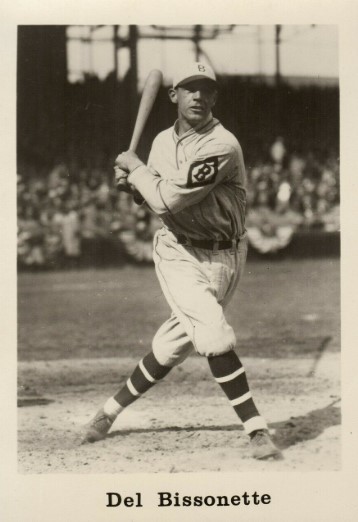
The Dodgers trailed the Giants 2-0 in the top of the ninth inning, when they loaded the bases with two outs (thanks to a pair of singles and a walk). That brought up 1B and number-six hitter Del Bissonette, who had come into the game hitting .345-4-15 (in 15 games). Manager John McGraw had Giants’ pitcher Larry Benton intentionally walk Bissonette, cutting the margin to one run. Benton then pitched to 2B Henry Riconda, who came into the contest with a .220 average and just one home run. While the IBB cost him a shutout, the strategy worked, as Benton went on to fan Riconda to end the game and get the win. Benton, by  the way, had his best MLB season in 1928 (his sixth MLB campaign), leading the league in wins (25 versus nine losses), winning percentage (.735) and complete games (28) – with a 2.73 ERA.  He pitched 13 MLB seasons, going 128-128, 4.03. The other principal in this mini-drama, Bissonette, played five MLB  seasons, going .305-66-391 in 604 games.

This one is at the top for the willingness to allow a run in a two-run game and move the tying tally to third base (and go-ahead run to second) – and delivering the win.

Load ‘Em Up, I’m Ready

Del Bissonette is credited with (on April 21, 1930) being the first MLB player to hit a bases-loaded home run and a bases-loaded triple in the same game.  

Number One (tied) … Barry Bonds, Giants, May 28, 1998
Photo by kevinrushforth

The Giants trailed the Diamondbacks 8-5  in the bottom of the ninth with Gregg Olson on the mound. Olson fanned CF Darryl Hamilton on three pitches  to open the frame, then walked 3B Bill Mueller on four pitches, before giving up a double to 2B  Jeff Kent (Mueller to third) and walking 1B  Charlie Hayes  to load the bases.  Olson then got RF Stan Javier to ground out (second-to-first) with Mueller scoring and Kent and Hayes each moving up a base.   J.T Snow then came on as a pinch hitter and drew a five-pitch walk again loading the bases.  Now, up by two  runs,  manager Buck Showalter ordered Olson to intentionally walk Barry Bonds  (who had drawn an unintentional  walk as a pinch hitter in the eighth inning and stayed in the game in LF) – forcing in a run and putting the tying  tally at third base and the go-ahead run at second. Olson then got C  Brent Mayne on a liner to right-center to end the contest and give the Diamondback an 8-7 win.  Bonds was hitting .305-13-41 at the time, while Mayne was no slouch at  .290-2-12 coming into the game.

Top of the List

Barry Bonds led his league in Intentional Walks a record 12 times – the last time in his final season, at age 42. 

Number Three … Napoleon Lajoie, Philadelphia Athletics, May 23, 1901

Nap Lajoie’s Athletics were down 11-7 to the White Sox in the top of the ninth inning, when they mounted a comeback – loading the bases with none out and bringing cleanup hitter 2B Napoleon Lajoie – who came into the game hitting .525 and was on his way to a  .426-14-125 triple crown  season – to the plate. White Sox player-manager Clark Griffith put himself into the game and intentionally  walked Lajoie, forcing in a run and cutting the lead to three. Griffith then got RF Socks Seybold (who would lead the AL in home runs in 1902) and 1B Harry Davis (who would lead the league in round trippers four times  in his career) on ground outs (one run scoring) to save an 11-9 win.  This intentional  walk got extra points for the courage of manager Griffith to take the responsibility on himself – and for setting up a situation in which the bases were loaded, the tying run was at first and he had to get three outs to save the game.

Clark Griffith … A Role(s) Player

Clark Griffith managed the 1901 White Sox to an 83-53 record and first  place in the National League. As a player-manager, he went 24-7, 2.67 on the mound and .303-2-14 (in 35 games) at the plate. .

Number Four … Josh Hamilton, Texas Rangers, August 17, 2008

This  game  saw RF Josh Hamilton and his Rangers trailing  the rays 7-2 in the bottom of the ninth.  With Juan Salas on the mound for Tampa, Rangers’ DH Jarrod Saltalamacchia opened the inning with a single, followed by a Chris Davis (1B)  walk. Salas then fanned 3B Travis Metcalf on three pitches. before giving way to Grant Balfour on the mound. Balfour walked 2B Ramon Vazquez  to load the bases, before getting LF Brandon Boggs to hit into a fielder’s choicer (second-to-shortstop) with one run scoring. A walk to SS Michael Young loaded the bases – and Devil Rays ‘manager Joe Maddon ordered Hamilton intentionally walked,  pushing across another run, putting the tying run at first base and bringing  Dan Wheeler in from the bullpen. Wheeler ended the game by fanning Marlon Byrd on five pitches.  Hamilton has come into the game hitting .302 with 28 homers and 112 RBI, while Byrd came in at .290-8-34.

Going Four-for-Two

Josh Hamilton is one of just eighteen MLB players to hit four home runs in a single game. He did it on May 8, 2012 – hitting four two-run home runs and a double in five at bats as his Rangers topped the Orioles 10-3. 

Number 5 … Bill Nicholson, Cubs, July 23, 1944 (second game)

The Giants led the Cubs 10-7 in the top of the eighth inning, but the Cubs were mounting a comeback. Giants’ righty Ace Adams (on in relief of Bill Voiselle) walked Cubs’ 3B  Stan Hack and SS Bill Schuster to open  the inning – and was replaced on the mound by southpaw Ewald Pyle, who issued an unintentional walk to 1B Phil Cavarretta to load the bases. That brought up RF and cleanup hitter Bill Nicholson – who was having quite a  day. In the first game of the Sunday twin bill (remember those), Nicholson had banged out three home runs (three homers and a walk for the game)  as the Cubs won 7-4.   He had already homered in the second inning the second game (his 21st of the season) and Giants’manager Mel Ott wanted no part of the hot hitter. Ewald issued the free pass, plating one run.  Ewald was then replaced by right-hander Andy Hansen who retired LF  Ival Goodman (holding the runners) and then hit CF Andy Pafko with a pitch, bringing in the second run of the inning and keeping the sacks full. 2B Don Johnson then grounded into a force at second,  plating another run – and tying the contest. Righty Bob Barthelson came in to pitch and got PH Billy Holm on a pop out to at least preserve the tie.  The Giants scored twice in the top of the ninth and won the game 12-10. The bases-loaded free pass, however, did not stop the Cubs from tying the game.

Taking the Lead

Bill Nicholson led the National League in home runs and RBI in both 1943 and 1944 … finishing second and third, respectively, in the NL Most Valuable voting in those years.  

Number Six … Abner Dalrymple, Chicago White Stockings (NL), August 2, 1881

The White Stockings, already up  5-0 over the Buffalo Bisons, opened the eighth inning  by loading the bases on consecutive hits by P Fred Goldsmith, C Silver Flint and 2B Joe Quest. Bisons’ manager Jim O’Rourke (presumably) wanted nothing to do with Dalrymple (on his way to a .323 season and the 1878 NL batting champ) and had Joe Flinch walk him intentionally – forcing in a run.  The White Sox eventually won the contest 11-2. The intentional pass was of little consequence in the outcome, but is generally accepted as the first IBB with the sacks full in MLB history.

Double Your Pleasure, Double Your Fun

On July 3, 1883, Abner Dalrymple hit four doubles in a nine-inning game tying an MLB single-game record that he still shares.

________________________________________________________

Barry Bonds – King of the Intentional Walk

Notably, when you talk intentional walks, the conversation pretty much starts and ends Barry Bonds. (We need to keep in mind, however, that IBB’s did not become an official statistic until 1955.)   Bonds holds the records for:

  • IBB in a season – 120 with the Giants in 2004.  That’s an intentional  walk in 19.4 percent – or nearly one in five – of Bonds’ plate appearances that season. His record 232 total walks for the season made up 37.6 percent of his plate appearances that campaign.
  • IBB in a career – 688. Second place goes to the still active Albert Pujols of the Angels with 313 as this is written.
  • Most seasons leading the league in IBB – 12.

Primary Resources: Baseball-Almanac.com; Baseball-Reference.com; MLB.com. Note:  The Baseball-Almanac Resource included information from research by Bill Deane, Everett Parker and Trent McCotter.  

Baseball Roundtable Disclaimer:  The MLB records referenced in this (and previous) posts have the potential to change as Major League Baseball recognizes and incorporates Negro League records from 1920-46 into the MLB record book.

______________________________________________

100Baseball Roundtable is on the Feedspot list of the Top 100 Baseball Blogs.  To see the full list, click here.

I tweet baseball @DavidBaseballRT

Follow/Like Baseball Roundtable’s Facebook Page here.  More baseball commentary; blog post notifications; PRIZES.

Member: Society for American Baseball Research (SABR); The Baseball Reliquary; The Negro Leagues Baseball Museum.

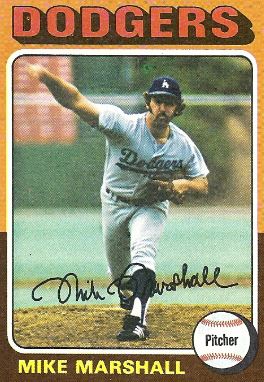
 

Mike Marshall … Very Good at Retiring Batters Late – Less Proficient (fortunately) at Retiring Early

On this date (May 15) in 1978, Mike Marshall made his first appearance on the mound for my hometown Minnesota Twins.  He came on in the ninth inning (in relief of Greg Thayer) with a runner on first, one out and the Twins and Orioles  tied at 6-6. Marshall closed out the ninth, tossed a scoreless tenth and got the win on a Willie Norwood walk-off, three-run homer in the bottom of the tenth inning.

Mike Marshall pitched a record 208 1/3 innings in relief in 1974.

That Marshall would be successful in relief was no surprise, nor was the fact that the “closer” would pitch more than an inning.  However, his appearance on the mound was in itself a bit unexpected. Marshall had endured a disappointing 1977 (which included a mid-season team change) and had also undergone back surgery late in the year (as well as knee surgery before the 1977 season). He let it be known that he was retiring as a player.  Marshall was, however, coaxed out of retirement  (in May of 1978) by Twins’ Manager Gene Much.   Was it a good decision? Well, Marshall saved 21 games (and won ten) for the Twins over the remainder of the season – and the following year (as a Twin) led the American League in saves and set the still-standing AL record for appearances in a season by a reliever (89).

But I’m getting ahead of myself.  Before, we get a look at Mike Marshall’s overall career on the bump, let me note that 1978 wasn’t the only time Mike Marshall contemplated “early retirement.” And, if he had followed through on either occasion, the MLB record books would look a bit different,

Mike Marshall – A Career that was “One for the Books.”

Marshall was a multi-sport (baseball, football and basketball) athlete in high school.  He was offered a baseball scholarship by Michigan State University, but signed (in 1960) as a free agent with the Phillies. (Reportedly there was some contention over the size of the scholarship.)

Marshall  started his professional career as a shortstop, where he showed promise at the plate.   Between 1961 (at age 18) and 1964, he was promoted every season, moving form Class D to AA. His best season was 1963, for the Class A Magic Valley Cowboys, where he hit .304, with 14 home runs, 76 RBI and ten stolen bases in 107 games.

The grind of everyday play, however, put significant stress on a childhood back injury and, in 1965, Marshall took his shortstop’s arm to the mound – which proved to be a fortuitous  move.  On May 31, 1967, Marshall made his major-league debut – for the Detroit Tigers. That season, he pitched in 37 games, going 1-3, with 10 saves and a nifty 1.98 earned run average.

Thus began Mike Marshall’s major-league odyssey. One that would last 14 seasons, put him on the mound for nine teams, survive one contemplated retirement and one announced retirement, and etch his name into the record books. Oh, and along the way, he would pursue his education part-time. (He would eventually earn a trio of degrees including a Ph.D. in Kinesiology.  Ironically, from the same university whose scholarship he declined.)

By the end of 1973, Marshall had six MLB seasons on his resume (Tigers, Pilots Astros, Expos) – as well as a reputation for being both opinionated and outspoken. At this point in his MLB career, he had a 40-48 record with 85 saves and a 3.21 earned run average. In the 1973 season (Expos), he had led the NL in games pitched (a then modern-era record 92), games finished (73) and saves (31).    Still, after the season, Marshall indicated he was contemplating retirement in order to work full-time on his doctorate.  That, and perhaps his attitude (more than his aptitude), were among the likely factors that contributed to his trade to the Dodgers.  The rest, as they is history – and historic.

A Diverse Repertoire, Particularly for a Reliever

Mike Marshall had a live fastball, slider, sinker and the pitch that built his career – a killer screwball.

In 1974, as a Dodger, he put up the grand-daddy of all relief seasons – becoming the first reliever to win the Cy Young Award and setting the still-standing record for appearances with 106 and innings pitched in a season in relief at 208 1/3. He finished the season 15-12, with a league-topping 21 saves and a 2.42 ERA.  Marshall was called on to go more than one inning in 74 games (68.5 percent of the time); and toiled three or more innings 22 times. A few other facts about Marshall’s remarkable season:

  • In 1974, Mike Marshall pitched 208 1/3 innings in relief.  In 2019, only six MLB starting pitchers toiled for more innings (led by Justin Verlander with 223).  And, in 2019, no MLB relief pitcher reached 100 innings.
  • Marshall’s longest stint came on August 19, when he came on in the seventh inning of a 7-7 game against the Cubs – and went six innings, earning the win as the Dodgers topped the Cubs 8-7 in twelve innings.
  • From June 18 to July 3, Marshall relieved in 13 consecutive regular-season games –an MLB record later tied (1986) by the Rangers’ Dale M0horcic.

How the Game Has Changed

In 1876 (according the Baseball-Reference.com), Jim Devlin pitched (started) all but the final game of the National League’s Louisville Grays’ season (a record 68 consecutive games pitched in) and finished 66 of them.  One season later, he started and finished all 61 of the Grays’ games – the only pitcher ever to pitch all of a team’s innings in a season.  In those two seasons, Devin logged a total of 1,181 innings. Side Note: Sadly, Devlin’s career was cut short when he was banned after the 1877 season, as the result of a game-fixing scandal.

  • From May 17-24, 1974, Marshall pitched eight straight days (no off days in that period).
  • On July 7, Marshall picked up a pair of saves, as the Dodgers swept a doubleheader from the Expos. Marshall pitched 1 2/3 innings in Game One and came back to go three innings in Game Two.

By the end of the 1977 season, it appeared Marshall’s MLB career was over.  His saves were down (just 28 saves over the 1975-77 seasons); his ERA was up (from 2.42 in 1974 to 3.29 in 1975, 3.99 in 1976 and 4.75 in 1977); he had endured a rib cage injury, as well as knee and back surgery; and there was speculation that his vaunted screwball had taken a n irreversible toll on his arm,   After the 1977 season he decided  to retire as a player.  That is until a call from Gene Mauch – who Marshall respected as a manager (and who had proven, while managing Marshall in Montreal, that  he could deal with Marshall’s at times contentious personality and unorthodox approach to the game). As Marshall said later, Mauch was the one baseball man he couldn’t say no to.

Earlier, I touched on Marshall’s first (1978) season in Minnesota.  In his second Twins’ campaign (1979), Marshall – at age 36 – made the record books again, setting  the AL record for appearances by a reliever (89 -tied by Mark Eichhorn in 1987) and total appearances in a season (90). Yes, he started one game. He led the AL in saves (32) and put up a 2.65 ERA.  He pitched 142 2/3 innings and pitched more than one  inning in 50 of his 89 relief appearances; three or more innings ten times.  After that AL record-setting campaign, Marshall pitched just two more MLB seasons (Twins/Mets) appearing in a total of 38 games (4-5, with one save and a 4.41 ERA).

Thus is the saga of Mike  Mike Marshall,  whose final MLB line as 97-112, 3.14, with 188 saves, 724 appearances (24 starts), 1,386 2/3 innings pitched, 52 walks, 880 strikeouts, two All Star selections and one Cy Young Award.  He led his league in mound appearances four times, games finished five times and saves three times. He finished in the top five for the Cy Young Award four times and  in the top-ten for league MVP three times.  He pitched at a time when relievers arrived early and stayed late – and he set the standard for closers willing to work overtime.

For a past post on other MLB fireman who came to work early and stayed late, as well as some statistics that illustrate the changing role of relievers, click here.

Primary Resources:  Baseball-Reference.com; “Mike Marshall, the Best and the Brightest,” Ron Fimrite, Sports Illustrated, July 2, 1979; “43 Years Ago:  Mike Marshall Wins Cy Young,” David Schoenfield, ESPN, November 6, 2014.

Baseball Roundtable Disclaimer:  The MLB records referenced in this (and previous) posts have the potential to change as Major League Baseball recognizes and incorporates Negro League records from 1920-46 into the MLB record book.

_______________________________________________

100Baseball Roundtable is on the Feedspot list of the Top 100 Baseball Blogs.  To see the full list, click here.

I tweet baseball @DavidBaseballRT

Follow/Like Baseball Roundtable’s Facebook Page here.  More baseball commentary; blog post notifications; PRIZES.

Member: Society for American Baseball Research (SABR); The Baseball Reliquary; The Negro Leagues Baseball Museum.
A Little Short-Season Trivia – Hall of Fame Infields

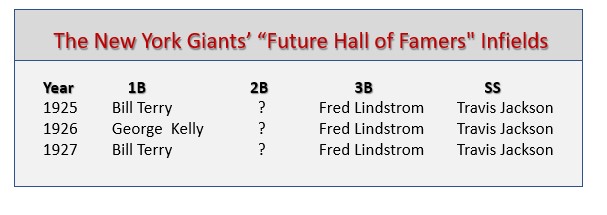
How about a little trivia as we move through the strange 2020 baseball season?  It recently caught BBRT’s eye that the New York Giants are the only team to field an infield (1B-2B-3B-SS) made up totally of future Hall of Famers.  Not only that, they did it in three consecutive seasons (1925-27).  Now, that is unique in itself, but what really got my attention was that the Giants had a different primary second baseman in each of those seasons … and then a fourth second basemen (who did not make the HOF) in the 1928 campaign.  So, here is your question.

In 1925, 1926 and 1927, the New York Giants infield (1B-2B-3B-SS) was made up entirely of future Hall of Famers.  Notably, each of those squads had a different second baseman.  Can you name the three future Hall of Famers who played the keystone sack on those teams?  Hint:  Hint:  Read carefully one of the three was more highly acclaimed at a different position.  The chart below may (or may not) help.

Giants

Now for the answer(s) …

1925 – George “High Pockets” Kelly (107 starts at 2B)

This is where that hint comes in. Future Hall of Famer 6’4” George “High Pockets” Kelly was more HIGH-ly known as a first baseman (in his 16 MLB seasons, he made 84.8 percent of his starts at first base).  In 1925, the combination of an injury to another future Hall of Famer (2B Frankie Frisch) and the desire to get more lineup time for emerging talent (and another future Hall of Famer) Bill Terry resulted in Kelly moving over to second base, where he started 107 games. (Kelly never started more than 17 games at 2B in any other season of his career.)

For the season, Kelly’s tenth MLB campaign (sixth as a full-time player), he went .309-20-99, with 87 runs scored for the Giants.  He finished second on the squad in RBI and home runs to LF Bob Meusel. Going into the 1925 season, Kelly had a .298-90-583 stat line and had hit .300 or better in each of the previous four campaigns.  The following season (1926), Frisch returned to full-time second base duty and Kelly took back his first base job (starting 114 games there and another 17 at 2B), hitting .303-13-80. Terry served as a backup, appearing in 37 at 1B, 14 in the OF and 47 times as a pinch hitter.  He hit .289-5-43 in 225 at bats.

Before the 1927 season, the Giants – looking for outfield help – decided to install Terry and first base and traded Kelly to the Reds for Of Edd Roush (who went on to play three seasons for the Giants, getting in 301 games and hitting .304).  Kelly played five seasons after the trade – hitting .288-25-258 – but played in 100 or more games only twice in that time.  He retired after 16 MLB seasons with a .297-148-1,020 stat line. He led his league in home runs once (hitting 20 or more three times) and RBI twice (topping 100 in five seasons). He was also one of the leading defensive first basemen of his time – leading NL first sackers in putouts three times, assists three times and double plays twice.

1926 – Frankie “The Fordham Flash” Frisch (126 starts at second base)

Frankie Frisch starred in baseball, football, basketball and track at Fordham University – hence “The Fordham Flash” nickname.  In 1919, he left Fordham and signed with the Giants – going right to the major-league club. By 1921, at age 23, Frisch had established his “star quality.”  That season, Frisch hit .341, with 211 hits (eight home runs), 121 runs scored, 100 RBI and league-leading 49 steals.

By 1926, the switch-hitting Frisch was looking back at five consecutive .300+ seasons.   Injuries on the Giants’ squad in 1925 (including a hand injury to Frisch himself) had both limited his playing time (120 games compared to 145 the season before) and forced him to move about the infield.  (In 1925, Frisch started 41 games at 2B, 43 at 3B and 36 at SS.)  In 1926, he was back in his role as the Giants’ primary keystone sacker. That season, Frisch hit .314-5-44, with 75 runs scored and 23 steals.  By this time, Frisch’s relationship with Giants’ manager John McGraw had – depending on your turn of phrase – either cooled considerable or really heated up. At any rate, it had become contentious enough that Frisch was traded to the Saint Louis Cardinals (along with pitcher Jimmy Ring) for another future Hall of Famer – Rogers Hornsby. In 1926, Hornsby had had hit .317-11-93 and managed the Cardinals to the National League pennant.  (More on Hornsby coming up).

Frisch flourished with the Cardinals. In his first eight seasons with the Redbirds, he hit .300 or better seven times – and he managed the team from 1933-38 (as a player-manager until 1937) – leading Saint Louis to a World Series Championship in 1934.  Frisch played a total of 19 MLB seasons, hitting .316 (2,880 hits), with 105 home runs, 1,244 RBI, 1,532 runs scored and 419 stolen bases. He led the NL in runs scored once (topping 100 runs tallied in seven seasons); hits once (getting 200+ safeties in three seasons); and stolen bases three times (a high of 49 in 1921). He managed in the major leagues in 16 seasons (Cardinals, Pirates, Cubs), totaling 1,138 wins and 1,078 losses.

1927 – Rogers “The Rajah” Hornsby (155 starts at 2B)

Rogers Hornsby may have been the greatest right-handed hitter of all time.  He was, however, not always the easiest person to deal with (understatement there).  By December 1926, when he was traded to the Giants’ for 2B Frankie Frisch and pitcher Jimmy Ring (11-10, 4.57 in the 1926 season), Hornsby had six batting titles and two home runs crowns on his MLB resume.  He had also led the National League in runs scored three times, hits four times, doubles four times, triples once, and RBI four times.  He was also known for a notable ego and angry disputes with ownership and management. Things came to a head after Hornsby, as a player-manager, led the 1926 Cardinals to a World Series Championship.  He asked for a three-year, $150,000 per year contract (he had signed a three-year/$100,000 deal after the 1924 season).   Cardinals’ owner Sam Breadon countered with one year at $50,000.  Hornsby declined and Breadon traded Hornsby to the Giants (as noted in the Frisch paragraphs) for Frankie Frisch and Jimmy Ring.

Hornsby apparently brought his ego and attitude with him to New York.  He was in the Big Apple for just one season (.361-26-125 in 1927) before being traded to the Boston Braves for catcher Shanty Hogan and Outfielder Jimmy Welch – a pair of solid players, but not the return you might have expected for Hornsby. Hornsby’s departure ended the Giants’ string of  “All Future Hall of Famer” infields.   Hornsby also spent just one season in Boston (winning the batting title at .387, with 21 home run and 94 RBI) before being traded to the Cubs for five players and $200,000.

Hornsby played 23 MLB seasons, hitting .358 (2,930 hits), with 301 home runs, 1,584 RBI and 1,579 runs scored. He was a seven-time batting champion (and hit .400+ in three seasons), a two-time league home run leader, a-four time RBI leader (topping 100 RBI in five seasons, led the NL in runs scored four times (with 100+ runs in six seasons), four times led the league in base hits (topping 200 in seven campaigns) and led the league in total bases seven times.

Andy Cohen

The Giants’ string of seasons with four future Hall of Famers in the infield was broken in 1928, when rookie Andy Cohen (who came into the season with 35 MLB at bats) took over at second base. Future Hall of Famers Bill Terry, Freddie Lindstrom and Travis Jackson were still at 1B, 3B and SS, respectively.  At the time, Cohen looked like he had the potential to extend the streak.  Cohen, just 22-years-old, hit .353 for the Buffalo Bison of the International League (Double A) in 1927.   Then he hit .274-9-59 in 129 games for the Giants in 1928 and .294 for New York in 101 games in 1929. He had, however, tailed off a bit in the second half and started the 1930 season with the International League Newark Bears – where it was reported that he suffered (depending on sources) either an shoulder or leg injury.  He never made it back to the major leagues, but played in the minors through 1942 (when he was inducted into the Army) – including (for Minnesota readers) eight seasons with the Minneapolis Millers (American Association – Double A).

Cohen retired as a player with a .281-14-114 line in three MLB seasons and a .288 average with 78 home runs in 16 minor-league campaigns. After military service, he served a number of years as a minor league manager and major league coach.

Cohen also had a 1.000 winning percentage as an MLB manager. In 1960, Cohen was a coach on the Phillies when manager Eddie Sawyer resigned after the first game of the season. Gene Mauch was hired as a replacement, but Cohen filled in for one game until Mauch could join the team.  In that contest, the Phillies won 5-4 over the Braves in ten innings. After leaving professional ball, Cohen coached the University of El Paso baseball team for 17 years.

More #WhyIHateTheDH

Baseball Roundtable recently published a post on solid-hitting pitchers (click here for that post). I thought I’d add another story to the BBRT #WhyIHateTheDH saga.

On August 5, 2001, Livan Hernandez started on the mound for the Giants (versus the Phillies). He got the win with 6 2/3 innings of four-run ball (eighth hits, three walks, three strikeouts), but he was even better at the plate – a three-for-three day, with a double in the third inning, a single n the fourth and a single in the sixth. His next start came on August 11 against the Cubs.  Another win for Hernandez and another perfect day at the plate: run-scoring single in the second, two-run home run in the third, single in the sixth and single in the eighth. Add to that a single in Hernandez’ final at bat in his in his July 31 start against the Cubs and Hernandez hit safety in eight straight plate appearances (not bad for a pitcher). That season, Hernandez hit .296 (24-for-82) with one home run and eight RBI. Further, in four starts, between July 26 and August 11, he went 12 for 13 (.923).  In those four starts, he went 3-0, 4.39 on the mound. Hernandez was a career .221 hitter (215-for-973). with ten homers and 85 RBI. On the bump, he went 178-11, 4.44.

Primary Resources:  Baseball-Reference.com; “Frankie Frisch” bio, by Fred Stein, Society for American Baseball Research; “Rogers Hornsby” bio, Society for American Baseball Research, by C. Paul Rogers III; “Baseball Maniac’s Almanac, Fifth Edition, ” edited by Bert Randolph Sugar (2019).

100Baseball Roundtable is on the Feedspot list of the Top 100 Baseball Blogs.  To see the full list, click here.

I tweet baseball @DavidBBRT

Follow/Like Baseball Roundtable’s Facebook Page here.  More baseball commentary; blog post notifications; PRIZES.

Member: Society for American Baseball Research (SABR); The Baseball Reliquary; The Negro Leagues Baseball Museum.
While Waiting for Baseball to Return – A Trivia Tidbit

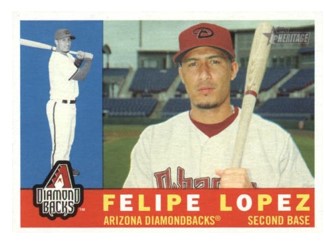
LopezFOn this date (April 6) in 2009, as the Rockies and Diamondbacks opened their seasons in Arizona  (There had been one game the previous day … Braves at Phillies) – MLB history was made.

On that day, Diamondbacks’ second baseman Felipe Lopez became the first hitter to go yard from both sides of the plate in a season “opener.” Lopez was in his ninth professional season (and with his fifth MLB team). Going into the campaign, he had 71 long balls in 873 games (20 right-handed, 51 left-handed).

Lopez led off the bottom of the first, going deep from the left-handers’ batter’s box off Rockies’ RHP Aaron Cook. He led off again in the bottom of the fourth inning and homered (this time from the right-handers’  batter’s box off southpaw Glendon Rusch. Lopez finished the game two-for-four (two runs and two RBI), as the D-backs triumphed 9-8.

TRIVIA QUESTION: 

Now, for your trivia question. How long (after Felipe became the first major leaguer to homer from both sides of the plate in an opener) was it before MLB again saw a player homer from both sides on Opening Day – and, for bonus recognition, who was that player?

ANSWER:

How long was it until saw a second player pop home runs from both side of the plate in an Opening Day game. It was just 1 1/3 innings.  Lopez’ teammate, first baseman, Tony Clark hit a two-run homer from the left side of the plate off RH Aaron Cook in the bottom of the third inning of Lopez’ historic game, breaking a 4-4 tie and knocking Aaron Cook out of the game. Clark came up again with one out in the bottom of the fifth (and the game again tied, this time at 7-7) and hit a solo shot from the right-hand side off lefty Glendon Rusch. Clark finished the day two-for-four with two runs and three RBI.

So, after more than a century of having no switch hitter ever homering from both sides of the plate on Opening Day, we had two players from the same team, in the first 4 1/3 innings of the same game (and off the same two pitchers) achieve the feat.  (More on Lopez and Clark later in the post.)

THIRD PLAYER TO HOMER FROM BOTH SIDE OF THE PLATE IN AN OPENING DAY GAME

In addition to Felipe Lopez and Tony Clark, one more switch hitter has homered from both sides of the plate in an Opening day contest – Dodgers’ catcher Yasmani Grandl, on April 3, 2017, as his Dodgers topped the Padres 14-3 in Los Angeles.

Felipe Lopez played in 11 MLB seasons (2001-2011) – going .264-90-439, with 124 steals.  He was an All Star once – in 2005, when he went .291-23-85, with 15 steals for the Reds. It was the only season he hit more than 11 homer runs. For his career, Lopez was .261-61-285 as a left-handed batter (3,074 at bats) and .271-29-155 from the right side (1,263 at bats). He also made one pitching appearance (right-handed), pitching a scoreless inning (one walk, one hit) for the Cardinals in 2010).

Tony Clark played 15 MLB seasons (1995-2009) – going .262-251-824.  Like Lopez, he was an All Star once – in 2001, when he had a .287-16-75 campaign for the Tigers.  Clark topped 25 home runs in five seasons (for of those with 30 or more dingers) and recorded 100+ RBI in two seasons. His best year was 1998, when he went .291-34-103 for the Tigers.  Clark hit .260-189-607 as a left-handed batter (3,279 at bats) and .267-62-217 at a right-handed batter (1,253 at bats).


Primary Resources:  Baseball-Reference.com; Baseball-Almanac.com.

100Baseball Roundtable is on the Feedspot list of the Top 100 Baseball Blogs.  To see the full list, click here.

I tweet baseball @DavidBBRT

Follow/Like Baseball Roundtable’s Facebook Page here.  More baseball commentary; blog post notifications; PRIZES.

Member: Society for American Baseball Research (SABR); The Baseball Reliquary; The Negro Leagues Baseball Museum.
 

BASEBALL ROUNDTABLE TRIVIA TEASER – JUST FILL IN THE BLANK

BASEBALL ROUNDTABLE TRIVIA TEASER

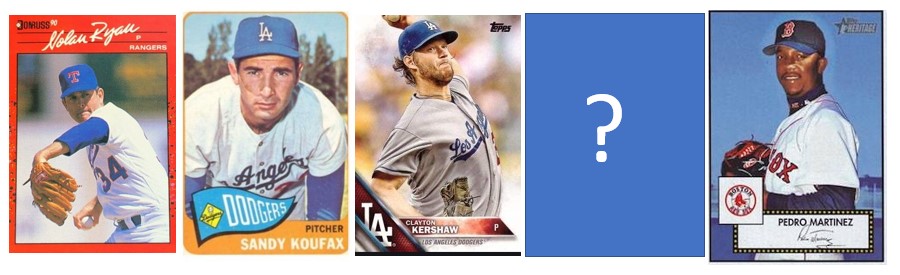
Fill  in the blank:

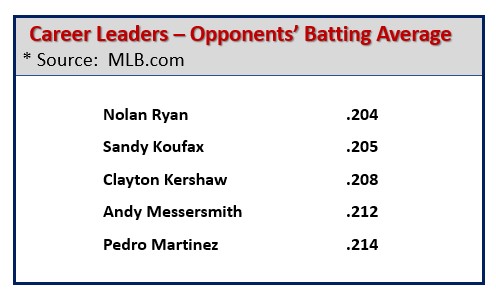
  —–Career-Low Opponents’ Batting Average (MLB.com listing)—–


                             Nolan Ryan                         .204

                             Sandy Koufax                     .205

                             Clayton Kershaw              .208

                              _______________       .212

                             Pedro Martinez                 .214

Hint:  I initially came up with this in the a.m. hours.

top

Baseball Roundtable Trivia Teaser Answer

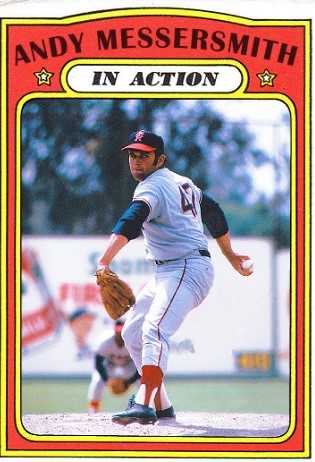
The answer is Andy Messersmith (initials A.M. per the hint), who pitched to a .212 opponents’ batting average over twelve MLB seasons (2,230 1/3 innings pitched) for the Angels (1968-72), Dodgers (1973-75 & 1979), Braves (1976-77) and Yankees (1978).

Career BAA

Messersmith, a 6’1”, 200-pound righthander made it to the majors In July of 1968 (at age 22). He went on to become a four-time All Star, two-time 20-game winner and two-time Gold Glover.  He did all of this with a fastball with movement, hard overhand curve, solid slider and effective change up.   His final career stat line was 130-99, with a 2.86 earned run average and 1,625 strikeouts.  He led his league one season each in wins, games started, complete games, shutouts and innings pitched. He also gave up his league’s fewest hits per nine innings (among qualifiers) in three seasons.

Reserve Clause

Andy Messersmith is also noted for his role in successfully challenging (along with Dave McNally) MLB’s reserve clause, which led to the 1975 ruling by arbitrator Peter Seitz that player who played one year for their teams without a signed contract could become free agents at the end of that year (basically ending the acceptance of unilateral contract renewals as a way to “reserve” a player).

andyMessersmith’s best year was arguably 1975, when he went 19-14, with a 2.29 ERA (for the Dodgers) and led the NL in starts (40), complete games (19), shutouts (7) and innings pitched (321 2/3); while also earning a Gold Glove.  This followed a 1974 season during which he went 20-6, 2.59 and was the NL All Star Game starter.

For those not familiar with Messersmith’s history, he was a high school quarterback and pitcher (going 16-2 in his senior season), before receiving a full scholarship (baseball) to the University of California Berkeley (1963), where he earned All-NCAA District and second-team All American honors.   He was a first-round draft choice (12th overall) of the Angels in June of 1966 and was in the majors (with the Angels) by 1968 (when he went 4-2, 2.21 primarily as a reliever).  In 1969, he earned a spot in the Angels’ starting rotation (16-11, 2.52) and the rest is history. His career totals were diminished by a number of injuries:  1970 (ribs); 1972 (finger injury/surgery); 1977 (elbow/surgery); 1978 (shoulder).  When he was healthy, however, he was one of the best. Notably, Messersmith threw over 200 innings in six seasons, had an earned run average under 3.00 in seven campaigns and had at least ten complete game  seven times.

Just Watch Me.

For about a month-and-a half of the 1976 season, Ted Turner’s Atlanta Braves – perhaps foreshadowing the current MLB Players’ Weekend – wore nicknames above the numbers on their home jerseys.  For example, Biff Pocoroba wore “Poco” on his back, Dick Ruthven wore “Rufus”), Phil Niekro wore “Knucksie” and Jimmy Wynn wore “Cannon.”

The most interesting of these may have been Any Messersmith – a newcomer to the Braves that season – who (in an apparent publicity move) wore the nickname (which he had never used) “Channel” above his number 17.  (Channel 17 was where you would find Turner’s cable TV “Superstation WTCG.”) In a bit of Irony, NL President Charles Feeney (much better known by the nickname”Chub”) objected to this rather obvious bit of promotion and put an end to it, with Messersmith moving on “Bluto,” a nickname he had acquired while with the Dodgers.   Braves’ PR Director at the time, Bob Hope (No, not that Bob Hope) later said the nickname served its purpose, “We knew baseball would step in and stop it, but we would get lots of publicity.”

Sources:  Baseball-Refeence.com; MLB.com; “Uni Watch’s Friday Flashback: What in a nickname” by Paul Lucas fort ESPN.com, May 13, 2016; Andy Messersmith Society for American Baseball Research bio, by Eric Golanty.


100Baseball Roundtable is on the Feedspot list of the Top 100 Baseball Blogs.  To see the full list, click here.

I tweet baseball @DavidBBRT

Follow/Like Baseball Roundtable’s Facebook Page here.  More baseball commentary; blog post notifications; PRIZES.

Member: Society for American Baseball Research (SABR); The Baseball Reliquary; The Negro Leagues Baseball Museum.
Baseball Roundtable Trivia Teaser … Leaning Toward the Long Ball

Baseball Roundtable – still smarting from yesterday’s Twins loss to the Yankees –  decided to look back further for today’s post.  I decided to ease my distress (and prepare for Game Two) with a Trivia Teaser focusing on foriegn-born home run champs. (This was partially due to the fact that the Twins led the American League in foreign-born players on their 2019 Opening Day Roster and all three Twins who homered yesterday were foreign-born – Jorge Polanco, Nelson Cruz, Miguel Sano. Also, ultimately, I am a “homer” at heart.)  By the way, if you are interested in a deeper look at: 1) the percentage of foriegn-born players (by country) on 2019 Opening Days rosters; 2) the major presence of players from the Dominican Republic in MLB; and the Twins’ and Pirates’ foriegn-born Opening Day Roster players (each had an MLB -leading 14) – click here for BBRT’s April post on the topic.  Anyway, as I checked out the list of home run leaders, I was surprised to see that, while the NL had a foriegn-born home-run leader early in its history, the AL didn’t have a non-American born long-ball leader until 1980. So here is your question.

BASEBALL ROUNDTABLE TRIVIA TEASER

This is two-parter.  Who were the first non-American born players to lead the National League and American League in home runs?  Hints: Use your brain to figure the NL answer out – and  the team the AL player suited up for may be a bit of a surprise.


ANSWERS:  

National League:  BBRT will accept either of two answers here:

Pre-1900:  Your pre-1900 first foriegn-born home-run leader in the NL would be George Hall – born March 29, 1849 in Stepney, England.  Hall, a 5’7″, 142-pound outfielder, was the first-ever National League home run champion – hitting five home runs in 1876 (the year the National League replaced the National Association of Professional Baseball Players). Hall played seven major league seasons (five in the National Association and two in the National League). He played 365 games, hitting .322, with 13 home runs, 377 runs scored and 252 RBI.

Post-1900: This would be Dave Brain – born January 24, 1879 in Hereford, England.  Brain was a 5’10” 3B-SS-OF, who played seven National League seasons between 1901 and 1908. In 1901, with the Boston Doves, Brain played in 133 games, hitting .279 (eighth in the league), with a league-topping 10 home runs. He finished 11th in RBI with 56, 22nd in runs scored with 60 and 12th in hits with 142. For his career, Brain went .252-27-303 in 679 games.

American League

The answer here is Ben Oglivie, born February 11, 1949 in Colon, Panama and drafted by the Red Sox in the 11th round of the 1969 MLB Draft. Oglivie, as a Milwaukee Brewer (they were in the American League at the time), tied Reggie Jackson for the American League home run lead with 41 in 1980. That season, the 6’2″, 160-pound outfielder went .304-41-118.  Oglivie played 16 MLB seasons between 1971 and 1986 – all in  the AL (Red Sox, Tigers and Brewers).  As an All Star in 1980, he reached career highs in batting average, home runs, RBI, hits (180) and run scored (94).  He was a three-time All Star, whose career stat line was .273-235-901. Oglivie topped twenty home runs in four seasons; 100 RBI twice; and had a .300+ average twice.

Canadian Tip O’Neill Leads the American Association in Just about Everything

For your added information:  Only one of  the additional leagues considered to be major leagues – the American Association –  ever had a foriegn-born home-run leader.  The National Association of Professional Baseball Players, Union Association, Federal League and Players League did not.

In the American Association, James “Tip” O’Neill – born in Springfield, Ontario, Canada on June 15, 1869 – was the 1887 home run leader (for the St. Louis Browns).  That year, O’Neill led the league in average (.435), home runs (14), RBI (123); doubles (52); triples (19), hits (224); and runs scored (167). O’Neill played 10 “MLB” seasons and put on the uniform in the National League, American Association and Players League. 

Primary Resource:  Baseball-Refeence.com

BASEBALL ROUNDTABLE ON THE TOP 100 BASEBALL BLOG LIST

100Baseball Roundtable is on the Feedspot list of the Top 100 Baseball Blogs.  To see the full list, click here.

I tweet baseball @DavidBBRT

Follow/Like Baseball Roundtable’s Facebook Page here.  More baseball commentary; blog post notifications; PRIZES.

Member: Society for American Baseball Research (SABR); The Baseball Reliquary; The Negro Leagues Baseball Museum.
Stan the Man and Nate the Kid – A Beautiful Baseball Coincidence

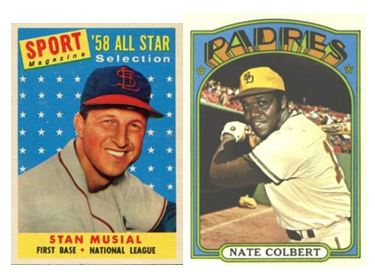
Stan and Nate

On this day 65 years ago – May 2, 1954 – Stan “The Man” Musial had one of the greatest days at the plate in major league history. That day, the New York Giants faced Musial’s Cardinals in a double header before 26,662 fans at Busch Stadium (I).

And, on that day, Musial became the first player to pole five home runs in a doubleheader – or, if you prefer, five home runs in a single day of the MLB schedule.

As the Cardinals won Game One 10-6, Musial was brilliant, recording four hits and a walk in five plate appearances – including a solo home run in the third inning, a two-run homer in the fifth and a three-run blast in the eighth. It was the first time Musial had hit three round trippers in a single game. He ended with contest with three runs scored and six RBI.

Musial faced knuckleballer Hoyt Wilhelm in Game Two. If Stan was going to continue his long-ball heroics, he would have to provide his own power – and he did.

In Game Two, Musial collected two hits and a walk in five plate appearances – including a two-run homer in the fifth inning and a solo shot in the seventh, scoring three runs and driving in three in a 9-7 Cardinals loss.

So, for the doubleheader, Stan Musial was six-for-eight, with two walks, six runs scored, nine RBI and five home runs.

BACK TO THOSE 26,662 FANS – AND OUR COINCIDENCE

Among the fans witnessing Musial’s 1954 feat was eight-year-old Nate Colbert – who, on August 1, 1972, would become the second player in MLB history (and there are still only two) to hit five round trippers in a double header.

Colbert, whose San Diego Padres were facing the Atlanta Braves in a double header before a meager crowd of 5,784 (in Atlanta), got his day off to a quick start. The Padres’ clean-up hitter hit a three-run homer in the top of the first inning. Colbert went on to add a run-scoring single in the third, another single in the fourth, and a solo homer in the seventh before striking out to open the ninth. For the game, won by the Padres 9-0, Colbert was four-for-five, three runs scored, five RBI and two home runs.

Game two started out quietly enough, with Colbert drawing a first-inning walk. Things heated up fast, as Colbert added a grand slam in the second, a ground out to third base in the fourth, a two-run homer in the seventh and a day-topping two-run round tripper with two out in the ninth. In the process, he went three-for-four with three runs scored and eight RBI – becoming only the second player with five home runs in a double header. (The Padres, by the way, won game two 11-7.)

For the double header, Colbert was seven-for-nine, with a walk, seven runs scored, 13 RBI and five home runs. Stan Musial, however, was not in the stands.

—–MARCH/APRIL MLB WRAP UP—–

SEE BASEBALL ROUNDTABLE’S MARCH/APRIL 2019 WRAP UP – THE STAT, STANDING, STORIES THAT CAUGHT BBRT’S EYE – AS WELL AS THE PLAYERS/PITCHERS OF THE MONTH AND THE BBRT TROT INDEX.  JUST CLICK HERE FOR THE FULL STORY. 

BASEBALL ROUNDTABLE ON THE TOP 100 BASEBALL BLOG LIST

100Baseball Roundtable is on the Feedspot list of the Top 100 Baseball Blogs.  To see the full list, click here.

I tweet baseball @DavidBBRT

Follow/Like Baseball Roundtable’s Facebook Page here.  More baseball commentary; blog post notifications; PRIZES.

Member: Society for American Baseball Research (SABR); The Baseball Reliquary; The Negro Leagues Baseball Museum.
Ketel Marte Homers from Both Batters’ Boxes … and Some Switch Hitter Trivia

Ketel Marte photo

Photo by THE Laura Smith

Yesterday (April 5, 2019), the Diamondback’s Ketel Marte hit a pair of 400-foot+ home runs, as the Arizona squad belted five round trippers while drubbing the Red Sox 15-8. Marte scored two and drove in five in the game.  What BBRT found noteworthy (or post-worthy) was the fact that, for the second time in his five-season career, the switch-hitting infielder hit home runs from both side of the plate in the same game.  That prompted BBRT to look into the roster of players who have gone yard from both batters’ boxes in the same game.

It’s really not as rare an occurrence as you might think.  It’s been done in the regular season a total of 330 times, and by 112 different players.

A LITTLE MORE OF A UNICORN

Only three players have homered from both sides of the plate in a post-season game.

Bernie Williams, Yankees       ALDS Game Three (October 6, 1995

Bernie Williams, Yankees       ALDS Game Four (October 5, 1996)

Chipper Jones, Braves             NLDS Game Four (October 4, 2003)

Milton Bradley, A’s                ALCS Game Two (October 10, 2006)


The first player to homer from both sides of the plate in the same game was Wally Schange of the Philadelphia Athletics on September 8, 1916.

The career record for homering from both sides of the plate in the same game is 14 – shared by Mark Teixeira and Nick Swisher. Leaders among players homering from both side of the plate in the same game:

Mark Teixeira – 14 times

Nick Swisher – 14

Carlos Beltran – 12

Chili Davis – 11

Eddie Murray – 11

Tony Clark- 10

Ken Caminiti – 10

Mickey Mantle – 10

In 1996, the Padres’ Ken Caminiti hit a home run from both sides of the plate in the same game a record four times in a single season – three times in the month of August alone. Note: Caminiti also achieved the feat three times in a single month in September of 1995.

No team has had more instances of a player hitting long balls from both sides of the plate in a game than the Yankees – 56 times.  Here are the perpetrators:

Mickey Mantle (10X)

Mark Teixeira (9X)

Bernie Williams (8X)

Jorge Posada (8X)

Roy White (5X)

Nick Swisher (5X)

Tom Tresh (3X)

Aaron Hicks (2X)

Roy Smalley

Ruben Sierra

Tony Clark

Melky Cabrera

Carlos Beltran

Neil Walker

BIG BOMBS IN THE BIG APPLE

From 1955-1965, a game in which a player homered from both sides of the plate occurred in the AL 14 times, with 13 of those being Yankees (Mickey Mantle 10, Tom Tresh 3).

The only non-Yankee to achieve the feat in the AL during that time span was the Red Sox’ Pumpsie Green (August 15, 1961). Green hit a total of just 13 home runs in his five-season MLB career.  BBRT Note: Green achieved historic significance as the first African-American player for the Boston Red Sox – the last MLB team to break the color line (1959). In the 1955-65 time span, there were only three NL games which saw a player homer from both sides of the plate – two by the Cubs’ Ellis Burton, one by the Dodgers’ Maury Wills.

Only three players have hit home runs from both sides of the plate in the same inning:

  • Carlos Baerga, Indians (April 9, 1993);
  • Mark Bellhorn, Cubs (August 29, 2002);
  • Kendrys Morales, Angels (July 30, 2012).

SHARE IT AROUND

Carlos Beltran and Nick Swisher share the record for hitting a home run from both side of the plate in a single game for the most teams at five:  Beltran – Mets, Cardinals, Royals, Astros, Yankees; Swisher – A’s, Yankees, White Sox, Indians, Braves.


Bonus chart

SWITCH HITTERS WITH AT LEAST 400 CAREER HOME RUNS

         Mickey Mantle            536

         Eddie Murray              504

         Chipper Jones              468

         Carlos Beltran             435

         Mark Teixeira              409


BASEBALL ROUNDTABLE ON THE TOP 100 BASEBALL BLOG LIST

100Baseball Roundtable is on the Feedspot list of the Top 100 Baseball Blogs.  To see the full list, click here.

I tweet baseball @DavidBBRT

Follow/Like Baseball Roundtable’s Facebook Page here.  More baseball commentary; blog post notifications; PRIZES.

Member: Society for American Baseball Research (SABR); The Baseball Reliquary; The Negro Leagues Baseball Museum.
The Ryan Express … The Ryan Nemesis (Nemeses?) … A World Versus Nolan Ryan All Star Lineup

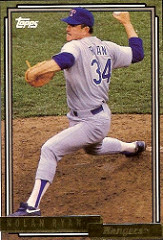
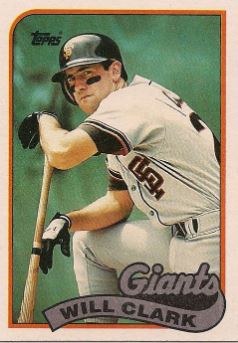
Will clarkOn this date (April 8) in, 1986, Will Clark, a 22-year-old rookie, stepped into the batter’s box for his first-ever major league at bat.  He was the second batter in the top of the first inning, as his Giants took on the Houston Astros.  On the mound was the imposing presence of the Astros’ right-handed flamethrower 38-year-old future Hall of Famer Nolan Ryan – who already had 241 MLB wins and more than 4,000 strikeouts to his credit. Clark took the first two pitches and then – with a one-and-one count – took his first MLB regular-season swing.  The result was a home run – and it set the tone for future Ryan-Clark confrontations.

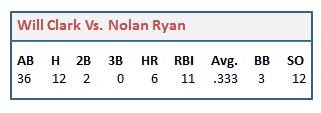
Over his career, Clark would face Ryan 39 times and collect 12 hits in 36 at bats – for a .333 average. More impressive, eight of those 12 hits would go for extra bases, six leaving the park.  Clark’s six home runs are those most any batter hit off Ryan – despite the fact that 163 hitters had more plate appearances versus Ryan than Clark.

That story, and those statistics, led Baseball Roundtable to look into which batters had found the most success against Ryan – and come up with a “World Against Nolan Ryan” All Star lineup. The nine-man, Nolan-centric squad I uncovered went 136-for-390 against Ryan (.349 average), with 22 home runs and 80 RBI.  They range from Hall of Famer (and career .328 hitter) Rod Carew at second base to career .158 hitter Ron Reed on the mound. It’s an experienced squad – each of them played more than a dozen seasons  in the major leagues (averaging better than 17 MLB seasons); all but one made at least one All Star squad; three were league MVPs; two were Rookies of the Year and two are in the Hall of Fame.  (Only one – Rod Carew – checks all four of those boxes.)

A Brief Semi-Commercial Message

This look at batters who “handled” Nolan Ryan’s outstanding stuff was the first step toward Baseball Roundtable’s ongoing “Who’s Your Daddy?” Series of blog post – looking at some of the best pitchers of all time and presenting position-by-position lineups of hitter who fared the best against these elite arms.  The links below will take you to other “edition” of the series. 

                     Sandy Koufax, click here

                    Pedro Martinez, click her

                    Bob Gibson, click here.

                    Randy Johnson, click here.

                   Greg Maddux, click here.

                   Justin Verlander, click here.

                  Bob Feller, click here.

                 Roger Clemens, click here.

                 Max Scherzer, click here.

                 Tom Seaver, click here

                 Mariano Rivera, click here.

                Warren Spahn, click here.

                 Lefty Grove, click here. 

DISCLAIMER

Nolan Ryan photo

Photo by Mike Overall

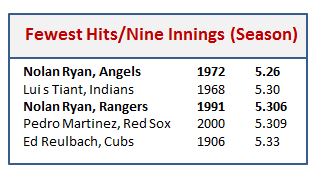
I must note that the fact that I chose to pursue this topic is actually a compliment to Nolan Ryan.  It is Ryan’s excellence that supports this lineup’s exceptionalism against him.  Let’s consider just how difficult it was to put up “good numbers” against Ryan.  Among qualifying pitchers, Ryan has the lowest career batting average against – a mere .204.  He also led his league in fewest hits per nine innings a dozen times – and has the career record for the lowest H/9 at 6.56.  Only five times in MLB history has a qualifying pitcher given up less than 5.5 hits per nine frames in a season. Two of those five campaigns belong to Ryan – and they came 19 years apart (at ages 25 and 44).

Hitsnine

Ryan also amassed 324 MLB victories, threw a record seven no-hitters and holds the all-time record for strikeouts (5,715). In his 27 MLB seasons, he led his league in strikeouts 11 times, set the post-1900 record for whiffs in a season at 383 and six times fanned 300+ batters in a season.  Over his career, Ryan fanned just over one of every four batters he faced.  The eight-time All Star also led the league in shutouts three times, earned run average twice and WHIP twice. It is Ryan’s consistent excellence that makes the success of the batter noted here worth noting.

Longevity – Good News/Bad News

When  you pitch for 27 seasons, you sometimes end up on the wrong side of a record.  Nolan Ryan, for example, not only holds the MLB record for strikeout (5,714), but also for walks (2,795) . In addition, he is the recognized record holder for MLB Grand Slams allowed (10) and the post-1900 record holder for wild pitches at 277 (leading his league in WP six times).

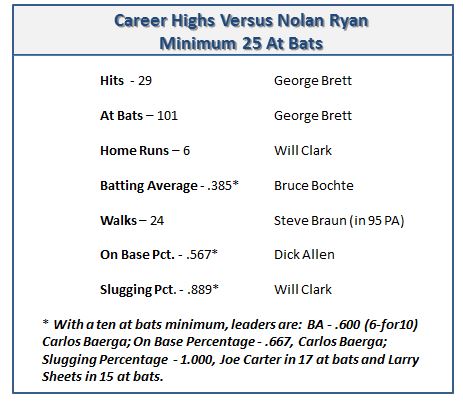
We’ll soon move on to the “World Versus Nolan Ryan” All Star squad, based solely on success against Ryan – but first a look at some of the “record holders” when it comes to matching up against the Hall of Famer.

Career vs, RyAN


THE BIG HURT – OUCH!    

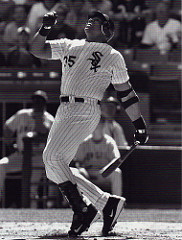
Frank Thomas faced Nolan Ryan 15 times in his career and put the ball in play just once.

Frank Thomas photo

Photo by rchdj10

On August 17, 1990, 22-year-old White Sox Rookie Frank Thomas (in the early days of a Hall of Fame career that would earn him the nickname “The Big Hurt“) stepped into the batters’ box against another (much more experienced) future Hall of Famer  – 43-year old Nolan Ryan.  Thomas was in his 14th MLB game – and was hitting .357.  Ryan was in his 24th MLB season, pitching in his 732nd game.  On the 1990 season, he was 11-6, 4.10 with 150 strikeouts in 134 innings. At that point in his career, Ryan was 300-269, 3.17 with 5,226 whiffs in 4,919 1/3 innings. 

Thomas faced Ryan four times that day, saw 18 pitches and struck out swinging in all four plate appearances. (Ryan, by the way, went ten shutout innings, giving up just three hits and fanning 15, as his Rangers topped the White Sox 1-0 in 13 frames.) Notably, that four-whiff day was a sign of things to come.  Thomas faced Ryan 15 times in his  career (Ryan retired after the 1993 season.) In those fifteen plate appearances he went zero-for-twelve.  His results included two walks, one hit by pitch, 11 strikeouts (nine swinging) and an infield pop out.  In fairness to Thomas, he did go on to hit .301, with 521 home runs and 1,704 RBI over 19 MLB seasons. He was a five-time All Star, a two-time AL MVP and the 1997 AL batting champ. (In the three seasons in which he went 0-12 with 11 whiffs against Ryan, Thomas hit .322-63-255 overall.)


Now that World Versus Nolan Ryan squad.

—–The World Versus Nolan Ryan All Star Team—–

Catcher – Rick Cerone, RHH, 5’11”/192 pounds

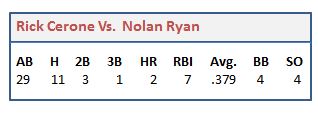
In his 18-season MLB career (1975-92), Rick Cerone faced Ryan 33 times (29 at bats).  He collected 11 hits, for a .379 average – including one double, one triple and two home runs, producing seven RBI.  He also did okay in the walks-to-strikeouts ratio, with four of each.

Cerone

Cerone’s success against Ryan comes as somewhat of a surprise.  Over his 18 seasons, he played in 100 or more games only four times and hit .245, with 59 home runs and 436 RBI.  He played in the major leagues from 1975 to 1992 –  (Indians… 1975-76; Blue Jays … 1977-79; Yankees…1980-84, 1987 & 1990; Braves … 1985; Brewers …1986; Red Sox 1988-89; Mets 1991; Expos 1992). His best season was 1988, when he hit .277, with 14 home runs and 85 RBI for the Yankees.

Rick Cerone’s two home runs and seven RBI against Nolan Ryan are the second-most he accumulated against any pitcher in his career. (He had three homers and ten RBI against Larry  Gura, whom he faced 55 times.)  

______________________________________________

First Base – Will Clark, LHH, 6’2”/190 pounds

As noted earlier, six-time All Star Will Clark got his MLB career off to a good start, homering off Nolan Ryan in his first-ever MLB at bat. He went on to prove the first round tripper was no fluke, hitting six home runs off Ryan between 1986 and 1988. Overall, Clark went 12-for-36 versus Ryan (.333), with eight extra-base hits and 11 RBI.  In 1988, Clark reached Ryan for a .600 average (six-for-ten), with two doubles, three home runs and five RBI. (That season, the 41-year-old Ryan went 12-11, 3.52, with NL leading 228 strikeouts in 220 innings.)

Clark

Over his MLB career (1986-2000), Clark collected 2,176 hits (.303 average), with 284 home runs and 1,205 RBI. He averaged .300 or better in ten of 15 campaigns, topped 20 home  runs six times and 100 RBI three times. Clark played for the Giants (1986-93); Rangers 1994-99), Orioles (1999-2000); and Cardinals (2000).

Will Clark’s six home runs versus Nolan Ryan are not only the most home runs any batter hit against Ryan, but also the most home runs Clark hit against any MLB pitcher.

___________________________________________

.300 – .400 – .400 …

Most at bats versus Nolan Ryan while maintaining a .300 or better average

Rod Carew –  93 at bats, .301 average

Most at bats versus Nolan Ryan while maintaining a .400 or better average

Gary Sutherland – 24 at bats, .417 average

Most at bats versus Nolan Ryan while maintaining a .500 or better average

Lonnie Smith – 24 at bats, .500 average

Most at bats versus Nolan Ryan while maintaining a .600 or better average

Carlos Baerga – 10 at bats, .600 average

__________________________________________

Second Base – Rod Carew, LHH, 6’/170 pounds

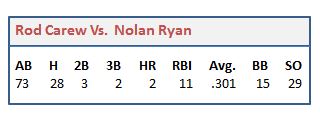
Okay, no surprise to see Rod Carew here.  He is, after all, a seven-time batting champ, who retired with 3,053 hits and a .328 career average. Carew has more at bats versus Ryan (93) than any other player who hit at least .300 against him. He also had the second-most career hits against Ryan with 28 – trailing only George Brett, who had 29 hits  in 101 at bats against Ryan (.287 average). Of course, getting touched for a .300 average versus Carew (.328 career average) is nothing to be ashamed of. The Hall of Famers  Carew hit at least .300 against (regular season) include Fergie Jenkins (.362 in 58 at bats); Jim Palmer (.358 in 95 AB); Catfish Hunter (.347 in 101 AB); Dennis Eckersley (.321 in 56 AB); Gaylord Perry (.316 in 76 AB); and, of course, Ryan.

Carew

Slow Starter?

In his first MLB game, Rod Carew struck out three times and grounded out pitcher-to-first.  Not a sign of things to come.

Carew was an 18-time All Star (in 19 MLB seasons … 1967-85). He hit .300 or better in 15 seasons (a high of .388 in 1977) and reached 200 or more hits in four campaigns. He was the AL Rookie of the Year in 1987, and league MVP in 1977. Carew played for the Twins (1967-78) and Angels (1979-86)

In 1974, when he won his fourth batting crown with a .364 average, Rod Carew hit .538 (seven-for-thirteen) versus Nolan Ryan – with a home run, four walks and four whiffs.

______________________________________________

Whiff – le Ball

Nobody struck out more times against Nolan Ryan than Claudell Washington, who faced Ryan 102 times and fanned 39. In those appearances (90 at bats), Washington hit .144. Nobody faced Ryan more times without striking out than Julian Javier, who stepped in the batter’s box 18 times against Ryan  and never fanned, but hit only .124 (two-for-sixteen). 

Here’s list of those who stepped in against Ryan at least a dozen times and never fanned.

Name                                      PA           AB               H            Avg.

Julian Javier                       18              16                  2            .125

Tommy Helms                    13               13                 2            .154

Carlos Baerga                      12                10               6            .600

________________________________________________

Third Base – Dick Allen, RHH, 5’11”/187 pounds

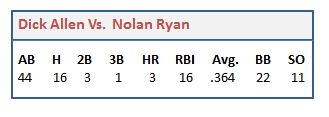
Thank goodness for Dick Allen’s 652 games at the hot corner, which enable me to keep both Allen and Will Clark in this lineup. Allen hit a robust .364 versus Ryan (16 hits in 44 at bats). He also hit three home runs versus The Ryan Express and drove in 16 tallies.  Only Darrell Porter and Rusty Staub had more career RBI (17 each) versus Ryan.  In 1968, Allen was perfect in eight plate appearances versus Ryan (then a 21-year-old rookie) collecting three hits (two home runs) and five walks.  Allen’s competition for this spot in the lineup came primarily from George Brett, who had the most career hits versus Ryan (29), but trailed Allen in HR (Brett had zero) and RBI (Brett had 8). In addition, Brett hit .287 against Ryan, well below his career .305 mark.

Allen

Allen was a seven-time All Star in 15 MLB seasons (1963-77). He collected 1,848 hits (.292 average, reaching .300+ in seven seasons), 351 home runs (topping 30 six times, a high of 40 in 1966) and reaching 100+ RBI three times.  He led his league in home runs twice, RBI once, runs scored once and triples once. He was the NL Rookie of the Year in 1964 and AL MVP in 1972. He played for the Phillies (1963-69 & 1975-76); Cardinals (1970); Dodgers (1971); White Sox (1972-74); and A’s (1977).

Despite striking out nearly twice as many times as he walked in his career (1,556 strikeouts to 894 walks), Dick Allen drew 22 walks versus just 11 strikeouts versus Nolan Ryan.  Those were the most walks Allen drew from any MLB pitcher – only one of the free passes was intentional.

________________________________________________

Shortstop Rafael Ramirez, RH, 6’/170-pounds

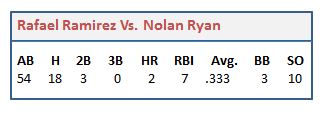
Rafael Ramirez, a .261 hitter in 13 MLB seasons (1980-92), is a bit of a surprise on this list – but put up a .333 average (18-for 54) versus Ryan, with two home runs and seven RBI.

During his career,  Ramirez was an All Star just once (1984, Braves). He reached double digits in home runs just once (10 in 1982) and hit over.270 in three campaigns.  He played for the Braves (1980-87) and Astros (1988-92). His best season was with the Braves in 1983, when he hit .297, with seven home runs, 58 RBI, 82 runs scored and 16 stolen bases in 152 games.

Ramirez

Rafael Ramirez hit two or more home runs against only four pitchers in his career. Don Robinson (3); Nolan Ryan (2); Bob Forsch (2); Dave Dravecky (2).

________________________________________________

Outfield – Carl Yastrzemski, LHH,  5’11’/175-pounds

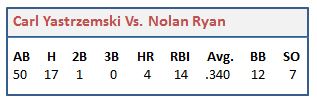
Carl Yastrzemski is no surprise on this list. In 23 MLB seasons (1961-83, all with the Red Sox), he collected 3,419 hits (.285 average), 452 home runs and 1,844 RBI. He touched Nolan Ryan for a .340 average (17-for-50), four home runs and 14 RBI.

Yaz was the AL MVP in 1967 (when he won the AL Triple Crown) and an All Star in 18 seasons. He won three batting titles (and hit .300 or better six times), twice led the AL in hits and three times topped the league in runs scored.

Yaz

Carl Yastrzemski was awarded a basketball scholarship by Notre Dame University.

_____________________________________________

Outfield – Lonnie Smith, RHH, 5’9”/170-pounds

Lonnie Smith was a bit of a journeyman over his 18-season MLB career (Phillies …1978-81; Cardinals … 1982-85; Royals … 1985-87; Braves … 1988-92; Pirates … 1993; Orioles … 1993-94). He was a steady performer throughout, putting up a .288 career average (1,488 hits) with 98 home runs, 909 runs, 553 RBI and 370 stolen bases. He hit over .300 in six seasons. As an All Star in 1982, he led the NL in runs (120) and hit .307 with eight home runs and 68 stolen bases.

Smith

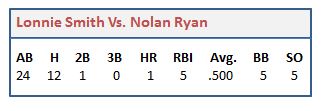
Smith did a good job against Nolan Ryan facing him 31 times and going 12-for-24 (.500 average), with one home run and five RBI. He also walked five times (versus five strikeouts) versus Ryan.

Lonnie Smith batted against Nolan Ryan in five different seasons (1980-84) and never hit under .333 against him.

_______________________________________________________

HALL OF FAMERS WHO DID WELL VERSUS NOLAN RYAN (minimum three at bats)

These Hall of Famers hit .333 or better versus Nolan Ryan:

Catfish Hunter –  .667 (2-for-3)

Eddie Murray  –  .389 (7-for 19)

Harold Baines –  .364 (8-for-22)

Barry Larkin – .357 (5-for-14)

Tony Perez – .346 (9-for-26)

Paul Molitor – .341 (14-for-41)

Carl Yastrzemski – .340 (17-for-50)

Phil Niekro – .333 (1-for-3)

Fergie Jenkins- .333 (1-for-3)

Joe Torre – .318 (7-for-22)

Hank Aaron – .308 (12-for-39)

Tony Gwynn – .302 (19-for-63)

Rod Carew – .301 (28-for-93)

Luis AparIcio – .300 (3-for-10)

Al Kaline – .300 (3-for-10)

These Hall of Famers hit .150 or lower against Ryan (minimum three at bats): 

Frank Thomas – .000 (0-12); Don Sutton – .000 (0-for-5); Jim Thome – .000 (0-for-4); Willie Mays – .000 (0-for-3); Edgar Martinez – .053 (1-for 19); Willie Stargell – .071 (1-for-14); Steve Carlton – .111 (1 for 9); Dave Winfield  – .115 (3-for-26); Rickey Henderson – .118 (2-for-17); Roberto Clemente – .125 (2-for-16); Willie McCovey – .133 (2-for 15); Johnny Bench – .138 (4-for-29); Jim Rice – .150 (6-for-40); Kirby Puckett – .150 (3-for-20).

_________________________________________________

Outfield – George Hendrick, RHH, 6’3”/195-pounds

George Hendrick play 18 seasons in the major leagues (1971-88) – collecting 1,980 hits (.278 average), 267 home runs and 1,111 RBI. He was an All Star four times, hit .300 or better four times, reached at least 20 home runs six  times and drove in 100 or more runs twice. Hendrick played for the A’s (1971-71); Indians (1973-76); Padres (1977-78); Cardinals (1979-84); Pirates (1985); Angels (1985-88).

Hendrick

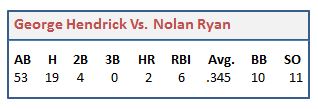
Against Nolan Ryan, Hendrick collected 19 hits in 53 at bats (.345), with two homers and six RBI.  The 19 hits were his sixth-most against any pitcher in his career.

George Hendrick, a .278 lifetime hitter, collected more hits off Hall of Famer Steve Carlton (38) than against any other pitcher.  He hit .345 against Carlton. He collected his third-most hits regular-season hits (22) off another HOFer, Bert Blyleven (.367 average) and his sixth-most (19) off Nolan Ryan.

________________________________________________

Pitcher – Ron Reed, RHH, – 6’6”/215-pounds

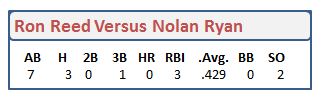
In his 19 MLB seasons, Reed went 149-140, with a 3.46 earned run average.  He stepped up to the plate seven times versus Nolan Ryan and produced two successful sacrifice bunts, one hit by pitch, three hits in seven at bats (a .429 average), one triple and three RBI.  In his career, Reed came to the plate 695 times and produced 98 hits (.158 average). In 1968, when he collected two of his three hits off Nolan Ryan (including the lone triple), he hit just .161 (10-for-62).  Reed’s main competition for a spot on this squad came from Catfish Hunter, who faced Ryan three times and produced a pair of singles and a foul ball pop out.

Reed

Ron Reed’s triple off Nolan Ryan was the only three-bagger of his career – and his three RBI versus Ryan were the most runs he plated off any opposing pitcher.

Primary Resources:  Baseball-Reference.com; MLB.com

Additional “Who’s Your Daddy?” looks at top lineups versus top pitchers:

  • Sandy Koufax, click here.
  • Bob Gibson, click here.
  • Pedro Martinez, click here.
  • Randy Johnson, click here


BASEBALL ROUNDTABLE MAKES TOP 100 BASEBALL BLOG LIST

100Baseball Roundtable has made the Feedspot list of the Top 1oo Baseball Blogs.  To see the full list, click here.

I tweet (on X) baseball @DavidBaseballRT

Follow/Like Baseball Roundtable’s Facebook Page here.  More baseball commentary; blog post notifications; PRIZES.

Member: Society for American Baseball Research (SABR); The Baseball Reliquary; The Negro Leagues Baseball Museum.
Trivia Teaser … Name the only team to win the World Series after being outscored in the regular season.

Trivia Teaser

Can you name the only MLB team to win the World Series after being outscored by the opposition in the regular season?


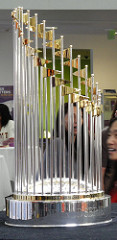
World Series Trophy photo

Photo by Shemp65

The only team to be outscored during the regular season and go on to win the World Series was the 1987 Twins – one of MLB’s unlikeliest World Series Champions.  Consider just a few of the circumstances:

  • The Twins had finished in sixth place, 20-games under .500 the previous season – when they were outscored by 98 runs (741-839).
  • In 1987, they were outscored by 20 tallies (786-806), but produced an 85-77 record, good enough to top the American League West.
  • The Twins has ended the 1987 season on a five-game losing streak.
  • In the American League Championship Series they faced the 98-64 Detroit Tigers – who had outscored their opponents by 161 runs; had beaten the Twins eight times (versus four losses) during the regular season; had outscored the Twins 83-58 in head-to head matchups; and had ended the regular season a four-game winning streak.
  • The Twins opponent in the World Series was the 95-67 St. Louis Cardinals, who had outscored their opponents by 105 runs (798-693).

The 1987 World Series saw the first-ever indoor Fall Classic contests – at Minnesota’s Hubert H. Humphrey Metrodome.

At the time, the Twins 85-77 record represented the worst regular-season record ever by a World Series Champion.  In the 2006 season, the 83-78 St. Louis Cardinals eclipsed that mark topping the 95-67 Tigers in the World Series.

There’s no place like dome.

The 1987 Twins had a 29-52 road record, the fifth-worst in MLB that season – but they offset that with a 56-25 home record (the best in baseball) at the Metrodome.  Then, in the World Series, the home team won every game – and the Twins had four home games.

It’s a Smalley World After all

Game Seven of the 1987 World Series was played on October 25 – the 35th birthday of Twins SS/3B Roy Smalley III. It was also the final game of Smalley’s 13-season MLB career.  He retired as part of a World Series winning squad – not a bad way to celebrate your birthday.

HOW THE GAME HAS CHANGED

The very first World Series night game as played on Wednesday, October 13, 1971, in Pittsburgh – with the Pirates topping the Orioles 4-3.  That’s right, prior to 1971, every World Series game was lit by the sun.

The 1987 World Series’ Game Six, played in the Metrodome, is the last scheduled World Series Day game – although, being indoors, the fans did not enjoy blue skies and sunshine.  The game, however, did enjoy prime-time TV exposure.


GOOD DAY SUNSHINE


World Series Baseball, old schoolers say,

Was made to be played under blue skies and autumn sun.

In fact, the Fall Classic didn’t see a night-time start

Until October of 1971.


It was a prime-time slide from there, two night matches in ’72;

Three in ’73 and then a total of four in ’74.

And World Series baseball continued to get darker,

Five night games in ’75 – and the future held even more.


Now the count for World Series day games

Has dropped to the lowly sum of none.

1987 was, sadly, the last October Classic

When we could watch even one.


Even that single day game in 1987

Was not exactly a sunlit ride.

It was played in Minnesota’s Metrodome,

Where the day could not get inside.


Now, 31 years of Series games

Have been played without blue skies and bright sun.

It’s been all moonlight heavens and halogen

Lighting the fields where championships are won.


Of course, TV advertising 

Has proven to be a boon.

But I’d still like to see some Series baseball

Under the sun and not the moon.


For an old school fan like me,

if wishes could come true,

A few weekend Series games 

Would feature skies, not black, but blue.


I tweet baseball @DavidBBRT

Follow’Like Baseball Roundtable’s Face book page here.

Member: Society for American Baseball Research; The Baseball Reliquary; The Negro Leagues Baseball Museum.