A Record Eight Five-Homer Games … And a Lot of Season to Go

This Monday, July 22, the Minnesota Twins banged out five home runs … while topping the Yankees 8-6 at Target Field.  In the process, they tied the 1977 Boston Red Sox for the most games with five or more home runs in a season – and there is still a lot of season to go. Before looking at each of the Twins’ five-dinger games, here are a few tidbits. (Note:  Later in the post, we’ll also take a look at the 1977 Red Sox’ 5+ homer outings.)

  • The Twins won all eight contests, and outscored their opponents 89-45.
  • The Twins racked up their five-home run games on the road five times and at home three. (The Red Sox accomplished the feat six times at home and twice on the road.)
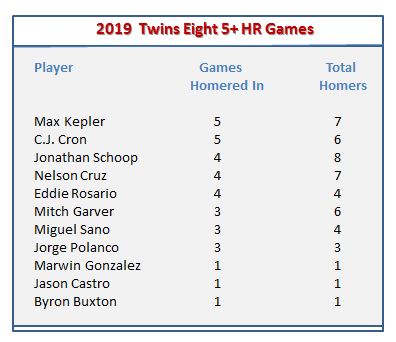
  • Eleven different players homered for the Twins in those eight contests.
2019Twins5hr

  • Six different Twins delivered a combined 14 two-homer games in the eight contests: Jonathan Schoop (four times); Mitch Garver (three); Nelson Cruz (three); Max Kepler (two); C.J. Cron; and Miguel Sano.
  • The Twins’ home runs total in the eight games: 48 total home runs – four games with five HRs, two games with six, two with eight.
  • At the end of play July 22, the Twins led all of MLB with 187 home runs; without a single player in the MLB top ten. Max Kepler with 25 home runs was tied for 14th in MLB and stood fifth in the American League.
  • At the close of play on July 22, the Twins were on a pace to hit 306 home runs – well above the MLB record 267 hit by the Yankees last seasons.

Now, here’s a look at those 5+ home run games.

April 9

April9

Twins HRs: Mitch Garver (2); Jonathan Schoop (2); Eddie Rosario; Jorge Polanco.

April 20

April20

Twins HRs: Nelson Cruz (2); Mitch Garver (2); Jonathan Schoop (2); C.J. Cron; Eddie Rosario.

April 26

April26

Twins HRs: Nelson Cruz (2); C.J. Cron; Eddie Rosario; Max Kepler.

All but one of the Twins’ five home runs were solo shots and four of the five came with two outs. 

April 27

April27

Twins HRs: Max Kepler (2); C.J. Cron; Marwin Gonzalez; Jason Castro.

The Twins went deep against Orioles’ pitching ten times in two games.  As of July 22, the Twins had hit 23 home runs against the Baltimore staff, the most HRs Minnesota had against any team.

May 18

May18

Twins HRs: C.J. Cron (2); Jonathan Schoop (2); Byron Buxton; Miguel Sano.

In this contest, the Twins reached five-home run mark by the third inning.

May 23

May23

Twins HRs: Jonathan Schoop (2); Miguel Sano (2); Jorge Polanco; C.J. Cron; Max Kepler; Eddie Rosario.

June 29

June 29

Twins HRs: Nelson Cruz (2); Max Kepler (2); Miguel Sano.

The Twins homered in the seventh, eighth and ninth innings to reach the five-dinger mark.

July 22

July29

Twins HRs: Mitch Garver (2); Nelson Cruz; Max Kepler; Jorge Polanco.

—–1977 BOSTON RED SOX – EIGHT 5+ HOMER GAMES—–

Now, let’s look at the 1977 Red Sox and their eight games with five or more home runs.

Before looking at each game, here are a few tidbits.

  • The Red Sox won all eight contests (six at home), and outscored their opponents 89-45.
  • Ten different players homered for the Red Sox in those eight contests.
  • George Scott was the only player to homer in every one of the eight games – a total of nine long balls.

1977SoxNames

  • The Red Sox home run total in the eight games: 46 total home runs – four games with five HRs, three games with six, one with eight.

In the July 4, 1977 game in which the Red Sox popped eight home runs while topping the Blue Jays 9-6 in Boston, Boston did not have a base runner until the fifth inning, and actually trailed 6-5 going into the bottom of the eighth (when they hit four solo home runs). They scored all nine runs on home runs.

  • The 1977 Red Sox finished second in the AL East to the Yankees at 97-64.
  • The Red Sox led MLB with 213 home runs that season and were second to the Minnesota Twins in runs scored (859 to the Twins 867 – Minnesota, by the way hit 90 fewer homers that season than the Red Sox).
  • The 1977 Red Sox leading home runs hitters were: Jim Rice (39); George Scott (33); Butch Hobson (30); Carl Yastrzemski (28); Carlton Fisk (26). Rice finished third in MLB in HRs, Scott finished eighth.

Here are the game totals.

May 22

May22

Red Sox HRs: Fred Lynn (2); Butch Hobson; Carl Yastrzemski; Dwight Evans; George Scott.

May 28

May 28

Red Sox HRs: Jim Rice (2); Carl Yastrzemski; Carlton Fisk; George Scott; Dwight Evans.

HEATING UP THE OLD RIVALRY

The rival New York Yankees visited Fenway for a three-game series July 17-19.  The Red Sox swept the series and hit at least five long balls in each game; while outscoring New York 30-9.  Coming against the Bronx Bombers had to make those long balls all the sweeter.

June 17

June 17

Red Sox HRs: Carlton Fisk (2); Rick Burleson; Fred Lynn; George Scott; Carl Yastrzemski.

June 18

June 18

Red Sox HRs: Carl Yastrzemski (2); Bernie Carbo (2); George Scott.

June 19

June 19

Red Sox HRs: Denny Doyle; Bernie Carbo; Jim Rice; Carl Yastrzemski. George Scott.

June 22

June 22

Red Sox HRs: Carlton Fisk (2); George Scott; Jim Rice; Butch Hobson.

All seven Red Sox’ runs scored via the long ball.

July 4

July 4

Red Sox HRs: George Scott (2); Fred Lynn(2); Butch Hobson; Bernie Carbo; Jim Rice; Carl Yastrzemski.

August 3

Aug3

Red Sox HRs: Jim Rice (2); Butch Hobson; George Scott; Bernie Carbo.

11 of Boston’s 12 runs scored on home runs, the other on a bases-loaded walk.

BASEBALL ROUNDTABLE ON THE TOP 100 BASEBALL BLOG LIST

100Baseball Roundtable is on the Feedspot list of the Top 100 Baseball Blogs.  To see the full list, click here.

I tweet baseball @DavidBBRT

Follow/Like Baseball Roundtable’s Facebook Page here.  More baseball commentary; blog post notifications; PRIZES.

Member: Society for American Baseball Research (SABR); The Baseball Reliquary; The Negro Leagues Baseball Museum.
A Look at the New Baseball Hall of Famers … and a few who didn’t make it.

Today’s Baseball Hall of Fame inductees are now officially “in the books and in the Hall.” Baseball Roundtable send out congratulations, in particular, to Mariano Rivera, the first-ever unanimous selection. Well-deserved congratulations also go to 2019 inductees Edgar Martinez, Roy Halladay and Mike Mussina.  All four were voted into the Hall in the Baseball Writers Association of America (BBWAA) balloting.

In addition, BBRT would like to congratulate Today’s Game Era Committee electees Lee Smith and Harold Baines. In this post, we’ll look at the inductees, as well as the additional players who would have gotten BBRT’s vote (if I had one) and the results (reportedly earlier) of Baseball Roundtable’s annual (unofficial) fan vote (192 ballots). Those who follow BBRT will already know that the fans were a bit stingier with their support than the BBWAA “official” voters.

Bernie Tugs at Baseball’s Heart Strings.

There were lots of highlights  at this year’s Hall of Fame celebration.  How about the National Anthem being performed by noted jazz guitarist, 2009 Latin Grammy Award nominee and (oh, yeah) four-time World Series Champion Bernie Williams?  Williams also provided a guitar salute to former teammate (and 2019 HOF inductee) Mariano Rivera – a unique version of “Take Me Out to the Ball Game,” which included Rivera’s walk-in “Enter Sandman” riff. 

Lets’ start with the 2019 inductees voted in by the writers – Rivera, Martinez, Halladay and Mussina – all of whom would have also gotten BBRT’s vote. (Side note: Back in November, BBRT predicted Rivera and Martinez would get in and identified Halladay and Mussina as BBRT’s two dark-horse candidates with a good chance at election.)

—–A LOOK AT 2019 Baseball Hall of Fame Inductees Elected by the BBWAA.—–

Mariano Rivera – 100 Percent … (RHP/Closer, 1995-2013) … First year on the ballot.

MO

Rivera is at the top of the 2019 HOF class, no matter how you look at it – and we finally have our first unanimous selection.

Rivera spent nineteen years with the Yankees and racked up an MLB-best 652 career saves.  He was an All-star in 13 seasons, led the AL in games saved three times and finished in the top three in Cy Young  voting four times. He saved 30 or more games in a season 15 times (including nine seasons of 40 or more saves, two of fifty or more) and put up an overall won-lost record of 80-52, with a 2.21 earned run average in 1,114 games. In 11 of his 19 seasons, Rivera’s earned run average was under 2.00 – which included a four-season span (2003-06), in which he saved 170 games, won 21 (13 losses) and put up a 1.69 ERA in 302 2/3 innings pitched. In his final season – at age 43 – Rivera went 6-2, with a 2.11 ERA and 44 saves.  Rivera was the American League Rolaids Relief Man of the Year in five seasons and the MLB Delivery Man of the Year in three campaigns.

All those New York fans.  When I was at Yankee Stadium pitching, it felt like I was pitching with 55,000 people next to me – throwing one pitch after another.

                 Mariano Rivera – from his Hall of Fame Induction Speech

The “Sandman” was even better In his 96 post-season appearances.  In those big games, Rivera went 8-1, with 42 saves and a minuscule 0.70 ERA. He was named the World Series MVP in 1999 and the ALCS MVP in 2003.  In 58 of his 96 post-season appearances, Rivera pitched more than one inning.  In the 2003 post-season, he appeared in eight games, pitching 16 innings (more than one frame in seven of the eight appearances), earning a win and five saves, giving up just one earned run (0.56 ERA).

Mariano Rivera’s Best Season: Lots to choose from here – like 43 saves and a 1.38 ERA in 2005; or 44 saves and a 1.91 ERA in 2011 (at age 41). BBRT will go with 2004, when Rivera saved a career-high 53 games, won four (lost two) and posted a 1.94 ERA.

___________________________________

Edgar Martinez – 85.4 Percent … (Designated Hitter/Third Base, 1987-2004) … Tenth/Final year on the ballot.

Edgar Martinez Mariners photo

Photo by clare_and_ben

We’ve seen some bias against designated hitters in past voting, but Edgar Martinez’ election indicates this may be subsiding. Martinez clearly defined the DH role. In an 18-season MLB career (all with the Mariners), Martinez was named to seven All Star teams; won a pair of batting titles (hitting a high of .356 in 1995); earned five Silver Slugger Awards; topped 100 RBI in six seasons (leading the league with 145 in 2000); and scored 100 or more runs five times (leading the league with 121 in 1995). He finished his career with a .312 average; 2,247 hits; 1,219 runs; 1,261 RBI; 309 home runs; and 514 doubles.

Like most kids in Puerto Rico, I wanted to be like Roberto Clemente … and what an honor to have my plaque in the Hall alongside his.

                            Edgar Martinez – from his Hall of Fame Induction Speech

Martinez hit .571 in the 1995 AL Championship Series (12-for-21), with two home runs, six walks and 10 RBI in five games.  In 34 post-season games, he hit .266, with eight home runs and 24 RBI.

Edgar Martinez’ Best Season: One of two … In 1995, Martinez led the league in batting average (.356), runs scored (121) and doubles (52), adding  29 home runs and 113 RBI.  In 2005, Martinez put up a .324 average, 37 home runs, a league-leading 145 RBI and 100 runs scored.

______________________________________

Roy Halladay – 85.4 percent …. (RHP/Starter, 1998-2013) … First year on the ballot.

Photo by Keith Allison

Photo by Keith Allison

Roy Halladay had one of the best-ever ten-year runs on the mound (2002-2011).  In those ten seasons, he went 170-75, with a 2.97 earned run average and 1,699 strikeouts in 2,194 2/3 innings. He was an All Star eight times during that span and won a pair of Cy Young Awards (2003 and 2010). Halladay also recorded three seasons of 20 or more wins during those ten seasons, leading his league twice. Between 2002 and 2011, he also led his league in complete games seven times, shutouts four times and innings pitched four times.

To both of the teams we were blessed to be part of  – the Blue Jays and the Phillies – thank you for allowing us to grow up, to fail over and over and, finally, learn how to succeed within your organizations.

                Brandy Halladay – at Roy Halladay’s Hall of Fame Induction 

And, there is more to support Halladay’s spot in the Baseball Hall of Fame.  On May 10, 2010, he pitched a perfect game – striking out 11 – as his Phillies topped the Marlins 1-0 in Miami. Then, on October 6, 2010, Halladay tossed a no-hitter against the Reds in Game One of the National League Division Series – walking one and fanning eight as the Phillies won 4-0. It was just the second no-hitter in post-season history.  Halladay was also one of just six pitchers to win the Cy Young Award in both the American and National Leagues.

Halladay finished his career at 203-105, 3.38 with 2,117 strikeouts in 2,749 1/3 innings pitched.  He pitched for the Blue Jays (1998-2009) and Phillies (2010-13).

Roy Halladay’s Best Season: In his 2010 Cy Young Award season – after being traded from the Blue Jays to the Phillies in December of 2009 – Halladay led the NL in wins (21-10); complete games (nine), shutouts (four), and innings pitched (250 2/3), while putting up a 2.35 ERA (third in the league), fanning 219 batters (second in the NL) and walking just 30.    His 7.3 strikeouts to walks ratio was the NL’s best.

________________________________________

Mike Mussina – 76.7 Percent …  (RHP/Starter, 1991-2008) – Sixth year on the ballot.

Photo by Willie Zhang

Photo by Willie Zhang

Mussina built a 270-153 record, with a career 3.68 ERA and 2,813 strikeouts over 18 seasons. While only once a 20-game winner (in his final season, at age 39), Mussina won 18 or 19 games five times, leading the AL with 19 wins in 1995. In his first three full seasons in the major leagues (1992-94), Mussina put up a .700 or better winning percentage each year (.783, .700, .762). His record over that span – for the Orioles – was 48-16.

I was never fortunate enough to win a Cy Young Award or be a World Series Champion. I didn’t win 300 games or strikeout 3,000 batters. And while my opportunities for those achievements are in the past, today I get to become a member of the National Baseball Hall of Fame.  Maybe I was saving up – from all of those” almost” achievements – for one last push. And, this time, I made it.

                                   Mike Mussina – from his Hall of Fame Induction speech

Mussina was a five-time All Star and a seven-time Gold Glove winner. He recorded a .650 or better winning percentage in nine seasons, with a career (and league-leading) high of .783 in 1992.  Mussina ranks 21st all-time in strikeouts and 26th in strikeouts-to-walks ratio (1,000 or more innings). He’s also in the top fifty all-time in games started, wins and winning percentage.  Mussina pitched for the Orioles (1991-2000) and Yankees (2000-2008).  Mussina appeared in 23 post-season games, with a 7-8 record and a 3.42 ERA.

Mike Mussina’s Best Season:  Mussina may have saved his best for last.  In his final season (as a Yankee), at age 39, he recorded his first twenty-win campaign.  That year, Mussina went 20-9, 3.37 – and proved his durability by leading the AL in starts with 34, logging his 11th season of 200 or  more innings pitched and earning his seventh Gold Glove.

____________________________________

Lee Smith (RHP) … 1980-97 … Today’s Game Era Committee Selection

From Baseball Roundtable’s perspective, Lee Smith should have been in the Hall of Fame long ago.  However, in his 15 years on the traditional ballot, he never garnered more than 50.6 percent support – and never less than 29.9 percent.

Why does BBRT feel strongly about Lee Smith’s spot in the Hall? Smith’s 478 career saves put him third on the all-time list (he was number-one when he retired after the 1997 season).  He recorded 13 consecutive seasons (in an 18-year career) of 25 or more saves, a 3.03 lifetime ERA and 1,251 strikeouts in 1,289 innings pitched; led his league in saves four times; made seven All Star teams; and was the Rolaids Relief Man of the Year in three seasons.

No matter where I pitched, I always wanted to embody two traits – loyalty to the team and my teammates and dependability as a teammate and a pitcher.

                                 Lee Smith – from his Hall of Fame Induction speech

Smith pitched for the Chicago Cubs (1980-87); Boston Red Sox (1988-90); St. Louis Cardinals (1990-93); New York Yankees (1993); Baltimore Orioles (1994); California Angels (1995-96); Cincinnati Reds (1996); Montreal Expos (1997).

Lee Smith’s Best Season:  1991, Cardinals … 6-3, 2.34 ERA, 47 saves, 73 innings pitched, 67 strikeouts.

______________________________________

Harold Baines (OF/DH) … 1980-2001 … Today’s Game Era Committee Selection

Photo by Keith Allison

Photo by Keith Allison

Harold Baines had a 22-season MLB career. He was a six-time All Star and two-time winner of the Designated Hitter of the Year Award. He is in the top 50 players all-time in hits with 2,866 (46th) and RBI with 1,628 (34th). Baines, with a .289 career average, hit .300 or better in nine seasons. He was a steady source of power with 384 home runs, never reaching 30 in a season, but hitting 20 or more home runs in ten campaigns.  He drove in 100+ runs in three seasons and scored 1,299 runs in his career.

Baines hit .324, with five home runs, 16 RBI and 14 runs scored in 31 post-season contests.

Harold Baines played for the White Sox (1980-1989, 1996-1997, 2000-2001); Rangers (1989-1990); A’s (1990-1992); Orioles (1993-1995, 1997-2000); and Indians (1999).

Many of my former teammates and quite a few of my former opponents are sitting behind me today.  Thank you for making baseball the greatest game of all – and for pushing so many of us to accomplishments beyond our dreams.

                       Harold Baines – from his Hall of Fame Induction  speech

Harold Baines’ Best Season:  Baines’ best MLB campaign may have been 1999, when – at age 40 – he made his final All Star team and hit .312, with 25 home runs and 103 RBI, playing for the Orioles and Indians. That season, Baines also hit .357 (5-for-16), with one home run and four RBI in four post-season (ALDS) games.

_________________________________

A FEW WHO DIDN’T MAKE IT THIS YEAR, BUT SHOULD HAVE

As I noted earlier, BBRT would have cast its votes for all four of the deserving BBWAA electees.  In addition, my ten-vote ballot would have included Jeff Kent, Todd Helton, Larry Walker, Fred McGriff, Omar Vizquel and Andy Pettitte.  Here’s a look at the reasons behind that support.

Larry Walker – (Outfield, 1989-2005)

Larry Walker played for the Expos (1989-1994), Rockies (1995-2004) and Cardinals (2004-2005).  Given BBRT’s admiration for “lumber AND leather,” Walker’s combination of three batting titles, three Silver Slugger Awards and seven Gold Gloves would earn him my vote.

Walker played 17 MLB seasons and retired with 2,160 hits, a .313 average and three batting titles.  Between 1997 and 2001, he hit .350 or better in four of five seasons. The five-time All Star (and 1997 NL MVP) hit 383 home runs (a high of 49 in 1997) and stole 230 bases (a high of 33 in 1997).  Walker hit just .230 in 28 post-season games, but did rack up seven home runs, 15 RBI and sixteen walks in those contests. Walker’s ten seasons in hitter-friendly Colorado may be hurting his vote totals – he hit .383 for his career in Coors, .271 elsewhere.  Still, BBRT believes if you add his Gold Glove defense to his productive bat, you have a Hall of Famer.  I’m also not much for punishing a player for taking full advantage of his home-field conditions.

___________________________________

Todd Helton – (First Base, 1997-2013)

Todd Helton spent his entire 17-year career with the Rockies (playing half his games in hitter-friendly Coors field), putting up a .316 career average (.345 at home and .287 on the road). Despite that home/road split, Helton’s body of work deserves HOF consideration. He was a five-time All Star, three-time Gold Glover and four-time Silver Slugger. He hit over .300 in 12 seasons – and won the NL batting crown in 2000 with a .372 average. His 59 doubles that season are the seventh-most all-time. Helton drove in 100 or more runs in five seasons and scored in triple figures six times. His 1,335 walks indicate the respect he earned at the plate.

____________________________________________________

Jeff Kent – (Second Base/Third Base/First Base, 1992-2008)

BBRT believes Jeff Kent is a deserving candidate, but he has not gotten much support from the writers. Kent holds the all-time MLB record for home runs by a second baseman (351 of his 377 career round trippers were hit while in the lineup at second base). He has a healthy .290 career batting average; 1,518 RBI (54th all time); and 560 doubles (29th all time).

Jeff Kent has more career runs batted in than such noted Hall of Famers as Mickey Mantle, Billy Williams, Eddie Mathews, Duke Snider and Orlando Cepeda.

Kent was a five-time All Star and the 2000 NL MVP.  As primarily a middle infielder, he hit 20 or more home runs in 12 seasons (a high of 37 in 2007) and topped 100 RBI eight times. He hit .276, with nine home runs and 23 RBI in 49 post-season games. A couple of Gold Gloves, at this traditionally defense-oriented position, would have really helped his case.

Kent played for the Blue Jays (1992); Mets (1992-1996); Indians (1996); Giants (1997-2002); Astros (2003-2004); and Dodgers (2005-2008).

_________________________________

Omar Vizquel – (Shortstop/Third Base, 1989-2012)

If Vizquel does make it to the HOF, it will be more with his glove (eleven Gold Gloves) than his bat.  However, voters should be mindful of the fact that he finished his 24-season MLB career just 123 hits short of that milestone 3,000 safeties. Vizquel delivered premier defense to the Mariners (1989-1993); Indians (1994-2004); Giants (2005-2008); Rangers (2009); White Sox (2010-2011); and Blue Jays (2012). He was a three-time All Star – and put together a string of nine straight Gold Gloves at shortstop (1993-2001).

Omar Vizquel led his league in sacrifice bunts four times.

In the field, Vizquel has the highest career fielding percentage (.9847) among shortstops with at least 500 games at the position (tied with the still-active Freddy Galvis). Vizquel  is also the all-time leader among shortstops in double plays, ranks third at the position for career assists and 11th in putouts. He shares the record (with Cal Ripken, Jr.) for the fewest errors by a shortstop in a season of at least 150 games played (three).

On offense, Vizquel put up a serviceable .272 career average, with 80 home runs, 951 RBI and 1,445 runs scored. The 1,445 runs put him in the top 100 players all-time (82nd); while his 2,877 hits puts him in the top 50 (43rd). He also swiped 404 bases – topping twenty steals eight times (a high of 42 in 1999) – putting him at number 72 on the all-time list. Vizquel played in 57 post-season games, hitting .250-0-20.

____________________________________________

Fred McGriff – (First Base, 1986-2004)

Fred McGriff played for the Blue Jays (1986-1990), Padres (1991-1993), Braves (1993-1997), Devil Rays (1998-2001, 2004), Cubs (2001-2002) and Dodgers (2003).  McGriff  was five-time All Star, who bashed 493 career home runs (led his league twice, hit 30 or more home runs in a season ten times); topped 100 RBI eight times (career total 1,550); and put up a  .284 career average over 19 seasons.  He ranks among MLB top 50 all-time in home runs, RBI, extra base hits and walks. McGriff was the 1994 All Star Game MVP. McGriff was also a solid post-season performer, going .303-10-37 in 50 post-season games.

Fred McGriff retired with 493 home runs, exactly matching the total of another well-respected first sacker – Lou Gehrig.

____________________________________________

Andy Pettitte – (LHP/Starter, 1995-2010, 2012-13) 

Andy Pettitte’s HOF resume was achieved in the post-season. Pettitte holds the MLB post-season marks for most wins (19 … versus 11 losses), innings pitched (276 2/3), games started (44), and is second in strikeouts (183). His post-season accomplishments include a 3.81 career ERA and the 2001 American League Championship Series MVP Award.

Andy Pettitte started 30 or more games in a season 12 times, leading his league three times (1997, 2006, 2007.)

Pettitte was no slouch in the regular season (Yankees – 1995-2003, 2007-2010, 2012-13) and Astros (2004-06).  He finished with 256 wins (153 losses) and a 3.85 ERA. Pettitte won 20 games in two seasons and 14 or more games 12 times – leading the AL with 21 wins in 1996. The three-time All Star struck out 2,448 batters in 2,316 innings.

So, there are the players I would have voted for in 2019 who did not get in (just a little lobbying advance of next years balloting.

—-THE BBWAA OFFICIAL BALLOT VERSUS BBRT’S UNOFFICIAL FAN BALLOT—-

Each year, BBRT conducts an unofficial fan HOF ballot.  I’ve already reported on this, but here, again, are a few comparisons between the BBWAA Balloting and BBRT’s fan voting.

  • While the top four players were the same on both sets of ballots, the fan balloting seemed more demanding.  In the fan ballot only Mariano Rivera and Edgar Martinez got the necessary 75 percent. Halladay and Mussina were in the 55-60 percent range.
  • Fans voting in the BBRT ballot were also a tougher sell on Rivera, who got 86.5 percent of the fan vote.
  • Players selected per ballot were fairly even, with fans casting votes for 7.7 players per ballot and the writers voting for 8.0 per ballot.
  • Fans seemed less forgiving than the writers when it came to PED suspicions.  For example, in the BBWAA balloting, Roger Clemens and Barry Bonds  got 59.5 and 59.1 percent of the vote,  respectively.  In the BBRT fan balloting, Clemens got 44.9 percent and Bonds 43.2.
  • Fans spread their votes around a bit more.  In BBRT’s fan balloting only three players received zero votes, while in the BBWAA official ballot eleven players were shutout.
  • Sixteen players were “one and done” on the BBWAA ballot (less than five percent support), while fifteen received less than five percent on the BBRT fan ballot.  The names on the “one and done” lists were identical except that Miguel Tejada received 7.3  on BBRT’s unofficial fan ballot, but only 1.2 percent on the BBWAA ballot.

If you want to dig deeper, here are the totals:


Fanvote1FAnvote2

Primary Resources:  Baseball-Reference.com; MLB.com; Baseball-Almanac.com

BASEBALL ROUNDTABLE ON THE TOP 100 BASEBALL BLOG LIST

100Baseball Roundtable is on the Feedspot list of the Top 100 Baseball Blogs.  To see the full list, click here.

I tweet baseball @DavidBBRT

Follow/Like Baseball Roundtable’s Facebook Page here.  More baseball commentary; blog post notifications; PRIZES.

Member: Society for American Baseball Research (SABR); The Baseball Reliquary; The Negro Leagues Baseball Museum.

Angels Honor Tyler Skaggs with Near-Perfect Game

http://Embed from Getty Images

Yesterday, the Los Angeles Angels  paid tribute to Angels’ pitcher Tyler Skaggs (photo above), who passed away unexpectedly – at age 27 – one July 1.  (It was the Angels’ first home game since Skaggs death.) All of the Angels’ player wore jerseys replicating Skaggs number-45 uniform and the pitcher was honored in a pre-game ceremony that included a video highlighting Skaggs’ career, a minute of silence and Skaggs’ mother Debbie throwing out the first pitch and the placement of the game-worn Skaggs jersey on the mound after the game.

The Angels then went out and honored Skaggs in the most appropriate way possible to recognize a pitcher – by holding the visiting Mariners’ hitless in a 13-0 Angels’ rout. Angels’ pitchers Taylor Cole and Felix Pena allowed only one base runner, a walk (off Pena) in the fifth inning, as the two Halo hurlers faced  only 28 Mariners’ batters. Cole pitched the first two innings (fanning two batters), while Pena fanned six over his seven frames.  It was MLB’s 13th combined no-hitter – and an appropriate tribute to a respected and well-liked competitor and teammate.  Let’s take a look at Skaggs’ career and then MLB’s previous twelve combine no-hitters.

Skaggs was selected by the Angels (our of Santa Monica High School) in the first round (40th overall) of the 2009 MLB draft – beginning his pro-career with the Arizona Angels (Arizona League) and Orem Owlz (Pioneer League). He pitched ten innings that season, walking two, fanning 13 and putting up a 1.80 ERA.   In 2010, he moved up to the Class A Midwest League Cedar Rapids Kernels, where he made the league All Star Team.  In July of that season, Skaggs was traded to the Arizona Diamondbacks, who kept him in the Midwest League (South Bend Silver Hawks). For the Midwest League season, Skaggs was 9-5, 3.29, with 25 walks and 102 strikeouts in 98 1/3 innings.

In 2011, Skaggs continued to move up, playing at both High A and Double A, as well as in the All-Star Future Game. His combined record was 9-6, 2.96, with 49 walks and 198 whiffs in 158 1/3 innings. Skaggs continued to progress in 2012, playing at Double A and Triple A, once playing in the All-Star Futures Game – and making his MLB debut.  His 2012 minor-league record was 9-6, 2.87, with 37 walks and 166 strikeouts in 122 1/3 inning.

In 2013, he was traded back to the Angels and spent time with the big club (as well as in the minors) in both 2013 and 2014 before an August 2014 injury that required Tommy John surgery (Skaggs missed the 2015 season). Skaggs returned to the Angels in 2016, starting 10 games; began the 2017 campaign with LA, but spent considerable time on the Disabled List (getting 16 starts); and had a total of 24 starts in an injury-limited 2018 season.  This  season, the lefty known for his curve ball was putting up solid numbers:  7-7 through 15 starts – leading the team in wins and strikeouts at the time of his passing.  Skaggs overall minor-league record was 36-31, with a 3.33 ERA. with 179 walks and 612 strikeouts in 554 2/3 innings.

Skaggs

Now for those other combined no-hitters:

The first-ever combine no-hitter took place on June 23, 1917 – with the Red Sox topping the Senators 4-0 in Boston. This game is special for several reasons: it was the first MLB combined no-hitter; Babe Ruth was involved;  it involved the most meager contribution by the starting pitcher (zero innings pitched); and, finally, it is arguably the most “perfect” combined no-hitter ever.  Like the Skaggs tribute no-no, this one featured only one base-runner for the losing squad, but in this case the victims sent only the minimum 27 batters to the plate.

Babe Ruth, at that time plying his trade as a left-handed starting pitcher for the Boston Red Sox, opened the game by walking Washington’s lead-off hitter Roy Morgan.  Ruth, and his catcher Pinch Thomas, took issue with umpire Brick Owens’ strike zone and, during the argument, Ruth made contact with the umpire (a glancing blow, it was reported).  The ultimate result of the confrontation was the ejection of both Ruth and Thomas (with Ruth earning a $100 fine and ten-game suspension).  Red Sox’ pitcher Ernie Shore was called in to replace Ruth and Sam Agnew took Thomas’ spot behind the plate. Morgan decided to test Agnew’s arm and was thrown out stealing, after which Shore retired the next 26 hitters in order – completing the first combined no-hitter and facing the minimum 27 batters.

_______________________

Given the past propensity for pitchers finishing what they started, MLB’s second combined no-hitter came 50 seasons and 70 no-hitters later – on April 30, 1967, with the Tigers defeating the Orioles 2-1 in Baltimore.  This combined no-hitter is unique because it was not a “no- no” (no hits – no runs), the team that threw the no-hitter lost (the only combined no-hitter loss) and it involved the briefest contribution by the relief staff (one pitcher/one-third inning pitched).

Orioles’ starter Steve Barber and was effectively wild, walking ten hitters and hitting two in 8 2/3 innings. The opposing hurler was Detroit’s Earl Wilson – who matched goose eggs with Barber for seven innings. In the eighth, Baltimore pushed across a run on three walks and a sacrifice fly (Wilson gave up only two hits and four walks in his eight innings of work) and victory was there if Barber could take it. He didn’t.  Barber walked Tiger 1B Norm Cash to start the ninth. He then walked SS Ray Oyler. Earl Wilson, a good-hitting pitcher, bunted the runners to second and third, before Barber got the second out of the inning, inducing PH Willie Horton to pop up to the catcher.  Now, just one out away from a 1-0, no-hit win, Barber uncorked a wild pitch that brought the tying run home. He then walked CF Mickey Stanley, ending his day on the mound. Stu Miller came in to get the final out, but not until an error allowed the go-ahead run to score.

_____________________________

Combined no-hitter number three came on September 28, 1975, with the A’s topping the Angels 5-0 in Oakland.  This game was unique in that it is one of only three no-hitters thrown on the final day of an MLB season – and it made starting pitcher Vida Blue the first hurler to take part in both a solo and combined no-hitter. (Blue had thrown a solo no-hitter on September 21, 1970.) Blue went five innings and was followed by Glenn Abbott (one inning), Paul Lindblad (one inning) and Rollie Fingers (2 innings). This was also the first time more than two pitchers were involved in a combined no-hitter.  Note: Blue has been joined by Kevin Millwood, Kent Mercker and Mike Witt as pitchers with both solo and combined no-hitters.)

_________________________________

The next combined no-hitter went back to the two-pitcher formula, as Blue Moon Odom (5 innings) and Francisco Barrios (4 innings) of the White Sox topped the A’s 2-1 in Oakland.  In the July 28, 1976 game, Blue walked five and gave up one run in his five frames, and Barrios added two walks in his four.

______________________________

Combined no-hitter number-five came on April 11, 1990 (again just two pitchers), with the Angels topping the Mariners 1-0 in Anaheim.  Mark Langston started the game and went seven, and Mike Witt (the only pitcher to throw a perfect game – September 30, 1984 – and take part in a combined no-hitter ) threw the final two.

____________________________

1991 saw seven MLB no-hitters including two combined no-nos. On July 13, the Orioles no-hit the A’s 2-0 in Oakland behind Bob Milacki (five innings), Mike Flanagan (one IP), Mark Williamson (one IP) and Gregg Olson (one IP). Then, on September 11, the Braves no-hit the Padres 1-0 in Atlanta, led by Kent Mercker (six innings), Mark Wohlers (two innings) and Alejandro Pena (one inning).

_______________________________

Combined no-hitter number eight came on July 12, 1997 – with the Pirates topping the Astros 3-0 in Pittsburgh.  It was unique in that it was the only extra-inning combined “no-no.” Francisco Cordova started and went nine hitless frames (two walks, ten whiffs) and Ricardo Rincon threw one hitless inning in relief (for the win).

_________________________________

The next combined no hitter was a record breaker – as the Astros used a record six pitchers (since tied) to no-hit the Yankees 8-0 in an inter-league game at Yankee Stadium (the last no-hitter at Old Yankee Stadium). Roy Oswalt started, but succumbed to a groin injury after just one completed inning. Joining in the no-hitter were: Pete Munro (2 2/3 IP); Kirk Saarlos (1 1/3 IP); Brad Lidge (2 IP); Octavio Dotel (1 IP); and Billy Wagner (1 IP). Notably, the no-hitter also broke up the Yankee’s record streak of 6,980 games without being held hitless. They had not been held without a safety since September 20, 1958.

______________________________

The very next combined no-hitter – another inter-league game – saw the six-pitcher record tied, as the Mariners topped the Dodgers 1-0 in Seattle. Kevin Millwood started that one (six innings), followed by Charlie Furbush (2/3 IP), Stephen Pryor (1/3 IP), Lucas Luetge (1/3 IP), Brandon League (2/3 IP) and Tom  Wilhemson (one IP).

________________________________

In combined no-hitter number 11 – September 1, 2014- the Phillies used four pitchers to no-hit the Braves 7-0 in Atlanta.  The pitchers involved were Cole Hamels, who started and went six innings (issuing five walks versus seven strikeouts); Jake Diekman (one inning, two strikeouts); Ken Giles (one inning, three strikeouts); and Jonathan Papelbon (one inning, no strikeouts).

_________________________________

On May 4, 2018 – the Dodgers no-hit the Padres 4-0 in a regular-season MLB game played in Monterrey Mexico – the twelfth combined no-hitter and the  first official MLB no-hitter ever thrown outside the United State or Canada.

It was the Dodgers’ MLB-best 23rd no-hitter and it came against the Padres the only MLB that has never had a no-hitter thrown in their cause.  Walker Buehler started for the Dodgers, and the 23-year-old – making just his third major league start (11th appearance) – went six innings (93 pitches), walking three and fanning eight.  He was followed by relievers Tony Cingrani (one inning, two walks, one whiff); Yimi Garcia (one inning, no walks, two strikeouts) and Adam Libertore (one inning, no walks, two strikeouts).  Buehler, by the way, also collected an unusual sixth inning single – as his groundball hit base runner Alex Verdugo between first and second, resulting in Verdugo being called out (for the final out of the inning) and Buehler being credited with a single. That single, of course, meant Buehler outhit the entire Padres’ lineup.

__________________________________

And, finally, there was yesterday’s combined no-hitter – a fitting tribute to Tyler Skaggs.

Primary Resources:  MLB.com; ESPN.com; Society for American Baseball Research.

BASEBALL ROUNDTABLE ON THE TOP 100 BASEBALL BLOG LIST

100Baseball Roundtable is on the Feedspot list of the Top 100 Baseball Blogs.  To see the full list, click here.

I tweet baseball @DavidBBRT

Follow/Like Baseball Roundtable’s Facebook Page here.  More baseball commentary; blog post notifications; PRIZES.

Member: Society for American Baseball Research (SABR); The Baseball Reliquary; The Negro Leagues Baseball Museum.
Yankees’ Long Ball Streak Ended at 31 – Appropriately by their Crosstown Rivals

The Yankees, who had homered in a record 31 consecutive games – every contest since May 26 – were the talk of the town in New York yesterday as they traveled crosstown to Citi Field to take on the Mets (before a crowd of 42, 150).  The Mets got the upper hand on their older-brother Bombers, handing the Yankees a 4-2 loss and keeping the ball in the park.  Four Mets’ hurlers – Zach Wheeler, Justin Wilson, Seth Lugo and Edwin Diaz – held the powerful, homer-happy Yankee squad to two runs on five singles and a double, while walking one and fanning ten. (Truth be told, I was kind of hoping the streak would stretch at least one day into a third month.)

So, here is BBRT’s final tale of the tape for the streak – May 26 through July 1.

  • Hit 57 home runs;
  • Averaged .282;
  • Won 20 and lost 11;
  • Outscored their opponents 195 to 164;
  • Had 14 different players go yard; eight of those at least four times.

Key contributors to the streak were:

  • DJ LeMahieu, who played in 30 of the game and hit .378, with eight home runs and 35 RBI;
  • Gary Sanchez, who put up a .252-8-23 line in 28 games; and
  • Gleyber Torres, .323-7-22 in 27 games.
 DJ LeMahieu Photo by jenniferlinneaphotography

DJ LeMahieu
Photo by jenniferlinneaphotography

Gary Sanchez photo

Gary Sanchez Photo by apardavila

Others homering for the Yankees in the streak were: Brett Gardner (5 HR); Aaron Hicks (5); Luke Voit (4); Gio Urshela (4); Cameron Maybin (4); Didi Gregorius (3); Edwin Encarnacion (3); Clint Frazier (2); Aaron Judge (2); Austin Romine; Giancarlo Stanton.

During the course of the streak, the Yankees had 14 games with one home run; 11 games with two; three games with three long balls; and three games with four.

ANOTHER HOMER-HAPPY TIDBIT – IT’S A BRAVES’ NEW WORLD

On this date (July 3, in 1969, Braves’ pitcher Tony Cloninger became the first National Leaguer (any position) to hit two Grand Slam home runs in a single game. He got the first GS in the top of the first inning (against the Giants in San Francisco), as Atlanta batted around and scored seven runs. The second came in top of the fourth and stretched the Braves lead to 13-0. For good measure, Cloninger added a run-scoring single in the eighth inning – for his ninth RBI in a 17-3 win. Oh yes, he also pitched a complete-game, seven-hitter.  Cloninger finished the 1966 season with a .234 average, five home runs and 23 RBI in 47 games. Now back to our regularly scheduled top.

The previous MLB team record for consecutive games with a home run belonged to the Texas Rangers’ – August 11 – September 9, 2002.

In that streak the Rangers:

  • Hit 55 home runs;
  • Averaged .306;
  • Went 17-10;
  • Outscored their opponents 177-144.

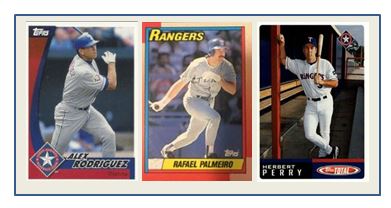
3 rangrers

That streak was driven by Alex Rodriguez, Rafael Palmeiro and Herbert Perry – who combined for 35 of the Rangers’ 55 round trippers.  Here’s a look at the sluggers who powered the Rangers’ surge:

  • SS Alex Rodriguez, who hit 16 home runs, drove in 33 runs and hit for a .333 average.
  • DH/1B Rafael Palmeiro, who hit ten home runs, drove in 18 and put up a .316 average.
  • 3B Herbert Perry, who launched nine round trippers, drove in 22 and hit .296.

Others going deep during the streak included: Ivan Rodriguez (6 HR); Todd Hollandsworth (4 HR); Carl Everett (3 HR); Todd Greene (2 HR); Mike Lamb (2 HR); Travis Hafner; Kevin Mench: and Michael Young.

There were ten games in which the Rangers’ hit only one home run. They hit two round tripper in 11 contests; three home runs in three games; four in one; and five in two.

Primary Resources: ESPN.com; MLB.com

BASEBALL ROUNDTABLE ON THE TOP 100 BASEBALL BLOG LIST

100Baseball Roundtable is on the Feedspot list of the Top 100 Baseball Blogs.  To see the full list, click here.

I tweet baseball @DavidBBRT

Follow/Like Baseball Roundtable’s Facebook Page here.  More baseball commentary; blog post notifications; PRIZES.

Member: Society for American Baseball Research (SABR); The Baseball Reliquary; The Negro Leagues Baseball Museum.
Baseball Roundtable June Wrap Up – From Trots to Tea Cups …and More

It’s July 1 and that means it’s time for Baseball Roundtable’s traditional previous month wrap up – touching on the statistics, standings and stories that caught BBRT’s eye over the previous month, along with the BBRT Players and Pitchers of the Month and the BBRT Trot index.  Here’s a bit of a spoiler –  a brief sampler of the kind of things you’ll read about – as always, if you last to the end of the post.  Among the things we saw in June:

  • One six-game winner (Max Scherzer) and one six-game loser (Aaron Sanchez).
  • One .400+ hitter (Charlie Blackmon).
  • A batter (Luke Voit) fanning 38 percent of the time, but still managing to hit .333 for the month.
  • A player (Charlie Blackmon) collecting a record 15 hits in a four-game series.
  • A record 13 home runs hit in a single game (Phillies/Diamondbacks).
  • Two cycles in two days (Shohei Ohtani & Jake Bauers).
  • A three-game hitting streak (Wilkin Castillo) that took just over ten years to complete.
  • A team (Yankees) homer in every game of the month – and then some.
  • A pitcher (Louis Castillo) leading MLB in walks for the month (with 20 in just 28 2/3 innings) and managing to go 2-2, with a tidy 2.83 earned run average. (He gave up just 16 hits in those 28+ frames).
  • A player (Freddie Freeman) drive in 33 runs in 28 games..

Oh yes, and if you read on, you’ll find out why the Yankees versus Red Sox in London was not my cup of tea.

If You aren’t  Familiar with …

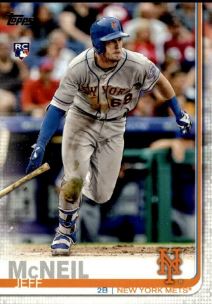
JeffmacJeff McNeil, you probably will be soon.  The 27-year-old Met (who has played 2B, 3B, RF and LF this season) ended the month of June as MLB’s leading hitter – with a .348 average. It should be no surprise, McNeil – a 12th round draft pick in 2013 – has hit wherever he has played. In six minor league seasons, he put up a .311 average (.327 at Triple A; .315 at Double A and .296 at A/High A). 

In a July 2018 call up, he hit .329 with three  homers, 19 RBI and seven stolen bases in 63 games.  Thus far, in 2019, he is .348-6-34, with 37 runs scored three steals. Looks like he’s here to stay.


Now, on to …

—-BASEBALL ROUNDTABLE PLAYERS & PITCHERS OF THE MONTH—–

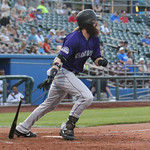
National League Player of the Month – Charlie Blackmon, RF, Rockies

Okay, I’ve admitted in the past that (as was often said of the zany, but talented, Rube Waddell) I can be distracted by bright and shiny things.  Well, in June, there were a couple of “bright and shiny” things that caught BBRT’s eye as I considered my National League Player of the Month.

They were the .412 June average (which led all qualifying hitters for June) put up by Rockies’s RF and lead off hitter Charlie Blackmon and the MLB-leading 33 June RBI recorded by Braves’ 1B Freddie Freeman. Blackmon’s .400+ average for the month – coupled with his ten home runs (MLB’s third-best), 25 RBI (sixth in MLB for June) and MLB-leading 30 runs scored took the day; but it was by a razor-thin margin.  For the month, Blackmon had MLB’s 38 hits (seven doubles, two triples, nine home runs). In his 22 games played (Blackmon missed the first six games of the month on the Injured List due to a right calf strain), Blackmon had 11 multi-hit games – at one point collecting 15 hits in a single four-game series. (See more on Blackmon’s multi-hit achievement in the “Highlights” section of this post.) As a side note: On June 29, Blackmon became the first left-handed hitter ever to go yard off Clayton Kershaw’s curve ball. (Another case of in baseball we track everything.)

Other contenders: Braves’ 1B Freddie Freeman, who went .322, with nine home runs, 24 runs scored and an MLB-high 33 RBI in June – helping the Braves surge to first place (the Braves started the month three games behind the Phillies and ended it with a 5 ½ game lead); Brewers’ RF Christian Yelich, who did a little bit (a lot, really) of everything – hitting .365 with power (eight home runs), driving in 18, scoring 20 and even swiping  eight bases in eight tries.

American League Player of the Month – DJ LeMahieu, 2B, Yankees

The Yankees, beset by injuries all season, needed players like DJ LeMahieu to step up – and step up he did.  In June, LeMahieu hit a robust .395 (second in MLB only to Charlie Blackmon’s .412), with six home runs, an AL-best 26 runs scored and an AL-high 29 RBI.  LeMahieu generated this offense while serving primarily as a lead off hitter and spending time at first base, second base and third base.

Other contenders: Blue Jay’s 2B Lourdes Gurriel, Jr., who hit .337 for June, bashed MLB’s third-most home runs (10), drove in 20 and scored 20;  Angels’ CF Mike Trout (isn’t he always on this list), who went .320-9-23 and scored 24 times.  Just a typical June for Trout.

_____________________________________________________

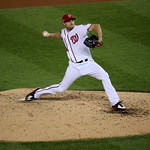
National League Pitcher of the Month – Max Scherzer, Nationals

Max Scherzer photo

Photo by apardavila

Easy call here. The three-time Cy Young Award winner got off to a slow start, going 2-5, 3.26 through May – but made up ground big time in June.  He was MLB’s only six-game winner in the month, going 6-0 (in six starts),  with a 1.00 ERA (five earned runs in 45 IP), just five walks and an MLB-high 68 June strikeouts. He average 7.5 innings per start and helped lead the Nationals to a 18-8 month.  His 1.00 ERA for the month was the lowest among pitchers with at least 25 innings on the mound.

Other contenders: The Rockies’ Jon Gray, who went 5-1, with a 2.65 ERA and 43 strikeouts in 37 1/3 innings (despite having four of his six June starts at Coors Field); Walker Buehler, Dodgers, who went 3-0 in five starts, with a 2.45 ERA and 46 strikeouts (versus just two walks) in 35 2/3 innings.

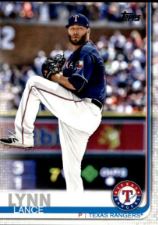
American League Pitcher of the Month – Lance Lynn, Rangers

LynnOkay, maybe I could have gone with big names and big swing-and-miss arms like Justin Verlander or Chris Sale, but (from BBRT’s perspective) the Rangers’ Lance Lynn put it all together in June.  Lynn tied for the AL lead in June wins – going 4-0 in six starts, with a respectable 2.90 earned run average.  He also fanned 48 batters in 40 1/3 innings, while walking only four.  (If only Lynn had pitched like this for my Twins.  He went 7-8, 5.10 in 20 starts for Minnesota last season.)

Other contenders: Luis Giolito, White Sox, who went 4-1, 2.50 and whiffed 46 batters in 36 innings (six starts); Mike Minor, Rangers, who went 3-0, 1.70 in five starts (30 strikeouts in 37 IP);

TROT INDEX … A REGULAR BBRT FEATURE

Through June,  36.0 percent of all MLB’s 96,145 2019 plate appearances ended in a trot (back to the dugout, around the bases, to first base). We’re talking about strikeouts, home runs, walks, hit by pitch and catcher’s interference – all outcomes that are, basically, devoid of action on the base paths or in the field. Here’s the breakout: strikeouts (22.7%); Walks (8.6%); home runs (3.6%); HBP (1.0%); Catcher’s Interference (less than 1%). Personally, I’d like more action in the field of play.

For the 2018 season, 34.8 percent of all MLB’s 185,139 plate appearances ended in a trot.  

________________________________________________

THE BEST OF TEAMS, THE WORST OF TEAMS

WonLost June

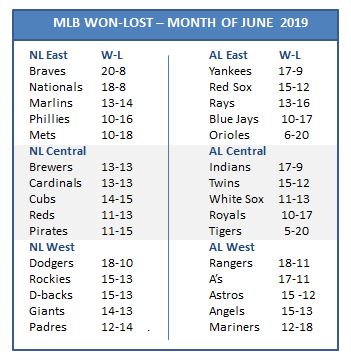
We did see some movement in the standings in July.  The Braves put up an MLB-best 20 June wins (versus just 8 losses) and went from  three games back of the Phillies on June 1 to 5 1/2 games up on Philadelphia on July 1.  Two other NL teams with solid June results were the Dodgers (18-10), who extended their lead in the West from 8 1/2 to 12 games – and the Nationals, who used an 18-8 month to move past the Mets (10-18) into third place in the East.  The NL Central Division had a “blah” month, with no team playing better than .500 ball.

The Braves offense fueled their 20 June wins, as they led MLB in runs scored (187) and home runs (56) for the month. Key contributors for the Braves were: Freddie Freeman (.322-9-33); Ozzie Albies (.317-6-22); Ronald Acuna, Jr. (.31-9-21); and Nick Markakis (.270-4-20).  The Dodgers rode MLB’s best pitching (MLB-lowest 3.08 ERA in June) to continued success.  Key mound work was provided by the likes of Rich Hill (3-0, 2.25), Walker Buehler (3-0, 3-0, 2.45), Clayton Kershaw (2-2, 2.93) and Hyun-Jin Ryu (1-1, 2.70). Their offense also contributed, scoring the NL’s fourth-most runs – led by the likes of Cody Bellinger (.272-7-15) and Max Muncy (.287-8-23)/

IF THE SEASON ENDED TODAY – YOUR PLAYOFF TEAMS WOULD BE …

AL:  Yankees; Twins; Astros.  Wild Cards: Rays; Rangers.

NL: Braves;  Dodgers; Cubs or Brewers. Wild Cards: Cubs or Brewers; Phillies or Rockies.  

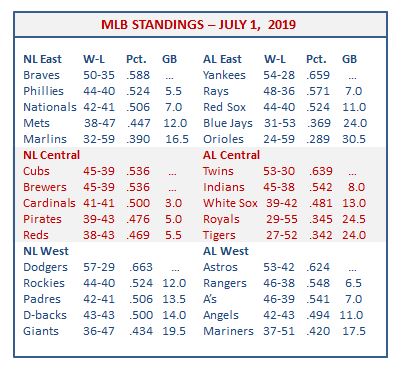
YOU’LL FIND FULL STANDINGS – AS OF JULY 1 – NEAR THE END OF THIS POST.

Over in the junior circuit, the Rangers went 18-11, and gained two games on the Astros (but are still 6 1/2 back)(.  In the East, the Yankees went 17-9 and expanded their lead from 1.5 games over the Rays on June 1 to 7 games on July 1.  The Indians were the other AL team with 17 June wins (nine losses),  gaining 2 1/2 games on the Twins, but still eight back. The Yankees pounded their opponents into submission, leading the AL in runs scored (176) and homering in every June game. By contrast, the Bronx Bombers June earned run average (5.46) was the third-worst in the AL.  Lot of contributors to the Yankees’ surge. including: DJ LeMahieu (.395-6-29); Gleyber Torres (.333-5-17); Gary Sanchez (.255-6-21).  Overall, power up and down the Yankee lineup.

At the other end of won-lost spectrum, two teams failed to win even ten games in June – The Tigers (5-20) and the Orioles (6-20). Both of those squads had June earned run averages north of 5.00 and the Tigers also finished last in MLB in runs scored. The Orioles had the fourth-fewest runs scored in the AL – even after a pair of late-June games in which they outscored the Indians by a combined 26-0.

_______________________________________

—-LEAGUE LEADERS – TEAMS – MONTH OF JUNE —–

(Stats as of July  1, 2019, a.m.)

RUNS SCORED … MLB Team Average – 134

AL: Yankees (176); Red Sox (159); Mariners (153)

NL: Braves (187); Rockies (167); Padres (153)

The Tigers scored an MLB-low 82 runs in June, while the Cardinals and Reds were at the bottom of the NL with only 92 tallies.  

BATTING AVERAGE … MLB Team Average – .255

AL: Red Sox (.291); Yankees (.286); Twins (.266)

NL: Pirates (.288); Rockies (.280); Braves (.277)

The Cardinals were the only team to hit under .230 for the month – at .223.

HOME RUNS … MLB Team Average – 38

AL:  Twins (51); Blue Jays (48); Yankees (47); Mariners (47)

NL: Braves (56); Mets (48); Dodgers (47)

The Tigers  hit only 20 home runs in June, the fewest of any MLB team.

SLUGGING PERCENTAGE – MLB Team Average – .440

AL: Yankees (.499); Red Sox (.488); Indians (.479)

NL: Braves (.520); Dodgers (.479); Pirates (.478)

STOLEN BASES … MLB Team Average – 13

AL: Rangers (25); Royals (25); Indians (19)

NL: Cardinals (26); Brewers (18); Padres (18); D-backs (18); Nationals (18)

The White Sox, Yankees, Twins and Marlins each stole an MLB-low four bases in June – with the Twins having the worse success rate at 40 percent (four steals, six thrown out stealing). 

BATTERS’ STRIKEOUTS … MLB Team Average – 233

AL: Rangers (288); Mariners (273); Rays (273)

NL: Rockies (260); Marlins (253); three with 250

The Braves led MLB in June extra-base hits with 126, while the Cardinals were at the bottom of the list with only 62 extra-base knocks. Teams with at least 100 XBH for the month (after the Cardinals) were the: Red Sox (112); Dodgers (108); Pirates (107); A’s (106); Twins (104); and Rockies (100).

WALKS DRAWN … MLB Average – 84

AL: Mariners (120); Astros (107); Yankees (106)

NL: Brewers (103); Braves (100); Padres (98)

_______________________________________

EARNED RUN AVERAGE … MLB Average – 4.60

AL:  Rays (3.92); Twins (3.95); A’s (3.99)

NL:  Dodgers (3.08); Cardinals (3.65); Reds (3.78)

June was a tough month for pitching staffs, as ten teams put up earned run averages north of 5.00 – with the Orioles at the bottom (or top, depending how how you look at it) at 5.81. The Orioles were a close second at 5.80. Together, these teams produced 16 wins and 37 losses during June. 

BATTING AVERAGE AGAINST …  MLB Average – .256

AL: Indians (.231); Astros (.236); Rays (.239)

NL: Dodgers (.217); Reds (.223); Nationals (.228)

STRIKEOUTS … MLB Average – 223

AL:  Red Sox (304); Astros (282); Rangers (266)

NL: Brewers (257); Dodgers (256); Mets (254)

The Red Sox and Angels were the only teams to average ten or more strikeouts per nine innings – 10.80 and 10.01, respectively. A total of 11 teams averaged at least one K per frame for the month.

SAVES … MLB Average – 6

AL: Twins (9); Yankees (9); Royals (9)

NL: Braves (10); Nationals (10); Brewers (9)

The Reds had June’s best save percentage at 100 percent (six saves in six  opportunities).  

FEWEST WALKS SURRENDERED … MLB Average – 84

AL: Rangers (74); Yankees (75); three with 77

NL: Dodgers (60); Nationals (70);  Padres (74); Cardinals (74)

Only three mound staff surrendered 50 or more home runs in June: Astros (56); Phillies (54); Yankees (50). The A’s surrendered the fewest June long balls (27). 

___________________________________________

—–JUNE HIGHLIGHTS … THE STORIES —–

Sale’s Immaculate Innings – Keeping Company with Lefty Grove

cHRIS sALE RED SOX photo

Photo by Keith Allison

On June 5, Boston southpaw Chris Sale was truly dominant versus the Royals, picking up his second win of the season with a complete game, three-hit shutout.  In the contest, he did not yield a single walk and fanned a dozen.  In the eighth, he  tossed an “immaculate inning” – fanning the three batters he faced (Kelvin Gutierrez, Nicky Lopez and Martin Maldonado) on nine pitches. It was Sale’s second immaculate inning of the season (the first came May 8 against the Orioles), making him just the second major leaguer with two immaculate frames in a season.  The other was Lefty Grove in 1928.  As June closed, Sale’s record on the season was 3-7, 3.82 – and he had fanned 148 batters in 101 1/3 innings.

It’s Raining Baseballs

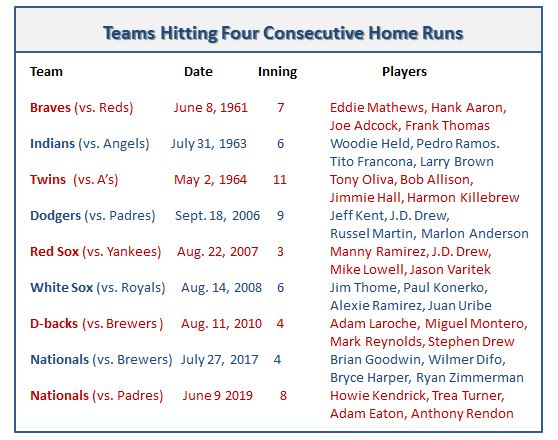
On June 9, the Nationals loaded up on the Padres in San Diego – bashing back – to back– to back – to back home runs in the eighth inning of a 5-2 win. All the long balls – which broke open a 1-1 contest –  came off reliever Craig Stammen. The homers were hit by PH Howie Kendrick, SS Trea Turner, RF Adam Eaton and 3B Anthony Rendon.  It was only the ninth time in MLB history that a team had cracked four consecutive home runs.

BBBB

On June 10it was raining baseballs again.  This time In Philadelphia – as the Diamondbacks and Phillies combined to hit an MLB record 13 home runs in a game. The teams got off to a rolling start, as the D-backs first three batters in the top of the first inning (CF Jarrod Dyson, SS Ketel Marte and LF David Peralta) homered off Phillies’ starter Jerad Eickhoff) and Phillies’ SS Jean Segura homered in the bottom of the frame off Taylor Clarke. Here are the homer hitters for the contest, won by the visiting D-backs 13-8:

Diamondbacks: Eduardo Escobar (2); Ildemaro Vargas (2); Alex Avila; Jarrod Dyson; Ketel Marte; David Peralta.

Phillies: Scott Kingery (2); Jean Segura; Rhys Hoskins; Jay Bruce.

That Was Fun, Let’s Do it Again

Before the Phillies-Diamondbacks 13-home run game on June 10, the previous record for combined home runs in a game was 12 – accomplished twice – both times by the Tigers/White Sox (once in each team’s home park) on May 28, 1995 and July 2, 2002.

Verlander Likes Swing Music- As Long as It’s Swing and Miss

On June 12, the Astros’ Justin Verlander was truly in the wing of things. – striking out a career high 15 batters in seven innings of work.  What may be of interest is that fact that all 15 were swinging strikeouts.  Still when, the Brewers swung and didn’t miss, they made it count. Verlander allowed only four hits (no walks) in his seven innings, but three of the four hits were homers (Ryan Braun – first inning; Yasmani Grandal – second inning; and Eric Thames – seventh inning). As a result, Verlander left with the game tied at three and the Astros eventually lost to the Brewers 6-3 in fourteen innings.  Back to the “in baseball we count everything” trend, MLB.com reported that Verlander is the first pitcher (since 1908) to record 15 strikeouts and give up at least three home runs in a game.

No, the Speed Game Does not Belong Exclusively to the NL

On June 14, the Rangers’ Elvis Andrus stole home with two outs in the top of the first inning of a game against the Reds.  It was Andrus’ second steal of home this season and the sixth of his career. It was the Rangers’ third steal of home this season – and second in June.  On June 9, Rangers’ 2B Rougned Odor stole home against the A’s. For those who are interested, the record for most steals of home in a season belongs to Ty Cobb (eight in 1912).  Cobb also holds the career record for steals of the plate (54).

As the month of June came to a close, four of the top five teams (on the season) in stolen bases were in the American League. The top five were the Royals (79); Rangers (65); Indians (58); Mariners (58); Cardinals (57).

Two Days – Two Cycles

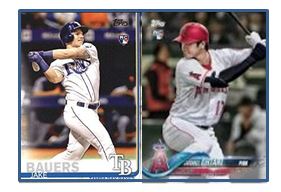
cyclesIn June, two players hit for the cycle (single, double, triple and homer in one game) – the Angels’ Shohei Ohtani on June 13 and the Indians’ Jack Bauers on June 14.  Both, by the way, were in the DH spot for the game.

Ohtani’s cycle came in a 5-3 win over the Ray s in Tampa. He went 4-for-4, with two runs and three RBI, collecting a home run in the first; double in the third; triple in the fifth; and single in the seventh.  Bauers’ cycle came in a 13-4 win over the Tiger in Detroit. Bauer was 4-for-5, with two runs and four RBI. He had a double in the second; single and triple in the fourth; strikeout in the sixth; and the home run in the eighth.  For more on cycles, click here.

92 Runs in Four Days – Only in Colorado

From June 13 through June 16, the Padres and Rockies played a four-game series (in Colorado) in which the teams combined for a MLB four-game series record 92 runs (44 for the Padres and 48 for the Rockies) – and came away with two wins (and two losses) apiece.  The 92 runs broke the old four-game series record of 88 (Dodger and Phillies), which had stood since 1929.  The Rox/Padres combined for 131 hits, two short of the all-time record. (They also hit a combined 17 home runs.) The final scores, in order, were Rockies win 9-6; Padres win 16-12; Rockies win 14-8; Padres win 14-13.  In the series, Rockies’ OF Charlie Blackmon stroked 15 hits – an MLB record for a four-game set (see more on Blackmon in the next story in this post).

It’s Not Always About the Home Run

From June 13 through June 18 Rockies’ outfielder Charlie Blackmon recorded five straight games of at least three hits – falling one game short of the record set by the Royals’ George Brett in 1976 (May 8-13).  Blackmon began his streak with three consecutive four-hit games (June 13-14-15 versus the Padres) and add a pair of three-hit contests (June 16 versus the Padres and June 18 versus the D-backs). During the streak, Blackmon went 18-for-29 (.621), with ten singles, three doubles, one triple, four home runs, 11 runs scored and 10 RBI. Surprisingly, despite his hot bat, he did not walk once over the five games.  The streak raised his season batting average from .305 to .341.  Blackmon’s 18 hits, by the way, fell just one hit shy of the most hits in a five-game span –  set by Brooklyn’s Jimmy Johnston (June 25-30, 1923).

Yankees Homer Happy from May Right Into June

On June 25, the Yankees set a new MLB record – homering in their 28th consecutive contest (breaking a tie with the 2002 Rangers) – and wasted no time doing it.  DJ LeMahieu homered to lead off the bottom of the first inning in a 4-3 Yankee win over the Blue Jays. The Yankees put an exclamation point on the record by scoring all four of their runs on solo homers – LeMahieu, Aaron Judge, Gleyber Torres and Edwin Encarnacion.  The Yankees continued the homer happy streak, which began on Mays 26  right to the end of June – stretching the streak to 31 games.

Updating the tale of the tape, the Yankees, in their streak (through June 30):

  • Hit 57 home runs;
  • Averaged .282;
  • Won 20 and lost 11;
  • Outscored their opponents 195 to 164;
  • Had 14 different players go yard; eight of those at least four times.

Homering for the Yankees in the streak were Gary Sanchez (8 homers); DJ LeMahieu (8); Gleyber Torres (7); Brett Gardner (5); Aaron Hicks (5); Luke Voit (4); Gio Urshela (4); Cameron Maybin (4); Didi Gregorius (3); Edwin Encarnacion (3); Clint Frazier (2); Aaron Judge (2); Austin Romine; Giancarlo Stanton .

250 for C.C.

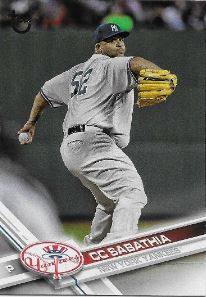
ccOn June 19, C.C. Sabathia picked up his fourth win of the season (4-4. 4.14 ERA). All those four may be lucky, as it was also Sabathia’s 250th MLB win. Sabathia went six innings in the game (leaving with a 6-1 lead), won by the Bombers 12-1 over Tampa Bay. He gave up three hits and one run, walking three and fanning seven. As June closed out Sabathia was 5-4, 4.04 on the season and 251-157, 3.71 for his career.

C.C.  Sabathia led the AL in victories in 2009 and 2010. 

Its’s Not Likely Even Ali Could have Stopped Scherzer

On June 19, Max Scherzer took the mound looking like he’d just dropped a heavyweight fight – black and swollen eye and broken nose.  His start, against the Phillies, came just a day after he fouled a batting practice bunt attempt off his face. How did he do? He threw seven shutout innings, giving u just four hits and two walks, while fanning ten – picking up the win as the Nationals topped the Phillies 2-0.

Weekends Belong to the Young

On Friday night, June 21, Dodgers’ 26-year-old rookie LF Matt Beaty got the weekend rolling with a walk-off, two-run homer in the bottom of the ninth (as the Dodgers topped Colorado 4-2).  It was Beaty’s second MLB round tripper. On Saturday, June 22, it was rookie CF Alex Verdugo’s turn – as he popped a walk-off, solo long ball in the bottom of the eleventh to give the Dodgers a 5-4 win over the Rox.  Note: the 23-year-old Verdugo in his third MLB season, still has his rookie status. Then, on Sunday, 24-year-old rookie Will Smith hit a three-run, walk-off dinger in the bottom of the ninth to put the Dodgers over the Rockies 6-3.  It was Smith’s seventh major league game and third MLB home run.

The string of finishes marked the first time in MLB history that rookie batters provided walk-off homer victories for their team in three consecutive games.   More proof that in baseball we track everything.

Hit Me With Your Best Shot

On June 22, Reds’ 2B Derek Dietrich got “nailed” by a 71-mph change up from Brewers’ reliever Alex Claudio – marking an MLB-record six HBP’s in a single series (of any length). Notably, Dietrich had tied an MLB record getting hit by three pitches (in a single game) on Friday (June 21).  More on this story, click here.

A FEEL GOOD STORY FOR JUNE – AND A TRIBUTE TO PERSISTENCE 

On June 22, 35-year-old Wilkin Castillo started at catcher for the Miami Marlins (versus the Phillies) and produced a two-run double in the seventh that helped the Marlins top the Phils 5-3.  It was Castillo’s first MLB game, first hit and first RBI in ten years and two days.  Castillo had last played in an MLB game on June 20, 2009, when (as a member of the Reds) he hit a pinch-hit, seventh-inning RBI-single versus the White Sox in a 10-8 Reds loss.  He tore his labrum and had to leave the game – and hadn’t played in an MLB game since.  (At the time of the injury, the 25-year-old Castillo had played in 22 MLB games – going 11-for-35, with two RBI.)

Since coming back from the 2009 injury (before his recent call up), Castillo played in more than 800 minor league, Dominican League, Mexican League and independent league ball games.  Side note: After his first game with the Marlins, Castillo could boast of a three-game major league hitting streak that spanned more than ten year (June 1, 2009 to June 22, 2019).   In his second game for Miami (June 25), he went zero-for-three, ending the streak.

More Homer Happy History

On June 22, Mets’ rookie first baseman Pete Alonso slugged his 26th home run of the season – setting a new NL record for home runs by a rookie before the All Star Game (set by Cody Bellinger in 2017).  (The MLB record of 33 belongs to Mark McGwire.) Alonso ended June with 28 round trippers – just a hot streak away from the overall pre-ASG rookie record – but with just a handful of games left before the break.  Beyond that is Bellinger’s NL rookie full season record of 39 and McGwire’s overall rookie record of 49 dingers.

Only One Chance to Make a First Impression

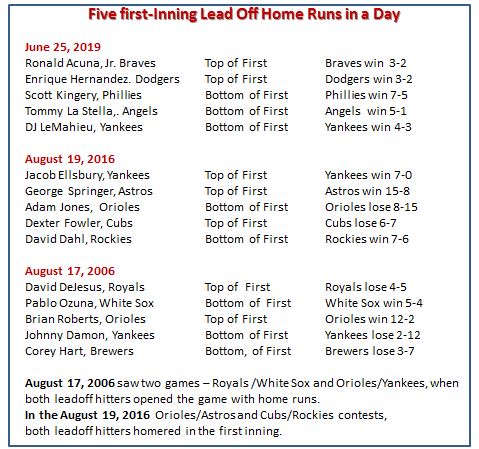
On June 25, an MLB-record was tied when five batters opened their team’s games with lead-off home runs.  Here’s look at the three times we’ve seen five lead-off long balls in a single MLB day.

Inning ONe HR

A Minor Shout Out

On June 26, the Rangers’ Mike Minor pitched his second complete game of the season – a one-run, five-hitter (two walks/seven whiffs) –  as the Rangers topped the Tigers 4-1 in Detroit. Why a shout out?  Because complete games have gone from the mundane to the sublime in major league baseball. Minor’s two complete games are enough to tie him with Zach Elfin (Phillies) and Lucas Giolito (White Sox) for the MLB lead. On the season, Minor is 8-4, 2.40.

STOP THE INSANITY PART ONE

It was reported this past month that MLB’s Executive Committee has given the Tampa Rays permission to explore the possibility of being a two-town team – splitting their season between Tampa and Montreal. Heck, they wouldn’t just be a two-city team, they’d be a two-country team.  Hats and jersey sales?  Stop the insanity.

Suitcase Simpson Step Aside

On June 28, 42-year-old Fernando Rodney pitched a clean, two-strikeout ninth in for the Nationals – picking up a save as Washington topped the Tigers 3-1. It was the record ninth MLB team for which Rodney had recorded a save.  Here’s a breakdown of his 326 MLB saves: Rays (85); Tigers (70); Mariners (64); Diamondbacks (39); Twins (25); Angels (17); Padres (17); Marlins (8); Nationals (1).

On Any Given Day

The Baltimore Orioles went into their June 28 game against the Cleveland Indians with the worst record in the major leagues (22-58) – and having given up the most 2019 runs in MLB and scored the fourth fewest.  They had reached double-digit in runs scored in just two times (12 each time), given up double-digit runs 16 times, shut out only one opponent and been shutout four times.

So, how did they fare against the second-place Indians? They topped the Indians 13-0 on Friday (June 28th) AND Saturday (June 29) – becoming the  first MLB team to win back-to-back shutouts while scoring at least 13 runs in each game.

STOP THE INSANITY – PART TWO

Tea Cup photo

Photo by 小卡

MLB scheduled a pair of mid-season contests in London (You all saw it, Yankees/Red Sox, June 29-30). My thoughts as the day(s) approached, shared over brews with baseball “buds,” were that the combination of disrupting the scheduling and routine for players, tiring travel, squeezing a baseball field into a football pitch and playing on temporary artificial turf  could result in baseball that more resembled pinball.  In addition, I had (still have) some concern regarding how this “overseas” series might affect the Yankees and Red Sox in the first few games after their return to the regular schedule.

Turns out, the enthusiastic crowds, in two games, saw 50 runs scored on 65 hits (nine home runs). It was, I believe, a marketing success.  I may be old school, but I’d still prefer to see these marketing efforts come in the form of exhibitions (as opposed to mid-season games “that count.”)  If exhibitions don’t meet MLB needs, I’d prefer to see the uniquely located games at the opening of the season, when I believe they would be less disruptive (but still showcase MLB abroad).  (That’s just my take, others I’ve talked to found the Yankees/Red Sox match up quite exciting.)  It remains to be seen what impact the London series will have on the Yankees and Red Sox. I am sure, however, that the fans (for the most part) went home both pleased and entertained.  It was just not my cup of tea.

—-INDIVIDUAL LEADERS For THE MONTH OF JUNE 2019—–

BATTING AVERAGE (at least 75 June at bats)

AL:  DJ LeMahieu, Yankees (.395); Eric Sogard, Blue Jays (.374); Hanser Alberto, Orioles (.354)

NL: Charlie Blackmon, Rockies (.412); Fernando Tatis, Jr., Padres (.383); Ketel Marte, D-backs (.374)

The lowest average among players with at least 75 June at bats belonged to the Cardinals’ Stephen Piscotty at .169 (14-for-83).

HITS

AL: DJ LeMahieu, Yankees (45); Elvis Andrus, Rangers (37); Whit Merrifield, Royals (36)

NL: Ronald Acuna, Jr. Braves (41); Charlie Blackmon, Rockies (40); Ketel Marte, D-backs (40)

When it came to extra-base hits, your June leader was the Braves’ Freddie Freeman with 20 … ten doubles, one triple  and nine round trippers.

HOME RUNS

AL: Edwin Encarnacion, Yankees (11); Lourdes Gurriel, Jr., Blue Jays (10); five with nine

NL: Manny Machado, Padres (11); Charlie Blackmon, Rockies (10); five with nine

RUNS BATTED IN

AL: DJ LeMahieu, Yankees (29); Nelson Cruz, Twins (24); Mike Trout, Angels (23)

NL: Freddie Freeman, Braves (33); David Dahl, Rockies (32); Manny Machado, Padres (29)

RUNS SCORED

AL: DJ LeMahieu, Yankees (26); Mike Trout, Angels (24); three with 22

NL: Charlie Blackmon, Rockies (30); Dansby Swanson, Braves (28); Ronald Acuna, Jr, Braves (28)

STOLEN BASES

AL: Alberto Mondesi, Royals (7); Mallex Smith, Mariners (7); three with six

NL: Trea Turner, Nationals (9); Christian Yelich, Brewers (8); Jarrod Dyson, D-backs (7)

BATTER’S STRIKEOUTS

AL:  Michael Chavis, Red Sox (45); Miguel Sano, Twins (39); Domingo Santana, Mariners (38)

NL: Austin Riley, Braves (37); Trea Turner, Nationals (35); two with 33

All or Nothing

The Yankees’ Luke Voit fanned 33 times in just 87 at bats (38 percent), yet still managed to hit .333 for the month (29-for-87), with three home runs and 12 RBI. 

WALKS

AL:  Dan Vogelbach, Mariners (23); Mookie Betts, Red Sox (23); Alex Bregman, Astros (22)

NL: Brandon Belt, Giants (24); Rhys Hoskins, Phillies (21); Max Muncy, Dodgers (19); Bryce Harper, Phillies (19)

Brandon Belt’s ability to draw walks resulted in a .387 on-base percentage for June, despite a .213 batting average.

ON-BASE PERCENTAGE (Minimum 75 June at bats)

AL: Luke Voit, Yankees (442); Mike Trout, Angels (.446); DJ LeMahieu, Yankees (.434)

NL: Fernando Tatis, Jr., Padres (.457); Charlie Blackmon, Rockies (.441); Bryan Reynolds, Pirates (.438)

_________________________________

PITCHING VICTORIES

AL: Mike Fiers, A’s (4-0); Lance Lynn, Rangers (4-0); Brandon Workman, Red Sox (4-0); Marcus Gonzales, Mariners (4-1); Lucas Giolito (4-1)

NL: Max Scherzer, Nationals (6-0); Jon Gray, Rockies (5-1); five with four

The Blue Jays’ Aaron Sanchez was the only pitcher to lose six games in June. Sanchez went 0-6, with a 12.00 ERA in six starts – giving up 44 hits and 19 walks (36 earned runs) in 27 innings.

EARNED RUN AVERAGE (minimum 25 May innings)

AL: Andrew Cashner, Orioles (1.44); Mike Minor, Rangers (1.70); Jesse Chavez, Rangers (1.73)

NL: Max Scherzer, Nationals (1.00); Cole Hamels, Cubs (1.22);  Dakota Hudson, Cardinals (2.25)

STRIKEOUTS

AL:  Justin Verlander, Astros (52 in 40 1/3 IP); Chris Sale, Red Sox (50 in 33 IP); Gerrit Cole, Astros (49 in 38 IP)

NL: Max Scherzer, Nationals (68 in 45 innings pitched); Jacob deGrom (51 in 40 IP); Robbie Ray, D-backs (47 in 36 IP).

Among pitchers with at least 25 innings pitched in June , Red Sox’ starter Chris Sale had the highest rate of strikeouts per nine innings at 13.64.  In the NL, the highest rate went to the Nationals Max Scherzer at 13.60. 

In the category of strikeouts-to-walks, Walker Buehler of the Dodgers led the way at 23 – with just two walks and 46 strikeouts in 36 2/3 innings. 

SAVES

AL:  Ian Kennedy, Royals (8); Brad Hand, Indians (8); Aroldis Chapman, Yankees (7); Alex Colome, White Sox (7)

NL: Will Smith, Giants (8); Sean Doolittle, Nationals (8); Josh Hader Brewers (7)

Standings July1

—-LEAGUE LEADERS – TEAMS – SEASON-TO-DATE —

(As of end of day, July 31, 2019)

RUNS SCORED … MLB Team Average – 401

AL: Yankees (476); Twins (474); Red Sox (463)

NL: Rockies (475); Braves (461); Dodgers (459)

Only two teams had scored fewer than 300 runs through June: Tigers (274) and Marlins (299).

BATTING AVERAGE … MLB Team Average – .251

AL: Twins (.270); Red Sox (.269); Astros (.267)

NL: Rockies (.269); Dodgers (.267); Pirates (.264); Braves (.264)

The Giants had the lowest team batting mark through June at .226 – and had just three players with at least 100 at bats hitting at least .250 (Pablo Sandoval at .284, Buster Posey at .251 and Kevin Pillar at .250).

HOME RUNS … MLB Team Average – 114

AL:  Twins (157); Mariners (150); Yankees (138)

NL: Brewers (141); Dodgers (139); Braves (132)

The Marlins and Tigers are the only teams with less than 75 round trippers through June, at 64 and 68, respectively.  Miami’s home run leader was 3B Brian Anderson with 11; the Tigers’ long ball leader also had just 11 round trippers (LF Brandon Dixon).  By contrast, the Twins had seven players with more than 11 home runs through June. 

SLUGGING PERCENTAGE … MLB Team Average – .430

AL: Twins (.496); Astros (.468); Yankees (.466)

NL: Dodgers (.473); Rockies (.462); Braves (.461)

The Twins finished June with a year-to-date slugging percentage of .496. The MLB season record is .491 (2003 Red Sox.)

STOLEN BASES … MLB Team Average – 40

AL:  Royals (79); Rangers (65); Mariners (58)

NL: Cardinals (57); Brewers (51); Nationals (59)

The Twins do not play the speed game.  While they lead MLB in home runs, they are last in stolen bases (through June) with just 20 (in 33 attempts).  

BATTERS’ STRIKEOUTS … MLB Team Average – 729

AL: Mariners (859); Rangers (828); Rays (799)

NL: Padres (808); Brewers (799); Rockies (795)

The Angels have fanned the fewest times at 565.  The only other team under 600 whiffs (under 648, actually) is the Astros (587 through June).

WALKS DRAWN … MLB Average – 275

AL: Mariners (336); Red Sox (327); Astros (316)

NL: Dodgers (332); Brewers (324); Cubs (324)

The least selective batters were found on the White Sox (197 walks) and Marlins (199).


When it comes to pinch hits, the Pirates lead the way with 38 pinch hits in 115 PH at bats for a .330 average. The Red Sox have the best pinch hitting batting average through June at .442 (19-for 43).

_______________________________________

EARNED RUN AVERAGE … MLB Average – 4.46

AL:  Rays (3.21); Astros (3.83); Twins (3.91)

NL:  Dodgers (3.41); Reds (3.69); Cubs (3.94)

The best starters’ ERA through June belonged to the Dodgers in the NL at 3.01, while the Rays had the best starting ERA in the AL at 3.06.

Bullpen ERAs saw the Rays best in the AL at 3.35 and the Reds lowest in the NL at 3.73.

The worst?  Nationals’ bullpen at 6.30 and Orioles’ starters at 5.50. The Orioles also had the worst overall ERA through June at 5.73.

BATTING AVERAGE AGAINST … MLB Average – .251

AL: Astros (.218); Rays (.222); Indians (.240)

NL: Dodgers (.226); Reds (.233); Marlins (.243)

STRIKEOUTS … MLB Average – 729

AL:  Red Sox (858); Astros (848); Rays (792)

NL: Brewers (788); Nationals (786); Mets (777)

The Red Sox remained the only team to average ten or more strikeouts per nine innings (10.12), while a total of nine teams averaged at least one K per frame through June.  

SAVES … MLB Average – 21

AL: Yankees (29); Twins (24); Indians (24)

NL: Padres (32); Dodgers (26); Brewers (25)

FEWEST WALKS SURRENDERED … MLB Average – 272

AL: Twins (229); Indians (234); Astros (235)

NL: Dodgers (188); Padres (212); Nationals (261)

No team has shut out the opposition more often (through June) than the Dodgers (10 shutouts).  The next best is eight (Indians). The Angels and Mariners have each recorded just one shutout through June.

The following teams have yet to record a complete game this season: Padres; Brewers; Twins; Braves; Cardinals; Tigers; Astros; Angels; Rays; D-backs, Royals; Orioles. The Phillies and Rangers each have an MLB-leading three complete games through June. 

Now let’s move on to the individual leaders through June. 

—-INDIVIDUAL LEADERS THROUGH JUNE 2019—–

BATTING AVERAGE (QUALIFIERS)

AL:  DJ LeMahieu, Yankees (.345); Rafael Devers, Red Sox (.322); Jorge Polanco, Twins (.320)

NL: Jeff McNeil, Mets (.348); Cody Bellinger, Dodgers (.346);  Charlie Blackmon, Rockies (.337)

The lowest average among qualifying players through June belonged to the Rangers Rougned Odor at .187 (46-for-246).

HITS

AL: DJ LeMahieu, Yankees (108); Whit Merrifield, Royals (106); Jorge Polanco, Twins (105)

NL: Freddie Freeman, Braves (104); Nolan Arenado, Rockies (103); Ketel Marte, D-backs (103)

When it comes to on-base percentage, your leaders through June are:

  • Mike Trout of the Angels (.452);
  • Cody Bellinger of the Dodgers (.442). 

Other players at .400 or better were: Christian Yelich, Brewers (.425); Jeff McNeil, Mets (.412); Carlos Santana, Indians (.411); Juan Soto, Nationals (.402)

 HOME RUNS

AL: Edwin Encarnacion, Mariners/Yankees (24); Gary Sanchez, Yankees (23); Mike Trout, Angels (22); Jorge Soler, Royals (22); Alex Bregman, Astros (22)

NL: Christian Yelich, Brewers (29); Pete Alonso, Mets (28); Cody Bellinger, Dodgers (27)

The player with the most 2019 at bats without going yard is the Marlins’  Miguel Rojas, who stands at .287-0-23 after 279 at bats.

RUNS BATTED IN

AL: Domingo Santana, Mariners (62); DJ LeMahieu, Yankees (61); Eddie Rosario, Twins (60); Jose Abreu, White Sox (60)

NL: Josh Bell, Pirates (70); Cody Bellinger, Dodgers (67); Freddie Freeman, Braves (65); Nolan Arenado, Rockies (65)

RUNS SCORED

AL: Mookie Betts, Red Sox (66); Mike Trout, Angels (63); Xander Bogaerts, Red Sox (63)

NL: Cody Bellinger, Dodgers (67); Charlie Blackmon, Rockies (65); Trevor Story, Rockies (65)

STOLEN BASES

AL:   Adalberto Mondesi, Royals (27); Mallex Smith, Mariners (21); Jose Ramirez, Indians (18)

NL: Jarrod Dyson, D-backs (19); Christian Yelich, Brewers (18); Trea Turner, Nationals (17)

Kolten Wong has the most 2019 stolen bases without being tossed out (14).  Whit Merrifield of the Royals leads in times caught stealing (seven in 18 attempts).

BATTER’S STRIKEOUTS

AL: Domingo Santana, Mariners (110); Jorge Soler, Royals (104); Brandon Lowe, Rays (103)

NL: Bryce Harper, Phillies (101); Javier Baez, Cubs (101); Wil Myers, Padres (99)

WALKS

AL:  Mike Trout, Angels (70); Mookie Betts, Red Sox (62); Alex Bregman, Astros (61)

NL: Rhys Hoskins, Phillies (61); Bryce Harper, Phillies (56); Cody Bellinger, Dodgers (52)

Nobody had drawn more intentional passes through June than the Phillies’ Maikel Franco (15).  This despite a .227 average (12 home runs).

PITCHING VICTORIES

AL: Lucas Giolito, White Sox (11-2); Justin Verlander, Astros (10-3); Jake Odorizzi, Twins (10-3); Lance Lynn, Rangers (10-4)

NL: Brian Woodruff, Brewers (10-2); Mike Soroka, Braves (9-1);  Hyun-Jin Ryu, Dodgers (9-2); Max Fried, Braves (9-3);  Zack Greinke, D-backs (9-3); Stephen Strasburg, Nationals (9-4); Jon Gray, Rockies (9-5)

No one has lost more games through June than the Blue Jays’ Aaron Sanchez (3-11, 6.31). What is a bit surprising is that Sanchez got off to a good start. He was 3-1, 2.32 at the end of April.

EARNED RUN AVERAGE (qualifying)

AL: Max Minor, Rangers (2.40); Charlie Morton, Rays (2.43); Frankie Montas, A’s (2.70)

NL: Hyun-Jin Ryu, Dodgers (1.83); Max Scherzer, Nationals (2.43); Luis Castillo, Reds (2.47)

Among qualifiers, the Astros’ Justin Verlander has held opposing hitters to the lowest average through June (.162). In the NL, the top dog in this category is the Reds’ Luis Castillo (.178). 

STRIKEOUTS

AL:  Gerrit Cole, Astros (161); Chris Sale, Red Sox (148); Justin Verlander, Astros (147)

NL: Max Scherzer, Nationals (170); Robbie Ray, D-backs (129); Jacob deGrom, Mets (128)

Only four qualifying pitchers average 12 or more strikeouts per nine innings through June:

  • Gerrit Cole, Astros (13.21);
  • Chris Sale, Red Sox (13.14);
  • Max Scherzer, Nationals (12.51); and
  • Blake Snell, Rays (12.39).  

SAVES

AL:  Aroldis Chapman, Yankees (23); Brad Hand, Indians (23); Shane Greene, Tigers (22)

NL: Kirby Yates, Padres (27); Kenley Jansen, Dodgers (23); Will Smith, Giants (21)

Primary Resources: MLB.com; ESPN.com; Baseball-Reference.com

BASEBALL ROUNDTABLE ON THE TOP 100 BASEBALL BLOG LIST

100Baseball Roundtable is on the Feedspot list of the Top 100 Baseball Blogs.  To see the full list, click here.

I tweet baseball @DavidBBRT

Follow/Like Baseball Roundtable’s Facebook Page here.  More baseball commentary; blog post notifications; PRIZES.

Member: Society for American Baseball Research (SABR); The Baseball Reliquary; The Negro Leagues Baseball Museum.
 

Yankees Tie Record for Consecutive Games Going Yard – The Tale of the Tape

YANKEE HOMER STREAK UPDATE  – SINCE THIS POST WAS WRITTEN

On June 25, the Yankees set a new MLB record – homering in their 28th consecutive contest (breaking a tie with the 2002 Rangers) – and wasted no time doing it.  DJ LeMahieu homered to lead off the bottom of the first inning in a 4-3 Yankee win over the Blue Jays. The Yankees put an exclamation point on the record by scoring all four of their runs on solo homers – LeMahieu, Aaron Judge, Gleyber Torres and Edwin Encarnacion.

Updating the tale of the tape (see below).  The Yankees, in their streak:

  • Hit 51 home runs;
  • Averaged .269;
  • Won 17 and lost 11; 
  • Outscored their opponents 158 to 136;
  • Had 12 players hit HRs; eight contributing at least four long balls.

The top Yankee long-ball bashers during the streak were Gary Sanchez, who hit .269, with 8 home runs and 21 RBI; DJ LeMahieu, who put up a .348-7-26 line; and Gleyber Torres, who went .291-7-21.

Others homering for the Yankees in the streak were: Brett Gardner (4 HR); Luke Voit (4 HR); Gio Urshela (4 HR); Aaron Hicks (4 HR); Cameron Maybin (4 HR); Edwin Encarnacion (3 HR); Clint Frazier (2 HR); Didi Gregorius; Austin Romine; Giancarlo Stanton; Aaron Judge. 

Next streak update in the June wrap up – July 1. 


Want a good reason to watch the Yankees tonight?  How about their chance to set a new record for consecutive games with a home run?  Yesterday the Yankees tied the Texas Rangers for an MLB-high 27 straight games going deep (Yankees, May 26-June 24 … Rangers August 11-September 9, 2002).  So, who were the bashers for these record-bashing clubs and how do they compare?

To put you up-to-date, here’s the tale of the tape so far.

27 chaRTR

The Yankees have spread the wealth over their 27-game “HomerFest,” with no player hitting more than eight long balls during the streak, but eight players hitting at least four.  For the 2019 Yankees, the top HR hitters during the ongoing streak have been:

  • C Gary Sanchez with eight long balls, a .269 average and 21 RBI.
  • 2B/SS Gleyber Torres, who launched six long balls during the streak, averaging .291 and driving in 20 runs,
  • DJ LeMahieu, with six home runs, 25 RBI and a .348 average.
Gary Sanchez Yankees photo

GARY SANCHEZ   Photo by apardavila

Other going deep for the Yankees during the streak have been: Brett Gardner (4 HR); Luke Voit (4 HR); Gio Urshela (4 HR); Aaron Hicks (4 HR); Cameron Maybin ( 4 HR); Edwin Encarnacion (2 HR);  Clint Frazier (2 HR); Didi Gregorius; Austin Romine;  and Giancarlo Stanton.

The Rangers’ streak included not only more home runs, but a higher concentration of power. Alex Rodriguez, Rafael Palmeiro and Herbert Perry combined for 35 of the Rangers’ 55 round trippers.  Here’s a look at the sluggers who powered the Rangers’ surge.

  • SS Alex Rodriguez, who hit 16 home runs, drove in 33 runs and hit for a .333 average.
  • DH/1B Rafael Palmeiro, who hit ten home runs, drove in 18 and put up a .316 average.
  • 3B Herbert Perry, who launched nine round trippers, drove in 22 and hit .296.

arodOthers going deep during the streak included: Ivan Rodriguez (6 HR); Todd Hollandsworth (4 HR); Carl Everett (3 HR); Todd Greene (2 HR); Mike Lamb (2 HR); Travis Hafner; Kevin Mench: and Michael Young.

The Yankees have had ten games in their streak in which they hit only one dinger;  The streak savers were: Brett Gardner (3 times); Gary Sanchez (twice); DJ LeMahieu (twice); Luke Voit (twice); Gleyber Torres; Aaron Hicks; Didi Gregorius; and Cameron Maybin.

There were ten games in which the Rangers’ hit only one home run and the players who notched those single streak-continuing shots were: Herbert Perry (three times); Alex Rodriguez (twice); Ivan Rodriguez (twice); Kevin Mench; Todd Greene; and Todd Hollandsworth.

Primary Resource:  Baseball-Reference.com


BASEBALL ROUNDTABLE ON THE TOP 100 BASEBALL BLOG LIST

100Baseball Roundtable is on the Feedspot list of the Top 100 Baseball Blogs.  To see the full list, click here.

I tweet baseball @DavidBBRT

Follow/Like Baseball Roundtable’s Facebook Page here.  More baseball commentary; blog post notifications; PRIZES.

Member: Society for American Baseball Research (SABR); The Baseball Reliquary; The Negro Leagues Baseball Museum.
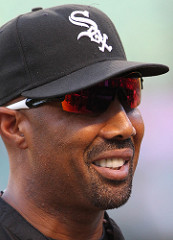
BBRT Declares June 18 & 19 Max Kepler Day(s)

Baseball Roundtable is declaring June 18th and 19th to be (semi) officially and in perpetuity Max Kepler Day(s) on this blog site. For those who are either not from Minnesota or  not sleep deprived this morning, here’s a brief explanation.

Yesterday (and today, really) the Twins topped the Boston Red Sox 4-3 in a 17-inning contest that took 5 hours and 45 minutes – with an opening pitch at 7:10 p.m. June 18 and a final, game-winning hit at approximately 12:55 a.m. June 19.  In between, here’s what Max Kepler did to earn this recognition.

  • In the bottom of the eighth, with the Twins trailing 2-1, Kepler hit a game-tying single to right, plating Twins catcher Mitch Garver.
  • In the 13th, after a Mookie Betts home run in the top of the inning had put Boston up 3-2, Kepler homered to right-center (again tying the game).
  • In the bottom of the 17th, Kepler singled to right, driving in pinch runner Luis Arraez with the winning tally.

Not a bad night/early morning for a player who didn’t even start the game. (Kepler came on as a pinch hitter for Marwin Gonzalez in the sixth.) Kepler ended the night/morning with three hits and a walk in six plate appearance, with one run scored and three RBI.

Red Sox    000   100   100   000   100   00     3  17  0

Twins        000   100   010   000   100   01      4  15  1

A few tidbits:

  • It was the longest game (by innings, there is no clock in baseball) ever at Target Field.
  • The win enabled the Twins to avoid their first-ever three-game losing streak of this season.
  • A total of 39 players appeared in the game.
  • Eighteen pitchers took the mound – nine for each squad.
  • Eight players had eight plate appearances.
  • The Twins’ Eddie Rosario went four-for-eight, with three doubles, off three different pitchers.
  • The Red Sox outhit the Twins 17-15 and out-homered the Twins 2-1.
  • A total of 487 pitches were thrown.
  • Twins’ catcher Mitch Garver “went the distance.”
  • There were seven walks and 33 strikeouts.
  • Thirty runners were left on base (Twins 16 – Red Sox 14).
  • A lot of Minnesotans went to be late (or early in the a.m.), but happy.

I watched this one on television and have only one question.  Did they quit selling beer after the seventh inning.  If so, it was an extra long night at the ball park.

BASEBALL ROUNDTABLE ON THE TOP 100 BASEBALL BLOG LIST

100Baseball Roundtable is on the Feedspot list of the Top 100 Baseball Blogs.  To see the full list, click here.

I tweet baseball @DavidBBRT

Follow/Like Baseball Roundtable’s Facebook Page here.  More baseball commentary; blog post notifications; PRIZES.

Member: Society for American Baseball Research (SABR); The Baseball Reliquary; The Negro Leagues Baseball Museum.

Ballpark Tours – Kentucky Bourbon Tour – Days 3 & 4

Days Three and Four … More versus Cubs Cardinals and a Legendary Half Inning.

Day Three (June 9) saw us still in Chicago – looking forward to an event Cubs/Cards tilt.  During the day, our adventurers headed out to places like the Second City Comedy Club Brunch, the Steppenwolf Theater or back for a second day at Chicago’s Blue Fest.  Note: To check out Days One and Two, click here. Days Five and Six, click here. Day Seven, click here. Day Eight, click here.  Days Nine and Ten, click here.

LintoastIn mid-afternoon, a group of us near the juke box at The Lodge to toast a much-loved and much-missed Ballpark Tours family member (Lin) that we lost this past year.  The Lodge is a BPT Gold Coast tradition – and the juke box is a focal point. Side note: Some of the “crew” was still there as the Cubs and Cardinals took the field.

Most BPT trekkers made it (via the EL) to Wrigleyville in plenty of time to enjoy the neighborhood.  As usual, the beverages were nice and cold, the fans nice and warm, the music nice and loud and the emporiums all packed.

The Cubby Bear was packed.

The Cubby Bear was packed.


Wrigley2Our seats were again down the left field line, this time in the second deck ($65, by the way). The site lines were good, we could see all the scoreboards and all the players.  The weather was bit cool, with a noticeable fog over the city.  Much to the pleasure of the Cubs’ fans, the home squad completed a sweep, topping the Redbirds 5-1, behind eight strong innings from Kyle Hendricks who picked up his seventh win) and some key hits from another Kyle (Schwarber), who went two-for-three, with a walk, run scored and two RBI. Former Rockie Carlos Gonzalez chipped in with a pair of hits, including an eighth-inning home run.

From a Baseball Roundtable perspective, I was pleased to see the first 4-6-3 double play (Cardinals’ Wong-to DeJong-to Goldschmidt), as well as three successful sacrifice bunts.

BBRT Observation

It’s generally accepted that the National League is the “running” league and the NL relies more on bunts, the hit-and-run and stolen bases to create runs. However, as I write this post, seven of the top eight teams in stolen bases for the season are American League squads.  (The only NL team to crack the top eight is the Brewers at number five.)

For the second Cubs’ game, I went traditional – a Chicago Dog.  An all-beef hot dog on a poppy seed bun – and you add your own pickle spears, tomato wedges, raw onions, hot and sweet peppers, relish, mustard and ketchup. All for just $7.75.  A ballpark bargain.

Once the final out was made, it was another rendition of “Go, Cubs, Go,” an EL ride back to the hotel and either off to bed or off to a few more celebratory libations.

DAY FOUR – A BUS RIDE, A LONG BOTTOM STRETCH AND A BALL GAME

Appropriate shirt for this group?

Appropriate shirt for this group?

We said goodbye to the Windy City at about 9:30 a.m. June 10 (Monday), headed for Lexington Kentucky, home of the Class A Lexington Legends. We found out a few things early (some we already knew): the back of the bus is always louder than the front; certain members of the group will talk endlessly about such topics as baseball, Soupy Sales, pro-wrestling and gluten-free; Chicago Mix (cheese corn and caramel corn) is addictive; snacks shared are snacks best-enjoyed; and karaoke can fill a bus (especially “Highway to Hell”).

nINAEarly on, one of our intrepid travelers (Nina), traveled all the way from the front of the bus to the back – to set up a “Long Bottom Stretch” bar.  These refreshing cocktails (High Balls?) proved to go well with everything from Chicago Mix to Meat and Cheese to nothing at all.

 Long Bottom Stretch

In a tin, shake 1 1/2 ounces Fords Gin, 1/2 ounce lime cordial*, 1/2 ounce lime juice, and 1/2 ounce Benedictine. Strain into a 10 ounce Collins glass over ice.  Top with tonic and a pinch of salt. Garnish with an orange peel.

*Lime cordial: Heat 6 1/2 cups water and 2 cups sugar in a saucepan. Stir until sugar is dissolved, and then cool to room temperature. Stir in a cup of lime juice and chill.

Traffic and a time change brought us into Lexington at about the time the ballpark gates opened, so it was a late hotel check-in … but first the game.

LegendsseatsLexington has a nice ball park with great site lines and, as you’d expect in a Class A park, all the seats are pretty close to the action.  We were seated in the lower deck, between home plate and first base (and the tickets were just $12.)

Before taking out seats, we stopped in the Kentucky Ale Tap Room, where one of the popular choices was Kentucky Bourbon Barrel Ale (aged in a  bourbon barrel and about 9 percent alcohol) at $6.25.

Legendsblody I had the obligatory Bloody Mary – at $9.00. Nice pour of smooth vodka, but the mix was a little too much tomato and not enough spice.  Still, it was $7.00 less than Wrigley – gotta love the minor leagues – and the service was good.  In fact, service was good all over the park.  For example, I needed team rosters to fill out my scorecard.  They were available at Guest Services, but a staff member ran off to get one for me, so that I wouldn’t have to abandon my drink.

A few thoughts about the game and ballpark.

  • The announced attendance was 3,001; but our group generally agreed that we’d be surprised if there were even 1,000 in the park. (That too was a surprise. The Legends started the game in second place in their division, just ½ game out of first and 1 ½ games up on the third-place Augusta Green Jackets – who they were playing that night.)
  • Class A ballplayers are young – and learning. Consider, this contest featured, nine walks, three errors, one hit batter, and one wild pitch BY THE WINNING TEAM (Augusta 8-5). Each team had 12 hits and Lexington pitchers also walked four batsmen.
  • Professional optimism was evidenced by the fact that the Legends (Royals affiliate) were pictured on the video board (as they came to the plate) not in Legends’ caps, but in Royals’ caps.

Now for a little Ballpark Tours narrative on the contest.

Legends’ starter Charlie Neuweiler (a 2017 fifth-round draft choice) seemed to have the game in hand early. Over the first four innings, he gave up just one run on four hits and had a 5-1 lead to work with.  He retired the first two batters in the fifth and seemed to be on cruise control – and that’s when things went out of control.  The next six batters went: walk; walk; single (loading the bases); two-run single; walk (loaded again); two-run single. Then, a pitching change (Bryce Hensley coming in), followed by: one-run single; one-run single; and finally out number three.  So, Augusta had eight straight hitters reach base after two out in the inning –  scoring six runs on three walks and five hits.

BBRT Players of the Game.

Legends’ CF Michael Gigliotti (23-years-old/2017 fourth-round draft pick). Gigliotti covered a lot of ground out in center (including a full-out, diving catch in the first inning) and went two-for-four with two walks.  (He’s hitting .290 on the season.)

Legends’ LHP Bryce Hensley (23-years-old/2018 22nd-round draft pick). Gave up just one run in 4 1/3 innings of relief.

Augusta Greenjackets’ 1B Frankie Tostado (20-years-old/2017 19th-round draft pick. Tostado went three-for-five, with a run scored and three RBI.  He’s .278-10-43 on the season.

Greenjackets ‘RF Diego Rincones (19-years-old/2015 International Free Agent). Rincones went three-for-five (one double) with two runs scored and one RBI.  He’s hitting .285 on the season.

Long Balls a Major accomplishment.

 The Legends/Greenjackets contest featured 24 hits, but just four extra-base hits (all doubles, three by the losing squad).  Contrast that with the Diamondbacks/Phillies game on the same day – which featured 27 hits – 16 for extra bases, including a new MLB single-game (combined) record 13 home runs.  (The D-backs went deep eight times in the 13-8 win.) Here are the culprits. D-backs: Eduardo Escobar and IIdemaro Vargas (2-HR each); Jarrod Dyson; Ketel Marte; David Peralta; Alex Avila. Phillies:  Scott Kingery (2-Hr); Jean Segura; Rhys Hoskins; Jay Bruce.

A few more observations:

  • Embarrassingly, a large portion of our group was seen in the eighth inning, in the bar, watching the NBA playoffs on TV – while a live baseball game was taking place just about 50-feet away.
  • Thanks to the Legends ten-plus hits, everyone won a free order of fried pickles from the Tilted Kilt (don’t know when we will collect).
  • The game included one inning of $1 beers.
  • The best audio of the evening was when a visiting player took a called strike. Over the PA you heard;  Man’s voice:  “Can I help you with anything?”  Woman’s voice: “No thanks, just looking.”
This head-snapping punch to the jaw may have been the prize winner.

This head-snapping punch to the jaw may have been the prize winner.

Finally, the Legends offered up perhaps the most brutal fan promotional contests BBRT has seen.  Large glove boxing with fans cheers determining who had handed out the best beating. Post-Post Note:  Seriously, look at the size of those gloves, no one was going to be hurt in this promo.

Anyway, we checked into the hotel about 11 p.m. and out tour master had outdone himself – but more on that in a future post. (Spoiler alert: There is a contemporary art gallery/museum right in the hotel.  If that doesn’t have Ballpark Tours written all over it, what does?)


Watch for more from the road in the coming days.

BASEBALL ROUNDTABLE ON THE TOP 100 BASEBALL BLOG LIST

100Baseball Roundtable is on the Feedspot list of the Top 100 Baseball Blogs.  To see the full list, click here.

I tweet baseball @DavidBBRT

Follow/Like Baseball Roundtable’s Facebook Page here.  More baseball commentary; blog post notifications; PRIZES.

Member: Society for American Baseball Research (SABR); The Baseball Reliquary; The Negro Leagues Baseball Museum.

Ballpark Tours – Kentucky Bourbon Tour – Days 1 & 2

shirt3DAY ONE – ON THE ROAD AGAIN

On Friday June 7, it was off again with St. Paul-based Ballpark Tours – my 31st trek with this dedicated if somewhat undisciplined, group or baseball fans.  This time a ten-day trip that will take our hardy group of 26 baseball fans to five cities and eight ball games -not to mention several breweries and distilleries.

As I have in the past, I will chronicle this adventure  to give readers and idea of what a Ballpark Tour is all about.

We left Saint Paul via motorcoach (fancy word for big bus with comfortable seats and a bathroom) at about 10:00 a.m. for a day of travel (without baseball) – headed for Chicago and a pair of Cardinals/Cubs contests.  The trip started with a lot of the usual Ballpark Tours hoopla. At about 11:00 a.m., the tequila showed up and made it’s way down the aisle. (Tequila – It’s not just for breakfast anymore, but it is for breakfast.)  At about the same time, the Bloody Mary Bar opened mid-bus.  As usual, BBRT rates Bloodies and these were good – nicely spiced with horseradish and garnished with hard salami, white cheddar and green olives.  (Side note:  The Tequila was also very smooth.)  Later, the traveler know as The Rev, The Associate Pope and the Lunchmaster fed the masses with crackers, cheese, deli meats and, appropriately, fish.  (Side note: Given the conduct on our deluxe motorcoach, aliases are to be considered a good thing.) Meanwhile, an assortment of treats from bing cherries to brownies to Chicago mix was circulating around the bus.

From the A.M. Bloody Mary Bar.

From the A.M. Bloody Mary Bar.

The Associate Pope feeds the masses, With a very "Latin" chant of "Nomar Garciaparra, my son."

A The Associate Pope feeds the masses, With a very “Latin” chant of “Nomar Garciaparra, my son.”

As we continued down that long – but no so lonesome – highway, other Ballpark Tours’ traditions were honored: A baseball book exchange; distribution of the traditional baseball trivia “K-Kwiz”: the contest forms for a contest in which you predicted how many runs would be scored in three days of major league baseball (Who’s Got The Runs?); the sharing of lots of tales (some even about baseball); and plenty of loud music and dancing at the “back of the bus.”


This trip, like so many before it, was becoming a “family and friends reunion.”

Note: For Days Three and Four, click here.  Days Five and Six, click here. Day Seven, click here.  Day Eight, click here. Days Nine and Ten, click here.

lunchAt about 2:30 p.m., it was time for the lunch stop – at (of course) a brew pub (Great Dane Brew Pub in Madison, Wisconsin). The beer was cold, the food both tasty and (in some cases) unique and the company excellent.  I, by the way, opted for the Imperial IPA and the West African Chicken Peanut Stew, gorgonzola salad and pretzel bread.  Then it was back on the bus, for the “run ” into Chicago – where back-of-the-bus music and dancing had deteriorated into some form of karaoke – with dueling “blue tooths.”  Or should it be dueling blue teeth?

About eight p.m. we checked into the Claridge House (Chicago’s Gold Coast) boutique hotel and either settled in for the night – or headed out for a bit more celebration. I opted to stay in and monitor the Twins game.  Tomorrow – brews, blues and BASEBALL!

Just When You Think Nothing Can Ever Be the Same Again.

We departed on June 7, which happened to the the 83rd anniversary of the day Yankee pitcher Red Ruffing picked up a 5-4, 16-inning victory over the Cleveland Indians.  A couple of notes: Ruffing went the distance, facing 63 batters and earned his victory without striking out a batter.  (Also, there was only one home run in the game – the 16th-frame game-winner by George Selkirk.) “My how the game has changed,” he mused with a bit of remorse.

Ah, but then on this year’s June 7, the Rockies’ Antonio Senzatela picked up a win (Rox topping the Mets 5-1), throwing six innings of one-run ball – without a strikeout.  And, yesterday (June 8), the Phillies’ Nick Pivetta and Rangers’ Adrian Sampson  both earned wins, while throwing their first-ever MLB complete games.  Baby steps, but progress -maybe. 

PS:  For those of you who like to know this stuff, the average number of strikeouts per game so far this season (combined, both teams) is 16.8.

DAY 2 – BLUES AND BASEBALL

I started the morning of Day Two with a trip down the street to Chicago’s Division Street Farmers’ Market – vegetables, fruit, flowers and lots of food (cheeses, pastries, meats and even street-vendor paella.  I grabbed a chocolate-filled croissant and washed it down with coffer al fresco, outside the hotel.

Breakfast!

Breakfast!

coffee

Coffee in front of the Claridge House.


Then it was off to Millennium Park for the 36th Annual Chicago Blues Fest.  Six stages of FREE live blues.  Did about five hours there, before getting ready for today’s headliner – the Cardinals/Cubs at Wrigley. I learned later that other in our group spent the afternoon in places like the Museum of Science and Industry, The Field Museum, the Chicago Art Museum and The Lodge (you had to be there to understand).  Ballpark Tours is nothing if not cultured.


blues3

Yes, Virginia, there was a ball game!

Our view.

Our view.

I took the EL to Wrigleyville, for the 6:15 p..m game.  As usual, I’ve written about this before, there was plenty of opportunity for pre-game music, libation and laughter at spots like The Cubby Bear, Murphy’s Bleachers and the Sports Corner.  Once inside the friendly confines of Wrigley itself, we found out seats located in the deep, left field corner (foul territory). A couple of observations, from our seats we could not see the old, traditional scoreboard beyond the CF wall (which I missed) nor the newer, jumbo video board above the RF stands (which I did not miss). Still, the Cubs do charge $74 for those seats.  Breaking the World Series curse may have gone to their heads just a bit.  (Also, in the banner-style video board directly in our line of sight, the Cubs chose to display the ball-and-strike count – only when the Cardinals were at bat.)

Still, the site lines  to the field were good – as was the company.

The game itself started out badly for the home squad. Jon Lester started for the Cubbies and after just seven batters, he had surrendered a walk, two singles and a pair a home runs.  He was down 4-0 and not yet out of the first, Surprise!  He settled down and, five innings later, was still around to pick up the win.  Lester ended up going six innings and giving up five hits, two walks and four earned runs, while fanning six. In fact, after those first seven batters through the end of the game, the Cardinals only hit one ball out of the infield.  During that time, hey touched Chicago pitching for:

  • 11 strikeouts;
  • 13 infield ground outs – one a double play’
  • Two infield foul pop ups’
  • One batter safe on an infield error – erased on that double play;
  • One walk;
  • One batter safe on a passed ball on strike three; and
  • one fly out to left field (second inning)

Chicago prevailed 9-3.


bloodyAs is tradition, BBRT tried and rated the Wrigley Field Bloody Mary.  First observation – not cheap at $16. However, it was top flight vodka and a good pour, came in a Cubs’ souvenir mug, was embellished with four large (and firm) olives and a line wedge.  (A key BBRT pet peeve is mushy Bloody Mary olives.)   

The bar was out of hot sauce, but my bartender did a good job of spicing up the Bloody with the pepper she had on hand.  Overall, a solid offering (although the mix was a bit salty) that would place in the upper mid-range of the BBRT ratings.


A few other Wrigley observations:

  • I’m not fond of the new video boards, maybe I’m too into nostalgia.
  • Like most parks, lots of people seemed more into selfies than the action on the field.
  • I was proud to see at least four others in our group keeping scorecards – including mentor Nina and her “Grasshoppers” Joe and Pamela.
  • We were seated in the LF corner and I had been told a new Beer Can Chicken Sandwich – available in the RF corner – was a good concessions bet.  One of our tour group made the cross field trek, but pronounced the sandwich not worth the effort.
  • The singer who presented the national anthem held the “free” longer than the anthem should have lasted.  Why do so many feel the anthem is a chance to honor their personal”song stylings” and ignore the fact that the song is supposed to be rendered at a brisk tempo?
  • The seventh-inning “Take Me Out to the Ballgame” is sung with special fervor in Wrigley.
  • Hearing the crowd’s boisterous rendition of the song “Go, Cubs, Go”is always stirring.

An Unlikely Hero

caRATINIWith the bases loaded and the game tied 4-4 in the bottom of the sixth, the Cubs called on backup catcher Victor Caratini to pinch hit.  In three MLB season to that point, Caratini was hitting .128 in 38 pinch hit at bats. He cleared the bases with a double. (Also in his two previous MLB seasons, Caratini had average just .238 in 107 games.  This season, he is hitting .366 in 17 contests.  He did, however, average .290 in seven minor-league seasons.) 


A final thought, yesterday’s night game at Wrigley came on the 56th anniversary of the first Sunday night game in MLB history (June 8, 1963).  In that contest, the Astros topped the Giants 3-0 in Houston.  (Because of Houston summer heat, MLB had granted them permission to schedule Sunday evening contests.

Watch for more from the road in the coming days.

BASEBALL ROUNDTABLE ON THE TOP 100 BASEBALL BLOG LIST

100Baseball Roundtable is on the Feedspot list of the Top 100 Baseball Blogs.  To see the full list, click here.

I tweet baseball @DavidBBRT

Follow/Like Baseball Roundtable’s Facebook Page here.  More baseball commentary; blog post notifications; PRIZES.

Member: Society for American Baseball Research (SABR); The Baseball Reliquary; The Negro Leagues Baseball Museum.
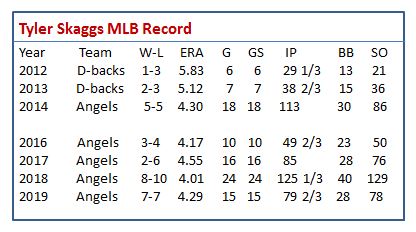
BBRT May Wrap UP – a Hum-Dinger of a Month

In May, major league hitters bashed 1,135 dingers …

a new one-month record for home runs. 
It’s June  1 and that means it’s time for Baseball Roundtable’s traditional previous month wrap up – statistics, standings and stories that caught BBRT’s eye over the previous month, along with the BBRT Players and Pitchers of the Month and the BBRT Trot index.  Here’s a bit of a spoiler – a preview of the kind of thing you’ll read about – if you last to the end of the post.  Among the things we saw in May:

  • The season’s first no-hitter – the second career no-hitter by a pitcher who has only two career complete games (Mike Fiers) in more than 160 starts.
  • A pitcher (Pat Venditte) hitting batters on two consecutive pitchers – one tossed left-handed and one right-handed.
  • A team (Red Sox) scoring nine runs in an inning – after the first two batters were retired.
  • A batter (Nolan Arenado) hitting over .400 for the month – and a team (Rockies) hitting .300.
  • A hitter (Albert Pujols) becoming just the third MLB player to reach 2,000 RBI.

Who said life was fair?  Chris Sale, with a 2.82 ERA, won one and lost two in six May starts.  Ivan Nova, with an ERA of 5.08 went 3-1 in six starts. 

  • A team (White Sox) turning a triple play and hitting a Grand Slam in the same game.
  • One team (Twins) hitting 100 home runs in the first 50 games of the season – and another (Orioles) giving up 100 homers in a MLB-low 48 games into the campaign.
  • One team (Dodgers) go a perfect 14-for-14 in stolen base attempts.
  • Four team playing .700+ ball (Yankees, Dodgers, Twins, Astros).
  • One batter (Nolan Arenado, Rockies) hitting over .400 for the month.
  • One team (Rockies) hitting .300 for the month.
  • Four starting pitchers with at least five May starts put up earned run averages under 1.00 for the month (Hyun-Jin Ryu; Mike Soroka; Jake Odorizzi; Julio Teheran).

Reasons to Read On?
As you read through this lengthy post, you may be rewarded with tidbits of interest. 
For example, BBRT found it interesting that, through May, the Rays’ had the AL’s (and MLB’s) best starters’ earned run average – and their starters had pitched the FEWEST innings of any staff.  The Dodgers’ had the best starting-staff earned run average in the NL (and were second only to the Rays in MLB) and their starters had pitched the MOST innings of any staff. (Details in the post.)

NATIONAL LEAGUE PLAYER OF THE MONTH

Josh Bell, 1B , Pirates – Trevor Story, Rockies (tie)

Josh Bell photo

Photo by mwlguide

I know a tie may be a cop-out, but there was no space between these two.

Bell was a beast in May – raking at a .390 pace and blasting an MLB-best (tied with the Reds’ Derek Dieterich and the Astros’ Alex Bregman) 12 home runs, driving in an MLB-high 31 and scoring 26 (second only to Trevor Story).  Bell was held hitless in only two games all month, raising his average from .286 to .343.  His 12 May doubles also led MLB, and his .797 slugging percentage was second only to the Dieterich.

So, why the tie?  How can you not honor a player who hit .425 for the month? that would be Arenado. He also hit nine May long balls (seventh best in MLB); drove in 29 (second only to Bell); and scored an MLB-best 30 runs. (And there’s also that Gold Glove defense.) In the NL, the race for player of the month was a Bell of a Story. 

Other contenders:   The Cubs’ 1B Anthony Rizzo hit  a solid .360, with nine home runs and 24 RBI; and LF Derek Dieterich of the Reds hit .309-12-22.

AMERICAN LEAGUE PLAYER OF THE MONTH

Rafael Devers, 3B, Red Sox 

Devers hit .351 for the month, led the AL with 40 base hits, knocked eight home runs (fifth in the AL), 24 RBI (fourth in the AL) and 25 runs scored (tied for first in the AL). He even tossed in three stolen bases.  All-around a great “En-Dever.”

Other contenders: LF Eddie Rosario, Twins, .313-6-25; RF Hunter Pence, Rangers (.299-8-26); Alex Bregman, 3B, Astros (.260-12-24);


NATIONAL LEAGUE PITCHER OF THE MONTH

Hyun-Jin Ryu, Dodgers

Hyun-Jin Ryu photo

Photo by Keith Allison

Really, no contest here. Ryu was MLB’s stingiest pitcher in May – with MLB’s lowest earned run average (among pitchers with at least 20 May innings) at a minuscule  0.59 and the third-lowest WHIP at 0.68.  Ryu averaged 7.5 innings pitched over his six May starts – going 5-0  and giving up just three runs  in 45 2/3 innings. In today’s power-focused game (at the plate and on the mound), he was an exception – fanning just 36 batters, but giving up zero home runs.

Contenders: Brandon Woodruff, Brewers (4-0, 1.36 – 37 strikeouts in 33 innings); Aaron Nola, Phillies (4-0, 2.73 – 42 strikeouts in 33 IP); Kyle Hendricks, Cubs (4-0. 1.81 – 37 strikeouts in 44 2/3 IP).


AMERICAN LEAGUE PITCHER OF THE MONTH

Lucas Giolito, White Sox

GiolitoGiolito was the AL’s  only five -game winner in May – going 5-0, 1.74 in six starts and fanning 46 batters (walking just ten) in 41 1/3 innings. The highlight of the month may have been when he shut down the potent Astros’ offense on May 23 – tossing a complete-game, four-hit shutout, walking one and fanning nine.

Other contenders: Justin Verlander, Astros (4-1, 2.29 – 42 whiffs in 35 1/3 innings), who allowed only 15 hits in his 35 frames; Aroldis Chapman, Yankees (0-0, 0.79, with an MLB-high 11 May saves – in eleven opportunities – and 18 strikeouts in 10 1/3 innings).


TROT INDEX … A REGULAR BBRT FEATURE

Through May,  36.3 percent of all MLB’s 65,019 2019 plate appearances ended in a trot (back to the dugout, around the bases, to first base). We’re talking about strikeouts, home runs, walks, hit by pitch and catcher’s interference – all outcomes that are, basically, devoid of action on the base paths or in the field. Here’s the breakout: strikeouts (22.9%); Walks (8.8%); home runs (3.5%); HBP (1.0%); Catcher’s Interference (less than 1%). Personally, I’d like more action in the field of play.

For the 2018 season, 34.8 percent of all MLB’s 185,139 plate appearances ended in a trot.  

_________________________________________________________________
THE BEST AND WORST OF TEAMS …

May W-L

 The Twins’ (21-8) not only led MLB in May victories, but also in May runs scored (191) and home runs (56). In addition, they topped the AL in May batting average (.289), put up an earned run average of 3.45 (second only to the Rays in the AL and third in MLB) and played superior defense.  Notably, the Twins showed offensive firepower up and down the lineup. Consider these May numbers: SS Jorge Polanco (.355-4-17); LF Eddie Rosario (.313-6-25); 1B C.J. Cron (.299-8-21); RF Max Kepler (.259-5-20).  The Twins had four player with at least five home runs on the month. On the mound it was Jake Odorizzi (4-0, 0.94); Martin Perez (4-2, 3.15) and Jose Berrios (3-1, 3.48) leading the way.  May was truly a team effort in Minny.

The Yankees (20-7 in May) are, arguably, as big a surprise as the Twins, given New York’s continuing injury woes.  Fortunately, for the Bronx Bombers, some unexpected “names” rose to the challenge.  The Yankees were bolstered by the May  performances of Gio Urshela, who hit .315 and drove in 15 runs; D.J. LeMahieu (.323-5-17); Gleyber Torres (.305-9-16); and Gary Sanchez  (285-9-15). On the mound, Aroldis Chapman gave the Yankees eleven saves in eleven opportunities, while starters Domingo German and J.A. Happ combined to go 8-1.

The Astros (20-8) in May) were just “The Astros” – a potent offense led by the likes of George Springer (.368-8-19 in May), Alex Bregman (.270-12-24); Michael Brantley (.327-5-18); Carlos Correa (.291-5-17); and a pitching staff that could boast of proven veterans Justin Verlander (4-1, 2.29) and Gerrit Cole (3-1, 4.13) – along with  with better than anticipated results from Brad Peacock (3-1, 2.76) and Wade Miley (4-1, 3.25).

Bang for the Buck.  The Tampa Rays,with the lowest payroll in baseball,  had a 35-20 record as MLB closed out May… the fifth best in the majors.  In addition, they were the only team with a team ERA under 3.00 at 2.96.

Over in the NL, the Dodgers reeled off 19 May wins (seven losses) – the only NL team to reach the 19-win mark for the month.  While they  showed a steady  offense (they were sixth in the NL in May runs scored),  it was their pitching that carried the day (the NL’s best – and MLB’s second-best – earned run average).  Among the May LA leaders: Hyun-Jin Ryu (5-0, 0.59); Kenta Maeda (-4-0, 2.73); Clayton Kershaw (4-0, 4.22).

Now for the bad news. The Mariners and Blue Jays each went an MLB-worst 7-21 in May.  You don’t have to look far for the reasons.  The Mariners team ERA of 6.03 was the second worst in MLB (the Pirates were at 6.19) and their 144 May runs were the sixth-lowest in MLB;. The Blue Jays’ May ERA was the fifth-worst at 5.66 and they scored the second-fewest May runs in MLB (98 – only the Marlins scored fewer at 89).

If the season ended May 31, your playoff teams would be:

AL: Twins; Yankee, Astros. Wild Cards:  Rays, Red Sox/A’s/Rangers (tied)

NL: Phillies, Cubs, Dodgers.  Wild Cards: Brewers, Braves/Padres (tied)

NOTE: FULL STANDING AND STATISTICS THROUGH MAY 31 AT THE END OF THIS POST. 

_________________________________________________________________________

Now, before a look at some May highlights, here are May’s team stats. 

—-LEAGUE LEADERS – TEAMS – month of May

RUNS SCORED … MLB Team Average – 132

AL: Twins (191); Red Sox (170); Astros (155)

NL: Rockies (183); Reds (149); Cubs (131); D-backs (145)

The Marlins scored an MLB-low 89 runs in May, after an MLB-low 82 runs in March/April. The Tigers and Blue Jays were at the bottom of the AL with 98 May tallies.  

BATTING AVERAGE … MLB Team Average – .253

AL: Twins (.286); Red Sox (.279); Astros (.278)

NL: Rockies (.300); Dodgers (.275); Pirates (.272)

HOME RUNS … MLB Team Average – 38

AL:  Twins (56); Red Sox (51); Astros (47)

NL: Cubs (51); Reds (45); Rockies (42)

The Marlins hit only 17 home runs in May, the only team under 20.

SLUGGING PERCENTAGE – MLB Team Average – .431

AL: Twins (.521); Astros (.500); Red Sox (.491)

NL: Rockies (.527); Dodgers (.476); Cubs (.468)

The Twins were the only team to top 500 total bases for the month (531). 

STOLEN BASES ... MLB Team Average – 12

AL: Royals (25); Indians (19); Red Sox (17)

NL: Reds (19); Brewers (17); D-backs (16)

Talk about futility on the bases.  The Cubs stole just one base in May – and were caught five times.  On the other end of the spectrum, the D-backs were  16-for-17 in May steal attempts. 

BATTERS’ STRIKEOUTS … MLB Team Average – 238

AL: White Sox (304); Mariners (269); Tigers (266)

NL: Padres (271); Brewers (264); Mets (259)

The Rockies and Twins led their respective leagues in doubles (67 and 61, respectively).  Consider this.  Miami had 54 total extra base hits for the month.  

WALKS DRAWN … MLB Average – 89

AL: Red Sox (1139; Indians (119); Angels (105)

NL: Cubs (121); Brewers (115); Cardinals (99)

____________________________________________________________

EARNED RUN AVERAGE ... MLB Average – 4.47

AL:  Rays (2.97); Twins (3.45); Yankees (3.45)

NL:  Dodgers (3.11); Cubs (3.74); Mets (3.85)

The only teams with May ERA’s over 6.00 were  the Pirates (6.19) and the Mariners (6.03).

STRIKEOUTS … MLB Average – 238

AL:  Astros (282); Red Sox (270); Twins (260)

NL: Reds (288); Nationals (268); Brewers (256)

Only two teams average more than ten strikeouts per  innings – the Astros (10.19) and the Reds (10.25).Eleven teams averaged at least one K per inning for the month; while the Tigers (7.35) and White Sox (7.48) had the lowest K/9 rate.

SAVES … MLB Average – 6

AL: Yankees (14); Astros (9); Angels (7)

NL: Padres (10); Phillies (9); Dodgers (9)

FEWEST WALKS SURRENDERED … MLB Average – 89

AL: Indians (63); Twins (65); Yankees (74)

NL: Dodgers (45); Padres (58); Mets (80)

When you look at  the strikeouts-to-walks  ratio, the Dodgers were the May kings (4.98  strikeouts per walk). 

__________________________________________

MAY HIGHLIGHTS

May 2 – Thor Wields a Silver Hammer

Noah Syndergaard photo

Photo by slgckgc

On May 2, the Mets’ Noah “Thor” Syndergaard was on his game. Facing the Reds in New York, Syndergaard threw a complete-game, four-hit shutout (one walk/ten whiffs). The Mets also got four-hits and their only run came on a Syndergaard home run in the bottom of the third – making Syndergaard just the seventh MLB pitcher ever to homer, while also pitching a 1-0 shutout. Here, by the way, are the other pitchers to throw a shutout and go yard for the only tally in a 1-0 game:  Red Ruffing, Yankees (1932); Spud Chandler, Yankees (1938); Early Wynn, White Sox (1959); Jim Bunning, Phillies (1965); Juan Pizzaro, Cubs (1971); Bob Welch, Dodgers (1983).

One for the Books

On May 2, Stephen Strasburg took the hill for the NationalS – against the Cardinals –  in Washington D.C.  In a game that included sitting out a two-and-a-half hour rain delay, Strasburg threw 6 2/3 innings of six-hit, one-run ball, while walking two and fanning nine.  It was the eighth strikeout of the night – when Cardinals’ pitcher Dakota Hudson watched a 1-2 curve ball for the last out of the fifth inning – that made the news.  It was Strasburg’s 1,500th career strikeout and it came at the 1,272 1/3 innings pitched mark  – the fewest innings ever needed to reach the 1,500 whiffs.  (The old record, at 1,290 innings, belonged to Chris Sale). The Nationals, by the way, won the game 2-1 and Strasburg got the win.

Red Sox Put Up a Really Big Inning

On May 4, the Red Sox came up in the top of the third inning trailing the White Sox 1-0.  Manny Banuelos looked good on the mound  for Chicago, having retired the first six Boston batters in order.  He continued the trend by getting the first two hitters in the third on a ground out and a fly out. Then, all “H” (for Hits) broke loose – as the Red Sox turned a two-out, no-one-on-base situation into a nine-run inning; drilling ten straight hits (two short of the record).  It went like this:

  • Christian Vazquez – single to CF.
  • Andrew Benintendi – single to CF, Vazquez to second.
  • Mookie Betts –double to left, Vazquez and Benintendi score.
  • D.J. Martinez – double to left, Betts scores.
  • Xander Bogaerts – home run to left, Bogaerts and Martinez score.
  • Michael Chavis – home run to CF.
  • Rafael Devers – double to right.
  • Steve Pearce – ground ball single to LF, Devers scores, Pearce goes to second on the throw.
  • Eduardo Nunez – homers to left-center, Pearce and Nunez score.
  • Vazquez – ground ball single to left (his second hit of the inning).

Finally, Banuelos is pulled, replaced by Carson Fulmer.

  • Benintendi – walk, Vazquez goes to second.
  • Betts – fly ball out to right.  It’s finally over.

The Red Sox, by the way, prevailed 15-2.

Back-to Back-to Back

On May 5, the Reds faced off against the Giants and Great American Ball Park – and they made a solid first impression. After Joey Votto singled to open the contest, Eugenio Suarez hit an 0-1 pitch from Jeff Samardzija into the right field stands to give the Reds a 2-0 lead. On the very next pitch from Samardzija, Jesse Winker homered to center to make it 3-0 – and the very next pitch saw Derek Dietrich take Samardzija out of the park (to right) for a 4-0 lead.  Three  home runs on three pitches. The Elias Sports Bureau indicates that no team had gone deep on three consecutive offerings since June 12, 2007 (Mets Wilson Betemit, Matt Kemp and Hong-Chih Kuo.) Despite the first-inning fireworks, the Reds lost 6-5

Ouch! From Both Sides Now.

Venditte photo

Pat Venditte Photo by Keith Allison

On May 6, San Francisco Giants’ pitchers tied an MLB record by hitting four Reds’ batters in the bottom of the sixth inning. That record, however, seems incidental when compared to what Giants’ pitcher Pat Venditte “accomplished.”  Venditte not only tied the MLB record for most batters hit in an inning, he became (at least by BBRT’s search) the first pitcher to hit at least one batter pitching left-handed AND right-handed in the same inning.

The ambidextrous hurler’s inning went like this:

  • Reds’ 1B Joey Votto flies out to left on a 3-2 pitch.
  • 3B Eugenio Suarez is hit by Venditte’s first offering (pitching right-handed).
  • RF Yasiel Puig walks on a 3-2 pitch.
  • 2B Kyle Farmer hits an infield single (1-1 count), loading the bases.
  • SS Jose Iglesias hits a two-run single on Venditte’s first offering.
  • C Curt Casilla singles in another run on a 1-0 pitch.
  • LF Juan Peraza is hit by Venditte first pitch to him (again throwing right-handed).

Ah, then the notable toss.

  • PH Josh VanMeter is hit by a Venditte’s first pitch (this time throwing southpaw).

So, Venditte not only tied a record by hitting three batsmen in an inning, he hit two, on consecutive pitches – one right-handed and one left-handed.  That, by the way, ended Venditte’s outing (and the Giants ended up losing 12-4).

Later in the inning, the Giants’ Sam Dyson plunked Votto – for the record-tying fourth HBP in the frame.

Fiers On Fire – Second N0-No

On May 7, A’s righty Mike Fiers pitched his second career no-hitter – and the first no-hitter of the 2019 season –  shutting down the Reds 2-0 in Oakland. Fiers gave up just  two walks and fanned six.  (He threw his first no-hitter for the Astros on August 21, 2015). In today’s game of pitch counts, it’s important to note that Fiers threw 131 pitches in the game. It’s also of interest to BBRT that Fiers has now started 165 MLB games in nine seasons – and has just two complete games, both no-hitters. He came into the May 7 game with a 2-3 record and a 6.81 ERA on the season. It was the 300th MLB no-hitter and Fiers became just the 35th pitcher with multiple no-hitters on his MLB resume.

A Pretty Exclusive Club

albert pujols photo

Photo by bk1bennett

On May 9, the Angels’ Albert Pujols popped his sixth homer of the 2019 season.  More significant, as he touched home plate he notched his 2,000th career RBI, making him just the third player to reach 2,000 runs batted in – following Hank Aaron (2,297) and Alex Rodriguez (2,086).  At the close of May, Pujols career line was  .301-642-2008.


Relax Out There in the Field – I Got This

On May 14, Chris  Sale reached a career-high 17 strikeouts in a game – and he did it in just seven innings – becoming the first pitcher to fan 17 batters in seven or fewer frames. (In baseball, we do like the obscure.) What did he get to show for this effort?  A no decision.  Sale left after seven innings with a 3-2 lead and the Red Sox went on to a 5-4 loss in 11 innings. Despite fanning 98 batters in 68 1/3 innings (12 starts) and a respectable 4.35 ERA,  Sale ended May 1-7 on the season.

It’s as Easy as 1-2-3

On May 17, the Cubs’ Kris Bryant had his second career three-homer game – and he waited to the last possible moment(s) to do it.  As the Cubs thumped the Nationals (in Washington) 14-6, Bryant hit a two-run homer in the seventh inning (off reliever Justin Miller), a solo shot (off Kyle Barraclough) in the eighth and another two-run blast (off Matt Grace) in the ninth.  For the game, Bryant was four-for-six, with three runs scored and five driven in.  Bryant, by the way, also became just the 12th MLB player to go deep in three consecutive innings.

Youth Will be Served

On May 19, the Indian Shane Bieber was on top of his game – throwing his first-ever complete game and his first-ever shutout (as the Indians beat the Orioles 10-0). In the contest, he gave up just five hits and no walks, while fanning 15. (Throwing 107 pitches, 75 strikes.)   With that performance Bieber became the fourth-youngest pitcher to record 15 whiffs and no walks in a complete-game shutout.  The youngest was Dwight Gooden (19 years, 302 days) – followed by Kerry Wood (20 years, 324 days), Vince Velasquez (23 years, 312 days) and Bieber (23 years, 323 days).

Double Your Pleasure, Triple Your Fun – and then Roll Four Tallies All into One

On May 22, the White Sox worked hard to stay out of trouble – turning double plays to end each of the the first two innings against the Astros in Houston. Then, they added to the fun in the third – completing a nifty third-to second-to fist triple play to end the frame. It went like this.

Astros’ DH Tony Kemp doubled to right off Ivan Nova to open the inning. Catcher Robinson Chirinos was hit by a pitch. Number-nine hitter CF Jake Marisnick grounded hard to White Sox’ third baseman Yoan Moncada, who stepped on the bag and fired to second baseman Yolmer Sanchez for out number two.
Sanchez then relayed the ball  to first baseman Jose Abreu for the final out.

Then in the sixth inning, the Pale Hose added to the fun, as RF Charlie Tilson popped a Grand Slam (the Sox scored six in the inning) – making Chicago just the fourth team in MLB history to record a triple killing and a Grand Slam in the same game (1979 Blue Jays, 2002 Mets, 2017 Tigers). The Sox, by the way, won the game 9-6.

Triple Play Trivia

There was once a triple play turned without a batted ball. On September 2, 2006 – as the Mariners faced the Rays in Tampa. In the first inning,with runners on first (Adrian Beltre) and third (Jose Lopez), the Mariner’s cleanup hitter Raul Ibanez struck out. Beltre broke for second and Rays’ catcher Dioner Navarro threw to shortstop Ben Zobrist who applied the tag for out number two. Meanwhile, Lopez broke for the plate (figuring to score as the Rays tossed out Beltre). Zobrist threw back to Navarro, who tagged the sliding Lopez.  Completing a 2-6-2 triple killing without the bat striking the ball.

Can We Keep Things Moving, I’m Kind of in a Hurry

On May 24, Rockies’ shortstop Trevor Story hit a two-run seventh-inning homer, as Colorado beat the Orioles 8-6.  (Story hit his 101st career homer in the ninth inning.)  The 100th blast made Story the fastest shortstop ever to reach triple digits in long balls (488 games played). The only other shortstop to reach that milestone in less than 500 games were Alex Rodriguez (470) and Nomar Garciaparra (491).

A Century that Doesn’t Come Around Often

On May 24, the Twin hit their 100th and 101st home runs of 2019 – just 50 games into the season.  Only one other team has reached 100+ homers in a season’s first 50 contests – the 1999 Mariners (102). 

The One That Got Away

Back on July 27, 2018, my hometown Twins traded reliever Ryan Pressly to the Houston Astros for  a pair of minor leaguers.  Who knew Pressly would become “The King.”

In his first four appearances for the Astros, Pressly gave up two earned runs in 5 1/3 innings pitched. Then, on August 15, 2018, Pressly began a run that would see him not allow a single earned run until May 24 of this season – an MLB record-setting streak of 40 consecutive scoreless appearances.  Over the forty-game span, Pressly pitched 39 innings, giving up just 17 hits and three walks, while fanning 49.

By the way, the streak was broken in style. Pressley came on in the eighth inning of the May 24 Astros/Red Sox contest and gave up a  inning-opening home run to the Red Sox’ number-nine hitter, CF Jackie Bradley, Jr.

Eight is Enough

The Twins hit eight home runs as they trounced the Angels 16-7 on May 23; the second time this season they have hit eight long balls in a game. (The other was on April 20.) Notably, both outbursts came in makeup for rain outs – and both resulted in 16-7 wins.  The record for home runs by one team in a game is ten, by the Blue Jays (against the Orioles) on September 14, 1987.

Yes, Virginia, MLB Does Track Everything

On May 24, baseball again provided evidence that “We do, indeed, count everything.” With National’s trailing the Marlins 9-8 in the inning,  Nats’ LF Juan Soto stroked a 100.1 mph fastball from Tayron Guerrero to the left-center for a three-run homer.   Washington first-sacker Matt Adams followed up by blasting a 101.5 mph Guerrero fastball over the right field fence. According to MLB.com, it’s the first time two players have hit back-to-back jacks off pitches clocked at 100 mph or faster.  (At least since the tracking era began in 2008.)

A Different Kind of Cycle

On May 27, as the Mariners topped the Rangers 6-2 in Seattle, Mariners’ CF (and number-nine hitter) Mallex Smith drew an eighth-inning walk and then ran wild on the bases – stealing second, third and home in the span of seven pitches (and enabling the Mariners to plate a run without the benefit of a base hit).   In the process, Smith became the 43rd major leaguer to complete the “steal cycle” in a single inning. For those who like to know these things, only four players have achieved this feat more than once:  Ty Cobb (four times); Honus Wagner (four times); Jackie Tavener (twice); and Max Carey (twice). Smith finished the month with a total of 14 steals for 2019.

Three’s a Crowd

Going into their May 29 match up against the Red Sox, the Indians were the only MLB team without a triple this season.  They made up for lost time,with three three-baggers (Greg Allen 2, Carlos Santana 1) as Cleveland topped Boston 14-9.

__________________________________________________________________

HERE’S A LOOK AT MAY’S TOP PERFORMERS.

_–INDIVIDUAL LEADERS FOR THE MONTH OF MAY 2019—

BATTING AVERAGE … (at least 75 May plate appearances)

AL:  Christian Vazquez, Red Sox (.373); George Springer, Astros (.368); Avasail Garcia, Rays (.360)

NL: Nolan Arenado, Rockies (.425); Josh Bell, Pirates (.390); Juan Soto, Nationals (.380)

The lowest average among players with at least 75 May plate appearances belonged to the Cardinals’ Kolten Wong and the Phillies’ Maikel Franco – both at .170 (15-for-88). 

HITS

AL: Rafael Devers, Red Sox (40); Jorge Polanco, Twins (39); Whit Merrifield, Royals (36)

NL: Josh Bell, Pirates (46); Nolan Arenado, Rockies (45);  Starling Marte, Pirates (37)

When it came to extra-base hits, your May leader was the Pirates’ Josh Bell with 24 … 12 doubles and 12 round trippers.

HOME RUNS

AL: Alex Bregman, Astros (12); Jose Abreu, White Sox (10); Eduardo Escobar, Twins (9); Gary Sanchez, Yankees (9); Gleyber Torres, Yankees (9)

NL: Josh Bell, Pirates (12); Derek Dietrich, Reds (12); Kris Bryant, Cubs (10); Pete Alonso, Mets (10)

RUNS BATTED IN

AL: Eduardo Escobar, Twins (28); Hunter Pence, Rangers (26); Jose Abreu, White Sox (26)

NL: Josh Bell, Pirates (31); Nolan Arenado, Rockies (29); Anthony Rizzo, Cubs (24)

RUNS SCORED

AL: Xander Bogaerts, Red Sox (25); Rafael Devers, Red Sox (24); Mookie Betts, Red Sox (23); Alex Bregman, Astros (23)

NL: Trevor Story, Rockies (30); Josh Bell, Pirates (26); Kris Bryant, Cubs (25); Nolan Arenado, Rockies (25)

STOLEN BASES

AL:  Alberto Mondesi, Royals (12); Kevin Kiermaier, Rays (7); Mallex Smith, Mariners (6)

NL: Jarrod Dyson, D-backs (9); Starling Marte, Pirates (6); four with five

BATTER’S STRIKEOUTS

AL:  Yoan Moncada, White Sox (44); Brandon Lowe, Rays (39); Joey Gallo Rangers (38)

NL: Javier Baez, Cubs (42); Bryce Harper, Phillies (38); Trevor Story, Rockies (34)

While Javier Baez led the NL in whiffs with 42, he managed to hit .305 for the month. 

WALKS

AL:  Mike Trout, Angels (23); Carlos Santana, Indians (22); Mookie Betts, Red Sox (21)

NL: Kyle Schwarber, Cubs (22); Yasmani Grandl, Brewers (20); Paul DeJong, Cardinals (20)

Only 15 batters with 75 or more plate appearances had at least as many walks as strikeouts in May, led by the the Giants’ Joe Panik with 1.48 walks per whiff.

PITCHING VICTORIES

AL:  Lucas Giolito, White Sox (5-0); Jake Odorizzi, Twins (4-0); ; Domingo German, Yankees (4-0); Justin Verlander, Astros (4-1); Wade Miley, Astros (4-1); J.A. Happ, Yankees (4-1); Martin Perez, Twins (4-2)

NL:  Hyun-Jin Ryu (5-0); Kyle Hendricks, Cubs (4-0); Aaron Nola, Phillies (4-0) Clayton Kershaw, Dodgers (4-0);  Brandon Woodruff, Brewers (4-0); Kenta Maeda, Dodgers (4-0); Kyle Hendricks, Cubs (4-0); Max Fried, Braves (4-2)

The Mariners’ Marco Gonzalez lost five games (0-5, 5.86) in six May starts. Nine pitchers lost four games during the month. 

EARNED RUN AVERAGE (minimum 20 May innings)

AL: Jake Odorizzi, Twins (0.94); Lucas Giolito, White Sox (1.74); Yonny Chironos, Rays (2.19)

NL:  Hyun-Jin Ryu, Dodgers (0.59); Mike Soroka, Braves (0.79); Julio Teheran, Braves (0.98)

STRIKEOUTS

AL:  Chris Sale, Red Sox (66 – 38 1/3 innings pitched); Shane Bieber, Indians (51 – 39 1/3 IP); Gerrit Cole, Astros (47– 28 1/3 innings pitched)

NL: Stephen Strasburg, Nationals (50 – 41 1/3 IP); Zack Wheeler, Mets (50 – 50 – 41 1/3 IP); Max Scherzer, Nationals (48 – 38  IP)

Among pitchers with at least 20 innings pitched in May, the Red Sox Chris Sale had the highest rate of strikeouts per nine innings at 15.50.  Despite the high whiff rate, Chris Sale won just one game (1-2, 2.82) in May.  Others meeting the 20-inning threshold and fanning 13 or more batters per nine inning were the Astros’ Gerrit Cole (14.93) and D-backs’ Robbie Ray (13.35).

SAVES

AL:  Aroldis Chapman, Yankees (11); Roberto Osuna, Astros (9); Brad Hand, Indians (6); Shane Green,Tigers (6)

NL: Kirby Yates, Padres (8); Felipe Vazquez, Pirates (7); Sergio Romo, Marlins (7); Sean Doolittle, Nationals (7); Kenley Jansen, Dodgers (7)

Sean Doolittle of the Nationals picked up seven saves (just one blown save), despite a 6.52 May earned run average. The May ERA was primarily the result of a May 22 appearance (against the Mets), when he gave up four hits and four earned runs without recording an out. 

_____________________________________________________________

JUne 1 Standings

—LEAGUE LEADERS – TEAMS – THROUGH MAY 31 —-

RUNS SCORED … MLB Team Average – 267

AL: Twins (332); Rangers (312); Red Sox (304)

NL: Dodgers (314); Rockies (308); D-backs (303)

The Marlins and Tigers were the only team to have scored fewer than 200 runs through May (171 and 192, respectively).

BATTING AVERAGE … MLB Team Average – .247

AL: Astros (.274); Twins (.272); Red Sox (.258); Rays (.259)

NL: Dodgers (.266); Rockies (.265); D-backs (.261)

The lowest averages through May belong to the Blue Jays and Giants – both at .221.

HOME RUNS … MLB Team Average – 76

AL: Twins (106); Mariners (103); Astros (93)

NL: Brewers (98); Cubs (92); Dodgers (92)

The  only teams with less than 50 home runs through May were the Marlins (40) and the Tigers (48).

STOLEN BASES … MLB Team Average – 27

AL: Royals (54); Mariners (40); Rangers (40)

NL: Brewers (33); Nationals (32); Cardinals (31)

The Royals speed not only showed up in stolen bases, KC also led all of baseball with 25 triples (MLB average).  Surprisingly, the top seven teams in total steals through May come from the American League. 

BATTERS’ STRIKEOUTS … MLB Team Average – 496

AL: Mariners (586); White Sox (547); Tigers (541)

NL: Padres (559); Brewers (557); Mets (536)

Angels’ hitters fanned an MLB-fewest 361 times through May.  

WALKS DRAWN … MLB Average – 191

AL: Red Sox (230); Indians (223); Mariners (216)

NL: Dodgers (237); Cubs (236); Phillies (225)

_______________________________________

EARNED RUN AVERAGE … MLB Average – 4.40

AL:  Rays (2.96); Astros (3.42); Yankees (3.68)

NL:  Dodgers (3.55); Reds (3.71); Cubs (3.88)

Five teams finished May with a year-to-date ERA  over 5.00: Orioles (5.70); Royals (5.21);Mariners (5.19);  Rockies (5.11); Rangers (5.03). 

PITCHERS’ STRIKEOUTS … MLB Average – 496

AL:  Astros (566); Red Sox (554); Yankees (536)

NL: Reds (556);  Nationals (546); Brewers (531);

The Astros led MLB in strikeouts per nine innings through May – at 9.97. The Reds led the NL at 9.86. Ten teams averaged at least one strikeout per inning.

SAVES … MLB Average – 14

AL:  Yankees (20); Tigers (18); Astros (18)

NL: Padres (25); Dodgers (19); three with 16

The Astros had MLB’s best bullpen ERA through May at 2.88 – the only relief staff under 3.00. Meanwhile, the Nationals’ disappointing season can be traced in great part of the team’s MLB-worst 7.08 bullpen ERA.

The best starting staff ERA through May was put up by the Rays at 2.35 – although, thanks to their “opener” and “bullpen day” approach, their starters threw the fewest innings (245).  A paradox? Dodgers starters had the lowest ERA through May in the NL (and second lowest in MLB) at 3.02. The LAD starting staff was at the opposite end of the innings pitched spectrum – leading MLB with 337 innings logged through May. 

FEWEST WALKS SURRENDERED …  MLB average 191

AL: Astros (149); Twins (154); Indians (157)

NL: Dodgers (131); Padres (142); Reds (184)

The Orioles have surrendered the most home runs through May (118), while the Rays’s  gave up the fewest (47).  The MLB average was 76. 

___________________________________________________________________

—INDIVIDUAL LEADERS THROUGH MAY  2019—

BATTING AVERAGE (qualifying hitters)

AL:  Jorge Polanco, Twins (.338); Michael Brantley, Astros (.329); Tim Anderson, White Sox (.328)

NL: Cody Bellinger, Dodgers (.379); Nolan Arenado, Rockies (.344); Josh Bell, Pirates (.343)

HOME RUNS

AL: Eddie Rosario, Twins  (17); Gary Sanchez, Yankees (17); George Springer, Astros (17); Alex Bregman, Astros (17)

NL: Christian Yelich, Brewers (21); Cody Bellinger, Dodgers (20); Pete Alonso, Mets (19)

The Marlins’ Miguel Rojas had the most  most at bats through May without a home run (178).

RUNS BATTED IN

AL: Jose Abreu, White Sox (50); Eddie Rosario, Twins (49); George Springer, Astros (43)

NL: Cody Bellinger, Dodgers (52); Josh Bell, Pirates (52);  Nolan Arenado, Rockies (50); Marcell Ozuna, Cardinals (50)

The Dodgers’s Cody Bellinger led all of MLB with a .465 on-base percentage through May.  Mike Trout (Who else?) led the AL at .458.

RUNS SCORED

AL: Mookie Betts, Red Sox (45); Mitch Haniger, Mariners (43); Xander Bogaerts, Red Sox (43)

NL: Trevor Story, Rockies (52); Cody Bellinger, Dodgers (50);  Andrew McCutchen, Phillies (45); Nolan Arenado, Rockies (45)

STOLEN BASES

AL: Aldaberto Mondesi, Royals  (20); Jose Ramirez, Indians (14); Mallex Smith, Mariners (14); Tim Anderson, White Sox (14)

NL: Jarrod Dyson, D-backs (12); Christian Yelich, Brewers (10); Trevor Story, Rockies (10)

Trea Turner of the Nationals and Kolten Wong of the Cardinals had the most steals through May without getting caught (8), On the other side of the coin, Jeff McNeil of the Mets had the most attempts without being successful (4).

While we have often heard that the NL is the running league, seven of the top eight base stealers through May were from the AL. 

BATTER’S STRIKEOUTS

AL:  Joey Gallo, Rangers (76); Mitch Haniger, Mariners (72); Brandon Lowe, Rays (72); Domingo Santana (72)

NL: Bryce Harper, Phillies (76); Javier Baez, Cubs (75); Wil Meyers, Padres (72)

WALKS DRAWN

AL:  Mike Trout, Angels (52); Joey Gallo, Rangers (41); Carlos Santana, Indians (40)

NL: Andrew McCutchen, Phillies (42); Rhys Hoskins, Phillies (40); Bryce Harper, Phillies  (37)

Not a big fan of WAR (Wins Above Replacement), but for those of you who like it, Cody Bellinger led all of MLB in WAR through May at 5.4. Mike Trout was a distant second at 3.7.

PITCHING VICTORIES

AL:  Domingo German, Yankees (9-1); Justin Verlander, Astros (8-2); Lucas Giolito, White Sox (7-1); Martin Perez, Twins (7-2); Jose Berrios (7-2); Jake Odorizzi, Twins (7-2)

NL:  Hyun-Jin Ryu, Dodgers (8-1); Brandon Woodruff, Brewers (7-1);  Kenta Maeda, Dodgers (7-2); Max Fried, Braves (7-3)

Just two MLB pitchers lost seven games by the end of May – Chris Sale, Red Sox (1-7, 4.35) and Jhoulys Chacin, Brewers (3-7, 4.35). Jorge Lopez of the Royals had the most losses without a win (0-6, 6.67). 

EARNED RUN AVERAGE (qualifying)

AL: Jake Odorizzi, Twins (2.16); Justin Verlander, Astros (2.38); Mike Minors, Rangers (2.74)

NL:  Hyun-Jin Ryu, Dodgers (1.48) Zach Davies, Brewers (2.19); Luis Castillo, Reds (2.45)

The highest ERA among qualifying pitchers through May was 7.13 – Kyle Freeland, Rockies, over 59 1/3 innings in 12 starts. 

STRIKEOUTS

AL:  Gerrit Cole, Astros (112– 71 2/3 innings pitched);  Justin Verlander, Astros (95 – 79 1/3 IP); Chris Sale, Red Sox (98 – 68 1/3 IP)

NL: Max Scherzer, Nationals (102 – 77 1/3 IP); Stephen Strasburg, Nationals (98 – 79 IP); Zack Wheeler, Mets (87 – 77 IP)

Among qualifying pitchers, Gerrit Cole of the Astros had the highest rate of strikeouts per nine innings through May at 14.07.  He was followed by the Red Sox’ Chris Sale (12.91) and Ray’s Blake Snell (12.11). Indicative the the fact that we are now in a hard-throwing/free-swinging era – 38 pitchers averaged at least one strikeout per inning through May. 

SAVES

AL:  Shane Greene, Tigers (18); Aroldis Chapman, Yankees (16); Roberto Osuna, Astros (16)

NL: Kirby Yates, Padres (22); Kenley Jansen, Dodgers (17); Felipe Vazquez, Pirates (14)

GAMES PITCHED

AL: Adam Kolarek, Rays (29); Victor Alcantara, Tigers (29); Ryan Buchter, A’s (28);

NL: Bryan Shaw, Rockies (30); Alex Claudio, Brewers (30); four with 28

For those who follow WAR (Wins Above Replacement), the leaders through May are Mike Minor, Rangers in the American League at 3.8 and German Marquez in the National League at 3.1.

Primary Resources: Baseball-Reference.com; Baseball-Almanac.com; MLB.com

BASEBALL ROUNDTABLE ON THE TOP 100 BASEBALL BLOG LIST

100Baseball Roundtable is on the Feedspot list of the Top 100 Baseball Blogs.  To see the full list, click here.

I tweet baseball @DavidBBRT

Follow/Like Baseball Roundtable’s Facebook Page here.  More baseball commentary; blog post notifications; PRIZES.

Member: Society for American Baseball Research (SABR); The Baseball Reliquary; The Negro Leagues Baseball Museum.