BBRT May Wrap UP – a Hum-Dinger of a Month

In May, major league hitters bashed 1,135 dingers …

a new one-month record for home runs. 

It’s June  1 and that means it’s time for Baseball Roundtable’s traditional previous month wrap up – statistics, standings and stories that caught BBRT’s eye over the previous month, along with the BBRT Players and Pitchers of the Month and the BBRT Trot index.  Here’s a bit of a spoiler – a preview of the kind of thing you’ll read about – if you last to the end of the post.  Among the things we saw in May:

  • The season’s first no-hitter – the second career no-hitter by a pitcher who has only two career complete games (Mike Fiers) in more than 160 starts.
  • A pitcher (Pat Venditte) hitting batters on two consecutive pitchers – one tossed left-handed and one right-handed.
  • A team (Red Sox) scoring nine runs in an inning – after the first two batters were retired.
  • A batter (Nolan Arenado) hitting over .400 for the month – and a team (Rockies) hitting .300.
  • A hitter (Albert Pujols) becoming just the third MLB player to reach 2,000 RBI.

Who said life was fair?  Chris Sale, with a 2.82 ERA, won one and lost two in six May starts.  Ivan Nova, with an ERA of 5.08 went 3-1 in six starts. 

  • A team (White Sox) turning a triple play and hitting a Grand Slam in the same game.
  • One team (Twins) hitting 100 home runs in the first 50 games of the season – and another (Orioles) giving up 100 homers in a MLB-low 48 games into the campaign.
  • One team (Dodgers) go a perfect 14-for-14 in stolen base attempts.
  • Four team playing .700+ ball (Yankees, Dodgers, Twins, Astros).
  • One batter (Nolan Arenado, Rockies) hitting over .400 for the month.
  • One team (Rockies) hitting .300 for the month.
  • Four starting pitchers with at least five May starts put up earned run averages under 1.00 for the month (Hyun-Jin Ryu; Mike Soroka; Jake Odorizzi; Julio Teheran).

Reasons to Read On?
As you read through this lengthy post, you may be rewarded with tidbits of interest. 
For example, BBRT found it interesting that, through May, the Rays’ had the AL’s (and MLB’s) best starters’ earned run average – and their starters had pitched the FEWEST innings of any staff.  The Dodgers’ had the best starting-staff earned run average in the NL (and were second only to the Rays in MLB) and their starters had pitched the MOST innings of any staff. (Details in the post.)

NATIONAL LEAGUE PLAYER OF THE MONTH

Josh Bell, 1B , Pirates – Trevor Story, Rockies (tie)
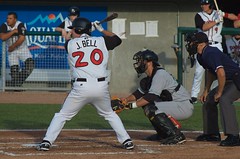
Josh Bell photo

Photo by mwlguide

I know a tie may be a cop-out, but there was no space between these two.

Bell was a beast in May – raking at a .390 pace and blasting an MLB-best (tied with the Reds’ Derek Dieterich and the Astros’ Alex Bregman) 12 home runs, driving in an MLB-high 31 and scoring 26 (second only to Trevor Story).  Bell was held hitless in only two games all month, raising his average from .286 to .343.  His 12 May doubles also led MLB, and his .797 slugging percentage was second only to the Dieterich.
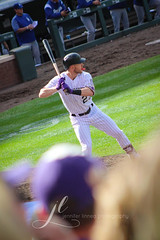
So, why the tie?  How can you not honor a player who hit .425 for the month? that would be Arenado. He also hit nine May long balls (seventh best in MLB); drove in 29 (second only to Bell); and scored an MLB-best 30 runs. (And there’s also that Gold Glove defense.) In the NL, the race for player of the month was a Bell of a Story. 

Other contenders:   The Cubs’ 1B Anthony Rizzo hit  a solid .360, with nine home runs and 24 RBI; and LF Derek Dieterich of the Reds hit .309-12-22.

AMERICAN LEAGUE PLAYER OF THE MONTH

Rafael Devers, 3B, Red Sox 
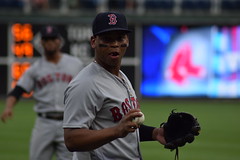
Devers hit .351 for the month, led the AL with 40 base hits, knocked eight home runs (fifth in the AL), 24 RBI (fourth in the AL) and 25 runs scored (tied for first in the AL). He even tossed in three stolen bases.  All-around a great “En-Dever.”

Other contenders: LF Eddie Rosario, Twins, .313-6-25; RF Hunter Pence, Rangers (.299-8-26); Alex Bregman, 3B, Astros (.260-12-24);


NATIONAL LEAGUE PITCHER OF THE MONTH

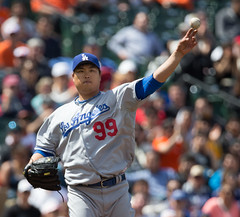
Hyun-Jin Ryu, Dodgers
Hyun-Jin Ryu photo

Photo by Keith Allison

Really, no contest here. Ryu was MLB’s stingiest pitcher in May – with MLB’s lowest earned run average (among pitchers with at least 20 May innings) at a minuscule  0.59 and the third-lowest WHIP at 0.68.  Ryu averaged 7.5 innings pitched over his six May starts – going 5-0  and giving up just three runs  in 45 2/3 innings. In today’s power-focused game (at the plate and on the mound), he was an exception – fanning just 36 batters, but giving up zero home runs.

Contenders: Brandon Woodruff, Brewers (4-0, 1.36 – 37 strikeouts in 33 innings); Aaron Nola, Phillies (4-0, 2.73 – 42 strikeouts in 33 IP); Kyle Hendricks, Cubs (4-0. 1.81 – 37 strikeouts in 44 2/3 IP).


AMERICAN LEAGUE PITCHER OF THE MONTH

Lucas Giolito, White Sox
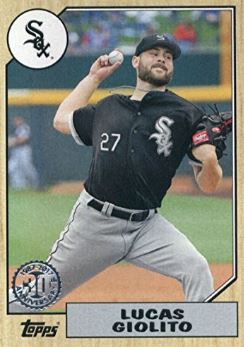
GiolitoGiolito was the AL’s  only five -game winner in May – going 5-0, 1.74 in six starts and fanning 46 batters (walking just ten) in 41 1/3 innings. The highlight of the month may have been when he shut down the potent Astros’ offense on May 23 – tossing a complete-game, four-hit shutout, walking one and fanning nine.

Other contenders: Justin Verlander, Astros (4-1, 2.29 – 42 whiffs in 35 1/3 innings), who allowed only 15 hits in his 35 frames; Aroldis Chapman, Yankees (0-0, 0.79, with an MLB-high 11 May saves – in eleven opportunities – and 18 strikeouts in 10 1/3 innings).


TROT INDEX … A REGULAR BBRT FEATURE

Through May,  36.3 percent of all MLB’s 65,019 2019 plate appearances ended in a trot (back to the dugout, around the bases, to first base). We’re talking about strikeouts, home runs, walks, hit by pitch and catcher’s interference – all outcomes that are, basically, devoid of action on the base paths or in the field. Here’s the breakout: strikeouts (22.9%); Walks (8.8%); home runs (3.5%); HBP (1.0%); Catcher’s Interference (less than 1%). Personally, I’d like more action in the field of play.

For the 2018 season, 34.8 percent of all MLB’s 185,139 plate appearances ended in a trot.  

_________________________________________________________________
THE BEST AND WORST OF TEAMS …
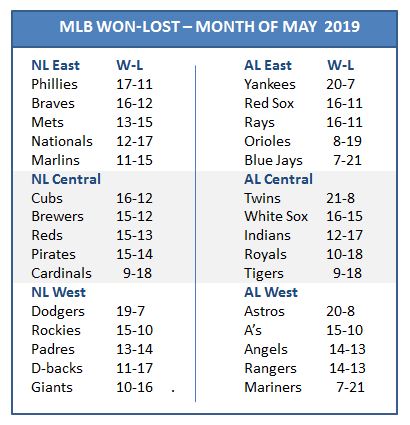
May W-L

 The Twins’ (21-8) not only led MLB in May victories, but also in May runs scored (191) and home runs (56). In addition, they topped the AL in May batting average (.289), put up an earned run average of 3.45 (second only to the Rays in the AL and third in MLB) and played superior defense.  Notably, the Twins showed offensive firepower up and down the lineup. Consider these May numbers: SS Jorge Polanco (.355-4-17); LF Eddie Rosario (.313-6-25); 1B C.J. Cron (.299-8-21); RF Max Kepler (.259-5-20).  The Twins had four player with at least five home runs on the month. On the mound it was Jake Odorizzi (4-0, 0.94); Martin Perez (4-2, 3.15) and Jose Berrios (3-1, 3.48) leading the way.  May was truly a team effort in Minny.

The Yankees (20-7 in May) are, arguably, as big a surprise as the Twins, given New York’s continuing injury woes.  Fortunately, for the Bronx Bombers, some unexpected “names” rose to the challenge.  The Yankees were bolstered by the May  performances of Gio Urshela, who hit .315 and drove in 15 runs; D.J. LeMahieu (.323-5-17); Gleyber Torres (.305-9-16); and Gary Sanchez  (285-9-15). On the mound, Aroldis Chapman gave the Yankees eleven saves in eleven opportunities, while starters Domingo German and J.A. Happ combined to go 8-1.

The Astros (20-8) in May) were just “The Astros” – a potent offense led by the likes of George Springer (.368-8-19 in May), Alex Bregman (.270-12-24); Michael Brantley (.327-5-18); Carlos Correa (.291-5-17); and a pitching staff that could boast of proven veterans Justin Verlander (4-1, 2.29) and Gerrit Cole (3-1, 4.13) – along with  with better than anticipated results from Brad Peacock (3-1, 2.76) and Wade Miley (4-1, 3.25).

Bang for the Buck.  The Tampa Rays,with the lowest payroll in baseball,  had a 35-20 record as MLB closed out May… the fifth best in the majors.  In addition, they were the only team with a team ERA under 3.00 at 2.96.

Over in the NL, the Dodgers reeled off 19 May wins (seven losses) – the only NL team to reach the 19-win mark for the month.  While they  showed a steady  offense (they were sixth in the NL in May runs scored),  it was their pitching that carried the day (the NL’s best – and MLB’s second-best – earned run average).  Among the May LA leaders: Hyun-Jin Ryu (5-0, 0.59); Kenta Maeda (-4-0, 2.73); Clayton Kershaw (4-0, 4.22).

Now for the bad news. The Mariners and Blue Jays each went an MLB-worst 7-21 in May.  You don’t have to look far for the reasons.  The Mariners team ERA of 6.03 was the second worst in MLB (the Pirates were at 6.19) and their 144 May runs were the sixth-lowest in MLB;. The Blue Jays’ May ERA was the fifth-worst at 5.66 and they scored the second-fewest May runs in MLB (98 – only the Marlins scored fewer at 89).

If the season ended May 31, your playoff teams would be:

AL: Twins; Yankee, Astros. Wild Cards:  Rays, Red Sox/A’s/Rangers (tied)

NL: Phillies, Cubs, Dodgers.  Wild Cards: Brewers, Braves/Padres (tied)

NOTE: FULL STANDING AND STATISTICS THROUGH MAY 31 AT THE END OF THIS POST. 

_________________________________________________________________________

Now, before a look at some May highlights, here are May’s team stats. 

—-LEAGUE LEADERS – TEAMS – month of May

RUNS SCORED … MLB Team Average – 132

AL: Twins (191); Red Sox (170); Astros (155)

NL: Rockies (183); Reds (149); Cubs (131); D-backs (145)

The Marlins scored an MLB-low 89 runs in May, after an MLB-low 82 runs in March/April. The Tigers and Blue Jays were at the bottom of the AL with 98 May tallies.  

BATTING AVERAGE … MLB Team Average – .253

AL: Twins (.286); Red Sox (.279); Astros (.278)

NL: Rockies (.300); Dodgers (.275); Pirates (.272)

HOME RUNS … MLB Team Average – 38

AL:  Twins (56); Red Sox (51); Astros (47)

NL: Cubs (51); Reds (45); Rockies (42)

The Marlins hit only 17 home runs in May, the only team under 20.

SLUGGING PERCENTAGE – MLB Team Average – .431

AL: Twins (.521); Astros (.500); Red Sox (.491)

NL: Rockies (.527); Dodgers (.476); Cubs (.468)

The Twins were the only team to top 500 total bases for the month (531). 

STOLEN BASES ... MLB Team Average – 12

AL: Royals (25); Indians (19); Red Sox (17)

NL: Reds (19); Brewers (17); D-backs (16)

Talk about futility on the bases.  The Cubs stole just one base in May – and were caught five times.  On the other end of the spectrum, the D-backs were  16-for-17 in May steal attempts. 

BATTERS’ STRIKEOUTS … MLB Team Average – 238

AL: White Sox (304); Mariners (269); Tigers (266)

NL: Padres (271); Brewers (264); Mets (259)

The Rockies and Twins led their respective leagues in doubles (67 and 61, respectively).  Consider this.  Miami had 54 total extra base hits for the month.  

WALKS DRAWN … MLB Average – 89

AL: Red Sox (1139; Indians (119); Angels (105)

NL: Cubs (121); Brewers (115); Cardinals (99)

____________________________________________________________

EARNED RUN AVERAGE ... MLB Average – 4.47

AL:  Rays (2.97); Twins (3.45); Yankees (3.45)

NL:  Dodgers (3.11); Cubs (3.74); Mets (3.85)

The only teams with May ERA’s over 6.00 were  the Pirates (6.19) and the Mariners (6.03).

STRIKEOUTS … MLB Average – 238

AL:  Astros (282); Red Sox (270); Twins (260)

NL: Reds (288); Nationals (268); Brewers (256)

Only two teams average more than ten strikeouts per  innings – the Astros (10.19) and the Reds (10.25).Eleven teams averaged at least one K per inning for the month; while the Tigers (7.35) and White Sox (7.48) had the lowest K/9 rate.

SAVES … MLB Average – 6

AL: Yankees (14); Astros (9); Angels (7)

NL: Padres (10); Phillies (9); Dodgers (9)

FEWEST WALKS SURRENDERED … MLB Average – 89

AL: Indians (63); Twins (65); Yankees (74)

NL: Dodgers (45); Padres (58); Mets (80)

When you look at  the strikeouts-to-walks  ratio, the Dodgers were the May kings (4.98  strikeouts per walk). 

__________________________________________

MAY HIGHLIGHTS

May 2 – Thor Wields a Silver Hammer
Noah Syndergaard photo

Photo by slgckgc

On May 2, the Mets’ Noah “Thor” Syndergaard was on his game. Facing the Reds in New York, Syndergaard threw a complete-game, four-hit shutout (one walk/ten whiffs). The Mets also got four-hits and their only run came on a Syndergaard home run in the bottom of the third – making Syndergaard just the seventh MLB pitcher ever to homer, while also pitching a 1-0 shutout. Here, by the way, are the other pitchers to throw a shutout and go yard for the only tally in a 1-0 game:  Red Ruffing, Yankees (1932); Spud Chandler, Yankees (1938); Early Wynn, White Sox (1959); Jim Bunning, Phillies (1965); Juan Pizzaro, Cubs (1971); Bob Welch, Dodgers (1983).

One for the Books

On May 2, Stephen Strasburg took the hill for the NationalS – against the Cardinals –  in Washington D.C.  In a game that included sitting out a two-and-a-half hour rain delay, Strasburg threw 6 2/3 innings of six-hit, one-run ball, while walking two and fanning nine.  It was the eighth strikeout of the night – when Cardinals’ pitcher Dakota Hudson watched a 1-2 curve ball for the last out of the fifth inning – that made the news.  It was Strasburg’s 1,500th career strikeout and it came at the 1,272 1/3 innings pitched mark  – the fewest innings ever needed to reach the 1,500 whiffs.  (The old record, at 1,290 innings, belonged to Chris Sale). The Nationals, by the way, won the game 2-1 and Strasburg got the win.

Red Sox Put Up a Really Big Inning

On May 4, the Red Sox came up in the top of the third inning trailing the White Sox 1-0.  Manny Banuelos looked good on the mound  for Chicago, having retired the first six Boston batters in order.  He continued the trend by getting the first two hitters in the third on a ground out and a fly out. Then, all “H” (for Hits) broke loose – as the Red Sox turned a two-out, no-one-on-base situation into a nine-run inning; drilling ten straight hits (two short of the record).  It went like this:

  • Christian Vazquez – single to CF.
  • Andrew Benintendi – single to CF, Vazquez to second.
  • Mookie Betts –double to left, Vazquez and Benintendi score.
  • D.J. Martinez – double to left, Betts scores.
  • Xander Bogaerts – home run to left, Bogaerts and Martinez score.
  • Michael Chavis – home run to CF.
  • Rafael Devers – double to right.
  • Steve Pearce – ground ball single to LF, Devers scores, Pearce goes to second on the throw.
  • Eduardo Nunez – homers to left-center, Pearce and Nunez score.
  • Vazquez – ground ball single to left (his second hit of the inning).

Finally, Banuelos is pulled, replaced by Carson Fulmer.

  • Benintendi – walk, Vazquez goes to second.
  • Betts – fly ball out to right.  It’s finally over.

The Red Sox, by the way, prevailed 15-2.

Back-to Back-to Back

On May 5, the Reds faced off against the Giants and Great American Ball Park – and they made a solid first impression. After Joey Votto singled to open the contest, Eugenio Suarez hit an 0-1 pitch from Jeff Samardzija into the right field stands to give the Reds a 2-0 lead. On the very next pitch from Samardzija, Jesse Winker homered to center to make it 3-0 – and the very next pitch saw Derek Dietrich take Samardzija out of the park (to right) for a 4-0 lead.  Three  home runs on three pitches. The Elias Sports Bureau indicates that no team had gone deep on three consecutive offerings since June 12, 2007 (Mets Wilson Betemit, Matt Kemp and Hong-Chih Kuo.) Despite the first-inning fireworks, the Reds lost 6-5

Ouch! From Both Sides Now.
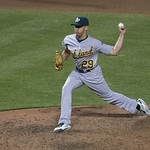
Venditte photo

Pat Venditte Photo by Keith Allison

On May 6, San Francisco Giants’ pitchers tied an MLB record by hitting four Reds’ batters in the bottom of the sixth inning. That record, however, seems incidental when compared to what Giants’ pitcher Pat Venditte “accomplished.”  Venditte not only tied the MLB record for most batters hit in an inning, he became (at least by BBRT’s search) the first pitcher to hit at least one batter pitching left-handed AND right-handed in the same inning.

The ambidextrous hurler’s inning went like this:

  • Reds’ 1B Joey Votto flies out to left on a 3-2 pitch.
  • 3B Eugenio Suarez is hit by Venditte’s first offering (pitching right-handed).
  • RF Yasiel Puig walks on a 3-2 pitch.
  • 2B Kyle Farmer hits an infield single (1-1 count), loading the bases.
  • SS Jose Iglesias hits a two-run single on Venditte’s first offering.
  • C Curt Casilla singles in another run on a 1-0 pitch.
  • LF Juan Peraza is hit by Venditte first pitch to him (again throwing right-handed).

Ah, then the notable toss.

  • PH Josh VanMeter is hit by a Venditte’s first pitch (this time throwing southpaw).

So, Venditte not only tied a record by hitting three batsmen in an inning, he hit two, on consecutive pitches – one right-handed and one left-handed.  That, by the way, ended Venditte’s outing (and the Giants ended up losing 12-4).

Later in the inning, the Giants’ Sam Dyson plunked Votto – for the record-tying fourth HBP in the frame.

Fiers On Fire – Second N0-No

On May 7, A’s righty Mike Fiers pitched his second career no-hitter – and the first no-hitter of the 2019 season –  shutting down the Reds 2-0 in Oakland. Fiers gave up just  two walks and fanned six.  (He threw his first no-hitter for the Astros on August 21, 2015). In today’s game of pitch counts, it’s important to note that Fiers threw 131 pitches in the game. It’s also of interest to BBRT that Fiers has now started 165 MLB games in nine seasons – and has just two complete games, both no-hitters. He came into the May 7 game with a 2-3 record and a 6.81 ERA on the season. It was the 300th MLB no-hitter and Fiers became just the 35th pitcher with multiple no-hitters on his MLB resume.

A Pretty Exclusive Club
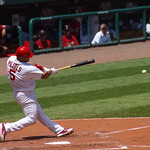
albert pujols photo

Photo by bk1bennett

On May 9, the Angels’ Albert Pujols popped his sixth homer of the 2019 season.  More significant, as he touched home plate he notched his 2,000th career RBI, making him just the third player to reach 2,000 runs batted in – following Hank Aaron (2,297) and Alex Rodriguez (2,086).  At the close of May, Pujols career line was  .301-642-2008.


Relax Out There in the Field – I Got This

On May 14, Chris  Sale reached a career-high 17 strikeouts in a game – and he did it in just seven innings – becoming the first pitcher to fan 17 batters in seven or fewer frames. (In baseball, we do like the obscure.) What did he get to show for this effort?  A no decision.  Sale left after seven innings with a 3-2 lead and the Red Sox went on to a 5-4 loss in 11 innings. Despite fanning 98 batters in 68 1/3 innings (12 starts) and a respectable 4.35 ERA,  Sale ended May 1-7 on the season.

It’s as Easy as 1-2-3

On May 17, the Cubs’ Kris Bryant had his second career three-homer game – and he waited to the last possible moment(s) to do it.  As the Cubs thumped the Nationals (in Washington) 14-6, Bryant hit a two-run homer in the seventh inning (off reliever Justin Miller), a solo shot (off Kyle Barraclough) in the eighth and another two-run blast (off Matt Grace) in the ninth.  For the game, Bryant was four-for-six, with three runs scored and five driven in.  Bryant, by the way, also became just the 12th MLB player to go deep in three consecutive innings.

Youth Will be Served

On May 19, the Indian Shane Bieber was on top of his game – throwing his first-ever complete game and his first-ever shutout (as the Indians beat the Orioles 10-0). In the contest, he gave up just five hits and no walks, while fanning 15. (Throwing 107 pitches, 75 strikes.)   With that performance Bieber became the fourth-youngest pitcher to record 15 whiffs and no walks in a complete-game shutout.  The youngest was Dwight Gooden (19 years, 302 days) – followed by Kerry Wood (20 years, 324 days), Vince Velasquez (23 years, 312 days) and Bieber (23 years, 323 days).

Double Your Pleasure, Triple Your Fun – and then Roll Four Tallies All into One

On May 22, the White Sox worked hard to stay out of trouble – turning double plays to end each of the the first two innings against the Astros in Houston. Then, they added to the fun in the third – completing a nifty third-to second-to fist triple play to end the frame. It went like this.

Astros’ DH Tony Kemp doubled to right off Ivan Nova to open the inning. Catcher Robinson Chirinos was hit by a pitch. Number-nine hitter CF Jake Marisnick grounded hard to White Sox’ third baseman Yoan Moncada, who stepped on the bag and fired to second baseman Yolmer Sanchez for out number two.
Sanchez then relayed the ball  to first baseman Jose Abreu for the final out.

Then in the sixth inning, the Pale Hose added to the fun, as RF Charlie Tilson popped a Grand Slam (the Sox scored six in the inning) – making Chicago just the fourth team in MLB history to record a triple killing and a Grand Slam in the same game (1979 Blue Jays, 2002 Mets, 2017 Tigers). The Sox, by the way, won the game 9-6.

Triple Play Trivia

There was once a triple play turned without a batted ball. On September 2, 2006 – as the Mariners faced the Rays in Tampa. In the first inning,with runners on first (Adrian Beltre) and third (Jose Lopez), the Mariner’s cleanup hitter Raul Ibanez struck out. Beltre broke for second and Rays’ catcher Dioner Navarro threw to shortstop Ben Zobrist who applied the tag for out number two. Meanwhile, Lopez broke for the plate (figuring to score as the Rays tossed out Beltre). Zobrist threw back to Navarro, who tagged the sliding Lopez.  Completing a 2-6-2 triple killing without the bat striking the ball.

Can We Keep Things Moving, I’m Kind of in a Hurry

On May 24, Rockies’ shortstop Trevor Story hit a two-run seventh-inning homer, as Colorado beat the Orioles 8-6.  (Story hit his 101st career homer in the ninth inning.)  The 100th blast made Story the fastest shortstop ever to reach triple digits in long balls (488 games played). The only other shortstop to reach that milestone in less than 500 games were Alex Rodriguez (470) and Nomar Garciaparra (491).

A Century that Doesn’t Come Around Often

On May 24, the Twin hit their 100th and 101st home runs of 2019 – just 50 games into the season.  Only one other team has reached 100+ homers in a season’s first 50 contests – the 1999 Mariners (102). 

The One That Got Away

Back on July 27, 2018, my hometown Twins traded reliever Ryan Pressly to the Houston Astros for  a pair of minor leaguers.  Who knew Pressly would become “The King.”

In his first four appearances for the Astros, Pressly gave up two earned runs in 5 1/3 innings pitched. Then, on August 15, 2018, Pressly began a run that would see him not allow a single earned run until May 24 of this season – an MLB record-setting streak of 40 consecutive scoreless appearances.  Over the forty-game span, Pressly pitched 39 innings, giving up just 17 hits and three walks, while fanning 49.

By the way, the streak was broken in style. Pressley came on in the eighth inning of the May 24 Astros/Red Sox contest and gave up a  inning-opening home run to the Red Sox’ number-nine hitter, CF Jackie Bradley, Jr.

Eight is Enough

The Twins hit eight home runs as they trounced the Angels 16-7 on May 23; the second time this season they have hit eight long balls in a game. (The other was on April 20.) Notably, both outbursts came in makeup for rain outs – and both resulted in 16-7 wins.  The record for home runs by one team in a game is ten, by the Blue Jays (against the Orioles) on September 14, 1987.

Yes, Virginia, MLB Does Track Everything

On May 24, baseball again provided evidence that “We do, indeed, count everything.” With National’s trailing the Marlins 9-8 in the inning,  Nats’ LF Juan Soto stroked a 100.1 mph fastball from Tayron Guerrero to the left-center for a three-run homer.   Washington first-sacker Matt Adams followed up by blasting a 101.5 mph Guerrero fastball over the right field fence. According to MLB.com, it’s the first time two players have hit back-to-back jacks off pitches clocked at 100 mph or faster.  (At least since the tracking era began in 2008.)

A Different Kind of Cycle

On May 27, as the Mariners topped the Rangers 6-2 in Seattle, Mariners’ CF (and number-nine hitter) Mallex Smith drew an eighth-inning walk and then ran wild on the bases – stealing second, third and home in the span of seven pitches (and enabling the Mariners to plate a run without the benefit of a base hit).   In the process, Smith became the 43rd major leaguer to complete the “steal cycle” in a single inning. For those who like to know these things, only four players have achieved this feat more than once:  Ty Cobb (four times); Honus Wagner (four times); Jackie Tavener (twice); and Max Carey (twice). Smith finished the month with a total of 14 steals for 2019.

Three’s a Crowd

Going into their May 29 match up against the Red Sox, the Indians were the only MLB team without a triple this season.  They made up for lost time,with three three-baggers (Greg Allen 2, Carlos Santana 1) as Cleveland topped Boston 14-9.

__________________________________________________________________

HERE’S A LOOK AT MAY’S TOP PERFORMERS.

_–INDIVIDUAL LEADERS FOR THE MONTH OF MAY 2019—

BATTING AVERAGE … (at least 75 May plate appearances)

AL:  Christian Vazquez, Red Sox (.373); George Springer, Astros (.368); Avasail Garcia, Rays (.360)

NL: Nolan Arenado, Rockies (.425); Josh Bell, Pirates (.390); Juan Soto, Nationals (.380)

The lowest average among players with at least 75 May plate appearances belonged to the Cardinals’ Kolten Wong and the Phillies’ Maikel Franco – both at .170 (15-for-88). 

HITS

AL: Rafael Devers, Red Sox (40); Jorge Polanco, Twins (39); Whit Merrifield, Royals (36)

NL: Josh Bell, Pirates (46); Nolan Arenado, Rockies (45);  Starling Marte, Pirates (37)

When it came to extra-base hits, your May leader was the Pirates’ Josh Bell with 24 … 12 doubles and 12 round trippers.

HOME RUNS

AL: Alex Bregman, Astros (12); Jose Abreu, White Sox (10); Eduardo Escobar, Twins (9); Gary Sanchez, Yankees (9); Gleyber Torres, Yankees (9)

NL: Josh Bell, Pirates (12); Derek Dietrich, Reds (12); Kris Bryant, Cubs (10); Pete Alonso, Mets (10)

RUNS BATTED IN

AL: Eduardo Escobar, Twins (28); Hunter Pence, Rangers (26); Jose Abreu, White Sox (26)

NL: Josh Bell, Pirates (31); Nolan Arenado, Rockies (29); Anthony Rizzo, Cubs (24)

RUNS SCORED

AL: Xander Bogaerts, Red Sox (25); Rafael Devers, Red Sox (24); Mookie Betts, Red Sox (23); Alex Bregman, Astros (23)

NL: Trevor Story, Rockies (30); Josh Bell, Pirates (26); Kris Bryant, Cubs (25); Nolan Arenado, Rockies (25)

STOLEN BASES

AL:  Alberto Mondesi, Royals (12); Kevin Kiermaier, Rays (7); Mallex Smith, Mariners (6)

NL: Jarrod Dyson, D-backs (9); Starling Marte, Pirates (6); four with five

BATTER’S STRIKEOUTS

AL:  Yoan Moncada, White Sox (44); Brandon Lowe, Rays (39); Joey Gallo Rangers (38)

NL: Javier Baez, Cubs (42); Bryce Harper, Phillies (38); Trevor Story, Rockies (34)

While Javier Baez led the NL in whiffs with 42, he managed to hit .305 for the month. 

WALKS

AL:  Mike Trout, Angels (23); Carlos Santana, Indians (22); Mookie Betts, Red Sox (21)

NL: Kyle Schwarber, Cubs (22); Yasmani Grandl, Brewers (20); Paul DeJong, Cardinals (20)

Only 15 batters with 75 or more plate appearances had at least as many walks as strikeouts in May, led by the the Giants’ Joe Panik with 1.48 walks per whiff.

PITCHING VICTORIES

AL:  Lucas Giolito, White Sox (5-0); Jake Odorizzi, Twins (4-0); ; Domingo German, Yankees (4-0); Justin Verlander, Astros (4-1); Wade Miley, Astros (4-1); J.A. Happ, Yankees (4-1); Martin Perez, Twins (4-2)

NL:  Hyun-Jin Ryu (5-0); Kyle Hendricks, Cubs (4-0); Aaron Nola, Phillies (4-0) Clayton Kershaw, Dodgers (4-0);  Brandon Woodruff, Brewers (4-0); Kenta Maeda, Dodgers (4-0); Kyle Hendricks, Cubs (4-0); Max Fried, Braves (4-2)

The Mariners’ Marco Gonzalez lost five games (0-5, 5.86) in six May starts. Nine pitchers lost four games during the month. 

EARNED RUN AVERAGE (minimum 20 May innings)

AL: Jake Odorizzi, Twins (0.94); Lucas Giolito, White Sox (1.74); Yonny Chironos, Rays (2.19)

NL:  Hyun-Jin Ryu, Dodgers (0.59); Mike Soroka, Braves (0.79); Julio Teheran, Braves (0.98)

STRIKEOUTS

AL:  Chris Sale, Red Sox (66 – 38 1/3 innings pitched); Shane Bieber, Indians (51 – 39 1/3 IP); Gerrit Cole, Astros (47– 28 1/3 innings pitched)

NL: Stephen Strasburg, Nationals (50 – 41 1/3 IP); Zack Wheeler, Mets (50 – 50 – 41 1/3 IP); Max Scherzer, Nationals (48 – 38  IP)

Among pitchers with at least 20 innings pitched in May, the Red Sox Chris Sale had the highest rate of strikeouts per nine innings at 15.50.  Despite the high whiff rate, Chris Sale won just one game (1-2, 2.82) in May.  Others meeting the 20-inning threshold and fanning 13 or more batters per nine inning were the Astros’ Gerrit Cole (14.93) and D-backs’ Robbie Ray (13.35).

SAVES

AL:  Aroldis Chapman, Yankees (11); Roberto Osuna, Astros (9); Brad Hand, Indians (6); Shane Green,Tigers (6)

NL: Kirby Yates, Padres (8); Felipe Vazquez, Pirates (7); Sergio Romo, Marlins (7); Sean Doolittle, Nationals (7); Kenley Jansen, Dodgers (7)

Sean Doolittle of the Nationals picked up seven saves (just one blown save), despite a 6.52 May earned run average. The May ERA was primarily the result of a May 22 appearance (against the Mets), when he gave up four hits and four earned runs without recording an out. 

_____________________________________________________________
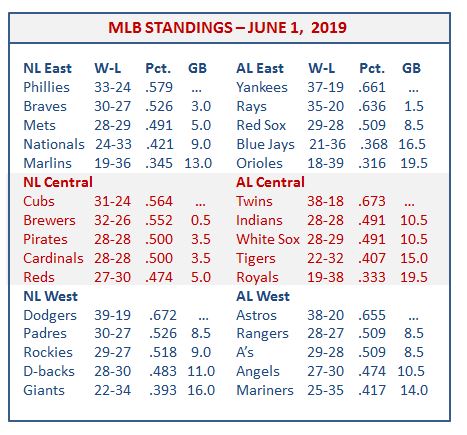
JUne 1 Standings

—LEAGUE LEADERS – TEAMS – THROUGH MAY 31 —-

RUNS SCORED … MLB Team Average – 267

AL: Twins (332); Rangers (312); Red Sox (304)

NL: Dodgers (314); Rockies (308); D-backs (303)

The Marlins and Tigers were the only team to have scored fewer than 200 runs through May (171 and 192, respectively).

BATTING AVERAGE … MLB Team Average – .247

AL: Astros (.274); Twins (.272); Red Sox (.258); Rays (.259)

NL: Dodgers (.266); Rockies (.265); D-backs (.261)

The lowest averages through May belong to the Blue Jays and Giants – both at .221.

HOME RUNS … MLB Team Average – 76

AL: Twins (106); Mariners (103); Astros (93)

NL: Brewers (98); Cubs (92); Dodgers (92)

The  only teams with less than 50 home runs through May were the Marlins (40) and the Tigers (48).

STOLEN BASES … MLB Team Average – 27

AL: Royals (54); Mariners (40); Rangers (40)

NL: Brewers (33); Nationals (32); Cardinals (31)

The Royals speed not only showed up in stolen bases, KC also led all of baseball with 25 triples (MLB average).  Surprisingly, the top seven teams in total steals through May come from the American League. 

BATTERS’ STRIKEOUTS … MLB Team Average – 496

AL: Mariners (586); White Sox (547); Tigers (541)

NL: Padres (559); Brewers (557); Mets (536)

Angels’ hitters fanned an MLB-fewest 361 times through May.  

WALKS DRAWN … MLB Average – 191

AL: Red Sox (230); Indians (223); Mariners (216)

NL: Dodgers (237); Cubs (236); Phillies (225)

_______________________________________

EARNED RUN AVERAGE … MLB Average – 4.40

AL:  Rays (2.96); Astros (3.42); Yankees (3.68)

NL:  Dodgers (3.55); Reds (3.71); Cubs (3.88)

Five teams finished May with a year-to-date ERA  over 5.00: Orioles (5.70); Royals (5.21);Mariners (5.19);  Rockies (5.11); Rangers (5.03). 

PITCHERS’ STRIKEOUTS … MLB Average – 496

AL:  Astros (566); Red Sox (554); Yankees (536)

NL: Reds (556);  Nationals (546); Brewers (531);

The Astros led MLB in strikeouts per nine innings through May – at 9.97. The Reds led the NL at 9.86. Ten teams averaged at least one strikeout per inning.

SAVES … MLB Average – 14

AL:  Yankees (20); Tigers (18); Astros (18)

NL: Padres (25); Dodgers (19); three with 16

The Astros had MLB’s best bullpen ERA through May at 2.88 – the only relief staff under 3.00. Meanwhile, the Nationals’ disappointing season can be traced in great part of the team’s MLB-worst 7.08 bullpen ERA.

The best starting staff ERA through May was put up by the Rays at 2.35 – although, thanks to their “opener” and “bullpen day” approach, their starters threw the fewest innings (245).  A paradox? Dodgers starters had the lowest ERA through May in the NL (and second lowest in MLB) at 3.02. The LAD starting staff was at the opposite end of the innings pitched spectrum – leading MLB with 337 innings logged through May. 

FEWEST WALKS SURRENDERED …  MLB average 191

AL: Astros (149); Twins (154); Indians (157)

NL: Dodgers (131); Padres (142); Reds (184)

The Orioles have surrendered the most home runs through May (118), while the Rays’s  gave up the fewest (47).  The MLB average was 76. 

___________________________________________________________________

—INDIVIDUAL LEADERS THROUGH MAY  2019—

BATTING AVERAGE (qualifying hitters)

AL:  Jorge Polanco, Twins (.338); Michael Brantley, Astros (.329); Tim Anderson, White Sox (.328)

NL: Cody Bellinger, Dodgers (.379); Nolan Arenado, Rockies (.344); Josh Bell, Pirates (.343)

HOME RUNS

AL: Eddie Rosario, Twins  (17); Gary Sanchez, Yankees (17); George Springer, Astros (17); Alex Bregman, Astros (17)

NL: Christian Yelich, Brewers (21); Cody Bellinger, Dodgers (20); Pete Alonso, Mets (19)

The Marlins’ Miguel Rojas had the most  most at bats through May without a home run (178).

RUNS BATTED IN

AL: Jose Abreu, White Sox (50); Eddie Rosario, Twins (49); George Springer, Astros (43)

NL: Cody Bellinger, Dodgers (52); Josh Bell, Pirates (52);  Nolan Arenado, Rockies (50); Marcell Ozuna, Cardinals (50)

The Dodgers’s Cody Bellinger led all of MLB with a .465 on-base percentage through May.  Mike Trout (Who else?) led the AL at .458.

RUNS SCORED

AL: Mookie Betts, Red Sox (45); Mitch Haniger, Mariners (43); Xander Bogaerts, Red Sox (43)

NL: Trevor Story, Rockies (52); Cody Bellinger, Dodgers (50);  Andrew McCutchen, Phillies (45); Nolan Arenado, Rockies (45)

STOLEN BASES

AL: Aldaberto Mondesi, Royals  (20); Jose Ramirez, Indians (14); Mallex Smith, Mariners (14); Tim Anderson, White Sox (14)

NL: Jarrod Dyson, D-backs (12); Christian Yelich, Brewers (10); Trevor Story, Rockies (10)

Trea Turner of the Nationals and Kolten Wong of the Cardinals had the most steals through May without getting caught (8), On the other side of the coin, Jeff McNeil of the Mets had the most attempts without being successful (4).

While we have often heard that the NL is the running league, seven of the top eight base stealers through May were from the AL. 

BATTER’S STRIKEOUTS

AL:  Joey Gallo, Rangers (76); Mitch Haniger, Mariners (72); Brandon Lowe, Rays (72); Domingo Santana (72)

NL: Bryce Harper, Phillies (76); Javier Baez, Cubs (75); Wil Meyers, Padres (72)

WALKS DRAWN

AL:  Mike Trout, Angels (52); Joey Gallo, Rangers (41); Carlos Santana, Indians (40)

NL: Andrew McCutchen, Phillies (42); Rhys Hoskins, Phillies (40); Bryce Harper, Phillies  (37)

Not a big fan of WAR (Wins Above Replacement), but for those of you who like it, Cody Bellinger led all of MLB in WAR through May at 5.4. Mike Trout was a distant second at 3.7.

PITCHING VICTORIES

AL:  Domingo German, Yankees (9-1); Justin Verlander, Astros (8-2); Lucas Giolito, White Sox (7-1); Martin Perez, Twins (7-2); Jose Berrios (7-2); Jake Odorizzi, Twins (7-2)

NL:  Hyun-Jin Ryu, Dodgers (8-1); Brandon Woodruff, Brewers (7-1);  Kenta Maeda, Dodgers (7-2); Max Fried, Braves (7-3)

Just two MLB pitchers lost seven games by the end of May – Chris Sale, Red Sox (1-7, 4.35) and Jhoulys Chacin, Brewers (3-7, 4.35). Jorge Lopez of the Royals had the most losses without a win (0-6, 6.67). 

EARNED RUN AVERAGE (qualifying)

AL: Jake Odorizzi, Twins (2.16); Justin Verlander, Astros (2.38); Mike Minors, Rangers (2.74)

NL:  Hyun-Jin Ryu, Dodgers (1.48) Zach Davies, Brewers (2.19); Luis Castillo, Reds (2.45)

The highest ERA among qualifying pitchers through May was 7.13 – Kyle Freeland, Rockies, over 59 1/3 innings in 12 starts. 

STRIKEOUTS

AL:  Gerrit Cole, Astros (112– 71 2/3 innings pitched);  Justin Verlander, Astros (95 – 79 1/3 IP); Chris Sale, Red Sox (98 – 68 1/3 IP)

NL: Max Scherzer, Nationals (102 – 77 1/3 IP); Stephen Strasburg, Nationals (98 – 79 IP); Zack Wheeler, Mets (87 – 77 IP)

Among qualifying pitchers, Gerrit Cole of the Astros had the highest rate of strikeouts per nine innings through May at 14.07.  He was followed by the Red Sox’ Chris Sale (12.91) and Ray’s Blake Snell (12.11). Indicative the the fact that we are now in a hard-throwing/free-swinging era – 38 pitchers averaged at least one strikeout per inning through May. 

SAVES

AL:  Shane Greene, Tigers (18); Aroldis Chapman, Yankees (16); Roberto Osuna, Astros (16)

NL: Kirby Yates, Padres (22); Kenley Jansen, Dodgers (17); Felipe Vazquez, Pirates (14)

GAMES PITCHED

AL: Adam Kolarek, Rays (29); Victor Alcantara, Tigers (29); Ryan Buchter, A’s (28);

NL: Bryan Shaw, Rockies (30); Alex Claudio, Brewers (30); four with 28

For those who follow WAR (Wins Above Replacement), the leaders through May are Mike Minor, Rangers in the American League at 3.8 and German Marquez in the National League at 3.1.

Primary Resources: Baseball-Reference.com; Baseball-Almanac.com; MLB.com

BASEBALL ROUNDTABLE ON THE TOP 100 BASEBALL BLOG LIST

100Baseball Roundtable is on the Feedspot list of the Top 100 Baseball Blogs.  To see the full list, click here.

I tweet baseball @DavidBBRT

Follow/Like Baseball Roundtable’s Facebook Page here.  More baseball commentary; blog post notifications; PRIZES.

Member: Society for American Baseball Research (SABR); The Baseball Reliquary; The Negro Leagues Baseball Museum.
Negro Leagues Baseball Museum Announces 2019 Hall of Game Electees

Eric the Red – The Crime Dog – The Cobra – Smoke

Seventy-one MLB seasons – 13 All Star selections – 6 Gold Gloves – A National League MVP Award – A World Series MVP Award – Two All Star Game MVP Awards – A Pair of Batting Titles – A Pair of Home Run Crowns – Four Twenty- Win seasons.  Those are just a few of the considerable – and well-earned – credentials of the Negro Leagues Baseball Museum (NLBM) 2019 “Hall of Game” class.

HOGThe Negro Leagues Baseball Museum (NLBM) this week (May 7) announced its sixth annual “Hall of Game” induction class.  This year’s class includes multi-year All-Star and Gold Glove and Silver Slugger honoree Eric Davis; five-time All-Star Fred McGriff; 1978 NL MVP Dave Parker; and 1989 World Series MVP Dave Stewart.  The group will be inducted into the NLBM Hall of Game during ceremonies at Kansas City’s Gem Theater on Saturday, June 29, at 8 p.m. Hy-Vee, Inc. will be the presenting sponsor for the sixth consecutive year.

This four 2019 electees will join previous honorees (listed alphabetically): Dick Allen; Lou Brock; Orlando Cepeda; Roberto Clemente; Andre Dawson; Jim “Mudcat” Grant; Ricky Henderson; Fergie Jenkins; Kenny Lofton; Joe Morgan; Eddie Murray; Tony Oliva; Al Oliver; Tony Perez; Tim Raines; J.R. Richard; Lee Smith; Ozzie Smith; Louis Tiant, Jr.; Maury Wills; and Dave Winfield. Ceremonies are scheduled for 8:00 p.m., June 9 at the Gem Theatre, 1615 18th Street, Kansas City, Missouri.

NEGRO LEAGUES BASEBALL MUSEUM HALL OF GAME

The NLBM established its Hall of Game in 2014 to recognize MLB greats “who competed with the same passion, determination, skill and flair exhibited by the heroes of the Negro Leagues.”

_____________________________________

Now, here’s a look at this year’s Hall of Game electees.

Eric Davis (OF, 1984-2001 … Reds, Dodgers, Tigers, Orioles, Cardinals, Giants)

DavisEric Davis, who combined speed and power, was a two-time All Star, three-Gold Glover and two-time Silver Slugger. He spent nine of his 17 MLB seasons with the Reds; hence, the nickname “Eric the Red.”

At his peak with Cincinnati, Reds’ manager Pete Rose described Davis as the greatest raw talent he had seen since Roberto Clemente.

In 1987, Davis had the best season of his MLB career – hitting .293, with 37 home runs, 100 RBI and 50 steals for the Reds (while also winning a Gold Glove for his outfield play). In the process, he became the first MLB player to hit at least 30 home runs and steal at least 50 bases in the same season.And, he accomplished all despite playing in just 129 games.

Davis all-out style of play resulted in a number of injuries during his career. In 1990, he suffered a lacerated kidney (requiring surgery) diving for a ball in Game Four of the World Series. He also had off-season surgery on a balky knee.  A series of injuries continued to hamper his play and he eventually missed the entire 1995 season. In 1996, he returned (with the Reds) and hit .287, with 26 home runs, 83 RBI and 23 stolen bases – earning NL Comeback Player of the Year recognition.

Then, in 1997 (while with the Orioles), Davis was diagnosed with colon cancer in late May and left the team in for treatment.  He returned, still undergoing treatment, in mid- September – and hit .310 in eight September games. (Davis was .304-8-25, in 42 games for the season).  He also hit a game-winning home run in the ninth inning of Game Five of the American League Championship Series.

In 1998, Davis hit .327, with 28 homers and 89 RBI – also compiling a in 30-game hitting streak,

Upon retirement, after the 2001 season, Davis had .289 career average (1,430 hits), 282 home runs, 934 RBI and 349 steals. He had eight seasons of 20 or more home runs and seven of 20 or more steals (a high of 80 in 1986).  He was a proven five-tool player, with an equally well-proven record of bouncing back from adversity.

______________________________________________

Fred McGriff (1B, 1986-2004 …Blue Jays, Padres, Braves, Rays, Cubs, Dodgers)

mcgriffIf you were looking for a consistent source of power Fred McGriff – the “Crime Dog” (Thank you, Chris Berman) – was your man.  He hit 30 or more home runs every season from 1988 through 1993 – leading the AL and NL once each during that time.  In his 19 MLB seasons, he hit at least 30 home runs ten times, and drove in 100+ runs eight times.

Fred McGriff’s 493 put him 28th all-time, tied with Lou Gehrig.

McGriff was a five-time All Star and a three time Silver Slugger. He retired with a solid .284 average (2,490 hits), 493 home runs, 1,305 RBI and 1,349 runs scored.

__________________________________________

Dave Parker (OF, 1973-1991 … Pirates, Reds, A’s, Brewers, Angels, Blue Jays)

ParkerAt 6’5”, 230-pounds, Dave “The Cobra” Parker was an imposing figure at the plate. Once he put his bat in motion, he proved even more lethal.

Parker brought power at the plate, speed on the bases (and in the field) and a rifle-like right arm to his game. Anyone who saw him play will attest to that. If you didn’t see him in action, consider: he was a seven-time All Star (the first selection at age 26, the seventh at 39); a two-time batting champion; a three-time Gold Glover; and a three-time Silver Slugger.

Dave Parker (Pirates) was the NL MVP in 1978, when he led the league in batting average (.334), slugged 30 home runs, drove in 117 tallies, swiped 20 bases and earned a Gold Glove in RF. Oh yes, he also led the league with 23 intentional walks.

Over his career, Parker had six full seasons with a batting average of .300 or better; hit 20 or more home runs nine times; and twice stole 20 bases. He led his league in hits once; doubles twice; extra-base hits twice; total bases three times; RBI once; batting average twice; and intentional walks twice. In 1977, he led NL right fielders with 26 assists. He also was the 1979 All Star Game MVP.

Parker’s career stats: .290 average (2,712 hits); 339 home runs; 1,493 RBI; 154 stolen bases.

____________________________________________

Dave Stewart (RHP, 1978-95 … Dodgers, Rangers, Phillies, A’s, Blue Jays)

srewartNicknamed “Smoke,” Dave Stewart could put the heat on batters when it counted most –clutch  grit that earned him the American League Championship Series MVP recognition in 1990 and 1993 and the World Series MVP Award in 1989.

Stewart, best known for his time with the Oakland A’s (eight of his 16 MLB seasons), did alright in the regular season, too. He won 20 or more games for the A’s in four straight season (1987-1990, leading the AL with 20 wins in 1987. In that span, Stewart was 84-45, with a 3.20 earned run average, 41 complete games and seven shutouts.

Dave Stewart threw a no-hitter against the Toronto Blue Jays on June 29, 1990.

In the 1981 National League Championship Series, as a Dodger, 24-year-old Dave Steward went 0-2, with a 40.50 ERA – lasting just 2/3 of an inning in two games (three earned runs). He toughened up after that, going 10-4, with a 2.58 ERA in 20 more post season appearance – and, of course, winning the 1978 World Series MVP Award, when he went 2-0, 1.69.

Stewart retired with a career record 168-129, 3.95. He led his league in games won once; games started four times; complete games twice; and innings pitched twice.

______________________________________________

In announcing the selections, NLBM President Bob Kendrick said, “We’re thrilled to induct four former Major League Baseball greats into our Hall of Game. These great athletes were thrilling to watch every time they took the field, and they played with the same spirit, passion and style that made the Negro Leagues so exciting.”

___________________________________________

“In addition to the Hall of Game inductions, the NLBM also will be presenting the Jackie Robinson Lifetime Achievement Award for “career excellence in the face of adversity” to the award namesake’s daughter, Sharon Robinson.  Just-7=years old when her father retired from baseball, Robinson grew up watching the iconic barrier-breaker embrace key roles in the Civil Rights Movement. Following in his difference-making footsteps, Robinson now serves as the educational consultant for Major League Baseball and manages Breaking Barriers: In Sports, In Life, a baseball-themed national character education curriculum that helps empower students to face obstacles in their lives.

“With this year being the centennial of Jackie Robinson’s birth, there’s no one we would rather honor during this special anniversary year than his remarkable daughter, Sharon Robinson,” Kendrick said. “She’s been a phenomenal voice and champion for diversity in sports and is carrying on her father’s legacy in a powerful and effective way. She has continued to make a positive difference not only in the sport of baseball but also in American culture as a whole. It’s our honor to present her with this award.”

The establishment of the Hall of Game and its annual celebration event holds two purposes: 1) to provide an avenue for the NLBM to continue garnering attention for one of the greatest stories in American history, and 2) to serve as a significant fundraiser to increase the NLBM’s ability to stay relevant with technology and community programming, and to complete the Buck O’Neil Education Center.

THE NEGRO LEAGUES BASEBALL MUSEUM

The Negro Leagues Baseball Museum is the world’s only museum dedicated to preserving and illuminating the rich history of black baseball. The museum, built in conjunction with the adjacent American Jazz Museum at the famous 18th & Vine Jazz District, has become an iconic piece of Kansas City’s social and entertainment culture. The NLBM is a privately funded, 501c3 not-for-profit organization incorporated in 1990. The museum’s inception brought together the vision of a group of Kansas City business leaders, historians and former baseball players, headed by the legendary John “Buck” O‘Neil. For more information, visit www.nlbm.com, and follow the Negro Leagues Baseball Museum on Twitter @nlbmprez.

Primary Resources: The Negro Leagues Baseball Museum; Baseball-Reference.com

BASEBALL ROUNDTABLE ON THE TOP 100 BASEBALL BLOG LIST

100Baseball Roundtable is on the Feedspot list of the Top 100 Baseball Blogs.  To see the full list, click here.

I tweet baseball @DavidBBRT

Follow/Like Baseball Roundtable’s Facebook Page here.  More baseball commentary; blog post notifications; PRIZES.

Member: Society for American Baseball Research (SABR); The Baseball Reliquary; The Negro Leagues Baseball Museum.
2019 Baseball Reliquary Shrine of the Eternals – Two Hard Throwers and an Ahead-of-the-Curve Executive

ReliquaryNewMay 5, the Baseball Reliquary announced the 2019 electees to the its Shrine of the Eternals.  This annual announcement is a highlight of Baseball Roundtable’s year.  (This commentary is a couple days late, as the announcement came as I was in transit to California.) Anyway, let’s start with a glimpse into The Baseball Reliquary and its “Shrine” to the game – then go on to this year’s electees, the BBRT ballot, the final 2019 vote totals and a list of all the “Shrine” members.  When you consider the Shrine of the Eternals, it all starts with a question.

What do the following have in common – a pitcher who once threw a no-hitter while high on LSD; a team owner who sent a midget to the plate; a man in a chicken suit; a member of Major League Baseball’s 3,000-hit club; an MLB catcher who one season led the National League in passed balls, despite starting only 59 games behind the plate; another backstop known as much for his malapropisms as his record 71 World Series base hits; an MLB manager who won eight World Championships; a one-armed outfielder; a one-handed  pitcher; a cartoon character who  managed and pitched his team to more than 1,000 losses (and just a handful of wins); a baseball card designer; a surgeon and his pitcher-patient; a labor leader; an organist with a razor-sharp wit; a statistical wizard; and more than one best-selling author?

These diverse individuals are all among the past electees to The Baseball Reliquary’s Shrine of the Eternals – an honor that recognizes individuals who have had impact on our national pastime that goes beyond statistics and touches upon the culture and character of the game.   In essence, the Shrine of the Eternals is our national pastime’s fan-focused Hall of Fame. (This year, you can add the first National League right-hander to record 300 whiffs in a season; a General Manager who was far ahead of the curve in applying advanced analytics to the game; and the greatest female softball pitcher to ever take the mound.

The 2019 inductees – who will be enshrined during ceremonies Sunday, July 14, at the Donald R. Wright Auditorium, Pasadena Central Library, 285 E. Walnut Street, Pasadena, California – include former MLB pitcher, J.R. Richard, “Moneyball” legend Oakland A’s General Manager Billy Beane and four-time All American (fast pitch softball) and three-time Olympic Gold Medalist Lisa Fernandez.

Before taking a closer look at this year’s electees, I’d like to provide a brief overview of both the Baseball Reliquary and its Shrine of the Eternals.

Spoiler Alert: Unabashed membership recommendation to follow.  If you are a baseball fan, I would highly recommend you consider membership in the Baseball Reliquary – a truly free-spirited (if somewhat eccentric) organization dedicated to celebrating the human side of baseball’s history and heritage.  The Baseball Reliquary is an open and fan-focused organization, committed to recognizing baseball’s place in American culture and to honoring the character and characters of the national pastime. It pursues that mission through its collection of artifacts, traveling exhibitions, ties to the Whittier College Institute for Baseball Studies and its own version of the Baseball Hall of Fame – the Baseball Reliquary Shrine of the Eternals.  For more on the Baseball Reliquary, and why you should become a member, click here.

Now, to the Shrine of the Eternals. Here’s what the Reliquary has to say about this honor.

Similar in concept to the National Baseball Hall of Fame, the Shrine of the Eternals differs philosophically in that statistical accomplishment is not the principal criterion for election. The Baseball Reliquary believes that the election of individuals on merits other than statistics and playing ability will offer the opportunity for a deeper understanding and appreciation of baseball than has heretofore been provided by “Halls of Fame” in the more traditional and conservative institutions.

Criteria for election shall be: the distinctiveness of play (good or bad); the uniqueness of character and personality; and the imprint that the individual has made on the baseball landscape. Electees, both on and off the diamond, shall have been responsible for developing baseball in one or more of the following ways: through athletic and/or business achievements; in terms of its larger cultural and sociological impact as a mass entertainment; and as an arena for the human imagination.

Each year, the Baseball Reliquary submits a list of candidates to its members and the top three vote-getters are honored.  Reliquarians can vote for up to nine nominees. 

——-2019 Shrine of the Eternals Electees—–

J.R. Richard (1950 – ) … 27 percent of the vote

J.R. Richard. Photos courtesy of The Baseball Reliquary.

J.R. Richard. Photos courtesy of The Baseball Reliquary.

At 6’8” and 222-pounds, Astros’ righty J.R. Richard was one of the most intimidating moundsmen ever. He hit his stride, literally, at age 26 in 1976 – when he went 20-15 with a 2.75 earned run average. That campaign, he fanned 214 batters in 291 innings, but the best was yet to come.

Richard won 18 games in each of the next three seasons, becoming (in 1978) the first NL right-hander to fan 300 batters in a season (303 strikeouts in 275 1/3 innings). In that 1978 campaign, Richard was the only MLB pitcher to fan more than 260 batters. He topped his K total the following season, with 313 whiffs in 292 1/3 innings and a league-best 2.71 earned run average. In that 1979 season, the next best MLB whiff total was 223 by Nolan Ryan.  That season, Richard also allowed MLB fewest hits per nine innings (6.77), notched the most strikeouts per nine (9.64); threw the second-most innings (292 1/3) and the second-most complete games (19); and had the second best strikeouts-to-walks ratio (3.19).

Richard started 1980 with ten wins against four losses and a 1.90 ERA, before suffering a mid-season stroke.  Richard had been feeling under-the-weather for some time, but his concerns were not taken seriously. (He was, in fact, at times accused of malingering.)  The stroke not only ended his MLB career, but put him on a downhill slide (two broken marriages and some bad investments) that ultimately saw him living under an overpass near the Astrodome. He has since gotten “back on his feet,” is the subject of the film “Resurrection: The J.R. Richard Story” and spent time counseling at-risk youth, the homeless and others in need.

Richard’s final MLB line was 107-71, 3.15, with 1,493 strikeouts in 1,606 innings pitched.

__________________________________________

Billy Beane (1962-   ) … 26.5 percent of the vote.

Billy Beane. Photo courtesy of The Baseball Reliquary.

Billy Beane. Photo courtesy of The Baseball Reliquary.

Billy Beane was a ballplayer before he was a baseball executive – if he disappointed at the former, he excelled beyond expectations at the latter. Beane was a first-round (23rd overall) draft choice (Mets) in 1980 – out of Mount Carmel High School (Rancho Bernardo, CA).  In high school, Beane excelled in baseball, football and basketball – and was recruited by Stanford University on a joint baseball-football scholarship.  He chose instead to sign with the Mets and was considered a top prospect. Note: Beane played in 148 MLB games over six seasons – going .219-3-29.  He played for the Mets, Twins, Tigers and A’s. Between 1980 and 1989, he also logged 965 games in the minors – with a .262-91-482 line.

Tiring of the ups-and-down of a career of bouncing between the major and minors, Beane signed on as an advance scout for the A’s in 1990 and stayed the position until 1993, when he was promoted to Assistant General Manager.  At that time, he and GM Sandy Alderson were faced with building a team with a shrinking payroll. That budget pressure continued as Beane succeeded Alderson as GM in 1997. This led Beane to look for new (sabermetric-based) ways to generate the maximum victories for the dollar. Turns out he was pretty good at it.  He looked for pitchers who kept batters off base and hitters who got on base (no matter what the means for either).  He didn’t want stars, he wanted empty bases on defense and base runners on offense.  And, it worked. The budget-restricted, no-name A’s made the playoffs every year from 2000 through 2003, even logging a 20-game winning streak in 2002 (winning 103 games that season). In December 2009, Sports Illustrated named Beane one of the Top Ten GM’s/Executives of the decade across all sports.  And then, of course, there was the 2003 book and 2011 movie ‘Moneyball.”  I mean, here’s a guy who saw the romance in baseball, was played in film by Brad Pitt and who changed the way many front-office executives evaluate “talent.”

____________________________________________________

Lisa Fernandez (1971 –)

Lisa Fernandez. Photo courtesy of The Baseball Reliquary.

Lisa Fernandez. Photo courtesy of The Baseball Reliquary.

Sandy Koufax was sometimes referred to as the “left arm of God.”  If that’s the case, Lisa Fernandez was the supreme right arm – the most dominating fast pitch softball hurler of all time.  Fernandez was a four- time All-American for UCLA, where she also won the Honda-Droderick Award as the top female college athlete (In any sport) three times.

How good was she?  In her senior year, she went 33-3, 0.23 on the mound and hit .509, with 11 home runs and 45 RBI.  For her college career, Fernandez went 93-7, from the bump – including a 97-inning scoreless streak and 42 consecutive wins.  With Fernandez leading the charge, UCLA won the NCAA Championship in 1990 and 1992 and finished as runner up in 1991 and 1993. She also led the U.S. women’s softball team to the Gold in the 1996, 2000 and 2004 Olympics – and was a 2012 inductee to the U.S. Olympic Hall of Fame.

Fernandez currently coaches softball at UCLA (her 21st season with the Bruins) and devotes time to conducting softball clinics and encouraging female athletes. Lisa Fernandez – a great athlete, a leades on and off the field and worthy role model.


—–BASEBALL ROUNDTABLE’S 2019 SHRINE OF THE ETERNALS BALLOT—

Unfortunately, none of the ten nominees BBRT voted for finished in the top three.  But here’s my ballot, and justifications, alphabetically.

Luke Easter (1915-79)

“Luscious” Luke Easter was one of the most prodigious home run hitters of all time – whose titanic blasts were known as “Easter Eggs.” Among his notables:

  • Easter was the first player to a homer into the farthest reaches of center field in the Polo Grounds;
  • He hit the longest home run in the history of old Cleveland Municipal Stadium – clearing the distant right field scoreboard; and
  • Luscious Luke was the first player to hit a drive over the CF scoreboard in Buffalo’s Offerman Stadium (at age 42) and proved it was no fluke by becoming the second to achieve the feat just a month later.

Easter began his baseball career in 1937, with as an OF/1B and cleanup hitter for the St. Louis Titanium Giants (a company team) – and didn’t play his final game until 27 years later.  Everything about the 6’4”, 240-pound Easter was big – his stature, his bat, his love of the game, his love of life, his relationship with teammates and  the fans and, later, even his Buick.

While he began showing his prowess at the plate in the late 1930’s, he really began making name for himself after getting out of the military in 1943.

In 1945, he starred with the barnstorming Cincinnati Crescents (for whom he hit the Polo Grounds home run noted above).

In 1947, he joined the Homestead Grays, where he hit .311, with 10 home runs in 219 at bats.  Research by Society for American Baseball Research Member Justin Murphy indicates Easter followed that up by hitting .363 for the Grays and tying teammate Buck Leonard for the Negro National League (NNL) lead in home runs (13) – helping the Grays to the NNL World Series Championship.

In 1949, Easter signed with the Cleveland Indians and made his major league debut on August 1 of that season – at age 34 – just the eleventh black player in the major leagues. While he hit only .222 in 54 games for the Indians, due in great part to an injured knee, Easter showed his (already long-proven) power by going .363-25-92 in 80 games at Triple A San Diego.

Then, in 1950, he hit .280-28-107 in 141 games for the Indians – earning recognition from the Sporting News as the AL’s Most Outstanding Player.  In 1951, he went .270-27-103 for the Tribe and, in 1952, .263-31-97. Age and injuries were already taking their toll on Easter, however, and on May 4, 1954, the 38-year-old Easter played his final MLB game – ending his MLB career with a .274-93-340 line in 491 games.

Ah, but Luscious Luke was not done. He played on in the minor leagues until 1964 – putting up four seasons of 30 or more home runs and 100+ RBI – earning his way into the International League Hall of Fame.

Over his career, also played winter ball in Puerto Rico, Venezuela, Mexico and Hawaii. A Winter-League star, Easter hit .402 for Mayaguez in the Puerto Rican League in 1948-49 (winning  league MVP honors); led the Mexican Pacific Coast League (for Hermosillo) in homers in 1954-55; and lead the Puerto Rican Winter League in homers in 1955-56 and 1956-57.

Easter, later serving as a Union Steward for TRW in Ohio, was murdered during a payroll robbery in 1979.

Why did Luke Easter get my vote? Consider that non-other than Bill James rated him the second-best Negro Leagues’ first baseman of all time (behind only Buck Leonard) and Al Rosen (a teammate of Easter on the Indians, as well as a four-time All Star, two-time AL home run leader, 1953 American League MVP and 1989 National Executive of the Year) maintained, “Had Luke come up to the big leagues as a young man, there’s no telling what numbers he would have had.”  Easter comes up big on the BBRT “Shrine” ballot.

____________________________

Rube Foster (1879-1930)

Andrew “Rube” Foster was an outstanding hurler, confined – by history – to pitching primarily for Black teams; such squads as the Chicago Union Giants, Cuban X-Giants and Philadelphia Giants. How good was Foster on the mound? Records are sketchy, but the Baseball Hall of Fame reports that, in 1902, Foster  ran off a streak of 44 straight victories and the Negro League Baseball Museum credits Foster with a 54-1 record that season.

Rube Foster’s tireless efforts earned him the unofficial title of “The Father of Black Baseball.”

Foster’s contributions to the national pastime, however, went beyond the mound. In 1911, he partnered with John Schorling (son-in-law of Charles Comiskey) to establish the Chicago American (Black) Giants – who, under Foster’s leadership, became Black baseball’s most dominant team.

But Foster wasn’t done yet.  In 1920, he was a key player (cited by many as THE key player) in the founding of the Negro National League.  As the league flourished, Foster wore many hats. He served not only as the league’s president and treasurer, but also was the owner and manager of the Chicago American Giants – winning the NNL’s first three pennants.  By 1926, his demanding schedule had taken a toll and Foster suffered a nervous breakdown. He never fully recovered and passed away prematurely in 1930. Fans might enjoy Larry Lester’s book “Rube Foster in His Time: On the Field and in the Papers with Black Baseball’s Greatest Visionary.”

Rube Foster was elected to the National Baseball Hall of Fame in 1981.

__________________________________________________________

Julio Franco (1958 –     )

If  you believe “Old Guys Rule” – Julio Franco should be your king.

Consider this fact,  Only 25 Major League home runs have been hit by players who had passed their 45th birthday – and Julio Franco hit 20 of them.

Also consider a handful of the “old guys rule” records held by the ageless Franco:

  • The oldest player to homer in a MLB game. Franco went deep at age 48 years, 254 days, hitting a two-run shot off Arizona’s Randy Johnson, as Franco’s Mets topped the Diamondbacks 5-3 on April 26, 2006). In that same game, Franco also became the second-oldest MLB player to steal base – and, thus, the oldest player to homer and steal a base in the same game.
  • The oldest player to hit a grand slam (46 years, 308 days) – connecting as a pinch hitter for the Atlanta Braves in a 7-2 win over the Marlins on June 27, 2005.
  • The oldest player to record a multi-homer game, belting a pair of homers on June 18, 2005 (age 46 years, 299 days), as his Atlanta Braves topped the Reds at Great American Ball Park. Franco started at first base and went two-for-four with two homers and three RBI.
  • The oldest player to hit a pinch-hit home run, in the eighth inning of a Mets’ 7-2 win over the Padres at San Diego (April 20, 2006 – 47 years, 240 days).
  • The oldest player to steal two bases in a game (and in an inning) – (June 16, 3005 – 46 years, 297 days).
  • The oldest player to be put into a game as a pinch runner (July 29, 2006 – 47 years, 340 days). And he delivered, promptly stole second base, going to third on an errant throw.

From 1982 to 1994, Franco played primarily as a middle infielder and DH for the Phillies, Indians, Rangers and White Sox – making three All Star teams (MVP of the 1990 All Star Game), earning five Silver Slugger Awards and leading the American League in hitting at .341 for the Rangers in 1991. In that 1991 campaign, Franco collected 201 hits, 15 homers, 78 RBI, 108 runs scored and 36 steals in 45 attempts. At season’s end, he had hit .300+ in five of the previous six seasons – the lone exception being .296 in 1990.

In 1994, when the remainder of the MLB season was lost to a strike, Franco was in the midst of possibly his best campaign.  After 112 games, he was hitting .319, with 138 hits, 20 home runs, 98 RBI, 72 runs scored, and eight steals.  Franco was determined to keep swinging the bat and signed to play in Japan with the Pacific League Chiba Lotte Marines.  In the 1995 Japanese season, Franco hit .306 and won the league’s equivalent of the Gold Glove at first base.

Franco returned to MLB in 1996, joining the Cleveland Indians, hitting .322-14-76 in 112 games. In August of the following season, the Indians released Franco – who was hitting .284-3-25 at the time. He finished the 1997 campaign with the Brewers, hitting .241 in 14 games with Milwaukee.

In 1998, at age 39, Franco was back in Japan playing for Chiba Lotte; where he hit .290, with 18 home runs and 77 RBI in 131 games. Then in 1999, he celebrated turning 40 (when most ballplayers are retired or coaching) by hitting for a .423 average in the Mexican League and getting one late season MLB at bat with Tampa Bay.

As he moved into his forties, Franco was far from finished as a player. He played in South Korea in 2000 (age 41), hitting .327-22-110.  In 2001, the well-traveled batsman was back in the Mexican League (Mexico City Tigers), where stellar play (a .437 average in 110 games) earned him a spot on the Atlanta Braves’ roster in September. Franco hit .300, with three home runs and 11 RBI over the final 5 ½ weeks of the MLB season.

From 2001 to 2007, the ageless wonder – professional hitter and pretty darn good first sacker – played for the Braves and Mets.  From 2001 through 2006 – ages 42 to 47 – Franco averaged .290 over 581 games.  He hit .222 in 55 games in his final MLB season – 2007 with the Mets and Braves.

Even at 49, Franco was not done battering baseballs. In 2008, he could be found at first base with the Tigres de Quintana Roo of the Mexican League (where he hit .250 in 36 games). That season, Franco – after 23 Major League seasons and 30 years after his first professional baseball game – announced his retirement as a player.

Oops? Not so fast. In 2014, at the age of 55, he appeared in seven games for the Fort Worth Cats of the independent United League – going six for 27.   Then in 2015, Franco was signed as player-manager of the Ishikawa Million Stars of the Japanese independent Baseball Challenge League (identified as a semi-pro league).

In 23 MLB seasons, Franco hit .298, with 2,586 hits, a .298 average, 173 homers, 1,285 runs, 1,194 RBI and 281 stolen bases. He also collected 618 minor league (U.S) hits, 316 in the Mexican League, 286 in Japan, 267 in the Dominican Winter League and 156 in South Korea and six in independent ball (U.S.).

Forever young, Mr. Franco got my vote.

_____________________________________________________

Mamie “Peanut” Johnson (1935 – 2017)

Mamie Johnson was one of three females to play for the Indianapolis Clowns during the declining days of the Negro Leagues (and the only woman ever to pitch in the Negro Leagues).  Johnson took the mound to the Clowns for three seasons (1953-55), running up a 33-8 record.  Her exploits are chronicled in the children’s book “A Strong Right Arm: The Story of Mamie ‘Peanut’ Johnson,” by Michelle Y. Green.

________________________

Ted Kluszewski (1924-1988)

I love to recognize players who do something we are not likely to see again. Therefore, I again cast a ballot for Ted “Big Klu” Kluszewski – perhaps the last of the true power hitters who also practiced exceptional plate discipline.  In 1954, for example, Big Klu hit .326, with 49 home runs and 141 RBI – a season made even more remarkable by the fact the Kluszewski struck out only 35 times (versus 78 walks). I doubt if we’ll ever see another player top 40 home runs without reaching 40 whiffs.  Kluszewski, in fact, had a streak of four seasons (1953-56) when he hit over .300, drove in 100+ runs, bashed 35+ home runs – and struck out no more than 40 times in any season.  In those four seasons, Kluszewski hit 171 home runs – and fanned 140 times.

It should also be noted that Kluszewski led NL first baseman in fielding percentage every year from 1951 through 1955.  Unfortunately, a back injury in 1956 hampered his performance in the later years of his career (he played until 1961).

Ted Kluszewski is noted for adding a bit of style and flair to the game, making his own intimidating fashion statement. Klu complained that his uniform jersey was too tight for his large and powerful biceps. He went on to have the sleeves cut from his jersey – exposing his bare arms from the shoulder.  (This was considered a bold move at that very conforming time in the game’s history.)

Kluszewski only appeared in one post-season – hitting .391, with three homers and ten RBI in the 1958 World Series (for the White Sox).  True to his form – Big Klu did not strike out even once (25 plate appearance) in the Series.  For trivia buffs, left unprotected in the 1960 expansion draft, Kluszewski hit the first-ever home run for the expansion Angels (a two-run shot in the first inning of the Angels’ first game – April 11 versus the Orioles). He added a punctuation mark, by hitting the Angels’ second–ever home run (a three-run shot) the very next inning. The Angels won 7-2, and (of course) Kluszewski did not strikeout.

____________________________

Mike Marshall (1943 –  *)

I should probably say Doctor Mike Marshall, since this former major league reliever (14 seasons … 1967, 1969-81) earned three college degrees, including a Ph.D. in Kinesiology from Michigan State University. Kinesiology is the study of muscle movement and Marshall used his knowledge to develop his own exercise program focused on minimizing stress, reducing injury and accelerating recovery time.  While his unorthodox methods, advanced education and outspoken approach often had him at odds with baseball’s traditionalists (and may be part of the reason he pitched for nine teams in 14 seasons), they did get the job done.

The fact is, we never saw a closer quite like Mike Marshall before he came along – and we’re not likely to see one like him again. In 1974, as a Dodger, he put up the grand-daddy of all relief seasons – setting the single-season MLB records for appearances with 106 and innings pitched in relief at 208 1/3. He finished the campaign 15-12, with a league-topping 21 saves and a 2.42 ERA.  That season, Marshall was called on to go more than one inning in 74 games (68.5 percent of the time); and he toiled three or more innings 22 times. He also relieved in 13 consecutive regular-season games – an MLB record later tied (1986) by the Rangers’ Dale Mohorcic. His efforts won him the 1974 Cy Young Award and Sporting News NL Pitcher of the Year.

Marshall holds the MLB and NL record for games pitched in relief in a season (106 – Dodgers, 1974), as well as the AL record (89 in relief – Twins, 1979 – he also had one start that year).  The Blue Jays’ Mark Eichhorn tied Marshall’s AL record in 1987. Marshall led his league in games pitched four times and saves three times – finishing 97-112, 3.14 with 188 saves.

A true “fireman” from an era when closers came in to put out fires and stayed on the mound to ensure they were no flare ups, Marshall got my vote for the Shrine.

______________________________________

Pete Reiser (1919-1981)

Combine Willie Mays’ skill set (younger folks, think Mike Trout) with Pete Rose’s hustle and on-field abandon and you have Pete Reiser. In his first full MLB season (CF, Dodgers), a 22-year-old Reiser dazzled defensively and led the NL in runs scored (117), doubles (39), triples (17), batting average (.343), total bases (299) and hit by pitch (11) – tossing in 14 home runs and 76 RBI for good measure. Unfortunately, unpadded outfield walls, helmet-less at bats (the fiery Reiser was a frequent bean ball target) and aggressiveness on the base paths (Reiser twice led the NL in stolen bases and holds the NL record for steals of home in a season at seven) took their toll.

In his ten-season career, the switch-hitting Reiser endured five skull fractures, a brain injury, a dislocated shoulder and a damaged knee.  He was carted off the field 11 times during his career (six times unconscious) and once actually given last rites at the stadium – and he played on. The three-time All Star retired as a player with a .295 career average, playing in 861 games over ten seasons. No telling what he might have done with padded outfield walls and batting helmets.  Pete Reiser was a true – and talented – gamer. For more on Reiser, try “Pete Reiser: The Rough and Tumble Career of the Perfect Ballplayer,” by Sidney Jacobson.

__________________________________________

Bing Russell (1926-2003)

Nate Oliver “Bring Russell” is probably best known to the general populace as Deputy Clem Foster in the TV series Bonanza.  His TV and film credits, in fact, ran long and deep.  He was cast in the film The Magnificent Seven and had guest roles in such television series as Wagon Train, Johnny Ringo, The Rifleman and the Big Valley.  And he was more than just a cowboy, he was also seen in television roles in series ranging from The Rockford Files to The Twilight Zone to The Monkees.

For baseball fans, Russel’s greatest role may have been as owner of the Portland Mavericks – an independent entry into Northwest League.  Shepherding the the only independent team in the league – Russell took  a group of ballplayers described in his Shrine of the Eternals nomination as “misfits, reprobates, hangers-on and washouts” and turned them into winners and the toast of the town – much to the chagrin of baseball’s organized franchises.

It all came about after organized ball moved the struggling Triple A Portland Beavers out of the city after the 1972 season. Russell led a move to establish the Class C Portland Mavericks (as an independent franchise) in the city.  As an owner, Russell focus was fun – and perhaps a bit of rebellio .  He had no ties to any MLB franchise, banned corporate advertising in the ball park and filled his team from open tryouts.  (He also, eventually, hired professional baseball’s first female General Manager, as well as its first Asian-American General Manager.)

How’d all of this work out?  Well, major league baseball did not expect the ragtag Mavericks to do well against their “in-the-system” prospects. They underestimated the impact of ‘Russell’s focus and style – and the determination of his last-change hopefuls.

In 1973, the Mavericks went 45-35 and finished first in the league’s South Division.

In 1974, they went 50-34 and finished second in the West Division – just two games behind the Dodgers’ Bellinger farm club. (See what I did there?  I got Dodgers and Bellinger in the same sentence.  Foreshadowing of things to come?)

In 1975, it was 42-35 and first place in the North Division.

In 1976, it was 40-32 and another North Division first place finish.

In 1977, 44-22  and first place in the South Division. The Mavericks, that season, had the best record in the league, won their division by 22 games and drew 125,000 fans to 33 regular season home games (a minor league short-season record.  (The average attendance was 3,788 fans per game).

Russell and his Mavericks had rekindled Portland passion for baseball with a combination of fun , irreverence and winning. They had proven that an independent franchise could compete and win on the field and at the turnstiles. And,  organized baseball took notice. They wanted the territory back and eventually – after some hard-fought legal battles – got it (although they had to pay Russell what was, at the time, by far the highest ever minor-league territorial rights payment; a victory for Russell and independent baseball).

So, in 1978, the Mavericks were dissolved and replaced by PCL Portland Beavers. By the way, the Beavers drew an average of  just 1,397 per game. Oh, and Russell’s success was ultimately document in the 2014 film “The Battered Bastards of Baseball.”  You should see it.

Three final fun facts about Russell and his life=long love affair with baseball. 1) He grew up near the Yankees Spring Training Camp in St. Petersburg, Florida and – as youngster – became a kind of unofficial mascot for the team – mingling with the likes of Joe DiMaggio, Lefty Gomez and Lou Gehrig.  (Reportedly, Gehrig gave Russell the bat he used to hit his late major league home run); 2) Later, pre-Mavericks, Russell created a number of detailed baseball training/instructional films.  3) Bing Russell’s son, noted actor Kurt Russell, played four seasons of minor league baseball and his grandson Matt Franco played eight MLB seasons (Cubs, Mets, Braves).

____________________________________

Rube Waddell (1876-1914)

Rube Waddell is almost universally recognized as the zaniest player in MLB history – but he also was one of the best (at least when he was focused on the game).

Waddell was known to: leave a ball game to chase fire engines; miss a game he was scheduled to start because he was fishing or playing marbles with neighborhood kids; bring his outfielders in to sit on the grass and then proceed to fan the side; wrestle alligators in the off-season; and (frequently) do battle with owners and managers.  Waddell simply was more interested in the freedom to enjoy life and do things his way than in money or professional stability.  But, when Waddell was on his game, he was arguably the best pitcher of his time. The 6’1”, 195-lb. lefty led the AL in strikeouts six consecutive seasons (1902-1907) – by a wide margin.

In 1902, Waddell joined the Philadelphia Athletics in June – making his first start on June 26 (with just 86 games left in the season). Waddell proceeded to win 24 games (the league’s second-highest total) against seven losses, with a 2.05 ERA.  Despite his shortened season, he led the AL with 210 strikeouts, fifty more than the runner-up (none other than Cy Young).

In 1904, Waddell set a modern (post-1900) MLB record with 349 strikeouts that stood until 1965.  Waddell, elected to the National Baseball Hall of Fame in 1946, finished with a 193-143, 2.16 stat line – leading the AL in strikeouts six times, ERA twice, wins once and complete games once. For more on Waddell, BBRT suggests: “Rube Waddell: The Zany, Brilliant Life of a Strikeout Artist,” by Allan Howard Levy and “Just a Big Kid: The Life and Times of Rube Waddell,” by Paul Proia.

_____________________________________

—THE SHRINE OF THE ETERNALS:  2019 VOTING PERCENTAGES—–


J.R. Richard – 27%

Billy Beane – 26.5%

Lisa Fernandez – 26%

Bob Costas – 25%

Mamie “Peanut” Johnson – 24.5%

Charlie Finley – 24%

Charles M. Conlon – 23%

Rube Waddell – 22.5%

Chet Brewer – 22%

Dr. Mike Marshall – 21.5%

Leo Durocher – 21%

Effa Manley – 21%

Denny McLain – 21%

Julio Franco – 20%

Rocky Colavito – 19%

Bill White – 19%

Annie Savoy – 18.5%

Rube Foster – 18%

Octavius V. Catto – 17%

Luke Easter – 17%

Melissa Ludtke – 17%

Fred Merkle – 17%

Tug McGraw – 16.5%

Bing Russell – 16.5%

Janet Marie Smith – 16.5%

Ralph Branca – 16%

Hideo Nomo – 16%

Vic Power – 16%

Charley Pride – 16%

Masanori Murakami – 15.5%

Tony Conigliaro – 15%

Dave Parker – 15%

Pete Reiser – 15%

Justine Siegal – 14%

John Thorn – 14%

Mike Veeck – 13.5%

John Young – 13.5%

Joe Pepitone – 13%

Jim Thorpe – 13%

Chris Von der Ahe – 13%

Bert Campaneris – 11%

Ernie Harwell – 11%

Ted Kluszewski – 10.5%

Kurt Bevacqua – 10%

Cleon Jones – 10%

Phil Pote – 10%

Shorty Perez – 9%

Dave Raymond – 9%

Boog Powell – 8.5%

Joe Schultz Jr. – 8.5%

_____________________________________

—-FULL ROSTER OF SHRINE OF THE ETERNALS INDUCTEES – INCLUDING 2019—–

Following is an alphabetical list of individuals who have been inducted into the Shrine of the Eternals between 1999 and 2019.  Year of induction in parenthesis.

Jim Abbott (2003)

Dick Allen (2004)

Roger Angell (2010)

Emmett Ashford (2008)

Billy Beane (2019)

Moe Berg (2000)

Sy Berger (2015)

Yogi Berra (2007)

Steve Bilko (2015)

Ila Borders (2003)

Jim Bouton (2001)

Jim Brosnan (2007)

Charlie Brown (2017)

Bill Buckner (2008)

Glenn Burke (2015)

Roberto Clemente (2004)

Steve Dalkowski (2009)

Dizzy Dean (2014)

Rod Dedeaux (2005)

Jim Eisenreich (2009)

Dock Ellis (1999)

Nancy Faust (2018)

Eddie Feigner (2013)

Lisa Fernandez (2019)

Mark Fidrych (2002)

Curt Flood (1999)

Ted Giannoulas (2011)

Josh Gibson (2006)

Jim “Mudcat” Grant (2012)

Pete Gray (2011)

Arnold Hano (2016)

William “Dummy” Hoy (2004)

Bo Jackson (2016)

Shoeless Joe Jackson (2002)

Bill James (2007)

Dr. Frank Jobe (2012)

Tommy John (2018)

Bill “Spaceman” Lee (2000)

Roger Maris (2009)

Marvin Miller (2003)

Minnie Minoso (2002)

Manny Mota (2013)

Don Newcombe (2016)

Lefty O’Doul (2013)

Buck O’Neil (2008)

Satchel Paige (2001)

Jimmy Piersall (2001)

Pam Postema (2000)

J.R. Richard (2019)

Jackie Robinson (2005)

Rachel Robinson (2014)

Lester Rodney (2005)

Pete Rose (2010)

Vin Scully (2017)

Rusty Staub (2018)

Casey Stengel (2010)

Luis Tiant (2012)

Bob Uecker (2017)

Fernando Valenzuela (2006)

Bill Veeck, Jr. (1999)

Maury Wills (2011)

Kenichi Zenimura (2006)

Don Zimmer (2014)

Primary Resources:  The Baseball Reliquary; Baseball-Reference.com; The Society for American Baseball Research.

BASEBALL ROUNDTABLE ON THE TOP 100 BASEBALL BLOG LIST

100Baseball Roundtable is on the Feedspot list of the Top 100 Baseball Blogs.  To see the full list, click here.

I tweet baseball @DavidBBRT

Follow/Like Baseball Roundtable’s Facebook Page here.  More baseball commentary; blog post notifications; PRIZES.

Member: Society for American Baseball Research (SABR); The Baseball Reliquary; The Negro Leagues Baseball Museum.


BASEBALL ROUNDTABLE TRIVIA TEASER – The King of the Four-Whiff Inning(s)

 baseball photoA pitcher recording four strikeouts in an inning is relatively rare.  It’s happened just 90 times in MLB history (There was also one instance of two pitchers combining for four strikeouts in a single frame.) By contrast, there have been 265 official single-pitcher MLB no-hitters, as well as 12 no-hitter spun by multiple pitchers.

This Trivia Teaser will focus on those four-strikeout innings.

Baseball Roundtable Trivia Teaser

Only three pitchers have recorded multiple four-strikeout innings and only one pitcher has recorded three such frames.  Your question:  Who was that pitcher? Hints:  All three were for American League Teams.  The last one on April 16, 2000.

The answer is Chuck Finley. 

4x

On May 12, 1999, starting against the Yankees (at New York) for the Angels, Finley’s third inning went: Single to left by Yankees’ LF Shane Spencer; three-pitch strikeout  (looking) of 3B Scott Brosius; C Joe Girardi safe on an error; (wild pitch advances both runners); strikeout (swinging) of Yankees’ 2B Chuck Knoblauch on a 2-2 pitch; strikeout (swinging) of SS Derek Jeter on a 3- 2 wild pitch, with Jeter safe at first; strikeout (swinging) of RF Paul O’Neill on a 2-2 pitch.  No runs scored, three left on base, two wild pitches, one error.  Finley went eight innings, giving up no runs on three and two walks, with eleven strikeouts. He got the win in a 1-0 ball game.

On August 15, 1999, Finley faced off (again for the Angels) against the Tigers in Detroit. In the bottom of the first, he gave up a ground ball single to CF Kimera Bartee, followed by: a swinging strikeout (on a 1-2 wild pitch) of SS Deivi Cruz, Cruz out and Bartee going to second; a swinging strikeout (on a 2-2) pitch of LF Juan Encarnacion; a swinging strikeout on a 1-2 wild pitch to 3B Dean Palmer, with Palmer safe at first and Bartee going to third; a swinging strikeout of Tony Clark on a 1-2 pitch.  No rusn scored on a hit and two wild pitches, with two men left on base. Finley went 6 2/3 innings to get the win, giving up two runs on six hits and two walks, with 12 whiffs.

In 1999, Chuck Finley led the American League with 15 wild pitches. 

On April 16, 2000, Finley – pitching for the Indians against the Rangers in Cleveland – tossed his third four-whiff inning. It came in the top of the third and went like this: a single by Rangers’ 2B Luis Alicea; a strikeout of 3B Tom Evans (swinging on a 2-2 pitch); a strikeout of SS Royce Clayton (swinging on a 1-2 pitch); a stolen base by Alicea; a strikeout of LF Chad Curtis on a 2-2 pitch, with Curtis reaching on a passed ball and Alicea going to third; a run-scoring single by C Ivan Rodriguez; and a strikeout looking (on a 3-2 pitch) by Rafael Palmeiro.  One unearned run scored on two hits and a passed ball. Finley got the win by a 2-1 score, going the full nine innings, giving up five hits, the one unearned run, with four walks and 13 strikeouts.

On April 14, the Blue Jays’ Tom Pannone threw the second “immaculate inning” – nine pitches/three strikeouts – of 2019. For the story and some immaculate inning trivia, click here.

Primary Resources: Baseball-Reference.com; Baseball-Almanac.com


BASEBALL ROUNDTABLE ON THE TOP 100 BASEBALL BLOG LIST

100Baseball Roundtable is on the Feedspot list of the Top 100 Baseball Blogs.  To see the full list, click here.

I tweet baseball @DavidBBRT

Follow/Like Baseball Roundtable’s Facebook Page here.  More baseball commentary; blog post notifications; PRIZES.

Member: Society for American Baseball Research (SABR); The Baseball Reliquary; The Negro Leagues Baseball Museum.

2019 John Paciorek Award – Harley Hisner – For the Love of the Game

JPAFIn 2014, Baseball Roundtable launched the John Paciorek Award (JPA). The JPA recognizes players who have had short, often very short, major league careers, but whose accomplishments, nonetheless, deserve recognition.  Past winners have included a player whose every MLB hit (three in nine career at bats) were home runs;  a player who had only MLB bat, but won a World Series Ring and a Purple Heart; a player who had just two home runs in 61 MLB at bats (for the vaunted Yankees and Dodgers), but whose “body of work” made him one of just two players in MLB history to homer in their first and final official appearances in a major league batter’s box;’ and more.  

(Note: Information on John Paciorek’s career – the inspiration for the JPA – can be found at the end of this post. Paciorek’s day in the sun constitutes arguably the best one-game MLB career ever.)

For an interesting take on topics related to baseball’s past, present and future, BBRT also recommends a visit to BaseballHappenings.net.  Click here to take a peek.

________________ 2019 JPA Winner – Harley Parnell Hisner  _______________

Harley Hisner. Photo: Courtesy of BaseballHappneings.net

Harley Hisner.
Photo: Courtesy of BaseballHappneings.net

This year’s JPA honoree did, indeed, have a short MLB career (just six innings).

Harley Hisner‘s MLB tenure encompassed the day of September 30, 1951 – when the Red Sox called upon the 6’1″, 180-pound, 24-year-old righty to face the New York Yankees.    It was also, in some way historic. He earns his spot here, as much for his love of the game, as for his place in MLB history.  But I’m getting ahead of myself. Let’s start with a look at how Hisner got to the Yankee stadium mound.

Hisner, whose nickname was “Jim,” grew up on a farm near Fort Wayne, Indiana. The youngest of four brothers, Harley was an solid athlete (basketball and baseball). In fact, the Hisner brothers seemed naturals and three of the four boys were signed to contracts by the Red Sox. (Only Harley would make it to the big club.) Harley was signed in 1945, for a $5,000 bonus, right after graduating from high school.  He was also, however, drafted into the U.S. Army at about the same time. World War II was winding down and Hisner did not leave the states and, in fact, was able to keep his baseball skills sharp playing the game at Fort Benjamin Harrison.

Hisner’s minor league career was a bit up-and-down, due in part to recurring arm/shoulder issues.  In 1947, the 20-year-old Hisner went 7-14, 5.21 for the Class C San Jose Red Sox and the Class A Scranton Red Sox.   Then, in 1948, he helped Scranton win the Eastern League title with an 11-3, 2.48 record (although Hisner missed a portion of the season with chronic bursitis).  The following  season, was down again – as Hisner went 6-11, 4.47 in stop at Scranton and Triple A Louisville.  More of the same in 1950 (5-6, 4.65 at Louisville).  In 1951, Hisner struggled early and ended up 7-13, 6.26 at Louisville.  However,  he came on strong at the end of the season; winning his last four starts.  That earned him  a late-season call up to the Red Sox – and a big-league start in the final game of the season.

HARLEY HISNER’S BIG GAME

Taking the MLB mound for  the first (and, as it would turn out, final) time, Hisner found himself facing a daunting challenge – a first-place Yankee lineup that included five future Hall of Famers: Mickey Mantle in RF; Joe DiMaggio in CF; Phil Rizzuto at SS; Johnny Mize at 1B; and Yogi Berra behind the plate.  In retelling the tale, however, Hisner often said he was made more nervous by the size of the partisan crowd (35,814)  than the Yankee lineup.

Hisner got off to a good start.  The first MLB batter he faced was rookie RF Mickey Mantle, who went down on strikes. He then gave up a single to SS Phil Rizzuto, before getting LF Hank Bauer to hit into a short to second fielder’s choice.  That brought up Yankee icon Joe DiMaggio, who hit an infield single – putting Hisner into the baseball history books.  That single was DiMaggio’s the final regular-season hit of DiMaggio’s great career Hisner, by the way pitched out of the jam, getting 1B Johnny Mize to fly out to right.  So, in his first MLB inning – a scoreless one at that – Hisner faced five batters; four of them future Hall of Famers. He went on to pitch a total of six frames, giving  up three runs on seven hits and four walks (with three strikeouts). He faced Mickey Mantle four times and it went like this:  First inning – strikeout; second inning – strikeout; fourth inning – walk; sixth inning – pitcher to short to first double play.

Hisner’s final career stat was 0-1, 4.50, with six innings pitched, seven hits, three earned runs, four walks and three strikeouts.

Harley Hisner batted twice in his lone MLB appearance, collecting a ground out to first (unassisted) and a single to right field – finishing his MLB career with a .500 average. 

The following year, Hisner was cut from the Red Sox on the final day of Spring Training and never made it back to the major leagues.  He played two more years of professional ball – going 3-7, 3.86 in two minor league stops in 1952 and, in 1953, helping the Wichita Falls Spudders capture the Big State League (Class B) title by going 14-5, 3.87. At this point, Hisner (tired of the travel and dissapointed with his progress) retired from professional baseball to pursue a career as a machinist.

FOR THE LOVE OF THE GAME

After leaving the professional ranks, Hinser did not lose he passion for the game. Hisner played semi-pro baseball through 1961; before becoming a youth coach. He was a member of the Fort Wayne team that won the 1956 National Baseball Congress Championship and Global World Series. Then, in 1957, as the Fort Wayne team finished second in the National Baseball Congress Tournament, Hinser tied Satchel Paige’s tourney record  with four wins, while  throwing 38 innings in 11 days.  The following year, Hinser threw a no-hitter for the Anderson, Indiana squad in the tournament.  Hisner also was a long-time board member of the Northeast Indiana Baseball Association.

In 1976,  Harley Hisner was inducted into the Northeast Indiana Baseball Association Hall of Fame and in 2010 he received the organization’s Colin Lister Award for “dedication to the game of baseball and its historic legacy.” 

Primary Resources: Indiana-Born Major League Baseball Players: A biographical dictionary 1871-2014 (by Pete Cava); The Society for American Baseball Research; Baseball-Reference.com.

________________________________________________________

PAST JOHN PACIOREK AWARD WINNERS:

2014 – Brian Scott Dallimore

In his first start (not his first game) for the 2004 Giants, Dallimore had two singles, a Grand Slam (his first MLB hit and only MLB home run), a walk and a hit by pitch.  For the full JPA take on Dallimore’s 27- game MLB career, click here.

2015 – Roy Gleason

Gleason played in just eight MLB games, had a double in his only MLB at bat – but also earned a World Series ring (1963) and a Purple Heart. Ultimately, he was the only ballplayer with MLB experience to serve on the front lines in Vietnam. For the full JPA take on Gleason, click here. Note: Gleason’s life is detailed in the book “Lost in the Sun – Roy Gleason’s Odyssey from the Outfield to the Battlefield.”

2016 – John Allen Miller

Miller played just 32 MLB games (during the 1966 and 1969), taking the field (at 1B/LF/3B/2B) for the Yankees and Dodgers. Miller collected ten hits in 61 MLB at bats (.164 average) and hit just two home runs – but he made those long balls count.  Miller made his MLB debut with the Yankees on September 11, 1966 and hit a two-run homer in his first big league at bat –  making him (surprisingly) the first Yankee ever to homer in his first MLB at bat. (Little did Miller know he would not get another home run or RBI until the final at bat of his MLB career.)  Miller’s final at bat came as a Dodger (September 23, 1969) and he stroked a solo home run.  That narrow “body of work” made Miller one of just two players in MLB history to homer in their first and final official appearances in a major league batter’s box. For more on Miller, click here.

2017 – Chris Saenz

RHP Chris Saenz’ big day came on April 24, 2004 – when he was called up from Double A Huntsville (where he was 1-1, 3.86) to make a spot start against the Saint Louis Cardinals, whose powerful lineup included the likes of Albert Pujols, Scott Rolen, Jim Edmonds and Reggie Sanders.   The rookie went six innings, giving up just two hits, three walks and no runs, while fanning seven. There was some speculation (primarily among sportswriters and fans) that Saenz’ performance might earn him another start or two, but two days after his debut, he was on his way back to Huntsville.  Unfortunately, his minor league season included a September elbow injury that required Tommy John surgery and he never returned to the majors. Statistics before 1900 can be sketchy, but baseball-reference.com shows that Saenz is the only pitcher to complete a one-game MLB career of at least five innings pitched, without giving up a single run (earned or unearned). For more details on this JPA honoree, click here.

2018 – Keith McDonald

Keith McDonald’s MLB career (Cardinals 2000-2001) covered just eight games and 11 plate appearances (nine at bats) and three hits – but he made them count.  All of McDonald’s safeties were home runs – making him the only MLB player with more than one career hit who can look back on major league career in which  his every hit was a home run.  McDonald is also one of only two players – and the only National Leaguer – to homer in his first two major league plate appearances.  For the full story, click here.


—–INSPIRATION FOR THE JPA—-

John Paciorek – signed out of Saint Ladislaus High School in Hamtramck, Michigan (where he had starred in football, basketball and baseball) – appeared in his first major league game on the final day of the 1963 season (September 29) at the age of 18.  The 6’ 1”, 200-pound outfielder had spent the 1963 season with Class A Modesto Colts. The Colts’ parent club, the Houston Colt .45s (that was the current Astros’ franchise name back then), was suffering through a difficult season. The team was 65-96 going into that final game.  Looking to the future, Houston had, in fact, fielded an all-rookie lineup (average age 19) on September 27. Youth was still being served two days later when John Paciorek started his first MLB game. The results were surprising – and worthy of recognition.

pACIOREKPlaying right field and batting seventh in a 13-4 win over the NY Mets, Paciorek ended up with three hits and two walks in five plate appearances, with four runs scored and three runs batted in.  Perhaps equally surprising is that it was not only Paciorek’s first major league appearance, it was to be his only MLB appearance.  Back pain the following spring, followed by surgery (he played 49 minor league games in 1964 and missed all of the 1965 season), put an end to his MLB playing days. (Paciorek did play in four more minor league seasons.)  Still, you will find John Paciorek in the Baseball Encyclopedia and his is arguably the greatest one-game MLB career ever.  Among one-gamers, he holds the record for times on base and runs scored, and shares the record for batting average, on base percentage and RBIs.

jpcOVERPaciorek, by the way, went on to become a high school teacher and multi-sport coach and is the author of three books (Plato and Socrates – Baseball’s Wisest Fans; The Principles of Baseball: And All There Is To Know About Hitting; and If I Knew Then What I Know Now.  You also can enjoy Paciorek’s prose (and expertise) directly at his blog “Paciorek’s Principles of Perfect Practice” by clicking here. You can find out even more about Paciorek in Steven Wagner’s 2015 book “Perfect: The Rise and Fall of John Paciorek, Baseball’s Greatest One-Game Wonder.”  (See the review of “Perfect” by clicking here.)

A final note. John Paciorek’s insight into the national pastime should come as no surprise. Paciorek comes from a true “baseball family.”  He was the first born of eight siblings and was followed to the big leagues by younger brothers Jim and Tom Paciorek.  (Like John, Jim’s MLB career was short – 48 games for the Brewers in 1987. Brother Tom, however, achieved a .282 average over an 18-season MLB career.)Books


BASEBALL ROUNDTABLE ON THE TOP 100 BASEBALL BLOG LIST

100Baseball Roundtable is on the Feedspot list of the Top 100 Baseball Blogs.  To see the full list, click here.

I tweet (on X) baseball @DavidBaseballRT

Follow/Like Baseball Roundtable’s Facebook Page here.  More baseball commentary; blog post notifications.

Member: Society for American Baseball Research (SABR); The Baseball Reliquary; The Negro Leagues Baseball Museum.
From Both Sides Now – Yesterday’s Pair of Batting Records

Records (we’re talking vinyl; here) have two-sides.  Yesterday (April 8, 2019), a couple of MLB hitting records were broken or tied – and they were, figuratively, on both sides of the offensive album.  On one side, the Orioles’ Chris Davis set a new record for futility in the batter’s box, while on other side the Mariners’ Edwin Encarnación tied an MLB record for success beyond the reaches of the ball field.

Chris Davis photo

Photo by Keith Allison

Let’s start with Davis. Yesterday, Davis went zero-for-five, with two strikeouts, as the Orioles pounded out 15 hits in a 12-4 thrashing of the A’s in Oakland.  In the process, Davis set a new MLB record for consecutive at bats without a base hit at 49 (and still counting).  Davis’ streak started after the second inning of a game on September 14, 2018 (when he doubled off James Shields). Since then, he has played in another 14 games, collected 32 plate appearances and 49 at bats – with no hits, six walks, 29 strikeouts, one run and two RBI.  As Sonny and Cher might sing on vinyl – “And the streak goes on.”

Last season, Chris Davis set the MLB record for the lowest batting average by a player qualifying for the batting title, when he hit .168 (79-for-470).    To be fair, Davis is also one of only 29 MLB players to hit 50 home runs in a season. In 2013, Davis hit .286, and led the AL with 53 home runs and 138 RBI.

The previous record of 46 consecutive at bats without a hit was held by Eugenio Vélez – who went hitless from a game on July 20, 2010 until his final MLB game on August 20, 2011.  Over that time, Vélez played in 29 MLB games, getting 52 plate appearances, 46 at bats) – with no hits, three walks and 12 whiffs.  He did score one run and drive in one. Vélez started his streak as a Giant and it ended as a Dodger.  (Well, it didn’t really end, Vélez’ streak was still active when he was released by the Dodgers.  He has since played in the U.S. Minor Leagues, the Dominican Winter League, The Mexican League and Mexican Pacific Winter League – but has not made it back to the majors. In 2018-19, he went a combined .281-1-9 in 27 games in the Dominican and Mexican Winter Leagues.  Maybe someone should give the 36-years-old another shot at extending or breaking the streak.

____________________________________________

Now, for the other side of the record book.

Edwin Encarnacion photo

Photo by james_in_to

Yesterday, the Mariners’ Edwin Encarnación hit his third and fourth home runs of the 2019 season. For the day, Encarnación was two-for-four with two runs scored and four RBI. Of importance is the fact that they both came in the sixth inning of Seattle’s 13-5 win over the Royals.  Of, perhaps, even more importance is that it was the second time in his career that Encarnacion has gone deep twice in one inning.  And, that ties an MLB record.  Fifty-six different players have hit two home runs in one MLB inning (MLB.com) – but only five players have accomplished the feat twice.

rECORDS

A few other two-home run inning tidbits:

  • Fernando Tatis of the Cardinals is the only player to hit two Grand Slams in one inning – the third frame of a Cardinals’ 12-5 win over the Dodgers on April 23, 1999. Maybe a greater surprise is that Dodgers’ starter Chan Ho Park was on the mound for both long balls.
  • On May 2, 2002, as the Mariners beat the White Sox 15-4, Seattle’s Brett Boone and Mike Cameron both hit two home runs in the first inning. It’s the only time two teammates have hit two home runs in an inning in the same game – and they did it back-to-back. Boone was hitting third and Cameron fourth.
  • Only three players have hit home runs from both sides of the plate in the same inningCarlos Baerga, Indians (versus Yankees) – April 8, 1993; seventh inning; Mark Bellhorn, Cubs (Brewers) – August 29, 2002; Fourth inning; and Kendrys Morales, Angels (versus Rangers) – July 30, 2012; sixth inning.

Primary Resources:  MLB.com; Baseball-Almanac.com; Baseball-Reference.com


BASEBALL ROUNDTABLE ON THE TOP 100 BASEBALL BLOG LIST

100Baseball Roundtable is on the Feedspot list of the Top 100 Baseball Blogs.  To see the full list, click here.

I tweet baseball @DavidBBRT

Follow/Like Baseball Roundtable’s Facebook Page here.  More baseball commentary; blog post notifications; PRIZES.

Member: Society for American Baseball Research (SABR); The Baseball Reliquary; The Negro Leagues Baseball Museum.
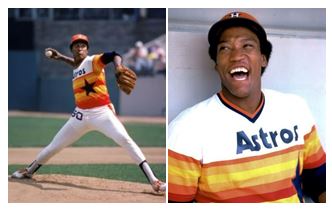
Ketel Marte Homers from Both Batters’ Boxes … and Some Switch Hitter Trivia

Ketel Marte photo

Photo by THE Laura Smith

Yesterday (April 5, 2019), the Diamondback’s Ketel Marte hit a pair of 400-foot+ home runs, as the Arizona squad belted five round trippers while drubbing the Red Sox 15-8. Marte scored two and drove in five in the game.  What BBRT found noteworthy (or post-worthy) was the fact that, for the second time in his five-season career, the switch-hitting infielder hit home runs from both side of the plate in the same game.  That prompted BBRT to look into the roster of players who have gone yard from both batters’ boxes in the same game.

It’s really not as rare an occurrence as you might think.  It’s been done in the regular season a total of 330 times, and by 112 different players.

A LITTLE MORE OF A UNICORN

Only three players have homered from both sides of the plate in a post-season game.

Bernie Williams, Yankees       ALDS Game Three (October 6, 1995

Bernie Williams, Yankees       ALDS Game Four (October 5, 1996)

Chipper Jones, Braves             NLDS Game Four (October 4, 2003)

Milton Bradley, A’s                ALCS Game Two (October 10, 2006)


The first player to homer from both sides of the plate in the same game was Wally Schange of the Philadelphia Athletics on September 8, 1916.

The career record for homering from both sides of the plate in the same game is 14 – shared by Mark Teixeira and Nick Swisher. Leaders among players homering from both side of the plate in the same game:

Mark Teixeira – 14 times

Nick Swisher – 14

Carlos Beltran – 12

Chili Davis – 11

Eddie Murray – 11

Tony Clark- 10

Ken Caminiti – 10

Mickey Mantle – 10

In 1996, the Padres’ Ken Caminiti hit a home run from both sides of the plate in the same game a record four times in a single season – three times in the month of August alone. Note: Caminiti also achieved the feat three times in a single month in September of 1995.

No team has had more instances of a player hitting long balls from both sides of the plate in a game than the Yankees – 56 times.  Here are the perpetrators:

Mickey Mantle (10X)

Mark Teixeira (9X)

Bernie Williams (8X)

Jorge Posada (8X)

Roy White (5X)

Nick Swisher (5X)

Tom Tresh (3X)

Aaron Hicks (2X)

Roy Smalley

Ruben Sierra

Tony Clark

Melky Cabrera

Carlos Beltran

Neil Walker

BIG BOMBS IN THE BIG APPLE

From 1955-1965, a game in which a player homered from both sides of the plate occurred in the AL 14 times, with 13 of those being Yankees (Mickey Mantle 10, Tom Tresh 3).

The only non-Yankee to achieve the feat in the AL during that time span was the Red Sox’ Pumpsie Green (August 15, 1961). Green hit a total of just 13 home runs in his five-season MLB career.  BBRT Note: Green achieved historic significance as the first African-American player for the Boston Red Sox – the last MLB team to break the color line (1959). In the 1955-65 time span, there were only three NL games which saw a player homer from both sides of the plate – two by the Cubs’ Ellis Burton, one by the Dodgers’ Maury Wills.

Only three players have hit home runs from both sides of the plate in the same inning:

  • Carlos Baerga, Indians (April 9, 1993);
  • Mark Bellhorn, Cubs (August 29, 2002);
  • Kendrys Morales, Angels (July 30, 2012).

SHARE IT AROUND

Carlos Beltran and Nick Swisher share the record for hitting a home run from both side of the plate in a single game for the most teams at five:  Beltran – Mets, Cardinals, Royals, Astros, Yankees; Swisher – A’s, Yankees, White Sox, Indians, Braves.


Bonus chart

SWITCH HITTERS WITH AT LEAST 400 CAREER HOME RUNS

         Mickey Mantle            536

         Eddie Murray              504

         Chipper Jones              468

         Carlos Beltran             435

         Mark Teixeira              409


BASEBALL ROUNDTABLE ON THE TOP 100 BASEBALL BLOG LIST

100Baseball Roundtable is on the Feedspot list of the Top 100 Baseball Blogs.  To see the full list, click here.

I tweet baseball @DavidBBRT

Follow/Like Baseball Roundtable’s Facebook Page here.  More baseball commentary; blog post notifications; PRIZES.

Member: Society for American Baseball Research (SABR); The Baseball Reliquary; The Negro Leagues Baseball Museum.

Some Opening Day Musings – 197 Hits, 247 Strikeouts and More

Joe DiMaggio photo

Photo by rchdj10

You always get a special kick on Opening Day, no matter how many you go through. You look forward to it like a birthday party when you’re a kid. You think something wonderful is going to happen,

Joe DiMaggio


At yesterday’s Twin Opener (at home, in Minnesota, in March), something wonderful did happen for all of us who had somehow survived the 2019 Polar Vortex. The sun came out, the temperature climbed to a lofty 49 degrees, the Twins played some baseball that counted – and the home squad came away with a victory!  In this post, BBRT will take a brief look at the Twins opener, as well as recount some of the highlights from Opening Day around MLB.  Note:  BBRT will treat all of yesterday’s games as though they occurred on Opening Day – even though the season actually opened on March 20 in Tokyo. For some thoughts on that, click here. 

2019 Opening Day in Minnesota.

2019 Opening Day in Minnesota.

As the game time approaches, the sun seems a little brighter, the sky a little bluer, the air a little warmer and the grass a shade greener.  Once the game begins, the ball hops off the bat with an especially sharp crack, the pitches seem to have more zip and whir-r-r than ever and the fielders move with a unique combination of grace and energy.  In the stands, the beer is crisp and cold and the hot dogs steam in the cool of early spring.  The fans cheer on their old and new heroes and follow this opening contest with pennant-race intensity – the most intense among them logging each play in the new season’s first scorecard.   Baseball Is Back!

                                                    Baseball Roundtable … March 26, 2013


2019PufferThe 2019 Twins Home Opener drew an officially counted 39,519 hardy fans.  The sky was partly cloudy, with the field occasionally bathed in sunlight and the game time temperature was a brisk (but comfortable) 49 degree.  The Twins, appropriately (for this is Minnesota) gave out Twins-logo-ed “puffer” vests to the first 30,000 through the gates.  I can testify that the give-aways were put to immediate and good use by at least 80 percent of the crowd.

The day featured all the usual Opening Day hoopla – player introductions, the giant on-the-field flag for the national anthem, an F-16 flyover and a first pitch thrown out by fomer Twin and 2006 American League MVP Justin Morneau.

As it is for nearly all Opening Day games, this contest featured what was expected to be a  solid pitching match-up.  The visiting Cleveland Indians sent two-time Cy Young Award winner Corey Kluber to the mound, while the Twins countered with 2018 All Star Jose Berrios. It was clear from the start that neither would disappoint.  Berrios got through the top of the first on just nine pitches (eight strikes), while Kluber was even more efficient – putting down the Twins in order in the bottom of the frame on just seven pitches (six strikes). It was more of the same in the second inning: Berrios – three up-three down on eight pitches (six strikes) and Kluber retiring the Twins in order on six pitches (all strikes).  So after two innings, we had seen a total of 27 pitches, with only four outside the strike zone.

Things didn’t change a whole lot over the course of the game – played in two hours and 18 minutes and featuring just two runs (both by the Twins) on a two-team total of six hits, with two walks, two hit batsmen and 19 strikeouts.

It’s always an honor to pitch Opening Day … It’s exciting.  It’s the beginning of a new season … That being said, I think we have five guys who could have pitched Opening day,”

Corey Kluber.

I should note that Kluber – after getting through four perfect innings on just 30 pitches (25 strikes) – did come down to earth a bit as the game progressed. While he needed just 11 pitches to get out of the fifth, his strike-to-ball ratio was six-to-five – and in the sixth inning,  he needed 15 pitches (eight strikes/seven balls).  In the seventh inning, after collecting just one hit and one walk over six  frames, the Twins finally mounted some offense – all driven by newcomers to the team.  DH Nelson Cruz singled to left. Then, after an Eddie Rosario whiff, 1B C.J. Cron singled to center.  Third baseman Marwin Gonzalez doubled them both home. And, that was the offense for the day.

Kluber pitched seven innings, giving up just two earned runs (four hits, one walk, one HBP and five strikeouts). Berrios lasted 7 2/3, giving up no runs on two hits, one walk and ten strikeouts.  Tyler Rogers came on to get a four-out save for the Twins – striking out  three.   And, the fans went home happy in their cozy “puffer” vests.

_____________________________________________

OPENING DAY AROUND BASEBALL

Another Free-swinging Season?

The 2018 season was the first in MLB history in which there were more strikeouts than base hits.  If Opening Day is any indication, we are headed there again.  Here are a few totals from the day’s 15 games.

Base hits – 197 (13.1 per game)

Strikeouts – 247 (16.5 per game)

Home Runs – 48 (3.7 per game)

Total runs scored – 124 (93 by winning teams, 33 by those on the losing side).

The most popular score of the day was 2-0, with four games ending by that tally (Twins over Indians; Mets over Nationals; Tigers over Blue Jays; Padres over Giants). There was a fifth shutout, as the A’s topped the Angels 4-0.

The most runs scored by any team on the day were 12, by three teams: Cubs over Rangers 12-4; Mariners over Red Sox 12-4; and Dodgers over Diamondbacks 12-5.

AN OPENING DAY RECORD FOR HOME RUNS – DEPENDS ON HOW YOU LOOK AT IT.

It was reported that a record 48 home runs were hit on Opening Day – the old record was 46.  For BBRT, it kind of depends on how you look at it.  Seven of those round trippers were hit by the Mariners and A’s – who had already opened the season March 30 in Tokyo.  Maybe an asterisk is in order?  Still, while all 48 homers were not hit by players in their team’s opening game, since neither the Mariners’ nor the A’s pitchers gave up a home run yesterday, all the home runs surrendered were by pitchers pitching in their teams opening game.  I guess that clears that up.

Dodgers set Opening Day Dinger Mark

The Dodgers topped the Diamondbacks (in LA) on Opening Day by a 12-5 score.  In the process, the Dodgers smacked an Opening Day single-team home run record with eight long balls. Joc Pederson and Enrique Hernandez each went deep twice, while Corey Seager, Max Muncy, Cody Bellinger and Austin Barnes added one apiece.

In Honor of the Final Four – A Baseball Double Double

For just the second time in MLB history, both starting pitchers in an Opening Day game notched double-digit strikeouts. Of course, it should be no surprise, they were the 2018 National League Cy Young Award winner (Jacob deGrom) and a three-time CYA winner and 2018 runner-up (Max Scherzer).

As the Mets topped the Nationals 2-0, deGrom got the win – going six scoreless innings, with five hits, one walk and ten whiffs. Scherzer took the loss, despite giving up just two hits (and two earned runs) in 7 2/3 frames, with three walks and 12 strikeouts.

The other time it two Opening Day starters fanned ten or more in the same game?  April 7, 1970, when Orioles bested the Indians 8-2 in Cleveland.  Orioles’ starter Dave McNally went the distance, giving up two runs on four hits, with three walks and 13 strikeouts.  Cleveland starter Sam McDowell went 6 1/3 innings before walking the bases loaded with one out in the seventh.  In his 6 1/3 frames, McDowell (who took the loss) was credited with giving up three earned runs on three hits, with five walks and eleven strikeouts.

Another Reason Why I Don’t Like the DH

When Brewers’ starting pitcher Jhoulys Chacin  popped a solo home run off Cardinals’ starter Miles Mikolas with two out in the bottom of the fifth, he joined some good company,  He adds his name to a short list of active pitchers with opening Day homers – Madison Bumgarner (two in 2017) and Clayton Kershaw (2013).  It proved to be an important homer, as it gave the Brew Crew a 5-3 lead and they held on for a 5-4 win.

Tim Beckham Takes Chris Sale Deep Twice – and That’s a Real Surprise

The Mariners’ Tim Beckham could not have been too happy to see Chris Sale on the mound on Opening Day.  Beckham was zero-for-fifteen in his career against Sale, with nine strikeouts (no walks). The nine whiffs were his most against any pitcher (he has also fanned nine times against Mark Estrada).   What happened on Opening Day?  Beckham took Sale deep twice – going two-for-five and plating three runs.  By the way, the two round trippers ties for the most long balls Beckham has hit against any hurler (he has hit a pair of career home runs against seven different pitchers).

Like Father – Like Son

Fernando Tatis, Jr. – starting at shortstop fort the San Diego Padres – singled in his first MLB at bat (off Madison Bumgarner of the Giants). The hit came in the bottom of the seventh and was one of two singles he would get in the game – won by the Padres 2-0.

His father, Fernando Tatis made his debut for the Texas Rangers – starting at 3B (against the White Sox) on July 26, 1997. He also began His MLB career with a single in his first at bat.

Primary Resources:  Baseball-Reference.com; MLB.com

FOR LINKS TO BASEBALL ROUNDTABLE’S 2019 PENNANT RACE AND MAJOR AWARDS PREDICTIONS, CLICK HERE. 

BASEBALL ROUNDTABLE ON THE TOP 100 BASEBALL BLOG LIST

100Baseball Roundtable is on the Feedspot list of the Top 1oo Baseball Blogs.  To see the full list, click here.

I tweet baseball @DavidBBRT

Follow/Like Baseball Roundtable’s Facebook Page here.  More baseball commentary; blog post notifications; PRIZES.

Member: Society for American Baseball Research (SABR); The Baseball Reliquary; The Negro Leagues Baseball Museum.
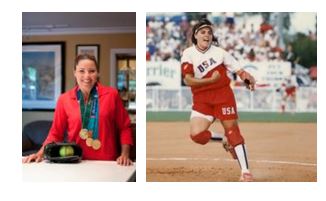
BASEBALL ROUNDTABLE LOOKS AT NEW TWINS CONCESSIONS – UNIQUE FOOD ITEMS AT OTHER BALL PARKS – AND MORE

Photo: Bob King

Photo: Bob King

A frozen treat with Bailey’s, Kahlua and Vodka – served in a cold fudge-coated cup with chocolate shavings.  Ballpark food?  It is now!  It’s the Mud Slide, one of the new food and beverage offerings being served at Target Field during the coming (it’s almost here) season. Served at the Town Ball Tavern and the Delta Sky 360 Club.  Price: $17.00


This afternoon (March 24), Baseball Roundtable again took part in what is now a rite of spring for me – the Twins’ Annual Food and Beverage Preview. Sponsored by the Minnesota Twins and Delaware North  (the team’s exclusive food and beverage partner), this was the tenth annual showcase and taste-fest of the upcoming season’s new Target Field food and beverage offerings.  If I had to describe the event, and Minnesotans will understand this, it’s a bit like the State Fair, only in a ball park.  In this post, we’ll take a look at some of the new Target Field concessions, as well as a few from other stadiums that BBRT found of interest.

Raising the Bar

When I first began attending MLB games, standard fare consisted of hot dogs, beer and soda.  Flavorful condiments could be counted on two fingers – ketchup and mustard (sometimes artfully applied). If you wanted to go a step further, there were peanuts, popcorn, Cracker Jack®, licorice ropes and ice cream (usually frozen malt cups, where you risked splinters working with a very flat wooden spoon).  When pizza, bratwurst and burgers arrived on the scene, many of us thought baseball’s culinary landscape was complete.

The 2019 Target Field Food and Beverage Preview again brought home how wrong we were – and how committed the Twins are to continually raising the ballpark food and beverage bar – or as Twins President David St. Peter put is “re-imagining” the food and beverage experience.

Now, I have neither the space, nor the time, to touch on all the new food and beverage items that were unveiled this afternoon. (They ranged from Grown-Up Grilled Cheese to a chance to create your own Soul Food Experience to a Chicken and Bacon Waffle Cone.)  I would like to share a comment or two on some of the new food items my photographer (Bob King) and I found especially tasty, interesting or both.   Note:  Keeping in mind that prices and offerings can change, for a detailed, up-to-date look at Twins concessions (old and new), click here.   I would expect it soon. Also, at the end of this post, you will find a description of a handful of top new food items from other ballparks.

The Obligatory Target Field Bloody Mary – Tossed a Curve

Hrbek’s Pub 

Mimosa

Target Field has a reputation for signature Bloody Marys – offered at Hrbek’s Pub, near section 114.  In the past, we have seen such concoctions as the Brunch Bloody Mary, the Cluck and Moo Bloody Mary and the Bigger Better Burger Bloody Mary.

This year, the Twins threw us a curve, with the “Mimosa Mary.”  It’s a  tangy and refreshing mixture of fruit and vegetable juices (predominantly orange), mandarin vodka and champagne. Served with skewer of fruit, it seemed a pretty healthy way to enjoy an adult beverage.  Price: $16.00

Photo: Bob King.

_____________________________________________

Now to the food.  Bacon has produced a few hits at the ballpark.  Here are two new bacon-centric Target Field options for 2019.

Peanut Butter n’ Jelly Candied Bacon Sandwich – Elvis Would be Proud

Craft Sandwiches – Section 114

PBJServed on grilled sourdough bread, this treat features peanut butter, strawberry jelly and candied bacon.

This simultaneously crunchy, gooey, meaty and sweet sandwich was a favorite of both Bob’s and mine – and of several other “tasters” I talked to.  Craft Sandwiches also offers a Philly Cheese Steak and Grown-Up Grilled Cheese.   But, why be a grown-up when there’s peanut butter, jelly and bacon on the menu?  BBRT Tip: Have a beverage near at hand.  Price : $10.00


Photo: Bob King.

Bollywood Smash Salad – A Healthy Delight

Roots for the Home Team – Section 101

SaladA tasty and refreshing offering, with roasted cauliflower and chickpeas, tossed with sorghum, mint, raisins and bok choy slaw – then topped with sunflower seeds and served with mango vinaigrette dressing.  It delivers healthy veggies in a combination of sweet (raisins and mango) and nutty (sorghum and sunflower seeds) flavors.  Bob noted, “I’m a committed carnivore and I’d order this.”  Another new offering from Roots for the Home Team is the Northside Fresh Salad (black-eyed peas, sweet potatoes, tomatoes, cucumbers, bell peppers, Brussel Sprouts, serrano pepper and currants – topped off with crispy wontons and pepitas in avocado-lime dressing.) This one has a little more “zip” and is a little less sweet.   Note: Roots for the Home Team partners with youth garden programs in the Twin Cities to give multicultural teens the opportunity to develop business and entrepreneurial skills.

Photo: Bob King

LegacyfoodIn addition to introducing new foods, the Twins honored Legacy Brands that have been part of the ball park experience for ten years – The Loon Cafe, Murray’s (steak house) and Kramarczuk Sausage Company.  We all got to enjoy the Loon Cafe’s chili, a classic Murray’s steak sandwich and a Kramarczuk sausage sampler.

Photo: Bob King

Chicken, Bacon and Waffle Cone – In a cone, but worthy of a stick.

Section 109 & 311 Grills

Chicken BaconPut this one on a stick and you are immediately transported to the fried food decadence that is the Minnesota State Fair. It’s a combination of chicken tenders, thick bacon and maple syrup – served in a waffle cone.  Rich, but very tasty.  The BBRT tip:  Make sure each bite you take includes a bit of chicken, a bit of bacon and a bit of waffle.  It’s the combination that makes this work – kind of like a smooth 6-4-3 double play. Price: $10.50


Photo: Bob King

The Boomstick – A New Take on a Long-Standing Tradition

Section 127

Photo: Bob King

Photo: Bob King

Nothing says a meal at the ballpark more than a hot dog – and the Twins are offering something that is, indeed, more than a hot dog. It’s the Boomstick – in honor of new power hitter Nelson “Boomstick” Cruz. (Cruz has hit 360 career boomers.)

This is an almost baseball bat-sized hot dog – two-feet long – smothered in chili, nacho cheese, grilled onions and jalapenos.  A sunny day, a cold beer, a scorecard and a Boomstick and you are ready for some baseball! You mighty want to add some mustard for old times’ sake. Price: $27.00.


Soul Bowl – Create Your Own Version of Minnesota Soul

Section 120

Photo: Bob King

Photo: Bob King

Chef Gerard Kass is putting a new spin on the soul food of his childhood – presenting it in a flavorful, healthy and eye-catching way.  And, he’s even letting you personalize your Soul Food Experience.  Create a combination that suits your soul, using  such ingredients as: Shaggy Yellow Rice; JR Jong Jerk Chicken; Rick Ross Smoked Mushrooms; Sade Sweet Corn; Biggie BBQ Braised Beef; #MPLS Mac & Cheese; and Jill Scott Greens.  Price:  $10.00 – $14.00


Shareable Boards 

Bat & Barrel

Barrio Taco Board Photo: Bob King

Barrio Taco Board
Photo: Bob King

Target Field’s Bat & Barrel is offering a trio of “shareable boards” to make your group’s ball park experience special.  These boards are brought to your table, creating a meal you and your family and  friends assemble to your own taste. They include:

Barrio Taco Board: 12 flour tortillas; Barbacoa Adobo Chicken; habanero pickled onions;  chopped onions; lime wedges; cilantro; shredded lettuce; sour cream; Ancho salsa; avocado tomatillo salsa; quesa fresco. Price: $45.00

ROWDYDOW BBQ Board: Chopped smoked brisket; pulled smoked pork; 12 King’s Hawaiian rolls; homemade bourbon pickles; fired onions; cole slaw; slow-cooked pinto bean; and homemade BBQ sauce.  Price: $42.00

Athena “It’s Greek To Me” Board: chicken souvlaki skewers; Htipita feta spread; Tzatziki  yogurt blend; pepperoncini; Kalamata olives; cucumber; a variety of fruits and vegetables; pistachios; herbs; and pita bread. Price: $42.00

______________________________________________________

Now, how about a few new items from other ball parks?

TOP NEW ITEM – THE “Fowl Pole” at Globe Life Park in Arlington (Rangers)

Fopwl PoleTexans take pride in doing things in a “big” way – and the New “Fowl Pole” sandwich is no exception. What we are talking about here is a is a two-pound (yes, I said/wrote two-pound) chicken tender  (it take four or five chicken breasts rolled, baked and fried to make this poultry log). The treat is served on a bed of waffle fries, with a choice of sauces (barbecue, honey and ranch) Price $27.50.  Photo: Delaware North.

MY FAVORITE NEW HOT DOG … and one honorable mention

Going Yard – Dodger Stadium (Dodgers)

Going YardThe Dodgers have captured my heart and appetite with their new “Going Yard” offering – previously offered only during the post-season.  This beauty has all the tastes I love – a 16 ½-inch jalapeno-cheddar sausage, topped with grilled onions, roasted corn, an avocado relish and sour cream.


Coney Dog Egg Roll – Comerica Park (Tigers), Honorable Mention

Coney Dog Egg RollA new twist on an old ballpark favorite.  The Tigers are offering a hot dog, inside an egg roll, topped with mustard and diced onions. Maybe add a little soy sauce?


Photo: Delaware North

A LITTLE SALAD PERHAPS – PNC Park (Pirates)

Photo: Aramark

Photo: Aramark

A tasty salad – that is as pretty as a picture and combines  sweet and tart: Red Quinoa, heart of palm, spinach, blueberries, cucumbers, carrots, sunflower seeds and balsamic dressing. Just $10, by the way.


How ABOUT DESSERT?

Funnel Cake Poutine – Rogers Centre (Blue Jays)

As sweet as it gets.  Funnel cake fries, ice cream, chocolate, caramel and marshmallow.

Funnel2


Photo: Aramark


____________________________________

THE  MINNESOTA TWINS GATE 34 EXPERIENCE

Gate34This week, the Minnesota Twins are unveiling a new way to get into the ball park – “The Gate 34 Experience.”  Focusing on one of Target Field’s busiest entrances (often referred to as the “front door” of the ball park), the improvements are aimed at enhancing accessibility and convenience for fans entering the park (for example, a new dedicated wheel chair lane and a canopy to shelter fans from the elements as security checks and ticket scanning are completed.)

But there is much more to the improvements, including elements designed to create not just an entrance, but an experience. There is a 5,100-square-foot open area that features a variety of outdoor games, as well as ever-changing, pop-up shopping for fans.  If the media preview is any indication, on a given day fans in the area could find everything from cotton candy to cookies and blankets to bow ties.  The days we visited the Gate 34 Experience, food vendors included Spinning Wild (cotton candy); Dearest Baker Macaroons; Thumbs Cookies; Hip Hop Gourmet Popcorn; Zamboni’s Pizza & Pub; Smack Shack (seafood); and the Breaking Bread Café.  Retail vendors on hand included: Through Jimmy Eye’s; Faribault Woolen Mill; and artist Adam Turman.

Gate 34 Curator Mich Berthiaume noted that the vendors will change with each series, keeping the fan experience fresh.  “We’re targeting Start Up Brands, Heritage Brands and Give-Back Brands.”

Pete Spike, General Manager of Delaware North Sports Service, Target Field, said the food offerings will  also be diverse (and changing) – noting that the Gate 34 Experience will offer new opportunities for local vendors not in a position to commit to an 81-game Twins schedule, while also expanding food and shopping opportunities to fans.


FOR LINKS TO BASEBALL ROUNDTABLE’S 2019 PENNANT RACE AND MAJOR AWARDS PREDICTIONS, CLICK HERE. 

BASEBALL ROUNDTABLE ON THE TOP 100 BASEBALL BLOG LIST

100Baseball Roundtable is on the Feedspot list of the Top 1oo Baseball Blogs.  To see the full list, click here.

I tweet baseball @DavidBBRT

Follow/Like Baseball Roundtable’s Facebook Page here.  More baseball commentary; blog post notifications; PRIZES.

Member: Society for American Baseball Research (SABR); The Baseball Reliquary; The Negro Leagues Baseball Museum.
Baseball Roundtable 2019 Prediction Week – Day Seven – MVP, CYA, ROY

BBRT’s 2019 Preview Week continues with our final Day (Day Seven) and predictions for the major MLB awards.   Keep in mind, these are just BBRT’s opinions and conjecture – not the result of any inside insight or info.  If you are interested in the standing prediction and a look into each teams lineup, rotation and bullpen, see the links below.

For the  NL East Preview, click here.

For the NL Central, click here. 

For the NL West, click here.

For the AL East, click here.

For the AL Central, click here.

For the AL West, click here.

Now, for those award predictions.

NATIONAL LEAGUE

MOST VALUABLE PLAYER – Paul Goldschmidt, 1B, Cardinals

Paul Goldschmidt photo

Photo by Keith Allison

Goldschmidt – an All Star in each of the last six seasons – is pretty much a lock for a .290-30-100 season (and could do even better).  His bat (a four-time Silver Slugger) changes the whole Cardinal lineup and his glove (a four-time Gold Glover) bolsters the Redbird defense.  An extra bonus, Goldschmidt –unlike many corner infielders – can steal you a base (a high of 32 steals in 2016). He leads the Cardinals back to the post-season and wins the MVP Award.

2. Nolan Arenado, 3B, Rockies

Like Goldschmidt, Arenado brings lumber and leather to the ballpark. In six seasons, the four -time All Star has three home run titles, two RBI titles, four Silver Slugger Awards and five Gold Gloves at the hot corner.  If the Rockies make a run at the Dodgers, Arenado will be in the middle of the action – and the MVP voting.

3. Anthony Rendon, 3B, Nationals

Some needs to step up with Bryce Harper gone – a .300-30-100 season from Rendon wouldn’t surprise.

CY YOUNG AWARD – Max Scherzer, Nationals

Max Scherzer photo

Photo by apardavila

Hard to pick against a guy who has led his league in wins in four of the last six seasons, in strikeouts the last three seasons and has been an All Star every season since 2013.   Scherzer was 18-7, 2.53 with 300 whiffs in 2018. He should be in that neighborhood again.

  1. Aaron Nola, Phillies

Nola came into his own in 2018 – going 17-6, 2.37, notching 224 strikeouts in 212 1/3 innings and finishing third in the Cy Young voting.  In 2019, he’ll be pitching for a much-improved Phillies’ squad.  If they are in the hunt, Nola will be a big part of it.

  1. Noah Syndergaard, Mets

Syndergaard was 13-4, 3.03 in 2018 – a season in which he missed considerable time with a finger injury and “Hand, foot and Mouth Disease.”  I think the 26-year-old is ready to break out in 2019.  And, how can you pass on a guy who can come down with an old school ailment like HF&M Disease.

ROOKIE OF THE YEAR – Peter Alonso, 1B, Mets

The Mets’ top prospect – 24-year-old Peter Alonso – at 6’3” and 245 pounds –  is a big man in the batter’s box.  He proved it in 2018, going .285-36-119 in 132 games at Double A and Triple – and then adding six home runs and 27 RBI in 27 Arizona Fall League games.  He’s ready.

  1. Victor Robles, OF, Nationals

The 22-year-old Robles had a taste of the big leagues in 2017 and 2018, going .277-3-10 in 34 games. At 22, he already has five minor league seasons under his belt (.300-28-155, with 129 steals in 385 games). If you’ve been watching the news, there is a spot open in the Nationals’ outfield.

______________________________________________

AMERICAN LEAGUE

MOST VALUABLE PLAYER – Mookie Betts, OF, Red Sox

Mookie Betts photo

Photo by Keith Allison

Tough to pick a repeat, but Betts is just 26-years-old and does it all. In five seasons, he is a three-time All Star, a three-time Gold Glover, a two-time Silver Slugger and (of course) the 2018 AL batting champion and Most Valuable Player. Last season, he went .346-32- 80, with thirty steals.  I could see another 30-30 season and a repeat MVP Award.

  1. Mike Trout, OF, Angels

How can you not put Mike Trout on this list? In seven full MLB seasons, he has been the AL MVP twice, finished second four times and fourth once.  Odds are he finishes somewhere in the top three.  He’s also a seven-time All Star, has led his league in runs three times, RBI once and stolen bases once.  He carries a .307 career average, with 240 homers and 189 steals into the 2019 season.  He’ll be in the running again.  (If only he had a better supporting case in Los Angeles).

  1. Justin Verlander, SP, Astros

The Astros lost three-fifth of their 2018 dominant starting rotation to free agency or Tommy John surgery. Justin Verlander will be critical to their ability to weather that storm.  I think the seven-time All Star has an outside chance to repeat his 2011 accomplishment of winning the Cy Young Award and the MVP Award in the same season.  In 2018, he was 16-9, 2.52, with 290 strikeouts in 214 innings.

CY YOUNG AWARD – Justin  Verlander

Verlander Astros photo

Photo by Keith Allison

See the description in the MVP predictions.

  1. Chris Sale, Red Sox

After winning 17 games in 2016 and 2017, Sale missed more than a month of 2018 (shoulder issues) and still went 12-4, 2.11 with 237 whiffs in 158 innings.  A healthy Sales should be right near, if not at, the top of the CYA balloting.

3. Trevor Bauer, Indians

I could easily have put Corey Kluber or Carlos Carrasco in this spot, but I just think it’s Bauer’s year to shine in Cleveland. Last season, he went 12-6, 2.21 with 221 strikeouts in 175 1/3 innings.

ROOKIE OF THE YEAR – Vladimir Guerrero, Jr., 3B, Blue Jays

Okay, I’ll ump on the bandwagon and put Vlad Jr, at the top of this list. Let’s face it, the 20-year-old with great baseball genes has got nothing left to prove in the minors. In three minor-league seasons, Guerrero is .331-41-200 in 276 games –  including .336-6-16 in 30 games at Triple A last season.  And, of course, the Blue Jays need help.

  1. Elroy Jimenez, OF, White Sox

As the White Sox work to build for the future, Elroy Jimenez looks like a pretty good bet to get ample time with the big club. The 22-year-old is .311-65-281 in five minor league seasons and, in 2018, went .355-12-33 in 55 games at Triple A.

  1. Yusei Kikuchi, SP, Mariners

An unusual rookie, Kikuchi is a 28-year-old southpaw with considerable experience in Japan, where he went 14-4, 3.08 in 2018.  His last three seasons in Japan saw him go 12-7, 2.58; 16-6, 1.97; and 14-4, 3.08. Kikuchi is said to have a mid-90’s fastball, as well as a workable slider curve and change.  He could make a splash in the Mariners’ rotation.

BASEBALL ROUNDTABLE ON THE TOP 100 BASEBALL BLOG LIST

100Baseball Roundtable is on the Feedspot list of the Top 1oo Baseball Blogs.  To see the full list, click here.

I tweet baseball @DavidBBRT

Follow/Like Baseball Roundtable’s Facebook Page here.  More baseball commentary; blog post notifications; PRIZES.

Member: Society for American Baseball Research (SABR); The Baseball Reliquary; The Negro Leagues Baseball Museum.