Small Samples … But Some Striking MLB Debuts

Yesterday (April 10). a couple of MLB rookies who made their debuts “in the show” this season – Hunter Greene and Steven Kwan opened some eyes across baseball.  In this post, Baseball Roundtable will look at these two players and three others who have made quite a splash in their first 100 hours or so in the MLB pool.

Steven Kwan, outfield, Guardians

The 24-year-old Kwan may be only 5’9’ and 170 pounds, but the left-handed batter has been playing big. Yesterday, in just his third MLB game, he went five-for-five and scored four runs as the Guardians topped the Royals 17-3 in Kansas City.   While Kwan doesn’t show much power, he has shown remarkable ability to make contact – and veteran patience at the plate.  He has  yet to strike out in 14 plate appearances and, in fact, has yet to swing and miss even once  in three games. So far this  season, he is 10-for-14 (a nice round .800 average), with two doubles, four runs scored and three walks. This comes after hitting at a .469 pace in 34 Spring Training plate  appearances (15-for-32, with two walks and no strikeouts).  As for that patience,  in his first MLB game (April 7), Kwan grounded out to short in his first at bat and then (showing none of the expected rookie anxiousness) waited out a pair of walks before tapping a groundball single (on an 0-2 count) in his final at bat of the day.

Kwan was a fifth-round draft choice (2018) out of Oregon State University, where he hit .329 over three seasons (156 games). In three minor-league seasons (217 games), he stroked the ball at a .301 pace – including .328-12-44 in 77 games at Double- and Triple-A last season.

Hunter Greene, RHP, Reds

Photo: Minda Haas Kuhlmann, CC BY 2.0 <https://creativecommons.org/licenses/by/2.0>, via Wikimedia Commons

Hunter Greene picked up his first MLB victory in his first MLB appearance (and start) on April 10. While he gave up three earned runs on four hits and two walks over five innings – he made quite an impression. The 22-year-old right-hander  looks like a flamethrower  at 6’5” and 230 pounds – and he pitches like one, as well.  Greene threw 20 of his 92 pitches at 100 mph or more (a high of 101.6 mph). His fastball averaged 99.7 mph. Perhaps just as important,  he effectively mixed in a slider and changeup and threw first-pitch strikes to 15 of 21 hitters. In his first three MLB innings, Greene faced  just ten batters and fanned six.

Greene garnered plenty of attention as a high schooler, regularly hitting triple-digits with his fastball. (How unfair is that?).  He was the number-two overall pick in the 2017 MLB draft out of  Notre Dame High School in Sherman Oaks, California. In his first full minor-league season (Class A Dayton Dragons), he went 3-7, 4.48, but fanned 89 hitters in 68 1/3 innings (and he was just 18-years-old). He did give the Reds’ brass a scare – needing Tommy John Surgery in 2019.  He came back in 2021 and went 10-8, 3.30 with 139 whiffs in 106 1/3 innings at Double- and Triple-A.

Seiya Suzuki, OF, Cubs

Seiya Suzuki was already a star when the Cubs signed him this March.  At Age 27, he had played nine seasons in Japan and was a five-time All Star – carrying a .315 career average.  Over his most recent three seasons in Japan, his stat lines were : .317-38-88; .300-25-75; and .335-28-87.

In his first three game with the Cubs, Suzuki hit .375 (3-for-8), with four walks (.538 on-base percentage). He has one home run, but – more important – six RBI in three contests.

Jeremy Pena, SS, Astros
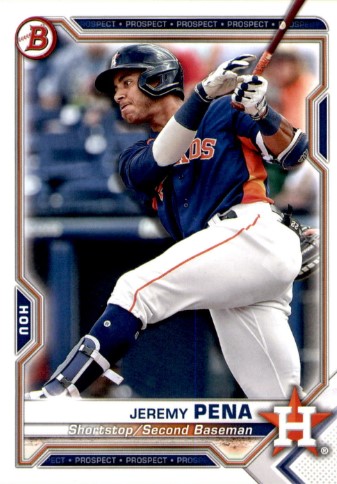
Pena has some big cleats to fill – those of Carlos Correa. He doesn’t seem intimidated so far. After hitting .360-2-9 in eight Spring Training games, he has gone six-for-16 (.375), with two doubles and a home run in his first three games at SS for the Astros; while also showing solid defensive skills and a good arm.

Pena was signed in the 39th round of the 2015 draft out of the University of Maine. In three college seasons,  he hit.305 (163 games) and in three minor-league campaigns, he averaged .291. Pena was injured in Spring Training in 2021 and, last season, played just 30 games at Triple-A – hitting .287 with ten home runs.

As the seventh inning of the Astros’ 13-6 win over the Angels opened on April 8, Cecilia and Geronimo Pena – parents of new Astros’ shortstop Jeremy Pena – were being interviewed on the AppleTV+ live broadcast of the game. At that moment, Pena, leading off the inning, hit the first pitch from the Angels’ Mike Mayers to deep left-center for his first MLB home run – with his parents elated reaction captured for the audience.  Pena ended up three-for-five on the night.

Jhoan Duran, RHP, Twins

Duran made his MLB debut in a tight spot.  In the fifth inning of the Twins’ April 8 opener against the Mariners (in Minnesota), Minnesota’s 24-year-old rookie right-hander (who boasts a triple-digit sinker) was called on to keep the Twins close (in a 2-1 game). In his first six pitches, he gave up a  pair of singles (1B Ty France and LF Jesse Winker) and tossed a wild pitch, putting  runners on first and third with no outs (in a 2-1 game). The Mariners were threatening to break it open. Over his next ten pitches, the rookie (apparently with nerves as cold as ice) put his sinker to work  struck out RF Mitch Haniger, 3B Eugenio Suarez and DH Jarred Kalenic – earning a standing ovation as he walked off the mound. (Duran pitched another scoreless frame, adding a fourth strikeout and walking a batter.)

Duran’s  performance came after a Spring Training in which the 24-year-old pitched in five games (seven  innings) – giving up just one hit and one walk, while fanning ten (o.00 ERA). Duran was signed out the Dominican Republic by the Diamondbacks. In six minor-league seasons, he went 23-29, 3.99, with 80 starts in 82 games. Early returns out of the bullpen look good, particularly with the Twins having traded cloer Taylor Rogers.  Could Duran er a closer-in-waiting?

Primary Resources:  Baseball-reference.com
 

100Baseball Roundtable is on the Feedspot list of the Top 100 Baseball Blogs.  To see the full list, click here.

I tweet baseball @DavidBBRT

Follow/Like Baseball Roundtable’s Facebook Page here.  More baseball commentary; blog post notifications; PRIZES.

Member: Society for American Baseball Research (SABR); Negro Leagues Baseball Museum; The Baseball Reliquary. 


Minnesota Twins New Food for the 2022 Season (and a few from other ballparks)

Today (April 5), Baseball Roundtable again took part in what has become a new rite of spring for me – the Twins’ Annual Food and Beverage Preview. (Sadly, there was a two-year Covid-driven hiatus). Sponsored by the Minnesota Twins and Delaware North (the team’s exclusive food and beverage partner), this annual media event features a look at (and taste of) the upcoming season’s new Target Field food and beverage offerings. If I had to describe the event, it’s a bit like a State Fair Feast in a ball yard.

The Twins Just Keep Raising the Bar

When I first began attending MLB games, standard fare consisted of (not always piping-hot) hot dogs and (not always ice-cold) beer and soda.  For those wanting to step outside the box, there were peanuts, popcorn and Cracker Jack® and, if you were really adventurous, ice cream (usually frozen malt cups with a wooden spoon after taste), licorice ropes or cotton candy.  When pizza and burgers arrived on the scene, we all thought baseball’s culinary landscape was complete.   

The 2022 Target Field Food and Beverage Preview – like those that went before it –  brought home how wrong we were; and how committed the Twins are to continually raising the ballpark food and beverage bar.

_____________________________________

Concessions with Twin Cities Connections

The Twins and Delaware Food Service North are committed to bringing new concessions – with Twin Cities connections – to  Target Field. Yes, you can still get the ballpark “traditionals,” but you can also enjoy unique taste treats from local businesses.

“We are looking to give fans a true taste of the Minneapolis-St. Paul region and be certain we have something for everyone,” Delaware N0rth onsite general manager Pete Spike told our tasting group.

________________________________

Now, I have neither the space, nor the time, to touch on all the new food and beverage items that were unveiled this afternoon, but I would like to share a comment or two on some of the new food items my  taster/photographer (Bob King) and I found especially tasty, interesting or both. Also, at the end of this post, you will find descriptions of a handful of top new food items from other ballparks that I wish I could try.  First, a few of the new Target Field offerings.

Hot Italian Grinder … from Upcycle Foods … Available at “Truly on Deck”

This was the number-one rated new concession item for both Taster Bob and me.  Capicola,  mortadella, ham, salami and provolone – with lettuce, tomato, red onion and zesty mayo –  served on a fresh-baked pretzel bun (made with the spent grains that are a by-product of the beer-brewing process.)  Side note: Upcycle Foods focuses on reducing food waste by using ingredients that might otherwise end up in the waste stream.

Lot of cheese and tender/moist meats in this sandwich, with a dense and tasty bun that held together well.  Taster Bob noted  “A great way to do something nice for the world – and for your taste buds.”

__________

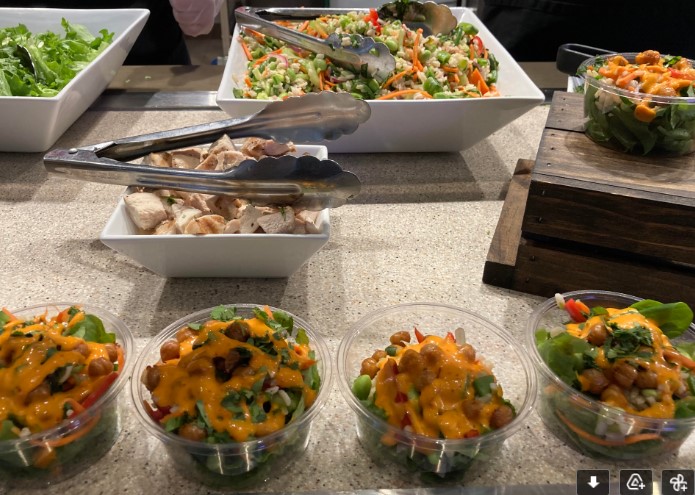
The Legacy Salad … From Roots for the Home Team … Near Section 101

Number-Two on Bob’s list. Three on mine. Brown rice, edamame, pickled vegetables, sugar snap peas, bok choy, chicken (optional) with a Korean chili-mango vinaigrette.  Crisp fresh ingredients, coupled with a chili-mango dressing that perfectly combined hot and sweet.  Bob noted, “I wouldn’t normally expect to order a salad at the ballpark, but this one I would.”  Side note: Roots for the Home Team focuses on serving the development of young people and serving youth-driven specialty salads with ingredients grown and harvested locally. A changing variety of youth-created and chef-mentored salads, usually at Target Field on weekends.

_________

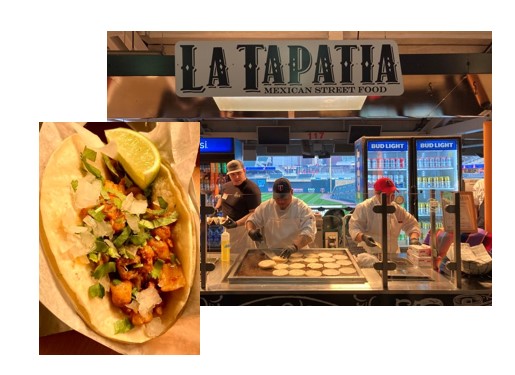
Adobo Chicken Tacos … from La Tapatia … Near Section 109

Number-two on my list. Crisp, tasty Adobo Chicken Tacos, served street- or Cali-style in soft corn tortillas. A hand-held, authentic Mexican-street-food taste treat.

_________

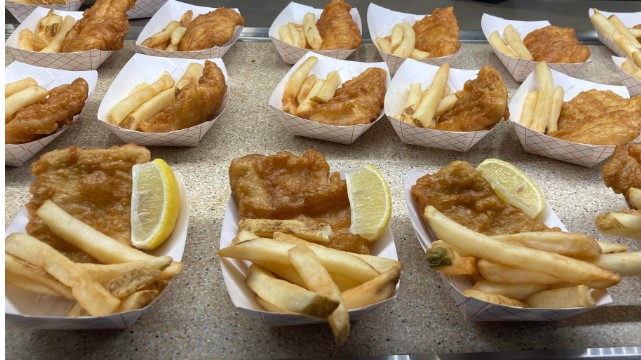
Mac’s Hand-Battered Walleye Filet … from Mac’s Fish … Townball Tavern

Bob’s third favorite. Hand-battered walleye, with fries and a seal-salt and jalapeno-lime tartar sauce. Great walleye, properly breaded.  Bob and I agreed that the spicy tartar sauce made this dish.  It’s Minnesota, gotta luv walleye. 

______________________

Artisan Grilled Cheese … from the Food Building (Mpls.) …  “The Market” near Section 126

This sandwich uses locally produced St. James (Tomme-style) cheese and Blue Earth American Brie, perfectly melted on a thick and hearty artisan bread. If you are into the distinctive flavors of artisan cheeses, this is for you.  I loved it.  Side note: The Food Building is home to Red Table Meat Company; Baker’s Field Flour and Bread; and the Alemar Cheese Company.

__________


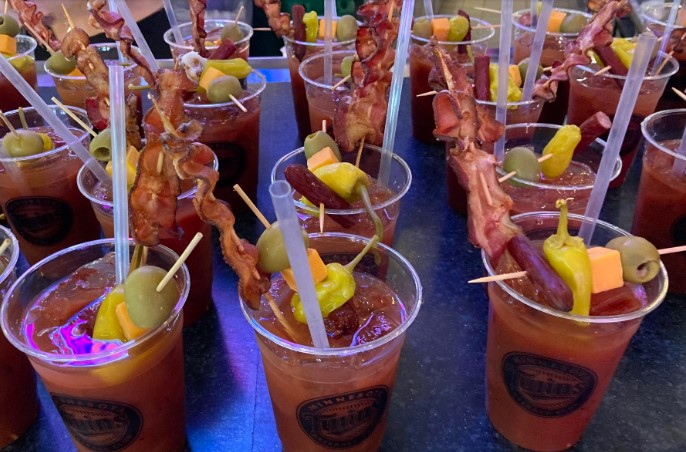
The 2022 Ballpark Bloody Mary – Hrbek’s Pub

Target Field is known for launching signature Bloody Marys – like The Brunch Bloody Mary, The Bigger Better Burger Bloody Mary, The Triple Sausage Sampler Bloody Mary and the College Daze Bloody Mary (there was a slice of pizza in that one).  This year. it’s The Ultimate Bloody Mary – featuring Cloverdale Bacon.  This one has bacon, an olive, cheese, a pepper, a beef stick and a generous pour.

The Summer Bowl … from Soul Bowl … Section 112

New Soul Bowl offerings include The Henry Sandwich (barbeque- braised beef, cole slaw, potato chips and potato roll); Summer Bowl (barbeque-braised beef Cajun corn and The Return of Mac and Cheese). I sampled the Summer Bowl – a great combination of complimentary flavors.

__________

Chicken Tikka … Hot Indian … Section 122

Two new items for Hot Indian: Chicken Tikka (seasoned yogurt-marinated chicken breast, simmered in creamy tomato curry, served with brown rice, crispy pappadum, cilantro and HI Slaw) and Vegan Channa Masala (chickpeas and Indian seasonings in a mild curry, served with brown rice, crispy pappadum and HI Slaw). You can never go wrong with Hot Indian. The Chicken Tikka was delicious – both crisp and moist –  and perfectly seasoned. A word to the wise. Go easy on the optional hot sauce.  It is hot (but also tasty).

_________

The Market … Grab-and-Go at Target Field

Inside Gate Six this season, you will find “The Market” – a new convenient grab-and-go concession experience (including a walk-in beer cooler).

Family-Friendly Prices

In Sections 133 and 327, you will again find stands offering family-friendly prices on such ballpark favorites as hots dogs, soft pretzels, popcorn, peanuts, fountain sodas and canned beer – all under $5.


—AROUND BASEBALL—

Now, lets take a look at some new food items at other stadiums.  Here you’ll find offerings ranging from a pulled pork sandwich topped with Reese’s (R) Peanut Butter Cups to a hot dog topped with pineapple and jalapenos to “Pickle Poutine.” (Not to mention the “Elvis Shake.”)  Thanks Aramark for the photos. 

Oakland Coliseum (A’s)

Flaming Hot Cheesesteak

Chopped steak, Flaming Hot Cheetos, chopped onions, and Cheez Whiz on a Hoagie. 

______________

Citizens Bank Park (Phillies)

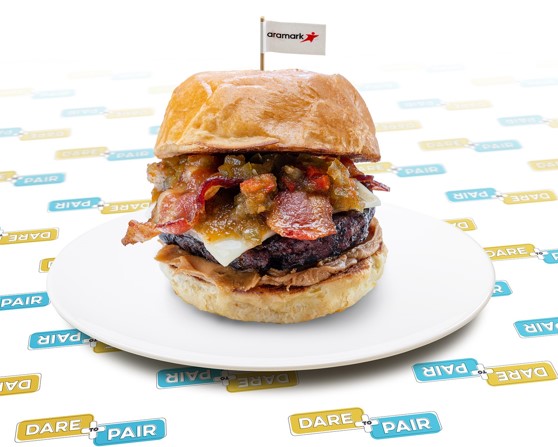
PBJ Burger

 Special-blend Boardwalk Burger topped with peanut butter, jalapeño jelly, American cheese, and bacon on a brioche bun.

__________

Coors Field (Rockies)

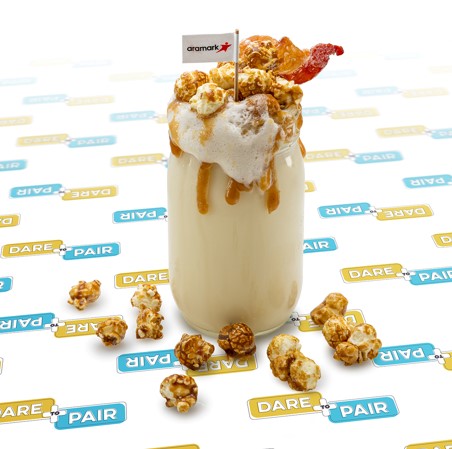
Elvis Shake

Crème de banana, soft serve ice cream, peanut butter sauce, Cracker Jack,  candied bacon. 

__________

Fenway Park (Red Sox)

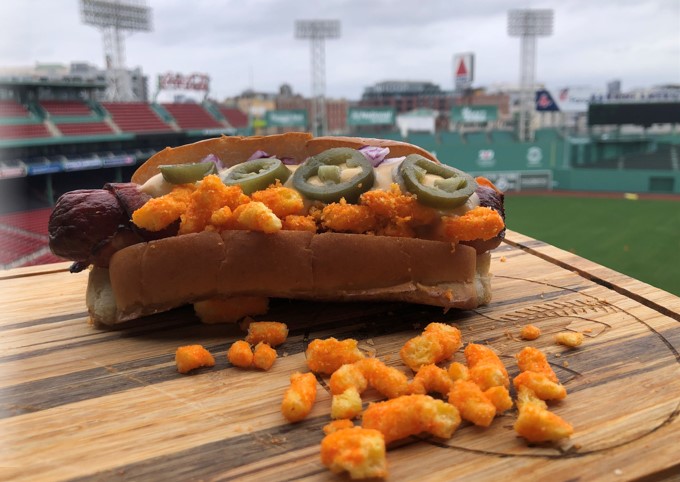
Jalapeño Cheetos Hot Dog

Kayem beef hot dog, semi-crushed Cheetos, nacho cheese, chopped bacon, jalapeños, and diced red onions.

___________________

Kauffman Stadium (Royals)

BBQ Reese’s Sandwich

Pulled pork, Sweet Baby Ray’s BBQ Sauce, REESE’S Peanut Butter Cups, and bacon bits. 

_________

T-Mobile Park (Mariners)

“Holy Moly” Loaded Chips

Crunchy Kettle Chips topped with pulled pork, white queso cheese sauce, drizzled BBQ sauce, citrus coleslaw, and green onions.

___________________

Minute Maid Park (Astros)

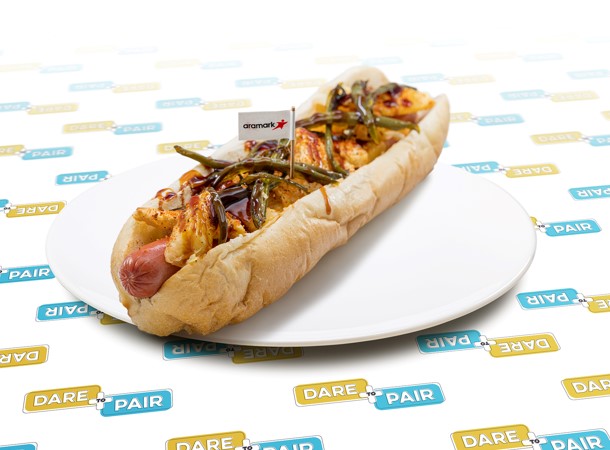
La Pina Dog

All beef hot dog, grilled and topped with fresh smoked pineapple, candied jalapeños, and teriyaki glaze. 

_________


PNC Park (Pirates)

Burgh Katsu

Cucumber kimchi, mini pierogies, bread fried ham, and hoisin aioli on a toasted roll. 

__________

Rogers Centre (Blue Jays)

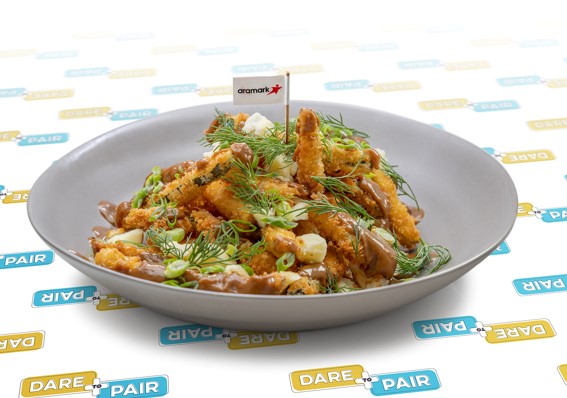
Pickle Poutine

Fried pickle straws, peanut butter gravy, cheese curds, bacon bits, and fresh dill scallions. 

_________

Citi Field (Mets)

Lil’ Chicken & Waffles

Fried chicken, waffles, lemon honey, and maple syrup. 

__________


100Baseball Roundtable is on the Feedspot list of the Top 100 Baseball Blogs.  To see the full list, click here.

I tweet baseball @DavidBBRT

Follow/Like Baseball Roundtable’s Facebook Page here.  More baseball commentary; blog post notifications; PRIZES.

Member: Society for American Baseball Research (SABR); Negro Leagues Baseball Museum; The Baseball Reliquary. 


Baseball Roundtable Fan Concerns Survey

Baseball Roundtable recently sent out a link to a survey soliciting fan opinions on some of the issues facing MLB today … from the length of games to a lack of on-field action to the cost of attendance to the current owners/players financial bargaining. Thirty-nine readers responded and they represented a cross-section in terms of attendance – with the bulk (59 percent) falling in the 1-10 MLB games attended per season categories.

Editors’ Note:  This is a self-selected (as opposed to random) sampling.  Those who responded were both interested enough in the national pastime to seek baseball info and news on the internet and also felt strongly enough to take the time to respond. 

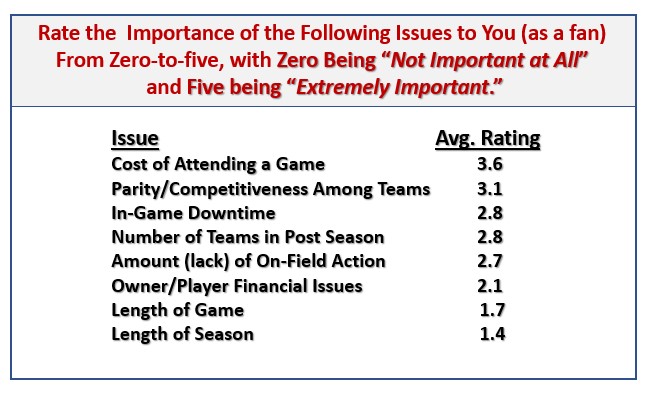
Respondents were asked to rate the importance of several issues on a zero-to-five scale – with zero being  “not important at all” and five being “extremely important.”  Here are the raw results followed by a bit of commentary.

The Number-One issue, with a 3.6 rating was the cost of attending a game (tickets, parking, concessions, etc.) Notably, 41 percent of the respondents rated this at the top of the scale (five-extremely important). This would indicate a need for MLB to examine its financial structure with an eye to its impact of the cost of an afternoon/evening at the ballpark.

Number Two, at 3.1, was parity/competitiveness among teams.  Just over a quarter (25.6 percent) gave this issue a “five” rating.  This topic would relate to such issues as salary caps/floors, MLB draft rules, the luxury tax, etc.

At Number Three (2.8) was in-game downtimeThe most common rating here was “four” – 25.6 percent.  Here, we’re looking at such issues as pitch clocks, making batters stay in the batters’ box, making pitchers remain on the mound, challenges/replays, mound visits, etc.

FAN OPINIONS ON SPECIFIC RULES ISSUES/PROPOSALS

Baseball Roundtable recently did a fan survey on a host of specific rules proposals (more than 200 respondents to that one) – ranging from pitch clocks to infield shifts to robot umpires (and more). For the results of that detailed survey, click here.  

Number Four  (2.8) was the number of teams in the post-season, just slightly behind downtime. The debate here seems to center on balancing the positive impact of having more teams stay “in the hunt” for a post-season spot and having so many team it overly reduces the importance of baseball’s “marathon-not-a-sprint” season. As they negotiate, owners and player need to get this right – and not just in terms of its on-the-surface financial impact.  More post-season games may mean more post-season revenues, but what impact does it have on regular-season attendance (if regular-season games mean less in terms of making it into October).

Number Five was the lack of on-field action at 2.7. Four was the most common response (35.9 percent).  Here we are dealing with possible rules changes aimed at reducing walks and strikeouts (more balls in play), leading to more baserunners (no shifts) and promoting the running game (limiting pick-off throws, bigger bases). Seeing both in-game downtime and lack of on-field action finish notably ahead of length of games, indicates (at least to me) that fans are fine with long afternoons and evenings at the ballpark – if something is happening on the field.

Number Six (2.1) was owner/player financial issues. Notably, here the most common response was zero-not all all important at 28.2 percent. It appears fans find all the dollar-and-cents … my share versus your share …  talk less compelling then a look at the product on the field (and, of course, the cost to the fan).

Bring up the rear at Seven and Eight were length of game (1.7) and length of season (1.4) – again reinforcing the importance of the on-field product (in terms of action and parity/competitiveness).

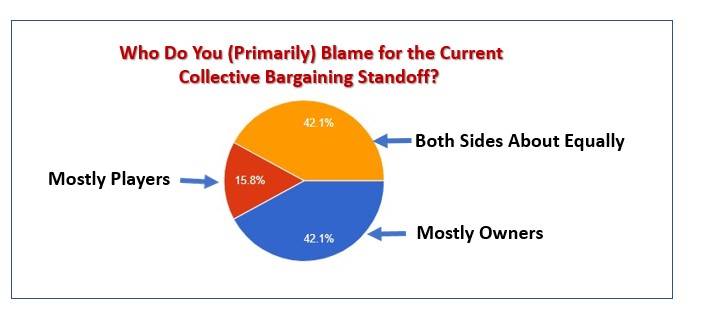
Of course, right now, there is no action on the field.  With that in mind, Baseball Roundtable also asked fans whom they blamed for the current standoff. Owners seem to be getting more blame than players, but more than 40 percent of the respondents did place the blame equally on both sides.

Finally, respondents were asked if they expected their attendance to go up or down in the future. Not surprisingly, given the current CBA negotiations and the prospect of empty ballparks, more than one-third said they expected their attendance to go down (and this follows a response that indicated 48.7 percent had already seen their attendance go down in recent seasons).  But still, just over half of the respondents expected their level of attendance to stay the same.  Some good news for MLB there.

The survey also included an open-ended (write your own answer) question on what would most influence each respondent’s decision to go (or not go) to an MLB game going forward. In order ot the number of mentions, the leading factors were:

1) Cost/price (mentioned more than twice as often as any other issue);

2) Duration/outcome of lockdown;

3) Parity/competitiveness;

4) COVID;

5) Family-friendly atmosphere/safety.

___________________________________________

Finally, here is a representative selection of  written responses from the comments section.

I’ve been more distressed by players and owners taking extreme political stances than by financial issues around the game; not just in baseball but in all sports.

——-

The question on playoffs, I would prefer LESS playoff teams than further expansion. Four teams per league is fine, expanding to 14 or more does not make sense to me, without shortening the regular season.

—–

PLEASE get the games back to two hours. Your popularity will skyrocket….and lower the cost of a family to attend…not just on a Tuesday night/upper deck/D-Backs game. and stop with this changing the rules business. This isn’t the NFL.

—–

The major league game is being played at a very high standard these days, but the owners don’t much care about the fan experience or the minor leagues — they are short-sighted.

—–

Get rid of or modify the shift and offense will go up. Singles, doubles and triples make the game exciting. Home runs are rally killers.

—–

Lets play ball, lets learn to go the other way to beat the shift, lets put the bat on the ball.

—–

And, finally, a condensed version of the most detailed comment provided by a reader.

I’m for:

  • moving the mound back six to eight inches and lowering it to 7.5 inches;
  • two infielders needing to be on each side of second base
  • a pitch clock for pitchers (count a ball for each five seconds over time);
  • hitters not allowed to step out of the batters’ box except as granted by the home plate umpire, and then only once per PA, special exemptions at the umpire’s discretion;
  • in-between innings transitions timed to something TBD as reasonable (60-90 seconds, perhaps?);
  • pitchers required to step off the rubber to throw to any base;
  • all fences made to conform to deeper minimums at four points in each stadium built after 1980, with two exceptions at each team’s discretion;
  • ghost runners added only when a game goes to the 13th inning;
  • a separate replay umpire to make calls in real time (to immediately correct bad calls without a team petitioning for review). This is not for calling balls and strikes; I am also against the robo-ump, and believe that TV strikezone boxes be disallowed.

Once again, for a look Baseball Roundtable’s more detailed survey on specific rules and rules proposals (taht address many of these issues), click here


100Baseball Roundtable is on the Feedspot list of the Top 100 Baseball Blogs.  To see the full list, click here.

I tweet baseball @DavidBBRT

Follow/Like Baseball Roundtable’s Facebook Page here.  More baseball commentary; blog post notifications; PRIZES.

Member: Society for American Baseball Research (SABR); Negro Leagues Baseball Museum; The Baseball Reliquary. 
 

Baseball Roundtable’s All 2021 MLB Debut Lineup

From the Cubs’ Corey Abbott to the Royals’ Angel Zerba and from 20-year-old Wander Franco to 33-year-old Mickey Jannis, 265 players made their MLB debuts in 2021.  In this post, I’d like to present a lineup (by position) of what Baseball Roundtable rates as 2021’s  “best” debut games.  But first, a few  2021 trivia tidbits:

  • 2021 debuts included 164 pitchers and 101 position players (including designated hitters).
  • The Orioles saw the most 2021 MLB debuts at 16, followed by the Angels and Cubs at 15.
  • The Braves and Cardinals saw the fewest debuts at three, followed by the White Sox and A’s at four each.
  • April first (Opening Day) was the earliest 2021  debut date – with nine players making their first major-league appearance on that date.
  • Two players made their debuts on October 3 – the season’s final day.
  • National League Rookie of the Year Jonathon India of the Reds made his debut in 2021; American League Rookie of the Year Randy Arozarena of the Rays made his MLB debut in 2019 (with the Cardinals) and had played 42 regular-season MLB games and 25 post-season games before the 2021 season opened.
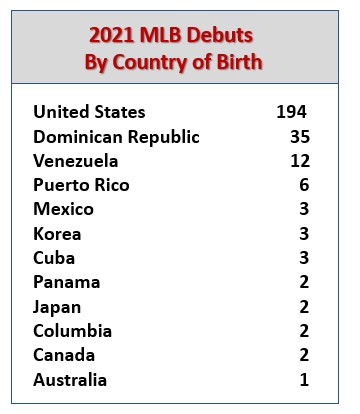
  • Twelve countries were represented among the debut players.

Baseball Roundtable Rates the Top 25 (All-Time) MLB Debuts

For Baseball Roundtable’s rating of the top 25 MLB debuts, click here.  You’ll find players from stars like Willie McCovey (four-for-four with two triples in his debut) to record-setters like Karl Spooner (15 strikeouts in his debut) to lesser-known players like Ray Jansen (with four hits in his only MLB game, which was also his first-ever  professional game at any level).

Now, that All-2021 Debut Lineup.

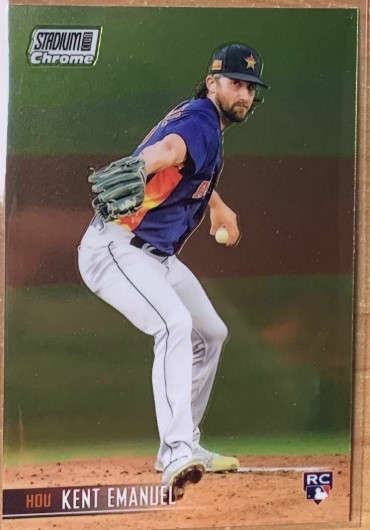
Kent Emanuel, Astros … April 24, 2021

  • 8 2/3 IP, five hits, two earned runs, zero walks, five strikeouts

There were a handful of pitchers whose 2021 MLB debuts deserved consideration. Pirates’ 23-year-old  righty Max Kranick, for example, made his debut on June 27 (starting against the Cardinals) and pitched five perfect innings (three strikeouts), picking up his first MLB win. Or there’s the Rangers 25-year-old right-hander Glenn Otto, who debuted on August 27  – starting against the powerful Astros – and gave up just two hits (no runs) over five innings, while fanning seven.  But, for Baseball Roundtable, the most striking (pun intended) 2021 pitching debut belonged to the Astros’ 29-year-old southpaw Kent Emanuel.

The rookie, who had already spent seven seasons in the minors, settled into the Astros’ bullpen ready to watch Houston starter Jake Odorizzi go to work,  He didn’t get to watch for long.  Odorizzi retired  leadoff hitter David Fletcher on five pitchers, but then had to  had to leave the game with forearm tightness – and suddenly Emanuel found himself heading to an MLB mound for the first time. Emanuel finished the game, tossing 8 2/3 innings, giving up just five hits and two runs (on home runs by Albert Pujols and Shohei Ohtani), walking none and fanning five. He threw 90 pitches, 55 for strikes. Emanuel picked up the win, as the Astros triumphed 16-2.

Emanuel pitched in nine more games for the Astros, before an elbow injury (requiring surgery) ended his season in late May. He never pitched more than two innings in any of those appearances and ended the season at 1-0, 2.55, with a total of 17 2/3 MLB innings on his resume.  In November,  the Astros placed Emanuel on waivers and he was claimed by the Phillies.

Emanuel was drafted in the third round of the 2013 MLB Draft (out of the University of North Carolina, where he had gone 28-10, 2.52 in three seasons).

Kent Emanuel was name Atlantic Coast Conference Pitcher of the ear in 2013.

In seven minor-league seasons – interrupted by 2015 Tommy John surgery,  Emanuel went 35-25, 4.77. In 2019, he was 8-2, 3.90 with the Triple-A Round Rock Express.

———————————————————-

Catcher – Nick Fortes, Marlins … September 18, 2021

  • Two-for-three, one run, two RBI, HR

Nick Fortes was drafted by the Marlins in the fourth round of the 2018 MLB Draft (out of the University of Mississippi, where he had played 126 games over three seasons, going .308-16-82,with 14 stolen bases). In three minor-league campaigns he hit .232-10-84 in 190 games.

He made his MLB debut on September 18, catching and batting seventh for the Marlins (versus the Pirates in  Miami).  In his first at bat (leading off the bottom of the third against the Pirate starter Bryse Wilson), he hit an 0-1 pitch for a groundball single up the middle. He came up against Wilson again in the fifth, with a runner on first, one out and the Marlins trailing 5-0. In that at bat, he hit Wilson’s first offering for a home run to deep left. In his third at bat, he grounded out to short, The Marlins lost the game 6-3,

Fortes got in 14 games for the Marlins in 2022, hitting .290, with four home runs, seven RBI, six runs scored and one stolen  base.

—————————————————-

First Base –  Alfonso Rivas III, Cubs … August 29, 2021

  • Two-for-three, one double

Rivas was drafted by the Oakland Athletics  in the fourth round of the 2018 MLB Draft (out of the University of Arizona, where he hit .323-15-141, with nine steals in 173 games over three seasons). In two minor-league seasons in the Oakland system (183 games), Rivas hit .289-10-88. Then, in January 2020, he was traded to the Cubs.  When called up in 2021, Rivas was hitting .284-4-32 (58 games) for the Iowa Cubs.

In his first MLB game, he was at first base, batting eighth, as the Cubs faced the White Sox. The White Sox’ Dylan Ceases (10-6, 3.92 at the time) started and went six innings (four hits, one run, 11 strikeouts) for the win. Cease retired the first seven Cubs he faced, before Rivas singled up the middle on the first MLB pitch he saw (top of the third). He came up again in the fifth – again facing Cease –  with the Cubs down 3-1, and doubled down the left field line. (Cease showed his “stuff” by fanning the next three Cubs.) In the seventh, Rivas flied out to  center off reliever Ryan Tepera.

In his next four games, Rivas went zer0-for-ten, but he  then hit safely in 11 of his final 13 2021 games, ending the season at .318-1-3 in 18 contests.

____________________________________

Second Base – Jonathan India, Reds … April 1, 2001

  • Two-for-four, one double

Jonathan India was a first-round pick (fifth overall) for the Reds in the 2018 MLB Draft (out of the University of Florida, where he it .310-31-126, with 41 steals  in 194 games over three season).

In 2018, Jonathon India was a first-team All American and the SEC Player of the Year. In that season, he went .350-21-52, with 15 steals in 68 games. 

 In two minor- league seasons, India hit.254-17-67, with 17 steals in 165 games.

The 24-year-old made his first start for the Reds on April 1, 2021,  playing second base and batting seventh against the Cardinals in Cincinnati. It was a less than auspicious start, as the Cardinals’ Jack Flaherty fanned him looking on a 3-2 pitch to end the second inning. India got the better of Flaherty in the fourth inning (with the Reds already down 11-3), doubling to left. India then led off the sixth with a single to left center off reliever Ryan Hensley, before flying out to right in his final at bat of the day (bottom of the seventh.). India got off to a good start overall, with 10 hits (.476 average) and 10 RBI in his first six MLB games.  He ended the season at .269-21-69, with 12 steals and 98 run scored in 150 games – capturing the Rookie of the Year honors.

_________________________________________

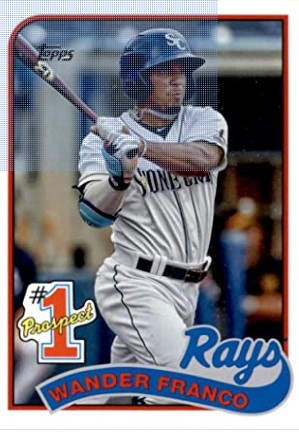
Third Base, Wander Franco, Rays…  June 22, 2021

  • Two-for-four, two runs, three RBI, one double, one home run, one walk

Wander Franco was considered  a top international  prospect when he signed (as a 16-year-old) with the Rays during the 2017 international signing period. He immediately began delivering on his potential with a .351-11-57 season (61 games) at Rookie-Level ball in 2018. In 2019, he hit .327-9-53 at  A and High-A.  In 2021, still just 20-years-old, he was hitting  Triple-A pitching for a .313 average, with seven homers and 35 RBI in 40 games.

The switch-hitting Franco made his first start  for the Rays on June 22, 2021 (batting second and playing third base against the Red Sox) and kept right on raking. In his first MLB plate appearance, he showed great discipline for a 20-year-old, working a six-pitch walk off starter Eduardo Rodriguez (the only walk Rodriguez would surrender in six innings of work). Wander later scored on a single by Francisco Mejia.

Wander worked the count to 3-2 again leading off the third, before flying out to center. Then in the fifth, with the Rays trailing 5-2, he jumped on the first pitch from Rodriguez for a game-tying three-run home run to left. Wander wasn’t done yet, as he doubled to left off reliever Josh Taylor in the seventh. He came up again in the bottom of the ninth needing a triple for the cycle, but grounded out to pitcher Matt Barnes. The Red Sox won in 11 innings by a 9-5 score.

Franco went on to play 70 games for the Rays in 2021 (starting 61 at SS).  He’s at third base here because that was his debut position.  He hit .288, with seven home runs and 39 RBI for the season.  He then went on to hit .368-2-4  in AL Division series (verso Boston).

___________________________________

MLB Debut Extra – A Long Time A’Comin’

Orioles’ pitcher Mickey Jannis, at 33-years-old, was the oldest player to make his MLB debut in 2021. It came on June 23 – in his eleventh professional season.  He came in in the top of the fifth, with the Astros leading the Orioles 6-0 and the number four-five-six hitters coming up.  The knuckleballer fanned the first MLB hitter he ever faced (DH Yordan Alvarez); got SS Carlos Correa on a flyout to right; and walked RF Kyle Tucker (who was erased trying to steal). Unfortunately, things didn’t go as well after that inning, as Jannis gave up seven runs in 3 1/3 innings.  Still, his perseverance did get him to the major-league mound.

Shortstop, Oneil Cruz, Pirates … October 2, 2021

  • Two-for-five, one run, one RBI

Cruz almost didn’t make this lineup.  First, he didn’t get make his MLB debut until the second-to-last game of the Pirates’ season.  Second, Wander Franco might seem like the logical choice here, but the fact that Franco made his debut at third base,  left the shortstop spot open on in this lineup.

Cruz made his MLB debut for the Pirates, playing Shortstop and batting eighth. It came on October 2, 2021. The late-season call up recognized Cruz’ fine 2021 season at Double-A and Triple-A – .310-17-47, with 19 steals in 68 games.

When Oneil Cruz stepped onto the field  on October 2 in Pittsburgh, he – at 6’-7” – became the tallest shortstop to start an MLB game.

In his first MLB at bat, Cruz grounded out to short to end the bottom of the second. He came up again in the fifth, with the Pirates trailing 5-0, with two runners on and no outs. In that plate appearance, he hit an RBI single through the right side of the infield, helping spark a six-run Pirates’ rally. He batted again the inning, striking out. He later added  single in the seventh inning and a strikeout in the eighth. Cruz was in the lineup again for the season finale, going one-for-four and collecting his first MLB home run.

Cruz was signed out of the Dominican Republic by the Dodgers (as a 16-year-old) in July of 2015.   In 2016, he hit .294, with 23 RBI and 11 steals (no home runs) in Rookie-Level ball. Then, in 2017, he was hitting .240-8-36 at A-Level, when the Dodgers traded him to the Pirates (July 31). Cruz has played in five minor-league seasons, hitting .281-49-207, with 60 steals (404 games).

____________________________________________

Left Field, Akil Baddoo, Tigers … April 4, 2021

  • One-for-three, solo home run

Akil Baddoo made his debut playing left field and batting ninth, as the Tigers faced the Indians in Detroit.  His first plate appearance came leading off the bottom of the third inning (Tigers ahead 2-1) and he hit the first MLB pitch he ever saw (from Aaron Civale) for a home run to left field. It was one of only three Tiger hits that afternoon, as Detroit fell 9-2.

“Hitting” the Ground Running

In his first four MLB games, Akil Baddoo went five-for-eleven (.455), with a triple, two home runs and seven RBI.

Badoo finished his rookie MLB season at .259-13-55 in 124 games.  He also had seven triples and was successful on 18 of 22 steal attempts.

Baddoo was signed by the Twins (out of Salem High School in Conyers, GA) in the second round of the 2016 MLB draft. While he struggled as a 17-year old in the Gulf Coast Rookie League (hitting .178 in 38 games), he found his footing the following season, when he hit .323-4-29 in 53 Rookie-Level games. In four minor-league seasons in the Twins’ organization, he hit .249-21-93, with 47 steals (in 233 games).  Baddoo had Tommy John surgery in 2019 (and, of course, did not play in 2020 due to the Corona virus).  The Twins left him available in the Rule Five draft and he went to the Tigers, where a  strong Spring earned him a roster spot.

___________________________________________________

MLB Debut Extra … I Get Around

Luke Williams made his MLB debut for the Phillies, as a pinch hitter, on June 8, 29012 – bunting  for a single to lead off the fifth inning and eventually scoring a run.  That’s not what gets him in as an “Extra” in this post.  What gets him here is that, in his debut MLB season, he appeared (and handled fielding chances) at every position except pitcher and catcher.

_______________________________________

Center Field Jarren Duran, Red Sox … July 17, 2021

  • One- for-two, one run, one walk

Jarren Duran debuted for the Rd Sox, manning center field and batting seventh, as they took on the Yankees and Gerrit Cole in New York. On the very first MLB pitch he saw (from Cole), Duran singled  to deep center – eventually coming around to score on a single by Red Sox’ second baseman Christian Arroyo (scoring the only run in a 3-1 Red Sox loss). Duran also drew a five-pitch walk against Cole, who pitched all six innings of the rain shortened game (Cole gave up five hits, two walks and fanned 11).  So, Duran was on base in two of  three plate appearances versus the Yankee “ace.”

Duran was drafted by the Red Sox in the seventh round of the 2018 MLB Draft (out of Californian State University, Long Beach, where he hit .294-3-66, with 49 steals in 169 games over three seasons). In three minor-league seasons, he hit .307-24-109, with 86 steals in 259 games. In his first MLB season, Duran hit .215-2-10 in 33 games. His MLB season was cut short by an early September positive COVID test. After returning from the COVID list, he was sent down to Triple A.

___________________________________________

Right Field, Kyle Isbel, Royals … April 1, 2021

  • Three-for-five, one run, two RBI

After just two (uneven)  minor-league seasons (.327 average in 2018 & .233 in 2019), Kyle Isbel found himself in the starting lineup (RF, batting seventh) for the Royals (versus Rangers) on Opening Day of the 2021 season. And, he acquitted himself well. In the bottom of the fist inning, he lashed an RBI single to right. He struck out on four pitches leading off the third inning, but came back with a single to left in the fourth. Like his up and down minor-league seasons, he fanned again on four pitches in the fifth, but came back with a run-scoring single in the seventh – giving him a nice three-for-five debut in the Royals’ 14-10 win.

Isbel got in 12 April games for the Royals, hitting .265,with one extra base hit (a triple) and three RBI.  However, he had just two walks versus 15 strikeouts in 36 plate appearances. In late April, Isbel was sent down to the Royals’ alternate training site (and then to Triple-A Omaha, where his .269-15-55 and 22 steals in 105 games earned him another look from the Royals). Called back up in mid-September, he hit .286-1-4 for the Royals in 16 games between September 12 and August 3. His final  line in his first MLB season was .276-1-7 in 28 games.

Isbel was drafted by the Royals in the third round of the 2018 MLB Draft (out of the University of Nevada, where he went .322-21-110 in three seasons (170 games).

In 2016, Kyle Isbel was the Mountain West Conference Co-Freshman of the Year. In  2018, he  earned First-Team All Mountain West Conference recognition.  

____________________________________________

Designated Hitter – Yohei Pozo, Rangers … August 13, 2021

  • Two-for-three, one run, three RBI, one home run

A catcher by trade, Yohei Pozo made his debut for the Rangers as a DH, batting eighth. He had quite a day, knocking in three of the Rangers’ runs in an 8-6 win over the Athletics (in Texas).

He started with a single leading off the bottom of the second. Then, a taste of reality in the big leagues, a three-pitch strikeout in the fourth. He followed that with a three-run home run off veteran Sergio Romo in the sixth and finished with a foul pop up in the seventh.

Pozo ended up the MLB season, hitting .284-1-9 in 21 games.

Pozo was signed by the Rangers (out of Venezuela) as a 16-year-old in 2013.  By age 22 he had six minor-league seasons under his belt (.278-25-192 in 444 games).  Then, in November of 2020, he was signed as a minor-league free agent by the Padres.  The Rangers, however, got him back in the fold a month later in the Rule Five Draft.  It proved to be a good move. Assigned to Triple-A to start the season, Pozo hit .337 with 19 home runs in 66 games to earn his call up to the Rangers. Note: Pozo was sent back down to Triple A in late September.

________________________________________

Debut Post Extra – Show about a Beer?

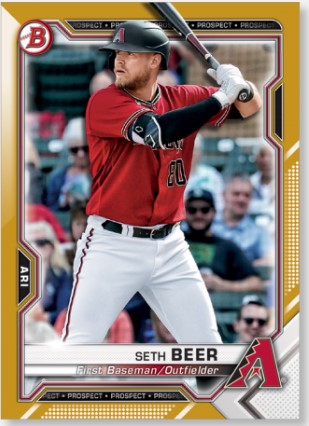
How can you not include the MLB debut of a ballplayer names “Beer?”  There’s jersey I have to have. Seth Beer made his MLB debut as a pinch hitter for the Diamondbacks on September 10, 2021.  And he did it in style.  Beer, In the eighth inning of that contest, in his first MLB plate appearance, stroked a pinch-hit home run to right field off reliever Diego Castillo to pull the Diamondbacks to within one run of the Mariners (4-5, the eventual final score). Seth Beer played in five 2021 games for Seattle, going four-for-nine with four runs scored, one home run and three RBI.  His season was cut short by a shoulder injury (which required surgery).  When called up by the Mariners, Beer was hitting  .287-16-59 (100 games) for the Triple-A Reno Aces.  Baseball Roundtable first wrote about the player with the perfect baseball name back in 2017.  For that post, click here.

Primary Resource:  Baseball-Reference.com

100Baseball Roundtable is on the Feedspot list of the Top 100 Baseball Blogs.  To see the full list, click here.

I tweet baseball @DavidBBRT

Follow/Like Baseball Roundtable’s Facebook Page here.  More baseball commentary; blog post notifications; PRIZES.

Member: Society for American Baseball Research (SABR); Negro Leagues Baseball Museum; The Baseball Reliquary. 
 

From Mound Visits to Replays to Banning the Shift … Baseball Roundtable’s Baseball Rules Survey Results

Baseball Roundtable recently completed a reader survey regarding some of the issues and rules facing major league baseball.  A total of 223 responses were received in the 24 hours the survey (using the Google survey tool) was open – although not all respondents replied to every question.  (Thanks to all of those who responded.  I appreciate your interest, thoughts and participation.)  I’d like to share those responses, as well as a bit of commentary, in this post.  One cautionary note:  The survey group was self-selecting. The fact that the respondents took the time to fill out the somewhat lengthy survey would indicate the group is composed of individuals who follow the game more closely than casual fans.  This is further amplified by the fact that a link to the survey was shared with such online groups as Baseball Fans of America, the Society for American Baseball Research, The Baseball Reliquary and Baseball Fans of America.

NOTE: COMING SOON – RESULTS OF BASEBALL ROUNDTABLE’S

(UNOFFICIAL) FAN HALL OF FAME BALLOT

LENGTH OF GAMES

Notably, respondents were split  on whether MLB games need to be shortened, with 51.6 percent say “No” and 42.5 percent saying “Yes.”

ONE RESPONDENT’S COMMENT

As a lifelong fan, I believe the rule changes to speed up the game (among other results) are based on television viewership and not for the fans who watch live. I have never heard anyone complain about the length of games at a stadium. The complaints I hear there (at the ballpark) are ones involving delays (pitching changes, multiple mound visits, replays) and never about the pace of the actual game. I think the constant tinkering only creates more holes to fix. 

Respondents’ pegged the ideal length of a game at 2 ½ – 3 hours, with 59.5 percent selecting  a response within that time frame (which seem contrary to more than 50 percent saying games do not need to be shortened).  Notably, 31.1 percent selected “However long it takes to have a winner.”

Ideal Length for an MLB Game – Top Five Responses

2 1/2 hours  … 32.4%

However Long it takes to have a winner … 31.1%

3 hours … 14%

2 3/4 hours … 13.1%

2 1/4 hours … 4.1%

Only 1.4 percent picked a specific time over three hours (6.9% picked times of 1 1/2 – 2 hours).

MLB Average Length of Game (Time)

The average game time in 2021 was three hours and 11 minutes. The last time the average was under 3:00 was a decade ago (2011 – 2:56). The last time, it was 2:30 or less was in 1978 (2:30). 

So, what about efforts, in place or being considered/experimented with, to shorten the game?

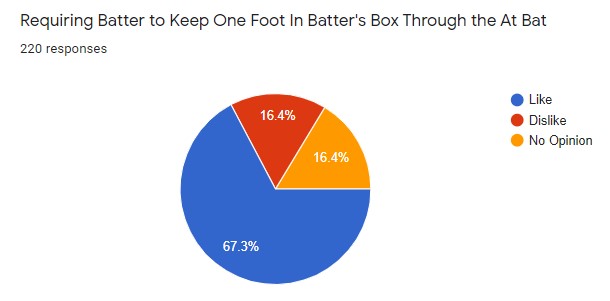
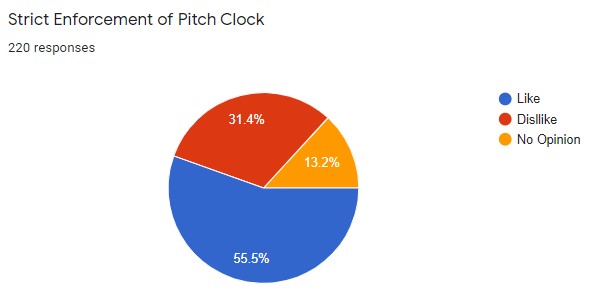
Among the most popular rules/proposals among respondents were: requiring batters to keep one foot in the batter’s box through the plate appearance; strict enforcement of a pitch clock; and limiting mound visits.  There has been a 20-second pitch clock at Double-A and Triple-A since 2015, but baseball is looking at a shorter (15-second),  more strictly enforced, limit).  A personal observation: Despite being “old school,” I’d like to see batters required to keep one foot in the batter’s box (and not wander off to adjust their batting gloves, add pine tar or take a swing or two).  I believe it was Bert Blyleven who said a great way to shorten the game would be to “ban Velcro.”   I’d also be on board with requiring pitchers to remain on the mound between pitches – except for “mound visits.”


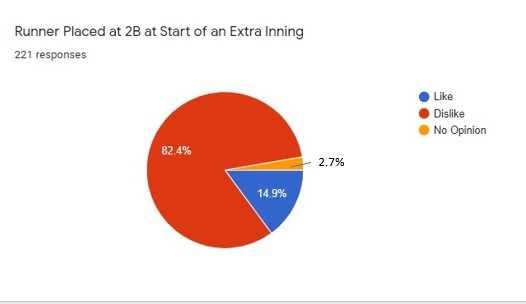
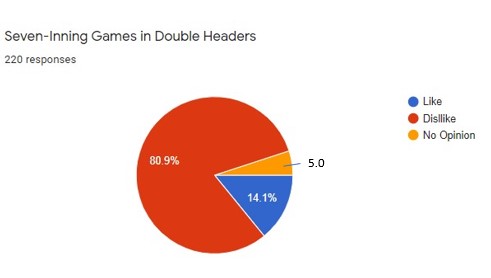
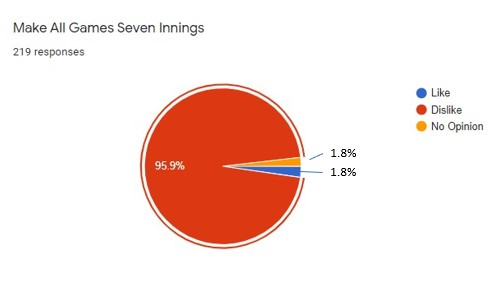
Respondents wanted little to do with seven-inning games; placing a runner at second base at the start of an extra inning; or allowing tie games after a specific number of extra frames. More than 80 percent of respondents disliked each of these.  From Baseball Roundtable’s point of view, shortening games to seven innings would wreak havoc with the game’s history, record book and rule book.  In a seven-inning game, how many innings are needed for a starter’s win? Or, how do you evaluate complete-games pitched records? Is a game “official” after 3 1/2 frames or still 4 1/2?  You get the idea.

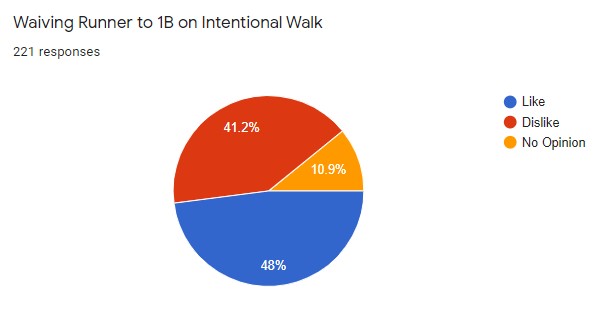
The split was more even on waiving a runner to first on an intentional walk, with 48 percent liking that change and 41.2 percent disliking it.  (Are we just getting used to it?)  Looks like we won’t ever again see a batter reach across the plate and poke an intentional “ball” to left for a double. I can live with it, although it seems a little “slow-pitch softball” for me.

RULE CHANGES AIMED AT REDUCING PITCHING CHANGES

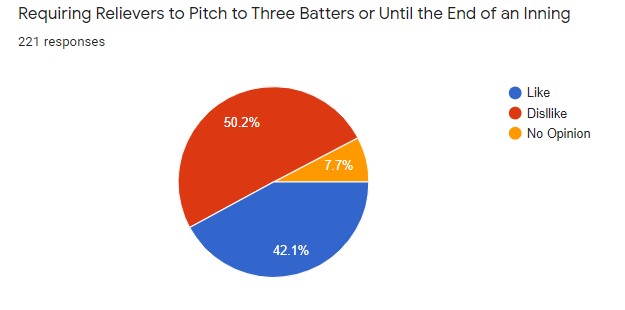
The split on the current MLB rule requiring a reliever (unless injured) to pitch to three batters (or to the end of an inning) was fairly even, with 50.2 percent disliking the rule and 42.1 percent liking it.

One respondent presented an idea for a similar approach to starting pitchers.

RESPONDENT’S COMMENT

Starting pitchers should be required to go five innings minimum unless they reach 100 pitches, allow four or more earned runs, or experience some type of injury.

This may seem a bit extreme, but in reality, it’s not much different in philosophy than the requiring a reliever to face three batters.  It would effectively end “bullpen games.”

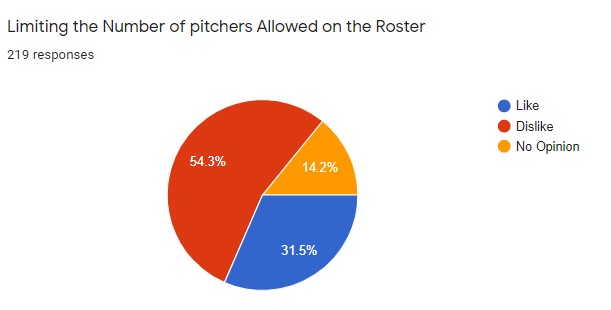
There has also been some discussion of limiting the number of pitchers on an MLB roster.  This, it is reasoned would reduce mound options and, in turn, pitching changes. The opposition outweighed the support on this one.  I sided with the “nays,” a team should be allowed to set up its own roster within the overall player limit. No, I don’t like those games in which we see an “opener” followed by a parade of bullpen arms. But the game is changing and teams should be able to set up rosters and employ pitching strategies they think can best enable them to compete and win.  Still, it’s a change I could live with.

JUICING UP THE RUNNING GAME

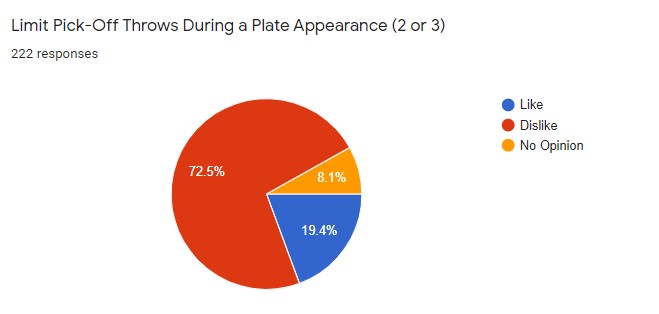
Another rule proposal which has been discussed (and experimented with at the minor-league level) would limit pick off throws during each plate appearance. We’ve all seen those at bats with seven or eight tosses to first base.  Yes, it’s frustrating (although fans only seem to boo the opposing pitcher for such attention to a base runner). I’m for letting the pitcher hold the runner on, which is in line with the 72.5 percent of respondents who disliked this proposal.

There is also some discussion around requiring a pitcher to be completely off the rubber before attempting a pick-off (experimented with in the Atlantic League). The “off the rubber” proposal was liked by 34.2 percent of respondents; disliked by 37.4 percent, with 28.4 percent voicing “no opinion.”  Both of these  proposals are intended to boost the running game – and did seem to have that effect in minor-league trials.

ROBOT UMPIRES/ELECTRONIC STRIKE ZONE

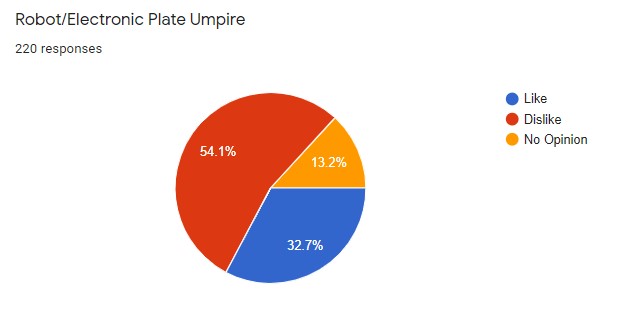
Okay, I’m being really “old school” here.  I like watching a pitcher work to “expand the strike zone.”  I find it an element of the craft of pitching.  So, I’d opposed an electronic strike zone. Just over half of the respondents took that position, but nearly one-third would welcome such a change.  I have a hunch it may be part of MLB’s future … just down the road a bit.

CHALLENGES/REPLAYS

Sticking with umpiring, this one surprised me.  Approximately two-thirds of respondents like the current MLB challenge/replay system.  Notably, they also “disliked” suggestions for limiting replays. For example, 67.1 percent disliked the idea of going back to replays only on fair/foul home run calls and 64.1 percent disliked the idea of allowing replays only at the umpires’ discretion (rather than allowing manager challenges).

RESPONDENT’S COMMENT

Allow only 30 seconds limit for manager to call for a challenge-review. If they are confident it was a bad call, they don’t need to check the replay first to challenge the call.


THE ONGOING  DESIGNATED HITTER DEBATE

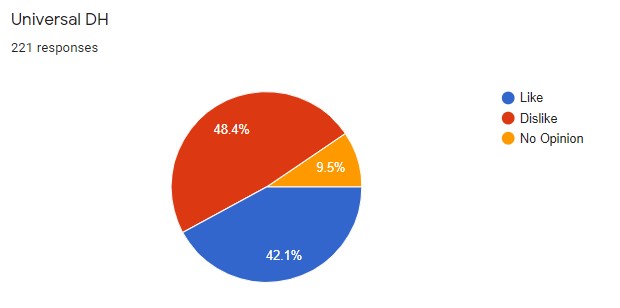
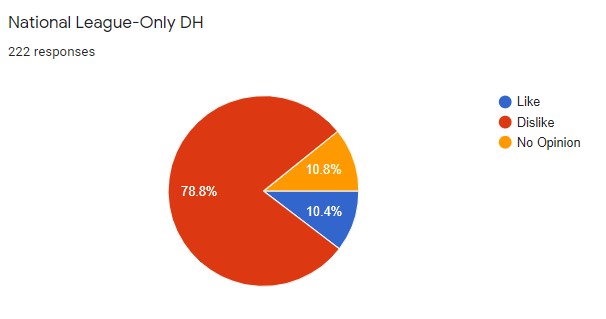
When will it end? The DH remains an ongoing point of contention … with about equal support for the application of designated hitter in both leagues (Universal DH) or the elimination the DH in both leagues.  The key word is both. Respondents just want one system. Only one in ten respondents like the current AL/NL split on this rule. How close was the call on Universal versus No DH?  42.5 percent “liked” No DH; while 42.1 percent “liked” a Universal DH. It appears the biggest mistake MLB can make is to keep the current split.

After this post was initially published, a reader asked for a bit more clarity on the DH issue. In response, I conducted a brief survey (which went to a smaller, but similar – if perhaps a bit more diverse in the depth of their fandom – group) on the issue.  In that effort, respondents had to selected their preferred treatment of the DH.  (rather than comment on all three).

The results were:

Universal DH – 47.6%

Eliminate DH – 26.2%

NL-only DH – 11.9%

No opinion – 14.7%

 INFIELD SHIFTS

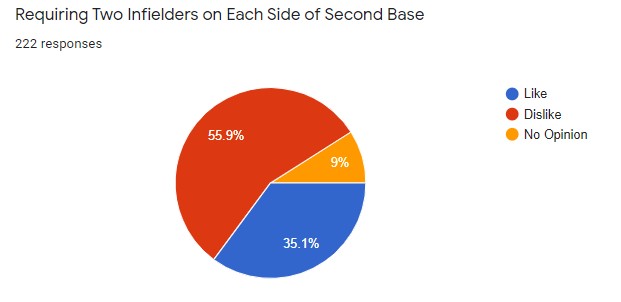
Another surprise here. I expected an overwhelming dislike of the current trend toward infield shifts. Yet, more than half of the respondents did not like the idea of requiring two infielders on each side of second base.  I guess, we’ll have to agree to disagree on this one.


One respondent offered an interesting alternative – allowing the shift on no more than two batters in an inning,  I kind of like that.  It would require manager’s to make strategic decisions on which hitter(s) could effectively be stymied by a shift or in what game situations a shift would have the most positive potential impact.   That would open the door for fan discussion, debate and second-guessing – and I like that.

LACK OF “ACTION”

We hear talk these days about the growth of the “three true results” – strike outs, home runs and walks – taking action out of the game. The Roundtable did ask respondents about these outcomes.  Here’s what they said they’d like to see less of:

Fewer Strikeouts … 51.6%

Fewer Home Runs … 30.2%

Fewer Walks … 25.1%

No Opinion … 34.4%


A FEW MORE RESPONDENTS’ COMMENTS

  • Many problems would be solved (especially too many players grooving swings to hit the ball over everybody, which increases K’s, HR’s and decreases interesting balls in play) by instituting the rule of two infielders, playing on dirt or INFIELD grass on either side of second base.
  • Radical suggestion: revisit the current rule allowing unlimited foul balls. That is a big source of delays.
  • The game does need to be sped up. Maybe less TV and radio commercials time would help. We need more day games during the playoffs. We need more programs that tell the younger generation about the history of the game.
  • Game pace is the problem. Far too many 15-minute innings with too few balls in play. Call strikes so that the batter swings the bat.
  • I love baseball, but to survive, more action is needed to compete with football. There needs to be more steals, more hit-and-run, and more contact.
  • Shorten time between innings to 75 seconds and you’ll save 20 minutes in a 9-inning game. Just saying.
  • What hurts the game most is dead time — pitching changes, replays, conferences, and general dicking around during at-bats. Combine that with all the non-action plays… and it just seems slower. I listened to a game last season when the announcer went nuts because he went 34 minutes without calling a fair ball.

Then there were these conflicting views voiced by a pair of respondents.

  • Baseball is as near a thing to perfect as there can be in a competitive sport. Leave it alone!!! The old rules worked fine for years and don’t need to be tinkered with.
  • The game needs to change and I’m really done with the “purists.” Did “purists” object when fielders started wearing gloves, when the pitcher was moved back to 60’6″.

A Final Observation

Not part of thee survey, but just an observation offered, as Rod Serling used to say, ‘for your consideration.”  In  2021, 36.3 percent of the MLB season’s 181,818 (interesting number) plate appearances ended in a trot (back to the dugout, around the bases, to first base). I call this the Baseball Roundtable Trot Index and have been reporting this stat for a number of seasons. We’re talking about strikeouts, home runs, walks, hit by pitch and catcher’s interference – all outcomes that are, basically, devoid of action on the base paths or in the field. Here’s the 2021 breakout: strikeouts (23.2%); walks (8.7%); home runs (3.3%); HBP (1.2%); catcher’s interference (less than 1%). Note: Totals 36.4% due to rounding.

Now, to provide a little context. Here are a few selected annual Trot Index scores since I began watching baseball in earnest:  1950  – 22.8 %; 1960 – 25.1%; 1970 – 27.0%; 1980 – 23.1%; 1990 – 31.7%; 2000 – 29.9%; 2010 – 30.3%; 2021 – 36.6%.


100Baseball Roundtable is on the Feedspot list of the Top 100 Baseball Blogs.  To see the full list, click here.

I tweet baseball @DavidBBRT

Follow/Like Baseball Roundtable’s Facebook Page here.  More baseball commentary; blog post notifications; PRIZES.

Member: Society for American Baseball Research (SABR); Negro Leagues Baseball Museum; The Baseball Reliquary. 

Preliminary Baseball Roundtable (unofficial) Hall of Fame Fan Balloting Report

As Baseball Roundtable’s awaits today’s announcement of the Hall of Fame Golden Days and Early  Baseball Era Committee balloting, I decided to pass time taking a look at early voting in the Baseball Roundtable Baseball Hall of Fame (unofficial) Fan Balloting (reader votes on the thirty candidates being considered by the Baseball Writers Association of America -BBWAA).   (Note: If you are interested in Baseball Roundtable’s take on the Golden Days and Early Era  Committee candidates, click here for Golden Days and here for Early Baseball.

Now, for a look at the Roundtable Fan ballot among traditional candidates.

BBRT Fan Ballot Still Open

The Baseball Roundtable (unofficial) Baseball Hall of Fame Fan Ballot is open until December 28, still plenty of time to vote.  To access the ballot click here. For a look at the thirty candidates (and some Roundtable predictions), click here (there are also links to the ballot the bio/prediction post.)

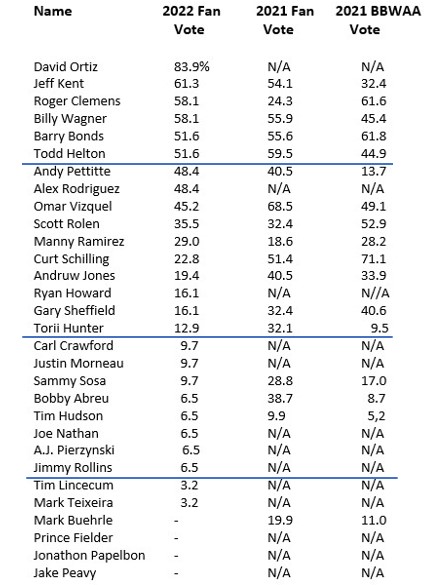
With 32 votes now in, readers have voted for an average of 6.8 candidates per ballot. At this point, only David Ortiz (83.8 percent) is running ahead of the 75 percent needed for election in the BBWAA) official balloting.  It appears fans are giving Ortiz the benefit of the doubt for a positive (but possibly erroneous) 2003 PED test.  Ortiz is one of only six candidates polling more than 50 percent in the reader balloting.  Here are the current top ten:

  • David Ortiz (83.9%)
  • Jeff Kent (61.3)
  • Roger Clemens (58.1)
  • Billy Wagner (58.1)
  • Barry Bonds (51.6)
  • Todd Helton (51.6)
  • Andy Pettitte (48.4)
  • Alex Rodriguez (48.4)
  • Omar Vizquel (45.2)
  • Scott Rolen (35.4)

A few other observations:

Fan voters appear to be taking Curt Schilling’s request to be taken off the ballot seriously.  In fan voting, he dropped from 51.4 percent a year ago, to 22.8 percent so far in this year’s unofficial balloting. Roger Clemens and Barry Bonds are both above 50 percent, but do not seem to gaining traction (in the Roundtable fan ballot or among the BBWAA voters).  Clemens did have an unexplained “blip” in Roundtable balloting.  His vote total in the fan ballot over the past five years:  50.2 percent; 44.8 percent; 46.9 percent; 24.3 percent; and 58.1 percent this year.

Among first-year candidates, David Ortiz and Alex Rodriguez currently lead among Roundtable vote-casters (first-time HOF candidates occupy eight of the nine bottom slots on the preliminary Roundtable balloting.

The Baseball RoundTable unofficial fan ballot also asked voters to indicate players not on the ballot that they through belong in the Hall.  Leading the way thus far, with six mentions, is Jim Kaat. Next comes a group with three mentions each: Gil Hodges, Pete Rose and  Joe Jackson. At two mentions are Tony Oliva, Don Baylor, Bobby Grich and Don Mattingly.  (A full list of those mentioned at least once will be included in a future post.)

Here are the Baseball Roundtable reader votes so far.

Baseball Roundtable 2022 (unofficial) Baseball Hall of Fame Fan Ballot

As of December 4 – Voting open through December 28.

Again, to access the ballot, click here.  For a deep dive into the thirty candidates, click here. 


Primary Resources: National Baseball Hall of Fame; Baseball-Reference.com; Baseball-Almanac.com

100Baseball Roundtable is on the Feedspot list of the Top 100 Baseball Blogs.  To see the full list, click here.

I tweet baseball @DavidBBRT

Follow/Like Baseball Roundtable’s Facebook Page here.  More baseball commentary; blog post notifications; PRIZES.

Member: Society for American Baseball Research (SABR); Negro Leagues Baseball Museum; The Baseball Reliquary. 
 

Baseball Roundtable 2022 Baseball Hall of Fame (unofficial) Fan Ballot

Baseball Roundtable’s 2022 Hall of Fame Debate Season is officially open!  The Baseball Writers Association of America (BBWAA) 2022 Hall of Fame ballots were distributed last week and the results will be announced in January, with the honorees inducted on July 24 This year’s traditional ballot includes 17 holdovers from last year, along with 13 newcomers.

In this post, BBRT will share:

  • Predictions on the 2021 BBWAA voting;
  • BBRT’s ballot (if I had one);
  • A deep look into all the candidates on the ballot;
  • A link to BBRT’s unofficial fan ballot – please take a few minutes to follow the link and cast your votes.

Note: For a look at the Early Baseball Era (veterans) Committee candidates, click hereFor the Golden Days Era Committee candidates, click here

To skip the post (although I hope you will read on) and go right to the Fan Ballot, click here

–PARTICIPATE IN BASEBALL ROUNDTABLE’S  2022 FANS’ HALL OF FAME BALLOT—

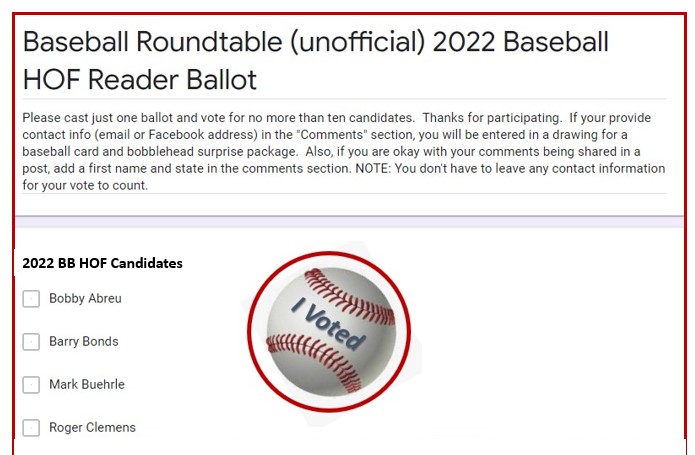
Baseball Roundtable is once again conducting an unofficial fan ballot – to cast your vote(s), click here.  Remember, you can vote for up to ten of the nominees for 2022 induction.  If you want to read through the nominees’ bios first, there is another link to the BBRT Fan Ballot following the bios (near the end of this post).  BBRT will be providing updates on the fan balloting, as well as a post-election comparison of fan votes as compared to the final BBWAA results.  Voting on the BBRT Fan Ballot will remain open until December 28, 2021.

Also, if you leave your email address in the comments section at the end of the ballot, you will be entered in a bobblehead and baseball card “surprise-prize” drawing.

Again, to cast your votes, click here

As you consider this year’s slate of candidates, BBRT would stress that all the players on the ballot – even those who remain for only one voting cycle – deserve recognition. To rise to the major leagues, last ten years and make it past the Hall of Fame Screening Committee is a significant accomplishment in itself.  In fact, the annual ballot release is a highlight for Baseball Roundtable, as it provides a chance to acknowledge the accomplishments of all the candidates – not just the favorites for election.  A review of the ballot gives us the opportunity to honor Mike Buehrle’s n0-hitter and perfect game; Carl Crawford’s 480 stolen bases; Billy Wagner’s 400 saves; Torii Hunter’s nine Gold Gloves; the MVP seasons of Justin Morneau and Jimmy Rollins; Prince Fielders 50–HR season; and more.

Now on to the official 2022 Baseball Hall of Fame election process itself – and, then, a look at the players on the ballot for 2021.

BASEBALL HALL OF FAME ELIGIBILITY/CRITERIA FOR ELECTION

The basic rules for eligibility are that a player must have played at least ten seasons and be retired for at least five years. In addition, the player must be approved for the ballot by the Hall of Fame Screening Committee.

A player can remain on the ballot for up to ten years, but must receive at least five percent of the vote in the preceding year’s ballot to remain on the ballot.  Each voter can vote for up to ten candidates.  Election requires that a player be named on at least 75 percent of the ballots cast.

The criteria for election: “Voting shall be based upon the player’s record, playing ability, integrity, sportsmanship, character, and contributions to the team(s) on which the player played.”

A couple of preliminary comments.

  • The 2022 ballot includes four players in their final year of eligibility – a group that generally gains some additional momentum.  However, this year’s “final ballot” group – Barry Bonds, Roger Clemens, Sammy Sosa and Curt Schilling –  brings with it some controversy (PEDs, politics, personality and even a denied request to be removed from the ballot). How all of that affect voting will be interesting to watch.
  • Support for the two strongest newcomers on the ballot – Alex Rodriguez and David Ortiz  – may also be affected by concerns that go beyond what are clearly Hall of Fame numbers.

Now, let’s take a look at whom BBRT predicts will be elected by the BBWAA; how BBRT would vote if I had a ballot; and the bios of these year’s candidates.

—–Baseball Roundtable’s Hall of Fame Predictions for 2022—–

First, the Roundtable’s Track Record …

Last November, I noted that Baseball Roundtable was “not optimistic about balloting” producing any new HOF members – giving  Curt Schilling the best chance of election. No one was elected, while Schilling did lead all candidates with 71.1 percent of the vote.  In November 2020, Baseball Roundtable correctly predicted  the election of Derek Jeter and Larry Walker – and anticipated  “dark horse” candidate Curt Schilling would fall closer to 70 percent than 75.  Jeter and Walker were elected and Schilling fell short (at 70 percent). Three years years ago, BBRT projected the election of Mariano Rivera and Edgar Martinez and listed Mike Mussina and Roy Halladay as “dark horse” candidates with a chance to generate the needed 75 percent support.   It was a bit of a swing and miss (maybe a foul ball), as all four were elected.  Four years ago, BBRT predicted the election of Chipper Jones, Jim Thome, Vlad Guerrero and Trevor Hoffman (with Mike Mussina as a “dark horse” candidate). Jones, Thome, Guerrero and Hoffman made it, with Mussina garnering 64.5 percent (sixth-most).

2022 Prediction …

For 2021, BBRT is again “not optimistic” about the balloting.  I anticipate a second consecutive shutout.  The best chance for election this year: David Ortiz and Alex Rodriguez. 

Dark Horse Possibilities ….

1. David Ortiz.  Ortiz’ 541 home runs and 1,768 RBI, plus his post-season performance, clearly are Hall-worthy (more on Ortiz in the bio section). I put him at the top of the “dark horse” list for a couple of reasons: His positive personality and the fact that he appears more lightly brushed by the PED-controversey. Ortiz did not fail a drug test after 2004, but a positive result was noted in a “leaked” 2003 survey test.  In 2016, when asked about Ortiz’ 2003 test results, MLB Commissioner Rob Manfred said of Ortiz “… there were legitimate scientific questions about whether or not those (some of the test results) were truly positive.”  I think Ortiz will be treated well on the first ballot (55-65%), but there will be enough BBWAA holdouts – some on the basis of PED suspicions, others who sets a higher standard for first-ballot candidates and a few with a lingering negative bias against designated hitters- to preclude the necessary 75 percent.

2. Curt Schilling.  Schilling’s stats (detail in the bio section) were strong enough to garner him 70 percent support in 2020 and 71.1 percent last year.  It does appear his political and social views and the manner in which he expresses them have been obstacles in his path to the Hall.  He didn’t do himself any favors by requesting to be removed from the ballot and indicating he would “not allow a group of morally bankrupt frauds another year to lie about my life.”   The Hall denied his request and BBRT believes this could go one of three ways: 1) The BBWAA voters could see Schilling’s outburst as just “Curt being Curt” and the traditional final-year boost could put him in the Hall; 2) Reverse psychology could kick in and the BBWAA voters could call Schilling’s bluff and elect him (if only to see how he reacts); 3) The BBWAA voters could choose to deny Schilling one more time for past reasons and/or his more recent request and criticism.  I’m betting on option three and a slight decline in Schilling’s support.

3. (tie) Barry Bonds, Roger Clemens. Bonds and Clemens – both in their tenth and final year on the ballot – each tracked at just shy of 62 percent in last year’s voting.  While they clearly have Hall of Fame numbers, the PED-specter has shaped their candidacies. The question for 2022 is whether an adequate number of  BBWAA voters think the pair have been punished enough and are ready to add their support.  I anticipate both Bonds and Clemens falling just shy of 70 percent, and the BBWAA passing this issue on to the ERA ( Veterans) Committee (where Bonds and Clemens will eventually gain induction). If the writers are ready to “forget and forgive,” we could see a 2022 calls to Bonds and Clemens.

5. Alex Rodriguez. Rodriguez clearly has Hall of Fame on-the-field numbers (see bio section), but like Bonds and Clemens is carrying PED “baggage” into his HOF candidacy.  I would have put A-Rod into a tie with Bonds and Clemens except that I am not convinced the BBWAA will want to make a player who has served a one-year suspension a first-ballot inductee. Rodriguez, however, ha s worked to restore his reputation and 55-60 percent support in year one would not surprise me.

Let’s move on to BBRT’s hypothetical – if I had one –  ballot and bios of the players I would vote for; followed by a look at the remainder of the 2021 candidates.

Side note: You will not find those most clearly caught up in the PED-controversy on my ballot. While I think the best of them will eventually be elected/inducted, if I had a ballot, I’d prefer they made the 75 percent without my vote.  As I noted in my predictions, I think it’s likely the BBWAA will “punt” on these players and “kick the ball”down the road to the Era Committee.  

So, here is BBRT’s Hall of Fame Ballot – again, if I had one – with the players listed in BBRT’s order of preference.

— PLAYERS WHO WOULD GET BBRT’S VOTE —

David Ortiz – Designated Hitter/First Base, 1992-2016 … First year on the ballot.

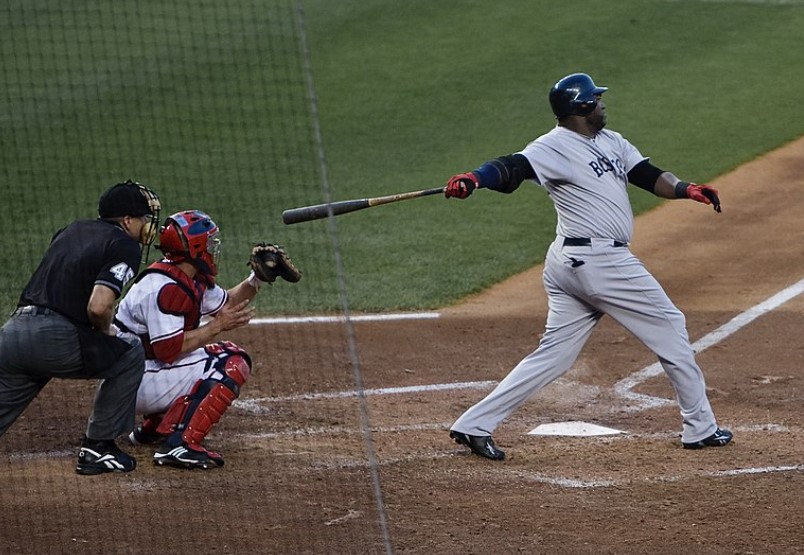
Photo: Cathy T from Washington, DC area, CC BY 2.0 <https://creativecommons.org/licenses/by/2.0>, via Wikimedia Commons

MLB Commissioners  Rob Manfred’s comments about the possible inaccuracy of David Ortiz’s 2003 PED test, MLB’s assurance that  the 2003 “survey” test would not result in disciplinary action and the fact that Ortiz did not test positive after 2003 put Ortiz (at least in Baseball Roundtable’s view) in a different position than a number of other candidates painted by the PED brush. So, let’s look at his HOF resume.  In 20 MLB seasons, Ortiz put up a .286-541-1,768 stat line. Career-wise, he ranks in the  MLB top fifty (among players with a qualifying number of plate appearances) all-time in home runs(17th); RBI (23rd); doubles (623-12th); (extra-base hits-1,192-eighth); total bases (4,765-32nd); slugging percentage (.552-26th); walks (1,319-41st); and intentional walks (209-16th). Ortiz collected 2,72 base hits, hitting .300 or better in six qualifying seasons

The ten-time All Star led the AL in home runs once (54 in 2006) and hit 30 or more long balls in nine campaigns; led in RBI twice and topped 100 in nine seasons; led the league in total bases once; and on-base and slugging percentage once each.  Ortiz played in 85 post-season games (.289-17-61) and was the MVP of the 2004 AL Championship Series and 2013 World Series).  With the Red Sox, he built a reputation as a team leader, clutch hitter and ambassador for baseball and Boston.

In his final season as a player (2016), the 40-year-old David Ortiz hit .315, with 38 home runs and league-leading 127 RBI. He led MLB in doubles (48); extra-base hits (87); and slugging percentage at .620.

Ortiz played for  played for the Twins  (1997-2002) and Red Sox (2003-2016).

David Ortiz’ Best Season: With the Red Sox in 2006, Ortiz hit .287, leading the league in home runs (54); RBI (137); walks (119); and total bases (355). He also scored 115 runs that campaign.

Ortiz has the numbers to earn a place in the HOF. Still, in his first year on the ballot, PED suspicions (whether warranted or not) and the fact that he spent the bulk of his time as a DH may work against him.  Still, he’d gets BBRT’s vote and should eventually make the Hall (perhaps even this year).

Jeff Kent – (Second Base/Third Base/First Base, 1992-2008) …  Ninth year on the ballot, 32.4 percent last year.

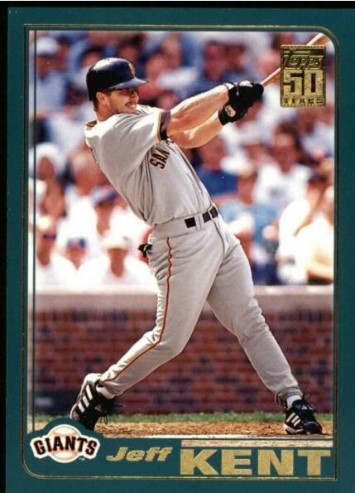
KentBBRT has long believed Jeff Kent is a deserving candidate, but he has not been getting much support from the writers.  Kent holds the all-time MLB record for home runs by a second baseman (351 of his 377 career round trippers were hit while in the lineup at second base). He has a healthy .290 career batting average; his 1,518 RBI are 54th all time; and his 560 doubles 30th.  His 984 extra base hits are 43rd all-time.

Kent was a five-time All Star and the 2000 NL MVP.  As primarily a middle infielder, he hit 20 or more home runs in 12 seasons (a high of 37 in 2007) at a time when middle infielders were not especially known for power. Kent topped 100 RBI eight times. He hit .276, with nine home runs and 23 RBI in 49 post-season games.

Running with the Big Boys …

Jeff Kent has more career runs batted in (1,509 in 17 seasons) than such noted Hall of Famers (who played a comparable number of seasons) as Mickey Mantle (1,508 in 18 seasons), Billy Williams (1,475 in 18 seasons), Eddie Mathews 1,453 in 17 seasons), Duke Snider (1,333 in 18 seasons) and Orlando Cepeda (1,365 in 17 seasons). Not bad for a middle infielder.

Kent played for the Blue Jays (1992), Mets (1992-1996), Indians (1996), Giants (1997-2002), Astros (2003-2004) and Dodgers (2005-2008).

Jeff Kent’s Best Season: With the Giants in 2000, Kent put up these stats – 159 games; 196 hits; .334 average; 33 home runs; 125 RBI; 114 runs; 12 steals. His performance earned him the NL MVP Award.

Kent has the credentials, but BBRT expects the writers will keep him on the bench – a couple of Gold Gloves, at this traditionally defense-oriented position, would have really helped his case.  In BBRT’s opinion, this is a true HOF “snub.”

_________

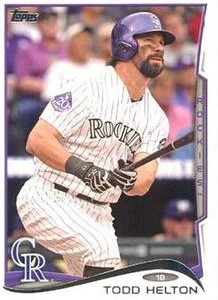
Todd Helton – (First Base, 1997-2013) … Fourth year on the ballot, 44.9 percent last year.

HeltonTodd Helton moved from 16.5 percent to 29.2 percent to 44.9 percent over his first three years on the ballot. I expect he will continue to gain ground and would not be surprised to see hims climb to between 55 and 60 percent this year. Still, he is hampered by the fact that he spent his entire 17-year career with the Rockies (playing half his games in hitter-friendly Coors field).  Helton, who put up a .316 career average, hit .345 at home and .287 on the road. Despite that home/road split, Helton’s body of work deserves HOF consideration.

Helton was a five-time All Star, three-time Gold Glover and four-time Silver Slugger. He hit over .300 in 12 seasons – and won the NL batting crown in 2000 with a .372 average. His 59 doubles that season are the seventh-most all-time. Helton drove in 100 or more runs in five seasons and scored in triple figures six times. His 1,335 walks (37th all-time) indicate the respect he earned at the plate.  Helton also ranks fifth in games played at first base, second in career assists at the position, 13th in putouts and third in double plays.

The Denver 400

Todd Helton is one of only 18 players to reach 400 or more total bases in a season – and one of only seven players to have multiple 400+ total base campaigns. He is also the only player to collect 100 extra-base hits in two consecutive seasons (2000-2001).

Todd Helton’s Best Season: In 2000, Helton won the NL batting crown with a .372 average – and also led the league in base hits (216), doubles (59), RBI (147), on-base percentage (.463), slugging percentage (.698) and total bases (405).  He also scored 138 runs and hit 42 home runs.

Helton will continue to move up in support – he’s just not likely to overcome the Coors Field-bias in the short-term future.  He gets BBRT’s vote (as he has in the past).

__________

Omar Vizquel – (Shortstop/Third Base, 1989-2012) … Fifth year on the ballot, 49.1 percent last year.

Photo by Keith Allison

Photo by Keith Allison

Omar Vizquel got off to a good start toward a HOF plaque, grabbing 37 percent support on his first-ballot year, moving up to 42.8 percent in his second year and 52.6 percent in his third year.  His support appears to have plateaued, dropping to 49.1 percent in 2021.  Vizquel once again earns BBRT’s vote. If he does eventually make it into the HOF it will be more with his glove (eleven Gold Gloves) than his bat.  However, voters should be mindful of the fact that he finished his 24-season MLB career just 123 hits short of that milestone 3,000 safeties.

Vizquel delivered premier defense to the Mariners (1989-1993), Indians (1994-2004), Giants (2005-2008), Rangers (2009), White Sox (2010-2011) and Blue Jays (2012). He was a three-time All Star – and put together a string of nine straight Gold Gloves at shortstop (1993-2001).

Sacrificing for the Team

Omar Vizquel led his league in sacrifice bunts four times.

In the field, Vizquel has the highest career fielding percentage (.9847) among shortstops with at least 500 games at the position.  Vizquel is also the all-time leader among shortstops in double plays (1,734), ranks third at the position for career assists and 11th in putouts. He shares the record (with Cal Ripken, Jr.) for the fewest errors by a shortstop in a season of at least 150 games played (three).

On offense, Vizquel put up a serviceable .272 career average, with 80 home runs, 951 RBI and 1,445 runs scored. The 1,445 runs put him in the top 100 players all-time (83rd); while his 2,877 hits put him in the top 50 (44th and fourth all-time among switch-hitters). He also swiped 404 bases – topping twenty steals eight times (a high of 42 in 1999) – putting him at number-72 on the all-time list. Vizquel played in 57 post-season games, hitting .250-0-20.

Omar Vizquel’s Best Season: In 1999, with the Indians, Vizquel hit a surprising .333, with five home runs, 66 RBI, 112 runs scored and 42 stolen bases – and, of course, won a Gold Glove at shortstop.

Vizquel would get BBRT’s vote, but the BBWAA likely will make him wait.  I do feel, given this year’s ballot, he will improve on his 49.1 percent showing of a year ago.

__________

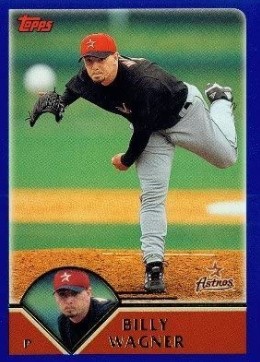
Billy Wagner – (LHP 1995-2010) … Eighth year on the ballot, 46.4 percent last year.

WagnerBilly Wagner made a nice  jump in support last year – going from 31.7 percent to 46.4 percent.  While he could (should) continue to make progress, each incremental point will likely get harder as he moves up the ladder.  Wagner played for the Astros (1995-2003), Phillies (2004-2005), Mets (2006-2009), Red Sox (2009) and Braves (2010). Wagner was a seven-time All Star, who amassed 422 saves (sixth all-time) in a 16-season MLB career.  He had nine seasons of 30 or more saves; a career ERA of 2.31; 1,196 career strikeouts in 903 innings; and 47-40 won-lost record.

Whiff-and-Poof

In 1992, playing for Ferrum College, Billy Wagner set an NCAA record for strikeouts per nine innings in a season at 19.3.

Billy Wagner’s Best Season: In 2003, Wagner went 1-4, 1.78 for the Astros, saving 44 games and fanning 105 batters in 86 innings.

BBWAA voters have been very demanding of relievers (although the recent induction of Mariano Rivera and Trevor Hoffman may be a good sign – but they, of course, both had 600+ saves). It also helps that Lee Smith (478 saves) was elected by the Today’s Game Committee in 2019.  BBRT thinks Wagner belongs in the Hall (based on his 400+ saves) – and hopes that momentum continues to build, but 75 percent is still a long way off.  I’d like to see Wagner at least jump past the 50 percent mark.  He gets my vote.

__________

Andy Pettitte – (LHP/Starter, 1995-2010, 2012-13) … Fourth year on the ballot, 13.7 percent last year.

Andy Pettitte - 19 career post-season wins.

Andy Pettitte – 19 career post-season wins.

I had to think for a while on this one (and will probably get some push back from readers), largely because a major part of Andy Pettitte’s HOF resume was achieved in the post-season and there was some PED-controversey surrounding Pettitte.  (Note: Pettitte admitted to using HGH while recovering from elbow surgery – a couple of years before the substance was banned.  He took responsibility and apologized.)

Pettitte holds the MLB post-season marks for most wins (19 … versus 11 losses), innings pitched (276 2/3) and games started (44). His post-season accomplishments include a 3.81 career ERA, 183 strikeouts (fourth all-time) and the 2001 American League Championship series MVP Award.

Pettitte, however, was no slouch in the regular season (Yankees – 1995-2003, 2007-2010, 2012-13) and Astros (2004-06).  He finished with 256 wins (153 losses) and a 3.85 ERA. His 256 victories puts him in the top 50 all time (42nd). Pettitte won 20 games in two seasons and 14 or more games 12 times – leading the AL with 21 wins in 1996. The three-time All Star struck out 2,448 batters (46th all-time) in 2,316 innings.

Ready, Willing and Able …

Andy Pettitte started 30 or more games in a season 12 times, leading his league three times (1997, 2006, 2007.)

Pettitte’s post-season numbers, plus 256 regular-season victories and the fact that he had 100+ more career wins than losses secure BBRT’s vote. He still has a long way to go with the BBWAA voters, however.

Andy Pettitte’s Best Season: In 1997, following a 21-8 campaign in 1996, Pettitte went 18-7, with a 2.88 ERA (fourth-best in the AL), leading the league in starts with 35, finishing third in innings pitched (240 1/3) and eighth in strikeouts (166).

__________

Bobby Abreu – (OF, 1996-2012, 2014) … Third  Year on the ballot, 8.7 percent one year ago.

AbreuA solid .291 career hitter (2,470 base hits), Abreu hit .300 or better in six seasons. He hit 20 or more round trippers in 10 campaigns, stole 20 or more bases 12 times (a high of 40 in 2004), drove in 100 or more runs eight times and scored at least 100 runs eight times.   Abreu also walked 1,476 times – including 100 or more free passes in eight straight seasons (1999-2006).

In the Top 50 … 

Bobby Abreu’s 1,476 walks are 20th all-time; his 574 doubles are 25th; his putouts as a RF are 12th; and his assists as a RF 28th. 

Abreu played for the Astros (1996-97, Phillies (1999-2006), Yankees (2006-2008), Angels (2009-1012), Dodgers (2012) and Mets (2014).

In 20 post-season games, Abreu went 19-for-67 (.284), with one home runs and nine RBI.

Bobby Abreu’s Best Season: In 2004, as a Phillie, Abreu hit .301, with 30 home runs and 40 steals. An All Star that season, he also drove in 105 runs and scored 118.

Abreu’s 400 steals are an HOF plus, as his 30-40 season in 2004 and his eight campaigns with 100 or more RBI.  Had he reached 300 home runs; it would have really boosted his status with the writers.  He’s also hurt by the fact that he only made two All Star teams in his 18 seasons.  Still, I have votes left and his body of work earns one of them.

Ryan Howard – (1B, 2204-2016) … First year on the ballot.

Photo: Keith Allison from Hanover, MD, USA, CC BY-SA 2.0 <https://creativecommons.org/licenses/by-sa/2.0>, via Wikimedia Commons

Let’s call this my “Sandy Koufax” vote.  Do I expect Ryan Howard to make the Hall of Fame? That’s a bit of a long shot.  Still, I would be inclined to cast a vote to help keep him on the ballot.  The “Koufax Connection?”  Hall of Famer Koufax was elected to the Hall with only 165 victories in a 12-season MLB career sadly cut short by arm issues. If you look at Koufax’ record, he was 36-40, 4.10 over his first six seasons and 129-47, 2.19 over his final six.  (Did you know that Tommy John had just one fewer victory after his 1974 TJ Surgery – at age 31 –  than Koufax had in his career?)

Did Ryan Howard have a period of dominance as great as Koufax (three Cy Young Awards in four seasons)? No, but like Koufax, Howard had several seasons of domination in a career derailed by injury. (Unlike Koufax, Howard’s HOF-worthy seasons came early in his career (he was able to play on after a series of injuries).

In 2005, Howard was the National League Rookie of the Year, hitting .288, with 22 home runs and 63 RBI in just 88 games. Then, from 2005 to 2011, Howard continued as one of the most feared hitters in the National League – and seemed on his way to a sure Hall of Fame career. Over those six seasons, he averaged .274, with 44 home runs, 133 RBI and 96 runs scored per campaign. (If you look at the first four of those seasons, he averaged .278-50-143, with 102 runs scored.)  He was the National League MVP in 2006 and finished in the top five in NL MVP voting four times in six seasons. Then injuries began to take a toll – Achilles tendon in the 2011 NLDS (surgery); fractured big toe in 2012; torn meniscus (2013).In his final five seasons, he averaged .226, with 19 home runs and 66 RBI per campaign).  Sort of Koufax in reverse.

For his career (12 seasons), Howard went .258-382-1,194.  He led his league in home runs twice (hitting 45 or more four times); RBI three times, topping 100 six times and 135 four times; and total  bases once, exceeding 300 four times. He also scored more than 100 runs in three seasons.

Ryan Howard reached 100 home runs in fewer career games than any other MLB player (325).

Howard played his entire career for the Phillies.

Ryan Howard’s Best Season: In 2006, Howard hit .313 and led MLB in home runs (58) and RBI (149) and total bases (383) – earning the NL MVP Award.

__________

So, with BBRT’s unofficial ballot covered, let’s look at the remainder of candidates – in alphabetical order.  Note: Here you will find a host of players with solid (but perhaps not HOF-level) career numbers and accomplishments – as well as a few that remain on the sidelines for other reasons.

—–THE REST OF THE BALLOT—–

Barry Bonds – (Outfield, 1986-2007) … Tenth (final) year on the ballot, 61.8 percent a year ago.

Barry Bonds played for the Pirates (1986-1992) and the Giants (1993-2007). There is no doubt about Bond’s credentials – .298 average, 2,935 hits, MLB-record 762 home runs, 1,996 RBI, MLB-record 2,558 walks. He was also a 14-time All Star; 12-time Silver Slugger Award winner; his league’s MVP a record seven times; and an eight-time Gold Glove winner.  In 2001, Bonds hit .328, with an MLB-record 73 home runs and 177 RBI.  He drove in 100 or more runs 12 times and also scored 100 or more runs in a dozen seasons.  And, I could go on and on.

Base Open?  Makes Sense to Me …

Barry Bonds drew an MLB-record 688 intentional walks in his career. Second place?  Albert Pujols, with 32. In 2004 alone, Bonds drew a record 120 intentional passes. He led his league in IBB 12 times.

Still, there are there is that pesky PED-controversey – an elephant in the room (and on the ballot) that I think will keep Bonds out of the Hall for now (there is the Era Committee in the future).

Barry Bonds’ Best Season: In 2001, Bonds crushed an all-time record 73 home runs, while hitting .328, driving in 137 runs, scoring 129 – all while drawing 177 walks.

_________

Mark Buehrle – (LHP, 2000-15) …. Second year on the ballot, 11 percent last year. 

Mark Buehrle pitched in 15 MLB campaigns – White Sox (2000-11), Marlins (2012), Blue Jays (2013-15) – and threw 200 or more innings in all but his rookie and final seasons. Buehrle was a five-time All Star and put up a 214-160, 3.81 record, with 1,870 strikeouts in 3,283 1/3 innings. He twice led his league in starts and twice topped his league in innings pitched. He won ten or more games in 15 consecutive seasons and six times won 15 or more.  Buehrle also four Gold Glove Awards.

Near-Perfect and Perfect

Mark Buehrle’s HOF resume is bolstered by a no-hitter tossed on April 18, 2007 – when his White Sox topped the Rangers 7-0 and Buehrle faced the minimum 27 batters.  The only Texas’ base runner came on a fifth inning, one-out walk to Sammy Sosa, whom Buehrle then picked off first base.  Buehrle notched eight strikeouts in the game, which was so-o-o very close to a “perfecto.”

Buehrle got his perfect game two years later (July 23, m 2009), when he recorded a clean slate in a 5-0 ChiSox win over the Rays.  He fanned six in that one.

Mark Buehrle’s Best Season:  In 2005, Buehrle went 16-8, 3.12 for the White Sox.

If he had 250 wins to go with the no-hitter, perfect game and four Gold Gloves, Buehrle would have had my vote.  With just 214 wins, no Cy Young Award and no 20-win season, he’s short of what BBRT looks for in a Hall of Fame candidate. .

__________

Roger Clemens – (RHP, 1984-2007) … Tenth (final) year on the ballot, 61.6 percent last year.

Roger Clemens pitched in 24 MLB seasons; for the Red Sox (1984-1996), Blue Jays (1997-1998), Yankees (1999-2003, 2007) and Astros (2004-2006).  Clemens has Hall-worthy stats:  354 wins (ninth all-time), 4,672 strikeouts (third all-time), an MLB-record seven Cy Young Awards and the 1986 AL MVP Award. The eleven-time All Star was a five-time 20-game winner (led the league in wins four times), seven-time ERA leader, five-time league leader in strikeouts and six-time leader in shutouts.  He won the AL pitching Triple Crown (Wins/ERA/Strikeouts) three times.  Clemens also has 12 post-season wins, with 173 strikeouts in 199 post-season innings.

Grab Some Bench, Buddy

Roger Clemens shares the record for strikeouts in a nine-inning game (20) with Kerry Wood and Max Scherzer. Clemens is the only pitcher to achieve 20 whiffs in a nine-inning game twice.

Roger Clemens’ Best Season: Lots to choose from here. Like 21-6, 1.93 in 1990 – or 1987, with a 20-9 record, 2.97 ERA, 18 complete games and seven shutouts.  I take 1986. Clemens went 24-4. 2.48 and won both the Cy Young (his first) and AL MVP Awards for the Red Sox.  He led the AL in wins, winning percentage (.857) and earned run average. He was fifth in innings pitched (254) and second in strikeouts (238).

Yes, he’s got the numbers (those listed and more), but the PED controversy seems to stand between him and the Hall.  If the writers don’t vote him in this year, it’s likely the Era Committee will do it in the future.  If the writers relent, I’d look for Bonds to join Clemens.  I anticipate Clemens candidacy will pass on to the Era Committee.

________________

Carl Crawford – (OF. 2002-2016) … First year on the ballot.

Carl Crawford was considered on the the fastest – if not the fastest – players on the base paths in his peak years. In his first five full MLB seasons, he led the AL in steals four times averaging  53.6 thefts per season.  His career total of 480 steals ranks 43rd all-time.   Crawford also led the AL in triples four times and was a solid contact hitter (.290 career average and six seasons of .300 or better). He collected 1,931 hits, belted 136 home runs (a high of 19 in 2010) and scored 998 runs (100+ in three seasons) in 1,716 career games. Crawford was a four-time All Star and one-time Gold Glover. He ranks 15th all-time in putouts as a left fielder (3,182) and led his league in LF putouts four times.

MVP-MVP

Carl Crawford was the MVP of the 2009 MLB All Star Game, after robbing Brad Hawpe of a go-ahead home run in the seventh inning of a 4-3 AL win. A reserve, he also went one-for-three at the plate.

Crawford played for the Rays (2002-10), Red Sox (2011-12) and Dodgers (2013-16),

Carl Crawford Best Season:  In 2007, Crawford hit a career-high .315, with 11 home runs, 80 RBI, 93 runs scored and 50 stolen bases.

The 480 steals and .290 average should get him enough support to stay on the ballot for 2023.  More than one Gold Glove would have helped his ultimate case for the Hall.

__________________

Prince Fielder – (First Base, 2005-16) … First year on the ballot. 

Prince Fielder was a power hitter (319 home runs), who could make contact (.283 career average – .290 or better in four seasons). He was also a workhorse, leading the league in games played four times and averaging 160 games per season from 2006 through 2013. Fielder led the league in home runs once (with 50 in 2007) and hit 30 or more home runs in six seasons).  The six-time All Star had 1,028 career RBI, leading the NL with 141 for the Brewers in 2009 and topping 100 RBI in six campaigns. He also led the AL in walks once and intentional walks twice,  Fielder played for the Brewers (20005-2011); Tigers (2009-13) and Rangers (2014-16).

It’s in the Genes

Prince Fielder and his father Cecil Fielder each hit exactly 319 regular-season home runs in their careers and each reached 50 home runs in one season – Cecil with 51 in 1990 and Prince with 50 in 2007).

Prince Fielder’s Best Season: Baseball Roundtable is looking at two possibilities here. In 2007, Fielder went .288-50-119, with 109 runs scored; while in 2009, he went .299-46-141, with 103 runs scored. As they say, six of one, half dozen of the other.

Fielder’s 50-HR seasons, 319 career long balls, coupled with the fact that he maintained a .283 average should get him enough support to stay on the ballot another year.  Perhaps in the 10 percent range.

_____________________________

Tim Hudson, – (RHP.  1999-2015) … Second year on the ballot, 5.2 percent last year. 

Tm Hudson pitched in 17 MLB seasons: A; s (1999-2004), Braves (2005-2013); and Giants (2014-15). He was a four-time All Star – making the All Star squad with the A’s, Braves and Giants.  Hudson’s career mark was 222-133, 3.49, with 2,080 strikeouts in 3,126 2/3 innings pitched.  He won 15 or more games in a season eight times, leading the AL in wins with 20 in 2000, his second MLB season. He led his league in games started twice, nine times starting 30+ games, and in shutouts twice.

A Two-way Player …

In 1997, Tim Hudson played in 65 games for Auburn University.  As a pitcher he went 15-2, 2.97 and, as a hitter, he went .396-18-95. Appropriately, he was named SEC Player of the Year and was a consensus All-American. (He was also named All-SEC at both pitcher and outfield.)

Tim Hudson’s Best Season:  In 2000, with the A’s,  Hudson went 20-6, 4.14, leading the AL in wins and winning percentage (.769).  Also, in the running is 2001, when he went 18-9, with a 34.37 ERA.

Nearly 100 more wins than losses deserve recognition, but it doesn’t seem  likely Hudson will gain any traction this year – and may even fall off the ballot.

__________

Torii Hunter – (OF, 1997-2015) … Second year on the ballot, 9.5 percent lat year. 

Torii Hunter played 19 MLB seasons, suiting up for the Twins (1997-2007, 2015), Angels (2008-12) and Tigers 2013-14). He was a five-time All Star, and nine-time Gold Glover. For his career, Hunter hit .277 (2,452 hits), with 353 home runs, 1,391 RBI, 1,296 runs scored and 195 stolen bases. He hit 20+ home runs in 11 seasons, drove in 100+ runs twice and stole 20+ bases in three campaigns. Hunter hit .274-4-20 in 48 post-season games. Hunter led his league in CF assists three times, CF putouts once and double plays turned out of CF four times. He also led his league’s right fielders in putouts, assists and double plays once each.

Spider-Man

Torii Hunter earned the nicknamed spider-man for his outstanding outfield play.

Torii Hunter’s Best Season:  In 2007 (Twins), Hunter hit .287, with 28 home runs, 107 RBI, 94 runs scored and 18 steals (and won his seventh straight Gold Glove) – although he can look back on at least four seasons with very similar numbers.

If I was going to add another player to my ballot, it would probably be Hunter. Nine Gold Gloves, five All Star selections and 353 home runs represent some pretty good credentials.  What may hurt Hunter is his consistency.  He could have used a couple of standout/spectacular/memorable seasons mixed in with all those very good campaigns that fans came to expect. He should stay on the ballot for 2023.

__________

Andruw Jones – (CF 1996-2012 )…. Fifth Year on the ballot, 33.9 percent last year.

Andruw Jones played for the Braves (1996-2007), Dodgers (2008), Rangers (2009), White Sox (2010) and Yankees (2011-2012). In a 17-season career – primarily patrolling centerfield – he won ten Gold Gloves (consecutively, 1998-2007). At the plate, he hit .254, with 434 home runs (48th all time), 1,289 RBI and 1,204 runs scored. He topped 25 home runs in ten seasons (six over thirty and a league-leading and career-high of 51 in 2005). He scored 100 or more runs four times, drove in 100+ five times and stole twenty or more bases in a season four times.  Jones appeared in 76 post-season games, hitting .273, with ten home runs and 34 RBI.

On the Big Stage ,,,

In the 1996 World Series, Andruw Jones – just 19-years-old – hit .400 (8-for-20) with two home runs and six RBI, becoming the youngest player to go yard in the Fall Classic.

Andrew Jones’ Best Season: In 2005, Jones hit only .263, but led the NL in home runs (51) and RBI (128) – finishing second in the MVP voting to Albert Pujols (.330-41-117).

Jones’ ten Gold Gloves  and 51-home run season work in his favor, but – over the long haul – that .254 average (he only hit .300 or better once and over .270 only four times) dampen his HOF chances.  Still, he moved from 19.4 percent two years ago to 33.9 percent lat year, so he may climb a bit further before plateauing.

____________________________

Tim Lincecum – (RHP, 2007-16) … First year on the ballot.

Tim Lincecum won 110 and lost 89, with a 3.74 earned run average, over ten MLB seasons (2007-15, Giants & 2016, Dodgers), which, on the surface, are not HOF numbers.  Still, he won consecutive Cy Young Awards (2008-09), was a four-time All Star and led the NL in strikeouts three times (2008-2010), complete games and shutouts once.  He also led the league in strikeouts per nine innings three times, fanned at least one batter per inning in six seasons and whiffed 1,736 batters in 1682 career innings. He also performed well in the post season (5-2, 2.40 in 13 post-season appearances( six starts) – with 65 strikeouts in 56 1/3 innings. So, he deserves a serious look.

Tim Lincecum’s Best Season: In 2008, Lincecum went 18-5 for the Giants, with a 2.62 ERA (second in the NL) and a league leading winning percentage (.783) and strikeout total (265).

The victory total is likely to keep Lincecum out of the Hall, but a pair of Cy Youngs and a 9.3 career strikeout-to-walk ratio make him worthy of consideration. He’ll need support from West Coast writers to stay on the ballot.

____________________________________

Justin Morneau – (1B, 2003-2016) … First year on the ballot.

Justin Morneau hit .281 (1,603 hits), with 247 home runs and 985 RBI over 14 MLB seasons (2003-2013, Twins ,,, 2013, Pirates … 2014-15, Rockies … 2016, White Sox.)  He was a four-time All Star, the 2006 AL MVP (Twins);  and the 2014 NL batting champion (.319, Rockies). Morneau hit 30 or more homers in three seasons and drove in 100+ runs four times. He also hit .302-2-4 in 13 post-season games.

Justin Morneau’s Best Season: In his 2006 MVP season, Morneau hit .321, with 34 home runs and 130 RBI.

Morneau could have used some benchmark numbers – 300 home runs, 1,000 RBI – to ensure at least 5 percent in this first year on the ballot.

____________________________

Joe Nathan – (RHP, 1999-2000, 2002-2009, 2011-2016) … First year on the ballot. 

Joe Nathan, who started his MLB career as a starter (29-starts in 39 appearances for the Giants in 1999-2000), made a name for himself as a closer (377 career saves – eighth all-time).  Nathan’s career took off after a trade to the Twins. For the Giants from 1999-2003, he was 24-10, 4.12 with one save.  As a Twin, from 2004 to 2009, he was 22-12, 1.87, with 246 saves – topping 35 saves for six straight seasons (three of those over 40). Nathan had Tommy J0hn surgery in 2010 – missing the entire season. He came back to record 129 saves (Twins/Tigers) from 2011 through 2014 – with 35 or more saves in three of those four campaigns.  For his career, Nathan was 64-34, with 377 saves and a 2.87 ERA. He was a six-time All Star and, while he never led the league in saves, he finished in the top five seven times. He recorded and ERA under 2.00 in five seasons (in which he pitched at least 50 innings) and fanned 11 or more batters per nine innings in four.

Joe Nathan’s Best Season:  In 2006, Nathan went 7-0, with 36 saves, a 1.58 ERA and 95 strikeouts in 68 1/3 innings.

Hall of Fame voters were not very kind to relievers for many year (although that has changed recently). Being eighth all-time in saves may keep Nathan on the ballot for next year.  Leading the league in saves a time or two would certainly have helped his case.

____________________________________

Jonathan Papelbon … (RHP, 2005-16) … First year on the ballot.

Jonathan Papelbon’s 368 career saves place him tenth all-time.   He was a steady and reliable closer who never  led is league in saves, but recorded eight seasons of at least 35 saves between 2006-14.  In that  nine-season span, he put up a 2.35 ERA and averaged and 36.1 saves per year. Papelbon was a six-time All Star. His final stat line was 41-36, with 368 saves, a 2.44 ERA and 808 strikeouts in 724 2/3 innings pitched  He averaged ten whiffs per nine innings for his career and six times fanned more than ten batters per nine frames.  He finished in the top five in his league in saves five times..  He also pitched well in the post season, 2-1, 1.00, with seven saves in 18 appearances, including three saves in the 2007 World Series.

Papelbon pitched for the Red Sox (2005-11), Phillies (2012-15) and Nationals (2015-16).

Jonathan Papelbon’s Bets Season: In 2009, Papelbon was 1-1, with a 1.85 ERA and 38 saves.  He fanned 76 batters in 68 innings.

Like Nathan above, a couple of years leading the league in saves would have helped Papelbon’s case.

______________________________

Jake Peavy … (RHP, 2002-16) … First year on the ballot.

In 15 MLB seasons Jake Peavy went 152-126, with a 3.63 ERA. He was the 2007 NL Cy Young Award winner, when he went 19-7, 2.54 for the Padres. Peavy was a two-time All Star and a one-time Gold Glove winner. Peavy led the NL in strikeouts and earned run average twice each and in victories once.  He also led his league in strikeouts per nine innings (among qualifiers) twice.

Peavy pitched for the Padres (2002-2009); White Sox (2013); Red Sox (2013-2014);and Giants (2014-16).

Jake Peavy’s Best Season: In 2007, Peavey led the NL in wins with 19 (six losses); ERA (2.54); and strikeouts (240 in 223 1/3 innings. ) – capturing the NL Cy Young Award.

Peavy does have a CYA on his resume, but the fact that he won 15 or more games in just just two seasons may see him dropped from the ballot.

_________________________________

A.J. Pierzynski – (C, 1998-2016) … First year on the ballot.

A.J. Pierzynski has a better case for the Hall than you might expect.  After all, he is only one of ten players to play at least half their games at catcher and collect 2.000 hits (and also one of just nine catchers  to collect 2,000 hits and 3,000 total bases). For his 19-season MLB career, Pierzynski (known as a fierce, if annoying, competitor), hit .280 (2,043 hits), with 188 home runs. 909 RBI, 807 run scored and 3,062 total bases. He hit .300 or better in four qualifying seasons, had four seasons of 15+home runs (a high of 27 in 2012). He was a two-time All Star. He appeared behind the plate in 1,936 of  of his 2.059 games. A workhorse who came to play, Pierzynski  started 100 or more games at catcher in 14 seasons.

Pierzynski played for the Twins (1998-2003); Giants (2004); White Sox (2007-12); Rangers (2013); Red Sox (2014); Cardinals (2014); and Braves (2015-16).

A.J. Pierzynski played 1,936 MLB games at catcher – ninth all-time. 

A.J. Pierzynski’s Best Season: In 2012 (White Sox), Pierzynski hit .278, with 27 home runs, 77 RBI and 68 runs scored in 135 games.

Not enough here to win a ticket to the Hall (a few Gold Gloves would have helped), but I’d like to see Pierzynski stay on the ballot for 2023. (Although I am not confident that will happen.)

_________________________

Manny Ramirez – (Outfield, 1993-2011) – Sixth year on the ballot, 28.2 percent last year.

Manny Ramirez played 19 MLB seasons, collecting 2,574 hits, a .312 batting average, 555 home runs (15th all-time) and 1,831 RBI (19th all-time). Ramirez was a 12-time All Star and led the AL in average (2002), home runs (2004) and RBI (1999) once each.  Ramirez won nine Silver Slugger Awards, including eight consecutive (1999-2006), hit .285 with 29 home runs in 111 post-season games and was the 2004 World Series MVP.  He hit 30 or more home runs in twelve seasons (five of 40+), scored 100 or more runs six times, hit .300 or better in 11 seasons and topped 100 RBI 12 times.

It’s Post Time …

Manny Ramirez’ 29 post-season home runs are first all-time, while his 78 post-season RBI rank second. In addition, he is the all-time post-season leader in walks (72, tied with Chipper Jones) and ranks third in post-season hits (117) and fourth runs scored (67).

Ramirez clearly put up HOF-caliber numbers, but two PED-related suspensions continue to hurt his chances.  (He seems to have plateaued at around 30 percent support.) He’ll be back for another shot, but he’s got a long way to do. Ramirez played for the Indians (1993-2000), Red Sox (2001-2008), Dodgers 2009-2010) and Rays (2011).

Manny Ramirez’ Best Season: In 1999, with Cleveland, Ramirez hit .333, with 44 home runs and 165 RBI (14th-most in a season all-time) in 140 games.

__________

Alex Rodriguez – (SS/3B, 1994-2013, 2015-16) … First year on the ballot.

Alex Rodriguez played 2,784 games over 22 MLB seasons.  He hit .295, with 3,115 hits (22nd all-time); 2,021 runs scored (sixth); 696 home runs (fourth) and 2,086 RBI (fourth).  He is also among MLB’s top 50 in total bases (seventh); doubles (33rd); walks (36th); and extra-base hits (seventh).

Rodriguez was a three-time league MVP, 14-time All Star and two-time Gold Glover.  He led his league in home runs five times and hit 30 or more long balls 14 times (with a high of 57 in 2002). He led his league in runs scored five times (with 100 or more in 13 seasons); led the league in RBI twice, (with 100 or more in 14 seasons and a high of 156 in 2007).  He also led the league in hits once; doubles once; average once (.358 in 1996); and total bases four times.

Rodriguez played for the Mariners (1994-2000). Rangers (2001-2003); and Yankees (2004-13 & 2014–16).

Alex Rodriguez’ Best Season:  So many to choose from here. Let’s go with his 2007 MVP seasons (Yankees), when he hit .314; led MLB in runs scored (143), home runs (54) and  RBI (156); and led the AL in slugging percentage (.645) and total bases (376).

A-Rod’s number belong in the Hall, but I think his 2014 full-year PED-related suspension will keep him on the outside looking in for now.  When the PED dam finally cracks (most likely  first through ERA Committee voting), Rodriguez should find his way intro the Hall.  Right now, he has ten years for the voters to change their minds.

____________________________________

Scott Rolen – (Third Base, 1996-2012) … Fifth year on the ballot, 52.9 percent last year.

Scott Rolen played for the Phillies (1996-2002), Cardinals (2002-2007), Blue Jays (2008-2009) and Reds (2009-2012). The seven-time All Star (including in two of his final three seasons) flashed leather and lumber, collecting eight Gold Gloves and rapping 316 home runs. He finished with a .281 average, 316 home runs, 1,287 RBI, 1,211 runs scored and 188 stolen bases. Rolen hit 25 or more home runs seven times, with a high of 34 in 2005.  He also put up five 100+ RBI seasons, scored 100+ runs in two campaigns and reached double digits in steals five times.

Off to a Good Start …

Scott Rolen was the NL Rookie of the Year in 1997 (.283-21-92, with 16 steals).

Scott Rolen’s Best Season: In 2004, with the Cardinals, Rolen hit career highs in average, home runs and RBI (.314-34-124) and won a Gold Glove.

Those Gold Gloves should keep Rolen on the ballot.   If only he had reached 200 steals, hit 400 home runs or led the league in one of the major offensive categories.  Still, last year, he moved from 35.3 percent to 52.9 percent – so there is till time. He could reach 60 percent this year.

__________

Jimmy Rollins – SS, 2000-2016) … First year on the ballot. 

Jimmy Rollins was a three-time All Star, four-time Gold Glover – and the 2007 NL MVP.  Over a 17-season MLB career , he hit .264-231-936, with 2,455 hits (115th all-time), 470 steals (46th) and 1,421 runs scored (88th). He led the league in triples four times (topping double-digits in five seasons) and stolen bases  once (reaching 30 or more in ten seasons). He also led the NL in runs scored once, and scored 100 or more runs in six campaigns. He ranks 46th all-time in putouts at shortstop, 20th in assists and 12th in double plays. He was truly an ‘everyday” player, appearing in 150 or more games in ten seasons.

20-20-20-20

Jimmy Rollins one of only four MLB players with a 20-20-20-20 season (at least 20 doubles, 20 triples, 20 home runs and 20 steals). See his 2007 “best season” below for details. The others are Curtis Granderson (2007), Willie Mays (1957), and Frank Schulte (1911). 

Rollins played for the Philllies (2000-2014); Dodgers (2015); and White Sox (2016).

Jimmy Rollins’ Best Season:  In his 2007 MVP season, he hit .296 – with  212 hits, 38 doubles, a league-leading 20 triples, 30 home runs, 94 RBI, a league-leading 139 runs scored and 41 steals.

Rollins’ .264 average and the fact that he made only three All Star squads are negatives for the long haul in balloting.  That 20-20-20-20 season, his  four Gold Gloves,  470 steals and 1,400+ runs scored should be enough to keep him on the ballot.

____________________________________

Curt Schilling – (RHP, 1988-2007) … Tenth (final) year on the ballot, 71.1 percent last year.

Curt Schilling pitched for the Orioles (1988-1990), Astros (1991), Phillies (1992-2000), Diamondbacks (2000-2003) and Red Sox (2004-2007).  Schilling was a six-time All Star, with 216 career wins (three seasons of 20 or more wins) over a 20-season MLB career. He recorded the 15th most career MLB strikeouts at 3,116 (three seasons of 300 or more whiffs), led his league in wins twice, complete games four times, innings pitched twice and strikeouts twice. He was also the 2001 World Series co-MVP – and has an impressive 11-2, 2.23 ERA post-season record (19 starts).

Putting the “K” in Strikeout …

Curt Schilling is one-half of one of only two tandems of teammates to strike out 300 batters in the same season. In 2002, Schilling fanned 316 batters for the Diamondbacks, while teammate Randy Johnson whiffed 324.  In 2019, Gerrit Cole (326) and Justin Verlander (300 K) joined this club.

Curt Schilling’s Best Season: In 2001, Schilling went 22-6 for the Diamondbacks (with a 2.98 ERA).  That year, he led the league in wins, starts (35), complete games (six), innings pitched (256 2/3).

As noted earlier, Schilling’s outspoken views, attack on the BBWAA voters and request to be taken off the ballot this year are all working against him. Unless, we see a little reverse psychology at work and the writers call his bluff and elect him (just to see his reaction).  I don’t see that happening.  (Side note: 250+ wins might have bought him a little more tolerance form the writers.)

__________

Gary Sheffield … (Outfield/Designated Hitter/Third Base/Shortstop, 1988-2009) … Eighth  year on the ballot, 40.6 percent last year.

Gary Sheffield played for the Brewers (1988-1991), Padres (1992-1993), Marlins (1993-19998), Dodgers (1998-2001), Braves (2002-2003), Yankees (2004-2006), Tigers (2008) and Mets (2009).  Sheffield was a nine-time All Star (in 22 MLB seasons). He launched 509 career home runs (26th all time) and topped 30 home runs in a season eight times (a high of 43 in 2000). He also maintained a .292 career average (hit .300+ in eight seasons); and collected 1,676 RBI (30th all-time).  Sheffield won the 1992 NL batting title (.330); topped 100 RBI eight times; and scored 100 or more runs in a season seven times.

From the Spring to the Winter of a Baseball Life …

Gary Sheffield is one of only four players to hit MLB home runs as teenagers and in their 40’s. The others are Ty Cobb, Rusty Staub and Alex Rodriguez.

Gary Sheffield’s Best Season: In 1996 (Marlins), Sheffield hit .314, with 42 home runs, 120 RBI, 188 runs scored and 16 steals.

Sheffield has the offensive numbers, but defensive questions and the shadow of PEDs are likely to keep him on the outside looking in for now.  He did jump from 13.6 percent of the vote in three years ago to 40.6 percent last year – so that’s progress.  I don’t see as big a gain in this year’s balloting.

_______________

Sammy Sosa – (Outfield, 1989-2007) … Tenth (final) year year on the ballot, 17.0 percent last year.

Sammy Sosa played for the Rangers (1989, 2007), White Sox (1989-1991), Cubs (1992-2004) and Orioles (2005).  Sosa hit 609 home runs (9th all-time) in 18 MLB seasons – winning two HR titles, topping sixty long balls three times and also hitting 50 one year.  In the four seasons from 1998 to 2001, Sosa averaged 60 home runs and 149 RBI per season. His career numbers include a .273 average, 1,667 RBI (31st all-time), 1,475 runs scored and 234 stolen bases (a high of 36 steals in 1993).  He’s also in the top 50 all-time in total bases (40th); extra-base hits (32nd); and intentional walks (48th). Sosa was the 1998 NL MVP (Cubs), led his league in home runs twice, runs scored three times and RBI twice.

Sixty Home Runs and All I Got was this Lousy T-Shirt …

Sammy Sosa has the most 60-home run seasons in MLB history with three – yet he did not lead the league in home runs in any of them. In 1998, he hit 66 home runs (Mark McGwire hit 70); in 1999, Sosa launched 63 (McGwire had 65); and, in 2001, he hit 64 (Barry Bonds hit 73).  Talk about unfortunate timing.

Sammy Sosa’s Best Season: In 1998 (Cubs), Sosa hit .308, with 66 home runs, a league-leading 158 RBI and a league-leading 134 runs scored – and even tossed in 18 stolen bases.

Vote total make it pretty clear the writers are no ready to support Sosa’s candidacy.

__________

Mark Teixeira … (1B, 2003-2016) … First year on the ballot.

Mark Teixeira put up a .268-409-1,298 line in 14 MLB seasons.  Hiss 409 home runs are 56th all-time and fifth among switch hitters, while his 1,298 RBI are 119th and 11th, respectively. Teixeira was a three-time All Star and a five-time Gold Glover. He led the league in runs scored. home runs and RBI once each and in total bases twice. Teixeira hit 30 or more home runs in nine seasons (a high of 43 in 2005), drove in 100+ runs eight times (a high of 144 in 2005) and scored 100+ runs in five seasons (a high of 113 in 2010).

From Both Sides Now

Mark Teixeira holds the MLB career record for homering from both sides of the plate in the same game at 14. 

Teixeira played for the Rangers (2003-2007); Braves (2007-08); Angels (2008); Yankees (2009-16).

Mark Teixeira’s Best Season: As a Ranger in 2005, Teixeira played in all 162 games, hitting .3-1, with 43 home runs, 144 RBI and 112 run scored – and earned a Gold Glover. He led the AL in total bases with 370.

A solid career, but that .268 career average will hold him back. Should stay on the ballot.

Again, to vote in Baseball Roundtable’s unofficial Fan Baseball Hall of Fame Ballot, click here.

Primary Resources: National Baseball Hall of Fame; Baseball-Reference.com; Baseball-Almanac.com

100Baseball Roundtable is on the Feedspot list of the Top 100 Baseball Blogs.  To see the full list, click here.

I tweet baseball @DavidBBRT

Follow/Like Baseball Roundtable’s Facebook Page here.  More baseball commentary; blog post notifications; PRIZES.

Member: Society for American Baseball Research (SABR); Negro Leagues Baseball Museum; The Baseball Reliquary. 
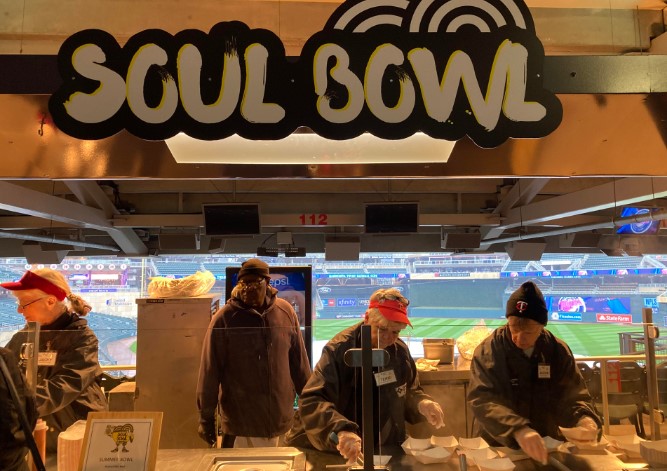
 

Baseball Roundtable Looks at the Early Baseball Era Hall of Fame Ballot

In early December the Baseball Hall of Fame’s Early Baseball Era (pre-1950) and Golden Days  Era Committees (1950-69) will each vote on a ballot of ten pre-screened candidates for 2022 induction into the HOF.  To be elected a candidate will need to secure at least 12 of the available 16 votes.  In this post, Baseball Roundtable will look at the Early Baseball Era candidates:

  • Indicating whom Baseball Roundtable would vote for if I had a ballot;
  • Profiling and ranking the candidates; and, finally,
  • Attempting to predict which candidate(s), the Committee will select.

For a Baseball Roundtable’s look at the Golden Days Era ballot, and more on the election process, click here.

A Statistical Word(s) of Caution

A  cautionary note, in case readers find what they feel are some discrepancies in the stats presented in this post.

When putting together these bios on Negro League and barnstorming players, there were often differences – both major and minor –  in reported stats.  For example, consider Dick “Cannonball” Redding. The Seamheads.com Negro League Database credits Redding with a record of 8-3 for the 1915 New York Lincoln Stars of the Eastern Independent Clubs League (and credits the Giants with a 24-14-2 record).  The Negro Leagues Baseball Museum profile, however, credits  Redding  with a 23-2 record for the Stars that season, including a 20-game winning streak (which is supported by the clip from the July 24, 1925 edition of the Chicago Defender – referenced in the Center for Negro League Baseball Research‘s Redding bio).  Why the difference?  Negro League teams, like Black players of the time, took games against opponents wherever they could showcase their talents, promote the game and generate revenue. The Seamheads’ stats appear to include only  league games, while the NLBM looked, as much as possible given record keeping in the era, at total contests (all levels of competition).   You can find a similar example in the case of Buck O’Neil: The Negro League Baseball Museum credits O’Neil with a .288 career average, Baseball-Refeence.com with a .283 average and the Seamheads.com Negro League Data Base .263.  As Baseball Roundtable put together this post, I looked at a variety of statistical and anecdotal sources.  Given the  lack of opportunity facing Black players in the period covered by the Early Baseball  ballot, I consistently leaned toward the Negro Leagues Baseball Museum’s profiles. 


BASEBALL ROUNDTABLE’S BALLOT …  IF I HAD ONE

  1. Buck O’Neil (Nov. 13, 1911 – October 6, 2006) … Professional Career: 1B/OF/Mgr., 1934-55

Photo: Public Domain via Wiki Commons.

Buck O’Neil getting my first vote is the only no-brainer  on this list – based on his career, his character and his contributions to the game.

O’Neil began his professional career touring with the Miami Giants in 1934 and also toured with the New York Tigers and Shreveport Acme Giants before signing with the Negro American League Memphis Red Sox in 1937 (although he later moved to the Zulu Cannibal  Giants).

In 1938, he joined the Kansas City Monarchs and remained with the franchise until 1955.  O’Neil also played in the Cuban League, Mexican Winter League and toured  and with the Satchel Page All Stars.

O’Neil led the Negro American League in batting average in 1946 at .353 and followed that up with a .358 average in 1947. Overall, he had four seasons of .330 or better.  He played in three Negro League All Star (East-West) Games and two Negro League World Series. As a manager, he led the Monarch to five Negro League Pennants.

O’Neil  later served as a scout and coach with the Chicago Cubs (the first Black coach in AL/NL history) and as a scout for the Kansas City Royals. He played a key role in the discovery and/or signing of such players as Lou Brock, Oscar Gamble, Lee Smith, Billy Williams and Ernie Banks.

Lou Brock on Buck O’Neil

“He shaped the character of young Black men. He touched the heart of everyone who loved the game. He gave us all a voice that could be hard on and off the field.”

O’Neil, who helped establish the Negro Leagues Baseball Museum, also gained recognition as one of the most eloquent spokesmen for (and advocate of) the national pastime – in particular the history of the Negro Leagues. Over the years, he cemented his reputation as an individual of great energy, spirit, integrity and character.– remaining consistently true to his passion for the game.

Here are just a few of the accolades O’Neil has already received.

  • 2006 … The Presidential Medal of Freedom.
  • 2007 … On the day of MLB’s first “Civil Rights Game,” O’Neil was awarded MLB’s first-ever Beacon of Life Award.
  • 2008 … the National Baseball Hall of Fame established the Buck O’Neil Lifetime Achievement Award – to honor individuals of character, integrity and dignity, who have enhanced baseball’s positive impact on society and broadened the game’s appeal. O’Neil, of course, was the first recipient.

2008 … Induction into the Baseball Reliquary Shrine of the Eternals.

2012 … Induction  into the Hall of Famous Missourians.

2016 … Kansas City’s Broadway Bridge was officially renamed the Buck O’Neil Bridge.

Despite these accolades , there is one well-deserved recognition that is  overdue.  Buck O’Neil belongs in the Baseball Hall of Fame.

  1. Vic Harris (January 10, 1905 – February 23, 1978) … Professional Career: OF/1B/Mgr., 1923-50

Photo: Public Domain via Wiki Commons.

Vic Harris gets Baseball Roundtable’s second vote for a combination of his exceptional playing career and, of notable impact on my decision, his seven Negro  League Championships as manager of the Homestead Grays.

Harris spent the bulk of his professional career with the Homestead Grays (23 seasons as a player and/or manager) – considered one of the elite franchises in Black baseball history.  He was a solid, slash hitter (.299 career average), a good fielder (known for his consistent hustle) and an aggressive base runner. Harris played in six  Negro League All Star (East-West) Games.  A few career highlights:

  • As a Negro Leagues rookie in 1923, Harris hit .304 for the Cleveland Tate Stars.
  • In 1929, he led the American Negro League in hitting, batting .333 for the Homestead Grays.
  • Playing for the Grays, he hit .324 in 1930, .348 in 1932; and .351 in 1933.
  • In 1934, he hit .360 for the Pittsburgh Crawfords.

Harris played with the Homestead Grays from 1925 to 1933.  In 1934, he moved to the  Pittsburgh Crawfords, but that lasted just one season. After his 1934 season with the Crawfords, Harris was convinced to rejoin the Homestead Grays as player-manager.  As a player, Harris hit .370 for the Grays in 1935 and .380 in 1938. As a manager he led the Grays to five seven  Negro League pennants. (He also managed the  Birmingham Black Barons for one season.) Harris also played and  managed in Cuba and Puerto Rico.

Among the teams Harris played for were the: Cleveland Tate Stars; Toledo Tigers; Cleveland Browns; Chicago American Giants; Homestead Grays; Detroit Wolves; and Pittsburgh Crawfords.

  1. John Wesley Donaldson  (February 20, 1891-April 14, 1970) … Professional Career: P/OF, 1908-41

John Wesley Donaldson
Photo: Courtesy of The Donaldson Network.

The number-three spot could easily have been a tie between two premier early Black hurlers –  John Wesley Donaldson and Dick “Cannonball” Redding. Donaldson gets a slight edge, as his accomplishment are, perhaps, the best-documented of any Black player of his era.

Baseball Roundtable first wrote about John Wesley Donaldson in November of 2016 after attending a presentation (before the Halsey Hall Chapter of the Society for American Baseball Research) by Peter Gorton, founder of the Donaldson Network – an organization dedicated to documenting Donaldson’s accomplishments and making the case for his election to the Baseball Hall of Fame. For that full story, click here.  Again, Thanks to the efforts of the Donaldson Network, Donaldson’s achievements – particularly on the mound –  are probably the best documented of any of the Black stars of his era.

Donaldson’s career stretched across four decades, during which time (like many Black players of his day), he took the mound pretty much anywhere he could draw a crowd and collect a paycheck. He played (and starred) for more than two dozen teams including the famous barnstorming All Nations Team, Brooklyn Royal Giants, Chicago America Giants, Los Angeles White Sox, New York Lincoln Giants, Indianapolis ABC’s, Detroit Stars and Kansas City Monarchs.  The southpaw – who possessed a good fastball and an exceptional assortment of drops and curves, is considered one of the top pitchers of his time.

Hall of Fame MLB Manager John McGraw on John Donaldson

“I think he is the greatest (pitcher) I have ever seen.”

The Donaldson Network has documented Donaldson’s appearance in more than 700 cities and towns in the U.S. and Canada – as well as:

  • 422 pitching victories;
  • 5, 177 strikeouts;
  • 14 no-hitters;
  • Two perfect games;
  • A 31-strikeout game; and
  • More than 20 games of 20 or more strikeouts.

On December 9, 1917, John Donaldson, then with the Los Angeles White  Sox, faced  lineup of all major leaguers. He pitched complete-game, six-hitter, striking out 16 in a 5-3 victory.

  1. Dick “Cannonball” Redding (April 15, 1890 -October 31, 1948) … Professional Career: P/OF/1B/Mgr.,  1911-38

Dick Redding’s overpowering fastball earned him the nickname “Cannonball” – and he lived up to it. Among his accomplishments (NLBM profile):

  • 30 no-hitters (multiple levels of competition);
  • 17 consecutive wins in his rookie season with the New York Lincoln Giants in 1911;
  • A 43-12 record, seven no-hitters, and 25 strikeouts in a nine-inning game for the Giants in 1912; and
  • A 20-game winning streak for the Lincoln Stars in 1915.

Redding was also known as a big-game pitcher who consistently  got the better of barnstorming major-league hitters.

Let’s Play Two

Dick Redding was considered a workhorse. His Negro Leagues Baseball Museum profile indicates he nearly always finished what he started, was more than willing to  pitch on back-to-back days and “often pitched doubleheaders two or three days in succession.”

Among the teams Redding pitched for were:  the Philadelphia Giants; New York Lincoln Giants; Indianapolis ABC’s; Brooklyn Royal Giants; Chicago American Giants; Atlantic City Bacharachs;  and New York Bacharachs. He served as a player-manager for the Atlantic City Bacharachs (1920-21) and the Brooklyn Royals (1927-33).  He also played in the Cuban Winter Leagues.

Sit Down Babe

Dick Redding once struck out Babe Ruth three times (on nine pitches) in a game against Ruth’s Barnstorming team (as noted in “Great Pitchers of the Negro Leagues,” by Paul Hoblin, SportsZone 2012).

Redding should meet the Babe again – in the HOF.

Now for the remainder of the ballot.

Actually, a pretty good case could be made for any of these players – but I could only choose four.

  1. Bill Dahlen (January 5, 1870 – December 5, 1950) … MLB Career: SS-3B, 1891-1911

How I wish I had one more vote.  It’s hard to pass on a player who played his last MLB game 110 years ago and still ranks among the top five shortstops all time in career assist and putouts.

Bill Dahlen was considered one of the finest  fielders and most aggressive base runners of his era. He also hit .272 over a 21-season MLB playing career,  with 84 home runs, 1,234 RBI, 1,590 runs scored and 548 stolen bases. He is 59th all-time in runs scored; 33rd in triples (163); and 28th in stolen bases (548). Dahlen scored 100+ runs in each of his first six seasons and 85 or more in a total of nine campaigns.

In 1894, Dahlen hit .359, with 15 home runs,  108 RBI and 150 runs scored and 43 steals. Overall, he hit .300 or better in three seasons  (twice over .350); stole 30 or more bases nine times (a high of 60 in 1892); and had double-digits in triples seven times.

In the field, Dahlen four times led NL shortstops in assists (and still ranks fourth all time with 7,505); finished in the top three among shortstops in putouts five seasons (and still ranks second all-time with 4,856); and led the league’s shortstops in double plays three times, finishing in the top three nine times.

Dahlen also managed the Brooklyn club for four seasons (1910-13), winning 251 and losing 355.

  1. Lefty O’Doul (March 4-1987-December 7, 1969) … MLB Career: P/OF, 1919-20, 1922-23, 1928-34

It’s somewhat surprising that Lefty O’Doul – with MLB’s sixth-highest career average is not yet in the Hall – the short span of his career seems the most likely reason (some early seasons spent on the mound also didn’t help his numbers).  I am sure there are plenty of readers out there who would question O’Doul being rated this low – and a case can be made.  The fact is, all these rankings are close (and subjective).

Lefty O’Doul played 11 MLB seasons, putting up a .349 career average with 113 home runs, 542 RBI, and 624 runs.  He won the NL batting title (and led MLB) with a .398 average in 1929 (Phillies) and again led MLB in 1932 with a .368 average (Dodgers). In his 1929 season, he also led MLB  with 254 hits (the third-most hits ever in an MLB campaign). That season O’Doul also bashed 32 home runs (fifth in the NL); drove in 122 (eighth); and scored 152 times (second in the league).

O’Doul started his career as a good-hitting pitcher. From 1919-23 (Giants and Red Sox), he appeared in 76 games, 34 as a pitcher, 41 as a  pinch hitter and one in the OF.  A 1-1, 4.87 record on the mound resulted in a return to the minors (Salt Lake City, Pacific Coast league) where, in 1924,  he hit .392 in 140 games and was 7-9, 6.54 on the mound.  A chronic sore arm led to his conversion to a full-time outfielder in 1925 – and between 1925 and 1927 (in the PCL), O’Doul  put up averages of .375 (198 games); .338 (180 games); and .378 (189 games). He earned a spot in the New York Giants outfield in 1928, hitting .319 in 114 games – and the rest is history.

O’Doul played in the majors for the Giants, Phillies, and Dodgers.

After his MLB playing career, O’Doul returned to the Pacific Coast League, managing the San Francisco Seals (1935-51), the San Diego Padres (1952-54), Oakland Oaks (1955), Vancouver Mounties (1956) and Seattle Rainiers (1957) – winning 2,094 games (1,970 losses) and two PCL championships.

O’Doul also played a notable role in building a base for baseball in Japan, making many trips to that country – both to create good will (through barnstorming teams of U.S. players) and to train Japanese players. He was credited with helping form the first Japanese professional league. He was the first American  inducted into the Japanese Baseball Hall of Fame (2002).  He is also a member of the San Francisco Bay Area Hall of Fame and the Baseball Reliquary Shrine of the Eternals.

  1. Bud Fowler (March 16, 1858-February 26, 1913) … Professional Career:  INF/OF/P,  1878-1899

Bud Fowler is acknowledged as the first African-American professional baseball player – playing on professional integrated teams as early 1878 (Lynn Live Oaks of the International Association). He is also recognized as the first African-American to captain an integrated team. Fowler was not just an accomplished defender, but a consistent (,300+) hitter.

In his early years, he pitched (and caught)  for teams in Worchester (New England Association); Malden (Eastern Massachusetts League); Guelph (Ontario); Petrolia, Texas; and Stillwater, Minnesota. After a 7-9 record at Stillwater in 1884 (some report it at 7-8, but that’s of little consequence), Fowler came up with a sore arm, prompting his transition to an infielder/outfielder. Between 1885 and 1894, Fowler played for at least 11 teams in nine different leagues – as well as for an independent Findlay, Ohio squad (where he also played from 1896-1899). Fowler’s movement from team to team was not because of his skills, but rather his color.  In Brian McKenna’s Society for American Baseball Research bio of Fowler, he quotes a Sporting Life article of the time as noting “With his splendid abilities he would long ago have been on some good club had his color been white instead of black. Those who know say there is no better second baseman in the country.”

Cooperstown Heritage

Bud Fowler grew up in Cooperstown,New York.

In 1887, Fowler organized the all-Black New York Gothams.  In 1895, Fowler helped organize the all-Black Page Fence Giants.   In that team’s first year, they went 118-36 and Fowler hit .319.   In 1898, Fowler played for the renowned  Cuban Giants. Shortly thereafter, he intensified his focus  on organizing barnstorming Black clubs like the Smoky City Giants (1901); All American Black Tourists (1903); and the Kansas City Stars (1904).

Fowler rates this high on this list both his baseball skills and his leadership and organizational abilities.

  1. George Scales (August 16, 1900-April 15, 1976) … Professional Career:  Inf/OF/Mgr., 1921-58

The versatile George Scales began his  career with the Montgomery Grey Sox in 1919 and went on to play with such squads as the Pittsburgh Keystones; St. Louis Giants; Saint Louis Stars; New York Lincoln Giants; Homestead Grays; Newark Stars; New York Black Yankees; Philadelphia  Stars; and the  Elite Giants.

Reviewing stats from a variety of sources, Scales had a career average of .313 over 25 seasons as a player, hitting  over .300 in 14 full-time seasons (nine of .340 or better, with two of those .400 or better).  Scales also played in Puerto Rico and Cuba and managed in Puerto Rico for a dozen seasons.  In Puerto Rico, he managed the  Ponce Lions for 10 seasons, delivering five pennants. (He also brought one pennant home to the Santurce team.)

Scales played a role in the organization of the New York Black Yankees in 1932 and was the team’s first manager. During his career, he also managed the Baltimore Elite Giants and Birmingham Black Barons.

  1. Grant “Home Run” Johnson (September 23, 1872-September 4, 1963) …Professional Career: SS/2B/Mgr., 1895-1923

Grant Johnson was one of Black baseball’s early stars – a feared slugger of the Dead Ball Era.  Like so many of the early Black baseball heroes, he played with many teams, going where he could showcase his skills and earn a living. He played with the Page Fence Giants; Chicago Columbia Giants; Chicago Unions; Cuban-X Giants; Brooklyn Royal Giants;  LeLand Giants; Chicago Giants; New York Lincoln Giants; Mohawk Giants; New York Lincoln Stars; Pittsburgh Colored Stars of Buffalo; and Buffalo Giants.

Grant was known not only as a disciplined and powerful hitter, but also  a fine fielder and  a natural leader – often managing the teams he played on.  A few highlights from his NLBM profile:

  • In 1895, hit .471 as his Page Fence team went 118-36;
  • He starred in the Cuban Winter league – captaining the Havana Reds and averaging .319 over five seasons and becoming the first American to win the Cuban batting title;
  • He served as captain of the Brooklyn Royals for several seasons;
  • Playing against all level of competition for the New York Lincoln Giants from 1911-13, he put up averages of .374; .413 and .371;
  • In 1894, hit 60 home runs in 112 games for the aptly-named semipro Findlay (Ohio) Sluggers.
  1. Allie Reynolds (February 10, 1917-December 26, 1994) … MLB career: RHP,  1942-54

Allie Reynolds  pitched in 13 MLB seasons, going 182-107, with a 3.30 ERA and 1,423 strikeouts in 2,492 1/3 innings pitched.  He was a five-time All Star, a 20-game winner once (20-8, 2.06 for the 1952 Yankees). He also led the AL twice in shutouts, twice in strikeouts and once in strikeouts per nine innings.

He was known as a “big-game” pitcher. In 15 World Series mound appearances (nine starts), he went 7-2, 2.79 with five complete games and two shutouts. His big-game reputation also followed him to the plate, despite a .163 career batting average, Reynolds hit .306 in 28 World Series plate appearances.

From 1943 through 1954  Reynolds won at least 11 games every year, winning 16 or more in seven seasons.   An “ace” for  the Yankees, Reynolds had his career cut short by a  back injury suffered in a team bus accident in 1953,

What Does Baseball Roundtable Think the Committee Will Do

I anticipate that Buck O’Neil will be elected and would not be surprised if the other candidates split up the votes enough that no one else get the 12 needed endorsements.  My dark horses for election would be John Donaldson (because of the level of documentation) and Lefty O’Doul (two batting titles and a season of 254 hits.) 

Primary Resources: Baseball-Reference.com; Negro League Baseball Museum player profiles; “Dick Redding” by Tim Hagerty, SABR Bio;  “Give Them The heaters – The Dick Redding Story,” by David Barr (November 21, 2017); “Forgotten Heroes: Dick ‘Cannonball;’ Redding,” Dr. Layton Revel & Luis Munoz, Center for Negro League Baseball Research: “Lefty O’Doul, “by Brian McKenna, SABR Bio; “Bud Fowler,” by Brian McKenna; SABR Bio.  


100Baseball Roundtable is on the Feedspot list of the Top 100 Baseball Blogs.  To see the full list, click here.

I tweet baseball @DavidBBRT

Follow/Like Baseball Roundtable’s Facebook Page here.  More baseball commentary; blog post notifications; PRIZES.

Member: Society for American Baseball Research (SABR); Negro Leagues Baseball Museum; The Baseball Reliquary. 

Heavy Metal Club … New Members Marcus Semien and Max Fried

Regular readers know that Baseball Roundtable has a particular fondness for players that bring “lumber and leather” to their game. This post/update (an annual BBRT tradition) will focus on players who have captured what the Roundtable sees as baseball’s “Heavy Metal Doubleheader” – winning a Silver Slugger and Gold Glove in the same season.  You have to admire those players who can earn recognition as the best at their positions both defensively and offensively.

Note: The Hillerich and Bradsby Silver Slugger Awards were first presented in 1980 (the Rawlings Gold Glove Awards were launched in 1957), so the list of double winners is relatively recent (at least  “recent” as defined by someone who went to their first World Series game the year the Gold Glove Awards were initiated).

In 2021, two players achieved “Heavy Metal” status, Blue Jays’ second baseman Marcus Semien and Braves’ pitcher Max Fried.  Let’s look at their 2021 Heavy Metal seasons.

Marcus Semien, 2B, Blue Jays

Marcus Semien’s Heavy Metal campaign encompassed a lot of ‘firsts” for the 30-year-old infielder. While it came in his ninth MLB season, it:

  • Represented Semien’s first Gold Glove and first Silver Slugger Awards;
  • Came in Semien’s first season as a Blue Jay (he signed as a free agent with the Jays in January 2021);
  • Was his first season as a regular at second base. (147 games at the keystone sack, 21 at SS). In his previous eight seasons, he had played  775 games at shortstop and just 29 at second base.

So, let’s look at the performance that punched his ticket into the Roundtable’s Heavy Metal Club.

On the offensive side, Semien hit .265, with 45 home runs (fourth in the AL); 102 RBI (tenth); and 115 runs scored (fourth). He also led the AL in extra base hits (86 … 39 doubles, two triples, 45 homers) and finished second in total bases (351).  He even threw in 15 steals (in 16 attempts). Quite an offensive year for a middle infielder, but not a surprise. In the 2019 seasons, Semien went .285-33-92 for the A’s.

Marcus Semien’s 45 home runs in 2021 are MLB’s most -ever in a season for a player who played primarily at second base. Of those 45 blasts, 41 were as a second basement and four as a shortstop.  Second on the list is Davey Johnson (1973 Braves) with 43 long balls (42 as a second basemen, one as a pinch hitter).

On defense, Semien was third among AL second basemen in Defensive Runs Saved with 11, first in Defensive Wins Above Replacement (1.8) and first in Zone Runs Saved (18). He was also third among AL second baseman in  putouts (202), fourth in assists (317) and second in double plays (86).

Max Fried, LHP, Braves

Fried won his second consecutive G0ld Glove and his first Silver Slugger Award.

At the plate, Fried hit .273 (15-for-55), with three doubles and five RBI. Notably, he was skilled enough with the bat to be used four times as a pinch hitter – going two-for-two (with a walk and a sacrifice)

On Defense, Fried led all NL pitchers in Defensive Runs Saved (six) and was second in pick offs (six).  He also led NL pitchers in assists (37) for the third straight season and was first in Range Factor (1.61). He made just one error in 45 chances.


–A ADDITIONAL BITS OF SAME-SEASON SS/GG TRIVIA–

  • The Chicago White Sox are the only team to never have a player capture a Silver Slugger Award and Gold Glove in the same season.
  • The most players to achieve the GG/SS combo in a season is nine – back in 1984: Lance Parrish, C, Tigers; Keith Hernandez, 1B, Mets; Eddie Murray, 1B, Orioles; Ryne Sandberg, 2B, Cubs; Lou Whitaker, 2B, Tigers; Mike Schmidt, 3B, Phillies; Buddy Bell, 3B, Rangers; Dave Winfield, OF, Yankees; Dale Murphy, OF, Braves.
  • Roberto Alomar (2B) is the only player to win the single-season Gold Glove/Silver Slugger combo with three different teams (Blue Jays-1992; Orioles-1996; Indians-1999, 2000).
  • Scott Rolen (3B) and Zack Greinke are the only players to win the SS/GG combo in a season in which they played for two different teams. In 2002, Rolen was traded from the Phillies to the Cardinals on July 29. He played 100 games for the Phillies and 55 for the Cardinals in what would be his only SS/GG combo season.  Greinke did it in 2019, , when he started the season with the Diamondbacks and was traded to the Astros at the July deadline. Despite moving to the AL with its DH, Geinke’s .280-3-8 season was goo enough to earn him a Silver Slugger.
  • The only team to have three SS/GG winners in the same season is the 1993 Giants (Robby Thompson (2B), Matt Williams (3B), Barry Bonds (OF).

Zack Greinke (2019 Diamondbacks/Astros), Mike Hampton (2003 Braves) and Max Fried (2021 Braves) are the only pitchers to win a Silver Slugger and Gold Glove in the same season. 

__________________________________________________________________

HM Streak

____________________________________________________________

Now that we’ve looked at 2021’s “Heavy Metal” honorees, here’s a look back at those who have won both awards in the same season in the past.  Since 1980, the combination of a Gold Glove/Silver Slugger has been achieved in a season 197 times by 106 different players – with 39 players accomplishing the feat more than once and 26 of those winning two or more consecutive SS/GG combinations.   Here are a couple of lists that might be of interest.  (Note: Since the Silver Slugger is awarded to three outfielders annually regardless of their position, the GG/SS combo lists in this post do not break outfielders out by position.)

—Full List of Same-Year Gold Glove/Silver Slugger Winners by Season—

2021

Marcus, Semien, 2B, Blue Jays

Max Fried, P, Braves

2020

Mookie Betts,RF, Dodgers

2019

J.T. Realmuto, C, Phillies; Mookie Betts, RF, Red Sox; Cody Bellinger, RF, Dodgers; Zack Greinke, P, D-backs/Astros

2018

Nolan Arenado, 3B, Rockies; Mookie Betts, OF, Red Sox; Nick Markakis, OF, Braves; Salvador Perez, C, Royals

2017

Nolan Arenado, 3B, Rockies; Paul Goldschmidt, 1B, Diamondbacks; Eric Hosmer, 1B, Royals; Marcell Ozuna, OF, Marlins

2016

Nolan Arenado, 3B, Rockies; Mookie Betts, Of, Red Sox; Salvador Perez, C, Royals; Anthony Rizzo, 1B, Cubs

2015

Jose Altuve, 2B, Astros; Paul Goldschmidt, 1B, Diamondbacks; Dee Gordon, 2B, Marlins; Nolan Arenado, 3B, Rockies; Brandon Crawford, SS, Giants.

2014

Adrian Gonzalez, 1B, Dodgers

2013

Yadier Molina, C, Cardinals; Paul Goldschmidt, 1B, Diamondbacks; J.J. Hardy, SS, Orioles; Adam Jones, OF, Orioles

2012

Adam LaRoche, 1B, Nationals; Robinson Cano, 2B, Yankees; Chase Headley, 3B, Padres; Andrew McCutchen, OF, Pirates

2011

Adrian Gonzalez, 1B, Red Sox; Brandon Phillips, 2B, Reds; Adrian Beltre, 3B, Rangers; Troy Tulowitzki, SS, Rockies; Jacob Ellsbury, OF, Red Sox; Matt Kemp, OF, Dodgers

2010

Joe Mauer, C, Twins; Albert Pujols, 1B, Cardinals; Robinson Cano, 2B, Yankees; Troy Tulowitzki, SS, Rockies; Carl Crawford, OF, Rays; Carlos Gonzalez, OF, Rockies

2009

Joe Mauer, C, Twins; Mark Tiexiera, 1B, Yankees; Ryan Zimmerman, 3B, Nationals; Derek Jeter, SS, Yankees; Matt Kemp, OF, Dodgers; Ichiro Suzuki, OF, Mariners; Torii Hunter, OF, Angels

2008

Joe Mauer, C, Twins; Dustin Pedroia, 2B, Red Sox; David Wright, 3B, Mets; Grady Sizemore, OF, Indians

2007

Russell Martin, C, Dodgers; Placido Polanco, 2B, Tigers; David Wright, 3B, Mets; Jimmy Rollins, SS, Phillies; Carlos Beltran, OF, Mets; Ichiro Suzuki, OF, Mariners

2006

Derek Jeter, SS, Yankees; Carlos Beltran, OF, Mets

2005

Jason Varitek, C, Red Sox; Mark Tiexierea, 1B, Rangers; Derrek Lee, 1B, Cubs; Andruw Jones, OF, Braves

2004

Ivan Rodriguez, C, Tigers; Jim Edmonds, OF, Cardinals

2003

Brett Boone, 2B, Mariners; Edgar Renteria, SS, Cardinals; Alex Rodriguez, SS, Rangers; Mike Hampton, P, Braves

2002

Todd Helton, 1B, Rockies; Scott Rolen, 3B, Cardinals/Phillies; Eric Chavez, 3B, A’s; Edgar Renteria, SS, Cardinals; Alex Rodriguez, SS, Rangers

2001

Todd Helton, 1B, Rockies; Ichiro Suzuki, OF, Mariners

2000

Roberto Alomar, 2B, Indians; Darin Erstad, OF, Angels

1999

Ivan Rodriguez, C, Rangers; Robert Alomar, 2B, Indians; Larry Walker, OF, Rockies; Ken Griffey, Jr., OF, Mariners; Shawn Green, OF, Blue Jays

1998

Ivan Rodriguez, C, Rangers; Rafael Palmeiro, 1B, Rangers; Ken Griffey, Jr. OF, Mariners

1997

Ivan Rodriguez, C, Rangers; Craig Biggio, 2B, Astros; Chuck Knoblauch, 2B, Twins; Matt Williams, 3B, Indians; Larry Walker, OF, Rockies; Barry Bonds, OF, Giants; Ken Griffey, Jr, OF, Mariners

1996

Ivan Rodriguez, C, Rangers; Roberto Alomar, 2B, Orioles; Ken Caminiti, 3B, Padres; Barry Larkin, SS, Reds; Barry Bonds, OF, Giants; Ken Griffey, Jr. OF, Mariners

1995

Ivan Rodriguez, C, Rangers; Craig, Biggio, 2B, Astros; Barry Larkin, SS, Reds

1994

Ivan Rodriguez, C, Rangers; Jeff Bagwell, 1B, Astros; Craig Biggio, 2B, Astros; Matt Williams, 3B, Giants; Wade Boggs, 3B, Yankees; Barry Bonds, OF, Giants; Ken Griffey, Jr., OF, Mariners

1993

Robby Thompson, 2B, Giants; Matt Williams, 3B, Giants; Jay Bell, SS, Pirates; Barry Bonds, OF, Giants; Ken Griffey, Jr, OF, Mariners

1992

Roberto Alomar, 2B, Blue Jays; Larry Walker, OF, Expos; Andy Van Slyke, OF, Pirates; Barry Bonds, OF, Pirates; Kirby Puckett, OF, Twins

1991

Will Clark, 1B, Giants; Ryne Sandberg, 2B, Cubs; Cal Ripken, Jr., SS, Orioles; Barry Bonds, OF, Pirates’ Ken Griffey, Jr., OF, Mariners

1990

Benito Santiago, C, Padres; Ryne Sandberg, 2B, Cubs; Kelly Gruber, 3B, Blue Jays; Barry Bonds, OF, Pirates; Ellis Burks, OF, Red Sox

1989

Ryne Sandberg, 2B, Cubs; Eric Davis, OF, Reds; Kirby Puckett, OF, Twins; Tony Gwynn, OF, Padres

1988

Benito Santiago, C, Padres; Ryne Sandberg, 2B, Cubs; Andy Van Slyke, OF, Pirates; Kirby Puckett, OF, Twins

1987

Don Mattingly, 1B, Yankees; Ozzie Smith, SS, Cardinals; Tony Gwynn, OF, Padres; Eric Davis, OF, Reds; Kirby Puckett, OF, Twins; Andre Dawson, OF, Cubs

1986

Don Mattingly, 1B, Yankees; Frank White, 2B, Royals; Mike Schmidt, 3B, Phillies; Tony Gwynn, OF, Padres; Kirby Puckett, OF, Twins

1985

Don Mattingly, 1B, Yankees; Ryne Sandberg, 2B, Cubs; Lou Whitaker, 2B, Tigers; Tim Wallach, 3B, Expos; George Brett, 3B, Royals; Willie McGee, OF, Cardinals; Dale Murphy, OF, Braves; Dave Winfield, OF, Yankees

1984

Lance Parrish, C, Tigers; Keith Hernandez, 1B, Mets; Eddie Murray, 1B, Orioles; Ryne Sandberg, 2B, Cubs; Lou Whitaker, 2B, Tigers; Mike Schmidt, 3B, Phillies; Buddy Bell, 3B, Rangers; Dave Winfield, OF, Yankees; Dale Murphy, OF, Braves

1983

Lance Parrish, C, Tigers; Eddie Murray, 1B, Orioles; Lou Whitaker, 2B, Tigers; Mike Schmidt, 3B, Phillies; Dale Murphy, OF, Braves; Dave Winfield, OF, Yankees; Andre Dawson, OF, Expos

1982

Gary Carter, C, Expos; Mike Schmidt, 3B, Phillies; Robin Yount, SS, Brewers; Dale Murphy, OF, Braves; Dave Winfield, OF, Yankees

1981

Gary Carter, C, Expos; Manny Trillo, 2B, Phillies; Mike Schmidt, 3B, Phillies; Andre Dawson, OF, Expos; Rickey Henderson, OF, A’s; Dwight Evans, OF, Red Sox; Dusty Baker, OF, Dodgers

1980

Keith Hernandez, 1B, Cardinals; Cecil Cooper, 1B, Brewers; Andre Dawson, OF, Expos; Willie Wilson, OF, Royals

_________________________________________

If you want to look up your favorite player(s), here is:

Your Same-Season, Gold Glove/Silver Slugger combo winners listed alphabetically:

Alomar, Roberto … 1992; 1996; 1999; 2000

Altuve, Jose … 2015

Arenado, Nolan … 2015; 2016; 2017; 2018

Baker, Dusty … 1981

Bagwell, Jeff … 1994

Bell, Buddy … 1984

Bell, Jay (SS) … 1993

Cody Bellinger … 2019

Beltre, Adrian (3B) … 2011

Beltran, Carlos (OF) … 2006; 2007

Biggio, Craig (2B) … 1994; 1995; 1997

Betts, Mookie (OF) … 2016; 2018; 2019; 2020

Boggs, Wade (3B) … 1994

Bonds, Barry … 1990; 1991; 1992; 1993; 1994; 1996; 1997

Boone, Brett … 2003

Brett, George … 1985

Burks, Ellis … 1990

Caminiti, Ken … 1996

Cano, Robinson … 2010; 2012

Carter, Gary … 1981; 1982

Chavez, Eric … 2002

Clark, Will … 1991

Cooper, Cecil …1980

Crawford, Brandon … 2015

Crawford, Carl … 2010

Dawson, Andre … 1980; 1981; 1983; 1987

Davis, Eric … 1987; 1989

Edmonds, Jim … 2004

Ellsbury, Jacob … 2011

Erstad, Darin … 2000

Evans, Dwight … 1981

Fried, Max … 2021

Goldschmidt, Paul … 2013; 2015; 2017

Gonzalez, Adrian … 2011; 2014

Gonzalez, Carlos … 2010

Gordon, Dee … 2015

Green, Shawn … 1999

Greinke, Zack … 2019

Griffey, Ken Jr. … 1991; 1993; 1994; 1996; 1997; 1998; 1999

Gruber, Kelly … 1990

Gwynn, Tony … 1986; 1987; 1989

Hampton, Mike … 2003

Hardy, J.J. … 2013

Headley, Chase … 2012

Helton, Todd … 2002

Henderson, Rickey … 1981

Hernandez, Keith … 1980; 1984

Eric Hosmer … 2017

Hunter, Torii … 2009

Jeter, Derek … 2006; 2009

Jones, Adam … 2013

Jones, Andruw … 2005

Kemp, Matt … 2009; 2011

Knoblauch, Chuck … 1997

Larkin, Barry … 1995; 1996

LaRoche, Adam … 2012\

Lee, Derrek … 2005

Markakis, Nick … 2018

Martin, Russell … 2008\

Mattingly, Don … 1985; 1986; 1987

Mauer, Joe … 2008; 2009; 2010

McCutchen, Andrew … 2012

McGee, Willie … 1985

Molina, Yadier … 2013

Murphy, Dale … 1982; 1983; 1984; 1985

Murray, Eddie … 1983; 1984

Marcell Ozuna … 2017

Polanco, Placido … 2007

Palmeiro, Rafael … 1998

Parrish, Lance … 1983; 1984

Pedroia, Dustin … 2008

Salvador, Perez … 2016; 2018

Phillips, Brandon … 2011

Puckett, Kirby … 1986; 1987; 1988; 1989; 1992

Pujols, Albert … 2010

J.T. Realmuto … 2019

Renteria, Edgar … 2002

Ripken, Cal, Jr. … 1991

Anthony Rizzo … 2016

Rodriguez, Alex … 2002; 2003

Rodriguez, Ivan … 1994; 1995; 1996; 1997; 1998; 1999; 2004

Rolen, Scott … 2002

Rollins, Jimmy … 2007

Sandberg, Ryne … 1984; 1985; 1988; 1989; 1990; 1991

Santiago, Benito … 1988; 1990

Schmidt, Mike … 1981; 1982; 1983; 1984; 1986

Sizemore, Grady … 2008

Semien, Marcus, 2021

Smith, Ozzie … 1987

Suzuki, Ichiro … 2001; 2007; 2009

Thompson, Robby … 1993

Tiexiera, Mark … 2005, 2009

Trillo, Manny … 1981

Tulowitzki, Troy … 2010; 2011

Van Slyke, Andy … 1988; 1992

Varitek, Jason … 2005

Walker, Larry … 1992; 1997; 1999

Wallach, Tim … 1985

White, Frank … 1986

Whitaker, Lou … 1983; 1984; 1985

Williams, Matt … 1993; 1994; 1997

Wilson, Willie … 1980\

Winfield, Dave … 1982; 1983; 1984; 1985

Wright, David … 2007; 2008

Yount, Robin … 1982

Ryan Zimmerman … 2009

Primary Resources:  Baseball-Reference.com; MLB.com; FanGraphs.com

100Baseball Roundtable is on the Feedspot list of the Top 100 Baseball Blogs.  To see the full list, click here.

I tweet baseball @DavidBBRT

Follow/Like Baseball Roundtable’s Facebook Page here.  More baseball commentary; blog post notifications; PRIZES.

Member: Society for American Baseball Research (SABR); Negro Leagues Baseball Museum; The Baseball Reliquary. 
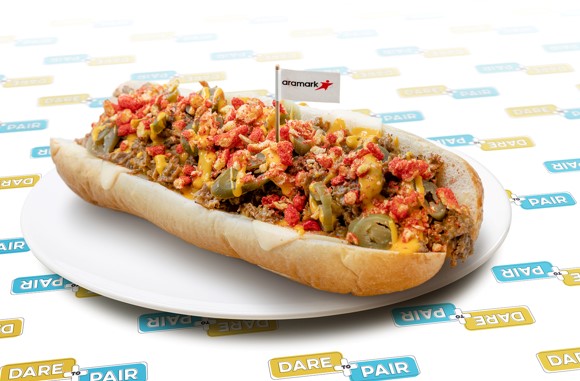
Baseball Roundtable Rates the 2021 MVP Candidates — With Perhaps a Surprise or Two

With the postseason behind us and the awards season ahead, Baseball Roundtable has devoted some time to looking at  (and rating) candidates for the major awards – as well as predicting the winners.  In this post, I look at Most Valuable Player candidates (sharing my ratings for the top five in each league).  For BBRT’s look at Rookie of the Year candidates, click here.  For the Cy Young Award, click here.

AMERICAN LEAGUE MVP

Baseball Roundtable Choice:  Shohei Ohtani

Baseball Roundtable Prediction: Shohei Ohtani

  1. Shohei Ohtani, DH/RHP, Angels … Let’s face it, this was pretty much a slam dunk – despite the Angels’ fourth-place finish. Ohtani delivered value at the plate, on the mound, on the base paths and in the roster flexibility he provided. Ohtani would be in the running for MVP even if he didn’t take the mound. Consider, not only were his 46 home runs third-best in the American League, he was fifth in steals with 26 – power and speed. He also led the league in triples (8) and intentional walks (20) and was third in total walks (96).  Ohtani produced a 100-100 season (100 RBI/103 runs scored). Add his 9-2, 3.18 mound record (23 starts) and 156 strikeouts in 130 1/3 innings and you have your AL MVP.  (Three things did trouble me: the .257 average, 189 strikeouts as a hitter and the DH position. Still, what he brought to the plate, on the bases and on the mound made him the clear choice.)
  2. Vlad Guerrero, Jr., 1B, Blue Jays … In almost any other year, the 22-year-old Guerrero would have been clearing a spot on his mantle for this award.  He hit a healthy .311, led the AL in home runs with 48 and was fifth in RBI with 111.  In fact, he teased a Triple Crown for much of the season. In addition, his 123 runs led the league, as did his 363 total bases,  .401 on-base percentage and .601 slugging percentage.  The slugging infielder had 52 multi-hit games – and his 188 safeties were second in the league. Side note:  A bit of a second-half decline probably kept Guerrero from claiming the triple crown.  He was .332-28-73 before the break and .288-20-38 after.  Again, Guerrero’s just 22, there is an MVP award (or two) in his future.
  3. Marcus Semien, 2B, Blue Jays … You have to like a middle infielder with power and Semien fits the bill. This season, he delivered 45 home runs, 102 RBI and 115 runs scored.  He even tossed in 15 steals in sixteen attempts. And, he was durable, playing in all  162 games.  Further, he did all of this while making the transition from being primarily a shortstop to primarily a second baseman (or does that matter with all of today’s defensive shifts). His .265 average was a little troubling, but he earned this spot among MVP candidates.
  4. Salvador Perez, C, Royals … What the heck! In his nine previous MLB seasons, Perez was recognized as a Gold Glove defensive catcher with a little pop – 152 home runs in nine seasons, with a high of 27 in both 2017 and 2018. In 2021, the 31-year-old turned on the afterburners. He tied for the league lead in home runs (48) and lead the league in RBI 121,while hitting .273. Those 48 home runs were the most hit in a season by a player who played at least half his games as a catcher (Perez hit 33 while in the game at catcher, 15 as a DH). For those who like to know these things, Javy Lopez – 2003 Braves – hold the single-season record for home runs hit while at catcher, hitting 42 of his 43 home runs that season as a catcher (one as a pinch hitter.
  5. Tie: Aaron Judge Yankees and Rafael Devers, Red Sox. (Well, we should have some players on this list whose teams made the post season.

Aaron Judge, RF, Yankees … Judge helped power the Yankees with a .287-39-98 line, and also scored 89 runs ans stole  six bases.

Rafael Devers, 3B, Red Sox … Devers was a critical piece of the Red Sox offense, going .279-38-113, and scoring 101 runs.  (I do like those 100/100 campaigns.)

Another Blue Jay for the List?

Okay, in my top five AL MVP candidates you find a pair of Blue Jays who delivered 100/100 seasons (Vlad Guerrero 111 RBI/123 runs & Marcus Semien (102 RBI & 115 Runs). I could easily have given a third spot to Bo Bichette, who produced 102 RBI and 121 run scored.


NATIONAL LEAGUE MVP

Baseball Roundtable Choice:  Paul Goldschmidt

Baseball Roundtable Prediction: Juan Soto

  1. Paul Goldschmidt, 1B, Cardinals ….  Placing Goldschmidt here may surprise a few folks, but Goldschmidt delivered a typically golden season: .294, with 31 home runs, 99 RBI, 102 runs scored and 12 steals (in 12 attempts) – plus Gold Glove caliber defense.  Perhaps even more important – from August 10 through October 3, when the Redbirds went 35-16 and put themselves back in the post-season picture, Goldschmidt went .346-13-36, while playing all but two of those contests.  I give Goldschmidt a slight edge over Juan Soto and Bryce Harper because of his contributions down the stretch – and the fact that his Cardinals did make the post season.
  2. Juan Sot0, RF, Nationals … The 22-year-old hit .313 (second in the NL) on the season, with 29 home runs, 95 RBI (tenth in the league) and 111 runs scored (second).  His .465 on-base percentage (he led the league with 145 walks and 23 intention passes) led the league (and MLB).  Those free passes clearly show how valuable his bat was to the Nationals and how determined opponents not to let Soto beat them. Soto had an especially strong second half, going .348-18-53 after the All Star break (with a .525 on-base percentage). That post-break surge may be what sways voters.  It’s hard to deny a player who gets on base more than half the time over half a season.  On the season, Soto had 41 multi-hit games and and 39 multi-walk games.
  3. Bryce Harper, RF, Phillies … Harper put up a .309-35-84 line, with 101 runs scored and 13 steals in 16 attempts. He also had a league-topping 42 doubles and a league-leading .615 slugging percentage. Like Goldschmidt and Soto, Harper finished strong – going .338-20-50 after the break.
  4. Freddie Freeman, 1B, Braves … Freeman had an MVP-candidate caliber season (again): .300-31, 83, with a league-leading 120 runs scored. He had the NL’s third-highest on-base percentage (393), drew the third-most walks (85) and he added steady veteran leadership to the Braves, who had to reshape their lineup after key offensive losses and trade deadline moves. Freeman’s 53 multi-it games, trailed only Trea Turner and Bo Bichette (58 each) in MLB.
  5. Fernando Tatis, Jr. , SS, Padres … Had the Padres not faded from the race, Tatis might have been right near the top of this ranking – thanks to a league-leading 42 home runs, coupled with 25 steals (in 29 attempts). He just missed the 100-100 club – with 97 RBI and 99 runs scored. Still, it was a season worth a top-five spot on the BBRT MVP list.

Special Mention

It’s hard to justify a spot on the MVP list for a player who was traded mid-season. (Why would you trade an MVP candidate?) Still, Trea Turner, who went from the Nationals to the Dodgers at the trading deadline, deserves a shout out here. Turner won the NL batting crown with a .328 average, lead the league with 195 hits, scored 125 runs, hit 28 home runs, stole a league-leading 32 bases and was a spark plug for the Dodgers down the stretch.  Still, he put up more than half of that offense while in a National’s uniform.  If had had done all that for the Dodgers, I’d probably slot him in the top three.

Primary Resources: Baseball Reference.com; STATS

BASEBALL ROUNDTABLE ON THE TOP 100 BASEBALL BLOG LIST

100Baseball Roundtable is on the Feedspot list of the Top 100 Baseball Blogs.  To see the full list, click here.

I tweet baseball @DavidBBRT

Follow/Like Baseball Roundtable’s Facebook Page here.  More baseball commentary; blog post notifications; PRIZES.

Member: Society for American Baseball Research (SABR); The Baseball Reliquary, The Negro Leagues Baseball Museum