Baseball May 2022 Wrap – No-hitters, .400 hitters, Hitting Streaks and More

It’s June 1, and that means it’s time for Baseball Roundtable’s monthly Wrap Up – outlining the stats and stories that caught Baseball Roundtable’s attention in May, plus the standings, Players and Pitchers of the Month and the year-to-date Trot Index.   This month is a little more challenging, as I am putting this post together while on Ballpark Tours’ 40th Anniversary baseball journey. So, I’m writing from the Intercontinental Hotel in Chicago, while waiting to head out to the Brewers-Cubs game at Wrigley Field. Given that, there may a typo to be discovered here and there.  Those on the tour bus will know who I’m talking about.

There was, as always, plenty to take note of over the past month:

  • Miguel Cabrera’s ever-growing Hall of Fame resume;
  • Angels’ rookie Reid Detmers’ no-hitter;
  • A record-tying five-homer inning by the Astros;
  • Two  qualifying players who hit .400+ for the month and three who hit at least 10 home run;
  • Max Scherzer’s first loss in nearly a year;
  • Two players who ended the month with active 20+ game hitting streaks;
  • The season’s first triple play;
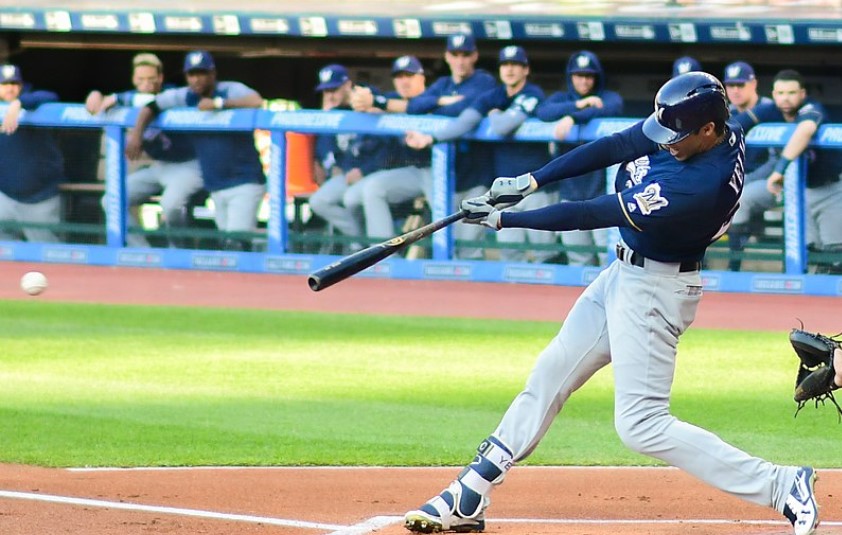
  • Christian Yelich’s record-tying (and, in some ways, record-setting) third cycle;
  • And more.

History Repeats Itself – Kind Of

In the April Wrap Up, Baseball Roundtable noted that on April 7 – National Beer Day – the Diamondbacks’ DH Seth Beer hit a walk-off home run to put the Diamondbacks past the Padres 4-1.  It was his second career homer and first career walk-off long ball.  I also voiced my wish that Beer be traded to the White Sox, who have 3B Jake Burger on the roster, so we could have a Beer and a Burger in the lineup together. (A trade taking Burger to the Diamondbacks would, of  course, achieve the same end. ) Well, I didn’t get that, but on May 28 – National Hamburger Day –  Burger homered in the White Sox 5-1 win over the Cubs. 

—–Baseball Roundtable Players/Pitchers  of the Month—–

National League Player of the Month – Paul Goldschmidt, 1B, Cardinals
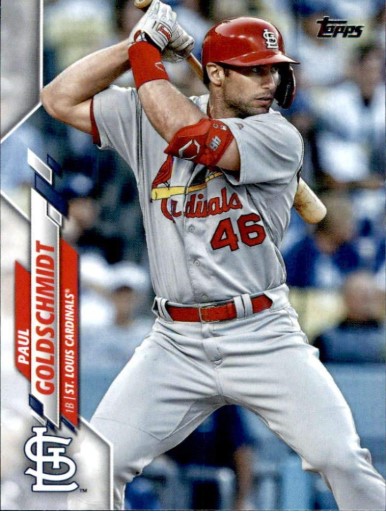
Goldschmidt lit it up in May – to the tune of 42 hits (most in the NL) and a .404 average – both tops in the National League.  His 33 RBI led MLB and his ten homers were second in the NL to the Dodgers’ Mookie Betts (12)   Goldschmidt ended the month with an  active  22-game hitting streak, during which he hit a robust .438. During the month, he had 12 multi-hit games and ten multi–RBI contests.  There were some other solid performances, but that .40o  average gave Goldschmidt the edge.

Honorable Mentions: Mookie Betts, RF, Dodgers, put up a .342 May average, led the NL with 12 May homers and was fourth in the NL with 26 RBI for the month, while leading  MLB with 31 May runs scored. It was a close call.   Philllies’ RF Bryce Harper went .47-7-18 and Mets’ 1B Pete Alonso went .315-9-30. A shout out also goes to Dodgers’ SS  Trea Turner, who hit  .314-4-24 month and ended with his 23-game hitting streak still active. He also swiped six bases.

American League  Player of the Month– Tie: Aaron Judge, RF, Yankees and J.D Martinez, LF Red Sox.

Hard to pick between MLB’s top hitters in May average (Martinez, among qualifiers) and home runs (Judge – tied).

Photo: Keith Allison from Hanover, MD, USA, CC BY-SA 2.0 <https://creativecommons.org/licenses/by-sa/2.0>, via Wikimedia Commons

A .400 average is a bright and shiny thing that attracts Baseball Roundtable’s attention – and Martinez hit .406 for the Month of May. His 43 hits were second in MLB  (to teammate 3B Rafael Devers). He also also scored 23 runs,  delivered four home runs and 15 RBI. Martinez collected a safety in all but one of his 26 May games – and he had 13 multi-hit performances.
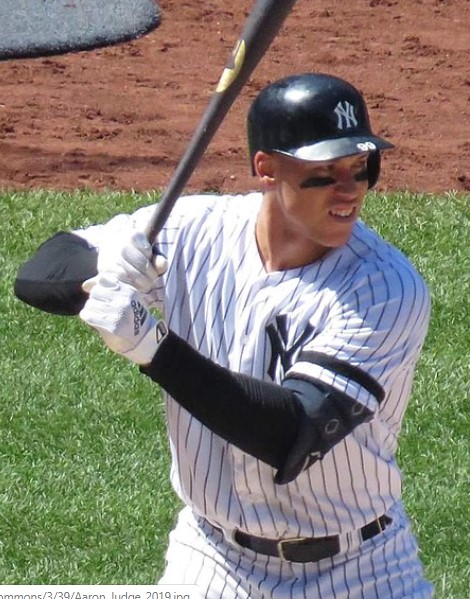
Photo: DR. Buddie, CC BY-SA 4.0 <https://creativecommons.org/licenses/by-sa/4.0>, via Wikimedia Commons

So why the tie?  Well, Judge didn’t hit.400.  But he did drive in and score  more runs than Martinez.   Judge led the AL and tied for the MLB lead  in May home runs with 12 was second  in the AL in RBI (25), while hitting  a healthy .311  He had three multi-homer games and six games with three or more RBI.

Some may ask why Red Sox’ SS Trevor Story and his AL-topping 32 May RBI did not figure into this ranking.  For me it’s that .218 average for the month.  It is Player of the “Month” and from May 1 through May 15, Story was .156-1-10.

Honorable Mentions: More Red Sox and Yankees here.  Red Sox’ 3B Rafael Devers was a mirror-image of  teammate J.D. Martinez for the month – .381-8-17, with 23 runs scored and an MLB-leading 45 May safeties.  The Yankees’ DH Giancarlo Stanton put up a solid .301-7-21 line  (fourth in AL in RBI).  Also have to give  nod to the Twins’ versatile Luis Arraez, who got in only 23 games, but hit .376 with an MLB topping (among qualifiers) .480 on-base percentage.

National League Pitcher of the Month- Sandy Alcantara, RHP, Marlins
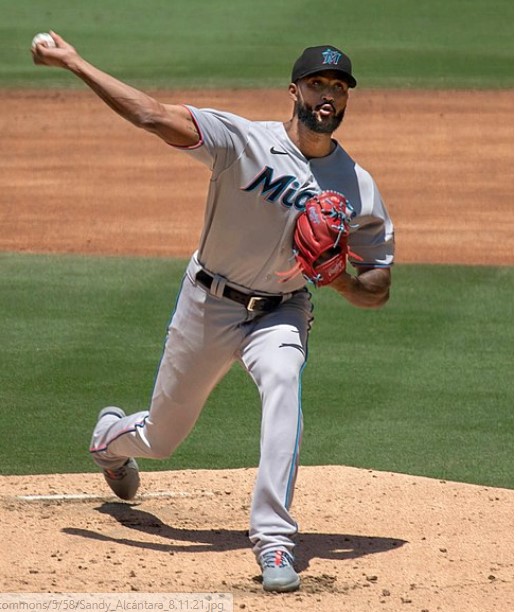
Photo: Ryan Casey Aguinaldo, CC BY-SA 4.0 <https://creativecommons.org/licenses/by-sa/4.0>, via Wikimedia Commons

It was a tough call here. No one really jumped out at me. There were Pirates’ Jose Quintana, Padres’ Joe Musgrove and Phillies’ Zack Wheeler who all pitched at least 25 innings with ERAs under 1.50;  the Phillies’ Aaron Nola with 40 strikeouts and just five walks in 33 innings; and the Mets’ Carlos Carrasco. Diamondbacks’ Zac Gallen and  and Dodgers’ Tony Gonsolin,  Tyler Anderson and Walker Buehler,  who each went 4-0 for the month.,

I decided to go with the Marlins’ Sandy Alcantara, who may have only gone 3-2 in May (keep in mind, he was pitching for the Marlins, who went 7-19 for the month), but put  up a 2.13 ERA, a league-topping 42 1/3 innings pitched (six starts) and 43 strikeouts (second in the NL). In his last four May starts, Alcantara pitched 32 innings (I’ll do the math, that’s eight frames per start) and gave up just three earned runs.

Honorable Mentions; The Padres’ Joe Musgrove went 2-0, 1.64 in five May starts, fanning 33 batters in 33 innings. In his five starts, Musgrove never went less than six full innings and never gave up more than two earned runs. In his three May no-decisions, the Padres scored a total of two runs while Musgrove was in the game.  The Dodgers’ Tony Gonsolin went 4-0, with a tidy 1.93 ERA in five starts and whiffed 31 batters in 28 innings

American League Pitcher of the Month – Martin Perez, LHP, Rangers

Photo: mjl816 on Flickr (Original version) UCinternational (Crop), CC BY-SA 2.0 <https://creativecommons.org/licenses/by-sa/2.0>, via Wikimedia Commons

Another tough decision. with Jameson Taillon, who went 4-0 for the Yankees; Rays Shane McClanahan, who went 4-0, 1.15; New York’s Gerrit Cole who fanned 45 batters (just five walks) in five starts (33 2/3 innings); and Tigers’ Tarik Skubal, Twins’ Sony Gray, Yankees’ Nestor Cortes, who joined McClanahan with at least 25 innings pitched and ERAs under 2.00.

I went with the only pitcher to put up an ERA not just under 2.00, but under 1.00 in six May starts – and also threw one of just two complete-game shutouts in May.  That would be the Rangers’ Martin Perez, who – on May 20, shutout the vaunted Houston Astros’ offense in a nine-inning, eight-hit, 3-0 win.  In five May starts, Perez went 4-0 and allowed only three earned runs in 42 1/3 innings – a stingy 0.64 ERA  (yes, his ERA started with a zero).

Honorable Mentions: The Rays’ Shane McClanahan could easily have this spot – going 4-0, 1.14 in five starts and fanning 39 in 31 1/3 innings. (I just could not resist Perez’ sub-1.00 ERA.)  White Sox’ closer Liam Hendricks also had a solid month, with an MLB-high ten saves (in 12 opportunities), a 2.03 ERA and 21 whiffs in 13 1/3 innings.  I also looked at the Tigers’ Tarik Skubal (2-0, 1.15 in five starts, with 35 strikeouts in 31 1/3 innings) and the Yankees’ Nestor Cortes (3-1, 1.95 with 33 strikeouts in 32 1/3 innings).

Surprise Player of the Month – Tyler Anderson, LHP. Dodgers

The 32-year-old Anderson came into the 2022 season with a 29-68, 4.66 record over six MLB seasons (2016-21 … Rockies, Giants, Pirates, Mariners). Anderson had never won more than seven games in a season and had finished above .500 just once – 4-3, 4.37 in 2020. He had, in fact, been granted free agency by the Mariners before the Dodgers signed him in March. This May, Anderson went 4-0, 3.09 in five starts, fanning 33 batters in 32 innings – bringing his record on the year to 6-0, 2.90 in nine appearances, seven starts. In his final three starts of the month, he went 3-0 and gave up just two earned runs in 21 innings – fanning 21 and walking just one.

________________

TROT INDEX … A REGULAR BBRT FEATURE

Through May, 34.5 percent of the MLB season’s 55,041 plate appearances ended in a trot (back to the dugout, around the bases, to first base). We’re talking about strikeouts, home runs, walks, hit by pitch and catcher’s interference – all outcomes that are, basically, devoid of action on the base paths or in the field. Here’s the breakout: strikeouts (22.3%); walks (8.5%); home runs (2.7%); HBP (1.0%); catcher’s interference (less than 1%). 

Now, to provide a little context (a more detailed post on this topic coming soon). Here are a few selected annual Trot Index scores since I began watching baseball in earnest:  1950  – 22.8 %; 1960 – 25.1%; 1970 – 27.0%; 1980 – 23.1%; 1990 – 26.1%; 2000 – 29.9%; 2010 – 30.3%; 2021 – 36.3%.

______________
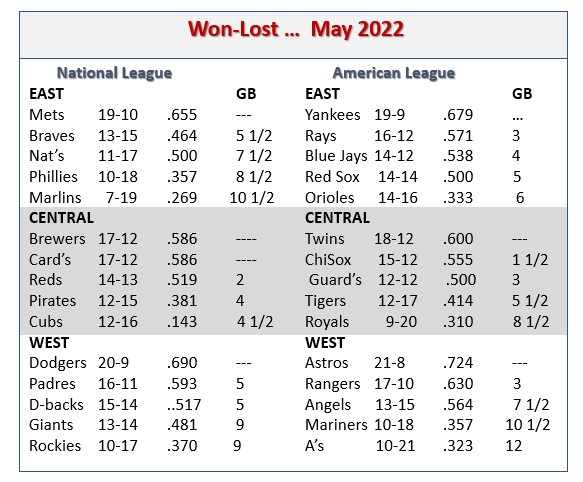
Only two teams won 20 or more games in May – the Astros and Dodgers and, no surprise, they each logged their leagues lowest earned run average.

The Astros 21-8 month was fueled included an 11-game wining streak (May 2-13, during which the Houston staff fashioned five shutouts and  put up a 0.91 earned run average.  During that stretch, they gave up three runs in just one contest.  They outscored their opponents 56-12 over the 11 games, outhit them .237-187 and out homered them 18-2.  They were the only team with a May ERA of under 3.00 – at 2.26.

Only six NL starters picked up four wins in May, and three of those pitchers wore Dodger Blue: Tony Gonsolin (4-0, 1.93); Tyler Anderson (4-0, 3.09) and Walker Buehler 4-0, 3.71).

——Team  Statistical Leaders for May 2022 ———-

RUNS SCORED

National League – Dodgers (174); Mets (168); Cardinals (150)

American League – Red Sox (159); Angels (131); Twins (137)

The fewest May runs were scored by the Tigers (74). The Pirates were last in NL scoring (88). The only other team to score less than 100 May runs was the A’s (93), 

AVERAGE

National League – Mets (.278); Nationals (.268);Rockies (.267)

American League – Red Sox (.282); Twins (.262); Royals (.255)

The lowest team average for May belonged to the As at .214.  The lowest in the NL was the Pirates at .218.

HOME RUNS

National League – Brewers (46); Diamondbacks (39); Dodgers (38)

American League –  Angels (41); Yankees (40); Astros (39)

The Padres and Athletics  had the fewest home runs for  May  at 15. 

Boston led MLB in May slugging percentage at .476.  The Dodgers led the NL at .457.

STOLEN BASES

National League – Cubs (30); Braves (18); Brewers (18); Phillies (18); Cardinals (18)

American League – Rangers (28); Athletics (22); Guardians (21)

The Blue Jays stole the fewest sacks in May  – just five.  

WALKS DRAWN

National League –   Dodgers (126); Giants (115); Brewers (104)

American League – Twins (105); Yankees (97); Astros (96)

The Red Sox  led MLB  in on-base percentage for April at .346. The Dodgers led the NL  at .344.

BATTERS’ STRIKEOUTS

National League – Braves (289); Diamondbacks (273); Cubs (267)

American League – Angels (263); Orioles (250);’ A’s (249)

Guardians’ batters fanned the fewest times in May (148).

______

Bonus Stat:

The Mets led all of MLB in May triples (10), while the Red Sox led in doubles (73).

______

Earned Run Average

National League – Dodgers (3.08); Padres (3.26); Brewers (3.59)

American League – Astros (2.26); Yankees (3.06); Rangers (3.32)

Five teams had May ERAs of 5.00 or higher: Royals (5.62); Giants (5.44); Nationals (5.36); Rockies (5.35); Reds (5.00). 

STRIKEOUTS

National League –  Brewers (278); Phillies (276); Dodgers (251)

American League – Twins (256); White Sox (250); Yankees (250)

The Phillies averaged an MLB-best 9.86 strikeouts per nine innings in May. The White Sox  averaged an AL-best 9.15.

FEWEST WALKS SURRENDERED

National League Dodgers (79); Brewers (80); Mets (81)

American League –  Yankees (53); Blue Jays (64); Rays (66)

The Yankees walked a stringiest 1.91  batters per nine frames (the only team under 2.00) The Royals  walked an MLB’s highest 4.32 per nine innings for the month.

SAVES

National League – Brewers (12); Padres (11): Brewers (10); Diamondbacks (9); Dodgers (9)

American League – White Sox (12); Twins (10); Blue Jays (10)

The Marlins recorded just one save in May (just six opportunities). They did win only seven of 25 games.

WALKS AND HITS PER INNING PITCHED (WHIP)

National League – Padres (1.14); Dodgers (1.21); ; Brewers (1.21)

American League – Yankees (1.03); Astros (1.07); Rays (1.11)

——Individual Statistical Leaders for May 2022———

AVERAGE (75  April  at bats minimum)

National League – Paul Goldschmidt, Cardinals (.404); Luis Gonzalez, Giants (.368) Ketel Marte, Diamondbacks  (.363)

American League –  J.D. Martinez, Red Sox (.406); Tim Anderson, White Sox (.385); Rafael Devers, Red Sox (.381)

The lowest April  average (among players with at least 75 at bats in the month)  belonged to the Rays’ Taylor Walls at .103 (8-for-78).

HOME RUNS

National League – Mookie Betts, Dodgers (12); Paul Goldschmidt, Cardinals (10); Jorge Soler, Marlins (9); Pete Alonso, Mets (9); Christian Walker, Diamondbacks (9)

American League –  Aaron Judge, Yankees  (12);  Trevor Story, Red Sox (9);  Jose Altuve, Astros (9)

The Cardinals’ Paul Goldschmidt had the highest May slugging percentage (among players with at least 75 at bats) at .817.  The AL  leader was the Red Sox’ Rafael Devers at .712.

RUNS BATTED IN

National League – Paul Goldschmidt, Cardinals (33); Pete Alonso, Mets (30);  Francisco Lindor, Mets (28)

American League – Trevor Story, Red Sox (32); Aaron Judge, Yankees (25); Jose Ramirez, Guardians (23)

HITS

National League – Paul Goldschmidt, Cardinals (42); Mookie Betts, Dodgers (39); Trea Turner, Dodgers (36)

American League –  Rafael Devers, Red Sox (435); J.D. Martinez, Red Sox (43); Ty France (39)

The Twins Luis Arraez led MLB (players (with at least 75 May at bats) in on-base percentage at .480. The NL leader was the Cardinals’ Paul Goldschmidt at .471.

DOUBLES

National League –  Freddie Freeman, Dodgers (15); Matt Olson, Braves (14); Paul Goldschmidt, Cardinals (13)

American League –  Rafael Devers, Red Sox (13); Bo Bichette, Blue Jays (11); Jackie Bradley, Red Sox (10)

TRIPLES

National League – Brandon Nimmo, Mets (3); ten  with two

American League – Jose Ramirez, Red Sox (3); ten with two

The Cardinals’ Paul Goldschmidt led MLB in extra-base hits in May with 23.

STOLEN BASES

National League –  Ronald Acuna, Braves (7); Harrison Bader, Cardinals (7); Jean Segura, Phillies (7); Tommy Edman, Cardinals (7)

American League – Cedric Mullins, Orioles (8); Kyle Tucker, Astros (7); Eli White Rangers (6); Jose Ramirez, Guardians (6)

WALKS

National League – Juan Soto, Nationals (21); Mike Yastrzemski, Giants (19); three with 18

American League – Jose Ramirez, Guardians (19); Kyle Tucker, Astros (17); three with 16

BATTER’S STRIKEOUTS

National League – Patrick Wisdom, Cubs (40); Kyle Schwarber, Phillies (39); Austin Riley, Braves (38)

American League – Eugenio Suarez, Mariners (40); Trevor Story, Red Sox (39); Mike Trout Angels (36)

No player grounded into more double plays in May than the Nationals Maikel Franc0 (9)

PITCHING VICTORIES

National League – Walker Buehler, Dodgers (4-0); Tyler Anderson, Dodgers (4-0); Carlos Carrasco, Mets (4-0); Tony Gonsolin, Dodgers (4-0); Zac Gallen, Phillies (4-0)Luis Garcia, Padres (4-1)

American League – Martin Perez, Rangers (4-0); Shane McClanahan, Rays (4-0); Jameson Taillon, Yankees (4-0); Justin Verlander, Astros (4-1); Nick Pivetta, Red Sox (4-1); Framber Valdez, Astros (4-1); Drew Rasmussen, Rays  (4-1 ); Kevin Gausman, Blue Jays (4-2)

EARNED RUN AVERAGE (at least 25  May innings pitched)

National League – Jose Quintana, Pirates (1.33); Joe Musgrove, Padres (1.64); Zack Wheeler, Phillies (1.65)

American League – Martin Perez, Rangers (0.64); Shane McClanahan, Rays (1.15); Tarik Skubal, Tigers (1.45)

STRIKEOUTS

National League – Corbin Burnes, Brewers (45); Sandy Alcantara, Marlins (43); Aaron Nola, Phillies (40); Zach Wheeler, Phillies (40).

American League – Dylan Cease, White Sox (48); Gerrit Cole, Yankees (45); Robbie Ray, Mariners (42)

SAVES

National League – Taylor Rogers, Padres (10); Josh Hader Brewers (8); David Bednar, Pirates (7); Edwin Diaz, Mets (7); Craig Kimbrel, Dodgers (7)

American League – Liam Hendricks, White Sox (10); Jeff Barlow, Ranges (8); four with six

WHIP (Walks +  Hits per Inning Pitched) – 25 May innings minimum)

National League – Tony Gonsolin, Dodgers (0.79); Corbin Burnes, Brewers (0.87); Adam Wainwright, Cardinals (1.69)

American League – Triston McKenzie, Guardians (0.74); Shane McClanahan, Rays (0.83); Nick Pivetta, Red Sox (0.83)

BONUS STAT

Among pitchers with 25 May innings, the Dodgers Tony Gonsolin held opponents to the lowest May batting average (.149 )

—–May 2022 Highlights —–

A Veteran Rookie

On May 1, after 11 years and more than 1,000 games in the minor leagues, Giants’ LF Jason Krizan notched his first MLB base hit. The 32-year-old rookie’s wife and two-year-old son were in the stands to share the landmark safety.  Krizan’s April 29 MLB debut came in his twelfth professional season, after 1,132 minor-league games.  Krizan was drafted in the eighth round of the 2011 MLB Draft (Tigers) – out of Dallas Baptist University, where, in 2011,  he hit .413-10-81 in 62 games. Over his 1,000+ minor league games, he hit .275-83-541.  On his lengthy journey to the “show,” Krizan had several solid seasons – including  .293-7-56 at Double-A in 2014; .294-10-65 at Double- and Triple-A in 2016; and .316-16-73 at Triple-A in 2021.

Old Guys Rule
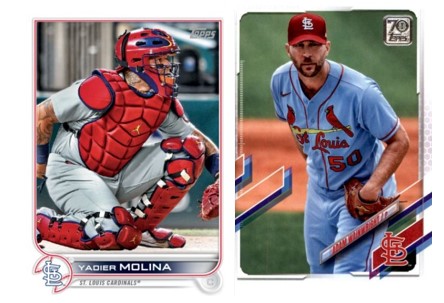
On May 4, the Cardinals starting battery was 40-year-old Adam Wainwright on the mound and 39-year-old Yadier Molina behind the plate. Wainwright got the win, to even his 2022 record at 3-3. It was the 202nd time the Cardinals had won a game with Wainwright and Molina as the starting battery – tying the pair for the MLB record in that category (tied with the Braves’ Warren Spahn and Del Crandall battery.) Molina and Wainwright captured sole position of the record in Wainwright’s very next start – as the Cardinals topped the Giants 15-6 in St. Louis. They continue to add to their own record. On May 20, Wainwright got the win -with Molina catching, as the Cardinals topped the Pirates 5-3. In that one, Wainwright gave up just one run in seven innings and Molina drove in two runs.  More #InBaseballWeCountEverything.

A Giant, Appropriately

On May 6, as the Giants took on the Cardinals in San Francisco, 25-year old rookie right-hander Sean Hjelle made his MLB debut – and tied a major-league record just by taking the mound. At 6’11” tall, Hjelle tied Jon Rauch – another right-handed pitcher – as the tallest major leaguer ever.   Hjelle pitched a 1-2-3 seventh inning (two whiffs and one ground out.). Rauch pitched in 11 MLB seasons (2002, 2004-2013 … White Sox, Expos, Nationals, Diamondbacks, Twins, Blue Jays, Nets, Marlins), going 43-40, 3.90 with 62 saves in 556 games (11 starts).

Miggy Watch goes On
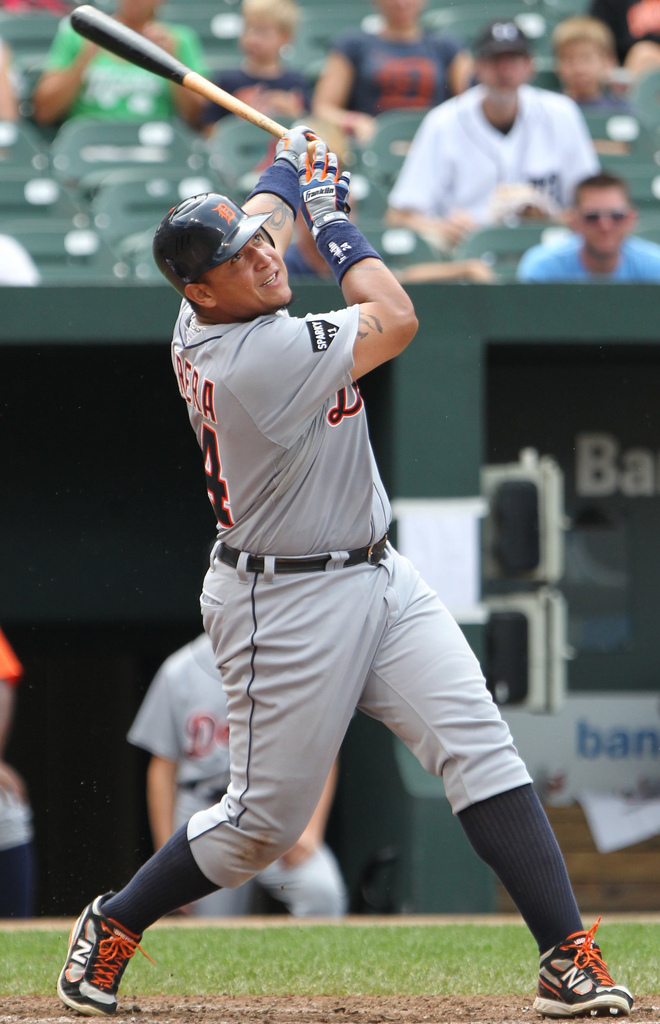
On May 7, in a Tigers 3-2 loss to the Astros, Miguel Cabrera added another line to his Hall of Fame resume. Cabrera hit a two-run double in the top of the third inning.  It was his It was his 600th career double – making him just one of three players (Hank Aaron & Albert Pujols) with 600 doubles, 500 homers and 3,000 hits (he picked up his 3,000th hit earlier this season – as he joined the 3,000 hit, 500 home run .300+ average club). Only two MLB players have retired with at least 3,000 hits, 500 homers and a .300 or better average (Hank Aaron and Willie Mays).  Cabrera finished May with 3,030 career hits, 505 home runs, 603 doubles and a .310 average.

The One That Got Away

On May 8, the Phillies handed Max Scherzer a loss, topping the Mets 3-2 and roughing up Scherzer for three runs on ten hits in six innings. (Scherzer did fan seven New York batters.) This unremarkable fact only makes it here because it was Scherzer’s first loss in 22 days short of a full year (since May 30, 2021). Over that time, Scherzer started 24 games, and went 15-0, 2.55.  Roger Clemens holds the record for the most starts between losses at 30 (June 3, 1998-June 1, 1999.  During that time , he went 20-0, 2.68. 

King Carl

Carl Hubbell holds the record for the most consecutive pitching victories at 24 (three of those wins came in relief).  From July 17, 1936 to May 27, 1937, he went 24-0 in 27 games (22 starts).

Looking for a Big Finish
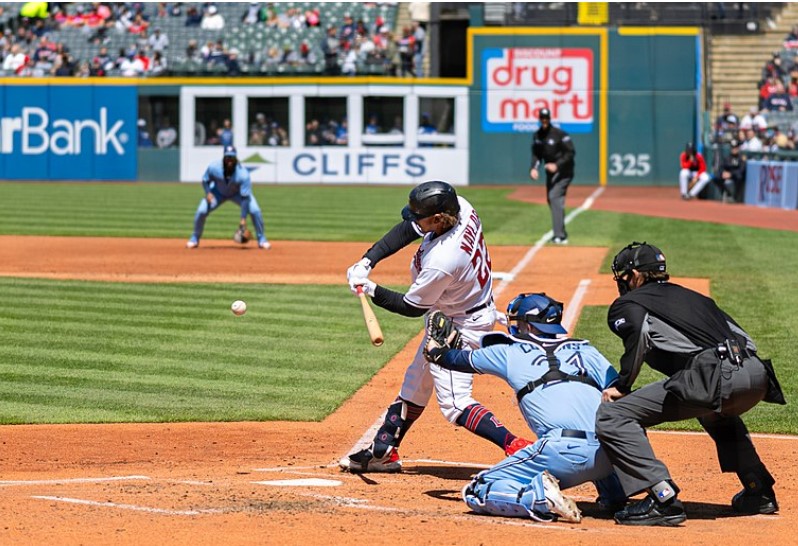
Photo: Erik Drost, CC BY 2.0 <https://creativecommons.org/licenses/by/2.0>, via Wikimedia Commons

On May 9, the Guardians came to bat in the top of the eighth inning trailing the White Sox 5-1. At this point in the game, Guardians’ 1B Josh Naylor had been to the plate three times and was zero-for-two (a walk and two strikeouts). This is how the rest of his game went:

  • Batting in the eighth with one on and two out, he delivered an RBI double to  cut the White Sox lead to 5-2.
  • Batting in the ninth with the bases loaded, two outs, and the Guardians down 8-4, he launched a Grand Slam home run to tie the contest
  • Batting in the eleventh frame, with two on and two out, he hit a three-run home run to provide the final margin in the Guardians’ eventual 12-9, 11-inning win.

The Elias Sports Bureau reported that Naylor was the first  player since 1920 (when RBI became an official statistic) to drive in at least eight runs in the eighth inning and later in a game. The bigger surprise for me is that all eight RBI were two-out RBI.

2022 Second No-Hitter

On  May 10, Angels’ 22-year-old rookie southpaw Reid Detmers tossed the second no-hitter of the 2022 season and the season’s first complete-game no-no. (On April 29, five Mets’ pitchers combined to no-hit the Phillies.) Note: Detmers made five appearances for the Angels in 2021, but his rookie status was still intact. Detmers walked one and fanned two as the Angels topped the Rays 12-0 in Anaheim. He threw 108 pitches (68 strikes). Coming into the game, Detmers was 1-1, 5.32 in five 2022 starts and had not gone more than five innings in any of those appearances. In his first start after the no-hitter, he gave up three runs on three hits and two walks in 3 2/3 innings. Detmers was signed in the first round (tenth overall) of the 2020 MLB draft out of University of Louisville, where he went 20-6, 3.20 in three seasons. In 2021 he went 3-4, 3.19 at Double- and Triple-A and 1-3, 7.40 with the Angels.

A Walk-Walk-Walk-Off

Photo by Keith Allison

On May 10, the Yankees went into the bottom of the ninth trailing the Blue Jays 5-3 – and facing closer Jordan Romano. Yankees’ SS Isiah Kiner Falefa went down swinging to start the inning, followed by consecutive walks to C Jose Trevino and 3B DJ LeMahieu – setting up CF Aaron Judge for a game-ending, walk-off three-run home run. Which he delivered.  It was the 168th home run of Judge’s career and his first-ever walk-off game-winning four-bagger (and it took those two walks to put him a position to deliver the 6-5 win).

A Tri-Cycle?

On May 11, Brewers DH Christian Yelich hit for the cycle (single, double, triple and home run in the same game), as Milwaukee topped the Reds 14-11.  In the process, he became just the sixth player to record three cycles in an MLB career and also the first to record three career cycles against the same teams (Reds).  For more on that May 11 game and a host of cycle trivia, click here.

How About a Trophy in the Shape of a Roll of Life Savers?

Brewers’ closer Josh Hader  set a new MLB record on Friday, May 13 – starting the season with saves in 13 straight mound appearances.  He extended that record to 18 straight appearances with a save while saving both games of a May 30 doubleheader versus the Cubs.

The Shohei Sho

On May 14, in a 9-1 Angels’ win over the A’s in Oakland, Angels’ DH Shohei Ohtani popped a two-run homer in the top of the fifth. It was his seventh of the season and 100th of his MLB career – and made him just the  third Japanese player to reach the 100 career mark in MLB (following Hideki Matsui with 175 homers and Ichiro Suzuki with 117).  It also made Ohtani just the second  MLB player with 100 or more home runs as a hitter and 250 or more career strikeouts as a pitch (the other being, of course, Babe Ruth). Just more #InBaseballWeCountEverything.

Alert Pujols Takes the Mound

On May 15, 42-year-old future Hall of Famer Albert Pujols (in his 22nd MLB season) – at the time the owner of 3,312 MLB hits, 681 home runs and 2, 156 RBI – took the mound (for the Cardinals) for the first time in his MLB career. It came in the top of the ninth, with Pujols’ Cardinals leading the Giants 15-2.  Pujols inning of work went:

  • LF Darin Ruf, walk.
  • CF Austin Slater, line out to center.
  • 3B Even Longoria, single.
  • SS Thairo Estrada, safe on fielder’s choice (Longoria out at second).
  • P Luis Gonzalez, three-run home run. (Note: Gonzalez started in LF, moved to the mound in the bottom of the eighth.)
  • C Joey Bart, solo home run.
  • RF LaMonte Wade, Jr., ground out third-to-first.

Pujols’ pitches ranged in velocity (if you can use that word) from 46.6 mph-to-66.3 mph. Pujols has now appeared  in the field at the major-league level at every position except catcher and centerfield.

Giving veterans stars a free trip to the mound may be the Cardinals’ theme this year. On May 22nd ten-time All Star C  Yadier Molina – like Pujols in his 22nd MLB season – made his first MLB mound appearance. It came in the  bottom of the ninth inning of a game against the Pirates, with the  Cardinals leading 18-0.  Like Pujols, Molina gave up four earned runs (and two homers) in his inning of work

How about a Nice Walk-(off) in the Park?

Okay, the Orioles aren’t really going anywhere this year.  As of May 22, they were 17-25, in last place in the AL East, 14 ½ game back.  Why did I pick May 22? Because  on that day the O’s picked up their third  Walk-Off win in  four days. They topped the Rays  7-6 in eleven innings, with DH Adley Rutschman (placed on second to start the inning and moved to third on a sacrifice), scoring on a  groundball dribbler (fielder’s choice) by 2B Rougned Odor. On May 20, the O’s walked-off a 13-inning, 8-6 victory against those same Rays.  This time on a two-run home run by Odor. On May 19, they picked up a 9-6  walk-off win against the Yankees (this time in the ninth inning) on a three-run homer by RF Anthony Santander.   Baseball Roundtable note: Five of the Orioles 17 wins through May 22 were walk-offs and they were 4-0 in extra-inning  games .

Two Shots at One Big Shot

In the first inning of the Cubs’ May 16 game against the Pirates (at Wrigley Field) catcher Willson Contreras found himself at DH and in the leadoff spot. He also happened to be sitting on 99 career round trippers.  Contreras  got into one leading off the game, taking the first pitch he saw from Pirates’ starter Dillon Peters to deep right-center for a double. He got another chance later in the same inning, coming to the plate for a second time, this time with the bases loaded, two outs, the Cubs up 4-0 and Bryse Wilson on the mound.   The Willson (Contreras) versus (Bryse) Wilson matchup went in Contreras’ favor, as he smoked the first pitch he saw from Wilson for a Grand Slam home run … and his 100th career regular-season dinger. So, at that point in the game, he had seen two pitchers, had a double and a home run for six total bases, had scored twice and driven in four – and had become just the tenth major-leaguer in the Modern Era to hit a Grand Slam in the first inning while batting leadoff.  Truthfully, I am surprised it’s happened that many times. The Cubs, by the way, scored eight runs in the first inning of that 9-0 win and Contreras had three more at bats (without a hit.)

Morel’s Career Mushrooming

On May 17, Cubs 22-year-old rookie Christopher Morel made  his first MLB appearance, pinch hitting for Patrick Wisdom in the bottom of the eighth with the Cubs up 6-0 on the Pirates.  Morel quickly fell behind the Pirates’ Chase De Jong no balls-two strikes, before working the count full and then hitting a 3-2 pitch to deep left field – to joint the list of major leagues to homering their first-ever MLB plate appearance. Morel had been hitting .306-7-20 at Double-A when e was called up. At the end of May, the rookies’ MLB stat line was .283-2-5 in 11 games.

Brotherly Love

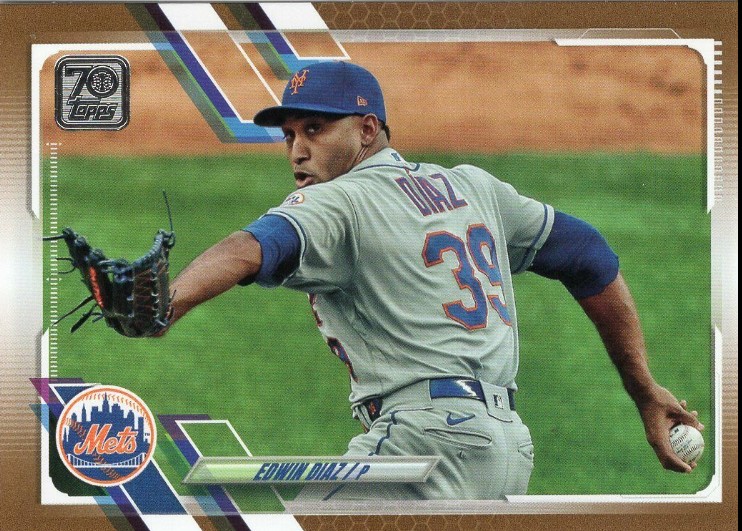
On May 17, brothers Edwin Diaz (Mets) and Alexis Diaz (Reds) both recorded saves.  They were just the third pair of brothers to record major-league saves on the same day. More proof of #InBaseballWeCountEverything. It was the senior (28-year-old) Diaz’ ninth save of the year and 182nd career save (he led the AL in 2018 with 57 saves for the Mariners).  It was the first MLB save, coming in his 17th MLB appearance, for 25-year-old Reds’ rookie Alexis Diaz.

The other pairs of brothers to ramrod a save on the same day? Todd (Dodgers) and Tim (Padres) Worrell on June 13 , 1997 and Ravelo (Pirates) and Josias Manzanillo (Mets), on June 30th 1994.  It was Todd Worrell’s  15 save of the season and 236th career save and Tim Worrell’s first save of the season and second career save.  Todd pitched 11 seasons  and record 256  saves. Tim pitched 14 years and recorded 71 saves. For the Manzanillo brothers, it was Ravelo’s only save (in three MLB seasons, 53 appearances), while  it was Josias’ second save of the 1994 season and his fourth of six career saves (11 MLB seasons, 267 appearances.)

Five Long Balls in One Frame

On May 17, the Red Sox’  Nathan Eovaldi got off to a good start against the Astros in Boston. He got past 2B Jose Altuve, DH Michael Brantley and 3B Alex Bregman on a total of five pitches (all strikes) – a ground out, line out and pop out. The second inning did not go quite as well, as the Astros tied an MLB single-inning record by bashing five home runs (all off Eovaldi). The homers came off the bats of LF Yordan Alvarez, RF Kyle Tucker, SS Jeremy Pena, Brantley and 1B Yuli Gurriel.  For the complete story and a look at the the eight times an MLB team has gone yard five times in an innings, click here.

An Interesting Comeback

Cubs’ 26-year-old rookie Brandon Hughes made quite a comeback – one that brought him all the way to Wrigley field – and the baseball record book.  At the end of Spring Training in 2019, Hughes – drafted out of Michigan State University, as an outfielder, in the 16th round of the 2017 major-league draft – was on the verge of being released by the Cubs.  The strong-armed outfielder, who had hit .237-4-35 in 110 games for  A-level South Bend in 2018, was told he would be released unless he was willing to take a shot at finding success as a pitcher (Side note:  Primarily an outfielder over three college seasons, Hughes had made seven relief appearances for Michigan State – as a freshman, in 2015 – putting up a 7.11 earned run average in 6 1/3 innings.  As a hitter, he  hit .304-13-93 in 159 games in three Michigan State seasons.)

Long story short, Hughes persevered and on May 17, found himself on the mound at Wrigley Field. He came on in the top of the sixth, with none on and one out and the Cubs leading the Pirates 6-0 and his outing wen like this.

Sixth Inning

  • 2B Josh VanMeter, walk.
  • CF Bryan Reynolds, strikeout.
  • LF Ben Gamel, inning-ending strikeout.

Seventh inning

  • DH Dan Vogelbach, strikeout.
  • 1B Yoshi Tsutsugo, strikeout.
  • 3B Michael Chavis, walk.
  • SS Rodolfo Castro, strikeout.

Hughes was replaced to open  the top of the eighth by Mark Leiter, Jr.

Oh, that record-book thing? STATS reported that Hughes was the first MLB pitcher since 1900 to record at least five outs in their MLB debut with all those outs coming via the strikeout.  Just more #InBaseballWeCountEverything.

At the end of May, Hughes had a 3,72  ERA over seven  appearances. Guess that switch paid off.

1-2-3 and You’re Out at the Old Ball Game

On May 20, The Nationals turned 2022’s first MLB triple play in a 7-0 loss to the Brewers (in Milwaukee).  It came in the bottom of the seventh. The inning started with the Nationals’ Carl Edwards, Jr. walking Brewers’ 3B Jace Peterson and 2B Kolten Wong.  On the first pitch in his at bat, SS Luis Urias hit a groundball to third.  Nationals’ 3B Maikel Franco  snagged it, stepped on the bag and fired to 2B Cesar Hernandez, who made the pivot and got the ball to 1B Josh Bell for the triple-killing. The odds, of course, favor this, but Baseball Roundtable did note that all six involved players (batter, base runners and fielders) were infielders.

More #InBaseballWeCountEverything

On May 21, 27-year-old Rockies’ rookie catcher Brian Serven collected his first major-league hit. It came in his second career game since a call up from Triple-A Albuquerque, where he was hitting .273-5-11 in 23 games.  After going zero-for-two in his first MLB games (May 177), Serven hit a two-run home run in his first May 17 at bat (bottom of the second inning versus the Mets).  He then grounded out in fifth, hit another two-run home run in the sixth and flied out in the seventh. According to MLB.com, that performance made Serven  the only player in MLB history whose first two major-league hits were multi-run homers in the same game.

Reeling in a Nice Round Number

On May 21, as the Angels topped the A’s 5-3 in Anaheim, Mike Trout went zero-for-three with a walk with a run scored.  The run scored was the 1,000th of his 12-season (including 2022) MLB career – making him just the third player in MLB history to score at least 1,000 runs, hit at least 300 home runs and steal at least 200 bases by his age-30 season. The others? Willie Mays and Alex Rodriguez.  Pretty good company.  or those who like to know such things, Trout has led the AL in runs scored four times.

Time to buy that “Old Guys Rule T-Shirt.”

In May, 39-year-old Astros’ starter Justin Verlander went 4-1, 2.27 in five starts,  – giving him a 6-2, 2.03 record on the season. 

Reds Leave Cubs Red-Faced

On May 26, the Reds pounded the Cubs 20-5 in front of 3,578 delighted (despite a 59-minute rain delay)  home-town fans. It was the first 20-run game for the Reds since a 22-3 win over the Phillies on September 4, 1999.  What struck Baseball Roundtable about the May 26 game is that five Reds’ hitters drove in three or more runs:

  • SS Kyle Farmer … 4-for-4, five RBI (two home runs)
  • 2B Matt Reynolds … 3-for-3, three RBI (one triple)
  • LF Albert Amora, Jr. … 3-for-5, three RBI
  • DH Tommy Pham … 2-for-4, three RBI (one double)
  • 3B Brandon Drury … 2-for-6, three RBI (one double)

In the September 4, 1999 win over the Phillies (in Philadelphia), six Reds collected at least three RBI:  2B Pokey Reese (3); RF Dmitri Young (4); LF Greg Vaughn (3); C Ed Taubensee (3); 3B Aaron Boone (3); and 3B Mark Lewis, who replaced Boone in the sixth inning (3). In that one, the Reds got home runs from Reese, Young, Vaughn, Taubensee (two homers), Boone, Lewis, CF Jeffrey Hammonds and C Brian Johnson.

Trevor’s Story

On May 15, Trevor Story had appeared in 29 of the Red Sox’ 34 games and was hitting a disappointing .196, with just one home run and 15 RBI. Then, in a ten-game span, between May 16 and May 26, Story went 13-for-39 (.333), with eight home runs and 22 RBI – improving his season line to .232-9-37.  He finished May .220-9-37 on the season. 

Like Father, Like Son – Except on the Other Side of the Pitch

On May 30, the Tigers called up 26-year-old Kody Clemens (Roger Clemens’ youngest son) from Triple-A Toledo. Clemens, a 2018 third-round draft choice out of the University of Texas at Austin, was hitting .283-8-31 (in 45 games) for Toledo. – and had appeared at 1B, 2B, 3B and LF.  Clemens made his MLB  debut May 31, going zero-for three, with one walk.

——Team  Statistical Leaders  Through May 31  ———-

If the season ended May 31, your post-season teams would be”

American League: Yankees, Astros, Twins.  Wild Cards: Blue Jays, Rays, Angels.

National League:  Dodgers< Mets, Brewers. Wild Cards: Padres, Cardinals; Giants.


RUNS SCORED (average 209)

National League – Dodgers (270); Mets (266); Giants (244)

American League – Angels (2356; Red Sox (235); Yankees (229)

Through May, the fewest runs were scored by the Tigers at 138. The next fewest was by the Pirates (166).

AVERAGE (average .240)

National League – Mets (.268); Rockies (.265); Nationals (.254)

American League – Red Sox  (.258); Angels (.250); Twins (.248)

The lowest team average through May belonged to the A’s at .213. The Diamondbacks were the lowest in the NL at .220.

HOME RUNS (average 49)

National League – Brewers (70); Braves (62); Diamondbacks (59); Dodgers (59)

American League –  Yankees (69); Angels (68); Astros (64)

The Tigers had the fewest home runs through May at 29.  The Nationals had the fewest in the NL at 32. 

STOLEN BASES (average 25)

National League – Cardinals (40); Cubs (34); Brewers (31);

American League – Rangers (39); Rays (34); A’s (34)

The Twins and Rockies stole the fewest bass through May at just ten each – in seventeen and eighteen attempts, respectively.  

WALKS DRAWN  (average 156)

National League –   Dodgers (208); Giants (184); Diamondbacks (182)

American League – Twins (181); Mariners (174); Yankees (170)

The Mets led MLB  in on-base percentage through May at .337. The Twins led the AL  at .325. In slugging percentage, the Dodgers were  on top at .430, while the Angels  led the AL at .425.

BATTER’S STRIKEOUTS (average 409)

National League – Braves (487); Diamondbacks (471); Brewers (451)

American League – Angels (451); Orioles (438); A’s (432)

Guardians’ batters went down on strikes the fewest times through May  (324).

EARNED RUN AVERAGE (average 3.93)

National League – Dodgers (2.76); Brewers (3.36); Padres (3.40)

American League – Astros (2.82); Yankees (2.91); Rays (3.36)

Three teams had ERAs through May  of 5.00  or higher – Reds  (5.41); Nationals (5.23); Royals (5.10)

STRIKEOUTS (average 434)

National League – Brewers (500); Mets (463); Phillies (461)

American League – Yankees (449); White Sox (440); Twins (436)

The Brewers  averaged an MLB-best 10.0 strikeouts per nine innings through May. The White Sox averaged an AL-best 9.4.

FEWEST WALKS SURRENDERED (average 156)

National League – Dodgers (125); Giants (136); Mets (146)

American League –  Yankees (121); Rays (123); Blue Jays (122)

The Rays and Yankees walked a stringiest 2.5  batters per nine frames through May. The Reds walked an MLB’s highest 4.3 per nine innings.

SAVES (average 13)

National League – Brewers (23); Padres (19); Braves (15); Rockies (15); Diamondbacks (15)

American League – Blue Jays (21); White Sox (18); Yankees (17)

Bonus Stats – In the Field

The  Pirates  made the most errors through May (39); while  the Padres were guilty of the fewest miscues (16).   

Primary Resources: Baseball-Reference.com; MLB.com; Baseball-Almanac.com


BASEBALL ROUNDTABLE ON THE TOP 100 BASEBALL BLOG LIST

100Baseball Roundtable is on the Feedspot list of the Top 100 Baseball Blogs.  To see the full list, click here.

I tweet baseball @DavidBBRT

Follow/Like Baseball Roundtable’s Facebook Page here.  More baseball commentary; blog post notifications; PRIZES.

Member: Society for American Baseball Research (SABR); The Baseball Reliquary; The Negro Leagues Baseball Museum.

BASEBALL ROUNDTABLE – BLOGGING BASEBALL SINCE 2012
 

Winning a Game Without a Hit… A Handful Plus Oone.

Yesterday (May 15, 29022), the Pittsburgh Pirates  pulled out an improbably victory – topping the Reds 1-0, without notching a single base-hit. Going into the bottom of the eighth, Reds’ starter Hunter Greene had held the Pirates in check, giving up no hits, walking three and fanning nine. The Reds were also without a run, as Pittsburgh starter Jose Quintana had pitched seven innings, giving up just three hits and one walk (five strikeouts) and reliever Chris Stratton had pitched a one-hit, one-walk scoreless top of the eighth.

The Pirates scored in the bottom of the eighth, without a hit, in an inning that went like this:

  • RF Jack Suwinski grounded out to first base unassisted.
  • SS Rodolfo Castro walked.
  • C Michael Perez walked, Castro going to second base.

Art Warren replaced Hunter Greene, who had tossed 118 pitches, on the mound.

  • LF Ben Gamel walked, loading the bases.
  • 3B Ke’Bryan Hayes grounded into a fielder’s choice – second to shortstop, as Castro scored and Perez moved to third.
  • CF Bryan Reynolds popped out to shortstop to end the inning.

Pirates ‘Reliever Dave Bednar came on to pitch a 1-2-3 ninth and the Pirates had a win without a hit. Note: Because the Reds pitchers hurled just eight innings (the Pirates did not have to bat in the bottom of the ninth), this game does not go down as a no-hitter for the Reds.

Baseball-Reference.com shows just five other instances (since 1901) in which teams have won without the benefit of a single safety. Here they area:

April 23, 1964, Reds 1 – Colt .45’s 0

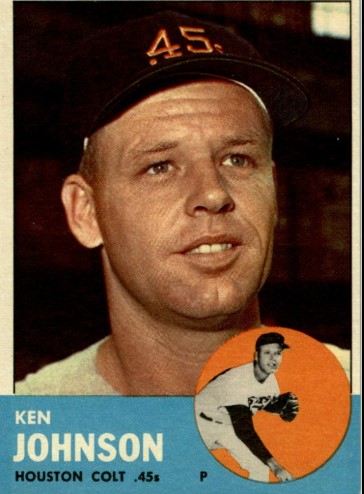
After eight innings this one was knotted 0-0. Reds’ starter Joe Nuxhall had given up five hits and one walk, while fanning four. The Astros’ Ken Johnson had been truly dominant.  Eight no-hit innings with two walks and nine whiffs.

Then, in the top of the ninth, this went down:

  • Reds’ 2B Pete Rose bunted in an attempt to both get the lead runner on and break up the no-hitter. Johnson fielded the bunt, but made a bad throw (error) to first, with Rose ending up at second base.
  • 3B Chico Ruiz, grounded out, Rose moving up to third.
  • CF Vada Pinson was safe on the Astros’ second miscue of the inning, this one by 2B Nellie Fox.
  • RF Frank Robinson flied out to left to end the inning.

Nuxhall  fanned two in a scoreless ninth, pitching around an error by Reds’ 1B Deron Johnson.

Johnson got credit for a complete-game, no-hitter – and is tagged with a loss. Johnson  pitched in 13 MLB seasons (1958-70 … Athletics, Astros,  Braves, Yankees, Cubs, Expos), going 91-106, 3.46.

Ken Johnson remains the only MLB pitcher to get saddled with the loss in an official, complete-game  no-hitter. 

—————–

April 30, 1967, Tiger 2 – Orioles 1

The Tigers were playing in Baltimore and, going into  the top of the ninth, Detroit trailed 1-0 with  Orioles’ starter Steve Barber having twirled  eight no-hit innings (seven walks and three strikeouts).  The Tigers’ Earl Wilson had given just one run on two hits and four walks (four strikeouts) over eight frames. The lone Orioles’ run, by the way  scored in an inning in which Baltimore did not get a hit –   three walks and a Luis Aparicio sacrifice fly in the bottom of the eighth. Barbers’ ninth inning went like this:

  • 1B Norm Cash walked, Dick Tracewski brought in to pinch run.
  • SS Roy Oyler walked.
  • P Earl Wilson, sacrifices (remember those), Tracewski going to third, Oyler to second. Jake Wood brought in to pinch run for Oyler.
  • PH Willie Horton popped out to the catcher.

At this point Barber still has a 1-0 lead and a no-hitter with two outs in the ninth.

  • With CF Mickey Stanley up, Barber threw a wild pitch, scoring Tracewski and sending Wood to third.
  • Stanley walked.

Stu Miller replaces Steve Barber on the mound.

  • 3B Don Wert hit a ground ball to SS  Aparicio, who threw to second for an inning-ending force. However, 2B Mark Belanger couldn’t handle the throw and the go-ahead run scored on his error. Note: Rookie Belanger (who would go on to win eight Gold Gloves at shortstop in his career) had been brought into the game in the top of the ninth.
  • RF Al Kaline grounded out to end the inning.

Fred Gladding replaces Earl Wilson  on the mound for Detroit and pitches a 1-2-3 ninth to save the win.

The Orioles record an official combined no-hitter, but also a loss.  Steve Barber pitched 15 MLB seasons (1960-74 … Orioles, Yankees, Pilots, Cubs, Braves, Angels, Giants), going 121-106, 3.36.  He was a two-time All Star and a 20-game winner  in 1963 – 20-13, 2.75 for the Orioles.

—————-

July 1, 1990. White Sox 4 -Yankees 0

Andy Hawkins managed to give up four runs in a complete-game, no-hit outing – but he had a little “help” from his friends.  It came in a game  played in Chicago and Hawkins’ mound opponent was southpaw Greg Hibbard. After seven  frames, the game was knotted at 0-0, and Hawkins had given up no hits, while walking two and fanning three. Hibbard had also tossed seven scoreless innings (four hits, no walks, four whiffs).

Barry Jones came to the mound for the ChiSox in the top of the eighth and held the Yankees without a run.  In the bottom of the eighth, the baseball Gods began to “mess with” Hawkins’ game.  Here’s how it went:

  • White Sox C Ron Karkovice popped out to 2B.
  • 2B Scott Fletcher popped out to 2B.
  • RF Sammy Sosa reached first on an error by Yankee third baseman Mike Blowers (a bobbled ground ball).
  • SS Ozzie Guillen walked on a 3-2 pitch.
  • CF Lance Johnson walked on four pitches, loading the bases with two out.

Sacks full, but shutout, no-hitter and the chance of a much-needed win still intact.

  • 3B Robin Ventura,  hit a playable fly ball to rookie Jim Leyritz in LF. The ball clanked off Leyritz’ glove for an error and all three runners scored (Ventura ended up on second).
  • DH Ivan Calderon hit a fly to RF that Jesse Barfield lost in the sun and dropped (another error) enabling the fourth run of the inning to score.
  • LF Dan Pasqua popped out to SS to end the inning.

The Yankees went scoreless off reliever Scott Radinsky in the top of the ninth, ending the game. At that moment, Andy Hawkins had a 4-0 loss – despite pitching a complete game, giving  up no hits (walking  five) and no earned runs.

It Was That Kind of Season

In Andy Hawkins’ next start, just five days after his July 1, 1990 no-hit loss, Hawkins carried a NO-HIT, shutout into the twelfth inning (against the Twins in New York).  Unfortunately, the Twins’ Allan Anderson and Juan Berenguer held the Bombers scoreless (despite ten hits).  The Twins got to Hawkins for two runs (two walk and two hits) in the twelfth and Rick Aguilera set down the Yankees without a run in the bottom of the inning. So, 11 no-hit innings for Hawkins and the end result was another loss.  That gave Hawkins a streak of 19 consecutive hitless innings over the two games – with two losses to show for it.

Andy Hawkins pitched in ten MLB seasons (1982-91 … Padres, Yankees, A’s). He went 84-91, 4.22.

—————

April 12, 1992, Indians 2 – Red Sox 1

The Indians jumped out front – without a hit – early in this one.

  • CF Kenny Lofton leads off the bottom of the first walking on four pitches form Red Sox’ starter Matt Young.
  • With DH Glenallen Hill at the plate, Lofton swipes second (on a 2-1 pitch).
  • As Hill fans on a 3-2 offering, Lofton steals third.
  • 2B Carlos Baerga hits a grounder to Red Sox’ SS Luis Rivera, whose errant throw allows Baerga to reach first, while Lofton crosses the plate.
  • LF Albert Belle flies out to right.
  • RF Mark Whiten flies out to right-center.

The Indians score again without a hit – in the bottom of the third.

  • Mark Lewis walks on four pitches.
  • Lofton walks on five pitches, sending Lewis to second.
  • Hill grounds to short, with the Red Sox getting the force at second. Hill is safe at first, Lewis moves to third.
  • With Baerga up, Hill steals second.
  • Baerga hits into a fielders’ choice, with Lewis scoring.
  • Belle strikes out.
  • Whiten grounds out second-to-first.

The Red Sox got one run back in the top of the fourth on a single by CF Ellis Burks, a walk  to 1B Mo Vaughn and an RBI single by SS Luis Rivera.

That was all the scoring in a game in which Matt Young threw eight no-hit innings (seven walks/six strikeouts), but still managed to give up two earned runs. Cleveland starter Charles Nagy gave up eight hits and one run (four walks/ten whiffs) in seven innings and relievers Brad Arnsberg and Derek Lilliquist held the Red Scoreless in the eighth and ninth.

Matt young pitched in 19 MLB seasons (1983-87, 1989-93 … Mariners, Dodgers, A’s, Red Sox, Indians). He went 55-95, 4.40.

————–

June 28, 2008, Dodgers 1 – Angels 0

This one was scoreless after 5 1/2 frames – Angels’ Jered Weaver versus Dodgers’ Chad Billingsley at Dodger Stadium.  The Dodgers broke the ice in the bottom of the fifth:

  • CF Matt Kemp reached on an error by P Weaver.
  • On an 0-1 pitch to 3B Blake DeWitt, Kemp stole second and made it to third on a bad throw by C Jeff Mathis.
  • DeWitt hit a sacrifice fly to deep right, scoring Kemp.
  • SS Angel Berroa flied out to center.
  • P Chad Billingsley walked.
  • LF Juan Pierre grounded out second-to-first to end the inning.

And that was all the scoring in this one. Weaver went six innings, gave up the one earned run, walking three and fanning six. Reliever Jose Arredondo then retired Dodgers in order in the seventh and eighth. For the Dodgers, Billingsley gave no runs on three hits (three walks, seven strikeouts) in seven innings – and relievers Jonathan Broxton and Takashi Soto held the Angels at Bay in the eighth in and ninth.

Jered Weaver itched in 12 MLB seasons (2006-17 … Angels, Padres). He went 150-98, 3.63, was a three-time All Star and won twenty games in 2012 (20-5, 2.81 for the Angels.
Primary Resource: Baseball-Reference.com

BASEBALL ROUNDTABLE ON THE TOP 100 BASEBALL BLOG LIST

100Baseball Roundtable is on the Feedspot list of the Top 100 Baseball Blogs.  To see the full list, click here.

I tweet baseball @DavidBBRT

Follow/Like Baseball Roundtable’s Facebook Page here.  More baseball commentary; blog post notifications; PRIZES.

Member: Society for American Baseball Research (SABR); The Baseball Reliquary; The Negro Leagues Baseball Museum.


.


Yelich Cycle … One for the Record Books … and More Cycle Trivia

Photo: Erik Drost, CC BY 2.0 <https://creativecommons.org/licenses/by/2.0>, via Wikimedia Commons

Yesterday (May 11, 2022),  Brewers’ DH Christian Yelich,  hit for the cycle (single, double, triple and home run all in one game) for the third time in his career.  (Despite, Yelich’s heroics, the Brewers lost to the Reds (in Cincinnati) by a 14-11 scored.  Yelich had a ground-rule double in he first inning; a three-run home run in the third; a single in the fifth; flied out to CF in the seventh; and recorded the often-elusive triple in the top of the ninth.

In the process, Yelich became:

  • Just the sixth player to record three cycles in an MLB career; and
  • the first player to record three career cycles against the same team (Reds).

Before yesterday’s performance, Yelich was already:

  • One of just five MLB players to record two cycles in a season; and
  • the only MLB player to record two cycles in a season against the same team (Reds).

Baseball Roundtable Disclaimer: The MLB records noted in this post have the potential to change as Major League Baseball recognizes and further incorporates Negro League records from 1920-48. 

In celebration of Yelich’s achievement, Baseball Roundtable thought this might be a good time to revisit come cycle trivia.

The Most Cycles Ever

Only six MLB players have hit for the cycle three times in their careers: John Reilly (Red Stockings, twice in 1883 and Reds in 1890); Babe Herman (Brooklyn Robins, twice in 1931 and Cubs in 1933); Bob Meusel (Yankees in 1921, 1922 and 1928); Adrian Beltre (Mariners in 2008, Rangers in 2012 and 2015); Trea Turner (Nationals in 2017, 2019 and 2021); and Christian Yelich (Brewers, twice in 2018, 2022).
The Most Cycles Ever in One Season

Only five players have collected two cycles in one season. Among those, Brewers’ outfielder Christian Yelich is the only one to hit for the cycle against the same team (the Reds) twice in the same campaign. In Yelich’s 2018 MVP season, he hit for the cycle on August 29, as the Brewers topped the Reds 13-12 in ten innings in Cincinnati. He doubled up on cycles on September 17, as the Brewers topped the Reds 8-0 in Milwaukee.

The  Only Pitcher Ever to Record a Win and Hit for the Cycle in the Same Game

On July 28, 1888 – as the Chicago White Stockings topped the Detroit Wolverines, 21-17 –  Jimmy Ryan  started in CF for Chicago with Mark Baldwin on the mound.  In the bottom of the second – with two out, six runs scored in the inning and the bases loaded – Chicago Manager Cap Anson had Baldwin and Ryan change places.  Ryan fanned Detroit pitcher Charles “Lady” Baldwin to end the inning, with the White Stockings trailing 7-4. Chicago tied the game at 8-8 in the top of the fourth and went on to win 21-17.

Ryan got the victory, pitching 7 1/3 innings, allowing ten runs. He also went five-for-six at the plate (a single, double, two triples and a home run), was safe on error, scored three runs, drove in four and stole a pair of bases.  In the process, he became the first (and still only) player to record a pitching victory and a cycle in the same game.  (For the season, Ryan hit .332, leading the National League in hits with 182, doubles with 33 and home runs with 16). On the mound, he was 4-0, 3.05 in eight appearances (two starts).  For his 18-season MLB career (1885-1900, 1902-03), Ryan hit.308-118-1,093, with 419 steals (2,014 games). On the mound he was 6-1, 3.62 in 24 games (five starts).

The Fastest Cycle Ever

On June 18, 2000, Colorado Rockies’ second baseman Mike Lansing completed the cycle in just four innings – making it  the quickest cycle in MLB history. Notably, Lansing was consistently behind in the counts and three of his four hits came with two strikes. Lansing, batting second in the order, hit:

  • An RBI triple to right in the first inning, on a 1-2 pitch;
  • A two-run home run (0-1 pitch) in the bottom of the second;
  • A two-run double (2-2 pitch) in the bottom of the third (as the Rockies scored nine times to take a 14-1 lead); and
  • A single (another 1-2 offering) to right in the fourth.

Lansing then struck out in the sixth, before being lifted for a pinch-hitter (Darren Bragg) in the eighth. Lansing ended the day four-for-five, with three runs scored and five RBI, as the Rockies torched the Diamondbacks 19-2 in Denver.

The “Slowest” Cycle Ever

The Expos’ Tim Foli is the only player to start a cycle one day and complete it the next. On April 21, 1976, Foli collected a single, double and triple in a contest against the Cubs that was suspended in the top of the seventh due to darkness. When play resumed the following day, Foli added an eighth-inning home run. (The Expos prevailed 12-6.)

Longest Time Ever Between Cycles

Among players with multiple cycles, George Brett went the longest time between cycles – 11 years & 57 days. He hit for the cycle on May 28, 1979 (his age-26 season) and again on June 24, 1990 (his age-37 season).

Something Old … Something New

The youngest MLB player ever to hit for the cycle is the NY Giants’ Mel Ott (age 20 and 75 days) on May 16, 1929).  The oldest player to hit for the cycle is The Angels’ Dave Winfield (age 39 and 264 days) on June 24, 1991.

Three’s a Crowd

Between August 2 and August 14 1933, three MLB players it for the cycle.  Mickey Cochrane (August 2); Pinky Higgins (August 6); Jimmie Foxx (August 14).  All three were suited up for the Philadelphia Athletics.

Sharing the Wealth

Three players have hit for the cycle in both the NL and AL: Bob Watson (NL Astros-1977 and AL Red Sox-1979); John Olerud (NL Mets-1997 and AL Mariners-2001); Michael Cuddyer (AL Twins-2009 and NL Rockies-2014).

Quote the Raven, “Nevermore”

The Marlins are the only MLB team to never have a batter record a cycle.

The Biggest Seasons for Cycles

MLB a record nine cycles in 1933 and 2009.  Here are the hitters.

1933: Pepper Martin, Cardinals; Chuck Klein, Phillies; Arky Vaughn, Pirates; Mickey Cochrane, Athletics; Pinky Higgins, Athletics; Jimmie Foxx, Athletics; Earl Averill, Indians; Babe Herman, Cubs.

2009:  Orlando Hudson, Dodgers; Ian Kinsler, Rangers; Jason Kubel, Twins; Michael Cuddyer, Twins; Melky Cabrera, Yankees; Troy Tulowitzki, Rockies; Felix Pie, Orioles; B.J. Upton, Rays.

Hitting (running) into an Out for the Cycle

Photo by rchdj10

The Yankees’ 1B Lou Gehrig (kind of) earned a cycle by being tossed out at the plate.  On June 25, 1934, as New York topped Chicago 13-2  at Yankee Stadium, Gehrig hit two-run home run in the first inning; a  single in the third; and a double in the sixth. Gehrig came up needing just the triple for the cycle in the seventh and hit a smash to deep center (scoring Yankees’ CF Ben Chapman). Gehrig wasn’t satisfied with a three-bagger and was thrown out at home (8-6-2) trying for an inside-the-park home run – thus getting credit for the triple he needed for a cycle.


Nearly a Cycle – In One Inning

On June 27, 2003, Johnny Damon was playing CF and leading off for the Red Sox  as they took on the Marlins in Boston.  In a start that brought Boston fans up out of their seats, Damon was three-fourths of the way to the cycle bat the end of the first inning – and had tied an MLB record with three hits in an inning.  (The Red Sox scored 14 runs in the first inning, on their way to a 25-3 win over the Marlins at Fenway.) Damon who collected a single, double and triple in the bottom of the first, ended the game five-for-seven, with three runs scored, three RBI, a double, a triple and three singles.  He, unfortunately, did not get the cycle. In his final three at bats Damon: struck out; flied out to center; singled to right; singled past third base.

Here’s how that first inning went:

  • Johnny Damon – Double past first base down the line.  (Off starter Carl Pavano.)
  • Todd Walker – Single, Damon scores.
  • Nomar Garciaparra – Double.
  • Manny Ramirez – Home run, scoring three.
  • David Ortiz – Double.
  • Kevin Millar – Single, Ortiz scores.

Michael Tejera replaces Pavano on the mound.

  • Trot Nixon – Single.
  • Bill Mueller – Walk, loading the bases.
  • Jason Varitek – Single, Millar and Nixon score.
  • Damon – Triple to deep right field, Mueller and Varitek score.
  • Walker – Single, Damon scores.

Allen Levrault takes over for Tejera – at this point, we’ve seen two pitchers, 11 batters, ten hits, one walk, nine runs and no outs.

  • Garciaparra – Foul pop out.
  • Ramirez – Single.
  • Ortiz – Walk, loading the bases.
  • Millar – Sacrifice fly, scoring Walker.
  • Nixon – Walk, loading the bases.
  • Mueller – Double, scoring Ramirez and Ortiz.
  • Varitek – Walk.
  • Damon – Line drive single to left, Nixon scores, Mueller is thrown out at the plate to end the inning.

Red Sox score 14 runs on 13 hits and four walks; Damon collects a single, double and triple.

The Cycle … From a Family Perspective

Only two father-son combinations have hit for the cycle at the major-league level – and both involved rookies.

Gary Ward hit for the cycle as a rookie (in just his 14th game) for the Twins on September 18, 1980. His son Daryle hit for the cycle for the Pirates (against the Cardinals) on May 26, 2004 (in his seventh MLB season).

In 2018, Blues Jays’ rookie Cavan Biggio – in a September 17 game against the Orioles – hit for the cycle.  Cavan’s father, Hall of Famer Craig Biggio, hit for the cycle (for the Astros versus the Rockies) on April 8, 2002.

The Cycle … Sometimes it Skips a Generation

Pittsburgh Pirates’ outfielder Gus Bell hit for the cycle on June 4, 1951 – as the Pirates topped the Phillies 12-4 in Philadelphia. Fifty-three seasons later – on June 28, 2004 – Phillies’ 3B David Bell (Gus Bell’s grandson) hit for the cycle (also in Philadelphia), as the Phillies topped the Expos 14-6.   Gus and David Bell are the only grandfather-grandson combination to achieve MLB cycles.

Cycles … A Big Stage Perspective

Brock Holt is the only player to record a cycle in the post season. He did it on October 8, 2018, as the Red Sox beat the Yankees 16-1 in Game Three of the American League Division Series. Holt grounded out in the top of the second inning; had a single and a triple in the Yankees seven-run fourth; grounded out in the sixth; hit a ground-rule double in the eighth; and managed to finish his cycle  with a home run with two outs in the top of the ninth. It was Holt’s second career cycle.  He had a regular-season cycle for the Red Sox on June 16, 2015, as Boston topped Atlanta 9-4 at Fenway. He also completed that cycle with two outs in Boston’s last offensive inning – hitting a triple with two down in the bottom of the eighth.

Primary Resources:  Baseball-Almanac.com; Baseball-Reference.com; “July 28, 1888: Jimmy Ryan hits for cycle as Chicago White Stockings win 21-17 slugging match, ” by Mike Huber, SABR.

BASEBALL ROUNDTABLE ON THE TOP 100 BASEBALL BLOG LIST

100Baseball Roundtable is on the Feedspot list of the Top 100 Baseball Blogs.  To see the full list, click here.

I tweet baseball @DavidBBRT

Follow/Like Baseball Roundtable’s Facebook Page here.  More baseball commentary; blog post notifications; PRIZES.

Member: Society for American Baseball Research (SABR); The Baseball Reliquary; The Negro Leagues Baseball Museum.


The Up and Down Career of Francisco Liriano – and an Unexpected No-hitter

Photo: aturkus on Flickr, CC BY 2.0 <https://cPhoto: aturkus on Flickr, CC BY 2.0 <https://creativecommons.org/licenses/by/2.0>, via Wikimedia Commons org/licenses/by/2.0>, via Wikimedia Commons

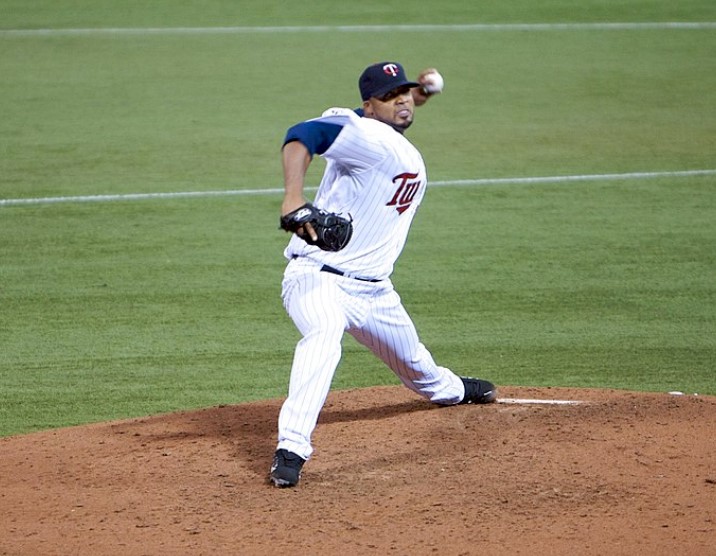
On this date (May 3) in 2011, Twins’ southpaw Francisco Liriano twirled a gem against the White Sox (in Chicago). It was the first complete game in Liriano’s then six-season MLB career, also his  first shutout and – most important – a no-hitter.  As the Twins triumphed in a tight 1-0 game, Liriano went nine innings, giving up six walks, fanning two and, of course, allowing no hits and no runs.

Liriano’s performance makes its way into the pages of Baseball Roundtable because it was one of the most unexpected and unpredictable no-hitters in MLB history.

Why unexpected?  Coming into the game, Liriano’s record on the season (in five starts) was 1-4, with a 9.13 ERA. In 23 2/3 innings (averaging about 4 2/3 per start), he had given up 27 hits, 24 runs (all earned),  18 walks and one hit-by-pitch,  while also fanning 18 batters. In the start immediately before the no-hitter (April 27), Liriano had lasted just three innings and given up seven runs on six hits and four walks.  To further make my case for the unexpected nature of this no-no, in the start immediately after the no-hitter (May 19), Liriano had again lasted just three frames, giving up four runs on four hits and three walks.  So, his no-hitter was “book-ended” by two games in which he lasted a total of six innings and surrendered 11 runs.

Getting back to that no hitter. In that game,  Liriano threw 122 pitches (66 strikes and 56 balls).  Despite command issues (hence, the six walks), only one White Sox player reached second base. Liriano  was aided by three double plays: 2B Alexi Casilla to SS Matt Tolbert to 1B Justin Morneau in the first and second innings and 3B Danny Valencia to Casilla to Morneau in the eighth.

Liriano finished the 2011 season 9-10,with a 5.09 ERA.  It was a bit of an “up-and-down” campaign for him.  Among his 26 starts, on the upside, he had nine starts in which he pitched at least six innings and gave up two or fewer runs – and, on the downside, six starts in which he pitched less than five frames and gave up four or more tallies.  His two relief appearance were also up and down. In one, he pitched two scoreless innings and in the other gave up five earned runs in two innings.  Also, on the downside was a trip to the disabled list in late August – he didn’t pitch from August 26-September 17 and, in September, made just two relief appearances.

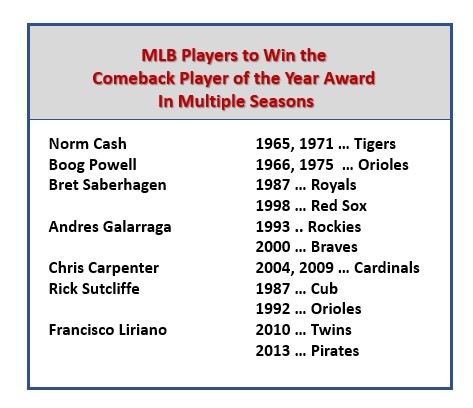
The up-and-down nature of Liriano’s career is reflected in the fact that, since the Comeback Player of the Year Award was established in 1965, Liriano is one of only seven players to win it twice and one of only two  to win it in both leagues. (Note: It was the Sporting News Comeback Player of the Year Award from 1965-2006 and the MLB Comeback Player of the Year Award from 2005-current – with overlapping awards in 2005-06).

So, let’s look briefly at Liriano’s career. Seventeen-year-old Liriano signed with the Giants as an international free agent (out of the Dominican Republic) in 2000.  In the minors, from 2001-2003, he  went 8-12, 3.88 with 170 strikeouts in 160 innings. In November of 2003, the Giants traded Liriano to the Twins (Liriano, Boof Bonser and Joe Nathan for A.J. Pierzynski and cash). The Twins saw Liriano as a top prospect with a hard, tailing fastball, a sharp-breaking slider and an effective curve (as well as with an unorthodox delivery).   After working his way up through High-A, Double-A and Triple-A (in 2005, he was 12-7, 2.63 with 204 strikeouts and just 50 walks at Double-A and Triple-A), Liriano got in six Twins game as a September call up (1-2, 5.70).

In 2005, Francisco Liriano was the International  League (AAA) Rookie of the Year.

In 2006, Liriano had one of his biggest ups, going 12-3. 2.16, in 28 games (16 starts) with the Twins. Observers will agree, his stuff was electric. However, the season was not without its downs. Liriano (known for an unorthodox – often  described as violent – delivery) – came down with arm (elbow) trouble and pitched in only one MLB game after August 7.  After the season, he underwent Tommy John Surgery – and missed all of 2007.

Liriano was back in 2008, but suffered through the down of starting the season in the minors, got an April call up and put down an 0-3, 11.32 record in three April starts for the Twins.   In late April, he was sent back down. However, putting up a 10-2, 3.28 record at Triple-A earned him a call back up to the Twins – where he went  went 6-1, 2.74, with 60 whiffs in 65 2/3 innings (11 starts) the rest of the way.  Plenty of smiles in Minnesota.

Observers point to Francisco Liriano’s original violent delivery, efforts to (alter) smooth that delivery, injury issues and some just plain hard-luck as factors in Liriano’s up-and-down career.

After that strong finish to 2008, things went a bit south in 2009 – a 5-13, 5.80 record in 29 games (24 starts).

Liriano’s 2010 season was primarily an up year (but still had its down moments). He started out 3-0, 0.93 in four April starts, with 27 strikeouts in 29 innings. Then, in six May starts, he seemed to lose his way (2-3, 5.15), but still there was solid promise – as he recorded 39 strikeouts and just nine walks in 36 2/3 May innings.  He righted the ship and was 14-7, 3.28 on September 15 – before losing his last three starts, giving up 12 earned runs in 13 1/3 innings. He finished the season 14-10, 3.62 – and to add another up – won his first Comeback Player of the Year Award.

Then came the 2011 no-hitter season (that we’ve already looked at). This was followed by  a 2012 season in which Liriano went 6-12, 5.34 for the Twins and White Sox. In October of 2012, the White Sox released Liriano and in December, he signed as a free-agent with the Pirates.  Then, another downer.  Shortly after signing with the Pirates, Liriano  broke his non-throwing arm playing with his children. Liriano started the 2013 season (after the Pirates’ contract was voided and renegotiated) on the disabled list and didn’t make  his first start until May 11. It was pretty much all up from there, as Liriano finished the season at 16-8, 3.02 in 26 starts, fanning 163 batters in 161 innings – winning his second Comeback Player of the Year Award.
In 2014-15, Liriano was pretty steady – going a combined 17-17, and putting up a 3.38 ERA in both seasons (for the Pirates).   Still, there were ups and downs.  In 2014, Liriano was 1-7, 4.72 through mid-July and then 6-3, 2.20 the rest of the way.

Liriano pitched until 2019 (suiting up for the Pirates, Blue Jays, Astros and Tigers). Over his final four seasons, he went 24-35, 4.68.   His final stat line was 112-114, 4.15, with 1,815 strikeouts and 816 walks in 1,813 2/3 innings. He also went 2-1, 3.96 in 11 post-season games (three starts) for the Twins, Pirates, Blue Jays and Astros.

As a Twins fan, I was privileged to see Liriano in action and when he was on his game, it was a beauty to watch – and he could, at times,  make batters look helpless “up or down” in the strike zone.

Primary Resources: Baseball-References.com; Baseball-Almanac.com; “Roberts Report: Liriano of old won’t be back soon,” April 24, 2008, ESPN.com; “Twins’ Liriano trying to slow down,” Associated Press, August 25, 2009.

BASEBALL ROUNDTABLE ON THE TOP 100 BASEBALL BLOG LIST

100Baseball Roundtable is on the Feedspot list of the Top 100 Baseball Blogs.  To see the full list, click here.

I tweet baseball @DavidBBRT

Follow/Like Baseball Roundtable’s Facebook Page here.  More baseball commentary; blog post notifications; PRIZES.

Member: Society for American Baseball Research (SABR); The Baseball Reliquary; The Negro Leagues Baseball Museum.

Mets Toss MLB’s First 2022 No-Hitter … Using a Handful of Pitchers

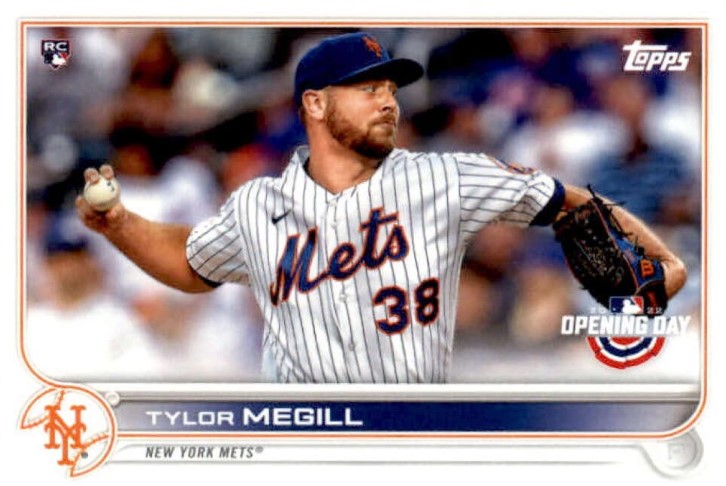
Yesterday (April 29, 2022),  five Mets’ pitchers combined to no-hit the Phillies (in New York), as the Metropolitans triumphed 3-0. Tyler Megill started the game and went five innings (three walks, five whiffs), picking up the win. He as followed by Drew Smith, who faced five batters, walking one and fanning four); Joely Rodriguez (one inning pitched, two walks); Seth Lugo (2/3 of an inning); and Edwin Diaz, who fanned the side on 13 pitches in the ninth to save the game and the no-no.


A few side notes:

  • It was just the 17th combined no-hitter in AL/N L history.
  • It just the second no-hitter  (by the Mets) in Mets’ ‘history.
  • The five pitchers used was just one shy of the record for a no-hitter.
  • The Mets’ pitchers threw 159 pitches (98 strikes), the most pitches in a no-hitter since accurate pitch counts began in the late 1980s.
  • It was the 20th no-hitter tossed against the Phillies – tied for the most against any franchise in MLB history (per the Elias Sports Bureau).

Now, in honor of the Mets’ combined no-hitter, let’s revisit the  sixteen AL/NL combined no-hitters that preceded the Mets’ effort – and the touch upon circumstances that made many of them unique.  Baseball Roundtable has lo0ked at combined no-hitter before, but this seems like a good time for review. 

The First-Ever Combined No-Hitter – Babe Ruth Didn’t Hang Around Long

This took place on June 23, 1917 – with the Red Sox topping the Senators 4-0 in Boston. This game is special for several reasons:

  • It was the first MLB combined no-hitter;
  • Babe Ruth started on the mound;
  • It involved the most meager contribution by the starting pitcher (zero innings pitched- one batter faced); and
  • It is arguably the most “perfect” combined no-hitter ever.

Babe Ruth, at that time plying his trade as a left-handed starting pitcher for the Boston Red Sox, opened the game by walking Washington’s lead-off hitter Roy Morgan.  Ruth, and his catcher Pinch Thomas, took issue with umpire Brick Owens’ strike zone and, during the argument, Ruth made contact with the umpire (a glancing blow, it was reported).  The ultimate result of the confrontation was the ejection of both Ruth and Thomas (with Ruth earning a $100 fine and ten-game suspension).  Red Sox’ pitcher Ernie Shore was called in to replace Ruth and Sam Agnew took Thomas’ spot behind the plate. Morgan decided to test Agnew’s arm and was thrown out stealing, after which Shore retired the next 26 hitters in order – completing the first combined no-hitter within the minimum 27 total batters.  Ruth, by the way, ended the season 24-13, with a 2.01 ERA and a league-leading 35 complete games in 38 starts.

_________________________________________

Second Combined No-Hitter – A Long Time A-comin’

Given the past propensity for pitchers finishing what they started, MLB’s second combined no-hitter came 50 seasons and 70 no-hitters later – on April 30, 1967, with the Tigers defeating the Orioles 2-1 in Baltimore.  This combined no-hitter is unique because:

  • It was not a shutout.
  • The team that threw the no-hitter lost (the only combined no-hitter loss); and
  • It involved the briefest contribution by the relief staff (one pitcher/one-third inning pitched).

Orioles’ starter Steve Barber was effectively wild, walking ten hitters and hitting two in 8 2/3 innings. The opposing hurler was Detroit’s Earl Wilson – who matched goose eggs with Barber for seven innings. In the eighth, Baltimore pushed across a run on three walks and a sacrifice fly (Wilson gave up only two hits and four walks in his eight innings of work) and victory was there if Barber could take it. He didn’t.  Barber walked Tigers’ 1B Norm Cash to start the ninth. He then walked SS Ray Oyler. Earl Wilson, a good-hitting pitcher, bunted the runners to second and third, before Barber got the second out of the inning, inducing PH Willie Horton to pop up to the catcher.  Now, just one out away from a 1-0, no-hit win, Barber uncorked a wild pitch that brought the tying run home. He then walked CF Mickey Stanley, ending his day on the mound. Stu Miller came in to get the final out, but not until an error allowed the go-ahead run to score.

________________________________________

Combined No-Hitter Number Three – Waiting Until the Last Possible Day

This no-hitter came on September 28, 1975, with the A’s topping the Angels 5-0 in Oakland.  This game was unique in that:

  • It is one of only three no-hitters thrown on the final day of an MLB season;
  • It made starting pitcher Vida Blue the first hurler to take part in both a solo and combined no-hitter. (Blue had thrown a solo no-hitter on September 21, 1970.); and
  • It was the first time more than two pitchers were involved in a combined no-hitter.

Blue went five innings  (two walks, two strikeouts) and was followed by Glenn Abbott (one inning,), Paul Lindblad (one inning, one whiff) and Rollie Fingers (two innings, two strikeouts). Note: Blue has been joined by Kevin Millwood, Kent Mercker and Mike Witt as pitchers with both solo and combined no-hitters.)

______________________________________

Combined No-Hitter Number Four – Tea for Two

The next combined no-hitter went back to the two-pitcher formula, as Blue Moon Odom (five innings, nine walks, three strikeouts) and Francisco Barrios (four innings, two walks, two strikeouts) of the White Sox topped the A’s 2-1 in Oakland.  In this July 28, 1976 game, Odom walked seven different players at least once in his five innings of work.

_____________________________________

Combined No-hitter Number Five –  At Witt’s End

MLB’s fifth combined no-hitter came on April 11, 1990 (again just two pitchers), with the Angels topping the Mariners 1-0 in Anaheim.  Mark Langston started the game and went seven (four walks, three strikeouts) and Mike Witt (the only pitcher to throw a perfect game – September 30, 1984 – and take part in a combined no-hitter ) threw the final two (two strikeouts.)

_______________________________________

1991 – The First “Year of the Combined No-Nos” (plural that is)

1991 saw seven MLB no-hitters, including two combined no-nos. On July 13, the Orioles no-hit the A’s 2-0 in Oakland behind Bob Milacki (who threw six no-hit innings – three walks/three whiffs) and was pulled after being hit by a Willie Wilson line drive. Mike Flanagan (one inning, one walk), Mark Williamson (one inning) and Gregg Olson (one inning, two strikeouts) finished up the no-no.

Then, on September 11, the Braves no-hit the Padres 1-0 in Atlanta, led by Kent Mercker (six innings, two walks, six strikeouts), Mark Wohlers (two innings) and Alejandro Pena (one inning).  Greg Harris, who started for the Padres, threw a complete-game seven-hitter.

_______________________________________

Combined No-Hitter Number Eight –  Working Overtime

Combined no-hitter number eight came on July 12, 1997 – with the Pirates topping the Astros 3-0 in Pittsburgh.  It was unique in that it is:

  • The only extra-inning combined “no-no;” and
  • Made Francisco Cordova the (still) only  pitcher to start a combined no-hitter by pitching nine full innings.

Francisco Cordova started and went nine hitless frames (two walks, ten whiffs) and Ricardo Rincon threw one hitless inning in relief (for the win).

__________________________________________

Combined No-Hitter Number Nine … Nearly the Whole Bullpen

The next combined no-hitter was a record breaker – as the then-National League Astros used a record six pitchers (since tied) to no-hit the Yankees 8-0 in an inter-league game at Yankee Stadium (the last no-hitter at Old Yankee Stadium). On June 11, 2003. Roy Oswalt started, but succumbed to a groin injury after just one completed inning (two strikeouts). Joining in the no-hitter were: Pete Munro (2 2/3 innings, three walks, two strikeouts ); Kirk Saarlos (1 1/3 innings, one strikeout); Brad Lidge (two innings, two strikeouts); Octavio Dotel (one inning, four strikeouts); and Billy Wagner (one inning, two whiffs).

Notably, the no-hitter also broke up the Yankee’s record streak of 6,980 games without being held hitless. They had not been held without a safety since September 20, 1958.  The five relievers combined for eight innings pitched, with three walks and 11 strikeouts.  The Houston Chronicle reported that the Yankees took the whitewashing well and that, when the Astros returned to the visiting clubhouse there was a bottle of champagne (courtesy of the Yankees) at each pitchers’ locker.

In the eighth inning of this game, Octavio Dotel recorded a four-whiff frame. He struck out Juan Rivera and Alfonso Soriano on three pitches each; fanned Derek Jeter on a 3-2 pitch only to see him awarded first base on catcher’s interference; and then got Jason Giambi on a 2-2 pitch.  All four were swinging strikeouts.

______________________________________________________

Combined No-Hitter Number Ten – Evening Up the Score

The very next combined no-hitter – another inter-league game – saw the six-pitcher record tied, as the Mariners topped the Dodgers 1-0 in Seattle on June 8, 2012.  In addition, the AL evened up the score in combined inter-league no-hitters at one apiece. Kevin Millwood started that one (six innings, one walk, six strikeouts), followed by Charlie Furbush (2/3 inning, one strikeout), Stephen Pryor (1/3 inning, two walks, one strikeout), Lucas Luetge (1/3 inning), Brandon League (2/3 inning, one strikeout) and Tom Wilhelmsen (one inning).

__________________________________________

Combined No-Hitter Number 11 – The Fab Four

On September 1, 2014, the Phillies used four pitchers to no-hit the Braves 7-0 in Atlanta.  The pitchers involved were Cole Hamels, who started and went six innings (issuing five walks versus seven strikeouts); Jake Diekman (one inning, two strikeouts); Ken Giles (one inning, three strikeouts); and Jonathan Papelbon (one inning, no strikeouts).

__________________________________

Combined No-Hitter Number 12 – On New Turf
This one took place on May 4, 2018, as the Dodgers no-hit the Padres 4-0 in a regular-season MLB game played in Monterrey, Mexico – the first official MLB no-hitter ever thrown outside the United State or Canada.

Right-hander Walker Buehler started for the Dodgers, and the 23-year-old – making just his third major-league start (11th appearance) – went six innings (93 pitches), walking three and fanning eight.  He was followed by relievers Tony Cingrani (one inning, two walks, one whiff); Yimi Garcia (one inning, no walks, two strikeouts) and Adam Libertore (one inning, no walks, two strikeouts).  Buehler, by the way, also collected an unusual sixth-inning single – as his groundball hit base runner Alex Verdugo between first and second, resulting in Verdugo being called out (for the final out of the inning) and Buehler being credited with a single. That single, of course, meant Buehler outhit the entire Padres’ lineup.

_________________________________________

Combined No-hitter number 13 – A Lucky Number

Thirteen was a lucky number for the Angels.  On July 12, 2019, their staff put together MLB’s 13th combined no-hitter and their offense scored 13 runs on 13 hits. Taylor Cole started the game (in the “opener” role) and pitched two clean frames with two strikeouts.  Felix Pena the came on for the Halos and went seven innings (one walk, six strikeouts).

_________________________________________

Combined No Hitter Number 14 – An Unlikely Starter

On August 3, 2019, four Astros’ pitcher no-hit the Mariners 9-0 in Houston. Starting pitcher Aaron Sanchez seemed an unlikely hurler to start off a no-no – he came into the game with a 3-14, 6.07 record in 23 starts (with batters hitting .290 against him – a .382 on-base percentage). Sanchez shut down the  Astros, walking two and fanning six over six no-hit innings, then giving way to Will Harris (one inning pitched, one walk); Joe Biagini (one inning pitched, one walk, one whiff); and Chris Devinski (one inning pitched, one strikeout).

It was, notably, the first appearance for the Astros for Sanchez and Biagini – both had been included in a Blue Jays/Astros trade on July 31 (Sanchez, Biagini and minor-leaguer Cal Stevenson for OF Derek Fisher).  Thanks to this effort, 2019 became just the second season with two combined no-hitters.

Combined No-Hitter Number 15 – Everyone Issued at least one Free pass

On June 24, 2021, the Chicago Cubs no-hit the Dodgers 4-0 in Los Angeles.  Zach Davies started for the Cubs and went six innings, walking five and fanning four. He was followed by Ryan Tepera (one inning, one walk); Andrew Chafin (one inning, one walk); and closer Craig Kimbrel (one inning, one walk, three strikeouts). That these three should close out a no-no is no surprise, coming into the game their earned run averages, respectively, were 2.02, 1.72 and 0.61.

More Proof of that “In Baseball, We Count Everything.” 

STATS, Inc. reported that this was the first no-hitter thrown against a lineup with three former MVP’s (Mookie Betts, Al Pujols, Cody Bellinger).

____________________________________

Combined No-Hitter Number 16 – You’ve Been Burned

On September 11, 2021), Brewers’ ace right-hander Corbin Burnes faced off against the Indians in Cleveland. Burnes tossed eight innings of no-hit ball, before yielding the mound to southpaw reliever Josh Hader, who finished off the no-hitter with a 1-2-3 ninth.  It was the ninth no-hitter of the 2021 season, breaking the MLB single-season record of eight (set back in 1884.)

Burnes tossed eight innings, walking one and fanning 14 – eleven swinging and three looking.  He went to a three-ball count on just five batters and four of those struck out (Cleveland CF Myles Straw walked on a 3-1 pitch to open the seventh inning –  the only Indians’ base runner in the game.  Hader came on in the ninth and retired the Indians on nine pitches (two strikeouts and a foul pop.)

Here are a few tidbits about the Burnes-Hader no-no.

  • The Indians became the first team to be no-hit three times in a single season.
  • Burnes became just the third pitcher in (American League / National League) to be pulled to open the ninth inning after eight hitless frames (Elias Sports Bureau).
  • It was the record seventh no-hitter thrown on the road in a season (an MLB single-season record – although 2021 already had the record at six).

Baseball Roundtable Disclaimer:  The MLB records referenced in this (and previous) posts have the potential to change as Major League Baseball recognizes and incorporates Negro League records from 1920-46 into the MLB record book.


Primary Resources:  Baseball-Reference.com; MLB.com; Baseball-Almanac.com

BASEBALL ROUNDTABLE ON THE TOP 100 BASEBALL BLOG LIST

100Baseball Roundtable is on the Feedspot list of the Top 100 Baseball Blogs.  To see the full list, click here.

I tweet baseball @DavidBBRT

Follow/Like Baseball Roundtable’s Facebook Page here.  More baseball commentary; blog post notifications; PRIZES.

Member: Society for American Baseball Research (SABR); The Baseball Reliquary; The Negro Leagues Baseball Museum.


The Athletics Nightmare’ Inning – 63 Years Ago Today

On this Date (April 22) in 1959, the Chicago White Sox completed what may be the weirdest MLB offensive inning ever – an event Baseball Roundtable loves to revisit and a nightmare Kansas City (Athletics) players and fans would surely like to forget. So,. I guess we’ll remind them here.

Nellie Fox drew two bases-loaded walks in the seventh inning of the White Sox 20-6 win. For the game. Fox was four-for-five, with a double, two walks,a run scored and five RBI.

In the seventh inning of a 20-6 road win over the Kansas City A’s, the Chicago White Sox scored 11 runs on just one base hit. In fact, they got only one ball out of the infield … and benefited from eight bases-loaded walks (ten total walks)  and one bases-full hit by pitch.  Actually, it did not start out like it was going to be a good day for the White Sox.  The A’s knocked Chicago’s starting pitcher Early Wynn – who would go on to lead the AL in wins with 22 – out of the game with six runs on six hits and two walks in the first 1 2/3 innings. The Sox trailed 6-1 after two frames. The White Sox, however, had come back to take the lead 8-6 before their 11-run sixth.

A Brief Break in the ChiSox Story – One for the Record Books

The ten seventh-inning walks received by the White Sox on April 22, 1959 were not a record. On September 11, 1949, the Yankees got the benefit of an MLB record 11 walks in a single inning – the 12-run third frame of a 20-5 win over the Senators in New York. In that inning, the Yankees had 11 walks, two doubles, two singles and one batter safe on an error. Eight different Yankees drew free passes that frame,  with RF Cliff Mapes, LF Charlie Keller and 1B Joe Collins drawing two each. Five of the 11 walks came with the bases loaded (a full replay of that inning can be found at the end of this post)

This White Sox’ unique “offensive outburst” would prove to be a portent of things to come. The 1959 AL pennant-winning White Sox became known as the “Go-Go Sox” for their ability to manufacture runs despite a punch less offense. (The Sox finished last in the league in home runs and sixth – out of the eight AL teams – in batting average and runs scored, but first in stolen bases and second in walks).

Still, it would have been hard to predict an inning in which the boys from Chicago would plate eleven runs on just one hit (a single) – or to anticipate a frame which included ten walks, a hit batsman, and three opposition errors – or a team plating 11 runs and hitting only one ball out of the infield.  Here are few “numbers” from that 11-run inning:

  • The Sox sent 17 batters to the plate, but collected just one hit – and, again, got only one ball out of the infield. For those that like to know such trivia, the hit belonged to LF Johnny Callison.
  • The inning started with two Athletics’ errors.
  • Sox’ hitters stepped into the box with runners in scoring position 14 times.
  • Sox hitters batted with the bases loaded 12 times and never got the ball past the pitcher.
  • Eight different White Sox’ players drew walks; Nellie Fox and Luis Aparicio each drew two walks in the inning.
  • The Sox drew eight bases-loaded walks (and had one bases-loaded hit batsman).
  • White Sox 2B Nellie Fox walked twice with the bases loaded in the inning.
  • Johnny Callison, who got the only base hit, was hit by a pitch in his only other place appearance that inning..
  • The White Sox three outs came on one strikeout and two groundouts – both hit to the pitcher.

Here’s how it went that inning (per baseball-reference.com):

Tom Gorman Pitching

  • 1B Ray Boone is safe on a throwing error by A’s shortstop Joe DeMaestri.
  • RF Al Smith attempts to sacrifice Boone to second (score was 8-6 at the time) and reaches safely on an error by A’s third baseman Hal Smith.
  • LF Johnny Callison singles to right. Scoring Boone and Smith (with the help of an error by A’s right fielder Roger Maris). Callison ends up on third.
  • SS Louis Aparicio walks – steals second (runners now on second and third).
  • P Bob Shaw walks (loading bases).
  • PH Earl Torgeson (batting for 3B Sammy Esposito) walks (scoring Callison).

Mark Freeman Pitching

  • 2B Nellie Fox walks (scoring Aparicio).
  • CF Jim Landis reaches on fielder’s choice – grounding back to pitcher Mark Freeman, who takes the force at home (bases still loaded).
  • C Sherman Lollar walks (scoring Torgeson, bases still loaded).

George Brunet Pitching

  • Boone makes his second plate appearance of the inning and walks (scoring Nellie Fox).
  • Smith makes his second plate appearance of the inning and walks (scoring Landis).
  • Johnny Callison, who had the only hit of the inning in his first plate appearance, is hit by a pitch (scoring Lollar, bases still loaded). Lou Skizas comes in to run for Callison.
  • Louis Aparicio draws his second walk of the inning (scoring Boone, bases still loaded).
  • Shaw strikes out.
  • PH Bubba Phillips (batting for Torgeson, who batted for Esposito earlier in the inning) walks (scoring Smith, bases still full).
  • Nellie Fox draws his second bases-loaded walk of the inning (scoring Skizas).
  • Jim Landis grounds out pitcher to first to end the inning.
  • The 20-runs the White Sox scored that day were the most they plated in any game that season.
  • In addition, to scoring 20 times, Chicago left eleven runners on base.
  • Nellie Fox was the offensive star of the game – with four hits (five at bats), two walks and five RBI.
  • The A’s used six pitchers in the contest, three in the seventh inning.

______________________________________________________

Now, a look at the record-setting Yankee inning.

—–Bottom of third inning, Senators at Yankees (September 11, 1949)—–

Paul Calvert Pitching

  • SS Phil Rizzuto – walk.
  • RF Cliff Mapes – walk.
  • 3B Bobby Brown -two-run double.
  • CF Joe DiMaggio – Grounder to third, safe on an error (one run scores).
  • C Yogi Berra – RBI double.

Dick Welteroth pitching

  • LF Charlie Keller – walk.
  • 1B Joe Collins – walk, loading the bases.
  • 2B Jerry Coleman – walk, forcing in a run.
  • P Allie Reynolds – two-run single.

Coleman picked off second

  • Rizzuto – walk.
  • Mapes – walk, loading the bases.

Julio Gonzalez pitching

  • Brown walk – forcing in a run.
  • DiMaggio – run-scoring fly out to left.
  • Berra – walk, loading the bases.
  • Keller – walk, forcing in a run.
  • Collins – walk, forcing in a run.

Buzz Dozier Pitching

  • Coleman – walk, forcing in a run.
  • Reynolds – pop out.

Primary Resources:  Baseball-Reference.com; Baseball-Almanac.com


100Baseball Roundtable is on the Feedspot list of the Top 100 Baseball Blogs.  To see the full list, click here.

I tweet baseball @DavidBBRT

Follow/Like Baseball Roundtable’s Facebook Page here.  More baseball commentary; blog post notifications; PRIZES.

Member: Society for American Baseball Research (SABR); Negro Leagues Baseball Museum; The Baseball Reliquary. 


Bartolo Colon’s 38 Straight Strikes – and Pitchers Who Were (apparently) Effectively Wild

Today (April 18, 2022) marks the tenth anniversary of a remarkable pitching achievements.  On April 18, 2012, Oakland A’s Bartolo Colon started on the mound against Ervin Santana and the Angels.  During one stretch of that game, won by A’s 6-0, Colon threw 38 consecutive strikes.  (The longest such streak since pitch-by-pitch data began being accurately tracked in 1988.) Were all 38 offerings in the strike zone? Perhaps not, but all those pitches that were outside the zone were close enough that the batters offered at them.

Overall, the streak lasted from the second pitch of the fifth innings until the seventh pitch of the eight frame.  Surprisingly, Colon struck out just two batters during the streak.  He also gave up two hits during the streak of strikes.

For the game, Colon threw 108 pitches – 82 strikes. For those who like such details, the first strike of Colon’s run came on his second pitch to SS Maicer Izturis leading off the Angels’ fifth. His streak ended on his second pitch to LF Bobby Abreu in the eighth. For the game, Colon pitched eight shutout innings – four hits, no walks and five whiffs – running his record to 3-1, 2.63. A few notable stats from the game:

  • 35 of the 38 pitches were fastballs (two changeups and one slider).
  • There was only one swing and miss (17 strikes looking).
  • There were ten foul fouls and ten balls put in play.

Colon pitched in 21 MLB seasons (1997-2009, 2011-18 … Indians, Expos, White Sox, Angels, Red Sox, Yankees, A’s, Mets, Braves, Twins, Rangers) – winnings 247 games (188 losses),  with a 4.12 ERA. He  fanned 2,535 batters and walked  948 in 3,461 2/3 innings. Between 2012-2016 he averaged just 1.3 walks per nine innings –  twice recording the NL’s lowest walks/nine rate.  He averaged fewer than two walks per nine frames in nine seasons.

Now, as always, with Baseball Roundtable, one thing leads to another. So, imagine my surprise, when I saw Colon as the most recent entry in Baseball Almanac’s list of pitchers to start a game and walk four consecutive batters before recording an out. It happened on June 29, 2000, as Colon started for the Indians in Kansas City. Colon opened the bottom of the first inning by walking  Royals’ LF Johnny Damon, 2B Jeff Roboulet, 1B Mike Sweeney and RF Jermaine Dye on a total of 24 pitches.  He actually survived the inning, following the four walks  with a sacrifice fly, run-scoring groundout and a strikeout. Side note: This was a pretty good hitting Royals team. Among those first-inning walks, Roboulet was hitting .309, Sweeney .347 and Dye .320.   Colon lasted five innings in the game, giving up five earned runs on two hits and six walks.

Well, that bit of research sent me on another tangent – a look at pitchers who gave  up at  least ten walks in a game, without surrendering a run.  Turns out it happened  a manageable nine times.  So, here they are, with some very subjective rankings.

  1. Jim Maloney. Reds … August 19, 1965 versus Cubs (in Chicago)

Maloney tops this list because his game was a ten-inning no-hitter – in which Maloney gave up ten walks, hit one batter and fanned  a dozen. Maloney’s toughest inning was the third, when he walked 2B Glenn Beckert and SS Don Kessinger to open the inning; then fanned P Larry Jackson and got CF Don Landrum to hit into a P-SS fielder’s choice; then walked LF Doug Clemens to load the bases, before getting RF Billy Williams on a groundout to second.  In the game, Maloney walked three in the third, two in the fourth, eighth and ninth and one in the tenth.  The Reds and Maloney won the game 1-0, scoring in the top of the tenth on a home run by number-eight hitter SS Leo Cardenas.

Maloney enjoyed a 12-season MLB career (1960-71) – all but the final year (Angels) with the Reds. He went 134-84, 3.19, twice winning 20 or more games in a season and logging six seasons of 15 or more victories.  He finished in the league’s top five in walks five times and top three in wild pitches six times (leading the league twice).

  1. Bill James, Tigers … May 12, 1916 versus Athletics (in Philadelphia)

James takes the number-two spot on this list because he managed  to not allow a run, while walking ten batters in just five innings.

  • James walked the first two batters in the first inning, but pitched out of the jam (sacrifice, fielder’s choice, strikeout).
  • He gave up a walk and a single to put runners on first and third to start the second frame, but again worked his way out (runner caught stealing, fly out, strikeout).
  • In the third, he again started the inning by putting two runners on base (walks), but slipped the hook with two ground outs and a fly out.
  • Fourth frame, guess what? First two batters get on again (walks). James then got a groundout and a strikeout (leaving runners on second and third), before another walk to load the bases. A flyball to right then ended the inning.
  • The fifth was uneventful, a lone two-out single.
  • James started the sixth with a pair of walks before being pulled – and reliever Bernie Boland got out of the inning without a run touching the plate.

So, despite two hits and ten walks in five innings, James left with a 2-0 lead.  The bullpen, oweer, eventually gave up the lead and James got a no-decision.  (The Tigers eventually won 8-6 in 11 innings.)

James pitched in eight MLB seasons (1911-12, 1914-19 … Indians, Browns, Tigers, Red Sox, White Sox). He went 64-71, 3.21.

  1. J.R. Richard, Astros … July 6, 1976 versus Mets (in Houston)

Photo: Public Domain via WikiCommons

Richard’s  qualifying game featured a ten-inning, compete-game shutout – despite eight hits, ten walks and two wild pitches.  In the first inning, Richard gave up a single and a double (3B Make Phillips and CF Bruce Boisclair), but avoided a run with Philips cut down at the plate. Richard pitched in and out of trouble all game,  but the seventh and eighth innings were especially tense. In the seventh , after getting the first out (2B Felix Milan on a grounder to short), Richard walked SS Bud Harrelson and wild pitched him to second. He then walked P Jon Matlock and 3B Mike Phillips to load the bases – but a fly out to  short center and a grounder to first got him out of the inning.  The eighth started out smooth, with two out and no one on, but Richard then walked C Jerry Grote, Milan and Harrelson to load the bases before fanning Matlock to end the inning.

Mets’ starter Jon Matlock matched Richard goose egg for goose egg  through nine, but was lifted for a pinch hitter in the tenth. Mets’ Reliever Skip Lockwood gave up a run on two singles and an error in the bottom of the tenth and Richard had a hard-fought 1-0 win.

Richard pitched 10 MLB seasons (1971-80), all for the Astros. He went 107-71, 3.15 – once winning 20 games (20-15, 2.75 in 1976) and three times notching 18 wins.  He led the NL in  strikeouts twice – both times topping 300 whiffs – and led in walks and wild pitches three times each.

  1. Gary Peters, Whites Sox …. September 13, 1967 versus the Indians (in Chicago)

Peters worked hard for little return (a no decision) – pitching 11 one-hit, no-run innings (with, of course, ten walks and one hit by pitch) – in a game the White Sox eventually won ( 17 innings) 1-0.  Peters gave up his lone hit in the top of the second –  a triple to C Joe Azcue with only one out. Peters  then walked CF Jose Vidal and 2B Vern Fuller to load the bases – before a short fly to LF and a grounder to SS got him out of the inning unscathed.  While the raw numbers would seem to dispute it, Peters really seemed to be in control, despite all the free passes.  From the third through the eleventh innings, only two runners reached second base.

Peters pitched in 14 MLB seasons (1959-72 … White Sox, Red Sox). He was a two-time All Star and went 124-103, 3.25, once leading the AL in wins (20-8 in 1964) and twice in ERA (2.33 in 1963 and 1.98 in 1966). He won 15 or more games in four seasons.

  1. Garland Buckeye, Indians … September 16, 1926 … versus Yankees in Cleveland

Have to put Garland Buckeye up here – great name and he managed a complete-game shutout against the Yankees of Babe Ruth, Lou Gehrig, Bob Meusel and Tony Lazzeri – despite giving up two hits, ten walks and a hit by pitch (and fanning only one). Buckeye spent considerable time in trouble during  the game – and Babe Ruth seemed to always be in the middle of it.

  • In the second inning, Buckeye walked RF Ruth and then gave up a double to LF Meusel (Ruth stopping a third). Buckeye then walked SS Lazzeri to load the bases. He got out of the jam with a pop up and a groundball double play.
  • In the fourth, Buckeye surrendered a single to 1B Gehrig and a walk to Ruth, before Meusel sacrificed them to second and third. A pop up and line out got Buckeye back to the bench without a run.
  • In the sixth, Buckeye walked Gehrig and Ruth with one out and pitched out of it with a couple of easy fly balls.
  • The seventh saw Buckeye issue three walks and bring Lou Gehrig to the plate with the sacks full and two out. It was then that Buckeye notched his only strikeout of the game.
  • Buckeye walked Ruth to open the eighth and followed up by hitting Meusel with a pitch – but got a double play and an infield pop up to again escape.

The game was tied 0-0 until the seventh, when the Indians put up five  runs against Yankee starter Herb Pennock. (Pennock came into the game 22-9, Buckeye at 4-8).

Garland Buckeye pitched in five MLB seasons He got a cup of coffee for the Washington Senators in 1918 (against the Yankees), and gave up three hits, six walks and four earned runs in two innings.  A big man for his time, Buckeye moved to football, where he played center and guard for the Chicago Tigers (1920) and Chicago Cardinals (1921-24)  of the American Professional Football Association (later renamed the National Football League). He returned to MLB in 1925 and played through 1928 (Indians, Giants). His career MLB stats read 30-39, 3.91 in 108 games (67 starts). As a hitter he was .230-5-23 in 204 at bats. His best season on the mound was 1925, when he went 13-8, 3.65 for the Indians.

  1. Hank Aguirre, Indians … September 24, 1955 … versus the Tigres (in Detroit)

This outing was Aguirre’s first MLB start (and just his fourth appearance).  The 24-year-old rookie struggled a bit, but managed a complete-game shutout – as his Indians prevailed 7-0.  Aguirre got off to a rocky start walking the first three batters he faced – SS Harvey Kuenn, 1B Earl Torgeson and RF Al Kaline. He wiggled out of the jam with two foul pop outs and a fly to right. He had another tough inning in the seventh, walking three of the first four batters before getting Kaline on a liner to first base and CF Bill Tuttle on a strikeout. With six of his ten free passes coming in two innings, the game was not as stressful as a ten-walk outing might seem.

Aguirre pitched 16 MLB seasons (1955-70 … Indians, Tigers, Dodgers, Cubs). He went 75-72, 3.25 and won 14 or more games in three campaigns. In 1962, he was an AL All Star (Tigers) and went 16-8, with a league-low 2.21 ERA.

  1. George Brunet, Angels … July 6, 1966 versus Tigers (in Detroit)

Brunet worked just a bit of overtime in a tight contest (the Angels won 1-0 in ten innings) to pick up a victory – giving up no runs, despite allowing three hits and 10 walks. Brunet had eight strikeouts in the game.  In the second inning, with runners on second and third and one out, Brunet fanned C Bill Freehan and SS Dick McAuliffe to escape. In the eighth, a double and a pair of walks (after two outs) loaded the bases, but Brunet coaxed a ground out to third from  LF Willie Horton. The Angels scored in the  top of the tenth to give Brunet a 1-0 lead, but  after he walked the first batter in the bottom of the inning (3B Don Wert), got 2B Jake Wood to pop out and then gave up a single to 1B Norm Cash, Brunet was relieved by Jack Sanford who got the final two outs.

George Brunet pitched in 15 MLB seasons (1956-57, 1959-71 … Athletics, Braves, Astros, Orioles, Angels, Pilots, Senators, Pirates, Cardinals). He went 69-93, 3.62.

George Brunet  is a member of the Mexican Baseball Hall of Fame. After leaving the major leagues, he pitched Mexico until 1989 (age 54).

  1. Mel Stottlemyre, Yankees … May 21, 1970 versus Senators (in New York)

This falls just a little short of one-run game.  Stottlemyre got a 2-0 win, despite six hits, 11 walks and two wild pitches.

Stottlemyre was  in trouble right from the start, giving  up two walks and two singles in a scoreless first (one runner was erased trying to advance to second on a single).  Things calmed down until the fourth, when Stottlemyre again managed to escape scoreless, despite two singles and a walk (one runner called out after being struck by a fair ball).  In the fifth, Stottlemyre gave up two walks, one hit, a stolen base and tossed a wild pitch – but a key runner caught stealing  enabled  him to escape again.  In the ninth, a single and two walks had the bases loaded with one out (in a 2-0 game) and  Stottlemyre was pulled.  Reliever Steve Hamilton came in and fanned 1B Mike Epstein and 2B Bernie Allen (the number-four and number-five hitters) to save the game.

Stottlemyre pitched in 11 MLB seasons (1964-70), all for the Yankees.  He was a five-time All Star and won 20 or more games in three seasons (15 or more games in seven seasons).  He also led the AL in losses twice. His overall record was 164-139, 2.97.

Mel Stottlemyre was an All Star in 1966, when he led the AL in losses ( 12-20, 3.80). He was 7-8, 3.15 at the break and 5-12, 4.51 in the second half.

  1. Lefty Gomez, Yankees … August 1, 1941 versus Browns (In New York)

Gomez  gave up five hits and 11 walks (one wild pitch) and still managed to shut down the Browns  in a lopsided 9-0 Yankee win. (There wasn’t a lot of pressure on Gomez, it was 3-0 after one inning and 6-0 after three.)

Really,  despite  all the walks, Gomez did not seem to be in a lot of trouble. The most bothersome innings  were bookends – the first and the ninth.  In the first, Gomez gave up a leadoff single to 2B Don Heffner, then retired the next two batters before walking a pair (Wally CF Judnich and LF Roy Cullenbine) to load the bases. This brought up RF Chet Laabs (remember that name, he’ll come up again) with the bases full and two outs. Gomez  got him on a foul pop out.  In the ninth, Gomez walked the bases full with two outs, and Chet Laabs was again the batter (told you he’d be back).  This time it was a fly out to center to end the game.

Hall  of Famer Gomez pitched in 14 MLB seasons (1930-43), all but the final one for the Yankees. (He was 0-1, 5.79 in one start for the Senators in 1943).  Gomez was 189-102, 3.34 for his career. A seven-time All Star, he led the AL in wins twice (and four times won 20+ games), and also led in ERA twice, in complete games twice, in shutouts three times and in strikeouts three times.

Primary Resources:  Baseball-Reference.com; Baseball-Almanac.com; Bartolo Colon Throws 38 Consecutive Strikes in A’s Win, The Washington Post, April 20, 2012, by Matt Brooks


100Baseball Roundtable is on the Feedspot list of the Top 100 Baseball Blogs.  To see the full list, click here.

I tweet baseball @DavidBBRT

Follow/Like Baseball Roundtable’s Facebook Page here.  More baseball commentary; blog post notifications; PRIZES.

Member: Society for American Baseball Research (SABR); Negro Leagues Baseball Museum; The Baseball Reliquary. 


More Pre-Season Musings – Teammates Finishing Atop the MVP Ballot … and More

More pre-season musings.  I was looking at rosters and noted that the Dodgers – for the second year in a row – had four former MVPs on the team: Freddie Freeman; Cody Bellinger; Mookie Betts; and Clayton Kershaw.   They did it a year ago, as well – with Albert Pujols replacing Freeman – and are the first team to achieve that distinction in consecutive seasons. Notably, of the five teams to boast four former MVPs on their Opening Day rosters, only one – the 1978 Reds – had four players who earned their MVP recognition with the team.


As regular readers know, when Baseball Roundtable looks into a trivia tidbit, “one thing always leads to another.”   In this case, it led to a look into teammates who finished atop the MVP voting in the same season.  I learned that the last time, MLB saw teammates finish 1-2-3 in Most Valuable Player race was in 1966– when Frank Robinson, Brook Robinson and Boog Powell of the World Champion Orioles earned the top three spots in the American League MVP balloting.  In this post, Baseball Roundtable will take a look at all those instances in which teammates finished 1-2 or 1-2-3 in the Most Valuable Player balloting.

Let’s start with a look at teammates who finished 1-2-3 in the MVP balloting.

1966 – OF Frank Robinson, Orioles, MVP … 3B, Brooks Robinson, Orioles, second … 1B Boog Powell, third

The 1966 World Champion Orioles (97-63) were clearly led by OF Frank Robinson.

  • Frank Robinson hit .316-49-122, winning the AL Triple Crown. He also led the league in runs scored (122).
  • Brooks Robinson, won his seventh straight Gold Glove, and also had a solid offensive year (.269-23-100).
  • Boog Powell came in at .287-34-109.

Notably, three Twins finished 4-5-6: Harmon Killebrew, Jim Kaat and Tony Oliva.  Also finishing in the top ten for the Orioles that year was shortstop Luis Aparicio at number nine.

From 1964-66, Brooks Robinson never finished lower than third in the AL MVP voting. One first, one second, one third.

______________________________________

1959 – 2B Nellie Fox, White Sox, MVP … SS Luis Aparicio, White Sox, second … P Early Wynn, White Sox, third

The 1959 White Sox used defense and pitching to upend the favored Yankees and finish first in the American League (94-60-2) – despite having only one player with at least 20 home runs (C Sherm Lollar , 22) and no player with more than 84 RBI or 98 runs scored. In fact, only one regular member of the lineup hit higher than .275. It’s no surprise that two Gold Glove middle infielders and a pitcher were their top MVP vote getters.

  • Nellie Fox hit .306-2-70, with 84 runs scored.
  • Luis Aparicio it .257-6-51, with 98 runs scored and 56 steals.
  • Early Wynn led the league with 22 wins (ten losses) and put up a 3.17 ERA in 37 starts.

The White Sox won the Al pennant in 1959 despite finishing sixth (out of eight teams) in runs scored and batting average and last in home runs. The ChiSox had five of the top ten finishers in the MVP balloting that year, with CF Jim Landis at number-seven and C Sherm Lollar at number-nine joining the top three.

________________________________

1941 – 1B Dolph Camilli, Dodgers, MVP … CF Pete Reiser, Dodgers, second … pitcher Whit Wyatt Dodges, third

The 1941 Dodgers went 101-54-3, finishing atop the National League –  boasting a potent attack  that led the league in runs scored (800), home runs (101) and average (.272), and a pitching staff that boasted two 20-game winners and the league’s  lowest ERA (3.14), That was reflected in the MVP balloting.

  • 1B Dolph Camilli hit .285 and led the league in home runs (34) and RBI (120), while scoring 92 runs.
  • CF Pete Reiser led the league in batting (.343), runs scored (117), doubles (39), triples (17) and tossed in 14 home runs and 76 RBI.
  • P Whit Wyatt led the league with 22 wins (10 losses) and seven shutouts. His 2.34 ERA was second in the league, as were his 23 complete games and 176 strikeouts.

Dodgers’ Kirby Higbe and OF Dixie Walker also finished in the balloting’s top ten at seven and ten, respectively.

__________________________

1914 – 2B Johnny Evers, Braves, MVP … SS Rabbit Maranville, Braves, second … P Bill James, Braves, third

The 1914 World Champion Braves finished the regular season 94-59-5. They were dubbed the Miracle Braves after finishing in fifth place the previous year and being 16 games out of first place on July 4 and  in last place (11 games out) as late as July 18.  In fact, the Braves did not drop their deficit into single digits until July 31 – and yet they finished the season 10 ½ games ahead of the second-place Giants.  No wonder they had the top three MVP vote-getters in Bill James (one of two 26-game winners on the pitching staff) and infielders Johnny Evers and Rabbit Maranville, who provided sparkling defense up the middle  (and led the league in double plays), while also contributing on offense.

  • Johnny Evers hit .279-1-40 , with 12 steals and 81 runs scored in 139 games.
  • Rabbit Maranville hit .246-4-78, with 74 runs and 28 steals in 156 games.
  • Bill James went 26-7, 1.90, with 30 complete games in 37 starts.

Brave’ pitcher Dick Rudolph also finished in the top ten, seventh in the voting.

Bill  James pitched in only four MLB seasons, with a career line of 37-21,  2.28. Outside of that 1914 miracle season, he was 11-14, 2.88. In Game Two of the 1914 World Series, James pitched a two-hit shutout, as the Braves topped the Athletics 1-0. Side note: James career was cut short by chronic arm fatigue which surfaced  in 1915.

______________________________________

Now, a look at teammates who finished  1-2 in the MVP vote.

2000 – 2B Jeff Kent, Giants, MVP … LF Barry Bonds Giants, second

In 2000, as the Giants won 97 games to lead the NL West.

  • Jeff Kent hit .334, with 33 home runs, 125 RBI, 114 runs scored and 12 steals.
  • Barry Bonds hit .306-49-106, with 129 runs scored and 11 steals.

Kent received 392 points in the balloting (with 22 first-place votes); Bonds was at 279 (six first-place votes).  They were at the heart of the Giants’ potent attack – and a solid case could be made for either player. After finishing second to Kent in the 2000 MVP voting, Bonds went on to win the National League MVP Award in each of the next four seasons.

2000 was truly a “power year in the balloting, as every one of the top 11 National League vote-getters hit at least 33 home runs (seven hit 40+) and drove in at least 104. The Rockies’ Todd Helton finished sixth in the balloting, despite leading the league in average (.373), RBI (147) and hits (216), while also stroking 42 homers.  The top four finishers  in the AL MVP race all hit 40+ homer and drove in 130+ runs. Pitcher Pedro Martinez broke the string, by finishing  fifth in the voting.

__________________________________

1989 – LF Kevin Mitchell, Giants, MVP… 1B Will Clark, Giants, second

The Giants went 92-70, finishing first in the NL West, with Clark and Mitchell each driving in 100+ runs.

On the season:

  • Kevin Mitchell hit .291, and led the NL in home runs (47) and RBI (125), while also scoring 100 runs.
  • Will Clark hit .333-23-111, and led the NL with 104 runs scored.

Mitchell outpaced Clark in balloting 314 to 222 in points and 20-to-three in first-place votes.

_______________________________________

1983 – SS Cal Ripken, Jr., Orioles, MVP … 1B Eddie Murray, Orioles, second

The Orioles finished 98-64 and went on to win the World Series behind these two MVP candidates:

  • Cal Ripken, Jr. went .318-27-102, and led the AL in hits (211) and runs scored (121), while playing in all 162 games;
  • Eddie Murray was close, ending at .306-33-111, with 115 runs scored.

It was a close vote (322-290), with Ripken getting 15 first-place nods and Murray ten.  The only other first-place votes went to White Sox catcher Carlton Fisk (three), who finished third (.286-26-86).

_________________________________

1976 – 2B Joe Morgan, Reds, MVP … OF George Foster, Reds, second

The Reds went 102-60 and won the nL West (and World Series).

  • Joe Morgan hit .320, with 27 home runs, 111 RBI and 113 runs scored (and picked up his third straight Gold Glove).
  • George Foster hit .306, with 29 home runs and a league-leading 121 RBI.

The clinchers for Morgan were likely his 60 steals (to Foster’s 17) and 114 walks to Foster’s 54. Those walks gave Morgan a league-topping .444 on-base percentage (to Foster’s .364).  Morgan got 311 points in the full ranked voting to 221 for Foster. Morgan got 19 first-place votes to Foster’s five. A third Reds’ player, Pete Rose, finished fourth in the balloting.

________________________________________

1971 – P Vida Blue, A’s, MVP … 3B Sal Bando, A’s, second

The A’s went 101-60 in winning the AL West, as Vida Blue won the Cy Young and Most Valuable Player Awards.

  • Vida Blue went 24-8, with a league-leading 1.82 earned run average. He threw 24 complete games in 39 starts and led the league with eight shutouts.
  • Bando went .271-24-94 (leading the A’s in RBI).

Blue outpaced Bando 268-182 in the full ranked voting and had 14 first-place votes to Bando’s four. Reggie Jackson, who hit .277-32-80, with 87 runs scored and 16 steals (outpacing Bando in all those categories) finished 14th in the balloting.

___________________________________

1968 – P Denny McLain, Tigers, MVP …. C Bill Freehan, Tigers, MVP

1960 was the “Year of the Pitcher,” with Denny McLain (AL) and Bob Gibson (NL) each capturing their league’s Cy Young and MVP Awards. McLain may have pulled his battery mate Bill Freehan along for the ride. The Tigers went 103-59-2 (and went on to win the World Series).

  • Denny McLain went 31-6, 1.96, leading the AL in wins (31), complete games (28) and innings pitched (336).
  • Bill Freehan went .263-25-84 in 155 games (138 behind the plate).

McLain outpaced Freehan 280 to 161 in the ranked voting and got all 20 first-place votes.  Boston’s 1B/OF Ken Harrelson finished third despite outhitting Freehan (.275, with 35 home runs and a league-topping 109 RBI). That season a .275 average was good for ninth-best in the AL.)

Denny McLain and Bill Freehan are the only battery mates to finish 1-2 in he MVP voting in the same season.

____________________________

1967 – 1B Orlando Cepeda, Cardinals, MVP … C Tim McCarver, Cardinals, second

The Cardinals went 101-60 in 1967 (and won the World Series) and Orlando Cepeda was the big bat in the lineup, leading the team in average, home runs and RBI.  For the season:

  • Orlando Cepeda hit .325-25-111, with 11 steals and 91 runs scored;
  • Tim McCarver hit .295-14-69, with eight steals and 68 runs scored and was an acknowledged team leader.

Cepeda got all 20 first-place votes and outpaced McCarver 280-136 in the balloting.

___________________________________

1965 – SS Zoilo Versalles, Twins, MVP … RF Tony Oliva, Twins, second

The Twins went 102-60 in 1965, taking the AL Pennant. SS Zoilo Versalles was selected AL MVP, topping teammate Tony Oliva.

  • Zoilo Versalles led the AL in plate appearances (728); at bats (666); runs scored (126), doubles (45), triples (12) and total bases (308), while batting .273, popping 19 home runs and stealing 27 bags.
  • Tony Oliva won the AL batting Championship (.321) and led the league in hits (185), popped 16 home runs, drove in 98 and scored 107.

In 1965, when Zoilo Versalles won the AL Most Valuable Player Award, he led the American League in strikeouts and errors.

Versalles got 19 of the twenty first-place votes and 275 total points in the balloting. Oliva got the remaining first-place vote and 174 points.

___________________________________________

1962 – CF Mickey Mantle, Yankees, MVP … 2B Bobby Richardson, Yankees, second

The World Champion Yankees went 96-66 in the regular season in 1962, as Mickey Mantle won his third MVP Award and first Gold Glove.

  • Mickey Mantle hit .321-30-89, with 96 runs scored and nine steals in 123 games.
  • Bobby Richardson hit .302-8-59, with 99 runs scored and a league-topping 209 hits in 161 one games (and was the glue in the Yankee infield).

Mantle got 13 first-place votes and 234 points in the balloting. Richardson got five first place votes and 152 points.  The remaining two first-place votes went to the Twins’ Harmon Killebrew and the Yankees’ Tom Tresh.

Bobby Richardson is the only player to win the World Series MVP Award while playing on the losing team (1960).

________________________________________

1961 – RF Roger Maris, Yankees, MVP … CF Mickey Mantle, Yankees, second

Okay, how do you not give the MVP Award to the player who broke Babe Ruth’s hallowed home run record?  But, despite the record, the vote was a lot closer than you might think. Here are the stats.

  • Roger Maris hit just .269, but led the AL in home runs (61), RBI (141) and runs scored (132), as he captured his second straight MVP Award.
  • Mickey Mantle hit .317-54-128, with 131 runs scored and 12 steals.

In the voting, Maris got seven first-place votes and 202 points; Mantle got six first-place votes and 198 points.  (Jim Gentile, who tied Maris for the RBI lead and had 46 home runs and a .302 average picked up five first-lace votes in a third-place finish.) The Yankees won 109 regular-season games (53 losses, one tie) and the World Championship behind the M&M boys.

__________________________________________

1960 – RF Roger Maris, Yankees, MVP … CF Mickey Mantle, Yankees, second

In a precursor to the 1961 MVP results, Roger Maris edged teammate Mickey Mantle for the AL MVP Award as the Yankees went 97-57-1 to lead the American League.

  • Roger Maris hit .281, with 39 homers and a league-topping 112 RBI (98 run scored).
  • Mickey Mantle hit .275, hit an AL-best 40 homers, drove in 94 runs and scored an AL-leading 119.

In the balloting Mantle got ten first-place votes to Maris’ eight, but lost 225 to 222 in total points.

The 1960 MVP race between Roger Maris and Mickey Mantle was the closest ever among teammates – a three-point difference among 447 points for the two leaders. The closest vote ever came in 1947, when Joe DiMaggio edged Ted Williams by one point (202-201) – despite the fact that Williams won the Triple Crown.

_______________________________________

1956 – CF Mickey Mantle, Yankees, MVP … C Yogi Berra, Yankees, second

Another Yankee 1-2 punch in the MVP chase. Finishing atop the MVP balloting for the World Champion Yankees (970-57 in the regular season) were:

  • Triple Crown winner Mickey Mantle (.353-52-130, with a league-leading 132 runs scored); and
  • Yogi Berra (.298-30-105, with 93 runs scored).

Mantle got 336 points and all 24 first-place votes and Berra accumulated 186 points.  The Yankees went 97-57 – and went on to win the World Series (over the Dodgers) four games-to-three.

In an 18-season MLB career, Mickey Mantle finished among the top three in AL MVP voting seven times.

__________________________________________

1956 – P Don Newcombe, Dodgers, MVP … P Sal Maglie, Dodgers Second

The 1955 Dodgers edged the Milwaukee Braves by one game for the NL pennant going 93-61. Overall, the Dodgers outscored the Braves 720-709 on the season and gave up 32 fewer runs.

A pair of Dodgers pitchers finished 1-2 in the MVP balloting.

  • Don Newcombe, led the NL in wins with 27 (seven losses), put up a 3.06 ERA and tossed 18 complete games in 36 starts.
  • Sal Maglie went 13-5, 2.87 for the Dodgers after coming over from the Indians in May.

Newcombe got eight first-place votes and 223 points to Maglie’s four first-place votes and 183 points. Notably, two pretty well-known Braves finished third and fourth: Hank Aaron (.328-26-92) and Warren Spahn (20-11, 2.78).

___________________________________

1955 – C Roy Campanella, Dodgers, MVP … CF Duke Snider, Dodgers, second

In 1955, the Dodgers finally knocked off the crosstown rival Yankees in the World Series.  They got there on a 98-55-1 regular-season record fueled, in great part, by Roy Campanella and Duke Snider.

  • Roy Campanella hit .318-32-107, with 81 runs scored.
  • Duke Snider hit .309, with 42 home runs, a league-leading 136 RBI and a NL-best 126 runs scored.

Each of these two Dodgers got eight first-place votes (the Cubs Ernie Banks got six), with Campanella winning the total point count 226-221.

_________________________________

Bobby Shantz In the Lead

In 1952, the Athletics’ Bobby Shantz won the AL Most Valuable Player Award on the strength of a 24-7, 2.48 record … despite the Athletics’ 79-75 fourth place finish (or maybe because of it … the Athletics were 25-8 in games in which Shantz pitched and 54-67 when he didn’t take the mound). Shantz gets a shout out here because the next three finishers in the MVP balloting were all from the World Champion Yankees: Allie Reynolds, Mickey Mantle and Yogi Berra.

______________________________________

1945 – P Hal Newhouser, Tigers, MVP … 2B Eddie Mayo, Tigers, second

The 1945 World Champion  Tigers won the AL pennant with an 88-65-2 record, behind the big arm of Hal Newhouser.

  • Hal Newhouser led the AL with 25 wins (nine losses) and a 1.81 ERA. He also led in starts (36), complete games (29), shutouts (8); innings pitched (313 1/3) and strikeouts (212).
  • Tigers’ 2B Eddie Mayo hit .285-10-54, with 71 runs scored.

Although the statistics would seem to say otherwise, the vote was closer than you might expect, as Mayo was rewarded for sparkling defense, on-field leadership and solid offensive numbers for a middle infielder (at the time). Mayo got seven fist place votes to Newhouser’s nine – and was outscored 236-164 in the full voting.

_________________________________

1944 … P Hal Newhouser, Tigers, MVP… P Dizzy Trout, Tigers, second

The Tigers finished second in 1944 (88-66-2), despite having the number-one and two finishers in the MVP balloting – a pair of pitchers who combined for 56 wins.

  • Southpaw Hall Newhouser led the league with 29 wins (nine losses) and 187 strikeouts, while putting up a 2.22 ERA, 25 complete games and six shutouts.
  • Righty Dizzy Trout nearly matched Newhouser with 27 wins (14 losses) and led the league in ERA (2.12), complete games (33) shutouts (7) and innings pitched (314).

In 1944, Hal Newhouser and Dizzy Trout finished 1 & 2 in the AL (in varying order) in wins, ERA, innings pitched, strikeouts, complete games and shutouts.

In the balloting, Trout got 10 first-place votes to Newhouser’s seven, but lost out in the full ranked voting 236-232.

_________________________________________

1943 … OF Stan Musial, Cardinals, MVP … C Walker Cooper Cards, second

Stan Musial, in just his second full MLB season, captured his first batting crown and MVP Award as the Cardinals finished on top of the NL with a 105-9-3 record.

Side note: Sign of the times, the Cardinals had no batter with more than 13 home runs and no hitter with more than 81 RBI (Musial and Walker Cooper tied for the team lead). Still, they finished second in the NL in runs scored and home runs.  They also posted the league’s best earned run average (2.57) – more than a half run better than the second-best team.

  • Stan Musial led the league in average (.357), hits (220), doubles (48) and triples (20); while scoring 108 runs, hitting 13 home runs, driving in 81 and stealing nine bases.
  • Walker Cooper hit .318-9-81, with 52 runs scored – and caught the pitching staff that led the league in ERA.

Musial got 13 first-place votes and 267 ranked points to Cooper’s five and 192, respectively,

In the six seasons Between 1946 and 1951, Stan Musial finished in the top two in the NL MVP race five times. In those six campaigns, he averaged .349-28-112, with an season-average 122 runs scored, 40 doubles, 14 triples, 87 walks and just 34 strikeouts. Stan “The Man,” indeed.

_________________________________________

1942 – P Mort Cooper, Cardinals … OF Enos Slaughter, Cardinals, second

The World Champion Cardinals went 106-48-2 on the season , topping the league in run scored (755) and ERA (2.55). It seems appropriate that a Cardinals’  pitcher and batter would find their way to the top of the MVP balloting.

  • Mort Cooper had a solid season going 22-7, 1.78 (although, truth be told, the Cardinals’ Johnny Beasley was not far behind at 21-6, 2.13). Cooper also had 22 complete games and ten shutouts. Cooper led the NL in wins, ERA and shutouts.
  • Enos Slaughter led the Cardinals’ lineup in average (.318), RBI (98), home runs (13), runs scored 100, hits (188) and triples (17). He led the NL in hits and triples, was second in average and runs scored and third in runs batted.

Cooper got 13 first place votes and 263 points to Slaughter’s six first-place recognitions and 200 ranked points.

In 1942 Mort Cooper won the NL Most Valuable Award. A year later, his brother Walker Cooper nearly duplicated the feat – finishing second in the MVP voting to Stan Musial. 

_________________________________

1934 – C Mickey Cochrane, Tigers, MVP … 2B Charlie Gehringer, Tigers, second

The 1934 Tigers finished first in the AL with a 101-53 record – led by player-manager Mickey Cochrane (who was also the AL MVP). All Star second baseman Charlie Gehringer finished second in the balloting.

  • Mickey Cochrane played in 129 games and hit .320, with two home runs and 75 RBI, while also managing and, of course, handling backstop duties.
  • Gehringer hit .356-11-127, scored a league-leading 135 runs and posted an NL-best 214 hits.

Cochrane edged Gehringer 67 points to 65 in the voting.

Primary Resource: BaseballReference.com


100Baseball Roundtable is on the Feedspot list of the Top 100 Baseball Blogs.  To see the full list, click here.

I tweet baseball @DavidBBRT

Follow/Like Baseball Roundtable’s Facebook Page here.  More baseball commentary; blog post notifications; PRIZES.

Member: Society for American Baseball Research (SABR); Negro Leagues Baseball Museum; The Baseball Reliquary. 


Pre-Season Musings – “No-Out Wonders”

As Baseball Roundtable waits for the MLB  season to start in earnest, my mind tends to wander to all sorts of big-league achievement and oddities – iconic, ironic or just plain unusual baseball events. In my recent (March 18), Baseball Roundtable Tenth Anniversary post, I described ten of my favorites such MLB occurrences. (Click here for that post.) Today, I’d like to continue those off-beat musings – looking at 39 pitchers who took the MLB mound at least once in their career – and never retired a batter.  I ask that readers keep in mind that, despite their lack of success, all these hurlers belong to that elite group of athletes that actually made it to the major-league mound.

N0t Sure If This One Counts

This list can be expanded to a fabulous forty if you include Larry Yount, brother of Hall of Famer Robin Yount, who had arguably the shortest MLB career ever.  On September 15, 1971, Yount (with the Astros) was called to  the mound in the top of the ninth with Houston  trailing the Braves 4-1. He was slated to face LF Ralph Garr, 1B Hank Aaron and C Earl Williams. He faced none of them. Young had experienced a bit of an elbow twinge in the bullpen and, while warming up on the mound, it got worse.  The trainer came to bump and Yount was pulled from the game – officially registering an MLB pitching appearance, but without tossing a single pitch. Yount pitched two more minor-league seasons, but never made it to the MLB mound again.  (In seven minor-league seasons, Yount went 40-69, 4.56.)

So, let’s look at some of the 39 “No-Out Wondes.”

Twenty-nine of the 39 gave up at least one earned run, giving them an earned run average of infinity. 

Bill Childers of the 1895 Louisville Colonels and Elmer “Doc” Hamann of the 1922 Cleveland Indians gave up the most earned runs in their no-out MLB mound careers – six each.

Childers sole MLB appearance came on July 27, 1895. He was called on with one out in the top of the ninth, with his Louisville Colonels trailing the Baltimore Orioles 12-6.  Childers proceeded to face seven batters – giving up two hits and five walks (and tossing three wild pitches) before being relieved in a 22-6 Louisville loss.

One September 21, 1922, Hamann (with the Indians) was brought in to open the top of the ninth (versus the Red Sox), with the Indians trailing 9-5. In his six-earned-run outing, Hamann, like Childers, faced seven batters,Hamann gave up three hits, three walks and one hit-by-pitch. The final score of this one was Red Sox 15 – Indians five. (For Baseball Roundtable’s Minnesota readers, Hamann (a New Ulm native), played baseball and basketball for  St. Thomas College. Side note: This no-out outing proved to be not only Hamann’s only MLB appearance, but his only professional pitching appearance.

_________________________________________________

Five  of the 39 were position players called in to pitch.

The most famous of the position players who took the mound during their career without ever retiring a batter was Stan Musial. On September 28, 1952, Musial, already a five-time batting champion, was called in –  not from the bullpen, but from CF – with one out and one on  in the top of the first inning in a Cardinals/Cubs tilt in St. Louis. Cardinals’ starting pitcher Harvey Haddix  went from the mound to RF, with RF Hal Rice moving to center. Musial faced Cubs’ RF Fran Baumholtz (hitting .325 at the time – second only to Musial in the NL batting race). Stan the Man  almost pitched his way off this list.  Baumholtz put Musial’s first (and only) MLB pitch into play and “The Man” would have recorded an out, except for an error (on a groundball) by Cardinals’ 3B Solly Hemus.  After facing Baumholtz, Musial went back to CF, Haddix returned to the mound and Hal Rice went back to right.

If you’re wondering why Musial was called to the mound, it was kind of a “courtesy” call. Musial started his professional career as a pitcher – and , in fact, appeared only as a pitcher in his first two minor-league campaigns. (Shoulder issues eventually led him to give up moundwork – which turned out to not be a bad deal at all.) In three minor-league seasons, Musial went 33-13, 3.52.

Other MLB position players to make at least one mound appearance without retiring a batter include: OF Vic Davalillo; OF Gerardo Parra; OF Jose Roque, OF Billy Sunday and C/OF Dave Pierson.

_______________________________________________

Only one player has made two career mound appearances without recording a single out.

Vic Davalillo, who enjoyed a 16-season MLB career as an outfielder (1963-74, 1977-80), took the mound for the Cardinals twice in 1969, without retiring a batter – both times against the Mets. On June 30, he opened the top of the ninth with the Cardinals trailing the Mets 10-2. He gave up a walk to CF Tommie Agee and a single to 3B Bobby Pfeil, before being relieved by Chuck Taylor, who got out of the inning without a run scoring. Just three days later, Davalillo pinch hit for pitcher Ray Washburn in the top of eighth, with the Cardinals down to the Mets by a 7-0 score.  Davalillo lined out the end the frame and stayed in to pitch in the eighth. He again started with a walk to CF Tommie Agee and then gave up a run-scoring double to 2B Ken Boswell before being pulled.  Over his career, Davalillo was a one-time All  Star and a one-time Gold Glover. He had a career line of .279-36-329, with 12t stolen bases in 1,458 MLB games.

__________________________________________________


Fourteen of the 39 no-out wonders achieved this “goal” as starting pitchers.

Harry Heitmann’s (1918 Brooklyn Robins) only MLB appearance came in the second game of a double header on July 27, with his Brooklyn Robins facing the Cardinals in Brooklyn. Heitmann faced four batters and gave up four runs on four hits – without recording an out. It was the only MLB appearance for Heitmann, who was called up to Brooklyn after compiling a 17-6 record at Double A Rochester. He went on to pitch eight more minor-league seasons, winning 17 games for Rochester again in 1921, but never made it back to the big leagues.

________________________________________________

Only two of the no-out wonders surrendered a home run in their appearance.

Zack Weiss is the only pitcher on this list to give up two home runs in his no-out MLB pitching career. On April 12, 2018 – as his Reds faced the Cardinals in Cincinnati – Weiss came on in relief in the top of the seventh, with the Reds down by just one run (5-4).  Weiss gave up a home run on a 2-0 pitch to Cards’ 1B Jose Martinez.  Then, C Yadier Molina took a 2-0 pitch out 0f the park. Next, Weiss walked SS Paul DeJong on four pitcher and 2B Kolten Wong on five pitches before leaving the game.  Weiss is still active, so he can pitch his way off this list, but for now, he has thrown 15 MLB pitches – 12 balls and three strikes, with two of his three strikes going yard.

The only other no-out career pitcher to surrender a home run in his appearance is Dave Pierson, a catcher/outfielder pitched in one game for the 1876 Cincinnati Reds. It came in the bottom of the first inning (Pierson started the game), as his Reds faced the Louisville Colonels (May 18, 1876). Pierson faced two batters and gave up two hits – the second of which was an inside-the-park home run to Louisville 3B Bill Hague. The Reds lost that one 9-3 – and Pierson was tagged with the defeat.

______________________________________________________

Baseball Roundtable Extra – Relieved by a One-Legged Pitcher

Lots of players discussed here can boast of an earned run average of infinity, but what about measurable ERA? Well, the highest measurable ERA – which would be by a pitcher who recorded at least one MLB out – is 189.00, It belongs to the 1945 Washington Senators’ righty Joe Cleary – and he gets extra credit since, in his one and only MLB appearance, he was relieved by MLB’s only one-legged pitcher.  More on that in a minute.

Cleary was in his fifth pro season (1939, 1941-42, 1944-45, when he was called up to the Senators (in the pitching lean war years). On August 4, in the second game of a double header between the Senators and the Red Sox, Cleary made his MLB debut in the top of  fourth inning, with the Senators trailing 6-2, a runner on third base and one out. Clearly made his way once through the Red Sox lineup and it went like this:

  • RBI single by CF George Metkovich;
  • Walk to 1B Dolph Camilli;
  • RBI single by RF Pete Fox;
  • Walk to 2B Skeeter Newsome;
  • Two-run single by C Bob Garbark;
  • Strikeout by P Dave Ferris;
  • RBI single by SS Eddie Lake;
  • Walk to 3B Ty LaForest;
  • Three-run double by LF Tom McBride.

That brought Metkovich for the second time in the frame and brought Bert Shepard – the one-legged pitcher I mentioned earlier – to the mound. Shepard stuck out  Metkovich to end the inning.

Although Cleary pitched in five more minor-league seasons, he never made it back to the big leagues. As for Shepard, he pitched five more innings that day, giving up just one run on three hits. (Washington lost 15-4.)  Side note: Shepard lost part of his right leg (below the knew) when his P-38 fighter was shot down near Hamburg Germany in May of 1944.  He received the Distinguished Flying Cross, Air Medal and a Purple Heart.  For the story of how he made it to the big leagues on one leg, click  here.

Primary Resources:  Baseball-Reference.com; Retrosheet.org


100Baseball Roundtable is on the Feedspot list of the Top 100 Baseball Blogs.  To see the full list, click here.

I tweet baseball @DavidBBRT

Follow/Like Baseball Roundtable’s Facebook Page here.  More baseball commentary; blog post notifications; PRIZES.

Member: Society for American Baseball Research (SABR); Negro Leagues Baseball Museum; The Baseball Reliquary. 


Baseball Roundtable Celebrates Tenth Anniversary

In this tenth anniversary post, Baseball Roundtable will present some highlights from past posts, as well as the listings of The Roundtable’s ten favorite fiction and non-fiction baseball books.

Today (March 18), marks the tenth anniversary of  Baseball Roundtable.  Over that span, Baseball Roundtable has published 887 posts – covering baseball past, present and, occasionally, future – with a combination stats and stories,  observation and opinion (mine and the readers’).   On these pages, The Roundtable has launched:

  • The Annual John Paciorek Award – honoring players with brief, but in some way notable, baseball careers. For the latest JPA post – with a link to all the JPA offerings, click here.
  • The “Who’s Your Daddy?” Series – presenting position-by-position lineups of players who performed exceptionally well against some of the best pitchers of all time. For the latest “Who’s You Daddy?” post, which includes links to the entire series, click here.
  • The Baseball Roundtable Trot Index – tracking the percentage of plate appearances that result in a “trot” – around the bases (home run); back to the dugout (strikeout); or to first base (walk, hit by pitch, catcher’s interference.)
  • The annual Baseball Roundtable Unofficial Fan Hall of Famed Ballot, as well as fan surveys on the baseball experiences (time of game, concessions, etc.), proposed rule changes and the general state of the game.
  • Lists covering topics from Baseball Roundtables’ favorite baseball quotes, nicknames and baseball cards.

Baseball Roundtable has also offered month-by-month MLB season summaries – with team and individual stats, stories (highlights) and Baseball Roundtable’s Players, Pitchers and Surprise of the Month.  There have also been a host of predictions, trivia questions, book reviews – (and interviews with authors).  And, of course, there’s been plenty of musings about the national pastime  (that, as regular readers know, provide proof of Baseball Roundtable’s assertion that when I research a hardball topic “one thing always leads to another.”  Baseball Roundtable has also featured guest posts by former players; coaches; sportswriters; writers from such websites as LiftYourGame.net, CatcherHome.com; The BaseballReviews.com; OldSportCards.com; I70Baseball.com; and even an Emmy Award Winner.

So, to get this tenth anniversary post rolling, here are my ten favorite hardball tidbits (with a few “extras”) from past posts (not necessarily the ten best, just those that seem to have stuck with me over time.

NUMBER ONE. This story has been told often, but it remains The Roundtable’s favorite baseball coincidence. On May 2, 1954,  Stan “The Man” Musial had one of the greatest days at the plate in major-league history.  That day, the New York Giants faced Musial’s Cardinals in a double header before 26,662 fans at Busch Stadium (I). Game One, a 10-6 Cardinal win, saw Musial go four-for-four with three home runs (his first-ever three-homer game) and six RBI. In Game Two, a 9-7 Cardinals’ loss, Musial went two-for-four, with two home runs and three RBI – becoming the first player ever to hit five home runs in a doubleheader. 

Why is this event at the top of this list?  Well. among the 26,662 fans witnessing Musial’s feat was eight-year-old Nate Colbert – who, on August 1, 1972, would become the second player in MLB history (and there are still only two) to hit five round trippers in a double header. In Game One of that doubleheader (Padres at Braves), Colbert went four-for-five, with two home runs and five RBI, as the Padres won 9-0.   In Game Two, an 11-7 Padres’ win, Colbert went three-for-four with three home runs and eight RBI.  Stan Musial, however, was not in the crowd.  (Now, that would really have been a coincidence.)

NUMBER TWO. This one falls into Baseball Roundtable’s “iconic and ironic” list.  I’ve always been impressed by the fact that the first National League (any position) to hit two Grand Slams in a game was a pitcher Tony Cloninger, who did it in a Braves 17-3 win over the Giants  on July 3, 1966.  Cloninger collected a pitchers’ record nine RBI in the game – and also threw a complete-game seven-hitter. This tidbit gets “extra credit”  when you add the fact that, after retiring from MLB, Cloninger became a world-class slow-pitch softball player. In 1978 (six years after his MLB retirement), playing  for the United States Slow-Pitch Softball Association’s Slow-Pitch World Series Champion Howard & Carroll team, Cloninger was selected as the third baseman on the Series All-World Team.  For trivia buffs, Cloninger used Denis Menke’s bat to hit that pair of Grand Slams.

Baseball Roundtable Tenth Anniversary Extra

On August 15, 1962, as the Philllies topped the Mets 9-3 in the first game of a twin bill, Phillies’ starting left fielder Don Demeter touched up starting pitcher right-hander Bob Miller (Robert Lane Miller) for a third-inning, solo home run. In the ninth frame, Demeter (who had now moved to CF) hit a three-run home run, this time off  left-handed reliever Bob Miller (Robert Gerald Miller). So, two home runs in one game off two Bob Millers, one southpaw and one righty, one starter and one reliever, while in the lineup at two different positions.

NUMBER THREE.  In 1961, the Orioles’ Jim Gentile  tied the MLB record and set a new AL mark (both since broken) for Grand Slams in a season with five bases-loaded long balls.  Every one of Gentile’s five four-run blasts was hit in a game started by  Orioles’ righty Chuck Estrada (who, as you would expect, picked up a victory in all four contests).  Added credit for the fact that Gentile hit only one other Grand Slam in his career (June 26, 1960) and – you guessed it – the starting and winning pitcher in that contest was Chuck Estrada – and for the fact that this was the first trivia question I ever posed on a Ballpark Tours trip.

Baseball Roundtable Tenth Anniversary Extra

In 1987, Yankees’ first baseman Don Mattingly set an MLB single-season record (since tied) with six Grand Slams. Despite a 14-season career that included 163 bases-loaded plate appearances, Mattingly did not hit another Grand Slam before or after those record-setting six.

NUMBER FOUR. On July 27, 1998, Tyrone Horne (Double-A Arkansas Travelers) became the first (and still only) professional ballplayer to hit for the “Home Run Cycle” – popping a solo, two-run, three-run and Grand Slam home run in one game (a 13-4 road win over the San Antonio Mission). Horne never made it to the major leagues, completing a 13-season minor-league career with a .288 average and 143 home runs.

NUMBER FIVE. On August 14, 1958, the Indians’ Vic Power tied an MLB record by stealing home an MLB record-tying  twice in one game – the second of which came in the bottom of the tenth inning, giving the Indians a “run-off” 10-9 win over the Tigers.  Why does this feat rank so high on my list?  Power stole only three bases during the entire 1958 season.

Baseball Roundtable Tenth Anniversary Extra

Babe Ruth had more inside -the-park home runs and more steals of home than Ricky Henderson.

NUMBER SIX.  Ron Wright played professional baseball from 1994-2004, but got only one game in the big leagues. As his Mariners took on the Rangers (in Texas) on April 14, 2002, Wright started at DH. That day he would see nine pitches in three plate appearance and be responsible for six outs. In his first plate appearance, he struck out on three pitchers, with two runners on base (second inning). He came up with two on again in the fourth and hit into a triple play on a 2-2 pitch (although there were some baserunning miscues that contributed …  the play went 1-6-2-5-1-4). Wright came up again in the sixth, again with two on, and hit the first pitch he saw into a traditional 6-4-3 double play. The Mariners pinch hit for Wright in the seventh – and he never appeared in a major league game again.

Baseball Roundtable Tenth Anniversary Extra

John Miller hit just two home runs in his MLB career – one for the Yankees in 1966 and one for the Dodgers in 1969.  Those blasts mad him one of just two MLB players to homer in their first and last MLB plate appearance. 

NUMBER SEVEN. Only five times in MLB history has a pitcher fanned 20 batters in nine innings  – Roger Clemens (twice); Kerry Woods; Max Scherzer; and Randy Johnson. (Johnson was the only non-complete game. He fanned twenty in nine innings, but was relieved by Byung-Hyun Kim in the top of the tenth with the score tied 1-1.) The tidbit that attracted me here is that is that in those five 20-strikeouts outings, these dominating pitchers did not walk a single batter. That’s right, 100 whiffs and not a single walk.

Baseball Roundtable Tenth Anniversary Extra

In 2021, Padre’s reliever Austin Adams led MLB in batters  hit-by-pitch with 24. The curveball here? He only pitched 52 2/3 innings – the fewest innings ever pitched in a season of 20 or more HBP.  To find the second-fewest, you have to go all the way back to Ed Doheny, who hit 22 batters in 1900 – in 133 2/3 innings pitched. Further, Adams’ 24 plunkings are the most since Jack Warhop’s 26 in 1909 (and he pitched 243 1/3 innings that season).

NUMBER EIGHT. The final score of the Yankees/Red Sox game on October 1, 1961 – when Roger Maris hit his historic 61st home run (breaking Babe Ruth’s long-standing single-season record) was 1-0.  Despite the chance to witness history, only 23,154 fans were in attendance –  just 34 percent of Yankee Stadium’s listed capacity at the time (67,337). That means, of course, about two of every three seats were empty.

Baseball Roundtable Tenth Anniversary Extra

Casey Stengel, while a member of the New York Giants, hit the first-ever inside-the-park and over-the-fence post-season home runs in Yankee Stadium, (Games One and Three of the 1923 World Series.)

NUMBER NINE.  On July 17, 1990, facing the Red Sox in Boston, the Minnesota Twins became the first (and still only) team to turn two triple plays in a single game. They came in the fourth and eighth and both were the purist triple killings possible – grounder to third (Gary Gaetti) for a force and then a relay to second (Al Newman), then on to first (Kent Hrbek).  What adds to this remembrance is that the very next day, the Twins turned six double plays, which gave them share of the AL record for double plays turned in single game –  and, add the four double plays turned by the Red Sox, and the Twins and Red Sox set the record for combined double plays in  a single game.

NUMBER TEN. In August of 1903, the Giants’ Joe McGinnity started both games of a double header three times (August 1, 8 and 31), pitched six complete games and won them all, giving up just ten runs.  What puts this on this list is, that same month, McGinnity pitched just one game on six other occasions – going 1-5 and giving up 28 runs. Apparently, he liked a full day’s work.

Baseball Roundtable Tenth Anniversary Extra

In 1946, the Boston Braves played a record 46 doubleheaders – including a record nine consecutive twin bills between September 4 and September 15.  In those doubleheaders, they recorded 42 wins, 48 losses and two ties.

___________________________________________________________

Baseball Roundtable’s  Big Surprise

Ten years ago, when I was searching for a domain name for this blog, I was surprised to find my first choice – baseballroundtable.com – was available. 

___________________________________________________________

Now, let move on to Baseball Roundtable’s list of favorite baseball books (baseball is, after all, the most literary of sports). Two things to keep in mind: 1) This is a subjective list. I do not maintain that thee are the “best” baseball books, but just (for various reasons) my favorites; 2) To qualify for this list, these books had to be on may “fan cave” bookshelves.

Non-Fiction

  1. The Baseball Encyclopedia (Macmillan) and ESPN Baseball Encyclopedia … A treasure trove of statistical information. I’ve spent (and still spend) more hours than I’d like to admit, pouring over these pages and pages of numbers. Open to any page and you’re likely to find something “new.” Sadly, the “newest” edition on my bookshelf is from 2008.
  2. The Glory of Their Times, by Lawrence S. Ritter … A look at the early day of bases through the eyes (and words) of those who played the game.
  3. Only the Ball was White, by Robert Peterson … A must read look at the Negro Leagues.
  4. The Summer of Bear and Whiskey, by Edward Achorn … A wild and wooly – and true – tale of baseball in the 1880s.
  5. Eddie Mathews and the National Pastime, by Eddie Mathews and Bob Buege … This book gets a spot in the top five since Ed Mathews is my all-time favorite player – and this read will tell you he was a pretty colorful bruiser and basher, with a great love of the game.
  6. The Baseball Maniac’s Almanac,  by Bert Sugar … Page upon page of all-time baseball trivia and tidbits.  Want to know which brothers played together as MLB double play combinations, which players hit World Series home runs for three different teams or see a list of MLB pitchers who have stolen home (there are more than you’d think)? It’s all here (and more).
  7. The Baseball 100, by Joe Posnanski … An entertaining and informative look at Posnanski’s 10o greatest players – full of fun stories, fascinating facts and a feel for the game and those who played it.  Sure to move up my list as I spend more time with this recent edition to my library.
  8. Ball Four,  by Jim Bouton … A first glimpse into the MLB club house that really needs no explanation.
  9. Baseball Nicknames – A Dictionary of Origins and Meanings, by Jakes K. Skipper, Jr. … A fun look at what’s behind more than 4,000 baseball nicknames. Where else can you learn why Lou Gehrig was once known as “Biscuit Pants” or how “Sparky” Anderson got his nickname. Indexed by player’s last name, as well as by nicknames, for easy reference.
  10. Catcher in the Wry, by Bob Uecker … Great entertainment from a truly funny former major leaguer.

There are, of course, dozens upon dozens of worthwhile baseball reads like: 24, Life and Stories from the Say Hey Kid; Satchel, the Life and Times of a Legend; Why Time Begins on Opening Day; Veeck as in Wreck; and I could go on and on (but I had to pick just ten).  Also, I’d be remiss if I didn’t mention another go to book for Baseball Roundtable, The Elias Book of Baseball Records.

Fiction

  1. The Great American Novel, by Philip Roth … The story of the Ruppert Mundys … a 1940’s team of shallow skills and deep neurosis, that (due to wartime circumstances) played the an entire season on the road. Hard to describe … Fun to read.
  2. If I Never Get Back, by Darryl Brock … A modern player steps off a train and into 1869, where he joins up with the Cincinnati Red Stockings.
  3. Bang the Drum Slowly, by Mark Harris … A heart-tugging baseball story (and a pretty good movie, too).
  4. The Natural, by Bernard Malamud … Darker than the movie, but the story of Roy Hobbs is compelling.
  5. Shoeless Joe, by W.P. Kinsella … “If you build it, he will come.” Nothing more needs to be said.
  6. Home Game, by Paul Quarrington … A combination of humor and compassion, Home Game is the story of a down-on-his-luck former major leaguer who is drawn into a conflict between a group of circus sideshow performers  and a conservative religious sect … that ends in a high-stakes baseball game between the two factions.
  7. The Iowa baseball Confederacy, by W.P. Kinsella … In 1908, the Chicago Cubs traveled to Onamata, Iowa to play a game against an amateur quad (made of of players from Iowa Baseball Confederacy) – a game that turned into a 2,000 inning contest. Or so the tale goes. Unfortunately,  no one believes the story and there is no real evidence to support it. Decades later – in attempt to document the event  – two friends travel back in time.
  8. The Universal Baseball Association, Inc. J. Henry Waugh, Proprietor, by Robert Coover … When fantasy baseball runs amok.
  9. The Art of Fielding, by Chad Harbach … A novel  about ambition, commitment, friendship, love and baseball- centered round how an errant throw changes the life of star college shortstop Henry Skrimshander.
  10. Brittle Innings,  by Michael Bishop … A strange, but enjoyable, tale that finds the Frankenstein monster playing  minor-league baseball in the 1940s

Hope you enjoyed this Tenth Anniversary post.

Primary Resources:  Baseball-Reference.com; Baseball-Almanac.com; MLB.com, The Elias Book of Baseball Records.


100Baseball Roundtable is on the Feedspot list of the Top 100 Baseball Blogs.  To see the full list, click here.

I tweet baseball @DavidBBRT

Follow/Like Baseball Roundtable’s Facebook Page here.  More baseball commentary; blog post notifications; PRIZES.

Member: Society for American Baseball Research (SABR); Negro Leagues Baseball Museum; The Baseball Reliquary.