Baseball Roundtable’s 2020 HOF Fan Ballot – along with a look at the candidates for election.

BBRT’s Baseball Hall of Fame 2020 Debate Season is officially open!  The Baseball Writers Association of America (BBWAA) 2020 Hall of Fame ballots were distributed early this week and the results will be announced in January, with the honorees inducted on July 21. This year’s traditional ballot includes 14 holdovers from last year, along with 18 newcomers.

In this post, BBRT will share:

  • Predictions on the 2020 BBWAA voting;
  • BBRT’s ballot (if I had one);
  • A deep look into all the candidates on the ballot;
  • A link to BBRT’s unofficial fan ballot – please take a few minutes to follow the link and cast your vote.

—PARTICIPATE IN BASEBALL ROUNDTABLE’S  2010 FANS’ HALL OF FAME BALLOT—

Baseball Roundtable is once again conducting an unofficial fan ballot – to cast your vote(s), click here or on the ballot image below.  Remember, you can vote for up to ten of the nominees for 2020 induction.  If you want to read through the nominees’ bios first, there is another link to the BBRT Fan Ballot following the bios (near the end of this post).  BBRT will be providing updates on the fan balloting, as well as a post-election comparison of fan votes as compared to the final BBWAA results.  Voting on the BBRT Fan Ballot will remain open until January 1, 2020.

Also, if you leave your email or Facebook address in the comments section at the end of the ballot, you will be entered in a bobblehead and baseball card “surprise-prize” drawing.

HOFBALLOT


As we consider this year’s slate of candidates, BBRT would stress that all the players on the ballot – even those who remain for only one voting cycle – deserve recognition. To rise to the major leagues, last ten years and make it past the Hall of Fame Screening Committee is a significant accomplishment in itself.  In fact, the ballot release is a highlight for BBRT, as it provides a chance to acknowledge the accomplishments of all the candidates – not just the favorites for election.  For example, a review of the ballot gives us the opportunity to note that Orioles’ second basemen Brian Roberts – while he only played 100 or more games in seven of his fourteen MLB seasons – was a doubles machine and a threat on the bases when in the lineup on a regular basis. In his seven seasons of 100+ games, 2003-09, Roberts hit 300 doubles (topping 50 three times and leading the AL twice) and stole 235 bases (stealing 30 or more four times and leading the league with 50 steals in 2007).  It also provides the opportunity to focus on such  accomplishments as Alfonso Soriano’s 40-40 season (one of just four such campaigns in MLB history), Bobby Abreu’s 400 stolen bases and Jose Valverde’s three seasons leading his league in saves.  You get the idea.

Now on to the official 2020 Baseball Hall of Fame election process itself – and, then, a look at the players on the ballot for 2020.

BASEBALL HALL OF FAME ELIGIBILITY/CRITERIA FOR ELECTION

The basic rules for eligibility are that a player must have played at least ten seasons and be retired for at least five years. In addition, the player must be approved for the ballot by the Hall of Fame Screening Committee.

A player can remain on the ballot for up to ten years, but must receive at least five percent of the vote in the preceding year’s ballot to remain on the ballot.  Each voter can vote for up to ten candidates.  Election requires that a player be named on at least 75 percent of the ballots cast.

The criteria for election: “Voting shall be based upon the player’s record, playing ability, integrity, sportsmanship, character, and contributions to the team(s) on which the player played.”

Now, let’s take a look at who BBRT predicts will be elected by the BBWAA; how BBRT would vote if I had a ballot; and, along the way, the bios of these year’c candidates.

—–LIKELY BASEBALL HALL OF FAME ELECTEES FOR 2019—–

BBRT’s Prediction for 2020 …

Last November, Baseball Roundtable released its 2020 BBWAA balloting predictions, projecting the election of Mariano Rivera and Edgar Martinez and listing Mike Mussina and Roy Halladay as “dark horse” candidates with a chance to generate the needed 75 percent support.   All four were elected.  Two years ago, BBRT predicted the election of Chipper Jones, Jim Thome, Vlad Guerrero and Trevor Hoffman (with Mike Mussina as a “dark horse” candidate). Jones, Thome, Guerrero and Hoffman made it, with Mussina garnering 64.5 percent (sixth most).

For 2020, BBRT anticipates just two electees from the traditional ballot:

  • Derek Jeter
  • Larry Walker

I also see one “dark horse” candidate who may slip in this season, but I have a hunch will fall closer to 70 percent than 75 percent.

  • Curt Schilling

Note: For BBRT’s previously posted take on the 2020 Modern Game (Era Committee) Hall of Fame ballot, click here.

Let’s move on to BBRT’s hypothetical ballot and bios of the players I would vote for –  followed by a look at the remainder of the 2020 candidates.

Side note: You will not find those caught up in the PED-controversy on my ballot. While I think the best of them will eventually be elected/inducted, if I had a ballot, I’d prefer they made the 75 percent without my vote.  Still, given their place in the history of the game, I’d probably break down and vote for the top players in this group when they reached their final year of eligibility.

So, here is BBRT’s Hall of Fame Ballot – again, if I had one – with the players listed in BBRT’s order of preference.

GROUP ONE – BBRT WOULD VOTE FOR THESE TWO

AND ANTICIPATES THEY WILL BE IN THE 2019 HOF CLASS.

Derek Jeter – (Shortstop, 1995-2014) – First Year on the ballot.
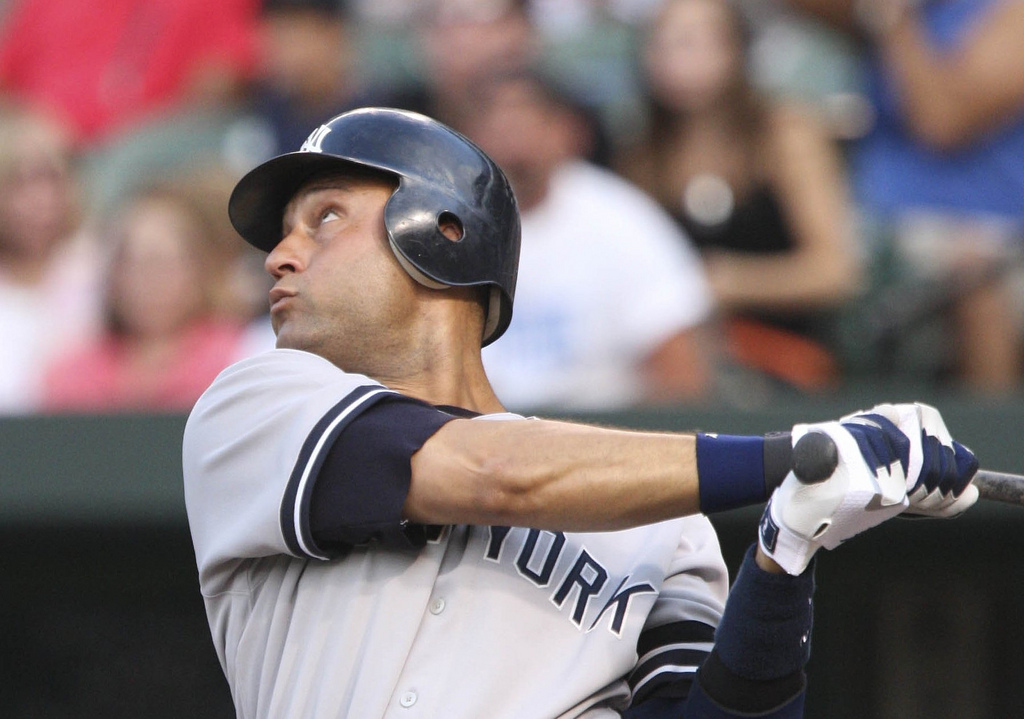
SPORT MLB BASEBALLA career-long Yankee, Derek Jeter’s 3,465 base hits (for a .310 career average) rank sixth in baseball history.  Who is ahead of him? Pete Rose, Ty Cobb, Hank Aaron, Stan Musial and Tris Speaker.  That probably makes his case right there. But let’s look a little deeper.

Jeter is a 14-time All Star, five-time Silver Slugger and five-time Gold Glover – as well as the 1996 American League Rookie of the Year.

Overall, Jeter hit .300 or better in 12 campaigns.  While he only led the AL in hits twice, he topped 200 safeties in eight times (the final time with an AL-leading 216 hits in 2012; at age 38).   Jeter also scored 1,923 runs (eleventh all time), topping 100 runs scored in 13 season and leading the AL with 127 in 1998. He collected 544 doubles (35th all time), 66 triples and 260 home runs – amassing 4,921 regular season total bases (23rd all time).  A savvy base runner, Jeter also stole 358 bases, twenty or more in eight seasons, with a high of 34 in 2006.

Jeter also played in a record 158 post-season games, hitting .308 (200 hits), with 20 home runs, 61 RBI, 111 runs scored (post-season record) and 18 steals. He was the MVP of the 2009 World Series – and hit .321 in 38 Fall Classic games (seven World Series).

Derek Jeter’s Best Season: In 1999, Jeter hit a robust .349, with a league -leading 219 hits, 24 home runs, 102 RBI, 134 runs scored and 19 stolen bases.

This one’s a gimme – Jeter goes in.  Will it be unanimous?  I just have a hunch there will be a holdout or two.

——————

Larry Walker – (Outfield, 1989-2005) … Tenth (final) year on the ballot, 54.6 percent last year.
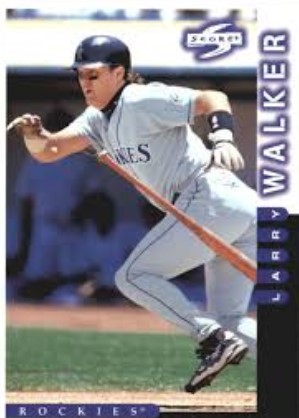
WalkerLarry Walker will need a big boost (players usually get somewhat of a boost in their final year of eligibility) to reach 75 percent   I’ll go out on a limb here and predict he makes it; but it is no sure thing.

Walker played for the Expos (1989-1994), Rockies (1995-2004) and Cardinals (2004-2005).  Given BBRT’s admiration for “lumber and leather,” Walker’s combination of three batting titles, three Silver Slugger Awards and seven Gold Gloves earns him my vote.

Walker played 17 MLB seasons and retired with 2,160 hits, a .313 average and three batting titles.  Between 1997 and 2001, he hit .350 or better in four of five seasons. The five-time All Star (and 1997 NL MVP) hit 383 home runs (a high of 49 in 1997) and stole 230 bases (a high of 33 in 1997).  Walker hit just .230 in 28 post-season games, but did rack up seven home runs, 15 RBI and sixteen walks in those contests.

Walker’s ten seasons in hitter-friendly Colorado may be hurting his vote totals – he hit .383 for his career in Coors, .271 elsewhere.  Also reaching 2,500 hits or 400 home runs would have been an asset.  Still, BBRT believes if you add his Gold Glove defense to his productive bat, you have a Hall of Famer.  I’m also not much for punishing a player for taking full advantage of his home-field conditions. Walker did jump from 34.1 to 54.6 percent a year ago.  So, he does have a chance chance of making it this year.  I’d call it 50-50.

In 1997, Larry Walker led the NL with 409 total bases – the 18th highest single-season total all-time. (There have been only 29 seasons of 400 or more total bases in MLB history.  Babe Ruth hold the record with 457 in 1921.).

Larry Walker’s Best Season: In his 1997 NL MVP year (Rockies), Walker hit .366, with a league-leading 49 home runs. He drove in 130 runs, scored 143, rapped 46 doubles, led the league in total bases at 409, topped the league in slugging percentage at .720 and even threw in 33 stolen bases and a Gold Glove.  That’s using all five tools.

—————

A DARK HORSE CANDIDATE WHO WOULD NOT GET BBRT’S VOTE

Curt Schilling – (Starting Pitcher, 1988-2007) … Eighth year on the ballot, 60.9 percent last year.

Curt Schilling pitched for the Orioles (1988-1990), Astros (1991), Phillies (1992-2000), Diamondbacks (2000-2003) and Red Sox (2004-2007).  Schilling was a six-time All Star, with 216 career wins (three seasons of 20 or more wins) over a 20-season MLB career. He recorded the 15th most career MLB strikeouts at 3,116 (three seasons of 300 or more whiffs), led his league in wins twice, complete games four times, innings pitched twice and strikeouts twice. He was also the 2001 World Series co-MVP – and has an impressive 11-2, 2.23 ERA post-season record (19 starts).

Curt Schilling is one-half of one of only two tandems of teammates to strike out 300 batters in the same season. In 2002, Schilling fanned 316 batters for the Diamondbacks, while teammate Randy Johnson whiffed 324.  In 2019, Gerrit Cole (326) and Justin Verlander (300 K) joined this club.

He is on the cusp for the HOF – reaching 250 wins would have helped (although Jim Kaat, with 283 wins and 16 Gold Gloves is still not in the HOF – a Minnesota gripe here).  However, Schilling’s outspoken views and the lack of a Cy Young Award may be working against his vote-getting capacity. I think Schilling will move up a few percentage points, but still fall short.

Curt Schilling’s Best Season: In 2001, Schilling went 22-6 for the Diamondbacks (with a 2.98 ERA).  That year, he led the league in wins, starts (35), complete games (six), innings pitched (256 2/3).

FIVE PLAYERS WHO WOULD GET BBRT’S VOTE …

BUT ARE NOT LIKELY TO ENTER THE HOF IN 2020

Omar Vizquel – (Shortstop/Third Base, 1989-2012) – Third year on the ballot, 42.8 percent on 2019 ballot.
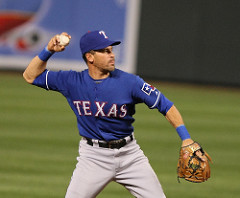
Photo by Keith Allison

Photo by Keith Allison

Omar Vizquel got off to a good start toward a HOF plaque, grabbing 37 percent support on his first-ballot year and moving up to 42.8 percent a year ago.  Vizquel once again earns BBRT’s vote – and should make his way into the Hall of Fame over time.  When he does, it will be more with his glove (eleven Gold Gloves) than his bat.  However, voters should be mindful of the fact that he finished his 24-season MLB career just 123 hits short of that milestone 3,000 safeties.

Vizquel delivered premier defense to the Mariners (1989-1993), Indians (1994-2004), Giants (2005-2008), Rangers (2009), White Sox (2010-2011) and Blue Jays (2012). He was a three-time All Star – and put together a string of nine straight Gold Gloves at shortstop (1993-2001).

Omar Vizquel led his league in sacrifice bunts four times.

In the field, Vizquel has the highest career fielding percentage (.9847) among shortstops with at least 500 games at the position.  Vizquel is also the all-time leader among shortstops in double plays (1,734, 144 ahead of Ozzie Smith in second place), ranks third at the position for career assists and 11th in putouts. He shares the record (with Cal Ripken, Jr.) for the fewest errors by a shortstop in a season of at least 150 games played (three).

On offense, Vizquel put up a serviceable .272 career average, with 80 home runs, 951 RBI and 1,445 runs scored. The 1,445 runs put him in the top 100 players all-time (82nd); while his 2,877 hits put him in the top 50 (43rd). He also swiped 404 bases – topping twenty steals eight times (a high of 42 in 1999) – putting him at number 72 on the all-time list. Vizquel played in 57 post-season games, hitting .250-0-20.

Omar Vizquel’s Best Season: In 1999, with the Indians, Vizquel hit a surprising .333, with five home runs, 66 RBI, 112 runs scored and 42 stolen bases – and, of course, won a Gold Glove at shortstop.

Vizquel would get BBRT’s vote, but the BBWAA voters likely will make him wait a bit longer – showing a preference for a bit more offense.

—————-

Jeff Kent – (Second Base/Third Base/First Base, 1992-2008) …  Seventh year on the ballot, 18.1 percent last year.
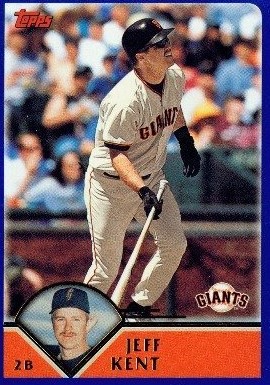
KemntBBRT believes Jeff Kent is a deserving candidate, but he has not been getting much support from the writers.  Kent holds the all-time MLB record for home runs by a second baseman (351 of his 377 career round trippers were hit while in the lineup at second base). He has a healthy .290 career batting average; his 1,518 RBI are 54th all time; and his 560 doubles 30th.

Kent was a five-time All Star and the 2000 NL MVP.  As primarily a middle infielder, he hit 20 or more home runs in 12 seasons (a high of 37 in 2007) and topped 100 RBI eight times. He hit .276, with nine home runs and 23 RBI in 49 post-season games.

Jeff Kent has more career runs batted in than such noted Hall of Famers as Mickey Mantle, Billy Williams, Eddie Mathews, Duke Snider and Orlando Cepeda.

Kent has the credentials, but BBRT has a hunch the writers may keep him on the bench – a couple of Gold Gloves, at this traditionally defense-oriented position, would have really helped his case.  Kent played for the Blue Jays (1992), Mets (1992-1996), Indians (1996), Giants (1997-2002), Astros (2003-2004) and Dodgers (2005-2008).

Jeff Kent’s Best Season: With the Giants in 2000, Kent put up these stats – 159 games; 196 hits; .334 average; 33 home runs; 125 RBI; 114 runs; 12 steals. His performance earned him the NL MVP Award.

Kent gets BBRT’s vote – and I believe the BBWAA’s support is overdue (but not forthcoming).  This is one HOF “snub” that somewhat confuses BBRT.

 —————

Todd Helton – (First Base, 1997-2013) … Second year on the ballot, 16.5 percent last year.
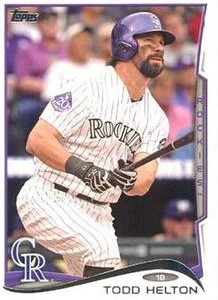
HeltonTodd Helton picked up just 16.5 percent of the vote in his first year on the ballot – probably due to a strong ballot and the fact that he spent his entire 17-year career with the Rockies (playing half his games in hitter-friendly Coors field).  Helton, who put up a .316 career average, hit .345 at home and .287 on the road. Despite that home/road split, Helton’s body of work deserves HOF consideration. He was a five-time All Star, three-time Gold Glover and four-time Silver Slugger. He hit over .300 in 12 seasons – and won the NL batting crown in 2000 with a .372 average. His 59 doubles that season are the sixth-most all-time. Helton drove in 100 or more runs in five seasons and scored in triple figures six times. His 1,335 walks (36th all-time) indicate the respect he earned at the plate.  Helton also ranks fifth in games played at first base, second in career assists at the position, 13th in putouts and third in double plays.

Todd Helton is one of only 18 players to reach 400 or more total bases in a season – and one of only seven players to have multiple 400+ total base campaigns. He is also the only player to collect 100 extra-base hits in two consecutive seasons (2000-2001).

Todd Helton’s Best Season: In 2000, Helton won the NL batting crown with a .372 average – and also led the league in base hits (216), doubles (59), RBI (147), on-base percentage (.463), slugging percentage (.698) and total bases (405).  He also scored 138 runs and hit 42 home runs.

Helton will stay on the ballot and has a chance at entry into the HOF – he’s just not likely to overcome the Coors Field-bias in the short-term future.

—————-

Billy Wagner – (LHP 1995-2010) … Fifth year on the ballot, 5.6 percent last year.
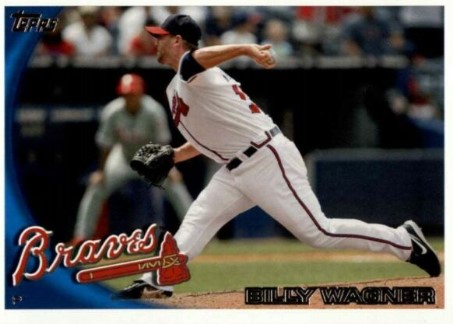
wAGNERBilly Wagner played for the Astros (1995-2003), Phillies (2004-2005), Mets (2006-2009), Red Sox (2009) and Braves (2010). Wagner was a seven-time All Star, who amassed 422 saves (sixth all-time) in a 16-season MLB career.  He had nine seasons of 30 or more saves; a career ERA of 2.31; 1,196 career strikeouts in 903 innings; and 47-40 won-lost record.

Billy Wagner’s Best Season: In 2003, Wagner went 1-4, 1.78 for the Astros, saving 44 games and fanning 105 batters in 86 innings.

BBWAA voters have been very demanding of relievers (although the recent induction of Mariano Rivera and Trevor Hoffman may be a good sign – but they, of course, both had 600+ saves.) BBRT thinks Wagner belongs in the Hall (based on his 400+ saves) – and hopes that momentum starts to build.   (However, the odds are not in Wagner’s favor; he is drifting awfully close to that 5 percent mark.)

—————-

Andy Pettitte – (LHP/Starter, 1995-2010, 2012-13) … Second year on the ballot. 9.9 percent last year.
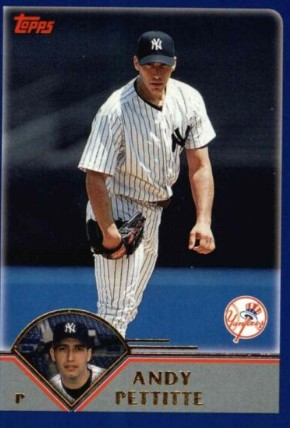
pettI had to think for a while on this one (and will probably get some push back from readers), largely because a major part of Andy Pettitte’s HOF resume was achieved in the post-season. Pettitte holds the MLB post-season marks for most wins (19 … versus 11 losses), innings pitched (276 2/3), games started (44) and is second in strikeouts (183). His post-season accomplishments include a 3.81 career ERA and the 2001 American League Championship series MVP Award.

Pettitte was no slouch in the regular season (Yankees – 1995-2003, 2007-2010, 2012-13) and Astros (2004-06).  He finished with 256 wins (153 losses) and a 3.85 ERA. Pettitte won 20 games in two seasons and 14 or more games 12 times – leading the AL with 21 wins in 1996. The three-time All Star struck out 2,448 batters (45th all-time) in 2,316 innings.

Andy Pettitte started 30 or more games in a season 12 times, leading his league three times (1997, 2006, 2007.)

Pettitte’s post-season numbers, plus 256 regular-season victories and the fact that he had 100+ more career wins than losses secures BBRT’s vote. He still has a long ways to go with the BBWAA voters, however.

Andy Pettitte’s Best Season: In 1997, following a 21-8 campaign in 1996, Pettitte went 18-7, with a 2.88 ERA (fourth-best in the AL), leading the league in starts with 35, finishing third in innings pitched (240 1/3) and eighth in strikeouts (166).

Post-publication note:  One of BBRT’s readers has correctly informed me that Pettitte was a PED-user.  I found he admitted to briefly using HGH while in recovery from and elbow injury – a couple of years before it was banned.    Pettitte was forthcoming, accepting of responsibility and apologetic.  Given the circumstances, I’ll stand by this vote (but also continued to “dig” a bit). I thought, in the name of transparency, I should add this information here.

—————


TWO PLAYERS WHO WERE VERY CLOSE CALLS  …

BUT WOULD GET BBRT’S VOTE (to keep them on the ballot for next year)

Alfonso Soriano – (2B/OF, 1999-2014) … First year on the ballot.
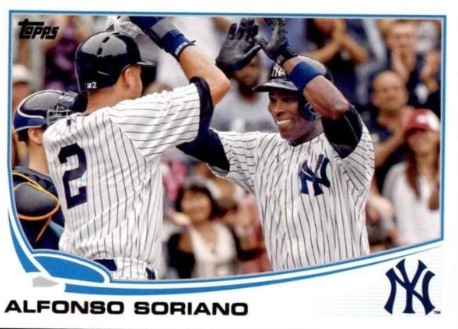
SorianHad Alfonso Soriano spent his career as a second baseman (he was moved to the outfield in his eighth season – sixth full season), his path to the Hall of Fame might have been assured.  Consider that in five full seasons at the keystone sack (2001-2005), Soriano hit .282, with 159 home runs 461 RBI and 167 stolen bases.  I’ll do the math for you. That’s an average campaign of .282, 31.8 home runs, 92.2 RBI and 33.5 steals.  Those are HOF numbers for a middle infielder.  (Of course, it’s also likely that, had he stayed at 2B, he would have put up some pretty impressive numbers for errors. Soriano led AL second sackers in errors in all five of his full seasons at the position.)

Having spent a little more than half of his career in the OF (starting 849 games in the OF and 734 at 2B), Soriano has stiffer competition for a spot in the HOF.  Still, BBRT thinks he deserves to qualify for next year’s ballot.

Soriano was a seven-time All Star (four at 2B, three in the OF) and four-time Silver Slugger.   He also is one of only four members of the 40-40 Club (forty home runs and forty stolen bases in the same season). In 2006, Soriano hit .277, with 46 home runs and 41 stolen bases. The only other players to record 40-40 seasons are Barry Bonds, Alex Rodriguez and Jose Canseco.  Soriano also logged three 30-30 seasons. Overall, he hit 30 or more home runs seven times and stole 30 or more bases five times (leading the AL with 41 in 2002). He also scored 100+ runs in four campaigns and drove in 100+ tallies in four seasons.

Soriano finished with 2,095 career hits (.270 average), 1,159 RBI and 1,152 runs scored.  His 412 career home runs are 54th all time and his 924 extra-base hits are 59th.  He is one of those “on the cusp” Hall of Famers in BBRT’s view – and will have to build some momentum.  Again, BBRT believes he deserves to stay on the ballot.

Soriano played for the Yankees (1999-2003, 2013-14)), Rangers (2004-2005), Nationals (2006) and Cubs (2017-13).

Alfonso Soriano’s Best Season: In 2002 (Yankees), Soriano hit an even .300, leading the AL in hits (209), runs (128) and steals (41).  He also hit 51 double and 39 home runs, while driving in 102.

—————–

Bobby Abreu – (OF, 1996-2012, 2014) … First year on the ballot.
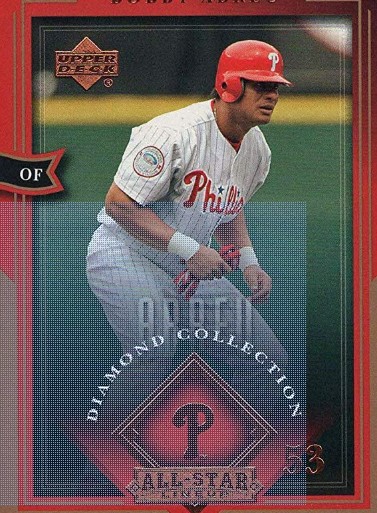
abrfeuBobby Abreu played in 18 MLB seasons. The two-time All Star showed both power and speed, hitting 288 home runs and swiping 400 bases (74th all time). Abreu led his league in games played twice, doubles once (50 in 2002) and triples once. He won a Gold Glove in 2005.

A solid .291 career hitter (2,470 base hits), Abreu hit .300 or better in six seasons. He hit 20 or more round trippers in 10 campaigns, stole 20 or more bases 12 times (a high of 40 in 2004), drove in 100 or more runs eight times and scored at least 100 runs eight times.   Abreu also walked 1,476 times – including 100 or more free passes in eight straight seasons (1999-2006).

Bobby Abreu’s 1,476 walks are 20th all-time and his 574 double are 25th.

Abreu played for the Astros (1996-97, Phillies (1999-2006), Yankees (2006-2008), Angels (2009-1012), Dodgers (2012) and Mets (2014).

In 20 post-season games, Abreu went 19-for-67 (.284), with one home runs and nine RBI.

Bobby Abreu’s Best Season: In 2004, as a Phillie, Abreu hit .301, with 30 home runs and forty steals. An All Star that season, he also drove in 105 runs and scored 118.

Abreu’s 400 steals are an HOF plus. Had he reached 300 home runs, it would have really boosted his prospects. I’d like to see Abreu stay on the ballot.

——————————THE REST OF THE BALLOT————————————

So, with BBRT’s unofficial ballot covered, let’s look at the remainder of candidates – in alphabetical order.  Note: Here you will find a host of players with solid (but perhaps not HOF-level) career numbers and accomplishments. 

Josh Beckett – RHP, 2001-2014) … First year on the ballot.

Josh Beckett put up a 138-106, 3.38 record in 14 MLB seasons.  The three-time all Star led the AL with 20 wins (seven losses) for the Red Sox in 2007, when he finished second in the Cy Young Award voting to C.C. Sabathia (21-7, 2.18).  Beckett won 15 or more games in four seasons and fanned 150 or more batters in 11 seasons (a high of 199 in 2009).

Josh Beckett was a horse in the postseason, going 7-3, 3.07, striking out 99 batters in 93 2/3 innings and throwing three complete games in 14 appearances (13 starts).

Josh Beckett pitched a no-hitter in his final MLB season. On May 25, pitching for the Dodgers, he no-hit the Phillies in a 6-0 win – walking three and fanning six.

Josh Becket played for the Marlins (2001-2005), Red Sox (2006-2012) and Dodgers (2012-2014).

Josh Beckett’s Best Season: In 2007, Becket let the AL with 20 wins (seven losses), his 3.27 earned run average was sixth in the AL, and his 194 strike outs (in 200 2/3 innings) seventh.  That season, he pitched in four post-season games for Boston – going 4-0, 1.20. He was the MVP of the American League Championship Series, when he started and won two games – giving up nine hits and just three earned runs, while fanning 18 in 14 innings.

Beckett had a solid MLB career, but falling short of 150 wins and never reaching 200 strikeouts in a season dims his HOF chances.  I really like his post-season accomplishments, however.

—————

Heath Bell – (RHP, 2005-14) … First year on the ballot.

Heath Bell appeared in 590 MLB games – all in relief. The three-time All Star was truly a dominant closer for the Padres from 2009-11, making the All Star team and saving 40 or more games in each of those three campaigns – and being named NL Reliever of the Year in 2009 and 2010. In 2009, he led the NL with 42 saves. Over his 11-season MLB career, Bell was 38-32, 3.49, with 168 saves. He averaged better than a strikeout per inning – fanning 637 batters in 628 2/3 innings.

Heath Bell’s Best Season: In 2010, Bell went 6-1, with 47 saves.  He pitched to a 1.93 earned run average in 70 innings (67 appearance), fanning 86 batters.

————–

Barry Bonds – (Outfield, 1986-2007) … Eighth year on the ballot, 59.1 percent a year ago.

Barry Bonds played for the Pirates (1986-1992) and the Giants (1993-2007). There is no doubt about Bond’s credentials – .298 average, 2,935 hits, MLB-record 762 home runs, 1,996 RBI, MLB-record 2,558 walks. He was also a 14-time All Star; 12-time Silver Slugger Award winner; his league’s MVP a record seven times; and an eight-time Gold Glove winner.  In 2001, Bonds hit .328, with an MLB-record 73 home runs and 177 RBI.  He drove in 100 or more runs 12 times and also scored 100 or more runs in a dozen seasons.  And, I could go on and on.

Barry Bonds drew an MLB-record 688 intentional walks in his career. Second place?  Albert Pujols, with 311. In 2004 alone, Bonds drew a record 120 intentional passes. He led his league in IBB 12 times.

Still, there are those PED’s – an elephant in the room (and on the ballot) that I think will keep Bonds out of the Hall for at least another year (and probably until his final year on the ballot). Eventually, the dam will break and we will see some of the major stars now under a PED cloud take places in the Hall.  BBRT is not ready to cast that vote yet – and I don’t think 75 percent of the BBWAA is either. We can expect Bonds back on the ballot next year (he may top 60 percent this year).

Barry Bonds’ Best Season: In 2001, Bonds crushed an all-time record 73 home runs, while hitting .328, driving in 137 runs, scoring 129 – all while drawing 177 walks.

————–

Eric Chavez – (3B, 1998-2014) …. First year on the ballot.

BBRT has a soft spot for player who evidence “leather and lumber” – and that would include Eric Chavez, who won six Gold Gloves (consecutively, 2001-2006) and popped 260 home runs during his 17 MLB seasons.

As a defender, Chavez led AL third basemen in assists three times; putouts twice; double plays twice; and fielding percentage twice.

At the plate, Chavez hit .268 (1,477 career hits), with 260 home runs, 902 RBI. He topped 25 home runs six times (a high of 34 in 2002) and 100 RBI four times (a high of 114 in 2001).

Eric Chavez’ Best Season: In 2001, Chavez hit .288, with 32 home runs, 114 RBI, 91 runs scored and eight stolen bases – and picked up his first Gold Glove.

Chavez was a superior defender, with had solid (but not HOF) offensive numbers.

————–

Roger Clemens – (RHP/Starter, 1984-2007) … Eighth year on the ballot, 59.5 percent last year.

Roger Clemens pitched for the Red Sox (1984-1996), Blue Jays (1997-1998), Yankees (1999-2003, 2007) and Astros (2004-2006).  Clemens has Hall-worthy stats:  354 wins (ninth all-time), 4,672 strikeouts (third all-time), an MLB-record seven Cy Young Awards and the 1986 AL MVP Award. The eleven-time All Star was a five-time 20-game winner (led the league in wins four times), seven-time ERA leader, five-time league leader in strikeouts, and six-time leader in shutouts.  He won the AL pitching Triple Crown (Wins/ERA/Strikeouts) three times.  Clemens also has 12 post-season wins, with 173 strikeouts in 199 post-season innings.

Roger Clemens shares the record for strikeouts in a nine-inning game (20) with Kerry Wood and Max Scherzer. Clemens is the only pitcher to achieve 20 whiffs in a nine-inning game twice.

Roger Clemens’ Best Season: Lots to choose from here. Like 21-6, 1.93 in 1990 – or 1987, with a 20-9 record, 2.97 ERA, 18 complete games and seven shutouts.  I take 1986. Clemens went 24-4. 2.48 and won both the Cy Young (his first) and AL MVP Awards for the Red Sox.  He led the AL in wins, winning percentage (.857) and earned run average. He was fifth in innings pitched (254) and second in strikeouts (238).

Yes, he’s got the numbers (those listed and more), but the PED controversy seems to stand between him and the Hall. Don’t think the BBWAA is ready yet, but he’ll continue on the ballot – and will likely gain a bit of ground on that 75 percent requirement.

————–

Adam Dunn – (OF-1B, 2001-2014) … First year on the ballot.

Adm Dunn had a great power swing – putting 462 balls (37th all time) out of the park in his 14 MLB seasons – at one point, (2004-2008), hitting at least forty long balls in five straight seasons.   Then, of course, there is the other side of the coin.  The two-time All Star also struck out 2,379 times (third all time), leading the league in whiffs in four seasons.  Over his career, Dunn hit forty or more homers in six seasons and 30 or more in three more.

Adam Dunn is one of only 12 MLB players to have six or more 40-HR season.

Adam Dunn’s Best Season: In 2004, for the White Sox, Dunn hit .266, with 46 home runs, 102 RBI and 105 runs scored.

Four-hundred-plus home runs is a good start, but Dunn’s .237 career average ad 2,000+ strikeouts work against him.

—————

Chone Figgins (3B/OF/2B, 2002-12, 2014) …. First year on the ballot.

Chone Figgins (almost got my vote just for the name) played for the Angels (2002-2009), Mariners (2010-1012) and Dodgers (2014).  He hit for a .276 average, with 35 home runs, 403 RBI and 341 stolen bases in 1,282 games.   Figgins stole 30 or more bases in seven season – forty or more in five of those.

Chone Figgins’ Beat Season:  In 2005, for the Angels, Chone Figgins hit .290, with a career-high and league-leading 62 stolen bases.  He also had 25 doubles, ten triples and eight home runs – scoring 113 times and driving in 57 runs.

————–

Rafael Furcal … (SS, 2000-2012, 2014) …. First year on the ballot.

Rafael Furcal, who came up with the Braves, was the 2000 NL Rookie of the year, when he hit .294, scored 87 runs and stole 40 bases in 131 games.  In his career, the three-time All Star hit a respectable .282 (1,817 hits), scored 1,063 runs (reaching 100 or more runs scored four times), hit 113 home runs, drove in 587 and stole 314 bases (stealing 25 or more bases seven times).  On defense. Furcal led NL shortstops in assists twice, putouts twice and double plays once.

Furcal played for the Braves (2000-05), Dodgers (2006-11), Cardinals (2011-12) and Marlins (2014).

Rafael Furcal’s Best Season: In 2006, with the Dodgers, Rafael Furcal hit .300, with 15 home runs, 63 RBI, 113 runs scored and 37 stolen bases. He also led the NL in put outs and double plays at shortstop and was second in assists.


—————

Jason Giambi – (1B/OF/DH, 1995-2014) … First year on the ballot.

Jason Giambi’s 20-year MLB career is a tribute to his offensive production – a .277 average to go with 440 home runs and 1,441 RBI. Giambi was a five-time All Star, two-time Silver Slugger and the 2000 AL MVP.  In the four seasons from 1999-2001, Giambi was clearly on top of his game (and on top of the plate), hitting .326, with 155 home runs and 502 RBI.  While he did strike out 1,572 times, he also walked 1,366 times – contributing to a healthy .399 career on-base percentage. Giambi led the AL in OBP three times).

Jason Giambi led the AL in free passes in four seasons – in strike outs just once.

In his career, Giambi topped 25 home runs in nine seasons (40+ twice), 100 RBI in seven seasons (a high of 137 in 2000) and hit over .300 in four campaigns.

Giambi’s career can really be divided into two parts. Over his first ten seasons, he went .297-381-944, as compared to .238-159-497 over his final ten campaigns.

Jason Giambi played for the A’s (1995-2001, 2009), Yankees (2002-2008), Rockies (2009-12) and Indians (2013-14).

In 45 post-season games, Giambi hit .290, with seven long balls and 19 RBI.

Jason Giambi’s Best Season: In his 2000 MVP season (for the A’s), Giambi hit .333, with 43 home runs, 137 RBI, 108 runs scored and a league-topping 137 walks (versus 96 strikeouts). Notably, he put up similar numbers the very next season – .342-38-120, with a league-leading 129 walks.

Giambi is competing at a power-position – still his power numbers and on-base percentage may keep him on the ballot for 2012.

—————

Raul Ibanez – OF/1B, 1996-2014 … First year on the ballot.

Raul Ibanez enjoyed a 20-season MLB career – suiting up from age 24 to age 42. He hit a respectable .272 (2,034 base hits) over that time, with 305 home runs, 424 doubles, 1, 207 RBI and 1,055 runs scored.  He also played solid defense, leading his league’s left fielders in assists and fielding percentage twice each and putouts once.

Ibanez was a one -time all Star (2009 Phillies).  He hit 20 or more home runs in eight seasons, with a high of 34 in 2009. He also drove n 100+ runs in four campaigns and scored 100+ runs in one season.

Ibanez hit .245, with six home runs and 22 RBI in 44 post-season games.

Raul Ibanez’ Best Season:  In 2006, with the Mariners, Ibanez hit .289, knocked 33 home runs, drove in 123 tallies and scored 103 times.

————–

Andruw Jones – (OF, 1996 -2012) … Third year on the ballot, 7.5 percent last year.

Andruw Jones played for the Braves (1996-2007), Dodgers (2008), Rangers (2009), White Sox (2010) and Yankees (2011-2012). In a 17-season career – primarily patrolling centerfield – he won ten Gold Gloves (consecutively, 1998-2007). At the plate, he hit .254, with 434 home runs (47th all time), 1,289 RBI and 1,204 runs scored. He topped 25 home runs in ten seasons (six over thirty and a league-leading and career-high of 51 in 2005). He scored 100 or more runs four times, drove in 100+ five times and stole twenty or more bases in a season four times.

Jones appeared in 76 post-season games, hitting .273, with ten home runs and 34 RBI.

In the 1996 World Series, Andruw Jones – just 19-years-old – hit .400 (8-for-20) with two home runs and six RBI, becoming the youngest player to hit for the distance in the Fall Classic.

Andrew Jones’ Best Season: In 2005, Jones hit only .263, but led the NL in home runs (51) and RBI (128) – finishing second in the MVP voting to Albert Pujols (.330-41-117).

Jones’ ten Gold Gloves work in his favor, but – over the long haul – that .254 average (he only hit .300 or better once and over .270 only four times) will dampen his HOF chances. Still, BBRT believe he deserves more support (he’s perilously close to the five percent mark).

—————

Paul Konerko – (1B, 1997-2014) … First year on the ballot.

Paul Konerko spent 16 of his 18 MLB seasons as a big bat in the middle of the White Sox lineup. A six-time All Star, Konerko hit .279 (2,340 hits), with 439 home runs (44th all time), 1,412 RBI and 1,162 runs scored.  Konerko hit 30 or more home runs in seven seasons (40 or more twice), drove in at least 100 runs in four seasons and hit .300 or better four times.

He was the MVP of the 2005 AL Championship Series, when he drove in seven runs in five games.  In 197 post-season contests, he hit .243, with seven home runs and 17 RBI,

Konerko played for the Dodgers (1997-98), Reds (1998) and White Sox 1999-2014.

Paul Konerko’s Best Season: In 2010, for the White Sox, Konerko his .312, with 39 home runs and 111 RBI.

Like Jason Giambi, his power output gives him a chance to stay on the ballot (listen up, Chicago-area BBWAA members); but long-run, both look to fall short of the HOF.

—————-

Cliff Lee – LHP, 2002-2014) … First year on the ballot.

Cliff Lee won 143 games (91 losses) in 13 MLB seasons, while putting up a 3.52 earned run average. He was a four-time All Star and the 2008 American League Cy Young Award winner.  Over his career, he led his league in wins, earned run average and complete game once each and shutouts and innings pitched twice each. He also led the NL in strikeouts-to-walks ratio three times and finished in the top ten in his league in the category in six seasons.  In addition, between 2008 and 2012, he allowed his league’s fewest walks per nine farms four times, was second once and fourth once.

In 328 games (324 starts), Lee notched 29 complete games and 12 shutouts, He pitched 2,156 2/3 innings, fanning 1, 824 batters.

Lee was solid in the post-season, going 7-3, 2.52 in 11 starts (three complete games).

Lee pitched for the Indians (2002-09), Phillies (2009, 2011-14), Mariners (2010) and Rangers (2010).

Cliff Lee’s Best Season: In his 2008 Cy Young Award season (Indians), Cliff Lee led the AL in wins (22, with just three losses); winning percentage (.880); earned run average (2.54); and shutouts (2). He fanned 170 batters in 223 1/3 innings, walking just 34 (a league-low 1.37 walks per nine innings).

—————

Carlos Pena – (1B, 2001-14) … First year on the ballot.

Carlos Pena hit 286 round trippers in his 14 MLB seasons.  He collected 1,146 hits (for a .232 career average), drove in 818 runs; and scored 745 times. He hit 30 or more home runs in a season three times, leading the AL with 39 in 2009 (his career-high was 46 in 2007). The one-time All Star was also a one-time Gold Glover.  Pena hit .269, with four home runs and 14 RBI in 19 post season games.

Although Carlos Pena played only 40 of his 1,493 games with the Rangers, he played his first (September 5, 2001) and last (July 12, 2014) MLB games in a Rangers’ uniform.

Pena played for the Rangers (2001. 2014), A’s (2002), Tigers (2002-2005), Red Sox (2006), Rays (2007-2010, 2012), Cubs (2011), Astros (2013) and Royals (2013).

Carlos Pena’s Best Season: In 2007, for Tampa Bay, Pena raked at a .282 pace, popping 46 home runs and driving in 121 tallies (all career highs).

—————

Brad Penny – (RHP, 2000-2012, 2014) … First year on the ballot.

Primarily a starting pitcher (349 MLB games, 319 starts), Brad Penny went 121-101, 4.29 over 14 MLB seasons. Penny was a two-time All Star and led the NL in wins (for the Dodgers) with 16 (nine losses) in 2006.  Penny won at least 15 games in just two seasons (16 each in 2007 and 2007, his two All Star campaigns.)  In nine post-season appearances, he went 3-2, 7.66.

Penny pitched for the Marlins (2000-2004), Dodgers (2004-2008), Red Sox (2009), Giants (2009, 2012), Cardinals (2010), Tigers (2011) and Marlins (2014).

Brad Penny’s Best Season: As a Dodger in 2007, Brad Penny went 16-4, leading the NL in winning percentage (.800), finishing fifth in wins and third in earned run average (3.03).

—————

J.J. Putz – RHP, 2003-2014) … First year on the ballot.

J.J. Putz made 572 relief appearance in his 14 MLB seasons, notching 37 wins (33 losses) and 189 saves, while putting up a 3.08 earned run average. The one-time All Star and 2007 Reliever of the Year saved 30 or more games four times, including a high of 45 for the 2011 Diamondbacks.

J.J. Putz’ Best Season: In 2007, Putz appeared in 68 games for the Mariners, going 6-1, 1.38 with 40 saves.  In 71 2/3 innings, he fanned 82 batters and walked just 13.

—————

Manny Ramirez – (Outfield, 1993-2011) – Fourth year on the ballot, 22.8 percent last year.

Manny Ramirez played 19 MLB seasons, collecting 2,574 hits, a .312 batting average, 555 home runs (15th all-time) and 1,831 RBI (19th all-time). Ramirez was a 12-time All Star and led the AL in average (2002), home runs (2004) and RBI (1999) once each.  Ramirez won nine Silver Slugger Awards, including eight consecutive (1999-2006), hit .285 with 29 home runs in 111 post-season games and was the 2004 World Series MVP.  He hit 30 or more home runs in twelve seasons (five of 40+), scored 100 or more runs six times, hit .300 or better in 11 seasons and topped 100 RBI 12 times.

Manny Ramirez’ 29 post-season home runs are first all-time, while his 78 post-season RBI rank second. In addition, he is the all-time post-season leader in walks (72), and ranks third in post-season hits (117) and runs scored (67).

In 111 post-season games, Ramirez hit .285, with 29 home runs and 78 RBI.

Ramirez clearly put up HOF-caliber numbers, but two PED-related suspensions continue to hurt his chances. Not this year, but he’ll be back for another shot.  Ramirez played for the Indians (1993-2000), Red Sox (2001-2008), Dodgers 2009-2010) and Rays (2011).

Manny Ramirez’ Best Season: In 1999, with Cleveland, Ramirez hit .333, with 44 home runs and 165 RBI (14th most in a season all-time) in 140 games.

—————-

Brian Roberts – (2B/SS, 2001-14) …. First year on the ballot.

Brian Roberts was a two-tine All Star, who spent 13 of his 14 MLB season with the Orioles.  Although he played more than 100 games in only seven seasons, he was a doubles machine, banging out 367 two-baggers – hitting 50 or more doubles in three seasons (leading the AL twice).  The speed that enabled Roberts to deliver all those doubles also contributed to his 285 stolen bases. He stole 20+ bases seven times, leading the AL with a career-high 50 steals in 2007 (being caught just seven times ).

Roberts hit .276 over his MLB career (1,527 hits), with 97 home runs, 542 RBI and 850 runs scored.  He scored 100+ runs in four campaigns.

Brian Roberts’ Best Season: in 2005, Brian Roberts hit .314, with 18 home runs and 73 RBI. He also scored 92 runs, stole 45 bases in 52 attempts, and knocked 45 doubles and seven triples. That season, he finished second in the AL among second basemen in assists, fifth in putouts and third in double plays.

BBRT always liked Roberts’ ability to use his speed to change a game, but seven season of 100+ games is just not enough.

————–

Scott Rolen – (Third Base, 1996-2012) … Third year on the ballot, 17.2 percent last year.

Scott Rolen played for the Phillies (1996-2002), Cardinals (2002-2007), Blue Jays (2008-2009) and Reds (2009-2012). The seven-time All Star (including in two of his final three seasons) flashed leather and lumber, collecting eight Gold Gloves (one Silver Slugger) and rapping 316 home runs. He finished with a .281 average, 316 home runs, 1,287 RBI, 1,211 runs scored and 188 stolen bases. Rolen hit 25 or more home runs seven times, with a high of 34 in 2005.  He also put up five 100+ RBI seasons, scored 100+ runs in two campaigns and reached double digits in steals five times. He was the NL Rookie of the Year in 1997 (.283-21-92, with 16 steals).

Scott Rolen’s Best Season: In 2004, with the Cardinals, Rolen hit career highs in average, home runs and RBI (.314-34-124) and won a Gold Glove.

Those Gold Gloves should keep Rolen on the ballot.   If only he had reached 200 steals or 400 home runs.

—————-

Gary Sheffield … (Outfield/Designated Hitter/Third Base/Shortstop, 1988-2009) … Sixth year on the ballot, 13.6 percent last year.

Gary Sheffield played for the Brewers (1988-1991), Padres (1992-1993), Marlins (1993-19998), Dodgers (1998-2001), Braves (2002-2003), Yankees (2004-2006), Tigers (2008) and Mets (2009).  Sheffield was a nine-time All Star (in 22 MLB seasons) and five-time Silver Slugger Award winner. He launched 509 career home runs (26th all time) and topped 30 home runs in a season eight times (a high of 43 in 2000). He also maintained a .292 career average (hit .300+ in eight seasons); and collected 1,676 RBI (30th all-time).  Sheffield won the 1992 NL batting title (.330); topped 100 RBI eight times; and scored 100 or more runs in a season seven times.

Gary Sheffield is one of only four players to hit MLB home runs as teenagers and in their 40’s. The others are Ty Cobb, Rusty Staub and Alex Rodriguez.

Gary Sheffield’s Best Season: In 1996 (Marlins), Sheffield hit .314, with 42 home runs, 120 RBI, 188 runs scored and 16 steals.

Sheffield has the offensive numbers, but defensive questions and the shadow of PEDs are likely to keep him on the outside looking in for now.

—————

Sammy Sosa – (Outfield, 1989-2007) … Eighth year on the ballot, 8.5 percent last year.

Sammy Sosa played for the Rangers (1989, 2007), White Sox (1989-1991), Cubs (1992-2004) and Orioles (2005).  Sosa hit 609 home runs (9th all-time) in 18 MLB seasons – winning two HR titles, topping sixty three times and also hitting 50 one year.  In the four seasons from 1998 to 2001, Sosa averaged 60 home runs and 149 RBI per season. His career numbers include a .273 average, 1,667 RBI (31st all-time), 1,475 runs scored and 234 stolen bases (a high of 36 steals in 1993). Sosa was the 1998 NL MVP (Cubs), led his league in home runs twice, runs scored three times and RBI twice.

Sammy Sosa has the most 60-home run seasons in MLB history with three – yet he did not lead the league in home runs in any of them. In 1998, he hit 66 home runs (Mark McGwire hit 70); in 1999, Sosa launched 63 (McGwire had 65); and, in 2001, he hit 64 (Barry Bonds hit 73).  Talk about unfortunate timing. 

Sammy Sosa’s Best Season: In 1998 (Cubs), Sosa hit .308, with 66 home runs, a league-leading 158 RBI and a league-leading 134 runs scored – and even tossed in 18 stolen bases.

Sosa played in 15 post-season contests, hitting .245-2-7.

Why is the seven-time All Star not in the Hall?  The PED shadow continues to cloud his chances.

—————-

Jose Valverde – (RHP, 2003-14) …. First year on the ballot.

Jose Valverde spent his 14-year MLB career coming out of the bullpen (626 appearances, zero starts).  He finished with a 27-33 record, with a 3.27 earned run average and, most important, 286 saves (ranking 32nd all time).   Valverde was a three-time All Star, who also led his league in saves three times – topping 40 saves in each of those seasons.   Over his career Valverde fanned 692 batters in 630 1/3 innings.

Jose Valverde’s Best Season:  In 2011, with the Tigers, Valverde went 2-4, 2,24 with a league-leading 49 saves.  He also led the AL in appearances (70) and games finished.

————–

Again, to vote in Baseball Roundtable’s unofficial Fan Baseball Hall of Fame Ballot, click here.

Primary Resources: National Baseball Hall of Fame; Baseball-Reference.com; Baseball-Almanac.com

BASEBALL ROUNDTABLE ON THE TOP 100 BASEBALL BLOG LIST

100Baseball Roundtable is on the Feedspot list of the Top 100 Baseball Blogs.  To see the full list, click here.

I tweet baseball @DavidBBRT

Follow/Like Baseball Roundtable’s Facebook Page here.  More baseball commentary; blog post notifications; PRIZES.

Member: Society for American Baseball Research (SABR); The Baseball Reliquary; The Negro Leagues Baseball Museum.
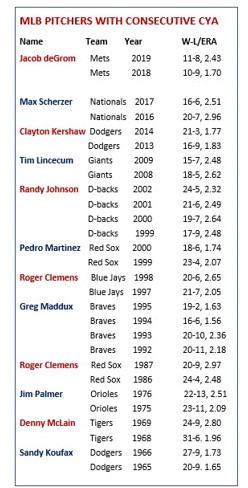
 

Baseball Roundtable Dives into the Cy Young Award

The 2019 Cy Young Award Winners have been announced and, while the results we no surprise, there was at least one historically surprising stat line.

Jacob degrom photo

Photo by slgckgc

Jacob deGrom won the 2018 Cy Young Award with 10-9 record (in 32 starts), an MLB-low 1.70 earned run average and 269 strikeouts (second in the NL) in 217 innings (second in the NL).  This season, deGrom became just the eleventh MLB pitcher to win consecutive CYA’s.  And, he did it, while putting up numbers similar to his 2018 season: an 11-8 record (32 starts); a 2.43 earned run average (second in the NL); and an NL-leading 255 whiffs in 204 innings pitched (third in the NL).  DeGrom also finished second in the league in Walks and Hits Per Nine Innings (WHIP) at 0.971, fourth in K’s per nine innings (11.25) and fourth in strikeouts-versus-walks ratio (5.80).

CYANEW
hen deGrom won the 2018 Cy Young Award with a 10-9 record, it was the fewest wins ever by a starting pitcher who captured the CYA.  This season, at 11-8, he posted the second fewest wins by a starting pitcher capturing a Cy Young Award.

That Historically Surprising Stat

Only twice in MLB history has a starting pitcher captured the Cy Young Award in a season in which his team put up a negative won-lost record in the games he started.  Both times, it was Jacob deGrom – as the Mets went 14-18 in his starts in both is 2018 and 2019 CYA seasons.   For those who are interested, the Yankees went 34-5 in CYA winner Whitey Ford’s 1961 starts. 

20+

DeGrom’s 21 total victories in capturing two consecutive Cy Young Awards illustrate how the Cy Young Award voting has changed in this era of  pitch counts, bullpen games and advanced metrics.   (In addition, to the lack of run support he has received.) Still, victories remain a solid indicator of CYA success.

Keep in mind that the Astros’ 2019 Cy Young Award winner Justin Verlander led MLB in wins with 21 – and number-two in the AL voting was his Houston teammate Gerrit Cole, who was second with 20 victories.

Verlander had only six losses this past season. His 2.58 earned run average was second in the AL; his Walks and Hits per Nine Innings (WHIP) was first in MLB at 0.83; he fanned an even 300 batters in 223 innings (leading the AL in innings pitched), while walking just 42 (for an AL-best 7.14 strikeouts-to-walks ratio).  Verlander threw a no-hitter against the Blue Jays (September 1). It was his third career no-hitter – making him just the sixth pitcher in MLB history to throw three or more no-hit games. Still, the CYA voting was was no cake walk for Verlander.

The Astros’ Gerrit Cole notched twenty wins (five losses); put up the junior circuit’s lowest ERA at 2.50; and led the league (and all of MLB) with 326 strikeouts (in 212 1/3 innings). His WHIP (0.90) was second only to Verlander in MLB and he led the way in whiffs per nine innings at 13.81 (the only qualifying pitcher to top 13.00).  In strikeouts-to-walks ratio, Cole (at 6.79) finished second to Verlander in the AL.

All in all, an interesting Cy Young Award season.

Do Wins Still Count?
There have now been 118 Cy Young Award winners – and the most telling predictor of victory (historically) has been wins – 79 of those CYA recipients have won at least 20 games.    If you factor out relief pitchers who have won CYA’s (nine) and strike-shortened seasons (four), 78.2 percent of the CYA winners have been 20-game winners.  Further, between 1956 and 2009, 79.5 percent of starters winning the CYA in full seasons notched at least twenty wins.  Since 2010, that figure had dropped to 65 percent – but it is still a solid indicator.

Going a step further, seventy-four CYA winners have led their league in victories.  That’s 67.9 percent of starting pitcher winners.   That number has not changed much.  Over the past ten seasons, fourteen of the 20 CYA winner have led their league in victories (70 percent.)

We are seeing some shift.  Consider WHIP.  Between 1956 and 2009, 29 of the starting-pitcher CYA winners (32.6 percent) notched their league’s lowest Whip (Walks and Hits per Nine Innings). Over the past ten seasons, an additional ten CYA winners have led in WHIP (50 percent).  Similarly, between 1956 and 2009, 29 starting-pitcher CYA winners led their league in earned run average, while 13 of the CYA winners over the past ten season (65 percent) have posted their league’s lowest ERA.    So, yes, wins still count – but probably not a as they once did.  Yes. I do have a good grasp of the obvious – but I do like to look at the numbers. 

Now, here are a few Cy Young Award factoids:

  • The first Cy Young Award winner (1956) was Brooklyn Dodgers’ right-hander Don Newcombe, who notched a league-leading 27 wins (seven losses), with a 3.06 ERA – and also captured the NL MVP Award (one of only eleven pitchers to date to win the Cy Young and MVP in the same season).
  • From 1956 through 1966, there was only one Cy Young Award presented each season. Seven of the 11 single awards went to National League hurlers.
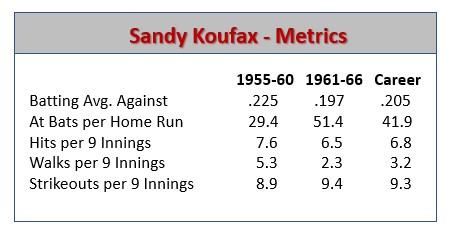
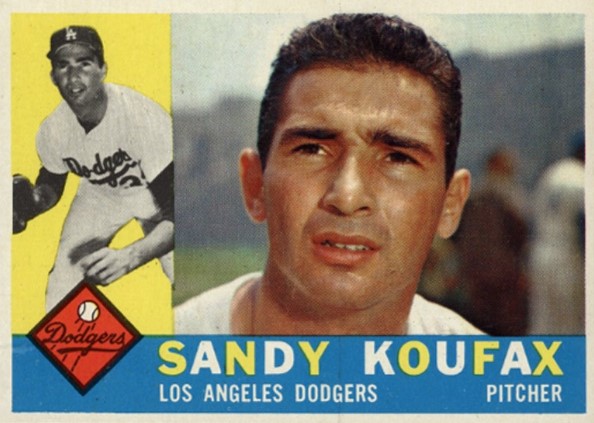
  • In the eleven years when only one Cy Young Award was awarded, the Dodgers brought home five – Sandy Koufax (3); Don Drysdale (1); Don Newcombe (1).
  • The first southpaw to capture the Cy Young was Warren Spahn, who, in 1957, went 21-11, 2.69 for the Milwaukee Braves.
  • The first AL CY winner was the Yankees’ (RH) Bob Turley, off a 21-7, 2.97 season in 1958.
  • The first AL left-hander to win the award was the Yankees’ Whitey Ford (25-4, 3.21 in 1961).
  • The first relief pitcher to win the award was the Los Angeles Dodgers’ Mike Marshall (1974). Marshall pitched in a (still) MLB-record 106 games, going 15-12, with a 2.42 ERA and a league-leading 21 saves.  Unlike today’s one-inning closers, Marshall threw a record 208 1/3 innings in relief.
  • Nine relievers have won Cy Awards: Mike Marshall (Dodgers 1974); Bruce Sutter (Cubs, 1979); Sparky Lyle (Yankees, 1977); Rollie Fingers (Brewers, 1981); Willie Hernandez (Tigers, 1984); Steve Bedrosian (Phillies, 1987); Mark Davis (Padres, 1989); Dennis Eckersley (A’s, 1992); Eric Gagne (Dodgers, 2003). Of these, only Willie Hernandez and Sparky Lyle did not lead their league in saves in their CY season.
  • Only two pitchers have won four consecutive Cy Young Awards:  Greg Maddux: 1992 (Cubs); 1993—94-95 (Atlanta Braves); and Randy Johnson: 1999-2001-02-03 (Arizona Diamond backs).
  • The oldest player to win a Cy Young Award is Roger Clemens, who claimed the prize at age 42 in 2004 (going 18-4, 2.98 for the Astros).
  • The youngest Cy Award winner is Dwight Gooden, who captured the award in 1985 (age 20), with a 24-4. 1.53 season for the Mets.
  • The only pitcher to win a Cy Young Award while playing for a last place team was the Phillies’ Steve Carlton.  In 1972, with the Phillies going a dismal 59-97, Carlton led the NL with 27 wins (versus 10 losses), while also topping the league in ERA (1.97), CG (30), innings pitched (346 1/3) and strikeouts (310).
  • The first pitcher to win a Cy Young Award with less than 20 wins was the Mets Tom Seaver in 1973 (19-10, 2.08). Seaver led the NL in ERA, strikeouts and complete games.  In the 35 seasons from 1956 to 1990, there were 13 Cy Young winners with less than 20 victories.  In the 23 seasons from 1991 to 2019, there have been 27 Cy Young Award winners with less than 20 wins.
  • There has been only one tie in Cy Young Award voting.  In 1969, the AL Cy Young Award was shared by the Tigers’ Denny McLain (24-9, 2.80) and the Orioles’ Mike Cueller (23-11, 2.38).
  • Only six times has a starting pitcher won the Cy Young without tossing a single complete game: Roger Clemens with the Yankees in 2001; Clemens again with the Astros in 2004;  Jake Peavy with the Padres in 2007; Max Scherzer with the Tigers in 2013; Blake Snell with the Rays in 2018; Jacob deGrom with the Mets in 2019.
  • The fewest wins ever by a Cy Young Award winner is two, by Dodgers’ reliever Eric Gagne, who went 2-3, 1.20 in 2003 – with a league-topping 55 saves and 137 strikeouts in 82 1/3 innings.
  • The most wins for a CYA winner goes to the Tigers’ Denny McLain, who went 31-6, 1.96 in 1968.
  • The highest-ERA ever for a CY winner was 3.51, by the Yankees’ Roger Clemens; 20-3, 3.51 in 2001).
  • The lowest ERA for a CYA winner was 1.04, by Brewers’ reliever Rollie Fingers in 1981 (6-3, 28 saves, 1.04).
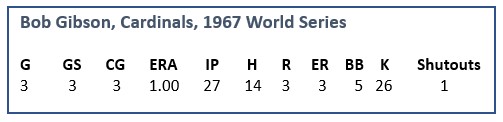
  • The lowest ERA for a starting pitcher winning the CYA is 1.12, for the Cardinals’ Bob Gibson in 1968 (22-9, 1.12).
  • The only rookie to win the Cy Young Award was the Dodgers’ Fernando Valenzuela (13-7, 2.48 in the strike-shortened 1981 season). Valenzuela thus becomes the answer to: “Who is the only pitcher to win the Cy Young and Rookie of the Year in the same season?”
  • Don Newcombe, the first CYA winner, was the first player to win the CY and league MVP in the same year (1956).  Since that time, ten more pitchers have won the CYA and MVP in the same season.
  • Roger Clemens has won the most CY Awards (7) and won for the most teams (4), and gone the longest between his first and final CYA’s (18 years).  Clemens wins: 1986 (Red Sox); 1987 (Red Sox); 1991 (Red Sox); 1997 (Blue Jays); 1998 (Blue Jays); 2001 (Yankees); 2004 (Astros).
  • The first pitcher to win a CYA in both leagues was Gaylord Perry (Indians, 1972 & Padres 1978). He has since been joined in that accomplishment by five hurlers: Randy Johnson (Mariners 1995 & Diamondbacks 1999-00-01-02); Pedro Martinez (Expos 1997 & Red Sox 1999-00); Roy Halladay (Blue Jays 2003 & Phillies 2010); Roger Clemens (Red Sox 1986-87,  1991, Blue Jays 1997-98, Yankees 2011 & Astros 2004); Max Scherzer (Tigers, 2013 & Nationals 2016-17).
  • The only brothers to both win CYA Awards are Jim Perry (1970, AL) and Gaylord Perry (1972, AL & 1978, NL).
Cy Young - Library of Congress photo.

Cy Young – Library of Congress photo.

The Cy Young Award, recognizing baseball’s best pitcher, is named in honor of right-handed hurler Denton True (Cy) Young – the “Cy” being short for his “Cyclone” nickname. Young won an MLB-record 511 games in his 22-season career (1890-1911), topping twenty wins in 15 seasons (with five of those 30+ wins).  The award was introduced in 1956 (by Baseball Commissioner Ford Frick), the year after Young’s death.  For the first eleven years (1956-66), there was only one Cy Young winner and NL hurlers captured the award seven of those eleven seasons.  After Frick retired in 1967, new Commissioner William Eckert, responding to fan requests, announced that, going forward, the Cy Young Award would be presented to the top pitcher in each league.


Primary Resources:  Baseball-Reference.com

BASEBALL ROUNDTABLE ON THE TOP 100 BASEBALL BLOG LIST

100Baseball Roundtable is on the Feedspot list of the Top 100 Baseball Blogs.  To see the full list, click here.

I tweet baseball @DavidBBRT

Follow/Like Baseball Roundtable’s Facebook Page here.  More baseball commentary; blog post notifications; PRIZES.

Member: Society for American Baseball Research (SABR); The Baseball Reliquary; The Negro Leagues Baseball Museum.


Baseball Roundtable All Rookie of the Year Lineup

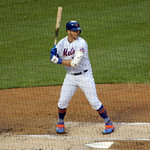
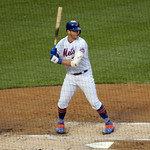
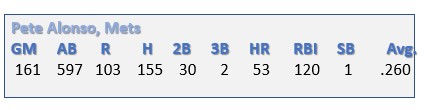
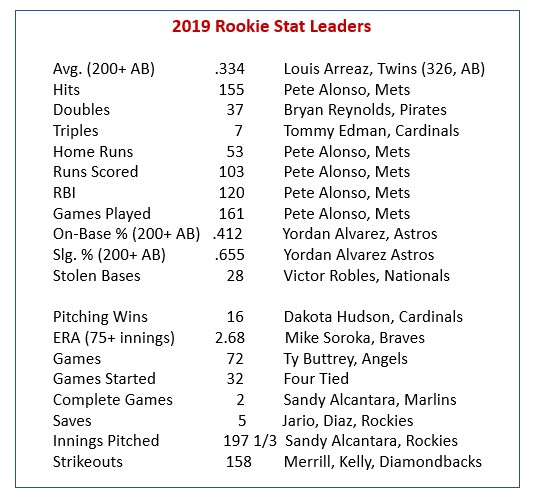
The 2019 Jackie Robinson Rookies of the Year have been announced – and there really were no surprises. In the National League, the honor went to Met’s 24-year-old 1B Pete Alonso, who put up a .260-53-120 line – topping MLB in home runs and setting a new rookie-season record.   In the process, Alonso also led all 2019 rookies in games (161), RBI (120) and runs scored (103).  Let’s face it, he simply outdistanced the competition.  The Mets had good reason expect power from Alonso. In 2018, in 132 games at Double-A Binghamton and Triple-A Las Vegas, Alonso hit .285, with 36 home runs and 119 RBI.

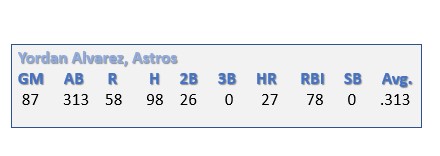
Over in the American League, the honoree was the Astros’ 22-year-old DH/OF Yordan Alvarez – who didn’t make his MLB debut until June 9, and then went on to win AL Rookie of the Month honors in June, July and August. In just 87 games for Houston, Alvarez went .313-27-78.  Side note: Before his call up, Alvarez was .343-23-71 in 56 games at Triple-A Round Rock.  Alvarez, in fact, has raked at every level.  In four minor league campaigns, he was .311-56-281 (250 games).

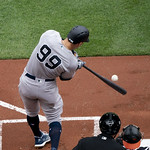
 Baseball Roundtable notes the accomplishments of these two outstanding rookies as an introduction to BBRT’s All Rookie of the Year Lineup – which I anticipate may stir some debate. For example, despite his rookie-record 53 home runs, Alonso is not on the squad. However, the Yankees’ Aaron Judge, with 52 home runs as a rookie, is.  Boston’s Fred Lynn (who won both the ROY and AL MVP awards in 1975) is not in this lineup, nor is Tony Oliva (who led the AL in batting average and hits in each of his first two seasons). In addition, since this a Rookie of the Year Lineup (and the award wasn’t established until 1947), such luminaries as Joe Jackson (.408-7-83, with 41 steals for the Naps in 1911), Joe DiMaggio (.323-29-125 for the Yankees in 1936), Ted Williams (.327-31-145 for the Red Sox in 1939), Russ Ford (26-6, 1.65 for the Yankees in 1910) and Grover Cleveland (Pete) Alexander (28-13, 2.57 for the Phillies in 1911) were not eligible.

So, as you read through my selections, join me in agreeing to disagree.  (Note: I made my selections based not just on the raw stats, but how those numbers compared with their peers at the time.)


—–BASEBALL ROUNDTABLE ALL ROOKIE OF THE YEAR LINEUP—–

CATCHER … Mike Piazza, Dodgers, 1993

Who could have predicted that the 1,390th player selected in the 1988 MLB draft would not only be the 1993 Rookie of the Year, but would also earn a spot in the National Baseball Hall of Fame? I give you the All Rookie of the Year Lineup backstop – Mike Piazza, who was also an All Star and Silver Slugger winner in his 1993 rookie campaign.

Piazza

In his 24-year-old’s rookie season, Piazza finished seventh in the AL in batting average; sixth in home runs and fourth in RBI.

PiazzaPiazza made his professional debut as a 20-year-old in 1989.  In his first two minor league seasons (Low A – High A), Piazza hit .254, with 14 home runs in 145 games. In 1991, he went .277-29-80 in 117 games at High A. Then in 1992, he turned on the jets, hitting .350-23-90 in 125 games at Double A and Triple A – earning a September call up to the Dodgers (.232-1-7 in 21 games).  Then came his 1993 rookie season and the rest is history.

Piazza hit .308, with 427 home runs and 1,335 RBI in 16 MLB seasons (Dodgers, Marlins, Mets, Padres, A’s). He was a two-time All Star, won ten Silver Slugger awards, topped 20 home runs nine times, 100 RBI six times and produced a .300+ average in nine campaigns.

Also looked at:  Carlton Fisk (.293-22-61, with a league-leading nine triples, for the 1972 Red Sox).


_____________________________________________________

FIRST BASE … Albert Pujols, Cardinals, 2001

A lot of scouts “fanned” on Albert Pujols, who wasn’t selected until the 13th round of the 1999 MLB draft – but was in the Redbirds’ everyday lineup by 2001.

In his first college baseball game, Albert Pujols (playing SS) hit a Grand Slam and turned an unassisted triple play.

Pujols

Albert pujols photo

Photo by todonitido

In his age-21 rookie season, Pujols finished sixth in the NL in batting average, fifth in RBI and 11th in home runs.  He was an All Star, a Silver Slugger honoree and turned in the first of ten straight “.300-30-100″ seasons.  Pujols went on to a 19-season (still active in 2019) MLB career.  He has collected 3,202 career hits (.300 average), 656 home runs and 2,075 RBI. Pujols is a ten-time All Star and six-time Silver Slugger.  He has led his league in batting average once, hits once, runs scored six times, home runs three times, RBI once, total bases four times.  A tribute to his stature at the plate – he also has led the league in intentional walks four times.

Also looked at: Pete Alonso (.260-53-129 for the 2019 Mets) and Mark McGwire (.289-49-118 for the 1987 A’s). While Alonso and McGwire both out-homered Pujols, I was swayed by the .329 average and the fact that he outpaced both Alonso and McGwire in runs scored and runs batted in.

Honorary Captain – Jackie Robinson

You have to have Jackie Robinson in here somewhere.  After all, not only is he credited with breaking MLB’s modern-era line, he was MLB’s first-ever Rookie of the Year (and now the award bears his name). So, why isn’t he a starter in this All ROY Lineup? Robinson played his rookie season at first base – and his .297-12-48 line (with a league-leading 29 steals) fell short of the numbers put up by Albert Pujols.  Still, Robinson’s historic rookie season is worthy of a spot here.Robbie

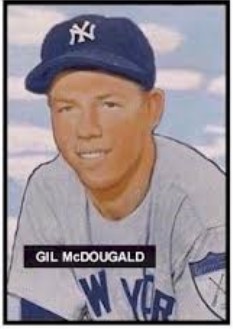
SECOND BASE … Gil McDougald, Yankees, 1951

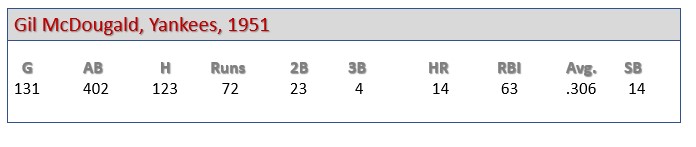
mCdOUXGALDGil McDougald’s rookie season was one of his best in the major leagues.  It was one of only two seasons in which he hit .300 or better (.306). He also set what would be career highs in home runs and total bases (14 each). Overall, the 23-year-old finished in the AL’s top ten in batting average (seventh); on-base percentage (ninth); slugging percentages (eighth); and stolen bases (fourth). (Note  McDougald started 58 games at 3B and 49 at 2B).  In three minor league seasons, McDougald hit .340 over 393 games – making the jump from Double A to the Yankees in 1951.

McDougald

Gil McDougald was a versatile infielder.  He topped the AL in double plays:

  • By a third baseman in 1952;
  • By a second baseman in 1955;
  • By a shortstop in 1957.

McDougald played 10 MLB seasons, all with the Yankees.  In 1,336 games, he collected 1,291 hits (.276), 112 home runs and 576 RBI.  He was an All Star in five seasons. He also hit .237, with seven home runs, in 53 World Series games.  (Oh, to be a Yankee in those days.)

Also looked at: Dustin Pedroia (.317-8-50, with seven steals for the 2007 Red Sox).

________________________________________________

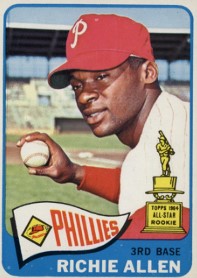
THIRD BASE … Dick Allen, Phillies, 1964

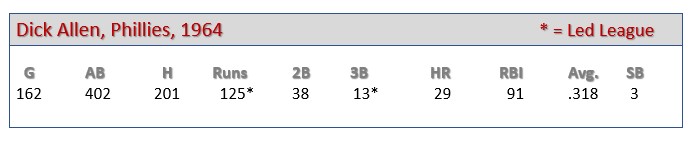
allenOkay, if I had to guess what offensive categories Dick Allen led the league in as a rookie, triples would not likely come to mind.  But he did indeed top the NL with nine triples (and 125 runs) as a 22-year-old freshman in 1964. In his rookie campaign, Allen was also first in the NL in total bases, fifth in in batting average, seventh in home runs, fourth in doubles (first in overall extra-base hits).  For the sake of transparency, Allen also led the NL in errors and strikeouts.

Dick AllenOver a 15-season career (Phillies, Cards, Dodgers, White Sox, A’s), Allen hit .292, with 351 home runs and 1,119 RBI. He was a seven-time All Star and the 1972 AL Most Valuable Player. Allen led his league in home runs twice (topping 30 round trippers in six seasons), triples once (reaching double-digits in three-baggers four times), RBI once and total bases once.

Also looked at: Scott Rolen (.283-21-92, with 16 steals for the 1997 Phillies).

_________________________________________________

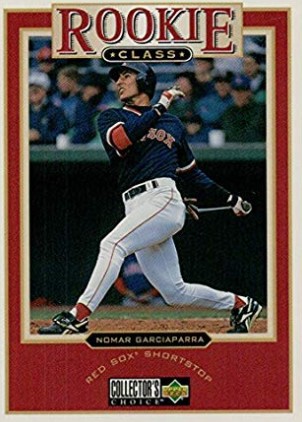
SHORTSTOP … Nomar Garciaparra, 1997 Red Sox

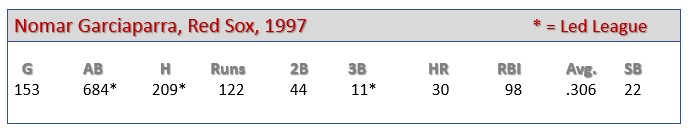
NomarNomar Garciaparra led the American league in hits, with 209, in his 1992 rookie season. The 23-year-old also led the league in triples, was second in runs scored, fourth in doubles and second in extra base hits.  In the field, he led he led all AL shortstops in put outs and double plays turned, and was second in assists. Garciaparra was an All Star and Silver Slugger recipient in that first season.

NomarGarciaparra played 14 MLB seasons (Red Sox, Cubs, Dodgers, A’s).  He was an All Star six times, won a pair of batting titles, hit over .300 eight times, scored 100+ runs in six seasons and drove in 100+ in four campaigns.

Nomar Garciaparra is one of only 13 major leaguers to hit two Grand Slams in a single game.  He did it on May 10, 1999 in a Red Sox 12-4 win over the Mariners. In the Game, Garciaparra went three-for-four, with three runs scored and ten RBI. 

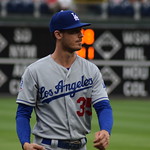
Also looked at: Corey Seager (.308-26-72 for the 2016 Dodgers) and Hanley Ramirez (.292-17-59, with 119 runs and with 51 stolen bases for the 2006 Marlins).

________________________________________________

OUTFIELD …

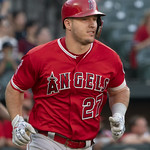
Mike Trout … 2012 Angels

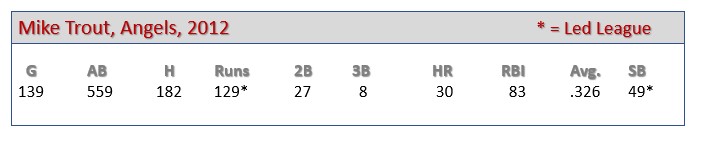
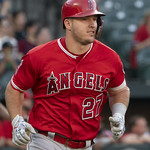
Mike Trout put up some astounding numbers as a 20-year-old rookie: .326 average (second in the NL); 30 home runs; and a league-topping 49 stolen bases (also a league-leading 129 runs scored).   Trout, of course, has gone on to prove that rookie season was no fluke.

Trout

At the close of the 2019 season (Trout’s ninth with the Angels), he had amassed 1,324 hits (in 1,199 games), 285 home runs, 903 runs scored, 752 RBI, and 200 steals.  An eight-time All Star and two-time AL MVP, Trout ha also captured seven Silver Slugger awards and lead the league in runs scored four times, RBI once, stolen bases once, total bases once., walks three times on-base percentage four times

In the eight seasons in which he has played at least 100 games, Trout has been a mainstay on the MVP ballot – finishing first twice, second four times and fourth once – and is one of three finalists for this year’s AL MVP.  

Ichiro Suzuki, 2004 Mariners

Ichiro photo

Photo by Laertes

Ichiro (Yes, like Cher and Elvis, he is known by one name.) is a unique rookie – coming to the major leagues after nine very successful seasons in Japan (a .353  batting average in 951 games). Major league pitching did not slow the 27-year-old rookie down.  As an MLB rookie, Ichiro led the AL with a .350 average, 242 hits and 56 stolen bases.   In that first year, he was an All Star, Rookie of the Year, Gold Glover, Silver Slugger recipient and the American League Most Valuable player.  Clearly, a spot in this lineup as to be reserved for him.

Ichiro

After his rookie season, Ichiro pretty much continued on a hitting spree. In 19 MLB seasons (Mariners, Yankees, Marlins), he won two batting titles, set a new MLB record for hits in a season (262 in 2004) and led the league in hits seven times (getting 200+ hits in ten consecutive seasons).  Now, the cherry on top of the sundae. He also earned ten Gold Gloves.  Oh yes, maybe a little whipped cream with that cherry – he also stole 509 bases. I think I’ve found my leadoff hitter.

Ichiro retired with 3,089 MLB hits in 2,653 games (.311), 117 home runs, 1,420 runs scored, 780 RBI, 509 steals.

Aaron Judge, 2917 Yankees

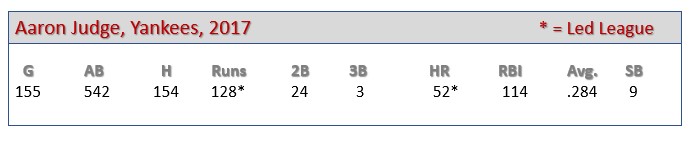
In his 2018 rookie season, the 25-year-old Aaron Judge hit .284 and led the AL with 52 home runs (at the time, the MLB rookie record and still the AL rookie mark) and 128 runs scored.  He also drove in 114 runs and drew a league-leading 127 walks.  Judge was an All Star and Silver Slugger recipient that season.

JudgeSince that rookie campaign, Judge has faced some injury issues and, at the close of the 2019 season, the two-time All Star had played in 396 games (all Yankees), putting up a .273 average, with 110 home runs and 246 RBI.

Also looked at: Walter Dropo (.322, 34 home runs and a league-leading 144 RBI for the 1950 Red Sox); Tony Oliva (league-leading .323 average, 109 runs, 217 hits and 43 doubles – plus 32 home runs and 94 RBI for the 1964 Twins); Fred Lynn; .331-21-105, plus a league-leading 103 runs and 47 doubles, a Gold Glove and the AL MVP Award for the 1975 Red Sox).

___________________________________________________

Starting Pitcher … Dwight Gooden, 1984 Mets

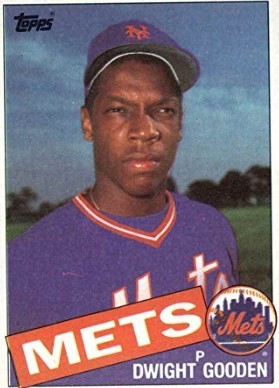
GoodenIn his rookie campaign, 19-year-old Dwight Gooden went 17-9, 2.60 and fanned a rookie-record and league-leading 276 batters in 218 innings. He also tossed seven complete games, including three shutouts.  That season, Gooden was first in the NL in Walks and Hits Per Nine Innings (WHIP), first in total strikeouts and strikeouts per nine innings, second in earned run average, second in strikeouts-to-walks ratio and third in wins.  He was also an All Star and finished second in the Cy Young Award voting. Not bad for a teenager.

Gooden

Dwight Gooden went 19-4, 2.50 at A-Ball and struck out 300 batters in 191 innings pitched as a 18-year-old in 1983 – jumping from A-Ball to the major league the following season.

Over a 16-season career (dampened by substance abuse issues), Gooden went 194-112, 3.51, with 2,293 strikeouts in 2,800 2/3 innings.  (Gooden pitched for the Mets, Yankees, Indians, Rays and Astros). He was a four-time All Star and won 15 or more games in six seasons.  He was the NL Cy Young Award winner in 1985, when he went 24.4, 1.53 and led the league in complete games (16), innings pitched (276 2/3) and strikeouts (268).

Also looked at: Herb Score (16-5, 2.88, with a league-leading – and then rookie record – 245 strikeouts in 227 1/3 innings for the Indians) and Fernando Valenzuela (who won the Cy Young Award as a rookie in the strike-shortened 1981 season – going 13-7, 2.48 for the Dodgers and leading  the NL in starts with 25, complete games with 11, shutouts with eight, innings pitched at 192 1/3 and strikeouts with 180.

___________________________________________________

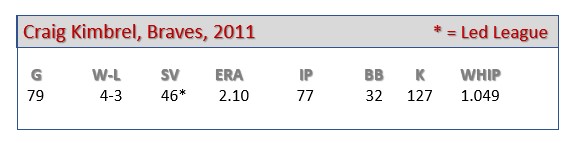
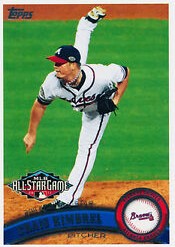
Relief Pitcher – Craig Kimbrel, 2011 Braves

Craig Kimbrel (at age 23) set the rookie record for saves with the Braves in 2011 – going 4-3, 2.10 with a league-leading 46 saves and 127 strikeouts in 77 innings.

Kimbrel

KimbrelKimbrel (still active) has now pitched in ten MLB seasons (Braves, Red Sox, Padres, Cubs) and has a 31-23 record and 346 saves in 565 appearances. He has had four seasons of 40 or more saves (a high of 50 in 2013) and led the league in saves each time. He is a seven-time All Star and has fanned 898 batters in 553 1/3 innings.

Also looked at: Todd Worrell (9-10, 2.08, with a league-leading 36 saves for the 1986 Cardinals).


Primary Resources:  Baseball-Reference.com; Baseball-Almanac.com

BASEBALL ROUNDTABLE ON THE TOP 100 BASEBALL BLOG LIST

100Baseball Roundtable is on the Feedspot list of the Top 100 Baseball Blogs.  To see the full list, click here.

I tweet baseball @DavidBBRT

Follow/Like Baseball Roundtable’s Facebook Page here.  More baseball commentary; blog post notifications; PRIZES.

Member: Society for American Baseball Research (SABR); The Baseball Reliquary; The Negro Leagues Baseball Museum.
Award Season – Baseball Roundtable’s Look at ROY, MVP and CYA Finalists

Well, the MLB award season is about to move into full swing.  With that in mind, Baseball Roundtable would like to share some predictions and preferences for Rookie of the Year, Most Valuable Player and Cy Young Awards.  So let’s get started.

ROOKIE OF THE YEAR

National League …

Pete Alonso photo

Photo by slgckgc

Okay, this is an easy one.  The Mets’ Pete Alonso, at 6’3”, 240-pounds, looks like a power hitter.  And, the 24-year-old lived up to that visual promise.  What did he do as a rookie?

  • Led all of MLB in home runs with 53 (setting a new MLB rookie season record in the process).
  • Drove in 120 runs, third in the NL.
  • Scored 103 runs (ninth in the NL).
  • Generated 348 total bases (second in the NL).
  • Made his first All Star team and won the All Star Game Home Run Derby.

He did all this while playing in 161 games (second in the NL) and hitting .260, with a .583 slugging percentage (second in the NL).  Game. Set. Match.

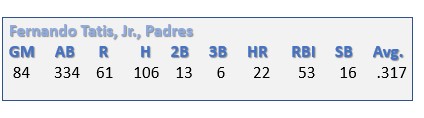
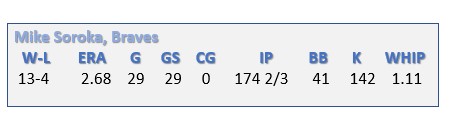
The fact is, Alonso simply outdistanced (how many feet of home runs did he hit?) the Braves’ 22-year-old righty Mike Soroka, who went 13-4, 2.68, and Padres’ Fernando Tatis, Jr.  (.317-22-53, with 16 steals). The 20-year-old Tatis – also an outstanding fielder and skilled base runner – was an early ROY favorite and would have given Alonso a run for the honor if back issues had not limited him to 84 games.

BBRT Prediction: Pete Alonso.

BBRT Selection: Pete Alonso.

American League …

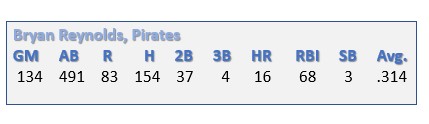
AlvArwezThe Astros’ Yordan Alvarez – like the Mets’ rookie Pete Alonso – is a big man who plays big.  The 6’5”, 225-pound, left-handed hitter put u p a .313 average, with 27 home runs and 78 RBI in just 87 games (he made his MLB debut in early June). His .314 average was second among AL rookies with at least 200 at bats. (The Twins’ Luis Arreaz hit .334). Alvarez’ 27 home runs trailed only the White Sox’ Eloy Jimenez’ 31. (Jimenez played in 35 more games.) And, Alvarez’ 78 RBI trailed Jimenez by one. The only drawback to Alvarez’ spot among the finalists is that he started 74 of his 83 games at DH. If he captures the Rookie of the Year award, he will be the first primarily DH to do so.

National League ROY finalist Brandon Lowe appeared in the starting Rays’ stating lineup at @B, 1B, RF, LF and DH. 

The other finalists were the Rays’ 25-year-old Brandon Lowe, who hit .270-17-51 in 82 games (and get extra points for versatility) and the Orioles’ 26-year-old southpaw John Means,  who went 12-11, 3.60 for the Orioles.

BBRT Prediction: Yordan Alvarez. 

BBRT Selection:  Yordan Alvarez.

_________________________________________________

Most Valuable Player

National League

Cody Bellinger photo

Photo by IDSportsPhoto

This is definitely a three-way race – and any of the three finalists could come away with the honors.  Brewers’ RF Christian Yelich, the 2018 NL MVP tied for the batting title – hitting .329. He also bashed 44 home runs (fourth in the NL); drove in 97 runs; scored 100 runs; and led the NL in both on-base percentage (.429) and slugging percentage (.671). Still, he played in only 130 games – missing most of September due to a knee injury.

The Dodgers’ Cody Bellinger drew an MLB leading 21 intentional walks in 2019. 

Anthony Rendon photo

Photo by Lorie Shaull

Then there is the Dodgers’ RF/1B Cody Bellinger – who put up a .305 average, with 47 home runs (third in the NL), 351 total bases (first in the NL), 115 RBI (seventh); and 121 runs scored (second). Clearly, his offense helped drive the Dodgers.  In his favor are both his plus defense and speed (15 stolen bases).  Bellinger also had a solid walks-to-whiffs ratio (95 BB/108 K).

The Nationals’ Anthony Rendon led the NL in RBI generated when hitting with two out and runners in scoring position (37). Rendon hit .362-6-37 in those clutch situations. 

Finally, we have Nationals’ 3B Anthony Rendon, who hit .319 (third in the NL), with 34 home runs, tallied an NL-leading 126 RBI and scored 117 runs (third in the NL). In addition, Rendon was fourth among NL third sackers in putouts, third in assists and third in double plays. Like Bellinger, Rendon also was solid in the walks-to-strikeouts department (80 BB/86 K).

BBRT: Prediction: Cody Bellinger.

BBRT Selection:  Anthony Rendon.  (I lean toward Rendon because of the “valuable” role he played in the Nationals’ rebound from a 19-31 start to the season.)

American League … 

If the award were for the Best Player, BBRT would see Mike Trout winning hands down. Despite missing the last half of September (foot injury), Trout – always an MVP candidate – had one of his best seasons ever.  He hit a healthy .291, with 45 homers (second in the AL), 104 RBI (ninth), 110 runs scored (sixth) and 11 stolen bases.  He also led the AL in both on-base percentage (.438) and slugging percentage (.645) and had 110 walks (second in the AL) and 120 strikeouts.

The Astros’ Alex Bregman was the only MLB player with enough at bats to qualify for the  batting title to have more walks than strikeouts in 2019. 

Next up is Astros’ 3B Alex Bregman who hit .296, with 41 home runs (second in the AL), 112 RBI (fifth); and 122 runs scored (fourth). Bregman also had 119 walks (first in the AL) versus only 83 strikeouts. He was second in on-base percentage at .423 (to Trout’s .438) and third in slugging percentage (.592). One key to Bregman’s candidacy is his willingness to fill in at shortstop for the Astros when Carlos Correa was down.  On the season, Bregman started 91 games at 3B and 59 at SS.


Of the three American League MVP finalists, A’s shortstop Marcus Semien had the most total bases (343, second in the AL) and the most extra-base hits (83, third in the AL). 

Finally, there is the A’s shortstop Marcus Semien – a stabilizing influence in the field and in the lineup.  Semien played in all 162 games.  On defense, he led all AL shortstops in assists, double plays and fielding percentage, and was second in putouts.  At the plate, he had an outstanding year – going .285-33-92, with ten steals and 123 runs scored (third in the AL). Semien finished second in total bases (343). He also finished third in the league in doubles (43) and fifth in triples (7).

BBRT Prediction: Mike Trout. (In his seven full seasons, Trout has won two MVP Awards, finished second four times and fourth once.  I think the voters are going to reward that ongoing excellence.)

BBRT Selection:  Alex Bregman.  (These are three deserving candidates.  For me, the value Bregman delivered filling at SS, gives him a slight edge.)

__________________________________________________

CY Young Award

National League

Jacob deGrom photo

Photo by slgckgc

Jacob deGrom won the 2018 Cy Young Award with 10-9 record (in 32 starts), an MLB-low 1.70 earned run average and 269 strikeouts (second in the NL) in 217 innings (second in the NL),  This season, he put up similar numbers: an 11-8 record (32 starts); a 2.43 earned run average (second in the NL); and an NL-leading 255 whiffs in 204 innings pitched (third in the NL).  DeGrom also finished second in the league in Walks and Hits Per Nine Innings (WHIP) at 0.971, fourth in K’s per nine innings (11.25) and fourth in strikeouts-versus-walks ratio (5.80).

When the Mets’ Jason deGrom won the 2018 Cy Young Award with a 10-9 record, it was the fewest wins ever by a staring pitcher who captured the CYA. 

Max Scherzer is also a finalist for NL CYA.   The three-time Cy Young Award winner went 11-7 in 27 starts, with a 2.92 earned run average (sixth in the NL) and 243 strikeouts (third) in 172 1/3 innings.  He finished first in the league in strikeouts per nine innings (12.69); fourth in WHIP (1.027); and first in strikeouts-versus-walks ratio (7.36).

The third finalist is the Dodgers’ Hyun-Jin Ryu, who went 14-5, with an NL and MLB-lowest 2.32 earned run average in 29 starts. Ryu is not in the same league deGrom and Scherzer when it comes to strikeouts (163 in 182 2/3 innings, but his strikeouts-to-walks ratio (6.79) was second only to Scherzer in the senior circuit and his WHIP of 1.01 placed him third in the league.

Three finalists, with a combined total of just 36 wins, guess you need to go deeper into the numbers.

BBRT: Prediction:  Jacob deGrom (His leadership in strikeouts and WHIP give him a slight edge, as does the fact that he is the only one of three finalists to each 200 innings pitched.)

BBRT Selection:  Jacob deGrom.

American League … 

While the NL CYA finalists won only 36 games combined, the three AL finalists put up 57 victories – and, the AL finalists lineup includes the only two twenty-game winners from the past season.

The Astros’ Justin Verlander led all of MLB with 21 victories (just six losses). His 2.58 earned run average was second in the AL; his Walks and Hits per Nine Innings (WHIP) was first in the AL and MLB at 0.83; He fanned an even 300 batters in 223 innings (leading the AL in innings pitched), while walking just 42 (for an AL-best 7.14 strikeouts-to-walks ratio.  In any other year, this might have been a cakewalk for Verlander.

In 2019, Justin Verlander threw a no-hitter against the Blue Jays (September 1). It was his third career no-hitter – making him just the sixth pitcher in MLB history to throw three or more no-hit games. Verlander walked one and fanned 14 in the game. 

But wait.  The Astros’ Gerrit Cole notched twenty wins (five losses); put up the junior circuit’s lowest ERA at 2.50 and led the league (and all of MLB) with 326 strikeouts (in 212 1/3 innings). His WHIP (0.90) was second only to Verlander in MLB and he led the way in whiffs per nine innings at 13.81 (the only qualifying pitcher to top 13.00).  In strikeouts-to-walks ratio, Cole (at 6.79) finished second to Verlander in the AL.

Also, in the race is the Rays’ Charlie Morton who went 16-6, 3.05, with 240 strikeouts in 194 2/3 innings.  A solid year, but it’s tough to compete with two twenty-game winners, who both notched at least 300 strikeouts and sported ERA’s under 2.60.

The Astros’ Gerrit Cole did not lose a game after May 22 – going 16-0, 1.78 in 22 starts. 

BBRT Prediction: Justin Verlander.  (Wow, you could hardly slip a piece of paper between the Justine Verlander and Gerrit Cole stat sheets. BBRT thinks the voters will look at the one extra win, the no-hitter and leadership in innings pitched as tiebreakers and go with Verlander. Had Verlander fallen one short of 300K, this one might have swung to Gerrit Cole.)

BBRT Pick:  Gerrit Cole. (Hedging my bet, I’m going to go with Cole.  Yes, one less win, but also one less loss (giving him a nice round .800 winning percentage to Verlander’s .778). Then there are the 13+ whiffs per nine and MLB-tops 326 strikeouts.)

Primary Resources: Baseball-Reference.com; MLB.com

BASEBALL ROUNDTABLE ON THE TOP 100 BASEBALL BLOG LIST

100Baseball Roundtable is on the Feedspot list of the Top 100 Baseball Blogs.  To see the full list, click here.

I tweet baseball @DavidBBRT

Follow/Like Baseball Roundtable’s Facebook Page here.  More baseball commentary; blog post notifications; PRIZES.

Member: Society for American Baseball Research (SABR); The Baseball Reliquary; The Negro Leagues Baseball Museum.

Who’s Your Daddy? … Sandy Koufax Edition

Braves’ right-handed pitcher (and 1957 World Series hero, Lew Burdette hit as many home runs and drove in as many runs off Sandy Koufax as Willie McCovey and Dick Allen COMBINED – and he did in in 64 fewer at bats.

Burdette hit .308, with two home runs and three RBI in 13 at bats versus Koufax. McCovey and Allen hit a combined .181, with two home runs and three RBI off the Hall of Fame southpaw in  77 at bats.

________________________________________________

Who’s Your Daddy?

On September 24, 2004, in the middle of a tight pennant race, the Yankees handed future Hall of Famer Pedro Martinez and the Boston Red Sox a tough 6-4 loss.  Martinez went 7 1/3 innings giving up nine hits and five earned runs.  The game came just five days after (in his previous start) Martinez had lasted just five frames against the Bronx Bombers (eight hits, eight earned runs) in a 16-7 loss.

After that second loss, Martinez candidly commented, “What can I say? I just tip my hat and call the Yankees my daddy.”  Little did he know that his comment – and a Yankee  fans’ chant of “Who’s your daddy?” would follow him into future starts in New York (all the way  to his final MLB start – against the Yankees for the Phillies – in Game Six of the 2009 World Series.)

The concept of “Who’s your daddy?” became the inspiration for Baseball Roundtable to take a look at the players who “had the number” of some of MLB’s premier pitchers.  I started with Nolan Ryan (see that post by clicking here) and the topic was well enough received I’ve decided to continue the journey.

Today’s “Who’s you daddy?” hurler is Hall of Famer Sandy Koufax.   

_________________________________________________________

Honorable Mention Koufax Krusher

Jerry Lynch – .714 average, .818 on-base percentage versus Sandy Koufax

Pirates’ and Reds’ outfielder Jerry Lynch – a .277 career hitter (13 seasons, 1,184 games) – faced Sandy Koufax 11 times in his career (seven at bats) and collected five hits (.714 average) and four walks (.818 on-base percentage). He struck out only once against the Hall of Fame southpaw and had one double, one home run and five RBI. Ah, but there is a catch. Eight of those plate appearances, four of those hits and two of those walks occurred between 1955 and 1960.  Why is that meaningful?  Check the chart below for the answer.Koufax Metrics

KoufaxpitcheThe fact is, Koufax was actually considering leaving baseball after an 8-13, 3.91 1960 season. Lucky for baseball that he persevered.  Otherwise, we would have missed a Hall of Fame career (cut short by chronic arthritis in his left arm) that included six consecutive All Star selections (1961-66); three Cy Young Awards (1963, 1965, 1966); an MVP Award (1963); five ERA titles; four seasons leading the NL in strikeouts (three with 300+ K’s); three seasons each leading the league in wins and shutouts; four no-hitters; one a perfect game; and countless thrilling performance.  All of this in Koufax’ final six seasons.

With all this in mind, as we take a look at the players who had the best overall numbers against Koufax, we need to take a bit of a unique approach.   We have to consider not only full-career (1965-66) numbers, but how batters fared from in the left-hander’s peak seasons (1961-66

–ONLY .400+ (minimum 20 at bats) HITTER VERSUS SANDY KOUFAX—

Bill Virdon, OF, Cardinals (1955-56); Pirates (1956-65, 1968)

Career versus Sandy Koufax: 21 games, 52 at bats, 21 hits (.404 average).

VirdonNow, Bill Virdon didn’t really crush Koufax. He never took Koufax deep (just four extra base hits, all doubles, against him), but he never gave in. Consider a .400+ average and nearly as many walks (seven) as whiffs (eight) against Koufax’ splendid left arm.  Virdon batted against Koufax in seven different seasons – and had a .500 or better on-base percentage in five of them.

Not only that, he actually performed his best against the three-time Cy Young Award winner when Koufax was in his prime. From 1961 forward, Virdon faced Koufax 27 times in nine games (25 at bats) – collecting 12 hits for a .480 batting average.  (During this period Koufax’ overall “Batting Average Against” was a stingy .197.)

How surprising is that?  In 12 MLB seasons, Virdon hit .267.  While he was the NL Rookie of the Year in 1955 (.281-17-68) and won a Gold Glove in 1962, he never made an All-Star team. He finished his career with 1,583 games, 1,596 hits (.267 average), 237 doubles, 81 triples, 91 home runs and 502 RBI.

Now, let’s take a look at two lineups of Koufax’ “daddies” – first for those premier years (1961-66) and then for his full career.

–BBRT ‘WHO’S YOUR DADDY?” LINEUP (ten or more regular-season at bats) AGAINST SANDY KOUFAX 1961-66 —

Note: Unless otherwise noted, stats in this section are from the 1961-66) period. BBRT limited eligibility to those with at least ten at bats against Koufax in that time (pitchers exempt). 

Catcher – Gene Oliver (.391 average)

Gene Oliver had 49 plate appearances (46 at bats) in 17 games against Koufax in the pitcher’s prime years – and mashed at a .391 rate (18 hits) – well above his .246 career average.  He also popped three long balls and drove in eight runs.

In a five-at-bat streak against Koufax in 1963, Gene Oliver collected five hits – three singles and two home runs.  It came in a season that saw Koufax go 25-5, with a 1.88 ERA, eleven shutouts and 20 complete games.  In the streak, that covered three games, Oliver twice poked the hit that knocked Koufax out of the game. In that 1963 season, Oliver hit .429-2-6 in 19 games against Koufax.  His overall, average that season?  Just .244.

The streak began with Oliver’s fifth-inning at bat (for the Milwaukee Braves) in a game against the Dodgers on June 29. His run-scoring single gave the Braves a 5-1 lead and knocked a struggling Koufax out of the game. (The Dodgers won 6-5 in 11 innings.) Oliver next faced Koufax on July 20.  In that contest, Oliver singled to lead off the bottom of the second; homered to lead off the fourth (and break a scoreless tie); and singled in the sixth (his next at bat was a single against Ron Perranoski in the seventh).  (Side note: Milwaukee’s Frank Bolling, who is also in this lineup, hit a run-scoring single later in the inning to drive Koufax from the game). The Dodgers won this one 5-4. Oliver next came up against Koufax on August 15 and hit a three-run home run in the bottom of the first inning to give the Braves a 4-0 lead and again knock Koufax out of the game. Oliver fanned against Koufax in his first at bat on August 25 to end the five-for-five streak.

Oliver played in ten MLB seasons (1959, 1961-69; Cardinals, Braves, Phillies, Red Sox, Cubs).    He played 786 games and had 546 hits (.246 average), with 93 home runs and 320 RBI. He appeared at catcher, first base and all three outfield spots.

First Base – Deron Johnson (.295, four home runs in 14 games)

Deron Johnson faced Koufax 47 times from 1964 to 1966.  He managed 13 hits (.295 average), four home runs and 10 RBI, with three walks and six strikeouts.

In Deron Johnson’s first game against Koufax (April 18, 1964), he hit a fourth-inning, three-run home run that accounted for all the scoring in a 3-0 Reds’ victory.

Johnson’s best campaign against Koufax came in 1964 (Johnson’s first season in the National League), when he went 6-for-17 (.353) against him – with two doubles, three home runs and six RBI in five games.

Johnson enjoyed a 16-season MLB career (1960-62, 1964-76; Yankees, Athletics, Reds, Braves, Phillies, Brewers, White Sox, Red Sox). He played in 1,765 games, collecting 1,447 hits (.244 average), with 245 home runs and 923 RBI. While he never made an All-Star team, in 1965 he led the NL in RBI with 130, while hitting .287 with 32 home runs.

Note: Orlando Cepeda put up a stat line similar to Johnson’s against Koufax in the 1961-66 time frame – .286-4-12; but Johnson did his damage in 19 fewer at bats.  Johnson also had three walks and six strikeouts against Koufax, as compared to Cepeda’s three walks and 14 whiffs.  Johnson gets the nod.

Trying to hit Sandy Koufax was like trying to drink coffee with a fork.

                             Hall of Famer Willie Stargell, who hit just 0.87, with ten strikeouts, in 23 at bats versus Koufax

Second Base – Frank Bolling (two homers and nine RBI in 21 games)

Frank Bolling hit just .250 against Koufax between 1961 and 1966, but made those hits count – with nine RBI and a double, triple and two home runs among his 14 hits. His two home runs were a three-run shot and a Grand Slam.

Bolling played in 12 MLB seasons (1954, 1956-1966 – Tigers, Braves). He appeared in 1,540 games and had 1,415 hits (.254 average), 106 home runs and 556 RBI. He was an All Star twice and a Gold Glover once.

Third Base – Eddie Mathews (.365 average in 18 games)

A career .271 hitter, Hall of Famer Eddie Mathews hit .365 (19 hits in 52 at bats) versus Koufax in the left-handed hurler’s prime seasons. The fact that Mathews did so well against Koufax in the years the lefty was dominating the National League is surprising since, prior to 1961, he had hit just .162 (in 20 games) versus Koufax.   This may indicate that Mathews focused on just making contact versus Koufax.  Of the power-hitting Mathews’ 19 hits against Koufax between 1961 and 1966, only three were for extra bases (two doubles and one home run.)

It was feast or famine in Eddie Mathews’ final game against Sandy Koufax (August 9, 1966). In a game that was tied 1-1 after eight innings, The Atlanta Braves’ third baseman had struck out against Koufax in the first, fourth and sixth innings.  He came up against Koufax again with one out in the ninth and hit a walk-off, game-winning solo home run. It was his first home run against Koufax since since August 17, 1959 (a span of 61 plate appearances).  

Mathews played 17 MLB seasons (1952-68; Braves, Astros, Tigers). He appeared in 2,391 games, had 2,315 hits (.271 average), with 512 home runs and 1,453 RBI. He was an All Star in nine seasons and hit 30+ home runs in ten campaigns.

Shortstop – Eddie Kasko (.366 average in 16 games)

Eddie Kasko, who played 10 seasons (1957-66; Cardinals, Reds, Astros and Red Sox), was a career .264 hitter.  From 1961-66, however, he touched Sandy Koufax for a .366 average (15 hits in 41 at bats).   Notably, 14 of Kasko 15 hits were singles (one double). He also walked three times (eight strikeouts).  In 1965, Kasko hit .247 overall, but .333 versus Koufax in nine at bats.

Eddie Kasko’s August 15, 1961 game against Koufax must have been pretty annoying for the lefty on the mound. Against Koufax in that game, the Reds’ shortstop (who came into the game hitting .265) lined a single to the left in the top of the first; slashed  another single to left in the third; hit a grounder through the hole for a single in the fifth (eventually scoring); and hit a run-scoring single to center in the sixth. He made his only out of the game (a 5-2 Reds’ win) after Koufax was off the mound.

Over his career, Kasko played in 1,077 games. He had 935 hits (.264 average), 22 home runs and 261 RBI. He was an All Star for the Reds in 1961, when he went .271-2-17, with 64 runs scored.

Outfield – Bill Virdon (.480 average in nine games.)

We already had a look at Virdon’s record versus Koufax earlier in this post.  Virdon had 22 at bats against Koufax from 1961 through 1966 and reached him for 12 hits (.480 average). Again, primarily a center fielder and leadoff hitter, Virdon did not show much power against Koufax (ten singles and two doubles among his 12 hits).  Still, he was neither fooled nor overpowered by the left-hander.

Outfield – Roberto Clemente (.301, six home runs 12 RBI in 22 games)

Facing Koufax in the pitcher’s prime years, Hall of Famer Roberto Clemente hit five home runs against the lefty (73 at bats), collected 22 hits (.301 average) and drove in a dozen tallies. Koufax did fan Clemente 13 times (versus four walks).

Roberto Clemente’s five home runs against Sandy Koufax between from 1961 to 1966 are the second most of any player during that time period. (Felipe Alou hit six dingers off Koufax in those seasons – and did it in 22 fewer at bats than Clemente). Clemente also had three doubles and two triples among his 22 hits.

Roberto Clemente’s six career home runs off Sandy Koufax tied for the most he hit off any pitcher (he also had six against Fergie Jenkins).

A Hall of Famer, Clemente played in 18 MLB seasons (1955-72; all for the Pirates). He got in 2,433 games and collected 3,000 hits (.317 average), 440 doubles, 166 triples and 240 home runs. He scored 1,416 times and drove in 1,305 runs.  He was an All Star in 12 seasons, won 12 (consecutive) Gold Gloves, was the 1966 National League MVP and was a four-time NL batting champion.

Outfield – Willie Mays (.243, with four home runs and 12 RBI in 27 games.)

I wavered between Willie Mays, Hank Aaron and Felipe Alou for the final outfield spot.  I ended up on Mays (and I will explain).  Yes, Mays hit just .241 (18-for-74) against Koufax during the 1961-66 period, but he made those hits count. His four home runs against Koufax tied for the third-most against the lefty during his prime years and his 12 RBI tied for second.  (Hall of Famer Frank Robinson drove in 14 off Koufax during those prime years, but hit just .205.)  Mays also drew 15 walks against Koufax (the most of any payer during the period). He fanned fifteen times against Koufax.

Aaron did hit .303 off Koufax (1961-66 in 26 games), but had only two home runs and six RBI.  So, he had two fewer homers and ten fewer RBI than Mays in one less game – as well as seven fewer walks. Alou did top Mays in home runs off Koufax (six to Mays’ four) and did in 19 games, but he had just eight RBI – and I also considered Alou’s 12 strikeouts-to-two walks, versus Mays’ 15-15 strikeout versus walks total.   Had to go with Mays’ full body of work for the 1961-66 period.

Hall of Famer Willie Mays played 22 MLB seasons (1951-52, 1954-73; Giants, Mets). He was an All Star in 20 seasons; NL Rookie of the year (1951); and a two-time NL MVP (1954 and 1965). He earned a dozen Gold Gloves and led the NL in home runs four times, stolen bases four times, triples three times, runs scored twice, and hits and batting average once each.

Koufax HR

FELIPE ALOU – HONORABLE MENTION CAREER AND 1961-66

When it came to taking Koufax deep, nobody did it better than Felipe Alou. While Alou hit only .265 in 68 career at bats versus Koufax (18 hits) and also fanned fifteen times, he laced four doubles and tied for the most career home runs hit against Koufax with seven long balls (tied with such luminaries as Hank Aaron, Frank Robinson and Ernie Banks) – one every 9.7 at bats. (It was also the most home runs Alou hit against any pitcher in his 17-season career (.286-206-852 stat line).

Notably, the bulk of those seven home runs came in Koufax’ prime years.  From 1961 to 1966, Alou hit .241 versus Koufax, but he managed six home runs – the most of any player against Koufax in that time period – and four doubles in 54 at bats (13 hits).

Pitcher – Robin Roberts (.667 average in one game.)

Robin Roberts was winding down his Hall of Fame career when he faced off against Sandy Koufax and the Dodgers on September 5, 1965.   The 38-year-old former Philly and Oriole was with the Astros at the time. In the contest, Roberts singled to left with two outs in the bottom of the third; bunted unsuccessfully in fifth; and singled to right to drive in one of the Astros’ only two tallies in the game in the seventh (and was tossed out trying to go to second on the play).  Roberts took a 2-1 lead into the top of the ninth, but gave up three runs to take the loss.

Roberts, by the way, was a career .167 hitter. He fared better on the mound, earning his way into the Hall of fame with a 19-season MLB career (1948-66; Phillies, Orioles, Astros, Cubs) that included 286 wins (245 losses) and a 3.41 ERA. The seven-time All Star led his league in wins four times, complete games five times, innings pitched five times and strikeouts twice.

____________________________________________________

Now, let’s move on to the a BBRT Lineup versus Koufax based on his full career.

Note:  Several players appear on both lists.  In those cases, BBRT will deal with them briefly in this section (you’ll find more details in the 1961-66 lineup section).


—BBRT ‘WHO’S YOUR DADDY?” LINEUP AGAINST SANDY KOUFAX 1955-66 —

(minimum 20 at bats, except for pitcher)

CatgegoriesKourfax


Catcher – Gene Oliver (.392 average)

Gene Oliver is the catcher in both of the Koufax-raking lineups. The bulk of Oliver’s (all but five) 51 at bats against Sandy Koufax came in Koufax’ best seasons (1961-66). Overall, the career .246 hitter was 20-for-51 (.392) versus Koufax, with four home runs and nine RBI (three walks/11 whiffs). In seven seasons against the lefty, Oliver hit under .333 just once. In 1963, he went six-for-14 (.429) against Koufax with two homers and six RBI in five games. Oliver’s .392 career average against Koufax is second only to Bill Virdon’s .404 among hitters with at least 20 at bats against the lefty. His four home runs tied for the most he hit off any pitcher (he also it four off Joe Nuxhall) and his nine RBI were the second most he collected against any hurler (he had ten off Turk Farrell).

In the 19 career games in which he faced Koufax, Oliver appeared nine times each at catcher and first base and once in the outfield.

Koufax Oliver F

First Base – Orlando Cepeda (.288-5-15 in 80 at bats)

Hall o Famer Orlando Cepeda faced Sandy Koufax in 29 games during his career – going 23-for-80, with five home runs, 15 RBI, three walks and 18 strikeouts. His 23 hits were the eleventh most against Koufax, his five home runs tied for sixth-most and his 15 RBI sixth-most.

For his 17-season MLB career (1958-74; Giants, Cardinals, Braves, A’s, Red Sox, Royals), Cepeda hit .297, with 379 home runs and 1,365 RBI. He was a six-time All Star, the 1958 NL Rookie of the Year, the 1967 NL MVP and a league leader in RBI twice and home runs once.  Given his overall stats, I’d say Koufax versus McCovey was a pretty good match up.

KoufaxCepeda

Second Base – Frank Bolling (.250-2-9 in 20 games)

Frank Bolling is also in the 1961-66 lineup. All of Bolling’s appearances against Sandy Koufax came in Koufax’ prime years (1961-66). A .254 career hitter, Bolling nearly matched that average against Koufax and added a pair of home runs and nine RBI.  You can find more detail on the Bolling-Koufax match up in the 1961-66 section.

On September 27, 19565, Koufax brought a 23-8, 2.05   record into a game against Frank Bolling and the Milwaukee Braves (in Milwaukee). In the second inning, of that game, Koufax gave up consecutive singles (to start the inning) to Joe Torre, Gene Oliver and Eddie Mathews.  Bolling then popped a Grand Slam home run off Koufax – one of six Grand Slams Koufax gave up in his 11-season MLB career and Bolling’s only MLB Grand Slam.  (Bolling was a career .231 hitter in 121 at bats – 140 plate appearances – with the bases loaded.)

KoufaxBolling

Third Base – Jim Ray Hart (.292-2-6 in 14 games)

The Giants’ third baseman hit .292 for his career against Sandy Koufax – and all his at bats came during Koufax’ prime seasons.  He also popped two home runs and drove in six tallies in 48 at bats. Notably, Koufax baffled Hart early (no hits in his first seven at bats against him), but from at bat number-eight on, Hart touched Koufax for a .350 average (14-for-40).  Koufax did fan Hart ten times (versus two walks).

Hart was a .278 hitter over 12 MLB seasons (1963-74; Giants, Yankees).  He had 1,052 hits, 170 home runs and 578 RBI.  He was a one-time All Star – 1966, when he went .285-33-93.

Koufaxhart

Shortstop – Eddie Kasko (.306-average in 24 games)

Eddie Kasko is in both the 1961-66 and career-versus-Koufax lineups.  For his career, Kasko hit .306 versus Koufax (19-for 62); but had only one extra-base hit (a double) and four RBI (three walks/ten strikeouts).  His best year against the southpaw was 1961, when he hit Koufax at a .444 pace (eight-for-eighteen). Oddly, 1961 was not a great season for the Kasko. He played in just 43 games, hitting .239
Koufax Kasko f

Willie Stargell managed just one two hits in 23 at bats against Sandy Koufax (a .087 average), with ten strikeouts. 

Outfield – Hank Aaron (.362-7-16 in 48 games)

Nobody collected more its off Sandy Koufax than Hank Aaron (42-for-116).  He also tied for the most home runs off Koufax with seven, hit the most triples (three) and fifth-most doubles (six) off the lefty.  Aaron’s 16 RBI are the fourth-most off Koufax.   In 12 seasons hitting against Koufax, Aaron topped .400 six times.  He also had more walks (14) than strikeouts (12) against Koufax.

Hall of Famer Aaron had a 23-season MLB career (1954-76; Braves and Brewers).   He played in 3,298 games and collected 3,771 hits (.305 average), 755 home runs and an MLB-high 2,297 RBI.  Aaron was an All Star in 21 seasons (missing only in his first and last campaigns); a three-time Gold Glover ; and the 1957 National League MVP. He led the NL in  home runs four times, RBI four times, runs scored three times, doubles three times, hits twice, and batting average twice.

KoufaxAaron

Outfield – Bill Virdon (.404 average).

Bill Virdon is in both the 1961-66 and career lineups.  He is the only player with more than 20 at bats versus Koufax to hit .400+ against him.  Virdon’s line against Koufax included a  .404 average (21-for-52), but with no home runs and just three RBI (he was a leadoff hitter).  Not much damage, but you can’t leave out a .400 hitter. You can find more on Virdon in the box near the top of this post and in the 1961-66 lineup section.
Koiufax Virdonm F

Outfield – Roberto Clemente (.297-6-16 in 42 games)

Roberto Clemente can be found in both the 1961-66 and career lineups.   He hit .297 against Koufax, with six home runs (fifth-most against the lefty) and 16 RBI (fourth-most). He also touched Koufax for six doubles and two triples – giving him 14 extra base hits among 33 safeties.

KoufaxClemente

Pitcher – Lew Burdette (.308-2-3 in eight games).

Braves’ right hander Lew Burdette went 203-144, 3.66 in 18 MLB seasons (1950-67; Yankees, Braves, Cardinals, Angels, Cubs, Phillies) and was not a bad hitter for a pitcher (.183-12-75 in 1,011 at bats).   And, he hit Sandy Koufax pretty well. Koufax was one of two pitchers that Burdette popped two home runs against (the other was Joe Nuxhall). That bit of power and his .308 average against Koufax earns Burdette this spot in the lineup.

KoufaxBrudette

Primary Resource:  Baseball-Reference. com

Additional Editions of “Who’s Your Daddy?”

Nolan Ryan, click here.

Bob Gibson, click here.

Pedro Martinez, click here.

Randy Johnson, click here. 

BASEBALL ROUNDTABLE ON THE TOP 100 BASEBALL BLOG LIST

100Baseball Roundtable is on the Feedspot list of the Top 100 Baseball Blogs.  To see the full list, click here.

I tweet (on X) baseball @DavidBaseballRT

Follow/Like Baseball Roundtable’s Facebook Page here.  More baseball commentary; blog post notifications; PRIZES.

Member: Society for American Baseball Research (SABR); The Baseball Reliquary; The Negro Leagues Baseball Museum.

Pre-Game Prep – World Series Targets to Shoot For

BallAs the Astros and the National prepare to face off in the 2019 World Series, Baseball Roundtable would like to take a look at some of the single-game and single World Series targets the players can shoot at. But first a few records that BBRT finds of particular interest.

  • While four three players have hit three home runs in a World Series game, only the Yankees’ Babe Ruth (appropriately) accomplished the feat twice – October 6, 1926 and October 9, 1928.
  • Babe Ruth also holds the record for the most innings pitched in a single World Series Game- going 14 innings for the Red Sox in a complete-game, six-hit, 2-1 win ( over the Brooklyn Robins) on October 9, 1916.
  • The Giants’ Willie Mays grounded into a World Series single-game record three double plays on October 8, 1951, as his Giants lost to the Yankees 6-2. Mays came up four times (with a total of five runners on base) and delivered three double plays and a fly out.

NO TAKE SIGN HERE

In the October 18, 1977 World Series game in which Yankee Reggie Jackson hit a record-tying three home runs (fourth, fifth and eight innings), he hit each home run on the first pitch of his at bat. That’s three long ball on three consecutive pitches. Jackson ended the day three-for-three (a walk in his first plate appearance), with four runs scored and five RBI, as the Yankees topped the Dodgers 8-4.

  • Three players – The Yankees’ Bobby Richardson (1960 WS), Cardinals’ Lou Brock (1968 WS) and Red Sox’ Marty Barrett – share the record for base hits in a single World Series (13) – and all three collected their Baker’s Dozen safeties in losing causes.
  • While 13 pitchers have recorded three wins in a single World Series, only the Giants’ Christy Mathewson threw complete-game shutouts in single World Series (1905 against the Philadelphia Athletics). In his three starts, Mathewson threw 27 innings, giving up just 13 hits and one walk, while fanning eight.
  • Lou Brock of the Cardinals is the only player to steal seven bases in a single World Series – and he did it twice. In the 1967 World Series, Brock stole seven bases in seven attempts.  He tied his own record with seven steals (in nine attempts) in the 1968 World Series.

THIS ONE’S ON US

On October 23, 2002, the Angels wanted little to do with Giants’ slugger Barry Bonds –  gifting him a single-game World Series record three intentional walks. They came: in the first inning, with runners and first and third and one out; in the third, with runners on second and third and one out; and in the fifth, with a runner on second and one out.  In his only other plate appearance, Bonds grounded out to first in the seventh inning. The Giants won the game 4-3.

  • In the 2002 World Series (Angels/Giants), the Giants’ Barry Bonds drew a single-World Series’ record 13 walks (in 30 plate appearances).
  • In the Opening Game of the 1968 World Series (October 8), the Cardinals’ Bob Gibson (facing the Tigers) struck out a World Series’ single-game record 17 hitters – getting each of the nine players in the Tigers’ starting line up at least once. Gibson threw a five-hit shutout, as St. Louis won 4-0.
  • The Dodgers’ Cody Bellinger, 2017 NL Rookie of the Year, struck out a World Series’ record 17 times (28 t bats) in the 2017 World Series (versus the Astros). This included two games in which he fanned four times in four at bats.
  • On October 22, 2011, as the Cardinals topped the Rangers 16-7, Albert Pujols collected a World Series’ single-game record 14 total bases – three home runs and two singles in six at bats.

YOU’VE GOT TO EARN YOUR WAY ON

Carl Mays (1921 Yankees) pitched the most innings in a single WS without issuing a walk – 26. That series, he went 1-2, 1.73 in thee complete-game starts, as the Yankees lost to the Giants five games-to-three. Just six pitchers have walked zero batters while pitching at least ten innings in a World Series.

  • While the 1990 World Series (Reds/A’s) lasted only four games, Reds’ CF Billy Hatcher made the most of them – putting up a World Series’ record .750 batting average (9 hits in 12 at bats). He also had two walks and one hit-by-pitch – putting on base in 12 of 15 plate appearance for a Series’ record .800 on-base percentage.

HE DOES LIKE THE BIG STAGE

Billy Hatcher, a career (12-seasons … 1984-95) .264 hitter, was pretty darn good in the post season. In 14 post-season games, he hit .404.

  • In the 1903 World Series – a best five-of-nine affair that went eight games – the Pirates’ Deacon Phillipe started and completed a record five games (in 13 days) – going 3-2, 3.07.

Now, let’s look at some World Series Targets


—-SINGLE-SEASON WORLD SERIES RECORDS—

HITTING

Batting Average – .750

Billy Hatcher, Reds, 1990 (12-for-15).

On-Base Percentage – .800

Billy Hatcher, Reds, 1990

Slugging percentage – 1.727

Lou Gehrig, Yankees, 1928

Home Runs – 5

Reggie Jackson, Yankees, 1977

Chase Utley, Phillies, 2009

George Springer, Astros, 2017

Total Bases – 29

George Springer, Astros, 2017

Runs Batted In – 12

Bobby Richardson, Yankees, 1960

Runs Scored – 10

Reggie Jackson, Yankees, 1977

Paul Molitor, Blue Jays, 1990

Doubles – 6

Pete Fox, Tigers, 1934

Triples – 4

Tommy Leach, Pirates, 1903

Walks – 13

Barry Bonds, Giants, 2002

Batter’s Strikeouts – 17

Cody Bellinger, Dodgers, 2017

Stolen Bases – 7

Lou Brock, Cardinals, 1967

Lou Brock Cardinals, 1968

PITCHING

Earned Run Average – 0.00

There are more than a dozen players with at least ten innings pitched in a World Series with a 0.00 ERA.  Only two have put up perfect ERA while tossing 27 innings in a single Fall Classic.

Christy Mathewson, Giants, 1905

Waite Hoyte, Yankees, 1921

Wins – 3

Thirteen players.

For a look at players who have earned three complete-game victories in a single World Series, click here.

Strikeouts – 35

Bob Gibson, Cardinals, 1968

Roger Clemens holds the single-WS record for strikeouts-per-nine innings at 12.8 (19 strikeouts in 13.1 innings pitched) – in two starts for the Yankees in 2001.

Complete-Game Shutouts – 3

Christy Mathewson, Giants, 1905

Complete Games – 5

Deacon Phillippe, Pirates, 1903 (best five-of-nine)

Game Appearances – Seven

Darold Knowles, A’s, 1973

Brandon Morrow, Dodgers, 2017

Innings Pitched – 44

Deacon Phillippe, Pirates, 1903 (best five-of-nine)

Saves – 4

John Wetteland, Yankees, 1996


—-SINGLE-GAME WORLD SERIES RECORDS—

BATTING

Home Runs – 3

Babe Ruth, Yankees – October 6, 1926

Babe Ruth Yankees October 9, 1928

Reggie Jackson, Yankees – October 18, 1977

Albert Pujols, – Cardinals, October 22, 2011

Pablo Sandoval, Giants – October 24, 2012

Runs Batted In – 6

Bobby Richardson, Yankees – October 8, 1960

Hideki Matsui, Yankees –   November 4, 2009

Albert Pujols, Cardinals – October 22, 2011

Addison Russell, Cubs – November 1, 2016

Runs Scored – 4

Eleven players.

Hits – Five

Paul Molitor, Brewers – October 12, 1982

Albert Pujols, Cardinals – October 22, 2011

Doubles – 4

Frank Isbell, White Sox – October 13, 1906

Triples – 2

Six Players.

Total Bases – 14

Albert Pujols, – October 22, 2011

Walks – Four

Seven Players

Intentional Walks – 3

Barry Bonds, Giants – October 23, 2002

PITCHING

Of course, Yankee Don Larsen’s 1956 perfect game gives him a piece of most of these records like fewest hits, lowest WHIP, fewest walks, etc.  So, here a sampling of a few not covered by Larsen’s “perfecto.” Side note: Larsen had gone 11-5, 3.26 for the Yankees in 1956 and had been knocked out in the second inning of his previous start that World Series (1 2/3 IP, one hit, four walks, four unearned runs.) 

Innings Pitched – 14

Babe Ruth – October 9, 1916

Strikeouts – 17

Bob Gibson, Cardinals – October 2, 1968

Strikeouts by A Reliever – 11

Moe Drabowsky, Orioles – October 5, 1966 (6 2/3 innings)

Most Hits Allowed – 15

Walter Johnson, – October 15, 1925

Johnson pitched a complete game (eight innings) – giving up 15 hits, nine runs (five earned), with one walk and three strikeouts – as his Senators lost 9-7 to the Pirates.  Note: Johnson took a 7-6 lead into the bottom of the eighth inning. He retired the first two batters in the eighth and then gave up three runs on three doubles and a walk, with an error by the shortstop tossed in.

Most Home Runs Allowed – 4

Charlie Root, Cubs   – October 1, 1932

Junior Thompson, Reds  – October 7, 1939

Dick Hughes, Cardinals – October 11, 1967

Primary Resources: Baseball-Reference.com; Baseball-Almanac.com; The World Series (Dial Press/Sports Products, Inc.)

BASEBALL ROUNDTABLE ON THE TOP 100 BASEBALL BLOG LIST

100Baseball Roundtable is on the Feedspot list of the Top 100 Baseball Blogs.  To see the full list, click here.

I tweet baseball @DavidBBRT

Follow/Like Baseball Roundtable’s Facebook Page here.  More baseball commentary; blog post notifications; PRIZES.

Member: Society for American Baseball Research (SABR); The Baseball Reliquary; The Negro Leagues Baseball Museum.
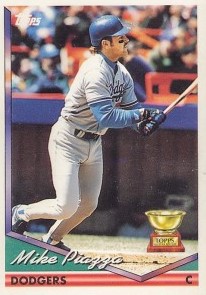
That Increasingly Rare Unicorn – A World Series Complete Game

UNicorn photoThe “prelims” are over and we’ve got our match up for the Main Event – the Astros versus the Nationals in the World Series.  As I contemplate the rosters of this pair of worthy opponents, I am led to wonder if, in the coming days, we will see that increasingly rare “unicorn” – a World Series complete game.  After all, we are looking at some quality starting pitchers in Justin Verlander, Gerrit Cole and Zack Greinke on one hand and Max Scherzer, Stephen Strasburg and Patrick Corbin on the other.  They have six Cy Young Awards among them – and, in 2019, this group won a combined 102 games (just 36 losses), put up a 2.75 earned run average and 1,547 strikeouts in 1,228 innings pitched.

Still, they only tossed a total of three complete games in 2019 (two by Verlander and one by Corbin) and the era of the complete-game pitching performance does seem to have passed us by. If  I had to pick the most likely source for a complete game in the upcoming Series, I go: 1) Justin Verlander (due to his two complete games this past season); 2) any one of the Nationals’ big-three starters (the Nationals’ MLB-worst 5.66 bullpen earned run average provides an incentive to let the starters go long).  Still, I’m not optimistic about a nine-inning outing.

In this post, I’ll take a look at how the World Series has changed when it comes to complete games, as well as at a handful of pitchers who have the distinction of tossing three complete-game victories in a single World Series (under the current best-of-seven format).

But, first, the back story on why Fall Classic complete-games are of notable interest to me.

When the Braves moved from Boston to Milwaukee in 1953, I was a six-year-old Milwaukee native.  My boyhood heroes made it to the World Series against the vaunted Yankees in 1957 – the first World Series I followed with a hometown passion.  The hero of that Braves’ World Series Championship?  Hank Aaron? Eddie Mathews? Warren Spahn? None of the aforementioned.  Or looking to the other dugout, Mickey Mantle, Yogi Berra or Whitey Ford?  Nope. It was Braves right-hander Lew Burdette, who earned three complete-game victories (two shutouts) in the Series – giving up a total of two earned runs in 27 innings.  (More on Burdette later in this post.)

Fast forward to 1965 – and the first World Series I ever attended (Game Six).  I was living in Minnesota by this time and rooting for the Twins to top the Dodgers.  It wasn’t to be.  The Dodger won four games-to-three. Notably, the winning pitcher in each game threw a complete game.  

Now, jump ahead t0 1991, when I was in the stands when Jack Morris threw a ten-inning, complete-game shutout to top the Braves 1-0 in Game Seven – and give the Twins the championship.

So, there’s a bit of an explanation for my “old school” fascination with World Series’ complete-games.

While complete games in the Fall Classic have declined fairly steadily over the decades, the most notable drop began in the 1970.  Consider that:

  • The first World Series without at least one complete game didn’t occur until 1959 – and that was the only World Series without a complete game between 1903 and 1972;
  • Since 1972, we’ve seen 23 World Series that did not have a single complete game;
  • The most recent World Series complete game came on October 28, 2015 – when the Royals’ Johnny Cueto threw a nine-inning two-hitter (one runs, three walks, four strikeouts) in topping the Mets 7-1;
  • Since 1996 (23 World Series, 129 games), there have been just three complete games (remember, old Lew Burdette had that many in one seven-game Series);
  • The percentage of World Series starts ending in a complete game has dropped (by decade) from just over 70 percent in the 1900’s to just over 38 percent in the 1960’s to less than two percent thus far this decade.

WSCG

Now, let’s move on to pitchers who have earned three complete-game victories in a best-of-seven World Series – and a couple of honorable mentions, which I think is better than an asterisk.


—PITCHERS WITH THREE COMPLETE-GAME VICTORIES

IN A BEST-OF-SEVEN WORLD SERIES—

Christy Mathewson, New York Giants … 1905 World Series

cHRISTY Mathewson photo

Photo by trialsanderrors

It makes sense that a big name would head this list.  The first pitcher to record three complete-game wins in a best-of-seven World Series was Hall of Famer Christy Mathewson.

By the time, Mathewson took the mound against the Athletics in the 1905 World Series, he was pretty much already a “Giant” in more ways than one. He had just completed his sixth MLB season (fifth full season) and had a 128-71, 2.08 career record. He had won 30 or more games in each of the past three seasons – leading the NL with 31 wins (9 losses), a 1.28 earned run average, eight shutouts and 206 strikeouts during the 1905 regular season.

All five games of the 1905 World Series featured a shutout by the winning team.

A great season for Mathewson, but even greater things were coming – as Mathewson was about to become the first (and still only) MLB pitcher to throw three complete-game SHUTOUTS in a single World Series.

In Game One (October 9), it was the Giants’ Mathewson versus 24-game winner Eddie Plank (also a future HOFer) in Philadelphia.  Both starters went the distance, with Mathewson tossing a four-hit, no-walk, six-whiff shutout – and Plank giving up three runs on ten hits and two walks.

Game Two (October 10 in New York) ended by the same 3-0 score, this time with the Athletics on top – behind a complete-game, four-hitter from Chief Bender, another future Hall-of-Famer

On October 12, Mathewson was back on the bump for Game Three (in Philadelphia) and cruised to 9-0 win – tossing a second four-hitter (one walk/eight strikeouts), The Athletics left Andy Oakley (18-8, 1.84 on the season) in for the entire nine frames (only three of the nine runs he surrendered were earned, thanks to four Philadelphia errors).

Christy Mathewson played baseball, football and basketball for Bucknell University – and also was in the band, glee club and a pair of literary societies. A well-rounded fellow indeed.

Then it was back to New York for Game Five (October 13). Plank was back on the mound for the Athletics and once again got zero support – losing 1-0 (the only run unearned), as the Giants’ Joe McGinnity (another future Hall-of-Famer (tossed a five-hit shutout).

Mathewson won the final game (October 14) before a home crowd, beating the Athletics 2-0 – and tossing his third shutout in six days, this one a five-hitter (no walks/four strikeouts).

Mathewson went on to a 17-season MLB career, picking up 373 wins (188 losses). He led his league in victories four times and won 20 or more games 13 times (30+ four times). He also led his league in ERA five times; shutouts four times; strikeouts five times; complete games twice; and, retroactively, saves once.

Charles “Babe” Adams, Pittsburgh Pirates …. 1909 World Series

AdamspBabe Adams was still officially a rookie in 1909, when his Pittsburgh Pirates faced off against the Detroit Tigers in the World Series. (In 1906-07, he had appeared in a total of five MLB games – going 0-3, 7.96, with 26 innings pitched.)  

Adams debuted with the Cardinals, but was sold to the Pirates at the end of the 1907 season.  He got in just four games for the Pirates as the season wore down and started (and finished) the 1908 season with the American Association Louisville Colonels. He flourished at Louisville – going 22-12 for the American Association Louisville Colonels in 1908. With Louisville he cemented a reputation for exceptional control, walking just 40 batters in 312 innings.

In 1909, Adams made it back to the big leagues.  In his first full MLB season, he went 12-3, with a 1.11 earned run average in 25 games and 130 innings pitched (12 starts/seven complete games). The 5’ 11”, 185-pound, 27-year-old righty was a surprise starter in Game One of the Series, based on his exceptional control and strong finish to the season. (Moving from primarily a reliever to a starter in late August, Adams’ final eight appearances were starts and he went 4-2 with five complete games and two shutouts.)

In the opening game of the Series (October 8), Adams went the distance, tossing a six-hitter (one run, four walks and two strikeouts, as the Pirates prevailed (in Pittsburgh) 4-1.  The Tigers bounced back to win Game Two (October 9) by a 7-2 score, knocking Pirates’  25-game winner Howie Camnitz out of the game in the third inning.

Moving to Detroit, Pittsburgh won Game Three 8-6 and the Tigers took Game Four 5-0 – knotting the Series at two games apiece.

On October 13, Adams was back on the mound in Pittsburgh. Although not as effective as in Game One, Adams went the distance, giving up four runs (three earned) on six hits, while walking one and fanning eight. It was good enough for the win, as the Pirates plated eight runs.

On July 17, 1914, Babe Adams pitched a 21-inning, complete game – without issuing a single walk.  It remains the longest walk-free complete game ever pitched.  Unfortunately, Adams and his Pirates lost 3-1 to the Giants. Giant’s starter Rube Marquard also went the distance, giving up one run on 15 hits.

Detroit tied the Series at 3-3 with a 5-4 win on October 14, which set the stage for Adams’ best game of the Series.  On October 16, he tossed a six-hit shutout (one walk/one whiff), as Pirates won the game and the Series by an 8-0 score.

Adams went on to a 19-season MLB career – putting up a 194-140, 2.76 record, completing 205 of 354 starts and walking just 430 batters in 2,995 1/3 innings. He won 15 or more games in five seasons and was a twenty-game winner twice.

Adams

Jack Coombs, Philadelphia Athletics … 1910 World Series

Right-handed hurler (and switch-hitter) Jack Coombs was in his fourth MLB season when he picked up three complete-game wins in a single World Series.  And the season itself might have been a bit of a surprise.  Going into the 1910 campaign, the 27-year-old Coombs had a four-season MLB line of 35 wins, 35 losses and a 2.45 ERA.

He put it all together in that 1910 season, leading the AL with 31 wins (nine losses), as well as with 13 shutouts.  He three 35 complete games in 38 starts and had a minuscule 1.30 ERA.

Now, you might have expected Coombs to draw the October 17 start (against the Cubs in Philadelphia) in Game One of the Series, particularly since the Athletics were without veteran started Eddie Plank (arm issues).  Philadelphia chose to go with the more experienced Chief Bender (who himself had gone 23-5, 1.58 on the season) over Coombs – and the decision paid off.  Bender shut down the Chicago squad, giving up one run (unearned) on three hits, with two walks and eight strikeouts.  The following day, Coombs pitched the Athletics to a 9-3 win, giving up three runs on eight hits.  It wasn’t exactly a sterling effort – as he also walked nine and had to pitch out of a lot of trouble.

The problems Coombs faced in Game Two didn’t seem to bother the Athletics, as Coombs was back on the mound (October 20 in Chicago) with just one day’s rest.  It was another rocky – but successful – outing. Coombs surrendered three runs over the first three innings (scored tied at 3-3).  Then the Athletics plated five in the top of the fourth and Coombs settled down. He went the distance again, giving up five runs on seven hits and four walks (eight strikeouts) in a 12-5 Philly victory. In this game, Coombs had three hits and three RBI of his own.

Bender went the distance in a losing effort in Game Four – falling 4-3 in ten innings.

It was back to Coombs for Game Five (October 23 in Chicago) and he finally turned in the kind of performance you’d expect from a pitcher with a season ERA south of 2.00. He gave up just two runs (although he did allow nine hits and a walk) in topping the Cubs 7-2. Notably, it was tense game, standing at 2-1 in Philadelphia’s favor until the Athletics explored for five runs in the top of the eighth.

To top off his three complete-games win, the switch-hitting Coombs went five-for-thirteen (.385) at the plate, with a double and three RBI.

Jack Coombs was an all-around athlete (and scholar). Before going to the major leagues, he earned a degree in chemistry from Colby College – where he was on the baseball, football, track and tennis teams.

Coombs pitched in 14 major league seasons, going 158-110, with a 2.78 ERA. In the three seasons from 1910 through 1912, he won 80 games (31 losses) and put up a 2.64 ERA, A bout with typhoid fever in in 1913 dampened his overall career stats.  (Coombs pitched in only four games in 1913-15 and was 43-44, 3,29 from 1913 until his retirement in 1920.)

Coombs

A Shout Out to a Near-Qualifier

Okay, let’s keep in mind that, from 1903 to the present day, the World Series has been a best-of-seven format in most seasons.  The 1920 World Series, however, was a best-of-nine affair.  Future Hall-of-Famer Stan Coveleski earned complete-game victories (for the Indians over the Brooklyn Robins) in Games One, Four and Seven. However, had the series been a best-of-seven, Game Seven would not have been played (the Indians went into the contest up four games-to-two.)  Still, Coveleski deserve some attention here.,

Coveleski was six seasons into his 14-campaign Hall-of-Fame career when he threw his three complete-game wins in the 1920 World Series. He won 20+ games in each of three previous seasons and had gone 24-12, 2.49 in 1920.

In Game one of the Series (October 5 in Brooklyn), Coveleski earned a victory over Rube Marquard (another future HOFer), by a 3-1 score, tossing a nifty five-hitter (one walk/three strikeouts). Coveleski faced off against the Dodgers Leon Cadore in Game Four (October 9 in Cleveland), with the Indians down two games-to-one. He came through again, giving up just one run (five hits, one walk, four strikeouts) in a complete-game 5-1 win.

Coveleski’s number came up again on October 12 (Game Seven), with the Indians up four games-to-two. This time, he tossed a complete-game, five-hit shutout – topping the Robins and future Hall-of-Famer Burleigh Grimes 3-0.

Coveleski pitched in 14 MLB seasons, going 215-142, 2.89 – winning 20 or more games in five campaigns.,

Lew Burdette, Milwaukee Braves … 1957 World Series

BurdettePPretty much everybody – except those of us in Milwaukee – figured the Yankees would top the Braves in the 1957 World Series.    Consider, as the Series opened, in my lifetime (I was born in 1947), the Yankees had won nine AL pennants and seven World Series championships  in eleven years.  My Milwaukee Braves? They were the recently (1953) relocated Boston Braves. Enough said. It was Beertown versus the Big Apple.  Few prognosticators gave the boys from Sudsville much of a chance.

Prospects looked even dimmer when Braves’ ace (and future HOFer) Warren Spahn (who had led the NL in wins that season with 21 and already had eight seasons of 20 or more victories) lost to the Yankees and (future HOFer) Whitey Ford 3-1 in the opening game (in New York). Game Two matched the Yankees’ Bobby Shantz (11-5, with an AL-best 2.45 ERA) versus the Braves’ Lew Burdette (who had gone 17-9. 3.72 on the season).

Lew Burdette had originally signed with the Yankees and made his debut with the New York club in 1950 – pitching just 1 1/3 innings in two appearances.  Remember the old “Spahn and Sain and pray for rain” refrain for the Boston Braves. Well, Burdette broke that up, being traded from the Yankees to the Braves (along with $50,00) for Johnny Sain in August of 1951.

In Game Two of the Series (October 3), Burdette stifled the Yankee attack, winning 4-2 and pitching a complete game, seven-hitter (three walks/five whiffs). As it turned out that would be the “worst” game of Burdette’s 1957 post-season.

Game Three (October 5) saw the teams move to Milwaukee, where the Yankees pasted the upstart Braves 12-3. Don Larsen got the win, Bob Buhl the loss. Spahn (21-11, 2.69) was matched against Tom Sturdivant (16-6, 2.54) in Game Four (October 6 in Milwaukee). Spahn went the distance in a 7-5 ten inning Braves’ win; with the winning blow a two-run home in the bottom of the tenth by Eddie Mathews.

With the series now tied at two games apiece, Game Five (October 7 in Milwaukee) saw Burdette having to face Yankees’ ace Whitey Ford. It was a duel for the ages. Burdette went the distance in a 1-0 win, giving up just seven Yankee safeties, walking no one and fanning five.  Ford gave up one run on six hits and walk in seven innings – with the only run being scored by Mathews (on a Joe Adcock single in bottom of the sixth).

The Yankees evened the series in Game Six (October 9 in New York), edging the Brave 3-2 – setting up the finale (October 10), with Burdette (on two-day’s rest) facing Larsen. Burdette did not disappoint the Milwaukee fans. He threw his third complete game and second consecutive shutout of the Series – topping the Yankees 5-0 and giving up seven hits and one walk, while fanning three.

Burdette

Burdette enjoyed an 18-season MLB career (203-144, 3.66). He was a two-time All Star and two-time twenty-game winner. He also led his league in wins once, ERA once, complete games once, and shutouts twice. His best season was 1958 (20-10, 2.91) – but his most notable accomplishment was bringing Milwaukee its first World Series Championship.

Bob Gibson, Cardinals, 1967 World Series

GibsonPIt was the year before the Year of the Pitcher, but Bob Gibson was already an imposing presence on the mound – a f0ur-time All Star, with a 125-88, 3.12 record and a reputation for taking no prisoners. Further, despite suffering a broken leg in mid-July that put him out of action until early September, Gibson was the logical choice to start Game One of the 1967 Series.  The fact is, he was tougher after the injury than before. When he went down (it was a Roberto Clemente line drive off his leg), Gibson was 10-6, 3.52. After returning from the fracture, Gibson went 4-1, with a microscopic 0.96 in five September starts. On the season, he was 13-7, 2.98.  He was clearly ready.

Gibson proved his worthiness in Game One (October 4 in Boston), topping Jose Santiago and the Red Sox in a nail-biter.  The final was 2-1 and Gibson threw a complete-game six-hitter, with one walk and ten strikeouts.

Gibson was back on the mound for Game Four (October 8 in St. Louis), with the Cardinals up two games-to-one. (Boston’s Jim Lonborg threw a nifty one-hit shutout in Game Two and the Redbirds came back to win 5-2 in Game Three.) In the fourth game, Gibson followed Lonborg’s lead, tossing complete-game shutout of his own (five hits, one walk, six strikeouts), as the Cardinals prevailed 6-0.

The Red Sox bounced back to win Game Six by an 8-4 score, setting up a match that fans had been waiting for – Gibson versus Lonborg in a winner-take-all Game Seven. Unfortunately, the anticipated pitching duel didn’t materialize.  The Cardinals were up 4-1 after five frames and Gibson coasted to a 7-2 win, tossing his third complete game of the series (three hits, three walks, ten K’s).

Bob Gibson played college basketball for Creighton and spent a season with the Harlem Globetrotter before starting his baseball career.

Gibson made the Hall of Fame after a 17-season MLB career in which he was an All Star nine times and won 20 or more games five times. He led the NL in wins once; ERA once; complete games once; shutouts four times; and strikeouts once.  He ended his career at 251-174, 2.91, with 3,117 strikeouts in 3,884 1/3 innings.

Gibson

In 1968, the Year of the Pitcher, Bob Gibson went 22-9, with an MLB-best 1.12 ERA; MLB-tops 13 complete game shutouts; and an NL-best 268 strikeouts. He was the National League Cy Young Award winner and Most Valuable Player.

In June/July of that season, Gibson started 12 games, completed and won all 12, threw eight shutouts and put up a 0.50 ERA.

Mickey Lolich, Detroit Tigers … 1968 World Series

olichpLike Lew Burdette earlier on this list, Mickey Lolich was not the “ace” of his staff.  For Burdette (in 1957), of course, that was Warren Spahn.  For Lolich, and the 1968 Tigers, that was Denny McLain, who was the Pitcher of the Year in The Year of the Pitcher – going 31-6, 1.96 and winning the AL Cy Young and MVP Awards.  Lolich had been no slouch, going 17-9, 3.19; but clearly, the match up between the Cardinals’ Bob Gibson (who would win the Cy Young and MVP in the National League) and McLain was the pre-series choice as the main attraction.

Gibson got the best of it in Game One, shutting out the Tigers (and beating McLain) in St. Louis by a 4-0 score (October 2). Game Two (October 3) featured Lolich versus the Redbirds’ Nelson Briles (19-11, 2.81) – and Lolich went the distance, throwing a complete-game six-hitter (two walks/nine whiffs) in an 8-1 win.

The Series moved to Detroit with the Cardinals taking Game Two (October 5) and Game Three (October 6) 10-1 in another Gibson/McLain match up.

Down three games to one, The Tigers went back to Lolich (again facing Briles) for Game Five (October 7 in Detroit). Lolich delivered his second complete-game win 5-3 (nine hits, one walk, eight strikeouts.) McLain finally sparkled in Game Six, as the Tigers tied the Series 3- 3 winning 13-1 behind McLain’s complete-game (one-run on nine hits, no walks, with seven strikeouts.)

Lolich got his third start of the Series in Game Seven (October 10 in St. Louis) and had his best outing of the Fall Classic – topping Gibson and the Cardinals 4-1 with a complete game five-hitter.

Lolich

Lolich pitched 16 seasons in the major leagues, going 217-191, 3.44, with 2,832 strikeouts in 3,638 1/3 innings pitched. He was a three-time All Star and won 20+ games in a season twice.  He led his league in wins once, complete games once, innings pitched once and strikeouts once.  In 1971, he went 25-14, 2.92 with an AL-leading 308 strikeouts – but finished second in the Cy Young Award voting to Vida Blue 24-8, 1.92, 301 whiffs.

The 1903 World Series – Sixteen Starts, 13 Complete Games

When the Boston Pilgrims (AL) faced off against the Pittsburgh Pirates (NL) in the first-ever AL/NL World Series, the Fall Classic (not yet a classic) was a best-of nine affair.  That first Series went eight games, with Boston winning five. In the process the MLB, AL and NL records for complete games in a single World Series (of any length) were set.

The Pirates’ Deacon Phillipe (25-9, 2.43) started and completed five games (in ten days), going 3-2, 2.86.  Phillipe still holds the MLB and NL records for complete games in a single World Series. Boston’s Bill Dinneen (21-13, 2.26) set and still holds the AL record with four complete games (in four starts) – going 3-1, 2.06.

Cy Young, by the way, started and completed three games in the Series – going 2-1, 1-85.

Phillipe enjoyed a 13-season MLB career, compiling 189 wins (109 losses) and a 2.59 ERA. He won 20 or more games in five seasons, Dinneen’s MLB career lasted 12 seasons (170-177, 3.01) and he won 20 or more games in four campaigns.

Primary Resources: The World Series, Sports Products, Inc.; Baseball-Reference.com; ESPN.com


BASEBALL ROUNDTABLE ON THE TOP 100 BASEBALL BLOG LIST

100Baseball Roundtable is on the Feedspot list of the Top 100 Baseball Blogs.  To see the full list, click here.

I tweet baseball @DavidBBRT

Follow/Like Baseball Roundtable’s Facebook Page here.  More baseball commentary; blog post notifications; PRIZES.

Member: Society for American Baseball Research (SABR); The Baseball Reliquary; The Negro Leagues Baseball Museum.

Baseball Roundtable 2019 All-Rookie Team … led, of course, by Pete Alonso

There doesn’t seem to be a whole lot of suspense surrounding this year’s MLB Rookie of the Year Awards.  Pete Alonso of the Mets not only set a new rookie record for home runs in a season with 53 long balls, but also led all MLB rookies in runs scored (103) and RBI (120).  Game. Set. Match.

In the AL, Yordan Alvarez of the Astros appears to hold sway, with a .313-27-78 season. His closest competition is likely to come from Eloy Jimenez, who put up a .267-31-79 line.  Alvarez’ .300+ average and the fact that he put up his numbers in 35 fewer games than Jimenez, makes the Astro the favorite.

Given that situation, Baseball Roundtable decided to go a little deeper into the rookie class.  Here is BBRT’s 2019 All-Rookie squad. Spoiler:  If you scroll down to the final members of this squad, you’ll find its oldest and least likely member. Also, for you Minnesota readers, that final selection had deep Minnesota ties (Brainerd High, St. Cloud State and the Twins). 

—–BASEBALL ROUNDTABLE 2019 ALL-ROOKIE TEAM—–

Catcher – Will Smith, Dodgers

The 24-year-old Smith, a first-rounder in the 2016 MLB draft (32nd overall), put a .253-15-42 line in 54 games – and was also solid defensively.  He was called up in late May, hitting .269-3-6 in nine games before being sent back down (late June) to Oklahoma City, where he earned a spot in the Triple-A All Star Game. Smith was called back up in late July and took over the regular catching duties for the post-season-bound Dodgers, hitting .318-9-25 in his first twenty games (after the call up).

Side note.  It has been speculated that the Dodgers are interested in Giants’ reliever Will Smith (6-0, 2.76 with 34 saves).  Now, that’s a battery I’d like to see.  If they were in LA, perhaps actor Will Smith could be in the stands.

Will Smith

Will Smith played college ball at the University of Louisville.  In his final college season (as a Junior), he hit .382-7-43 in 55 games.

First Base, Pete Alonso, Mets

Pete Alonso photo

Photo by slgckgc

The 24-year-old Alonso looks like a power threat (6’ 3”, 240-pounds); and hits like one. He played in 161 games in his rookie campaign.  He used those 161 contests to set a new rookie-season record for home runs with 53; leading all of MLB in 2019 long balls.  Alonso also led all rookies in hits (155), runs scored (103) and RBI (120). He was the only 2019 rookie to reach 100 runs scored, as well as the only 2019 freshman to reach 100 RBI.  In three minor league campaigns, Alonso hit .290-59-203 (255 games).

Freshman seasons seem a charm for Alonso. At the University of Florida, he made the 2014 All-Southeastern Conference Team in his freshman season. He was drafted (Mets) in the second round of the 2016 MLB Draft.


Alonso

With 53 home runs, 30 doubles and two triples, 54.8 percent of all Pete Alonso’s hits were for extra bases – and just over one of every three of his safeties left the ball park.

Second Base, Keston Hiura, Brewers

There was some tough competition among rookies at the keystone sack.  The Twins’ Luis Arreaz showed pure hitting skills – .334 average in 92 games; more walks (36) than strikeouts (29).  The Pirates’ Kelvin Newman showed multiple tools – .303-12-64, with 16 steals in 130 games.  But this spot goes to the Brewers’ 22-year-old second baseman Kelvin Hiura, who played in 84 games and put up a .300+ average (.303); showed the most power of the three contenders (19 home runs); drove in just five fewer runs (in 46 fewer games) than Newman; and flashed some speed (nine steals).

Hiura was a 2017 first-round draft pick out of the University of California, Irvine (ninth pick overall). In three college seasons, he averaged 55 games played, 7.3 home runs, 45 RBI – with a .375 college career average.  In three minor league seasons, he hit .317, with 36 home runs, 122 RBI and 24 steals in 222 games.

Huira Keston Hiura was the 2017 Big West Conference Player of the Year, after hitting .442-8-42, with nine steals in 56 games for U.C. Irvine.

Third Base, Tommy Edman, Cardinals

Edman was a 2016 sixth-round draft pick (Cardinals) out of Stanford – where he hit .281, with four home runs, 71 RBI and 15 stolen bases over three seasons (168) games. In 2017, he played at A, High-A and Double-A, going a combined .261-5-55 with 13 steals (119 games).  Edman found his stroke in 2018, hitting .301-7-41, with 30 steals, at Double- and Triple-A.  The 24-year-old was again a hitting over .300 when called up from Triple-A Memphis in June – and he just kept on hitting (.304) and running (15 steals in 16 attempts) at the major-league level.  He also showed a bit of unexpected power, with 11 home runs in 92 games for the Redbirds.  Edman’s versatility worked in his favor. He appeared at third base, second base and all three outfield spots for the Cardinals.

Edman edged out an early season Rookie of the Year favorite – Vlad Guerrero, Jr., – who went .272-15-69 in 123 games (in a season limited by injuries).  Had he stayed healthy Guerrero might have captured this spot.  It was very close.

Edman

Tommy Edman had a successful year on the base paths in 2019 stealing nine bases in nine tries at Triple-A Memphis and swiping 15 bags in 16 tries for the Cardinals (a combined 96 percent success rate).

Shortstop, Fernando Tatis, Jr. Padres

Tatis was signed, by the ChiSox, as a 2015 International Free Agent (Dominican Republic) – and traded to the Padres before he ever took the field as a pro. (He was only 17 at the time.)  That might have been an “Oops” moment for the White Sox.

Before the 2019 season opened, Tatis was listed as a top-three prospect by MLB Pipeline; ESPN; Baseball America; and Baseball Prospectus.  In four minor league seasons, Tatis hit .280-42-143, with 64 steals (276 games).  After his call up to the Padres – AT JUST 20-YEARS-OLD – Tatis raked at a .317-22-53 pace, with 16 steals (84 games) and played plus defense.  Tatis did have some competition at this spot, the Blue Jays’ Bo Bichette hit .311-11-21 in 46 games – and set a new MLB record by collecting at least one two-base hit in nine straight games (and he set that record in just his 11th MLB game).  Bichette just didn’t have enough games under his belt to unseat Guerrero.

Tatis

Fernando Tatis, Sr. set the bar high.  He is the only player to hit two Grand Slam home runs in one inning (April 23, 1999).  Fernando Tatis (The Elder) had an 11-season MLB career (.265-113-448). His best season was 1999, when he hit .307-34-107 for the Cardinals.  All of Senior’s marks seem well within Junior’s reach (and then some).

Rookleaders

Outfield, Yordan Alvarez, Astros

Alvarez, who defected from Cuba in 2016, was signed by the Dodgers as an International Free Agent that June – and, just two months later, traded to the Astros (for reliever Josh Fields).  Then just 19- years-old, Alvarez immediately showed his potential, hitting .341 with the Dominican Summer League Astros in his first pro assignment.  In four minor league campaigns, Alvarez hit .311, with 56 home runs and 218 RBI in 250 contests.

After his June 9 call up, the 22-year-old Alvarez: homered in his first two games; homered four times in his first five games; drove in 16 runs in his first 12 games; and drove in 51 runs in his first 45 games.  After his first dozen major league games, his stat line was .333-7-16, with 12 runs scored. Alvarez ended the season at .313-27-78 in just 87 games.  He’s the cream of the rookie outfield crop.

AlvarezAt the time of 2019 MLB call up, Yordan Alvarez was hitting .343-23-71 with the Pacific Coast League (Triple-A) Round Rock Express (56 games).   He also had a solid walks-to-strikeouts ratio (38 walks/50 whiffs).

Outfield, Eloy Jimenez, White Sox

Jimenez was signed in 2013 (out of the Dominican Republic) as an International Free Agent – and traded to the White Sox in July of 2017 – a great power pickup for the ChiSox.  In four seasons in the Cubs’ system, Jimenez hit .297, with just 24 home runs and 141 RBI (211) games, but his final season as a Cub farmhand (2016) showed his potential, as the then 19-year-old hit .329-14-81 in 112 games at A-Level South Bend (Midwest League).  That potential was not lost on the crosstown White Sox.

As a White Sox farmhand, Jimenez went .312-19-65 in 89 games at A and Double-A in 2017; and .337-22-75 in 108 games at Double- and Triple-A in 2018. In his rookie MLB season, the 22-year-old popped 31 home runs and drove in 79 tallies in 122 games.  His average was only .267, but history seems to point to better things to come in that department.

Jimenez

Eloy Jimenez’ 31 home runs led all American League Rookies, as did his 79 RBI.

Outfield, Bryan Reynolds, Pirates

Reynolds was a 2016 second-round draft pick (Giants) out of Vanderbilt; where he hit .329-22-159, with 39 steals over three seasons (206 games). In January 2018, he was included in the trade to the Pirates that brought Andrew McCutchen to San Francisco.  In two minor league seasons in the Giants’ system, Reynolds had gone .312-16-101 in 177 games.  He kept on hitting in the Pirates’ farm system and earned his way to the big club in 2019 – where the 24-year-old went .314-16-68 in 134 games – and spent much of the season as part of the NL batting race.

Reynolds

Bryan Reynolds started his MLB career with an eleven-game hitting streak. Over the course of the streak, he went 15-for-36 (.417), with six doubles and a home run.

BBRT Note:  I’m not selecting a DH – these players are too young to DH (just my opinion). If you want one. however, feel free to choose from Louis Arreaz, Kelvin Newman, Vlad Guerrero, Jr. or Bo Bichette (all mentioned in the position-player text above).

Starting Pitcher, Mike Soroka, Braves

Soroka was drafted by the Braves (out of Bishop Carroll High School) in the first round of the 2015 Amateur Draft.  As a 17-year-old, he went 0-2, with a solid 3.18 ERA at the Rookie-League Level. The following year he went 9-9, 3.02 at A-Level.  Moving up consistently, 2017 saw Soroka going 1-8, 2.75 at Double-A. In 2018, in a season interrupted by shoulder issues, he went 2-1, 1.76 at A and Triple-A – and earned a late season call up to the Braves (where he went 2-1, 3.51 in five starts).

In 2019, Soroka went 13-4, 2.68 ion 29 starts for the Braves – fanning 142 batters (41 walks) in 174 2/3 innings.

Dakota Hudson deserves a shout out here. The 24-year-old Cardinals’ rookie led all rookie hurlers with 16 wins (seven losses), but his overall numbers (3.35 ERA, six fewer strikeouts and 45 more walks than Soroka in the same number of innings) left him as runner-up.

Soroka

Rookie Mike Soroka made the 2019 National League All Star Team. He was 9-1, 2.42 at the break.

Relief Pitcher, Nick Anderson, Marlins/Rays

Ah, for BBRT’s Minnesota readers, the choice for rookie reliever played for Brainerd (MN) High School and St. Cloud (MN) State University – before transferring to Mayville State University (ND) for his senior season (in which he went 5-2, 1.95).

Nick Anderson is the oldest (28) and most surprising member of the BBRT All-Rookie Team.

Anderson was selected by the Brewers in the 32nd round of the 2012 MLB draft, but did not sign. Instead, he decided to play in the Independent Leagues.  Things did not start out very promising.  In two seasons (2012-13) for the Rockford Riverhawks of the Frontier league, he went 6-14, 6.78  as a starter. Then, in 2015, as a reliever with the Frontier League Frontier Greys, he put up a 0.65 ERA over 25 appearance.  He signed with the Minnesota Twins in August of 2015 and got in nine games at Cedar Rapids of the A-Level Midwest League, putting up a 0.75 ERA, saving four games and fanning 12 batters (no walks) in 12 innings.

In  2016, he continued to show his stuff – going 4-3, 2.65, with 13 saves and 75 whiffs in 57 2/3 innings at A and High-A.  In 2017, Anderson moved up and went 4-1, 1.00, with 57 strikeouts in 54 innings at High-A and Double-A.  In 2018, it was another step up – to Triple-A, where he went 8-2, 3.30 with 88 strikeouts in 60 innings.

In November 2018, The Twins traded Anderson to the Marlins (for minor-league infielder Brian Schales), which proved a fortunate transaction for Anderson (the Marlins put him on their 40-man MLB roster and he made the team out of Spring Training).  Anderson pitched well for Miami; 2-4, 3.92, with one save in 45 games (69 strikeouts in 43 2.3 innings).  However,  the best was yet to come. Traded to the Marlins at the July 31 deadline, he went 3-2.11 in 23 appearances for the Wild-Card bound Rays. Now it’s a long way from struggling as a starter in the Independent Leagues to taking the mound in the MLB post-season, but Anderson made the journey. He pitched a scoreless 1 1/3 innings (one hit, four strikeouts) in the AL Wild Card Game and made three appearances in the AL Championship Series  (4 1/3 innings, four hits, one run, four K’s).

Anderson

While pitching for the Rays in their drive for a post-season spot, Nick Anderson fanned 41 batters and walked just two in 21 1/3 innings (2.11 ERA, three wins and no losses).

Primary Resources: Baseball-Reference.com; ESPN.com; MLB.com


BASEBALL ROUNDTABLE ON THE TOP 100 BASEBALL BLOG LIST

100Baseball Roundtable is on the Feedspot list of the Top 100 Baseball Blogs.  To see the full list, click here.

I tweet baseball @DavidBBRT

Follow/Like Baseball Roundtable’s Facebook Page here.  More baseball commentary; blog post notifications; PRIZES.

Member: Society for American Baseball Research (SABR); The Baseball Reliquary; The Negro Leagues Baseball Museum.
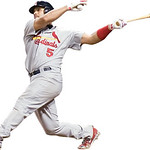
59 Years Ago Today – A Shocker on Baseball’s Biggest Stage

Today (October 13, 2010) marks the 59th anniversary of one of the most exciting World Series games of all time – the Pittsburgh Pirates 10-9, Game-Seven win over the New York Yankees.  It was a victory that got the decade of the sixties off to a great start for me.

HRDLet me set the stage.  There were only 16 major league teams.  If you didn’t finish with ‘the best record in your league, you didn’t get even the slightest taste of the post-season. No one had ever heard of the designated hitter, the wild card, WAR or even WHIP. (For that matter, no one had ever seen a computer mouse, a Ford Mustang, an Etch-A-Sketch or Star Trek – or listened to a Beatles record.)   The news was headed by the Cold War, Space Race, Kennedy-Nixon Debates, Civil Right Movement, Sexual Revolution and Year of Africa. Gunsmoke, Wagon Train and Have Gun Will Travel were the top three TV shows and Home Run Derby was a TV-must in our house – with power hitters, in black-and-white, pairing off at Wrigley Field in Los Angeles.

Roger Maris photo

Roger Maris Photo by rchdj10

Babe Ruth still held the MLB single-season home run record – and Roger Maris was about to collect his first AL MVP Award (earned in his first year as a Yankee; after being traded from the Kansas City Athletics).  Ted Williams had just finished his career with a home run in his last at bat, Brooks Robinson was about to collect his first Gold Glove. MLB held two All Star Games. The White Sox had become the first team to put players’ names on uniforms. That season, Warren Spahn had thrown his first no-hitter at age 39 (and won a league-leading 21 games) and 22-year-old Juan Marichal had tossed a one-hitter in his major league debut.

The Pirates’ Dick Groat won the NL batting title and would be named the NL MVP.  Mickey Mantle had led the AL in home runs, Roger Maris in RBIs, Pete Runnels in batting average and Minnie Minoso in base hits.   In the NL, Ernie Banks won the home run crown, Hank Aaron the RBI title and Willie Mays topped the senior circuit in hits.   Don Drysdale and Sandy Koufax finished one-two in the NL strikeout race, while Jim Bunning topped the AL.   Lindy McDaniel of the Cardinals set a new record with 26 saves, while the Tigers’ Frank Lary’s 15 complete games were the lowest ever to lead either league.

This is Getting A Little Old … For the Rest of Us

Going into the 1960 World Series, the Yankees had played in eight of the Worlds Series held in the decade of the 1950’s – winning six of them.  The Pirates had last appeared in the Fall Classic in 1927 and last won it in 1925. 

I was thirteen and an avid baseball fan.  The Game of the Week, the radio – especially the radio – and an occasional trip to the ballpark were my tickets to the national past time.

At the time, the Yankees were baseball’s dynasty.  Since my birth in 1947, the Bronx Bombers had been to 11 World Series (including the 1960 Series, yet to be played) and had won eight World Championships.  Fans from pretty much everywhere but New York had made Yankee-hating a tradition.  I was no exception.  Milwaukee-born, I was a steadfast Braves fan, still smarting from the Yankees’ 1958 World Series comeback, when they downed my Braves after trailing three games to one. The Yankees were in the 1960 Series – and I had an emotional interest in seeing them lose.

StanMusialBeing of Polish descent, I also took pride in the fact the great Stan Musial was Polish and wondered why Milwaukee-born Hall of Famer Al Simmons had changed his name from Al Symanski.  I was a fan of the sleeveless power hitter Ted Kluszewski, regretted that Tony Kubek (also of Polish descent) played for the Yankees, was rooting for the Pirates’ Bill Mazeroski.  I also was firm in my belief that Steve Dalkowski threw that fastest fastball ever … you can look it up.

Put all of this together and you can see why I looked to the 1960 World Series with excitement – and why I was rooting for the underdog Pirates.

The prognosticators predicted a Yankee win in five or six games.  They pointed out that the Yankees, with a 97-57 record (the Pirates were 95-59-1) came into the Series with the momentum of a 15-game, season-closing winning streak, while the Pirates lost four of their final seven.  They also lauded the Yankees’ post-season experience and heralded the Yankees power (the Yankees led the AL with a record 193 home runs and 746 runs scored, while the Pirates led the NL with 734 runs scored, but only 120 round trippers). The Yankees’ Game-One starting lineup had belted 152 regular season homers to 98 for the Pirates’ starters.  When it came to mound work, things appeared more balanced, maybe even a shade in favor of the Pirates.  While the Yankees’ 3.52 ERA was the lowest in the AL, the Pirates’ NL third-best ERA (at 3.49) slightly bettered the Bombers’ mark.  The Pirates did have the clear advantage in strikeouts (811-712) and fewest walks allowed (an NL low of 386 to an AL worst 609 for the Yankees). They also boasted twenty-game winner Vernon Law (20-9, 3.08), backed up by Bob Friend (18-12, 3.00), while no Yankee starter had topped 15 wins.  The top relievers for the two teams were Elroy Face, with 24 saves for Pittsburgh and Bobby Shantz, who saved 11 for the Yanks.

To the surprise of many fans (and analysts), the Series was tied after six games – despite the fact that the Bronx Bombers had outscored the Pirates 46 to 17, outhit them 78 to 49 and out-homered them 8 to 1.  (The Yankees had won Game Two 16-3, Game Three 10-0 and Game Six 12-0.  The Pirates had prevailed in Game One 6-4, Game Four 3-2 and Game Five 5-2).

Then came Game Seven – 60 year ago today – in Pittsburgh.  Here’s how it went down.

The Pirates were started Vernon Law, 20-9, 3.08 on the season and the winner of Games One and Four.  The Yankees countered with Bob Turley, 9-3, 3.27 on the season.  Turley had won Game Two, despite giving up 13 hits and three walks in 8 1/3 innings.  The Pirates had their top left-handed hitter, Bob Skinner (injured in Game One), back at the number-three spot in the order, while the Yankees were missing Elston Howard (broken finger, Game Six).  An upset did seem possible.

The Yanks went meekly in the top of the first inning (liner, popup, foul out), and the Pirates, homer-less since a Bill Mazeroski blast in Game One, got a two-run homer from Rocky Nelson (whom Manager Gene Murtaugh chose to start at first base over regular Dick Stuart).

In the second inning, Law set the heart of the Yankees down in order – Mickey Mantle, fly to center; Yogi Berra, grounder to third; Moose Skowron, grounder to short.  In the bottom of the inning, manager Casey Stengel appeared to put his managerial position in further jeopardy.  Smoky Burgess started the inning with a single and Stengel immediately pulled Turley in favor of the rookie Bill Stafford (who had stifled the Pirates for five innings in Game Five).  The move did not pay off.  Stafford walked third baseman Don Hoak and Mazeroski beat out a bunt single.  Law was now at the plate (the Pirates’ pitcher was two for four, with a double, run scored and RBI in Games One and Four).  Law hit back to Stafford for a pitcher-to home-to first double play, but center-fielder/lead-off hitter Bill Virdon followed with a two-run single and a 4-0 Pirates lead.

Casey Stengel, despite ten pennants and seven World Series titles in 12 seasons as manager of the Bronx Bombers, was fired by the Yankees five days after the 1960 Game Seven loss to the Pirates. 

Law handcuffed the Yankees through four innings, giving up only two singles.  In the fifth, Yankee first sacker Skowron made the score 3-1 with a lead-off homer just inside the right field foul pole.  Law did not let the round tripper upset him, retiring Johnny Blanchard, Clete Boyer and Bobby Shantz (who came on to pitch for New York in the third) in order.

The Yankees closed the gap – and then some – in the top of the sixth.  The pesky Bobby Richardson (who already had nine hits in the series) led off with a single to center, and Tony Kubek followed with a walk.  With the Bombers appearing on the verge of a rally, Murtaugh replaced Law (who, it turns out had been pitching on a sore ankle throughout the Series) with his top reliever Elroy Face.   Face got Roger Maris on a foul pop to Don Hoak at third base, but Mickey Mantle followed with a “seeing eye” single up the middle, scoring Richardson. Yogi Berra followed with an upper deck home run (like Skowron’s just inside the right field foul pole) to give New York a 5-4 lead in what was shaping up to be a Game Seven nail-biter.

The veteran Bobby Shantz, meanwhile, was baffling the Pirates – giving up only a single and a walk from the third to the seventh innings.

In the top of the eighth, the Yankees seemed to dash the Pirates’ upset hopes – using a walk, two singles and a double to produce two more runs and a 7-4 lead.   Notably, Stengel’s pitching decisions again came into play.  He let Shantz bat with two out and runners at second and third (Boyer and Skowron) and a chance to extend the Yankee lead.  Shantz flied out and the living-room and press-box managers were quick to point out:  1) the lost scoring opportunity; 2) the fact that Stengel left Shantz in for a sixth inning of work, despite the fact that Shantz had not gone more than four innings in the regular season.

So, that was the situation as the game went into the bottom of the eighth – when the Pirates (and Forbes Field) proved they still has some life left in them.  Gino Cimoli pinch hit for Face and stroked a single to right-center field.  Shantz, who had already induced two double plays appeared to have worked his magic again, as Bill Virdon hit a hard ground ball right at shortstop Tony Kubek.  Just as Kubek was ready to field the ball and begin the sure double play, it appeared to hit a pebble (the Yankees had already been critical of the condition of the Forbes Field infield) and ricocheted into Kubek’s throat.  Kubek went down, gasping for air and spitting up blood, with his windpipe rapidly swelling (doctors on the scene at first thought an emergency tracheotomy might be necessary).  The end result?  Kubek sent to the hospital and replaced by Joe DeMaestri and the Pirates with two on and no outs, instead of none on and two outs.

Pirates’ shortstop Dick Groat took advantage of Kubek’s mishap and lined singled to left, scoring Cimoli.  Stengel came to the mound and replaced Shantz with right-hander Jim Coates (despite the fact that lefty Bill Skinner was coming to the plate).  The righty-lefty match-up made little difference, as Skinner sacrificed the runners up one base.  Next was Rocky Nelson, who flied out to medium right, with the Pirates choosing not to test Roger Maris’ powerful arm.   So, two outs, two on and the Yankees still in front 7-5.   That brought up the Pirates’ best hitter, right-fielder Roberto Clemente, who had been held hitless in his first three at-bats. Coates made a good pitch, getting Clemente to hit a weak ground ball toward first.   A hustling Clemente beat both Coates and Skowron’s throw to the bag, while Virdon scored and Groat moved to third.  Now, 7-6 and the Pirates still had life.

Trivia Tidbit:  The seventh game of the 1960 Series is the only World Series game in which neither team recorded a strikeout.

That brought up backup catcher Hall Smith (who had come into the game in the eighth after Joe Christopher ran for starting catcher Smoky Burgess in the bottom of the seventh).   Smith took a 2-2 Coates’ pitch over the left-field wall for a 9-7 Pittsburgh lead.  The Pirates, with only one round tripper in the first six games had homered twice for five runs in Game Seven.

To protect the lead in the ninth (and with Elroy Face already out of the game), Pirates’ Manager Danny Murtaugh called on starter Bob Friend, who had lost Games Two and Six, giving up seven earned runs in six innings (and had pitched in relief only once all season).  Yankee lead off hitter Bobby Richardson started off the ninth with a single to left.  Veteran and former-Pirate Dale Long, pinch hitting for Joe DeMaestri (who had replaced the injured Kubek) singled to right and Friend was gone, replaced by Game Five starter Harvey Haddix.  Haddix got Roger Maris on a foul out, but Mickey Mantle drove in Richardson with a single to right center.   Yogi Berra followed with a ground ball down the first base line.  Rocky Nelson made a nice backhanded stop, but was out of position for a first-to second-to first, game-ending double play.   Nelson took the sure out, stepping on the first base bag and retiring Berra, while Gil McDougald (pinch running for Long) headed toward home.  It was at this point that Nelson realized Mantle had not run to second.  Mantle, sizing up the situation, was returning to first (with the force at second now off). It was an unorthodox base-running move, but as Mantle dove head first back to the bag (avoiding Nelson’s desperate attempt to tag him), McDougald scored the tying run.  Skowron then grounded out to Mazeroski (forcing Mantle) to end the inning in a 9-9 tie.

Mazeroski's 1960 home run trot immortalized at PNC Park.

Mazeroski’s 1960 home run trot immortalized at PNC Park.

Stengel, like Murtaugh, was now using starters in relief, bringing Game Four-loser Ralph Terry in to pitch the ninth.  Number-eight hitter Bill Mazeroski led off the inning.  Terry’s first pitch was a high and inside fastball.  The second pitch, another fastball, was in the strike zone and Mazeroski deposited it over the 406-foot marker in left center.  Not sure the ball would carry out in the deep part of the park, Mazeroski ran full speed with his head down to first and toward second, before seeing the umpire making the circular home run signal.  Mazeroski removed his helmet, waving his way to home plate where his team mates awaited the first player in major league history to end the World Series with a walk-off home run.


maz3


When the Series was over, the Pirates were World Series Champs,

but you could never tell by the stat line.

The Yankees scored a Series’ record 55 runs to 27 for the Pirates,

The Yankees collected a Series’ record 91 hits to 60 for the Pirates.

The Yankees hit a Series record .338 to .256 for the Pirates

The Yankees collected a Series’ record 27 extra base hits to 15 for the Pirates.

The Yankees out-homered the Pirates 10-4.

The Yankees’ pitchers put up a 3.54 ERA to 7.11 for the Pirates.

Bobby Richardson of the losing Yankee squad won the Series MVP award, hitting .367 with a Series’ record 12 RBI.

Primary Resources:  Baseball-Reference.com; Chronicle of the 20th Century (Chronicle Publications). 

BASEBALL ROUNDTABLE ON THE TOP 100 BASEBALL BLOG LIST

100Baseball Roundtable is on the Feedspot list of the Top 100 Baseball Blogs.  To see the full list, click here.

I tweet baseball @DavidBBRT

Follow/Like Baseball Roundtable’s Facebook Page here.  More baseball commentary; blog post notifications; PRIZES.

Member: Society for American Baseball Research (SABR); The Baseball Reliquary; The Negro Leagues Baseball Museum.
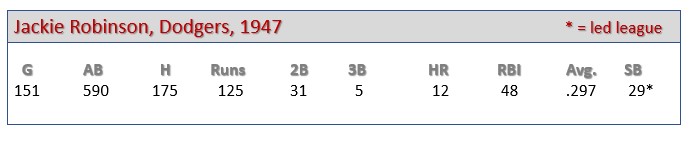
Baseball Roundtable September and Season-End Wrap Up. Lots of Whacks, Whiffs and Records.
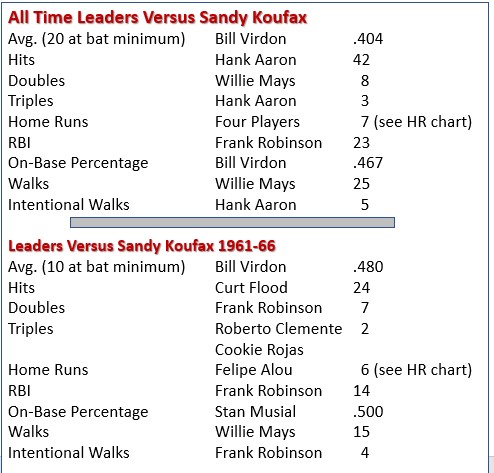
It’s October 1, and that means it’s time not only for the opening of post-season baseball, but also for Baseball Roundtable’s look back at the previous month – the standings, statistics and stories that caught BBRT’s eye, as well as the BBRT Players and Pitchers of the Month and season-to-date “Trot Index.”  This month, if you make it to the end of this post, you’ll also find BBRT’s predictions for the post season.  (Note: I guess I could have posted this September 30, but the first of the following month is kind of a BBRT tradition.)

Of course, for many teams, the final day (September 29) of the 2019 regular season was anti-climactic. All the post-season spots were clinched and only one division title was up for grabs – the Brewers came into the final day just one game behind the Cardinals.  A Redbirds’ loss and Brew Crew win would set up a “Game 163,” with the winner taking the NL Central and the loser playing the Nationals in the Wild Card game. The Cardinals relieved fans of the suspense with a 9-0 thrashing of the Cubs, while the Brewers bowed out with a 4-3, 12-inning loss at Colorado.

Before BBRT gets into September stats and stories, I’d like to comment on another race I watched with some interest on the final day of the regular season – the race for MLB’s all-time, single-season, team home-run crown.

YOU HAD TO “C” THIS ONE

Jason Castro - hit the record-setting "Bomba."

Jason Castro – hit the record-setting “Bomba.”

Coming into the season’s final day the Yankees and Twins had both won more than 100 games, clinched their division titles and hit more than 300 2019 home runs.  (The previous single-season record was 267 homers – 2018 Yankees.) As play started September 29 (Twins at Royals/Yankees at Rangers), New York’s Bronx Bombers had 305 home runs, while Minnesota’s Bomba-Squad had 304. Many of us here in Minnesota, stung by a history of post-season losses to the Yankees, really wanted that long-ball record.

Well, the Yankees popped just one home run (Aaron Judge) in a 6-1 loss at Texas.  The Twins launched a trio of dingers, to take the record 307-306.  Why the “You Had To C This   One” title?  Well, a lot of T.C. fans traveled to K.C. to C this final game.  It turns out, all three Twins; home runs were hit by players whose last name started with a “C” – C.J. Cron; Jake Cave; and Jason Castro (who hit the record-setter).  Ironically, Minnesota’s most-prolific 2019 home run bat, belonging to Nelson “last name begins with a C” Cruz was on the bench.  In another bit of irony, at least to BBRT, it was the first home run this September for Cron, Cave and Castro.   C U this Friday, Yankees.

Now, here’s just a few September highlights.  You’ll find details on these and other “events” that caught BBRT’s eye in the “Highlights” section of this post.  In September, we saw:

  • The Mets’ 24-year-old rookie Pedro Alonso popping an MLB-best 11 September home runs;  leading all major leaguers with 53 home runs for the season – setting a new MLB rookie round tripper record;
  • The Astros’ Justin Verlander opening the month with his third career no-hitter;
  • A second Biggio (Cavan) hitting for the cycle and a new Yastrzemski (Mike) homering in Fenway Park;

In 2019, MLB strikeouts reached a new record (42,823) for  the 12th consecutive season. 

  • One player (Yoan Moncada) hitting 400+ for the month;
  • The Arizona Diamondbacks winning a ball game, despite having only one base runner over nine innings;

In 2019 the Astros waved zero – that’s zero – batters to first.   That’s right, not a single intentional walk. The MLB team average for the season was 25 IBB – and the second-lowest total was ten (Twins). 

  • Two teams (Twins and Yankees) becoming the first MLB teams to reach 300 home runs in a season;
  • Two teams using a combined (record) 25 pitchers in a game;
  • Four teams reaching 100 wins on the season – coincidentally, the four teams who also surpassed the previous record for home runs in a season;
  • Two pitchers (the Astros’ Gerrit Cole and Justin Verlander) on the same team reaching 300 strikeouts in the season for only the second time in MLB history.

In 2019, as home run records fell like overripe apples from a tree, not only did MLB reach a record 6,776 home runs (breaking the old record by 671 dingers), but four teams exceeded the old MLB team single-season record (the Twins exceeded the old mark by 40) and a total of 14 teams set new franchise records for home runs in a season.  In addition, we saw new MLB single-season records for the most players on a team with at least thirty home runs (five-Twins); most with at least 20 home runs (eight-Twins); and most with at least  ten  or more home runs (14-Yankees).  Of course, there are two sides to this story.  the Orioles gave up almost as many home runs as the Twins hit (setting a new record for home runs surrendered in as season at 305). 

Let’s move on to a regular feature of these Wrap Ups.

—–BASEBALL ROUNDTABLE PLAYERS AND PITCHERS OF THE MONTH—-

American League Player of the Month – Eloy Jimenez, LF, Chicago White Sox

Photo by mwlguide

Photo by mwlguide

Eloy (I always want to add an “r” to his name) Jimenez was a force for the ChiSox in September – hitting .340, finishing fourth in AL September home runs with nine (one behind the three leaders) and tying for the AL lead in RBI with 25.  The 22-year-old rookie also scored 19 runs. Jimenez, who came into September hitting just .247 (with power), notched ten multi-hit games over the month and raised his average 20 points.  He finished the season at .267-31-79.  Jimenez’ September surge was not totally unexpected. In six minor league campaigns, he hit .311, with 66 home runs in 413 games.

Other Contenders: BBRT also considered another young White Sox hitter, 24-year-old 3B Yoan Moncada, the only MLB player (with at least 75 at bats) to hit over .400 for September.  Moncada hit .412, led all of MLB with 42 September hits, scored 21 runs, hit three homers and drove in 15/  Also in the running was A’s SS Marcus Semien, who hit .347, with eight home runs, 19 RBI and an MLB-best 25 September runs scored.  BBRT also gives a shout out to the Royals’ Jorge Soler, who hit .330-10-20 in September, and ended up being the first Royal to lead the league in home runs, with 48 on the season.
American League Pitcher of the Month – Gerrit Cole, RHP, Astros

Gerrit Cole photo

Photo by boomer-44

Gerrit Cole had the AL’s second-lowest September ERA at 1.07 (among pitchers with at least 25 innings pitched). Cole also tied for the MLB lead in wins for the month, going 5-0 in six starts, and fanned an MLB-best 74 batters in 42 innings (seven walks).

Other Contenders: Right behind Gerrit Cole was his Astros’ teammate Justin Verlander, who also won five September games (one loss) in six starts, put up a 2.08 ERA and fanned the MLB’s second-most batters (57 in 39 innings). BBRT also recognizes the Yankees’ James Paxton, who went 4-0 in five starts with a minuscule 1.05 ERA.


Surprise Player of the Month – Austin Meadows, OF, Rays

Really, there were several positive surprises in September. (See Jack Flaherty, BBRT’s NL Pitcher of the Month, or the A’s Marcus Semien, in the running for BBRT AL Player of the Month.)  BBRT will give September’s “Surprise” recognition to the Rays’ 24-year-old, southpaw-swinging outfielder Austin Meadows, who came into September hitting .273 (with 24 home runs and 69 RBI).  In September, Meadows hit at a .378 pace (second-best in MLB among players with 75 September at bats), with nine home runs (tied for MLB’s sixth-most), 20 RBI (tied for tenth), and 24 runs scored (tied for second). In addition, he walked 15 times (versus just 16 strikeouts); putting up a September on-base percentage of .472 (second only to the Astros’ Alex Bregman). Meadows played in 24 games, hit safely in all but one and had ten multi-hit contests.

National League Player of the Month – (Tie) Reds’ 3B Eugenio Suarez and Dodgers’ SS Corey Seager

Eugenio Suarez photo

Photo by haydenschiff

Eugenio Suarez rapped ten September home runs (second only to the Mets’ Pete Alonso’s 11), while hitting .337, with 20 RBI. He had ten multi-hit games during the month. He ended the season at .271-49-103.

Cody Bellinger brought superior defense and infield power to the Dodgers, hitting.291, with seven homers and MLB’s highest RBI total for the month (26). Bellinger really turned it up a notch in September.  It was his highest month of the season in terms of both home runs and RBI.

Other Contenders: Mets’ rookie 1B Pete Alonso led the majors with 11 September home runs (on his way to a new rookie-season record of 53), but was held back by a .245 average and just 19 September RBI. Cardinals’ 3B Tommy Edman hit .350-6-14, with 22 runs scored.

National League Pitcher of the Month – Jack Flaherty, RHP, Cardinals

As the Cardinals held off the Brewers for the NL Central title down the stretch, Flaherty was “The Man.” The 23-year-old went 3-1 in six starts and led MLB in September earned run average (among pitchers with at least 25 innings pitched) at 0.82, WHIP (0.57) and innings pitched (44). He also led the NL in strikeouts fopr the month (and was third in MLB) with 53, while walking just eight batters. In his six September starts, Flaherty went seven or eight innings in five (giving up just one earned run in those 38 innings.  His only September loss came in a six-inning effort in which he gave up three runs in six frames, while fanning ten. This was a pretty easy pick.

Other Contenders: It seems like the Mets’ Jacob deGrom is always in the running.  This September, he went 3-0, 1.29 in five starts, fanning 41 batters (five walks) in 35 innings. BBRT also considered the Braves’ Mike Foltynewicz, who won four September games (one loss) and had a nifty 1.50 ERA for the month. A nod also goes to the Cardinals’ Adam Wainwright, the only NL pitcher to win five September games (5-1, 2.97 in six starts). Giving relievers a little love, the Brewers went 20-7 in September thanks in great part to Josh Hader’s MLB-topping ten September saves.  Hader put up a 1.88 ERA and fanned 27 batters in 14 1/3 innings.

TROT INDEX … A REGULAR BBRT FEATURE

For the 2019 season,  36.2 percent of MLB’s 186,517 plate appearances ended in a trot (back to the dugout, around the bases, to first base). We’re talking about strikeouts, home runs, walks, hit by pitch and catcher’s interference – all outcomes that are, basically, devoid of action on the base paths or in the field. Here’s the breakout: strikeouts (23.0%); walks (8.5%); home runs (3.6%); HBP (1.1%); catcher’s interference (less than 1%). Personally, I’d like more action in the field of play.

For the 2018 season, 34.8 percent of all MLB’s 185,139 plate appearances ended in a trot.  Bonus Trivia: According to MLB, in 2019, the average time of an MLB game was a record three hours-five minutes-35 seconds.  

_________________________________________________________________

Septemberwl

—–The Best and Worst of Teams—–

NL’s Best

No team won more games in September than the Brewers, who went 20-7. The Brewers failed to chase down the Cardinals for the Central Division title, but did manage to move passed the Phillies, Cubs and Diamondbacks into a Wild Card spot.  Milwaukee leveraged solid pitching (MLB’s lowest September ERA at 3.01) and a steady offense (the NL’s fifth-most September runs scored) into 20 victories.  Key contributors on the mound included: Jordan Lyles (3-0, 2.39 in five starts); Zach Davies (2-0, 2.31 in five starts); and Chase Anderson (2-0, 2.35 in five starts).  We also can’t forget Gio Gonzalez.  He may have gone just 1-0 in September (four starts and two relief appearances), but put up a 1.17 ERA and saw the Brewers win five of the six games in which he appeared. The Brew Crew also got solid performance out of the bullpen, led by Josh Hader’s ten saves and 1.88 ERA and Drew Pomeranz’ two saves and seven holds in 14 appearances (2.03 ERA).

AL’s Best

Over in the NL, best-of-the-best recognition goes to the Houston Astros (19-6), who dominated nearly all September statistical categories.  On the mound, they had the AL’s  lowest ERA, highest number of strikeouts, fewest walks and most saves.  At the plate, they were the AL’s September leaders in runs scored and home runs – and had the fewest batters’ strikeouts.  Key contributors? There were many. On the bump: Gerrit Cole went 5-0, 1.07 in six starts; Justin Verlander was 5-1, 2.08 in six starts; Zack Greinke was 4-1, 2.59 in five starts; and Roberto Osuna saved seven games (eight opportunities) and put up a 0.79 ERA.  Keys to the well-balanced offense included: George Springer, who hit .275, with ten homers and 19 RBI; Alex Bregman, who went .333-9-18; Yordan Alvarez, who was .296-6-16;  Josh Reddick at .338-4-12; and Jose Altuve at at .278-6-13.

Other teams putting up solid September performance included: Dodgers (18-6); Twins (18-9); and A’s (18-8).  All these squads are, of course, in the post-season.

How about the worst September results? The Padres, Angels, Tigers, Orioles and Marlins all won fewer than ten September games.

______________________________________________

—LEAGUE LEADERS – TEAMS – MONTH OF SEPTEMBER 2019—-

RUNS SCORED … MLB Team Average – 122

AL: Astros (154); Yankees (146); A’s (143)

NL: Nationals (153); Cubs (150); Mets (140); Cardinals (140)

The Angels scored the fewest September runs at 82, while the Giants were at the bottom of the NL, plating just 83 runners.

BATTING AVERAGE … MLB Team Average – .244

AL: White Sox (.290); Royals (.268); Astros (.266)

NL: Nationals (.268); Cubs (.257); Pirates (.255)

Four teams hit under .220 for the month: Padres (.214); Mariners (.219); Giants (.219); and Angels (.219). 

HOME RUNS … MLB Team Average – 36

AL:  Astros (58); Yankees (52); A’s (42)

NL: Mets (50); Phillies (46); Dodgers (45)

At the bottom of the power list were the Pirates (14 home runs); Giants (19); Diamondbacks (22); and Tigers (23).

SLUGGING PERCENTAGE … MLB Team Average –  .422

AL:  Astros (.530); Yankees (.491); White Sox (.485)

NL: Mets (.474); Dodgers (.466); Cubs (.461)

The Astros collected an MLB-high 112 extra-base hits in September – while the Giants had an MLB-low of exactly half that many (56).

STOLEN BASES … MLB Team Average – 13

AL:  Rangers (26); Royals (19); Mariners (18)

NL: Cardinals (27); Rockies (22); Nationals (19); Phillies (19)

The Twins stole an MLB-low two bases in September (only three tries). Notably, the Phillies stole 19 bases in 19 attempts.

BATTERS’ STRIKEOUTS … MLB Team Average – 233

AL: Blue Jays (269); White Sox (265); Mariners (256)

NL: Brewers (286); Cardinals (282); Padres (277)

The Astros fanned the fewest times in September (186). Notably, despite the AL’s second-most whiffs, the White Sox put up MLB’s best batting average.

_______________________________________

EARNED RUN AVERAGE … MLB Team Average – 4.38

AL:  Astros (3.26); Rays (3.55); A’s (3.58)

NL:  Brewers (3.01); Dodgers (3.10); Cardinals (3.24)

One team posted an ERA north of 6.00 in September – the Rangers at 6.19.

BATTING AVERAGE AGAINST … MLB Team Average – .244

AL: Astros (.205); Rays (.219); A’s (.232)

NL: Reds (.202); Dodgers (.202); Brewers (.210);

Teams hit an MLB-high .299 against Tiger hurlers in September.

STRIKEOUTS … MLB Team Average – 233

AL:  Astros (295); Red Sox (276); Twins (273)

NL: Cubs (279); Padres (273); Brewers (272)

WALKS (Fewest) … MLB Team Average – 86

AL: Astros (60); Rays (62); A’s (68)

NL: Braves (63); Mets (70); Dodgers (73)

The Astros led all of MLB in September strikeouts per nine innings (11.46) and strikeouts-to-walks ratio (4.92). 

SAVES … MLB Team Average – 7

AL:  A’s (11); Astros (11); Twins (10)

NL: Brewers (12); Cardinals (11); Diamondbacks (11)

MLB’s best save percentage in September belonged to the Braves and Blue Jays, who each notched six saves in seven opportunities (85.7%). The Yankees had the most significant problem closing September games, with only one save in six opportunities. 


—INDIVIDUAL LEADERS FOR SEPTEMBER 2019—–

BATTING AVERAGE (75 or more at bats)

AL: Yoan Moncada, White Sox (.412); Austin Meadows, Rays (.378); Tim Anderson, White Sox (.374)

NL: Tommy Edman, Cardinals (.350); Nolan Arenado, Rockies (.342); Kyle Schwarber, Cubs (.341)

The lowest average among players with at least 75 September at bats belonged to the Orioles’ Anthony Santander at .155 (13-for-84). Seventeen players with at least 75 at bats hit under .200 for the month.

HITS

AL: Yoan Moncada, White Sox (42); Trey Mancini, Orioles (38); Tim Anderson, White Sox, (37)

NL: Trea Turner, Nationals (36); Tommy Edman, Cardinals (36); Kyle Schwarber, Cubs (31); Ozzie Albies, Braves (31)

HOME RUNS

AL: Brett Gardner, Yankees (10); George Springer, Astros (10); Jorge Soler, Royals (10)

NL: Pete Alonso, Mets (11); Eugenio Suarez. Reds (10); five with seven

The Marlins’ Jon Berti had the most September at bats without a home run – 87.  He had a total of 25 September hits (.287) – twenty singles and five doubles.

RBI

AL: Rougned Odor, Rangers (25); Eloy Jimenez, White Sox (25); Matt Olson, A’s (23); Trey Mancini, Orioles (23)

NL: Corey Seager, Dodgers (26); Paul Goldschmidt, Cardinals (24); Asdrubel Cabrera, Nationals (21)

Among players with at least 75 September at bats, the Astros’ Alex Bregman had the highest on-base percentage at .486. In the NL, it was the Reds’ Eugenio Suarez at .455. The other players above .450 were: Austin Meadows, Rays (.472); Yoan Moncada, White Sox (.455); and Nolan Arenado, Rockies (.451).

Alex Bregman also had the highest slugging percentage in September (.753); while Eugenio Suarez led the NL at .747.

RUNS SCORED

AL: Marcus Semien, A’s (25); Austin Meadows, Rays (24); Francisco Lindor, Indians (21); Tim Anderson, White Sox (21); Yoan Moncada, White Sox (21)

NL: Trea Turner, Nationals (24); Starlin Castro, Marlins (22); Yasmani Grandal, Brewers (22); Pete Alonso, Mets (22); Tommy Edman, Cardinals (22)

STOLEN BASES

AL:   Alberto Mondesi, Royals (12); Tommy Pham, Rays (9); Danny Santana, Rangers (8); Jonathan Villar, Orioles (8)

NL: Jon Berti, Marlins (9); Garrett Hampson, Rockies (9); four with six

Jackie Bradley, Jr. of the Indians had the toughest month on the bases in September, caught three times in four attempts. The only other player tossed out three times was Alberto Mondesi (Royals), but he stole 12 bags.

BATTER’S STRIKEOUTS

AL: Hunter Dozier, Royals (35); Aaron Judge, Yankees (33); Miguel Sano, Twins (32)

NL:  Eric Hosmer, Padres (40); Harrison Bader, Cardinals (39); Pete Alonso, Mets (38)

Among the strikeouts leaders listed above, the Twins’ Miguel Sano had the best overall September stat line – .288-8-21.

WALKS

AL:  Alex Bregman, Astros (22); Mark Canha, A’s (16); Marcus Semien, A’s (16); Matt Chapman, A’s (16); Cavan Biggio, Blue Jays (16)

NL: Anthony Rendon, Nationals (25); Yasmani Grandal, Brewers (24); Juan Soto, Nationals (24)

PITCHING VICTORIES

AL: Gerrit Cole, Astros (5-0); Justin Verlander, Astros (5-1); four with four

NL: Adam Wainwright, Cardinals (5-1); Brent Suter, Brewers (4-0); Patrick Corbin, Nationals (4-1); Mike Foltynewicz, Braves (4-1); Merrill Kelly, Diamondbacks (4-1)

Another Episode of: How Fair Is That:

In September, the Brewers’ Matt Albers went 3-2, with a 10.38 ERA, while the Cubs’ Yu Darvish went 1-2, with a 2.39 ERA.

EARNED RUN AVERAGE (at least 25 innings pitched)

AL: James Paxton, Yankees (1.05); Gerrit Cole, Astros (1.07); Sean Manea, A’s (1.21)

NL: Jack Flaherty, Cardinals (0.82); Jacob deGrom, Mets (1.29); Mike Foltynewicz, Braves (1.50)

STRIKEOUTS

AL:  Gerrit Cole, Astros (74/42 IP); Justin Verlander, Astros (57/39 IP); Eduardo Rodriguez, Red Sox (53/37 2/3 IP)

NL: Jack Flaherty, Cardinals (53/44 IP); Yu Darvish, Cubs (46/26 1/3 IP); Patrick Corbin, Nationals (45/33 1/3 IP)

Gerrit Cole led all qualifying pitchers in strikeouts per nine innings in September (15.86). Yu Darvish led the NL (15.72).

SAVES

AL:  Taylor Rogers, Twins (9); Liam Hendriks, A’s (8); Robert Osuna, Astros (7); Brandon Workman, Red Sox (7)

NL:  Josh Hader, Brewers (10); Carlos Martinez, Cardinals (8); Archie Bradley, Diamondbacks (8)

How About a Shout Out for Holds?  That’s No Bummer.

The White Sox’ Aaron Bummer led MLB in September “holds” with nine (13 appearances).

Now a few stats and stories from the month of September.

________________________________________________

—SEPTEMBER 2019 HIGHLIGHTS —

Getting September Off to a Good “Start”

On September 1, Justin Verlander faced off against the Blue Jays in Toronto – and he got the Astros off to a good start for the month.

Verlander threw a no-hitter, walking just one Blue Jay, while fanning 14. The Astros did make him “worry” the no-no to completion. They didn’t score a run for Verlander until there were two out in the top of the ninth (a two-run home run by Alemedys Diaz).

Verlander is just the sixth pitcher to throw at least three no-hitters – joining Nolan Ryan (7); Sandy Koufax (4); Larry Corcoran (3); Cy Young (3); and Bob Feller (3).  Pretty good company.

We’d Give Anything to Hold Them to a Bloop Single

On September 8, the Astros did a number on the Mariners – outscoring the Seattle squad 21-1 and outhitting them 22-1.  Not only did 11 different Astros score at least one run in the game, Houston plated ten runners before hitting their first single.  The ten runs scored before the end of the third inning – on six doubles, two home runs, two walks, one hit batsman and one error.  Ouch!

Never Before – Unlikely Again

September 14 marked a “never before – unlikely ever again” feat of pitching excellence (or batting futility). For the first time since 1900 (according to Elias Sports Bureau), an MLB team managed a victory despite having only one base runner (which, of course, would be the bare minimum) in a game of at least nine innings.  The team with this absolutely zero-waste offensive output?  The Arizona Diamondbacks, who topped the Cincinnati Reds 1-0 (in Phoenix).

Reds’ starter Anthony DeSclafani set the Diamondbacks down in order in the first, second, fourth, fifth, sixth and seventh innings (fanning five); while reliever Joel Kuhnel added one whiff in a 1-2-3 eighth.  The only blemish for the Reds’ mounds men came in the third inning. Arizona SS Nick Ahmed led off with a high hopper (on the first pitch he saw from DeSclafani) that bounced over the head of Reds’ third-sacker Eugenio Saurez and rolled all the way to the left field wall for a triple.  D-backs’ RF Jarrod Dyson was also first-pitch swinging and sent a fly ball to center for a run-scoring sacrifice fly – and that was Arizona’s total offense for the game.

The Diamondbacks’ staff – starter Merrill Kelly (seven innings) and relievers Kevin Ginkel and Archie Bradley (one frame each) made the 1-0 lead stand up; giving up no runs on three hits and two walks (seven strikeouts).

It’s a Family Affair – at Least on September 17

The Yastrzemski Clan

On September 17, in a “Family Affair” occurrence, the Giant’s 29-year-old rookie Mike Yastrzemski (thanks to inter-league play) took the field for the first time in his career in Fenway Park – where his grandfather, Hall of Famer Carl Yastrzemski played 23 seasons and hit 237 home runs (he had 452 total long balls). Mike added another long ball to the Yastrzemski Fenway legend, popping a fourth-inning homer over the center field wall – helping the Giants top the BoSox 7-6. By the way, young Mike started in left field – in front of the famous Fenway Wall – the same position his grandfather manned for so many years.

The Biggio Household

On September 17, Blue Jays’ 24-year-old rookie Cavan Biggio – son of Hall of Famer Craig Biggio – hit for the cycle (single, double, triple, home run in one game) against the Orioles at Camden Yards.   In the game, won by the Blue Jays 8-5, Cavan was four-for-five with three runs scored and four RBI.  What made his cycle unique was that, 17 seasons earlier, Biggio (Craig) The Elder also hit for the cycle.  The exact date was April, 8, 2002 and Biggio, in his 15th MLB season, went four-for-five with two runs scored and four RBI.

Cavan’s cycle made the Biggios only the second MLB father-son combination to hit for the cycle – following Gary and Daryle Ward, who cycled their way into MLB history on September 18, 1980 and May 26, 2004, respectively.  Gary Ward achieved his cycle with the Twins, son Daryle with the Pirates.

Five-For-Thirty Can Be a Good Baseball Stat

Miguel Sano photo

Photo by andywitchger

On September 17, as the Twins topped the White Sox 9-8 in 12 frames, 3B Miguel Sano smacked his 30th home run of the 2019 season.  This made the Twins the first MLB team to have five players with 30 or more home runs on its roster in the same season (breaking at 12-team time at four). The 2019 Twins’ final counts:  Nelson Cruz – 41 home runs; Max Kepler – 36; Miguel Sano – 34; Eddie Rosario – 32; and Mitch Garver – 31

Earlier this season, the Minnesota squad became the first MLB team with eight players with 20 or more long balls on its roster in the same season.


2,000 for Bochy

On September 18, the Giants pounded the Red Sox 11-3 at Fenway – giving Giants’ manager Bruce Bochy his 2,000th MLB victory.  Bochy is just the 11th major league manager to reach the 2K mark in wins.  (Connie Mack tops the list at 3,731 wins.) Bochy, who has announced his retirement, ended the season with a 2003-2029 managerial record (12 seasons with the Padres/13 seasons with the Giants). He won an NL Pennant with the Padres in 1998; led the Giants to World Series championships in 2010, 2012 and 2014; and was the 1996 National League Manager of the Year.

Runnin’ on Cruz Control

On September 22, as the Twins downed the Royals 12-8 in Minnesota, DH Nelson Cruz touched a couple of milestones with a fourth-inning solo home run.  The long ball gave Cruz a nice round number on the season (40) and for his career (400).  Cruz became the 57th major leaguer to reach 400 home runs and  just the third player in MLB history to hit forty home runs at age 39 or older (joining Hank Aaron and Barry Bonds).  Cruz finished the season at 311-41-108.

Stone-Cole Hero

On September 24, Gerrit Cole picked up his 19th win of the season, as the Astros topped the Mariners 3-0 in Seattle.  Cole went seven innings, giving up two hits and fanning 14 batters. It gave Cole 316 strikeouts for the season – as well as setting a new Astros’ franchise record for whiffs in a campaign.  J.R. Richard had held the Astros’ record for 40 years, fanning 313 in 1979. It was Cole’s MLB-record tying eighth consecutive game with ten or more strikeouts (100 whiffs over 56 2/3 innings in that streak) and his 20th double-digit strikeout game of the season.  (Cole would go on to add a 21st and ninth consecutive double-digit strikeout game on September 29, when he fanned 10 Angels in five innings.) In his previous start, on September 18, Cole had become just the 18th pitcher since 1900 to reach 300 strikeouts in an MLB season.

Randy Johnson holds the record for double-digit strikeout games in a season at 23 – and he did it three times (all for the Diamondbacks) – in 1999-2000 and 2001.

Happy Birthday Boss!

On September 25, the Minnesota Twins won their 98th game of the 2019 season – clinching the American League Central Division title.  That day also happened to be the 38th birthday of rookie manager Rocco Baldelli.  A nicely wrapped gift for the boss.

He Got By with a Little Help from His Friends

On September 26, the Rangers faced off against the Red Sox in Texas. Starting on the bump for the Rangers was Mike Minor (13-10, 3.52), while the Red Sox sent “opener” rookie Travis Lakins (0-1, 4.22) to the mound. As the contest went into the ninth inning, Minor was still in the game, holding on to a 7-5 lead. At the time, Minor had fanned eight batters – giving him 199 for the season.   He got Red Sox 1B Sandy Leon on a fly out to left to start the inning and then went to a 1-1 count on SS Chris Owings.  On the next pitch, Owings hit a foul pop up to the right side of first base.  Both 1B Ronald Guzman and catcher Jose Trevino had a chance to catch it, but they let it drop (reportedly at Minor’s urging) for an error (and for strike two).  Owings took the next pitch for strike three – and Minor had reached the coveted 200-strikeout mark (with a little help from his friends) for the season. Then Jose Leclerc replaced Minor and fanned Marco Hernandez for the final out and the save.

Another 2019 Immaculate Inning

On September 27, Astros’ reliever Will Harris was called in to open the bottom of the eighth inning of the Astros’ contest against the Angels – with the Western Division champs up 4-0. He was facing the Angels’ sixth seventh and eighth batters – 2B Kaleb Coward, 3B Matt Thaiss and CF Michael Hermosillo. Harris, who had fanned 59 hitters in 58 2/3 innings to that point in the season, turned in a stellar performance.  He whiffed those three unfortunate hitters on nine pitches – turning in 2019’s record-tying eighth “immaculate inning” (three outs, three strikeouts on the minimum nine pitches).

Three (hundred) for Two  … and Two for Three (Hundred)

On September 28, the Astros’ Justin Verlander had quite the day – going six innings in the Astros’ 6-3 win over the Angels.  It was Verlander’s MLB-leading 21st win (six losses).  In his six innings of work, he gave up three runs on four hits and fanned 12 batters. The 12 strikeouts:

  • Gave him 300 on the season – his first 300-whiff campaign – making him just the 19th pitcher since 1900 to reach 300K in a season;
  • Gave him 3,006 strikeouts for his career, making him just the 18th MLB pitcher to reach 3,000 career K’s;
  • Enabled him to join Gerrit Cole as the only American League teammates to log 300 strikeouts in the same season (Cole finished 2019 with 326 strikeouts). The only other team with two 300K pitchers? The 2002 Diamondbacks, with Randy Johnson (334) and Curt Schilling (316).

Another Home Run Record Falls

Pete Alonso photo

Photo by slgckgc

On September 28, Mets’ rookie 1B Pete Alonso launched his 53rd home run of the season –  as the Mets topped Atlanta 3-0 in New York.  In the process, the 2019 NL home run leader, broke Aaron Judge’s MLB rookie record of 52 home runs (set in 2017).

A First For the Royals –  Records for Soler

On September 29th, the Royals’ OF/DH officially became the first Kansas City Royal ever to win the AL home run crown.  In addition, his 48 round trippers extended his single-season record for the Royals’ franchise, as well as set a new single-seasons record for a Cuban-born MLB player. The previous record for a Cuban-born player was held by Rafael Palmeiro, who hit 47 long balls for the Rangers in 1999.

Now, let’s move on to the full-season stats.

__________________________________________________

2019fINAL


—-LEAGUE LEADERS – TEAMS – FINAL—–

RUNS SCORED … MLB Team Average – 782

AL: Yankees (943); Twins (939); Astros (920)

NL: Dodgers (886); Nationals (873); Braves (855)

The Astros had MLB’s most positive run differential in 2019 at +280. The Dodgers were not far behind at +273.  The only other team over 200 was the Yankees at +204. On the negative side, the Tigers were an MLB-worst -333.

BATTING AVERAGE … MLB Team Average – .252

AL: Astros (.274); Twins (.270); Red Sox (.269)

NL: Rockies (.265); Nationals (.265); Pirates (.265)

HOME RUNS … MLB Team Average – 226

AL:  Twins (307; Yankees (306); Astros (288)

NL: Dodgers (279); Cubs (256); Brewers (250)

Seven of the top eight teams in home runs made it to the post season. Bonus note:  The Marlins and Tigers were the only teams to hit fewer than 150 home runs, at 146 and 149, respectively. Their combined record was 104-219.

SLUGGING PERCENTAGE – MLB TEAM Average – .430

AL: Astros (.495); Twins (.494); Yankees (.490)

NL: Dodgers (.472); Rockies (.456); Nationals (.454)

STOLEN BASES … MLB Team Average – 76

AL:  Rangers (131); Royals (117); Mariners (115)

NL: Nationals (116); Cardinals (116); Brewers (101)

The Twins (who led all of baseball with 307 home runs, trailed all of MLB with just 28 stolen bases.  They also had the lowest stolen base success rate at 57.1% (28-for-49). The Diamondbacks were successful and MLB-best 86.3 percent of the time (88-for-102).

BATTERS’ STRIKEOUTS … MLB Team Average – 1,427

AL: Tigers (1,595); Mariners (1,581); Rangers (1,578)

NL: Padres (1,581); Brewers (1,563); Rockies (1,503)

Astros’ batters fanned the fewest times (1,166). In the NL, that honor went to the Pirates (1,213).

WALKS DRAWN … MLB Average – 530

AL: Astros (645); Red Sox (590); Mariners (588)

NL: Brewers (629); Braves (619); Dodgers (607)

No one hit better with runners in scoring position than the Yankees, with a .294 average in those situations. The worst average with runners in scoring position? The Tigers at .227. How about with runners in scoring position and two out?  The leader there was the Red Sox at .283, with the Marlins at the bottom (.191).

EARNED RUN AVERAGE … MLB Average – 4.49

AL:  Rays (3.65); Astros (3.66); Indians (3.76)

NL:  Dodgers (3.37); Cardinals (3.80); Cubs (4.10)

The best starters’ ERA for the season belonged to the Dodgers at 3.11, while the Astros had the best starting ERA in the AL at 3.61. The Rockies had the worst starters’ ERA at 5.87.

Bullpen ERA’s saw the Rays best in the AL at 3.66 and the Dodgers lowest in the NL at 3.78. The Wild Card Nationals had the worst bullpen ERA at 5.66.

The worst overall ERA?  The Orioles’ at 5.59.

BATTING AVERAGE AGAINST … MLB Average – .252

AL: Astros (.221); Rays (.230); Indians (.240)

NL: Dodgers (.223); Reds (.235); Cardinals (.238)

STRIKEOUTS … MLB Average – 1,176

AL:  Astros (1,671); Red Sox (1,633); Rays (1,621)

NL: Reds (1,552); Mets 1,520); Dodgers (1,519)

The Astros were the only team to average ten or more strikeouts per nine innings (10.28), but the Red Sox came close at 9.99. Fourteen teams averaged at least nine whiffs per nine frames.

SAVES … MLB Average – 39

AL: Twins (50); Yankees (50); Astros (47)

NL: Cardinals (52); Brewers (50); Padres (47)

The Blue Jays had the best save percentage for the season at 76.4% (33-for-43).  The Orioles had the worst save percentage at 50% (27 saves in 54 opportunities). 

—-2019 INDIVIDUAL LEADERS – FINAL—–

BATTING AVERAGE (QUALIFIERS)

AL:  Tim Anderson, White Sox (.335); DJ LeMahieu, Yankees (.327); Yoan Moncada, White Sox (.315)

NL: Christian Yelich, Brewers (.3292); Ketel Marte, Diamondbacks (.3286); Anthony Rendon, Nationals (.319)

HITS

AL: Whit Merrifield, Royals (206); Rafael Devers, Red Sox (201); DJ LeMahieu, Yankees (197)

NL: Ozzie Albies, Braves (189); Ketel Marte, Diamondbacks (187); Nolan Arenado, Rockies (185)

HOME RUNS

AL: Jorge Soler, Royals (48) Mike Trout, Angels (45); Alex Bregman, Astros (41); Nelson Cruz, Twins (41)

NL: Pete Alonso, Mets (53); Eugenio Suarez, Reds (49); Cody Bellinger, Dodgers (47)

Among qualifying batters, the Angels’ Mike Trout had the best “At Bats per Home Run” rate at 10.4. In the NL that honor went to the Brewers’ Christian Yelich at 11.1. Others at under 12.0 included: Twins’ Nelson Cruz (11.1); Mets’ Pete Alonso (11.3); Reds; Eugenio Suarez (11.7); and Dodgers Cody Bellinger (11.9).

RUNS BATTED IN

AL: Jose Abreu, White Sox (123); Xander Bogaerts, Red Sox (117); Jorge Soler, White Sox (117)

NL: Anthony Rendon, Nationals (126); Freddie Freeman, Braves (121); Pete Alonso, Mets (120)

RUNS SCORED

AL: Mookie Betts, Red Sox (136); Rafael Devers, Red Sox (129); Marcus Semien, A’s (123)

NL: Ronald Acuna, Jr., Braves (127); Cody Bellinger (121); Anthony Rendon, Nationals (117)

The Padres’ Manny Machado and White Sox’ Jose Abreu shared the lead in grounding into double plays at 24.

STOLEN BASES

AL:   Mallex Smith, Mariners (45); Aldaberto Mondesi, Royals (43); Jonathan Villar, Orioles (40)

NL: Ronald Acuna, Jr., Braves (37); Trea Turner, Nationals (35); Jarrod Dyson, Diamondbacks (30)

No players were caught stealing more often than Whit Merrifield of the Royals and Amed Rosario of the Mets (ten time each). Merrifield had 20 successful attempts; Rosario had 19.

BATTER’S STRIKEOUTS

AL: Rougned Odor, Rangers (178); Jorge Soler, Royals (178); Jonathan Villar, Orioles (176)

NL: Eugenio Suarez, Red (189); Ronald Acuna, Jr., Braves (188); Pete Alonso, Mets (183)

The top three strikeout artists – Eugenio Suarez, Ronald Acuna, Jr. and Pete Alonso – combined for 143 home runs and 324 RBI.

WALKS

AL:  Alex Bregman, Astros (119); Mike Trout, Angels (110); Carlos Santana, Indians (108)

NL: Rhys Hoskins, Phillies (116); Yasmani Grandal, Brewers (109); Juan Soto, Nationals (108)

The Dodgers’ Cody Bellinger led all batters in intentional walks with 21.  I guess that’s the kind of respect a .305-47-115 line will get you.

ON BASE + SLUGGING PERCENTAGE

AL: Mike Trout, Angels (1.083); Nelson Cruz, Twins (1.031); Alex Bregman, Astros (1.015)

NL: Christian Yelich, Brewers (1.100); Cody Bellinger, Dodgers (1.035); Anthony Rendon, Nationals (1.010);

PITCHING VICTORIES

AL:  Justin Verlander, Astros (21-6); Gerrit Cole, Astros (20-5); Eduardo Rodriguez, Red Sox (19-6)

NL: Stephen Strasburg, Nationals (18-6); Max Fried, Braves (17-6); Clayton Kershaw, Dodgers (16-5); Dakota Hudson, Cardinals (16-7)

The Tigers’ Spencer Turnbull led all of MLB in losses, going 3-17, 4.61 in 30 starts. 

EARNED RUN AVERAGE (qualifying)

AL: Gerrit Cole. Astros (2.50); Justin Verlander, Astros (2.58); Charlie Morton, Rays (3.05)

NL: Hyun-Jin Ryu, Dodgers (2.32); Jacob deGrom, Mets (2.43); Mike Soroka, Braves (2.68)

Note: Zack Greinke of the Astros had a 2.93 ERA, but his innings were split between the Diamondbacks and Astros.

STRIKEOUTS

AL:  Gerrit Cole, Astros (326); Justin Verlander, Astros (300); Shane Bieber, Indians (259)

NL: Jacob deGrom, Mets (255); Stephen Strasburg, Nationals (251); Max Scherzer, Nationals (243)

Note: Trevor Bauer of the Reds had 253 K’s, but they were split between the Indians (185) and Reds (68).

Only four qualifying pitchers averaged 12 or more strikeouts per nine innings: Gerrit Cole, Astros (13.82); Max Scherzer, Nationals (12.69); Robbie Ray, Diamondbacks (12.13); and Justin Verlander, Astros (12.11).  A total of 25 qualifiers averages 9+ K’s per nine innings.

SAVES

AL:  Roberto Osuna, Astros (38); Aroldis Chapman, Yankees (37); Brad Hand, Indians (34)

NL: Kirby Yates, Padres (41); Josh Hader, Brewers (37); Will Smith, Giants (34); Raisel Iglesias, Reds (34)

Just Hold Me, Please

The Padres’ Craig Stammen, Astros’ Ryan Pressley and Jake Diekman (Royals & A’s) led the major leagues with 31 “holds” each. 

A final thought – a look to the post season.post seasopnm

Primary Resources: ESPN.com; MLB.com; Baseball-Reference.com

BASEBALL ROUNDTABLE ON THE TOP 100 BASEBALL BLOG LIST

100Baseball Roundtable is on the Feedspot list of the Top 100 Baseball Blogs.  To see the full list, click here.

I tweet baseball @DavidBBRT

Follow/Like Baseball Roundtable’s Facebook Page here.  More baseball commentary; blog post notifications; PRIZES.

Member: Society for American Baseball Research (SABR); The Baseball Reliquary; The Negro Leagues Baseball Museum.