59 Years Ago Today – A Shocker on Baseball’s Biggest Stage

Today (October 13, 2010) marks the 59th anniversary of one of the most exciting World Series games of all time – the Pittsburgh Pirates 10-9, Game-Seven win over the New York Yankees.  It was a victory that got the decade of the sixties off to a great start for me.
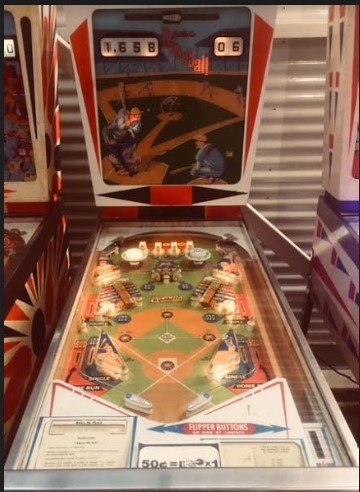
HRDLet me set the stage.  There were only 16 major league teams.  If you didn’t finish with ‘the best record in your league, you didn’t get even the slightest taste of the post-season. No one had ever heard of the designated hitter, the wild card, WAR or even WHIP. (For that matter, no one had ever seen a computer mouse, a Ford Mustang, an Etch-A-Sketch or Star Trek – or listened to a Beatles record.)   The news was headed by the Cold War, Space Race, Kennedy-Nixon Debates, Civil Right Movement, Sexual Revolution and Year of Africa. Gunsmoke, Wagon Train and Have Gun Will Travel were the top three TV shows and Home Run Derby was a TV-must in our house – with power hitters, in black-and-white, pairing off at Wrigley Field in Los Angeles.

Roger Maris photo

Roger Maris Photo by rchdj10

Babe Ruth still held the MLB single-season home run record – and Roger Maris was about to collect his first AL MVP Award (earned in his first year as a Yankee; after being traded from the Kansas City Athletics).  Ted Williams had just finished his career with a home run in his last at bat, Brooks Robinson was about to collect his first Gold Glove. MLB held two All Star Games. The White Sox had become the first team to put players’ names on uniforms. That season, Warren Spahn had thrown his first no-hitter at age 39 (and won a league-leading 21 games) and 22-year-old Juan Marichal had tossed a one-hitter in his major league debut.

The Pirates’ Dick Groat won the NL batting title and would be named the NL MVP.  Mickey Mantle had led the AL in home runs, Roger Maris in RBIs, Pete Runnels in batting average and Minnie Minoso in base hits.   In the NL, Ernie Banks won the home run crown, Hank Aaron the RBI title and Willie Mays topped the senior circuit in hits.   Don Drysdale and Sandy Koufax finished one-two in the NL strikeout race, while Jim Bunning topped the AL.   Lindy McDaniel of the Cardinals set a new record with 26 saves, while the Tigers’ Frank Lary’s 15 complete games were the lowest ever to lead either league.

This is Getting A Little Old … For the Rest of Us

Going into the 1960 World Series, the Yankees had played in eight of the Worlds Series held in the decade of the 1950’s – winning six of them.  The Pirates had last appeared in the Fall Classic in 1927 and last won it in 1925. 

I was thirteen and an avid baseball fan.  The Game of the Week, the radio – especially the radio – and an occasional trip to the ballpark were my tickets to the national past time.

At the time, the Yankees were baseball’s dynasty.  Since my birth in 1947, the Bronx Bombers had been to 11 World Series (including the 1960 Series, yet to be played) and had won eight World Championships.  Fans from pretty much everywhere but New York had made Yankee-hating a tradition.  I was no exception.  Milwaukee-born, I was a steadfast Braves fan, still smarting from the Yankees’ 1958 World Series comeback, when they downed my Braves after trailing three games to one. The Yankees were in the 1960 Series – and I had an emotional interest in seeing them lose.
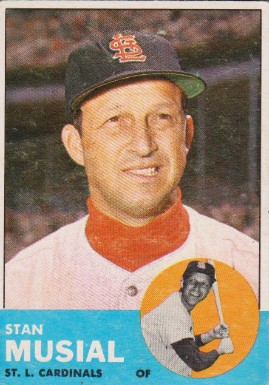
StanMusialBeing of Polish descent, I also took pride in the fact the great Stan Musial was Polish and wondered why Milwaukee-born Hall of Famer Al Simmons had changed his name from Al Symanski.  I was a fan of the sleeveless power hitter Ted Kluszewski, regretted that Tony Kubek (also of Polish descent) played for the Yankees, was rooting for the Pirates’ Bill Mazeroski.  I also was firm in my belief that Steve Dalkowski threw that fastest fastball ever … you can look it up.

Put all of this together and you can see why I looked to the 1960 World Series with excitement – and why I was rooting for the underdog Pirates.

The prognosticators predicted a Yankee win in five or six games.  They pointed out that the Yankees, with a 97-57 record (the Pirates were 95-59-1) came into the Series with the momentum of a 15-game, season-closing winning streak, while the Pirates lost four of their final seven.  They also lauded the Yankees’ post-season experience and heralded the Yankees power (the Yankees led the AL with a record 193 home runs and 746 runs scored, while the Pirates led the NL with 734 runs scored, but only 120 round trippers). The Yankees’ Game-One starting lineup had belted 152 regular season homers to 98 for the Pirates’ starters.  When it came to mound work, things appeared more balanced, maybe even a shade in favor of the Pirates.  While the Yankees’ 3.52 ERA was the lowest in the AL, the Pirates’ NL third-best ERA (at 3.49) slightly bettered the Bombers’ mark.  The Pirates did have the clear advantage in strikeouts (811-712) and fewest walks allowed (an NL low of 386 to an AL worst 609 for the Yankees). They also boasted twenty-game winner Vernon Law (20-9, 3.08), backed up by Bob Friend (18-12, 3.00), while no Yankee starter had topped 15 wins.  The top relievers for the two teams were Elroy Face, with 24 saves for Pittsburgh and Bobby Shantz, who saved 11 for the Yanks.

To the surprise of many fans (and analysts), the Series was tied after six games – despite the fact that the Bronx Bombers had outscored the Pirates 46 to 17, outhit them 78 to 49 and out-homered them 8 to 1.  (The Yankees had won Game Two 16-3, Game Three 10-0 and Game Six 12-0.  The Pirates had prevailed in Game One 6-4, Game Four 3-2 and Game Five 5-2).

Then came Game Seven – 60 year ago today – in Pittsburgh.  Here’s how it went down.

The Pirates were started Vernon Law, 20-9, 3.08 on the season and the winner of Games One and Four.  The Yankees countered with Bob Turley, 9-3, 3.27 on the season.  Turley had won Game Two, despite giving up 13 hits and three walks in 8 1/3 innings.  The Pirates had their top left-handed hitter, Bob Skinner (injured in Game One), back at the number-three spot in the order, while the Yankees were missing Elston Howard (broken finger, Game Six).  An upset did seem possible.

The Yanks went meekly in the top of the first inning (liner, popup, foul out), and the Pirates, homer-less since a Bill Mazeroski blast in Game One, got a two-run homer from Rocky Nelson (whom Manager Gene Murtaugh chose to start at first base over regular Dick Stuart).

In the second inning, Law set the heart of the Yankees down in order – Mickey Mantle, fly to center; Yogi Berra, grounder to third; Moose Skowron, grounder to short.  In the bottom of the inning, manager Casey Stengel appeared to put his managerial position in further jeopardy.  Smoky Burgess started the inning with a single and Stengel immediately pulled Turley in favor of the rookie Bill Stafford (who had stifled the Pirates for five innings in Game Five).  The move did not pay off.  Stafford walked third baseman Don Hoak and Mazeroski beat out a bunt single.  Law was now at the plate (the Pirates’ pitcher was two for four, with a double, run scored and RBI in Games One and Four).  Law hit back to Stafford for a pitcher-to home-to first double play, but center-fielder/lead-off hitter Bill Virdon followed with a two-run single and a 4-0 Pirates lead.

Casey Stengel, despite ten pennants and seven World Series titles in 12 seasons as manager of the Bronx Bombers, was fired by the Yankees five days after the 1960 Game Seven loss to the Pirates. 

Law handcuffed the Yankees through four innings, giving up only two singles.  In the fifth, Yankee first sacker Skowron made the score 3-1 with a lead-off homer just inside the right field foul pole.  Law did not let the round tripper upset him, retiring Johnny Blanchard, Clete Boyer and Bobby Shantz (who came on to pitch for New York in the third) in order.

The Yankees closed the gap – and then some – in the top of the sixth.  The pesky Bobby Richardson (who already had nine hits in the series) led off with a single to center, and Tony Kubek followed with a walk.  With the Bombers appearing on the verge of a rally, Murtaugh replaced Law (who, it turns out had been pitching on a sore ankle throughout the Series) with his top reliever Elroy Face.   Face got Roger Maris on a foul pop to Don Hoak at third base, but Mickey Mantle followed with a “seeing eye” single up the middle, scoring Richardson. Yogi Berra followed with an upper deck home run (like Skowron’s just inside the right field foul pole) to give New York a 5-4 lead in what was shaping up to be a Game Seven nail-biter.

The veteran Bobby Shantz, meanwhile, was baffling the Pirates – giving up only a single and a walk from the third to the seventh innings.

In the top of the eighth, the Yankees seemed to dash the Pirates’ upset hopes – using a walk, two singles and a double to produce two more runs and a 7-4 lead.   Notably, Stengel’s pitching decisions again came into play.  He let Shantz bat with two out and runners at second and third (Boyer and Skowron) and a chance to extend the Yankee lead.  Shantz flied out and the living-room and press-box managers were quick to point out:  1) the lost scoring opportunity; 2) the fact that Stengel left Shantz in for a sixth inning of work, despite the fact that Shantz had not gone more than four innings in the regular season.

So, that was the situation as the game went into the bottom of the eighth – when the Pirates (and Forbes Field) proved they still has some life left in them.  Gino Cimoli pinch hit for Face and stroked a single to right-center field.  Shantz, who had already induced two double plays appeared to have worked his magic again, as Bill Virdon hit a hard ground ball right at shortstop Tony Kubek.  Just as Kubek was ready to field the ball and begin the sure double play, it appeared to hit a pebble (the Yankees had already been critical of the condition of the Forbes Field infield) and ricocheted into Kubek’s throat.  Kubek went down, gasping for air and spitting up blood, with his windpipe rapidly swelling (doctors on the scene at first thought an emergency tracheotomy might be necessary).  The end result?  Kubek sent to the hospital and replaced by Joe DeMaestri and the Pirates with two on and no outs, instead of none on and two outs.

Pirates’ shortstop Dick Groat took advantage of Kubek’s mishap and lined singled to left, scoring Cimoli.  Stengel came to the mound and replaced Shantz with right-hander Jim Coates (despite the fact that lefty Bill Skinner was coming to the plate).  The righty-lefty match-up made little difference, as Skinner sacrificed the runners up one base.  Next was Rocky Nelson, who flied out to medium right, with the Pirates choosing not to test Roger Maris’ powerful arm.   So, two outs, two on and the Yankees still in front 7-5.   That brought up the Pirates’ best hitter, right-fielder Roberto Clemente, who had been held hitless in his first three at-bats. Coates made a good pitch, getting Clemente to hit a weak ground ball toward first.   A hustling Clemente beat both Coates and Skowron’s throw to the bag, while Virdon scored and Groat moved to third.  Now, 7-6 and the Pirates still had life.

Trivia Tidbit:  The seventh game of the 1960 Series is the only World Series game in which neither team recorded a strikeout.

That brought up backup catcher Hall Smith (who had come into the game in the eighth after Joe Christopher ran for starting catcher Smoky Burgess in the bottom of the seventh).   Smith took a 2-2 Coates’ pitch over the left-field wall for a 9-7 Pittsburgh lead.  The Pirates, with only one round tripper in the first six games had homered twice for five runs in Game Seven.

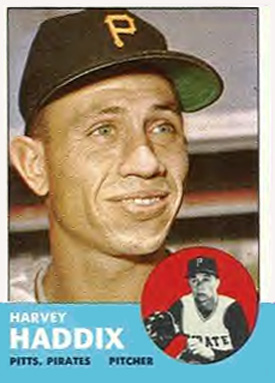
To protect the lead in the ninth (and with Elroy Face already out of the game), Pirates’ Manager Danny Murtaugh called on starter Bob Friend, who had lost Games Two and Six, giving up seven earned runs in six innings (and had pitched in relief only once all season).  Yankee lead off hitter Bobby Richardson started off the ninth with a single to left.  Veteran and former-Pirate Dale Long, pinch hitting for Joe DeMaestri (who had replaced the injured Kubek) singled to right and Friend was gone, replaced by Game Five starter Harvey Haddix.  Haddix got Roger Maris on a foul out, but Mickey Mantle drove in Richardson with a single to right center.   Yogi Berra followed with a ground ball down the first base line.  Rocky Nelson made a nice backhanded stop, but was out of position for a first-to second-to first, game-ending double play.   Nelson took the sure out, stepping on the first base bag and retiring Berra, while Gil McDougald (pinch running for Long) headed toward home.  It was at this point that Nelson realized Mantle had not run to second.  Mantle, sizing up the situation, was returning to first (with the force at second now off). It was an unorthodox base-running move, but as Mantle dove head first back to the bag (avoiding Nelson’s desperate attempt to tag him), McDougald scored the tying run.  Skowron then grounded out to Mazeroski (forcing Mantle) to end the inning in a 9-9 tie.

Mazeroski's 1960 home run trot immortalized at PNC Park.

Mazeroski’s 1960 home run trot immortalized at PNC Park.

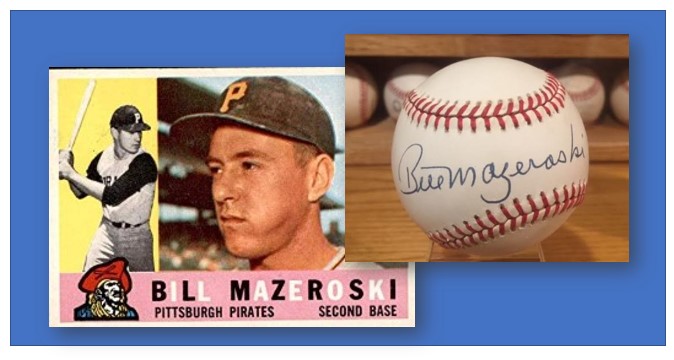
Stengel, like Murtaugh, was now using starters in relief, bringing Game Four-loser Ralph Terry in to pitch the ninth.  Number-eight hitter Bill Mazeroski led off the inning.  Terry’s first pitch was a high and inside fastball.  The second pitch, another fastball, was in the strike zone and Mazeroski deposited it over the 406-foot marker in left center.  Not sure the ball would carry out in the deep part of the park, Mazeroski ran full speed with his head down to first and toward second, before seeing the umpire making the circular home run signal.  Mazeroski removed his helmet, waving his way to home plate where his team mates awaited the first player in major league history to end the World Series with a walk-off home run.
 

maz3


When the Series was over, the Pirates were World Series Champs,

but you could never tell by the stat line.

The Yankees scored a Series’ record 55 runs to 27 for the Pirates,

The Yankees collected a Series’ record 91 hits to 60 for the Pirates.

The Yankees hit a Series record .338 to .256 for the Pirates

The Yankees collected a Series’ record 27 extra base hits to 15 for the Pirates.

The Yankees out-homered the Pirates 10-4.

The Yankees’ pitchers put up a 3.54 ERA to 7.11 for the Pirates.

Bobby Richardson of the losing Yankee squad won the Series MVP award, hitting .367 with a Series’ record 12 RBI.

Primary Resources:  Baseball-Reference.com; Chronicle of the 20th Century (Chronicle Publications). 

BASEBALL ROUNDTABLE ON THE TOP 100 BASEBALL BLOG LIST

100Baseball Roundtable is on the Feedspot list of the Top 100 Baseball Blogs.  To see the full list, click here.

I tweet baseball @DavidBBRT

Follow/Like Baseball Roundtable’s Facebook Page here.  More baseball commentary; blog post notifications; PRIZES.

Member: Society for American Baseball Research (SABR); The Baseball Reliquary; The Negro Leagues Baseball Museum.

Baseball Roundtable September and Season-End Wrap Up. Lots of Whacks, Whiffs and Records.

It’s October 1, and that means it’s time not only for the opening of post-season baseball, but also for Baseball Roundtable’s look back at the previous month – the standings, statistics and stories that caught BBRT’s eye, as well as the BBRT Players and Pitchers of the Month and season-to-date “Trot Index.”  This month, if you make it to the end of this post, you’ll also find BBRT’s predictions for the post season.  (Note: I guess I could have posted this September 30, but the first of the following month is kind of a BBRT tradition.)

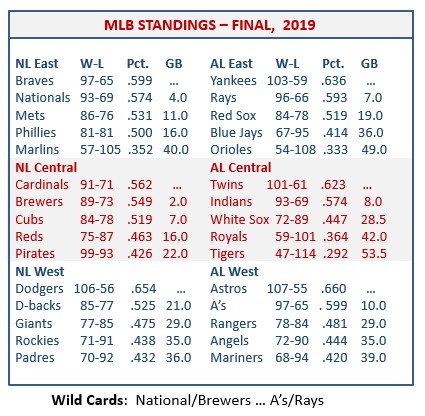
Of course, for many teams, the final day (September 29) of the 2019 regular season was anti-climactic. All the post-season spots were clinched and only one division title was up for grabs – the Brewers came into the final day just one game behind the Cardinals.  A Redbirds’ loss and Brew Crew win would set up a “Game 163,” with the winner taking the NL Central and the loser playing the Nationals in the Wild Card game. The Cardinals relieved fans of the suspense with a 9-0 thrashing of the Cubs, while the Brewers bowed out with a 4-3, 12-inning loss at Colorado.

Before BBRT gets into September stats and stories, I’d like to comment on another race I watched with some interest on the final day of the regular season – the race for MLB’s all-time, single-season, team home-run crown.

YOU HAD TO “C” THIS ONE

Jason Castro - hit the record-setting "Bomba."

Jason Castro – hit the record-setting “Bomba.”

Coming into the season’s final day the Yankees and Twins had both won more than 100 games, clinched their division titles and hit more than 300 2019 home runs.  (The previous single-season record was 267 homers – 2018 Yankees.) As play started September 29 (Twins at Royals/Yankees at Rangers), New York’s Bronx Bombers had 305 home runs, while Minnesota’s Bomba-Squad had 304. Many of us here in Minnesota, stung by a history of post-season losses to the Yankees, really wanted that long-ball record.

Well, the Yankees popped just one home run (Aaron Judge) in a 6-1 loss at Texas.  The Twins launched a trio of dingers, to take the record 307-306.  Why the “You Had To C This   One” title?  Well, a lot of T.C. fans traveled to K.C. to C this final game.  It turns out, all three Twins; home runs were hit by players whose last name started with a “C” – C.J. Cron; Jake Cave; and Jason Castro (who hit the record-setter).  Ironically, Minnesota’s most-prolific 2019 home run bat, belonging to Nelson “last name begins with a C” Cruz was on the bench.  In another bit of irony, at least to BBRT, it was the first home run this September for Cron, Cave and Castro.   C U this Friday, Yankees.

Now, here’s just a few September highlights.  You’ll find details on these and other “events” that caught BBRT’s eye in the “Highlights” section of this post.  In September, we saw:

  • The Mets’ 24-year-old rookie Pedro Alonso popping an MLB-best 11 September home runs;  leading all major leaguers with 53 home runs for the season – setting a new MLB rookie round tripper record;
  • The Astros’ Justin Verlander opening the month with his third career no-hitter;
  • A second Biggio (Cavan) hitting for the cycle and a new Yastrzemski (Mike) homering in Fenway Park;

In 2019, MLB strikeouts reached a new record (42,823) for  the 12th consecutive season. 

  • One player (Yoan Moncada) hitting 400+ for the month;
  • The Arizona Diamondbacks winning a ball game, despite having only one base runner over nine innings;

In 2019 the Astros waved zero – that’s zero – batters to first.   That’s right, not a single intentional walk. The MLB team average for the season was 25 IBB – and the second-lowest total was ten (Twins). 

  • Two teams (Twins and Yankees) becoming the first MLB teams to reach 300 home runs in a season;
  • Two teams using a combined (record) 25 pitchers in a game;
  • Four teams reaching 100 wins on the season – coincidentally, the four teams who also surpassed the previous record for home runs in a season;
  • Two pitchers (the Astros’ Gerrit Cole and Justin Verlander) on the same team reaching 300 strikeouts in the season for only the second time in MLB history.

In 2019, as home run records fell like overripe apples from a tree, not only did MLB reach a record 6,776 home runs (breaking the old record by 671 dingers), but four teams exceeded the old MLB team single-season record (the Twins exceeded the old mark by 40) and a total of 14 teams set new franchise records for home runs in a season.  In addition, we saw new MLB single-season records for the most players on a team with at least thirty home runs (five-Twins); most with at least 20 home runs (eight-Twins); and most with at least  ten  or more home runs (14-Yankees).  Of course, there are two sides to this story.  the Orioles gave up almost as many home runs as the Twins hit (setting a new record for home runs surrendered in as season at 305). 

Let’s move on to a regular feature of these Wrap Ups.

—–BASEBALL ROUNDTABLE PLAYERS AND PITCHERS OF THE MONTH—-

American League Player of the Month – Eloy Jimenez, LF, Chicago White Sox

Photo by mwlguide

Photo by mwlguide

Eloy (I always want to add an “r” to his name) Jimenez was a force for the ChiSox in September – hitting .340, finishing fourth in AL September home runs with nine (one behind the three leaders) and tying for the AL lead in RBI with 25.  The 22-year-old rookie also scored 19 runs. Jimenez, who came into September hitting just .247 (with power), notched ten multi-hit games over the month and raised his average 20 points.  He finished the season at .267-31-79.  Jimenez’ September surge was not totally unexpected. In six minor league campaigns, he hit .311, with 66 home runs in 413 games.

Other Contenders: BBRT also considered another young White Sox hitter, 24-year-old 3B Yoan Moncada, the only MLB player (with at least 75 at bats) to hit over .400 for September.  Moncada hit .412, led all of MLB with 42 September hits, scored 21 runs, hit three homers and drove in 15/  Also in the running was A’s SS Marcus Semien, who hit .347, with eight home runs, 19 RBI and an MLB-best 25 September runs scored.  BBRT also gives a shout out to the Royals’ Jorge Soler, who hit .330-10-20 in September, and ended up being the first Royal to lead the league in home runs, with 48 on the season.

American League Pitcher of the Month – Gerrit Cole, RHP, Astros

Gerrit Cole photo

Photo by boomer-44

Gerrit Cole had the AL’s second-lowest September ERA at 1.07 (among pitchers with at least 25 innings pitched). Cole also tied for the MLB lead in wins for the month, going 5-0 in six starts, and fanned an MLB-best 74 batters in 42 innings (seven walks).

Other Contenders: Right behind Gerrit Cole was his Astros’ teammate Justin Verlander, who also won five September games (one loss) in six starts, put up a 2.08 ERA and fanned the MLB’s second-most batters (57 in 39 innings). BBRT also recognizes the Yankees’ James Paxton, who went 4-0 in five starts with a minuscule 1.05 ERA.


Surprise Player of the Month – Austin Meadows, OF, Rays

Really, there were several positive surprises in September. (See Jack Flaherty, BBRT’s NL Pitcher of the Month, or the A’s Marcus Semien, in the running for BBRT AL Player of the Month.)  BBRT will give September’s “Surprise” recognition to the Rays’ 24-year-old, southpaw-swinging outfielder Austin Meadows, who came into September hitting .273 (with 24 home runs and 69 RBI).  In September, Meadows hit at a .378 pace (second-best in MLB among players with 75 September at bats), with nine home runs (tied for MLB’s sixth-most), 20 RBI (tied for tenth), and 24 runs scored (tied for second). In addition, he walked 15 times (versus just 16 strikeouts); putting up a September on-base percentage of .472 (second only to the Astros’ Alex Bregman). Meadows played in 24 games, hit safely in all but one and had ten multi-hit contests.

National League Player of the Month – (Tie) Reds’ 3B Eugenio Suarez and Dodgers’ SS Corey Seager

Eugenio Suarez photo

Photo by haydenschiff

Eugenio Suarez rapped ten September home runs (second only to the Mets’ Pete Alonso’s 11), while hitting .337, with 20 RBI. He had ten multi-hit games during the month. He ended the season at .271-49-103.

Cody Bellinger brought superior defense and infield power to the Dodgers, hitting.291, with seven homers and MLB’s highest RBI total for the month (26). Bellinger really turned it up a notch in September.  It was his highest month of the season in terms of both home runs and RBI.

Other Contenders: Mets’ rookie 1B Pete Alonso led the majors with 11 September home runs (on his way to a new rookie-season record of 53), but was held back by a .245 average and just 19 September RBI. Cardinals’ 3B Tommy Edman hit .350-6-14, with 22 runs scored.

National League Pitcher of the Month – Jack Flaherty, RHP, Cardinals

As the Cardinals held off the Brewers for the NL Central title down the stretch, Flaherty was “The Man.” The 23-year-old went 3-1 in six starts and led MLB in September earned run average (among pitchers with at least 25 innings pitched) at 0.82, WHIP (0.57) and innings pitched (44). He also led the NL in strikeouts fopr the month (and was third in MLB) with 53, while walking just eight batters. In his six September starts, Flaherty went seven or eight innings in five (giving up just one earned run in those 38 innings.  His only September loss came in a six-inning effort in which he gave up three runs in six frames, while fanning ten. This was a pretty easy pick.

Other Contenders: It seems like the Mets’ Jacob deGrom is always in the running.  This September, he went 3-0, 1.29 in five starts, fanning 41 batters (five walks) in 35 innings. BBRT also considered the Braves’ Mike Foltynewicz, who won four September games (one loss) and had a nifty 1.50 ERA for the month. A nod also goes to the Cardinals’ Adam Wainwright, the only NL pitcher to win five September games (5-1, 2.97 in six starts). Giving relievers a little love, the Brewers went 20-7 in September thanks in great part to Josh Hader’s MLB-topping ten September saves.  Hader put up a 1.88 ERA and fanned 27 batters in 14 1/3 innings.

TROT INDEX … A REGULAR BBRT FEATURE

For the 2019 season,  36.2 percent of MLB’s 186,517 plate appearances ended in a trot (back to the dugout, around the bases, to first base). We’re talking about strikeouts, home runs, walks, hit by pitch and catcher’s interference – all outcomes that are, basically, devoid of action on the base paths or in the field. Here’s the breakout: strikeouts (23.0%); walks (8.5%); home runs (3.6%); HBP (1.1%); catcher’s interference (less than 1%). Personally, I’d like more action in the field of play.

For the 2018 season, 34.8 percent of all MLB’s 185,139 plate appearances ended in a trot.  Bonus Trivia: According to MLB, in 2019, the average time of an MLB game was a record three hours-five minutes-35 seconds.  

_________________________________________________________________

Septemberwl

—–The Best and Worst of Teams—–

NL’s Best

No team won more games in September than the Brewers, who went 20-7. The Brewers failed to chase down the Cardinals for the Central Division title, but did manage to move passed the Phillies, Cubs and Diamondbacks into a Wild Card spot.  Milwaukee leveraged solid pitching (MLB’s lowest September ERA at 3.01) and a steady offense (the NL’s fifth-most September runs scored) into 20 victories.  Key contributors on the mound included: Jordan Lyles (3-0, 2.39 in five starts); Zach Davies (2-0, 2.31 in five starts); and Chase Anderson (2-0, 2.35 in five starts).  We also can’t forget Gio Gonzalez.  He may have gone just 1-0 in September (four starts and two relief appearances), but put up a 1.17 ERA and saw the Brewers win five of the six games in which he appeared. The Brew Crew also got solid performance out of the bullpen, led by Josh Hader’s ten saves and 1.88 ERA and Drew Pomeranz’ two saves and seven holds in 14 appearances (2.03 ERA).

AL’s Best

Over in the NL, best-of-the-best recognition goes to the Houston Astros (19-6), who dominated nearly all September statistical categories.  On the mound, they had the AL’s  lowest ERA, highest number of strikeouts, fewest walks and most saves.  At the plate, they were the AL’s September leaders in runs scored and home runs – and had the fewest batters’ strikeouts.  Key contributors? There were many. On the bump: Gerrit Cole went 5-0, 1.07 in six starts; Justin Verlander was 5-1, 2.08 in six starts; Zack Greinke was 4-1, 2.59 in five starts; and Roberto Osuna saved seven games (eight opportunities) and put up a 0.79 ERA.  Keys to the well-balanced offense included: George Springer, who hit .275, with ten homers and 19 RBI; Alex Bregman, who went .333-9-18; Yordan Alvarez, who was .296-6-16;  Josh Reddick at .338-4-12; and Jose Altuve at at .278-6-13.

Other teams putting up solid September performance included: Dodgers (18-6); Twins (18-9); and A’s (18-8).  All these squads are, of course, in the post-season.

How about the worst September results? The Padres, Angels, Tigers, Orioles and Marlins all won fewer than ten September games.

______________________________________________

—LEAGUE LEADERS – TEAMS – MONTH OF SEPTEMBER 2019—-

RUNS SCORED … MLB Team Average – 122

AL: Astros (154); Yankees (146); A’s (143)

NL: Nationals (153); Cubs (150); Mets (140); Cardinals (140)

The Angels scored the fewest September runs at 82, while the Giants were at the bottom of the NL, plating just 83 runners.

BATTING AVERAGE … MLB Team Average – .244

AL: White Sox (.290); Royals (.268); Astros (.266)

NL: Nationals (.268); Cubs (.257); Pirates (.255)

Four teams hit under .220 for the month: Padres (.214); Mariners (.219); Giants (.219); and Angels (.219). 

HOME RUNS … MLB Team Average – 36

AL:  Astros (58); Yankees (52); A’s (42)

NL: Mets (50); Phillies (46); Dodgers (45)

At the bottom of the power list were the Pirates (14 home runs); Giants (19); Diamondbacks (22); and Tigers (23).

SLUGGING PERCENTAGE … MLB Team Average –  .422

AL:  Astros (.530); Yankees (.491); White Sox (.485)

NL: Mets (.474); Dodgers (.466); Cubs (.461)

The Astros collected an MLB-high 112 extra-base hits in September – while the Giants had an MLB-low of exactly half that many (56).

STOLEN BASES … MLB Team Average – 13

AL:  Rangers (26); Royals (19); Mariners (18)

NL: Cardinals (27); Rockies (22); Nationals (19); Phillies (19)

The Twins stole an MLB-low two bases in September (only three tries). Notably, the Phillies stole 19 bases in 19 attempts.

BATTERS’ STRIKEOUTS … MLB Team Average – 233

AL: Blue Jays (269); White Sox (265); Mariners (256)

NL: Brewers (286); Cardinals (282); Padres (277)

The Astros fanned the fewest times in September (186). Notably, despite the AL’s second-most whiffs, the White Sox put up MLB’s best batting average.

_______________________________________

EARNED RUN AVERAGE … MLB Team Average – 4.38

AL:  Astros (3.26); Rays (3.55); A’s (3.58)

NL:  Brewers (3.01); Dodgers (3.10); Cardinals (3.24)

One team posted an ERA north of 6.00 in September – the Rangers at 6.19.

BATTING AVERAGE AGAINST … MLB Team Average – .244

AL: Astros (.205); Rays (.219); A’s (.232)

NL: Reds (.202); Dodgers (.202); Brewers (.210);

Teams hit an MLB-high .299 against Tiger hurlers in September.

STRIKEOUTS … MLB Team Average – 233

AL:  Astros (295); Red Sox (276); Twins (273)

NL: Cubs (279); Padres (273); Brewers (272)

WALKS (Fewest) … MLB Team Average – 86

AL: Astros (60); Rays (62); A’s (68)

NL: Braves (63); Mets (70); Dodgers (73)

The Astros led all of MLB in September strikeouts per nine innings (11.46) and strikeouts-to-walks ratio (4.92). 

SAVES … MLB Team Average – 7

AL:  A’s (11); Astros (11); Twins (10)

NL: Brewers (12); Cardinals (11); Diamondbacks (11)

MLB’s best save percentage in September belonged to the Braves and Blue Jays, who each notched six saves in seven opportunities (85.7%). The Yankees had the most significant problem closing September games, with only one save in six opportunities. 


—INDIVIDUAL LEADERS FOR SEPTEMBER 2019—–

BATTING AVERAGE (75 or more at bats)

AL: Yoan Moncada, White Sox (.412); Austin Meadows, Rays (.378); Tim Anderson, White Sox (.374)

NL: Tommy Edman, Cardinals (.350); Nolan Arenado, Rockies (.342); Kyle Schwarber, Cubs (.341)

The lowest average among players with at least 75 September at bats belonged to the Orioles’ Anthony Santander at .155 (13-for-84). Seventeen players with at least 75 at bats hit under .200 for the month.

HITS

AL: Yoan Moncada, White Sox (42); Trey Mancini, Orioles (38); Tim Anderson, White Sox, (37)

NL: Trea Turner, Nationals (36); Tommy Edman, Cardinals (36); Kyle Schwarber, Cubs (31); Ozzie Albies, Braves (31)

HOME RUNS

AL: Brett Gardner, Yankees (10); George Springer, Astros (10); Jorge Soler, Royals (10)

NL: Pete Alonso, Mets (11); Eugenio Suarez. Reds (10); five with seven

The Marlins’ Jon Berti had the most September at bats without a home run – 87.  He had a total of 25 September hits (.287) – twenty singles and five doubles.

RBI

AL: Rougned Odor, Rangers (25); Eloy Jimenez, White Sox (25); Matt Olson, A’s (23); Trey Mancini, Orioles (23)

NL: Corey Seager, Dodgers (26); Paul Goldschmidt, Cardinals (24); Asdrubel Cabrera, Nationals (21)

Among players with at least 75 September at bats, the Astros’ Alex Bregman had the highest on-base percentage at .486. In the NL, it was the Reds’ Eugenio Suarez at .455. The other players above .450 were: Austin Meadows, Rays (.472); Yoan Moncada, White Sox (.455); and Nolan Arenado, Rockies (.451).

Alex Bregman also had the highest slugging percentage in September (.753); while Eugenio Suarez led the NL at .747.

RUNS SCORED

AL: Marcus Semien, A’s (25); Austin Meadows, Rays (24); Francisco Lindor, Indians (21); Tim Anderson, White Sox (21); Yoan Moncada, White Sox (21)

NL: Trea Turner, Nationals (24); Starlin Castro, Marlins (22); Yasmani Grandal, Brewers (22); Pete Alonso, Mets (22); Tommy Edman, Cardinals (22)

STOLEN BASES

AL:   Alberto Mondesi, Royals (12); Tommy Pham, Rays (9); Danny Santana, Rangers (8); Jonathan Villar, Orioles (8)

NL: Jon Berti, Marlins (9); Garrett Hampson, Rockies (9); four with six

Jackie Bradley, Jr. of the Indians had the toughest month on the bases in September, caught three times in four attempts. The only other player tossed out three times was Alberto Mondesi (Royals), but he stole 12 bags.

BATTER’S STRIKEOUTS

AL: Hunter Dozier, Royals (35); Aaron Judge, Yankees (33); Miguel Sano, Twins (32)

NL:  Eric Hosmer, Padres (40); Harrison Bader, Cardinals (39); Pete Alonso, Mets (38)

Among the strikeouts leaders listed above, the Twins’ Miguel Sano had the best overall September stat line – .288-8-21.

WALKS

AL:  Alex Bregman, Astros (22); Mark Canha, A’s (16); Marcus Semien, A’s (16); Matt Chapman, A’s (16); Cavan Biggio, Blue Jays (16)

NL: Anthony Rendon, Nationals (25); Yasmani Grandal, Brewers (24); Juan Soto, Nationals (24)

PITCHING VICTORIES

AL: Gerrit Cole, Astros (5-0); Justin Verlander, Astros (5-1); four with four

NL: Adam Wainwright, Cardinals (5-1); Brent Suter, Brewers (4-0); Patrick Corbin, Nationals (4-1); Mike Foltynewicz, Braves (4-1); Merrill Kelly, Diamondbacks (4-1)

Another Episode of: How Fair Is That:

In September, the Brewers’ Matt Albers went 3-2, with a 10.38 ERA, while the Cubs’ Yu Darvish went 1-2, with a 2.39 ERA.

EARNED RUN AVERAGE (at least 25 innings pitched)

AL: James Paxton, Yankees (1.05); Gerrit Cole, Astros (1.07); Sean Manea, A’s (1.21)

NL: Jack Flaherty, Cardinals (0.82); Jacob deGrom, Mets (1.29); Mike Foltynewicz, Braves (1.50)

STRIKEOUTS

AL:  Gerrit Cole, Astros (74/42 IP); Justin Verlander, Astros (57/39 IP); Eduardo Rodriguez, Red Sox (53/37 2/3 IP)

NL: Jack Flaherty, Cardinals (53/44 IP); Yu Darvish, Cubs (46/26 1/3 IP); Patrick Corbin, Nationals (45/33 1/3 IP)

Gerrit Cole led all qualifying pitchers in strikeouts per nine innings in September (15.86). Yu Darvish led the NL (15.72).

SAVES

AL:  Taylor Rogers, Twins (9); Liam Hendriks, A’s (8); Robert Osuna, Astros (7); Brandon Workman, Red Sox (7)

NL:  Josh Hader, Brewers (10); Carlos Martinez, Cardinals (8); Archie Bradley, Diamondbacks (8)

How About a Shout Out for Holds?  That’s No Bummer.

The White Sox’ Aaron Bummer led MLB in September “holds” with nine (13 appearances).

Now a few stats and stories from the month of September.

________________________________________________

—SEPTEMBER 2019 HIGHLIGHTS —

Getting September Off to a Good “Start”

On September 1, Justin Verlander faced off against the Blue Jays in Toronto – and he got the Astros off to a good start for the month.

Verlander threw a no-hitter, walking just one Blue Jay, while fanning 14. The Astros did make him “worry” the no-no to completion. They didn’t score a run for Verlander until there were two out in the top of the ninth (a two-run home run by Alemedys Diaz).

Verlander is just the sixth pitcher to throw at least three no-hitters – joining Nolan Ryan (7); Sandy Koufax (4); Larry Corcoran (3); Cy Young (3); and Bob Feller (3).  Pretty good company.

We’d Give Anything to Hold Them to a Bloop Single

On September 8, the Astros did a number on the Mariners – outscoring the Seattle squad 21-1 and outhitting them 22-1.  Not only did 11 different Astros score at least one run in the game, Houston plated ten runners before hitting their first single.  The ten runs scored before the end of the third inning – on six doubles, two home runs, two walks, one hit batsman and one error.  Ouch!

Never Before – Unlikely Again

September 14 marked a “never before – unlikely ever again” feat of pitching excellence (or batting futility). For the first time since 1900 (according to Elias Sports Bureau), an MLB team managed a victory despite having only one base runner (which, of course, would be the bare minimum) in a game of at least nine innings.  The team with this absolutely zero-waste offensive output?  The Arizona Diamondbacks, who topped the Cincinnati Reds 1-0 (in Phoenix).

Reds’ starter Anthony DeSclafani set the Diamondbacks down in order in the first, second, fourth, fifth, sixth and seventh innings (fanning five); while reliever Joel Kuhnel added one whiff in a 1-2-3 eighth.  The only blemish for the Reds’ mounds men came in the third inning. Arizona SS Nick Ahmed led off with a high hopper (on the first pitch he saw from DeSclafani) that bounced over the head of Reds’ third-sacker Eugenio Saurez and rolled all the way to the left field wall for a triple.  D-backs’ RF Jarrod Dyson was also first-pitch swinging and sent a fly ball to center for a run-scoring sacrifice fly – and that was Arizona’s total offense for the game.

The Diamondbacks’ staff – starter Merrill Kelly (seven innings) and relievers Kevin Ginkel and Archie Bradley (one frame each) made the 1-0 lead stand up; giving up no runs on three hits and two walks (seven strikeouts).

It’s a Family Affair – at Least on September 17

The Yastrzemski Clan

On September 17, in a “Family Affair” occurrence, the Giant’s 29-year-old rookie Mike Yastrzemski (thanks to inter-league play) took the field for the first time in his career in Fenway Park – where his grandfather, Hall of Famer Carl Yastrzemski played 23 seasons and hit 237 home runs (he had 452 total long balls). Mike added another long ball to the Yastrzemski Fenway legend, popping a fourth-inning homer over the center field wall – helping the Giants top the BoSox 7-6. By the way, young Mike started in left field – in front of the famous Fenway Wall – the same position his grandfather manned for so many years.

The Biggio Household

On September 17, Blue Jays’ 24-year-old rookie Cavan Biggio – son of Hall of Famer Craig Biggio – hit for the cycle (single, double, triple, home run in one game) against the Orioles at Camden Yards.   In the game, won by the Blue Jays 8-5, Cavan was four-for-five with three runs scored and four RBI.  What made his cycle unique was that, 17 seasons earlier, Biggio (Craig) The Elder also hit for the cycle.  The exact date was April, 8, 2002 and Biggio, in his 15th MLB season, went four-for-five with two runs scored and four RBI.

Cavan’s cycle made the Biggios only the second MLB father-son combination to hit for the cycle – following Gary and Daryle Ward, who cycled their way into MLB history on September 18, 1980 and May 26, 2004, respectively.  Gary Ward achieved his cycle with the Twins, son Daryle with the Pirates.

Five-For-Thirty Can Be a Good Baseball Stat

Miguel Sano photo

Photo by andywitchger

On September 17, as the Twins topped the White Sox 9-8 in 12 frames, 3B Miguel Sano smacked his 30th home run of the 2019 season.  This made the Twins the first MLB team to have five players with 30 or more home runs on its roster in the same season (breaking at 12-team time at four). The 2019 Twins’ final counts:  Nelson Cruz – 41 home runs; Max Kepler – 36; Miguel Sano – 34; Eddie Rosario – 32; and Mitch Garver – 31

Earlier this season, the Minnesota squad became the first MLB team with eight players with 20 or more long balls on its roster in the same season.


2,000 for Bochy

On September 18, the Giants pounded the Red Sox 11-3 at Fenway – giving Giants’ manager Bruce Bochy his 2,000th MLB victory.  Bochy is just the 11th major league manager to reach the 2K mark in wins.  (Connie Mack tops the list at 3,731 wins.) Bochy, who has announced his retirement, ended the season with a 2003-2029 managerial record (12 seasons with the Padres/13 seasons with the Giants). He won an NL Pennant with the Padres in 1998; led the Giants to World Series championships in 2010, 2012 and 2014; and was the 1996 National League Manager of the Year.

Runnin’ on Cruz Control

On September 22, as the Twins downed the Royals 12-8 in Minnesota, DH Nelson Cruz touched a couple of milestones with a fourth-inning solo home run.  The long ball gave Cruz a nice round number on the season (40) and for his career (400).  Cruz became the 57th major leaguer to reach 400 home runs and  just the third player in MLB history to hit forty home runs at age 39 or older (joining Hank Aaron and Barry Bonds).  Cruz finished the season at 311-41-108.

Stone-Cole Hero

On September 24, Gerrit Cole picked up his 19th win of the season, as the Astros topped the Mariners 3-0 in Seattle.  Cole went seven innings, giving up two hits and fanning 14 batters. It gave Cole 316 strikeouts for the season – as well as setting a new Astros’ franchise record for whiffs in a campaign.  J.R. Richard had held the Astros’ record for 40 years, fanning 313 in 1979. It was Cole’s MLB-record tying eighth consecutive game with ten or more strikeouts (100 whiffs over 56 2/3 innings in that streak) and his 20th double-digit strikeout game of the season.  (Cole would go on to add a 21st and ninth consecutive double-digit strikeout game on September 29, when he fanned 10 Angels in five innings.) In his previous start, on September 18, Cole had become just the 18th pitcher since 1900 to reach 300 strikeouts in an MLB season.

Randy Johnson holds the record for double-digit strikeout games in a season at 23 – and he did it three times (all for the Diamondbacks) – in 1999-2000 and 2001.

Happy Birthday Boss!

On September 25, the Minnesota Twins won their 98th game of the 2019 season – clinching the American League Central Division title.  That day also happened to be the 38th birthday of rookie manager Rocco Baldelli.  A nicely wrapped gift for the boss.

He Got By with a Little Help from His Friends

On September 26, the Rangers faced off against the Red Sox in Texas. Starting on the bump for the Rangers was Mike Minor (13-10, 3.52), while the Red Sox sent “opener” rookie Travis Lakins (0-1, 4.22) to the mound. As the contest went into the ninth inning, Minor was still in the game, holding on to a 7-5 lead. At the time, Minor had fanned eight batters – giving him 199 for the season.   He got Red Sox 1B Sandy Leon on a fly out to left to start the inning and then went to a 1-1 count on SS Chris Owings.  On the next pitch, Owings hit a foul pop up to the right side of first base.  Both 1B Ronald Guzman and catcher Jose Trevino had a chance to catch it, but they let it drop (reportedly at Minor’s urging) for an error (and for strike two).  Owings took the next pitch for strike three – and Minor had reached the coveted 200-strikeout mark (with a little help from his friends) for the season. Then Jose Leclerc replaced Minor and fanned Marco Hernandez for the final out and the save.

Another 2019 Immaculate Inning

On September 27, Astros’ reliever Will Harris was called in to open the bottom of the eighth inning of the Astros’ contest against the Angels – with the Western Division champs up 4-0. He was facing the Angels’ sixth seventh and eighth batters – 2B Kaleb Coward, 3B Matt Thaiss and CF Michael Hermosillo. Harris, who had fanned 59 hitters in 58 2/3 innings to that point in the season, turned in a stellar performance.  He whiffed those three unfortunate hitters on nine pitches – turning in 2019’s record-tying eighth “immaculate inning” (three outs, three strikeouts on the minimum nine pitches).

Three (hundred) for Two  … and Two for Three (Hundred)

On September 28, the Astros’ Justin Verlander had quite the day – going six innings in the Astros’ 6-3 win over the Angels.  It was Verlander’s MLB-leading 21st win (six losses).  In his six innings of work, he gave up three runs on four hits and fanned 12 batters. The 12 strikeouts:

  • Gave him 300 on the season – his first 300-whiff campaign – making him just the 19th pitcher since 1900 to reach 300K in a season;
  • Gave him 3,006 strikeouts for his career, making him just the 18th MLB pitcher to reach 3,000 career K’s;
  • Enabled him to join Gerrit Cole as the only American League teammates to log 300 strikeouts in the same season (Cole finished 2019 with 326 strikeouts). The only other team with two 300K pitchers? The 2002 Diamondbacks, with Randy Johnson (334) and Curt Schilling (316).

Another Home Run Record Falls

Pete Alonso photo

Photo by slgckgc

On September 28, Mets’ rookie 1B Pete Alonso launched his 53rd home run of the season –  as the Mets topped Atlanta 3-0 in New York.  In the process, the 2019 NL home run leader, broke Aaron Judge’s MLB rookie record of 52 home runs (set in 2017).

A First For the Royals –  Records for Soler

On September 29th, the Royals’ OF/DH officially became the first Kansas City Royal ever to win the AL home run crown.  In addition, his 48 round trippers extended his single-season record for the Royals’ franchise, as well as set a new single-seasons record for a Cuban-born MLB player. The previous record for a Cuban-born player was held by Rafael Palmeiro, who hit 47 long balls for the Rangers in 1999.

Now, let’s move on to the full-season stats.

__________________________________________________

2019fINAL


—-LEAGUE LEADERS – TEAMS – FINAL—–

RUNS SCORED … MLB Team Average – 782

AL: Yankees (943); Twins (939); Astros (920)

NL: Dodgers (886); Nationals (873); Braves (855)

The Astros had MLB’s most positive run differential in 2019 at +280. The Dodgers were not far behind at +273.  The only other team over 200 was the Yankees at +204. On the negative side, the Tigers were an MLB-worst -333.

BATTING AVERAGE … MLB Team Average – .252

AL: Astros (.274); Twins (.270); Red Sox (.269)

NL: Rockies (.265); Nationals (.265); Pirates (.265)

HOME RUNS … MLB Team Average – 226

AL:  Twins (307; Yankees (306); Astros (288)

NL: Dodgers (279); Cubs (256); Brewers (250)

Seven of the top eight teams in home runs made it to the post season. Bonus note:  The Marlins and Tigers were the only teams to hit fewer than 150 home runs, at 146 and 149, respectively. Their combined record was 104-219.

SLUGGING PERCENTAGE – MLB TEAM Average – .430

AL: Astros (.495); Twins (.494); Yankees (.490)

NL: Dodgers (.472); Rockies (.456); Nationals (.454)

STOLEN BASES … MLB Team Average – 76

AL:  Rangers (131); Royals (117); Mariners (115)

NL: Nationals (116); Cardinals (116); Brewers (101)

The Twins (who led all of baseball with 307 home runs, trailed all of MLB with just 28 stolen bases.  They also had the lowest stolen base success rate at 57.1% (28-for-49). The Diamondbacks were successful and MLB-best 86.3 percent of the time (88-for-102).

BATTERS’ STRIKEOUTS … MLB Team Average – 1,427

AL: Tigers (1,595); Mariners (1,581); Rangers (1,578)

NL: Padres (1,581); Brewers (1,563); Rockies (1,503)

Astros’ batters fanned the fewest times (1,166). In the NL, that honor went to the Pirates (1,213).

WALKS DRAWN … MLB Average – 530

AL: Astros (645); Red Sox (590); Mariners (588)

NL: Brewers (629); Braves (619); Dodgers (607)

No one hit better with runners in scoring position than the Yankees, with a .294 average in those situations. The worst average with runners in scoring position? The Tigers at .227. How about with runners in scoring position and two out?  The leader there was the Red Sox at .283, with the Marlins at the bottom (.191).

EARNED RUN AVERAGE … MLB Average – 4.49

AL:  Rays (3.65); Astros (3.66); Indians (3.76)

NL:  Dodgers (3.37); Cardinals (3.80); Cubs (4.10)

The best starters’ ERA for the season belonged to the Dodgers at 3.11, while the Astros had the best starting ERA in the AL at 3.61. The Rockies had the worst starters’ ERA at 5.87.

Bullpen ERA’s saw the Rays best in the AL at 3.66 and the Dodgers lowest in the NL at 3.78. The Wild Card Nationals had the worst bullpen ERA at 5.66.

The worst overall ERA?  The Orioles’ at 5.59.

BATTING AVERAGE AGAINST … MLB Average – .252

AL: Astros (.221); Rays (.230); Indians (.240)

NL: Dodgers (.223); Reds (.235); Cardinals (.238)

STRIKEOUTS … MLB Average – 1,176

AL:  Astros (1,671); Red Sox (1,633); Rays (1,621)

NL: Reds (1,552); Mets 1,520); Dodgers (1,519)

The Astros were the only team to average ten or more strikeouts per nine innings (10.28), but the Red Sox came close at 9.99. Fourteen teams averaged at least nine whiffs per nine frames.

SAVES … MLB Average – 39

AL: Twins (50); Yankees (50); Astros (47)

NL: Cardinals (52); Brewers (50); Padres (47)

The Blue Jays had the best save percentage for the season at 76.4% (33-for-43).  The Orioles had the worst save percentage at 50% (27 saves in 54 opportunities). 

—-2019 INDIVIDUAL LEADERS – FINAL—–

BATTING AVERAGE (QUALIFIERS)

AL:  Tim Anderson, White Sox (.335); DJ LeMahieu, Yankees (.327); Yoan Moncada, White Sox (.315)

NL: Christian Yelich, Brewers (.3292); Ketel Marte, Diamondbacks (.3286); Anthony Rendon, Nationals (.319)

HITS

AL: Whit Merrifield, Royals (206); Rafael Devers, Red Sox (201); DJ LeMahieu, Yankees (197)

NL: Ozzie Albies, Braves (189); Ketel Marte, Diamondbacks (187); Nolan Arenado, Rockies (185)

HOME RUNS

AL: Jorge Soler, Royals (48) Mike Trout, Angels (45); Alex Bregman, Astros (41); Nelson Cruz, Twins (41)

NL: Pete Alonso, Mets (53); Eugenio Suarez, Reds (49); Cody Bellinger, Dodgers (47)

Among qualifying batters, the Angels’ Mike Trout had the best “At Bats per Home Run” rate at 10.4. In the NL that honor went to the Brewers’ Christian Yelich at 11.1. Others at under 12.0 included: Twins’ Nelson Cruz (11.1); Mets’ Pete Alonso (11.3); Reds; Eugenio Suarez (11.7); and Dodgers Cody Bellinger (11.9).

RUNS BATTED IN

AL: Jose Abreu, White Sox (123); Xander Bogaerts, Red Sox (117); Jorge Soler, White Sox (117)

NL: Anthony Rendon, Nationals (126); Freddie Freeman, Braves (121); Pete Alonso, Mets (120)

RUNS SCORED

AL: Mookie Betts, Red Sox (136); Rafael Devers, Red Sox (129); Marcus Semien, A’s (123)

NL: Ronald Acuna, Jr., Braves (127); Cody Bellinger (121); Anthony Rendon, Nationals (117)

The Padres’ Manny Machado and White Sox’ Jose Abreu shared the lead in grounding into double plays at 24.

STOLEN BASES

AL:   Mallex Smith, Mariners (45); Aldaberto Mondesi, Royals (43); Jonathan Villar, Orioles (40)

NL: Ronald Acuna, Jr., Braves (37); Trea Turner, Nationals (35); Jarrod Dyson, Diamondbacks (30)

No players were caught stealing more often than Whit Merrifield of the Royals and Amed Rosario of the Mets (ten time each). Merrifield had 20 successful attempts; Rosario had 19.

BATTER’S STRIKEOUTS

AL: Rougned Odor, Rangers (178); Jorge Soler, Royals (178); Jonathan Villar, Orioles (176)

NL: Eugenio Suarez, Red (189); Ronald Acuna, Jr., Braves (188); Pete Alonso, Mets (183)

The top three strikeout artists – Eugenio Suarez, Ronald Acuna, Jr. and Pete Alonso – combined for 143 home runs and 324 RBI.

WALKS

AL:  Alex Bregman, Astros (119); Mike Trout, Angels (110); Carlos Santana, Indians (108)

NL: Rhys Hoskins, Phillies (116); Yasmani Grandal, Brewers (109); Juan Soto, Nationals (108)

The Dodgers’ Cody Bellinger led all batters in intentional walks with 21.  I guess that’s the kind of respect a .305-47-115 line will get you.

ON BASE + SLUGGING PERCENTAGE

AL: Mike Trout, Angels (1.083); Nelson Cruz, Twins (1.031); Alex Bregman, Astros (1.015)

NL: Christian Yelich, Brewers (1.100); Cody Bellinger, Dodgers (1.035); Anthony Rendon, Nationals (1.010);

PITCHING VICTORIES

AL:  Justin Verlander, Astros (21-6); Gerrit Cole, Astros (20-5); Eduardo Rodriguez, Red Sox (19-6)

NL: Stephen Strasburg, Nationals (18-6); Max Fried, Braves (17-6); Clayton Kershaw, Dodgers (16-5); Dakota Hudson, Cardinals (16-7)

The Tigers’ Spencer Turnbull led all of MLB in losses, going 3-17, 4.61 in 30 starts. 

EARNED RUN AVERAGE (qualifying)

AL: Gerrit Cole. Astros (2.50); Justin Verlander, Astros (2.58); Charlie Morton, Rays (3.05)

NL: Hyun-Jin Ryu, Dodgers (2.32); Jacob deGrom, Mets (2.43); Mike Soroka, Braves (2.68)

Note: Zack Greinke of the Astros had a 2.93 ERA, but his innings were split between the Diamondbacks and Astros.

STRIKEOUTS

AL:  Gerrit Cole, Astros (326); Justin Verlander, Astros (300); Shane Bieber, Indians (259)

NL: Jacob deGrom, Mets (255); Stephen Strasburg, Nationals (251); Max Scherzer, Nationals (243)

Note: Trevor Bauer of the Reds had 253 K’s, but they were split between the Indians (185) and Reds (68).

Only four qualifying pitchers averaged 12 or more strikeouts per nine innings: Gerrit Cole, Astros (13.82); Max Scherzer, Nationals (12.69); Robbie Ray, Diamondbacks (12.13); and Justin Verlander, Astros (12.11).  A total of 25 qualifiers averages 9+ K’s per nine innings.

SAVES

AL:  Roberto Osuna, Astros (38); Aroldis Chapman, Yankees (37); Brad Hand, Indians (34)

NL: Kirby Yates, Padres (41); Josh Hader, Brewers (37); Will Smith, Giants (34); Raisel Iglesias, Reds (34)

Just Hold Me, Please

The Padres’ Craig Stammen, Astros’ Ryan Pressley and Jake Diekman (Royals & A’s) led the major leagues with 31 “holds” each. 

A final thought – a look to the post season.post seasopnm

Primary Resources: ESPN.com; MLB.com; Baseball-Reference.com

BASEBALL ROUNDTABLE ON THE TOP 100 BASEBALL BLOG LIST

100Baseball Roundtable is on the Feedspot list of the Top 100 Baseball Blogs.  To see the full list, click here.

I tweet baseball @DavidBBRT

Follow/Like Baseball Roundtable’s Facebook Page here.  More baseball commentary; blog post notifications; PRIZES.

Member: Society for American Baseball Research (SABR); The Baseball Reliquary; The Negro Leagues Baseball Museum.
 

Basketball has March Madness. How about some Baseball September Madness?

Mound Madness

Baseball pitcher photoYesterday (September 24) – well, actually shortly after one o’clock this morning (September 25) – The Rockies and Giants set an MLB record unlikely to ever fall. In a 16-inning match up that ended in an 8-5 Rockies’ victory, the two teams used an MLB-record combined 25 pitchers. A somewhat surprising aspect of that game it that Giants’ starter Madison Bumgarner completed seven innings of work.  The Giants then used 12 pitchers to get through nine more innings.

Then again, maybe the record could fall.  In a game that ended about an hour and twenty minutes later (played in Arizona), the Cardinals and Diamondbacks came close – using a combined 24 pitchers in a nineteen-inning contest won 3-2 by the D-backs.

If the record does fall, it will have to be this season.  Starting next season, September rosters will only expand to 28 players (rather than the current 40-player September limit).

How about Home Run Madness?

High five New York Yankees photo

Photo by Ken Lund

Yesterday, in a 2-1 loss to the Rays, Yankees’ starting CF Cameron Maybin accounted for the Bronx Bombers’ only run with a third-inning homer.  Notably, it was his tenth round tripper of the year. – making the Yankees the first MLB team ever to boast 14 players with ten or more home runs.   Here’s a little more home run madness. This season (as I write this post):

  • The Twins have become the first MLB team with with five players hitting at least 30 home runs – and the first MLB team with eight players with 20 or more homers;
  • Four teams (Yankees, Twins, Astros and Dodgers) have already surpassed the previous all -time team record for homers in a season;
  • Twelve MLB teams have already surpassed their previous franchise record for home runs in a season and another three teams seem likely to join them; and
  • MLB has seen a record 6,590 home runs – far outpacing the past mark of 6,105.

Primary Resource:  Baseball-Reference.com


BASEBALL ROUNDTABLE ON THE TOP 100 BASEBALL BLOG LIST

100Baseball Roundtable is on the Feedspot list of the Top 100 Baseball Blogs.  To see the full list, click here.

I tweet baseball @DavidBBRT

Follow/Like Baseball Roundtable’s Facebook Page here.  More baseball commentary; blog post notifications; PRIZES.

Member: Society for American Baseball Research (SABR); The Baseball Reliquary; The Negro Leagues Baseball Museum.
More Baseball Roundtable Musings – From the Babe to the Boomstick and “Miller Time” to “Kilroy was Here.”

Baseball Roundtable apologizes for being a little light on posts over the past week or so.  My hometown Twins have been in a tight division title race and I’ve spent most of my time at Target Field or glued to Fox Sports North’s television coverage.  It’s an off day today, so here some BBRT Baseball Musings from the past ten days.

Boomstick … On Cruz Control

Yesterday (September 22), as the Twins topped the Royals 12-8 in Minnesota, Twins’ DH Nelson Cruz launched a fourth-inning solo home run.  It was part of a two-for-three (with two walks) game that left Cruz with a .303 average, 40 home runs and 105 RBI on the season.  It was also a landmark blast for Cruz, his 400th career long ball.  Further, it made Cruz just one of three players to reach the 40-home run mark in a season at age 39 or older.  The others?  Hank Aaron, who hit an even forty round trippers in his age-39 season (1973 Braves) and Barry Bonds, who hit 45 long balls in his age-39 campaign (2004 Giants).  No player has hit forty home runs in his age-40 or later season – although 40-year-old David Ortiz came close with a .315-38-127 campaign in his final season (2016 Red Sox).  Cruz may have a target to next season.

It’s Miller Time – or Making those Tators Count

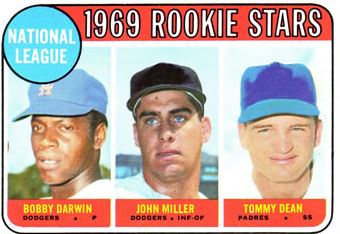
John Miller (center) made his two MLB home runs historic.

John Miller (center) made his two MLB home runs historic.

On this date (September 23) fifty years ago (1969), the Dodgers’ John Allen Miller popped a pinch-hit home run (off the Reds’ Jim Merritt) in the top of the eighth inning of an LA 6-3 loss to the Reds.  It was one of just two career home runs for Miller – who made both of his long balls count big time.

Miller played just parts of two seasons in the major leagues (1966 and 1969, with the Yankees and Dodgers, respectively).  An outfielder/first baseman, he appeared in a total of 32 major league games, getting 61 at bats and just ten hits (.164 career average), two home runs and three RBI.  With that output, however, Miller earned a special place in the MLB record books.  Miller’s two round trippers came in his very first and very last MLB at bats – making him just one of two players in MLB history to homer in their first and final big league at bats. The other is Paul Gillespie – whose MLB career spanned three seasons during World War II (1942, 1944, 1945), all with the Cubs. Gillespie, a catcher, appeared in 89 games – hitting .283, with six home runs and 31 RBI; and went zero-for-six in the 1945 World Series.

Miller made his MLB debut with the Yankees on September 11, 1966. The 22-year-old was in his fifth professional season and had hit a promising .294, with 16 home runs and 59 RBI in 113 games at AA and AAA that season. Miller started that debut game (against the Red Sox at Fenway) in LF, batting seventh. In his very first big league at bat, he hit a two-out, two-run home run off of Red Sox starter Lee Stange.  Despite the Yankees’ long heritage of home run hitters, Miller’s long ball made him the first Yankee to homer in his first MLB at bat. (Little did Miller know he would not get another home run nor another RBI until the final at bat of his MLB career.) Miller got in five more games with the Yankees in 1966, ending the season at .087 (two-for-23), with one home run and two RBI.

In April of 1967, Miller was traded (along with pitcher Jack Cullen and $25,000) to the LA Dodgers for utility infielder John Kennedy. Miller spent 1967 and 1968 at Triple A Spokane – putting up respectable numbers.  In 1969, he made it back to the big leagues, getting in 26 games (just 38 at bats) for the Dodgers. In the first 37 of those at bats, Miller collected seven hits (one double and six singles), scored twice, but did not collect an RBI.   Miller’s last at bat of the season (and what turn out to be the last at bat of his MLB career) was that September 13, 1969 pinch-hit appearance. 

Miller appeared in one more box score for the Dodgers after his pinch-hit long ball, but did not come to the plate.  On September 27, the Dodgers and Giants faced off in a contest tied 1-1 in the bottom of the eleventh inning.  Southpaw Ron Bryant was on the mound for the Giants and, after getting Dodgers’ SS Maury Wills to pop out, he gave up singles to LF Manny Mota and CF Willie Davis. Dodgers’ manager Walt Alston sent the right-handed hitting Miller up to hit for LA pitcher Jim Brewer.  Giants’ skipper Clyde King –playing the percentages – brought in veteran righty Don McMahon to pitch.  Alston countered by calling Miller back and sending up left-handed swinging Len Gabrielson (who singled in the winning tally.)  Without the switch, that final at bat home run could have become just an obscure next-to-last at-bat dinger.

How About a 100th Anniversary Involving the Great Bambino – and a Touch of Irony

This September (September 20 to be exact) marks the 100th Anniversary of the first-ever Babe Ruth Day at a ballpark. In this case, it was at Fenway Park and Ruth suited up as a member of the Boston Red Sox. By this time, Ruth: was in his sixth season in a Red Sox jersey; had already twice been a twenty-game winner; had led the league in ERA, complete games and shutouts once each; had led the AL in home runs the year before; and was on the verge of setting a new MLB single-season high in long balls.

With all of this in mind, the Knights of Columbus sponsored “Babe Ruth Day” for the BoSox hero, with ceremonies and gifts to presented between games of a double-header against the White Sox. The Babe did not disappoint – breaking a 3-3 tie with a walk-off home run in the bottom of the ninth of game one; his 27th home run of the season, tying the MLB single-season record.  (Ruth, by the way, started the game on the mound, giving up three runs in 5 1/3 innings before moving to left field.) In Game Two, Ruth started in left field and went one-for-three with an RBI, as the Red Sox prevailed again 5-4. By season’s end, he would extend the MLB home run record to 29 (.322-29-113.)

Oh yes, the irony I noted in the header?  The Red Sox’ Babe Ruth Day would mark the last time Ruth ever appeared in Boston in a Red Sox uniform.  The team finished out the season on the road and, that December, Ruth was sold the Yankees.  (The rest, of course, is history.)

Cole Rolls a 300

Gerrit Cole photo

Photo by boomer-44

On  September 18, Astros’ right-hander Gerrit Cole notched his 19th game with ten or more strikeouts this season. – beating the Texas Ranger 3-2 (six hits, one walk, two earned runs), while fanning ten batters in eight innings.   It was also his seventh consecutive start with ten or more whiffs – and brought his season total to 302 strikeouts in 200 1/3 innings pitched.

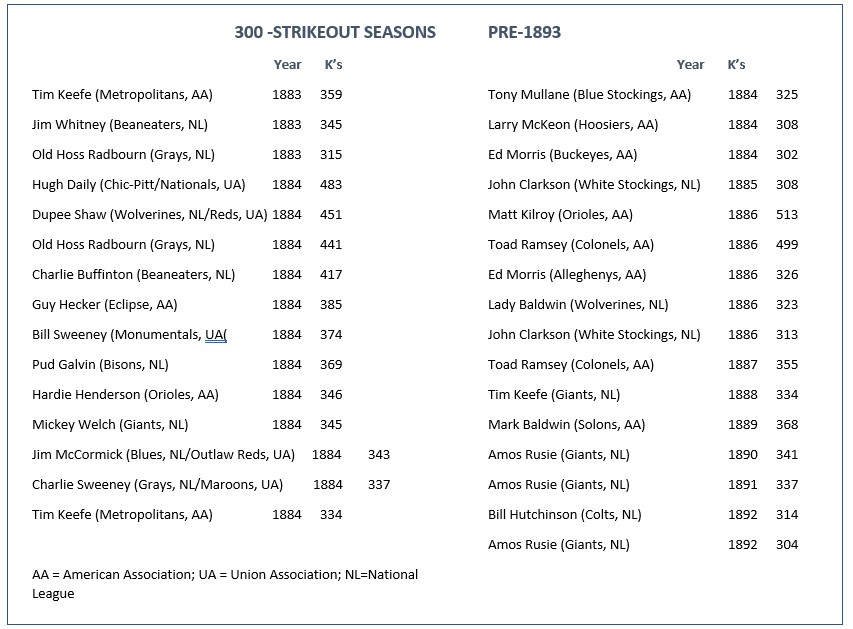
The performance made Cole the 41st pitcher in MLB history and just the 18th since 1893 (when the pitching distance was increased to 60’ 6”) to reach the 300 mark.   (Side Note:  Most baseball historians divide MLB records into pre-1900 and 1900-present. BBRT prefers to use 1893 for this record, since that is when the pitching distance was extended to 60’6”.   However, it really makes no difference in record-keeping, since there were no 300K seasons between 1892 and 1903.)

Here, in honor of Cole’s feat, are a few 300-strikeout tidbits.

  • 41 MLB pitchers have turned in 68 seasons of 300 or more strikeouts – 31 of those before 1893.
  • 1884 saw a record 15 pitchers notch at least 300 strikeouts.
  • Since 1893, there have never been more than two 300K pitchers in any one MLB season.

The Exclusive 500 Club

Only one MLB pitcher has ever fanned 500 batters in a season – and that was Matt Kilroy, who whiffed 513 batters in 583 innings as a 20-year-old rookie with the 1884 American Association Baltimore Orioles. Of course, it was a different game back then.  The pitching distance was shorter, hurlers threw from a box and not from a rubber and it took six balls to draw a walk.

In his record-setting season, Kilroy started 68 of the Orioles 139 games (49 percent) – and completed 66 of them. (That season, American Association starting pitchers finished an average of 96 percent of their starts.) Despite five shutouts and a 3.37 earned run average (the league ERA was 3.44), Kilroy finished 29-34 for the last-place (46-85) Orioles.

  • There were no 300-strikeout campaigns between 1912 (Walter Johnson – 303) and 1946 (Bob Feller – 348).
  • Rube Waddell’s 349 strikeouts in 1904 stood as the post-1893 (or post-1900, as most MLB historians prefer) record for 61 years (Sandy Koufax – 382 in 1965). Koufax’ record held for just eight seasons (Nolan Ryan – 383 in 1973, still the post-1900 MLB record). Koufax still holds the NL post-1900 record for whiffs in a season.

Rube Waddell – The Man Could Bring it

How good was Rube Waddell?  In 1902, he joined the Philadelphia Athletics in June – making his first start on June 26 (with just 86 games left in the season). Waddell proceeded to win 24 games (the league’s second-highest total) against seven losses, with a 2.05 ERA.  Despite his shortened season, he led the AL with 210 strikeouts, fifty more than the runner-up (none other than Cy Young).

The 6’1”, 195-lb. lefty (figures Waddell, known as one of the zaniest players in MLB history, would be a southpaw) went on to lead the AL in strikeouts six consecutive seasons (1902-1907) – by a wide margin.  In 1904, when he set the MLB strikeout record (which stood for 61 years) at 349, he outpaced the runner up by 110 K’s. 

Final note:  Rube Waddell was born on Friday the 13 of October in 1876 and died on April Fool’s Day 1914.  There is some symmetry there.

  • The only team to boast two 300+ strikeout pitchers in the same season is the 2002 Diamondbacks – Randy Johnson (334) and Curt Schilling (316).
  • The most 300-K seasons by any one pitcher is six – and two hurlers share the record: Nolan Ryan (1972-73-74-76-77-89) and Randy Johnson (1993-98-99-2000-01-02).
  • Randy Johnson reached 300 strikeouts in a record five consecutive campaigns.
  • The oldest player ever to record a 300-strike out season ewes 42-year-old Nolan Ryan in 1989 (301 whiffs for the Texas Rangers).

Youth will be Served

The youngest pitcher ever to record 300+ strikeouts in a season was 18-year-old rookie Larry McKeon, who fanned 308 batters in 512 innings for the American Association Indianapolis Hoosiers in 1884. Despite all those whiffs (and a 3.50 ERA) McKeon led the AA with 41 losses (versus 18 wins) that season. In 1884, the overall AA earned run average was 3.24 – and Guy Hecker was the league’s premier hurler.

The youngest pitcher to notch 300 whiffs in a season since 1900 was 21-year-old Vida Blue, who fanned 301 batters (312 innings pitched) for the A’s in 1971.  That season, Blue went 24-8, with an AL-best 1,82 ERA, a league-topping eight shutouts and 24 complete games in 39 starts.

3001A3001B

Primary Resources: Baseball-Reference.com; ESPN.com; MLB.com

BASEBALL ROUNDTABLE ON THE TOP 100 BASEBALL BLOG LIST

100Baseball Roundtable is on the Feedspot list of the Top 100 Baseball Blogs.  To see the full list, click here.

I tweet baseball @DavidBBRT

Follow/Like Baseball Roundtable’s Facebook Page here.  More baseball commentary; blog post notifications; PRIZES.

Member: Society for American Baseball Research (SABR); The Baseball Reliquary; The Negro Leagues Baseball Museum.
BBRT Musings: One-Hit Wonders – A Different Kind of Thirty Game Winner – So Close, and Yet, So Far

Just a few days ago, Baseball Roundtable featured a post on the fewest combined hits ever allowed in a major league contest of at least nine innings.  It happened back on September 9, 1965, when the Dodgers’ Sandy Koufax bested the Cubs’ Bob Hendley 1-0.  Koufax threw a no-hitter (perfect game), while the unfortunate Hendley gave up just one safety.  For the whole story, click here.

Never Before – Unlikely Again

Yesterday, marked another “never before – unlikely ever again” feat of pitching excellence (or batting futility). For the first time since 1900 (according to Elias Sports Bureau), an MLB team managed a victory despite having only one base runner (which, of course, would be the bare minimum) in a game of at least nine innings.  The team with this absolutely zero-waste offensive output?  The Arizona Diamondbacks, who topped the Cincinnati Reds 1-0 (in Phoenix). Reds’ starter Anthony DeSclafani set the Diamondbacks down in order in the first, second, fourth, fifth, sixth and seventh innings (fanning five); while reliever Joel Kuhnel added one whiff in a 1-2-3 eighth.  The only blemish for the Reds’ mounds men came in the third inning. Arizona SS Nick Ahmed led off with a high hopper (on the first pitch he saw from DeSclafani) that bounced over the head of Reds’ third-sacker Eugenio Saurez and rolled all the way to the left field wall for a triple.  D-backs’ RF Jarrod Dyson was also first-pitch swinging and sent a fly ball to center for a run-scoring sacrifice fly – and that was Arizona’s total offense for the game.

The Diamondbacks’ staff – starter Merrill Kelly (seven innings) and relievers Kevin Ginkel and Archie Bradley (one frame each) made the 1-0 lead stand up; giving up no runs on three and two walks (seven strikeouts).

It’s Happened Before, It’ll Happen Again

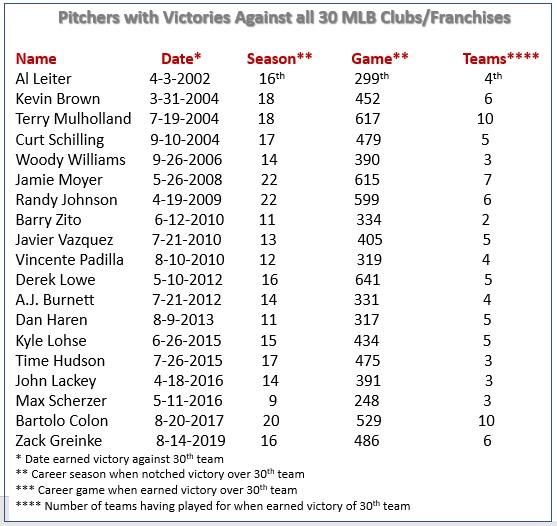
Yesterday (September 14), the Astros’ Zack Greinke pitched six innings of one-run ball (six hits, no walks, seven strikeouts) for the win, as Houston topped Kansas City 6-1 (in K.C.).  It was the Greinke’s 203rd career win and 16th victory of 2019 – but his first-ever against the Royals (Greinke was a Royals’ first-round draft pick in 2002, pitched for the Royals from 2004 through 2010 and won the AL Cy Young Award as a Royal in 2009).  Notably, Greinke’s win against the Royals made him the 19th pitcher to record victories against all 30 teams.  (Keep in mind, MLB didn’t reach 30 teams until 1998.) With today’s inter-league play and player movement from team to team, we can expect more hurlers to reach this mark.  Still, it’s a pretty good sign of MLB longevity – and a fun statistic.

Al Leiter and me ... at the 2015 All Fan Fest.

Al Leiter and me … at the 2015 All Fan Fest.

The first pitcher to notch wins against all thirty MLB team was Al Leiter, who completed the feat in 2002).  Since that time, Leiter has been joined by Kevin Brown, Terry Mulholland, Curt Schilling, Woody Williams, Jamie Moyer, Randy Johnson, Barry Zito, Javier Vazquez, Vincente Padilla, Derek Lowe, A.J. Burnett, Dan Haren, Kyle Lohse, Tim Hudson, John Lackey, Max Scherzer, Bartolo Colon and Zack Greinke.

Greinke’s fewest career victories against any team have come, of course, against the Royals (1).  He is 1-2, 2.90 versus K.C. On the other side of the coin, he has more career victories for the Royals (60) than for any other team.  He has more career victories against the Rockies (14-7, 3.66) than any other team.

Max Scherzer photo

Photo by apardavila

Looking at the full list,  Max Scherzer was the quickest to wins against all 30 teams – just nine seasons and 248 pitching appearances.  Taking the longest? Jamie Moyer and Randy Johnson each wrapped up the complete victory cycle in their 22nd MLB seasons and Derek Lowe notched a victory against team number 30 in his 641st appearance.  Oh yes, Barry Zito appeared for the fewest teams in his run to a win against all 30 franchises – taking the mound for just the Giants and A’s.


30-2


On May 11, 2016, Max Scherzer of the Nationals joined the ranks of pitchers recording a career victory against all 30 MLB teams, as Washington topped Detroit 3-2.     In the process, he became the first pitcher to reach the “30-team” mark while tossing a complete game – AND he tied an MLB record by fanning 20 batters in the contest (two runs, two hits, no walks, 20 whiffs). Scherzer was drafted by the Diamondbacks in the first round of the 2006 MLB draft- and has pitched for Arizona in 2008-09, Detroit (2010-2015) and Washington (2015-19).

Don’t Want to See This Again … So Close, Yet So Far

On this day (September 15) in 1971, Larry Yount (brother to Hall of Famer Robin Yount) had the shortest MLB career of any pitcher. Called up from the minors by the Astros that September, Yount was called in from the bullpen to pitch the ninth inning of a game against the Braves (Houston was trailing 4-1).  While he was warming up on the mound, he felt tightness and pain in his elbow. Baseball rules require a reliever to face at least one batter, with the lone exception being if he has to be removed due to injury.  That exception helped make Yount the answer to a trivia question.  Yount and his painful elbow were taken out of the game before he faced a single batter.  By baseball rules, however, he was credited with an MLB game appearance.  Yount played three more seasons (1972-73 and 1975), but never made it back to the majors.  He remains the only pitcher listed in MLB’s official records as having appeared in the majors – but never having faced a batter.

BASEBALL ROUNDTABLE ON THE TOP 100 BASEBALL BLOG LIST

100Baseball Roundtable is on the Feedspot list of the Top 100 Baseball Blogs.  To see the full list, click here.

I tweet baseball @DavidBBRT

Follow/Like Baseball Roundtable’s Facebook Page here.  More baseball commentary; blog post notifications; PRIZES.

Member: Society for American Baseball Research (SABR); The Baseball Reliquary; The Negro Leagues Baseball Museum.

Stan “The Man” Celebrates Becoming Stan “The Grandpa”

StanMusialAt about 5:00 a.m. on September 10, 1963, Stan “The Man” Musial and his wife Lillian got a call from Stan’s son Dick informing them that Stan “The Man” was now Stan “The Grandpa.”

Approximately 15 hours later, Stan Musial was on the field, playing left field for the Saint Louis Cardinals, facing the Chicago Cubs.  Bob Gibson was on the mound for Saint Louis and, after giving up a single to Lou Brock to open the game, he retired the next three Cubs in order.   In the bottom of the first, the Cubs’ Glen Hobbie fanned Cardinals’ lead off hitter 2B Julian Javier before giving up a single to SS Dick Groat.  That brought the 42-year-old Musial to the plate – for his first at bat as a grandpa. He was apparently not the least bit phased by the new age marker – drilling the first pitch he ever saw as a grandpa over the right field wall for a two-run homer.  (MLB’s first-ever homer by a grandfatherYes, in baseball we track everything.)

The Cardinals won 8-0, and Musial went two-for-three with one run scored and three RBI. It was Musial’s final big league season and he finished the year at .255-12-58.    Being a grandfather seemed to agree with him, as he played in 16 games after his first grandson’s birth, going .341-2-7.

Oh, for those who track such things, Musial played 22 MLB seasons, made 20 All Star teams, collected 3,630 hits (.331 average) and seven batting titles; hit 475 home runs; led the league in hits six times, doubles eight times, triples five times, runs scored five times and RBI twice; and was a three-time NL Most Valuable Player. Over his life, he also was a father four times; grandfather eleven times; and great grandfather 12 times.

Side note: In that September 10, 1963 game, Cardinals’ starting pitcher Bob Gibson not only  threw a complete-game, six-hit shutout, but also popped a three-run home run.  More #WhyIHateTheDH.

Primary Resource:  Baseball-Reference.com

BASEBALL ROUNDTABLE ON THE TOP 100 BASEBALL BLOG LIST

100Baseball Roundtable is on the Feedspot list of the Top 100 Baseball Blogs.  To see the full list, click here.

I tweet baseball @DavidBBRT

Follow/Like Baseball Roundtable’s Facebook Page here.  More baseball commentary; blog post notifications; PRIZES.

Member: Society for American Baseball Research (SABR); The Baseball Reliquary; The Negro Leagues Baseball Museum.

Unrequited Excellence – Stories that Connect The Left Arm of God, Hippo, The Kitten, Greasy, Fidgety Lew The Hammer and More

KoufaxToday (September 9, 2019) is the 54th anniversary of the MLB game that featured the fewest base hits ever.  It happened in 1965, with the Dodgers’ Sandy “The Left Arm of God” Koufax facing Cubs’ righty Bob Hendley in Los Angeles. At the time, the Dodgers (eventual 1965 World Series Champions) were in second place with an 80-61 record, while the Cubs were in the eighth spot at 65-77. Koufax went into the game with a 21-7, 2.20 record on the season; while Hendley was 2-2, with an 8.22 earned run average.

Hendley, however, was on top his game that day. After eight innings, he had given up just one hit and one walk (versus three strikeouts). The only hit had been a harmless double by Dodgers’ LF Lou Johnson in the bottom of the seventh. Hendley had allowed just one run (unearned) in eight frames – and even that wasn’t his fault.  The pesky Johnson had led off the fifth with a walk; moved to second on a sacrifice by RF Ron Fairly; stole third; and then scored as Cubs’ catcher Chris Krug made a wild throw past third baseman Ron Santo.

Unfortunately, it wasn’t nearly enough. Koufax, threw a perfect game – striking out 14 Cubs.  It was the last of Koufax’ four career no-hitters (one each in 1962-63-64-65) and his only perfect game.  For Hendley, it was a well-pitched loss and a piece of the record for playing/pitching in the MLB game with the fewest combined hits.

Hendley, by the way, went 48-52, 3.97 in a seven-year MLB career (Braves, Giants, Cubs, Mets)’ while Koufax went to the Hall of Fame with a 165-87, 2.76 record, three Cy Young Awards, one MVP and a heavenly nickname.

HOW ABOUT BEING PART OF A DOUBLE NO-NO?

Bob Hendley could take some solace in the fact that his may not be the best-ever unrewarded mound effort. Back on May 2, 1917, another Cubs’ pitcher – Hippo Vaughn – found himself in a true pitchers’ duel (in Chicago) against the Reds’ Fred Toney. Vaughn was 3-1 on the season at the time, while Toney was 4-1. After nine innings, the game was scoreless and NEITHER pitcher had given up a hit.

Looking at total offense over the first nine innings, Vaughn had given up two walks and one Reds’ hitter had reached on an error.  Those three runners were retired on an attempted steal and a pair of double plays, so Vaughn had actually faced the minimum 27 batters through nine, striking out ten. Toney was not as overpowering, but just as effective. The Reds’ starter had also given up just a pair of walks, but had fanned just one.

So, going into the tenth, Vaughn and Toney were matched up in the first (still only) double nine-inning no-hitter in MLB history. In the top of the tenth, however, Vaughn:

  • Surrendered a lead off single to Reds’ SS Larry Kopf;
  • Got CF Greasy Neale to fly out to Cubs’ CF Cy Williams (gotta love a game where a guy named Hippo Vaughn pitches to a guy name Greasy Neale);
  • Saw Williams drop a liner by Reds’ 1B Hal Chase – putting runners at second and third with one out; and
  • Gave up a high-hopping infield hit to speedy RF Jim Thorpe – scoring what would be the only run of the game.

Toney, who had fanned only one Cub over the first nine, was energized after getting the lead – completing his no-hitter with a 1-2-3 tenth, striking out two more Chicago batters.   Tough loss for Vaughn, after nine innings of no-hit, no-run ball.

For those who track such things: Toney finished the 1917 season 24-16, 2.20 – and his 12-season MLB career at 139-102, 2.69. Vaughn went 23-13, 2.01 in 1917 and 178-137, 2.49 in 13 MLB seasons (

12 PERFECT INNINGS – FOR THE LOSS

HaddixFor, perhaps, MLB’s toughest hard luck story, consider the Pittsburgh Pirates’ Harvey “The Kitten” Haddix, who took a perfect game into the 13th inning – AND LOST.

On May 26, 1959, Haddix took the mound (fighting a  bout of the flu) against the power-laden Milwaukee Braves (who had won the National League pennant the previous two seasons and came into the game again leading the league).  Haddix retired the first 36 hitters in order – fanning eight, carrying a perfect game into the bottom of the 13th. A 20-game winner in 1953, the 33-year-old Haddix had come into the game 4-2, with a 2.67 ERA in seven starts – and had thrown complete games in his two previous outings. (He would end up 12-12, 3.13 on the year.)

Unfortunately, the Braves’ “Fidgety” Lew Burdette, despite giving up 12 hits and fanning only two, had held the Pirates scoreless. (Like Haddix, Burdette had not issued a single free pass.) Milwaukee 2B Felix Mantilla led off the 13th by reaching on error by Pirates’ third baseman Don Hoak. Slugging 3B Eddie Mathews bunted Mantilla over to second, which led to an intentional walk to RF Hank “The Hammer” Aaron, bringing up 1B Joe Adcock.

Adcock rapped a 1-0 pitch over the right field fence for what appeared to be a three-run home run.  However, the Braves, in celebrating the tension-filled victory, forgot how to run the bases. Adcock passed Aaron between second and third and, after some deliberation, Adcock was called out – ultimately changing his three-run homer to a one-run double. So, despite 12 perfect innings, Haddix lost the no-hitter, the shutout and the game itself.  But he did etch his name forever into baseball lore; and countless trivia quizzes.

Braves’ manager Fred Haney once commented that Lew Burdette’s fidgeting antics on the mound “would make coffee nervous.” 

Haddix spent 14 seasons (1952-65) in the major leagues (Cardinals, Phillies, Reds, Pirates, Orioles), going 136-113, 3.48.  His best seasons were with the Cardinals in 1953-54. In those two campaigns, Haddix put up lines of 20-9, 3.06 and 18-13, 3.57.  The 5’9”, 170-pounder was a three-time All Star and led the NL in shutouts (six) in 1953.

BASEBALL ROUNDTABLE ON THE TOP 100 BASEBALL BLOG LIST

100Baseball Roundtable is on the Feedspot list of the Top 100 Baseball Blogs.  To see the full list, click here.

I tweet baseball @DavidBBRT

Follow/Like Baseball Roundtable’s Facebook Page here.  More baseball commentary; blog post notifications; PRIZES.

Member: Society for American Baseball Research (SABR); The Baseball Reliquary; The Negro Leagues Baseball Museum.
Mike Lorenzen Joins Babe Ruth … with a bit of Jimmie Foxx “Tossed” In

LorenzenYesterday (September 5), Reds’ right-hander Mike Lorenzen became only the second major leaguer to earn a win on the mound, play in the field and play a position (other than pitcher) in the field – all in the same game.  The other?  Babe Ruth.

Lorenzen came in from the bullpen in the top of the seventh (replacing Robert Stephenson) with the Reds leading the Phillies 5-4.   He faced four batters, notching one strikeout and giving up a game-tying home run to Jay Bruce.  (That long ball would be the key to Lorenzen’s appearance in the “win” column.)  The Reds scored a go-ahead run on Jose Iglesias’ pinch-hit home run in the bottom of the inning.

Lorenzen pitched a 1-2-3 eighth.  Then, in the bottom of the inning, he came to the plate with one on and two out – and hit home run to left-center (his first of the year) – expanding the lead to 8-5.

In the top of the ninth, another Reds’ Iglesias (closer Raisel) replaced Lorenzen on the mound, but Lorenzen’s game was not over.  He moved to center field.  Iglesias pitched a 1-2-3 ninth (Lorenzen did not have a play.)

Babe Ruth enjoyed a three-way day (pitching victory, home run, turn in the field) on June 13, 1921. On that date, Ruth started on the mound for the Yankees against the Tigers and pitched five innings (five hits, four runs/three earned, seven walks and one strikeout), picking up the win as the Yankees prevailed 13-8. After his turn on the mound, Ruth moved to CF, where he handled a pair of fly-ball putouts. In five plate appearances, Ruth went two-for-three (both home runs), with two walks, two runs scored and three RBI.  Ruth would pitch once more that season (October 1), picking up a second win (despite giving up six runs on nine hits in four innings of relief) as the Yankees topped the Athletics 7-6.  Ruth would not take the mound again until 1930.

Lorenzen’s three-way day should come as no surprise (and we may very well see more such performances in his future). Drafted out of Cal State Fullerton (38th pick overall in the 2013 MLB draft), Lorenzen was a 2012 All American and, more relevantly, a finalist for the John Olerud Two-Way (College) Player of the Year Award. As a sophomore in 2012, Lorenzen posted a 2-0 record, with 16 saves and a 1.23 earned run average in 20 appearances on the mound.  That season, Lorenzen started 57 games in center field for CSF.  At the plate, he hit .297, with 20 doubles, three triples, two home runs, 38 runs, 43 RBI and 14 stolen bases. Lorenzen’s stat line in three college seasons was .324-11-128, with 45 steals (in 164 games).  On the mound (two seasons), he was 5-0, 1.61, with 35 saves (in 42 appearances).

In five minor-league campaigns, Lorenzen went 9-9, 2.71, with five saves in 59 appearances (31 starts); but did not fare as well at the plate (.175-1-7 in 40 at bats).

As of yesterday, the 27-year-old (in his fifth MLB season) was 1-4, 3.04, with six saves on the mound this season (66 appearances) – and .353-1-4 in 18 at bats.  In 2019, he has found himself in the outfield 18 times.  For his MLB career (to date), Lorenzen is 19-20, 3.99, with nine saves (243 appearances) and .267-7-22 (101 at bats).

______________________________________________________

Jimmie Foxx – Oh, What A Relief!

The Lorenzen/Ruth connection gave me reason to reflect on the pitching career of Hall of Famer Jimmie Foxx.

When Neil Armstrong first set foot on the moon, he and all the space scientists were puzzled by an unidentifiable white object.  I knew exactly was it was.  That was a home run hit off me in 1937 by Jimmie Foxx.

                                                                                 Hall of Fame Pitcher Lefty Gomez

FoxxFoxx, nicknamed “The Beast” was known for his prestigious home runs. He hit them high, hard, far and often. In 20 MLB seasons, he hit 534 home runs, leading the four times. The Hall of Famer was also a nine-time All Star, three-time American League MVP and the 1933 AL Triple Crown winner (.356-48-163).  Foxx also led his league in batting average twice, RBI three times, runs scored once, and total bases three times. His career batting average was .325 (2,646 hits) and he posted 1,922 RBI and 1,751 runs scored.  He was one of the most feared batsmen of his era. He hit 30 or more home runs in 12 straight seasons (1929-40) and drove in 100+ runs in 13 consecutive campaigns (1929-41).

The surprise of Foxx’ stellar career may have come in his final season (1945), when the 37-year-old – a sure Hall of Famer by this time – answered the call when his team (then the Phillies) found itself short of pitching. Foxx who had taken the mound only once in his career (a 1-2-3 inning for the Red Sox in 1939) volunteered to step on the bump and into the breach.  How did the veteran do?  He made nine appearances, two starts – going 1-0, 1.52 in 22 2/3 innings (fanning ten). (He did give up 14 walks.)  With his one clean 1939 inning, Foxx had a .152 career ERA.

Side note: Foxx, signed at 16 and was in the majors at 17.  He hit .296, with 10 home runs in 76 games at Class D as a 16-year-old and .327 with one home run in Double A as a 17-year-old.  

Jimmie Foxx’ lone career mound win came on August 19th, as his Phillies topped the Reds 4-2.  The losing pitcher was another Fox (single X), Reds’ starter Howie Fox. 

Primary Resources: MLB.com; Baseball-Reference.com; CBSsports.com

BASEBALL ROUNDTABLE ON THE TOP 100 BASEBALL BLOG LIST

100Baseball Roundtable is on the Feedspot list of the Top 100 Baseball Blogs.  To see the full list, click here.

I tweet baseball @DavidBBRT

Follow/Like Baseball Roundtable’s Facebook Page here.  More baseball commentary; blog post notifications; PRIZES.

Member: Society for American Baseball Research (SABR); The Baseball Reliquary; The Negro Leagues Baseball Museum.

The Dinger Diaries – Baseball Roundtable August Wrap Up

pinball

It’s September 1, and that means it’s time for Baseball Roundtable’s look back at the previous month – the standings, statistics and stories that caught BBRT’s eye, as well as the BBRT Players and Pitchers of the Month and season-to-date “Trot Index.”

August came to an end with a Twins/Tigers match-up that seemed a microcosm of the 2019 season. In posting a 10-7 victory, the Twins:

  • hit six home runs;
  • hit their 268th round tripper of the season, breaking the all-time single-single season MLB record;
  • saw Jorge Polanco hit his 20th long ball, becoming the eighth member of the Twins to reach 20 home runs this season, breaking another all-time, single-season MLB record;
  • Notched their eleventh game of five or more homers this season – extending their own MLB record (they broke the old record of eight in late July).

How does BBRT feel about the home run records that just keep falling across major league baseball?  Let me put it this way, the two most exciting plays I witnessed this past month were:

  •  a third-to-second-to first triple play turned by the Twins August 7 (against the Braves), the home squad’s second triple-killing of the season; and
  • a successful suicide squeeze pulled off (against the Twins) by the White Sox’ Yolmer Sanchez on an 0-2 count.

But enough “old schooling,” the Twins are on their way to the first 300-homer season in MLB history (and then some), as well as on their way to the post season.  (Yes, I’m that confident.)  And, that makes for some pretty exciting baseball for me.  Now, here’s a look at a few other baseball events that caught my eye in August.

  • Two players (Mets’ Wilson Ramos and Astros’ Alex Bregman) hit over .400 for the month.
  • A rookie (Bo Bichette) set a record by doubling  in nine straight games – and at the time he had only played in 11 MLB contests.
  • Carl Yastrzemski‘s grandson Mike had a three-homer game – giving the rookie the same number of three-homer games as his Hall of Fame grandfather.

In August, the New York Yankees, with MLB’s best record (21-9),  were the only team with zero (that’s right zero) sacrifice bunts.  

  • The Yankees set a new MLB record for home runs in a calendar month (74).
  • Kevin Gausman joined Nolan Ryan as one of the only two pitchers to thrown an immaculate inning (nine pitches, three strikeouts) in both the American and National Leagues.
  • The Mets’ Pete Alonso broke the National League rookie-season home run record, ending August with 42 dingers.
  • Eduardo Escobar became just the fourth MLB switch-hitter to record 20 doubles, 10 triples and 30 home runs in a season; joining Mickey Mantle; Rip Collins and Jimmy Rollins.
  • Mike Trout became the youngest player to reach 200 home runs and 200 stolen bases in his career.

When you get to the highlights section, you’ll find the details on these and plenty of other August stories.  But, let’s move on now to the Players and Pitchers of the month.

______________________________________________________________

— BASEBALL ROUNDTABLE PLAYERS AND PITCHERS OF THE MONTH—–

AL Player of the Month – Alex Bregman, 3B, Astros

Bregman truly raked in the dog days of August, putting up an MLB second-best (among players with at least 75 at bats) .404 average, with six home runs, an AL-tops 31 RBI and the senior circuit’s second-highest 27 runs scored. Over the course of the month, he had 14 multi-hit games in 26 starts and raised his average from .266 to .290.

Other contenders: Well, it’s easy to see why the Astros fared so well in August. Also contending for BBRT’s AL Player of the Month were: Astros’ 1B Yuli Gurriel (.344-7-29) and Houston rookie LF Yordan Alvarez (.309-9-26). Bregman, Gurriel and Alvarez were 1-3-6 in the AL in August RBI.  Young Yankee infielders Gleyber Torres and Gio Urshela also deserve recognition. Torres launched an AL-best 13 August home runs, to go along with a .277 average and 21 RBI; while Urshela hit .385, with seven long balls, 18 RBI and 20 runs scored.

AL Pitcher of the Month – Mike Clevinger, RHP, Indians

If the Indians manage to chase down the Twins for the AL Central Division crown, Mike Clevinger will have a lot to do with it.  In August, he went 5-0 in six starts (one of just three pitchers with five or more wins in the month), putting up a 1.96 earned run average and fanning 51 batters (with just 11 walks) in 36 2/3 innings. Clevinger gave up two or fewer earned runs in five of his six starts.

Other Contenders:  It was very close between Clevinger and the Yankees’ James Paxton, the only pitcher to tally six victories (no losses) in August. Paxton had a 3.57 ERA and fanned 39 batters (14 walks) in 35 1/3 frames. Also in the running was the White Sox’ Lucas Giolito, who only went 3-2, but had a 2.45 August ERA and fanned an MLB-high 53 batters in 33 innings, while walking just nine. Aroldis Chapman of the Yankees saved an MLB-high nine August games in nine opportunities, put up a 0.00 ERA and fanned 20 batters in 11 innings.

Surprise Player of the Month

Of course, the Reds’ Aristides Aquino (see below) was a surprise – a rookie topping MLB in home runs and RBI in his first MLB month.  But, he’s the BBRT NL Player of the Month.  So, BBRT will go with Mets’ catcher Wilson Ramos, who hit .434 for August (43-for 99), with three homers and 20 RBI. A career (10 seasons) .276 hitter, Ramos came into August hitting .255 on the year, went two-for-three in a game against the White Sox on August 1 and took off from there. He collected hits in 25 out of 26 August games played – ending the month with a still-active, 24-game hitting streak. The two-time All Star is having a banner season – standing at .299-13-66 through August.

NL Player of the Month – Reds’ OF Aristides Aquino

AquinoWhat can you say? The 22-year-old rookie led all of MLB with 14 August home runs and 33 August RBI – in just 29 games; while also putting up a .300 average.  His 14 home runs were the most ever in a month by an NL rookie and he is the first player to collect 14 long balls in his first 100 MLB plate appearances.

Other Contenders: I’ll slot in a couple of third basemen here. Nationals’ 3B Anthony Rendon hit .394 for August, with eight home runs, 29 RBI and 23 runs scored.  Rockies’ 3B Nolan Arenado not only continued to flash Gold Glove leather, his August stat line was .337-12-23.

NL Pitcher of the Month – (Tie) Jack Flaherty, RHP, Cardinals and Sonny Gray, RHP, Reds

The Cardinals are in a tight race with the Cubs and Jack Flaherty contributed significantly to the team’s August surge.  The 23-year-old Flaherty, who came into August with a 4-6, 4.17 record on the year (and 12-17, 3.89 career marks) turned it up a notch (or more) last month.  He went 4-1 in six starts with an MLB-best (among pitchers with at least 25 innings pitched) 0.71 earned run average. He also fanned 47 batters in 38 innings, while walking just nine. He started the month with a key victory against the rival Cubs – going seven scoreless innings, giving up just one hit, walking two and fanning nine.

GrayRight there with Flaherty was the Reds’ Sonny Gray. The 29-year-old,  in his seventh MLB season, went 4-0 in six starts for the Reds (who went 13-16 for the month), putting up a nifty 0.74 ERA and striking out 44 in 36 2/3 innings of work.

Other Contenders: Walker Buehler of the Dodgers, who only went 2-1 (five starts), but put up a 1.69 ERA and fanned 48 (against just eight walks) in 32 innings; the Mets’ Jacob deGrom – 2-1, 2.18 with 40 whiffs (five walks) in 33 innings of work; and the Cubs’ Jose Quintana, who went 4-1, 2.02 in six starts.


TROT INDEX … A REGULAR BBRT FEATURE

Through August,  35.9 percent of MLB’s 156,355 2019 plate appearances ended in a trot (back to the dugout, around the bases, to first base). We’re talking about strikeouts, home runs, walks, hit by pitch and catcher’s interference – all outcomes that are, basically, devoid of action on the base paths or in the field. Here’s the breakout: strikeouts (22.7%); walks (8.5%); home runs (3.6%); HBP (1.1%); catcher’s interference (less than 1%). Personally, I’d like more action in the field of play.

For the 2018 season, 34.8 percent of all MLB’s 185,139 plate appearances ended in a trot.  

___________________________________________________________

Auguitwonlostuse

They Were the Best of Teams and the Worst of Teams

The Yankees were MLB’s hottest team in August, going 21-9 and expanding their AL East lead from 7 ½ to ten games over the Rays.  Their surge was fueled at the plate – where they had the AL’s third-highest batting average for the month (.278); scored the third-most runs (178); and set a new MLB record for home runs in a calendar month (74). On the mound, the Bronx staff put up a “middle of the road”  eighth-best earned run average in the AL (4.60), so they needed to bring their bats to the ballpark to produce that .700 winning percentage. Surprisingly, despite the 74 dingers, the Yankees only had one player with at least ten in August – infielder Gleyber Torres (.277-13-21), who had the AL’s most August long balls.  However, eight Bombers had at least five August dingers. A couple of key contributors were 2B  DJ LeMahieu (.336-9-19) and 3B Gio Urshela (.385-7-18).  On the mound, James Paxton went 6-0, 3.57 in six starts (leading MLB in August wins) and Domingo German had a 4-1, 3.86 month. Aroldis Chapman also played a crucial role in the Yankees’ victory total, saving nine games in nine opportunities – and not giving up an earned run.

The Astros had a strong month (19-9) and needed every bit of it, as the A’s nearly matched their pace (17-9). The Astros did it with a combination of offense and pitching. They scored the AL’s (and MLB’s) most runs in August (200) and put up the league’s second-best ERA (3.42).  The big gun at the plate for the Astros was 3B Alex Bregman, who hit .404 in August, with six home runs and 31 RBI. Houston, in fact, had four players with 20 or more August RBI: Bregman; Yuli Guerriel (.344-7-29); Yordan Alvarez (.309-9-26); and Jose Altuve (.308-9-20). On the mound, starters Gerrit Cole, Wade Miley and Zack Greinke went a combined 11-0, 2.99.

The A’s (17-9) also showed some balance – scoring the AL’s fifth-most runs (146) and putting up the third-best August ERA in the senior circuit (3.85).  SS Marcus Seimen led they way at the plate (.282-8-21); the 1B/DH combo of Matt Olson (.297-5-21) and Mark Canha .347-6-18) also boosted the Oakland offense; and  Mike Fiers (4-0, 2.76) and Liam Hendriks (eight saves in eight opportunities and a 0.73 ERA) led the mound staff.  Homer Bailey and Tanner Roark went 3-1 and 2-1, respectively.

Over in the NL, the Nationals (19-7) and Braves (19-9) had the best August records.  The Cardinals went 18-9, to build a 2 1/2 game lead over the Cubs.

The Nationals topped the NL in August runs scored (180).  Anthony Rendon (.394-8-29, 23 runs) led the Washington attack, with plenty of help from: Juan Soto (.313-10-22, with 29 runs scored); Adam Eaton (.329-5-14, with 26 runs); and Trea Turner (.324-4-16, with 25 runs). The Nationals’ 4.19 ERA was fourth in the NL.  Joe Ross had an especially good August, going 3-0, 1.05 in five starts.

The Braves scored the NL’s third-most runs (151) and had the league’s fifth-best ERA (4.05). The big boppers for the Braves were a veteran and a youngster – who each logged an identical 11 home runs, 27 RBI, and 23 runs scored.  Freddie Freeman accomplished that line with a .267 average, while Ronald Acuna, Jr. put up a .270 mark. Josh Donaldson was the only other Brave with more than four August homers (he had eight); and no other Braves had more than 13 RBI for the month. On the mound, Max Fried was 4-0, 3.51; Dallas Keuchel was 3-1, 3.53; and Luke Jackson picked up three wins and a save (no losses) in 14 relief appearances (1.88 ERA).

The Cardinals and Cubs are locked in a battle for the NL Central and St. Louis got the better of it in August (18-9 to the Cubs 16-12). The Redbirds’ move to the top of the NL Central was driven primarily by the pitching staff, which put up an MLB-best 3.26 earned run average for the month (the Cubs were eleventh at 4.39). On offense, the Cardinals scored 141 August runs – 13th in MLB and 8th in the National League.  Note: The Cubs put only 131 August runs on the board.   Leading the Cardinals from the mound were: Jack Flaherty (4-1, 0.71 in six starts) and Dakota Hudson (4-1, 2.38 in six starts). On offense, 2B Kolton Wong hit .373 and scored 11 runs, SS  Tommy Edman hit .308 and scored a team-high 19 runs, and RF Dexter Fowler had a team-high 21 RBI.  Overall, the offense, while not dominating, showed balance. Eight players scored 10 or more runs and six players drove in a dozen or more tallies.

Oh, by the way, the worst teams last month were the Tigers, Royals, Orioles, Angels, Rockies and Marlins –  all won less then ten games. Surprise! Those teams make up six of the seven worst August earned run averages.

If the season ended after play on August 31, the post-season teams would be:

American League

Yankees, Astros Twins.  Wild Cards: Indians and A’s or Rays

National League

Braves, Cardinals, Dodgers.  Wild Cards: Nationals and Cubs


Full Standings and Stats Later in this Post. 

_________________________________________

IF YOU PREFER TO SKIP AND STATS AND GO RIGHT TO THE STORIES,

SCROLL DOWN TO THE HIGHLIGHTS SECTION

—-LEAGUE LEADERS – TEAMS – MONTH OF AUGUST 2019—-

RUNS SCORED … MLB Team Average – 138

AL: Astros (200); Twins (189); Yankees (178)

NL: Nationals (180); Dodgers (156); Braves (151)

The Rangers scored the fewest August runs at 104, while the Brewers were at the bottom of the NL, plating just 106 runners.

BATTING AVERAGE … MLB Team Average – .259

AL: Astros (.297); Twins (.282); Yankees (.278)

NL: Nationals (.292); Rockies (.283); Mets (.279)

Three teams hit under .230 for the month: Rangers (.217); Mariners (.221); and Royals (.224).

HOME RUNS … MLB Team Average – 41

AL:  Yankees (74); Twins (59); Astros (53)

NL: Dodgers (51); Reds (48); Cubs (47)

At the bottom of the power list were the White Sox (24 home runs); Tigers (28); and Marlins (29)

SLUGGING PERCENTAGE – MLB Team Average – .449

AL:  Yankees (.551); Astros (542); Twins (.516)

NL: Nationals (.517); Dodgers (.498); Rockies (.475)

The Yankees collected 136 extra-base hits in August – 59 doubles, three triples and 74 home runs.  Overall, 46.6 percent of their August safeties went for extra bases.

STOLEN BASES … MLB Team Average – 12

AL:  Rangers (23); Mariners (19); Indians (15)

NL: Nationals (26); Phillies (19); Pirates (19)

The power-focused Twins attempted only four steals in August – and were successful just twice.  That was the MLB low for the month.

BATTERS’ STRIKEOUTS … MLB Team Average – 238

AL: Tigers (309); White Sox (281); Rangers (277)

NL: Marlins (280); Padres (268); Braves (257)

What strikes BBRT here is that, despite pitchers not hitting in the AL,  three of the top four teams in terms of batters’ strikeouts were from the junior circuit.

WALKS DRAWN … MLB Average – 90

AL: Astros (126); Angels (110); A’s (100)

NL: Braves (117); Dodgers (109); Phillies (104)

————————————

EARNED RUN AVERAGE … MLB Team Average – 4.68

AL:  Indians (3.37); Astros (3.52); A’s (3.85)

NL:  Cardinals (3.26); Dodgers (3.58); Mets (3.74)

Dog Days of Summer Hounding These Staffs

Four teams posted earned run averages north of 6.00 in August: Orioles (6.67); Rockies (6.36); Marlins (6.21); and Royals (6.02).

BATTING AVERAGE AGAINST … MLB Team Average – .259

AL: Yankees (.233); Astros (.239); Indians (.241)

NL: Cardinals (.220); Dodgers (.231); Nationals (.239)

The White Sox were the only team with two complete games in August. Twenty-three teams did not see a complete-game effort during the month.

STRIKEOUTS … MLB Team Average – 238

AL:  Rays (286); Astros (271); Yankees (270)

NL: Reds (284); Dodgers (276); Pirates (262)

WALKS (Fewest) … MLB Team Average – 90

AL: A’s (61); Mariners (68); Rays (73); Indians (73)

NL: Dodgers (65); Cubs (72); Phillies (75)

Grab Some Bench, Pardner.

The leaders in K’s per nine innings for August were the Rays (10.59) and Reds (10.05). The leaders in Strikeouts-versus-walks ratio were the Dodgers (4.25) and Rays (3.92).

SAVES … MLB Team Average – 6

AL: Yankees (13); Twins (10); A’s (9); Rays (9)

NL: Cubs (10); Reds (9); Padres (9); Diamondbacks (9)

MLB’s best save percentage in August belonged to the Blue Jays at 88.9 percent – nine saves in ten opportunities. Miami was at the opposite end of the spectrum at 12.5 percent – seven blown saves in eight July opportunities

Now, how about individual leaders for the month – followed by some highlights?

__________________________________________________

—-INDIVIDUAL LEADERS FOR August 2019—–

BATTING AVERAGE (75 or more at bats)

AL:  Alex Bregman, Astros (.404); J.D. Martinez, Red Sox (.394); Gio Urshela, Yankees (.385)

NL: Wilson Ramos, Mets (.434); Anthony Rendon, Nationals (.394); Trevor Story, Rockies (.379)

The lowest average among players with at least 75 August at bats belonged to the Mariners’ Daniel Vogelbach at .130 (13-for-77). Nineteen players with at least 75 at bats hit under .200 for the month.   

HITS

AL: Tim Anderson, White Sox (44); Jose Abreu, White Sox (42); Alex Bregman, Astros (40); Gio Urshela, Yankees (40)

NL: Wilson Ramos, Mets (43) Anthony Rendon, Nationals (41); Trevor Story, Rockies (41); Amed Rosario, Mets (41)

HOME RUNS

AL: Gleyber Torres, Yankees (13); J.D. Martinez, Red Sox (10); Jorge Soler, Royals (10)

NL: Aristides Aquino, Reds (14); Nolan Arenado, Rockies (12); four with 11

The Astros’ Alex Bregman and Blue Jays’ Bo Bichette each had an MLB-high 21 extra base hits in August.

RBI

AL: Alex Bregman, Astros (31); J.D. Martinez, Red Sox (29); Yuli Gurriel, Astros (29)

NL: Aristides Aquino, Reds (33); Anthony Rendon, Nationals (29); Eduardo Escobar, D-backs (28); Starlin Castro, Marlins (28)

Among players with at least 75 August at bats, the Astros’ Alex Bregman had the highest August on-base percentage at .487. In the NL, it was the Cubs’ Anthony Rizzo at .467.

RUNS SCORED

AL: Jose Altuve, Astros (32); Alex Bregman, Astros (27); Carlos Santana, Indians (26)

NL: Juan Soto, Nationals (29); Adam Eaton, Nationals (26); Trea Turner, Nationals (25)

STOLEN BASES

AL:   Mallex Smith, Mariners (10); Jonathan Villar, Orioles (9); Delino DeShields, Rangers (8)

NL: Starling Marte, Pirates (11); Trea Turner, Nationals (8); Jon Berti, Miami (7)

The Rangers’ Delino DeShields swiped the most bags without getting caught in August (8). Meanwhile, the Mariners’ Keon Broxton was caught in four of five attempts. The Blue Jays’ Bo Bichette was the only other player caught stealing four times in August (seven attempts).  

BATTER’S STRIKEOUTS

AL: Miguel Sano, Twins (42); Danny Santana, Rangers (41); Brandon Dixon, Tigers (38)

NL: Eugenio Suarez, Reds (39); Ronald Acuna, Jr., Braves (39); Hunter Renfroe, Padres (38); Ryan McMahon, Rockies (38)

Ronald Acuna, Jr. and Eugenio Suarez, who tied for the NL lead in whiffs, still managed to put up stat lines of .270-11-27 and .269-10-14, respectively. 

WALKS

AL:  Carlos Santana, Indians (24); Mike Trout, Angels (22); Yordan Alvarez, Astros (21)

NL: Yasmani Grandal, Brewers (25); Josh Donaldson, Braves (24);  Rhys Hoskins, Phillies (24)

PITCHING VICTORIES

AL: James Paxton, Yankees (6-0); Mike Clevinger, Indians (5-0); four with four

NL: Junior Guerra, Brewers (5-2); seven with four

How Fair Is That?

In July, the Pirates’ Trevor William went 4-2 in six starts – with a 6.68 earned run average. The Giants’ Jeff Samardzija went 1-2 in five starts – with a 1.84 ERA.

EARNED RUN AVERAGE (at least 25 innings pitched)

AL: Ryan Yarborough, Rays (1.50); Ivan Nova, White Sox (1.95); Mike Clevinger, Indians (1.96)

NL: Jack Flaherty, Cardinals (0.71); Sonny Gray, Reds (0.74); Joe Ross, Nationals (1.05)

STRIKEOUTS

AL:  Lucas Giolito, White Sox (53 in 33 innings pitched); Mike Clevinger, Indians (51 in 36 2/3 IP); Shane Bieber, Indians (50 in 41 1/3 IP)

NL: Walker Buehler, Dodgers (48 in 32 IP); Clayton Kershaw, Dodgers (48 in 38 IP); Jack Flaherty, Cardinals (47 in 38 IP); Stephen Strasburg, Nationals (47 in 38 1/3 IP)

Lucas Giolito led all pitchers (with at least 25 August innings) in strikeouts per nine innings (14.45).

SAVES

AL:  Aroldis Chapman, Yankees (9); Liam Hendriks, A’s (8); Emilio Pagan, Rays (8)

NL: Archie Bradley, D-backs (9); Kirby Yates, Padres (8); Raisel Iglesias, Reds (7)

The Yankees’ Zack Britton had an MLB-high eight holds in August.

Double Your Pleasure

Major League baseball has seen only six 60-double seasons (versus, for example, eight seasons of 60 or more home runs).  All six of those 60-double seasons occurred before 1940 (between 1926 and 1936, to be more precise).  This season, three players are chasing down that magic number – Rafael Devers with 48 doubles, Xander Bogaerts with 47 and Nick Castellanos with 46. The all-time, single-season high belong to the Red Sox’ Earl Webb, with 67 two-baggers in 1931.  Others with 60 or more: Joe Medwick, 1936 Cardinals (64); George Burns, 1926 Indians (64); Hank Greenberg, 1934 Tigers (63); Paul Waner, 1932 Pirates (62); and Charlie Gehringer, 1936 Tigers (60).

_____________________________________________

—–AUGUST HIGHLIGHTS … STORIES AND STATS—-

Who Says Pitchers Can’t Hit? (Oops, I mean, field.)

On August 2, the Phillies found themselves short-handed in the bullpen as their game against the White Sox moved deep into extra innings.  The situation was so challenging that, in the 14th frame, outfielder Roman Quin took the mound for the Phillies and pitcher Vince Velasquez took a spot in left field. In the 14th, Velasquez cut down the potential winning run (Jose Abreu attempting to score on a James McCann single) with a strong and accurate throw to the plate.  In the 15th inning, Velasquez flashed more leather, making a diving catch to end the inning. (Unfortunately, the White Sox had scored one in the inning, and the Phillies fell by a 4-3 score.)

2019’s Fifth Cycle

On August 5, Orioles’ shortstop Jonathan Villar came up in the ninth inning against Yankees’ flame-throwing closer Aroldis Chapman.  Villar slapped a single into right and, while it didn’t help the Orioles to victory (they fell to NY 9-6), it did put Villar into the record books. Villar had tripled in the third, doubled in the fifth and homered in the sixth.  His ninth-inning single gave him the fifth cycle of the 2019 season. Others to hit for the cycle this season are: Jorge Polanco, Twins; Shohei Ohtani, Angels; Jake Bauers, Indians; and Trea Turner, Nationals.

Eight is Enough

On August 7, Astros’ 1B Yuli Gurriel brought his A-game to a contest (in Houston) against the Rockies.  Gurriel drove in eight runs in a 14-3 Astros win – tying both the club record for RBI in a game and the single-game RBI record for Cuban-born players. (Another #InBaseballWeTrackEverything moment.)  Sharing the record(s) with Gurriel are Astro J.R. Towles (September 20, 2007) and Cuba-born Jose Canseco (June 13, 1994) and Yasmani Grandal (May 7, 2015).  Gurriel’s day went like this:

  • First inning – three-run home run;
  • Third inning – run-scoring sacrifice fly;
  • Fourth inning – double, driving in three runs;
  • Sixth inning – safe on a fielder’s choice, scoring a run, with Gurriel getting the RBI;
  • Seventh inning – pop out to second baseman.

The Yankees are For the Birds

On August 7, The Yankees pounded the Orioles 14-2 in Baltimore – going yard five times.  That output gave the Bronx Bombers the all-time record for home runs against one team in a season at 52, as well as the record for home runs in a season in one ballpark as a visitor (43). In addition, it gave them a record-tying five straight games with at least five home runs (tied the 1977 Red Sox).  And the Yankees weren’t done yet. When their season against the Orioles was completed, the Yankee had hit .303, with 61 home runs and 151 runs (7.9 per game) against the Birds. Overall, they outscored the Orioles by 68 runs, while winning 17 of 19 games.

A Little Something Extra

Bo Bichette photo

Photo by mwlguide

On August 8, the Blue Jays’ 21-year-old rookie SS Bo Bichette collected a pair of extra-base hits –  a home run and a double. It was his ninth consecutive game with at least one extra-base knock. In the process, he became the first MLB player ever to collect a double in nine straight contests and the first rookie since Ted Williams (good company there) to collect an extra-base hit in nine straight games  What makes this rather unique is that, at the time he hit his way into the record books, Bichette had played in just 11 MLB games (called up in late July).  Over those first 11 contests, Bichette hit .408 (20-for-49, with nine doubles, four home runs and seven RBI).  Not a bad start for Dante’s kid.

Three is Not a Crowd

On August 10, the Astros’ 22-year-old rookie OF Yordan Alvarez hit three home runs and drove in seven tallies, as Houston bounced the Orioles 23-2 (unfortunately, for the fans, at Camden Yards).  The performance gave him 51 RBI in his first 45 career games – breaking Ted Williams’ record of 47 in his first 45 contests.  (More #InBaseballWeTrackEverything.) At the close of play on August 31, Alvarez had a stat line of .319-21-62 in 64 games.

On August 10, Astros’ rookie Yordan Alvarez and Reds’ rookie Aristides Aquino each hit three home runs.  The first time two MLB rookies hit three dingers in a game on the same day.

Sale-ing Toward 2,000 Whiffs

It’s been a tough season for Chris Sale, but on August 13, he reached a milestone and did it in fewer innings than any other pitcher in MLB history.  In the third inning of a contest against the Indians, Sale fanned Cleveland CF Orlando Mercado for his fifth strike out of the game and the 2,000th of his career.  He reached the 2,000 figure in 1,626 innings, breaking Pedro Martinez’ mark of 1,711 1/3.  Sale fanned 12 batters in the game (6 2/3 innings), but also gave up five runs (three earned) on two walks and five hits.  (He got no decision.)   The contest would prove to be the last of the season for Sale, who went on the Injured List (elbow) four days later and will be out for the remainder of the season.  He finished 2019 with a 6-11, 4.40 record and 218 strikeouts in 147 1.3 innings pitched.

Revolving Door

On August 10, Mariners’ rookie RHP Reggie McClain made his major league debut in the seventh inning of a game against the Rays.  It was meaningful both for McClain and Seattle catcher Omar Navarez. McClain was the 38th different pitcher caught bu Navarez this season – a new MLB record (he has since extended the record to 39). And, just think, he’ll soon be catching the September call-ups.

100 – That’s a Nice Round Number

On August 15, Astros’ shortstop Carlos Correa hit his 100th career home run (as the Astros lost to the A’s 7-6 in Oakland).  In the process he became just the third shortstop to hit 100 home runs before turning 25-years-old – putting himself in some pretty good company (Cal Ripken, Jr. and Alex Rodriguez).

Let’s Go. I’m in a Hurry

On August 16, Reds’ 25-year-old rookie OF Aristides Aquino popped his 10th career home run – as the Reds lost the Cardinals 13-4 at Great American Ball Park. After just 16 MLB games (15 coming this season), Aquino’s 10 dingers made him the fastest ever (career-wise) to reach double digits in long balls.  Aquino’s two-run-shot, off Adam Wainwright, came in the bottom of the sixth. At the close of play on the 16th, Aquino was hitting .353 (18-for 51).  He had one MLB at bat (no hits) in 2018, which means that 55.6 percent of his hits over his first 15 games had gone yard.

And, he wasn’t done. On August 29, Aquino hit his 14th home run of the season.  It was also his 14th home run in August, giving him the National League rookie record for home runs in a month – topping Cody Bellinger’s 13 in June of 2017. The Tigers’ Rudy York holds the overall rookie record for homers in a calendar month at 18 (August, 1937). At the close of the month, Aquino was hitting .320-14-33.

The European Sultan of Swat

Max Kepler photo

Photo by IDSportsPhoto

On August 16, the Twins’ Max Kepler hit his 33rd home run of the 2019 season – as the Twins topped the Rangers 4-3 at Texas’ Globe Life Park.  Providing another example of  “In baseball, we pretty much track everything,” the blast gave Kepler the single-season, MLB record for home runs by a European-born player. The German-born Kepler broke the 32-HR record of Scottish-born Bobby Thomson (New York Giants, 1951).  Kepler finished August with 36 round trippers.

Yaz Sir, that’s My Grandson

On August 16, a week before his 29th birthday, Giants’ rookie Mike Yastrzemski – grandson of Carl Yastrzemski – hit three home runs, as San Francisco topped the Diamondbacks 10-9 at Chase Field.  Young Mike now has as many career three-homer games as his Hall of Fame grandfather.

Thirteen is Not Always an Unlucky Number

Gleyber Torres of the Yankees hit 13 home runs against the Orioles this season – one short of Lou Gehrig’s record for the most home runs against one team in a campaign. In 18 games versus Baltimore, Torres hit .394, with 13 home runs, 20 RBI and 22 runs scored.  At Camden Yards, he went .400-7-10 in eight games.

Stop the Insanity – More Homer News

August 17 was a bit of an off-day for the Los Angeles Dodgers. Not only did they lose to the Braves 4-2 in Atlanta, the Dodgers hit only two home runs.  The two-dinger output broke the Dodgers’ MLB-record string of five consecutive games with at least four long balls (August 11-16). During that string, the Dodgers went 4-1 (losing a 13-7 decision at Miami on August 15), out-homering their opponents 22-3 and outscoring them 48-21.

Ah, Sweet Youth

Rafael Devers photo

Photo by IDSportsPhoto

On August 18, the Red Sox’ 22-year-old 3B Rafael Devers went four-for-five with a homer (his 27th of the season), two doubles and four RBI, as the Red Sox won 13-7 at Fenway.  The runs driven in gave Devers 101 RBI on the season – making him the first player to reach 100 RBI in 2019. Devers ended the month with a .320-28-104 line on the season.

Another Immaculate Inning – and Some Elite Company

Kevin Gausman photo

Photo by IDSportsPhoto

Reds’ reliever Kevin Gausman was called in (August 18) to pitch the eighth inning of the Reds/Cardinals contest (in St. Louis) – with the Cardinals up 5-1.  He proved to have some pretty good stuff that day. Gausman proceeded to fan the side – Paul DeJong, Yadier Molina, Lane Thomas – on just 14 pitches.    Who would have guessed he’d do measurably better in the ninth?

In the ninth inning, Gausman took just nine pitches to fan the side – Yairo Munoz, Dexter Fowler, Tommy Erdman – notching 2019’s sixth “Immaculate Inning” (nine pitches, three punch outs).

Gausman’s immaculate inning put him in some pretty good company.  It was the second immaculate inning of his career (he also threw one for the Orioles on April 23 of last season). Only six other pitchers have tossed more than one immaculate frame: Sandy Koufax with three and the following hurlers with two each – Lefty Grove; Nolan RyanRandy Johnson; Chris Sale (both this season); and Max Scherzer.  Gausman also joined Ryan as one of only two pitchers to throw an immaculate inning both the AL and NL.

Another Home Run Record Falls – and Falls Far

On August 18, the Mets’ 24-year-old rookie 1B Pete Alonso rapped a home run to left to lead off the top on the ninth in a Metes’ 11-5 win over the Royals. It was Alonso’s 40th long ball of the year – giving him the National League rookie home run record – with plenty of season to go. (By the end of August Alonso had 42 dingers.) The MLB record? Aaron Judge’s 52 in 2017.

Even the Pitching Highlights Include the Long Ball

degrom photo

Photo by slgckgc

On August 23, the Mets’ Jacob deGrom tossed a gem against the rival Braves – at one point fanning eight-straight in a seven-inning, four-hit, one-run, 13-strikeout outing. Note: deGrom left with the game tied 1-1, and the Mets eventually lost 2-1 in 14 innings.  There was some significance to deGrom’s night on the bump.  He also homered in the sixth (the only run the Mets would score all night), making him the first pitcher ever to go deep in the same game in which he fanned at least 13 batters twice in one season.  (Back on April 3, deGrom tossed seven three-hit, no-run, 14-strikeout game against the Marlins – and also led off the third inning with a home run.) Oh yes, another example of “In baseball, we pretty much track everything.”  Also, more #WhyIHateTheDH.

Catch Me If You Can

On August 23, Yankees’ backstop Gary Sanchez popped his 29th home run of 2019 – which was also the 100th long ball of his career.  It was a solo shot in the third inning off Hyun-Jin Ryu and contributed to a 10-2 Yankee win over the Dodgers. That dinger made Sanchez the quickest American League player (in terms of games played) to reach 100 homers, as well as the quickest catcher (in either league) to reach the mark.  It came in his 355th career game.  Joey Gallo had been the fastest AL player to reach the mark (377 games) and Mike Piazza of the Dodgers had been the fastest catcher to reach the mark (422 games). Side note: On August 27, Aaron Judge reached the 100homer mark in his 371st game; behind only the all-time fastest – Ryan Howard, 325 games – and Sanchez.

More Long Ball Marks Erased

On August 25, Yankees’ 2B DJ LeMahieu led off the Bombers’ game against the Dodgers (in Los Angeles) with his 22nd  home run of the season.  It was also the Yankees’ 59th round tripper in August, breaking the all-time MLB record for home runs by a team in any month.  The 1987 Orioles and 1999 Mariners each had 58 dingers in May of those two seasons.  By the end of August, the Yankees had extended the record to 74 home runs.

A Twins’ Twin’s Twin Makes His Debut (consider the grammar)

On August 27, Twins’ reliever Taylor Rogers converted his 21st save for the Minnesota club – as the Twins topped the White Sox 3-1 at Chicago’s Guaranteed Rate Field. Once he hit the locker room, Rogers tuned all the available televisions to the Giants/Diamondback’s game.  His goal?  To, hopefully, see his twin brother Tyler (who had been called up the day before) make his MLB debut for the Giants.  (Tyler and Taylor are each, in effect, a twin’s twin.) Taylor got his wish as Tyler Rogers pitched a 1-2-3 eighth inning in the Giants’ 3-2 loss.  This made the Rogers brothers just the tenth set of twins to make the major leaguers – and the first to both make it as pitchers.  A final BBRT note on this topic.: If you consider twins to be a mirror image of each other, it makes sense that Taylor throws left-handed and Tyler tosses righty.

A Baker’s Dozen for Aquino

On August 28, Reds’ rookie RF Aristides Aquino launched a three-run homer in the first inning of a 5-0 Reds’ win over the Marlins – making him the first player in the modern era to hit 13 home runs in his first 100 plate appearances.  He broke the record of an even dozen set by the Phillies’ Rhys Hoskins (2017) and tied by the Dodgers’ Will Smith this season.  In his first 100 MLB plate appearances, Aquino went 28-for- 89 (.315), with 13 home runs and 29 RBI, while also  drawing eight walks. For those interested in such things, at Triple A this season, Aquino hit .299 with 28 home runs in just 78 games.

20-10-30 – That’s a Switch

On August 29, Diamondbacks’ 3B Eduardo Escobar went two-for-five with two runs scored and three RBI, as Arizona topped the Dodgers 11-5. Escobar’s RBIs came on a three-run home run in the sixth inning – and gained him admission to a somewhat exclusive club.  Esc0bar became just the fourth switch hitter (Mickey Mantle, Rip Collins, Jimmy Rollins) to collected 20 doubles, 10 triples and 30 home runs in the same season.  He ended the month at ..270-32-109, with 25 doubles and ten triples.

Dinger Diaries – Minnesota Rewrites the Record Book in August

As the Twins marched toward the all-time, single-season home run record, they already had one mark in their pocket. On August 29, the Twins topped the White Sox 10-5 in Chicago – in a game that included a pair of long balls by Jake Cave and one by C.J. Cron.  That gave Minnesota 141 home runs as the visiting team this season – a new MLB single-season, road-dinger record.  By month’s end, their road home runs would total 148.

On August 31, the Twins launched six home runs (in a 10-7 loss in Detroit). The third of those long balls, hit by SS Jorge Polanco in the fifth, was Polanco’s 20th of the season – making the Twins the first team in MLB history with eight players hitting 20 home runs in the same season. A home run by DH Nelson Cruz in the eighth tied the all-time record of 267 home runs in a season (2018 Yankees), but the tie didn’t last long.  One inning later C Mitch Garver went yard for the second time in the game – setting a new mark at 268. The Twins ended August on a pace to hit 322 home runs by season’s end.

Twins20

Worth Waiting For

On August 30, Red Sox’ CF and lead off man Mookie Betts started the game against the Angels with a home run to left. About five hours and six trips to the plate later, he hit his second home run of the game (also to left) to break a 6-6 tie in the fifteenth inning – and, eventually, give the BoSox a 7-6 win.

Trout – A Big Fish in the Big Pond

Mike Trout photo

Photo by SportsAngle.com

On August 31 – as the Angels topped the Red Sox 10-4 – Angels’ CF Mike Trout went one-for-three with a run scored, one RBI and two walks. More important, he stole his 11th base of the season (and 200th of his career). Coupled with his 283 home runs, that made Trout at (28-years, and 24-days old), the youngest player ever to reach 200 home runs and 200 stolen bases – beating Barry Bonds by 325 days. This season (through August 31), Trout is hitting .292, with 43 home runs and 101 RBI and 105 runs scored.


__________________________________________________

September1Stadnings

—-INDIVIDUAL LEADERS THROUGH AUGUST 2019—–

BATTING AVERAGE (QUALIFIERS)

AL:  DJ LeMahieu, Yankees (.333); Michael Brantley, Astros (.332); Hanser Alberto, Orioles (.321)

NL: Anthony Rendon, Nationals (.336); Bryan Reynolds, Pirates (.332);’ Christian Yelich, Brewers (.328)

The lowest average among qualifying players through June belonged to the Rangers’ Rougned Odor at .194 (84-for-434).

HITS

AL: Rafael Devers, Red Sox (174); Whit Merrifield, Royals (172); DJ LeMahieu, Yankees (169)

NL: Ketel Marte, D-backs (164); Nolan Arenado, Rockies (159); Charlie Blackmon, Rockies (159)

HOME RUNS

AL: Mike Trout, Angels (43); Jorge Soler, Royals (38); Max Kepler, Twins (36)

NL: Cody Bellinger, Dodgers (42); Pete Alonso, Mets (42); Christian Yelich, Brewers (41)

The player with the most 2019 at bats without going yard is the Royals’ Billy Hamilton (who started the season with the Braves), who stands at .221-0-14 after 290 at bats.

RUNS BATTED IN

AL: Rafael Devers, Red Sox (104); Jose Abreu, White Sox (102); Mike Trout, Angels (101)

NL: Freddie Freeman, Braves (109); Eduardo Escobar, Diamondbacks (109); Josh Bell, Pirates (109); Anthony Rendon, Nationals (109)

RUNS SCORED

AL: Mookie Betts, Red Sox (122); Rafael Devers, Red Sox (112); Mike Trout, Angels (105)

NL: Ronald Acuna, Jr., Braves (107); Freddie Freeman, Braves (105); Cody Bellinger (104)

STOLEN BASES

AL:   Mallex Smith, Mariners (39); Jonathan Villar, Orioles (32); Aldaberto Mondesi, Royals (31)

NL: Ronald Acuna, Jr., Braves (31); Trea Turner, Nationals (29); Jarrod Dyson, D-backs (28)

Tom Locastro of the Diamondbacks has the most 2019 stolen bases without being tossed out (13).  Whit Merrifield of the Royals and Dylan Moore of the Mariners share the lead in times caught stealing (nine). Merrifield’s nine toss outs came in 26 attempts, Moore’s in just 16.

BATTER’S STRIKEOUTS

AL: Domingo Santana, Mariners (159); Rougned Odor, Rangers (151); Jorge Soler Royals (150)

NL: Eugenio Suarez, Red (160); Ronald Acuna, Jr., Braves (159);  Javier Baez, Cubs (155)

Tough campaign for Rougned Odor – a .194 average and 151 strikeouts in 434 at bats (35 percent).  He does have 21 home runs and 68 RBI, however.

WALKS

AL:  Mike Trout, Angels (106); Carlos Santana, Indians (98); Alex Bregman, Astros (97)

NL: Rhys Hoskins, Phillies (103); Bryce Harper, Phillies (87); Yasmani Grandal, Brewers (85)

The Phillies’ Maikel Franco and Dodgers’ Cody Bellinger lead MLB in intentional passes through August, with 17 each.   

SLUGGING PERCENTAGE

AL: Mike Trout, Angels (.644); Nelson Cruz, Twins (.643); J.D. Martinez, Red Sox (.585)

NL: Christian Yelich, Brewers (.667); Cody Bellinger, Dodgers (.649); Anthony Rendon, Nationals (.632)

PITCHING VICTORIES

AL: Domingo German, Yankees (17-3); Eduardo Rodriguez, Red Sox (16- 5); Justin Verlander, Astros (16-5)

NL: Stephen Strasburg, Nationals (16-5); Max Fried, Braves (15-4); Dakota Hudson, Cardinals (14-6)

Two pitchers have picked up 14 losses through August:  The Blue Jays’ Aaron Sanchez (5-14, 5.89 in 27 starts) and Brad Keller of the Royals (7-14, 4.19 in 28 starts).

EARNED RUN AVERAGE (qualifying)

AL: Justin Verlander, Astros (2.69); Gerrit Cole. Astros (2.85); Wade Miley, Astros (3.06)

NL: Hyun-Jin Ryu, Dodgers (2.35); Mike Soroka, Braves (2.44); Max Scherzer, Nationals (2.46)

Note: Zack Greinke of the Astros has a 2.99 ERA, but his innings are split between the Diamondbacks and Astros.

STRIKEOUTS

AL:  Gerrit Cole, Astros (252); Justin Verlander, Astros (243); Shane Bieber, Indians (224)

NL: Stephen Strasburg, Nationals (215); Jacob deGrom, Mets (214);  Max Scherzer, Nationals (200)

Note: Trevor Bauer of the Reds has 222 K’s, but 185 came with the Indians.

Only three qualifying pitchers averaged 12 or more strikeouts per nine innings through August: Gerrit Cole, Astros (13.32); Chris Sale, Red Sox (13.32); and Max Scherzer, Nationals (12.62). A total of 30 MLB qualifying hurlers’ averaged at least one strikeout per inning through August.

If you expand  the pool to include relievers with at least 20 innings pitched through August, the whiffs-per-nine leader is the Red Sox’ Darwinzon Hernandez at 16.75.

SAVES

AL:  Aroldis Chapman, Yankees (36); Brad Hand, Indians (33); Roberto Osuna, Astros (31)

NL: Kirby Yates, Padres (39); Will Smith, Giants (30); Sean Doolittle, Nationals (28)


—–THROUGH AUGUST —TEAM LEAGUE LEADERS – SEASON-TO-DATE—–

(As of September  1, 2019)

RUNS SCORED … MLB Team Average – 660

AL: Twins (802); Yankees (797); Red Sox (785)

NL: Dodgers (751); Braves (736); Nationals (720)

Only two teams had a positive run differential of more than 200 through August. The Dodgers at +216 and the Astros at +213. On the other end of the spectrum were the Tigers at -264 and Orioles at -242. The Marlins had the NL’s worse run differential at -171.

BATTING AVERAGE … MLB Team Average – .254

AL: Astros (.275); Red Sox (.275); Twins (.272)

NL: Rockies (.269); Pirates (.267); Nationals (.264)

HOME RUNS … MLB Team Average – 190

AL:  Twins (268); Yankees (254); Astros (230)

NL: Dodgers (234); Braves (214); Cubs (213)

The Marlins have the majors fewest home runs through August (117). The Tigers had the fewest in the AL (126).

SLUGGING PERCENTAGE – MLB Team Average – .437

AL: Twins (.504); Yankees (.490); Astros (.489)

NL: Dodgers (.473); Braves (.458); Rockies (.456);

STOLEN BASES … MLB Team Average – 63

AL:  Rangers (105); Royals (98); Mariners (97)

NL: Nationals (97); Cardinals (90); Brewers (88)

If you hanker to see runners flashing their speed on the base paths, don’t look to the Twins. They stole an MLB-low 26 bases through August – and 14 of those belong to Byron Buxton, who is on the IL. They do, however, have an MLB record-setting eight players with at least 20 home runs. 

BATTERS’ STRIKEOUTS … MLB Team Average – 1,185

AL: Rangers (1,353); Tigers (1,340); Mariners (1,325)

NL: Padres (1,304); Brewers (1,277); Rockies (1,254)

 The Astros are the only MLB team to fan fewer than 1,000 times through August (980).

WALKS DRAWN … MLB Team Average – 441

AL: Astros (539); Angels (510); Red Sox (501)

 NL: Dodgers (537); Brewers (512); Braves (510)

Kind of a Weird Stat

Through August, the Marlins were the only team to hit as many ground balls (1,692) as fly balls (1,688). By contrast, the Twins had launched 2,289 fly balls to 1,417 ground balls. The MLB team average was 1,549 ground balls to 1,980 fly balls. 

EARNED RUN AVERAGE … MLB Team Average – 4.52

AL:  Indians (3.66); Rays (3.67); Astros (3.74)

NL:  Dodgers (3.42); Cardinals (3.92); Cubs (4.07)

The best starters’ ERA through August belonged to the Dodgers at 3.08, while the Rays had the best starting ERA in the AL at 3.51.

Bullpen ERA saw the Indians best in the AL at 3.43 and the Cardinals lowest in the NL at 3.66.

The worst?  The Orioles’ team ERA through August was 5.77.  The Rockies were at the bottom of the NL at 5.63.

The O’s had the worst bullpen ERA at 5.92 and Rockies’ starters fared the worst at 5.96. Ten teams had starting staff ERA’s of 5.00 or higher through August and six teams had five teams had bullpen ERA’s of 5.00 or higher.

BATTING AVERAGE AGAINST … MLB Team Average – .254

AL: Astros (.224); Rays (.232); Indians (.237)

NL: Dodgers (.227); Cardinals (.240); Reds (.242)

STRIKEOUTS … MLB Team Average – 1,185

AL:  Astros (1, 376); Red Sox (1,357); Rays (1,351)

NL: Reds (1,297); Dodgers (1,271); Mets (1,258)

The Red Sox remained the only team to average ten or more strikeouts per nine innings (10.06), while a total of 12 teams averaged at least one K per frame through August. The Dodgers had the best strikeouts-to-walks ratio through August at 3.98.  By comparison, the Royals’ strikeouts-to-walks ratio was an MLB-low 2.12.

SAVES … MLB Team Average – 33

AL: Yankees (49); Twins (40); Indians (37); Rays (38)

NL: Padres (45); Cardinals (41); Braves (38); Reds (38); Brewers (38)

The Cardinals had the best save percentage through August at 78.9 percent (41-for-52). The Red Sox’ pen had the worst percentage at 49.1 percent (27-for-53).

WALKS AND HITS PER INNING PITCHED (WHIP) … MLB Team Average – 1.34

AL: Astros (1.15); Rays (1.19); Indians (1.20)

NL: Dodgers (1.11); Cardinals (1.27); Reds (1.29)

No team shut out the opposition more often (through August) than the Dodgers (14 shutouts).  In the AL, Cleveland leads with way with 13 white-washings.  The Angels recorded the fewest shutouts through August (two).

A final #HowTheGameHasChanged stat;  The White Sox and Indians led MLB in complete games through August with five each. Nine of the thirty teams recorded zero complete games through August 31. 

Primary Resources: MLB.com; ESPN.com; Baseball-Reference.com

BASEBALL ROUNDTABLE ON THE TOP 100 BASEBALL BLOG LIST

100Baseball Roundtable is on the Feedspot list of the Top 100 Baseball Blogs.  To see the full list, click here.

I tweet baseball @DavidBBRT

Follow/Like Baseball Roundtable’s Facebook Page here.  More baseball commentary; blog post notifications; PRIZES.

Member: Society for American Baseball Research (SABR); The Baseball Reliquary; The Negro Leagues Baseball Museum.
 

Two No-Hitters in a Season – A Very Small “Club” … That Plus Herman’s Hermits and “Jittery Jack” Kralick

TrucksYesterday, August 25, marked the 67th anniversary of Tigers’ righty Virgil Trucks’ admission to a pretty exclusive MLB “Club.” In fact, at the time Trucks made his mark, this Club had only two previous members – The Reds’ Johnny Vander Meer and the Yankees’ Allie Reynolds.  In the 67 years since that time, this trio has been joined by three additional hurlers – Nolan Ryan, Roy Halladay and Max Scherzer.  Trucks, however, remains its most unlikely member.

I am talking (writing) about MLB pitchers who have thrown two no hitters in a single season (or single season and post season in the case of Halladay. Let’s take a look at the membership of this club, starting with Trucks.

HermanfNote:  Yep, I’m a day late on this celebration.  You can blame the Minnesota State Fair and Peter Noone of Herman’s Hermits fame.  I started this post yesterday morning, but had to head out to the Minnesota State Fair – for a day of great food (everything from foot-long hot dogs to T-bone lamb chops) and great things to look at (from demonstrations of mops to Belgian horses to lots of live music to pure people watching).  It was all topped off by a 90-minute concert by Herman’s Hermits (one of my reasons for choosing yesterday). So, I may be a day late, but it was worth it.

Now, those hurlers with two no-hitters in a single season.

Virgil Trucks (RHP), Tigers – No hitters on May 15 and August 25, 1952.

Distinction:  Least likely member of the Two No-Hitters in One Season Club, won only five games that season.

In 1952, 35-year-old Virgil Trucks was toiling for the Detroit Tigers, who were on their way to a 50-104, last-place finish. On May 15, he took the mound against the Washington Senators.  His record was 1-2, with an 8.47 earned run average. In his first four starts, he had lasted more than four innings just once.

That day, Trucks tossed a true gem, winning a 1-0, no-hit, complete-game shutout over Bob Porterfield and the Senators (in Detroit). Trucks walked one and hit two batters in completing his first no-no of his season (and career).

On August 25, Trucks faced an even tougher foe, the powerful Yankees (with the likes of Mickey Mantle, Hank Bauer, Yogi Berra and Phil Rizzuto in the lineup). At the time, the Yankees were 72-53 and the Tigers 42-8). Trucks, to that point in the season, had won four games and lost fifteen, although he had lowered his ERA to a respectable 3.55.

On this day, in a game played at Yankee Stadium, Trucks pitched his second complete-game, no-hitter of the season.  And, once again, he needed it.  Like his first 1952 no-no, Trucks emerged a 1-0 winner. The only Yankee base runners were RF Hank Bauer (who reached in the first inning on a catcher’s error after Trucks struck him out) and Mickey Mantle (who walked in the third inning). Trucks fanned eight in the game including Mantle and Bauer twice each.

For the season, Trucks finished with just five wins (against 19 losses) and a 3.97 ERA. Three of his fine victories were shutouts. (In ten of Trucks’ losses, the Tigers scored two or fewer runs.) Trucks enjoyed a 17-season MLB career (1941-58, missing 1944 due to military service). He went 177-135, 3.39 and was an All Star in 1949 and 1954 (at ages 32 and 37).  He won 19 games (11 losses) for the Tigers in 1949 and for the White Sox (12 losses) in 1954.  In 1949, he led the AL in strikeouts with 153 in 275 innings. Trucks was also a 20-game winner in 1953 (Browns/White Sox), when he went 20-10, 2.79.   He threw 33 shutouts in his career, leading the AL twice (1949 and 1954).

Johnny Vander Meer (LHP), Reds … No-hitters on June 11 and June 15, 1938.

Distinction(s): First player to throw two no-hitters in a season; only player to throw two consecutive no-hitters.

Although Johnny Vander Meer is best known for throwing consecutive no-hitters, he should also be recognized for leading the National League in strikeouts for three consecutive seasons (1941-43). He was an All Star in 1942 and 43, before losing two prime seasons to military service.

On June 11, 1938 Vander Meer faced the Boston Bees in Cincinnati. At the time, the Bees were 21-20, the Reds 24-20. Vander Meer, at 23-years-old, was in just his second major league campaign – and he was off to a good start. He went into the contest with a 5-2 record, and a 2.77 earned run average. In his previous three starts he had pitched compete-game victories (one of ten innings) and had surrendered just 13 hits, three walks and three runs in 29 innings.   Against the Bees that day, Vander Meer was even better.

He pitched a no-hitter as the Reds topped the Bees 3-0; walking three and fanning four – running his record to 6-2, 2,47.

Just four days later, Vander Meer took the mound against the Dodgers in Brooklyn.  He came away with his seventh win – and a second consecutive no-hitter – as the Reds prevailed 6-0. It wasn’t exactly a flawless performance, as Vander Meer walked eight (and fanned seven). The June 15 no-no had one of the more tense finishes of any no-hitter. In the ninth inning, Vander Meer walked the bases loaded with one out, but got the next two hitters on a grounder to third (force at home) and a lazy fly to center.

In a six start stretch – from May 27 to June 19, 1938 – Johnny Vander Meet went 6-0, threw six complete games (two no-hitters), pitched 55 innings – giving up just 17 hits and four runs (0.65 ERA).

Vander Meer finished the 1938 season with a 15-10, 3.12 record and sixteen complete games in 29 starts. In his 13 MLB seasons, he went 119-121, 3.44. He won 15 or more games in four seasons. Notably, he was 75-66. 3.11 before losing two seasons (WW II) and 44-55, 3.93 after returning from military service.

Allie Reynolds (RHP), Yankees … No-hitters on July 12 and September 28, 1951.

Distinction:  First American Leaguer with two no-hitters in a season.

The Yankees Allie Reynolds entered the 1951 season coming off two consecutive All Star campaigns – 17-6, 4.00 in 1949 and 16-12, 3.74 in 1950.  When he started against the Indians on July 12, he was 9-5, 3.60 on the season and had made 13 starts (nine complete games) and eight relief appearances. He had been in a bit of a slump.  In his previous three appearances (two starts), he had given up 13 earned runs in 10 1/3 innings pitched. He righted the ship in Cleveland on June 12, beating the Indians and Bob Feller 1-0, with a no-hitter (walking three and fanning four).  From that point on in 1951, he went 13-6, 2.51 – and, of course, added a second no-hitter.

In his last 1951 regular-season start, Reynolds faced the Red Sox and 18-game winner Mel Parnell in New York. Reynolds pitched his second no-hitter of the season in an easy 8-0 Yankee win – walking four and whiffing nine.  He ended the season 17-8, 3.05.

Allie Reynolds made the AL All Star five times between 1949 and 1954.  The only year he missed was 1951, when he threw his two no-hitters and went 17-8.  That year, he finished third in the MVP voting.  Reynolds won 182 games (107 losses) in 13 MLB seasons (1942-54). He won 16 or more in seven campaigns, with a high of 20 wins in 1952 (20-8, with an AL-best 2.06 ERA). He led the AL in shutouts in 1951 (7) and 1952 (6). He also topped the AL in strikeouts in 1943 and 1952.

Nolan Ryan (RHP), Angels   … May 15 and July 15, 1973.

Distinction(s):  Ryan’s two 1973 no-hitters were the first two of his record seven career no-hitters; his second no-hitter that season included a record 17 strikeouts (in a no-hitter, since tied).

No surprise to find Nolan Ryan, twirler of seven career no-hitters, in this club.

Ryan’s first 1973 no-hitter came on May 15 against the Royals in Kansas City. He was 4-3, 3.09 at the time and had lost his last two starts. On this day, he would be superb, walking three and fanning a dozen, as he topped the Royals 3-0.

Two months later, July 15, Ryan would face the Tigers in Detroit. He was not exactly on fire at the time – sporting a 10-11 record. Still he had pitched well enough to have a better won-lost mark, boasting a 3.05 ERA and 203 strikeouts in 180 innings. In this contest, won by the Angels 6-0, Ryan would walk four and fan 17; notching at least one whiff against each member of the Tigers’ batting order.  After evening his record at 11-11, Ryan would take off, finishing the season at 21-16, 2.87, completing 26 of 39 starts.

Ryan would finish his 27-seasons career at 324-292, 3.19, with an MLB record 5,714 strikeouts (and a record 2,795 walks) in 5,386 innings. He would be an eight-time All Star and a two-time 20-game winner, while leading his league in strikeouts 11 times (six times fanning more than 300 batters in a season), shutouts three times, ERA twice and innings pitched once. Two notable facts: 1) Ryan would go on to throw five more no-hitters, the last at age 44 (making him the oldest to throw an MLB no-hit game); 2) Ryan never won a Cy Young Award.

Something Extra for Minnesota Readers

On this date (August 26) in 1962, southpaw Jittery Jack Kralick (nicknamed for his fidgeting presence on the mound)  tossed the first-ever Minnesota Twins no-hitter. (The franchise had two no-hitters before moving to Minnesota from Washington D.C. in 1961.) It came in a 1-0 in over the Athletics (Kansas City) in Bloomington and was very nearly a perfect game. Kralick retired the first 25 hitters he faced.  Then, with one out in the ninth, he walked pinch hitter Billy Bryan (hitting .226 at the time), before getting the final two outs. Kralick fanned three in the game. Kralick finished the season 12-11, 3.86.

Kralick pitched nine seasons in the majors (Senators/Twins and Indians), going 67-65, 3.56. His highest win total was 14 (against 13 losses) in 1963.  He was an All Star once (1964, Indians) and posted ten or more wins four times.

Roy Halladay, (RHP), Phillies … May 29 and October 6, 2010.

Distinctions: Halladay’s first 2019 no-no was a perfect game; his second was just the second post-season no-hitter ever (the first being Don Larsen’s 1956 World Series perfect game.  (Does that require an asterisk beside his line on this list?)

The 33-year-old Roy Halladay was in his 13th MLB season when he tossed his two no-hitters. The first came on May 29 – on the road against the Marlins. Halladay needed the effort, as his Phillies squeaked by 1-0.  Halladay’s outing produced a perfect game, with 11 strikeouts.  It was his seventh win of the season (versus three losses) and lowered his earned run average to 1.99. Halladay had lost his previous two starts – a nine-inning complete game in which he gave up just two runs and a 5 2/3 inning outing in which he surrendered seven runs (six earned).

Halladay finished the regular season with a 21-10, 2.44 record – leading the NL in wins, complete games (9), shutouts (4), innings pitched (250 2/3) and earning a Cy Young Award.

Halladay’s second no-hitter of 2010 may not have been a perfect game, but it came at a perfect time – in Game 1 of the National League Division Series. Halladay shut down the Reds (in Philadelphia) 4-0, on no hits, one walk and eight strikeouts.  He also went 1-for-3 in the game with a run scored and an RBI.

In his 16-season MLB career, Halladay won 203 games (105 losses) and put up a 3.38 ERA. He was a three-time 20-game winner (leading his league in victories twice) and led his league in complete games seven times, shutouts four times and innings pitched four times. He won a Cy Young Award with the Blue Jays in 2003 and the Phillies in 2010.

Max Scherzer (RHP), Nationals … June 20 and October 3, 2015.

Distinction:  In his second no-hitter, Scherzer tied the MLB record for strikeouts in a no-hitter with 17.

Max Scherzer threw his two no-hitters in his eighth MLB season – at age 30 – in his first season with the Nationals. (He led the AL in wins in 2014 before becoming a free agent and signing with the Nats.)

The first of his no-no’s came on June 20 and he might have signaled the gem in his previous start (June 14), when he tossed a one-hit, one-walk, sixteen-strikeout, complete-game shutout against the Brewers. He came back on June 20th to no-hit the Pirates 6-1 in Washington, surrendering no walks and fanning ten.  His outing was so-o-o close to a perfect game. He hit pinch hitter Jose Tabata with a pitch with two outs in the ninth for the only Pirates’ base runner.  The win left him with an 8-5, 1.76 record on the season.

On October 3, Scherzer was arguably even better than on June 20. In his second no hitter, he beat the Mets 2-0 in New York.   In that game he walked none and fanned 17 (tying the record for whiffs in a no-hitter). The only base runner (Kevin Plawecki) came on a sixth-inning error by Nationals’ 3B Yunel Escobar.

Surprisingly, 2015, the year of his two no-hitters, saw Scherzer win the fewest games (14) in any season between 2011 and 2018.  He was 14-12, 2.79 – but still led the NL in complete games (4) and shutouts (3),  Now in his 12th season, Scherzer has been an All Star the last seven campaigns, has won three Cy Young Awards, led his league in wins four times, starts twice, complete games three times, shutouts twice and strikeouts three times. His record to date is 168-87, 3.17 with 2,641 strikeouts in 2,256 innings pitched.  His best season was 2018, when he went 21-3, 2.90 for the Tigers.

Primary Resource: Baseball-Reference.com

BASEBALL ROUNDTABLE ON THE TOP 100 BASEBALL BLOG LIST

100Baseball Roundtable is on the Feedspot list of the Top 100 Baseball Blogs.  To see the full list, click here.

I tweet baseball @DavidBBRT

Follow/Like Baseball Roundtable’s Facebook Page here.  More baseball commentary; blog post notifications; PRIZES.

Member: Society for American Baseball Research (SABR), The Baseball Reliquary, the Negro Leagues Baseball Museum.