Ballpark Tours 2015 – Fireworks Friday

Our Ballpark Tours (BPT) Bleacher Bums XXXIII – Rock N’Roll Adventure – tour group rolled out of Chicago at about 9:30 a.m. on Friday, leaving Wrigley Field behind and heading for Cleveland’s Progressive Field and two days of watching the Indians take on the Twins.  For more on BPT 2015 Day One, click here; Day Two, here.

Progressive Field - lots of fireworks, early and late.

Progressive Field – lots of fireworks, early and late.

Clearly, the entertainment options available in The Windy City took the wind out of the sails for many of our group.  It was a relatively quiet bus ride.  We arrived at the Holiday Inn Express in downtown Cleveland about 5:30 (great hotel, large rooms, complimentary breakfast, ten-minute walk to the ballpark – see photo at the end of this post), so our group rushed to get settled in an off to view some baseball – not to mention $2 Budweisers in right field until 7:00 p.m.

We arrived close to game time, so there wasn’t a great deal of time to explore the ballpark (more on that in my next post). I will pass on a few observations on the ballpark later in this post – but first, the game:

  • We were promised post-game “Rock N’Blast” fireworks, but the Twins and Indians delivered their own fireworks much earlier. In the third inning, BOTH teams batted around.  The Twins sent 11 batters to the plate, scoring six runs; the Indians had nine batters step into the box, while scoring four times.
  • Overall, it was an exciting (especially for our group of Twins fans) back-and-forth contest. The Twins took a 6-0 lead early, then fell behind 9-7, and, finally won, 10-9 on a Torii Hunter homer in the top of the ninth.
  • The two teams used six pitchers each. So, in the past two games on the tour (Cubs/Giants – Indians/Twins), we’ve seen a total of 24 pitchers.
  • Going back to the fireworks theme, Friday’s game featured 29 hits – including seven doubles, two triples and four home runs. For those on the bus who love offense, this may prove to be this year’s best stop. A Twins’ win and 29 hits, that’s like dinner and a show.
  • Forty-year-old Torii Hunter started in right field and had a single, double, (game-winning) home run, three runs scored, two RBI and a stolen base for the Twins. Almost prophetically, the PA announcer had told the crowd before the game that Hunter had more hits against the Indians in his career than any other active player. He certainly stayed active last night.
  • Recent Twins’ call-up A.J. Achter got off to a rocky start in his first 2015 major league appearance (relieving in the bottom of the fourth) – giving up a walk and a home run to the first two hitters he faced (Indians’ DH Carlos Santana and C Yan Gomes). Achter then settled down and struck out the next four batters (before being lifted at the end of the fifth inning). Achter was 4-2, with a 2.82 ERA and 45 strikeouts in 44 2/3 innings in 40 appearances at Triple A Rochester this season. In six minor league seasons, he is 22-18, with 31 saves, a 2.91 ERA and 383 strikeouts in 365 innings. He pitched in seven games for the Twins last year, going 1-0, 3.27.

In Baseball, We Keep Track of Everything … Well, almost.

It’s often been noted in this blog that “In baseball, we keep track of everything.” That generic “we” – at least yesterday – did not include the umpiring crew.  Last night, with the Twins’ CF Aaron Hicks’ facing Indians’ right-hander Cody Anderson with one on and one out in the third inning, home plate umpire D.J. Rayburn “lost track” of the count. (It was either 2-2 or Hicks had fanned on a 1-2 pitch.) Apparently, Rayburn wasn’t the only one off track out there on the field.  The four-man umpiring crew met behind the mound, but couldn’t agree on just what the ball-strike count was.  So, the “powers that be” in New York were called upon (during an official delay of 1:58) to review the video and determine the proper count, which was confirmed from New York at 2-2. Hicks went on to hit a single to center, part of the Twins’ six-run third.  Ultimately, we ended up seeing an umpiring crew needing the help of reviewers some 460 miles away not to make a judgment on a close call, but to determine the ball-strike count. It doesn’t seem like keeping track should be quite that hard.

A Few Observations on Progressive Field

Progressive Field is a good place to watch a ball game.  Fine sight lines; a feeling of being close to the action; a nice city skyline back drop; solid and fairly priced concessions; and knowledgeable, involved and loyal fans.  In addition, Progressive Field’s downtown location is close to plenty of pre- and post-game food, beverage and entertainment possibilities.  The overall architecture does feel a bit industrial, however, when compared to newer designs. We arrived too close to game time to explore much of the park (although I have been here before), but I’ll provide more detail after Game Two of the series.

While Progressive Field is a good place to watch a ball game, it is not a good place for scoreboard watching. The large video board in centerfield is the primary source for almost all game-related info (and the Indians seem to provide less info than most teams) – and it is hard to see from the outfield seats.  There are narrow LED panels along the bottom of the upper deck, but they are hard to read – and the information keeps changing – so you need to be looking at the right panel at the right time to get the information you want.  (Scores from other games, for example, come up periodically and one at a time.) Also, any detailed information on the panels (like an inning-by-inning line score of the Indians’ contest is pretty small and hard to read.  I thought that might be my 68-year-old eyes, but a twenty-something tour participant said he had the same issue.

BBRT Note/Correction:  Since this post was written, I have taken in a game from Progressive Field’s infield section seats – with a view of the big center field video board and lower video panel.   On that board and panel, the Indians do provide more info on each hitter/pitcher and  an inning by inning line score – and show the score more like eight games at a time.  Still, that board is difficult, if not impossible to view from many outfield seats. (In fact, while we had tro strain to see it from our $45 left field area seats Friday night, we could view it easily from our $29 second-deck, infield section seats on Saturday. Also  even though the CF board shows the games about eight at a time, they do not leave the scores up – so you still have to be looking when they are posted.

It is also worth noting that , when it opened in 1994 (April 4, with President Clinton throwing out the first pitch), it was considered one of finest ballparks in the nations.  And, the Cleveland fans agreed. The Indians sold out every game from June 12, 1995 to April 4, 2001 – 455 consecutive home sellouts. 

The Terrace Club -  give it a try when in Cleveland.

The Terrace Club – give it a try when in Cleveland.

Final Progressive Field thoughts for now.

  • The Indians know how to put on a Dollar Dog Night. You can have up to six and there are plenty of vendors, both at concessions stand and traveling the concourse and seating area.
  • Cleveland also knows how to do fireworks. BPTers generally agreed that the post-game Rock N’Blast Show – fireworks and lasers set to rock music – was the best ballpark any had witnessed.


  • Two-dollar Bud night is very popular, get to the “Right Field District” early if your goal is to maximize this opportunity.
  • I’d recommend visiting the Terrace Club – in the left field corner.  It’s a glass enclosed bar and restaurant open to any ticket holders.  (It’s where I purchased my Bloody Mary for review.) Get there early enough to get a seat (counter or table) near the “glass” and you can watch the game VIP style.
  • You also may want to try the right field Corner Bar –a two story bar with more than three dozen beers on tap.
  • If it’s a night game, take a light jacket. It gets windy at Progressive Field.

Progressive Field Bloody Mary

Special note: I did drink responsibly.

Special note: I did drink responsibly.

The Bloody Mary ($9.75)  at Progressive Field (Terrace Club) beat Wrigley’s disappointing offering, but still did not crack BBRT’s first division.  On the plus side: a generous pour; I was asked if I wanted it spicy, and tobasco and pepper were added (the final product did have the appropriate “bite”); the Terrace Club proved a great (and classy) place to consume a Bloody Mary and still keep an eye on what’s happening in the ballpark.  Negative:  The only condiments offered were a slice of lime or lemon. I am told, however, that on Sundays, they offer Bloody Mary’s loaded with such items as shrimp and bacon. Wish I was going to be here then.


Diversions

Saturday (today), we had time (it’s a night game) to explore Cleveland.  As usual our bus travelers split off to take part in the pursuits of their choice. Popular destinations were the Cleveland Museum of Art; Cleveland Baseball Heritage Museum; the nearby Horseshoe Casino; and, perhaps most popular, the Rock and Roll Hall of Fame (a must for music lovers visiting Cleveland.)
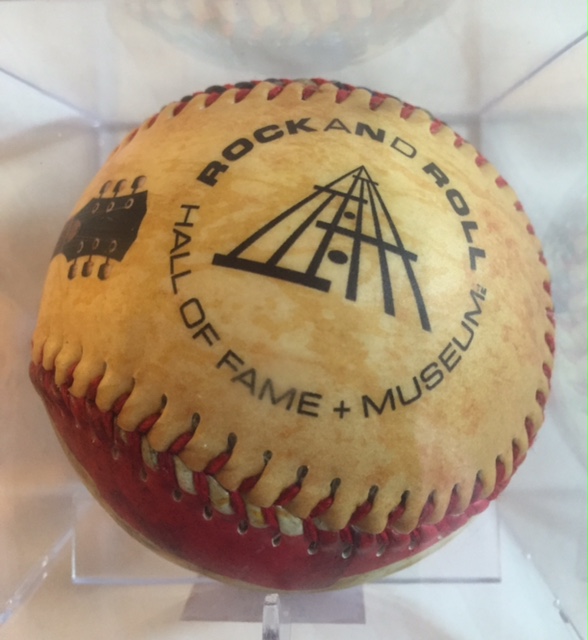
A baseball from the Rock and Roll Hal of Fame ... an appropriate symbol for BPT's Rock N'Roll Adventure.

A baseball from the Rock and Roll Hal of Fame … an appropriate symbol for BPT’s Rock N’Roll Adventure.

I chose the Rock and Roll HOF (even though I’ve been there twice before). What a day. Those who know me will recognize how much I would appreciate free breakfast, rock and roll and baseball ALL in the same day.  I discovered two bonuses at the Hall: 1) They’ve lifted the ban on picture taking. 2) There was a special Everly Brothers (my all-time favorites) exhibit on the third floor.   BBRT side note:  One of the staff told me that after the Rock and Roll Hall of Fame lifted the photo ban (you actually had to check your camera at the entrance and pick it up when you left), a number of artists pulled their display items.  She declined to name names, however.


Tonight more baseball, but first a nice late lunch/early dinner.  Given our schedule, late game, early a.m. bus departure for Detroit (Tigers/Red Sox), you’ll probably be spared a post tomorrow. But, I’ll be back.

Oh yeah – and here’s our room. Ballpark Tours delivers again!

bptclevroom


I tweet baseball @DavidBBRT.  Follow me for notification of new blog posts.

Ballpark Tours 2015 – Day Two – Wrigley

101 years of baseball at this location.

101 years of baseball at this location.

Day Two of my 2015 Ballpark Tours (BPT) trek began early Thursday morning in Chicago’s Gold Coast area. On the docket for “trekkers?” A day of sightseeing, a night game at Wrigley Field (Cubs/Giants) and maybe brews and blues post game. For information on Ballpark Tours and a report on Day One of this year’s trip, click here.

Early in the day, the BPT touring party fanned out in small groups heading for (among other places) – an on-the-river architectural tour, the Art Museum, the Museum of Science and Industry, Navy Pier and Magnificent Mile shopping – and those are just the excursions I heard about.  (Ballpark Tours always schedules free time for trekkers to take in local culture, entertainment, food, shopping, etc.)

Wrigleyville - Welcome to the neighborhood.

Wrigleyville – Welcome to the neighborhood.

By mid-afternoon – via the El, on-foot or by taxi – members of the group began making their way to Wrigleyville (Red Line Addison stop if you’re lucky enough to make a Cubs’ game). Our cadre headed for the Cubby Bear for pre-game food and beverage and – like most of the many Wrigleyville sports-oriented bars –  it was packed by 3 p.m. (before a 7:05 game).  BBRT’s suggestion – make it to Wrigleyville early and take in the atmosphere – sports bars packed with fans, bustling souvenir/memorabilia shops  and “hustling” outdoor stands and ticket sellers seemingly on every block.  Pre-game Wrigleyville is part of the Cubs’ experience.

As game time approached, the excitement in the bars and on the streets ratcheted up.  There was lots of Cubs’ Blue and Giants’ Orange.  This was a big series, with the Cubs trailing the Giants by just ½ game for the final Wild Card playoff spot.  Clearly, the fans (on both sides) were ready for meaningful baseball (and just over 41,000 would pack into Wrigley for the contest.

I got into the park early, collecting my promotional Cubbies Water Bottle – a give-away that I promptly gave away to a Cubs’ fan (didn’t need one more thing to cram into my suitcase). Now if it had been a bobble head …

On the way into Wrigley, I noted three things: 1) Lots of photo taking with the Ron Santo, Billie Williams and Ernie Banks statues; 2) Lots of street vendors selling water and peanuts; 3) Lots of Kyle Schwarber (#12) jerseys – more on that later.

For those of you who don’t track such things, there’s a great deal of messy construction in and around Wrigley Field this year (which will continue for quite some time), as the Cubs are restoring, improving and updating the century-old facility. The effort – deemed the 1060 Project – will cost about $575 million and should be completed by 2018. It includes improvements to Wrigley’s façade and infrastructure; upgraded restrooms, concourses, suites, press boxes and clubhouses; additional seating; a giant “jumbotron”; and even an adjacent hotel and office-retail complex.

Wrigley Field - new video board in left field may be a little too much.

Wrigley Field – new video board in left field may be a little too much.

Once inside Wrigley, we were witness to the most visible impacts of Phase 1 of Project 1060 – additional bleacher seating, a 3,990-square-foot video board in left field and a 2,250-square-video board in right field.  For BBRT at least, the changes take away some of the ancient lady’s charms.  Lost behind the video board in right field was the glimpse of Lake Michigan we used to enjoy – and cumulatively the expanded bleachers  and new video boards reduced the view of the Chicago skyline and Wrigleyville’s row house architecture. And, with all the usual video hoopla that comes with video boards – after spending all that money, you better maximize their use – Wrigley is no longer as much of a “step back in time” for fans.  BBRT’s take?  I like the tastefully sized right field video board, but find the massive left field video structure distracting and out of place with my image of Wrigley. Thank goodness they kept the ivy (Wrigley Field is the last remaining ballpark with ivy-covered outfield walls) and the manual scoreboard above the center field bleachers.

BBRT note: I set about informally surveying Cubs’ fans on how they felt about the changes and found out two things: 1) Cubs fans like the new video boards by about a 3-1 ratio (they appreciate joining the 21st century in terms of graphics and replay); 2) The Cubs make lots of money off visitors to Wrigley. On that second realization … I approached groups of fans in the ball park (concentrating on those in which at least one member was wearing Cubs’ apparel) for my survey and came fact-to-face with fans from California, Iowa, Ohio, Massachusetts, Arizona, Michigan, North Carolina and Louisiana before finding my first Chicagoan. Hopefully, changes to the park and adjacent area won’t cut into the attraction for fans from outside Chicago. 

Now to observations on the game.

Hunter Pence - MLB's highest stirrups?

Hunter Pence – MLB’s highest stirrups?

The Cubs jumped out to a 5-0 lead after two innings – and then held on for a 5-4 win, taking a half-game lead (for the final Wild Card spot) over the Giants – and sending the crowd into a rousing rendition of the “Go Cubs Go” victory song.  Good game, great fans in what is still a great place to watch a game. Some observations:

  • My obligatory score card got off to a bad start. Before the lineups were announced, I “inked” Cubs’ pitcher Jason Hammel into the nine spot.  “Clever” Joe Maddon, however, chose to bat the pitcher eighth, putting 2B Addison Russell in the nine-hole. Note: Hammel did lead off the second with a single – and later scored.
  • My Hammel lineup gaff hardly mattered. It’s hard to produce a “clean” scorecard, when the two teams use 35 players, including 12 pitchers and five pinch hitters.  Gotta love the National League and the double switch.
  • The Cubs’ 22-year-old rookie catcher Kyle Schwarber’s (#12) replica jerseys were all over the park. In the second inning, the 2014 first-round pick – and former High School and College All American – showed us why. He poled a three-run homer – and ended the contest hitting .342 with six homers and 18 RBI in 25 games.  Schwarber, who made his major league debut in mid-June, played in 147 minor league games in 2014-15, putting up a .333-34-102 line.
  • Kyle Schwarber is only one of many young players to watch on this exciting young Cubs’ team. Starting the game were: 3B Kris Bryant, 2B Addison Russell, RF Jorge Soler, SS Starlin Castro.
  • Giants’ RF Hunter Pence must have the highest stirrups in MLB.
  • The Giants’ offense was based on the “Brandon Principle.” Four runs on a pair of two-run homers – by 1B Brandon Belt (great baseball name) and SS Brandon Crawford.
  • It was a game of deep counts (on both sides). Twelve hurlers threw 315 pitches (136 balls, 179 strikes).


Ode to Cubbies/Giants


Young Cubbies take the day.

Put Champion Giants away.

Schwarber and Soler drive in five.

Two Brandons keep SF alive.


Still much to my dismay.

Not a single double-play.

And to top off my chagrin.                         

Also heard the Twinkies didn’t win.

Bad Bloody - somewhat saved by the Chicago Dog guy.

Bad Bloody – somewhat saved by the Chicago Dog guy.

Bloody Mary Review

When it comes to the traditional BBRT Bloody Mary Review, Wrigley won’t be flying the big “W” flag.  The $10 Bloody Mary, although featuring a generous vodka pour, suffered from a weak, very mild mix – and NO (that’s zero/nada) salt, pepper, tabasco or condiments (no pickles, olives, lime, celery, peppers, etc.). I actually ended up commandeering some celery salt, pepper and peppers from the Chicago Dog stand.


Decade Dogs

Decade Dogs - tastes for the ages.

Decade Dogs – tastes for the ages.

A final thought.  While in Wrigley, stop by the Decade Dogs booth featuring – on an alternating basis – ten specialty dogs to commemorate each of Wrigley’s ten decades.  On our day at the park, the featured item was “Mini Corn Dogs,” but you could also enjoy jumbo versions of the: Chicago Dog (a seven on a scale of ten according to one of our trekkers); Chili-Cheese Dog; Maxwell Street Polish; and (Ugh!) Veggie Dog.


And, now it’s on to Cleveland for the Twins, Dollar Dog Night and Two-dollar Bud Night. I’ll keep the Pepto ready for all three.


I tweet baseball @DavidBBRT – follow for notification of new blog posts.

me.


Ballpark Tours 2015 – Every Mile a Memory

This morning I departed on my annual Ballpark Tours’ (BPT) baseball trek, my 27th such journey.  Ballpark tours has taken me to major and minor league ball parks from Colorado to New York and pretty much all parts in between.  (Thank you, “tour master” Julian Loscalzo.) On this year’s trek, I’m joining 35 other baseball fans and fanatics for a week-long bus tour that is taking us to a minor league game in Schaumburg, IL (just outside of Chicago), as well as major league contests in Chicago (Cubs hosting Giants), Cleveland (Indians hosting our Twins), Detroit (Tigers hosting Red Sox), back to Chicago (White Sox entertaining the Angels) and then back to our home base of Saint Paul, MN (with a stop at a craft brewery in Wisconsin on the way home).

Before I begin my series of “reports from the road,” let me put in an unabashed plug.  For BBRT, there is no better baseball touring group than Ballpark Tours – just the right amount of chaos and discipline; comfortable transportation; great hotels; time in most cities to take in local culture, arts, food and nightlife (I’m planning on the Chicago’s Museum of Science and Industry and Cleveland’s Rock and Roll Hall of Fame on this trip); and, most important, the comradery – every year, without fail – of a great group of fun-loving baseball fans/friends.  How do others feel about Ballpark Tours?  On this trip, 35 of our 36 trekkers are repeat participants. How do I feel about BPT?  Hey, every morning for the next week I can get up knowing the most important item on my agenda is going to a ball game.  How can you beat that? For more on Ballpark Tours (and the upcoming Cuban trip), click here. 

I probably won’t post every day (we do have a busy schedule), but here’s first report from the tour.

DAY ONE

Scnuamburg tsnirtWe met our bus in Saint Paul’s Midway area at 9:30 a.m. Wednesday, August 5, and the parking lot was filled not just with our luggage, but also with hugs and handshakes, as old baseball- and tour-based friendships were renewed.   We loaded up quickly, with the rowdier trekkers heading for their seats at the back of the bus, and the less animated at the front (there is always a friendly competition between “the front of the bus” and the “back of the bus”).  The departure was toasted with coffee, juice, energy drinks (we’ll need them in the days ahead) – as well as an assortment of adult beverages.

The theme for this trip is Rock N’Roll Adventure (commemorative and complimentary T-shirts were handed out before we boarded the bus) and our theme would prove prophetic sooner than even I expected (but I don’t want to get ahead of myself).

As is Ballpark Tours’ tradition, early in the day, the K-Kwiz – a baseball trivia contest – was distributed and each trekker took the microphone and introduced themselves – usually with a baseball-related story. (Oh, and I shouldn’t forget, participants also described the books they each brought for the on-board baseball book exchange). It was during this phase that I began feeling like the Minnie Minoso of BPT – having been on BPT trips in four consecutive decades, beginning in the 1980s.  I should note here that Day One would feature other handouts – including a schedule of our games, hotels and arrival/departure times; a Ports-O-Call guide to restaurants, “watering holes,” museums, music, public transit, etc. in the cities we will visit; and entry forms for a contest based on predicting the total runs scored in MLB over the weekend. We will leave a paper trail.

You never know who'll show up on a Ballpark Tours trip.

You never know who’ll show up on a Ballpark Tours trip.

Around lunch time, we also had a visit from the “Assistant Pope” (aka Tom Smith) – who regaled the group with a laugh-provoking monologue worthy of a comedy club and then distributed assorted crackers, deli meats, cheeses and “sacred” eel pout (actually pickled herring) throughout the bus.  We lunched, pack your own, at a rest stop along the highway – with trekkers unveiling everything from deli sandwiches and beer to an elaborate picnic table buffet of baguettes, lox, assorted cheeses, stuffed olives and Napa Valley wine.

Then, it was back on the bus, when the Rock N’Roll Adventure began to rock.  Thanks to modern technology, the back of the bus began a long-lasting sing-along to 70’s rock – which included plenty of air guitar and dancing in the aisle of the bus. The moves being thrown down were a bit subdued given the limited space, but the singing was spirited (especially on Rolling Stones and Beatles numbers).

Great seats!

Great seats!

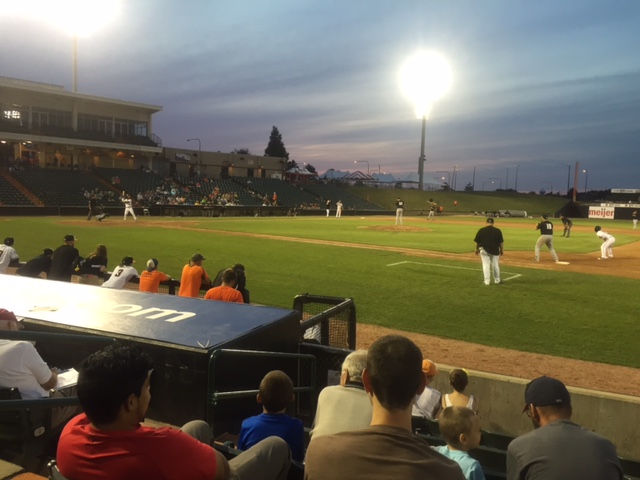
Of course, this is a baseball trip, and – we arrived in Schaumburg – for the Schaumburg Boomers/Southern Illinois Miners games.  The Boomers play in the independent Frontier League, so the names won’t be recognizable, but here are a few observations:

  • A nice park – I always like the old-style Red Brick – but it was empty (the over and under on fans was about 300 in a stadium that holds 7,365). It was almost like the tour group had a private showing.
  • The lighting, as in a number of minor league parks, was terrible (although only one fly ball – a foul pop-up was “lost” in the dark).
  • We had great seats, at the edge of the first base dugout – row six. (However, you could sit pretty much anywhere you wanted.)
  • The ball park was not kind to dead pull hitters – 355-feet down the left field line and 353-feet to the right field corner. One team representative informed me that the dimensions matched Wrigley Field because the mayor of Schaumburg “has a thing for the Cubs.”  Further digging showed deeper Cubs’ ties.  The stadium, which opened in 1999, is built on land purchased in the 1980s – reportedly as a potential site of a new home for the Cubs (the New Wrigley Field) if the team and the city of Chicago could not come to an agreement on night baseball.
  • Several small planes from the nearby Schaumberg Airport flew over the stadium during the game, seeming to clear the third-base-side light towers by about fifty-feet.
  • The team’s signature sandwich, the Schaumburger (a hamburger, topped with pulled pork and cole slaw for eight dollars) was both juicy and tasty. BBRT would recommend it.
  • There will be no Bloody Mary review for Schaumburg Boomers Stadium – the only adult beverage was beer.
  • There was general agreement among those of us keeping score sheets that the official scorekeeper had lost his or her red “error” pen – two or three errors were scored as base hits.

As for the game itself, Southern Illinois topped Schaumburg 4-1 in a fairly “quiet” contest – that’s what happens when you have 300 fans in the stands.  But there were a few highlights, at least from the BBRT point of view. Southern Illinois’ leadoff hitter CF Aaron Gates showed great speed, going three-for-four with a pair of well-placed bunt singles down the third base line. Schaumburg’s leadoff hitter 2B Mike Schulze also got on base three times – via three walks.  The stadium organ player was right on top of things, playing Fitz and the Tantrum’s song “The Walker” after Schulze’s last plate appearance. Schaumburg did turn a nifty third-second-first double play (TJ Bennett to Mike Schulze to Willi Martin) in the middle of Southern Illinois’ three-run third inning. (BBRT loves a good double play.) Southern Illinois’ starting pitcher Adam Lopez (who came into the game with a 1.88 ERA and 82 strikeouts in 76 1/3 innings) showed good stuff – giving up one run in six innings, with three hits, two walks and six strikeouts.

IndigoPost-game, we checked in to the Hotel Indigo, in Chicago’s Gold Coast neighborhood.  Another quality Ballpark Tours lodging choice. All in all, a great first day.


More on the tour in the days to come, including BBRT’s take on the changes to Wrigley Field – video screens, expanded bleachers, concourse/concession upgrades, etc.

I tweet baseball @DavidBBRT    (Note: Follow me on twitter for notification of new blog posts.)

Beltre’s Record-Tying Cycle

Adrian Beltre - Solid credentialq with the bat and the glove.

Adrian Beltre – Solid credentialq with the bat and the glove.

Adrian Beltre tied a MLB record yesterday (August 3) – as his Rangers topped the Astros 12-9 – becoming just the fourth player to hit for the cycle (single, double, triple, home run in a game) three times in a career. The 36-year-old Beltre, in his 18th major league season, joins John Reilly, Babe Herman and Bob Meusel with three career cycles. Beltre hit a triple in the first inning (getting the hard one out of the way, especially on 36-year-old legs), a double in the second, a single in the third and a home run in the fifth.  For the game, he went four-for-five, with two runs scored and three RBI.  Here are a few bits of trivia related to Beltre’s achievement:

Despite completing his cycle in the first five innings, Beltre does not have the fastest cycle in MLB history.  That distinction goes to Rockies’ Mike Lansing. On June 18, 2000, Lansing completed the cycle in just four innings – as the Rockies topped the Diamondbacks 19-2. In that game, Lansing went four-for-five with three runs scored and five RBI.  Lansing could have done more damage, but was lifted for a pinch hitter in the eighth.

– Beltre’s three cycles have come on September 1, 2008 (for the Mariners against the Rangers); August 24, 2012 (for the Rangers against the Twins); and August 3, 2015 (for the Rangers against the Astros).

– All three of Beltre’s cycles have come at Arlington, making him the only player to hit for multiple cycles in the same park for more than one team.  (As BBRT maintains, in baseball, we keep track of pretty much everything.)

– In his three cycles, Beltre has gone thirteen-for-fifteen (.867), with eight runs, nine RBI and three doubles, three triples, three home runs.

Beltre, by the way, is somewhat quietly building a resume that should earn him serious Hall of Fame consideration. To date, he had 2,697 hits; 404 home runs; 1, 304 runs scored; and 1,414 RBI – to go with a .284 career average. He’s a four-time All Star; four-time Gold Glove winner; and has led his league in hits, doubles and home runs once each.  In addition to now being one of just four players to hit for the cycle three times, he is also one of only five players to hit 100 or more home runs for three different teams (Dodgers, Marines, Rangers); joining Darrell Evans (Braves, Giants, Tigers); Reggie Jackson (A’s, Angels, Yankees); Jim Thome (Indians, Phillies, White Sox); and Alex Rodriguez (Rangers, Mariners, Yankees). While not a likely first-ballot electee, reaching 3,000 hits and 1,500 RBI should give Beltre a solid shot at the Hall.

For you trivia buffs, thanks to the Cubs’ long-time reluctance to install lights, Tim Foli of the Montreal Expos is the only MLBer to start a cycle on one day and complete it the next. On April 21, 1976, Foli collected a single, double and triple against the Cubs before the game was suspended due to darkness (top of the seventh. with the Expos up 11-3).  When play resumed on April 22, Foli added an eighth-inning home run – completing a somewhat unnatural “natural” (single, double, triple, home run in that order) cycle.   To date there have been just 14 natural cycles in MLB history. The Expos, by the way, won the game 12-6.  


I tweet baseball @DavidBBRT

BBRT – Looking Back at MLB in the Month of July

To regular followers, an apology.  BBRT posts have lagged a bit as, in the past four weeks, we’ve sold one house and purchased another, with a three-week lag between possessions.  It’s been, to say the least, a bit hectic.  BBRT should be back on a regular schedule soon – and my annual Ballpark Tours’ baseball trek is just around the corner – Schaumburg (minor league), Chicago (Cubs and White Sox), Detroit and Cleveland. I’ll report from the road.


July – Teeny Boppers to Ancient Warriors and

No-Hitters to 21-Run Explosions

We are entering the “Dog Days of August,” which means it’s time for BBRT’s look back at the previous month in MLB.  As usual, BBRT will feature a few “items of interest” and a bit of a statistical review. In this monthly wrap up, I’ll also take a look at the winners in the trade deadline scramble.

ITEMS THAT CAUGHT BBRT’S ATTENTION

Mike Trout - Knows how to celebrate his mom';s birthday.

Mike Trout – Knows how to celebrate his mom’;s birthday.

Happy Birthday Mom, Love Mikey

Okay, I admit it.  Nothing Mike Trout does surprises me.  Hopefully, however, he surprised his mother on her birthday this year (July 10). He did his mother proud that day, going three-for-five with two home runs, two runs scored and four RBI. Then again, maybe she wasn’t surprised.  In his five MLB seasons, Trout is hitting .556 (ten-for-eighteen) with three home runs, seven runs scored and nine RBIs on his mother’s birthday.

Going for the Cycle

On July 21, with a ninth-inning triple, Rangers’ OF Shin-Soo Choo became the 274th MLBer to hit for the cycle (it’s been done 306 times), He was also just the eighth Ranger and first Korean player to achieve that feat.

Bring ‘Em All On

On July 26, sixteen-season MLB veteran Tim Hudson took the mound for the Giants against the Oakland A’s, a team he had never beaten in his MLB career (0-2, 9.58 ERA) – in fact, the only team he had never beaten in his MLB career.  Hudson went five innings, giving up three runs and earned the victory as the Giants topped the A’s 4-3. In gaining the win, the 40-year-old Hudson became just the fifteenth pitcher to record at least one win against all 30 current major league franchises. Hudson was also the second pitcher to achieve that distinction this season, joining the Brewers’ Kyle Lohse, who beat the Twins to complete his 30-team victory list on June 26. Both Lohse and Hudson joined the 30-franchise victory club by beating the teams that first put them on the major league mound.

By the way, that 15-pitcher list includes Al Leiter (first ever to accomplish the feat), Randy Johnson, Kevin Brown, Barry Zito, Terry Mulholland, Curt Schilling, Woody Williams, Jamie Moyer, Javier Vazquez, Vicente Padilla, Derek Lowe, Dan Haren and A.J. Burnett.

Karns Shines on the Mound and in the Batter’s Box

On July 21, Rays’ pitcher Nathan Karns collected his first-ever major league hit – a second-inning home run against Phillies’ starter Aaron Nola.  It was the first MLB game since 2009 won by a score of 1-0 with the only run being a home run by a pitcher – and the first such outcome in the AL since 1962.  Karns also became only the second Rays’ hurler ever to go deep, joining Estaban Yan (June 4, 2000) in that club of two “clubbers.” Karns pitched five innings of shutout ball to pick up his fifth win (against five losses.) Five relievers protected the 1-0 lead.

Cole Hamels - traded after his no-hitter.

Cole Hamels – traded after his no-hitter.

Hamels No-Hitter Helps Ruiz Make History

On July 25, the Phillies’ Cole Hamels threw a no-hitter, beating the Cubs 5-0 at Wrigley.  Hamels walked just two and struck out 13 in the dominating outing. On that day, history was made not just from the mound, but also behind the plate. It was the fourth no-hitter caught by Phillies’ backstop Carlos Ruiz – tying him for the MLB record for no-hitters caught with Jason Varitek. Ruiz’ list of no-hitters caught includes Hamels’, two by Roy Halladay and one combined no-hitter (started by Hamels). Varitek caught no-hit games by Jon Lester, Hideo Nomo, Derek Lowe and Clay Buchholz.

Of special interest to BBRT:  The no-hitter was also Hamels’ final start for the Phillies, who traded him to the Rangers on July 29. That makes Hamels only the second pitcher to throw a no-hitter and be traded before his next start (and the first to be traded immediately after a no-hitter mid-season). Hall of Famer Bert Blyleven threw a no-hitter for the Rangers in his last start of the 1977 campaign and was traded to the Pirates before the 1978 season opened.

On a Pretty Good Run

On July 26, the Angels Albert Pujols took another step – this one about 90-feet – toward his spot in the Hall of Fame. In a 13-7 win over the Rangers, Pujols swiped his 100th career base – joining Babe Ruth, Hank Aaron and Willie Mays as the only MLBers with a career .300 average, 500 homers and 100 steals. Pujols is on a pretty good run this year. Although it was only his second stolen base of the campaign, he has 30 home runs this season and made the All Star squad for the first time since 2010. Pujols’ membership in his new “club” is not guaranteed, however. Since 2010, his career batting average has dropped from .331 to .314. (From 2011 to July 31, 2015, Pujols has averaged .276.)

The Perfect Outing

On June 26, Cubs’ catcher David Ross took the mound and retired the Phillies in order in the ninth.  It was his second relief outing of the season – and his second perfect 1-2-3 inning. This outing was made even more special, as the 38-year-old Ross belted his first HR of the season in the bottom of the inning. According to reliable sources, Ross’ fastball topped out at 72 mph. Ross, who never pitched in a professional game before this season, now has a WHIP of 0.00.


A-Rod ...from Teeny "Bopper" to 40-year-old slugger.

A-Rod …from Teeny “Bopper” to 40-year-old slugger.

From Teeny “Bopper” to Ancient Warrior

On July 27, Yankees’ DH Alex Rodriguez celebrated his birthday in style, hitting his 24th home run of the season. The round tripper, which helped the Yankees to a 6-2 win over the Rangers proved an historic blast. Coming on his fortieth birthday, it made A-Rod only the fourth player to homer both as a teenager and in his forties (Ty Cobb, Rusty Staub and Gary Sheffield are the others).  Elias also reports that Rodriguez holds the MLB record for career home runs (six) hit by a player on his birthday. (We do seem to track everything in baseball.) 

OUCH!

On July 28, the Yankees torched the Rangers’ for 21 runs (in a 21-5 win).  The last team to give up 21 runs? It was also the Rangers, in a May 30, 2012 loss to the Mariners (21-8). On July 28, the Yankees put up 19 hits, drew ten walks and also benefitted from two hit batters, and three errors (two were catcher’s interference). In the Bomber’s 11-run seventh inning, the first eight batters reached base safely against Rangers’ starter Martin Perez (2B, 1B, 1B, HBP, 2B, 1B, 1B, 3B). Wandy Rodriguez came on in relief and struck out the side. The K’s, however, were sandwiched around three hits and a walk.  On the trivia side of the equation, Yankees’ CF Jacob Ellsbury became only the seventh player in MLB history to reach base on catcher’s interference twice in the same game (joining David Murphy, Rangers, 2010; Bob Stinson, Royals, 1979; Dan Meyer, Mariners, 1977; Pat Corrales, Phillies, twice in 1965; and Ben Geraghty, Dodgers, 1936).

Pulling the Old Switchroo

On July 31, the Yankees’ switch-hitting first baseman Mark Teixeira ended the month in style, popping a pair of home runs (one his tenth career Grand Slam), as the Yanks topped the White Sox 13-6. Teixeira hit the Grand Slam in the second inning, batting right-handed and crashed a two-run homer from the left side of the plate in the fourth.  That blast gave Teixeira a MLB-record 14 games with home runs from both sides of the plate, breaking a tie with Nick Swisher. For BBRT, it brought back memories of Ken Caminiti, who accomplished this feat ten times, and once hit dingers from both sides of the plate three times in four days (for the Padres) –  September 16, 17 and 19, 1995.  On the 18th he went 0-4 with two strikeouts, in the other 3 games he was 10 for 11 with 6 homers, 2 doubles, 3 walks, 7 runs scored and 12 RBI.

The All Star Game

Of course, July featured the 2015 All Star Game – which turned out to be a tribute to the changing “face(s)” or the game.  For BBRT observations on the ASG, click here.

 ______________________________________________________________

NOW, THE STATS

July’s Best and Worst Records

No team had a better month than the Yankees, who went 17-7 (.704), the only squad to play .700 ball for the month. That enabled the Bombers to enter August with a six-game lead over second place (tie) Baltimore and Toronto. Over in the NL, the Pirates matched the Yankees 17 wins (versus nine losses), but still trail the Cardinal by 5 ½. Other teams with at least 15 wins in the All Star Game-shortened month were:  The Royals (17-11), White Sox (16-10) in the AL; and the Cardinals and Cubs, both 15-12 in the NL.  On the other side of the ledger, only the Rockies and Rays failed to win at least ten games in July, going 9-15 and 9-16, respectively.

If the Season Ended …   

So who’s on top?  If the season ended on July 31, the MLB playoff teams would be:

  • AL … Division Champions: Yankees; Royals; Astros. Wild Cards: Angels, Twins. Note: Both the Orioles and Jays are within one game of a WC spot.
  • NL … Division Champions: Nationals; Cardinals; Dodgers. Wild Cards: Giants; Pirates. Note: The Cubs are just one game out of a WC spot.

Also, if the season ended today, only the Cardinals would be playing .600 or better ball (66-37, .641), although the Royals would be close (61-41, .598). Only the Phillies would be playing under .400 ball (40-65, .385). Of interest to BBRT: The Cardinals,with the best record in MLB,  are no offensive juggernaut, standing 18th in runs scored, ninth in batting average and 21st in home runs.. The Cards, however, have given up the fewest runs (300) and boast the lowest team ERA (2.65)

You can see the full July 31 standings at the end of this post.

Trade Deadline Biggest Winners

More than 100 MLB players and prospects (and a few handfuls of cash and players to be named later) changed teams in dozens of trades leading up to the July 31 non-waiver trade deadline.  BBRT won’t examine them all, but here are the teams BBRT rates as having made make the biggest “splash” during the wave of trades.

1. Toronto … The Jays proved they are serious about making the 2015 post-season, acquiring five-time All Star SS Troy Tulowitzki, an “ace” in five-time All Star southpaw David Price, speed for the lineup in CF Ben Revere and bullpen help (LaTroy Hawkins and Mark Lowe). Probably the biggest July haul.

2. (Tie) Kansas City … The Royals are determined to make another run at the World Series title and improved their chances by adding RHP Johnny Cueto (a 20-game winner in 2014) and the versatile veteran, solid-hitting Ben Zobrist

2. (Tie) New York-NL … The Mets went out and got a much needed power hitter in Yeonis Cespedes (who has topped 20 homers and 80 RBI in each of his three full MLB seasons and has 18 HRs and 61 RBI this year), strengthened the bullpen with Tyler Clippard and added versatility and a bit of offensive punch with Juan Uribe and Kelly Johnson.

4. Houston  … The Astros, like the Blue Jays and Royals, added an ace to their pitching staff, acquiring (three-time All Star) Scott Kazmir. They also added power and speed for the outfield with two-time All Star Carlos Gomez (if healthy) and pitching depth with Mike Fiers.

5. Los Angeles-NL … The names weren’t as big, but the Dodgers filled a back of the rotation need, acquiring starting pitchers Matt Latos and Alex Wood.

Honorable Mentions: Nationals (beefed up their bullpen with closer Jonathan Papelbon); Cubs (added starting pitching in the form of Dan Haren and bullpen help with Tommy Hunter).

Special Mention:  The Rangers may not be in the hunt (and BBRT expected them to be sellers, not buyers), but they may have made what will prove to be the best  long-term deal, acquiring southpaw Cole Hamels – a three-time All Star, who still has three seasons on his contract – from the Phillies.

______________________________________________________

STAT TIME

Here are a few tidbits of information about July team performance:

  • Cardinals’ hurlers put up the best ERA for the month at 2.78. Over in the AL, White Sox pitchers were the stingiest in July at 3.29. How much difference does the DH make? For the month, the overall AL ERA was 4.10, compared to 3.59 for the NL. For the season, through July, the difference is not as pronounced – NL-3.77; AL-3.90.
  • Through July 31, the Cardinals are the only team with a season ERA under 3.00 – at 2.65. Next best?  The Pirates at 3.18. The AL’s lowest season ERA belongs to the A’s at 3.45.
  • No team scored more runs in July than the surging Yankees, who put 133 runs on the board. Other teams topping 120 tallies for the month were the Angels (132), Tigers (131), Blue Jays (126), Royals (123) and Pirates (120). For the season, the Blue Jays hold the top spot with 550 runs scored. No other team has reached the 500 mark. (Despite this offensive output, the Blue Jays are only two games over .500.)  The Braves, on the other end of the spectrum, pushed across an MLB-low 72 runs for the month.
  • The July team home run title is shared by the Tigers and Mariners, who each bashed 37 round trippers during the month – and still went a combined 12-31. Colorado topped the NL in July homers at 27. The A’s and Marlins had the fewest July dingers, 15 each.
  • For the season, the Astros lead the AL with 143 homers, while the Dodgers top the NL with 127. (Note: Houston also leads the AL in stolen bases at 74, a nice power/speed combination.) Only four teams had less than 80 HRs through July: Braves (62), Phillies (69), Marlins (79), White Sox (79).

________________________________________________________________

Now, here are your month-of-July and through-July batting and pitching leaders:

Month-of-July Batting Leaders

Four National Leaguers with at least 75 plate appearances managed to hit at a .400 or better pace for the month of July – led by Brewers outfield Gerarado Parra at .435 (37-for-85). Parra also led the NL in runs scored (23). Parra’s hot month earned him a move to the AL – and he is now an Oriole. Other July .400 hitters were the Reds’ 1B Joey Votto (.405), Giants’ C Buster Posey (.400) and Rockies’ 2B DJ LeMahier (.400).  Over in the AL, the top average for the month went to Royals’ 1B Eric Hosmer at .385 (40-for-104).

July’s hottest hitters were Rockies’ RF Carlos Gonzalez in the NL (.386-11-24 for June), who led the senior circuit in home runs and RBI for the month; and Angels’ CF Mike Trout, who hit .367-12-24 for the month, leading the AL (and all MLB) in July HR and tying for the league lead in RBI.   Here are the July offensive leaders.

—– AVERAGE (minimum 75 plate appearances) —–

AL                                          

Eric Hosmer, 1B, Royals – .385

Xander Bogaerts, SS, Red Sox – .371

Chase Headley, 3B, Yankees – .370

NL

Gerardo Parra, LF, Brewers – .435

Joey Votto, 1B, Reds – .405

Buster Posey, C, Giants – .400

DJ LeMahieu, 2B, Rockies – .400

—– HRs —–

NL

Carlos Gonzalez, RF, Rockies – 11

Adrian Gonzalez, 1B, Dodgers – 8

Lucas Duda, 1B, Mets – 8

AL

Mike Trout, CF, Angels – 12

Alex Rodriguez, DH, Yankees – 9

Mark Teixeira, 1B, Yankees – 9

—– RBI —–

AL

Mike Trout, CF, Angels – 24

Kendrys Morales, DH, Royals – 24

Josh Donaldson, 3B, Blue Jays – 24  

NL

Carlos Gonzalez, RF, Rockies – 24

Ryan Howard, 1B, Phillies – 23

Andrew McCutchen, CF, Pirates – 21

—– RUNS SCORED —–

AL

Lorenzo Cain, CF, Royals – 22

J.D. Martinez, RF, Tigers – 21

Adam Eaton, CF, White Sox – 21

NL

Gerardo Parra, LF, Brewers – 23

Carlos Gonzalez, RF, Rockies – 20

Four with 18

—– STOLEN BASES —–

NL

Billy Hamilton, CF, Reds –  9

Jayson Heyward, RF, Cardinals – 7

A.J. Pollock, CF, D-backs – 7

AL

Jose Altuve, 2B, Astros – 6

Jose Reyes, SS, Blue Jays (now a Rockie)– 6

Three with five

Month-of-July Pitching Leaders

Four was a lucky number for pitchers in July, as nine hurlers tied for the month’s leadership in victories with four. All but one of those, the Royals’ Wade Davis, was a starter. As a reliever Davis had quite a month – pitching 10 2/3 innings in 12 appearances, going 4-0, with five holds and a 0.84 ERA.

When it comes to mound efficiency, Scott Kazmir – who started the month as an Angel and ended it as an Astro, led the way. Kazmir went 34 innings in five starts and gave up – wait for it – just one earned run. His 0.26 ERA was MLB’s lowest for July, but not by much. The Dodgers’ Clayton Kershaw also gave up just one earned in July, but pitched on fewer inning – for a NL-lowest 0.27 ERA.  The only other pitcher with a July ERA under 1.00 was Kershaw’s team mate Zack Grienke (0.95).\

Month of July Pitching Leaders

—– WINS —–

AL

Wade Davis, Royals – 4-0, 0.84 ERA

Anibel Sanchez, Tigers – 4-1, 4.55

Andrew Heaney, Angels – 4-0, 1.98

Nathan Eovaldi, Yankees – 4-0, 3.09

NL

Jake Arrietta, Cubs – 4-1, 1.90

Mike Leake, Reds – 4-1, 1.25

Jose Fernandez, Marlins – 4-0. 2.53

Matt Wisler, Braves – 4-0, 3.30

Jose Fernandez, Marlins – 4-0, 2.53

 —– ERA (minimum 20 innings pitched in the month) —–

AL

Scott Kazmir, Angels/Astros – 0.26

Chris Tillman, Orioles  – 1.31

Matt Shoemaker, Angels – 1.78

NL

Clayton Kershaw, Dodgers – 0.27

Zack Greinke, Dodgers – 0.95

Mike Leake, Reds – 1.25

—– STRIKEOUTS —–

AL

Corey Kluber, Indians – 45 (46 1/3 IP)

Carlos Carrasco, Indians – 43 (38 2/3 IP)

Chris Archer, Rays – 40 (32 2/3 IP)

Jose Quintana, White Sox – 40 (42 IP)

NL

Jon Lester, Cubs,  – 50 (40 1/3 IP)

Clayton Kershaw, Dodgers – 45 (33 IP)

Jake Arrieta, Cubs – 44 (42 2/3 IP)

—– SAVES —–

AL

Shawn Tolleson, Rangers – 7

Cody Allen, Indians – 7

Four with six

NL

Craig Kimbrel, Padres – 11

Mark Melancon, Pirates – 9

Trevor Rosenthal, Cardinals – 8

_______________________________________________________    

And now the MLB Leaders THROUGH July

—– BATTING AVERAGE —–

NL

Paul Goldschmidt, 1B, D-backs – .349

Dee Gordon, 2B, Marlins – .331

Bryce Harper, RF, Nationals – .330

AL

Miguel Cabrera, 1B, Tigers – .350

Jason Kipnis, 2B, Indians – .329

Prince Fielder, 1B, Rangers – .326

—– HR —–

AL

Mike Trout, CF, Angels – 32

Albert Pujols, 1B, Angels – 30

J.D. Martinez, RF, Tigers – 28

NL

Bryce Harper, RF, Nationals – 29

Giancarlo Stanton, RF, Marlins – 27

Todd Frazier, 3B, Reds – 27

—– RBI —–

NL

Nolan Arenado, 3B, Rockies – 78

Paul Goldschmidt, 1B, D-backs – 77

Bryce Harper, RF, Nationals – 68

AL

Josh Donaldson, 3B, blue Jays – 73

Mark Teixeira, 1B, Yankees – 73

Kendrys Morales, DH, Royals – 72

—– RUNS SCORED —–

AL

Mike Trout, CF, Angels – 76

Brian Dozier, 2B, Twins – 74

Two with 72

NL

Bryce Harper, CF, Nationals – 68

Paul Goldschmidt, 1B, D-backs – 67

A.J. Pollock, Cf, D-backs – 67

—– STOLEN BASES —–

NL

Billy Hamilton, CF, Reds  – 49

Dee Gordon, 2B, Marlins – 34

Charlie Blackmon, CF, Rockies – 27

AL

Jose Altuve, 2B, Astros – 27

Billy Burns, CF, A’s – 21

Lorenzo Cain, CF, Royals – 19

BBRT note: Through July, The Nationals’ CF  Denard Span has the most steals without getting caught (11).

Pitching Leaders THROUH July

—– WINS —–

NL

Gerrit Cole, Pirates – 14-4 (2.24)

Michael Wacha, Cardinals – 12-4 (3.09)

Five with 11

AL

Dallas Keuchel, Astros – 12-5 (2.32)

Colin McHugh, Astros – 12-5 (4.43)

Felix Hernandez, Mariners – 12-6 (3.02)

—– ERA —–

NL

Zack Greinke, Dodgers – 1.41

Jacob deGrom, Mets – 2.05

Max Scherzer, Nationals – 2.22

AL

Scott Kazmir, Angels/Astros – 2.10

Sonny Gray, A’s – 2.16

Dallas Keuchel, Astros – 2.32

—– STRIKEOUTS —–

AL

Chris Sale, White Sox – 177 (137 2/3 IP)

Chris Archer, Rays – 173 (141 2/3 IP)

Corey Kluber, Indians – 172 (157 IP)

NL

Clayton Kershaw, Dodgers – 185 (140 IP)

Max Scherzer, Nationals – 172 (150 IP)

James Shields, Padres – 148 (133 2/3 IP)

—– SAVES ——-

AL

Glen Perkins, Twins – 29

Zach Britton, Orioles – 27

Two with 25

NL

Mark MelanCon, Pirates – 33

Trevor Rosenthal, Cardinals – 31

Craig Kimbrel, Padres – 30

___________________________________________

Finally, MLB standingS as of July 31


AL East

Yankees          58-44   .569

Orioles             52-50   .510     6.0

Blue Jays         53-51   .526     6.0

Rays                51-53   .490     8.0

Red Sox          46-58   .442     13.0

AL Central

Royals             61-41   .598

Twins              53-49   .520     8.0

Tigers              50-53   .485    11.5

White Sox       49-52   .485     11.5

Indians            48-54   .471     13.0

AL West

Astros              58-46   .558

Angels             55-47   .539     2.0

Rangers           50-52   .490     7.0

Mariners          47-57   .452     11.0

A’s                  45-59   .433     13.0

NL East

Nationals         54-47   .535

Mets                53-50   .515    2.0

Braves             46-57   .447    9.0

Marlins            42-61   .408     13.0

Phillies             40-64   .385     15.5

NL Central

Cardinals         66-37   .641

Pirates             60-42   .588     5.5

Cubs                55-47   .539     10.5

Reds                46-55   .455     19.0

Brewers           44-60   .423     22.5

NL West

Dodgers          58-45   .563

Giants              56-46   .538     1.5

D-Backs          50-51   .495       7.0

Padres             50-53   .485      8.0

Rockies           43-58   .4426   14.0

I tweet baseball @David BBRT

2015 All Star Game – A Few Observations

Mike Trout  first to win consecutive All Star Game MVP Awards - reflects MLB's "changing of the guard."

Mike Trout first to win consecutive All Star Game MVP Awards – reflects MLB’s “changing of the guard.”

Another All Star game on the books, and this one – at least from BBRT’s point of view – lived up to its promise.  There’ll be plenty written about this contest, so I’d just like to share a handful All Star related events/achievements that grabbed my attention.

The game clearly reflected a “changing of the guard in baseball,” with a record 20 players 25-years-old or younger and 33 first-time All Stars.

Mike Trout may have provided the most compelling evidence of baseball’s new “guard,” leading the game off with a home run and becoming first player to win consecutive ASG Most Valuable Player Awards. The only other players to win two ASG MVPs – and none of them consecutively – are Willie Mays, Steve Garvey, Gary Carter and Cal Ripken, Jr. And, keep in mind, this is Trout’s fourth All Star Game, and he’s just 23-years-old.


Now, a few more BBRT ASG observations:

  • Monday night’s Home Run Derby got the whole event off to a good start. I’m usually a traditionalist, and I do oppose imposing a “clock” on regular season games, but the time element added to the HR Derby worked.  It added a sense of urgency, and ended the days of watching MLB’s top power hitters wait (pitch-after-pitch) for the perfectly placed offering.  This year’s HR Derby was, indeed, a swinging event.

– It didn’t hurt that home town hero Todd Frazier won the competition – it really got the fans into it.

The event included a great balance of “stars,” – from rookies like the Dodgers’ Joc Pederson and Cubs’ Kris Bryant – to veterans who have rediscovered their strokes like the Angels’ Albert Pujols and the Rangers’ Prince Fielder – to star-players in their prime like the Blue Jays’ Josh Donaldson and Reds’ Todd Frazier.

  • Aroldis Chapman - MLB's hardest thrower.

    Aroldis Chapman – MLB’s hardest thrower.

    Baseball is a game that invites conversation and debate, but Reds’ southpaw closer Aroldis Chapman once again provided evidence of the undebatable – he is, without a doubt, the fastest pitcher in MLB. He came on the ninth inning and struck out the side on 14 pitches, with 12 of the 14 reaching at least 100 mph (his fastest pitch at 103, the slowest at 98). Still want to debate?  MLB.com lists the major league’s 50 fastest pitches of 2015 – and numbers one-through-fifty belong to Chapman.  More evidence?  This season Chapman has thrown 284 pitches of 100 mph or faster.  That’s 46 more than the all the rest of MLB’s pitchers combined. The look on the faces of the AL All Stars watching from the dugout told it all.  Note: Coming into the game, Chapman was 3-3, 1.69 ERA with 18 saves on the season – and 65 strikeouts in 37 1/3 innings pitched.

  • It was also an eye-opening pleasure to watch the Mets’ Jason deGrom work from the hill. DeGrom – relying primarily on a high-90s fastball with movement – came on in the sixth inning and struck out the side (Stephen Vogt, Jason Kipnis and Jose Iglesias) on just ten pitches (the fewest pitches to strike out the side ever in an All Star Game). DeGrom, last year’s NL Rookie of the Year is 9-6, 2.14 ERA with 112 strikeouts in 113 2/3 innings this season.
  • It was great to see the Twins’ Brian Dozier – added to the All Star team, very deservedly, at the last minute – hit a home run in his first All Star at bat. The only other Twins with All Star Game homers. Harmon Killebrew (3) and Kirby Puckett. Good company!
  • Tigers’ SS Jose Iglesias made the defensive play of the game in the eighth inning, back-handing a grounder by the Dodger’ Yasmani Grandal deep in the hold between short and third and then making jumping, twisting throw to first.
  • Really not fond of the online All Star fan voting process. Would like to see more emphasis on voting “at the ballpark” – and fewer online votes allowed per fan.
  • Fantastic to see  the Greatest Living Players honoring Hank Aaron, Johnny Bench, Sandy Koufax and Willie Mays. Can’t really argue with those choice – although there are others deserving recognition (perhaps Greatest Living Player at each position next year). Glad to have had the chance to see all four of them play.
  • Found it interesting that Nolan Ryan led the way by being named to three of the fan-voted, greated “Franchise Four” lists – Angels, Astros, Rangers. Vlad Guererro is the only other player on multiple Franchise Fours (two – Angels and Expos/Nationals).

I tweet baseball @DavidBBRT

All Star Game “Firsts” and “First and Only(s)”

With the 2015 MLB All Star Game just ahead, BBRT would like to devote another post to All Star game history.  This time, taking a look at the very first All Star Game – played at Chicago’s Comiskey Park on July 6, 1933 – and some of the “firsts” from that game.  In that initial All Star match-up – won  by the American League 4-2 – the starting lineups included eleven Hall of Famers (seven for the AL and four for the NL). There were another nine future HOFers on the bench (four for the NL, five for the AL). Both managers – John McGraw (NL) and Connie Mack (AL) were headed for the Hall, as were three of the four coaches. The stage was clearly set for some memorable, big-name All Star Game “firsts” – like Babe Ruth hitting the first AS Game round tripper.

Babe Ruth, appropriately, smacked the first-ever All Star Game home run. 

We’ll take a look at all the firsts from that first All Star gathering, but let me lead off with a curve ball, and take a look at some AS Game “first and only(s)” that did not take place in 1933.   Here are three baseball happenings that, to date, have happened just once in All Star competition.

  • Steal of Home: 1934 AS game, fifth inning, two out, two on, NL trailing 8-6 – NL 3B Pie Traynor (Pirates)  notches the first (and still only) AS Game steal of home. (AL won game 9-7.)
  • Grand Slam: 1983 All Star Game, third inning, bases loaded, two outs, AL leading 5-1, AL CF Fred Lynn hits first – and still only – AS Game Grand Slam. (AL wins 13-3).

Fred Lynn – Only ASG Grand Slam

  • Inside-the-Park Home Run: 2007 All Star Game, fifth inning, one on, one out, AL CF Ichiro Suzuki hits first – and still only – AS Game inside-the-park home run.

______________________________________________________

Now, here’s a dozen AS Game firsts from 1933.

  • First batter/pitcher matchup: NL 3B Pepper Martin (Cardinals) versus Lefty Gomez (Yankees). Gomez retired Martin on a grounder to shortstop.
  • First starting pitchers: AL, Lefty Gomez (Yankees) – NL, Bill Hallahan (Cardinals). Gomez got the first All Star win, Hallahan the first loss.
  • First hit: Cardinals’ Chick Hafey (leading off second inning – off the Yankees’ Lefty Gomez). Hafey was starting in LF and batting fourth for the NL.
  • First run scored: AL starting 3B Jimmy Dykes (White Sox).
  • First RBI: AL starting pitcher Lefty Gomez (Yankees) – drove home Jimmy Dykes (White Sox), who had walked, with a single to center field. Take that, DH Rule.
  • First double: Pie Traynor (Pirates), NL pinch hitter – top of seventh off Lefty Grove (Yankees).
  • First triple: NL pitcher Lon Warneke (Cubs) – top of the sixth inning off Alvin Crowder (Senators). Take that again, DH Rule.
  • First home run: AL RF Babe Ruth (Yankees), two-run home run, bottom of the third, off Bill Hallahan (Cardinals).
  • First walk: Bottom of first. Hitter – AL 2B Charlie Gehringer (Tigers). Pitcher – Bill Hallahan (Cardinals).
  • First stolen base: Bottom of first, AL 2B Charlie Gehringer (Tigers).
  • First strikeout: Final out, top of second. Pitcher – Lefty Gomez (Yankees). Hitter – NL SS Dick Bartell (Phillies).
  • First fielding error: Top of the fifth, AL 1B Lou Gehrig (Yankees).

Here’s hoping we see a record-setting performance at the 2015 All Star Game. From this viewpoint, the best All Star competition in any sport.

I tweet baseball @DavidBBRT

Best All Star Game Performances Ever – From the Batter’s Box and the Mound

With all the recent commentary surrounding the recent MLB All Star team voting and selections, BBRT thought it might be time to focus on a topic more likely to generate consensus – the best hitting and pitching performances ever in an All Star game, and some of the targets the players who take the field at Cincinnati’s Great American Ball Park on Tuesday July 14 can shoot for.  For a look at BBRT’s 2015 All Star ballot, click   here.

Now, I’s sure there are those that would maintain the selecting the greatest-ever All Star Game performances form the batter’s box and the pitching mound might be a matter for considerable debate. But, hear (read) me out and I believe we’ll be able to agree.

Best All Star Game Performance – from the Batter’s Box

Ted Williams, Boston Red Sox, 1946

http://

When home-town hero Ted Williams trotted out to left field at Fenway Park on July 9, 1946, Boston fans could not have imagined what kind of day The Splendid Splinter had in store for them – and for the four National League pitchers he would face that day.  Expectations, however, were pretty high.  Williams came into the game hitting .347, with 23 home runs, 82 runs scored and 71 RBI in 79 regular season games.  Compared to the day he was about to have that would look like a slump. Here’s how Williams’ day went.

In the first inning, batting third and facing the Cubs’ Claude Passeau, Williams drew a walk and then scored on a home run by the Yankees’ Charlie Keller.

In the bottom of the fourth, leading off against new NL hurler Kirby Higbe of the Dodgers, Williams homered to give the AL a 3-0 lead.

In the bottom of the fifth, with Higbe still in the game, Teddy Ballgame came up again – this time with one out  the Senators’ Stan Spence on third and the Browns’ Vern Stephens on second.   This time, Williams delivered a run-scoring single.

In the bottom of the seventh, this time facing the Reds’ Ewell Blackwell with none on and two out, Williams singled again.

Finally, in the bottom of the eighth – facing the Pirates’ Rip Sewell and his Ephus pitch – with Stephens and the Browns’ Jack Kramer on base, William capped of his day with a three-run homer.

The AL won 12-0 that’s day – and Williams’ final tally was:  four-for-four, plus a walk, two home runs, four runs scored and five runs driven in.   In the process, Williams set or tied the following All Star Game single-game records: runs scored (four – Williams still stands alone); total bases (ten – Williams stands alone); runs batted in (five – later, 1954, tied by the Indians’ Al Rosen); base hits (four – tying the Cardinals’ Ducky Medwick, 1937, and later matched by the Red Sox’ Carl Yastrzemski, 1970); home runs (two – tied, in 1954, by the Indians Al Rosen).

Want a topper to clinch this as the best-ever All Star Game hitting performance?  Williams was coming off three years away from big league pitching (1943-45), serving in the Marine Corps.


Best All Star Game Performance Ever – On the Mound

Carl Hubbell, New York Giants, 1934

http://

In just the second-ever All Star Game, Giants’ southpaw Carl Hubbell turned in a pitching performance for the ages – arguably the best ever in All Star competition.  Hubbell, on his way to a 21-win season (the second of five straight 20+ win campaigns) , came into the game with a 12-5, 2.76 ERA regular-season stat line. Hubell had struck out 58 hitters in 156 1/3 innings pitched to that point, but he was about to make the strikeout a much bigger part of his game.

The game was played on July 10, 1934 at New York’s Polo Grounds – with screwball-specialist Hubbell starting for the NL and Yankee Lefty Gomez starting for the AL.  Facing an AL line up stacked with some of the game’s greatest hitters, Hubbell got off to a rocky start, giving up a lead-off single to Detroit’s Charlie Gehringer, followed by a walk to the Senators Heinie Manusch. Then the fun began, as Hubbell set down five straight future Hall of Famers – all on strikeouts – the Yankees’ Babe Ruth, Yankees’ Lou Gehrig, and Atheletic’ Jimmie Foxx to close out the first. Then the White Sox’ Al Simmons and  Senators’ Joe Cronin to open the second.  Hubbell then gave up a single to Yankees’ Bill Dickey, before whiffing Lefty Gomez (who also made the Hall of Fame) to end the inning. After an uneventful third inning – two fly outs, a ground out and walk – Hubbell left the game credited with three scoreless innings, two hits, two walks and six strikeouts – all six future Hall of Famers (although Gomez made it as a pitcher).

Hubbell’s six strikeouts remain the All Star Game single-game record – tied in 1943 by the Reds’ Johnny Vander Meer (2 2/3 innings pitched); 1950 by the Giants’ Larry Jansen (5 innings pitched); and 1967 by the Cubs’ Fergie Jenkins (3 innings pitched). Given the place in history of Hubbell’s six victims, BBRT considers this top (or at least most memorable All Star Game mound performance.  Oh yes, the AL won the game 9-7, and how did those strike out victims fare When not facing Hubbell?  Against the rest of the NL All Star staff, they went seven-for-sixteen, with four doubles, five runs scored and three RBI.

_______________________________________________________________

Now here, with a much appreciated assist from the stat-packed baseballreference.com, are a few All Star targets for today’s stars to shoot for:

  • Innings pitched in a single AS Game: Yankees’ Lefty Gomez – 6 (1935)
  • At bats in a single AS Game: Willie Jones, Phillies – 7 (1950)
  • Doubles in a single AS Game: two, nine players (Most recently, the Brewers’ Jonathan LeCroy in 2014.  No surprise, LeCroy had a league-leading 53 doubles that season.)
  • Triples in a single AS Game: Rod Carew, Twins – 2 (1978) – leading off the first and third innings, both off the Giants’ Vida Blue.
  • Stolen Bases in a single AS game: Two by five players. (Most recently, the Cubs’ Starlin Castro, 2011.)

How about a few career records:

  • AS games played, career: Willie Mays, Hank Aaron, Stan Musial – 24.   Note: There is some confusion here since, in some years, there were two All Star games.  Aaron holds the record for seasons on an All Star game team (21), and total All Star Game rosters made (25). Mays and Musial each played in 24 AS Games in 20 All Star seasons.
  • AS Game hits, career: Willie Mays – 23
  • AS Game doubles, career: Dave Winfield – 7
  • AS Game triples, career: Willie Mays and Brooks Robinson – 3
  • AS Game home runs, career: Stan Musial – 6
  • AS Game RBI, career: Ted Williams – 12
  • AS Game walks, career: Ted Williams – 11
  • AS Game stolen bases, career: Willie Mays – 6
  • All Star Game runs scored, career: Willie Mays – 20.
  • AS Game wins  – Lefty Gomez – 3
  • AS Game appearances: Roger Clemens – 10
  • AS Games started: Lefty Gomez, Robin Roberts, Don Drysdale – 5
  • AS Game saves: Mariano Rivera – 4
  • AS Games innings pitched: Don Drysdale – 19 1/3
  • As Game strikeouts: Don Drysdale – 19

Note: It’s hard to pick AS Game career leaders in such areas as ERA and batting average. (How many at bats or innings pitched do you use to qualify?) However, here are two BBRT nominations. If you use 20 at bats as a standard, your batting average leader is Charlie Gehringer at .500 (ten-for-twenty in six AS games, plus nine walks). If you use ten innings pitched as a qualifier, only Mel Harder can  boast a 0.00 ERA (13 innings).

So, there a look at the All Star Game record book – hope you enjoy the game.


I tweet baseball @DavidBBRT


Baseball Roundtable’s 2015 All Star Ballot

MLB will announce the 2015 All Star vote this Sunday, so it’s about time for BBRT to share its (my) All Star ballot.  I prefer to vote late in the balloting, just in case some player has made a late-June/early-July surge that puts him over the top or has suffered a late slump that let’s other contenders close the gap.  So, here’s my ballot (statistics through July 2 – the time of my vote).

NATIONAL LEAGUE

Catcher

Buster Posey – Giants

The two-time All Star and 2012 NL MVP gets BBRT’s vote based on his solid .304-13-56 stat line.  The only other tempting candidate was the Cardinals’ Yadier Molina – clearly the best defensive catcher out there (seven consecutive Gold Gloves) and a solid hitter (.286-2-27 in 2015). If I was building a team, I’d probably take Molina for what he could mean to the pitching staff.  For the 2015 All Star Game, I’ll take Posey’s bat.

Tidbit:  Through July 2 of 2015, Posey was hitting .364 with runners in scoring position and .438 with two outs and runners in scoring position.

Paul Goldschmidt - lumber, leader and speed - leads BBRT's NL All Star ballot.

Paul Goldschmidt – lumber, leader and speed – leads BBRT’s NL All Star ballot.

First Base

Paul Goldschmidt – Diamondbacks

Easy choice here, Goldschmidt brings it all to the ball park – average, power, speed and defense. His line through July 2 – a league leading .352 average, with 20 home runs, 65 RBI and 15 stolen bases. And, of course, there is that Gold Glove (2013 defense).

Tidbit: As of July 1, Goldschmidt led the NL in average (.352), runs scored (56), walks (63), intentional walks (18) and on-base percentage (.468).  

Second Base

Dee Gordon – Marlins

Might have gotten a little more offense from the other second sackers in contention for the BBRT vote – but Gordon’s 26 stolen bases stole this vote.  And, as of July 2, he was hitting .345 – with an NL-best 114 hits. Other candidates I considered were the Cardinals’ Kolten Wong (.287-9-36, with six steals) and the Giants’ Joe Panik (.316-6-30, with three steals).

Tidbit: It’s troubling to note that Gordon’s average has dropped each month this season. He hit .418 in April; .393 in May; and .304 in June. Still his hot start earned the nod here.

Third Base

Nolan Arenado – Rockies

The 24-year-old Arenado looks to have many All Star games ahead of him.  This year’s .287-24-68 (he leads all of MLB in RBI) line enabled him to edge out the Reds’ Todd Frazier (.283-25-54). Frazier does have eight steals to none for Arenado, but Arenado has won the NL Gold Glove at third base in both his previous MLB seasons. BBRT likes players who can flash “lumber and leather.”

Tidbit: Arenado hits righties and lefties equally well.  This season, through July 2, Arenado was hitting .287 versus right-handers and .288 versus southpaws.

Shortstop

Troy Tulowitzki – Rockies

Tulo is hitting .319-8-41 and that’s a lot of offense from the shortstop position.  Still picking Tulowitzki over Andrelton Simmons of the Braves (.269-3-29) was a close call. Simmons, after all, may be the best infield defender on the planet – and won a Gold Glove in each of his first two full MLB seasons (2013-14). A little better batting average or a touch more speed on the bases (Simmons has one stolen base in three attempts) probably would have swung my vote.

Tidbit: Simmons may be garnering the “glove-work” headlines now, but before Simmons hit the big leagues, Tulowitzki had picked up a pair of Gold Gloves at shortstop (2010-11).

Outfield

Bryce Harper – Nationals

Giancarlo Stanton – Marlins

Sterling Marte – Pirates

The first two votes were relatively easy – Harper (.339-24-58) and Stanton (.265-27-67) can both carry a team – and have 51 home runs and have a 125 RBI between them. They’ll give the NL offense some real punch. (Stanton’s 27 dingers lead all of MLB, as does Harper’s .705 slugging percentage.)

Picking Starling Marte for the third spot added some speed without sacrificing power. Marte’s .288-13-48, with 16 steals, edges his teammate Andrew McCutchen (.295-9-47, with five steal)s – but barely. This is another case, where, if I was setting up a team for the long haul, I’d probably take McCutchen, but Marte earned my vote for this All Star squad. (Of course, with Stanton’s recent hand injury, McCutchen would also make the BBRT All Star starting line-up). And, how can you not vote for a guy named Starling?

Others in the running, but not that close, were the Dodgers’ Joc Pederson and the Reds’ Billy Hamilton – one for exciting power (rookie Pederson’s 20 homers, but .243 average with 95 strikeouts), one for super-exciting speed (Hamilton’s 40 steals, with a .230 average). Still, batting south of .250 kept them behind my three choices.

Tidbit(s): Bryce Harper hit 22 MLB home runs as a teenager, the most very by a teenie-bopper in the NL and second only to Boston Red Sox’ Tony Conigliaro’s 24 dingers before age 20. Giancarlo Stanton has hit five of the ten longest 2015 MLB home runs (through July 2) according to ESPN’s Home Run Tracker. Starling Marte hit a home run on the first pitch he ever saw in the major leagues

_____________________________________________________________

AMERICAN LEAGUE

Catcher

Steve Vogt – A’s

The A’s Steve Vogt is having a breakout season at age 30 – hitting .290 with 13 home runs and 53 RBI through July 2. He edges out the Blue Jays’ Russell Martin (.262-12-38) and the Yankees’ Brian McCann (.265-12-49). Besides those two veterans already have 10 All Star appearances between. Give the new guy a chance to shine.

Tidbit:  With runners in scoring position (through July 2), Vogt is hitting .365 with 7 home runs and 46 RBI in 74 at bats.

First Base

Miguel Cabrera –Tigers

If two consecutive MVP Awards and a Triple Crown aren’t an automatic All Star vote, what is?  Perhaps, Miguel Cabrera’s .345-15-53 line through July 2. I did consider Albert Pujols’ AL-leading 24 home runs, but Miggy’s all-around game is better.

Tidbit: Miguel Cabrera has finished in the top five in MVP voting in seven of his 13 MLB seasons.

Second Base

Jason Kipnis – Indians

Kipnis earned the BBRT vote with a league-leading .347 average (and league-leading 108 hits), six home runs, 35 RBI and ten steals through July 2 – but this was one of the toughest calls in the balloting process.

Also in the running were the Twins’ Brian Dozier, with 16 home runs, 40 RBI and an MLB-best 61 runs scored through July 2; the Astros’ Jose Altuve (.298-7-33, with an AL-leading 23 steals); and the Red Sox’ Dustin Pedroia (.306-9-33).

Tidbit: Kipnis also leads the AL with 26 doubles.

Third Base

Manny Machado – Orioles

If I could split a vote, it might be here. Josh Donaldson and Manny Machado are that close. The basic line: Donaldson .300-19-52; Machado .302-16-44.  So, why give the edge to Machado?  An eleven steals to three edge, and a one Gold Glove to none edge. Once again, BBRT respects the combination of “leather and lumber” – add a touch of speed and you get my vote.

Tidbit: Machado hit .365 with eight home runs and 22 RBI this June.

Shortstop

Xander Bogaerts – Red Sox

This vote could have gone to Bogaerts (.297-3-35, with four steals); the Blue Jays’ Jose Reyes (.272-4-27, with ten steals); or Jose Iglesias of the Tigers (.320-1-11, with nine steals). Let’s give a nod to the youngster – get someone in the lineup whose name starts with ‘X” – and give the forlorn Red Sox nation something to cheer about.

Tidbit: In 2013, Bogaerts was the USA Today Minor League Player of the Year after hitting .297 with 15 home runs at AA and AAA.

Mike Trout - a five-tool player for the BBRT AL All Star ballot.

Mike Trout – a five-tool player for the BBRT AL All Star ballot.

OF

Mike Trout – Angels

Adam Jones – Orioles

Brett Gardner – Yankees

Here BBRT’s vote(s) went for all-around players who could deliver power, defense and speed. That channeled my support to Mike Trout (.303-21-44, with nine stolen bases), who brings all the tools every day; Adam Jones (.292-10-37, with four Gold Gloves); and Brett Gardner (.304-9-39 and 15 steals).  With this OF, the AL would have plenty of offense and plenty of speed to run down anything the NL sent to the OF.  Others in the running were Tigers’ slugger J.D. Martinez (.281-21-51) and the A’s Josh Reddick (.287-11-49 and a solid defender).

Tidbit(s): Mike Trout is just 23-years-old and this will be his fourth All Star game); Brett Gardner led the AL in stolen basis in 2011 (49); and Adam Jones has won Gold Gloves in each of the past three seasons.

DH

Nelson Cruz – Mariners

Cruz brings a powerful bat (.303-20-48) to the DH slot.  Actually, the only other DH I really considered was Alex Rodriguez – making history and having a pretty good season (.280-15-45), just a bit shy of Cruz’ marks.

Tidbit: In 2011, Cruz and Ian Kinsler became the first two teammates in major league history to homer in each of the first three games in a season.

So, there’s the BBRT All Star ballot. Hope it gave you some food for thought.

I tweet baseball @DavidBBRT

MLB June in Review

July is with us, and that means it’s time for BBRT’s traditional look back at the previous month in MLB. So, what happened in June? First, a few items that BBRT found of interest – and then the statistical review.

Albert Pujols led the AL in HRs and RBI in June.

Albert Pujols led the AL in HRs and RBI in June.

He’s b-a-a-ck!

One of June’s big stories was the resurgence of 35-year-old Angels’ slugger Albert Pujols, who hit .303 for the month and led the AL with 13 home runs and 26 RBI. (The Tigers’ J.D. Martinez tied Pujols for June runs driven in.)

He’s b-a-ack to back!

On June 19th, the Yankees’ Alex Rodriguez became the 29th player in MLB history to join the 3,000-hit club. The last player to join the 3K club? Yankee Derek Jeter back in 2011. A-Rod’s hit marked the first time back-to-back new members of the 3,000-hit club have come from the same team. A-Rod also became just the third player to go yard for his 3,000th hit.  The last one to do it?  You guessed it. Derek Jeter – so Rodriguez and Jeter are also the only players to hit back-to-back (in a way) homers for their 3,000th safeties.

He has arrived.

Mets’ rookie pitcher Steve Matz announced his arrival in the big leagues with authority. He made his first MLB start on June 28 – going 7 2/3 innings (2 earned runs) as the Mets topped the Reds 7-2. AND, Matz also went 3-for-3 at the plate, with four RBI. Take that, DH rule.

He was just here – and now he’s gone.

Reds’ CF Billy Hamilton didn’t stay anywhere very long in June – as the speedster swiped a MLB-leading 19 bases (caught three times), despite a .226 average. No one else was even close (Colorado’s Charlie Blackmon had the second most June steals at 11). Hamilton has an MLB-best forty steals through June 30.

He’s still hot.

The White Sox Chris Sale was a popular pre-season prediction for the AL Cy Young Award. Sale lived up to his billing in June, striking out an MLB-best 75 hitters in just 44 1/3 innings – going 2-2, 1.83 in six starts. In his final June outing (June 30), Sale fanned 12 hitters in eight innings and, in the process, joined Pedro Martinez as the only pitchers to strike out ten or more hitters in eight consecutive games. In his eight games, Sale pitched 60 innings, striking out 97 and walking just nine.

He’s almost perfect.

MLB witnessed two no-hitters in June: by the Phillies’ Chris Heston on June 9 and the Nationals’ Max Scherzer on June 20th.  There were a total of four base runners in the two games – and, ironically,  they all got on via hit-by-pitch.  (Scherzer’s with two outs in the ninth.) For more on Scherzer’s game click here – Heston’s game click here.

We’ll have more on June’s player performances later. Let’s first take a look at June’s most – and least – successful teams.

June’s Best and Worst Records

MLB's winningest team plays here/

MLB’s winningest team plays here/

Three teams won an MLB-best 18 games in June: The Toronto Blue Jays (18-9) and Baltimore Orioles (18-10) in the AL and the Saint Louis Cardinals (18-8 – MLB’s top June winning percentage at .692) in the NL. The Cardinals’ strong June enabled them to stretch their NL Central lead from six games to eight – and end the month as the only MLB team with 50 or more wins on the season (51-25).  Meanwhile, Baltimore’s hot month moved the Orioles from third place (at the end of May) to a tie with the Rays for the top spot in the tight AL East (four teams separated by just one game) at the end of June. The Blue Jays needed all of their 18 wins to stay within one game (fourth place) of the Orioles.

Looking at the fewest June victories, the Philadelphia Phillies continued to suffer through a dismal season, logging MLB’s worst June record at 8-19.  As June closed, the Phillies trailed the Nationals by 17 games in the NL East.  The Brewers faced the biggest deficit at the end of the month – having fallen 21 ½ games behind the Cardinals. Over in the AL, the White Sox brought up the rear with only 10 June wins (10-16). Their 33-42 season record left them with the AL’s biggest deficit. They finished June 11 ½ games behind the AL Central-leading Royals.

If the Season Ended …   

So who’s on top?  If the season ended on June 30, the MLB playoff teams would be:

  • AL … Division Champions: Orioles or Rays (playoff to break tie); Royals; Astros. Wild Cards: Loser of Orioles/Rays playoff; Minnesota. (Note: The Angels, Yankees, Blue Jays, Tigers and Rangers are all within 1 ½ games of a Wild Card slot.)
  • NL … Division Champions: Nationals; Cardinals; Dodgers. Wild Cards: Giants; Pirates.

You can see the full June 30 standings at the end of this post.


A Few More Items of Interest

Before we get into June and season-through-June leaders, let’s look at a few more items of interest from the past 30 days or so.

  • On June 26, Brewers’ pitcher Kyle Lohse faced off against his original MLB team, the Minnesota Twins. It wasn’t a great performance (four earned runs in six innings, six hits, one walk, two strikeouts), but it was good enough for the win. It was also good enough to make the 36-year-old Lohse – in his 15th MLB season –  one of just 14 pitchers to record a victory against all 30 major league franchises.
  • Prince Fielder joined his dad Cecil in the 300-club.

    Prince Fielder joined his dad Cecil in the 300-club.

    On June 26, Rangers’ 1B Prince Fielder hit his 12th home run of the season (in a 12-2 loss to the Blue Jays). Despite the outcome, it was an historic home run.  It was the 300th of Fielder’s career – and it enabled him to join his father Cecil Fielder (who hit 319 home runs in a 13-year MLB career) as only the second father-son tandem to both hit 300 round trippers.  The other?  Bobby and Barry Bonds.


  • Three is not always a crowd. On June 24, the Class A Batavia Muckdogs (off to an 0-5 start) reversed their fortunes. The Marlins’ affiliate sent Gabriel Castellanos (with had a 7-21, 5.15 career minor league record) to the mound against the Mahoning Valley Scrappers. Castellanos threw seven perfect innings, striking out twelve Mahoning Valley hitters, before giving way to reliever Brad Lilek, who struck out the side in the eighth. Lilek then passed the ball to Steven Farnworth, who pitched a perfect ninth (one strikeout) for the save – and to complete a 1-0, three-pitcher, perfect-game win.

_______________________________________________________________

STAT TIME

Here’s a few tidbits of information about June team performance:

  • The Oakland pitching staff put up the AL’s best June ERA at 3.06, while Yankees’ hurlers had the AL’s worse ERA for the month at 4.48.
  • In the NL, the Cardinals’ (2.33) and Pirates’ staffs (2.63) both had ERAs under 3.00, while the Rockies (5.39) and Phillies (5.36) both gave up more than five earned runs per contest.
  • Pitching counts. The Rockies topped the NL in runs scored for the month at 140, yet were five games under .500 (12-17) for June. The Cardinals, on the other hand, scored the tenth most runs in the NL (and 19th most in MLB) for June, but had the best June record in all of MLB.
  • Over in the AL, Toronto’s 18 wins were built on a combination of the league’s second-best ERA (3.17 to Oakland’s 3.06) and most June runs put on the board (156). In short, the Blue Jays were hot.
  • The long and short of June home runs. In the NL, the Dodgers hit a league-best 38 round trippers in June, while the Pirates hit the NL’s fewest long balls (13). In the AL, Houston continued to build success on power with a league-topping 45 June homers, while Seattle managed an AL-fewest 17.

Now, here are your month-of-June and through-June individual batting and pitching leaders:

Month of  June Batting Leaders

Average (minimum 75 plate appearances)

Miggy  put up MLB's highest June average.

Miggy put up MLB’s highest June average.

AL                                          

Miguel Cabrera, 1B, Tigers – .384

Manny Machado, 3B, Orioles – .365

Kevin Pillar, OF, Blue Jays – .365

NL

Troy Tulowitzki, SS, Rockies – .381

Bryce Harper, RF, Nationals – .370

Paul Goldschmidt, 1B, D-backs – .354

HRs

NL

Giancarlo Stanton, RF, Marlins – 12

Nolan Arenado, 3B, Colorado – 12

Todd Frazier, 3B, Reds – 9

AL

Albert Pujols, 1B, Angels – 13

J.D. Martinez, RF, Tigers – 11
Luis Valbeuna, 3B, Astros – 9

Mitch Moreland, 1B/DH, Texas – 9

RBI

Nolan Arenado's 33 June RBI led MLB.

Nolan Arenado’s 33 June RBI led MLB.

AL

Albert Pujols, 1B, Angels – 26

J.D. Martinez, RF, Tigers – 26

Mitch Moreland, 1B/DH, Texas – 25

NL

Nolan Arenado, 3B, Rockies – 33

Buster Posey, C, Giants – 27

Maikel Franco, 3B, Phillies – 24


Runs Scored

AL

Brett Gardner, CF, Yankees – 27

Albert Pujols, 1B, Angels – 23

NL

Nolan Arenado, 3B, Rockies – 24

Todd Frazier, 3B, Reds – 20

DJ LeMahieu, 2B, Rockies – 20

Charlie Blackmon, CF, Rockies – 20

Stolen Bases

NL

Billy Hamilton, CF, Reds –  19 (3 CS)

Charlie Blackmon, CF, Rockies – 11 (3 CS)

Ben Revere, LF, Phillies – 9 (1 CS)

AL

Billy Burns, CF, A’s – 7 (1 CS)

Five players with 6

Month-of-June Pitching Leaders

Wins

Four was the lucky number of victories in June, with 11 AL hurlers and 4 NL pitchers notching four wins. Of interest, at least to BBRT, is that the May ERAs for these four-game winners ranged from the 2.18 of the Cardinals’ Carlos Martinez to 5.54 for Charlie Morton of the Pirates. (Charles Tillman of the Orioles also won four games despite an ERA in excess of five – 5.13 – for the month).

ERA (minimum 20 innings pitched in the month)

AL

Yovani  Gallardo, June's lowest ERA.

Yovani Gallardo, June’s lowest ERA.

Yovani Gallardo, Rangers – 0.54

Erasmo Ramirez, Rays – 1.44

Mike Montgomery, Mariners – 1.62

NL

Jaime Garcia, Cardinals – 1.03

Lance Lynne, Cardinals – 1.09

Jacob DeGrom, Mets – 1.21


Strikeouts

AL

Chris Sale, White Sox – 75 (44 1/3 IP)

Chris Archer, Rays – 51 (41 IP)

Ubaldo Jiminez, Orioles – 42 (35 2/3 IP)

Dallas Keuchel,  Astros – 42 (42 2/3 IP)

NL

Clayton Kershaw, Dodgers – 57 (41 2/3 IP)

Madison Bumgarner, Giants – 49 (39 IP)

Max Scherzer, Nationals – 45 (38 2/3 IP)

Saves

AL

Greg Holland, Royals – 9

Zack Britton, Orioles – 9

Koji Uehara, Red Sox – 8

NL

Mark Melancon, Pirates – 11

Francisco Rosdriguez, Brewers – 9

Brad Zeigler, D-Backs – 9

Mark Melancon, Pirates – 8


And now the MLB Leaders Through June

Batting Average

NL

Paul Goldschmidt, 1B, D-backs – .354

Dee Gordon, 2B, Marlins – .351

Bryce Harper, RF, Nationals – .340

AL

Miguel Cabrera, 1B, Tigers – .349

Prince Fielder, 1B, Rangers – .347

Jason Kipnis, 2B, Indians – .346

HR

AL

Giancarlo Stanton - MLB home run leader.

Giancarlo Stanton – MLB home run leader.

Albert Pujols, 1B, Angels – 24

Mike Trout, CF, Angels – 20

J.D. Martinez, RF, Tigers – 20

NL

Giancarlo Stanton, RF, Marlins – 27

Todd Frazier, 3B, Reds – 25

Bryce Harper, RF, Nationals – 24


RBI

NL

Nolan Arenado, 3B, Rockies – 68

Giancarlo Stanton, RF Marlins – 67

Paul Goldschmidt, 1B, D-backs – 65

AL

Mark Teixeira, 1B, Yankees – 54

Miguel Cabrera, 1B, Tigers – 53

Stephen Vogt, C, A’s – 53

Runs

AL

Brian Dozier, 2B, Twins – 60

Brett Gardner, CF, Yankees – 58

Josh Donaldson, 3B, Blue Jays – 58

NL

Paul Goldschmidt, 1B, D-backs – 55

Todd Frazier, 3B, Reds – 54

Bryce Harper, CF, Nationals – 53

Stolen Bases

NL

Billy Hamilton, CF, Reds  – 40 (6 CS)

Dee Gordon, 2B, Marlins – 26 (11 CS)

Charlie Blackmon, CF, Rockies – 20 (7 CS)

AL

Jose Altuve, 2B, Astros – 21 (7 CS)

Billy Burns, CF, A’s – 16 (3 CS)

Brett Gardner, CF, Yankees – 15 ( CS)

Lorenzo Cain, CF, Royals – 15 (3 CS)

BBRT Note: The Padres’ LF Justin Upton has the most steals without getting caught (15).

Pitching Leaders Through June

Wins

NL

Gerrit Cole, Pirates – 11-3 (2.20)

Micheal Wacha, Cardinals – 10-3 (2.77)

Three with nine wins

AL

Dallas Keuchel, Astros – 10-3 (2.03)

Felix Hernandez, Mariners – 10-4 (3.05)

Four with nine wins

Strikeouts

AL

Chris Sale, White Sox – 141 (103 1/3 IP)

Chris Archer Rays – 133 (109 IP)

Corey Kluber, Indians – 127 (110 2/3 IP)

NL

Clayton Kershaw, Dodgers – 140 (107 IP)

Max Scherezer, Nationals – 130 (110 1/3 IP)

James Shields, Padres – 116 (97 2/3 IP)

Saves

AL

Glen Perkins, Twins – 25

Houston Street, Angels – 23

Zach Britton, Orioles – 22

NL

Mark Melancon, Pirates – 24

Drew Storen, Nationals – 23

Trevor Rosenthal, Cardinals – 23


______________________________________________

Finally, MLB standing as of June 30


AL East

Orioles             41-36   .532

Rays                 41-36   .532

Yankees           41-37   .526     0.5

Blue Jays          41-38   .519    1.0

Red Sox           36-43   .456     6.0

AL Central

Royals              44-30   .595

Twins               41-36   .532     4.5

Tigers               39-37   .513     6.0

Indians             25-41   .461     10.0

White Sox        33-42   .440     11.5

AL West

Astros              46-34   .575

Angels              41-37   .526     4.0

Rangers            40-38   .513     5.0

Mariners            35-42   .455     9.5

A’s                    35-45   .438     11.0


NL East

Nationals          43-34   .558

Mets                40-38   .513    3.5

Braves              26-41   .468    7.0

Marlins            32-46   .410     11.5

Phillies              27-52   .342     17.0

NL Central

Cardinals          51-25   .671

Pirates              43-33   .566     8.0

Cubs                40-35   .533     10.5

Reds                35-41   .461     16.0

Brewers           31-48   .392      21.5

NL West

Dodgers           44-35   .557

Giants              42-36   .538     1.5

D-Backs           37-40   .481     6.0

Padres              37-42   .468     7.0

Rockies            34-43   .442     9.0

I tweet baseball @David BBRT