George Sisler … Babe Ruth Lite?

This is a tale of two left-handed pitchers named George who also both proved they could handle the bat pretty well.

On this date (September 17 in 1916) a 23-year-old southpaw pitcher – in just his second MLB season – took the mound for the Saint Louis Browns against future Hall of Famer Walter Johnson (Washington Senators). On the surface, it seemed a mismatch.

Johnson was in his tenth major league season – with a career record of 231-145, and a 1.64 career earned run average.  He had already led the AL in strikeouts five times (including the four previous seasons) and in victories the three previous seasons.  At that point in the 1916 season, he was 25-17, with a 1.84 earned run average – on his way the leading the AL in wins, complete games, innings pitched and strikeouts.

Johnson’s mound opponent had gone 4-4. 2.83 as a rookie in 1915 (with 15 mound appearances and six complete games in eight starts. He came into the game against Johnson with 0-1 record on the year – his one pitching appearance being a 1-0 complete-game loss.

Further, Johnson had solid motivation to top his opponent.  The previous season, in a matchup against the same left-hander, Johnson had been bested 2-1 in a pitching duel that saw both hurlers go the distance.  Johnson gave up two runs on six hits, the rookie allowed one run on six safeties.

On that September 2016 afternoon, Johnson again was outpitched – despite giving up just one run (unearned) on four hits, while walking two and fanning eight. His opponent, like Johnson, went the distance – pitching a six-hit, two-walk, six-strikeout, shutout. It would, ironically, be his last pitching victory.  (Johnson, however, would go on to 166 more wins.)  It would not, however, be his last major league game. In fact, the Browns’ starting pitcher would go on to play 13 more seasons, earning his own spot in the Hall of Fame – with his bat and glove, rather than his pitching arm.
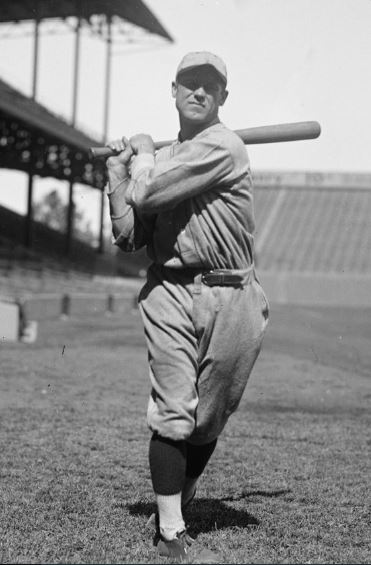
Photo: Library of Congress.

Photo: Library of Congress.

Who was that southpaw who won both his matchups against Walter Johnson – giving up just one run in 18 innings?  Future Hall of Famer George Sisler, who – like another hitter who came up as a pitcher (Babe Ruth) – would prove master batsman. Playing primarily at first base (where he earned a reputation as an excellent fielder),  Sisler collected 2,812 MLB hits, put up a career .340 average, won two batting titles (hitting .407 in 1920 and .420 in 1922), led the AL in stolen bases four times, triples twice, base hits twice (his 257 hits in 1920 would stand as the MLB record until 2004) and runs scored once. Sisler hit over .300 in 13 of his 15 MLB seasons, topping .350 five times. He stole a total of 375 bases, with a high of 51 in 1922. He also had 100+ RBI in four campaigns, 100 or more runs in four seasons and 200+ hits in six seasons.

Overshadowed by the Babe

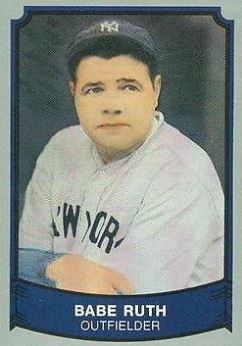
In 1920, when George Sisler set a then MLB record with 257 hits (and led the AL with a .407 average), he also set a career high with 19 home runes.  He was overshadowed by another former left-handed pitcher named George (George Herman “Babe” Ruth) who hit “only” .376, but shattered the MLB home run record with an unheard of 54 round trippers (breaking his own record of 29).

That season, Sisler finished second to Ruth in home runs (54-19); runs (158-137) and RBI (135-122), but did top the Babe in total bases (399-388).

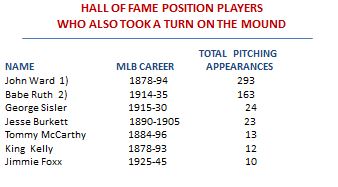
Like Ruth, Sisler would occasionally take a turn on the mound later in his career (twice in 1918 and once each season in 1920, 1925, 1926 and 1928). His career pitching line in 24 games (12 starts) was 5-6, 2.35, with nine complete games and one shutout.

The Sisler – Rickey Connection

Branch Rickey and George Sisler are both in the Baseball Hall of Fame, but their connections run much deeper.

  • Sisler’s college coach (at the University of Michigan) was Branch Rickey.
  • Sisler’s first MLB manager (with the 1915 Saint Louis Browns) was Branch Rickey.
  • In World War I, Sisler served in a chemical warfare training unit commanded by Branch Rickey.
  • From 1942 through 1950, Sisler worked as a scout (he reportedly scouted Jackie Robinson) and player development coach for the Dodgers (under Branch Rickey).
  • In 1952, when Branch Rickey joined the Pirates’ organization, he hired Sisler as a roving coach.
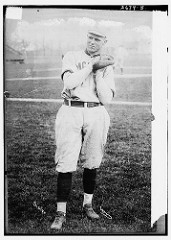
Sisler was both an excellent athlete and student. In high school, he excelled in his studies and played baseball (pitcher), basketball (forward) and football (end). He attended college at the University of Michigan, where he graduated with a degree in Mechanical Engineering and was a two-time baseball All-American.   In 2010, Sisler was elected to the College Baseball Hall of Fame.

Cassius Clay Connection

George Sisler was the son of Mary Whipple and Cassius Clay Sisler.

When he joined the Saint Louis Browns in 1915, Sisler’s manager Branch Rickey – who had witnessed his college pitching and batting prowess (Sisler hit over .400 in his college baseball career) – began working him out at first base and in the outfield.   The results, as noted earlier, were spectacular.

Baseball Genes

Two of George Sisler’s three sons made it to the major leagues as players, while the third served as a minor league executive.

  • Dick Sisler hit .276 in eight seasons (799 games – Cardinals, Phillies, Reds) as an MLB outfielder/first baseman and went on to manage the Cincinnati Reds (1964-65) and later serve as a coach with the Cardinals,  Padres, and Mets.
  • Dave Sisler pitched in seven MLB seasons (Red Sox, Tigers, Senators, Reds) going 38-44, 4.33 with 28 saves (247 games, 59 starts).
  • George Sisler, Jr. was a general manager for several minor league teams and served as the President of the International League for a decade (1966-76).

Primary resources: Society for American Baseball Research; The Sizzler: George Sisler, Baseball Forgotten Giant (Rick Huhn, University of Missouri, 2004); Baseball Hall of Fame; Baseball-Reference.com


I tweet baseball @DavidBBRT

Like/Follow the Baseball Roundtable Facebook page here.

Member: Society for American Baseball Research; The Baseball Reliquary; The Negro League’s Baseball Museum.
Fun with Faust – The Short and Improbable MLB Career of Charles “Victory” Faust

How does a pitcher of, at best, minimal skills, who made his professional debut at age 30, appeared in only two games (two innings) and never recorded an MLB win earn the nickname “Victory?”

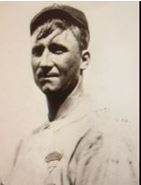
Charles "Victory" Faust - who had the "good fortune" to pitch for a pennant winner.

Charles “Victory” Faust – who had the “good fortune” to pitch for a pennant winner.

Well, it helps if your middle name is “Victor.” It also helps if you believe in fortune tellers, are slightly “off balance” and can find a manager and team that can be convinced you are a good luck charm that can bring them a successful trip to the World Series.  All those forces came  together to create a “perfect storm” in the short, zany and improbable life and major league “career”  of Charles ”Victory” Faust.

Side note:  BBRT has often talked about how, when looking into baseball “tidbits,” one thing can often lead to another – and another – and another. In this case, research BBRT was putting together a post on a unique connection between two players who were hit by a pitch (in their first – and for one only – plate appearance) fifty years apart led BBRT to a look at a third player who also was clipped by a pitch in his first (and only) MLB plate appearance. For a look at the post that led to this article, click here.  Anyway, that’s the roundabout way I got to this post about Charles “Victory” Faust.   

 As I prepared this post, it became clear that record-keeping (and even “eye-witnessing”) were not exact sciences among ballplayers in the early 1900s.  I worked to distinguish between myth and reality as I looked into the life of Charles Faust, but can’t guarantee a bit of myth may have slipped by.  Still, even when you discount likely myth, there is plenty of magic in this Faust-ian tale.

Charles Victor Faust – an awkward and somewhat slow fellow in many ways – grew up on a Kansas farm and did not appear to have an overly bright future. That is, not until the spring of 1911, when he availed himself of a country fair fortune teller – who told him (among other things) that he was destined to marry a California woman named Lulu and pitch the New York Giants to a World Series championship.  The 30-year-old Faust – apparently with child-like enthusiasm, intellect and trust – took the predictions to heart.  Despite his total inexperience as a pitcher, Faust’s focus in life became finding a way to convince Giants’ Manager John McGraw to enable him to pursue his destiny.

In late July, Faust traveled to Saint Louis, where the Giants were facing the Cardinals.  Now, there are a couple of versions of what took place in Saint Louis.  One says that Faust approached McGraw at the team’s hotel and related the fortune teller’s prediction, promising that he would fulfill his destiny and pitch the Giants to the World Championship.  The other is that Faust bought a ticket to the Giants/Cardinals game and, during pre-game warm-ups, simply stepped out onto the field and approached McGraw.

In either case, Faust – who may have seemed a bit odd to McGraw, but was certainly sincere enough – got his tryout with during that day’s pre-game warmups. (The tendency of baseball players and managers of the time toward superstition may have swayed McGraw to want to explore the efficacy of the fortune-teller first-hand; or Faust’s tryout may have been just a whim intended to break up the day’s routine.)

How talented was Faust?  Well, after a few pitches from Faust (who was still in his street clothes), McGraw ditched his glove and caught his offerings barehanded (most likely to embarrass and discourage the eager, but inadequate, hurler).

“His windup was like a windmill. Both arms went around in circles for quite a while before Charlie finally let go of the ball. Well, regardless of the sign that McGraw would give, the ball would come up just the same. There was no difference in his pitches whatsoever. And there was no speed – probably enough to break a plane of glass, but that was about all.”

NY Giants’ CF Fred Snodgrass, describing Charlie Faust’s tryout deliveries in Lawrence S. Ritters’s book “The Glory of Their Times – The Story of the Early Days of Baseball told by the Men Who Played it.”

When McGraw’s bare-handed catching didn’t diminish Faust’s confidence, the manager tried another tack.  He told Faust to take a few batting practice swings. Faust swung and missed a few lollipop offerings, before finally making weak contact. With that contact, McGraw urged Faust to run around the bases – sliding into each one, tattering his Sunday-best clothes, picking up a few scrapes, but (apparently) not bruising his ego or dampening his conviction.

Well, as one might expect, McGraw send the Faust on his way without a contract. The Giants, however, won big that day and when the still undaunted Faust showed up at the park the next day, the players reportedly put him in a spare uniform and sent him on out for another pre-game exhibition of his “skills” (most likely for their own amusement). The ensuing laughter did not embarrass the affable Faust. Rather he liked the attention and felt he had made a step forward in his quest.  That day, with Faust as the pre-game show, the Giants again topped the Cardinals and the following day, they enjoyed a repeat performance from Faust and another victory.  A pattern was developing.

The next day, as the team left Saint Louis, the fun (at least for McGraw) was over and the team unceremoniously ditched the gullible Faust at the railroad station.  Two similar stories are reported here, both have the team sending him back to the team’s hotel on a fool’s errand – to retrieve either his contract or his train ticket. (Neither, of course, existed.  The Giants, without Faust as a good luck charm, lost four of the next six games and were again seeming more like a third- or fourth-place squad than a pennant contender.

When the team returned home to New York, who should be waiting for them but Faust, as enthusiastic as ever about his role as the key to the Giants’ championship.   The ballplayers – and McGraw – again, being a generally superstitious bunch, were receptive to Faust rejoining the squad.  And the rest, as they say, is history.

Faust stayed with the team and became a popular source of pregame entertainment for fans.  He would warm up, take batting practice, shag flies and run the bases – at which times his awkward, but energetic, displays would delight the fans (and sports reporters).  Even opposing players would get into the act, sometime hitting against Faust in their own batting practices and “striking out” against his  soft tosses. There was some less than good natured laughter, but Faust did not seem to notice; relishing his spot on the squad and warming up in the bullpen nearly every game – so he would be ready when he was needed on the mound. (The story goes that when the Giants would fall behind, McGraw would have Faust warmup in the bullpen – and, inevitably, the Giants would rally.)  Faust was fast-becoming the toast of the town.

The definitive book on the improbable MLB career of Charles "Victory" Faust.

The definitive look at the improbable MLB career of Charles “Victory” Faust.

Faust, indeed, also proved a good luck charm for the New York squad – some speculated just by keeping the team happy and “loose.”  One thing is clear, his conviction that he and the Giants were headed for greatness was unshakeable – and perhaps contagious. As Gabriel Schechter author of the book “Victory Faust – The Rube Who Save McGraw’s Giants” reports, as the season went on, the team went 36-2 when Faust was with them and just 3-7 when he wasn’t. (A bit of explanation on at least some those absences: Faust became so popular in New York that he was offered a job on vaudeville, telling stories, duplicating his windup and imitating the stars of the game. In his first three days in show business, the Giants went without a win, and Faust returned to his team and what he saw as his true destiny.)  

Still Faust was not satisfied and kept badgering McGraw to give him a chance to toe the rubber in a game.

On October 5, the Giants clinched the pennant, but they still had a week’s worth of meaningless games until the fortune teller-predicted and Faust-promised World Series.  And, Faust was still driven to appear on the mound.  He had not – as predicted – “pitched” the Giants to success.  He was about to get his wish.

On October 7, McGraw relented to Faust’s consistent badgering and brought him in to pitch the ninth inning of a game in which the Giants trailed the Boston Rustlers (Braves) 4-2.  Faust, throwing fat pitches out of his exaggerated windmill-style  windup actually managed to get out of the inning giving up just one run on one-hit (a double) and a sacrifice fly.

In the bottom of the ninth, the Giants made the final out with Faust on deck. But Faust, still showing his unbridled (perhaps slightly off-kilter) enthusiasm took his place in the batters’ box and refused to leave the field.  And then a strange thing happened.  The Boston players “played” along, stayed on the field and pitched to Faust. When he tapped a ball to the infield, the Boston players mishandled each throw and tag attempt until finally retiring a clumsily sliding (but surely smiling) Faust about ten feet from home plate.  Although the at bat didn’t count, Faust had made his (and the fortune-teller’s) dream come true – he had pitched in a major league game.  But he wasn’t done yet.

On October 12, in the final inning of the Giants’ final regular season game, with New York trailing the Brooklyn Superbas (Dodgers) 5-1, Faust pitched again – notching a scoreless frame.  This time, he came to the plate when it counted  And, like their Boston counterparts, the Brooklyn squad played along. Apparently believing there was little chance the awkward Faust could be counted on to hit the ball, Brooklyn pitcher Eddie Dent “dented” Faust with a pitch. Faust then, being largely ignored (or, perhaps, even encouraged) by the Brooklyn team, stole second and third base before scoring on a groundout.  Quite an end to the season, and the World Series was ahead.  It was also quite the end to Faust’s major league career.

Despite Faust’s presence, the Giants lost the World Series to the Philadelphia Athletics four games to two – and McGraw seemed to lose interest in the New York’s good luck charm.

The Giants did not invite Faust back in 1912 – but, no surprise, he showed up anyway.  And, in a tribute to persistence, was again allowed to provide pre-game hijinks at the Polo Grounds (the team declined to pay his travel expenses for away games that season).  Although the Giants (who would have expected otherwise) got off to a 54-11 start, McGraw had tired of Faust’s continued badgering about the opportunity to take the mound – and Faust was convinced to leave the team in mid-season.

The Giants won more than 80 percent of the games they played while Faust was with the team.

Faust moved back to Kansas, then California (perhaps, looking for Lulu) and eventually to Seattle (near one of his brothers) still insisting he would make it back to help the Giants win another pennant. It was not meant to be.  In December of 1914, Faust was committed to an Oregon mental hospital, where he was diagnosed with dementia and (after several weeks of treatment) released in his brother’s care.  Faust died June 18, 1915 (at age 34) of tuberculosis.  Often described a “delusional,” the fact is Charles “Victory” Faust made it to the big leagues and did earn a pair of turns on the mound for a pennant winning club.  In doing so, he carved a spot for himself as one of the more memorable characters in baseball history – and realized a dream that lives in most baseball fans’ hearts.

In 1915, the year Charles “Victory” Faust passed away, the New York Giants finished last in the National League – their first last-place finish since 1900. It would, in fact, be their only last place finish between 1900 and 1943.

Charles “Victory’ Faust – MLB Record

Pitching:

Games … 2.  W-L … 0-0.  Innings pitched … 2.  Hits … 2. Earned runs … 1. ERA … 4.50.

Hitting

Plate appearances … 1.  At Bats … 0.  Hits … 0.  Walks … o.  Hit By Pitch … 1. Stolen bases … 2. Runs scored … 1.  RBI … 0.

A final note:  You can probably file this one under #HowTheGameHasChanged.  There will never be another player like Charles “Victory” Faust.

Primary Resources;  Charlie Faust – Society for American Baseball Research Biography, by Gabriel Schechter; Searching for Victory – The Story of Charles Victor(y) Faust, by Thomas S, Busch, Society for American Baseball Research, Research Journals Archives; Baseball-Reference.com; The Glory of Their Times, by Lawrence S. Ritter, McMillian and Company (1966).

I tweet baseball @DavidBBRT

Follow/Like the Baseball Roundtable Facebook page here.

Member: Society for American Baseball Research; The Baseball Reliquary; The Negro Leagues Baseball Museum.
GUEST POST: A Fan Looks at MLB Attendance Issues … Is It a Matter of Timing?

Baseball Roundtable invites, encourages and enjoys comments and guest post from readers. Debate and discussion are, after all, part of what makes baseball our national pastime.  What follows is a guest post from Evan Sutker – a hardball fan and BBRT reader who says he grew up on Maddux, Smoltz and Glavine (as well as the Jones boys, Chipper and Andruw) and the Braves of the late 1990’s and early 2000’s. Sutker has a passion for both baseball and Lacrosse and spent his evenings (when he didn’t have Lacrosse practice) watching the Braves.  If you are interested in a look at baseball attendance trends, read on.  Also, if you have an interest in honest and reliable Lacrossw equipment and gear reviews, you should visit Evan’s blog at lacrossescoop.com


 MLB Popularity Changes- Is the Sport Really Declining?

Guest Post by Evan Sutker

Has baseball’s popularity really been trending down for years, or even decades? Is the sport just too slow and outdated to compete with the NBA and NFL? Let’s take a look at the actual numbers and go from there.

MLB Attendance Numbers

Using Baseball Reference’s attendance numbers, we see that attendance per game is down for the third consecutive year, averaging 28,738 per game played so far in 2018 (as of July 31st).  This is down 5.3 percent from 30,349 in 2015.  Attendance per game peaked in 2007 at 32,696, nearly 14 percent higher than the average attendance per game this season.  NFL attendance has dropped from 17.51 million to 17.25 million from 2015 to 2017, a drop of 1.5 percent.


The stats show a slight, but noteworthy, drop in baseball attendance. 2017 and 2018 were the first years under 30,000 average per game since 2003.  Additionally, there have been no player strikes or recessions that would help explain any decrease. See the full attendance averages here.

Attendance

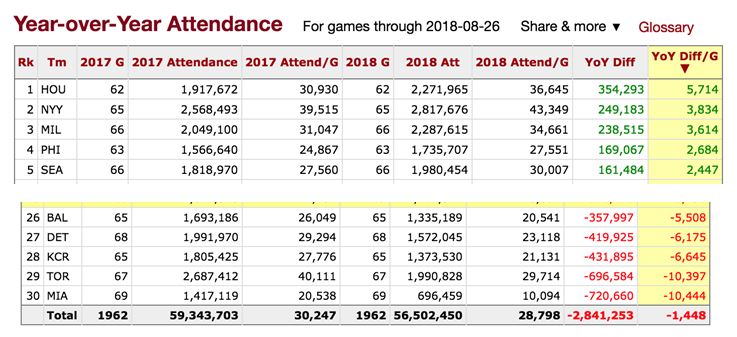
It does appear that the product on the field matters.  Check out the chart above – a look at the top five teams in 2018 attendance gains versus the five biggest losers in attendance per game this year (compared to one year ago).  Houston, coming off their World Series win, shows the biggest gain at nearly 6,000 more fans per game. New York (Yankees), on track to win ten more games than last year, and Milwaukee, Philadelphia and Seattle (all significantly improved over one year ago) are all showing notable attendance jumps.   Conversely, Baltimore and Kansas City are on track for historically bad seasons – and have the third- and fifth-largest attendance declines.  Detroit, Toronto and Miami – teams that have all disappointed and have been on track to lose 90 or more games (as of July 31) – are also among the top five teams in terms of average attendance decline.

TV Ratings

Attendance numbers are down, so what about television ratings?  Well, there is good news and bad news for MLB. The good news is that baseball games lead ratings in 25 of 29 cable TV markets that MLB plays in.  162 baseball games is a long season and advertisers and networks cannot ignore that type of day-in and day-out dominance.  MLB may have peaked in America a few years or even decades ago, but it is not going anywhere anytime soon.  For a look at the prime-time television ratings for MLB (as reported by Forbes), click here.

However, there is some bad news.  TV ratings are down significantly and the downward trend shows little sign of abating.  Getting information to compare local ratings for regular season games is very difficult, but looking at World Series ratings year-over-year does not paint a pretty picture. (See the World Series ratings here.)  World Series ratings peaked in the late 80’s and early 90’s, routinely averaging over 30 million viewers per game.  The 2016 World Series  (featuring the big market Chicago Cubs breaking a near century-long streak) is the only World Series since 2004 to break 20 million viewers, despite the US population consistently rising.

Super Bowl viewership has risen consistently year-over-year and decade-over-decade (but you must consider that the Super Bowl is a single Sunday, as opposed to a potential seven-game World Series) viewing commitment.   NBA Finals viewership is up and down depending on whether Michael Jordan is playing!  See Super Bowl viewership ratings here; NBA Finals ratings here.

There are no easy fixes, but I believe pace of play is a large factor.  We are seeing approximately two more pitchers per game than 20 years ago – which adds around 10-15 minutes of game time by itself. It seems like there are several games each night that push toward four hours, despite not going into extra innings.  A fan survey earlier this season on BBRT showed that 38 percent of respondents do not care about game length, while 46 percent of respondents felt like the ideal game would be 2.5 hours or less. Keep in mind that Baseball Roundtable readers likely are more committed to the game than the average fan; so we can expect a greater number percentage of fans overall  would show a notable preference for games of under three hours.

MLB has instituted rule changes in recent years to help speed things up including shortening the time between innings, limiting mound visits for managers and the new Intentional Walk rule.  There has also been talk of changes like requiring batters to keep one foot in the batter’s box during an at bat or requiring relief pitchers to record at least one out.  Additionally, the minor leagues have instituted a new rule that puts a runner on second base for both teams at the start of each frame in all extra innings. That seems like too much for me, but it would certainly help keep games from hitting the four-hour mark. I think a pitch clock is inevitable and would help the game of baseball market itself to casual, younger fans. What do you think – not just about a pitch clock, but other potential methods to accelerate the pace of the game?  If you enjoyed the post, please check out my Lacrosse site – here.


BBRT says “Thanks Evan, for sharing with Baseball Roundtable’s readers.”


Two “PainFul” Careers – and a Combination of Connection and Coincidence.

There is, at least from a Baseball Roundtable perspective, a certain satisfaction in coming across MLB events that, although seemingly unrelated at the time they occurred, later create lasting connections (and impressions).  This blog post is about a pair of “hit-by-pitches” that occurred fifty seasons apart, but brought the players together both in the record books and (57 years after the first HBP) in Marlins Park.

FRED VAN DUSEN

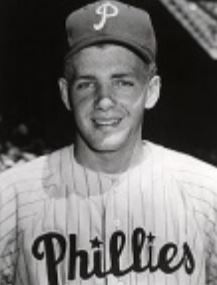
Van DIt all started with a left-handed throwing and hitting outfielder named Fred Van Dusen.  As a 16- and 17-year-old, Van Dusen showed promise – a steady and powerful bat, speed on the base paths and in the field, as well as a strong arm. The 6’3”, 180-pound outfielder caught the attention of a number of scouts and, just 20 days after his 18th birthday, signed as a “Bonus Baby” with the Philadelphia Phillies.

Less than a month after signing, Van Dusen got his first MLB plate appearance. It came in the second game of a September 11, 1955 double header versus the Braves (in Milwaukee). Van Dusen came to the plate as a pinch hitter – for pitcher Lynn Lovenguth – in the top of the ninth, with one out, one on and the Phillies trailing 9-1. (For those who like to know those things, the pitcher was Humberto Robinson.). As he stepped up to the dish, Van Dusen became the youngest player to appear in an MLB game in 1955.  But, there was more to come.

Van Dusen quickly fell behind 0-2 – remember that count, it will come into play later. On his third pitch, Robinson hit the rookie on the knee with a sweeping curveball. As he was left stranded at first, Van Dusen could hardly have expected that he had just experienced his first – and final – MLB plate appearance; and 2) that 57 years later that lone MLB plate appearance would be the catalyst for an appearance on the MLB Miami Marlins’ mound.  More on that in a bit, let’s get back to Van Dusen’s professional career.

His sophomore professional season  saw Van Dusen playing for the Wilson Tobs of the Class B Carolina League, where he hit .252, with 11 home runs in 140 games. He went on to play five more minor league seasons, hitting .260, with 86 home runs.  His best season was 1957, when he hit .310, with 25 long balls for the High Point – Thomasville Hi-Toms of the Carolina League; and was named the Carolina League’s Player of the Year. Despite that strong season, Van Dusen started the next campaign with the Triple A Miami Marlins (remember that Marlins connection, it too will come into played) and he never appeared in another MLB game.

Until 2005, Van Dusen was the only player who was hit by a pitch in his only plate appearance, in his only MLB game; and who also never appeared in the field (in the majors) defensively. (Just more evidence of BBRT’s contention that “In baseball we track everything.”)

ADAM GREENBERG

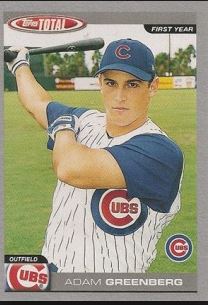
GreenbrgThen, in 2005, 24-year-old rookie Adam Greenberg (another promising southpaw outfielder), doubled the size of Van Dusen’s list (one MLB game, one MLB plate appearance, hit by pitch, never played in the field) – and he stayed there until October 2, 2012.

Greenberg made his MLB debut with the Cubs on July 9, 2005.  It came in the top of the ninth inning with the Cubs leading the Marlins 4-2. (Remember the Van Dusen minor league Miami Marlins connection? BBRT likes that kind of coincidence.) Greenberg was called on to hit for pitcher Will Ohman with one out and no one on base. The very first MLB pitch Greenberg ever saw came from Marlins’ lefty Valerio De Los Santos. Remember that name, it also comes into play later.  It was a 92-mph fastball that got away and hit Greenberg in the back of the head – resulting in a concussion that sent him directly to the hospital (rather than first base) and led to recurring positional vertigo, vision issues and headaches – and contributed to a very short MLB career.

But I’m getting ahead of myself.  Let’s look at how Greenberg got to that plate appearance.

Greenberg was a star athlete at Guilford (Connecticut) High School – a four-year letterman in baseball, basketball and soccer – and team captain in both baseball and soccer.  He then went to the University of North Carolina, where he was named to the ACC All-Conference team in 2002 – after hitting .337, with 17 home runs and 35 stolen bases.

The Cubs selected Greenberg in the ninth round of the 2002 MLB Draft and he began his professional career in the Cubs’ system that year. He showed considerable promise.  As a 21-year-old he hit a combined .286, with 17 stolen bases in 77 games at Class A (Lansing Lugnuts) and High A (Daytona Cubs). In 2003, he hit .299 with 26 steals at Daytona and, in 2004, he hit a combined .285, with six homers, 17 triples and 19 steals – while moving from High A (Daytona) to Double A (Western Tennessee Diamond Jaxx) to Triple A (Iowa Cubs).  When he got the 2005 call up to the Cubs he was having a solid season at Western Tennessee.  Then, of course, came the beaning – and the aftermath.

Greenberg was released by the Cubs in in June of 2006 – after disappointing performance at Iowa and Western Tennessee He then bounced around the minors in Dodgers’, Royals and Angels’ systems, as well as with the (Independent) Atlantic League Bridgeport Bluefish – continuing to chase his maj league dream.

Another Coincidence/Connection

Valerio De Los Santos – who hit Adam Greenberg with that fateful 2005 pitch – enjoyed a nine-season MLB career. His last MLB appearance was with Colorado in 2008. In 2011, De Los Santos (then 38-years-old) was playing his last professional season – with the Long Island Ducks of the (Independent) Atlantic League.  Greenberg was playing for the Bridgeport Bluefish in the same league and found himself facing De Los Santos once again.

In an interview with the Shoreline Times, Greenberg said this of his second professional at bat versus De Los Santos,”It was a big deal. As much as I try to pretend it wasn’t. It’s been 5 ½ years and to face him again in a game that meant something … It brings things full circle.  You have the what-if stuff – What if he threw that first pitch for a strike 5 ½ years ago? That’s the fun stuff. The fact is, it happened.  And that we’re both still playing is awesome.”

2012 – AND THINGS REALLY GOT INTERESTING

In October of 2012 – perhaps responding to a national social media campaign aimed at getting Greenberg a major league at bat (rather than just a plate appearance) – the Miami Marlins signed Greenberg to a one-day major league contract. Keep in mind the Van Dusen connection.  At this point in time, Van Dusen and Greenberg were the only two players in MLB history to be hit by a pitch in their only MLB plate appearance, in their only MLB game, without appearing in a defensive position on the field.

Knowing that Greenberg’s appearance  in a Marlins’ game would once again make Van Dusen the sole holder of the “one game, one plate appearance, hit-by-pitch and never appearing in the field” record, the Marlins called on the then 75-yedar-old Van Dusen to throw out the ceremonial first pitch for the contest.   So, two events – somewhat similar, but 50 years apart – eventually brought Greenberg and Van Dusen together on the same day on the same major league diamond. BBRT likes that symmetry.

One Game, One Plate Appearance, One Hit by Pitch

There are three other players who qualify for the one game, one plate appearance, one hit by pitch club – but those three all played a defensive position in their single game.  They are: The Giants’ Ham Wade (September 9, 1907); Indians’ Harvey Grubb (September 27, 1912); and Phillies’ Cy Malis (August 17, 1934). 

Pitcher Charles “Victory” Faust of the 1911 Giants came close – with just one career plate appearance – hit-by-pitch, two stolen bases and one run scored.  Faust, however, appeared in two games. His story, as the good luck charm of the 1911 Giants, is unique in the lore of baseball superstitions – and will get its own post here in the near future.

Now to Greeberg’s 2012 at bat. He came up as a pinch hitter (for LF Bryan Petersen),  leading off the bottom of the sixth, with the Marlins up 2-0. Greenberg was facing 20-game winner, and eventual 2012 NL Cy Young Award winner, knuckleballer R.A. Dickey.

Greenberg’s Walk up music was, appropriately, Aerosmith’s “Dream On.”  He came to the plate accompanied by a standing ovation – and struck out on three pitches.  (Remember, Van Dusen was hit by an 0-2 pitch? So, in the totality of Van Dusen’s and Greenberg’s MLB careers, every major league pitch they ever saw that didn’t hit one of them was a strike.).

Even after getting that elusive MLB at bat, Greenberg was not done.  His heart was in the game and, in December of 2012, he signed with the Orioles as a minor-league free agent.  He was, however, released by Baltimore in March of 2013. He still, however, felt the urge to be on the field and played 30 games back with the Bridgeport Bluefish in 2013.  It was his final professional baseball season.

Primary Resources:  Baseball-Reference.com, Society for American Baseball Research.


I tweet baseball @DavidBBRT

Like/Follow the Baseball Roundtable Facebook page here.  

Member: Society for American Baseball Research; The Baseball Reliquary; The Negro Leagues Baseball Museum.
How Close Can You Get? Perfect Games Lost with Two Outs in the Ninth … or Later

Saturday(September 8), Kansas City Royals’ rookie right-hander Jorge Lopez took a 4-0 lead over my hometown Twins into the bottom of the ninth.  More important (particularly since neither the Twins nor Royals are in the post-season hunt), the 25-year-old Lopez also took a perfect game into the ninth. History, however, was not to be made. Lopez walked Twins’ RF Max Kepler on five pitches to start the inning (and lose the perfect game) and then gave up a single to center by LF Robbie Grossman (on a 1-2 pitch) to lose the no-hitter (Kepler going to third). Wily Peralta came on in relief and gave up a sacrifice fly (there went the shutout), but closed out Lopez’ 4-1 victory.

Lopez’ near-perfect outing led BBRT to reflect on past games when MLB pitchers got even closer to perfection.  So, here’s a post on perfect games lost with two outs in the ninth inning – or even later.  I’ll rate the top ten on the bases of heartbreak (or irony) … and throw in the remainder as “Honorable Mentions.”

______________________________________________

NUMBER ONE – I’m “Calling” This the Toughest Perfect Game “Missed” Ever

Armando Galarraga, Tigers … June 2, 2010

Photo by Kevin.Ward

Photo by Kevin.Ward

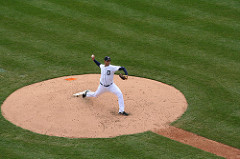
Perhaps the most heartbreaking “no-hitter breakup” took place on June 2, 2010, when Detroit Tigers’ righty Armando Galarraga found himself on the mound in the top of the ninth 26 outs into a perfect game (three strikeouts).  The Tigers led 3-0 and Galarraga was facing Indians’ second baseman Jason Donald. Galarraga induced Donald to ground to right side of the infield. Detroit first baseman Miguel Cabrera moved to his right to make a fine play, spinning and throwing to Galarraga covering first (who clearly beat Donald to the bag). Umpire Jim Joyce called Donald safe, a mistake he admitted and apologized for after the game. (Talk about a bad time for a bad call.)

The official scorekeeper gave Donald an infield single, ending both the perfect game and the no-hitter. Galarraga retired the next batter – CF Trevor Crowe – on a groundout. Joyce’s call, despite the post-game mea culpa, stood, and Galarraga, painfully, joined the list of pitchers losing a perfect game with two outs in the ninth.

Galarraga had a five-season MLB career (2007-2012), going 26-34, 4.78 for the Rangers, Tigers, Diamondbacks and Astros. His near-perfect game was one of only two complete games in 91 career starts.

NUMBER TWO – Unlucky 13, Indeed!

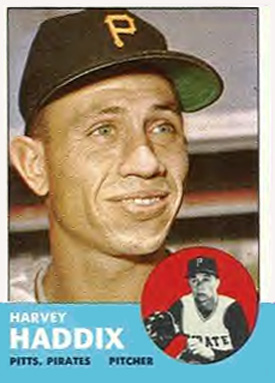
HaddixFor another hard luck story involving near-perfection, consider the plight of Pittsburgh Pirates’ southpaw Harvey Haddix, who took a perfect game into the 13th inning – AND LOST.

On May 26, 1959, Haddix took the mound against the first-place and defending NL Champion Milwaukee Braves.  Haddix retired the first 36 hitters in order – fanning eight, carrying a perfect game into the bottom of the 13th. A 20-game winner in 1953, the 33-year-old Haddix had come into the game 4-2, with a 2.67 ERA in seven starts – and had thrown complete games in his two previous outings. (He would end up 12-12, 3.13 on the year.)

Unfortunately,  the Pirates’ lineup had given him no support.  (Yes, the heartbreak here is that he continued that “perfecto” past the ninth and his teamates still could not give hime a run.)  Braves’ righty Lew Burdette, despite giving up 12 hits and fanning only two, had held the Pirates scoreless. Milwaukee 2B Felix Mantilla led off the 13th by reaching on a throwing error by Pirates’ third baseman Don Hoak. Future Hall of Famer 3B Eddie Mathews bunted Mantilla over to second, which led to an intentional walk to another future Hall of Famer (RF Hank Aaron), bringing up 1B Joe Adcock.

Adcock launched a 1-0 pitch over the right field fence for what appeared to be a three-run home run.  However, the Braves, in celebrating the tension-filled victory, forgot how to run the bases. Adcock passed Aaron between second and third and, after some deliberation, Adcock was called out – ultimately changing his three-run homer to a one-run double. So, despite 12 perfect innings, Haddix lost the no-hitter, the shutout and the game itself.  But he did etch his name forever into baseball lore; and countless trivia quizzes. He still holds the record for the most consecutive hitters retired from the start of a game – and the second spot on this heartbreak, near-perfect list. 

Haddix spent 14 seasons (1952-65) in the major leagues (Cardinals, Phillies, Reds, Pirates, Orioles), going 136-113, 3.48.  His best seasons were with the Cardinals in 1953-54. In those two campaigns, Haddix put up lines of 20-9, 3.06 and 18-13, 3.57.  The 5’9”, 170-pounder was a three-time All Star and led the NL in shutouts (six) in 1953.

NUMBER THREE – Not Just One Out, One Strike, Away.

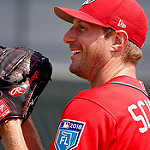
Max Scherzer, Washington Nationals … June 20, 2015 

Photo by Corn Farmer

Photo by Corn Farmer

Washington Nationals’ right-hander Max Scherzer came within one out – within one strike actually – of a perfect outing on June 20, 2015. Missing by just one swing and miss – and having four chances to sneak that final strike by – earns him number-three on the hard-luck, near-perfect roster.

Scherzer entered the top of the ninth with a 6-0 lead over the Pittsburgh Pirates – having retired the first 24 batters, striking out ten.  In the ninth, Scherzer retired the first two batters (RF Gregory Polanco on a pop out to the catcher and SS Jordy Mercer on a liner to center) and then worked the 27th hitter (pinch hitter Jose Tabata) to a 2-2 count.  Tabata fouled off three 2-2 pitches before Scherzer lost the perfect game in perhaps the most painful way (in more ways than one) possible – by hitting Tabata with a pitch (a breaking ball to the elbow).  Scherzer then got Pirates’ second baseman Josh Harrison on a fly ball to left, completing the no-hitter – and earning a 6-0 victory.  Scherzer, by the way, was not the first pitcher to lose a perfect game by hitting the 27th batter (see George Wiltse, next in this post).

Scherzer, still active, is in his eleventh major league season (Diamondbacks, Tigers, Nationals).  He is a six-time All Star, two-time twenty-game winner and three-time Cy Young Award winner (2013-2016). In 2015, he went 14-12, 2.79, but led the NL with four complete games and three shutouts.  As this post is written his career record is 158-81, 3.20 – with ten complete games, five shutouts and two no-hitters.

______________________________________________________

NUMBER FOUR – Another Bad “Call” – Another “Missed” Perfecto – Another “Not Missed” Batter.

George “Hooks” Wiltse, New York Giants … July 4, 1908

Giants’ southpaw curveballer George Wiltse – like Max  Scherzer (above) – got not just within one out, but within one strike, of perfection.  And, as in the Armando Galarrago near-perfect game, the umpire later admitted that Wilste threw that strike, and had the out, he just didn’t get the call.

It looked, for the longest time, like Wiltse was going to have plenty to celebrate on Independence Day 1908. The Giants’ southpaw retired the first 26 Phillies before hitting Philadelphia pitcher George McQuillan with a pitch on a 2-2 count (after not getting the call on a very close pitch on his previous delivery – a call umpire Cy Rigler later admitted he missed).  Wilste retired the next batter. However, despite nine no-hit/no-run innings, he wasn’t done yet.  He and McQuillan were embroiled in a 0-0 duel (like Harvey Haddix, Wiltse got little support in his near-perfecto).  Wiltse went on to pitch-a 1-2-3 tenth (preserving the no-hitter) and the Giants managed to push across a run to give Wiltse a 1-0, no-hit victory. Wilste is one of only three pitchers to date to complete a no-hitter of more than nine innings. Wilste finished the 1908 season 23-14, with a 2.34 ERA. He was also a twenty-game winner in 1909 (20-11, 2.00) and went 139-90, 2.47 in twelve MLB seasons.  He finishes a spot behind Scherzer’s two-strike hit batsman only because, even if he had gotten the strike out, the perfect game would not have been completed (since the game itself was not completed). Given his 1-2-3 tenth, however, that missed call cost him a perfect outing.

___________________________________________________

NUMBER FIVE – Another One-Strike-Away Performance

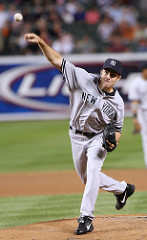
Mike Mussina, Yankees … September 2, 2001 

Photo by Keith Allison

Photo by Keith Allison

Fifth-place on the list goes to another one-strike-away, near-perfect performance. On September 2, 2001, the Yankees’ Mike Mussina squared off against the rival Red Sox at Fenway Park. After eight innings, Mussina and Red Sox starter David Cone were locked in a 0-0 duel. Mussina hadn’t allowed a base runner, striking out twelve. Cone had given up just four hits and three walks (fanning eight), while holding New York scoreless.  The Yankees pushed across a run in the top of the ninth on a single, an error and a double by 3B Enrique Wilson. Mussina, looking for his 14th victory of the campaign, went to work on his perfect game (which would have been the first ever at Fenway) – notching a ground out (pinch hitter Troy O’Leary) and a strikeout (2B Lou Merloni) and taking pinch hitter Carl Everett to a 1-2 count before Everett singled to left. Mussina retired Trot Nixon for the final out, in a 1-0 one-hit win.

Mussina finished the season 17-11, 3.15. In an 18-season MLB career (1991-2008), Mussina went 270-153, 3.68 with 57 complete games and 23 shutouts. The five-time All Star won 17 or more games eight times and, ironically, had only one 20-win season – his last. As a 39-year-old, Mussina went 20-9, 3.37 for the Yankees in 2008. In the major leagues from 1991 to 2008, Mussina pitched for the Orioles and Yankees.

_________________________________________________

NUMBER SIX

Dave Stieb, Blue Jays … August 4, 1989 … Worked Really Hard for a No-Hitter

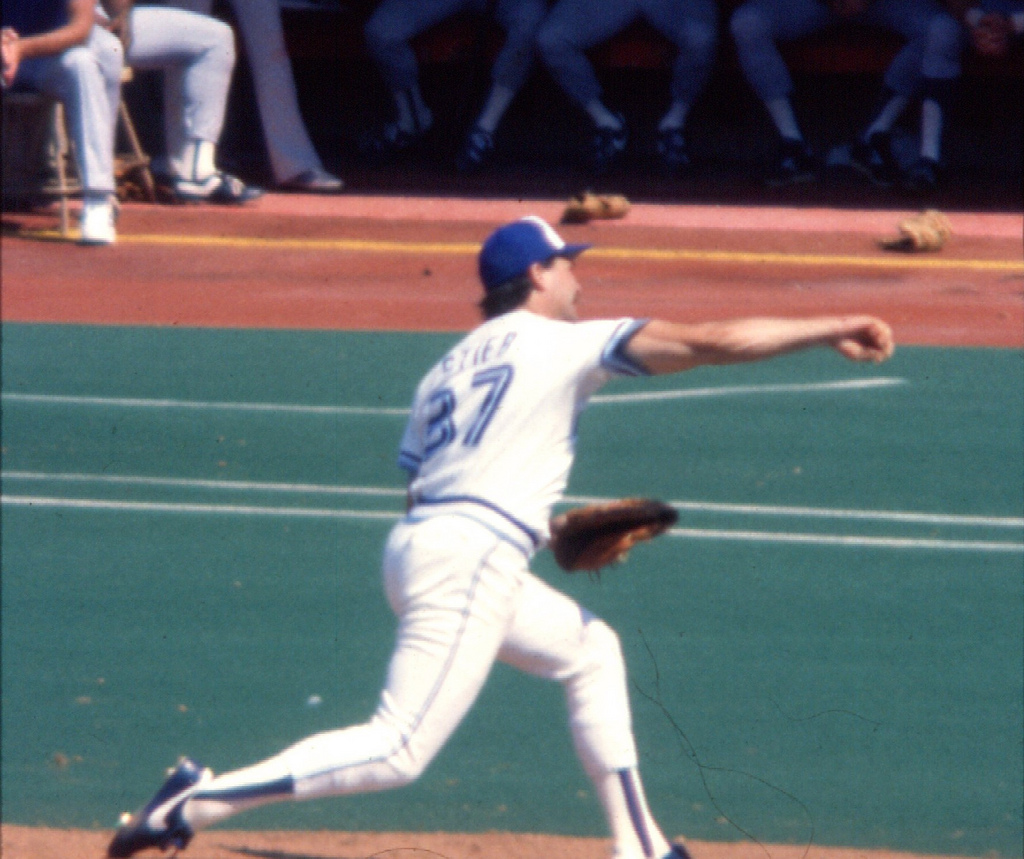
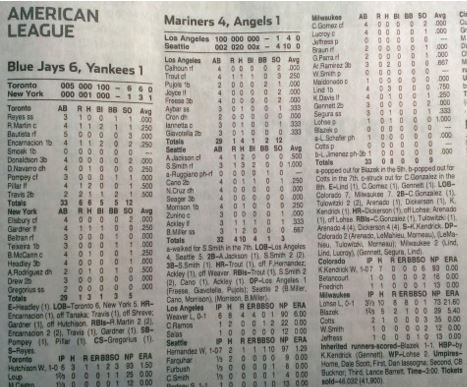
Dave StiebOn August 4, 1989, Blue Jays’ right-hander Dave Stieb took a 2-0 lead and a perfect game into the top of the ninth inning against the Yankees. Stieb started the inning as though ready to make history, fanning pinch hitters Hal Morris and Ken Phelps on nine pitches (his tenth and eleventh strikeouts of the game).  Then Steib fell behind the number-nine hitter – CF Roberto Kelly – 2-0. Stieb had to throw a strike and Kelly knew it – and hit it. He broke up the perfect game and the no-hitter with a double to left.  Second baseman Steve Sax followed with a run-scoring single, before left fielder Luis Polonia grounded out to end the game.  So, Stieb lost the perfect game, the no-hitter and the shutout – but did get the win.

Stieb ended the season 17-8, 3.35 – one of six seasons in which the seven-time All Star logged 16 or more wins.  In a 16-season MLB career (1979-1992, 1998), Stieb went 176-137, 4.83 for the Blue Jays and (for one season) White Sox.   Steib takes sixth-place on this list based not soley on that 1989 game – but also on the fact that it came after he lost two no-hitters (not perfect games) with two outs and two strikes on the batter the previous season. (See box below.)

DAVE STIEB – SO CLOSE AND YET SO FAR

In 1988, Dave Stieb – who would lose a perfect game with two outs in the ninth on August 4, 1989 – twice came within one strike of a no-hitter – and in consecutive starts. On September 24, 1988 (against the Indians) and September 30. 1988 (versus the Orioles), he lost no-hitters with two outs in the ninth inning and two strikes on the hitter (2 and 2 counts both times).  Stieb did get two complete-game shutouts, 1-0 over the Indians and 4-0 over the Orioles. The games were his final two starts of the 1988 season, so he had the entire off-season to contemplate his bad luck. Stieb did finally get his no-hitter – the first in Toronto Blue Jays’ history – a 3-0 win (four walks/nine strikeouts) over the Indians in Cleveland on September 2, 1990.


NUMBER SEVEN – Unfortunately, A Walk In The Park.

Milt Pappas, Cubs … September 2, 1972

On September 2, 1972, the Cubs’ Milt Pappas held an 8-0 lead over the San Diego Padres – and had a perfect game going (with six strikeouts) as the Padres batted in the ninth.  After retiring the first two batters in the final frame, Pappas walked pinch hitter Larry Stahl on a very close 3-2 pitch.  Pappas then retired pinch hitter Garry Jestadt on a pop out to second base. So, while he lost the perfect game, he did save the no-hitter. Pappas – who went 209-164, 3.40 in 17 MLB seasons (1957-73) – had his best year in 1972, going 17-7, 2.77. It was the 33-year-old’s 16th MLB campaign (he retired after the 1973 season). The two-time All Star (1962 and 1965) spent time with the Orioles, Reds, Braves, and Cubs.

______________________________________________

NUMBER-EIGHT – Once Again, One Strike Away.

Ron Robinson, Reds … May 2, 1988

Reds’ right-hander Ron Robinson was one strike away from a perfect game on May 2, 1988. He had a 3-0 lead, two outs in the ninth, nary a base runner allowed (three strikeouts) and a 2-2 count on Expos’ pinch hitter Wallace Johnson – and then hung a curveball that Johnson hit for a single. Tim Raines followed with a two-run home run, and Red’s closer John Franco was brought in to get the final out.  So, on the verge of a perfect game (with two out and two strikes in the ninth), Robinson lost the no-hitter, the shutout and the complete game. (He did get the win.)

In his nine MLB seasons (1984-92 – Reds and Brewers), Robinson recorded eight complete games and two shutouts – and had a respectable 48-39 record, with a 3.63 ERA and 19 saves. His best season was 1990, split between the Reds and Brewers, when he went 14-7, 3.26 and notched three seven of his complete games and both of his career shutouts.

_____________________________________________

NUMBERS NINE & TEN (tie) … Yu Can’t Always Get What You Want

Yu Darvish and Yusmeiro Petit

Ninth and tenth place tie – double Yu’s; and as much irony as heartbreak.  In 2013, two pitchers named Yu – Yu Darvish and Yu Petit lost perfect games with two outs in the ninth.  Those two share ninth place, just for the irony of having two “Yu’s” lose a perfect game with two outs in the ninth in the same season.

Yu Darvish, Rangers … April 2, 2013

In his first start of the 2013 season (April 2), Rangers’ Ace Yu Darvish stifled the Houston Astros without a base runner for 8 2/3 innings – fanning 14. All he had to do to gain perfection was retire the Rangers’ number-nine hitter, Marwin Gonzalez. (Gonzalez had hit .234 in 80 games as a rookie in 2012, and would hit .221 in 72 games in 2013.)

Gonzalez hit Darvish’s first pitch up the middle – through Darvish’s legs – for a single. It was Darvish’s 111th pitch and he was relieved by Michael Kirkman, who finished off the 7-0 win. So, despite a sterling effort, Darvish was denied a perfect game, a no-hitter, a complete game and even a personal shutout.  He did get the win.  Darvish, still active, finished the 2003 season 13-9, 2.83. As this post is written, his career record is 57-45, 3.49 and he has two complete games and one shutout in 139 starts (2012-14, 2016-18).

Yusmeiro “Yu” Petit, Giants … September 6, 2013

On September 6, 2013, the San Francisco Giants’ Yusmeiro (Yu) Petit joined the unlucky “almost perfect” rotation. With two out in the ninth, Petit – with a 3-0 lead over the Diamondbacks – had retired all 26 batters he had faced, fanning seven.  The Diamondbacks sent up pinch hitter Eric Chavez, who worked the count full. Then, just one strike away from perfection, Petit gave up a single to right field (that dropped just out of the reach of a diving Hunter Pence).  Petit retired the next hitter CF A.J. Pollock on a grounder to third – settling for a one-hit shutout.  This made Petit the second pitcher name “Yu” to get within one out of a “perfecto” during the 2013 season.  Petit finished the season a 4-1, 3.86 (eight games, seven starts). Still active (2006-17), his MLB record as this post is written is 24-32, 4.47.

______________________________________________

HONORABLE MENTIONS

THE REMAINING HURLERS WHO LOST NO-HITTERS WITH TWO OUTS IN THE NINTH INNING.

Brian Holman, Mariners … April 20, 1990

On April 20, 1990, the Mariners’ Brian Holman retired the first 26 hitters (six strikeouts), shutting down the defending World Champion Oakland A’s. Holman had a perfecto and a comfortable 6-0 lead with two outs in the bottom of the ninth, before giving up a first-pitch home run to pinch hitter Ken Phelps (and, of course, losing the perfect game, no-hitter and shutout).  It was Phelps only home run of the 1990 season and the last of his 123 career round trippers. Holman then struck out Rickey Henderson for the final out in a 6-1 Mariners’ win.  It was one of only two complete games in Holman’s four MLB seasons (37-45, 3.71). Holman finished the 1990 season 11-11, 4.03 – the only season he finished at .500 or better. He played for the Expos and Mariners (1988-91).

———-

Milt Wilcox, Tigers … April 15, 1983

With two outs in the bottom of the ninth – in an early-season game (April 15, 1983) –  Tigers’ right-hander Milt Wilcox had yet to allow a White Sox hitter to reach base (and had struck out eight). Pinch hitter Jerry Hairston ended that with his first hit of the season – a clean single. (As with the hit that broke up Brian Holman’s perfect game, Hairston’s came on the first pitch of his at bat.) Wilcox retired the next batter (CF Rudy Law) for a 6-0 (one-hitter) win. Wilcox finished the season 11-10, 3.97. He won 119 games (113 losses) in 18 MLB seasons (1970-75, 1977-86) with the Reds, Cubs, Tigers, Mariners. His career ERA was 4.07, with 73 complete games and 10 shutouts. Wilcox’ best season was 1984, when he went 17-8, 4.00.

———-

Billy Pierce, White Sox … June 27, 1958

White Sox’ lefty Billy Pierce was on a roll when he faced the Senators on June 27, 1958.  Despite a slow start to the season (his record was 6-5 on the year), Pierce was coming off back-to-back complete-game shutouts of the Red Sox and Orioles.  Pierce retired the first 26 hitters he faced (eight strikeouts) and then gave up a double to Senators’ pinch hitter Ed FitzGerald before striking out AL 1958 Rookie of the Year Albie Pearson to gain a 3-0 win (and his third consecutive,complete-game shutout).

Pierce finished the season 17-11, 2.68.  He was a seven-time All Star and two-time twenty-game winner and won 211 games (versus 169 losses) with a 3.27 in 18 MLB seasons (1945, 1948-64). He threw 193 complete games and 38 shutouts.

———-

Tommy Bridges, Tigers … August 5, 1932

On August 5, 1932, the Tigers’ Tommy Bridges was coasting along with a 13-0 lead, seven strikeouts and a perfect game with two outs in the ninth, when he gave up a single to Washington Senators’ pinch-hitter Dave Harris.  Bridges then got the final out for a 13-0 win. Bridges went 14-12, 3.36 that season, but hit his stride two years later – winning 20+ games in 1934, 1935 and 1936. The six-time All Star finished a 16-season MLB career (1930-43, 1945-46) with a 194-138, 3.57 record. He pitched 200 complete games and recorded 33 shutouts.

Primary Resources:  Baseball-Reference.com; Society for American Baseball Research; MLB.com.


I tweet baseball @ DavidBBRT

LIKE/FOLLOW Baseball Roundtable’s Facebook Page, here. More baseball commentary, blog post notifications and more bobblehead giveaways coming. 

Member:  Society for American Baseball Research (SABR); The Baseball Reliquary; The Negro Leagues Baseball Museum; Baseball Bloggers Alliance.

A “You Can’t Un-See That” Kind of Inning

Today's box score - a thing of beauty.

The box score – a thing of beauty.

Consistent with Baseball Roundtable’s reputation as being at least a bit “old school” (Hey, I’m 71, cut me a little slack), I start each day with the scent of hot coffee and newsprint.  Yes, each day during the baseball season, I start my morning with the newspaper box scores.  I look not only to see the standings and who turned in the best pitching or hitting performances, but also any anomalies that grab my attention (and demand further research).  For example, if you look at the box score for the 1968 MLB All Star Game (That was, of course, known as “The Year of the Pitcher.”), you will see that not a single run batted in was recorded.  (More on that in a bit, but let’s look at something more current, a box score item from yesterday that caught my eye.)

Yesterday, September 3, the Brewers topped the Cubs 4-3 with a bottom-of-the-ninth run that scored in an inning in which there were no base hits and no fielder’s errors.   The baseball, in fact, never left the infield. BBRT classifies this inning as one of those “Glad It Happened on the Road” frames.  Had it happened in Chicago, I would have put it in the “You Just Can’t Un-See That” category.

Steve Cishek photo

Steve Cishek     Photo by THE Laura Smith

Here’s how it went.  The Brewers had tied it up in the bottom of the eighth on a bases-loaded walk (Carl Edwards pitching to Brewers’ pinch hitter Mike Moustakas.) Edwards had sandwiched two singles and two walks around a pair of strikeouts and Cubs’ manager Joe Maddon had seen enough.  He went to the pen for right-hander Steve Cishek and Brewers’ manager Craig Counsell countered with left-handed pinch hitter Travis Shaw. (It was, by the way, Cishek’s line in the box score that caught my eye. He got the loss, gave up an earned run – but allowed no hits. But, I’m getting ahead of myself.)  It seemed like a pretty solid move. On the season, Cishek had appeared in 65 games, going 4-2 (three saves) with a 1.90 earned run average and 69 strikeouts in 61 2/3 innings pitched. The move worked out well in the eighth. Cishek went to 2-0 on Shaw and then ended the inning (and the bases-loaded jam) on a groundball back to the mound.

Now, we go to the bottom of the ninth – the inning most responsible for the box score line that got BBRT’s attention. Cishek opened the inning with a four-pitch walk to the number-seven hitter, Eric Kratz. On his fifth pitch, he hit Brewers’ shortstop Orlando Arcia. Cishek then settled down and fanned LF Curtis Granderson – with both runners moving up on a passed ball (on the fourth pitch of the six-pitch at bat). The next hitter was CF and leadoff man Lorenzo Cain and Cishek again lost the plate – hitting Cain with a 2-0 pitch.  So, at this point, the ninth inning had seen Cishek throw 14 pitches (just three strikes, all to Granderson) – loading the bases with one out, without a single ball leaving the infield.

Christian yelich photo

Christian Yelich’s round out plated the winning run.      Photo by DandreaPhotography

Maddon then brought in Jesse Chavez to face one of the hottest hitters in baseball, Brewers RF Christian Yelich.  Chavez got ahead in the count (1-2) and induced a grounder to third baseman Kris Bryant.  Bryant stepped on third for the force, but Yelich beat the throw to first and the winning run scored on the fielder’s choice – and the ball had still not left the infield. Cishek’s total “day?”  Two-thirds of an inning pitched, 17 pitches (four strikes), one earned run, zero hits, one walk, two hit batsman.

In that September 3 Cubs/Brewers game, Steve Cishek realized the satisfaction of pitching out of someone else’s bases-loaded jam in the eighth and the disappointment of creating his own sacks-juiced jam in the ninth.

So, anyway, that’s the story behind a box score anomaly that caught BBRT’s eye this morning.

____________________________________________________

The 1968 MLB All Star Game – The One Without an RBI

Now, back to that 1968 All Star Game.  It was, indeed, The Year of the Pitcher. Denny McLain went 31-6, Bob Gibson put up an MLB-best 1.12 earned run average (seven qualifying pitchers were under 2.00), Juan Marichal tossed 30 complete games, Bob Gibson threw 13 complete-game shutouts, the AL had only one qualifying .300 hitter (Carl Yastrzemski won the batting title at .301), and the Most  Valuable Player Award went to a pitcher in both leagues (Denny McLain in the AL and Bob Gibson in the NL). How dominant were the pitchers? Before the opening of the 1969 season, the pitchers’ mound was lowered from 15 inches to ten inches and the strike zone was shrunk to the distance  between the batter’s armpits and his knees (from the distance between the batter’s shoulders and his knees.)

That season’s All Star Game, played on July 9 at the Astrodome, reflected the pitchers’ dominance over the season – ending 1-0, with a total of just eight hits and (here’s that anomaly) not a single run batted in. The only run (and, ironically, even without an RBI, the run was earned) scored off the American League’s Luis Tiant in the bottom of the first.

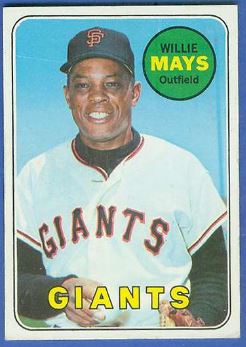
Willie Mays scored the only run of the 1968 All Star game - as Willie McCovey hit into a 4-6-3 double play.

Willie Mays scored the only run of the 1968 All Star game – as Willie McCovey hit into a 4-6-3 double play.

It went like this, NL CF Willie Mays started the inning with a single to left.  It appeared that Tiant had Willie picked off first, but the throw went awry and Mays went to second. A wild pitch sent Mays to third – before LF Curt Flood walked. 1B Willie McCovey hit into a 4-6-3 (Rod Carew-Jim Fregosi-Harmon Killebrew) double play, with Mays scoring. (No RBI awarded on a double play.) After a walk to RF Hank Aaron, Tiant got 3B Ron Santo on a short-to-first ground out.  And that was all the scoring for the 1968 All Star contest.  The game featured just eight total hits (four doubles), six walks (all given up by AL pitchers) and 20 strikeouts (nine by AL pitchers, 11 by NL hurlers).

Primary Resource:  Baseball-Reference.com.


I tweet baseball @DavidBBRT

Follow/Like the Baseball Roundtable Facebook page here.

Member: Society for American Baseball Research; The Baseball Reliquary; The Negro Leagues Baseball Museum.
Plenty To See in the Final Month – From the Wild Wild West(s) to Possible New Records in Whiffs

Okay, I wake up on Labor Day and my Twins are ten games under .500, 14 games behind the Indians in the AL Central and 18 games behind in the Wild Card chase. Not only that: Brian Dozier (his glove and powerful bat) is plying his trade with the Dodgers; Fernando Rodney (his flamboyance, power arm and “bow and arrow” celebration) is now taking the mound for the A’s; and Eduardo Escobar (his steady bat and fielding versatility) is looking good in Arizona. Beyond that, Byron Buxton was last seen in Rochester; Ervin Santana was last seen with recurring injury issues; and Miguel Sano was last seen struggling at the plate. Heck, even Zack Duke and Lance Lynn are gone.  Ouch!

Still, I can find plenty of reasons to celebrate not only Labor Day, but also the final four weeks of the baseball season.  Here a Baker’s Dozen reasons BBRT will continue to watch the national pastime  intensely..

  1. The Wild, Wild West(s)

Can’t wait to see who wins the National League West, where we begin Labor Day action just one game separating the Dodgers (75-62); Rockies (74-62); and Diamondbacks (74-63).

I’m also excited about seeing how far the AL West Division Oakland A’s can go. The A’s – who started the season with MLB’s lowest team payroll – came into Labor Day 26-games over .500 (82-56); just 2 ½ game behind the first-place Astros; and with a 5 ½ game cushion in the AL Wild Card race.

  1. The Orioles’ Chris Davis

Orioles’ first baseman/DH Chris Davis has a chance to make history – of sorts. As action opened on Labor Day, Davis had the lowest 2018 batting average (among players with enough plate appearances to qualify for the batting title) at .177 (75-for-424).

BBRT will be watching to see if he sets a new all-time season low for “qualifiers.” That distinction is now shared by The Brewers’ Rob Deer (1991) and the Braves’ Dan Uggla (2013) at .179 (both went 80-for-448). Deer’s line was .179-25-64, with an AL-Leading 175 strikeouts; while Uggla put up a .179-22-55 season, with 171 whiffs. Chris Davis’ 2018 stat line (as play opens on Labor Day) is .177-16-48, with 171 K’s.

  1. J.D. Martinez and the Triple Crown

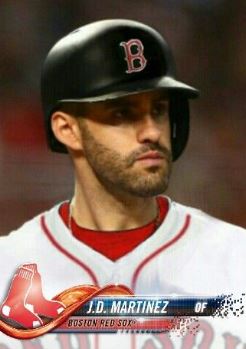
MartinezAs play opens today, the Red Sox’ is second in the AL in batting average at .337 (.003 behind teammate Mookie Betts); second in home runs with 39 (one behind the A’s Khris Davis); and first in RBI with 115.  It won’t be easy, but Martinez’ attempt at the Triple Crown is worth watching.


Trivia Tidbit:

In only one season has there been a Triple Crown Winner in both leagues – and, in fact, they played in the same city. In 1933, the Philadelphia Athletics’ Jimmie Foxx won the Triple Crown with a .356-48-163 season.  That same season, the Phillies’ Chuck Klein won the NL Triple Crown with a .368-28-120 campaign.


  1. Watching those Whiffs.

As of Labor Day, there were four players on a pace to fan 200 times this season (all in the AL, by the way) – Yoan Moncada, White Sox (189 K’s); Giancarlo Stanton, Yankees (180); Joey Gallo, Rangers (177); and Chris Davis, Orioles (171).  I see this as worth watching for three reasons:

  • 2016 is the only season in which MLB has had more than one player with 200 strikeouts (there were two that year, the Brewers’ Chris Carter and Orioles’ Chris Davis.) Note: MLB has seen a total of ten 200-K campaigns.
  • If Chris Davis delivers 200 strikeouts, he will tie Mark Reynolds (D-backs) for the most career 200-strikeout campaigns. Reynolds did it in 2008-09-10). Davis racked up 200+ strikeouts in 2015 and 2016.
  • Moncada is on a pace for 223 strikeouts this season, which would tie Mark Reynolds for the all-time, single-season high.
  1. Strikeout versus Base Hits

We’ve heard a lot about this one – whether strikeouts will, for the first time ever, outpace base hits this season is still in question.  The current count is close – and worth watching – 34,623 strikeouts and 34,833 base hits.

  1. The BBRT Trot Index

Okay, I may be the only one watching this.  It’s the baseball Roundtable Trot Index – the percentage of total MLB 2018 plate appearance that end in a trot (to first base on a walk, hit by pitch or catcher’s interference – to the dugout after a strikeout – or around the bases on a home run). At the end of August, 34.6 percent of all plate appearance ended with a no-action (in the field or on the base paths) trot.

  1. Edwin Diaz, the Mariners’ Save Machine
Edwin Diaz photo

Photo by THE Laura Smith

There have been only seventeen 50-save seasons in MLB history – all since 1990 – and Edwin Diaz (the Mariners’ 24-year-old closer) has fifty already this year (making him the youngest player to record a 50-save campaign). Although Francisco Rodriguez’ record of 62 (Angels, 2008) seems out of reach, just seven more saves would tie Diaz with the White Sox’ Bobby Thigpen (57  saves in 1990, the first-ever, 50-save season) for the second-most in a season. I’m hoping he makes a run at Rodriguez.


  1. If I Were A Carpenter, I’d Have a Hammer

The Cardinals’ 3B Matt Carpenter went to the park on Labor Day leading the National League with 35 home runs.  Why is that worth watching?  Carpenter is batting leadoff for the Redbirds and, if he wins the home run title, he will be the first leadoff hitter ever to do so.  The Orioles’ leadoff hitter Brady Anderson came close in 1996 – bashing fifty round trippers, missing out on the title (to Mark McGwire) by two long balls.

  1. Twenty-Twenty Vision

BBRT will be keeping an eye on Corey Kluber, Luis Severino, Blake Snell, Carlos Carrasco and Max Scherzer – who all have a legitimate chance for twenty victories this season.  We haven’t had five twenty-game winners in a season since 2003 and only had four three times since 2004.

BBRT will also be watching box scores for complete games, since no one has more than two this season (Kluber and Carrasco from the list above) and no team has more than five (Indians).  In fact, ten of the thirty MLB team have yet to record a 2018 complete game.  This could be the first MLB season in which there was not at least one pitcher with four complete games.

Trivia Tidbit:

In 2008, C.C. Sabathia pitched ten complete games – five of them shutouts. Of note is the fact that (thanks to a mid-season trade) Sabathia tied for the league lead in shutouts in both the AL (two for the Cleveland Indians) and the NL (three for the then NL Milwaukee Brewers).

  1. A Long Shot at History

Only three times in MLB history has a player led the league in home runs and stolen bases in the same season:  Jimmy Sheckard with nine home runs and 67 steals for the 1903 Brooklyn Superbas (Dodgers); Ty Cobb with nine home runs and 76 steals for the 1909 Tigers (Cobb also hit .377 that year, wining the Triple Crown); and Chuck Klein, with 38 home runs and 20 stolen bases for the 1932 Phillies.

Now, it’s a real long shot, but – as of Labor Day – the Indians’ 25-year-old 3B Jose Ramirez was third the AL home run races with 37 (J.D. Martinez of the Red Sox had 39, Khris Davis of the A’s 40) and second in stolen bases with 29 (one behind the Royals’ whit Merrifield and the Mariners Dee Gordon).  Okay, it’s a long shot. But something to root for. It would just take one real hot streak down the stretch.

  1. My Braves

I was a Milwaukee native and just six-years-old when the Braves moved there in 1953 – and they still have a place in my heart. After finishing 18-games under .500 in 2017, the Braves looked to be improved and rebuilding.  Yet, here they are, ahead of schedule – 16 games over .500, with a four-game lead in the AL East.   Their chief competition is the Phillies, who finished last in the division and 30 games under .500 in 2017. Can’t wait to see the Braves in the post season. Wouldn’t mind seeing the Phillies there, too.

  1. The Stars of Tomorrow – Today

Wow!  There are so many great young (rookie) stars to watch. Here are just a few of the players that fit the bill:

Juan Soto (OF, Nationals), age 19 … .303-16-53 in 92 games.

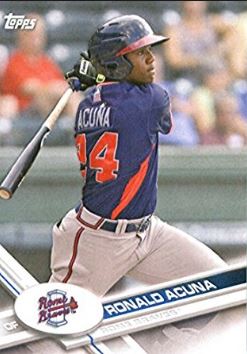
Ronald Acuna, Jr. (OF, Braves), age 20 … .296-23-50, with 11 steals, in 85 games.

Gleyber Torres (2B, Yankees) age 21 … .282-22-55, with five steals, in 99 games.

Jack Flaherty (RHP, Cardinals), age 22 … 8-6, 2.87, and 149 K in 122 1/3 IP.

Miguel Andujar (3B, Yankees), age 23 … .301-23-76 in 126 games.

Walker Buehler (RHP), Dodgers), age 24 … 6-4, 2.92, and 115 K in 114 IP

Colin Moran (3B, Pirates), age 25 … .280-8-49 in 122 games.

A.J. Minter (LHP, Braves), age 25 … 4-2, 3.06, 12 saves, 86 K in 68 IP.

  1. All By Himself

All by himself worth watching – especially now that he’s back on the mound – is 23-year-old Angels’ pitcher/DH Shohei Ohtani.  Thus far, he is  .276-15-43, with six steals, on offense and 4-2, 3.31 with 63 strikeouts in 51 2/3 innings on the mound.

Of course, let’s not forget – there’s the post-season to take in as well.  But, that’s another story.

For BBRT’s August Wrap Up … the stars, stats and stories of the past month in baseball, click here. 

Primary Resources:  ESPN.com, Baseball-Reference.com

______________________________________________________

I tweet baseball @DavidBBRT.

Follow/Like the Baseball Roundtable Facebook page here.

Member: Society for American Baseball Research; The Baseball Reliquary; The Negro Leagues Baseball Museum.
August Wrap Up … Sister Mojo, Big Al, The Women’s Baseball World Cup, The Ultimate and the Immaculate … and more

Well, it’s September 1, which means – among many other things – that it’s time for Baseball Roundtable’s August Wrap Up.  So, let’s take a look at the stories, statistics and stars that caught BBRT’s attention over the past month.

Christian Yelich photo

Photo by hueytaxi

Six-for-Six … And The Cycle

There is no way you can leadoff the August lineup with anything  other than the remarkable offensive display put on by Brewers’ outfielder  Christian Yelich on August 29. In an wild, ten-inning, 13-12 Brewers’ win over the Reds at Great American Ballpark, Yelich not only hit for the cycle (single, double, triple and home run), he also collected six hits in six at bats – becoming, according to ESPN, just the fourth player since 1920 to combine a cycle with a six-hit game.  Yelich scored twice and drove in three in the contest.

Move Over Suitcase Simpson, “Backpack Drake” is On The Way

Suitcase with baseball photo

Photo by wwarby

On August 4, right-hander Oliver Drake took the mound for the Minnesota Twins in the top of the ninth – with the Twins  leading the Royals (at Target Field) 8-2.  Drake pitched a 1-2-3 ninth, but that was not the big news. 

In that appearance, Drake toed the rubber for his fifth major league team – DURING THE 2018 SEASON.  That is the MLB record for the number of teams played for in a single campaign. Blake started the season with the Brewers (appearing in 11 games); was purchased from the Brewers by the Indians on May 5 (four games); selected off waivers by the Angels May 31 (eight games); selected off waivers by the Blue Jays July 26 (two games); and, finally, selected off waivers by the Twins August 3 (ten August games). 

Overall, August was a pretty unique month.  We saw:

  • A nun with a curveball and a Little Leaguer who”hits dingers” steal baseball’s thunder;
  • Women take center stage in the Women’s Baseball World Cup;
  •  Both the Ultimate (Grand Slam) and the Immaculate (Inning); and
  • Some noteworthy accomplishments by players both young (Ronald Acuna, Jr. and Juan Soto) and old (Bartolo Colon and Albert Pujols).

We’ll get into all this (and more), but first a look at BBRT Players and Pitchers of the Month.

________________________________________

NATIONAL LEAGUE

Player of the Month … Ronald Acuna, Jr., OF, Braves

AcunaThe Braves’ 20-year-old rookie outfielder – Ronald Acuna, Jr. – scorched NL pitching in August. He hit .336, smashed an MLB-high (tied with the Brewers’ Christian Yelich) eleven round trippers, drove in 19 runs (eighth in the NL) and scored an MLB-high (tied with the Red Sox’ Mookie Betts) 25 times.  Later, in the individual  highlights, you can learn more about this rookie’s historic August power output.  Oh yes, and he swiped six bases in nine tries.

Other Contenders: The Dodgers’ 3B Justin  Turner turned it on in August, hitting an NL-best  .402 for the month, tied Acuna for the NL lead in hits with 39, popped  six home runs, drove in 20 (fifth in the NL) and scored 22 (second in the NL).  David Peralta of the Diamondbacks (.361-10-21) and the Padres’ Hunter Renfroe, with a .302 average, nine homers and a league-best 27 August RBI also deserve mention.

Pitcher of the Month – Cole Hamels, Cubs

There were lots of contenders for this recognition, as 13 National pitchers who logged at least 25 innings put up August earned run averages under 2.00.  BBRT will go with the lowest of the low.  It is, in fact, looking like the Cubs may have made the best July trading deadline move when they acquired Cole Hamels from the Rangers. Hamels, who was 5-9, 4.72 with Texas, put up a 4-0 record with a microscopic and MLB-lowest (among pitchers with at least 25 innings pitched in August) 0.69 earned run average in his first month with Chicago. Hamels went 39 innings in six starts, walking eleven and fanning 38.

Other Contenders: The Mets’ Jacob deGrom went 3-2 in six starts, but deserved better. The Mets scored just one run in each of his losses.  For the month, deGrom led MLB with 60 strikeouts and 43 2/3 inning pitched and put up the NL’s sixth-best August ERA at 1.24.  BBRT also looked at the Cardinals’ Jack Flaherty, who went 4-0, 1.13 in five starts. Another Cardinals’ rookie – Austin Gomber – deserves recognition as MLB’s only five-game  winner in August. Gomber  went 5-0, 2.38 in seven August appearances (six starts).  The Phillies’ Aaron Nola pitched some big  games (against some big names – outdueling Max Scherzer and Noah Syndergaard) on his way to a 3-0, 1.06 August (with 35 strikeouts in 34 innings).

AMERICAN  LEAGUE

Player of the Month –  Tie: J.D. Martinez, RF, Red Sox & Miguel Andujar, 3B, Yankees

BBRT is celebrating a veteran and rookie in the AL this month.  Boston’s veteran DH J.D. Martinez not only hit .373 for the month, he smacked seven home runs and drove in 25 (third in the AL). He also scored 24 times (second in the AL) and had the league’s highest on base + slugging percentage among qualifiers at 1.139.

Yankees’ rookie 3B Miguel Andujar tore it up in August – to the tune of .320-10-29; finsihing with the AL’s highest August home run total (tied with the A’s Khris Davis) and MLB’s highest RBI total (tied with the Rangers’ Rougned Odor). Andujar also scored 21 runs (seventh in the AL).

Other Contenders: Texas’ 2B Rougned Odor tied Andujar for the MLB lead in August RBI with 29, and scored 23 times, while hitting .269 with seven long balls. The Astros’ Marwin Gonzalez was also a contender, with an August stat line of .303-8-20 – along with 19 runs scored. And, the Astros’ Tyler White made a splash, with a .325-8-23 August.

Pitcher of the Month – Blake Snell, Rays

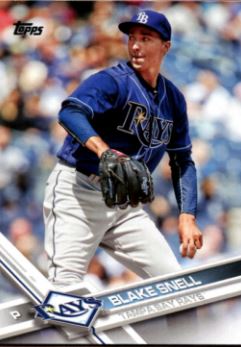
snellBlake Snell went 4-0, with an AL-lowest (among pitchers with 25 August innings) 1.04 earned  run average. He also fanned 34 batters in 26 innings – giving up 11 hits and three walks (a league-low 0.65 WHIP). He was the class of the AL field in August.

Other Contenders:  Mariners’ closer Edwin Diaz (who already has 50 saves on the season) racked up an MLB-best ten August saves (in 11 opportunities) fanning 21 hitters (no walks) in 11 innings and putting up a 1.64 ERA.  The Indians’ Carlos Carrasco went 4-2, 1.85 in six starts and fanned an AL-high 50 batters (tied with Justin Verlander) in 39 innings.


___________________________________________________________

Now, how about those standings … and August team performance?

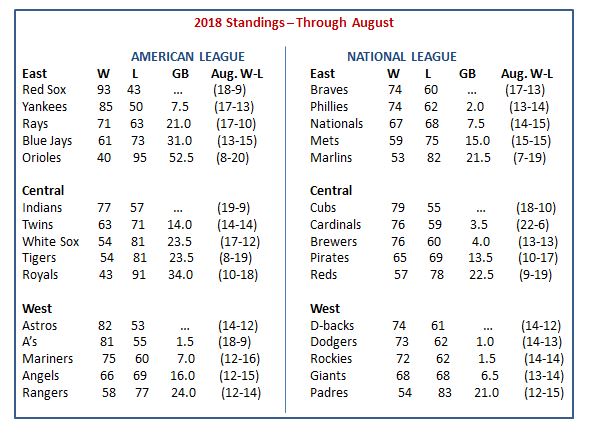
IF THE SEASON ENDED ON AUGUST 31, YOUR PLAYOFF TEAMS WOULD BE …

American League: Red Sox, Indians, Astros.   Wild Cards: Yankees, A’s

The most interesting AL race appears to be in the AL West, where the A’s trail the Astros by just 1 ½ games. Side Note: Baltimore is a whopping 52 ½ out in the tough AL East.

National League: Braves, Cubs, Diamondbacks.  Wild Cards: Brewers, Cardinals

Things are tighter in the NL, with the Diamondbacks, Rockies and Dodgers separated by just 1 1/2 games in the West; the Phillies just two back of Atlanta in the East; and the Cardinals having  surged to just 3 1/2 behind the Cubs in the Central.  

Here’s a few observations on August’s best and worst teams.

NATIONAL LEAGUE – AUGUST’S BEST (Cardinals) & THE REST

The Cardinals were baseball’s hottest team in August –  going 22-6. They were, in fact, the only team to reach 20 wins for the month. They did it primarily on the strength of their pitching staff – which put up an MLB-lowest 2.75 earned run average for the month. The club gave up just 82 runs (76 earned) in 28 games.  (They were actually no slouches on offense, leading the NL with 148 August runs scored.) On the mound, the Cardinals’ surge was led by 22-year-old righty Jack Flaherty and 24-year-old southpaw Austin Gomber. Gomber went 5-0, 2.38 (the majors only five-game winner in August). while Flaherty went 4-0, 1.13. Good news for Cards’ fans – both are rookies.  The Redbirds also got eight saves and a 1.86 ERA out of reliever Bud Norris.  On offense, RF Jose Martinez continued to put up MVP-consideration numbers – going .376-3-18 for the month. 1B Matt Carpenter hit only .255 in August, but chipped in some big hits (including  eight home runs). Carpenter scored 21 times in August, second in the NL.

Other NL teams having strong Augusts included:  The Cubs at 18-10 and the Braves at 17-13.  The Cubs finished the month 18-10  despite outscoring their opposition by only 13 runs (the Braves outscored their  foes by 26 tallies, the Cardinal had a plus-66 run differential).  The Cubs may have made the deadline pickup of the season – getting a 4-0, 0.69 month out of Cole Hamels. The offense was driven by 1B Anthony Rizzo (.340-7-17) and 2B Javier Baez (.288-7-16).

Like the Cardinals, the Braves relied on pitching – with a 3.03 ERA for the month, third-best in the NL.  Key contributors were newcomer Kevin Gausman (4-1, 1.69) and Mike Foltynewicz (3-2, 2.09). The Braves also got solid offense from a core group of young players like LF Ronald Acuna, Jr. (.336-11-21 in August) and 3B Johan Carmargo (.327-3-18), as well as steady production from  veterans like Ender Inciarte (.286-3-15) and Freddie Freeman (.283-2-13)The team is showing solid balance for the stretch run.

Bringing up the rear  of the National League (in August) were two teams that failed to win ten games – Marlins (7-19) and Reds (9-19).

AMERICAN LEAGUE – Rotation – Rotation – Rotation

The Indians led the AL in August wins at 19-9; relying largely on their starting rotation. (Close behind the Indians  were the Red Sox and A’s – both at 18-9.) The Tribe’s 3.10 staff ERA for August was the third-best in the AL, while there 132 runs scored was fifth. The Indians’ had a balanced offense in August with three players contributing five home runs and 16 RBI each. CF Melky Cabrera (.293-5-16), DH Edwin Encarnacion (.241-5-16) and 3B Jose Ramirez (.245-5-16). Also important were LF Michael  Brantley (.333 – with 16 runs scored and 13 RBI) and SS Francisco Lindor (who hit just .263, but crossed the plated 18 times).  It was, however, the rotation of Carlos Carrasco (4-2, 1.85); Corey Kluber (4-1, 2.81); Mike Clevinger (3-0, 2.21); and Shane Bieber (3-0, 3.81) that kept the Indians rolling toward the Central Division Crown.

Boston picked up 18 August victories more with a hammer than a scalpel. The team gave up 127 runs – by comparison, the Astros, A’s, Indians and Rays all gave up less than 95 – but the Bosox scored an MLB-high 166 tallies.  Missing “ace” Chris Sale (shoulder) for most of August didn’t help, although veteran David Price picked up the slack with a 3-0, 2.10 month. Still, there was enough offense to support the team’s 4.18 August ERA.  DH J.D. Martinez went .373-7-25 and scored 24 runs; RF Mookie Betts  went .354-4-14 with 25 runs scored; SS Xander Bogaerts drove in 21, to go with three homers and a.303 average; LF Andrew Benintendi hit .270 and scored 20 August runs – and the list of offensive contributors went on.

The A’s got strong performances from a couple of pitchers who did not start the season in Oakland – Mike Fiers (who came over from Detroit in early August) went 3-0, 2.73 in six starts for the A’s, while Edwin Jackson (released by the Nationals and signed by the A’s in June) went 2-1, 2.60 (but the A’s did win four his his five starts). The A’s offense flowed primarily through 3B Matt Chapman (.319-9-18 in August), 2B Jedd Lowrie (.293-4-16) and DH Khris Davis, who hit only .222 for the month, but belted ten home runs (tops in the AL) and drove in 20.

Two teams a failed to win ten games in the AL in August – Orioles (8-20) and Tigers (8-19). 

FULL STANDINGS AND AUGUST WON-LOST RECORDS CAN BE FOUND IN A GRAPHIC  NEAR THE END OF THIS POST. 

____________________________________________________________________________

TROT INDEX … A REGULAR BBRT FEATURE

Through August 31, , more than one-third (34.6 percent) of all MLB 2018 plate appearances have ended in a trot (back to the dugout, around the bases, to first base). We are talking about strikeouts, home runs, walks, hit by pitch and catcher’s interference – all outcomes that are, basically, devoid of action on the base paths or in the field. Here’s the breakout: strikeouts (22.1%); Walks (8.4%); home runs (3.0%); HBP (1.0%); Catcher’s Interference (less than .001%).  

______________________________________________________________

*HERE’S A LOOK AT THE AUGUST TEAM STATS*

—-LEAGUE LEADERS – TEAMS – FOR AUGUST—–

RUNS SCORED … MLB Team Average – 123

AL: Red Sox (166); Yankees (155); Rangers (143)

NL: Cardinals (148); Mets (145); Nationals (137)

Three teams tallied fewer than 100 runs in August: Marlins (86); Giants (93); Pirates (94). The Tigers were the lowest-scoring  team in the AL at 101 runs. 

BATTING AVERAGE … MLB Team Average – .253

AL: Red Sox (.275); Blue Jays (.260); Orioles (.260)

NL: Brewers (.273); Cardinals (.273); Reds (.265)

The Giants had the lowest batting average for August at .217, as well as the fewest home runs (15), and second-fewest runs scored.

HOME RUNS … MLB Team Average – 33

AL:  Yankees (53); Blue Jays (41); A’s (39)

NL: Dodgers (45); Brewers (44); Cardinals (40)

The Brewers led MLB in slugging percentage for August at .471. By contrast, the Giants slugging percentage was an MLB-low .319. The MLB team average was .416.

STOLEN BASES … MLB Team Average – 15

AL: Rays (33);  Indians (25); Royals (25)

NL: Dodgers (28); Rockies (22); Nationals (19)

The Twins had their difficulties on the base paths in August – swiping an MLB-low three bases and being tossed out on six-of-nine steal attempts. 

BATTERS’ STRIKEOUTS … MLB Team Average – 227

AL: White Sox (298); Yankees (242); Twins (238)

NL: Mets (260); Dodgers (255); Padres (254)

Ouch!

Cardinals’ batters appeared to be popular targets in August, as the team suffered an MLB-high 21 hit batters – nearly twice the major league average (11) for the month.

EARNED RUN AVERAGE … MLB Average – 4.14

AL:  Rays (2.76); A’s (3.02); Indians (3.10)

NL: Cardinals (2.75); D-backs (2.96); Braves (3.03)

Six teams recorded August earned run averages over 5.00, but only one – the Orioles –  topped 6.00 (6.42). 

PITCHERS’ STRIKEOUTS … MLB Average – 227

AL:  Yankees (317); Indians (280); Astros (260)

NL: Braves (267); Mets (266); Dodgers (256)

In August, the Orioles’ pitching staff gave up an MLB-high 51 home runs in 28 games. The Cardinals, by contrast, gave up just 16 long balls  in 28 games. 

SAVES … MLB Average – 7

AL:  Indians (10); Mariners (10); Twins (10)

NL: Cardinals (12); five with eight

The Royals converted only two of eight save opportunities in August – for an MLB-low 25 percent save rate. The lowest conversion rate in the NL went to the Marlins (four saves in 11 opportunities – 36.4 percent). The Rangers and Mets put up 100 percent save conversion rates in August – with eight and six saves, respectively,

________________________________________________________

——————HOW ABOUT A FEW AUGUST HIGHLIGHTS?——————————

A Sister Gets A Bobblehead

The highlight of August may very well have came at the hands (and strong right arm) of Sister Mary Joe Sobiek – who threw out (maybe “fired” is a better word) the cermonial first pitch at a White Sox game on August 18.  Sobiek, who teaches theology at Marian Cath0lic High School in Chicago Heights, IL, opened with a showy bounce of the baseball off her right bicep and  then tossed a curve ball for a strike (from the mound) to the White Sox’ Lucas Giolito. Sister Sobiek (called “Sister Mojo” by her students) was a three-sport athlete in college (College of Saint Scholastica, Duluth, MN) and says her athletic ability and energy help her relate to her students. For Minnesota readers, Sister Sobiek not only went to college in the state, she grew up in Saint Cloud and is a long-time Tweins fan.

In honor of the feat, the National Bobble Head Hall of Fame has created (and is selling) an “inspirationaL” bobble of Sister Sobiek in full windup.

Robbie Grossman on Players Weekend Nicknames

On the weekend of August 24-26, MLB celebrated its second annual Players’ Weekend – sporting colorful uniforms and equipment; sleeve patches honoring those who inspired them on their way to majors; and the MLB “Evolution” logo –showing a progression of five player images reflecting the progress from Little League to youth leagues to the major leagues.  Perhaps of greatest interest, however, were the names on the back of the jerseys, as players were able to choose a nickname for display that reflected their own personalities, passions or sense of humor.  For more on Players Weekend and a look at some of the best nicknames, click here.

There were a number of players who choose not to go with a nickname and BBRT appreciated the explanation offered by the Twins’ Robbie Grossman – “I worked to hard to get my name on the back of a major league jersey … that I don’t want to wear anything else.” Makes sense to me. 

_________________________________________________________________________

The Little League Classic …

On Sunday, August 26, Hawaii captured Little League World Series 2018 title with a 3-0 win over South Korea in Williamsport, PA. Hawaii went undefeated in the 16-team tournament, outscoring their opponents by a 26-3 margin.

While Hawaii may have captured the LLWS title, the combination of Little Leaguers and Major Leaguers captured a lot of hearts – as the Phillies and Mets traveled to Williamsport on Sunday, August 19th, for the Second Annual Little League Classic (a regular-season game played at BB&T Ballpark at Historic Bowman Field during the LLWS).  BBRT Note: Bowman Field, just a short distance from the Little League International Complex, is the second oldest minor league  ballpark in the United States (opened in 1926). The Mets won the game 8-2, in  front of a crowd of 2,429.

The real action, however, was the up-close interaction between the Major Leaguers and the Little Leaguers – plenty of smiles, handshakes and high fives, autographs, selfies and the sharing of hitting, fielding and pitching tips.  The Phillies’ Rhys Hoskins and “Big Al” Delia of the Mid-Atlantic Little League squad provided one of the day’s highlights, as they went on social media to share their mutual love of “hitting dingers.”  A number of the big leaguers took time to catch some Little League action in the afternoon – and, of course, the Little Leaguers and their fans and families returned the favor during the evening’s Mets/Phillies  tilt.  Oh, and “Big Al” was center stage again – catching the ceremonial first pitch from Mets’ 3B Todd Frazier, who was a member  of the Toms River East team that won the 1998 LLWS title.

A good time, it was said, was had by all.

Final Note: The Little League dinger machine showed up again oin August 28th, this time at batting practice before a White Sox/Yankees game, apparently exchanging long-ball stories with his Giancarlo Stanton and also admiring Aaron Hicks’ “Big Al Hits Dingers” t-shirt.

ULTIMATE AND IMMACULATE – BOTH IN THE SAME MONTH

BoteIn the “What’s in a name?” category.  On August 12th, Cubs’ rookie infielder David Bote hit was is referred to as an “Ultimate Grand Slam” – a walk-off, Grand Slam home run coming when your team is down by three runs. He came to plate as a pinch-hitter – facing the  Nationals’  Ryan Madson with two outs, the bases loaded and the Cubs down 3-0.  Bote laced a 2-2 offering over the center field fence for an Ultimate Grand Slam.  (Note:  It wasn’t exactly a great inning for Madson, who loaded the bases on an infield single and two hit batters.) MLB.com reports that Bote’s was the 25th known Ultimate Grand Slam, just the fifteenth with two outs and the sixth by a pinch hitter.

August also saw two MLB pitchers toss “Immaculate Innings” … a 1-2-3 frame, with three strikeouts on nine pitches. On August 8, the Rockies’ German Marquez accomplished it against the Pirates (fourth inning – Corey Dickerson, Starling Marte and Gregory Polanco). On August 19, the Dodgers’  Zac Rosscup threw and Immaculate (ninth) Inning versus the Mariners (Kyle Seager, Ryon Healy, Cameron Maybin). More detail on Rosscup’s inning later in this post.

Colon Puts Exclamation Point on Career

On August 7, Rangers’ 45-year-old righty Bartolo Colon worked seven innings – giving up four runs on eight hits – in picking up an 11-4 win over the Mariners.  It was Colon’s 246th MLB victory, moving him past Dennis Martinez for the most victories by a Latin American born pitcher.  Colon added another win on August 13 to add to his mark – and finished August 10-15, 5.45 on the season and 247-187, 4.10 on his 21-season MLB career.

Youth Will Be Served

On August 14th, Braves’ 20-year-old rookie outfielder Ronald Acuna Jr. led off the bottom of the first inning against the Marlins with his 18th home run of the season.  That long ball was significant for a number of reasons:

  • It made the youngest MLB player to homer in five straight games.
  • It made him the youngest and just the second player (of any age) in MLB history to open three consecutive games with a first-inning leadoff home run. (The other was Brady Anderson in April of 1996).

But Acuna’s August accomplishments go even further. On August 13th, he hit first-inning leadoff home runs in both games of a doubleheader – becoming just the fourth player to accomplish that feat (Harry Hooper – May 30, 1913; Ricky Henderson – July 6, 1993; and Brady Anderson (August 21, 1999).

Most Home Runs by a Player in Their Age-20 MLB season …

Frank Robinson, Reds … 38 (1956)

Alex Rodriguez, Mariners … 36 (1996)

Tony Conigliaro, Red Sox … 32 (1965)

Ted Williams, Red Sox… 31 (1939)

Mike Trout, Angels … 30 (2012)

Al Kaline, Tigers … 27 (1955)

Ed Mathews, Braves … 25 (1952)

Orlando Cepeda, Giants … 25 (1958)

Note: Conigliaro also had 24 home runs in his 10-year-old season (1964).

Something for the Veterans as Well

Albert Pujols photo

Photo by bk1bennett

On August 10th, as the Angels topped the A’s 4-3, Angels’ DH Albert Pujols stroked a single to left in the sixth inning.  It was Pujols 1,000th American League safety – making him just the ninth MLB player to collect at least 1,000 hits in each league. (Pujols had 2, 073 hits with the Cardinals.)  Others on the list are: Frank Robinson, Fred McGriff, Dave Winfield, Carlos Lee, Vlad Guerrero, Orlando Cabrera, Alfonso Soriano and Carlos Beltran.


A GIANT BBRT RANT – Oh, The Insanity

On August 6, the Florida State League (Class A) Clearwater Threshers (Phillies’ farm club) faced off against the Tampa Tarpons (Yankees’ affiliate) in a double header. In the second game, Tarpons’ starter Deivi Garcia tossed seven perfect innings, with 12  strikeouts  (minor league doubleheaders are seven-inning games), but the Tarpon had also failed to score.

In the top of the eighth, the first extra inning, the Threshers (via a new minor league rule) started with a runner on second (against Tampa reliever Christian Morris). That runner scored on an error and a fielder’s choice.  Tampa remained scoreless in the bottom of the inning.  The end result – Tampa lost 1-0, despite tossing a no-hit game.  A few other oddities:

  • Christian Morris got the loss – despite the fact that he had nothing to do with the runner who crossed the plate.
  • The runner was treated as though he reached on an error (in terms of the pitcher’s earned run average) – although there was no error charged to a fielder or the team.
  • The base runner was credited with a run scored – despite getting a 180-foot head start.
  • Had Morris pitched a 1-2-3 inning, the perfect game would have been intact. (The”placed” runner does not affect a perfect game or a no-hitter.)

From BBRT’s standpoint, this “placed” runner rule should be scrapped.

Not So One-Der-Ful

In a five-game stretch from August 16th through August 21, the Chicago Cubs scored exactly one run in each game – and, in each contest, that lone run came on a solo homer. Surprisingly, despite the meager offensive output, the Cubbies won two and lost three over that span.

  • August 16th, Cubs top Pirates 1-0 in Pittsburgh. The only run scores on a fourth-inning Ian Happ home run.
  • August 17th, Cubs again best Pirates 1-0. This time on a second-inning solo home run by Kyle Schwarber.
  • August 18th, Cubs lose to Pirates 3-1 and the only Cubs’ tally comes on a third-innings solo shot by Ben Zobrist.
  • August 19th, Cubs lose to Pirates 2-1, the only Cubs’ run a second-inning home run off the bat of Kyle Schwarber.
  • August 21, Cubs lose 2-1 to Tigers (in Detroit), with the only Cubs’ run a sixth-inning home run by Anthony Rizzo.


It’s a Teen Kind of Thing

Juan Soto Nationals photo

Photo by pdeonarain

On August 29, 19-year-old Nationals’ rookie LF Juan Soto rapped his 16th home run of the season – a two-run shot that came in the third inning of an 8-6 Nationals loss to the Phillies.  The long ball moved Soto into a tied for the fourth-most MLB home runs home runs by a teenager (tie with Ken Griffey, Jr.). Still ahead, Mel Ott (19), Bryce Harper (22) and Tony Conigliaro (24).  In 89 games this season,Soto is hitting .292, with 16 home runs, 50 RBI and 62 runs scored.

Record Number of Twin Killings Secure 1-0 Win

On August 17th, the Cubs nipped the Pirates 1-0 in Pittsburgh – and, in the process, tied a major league record by turning seven double plays in a nine-inning game.  For the full story, click here.

A Walk-Off and a Balk-Off … Tough on a Pitcher

How about giving up a walk-off walk and a walk-off balk in the span of one week?  That got to be a little disheartening.

Saturday August 18, Dodgers’ reliever Dylan Floro was brought into a 4-4 tie (in Seattle) in the bottom of the tenth inning. At the time, the Mariners had runners on first (Robinson Cano) and second (Cameron Maybin) and one out.  Floro walked the powerful Nelson Cruz to load the bases – and then the fun began. With the sacks full, Dodgers’ 3B Justin Turner faked a move to the third base bag (a faux pick-off), the base runner (Maybin) flinched and Floro (also apparently “deked”) dropped his hands and stepped off the rubber – balking in the  winning run.

The August 18 balk-off came just six days after Flora gave up an August 12 walk-off walk in a 4-3 Dodgers’ loss at Colorado.  In that game, Flora came to open the bottom of the ninth of a 3-3 tie. He gave up a single to Rockies’ 2B DJ LeMahieu, who went to second on an error by right fielder Yasiel Puig.  Flora then fanned SS Trevor Story on four pitches. Next came an intentional walk to David Dahl to set up the double play. However, Ian Desmond was out on a slow  roller to third base – with the runners moving up to second and third. Another intentional walk (to Ryan McMahon) brought up catcher Chris Ianetta, with a force available at any base. A five-pitch walk plated the game-ending, game-winning run.  Side note:  Thinking about that new intentional walk (wave ’em to first) rule – Flora actually gave up three walks on five pitches.

By the way, don’t get the wrong idea about Floro. At the end of August he was 1-1, 1.66 with the Dodgers and 4-3, 2.33 on the season.

A Verlander Milestone

Justin Verlander photo

Photo by Keith Allison

On August 19th, the Astros’ Justin Verlander did not appear to be on the top of his game.  In the first inning of a critical game against the Oakland A’s (challenging Houston for the AL West Crown), Verlander gave up home runs to Oakland 3B Matt Chapman and DH Khris Davis – and after three innings, the two teams were knotted at 4-4. Verlander settled down and held the A’s scoreless into the sixth, with the Astros eventually picking up a much-needed 9-4 win.  The win was Verlander’s twelfth of the season (12-8, 2.65 ERA) and also the 200th of his 14-season MLB career.

MVP & Cy Young … A Winning Combination

Justin Verlander is one of just ten pitchers to win the Cy Young Award and Most Valuable Player Award in the same season. Note: One-half of the ten were Tigers (3) or Dodgers (2).  Here they are:

Don Newcombe – 1956 Dodgers – 27-7, 3.06 earned run average.

Sandy Koufax – 1963 Dodgers – 25-5, 1.88

Denny McLain – 1968 Tigers – 31-6, 1.96

Bob Gibson – 1968 Cardinals – 22-9, 1.12

Rollie Fingers – 1981 Brewers – 6-3, 28 saves, 1.04

Willie Hernandez – 1984 Tigers – 9-3, 32 saves, 1.92

Roger Clemens – 1986 Red Sox – 24-4, 2.48

Dennis Eckersley – 1992 A’s – 7-1, 51 saves, 1.91

Justin Verlander – 2011 Tigers – 24-5, 2.40

Clayton Kershaw – 2014 Dodgers – 21-3, 1.77

Fifty is Nifty

Edwin Diaz photo

Photo by THE Laura Smith

On August 25, Seattle closer Edwin Diaz came into a game (against the Diamondbacks) n the bottom of the tenth inning with the Mariners up 4-3. It wasn’t easy, but Diaz did pick up the save – despite giving up two hits and having one runner tossed out at home.  So, what makes this rather rocky save worthy of mention here? It was the 24-year-old right-hander’s 50th save of the season.  Diaz is the 14th (and youngest) player ever to record 50 saves. Three pitchers have had two 50-save campaigns: Eric Gagne, Mariano Rivera and Jim Johnson. Diaz, who had 34 saves in 2017, ended August with a 0-3, 1.97 record, with 50 saves and 108 strikeouts in 64 innings.


Top Five Most Saves in a Season

62 … Francisco Rodriguez, Angels (2008)

57 … Bobby Thigpen, White Sox (1990)

55 … John Smoltz, Braves (2002)

55 … Eric Gagne, Dodgers (2003)

53 … Randy Myers, Cubs (1993)

53 … Trevor Hoffman, Padres (1998)

53 … Mariano Rivera, Yankees (2001)

Zimmerman Hits 11th Walk Off Long Ball

It took a video review to get the job done, but on August 22, Nationals’ 1B Ryan Zimmerman bashed a two-run home run – with two-outs in the bottom of the ninth – to give the Nationals an 8-7 walk-off win over the Phillies.  It was Zimmerman’s 11th career walk-off home run, putting him just two behind all-time MLB leader in walk-off homers – Jim Thome. Standing between Zimmerman and Thome at 12 walk-off dingers each are: the still-active Albert Pujols and a group of Hall of Famers (Babe Ruth, Jimmie Foxx; Stan Musial, Mickey Mantle, Frank Robinson).

Guess that Single run Broke the ice.

On August 26th, the Nationals took on the Mets in New York.  Washington came into the game having failed to score in 27 consecutive innings – losing their previous three games by 2-0; 3-0; and 3-0. On the 25th, it looked like more of the same, as the Nats and Mets were tied 0-0 at the end of five (running Washington’s scoreless streak to 32 innings). Washington finally eked out a run in the top of the sixth on a double, single and RBI groundout.  That apparently broke the ice.  Over the final three innings of the game, the Nationals scored 14 more times (eight runs in the eighth and six more in the ninth) for a 15-0 win.

Double Your Pleasure … Double Your Fun

Matt Carpenter photo

Photo by d-deee

On August 26, Cardinals 1B/Leadoff hitter Matt Carpenter broke out of a bit of an August slump – and tied the MLB record for a nine-inning game with four doubles (as St. Louis topped the Rockies 12-3 in Colorado).

Carpenter, who came into the game hitting just .221 for the month, but with eight August round trippers,  got off to a good start, hitting two doubles to right off Tyler Anderson in the very first inning. (The Cardinals batted around and scored six times.)  He doubled to center off Chad Bettis in his next at bat (third inning); grounded out second-to-first to end the fifth; and doubled to center off Bryan Shaw in the seventh. On the day, Carpenter was four-for-five, scoring twice and driving in two.  Carpenter’s four doubles in a nine-inning contest ties him with 47 other players.  Albert Belle is the only player to accomplish the feat twice – on August 29 and September 23, 1999.

Seven Not Always So Lucky

Between August 19 and August 26th, Blue Jays’ 1B/DH Kendrys Morales went yard in seven straight games – coming within one of the MLB record.  Morales streak ended on August 27th, when he went zero-for-three with a walk. The Blue Jays won five of seven during Morales streak.  He hit .481 (13-for-27), with eight home runs, 13 RBI and nine runs scored during his run. Oh, and in the category of “In Baseball We Count Everything” – Morales did set the record for consecutive games with a home run by a switch-hitter.

The record of eight straight contests with a home run is shared by The Pirates’ Dale Long (May 19-28, 1956); Yankees’ Don Mattingly (July 8-18, 1987); and Mariners’ Ken Griffey, Jr. (July 20-28, 1993).

Walking ‘Em Off

On August 29th, Houston’s Tyler White hit a walk-off home run in the bottom of the ninth to give the Astros a 5-4 win over the vistiting A’s.  It was the 81st Walk off home of the season – breaking the single-season record for walk-off dingers (80) set back in 2004 … and we still have a month of baseball left.  Note:  At the end of August, the record was up to 83 walk-off home runs this  season.

Women’s Baseball World Cup …United States Finishes Fourth

Womens BaaseballThe Women’s Baseball World Cup wrapped up on August 31 (in Viero, Florida), with Japan winninng its sixth straight World Cup – topping Chinese Taipei 6-0.  Japan took the Gold, Taipei the Silver and Canada the Bronze (by topping the U.S. team 8-5 in ten innings in the third-place game). Japan went 9-0 in the 12-team tournament, while Taipei, Canada and the U.S. all went 6-3. 

Starring for the U.S. Team was OF/DH Megan Baltzell, who hit .500 for the tournament (third-best); hit a tourney-high two home runs; was second in RBI with 11.  Ayami Sato of Japan was named tournament MVP – going 3-0 in four pitching appearances with a o.37 earned run average and 18 strikeouts in 19 innings.

A tale of two Megans: Two Americans were selected to the All World Team – Megan Baltzell at DH (stats already noted) and relief pitcher Megan Meidlinger, who pitched in five games, picked up one save and allowed no runs on three hits and a walk (with three strikeouts) in five innings.

_______________________________________________________________________

You’ve read the highlights,now the stats.

—INDIVIDUAL LEADERS FOR AUGUST —

BATTING AVERAGE (minimum 75 August plate appearances)

AL:  Mallex Smith, Rays (.389); J.D. Martinez, Red Sox (.373); Whit Merrifield, Royals (.358)

NL: Justin Turner, Dodgers (.402); Jose Martinez, Cardinals (.389); David Peralta, D-backs (.361)

The lowest August average among players with at least 75 plate appearances during the month belonged to the Rays’ Jeff Bauers at .105 (8-for-76, with 17 walks). 

HOME RUNS

AL: Khris Davis, A’s (10); Miguel Andujar, Yankees (91); three with nine

NL:  Christian Yelich, Brewers (11); Ronald Acuna, Jr., Braves (11); David Peralta, D-backs (10)

The highest August Slugging Percentage (at least 75 plate appearances) was run up by the D-backs’ David Peralta (.732) in the NL and Astros’ Tony White (.711) in the AL.  The only other player over .700 was the Dodgers’ Justin Turner at .722.

RUNS BATTED IN

AL: Miguel Andujar, Yankees (29); Rougned Odor, Ranger (29); J.D. Martinez, Red Sox (25)

NL: Hunter Renfroe, Padres (27); Paul DeJong, Cardinals (22); David Peralta, D-backs (21); Ronald Acuna, Jr., Braves (21)

RUNS SCORED

AL: Mookie Betts, Red Sox (25); J.D. Martinez, Red Sox (24); Aaron Hicks, Yankees (24)

NL: Ronald Acuna, Jr., Braves (25); Justin Turner, Dodgers (22); Matt Carpenter, Cardinals (22); Christian Yelich, Brewers (22)

HITS

AL: Mitch Haniger, Mariners (41); Whit Merrifield, Royals (39); Miguel Andujar, Yankees (39)

NL: Justin Turner, Dodgers (39); Ronald Acuna, Jr., Braves (39); Lorenzo Cain, Brewers (37); Jose Martinez, Cardinals (37)

Among players with at least 75 August plate appearances, the Dodgers’ Justin Turner had the top on-base percentage at .491; the Rays’ Mallex Smith led the AL at .476.  The only other players over .450 were Boston’s Mookie Betts (.460) and J.D. Martinez (.453).

STOLEN BASES

AL: Aldaberto Mondesi, Royals (10); Mallex Smith, Rays (9); Jonathan Villar, Orioles (8); Greg Allen, Indians (8)

NL: Trevor Story, Rockies (9); Trea Turner, Nationals (8); Billy Hamilton, Reds (7); Amed Rosario, Mets (7)

The Pirates’ Starling Marte led all of MLB in caught-stealing in August – being tossed out in five of ten tries. 

BATTER’S STRIKEOUTS

AL: Yoan Moncada, White Sox (42); Chris Davis, Orioles (41); Giancarlo Stanton (40); Teoscar Hernandez, Blue Jays (40)

NL: Michael Conforto, Mets (42); Austin Jackson, Mets (38); Chris Taylor, Dodgers (33)

WALKS DRAWN

AL:  Aaron Hicks, Yankees (23); Mookie Betts, Red Sox (19); Jose Ramirez, Indians (18)

 NL: Juan Soto, Nationals (24); Matt Carpenter, Cardinals (20);  Andrew McCutchen, Giants (19); Brian Dozier, Dodgers (19)

Kyle Schwarber of the Cubs drew an MLB-high seven intentional walks in August. 

PITCHING VICTORIES

AL:  J.A. Happ, Yankees (4-0): Blake Snell, Rays (4-0); Jalern Beeks, Rays (4-0); Corey Kluber, Indians (4-1); Carlos Carrasco, Indians (4-2)

NL:  Austin Gomber, Cardinals (5-0); Cole Hamels, Cubs (4-0); Jack Flaherty, Cardinals (4-0); Zack Wheeler, Mets (4-1);  Kevin Gausman, Braves (4-1); Jhoulys Chacin, Brewers (4-2)

White Sox Rookie Dylan Covey appeared in eight August contests (four starts) – and went 1-6, 5.11,  leading all of MLB in August losses. On the season, he ended August 5-12. 5.61

EARNED RUN AVERAGE (at least 25 August innings)

AL:  Blake Snell, Rays (1.04); Carlos Rodon, White Sox (1.80); Carlos Carrasco, Indians (1.80)

NL:  Cole Hamels, Cubs (0.69); Aaron Nola, Phillies (1.06); Zack Wheeler, Mets (1.13); Jack Flaherty, Cardinals (1.13)

STRIKEOUTS

AL:  Justin Verlander, Astros (50 – 32 1/3 IP); Carlos Carrasco, Indians (50- 39 IP); Rick Porcello, Red Sox (45 – in 37 IP)

NL:  Jacob deGrom, Mets (60 – 43 2/3 IP); German Marquez, Rockies (53 – 42 IP); Max Scherzer, Nationals (49 – 38 IP)

SAVES

AL:  Edwin Diaz, Mariners (10); Blake Treinen, A’s (7); Ken Giles, Blue Jays (7); Jose LeClerc, Rangers (7)

NL: Bud Norris, Cardinals (8); Pedro Strop, Cubs (6); Brad Boxberger, D-backs (6); Brad Hand, Indians (6)

Being Stingy

Among pitchers with at least 25 August innings, Black Snell was the stingiest – giving up just 0.65 walks plus hits per inning pitched (WHIP). Snell allowed just 11 hits and six walks in 26 innings.

___________________________________________________________________

StandingSpet 1

—–LEAGUE LEADERS – TEAMS –  YEAR-TO-DATE (through August)—–

RUNS SCORED … MLB Team Average – 600

AL: Red Sox (738); Yankees (701); Indians (679)

NL: Cubs (644); Dodgers (638);  Braves (635)

The Marlins scored the fewest runs through August at 505 – while the Royals were at the bottom of the AL at 507.

BATTING AVERAGE … MLB Team Average – .249

AL: Red Sox (.269); Indians (.258); Astros (.256); Mariners (.256)

NL: Cubs (.263); Braves (.260); Reds (.259)

The Mets had the lowest team batting average through August (.235); while the Orioles were at the bottom of the AL’s (.238). Surprisingly, despite not having the DH, three of the top four MLB team batting averages (through August) belonged to NL teams. 

HOME RUNS … MLB Team Average – 156

AL: Yankees (221); A’s (186); Blue Jays (183)

NL: Dodgers (189);  Brewers (179); Cardinals (175)

The Tigers and Marlins suffered through MLB’s worst power outage through August, with just 112 home runs each. 

STOLEN BASES … MLB Team Average – 67

AL: Indians (109); Red Sox (101); Rays (98)

NL: Brewers (102); Nationals (95); Padres (81)

The A’s swiped the fewest bases through August (31). In fact, only three teams stole ‘fewer than 40 sacks through August – The A’s, Blue Jays (35) ad Twins (39).

BATTERS’ STRIKEOUTS … MLB Team Average – 1,137

AL: White Sox (1,302); Rangers (1,257); Yankees (1,178)

NL: Padres (1,297); Phillies (1,259); Brewers (1,233)

The Indians were the only team to fan less than 1,000 times through August at 976.

EARNED RUN AVERAGE … MLB Average – 4.15

AL:  Astros (3.14); Red Sox (3.61); Rays (3.69)

NL:  Dodgers (3.43); D-backs (3.52); Cardinals (3.66)

Three teams carried ERA’s of 5.00 or higher through July –  the Royals (5.18), Orioles (5.15) and Rangers (5.00)

PITCHERS’ STRIKEOUTS … MLB Average – 1,137

AL:  Astros (1,,411); Yankees (1,367); Red Sox (1,297)

NL: Dodgers (1,295); Phillies (1,209); D-backs (1,200)

Through August, the Astros were averaging MLB-tops 10.46 strikeouts per nine innings. The only other team averaging 10 or more was the Yankees at 10.10.   The Dodgers topped the NL at 9.48 strikeouts per nine innings.  Six MLB teams were averaging at least one whiff per inning. 

SAVES … MLB Average – 35

AL: Mariners (52); Yankees (42); Red Sox (40); Rays (40)

NL: Rockies (43); Dodgers (41); Phillies (39); Cubs (39)

BULLPEN AND STARTING STAFF ERAS

The best bullpen earned run average through August belonged to the Astros at 3.02. The D-backs bullpen ERA was the NL’s best at 3.09. Bullpens putting up ERAs of 5.00 or higher included the:  Marlins (5.31); Royals (5.18); Mets (5.02); Rockies (5.00).

The Dodgers put up the best ERA among starters (through August) at 3.17, while the Astros’ starters were the AL’s best at 3.19. Six starting staffs put up ERAs over 5.00 through August: Rangers (5.50); Orioles (5.41); Blue Jays (5.21); Reds (5.21); Royals (5.19; Padres (5.08).  Those six teams were a combined 180 games undeer .500 at the end of August.

__________________________________________

—INDIVIDUAL LEADERS FOR YEAR TO DATE (through August) —

BATTING AVERAGE (qualifiers)

AL:  Mookie Betts, Red Sox (.341); J.D. Martinez, Red Sox (.333); Jose Altuve, Astros (.326)

NL: Christian Yelich, Brewers (.317); Scooter Gennett, Reds (.317); Jose Martinez, Cardinals (.314)

The lowest average (through August) among qualifying players belonged to the Orioles’ Chris Davis at .173 (72-for-417).   Davis, who also has 16 home runs and 48 RBI, is the only qualifying batter hitting under .200.

HOME RUNS

AL: Khris Davis, A’s (39); J.D. Martinez, Red Sox (39): Jose Ramirez, Indians (37)

NL: Matt Carpenter, Cardinals (35); Nolan Arenado, Rockies (31); Paul Goldschmidt, D-backs (31); Jesus Aguilar, Brewers (31)

Astros’ 1B Yuli Gurriel leads MLB in grounding into double plays through August (22.)

RUNS BATTED IN

AL: J.D. Martinez, Red Sox (114); Khris Davis, A’s (104) Jose Ramirez, Indians (94)

NL: Javier Baez, Cubs (98); Eugenio Suarez, Reds (96); Jesus Aguilar, Brewers (93)

Among players with at least 25 plate appearances with runners in scoring position, the Twins’ Jorge Polanco has the best average with RISP through August at .436 (17-for-39). Another Twin is second on that list – Joe Mauer at .412 (28-for-68). Others at (or above) .400 with RISP are the Red Sox; J.D. Martinez (.403); Astros’ Yuli Gurriel (.402); Orioles’ Craig Gentry (.400). 

RUNS SCORED

AL: Francisco Lindor, Indians (110); Mookie Betts, Red Sox (109); J.D. Martinez, Red Sox (100)

NL: Charlie Blackmon, Rockies (96); Christian Yelich, Brewers (94); Ozzie Albies, Braves (90); Matt Carpenter, Cardinals (90)

The Rays’ Carlos Gomez appears to be MLB’s number-one target;  being hit by an MLB-high 20 pitches through August. 

HITS

AL: J.D. Martinez, Red Sox (164); Jean Segura, Mariners (159); Whit Merrifield, Royals (158)

NL: Nick Markakis, Braves (160); Freddie Freeman, Braves (160); Scooter Gennett, Reds (157)

The Angels’ Mike Trout had an MLB-best .458 on-base percentage (among qualifiers) through August; while the Reds’ Joey Votto topped the NL at .420.  Just five players were at .400 or above. 

STOLEN BASES

AL: Dee Gordon, Mariners (30); Jose Ramirez, Indians (29); Whit Merrifield, Royals (29)

NL: Trea Turner, Nationals (34): Sterling Marte, Pirates (30); Billy Hamilton, Reds (29)

War. Good God. What is it Good For?

Not a big fan of all the new stats, but I know some readers are.  So, your leader in WAR (Wins Above Replacement) through August is the Red Sox’ Mookie Betts at 9.0. The Brewers’ Lorenzo Cain leads the National League at 5.9. 

BATTER’S STRIKEOUTS

 AL:  Yoan Moncada, White Sox (186); Giancarlo Stanton, Yankees, (178); Joey Gallo, Rangers (175)

NL: Chris Taylor, Dodgers (158); Paul Goldschmidt, D-backs (147); two at 143

WALKS DRAWN

 AL:  Mike Trout, Angels (105); Jose Ramirez, Indians (88); Shin-Soo Choo, Rangers (82)

 NL: Bryce Harper, Nationals (96); Joey Votto, Reds (92); Carlos Santana, Phillies (92)

Mike Trout led all MLB players through July in intentional free passes with 20. The Cubs’ Kyle Schwarber led the NL with 19. 

PITCHING VICTORIES

AL:  Luis Severino, Yankees (17-6); Corey Kluber, Indians (17-7); Blake Snell Rays (16-5); Carlos Carrasco, Indians (16-7)

NL:  Max Scherzer, Nationals (16-6); Aaron Nola, Phillies (15-3); three at 14

EARNED RUN AVERAGE (qualifiers)

AL:  Chris Sale, Red Sox (1.97);  Blake Snell, Rays (2.05); Trevor Bauer, Indians (2.22)

NL:  Jacob deGrom, Mets (1.68); Aaron Nola, Phillies (2.10); Max Scherzer, Nationals (2.22)

STRIKEOUTS

AL:  Justin Verlander, Astros (240 – 181 IP); Gerrit Cole, Astros (234 – 170 2/3 IP); Chris Sale, Red Sox (219 – 146 IP)

NL: Max Scherzer, Nationals (249 – 186 2/3 IP); Jacob deGrom, Mets (224 – 182 IP); Patrick Corbin, D-backs (207 – 168 2/3 IP);

Among pitchers with at least 100 innings pitched through August, the Red Sox’ Chris Sale had the highest ratio of strikeouts per nine innings at 13.50. The only other hurlers above 12.00 were Gerrit Cole of the Astros (12.34) and Max Scherzer of the Nationals (12.01).   Forty pitchers with more than 100 innings logged through August struck out at least nine batters per nine innings.

SAVES

AL:  Edwin Diaz, Mariners (50); Craig Kimbrel, Red Sox (37); Blake Treinen, A’s (34)

NL: Wade Davis, Rockies (36); Kenley Jansen, Dodgers (33): Brad Boxberger, D-backs (31)

Pitchers Wins Above Replacement

The Phillies’ Aaron Nola  led all hurlers (through August) in Wins Above Replacement at 9.3, followed by the Nationals’ Max Scherzer at 8.0. Chris Sale was the AL leader at 6.5.


Primary Resources:  ESPN.com; Baseball-Reference.com; MLB.com

I tweet baseball @DavidBBRT.

Follow/Like the Baseball Roundtable Facebook page here.

Member: Society for American Baseball Research; The Baseball Reliquary; The Negro Leagues Baseball Museum


Jason Jennings – An MLB Leader in Great First Impressions

JenningsThere’s nothing like impressing your bosses on your first day on the job – and, when it comes to a performance on a major league ball field, Jason Jennings did just that.  In fact, his MLB debut apprearance prompts me to lead this post off with apair of hashtages … #GreatFirstImpressions and #MoreWhyIHateTheDH. 

On this date (August 23), back in 2001, Colorado Rockies’ 22-year-old rookie right-hander Jason Jennings made his first MLB appearance – a start on the mound against the New York Mets (in New York). Jennings – a 1999 first-round draft pick – did not disappoint. After a slow start (a single and a walk to the first two batters he faced), Jennings settled in.  In that first big-league appearance, he went the distance – tossing a complete-game, five-hit (four walks/eight strikeouts) shutout.

He did alright at the plate, as well, again after a slow start.  The left-handed hitter popped up to third in his first at bat (ending the first inning, when the Rockies gave him a three-run cushion). Then, in the top of the fourth, he singled to left; in the fifth, he grounded to first; in the seventh he stroked an RBI single to center; and he topped of his first game with a leadoff home run in the top of the ninth. His day? Three-for-five, one run scored, two RBI and a home run. That first impression is another of the many reasons why I occasionally use the hashtag  #WhyIHateTheDH.

The Rockies’ Jason Jennings is the only pitcher (post-1900) to toss a shutout and hit a home run in his first MLB start. 

Jennings ended his first MLB campaign 4-1, 4.58 in seven starts and .267-1-2 at the plate.

He continued to deliver on that first impression in 2012, when he went 16-8, 4.52 in 32 starts for the Rockies – and won the National League Rookie of the Year Award.  That made him 20-9, 4.53 for his first two MLB seasons. He also improved his results at the plate in 2002, raking at a .306 pace (19-for-68), with four doubles and 11 RBI in 30 games.

Jennings’ run, however, did not continue – as he went on to face some control issues as well as elbow problems. The 2002 season was his final .500 or better campaign and, over his final seven seasons (Rockies, Astros, Rangers), Jennings went 42-65, with a 5.06 earned run average. He did notch five more complete games, two more shutouts and a second home run.  His final stat line for nine seasons? Pitching: 62-74, 4.95. Batting: .207-2-26.

Still, Jennings first (MLB) impression is one that should be remembered.

Jason Jennings, drafted by the Rockies in the first round of the 1999 MLB draft  (16th overall), was a star in both high school and college.  He was All-District in high school (Poteet HS –Mesquite, TX) football as a punter/place-kicker and an outstanding pitcher and hitter in baseball (named District Most Valuable Player as a senior when he hit .410 and went 10-3, 0.92 on the mound). He played baseball at Baylor University from 1997-99 and, in 1999, was named the National College Player of the Year by “Baseball America” and “Collegiate Baseball.”  A three-time All-American, Jennings was elected to the Baylor University Hall of Fame (2009). In his three college seasons, he hit .344 with 39 home runs and went 27-11, 3.56 on the mound.

Primary Resources:  Baseball-Reference.com; Major League Baseball a Mile High – The First Quarter Century of the Colorado Rockies (Edited by Bill Nowlin and Pual T. Parker – Copyright 2018, Society for American Baseball Research)


I tweet baseball @DavidBBRT

Like/Follow the Baseball Roundtable Facebook page here.

Member: Society for American Baseball Research;  The Baseball Reliquary; The Negro Leagues Baseball Museum.
Trivia Teaser – 500 Home Runs and a Trip to the Mound … and more.
BASEBALL ROUNDTABLE TRIVIA TEASER

Which three members of the 500-Home Run Club took to the mound during their careers – and which two of those three actually pitched after reaching 500 career long balls?

Here are your Trivia Teaser answers, followed by a bit of detail on each of the players – and some added information on position players who have taken to the major league mound.

The three members of the 500 home run club to also spend time on the mound in their careers are: Babe Ruth (no surprise); Jimmie Foxx; Ted Williams.  The two who actually pitched after reaching the 500-HR mark are: Ruth and Foxx

BABE RUTH

RuthBabe Ruth is the unique member of this list, since he started his career as a pitcher.  In fact, 158 of the southpaw’s 163 pitching appearances came in his first six MLB seasons (1914-19) – when he went 89-46, with a 2.19 earned run average, two 20+ win seasons and 105 complete games. During those same six campaigns, Ruth also appeared 169 games as an outfielder, 19 as a first baseman and 52 as a pinch hitter.  He, of course, ended his career as the all-time home run leader (since surpassed) with 714 – and still holds the record for the most seasons leading his league in home runs at 12.

What qualifies Ruth as a position player who took the mound came later.  From 1920 through 1935, The Bambino appeared in 2,112 games – but just five as a pitcher. His final pitching appearance came on the final day of the 1933 season, as his Yankees faced the rival Boston Red Sox (in a game that meant little in the standings, but a Ruth appearance on the mound would put some fans in the seats).  In his only mound appearance of the season, the 38-year-old Ruth went the distance, scattering 12 hits (11 singles) and three walks (five runs) over nine innings in a 6-5 Yankees’ win.  Ruth came into the game with 685 career home runs – the most ever for a pitcher to start (or even appear in) a game. He added one home run during the contest.

JIMMIE FOXX

foxxJimmie Foxx – a four-time league home run champion – ended his career (1925-1945) with 534 home runs (in 2,503) games and ten pitching appearances.  (Foxx also won three league MVP Awards and the 1933 AL Triple Crown.) Foxx did not make his first mound appearance until August 6, 1939. It pretty much followed the current pattern – a position player in a mop-up role in a game out of hand. Foxx’ Red Sox were down 10-1 to the Tigers in the first game of a doubleheader and manager Joe Cronin may have wanted to save pitching staff arms for Game Two. The 31-year-old Foxx, in his 15th MLB season pitched a 1-2-3 ninth with one strikeout.  Foxx had 456 career round trippers at the time.  But there would be more home runs and more trips to the mound to follow.

Foxx did not pitch again until 1945, the then 37-year-old’s last MLB season.   The big right-hander – known as “The Beast” for his tremendous power – also had a strong throwing arm and volunteered to help out on the mound whenever needed. He started two games and relieved in seven more that season, going 1-0, with a 1.59 earned run average in 22 1/3 innings. (Control may have been an issue.  He walked 14 and fanned ten.) Foxx made his final career mound appearance on September 17 (two innings of four-hit, one-run relief as his Phillies lost to the Cardinals 7-3). Foxx had 534 career home runs at the time of that final pitching appearance.

TED WILLIAMS

WilliamsThe Splendid Splinter hit 521 long balls in his 19 seasons (1939-60, with three full seasons and parts of two others lost to military service).  His lone pitching appearance came long before Williams approached 500 round trippers.

On August 24, 1940, the then 20-year-old (in his second MLB campaign) took the mound for the final two innings of a 12-1 Red Sox loss to the Tigers. (It was 11-1 when Williams moved from left field to the mound.) He didn’t fare too badly. Two innings pitched, three hits, one earned run and one strikeout.  Williams had 49 career home runs at the time of his lone mound appearance. He joined the 500-Home Run Club in 1960. During his career, Williams won four home run crowns, six batting titles and the AL Triple Crown in 1942 and 1947.

A bit of info on other notable position  players who pitched.


chart1Chart2Chart 3Chart 4

———————————————————————————

RECORD NUMBER OF POSITION PLAYERS PITCHING IN 2018

The impetus for the Trivia Teaser (and this post) was the record number of position players appearing as pitchers during the 2018 MLB season. According to Baseball-Reference.com, as of the end of play on Monday (August 20) a record 51 position players had made a record 64 MLB mound appearances this season.  (Actually, the figures from the Baseball-Reference.com page would be slightly higher as they include the Angels’ Shohei Ohtani as a non-pitcher with pitching appearances, while Baseball Roundtable dropped him from the 2018 position-player pitching count.) Side note: To make the Baseball-reference.com list, the player must have at least five times as many games as a position player as he does as a pitcher.

How much more common is it becoming to see a non-pitcher on the mound?  The Baseball-Reference list includes 600 players in baseball history (1871 to present, again not including Ohtani) – and 69 of those players (11.5 percent) were active during this baseball season).

—-MLB Position Players to Pitch in 2018 (Through August 20—-  

If they pitched in more than one game, total mound appearances this season listed in parenthesis.

A’s … Jake Smolinski

Angels … Francisco Arcia

Astros … J.D. Davis

Blue Jays … Kendrys Morales

Braves … Charlie Culberson

Brewers… Hernan Perez (3); Eric Kratz (3); Nick Franklin

Cardinals … Jedd Gyorko; Greg Garcia

Cubs … Victor Caratini (2); Anthony Rizzo; Ian Happ; Tommy La Stella; Chris Gimenez

The only teams to not use a position player on the mound this season are the Tigers, Red Sox, Yankees, Pirates and Rockies. 

Diamondbacks … Daniel Descalso (2); Jeff Mathis; Alex Avila

Dodgers … Enrique Hernandez

Giants … Pablo Sandoval; Chase d’Arnaud

Indians … Brandon Guyer

Mets … Jose Reyes

Mariners … Anthony Romine (3); Taylor Motter

Marlins … Bryan Holaday

Nationals … Mark Reynolds

Orioles … Danny Valencia; Ryan Flaherty. Chris Davis

Padres … Corey Spangenberg (2)

Phillies … Pedro Florimon (2); Roman Quinn; Jesmuel Valentin; Scott Kingery

Rangers … Ryan Rua; Carlos Tocci

Rays … Jesus Sucre (2); Daniel Robertson; Carlos Gomez; Johnny Field

Reds … Cliff Pennington; Brandon Dixon; Phil Ervin; Alex Blandino

Royals …  Drew Butera

Twins … Ryan LaMarre; Eduardo Escobar; Mitch Garver; William Astudillo

White Sox … Matt Davidson (3)

MattThe White Sox Matt Davidson has arguably the best record among position players taking the mound in 2018 – three appearances, three innings pitched, one hit, no runs, one walk and two strikeouts

Primary Resources: Baseball-Reference.com; Society for American Baseball Research.


I tweet baseball @DavidBBRT

Like/Follow the Baseball Roundtable Facebook page here.

Member: Society for American Baseball Research; The Baseball Reliquary; The Negro Leagues Baseball Museum.