BBRT’S 2019 Mid-season Under-25 All Star Squad

Ronald Acuna Jr. - 21-year-old headed for a 30-30 campaign. Photo by IDSportsPhoto

Ronald Acuna Jr. –
21-year-old headed for a 30-30 campaign.                 Photo by IDSportsPhoto

Readers of Baseball Roundtable know I can be a bit old school – not a fan of the DH, waving a runner to first on an intentional walk, the “challenge” system, launch angle, exit velocity or spin rate.

You may also be aware of the fact that my youth saw the debuts and witnessed the development of such players as all-time stars as Hank Aaron, Eddie Mathews, Sandy Koufax, Robert0 Clemente, Mickey Mantle, Ernie Banks, Willie Mays, Al Kaline, Frank Robinson, Don Drysdale and more. Still, I have maintained in this blog that we are currently seeing the emergence of young talent that can compare with the 1950’s.   With that in mind, I would like to present BBRT’s 2019 Mid-season, under-age-25 All Star squad.  All positions, of course, are open to debate.  (All 2019 stats through August 17.)


C – Will Smith, Dodgers … Age 24

Okay, he’s only got 25 MLB games under his belt (or his chest protector), but Smith is hitting .329 with 10 home runs and 28 RBI in just 76 at bats.

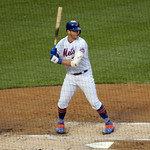
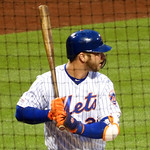
1B Pete Alonso, Mets … Age 24

Pete Alonso photo

Photo by slgckgc

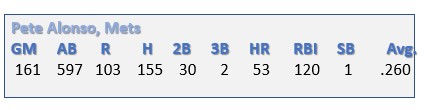
Alonso will age off this list in December, but the rookie is on his way to a new NL rookie home run record. He earns this spot by virtue of a .263-39-91 stat line with plenty of season left. The question is, after he passes Cody Bellinger’s NL rookie dinger record, can he catch Aaron Judge’s overall mark?

Pete Alonso (age 24) won the 2019 All Star Game Home Run Derby, with 20-year-old Vlad Guerrero, Jr. finishing second. 

2B – Gleyber Torres, Yankees … Age 22

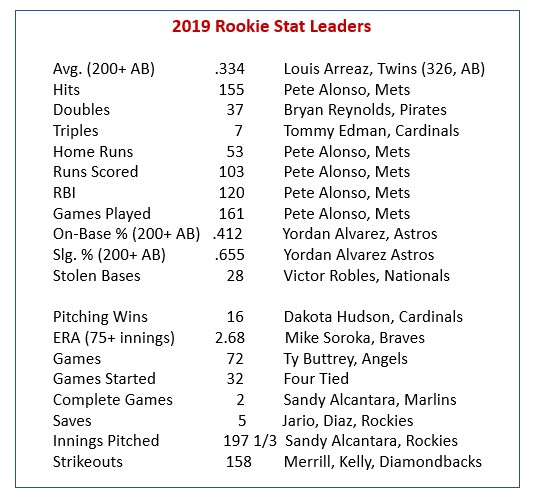
Torres played 123 games for the Bronx Bombers last season, hitting  .271-22-77 – earning an All Star nod in the process.  He repeated as an All Star this season and is hitting .282-27-71.  I have to include an honorable mention here.  The Twins’ 22-year-old Luis Arreaz (a totally different type of hitter then Torres) has put up a .353-3-19 stat in his first 56 MLB games (all this season).

3B – Rafael Devers, Red Sox … Age 22

Devers joined the Red Sox as a 20-year-old in 2017 and hit .284, with 10 home runs and 30 RBI in just 58 games.  He slipped to .240 in 2018, but hit 21 homers and drove in 66 runs in 121 games.  This season (as of August 17), he stands at .328, with 25 home runs and an AL-topping 95 RBI.  Notably, the Astros’ Alex Bregman – a two-time All Star who hit .286-31-103 as a 24-year-old last season – aged off this list (turning 25 on March 30).

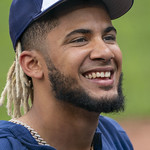
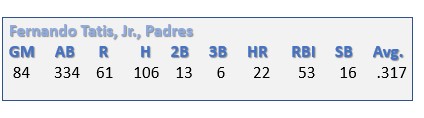
SS – Fernando Tatis, Jr. Padres … Age 20

Tatis brought his baseball genes to the Padres this season. Currently shelved due to back issues, over his first 84 MLB games, Tatis went .317-22-53, with 16 stolen bases.

Astros’ SS Carlos Correa, this season, became just the third MLB shortstop ever to reach 100 home runs before turning 25. (The others are Cal Ripken, Jr. and Alex Rodriguez – pretty good company.)

OF – Cody Bellinger, Dodgers … Age 24

Cody Bellinger photo

Photo by IDSportsPhoto

Bellinger came up at 21 (2017), went .267-39-97 in 132 games (stole 10 bags). Bellinger was an All Star, NL Rookie of the Year and set a new NL rookie home run record. (Peter Alonso will top that record this season.) Bellinger went .260-25-76 (14 steals ) in 2018 – and, this year, stands at .319-41-94 (10 steals).


OF – Ronald Acuna, Jr., Braves … Age 21

Acuna joined the Braves (last season) as a 20-year-old and went .293-26-64, with 11 stolen bases (in 111 games) – winning NL Rookie of the Year honors.  He’s looking even better this year. The 2019 All Star is standing at .297-35-85 with 29 steals (headed for a 30-30 campaign).

In his first MLB season, Ronald Acuna, Jr. became the youngest major leaguer to homer in five straight games, as well as the youngest major leaguer to it a post-season Grand Slam. (October 7, NLDS versus the Dodgers).

OF – Juan Soto, Nationals … Age 20

Soto joined that Nationals as a 19-year-old on May 20, 2018 – and promptly went .292-22-70 (five steals) in 116 games. He’s even better this season – .288-25-79, with 11 steals.

DH – Ozzie Albies, Braves … Age 22

The Braves’ second baseman came very close to the starting spot at second base. Fortunately, I needed a DH.   Already a one-time All Star, Albies  is hitting .297-18-66, with 11 steals this season.

FIRST OFF THE BENCH

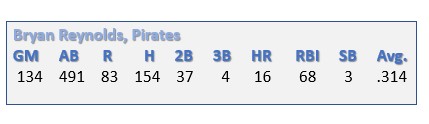
The Pirates’ switch-hitting, 24-year-old outfielder Bryan Reynolds is off to such a good start to his MLB career (this is his first major-league season), I had to create a spot for him in this post (and on this team).  As of August 17, Reynolds was hitting a robust .329, with 13 home runs and 49 RBI in 99 games.  Yes, he is a factor in the NL batting race. 

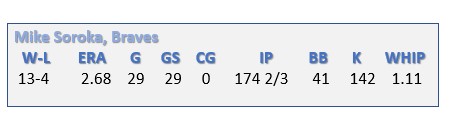
SP – Mike Soroka, Braves … Age 22

Soroka has put up a 10-2 record, with a stingy 2.41 earned run average for the Braves. An All Star at 21-years-old, he’s earned this spot.

RP Robert Osuna, Astros … Age 24

What can you say, at just 24, Osuna is in his fifth MLB season and already has 142 saves. He’s 3-3, 2.98 with 26 saves this campaign, has two 35+ save campaigns on his resume and will age off this list next year.

Primary Resource: Baseball-Reference.com

BASEBALL ROUNDTABLE ON THE TOP 100 BASEBALL BLOG LIST

100Baseball Roundtable is on the Feedspot list of the Top 100 Baseball Blogs.  To see the full list, click here.

I tweet baseball @DavidBBRT

Follow/Like Baseball Roundtable’s Facebook Page here.  More baseball commentary; blog post notifications; PRIZES.

Member: Society for American Baseball Research (SAB

From SCOOTS McGOOTS to SOUTHERN THUNDER & BISCUIT PANTS to THE SPLENDID SPLINTER … Baseball Nicknames, Past and Present

August 23-25 will mark the 2019 MLB season Players’ Weekend – and there is a new twist. This year, the uniforms will be black and white (not a choice I would have made). The players will be providing all the color. Players will be able to bring their personalities to the field in their equipment (bats, batting gloves, wristbands and more) and will also be able to wear “tribute” patches and self-selected “nicknames” on their uniforms. The nicknames will once again be the highlight of the weekend and, in this post, Baseball Roundtable will take a look at BBRT’s three favorite nicknames from each team. I’ll follow that up with a look at back at what BBRT earlier reported as the best and worst baseball nicknames of all time.  Here’s a spoiler alert, Lou Gehrig makes both the best and worst lists, having worn the monikers “Biscuit Pants” and “Iron Man.”

Side Note:  BBRT apologizes for the time between posts.  Just got a new computer and file and program transfers are taking longer than a “computer minute.”

Joey "WHO" Votto.Photo by Keith Allison

Joey “WHO” Votto.  Photo by Keith Allison

First, my favorite nickname for this season?  That would be “WHO” – to be worn by Reds’ first baseman Joey Votto. (We now know the answer to “Who’s on first?”)

There are plenty of other good nicknames out there. Like the Indians’ Shane Bieber’s “NOT JUSTIN” (see his 2019 Topps’ card), Mike Leake’s “DRIP” and Melky Cabrera’s “MELK MAN.” There are also some that relate directly to on-the-field achievements, like Aroldis Chapman’s “THE MISSILE,” Nelson Cruz’ “BOOMSTICK”  and hit-stealing Kevin Kiermaier’s “OUTLAW.”

There are a few that tie to physical characteristics, like Tyler Glasgow’s “BABY GIRAFFE,” Jared Hughes’ “OSTRICH” and Pablo Sandoval’s “PANDA.”  There are even a couple that tie to past or part-time occupations – Michael Fulmer’s “THE PLUMBER” and Steve Cishek’s “SPEEDPASS.”  And, let’s not forget the nicknames that just make you smile, like  Zach Davies’ “BAT BOY,” Scott Barlow’s “SCOOTS McGOOTS,” and Jeff McNeil’s “FLYING SQUIRREL.”  We should also give a nod to Luke Jackson’s “SKYWALKER,” because Star Wars never gets old.

So let’s get to it.  Here are BBRT’s three favorite nicknames from each team.

—-Arizona Diamondbacks—-

Mike Leake – DRIP.

Jarrod Dyson – ZOOMBIYA.  The kind of pitch you are looking for – one that zooms by ya. Plus, it takes me back to the ’60s.

David Peralta – FREIGHT TRAIN. He runs the bases with abandon.

—–Atlanta Braves—–

Josh Donaldson – BRINGER OF RAIN.  This one’s been around awhile – as have his high-flying, rain-bringing dingers.

Mike Foltynewicz – HIGH FOLTAGE.

Julio Teheran – EL CABALLO DE OLAYA.  The Horse of Olaya – and of the Braves.

—-Baltimore Orioles—–

Chance Sisco – SISCO KID.  I loved the “Cisco” Kid, when I was a “kid.” No “Poncho” on the team though.

Trey Mancini – BOOMER.

Richie Martin – RICH BOY.  Hmm? Possible backlash?

—-Boston Red Sox—-

Nathan Eovaldi – NITRO.

Chris Sale – THE CONDUCTOR.  He does punch a lot of tickets.

Mookie Betts – MOOKIE.  Can’t improve on that.

—–Chicago Cubs—–

Javier Baez – EL MAGO.  The Magician.  Have you seen his glove work?

Steve Cishek – SPEEDPASS.  Not a pitching term, but Cishek once worked at a gas stations that used the Speedpass.

Brandon Kintzler – SALT.  Kintzler is said to have a “salty” personality.

—–Chicago White Sox—–

Ivan Nova – SUPER NOVA.

James McCann – McCANNON.

Yoan Moncada – YOYO.

—–Cincinnati Reds—–

Joey Votto – WHO.  … is on first?

Michael Lorenzen – ZEN.  Gives me a sense of peace on the diamond.

Jared Hughes – OSTRICH. Watch him run in from the bullpen.

—–Cleveland Indians—–

Shane Bieber – NOT JUSTIN.  Topps, pay attention.

Jason Kipnis – DIRTBAG.  He’s a scrapper, not afraid to get his uniform dirty.

Yasiel Puig – WILD HORSE.  This one’s often attributed to a Vin Scully description of a Puig triple, “The Wild Horse is loose.”

—–Colorado Rockies—–

David Dahl – BABY DAHL.  Might be a little soft.

German Marquez – MARQUEE.

Bryan Shaw – GEEK.  Loves video games.

—–Detroit Tigers—–

Michael Fulmer – PLUMBER.  Fulmer has worked as a plumber in the off-season.

Brandon Dixon – BANDIT.  Great nickname, not so great story.  Apparently, someone misheard him being called “Brandon;” thought he heard “Bandit.”

Niko Goodrum – STINCHCOMB.  Wha-a-at?

—–Houston Astros—–

Jake Marisnick – BIG FUDGE.  A reference to his eating habits while on the DL.

Josh Reddick – MR. IRRELEVANT.  Hard to standout on the star-studded Astros’ squad.

George Springer – HORHAY.  A nod to his Puerto Rican and Panamanian roots.

—–Kansas City Royals—–

Scott Barlow – SCOOTS McGOOTS.  Makes me smile.

Jacob Junis – JUNE BUG.  See above.

Richard Lovelady – LOVE.  Oh, more back-to-the-’60s vibe. The Summer of Love.

—–Los Angeles Angels—–

Albert Pujols – LA MÁQUINA.  He has been a long-time hitting machine.

Dillon Peters – DILLYPICKLEZ.

Shohei Ohtani – SHOWTIME.

—–Los Angeles Dodgers—–

Kenley Jansen – KENLEYFORNIA.

Walker Buehler – BUETANE.

Pedro Baez – LA MULA.  The Mule.  Quite the work ethic.

—–Miami Marlins—–

Curtis Granderson – GRANDYMAN.

Garret Cooper – COOPALOOP.

Jose Urena – EL NUEVE.  The nine.  I thought it might be the inning Urena prefers to pitch.  But I saw a story that says, in the Dominican Republic, youngsters would often greet each other with “El Nueve” — considered an friendly acknolwegement.

—-Milwaukee Brewers—-

Zach Davies – BAT BOY. Davies is also wearing “BB” in place of his uniform number.

Josh Hader – HADARADE.

Yasmani Grandal – YAZMANIAN DEVIL.


—–Minnesota Twins—–

Nelson Cruz – BOOMSTICK.

Jose Berrios – LA MAKINA.  A pitching machine.

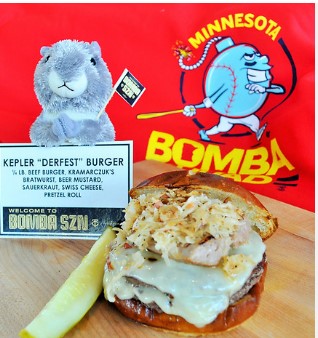
Max Kepler – RὉŻYCKI. Maximilian Kepler-RὉŻYCKI.

—–New York Mets—–

Jeff McNeil – FLYING SQUIRREL. Plays with a lot of energy.

Seth Lugo – QUARTERRICAN.  A nod to his grandfather.

Todd Frazier – TODDFATHER

—–New York Yankees—–

Aroldis Chapman – THE MISSILE.

James Paxton – BIG MAPLE.  Canadian roots.

Giancarlo Stanton – PARMIGIANCARLO.

—–Oakland A’s—–

Liam Hendriks – SLYDAH. Gotta love the breaking ball. (Or is it White Castle?)

Mike Fiers – SMOKEY.

Chris Herrmann – WORM.

—–Philadelphia Phillies—–

Scott Kingery – JETPAX. Kingery runs the bases with abandon.

Jake Arrieta – SNAKE.  Just a classic.

Mike Morin – MOOSH.  I like the sound and the alliteration.

—–Pittsburgh Pirates—–

Felipe Vazquez – NIGHTMARE.  Vazquez wants to give bad dreams to batters, I assume.

Chris Archer – FLACO FUERTE.  Skinny Strong.  Assigned by a teammate who grabbed Archer’s arm and was apparently underwhelmed.

Melky Cabrera – MELK MAN.

—–Saint Louis Cardinals—–

Adam Wainwright – UNCLE CHARLIE.  More love for the breaking ball.

Michael Wacha – WACHAMOLE.  Is it a dip or a carnival game?

Ryan Helsley – HELLZ BELLZ.

—–San Diego Padres—–

Joey Lucchesi – JOEY FUEGO.  He’s been on fire since he got this nickname at Southwest Missouri State.

Chris Paddock – SHERIFF.  A Texan through and through; known for his game-day cowboy hat.

Fernando Tatis, Jr.  – EL NIÑO. A tribute to his big-league dad.

—-San Francisco Giants—–

Madison Bumgarner – MAD BUM.  All three of BBRT’s Giants’ favorites are MLB long-standing classics.

Pablo Sandoval – PANDA.

Jeff Samardzija – SHARK.

—–Seattle Mariners—–

Dee Gordon – A lightning bolt emoji. The man can run – enough said.

Dan Vogelbach – THE BABE.  Does he really look like George Herman Ruth?

Felix Hernandez – KING FELIX.  Another well-established moniker.

—–Tampa Rays—–

Kevin Kiermaier – OUTLAW.  How many hits has he stolen with his glove?

Tyler Glasnow – BABY GIRAFFE.   6’ 6”, ‘nuff said.

Tommy Pham –  PHAMTASTIC.

—–Texas Rangers—–

Elvis Andrus – EL COMANDO.  Commander. Given to him by his brother, guess we know who was in charge.

Delino DeShields – LIL BOP.  His MLB dad was known as BOP.

Nomar Mazara – BIG CHILL.

—–Toronto Blue Jays—–

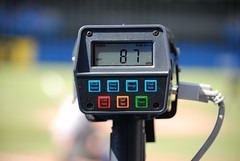
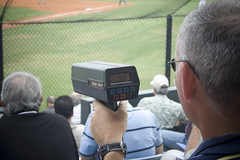
Ken Giles – 100 MILES GILES.  A nickname based on Radar-gun readings.

Teoscar Hernandez – MR. SEEDS. Sunflower seeds, that is.

Vlad Guerrero, Jr. – THE KID.  The kid of a Hall of Famer, of course.

—–Washington Nationals—–

Hunter Strickland – SOUTHERN THUNDER.

Max Scherzer – BROWN EYE.  Scherzer has honored his blue eye in the past (he has heterochromia of the eyes); the brown eye gets the honor this year.

Erik Fedde – FEDDECCINI. Didn’t get this word play pasta me.

——-BASEBALL ROUNDTABLE’S BEST AND WORST ALL-TIME NICKNAMES——-

Ted Williams collected nicknames like he collected base hits - The Kid, Splendid Splinter, The Thumper, Teddy Ballgame.

Ted Williams collected nicknames like he collected base hits – The Kid, Splendid Splinter, The Thumper, Teddy Ballgame.

Nicknames have always been a part of our national pastime – some complimentary (Joe “The Yankee Clipper” DiMaggio); some less so (Fred “Bootnose” Hoffman). Here is a look two purely subjective nickname-based lineups – one focused on baseball’s best nicknames, the other on some of the national pastime’s worst. (Keep in mind, these are not nicknames chosen for the weekend.  They are earned monitors that “stuck.”)

But, I’m getting ahead of myself.  Let’s get to the lists, leading off with some of MLB’s worst nicknames – often cruel, but always descriptive and almost always interesting.

—-BASEBALL’S WORST NICKNAMES—-

P – Hugh “Losing Pitcher” Mulcahy … Ouch! Mulcahy “enjoyed” a nine-season major league career (1935-47, minus five WWII years), during which he earned his nickname. He ran up a career record of 45-89, with a 4.49 ERA (all with the Phillies), leading the NL in losses twice, hits allowed once, earned runs allowed twice, walks allowed once, hit batsmen twice and wild pitches once. Notably, he made one MLB All Star squad; in 1944, when he led the NL with 22 losses (versus 13 wins), despite a respectable 3.60 ERA.

C – Gabby “Old Tomato Face” Hartnett … The Hall of Fame catcher reportedly picked up his nickname as he gained weight and developed a ruddy complexion. Notably, even “Gabby” was a nickname (real name Charles Leo Hartnett) – reflecting Hartnett’s career-long shyness and reluctance to speak to anyone, particularly reporters. Harnett played 20 MLB seasons (1922-41, all but the last season with the Cubs), hitting .297, with 236 home runs and 1,179 RBI. He was a six-time All Star and the 1935 NL MVP.

1B – Lou “Biscuit Pants” Gehrig …  Great player with multiple nicknames –ranging from Biscuit Pants on the low end to Buster in the middle to Iron Man on the high side.  The Biscuit Pants monitor acknowledged Gehrig’s baggy uniform pants, thick legs and sturdy derriere. A Hall of Famer, Gehrig played 17 seasons with the Yankees (1923-39), producing a .340 career average, with 493 home runs, 1,995 RBI and 1,888 runs scored. He was a seven-time All Star, two-time AL MVP, won one batting, title, led the AL in home runs three times, RBI five times, runs scored four times, doubles three times and triples once.

2B – Charlie “Piano Legs” Hickman …  At 5’9” and 215-pounds, it’s easy to imagine the source of Hickman’s nickname. Hickman played 1B, 2B and OF during his 12-year MLB career (1897-1908), delivering a .295 career average, with 50 home runs and 614 RBI. Hickman led the AL in hits and total bases in 1902, when he split time between Boston and Cleveland.

3B – Gary “The Rat” Gaetti … Despite the uncomplimentary nickname, Gary Gaetti was anything but a rat on the field. Also known as G-Man, Gaetti had a 20-season MLB career (1981-2000 with the Twins, Angels, Royals, Cardinals, Cubs and Red Sox). He was a career .255 hitter, with 360 home runs and 1,341 RBI.  Gaetti was a two-time All Star, four-time Gold Glover at third base and the 1987 American League Championship Series MVP.

SS – Bill “Wagon Tongue” Keister … Unlike Gabby Hartnett (see the catcher on this list), Bill Keister just wouldn’t shut up.  In a seven-season MLB career (1896-1903), Keister played for Brooklyn, Boston, Saint Louis and Philadelphia in the NL and Baltimore and Washington in the AL.  He hit .312, with 18 home runs, 400 RBI and 131 stolen bases – spending time at shortstop, third base and second base.   In the field, Wagon Tongue did not put his money where his mouth was.  In 1901, he set the all-time MLB low for fielding average by a shortstop (.851) – making 97 errors in 112 games (650 total chances).

LF – Johnny “Ugly” Dickshot … Not the best looking of men, it’s reported that Dickshot granted himself the title of the ugliest man in baseball.  Clearly, the combination of his nickname and actual name earns Dickshot a spot on this list of worst baseball nicknames.  In six major league seasons (spread over 1936-45), he played in 322 games (Pirates, Giants, White Sox), hitting .276, with seven home runs and 116 RBI. More than half his career offensive production came in his final season (1945, White Sox), when he hit .302, with seven home runs and 58 RBI.

CF – Hunter “Captain Underpants” Pence … The story has it that, during a minor league game, an aggressive heckler thought that (on the minor league PA system) “Hunter Pence” sounded a lot like “Underpants” and proceeded to taunt him with the Underpants chant, which  apparently had more staying power when teammates promoted Mr. Underpants to “Captain.”  As of this writing, Pence is in his 13th MLB campaign, with a .280 career average, 241 home runs and 931 RBI.  He is a three-time all star.

RF – “Bucketfoot” Al Simmons … Another Hall of Famer on this list, Simmons’ nickname (which he disliked) was drawn from his batting stance.  The bucketfoot stance seemed to work for him. In 20 MLB seasons (1924-1944; Athletics, White Sox, Tigers, Senators, Braves, Reds, Red Sox), Simmons hit .334, with 307 home runs and 1,828 RBI. He led his league in batting average, hits and total bases twice each and RBI once.

So, there is BBRT’s worst nickname lineup. If I had a bench, it would be manned by such notables as: Fred “Bootnose” Hoffman; Walt “No Neck” Williams; Jeff “Penitentiary Face” Leonard; Ernie “Schnozz” Lombardi; Harry “Stinky”Davis;  Dick “Dr. Strangeglove” Stuart; and Bris “The Human Eyeball” Lord.

—–BEST BASEBALL NICKNAMES—-

Now, here’s the BBRT lineup based on a very subjective judgment of the  best baseball nicknames.  As you will note, solid performance often results in a solid (and memorable) nickname.

P – “Sudden” Same McDowell … Yes, there are some Hall of Fame Pitchers with great nicknames. Walter “Big Train” Johnson, “Rapid Robert” Feller are  just two. However, that  “Sudden” nickname is my favorite.  McDowell – whose blazing heater could be past you with amazing suddenness – was a six-time All Star and five-time league strikeout leader. In a 15-year MLB career (1961-75, with the Indians, Giants, Yankees and Pirates), McDowell went 141-134, 3.17 and fanned 2,453 hitters in 2,492 1/3 innings.

C – Johnny “Little General” Bench … Catchers are supposed to take charge on the field and this nickname fits Hall of Famer Johnny Bench both behind and at the plate. Bench was a leader for the Reds for 17 seasons (1967-83). He was a 14-time All Star, ten-time Gold Glover, two-time league HR leader, two-time league MVP, 1968 Rookie of the Year and 1976 World Series MVP

Lou Gehrig gained fame as the Yankees "Iron Man," but he was also know as "Biscuit Pants," " Buster" and "The Iron Horse" during his career. Photo by rchdj10

Lou Gehrig gained fame as the Yankees “Iron Man,” but he was also know as “Biscuit Pants,   “Buster” and “The Iron Horse” during his career. Photo by rchdj10

1B – Lou Iron Man Gehrig … Hall of Fame slugger Lou Gehrig (see his career achievements in the worst nickname lineup under Biscuit Pants) earned this nickname for his combination of power and durability (until it was broken by Cal Ripken, Jr. in 1995, Gehrig held the record for consecutive games played at 2,130).

2B – Felix “The Cat” Millan … The Cat earned his nickname for his slick fielding around the keystone sack.  In 12 MLB seasons (1966-77, with the Brave s and Mets), Millan was a three-time All Star and two-time Gold Glover. He put up respectable offensive numbers with a career line of .279-22-403, with 699 runs scored.

3B – Pete “Charlie Hustle” Rose … BBRT could have put the ultimate hustler in at nearly any place on the diamond, but I like his aggressive play at the hot corner – where Rose started 627 games in his career. MLB’s all-time hits leader (4,256), Rose played 24 seasons in the majors (1963-86) – with the Reds (19), Phillies and Expos. Known for his hustle and aggressive play, Rose was a 17-time All Star, three-time batting champion and two-time Gold Glover, as well as the 1963 NL Rookie of the Year and 1973 NL MVP. He led the NL in games played five times, hits seven times, double five times and runs scored four times.

SS – Ozzie “The Wizard of Oz” Smith … In his 19 MLB seasons (1978-96, with the Padres and Cardinals), Hall of Famer Smith’s defensive wizardry earned him 13 Gold Gloves. The 15-time All Star had a career average of .262, with 28 home runs, 793 RBI, and 1,257 runs scored.

LF – Ted “The Splendid Splinter” Williams … Williams’ nickname – the Splendid Splinter – reflects his lanky, splinter-like build and his splendid skills.  Notably, Williams’ play earned him a team’s worth of nicknames – The Kid, Teddy Ballgame and The Thumper also among them.  Williams’ career on-base percentage of .482 is the best in baseball history.  Think about it – reaching base, basically, one of every two trips to the plate. Williams was a 19-time All Star, two-time MVP and two-time Triple Crown winner.  In 19 seasons with the Red Sox (1939-60, time lost for service in WWII and the Korean Conflict), Williams won six batting titles, and lead the AL in runs six times, RBI four times, home runs four times, doubles twice, walks eight times and total bases six times. He retired with a .344-521-1,839 stat line – and is the last MLBer to hit .400 for a season (.406 in 1941).

CF – Franklin “Death to Flying Things” Gutierrez … A lot of people probably expected to see Joe “The Yankee Clipper” DiMaggio or Ty “The Georgia Peach” Cobb in this spot.  However, based on the quality of the nickname, far-ranging outfielder Frank “Death to Flying Things” Gutierrez belongs here. In ten big league seasons (2005-13 & 2015-17, with the Indians, Mariners and Dodgers), Gutierrez earned one Gold Glove, a .257-97-361 stat line and one awesome nickname.  Note: two players from the 1800s – Jack Chapman and Bob Ferguson also  were honored with this nickname.

RF – Stan “The Man” Musial … Hall of Famer Musial (who started more than 1,800 of his 3,026 game played in the outfield) was indeed “The Man” – and not just in Saint Louis (where he played from 1941-63).  He was respected for his bat and his attitude around baseball.  Musial was a seven-time batting champ and three-time MVP, who also led the NL in hits six times, runs scored five-times, doubles eight times, triples five times and RBI twice. He retired with a .331 average, 3,630 hits 1,946 runs scored and 1,951 RBI.

If I had a bench for this squad, you might find such players as: Joe “The Yankee Clipper” DiMaggio;  “Rapid Robert” Feller; Babe “The Sultan of Swat” Ruth; Jimmy “The Beast” Foxx;  Don “Donnie Baseball” Mattingly; Roger “The Rocket” Clemens, Reggie “Mr. October” Jackson; Al “The Mad Hungarian” Hrabosky; Frank “The Big Hurt” Thomas; and Dwight “Dr. K” Gooden.

Again, all these choices are subjective.  BBRT would love to hear from readers on some of your favorite MLB nicknames.

Primary Resources:  

BASEBALL ROUNDTABLE ON THE TOP 100 BASEBALL BLOG LIST

100Baseball Roundtable is on the Feedspot list of the Top 100 Baseball Blogs.  To see the full list, click here.

I tweet baseball @DavidBBRT

Follow/Like Baseball Roundtable’s Facebook Page here.  More baseball commentary; blog post notifications; PRIZES.

Member: Society for American Baseball Research (SABR); The Baseball Reliquary; The Negro Leagues Baseball Museum.
Babe Ruth, Shane and Justin Bieber, Don(s) Larsen and Drysdale and a Few Random Baseball Thoughts

Sometimes on a lazy day – actually almost always – my thoughts turn to baseball.  So, here are just a few random thoughts (stories and stats) that crossed my mind today.  Hope you enjoy this stream of consciousness post.

How About a Little Respect?

Maikel Franco photo

Photo by apardavila

Yesterday, August 4, the Phillies optioned 3B Maikel Franco to Triple A. Franco, at the time hitting .231-15-47, apparently got more respect from the opposition.  He was leading all of MLB in 2019 Intentional Walks, with 17.

Things Can Turn Around Quickly

On August 3, Aaron Sanchez – an August acquisition by the post-season bound Astros – started his first game in a Houston uniform.  It looks like the change of scenery was good for him.

When Sanchez came over from the Blue Jays on July 31, he was leading MLB in losses (3-14, with a 6.07 earned run average). In his first start for the Astros, Sanchez threw six scoreless, HITLESS innings (two walks/six whiffs), leaving the game with a 6-0 lead (and eventually picking up the win).  A trio of relievers (Will Harris, Joe Biagini and Chris Devenski) followed Sanchez to the bump, turning three more scoreless, HITLESS frames. So, in Sanchez’ first start for his new team, he was part of MLB’s 14th combined no-hitter (out of 302 official no-hitters).  The Astros, by the way, collected 15 hits in the 9-0 whitewashing. Side note: Sanchez was an All Star as recently as 2016, when he went 15-2, 3.00 in 30 starts for the Blue Jays.

Combined No-Hitters, Becoming a Thing?

The Astros’ August 3 no-hitter was the third MLB no-hitter thrown in 2019 – and the season’s second combined no-hitter. Given today’s pitch counts and seventh-, eighth- and ninth-inning specialists, combined no-hitters are becoming more common.  MLB saw just one combined no-hitter before 1967 (more on that coming) and a total of nine combined no-hitters (out of 272 total no-hitters) through 2011. Since then, we’ve seen five combined no-hitters (out of 30 no-hit games).  And again, two of three 2019 no-hitters have been collaborative works.

Babe Ruth and the First-ever Combined No-Hitter

The first-ever combine no-hitter took place on June 23, 1917 – with the Red Sox topping the Senators 4-0 in Boston. This game is special for several reasons:

  • It was the first MLB combined no-hitter;
  • Babe Ruth was the starting pitcher;
  • It is the only combined no-hitter in which the pitcher was not pulled by the manager with a no-hitter in progress;
  • It involved the most meager contribution by any starter (actually any pitcher)  in a combined no-hitter (zero innings pitched/one batter faced);
  • It is arguably the most “perfect” combined no-hitter ever.

Ruth, at the time plying his trade as a 22-year-old southpaw starting pitcher for the Boston Red Sox, opened the game by walking Washington’s lead-off hitter Roy Morgan.  Ruth and Boston catcher Pinch Thomas took issue with umpire Brick Owens’ strike zone and, during the argument, Ruth made contact with the umpire.  The ultimate result of the confrontation was the ejection of both Ruth and Thomas (with Ruth earning a $100 fine and ten-game suspension); hence he was not pulled by the manager and left the soon to be first-ever combined no-hitter after facing just one batsman.

Red Sox’ pitcher Ernie Shore was called in to replace Ruth; and Sam Agnew took Thomas’ spot behind the plate. Morgan decided to test Agnew’s arm and was thrown out stealing, after which Shore retired the next 26 hitters in order – completing the first combined no-hitter and facing the minimum 27 batters. (Hence the “most perfect” combined no-hitter). Ruth finished the 1917 season at 23-13, with a 2.01 earned run average and a league-leading 35 complete games. Shore finished the campaign at 13-10, 2.22.

Can’t I Get Any Justin? Yes, you can. 

Shane Bieber is having a great season. Not only was he the All Star Game MVP, his record stands at 11-4 and he leads all of MLB with three complete games and two CG shutouts.  Name recognition?  Maybe not so much.

The back of his Topps baseball card reads “Until Bieber did it 2018, no Indians pitcher in 54 years had logged six or more strikeouts in each of his first three big-league appearances. Justin was particularly comfortable on the road, where went a team-record 7-0 and was undefeated in 11 starts.”  Yep, Shane’s 2018 road record was attributed to Justin Bieber.

Shane Bieber leads MLB in complete games this season with three. In 1884, Charles “Old Hoss” Radbourn started 73 games – and completed 73 games. A few other tidbits:

  • The last pitcher to complete ten or more games in a season was the Rays’ James Shields (11 in 2011);
  • 2000 was the first season that saw no MLB pitcher complete at least ten games;
  • The last pitcher to complete 20 games in a season was the Dodgers’ Fernando Valenzuela in 1986 (20 CG);
  • The last pitcher to complete 30 games in a season was the Yankees’ Catfish Hunter (30 in 1975);
  • Currently, there are ten MLB teams without a complete game in 2019. There were nine in 2018;
  • The last season in which every MLB team had at least one complete game was 2014.

    The Rays have gone the longest without a complete game 565 games (back to May 14, 2017). In the NL, that honor goes to the Brewers at 387 games (June 18, 2017.)

Finally, A Three-Blast Day

Photo by Keith Allison

Photo by Keith Allison

The Twins Nelson Cruz has been a flexing his long-ball muscles for more than a decade. He came into the 2019 season, at age 38, with 360 MLB home runs and 203 home runs over the previous five campaigns (all for the Mariners). Yet, in 14 MLB seasons, he had never had a three-home run game. That is, not until, July 25 of this season, when (at age 39) he popped three home runs in a Twins 10-3 win over the White Sox. He proved it wasn’t a fluke on August 3, when he had his second three-home run day. This time it came in an 11-3 win over the Royals – and, by the way, made Cruz the oldest MLB player ever to have two three-homer games in a season. Oldest player ever with a three-homer game? That would be Stan Musial July 8, 1962, at age 41 (and 229 days).  As I write this, Cruz is hitting .292-30-72 on the season.

The Wrong Place at the Wrong Time?

Jacob degrom photo

Photo by slgckgc

Jacob deGrom currently has a 6-7 record on the season, with a nifty 2.78 earned run average. Meanwhile, there are nine pitchers with ten or more wins, with ERA’s over 4.00.  But all that should be nothing new to deGrom. In 2018, he won only ten games (10-9) in 32 starts, despite a MLB-lowest 1.70 ERA.

A few Whiff Stats

  • The first time any MLB batter fanned 200 times in a season was 2008 (Mark Reynolds 204). Since then, we’ve seen a dozen more seasons of 200+ strikeouts.
  • Mark Reynolds has the most 200+ whiff seasons at three (2008, 2009, and 2010).
  • 2018 saw the most players with 200+ whiffs in a season at three (Joey Gallo, Giancarlo Stanton, Yoan Moncada).
  • Babe Ruth never fanned 100 times in a season, but led the league in whiffs five time.

HKS
The Other Side of Don Larsen

Yankee Don Larsen is, of course, best known for throwing the only World Series perfect game. You should also know that, as a Saint Louis Browns’ rookie (1953), Larsen set a record for consecutive base hits by a pitcher (seven).

The streak started in the second game of a doubleheader against the Red Sox on July 24. In his final at bat (in the eighth inning) of that game, Larsen laced a double to right-center off Mickey McDermott. (Larsen came on in relief in the sixth inning).  Larsen pitched again on July 26th – one inning of relief against the BoSox – but did not come to the plate.

On July 28, he came on in relief (against the Athletics) in fourth inning and took the loss in 9-7 game.  On the mound, Larsen gave up three earned runs in five frames (two hits, two walks, four strikeouts).  At the plate, he did better, with an RBI single to CF in the fourth, a single to RF in the seventh and another single to RF in the ninth.  The streak was now at hits in four consecutive plate appearances.  Side note:  The Browns let Larsen bat with two outs in the ninth, trialing 9-7. Larsen relieved against the Athletics again on July 30, pitching a scoreless eighth, but did not come to the plate.

On August 5, Larsen got the start against the Orioles and went the distance in a 5-0 loss. At the plate in that game, he collected: a single to left in the third; a single to left in the fifth; and single to center in the seventh – giving him base hits in seven consecutive plate appearances. At the time, he was 2-10, 4.32 on the mound, but had a .288 batting average on the season.  It turns out, Larsen would appear in four more games before the streak would officially come to an end.

Larsen next trip to the plate came on August 7.  In that game (against the Senators), he came in to play left field in the sixth and grounded out in the eighth. Technically, the streak was still alive, since he grounded out as a left fielder, not as a pitcher.  He appeared again in the first game of a doubleheader against the Senators on August 9, this time as a pinch runner (scoring a run, but not appearing at the plate). In the second game of the DH, Larsen batted again, but still not as a pitcher. He hit into a double play as a pinch hitter in the fifth inning (as the Browns lost 12-3).  On August 11, Larsen finally batted again as a pitcher.  He started against the Tigers (taking the loss in a 9-3 game) and flied out to short in the third to end the streak.

Larsen ended his 1953 rookie season at 7-12, 4.16 – with a .284-3-10 line at the plate.

Don Drysdale photo

Photo by Ted Van Pelt

The World Champion 1965 Dodgers had just one batter with at least 100 bats and a .300 or better batting average. That was pitcher Don Drysdale, who hit .300-7-19 in 130 at bats. Next best was speedster Maury Wills at .286 in 650 at bats (no home runs and 33 RBI). Drysdale’s seven long balls were seventh on the team – although every player ahead of him had 400 or more at bats. 


Primary Resources:  ESPN.com; Baseball-Reference.com

BASEBALL ROUNDTABLE ON THE TOP 100 BASEBALL BLOG LIST

100Baseball Roundtable is on the Feedspot list of the Top 100 Baseball Blogs.  To see the full list, click here.

I tweet baseball @DavidBBRT

Follow/Like Baseball Roundtable’s Facebook Page here.  More baseball commentary; blog post notifications; PRIZES.

Member: Society for American Baseball Research (SABR); The Baseball Reliquary; The Negro Leagues Baseball Museum.
Baseball Roundtable August Wrap Up – Hiura and Santana, Just a Couple of the Surprises

It’s August 1,  and that means it’s time for Baseball Roundtable’s traditional previous month wrap up – touching on the statistics, standings and stories that caught BBRT’s eye over the previous month, along with the BBRT Players and Pitchers of the Month and the BBRT Trot index.  And, this month, BBRT is adding a new designation: The Surprise Player of the Month, recognizing one player whose performance was both outstanding and (at least somewhat) unexpected. Here’s a brief sampler of the kind of things you’ll read about – as always, if you last to the end of the post.  Among the things we saw in July:

  • One team (Red Sox) hitting over .300 for the month.
  • One team (Indians) recording an earned run average under 3.00 for the month.
  • A record streak of four consecutive days when a batter launched three home runs in a game (Robinson Cano, Paul DeJong, Nelson Cruz, Mookie Betts).
  • A team (Twins) finishing July with 209 home runs on the season – on a pace to hit a record 316 home runs, which would shatter the old record of 267.  (By old, I mean from 2018.)

Shout out to “I Love Baseball” for Posting This … 

  • On April 27th, 2010 Justin Smoak (in his fifth MLB game) drove in Vlad Guerrero, Sr. to post his first MLB RBI.
  • On May 4, 2019, Vlad Guerrero, Jr. (in his seventh MLB game) drove in Justin Smoak for his first MLB RBI. 
  • 2019’s fifth”Immaculate Inning (Stephen Strasburg).
  • Six players (Mariano Rivera, Edgar Martinez, Mike Mussina, Roy Halladay, Lee Smith, Harold Baines) inducted into the Hall of Fame.
  • A last-place team record (Orioles) record a record ten straight multi-home games.

How Fair is That?

The Cubs’ Kyle Hendricks went 1-3 in July, despite a 2.25 earned run average for the month. Meanwhile, the Red Sox; Rick Porcello went 4-1, despite a 7.54 ERA for the month.

  • A dozen pitchers who logged 20 or more innings putting up earned run averages under 2.00; and nine pitcher who logged 20 or more innings putting up ERAs over 7.00 for the month.
  • One player (Max Kepler) going yard against another player (Trevor Bauer) in five consecutive at bats.
  • 31 first-time All Stars.
  • A line-up that included three rookies whose fathers’ made a combined 20 MLB All Star teams.

—–PLAYERS & PITCHERS OF THE MONTH … (plus a surprise)—–

Players of the Month

American League – Yuli Gurriel, First Base, Astros

GurrielHouston’s 35-year-old first baseman has been a solid hitter since finally winning a full-time job in 2017 (at the age of 33). In 412 career MLB games, he has hit .293 with 54 round trippers.  Gurriel went above and beyond expectations in July, hitting an MLB-best (among those with at least 75 at bats) .398, launching 12 home runs (second only to Mike Trout’s 13) and driving in 31 runs (second in MLB to Rafael Devers’ 34). Gurriel played in 24 games in July and got at least one hit in 23 of them (12 multi-hit games).

Other AL contenders: Red Sox 3B Rafael Devers finished a close second after going .358 with nine home runs and an MLB-best 34 RBI in July; CF Ramon Laureano of the A’s put up a solid .392 average (only 74 at bats) and added eight home runs, 18 RBI and 22 runs scored in 22 games; Rangers’ 2B Danny Santana hit .391-7-21 for July; and, of course, always a finalist, the Angels’ Mike Trout topped all of MLB with 13 July homers, with a .286 average, 29 RBI and 20 runs scored.

National League – Paul Goldschmidt, 1B, Cardinals

This was a tough one, as any of the contenders (listed later) could make a case.  However, BBRT is “Going with Goldy,” whose bat came alive in July. Goldschmidt hit .308, was second in the NL in July home runs with 11 and tied for the league tops in RBI with 27.  He also scored 20 runs (tied for second-best in the NL).  From July 22 through July 27, he homered in six straight games.

Other Contenders:  Christian Yelich, RF, Brewers.  What can you say about Yelich? He does it all. In July, he raked at a .352 pace (second-best among National Leaguers with at least 75 at bats), popped seven home runs, drove in 18, scored 14 and swiped five bases in six tries; Pirates’ CF Starling Marte, who hit .305 for the month, with 6 long balls, 22 RBI and an NL-best 24 runs scored, deserved consideration; another finalist was Reds’ 3B Eugenio Suarez, who hit .289 in July, with an NL-best 12 home runs and 23 RBI.

SURPRISE PLAYER OF THE MONTH – Keston Hiura, 2B, Brewers

I did say (write) that there would be a surprise.  The surprise is that, going forward, BBRT will select a Surprise Player for each month.  This month, it’s 22-year-old Brewers’ rookie 2B Keston Hiura. 

HuiraAll this youngster did in July was hit .355, with six home runs, 18 RBI, 17 runs scored and six stolen bases. Of course, it shouldn’t be too big a surprise. The 2017 first-round draft choice has pretty much hit wherever he played.  He hit .375 over three seasons at the University of California Ervine (.442 in his final year) and .317 over three minor league seasons (222 games).

Danny Santana photo

Photo by IDSportsPhoto

Oh yes, a second surprise.  This first Surprise Player of the Month was a tie.  Joining Hiura in the sidebar of honor is the Rangers’ Danny Santana (former Twin, for you Minnesota readers).  Santana came into the season with a career average of .256, with 13 home runs and 100 RBI over five MLB seasons.  He was hitting .297 with nine homers and five RBI through June – but that’s not the surprise.  In July, Santana hit .391, with seven long balls and 21 RBI (bringing his season totals to .326-16-46).  The frosting on the cake?  This season, Santana has seen time in at 1B, 2B, SS, as well as in all three outfield positions. 

PITCHERS OF THE MONTH

American League – Gerrit Cole, RHP, Astros

Gerrit Cole photo

Photo by boomer-44

Plenty of deserving candidates here (like Justin Verlander, Eduardo Rodriguez and Mike Clevinger), but BBRT could not pass on the Astros’ Gerrit Cole.  Cole went 4-0 in five July starts, led (tied) MLB with 51 whiffs (34 innings) and put up a nifty 1.85 earned run average. Cole went seven innings in four of his five starts and reached double-digits in strikeouts in three of five starts. He gave up more than one run in only one of his July outings.

Other Contenders: Indians’ RHP Mike Clevinger went 4-0, 1.74 in July, fanning 41 hitters in 31 innings, as the Indians gained ground in the AL Central (his performance also may have made the Indians more willing to part with Trevor Bauer);  Red Sox’ lefty Eduardo Rodriguez helped the Red Sox get back in the race with a 5-0, 2.03 month.

National League – Stephen Strasburg, RHP, Nationals

Stephen Strasburg photo

Photo by runneralan2004

Strasburg was one of just two five-game winners in July (5-0) and put up a minuscule 1.14 earned run average. He fanned 44 batters in 31 2/3 innings, while walking just seven. Strasburg picked up important wins against the Dodgers and Braves – likely post-season teams – in July.

Other Contenders. The Marlins’ Caleb Smith went 4-0 (for the Marlins, who went 9-15), with a 3.48 ERA and 37 punch outs in 31 innings. The southpaw logged victories over the Braves, Mets, Diamondbacks and White Sox; Diamondbacks’ lefty Robbie Ray continued to miss bats, fanning 44 hitters in 30 1/3 innings, to go with a 4-1, 3.26 stat line; and, finally, a pair of pitchers who continued to baffle hitters, even if they didn’t pick up a lot of wins.  Each had five July starts: Jacob deGrom went 2-0, 1.09 for the Mets in July, with 46 whiffs in 33 innings, while the Dodgers’ Hyun-Jin Ryu, went 2-0, 1.10.

TROT INDEX … A REGULAR BBRT FEATURE

Through July,  36.0 percent of all MLB’s 124,438 2019 plate appearances ended in a trot (back to the dugout, around the bases, to first base). We’re talking about strikeouts, home runs, walks, hit by pitch and catcher’s interference – all outcomes that are, basically, devoid of action on the base paths or in the field. Here’s the breakout: strikeouts (22.8%); walks (8.5%); home runs (3.6%); HBP (1.0%); catcher’s interference (less than 1%). Personally, I’d like more action in the field of play.

For the 2018 season, 34.8 percent of all MLB’s 185,139 plate appearances ended in a trot.  

_________________________________________

 —–A LOOK AT JULY’S WON-LOST RECORDS—–

JulyWL

First, before we get into July performance, let me note that, if the season ended with the games on July 31, your post-seasons  teams would be:

American League: Yankees; Astros, Twins.  Wild Cards: Indians; Rays

National League: Braves; Dodgers; Cubs or Cardinals.  Wild Cards: Cubs or Cardinals; Nationals.

You’ll find the full standings (through July) later in this post. 

July’s Best and Worst of Teams …

The top two teams in terms of July performance were the Giants (19-6) in the National League League and the Indians (18-6) in the American League.

The Indians, who shrunk the Twins’ lead in the AL Central from eight games to three (and built a 2 1/2-game Wild Card advantage) did it primarily with pitching – logging an MLB-lowest 2.77 earned run average for the month (the only MLB team under 3.00).  I should add that they were pretty good at the plate as well, scoring the AL’s third-most July runs.

The Cleveland surge was led by Mike Clevinger (4-0, 1.74/five starts); Shane Bieber (3-1,  3.00/five starts); Zach Plesac (3-0, 3.04/five starts); and the now-departed Trevor Bauer (3-2, 4.54 with a league-topping 51 strikeouts/five starts.  The Tribe also got solid bullpen performance from the likes of closer Brad Hand (four saves, 3.12 ERA); Adam Cimber (1.84 ERA in 12 appearances); Nick Goody (0.00 ERA in 10 appearances); and Oliver Perez (2.08 ERA in nine appearances).  Key to the offense were: Jose Ramirez (.320-9-25 for July) and  Francisco Lindor (.330-6-16).

The Giants, climbed from last in the NL West at the end of June to second at the end of July.  Still, they trail the Dodgers by 15 games. However, they are now just two games out of a Wild Card spot. The Giants led the NL in scoring with 144 July runs and put up the third-best NL July ERA (3.58). While the Giants got important hits from up and down the lineup, key contributors to their’ turnaround were young Mike Yastrzemski (.316-4-16); Brandon Crawford (.263-4-17); Donovan Salano (.373-2-10); and Buster Posey (.280-3-11). On the mound, Jeff Samardzija went 4-1, 2.09 in six starts; Madison Bumgarner, while going just 1-0, pitched well, with a 2.70 ERA in five starts (the Giants won four of those games); Will Smith picked up  two wins and five saves (3.86 ERA); Trevor Gott went 3-0, 3.72 in five appearances; and Sam Dyson produced a save, five holds and a 2.25 ERA in 12 trips to the bump.

At the other end of the spectrum, the Tigers (5-20) and Rockies (6-19) put up the worst records in their respective leagues. Detroit recorded MLB’s third-worst team earned run average and seventh-worst runs scored.  They were outscored 157-102 for the month. The Rockies had MLB’s worst July ERA at 6.63  and eighth fewest runs scored. They were outscored 167 – 107 for the month.

Now, let’s move on to July’s team statistics.

—-LEAGUE LEADERS – TEAMS – JULY 2019—-

RUNS SCORED … MLB Team Average – 121

AL: Red Sox (173); Yankees (143); Indians (142)

NL: Giants (144); Dodgers (136); Pirates (128)

The White Sox scored the fewest July runs at 82, wile the Marlins were at the bottom of the NL with 84 July tallies. 

BATTING AVERAGE … MLB Team Average – .257

AL: Red Sox (.303); Indians (.284); Astros (.278)

NL: Reds (.280); Pirates (.273); Nationals (.273)

Only three teams hit under .240 for the month – and one was a real surprise. The Marlins hit just .230 and the Tigers just .237.  No surprises there.  But the Dodgers hit only .237 for the month – and still scored the second-most runs in the National League.  Of course, they did lead the senior circuit in home runs.

HOME RUNS … MLB Team Average – 35

AL:  Twins (52); Red Sox (45); Astros (44)

NL: Dodgers (44); Cardinals (40); Giants (38)

The Royals were the only team with fewer than 24 home runs in July – at 19.

SLUGGING PERCENTAGE – MLB Team Average – .444

AL:  Red Sox (.535); Twins (.518); Indians (.500)

NL: Reds (.473); Giants (.464); Cardinals (.453)

Boston collected an MLB-highest 119 extra-base hits in July. Four other teams collected at least 100 extra-base knocks: Twins (104); Yankees (102); Giants (102); Angels (101). 

STOLEN BASES … MLB Team Average – 11

AL:  Mariners (20); Rays (17); Indians (17); Rangers (17)

NL: Brewers (22);  Braves (22); Nationals (21)

The Giants, Mets and Twins were are the bottom of the stolen base list for July with four steals each. The Mets had the lowest success rate (36.4%), with four steals in eleven attempts.  The Angels were at the other end of the spectrum (93.3%), at 14-for-15.

BATTERS’ STRIKEOUTS … MLB Team Average – 218

AL: Tigers (253); Rays (252); Rangers (248)

NL: Giants (238); Rockies (232); Braves (231)

Old School baseball?  The Rockies and Giants led MLB in July sacrifice bunts with nine. There were five teams without a single sacrifice bunt during the month: Angels; A’s; Rangers; Blue Jays; and Rays.

WALKS DRAWN … MLB Average – 76

AL: Angels (94); Astros (93); Rays (91)

NL: Nationals (107); Dodgers (96); Brewers (90)

Either the Reds crowd the plate or they’ve made some enemies. The Reds led all of MLB in July hit-by-pitch with 20 batters plunked – more than twice the  MLB average for the month (9).

_______________________________________

EARNED RUN AVERAGE … MLB Team Average – 4.57

AL:  Indians (2.77); Astros (3.38); A’s (4.10)

NL:  Mets (3.29); Dodgers (3.39); Giants (3.58)

Two teams posted earned run averages north of 6 in July: Rockies (6.63); Rangers (6.18).

BATTING AVERAGE AGAINST … MLB Team Average – .257

AL: Indians (.218); Astros (.226); Rays (.249)

NL: Dodgers (.226); Marlins (.229); D-backs (.231)

STRIKEOUTS … MLB Team Average – 218

AL:  Rays (273); Astros (257); Red Sox (254)

NL: Giants (243); Reds (240); Nationals (237)

SAVES … MLB Team Average – 6

AL: Royals (10); Rays (9); four with seven

NL: Cardinals (11); Reds (9); Mets (8)

MLB’s best save percentage in July belonged to the Cardinals at 100 percent – 11 saves in 11 opportunities. Detroit was REALLY at the opposite end of the spectrum at 0 percent – five blown saves in five July opportunities.

Now a few “stories” from July.

—- JULY HIGHLIGHTS … STATS AND STORIES —–

A True Walk(s)-Off Win

On July 2, the Dodgers went into the bottom of the ninth inning trailing the Diamondbacks 4-3 – and things immediately looked even more desperate, as reliever Greg Holland got Edwin Rios on a ground out (short to first) and Austin Barnes on a fly out to center.  Bases empty, two-out, down a run.  Then the wheels came off for the Diamondbacks.

It went like this.

  • LF Chris Taylor walks on a 3-2 pitch.
  • PH Russell Martin walks on a 3-2 pitch.
  • CF Alex Verdugo walks on a 3-1 pitch.
  • 1B Matt Beaty walks on four pitches. Taylor scores the tying run.
  • T.J. McFarland replaces Greg Holland on the mound.
  • RF Cody Bellinger walks on a 3-2 pitch. Martin scored the winning run.

More #InBaseballWeCountEverything

On July 3, the Phillies’ Bryce Harper (that still sounds strange to me) hit his 200th career MLB home run – a solo shot to left field at Atlanta’s Sun Trust Park.  The blast was also Harper’s 1,000th career hit and made Harper the first player in MLB history to record two milestone hits in the same at bat.

It’s Not Always About Dingers

On July 2, Texas shortstop Elvis Andrus stole home for the third time this season (as the Rangers lost 9-4 to the Angels).  It was Andrus’ seventh career steal of home.  He may be reviving a lost art. Andrus closed July with 22 steals in 26 attempts on the season.

Really, It’s Not All Always About Dingers

On July 3, the National’s Stephen Strasburg had his good stuff workin’ against the Marlins in Washington D.C., going 7 1/3 shutout innings and giving up just two hits and two walks, while fanning 14.  He picked up his 10th win (versus four losses).

In the fourth inning of that game, Strasburg also threw the first “Immaculate Inning” (three strikeouts on nine pitches) of his career. His victims were Garrett Cooper, Neil Walker and Starlin Castro – the number 3-4-5 hitters in the Marlins’ lineup.  It was, by the way, the fifth immaculate inning this season. There has been one each month of the 2019 campaign.

IMMAC

Move Over Bombers, Here Comes the Bomba-squad

In 2018, the New York Yankees set a new MLB mark for home runs before the All Star break at 161. The Minnesota Twins tied that mark on July 3, as Jorge Polanco (DH) homered in a 4-3 win at Oakland.  The A’s held the Twins without a homer in a 7-2 Oakland win the next day. Then, on July 5, the Twins shattered the Yankee record in style and, fortunately for the fans, at home.

They broke the record with home run number 162 – a second-inning shot to right by rookie infielder Luis Arraez (at 3B and hitting seventh).  The Twins weren’t done yet. Shortstop Jorge Polanco added a two-run homer later in the second inning; 2B Jonathan Schoop went deep (for two runs) in the fifth; and C Mitch Garver popped a solo shot in the seventh. The Twins went into the break with a new-record 166  pre-All Star break round trippers.

The Twins ended July with 209 round trippers on a pace for 316 on the seasons – far ahead of the existing record of 267.

Ah, Youth Sweet Youth

On July 7, 20-year-old Padres rookie Fernando Tatis, Jr. became the youngest Padres’ player to record a multi-homer game and also the youngest player to have a multi-homer game in Dodger Stadium (which does have some significance for the Tatis baseball family). As of July 31, the rookie was hitting .329, with 19 home runs, 45 RBI, 54 runs scored and 14 stolen bases.

Fernando Tatis, Sr. set an MLB record by popping two Grand Slam home runs in the same inning (both against Chan Ho Park) – versus the Dodgers at Dodger Stadium on April 23, 1999.

An Appropriate Send-Off

On July 1, the Angels’ 27-year-old left-handed starter Tyler Skaggs passed away unexpectedly. The Angels honored the well-liked and respected teammate in their first home game after his death (July 12). The day included: a video tribute; Skaggs’ mother throw out the first pitch; the presentation of a framed Skaggs’ jersey to his family; and the entire team wearing Skaggs’ number-45 jerseys. Oh yes, and to top it off, Angels’ pitchers Taylor Cole and Felix Pena combined to throw a no-hitter as the Halos topped the Mariners 13-0.

Tulowitzki Retires

Troy Tulowitzki photo

Photo by Terry Foote

Late in July, 34-year-old Yankee SS Troy Tulowitzki  – slowed by injuries in recent seasons – announced his retirement from MLB (indicating he will be joining the University of Texas coaching staff). Tulowitzki, who spent most of his 13 MLB seasons with the Rockies, was a five-time All Star and two-time Gold Glover.  He retires with a .290 career average (1,391 hits), 225 home runs and 780 RBI. Tulo topped 20 home runs in seven seasons.  His best year was 2011, when he went .302-30-105 and won a Gold Glove.

All Star Game

Plenty has already been said or written about this year’s 4-3 American League All Star Game win (July 9), so here are just a few BBRT observations.

Despite being a “born in 1947″ old schooler, who – in my formative baseball-fan years – saw the debuts and witnessed the development of such players as Hank Aaron, Eddie Mathews, Sandy Koufax, Robert0 Clemente, Mickey Mantle, Ernie Banks, Willie Mays, Al Kaline, Frank Robinson, Don Drysdale and more, I have maintained in this blog that we have seen the emergence of young talent in recent years that can compare with the 1950’s.  That contention was further enforced as the fans elected the youngest starting lineup (for the NL) ever in an All Star game.

  • The NL starting lineup averaged just 25.9 years of age and included not a single player who had reached 30.
  • 24-year-old Indians’ righty Shane Bieber, who struck out the side in the fifth inning, was the AS Game MVP. (AL pitchers, by the way, fanned 16 NL hitters; a record for a nine-inning All Star Game).
  • 24-year-old Pete Alonso of the Mets won the home run derby, with 22-year old Vlad Guererro, Jr. of the Blue Jays as runner up (despite hitting a 91 long balls in three rounds).
  • There were 31 first-time All Stars.
  • The NL skewed slightly younger than the AL and pitchers skewed older than position players.
    • Of the 20 position players on each squad, the AL had five age 25 and younger and six age 30 and older; while the NL had six age 25 and younger and just three age 30 and older.
    • Of the twelve pitchers on each squad, the AL had three age 25 and younger and six age 30 and older; while the NL had three age 25 and younger and five age 30 and older.

The American League is on a hot streak, having won 19 or the past 23 All Star Games, including the past seven in a row.  Historically, the squads are pretty well balanced.  The American League has won 45 games and the National League 43 (two ties). Overall, the AL has scored 373 runs in All Star Games, the National League 370.

SEVEN-ELEVEN?

In 1972, the National League began an 11-game All Star Game winning streak.  Within that streak, from 1973 through 1979, the NL scored SEVEN runs in six of SEVEN All Star Games (they scored six runs in 1975). Here were the NL’s winning scores in those years:

1973 … 7-1

1974 … 7-2

1975 … 6-3

1976 … 7-1

1977 … 7-5

1978 … 7-3

1979 … 7-6

Who’s Got Your Number?

On July 13, the Twins were facing the Central Division rival Indians in Cleveland, with the Indians’ Trevor Bauer on the mound and RF Max Kepler leading off for the Twins.  Kepler opened the game with a long home run to right-center off Bauer – and then homered off the Indians’ starter again in the second inning. Now, that might not seem so significant.  However, the last time Kepler and the Twins faced Bauer (June 6), Kepler went three-for-three off him – with three home runs (and a walk).  That gave Kepler five home runs in five consecutive at bats off Bauer.

Bauer, by the way, broke the string by fanning Kepler on a 3-2 pitch in the fourth inning of the July 13 game. As you might expect, the Twins won both games: 5-4 on June 6 and 6-2 on July 13.

In another edition of “In baseball we count everything,” the Elias SportS Bureau indicated that  Kepler had matched the longest streak of home runs in consecutive at bats versus the same pitcher since 1961 – and that  his was the only such streak since 1961 that occurred in the same season. (Carlos Delgado had dingers in five straight at bats off Jorge Sosa of the White Sox in 2003 and 2004 and Frank Howard accomplished the feat off Bob Hendley in 1963 and 1964).

Three is (Good) Company

On July 15, Giants’ SS Brandon Crawford tied a pair of Giants’ legends (and Hall of Famers) – Willie Mays and Orlando Cepeda – for the club record for RBIs in a game, driving in eight runs as San Francisco topped the Rockies 19-2 in the first game of a double header at Coors Field.  In the process, he became the first MLB shortstop to have five hits and eight RBI in a single game.  Crawford, batting in the five-hole, hit a three-run homer in the first inning; had a single in the third; added an RBI single in the fourth; launched a two-run home in the sixth; grounded out in the eighth; and hit a two-run single in the ninth.

Something to Cheer About in Baltimore

From July 12 through July 17, the Baltimore Orioles (with one of the worst 2019 records in MLB) recorded ten consecutive multi-homer games – a new MLB record.  During that span the O’s went 7-3, hitting .308, with 22 home runs and 70 runs scored (their opponents scored 52 times in the ten contests). The most significant contributors to the streak were RF Trey Mancini and 1B Renato Nunez, who each homered in five of the ten games.

o's

More #WhyIHateTheDH

On July 18, Stephen Strasburg and the Nationals faced off against the Braves in Atlanta. Strasburg lasted just 5 1/3 innings (eight hits, three runs, seven strikeouts), but got the win (as Washington prevailed by a score of 13-4) – thanks in great part to his bat.  Strasburg rapped a single and a three-run home run IN THE THIRD INNING ALONE. He also drove in a pair of runs with a fifth-inning single.  On the day, the Nationals’ pitcher was three-for-three with two runs scored and five RBI.

Welcome to the Hall!

On July 21, the Baseball Hall of Fame welcomed new inductees Mariano Rivera, Edgar Martinez, Roy Halladay, Mike Mussina, Lee Smith (finally) and Harold Baines.  For BBRT’s take, click here.

Come On!  I’m in a Hurry!

Gerrit Cole photo

Photo by boomer-44

On July 22, Astros’ righty Gerrit Cole fanned eleven batters in seven innings (two-hits, one run), as the Astros topped Oakland 11-1 in Houston. His sixth whiff of the game (Matt Olson in the fourth inning) gave Cole 200 on the season – in 133 1/3 innings.  That is the second-fewest innings needed to reach 200 K’s in any MLB season.  Randy Johnson reached 200 strikeouts in 130 2/3 innings in 2001.

Cole ended July with a 12-5 record, 2.94 ERA and 212 strikeouts in 143 2/3 innings pitched.

A Three-by-Five Card

On July 22, as the Twins took on the dreaded Yankees, Minnesota made a couple of statements in the very first inning (one with their gloves and one with their bats).  In the top of the inning, with D.J. LeMahieu on first and Aaron Judge on second (both on walks from  Martin Perez ), the Twins turned a nifty 5-4-3 triple play on an Edwin Encarnacion grounder to third.  Then in the bottom of the inning, after Mitch Garver flied out to start the frame, Twins Jorge Polanco and Nelson Cruz hit back-to-back jacks. It was the start of an 8-6 win that saw Minnesota deposit five baseballs into the outfield stands.

The Twins remain the only MLB team to turn two triple plays in one game. Both were 5-4-3 (Gary Gaetti to Al Newman to Kent Hrbek), started on ground balls to third.  That was the good news.  The bad news is that the Twins lost to the Red Sox 1-0 that day (July 7, 1990 at Fenway Park).

Three’s a Crowd

In the four days from July 23–26, MLB saw four different players (one each day) hit three home runs in a game.

  • July 23, Robinson Cano Mets
  • July 24, Paul DeJong, Cardinals
  • July 25, Nelson Cruz, Twins
  • July 26, Mookie Betts, Red Sox

Betts’ July 26 outburst was his fifth career three-homer game.  For more on that story click here.

Pedal to the Metal

On July 23, Washington Nationals’’ SS and lead off hitter Trea Turner hit for the cycle (single, double, triple and home run in the same game) becoming just the 28th MLB player with multiple cycles in his career.  (Turner also hit for the cycle on July 23, 2018.) Turners’  July 23 cycle produced two runs and two RBI, as the Nationals topped the Rockies 11-1.  For the record, three players recorded an MLB-best three cycles in their careers: Bob Meusel; Babe Herman; and Adrian Beltre.  Active players with two cycles include: Turner; Brock Holt; Christian Yelich; and Carlos Gomez.

Save the Last Dance (inning) for Me

On July 25, the Orioles faced off against the Angels in Anaheim.  The game went 16 innings before the Orioles prevailed 10-8.  A total of ten players took the mound for the O’s in the contest (ten for the Angels, as well).  It was the final Orioles’ hurler that made history.  That was outfielder Steve Wilkerson, who came in from center field to pitch a 1-2-3 bottom of the sixteenth.

According to MLB.com, Wilkerson became the first position player (since the save was introduced as a statistic in 1969) to record a save.   He did it on two fly outs and a ground out and without any of his lobs ever reaching 60 M.P.H. on the radar gun.  It was Wilkerson’s third trip to the mound this season. Overall, he has thrown four innings and given up just two hits and one run (2.25 earned run average).

Double Your Pleasure – Double Your Fun

Albert Pujols photo

Photo by bk1bennett

On July 28, the Angels’ Albert Pujols added another line to his Hall of Fame resume. Pujols popped a two-run homer (off Orioles’ starter Dylan Bundy) as the Halos topped the O’s 5-4 in Anaheim.  That long ball made Pujols just the sixth player with 650 or more MLB home runs (Barry Bonds – 762; Hank Aaron – 755; Babe Ruth – 714; Alex Rodriguez – 696; and Willie Mays – 660).  By virtue of his 653 career doubles (as of the 28th), it also made Pujols the first major leaguer with 650 or more homers and 650 or more doubles.  (Another example of “In baseball we count pretty much everything.”)

Like Father(s)/Like Son(s)

On July 29, the Toronto Blue Jays’ line up included rookies:  2B Cavan Biggio (son of Baseball Hall of Famer Craig Biggio); 3B Vlad Guerrero, Jr. (son of Baseball Hall of Famer Vlad Guerrero, Sr.); and SS Bo Bichette (son of four-time All Star outfielder Dante Bichette). Together, the “fathers” made their way onto 20 MLB All Star squads.

—-INDIVIDUAL LEADERS FOR  JULY 2019—–

BATTING AVERAGE (75 or more at bats)

AL:  Yuli Gurriel, Astros (.398); Danny Santana, Rangers (.391); Jose Altuve (.388)

NL: Keston Hiura, Brewers (.355); Christian Yelich, Brewers (.352); Amed Rosario, Mets (.350)

The lowest average among players with at least 75 July at bats belonged to the Mariners J.P. Crawford at .167 (13-for-78).  

HITS

AL: Rafael Devers, Red Sox (39);  Yuli Gurriel, Astros (39); Jose Altuve, Astros (38); Mookie Betts, Red Sox (38)

NL: Keston Hiura, Brewers (33); Starling Marte, Pirates (32); Anthony Rendon, Nationals (32); Fernando Tatis, Jr., Padres (32); Trea Turner, Nationals (32)

HOME RUNS

AL: Mike Trout, Angels (13); Yuli Gurriel, Astros (12); Nelson Cruz, Twins (10)

NL: Eugenio Suarez, Reds (12); Paul Goldschmidt, Cardinals (11); Josh Donaldson, Braves (10)

The Red Sox Rafael Devers led MLB with 22 extra-base hits in July with 22 (he also had 16 singles). Devers had 12 doubles, one triple and nine home runs.

RUNS BATTED IN

AL: Rafael Devers, Red Sox (34);  Yuli Gurriel, Astros (31;); Mike Trout, Angels (29)

NL: Paul Goldschmidt, Cardinals (27); Josh Donaldson, Braves (27); Eugenio Suarez, Reds (23)

RUNS SCORED

AL: Mookie Betts, Red Sox (33); Rafael Devers, Red Sox (27); Marcus Semien, A’s (23)

NL: Starling Marte, Pirates (24); Paul Goldschmidt, Cardinals (20); Ronald Acuna, Jr., Braves (20)

STOLEN BASES

AL:   Mallex Smith, Mariners (8); Jonathan Villar, Orioles (7); Elvis Andrus, Rangers (6)

NL: Ronald Acuna, Jr., Braves (12); Victor Robles, Nationals (6); Keston Huira, Brewers (6)

BATTER’S STRIKEOUTS

AL: Aaron Judge, Yankees (38); James McCann, White Sox (35); Willy Adames, Rays (33)

NL: Scott Kingery, Phillies (39); Eugenio Suarez (35); Fernando Tatis,Jr. (34)

The White Sox’ James McCann had a difficult July, not only fanning 35 times in 81 at bats, but hitting for a .173 average. Notably, while Fernando Tatis, Jr. fanned 34 times, he hit .314 with eight home runs for the month.

WALKS

AL:  Alex Bregman, Astros (21); Jorge Soler, Royals (18);  Cavan Biggio, Blue Jays (18)

NL: Juan Soto, Nationals (21); Brian Dozier, Nationals (20);  Rhys Hoskins, Phillies (18)

July’s best ratio (among those with 75 or more at bats) of walks  versus strikeouts belonged to Wilson Ramos of the Mets who drew 1.6 walks per whiff in July (eight walks and five whiffs in 78 plate appearances).

ON BASE PERCENTAGE (minimum 75 at bats)

AL: Mookie Betts, Red Sox (.438); Jose Altuve, Astros (.434); Yuli Gurriel, Astros (.427)

NL: Christian Yelich, Brewers (.441): Brian Dozier, Nationals (.435); Kolton Wong, Cardinals (.432)

PITCHING VICTORIES

AL: Eduardo Rodriguez, Red Sox (5-0); six with four

NL: Stephen Strasburg, Nationals (5-0); four with four

July saw three four-game losers:  Zach Elfin, Phillies (0-4, 11.88); Kenta Maeda, Dodgers (0-4, 5.11) and Glenn Sparkman, Royals (1-4, 7.53).

EARNED RUN AVERAGE (at least 25 innings)

AL: Mike Clevinger, Indians (1.74); Marcus Stroman, Blue Jays (1.80);  Gerrit Cole, Astros (1.85)

NL: Jacob deGrom, Mets (1.09); Hun-Jin Ryu, Dodgers (1.10); Stephen Strasburg, Nationals (1.14)

STRIKEOUTS

AL:  Gerrit Cole, Astros (51 in 34 innings); Trevor Bauer, Indians (51/37 2/3 IP); Mathew Boyd, Tigers (49 30 2/3 IP); Justin Verlander, Astros (49/32 IP)

NL: Patrick Corbin, Nationals (48/37 IP); Jacob deGrom, Mets (46/33 IP); Robbie Ray, Diamondbacks (44/30 1/3 IP); Stephen Strasburg, Nationals (44/31 2/3 IP)

SAVES

AL:  Ian Kennedy, Royals (9); Liam Hendriks, A’s (7); Roberto Osuna, Astros (7)

NL: Carlos Martinez, Cardinals (9); Craig Kimbrel, Cubs (7); Edwin Diaz, Mets (7)

How About a Shout Out for Holds?

 Yoan Lopez of the Diamondbacks recorded the most “holds” in July (8).

___________________________________________________

Now, a look at the Year-to-Date …

Standing Aug 1.

—-INDIVIDUAL LEADERS THROUGH JULY 2019—–

BATTING AVERAGE (QUALIFIERS)

AL:  DJ LeMahieu, Yankees (.332); Rafael Devers, Red Sox (.331); Michael Brantley, Astros (.321)

NL: Christian Yelich, Brewers (.333); Jeff McNeil, Mets (.331);   Cody Bellinger, Dodgers (.328);

 The lowest average among qualifying players through July belonged to the Rangers Rougned Odor at .208 (70-for-337).

HITS

AL: Rafael Devers, Red Sox (142);  Whit Merrifield, Royals (138); DJ LeMahieu, Yankees (130); Xander Bogaerts, Red Sox (130)

NL: Ketel Marte, D-backs (132); Freddie Freeman, Braves (128); Ronald Acuna, Jr., Braves (127)

When it comes to on-base percentage, your leaders through July were Mike Trout of the Angels (.438) and Christian Yelich of the Brewers and Cody Bellinger of the Dodgers (both at .429).  The only others at .400 or better were Anthony Rendon, Nationals (.404) and Juan Soto, Nationals (.400).

HOME RUNS

AL: Mike Trout, Angels (35); Edwin Encarnacion, Yankees (30); Max Kepler, Twins (29)

NL: Christian Yelich, Brewers (36); Pete Alonso, Mets (34); Cody Bellinger, Dodgers (34)

The player with the most 2019 at bats without going yard is the Royals’ Billy Hamilton, who stands at .211-0-12 after 261 at bats.

RUNS BATTED IN

AL: Mike Trout, Angels (86); Rafael Devers, Red Sox (84);  Xander Bogaerts, Red Sox (81)

NL: Josh Bell, Pirates (88); Freddie Freeman, Braves (82); Nolan Arenado, Rockies (81)

WAR, GOOD GOD, Y’ALL!  WHAT IS IT GOOD FOR?

Not a big fan of WAR (Wins Above Replacement).  However, for those who are, Mike Trout is number-one among position players at 6.9, followed closely by the Dodgers’ Cody Bellinger at 6.8.  Only two other players have a WAR of at least 5.0: the Brewers’ Christian Yelich at 5.8 and Diamondbacks’ Ketel Marte at 5.0.

RUNS SCORED

AL: Mookie Betts, Red Sox (99); Rafael Devers, Red Sox (89); Xander Bogaerts, Red Sox (85)

NL: Cody Bellinger, Dodgers (86); Ronald Acuna, Jr., Braves (84); Freddie Freeman, Braves (82)

STOLEN BASES

AL:   Adalberto Mondesi, Royals (31); Mallex Smith, Mariners (29); Jonathan Villar, Orioles (23)

NL: Ronald Acuna, Jr., Braves (25); Jarrod Dyson, D-backs (24); Christian Yelich, Brewers (23)

 Whit Merrifield of the Royals leads in times caught stealing (eight in 23 attempts).

BATTER’S STRIKEOUTS

AL: Domingo Santana, Mariners (139); Jorge Soler, Royals (123);  Niko Goodrum, Tigers (117)

NL: Javier Baez, Cubs (129); Bryce Harper, Phillies (126);  Eugenio Suarez, Reds (121)

WALKS

AL:  Mike Trout, Angels (84); Alex Bregman, Astros (82); Mookie Betts, Red Sox (77)

NL: Rhys Hoskins, Phillies (79); Bryce Harper, Phillies (73); Cody Bellinger, Dodgers (67); Juan Soto, Nationals (67)

Fear Factor

Nobody had drawn more intentional passes through July than the Phillies’ Maikel Franco (17).  Franco is hitting .233-15-47 on the season. 

SLUGGING PERCENTAGE

AL: Mike Trout, Angels (.656); Nelson Cruz, Twins (.603); George Springer, Nationals (.586)

NL: Christian Yelich, Brewers (.696); Cody Bellinger, Dodgers (.667); Anthony Rendon, Nationals (.609)

Take One More

The Pirates’ Josh Bell leads the majors in extra-base hits with 64 (versus 49 singles).  Bell has 34 doubles, three triples and 27 home runs – and a stat line of .283-27-88 through July.

PITCHING VICTORIES

AL: Justin Verlander, Astros (14-4); Domingo German, Yankees (13-2); Eduardo Rodriguez, Red Sox (13- 4); Lance Lynn, Rangers (13-6)

NL: Stephen Strasburg, Nationals (14-4);  Hyun-Jin Ryu, Dodgers (11-2); Brian Woodruff, Brewers (11-3); Max Fried, Braves (11-4)

No one lost more games through July than the Blue Jays’ Aaron Sanchez (3-14, 6.07 in 23 starts). What is a bit surprising is that Sanchez got off to a good start. He was 3-1, 2.32 at the end of April. 

EARNED RUN AVERAGE (qualifying)

AL: Justin Verlander, Astros (2.73);  Charlie Morton, Rays (2.78); Jose Berrios, Twins (2.80)

NL: Hyun-Jin Ryu, Dodgers (1.66); Mike Soroka, Braves (2.37); Max Scherzer, Nationals (2.41)

Wins Above Replacement leaders among pitchers (through July) are: Mike Minor, Rangers (6.0) and Max Scherzer, Nationals (5.4).  Others at 5.0 or better include: Lance Lynn, Rangers (5.1); Hyun-Jin Ryu, Dodgers (5.1); and Justin Verlander, Astros (5.0).

STRIKEOUTS

AL:  Gerrit Cole, Astros (212); Justin Verlander, Astros (196); Chris Sale, Red Sox (189)

NL: Max Scherzer, Nationals (189); Jacob deGrom, Mets (174); Robbie Ray, D-backs (173)

Only five qualifying pitchers average 12 or more strikeouts per nine innings through July: Gerrit Cole, Astros (13.28); Chris Sale, Red Sox (13.19); Max Scherzer, Nationals (12.66); Mathew Boyd, Tigers (12.11); and Robbie Ray, Diamondbacks (12.07).   

If you look at pitchers with at least 20 inning pitched (let’s get those relievers in there), your leader is Josh Hader of the Brewers at 16.62 K’s per nine. Over in the AL, it’s the Red Sox’ Matt Barnes at 16.24.

SAVES

AL:  Brad Hand, Indians (27); Aroldis Chapman, Yankees (27); Roberto Osuna, Astros (24)

NL: Kirby Yates, Padres (31); Will Smith, Giants (26); Kenley Jansen, Dodgers (25)

—–THROUGH JULY  — TEAM LEAGUE LEADERS—–

(As of August  1, 2019)

RUNS SCORED … MLB Team Average – 522

AL: Red Sox (636); Yankees (619); Twins (613)

NL: Dodgers (595); Braves (585); Rockies (582)

Only two teams scored fewer than 400 runs through July: Tigers (376) and Marlins (383).

BATTING AVERAGE … MLB Team Average – .252

AL: Red Sox (.277); Twins (.270); Astros (.270)

NL: Pirates (.266); Rockies (.265); Braves (.263)

The Tigers had the lowest team batting mark through July at .231.

HOME RUNS … MLB Team Average – 149

AL:  Twins (209);  Yankees (180); Mariners (178)

NL: Dodgers (183); Brewers (178); Braves (169)

The Marlins and Tigers are the only teams with less than 100 round trippers through July, at 88 and 98, respectively.

SLUGGING PERCENTAGE – MLB Team Average – .430

AL: Twins (.501); Red Sox (.475); Astros (.475)

NL: Dodgers (.467); Braves (.458); Rockies (.452)

STOLEN BASES … MLB Team Average – 51

AL:  Royals (91); Rangers (82); Mariners (78)

NL: Brewers (73);  Nationals (71); Cardinals (71)

The Twins do not play the speed game.  While they lead MLB in home runs, they are last in stolen bases (through July) with just 24 (in 42 attempts).  The Twins 57.1 percent success rate through July is also MLB’s worst; while the Diamondbacks have the best stolen base success rate at 89.6 percent (60 steals in 67 attempts.)

BATTERS’ STRIKEOUTS … MLB Team Average – 719

AL: Mariners (1,082); Rangers (1,076); Rays (1,051)

NL: Padres (1,036); Brewers (1,028); Rockies (1,027)

The Angels have fanned the fewest times at 783. The only other team under 800 is the Astros  (785)

WALKS DRAWN … MLB Team Average – 272

AL: Astros (413); Red Sox (407); Mariners (400); Angels (400)

NL: Dodgers (428); Brewers (414); Cubs (396)

_______________________________________

EARNED RUN AVERAGE … MLB Team Average – 4.48

AL:  Rays (3.56); Indians (3.74); Astros (3.79)

NL:  Dodgers (3.39); Cubs (3.98); Reds (4.02)

The best starters’ ERA through July belonged to the Dodgers at 3.03, while the Rays had the best starting ERA in the AL at 3.32.

Bullpen ERA’s saw the Indians best in the AL at 3.19 and the Giants lowest in the NL at 3.75.

The worst?  Nationals’ bullpen at 5.90 and Rockies’ starters at 5.67. The Orioles also had the worst overall ERA through July at 5.55.

BATTING AVERAGE AGAINST … MLB Team Average – .252

AL: Astros (.220); Rays (.229); Indians (.235)

NL: Dodgers (.226); Marlins (.240); Reds (.240)

STRIKEOUTS … MLB Team Average – 719

AL:  Red Sox (1,112); Astros (1,105);  Rays (1,065)

NL: Nationals (1,023); Brewers (1,017); Reds (1,013)

The Red Sox and Astros are the only teams averaging at least ten strikeouts per nine innings – both at 10.14. The Reds’ staff leads the NL in this category, averaging 9.70 whiffs per nine frames through July. 

SAVES … MLB Team Average – 26

AL: Yankees (36); Indians (30); Twins (30)

NL: Padres (36); Cardinals (34); Brewers (31)

My, how the game has changed. The Indians lead all of MLB with four complete games through July. Eleven MLB teams have yet to record a complete game this season.

FEWEST WALKS SURRENDERED … MLB Team Average – 272

AL: Indians (298); Twins (300); Astros (305)

NL: Dodgers (254); Padres (291); Giants (330)

No teams have shut out the opposition more often (through July) than the Dodgers and Cleveland (11 shutouts each).  The next best is seven (four teams). 


Primary Resources:  ESPN.com; MLB.com; Baseball-Reference.com

BASEBALL ROUNDTABLE ON THE TOP 100 BASEBALL BLOG LIST

100Baseball Roundtable is on the Feedspot list of the Top 100 Baseball Blogs.  To see the full list, click here.

I tweet baseball @DavidBBRT

Follow/Like Baseball Roundtable’s Facebook Page here.  More baseball commentary; blog post notifications; PRIZES.

Member: Society for American Baseball Research (SABR); The Baseball Reliquary; The Negro Leagues Baseball Museum.


MLB Long Ball Records – Like Baseballs – Disappearing

Yesterday, the Baltimore Orioles, with the second-worst record in all of baseball, set a new MLB record by hitting multiple (two or more) home runs in their tenth consecutive game. It’s the kind of story we’ve been hearing all season long (along with a tale about how the ball itself hasn’t changed) – as home run records seem to be falling just as fast as long balls are dropping into the stands.  It seems that, almost daily, we hear about new “highs” or “fastest to” accomplishments when it comes to dingers.

Just how much has the game changed, when it comes to the long ball?  This may shed some light:

  • Going into this season only five teams in MLB history had hit 250 or more home runs in a season. Currently, eight teams are on a pace to top 250 long balls in 2019.
  • The current MLB record for team home runs in a season is 267 (2018) Yankees. The Twins are on a pace to hit 313 home runs this season – topping the old record by 46 home runs. Further, both the Dodgers and Brewers are on pace to top the existing 267 mark.
  • The single-season record for home runs in all of major league baseball is 6,105 (2017). MLB is on a pace to see 6,694 long balls in 2019.

Pace

Past MLB teams with 250 or more home runs in a season:

  • 2018 Yankees (267)
  • 1997 Mariners (264)
  • 2005 Rangers (260)
  • 1996 Orioles (257)
  • 2010 Blue Jays (257)

Primary resources: Baseball-Reference.com; Baseball-Almanac.com

BASEBALL ROUNDTABLE ON THE TOP 100 BASEBALL BLOG LIST

100Baseball Roundtable is on the Feedspot list of the Top 100 Baseball Blogs.  To see the full list, click here.

I tweet baseball @DavidBBRT

Follow/Like Baseball Roundtable’s Facebook Page here.  More baseball commentary; blog post notifications; PRIZES.

Member: Society for American Baseball Research (SABR); The Baseball Reliquary; The Negro Leagues Baseball Museum.
Three’s a Crowd – Or at least More Crowded

Mookie Betts photo

Photo by Keith Allison

Yesterday – July 26, 2019 – Red Sox’ RF and lead off hitter Mookie Betts notched his fifth career three-homer game.  That is as many three-home run games as Babe Ruth, Hank Aaron, Harmon Killebrew and Mickey Mantle combined.  (Ruth had two, the other one each.)

For the day, Betts went four-for-five, with three homers and a double, four runs scored and five RBI – as the Red Sox beat the rival Yankees 10-5.

Betts is now just one shy of the career record for three-homer games, which is shared by Johnny Mize and Sammy Sosa. Among those with five career three-homer games, you will find Joe Carter, Carlos Delgado, Dave Kingman, Mark McGwire and Alex Rodriguez (along with Betts, of course).

Three’s a Crowd – Or at least More Crowded.

Betts’ three-homer game marked a record four consecutive days in which MLB saw a player notch a three-homer game.

  • July 23 – Robinson Cano, 2B, Mets
  • July 24 – Paul DeJong, SS, Cardinals
  • July 25 – Nelson Cruz, DH, Twins
  • July 26 – Mookie Betts, RF, Red Sox

Here’s a look at the game’s top dozen home run hitters and the number of three-homer games for each.  (Note: I went to number-twelve to include Harmon Killebrew for BBRT’s Minnesota readers.)

5HRcorrected

Betts, by the way, shares the record for the most three-homer games in a season (two). Betts had two three-homer games in 2016 and 2018.  Johnny Mize had two three-homer games in 1938 and 1940.

A Promising Performance

Reports from MLB.com indicate that before yesterday’s three-homer outburst, the Red Sox’ Mookie Betts met with a 10-year-old fan and Make-A-Wish participant named Nico – and promised to step up and go deep against the Yankees. Promise made – promise kept. 

Primary Resources:  MLB.com; Baseball-Reference.com.

BASEBALL ROUNDTABLE ON THE TOP 100 BASEBALL BLOG LIST

100Baseball Roundtable is on the Feedspot list of the Top 100 Baseball Blogs.  To see the full list, click here.

I tweet baseball @DavidBBRT

Follow/Like Baseball Roundtable’s Facebook Page here.  More baseball commentary; blog post notifications; PRIZES.

Member: Society for American Baseball Research (SABR); The Baseball Reliquary; The Negro Leagues Baseball Museum.
Now that Didn’t Take Long … Twin Notch their Ninth Five-Homer Game of 2019

CruzEarlier this week, Baseball Roundtable posted an article on the Twins tying the 1977 Boston Red Sox for the most five-homer games in a season (eight). For that post, looking at how the Twins and Red Sox each reached that mark, click here.  Well, last night, just three days after tying the mark, the Twins broke it – riding Nelson Cruz’ first-ever three-homer game to a ninth five-home run outburst and a 10-3 win over the White Sox in Chicago. Here is an update on the stats in those nine 5+-homer games.

  • The Twins won all nine contests, outscoring their opponents 99-48.
  • The Twins created a lot of disappointment in the ball park. racking up their five-home run games on the road six times and at home three.)
  • Eleven different players homered for the Twins in those nine contests.

Twins 5XNine

  • Six different Twins delivered a combined 15 multi-homer games in the nine contests: Jonathan Schoop (four times); Nelson Cruz (four); Mitch Garver (three); Max Kepler (two); C.J. Cron; and Miguel Sano. Cruz’ Thursday output was the only three-homer game.
  • The Twins’ home run total in the nine games: 53 home runs – five games with five HRs, two games with six, two with eight.
  • At the end of play July 25, the Twins led all of MLB with 199 home runs (25 ahead of the next-best Dodgers and Yankees); with just one player in the MLB top ten. Max Kepler was tied for tenth with 26 home runs and stood fourth in the American League.
  • At the close of play on July 25, the Twins were on a pace to hit 316 home runs – well above the MLB record 267 hit by the Yankees last seasons.
  • At the end of play on July 25, the Twins had six players on a pace to hit 25 or more home runs for the season – and had ten players who were already in double-digits for dingers. 

Primary Resources: Baseball-Reference.com; MLB.com

BASEBALL ROUNDTABLE ON THE TOP 100 BASEBALL BLOG LIST

100Baseball Roundtable is on the Feedspot list of the Top 100 Baseball Blogs.  To see the full list, click here.

I tweet baseball @DavidBBRT

Follow/Like Baseball Roundtable’s Facebook Page here.  More baseball commentary; blog post notifications; PRIZES.

Member: Society for American Baseball Research (SABR); The Baseball Reliquary; The Negro Leagues Baseball Museum.
A Record Eight Five-Homer Games … And a Lot of Season to Go

This Monday, July 22, the Minnesota Twins banged out five home runs … while topping the Yankees 8-6 at Target Field.  In the process, they tied the 1977 Boston Red Sox for the most games with five or more home runs in a season – and there is still a lot of season to go. Before looking at each of the Twins’ five-dinger games, here are a few tidbits. (Note:  Later in the post, we’ll also take a look at the 1977 Red Sox’ 5+ homer outings.)

  • The Twins won all eight contests, and outscored their opponents 89-45.
  • The Twins racked up their five-home run games on the road five times and at home three. (The Red Sox accomplished the feat six times at home and twice on the road.)
  • Eleven different players homered for the Twins in those eight contests.

2019Twins5hr

  • Six different Twins delivered a combined 14 two-homer games in the eight contests: Jonathan Schoop (four times); Mitch Garver (three); Nelson Cruz (three); Max Kepler (two); C.J. Cron; and Miguel Sano.
  • The Twins’ home runs total in the eight games: 48 total home runs – four games with five HRs, two games with six, two with eight.
  • At the end of play July 22, the Twins led all of MLB with 187 home runs; without a single player in the MLB top ten. Max Kepler with 25 home runs was tied for 14th in MLB and stood fifth in the American League.
  • At the close of play on July 22, the Twins were on a pace to hit 306 home runs – well above the MLB record 267 hit by the Yankees last seasons.

Now, here’s a look at those 5+ home run games.

April 9

April9

Twins HRs: Mitch Garver (2); Jonathan Schoop (2); Eddie Rosario; Jorge Polanco.

April 20

April20

Twins HRs: Nelson Cruz (2); Mitch Garver (2); Jonathan Schoop (2); C.J. Cron; Eddie Rosario.

April 26

April26

Twins HRs: Nelson Cruz (2); C.J. Cron; Eddie Rosario; Max Kepler.

All but one of the Twins’ five home runs were solo shots and four of the five came with two outs. 

April 27

April27

Twins HRs: Max Kepler (2); C.J. Cron; Marwin Gonzalez; Jason Castro.

The Twins went deep against Orioles’ pitching ten times in two games.  As of July 22, the Twins had hit 23 home runs against the Baltimore staff, the most HRs Minnesota had against any team.

May 18

May18

Twins HRs: C.J. Cron (2); Jonathan Schoop (2); Byron Buxton; Miguel Sano.

In this contest, the Twins reached five-home run mark by the third inning.

May 23

May23

Twins HRs: Jonathan Schoop (2); Miguel Sano (2); Jorge Polanco; C.J. Cron; Max Kepler; Eddie Rosario.

June 29

June 29

Twins HRs: Nelson Cruz (2); Max Kepler (2); Miguel Sano.

The Twins homered in the seventh, eighth and ninth innings to reach the five-dinger mark.

July 22

July29

Twins HRs: Mitch Garver (2); Nelson Cruz; Max Kepler; Jorge Polanco.

—–1977 BOSTON RED SOX – EIGHT 5+ HOMER GAMES—–

Now, let’s look at the 1977 Red Sox and their eight games with five or more home runs.

Before looking at each game, here are a few tidbits.

  • The Red Sox won all eight contests (six at home), and outscored their opponents 89-45.
  • Ten different players homered for the Red Sox in those eight contests.
  • George Scott was the only player to homer in every one of the eight games – a total of nine long balls.

1977SoxNames

  • The Red Sox home run total in the eight games: 46 total home runs – four games with five HRs, three games with six, one with eight.

In the July 4, 1977 game in which the Red Sox popped eight home runs while topping the Blue Jays 9-6 in Boston, Boston did not have a base runner until the fifth inning, and actually trailed 6-5 going into the bottom of the eighth (when they hit four solo home runs). They scored all nine runs on home runs.

  • The 1977 Red Sox finished second in the AL East to the Yankees at 97-64.
  • The Red Sox led MLB with 213 home runs that season and were second to the Minnesota Twins in runs scored (859 to the Twins 867 – Minnesota, by the way hit 90 fewer homers that season than the Red Sox).
  • The 1977 Red Sox leading home runs hitters were: Jim Rice (39); George Scott (33); Butch Hobson (30); Carl Yastrzemski (28); Carlton Fisk (26). Rice finished third in MLB in HRs, Scott finished eighth.

Here are the game totals.

May 22

May22

Red Sox HRs: Fred Lynn (2); Butch Hobson; Carl Yastrzemski; Dwight Evans; George Scott.

May 28

May 28

Red Sox HRs: Jim Rice (2); Carl Yastrzemski; Carlton Fisk; George Scott; Dwight Evans.

HEATING UP THE OLD RIVALRY

The rival New York Yankees visited Fenway for a three-game series July 17-19.  The Red Sox swept the series and hit at least five long balls in each game; while outscoring New York 30-9.  Coming against the Bronx Bombers had to make those long balls all the sweeter.

June 17

June 17

Red Sox HRs: Carlton Fisk (2); Rick Burleson; Fred Lynn; George Scott; Carl Yastrzemski.

June 18

June 18

Red Sox HRs: Carl Yastrzemski (2); Bernie Carbo (2); George Scott.

June 19

June 19

Red Sox HRs: Denny Doyle; Bernie Carbo; Jim Rice; Carl Yastrzemski. George Scott.

June 22

June 22

Red Sox HRs: Carlton Fisk (2); George Scott; Jim Rice; Butch Hobson.

All seven Red Sox’ runs scored via the long ball.

July 4

July 4

Red Sox HRs: George Scott (2); Fred Lynn(2); Butch Hobson; Bernie Carbo; Jim Rice; Carl Yastrzemski.

August 3

Aug3

Red Sox HRs: Jim Rice (2); Butch Hobson; George Scott; Bernie Carbo.

11 of Boston’s 12 runs scored on home runs, the other on a bases-loaded walk.

BASEBALL ROUNDTABLE ON THE TOP 100 BASEBALL BLOG LIST

100Baseball Roundtable is on the Feedspot list of the Top 100 Baseball Blogs.  To see the full list, click here.

I tweet baseball @DavidBBRT

Follow/Like Baseball Roundtable’s Facebook Page here.  More baseball commentary; blog post notifications; PRIZES.

Member: Society for American Baseball Research (SABR); The Baseball Reliquary; The Negro Leagues Baseball Museum.
A Look at the New Baseball Hall of Famers … and a few who didn’t make it.

Today’s Baseball Hall of Fame inductees are now officially “in the books and in the Hall.” Baseball Roundtable send out congratulations, in particular, to Mariano Rivera, the first-ever unanimous selection. Well-deserved congratulations also go to 2019 inductees Edgar Martinez, Roy Halladay and Mike Mussina.  All four were voted into the Hall in the Baseball Writers Association of America (BBWAA) balloting.

In addition, BBRT would like to congratulate Today’s Game Era Committee electees Lee Smith and Harold Baines. In this post, we’ll look at the inductees, as well as the additional players who would have gotten BBRT’s vote (if I had one) and the results (reportedly earlier) of Baseball Roundtable’s annual (unofficial) fan vote (192 ballots). Those who follow BBRT will already know that the fans were a bit stingier with their support than the BBWAA “official” voters.

Bernie Tugs at Baseball’s Heart Strings.

There were lots of highlights  at this year’s Hall of Fame celebration.  How about the National Anthem being performed by noted jazz guitarist, 2009 Latin Grammy Award nominee and (oh, yeah) four-time World Series Champion Bernie Williams?  Williams also provided a guitar salute to former teammate (and 2019 HOF inductee) Mariano Rivera – a unique version of “Take Me Out to the Ball Game,” which included Rivera’s walk-in “Enter Sandman” riff. 

Lets’ start with the 2019 inductees voted in by the writers – Rivera, Martinez, Halladay and Mussina – all of whom would have also gotten BBRT’s vote. (Side note: Back in November, BBRT predicted Rivera and Martinez would get in and identified Halladay and Mussina as BBRT’s two dark-horse candidates with a good chance at election.)

—–A LOOK AT 2019 Baseball Hall of Fame Inductees Elected by the BBWAA.—–

Mariano Rivera – 100 Percent … (RHP/Closer, 1995-2013) … First year on the ballot.

MO

Rivera is at the top of the 2019 HOF class, no matter how you look at it – and we finally have our first unanimous selection.

Rivera spent nineteen years with the Yankees and racked up an MLB-best 652 career saves.  He was an All-star in 13 seasons, led the AL in games saved three times and finished in the top three in Cy Young  voting four times. He saved 30 or more games in a season 15 times (including nine seasons of 40 or more saves, two of fifty or more) and put up an overall won-lost record of 80-52, with a 2.21 earned run average in 1,114 games. In 11 of his 19 seasons, Rivera’s earned run average was under 2.00 – which included a four-season span (2003-06), in which he saved 170 games, won 21 (13 losses) and put up a 1.69 ERA in 302 2/3 innings pitched. In his final season – at age 43 – Rivera went 6-2, with a 2.11 ERA and 44 saves.  Rivera was the American League Rolaids Relief Man of the Year in five seasons and the MLB Delivery Man of the Year in three campaigns.

All those New York fans.  When I was at Yankee Stadium pitching, it felt like I was pitching with 55,000 people next to me – throwing one pitch after another.

                 Mariano Rivera – from his Hall of Fame Induction Speech

The “Sandman” was even better In his 96 post-season appearances.  In those big games, Rivera went 8-1, with 42 saves and a minuscule 0.70 ERA. He was named the World Series MVP in 1999 and the ALCS MVP in 2003.  In 58 of his 96 post-season appearances, Rivera pitched more than one inning.  In the 2003 post-season, he appeared in eight games, pitching 16 innings (more than one frame in seven of the eight appearances), earning a win and five saves, giving up just one earned run (0.56 ERA).

Mariano Rivera’s Best Season: Lots to choose from here – like 43 saves and a 1.38 ERA in 2005; or 44 saves and a 1.91 ERA in 2011 (at age 41). BBRT will go with 2004, when Rivera saved a career-high 53 games, won four (lost two) and posted a 1.94 ERA.

___________________________________

Edgar Martinez – 85.4 Percent … (Designated Hitter/Third Base, 1987-2004) … Tenth/Final year on the ballot.

Edgar Martinez Mariners photo

Photo by clare_and_ben

We’ve seen some bias against designated hitters in past voting, but Edgar Martinez’ election indicates this may be subsiding. Martinez clearly defined the DH role. In an 18-season MLB career (all with the Mariners), Martinez was named to seven All Star teams; won a pair of batting titles (hitting a high of .356 in 1995); earned five Silver Slugger Awards; topped 100 RBI in six seasons (leading the league with 145 in 2000); and scored 100 or more runs five times (leading the league with 121 in 1995). He finished his career with a .312 average; 2,247 hits; 1,219 runs; 1,261 RBI; 309 home runs; and 514 doubles.

Like most kids in Puerto Rico, I wanted to be like Roberto Clemente … and what an honor to have my plaque in the Hall alongside his.

                            Edgar Martinez – from his Hall of Fame Induction Speech

Martinez hit .571 in the 1995 AL Championship Series (12-for-21), with two home runs, six walks and 10 RBI in five games.  In 34 post-season games, he hit .266, with eight home runs and 24 RBI.

Edgar Martinez’ Best Season: One of two … In 1995, Martinez led the league in batting average (.356), runs scored (121) and doubles (52), adding  29 home runs and 113 RBI.  In 2005, Martinez put up a .324 average, 37 home runs, a league-leading 145 RBI and 100 runs scored.

______________________________________

Roy Halladay – 85.4 percent …. (RHP/Starter, 1998-2013) … First year on the ballot.

Photo by Keith Allison

Photo by Keith Allison

Roy Halladay had one of the best-ever ten-year runs on the mound (2002-2011).  In those ten seasons, he went 170-75, with a 2.97 earned run average and 1,699 strikeouts in 2,194 2/3 innings. He was an All Star eight times during that span and won a pair of Cy Young Awards (2003 and 2010). Halladay also recorded three seasons of 20 or more wins during those ten seasons, leading his league twice. Between 2002 and 2011, he also led his league in complete games seven times, shutouts four times and innings pitched four times.

To both of the teams we were blessed to be part of  – the Blue Jays and the Phillies – thank you for allowing us to grow up, to fail over and over and, finally, learn how to succeed within your organizations.

                Brandy Halladay – at Roy Halladay’s Hall of Fame Induction 

And, there is more to support Halladay’s spot in the Baseball Hall of Fame.  On May 10, 2010, he pitched a perfect game – striking out 11 – as his Phillies topped the Marlins 1-0 in Miami. Then, on October 6, 2010, Halladay tossed a no-hitter against the Reds in Game One of the National League Division Series – walking one and fanning eight as the Phillies won 4-0. It was just the second no-hitter in post-season history.  Halladay was also one of just six pitchers to win the Cy Young Award in both the American and National Leagues.

Halladay finished his career at 203-105, 3.38 with 2,117 strikeouts in 2,749 1/3 innings pitched.  He pitched for the Blue Jays (1998-2009) and Phillies (2010-13).

Roy Halladay’s Best Season: In his 2010 Cy Young Award season – after being traded from the Blue Jays to the Phillies in December of 2009 – Halladay led the NL in wins (21-10); complete games (nine), shutouts (four), and innings pitched (250 2/3), while putting up a 2.35 ERA (third in the league), fanning 219 batters (second in the NL) and walking just 30.    His 7.3 strikeouts to walks ratio was the NL’s best.

________________________________________

Mike Mussina – 76.7 Percent …  (RHP/Starter, 1991-2008) – Sixth year on the ballot.

Photo by Willie Zhang

Photo by Willie Zhang

Mussina built a 270-153 record, with a career 3.68 ERA and 2,813 strikeouts over 18 seasons. While only once a 20-game winner (in his final season, at age 39), Mussina won 18 or 19 games five times, leading the AL with 19 wins in 1995. In his first three full seasons in the major leagues (1992-94), Mussina put up a .700 or better winning percentage each year (.783, .700, .762). His record over that span – for the Orioles – was 48-16.

I was never fortunate enough to win a Cy Young Award or be a World Series Champion. I didn’t win 300 games or strikeout 3,000 batters. And while my opportunities for those achievements are in the past, today I get to become a member of the National Baseball Hall of Fame.  Maybe I was saving up – from all of those” almost” achievements – for one last push. And, this time, I made it.

                                   Mike Mussina – from his Hall of Fame Induction speech

Mussina was a five-time All Star and a seven-time Gold Glove winner. He recorded a .650 or better winning percentage in nine seasons, with a career (and league-leading) high of .783 in 1992.  Mussina ranks 21st all-time in strikeouts and 26th in strikeouts-to-walks ratio (1,000 or more innings). He’s also in the top fifty all-time in games started, wins and winning percentage.  Mussina pitched for the Orioles (1991-2000) and Yankees (2000-2008).  Mussina appeared in 23 post-season games, with a 7-8 record and a 3.42 ERA.

Mike Mussina’s Best Season:  Mussina may have saved his best for last.  In his final season (as a Yankee), at age 39, he recorded his first twenty-win campaign.  That year, Mussina went 20-9, 3.37 – and proved his durability by leading the AL in starts with 34, logging his 11th season of 200 or  more innings pitched and earning his seventh Gold Glove.

____________________________________

Lee Smith (RHP) … 1980-97 … Today’s Game Era Committee Selection

From Baseball Roundtable’s perspective, Lee Smith should have been in the Hall of Fame long ago.  However, in his 15 years on the traditional ballot, he never garnered more than 50.6 percent support – and never less than 29.9 percent.

Why does BBRT feel strongly about Lee Smith’s spot in the Hall? Smith’s 478 career saves put him third on the all-time list (he was number-one when he retired after the 1997 season).  He recorded 13 consecutive seasons (in an 18-year career) of 25 or more saves, a 3.03 lifetime ERA and 1,251 strikeouts in 1,289 innings pitched; led his league in saves four times; made seven All Star teams; and was the Rolaids Relief Man of the Year in three seasons.

No matter where I pitched, I always wanted to embody two traits – loyalty to the team and my teammates and dependability as a teammate and a pitcher.

                                 Lee Smith – from his Hall of Fame Induction speech

Smith pitched for the Chicago Cubs (1980-87); Boston Red Sox (1988-90); St. Louis Cardinals (1990-93); New York Yankees (1993); Baltimore Orioles (1994); California Angels (1995-96); Cincinnati Reds (1996); Montreal Expos (1997).

Lee Smith’s Best Season:  1991, Cardinals … 6-3, 2.34 ERA, 47 saves, 73 innings pitched, 67 strikeouts.

______________________________________

Harold Baines (OF/DH) … 1980-2001 … Today’s Game Era Committee Selection

Photo by Keith Allison

Photo by Keith Allison

Harold Baines had a 22-season MLB career. He was a six-time All Star and two-time winner of the Designated Hitter of the Year Award. He is in the top 50 players all-time in hits with 2,866 (46th) and RBI with 1,628 (34th). Baines, with a .289 career average, hit .300 or better in nine seasons. He was a steady source of power with 384 home runs, never reaching 30 in a season, but hitting 20 or more home runs in ten campaigns.  He drove in 100+ runs in three seasons and scored 1,299 runs in his career.

Baines hit .324, with five home runs, 16 RBI and 14 runs scored in 31 post-season contests.

Harold Baines played for the White Sox (1980-1989, 1996-1997, 2000-2001); Rangers (1989-1990); A’s (1990-1992); Orioles (1993-1995, 1997-2000); and Indians (1999).

Many of my former teammates and quite a few of my former opponents are sitting behind me today.  Thank you for making baseball the greatest game of all – and for pushing so many of us to accomplishments beyond our dreams.

                       Harold Baines – from his Hall of Fame Induction  speech

Harold Baines’ Best Season:  Baines’ best MLB campaign may have been 1999, when – at age 40 – he made his final All Star team and hit .312, with 25 home runs and 103 RBI, playing for the Orioles and Indians. That season, Baines also hit .357 (5-for-16), with one home run and four RBI in four post-season (ALDS) games.

_________________________________

A FEW WHO DIDN’T MAKE IT THIS YEAR, BUT SHOULD HAVE

As I noted earlier, BBRT would have cast its votes for all four of the deserving BBWAA electees.  In addition, my ten-vote ballot would have included Jeff Kent, Todd Helton, Larry Walker, Fred McGriff, Omar Vizquel and Andy Pettitte.  Here’s a look at the reasons behind that support.

Larry Walker – (Outfield, 1989-2005)

Larry Walker played for the Expos (1989-1994), Rockies (1995-2004) and Cardinals (2004-2005).  Given BBRT’s admiration for “lumber AND leather,” Walker’s combination of three batting titles, three Silver Slugger Awards and seven Gold Gloves would earn him my vote.

Walker played 17 MLB seasons and retired with 2,160 hits, a .313 average and three batting titles.  Between 1997 and 2001, he hit .350 or better in four of five seasons. The five-time All Star (and 1997 NL MVP) hit 383 home runs (a high of 49 in 1997) and stole 230 bases (a high of 33 in 1997).  Walker hit just .230 in 28 post-season games, but did rack up seven home runs, 15 RBI and sixteen walks in those contests. Walker’s ten seasons in hitter-friendly Colorado may be hurting his vote totals – he hit .383 for his career in Coors, .271 elsewhere.  Still, BBRT believes if you add his Gold Glove defense to his productive bat, you have a Hall of Famer.  I’m also not much for punishing a player for taking full advantage of his home-field conditions.

___________________________________

Todd Helton – (First Base, 1997-2013)

Todd Helton spent his entire 17-year career with the Rockies (playing half his games in hitter-friendly Coors field), putting up a .316 career average (.345 at home and .287 on the road). Despite that home/road split, Helton’s body of work deserves HOF consideration. He was a five-time All Star, three-time Gold Glover and four-time Silver Slugger. He hit over .300 in 12 seasons – and won the NL batting crown in 2000 with a .372 average. His 59 doubles that season are the seventh-most all-time. Helton drove in 100 or more runs in five seasons and scored in triple figures six times. His 1,335 walks indicate the respect he earned at the plate.

____________________________________________________

Jeff Kent – (Second Base/Third Base/First Base, 1992-2008)

BBRT believes Jeff Kent is a deserving candidate, but he has not gotten much support from the writers. Kent holds the all-time MLB record for home runs by a second baseman (351 of his 377 career round trippers were hit while in the lineup at second base). He has a healthy .290 career batting average; 1,518 RBI (54th all time); and 560 doubles (29th all time).

Jeff Kent has more career runs batted in than such noted Hall of Famers as Mickey Mantle, Billy Williams, Eddie Mathews, Duke Snider and Orlando Cepeda.

Kent was a five-time All Star and the 2000 NL MVP.  As primarily a middle infielder, he hit 20 or more home runs in 12 seasons (a high of 37 in 2007) and topped 100 RBI eight times. He hit .276, with nine home runs and 23 RBI in 49 post-season games. A couple of Gold Gloves, at this traditionally defense-oriented position, would have really helped his case.

Kent played for the Blue Jays (1992); Mets (1992-1996); Indians (1996); Giants (1997-2002); Astros (2003-2004); and Dodgers (2005-2008).

_________________________________

Omar Vizquel – (Shortstop/Third Base, 1989-2012)

If Vizquel does make it to the HOF, it will be more with his glove (eleven Gold Gloves) than his bat.  However, voters should be mindful of the fact that he finished his 24-season MLB career just 123 hits short of that milestone 3,000 safeties. Vizquel delivered premier defense to the Mariners (1989-1993); Indians (1994-2004); Giants (2005-2008); Rangers (2009); White Sox (2010-2011); and Blue Jays (2012). He was a three-time All Star – and put together a string of nine straight Gold Gloves at shortstop (1993-2001).

Omar Vizquel led his league in sacrifice bunts four times.

In the field, Vizquel has the highest career fielding percentage (.9847) among shortstops with at least 500 games at the position (tied with the still-active Freddy Galvis). Vizquel  is also the all-time leader among shortstops in double plays, ranks third at the position for career assists and 11th in putouts. He shares the record (with Cal Ripken, Jr.) for the fewest errors by a shortstop in a season of at least 150 games played (three).

On offense, Vizquel put up a serviceable .272 career average, with 80 home runs, 951 RBI and 1,445 runs scored. The 1,445 runs put him in the top 100 players all-time (82nd); while his 2,877 hits puts him in the top 50 (43rd). He also swiped 404 bases – topping twenty steals eight times (a high of 42 in 1999) – putting him at number 72 on the all-time list. Vizquel played in 57 post-season games, hitting .250-0-20.

____________________________________________

Fred McGriff – (First Base, 1986-2004)

Fred McGriff played for the Blue Jays (1986-1990), Padres (1991-1993), Braves (1993-1997), Devil Rays (1998-2001, 2004), Cubs (2001-2002) and Dodgers (2003).  McGriff  was five-time All Star, who bashed 493 career home runs (led his league twice, hit 30 or more home runs in a season ten times); topped 100 RBI eight times (career total 1,550); and put up a  .284 career average over 19 seasons.  He ranks among MLB top 50 all-time in home runs, RBI, extra base hits and walks. McGriff was the 1994 All Star Game MVP. McGriff was also a solid post-season performer, going .303-10-37 in 50 post-season games.

Fred McGriff retired with 493 home runs, exactly matching the total of another well-respected first sacker – Lou Gehrig.

____________________________________________

Andy Pettitte – (LHP/Starter, 1995-2010, 2012-13) 

Andy Pettitte’s HOF resume was achieved in the post-season. Pettitte holds the MLB post-season marks for most wins (19 … versus 11 losses), innings pitched (276 2/3), games started (44), and is second in strikeouts (183). His post-season accomplishments include a 3.81 career ERA and the 2001 American League Championship Series MVP Award.

Andy Pettitte started 30 or more games in a season 12 times, leading his league three times (1997, 2006, 2007.)

Pettitte was no slouch in the regular season (Yankees – 1995-2003, 2007-2010, 2012-13) and Astros (2004-06).  He finished with 256 wins (153 losses) and a 3.85 ERA. Pettitte won 20 games in two seasons and 14 or more games 12 times – leading the AL with 21 wins in 1996. The three-time All Star struck out 2,448 batters in 2,316 innings.

So, there are the players I would have voted for in 2019 who did not get in (just a little lobbying advance of next years balloting.

—-THE BBWAA OFFICIAL BALLOT VERSUS BBRT’S UNOFFICIAL FAN BALLOT—-

Each year, BBRT conducts an unofficial fan HOF ballot.  I’ve already reported on this, but here, again, are a few comparisons between the BBWAA Balloting and BBRT’s fan voting.

  • While the top four players were the same on both sets of ballots, the fan balloting seemed more demanding.  In the fan ballot only Mariano Rivera and Edgar Martinez got the necessary 75 percent. Halladay and Mussina were in the 55-60 percent range.
  • Fans voting in the BBRT ballot were also a tougher sell on Rivera, who got 86.5 percent of the fan vote.
  • Players selected per ballot were fairly even, with fans casting votes for 7.7 players per ballot and the writers voting for 8.0 per ballot.
  • Fans seemed less forgiving than the writers when it came to PED suspicions.  For example, in the BBWAA balloting, Roger Clemens and Barry Bonds  got 59.5 and 59.1 percent of the vote,  respectively.  In the BBRT fan balloting, Clemens got 44.9 percent and Bonds 43.2.
  • Fans spread their votes around a bit more.  In BBRT’s fan balloting only three players received zero votes, while in the BBWAA official ballot eleven players were shutout.
  • Sixteen players were “one and done” on the BBWAA ballot (less than five percent support), while fifteen received less than five percent on the BBRT fan ballot.  The names on the “one and done” lists were identical except that Miguel Tejada received 7.3  on BBRT’s unofficial fan ballot, but only 1.2 percent on the BBWAA ballot.

If you want to dig deeper, here are the totals:


Fanvote1FAnvote2

Primary Resources:  Baseball-Reference.com; MLB.com; Baseball-Almanac.com

BASEBALL ROUNDTABLE ON THE TOP 100 BASEBALL BLOG LIST

100Baseball Roundtable is on the Feedspot list of the Top 100 Baseball Blogs.  To see the full list, click here.

I tweet baseball @DavidBBRT

Follow/Like Baseball Roundtable’s Facebook Page here.  More baseball commentary; blog post notifications; PRIZES.

Member: Society for American Baseball Research (SABR); The Baseball Reliquary; The Negro Leagues Baseball Museum.

Celebrating the Most Perfectly Time Perfect Game

Today we celebrate the twentieth anniversary of, arguably, the most perfectly timed perfect game in MLB history.

On July 18, 1999, the New York Yankees held Yogi Berra Day.  As part of the pre-game festivities, the fans were treated to former Yankee Don Larsen throwing out the ceremonial first pitch to Berra – reuniting the battery for the most famous (and only World Series) perfect game ever pitched (October 8, 1956).  The 41,390 fans in attendance had no idea of the treat that was yet to come.

Don Larsen’s perfect game came in the fifth game of the World Series and against the rival Brooklyn Dodgers.  Larsen fanned seven in his perfecto, throwing a total of 97 pitches (71 strikes). Larsen only went to a three-ball count on one batter (Pee Wee Reese in the first inning) and the longest at bat (seven pitches) was delivered by opposing pitcher Sal Maglie (strike-strike-ball-foul-foul-ball-strike out). Larsen had gone 11-5, 3.26 for the Yankees that season and was just two seasons removed from leading the AL in losses (3-21 for the Orioles in 1954).   

Taking the mound for the Yankees after Larsen’s ceremonial first pitch was right-hander David Cone, who came into the contest with a 9-4 record and a 2.86 ERA.  Opposing Cone was the Montreal Expos’ Javier Vazquez (2-4, 6.63).

David Cone Yankees photo

Photo by gomarky

The game started out routinely enough.  The Expos went down in order in the top of the first inning (strikeout, fly out, fly out). The Yankees went scoreless in the bottom of the inning (lead off hitter Chuck Knoblauch hit by pitch, followed by a fly out and two infield ground outs). The Expos went quietly again in the second (strikeout, ground out, ground out), but the Yankees exploded for five runs in the bottom of the inning  – a frame which included home runs by LF Rickey Ledee and SS Derek Jeter.  After that it was clearly “game on” for Cone, as he struck out the side (in order) on 12 pitches in the top of the third.

The rest, as they say, is history.  The Yankees won 6-0 and Cone pitched a perfect game (still the only one in an inter-league contest) – on the day when Don Larsen (who tossed the only World Series perfecto) tossed out the first pitch.  Cone used just 88 pitches to record his 27 outs, throwing 68 for strikes (he fanned ten Expos).  Cone’s 88 pitches are the second-fewest ever in a perfect game (Addie Joss had a 74-pitch perfect outing in 1908.)

BBRT note:  Cone’s perfecto almost didn’t make it into the books – the game was delayed for 33 minutes by rain in the bottom of the third inning.

Cone ended the 1999 season – the 36-year-old’s 14th MLB campaign – 12-9, with a 3.44 ERA. His career stats were 194-126, 3.46, with 2,668 strikeouts in 2,898 2/3 innings pitched. In his career, he was a two-time 20-game winner, won the 1994 Cy Young Award (while with the Royals), led his league in wins once, winning percentage once and strikeouts twice. In 1992, he led MLB in strikeouts with 261, without leading either league (214 for the Mets, 47 for the Blue Jays). Cone was a five-time All Star.

Clearly, in 1999, he picked a “perfect” day to put it all together – with Berra and Larsen “in the building.”

Remember, I said this was arguably the most perfectly timed perfect game? I would accept one other nomination:  Larsen’s World Series perfect outing.  It was, after all, on MLB’s biggest stage.

Primary Resource:  Baseball-Reference.com

BASEBALL ROUNDTABLE ON THE TOP 100 BASEBALL BLOG LIST

100Baseball Roundtable is on the Feedspot list of the Top 100 Baseball Blogs.  To see the full list, click here.

I tweet baseball @DavidBBRT

Follow/Like Baseball Roundtable’s Facebook Page here.  More baseball commentary; blog post notifications; PRIZES.

Member: Society for American Baseball Research (SABR); The Baseball Reliquary; The Negro Leagues Baseball Museum.