That Increasingly Rare Unicorn – A World Series Complete Game

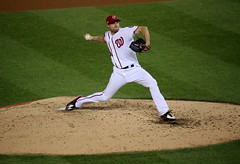
UNicorn photoThe “prelims” are over and we’ve got our match up for the Main Event – the Astros versus the Nationals in the World Series.  As I contemplate the rosters of this pair of worthy opponents, I am led to wonder if, in the coming days, we will see that increasingly rare “unicorn” – a World Series complete game.  After all, we are looking at some quality starting pitchers in Justin Verlander, Gerrit Cole and Zack Greinke on one hand and Max Scherzer, Stephen Strasburg and Patrick Corbin on the other.  They have six Cy Young Awards among them – and, in 2019, this group won a combined 102 games (just 36 losses), put up a 2.75 earned run average and 1,547 strikeouts in 1,228 innings pitched.

Still, they only tossed a total of three complete games in 2019 (two by Verlander and one by Corbin) and the era of the complete-game pitching performance does seem to have passed us by. If  I had to pick the most likely source for a complete game in the upcoming Series, I go: 1) Justin Verlander (due to his two complete games this past season); 2) any one of the Nationals’ big-three starters (the Nationals’ MLB-worst 5.66 bullpen earned run average provides an incentive to let the starters go long).  Still, I’m not optimistic about a nine-inning outing.

In this post, I’ll take a look at how the World Series has changed when it comes to complete games, as well as at a handful of pitchers who have the distinction of tossing three complete-game victories in a single World Series (under the current best-of-seven format).

But, first, the back story on why Fall Classic complete-games are of notable interest to me.

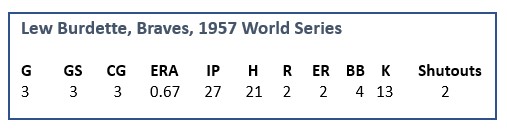
When the Braves moved from Boston to Milwaukee in 1953, I was a six-year-old Milwaukee native.  My boyhood heroes made it to the World Series against the vaunted Yankees in 1957 – the first World Series I followed with a hometown passion.  The hero of that Braves’ World Series Championship?  Hank Aaron? Eddie Mathews? Warren Spahn? None of the aforementioned.  Or looking to the other dugout, Mickey Mantle, Yogi Berra or Whitey Ford?  Nope. It was Braves right-hander Lew Burdette, who earned three complete-game victories (two shutouts) in the Series – giving up a total of two earned runs in 27 innings.  (More on Burdette later in this post.)

Fast forward to 1965 – and the first World Series I ever attended (Game Six).  I was living in Minnesota by this time and rooting for the Twins to top the Dodgers.  It wasn’t to be.  The Dodger won four games-to-three. Notably, the winning pitcher in each game threw a complete game.  

Now, jump ahead t0 1991, when I was in the stands when Jack Morris threw a ten-inning, complete-game shutout to top the Braves 1-0 in Game Seven – and give the Twins the championship.

So, there’s a bit of an explanation for my “old school” fascination with World Series’ complete-games.

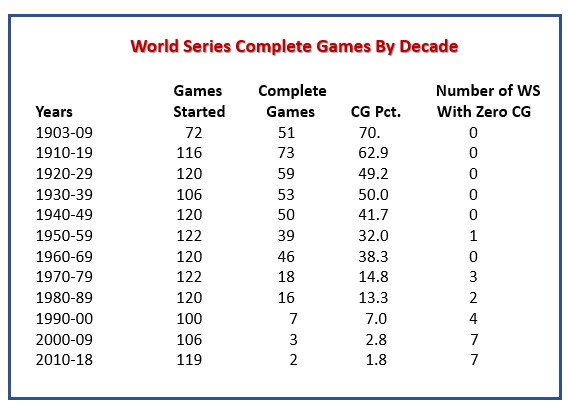
While complete games in the Fall Classic have declined fairly steadily over the decades, the most notable drop began in the 1970.  Consider that:

  • The first World Series without at least one complete game didn’t occur until 1959 – and that was the only World Series without a complete game between 1903 and 1972;
  • Since 1972, we’ve seen 23 World Series that did not have a single complete game;
  • The most recent World Series complete game came on October 28, 2015 – when the Royals’ Johnny Cueto threw a nine-inning two-hitter (one runs, three walks, four strikeouts) in topping the Mets 7-1;
  • Since 1996 (23 World Series, 129 games), there have been just three complete games (remember, old Lew Burdette had that many in one seven-game Series);
  • The percentage of World Series starts ending in a complete game has dropped (by decade) from just over 70 percent in the 1900’s to just over 38 percent in the 1960’s to less than two percent thus far this decade.
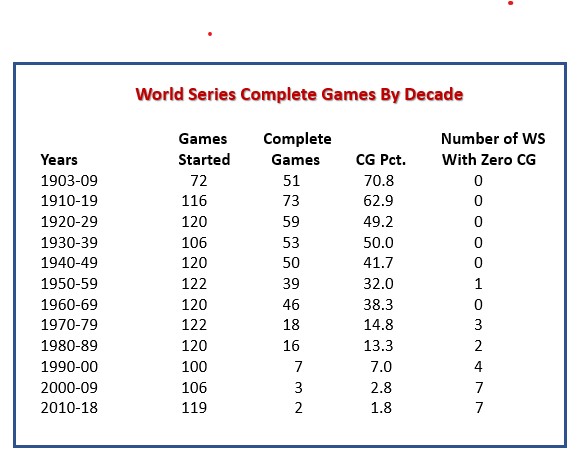
WSCG

Now, let’s move on to pitchers who have earned three complete-game victories in a best-of-seven World Series – and a couple of honorable mentions, which I think is better than an asterisk.


—PITCHERS WITH THREE COMPLETE-GAME VICTORIES

IN A BEST-OF-SEVEN WORLD SERIES—

Christy Mathewson, New York Giants … 1905 World Series

cHRISTY Mathewson photo

Photo by trialsanderrors

It makes sense that a big name would head this list.  The first pitcher to record three complete-game wins in a best-of-seven World Series was Hall of Famer Christy Mathewson.

By the time, Mathewson took the mound against the Athletics in the 1905 World Series, he was pretty much already a “Giant” in more ways than one. He had just completed his sixth MLB season (fifth full season) and had a 128-71, 2.08 career record. He had won 30 or more games in each of the past three seasons – leading the NL with 31 wins (9 losses), a 1.28 earned run average, eight shutouts and 206 strikeouts during the 1905 regular season.

All five games of the 1905 World Series featured a shutout by the winning team.

A great season for Mathewson, but even greater things were coming – as Mathewson was about to become the first (and still only) MLB pitcher to throw three complete-game SHUTOUTS in a single World Series.

In Game One (October 9), it was the Giants’ Mathewson versus 24-game winner Eddie Plank (also a future HOFer) in Philadelphia.  Both starters went the distance, with Mathewson tossing a four-hit, no-walk, six-whiff shutout – and Plank giving up three runs on ten hits and two walks.

Game Two (October 10 in New York) ended by the same 3-0 score, this time with the Athletics on top – behind a complete-game, four-hitter from Chief Bender, another future Hall-of-Famer

On October 12, Mathewson was back on the bump for Game Three (in Philadelphia) and cruised to 9-0 win – tossing a second four-hitter (one walk/eight strikeouts), The Athletics left Andy Oakley (18-8, 1.84 on the season) in for the entire nine frames (only three of the nine runs he surrendered were earned, thanks to four Philadelphia errors).

Christy Mathewson played baseball, football and basketball for Bucknell University – and also was in the band, glee club and a pair of literary societies. A well-rounded fellow indeed.

Then it was back to New York for Game Five (October 13). Plank was back on the mound for the Athletics and once again got zero support – losing 1-0 (the only run unearned), as the Giants’ Joe McGinnity (another future Hall-of-Famer (tossed a five-hit shutout).

Mathewson won the final game (October 14) before a home crowd, beating the Athletics 2-0 – and tossing his third shutout in six days, this one a five-hitter (no walks/four strikeouts).
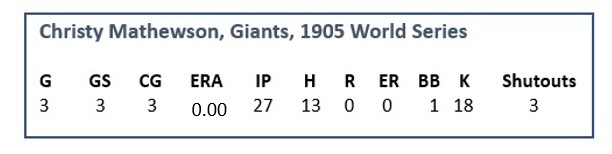
Mathewson went on to a 17-season MLB career, picking up 373 wins (188 losses). He led his league in victories four times and won 20 or more games 13 times (30+ four times). He also led his league in ERA five times; shutouts four times; strikeouts five times; complete games twice; and, retroactively, saves once.

Charles “Babe” Adams, Pittsburgh Pirates …. 1909 World Series
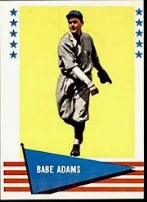
AdamspBabe Adams was still officially a rookie in 1909, when his Pittsburgh Pirates faced off against the Detroit Tigers in the World Series. (In 1906-07, he had appeared in a total of five MLB games – going 0-3, 7.96, with 26 innings pitched.)  

Adams debuted with the Cardinals, but was sold to the Pirates at the end of the 1907 season.  He got in just four games for the Pirates as the season wore down and started (and finished) the 1908 season with the American Association Louisville Colonels. He flourished at Louisville – going 22-12 for the American Association Louisville Colonels in 1908. With Louisville he cemented a reputation for exceptional control, walking just 40 batters in 312 innings.

In 1909, Adams made it back to the big leagues.  In his first full MLB season, he went 12-3, with a 1.11 earned run average in 25 games and 130 innings pitched (12 starts/seven complete games). The 5’ 11”, 185-pound, 27-year-old righty was a surprise starter in Game One of the Series, based on his exceptional control and strong finish to the season. (Moving from primarily a reliever to a starter in late August, Adams’ final eight appearances were starts and he went 4-2 with five complete games and two shutouts.)

In the opening game of the Series (October 8), Adams went the distance, tossing a six-hitter (one run, four walks and two strikeouts, as the Pirates prevailed (in Pittsburgh) 4-1.  The Tigers bounced back to win Game Two (October 9) by a 7-2 score, knocking Pirates’  25-game winner Howie Camnitz out of the game in the third inning.

Moving to Detroit, Pittsburgh won Game Three 8-6 and the Tigers took Game Four 5-0 – knotting the Series at two games apiece.

On October 13, Adams was back on the mound in Pittsburgh. Although not as effective as in Game One, Adams went the distance, giving up four runs (three earned) on six hits, while walking one and fanning eight. It was good enough for the win, as the Pirates plated eight runs.

On July 17, 1914, Babe Adams pitched a 21-inning, complete game – without issuing a single walk.  It remains the longest walk-free complete game ever pitched.  Unfortunately, Adams and his Pirates lost 3-1 to the Giants. Giant’s starter Rube Marquard also went the distance, giving up one run on 15 hits.

Detroit tied the Series at 3-3 with a 5-4 win on October 14, which set the stage for Adams’ best game of the Series.  On October 16, he tossed a six-hit shutout (one walk/one whiff), as Pirates won the game and the Series by an 8-0 score.

Adams went on to a 19-season MLB career – putting up a 194-140, 2.76 record, completing 205 of 354 starts and walking just 430 batters in 2,995 1/3 innings. He won 15 or more games in five seasons and was a twenty-game winner twice.
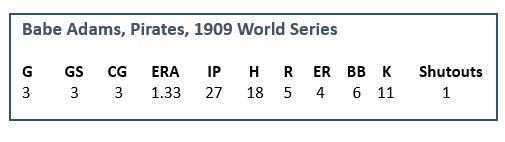
Adams

Jack Coombs, Philadelphia Athletics … 1910 World Series
Right-handed hurler (and switch-hitter) Jack Coombs was in his fourth MLB season when he picked up three complete-game wins in a single World Series.  And the season itself might have been a bit of a surprise.  Going into the 1910 campaign, the 27-year-old Coombs had a four-season MLB line of 35 wins, 35 losses and a 2.45 ERA.

He put it all together in that 1910 season, leading the AL with 31 wins (nine losses), as well as with 13 shutouts.  He three 35 complete games in 38 starts and had a minuscule 1.30 ERA.

Now, you might have expected Coombs to draw the October 17 start (against the Cubs in Philadelphia) in Game One of the Series, particularly since the Athletics were without veteran started Eddie Plank (arm issues).  Philadelphia chose to go with the more experienced Chief Bender (who himself had gone 23-5, 1.58 on the season) over Coombs – and the decision paid off.  Bender shut down the Chicago squad, giving up one run (unearned) on three hits, with two walks and eight strikeouts.  The following day, Coombs pitched the Athletics to a 9-3 win, giving up three runs on eight hits.  It wasn’t exactly a sterling effort – as he also walked nine and had to pitch out of a lot of trouble.

The problems Coombs faced in Game Two didn’t seem to bother the Athletics, as Coombs was back on the mound (October 20 in Chicago) with just one day’s rest.  It was another rocky – but successful – outing. Coombs surrendered three runs over the first three innings (scored tied at 3-3).  Then the Athletics plated five in the top of the fourth and Coombs settled down. He went the distance again, giving up five runs on seven hits and four walks (eight strikeouts) in a 12-5 Philly victory. In this game, Coombs had three hits and three RBI of his own.

Bender went the distance in a losing effort in Game Four – falling 4-3 in ten innings.

It was back to Coombs for Game Five (October 23 in Chicago) and he finally turned in the kind of performance you’d expect from a pitcher with a season ERA south of 2.00. He gave up just two runs (although he did allow nine hits and a walk) in topping the Cubs 7-2. Notably, it was tense game, standing at 2-1 in Philadelphia’s favor until the Athletics explored for five runs in the top of the eighth.

To top off his three complete-games win, the switch-hitting Coombs went five-for-thirteen (.385) at the plate, with a double and three RBI.

Jack Coombs was an all-around athlete (and scholar). Before going to the major leagues, he earned a degree in chemistry from Colby College – where he was on the baseball, football, track and tennis teams.

Coombs pitched in 14 major league seasons, going 158-110, with a 2.78 ERA. In the three seasons from 1910 through 1912, he won 80 games (31 losses) and put up a 2.64 ERA, A bout with typhoid fever in in 1913 dampened his overall career stats.  (Coombs pitched in only four games in 1913-15 and was 43-44, 3,29 from 1913 until his retirement in 1920.)
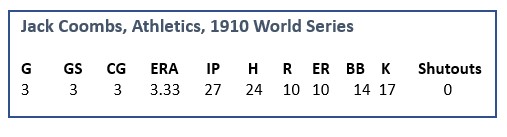
Coombs

A Shout Out to a Near-Qualifier

Okay, let’s keep in mind that, from 1903 to the present day, the World Series has been a best-of-seven format in most seasons.  The 1920 World Series, however, was a best-of-nine affair.  Future Hall-of-Famer Stan Coveleski earned complete-game victories (for the Indians over the Brooklyn Robins) in Games One, Four and Seven. However, had the series been a best-of-seven, Game Seven would not have been played (the Indians went into the contest up four games-to-two.)  Still, Coveleski deserve some attention here.,

Coveleski was six seasons into his 14-campaign Hall-of-Fame career when he threw his three complete-game wins in the 1920 World Series. He won 20+ games in each of three previous seasons and had gone 24-12, 2.49 in 1920.

In Game one of the Series (October 5 in Brooklyn), Coveleski earned a victory over Rube Marquard (another future HOFer), by a 3-1 score, tossing a nifty five-hitter (one walk/three strikeouts). Coveleski faced off against the Dodgers Leon Cadore in Game Four (October 9 in Cleveland), with the Indians down two games-to-one. He came through again, giving up just one run (five hits, one walk, four strikeouts) in a complete-game 5-1 win.

Coveleski’s number came up again on October 12 (Game Seven), with the Indians up four games-to-two. This time, he tossed a complete-game, five-hit shutout – topping the Robins and future Hall-of-Famer Burleigh Grimes 3-0.

Coveleski pitched in 14 MLB seasons, going 215-142, 2.89 – winning 20 or more games in five campaigns.,

Lew Burdette, Milwaukee Braves … 1957 World Series
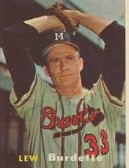
BurdettePPretty much everybody – except those of us in Milwaukee – figured the Yankees would top the Braves in the 1957 World Series.    Consider, as the Series opened, in my lifetime (I was born in 1947), the Yankees had won nine AL pennants and seven World Series championships  in eleven years.  My Milwaukee Braves? They were the recently (1953) relocated Boston Braves. Enough said. It was Beertown versus the Big Apple.  Few prognosticators gave the boys from Sudsville much of a chance.

Prospects looked even dimmer when Braves’ ace (and future HOFer) Warren Spahn (who had led the NL in wins that season with 21 and already had eight seasons of 20 or more victories) lost to the Yankees and (future HOFer) Whitey Ford 3-1 in the opening game (in New York). Game Two matched the Yankees’ Bobby Shantz (11-5, with an AL-best 2.45 ERA) versus the Braves’ Lew Burdette (who had gone 17-9. 3.72 on the season).

Lew Burdette had originally signed with the Yankees and made his debut with the New York club in 1950 – pitching just 1 1/3 innings in two appearances.  Remember the old “Spahn and Sain and pray for rain” refrain for the Boston Braves. Well, Burdette broke that up, being traded from the Yankees to the Braves (along with $50,00) for Johnny Sain in August of 1951.

In Game Two of the Series (October 3), Burdette stifled the Yankee attack, winning 4-2 and pitching a complete game, seven-hitter (three walks/five whiffs). As it turned out that would be the “worst” game of Burdette’s 1957 post-season.

Game Three (October 5) saw the teams move to Milwaukee, where the Yankees pasted the upstart Braves 12-3. Don Larsen got the win, Bob Buhl the loss. Spahn (21-11, 2.69) was matched against Tom Sturdivant (16-6, 2.54) in Game Four (October 6 in Milwaukee). Spahn went the distance in a 7-5 ten inning Braves’ win; with the winning blow a two-run home in the bottom of the tenth by Eddie Mathews.

With the series now tied at two games apiece, Game Five (October 7 in Milwaukee) saw Burdette having to face Yankees’ ace Whitey Ford. It was a duel for the ages. Burdette went the distance in a 1-0 win, giving up just seven Yankee safeties, walking no one and fanning five.  Ford gave up one run on six hits and walk in seven innings – with the only run being scored by Mathews (on a Joe Adcock single in bottom of the sixth).

The Yankees evened the series in Game Six (October 9 in New York), edging the Brave 3-2 – setting up the finale (October 10), with Burdette (on two-day’s rest) facing Larsen. Burdette did not disappoint the Milwaukee fans. He threw his third complete game and second consecutive shutout of the Series – topping the Yankees 5-0 and giving up seven hits and one walk, while fanning three.
Burdette

Burdette enjoyed an 18-season MLB career (203-144, 3.66). He was a two-time All Star and two-time twenty-game winner. He also led his league in wins once, ERA once, complete games once, and shutouts twice. His best season was 1958 (20-10, 2.91) – but his most notable accomplishment was bringing Milwaukee its first World Series Championship.

Bob Gibson, Cardinals, 1967 World Series
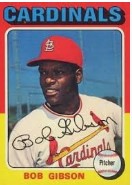
GibsonPIt was the year before the Year of the Pitcher, but Bob Gibson was already an imposing presence on the mound – a f0ur-time All Star, with a 125-88, 3.12 record and a reputation for taking no prisoners. Further, despite suffering a broken leg in mid-July that put him out of action until early September, Gibson was the logical choice to start Game One of the 1967 Series.  The fact is, he was tougher after the injury than before. When he went down (it was a Roberto Clemente line drive off his leg), Gibson was 10-6, 3.52. After returning from the fracture, Gibson went 4-1, with a microscopic 0.96 in five September starts. On the season, he was 13-7, 2.98.  He was clearly ready.

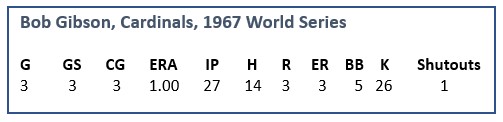
Gibson proved his worthiness in Game One (October 4 in Boston), topping Jose Santiago and the Red Sox in a nail-biter.  The final was 2-1 and Gibson threw a complete-game six-hitter, with one walk and ten strikeouts.

Gibson was back on the mound for Game Four (October 8 in St. Louis), with the Cardinals up two games-to-one. (Boston’s Jim Lonborg threw a nifty one-hit shutout in Game Two and the Redbirds came back to win 5-2 in Game Three.) In the fourth game, Gibson followed Lonborg’s lead, tossing complete-game shutout of his own (five hits, one walk, six strikeouts), as the Cardinals prevailed 6-0.

The Red Sox bounced back to win Game Six by an 8-4 score, setting up a match that fans had been waiting for – Gibson versus Lonborg in a winner-take-all Game Seven. Unfortunately, the anticipated pitching duel didn’t materialize.  The Cardinals were up 4-1 after five frames and Gibson coasted to a 7-2 win, tossing his third complete game of the series (three hits, three walks, ten K’s).

Bob Gibson played college basketball for Creighton and spent a season with the Harlem Globetrotter before starting his baseball career.

Gibson made the Hall of Fame after a 17-season MLB career in which he was an All Star nine times and won 20 or more games five times. He led the NL in wins once; ERA once; complete games once; shutouts four times; and strikeouts once.  He ended his career at 251-174, 2.91, with 3,117 strikeouts in 3,884 1/3 innings.
Gibson

In 1968, the Year of the Pitcher, Bob Gibson went 22-9, with an MLB-best 1.12 ERA; MLB-tops 13 complete game shutouts; and an NL-best 268 strikeouts. He was the National League Cy Young Award winner and Most Valuable Player.

In June/July of that season, Gibson started 12 games, completed and won all 12, threw eight shutouts and put up a 0.50 ERA.

Mickey Lolich, Detroit Tigers … 1968 World Series
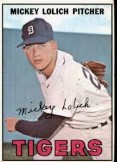
olichpLike Lew Burdette earlier on this list, Mickey Lolich was not the “ace” of his staff.  For Burdette (in 1957), of course, that was Warren Spahn.  For Lolich, and the 1968 Tigers, that was Denny McLain, who was the Pitcher of the Year in The Year of the Pitcher – going 31-6, 1.96 and winning the AL Cy Young and MVP Awards.  Lolich had been no slouch, going 17-9, 3.19; but clearly, the match up between the Cardinals’ Bob Gibson (who would win the Cy Young and MVP in the National League) and McLain was the pre-series choice as the main attraction.

Gibson got the best of it in Game One, shutting out the Tigers (and beating McLain) in St. Louis by a 4-0 score (October 2). Game Two (October 3) featured Lolich versus the Redbirds’ Nelson Briles (19-11, 2.81) – and Lolich went the distance, throwing a complete-game six-hitter (two walks/nine whiffs) in an 8-1 win.

The Series moved to Detroit with the Cardinals taking Game Two (October 5) and Game Three (October 6) 10-1 in another Gibson/McLain match up.

Down three games to one, The Tigers went back to Lolich (again facing Briles) for Game Five (October 7 in Detroit). Lolich delivered his second complete-game win 5-3 (nine hits, one walk, eight strikeouts.) McLain finally sparkled in Game Six, as the Tigers tied the Series 3- 3 winning 13-1 behind McLain’s complete-game (one-run on nine hits, no walks, with seven strikeouts.)

Lolich got his third start of the Series in Game Seven (October 10 in St. Louis) and had his best outing of the Fall Classic – topping Gibson and the Cardinals 4-1 with a complete game five-hitter.
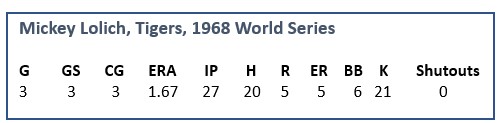
Lolich

Lolich pitched 16 seasons in the major leagues, going 217-191, 3.44, with 2,832 strikeouts in 3,638 1/3 innings pitched. He was a three-time All Star and won 20+ games in a season twice.  He led his league in wins once, complete games once, innings pitched once and strikeouts once.  In 1971, he went 25-14, 2.92 with an AL-leading 308 strikeouts – but finished second in the Cy Young Award voting to Vida Blue 24-8, 1.92, 301 whiffs.

The 1903 World Series – Sixteen Starts, 13 Complete Games

When the Boston Pilgrims (AL) faced off against the Pittsburgh Pirates (NL) in the first-ever AL/NL World Series, the Fall Classic (not yet a classic) was a best-of nine affair.  That first Series went eight games, with Boston winning five. In the process the MLB, AL and NL records for complete games in a single World Series (of any length) were set.

The Pirates’ Deacon Phillipe (25-9, 2.43) started and completed five games (in ten days), going 3-2, 2.86.  Phillipe still holds the MLB and NL records for complete games in a single World Series. Boston’s Bill Dinneen (21-13, 2.26) set and still holds the AL record with four complete games (in four starts) – going 3-1, 2.06.

Cy Young, by the way, started and completed three games in the Series – going 2-1, 1-85.

Phillipe enjoyed a 13-season MLB career, compiling 189 wins (109 losses) and a 2.59 ERA. He won 20 or more games in five seasons, Dinneen’s MLB career lasted 12 seasons (170-177, 3.01) and he won 20 or more games in four campaigns.

Primary Resources: The World Series, Sports Products, Inc.; Baseball-Reference.com; ESPN.com


BASEBALL ROUNDTABLE ON THE TOP 100 BASEBALL BLOG LIST

100Baseball Roundtable is on the Feedspot list of the Top 100 Baseball Blogs.  To see the full list, click here.

I tweet baseball @DavidBBRT

Follow/Like Baseball Roundtable’s Facebook Page here.  More baseball commentary; blog post notifications; PRIZES.

Member: Society for American Baseball Research (SABR); The Baseball Reliquary; The Negro Leagues Baseball Museum.
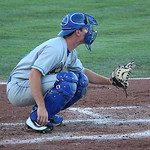
Baseball Roundtable 2019 All-Rookie Team … led, of course, by Pete Alonso

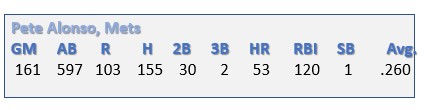
There doesn’t seem to be a whole lot of suspense surrounding this year’s MLB Rookie of the Year Awards.  Pete Alonso of the Mets not only set a new rookie record for home runs in a season with 53 long balls, but also led all MLB rookies in runs scored (103) and RBI (120).  Game. Set. Match.

In the AL, Yordan Alvarez of the Astros appears to hold sway, with a .313-27-78 season. His closest competition is likely to come from Eloy Jimenez, who put up a .267-31-79 line.  Alvarez’ .300+ average and the fact that he put up his numbers in 35 fewer games than Jimenez, makes the Astro the favorite.

Given that situation, Baseball Roundtable decided to go a little deeper into the rookie class.  Here is BBRT’s 2019 All-Rookie squad. Spoiler:  If you scroll down to the final members of this squad, you’ll find its oldest and least likely member. Also, for you Minnesota readers, that final selection had deep Minnesota ties (Brainerd High, St. Cloud State and the Twins). 

—–BASEBALL ROUNDTABLE 2019 ALL-ROOKIE TEAM—–

Catcher – Will Smith, Dodgers

The 24-year-old Smith, a first-rounder in the 2016 MLB draft (32nd overall), put a .253-15-42 line in 54 games – and was also solid defensively.  He was called up in late May, hitting .269-3-6 in nine games before being sent back down (late June) to Oklahoma City, where he earned a spot in the Triple-A All Star Game. Smith was called back up in late July and took over the regular catching duties for the post-season-bound Dodgers, hitting .318-9-25 in his first twenty games (after the call up).

Side note.  It has been speculated that the Dodgers are interested in Giants’ reliever Will Smith (6-0, 2.76 with 34 saves).  Now, that’s a battery I’d like to see.  If they were in LA, perhaps actor Will Smith could be in the stands.

Will Smith

Will Smith played college ball at the University of Louisville.  In his final college season (as a Junior), he hit .382-7-43 in 55 games.

First Base, Pete Alonso, Mets

Pete Alonso photo

Photo by slgckgc

The 24-year-old Alonso looks like a power threat (6’ 3”, 240-pounds); and hits like one. He played in 161 games in his rookie campaign.  He used those 161 contests to set a new rookie-season record for home runs with 53; leading all of MLB in 2019 long balls.  Alonso also led all rookies in hits (155), runs scored (103) and RBI (120). He was the only 2019 rookie to reach 100 runs scored, as well as the only 2019 freshman to reach 100 RBI.  In three minor league campaigns, Alonso hit .290-59-203 (255 games).

Freshman seasons seem a charm for Alonso. At the University of Florida, he made the 2014 All-Southeastern Conference Team in his freshman season. He was drafted (Mets) in the second round of the 2016 MLB Draft.


Alonso

With 53 home runs, 30 doubles and two triples, 54.8 percent of all Pete Alonso’s hits were for extra bases – and just over one of every three of his safeties left the ball park.

Second Base, Keston Hiura, Brewers

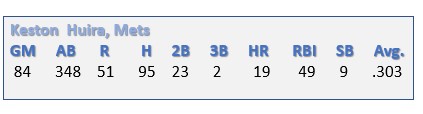
There was some tough competition among rookies at the keystone sack.  The Twins’ Luis Arreaz showed pure hitting skills – .334 average in 92 games; more walks (36) than strikeouts (29).  The Pirates’ Kelvin Newman showed multiple tools – .303-12-64, with 16 steals in 130 games.  But this spot goes to the Brewers’ 22-year-old second baseman Kelvin Hiura, who played in 84 games and put up a .300+ average (.303); showed the most power of the three contenders (19 home runs); drove in just five fewer runs (in 46 fewer games) than Newman; and flashed some speed (nine steals).

Hiura was a 2017 first-round draft pick out of the University of California, Irvine (ninth pick overall). In three college seasons, he averaged 55 games played, 7.3 home runs, 45 RBI – with a .375 college career average.  In three minor league seasons, he hit .317, with 36 home runs, 122 RBI and 24 steals in 222 games.

Huira Keston Hiura was the 2017 Big West Conference Player of the Year, after hitting .442-8-42, with nine steals in 56 games for U.C. Irvine.

Third Base, Tommy Edman, Cardinals

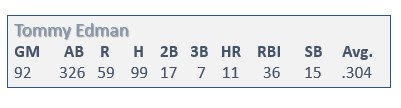
Edman was a 2016 sixth-round draft pick (Cardinals) out of Stanford – where he hit .281, with four home runs, 71 RBI and 15 stolen bases over three seasons (168) games. In 2017, he played at A, High-A and Double-A, going a combined .261-5-55 with 13 steals (119 games).  Edman found his stroke in 2018, hitting .301-7-41, with 30 steals, at Double- and Triple-A.  The 24-year-old was again a hitting over .300 when called up from Triple-A Memphis in June – and he just kept on hitting (.304) and running (15 steals in 16 attempts) at the major-league level.  He also showed a bit of unexpected power, with 11 home runs in 92 games for the Redbirds.  Edman’s versatility worked in his favor. He appeared at third base, second base and all three outfield spots for the Cardinals.

Edman edged out an early season Rookie of the Year favorite – Vlad Guerrero, Jr., – who went .272-15-69 in 123 games (in a season limited by injuries).  Had he stayed healthy Guerrero might have captured this spot.  It was very close.

Edman

Tommy Edman had a successful year on the base paths in 2019 stealing nine bases in nine tries at Triple-A Memphis and swiping 15 bags in 16 tries for the Cardinals (a combined 96 percent success rate).

Shortstop, Fernando Tatis, Jr. Padres

Tatis was signed, by the ChiSox, as a 2015 International Free Agent (Dominican Republic) – and traded to the Padres before he ever took the field as a pro. (He was only 17 at the time.)  That might have been an “Oops” moment for the White Sox.

Before the 2019 season opened, Tatis was listed as a top-three prospect by MLB Pipeline; ESPN; Baseball America; and Baseball Prospectus.  In four minor league seasons, Tatis hit .280-42-143, with 64 steals (276 games).  After his call up to the Padres – AT JUST 20-YEARS-OLD – Tatis raked at a .317-22-53 pace, with 16 steals (84 games) and played plus defense.  Tatis did have some competition at this spot, the Blue Jays’ Bo Bichette hit .311-11-21 in 46 games – and set a new MLB record by collecting at least one two-base hit in nine straight games (and he set that record in just his 11th MLB game).  Bichette just didn’t have enough games under his belt to unseat Guerrero.

Tatis

Fernando Tatis, Sr. set the bar high.  He is the only player to hit two Grand Slam home runs in one inning (April 23, 1999).  Fernando Tatis (The Elder) had an 11-season MLB career (.265-113-448). His best season was 1999, when he hit .307-34-107 for the Cardinals.  All of Senior’s marks seem well within Junior’s reach (and then some).

Rookleaders

Outfield, Yordan Alvarez, Astros

Alvarez, who defected from Cuba in 2016, was signed by the Dodgers as an International Free Agent that June – and, just two months later, traded to the Astros (for reliever Josh Fields).  Then just 19- years-old, Alvarez immediately showed his potential, hitting .341 with the Dominican Summer League Astros in his first pro assignment.  In four minor league campaigns, Alvarez hit .311, with 56 home runs and 218 RBI in 250 contests.

After his June 9 call up, the 22-year-old Alvarez: homered in his first two games; homered four times in his first five games; drove in 16 runs in his first 12 games; and drove in 51 runs in his first 45 games.  After his first dozen major league games, his stat line was .333-7-16, with 12 runs scored. Alvarez ended the season at .313-27-78 in just 87 games.  He’s the cream of the rookie outfield crop.

AlvarezAt the time of 2019 MLB call up, Yordan Alvarez was hitting .343-23-71 with the Pacific Coast League (Triple-A) Round Rock Express (56 games).   He also had a solid walks-to-strikeouts ratio (38 walks/50 whiffs).

Outfield, Eloy Jimenez, White Sox

Jimenez was signed in 2013 (out of the Dominican Republic) as an International Free Agent – and traded to the White Sox in July of 2017 – a great power pickup for the ChiSox.  In four seasons in the Cubs’ system, Jimenez hit .297, with just 24 home runs and 141 RBI (211) games, but his final season as a Cub farmhand (2016) showed his potential, as the then 19-year-old hit .329-14-81 in 112 games at A-Level South Bend (Midwest League).  That potential was not lost on the crosstown White Sox.

As a White Sox farmhand, Jimenez went .312-19-65 in 89 games at A and Double-A in 2017; and .337-22-75 in 108 games at Double- and Triple-A in 2018. In his rookie MLB season, the 22-year-old popped 31 home runs and drove in 79 tallies in 122 games.  His average was only .267, but history seems to point to better things to come in that department.

Jimenez

Eloy Jimenez’ 31 home runs led all American League Rookies, as did his 79 RBI.

Outfield, Bryan Reynolds, Pirates

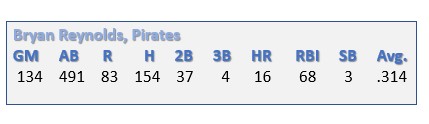
Reynolds was a 2016 second-round draft pick (Giants) out of Vanderbilt; where he hit .329-22-159, with 39 steals over three seasons (206 games). In January 2018, he was included in the trade to the Pirates that brought Andrew McCutchen to San Francisco.  In two minor league seasons in the Giants’ system, Reynolds had gone .312-16-101 in 177 games.  He kept on hitting in the Pirates’ farm system and earned his way to the big club in 2019 – where the 24-year-old went .314-16-68 in 134 games – and spent much of the season as part of the NL batting race.

Reynolds

Bryan Reynolds started his MLB career with an eleven-game hitting streak. Over the course of the streak, he went 15-for-36 (.417), with six doubles and a home run.

BBRT Note:  I’m not selecting a DH – these players are too young to DH (just my opinion). If you want one. however, feel free to choose from Louis Arreaz, Kelvin Newman, Vlad Guerrero, Jr. or Bo Bichette (all mentioned in the position-player text above).

Starting Pitcher, Mike Soroka, Braves

Soroka was drafted by the Braves (out of Bishop Carroll High School) in the first round of the 2015 Amateur Draft.  As a 17-year-old, he went 0-2, with a solid 3.18 ERA at the Rookie-League Level. The following year he went 9-9, 3.02 at A-Level.  Moving up consistently, 2017 saw Soroka going 1-8, 2.75 at Double-A. In 2018, in a season interrupted by shoulder issues, he went 2-1, 1.76 at A and Triple-A – and earned a late season call up to the Braves (where he went 2-1, 3.51 in five starts).

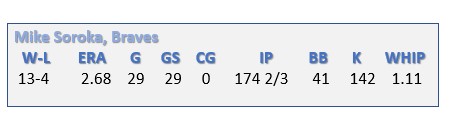
In 2019, Soroka went 13-4, 2.68 ion 29 starts for the Braves – fanning 142 batters (41 walks) in 174 2/3 innings.

Dakota Hudson deserves a shout out here. The 24-year-old Cardinals’ rookie led all rookie hurlers with 16 wins (seven losses), but his overall numbers (3.35 ERA, six fewer strikeouts and 45 more walks than Soroka in the same number of innings) left him as runner-up.

Soroka

Rookie Mike Soroka made the 2019 National League All Star Team. He was 9-1, 2.42 at the break.

Relief Pitcher, Nick Anderson, Marlins/Rays

Ah, for BBRT’s Minnesota readers, the choice for rookie reliever played for Brainerd (MN) High School and St. Cloud (MN) State University – before transferring to Mayville State University (ND) for his senior season (in which he went 5-2, 1.95).

Nick Anderson is the oldest (28) and most surprising member of the BBRT All-Rookie Team.

Anderson was selected by the Brewers in the 32nd round of the 2012 MLB draft, but did not sign. Instead, he decided to play in the Independent Leagues.  Things did not start out very promising.  In two seasons (2012-13) for the Rockford Riverhawks of the Frontier league, he went 6-14, 6.78  as a starter. Then, in 2015, as a reliever with the Frontier League Frontier Greys, he put up a 0.65 ERA over 25 appearance.  He signed with the Minnesota Twins in August of 2015 and got in nine games at Cedar Rapids of the A-Level Midwest League, putting up a 0.75 ERA, saving four games and fanning 12 batters (no walks) in 12 innings.

In  2016, he continued to show his stuff – going 4-3, 2.65, with 13 saves and 75 whiffs in 57 2/3 innings at A and High-A.  In 2017, Anderson moved up and went 4-1, 1.00, with 57 strikeouts in 54 innings at High-A and Double-A.  In 2018, it was another step up – to Triple-A, where he went 8-2, 3.30 with 88 strikeouts in 60 innings.

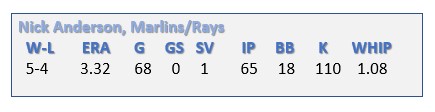
In November 2018, The Twins traded Anderson to the Marlins (for minor-league infielder Brian Schales), which proved a fortunate transaction for Anderson (the Marlins put him on their 40-man MLB roster and he made the team out of Spring Training).  Anderson pitched well for Miami; 2-4, 3.92, with one save in 45 games (69 strikeouts in 43 2.3 innings).  However,  the best was yet to come. Traded to the Marlins at the July 31 deadline, he went 3-2.11 in 23 appearances for the Wild-Card bound Rays. Now it’s a long way from struggling as a starter in the Independent Leagues to taking the mound in the MLB post-season, but Anderson made the journey. He pitched a scoreless 1 1/3 innings (one hit, four strikeouts) in the AL Wild Card Game and made three appearances in the AL Championship Series  (4 1/3 innings, four hits, one run, four K’s).

Anderson

While pitching for the Rays in their drive for a post-season spot, Nick Anderson fanned 41 batters and walked just two in 21 1/3 innings (2.11 ERA, three wins and no losses).

Primary Resources: Baseball-Reference.com; ESPN.com; MLB.com


BASEBALL ROUNDTABLE ON THE TOP 100 BASEBALL BLOG LIST

100Baseball Roundtable is on the Feedspot list of the Top 100 Baseball Blogs.  To see the full list, click here.

I tweet baseball @DavidBBRT

Follow/Like Baseball Roundtable’s Facebook Page here.  More baseball commentary; blog post notifications; PRIZES.

Member: Society for American Baseball Research (SABR); The Baseball Reliquary; The Negro Leagues Baseball Museum.
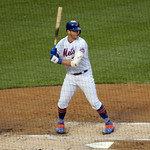
59 Years Ago Today – A Shocker on Baseball’s Biggest Stage

Today (October 13, 2010) marks the 59th anniversary of one of the most exciting World Series games of all time – the Pittsburgh Pirates 10-9, Game-Seven win over the New York Yankees.  It was a victory that got the decade of the sixties off to a great start for me.

HRDLet me set the stage.  There were only 16 major league teams.  If you didn’t finish with ‘the best record in your league, you didn’t get even the slightest taste of the post-season. No one had ever heard of the designated hitter, the wild card, WAR or even WHIP. (For that matter, no one had ever seen a computer mouse, a Ford Mustang, an Etch-A-Sketch or Star Trek – or listened to a Beatles record.)   The news was headed by the Cold War, Space Race, Kennedy-Nixon Debates, Civil Right Movement, Sexual Revolution and Year of Africa. Gunsmoke, Wagon Train and Have Gun Will Travel were the top three TV shows and Home Run Derby was a TV-must in our house – with power hitters, in black-and-white, pairing off at Wrigley Field in Los Angeles.

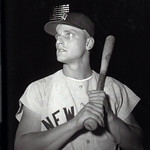
Roger Maris photo

Roger Maris Photo by rchdj10

Babe Ruth still held the MLB single-season home run record – and Roger Maris was about to collect his first AL MVP Award (earned in his first year as a Yankee; after being traded from the Kansas City Athletics).  Ted Williams had just finished his career with a home run in his last at bat, Brooks Robinson was about to collect his first Gold Glove. MLB held two All Star Games. The White Sox had become the first team to put players’ names on uniforms. That season, Warren Spahn had thrown his first no-hitter at age 39 (and won a league-leading 21 games) and 22-year-old Juan Marichal had tossed a one-hitter in his major league debut.

The Pirates’ Dick Groat won the NL batting title and would be named the NL MVP.  Mickey Mantle had led the AL in home runs, Roger Maris in RBIs, Pete Runnels in batting average and Minnie Minoso in base hits.   In the NL, Ernie Banks won the home run crown, Hank Aaron the RBI title and Willie Mays topped the senior circuit in hits.   Don Drysdale and Sandy Koufax finished one-two in the NL strikeout race, while Jim Bunning topped the AL.   Lindy McDaniel of the Cardinals set a new record with 26 saves, while the Tigers’ Frank Lary’s 15 complete games were the lowest ever to lead either league.

This is Getting A Little Old … For the Rest of Us

Going into the 1960 World Series, the Yankees had played in eight of the Worlds Series held in the decade of the 1950’s – winning six of them.  The Pirates had last appeared in the Fall Classic in 1927 and last won it in 1925. 

I was thirteen and an avid baseball fan.  The Game of the Week, the radio – especially the radio – and an occasional trip to the ballpark were my tickets to the national past time.

At the time, the Yankees were baseball’s dynasty.  Since my birth in 1947, the Bronx Bombers had been to 11 World Series (including the 1960 Series, yet to be played) and had won eight World Championships.  Fans from pretty much everywhere but New York had made Yankee-hating a tradition.  I was no exception.  Milwaukee-born, I was a steadfast Braves fan, still smarting from the Yankees’ 1958 World Series comeback, when they downed my Braves after trailing three games to one. The Yankees were in the 1960 Series – and I had an emotional interest in seeing them lose.

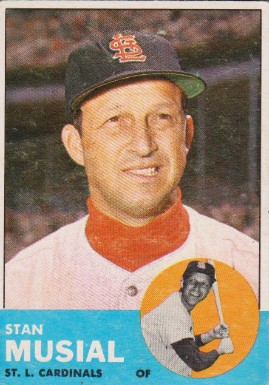
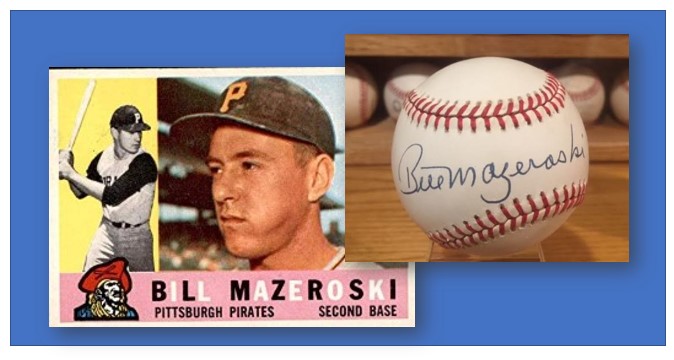
StanMusialBeing of Polish descent, I also took pride in the fact the great Stan Musial was Polish and wondered why Milwaukee-born Hall of Famer Al Simmons had changed his name from Al Symanski.  I was a fan of the sleeveless power hitter Ted Kluszewski, regretted that Tony Kubek (also of Polish descent) played for the Yankees, was rooting for the Pirates’ Bill Mazeroski.  I also was firm in my belief that Steve Dalkowski threw that fastest fastball ever … you can look it up.

Put all of this together and you can see why I looked to the 1960 World Series with excitement – and why I was rooting for the underdog Pirates.

The prognosticators predicted a Yankee win in five or six games.  They pointed out that the Yankees, with a 97-57 record (the Pirates were 95-59-1) came into the Series with the momentum of a 15-game, season-closing winning streak, while the Pirates lost four of their final seven.  They also lauded the Yankees’ post-season experience and heralded the Yankees power (the Yankees led the AL with a record 193 home runs and 746 runs scored, while the Pirates led the NL with 734 runs scored, but only 120 round trippers). The Yankees’ Game-One starting lineup had belted 152 regular season homers to 98 for the Pirates’ starters.  When it came to mound work, things appeared more balanced, maybe even a shade in favor of the Pirates.  While the Yankees’ 3.52 ERA was the lowest in the AL, the Pirates’ NL third-best ERA (at 3.49) slightly bettered the Bombers’ mark.  The Pirates did have the clear advantage in strikeouts (811-712) and fewest walks allowed (an NL low of 386 to an AL worst 609 for the Yankees). They also boasted twenty-game winner Vernon Law (20-9, 3.08), backed up by Bob Friend (18-12, 3.00), while no Yankee starter had topped 15 wins.  The top relievers for the two teams were Elroy Face, with 24 saves for Pittsburgh and Bobby Shantz, who saved 11 for the Yanks.

To the surprise of many fans (and analysts), the Series was tied after six games – despite the fact that the Bronx Bombers had outscored the Pirates 46 to 17, outhit them 78 to 49 and out-homered them 8 to 1.  (The Yankees had won Game Two 16-3, Game Three 10-0 and Game Six 12-0.  The Pirates had prevailed in Game One 6-4, Game Four 3-2 and Game Five 5-2).

Then came Game Seven – 60 year ago today – in Pittsburgh.  Here’s how it went down.

The Pirates were started Vernon Law, 20-9, 3.08 on the season and the winner of Games One and Four.  The Yankees countered with Bob Turley, 9-3, 3.27 on the season.  Turley had won Game Two, despite giving up 13 hits and three walks in 8 1/3 innings.  The Pirates had their top left-handed hitter, Bob Skinner (injured in Game One), back at the number-three spot in the order, while the Yankees were missing Elston Howard (broken finger, Game Six).  An upset did seem possible.

The Yanks went meekly in the top of the first inning (liner, popup, foul out), and the Pirates, homer-less since a Bill Mazeroski blast in Game One, got a two-run homer from Rocky Nelson (whom Manager Gene Murtaugh chose to start at first base over regular Dick Stuart).

In the second inning, Law set the heart of the Yankees down in order – Mickey Mantle, fly to center; Yogi Berra, grounder to third; Moose Skowron, grounder to short.  In the bottom of the inning, manager Casey Stengel appeared to put his managerial position in further jeopardy.  Smoky Burgess started the inning with a single and Stengel immediately pulled Turley in favor of the rookie Bill Stafford (who had stifled the Pirates for five innings in Game Five).  The move did not pay off.  Stafford walked third baseman Don Hoak and Mazeroski beat out a bunt single.  Law was now at the plate (the Pirates’ pitcher was two for four, with a double, run scored and RBI in Games One and Four).  Law hit back to Stafford for a pitcher-to home-to first double play, but center-fielder/lead-off hitter Bill Virdon followed with a two-run single and a 4-0 Pirates lead.

Casey Stengel, despite ten pennants and seven World Series titles in 12 seasons as manager of the Bronx Bombers, was fired by the Yankees five days after the 1960 Game Seven loss to the Pirates. 

Law handcuffed the Yankees through four innings, giving up only two singles.  In the fifth, Yankee first sacker Skowron made the score 3-1 with a lead-off homer just inside the right field foul pole.  Law did not let the round tripper upset him, retiring Johnny Blanchard, Clete Boyer and Bobby Shantz (who came on to pitch for New York in the third) in order.

The Yankees closed the gap – and then some – in the top of the sixth.  The pesky Bobby Richardson (who already had nine hits in the series) led off with a single to center, and Tony Kubek followed with a walk.  With the Bombers appearing on the verge of a rally, Murtaugh replaced Law (who, it turns out had been pitching on a sore ankle throughout the Series) with his top reliever Elroy Face.   Face got Roger Maris on a foul pop to Don Hoak at third base, but Mickey Mantle followed with a “seeing eye” single up the middle, scoring Richardson. Yogi Berra followed with an upper deck home run (like Skowron’s just inside the right field foul pole) to give New York a 5-4 lead in what was shaping up to be a Game Seven nail-biter.

The veteran Bobby Shantz, meanwhile, was baffling the Pirates – giving up only a single and a walk from the third to the seventh innings.

In the top of the eighth, the Yankees seemed to dash the Pirates’ upset hopes – using a walk, two singles and a double to produce two more runs and a 7-4 lead.   Notably, Stengel’s pitching decisions again came into play.  He let Shantz bat with two out and runners at second and third (Boyer and Skowron) and a chance to extend the Yankee lead.  Shantz flied out and the living-room and press-box managers were quick to point out:  1) the lost scoring opportunity; 2) the fact that Stengel left Shantz in for a sixth inning of work, despite the fact that Shantz had not gone more than four innings in the regular season.

So, that was the situation as the game went into the bottom of the eighth – when the Pirates (and Forbes Field) proved they still has some life left in them.  Gino Cimoli pinch hit for Face and stroked a single to right-center field.  Shantz, who had already induced two double plays appeared to have worked his magic again, as Bill Virdon hit a hard ground ball right at shortstop Tony Kubek.  Just as Kubek was ready to field the ball and begin the sure double play, it appeared to hit a pebble (the Yankees had already been critical of the condition of the Forbes Field infield) and ricocheted into Kubek’s throat.  Kubek went down, gasping for air and spitting up blood, with his windpipe rapidly swelling (doctors on the scene at first thought an emergency tracheotomy might be necessary).  The end result?  Kubek sent to the hospital and replaced by Joe DeMaestri and the Pirates with two on and no outs, instead of none on and two outs.

Pirates’ shortstop Dick Groat took advantage of Kubek’s mishap and lined singled to left, scoring Cimoli.  Stengel came to the mound and replaced Shantz with right-hander Jim Coates (despite the fact that lefty Bill Skinner was coming to the plate).  The righty-lefty match-up made little difference, as Skinner sacrificed the runners up one base.  Next was Rocky Nelson, who flied out to medium right, with the Pirates choosing not to test Roger Maris’ powerful arm.   So, two outs, two on and the Yankees still in front 7-5.   That brought up the Pirates’ best hitter, right-fielder Roberto Clemente, who had been held hitless in his first three at-bats. Coates made a good pitch, getting Clemente to hit a weak ground ball toward first.   A hustling Clemente beat both Coates and Skowron’s throw to the bag, while Virdon scored and Groat moved to third.  Now, 7-6 and the Pirates still had life.

Trivia Tidbit:  The seventh game of the 1960 Series is the only World Series game in which neither team recorded a strikeout.

That brought up backup catcher Hall Smith (who had come into the game in the eighth after Joe Christopher ran for starting catcher Smoky Burgess in the bottom of the seventh).   Smith took a 2-2 Coates’ pitch over the left-field wall for a 9-7 Pittsburgh lead.  The Pirates, with only one round tripper in the first six games had homered twice for five runs in Game Seven.

To protect the lead in the ninth (and with Elroy Face already out of the game), Pirates’ Manager Danny Murtaugh called on starter Bob Friend, who had lost Games Two and Six, giving up seven earned runs in six innings (and had pitched in relief only once all season).  Yankee lead off hitter Bobby Richardson started off the ninth with a single to left.  Veteran and former-Pirate Dale Long, pinch hitting for Joe DeMaestri (who had replaced the injured Kubek) singled to right and Friend was gone, replaced by Game Five starter Harvey Haddix.  Haddix got Roger Maris on a foul out, but Mickey Mantle drove in Richardson with a single to right center.   Yogi Berra followed with a ground ball down the first base line.  Rocky Nelson made a nice backhanded stop, but was out of position for a first-to second-to first, game-ending double play.   Nelson took the sure out, stepping on the first base bag and retiring Berra, while Gil McDougald (pinch running for Long) headed toward home.  It was at this point that Nelson realized Mantle had not run to second.  Mantle, sizing up the situation, was returning to first (with the force at second now off). It was an unorthodox base-running move, but as Mantle dove head first back to the bag (avoiding Nelson’s desperate attempt to tag him), McDougald scored the tying run.  Skowron then grounded out to Mazeroski (forcing Mantle) to end the inning in a 9-9 tie.

Mazeroski's 1960 home run trot immortalized at PNC Park.

Mazeroski’s 1960 home run trot immortalized at PNC Park.

Stengel, like Murtaugh, was now using starters in relief, bringing Game Four-loser Ralph Terry in to pitch the ninth.  Number-eight hitter Bill Mazeroski led off the inning.  Terry’s first pitch was a high and inside fastball.  The second pitch, another fastball, was in the strike zone and Mazeroski deposited it over the 406-foot marker in left center.  Not sure the ball would carry out in the deep part of the park, Mazeroski ran full speed with his head down to first and toward second, before seeing the umpire making the circular home run signal.  Mazeroski removed his helmet, waving his way to home plate where his team mates awaited the first player in major league history to end the World Series with a walk-off home run.


maz3


When the Series was over, the Pirates were World Series Champs,

but you could never tell by the stat line.

The Yankees scored a Series’ record 55 runs to 27 for the Pirates,

The Yankees collected a Series’ record 91 hits to 60 for the Pirates.

The Yankees hit a Series record .338 to .256 for the Pirates

The Yankees collected a Series’ record 27 extra base hits to 15 for the Pirates.

The Yankees out-homered the Pirates 10-4.

The Yankees’ pitchers put up a 3.54 ERA to 7.11 for the Pirates.

Bobby Richardson of the losing Yankee squad won the Series MVP award, hitting .367 with a Series’ record 12 RBI.

Primary Resources:  Baseball-Reference.com; Chronicle of the 20th Century (Chronicle Publications). 

BASEBALL ROUNDTABLE ON THE TOP 100 BASEBALL BLOG LIST

100Baseball Roundtable is on the Feedspot list of the Top 100 Baseball Blogs.  To see the full list, click here.

I tweet baseball @DavidBBRT

Follow/Like Baseball Roundtable’s Facebook Page here.  More baseball commentary; blog post notifications; PRIZES.

Member: Society for American Baseball Research (SABR); The Baseball Reliquary; The Negro Leagues Baseball Museum.
Baseball Roundtable Trivia Teaser … Leaning Toward the Long Ball

Baseball Roundtable – still smarting from yesterday’s Twins loss to the Yankees –  decided to look back further for today’s post.  I decided to ease my distress (and prepare for Game Two) with a Trivia Teaser focusing on foriegn-born home run champs. (This was partially due to the fact that the Twins led the American League in foreign-born players on their 2019 Opening Day Roster and all three Twins who homered yesterday were foreign-born – Jorge Polanco, Nelson Cruz, Miguel Sano. Also, ultimately, I am a “homer” at heart.)  By the way, if you are interested in a deeper look at: 1) the percentage of foriegn-born players (by country) on 2019 Opening Days rosters; 2) the major presence of players from the Dominican Republic in MLB; and the Twins’ and Pirates’ foriegn-born Opening Day Roster players (each had an MLB -leading 14) – click here for BBRT’s April post on the topic.  Anyway, as I checked out the list of home run leaders, I was surprised to see that, while the NL had a foriegn-born home-run leader early in its history, the AL didn’t have a non-American born long-ball leader until 1980. So here is your question.

BASEBALL ROUNDTABLE TRIVIA TEASER

This is two-parter.  Who were the first non-American born players to lead the National League and American League in home runs?  Hints: Use your brain to figure the NL answer out – and  the team the AL player suited up for may be a bit of a surprise.


ANSWERS:  

National League:  BBRT will accept either of two answers here:

Pre-1900:  Your pre-1900 first foriegn-born home-run leader in the NL would be George Hall – born March 29, 1849 in Stepney, England.  Hall, a 5’7″, 142-pound outfielder, was the first-ever National League home run champion – hitting five home runs in 1876 (the year the National League replaced the National Association of Professional Baseball Players). Hall played seven major league seasons (five in the National Association and two in the National League). He played 365 games, hitting .322, with 13 home runs, 377 runs scored and 252 RBI.

Post-1900: This would be Dave Brain – born January 24, 1879 in Hereford, England.  Brain was a 5’10” 3B-SS-OF, who played seven National League seasons between 1901 and 1908. In 1901, with the Boston Doves, Brain played in 133 games, hitting .279 (eighth in the league), with a league-topping 10 home runs. He finished 11th in RBI with 56, 22nd in runs scored with 60 and 12th in hits with 142. For his career, Brain went .252-27-303 in 679 games.

American League

The answer here is Ben Oglivie, born February 11, 1949 in Colon, Panama and drafted by the Red Sox in the 11th round of the 1969 MLB Draft. Oglivie, as a Milwaukee Brewer (they were in the American League at the time), tied Reggie Jackson for the American League home run lead with 41 in 1980. That season, the 6’2″, 160-pound outfielder went .304-41-118.  Oglivie played 16 MLB seasons between 1971 and 1986 – all in  the AL (Red Sox, Tigers and Brewers).  As an All Star in 1980, he reached career highs in batting average, home runs, RBI, hits (180) and run scored (94).  He was a three-time All Star, whose career stat line was .273-235-901. Oglivie topped twenty home runs in four seasons; 100 RBI twice; and had a .300+ average twice.

Canadian Tip O’Neill Leads the American Association in Just about Everything

For your added information:  Only one of  the additional leagues considered to be major leagues – the American Association –  ever had a foriegn-born home-run leader.  The National Association of Professional Baseball Players, Union Association, Federal League and Players League did not.

In the American Association, James “Tip” O’Neill – born in Springfield, Ontario, Canada on June 15, 1869 – was the 1887 home run leader (for the St. Louis Browns).  That year, O’Neill led the league in average (.435), home runs (14), RBI (123); doubles (52); triples (19), hits (224); and runs scored (167). O’Neill played 10 “MLB” seasons and put on the uniform in the National League, American Association and Players League. 

Primary Resource:  Baseball-Refeence.com

BASEBALL ROUNDTABLE ON THE TOP 100 BASEBALL BLOG LIST

100Baseball Roundtable is on the Feedspot list of the Top 100 Baseball Blogs.  To see the full list, click here.

I tweet baseball @DavidBBRT

Follow/Like Baseball Roundtable’s Facebook Page here.  More baseball commentary; blog post notifications; PRIZES.

Member: Society for American Baseball Research (SABR); The Baseball Reliquary; The Negro Leagues Baseball Museum.
Twins Announce New Food Items for the Post Season … and They Are the “Bombas”

On their way to 101 wins, the AL Central Division title and the post season, the Twins launched a new MLB-record 307 “Bombas.”  The team’s on-the-field (and over-the-fence) success led the Twins and Delaware North Sportservice to launch a few “Bombas” of their own – a host of over-the-top, Bomba-inspired food items for the Target Field post-season menu.

Let’s face it, a division title and post-season play tastes pretty darn good.  Well, here’s a preview of the new tastes fans will find at the ballpark this October. Photos: Delaware North Sportservice.


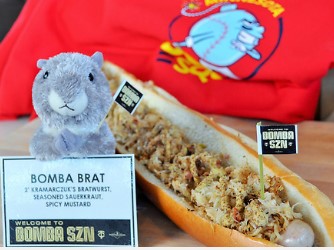
Bomba BratThe Bomba Brat

A two-foot Kramarczuk’s bratwurst, with seasoned kraut and spicy mustard. Available in Sections 127 and 302.


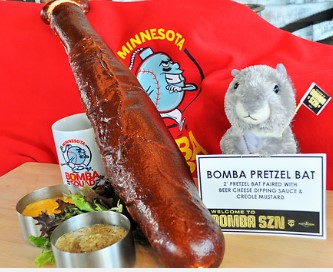
Bomba pretzelThe Bomba Pretzel Bat

Another two-foot offering … a pretzel, served with beer cheese dipping sauce and creole mustard.                     Available at Bat & Barrel.

I plan to get there early and take a swing at one of these. 


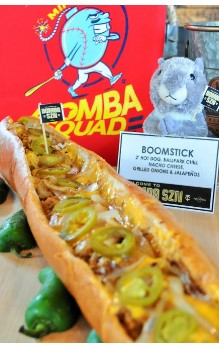
BoomstickThe Boomstick

Inspired by Nelson “Boomstick” Cruz’  41 dingers … a two-foot hot dog, smothered in ballpark chili,                         nacho cheese, grilled onions and jalapenos. Available in Sections 127 and 302.

Gransd SalamiThe Grand Salami

Score big with a two-foot pretzel bat, loaded with salami, capicola, mortadella, provolone cheese, roasted red peppers and arugala. These are truly the flavors of a championship run.  Available at Bat & Barrel and suites.

Looking for A Place to Watch Those Road Games – How About Target Field?

Friday, October 4 – The Twins are hosting an American League Division Series Game One Viewing Party … welcoming fans into Target Field’s Delta SKY360° Club and Bat & Barrel to watch Game One of the 2019 ALDS. Food and beverage will be available for purchase. The event will take place rain or shine. Fans can go to twinsbaseball.com/postseason to receive their free ticket for this event!

Saturday, October 5 – The ALDS Game Two Viewing Party at Target Field’s Delta SKY360° Club and Bat & Barrel. Food and beverage will be available for purchase, and the event will take place rain or shine. Get your free tickets at twinsbaseball.com/postseason.

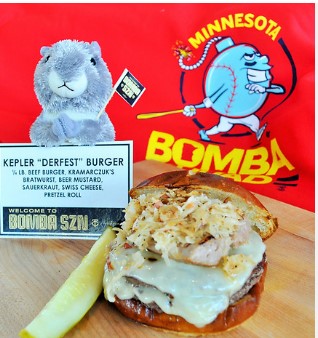
KeplerderfestKepler “Derfest” Burger

Max Kepler gave us 36 homers, Delaware North Sportsservice is honoring him with a quarter-pound beef burger, Kramarczuk’s bratwurst, beer mustard, sauerkraut, Swiss cheese; served on a pretzel roll.                                     Available at Town Ball Tavern and Hrbek’s.

LobsterslidersLobster Sliders

Lobster at the ballpark, that’s a sure way  to cross the plate in style. Lobster salad, fresh tarragon, celery and apple; served on a sweet Hawaiian bun. Available in Delta SKY360 (Carew Atrium).

TwinstortaThe Twins Torta

Adobo chicken, refried beans, chipotle corn and peppers, cojita and pepperjack cheese and avocado.              Available at the Section 114 Sandwich Cart.


There are also post-season desserts — so fitting since post-season play is so sweet.

Dough Dough

Cookie dough that’s safe to eat – and in the championship flavors of Chocolate Chip, Monster (oats, peanut butter, chocolate chip and M&Ms) and Celebration (sprinkles and marshmallow fluff).  Available in Section 134.

Original Hockey Mom’s Brownies

A tip of the hat to the second-most wins in any Twins’ season ever.  Chocolate brownies and ice cream served in a souvenir baseball cap.  Available in Section 126.

Finally, there will also be a bat rack full of post-season specialty cocktails and beer:

  • Pumpkin Spice White Russian – Kahlua, vodka, pumpkin spice, cream, topped off with a cinnamon stick. Served at Bat & Barrel.
  • Caramel Apple Mimosa – Caramel vodka, apple cider, champagne, caramel and cinnamon sugar rim. Served at Bat & Barrel.
  • Cherry Bomba Jell-O Shots – Cherry Jell-O mixed with vodka and garnished with a cherry. Available at Bat & Barrel and premium clubs and bars.
  • Four Seam Screamer IPA – Collaboration beer brewed by Surly and former pitcher Glen Perkins. Available in Section 108.


BASEBALL ROUNDTABLE ON THE TOP 100 BASEBALL BLOG LIST

100Baseball Roundtable is on the Feedspot list of the Top 100 Baseball Blogs.  To see the full list, click here.

I tweet baseball @DavidBBRT

Follow/Like Baseball Roundtable’s Facebook Page here.  More baseball commentary; blog post notifications; PRIZES.

Member: Society for American Baseball Research (SABR); The Baseball Reliquary; The Negro Leagues Baseball Museum.
Baseball Roundtable September and Season-End Wrap Up. Lots of Whacks, Whiffs and Records.

It’s October 1, and that means it’s time not only for the opening of post-season baseball, but also for Baseball Roundtable’s look back at the previous month – the standings, statistics and stories that caught BBRT’s eye, as well as the BBRT Players and Pitchers of the Month and season-to-date “Trot Index.”  This month, if you make it to the end of this post, you’ll also find BBRT’s predictions for the post season.  (Note: I guess I could have posted this September 30, but the first of the following month is kind of a BBRT tradition.)

Of course, for many teams, the final day (September 29) of the 2019 regular season was anti-climactic. All the post-season spots were clinched and only one division title was up for grabs – the Brewers came into the final day just one game behind the Cardinals.  A Redbirds’ loss and Brew Crew win would set up a “Game 163,” with the winner taking the NL Central and the loser playing the Nationals in the Wild Card game. The Cardinals relieved fans of the suspense with a 9-0 thrashing of the Cubs, while the Brewers bowed out with a 4-3, 12-inning loss at Colorado.

Before BBRT gets into September stats and stories, I’d like to comment on another race I watched with some interest on the final day of the regular season – the race for MLB’s all-time, single-season, team home-run crown.

YOU HAD TO “C” THIS ONE

Jason Castro - hit the record-setting "Bomba."

Jason Castro – hit the record-setting “Bomba.”

Coming into the season’s final day the Yankees and Twins had both won more than 100 games, clinched their division titles and hit more than 300 2019 home runs.  (The previous single-season record was 267 homers – 2018 Yankees.) As play started September 29 (Twins at Royals/Yankees at Rangers), New York’s Bronx Bombers had 305 home runs, while Minnesota’s Bomba-Squad had 304. Many of us here in Minnesota, stung by a history of post-season losses to the Yankees, really wanted that long-ball record.

Well, the Yankees popped just one home run (Aaron Judge) in a 6-1 loss at Texas.  The Twins launched a trio of dingers, to take the record 307-306.  Why the “You Had To C This   One” title?  Well, a lot of T.C. fans traveled to K.C. to C this final game.  It turns out, all three Twins; home runs were hit by players whose last name started with a “C” – C.J. Cron; Jake Cave; and Jason Castro (who hit the record-setter).  Ironically, Minnesota’s most-prolific 2019 home run bat, belonging to Nelson “last name begins with a C” Cruz was on the bench.  In another bit of irony, at least to BBRT, it was the first home run this September for Cron, Cave and Castro.   C U this Friday, Yankees.

Now, here’s just a few September highlights.  You’ll find details on these and other “events” that caught BBRT’s eye in the “Highlights” section of this post.  In September, we saw:

  • The Mets’ 24-year-old rookie Pedro Alonso popping an MLB-best 11 September home runs;  leading all major leaguers with 53 home runs for the season – setting a new MLB rookie round tripper record;
  • The Astros’ Justin Verlander opening the month with his third career no-hitter;
  • A second Biggio (Cavan) hitting for the cycle and a new Yastrzemski (Mike) homering in Fenway Park;

In 2019, MLB strikeouts reached a new record (42,823) for  the 12th consecutive season. 

  • One player (Yoan Moncada) hitting 400+ for the month;
  • The Arizona Diamondbacks winning a ball game, despite having only one base runner over nine innings;

In 2019 the Astros waved zero – that’s zero – batters to first.   That’s right, not a single intentional walk. The MLB team average for the season was 25 IBB – and the second-lowest total was ten (Twins). 

  • Two teams (Twins and Yankees) becoming the first MLB teams to reach 300 home runs in a season;
  • Two teams using a combined (record) 25 pitchers in a game;
  • Four teams reaching 100 wins on the season – coincidentally, the four teams who also surpassed the previous record for home runs in a season;
  • Two pitchers (the Astros’ Gerrit Cole and Justin Verlander) on the same team reaching 300 strikeouts in the season for only the second time in MLB history.

In 2019, as home run records fell like overripe apples from a tree, not only did MLB reach a record 6,776 home runs (breaking the old record by 671 dingers), but four teams exceeded the old MLB team single-season record (the Twins exceeded the old mark by 40) and a total of 14 teams set new franchise records for home runs in a season.  In addition, we saw new MLB single-season records for the most players on a team with at least thirty home runs (five-Twins); most with at least 20 home runs (eight-Twins); and most with at least  ten  or more home runs (14-Yankees).  Of course, there are two sides to this story.  the Orioles gave up almost as many home runs as the Twins hit (setting a new record for home runs surrendered in as season at 305). 

Let’s move on to a regular feature of these Wrap Ups.

—–BASEBALL ROUNDTABLE PLAYERS AND PITCHERS OF THE MONTH—-

American League Player of the Month – Eloy Jimenez, LF, Chicago White Sox

Photo by mwlguide

Photo by mwlguide

Eloy (I always want to add an “r” to his name) Jimenez was a force for the ChiSox in September – hitting .340, finishing fourth in AL September home runs with nine (one behind the three leaders) and tying for the AL lead in RBI with 25.  The 22-year-old rookie also scored 19 runs. Jimenez, who came into September hitting just .247 (with power), notched ten multi-hit games over the month and raised his average 20 points.  He finished the season at .267-31-79.  Jimenez’ September surge was not totally unexpected. In six minor league campaigns, he hit .311, with 66 home runs in 413 games.

Other Contenders: BBRT also considered another young White Sox hitter, 24-year-old 3B Yoan Moncada, the only MLB player (with at least 75 at bats) to hit over .400 for September.  Moncada hit .412, led all of MLB with 42 September hits, scored 21 runs, hit three homers and drove in 15/  Also in the running was A’s SS Marcus Semien, who hit .347, with eight home runs, 19 RBI and an MLB-best 25 September runs scored.  BBRT also gives a shout out to the Royals’ Jorge Soler, who hit .330-10-20 in September, and ended up being the first Royal to lead the league in home runs, with 48 on the season.

American League Pitcher of the Month – Gerrit Cole, RHP, Astros

Gerrit Cole photo

Photo by boomer-44

Gerrit Cole had the AL’s second-lowest September ERA at 1.07 (among pitchers with at least 25 innings pitched). Cole also tied for the MLB lead in wins for the month, going 5-0 in six starts, and fanned an MLB-best 74 batters in 42 innings (seven walks).

Other Contenders: Right behind Gerrit Cole was his Astros’ teammate Justin Verlander, who also won five September games (one loss) in six starts, put up a 2.08 ERA and fanned the MLB’s second-most batters (57 in 39 innings). BBRT also recognizes the Yankees’ James Paxton, who went 4-0 in five starts with a minuscule 1.05 ERA.


Surprise Player of the Month – Austin Meadows, OF, Rays

Really, there were several positive surprises in September. (See Jack Flaherty, BBRT’s NL Pitcher of the Month, or the A’s Marcus Semien, in the running for BBRT AL Player of the Month.)  BBRT will give September’s “Surprise” recognition to the Rays’ 24-year-old, southpaw-swinging outfielder Austin Meadows, who came into September hitting .273 (with 24 home runs and 69 RBI).  In September, Meadows hit at a .378 pace (second-best in MLB among players with 75 September at bats), with nine home runs (tied for MLB’s sixth-most), 20 RBI (tied for tenth), and 24 runs scored (tied for second). In addition, he walked 15 times (versus just 16 strikeouts); putting up a September on-base percentage of .472 (second only to the Astros’ Alex Bregman). Meadows played in 24 games, hit safely in all but one and had ten multi-hit contests.

National League Player of the Month – (Tie) Reds’ 3B Eugenio Suarez and Dodgers’ SS Corey Seager

Eugenio Suarez photo

Photo by haydenschiff

Eugenio Suarez rapped ten September home runs (second only to the Mets’ Pete Alonso’s 11), while hitting .337, with 20 RBI. He had ten multi-hit games during the month. He ended the season at .271-49-103.

Cody Bellinger brought superior defense and infield power to the Dodgers, hitting.291, with seven homers and MLB’s highest RBI total for the month (26). Bellinger really turned it up a notch in September.  It was his highest month of the season in terms of both home runs and RBI.

Other Contenders: Mets’ rookie 1B Pete Alonso led the majors with 11 September home runs (on his way to a new rookie-season record of 53), but was held back by a .245 average and just 19 September RBI. Cardinals’ 3B Tommy Edman hit .350-6-14, with 22 runs scored.

National League Pitcher of the Month – Jack Flaherty, RHP, Cardinals

As the Cardinals held off the Brewers for the NL Central title down the stretch, Flaherty was “The Man.” The 23-year-old went 3-1 in six starts and led MLB in September earned run average (among pitchers with at least 25 innings pitched) at 0.82, WHIP (0.57) and innings pitched (44). He also led the NL in strikeouts fopr the month (and was third in MLB) with 53, while walking just eight batters. In his six September starts, Flaherty went seven or eight innings in five (giving up just one earned run in those 38 innings.  His only September loss came in a six-inning effort in which he gave up three runs in six frames, while fanning ten. This was a pretty easy pick.

Other Contenders: It seems like the Mets’ Jacob deGrom is always in the running.  This September, he went 3-0, 1.29 in five starts, fanning 41 batters (five walks) in 35 innings. BBRT also considered the Braves’ Mike Foltynewicz, who won four September games (one loss) and had a nifty 1.50 ERA for the month. A nod also goes to the Cardinals’ Adam Wainwright, the only NL pitcher to win five September games (5-1, 2.97 in six starts). Giving relievers a little love, the Brewers went 20-7 in September thanks in great part to Josh Hader’s MLB-topping ten September saves.  Hader put up a 1.88 ERA and fanned 27 batters in 14 1/3 innings.

TROT INDEX … A REGULAR BBRT FEATURE

For the 2019 season,  36.2 percent of MLB’s 186,517 plate appearances ended in a trot (back to the dugout, around the bases, to first base). We’re talking about strikeouts, home runs, walks, hit by pitch and catcher’s interference – all outcomes that are, basically, devoid of action on the base paths or in the field. Here’s the breakout: strikeouts (23.0%); walks (8.5%); home runs (3.6%); HBP (1.1%); catcher’s interference (less than 1%). Personally, I’d like more action in the field of play.

For the 2018 season, 34.8 percent of all MLB’s 185,139 plate appearances ended in a trot.  Bonus Trivia: According to MLB, in 2019, the average time of an MLB game was a record three hours-five minutes-35 seconds.  

_________________________________________________________________

Septemberwl

—–The Best and Worst of Teams—–

NL’s Best

No team won more games in September than the Brewers, who went 20-7. The Brewers failed to chase down the Cardinals for the Central Division title, but did manage to move passed the Phillies, Cubs and Diamondbacks into a Wild Card spot.  Milwaukee leveraged solid pitching (MLB’s lowest September ERA at 3.01) and a steady offense (the NL’s fifth-most September runs scored) into 20 victories.  Key contributors on the mound included: Jordan Lyles (3-0, 2.39 in five starts); Zach Davies (2-0, 2.31 in five starts); and Chase Anderson (2-0, 2.35 in five starts).  We also can’t forget Gio Gonzalez.  He may have gone just 1-0 in September (four starts and two relief appearances), but put up a 1.17 ERA and saw the Brewers win five of the six games in which he appeared. The Brew Crew also got solid performance out of the bullpen, led by Josh Hader’s ten saves and 1.88 ERA and Drew Pomeranz’ two saves and seven holds in 14 appearances (2.03 ERA).

AL’s Best

Over in the NL, best-of-the-best recognition goes to the Houston Astros (19-6), who dominated nearly all September statistical categories.  On the mound, they had the AL’s  lowest ERA, highest number of strikeouts, fewest walks and most saves.  At the plate, they were the AL’s September leaders in runs scored and home runs – and had the fewest batters’ strikeouts.  Key contributors? There were many. On the bump: Gerrit Cole went 5-0, 1.07 in six starts; Justin Verlander was 5-1, 2.08 in six starts; Zack Greinke was 4-1, 2.59 in five starts; and Roberto Osuna saved seven games (eight opportunities) and put up a 0.79 ERA.  Keys to the well-balanced offense included: George Springer, who hit .275, with ten homers and 19 RBI; Alex Bregman, who went .333-9-18; Yordan Alvarez, who was .296-6-16;  Josh Reddick at .338-4-12; and Jose Altuve at at .278-6-13.

Other teams putting up solid September performance included: Dodgers (18-6); Twins (18-9); and A’s (18-8).  All these squads are, of course, in the post-season.

How about the worst September results? The Padres, Angels, Tigers, Orioles and Marlins all won fewer than ten September games.

______________________________________________

—LEAGUE LEADERS – TEAMS – MONTH OF SEPTEMBER 2019—-

RUNS SCORED … MLB Team Average – 122

AL: Astros (154); Yankees (146); A’s (143)

NL: Nationals (153); Cubs (150); Mets (140); Cardinals (140)

The Angels scored the fewest September runs at 82, while the Giants were at the bottom of the NL, plating just 83 runners.

BATTING AVERAGE … MLB Team Average – .244

AL: White Sox (.290); Royals (.268); Astros (.266)

NL: Nationals (.268); Cubs (.257); Pirates (.255)

Four teams hit under .220 for the month: Padres (.214); Mariners (.219); Giants (.219); and Angels (.219). 

HOME RUNS … MLB Team Average – 36

AL:  Astros (58); Yankees (52); A’s (42)

NL: Mets (50); Phillies (46); Dodgers (45)

At the bottom of the power list were the Pirates (14 home runs); Giants (19); Diamondbacks (22); and Tigers (23).

SLUGGING PERCENTAGE … MLB Team Average –  .422

AL:  Astros (.530); Yankees (.491); White Sox (.485)

NL: Mets (.474); Dodgers (.466); Cubs (.461)

The Astros collected an MLB-high 112 extra-base hits in September – while the Giants had an MLB-low of exactly half that many (56).

STOLEN BASES … MLB Team Average – 13

AL:  Rangers (26); Royals (19); Mariners (18)

NL: Cardinals (27); Rockies (22); Nationals (19); Phillies (19)

The Twins stole an MLB-low two bases in September (only three tries). Notably, the Phillies stole 19 bases in 19 attempts.

BATTERS’ STRIKEOUTS … MLB Team Average – 233

AL: Blue Jays (269); White Sox (265); Mariners (256)

NL: Brewers (286); Cardinals (282); Padres (277)

The Astros fanned the fewest times in September (186). Notably, despite the AL’s second-most whiffs, the White Sox put up MLB’s best batting average.

_______________________________________

EARNED RUN AVERAGE … MLB Team Average – 4.38

AL:  Astros (3.26); Rays (3.55); A’s (3.58)

NL:  Brewers (3.01); Dodgers (3.10); Cardinals (3.24)

One team posted an ERA north of 6.00 in September – the Rangers at 6.19.

BATTING AVERAGE AGAINST … MLB Team Average – .244

AL: Astros (.205); Rays (.219); A’s (.232)

NL: Reds (.202); Dodgers (.202); Brewers (.210);

Teams hit an MLB-high .299 against Tiger hurlers in September.

STRIKEOUTS … MLB Team Average – 233

AL:  Astros (295); Red Sox (276); Twins (273)

NL: Cubs (279); Padres (273); Brewers (272)

WALKS (Fewest) … MLB Team Average – 86

AL: Astros (60); Rays (62); A’s (68)

NL: Braves (63); Mets (70); Dodgers (73)

The Astros led all of MLB in September strikeouts per nine innings (11.46) and strikeouts-to-walks ratio (4.92). 

SAVES … MLB Team Average – 7

AL:  A’s (11); Astros (11); Twins (10)

NL: Brewers (12); Cardinals (11); Diamondbacks (11)

MLB’s best save percentage in September belonged to the Braves and Blue Jays, who each notched six saves in seven opportunities (85.7%). The Yankees had the most significant problem closing September games, with only one save in six opportunities. 


—INDIVIDUAL LEADERS FOR SEPTEMBER 2019—–

BATTING AVERAGE (75 or more at bats)

AL: Yoan Moncada, White Sox (.412); Austin Meadows, Rays (.378); Tim Anderson, White Sox (.374)

NL: Tommy Edman, Cardinals (.350); Nolan Arenado, Rockies (.342); Kyle Schwarber, Cubs (.341)

The lowest average among players with at least 75 September at bats belonged to the Orioles’ Anthony Santander at .155 (13-for-84). Seventeen players with at least 75 at bats hit under .200 for the month.

HITS

AL: Yoan Moncada, White Sox (42); Trey Mancini, Orioles (38); Tim Anderson, White Sox, (37)

NL: Trea Turner, Nationals (36); Tommy Edman, Cardinals (36); Kyle Schwarber, Cubs (31); Ozzie Albies, Braves (31)

HOME RUNS

AL: Brett Gardner, Yankees (10); George Springer, Astros (10); Jorge Soler, Royals (10)

NL: Pete Alonso, Mets (11); Eugenio Suarez. Reds (10); five with seven

The Marlins’ Jon Berti had the most September at bats without a home run – 87.  He had a total of 25 September hits (.287) – twenty singles and five doubles.

RBI

AL: Rougned Odor, Rangers (25); Eloy Jimenez, White Sox (25); Matt Olson, A’s (23); Trey Mancini, Orioles (23)

NL: Corey Seager, Dodgers (26); Paul Goldschmidt, Cardinals (24); Asdrubel Cabrera, Nationals (21)

Among players with at least 75 September at bats, the Astros’ Alex Bregman had the highest on-base percentage at .486. In the NL, it was the Reds’ Eugenio Suarez at .455. The other players above .450 were: Austin Meadows, Rays (.472); Yoan Moncada, White Sox (.455); and Nolan Arenado, Rockies (.451).

Alex Bregman also had the highest slugging percentage in September (.753); while Eugenio Suarez led the NL at .747.

RUNS SCORED

AL: Marcus Semien, A’s (25); Austin Meadows, Rays (24); Francisco Lindor, Indians (21); Tim Anderson, White Sox (21); Yoan Moncada, White Sox (21)

NL: Trea Turner, Nationals (24); Starlin Castro, Marlins (22); Yasmani Grandal, Brewers (22); Pete Alonso, Mets (22); Tommy Edman, Cardinals (22)

STOLEN BASES

AL:   Alberto Mondesi, Royals (12); Tommy Pham, Rays (9); Danny Santana, Rangers (8); Jonathan Villar, Orioles (8)

NL: Jon Berti, Marlins (9); Garrett Hampson, Rockies (9); four with six

Jackie Bradley, Jr. of the Indians had the toughest month on the bases in September, caught three times in four attempts. The only other player tossed out three times was Alberto Mondesi (Royals), but he stole 12 bags.

BATTER’S STRIKEOUTS

AL: Hunter Dozier, Royals (35); Aaron Judge, Yankees (33); Miguel Sano, Twins (32)

NL:  Eric Hosmer, Padres (40); Harrison Bader, Cardinals (39); Pete Alonso, Mets (38)

Among the strikeouts leaders listed above, the Twins’ Miguel Sano had the best overall September stat line – .288-8-21.

WALKS

AL:  Alex Bregman, Astros (22); Mark Canha, A’s (16); Marcus Semien, A’s (16); Matt Chapman, A’s (16); Cavan Biggio, Blue Jays (16)

NL: Anthony Rendon, Nationals (25); Yasmani Grandal, Brewers (24); Juan Soto, Nationals (24)

PITCHING VICTORIES

AL: Gerrit Cole, Astros (5-0); Justin Verlander, Astros (5-1); four with four

NL: Adam Wainwright, Cardinals (5-1); Brent Suter, Brewers (4-0); Patrick Corbin, Nationals (4-1); Mike Foltynewicz, Braves (4-1); Merrill Kelly, Diamondbacks (4-1)

Another Episode of: How Fair Is That:

In September, the Brewers’ Matt Albers went 3-2, with a 10.38 ERA, while the Cubs’ Yu Darvish went 1-2, with a 2.39 ERA.

EARNED RUN AVERAGE (at least 25 innings pitched)

AL: James Paxton, Yankees (1.05); Gerrit Cole, Astros (1.07); Sean Manea, A’s (1.21)

NL: Jack Flaherty, Cardinals (0.82); Jacob deGrom, Mets (1.29); Mike Foltynewicz, Braves (1.50)

STRIKEOUTS

AL:  Gerrit Cole, Astros (74/42 IP); Justin Verlander, Astros (57/39 IP); Eduardo Rodriguez, Red Sox (53/37 2/3 IP)

NL: Jack Flaherty, Cardinals (53/44 IP); Yu Darvish, Cubs (46/26 1/3 IP); Patrick Corbin, Nationals (45/33 1/3 IP)

Gerrit Cole led all qualifying pitchers in strikeouts per nine innings in September (15.86). Yu Darvish led the NL (15.72).

SAVES

AL:  Taylor Rogers, Twins (9); Liam Hendriks, A’s (8); Robert Osuna, Astros (7); Brandon Workman, Red Sox (7)

NL:  Josh Hader, Brewers (10); Carlos Martinez, Cardinals (8); Archie Bradley, Diamondbacks (8)

How About a Shout Out for Holds?  That’s No Bummer.

The White Sox’ Aaron Bummer led MLB in September “holds” with nine (13 appearances).

Now a few stats and stories from the month of September.

________________________________________________

—SEPTEMBER 2019 HIGHLIGHTS —

Getting September Off to a Good “Start”

On September 1, Justin Verlander faced off against the Blue Jays in Toronto – and he got the Astros off to a good start for the month.

Verlander threw a no-hitter, walking just one Blue Jay, while fanning 14. The Astros did make him “worry” the no-no to completion. They didn’t score a run for Verlander until there were two out in the top of the ninth (a two-run home run by Alemedys Diaz).

Verlander is just the sixth pitcher to throw at least three no-hitters – joining Nolan Ryan (7); Sandy Koufax (4); Larry Corcoran (3); Cy Young (3); and Bob Feller (3).  Pretty good company.

We’d Give Anything to Hold Them to a Bloop Single

On September 8, the Astros did a number on the Mariners – outscoring the Seattle squad 21-1 and outhitting them 22-1.  Not only did 11 different Astros score at least one run in the game, Houston plated ten runners before hitting their first single.  The ten runs scored before the end of the third inning – on six doubles, two home runs, two walks, one hit batsman and one error.  Ouch!

Never Before – Unlikely Again

September 14 marked a “never before – unlikely ever again” feat of pitching excellence (or batting futility). For the first time since 1900 (according to Elias Sports Bureau), an MLB team managed a victory despite having only one base runner (which, of course, would be the bare minimum) in a game of at least nine innings.  The team with this absolutely zero-waste offensive output?  The Arizona Diamondbacks, who topped the Cincinnati Reds 1-0 (in Phoenix).

Reds’ starter Anthony DeSclafani set the Diamondbacks down in order in the first, second, fourth, fifth, sixth and seventh innings (fanning five); while reliever Joel Kuhnel added one whiff in a 1-2-3 eighth.  The only blemish for the Reds’ mounds men came in the third inning. Arizona SS Nick Ahmed led off with a high hopper (on the first pitch he saw from DeSclafani) that bounced over the head of Reds’ third-sacker Eugenio Saurez and rolled all the way to the left field wall for a triple.  D-backs’ RF Jarrod Dyson was also first-pitch swinging and sent a fly ball to center for a run-scoring sacrifice fly – and that was Arizona’s total offense for the game.

The Diamondbacks’ staff – starter Merrill Kelly (seven innings) and relievers Kevin Ginkel and Archie Bradley (one frame each) made the 1-0 lead stand up; giving up no runs on three hits and two walks (seven strikeouts).

It’s a Family Affair – at Least on September 17

The Yastrzemski Clan

On September 17, in a “Family Affair” occurrence, the Giant’s 29-year-old rookie Mike Yastrzemski (thanks to inter-league play) took the field for the first time in his career in Fenway Park – where his grandfather, Hall of Famer Carl Yastrzemski played 23 seasons and hit 237 home runs (he had 452 total long balls). Mike added another long ball to the Yastrzemski Fenway legend, popping a fourth-inning homer over the center field wall – helping the Giants top the BoSox 7-6. By the way, young Mike started in left field – in front of the famous Fenway Wall – the same position his grandfather manned for so many years.

The Biggio Household

On September 17, Blue Jays’ 24-year-old rookie Cavan Biggio – son of Hall of Famer Craig Biggio – hit for the cycle (single, double, triple, home run in one game) against the Orioles at Camden Yards.   In the game, won by the Blue Jays 8-5, Cavan was four-for-five with three runs scored and four RBI.  What made his cycle unique was that, 17 seasons earlier, Biggio (Craig) The Elder also hit for the cycle.  The exact date was April, 8, 2002 and Biggio, in his 15th MLB season, went four-for-five with two runs scored and four RBI.

Cavan’s cycle made the Biggios only the second MLB father-son combination to hit for the cycle – following Gary and Daryle Ward, who cycled their way into MLB history on September 18, 1980 and May 26, 2004, respectively.  Gary Ward achieved his cycle with the Twins, son Daryle with the Pirates.

Five-For-Thirty Can Be a Good Baseball Stat

Miguel Sano photo

Photo by andywitchger

On September 17, as the Twins topped the White Sox 9-8 in 12 frames, 3B Miguel Sano smacked his 30th home run of the 2019 season.  This made the Twins the first MLB team to have five players with 30 or more home runs on its roster in the same season (breaking at 12-team time at four). The 2019 Twins’ final counts:  Nelson Cruz – 41 home runs; Max Kepler – 36; Miguel Sano – 34; Eddie Rosario – 32; and Mitch Garver – 31

Earlier this season, the Minnesota squad became the first MLB team with eight players with 20 or more long balls on its roster in the same season.


2,000 for Bochy

On September 18, the Giants pounded the Red Sox 11-3 at Fenway – giving Giants’ manager Bruce Bochy his 2,000th MLB victory.  Bochy is just the 11th major league manager to reach the 2K mark in wins.  (Connie Mack tops the list at 3,731 wins.) Bochy, who has announced his retirement, ended the season with a 2003-2029 managerial record (12 seasons with the Padres/13 seasons with the Giants). He won an NL Pennant with the Padres in 1998; led the Giants to World Series championships in 2010, 2012 and 2014; and was the 1996 National League Manager of the Year.

Runnin’ on Cruz Control

On September 22, as the Twins downed the Royals 12-8 in Minnesota, DH Nelson Cruz touched a couple of milestones with a fourth-inning solo home run.  The long ball gave Cruz a nice round number on the season (40) and for his career (400).  Cruz became the 57th major leaguer to reach 400 home runs and  just the third player in MLB history to hit forty home runs at age 39 or older (joining Hank Aaron and Barry Bonds).  Cruz finished the season at 311-41-108.

Stone-Cole Hero

On September 24, Gerrit Cole picked up his 19th win of the season, as the Astros topped the Mariners 3-0 in Seattle.  Cole went seven innings, giving up two hits and fanning 14 batters. It gave Cole 316 strikeouts for the season – as well as setting a new Astros’ franchise record for whiffs in a campaign.  J.R. Richard had held the Astros’ record for 40 years, fanning 313 in 1979. It was Cole’s MLB-record tying eighth consecutive game with ten or more strikeouts (100 whiffs over 56 2/3 innings in that streak) and his 20th double-digit strikeout game of the season.  (Cole would go on to add a 21st and ninth consecutive double-digit strikeout game on September 29, when he fanned 10 Angels in five innings.) In his previous start, on September 18, Cole had become just the 18th pitcher since 1900 to reach 300 strikeouts in an MLB season.

Randy Johnson holds the record for double-digit strikeout games in a season at 23 – and he did it three times (all for the Diamondbacks) – in 1999-2000 and 2001.

Happy Birthday Boss!

On September 25, the Minnesota Twins won their 98th game of the 2019 season – clinching the American League Central Division title.  That day also happened to be the 38th birthday of rookie manager Rocco Baldelli.  A nicely wrapped gift for the boss.

He Got By with a Little Help from His Friends

On September 26, the Rangers faced off against the Red Sox in Texas. Starting on the bump for the Rangers was Mike Minor (13-10, 3.52), while the Red Sox sent “opener” rookie Travis Lakins (0-1, 4.22) to the mound. As the contest went into the ninth inning, Minor was still in the game, holding on to a 7-5 lead. At the time, Minor had fanned eight batters – giving him 199 for the season.   He got Red Sox 1B Sandy Leon on a fly out to left to start the inning and then went to a 1-1 count on SS Chris Owings.  On the next pitch, Owings hit a foul pop up to the right side of first base.  Both 1B Ronald Guzman and catcher Jose Trevino had a chance to catch it, but they let it drop (reportedly at Minor’s urging) for an error (and for strike two).  Owings took the next pitch for strike three – and Minor had reached the coveted 200-strikeout mark (with a little help from his friends) for the season. Then Jose Leclerc replaced Minor and fanned Marco Hernandez for the final out and the save.

Another 2019 Immaculate Inning

On September 27, Astros’ reliever Will Harris was called in to open the bottom of the eighth inning of the Astros’ contest against the Angels – with the Western Division champs up 4-0. He was facing the Angels’ sixth seventh and eighth batters – 2B Kaleb Coward, 3B Matt Thaiss and CF Michael Hermosillo. Harris, who had fanned 59 hitters in 58 2/3 innings to that point in the season, turned in a stellar performance.  He whiffed those three unfortunate hitters on nine pitches – turning in 2019’s record-tying eighth “immaculate inning” (three outs, three strikeouts on the minimum nine pitches).

Three (hundred) for Two  … and Two for Three (Hundred)

On September 28, the Astros’ Justin Verlander had quite the day – going six innings in the Astros’ 6-3 win over the Angels.  It was Verlander’s MLB-leading 21st win (six losses).  In his six innings of work, he gave up three runs on four hits and fanned 12 batters. The 12 strikeouts:

  • Gave him 300 on the season – his first 300-whiff campaign – making him just the 19th pitcher since 1900 to reach 300K in a season;
  • Gave him 3,006 strikeouts for his career, making him just the 18th MLB pitcher to reach 3,000 career K’s;
  • Enabled him to join Gerrit Cole as the only American League teammates to log 300 strikeouts in the same season (Cole finished 2019 with 326 strikeouts). The only other team with two 300K pitchers? The 2002 Diamondbacks, with Randy Johnson (334) and Curt Schilling (316).

Another Home Run Record Falls

Pete Alonso photo

Photo by slgckgc

On September 28, Mets’ rookie 1B Pete Alonso launched his 53rd home run of the season –  as the Mets topped Atlanta 3-0 in New York.  In the process, the 2019 NL home run leader, broke Aaron Judge’s MLB rookie record of 52 home runs (set in 2017).

A First For the Royals –  Records for Soler

On September 29th, the Royals’ OF/DH officially became the first Kansas City Royal ever to win the AL home run crown.  In addition, his 48 round trippers extended his single-season record for the Royals’ franchise, as well as set a new single-seasons record for a Cuban-born MLB player. The previous record for a Cuban-born player was held by Rafael Palmeiro, who hit 47 long balls for the Rangers in 1999.

Now, let’s move on to the full-season stats.

__________________________________________________

2019fINAL


—-LEAGUE LEADERS – TEAMS – FINAL—–

RUNS SCORED … MLB Team Average – 782

AL: Yankees (943); Twins (939); Astros (920)

NL: Dodgers (886); Nationals (873); Braves (855)

The Astros had MLB’s most positive run differential in 2019 at +280. The Dodgers were not far behind at +273.  The only other team over 200 was the Yankees at +204. On the negative side, the Tigers were an MLB-worst -333.

BATTING AVERAGE … MLB Team Average – .252

AL: Astros (.274); Twins (.270); Red Sox (.269)

NL: Rockies (.265); Nationals (.265); Pirates (.265)

HOME RUNS … MLB Team Average – 226

AL:  Twins (307; Yankees (306); Astros (288)

NL: Dodgers (279); Cubs (256); Brewers (250)

Seven of the top eight teams in home runs made it to the post season. Bonus note:  The Marlins and Tigers were the only teams to hit fewer than 150 home runs, at 146 and 149, respectively. Their combined record was 104-219.

SLUGGING PERCENTAGE – MLB TEAM Average – .430

AL: Astros (.495); Twins (.494); Yankees (.490)

NL: Dodgers (.472); Rockies (.456); Nationals (.454)

STOLEN BASES … MLB Team Average – 76

AL:  Rangers (131); Royals (117); Mariners (115)

NL: Nationals (116); Cardinals (116); Brewers (101)

The Twins (who led all of baseball with 307 home runs, trailed all of MLB with just 28 stolen bases.  They also had the lowest stolen base success rate at 57.1% (28-for-49). The Diamondbacks were successful and MLB-best 86.3 percent of the time (88-for-102).

BATTERS’ STRIKEOUTS … MLB Team Average – 1,427

AL: Tigers (1,595); Mariners (1,581); Rangers (1,578)

NL: Padres (1,581); Brewers (1,563); Rockies (1,503)

Astros’ batters fanned the fewest times (1,166). In the NL, that honor went to the Pirates (1,213).

WALKS DRAWN … MLB Average – 530

AL: Astros (645); Red Sox (590); Mariners (588)

NL: Brewers (629); Braves (619); Dodgers (607)

No one hit better with runners in scoring position than the Yankees, with a .294 average in those situations. The worst average with runners in scoring position? The Tigers at .227. How about with runners in scoring position and two out?  The leader there was the Red Sox at .283, with the Marlins at the bottom (.191).

EARNED RUN AVERAGE … MLB Average – 4.49

AL:  Rays (3.65); Astros (3.66); Indians (3.76)

NL:  Dodgers (3.37); Cardinals (3.80); Cubs (4.10)

The best starters’ ERA for the season belonged to the Dodgers at 3.11, while the Astros had the best starting ERA in the AL at 3.61. The Rockies had the worst starters’ ERA at 5.87.

Bullpen ERA’s saw the Rays best in the AL at 3.66 and the Dodgers lowest in the NL at 3.78. The Wild Card Nationals had the worst bullpen ERA at 5.66.

The worst overall ERA?  The Orioles’ at 5.59.

BATTING AVERAGE AGAINST … MLB Average – .252

AL: Astros (.221); Rays (.230); Indians (.240)

NL: Dodgers (.223); Reds (.235); Cardinals (.238)

STRIKEOUTS … MLB Average – 1,176

AL:  Astros (1,671); Red Sox (1,633); Rays (1,621)

NL: Reds (1,552); Mets 1,520); Dodgers (1,519)

The Astros were the only team to average ten or more strikeouts per nine innings (10.28), but the Red Sox came close at 9.99. Fourteen teams averaged at least nine whiffs per nine frames.

SAVES … MLB Average – 39

AL: Twins (50); Yankees (50); Astros (47)

NL: Cardinals (52); Brewers (50); Padres (47)

The Blue Jays had the best save percentage for the season at 76.4% (33-for-43).  The Orioles had the worst save percentage at 50% (27 saves in 54 opportunities). 

—-2019 INDIVIDUAL LEADERS – FINAL—–

BATTING AVERAGE (QUALIFIERS)

AL:  Tim Anderson, White Sox (.335); DJ LeMahieu, Yankees (.327); Yoan Moncada, White Sox (.315)

NL: Christian Yelich, Brewers (.3292); Ketel Marte, Diamondbacks (.3286); Anthony Rendon, Nationals (.319)

HITS

AL: Whit Merrifield, Royals (206); Rafael Devers, Red Sox (201); DJ LeMahieu, Yankees (197)

NL: Ozzie Albies, Braves (189); Ketel Marte, Diamondbacks (187); Nolan Arenado, Rockies (185)

HOME RUNS

AL: Jorge Soler, Royals (48) Mike Trout, Angels (45); Alex Bregman, Astros (41); Nelson Cruz, Twins (41)

NL: Pete Alonso, Mets (53); Eugenio Suarez, Reds (49); Cody Bellinger, Dodgers (47)

Among qualifying batters, the Angels’ Mike Trout had the best “At Bats per Home Run” rate at 10.4. In the NL that honor went to the Brewers’ Christian Yelich at 11.1. Others at under 12.0 included: Twins’ Nelson Cruz (11.1); Mets’ Pete Alonso (11.3); Reds; Eugenio Suarez (11.7); and Dodgers Cody Bellinger (11.9).

RUNS BATTED IN

AL: Jose Abreu, White Sox (123); Xander Bogaerts, Red Sox (117); Jorge Soler, White Sox (117)

NL: Anthony Rendon, Nationals (126); Freddie Freeman, Braves (121); Pete Alonso, Mets (120)

RUNS SCORED

AL: Mookie Betts, Red Sox (136); Rafael Devers, Red Sox (129); Marcus Semien, A’s (123)

NL: Ronald Acuna, Jr., Braves (127); Cody Bellinger (121); Anthony Rendon, Nationals (117)

The Padres’ Manny Machado and White Sox’ Jose Abreu shared the lead in grounding into double plays at 24.

STOLEN BASES

AL:   Mallex Smith, Mariners (45); Aldaberto Mondesi, Royals (43); Jonathan Villar, Orioles (40)

NL: Ronald Acuna, Jr., Braves (37); Trea Turner, Nationals (35); Jarrod Dyson, Diamondbacks (30)

No players were caught stealing more often than Whit Merrifield of the Royals and Amed Rosario of the Mets (ten time each). Merrifield had 20 successful attempts; Rosario had 19.

BATTER’S STRIKEOUTS

AL: Rougned Odor, Rangers (178); Jorge Soler, Royals (178); Jonathan Villar, Orioles (176)

NL: Eugenio Suarez, Red (189); Ronald Acuna, Jr., Braves (188); Pete Alonso, Mets (183)

The top three strikeout artists – Eugenio Suarez, Ronald Acuna, Jr. and Pete Alonso – combined for 143 home runs and 324 RBI.

WALKS

AL:  Alex Bregman, Astros (119); Mike Trout, Angels (110); Carlos Santana, Indians (108)

NL: Rhys Hoskins, Phillies (116); Yasmani Grandal, Brewers (109); Juan Soto, Nationals (108)

The Dodgers’ Cody Bellinger led all batters in intentional walks with 21.  I guess that’s the kind of respect a .305-47-115 line will get you.

ON BASE + SLUGGING PERCENTAGE

AL: Mike Trout, Angels (1.083); Nelson Cruz, Twins (1.031); Alex Bregman, Astros (1.015)

NL: Christian Yelich, Brewers (1.100); Cody Bellinger, Dodgers (1.035); Anthony Rendon, Nationals (1.010);

PITCHING VICTORIES

AL:  Justin Verlander, Astros (21-6); Gerrit Cole, Astros (20-5); Eduardo Rodriguez, Red Sox (19-6)

NL: Stephen Strasburg, Nationals (18-6); Max Fried, Braves (17-6); Clayton Kershaw, Dodgers (16-5); Dakota Hudson, Cardinals (16-7)

The Tigers’ Spencer Turnbull led all of MLB in losses, going 3-17, 4.61 in 30 starts. 

EARNED RUN AVERAGE (qualifying)

AL: Gerrit Cole. Astros (2.50); Justin Verlander, Astros (2.58); Charlie Morton, Rays (3.05)

NL: Hyun-Jin Ryu, Dodgers (2.32); Jacob deGrom, Mets (2.43); Mike Soroka, Braves (2.68)

Note: Zack Greinke of the Astros had a 2.93 ERA, but his innings were split between the Diamondbacks and Astros.

STRIKEOUTS

AL:  Gerrit Cole, Astros (326); Justin Verlander, Astros (300); Shane Bieber, Indians (259)

NL: Jacob deGrom, Mets (255); Stephen Strasburg, Nationals (251); Max Scherzer, Nationals (243)

Note: Trevor Bauer of the Reds had 253 K’s, but they were split between the Indians (185) and Reds (68).

Only four qualifying pitchers averaged 12 or more strikeouts per nine innings: Gerrit Cole, Astros (13.82); Max Scherzer, Nationals (12.69); Robbie Ray, Diamondbacks (12.13); and Justin Verlander, Astros (12.11).  A total of 25 qualifiers averages 9+ K’s per nine innings.

SAVES

AL:  Roberto Osuna, Astros (38); Aroldis Chapman, Yankees (37); Brad Hand, Indians (34)

NL: Kirby Yates, Padres (41); Josh Hader, Brewers (37); Will Smith, Giants (34); Raisel Iglesias, Reds (34)

Just Hold Me, Please

The Padres’ Craig Stammen, Astros’ Ryan Pressley and Jake Diekman (Royals & A’s) led the major leagues with 31 “holds” each. 

A final thought – a look to the post season.post seasopnm

Primary Resources: ESPN.com; MLB.com; Baseball-Reference.com

BASEBALL ROUNDTABLE ON THE TOP 100 BASEBALL BLOG LIST

100Baseball Roundtable is on the Feedspot list of the Top 100 Baseball Blogs.  To see the full list, click here.

I tweet baseball @DavidBBRT

Follow/Like Baseball Roundtable’s Facebook Page here.  More baseball commentary; blog post notifications; PRIZES.

Member: Society for American Baseball Research (SABR); The Baseball Reliquary; The Negro Leagues Baseball Museum.
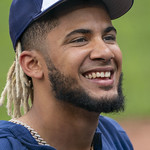
 

Basketball has March Madness. How about some Baseball September Madness?

Mound Madness

Baseball pitcher photoYesterday (September 24) – well, actually shortly after one o’clock this morning (September 25) – The Rockies and Giants set an MLB record unlikely to ever fall. In a 16-inning match up that ended in an 8-5 Rockies’ victory, the two teams used an MLB-record combined 25 pitchers. A somewhat surprising aspect of that game it that Giants’ starter Madison Bumgarner completed seven innings of work.  The Giants then used 12 pitchers to get through nine more innings.

Then again, maybe the record could fall.  In a game that ended about an hour and twenty minutes later (played in Arizona), the Cardinals and Diamondbacks came close – using a combined 24 pitchers in a nineteen-inning contest won 3-2 by the D-backs.

If the record does fall, it will have to be this season.  Starting next season, September rosters will only expand to 28 players (rather than the current 40-player September limit).

How about Home Run Madness?

High five New York Yankees photo

Photo by Ken Lund

Yesterday, in a 2-1 loss to the Rays, Yankees’ starting CF Cameron Maybin accounted for the Bronx Bombers’ only run with a third-inning homer.  Notably, it was his tenth round tripper of the year. – making the Yankees the first MLB team ever to boast 14 players with ten or more home runs.   Here’s a little more home run madness. This season (as I write this post):

  • The Twins have become the first MLB team with with five players hitting at least 30 home runs – and the first MLB team with eight players with 20 or more homers;
  • Four teams (Yankees, Twins, Astros and Dodgers) have already surpassed the previous all -time team record for homers in a season;
  • Twelve MLB teams have already surpassed their previous franchise record for home runs in a season and another three teams seem likely to join them; and
  • MLB has seen a record 6,590 home runs – far outpacing the past mark of 6,105.

Primary Resource:  Baseball-Reference.com


BASEBALL ROUNDTABLE ON THE TOP 100 BASEBALL BLOG LIST

100Baseball Roundtable is on the Feedspot list of the Top 100 Baseball Blogs.  To see the full list, click here.

I tweet baseball @DavidBBRT

Follow/Like Baseball Roundtable’s Facebook Page here.  More baseball commentary; blog post notifications; PRIZES.

Member: Society for American Baseball Research (SABR); The Baseball Reliquary; The Negro Leagues Baseball Museum.
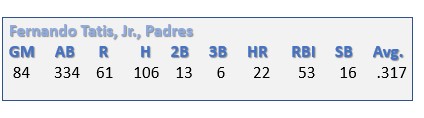
More Baseball Roundtable Musings – From the Babe to the Boomstick and “Miller Time” to “Kilroy was Here.”

Baseball Roundtable apologizes for being a little light on posts over the past week or so.  My hometown Twins have been in a tight division title race and I’ve spent most of my time at Target Field or glued to Fox Sports North’s television coverage.  It’s an off day today, so here some BBRT Baseball Musings from the past ten days.

Boomstick … On Cruz Control

Yesterday (September 22), as the Twins topped the Royals 12-8 in Minnesota, Twins’ DH Nelson Cruz launched a fourth-inning solo home run.  It was part of a two-for-three (with two walks) game that left Cruz with a .303 average, 40 home runs and 105 RBI on the season.  It was also a landmark blast for Cruz, his 400th career long ball.  Further, it made Cruz just one of three players to reach the 40-home run mark in a season at age 39 or older.  The others?  Hank Aaron, who hit an even forty round trippers in his age-39 season (1973 Braves) and Barry Bonds, who hit 45 long balls in his age-39 campaign (2004 Giants).  No player has hit forty home runs in his age-40 or later season – although 40-year-old David Ortiz came close with a .315-38-127 campaign in his final season (2016 Red Sox).  Cruz may have a target to next season.

It’s Miller Time – or Making those Tators Count

John Miller (center) made his two MLB home runs historic.

John Miller (center) made his two MLB home runs historic.

On this date (September 23) fifty years ago (1969), the Dodgers’ John Allen Miller popped a pinch-hit home run (off the Reds’ Jim Merritt) in the top of the eighth inning of an LA 6-3 loss to the Reds.  It was one of just two career home runs for Miller – who made both of his long balls count big time.

Miller played just parts of two seasons in the major leagues (1966 and 1969, with the Yankees and Dodgers, respectively).  An outfielder/first baseman, he appeared in a total of 32 major league games, getting 61 at bats and just ten hits (.164 career average), two home runs and three RBI.  With that output, however, Miller earned a special place in the MLB record books.  Miller’s two round trippers came in his very first and very last MLB at bats – making him just one of two players in MLB history to homer in their first and final big league at bats. The other is Paul Gillespie – whose MLB career spanned three seasons during World War II (1942, 1944, 1945), all with the Cubs. Gillespie, a catcher, appeared in 89 games – hitting .283, with six home runs and 31 RBI; and went zero-for-six in the 1945 World Series.

Miller made his MLB debut with the Yankees on September 11, 1966. The 22-year-old was in his fifth professional season and had hit a promising .294, with 16 home runs and 59 RBI in 113 games at AA and AAA that season. Miller started that debut game (against the Red Sox at Fenway) in LF, batting seventh. In his very first big league at bat, he hit a two-out, two-run home run off of Red Sox starter Lee Stange.  Despite the Yankees’ long heritage of home run hitters, Miller’s long ball made him the first Yankee to homer in his first MLB at bat. (Little did Miller know he would not get another home run nor another RBI until the final at bat of his MLB career.) Miller got in five more games with the Yankees in 1966, ending the season at .087 (two-for-23), with one home run and two RBI.

In April of 1967, Miller was traded (along with pitcher Jack Cullen and $25,000) to the LA Dodgers for utility infielder John Kennedy. Miller spent 1967 and 1968 at Triple A Spokane – putting up respectable numbers.  In 1969, he made it back to the big leagues, getting in 26 games (just 38 at bats) for the Dodgers. In the first 37 of those at bats, Miller collected seven hits (one double and six singles), scored twice, but did not collect an RBI.   Miller’s last at bat of the season (and what turn out to be the last at bat of his MLB career) was that September 13, 1969 pinch-hit appearance. 

Miller appeared in one more box score for the Dodgers after his pinch-hit long ball, but did not come to the plate.  On September 27, the Dodgers and Giants faced off in a contest tied 1-1 in the bottom of the eleventh inning.  Southpaw Ron Bryant was on the mound for the Giants and, after getting Dodgers’ SS Maury Wills to pop out, he gave up singles to LF Manny Mota and CF Willie Davis. Dodgers’ manager Walt Alston sent the right-handed hitting Miller up to hit for LA pitcher Jim Brewer.  Giants’ skipper Clyde King –playing the percentages – brought in veteran righty Don McMahon to pitch.  Alston countered by calling Miller back and sending up left-handed swinging Len Gabrielson (who singled in the winning tally.)  Without the switch, that final at bat home run could have become just an obscure next-to-last at-bat dinger.

How About a 100th Anniversary Involving the Great Bambino – and a Touch of Irony

This September (September 20 to be exact) marks the 100th Anniversary of the first-ever Babe Ruth Day at a ballpark. In this case, it was at Fenway Park and Ruth suited up as a member of the Boston Red Sox. By this time, Ruth: was in his sixth season in a Red Sox jersey; had already twice been a twenty-game winner; had led the league in ERA, complete games and shutouts once each; had led the AL in home runs the year before; and was on the verge of setting a new MLB single-season high in long balls.

With all of this in mind, the Knights of Columbus sponsored “Babe Ruth Day” for the BoSox hero, with ceremonies and gifts to presented between games of a double-header against the White Sox. The Babe did not disappoint – breaking a 3-3 tie with a walk-off home run in the bottom of the ninth of game one; his 27th home run of the season, tying the MLB single-season record.  (Ruth, by the way, started the game on the mound, giving up three runs in 5 1/3 innings before moving to left field.) In Game Two, Ruth started in left field and went one-for-three with an RBI, as the Red Sox prevailed again 5-4. By season’s end, he would extend the MLB home run record to 29 (.322-29-113.)

Oh yes, the irony I noted in the header?  The Red Sox’ Babe Ruth Day would mark the last time Ruth ever appeared in Boston in a Red Sox uniform.  The team finished out the season on the road and, that December, Ruth was sold the Yankees.  (The rest, of course, is history.)

Cole Rolls a 300

Gerrit Cole photo

Photo by boomer-44

On  September 18, Astros’ right-hander Gerrit Cole notched his 19th game with ten or more strikeouts this season. – beating the Texas Ranger 3-2 (six hits, one walk, two earned runs), while fanning ten batters in eight innings.   It was also his seventh consecutive start with ten or more whiffs – and brought his season total to 302 strikeouts in 200 1/3 innings pitched.

The performance made Cole the 41st pitcher in MLB history and just the 18th since 1893 (when the pitching distance was increased to 60’ 6”) to reach the 300 mark.   (Side Note:  Most baseball historians divide MLB records into pre-1900 and 1900-present. BBRT prefers to use 1893 for this record, since that is when the pitching distance was extended to 60’6”.   However, it really makes no difference in record-keeping, since there were no 300K seasons between 1892 and 1903.)

Here, in honor of Cole’s feat, are a few 300-strikeout tidbits.

  • 41 MLB pitchers have turned in 68 seasons of 300 or more strikeouts – 31 of those before 1893.
  • 1884 saw a record 15 pitchers notch at least 300 strikeouts.
  • Since 1893, there have never been more than two 300K pitchers in any one MLB season.

The Exclusive 500 Club

Only one MLB pitcher has ever fanned 500 batters in a season – and that was Matt Kilroy, who whiffed 513 batters in 583 innings as a 20-year-old rookie with the 1884 American Association Baltimore Orioles. Of course, it was a different game back then.  The pitching distance was shorter, hurlers threw from a box and not from a rubber and it took six balls to draw a walk.

In his record-setting season, Kilroy started 68 of the Orioles 139 games (49 percent) – and completed 66 of them. (That season, American Association starting pitchers finished an average of 96 percent of their starts.) Despite five shutouts and a 3.37 earned run average (the league ERA was 3.44), Kilroy finished 29-34 for the last-place (46-85) Orioles.

  • There were no 300-strikeout campaigns between 1912 (Walter Johnson – 303) and 1946 (Bob Feller – 348).
  • Rube Waddell’s 349 strikeouts in 1904 stood as the post-1893 (or post-1900, as most MLB historians prefer) record for 61 years (Sandy Koufax – 382 in 1965). Koufax’ record held for just eight seasons (Nolan Ryan – 383 in 1973, still the post-1900 MLB record). Koufax still holds the NL post-1900 record for whiffs in a season.

Rube Waddell – The Man Could Bring it

How good was Rube Waddell?  In 1902, he joined the Philadelphia Athletics in June – making his first start on June 26 (with just 86 games left in the season). Waddell proceeded to win 24 games (the league’s second-highest total) against seven losses, with a 2.05 ERA.  Despite his shortened season, he led the AL with 210 strikeouts, fifty more than the runner-up (none other than Cy Young).

The 6’1”, 195-lb. lefty (figures Waddell, known as one of the zaniest players in MLB history, would be a southpaw) went on to lead the AL in strikeouts six consecutive seasons (1902-1907) – by a wide margin.  In 1904, when he set the MLB strikeout record (which stood for 61 years) at 349, he outpaced the runner up by 110 K’s. 

Final note:  Rube Waddell was born on Friday the 13 of October in 1876 and died on April Fool’s Day 1914.  There is some symmetry there.

  • The only team to boast two 300+ strikeout pitchers in the same season is the 2002 Diamondbacks – Randy Johnson (334) and Curt Schilling (316).
  • The most 300-K seasons by any one pitcher is six – and two hurlers share the record: Nolan Ryan (1972-73-74-76-77-89) and Randy Johnson (1993-98-99-2000-01-02).
  • Randy Johnson reached 300 strikeouts in a record five consecutive campaigns.
  • The oldest player ever to record a 300-strike out season ewes 42-year-old Nolan Ryan in 1989 (301 whiffs for the Texas Rangers).

Youth will be Served

The youngest pitcher ever to record 300+ strikeouts in a season was 18-year-old rookie Larry McKeon, who fanned 308 batters in 512 innings for the American Association Indianapolis Hoosiers in 1884. Despite all those whiffs (and a 3.50 ERA) McKeon led the AA with 41 losses (versus 18 wins) that season. In 1884, the overall AA earned run average was 3.24 – and Guy Hecker was the league’s premier hurler.

The youngest pitcher to notch 300 whiffs in a season since 1900 was 21-year-old Vida Blue, who fanned 301 batters (312 innings pitched) for the A’s in 1971.  That season, Blue went 24-8, with an AL-best 1,82 ERA, a league-topping eight shutouts and 24 complete games in 39 starts.

3001A3001B

Primary Resources: Baseball-Reference.com; ESPN.com; MLB.com

BASEBALL ROUNDTABLE ON THE TOP 100 BASEBALL BLOG LIST

100Baseball Roundtable is on the Feedspot list of the Top 100 Baseball Blogs.  To see the full list, click here.

I tweet baseball @DavidBBRT

Follow/Like Baseball Roundtable’s Facebook Page here.  More baseball commentary; blog post notifications; PRIZES.

Member: Society for American Baseball Research (SABR); The Baseball Reliquary; The Negro Leagues Baseball Museum.
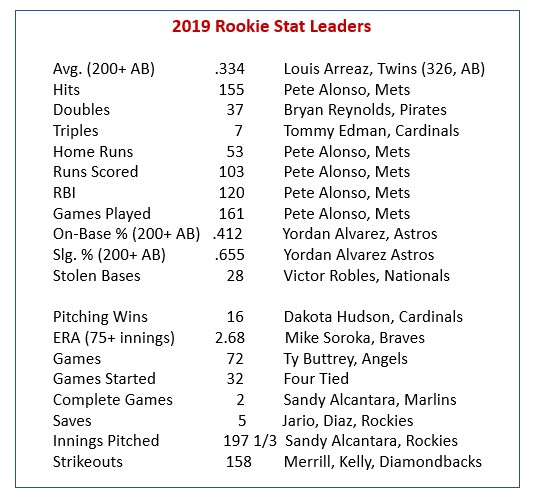
Guest Post – Getting Up to Speed on Radar Guns

BASEBALL ROUNDTABLE PRESENTS A GUEST POST FROM LIFT YOUR GAME

We’ve come a long way since that day in the summer of 1940, when a motorcycle sped past Bob Feller (going into his wind up in Chicago’s Lincoln Park) motoring loudly toward a paper barrier, while Feller launched his fastball toward an adjacent paper target. It was a race of man against machine (and an attempt to illustrate just how blisteringly fast Feller’s heater was).  Click here to see a video of that match up.  

Today, we have the means to measure not just pitch speed, but also pitch spin rate, launch angle and velocity off the bat and much more.  But really, this fascination with measuring velocity started with the radar gun and raw pitch speed.  With that in mind, Baseball Roundtable is pleased to present this guest post – looking at radar guns – from Matt Brown of Lift Your Game (liftyourgame.net), a website dedicated to providing sport equipment reviews, performance tips and advanced tutorials.  Click here to visit liftyourgame.net.  Now for that guest post.  Hope you enjoy Matt Brown’s thoughts, insights and opinions on radar guns. 

Everything You’d Ever Wanna Know about Radar Guns in Baseball

By Matt Brown

Pitch speed baseball photo

Photo by james_in_to

Being able to track pitch speed in baseball wasn’t always as important as it is today. But since Michigan coach Danny Litwhiler began using police radar technology as a training tool in the early ’70s, pitch velocity has become one of the most important stats in baseball.  (This July, for example, 23-year-old Oakland A’s fan Nathan Patterson – who hadn’t played baseball since high school – took a turn against the radar gun in the Fan Zone at an A’s game.  He lit it up at 96 m.p.h. and earned a contract with the A’s franchise.)

As a pitcher, knowing your velocity obviously allows you to see how hard your fastball is – as well as how much variation there between your fastball, change-up and breaking pitches.  And obviously, this information is invaluable for scouts.  As a coach or scout, radar readings can help you gauge velocity and speed variation from one pitcher to another (using the same model radar gun, of course) – a key tool in helping to gauge each hurler’s  potential ability to miss bats or produce weak contact.

But whether you’re a scout, a parent, or a coach, it’s not as simple as just going online and buying a $50 radar gun, pointing it at the pitcher, and pulling the trigger. You’ve got to know which type of gun to buy, and how to actually use it to get accurate readings.  (There still are no tools to measure grit and heart, but technology can help measure “stuff.”)

What types of radar guns are used?

Radar guns come in all shapes and sizes. However, most of them struggle to track baseballs with much accuracy.  Oddly, it’s often the devices advertised as being perfect for baseball that are the least accurate options.

For example, you can get little radar chips to put on the back of the catcher’s mitt, which are supposed to pick up ball speed on entering the mitt. While these things are great for kids, they’re not something you’d ever see an MLB coach using. This particular technology has a very short range (just a few feet in front of the mitt), and can often produce a slow reading.

There are even actual baseballs with gyros and LCD screens, which claim to show you pitch speed after a throw. As you might expect, these devices can break quite easily.

And finally, there are “pocket radars.” These products can take an accurate measurement, but are often quite inconsistent. Like in-the-glove radars, they normally produce a slightly slow reading – about 5 m.p.h. below actual pitch speed.

So, where do the readings used by scouts and put up on scoreboards around the major and minor league come from?

MLB scouts and coaches use police-style, hand-held radar guns. Most good-quality options from companies like JUGS (the first company to measure baseball velocity), Stalker and Bushnell.  These radar guns generally cost anywhere from $500 up to $1500.

The most popular gun out there among the pros right now is the Stalker Sport II, a gun which is actually designed with baseball in mind. This gun is popular because it’s calibrated to pick up smaller objects like baseballs – as opposed large moving objects like cars and trucks – even at long distances (more on this below).  It’s by no means cheap though!  Teams may invest up to north of $1,000 in each of these radar guns and purchase them in multiples for use throughout their systems.

How do scouts use radar guns?

Scouts (and anyone else using a radar gun) need to consider two basic issues to ensure that they get an accurate reading.

First, they’ve got to ensure that they’re aiming the gun at the right angle, relative to the pitcher and their throw. This is because all radar guns use something called Doppler Radar. Essentially, they work by firing radar beams at the ball. The time it takes for successive beams to return to the radar gun is then used to calculate pitch velocity. Therefore, for the readings to get back to the gun, rather than bouncing off at an angle, you need to be as straight-on with the line of the pitch as possible.

The further off-center the scout is, the slower the pitch will read. However, the better the gun, the more leeway you have with the angle of the shot. Some radar guns even allow you to compensate for the angle in the settings, in case you’re unable to get exactly in-line. Time to break out the protractor!

Lift Your Game is a sports website, made by athletes, for athletes. Since 2017, they’ve been providing gear reviews, tutorials, and other hints and tips for a variety of different sports.

For baseballers specifically, you’ll find tutorials for pitching, fielding, and batting techniques – like how to throw a split-finger fastball. They also do product tests and reviews, helping players and coaches find the right equipment to use to improve performance on the field.

Second, scouts need to consider the distance between the gun and the pitcher. Top of the line radar guns (think $1,000+) should be able to get an accurate reading at 200-300 feet – the Stalker Sport II mentioned earlier claims to work at up to 500 feet. However, for coaches or parents who have slightly cheaper models, you’ll want to be less than 150-feet away to ensure a good measurement.

Even the best radar guns out there are never 100 percent accurate all the time, so it’s crucial to get multiple measurements. Different scouts have different techniques, but one method is to take at least 10 readings and then find the median. This method, as opposed to using the average, ensures that the measurement is not skewed by outliers, bad readings, or change ups.  With this in mind, as a fan checking out scoreboard velocity reports, you may want to look for the middle of the range of a few fastballs when evaluating a pitcher.

For Lift Your Game’s review of specific radar guns, click here. 


BBRT Note: As of this posting, the Cardinals’ 22-year-old righty Jordan Hicks held the top 21 spots (and 28 of the top 30) on the 2019 Statcast pitch velocity leaderboard – and had posted  a top pitch speed of 104.3 m.p.h.  (Hicks underwent Tommy John Surgery in June.)  In 28 2/3 innings, he had thrown twenty pitches of 103 m.p.h. or faster.  The only other pitcher currently credited with a 103-m.p.h. pitch this season is the Marlins’ Tayron Guerrero, with one pitch at 103.0 mph. 

_______________________________________

A Few Questions BBRT asked of Guest Poster Matt Brown.

BBRT: What is your baseball background?

Matt:  I played a heap of Little League as a kid, but since then I’ve spent a lot more time watching baseball, and studying how good players become great, rather than playing … except for the occasional get-together at the park!

I have a bit of a soft spot for the Cubs, as most of my family is in Chicago, but I try to be a neutral so I can try to look at players’ performance, and analyze games, without too much bias.

For me, the beauty of baseball lies in the mental side of the sport. When two great teams come up against each other, the game is normally decided by the mental aspect of individual match-ups between players – especially pitcher versus batter. If you ask me, no other sports really have such a level of direct mental competition to them.

BBRT: What equipment advances to you think have had the greatest impact on the game?

Matt: On the field, the biggest change that you might not have thought about has probably been how gloves have evolved over the years – unless you’re a believer in the juiced ball theory! Tinfoil hats aside though, advances in baseball gloves now make it much easier to collect and throw the ball. Since they first came into baseball in the late 1800s, gloves are now bigger, lighter, and have much deeper pockets, which is part of the reason why batting averages are lower today than they were in the early years of MLB.

However, there’s a hidden impact of technological advances on baseball: training is now a lot more scientific. It’s not just about radar guns – there are now pitching machines, for example, that can throw the ball in exactly the same spot, again and again and again. The human factor is – for the large part – being taken out of the equation, allowing coaches to sort of act like doctors: diagnosing the problem (improper launch angle, for example) and prescribing a solution (sessions with a weighted bat, perhaps).

BBRT: What type of technology is used to measure exit velocity and launch angle off the bat – and how much accuracy can we expect?

Matt: To get a good measure of a batter’s exit velocity, you need to use a good-quality batting tee – one that won’t add drag to the ball as you hit it. You can technically record exit velocity off of a pitched ball, but this will normally add around 15 m.p.h. to the measurement.

Next, set up your radar gun directly behind the line of where the ball will travel when you hit it. You want to avoid measuring bat velocity if possible. If you think you are measuring bat speed, try to bring your radar gun in a little closer. You can also hit the ball into a net that’s hanging a few feet in front of you, and then use the last-recorded measurement on the gun to try and find your exit velocity. The issue with doing this is the ball will have slowed down a little by the time it reaches the net.

Measuring launch angle is a bit trickier. You’ll need specialized hardware – normally a sensor that clips onto your bat. There are a few options out there, but the good ones cost around $100, and will connect with your phone. Accuracy varies by product, but on the whole, these devices are generally quite good.

The cheaper way to do this is to try and film yourself hitting in slow motion and measure your angle manually. However, this takes a long time, and it’s hard to take an accurate measurement. If possible, it’s worth investing in a specialized sensor to measure your launch angle.

BBRT: Lots of young (and older) baseball and softball players out there. What basic advice might you give them on selecting a glove and breaking it in?

Matt: Comfort is absolutely crucial when selecting a glove. If you use something that doesn’t fit, or that isn’t the right shape, this is going to distract you in the field, which will impact your performance.

 The next most important thing to consider is your position. As an infielder, you’ll want something with a shallower pocket, so you can more quickly grab the ball and make a great throw. On the other hand, for outfielders and first basemen, you’ll want a bigger, deeper glove, in order to manage different types of throws, or to reach over the fence and claw back those homers. Catcher’s mitts as you might expect are much tougher, designed to handle 80 m.p.h.+ balls on a consistent basis.

If you go for a top-of-the-line glove, chances are, the leather will be quite stiff to begin with. To break in a glove, there are a few different techniques you can use. The simplest one is to play catch with it, or repeatedly throw your ball into the palm when doing something else, like watching TV. If this just isn’t working, you can also work to soften the leather with a flat-headed mallet. Pound the pocket and also pound the web to begin making a fold where you want it on the glove. From this point, you can begin flexing specific areas repeatedly if they’re not as soft as you’d like them. If this still isn’t working, you can apply some hot water (around 160 degrees) to certain areas of the glove before flexing it repeatedly, in order to speed up the softening process.

BBRT: What would you look for in selecting a bat? And, how does it differ between wood and metal?

Matt: Finding the right bat really comes down to who you are as a player. The key is being able to find something that feels right – something that feels like it’s the correct length and weight for you as a player. How far you can hit is more a function of your strength and technique, rather than what bat you’re using. This is why the pros don’t all use the same bat.

Be sure to go into a store and actually feel the bat before buying. For kids, something in the 18-24-ounce range is normally your best bet. But for high-school level and above, you can go for heavier options, depending on the strength of the player.

As for length, you generally want the longest bat you feel comfortable using, provided it isn’t too heavy. This ensures that you can cover your entire strike zone, without having to lean or reach for the ball. Reaching for the ball will severely limit the amount of power you can generate.

BBRT: Any thoughts on wood versus metal bats?

Matt: Of course, in most instances, the league you play in will determine whether you can use a metal bat.  If both wood and metal are allowed, it becomes a matter of personal preference. Some people – like me – are old-school, and just prefer the feeling of wood.

However, metal bats are on average going to produce a better hit. They’re lighter, meaning you can aim them easier, while maintaining your swing velocity. Plus, they offer a complete sweet spot.

Let me put it this way: If you’re really used to how wood bats feel, and you like having that extra bit of weight, stay with wood. Otherwise, it’s probably a better idea to go for an aluminum-alloy bat.

BBRT: Lift Your Game, BBRT has noticed, covers a wide range of sports? How does Lift Your Game select its writers?

Matt: We sure do! We specialize in all-American classics like baseball and football, but our range of coverage also includes everything from soccer to billiards.

Our writers each have a lot of experience with a number of different sports, which allows us to cover such a wide variety of topics. But when selecting writers, the team always wants to find people who have that extra work ethic – who are prepared to seek additional expertise when they need help on a certain article. We’re all athletes at the end of the day – and that’s why I think the 100+ articles we’ve put together so far make our website such a valuable resource.


BASEBALL ROUNDTABLE ON THE TOP 100 BASEBALL BLOG LIST

100Baseball Roundtable is on the Feedspot list of the Top 100 Baseball Blogs.  To see the full list, click here.

I tweet baseball @DavidBBRT

Follow/Like Baseball Roundtable’s Facebook Page here.  More baseball commentary; blog post notifications; PRIZES.

Member: Society for American Baseball Research (SABR); The Baseball Reliquary; The Negro Leagues Baseball Museum.
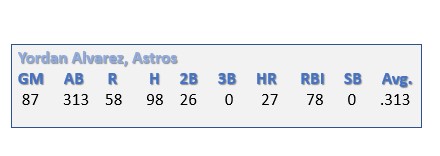
BBRT Musings: One-Hit Wonders – A Different Kind of Thirty Game Winner – So Close, and Yet, So Far

Just a few days ago, Baseball Roundtable featured a post on the fewest combined hits ever allowed in a major league contest of at least nine innings.  It happened back on September 9, 1965, when the Dodgers’ Sandy Koufax bested the Cubs’ Bob Hendley 1-0.  Koufax threw a no-hitter (perfect game), while the unfortunate Hendley gave up just one safety.  For the whole story, click here.

Never Before – Unlikely Again

Yesterday, marked another “never before – unlikely ever again” feat of pitching excellence (or batting futility). For the first time since 1900 (according to Elias Sports Bureau), an MLB team managed a victory despite having only one base runner (which, of course, would be the bare minimum) in a game of at least nine innings.  The team with this absolutely zero-waste offensive output?  The Arizona Diamondbacks, who topped the Cincinnati Reds 1-0 (in Phoenix). Reds’ starter Anthony DeSclafani set the Diamondbacks down in order in the first, second, fourth, fifth, sixth and seventh innings (fanning five); while reliever Joel Kuhnel added one whiff in a 1-2-3 eighth.  The only blemish for the Reds’ mounds men came in the third inning. Arizona SS Nick Ahmed led off with a high hopper (on the first pitch he saw from DeSclafani) that bounced over the head of Reds’ third-sacker Eugenio Saurez and rolled all the way to the left field wall for a triple.  D-backs’ RF Jarrod Dyson was also first-pitch swinging and sent a fly ball to center for a run-scoring sacrifice fly – and that was Arizona’s total offense for the game.

The Diamondbacks’ staff – starter Merrill Kelly (seven innings) and relievers Kevin Ginkel and Archie Bradley (one frame each) made the 1-0 lead stand up; giving up no runs on three and two walks (seven strikeouts).

It’s Happened Before, It’ll Happen Again

Yesterday (September 14), the Astros’ Zack Greinke pitched six innings of one-run ball (six hits, no walks, seven strikeouts) for the win, as Houston topped Kansas City 6-1 (in K.C.).  It was the Greinke’s 203rd career win and 16th victory of 2019 – but his first-ever against the Royals (Greinke was a Royals’ first-round draft pick in 2002, pitched for the Royals from 2004 through 2010 and won the AL Cy Young Award as a Royal in 2009).  Notably, Greinke’s win against the Royals made him the 19th pitcher to record victories against all 30 teams.  (Keep in mind, MLB didn’t reach 30 teams until 1998.) With today’s inter-league play and player movement from team to team, we can expect more hurlers to reach this mark.  Still, it’s a pretty good sign of MLB longevity – and a fun statistic.

Al Leiter and me ... at the 2015 All Fan Fest.

Al Leiter and me … at the 2015 All Fan Fest.

The first pitcher to notch wins against all thirty MLB team was Al Leiter, who completed the feat in 2002).  Since that time, Leiter has been joined by Kevin Brown, Terry Mulholland, Curt Schilling, Woody Williams, Jamie Moyer, Randy Johnson, Barry Zito, Javier Vazquez, Vincente Padilla, Derek Lowe, A.J. Burnett, Dan Haren, Kyle Lohse, Tim Hudson, John Lackey, Max Scherzer, Bartolo Colon and Zack Greinke.

Greinke’s fewest career victories against any team have come, of course, against the Royals (1).  He is 1-2, 2.90 versus K.C. On the other side of the coin, he has more career victories for the Royals (60) than for any other team.  He has more career victories against the Rockies (14-7, 3.66) than any other team.
Max Scherzer photo

Photo by apardavila

Looking at the full list,  Max Scherzer was the quickest to wins against all 30 teams – just nine seasons and 248 pitching appearances.  Taking the longest? Jamie Moyer and Randy Johnson each wrapped up the complete victory cycle in their 22nd MLB seasons and Derek Lowe notched a victory against team number 30 in his 641st appearance.  Oh yes, Barry Zito appeared for the fewest teams in his run to a win against all 30 franchises – taking the mound for just the Giants and A’s.


30-2


On May 11, 2016, Max Scherzer of the Nationals joined the ranks of pitchers recording a career victory against all 30 MLB teams, as Washington topped Detroit 3-2.     In the process, he became the first pitcher to reach the “30-team” mark while tossing a complete game – AND he tied an MLB record by fanning 20 batters in the contest (two runs, two hits, no walks, 20 whiffs). Scherzer was drafted by the Diamondbacks in the first round of the 2006 MLB draft- and has pitched for Arizona in 2008-09, Detroit (2010-2015) and Washington (2015-19).

Don’t Want to See This Again … So Close, Yet So Far

On this day (September 15) in 1971, Larry Yount (brother to Hall of Famer Robin Yount) had the shortest MLB career of any pitcher. Called up from the minors by the Astros that September, Yount was called in from the bullpen to pitch the ninth inning of a game against the Braves (Houston was trailing 4-1).  While he was warming up on the mound, he felt tightness and pain in his elbow. Baseball rules require a reliever to face at least one batter, with the lone exception being if he has to be removed due to injury.  That exception helped make Yount the answer to a trivia question.  Yount and his painful elbow were taken out of the game before he faced a single batter.  By baseball rules, however, he was credited with an MLB game appearance.  Yount played three more seasons (1972-73 and 1975), but never made it back to the majors.  He remains the only pitcher listed in MLB’s official records as having appeared in the majors – but never having faced a batter.

BASEBALL ROUNDTABLE ON THE TOP 100 BASEBALL BLOG LIST

100Baseball Roundtable is on the Feedspot list of the Top 100 Baseball Blogs.  To see the full list, click here.

I tweet baseball @DavidBBRT

Follow/Like Baseball Roundtable’s Facebook Page here.  More baseball commentary; blog post notifications; PRIZES.

Member: Society for American Baseball Research (SABR); The Baseball Reliquary; The Negro Leagues Baseball Museum.