Baseball Roundtable “Who’s Your Daddy?” …. Greg Maddux Edition

Greg Maddux could put a baseball through a Life Saver if you asked him.

Hall of Famer Joe Morgan

Junior Spivey – first seven plate appearance versus Greg Maddux: six hits, one HBP, one walk.

SpiveyOn August 12, 2001, Diamondback’s second baseman Junior Spivey faced future Hall of Famer Greg Maddux for the first time.  Maddux was in his 16th MLB season and brought a 15-6 record and a 2.68 earned run average into the game. Maddux already had more than 250 major-league wins under his belt. Spivey, on the other hand, was in his rookie season, playing in just hit 42nd MLB game. He had a total of 27 MLB hits and a .276 average.  It would seem to be “advantage Maddux.”  Not so fast.

In his first at bat against Maddux (top of the first), Spivey singled and stole second. He faced him again in the third and singled again; in the fourth, he produced another single; and in the sixth, another single. Spivey picked up a fifth hit in the eighth inning, but Maddux was out of the game. Spivey didn’t face Maddux again until April 25, 2002 – and he seemed intent on proving that  initial four-for-four wasn’t a fluke. He came to the plate three times and went hit-by-pitch, double, walk.  Maddux finally retired Spivey for the first time in his first at bat on August 7 – in Spivey’s eighth career plate appearance versus “The Professor.”  Spivey, who hit .270 over five MLB seasons (2001-2005) went 10-for-18 (.556) in seven career games versus Maddux.

In this post, the sixth  in Baseball Roundtable’s  “Whose Your Daddy?” series, we’ll take a look at a lineup of hitters who performed exceptionally well against Greg Maddux.

Who’s Your Daddy?  What It’s All About.

On September 24, 2004, in the middle of a tight pennant race, the Yankees handed future Hall of Famer Pedro Martinez and the Boston Red Sox a tough 6-4 loss.  Martinez went 7 1/3 innings giving up nine hits and five earned runs.  The game came just five days after (in his previous start) Martinez had lasted just five frames against the Bronx Bombers (eight hits, eight earned runs) in a 16-7 loss.

After that second loss, Martinez candidly commented, “What can I say? I just tip my hat and call the Yankees my daddy.”  Little did he know that his comment – and a Yankee fans’ chant of “Who’s your daddy?” would follow him into future starts in New York (all the way to his final MLB start – against the Yankees for the Phillies – in Game Six of the 2009 World Series.)

The concept of “Who’s your daddy?” became the inspiration for Baseball Roundtable to take a look at the players who “had the number” of some of MLB’s premier pitchers.  

Here are links to the previous editions of this series:

  • Nolan Ryan, click here.
  • Sandy Koufax, click here. 
  • Pedro Martinez, click here.
  • Bob Gibson, click here
  • Randy Johnson, click here

BBRT Note:  Keep in mind, the pitchers included in the “Who’s Your Daddy?” series are among the “best in the business.” They are selected not because of the players who performed well against them, but rather because solid hitter performance when they were on the mound was the exception rather than the rule.

Now, let’s take a look at the mound resume that earned Maddux a spot in this series – and then a lineup of players who seemed up to the task of facing Maddux’ mindful strike-zone mastery.

———————————————————————-

Greg Maddux

MadduxGreg Maddux translated a fastball that peaked in the low 90s (mph) and was in the high 80s much of his career, an assortment of off-speed and breaking pitches (circle change, curve, slider, splitter), exceptional (beyond exceptional) control and a cerebral approach to pitching that earned him the nickname “The Professor” into 355 wins (eighth all time), a .610 winning percentage, four Cy Young Awards and a spot in the Baseball Hall of fame.

I could probably throw harder if I wanted to,but why? When they’re in a jam, a lot of pitchers try to throw harder. Me, I try to locate better.              

                                                                                          Greg Maddux

The 6’, 170-lb. right-hander was an eight-time All Star and won a record 18 Gold Gloves. Maddux won 15 or more games for an MLB record 17 consecutive seasons (18 times overall) and was twice a 20-game winner. He led the NL in wins three times, winning percentage twice, earned run average four times, games started seven times, complete games three times, shutouts five times and innings pitched five times. He also topped the league in fewest walks per nine inning nine times.

Greg Maddux was the first MLB pitcher to win four consecutive Cy Young Awards (1992-95). He was joined in this “club” by Randy Johnson (1999-2002).

Greg Maddux pitched for 23 MLB seasons (1986-2008). He pitched for the Braves (11 seasons); Cubs (10); Dodgers (2); and Padres (2). He went 355-227, 3.16 – with 109 complete games, 35 shutouts, 5,008 1/3 innings pitched, 3,371 strikeouts and 999 walks.  For you trivia buffs, Greg Maddux made his major league debut in the bottom of the 17th inning of a Cubs-Astros game on September 3, 1983 – as a pinch runner (for Jody Davis). He stayed in the game and took the mound for the 18th inning, giving up a game-losing home run to Astros’ CF Billy Hatcher.  In the game, the teams used a total of 53 players (17 pitchers).

Chicago’s Loss

In 1992, Greg Maddux went 20-11, 2.18 for the Chicago Cubs, leading the league in wins and earning the National League Cy Young Award.  After some contentious contract negotiations, Maddux signed with the Braves (as a free agent) on December 9, 1992.  The first regular-season opponent Maddux faced as a Brave? The Chicago Cubs – on Opening Day 1993 (April 5) at Wrigley Field.  Maddux three 8 1/3 shutout innings (five hits, three walks and four strikeouts) and got the win in a 1-0 Braves victory. (Maddux won the Cy Young Award in each of his first three season with the Braves).

“Throwing a “Maddux.” What did Maddux bring to the mound?  On July 22, 1997, Maddux carved up the Chicago Cubs in a 4-1 complete-game victory.  He accomplished the feat in just 76 pitches, 63 of which were strikes. He did not go to a three-ball count on any batter and only two batters reached a two-ball count. Maddux mound mastery is “immortalized” in today’s expression “Throwing a Maddux,” described at MLB.com as tossing a complete-game, shutout using less than 100 pitches. Maddux accomplished the feat 13 times during his career. For you trivia buffs, Baseball-Almanac.com reports that the fewest pitches ever thrown in a nine-inning complete game is 58, by the Boston Braves’ Red Barrett in a 2-0, two-hit, no-walk, no-strikeout victory over the Reds on August 10. 1944. Time of game? One-hour and 15-minutes.

———————————————————

Now let’s look at Baseball Roundtable’s anti-Maddux lineup.  As Baseball Roundtable selected this lineup, a number of factors were considered including, but not limited to, sample size (plate appearances), average and on-base percentage, power, walks versus strikeouts and Maddux’ record in the season in which the opposing batter found the most success.  Like all things baseball, these selections are subject to discussion and debate.

Maddux carrer

Catcher – Javier Valentin … Announcing his presence with authority.

Javier Valentin, catching for the Reds, announced his presence to Greg Maddux “with authority.”  He first faced Maddux on July 22, 2004. In his first at bat against Maddux, Valentin took him deep (right field) on an 0-1 pitch to lead off the third inning and tie the game 1-1. Javier faced Maddux again with two outs in the sixth and the Reds trailing 6-1.  On the first pitch of that at bat, he again homered to deep right. So, now he had seen three pitches from Maddux and had two home runs to show for it. Valentin went two-for-three (in a game in which Maddux went the distance and gave up only four safeties) – and his two long balls were the only runs scored off Maddux that day.  Javier went on to face Maddux 29 times (in 12 games) in his career and hit a robust .393, with two doubles, five home runs and eight RBI. His five home runs tied for the fifth-most against Maddux and he did it in just 29 plate appearance.  None ahead of him had fewer than 91. No other player with at least five regular-season long balls against Maddux did it in fewer than 50 plate appearances.

ValentinMadValentin had a 10-season MLB career (1997-99, 2002-2008 …Reds, Twins, Devil Rays), hitting .251, with 45 home runs and 210 RBI in 631 games. He had more hits, more home runs and RBI against Maddux than he had against any  other pitcher.  Valentin’s best season was 2005, when he went .281-14-50 for the Reds. Side note:  Valentin never appeared in 100 games in any MLB season.

Honorable mention at catcher goes to Benito Santiago, who put up a .289-6-17 line against Maddux in 29 games.

________________________

First Base – Jeff Bagwell … Seven dingers and 17 RBI.

In 28 regular-season games versus Maddux, Bagwell went .305-7-17. He also was hit by a pitch three times, second only Andres Gallaraga’s four. Bagwell’s seven home runs versus Maddux are the third-most of any hitter, while his 17 RBI rank fourth.  His 91 plate appearances are 14th.

Bagwellmad

Bagwell played 15 MLB seasons (1991-2005), all for the Astros.  He was a four-time All Star, who led the NL in games played four times, runs scored three times and home runs, RBI, walks and total bases once each.  He was the National Rookie of the Year in 1991 and the MVP in 1994, when he hit .368, with 39 home runs – and led the league in both runs scored (104) and RBI (116). He also stole 15 bases and won a Gold Glove that season. For his career, Bagwell put up a .297 average (2,314 hits), 488 home runs, 1,529 RBI, 1,517 runs scored and 202 steals. He topped 30 home runs in nine seasons (40+ three times) and stole 30 or more bases twice.

______________________

Second Base – Jeff Kent … Picked up the pace after a slow start.

There was a bit of competition here, with Jeff Kent’s power giving him an edge of Mickey Morandini. Considering his slow start against Maddux, Kent’s final number (.330-5-13) are even more impressive. In his first two season versus “The Professor” (1992-93), Kent came to the plate 15 times and recorded just one single and one hit by pitch – with six of his 12 outs being strikeouts. From 1994 to 2008, he hit .378 (28-for-74).

KentMad

Jeff Kent played 17 MLB seasons (1992-2008 … Giants, Mets, Dodgers, Astros, Indians, Blue jays). He hit .290 (2,461 hits), with 377 home runs and 1,518 RBI. Kent was five-time All Star and the 2000 NL MVP, when he hit .334, with 33 home runs and 125 RBI. Kent hit 30 or more home runs in three seasons and drove in 100+ runs in eight campaigns.

Jeff Kent’s 351 career home runs while in the lineup as a second baseman are the most ever for a keystone sacker.

Honorable mentions  at second base go Junior Spivey (whose performance was described earlier) and  to Mickey Morandini, who hit .344-1-8 against Maddux in 29 regular season games – and also holds the all-time triples mark against him (4).  All of Spivey’s plate appearances against Maddux, however, came in the final four seasons of Maddux’ career. Again, for trivia buffs, Greg Maddux took the mound for the final time in his career as a Dodger (September 27, 2008), giving up one run on two hits in a 2-1 win over the Giants in San Francisco.

____________________________

Third Base – Mike Lowell … A .367 average in 20 games.

Mike Lowell had just one hit (a single) in his first eight career at bats against Greg Maddux, but (like Jeff Bagwell) he picked up the pace.  In 20 career games versus Maddux, Lowell hit .367 (18-for-49) with four home runs and eight RBI.

LowellMad

Mike Lowell had a 13-season MLB career (1998-2010 … Marlins, Red Sox, Yankees). He was a four-time All Star and won a Gold Glove in 2005. Lowell finished his career with a .279 average (1,619 hits), 223 home runs and 952 RBI. He hit 20 or more home runs in six seasons (a high of 32 in 2003); three times topped 100 RBI; and hit over .30o once (.324 in 2007).

Honorable mention at third base goes to Howard Johnson, who hit .284-5-13 against Maddux in 28 games. The edge fges to Lowell based on his average and the fact the Lowell fanned just five times in 20 games versus Maddux, while Johnson fanned 18 times in 28 games.

________________________

Shortstop – Orlando Cabrera … Fanned only once in 50 plate appearance.

Orlando Cabrera hit .340 versus Greg Maddux – 16-for-47 in 16 games, with six extra base hits.    He also fanned only once versus Maddux in 50 plate appearances.

Cabrera MadduxCabrera was a true journeyman, playing for nine teams (Expos, Angels, Twins, Giants, A’s, Red Sox, Indians, Reds and White Sox), after spending his first seven seasons in Montreal. His MLB career stretched from 1997-2011.   Cabrera had a career .272 average (2,055 hits), with 854 RBI, 985 runs scored, 123 home runs and 216 steals (29 or more steals in five seasons). He was also a two-time Gold Glover. Cabrera played in the post season with five clubs (Red Sox, Angels, White Sox, Twins and Reds), hitting .228 with 18 RBI in 37 post-season games.

_______________________________

How About a Utility Player?

If I could pick a utility man it would be Bip Roberts, who started four games at third base, four at second base, two in left field, one in center field and one at shortstop against Maddux.  He didn’t show much power, but he made consistent contact and exhibited a good eye at the plate versus Maddux.  In 13 games against the control master, Roberts walked seven times and fanned just four.  He also had 16 hits (four doubles) for a .471 career average versus Maddux. In 1989, Roberts faced Maddux eight times and reached base six (three hits and three walks.).

Outfield – Tony Gwynn … 103 regular-season plate appearances, no strikeouts.

He’s (Maddux) like a surgeon out there … he puts the ball where he wants to.

                     Eight-time batting champion and Hall of Famer, Tony Gwynn

Despite the respect shown in the above comment, Tony Gwynn faced Greg Maddux 103 times in regular-season games – and never struck out (and another four times in the post-season without a whiff.

GwynnMad

Tony Gwynn collected more regular season hits against Greg Maddux than any other batter (39 in 33 games).  He also had the second-most regular-season doubles, fifth-most walks and second-most intentional walks.  In his first game against Maddux, Gwynn was intentionally walked twice and grounded out twice.

Tony Gwynn was a standout player in both baseball and basketball at San Diego State University, earning All-Conference (Western Athletic Conference) honors in both sports,  He was drafted by both the San Diego Padres and the NBA San Diego Clippers.

Gwynn’s best season versus Maddux was 1990, when he when he went 8-for-12 (.667) against him in four games. He hit .500 or better against Maddux in seven of the 15 seasons in which he faced him.

Tony Gwynn played 20 MLB seasons (1982-2001), all with the Padres. He was an eight-time batting champion and led the NL in hits seven times (topping 200 safeties in five seasons). He was an All Star in fifteen seasons and a Gold Glover in five. He also stole 25 or more bases five times, with a high of 56 in 1987.  A “pure” hitter, Gwynn also led the NL in at bats per strikeout in 10 seasons. In 1995, he fanned just 15 times in 577 plate appearances (535 at bats). Gwynn retired with a .338 average (3,141 hits), 1,383 runs scored, 1,138 RBI, 543 doubles, 135 home runs and 319 steals.

_________________________________

Outfield – Luis Gonzalez … Only player to reach double-digit home runs. 

Luis Gonzalez, hit more home runs (10) and drove in more runs (22) than any other hitter against Maddux (38 regular-season games).

GonzalezMad

Gonzalez got off to a good start against Maddux.  In his first game against “The Professor” (May 1, 1991), Gonzalez had a single on the first pitch he ever saw from Maddux in the third inning; a two-run home run on the first pitch he saw in the fourth, a four-pitch walk in the sixth; a two-run home run on the first pitch he saw in the eighth.  Think about it, on just seven pitches, he had a walk, two home runs and a single – driving in four runs and scoring a pair.  Maddux, by the way, got the win as the Cubs beat the Astros 11-8. In that 1991 season, Maddux went 15-11, 3.35.

Gonzalez played 19 MLB seasons (1990-2008 … Diamondbacks, Astros, Cubs, Dodgers, Marlins, Tigers). He hit .283 (2,591 hits), scored 1,412 runs, hit 354 home runs, drove in 1,439 tallies and swiped 128 bases.  He was a five time All Star.  He also led the NL in hits once, 206 in 1999.  Gonzalez hit 20 or more home runs in seven seasons, with a high of 57 in 2011 – when he went.325-57-142, scored 128 runs and drew 100 walks.  He hit .300 or better in five seasons.

_____________________________________

Outfield – Shawn Green … Home runs right off the bat.

Shawn Green smacked a home run to deep right field of Greg Maddux in his first at bat against him (June 17, 1997) – and went on to go .429-3-10 against him in 15 regular season games.

Greenmad

Shawn Green holds the major league record for most total bases in a nine-inning game. On May 23, 2002, as his Dodgers topped the Brewers in Milwaukee by a 16-3 score, Green went six-for-six, with four home runs, a double and a single (a record 19 total bases) – scoring six times and driving in seven runs.

Green played 15 seasons in the major leagues (1993-2007 … Blue Jays, Dodgers, Diamondbacks, Mets), going .283-328-1,070. He collected 2,003 hits, scored 1,129 runs and stole 162 bases. Green was a two-time All star and one-time Gold Glover.  He hit 35 or more home runs in four seasons (a high of 49 for the Dodgers in 2001) and drove in 100 or more runs four times.

________________________________________

Pitcher -Jamey Wright … Career-long hitting streak.

Jamey Wrights, a 6’6, 240-pound right-hander found himself facing Greg Maddux (on the mound and at the plate) in three contests during his career – and he retired with a three-game hitting streak against Maddux. His three hits against Maddux were the most he had against any pitcher (he also had three career hits versus Kevin Brown). He went 2-0 on the mound against Maddux (he did not figure into the decision in the third game).  Wright faced Maddux as a Rockie, a Brewer and a Giant.

WrightMad

Wright had a 19-season major league career (1996-2014 … Rockies, Brewers, Royals, Dodgers, Rangers, Mariners, Rays, Giants, Cardinals, and Indians). He started 248 games and relieved in 471 – going 97-130, 4.81 with two saves. In six seasons, his earned run average was north of 5.00 and in four  campaigns it was under 4.00. In his final season, 2014, at the age of 39, Wright was 5-4, 4.35 in 61 appearances for the Dodgers. He was a career .144 hitter (64 for 443), with one home run and 17 RBI.

400

Bonus Player – Dave Parker

The Reds’ Dave Parker faced Greg Maddux for the first time on September 7, 1986 – as the Reds lost to Maddux and the Cubs (in Cincinnati) 11-3. In his first at bat against the future Hall of Famer, Parker doubled (two out, no one on in the first inning). It was the start of a pretty good day for Parker (despite Maddux’ complete-game victory). He came up again in the third inning and walked. His next trip to the plate came in the fifth and he slashed a run-scoring single. He faced Maddux one more time that day and produced a seventh-inning single.  Not a bad day, three-for-three, with a walk.

Parker didn’t face Maddux again until the following May (May 20), when the Reds topped Maddux and the Cubs 6-2 in Cincinnati. The results, for Parker, were even better.  He produced a single leading off the second frame and another based hit with one out in the fourth. (He also had a two-run home run in sixth, but by that time, Maddux was out of the game.)  So, after two games against Maddux, Parker was five-for-five with a walk.

Parker would come up against Maddux again just five day letter (as the Reds topped the Cubs 5-4 in Cincy). The pattern continued, as Parker delivered a two-run double off Maddux in the first inning. He came up against Maddux again in the second, with two-out and a runner on second (and the Reds up 5-1). Cubs’ manager name Gene Michael had apparently seen enough of Maddux versus Parker and ordered an intentional walk.  Maddux was out of the game before Parker came to the plate again.  So, it was a one-for-one game, with a walk.  After the season, Parker was traded to the American League A’s and never faced Maddux again.  So, in his career versus Maddux, Parker Came to the plate eight times and collected six hits (two doubles) and a pair of walks.  It is the most plate appearances by any batter that Maddux never retired.

There are, however, extenuating circumstances.  Dave Parker was already “The Cobra” the first time he faced Maddux. He was 34-years-old, in his 14th major league season, had been an All Star six times and the 1978 National League’s Most Valuable Player. Maddux, on the other hand, was not yet “The Professor.”  He was a 20-year-old rookie in his first major-league start (second appearance). He did go the distance – giving up 11 hits and three walks, but only three runs, in earning his first victory.  Also, in the two seasons in which Parker faced Maddux (1986-87), Maddux was 8-18, with a 5.59 earned run average. Parker left the NL in 1988, the first of Maddux’ MLB-record 17 straight seasons of 15 or more wins.  It was these career circumstances that keep Parker – perfect against Maddux – from being on the Baseball Roundtable Greg Maddux “Who’s Your Daddy?” team.


Coming up, new editions of “Whose Your Daddy?” featuring Bob Feller and Justin Verlander.

Primary Resources: Baseball-Reference.com; MLB.com; Baseball-Almanac.com.


BASEBALL ROUNDTABLE ON THE TOP 100 BASEBALL BLOG LIST

100Baseball Roundtable is on the Feedspot list of the Top 100 Baseball Blogs.  To see the full list, click here.

I tweet (on X) baseball @DavidBaseballRT

Follow/Like Baseball Roundtable’s Facebook Page here.  More baseball commentary; blog post notifications; PRIZES.

Member: Society for American Baseball Research (SABR); The Baseball Reliquary; The Negro Leagues Baseball Museum.
Twenty Losses – Not Always a Dubious Achievement

Hall of Famer James Francis “Pud” Galvin racked up a total of ten (consecutive) seasons with 20 or more losses (1879-1888) during his 15-season MLB career.  However, it was a different game back then. In nine of those seasons, Galvin also won 20 or more games and in eight of them he actually won more games than he lost.  In 1884, Galvin, pitching for the National League Buffalo Bisons, won 24 games more than he lost – going 46-22, 1.99 in 72 starts (71 complete games and a league-topping 12 shutouts.)  In games the stocky 5’8”, 190-pound righty didn’t start on the mound that season, Buffalo went 18-25.

Galvin

During his ten-year streak of 20-loss seasons, Galvin went 301-253, with a 2.71 ERA and 535 complete games (50 shutouts) in 562 starts. Galvin is said to have featured great control of an excellent fastball; a serviceable off-speed pitch; a deceptive pick-off move; and exceptional fielding skills.  Galvin finished his career with 365 wins (fifth all time), versus 310 losses (second all time), with a 2.85 earned run average. He ranks in MLB’s top ten in innings pitched (6,003 2/3 – second); games started (666 – tenth); and complete games (646 – second).

In MLB history, there have been a total of 499 seasons of 20 or more losses, accomplished (if that is the right word) by 231 different pitchers.  Notably, 291 of those 499 seasons (58.3 percent) occurred before 1900 and since (and including) 1980, there have been only two 20-loss campaigns (A’s Brian Kingman, 1980 and Tigers’ Mike Maroth, 2003).

20-loss seasons

Here are a few more bits of 20-loss trivia.

  • The 1884 season saw the most 20-loss campaigns, as 25 pitchers reached or exceeded twenty defeats. (The 1884 season featured 33 “major league” teams … National League, Union Association and American Association.)
  • The most wins in a 20-loss season belong to Hall of Famer Guy Hecker, who went 52-20, 1.80 for the 1884 Louisville Eclipse of the American Association. (The Eclipse went 68-40 that season.) Hecker led the league in wins, earned run average, games (73), starts (73), complete games (72), innings pitched (670 2/3) and strikeouts (385). Hecker finished his nine-season MLB career at 175-46, 2.93, with a .282 batting average (he pitched in 336 games, played first base in 322 and outfield in 75).

On the Mound and at the Plate

Guy Hecker won the American Association ERA title in 1884 (1.80) and the league’s batting title in 1886 (.341).

  • The fewest wins in a season with 20 or more losses is one, shared by: John Cassidy (1-21, 3.03 for the Brooklyn Atlantics (National Association) in 1875; and Jack Nabors (1-20, 3.47 for the American League Philadelphia Athletics in 1916). Cassidy pitched in 30 games as a rookie in 1875 and only took the mound twice more in his 11-season MLB career (1875-1885). He hit .246, primarily as an outfielder. Nabors pitched in just three MLB seasons, with 40 of his 52 appearance in 1916.
  • In 107 of MLB’s 499 20-loss seasons, the pitcher put up a winning percentage of .500 or better, with Guy Hecker’s .722 (52-20) being the highest ever.

Baseball Roundtable’s 20-20 Guy

wwodSince 1900, only one pitcher has TWICE put up a season of twenty losses immediately after a season of twenty wins.  That would be the White Sox’ Wilbur Wood, who accomplished the feat between 1972 and 1975.

Wood – a southpaw knuckleball pitcher – started his MLB career primarily as a reliever,  just 21 starts in 365 appearances between 1961 and 1970. He was converted to a starter by the White Sox in 1971 and won 20 or more games in each of the next four season.  He played in 17 MLB seasons, going 164-156, 3.13, with 57 saves. He made a total of 651 appearances (297 starts).  Wood was a three-time All Star and led his league in wins twice (losses once), games pitched three times, games started four times, and innings pitched twice.

Woos

Side note:  Wood was primarily a fastball-curve pitcher in his early years (going 24-2 as a high-schooler and showing some success in the minor leagues (in 1962, he was 15-11, 2.84 at Single-A); but his stuff didn’t play at the major-league level. That is, not until 1966, when Hall of Fame knuckler Hoyt Wilhelm began working with him on a knuckleball that Wood occasionally used as a trick pitch. 

  • The most recent 20-loss season was “achieved” by the Tigers’ Mike Maroth, who went 9-21, 5.73 in 2003. Maroth, a 6’, 180-lb. southpaw, went 50-67, 5.05 in six MLB seasons. Of note is the fact that Maroth was actually the Tigers’ Opening Day starter (a 3-1 loss to the Twins in Detroit) and his nine wins led the Detroit ball club (no other pitcher won more than six games for the Tigers, who  finished 43-119 and 47 games off the pace.)
  • Pitchers have reached 20 ore more wins AND 20 or more losses in the same seasons 52 times.

Both Ends Now

The most recent pitcher to notch 20 or more wins AND 20 or more losses in the same season IS Braves’ Hall of Famer knuckleball specialist Phil Niekro, who went 21-20 in 1979, leading the NL in both wins and losses. (He tied his brother Joe in the wins category). Niekro, notably, led the NL in losses for four straight seasons (1977-80). Niekro pitched in 24 MLB seasons (1964-87), going 318-274, 3.35. He was a four-time All Star and led his league in wins twice, winning percentage once, earned run average once, complete games four times and innings pitched four times. He also earned five Gold Gloves.

  • The most 20-loss seasons by a pitcher since 1900 is three – ten pitches share that mark.
  • The lowest ERA for a pitcher with 20 or more losses in a season is 1.27, by the White Sox’ Ed Walsh in 1910 (18 wins and 20 losses). The league ERA was 2.52 that season.
  • The highest earned run average for a pitcher in a 20-loss season is 6.43 for Les German (2-20 for the 1891 Giants and Senators). The league ERA was 4.36.

Leading the League … In A Way

Only three players have led their league in losses four times in a career, Phil Niekro, Bobo Newsom and Pedro Ramos. Ramos and Niekro accomplished the dubious feat in consecutive seasons: Ramos… 1958-61; and Niekro … 1977-80.

  • The name game.  Some pitchers (whose names stuck out for me) with 20-loss seasons under their belts: Steve Carlton; Walter Johnson; Jerry Koosman; Mickey Lolich; Don Larsen; Rube Marquard; Joe McGinnity; Denny McLain; Old Hoss Radbourn; Eppa Rixey; Robin Roberts; Red Ruffing; Amos Rusie; Mel Stottlemyre; Luis Tiant; Cy Young.
  • Nicknames. Ah, those were the days.  Here are some 20-game losers with nicknames that grabbed me (these are nicknames bestowed upon them by their peers, not selected on their own – as we now see on Players’ Weekend): Ice Box Chamberlain; Egyptian Healy; Phenomenal Smith; Tricky Nichols; The Only Nolan; Brickyard Kennedy; Bullet Joe Bush; Boom-Boom Beck; Pretzels Getzien; Cherokee Fisher; Pink Hawley; Sad Sam Jones; Bobo Newsom.

To wrap this up, let’s look at pitchers, since 1900, who have either followed up a 20-win season with 20 losses in the next campaign, or followed a 20-loss season immediately with a 20-win season.

20 loss after 20 win

20-20


Primary Resources:  Baseball-Reference.com; Baseball-Almanac.com.

BASEBALL ROUNDTABLE ON THE TOP 100 BASEBALL BLOG LIST

100Baseball Roundtable is on the Feedspot list of the Top 100 Baseball Blogs.  To see the full list, click here.

I tweet baseball @DavidBBRT

Follow/Like Baseball Roundtable’s Facebook Page here.  More baseball commentary; blog post notifications; PRIZES.

Member: Society for American Baseball Research (SABR); The Baseball Reliquary; The Negro Leagues Baseball Museum.
Foster, Patkin and Costas Elected to Baseball Reliquary Shrine of the Eternals

This week (on May 6, 2020), the Baseball Reliquary announced the 2020 electees to its Shrine of the Eternals; the Reliquary’s fan-centric equivalent to the National Baseball Hall of Fame.  It was the twenty-second “Shrine” class (the Baseball Reliquary members annually elect three new members to the Shrine of the Eternals).

The 2020 honorees include “the father of Black baseball” – Rube Foster; one of the game’s preeminent broadcasters – Bob Costas; and “The Clown Prince of Baseball” – Max Patkin. (Each year, Reliquary members and vote for up to nine candidates among 50 nominees, with the top three vote-getters earning election.

ReliquaryNewFor those not familiar with the Baseball Reliquary or its Shrine of the Eternals, honorees are selected on the basis of their contributions to the national pastime both on and off the field.  Criteria for election are: “the distinctiveness of play (good or bad); the uniqueness of character and personality; and the imprint that the individual has made on the baseball landscape.  Electees, both on and off the diamond, shall have been responsible for developing baseball in one or more of the following ways; through athletic and/or business achievements; in terms of its larger cultural and sociological impact as a mass entertainment; and as an arena for human imagination.  Past Honorees include such varied “characters” as a man in chicken suit; a member of MLB’s 3,000 hit club; a cartoon character who accumulated more than 1,000 mound losses; a noted surgeon; a renowned statistician; softball’s mound “king;” and a pitcher who threw a no-hitter while on LSD.  (A full list of past honorees is included at the end of this post.)

For more on the Baseball Reliquary – its collections and exhibits, ties to the Institute for Baseball Studies and the Shrine of the Eternals, click here.  That link will also take you to a look at Baseball Roundtable’s 2020 Shrine Ballot.

Here are the photos and bios, provided by the Baseball Reliquary, of this year Electees.

Rube Foster

FOSTERElected to the Shrine of the Eternals in his 22nd year on the ballot, ANDREW “RUBE” FOSTER (1879-1930) was a dominant southpaw pitcher who peaked during the early years of the 20th century. With the Philadelphia Cuban X-Giants in 1902, Foster reeled off 44 consecutive wins and, in the following year, pitched that team to victory over the Philadelphia Giants for “the Colored Championship of the World.” He picked up his nickname when he beat Philadelphia Athletics southpaw Rube Waddell in a 1902 exhibition game.

In 1911, he partnered with the son-in-law of Charlie Comiskey, owner of the White Sox, to found the Chicago American (or Black) Giants. Under Foster’s expert guidance, the Giants crushed opponents, winning every black championship for a decade. After establishing the team as the greatest sporting institution that Black America had ever seen, Foster set his sights higher. During the 1919-1920 off-season, he founded the Negro National League in Kansas City – the first successful, organized black professional baseball league. While still acting as manager of the Giants, Rube took on the additional roles of league president and treasurer, leading the circuit to dizzying heights of success.

The weight of these responsibilities caught up with him in 1926, when he suffered a nervous breakdown. The “Father of Black Baseball” never recovered, dying prematurely in 1930.

The pitcher-turned-entrepreneur, Rube Foster is elected to the Shrine of the Eternals in the same year that he is being honored during the centennial celebration of his greatest achievement, the founding of the Negro National League. “What Rube Foster accomplished in establishing the Negro Leagues against the backdrop of American segregation is monumental and richly deserves to be more than just a footnote in baseball history,” Bob Kendrick, Negro Leagues Baseball Museum president, said. “The Negro Leagues would change the game and America too. This milestone anniversary creates a platform to educate the public about this powerful story of triumph over adversity while using the many relevant life-lessons to inspire a nation to embrace diversity and inclusion.”

————————————————————————————–

Max Patkin

patkinElected to the Shrine of the Eternals in his first year on the ballot, MAX PATKIN (1920-1999) easily holds the all-time record for playing at the most ballparks in baseball history. The “Clown Prince of Baseball “(the second of that name, technically, after Al Schacht), comic Max Patkin played to adoring crowds in parks and stadia from Key West to Kenosha to Kingman to Keokuk and all points between, around, and beyond for decades.

Entertaining tens of thousands of fans and players with over-sized theatrics and uncanny pantomime skills, Patkin was a traveling one-man cottage industry; moving from one minor-league town to another and sometimes squeezing in an appearance at a major-league park, his annual visits were eagerly anticipated.

After an arm injury ended his minor -league career, Patkin joined the Navy during World War II. While stationed in Hawaii, he pitched for a service team against Joe DiMaggio, who quickly homered off him. When Patkin threw down his glove in feigned anger and began to follow the Yankee Clipper around the bases, imitating his movements, the fans howled and, according to the prevailing origin story, a career was born.

After the war, he was hired as a coach by Bill Veeck of the Indians, but after Veeck sold the team in 1949, Patkin struck out on his own to barnstorm around the country. He would appear more than four-thousand times (his estimate) in ballparks big and tiny, dressed in an over-sized uniform with “?” stitched on back, cap askew, contorting his body and face into hundreds of extreme poses and goofy expressions. Patkin stated proudly that in 50 years (1944-1993), he never once missed a performance. While some found his comedy corny, and contemporaries would now most likely find it hopelessly outmoded – a throwback to big-gesture vaudeville performance practices – Patkin nonetheless endeared himself to fans and players everywhere. In 1988, he attained the zenith of his fame when he was named “King of Baseball” at that year’s annual Winter Meetings, and also appeared in Ron Shelton’s Bull Durham, in which he played himself, this time before millions. If baseball fans in America could adore a funny-looking Jewish son of Russian immigrants and former ballplayer-turned-clown, then there’s hope for this country yet.

——————————————————————————-

Bob Costas

cpostasElected to the Shrine of the Eternals in his seventh year on the ballot, BOB COSTAS (born 1952), a native of Queens, New York, has been a near-ubiquitous presence in American sports television since his days as a cub reporter at KMOX in St. Louis during the seventies, when he looked all of fourteen-years-old by some reports. But his cuddly demeanor shouldn’t fool you. Costas is among the sharpest, most articulate, gracious, knowledgeable, good-natured, and devastatingly perceptive sports analysts on the air. He is capable of discussing all sports with the air of an expert, but he is often among the first to humble himself by admitting an error or misperception. Costas is at home in the broadcast booth, any broadcast booth – it doesn’t matter if he’s covering the NBA, NFL, NHL, MLB, the Kentucky Derby, the Olympics (he hosted eleven of ‘em from 1992 to 2016), golf tournaments, or any one of several talk shows. But he is at his happiest and most comfortable when he is talking, broadcasting, or debating baseball.

This eternal kid grew up idolizing Mickey Mantle, the Eternal Kid. The game is in his bones. When he broadcasts a ballgame, his style is informative, but not intrusive; his profound understanding and insights elicit silent smiles of delight, not groans of dismay at the retelling of old war stories; he’s forthright enough to question with vigor conventional wisdom, and smart enough to know when he’s pushed a point too far. Listening to his play-by-play accounts on NBC (for whom he worked from 1979 through 2018) or MLB-TV, you often sense that you’re watching the game while seated beside your smarter kid brother or your favorite uncle. He has been particularly vocal in the recent debate concerning PEDs, holding all parties involved – players, management, the union, the commissioner’s office, the media – accountable to some degree for failure to address the problem in a meaningful and forceful manner. Even the sainted Marvin Miller, the late labor leader, a man whom Costas respected deeply, wasn’t spared the occasional barb.

As excellent an announcer as he is, Costas is an even better interviewer, a talent clearly evident on his talk show, Studio 42 with Bob Costas, broadcast on MLB-TV. Seated informally with one or two guests, and supplemented by film and video clips illustrating the topic under discussion, Costas is able to bring the best out of his subjects, even when the discussion veers into sensitive or painful memories. As viewers, we are fortunate to have a broadcast sports journalist of Costas’ intelligence and skill reporting on the games of our time. Just as the 1960s and ‘70s are remembered as the Jim McKay era in sports reporting, our time will be remembered as the Bob Costas era.

______________________________________________________________

THE SHRINE OF THE ETERNALS:  2020 VOTING PERCENTAGES

Rube Foster – 42.5%

Max Patkin – 36%

Bob Costas – 32%

Effa Manley – 29%

Mamie “Peanut” Johnson – 27%

Dusty Baker – 25%

Felipe Alou – 22%

Octavius V. Catto – 22%

Rube Waddell – 22%

Melissa Ludtke – 20.5%

Hideo Nomo – 20.5%

Annie Savoy – 20.5%

Mike Veeck – 20.5%

Ralph Branca – 20%

Charles M. Conlon – 20%

Charley Pride – 19.5%

John Young – 19.5%

Charlie Finley – 19%

Jack Kerouac – 19%

Denny McLain – 19%

Bill White – 19%

Chet Brewer – 18.5%

Dr. Mike Marshall – 18.5%

Leo Durocher – 18%

Ron LeFlore – 18%

Ernie Harwell – 17%

Janet Marie Smith – 17%

Julio Franco – 16%

Luke Easter – 15.5%

John Kruk – 15.5%

Jim Thorpe – 15%

Rocky Colavito – 14%

John Thorn – 14%

Fred Merkle – 13.5%

Masanori Murakami – 13.5%

Pete Reiser – 13.5%

Bing Russell – 13.5%

Justine Siegal – 13.5%

Chris Von der Ahe – 13.5%

Dave Parker – 12.5%

Vic Power – 12.5%

Tony Conigliaro – 11.5%

Tug McGraw – 11%

Jim Joyce – 8%

Joe Pepitone – 8%

Charley Lau – 6%

Jesse Cole – 5.5%

Cleon Jones – 5%

Jack Dunn – 2%

Bugs Raymond – 1.5%

inmDUCTEES

Note: Due to the coronavirus pandemic, the Shrine of the Eternals 2020 Induction Day has been postponed until 2021. The three electees for 2020, along with the three electees for 2021, will be formally inducted into the Shrine of the Eternals in a public ceremony on Sunday, July 18, 2021.

Again, for more on The Baseball Reliquary, the Shrine of the Eternals and Baseball Roundtable’s Shrine Ballot, click here.  Also, if you are looking for some shelter-at-home reading, while we await the return of baseball, you might find the bio of many past Shrine electees interesting and entertaining – you can find them here.

Primary Resource:  The Baseball Reliquary

BASEBALL ROUNDTABLE ON THE TOP 100 BASEBALL BLOG LIST

100Baseball Roundtable is on the Feedspot list of the Top 100 Baseball Blogs.  To see the full list, click here.

I tweet baseball @DavidBBRT

Follow/Like Baseball Roundtable’s Facebook Page here.  More baseball commentary; blog post notifications; PRIZES.

Member: Society for American Baseball Research (SABR); The Baseball Reliquary; The Negro Leagues Baseball Museum.
More Shelter-at-Home Baseball Trivia … A Couple of All-Time All Star Performances

Here to help get through the days without live baseball is another Baseball Roundtable trivia question.

Question

Only two pitchers have struck out five straight batters in an MLB All Star Game. Credit yourself with a single if you can name one of them; a double for getting them both; a triple if you know the years; a home run if you can name half of their victims: and a Grand Slam if you can name more than half of the players who walked back to the dugout as a “K” went into the box score.


Answer

Carl Hubbell, 1934 and Fernando Valenzuela, 1986. 

Hubbell fanned Babe Ruth, Lou Gehrig and Jimmie Foxx to end the first inning (after giving up a single to Charlie Gehringer and a walk to Heinie Manush) and then fanned Al Simmons and Joe Cronin to open the second. 

Valenzuela came on in the fourth and struck out Don Mattingly, Cal Ripken, Jr. and Jesse Barfield and then added Lou Whitaker and Teddy Higuera to open the fifth.

——————MORE ON FERNANDO VALENZUELA——————————- 

I ask the above question primarily because it gives me a chance to reminisce about “Fernandomania” and, perhaps, introduce the flamboyant lefty to some of BBRT’s younger readers who may not be very familiar with his exploits.

And, what was so special about this portly youngster with the funky windup?  Well, at this point in the season (April 27, 1981) , Valenzuela had started five games, completed them all and given up just one earned run (for a nifty 0.20 earned run average).  But. There was more. While he retained his rookie status in 1981, Valenzuela had appeared in ten games in relief in 1980 (making his debut on September 15) – pitching 17 2/3 innings without giving up an earned run (two unearned). In those appearances, he recorded two wins and a save.  So, as of then end of that April 27 appearance, Valenzuela was 7-0 as a big leaguer, with a o.14 earned run average.  (Valenzuela , who had signed by the Dodgers – out of Mexico in 1979 – had been called up in September  1980, after going 13-9, 3.10 at Double A San Antonio).

And, his early-career “roll” wasn’t over. Valenzuela won his next two starts (on the road), giving up just one run in 18 innings.  Then on May 14, he showed just a tiny bit of vulnerability getting touched for two runs in a 9-2 win over the Expos at Dodger Stadium.  So, in his first eight MLB starts, he was 8-0, 0.50, with eight complete games, five shutouts and 68 strikeouts (17 walks) in 72 innings.  Fernandomania, Indeed.

When the 1981 season was interrupted by a strike (mid-June), Valenzuela was 10-4 with a 2.45 ERA. He was less dominant after baseball returned in August. Valenzuela went on to went on to a 13-7, 2.58 record in the strike-shortened 1981 season, leading the league in starts (25), complete games (11), shutouts (8) and strikeouts (180). In the process, he captured both the NL Rookie of the Year and Cy Young Awards – the only player to win both awards in the same season.

Valenzuela also showed some talent with the stick, hitting .250 (16-for-64) and winning a Silver Slugger Award as the NL’s best hitting pitcher. He would win a Second Silver slugger Award in 1983, as well as a Gold Glove in 1986.

Over the early years of his career, the lefty seemed to shine particularly brightly in the spotlight.

  • In the 1981 post-season, he went 3-1, 2.21 in five starts. For his career, he would appear in nine post-season games, going 5-1, 1.98.
  • Valenzuela appeared in five All Star games, putting up a 0.00 ERA, with two walks and eight strikeouts in 7 2/3 innings. In the 1986 All Star contest, he tied Carl Hubbell’s All Star Game record of five consecutive strikeouts.

How Big Was Fernandomania?

In 1981, the Dodgers averaged 48,431 fans in each home game Valenzuela pitched – 7,519 more fans than in Dodger Stadium contests he did not start. (The difference might have been even greater, but 11 of his 12 home starts we sellouts). When on the road, the Dodgers drew an average of 18,981 fans in games Fernando didn’t pitch as compared to 33,272 in his road starts.

By 1988, a heavy) innings workload) and the stress of his devastating screwball had taken their toll on the left-hander and he was less effective over the remainder of his career.  His final MLB record was 173-153, 3.54 with 2,074 strikeouts in 2,930 innings pitched. In 17 MLB seasons, he was an All Star six times (1981-86); led the NL in wins once (21 in 1986), strikeouts once, shutouts once,  and complete games three times.

Primary Resources: Baseball-Reference.com; “Fernandomania,” The National Pastime (2011), by Vic Wilson.

BASEBALL ROUNDTABLE ON THE TOP 100 BASEBALL BLOG LIST

100Baseball Roundtable is on the Feedspot list of the Top 100 Baseball Blogs.  To see the full list, click here.

I tweet baseball @DavidBBRT

Follow/Like Baseball Roundtable’s Facebook Page here.  More baseball commentary; blog post notifications; PRIZES.

Member: Society for American Baseball Research (SABR); The Baseball Reliquary; The Negro Leagues Baseball Museum.
Coronavirus Trivial Pursuit – Tiny bits of MLB Home Opener Irony.

Old Baseball photo

While we wait for the national pastime’s return, here’s another Baseball Roundtable trivia question.

Question:  On this date (April 21) in 1961, the Minnesota Twins, having relocated from Washington D.C. to the Land of 10,000 Lakes,  played a true “home opener.” That day, they took the field, for the first-ever game  in their new digs – Metropolitan Stadium in  Bloomington, Minnesota.  They lost that contest 5-3. To get this question correct, you just have to tell me what team picked up the victory. Bonus point if you can name the winning pitcher of that contest.  Hint for both answers: The headline for this post points to “tiny bits of irony.”

Answer(s):

In a bit of irony, the Twins – who had moved from Washington D.C.  to Minnesota for the 19861 seasons, lost their first home-open to the “new” Washington Senators

The winning pitcher was Senators’ 27-year-old rookie Joe McClain, who had toiled six years in the minors (with a two-season interruption for military service) before getting his major-league break. McClain had been the final pick of the minor league phase of the 1960 MLB expansion draft. The new Washington Senators had taken him out of – you guessed it – the old Washington Senators (now Twins) minor-league system (in 1960, McClain played for the Triple A Charleston Senators.)

For you trivia buffs, McClain

  • Was the winning pitcher in the new Washington Senators’ (now Texas Rangers) first franchise victory – a 3-2 complete game win over the Cleveland Indians on (April 14, 1961), the Senators’ second-ever game.
  • Pitched the new Senators’ second-ever complete game. Dick Donovan had gone the distance in the Senators’ inaugural game (a 4-3 loss to the White Sox), so McClain missed making new Senators’ history buy once contest.
  • Pitched the new Senators’ second-ever complete-game shutout, again missing history by one game. The Senators’ ‘Tom Sturdivant blanked the Red Sox 4-0 on a one-hitter on May 13. McClain shutout the BoSox (3-0) on a five-hit, complete game the very next day.

McClain led the new Senators (who went 61-100) in games started (29), shutouts (2), tied with Dick Donovan and Pete Burnside); innings pitched (212, tied with Bennie Daniels) – while gong 8-18, with a 3.86 earned run average.

McClain, by the way, faced the Twins five times that season picking up three of 1961 (and career) eight MLB victories – going 3-2, 2.84 against his “former franchise. ” He also threw one of his two 1961 (and career) shutouts versus the Twins, a 3-0 three hit victory on July 7.

More on McClain later in this post, but first a little more on that Twins ‘1961 home opener.

TwiunsOD

The Twins were down 3-0 before they ever stepped into the batter’s box in that home opening contest – thanks in part to a two-run home run by Senators’ 1B Dale Long in the top of the first inning.  The Twins got home runs in the game from Don Mincher (a two-run shot in the fourth,) and Lenny Green (a solo-shot in the eighth that tied the game at 3-3).  The Senators came back with two runs in the top of the ninth (off reliever Ray Moore) and Joe McClain earned the win with help from Dave Sisler in the ninth.

Dale Long shares the record for consecutive games with a home run at eight (tied with Don Mattingly and Ken Griffey, Jr.) Long was the first to achieve this feat. Between May 19 and May 28, 1956, he went yard in eight straight contests, hitting an even .500 (15-for-30), with eight home runs and 19 RBI.

——-A look at Joe McClain – and his painful path to the major leagues ——-

Joe McClain – a 6-foot, 183-pound righthander, was a gifted (and highly scouted) athlete – a three-sport star (baseball,  football and track & field) for Science Hill High School in Johnson City Tennessee.   He was signed by the Saint Louis Cardinals in 1953 after one year at the University of Tennessee.

He started his pro career in 1953 and was sent  “home” by the Cardinals –  going 10-2, 3.42 for his hometown Johnson City Cardinals (Class D).  He showed real promise on the mound, and his natural athleticism was reflected in his .344 batting average (63-for-183, with five home runs). That athleticism may literally have hurt McClain’s career, as he suffered an elbow injury when called on to play centerfield in a pinch.

McLain’s pro career was interrupted by military service  in 1954 and 1955,  and he returned to the Cardinals’ organization (still having problems with his elbow) in 1956.   Those arm troubles forced a change in pitching style and most likely altered the curve of his pro career.  In a 2008 interview, McClain told Tim Hayes of the Bristol Herald Courier, “I would have liked to have gone through my career with the arm I had before the injury and see where the cards fell … I went  from throwing a lot of fastballs to mainly throwing off speed pitches a lot.”

Even with the tender arm (and eventually shoulder), McClain pitched through pain, cortisone shots and other treatments to eventually make his way to the major leagues.

Between 1956 and 1969, McClain went 56-45, 3.58 in the minors (also putting up a .243 batting average). Then major league expansion created an opportunity – with the “new” Senators.

McClain got off to a great start, notching that first-ever (new) Washington franchise victory and, after his first nine major league starts, he was 5-3, 2.63 and had averaged eight innings per outing – with three complete games.  He also had a .273 batting average over those nine contests.  McClain finished the season 8-18, 3.86, with a .206 average.  He came back for the 1962 season, , but went 0-4, 9.38 in ten appearances before being sent down to Triple A.  He did not make it back to the majors and retired after the 1963 season.

Joe McCain’s major-league career may have been a too short and even a bit too painful.  Still, he made it to the major leagues – and that in itself is pretty sweet!  And remember there are those eight MLB wins, seven MLB complete games, two MLB shutouts and even 14 big league base hits (four doubles).  Sweet, indeed!

Primary Resources: Baseball-reference.com; “McClain elected to pitch with pain,” Johnson City Press, October 29, 2012, by Trey Williams; “LOCAL LEGENDS IN THE PROS: McClain made memorable major league debut,” Bristol Herald Courier, October 6, 2008, by Tim Hayes.

BASEBALL ROUNDTABLE ON THE TOP 100 BASEBALL BLOG LIST

100Baseball Roundtable is on the Feedspot list of the Top 100 Baseball Blogs.  To see the full list, click here.

I tweet baseball @DavidBBRT

Follow/Like Baseball Roundtable’s Facebook Page here.  More baseball commentary; blog post notifications; PRIZES.

Member: Society for American Baseball Research (SABR); The Baseball Reliquary; The Negro Leagues Baseball Museum.
Shelter-At-Home Baseball Fans’ Diversion – A Trivia-Driven Lineup

Here’s a little diversion, while we shelter at home and wait for baseball to return.

TRIVIA QUESTION:

What somewhat unique achievement do the players in the following line up share? Hint:  It was a stroke of good luck – against notable odds – to have a pitcher qualify for this squad and we’re not likely to see a Designated Hitter join the lineup any time soon.

P -Hal Newh0user … 1B – Jimmie Foxx … 2B – Joe Morgan … 3B – Mike Schmidt … SS – Ernie Banks … LF – Barry Bonds … CF – Mickey Mantle … RF – Roger Maris

MVPChartfginal


Answer:  They all won consecutive league Most Valuable Player Awards during their career.   


Here’s a look at the All-Consecutive MVP lineup, some tidbits about their lives and careers – as well as a few comments on the additional players who won consecutive MVP Awards, but didn’t make the lineup (Dale Murphy, Frank Thomas, Albert Pujols, Miguel Cabrera).

—————————————————

Pitcher – Hal Newhouser

The only pitcher to capture consecutive MVP Awards was the Tigers’ southpaw Hal Newhauser – who was the AL MVP in 1944 and 1945. In 1944, Newhouser led the major leagues with 29 victories (nine losses) and strikeouts (187), as his Tigers finished second in the American League with an 88-66 record.   He was also second in MLB in ERA, third in shutouts, fourth in complete games, third in W-L percentage, and third in innings pitched.  Notably, the Al MVP race came down to Newhouser and his Detroit teammate Dizzy Trout. Newhauser got fewer first-place votes than Trout, but edged him in total points 236 to 232.  Trout, by the way, went 27-14 and bested Newhauser and led MLB in ERA (2.12), innings pitched (352 1/3), shutouts (7) and complete games (33).  This was a close one.  Winning one of the closest-ever MVP races, put Newhauser in the position to become the only pitcher to capture consecutive league MVP Awards.

Who says pitchers can’t hit?

In his MVP seasons, Newhauser acquitted himself well as the plate, as well as on the mound.   In 1944 and 1945, he went 57 for 229 (.249), with 18 runs scored and 22 RBI (in 878 games).  

Newhouser followed up his 1944 success with a second MVP Award in 1945, when the Tigers finished first in the American League (88-65) and topped the Cubs four games-to-three in the World Series.  That season, Newhouser again lead MLB in wins (25, versus nine losses), and also lead MLB in ERA (1.81), starts (36), complete games (29), shutouts (8), innings pitched (313 1/3) and strikeouts 212.

NewhouserF5

Newhouser followed up his 1945 MVP season with another worthy of MVP consideration, In 1946, he went 26-9, again leading MLB in wins (tied with Bob Feller) and ERA (1.94), while tossing 29 complete games  and fanning 275 batters in 292 2/3 innings.  That season, Newhouser finished second in the AL MVP race to Ted Williams, who went .342-38-123 for AL Champion Red Sox (the Tigers finished 12 games back, despite going 92-62).

Oh, Not to be 30-Something

Hal Newhauser made his first major league appearance at age 18 (one game for the Tigers in the 1939 season).  When he beat the Red Sox (an 8-4 complete game victory) on his 30th birthday (May 20, 1951), Newhouser’s career record was 189-134, with a 2.96 ERA. He had, however, already faced shoulder and back issues and from his thirtieth birthday on (he retired as a player in 1955), Newhouser won just 18 more games (14 losses), with a 3.97 ERA.

Over a 17-season MLB career, Newhouser went 207-150, with a 3.06 ERA and 1,796 strikeouts in 2,993 innings pitched. He threw 212 complete games and had 33 shutouts in 374 starts. Newhouser was a six-time All Star and four times won 20 or more games in a season (leading his league in wins in all four of those campaigns).  In his peak years, 1944-48, Newhauser went 118-56, with a 2.35 ERA. Note:  Newhauser would have been a seven-time All Star, but (due to World War II) there were no official All Star selections in Newhouser’s 1945 MVP seasons.

Temper – Temper

Hal Newhouser was known as a perfectionist with a temper and at, at times, a hard-to-control fastball – not a great combination for a pitcher. After a slow start to his major-league career, Newhouser seem to settle into a groove. Some observers speculated that he gained control of his fastball when he gained control of his temper.  Newhauser disagreed, maintaining “I didn’t win because I controlled my temper, I controlled my temper because I began to win.”

                Source, Society for American Baseball Research Newhauser bio – by Mark Stewart.

———————————————————

C – Yogi Berra

Yogi Berra played on some Yankee teams that were loaded with All Stars and MVP candidates. In fact, during Yogi’s 19-season tenure (1946-63, 1965) with the team, the Yankees won 14 AL Pennants and ten World Series Championships. During that period, Berra won three AL MVP Awards (1951, 1953 and 1954).  To illustrate how tough the competition was – even from just his own team – other Yankees to bring home MVP hardware during that time included Joe DiMaggio, Phil Rizzuto, Mickey Mantle, Roger Maris and Elston Howard.

You Can Quote Me on That

He (Yogi Berra) seemed to be doing everything wrong, yet everything came out right, He stopped everything behind the plate and hit everything in front of it.

                                                                   Hall of Famer Mel Ott

He’d (Yogi Berra) fall I a sewer and come up with a gold watch.

                                                                    Hall of Famer Casey Stengel

In 1954, Berra won his second MVP Award (and the first of his two consecutive MVP honors), despite the fact that the Yankees finished second to the Indians (the Yankees did post a 103-51 record that season, but the Indians went 111-43). Berra topped the Indian’s Larry Doby by a 230-to-210 point margin.  Berra may have been helped a bit by the way the votes split out. Four of the top six finishers were from the Indians (Doby, Bobby Avila, Bob Lemon and Early Wynn). Doby, Avila and Wynn each garnered five first-place votes, while Berra picked up seven.  For the season, Berra finished in the American League’s top ten in average (sixth, games played (ninth), doubles (fourth), home runs (seventh) and runs batted in (second).  Berra’s 1955 MVP Award saw him outdistance second-place finisher Al Kaline by 16 points (218-201).

Berra

That’ll Do in a Pinch

On October 2, 1947 – in the seventh inning of the third game of the Yankees-Dodgers World Series, – Yogi Berra hit the first-ever World Series pinch-hit home run – bringing the Yankees to within one run of the Dodgers (who were leading 9-7 at the time and would win the contest 9-8). Berra hit the long ball off a pitcher who would give up an even more historic home run in the future – Ralph Branca.

Berra’s Hall of Fame career spanned 19 seasons, over which he hit .285 (2,150 hits), with 358 home runs and 1,430 RBI. He was an All Star in 15 of those seasons.  Berra hit 20 or more home runs in 11 seasons and topped 100 RBI in four. He played on ten World Series Champions and holds the career World Series records for games played (75), at bats (259), hit (71), doubles (10).

It’s Not Exactly Brain Surgery

When Yogi Berra appeared on the soap opera General Hospital in 1962, he played a brain surgeon.

Yogi Berra Museum

——————————————————–

First Base – Jimmie Foxx

Those  eligible for this lineup atsfirst base (winners of consecutive MVP Awards) are pretty impressive – Jimmie Foxx, Albert Pujols and Frank Thomas. Foxx earns this spot for having the most dominating pair of MVP season of the trio.  In Pujols’ consecutive MVP seasons (2008-2009), he put up stat lines of .357-37-116 and .327-47-135 – leading the league in home runs in 2009.  Frank Thomas earned consecutive MVP awards in 1993 and 1994, with stat lines of .317-41-128 and .353-38-101. He did not lead the AL in any of those categories in either season (although they were both clearly MVP-caliber campaigns).  Foxx – the first player ever to capture consecutive MVP Awards –  was the most dominant of the three first-sackers. He won the Triple Crown with a .356-48-163 season in the second of his consecutive MVP campaigns (1933).

FoxxMVP

Notably, Foxx had even better numbers in all three categories as MVP the year before (.364-58-169), when he led the AL in home runs and RBI.  Under today’s qualifying rules, Foxx would, in fact, have captured the Triple Crown in 1932. He finished second in the AL to Dale Alexander in batting average (by .003).  Under today’s rules, Alexander- who had 454 plate appearances that season – would need 477 plate appearances to qualify for the batting title.  In his two consecutive MVP seasons, Foxx’ Philadelphia Athletics finished second (1932) and third (1933).

Two-for-Three … Not a Bad Day (or season)

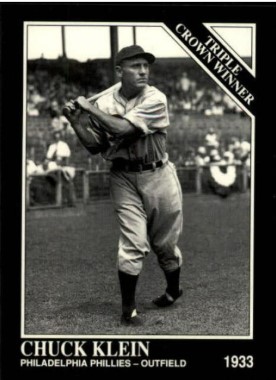
When Jimmie Foxx won the American League Triple Crown in 1933, it marked the only season when both the AL and NL boasted Triple Crown winners – and they played in the same city. Foxx was taking the field for the Philadelphia Athletics, while the NL winner, Chuck Klein, played for the Phillies.

Hall of Famer Foxx, nicknamed Double X and The Beast, was known as one of the – if not THE – most powerful and feared sluggers of his time.   He played 20 MLB seasons (1925-42, 1944-45). He was an All Star in nine seasons and a three-time American League MVP. He finished with a .325 batting average (2,646 hits), 534 home runs, 1,922 RBI and 1,751 runs scored. He led his league in home runs four times (had 12 consecutive seasons of 30 or more); RBI three times (13 seasons of 100+ and four seasons pf 150+), batting average twice (topping .300 nine times) and runs scored once (with 100+ runs scored in 11 seasons).  Foxx also hit .344-4-11 in 18 post-season games.

While Foxx was best known for his prestigious home runs, the surprise of his stellar career may have come in his final season (1945), when the 37-year-old – a sure Hall of Famer by this time – answered the call when his team (then the Phillies) found itself short of pitching. Foxx who had taken the mound only once in his career (a 1-2-3 inning for the Red Sox in 1939) volunteered to step on the bump and into the breach.  How did the veteran do?  He made nine appearances, two starts – going 1-0, 1.52 in 22 2/3 innings (fanning ten and walking 14).  With his one clean 1939 inning, Foxx had a 1.59 career ERA.  Side note: Jimmie Foxx’ lone career mound win came on August 19th, as his Phillies topped the Reds 4-2.  The losing pitcher was another Fox (single X), Reds’ starter Howie Fox.

Mystery Solved

When Neil Armstrong set foot on the moon, he and all the space scientists were puzzled by an unidentifiable white object. I knew exactly what it was. That was a home run hit off me in 1937 by Jimmie Foxx,

Hall of Famer Lefty Gomez

——————————————————————

Second Base – Joe Morgan

If you like lumber and leather, Hoe Morgan fits the bill.  In 1975 and 1976, when he turned in consecutive MVP seasons to lead his Reds to a pair of NL pennants (and World Series Championships), Morgan was not only one of the best offensive second basemen in MLB, he also earned a pair of Gold Gloves for his defensive play. (Morgan won five consecutive Gold Gloves at 2B … 1973-77).

MorganMVP

How valuable was Morgan? In 1975 he earned 21 of 23 first-place votes in the MVP race and outscored runner up Greg Luzinski 321 to 154. The following year, he got 19 of 24 first place votes (the other five went to teammate George Foster) and led runner up Foster 311 to 221 overall.

Doesn’t Flinch in the Clutch

In 1975, Joe Morgan hit .339 with two out and runner in scoring position; while in 1976 he hit .327 in those situations.

Joe Morgan played 22 MLB seasons (1963-84). The Hall of Famer was an All Star in ten seasons . He retired with a .271 average (2,517 hits), 268 home runs, 1,133 RBI, 1,650 runs scored and 689 steals (eleventh all time). He led his league in runs scored once, triples once and walks four times. His keen batting eye helped him to lead his league in on-base percentage four times and compile a .392 career OBP. While he never led the league in steals, Morgan brings speed to this lineup.  He swiped 40 or more bags in nine seasons, including a high of 67 in both 1973 and 1975. He also topped 20 home runs in three seasons and had 100+ walks in eight campaigns.

Getting the Jump on the Opposition

A good base stealer should make the whole infield jumpy. Whether you steal or not, you’re changing the rhythm of the game. Of the pitcher is concerned about you, he isn’t concentrating enough on the batter.,

Joe Morgan

—————————————————

Third Base – Mike Schmidt

There was plenty of competition at both corner infield spots for a place in this lineup.  (We’ve already talked about the first-base candidates.) At third base, two players have earned consecutive league MVP honors – Mike Schmidt and Miguel Cabrera. BBRT gives Schmidt a slight edge.  In his consecutive MVP seasons (2012-13), Cabrera went a combined .338-88-276, with 398 hits and 212 runs scored for the Tigers.  Included in that total was his 2012 Triple Crown season.  Schmidt’s consecutive MVP seasons (1980-81) produced a .298-79-212 line, with 182 runs scored. (We need to keep in mind that the 1981 season was strike-shortened). Schmidt led the NL in home runs and RBI in each of  his consecutive MVP seasons. The difference maker between Cabrera and Schmidt? Schmidt earned a Gold Glove for his defense in each of his consecutive MVP seasons. Schmidt, by the way, received all 24 first-place votes for NL MVP in 1980 and 21 of 24 in 1981. Cabrera received 22 of 28 votes in 2012 and 28 of 30 in 2013.

SchmidtMVP

Alone at the Top of the List

Mike Schmidt’s 509 home runs, while in the lineup as a third baseman, are the most by any third sacker ever.

Mike Schmidt enjoyed an 18-season MLB career (1972-89 …. all with the Phillies).  He hit .267 (2,234 hits) with 548 home runs, 1,595 RBI, 1,506 runs scored and 174 stolen bases.  Schmidt was a 12-time All Star. He led the NL in round trippers eight times (topping 30 home runs in 13 seasons). He also led the NL in runs scored once, RBI four times (with 100+ nine times), walks four times and slugging percentage five times.  He earned a total of three league MVP Awards (1980, 1981, 1986).

Tied at the Top of the List

Mike Schmidt also holds a share of the record for most home runs in a game.  On April 17, 1976, he sent four balls over the fences in a five-for-six, eight-RBI day.

In addition to his power, Schmidt showed good speed, reaching double-digits in steals eight times, with a high of 29 stolen bases in 1975.

Near the top of the list

Only Babe Ruth won more home runs titles (12) than Schmidt (8).

Only Brooks Robinson has more Gold Glove at third base (16) than Schmidt (10).

—————————————————-

Shortstop – Ernie Banks

Ernie banks has a unique distinction among players with two consecutive MVP Awards. Not only is he the only shortstop to achieve the feat, he is also the only player to win consecutive MVP Award while playing on losing team for both seasons – and one of only two players to twice win an MVP Award (consecutively or not) while playing on a losing squad.

MVP Losersrs

Banks, who was bucking the image of shortstops as glove men, base stealers and slap hitters, won his first MVP in 1958, when he led the NL in games played, home runs (a career high 47) and RBI and finished sixth in batting average.

BanksMVPHe followed that with another MVP season in 1959, again leading the NL in games played and RBI (a career-high 143), while finishing tenth in batting average.

The First Ever Moon Shot.

In 1954, Ernie Banks finished second to the Cardinals’ Wally Moon in the NL Rookie of the Year balloting. Moon went .304-121-76 and got 17 votes. Banks went .275-19-79 and got four votes. Two Braves finished third and fourth – Gene Conley and Hank Aaron.

Banks played 19 MLB seasons (1953-71 … all for the Cubs) and was an All Star in eleven of those campaigns. He led the National in games played six times (in his seven first full seasons), home runs twice (topping 20 home runs in 13 seasons – with forty+ dingers in five of those), RBI twice (with 100+ eight times). He also won one Gold Glove.  For his career, the Hall of Famer hit .274, with 512 home runs and 1,636 RBI.  He was known, deservedly, in Chicago as “Mr. Cub.”

For the Love of the Game

Ernie Banks was synonymous with a childlike enthusiasm for baseball.  It was not just great talent, but also his relentless spirit of optimism that made him a back-to-back National League MVP, a Hall of Famer, a member of our All-Century Team, a recipient of the Presidential Medal of Freedom and, indeed, forever Mr. Cub.

                                                            Baseball Commissioner Bud Selig

—————————————————————

Left Field – Barry Bonds

What can you say about Barry Bonds – good and bad – that hasn’t already been said? The man won a record seven MVP Awards, including two consecutive (1992 and 1993) and another streak of four consecutive (2001-2004.)  And, he nearly had two streaks of four consecutive MVP recognitions.  Bonds won the NL MVP Award in 1990, finished a close second (274-259 and 12 first-place votes to ten) behind the Braves’ Terry Pendleton in 1991, and then won the honor again in 1992 and 1993. The chart below provides the stats for those MVP seasons – and they are remarkable. But then, of course, there is that PED “elephant in the room.” In the seven seasons that Bonds won the NL MVP Award, his team finished first in their division four times and second three times.

BondsMVP

Bonds had a 22-season MLB career, during which he was an All Star 14 times, a Silver Slugger winner 12 times, home run champion twice and batting champion twice.  He holds the MLB single-season home run record at 73 (2001, Giants), as well as the career record for long balls (762). He retired with a .298 average (2,935 hits), 762 home runs, 1,996 RBI, 2,227 ruins scored and 514 stolen bases.  He hit 30 or more home runs in 14 seasons, drove in 100 or more tallies in 12 campaigns and hit over .300 11 times (a high of .370 in 2002).  Bonds also earned eight Gold Gloves

A Real Mover and Shaker

Barry Bonds is the only player to win the Most Valuable Player Award in two consecutive seasons while playing for two different team – Pirates (1992) and Giants (1993).

How feared was Barry Bonds at the plate? Bonds led the NL in walks 12 times, amassing an MLB-record 2,558 career walks.  He also led the league in intentional walks 12 times, being intentionally passed an MLB-high 688 times. In 2004, he was intentional passed a record 120 times.  No other player has been intentionally walked more than 45 times in a season (Willie McCovey, 45 in 1969).


The rest of us play in the major leagues, He’s at another level.

                                             Giants’ infielder Rich Aurelia

——————————————————-

Center field – Mickey Mantle

Mickey Mantles’ two consecutive MVP Awards came in 1956 and 1957 and included his .353-52-130 Triple Crown campaign in 1956.  Notably, in addition to the 1956 and 1957 MVP honors, Mantle won the MVP award in in 1962 and finished second in 1960, 1961 and 1964 – while playing on Yankee teams that were loaded with potential MVP candidates. Two of Mantle’s three second-place finishes were to teammate Roger Maris, who is also in this lineup of consecutive MVP winners.  In his 1956 MVP season, Mantle led both leagues in average (.,353), slugging percentage (,705), runs scored (132), total bases (376), home runs (52) and runs batted in (130).


MantleMVP

Walk, Don’t’ Run

Only Jim Thome hit more regular-season walk-off home runs in his career (13) than Mickey Mantle (12). Note: Mantle is tied with Jimmie Foxx, Stan Musial, Albert Pujols, Frank Robinson and Babe Ruth at 12.

Mickey Mantle played 18 major league seasons (1951-68 … all with the Yankees).  The Hall of Famer was an All Star in 16 of those seasons. He led his league in runs scored five times, home runs four times, walks five times, and batting average and triples once each.  He retired with a .298 average (2,415 hits), 536 home runs (hitting 30 or more in nine seasons), 1,509 RBI (100+ four times), 1,676 runs scored (topping 100 in eight seasons), 1,733 walks and 153 stolen bases. He won a Gold Glove in his 1962 MVP season.  He put up those numbers, despite suffering from Osteomyelitis and dealing with a series of injuries that dampened his numbers (shoulder, rib cage, hip abscess, fractured finger, knee surgeries, broken foot).

Nearly an Annual Affair

In 18 MLB seasons, Mickey Mantle played in 12 World Series.  He holds the all-time record for World Series home runs (18), runs batted in (40) and runs scored (42) in 65 games).


The Final Word … On two good legs, Mickey Mantle would have been the greatest ballplayer that ever lived.,

                                                                      Hall of Famer Nellie Fox

Also qualifying for this spot was Braves ‘CF Dale Murphy , who won consecutive NL MVP Awards in 1982 and 1983. In 1982, Murphy went .281-36-109, with 232 steals and a Gold Glove.  He followed that up in 1983 with a .302-36-121 season (30 steals and another Gold Glove). Still, Mantle’s Triple Crown season gives him the edge. Murphy, be the way, hit .265 over 18 MLB seasons, with 398 homers, 1,266 RBI, 161 steals, seven All Star  selections and five Gold Gloves.

————————————————————-

RF – Roger Maris

Roger Maris was traded from the Kansas City Athletics to the Yankees after the 1950 season – part of a multi-player deal. At the time, he had three major-league seasons under his belt – with a .249 average, 58 home runs and 203 RBI in 388 games. His best season had been 1958, when he hit .240-28-80 in 150 games.  Whether it was joining the powerful Yankee lineup   or just maturing as a hitter, the move to New York changed Maris’ career path, as he was the American MVP Award his first two seasons in Yankee pinstripes.

MarisMVP

A Change of Scenery

In his first three seasons in pinstripes, Roger Maris average 44 home runs and 118 RBI per campaign. They were the only seasons in which he reached 30 homers or 75 RBI.

In 1960, as the Yankees won the pennant with a 97-59 record, Maris set new career highs with a .283 average, 39 home runs and a league-leading 112 RBI – and threw in a Gold Glove for good measure. In 1961, as the Yankees went 109-53 (and won the World Series), Maris, of course, made history.  He won his second consecutive MVP Award, while also setting a new (since broken) single-season home run record of 61.

Making It Count

On October 1, 1961, when Roger Maris hit his historic 61st home run of the season, he made it count. The blast came in the bottom of the fourth inning and accounted for the only run in a 1-0 Yankee win over the rival Red Sox,

Maris played 12 major-league seasons (1957-68) and put up a .260 average, with 275 home runs and 850 RBI. He was a four-time All Star and led his league in RBI twice and runs, home runs and total bass once each.

Going Yard in Football, Too

Roger Maris set a national high school record, returning four kick-offs for touchdowns in a single game, while playing for Shanley High School in Fargo, North Dakota. He was offered a football scholarship by the University of Oklahoma, but chose instead to start his baseball career (right out of high school) in the Cleveland Indians organization.

Primary Resources:  Baseball-Reference.com; MLB.com; Baseball-Almanac.com


BASEBALL ROUNDTABLE ON THE TOP 100 BASEBALL BLOG LIST

100Baseball Roundtable is on the Feedspot list of the Top 100 Baseball Blogs.  To see the full list, click here.

I tweet baseball @DavidBBRT

Follow/Like Baseball Roundtable’s Facebook Page here.  More baseball commentary; blog post notifications; PRIZES.

Member: Society for American Baseball Research (SABR); The Baseball Reliquary; The Negro Leagues Baseball Museum.
The Baseball Reliquary Shrine of the Eternals Ballot – A Baseball Diversion While “Sheltering at Home”

There is no joy in Mudville – Major League baseball is in timeout.

With the major league baseball season suspended as we respond to the COVID-19 pandemic, fans of the national pastime are searching for hardball-related diversions.   We’re watching “classic” ball games from the past, cueing up baseball movies, revisiting our baseball card and memorabilia collections, playing dice- and computer-based baseball games, reading (even re-reading) countless baseball books and challenging others (online) with increasingly obscure baseball trivia.  Heck, even old “Pitch Backs” are being pulled out of the back of the garage and Wiffle (c) Balls are flying in rec (wreck?) rooms.

ReliquaryNewWhere am I going with this? Early this week, another rite of spring brought baseball back to my home.  I received my annual Baseball Reliquary Shrine of the Eternals ballot; which means I can spend some joyous time pondering the character and characters that helped shape the history of our grand game (as presented in the always informative and creative biographies included with the ballot).

I’ll take a look at my choices from this year’s ballot in a bit, but first – for those not familiar with The Baseball Reliquary – a little background.


The Baseball Reliquary is an organization of fans dedicated to the free-spirited celebration of the human side of baseball’s history and heritage.

Reliquary (rel′ə kwer′ē)

Noun- a container or shrine in which sacred relics are kept and displayed for veneration.

While its “home” is in Pasadena, California, The Reliquary is not just a place.  The Reliquary really resides in the hearts of its founders, members, contributors and honorees – who all are important parts of the organization’s joyful (often irreverent, but always well-informed and fan-centric) celebration of all things baseball.  This celebration is fueled through The Reliquary’s Shrine of the Eternals, collection of historic artifacts, exhibitions and collaboration with the Whittier College Institute for Baseball Studies.

Let’s look at each of these.

The Shrine of the Eternals is the Reliquary’s best-known element and its honorees include (among others) a one-armed major league outfielder, a pitcher who once threw a no-hitter while high on LSD, a team owner who sent a midget to the plate, a man in a chicken suit, a member of Major League Baseball’s 3,000-hit club, a manager who won eight World Championships, a cartoon character who pitched his team to more than 1,000 losses, more than one best-selling author, a statistical wizard and even the sports editor of the Daily Worker (American Communist Party newspaper). The honorees are each unique in their roles in – and contributions to –   the national pastime, but they all share the distinction of having made a significant impact on the game.  Note: Each year, The Reliquary also recognizes distinguished service to baseball by a fan (The Hilda Award) and contributions to the preservation of baseball history (The Tony Salin Award).  

The Baseball Reliquary’s Collection of what BBRT would term “art-ifacts” is as diverse as its roster of Shrine honorees.  The collection includes (but is “oh-so not limited” to) the Walter O’Malley Tortilla, the Roger Bresnahan Potato, the Eddie Gaedel Jock Strap,  a Babe Ruth cigar, a Mother Teresa autographed baseball (a whole case actually), a heat-twisted 45-rpm record from the White Sox’ ill-fated Disco Demolition Night; and a  San Diego Chicken game-worn costume.

The Baseball Reliquary’s Exhibits have have covered such varied topics as Latino and Black baseball history, baseball in foreign policy, baseball literature and art, a celebration of baseball cards, and even the self-defining “Lasordapalooza.”

The Whittier (CA) College Institute for Baseball Studies is the first humanities-based baseball research center associated with a U.S. college or university, The Institute houses the Baseball Reliquary’s baseball-related research collection – books, periodicals and papers from distinguished authors, historians and journalists. It is open to students, scholars and the general public.

Why Not Join Now

As we now contemplate even more time with no action on the diamonds, I think joining The Baseball Reliquary would be a gem of an idea for all fans.    If you are interested, click here for BBRT’s full (and FUN) story of the history behind The Baseball Reliquary (You can skip the first few paragraphs, which mirror this post, and jump down to the text below the Reliquary logo.) Or, if you’ve already decided to consider membership, visit the Reliquary website at http://www.baseballreliquary.org.  


—–THE SHRINE OF THE ETERNALS 2020 VOTING—–

Now, on to the Shrine of the Eternals. Before I share my ballot, here’s what the Reliquary has to say about this honor.

“Similar in concept to the National Baseball Hall of Fame, the Shrine of the Eternals differs philosophically in that statistical accomplishment is not the principal criterion for election. The Baseball Reliquary believes that the election of individuals on merits other than statistics and playing ability will offer the opportunity for a deeper understanding and appreciation of baseball than has heretofore been provided by “Halls of Fame” in the more traditional and conservative institutions.

“Criteria for election shall be: the distinctiveness of play (good or bad); the uniqueness of character and personality; and the imprint that the individual has made on the baseball landscape. Electees, both on and off the diamond, shall have been responsible for developing baseball in one or more of the following ways: through athletic and/or business achievements; in terms of its larger cultural and sociological impact as a mass entertainment; and as an arena for the human imagination.”

Each year, the Baseball Reliquary submits a list of candidates to its members and the top three vote-getters are honored.  Reliquarians can vote for up to nine nominees.

Here’s a look at those who are getting my vote this year.

—–BASEBALL ROUNDTABLE’S 2020 SHRINE OF THE ETERNALS BALLOT—

Luke Easter (1915-79) … Sixth year on the ballot.

balloot“Luscious” Luke Easter was one of the most prodigious home run hitters of all time. His titanic blasts were known as “Easter Eggs.” Among his notables, Easter:

  • Was the first player to a homer into the farthest reaches of center field in the Polo Grounds;
  • Hit the longest home run in the history of old Cleveland Municipal Stadium – clearing the distant right field scoreboard; and
  • Was the first player to hit a drive over the CF scoreboard in Buffalo’s Offerman Stadium (at age 42), proving it was no fluke by hitting the second drive to ever to clear the scoreboard just a month later.

Easter began his baseball career in 1937, as an OF/1B and cleanup hitter for the St. Louis Titanium Giants (a company team) – and didn’t play his final game until 27 years later.  Everything about the 6’4”, 240-pound Easter was big – his stature, his bat, his love of the game, his love of life, his relationship with teammates and the fans and, later, even his Buick.

While he began showing his prowess at the plate in the late 1930’s, he really began carving his name into baseball history after getting out of the military in 1943.

In 1945, he starred with the barnstorming Cincinnati Crescents (for whom he hit the Polo Grounds home run noted above).

In 1947, he joined the Homestead Grays, where he hit .311, with 10 home runs in 219 at bats.  Research by Society for American Baseball Research Member Justin Murphy indicates Easter followed that up by hitting .363 for the Grays and tying teammate Buck Leonard for the Negro National League (NNL) lead in home runs (13) – helping the Grays to the NNL World Series Championship.

In 1949, Easter signed with the Cleveland Indians and made his major league debut on August 1 of that season – at age 34 – just the eleventh black player in the major leagues. While he hit only .222 in 54 games for the Indians, due in part to an injured knee, Easter showed his (already long-proven) power by going .363-25-92 in 80 games at Triple A San Diego.

Then, in 1950, he hit .280-28-107 in 141 games for the Indians – earning recognition from the Sporting News as the AL’s Most Outstanding Player.  In 1951, he went .270-27-103 for the Tribe and, in 1952, .263-31-97. Age and injuries were already taking their toll, however, and on May 4, 1954, the 38-year-old Easter played his final MLB game – ending his MLB career with a .274-93-340 line in 491 games.

Ah, but Luscious Luke was not done. He played on in the minor leagues until 1964 – putting up four seasons of 30 or more home runs and 100+ RBI – earning his way into the International League Hall of Fame.

Over his career, Easter also played winter ball in Puerto Rico, Venezuela, Mexico and Hawaii. A Winter-League star, Easter hit .402 for Mayaguez in the Puerto Rican League in 1948-49 (winning league MVP honors); led the Mexican Pacific Coast League (for Hermosillo) in homers in 1954-55; and lead the Puerto Rican Winter League in homers in 1955-56 and 1956-57.

Easter, later serving as a Union Steward for TRW in Ohio, was murdered during a payroll robbery in 1979.

Why did Luke Easter get my vote? Consider that non-other than Bill James rated him the second-best Negro Leagues’ first baseman of all time (behind only Buck Leonard) and Al Rosen (a teammate of Easter on the Indians, as well as a four-time All Star, two-time AL home run leader, 1953 American League MVP and 1989 National Executive of the Year) maintained, “Had Luke come up to the big leagues as a young man, there’s no telling what numbers he would have had.”

Easter comes up big on the BBRT “Shrine” ballot.

____________________________

Rube Foster (1879-1930) …. Twenty-second year on the ballot.

Andrew “Rube” Foster was an outstanding hurler, confined – by history – to pitching primarily for Black teams. He was a star on such squads as the Chicago Union Giants, Cuban X-Giants and Philadelphia Giants. Just how good was Foster on the mound? Records are sketchy, but the Baseball Hall of Fame reports that, in 1902, Foster ran off a streak of 44 straight victories and the Negro League Baseball Museum credits Foster with a 54-1 record that season.

Rube Foster’s tireless efforts earned him the unofficial title of “The Father of Black Baseball.”

Foster’s contributions to the national pastime, however, went beyond the mound. In 1911, he partnered with John Schorling (son-in-law of Charles Comiskey) to establish the Chicago American (Black) Giants. Under Foster’s leadership, the Giants became Black baseball’s most dominant team.

But Foster wasn’t done yet.  In 1920, he was a key player (cited by many as THE key player) in the founding of the Negro National League.  As the league flourished, Foster wore many hats. He served not only as the league’s president and treasurer, but also was the owner and manager of the Chicago American Giants – winning the NNL’s first three pennants.  By 1926, his demanding schedule had taken a toll and Foster suffered a nervous breakdown. He never fully recovered and passed away prematurely in 1930. Fans might enjoy Larry Lester’s book “Rube Foster in His Time: On the Field and in the Papers with Black Baseball’s Greatest Visionary.”

Rube Foster was elected to the National Baseball Hall of Fame in 1981.

__________________________________________________________

Julio Franco (1958 –) … Second year on the ballot.

If you believe “Old Guys Rule” – Julio Franco should be your king. 

As Rod Serling often said:  For your consideration: Only 25 Major League home runs have been hit by players who had passed their 45th birthday – and Julio Franco hit 20 of them.

Franco is also the oldest player to homer in an MLB game. Franco went deep at age 48 years, 254 days, hitting a two-run shot off Arizona’s Randy Johnson as Franco’s Mets topped the Diamondbacks 5-3 on April 26, 2006). In that same game, Franco also became the second-oldest MLB player to steal base – and, thus, the oldest player to homer and steal a base in the same game.

Franco is also the:

  • Oldest player to hit a grand slam (46 years, 308 days) – connecting as a pinch hitter for the Atlanta Braves in a 7-2 win over the Marlins on June 27, 2005;
  • Oldest player to record a multi-homer game, belting a pair of homers on June 18, 2005 (age 46 years, 299 days), as his Atlanta Braves topped the Reds at Great American Ball Park. Franco started at first base and went two-for-four with two homers and three RBI;
  • Oldest player to hit a pinch-hit home run, in the eighth inning of a Mets’ 7-2 win over the Padres at San Diego (April 20, 2006 – 47 years, 240 days);
  • Oldest player to steal two bases in a game (and in an inning) – (June 16, 3005 – 46 years, 297 days)’ and
  • Oldest player to be put into a game as a pinch runner (July 29, 2006 – 47 years, 340 days) … he delivered, promptly stealing second base, going to third on an errant throw.

From 1982 to 1994, Franco played primarily as a middle infielder and DH for the Phillies, Indians, Rangers and White Sox – making three All Star teams (MVP of the 1990 All Star Game), earning five Silver Slugger Awards and leading the American League in hitting at .341 for the Rangers in 1991. In that 1991 campaign, Franco collected 201 hits, 15 homers, 78 RBI, 108 runs scored and 36 steals in 45 attempts. At season’s end, he had hit .300+ in five of the previous six seasons – the lone exception being .296 in 1990.

In 1994, when the remainder of the MLB season was lost to a strike, Franco was in the midst of possibly his best campaign.  After 112 games, he was hitting .319, with 138 hits, 20 home runs, 98 RBI, 72 runs scored, and eight steals.  Franco was determined to keep swinging the bat and signed to play in Japan with the Pacific League Chiba Lotte Marines.  In the 1995 Japanese season, Franco hit .306 and won the Pacific League’s equivalent of the Gold Glove at first base.

Franco returned to MLB in 1996, joining the Cleveland Indians, hitting .322-14-76 in 112 games. In August of the following season, the Indians released Franco – who was hitting .284-3-25 at the time. He finished the 1997 campaign with the Brewers, hitting .241 in 14 games with Milwaukee.

In 1998, at age 39, Franco was back in Japan playing for Chiba Lotte; where he hit .290, with 18 home runs and 77 RBI in 131 games. Then in 1999, he celebrated turning 40 (when most ballplayers are retired or coaching) by hitting for a .423 average in the Mexican League and getting one late-season MLB at bat with Tampa Bay.

As he moved into his forties, Franco was far from finished as a player. He played in South Korea in 2000 (age 41), hitting .327-22-110.  In 2001, the well-traveled batsman was back in the Mexican League (Mexico City Tigers), where stellar play (a .437 average in 110 games) earned him a spot on the Atlanta Braves’ roster in September. Franco hit .300, with three home runs and 11 RBI over the final 5 ½ weeks of the MLB season.

From 2001 to 2007, the ageless wonder – professional hitter and pretty darn good first sacker – played for the Braves and Mets.  From 2001 through 2006 – ages 42 to 47 – Franco averaged .290 over 581 games.  He hit .222 in 55 games in his final MLB season – 2007 with the Mets and Braves.

Even at 49, Franco was not done battering baseballs. In 2008, he could be found at first base with the Tigres de Quintana Roo of the Mexican League (where he hit .250 in 36 games). That season, Franco – after 23 Major League seasons and 30 years after his first professional baseball game – announced his retirement as a player.

Oops? Not so fast. In 2014, at the age of 55, he appeared in seven games for the Fort Worth Cats of the independent United League – going six for 27.   Then in 2015, Franco was signed as player-manager of the Ishikawa Million Stars of the Japanese independent Baseball Challenge League (identified as a semi-pro league).

In 23 MLB seasons, Franco hit .298, with 2,586 hits, 173 homers, 1,285 runs, 1,194 RBI and 281 stolen bases. He also collected 618 minor league (U.S) hits, 316 in the Mexican League, 286 in Japan, 267 in the Dominican Winter League and 156 in South Korea and six in independent ball (U.S.).

Forever young, Mr. Franco – baseball’s Energizer Bunny – got my vote.

_____________________________________________________

Mamie “Peanut” Johnson (1935 – 2017) … Seventh year on the ballot.

Mamie Johnson was one of three females to play for the Indianapolis Clowns during the declining days of the Negro Leagues (and the only woman ever to pitch in the Negro Leagues).  Johnson took the mound to the Clowns for three seasons (1953-55), running up a 33-8 record.  Her exploits are chronicled in the children’s book “A Strong Right Arm: The Story of Mamie ‘Peanut’ Johnson,” by Michelle Y. Green.

________________________________


Mike Marshall (1943 –  ) … Fifteenth year on the ballot.

I should probably say Doctor Mike Marshall, since this former major league reliever (14 seasons … 1967, 1969-81) earned three college degrees, including a Ph.D. in Kinesiology from Michigan State University. Kinesiology is the study of muscle movement and Marshall used his knowledge to develop his own exercise program focused on minimizing stress, reducing injury and accelerating recovery time.  While his unorthodox methods, advanced education and outspoken approach often had him at odds with baseball’s traditionalists (and may be part of the reason he pitched for nine teams in 14 seasons), they did get the job done.

The fact is, we never saw a closer quite like Mike Marshall before he came along – and we’re not likely to see one like him again. In 1974, as a Dodger, he put up the grand-daddy of all relief seasons – setting the single-season MLB records for appearances with 106 and innings pitched in relief at 208 1/3. He finished the campaign 15-12, with a league-topping 21 saves and a 2.42 ERA.  That season, Marshall was called on to go more than one inning in 74 games (68.5 percent of the time) and he toiled three or more innings 22 times. He also relieved in 13 consecutive regular-season games – an MLB record later tied (1986) by the Rangers’ Dale Mohorcic. His efforts won him the 1974 Cy Young Award and recognition as The Sporting News NL Pitcher of the Year.

Marshall led his league in games pitched four times and saves three times – finishing 97-112, 3.14 with 188 saves.

A true “fireman” from an era when closers came in to put out fires and stayed on the mound to ensure they were no flare ups, Marshall gets my vote for the Shrine.

______________________________________

Pete Reiser (1919-1981) … Eighth year on the ballot.

Combine Willie Mays’ skill set (younger folks, think Mike Trout) with Pete Rose’s hustle and on-field abandon and you have Pete Reiser. In his first full MLB season (CF, Dodgers, 1941), a 22-year-old Reiser dazzled defensively and led the NL in runs scored (117), doubles (39), triples (17), batting average (.343), total bases (299), Slugging Percentage (.558) and hit by pitch (11) – tossing in 14 home runs and 76 RBI for good measure. He was an All Star and finished second in the National League MVP balloting.  Unfortunately, unpadded outfield walls, helmet-less at bats (the fiery Reiser was a frequent bean ball target) and aggressiveness on the base paths (Reiser twice led the NL in stolen bases and holds the NL record for steals of home in a season at seven) took their toll.

In his ten-season career, Reiser endured five skull fractures, a brain injury, a dislocated shoulder and a damaged knee.  He was carted off the field 11 times during his career (six times unconscious) and once actually given last rites at the stadium – and he played on. The three-time All Star retired as a player with a .295 career average, playing in 861 games over ten seasons. No telling what he might have done with padded outfield walls and batting helmets.  Pete Reiser was a true – and talented – gamer. For more on Reiser, try “Pete Reiser: The Rough and Tumble Career of the Perfect Ballplayer,” by Sidney Jacobson.

For a combination of pure talent and reckless abandon – Pete Reiser gets my vote.

__________________________________________

Bing Russell (1926-2003) … Fifth year on the ballot.

Nate Oliver “Bing Russell” is probably best known to the general populace as Deputy Clem Foster in the TV series Bonanza.  His TV and film credits, in fact, run long and deep.  He was cast in the film The Magnificent Seven and had guest roles in such television series as Wagon Train, Johnny Ringo, The Rifleman and The Big Valley.  And he was more than just a cowboy, he was also seen in television roles in series ranging from The Rockford Files to The Twilight Zone to The Monkees.

For baseball fans, Russel’s greatest role may have been as owner of the Portland Mavericks – an independent entry into Northwest League.  Shepherding the only independent team in the league, Russell took a group of ballplayers described in his Shrine of the Eternals nomination as “misfits, reprobates, hangers-on and washouts” and turned them into winners and the toast of the town – much to the chagrin of baseball’s organized franchises.

It all came about after organized ball moved the struggling Triple A Portland Beavers out of the city after the 1972 season. Russell led a move to establish the Class C Portland Mavericks (as an independent franchise) in the city.  As an owner, Russell’s focus was fun – and perhaps a bit of rebellion.  He had no ties to any MLB franchise, banned corporate advertising in the ball park and filled his team from open tryouts.  (He also, eventually, hired professional baseball’s first female General Manager, as well as its first Asian-American General Manager.)

How’d all of this work out?  Well, major league baseball did not expect the ragtag Mavericks to do well against their “in-the-system” prospects. They underestimated the impact of  Russell’s focus and style – and the determination of his last-chance hopefuls.

In 1973, the Mavericks went 45-35 and finished first in the league’s South Division.

In 1974, they went 50-34 and finished second in the West Division – just two games behind the Dodgers’ Bellinger farm club.

In 1975, it was 42-35 and first place in the North Division.

In 1976, it was 40-32 and another North Division first-place finish.

In 1977, 44-22 and first place in the South Division. The Mavericks, that season, had the best record in the league, won their division by 22 games and drew 125,000 fans to 33 regular season home games (a minor-league short-season record).  Their average attendance was 3,788 fans per game.

Russell and his Mavericks had rekindled Portland passion for baseball with a combination of fun, irreverence and winning (Sounds like a Reliquary-friendly combo.) They had proven that an independent franchise could compete and win on the field and at the turnstiles. And, organized baseball took notice. They wanted the territory back and eventually – after some hard-fought legal battles – got it (although they had to pay Russell what was, at the time, by far the highest ever minor-league territorial rights payment; a victory for Russell and independent baseball).

So, in 1978, the Mavericks were dissolved and were replaced by the PCL Portland Beavers. By the way, the Beavers drew an average of just 1,397 per game. Oh, and Russell’s success was ultimately documented in the 2014 film “The Battered Bastards of Baseball.”  You should see it.

Three final fun facts about Russell and his life-long love affair with baseball.:

1) He grew up near the Yankees Spring Training Camp in St. Petersburg, Florida and – as youngster – became a kind of unofficial mascot for the team – mingling with the likes of Joe DiMaggio, Lefty Gomez and Lou Gehrig.  (Reportedly, Gehrig gave Russell the bat he used to hit his last major-league home run);

2) Later, pre-Mavericks, Russell created a number of detailed baseball training/instructional films; and

3) Bing Russell’s son, noted actor Kurt Russell, played four seasons of minor league baseball and his grandson Matt Franco played eight MLB seasons (Cubs, Mets, Braves).

For a life-long commitment to baseball, an attitude consistent with The Baseball Reliquary’s values  and a solid measure of success on the field and at the gate, Bing Russell gets my vote.

____________________________________

Justine Siegal (1975- ) … Second year on the ballot.

In 1988, a baseball coach told 13-year-old pitcher-third baseman Justine Siegal that she wasn’t wanted on his (boys) baseball team, that she should play softball instead. That denied opportunity to play the game she loved helped create a powerful gender-equity dynamo and, while there is still a long way to go, baseball is becoming the better for it.

Being from Minnesota, I take pride in the fact the Siegal earned a Bachelor’s Degree (Concentration: Leadership: Religion, Military and Baseball) from Northfield, Minnesota’s St. Olaf College. She went on to earn a Masters degree in Sport Studies from Kent State University and a Ph.D. in Sport and Exercise Psychology from Springfield (MA) College.  And through all of this, Siegal never lost her passion for – and focus on – baseball and generating opportunity for women (and girls) to take their place in the national pastime.

Consider:

  • In 1998, Siegal organized the Baseball for All Foundation focused on expanding opportunities for girls to “get in the game” of baseball (Baseball for All;
  • In 2002, she organized Sparks – the first all-girl baseball team to compete in a national boys’ tournament;
  • In 2008-10, she was an assistant coach of the Springfield College Baseball Team;
  • In 2009, she became the first female coach of a professional men’s baseball team, – the Brockton Rox of the independent Canadian-American Association of Professional baseball;
  • In 2011, she was the first woman to throw batting practice to a major league team (Cleveland Indians Spring Training);
  • In 2015. She was the first female hired for coaching duties with a major-league franchise (coaching in the Arizona Instructional a league for the Oakland A’s franchise); and
  • In 2016, she was brought on as Mental Skills coach for the Israel Team for the 2017 World Baseball Classic.

Siegal currently serves as Director of Sports Partnerships at the Center for the Study of Sport in Society at Northeastern University – a position she has held since 2011. For more on Siegal and the impact of her work, I’d suggest visiting the baseballforall.com website

When major league baseball sees its first female player, she will owe a tip of the cap to Justine Siegal. For her contributions to that eventuality, Siegal gets my vote.

_______________________________________

Rube Waddell (1876-1914) … Twenty-second year on the ballot.

Rube Waddell is almost universally recognized as the zaniest player in MLB history (that alone should earn him a spot in the Shrine).  Add the fact that he also was one of the best pitchers (at least when he was focused) in the game and Waddell seems a perfect fit for Reliquary honors.

Waddell was known to:

  • Leave a ball game to chase fire engines;
  • Miss a game he was scheduled to start because he was fishing or playing marbles with neighborhood kids;
  • Bring his outfielders in to sit on the grass and then proceed to fan the side;
  • Wrestle alligators in the off-season; and
  • Much too frequently do battle with owners and managers.

Waddell simply was more interested in the freedom to enjoy life and do things his way than in money or professional stability.  But, when Waddell was on his game, he was arguably the best pitcher of his time. The 6’1”, 195-lb. lefty led the AL in strikeouts six consecutive seasons (1902-1907) – by a wide margin.

In 1902, Waddell joined the Philadelphia Athletics in June – making his first start on June 26 (with just 86 games left in the season). Waddell proceeded to win 24 games (the league’s second-highest total) against seven losses, with a 2.05 ERA.  Despite his shortened season, he led the AL with 210 strikeouts, fifty more than the runner-up (none other than Cy Young).

In 1904, Waddell set a modern (post-1900) MLB record with 349 strikeouts that stood until 1965.  Waddell, elected to the National Baseball Hall of Fame in 1946, finished with a 193-143, 2.16 stat line – leading the AL in strikeouts six times, ERA twice, wins once and complete games once. For more on Waddell, BBRT suggests: “Rube Waddell: The Zany, Brilliant Life of a Strikeout Artist,” by Allan Howard Levy.

Honoring the zaniest player in history – a title it appears Waddell will hold into eternity – just seems right for the Shrine of the Eternals. Rube gets my vote.


Annotation 2020-04-08 211642

Primary Resources:  The Baseball Reliquary; Baseball-Reference.com; The Baseball Reliquary; The Society for American Baseball Research.

Coming in May – The Results of The Baseball Reliquary’s 2020 Shrine of the Eternals balloting – and a full list of past honorees.

BASEBALL ROUNDTABLE ON THE TOP 100 BASEBALL BLOG LIST

100Baseball Roundtable is on the Feedspot list of the Top 100 Baseball Blogs.  To see the full list, click here.

I tweet baseball @DavidBBRT

Follow/Like Baseball Roundtable’s Facebook Page here.  More baseball commentary; blog post notifications; PRIZES.

Member: Society for American Baseball Research (SABR); The Baseball Reliquary; The Negro Leagues Baseball Museum.
While Waiting for Baseball to Return – A Trivia Tidbit

LopezFOn this date (April 6) in 2009, as the Rockies and Diamondbacks opened their seasons in Arizona  (There had been one game the previous day … Braves at Phillies) – MLB history was made.

On that day, Diamondbacks’ second baseman Felipe Lopez became the first hitter to go yard from both sides of the plate in a season “opener.” Lopez was in his ninth professional season (and with his fifth MLB team). Going into the campaign, he had 71 long balls in 873 games (20 right-handed, 51 left-handed).

Lopez led off the bottom of the first, going deep from the left-handers’ batter’s box off Rockies’ RHP Aaron Cook. He led off again in the bottom of the fourth inning and homered (this time from the right-handers’  batter’s box off southpaw Glendon Rusch. Lopez finished the game two-for-four (two runs and two RBI), as the D-backs triumphed 9-8.

TRIVIA QUESTION: 

Now, for your trivia question. How long (after Felipe became the first major leaguer to homer from both sides of the plate in an opener) was it before MLB again saw a player homer from both sides on Opening Day – and, for bonus recognition, who was that player?

ANSWER:

How long was it until saw a second player pop home runs from both side of the plate in an Opening Day game. It was just 1 1/3 innings.  Lopez’ teammate, first baseman, Tony Clark hit a two-run homer from the left side of the plate off RH Aaron Cook in the bottom of the third inning of Lopez’ historic game, breaking a 4-4 tie and knocking Aaron Cook out of the game. Clark came up again with one out in the bottom of the fifth (and the game again tied, this time at 7-7) and hit a solo shot from the right-hand side off lefty Glendon Rusch. Clark finished the day two-for-four with two runs and three RBI.

So, after more than a century of having no switch hitter ever homering from both sides of the plate on Opening Day, we had two players from the same team, in the first 4 1/3 innings of the same game (and off the same two pitchers) achieve the feat.  (More on Lopez and Clark later in the post.)

THIRD PLAYER TO HOMER FROM BOTH SIDE OF THE PLATE IN AN OPENING DAY GAME

In addition to Felipe Lopez and Tony Clark, one more switch hitter has homered from both sides of the plate in an Opening day contest – Dodgers’ catcher Yasmani Grandl, on April 3, 2017, as his Dodgers topped the Padres 14-3 in Los Angeles.

Felipe Lopez played in 11 MLB seasons (2001-2011) – going .264-90-439, with 124 steals.  He was an All Star once – in 2005, when he went .291-23-85, with 15 steals for the Reds. It was the only season he hit more than 11 homer runs. For his career, Lopez was .261-61-285 as a left-handed batter (3,074 at bats) and .271-29-155 from the right side (1,263 at bats). He also made one pitching appearance (right-handed), pitching a scoreless inning (one walk, one hit) for the Cardinals in 2010).

Tony Clark played 15 MLB seasons (1995-2009) – going .262-251-824.  Like Lopez, he was an All Star once – in 2001, when he had a .287-16-75 campaign for the Tigers.  Clark topped 25 home runs in five seasons (for of those with 30 or more dingers) and recorded 100+ RBI in two seasons. His best year was 1998, when he went .291-34-103 for the Tigers.  Clark hit .260-189-607 as a left-handed batter (3,279 at bats) and .267-62-217 at a right-handed batter (1,253 at bats).


Primary Resources:  Baseball-Reference.com; Baseball-Almanac.com.

100Baseball Roundtable is on the Feedspot list of the Top 100 Baseball Blogs.  To see the full list, click here.

I tweet baseball @DavidBBRT

Follow/Like Baseball Roundtable’s Facebook Page here.  More baseball commentary; blog post notifications; PRIZES.

Member: Society for American Baseball Research (SABR); The Baseball Reliquary; The Negro Leagues Baseball Museum.
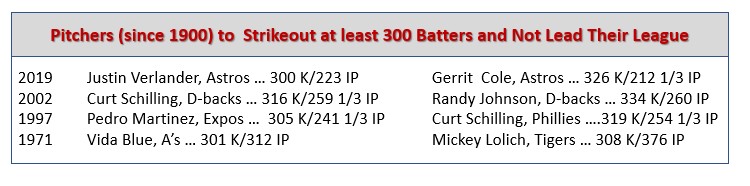
 

2020 Baseball Roundtable John Paciorek Award – Bert Shepard … Hero On and Off the Field

JPAFIn 2014, Baseball Roundtable launched the John Paciorek Award (JPA). The JPA recognizes players who have had short, often very short, major league careers, but whose accomplishments, nonetheless, deserve recognition.  Past winners have included a player whose every MLB hit (three in nine career at bats) was a home run;  a player who had only one MLB at bat, but earned  a World Series ring and a Purple Heart; a player who had just two home runs in 61 MLB at bats (for the vaunted Yankees and Dodgers), but whose “body of work” made him one of just two players in MLB history to homer in their first and final official appearances in a major league batter’s box; and more.  (Note: Information on John Paciorek’s career – the inspiration for the JPA – can be found at the end of this post. Paciorek’s day in the sun constitutes arguably the best one-game MLB career ever.)

For 2020, given the circumstances across our nation and around the globe. Baseball Roundtable decided to look for a major-league short-timer who exemplified heroism – and who exhibited courage, commitment, perseverance and high spirits in the face of adversity. Let me diverge for a moment here and thank today’s heroes – those who are (still) working to respond to our health care needs, keep us safe or make our lives as comfortable/normal as possible.  You know who I’m talking about: medical professionals and support staff; first responders (police, fire, paramedic); big rig drivers; shipping and delivery workers; postal employees; grocery store workers; public transit workers; restaurant staff.   I’m sure I missed some, but to all of those working hard for all of us, thank you for the risks you take and the services/comfort you provide. And, a thought for the day, let’s all say thank you to – and tip – these people whenever we can.

Now let’s take a look at this year’s John Paciorek Award winner – an individual who showed tremendous courage, commitment to duty, perseverance and endurance in the face of adversity – qualities we can all use right now. This year’s JPA honorees was a true hero both off and on the baseball diamond.

—-BASEBALL ROUNDTABLE 2020 JOHN PACIOREK AWARD HONOREE —-

BERT SHEPARD

Robert “Bert” Shepard was born and raised in western Indiana – a natural athlete who, during his high school years, played basketball and football, as well as semipro baseball (his high school did not have a baseball team). His dream? To become a professional baseball player. Little did he know that his pursuit of that dream would be interrupted by a global conflict.

In 1939, Shepard signed a minor-league deal with the White Sox.  Over the next four seasons (1939-42) he played for six minor-league teams, never rising above Class C. While he often showed good stuff, Shepard had control issues. In his best season, 1942 (by this time in the Cardinals’ system), Shepard went 9-13, 4.45 – but walked 122 batters in 172 innings.  With Shepard still working on his command, World War II came calling with a different kind of command.

In 1943, Shepard interrupted his baseball pursuits to enlist in the U.S. Army, where his natural athleticism helped him earn a commission as a P-38 Lightning fighter pilot. Stationed out of England, Shepard flew more than thirty combat missions. On May 21, 1944, a critical air attack on an airfield near Hamburg, Germany was in the works and, although he was not scheduled to take part, Shepard volunteered for the mission (which would prove to be 34th and final combat flight). On the return from the attack, Shepard’s plane was shot down and he was injured and captured.  His wounds required the amputation of his right leg below the knee.

While he was a Prisoner of War, a fellow prisoner (a Canadian medic) cobbled together an artificial lower leg for Shepard (out of scrap metal, wood and leather) and Shepard actually pitched in Stalag cricket matches using the makeshift prosthesis. After eight months as a P.O.W., Shepard was released as part of a prisoner exchange. Shortly after his return,  Shepard he began practicing with a local semipro team – noting that he was lucky his prosthesis was on his right leg, since (as a southpaw) it was his landing leg rather than his push-off limb.

Bert Shepard’s World War II heroism earned him the Distinguished Flying Cross,

Air Medal and Purple Heart.

Then came a lucky coincidence. Shepard, while being fitted for a new leg at Walter Reed Hospital, was fortunate enough to be visited by Undersecretary of War Robert Patterson – who just happened to be a baseball fan and friend of Washington Senators owner Clark Griffith. In his conversation with Patterson, Shepard mentioned his desire (and commitment), despite his injuries, to once again play professional baseball. Patterson relayed Shepard’s comments to Griffith, who brought the decorated veteran in for a tryout and signed him to serve as a coach and batting practice pitcher – and to take the mound in the occasional exhibition games (where Shepard acquitted himself well).  After an effective four-inning outing against the Dodgers in a July 1945 exhibition (raising funds for the War Relief effort), Shepard was added to the Senators’ active roster. Another step toward his major-league dream.

Bert Shepard made many visits to veterans hospitals, made a training film for amputees and was an inspiration for injured veterans – which may be exactly what Undersecretary of War Robert Patterson and Washington Senators owner Clark Griffith had in mind.

While Shepard was on the Senators’ active roster, the team was involved in a tight pennants race (the club would finish 1 ½ games behind the AL Champion Tigers) and manager Ossie Bluege was reluctant to use him in critical situations.

Then, on August 4, 1945, the opportunity to bring the war hero to the mound surfaced. It came with the Red Sox leading the Senators 14-2, with a runner on second and two outs in the top of the fourth. The Senators were in the second game of a double header, had already played twin bills on August, 1, 2, and 3 and were slated for another double dip on August 5.  The pitching staff was beleaguered and Shepard would prove to be just what the doctors ordered.

He came into a game  in which the BoSox bats were sizzling. They had already scored 12 runs (seven hits, six walks) in the inning, had a runner on second and clean-up hitter George “Catfish” Metkovich at the plate.  Shepard looked comfortable on the mound and pitched as well as he ever had (maybe even better). He struck out Metkovich to end the inning – and went on to finish the game – giving up just one run over 5 1/3 frames.

Shepard

It was to be Shepard’s sole MLB appearance – but it was a good one, ending in a career 1.69 ERA for the only one-legged pitcher in baseball history.  Shepard was released by the Senators on September 30, 1945, but retained his passion for the game.

In 1946, with major league players now returning from military service, Shepard did not make the Senators’ active roster, but was signed as a coach. Shepard’s competitive fires were still burning however, and he  asked to be sent down to the minors, where he could prove himself on the field. His control issues continued and his situation was complicated by additional surgery (to remove more of his leg) after the season. Shepard signed with the St. Louis Browns for 1947, but was released after a stint with the Elmira club of the Eastern League. Additional surgeries followed, but Shepard continued to play the game he loved – taking the minor-league mound as late as 1955, pitching in semi-pro leagues and managing in the minor leagues in 1949, 1952 and 1954.

After finally hanging up his baseball spikes, Shepard’s competitive spirit continued and he took up golf – winning the United States Amputee Gold Championship in 1968 and 1971/

Shepard passed away in 2008, at age 87.

Primary Resources:  Baseball-Reference.com; Bert Shepard Society for American Baseball Research biography, by Terry Bohn; Shot Down in the Prime  of Life: Bert Shepard, Who Pitched One Major League  Game With One leg, Searched  for years to Find Out Who Saved His Life,  by Chris Dufresne, Los Angeles Times, October 6, 1995; Valor  of Many Stripes, by Scott Baron, 2019. McFarland and Company; Bert Shepard, 87, Who Pitched in Majors After War Amputation Dies, by Richard Goldstein New York Times, June 20, 2008.


—- PAST JOHN PACIOREK AWARD HONOREES (with links) —-

2014 – Brian Scott Dallimore

In his first start (not his first game) for the 2004 Giants, Dallimore had two singles, a Grand Slam (his first MLB hit and only MLB home run), a walk and a hit by pitch.  For the full JPA take on Dallimore’s 27- game MLB career, click here.

2015 – Roy Gleason

Gleason played in just eight MLB games, had a double in his only MLB at bat – but also earned a World Series ring (1963) and a Purple Heart. Ultimately, he was the only ballplayer with MLB experience to serve on the front lines in Vietnam. For the full JPA take on Gleason, click here. Note: Gleason’s life is detailed in the book “Lost in the Sun – Roy Gleason’s Odyssey from the Outfield to the Battlefield.”

2016 – John Allen Miller

Miller played just 32 MLB games (during the 1966 and 1969), taking the field (at 1B/LF/3B/2B) for the Yankees and Dodgers. Miller collected ten hits in 61 MLB at bats (.164 average) and hit just two home runs – but he made those long balls count.  Miller made his MLB debut with the Yankees on September 11, 1966 and hit a two-run homer in his first big league at bat – making him (surprisingly) the first Yankee ever to homer in his first MLB at bat. (Little did Miller know he would not get another home run or RBI until the final at bat of his MLB career.)  Miller’s final at bat came as a Dodger (September 23, 1969) and he stroked a solo home run.  That narrow “body of work” made Miller one of just two players in MLB history to homer in their first and final official appearances in a major league batter’s box. For more on Miller, click here.

2017 – Chris Saenz

RHP Chris Saenz’ big day came on April 24, 2004 – when he was called up from Double A Huntsville (where he was 1-1, 3.86) to make a spot start against the Saint Louis Cardinals, whose powerful lineup included the likes of Albert Pujols, Scott Rolen, Jim Edmonds and Reggie Sanders.   The rookie went six innings, giving up just two hits, three walks and no runs, while fanning seven. There was some speculation (primarily among sportswriters and fans) that Saenz’ performance might earn him another start or two, but two days after his debut, he was on his way back to Huntsville.  Unfortunately, his minor league season included a September elbow injury that required Tommy John surgery and he never returned to the majors. Statistics before 1900 can be sketchy, but baseball-reference.com shows that Saenz is the only pitcher to complete a one-game MLB career of at least five innings pitched, without giving up a single run (earned or unearned). For more details on this JPA honoree, click here.

2018 – Keith McDonald

Keith McDonald’s MLB career (Cardinals 2000-2001) covered just eight games and 11 plate appearances (nine at bats) and three hits – but he made them count.  All of McDonald’s safeties were home runs – making him the only MLB player with more than one career hit who can look back on major league career in which his every hit was a home run.  McDonald is also one of only two players – and the only National Leaguer – to homer in his first two major league plate appearances.  For the full story, click here.

2019 – Harley Hisner

Harley Hisner’s MLB tenure encompassed the day of September 30, 1951. That’s when the 24-year-old righty faced the New York Yankees – and a lineup that included five future Hall of Famers: Mickey Mantle in RF; Joe DiMaggio in CF; Phil Rizzuto at SS; Johnny Mize at 1B; and Yogi Berra behind the plate. In is very first MLB inning, Hisner faced five batters, four of them future Hall of Famers, and gave up two singles and no runs.  His place in history? One of those singles was Joe DiMaggio’s last MLB safety. He faced Mickey Mantle four times in the game – walking him once, fanning him twice and getting him to hit into a double play.  Hisner’s final career stat was 0-1, 4.50, with six innings pitched, seven hits, three earned runs, four walks and three strikeouts. For more on Harley Hisner and his ongoing involvement in and love of the game (he went on to earn the Northeast Indiana Baseball Association Colin Lister Award for “dedication to the game of baseball and its historic legacy,” click here.


—-INSPIRATION FOR THE JPA—–

PaciorekYOungJohn Paciorek – signed out of Saint Ladislaus High School in Hamtramck, Michigan (where he had starred in football, basketball and baseball) – appeared in his first major league game on the final day of the 1963 season (September 29) at the age of 18.  The 6’ 1”, 200-pound outfielder had spent the 1963 season with Class A Modesto Colts. The Colts’ parent club, the Houston Colt .45s (that was the current Astros’ franchise name back then), was suffering through a difficult season. The team was 65-96 going into that final game.  Looking to the future, Houston had, in fact, fielded an all-rookie lineup (average age 19) on September 27. Youth was still being served two days later when John Paciorek started his first MLB game. The results were surprising – and worthy of recognition.

pACIOREKPlaying right field and batting seventh in a 13-4 win over the NY Mets, Paciorek ended up with three hits and two walks in five plate appearances, with four runs scored and three runs batted in.  Perhaps equally surprising is that it was not only Paciorek’s first major league appearance, it was to be his only MLB appearance.  Back pain the following spring, followed by surgery (he played 49 minor league games in 1964 and missed all of the 1965 season), put an end to his MLB playing days. (Paciorek did play in four more minor league seasons.)  Still, you will find John Paciorek in the Baseball Encyclopedia and his is arguably the greatest one-game MLB career ever.  Among one-gamers, he holds the record for times on base and runs scored, and shares the record for batting average, on base percentage and RBIs.

BooksPaciorek, by the way, went on to become a high school teacher and multi-sport coach and is the author of four books (Plato and Socrates – Baseball’s Wisest Fans; The Principles of Baseball: And All There Is To Know About Hitting; and If I Knew Then What I Know Now.  You also can enjoy Paciorek’s prose (and expertise) directly at his blog “Paciorek’s Principles of Perfect Practice” by clicking here. You can find out even more about Paciorek in Steven Wagner’s 2015 book “Perfect: The Rise and Fall of John Paciorek, Baseball’s Greatest One-Game Wonder.”  (See the review of “Perfect” by clicking here.)

If I only Knew

A final note. John Paciorek’s insight into the national pastime should come as no surprise. Paciorek comes from a true “baseball family.”  He was the first born of eight siblings and was followed to the big leagues by younger brothers Jim and Tom Paciorek.  (Like John, Jim’s MLB career was short – 48 games for the Brewers in 1987. Brother Tom, however, achieved a .282 average over an 18-season MLB career.


100Baseball Roundtable is on the Feedspot list of the Top 100 Baseball Blogs.  To see the full list, click here.

I tweet (on X) baseball @DavidBaseballRT

Follow/Like Baseball Roundtable’s Facebook Page here.  More baseball commentary; blog post notifications; PRIZES.

Member: Society for American Baseball Research (SABR); The Baseball Reliquary; The Negro Leagues Baseball Museum.
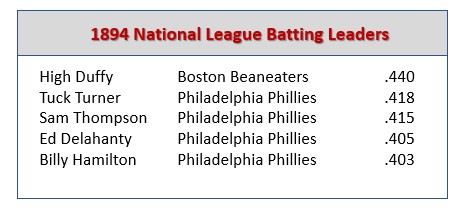
Who’s Your Daddy? – Randy Johnson Edition

Randy Johnson photo

Photo by SD Dirk

Six-foot-ten inch Randy Johnson stood tall, threw downhill and brought the heat.   Drafted in the second round of the 1985 MLB draft (by the Montreal Expos) out of the University of Southern California, he pitched his way into the Hall of Fame during a 22-season major-league career that featured 303 victories (22nd all time) and 4,975 regular-season strikeouts (second only to Nolan Ryan). He was also ten-time time All Star and five-time Cy Young Award winner (second only to Roger Clemens’ seven).

Brett Carroll – One for the Ages.

Brett Carroll, a .201 career hitter (2007-12 … Marlins/Brewers/Nationals), faced Randy Johnson in just one game (June 8, 2009), but he will have a story to share long into the future. Johnson gave up three runs in five innings of a 4-0 Giants’ loss to the Marlins – and Carroll drove in all three tallies. He only batted twice against Johnson, hitting a three-run home run in the bottom of the second inning (Carroll’s first MLB long ball) and adding a triple in the fourth.  Not bad.  Two career at bats against Johnson – with two hits and seven total bases. I’d leave out the part about Johnson being 45-year-old and in his late MLB season at the time. Although The Big Unit did go 8-6, 4.88 with 86 strikeouts in 96 innings that season.)

In the post, we’ll take a look at a lineup of hitters who seemed to have Randy Johnson’s number.  It’s part of a series inspired by Pedro Martinez.

Who’s Your Daddy?  What It’s All About.

On September 24, 2004, in the middle of a tight pennant race, the Yankees handed future Hall of Famer Pedro Martinez and the Boston Red Sox a tough 6-4 loss.  Martinez went 7 1/3 innings giving up nine hits and five earned runs.  The game came just five days after (in his previous start) Martinez had lasted just five frames against the Bronx Bombers (eight hits, eight earned runs) in a 16-7 loss.

After that second loss, Martinez candidly commented, “What can I say? I just tip my hat and call the Yankees my daddy.”  Little did he know that his comment – and a Yankee fans’ chant of “Who’s your daddy?” would follow him into future starts in New York (all the way to his final MLB start – against the Yankees for the Phillies – in Game Six of the 2009 World Series.)

The concept of “Who’s your daddy?” became the inspiration for Baseball Roundtable to take a look at the players who “had the number” of some of MLB’s premier pitchers.  

Here are links to the previous editions of this series:

  • Nolan Ryan, click here.
  • Sandy Koufax, click here. 
  • Pedro Martinez, click here.
  • Bob Gibson, click here

BBRT Note:  Keep in mind, the pitchers included in the “Who’s your daddy?” series are among the “best in the business.” They are selected not because of the players who performed well against them, but rather because solid hitter performance when they were on the mound was the exception rather than the rule.

Now, a look at the mound resume that earned Johnson a spot in this series – and then a lineup of players who seemed up to the task of facing Johnson’s downhill heat.

“Randy (Johnson) carries his emotions on his sleeve. So when Randy gets pumped, it’s pretty much wise to just go home. When he gets that look in his eyes, you know you’re not going tog get a hit off him. “

                                   16-season major leaguer Mark Grace

During his career, Johnson won 20 or more games in three seasons, leading the NL with 24 victories (five losses) in 2002.  He also led his league in strikeouts nine times; winning percentage, ERA and complete games four times each; shutouts and innings pitched twice.  Like a fine wine, Johnson aged well. He fanned 300 or more batters in five seasons – four after turning age 35. Similarly, he earned the NL Cy Young Award in his age 35, 35, 37 and 38 seasons. (  In short, he was an intimidating and superbly effect presence on the mound.

Johnson K's.

But again, this post is not about the many batters Johnson dispatched to the dugout shaking their heads.  It’s about a lineup of hitters who stood tall versus  “The Big Unit.”  As you go through this lineup, you’ll find some hitters you might have expected, like Albert Pujols and Chipper Jones at the corner infield spots, and some that may seem less likely, say Ty Wigginton at second base.

UNitsCarerF.


—The Randy Jones “Who’s Your Daddy?” Lineup—

Regular-season stats – 10 at bat versus Johnson minimum.
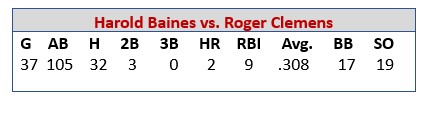
 

Catcher – Paul Lo Duca … RHH, 5’10”, 193 lbs. (Twenty career hits versus Johnson)

Nobody had more regular-season hits in his career against Johnson than Paul Lo Duca (20 hits in 21 games and 63 at bats (.317 average). Not only that, his 14 RBI  are second only to Manny Ramirez’ 17 against the big southpaw. To top it off, Lo Duca had a pretty good strikeout-to-walk ratio versus Johnson – five walks and six whiffs.

Lo DucaF

Lo Duca is one of those players whom BBRT thinks doesn’t get enough attention.  In an 11-season MLB career (1998-2008 … Dodgers/Marlins/Mets/Nationals), the four-time All Star hit .286, with 80 home runs and 481 RBI. His best season was 2001, when he went .320-25-90 for the Dodgers.

I also consider Ivan Rodriguez for this spot. I-Rod had 21 hits against Johnson. Those 21 safeties were the most of any batter against Johnson, but two of them came in the post-season. In the regular-season, he hit .244 (19-for-78) with one home run and five RBI against Johnson.  Lo Duca clearly deserves this spot.

There’s Statistics and then there’s ….

In 2003, Paul Lo Duca led MLB in runners thrown out stealing (but he also allowed the second most stolen bases). In 2004, he reversed those – allowing the most stolen bases (but throwing out the second most baser runners.)  Al in all, it looks like Lo Duca was consistently tested.

——————————————————–

First Base – Albert Pujols … RHH, 6’3″, 235 lbs. (13 RBI in xx games versus Johnson)

Albert Pujols hit a healthy .458 (in 24 regular-season games) against Randy Johnson.  He was 11-for-24 and eight of those 11 hits went for extra bases (three doubles and five home runs).  He also had 13 RBI versus Johnson. So, despite have the 196th most plate appearances versus the HOF southpaw, Pujols was number-two in home runs and number-three in RBI against him (regular season).  In Pujols’ final game against Johnson (June 30, 2009), in fact in his final two at bats against him, the 1B/OF hit a pair of home runs.

PujolsUNit

Pujols, still active, is a sure Hall of Famer. In 10 seasons (2001-19 … Cardinals/Angels), he has collected 3,202 hits (.300 average), 656 home runs and 2,075 RBI. He is a 10-time All Star, three-time league Most Valuable Player and was the 2001 NL Rookie of the Year.

Jack of All Trades

In 2002, Alert Pujols took the field defensively at 1B, 3B, SS, LF and RF.

Pujols has led his league in runs scored five times, home runs twice and hits, doubles, RBI and batting average once each. He has hit 30 or more home runs in 14 season, topped 100 RBI in 14 seasons and hit .300 or better in 11 campaigns.  He is also .323-19-54 in 77 post-season games.

Consistency is Not a Hobgoblin

Albert Pujols, famously, topped .300, 30 home runs and 100 RBI in each of his first ten MLB seasons. He came close in his 11th campaign, .299-37-99.

——————————————-

Second Base – Ty Wigginton … (.393 average versus Johnson)

Ty Wigginton hit .393 and popped four long balls in xx games against Randy Johnson – all this after going zero-for-four in his first game against him (August 5, 2002).  Wigginton’s success against the HOFer is a bit of a surprise, since Wigginton was a .261 career hitter over 12 seasons (2002-2013 … Mets/Pirates/Devil Rays/Astros/Orioles/Rockies/Phillies/Cardinals). Still, he had his moments – topping 20 home runs in four campaigns and making the AL All Star squad, as an Oriole, in 2010.

WiggintonUnit

Where’s Waldo?

Ty Wigginton was a true journey man. In 12 MLB seasons, he suited up for eight different MLB teams – and started games at 1B,2B, 3B, LF RF and DH,

In nine games against Randy Johnson, Wigginton started for four different teams (Astros, Devil Rays, Pirates, Mets) and at four different positions (1B, 2B, 3B, LF).

Wigginton’s career line is .261-169-594.

———————————————————-

Third Base – Chipper Jones … SH, 6’4″, 210 lbs. (Six regular-season home runs, the most of any batter versus Johnson)

In 12 games against Johnson, Hall of Famer Chipper Jones hit .361, with six home runs and eight RBI.  Those six home runs are the most by any batter against Johnson and the second-most Jones had against any pitcher.  (He had seven career, regular-season long balls off Steve Trachsel, but in more than twice as many games (29 versus Trachsel and 12 versus Johnson). Jones did the most damage in 2000, when he faced Jones six times in two games and went four-for-six, with three home runs and five RBI. That season, Johnson was 19-7, 2.64, with 347 strikeouts in 248 2/3 innings – capturing his third Cy Young Award.

JonesUNit

Bad Bookends

If you looked at his first and last games against Randy Johnson, you would not expect Chipper Jones to have put up good numbers against the big southpaw.  The first time he faced Johnson (September 2, 1998), Jones, went zero-for-four, with a ground out and three swinging strikeouts.   The final game in which he faced Johnson (May 27, 2009), Chipper went zero-for-three, with all three appearance ending in a strikeout (two swinging, one looking). So, for those book-ending games, Jones was zero-for-seven with six whiffs.

I did look consider a couple of other third baseman for this spot. Mike Blowers, who hit .563 against Johnson in six games (nine-for-sixteen) and Phil Nevin, who drove in the third-most runs against Johnson (13 in 24 games).  Blowers’ line against Johnson was .563-0-7, while Nevin was .261-3-13.  Jones got the edge for combing average and power.

Jones enjoyed a 19-season career (1993, 1995-2012 … Braves) – hitting .303, with 468 home runs and 1,623 RBI. He was an eight-time All Star and the 1999 National League MVP.  He also won the 2008 NL batting title. While he never led his league in home runs, Jones hit 30 or more in six seasons and 20 or more in 14 campaigns. He had 100 or more RBI in nine seasons – eight consecutive (1996-2003). He stole 150 bases in his career, with a high of 25 in 1999.

Trivia that is Not so Trivial

Chipper Jones had more walks (1,512) than whiffs (1,409) in his career.

Only Mickey Mantle (536) and Eddie Murray (504) have more home runs among switch hitters than Chipper Jones (468).

Only Eddie Murray has more RBI (1,917) among switch hitters than Chipper Jones (1,623).

Chipper Jones is one of only two switch hitters with at least 5,000 plate appearances to hit .300 or better from both sides of the plate.  Jones hit .303 left-handed and .304 right-handed.  The other, by the way, is Hall of Famer Frankie Frisch, who hit .319 lefty and.308 righty over a 19-season MLB career (1919-37).

Chipper Jones is one of only two Braves with a career on- base percentage (with the Braves) over .400.  Jones OBP was .401.   By comparison, Hank Aaron’s OBP in 21-seasons with the Braves was .377.  Billy Hamilton, who played with Braves (Beaneaters) franchise from 1896-1901 had the highest OBP for the team (.456).  In a 14-season MLB career – from 1888-1901 – Hamilton .344, with a .455 OBP.

—————————————————

Shortstop – Miguel Tejada … RHH, 5’9″, 220 lbs.  (Hit .386 versus Johnson)

In 16 games against Johnson, Miguel Tejada hit .386, with two home runs and eight RBI.  In addition, he had a 1-1 strikeouts-to-walks ratio (five walks/five whiffs).  I should note this was a very close call.  I also considered Randy Velarde and Rich Aurilia for this spot. Velarde faced off against Johnson in 13 career regular-season games and hit .452 (19-for-42). His 19 hits tied for the second-most regular-season safeties against Johnson. Velarde, however, had no home runs, seven RBI (one fewer than Tejada) and walked four times, while fanning ten.  Aurilia took the field (and batter’s box) against Johnson in 18 games and hit .333 (18-for-59), with three home runs and six RBI.  He walked five times against The Big Unit and fanned 16. Anyone of these three would have fit in here. I subjectively gave Tejada a slight edge for putting the ball in play.

Tejada UNit

Tejada played 16 MLB seasons (1997-2011, 2013 … A’s/Orioles/Astros/Padres/Giants/Royals).  He hit .285, with 307 home runs and 1,302 RBI. He was a six-time All Star and the 2002 American League MVP (.308-34-131 for the A’s).  Tejada hit 30 or more home runs in four seasons, drove in 100+ tallies in six seasons and hit .300+ in five.  Miguel Tejada is one of only 25 MLB players to drive in at 150 or more runs in a season.  (In 2004, he went .311-34-150 for the Orioles.)

We May not Know where Waldo is, but We Do Know where Miguel is – on the Field

Between June 2, 2000 and June 21, 2007 – a seven-year span – Miguel Tejada did not miss a game. His 1,152 consecutive games played is MLB’s fifth-longest streak.

——————————————————

Outfield – Barry Bonds … LHH, 6’1″, 185 lbs. – or so it says in Baseball-Reference.com. (Walked once every 5.6 plate appearance versus Randy Johnson)
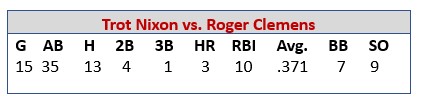
Barry Bonds faced off against Randy Johnson 62 times in 19 games – and put up a .306 average, with three home runs and 12 RBI.  Just as important, he walked 11 times and struck out just six (and was HBP twice) – for a .452 on-base percentage.
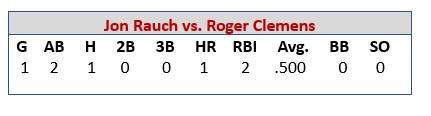
BpondsUNit

Putting the ball in play.

In 2004, Barry Bonds faced Randy Johnson 15 times and did not strikeout once (three hits, two walks, two HBP).

Barry Bonds played 22 MLB seasons (1986-2007 … Pirates/Giants).  He was a 14-time All Star, eight-time Gold Glover and seven-time MVP. He led the NL in home runs twice (an MLB record 73 in 2001); batting average twice; ruins scored once; RBI once; and walks 12 times. He finished his career with a .298-762-2,558 line and holds the career and single-season home runs records, as well as the career RBI record.  In addition, his career  2,558 walks and 688 intentional walks are MLB highs. (He led his league in intentional walks 12 times – with a high of, and MLB-record, 120 in 2004. There is, of course, that “elephant in the room.”

______________________________________________________________

Not a Lot of Action

Rickey Henderson struck more often against Randy Johnson than any other batter – 30 times in 85 plate appearances/59 at bats.  He also walked more times against Johnson than any other batter (26 times).  When he did make contact, Henderson hit .119 (7-for-59) against him).

_______________________________________________________________

Outfield – Moises Alou … RHH, 6’3″, 185 lbs. (.571 batting average against Johnson)

AlouiMoises Alou’s .571 average (8-for-14) against Randy Johnson is the highest of any hitter with at least 10 at bats against the HOF lefty, He did most of his damage during the 2000 season, when he played two games against Johnson and went three-for-five, with a walk, home run and four RBI. In his five career games against Johnson, he was never held hitless.

AlouUnitg

Alou played in 17 MLB seasons (1990, 1992-98, 2000-2008 …. Pirates/Expos/Marlins/Astros/Cubs/Giants/Mets). He was a six-time All Star, whose best season was probably 1998, when he went .312-38-124 for the Astros.  Alou put up a .303 career average, with 332 home runs and 1,287 RBI.  He hit 30 or more home runs three times and drove in 100+ runs in five seasons.

_________________________________________________________

Shout out to Mel Hall and Bill Pecota

Mel Hall had the most plate appearances and at bats against Randy Johnson without striking out (18 plate appearances/16 at bats).  He did, however, have just three singles and two walks (.188) average.  Second in both plate appearances and at bats versus Johnson without a whiff was Bill Pecota (16/11). Pecota had four hits and two walks (.364).

Hall, an outfielder, put up a .276-134-620 line in 13 MLB seasons, while Pecota (infielder) hit .249-22-148 in nine MLB seasons.

____________________________________________________________

Outfield – Manny Ramirez … RHH, 6′, 225 lbs. (17 RBI in 20 regular season games versus Randy Johnson)

No hitter drove in more regular season runs versus Randy Jonson than Manny Ramirez, who drove in 17 tallies in 20 games. His five regular-season home runs off the Big Unit is tied for second among all hitters. Overall Manny went 14-for-50 versus Johnson, with nine of those 14 safeties going for extra bases.

Manny UNit

How About a Mulligan for 1995?

In 1995, Manny Ramirez faced Randy Johnson in just one regular-season game – going zero-for-four with two strikeouts.  They matched up again in the AL Championship Series (Ramirez’ Indians versus Johnson’s Mariners) and Ramirez recorded six plate appearance against Johnson – going 0-for-6 with tree whiffs.

Manny Ramirez had a 190-season MLB career (1993-2011 … Indians, Red Sox, Dodgers, Rays, White Sox). He hit .312, with 555 home runs and 1,831 RBI. He was a 12-tie All Star and the 2002 AL Batting champ. He also led his league in home runs and RBI once each. Ramirez hit 30+ home runs in 12 seasons, drove om 100+ runs in 12 seasons and hit .300+ in 11 full campaigns.  He also hit .285-29-78 in 111 post-season games – and was the 2004 World Series MVP.

Other outfielders, I took a long hard look at: Alex Rios (.500 average … 7-for-14) versus Johnson; Carlos Beltran (.409-1-8 in eight games versus Johnson); and Ellis Burks (.281-3-13 in 12 games);

___________________________________________________________

Not Again!

Jason LaRue had a tough time against Randy Johnson. He struck out the first seven times he faced him – getting to two-ball count only once. He tightened up after that going ground out, fly out, sacrifice in his final three plate appearance versus Johnson. LaRue, by the way, hit .231 over a 12-season MLB career (922 games)

______________________________________________________

Pitcher – Seth McClung … LHH/RHP, 6’6″, 280 lbs. (Johnson never got him out)

Seth McClung only found himself matched up against Randy Johnson in one contest, it came on June 3 2008 and McClung got the win, pitching six innings of one-run ball in a 7-1 Brewers ‘win over the Diamondbacks. At the plate, McClung wen 2-for-2 versus Johnson (both singles).

BIG Time Match up

When Brewer Seth McClung started against Randy Johnson and the Diamondbacks, it was a BIG mound confrontation.  The two pitchers stood a combined 13′ 4″ tall and weighed a combined 505 lbs.

MccC.lung iunitMcClung’s career mound record (2003, 2005-09 … Devil Rays/Brewers) was 26-34, 5.46.)  At the plate he was five for 27 (.185).

O-Fer Pete’s Sake

When it comes to pitcher futility (in the batter’s box) versus Johnson, we might look to Tom Glavine who had 14 regular-seasons career at bats (17 plate appearances) versus Johnson and fanned ten times. He did draw a pair of walks and put down one successful sacrifice. For his career, Glavine had a regular-season average of .186 (246-for-1,323). 

Primary Resource:  Baseball-Reference.com

100Baseball Roundtable is on the Feedspot list of the Top 100 Baseball Blogs.  To see the full list, click here.

I tweet (on X) baseball @DavidBaseballRT

Follow/Like Baseball Roundtable’s Facebook Page here.  More baseball commentary; blog post notifications; PRIZES.

Member: Society for American Baseball Research (SABR); The Baseball Reliquary; The Negro Leagues Baseball Museum.