Baseball Roundtable Rates the Rookies – Explores Willie McCovey/Frank Schwindel Link

In 1959, the Giants’ 1B Willie McCovey won the NL Rookie of the Year Award despite playing in just 52 games.  In 2021, Frank Schwindel of the Cubs (rookie-status intact) put up numbers that mirrored those of McCovey in 1959.
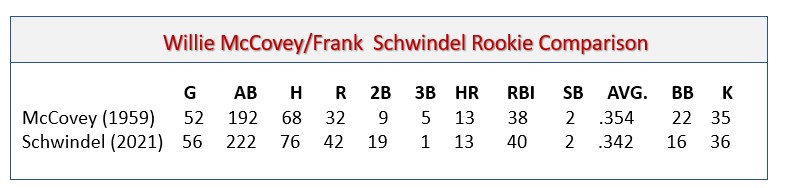
Admittedly, there are a few differences.  McCovey was just 21-years-old and had not played a game at the MLB level before 1959, while Schwindel was 29-years-old, had come to the Cubs (on waivers) from the  A’s in July and had 14 MLB games (American League) under his belt before joining Chicago.  Still, the similarities in their performance led me to take a look at the 2021 candidates for AL and NL Jackie Robinson Rookie of the Year Awards.

Here are my choices; how I predict the vote will go; and my ratings for the top five rookies in each league.

NATIONAL LEAGUE ROOKIE OF THE YEAR

BBRT Choice: Jonathan India

BBRT Prediction:  Jonathan India

  1. Jonathan India, 2B, Reds – The 24-year-old India played in 150 games this season and went .269-21-69, with 12 steals and 98 runs scored. India really came on after the All Star break, 15 of his 21 home runs. India also led all 2021 rookie in walks with 71 and  led MLB with 23 hit-by-pitches – contributing to a .376 on-base percentage.  His overall stat line should earn him the top vote totals.
  2. Frank Schwindel, 1B,Cubs – Okay, I doubt anyone else will have him this high, but the 29-year-old (who came over from the A’s on waivers in July) hit .342, with 13 home runs and 40 RBI for the Cubbies. These numbers (as noted above) are remarkably similar to Willie McCovey’s 1959 line of .354-13-38, when he won the NL Rookie of the Year Award after playing in just 52 games for the Giants.
  3. Patrick Wisdom, 1B/3B/OF, Cubs – The 29-year-old (who had played 43 MLB games over the previous three seasons) came into his own in 2021, going .231-28-61 in 106 games (that average will cost him some votes, but he deserves to be in the mix). Bonus points for versatility in the field.
  4. Dylan Carson, OF, Cardinals – The 22-year-old switch-hitting Redbird outfielder should get a few votes based on his .266-18-65, line (with 79 runs scored).
  5. Trevor Rogers, LHP, Marlins –  The 23-year-old went 7-8 in 25 starts for the Marlins (who finished 28 games under .500), but put up a fine 2.64 ERA and fanned 157 batters in 133 innings.

AMERICAN LEAGUE ROOKIE OF THE YEAR

Overall, this is one of the toughest Rookie of the Year races in recent years.  I could see any of the my top five winning the award: Emmanuel Clase for his 24 saves; Arozarena  with a 20 HR / 20 SB season; Adolis Garcia topping all rookies with 90 RBI; Ryan Mountcastle leading all rookies with 33 home runs; or Wander Franco with his 43-game on-base streak.

BBRT Choice: Emmanuel Clase, RHP, Indians

BBRT Prediction: Randy Arozarena, OF, Rays

  1. Emmanuel Clase, RHP, Indians – Baseball Roundtable is going against the grain here and pick a pitcher (I don’t think the voters will concur). Twenty-three-year-old reliever Emmanuel Clase, went 4-5, with a 1.29 earned run average and 24 saves in 71 games – fanning 74 batters in 69 2/3 innings and putting up a 0.96 WHIP. Clase has an outside chance of capturing ROY if the bevy of rookie hitters who should be in the chase split up the offense-leaning votes.
  2. Randy Arozarena, Of, Rays – Voters are unlikely to forget Arozarena’s  2020 post-season heroics and his 2021 stat line of .274-20-69 is solid. Baseball Roundtable gives the 26-year-old Arozarena an edge over the remaining hitters in my top five, based on his 20 steals and 94 runs scored – and, of course, name recognition.  I believe, he will be the official AL ROY for 2021.
  3. Adolis Garcia, OF, Rangers – The 28-year-old Rangers’ outfielder went .243-31-90, with 77 runs scored. His strikeout-to-walks ratio (194 strikeouts/32 walks) may hurt him a bit. Still, those 16 steals and his defensive work keep him in the running (pun intended).
  4. Ryan Mountcastle. 1B/OF, Orioles – The 24-year-old 1B/OF put up a 2021 stat line of .255-33-89 (with 77 runs scored) for the Orioles. Mountcastle  put up these solid numbers despite a slow start – he was  .198-1-71 in 25 April games and .266-32-82 the rest of the way.
  5. Wander Franco, SS, Rays – The 20-year-old SS may have the best chance of upsetting Arozarena for this award. (I think the voters will rate France a bit higher than I have.) In his 70 games, he went .288-7-39, with 53 runs scored.  He also gained considerable name recognition thanks to his 43-game on-base (via hit, walk or hit-by-pitch) streak (tying Hall of Famer Frank Robinson for the longest such streak by a player 20-year-old or younger).  Fewer games and fewer steals (two to Arozarena’s 20) will cost him some votes.

Primary Resource: Baseball-Reference.com

BASEBALL ROUNDTABLE ON THE TOP 100 BASEBALL BLOG LIST

100Baseball Roundtable is on the Feedspot list of the Top 100 Baseball Blogs.  To see the full list, click here.

I tweet baseball @DavidBBRT

Follow/Like Baseball Roundtable’s Facebook Page here.  More baseball commentary; blog post notifications; PRIZES.

Member: Society for American Baseball Research (SABR); The Baseball Reliquary; The Negro Leagues Baseball Museum.
Baseball Roundtable Rates the Top 25 MLB Debuts

How often have we hears the phrase, “You have only one chance to make a first impression?”  Well, this post is about 25 players who made a grand first impression in their major-league debut games.

Note/Disclaimer: This post does not include Negro Leagues’ debuts. Baseball Roundtable has not yet found a solid and accessible  source of game logs for the Negro Leagues of 1920-48; now officially major leagues. I would welcome suggestions either for a source of Negro Leagues’ game logs or of individual players – and their debut-game stats –  whose Negro League debuts you believe would put them on this list.

The ratings here, of course, are subjective.  They take into account not only the bare stats, but such factors as how unique ( a record 15 strikeouts or five base hits in a debut appearance) they might be; how unexpected (a great debut, which turns out to encompass an entire MLB career): the immediate follow-up (a debut shutout is great, but you get extra credit for following up with a game-two shutout);  the pressure of the moment (recognition of the significance of Opening Day, traditional rivalries or Hall of Fame opposition),  So, let’s get to it.

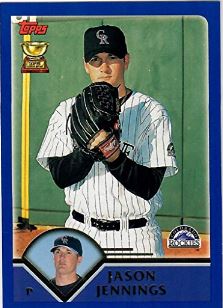
1. Jason Jennings, RHP, Colorado Rockies … August 23, 2001 … A Shutout and a Homer

Jason Jennings, a 22-year-old right-hander (who batted left – you’ll see the significance in a bit), was called up by the Rockies in late August after going 9-8, 4.42 in 26 starts at Double-A and Triple A.  Jennings  made his MLB debut on August 23 against the Mets in New York.  He proceeded to throw a nine-inning, complete-game shutout – five hits, four walks, eight strikeouts. At that point, he had thrown three complete games and one shutout in 68 minor-league starts (three seasons).

As a bonus, Jennings  also went three-for-five at the plate, with a  home run, one run scored and two RBI – becoming the first  MLB player to pitch a shutout and hit a home run in his first MLB appearance.  Jenning’s day included a pop out to third base in the first inning; a single to left in the third; a ground out to first in the fifth; an RBI single to right-center in the seventh; and a homer to right in the top of the ninth. (The Rockies won the contest 10-0).

Collegiate Star

Jason Jennings was a first-round draft pick (Rockies, 16th overall) in 1999 (out of Baylor University). In his three years at Baylor (1997-99), he was a three-time All American and, in 1999, won both the Golden Spikes Award and Dick Howser Trophy.  He posted a three-year pitching record of 27-11, 3.56 and a .344 batting average with 39 home runs in 172 games.  He is generally considered the best player in Baylor baseball history.

Jennings went 4-1, 4.58 in seven 2001 starts; hitting .267 (four-for-fifteen). He followed up by winning the NL Rookie of the Year Award in 2002, with a 16-8, 4.52 record for the Rox – and a .306-0-11 batting line (in 68 plate appearances). That proved to be his best season, as he appeared to succumb to command and injury issues and went 42-65, 5.06 over his final seven MLB seasons. He retired as an active player after the 2012 season, when he went 10-2, 3.58 for the (Independent) American Association Grand Prairie Ground Hogs. His final MLB line (2001-2009 … Rockies, Astros, Rangers) was 62-74, 4.95. As a hitter, he went 68-for-329 (.207), with two home runs and 26 RBI.

Post playing days, Jennings has been involved in The Keeper of the Game Foundation, The Miracle League, The Michael Young Foundation and MLB Baseball Assistance Team.

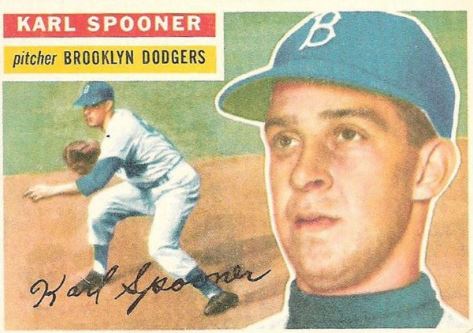
2. Karl Spooner, LHP, Dodgers … September 22, 1954 … a Shutout, with 15K

Spooner was called up to the Dodgers in late 1954 – after going 21-9, 3.14 for the Double-A Fort Worth Cats.  He was an immediate sensation – pitching a complete-game, three-hit shutout against the rival Giants in his September 22 debut.  In the 3-0 win, Spooner walked three and fanned 15 batters – still the MLB record (since tied) for a pitcher in his first MLB appearance.

Spooner, notably, did not get off to a great start – giving up a single and  two walks in the first frame – but pitching out of trouble. Not a single batter reached second base after the first inning and in the seventh and eighth, Spooner faced the minimum six batters and fanned them all (swinging) on a total of 29 pitches.  Spooner cemented the number-two spot on this list (whether it’s a fair way to “score” or not) with his second MLB appearance – another complete-game shutout. This time a four-hit, 1-0 win over the Pirates (September 25) in which he walked three and fanned a dozen.  So, in his first two MLB appearance, Karl Spooner did not give up a run and  fanned 27 batters in 18 innings – in a season in which the average strikeouts per nine innings among MLB pitcher was 4.2.   Side note: J.R, Richard, who (in 1971) tied Spooner’s record of 15K in an MLB debut did not “score” as high as Spooner for two reasons: 1) His debut game was not a shutout; 2) He fanned just five (in five innings) in his second game.  More on Richard later in this listing.

Clearly, with Spooner, it looked like the Dodgers had an “ace” in the making. That, however, was not to be.  In 1955, a Spring Training shoulder injury took  its toll and Spooner pitched only 98 2/3 innings that season – going 8-6, 3.65 in 29 appearances (14 starts). He spent the next three seasons in the minor leagues, before retiring at age 27.  His MLB career (1954-55 … Dodgers) stat line was 10-6, 3.09, with 105 strikeouts in 116 2/3 innings.

3. Billy Rohr, LHP, Red Sox … April 14, 1967 … One Strike Away from History

Billy Rohr got a higher than expected spot on this list at least in part based on the pressure of the moment. He made his debut against the Red Sox’ rival Yankees, at the New Yorkers’ 1967 home opener, and his mound opponent was Yankee ace, hero and future Hall of Famer Whitey Ford.

How did the 21-year-old rookie fare? Well, with two out in the bottom of the ninth, he was protecting a 3-0 lead and had yet to give up a hit (five walks, two strikeouts). In addition, he was dealing with the effects of a sixth-inning line drive off the bat of Yankee’s RF Bill Robinson that had ricocheted off Rohr’s shin to third baseman Joe Foy who threw to first for the out. Rohr had to argue with manager Dick Williams to stay in the game.  Now, with two down in the ninth, all that stood between Rohr and a no-hitter was Yankee catcher Elston Howard.  Rohr got ahead of Howard 1-2 and was one strike away from a no-hitter in his first MLB appearance. The next pitch was called a ball (Red Sox catcher Russ Gibson would forever maintain it was a strike). Then, on a 2-2 count, Howard hit a soft,  looping liner over second baseman Reggie Smith – putting an end to the no-hitter. On the  very next pitch, Yankees’ 3B Charley Smith flied out to right and Rohr had a one-hit shutout in his MLB debut.

One week later (April 21), Rohr made his second major-league appearance.  Again, he faced the Yankees, this time in Boston. He sparkled once more, holding a 6-0 lead after seven innings. The New Yorkers finally scored off the rookie in the eighth, one an RBI single by Rohr’s debut nemesis Elston Howard.

So, after two MLB appearances, Rohr was 2-0, with two complete games and 0.50 earned  run average. It looked like the youngster was on his way. He was not.  Rohr made eight more appearances (six starts) through June 1, going 0-3, 7.71, before being sent back down to Triple A. (He did make one more appearance, in relief, for Boston in September.) Early in the 1968 season, he was sold to the Indians, where he went 1-0, 6.87 in 17 relief appearances. He made his last MLB appearance on June 26, 1967, although he did toil in the minors until 1972.  After that 2-0, 0.50 start, Rohr ended with an MLB line (1967-68 … Red Sox)  of 3-3, 5.64.  Rohr, by the way, was originally signed by the Pirates out of Bellflower  (CA) High school, where he went 23-6 with four no-hitters.

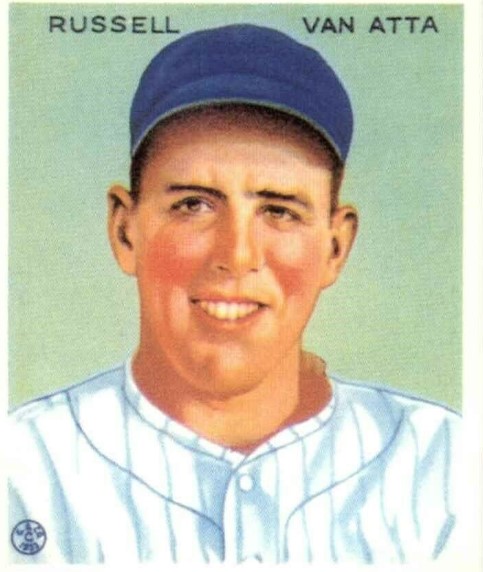
4. Russ Van Atta, LHP, Yankees April 25, 1933 … A Shutout and Four Hits

Maybe it’s the “Ohtani Effect,” but two of my top four on this list are pitchers that threw shutouts and also hit the ball well in their MLB debuts. Russ Van Atta was a pitching star at Penn State, where he reportedly lost only one game in four college seasons (before signing with the Yankees in 1928). Van Atta pitched in the minors from 1928 through 1932 (four years with the Double-A American Association Saint Paul Saints, where he went 22-17 in 1932). He made his debut for the Yankees on April 25, 1933, facing the Washington Senators.  (Note: These were not the Senators of later years. In 1933, the Senators went 99-53-1 and finished first in the American League.)

In his debut, Van Atta threw a five-hit, complete-game shutout (three walks, five strikeouts) as his Yankees won 16-0.  Not only that, he went four-for-four (all singles) at the plate, scoring three runs and driving in one. Van Atta had as many hits in the game as teammates Babe Ruth and Lou Gehrig combined.

Van Atta finished his rookie season 12-4, 4.18, in 26 games (22 starts) with ten complete games –  and with a .283 average in 60 at bats.

Van Atta looked to be on the cusp of a solid MLB career, only to see it derailed by a “unique” injury. Between the 1933 and 1934 seasons,  he injured the index finger on his pitching hand rescuing a dog from a home fire – and it affected his mound performance. He went 3-5, 6.34 in 1934 (28 games, nine starts).  After that season, he was primarily a relief pitcher – leading the AL in appearances in 1935 and 1936.  Van Atta had a seven-season MLB career (1933-39 … Yankees, Browns) and went 33-41, 5.60. As a batter, he went .228-2-17 in 206 at bats.

5. Juan Marichal, RHP, Giants … July 19, 1960 … Taking a Perfect Game into the Seventh

Juan Marichal was signed in 1958  as a 20-year-old out of the Dominican Republic – and made his MLB debut (at age 22) on July 19, 1960.  When called up, he was 11-5, 3.11 in 18 Triple-A starts for the season. The future Hall of Famer showed his credentials as “The Dominican Dandy” right from that very first appearance. He tossed a complete-game, one-hit shutout against the Phillies in San Francisco. Allowing jut one walk and fanning a dozen (the Giants won 2-0). He retired the first 19 MLB batters he ever faced (until a seventh-inning error by SS Eddie Broussard put Phillies’ 2B Tony Taylor on base). The first hit against Marichal didn’t come until there were two outs in the eighth (a single by catcher Clay Dalrymple). In the game, only one Phillie reached second base. In his first three MLB starts, Marichal tossed three complete-game victories (one a ten-inning contest) and gave up just three runs in 29 frames.

Marichal pitched 16 MLB seasons (1960-75 … Giants, Red Sox, Dodgers), going 243-142, 2.89.  He was an All Star in nine seasons and a seven-time winner of 20+ games.  Despite seasons of 25-8, 2.41 (1963), 25-6, 2.23 (1966) and 26-9, 2.43 (1968), he never won a Cy Young Award.  In fact, he did not get a single CYA vote in any of those three seasons. The unanimous NL winners were Sandy Koufax in 1963 and 1966 and Bob Gibson in 1968.

6. (tie) Starlin Castro, SS, Cubs … May 7, 2010 … Six-RBI Debut

It’s about time we got a position player in here, don’t you think? Starlin Castro made his debut with the Cub on May 7, 2010  (versus the Reds in Cincinnati) at age 20 – and started with a bang. Batting in the eight-hole, Castro got his first MLB at bat with two-on and no one out in the top of the second inning. He hit a 2-2 pitch for a three-run home run off (appropriately) Homer Bailey (I always thought that was an unfortunate name for a pitcher; like Nick Swisher for a hitter). In his second at bat, Castro lined out to center (leading off the fourth). He came up again in the fifth, this time with the bases loaded and two outs.  The result? A triple to deep left center.  So, three at bats into his major league career, Castro had six RBI.  (He was retired in his final two plate appearances.)

Starlin Castro’s six RBI are the MLB record for a player in his first MLB game.

Castro played in 125 games in that rookie season, going .300-3-41, and finished fifth in the NL  Rookie of the Year balloting. (The winner was Giants’ C Buster Posey, who hit .305-18-67). As of the completion of the 2021 season, Starlin had 12 seasons of MLB service (Cubs, Yankees, Marlins, Nationals), with a stat line of .280-138-678 (1,573 games). The four-time All Star has had  three seasons with a .300 or better average, two with 20+ home runs and two with 20+ steals. He led the NL in hits with 207 in 2011, when he hit .307 with 10 homers, 66 RBI and 22 steals. Over his career, he had played SS, 3B and 2B.

6. (Tie) Trevor Story, SS, Rockies …. April 4, 2016 … Two Homers in First Game; Six in First Four

Talk about getting the party started!  Rockies’ SS Trevor story made his debut (at age 23) on Opening Day 2016 –  as the Rockies faced the Diamondbacks in Arizona. The 2011 Rockies’ first-round draft pick was coming off a .279-20-80, 22-stolen base season at Double-A and Triple-A.  Right from his first game, he started powering his way into the record books. After grounding out in the first, he hit a three-run home to right in the third and a solo home run to left in the fourth. He ended the day two-for-six, with four RBI, as the Rockies won 10-5.

Story got a little extra credit (and moved up a couple of spots on this list) for what he did immediately after that multi-homer debut game – going deep in his first four MLB games. Between April 4 and April 8, Story went seven for 19 (.368). Six of his seven hits were home runs and, in the four games, he scored six times and drove in 11. In the process he became the first MLB player to homer in their first three and first four games, as well as the first with two multi-homer games in their first four MLB contests. One wonders what Story could have done in his rookie season if it were not for an early-August injury (thumb) that ended his season., Still, he went .272-27-72 in 95 games.  At the end of the 2021 season, the Rockies’ two-time All Star had a stat line of .272-158-450 – with 100 steals.

8. J.R. Richard, RHP, Astros … September 4, 1971 … A 15K Debut

Public Domain via Wiki Commons.

J.R. Richard was called up in September 1971, after going  12-7, 2.45, with 202 strikeouts in 173 innings for the Triple-A Oklahoma City 89ers. In his very first MLB start (September 4 versus the Giants), Richard went the distance, giving up three runs (two earned) on seven hits, while walking three and fanning 15 (in a 5-3 win).  Richard places this high on the list because his 15 whiffs place him in a tie for strikeouts in a debut MLB game.  Richard went on to a ten-season MLB career (cut short by a stroke in July of 1980) – all for the Astros. He went 107-71, 3.15, with 1,493 strikeouts in 1,606 innings pitched. He twice topped 300 strikeouts in a season (leading the league both times) and led the league in ERA at 2.71 in 1979. From 1976 until his stroke in mid-season 1980, Richard went 84-55, with a 2.79 ERA and 1,163 strikeouts in 1,239 1/3 innings; also recording 66 complete games and 17 shutouts. A little extra credit here for a dominating career cut short.

9. (Tie) Jay Hughes, RHP, Baltimore Orioles (NL) … April 18, 1898 … A Two-Hit Shutout and then He Got Better

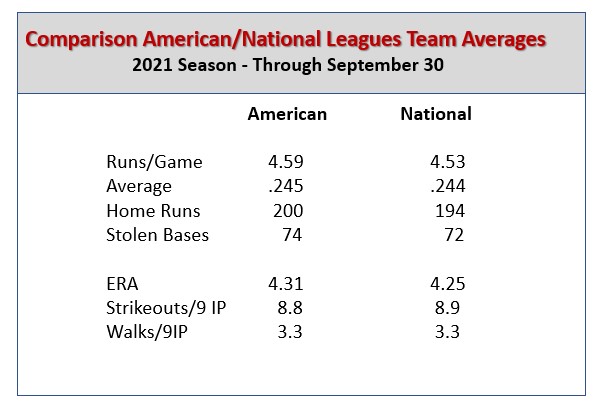
Sacramento, CA-born Jay Hughes made his MLB debut for the National League’s Baltimore Orioles on April 18, 1898 (the Sacramento connection’s importance will become clear soon). The 24-year-old Hughes embarked on his major-league career with a two-hit, complete-game shutout in a 9-0 win over the Washington Senators (Yes, in 1898, the Senators and Orioles were both in the NL) in Washington.  He followed it up with an 8-0, complete-shutout over the Boston Beaneaters in Baltimore.  He gets an edge over a handful of other hurlers who started their MLB careers with consecutive shutouts because Hughes’ second MLB start produced not just a shutout, but a no-hitter. Now, some may be quick to interject that time were different then and maybe the two shutouts were not that impressive.  But wait, in 1898, the MLB team average runs per game was 4.96 and Hughes “victims” – Washington and Boston – averaged 4.54 and 5.74 runs per game, respectively. This compares  pretty well to the 2021 season, when AL teams averaged 4.60 runs per game and NL squads averaged 4.46.

Back to Hughes, he finished his rookie season at 23-12, 3.20 and followed up with a 28-6 season for the Brooklyn Superbas in 1899. Now, of course, this was in the days before the big major-league contracts and Hughes missed his West Coast home territory.  So, in 1900, he left the National League and went back to Sacramento (got married) and put up a 23-9 record for the Sacramento Beavers of the California League. He was lured back the Brooklyn for the 1901-02 MLB seasons – going 17-12, 3.27 and 15-10, 2.94. Still, the West Coast was calling and, in 1903, he made his way to the Pacific Coast League Seattle Siwashes, where he went 34-15, 2.35. He played three more seasons in the PCL before retiring as a player,  Hughes’ MLB career was, by is own  choice, short – but what a start he had, a two-hitter and a no-hitter in his first two games. His career (1898-99 & 1901-02 … Orioles, Superbas) was 83-40, 3.02.

9. (Tie) Charles “Bumpus” Jones, RHP, Cincinnati Reds … October 15, 1892 … A No-Hitter First Time Out

Bumpus Jones makes an appearance here in part because he is the answer to a baseball trivia question – “Who is the only major leaguer to throw a complete-game, no-hitter in his very first MLB appearance?”  At first glance, one might be tempted to reply “Bobo Holloman” – but, while Bobo threw a no-no in his first MLB start, it was preceded by four relief appearances.  Bumpus, however, threw a no-hitter in his first-ever MLB mound appearance.  It came on October 15, 1892 (the final day of  the season) against the Pittsburgh Pirates. Jones walked four and struck out three in the game – a 7-1 Reds’ win. The only Pirates’ run scored in the third inning on a walk, a stolen base and an error by Jones.

A couple of additional notes here.  In 1892, the pitcher’s box was 50-feet from home plate (and Bumpus had made a name for himself pitching at that distance in the minor leagues). In 1893, the mound was moved to 60’ 6” and Jones did not recapture the magic of that no-hitter.  In 1893, he was 1-4, 10.19 for the Red Stockings and Giants. He continued to play professionally, (at least until 1901), but never again pitched in the major leagues. (For my Minnesota Readers, all evidence points to Jones’ last professional start coming on May 4, 1901 –  for the St. Paul Apostles). Jones played two MLB seasons (1892-93 … Giants, Reds), going 2-4, 7.99.

11. Fred Clarke, LF, Louisville Colonels (National League) … June 30, 1884 … Five-Hit Debut

In his first MLB game, 21-year-old  Fred Clarke rapped our four singles and a triple in five at bats (in a 13-6 loss to the Phillies).  He remains the only player to record five hits in a nine-inning MLB-debut game. On the season, Clarke hit .274-7-48 in 76 games.  He delivered on that debut-game promise in 1895, hitting .347 in 132 games.  Clarke  went on to a 21-season Hall of Fame career (1894-1911, 1913-15 … Colonels, Pirates), putting up a stat line of .312-67-1,015, hitting over .300 in ten seasons in which he played at least 100 games (a high of .390 in 130 games in 1897). Clarke also stole 509 career bases and recorded 220 triples (14 seasons of double-digits in triples).  He also enjoyed  a 19-season managerial career (1,602 wins, 1,181 losses … four pennants, one World Series title).

12. Willie McCovey, 1B, Giants … July 30, 1959 … Four-for-Four, Two Triples

Twenty-one-year old McCovey was called up to the Giants in July of 1959. At the time, he was  already in his fifth pro season, hitting .372-29-92 (95 games) for the Triple-A Phoenix Giants. San Francisco dropped the prospect right into the number-three slot in the lineup – and he delivered. As the Giants topped the Phillies 7-2 in San Francisco, McCovey made his MLB debut with a single (off future Hall of Famer Robin Roberts) in the first inning; a triple off Roberts in the fourth; an RBI single off Roberts in the fifth; and a second RBI triple off Roberts in the seventh.  McCovey finished his MLB debut game four-for four – with three runs scored, two RBI and, of course, those two triples.  McCovey shares the record for triples in a debut game.

Notably, McCovey started his MLB career with a seven-game hitting streak, during which he hit .467 (14-for-30), with three home runs, two doubles, two triples, nine runs scored and nine RBI. He went .354-13-38 on the season – winning the NL Rookie of the Year Award, despite playing in just 52 games.   McCovey went on to a 22-season Hall of Fame career (1959-80 – all with the Giants), hitting .270, with 521 home runs and 1,555 RBI. He was an All Star in six seasons, led the NL in home runs three times (hitting 30 or more home runs seven times) and RBI twice.  He was the 1969 NL Most Valuable Player.

13. Cecil Travis, 3B, Senators … May 16, 1933 … Five-Hit Debut (just took a little longer)

Only Fred Clarke (at number-eleven) and Cecil Travis collected five  hits in their MLB debut game. Travis, however, did not pick up his fifth hit until the bottom of the tenth (in a game in which his Senators beat the Indians in 12 innings by an 11-10 score). In the game, Travis went five-for-seven (all singles) and scored three runs. Travis’ hot start should not have been a surprise. In 1931, as a 17-year-old with the Class-A Chattanooga Lookouts, he hit .429 in 13 games. In 1932, still with Chattanooga, he raked at a .356 pace in 152 games. He was again hitting well over .300 for Chattanooga when the Senators  called him up to replace injured third baseman Ossie Bluege. Travis got in nine games between May 16 and May 24 (going nine-for-29 – all singles) before Bluege reclaimed the third base position.  Travis got in another nine contests in September/October and finished the season at .302 for Washington (13-for-43 – with just one extra-base hit) and .352 for Chattanooga.  He won the Senators’ third base job outright in 1934.

Travis enjoyed  a 12-season MLB career (1933-41, 1945-47 … Senators) finishing at .314-27-657 – but without the impact of World War II, his numbers could be notably more impressive. Travis lost nearly four years to military service (all of 1942-44 and most of 1945). In his nine MLB seasons before military service, he went .327-25-581. In the three seasons after his return, he went .241-7-26. In  1941, the season before he began his military service, he hit .359 and led the American League with 218 hits. He also scored 106 runs and drove in 101 that season

14. Kazuo Matsui, 2B, Mets …. April 6, 2004 … Home Run, Two Doubles, a Pair of Walks

In his MLB debut game, Kazuo Matsui came to the plate five times and got on base five times – two doubles, one home run and two walks; scoring once and driving in three as his Mets topped the Braves 7-2 in Atlanta.

Matsui came to Mets after nine seasons in Japan (1995-2003), during which he hit .309, with 150 home runs and 320 stolen bases.  He showed unexpected power with 69 home runs over the 2002-03 seasons.  As noted, he was three-for-three with two walks in his MLB debut.  In addition, he hit the first MLB pitch he ever saw (and the first pitch of the Mets’ 2004 season) for a home run. His  day went: solo home run in the first inning; RBI double in the second; bases-loaded walk in the third; double in the fifth; and intentional walk in the seventh. Matsui’s first-pitch home run, in retrospect,  was unexpected. In seven MLB seasons (2004-10 …  Mets, Rockies, Astros), he hit just 32 round trippers (.267 average, 211 RBI, 330 runs scored and 102 steals).

According the Elias Sports Bureau, Kaz Matsui is  the only MLB player to homer in his first plate appearance in three consecutive seasons (2004-05-06).

After the 2010 season, Matsui returned to Japan, where he played through 2018.

15. Mark Quinn, OF, Royals … September 14, 1999 … Two Homers and a Double

Mark Quinn made his debut as a designed hitter, batting fifth as the Royals took on the Angels in Kansas City. He earned his call up with .360-25-84 season (107 games) at Triple-A Omaha. In his first MLB game, the 25-year-old  popped out in the first inning; doubled to lead off the fourth; hit a two-run home run in the sixth; added another two-run homer in the eighth to finish three-for-four with three extra-base hits, while driving in four of the Royals’ five runs in a 6-5 loss to the Angels.

Quin played in 293 MLB games (1999-2002 … Royals), going .282-45-167. In 2000, he had his best season with a .294-20-78 line in 135 games.

16. John Paciorek, RF, Colt .45’s … September 29, 1963 … 1.000 Career Average

Signed out of Saint Ladislaus High School in Hamtramck, Michigan (where he had starred in football, basketball and baseball), John Paciorek appeared in his first major-league game on the final day of the 1963 season (September 29) at the age of 18.  The 6’ 1”, 200-pound outfielder had spent the 1963 season with Class-A Modesto Colts; where he hit .219-9-49 in 78 games.  The Colts’ parent club, the Houston Colt .45s (that was the current Astros’ franchise name back then), was suffering through a difficult season. The team was 65-96 going into that final game.  Looking to the future, Houston had, in fact, fielded an all-rookie lineup (average age 19) on September 27. Youth was still being served two days later when John Paciorek started his first MLB game. The results were surprising – and worthy of recognition.

Playing right field and batting seventh in a 13-4 win over the NY Mets, Paciorek ended up with three hits and two walks in five plate appearances, with four runs scored and three runs batted in.  Perhaps equally surprising is that it was not only Paciorek’s first major-league appearance, it was to be his only MLB appearance.  Back pain the following spring, followed by surgery (he played 49 minor league games in 1964 and missed all of the 1965 season), put an end to his MLB playing days. (Paciorek did play in four more minor-league seasons.)  Still, you will find John Paciorek in the Baseball Encyclopedia and his is arguably the greatest one-game MLB career ever.  Among one-gamers, he holds the record for times on base and runs scored, and shares the record for batting average, on base percentage and RBIs.

17. Ray Jansen, 3B. Browns … September 30, 1910 … Four Hits in First Pro Game

Like John Paciorek (above), Ray Jansen’s MLB debut game was his only major-league appearance.  Unlike Paciorek, however, Jansen’s MLB debut was also his professional debut. The 1910 season was winding down and the St. Louis Browns  were 54 ½ games behind in the American League race – and apparently decided to give some local talent a “look-see.” (Jansen was born and raised in St. Louis.)  So, on September 19, 1910, we find the 21-year-old Jansen – who had never played professionally at any level – starting at third base and hitting second for the Browns (against the White Sox in St. Louis). Jansen had a good day at the plate – four singles in five at bats, which gives him the record for the most hits by  a player with a one-game MLB career (more #InBaseballWeCountEverything).   He was a little less adept at the hot corner (which may help explain his one-game MLB career), making three errors.  To be fair, the Browns did make seven errors that day (and led the league with 385 on the season). Jansen’s lone game did have an unusual line score. The White Sox scored nine runs on nine hits  (there were four walks and, of course, those seven errors).  The Browns tallied just one run on 16 hits (two triples and 14 singles), with the White Sox making just one error and surrendering no free passes. Jansen did continue his career in the minors, where he played until 1918, hitting .266 with ten home runs in 616 games.

18. Bert Campaneris, SS, A’s … July 23, 1964 … Three-for-Three, Two Home Runs, Stolen Base

Bert Campaneris was not a power threat. In 19 MLB seasons, he hit more than eight home runs in just one campaign (22 long balls in 1970). Still, he did manage to go deep on the very first MLB pitch he ever saw (off the Twins’ Jim Kaat).

Campaneris was called up to the A’s in July of 1964 due to an injury to A’s starting SS Wayne Causey. The 22-year-old Campaneris was in his third professional season and was having a solid season with the Double-A Birmingham Barons (he was hitting .325 with 25 steals for the Barons). In his MLB debut game, Campaneris (playing SS and batting second) hit a solo home run in the first; singled in the third; reached on a Fielder’s Choice and stole second in the fifth; hit a two-run homer in the seventh; and walked in the tenth.  The A’s won 4-3 in 12 innings. Campaneris went three-for-for, with two runs scored, three RBI.

Campaneris enjoyed a 19-season MLB career (1964-81, 1983 … A’s, Rangers, Angels, Yankees), hitting .259-79-646 with 649 stolen bases.  He was a six-time All Star; six-time stolen base leader (with ten consecutive seasons of 30 or more steals).

19. Daniel Ponce de Leon, RHP, Cardinals …. July 23, 2018 … A Comeback after a Comebacker

Public Domain via Wiki Commons

Okay, first, how can you not put a guy named Ponce de Leon on any list.  And, while Daniel Ponce de Leon didn’t pick up a win in his MLB debut (in fact, didn’t get a victory in his first MLB season), getting to the mound was a victory in itself.  He deserves a spot here on the virtue of pure grit and determination.

Ponce de Leon was drafted out of Embry-Riddle Aeronautical University (Daytona Beach, Florida) – in 2014. By 2017, at age 25, he had worked his way up the Triple-A Memphis Redbirds – where, on May 9, he was hit in the head by a line drive up the middle, fracturing his  skull.  At the time, he was 2-0, 2.17 on the season. The injury required surgery,  he spent three weeks in the hospital  and did not return to action until Spring Training 2018. He started the 2018 season back at Memphis, where he was 5-2, 2.41, with 71 strikeouts in 59 2/3 innings before a July call up to the Cardinals – just 13 months  after what many thought was a career-ending injury.,

So, how did he do in that first MLB appearance?  How about seven no-hit innings against the Reds in Cincinnati (three walks, three strikeouts). Ponce de Leon left the game with a 1-0 lead, but the Reds scored two in the ninth to win the game.  He made a total of 11 appearances in 2018 (four starts) and went 0-2, 2.73 with one save. Ponce de Leon was up and down several times  (between St, Louis, Memphis and Springfield) in 2018 through 2021 – and was released by the Cardinals in September of this year.  To date, his MLB record is 3-8, 4.33 in 57 games (22 starts).

20. J.P. Arencibia, C, Blue Jays … August 7, 2010 … Three Extra-Base Hits

J.P. Arencibia was a first round pick (21st overall) of the Blue Jays (out of the University of Tennessee) in the 2007 draft. He showed a solid power the minors: .254-3-25 in 63 games at Low-A in 2007; .298-27-105 in 126 games at High-A and Double-A in 2008; .236-21-75 in 116 games at Triple-A in 2009; and .301-32-85 in 104 Triple-A Games in 2010. He made his MLB debut on August 7, 2010 in Toronto as the Blue Jays faced the Rays.  It was a slugfest (a 17-11 Jays win) and Arencibia was glad to take part.  He homered off James Shields in the bottom of the second (a two-run shot on the first MLB pitch he ever saw); doubled in the third; singled (and later scored) in the fifth; hit a solo home run in the sixth; fouled out in the seventh; finishing the day four-for-five, with three runs scored, three RBI and three extra base hits.

Arencibia struggled after that first big game. He played ten more games for the Jays that season and had just one single in 30 at bats. Arencibia eventually played in six MLB seasons (2010-15 … Blue Jays, Rangers, Rays), going .212-80-245. He topped 20 home runs in two seasons.

21. (Tie) Al Jurisch, RHP, Cardinals … April 26, 1944 … Working Overtime

Al Jurisch made his MLB debut on April 26th, 1944, as his Cardinals took on the Reds in Cincinnati. Despite throwing 12 scoreless innings that day, the 22-year-old righty got the loss when he gave up a run on a walk-off home run (to 1B and cleanup hitter Frank  McCormick) with two outs in the bottom of the unlucky 13th.  (Jurisch had struck out the first two batters in the inning.) The 12 2/3 innings remains the longest debut outing by an MLB pitcher.  For the game, Jurisch gave up eight hits, walked four and fanned seven.

Jurisch went 7-9, 3.39 in 1944 – appearing in thirty games (seven starts) with five complete games and two shutouts.  It was his best MLB campaign. He pitched in  the majors through 1947 (Cardinals, Phillies),  with a final stat line of 15-22, 4,24.

21. (Tie)  Al Worthington, RHP, Giants …. July 6, 1953 … Start with a Shutout, Follow Up with a Shutout

Al Worthington made a name for himself in the major leagues as a reliever – running off a string of seven seasons of double-digits in saves and leading the AL with 18 saves for the Twins in 1969. Worthington  gets irony points here, since the respected reliever  made this list by virtue of throwing two, complete-game shutouts in his first two MLB appearances. The 24-year-old was in his third pro season and was 9-5, 2.90 for the Minneapolis Millers when he was called up by the Giants. In his MLB debut game on July 6, 1953, he shut down the Philllies on two hits (four walks, six whiffs) as his Giants won 6-0 in New York. Five days later he started again and shut out the Dodgers 6-0 on four hits (one walk, seven strikeouts, It was the only time the NL Champion Dodgers were shutout that season. Things went a little south after that, as his next eight decision were all losses (0-8, 5.13 in that span). He ended his rookie campaign at 4-8, 3.44. Worthington went on to a 14-season MLB career, going 75-82, 3.39 with 111 saves (533 relief appearances, 69 starts).  He was 16-31, 3.99 as a starter and 59051 (with those 111 saves), 3.11 as a reliever

23. Joe Doyle, RHP, New York Highlanders … August 25, 1906

Known as Slow Joe Doyle for his pace on the mound, Doyle made his MLB debut for the Highlanders (Yankees) on August 25, 1906, shutting out the Indians 2-0 (in New York) on six hits (two walks, five strikeouts). He followed it up August 30 with another complete-game shutout.  This time a two-hitter (no walks, six strikeouts) as the Highlanders beat the Senators 5-0. He finished his rookie season at 2-1, 2.38 and went on to  five-season MLB career (1906-10) with a 22-21, 2.85 line.

24. Johnny Marcum, RHP, Athletics … September 7, 1933 … A Pair of Five-Hitters

The Philadelphia Athletics called up 23-year-old Johnny Marcum in September of 19-33 – after a 20-13, 3.74 season for the Double-A Louisville Colonels.  He showed his “stuff” right away, In his first appearance, September 7, he tossed a five-hit (six walks, four whiffs) shutout, as the Athletics topped the Indians 6-0 in Philadelphia. He started again on the 11th and tossed another five-hit shutout (three walks, three whiffs) as the Athletics topped with White Sox 8-0. He finished his rookie season at 3-2, 1.70 and went 65-63 in a seven-season (1933-39) MLB career.

25. Steve Woodard, RHP, Brewers … July 28, 1997 … Topping Roger Clemens

Steve Woodard was drafted  in the fifth round of the 1994 MLB Draft, out of Hartselle (AL) High School. He made a pretty quick impression, going 8-0, 2.40 in the Arizona (rookie) League as a 19-year-old (1994). Over the next three seasons, Woodard  went 34-16, as he worked his way up the minor-league system. He was called up to the Brewers in July of 1997 – and made his first appearance against the Blue Jays on July 28 in Milwaukee. To add to the pressure – and garner Woodard extra “points” in this listing –  his mound opponent was Roger Clemens, who was 16-3, with a 1.54 ERA going into the game. Woodard proved up to the task, pitching eight innings and giving up just one hit and one walk, while fanning 12. And, he needed to be that good, as Clemens tossed an eight-frame complete game, giving up four hits and one run, while walking one and striking out ten.

Notably, the lone hit the Blue Jays got off Woodard came on the third pitch of the game – a double to Blue Jays lead-off hitter CF Otis Nixon. Nixon stole third with one out, and then Woodard settled down and struck out LF Joe Carter and 1B Carlos Delgado on nine pitches. The only base runner he allowed over the next seven innings came on a third-inning, one-out walk to SS Alex Gonzalez.  Again, he bore down with a runner on base and struck out the next two batters. With one inning of relief from Mike Fetters, Woodard collected a 1-0 win.

Woodard’s debut season did not follow the path of that first game. He ended 1997 at 3-3, with a 5.15 earned run average. Woodard had a seven-season MLB career (1997-2003 … Brewers, Indians, Rangers, Red Sox), during which he went 32-36, 4.94. His best season was 2003, when he went 11-8, 4.52 for the Brewers.

The 25 debut games on this list, of course, are subjective calls. Want to switch someone out?  Below are a few choices that Baseball Roundtable considered.  Or add you own suggestions on the list or its order  in the comments.

Steven Strasburg, RHP, Nationals … June 8, 2010.  The much-publicized debut of Strasburg went well.  He gave up just four hits and two runs over seven innings, with no walks and 14 strikeouts (third most in an MLB debut) – while his Nationals topped the Pirate 5-2.

Joey Gallo, 3B, Rangers … June 2, 2015.  Highly-rated prospect Gallo went three-for-four, with a double, home run (and a walk), scoring three times and driving in four, as the Rangers topped the White Sox 15-2 in Texas.

Tom Phoebus, RHP, Orioles … September 15, 1966.  Phoebus made his MLB debut with a four-hit (two walks, eight strikeouts), 2-0, complete-game win  over the Angels.  In his second appearance,  he threw another shutout – a  five-hit, 4-0 win over the Athletics.

Freddy Peralta, RHP, Brewers … May 13, 2018. Peralta only pitched 5 2/3 innings in his debut (a start against the Rockies in Colorado).  Despite the mile-high air and a lineup that included DJ LeMahieu, Charlie Blackmon, Trevor Story, Nolan Arenado and Carlos Gonzalez, Peralta gave up just one hit (two walks) and struck out 13,  He fanned five of the first six MLB hitters he ever faced (LeMahieu, Blackmon, Arenado, Gonzalez and Story).

Kirby Puckett, CF, Twins … May 8, 1964 … Minnesota fan favorite Puckett rapped four singles in five at bats in his debut game – and went on to hit safely in his first seven MLB contests (16-for-33, .485).

Primary Resources: Baseball-Reference.com; Baseball-Almanac.com; the following SABR bios: Bumpus Jones, by Chris Rainey; Fred Clarke, by Angelo Luisa; Billy Rohr, by Alexander Edelman; Bert Campaneris, by Rick Schabowski; Jay Hughes, by Bill Lamb;  and “A Most Spectacular Debut” (Russ Van Atta), by  Randolph Linthurst.


BASEBALL ROUNDTABLE ON THE TOP 100 BASEBALL BLOG LIST

100Baseball Roundtable is on the Feedspot list of the Top 100 Baseball Blogs.  To see the full list, click here.

I tweet baseball @DavidBBRT

Follow/Like Baseball Roundtable’s Facebook Page here.  More baseball commentary; blog post notifications; PRIZES.

Member: Society for American Baseball Research (SABR); The Baseball Reliquary; The Negro Leagues Baseball Museum.


Why I Love Baseball … Guest Post by Author, Poet and Grammy Nominee Leonard I. Eckhaus

As regular Baseball Roundtable readers know, Baseball Roundtable invites and encourages guest contributions to its “Why I Love Baseball” page. Today, BBRT is pleased to present a guest post from Leonard I. Eckhaus, an award-winning author and poet, two-time Grammy Award nominee and, of course, lifelong fan of the national pastime.  Eckhaus shares his love of the game in the form of a poem.  You’ll find a full biography of Eckhaus and a Baseball Roundtable Q&A with him (exploring his passion for and opinions on the  game) after the poem.  Note: If you are interested in previous guest posts on the topic, click the “Why I Love Baseball” hot link at the top of the page (top line).


                                  Why I Love Baseball

                                                             By Leonard I. Eckhaus


                                   We’re down in the score,

                                   It’s late in the innings,

                                  What we need right now

                                  Is a new beginning.


                                   Then – a bunt, a sacrifice,

                                   A stolen base,

                                   Puts a runner at third,

                                   Maybe it’s not too late.


                                    A long fly to right,

                                   The runner takes a lead.

                                   Only ninety feet to home,

                                   Hope he has enough speed.


                                   A throw from the outfield,

                                   A slide into the plate.

                                  The umpire signals…

                                  The runner is safe!


                                  And now the score

                                  Is three to three,

                                 And I’m coming to bat –

                                 It’s all up to me.


                                 Once again the ballpark

                                 Has come alive.

                                 As the fans realize

                                 We just may survive.


                                The scoreboard lights up,

                                The bulbs all aglow.

                                The fans rise from their seats,

                                Shouting “Go team, go!”


                                The organist begins to play

                                Stars and Stripes Forever,

                                The fans begin to scream and chant,

                                Their voices rise together.

                                Excitement building all around,

                                A cacophony… of color and sound.


                               And, above it all, you still can hear

                               The vendors’ voices loud and clear,

                               Shouting “Getch’ yer hot dogs,

                               Get yer beer.”


                               But I can’t listen,

                               I must concentrate now,

                               Not hear the noise,

                               Not hear the crowd.


                              So I stand real still

                              And wait for the pitch.

                              A fastball, a curve –

                              It doesn’t matter which.


                             The pitcher and I,

                             We’re on our own.

                             He’s winding up,

                            The pitch is thrown.


                             I see it coming,

                             I swing and connect.

                            The ball leaps from my bat

                            It’s better than I expect.


                            I look up just once

                            As I’m rounding first base,

                            Running fast as I can,

                            Just in case…


                           I hear the roar of the crowd

                           See them get to their feet.

                           As the ball soars out of the park,

                          And into the street.


                           And they shout out my name…

                           … And we win the game.


                           And then, amidst all the hullabaloo,

                           I know exactly what I have to do.


                           So, I tip me hat

                           And I bends me knee,

                           And the cheering explodes…

                          … And I know it’s for me.


                          True, it’s only a dream,

                           But that doesn’t matter,

                           Even though

                           I wasn’t really the batter.


                          In my dreams at least

                          I can hit a home run

                          Enjoy the thrills,

                          Enjoy the fun.


                            Anyone

                            Can play this game

                           And in their mind,

                           Have glory and fame.


                          You don’t have to be good,

                          You don’t have to be great,

                          You can just play to have fun –

                           To participate.


                            … And that’s why I love baseball!!

Photo by petestokke

Leonard Eckhaus Bio

Leonard Eckhaus is the founder of AFCOM (1980), the leading association in the world for Data Center Managers; the co-founder of LL Music and a two-time Grammy nominee; and an award-winning author and poet.

In 2017, Eckhaus co-founded LL Music, a music production company and record label. He received two Grammy nominations in 2018 for his first album, Rendezvous, featuring the singer, Clint Holmes. A song he wrote for his wife Linda charted on UK Radio in its first week on the air and has received over 50,000 views on YouTube.

Eckhaus’ book, My Journey: (Lessons I’ve Learned Along the Way), the Memoirs of Leonard I. Eckhaus, has been selected by UK Talk Radio as one of the top 10 must-read books in 2021. His most recent book, If I Were a Pony, a poem about the relationship between a young lad and his pony, aimed at the grade school audience, has won ten awards including Creative Child Magazine’s 2021 Book of the Year.

Eckhaus established and presided over The Data Center Institute, a think tank of leading computer industry visionaries. He also created, produced and published DCM, an award-winning magazine. His insights into the growth and impact of Data Centers have appeared in such publications as The Wall Street Journal, The New York Times, the Washington Post, U.S. News & World Report, Bloomberg News and others.

Eckhaus has been married to his childhood sweetheart, Linda, for 59 years. They live in Nevada and have been involved in a number of local and state arts-focused organizations.


A Baseball Roundtable Interview with Leonard Eckhaus

Roundtable: What first drew you to the national pastime? 

When I was seven- or eight- years-old, my friends and I used to play softball in an old nearby vacant lot. That’s also when every time I got hold of a nickel, I would buy a package of bubble gum that, in addition to the gum, contained five Topps baseball cards. Wish I still had them! A few years later, we switched from softball to baseball.

Roundtable: When did you attend your first baseball game and what was most memorable about it?

In 1951, my parents bought their first TV.  It was a GE 16” combination TV, AM/FM radio and phonograph. When the technician that installed it turned it on, there was a New York Yankee game being played out right before my nine-year-old eyes. I couldn’t believe it! That was the first Major League game I had ever seen. Before that I had listened to them on the radio and had seen clips of baseball games on the newsreels they showed before the main feature started in movie theaters. About a year later, I was able to attend my very first in-person game. It was at the Polo Grounds, New York Giants vs. Cincinnati Reds. I still remember marveling at those huge arms of Ted Kluszewski.

Roundtable: Did you play baseball and, if so, at what levels?

I played in Little League and thought I was a pretty good hitter – until I was 14-years-old and made a team in some other league with players aged 14 to 16. The first time I saw a decent curve ball, I couldn’t stand in there and quickly realized it was time to retire and enjoy baseball from the stands.

Roundtable: What is your concept of the best baseball game?  Indoors/outdoors?  Day/Night? Slugfest/Pitchers’ duel  or somewhere in the middle? Any other qualities you look for in a game?

Baseball today is not quite the same game as it was when I was growing up. The games I liked best were played during the afternoon. Pitchers all hoped to finish every game they started, regardless of the number of pitches they had thrown. I preferred pitchers’ duels and ‘little’ ball, which you hardly ever see today. The skill positions – catcher, shortstop, second baseman – often determined which team won. Bunting was an acquired and important skill. Moving the runner up was the hitter’s goal. A really good ballplayer consistently batted over .280 and had 20+ home runs, season after season.

I am not a fan of trying to “improve” the game by making it easier to hit home runs (lowering the pitcher’s mound) or having more runs scored by using ‘designated’ hitters.  Guess I’m pretty much a traditionalist.

Roundtable: Do you have any favorite players or teams – past or present?

I was always a NY Yankee fan. My favorite players were Yogi Berra, Mickey Mantle, Phil Rizzuto, Hank Bauer, Whitey Ford and Eddie Lopat. But the single most exciting player I ever saw was Nolan Ryan when he played for the then California Angels and I had season tickets. Every time he got two strikes on a batter, the fans would rise to their feet and start cheering, hoping for the strikeout.

Roundtable: Since you are a data management guru, how do you feel about the data and analytics that have become such a big part of today’s game?  Any specific types of data you feel are more or less useful?

When I was growing up, I had a good friend whose life ambition was to become a baseball statistician. When I went to games, I filled out a scorecard, brought it home and saved it. Batting averages, ERA’s, RBI’s, number of home runs … these were the only stats we fans really cared about.

Today’s ability to track everything from pitching speeds to how many times a batter strikes out on a fastball or on a curve, to designing the most effective gloves, take the fundamentals out of the game and replace them with statistics that often, in my opinion, should be left to the players’ intuition. The greatest managers gave their greatest players a lot of freedom to do their job as they saw best.


BASEBALL ROUNDTABLE ON THE TOP 100 BASEBALL BLOG LIST

100Baseball Roundtable is on the Feedspot list of the Top 100 Baseball Blogs.  To see the full list, click here.

I tweet baseball @DavidBBRT

Follow/Like Baseball Roundtable’s Facebook Page here.  More baseball commentary; blog post notifications; PRIZES.

Member: Society for American Baseball Research (SABR); The Baseball Reliquary; The Negro Leagues Baseball Museum.


Baseball Roundtable Picks Braves in Seven … Some Thoughts

As we move on to the World Series, once again, the statistics seem to establish the Braves as underdogs. However, Baseball Roundtable went with the underdog Braves to top the Dodgers and that worked out – so, I’m doubling down and picking Atlanta to top the Astros. When I picked the Braves over the Dodgers, I noted that Joc Pederson’s key pinch-hit home runs in NLDS Games One and Three seemed to establish the 2021 Braves as a team of destiny. That feeling was reinforced in the seventh inning of Game Six when the Dodgers (down by two) put runners on second and third with no outs and Tyler Matzek came in to pitch and fanned Albert Pujols, Steven Souza, Jr. and Mookie Betts on 11 pitches.  That’s probably the point at which this prediction was cemented.  Whether it’s Pederson, Matzek, NLCS MVP Eddie Rosario, Austin Riley (HR and walk-off single in NLDS Game One) or Will Smith (two wins, four saves and and a o.oo in seven appearances this postseason), the Braves players seem to be stepping up.

Yordan Alvarez, ALCS MVP, hit .522 with six RBI in the six games against Boston. Alvarez Photo: Flickr user thatlostdog–, CC BY 2.0 <https://creativecommons.org/licenses/by/2.0>, via Wikimedia Commons

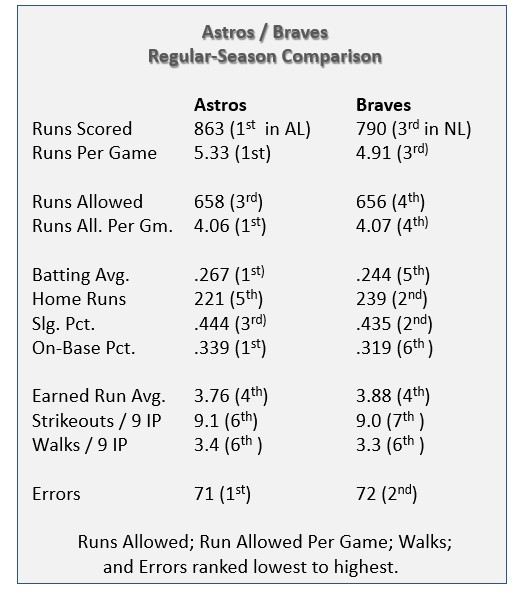
Really, when it comes down to it, this predict is about pitching.  Both these teams have solid offenses. The Astros bring more star power to the offense with three players with 30 or more home runs (2B Jose Altuve – .278-31-83); RF Kyle Tucker (.294-30-92); DH Yordan Alvarez (.277-33-104).  SS Carlos Correa added 26 home runs and  92 RBI to go with a .279 average; LF Michael Brantley hit .311-8-47 in 121 games and 3B Alex Bregman contributed .270-12-55 in 91 contests.  The lineup is deep, experienced (the Astros have been to the World Series three times in the past five seasons) and explosive (the Astros have scored 65 runs in ten 2021 post-season games).

Eddie Rosario, NLCS MVP, hit .560 with nine RBI in the six games against the Dodgers.

Of course, the Braves are no slouches on offense. As I’ve noted before, they have perhaps the most powerful infield in MLB right now: 1B Freddie Freeman (.300-31-83); 2B Ozzie Albies (.259-30-106); 3B Austin Riley (.303-33-107) and SS Dansby Swanson (,248-27-88).  And, while they lost a key offensive pieces in Ronald Acuna Jr. and Marcell Ozuna, they made some trade deadlines moves that filled the gap – a mid-July trade for Joc Pederson (.249-7-22 in 64 games for the Braves/.238-18-61 overall) and trade deadline acquisitions of Eddie Rosario (.271-7-16 in 33 games for Atlanta/.259-14-62 on the season); Adam Duvall (.226-16-45 in 55 games for Atlanta/.228-38-113 overall); and Jorge Soler (.269-14-33 in 55 games for Atlanta/.223-27-70 overall). The Braves may not be quite as deep or experienced as the Astros, but there is plenty of punch there.  While the Braves scored 73 fewer runs then the Astros this season (still third-most in the NL), I’d note that Atlanta’s total included 308 plate appearances by pitchers  (.131 average). Offensively, the advantage goes to the Astros – but the difference is not as great as you might think.

Post Trade Deadline – after the Braves’ outfield makeover – Atlanta went 36-19. The Astros went 31-26 over the same period.

Here’s a regular-season stat comparison. Keep in mind, that the designated hitter impacts both the offensive and pitching numbers.

On the mound, the Braves, from my perspective, have a notable  edge. The Braves’ rotation looks solid: Charlie Morton (14-6, 3.34), Max Fried (14-7, 3.04) and Ian Anderson (9-5, 3.58) will lead the way; with Drew Smyly  (11-4, 4.48 ) the possible fourth starter.  On the Astros’ side of the coin, it seems unlikely ace Lance McCullers will start in the Series. In addition, there are concerns regarding Zack Greinke, who has pitched just 2 1/3 innings this post-season.  Luis Garcia (11-8, 3.30), Framber Valdez (11-5, 3.14) and Jose Urquidy (8-3, 3.62) will be counted on to hold down the Braves. The Braves’ rotation, from Baseball Roundtable’s perspective, seems to offer more potential for going deeper into starts, enabling the Braves to stick to bullpen “roles.”

A Key Question

A key question for the Astros is who shows up to start on the mound – The Framber Valdez, Luis Garcia, Jose  Urquidy and Zack Greinke who lasted  a total of 6 2/3 innings  in the first four games of the ALCS or a better version of that rotation? (Valdez went eight strong innings in Game Five and Garcia went 5 2/3 scoreless in Game Six – and Greinke and Urquidy have shown more.) The Astros need some length out of their starters to protect the bullpen.

That bullpens looked fairly well matched. Although the Astros have a slight edge at closer (Ryan Pressley … 2.25 ERA, with 26 saves and 11.4 K/9  in 2021) versus Braves’ closer  Will Smith (3.33 with 37 saves). Lined up behind (actually in front of) Pressley will be  Ryan Stanek (3.42 in 72 appearances, 10.9 K/9), Kendall Graveman (1.77 in 53 appearances for the Mariners and Astros), Brooks Raley (4.78 in 58 games, with 11.9 K/9) and Blake Taylor (3.16 in 51 appearances). Cristian Javier, who made nine starts in 36 appearances, may play an important role if any of the starters falter early.  The Braves will likely use Tyler Matzek (2.57 in 69 games, with 11.0 K/9), A.J. Minter (3,78 in 61 appearances) and Luke Jackson (1.98 in 71 appearances) to get to Smith.  On the surface, the Astros seem to have a bit of advantage.  Their bullpen , however, has been worked harder in the post-season (and have been forced, at times, into varying roles). That, and the extra length the Braves can expect out of their starters, I think, evens things up (or even gives Atlanta a slight edge).

Remember these Names – Smith & Tucker (No, it’s not a law firm.)

So far this post season, Braves’ closer Will Smith has appeared in seven games and picked up two wins and four saves. He’s given up three hits, two walks and no earned runs, while fanning seven. 

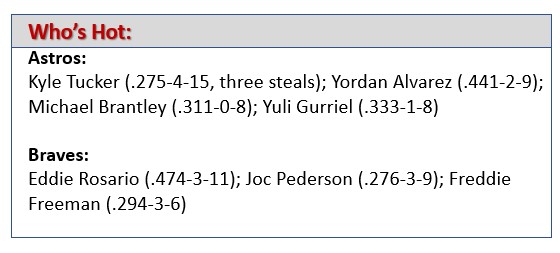
Astros’ RF Kyle Tucker leads all hitters this post-season, with 15 RBI in ten 2021 games. 

Here’s a look at who’s hot, thus far in the 2012 post-season. 

Here are post-season stats. Again, keep in mind the impact of the designated hitter.

I may be going against the grain here, but I see a seven-game series, with the Braves winning on the strength of their starting pitching – and a less stressed bullpen.

Primary Resource: Baseball-Reference.com.


BASEBALL ROUNDTABLE ON THE TOP 100 BASEBALL BLOG LIST

100Baseball Roundtable is on the Feedspot list of the Top 100 Baseball Blogs.  To see the full list, click here.

I tweet baseball @DavidBBRT

Follow/Like Baseball Roundtable’s Facebook Page here.  More baseball commentary; blog post notifications; PRIZES.

Member: Society for American Baseball Research (SABR); The Baseball Reliquary; The Negro Leagues Baseball Museum.


Baseball Roundtable Looks at the NLCS …. A Total Eclipse of the Heart

So far, this post season, I am running 50 percent on my predictions – about where I’d be if I simply flipped a coin and wrote about the frequency of heads and tails.  I’m not doing myself any favors with my NLCS pick either. In this case, however, my fan’s heart may have eclipsed my analytical (or common) sense.

Me – A Braves’ fan since …

Smart money – and knowledgeable fans and analysts – are going with the Dodgers in the NL Championship Series.  I’m going against the grain – anticipating a hard-fought series and picking the Braves.  Let me explain part of the process that got me here.  I was a six-year-old living in Milwaukee when the Braves came to town.  I grew up on a baseball diet of Eddie Mathews, Hank Aaron, Warren Spahn, Lew Burdette, Billy Bruton (and many more, including the unexpected storm that was Bob “Hurricane” Hazle). The Braves were my first team and Eddie Mathews was my first hero (throughout my baseball and softball years, I always played third base and wore number 41).  I have loyally followed the Braves (and their third sackers) through Mathews, Terry Pendleton, Bob Horner and Chipper Jones – right up to Austin Riley.

So, take that all into consideration as you ponder this prediction – still I think I can at lease a small case for my position. (However, most of the stats I will report here admittedly point to the Dodgers as taking this series.)

The Dodgers, who won 106 games to the Braves 88, also finished strong. LA went 50-21 from August 1 on, while the Braves went 44-28. 

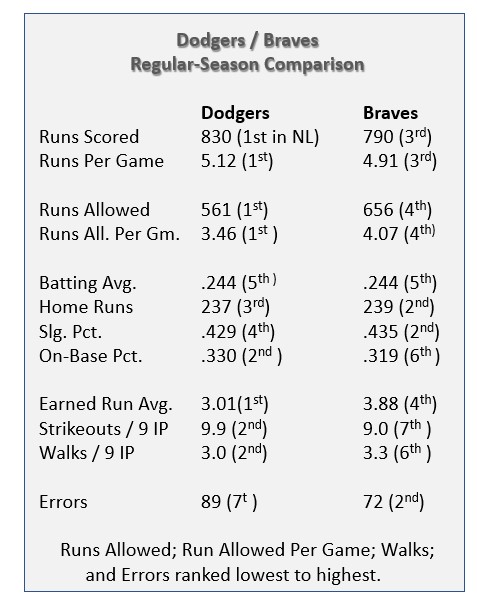
On offense, the Dodgers led the National League with 830 runs scored and 5.12 runs per game.  Still, the Braves were not far behind at 790 runs and 4.91 runs per game (both third in the league). Both teams put up a .244 average and the Braves out-homered the Dodgers by two long balls (239-237). (Yes, I do acknowledge that the Braves played in a decidedly weaker division – but remember, I’m shooting a bit form the heart here.)

The Dodgers’ offense features five players who hit 20 or more home runs, even without the injured Max Muncy’s .249-36-94 stats. The leaders coming into the Championship Series include 2B Trea Turner (.338-10-28 in 52 games for LA); 3B Justin Turner (.278-27-87); and RF Mookie Betts (.264-23-58). There is also plenty of punch available from C Will Smith (25 home runs and 76 RBI); SS Corey Seager (.306, with 16 home runs in 95 games); OF A.J. Pollock (.297-21-69); and versatile Gavin Lux and Cody Bellinger (who seems ready to contribute after a difficult injury-dampened 2021 regular season). This lineup is strong and deep.

Freddie Freeman, steady power source. Photo by dougandme

Just as the Dodgers are missing the bat of Muncy, the Braves will miss Ronald Acuna Jr., who was .283-24-52 in 82 games, as well as trade deadline pickup Jorge Soler (.269-14-33 in 55 games for Atlanta). (Soler is on COVID restriction.) Still, they pack plenty of punch, with perhaps the most powerful infield in MLB right now: 1B Freddie Freeman (.300-31-83); 2B Ozzie Albies (.259-30-106); 3B Austin Riley (.303-33-107); and SS Dansby Swanson (.248-27-88).  The outfield will be some combination of Guillermo Heredia; Adam Duvall; Joc Pederson; and Eddie Rosario. While the Dodgers may be a bit deeper, I think the heart of the Braves’ lineup may be more explosive.

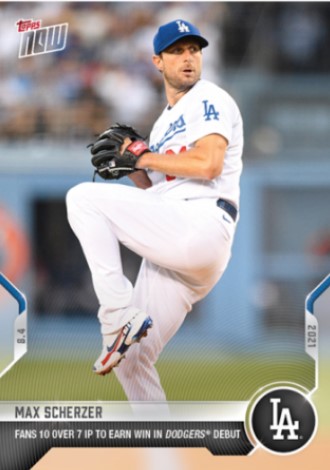
On the mound, it appears (at first examination) to be all Dodgers. Their 3.01 earned run average was the lowest in the majors . Even without Clayton Kershaw, they can put forth a starting trio of Walker Buehler (16-4, 2.47); Julio Urias (20-3. 2.96); and Max Scherzer (7-0, 1.98 for the Dodgers and 15-4, 2.46 overall). If a fourth starter is needed, Tony Gonsolin was 4-1, 3.23 (15 games / 13 starts).  The bullpen features Kenley Jansen (38 saves, 2.22 ERA); Blake Treinen (1.99 ERA in 72 games, with  seven saves); flame-throwing Brusdar Graterol (4.59 in 34 games); and Corey Knebel (2.45 in 27 games).

The Braves’ rotation looks solid: Charlie Morton (14-6, 3.34); Max Fried (14-7, 3.04); and Ian Anderson (9-5, 3.58). Will Smith (3.33 with 37 saves) will close, with support from Tyler Matzek (2.57 in 69  games); Luke Jackson (1.98 in 71 games); and A.J.Minter (3.78 in 61 games).

The Braves’ overall ERA of 3.89 does not compare well with the Dodgers 3.01 – but the Braves put up a 3.44 ERA after the All Star break,  (Side note:  the Dodgers’ ERA after the break was an even stingier 2.86).

So, given that the Dodgers’ lineup up and pitching staff both look deeper than the Braves, how can I pick Atlanta?  A few factors.  While the Braves were 2-4 versus the Dodgers during the regular season, the run totals were close (Dodges 27-Braves 23) and two of the Braves losses to the Dodgers were one-run games). Two, the Braves, who have home field advantage for the season, won two of three in Atlanta.  Three, the Dodgers had a tougher time getting to this point then the Braves (more competitive division, a Wild Card game, a tougher Division Series) – that may have taken a toll. Four, the Braves, by virtue of wrapping up their Series with the Brewers early, have had more time to set up their pitching staff. Five,  I’m not sure what the impact of the emotional high of getting past the Giants will have on the Dodgers going forward. Six, somehow I think the  Braves’ starting mound trio will be able to hold down the Dodgers’ offense better than the Dodgers can rein in the Braves’ big four. (Okay, so that’s more emotion than evidence.) Seven, Joc Pederson’s two pinch-hit home runs in the ALDS seem to have the “feel” of destiny. Finally, remember, this prediction is at least partially from the heart.

Ultimately, I expect a good series (much more competitive than most expect) and anticipate the Game One winner – Fried versus Scherzer – will take the Series.  I’ll go with the Braves – but logic seems to say otherwise.  MVP? Freddie Freeman or Max Fried. Besides, I’ve been fifty-fifty going with the “favorites.” Maybe it’s time to pick an underdog.

Side Note:  I have now lived in Minnesota for about five decades, so the Twins have my baseball fan’s heart.  However, I still have a soft spot for the Braves (my NL team of preference) – and I’ve even come to forgive them for the move to Atlanta.  (After all, Milwaukee did welcome them from Boston. )

Primary Resource: Baseball-Reference.com

BASEBALL ROUNDTABLE ON THE TOP 100 BASEBALL BLOG LIST

100Baseball Roundtable is on the Feedspot list of the Top 100 Baseball Blogs.  To see the full list, click here.

I tweet baseball @DavidBBRT

Follow/Like Baseball Roundtable’s Facebook Page here.  More baseball commentary; blog post notifications; PRIZES.

Member: Society for American Baseball Research (SABR); The Baseball Reliquary; The Negro Leagues Baseball Museum.


Baseball Roundtable AL Championship Series Pick

Okay, the Red Sox have surprised me more than once – beating the Yankees and the Rays – so I probably shouldn’t pick against them again.  However, I have to go with the Astros in the AL Championship Series.

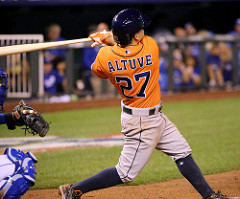
Jose Altuve – Potential ALCS MVP.
Photo by apardavila

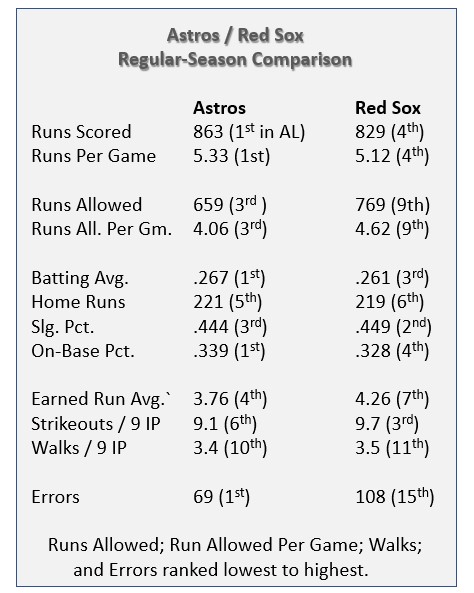
The reasons?  Pitching and defense – and, maybe, just a little bit of history. Clearly, these are two strong offensive clubs. During the regular season, the Astros averaged 5.33 runs per game (best in the AL), the Red Sox were close behind (fourth at 5.12). The Red Sox boast six players with 20+ home runs – and are led by 3B Rafael Devers (.279-38-113); DH JD Martinez (.286-28-99); RF Hunter Renfroe (.259-31-96); and SS Xander Bogaerts (.295-23-99). 1B Bobby Dalbec and CF Kiki Hernandez also have proven forces to be reckoned with.  The Astros counter with an equally strong lineup – three players with 30 or more 2021 home runs (plus 26 long balls out of SS Carlos Correa). Their offense is led by Correa (.279-26-92); RF Kyle Tucker (.294-30-92); DH Yordan Alvarez (.277-33-104); and 2B Jose Altuve (.271-31-83). And remember, this is a lineup in which 2021 AL batting champion 1B Yuli Gurriel (.319) hits seventh. And let’s not forget LF Michael Brantley and 3B Alex Bregman.  In short, both lineups are strong and deep.  Call it a wash.

Chris Sale – Will he be ready?
Photo by Keith Allison

Now, how about pitching? On the season, the Astros’ 3.76 ERA was fourth in the AL, the Red Sox 4.26 seventh. Neither team can turn to an “ace” starter. The Red Sox had just two pitchers with at least ten wins  (Nathan Eovaldi … 11-9, 3.75 and Eduardo Rodriguez … 13-8, 4.74).  The likely third starter is Chris Sale, who was 5-1, 3. 16 (making his 2021 debut in mid-August after March 2020 Tommy John surgery). Sale, however, was touched by the Rays for five runs in one innings in his first 2021 post-season appearance.  The Red Sox need him to be ready. If he is the Chris Sale of old (a true “ace”), he could be a difference maker.  The Astros had four starters with at least ten wins and look to go with the trio of Lance McCullers, Jr. (13-5, 3.16); Framber Valdez (11-6, 3.14); and Luis Garcia (11-8, 3.80). On the season, Astros’ starters put up a 3.60 ERA, Red Sox starters 4.49). Edge: Houston.

The bullpens look evenly matched (Red Sox bullpen ERA at 3.99; Astros 4.06). Red Sox closer Matt Barnes had a 3.79 ERA with 24 saves); and he’ll be supported by Adam Ottavino (7-3, 11 saves, 4.21), Josh Taylor (3.40 in 61 games); and Garrett Whitlock 8-4, 1,96 in 46 games. Tanner Houck and Nick Pivetta could also come of the pen and play a key long relief role if a starter should falter (one of them could draw a start if Sale isn’t ready).  The Astros’ pen will be led by closer Ryan Pressly (26 saves, 2.25 ERA), with a supporting cast that will include: Kendall Graveman (3.13 in 23 games for the Astros); Ryan Stanek (3.42 in 72 games); and Christian Javier (3.55 in 36 games).

Finally, there is the defense – potentially critical in a tight series.  In 2021, the Astros made the fewest errors in the AL (69), the Red Sox the most at 108.  Notable edge: Astros.

Digging little deeper, The Astros won the season series against the Red Sox five games to two and outscored them  42-25.

Then again, the Red Sox come in “hot” on offense. In the Division Series, the Red Sox hit .341, with 56 hits, nine home runs and 26 runs against the  Rays’ lauded pitching staff.  The Astros hit “just” .288” with “only” 40 hits and four  home runs against the White Sox – but, they actually scored more runs in their four games set then the Red Sox did in theirs (31-26).  Another stat that caught my eye was that the Astros scored 18 two-out runs against the White Sox to eight for the Red Sox against the Rays. 

So, there it is.  I’m once again going against the Red Sox, but I expect a tough series with plenty of offense.   Astros in six.  Potential MVP?  I like Jose Altuve or Kyle Tucker.

Primary Resource:  Baseball-Reference.com


BASEBALL ROUNDTABLE ON THE TOP 100 BASEBALL BLOG LIST

100Baseball Roundtable is on the Feedspot list of the Top 100 Baseball Blogs.  To see the full list, click here.

I tweet baseball @DavidBBRT

Follow/Like Baseball Roundtable’s Facebook Page here.  More baseball commentary; blog post notifications; PRIZES.

Member: Society for American Baseball Research (SABR); The Baseball Reliquary; The Negro Leagues Baseball Museum.



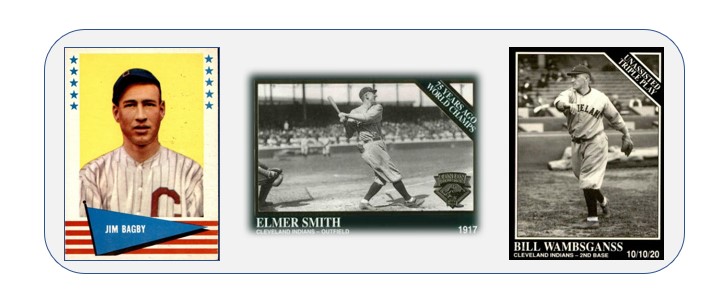
October 10, 1920 … Worth the Price of Admission … a Record-Setting Fall Classic Day

On this date (October 10) in 1920, the Cleveland Indians faced off against the Brooklyn Robins (Dodgers) in Game Five of the Word  Series.  The nearly 27,000 fans in attendance were about to get much more than they bargained for – a General Admission ticket was $1.10, a First Level Pavilion seat  $3.30 and  Main Level Grandstand seat $5,50.

The Series (best-of-nine) was knotted at two games apiece and  the Indians sent ace righty Jim Bagby  – who had led the AL with 31 wins (12 losses, 2.89 ERA) and a .721 winning percentage. The Robins countered with future Hall of Famer, right-hander Burleigh Grimes – who had gone 23-11, 2.22 and led the NL in winning percentage  at .676.

The expected pitchers’ duel did not materialize. In the bottom of the first inning, Indians’ LF  Charlie Jamieson singled to right, 2B Bill Wambsganss singled to left (Jamieson moving up to second), CF Tris Speaker dropped a bunt single down the third base line and and RF Elmer Smith hit a Grand Slam home run to right field – giving the Indians a four-run lead before Grimes had recorded a single out. (Smith had hit .316-12-103 during the regular season – finishing fifth in the AL in home runs – Babe Ruth led with 54, no one else had more than 19 – and tenth in RBI.) Grimes retired the next three batters and the Indians closed out the frame with a 4-1 lead.

Well, that was a Bit of History – Part One

The Indians’ Elmer Smith’s Game Five Grand Slam was the first-ever World Series Grand Slam home run.

The score remained 4-0 until the bottom of the fourth, when Cleveland  1B Doc Johnston opened the inning with an infield single off Grimes, moved to second on a  passed ball and to third on a Joe Sewell (SS) ground out. Grimes then walked number-eight hitter C Steve O’Neill to get to Bagby, who  homered to center to up the lead to 7-0.

Well, that was a Bit of History – Part Two

Jim Bagby’s three-run home run in Game Five of the 1920 World Series was the first-ever World Series homer hit by a pitcher.  Bagby was a decent hitting pitcher.  On the 1920 season, he had gone .252-1-14.

In the top of the fifth, trailing 7-0, the Robins looked to mount a rally. 2B Pete Kilduff opened with a single to left-center off Bagby and C Otto Miller followed with another single to center, Kilduff going to second.  The next batter, was P Clarence Mitchell (who had come on in relief of Grimes). Sending a pitcher to the plate with a couple of runners on did not work as well for the Robins as it had for the Indians.  Mitchell hit a liner up the middle –  a hit that seemed headed for the outfield.  Indians’ 2B Wambsganss, however, moved to his right, leapt high and snagged the liner. With the runners on the move, Wambsganss stepped on second to retire Kilduff and then turned and tagged Miller who was approaching the keystone  bag.  One play, one defender, three outs.

Well, that was a Bit of History – Part Three

Ed Wambsganss’ unassisted triple play in Game Five of the 1920 World Series remains the only unassisted triple killing in World Series history.

The game ended in an 8-1 Indians victory – despite the fact that the Robins outhit the Indians 13-12. Bagby went the distance, giving up just one tally on 13 hits. He did benefit from three double plays:  LF-C; 3B-2B-1B; 1B-SS-1B; and, of course, one triple play.

The Indians went on to win the best-of-nine series five games-to-two, with Stan Coveleski picking up three complete-game wins (giving up just 15 hits and two runs in 27 innings). Notably, the Indians gave up just six earned runs in the seven games (0.89 ERA).

The Indians’ two historic home runs in Game Five of the 1920 World Series were their only home runs of the Series. There were, in fact, the only two home runs by either squad in the 1920 Fall Classic

The principals:

Jim Bagby

Bagby pitched in nine MLB seasons (1912, 1916-23) – primarily for the Indians. His best season was 1920 (31-12. 2.89, with 30 complete games). He also went 23-13, 1.99 for the 1917 Indians.  His final stat line was 127-89, 3.11.  As a hitter, he went .218-2-60 in 660 at bats.

Elmer Smith

Smith played in ten MLB seasons (1914-17, 1919-23, 1925). 1920 was his best campaign (.316-12-103), as he reached full-season career highs in average and RBI and recorded his second-highest, single-season home run total (he had 16 homers in 1921).  He played in 1,012 MLB games, hitting .276-7-540.

Bill Wambsganss

Wambsganss played in 13 MLB seasons (1914-1926), hitting .259-7-521. His best season at the plate was 1918, when he went .295-0-40 for the Indians, stole 16 bases and scored 34 runs in 87 games. He scored 80 or more runs in four  seasons  and stole 16 or more bases in four seasons. He led the AL in double plays at second base twice, and in putouts and assists at 2B once each. He also led in errors at 2B four times.

Primary Resource: Baseball-Reference.com

BASEBALL BLOG LIST

100Baseball Roundtable is on the Feedspot list of the Top 100 Baseball Blogs.  To see the full list, click here.

I tweet baseball @DavidBBRT

Follow/Like Baseball Roundtable’s Facebook Page here.  More baseball commentary; blog post notifications; PRIZES.

Member: Society for American Baseball Research (SABR); The Baseball Reliquary; The Negro Leagues Baseball Museum.


Baseball Roundtable Looks at the Division Series

As a prognosticator, I’m off to a bit of a slow start this post-season.  One-for-two on the Wild Card games – and even the one I got right (Dodgers over Cardinals) did not go as I expected.  In that one, I anticipated Max Scherzer’s arm to make the difference (although he gave up just one run, he didn’t make it out of the fifth inning) and did not expect the big hit to come off the bat of Chris Taylor.  Still, anything can happen in a one-game play-in, so I’ll take my lumps and try again in the Division Series.  So, here are my predictions. (Take them with a grain of salt – and maybe an accompanying shot of tequila.)

AMERICAN LEAGUE

Astros Over the White Sox

Photo by apardavila

This looks to be a pretty hard-fought series.  On the surface, the Astros appear to have an edge on offense, having scored 863 runs (most in MLB) to the White Sox’ 796 (fifth in the AL) and hit 221 home runs to the White Sox’ 190.  However, you have to consider that the White Sox had to work their way through some injuries that had an impact on those numbers. CF Luis Robert (torn hip flexor) played in only 68 games – but still went .338-13-43 and LF Eloy Jimenez saw action in just 55 games (.249-10-37)  –  and this is a player who went .267-31-79 as a rookie in 2019. Both should be back in the lineup for the Division Series. The Sox do put a solid lineup on the field, led by MVP candidate 1B Jose Abreu (.261-30-117), CF Robert and LF Jimenez, SS Tim Anderson (.309-17-61, with 18 steals), catcher Yasmani Grandal (23 home runs and 62 RBI in 98 games). Also, as they juggled the lineup to compensate for injuries, the Sox had eight players reach double digits in home runs.  One caution:  Abreu is questionable for Game One.

The Astro bring more star power to the offense, with three players with 30 or more home runs: 2B Jose Altuve (.278-31-83); surprising RF Kyle Tucker (.294-30-92); DH Yordan Alvarez (.277-33-104).  SS Carlos Correa added 26 home runs and  92 RBI to go with a .279 average.  Add the Astros’  playoff experience and I believe they have the edge on offense.

On the mound, the Sox will look to Lance Lynn (11-6, 2.69); Lucas Giolito (11-9, 3.53); and Dylan Cease (13-7, 3.91); They also hope that Carlos Rodon (13-5, 2,37 … shoulder issues) is ready to have an impact in the post-season. Like the White Sox, the Astros had no pitcher with more than 13 wins (Lance McCullers (13-5, 3.16). Other  potential starters include Luis Garcia (11-8, 3.30); Framber Valdez (11-5, 3.14); Jose Urquidy (8-3, 3.62); and  Zack Greinke (11-6, 4,16).

The Astros’ bullpen is headed by closer Ryan Pressley (26 saves, 2.256 ERA, 11.4K / nine), with a supporting  cast of Ryan Stanek, Kendall Graveman, Brooks Raley and Blake Taylor. Overall, I give an edge to the White Sox here. The White Sox bullpen is led by Liam Hendriks (38 saves, 2.54 ERA, 14.3K / 9), with the experienced Craig Kimbrel and Aaron Bummer in key innings.   If starters falter early, Mike Kopech provides a quality long arm.

So, how do I separate these two squads?  Well, as noted earlier, the Astros have an advantage in post-season experience, but maybe more important,  the Astros made the fewest errors in the American League (71) to the White Sox’ 97 (fifth-worst in the AL). This Series may hinge on a few key plays and the Astros post-season experience, coupled with a tighter defense, should make the difference.  The Astros won five of seven from the White Sox during the regular season – and I expect them to continue to hold an edge.

Rays  over Red Sox

We should see some offensive fireworks in this one.  Only the Astros topped the Rays 857 runs scored in 2021 (the Astros had 863) and the Red Sox were not far behind at 829.  But then there is the pitching, where the Rays again proved their ability to manage pitching roles, putting up the AL’s lowest ERA at 3.67.  The Red Sox were seventh at 4.26.

So, how do the Rays Manage to Win?  

On the mound, the Rays had no pitcher start more than 25 games (nor win more than ten) – and eight hurlers start at least ten.  They also got saves out of 14 pitchers (three with five or more). On offense, they used 158 different lineups during the season. (Joey Wendle and Brandon Lowe, for example, each started at three different defensive positions and in eight of the nine spots in the batting order.) Somehow, the Rays “manage “ to get the best out of their entire squad, which plays well now that we’re past the one-game Wild Card play-in (not a fan of that to tell you the truth – would prefer two-of three or just take the non-division winner with the best record.)

First, keep in mind, the Rays put up the AL’s lowest ERA (3.67) – despite just 14 starts from projected “ace” Tyler Glasnow (Tommy John surgery) and just five from Chris Archer (hip), who was expected to hold down a spot in the top half of the rotation.  The Rays’  starter for the Game One will be Shane McClanahan (10-6, 3.43 in 25 starts).  After that, your guess is as good (or better than) mine. Among the more likely candidates are veteran Michael Wacha (3-5, 5.05); Drew Rasmussen (4-0, 2.44 in  20 appearances / 10 starts); Shane Baz (2-0. 2.03 in three starts); and Ryan Yarborough (9-7, 5.11).  Whomever gets the starts, you can expect the Rays to be working to create plenty of desired pitcher-batter matchups as the games progress. You also can bet their pitching strategy will be will be both unorthodox and (very likely) effective.

The Red Sox will  counter in Game One with Eduardo Rodriguez (13-8, 4.74), who went 3-1, 3.19 in September. Other potential starters include Wild Card Game starter Nathan Eovaldi (11-9, 3.75); Chris Sale (5-1, 3.16) – who made his first  start of the season August 14 (coming off Tommy John surgery last March) – and has gone at least six innings only once this season; and Nick Pivetta (9-8, 4.53).  The Red Sox really need Sale to step up if they want to be in the Series.

Predicting bullpen strategies is futile. Over the past two months of the season, the Red Sox have been mixing things up (after Matt Barnes – 24 saves, 3.79 – lost the lock on the closer role. Relievers likely to play key roles include Barnes , Garrett Whitlock (1.96 ERA in 73 1/3 innings); Josh Taylor (3.40 in 61 appearances); and Adam Ottavino (11 saves). Hard to predict the Rays’ bullpen strategy, but expect important innings from Andrew Kittredge (1.88 ERA in 57 appearances),;Colin McHugh (who started seven games for the Rays and relieved in 30 games); and Pete Fairbanks (3.59 ERA and five saves in 47 games).  Starters Josh Fleming and Luis Patino could also see some bullpen work.  Looks like a toss-up in the pen, although the Rays staff may be more used to switching roles.

On offense, the Rays will look to 2B Brandon Lowe (.247-39-99); LF Austin Meadows (.234-27-106); rising star SS Wander Franco (.288-7-39 in 70 games);  C Mike Zunino (.216-33-62); and OF Randy Arozarena (.274-20-69, who has proven he likes the big stage.)  DH Nelson Cruz (.265-32-86 for the Twins and Rays) should be a steady and influential presence.  The Red Sox counter with a lineup that  will include SS Xander Bogaerts (.295-23-79); 3B Rafael Devers (.279-38-113); and RF Hunter Renfroe (.259-31-96). Overall, the Red Sox had six players with 20+ home runs and five with 75+ RBI. There’s some punch there.

The Rays won the season series between the two teams 11 games-to-eight, but there was only a two-run differential and six of the contests were decided by a single tally. It should be a good series; However, I just can’t go against the Rays who this season have “managed” to put up 100 wins in the AL’s toughest division.

NATIONAL LEAGUE

Dodges Over Giants

Look at these stats.

Wins – Giants 107 (first in MLB); Dodgers 106 (second)

ERA – Dodgers  3.01 (first in MLB); Giants 3.24 (second)

Batting Avg. – Giants .249 (second in NL); Dodgers .244 (fifth in NL)

Home Runs: Giants 241 (first in NL); Dodgers 237 (third)

Runs scored : Dodgers 830  (first in NL); Giants 804 (second).

These were clearly the two best teams the NL in 2021. So, who wins the matchup in this long-standing rivalry?  The Giants won the season series 10-9, but I expect the Dodgers  (even without Clayton Kershaw) to prevail in this series. The charge will be led by Game One starter Walker Buehler (16-4, 2.247); Julio Urias (20-3, 2.96); and Max Scherzer (15-4, 2.46 & 7-0. 1.98 for LA).  The Giants can counter with Game One starer Logan Webb (11-3, 3.03); Kevin Gausman (14-6, 2.81); Anthony DeSclafani (13-7, 3.17);  and Alex Wood (10-4, 3.83). I give the Dodgers a slight edge here.

The bullpens match up pretty well, with the Giants looking to Jake McGee (31 saves, 2.72) and Tyler Rogers (13 saves, seven wins, 2.22)  to lead the way and the Dodgers countering with Kenley Jansen (38 saves, 2.22) and Blake Treinen (seven saves, 1.99).  The Dodger may be a little deeper in the pen. Their top four relievers (in term of appearances) all averaged 10+ strikeouts per nine innings; while the Giants top  four ranged between 5.8 and 9.2 strikeouts per nine frames.

On offense, the Giants bring a powerful balance – ten players with at least ten home runs and seven with 15 or more (and six players with at least 50 RBI). The leaders would be SS Brandon Crawford, (.298-24-90) and C Buster Posey (.304-18-58).  At least for this series, it appears the Giants will  miss 1B Brandon Belt’s bat (.274-29-59) and glove. Still, this is an offense that looked to a lot of different heroes on their way to 106 wins, so they still pose a threat.

Like the Giants, the Dodgers will miss their first baseman (Matt Muncy (.249-36-94). They will be looking to LF AJ Pollock (.297-21-69); 3B Justin Turner (.278-27-87); SS Corey Seager (.306-16-57); 2B Trea Turner (.338 average); and C Will Smith (.258-25-76); and RF Mookie Betts (.64-23-58).

This series is gong to be a dogfight, but I think the Dodgers pitching will give them edge – and the Giants are also likely to miss Belt more than then the Dodgers miss Muncy, Still, a Giants’ win would not be a surprise.

Brewers Over Braves

Here ‘a surprise stat for you – Despite all the talk about Brewer pitching, and a starting staff that put up a 3.13 ERA, no Milwaukee pitcher won more than 11  games this season. Still, it’s the Brewers starting staff that led me to pick them over the Braves.  The Brew Crew can send out Brandon Woodruff (9-10, 2.56); Corbin Burnes (11-5, 2.43); Freddy Peralta (10-5, 2.81); Adrian Houser (10-6, 3.22). And there’s also Eri Lauer (7-5, 3.19). Then, back them up with a flame throwing bullpen, headed by closer Josh Hader (34 saves, 1.23 ERA, 15.6K / 9) and an effective supporting staff  that includes: Brent Suter (3.07); Brad Boxberger (3.34,  11.6K / 9); Devin Williams (2.50, 14.5K / 9).

The Braves are likely  to counter with Charlie Morton (14-6, 3.34); Max Fried (14-7, 3.58) , Ian Anderson (9-5, 3.58); and Huascar Ynoa (4-6, 4.05). In the pen, you’ll find closer Will Smith (37 saves, 3.44 ERA, 11.5K / 9) and a supporting cast headed by Luke Jackson (1.98 ERA in 71 appearances), Tyler Matzek (2.57 in 69 appearances) and A. J. Minter (3.78 in 61 appearances). Overall, the Brewers hold an edge on the mound – particular when it comes to getting a big strikeout to snuff out a threat. (The Brewers led the NL in strikeouts with 1,618, the Braves were eighth at 1,417.)

The Braves hold a bit of an edge on offense, scoring 790 runs to the Brewers 738,  but they will miss the bat of Ronald Acuna, Jr. who went down in mid-season with a torn ACL in his right knee. Acuna hit .283-24-52 in just 82 games. They added some pop with the acquisition of Jorge Soler (.269-14-33 in 55 games for the Braves) and Eddie Rosario (.271-7-16 in 33 Braves’ contests).  Still, the load will be carried by 1B Freddie Freeman (.300-31-83); 2B Ozzie Albies (.259-30-106); 3B Austin Riley (.303-33-107). The bats that need to carry the Brewers include: 3B Luis Urias (.249—23-75); SS Wiley Adames (.285-20-58 in 99 games for the Brew Crew); and RF Avisail Garcia (.262-29-86).  2B Kolten Wong could provide some pop (.272-14-50 in 116 games). The Brewers could really use a solid series from LF Christian Yelich, who disappointed at .248-9-51 in 117 games this season. On offense, advantage Braves (even without Acuna).

Ultimately, I believe the Brewers will prevail behind solid starts from Burnes, Woodruff and Peralta – and a swing-and-miss bullpen.

Most Likely Upset

If I had to pick an upset, it would be in this series – with the Braves getting game-changing performances from Freddie Freeman, Ozzie Albies and Max Fried.    

Primary Resource:  Baseball-Reference.com

BASEBALL ROUNDTABLE ON THE TOP 100 BASEBALL BLOG LIST

100Baseball Roundtable is on the Feedspot list of the Top 100 Baseball Blogs.  To see the full list, click here.

I tweet baseball @DavidBBRT

Follow/Like Baseball Roundtable’s Facebook Page here.  More baseball commentary; blog post notifications; PRIZES.

Member: Society for American Baseball Research (SABR); The Baseball Reliquary; The Negro Leagues Baseball Museum.


Baseball Roundtable – Wild Card Round Predictions

AL Wild Card –  Yankees over Red Sox … But Wait!

Gerrit Cole

Conventional wisdom says a one-game play-off/play-in game is likely to be decided by pitching.  And this one features the Yankees’ Gerrit Cole (18-8, 3.23) against the Red Sox’ Nathan Eovaldi (11-9. 3.75). It would appear to be advantage Yankees.

But wait, Cole left his second September start (Sept. 7) after just 3 2/3 innings (tight hamstring) and, while he came back to go  five effective innings (one run, four hits, three walks, seven strikeouts) on the 14th, there is still cause for concern here. First, that September 14 game was against the Orioles. Second, Cole  made three more 2021 start and went 1-2, with a 7.64 ERA. Third, the game is at Fenway

On the other side of the mound, the Red Sox did win seven of Eovaldi’’s last eight starts of the season. But wait, he only got the victory in one of them.  And, wait again, Eovaldi went 1-1 with a 5.30 ERA in his final four September starts (and two of those were against the Orioles). One of those final starts was against the Yankees (at Fenway) and Eovaldi gave up seven runs in 2 2/3 innings.

Going deeper, we see two teams (long-time rivals), with  solid offenses: the Yankees lead by Aaron Judge (.287-39-98) and Giancarlo Stanton (.273-35-97); the Red Sox led by Rafael Devers (.279-38-113), J.D. Martinez (.286-28-99); and Hunter Renfroe (.259-31-99). The Yankees will miss D.J. LeMahieu (hip) and it’s not yet clear if Martinez (ankle) will be ready for Boston.  Overall, the Sox seem to bring a little more explosive power to the battle (six players with 20 or more home runs). On the season, the Red Sox Scored 829 runs to the Yankees 711.  (Note: On the season, the Yankees surrendered 669 runs to the Red Sox 749).

BBRT gives the Yankee bullpen – led by Aroldis Chapman (38 saves, 3.36, 15.5 K/9) and Chad Green (6 saves, 3.17, 10.6 K/9) the edge over the Red Sox pen. Leading the Red Sox relief staff are Matt Barnes (24 saves, 3.79, 13.8/K9) and Adam Ottavino (11 saves, 4.21, 10.3 K/9).  Josh Taylor, who had a 3.40 ERA in 61 appearances for the BoSox, is on the IL.

Ultimately, these squads seemed pretty well matched.  The Red Sox won the season series 10 games-to-nine, outscoring the Yankees 75-74.  Now another “but wait.”  The Red Sox won the first seven matchups – while the Yankees topped the Red Sox in the last six.  Momentum seems to go to the  Yankees.

For Baseball Roundtable, it appears the game will rest on the bullpens (given the suspect nature of both starter’s late-September outings). I anticipate a close game, decided late (a key hit by Aaron Judge?) with contributions from the bullpens critical.  Yankees 5 – Red Sox 3.

NL Wild Card – Dodgers over Cardinals … Look at the Numbers

The numbers have a lot to say about this one.  The Dodgers scored the most runs in the National League (830) and gave up the fewest (561).  The Cardinals  scored the tenth-most tallies (706)  and gave up the sixth-fewest (672). Clearly, edge LA – the team has more depth on the pitching staff and in the lineup.  However, this is a one-game play-in, so depth is not as critical.  But even for a one-game matchup, the Dodgers should have the edge. After all, who would you rather have on the mound to start one big game than Max Scherzer? He was  15-4,  2.46 on the season and 7-0, 1.98 in 11 starts for the Dodgers. Further, Scherzer faced the Cardinals twice this season, going 2-0 without giving up a run (14 innings), while fanning 22 and walking just one.,

Not to say that Adam Wainwright of the Cardinals is chopped liver.  The forty-year old went 17-7, 3.05 in 32 starts and 4-0, 3.44 in six September outings. Against the Dodgers, he was 1-0, 4.32 in one 2021 start.  Still, Scherzer should be the difference. And, if Scherzer pitches late into the game (which I anticipate he will), Blake Treinen (1.99 ERA in 72 appearances) and Kenley Jansen (2.22 ERA and 38 saves) should finish the job.  (Note: The Cardinals’ bullpen is headed by closer Giovanny Gallegos, who took over the role in late August and led MLB with 11 saves for the month.)  Overall, the Dodger pen put up a 3.16 ERA for the season, the Cardinals 3.97.

While the Dodgers’ offense may miss Matt Muncy (elbow) and his 36 home-run power, they still can put out a lineup with five players with 20 or more home runs and Trea Turner’s .338 average.  With Justin turner, Will Smith, AJ Pollock and more, the Dodgers still have plenty of firepower.

Even with all this, the Redbirds have reason for hope.  One, they have some momentum (a 17-game September winning streak and a 23-9 record since September 1. Two, like the Dodgers they are starting their ace in Wainwright. Three, they have three players 30+ home run this season: Paul Goldschmidt (.294-31-99); Nolan Arenado (.255-34-105); and Tyler O’Neill (.286-34-80). A big day by one of the big three could make a difference.

Baseball Roundtable is betting on Scherzer and a Dodgers’ win … 5-2.

Primary Resource:  Baseball-Reference.com

______________________________________________

BASEBALL ROUNDTABLE ON THE TOP 100 BASEBALL BLOG LIST

100Baseball Roundtable is on the Feedspot list of the Top 100 Baseball Blogs.  To see the full list, click here.

I tweet baseball @DavidBBRT

Follow/Like Baseball Roundtable’s Facebook Page here.  More baseball commentary; blog post notifications; PRIZES.

Member: Society for American Baseball Research (SABR); The Baseball Reliquary; The Negro Leagues Baseball Museum.
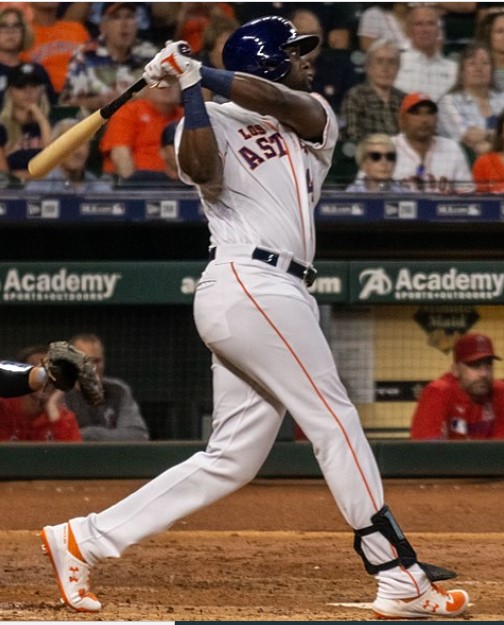
 

September In MLB Streaked on By …. Here are the Stats, Stories, Standings and More

Well a new month rolls around, so it’s time for Baseball Roundtable to take a look at the month we are leaving behind – and the stats, stories and standings  that caught the Roundtable’s attention – not to mentions the BBRT Players and Pitchers of the Month and, of course, the Trot Index.

As a teaser, this past month we saw:

  • One player (Juan Soto) hit ,400+ for the month.
  • A 17-game winning streak (Cardinals).
  • The season’s ninth no-hitter and fourth cycle.
  • Max Scherzer’s 3000th strikeout and Adam Wainwright’s 2000th.
  • A 43-game on-base streak by 20-year-old Wander Franco.
  • Shohei Ohtani’s 2021 ninth mound victory; 45th home run; eighth triple; and 26th stolen base.
  • New single-season home runs records for a catcher (Salvador Perez) and second baseman (Marcus Semien).
  • One team with an ERA under 3.00 for the month (Dodgers); eight with ERA’s north of 5.00.
  • Three teams (Cardinals, Dodgers, Giants) playing .700+ ball for the month,

For all this and more, read one.  Here’s a little preview of the kind of tidbits you will find sprinkled among the numbers.

Below the Mendoza Line, But Still Productive

The lowest average through September (among qualifiers) belonged to the Reds’ Eugenio Suarez at .192 (95-for-494).  Notably, it was a productive .192 – as Suarez also had 30 home runs and 77 RBI – in 142 games.

Over in the AL, the lowest average among qualifies belongs to Joey Gallo of the Yankees at .199 (97-for-488). Gallo has 38 long balls and 76 RBI in 149 games.

——Baseball Roundtable Players and Pitchers of the Month—–

National League Player of the Month – Juan Soto, RF, Nationals 

Photo: All-Pro Reels from District of Columbia, USA, CC BY-SA 2.0 <https://creativecommons.org/licenses/by-sa/2.0>, via Wikimedia Commons

Juan Soto led all batters (with at least 75 September at bats) with a .404 average. He was second in MLB in hits to the Cubs’ surprising 1B Frank Schwindel (but Schwindel drew only eight September walks to Soto’s MLB-leading 35.)  Soto also racked up 23 September RBI and 22 runs scored (seven home runs) – and fanned just nine times in 27 games.  Soto led all of MLB players with at least 75 September at bats in on-base percentage (.565) and his September slugging percentage of  .691 was fourth among National Leaguers with at least 75 September at bats.  Soto had 11 multi-hit games in September and was on base via hit or walk in all but two games. From September 14 through September 23, he had a nine-game hitting streak in which he hit .567, with four homers, nine RBI, nine runs scored, 12 walks and just one strikeout.

Honorable Mentions: Tyler O’Neill, LF, Cardinals –  who led the NL in September home runs (11) and RBI (27), while hitting .303.; Paul Goldschmidt, 1B, Cardinals, who put up a .340-9-19 line, and led MLB in Septembers runs scored with 29.

National League Pitcher of the Month – Eric Lauer, LHP, Brewers

The Brewers’ Eric Lauer came into September with a 4-5, 3.61 record, but gave up no more than one earned run in any of this five September starting assignments. – going 3-0, 1.15 for the month. That ERA was the lowest among MLB pitchers with at least 20 September innings. Lauer’s WHIP of 0.70 was also the best among pitchers with 20 innings pitched for the month, as was his .133 opponents’ batting average. Lauer fanned 32 batters (eight walks) in 31 1/3 innings pitched.

Honorable Mentions: The Dodgers’ Max Scherzer went 3-0, with a 2.29 ERA and an MLB-leading 48 September strikeouts (and only three walks) in 39 1/3 innings in six September starts. The Phillies’ Zack Wheeler was also in the running at 3-1, 1.47 with 39 strikeouts (just six walks) in 30 2/3 September innings; as was the Braves’ Max Fried, 3-0, 1.54, with an MLB-high 41 innings pitched in September (36 whiffs/seven walks).

___________________________________________

AL Player of the Month  – tie: Luis Robert, CF, White Sox & Salvador Perez, C, Royals

Luis Robert‘s .367 average led all American Leaguers with at least 75 at bats. He  hit safely in 20 of 23 September games – with 11 multi-hit games. His 36 September hits were sixth in MLB and fourth in the AL. He had six home runs, 20 RBI and 14 runs scored. His  eight doubles were fifth in the AL and his .633 slugging percentage was  third among AL players with at least 75 September at bats.

Photo: Arturo Pardavila III from Hoboken, NJ, USA, CC BY 2.0 <https://creativecommons.org/licenses/by/2.0>, via Wikimedia Commons

Salvador Perez had a .284-10-27 month for the Royals. His 27 RBI were second only to Lourdes Gurriel in MLB and his ten long balls second only to the Blue Jays’ Marcus Semien.  Perez’  ten September home runs gave him 48 on the season, a new record for catchers.  Perez hit safely in 22 of 28 games played in September and had nine multi-hit contests.

Honorable Mentions: Lourdes Gurriel, Jr.  led all of MLB with 30 September RBI, despite a late-September hand injury that cost him a handful of games played.   His line for the month was .329-7-30, with 18 runs scored in 24 games. The Blue Jays’ Teoscar Hernandez hit .301 for the month, with nine home runs and 26 RBI in 28 games. The Royals’ Andrew Benintendi put up a  343-5-27 line.

AL Pitcher of the Month – Frankie Montas, RHP, A’s

Photo: Keith Allison from Hanover, MD, USA, CC BY-SA 2.0 <https://creativecommons.org/licenses/by-sa/2.0>, via Wikimedia Commons

Frankie Montas went 3-0, 2.19 in six September starts. His ERA was third among AL pitchers with at least 25 September innings, his 37 innings pitched second, and his 40 strikeouts fifth.  He threw five quality starts in his six games and finished strong – a 0.45 ERA in his final three starts (one win, two no decisions). He came up big in a key game against the division-rival (and first-place) Astros in Houston on September 24 – going seven innings, giving up just two  hits and one walk and  fanning eight – enabling the A’s to take a 3-2 lead into the bottom of the seventh.  (The A’s eventually won 14-2. )

Honorable  Mentions: Cal Quantrill of the Indians was contender at 4-1, 2.73 in five starts (33 innings), with a 1.06 WHIP and a .215 average against. I also looked at the Twins’ Michael Pineda, the only AL pitcher with five September wins (5-0 in five games/four starts). Pineda had a nifty 1.85 ERA for the month, but pitched only 24 1/3 innings.


Surprise Player of the Month … Giovanny Gallegos, RHP, Cardinals

Thirty-year-0ld Giovanny Gallegos took over the Cardinals’ closing role (replacing a struggling Alex Reyes) in late August (he recorded his third save – in 58 appearances on August 30). In September, Gallegos  recorded 11 saves (in 12 opportunities), fanning 21 batters in 13 2/3 innings, holding batters to a .149 average and putting up a 3.29 ERA. Why the surprise? As of September 1, Gallegos – in five MLB seasons and  162 appearances – had a 10-10 record with just nine saves.  He, however, became the end-of-game, go-to guy, as the Cardinals ran off a 22-7  September record that put them in the post-season. He took the ball and saved a lot of big games for the Redbirds.

Honorable Mention: Cubs’ 1B Frank Schwindel earned this recognition in August with a .357-7-21 month.  (When picked up on waivers from the A’s on July 18, he was four-for-35  as a major leaguer with just one home run and three RBI.)  After his big August, September is less of a surprise, but Schwindel gets a HM for a month in which he led MLB with 40 hits. Clearly, he surprised a lot of people in August – and then surprised even more by keeping up the pace in September.

________________________________________________________________________

TROT INDEX … A REGULAR BBRT FEATURE

Through September  2021, 36.3 percent of the MLB season’s 178,446 plate appearances ended in a trot (back to the dugout, around the bases, to first base). We’re talking about strikeouts, home runs, walks, hit by pitch and catcher’s interference – all outcomes that are, basically, devoid of action on the base paths or in the field. Here’s the breakout: strikeouts (23.2%); walks (8.7%); home runs (3.3%); HBP (1.2%); catcher’s interference (less than 1%). 

Taking the Trot Index one step further – to the slow walk back to the dugout 0 so far this season there have been 2,656 more strikeouts than base hits (41,356 to 38,700). 

____________________________________________________________

If you’ve been following Baseball Roundtable, you’ve read a lot about streaks this year.  This season, the  Yankees have run off a 13-game winning streak, the Rays have had a 11-game victory streak and the Orioles have suffered through  14- and 19-game losing streaks. And, there are more examples of this streaky season. The Padres won all nine contests in a nine-game homestand; the Dodgers, at one point, had lost 11 straight extra-inning game; and the list goes on.

Well, the Cardinals added the cherry on top of the sundae in September.  Their 22-7 month (which propelled them into a post-season berth) included a 17-game winning streak (September 11 through September 28). Surprisingly, at least for BBRT, the streak included just six home games., During the streak, the Cardinals outscored their opponents 115-53, outhit them .293 to .221 and out-homered them 32-17; while their pitching staff put up a 2.90 ERA to the opponents’ 6.53.  If you are looking for the heroes of the September Redbird surge, there were plenty. Here are just a few with their September stats: LF Tyler O’Neill (.303-11-27); 1B Paul Goldschmidt (.340-9-19); CF Harrison Bader (.340-6-18); 3B Nolan Arenado (.260-8-21); Adam Wainwright (4-0, 3.44); Alex Reyes with five wins out of the bullpen; and Giovanny Gallegos with an MLB-high 11 September saves.  You get the idea, it was a true team effort.

There was also a good story in the NL West, where the Giants and Dodgers continue to duke (Snider-pun intended) it out for the division crown.  Both played .700+ ball and were never separated by more than 2 1/2 games during the month. (The Giants appear set to hold on.) The Dodgers had seven players with ten or more RBI during the month, led by Corey Seager’s .366-8-19. But the pitching staff – led by Julio Urias (4-0, 2.20) and Max Scherzer (3-0, 2.29) and a solid bullpen – was the key. The Dodgers put up MLB’s lowest ERA and WHIP for the month., The Giants still outperformed the Dodgers in the won-lost columns, while tying for the NL lead in September runs scored and putting up an ERA second only to the Dodgers.  On offense a pair of Brandons led the way. 1B Brandon Belt hit.349-9-18 for the month and SS Brandon Crawford went .352-5-16. On the mound a trio of relievers (Camilo Doval, Zack Littell and Tyler Rogers) chipped in 10 wins, three saves (no losses) and a combined 2.36 ERA in 43 combined appearances.

The Mariners surprised many with a near .700 month in the AL (.692) and propelled themselves back into what should be a “wild” wild-card race as the season goes into its final weekend. The Mariners scored the AL’s sixth-most runs in September and gave up the eighth fewest – which doesn’t sound like the formula for a near-.700 month. Looking at the scoreboard provides some explanation.  In September the Mariners were 6-2 in one-run games, 3-0 in games decided by two runs and 2-4 in lopsided (five or more runs difference) games.  A few key contributors: RF Mitch Hanniger (.260-9-22), SS J.P. Crawford (.315-3-14, with 21 runs scored); Marco Gonzalez (4-0, 3.90); and Chris Flexen (3-1, 4.40).

FULL STANDINGS AND STATS THROUGH SEPTEMBER

CAN BE FOUND AT THE END OF THIS POST. 

——-Team Statistical Leaders for September———

RUNS SCORED

National League – Cardinals (158); Giants (158); Nationals (137)

American League – Blue Jays (167); Astros  (141); Red Sox (138(

Two teams scored fewer than 100 runs in September: Marlins (90); Diamondbacks (97). 

BATTING AVERAGE

National League – Giants (.277); Cubs (.266); Nationals (.265)

American League – Blue Jays  (274); Red Sox (.273); White Sox  (.269)

The lowest September team average belonged to the Marlins  at .213. Lowest in the AL was the Angels at .222.

HOME RUNS

National League – Cardinals (52); Dodgers (43); Braves (42)

American League –  Blue Jays  (55); Yankees (51); Astros (43)

The Rangers had the fewest September home runs at just 16 – the only MLB team under 20.  

STOLEN BASES

National League –  Cubs  (22); Cardinals (19); Pirates (17)

American League – Rangers (29); Royals (24); Indians  (20)

No team stole fewer bases in September than the Braves – just three swipes in six attempts. Notably, like the Braves, the Rangers (with MLB-best 29 September steals) were also caught just three times.  

WALKS DRAWN

National League –  Nationals (129); Giants (114); Pirates (106)

American League – Astros (97); Blue Jays  (96); White Sox  (93)

The Giants had MLB’s top September on-base percentage at .363. Tops in the AL were the White Sox at .349.

BATTER’S STRIKEOUTS 

National League – Cubs (260); Marlins  (255); Cardinals (253)

American League – Orioles (270); Indians  (268);  Twins (241)

The Padres and Reds fanned the fewest times in September (189).

BONUS STAT

The Blue Jays racked up the most September total bases (488). The Cardinals led the NL at 461. The Angels had the fewest September total bases (303).

EARNED RUN AVERAGE

National League –  Dodgers (2.91); Giants (3.09); Braves (3.39)

American League – White Sox (3.69); Rays  (3.81);Tigers (3.92)

A surprising (at least for BBRT) eight teams (five in the NL, three in the AL) had September earned run averages north of 5.0.  The teams: Cubs (5.86); Padres (5.82); Orioles (5.42); Nationals (5.36) Pirates (5.34); Rangers (5.32); A’s (5.15); Rockies (5.06). 

STRIKEOUTS

National League – Brewers (265); Philllies (265); Giants (248)

American League – Yankees (291); Blue Jays  (260); Red Sox (245)

The Yankees’  staff fanned an MLB-highest 10.76 batters per nine innings in September. The Brewers led the NL at 10.32. Ten teams average better than one strikeout per inning for the month.

WALKS ALLOWED (most)

National League – Nationals (115); Pirates (110); Cubs (101)

American League – Astros (112); Tigers (102); Royals (93); Orioles )93)

The Giants walked the fewest batters per nine innings in September (2.47). The Rays held that distinction in the AL (2.58)

SAVES

National League –  Cardinals (14; Dodgers (11); Rockies (8); Braves (8)

American League – Mariners  (12); Twins (9); Tigers (9)

 The Padres had eight save opportunities in September and converted just one.

WHIP (Walks + Hits per Innings Pitched)

National League – Dodgers (1.08); Braves (1.09); Brewers (1.13)

American League – Rays (1.17); Blue Jays (1.21); White Sox (1.25)

BONUS STAT

The  Braves held opposing hitters to an MLB-lowest .207 batting average in September; while the Pirates staff had the worst of that stat at .284 for the month.

—– Some September Highlights—–

Just Another Day at the Office

The Shohei Ohtani stories just keep coming.  On September 3, the Angels’ DH/P started  on the mound against the Rangers (in LA). While he went zero-for-four at the plate, Ohtani threw 117 pitches in his seven-inning stint (seven hits, two earned runs, two walks and eight strikeouts) – getting the win, as the Angels triumphed 3-2. He ran his 2021 mound record to 9-1, 2.97 with the victory.

Goose Eggs – What a Rare and Beautiful Sight

On September 4, Brewers’ righty Adrian Houser pitched a three-hit shutout (no walks, seven strikeouts). as the Brew Crew topped the  Cardinals 4-0. The significance? It was not only Houser’s first MLB complete game, but also the Brewers’ first complete-game shutout since September 24, 2014 – a span of 1,011 games.   How dominant was Houser.? He threw 100 pitches, 76 for strikes – and recorded a first-pitch strike on 25 of 29 batters.  Houser, who came into the 2021 season with a 7-13 record over four MLB seasons, was 10-6, 3.22 on the 2021 season at the close of September.

100 for Pete Alonso

Photo by slgckgc

On September seventh, Mets’ 1B Pete Alonso, hit a two-run home run in top of the first inning of the Mets game against the Marlins,  It was his  100th MLB long ball – and    He reached 100 home runs balls in the second-fewest games in MLB history.  It was Alonso’s 347th  MLB game. The Phillies’ Ryan Howard did it in 325 games. (Side note:  Alonso reached 101 in the ninth inning of the same game – a Mets 9-4 win.)

No, No – Not Another No-No!

On September 11, Brewer’s right-hander Corbin Burnes (eight innings) and southpaw reliever Josh Hader (one inning) combined to throw a no-hitter as the Brewers topped the Indians 3-0 in Cleveland. A few tidbits from that game:  It was the ninth no-hitter of the 2021 season – the most no-hitters ever in a single campaign, breaking a record that dated back to 1884. It was also the seventh no-hitter tossed on the road this season (another record); and made the Indians the first team to be no-hit three times in one season.  For the full story of the game (and other combined no-hitter tidbits) , click here.

3,000 and Counting

On September 12, the Dodgers’ Max Scherzer topped the Padres 8-0 in LA – going eight innings, giving up just one hit and no walks, while fanning nine. In the process, he hit a couple of milestones. He recorded his 3,000th strikeout (his sixth of the game) in the top of the fifth inning, getting Padres’ 1B Eric Hosmer (swinging on a 3-2 change up). But that wasn’t all.  In the third frame, he tossed an Immaculate Inning (three up, three down, three strikeouts on nine pitches) – getting the four, five and six hitters (SS Fernando Tatis, Jr., Hosmer and LF Tommy Pham). In doing that,  Scherzer became just the third pitcher to throw three immaculate Innings in his career – joining Chris Sale and Sandy Koufax in that somewhat exclusive club.

Max Scherzer ended September with 3,020 strikeouts – 18th all time.

Just Ask Siri … or the Elias Sports Bureau

On September 13, 26-year-old Jose Siri of the Astros made his first MLB start – in LF, batting eighth, against the Rangers. He went four-for-five in the game (a 15-1 Astros win), with two home runs, three runs scored and five RBI. In another, #InBaseballWeCountEverything moment, the Elias Sports Bureau reported that Siri was the first player to record two homers and five RBI in his first MLB start.  It was, by the way, Siri’s sixth MLB game since his September 2 call up to the team. He previously had been used as a pinch runner twice, a pinch hitter once, a defensive replacement once (CF) and had come as an injury replacement in the second inning of a September 11 game against the Angels.  It was, notably, Siri eighth professional season and he was hitting .318-16-72, with 24 steals, at Triple-A Sugar Land (Skeeters) when called up.  He finished September with a  .289-4-9 MLB line.
Old Guys Rule

On September 13, two 40+-year-olds started as mound opponents, as  Rich Hill (41 years-186 days old on game day) started for the Mets versus Adam Wainwright (40 years-14 days) of the Cardinals. Wainwright got the win with six scoreless innings (four hits, three walks, four strikeouts), while Hill took the loss (giving up three runs on six hits and two walks over five innings, with four strikeouts). It was the first time two pitchers over forty started against each other since 2015 (R.A. Dickey, Blue Jays versus Bartolo Colon, Mets).

The Oldest Match Up Ever

The Angels’ Don Sutton  (42 years-67 days) and the Indians’ Phil Niekro (48 years-68 days) were starting mound opponents – a combined 90 years 135 days old – on June 8, 1987. Both pitchers acquitted themselves well in that one. Niekro got the win (7 1/3 scoreless innings, three hits, five walks, four strikeouts) and Sutton took the loss (eight innings, six hits, two earned runs, no walks, two whiffs).

Bringing the Heat, Right Where it Hurts

On September 17, Padres’ reliever Austin Adams had quite an innings against the Cardinals. Adams came on in the bottom of the eighth with the Padres trailing 4-2. He gave up a double to  1B Paul Goldschmidt to open the inning, then fanned LF Tyler O’Neill on three pitches. Then things got a little “wild.”  He walked  3B Nolan Arenado on four pitches, threw a wild pitch on an 0-2 count to C Yadier Molina (with Goldschmidt and Arenado moving up a base) and then hit Molina on a 1-2 count.  At that point, he was relieved by Ross Detwiler, who gave up a grand slam to RF Dylan Carlson.

Adams’ plunking of Molina earned him a touch of fame.  It was his sixth hit batsman of September (in four innings pitched)  and his 24th HBP of the season (in just 49 2/3 innings pitched). According to sources, it was the most hit batters by any pitcher in a season in the live ball era (since 1920), breaking the record (23) of Howard Ehmke, who hit 23 batters in 279 2/3 innings in 1922. Interestingly, despite all the plunked hitters, Adams has pitched pretty well – as of September 17, he had a 3-2, 4.17 record on the season (63 appearances. Also, previous to 2021, he had pitched 42 MLB innings (2017-2020) and hit only two batters.  And, in eight minor-league seasons (340 innings pitched), he had hit just 32 batters. (I’ll do the match, coming into this season he had hit 34 batters in 382 minor- and major-league innings (one every 11.24 innings). This season, through September 17, he had hit one batter every 2.05 innings. For those that like to know such things, the most batters hit in a single MLB season is 51, by Phil Knell (Columbus Solons – 1891).

Staying in the Hit by Pitch Lane

On September 17, the Astros went into the bottom of the tenth inning trailing the Diamondback 3-2 – with, of course, runner (Manny Maldonado) placed at second (do not like that rule). After Tyler Clippard got SS Carlos Correa on a line out to CF, DH Yordan Alvarez was intentionally walked (not much for that new wave ‘em to first rule either).  CF  Jake Meyer’s single then scored Maldonado with the tying run, with Alvarez going to second. Pinch hitter Aledmys Diaz the walked loading the bases. Clippard got ahead of LF Chas McCormick 0-2 and then plunked him with a pitch to bring in the winning run.  The pain was probably worth it, it was McCormick’s first-ever MLB walk-off RBI.

Perez Goes Deep

On September 20, Royals ‘catcher Salvador Perez his eighth home run of September giving him 46 on the season and the record for home runs in a season by a player who played 75 percent to f his games at catcher (topping Johnny Bench’s 45 in 1970.) Perez finished the month with a total of 48 long balls on the season, extending his own record.

As with most things’ baseball, there is some debate, as Perez has hit 33 of his 48 home runs in 122 games at catcher, 15 in 36 games as a DH. Still, to be fair, Bench’s ‘s 45 1970 home runs included 38 in 137 games at catcher, one is seven games at first base, five in 14 games in LF, one in seven games in RF and one as a pinch hitter. The most home runs hit in a season while in the game as a catcher is 42 by the Braves’ Javy Lopez  in 2003.  (He also had one home run as a pinch hitter.)

Another  Cycle

On September 20, Braves’ LF Eddie Rosario achieved the fourth cycle (single, double, triple and homer run in one game) of the 2021 season as Atlanta topped San Francisco 3-0. Rosario doubled in the second inning, tripled in the fifth, homered in the seventh and singled in the ninth,  for some “cycling” trivia, click here.

2,000 for Waino

Photo by bk1bennett

September 23 was a bit of a rough day for Cardinal’s right-hander Adam Wainwright. The forty-year-old  Wainwright is having a solid 2012 season (17-7, 3.05), but on the 23rd, he lasted just four innings, giving up five runs on four hits and two walks. Still, there was a right spot,. While Wainwright fanned just one batter ( Brewers’ 3B Luis Urias on a 2-2 pitch in the bottom of the fourth), it was his 2,000th career strikeout.   Urias, by the way, did not make it easy,  After the count reached 2-2, Urias fouled off three Wainwright offerings before swinging and missing on a curveball for the landmark whiff.  Surprisingly, despite the Cardinals’ long history, Wainwright is only the second player to record 2,000 strikeouts for the Redbirds. The Cardinals won the game 8-5, coming back from a 5-0 fourth-inning deficit.

The Shohei Show Continues – and It’s a Walk in the Park

Photo by shinya

On September 24, Angels DH/P Shohei Ohtani came to the plate five times and drew four walks (two intentional), as the Angels lost to the Mariners 6-5 in LA.  In the process, he tied the MLB record (Bryce Harper – 2017) for most walks in three consecutive games – 11.  On September 23, Ohtani drew three walks in four plate appearances and on September 22, he her drew four walks in six plate appearances (two intestinal passes).  In the four  plate appearances  over those three games that he didn’t walk, Ohtani struck out three times and grounded out once.

More Ohtani

On September 25, Shohei Ohtani showed off his wheels, legging out two triples in three at bats in an Angels 14-1 win over the Marines. The performance gave him a league-leading seven triples on the season. )He added an eighth three-bagger later in the month.) He also displayed a good eye at the plate – walking twice in the game, giving him 13 walks over a four-game span, tying an MLB record shared by Babe Ruth (1930), Bryce Harper (2016) and Yasmani Grandal (earlier this season).

Max – Maddux Light

Greg “The Professor” Maddux was the master of efficiency on the mound.  In fact, MLB has informally coined the term “Tossing a Maddux” to indicate throwing a nine-inning complete- game shutout in 100 pitches of less. Well, on September 24, Braves’ lefty Max Fried tossed his second “Maddux” of the 2021 season. He used just 98 pitches (66 strikes)  to shutout the Padres in a 4-0 Braves’ win. Fried gave up just three hits, walked none and fanned four. In the game, just one Padre got as far as second base. Fried tossed a similar game on August 20 – as the Braves beat the Orioles 3-0 in Baltimore. In that one, he used just 90 pitches (66 strikes)  – giving up four hits, walking and fanning four.

Streak-us Interruptus

On September 11, Rays’ SS Wander Franco went down with a tight hamstring.  At the time, he had a thirty-nine game streak of getting on base (via it, walk or HBP) – four games short of the MLB record for a player who had not yet reached 21 years of age (more of #InBaseballWeCountEvferything) – a distinction held by Hall of Famer Frank Robinson.  Wander returned to the field on September 24 and picked up right where he left off, running his streak to 40 games with a sixth inning walk (he also had a double in the eighth) – as the Rays bested Miami 8-0.

Wander did not play on September 25 and then on September 26, as the Rays topped the Marlins 4-2, he collected a double and a home run in four at bats – extending the streak to 41 contests. He went on to reach base via a walk on September 28,. Then, with three hits on the 29th , he tied Robinson’s 43-game streak. On the final day of the month, Wander’s streak ended with an zero-for-four versus the Astros. Strangely, despite the streak ending he did reach first base (more than once).

He reached first on a fielder’s choice in the fourth inning (fielder’s choice plays do not extend the streak). In the sixth inning, he reached first on what appeared to be an infield single, but was ruled out on replay. Then in the ninth,  he again got on base via a fielder’s choice.

For those who like to know such things, Hall of Famer Ted Williams holds the longest “getting on base” streak at 84 games (July-September 27, 1949). During his streak, he hit .317, with 112 hits and 92 walks. He hit 24 homers during the streak, scored 81 runs and drove in 80.  During his streak, Franco hot .329 (55 hits), with four home runs, 26 RBI, 39 runs scored and 17 walks.

100 – That a Nice Round Number

On September 26, the Dodgers won their 100th game of the season, besting the Diamondbacks 3-0 in Arizona.  In the first inning of that contest, Dodgers’ SS Corey Seager popped a home run (on a 1-2 pitch from Humberto Mejia)  to give the Dodgers a 1-0 lead.  It was Seager’s 11th long ball of the season and the 100th home run of his career.  On the very next pitch, 2B Trea Turner hit his 25th home run of the season – which was also the 100th of his MLB career. Landmark long balls, back-to-back, on two pitches).  Side note:  the Dodgers completed their scoring with a second  solo home run from Seager in the third inning.

Brotherly Love

‘On September 27, Cleveland outfielder Bradley Zimmer faced his older broth Kyle Zimmer (pitching for the Royals) for the third time this season. The previous two brother-to-brother matchups had basically ended in a draw – a walk and a strikeout. The third matchup came in the bottom of the eighth, when Kyle was brought into the game in relief.  Younger brother Bradley led off the inning and a 1-1 pitch for a solo home run. Elias Sports Bureau indicated it was the fourth time in MLB history that a brother has homered off a brother:

October 7, 1904 … Naps’ George Stovall goes deep off the Tigers ‘Jesse Stovall.

July 19, 1933 …  BoSox’ Rick Ferrell homers off the Indians’ West Ferrell.

May 29, 1975 … Astros’ Joe Niekro goes deep off the Braves’ Phil Niekro.

Well-Timed Move, Marcus

On September 29, as the Blue Jays picked up a much- needed 6-5 win over the Yankees. Toronto SS Marcus Semien, hit his 44th  home run of the season. Semien who had appeared defensively solely at SS (for the A’s) over the previous six seasons (2015-2020), had been moved to second base by the Blue Jays, who saw Bo Bichette as their regular shortstop. Why was that such a good move?  That 44th home run gave Semien for the record for the most home runs by a second  baseman in an MLB season (breaking a tie with the Braves’ Davey Johnson -1973). If Semien had hit them as a shortstop, he would he would still be short of Alex Rodriguez’ record tor the position (57 in 2002).

——Individual Statistical Leaders for September———

AVERAGE (75 September at bats minimum)

National League – Juan Soto, Nationals (.404); Corey Seager (.366); Javy Baez (.361)

American League –  Luis Robert, White Sox (.367); Luery Garcia, White Sox (.360); Bo Bichette, Blue Jays (.345)

HOME RUNS

National League – Tyler O’Neill, Cardinals (11); Nick Castellanos. Reds (9); Brandon Belt, Giants (9); Paul Goldschmidt, Cardinals (9); Francisco Lindor, Mets (9)

American League –  Marcus Semien, Blue Jays (12); Salvador Perez, Royals (10); Giancarlo Stanton, Yankees (10); Aaron Judge, Yankees (10)

The Giants’ Brandon Belt had the highest  September slugging percentage (among players with at least 75 at bats) at .721.  The Al leader was Lourdes Gurriel, Jr. at .694.

RUNS BATTED IN

National League – Tyler O’Neill, Cardinals (27); Nick Castellanos, Reds (25); Austin Riley, Braves (25); Francisco Lindor, Met (25)

American League – Lourdes Gurriel, Jr., Blue Jays (30); Andrew Benintendi, Royals (27); Salvador Perez (Royals (27)

HITS

National League – Frank Schwindel, Cubs (40); Juan Soto, Nationals (38); Alcides Escobar, Mets (36)

American League – Nicky Lopez, Royals (378); Bo Bichette, Blue Jays (38); Andrew Benintendi, Royals (37)

Juan Soto led MLB (players with at least 75 September at bats) in on-base percentage at .565.

DOUBLES

National League –  Luis Garcia, Nationals (11); Jonathan India, Reds (10); Harrison Bader, Cardinals (10)

American League –  Whit Merrifield, Royals (11); Jose Altuve, Astros (10); Kyle Tucker, Astros (10)

TRIPLES

National League – Brandon Nimmo, Mets (3); Bryan Reynolds, Pirates (3); Steve Duggar, Giants (3)

American League – Kevin Kiermaier, Rays (4); Shohei Ohtani (3); six with two

STOLEN BASES

National League –  Tommy Edman, Cardinals (7); Trea Turner, Dodgers (6); Ian Happ, Cubs (6)

American League – Aldaberto Mondesi, Royals (13); Myles Straw, Indians (7); Jose Ramirez, Indians (7); Yonny Hernandez, Rangers (7); Adolis Garcia, Rangers (7)

The Royals’ Aldaberto Mondesi was 13-for 13 in September steal attempts. 

WALKS

National League – Juan Soto, Nationals (35); Bryce Harper, Phillies (25); Josh Bell, Nationals (24)

American League – Yasmani Grandal, White Sox (22); Shohei Ohtani, Angels (22); Matt Olson, A’s (21)

BATTER’S STRIKEOUTS

National League – Patrick Wisdom, Cubs (40); Tyler O’Neill, Cardinals (38); Adam Duvall, Braves (38)

American League – Miguel Sano, Twins (37); Franmil Reyes, Indians (36); Ryan Mountcastle, Orioles (36)

PITCHING VICTORIES

National League – Alex Reyes, Cardinals (5-1); Adam Wainwright, Cardinals (4-0); Julio Urias, Dodgers (4-0); Camilo Doval, Giants (4-0); Jacob Webb Braves (4-2)

American League – Michael Pineda, Twins (5-0); Adam Ottavino, Red Sox (4-0); Marco Gonzalez, Mariners (4-0); Cal Quantrill, Indians (4-1)

The Angels’ Packy Naughton led MLB in September losses, going 0-4, 7.79 in five starts.

EARNED RUN AVERAGE (at least 25 innings pitched)

National League – Eric Lauer, Brewers (1.15); Ranger Suarez, Phillies (1.41); Zach Wheeler, Phillies (1.47)

American League – Wily Peralta, Tigers (1.75); Kris Bubic, Royals (2.08); Frankie Montas, A’s (2.19)

Among pitchers with at least 25 innings pitched or at least four starts in September the Cubs’ Zach Davies had the highest September ERA (0-2, 15.32 – 21 earned runs, over 12 1/3 innings in four stats.

STRIKEOUTS

National League – Max Scherzer, Dodgers (48 / 39 1/3 IP); Kevin Gausman, Giants (46 / 33 IP); Aaron Nola, Philllies (42 / 32 IP)

American League – Robbie Ray, Blue Jays (46 / 34 IP); Gerrit Cole, Yankees (43 / 33 1/3 IP); Jose Berrios. Blue Jays (42 / 39 IP)

SAVES

National League – Giovanny Gallegos, Cardinals (11); Will Smith, Braves (7); Carlos Estevez, Rockies (7); Kenley Jansen, Dodgers (7)

American League – Jordan Romano, Blue Jays (8); Joe Barlow, Rangers (8); Liam Hendriks, White Sox (7); Alex Colome, Twins (7)

WHIP (Walks +  Hits per Inning Pitched – 25 innings minimum)

National League – Eric Lauer, Brewers (0.70); Max Fried, Braves (0.73); Max Scherzer, Dodgers (0.81)

American League – Joe Ryan, Twins (0.79); Jose Berrios, Blue Jays (0.79); Michael Wacha, Rays (0.80)

BONUS STAT

Among pitchers with at least 25 September innings, the Indians’ Eric Lauer held opponents o the lowest batting average (.133)

———-Year To Date———


—Team  Statistical Leaders through  September ———-

RUNS SCORED (average 719)

National League –  Dodgers (804); Giants (788); Braves (776)

American League – Rays (841); Astros (840); Blue Jays (818)

AVERAGE (average .244)

National League – Nationals (.259); Giants (.250); Reds (.249); Rockies (.249)

American League – Astros (.266); Blue Jays (.264); Red Sox (.261)

The lowest team average through September  belonged to the Mariners  at .226.  The lowest average in the NL?  Marlins at .233.  Side note:  The Brewers (in first place in the NL Central) and the Pirates (in last place in the NL Central – 36 games out) tied for the second-lowest NL team average at .234.

HOME RUNS (average 194)

National League – Giants (238); Braves (234); Dodgers (229)

American League –  Blue Jays (251); Twins (224); Yankees (221)

The Pirates had the fewest home runs through September  at 122.

STOLEN BASES (average 72)

National League – Padres (110);  Marlins (105); Cardinals (85)

American League – Royals (121); Rangers (106); Indians (103)

The Reds  stole the fewest sacks through September  at 36 (in 59 attempts).

WALKS DRAWN (average 517)

National League – Dodgers (603); Giants (592); Padres (582)

American League – Yankees (616); White Sox (575; ); Rays (573)

The Astros led MLB  in on-base percentage through  September  at .338. The Nationals led the NL at .337. In slugging percentage, the Blue Jays  were on top at .461, while the Giants  led the NL at .442.

BATTER’S STRIKEOUTS (average 1,379)

National League – Cubs (1,573); Marlins (1,529); Diamondbacks (1,443)

American League – Rays (1,510); Tigers (1,483); Mariners (1,466)

EARNED RUN AVERAGE (average 4.25)

National League – Dodgers (2.99); Giants (3.27);  Brewers (3.39)

American League – Rays (3.70); Yankees (3.71); White Sox (3.73); Astros (3.73)

Pitching Counts

Three teams had ERA’s through September at 5.00  or higher – Orioles (5.77), Diamondbacks (5.11), and Pirates (5.09). They have a combined record of 161-316 – and all reside in last place.  Among the seven ERA leaders listed above, six have clinched post-season berths. Their combined W-L through September is 676-437. 

STRIKEOUTS (average 1,379)

National League – Brewers (1,599); Dodgers (1,566); Reds (1,493)

American League – White Sox (1,557); Yankees (1,537); Red Sox (1,493)

The Brewers and White Sox  each averaged an MLB-best 10.2 strikeouts per nine innings through September. The MLB average was 8.9.

FEWEST WALKS SURRENDERED (average 517)

National League – Giants (412); Mets (468); Dodgers (481)

American League – Rays (431); A’s (431); Blue Jays (468)

The Giants walked a stringiest 2.6 batters per nine frames. They also  had the best strikeouts-to-walks ratio at 3.39.

SAVES (average 39)

National League – Giants (55); Dodgers (54); Cardinals (50)

American League – Mariners (50); Yankees (47); Red Sox (46)

BONUS STATS – WILD ONE

The Royals led all of baseball in wild pitchers through September (86), while the Cubs led in hit batters with 96. The MLB averages were 61 and 69, respectively. (Side note: The Reds’ and Dodgers’ hitters were plunked most often – 103 times.

——-Individual Statistical Leaders through September ———-

BATTING AVERAGE (qualifying players – 3.1 at plate appearance for each team game played)

National League – Trea Turner, Dodgers (.325); Juan Soto, Nationals (.318); Nick Castellanos, Reds (.310)

American League – Yuli Gurriel, Astros (.316);  Vlad Guerrero, Jr. , Blue Jays (.313); Michael Brantley, Astros (.312)

HOME RUNS

National League – Fernando Tatis, Jr., Padres (42); Adam Duvall, Braves (38); Pete Alonso, Mets (37)

American League –   Salvador Perez, Royals (48); Vlad Guerrero, Jr., Blue Jays (46); Shohei Ohtani, Angels (45)

RUNS BATTED IN

National League – Adam Duvall, Braves (112); Nolan Arenado, Cardinals (105); Austin Riley, Braves (105)

American League – Salvador Perez, Royals (121); Jose Abreu, White Sox (113); Teoscar Hernandez, Blue Jays (112)

The Padres’ Fernando Tatis, Jr. had the highest slugging percentage (among qualifiers) through September at .614).  Another Jr. – Vlad Guerrero of the Blue Jays led the AL at .596. 

RUNS SCORED

National League – Freddie Freeman, Braves (119); Juan Soto, Nationals (110); Trea Turner, Dodgers (102); Ozzie Albies, Braves (102)

American League – Vlad Guerrero, Jr., Blue Jays (120); Bo Bichette, Blue Jays (118); Jose Altuve, Astros (114)

HITS

National League –Trea Turner, Dodgers  (190); Freddie Freeman, Braves (177); Austin Riley, Braves (176)

American League – Bo Bichette, Blue Jays (186); Vlad Guerrero, Jr., Blue Jays (185); Whit Merrifield, Royal (180)

DOUBLES

National League –  Tommy Edman, Cardinals (41); Bryce Harper, Phillies (40); Ozzie Albies, Braves (38)

American League – Jeimer Candelario, Tigers  (42);   J.D. Martinez, Red Sox (42); Whit Merrifield, Royals (41)

The Blue Jays’ Marcus Semien had the most extra-base hits through August (85). The Braves’ Ozzie Albies led the NL with 75 extra-base knocks.

TRIPLES

National League – Dave Peralta, D-backs (8); Jake Cronenworth, Padres (7); Bryan Reynolds, Pirates (7); Ozzie Albies, Braves (7)

American League – Shohei Ohtani, Angels (8); Akil Baddoo, Tigers (7); five with six

STOLEN BASES

National League –  Trea Turner, Dodgers (32); Tommy Edman, Cardinals (28); Fernando Tatis, Jr., Padres (25)

American League –Whit Merrifield, Royals (40); Cedric Mullins, Orioles (30); Myles Straw, Indians (29)

The most stolen bases without being thrown out through September was 21  by the Royals’ Nicky Lopez.

Starling Marte leads the  major leagues in steals with 45 – 22 with the Marlins and 23 with the A’s.   

WALKS

National League – Juan Soto, Nationals (140); Bryce Harper, Phillies (99);  Freddie Freeman, Braves (84)

American League – Joey Gallo, Yankees (110); Robbie Grossman, Tigers (96); Shohei Ohtani, Angels (91)

BATTER’S STRIKEOUTS

National League – Javier Baez, Mets (182); Adam Duvall, Braves (174); Eugenio Suarez, Reds (169)

American League – Joey Gallo, Yankees (209); Matt Chapman, A’s (201); Adolis Garcia, Rangers (191)

PITCHING VICTORIES

National League –Julio Urias, Dodgers (19-3); Adam Wainwright, Cardinals (17-7); Walker Buehler, Dodgers (15-4); Max Scherzer, Dodgers (15-4)

American League – Gerrit Cole, Yankees (16-8); Chris Flexen, Mariners  A’s (14-6); seven with thirteen

The  Reds’ Jorge Lopez (8-16, 4.05) and Nationals’ Patrick Corbin  (9-16, 5.82) led MLB in losses through September.

EARNED RUN AVERAGE (qualifying players … at least one inning pitched for each team game played)

National League – Corbin Burnes, Brewers (2.29); Max Scherzer. Dodgers (2.46); Walker Buehler, Dodgers (2.49)

American League – Robbie Ray, Blue Jays (2.84);  Lance McCullers, Astros (3.16)’ Gerrit Cole, Yankees (3.23)

INNINGS PITCHED

National League – Zach Wheeler, Phillies (213 1/3 IP); Adam Wainwright, Cardinals (206 1/3 IP); Walker Buehler,  Dodgers (202 2/3 IP)

American League – Robbie Ray, Blue Jays (193 1/3); Jose Berrios, Blue Jays (192);  Frankie Montas, A’s (187)

STRIKEOUTS

National League – Zack Wheeler, Phillies (247  / 213 1/3 IP);  Max Scherzer, Dodgers (236 / 179 1/3 IP); Corbin Burnes, Brewers (230 / 165 IP)

American League – Robbie Ray, Blue Jays (248 / 193 1/3 IP); Gerrit Cole, Yankees (243 / 181 1/3 IP); Dylan Cease, White Sox (221 / 161 2/3 IP)

Among qualifying pitchers, the Brewers’ Corbin Burnes had the best strikeouts/nine innings ratio through September  at 12.55. The White Sox’ Dylan Cease  led the AL  at 12.30.  The only other pitcher at 12.0 or higher was Gerrit Cole of the Yankees(12.06). Fourteen qualifying pitchers averaged 10+ strikeouts per nine innings through September.

Among qualifying pitchers,  Burnes also had the best strikeouts-to-walks ratio at 6.97.

SAVES

National League – Mark Melancon, Padres (38); Kenley Jansen, Dodgers (37); Will Smith Braves (37)

American League – Liam Hendriks, White Sox (37):  Raisel Iglesias, Angels (33);  Aroldis Chapman, Yankees (30)

WHIP (among qualifiers)

National League – Max Scherzer, Dodgers (0.86); Corbin Burners, Brewers (0.93); Brandon Woodruff, Brewers (0.96)

American League – Robbie Ray, Blue Jays (1.04); Gerrit Cole, Yankees (1.06); Jose Berrios, Blue Jays (1.06)

Primary Resources: Baseball-Reference.com; MLB.com; Elias Sport Bureau

_____________________________________

Baseball Roundtable Disclaimer:  The MLB records referenced in this (and previous) posts have the potential to change as Major League Baseball recognizes and incorporates Negro League records from 1920-46 into the MLB record book.

______________________________________________

BASEBALL ROUNDTABLE ON THE TOP 100 BASEBALL BLOG LIST

100Baseball Roundtable is on the Feedspot list of the Top 100 Baseball Blogs.  To see the full list, click here.

I tweet baseball @DavidBBRT

Follow/Like Baseball Roundtable’s Facebook Page here.  More baseball commentary; blog post notifications; PRIZES.

Member: Society for American Baseball Research (SABR); The Baseball Reliquary; The Negro Leagues Baseball Museum.