MLB Expansion Drafts … Best, First, Most Interesting

Today, December 14, marks the 61st Anniversary of the 1960 MLB Expansion Draft – which officially launched what we now often hear referred to as “The Expansion Era.”  With that in mind, I’d like to use this post to look at MLB Expansion Drafts since that time – rating (totally subjectively) what Baseball Roundtable believes are the top Top Five Expansion Picks all-time (well, since 1960), as well as commenting on each expansion team’s first and most interesting picks. Note:  The first and most interesting picks section is  updated and expanded from a 2016 Baseball Roundtable post on this topic.)

This post is indeed a labor of love. Expansion drafts have fascinated me since I was just a kid – drafting Strat-O-Matic or baseball card teams with my baseball buddies.  That interest was re-energized as an adult, when I began annually drafting fantasy teams.

Notably, first-pick selections in MLB’s seven Expansion Drafts ranged from a utility player with only 13 MLB at bats (Bob Bailor) to a former AL MVP (Bobby Shantz). And, when you further examine Expansion Draft first picks, you also find a pitcher who had started Game Four of the previous season’s World Series (Tony Saunders) and a veteran outfielder with a .292 career average (over seven seasons) who would go on to a 20-season MLB career (Manny Mota). But enough teasers, let’s get started with a look at Baseball Roundtable’s choices for top expansion picks all-time,

———TOP MLB EXPANSION DRAFT PICKS ALL-TIME——–

One caveat here, these players are chosen on the basis of what they did while playing for the teams that drafted them.  For example, Bobby Abreu, drafted by the Devil Rays (from the Astros) with the sixth pick in the 1997 draft may have had the best offensive post-draft career of any Expansion Draft player.  Prior to the 1997 Expansion Draft, the 23-year-old had played in 620 minor-league games and 74 games for the Astros (1996-97), with a .248-3-27 MLB stat line. (Abreu was signed out of Venezuela and began his pro career as a 17-year-old.) Post-draft, Abreu played another 16 seasons, hitting .292, with 285 home runs, 1,336 RBI, 1,430 runs scored and 393 stolen bases (bringing his career line to .291-288-1,363 with 400 steals). However, not one bit of that offense was recorded for the team that drafted him.  After being drafted he was quickly traded to the Philllies for SS Kevin Stocker.  Oops!  Or there is Hoyt Wilhelm, drafted by the Royals (from the White Sox) with the 49th pick in the 1968 Expansion Draft.  The 45-year-old Wilhelm was already on his way to the Hall of Fame – with 17 MLB seasons, 937 appearances, 130 wins and 197 saves under his belt. Before their inaugural season, the Royals traded Wilhelm to the Angels.   He played four more seasons, adding 133 appearances, 13 wins and 31 saves to his career totals.  These are just a couple of examples of players with notable career achievements who did not make the best picks list because they had little (and sometimes no) direct impact on the expansion teams that drafted them.

So, here’s Baseball Roundtable’s Top-Five Expansion Draft picks.

NUMBER ONE – Jim Fregosi, SS … drafted by Angels (from Red Sox) with the 35th pick of the 1960 Expansion Draft.
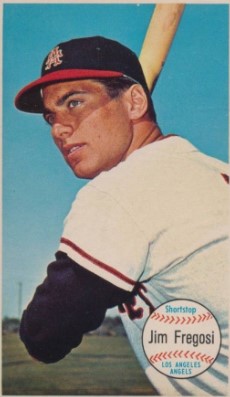
Fregosi was signed by the Red Sox right out of high school and, at 19-years-old, had just one minor-league season to his credit (.267-6-58 in 112 games at Class-D) when the Angels snatched him from the Red Sox. In is first two seasons in the Angels’ system, he got in 214 games at Triple-A Dallas Fort Worth (.263-7-64). He was called  up to the Angels briefly in 1961 (11 Sept./Oct. games). In 1962,  he was called up in July and went .291-3-23 in 58 games. Fregosi was with the Angels through 1971, playing in 1,429 games (.268-115-546, with 691 runs scored). The six-time All Star and one-time Gold Glover provided solid leadership and a steadying presence in the Angels’ infield and line up. Fregosi received MVP votes in eight Angels’ seasons. He ultimately played in 18 MLB seasons, going .265-151-706).

After the Fact

Although, these factors did not play a role in  this ranking, Jim Fregosi did have an impact on the Angels well past his days on the field with the team. In 1961, the Angels traded Fregosi to the Mets for four players – one of whom was Nolan Ryan. (That worked out pretty well.)  Then, in 1978, he came back to the manage the Angels (1978-81). 

___________________________________________

NUMBER TWO – Vinny Castilla, SS/3B … drafted by the ROCKIES (from the Braves) with the 40th pick in the 1992 Expansion draft.
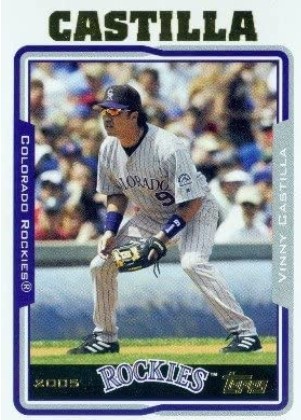
Castilla showed modest power potential in the Braves’ minor-league system – 31 home runs in 399 games (primarily as a shortstop) before the Rockies picked him in the 1992 Expansion Draft.  Odds are, the Rox got even more than they expected – as a switch to third base and the “Rocky Mountain Air” seemed to agree with Castilla. From 1993-99, Castillo hit .299 for Colorado, with 203 home runs and 610 RBI. He made two All Star teams, hit 40 or more home runs in three seasons and drove in 100+in four (a high of 144 RBI in 1998). In 1999, after a .275-33-102 season, he was traded to the Rays for Rolando Arrojo and Aaron Ledesma.  Castilla came back for a couple of stints with the Rox, including a .271-35-131 season in 2004. In 16 MLB seasons, Castilla hit .276, with 320 home runs and 1,105 RBI.

____________________________________

NUMBER THREE – Nate Colbert, 1B/OF… drafted by the Padres (from the Astros)  with the 18th pick in the 1968 Expansion Draft. 
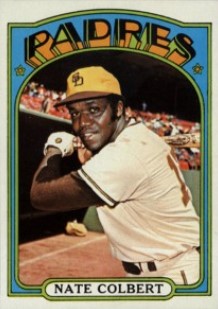
While Colbert had a .133 average in 39 games with the Astros (1966 & 1968), he had shown potential in the minors (including a .289-28-67 season at Double-A/Triple-A in 1967). Colbert immediately began delivering on that potential with the Padres. The 23-year-old hit .255 with 24 home runs and 66 RBI in his first season in San Diego, went on to earn three All Star berths and hit 163 home runs in six seasons for the team (still the record for carer homers in a Padres’ uniform). His best season was 1972, when he went .250-38-111 for the Padres. Colbert gained further fame on August 1, 1972, when he hit a record-tying five home runs in a double header.

_____________________________


NUMBER FOUR- Turk Farrell, RHP … drafted by the Colt .45s (from the Dodgers) with the fourth pick (premium phase) of the 1961 Expansion Draft.

The 26-year-old righty had a five-season MLB record of 37-31, 3.70 and one All Star selection on his MLB resume (1958 Phillies) when the Colt .45s selected him in the 1961 Expansion draft. It turned out to be a pretty good move.  Farrell was with Houston through May of 1967.  During those six seasons, he was a three-time All Star –  and went 53-64, 3.45 (during that time, Houston went 402-568.).  In 1963, Farrell put up a 14-13, 3.02 stat line for a team that finished 30 games under .500.  Farrell started 132 games for Houston (completing 41) and relieved in 49 (eight saves). Farrell pitched in 14 MLB seasons, going 106-111, 3.45

__________________________________________

NUMBER FIVE – Jim Clancy, RHP … drafted by the Blue Jays  (from the Rangers) with the sixth pick in the 1976 Expansion Draft.

Jim Clancy had four minor-league seasons on his professional resume when the Blue Jays drafted him, but they were far from attention gathering results – a 20-37 record, with a 5.30 earned run average.  His first three seasons with the Blue Jays were marginally better, 16-28, 4,58.   Then in 1980 – as a 24-year-old – he seemed to progress (13-16, but with a 3.30 ERA for the 67-95 Blue Jays.)  Clancy get this spot  partially on the basis of longevity. He stayed with the Blue Jays for 12 seasons – putting up a 128-140 record, with a 4.10 ERA. He gave the Blue Jays double-digit wins in eight seasons and twice led the AL in games started. In 1982, he was an ll Star and put up a 16-14, 3.,71 record.  He pitched in 15 MLB seasons, going 140-167, 4.23.

_______________________________________


HONORABLE   – Tommy Harper, OF …  drafted by the Seattle Pilots (from the Indians) with the third pick in the 1968 Expansion Draft.  

Harper deserves a mention for providing a lot of thrills for fans, early in an expansion club’s existence. He had appeared in 778 MLB games (Reds & Indians) by the time the Pilots selected him in the 1968 Expansion Draft.  He had a .251 career average, with 50 home runs, 203 RBI, 492 runs scored and 135 stolen bases. In 1965, he had hit .257 for the Reds and led the National League in runs scored with 126. The best, it seems,was yet to come.

In his first year as a Pilot, Harper may have hit only .235, but he led MLB with 73 stolen bases. But, the best was yet to come.

In 1969, the Pilots moved to Milwaukee and became the Brewers – and Tommy Harper became an All Star, a Brewers fan favorite and a 30-30 player.  For the Brewers, he hit .296, with 31 home runs, 38 stolen bases, 82 RBI and 104 runs scored. The following season (1971), he regressed, hitting .258-14-52, with 25 steals. After the season, he was traded to the Red Sox in a multi-player deal.  The Brewers sent Pat Skrable, Lew Krausse and Marty Pattin to the BoSox for Ken Brett, Billy Conigliaro, Joe Lahoud, Jim Lonborg, Don Pavletich and George Scott. (You can figure that one out.)  Harper played 15 MLB seasons (1962-76), going .257-146-567, with 408 steals.  Clearly the Pilots/Brewers got Harper’s best.

__________________________________________


Now let’s look at each expansion team’s first and, in Baseball Roundtable’s view, most interesting picks.


——1960 EXPANSION DRAFT – For 1961 Season——

Eli Grba – RHP – First pick of the Angels, taken from the Yankees.
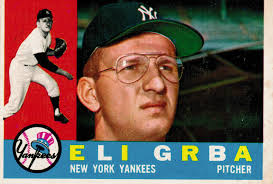
Eli Grba – first player taken in MLB’s first expansion draft.

Eli Grba was the first-ever Expansion Draft selection (the Angels had first pick). The 25-year-old Grba had appeared in a total of 43 games (15 starts) and 131 major-league innings for the Yankees in the 1959-60 seasons – going 8-9 with a 4.74 ERA and one save. He was considered a solid prospect (who already had some seasoning), coming off a 1960 season in which he went 7-1, 1.80 at Triple-A before putting up a 6-4, 3.68 line for the Yankees.  Grba had a good season for the Angels in 1961 – winning 11 and losing 13, with a 4.25 ERA in 211 2/3 innings pitched.  Grba, however, was out of the major leagues by 1964, finishing with a 28-33, 4.67 (4 saves) record over five seasons.

Angels’ most interesting pick – 20-year-old RHP Dean Chance, taken from the Orioles … kind of .

The 1960 expansion draft had a complex set of rules- among them that no existing team could lose more than seven players and no expansion team could take more than four players from any one existing team. As the draft unfolded, these rules were not followed to the letter – particularly the restriction on how many players from any one team any one expansion team could draft.  As a result, AL President Joe Cronin had to step in and mandate trades to bring teams into compliance.   And, that’s where Dean Chance becomes an interesting pick. One of the mandated trades sent Joe Hicks, originally drafted by the Angels to the Senators for Chance (originally drafted by Washington).  Chance was clearly a “prospect pick.” Just 20, he already had two minor-league seasons behind him (in which he had gone 22-12, with a 3.06 ERA). Chance spent most of 1961 at Triple-A, getting into just five games with the Angels at the end of the season (0-2, 6.87 in 18 1/3 innings). In 1962, he was a 14-game winner for the Angels and, by 1964, he was an All Star and AL Cy Young Award winner (20-9, 1.65 with 11 complete-game shutouts).  A nice pick who had an 11-year MLB career, six seasons with the Angels (74-66, 2.83).  If it hadn’t been for that “interesting” draft-day trade, Chance would have made my five best picks list.  His career stat line was 128-115, 2.92.

_______________________________________________________

Bobby Shantz – LHP – First pick of the Senators, taken from the Yankees.

The expansion Senators appeared to go for experience in their first pick – selecting 35-year-old left-hander Bobby Shantz; a 12-year MLB veteran, three-time All Star and 1952 AL MVP.  Shantz, however, never played for the Senators. He was quickly traded to the Pittsburgh Pirates for RHP Bennie Daniels, 3B Harry Bright and 1B R.C. Stevens. The players the Senators received for Shantz did provide some value. Daniels led the Senators in wins in 1961, going 12-11, 3.44. He stayed with the team four more seasons, picking up 25 more victories. Harry Bright hit .240-4-21 in 72 games for Washington in 1961, then set career highs at .273-17-67 for the team the following year (after which he was traded to the Reds). R.C. Stevens played in only 33 games for the Senators – hitting .129 in his last of four MLB season.

Senators’ most interesting pick – LHP Bobby Shantz (see the full Shantz story below).

Bobby Shantz – The Most Interesting Player in TWO MLB Expansion Drafts

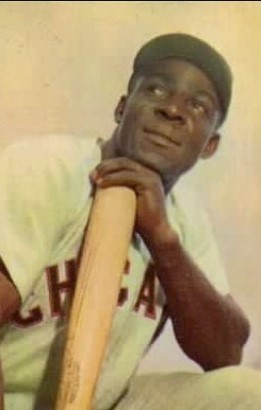
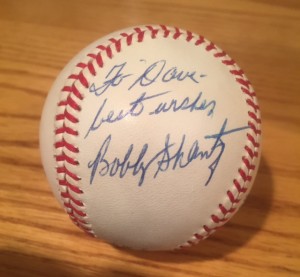
Bobby Shantz - Boyhood Hero.

Bobby Shantz – Boyhood Hero.

Like the Dos Equis beer campaign’s “most interesting man in the world,”  Bobby Shantz was the most interesting player in not one, but two, MLB Expansion drafts – at least in BBRT’s estimation.

First, a disclaimer. As a youngster, I had a personal interest in the 5’ 6 “ Shantz.  My Dad was just 5’ 1” and it looked like I might follow in his (short stride and) footsteps.  Luckily, a growth spurt in my teens got me past my Dad’s mark to a more average 5′ 9″. Before that growth spurt, however, Shantz was my assurance that the vertically challenged could succeed in the national pastime.

Let’s take a look at this most interesting of Expansion Draft picks (actually one of the more interesting MLB players period). Shantz – who was still under five-feet tall when he graduated from high school – was a natural athlete, excelling in everything from baseball to diving to gymnastics to ping-pong. Still, when it came to professional opportunities, he was considered too small. Fortunately, a late growth spurt (some of which occurred during his military service) pushed Shantz up to 5’ 6″ and just shy of 140 pounds. After his discharge, some excellent results in sandlot ball earned Shantz a contract with the Philadelphia Athletics (most teams passed on Shantz due to his size).  In his first season of pro-ball (1948 … for the Class A Lincoln A’s), Shantz went 18-7, with a 2.82 ERA and 212 strikeouts in 214 innings – showing great control and a baffling curve ball. Shantz was on his way. By 1951, he was an All Star for the Athletics, finishing the season 18-10, with a 3.94 ERA. The following season, he reached his peak. While the Athletics finished barely above .500 (79-75, fourth place), Shantz went 24-7, 2.48 – leading the league in wins and winning percentage and throwing 27 complete games in 33 starts.  The campaign was topped off when Shantz was named the AL MVP.

The following season, however, Shantz fell victim to a shoulder injury that would create problems for him on-and-off for the remainder of his career. In 1957, Shantz was included in a 13-player trade (Athletics and Yankees). He proved a valuable addition to the Bronx Bombers, going 11-5, with a league-low 2.45 ERA (30 games, 21 starts). That year, he made his third and final All Star squad. He also started Game Two of the 1957 World Series, taking the loss in a 4-2 Braves victory.

In addition to making it to the World Series, Shantz also started an enviable streak in 1957.  Remember the earlier note that Shantz was a natural athlete? Well, in 1957, the first Gold Gloves were awarded. In that initial year, one Gold Glove was awarded for each position (not one for each position in each league) and Shantz was the first pitcher to earn a Gold Glove. The following season, Gold Gloves were awarded by league and Shantz won the AL Gold Glove for pitchers in each of the next three seasons. He moved to the NL in 1961, and won four more consecutive Gold Gloves (1961-64).

So, as we look to the 1960 Expansion Draft, we find Shantz – at the time a former MVP, three-time All Star and four-time Gold Glover – left unprotected by the Yankees. Shantz was the first pick of the Senators, who – two days later – traded him to the Pirates. As a reliever and spot starter for Pittsburgh, Shantz went 6-3, 3.32, with two saves (43 games, six starts).

Then came the 1961 draft. The Pirates did not protect Shantz and the former MVP was again a “draftee,”  selected by the Houston Colt .45’s with the number-21 pick.  Shantz started the first-ever game for Houston (April 10, 1962), beating the Cubs 11-2 on a complete game five-hitter.  He got three starts for Houston (1-1, 1.31) before a May 7 trade to the Cardinals (for OF Carl Warwick and P John Anderson). Shantz had a solid season as a reliever for Saint Louis – 5-3, 2.18 with four saves, and finished out his career as a reliever with the Cardinals, Cubs and Phillies He retired after the 1964 season with a 119-99, 3.38 record (48 saves) in 16 seasons – and BBRT’s vote as the most interesting player in the first – and second – Expansion Drafts.
 

——1961 MLB EXPANSION DRAFT——

Eddie  Bressoud – SS/2B/3B – First pick of the Colt. .45s, taken from the Giants.

The 29-year-old Bressoud had been utility infielder with the Giants (1956-61) – versatile and capable in the field, with a .239 career batting average. Like Bobby Shantz (see above), Bressoud was not to play a single game for the team that made him their first draft pick.  He was traded to the Boston Red Sox for shortstop Don Buddin – which proved an unproductive move.  Buddin played in 40 games for the 1962 Colt .45s, hitting just .163 in 80 at bats before being moved to the Detroit Tigers for cash in mid-season. The slick-fielding Bressoud remained in the major leagues for six more seasons, making the AL All Star team in 1964, when he hit .293 in 158 games as the regular shortstop for the Red Sox. Bressoud closed out his MLB career as a member of the 1967 World Champion Cardinals.

Colt .45’s most interesting pick – Bobby Shantz, taken from the Pirates (see full story in box above).

___________________________________________

Hobie Landrith – C – First pick of the Mets, taken from the Giants.

Hobie Landrith had a dozen MLB seasons under his belt (primarily as a backup catcher, although he did play in 100+ games in 1956 and 1959) when the Mets made him their first Expansion Draft pick.  When asked about the reasoning behind this first pick, Met’s manager Casey Stengel is famously said to have replied, “You have to have catchers or you’re going to have a lot of passed balls.”  Like so many of these first expansion picks, Landrith was not long for his new team.  He played in just 23 games for the Mets (.289-1-7) before being traded to the Orioles to complete a trade that brought the Mets future team “legend” Marvelous Marv Throneberry. Landrith only played one more season in the big leagues. Throneberry was with the Mets in 1962 and 1963 (his last MLB season) – hitting .240 with 16 home runs and 50 RBI in 130 games. Marvelous Marv later gained fame as a spokesperson for Miller Lite beer.

Mets’ most interesting pick – 1B Gil Hodges, taken from the Dodgers. 

The Mets took 37-year-old veteran 1B Gil Hodges from the Dodgers with the 14th pick of the 1961 draft – bringing a Brooklyn Dodgers’ fan favorite back to New York. Hodges was an eight-time All Star, all with Brooklyn. He was also a three-time Gold Glover – one with Brooklyn, two with Los Angeles.  At the time he was drafted, Hodges had a .276 career average, 361 home runs and 1,254 RBI.  Hodges got in just 65 games in two seasons with the Mets, hitting .248, with nine homers and 20 RBI.  Hodges, appropriately, did hit the first home run in Mets’ history – on April 11, 1962. He was traded to the Washington Senators (for OF Jimmy Piersall) on May 23, 1963 – immediately retiring as a player to take over as the Senators’ manager (the purpose of the trade.)

——1968 EXPANSION DRAFT——

Ollie Brown – OF – First pick of the Padres, taken from the Giants.

Ollie “Downtown” Brown, a plus defender with a strong arm, was the first pick of the expansion Padres – and it worked out well for Brown and the team.  A part-timer with the Giants (181 games from 1965-68), Brown became a staple in the outfield for the Padres.  In 1969, he played in 151 games for San Diego, hitting .264, with 20 HR’s and 61 RBI.  He did even better the following season – .292-23-89 in 139 games. He was a regular in the Padres’ OF until he was traded to Oakland in 1972. Brown stayed in the majors through 1977 (13 seasons), putting up a career average of .265, with 102 home runs and 454 RBI.

Padres’ most interesting pick – 1B Nate Colbert, taken from the Houston Astros.

You can read more about Colbert in the “Best Picks” section at the top of this post. Adding to the “interest factor” for BBRT is the fact that on August 1, 1972, Nate Colbert hit five home runs in a double header (remember those).  The only other time this feat has been accomplished (by Stan Musial on May 2, 1954), Colbert (then 8-years-old) was a fan in the stands.

_________________________________________________

Manny Mota – OF – First pick of the  Expos, taken from the Pirates.

Manny Mota, the Expos’ first-pick in the 1968 draft, played only 31 games for the team before being traded to the Los Angeles Dodgers. Mota and Expos’ SS Maury Wills were traded to the Dodgers for OF/1B Ron Fairly and IF Paul Popovich in mid-June of the 1969 season. Mota was with the Dodgers until 1982 (an All Star in 1973), becoming one MLB’s most adept pinch hitters; while Wills (who started his career with the Dodgers) stayed with LA through the 1972 season. Fairly was a Montreal regular (and a 1973 All Star). In six seasons with the Expos, he hit .276, with 86 home runs and 331 RBI. Popovich was immediately traded to the Cubs for OF Adolfe Phillips and RHP Jack Lamabe. (Phillips hit .216 in 58 games for the Expos that season, Lamabe spent the season in the minors and never pitched in the major again.)

Expos’ most interesting pick – SS Maury Wills, taken from the Pirates.

The Expos selected Dodger SS Maury Wills with the 21st pick of the NL Expansion Draft.  The 36-year-old Wills was a five-time All Star, two-time Gold Glover, 1962 NL MVP and had led the NL in stolen bases six times. He’d spent most of his career with the Dodgers, but in the year preceding the Expansion Draft, he had hit .278, with 52 steals for the Pirates – who did not protect him in the draft. (Wills was traded by the Dodgers to the Pirates after the 1966 season, reportedly over a disagreement over payment for a team post-season tour of Japan.)  The 36-year-old Wills got into 47 games for the Expos (.222, 15 steals), before being traded back to his original team (the Dodgers), where he hit .297 with 25 more steals. Wills retired as a Dodger in 1972, with a .281 average and 586 stolen bases.

____________________________________________________

Roger Nelson – RHP – First pick of the Royals, taken from the Orioles.

Roger Nelson had gone 4-3, 2.41 in 19 games (six starts) for the Royals in 1968 – after starting the season 3-0, 1.29 at AAA Rochester. At 24-years-old, he already had 6 years of professional experience when the Mariners made him their first choice.  Nelson started 29 games for the Royals, going 7-13, 3.31. He was with the team for three more seasons, his best being 1972, when he went 11-6, 2.08 at a starter and reliever. After the 1972 season, he was traded (along with OF Richie Scheinblum) to the Reds for OF Hal McRae and RHP Wayne Simpson. McRae would spend 15 seasons with Kansas City, compiling a .293 average for the team, earning three All Star selections and leading the  AL in doubles twice (54 in 1977 and 46 in 1982) and RBI once (133 in 1982).

Royals’ most interesting pick – RHP Hoyt Wilhelm from the Chicago White Sox.

Future Hall of Famer Hoyt Wilhelm was already 45-years-old, a four-time All Star and had appeared in more than 900 games when the Royals made him the 49th pick in the AL Expansion Draft. Who would have thought the ageless knuckleballer still had four seasons (including one All Star campaign) left in his arm. Apparently not the Royals, who quickly traded Wilhelm to the California Angels for a pair of catchers – Ed Kirkpatrick and Dennis Paepke. Kirkpatrick hit .248 with 56 home runs in six seasons with the Royals, while Paepke got in just 80 games (.183 average) in four Royals’ seasons. Wilhelm split the 1969 season with the Angels and Cubs, going 7-7, 2.19 (14 saves) in 52 appearances. In 1970, he split time with the Braves and Cubs, going 6-5, 3.40 with 13 saves and making his final All Star game. Wilhelm retired after the 1972 season (his 21st MLB campaign) having appeared in 1,070 games (none for the Royals), with a 143-122 record, 228 saves and a 2.52 career ERA.

_________________________________________________

Don Mincher – 1B – First pick of the Pilots, taken from the Angels.

Don Mincher had established himself as a steady source of power when the Seattle Pilots made him their first choice in the 1968 Expansion Draft. In nine MLB seasons (Washington/Minnesota/California), Mincher had hit .248, with 130 home runs (despite averaging just 98 games per season), topping 20 homers in a season three times. The 31-year-old played in 140 games for Seattle in 1969, hitting .246, with a team-leading 25 home runs and 78 RBI (second on the Pilots to Tommy Davis’ 80). The Pilots, of course, moved to Milwaukee (to become the Brewers) in 1970 – but Mincher did not make the trip. The Pilots’ leading source of power was traded (along with infielder Ron Clark) to the Oakland A’s for pitchers Lew Krausse and Ken sanders, OF Mike Hershberger and C Phil Roof.

Pilots’ most interesting pick –OF Lou Piniella taken from the Indians. 

Wow, the Pilots had several interesting picks – Mike Marshall, who would go on to set records for relief appearances in a season in both the NL and AL; two-time batting champ Tommy Davis; and a 28-year-old outfielder named Tommy Harper, who would lead the AL in stolen bases for the Pilots with 73 in 1969 and join the 30-30 (HR/SB) club in 1970.

For BBRT, their most interesting pick was a 25-year-old outfielder named Lou Piniella, taken from the Indians with the 28th pick. The Pilots traded Piniella to the Royals (appropriately on April Fool’s Day) before the season opened (for RHP John Gelnar and OF Steve Whitaker).  The Pilots looked a bit foolish when Piniella went on to earn Rookie of the Year honors with the Royals – and then enjoyed an 18-season MLB career (.291 average, 102 home runs, 766 RBI), as well as a long career as an MLB manager.

——1976 EXPANSION DRAFT——

Ruppert Jones – OF –  First pick of Mariners, taken from the Royals.

Ruppert Jones began his professional career at age 18 (1973), hitting .301 in 61 games for the Royals’ rookie-level Billings (Montana) Mustangs. The next season – at Class A – he hit .320 with 21 home runs and 24 stolen bases.  In 1975 and 1976, he held his own at AAA (.243-13-54, with 12 steals; .262-19-73, with 16 steals). In 1976, he was called up to the Royals and made his MLB debut in August, but hit just .216 in 28 games.  The Mariners, however, recognized Jones’ potential and made him their first choice.  In his initial season with Seattle, Jones got in 160 games, hitting .263, with 24 home runs, 76 RBI and 13 steals – earning his first of two All Star selections (he was also an All Star with the 1982 Padres). Jones was with the Mariners for three seasons, before being traded to the Yankees in a six-player deal in November of 1979. Jones hit.250 with 147 home runs and stole 143 bases in a 12-year MLB career.

Mariners’ most interesting pick – OF Dave Collins, taken from the Angels.  

The Mariners used their number-14 pick in the 1976 Expansion Draft to add some speed to their roster – in the form of 24-year-old, switch-hitting outfielder Dave Collins. Collins had spent a good portion of the 1975-76 seasons with the Angels, getting into 192 games and hitting .265 with 56 stolen bases. In 1977, he hit .239 (120 games) for the Mariners, and swiped 25 bags.  After the season, the Mariners traded Collins to the Reds for LHP Shane Rawley. Collins went on to a 16-year MLB career in which he hit .272, with 395 steals (a high of 79 for the Red in 1980.)  Collins hit over .300 thee times, with 1980 his best overall season – .303 average, 79 steals, 94 runs scored.) What makes Collins most “interesting” to BBRT is that he is one of a handful of players who played in the short-lived Senior Professional Baseball Association (for retired and released players over age 35) and made it back to the major leagues.  (For the story on the SPBA, click here.)

_________________________________________________

Bob Bailor – Utility – First pick of the Blue Jays, taken from the Orioles.

In 1975 and 1976, Bob Bailor got the proverbial ”cup of coffee” in the big leagues – 14 games and 13 at bats with the Orioles. The versatile player had put up some pretty good minor-league numbers – with a solid average and plenty of speed.  (In 1975, he hit .293 and swiped 21 bases at AAA.) Toronto made Bailor their first choice in the 1976 Expansion Draft and he responded with arguably his best MLB season, In 1977, Bailor put up a .310 average, with 5 home runs and 15 steals in 122 games; while playing all three OF spots and shortstop. Bailor hit.264 over an 11-year MLB career (four seasons with the Blue Jays) in which he spent time at every position except pitcher, catcher and first base.

Blue Jays’ most interesting pick – DH Rico Carty, taken from the Indians.  

While the Blue Jays went with diversity (of positions) with their first pick, their most interesting pick might have been a more limited player taken at number ten – Designated Hitter and former batting champ (.366 for the Braves in 1970) Rico Carty. Now here’s where (and why), it gets interesting – and yo-yo like.  The 37-year-old Carty was traded by the Blue Jays TO the Indians (for OF John Lowenstein and C Rick Cerone). Carty went on to a .280-15-80 season as the Indians’ primary DH. Then, during Spring Training 1978, the Blue Jays traded LHP Dennis DeBarr to the Indians FOR Carty.  The DH hit .284-20-68 for Toronto in 104 games before being traded TO the Oakland A’s (for DH Willie Horton and RHP Phil Huffman) in August.  In 41 games for Oakland, Carty hit .277 and added another 11 round trippers. That gave the DH a respectable .282-31-99 season. Then, in October 1978, the Blue Jays again ACQUIRED Carty (for cash this time). In 1979, with Toronto – his last MLB season –  Carty hit .256-12-55.  Carty probably should have retired one year earlier. In his 15-season MLB career, Carty hit .299 (204 home runs, 890 RBI). a .300 average would have been nice.

——1992 EXPANSION DRAFT——

David Nied – RHP – First pick of the Rockies, taken from the Braves.

By the time of the 1992 draft, David Nied looked like a true prospect. In 1992, he had gone 14-9, 2.84 at Triple-A and then 3-0, 1.17 in a call up to the Braves.  (In five minor-league seasons, Nied had a 57-36 record, with a 3.26 ERA). The Rockies couldn’t resist and made Nied their number-one choice in the Expansion Draft. That first season, the 24-year-old Nied went 5-9, 5.17.He did start the first-ever Rockies’ game and pitch Colorado’s first-ever complete game and shutout.  The following year, he improved to 9-7, 4.80. Then in 1995, an elbow injury proved the first step in shortening his career (he was out of baseball by age 28).  In parts of four seasons with the high-air Rockies, Nied went 14-18, 5.47.

Rockies’ most interesting pick –  SS/3B Vinny Castilla, taken from the Braves.

You can read about Castilla in the “Best Picks” section at the top of this post. 

____________________________________________________

Nigel Wilson – OF – First pick of the  Marlins, taken from the Blue Jays.

Being the Mariners’ first choice in the 1992 Expansion Draft was one of the highlights of Nigel Wilson’s MLB career – which was comprised of 22 games and 36 plate appearances, over three seasons (1993-95-96) with three teams (Marlins, Reds, Indians). That’s not to say Wilson had not shown promise.  In 1992, he hit .274, with 26 home runs and 13 stolen bases at Double-A Knoxville.  This after a .301 season (12 homers, 27 steals) at High-A Dunedin in 1991.  In 1993, Wilson got in only seven games for the Marlins, going zero-for-sixteen – although he did hit .293 with 17 home runs and eight steals for the Marlins’ AAA farm club.  Somehow, that minor-league success never translated to the majors. Wilson’s final MLB line shows a .086 average (3-for-35) with two home runs and five RBI. Wilson did go on to have three seasons of 30+ home runs in Japan.

Marlins’ most interesting pick – RHP Trevor Hoffman, taken from the Reds.

Yes indeed, the Reds left Trevor Hoffman (who would go on  to log 601 MLB saves) unprotected in the 1992 draft – and the Marlins grabbed him with the number-eight pick. Hoffman had not yet pitched in the major leagues and, in 1992, he had gone 7-6, 3.41 as a starter and reliever at Double-A and Triple-A. While the Reds didn’t protect him, the Marlins didn’t keep him. (Two wrongs don’t make a right.) Hoffman got in 28 games for the Marlins (2-2, 3.28, 2 saves) before being traded to the Padres (along with two minor-league pitchers) for Gary Sheffield and relief pitcher Rich Rodriguez. The rest is history, 601 career saves (552 with San Diego), seven All Star selections, 14 seasons of over 30 saves, with a high of 53 in 1998. 

——1997 EXPANSION DRAFT——

Tony Saunders – LHP – First Pick of the Devil Rays, taken from the Marlins.

Signed by the Marlins in 1992, Tony Saunders made it t0 the major leagues in 1997 – after several strong minor-league seasons. Between 199 and 1996, Saunders went 34-15, with a 2.85 ERA in nearly 400 minor league innings.  In 1997, he went 4-6, 4.61 in 22 games (21 starts) for the Marlins – and got a start in both the National League Championship Series and World Series. In his first season with the Devil Rays, Saunders went 6-15, 4.12 in 31 starts. The following year, his last in the major leagues, he went 3-3, 6.43 – before a broken arm (May 26) cut his season (and eventually his career) short. (In 2000, he broke the arm again during a rehab assignment.)

Devil Rays’ most interesting pick – UT Brooks Kieschnick, taken from the Cubs.

Okay, I thought of going with Saunders – based on his pitching in the World Series shortly before being given up in the draft. However, I was afraid you’d think I was getting lazy (this is a pretty long post), so I went with Kieschnick.  You’d be right to ask why, particularly since Kieschnick spent all his time with the Devil Rays in their minor-league system. Kieschnick piqued my interest because he was a bit of a jack of all trades.  In 2003, while with the Brewers, Kieschnick became the first player to hit home runs as a pitcher, designated hitter and pinch hitter in the same season. For his MLB career, Kieschnick played 784 games at pitcher, 50 in the outfield, four at DH and two at 1B – and none for the Devil Rays.

____________________________________________________

Brian Anderson – LHP – First pick of the Diamondbacks, taken  from the Indians.

Twenty-five-year-old southpaw Brian Anderson already had 58 major-league appearances (20-16, 5.25 ERA) under his belt when the Diamondbacks made him their first choice in the 1997 draft. Like Devil Rays’ first pick Tony Saunders, Anderson pitched in the 1997 post season – making a combined six appearances in relief in the American League Championship Series and World Series. He pitched well in both, going 1-0 with a 1.80 ERA in ten innings. Still, like Saunders, he was left unprotected. The southpaw had a solid season for the expansion team in 1998, going 12-13, 4.33 in 32 starts. He stayed with Arizona for four more seasons ending his Diamondbacks’ tenure with a 41-32 record and 4.52 ERA. Anderson pitched for four teams in 13-season MLB career, going 82-83, 4.74.

Diamondback’s most interesting pick –  LHP Brian Anderson.

This is based on his World Series’ performance (see above) – just weeks before he was left unprotected in the draft.  Kind of a cop out, but I did need to recognize that the 1997 draft included two pitchers who, just weeks before, had been on the mound in the World Series.

Primary Resource:  Baseball-Reference.com


STILL TIME TO VOTE IN BASEBALL ROUNDTABLE’S HALL OF FAME FAN BALLOT.

The Baseball Roundtable (unofficial) Baseball Hall of Fame Fan Ballot is open until December 28, still plenty of time to vote.  To access the ballot click here. For a look at the thirty candidates (and some Roundtable predictions), click here (there are also links to the ballot the bio/prediction post.) For a report on early voting, click here. 
 

100Baseball Roundtable is on the Feedspot list of the Top 100 Baseball Blogs.  To see the full list, click here.

I tweet baseball @DavidBBRT

Follow/Like Baseball Roundtable’s Facebook Page here.  More baseball commentary; blog post notifications; PRIZES.

Member: Society for American Baseball Research (SABR); Negro Leagues Baseball Museum; The Baseball Reliquary. 

Frank Howard … The Week of the Hitter in the Year of the Pitcher

It was 1968 and, in the major leagues, pitching was dominant.  So much so, that season became forever known as “The Year of the Pitcher.”  In fact, pitchers appeared to have such an “upper” hand that MLB went into the 1969 season with a lower mound (10 inches) and a smaller strike zone.  Consider, in 1968:

  • The MLB earned run average was 2.98.
  • Six qualifying pitchers put up ERAs under 2.00.
  • Bob Gibson’s 1.12 ERA was (and still is) the fourth-lowest in MLB history (and was the lowest since 1914).
  • Only six qualifying hitters hit .300 or better.
  • Carl Yastrzemski won the AL batting title with a .301 average, and a .274 average was good enough for the AL top ten.
  • Denny McLain won 31 games, becoming the first 30-game winner since 1934 (Dizzy Dean).
  • Pitchers Denny McLain (Tigers) and Bob Gibson (Cardinals) won the AL and NL Cy Young and MVP awards, respectively.

.

In 1968, there were 339 shutouts in MLB – with 20.9  of the season’s losses (or victories,   depending on which side you are on) coming in whitewashings.

I could go on, but you get the idea.

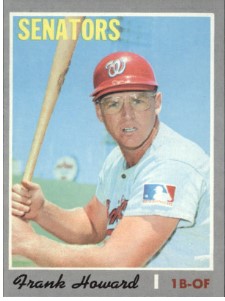
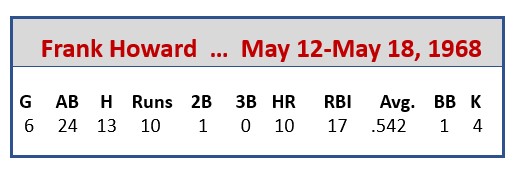
Yet, somehow – in the midst of all this pitching dominance – the Washington Senators’ big (6’8” – 260-lb.) OF/1B Frank Howard put together one of the most explosive offensive weeks in MLB history. From Sunday May 12 through Saturday May 18, in just 25 plate appearances (in six games), Howard banged out thirteen hits – including ten home runs and one double – and drew one walk (for a .542 average).  He also scored ten times and drove in 17 tallies. Side note: Surprisingly, the Senators went 3-3 over Howard’s streak.  Howard’s ten home runs remain MLB’s record for home runs in a week.  

Howard’s game lines during the streak looked like this:

  • May 12 … two-for-four, two runs scored, two RBI, two home runs.
  • May 14 … three-for-four, two runs scored, three RBI, two home runs.
  • May 15 … two-for-four, one run scored, two RBI, one double, one home run.
  • May 16 .… two-for-four, two runs scored, four RBI, two home runs.
  • May 17 … one-for-four, one run scored, two RBI, one home run.
  • May 18 … three-for-five, two runs scored, four RBI, two home runs.

Howard picked on some pretty good hurlers during his streak.  Three of the long balls came off the Tigers’ Mickey Lolich,  who went 17-9, 3.19 on the season and won three games in the 1968 World Series. Another pair of the record-setting round trippers came off “Sudden” Sam McDowell, who – while he only went 15-14 that season – put up a 1.81 earned run average and led the AL with 283 strikeouts.   Howard also showed he could “hit ‘em anywhere.” Only two of the ten long balls came at home – and his streak also included home runs in Boston, Cleveland and Detroit.

Howard came into the streak with a.300 average on the season (which he raised to .347 during the six games). Notably, he didn’t “come in hot,” he had  just three hits (.130 average) over his previous six games.

All-Around Athlete

Frank Howard was All American in both baseball and basketball for Ohio State University – and still holds the Ohio State record for rebounds in a game at 32.

Howard was signed out of Ohio State University by the Dodgers. The 21-year-old began his professional career in 1958 – with the Class B Green Bay Blue Jays, where he hit .333, with 37 home runs and 119 RBI in 129 games, was named the  Three-I League MVP and began building his reputation for hitting the ball hard and far.  (Today’s exit-velocity fans would have loved him.)  That performance earned him a September call up to the Dodgers, where he hit .241, with one long ball in eight games.

His early career did feature a few “ups and downs.”

In 1959, Howard began his season with the Double-A Victoria Rosebuds (Texas League), where he raked at a .371-27-79 pace over 63 games – earning a mid-June call up to Los Angeles. That stay lasted only about a week, during which Howard went 2-for-19 (.105).  He was sent down to Triple-A Spokane, where he continued to dominate minor-league pitching, with a .319-16-47 line in 76 games. That earned him another call up and he went one-for-two (with a home run) in two September pinch-hitting appearances.

Howard again started the season at Spokane in 1960, hitting .371-4-24 in 26 games and earning a May call up.  For LA, he hit .268-23-77 in 117 games, earning National League Rookie of the Year honors. (For those who like to know such things, the Phillies’ Poncho Herrera finished second in the ROY balloting and  Howard’s teammate Tommy Davis finished fifth.)

That One’s Outta Here

In the fourth game of the 1963 World Series, Frank Howard became the first player to hit a home run into Dodger Stadium’s loge level (upper deck) in left field – a feat that wouldn’t be matched for four decades.

Howard stayed with the Dodgers through the 1964 season, showing solid, but not spectacular power (.271-98-297 in four seasons … 1961-64). His best campaign for LA came in 1962, when he hit .296, with 31 home runs and 119 RBI (going .297-20-71 in 76 games after the All Star break). In December of 1964, he was sent to the Washington Senators as part of a seven-player trade.

Frank Howard Knocks Out Duke Snider

In the fifth inning of a September 16, 1958 game against the Reds, with Duke Snider leading off third base, Frank Howard hit a rocket (foul) down the third base line.  The ball hit Snider on the shoulder and ricocheted the bottom his helmet – knocking Snider out and ending his season.

It was in Washington that Howard seemed to refine his uppercut swing and  his bating eye  (he often credited Gil Hodges, Jim Lemon and Ted Williams for the tutelage) and finally reach his “big man” potential. The 1967-1971 seasons (ages 30-34) were clearly Howard’s best in the majors.  In that five-season span, he made four All Star teams and hit .278, with 198 home runs and 515 RBI. He topped 40 home runs in three straight seasons (1968-70) and also topped 100-RBI in each of those campaigns. Howard led the AL in long balls in 1968 and 1970, as well as in RBI in 1970.

In Washington, “Hondo” Howard became known as “The  Washington Monument” and the “Capitol Punisher” – one of the game’s most powerful hitters and a true second-deck threat.  He also continued his reputation as one of the game’s  most popular, humble, gracious and accommodating  stars.

He’ s the most pleasant giant of a man I know.

Dusty Baker about Frank Howard

Howard ultimately played in 16 MLB seasons (1958-73 … Dodgers, Senators, Rangers, Tigers).  He put up a .273-382-1,119 stat line. Howard hit 30 or more home runs in five seasons and drove in 100+ runs in four.  The four-time All Star also led his league in total bases twice, slugging percentage once, walks once, intentional walks twice and, as noted earlier, home runs twice and RBI once.

“No one hit the ball harder than Frank Howard. He was the strongest I ever saw.  I saw him hit a line drive off Whitey Ford at the (Yankee) Stadium that Whitey actually jumped for, it was hit that low.  It ended up hitting the speakers behind the monuments in dead center.

                                                                                  Mickey Mantle about Frank Howard

No one pitcher took more punishment from Howard then the Orioles’ three-time All Star Dave McNally. In 35 games over nine seasons, Howard hit .336 against McNally with 13 home runs and 24 RBI (his most HR and RBI versus any MLB pitcher).  Still, he seemed to have an even greater affinity for the offerings of Bob Hendley (Brewers/Giants).  In just 16 games against Hendley, Howard hit eight home runs and drove in 16 tallies (with a .366 average).

Sam McDowell seemed most prone to pitch around the big guy. In 28 games (95 plate appearances), McDowell walked Howard 25 times (26.3 percent of those plate appearances). That figure includes  nine intentional passes – the most any pitcher awarded to Howard. (The 25 total walks were also Howard’s high against any pitcher.)

Howard’s lowest batting average (minimum 25 at bats) versus any pitcher came against the Orioles’ Tom Phoebus  at .083 (3-for-36, although two of the three were home runs). Notably, Jim Maloney, Reds and Angels, held Howard to a .118 average over 12 games and fanned him in 50 percent of  the times he faced him (17 whiffs in 34 plate appearances).

Primary Resources: Baseball-Reference.com; “Frank Hondo Howard – The Gentle Giant,”  LADodgerTalk.com, August 21, 2020; “The Dodgers Troubled Giant.”  Sports Illustrated, May 25, 1964;  “IT’S OUTTA HEEERRE!!: A New Generation of Sluggers Invites Tape-Measure Comparisons,” Los Angeles Times, June 21, 1986.


STILL TIME TO VOTE IN BASEBALL ROUNDTABLE’S HALL OF FAME FAN BALLOT.

The Baseball Roundtable (unofficial) Baseball Hall of Fame Fan Ballot is open until December 28, still plenty of time to vote.  To access the ballot click here. For a look at the thirty candidates (and some Roundtable predictions), click here (there are also links to the ballot the bio/prediction post.) For a report on early voting, click here. 


100Baseball Roundtable is on the Feedspot list of the Top 100 Baseball Blogs.  To see the full list, click here.

I tweet baseball @DavidBBRT

Follow/Like Baseball Roundtable’s Facebook Page here.  More baseball commentary; blog post notifications; PRIZES.

Member: Society for American Baseball Research (SABR); Negro Leagues Baseball Museum; The Baseball Reliquary. 
Preliminary Baseball Roundtable (unofficial) Hall of Fame Fan Balloting Report

As Baseball Roundtable’s awaits today’s announcement of the Hall of Fame Golden Days and Early  Baseball Era Committee balloting, I decided to pass time taking a look at early voting in the Baseball Roundtable Baseball Hall of Fame (unofficial) Fan Balloting (reader votes on the thirty candidates being considered by the Baseball Writers Association of America -BBWAA).   (Note: If you are interested in Baseball Roundtable’s take on the Golden Days and Early Era  Committee candidates, click here for Golden Days and here for Early Baseball.

Now, for a look at the Roundtable Fan ballot among traditional candidates.

BBRT Fan Ballot Still Open

The Baseball Roundtable (unofficial) Baseball Hall of Fame Fan Ballot is open until December 28, still plenty of time to vote.  To access the ballot click here. For a look at the thirty candidates (and some Roundtable predictions), click here (there are also links to the ballot the bio/prediction post.)

With 32 votes now in, readers have voted for an average of 6.8 candidates per ballot. At this point, only David Ortiz (83.8 percent) is running ahead of the 75 percent needed for election in the BBWAA) official balloting.  It appears fans are giving Ortiz the benefit of the doubt for a positive (but possibly erroneous) 2003 PED test.  Ortiz is one of only six candidates polling more than 50 percent in the reader balloting.  Here are the current top ten:

  • David Ortiz (83.9%)
  • Jeff Kent (61.3)
  • Roger Clemens (58.1)
  • Billy Wagner (58.1)
  • Barry Bonds (51.6)
  • Todd Helton (51.6)
  • Andy Pettitte (48.4)
  • Alex Rodriguez (48.4)
  • Omar Vizquel (45.2)
  • Scott Rolen (35.4)

A few other observations:

Fan voters appear to be taking Curt Schilling’s request to be taken off the ballot seriously.  In fan voting, he dropped from 51.4 percent a year ago, to 22.8 percent so far in this year’s unofficial balloting. Roger Clemens and Barry Bonds are both above 50 percent, but do not seem to gaining traction (in the Roundtable fan ballot or among the BBWAA voters).  Clemens did have an unexplained “blip” in Roundtable balloting.  His vote total in the fan ballot over the past five years:  50.2 percent; 44.8 percent; 46.9 percent; 24.3 percent; and 58.1 percent this year.

Among first-year candidates, David Ortiz and Alex Rodriguez currently lead among Roundtable vote-casters (first-time HOF candidates occupy eight of the nine bottom slots on the preliminary Roundtable balloting.

The Baseball RoundTable unofficial fan ballot also asked voters to indicate players not on the ballot that they through belong in the Hall.  Leading the way thus far, with six mentions, is Jim Kaat. Next comes a group with three mentions each: Gil Hodges, Pete Rose and  Joe Jackson. At two mentions are Tony Oliva, Don Baylor, Bobby Grich and Don Mattingly.  (A full list of those mentioned at least once will be included in a future post.)

Here are the Baseball Roundtable reader votes so far.

Baseball Roundtable 2022 (unofficial) Baseball Hall of Fame Fan Ballot

As of December 4 – Voting open through December 28.

Again, to access the ballot, click here.  For a deep dive into the thirty candidates, click here. 


Primary Resources: National Baseball Hall of Fame; Baseball-Reference.com; Baseball-Almanac.com

100Baseball Roundtable is on the Feedspot list of the Top 100 Baseball Blogs.  To see the full list, click here.

I tweet baseball @DavidBBRT

Follow/Like Baseball Roundtable’s Facebook Page here.  More baseball commentary; blog post notifications; PRIZES.

Member: Society for American Baseball Research (SABR); Negro Leagues Baseball Museum; The Baseball Reliquary. 
 

Baseball Roundtable 2022 Baseball Hall of Fame (unofficial) Fan Ballot

Baseball Roundtable’s 2022 Hall of Fame Debate Season is officially open!  The Baseball Writers Association of America (BBWAA) 2022 Hall of Fame ballots were distributed last week and the results will be announced in January, with the honorees inducted on July 24 This year’s traditional ballot includes 17 holdovers from last year, along with 13 newcomers.

In this post, BBRT will share:

  • Predictions on the 2021 BBWAA voting;
  • BBRT’s ballot (if I had one);
  • A deep look into all the candidates on the ballot;
  • A link to BBRT’s unofficial fan ballot – please take a few minutes to follow the link and cast your votes.

Note: For a look at the Early Baseball Era (veterans) Committee candidates, click hereFor the Golden Days Era Committee candidates, click here

To skip the post (although I hope you will read on) and go right to the Fan Ballot, click here

–PARTICIPATE IN BASEBALL ROUNDTABLE’S  2022 FANS’ HALL OF FAME BALLOT—

Baseball Roundtable is once again conducting an unofficial fan ballot – to cast your vote(s), click here.  Remember, you can vote for up to ten of the nominees for 2022 induction.  If you want to read through the nominees’ bios first, there is another link to the BBRT Fan Ballot following the bios (near the end of this post).  BBRT will be providing updates on the fan balloting, as well as a post-election comparison of fan votes as compared to the final BBWAA results.  Voting on the BBRT Fan Ballot will remain open until December 28, 2021.

Also, if you leave your email address in the comments section at the end of the ballot, you will be entered in a bobblehead and baseball card “surprise-prize” drawing.

Again, to cast your votes, click here

As you consider this year’s slate of candidates, BBRT would stress that all the players on the ballot – even those who remain for only one voting cycle – deserve recognition. To rise to the major leagues, last ten years and make it past the Hall of Fame Screening Committee is a significant accomplishment in itself.  In fact, the annual ballot release is a highlight for Baseball Roundtable, as it provides a chance to acknowledge the accomplishments of all the candidates – not just the favorites for election.  A review of the ballot gives us the opportunity to honor Mike Buehrle’s n0-hitter and perfect game; Carl Crawford’s 480 stolen bases; Billy Wagner’s 400 saves; Torii Hunter’s nine Gold Gloves; the MVP seasons of Justin Morneau and Jimmy Rollins; Prince Fielders 50–HR season; and more.

Now on to the official 2022 Baseball Hall of Fame election process itself – and, then, a look at the players on the ballot for 2021.

BASEBALL HALL OF FAME ELIGIBILITY/CRITERIA FOR ELECTION

The basic rules for eligibility are that a player must have played at least ten seasons and be retired for at least five years. In addition, the player must be approved for the ballot by the Hall of Fame Screening Committee.

A player can remain on the ballot for up to ten years, but must receive at least five percent of the vote in the preceding year’s ballot to remain on the ballot.  Each voter can vote for up to ten candidates.  Election requires that a player be named on at least 75 percent of the ballots cast.

The criteria for election: “Voting shall be based upon the player’s record, playing ability, integrity, sportsmanship, character, and contributions to the team(s) on which the player played.”

A couple of preliminary comments.

  • The 2022 ballot includes four players in their final year of eligibility – a group that generally gains some additional momentum.  However, this year’s “final ballot” group – Barry Bonds, Roger Clemens, Sammy Sosa and Curt Schilling –  brings with it some controversy (PEDs, politics, personality and even a denied request to be removed from the ballot). How all of that affect voting will be interesting to watch.
  • Support for the two strongest newcomers on the ballot – Alex Rodriguez and David Ortiz  – may also be affected by concerns that go beyond what are clearly Hall of Fame numbers.

Now, let’s take a look at whom BBRT predicts will be elected by the BBWAA; how BBRT would vote if I had a ballot; and the bios of these year’s candidates.

—–Baseball Roundtable’s Hall of Fame Predictions for 2022—–

First, the Roundtable’s Track Record …

Last November, I noted that Baseball Roundtable was “not optimistic about balloting” producing any new HOF members – giving  Curt Schilling the best chance of election. No one was elected, while Schilling did lead all candidates with 71.1 percent of the vote.  In November 2020, Baseball Roundtable correctly predicted  the election of Derek Jeter and Larry Walker – and anticipated  “dark horse” candidate Curt Schilling would fall closer to 70 percent than 75.  Jeter and Walker were elected and Schilling fell short (at 70 percent). Three years years ago, BBRT projected the election of Mariano Rivera and Edgar Martinez and listed Mike Mussina and Roy Halladay as “dark horse” candidates with a chance to generate the needed 75 percent support.   It was a bit of a swing and miss (maybe a foul ball), as all four were elected.  Four years ago, BBRT predicted the election of Chipper Jones, Jim Thome, Vlad Guerrero and Trevor Hoffman (with Mike Mussina as a “dark horse” candidate). Jones, Thome, Guerrero and Hoffman made it, with Mussina garnering 64.5 percent (sixth-most).

2022 Prediction …

For 2021, BBRT is again “not optimistic” about the balloting.  I anticipate a second consecutive shutout.  The best chance for election this year: David Ortiz and Alex Rodriguez. 

Dark Horse Possibilities ….

1. David Ortiz.  Ortiz’ 541 home runs and 1,768 RBI, plus his post-season performance, clearly are Hall-worthy (more on Ortiz in the bio section). I put him at the top of the “dark horse” list for a couple of reasons: His positive personality and the fact that he appears more lightly brushed by the PED-controversey. Ortiz did not fail a drug test after 2004, but a positive result was noted in a “leaked” 2003 survey test.  In 2016, when asked about Ortiz’ 2003 test results, MLB Commissioner Rob Manfred said of Ortiz “… there were legitimate scientific questions about whether or not those (some of the test results) were truly positive.”  I think Ortiz will be treated well on the first ballot (55-65%), but there will be enough BBWAA holdouts – some on the basis of PED suspicions, others who sets a higher standard for first-ballot candidates and a few with a lingering negative bias against designated hitters- to preclude the necessary 75 percent.

2. Curt Schilling.  Schilling’s stats (detail in the bio section) were strong enough to garner him 70 percent support in 2020 and 71.1 percent last year.  It does appear his political and social views and the manner in which he expresses them have been obstacles in his path to the Hall.  He didn’t do himself any favors by requesting to be removed from the ballot and indicating he would “not allow a group of morally bankrupt frauds another year to lie about my life.”   The Hall denied his request and BBRT believes this could go one of three ways: 1) The BBWAA voters could see Schilling’s outburst as just “Curt being Curt” and the traditional final-year boost could put him in the Hall; 2) Reverse psychology could kick in and the BBWAA voters could call Schilling’s bluff and elect him (if only to see how he reacts); 3) The BBWAA voters could choose to deny Schilling one more time for past reasons and/or his more recent request and criticism.  I’m betting on option three and a slight decline in Schilling’s support.

3. (tie) Barry Bonds, Roger Clemens. Bonds and Clemens – both in their tenth and final year on the ballot – each tracked at just shy of 62 percent in last year’s voting.  While they clearly have Hall of Fame numbers, the PED-specter has shaped their candidacies. The question for 2022 is whether an adequate number of  BBWAA voters think the pair have been punished enough and are ready to add their support.  I anticipate both Bonds and Clemens falling just shy of 70 percent, and the BBWAA passing this issue on to the ERA ( Veterans) Committee (where Bonds and Clemens will eventually gain induction). If the writers are ready to “forget and forgive,” we could see a 2022 calls to Bonds and Clemens.

5. Alex Rodriguez. Rodriguez clearly has Hall of Fame on-the-field numbers (see bio section), but like Bonds and Clemens is carrying PED “baggage” into his HOF candidacy.  I would have put A-Rod into a tie with Bonds and Clemens except that I am not convinced the BBWAA will want to make a player who has served a one-year suspension a first-ballot inductee. Rodriguez, however, ha s worked to restore his reputation and 55-60 percent support in year one would not surprise me.

Let’s move on to BBRT’s hypothetical – if I had one –  ballot and bios of the players I would vote for; followed by a look at the remainder of the 2021 candidates.

Side note: You will not find those most clearly caught up in the PED-controversy on my ballot. While I think the best of them will eventually be elected/inducted, if I had a ballot, I’d prefer they made the 75 percent without my vote.  As I noted in my predictions, I think it’s likely the BBWAA will “punt” on these players and “kick the ball”down the road to the Era Committee.  

So, here is BBRT’s Hall of Fame Ballot – again, if I had one – with the players listed in BBRT’s order of preference.

— PLAYERS WHO WOULD GET BBRT’S VOTE —

David Ortiz – Designated Hitter/First Base, 1992-2016 … First year on the ballot.

Photo: Cathy T from Washington, DC area, CC BY 2.0 <https://creativecommons.org/licenses/by/2.0>, via Wikimedia Commons

MLB Commissioners  Rob Manfred’s comments about the possible inaccuracy of David Ortiz’s 2003 PED test, MLB’s assurance that  the 2003 “survey” test would not result in disciplinary action and the fact that Ortiz did not test positive after 2003 put Ortiz (at least in Baseball Roundtable’s view) in a different position than a number of other candidates painted by the PED brush. So, let’s look at his HOF resume.  In 20 MLB seasons, Ortiz put up a .286-541-1,768 stat line. Career-wise, he ranks in the  MLB top fifty (among players with a qualifying number of plate appearances) all-time in home runs(17th); RBI (23rd); doubles (623-12th); (extra-base hits-1,192-eighth); total bases (4,765-32nd); slugging percentage (.552-26th); walks (1,319-41st); and intentional walks (209-16th). Ortiz collected 2,72 base hits, hitting .300 or better in six qualifying seasons

The ten-time All Star led the AL in home runs once (54 in 2006) and hit 30 or more long balls in nine campaigns; led in RBI twice and topped 100 in nine seasons; led the league in total bases once; and on-base and slugging percentage once each.  Ortiz played in 85 post-season games (.289-17-61) and was the MVP of the 2004 AL Championship Series and 2013 World Series).  With the Red Sox, he built a reputation as a team leader, clutch hitter and ambassador for baseball and Boston.

In his final season as a player (2016), the 40-year-old David Ortiz hit .315, with 38 home runs and league-leading 127 RBI. He led MLB in doubles (48); extra-base hits (87); and slugging percentage at .620.

Ortiz played for  played for the Twins  (1997-2002) and Red Sox (2003-2016).

David Ortiz’ Best Season: With the Red Sox in 2006, Ortiz hit .287, leading the league in home runs (54); RBI (137); walks (119); and total bases (355). He also scored 115 runs that campaign.

Ortiz has the numbers to earn a place in the HOF. Still, in his first year on the ballot, PED suspicions (whether warranted or not) and the fact that he spent the bulk of his time as a DH may work against him.  Still, he’d gets BBRT’s vote and should eventually make the Hall (perhaps even this year).

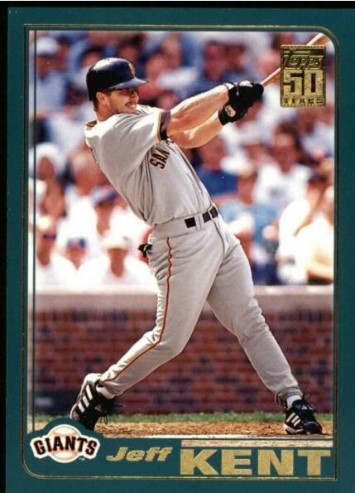
Jeff Kent – (Second Base/Third Base/First Base, 1992-2008) …  Ninth year on the ballot, 32.4 percent last year.

KentBBRT has long believed Jeff Kent is a deserving candidate, but he has not been getting much support from the writers.  Kent holds the all-time MLB record for home runs by a second baseman (351 of his 377 career round trippers were hit while in the lineup at second base). He has a healthy .290 career batting average; his 1,518 RBI are 54th all time; and his 560 doubles 30th.  His 984 extra base hits are 43rd all-time.

Kent was a five-time All Star and the 2000 NL MVP.  As primarily a middle infielder, he hit 20 or more home runs in 12 seasons (a high of 37 in 2007) at a time when middle infielders were not especially known for power. Kent topped 100 RBI eight times. He hit .276, with nine home runs and 23 RBI in 49 post-season games.

Running with the Big Boys …

Jeff Kent has more career runs batted in (1,509 in 17 seasons) than such noted Hall of Famers (who played a comparable number of seasons) as Mickey Mantle (1,508 in 18 seasons), Billy Williams (1,475 in 18 seasons), Eddie Mathews 1,453 in 17 seasons), Duke Snider (1,333 in 18 seasons) and Orlando Cepeda (1,365 in 17 seasons). Not bad for a middle infielder.

Kent played for the Blue Jays (1992), Mets (1992-1996), Indians (1996), Giants (1997-2002), Astros (2003-2004) and Dodgers (2005-2008).

Jeff Kent’s Best Season: With the Giants in 2000, Kent put up these stats – 159 games; 196 hits; .334 average; 33 home runs; 125 RBI; 114 runs; 12 steals. His performance earned him the NL MVP Award.

Kent has the credentials, but BBRT expects the writers will keep him on the bench – a couple of Gold Gloves, at this traditionally defense-oriented position, would have really helped his case.  In BBRT’s opinion, this is a true HOF “snub.”

_________

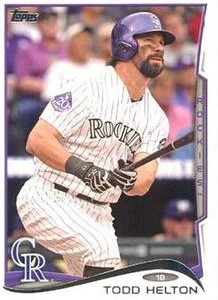
Todd Helton – (First Base, 1997-2013) … Fourth year on the ballot, 44.9 percent last year.

HeltonTodd Helton moved from 16.5 percent to 29.2 percent to 44.9 percent over his first three years on the ballot. I expect he will continue to gain ground and would not be surprised to see hims climb to between 55 and 60 percent this year. Still, he is hampered by the fact that he spent his entire 17-year career with the Rockies (playing half his games in hitter-friendly Coors field).  Helton, who put up a .316 career average, hit .345 at home and .287 on the road. Despite that home/road split, Helton’s body of work deserves HOF consideration.

Helton was a five-time All Star, three-time Gold Glover and four-time Silver Slugger. He hit over .300 in 12 seasons – and won the NL batting crown in 2000 with a .372 average. His 59 doubles that season are the seventh-most all-time. Helton drove in 100 or more runs in five seasons and scored in triple figures six times. His 1,335 walks (37th all-time) indicate the respect he earned at the plate.  Helton also ranks fifth in games played at first base, second in career assists at the position, 13th in putouts and third in double plays.

The Denver 400

Todd Helton is one of only 18 players to reach 400 or more total bases in a season – and one of only seven players to have multiple 400+ total base campaigns. He is also the only player to collect 100 extra-base hits in two consecutive seasons (2000-2001).

Todd Helton’s Best Season: In 2000, Helton won the NL batting crown with a .372 average – and also led the league in base hits (216), doubles (59), RBI (147), on-base percentage (.463), slugging percentage (.698) and total bases (405).  He also scored 138 runs and hit 42 home runs.

Helton will continue to move up in support – he’s just not likely to overcome the Coors Field-bias in the short-term future.  He gets BBRT’s vote (as he has in the past).

__________

Omar Vizquel – (Shortstop/Third Base, 1989-2012) … Fifth year on the ballot, 49.1 percent last year.

Photo by Keith Allison

Photo by Keith Allison

Omar Vizquel got off to a good start toward a HOF plaque, grabbing 37 percent support on his first-ballot year, moving up to 42.8 percent in his second year and 52.6 percent in his third year.  His support appears to have plateaued, dropping to 49.1 percent in 2021.  Vizquel once again earns BBRT’s vote. If he does eventually make it into the HOF it will be more with his glove (eleven Gold Gloves) than his bat.  However, voters should be mindful of the fact that he finished his 24-season MLB career just 123 hits short of that milestone 3,000 safeties.

Vizquel delivered premier defense to the Mariners (1989-1993), Indians (1994-2004), Giants (2005-2008), Rangers (2009), White Sox (2010-2011) and Blue Jays (2012). He was a three-time All Star – and put together a string of nine straight Gold Gloves at shortstop (1993-2001).

Sacrificing for the Team

Omar Vizquel led his league in sacrifice bunts four times.

In the field, Vizquel has the highest career fielding percentage (.9847) among shortstops with at least 500 games at the position.  Vizquel is also the all-time leader among shortstops in double plays (1,734), ranks third at the position for career assists and 11th in putouts. He shares the record (with Cal Ripken, Jr.) for the fewest errors by a shortstop in a season of at least 150 games played (three).

On offense, Vizquel put up a serviceable .272 career average, with 80 home runs, 951 RBI and 1,445 runs scored. The 1,445 runs put him in the top 100 players all-time (83rd); while his 2,877 hits put him in the top 50 (44th and fourth all-time among switch-hitters). He also swiped 404 bases – topping twenty steals eight times (a high of 42 in 1999) – putting him at number-72 on the all-time list. Vizquel played in 57 post-season games, hitting .250-0-20.

Omar Vizquel’s Best Season: In 1999, with the Indians, Vizquel hit a surprising .333, with five home runs, 66 RBI, 112 runs scored and 42 stolen bases – and, of course, won a Gold Glove at shortstop.

Vizquel would get BBRT’s vote, but the BBWAA likely will make him wait.  I do feel, given this year’s ballot, he will improve on his 49.1 percent showing of a year ago.

__________

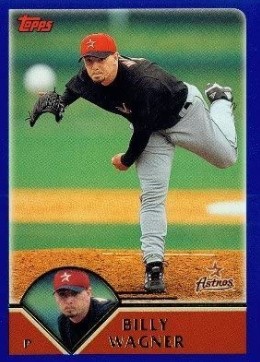
Billy Wagner – (LHP 1995-2010) … Eighth year on the ballot, 46.4 percent last year.

WagnerBilly Wagner made a nice  jump in support last year – going from 31.7 percent to 46.4 percent.  While he could (should) continue to make progress, each incremental point will likely get harder as he moves up the ladder.  Wagner played for the Astros (1995-2003), Phillies (2004-2005), Mets (2006-2009), Red Sox (2009) and Braves (2010). Wagner was a seven-time All Star, who amassed 422 saves (sixth all-time) in a 16-season MLB career.  He had nine seasons of 30 or more saves; a career ERA of 2.31; 1,196 career strikeouts in 903 innings; and 47-40 won-lost record.

Whiff-and-Poof

In 1992, playing for Ferrum College, Billy Wagner set an NCAA record for strikeouts per nine innings in a season at 19.3.

Billy Wagner’s Best Season: In 2003, Wagner went 1-4, 1.78 for the Astros, saving 44 games and fanning 105 batters in 86 innings.

BBWAA voters have been very demanding of relievers (although the recent induction of Mariano Rivera and Trevor Hoffman may be a good sign – but they, of course, both had 600+ saves). It also helps that Lee Smith (478 saves) was elected by the Today’s Game Committee in 2019.  BBRT thinks Wagner belongs in the Hall (based on his 400+ saves) – and hopes that momentum continues to build, but 75 percent is still a long way off.  I’d like to see Wagner at least jump past the 50 percent mark.  He gets my vote.

__________

Andy Pettitte – (LHP/Starter, 1995-2010, 2012-13) … Fourth year on the ballot, 13.7 percent last year.

Andy Pettitte - 19 career post-season wins.

Andy Pettitte – 19 career post-season wins.

I had to think for a while on this one (and will probably get some push back from readers), largely because a major part of Andy Pettitte’s HOF resume was achieved in the post-season and there was some PED-controversey surrounding Pettitte.  (Note: Pettitte admitted to using HGH while recovering from elbow surgery – a couple of years before the substance was banned.  He took responsibility and apologized.)

Pettitte holds the MLB post-season marks for most wins (19 … versus 11 losses), innings pitched (276 2/3) and games started (44). His post-season accomplishments include a 3.81 career ERA, 183 strikeouts (fourth all-time) and the 2001 American League Championship series MVP Award.

Pettitte, however, was no slouch in the regular season (Yankees – 1995-2003, 2007-2010, 2012-13) and Astros (2004-06).  He finished with 256 wins (153 losses) and a 3.85 ERA. His 256 victories puts him in the top 50 all time (42nd). Pettitte won 20 games in two seasons and 14 or more games 12 times – leading the AL with 21 wins in 1996. The three-time All Star struck out 2,448 batters (46th all-time) in 2,316 innings.

Ready, Willing and Able …

Andy Pettitte started 30 or more games in a season 12 times, leading his league three times (1997, 2006, 2007.)

Pettitte’s post-season numbers, plus 256 regular-season victories and the fact that he had 100+ more career wins than losses secure BBRT’s vote. He still has a long way to go with the BBWAA voters, however.

Andy Pettitte’s Best Season: In 1997, following a 21-8 campaign in 1996, Pettitte went 18-7, with a 2.88 ERA (fourth-best in the AL), leading the league in starts with 35, finishing third in innings pitched (240 1/3) and eighth in strikeouts (166).

__________

Bobby Abreu – (OF, 1996-2012, 2014) … Third  Year on the ballot, 8.7 percent one year ago.

AbreuA solid .291 career hitter (2,470 base hits), Abreu hit .300 or better in six seasons. He hit 20 or more round trippers in 10 campaigns, stole 20 or more bases 12 times (a high of 40 in 2004), drove in 100 or more runs eight times and scored at least 100 runs eight times.   Abreu also walked 1,476 times – including 100 or more free passes in eight straight seasons (1999-2006).

In the Top 50 … 

Bobby Abreu’s 1,476 walks are 20th all-time; his 574 doubles are 25th; his putouts as a RF are 12th; and his assists as a RF 28th. 

Abreu played for the Astros (1996-97, Phillies (1999-2006), Yankees (2006-2008), Angels (2009-1012), Dodgers (2012) and Mets (2014).

In 20 post-season games, Abreu went 19-for-67 (.284), with one home runs and nine RBI.

Bobby Abreu’s Best Season: In 2004, as a Phillie, Abreu hit .301, with 30 home runs and 40 steals. An All Star that season, he also drove in 105 runs and scored 118.

Abreu’s 400 steals are an HOF plus, as his 30-40 season in 2004 and his eight campaigns with 100 or more RBI.  Had he reached 300 home runs; it would have really boosted his status with the writers.  He’s also hurt by the fact that he only made two All Star teams in his 18 seasons.  Still, I have votes left and his body of work earns one of them.

Ryan Howard – (1B, 2204-2016) … First year on the ballot.

Photo: Keith Allison from Hanover, MD, USA, CC BY-SA 2.0 <https://creativecommons.org/licenses/by-sa/2.0>, via Wikimedia Commons

Let’s call this my “Sandy Koufax” vote.  Do I expect Ryan Howard to make the Hall of Fame? That’s a bit of a long shot.  Still, I would be inclined to cast a vote to help keep him on the ballot.  The “Koufax Connection?”  Hall of Famer Koufax was elected to the Hall with only 165 victories in a 12-season MLB career sadly cut short by arm issues. If you look at Koufax’ record, he was 36-40, 4.10 over his first six seasons and 129-47, 2.19 over his final six.  (Did you know that Tommy John had just one fewer victory after his 1974 TJ Surgery – at age 31 –  than Koufax had in his career?)

Did Ryan Howard have a period of dominance as great as Koufax (three Cy Young Awards in four seasons)? No, but like Koufax, Howard had several seasons of domination in a career derailed by injury. (Unlike Koufax, Howard’s HOF-worthy seasons came early in his career (he was able to play on after a series of injuries).

In 2005, Howard was the National League Rookie of the Year, hitting .288, with 22 home runs and 63 RBI in just 88 games. Then, from 2005 to 2011, Howard continued as one of the most feared hitters in the National League – and seemed on his way to a sure Hall of Fame career. Over those six seasons, he averaged .274, with 44 home runs, 133 RBI and 96 runs scored per campaign. (If you look at the first four of those seasons, he averaged .278-50-143, with 102 runs scored.)  He was the National League MVP in 2006 and finished in the top five in NL MVP voting four times in six seasons. Then injuries began to take a toll – Achilles tendon in the 2011 NLDS (surgery); fractured big toe in 2012; torn meniscus (2013).In his final five seasons, he averaged .226, with 19 home runs and 66 RBI per campaign).  Sort of Koufax in reverse.

For his career (12 seasons), Howard went .258-382-1,194.  He led his league in home runs twice (hitting 45 or more four times); RBI three times, topping 100 six times and 135 four times; and total  bases once, exceeding 300 four times. He also scored more than 100 runs in three seasons.

Ryan Howard reached 100 home runs in fewer career games than any other MLB player (325).

Howard played his entire career for the Phillies.

Ryan Howard’s Best Season: In 2006, Howard hit .313 and led MLB in home runs (58) and RBI (149) and total bases (383) – earning the NL MVP Award.

__________

So, with BBRT’s unofficial ballot covered, let’s look at the remainder of candidates – in alphabetical order.  Note: Here you will find a host of players with solid (but perhaps not HOF-level) career numbers and accomplishments – as well as a few that remain on the sidelines for other reasons.

—–THE REST OF THE BALLOT—–

Barry Bonds – (Outfield, 1986-2007) … Tenth (final) year on the ballot, 61.8 percent a year ago.

Barry Bonds played for the Pirates (1986-1992) and the Giants (1993-2007). There is no doubt about Bond’s credentials – .298 average, 2,935 hits, MLB-record 762 home runs, 1,996 RBI, MLB-record 2,558 walks. He was also a 14-time All Star; 12-time Silver Slugger Award winner; his league’s MVP a record seven times; and an eight-time Gold Glove winner.  In 2001, Bonds hit .328, with an MLB-record 73 home runs and 177 RBI.  He drove in 100 or more runs 12 times and also scored 100 or more runs in a dozen seasons.  And, I could go on and on.

Base Open?  Makes Sense to Me …

Barry Bonds drew an MLB-record 688 intentional walks in his career. Second place?  Albert Pujols, with 32. In 2004 alone, Bonds drew a record 120 intentional passes. He led his league in IBB 12 times.

Still, there are there is that pesky PED-controversey – an elephant in the room (and on the ballot) that I think will keep Bonds out of the Hall for now (there is the Era Committee in the future).

Barry Bonds’ Best Season: In 2001, Bonds crushed an all-time record 73 home runs, while hitting .328, driving in 137 runs, scoring 129 – all while drawing 177 walks.

_________

Mark Buehrle – (LHP, 2000-15) …. Second year on the ballot, 11 percent last year. 

Mark Buehrle pitched in 15 MLB campaigns – White Sox (2000-11), Marlins (2012), Blue Jays (2013-15) – and threw 200 or more innings in all but his rookie and final seasons. Buehrle was a five-time All Star and put up a 214-160, 3.81 record, with 1,870 strikeouts in 3,283 1/3 innings. He twice led his league in starts and twice topped his league in innings pitched. He won ten or more games in 15 consecutive seasons and six times won 15 or more.  Buehrle also four Gold Glove Awards.

Near-Perfect and Perfect

Mark Buehrle’s HOF resume is bolstered by a no-hitter tossed on April 18, 2007 – when his White Sox topped the Rangers 7-0 and Buehrle faced the minimum 27 batters.  The only Texas’ base runner came on a fifth inning, one-out walk to Sammy Sosa, whom Buehrle then picked off first base.  Buehrle notched eight strikeouts in the game, which was so-o-o very close to a “perfecto.”

Buehrle got his perfect game two years later (July 23, m 2009), when he recorded a clean slate in a 5-0 ChiSox win over the Rays.  He fanned six in that one.

Mark Buehrle’s Best Season:  In 2005, Buehrle went 16-8, 3.12 for the White Sox.

If he had 250 wins to go with the no-hitter, perfect game and four Gold Gloves, Buehrle would have had my vote.  With just 214 wins, no Cy Young Award and no 20-win season, he’s short of what BBRT looks for in a Hall of Fame candidate. .

__________

Roger Clemens – (RHP, 1984-2007) … Tenth (final) year on the ballot, 61.6 percent last year.

Roger Clemens pitched in 24 MLB seasons; for the Red Sox (1984-1996), Blue Jays (1997-1998), Yankees (1999-2003, 2007) and Astros (2004-2006).  Clemens has Hall-worthy stats:  354 wins (ninth all-time), 4,672 strikeouts (third all-time), an MLB-record seven Cy Young Awards and the 1986 AL MVP Award. The eleven-time All Star was a five-time 20-game winner (led the league in wins four times), seven-time ERA leader, five-time league leader in strikeouts and six-time leader in shutouts.  He won the AL pitching Triple Crown (Wins/ERA/Strikeouts) three times.  Clemens also has 12 post-season wins, with 173 strikeouts in 199 post-season innings.

Grab Some Bench, Buddy

Roger Clemens shares the record for strikeouts in a nine-inning game (20) with Kerry Wood and Max Scherzer. Clemens is the only pitcher to achieve 20 whiffs in a nine-inning game twice.

Roger Clemens’ Best Season: Lots to choose from here. Like 21-6, 1.93 in 1990 – or 1987, with a 20-9 record, 2.97 ERA, 18 complete games and seven shutouts.  I take 1986. Clemens went 24-4. 2.48 and won both the Cy Young (his first) and AL MVP Awards for the Red Sox.  He led the AL in wins, winning percentage (.857) and earned run average. He was fifth in innings pitched (254) and second in strikeouts (238).

Yes, he’s got the numbers (those listed and more), but the PED controversy seems to stand between him and the Hall.  If the writers don’t vote him in this year, it’s likely the Era Committee will do it in the future.  If the writers relent, I’d look for Bonds to join Clemens.  I anticipate Clemens candidacy will pass on to the Era Committee.

________________

Carl Crawford – (OF. 2002-2016) … First year on the ballot.

Carl Crawford was considered on the the fastest – if not the fastest – players on the base paths in his peak years. In his first five full MLB seasons, he led the AL in steals four times averaging  53.6 thefts per season.  His career total of 480 steals ranks 43rd all-time.   Crawford also led the AL in triples four times and was a solid contact hitter (.290 career average and six seasons of .300 or better). He collected 1,931 hits, belted 136 home runs (a high of 19 in 2010) and scored 998 runs (100+ in three seasons) in 1,716 career games. Crawford was a four-time All Star and one-time Gold Glover. He ranks 15th all-time in putouts as a left fielder (3,182) and led his league in LF putouts four times.

MVP-MVP

Carl Crawford was the MVP of the 2009 MLB All Star Game, after robbing Brad Hawpe of a go-ahead home run in the seventh inning of a 4-3 AL win. A reserve, he also went one-for-three at the plate.

Crawford played for the Rays (2002-10), Red Sox (2011-12) and Dodgers (2013-16),

Carl Crawford Best Season:  In 2007, Crawford hit a career-high .315, with 11 home runs, 80 RBI, 93 runs scored and 50 stolen bases.

The 480 steals and .290 average should get him enough support to stay on the ballot for 2023.  More than one Gold Glove would have helped his ultimate case for the Hall.

__________________

Prince Fielder – (First Base, 2005-16) … First year on the ballot. 

Prince Fielder was a power hitter (319 home runs), who could make contact (.283 career average – .290 or better in four seasons). He was also a workhorse, leading the league in games played four times and averaging 160 games per season from 2006 through 2013. Fielder led the league in home runs once (with 50 in 2007) and hit 30 or more home runs in six seasons).  The six-time All Star had 1,028 career RBI, leading the NL with 141 for the Brewers in 2009 and topping 100 RBI in six campaigns. He also led the AL in walks once and intentional walks twice,  Fielder played for the Brewers (20005-2011); Tigers (2009-13) and Rangers (2014-16).

It’s in the Genes

Prince Fielder and his father Cecil Fielder each hit exactly 319 regular-season home runs in their careers and each reached 50 home runs in one season – Cecil with 51 in 1990 and Prince with 50 in 2007).

Prince Fielder’s Best Season: Baseball Roundtable is looking at two possibilities here. In 2007, Fielder went .288-50-119, with 109 runs scored; while in 2009, he went .299-46-141, with 103 runs scored. As they say, six of one, half dozen of the other.

Fielder’s 50-HR seasons, 319 career long balls, coupled with the fact that he maintained a .283 average should get him enough support to stay on the ballot another year.  Perhaps in the 10 percent range.

_____________________________

Tim Hudson, – (RHP.  1999-2015) … Second year on the ballot, 5.2 percent last year. 

Tm Hudson pitched in 17 MLB seasons: A; s (1999-2004), Braves (2005-2013); and Giants (2014-15). He was a four-time All Star – making the All Star squad with the A’s, Braves and Giants.  Hudson’s career mark was 222-133, 3.49, with 2,080 strikeouts in 3,126 2/3 innings pitched.  He won 15 or more games in a season eight times, leading the AL in wins with 20 in 2000, his second MLB season. He led his league in games started twice, nine times starting 30+ games, and in shutouts twice.

A Two-way Player …

In 1997, Tim Hudson played in 65 games for Auburn University.  As a pitcher he went 15-2, 2.97 and, as a hitter, he went .396-18-95. Appropriately, he was named SEC Player of the Year and was a consensus All-American. (He was also named All-SEC at both pitcher and outfield.)

Tim Hudson’s Best Season:  In 2000, with the A’s,  Hudson went 20-6, 4.14, leading the AL in wins and winning percentage (.769).  Also, in the running is 2001, when he went 18-9, with a 34.37 ERA.

Nearly 100 more wins than losses deserve recognition, but it doesn’t seem  likely Hudson will gain any traction this year – and may even fall off the ballot.

__________

Torii Hunter – (OF, 1997-2015) … Second year on the ballot, 9.5 percent lat year. 

Torii Hunter played 19 MLB seasons, suiting up for the Twins (1997-2007, 2015), Angels (2008-12) and Tigers 2013-14). He was a five-time All Star, and nine-time Gold Glover. For his career, Hunter hit .277 (2,452 hits), with 353 home runs, 1,391 RBI, 1,296 runs scored and 195 stolen bases. He hit 20+ home runs in 11 seasons, drove in 100+ runs twice and stole 20+ bases in three campaigns. Hunter hit .274-4-20 in 48 post-season games. Hunter led his league in CF assists three times, CF putouts once and double plays turned out of CF four times. He also led his league’s right fielders in putouts, assists and double plays once each.

Spider-Man

Torii Hunter earned the nicknamed spider-man for his outstanding outfield play.

Torii Hunter’s Best Season:  In 2007 (Twins), Hunter hit .287, with 28 home runs, 107 RBI, 94 runs scored and 18 steals (and won his seventh straight Gold Glove) – although he can look back on at least four seasons with very similar numbers.

If I was going to add another player to my ballot, it would probably be Hunter. Nine Gold Gloves, five All Star selections and 353 home runs represent some pretty good credentials.  What may hurt Hunter is his consistency.  He could have used a couple of standout/spectacular/memorable seasons mixed in with all those very good campaigns that fans came to expect. He should stay on the ballot for 2023.

__________

Andruw Jones – (CF 1996-2012 )…. Fifth Year on the ballot, 33.9 percent last year.

Andruw Jones played for the Braves (1996-2007), Dodgers (2008), Rangers (2009), White Sox (2010) and Yankees (2011-2012). In a 17-season career – primarily patrolling centerfield – he won ten Gold Gloves (consecutively, 1998-2007). At the plate, he hit .254, with 434 home runs (48th all time), 1,289 RBI and 1,204 runs scored. He topped 25 home runs in ten seasons (six over thirty and a league-leading and career-high of 51 in 2005). He scored 100 or more runs four times, drove in 100+ five times and stole twenty or more bases in a season four times.  Jones appeared in 76 post-season games, hitting .273, with ten home runs and 34 RBI.

On the Big Stage ,,,

In the 1996 World Series, Andruw Jones – just 19-years-old – hit .400 (8-for-20) with two home runs and six RBI, becoming the youngest player to go yard in the Fall Classic.

Andrew Jones’ Best Season: In 2005, Jones hit only .263, but led the NL in home runs (51) and RBI (128) – finishing second in the MVP voting to Albert Pujols (.330-41-117).

Jones’ ten Gold Gloves  and 51-home run season work in his favor, but – over the long haul – that .254 average (he only hit .300 or better once and over .270 only four times) dampen his HOF chances.  Still, he moved from 19.4 percent two years ago to 33.9 percent lat year, so he may climb a bit further before plateauing.

____________________________

Tim Lincecum – (RHP, 2007-16) … First year on the ballot.

Tim Lincecum won 110 and lost 89, with a 3.74 earned run average, over ten MLB seasons (2007-15, Giants & 2016, Dodgers), which, on the surface, are not HOF numbers.  Still, he won consecutive Cy Young Awards (2008-09), was a four-time All Star and led the NL in strikeouts three times (2008-2010), complete games and shutouts once.  He also led the league in strikeouts per nine innings three times, fanned at least one batter per inning in six seasons and whiffed 1,736 batters in 1682 career innings. He also performed well in the post season (5-2, 2.40 in 13 post-season appearances( six starts) – with 65 strikeouts in 56 1/3 innings. So, he deserves a serious look.

Tim Lincecum’s Best Season: In 2008, Lincecum went 18-5 for the Giants, with a 2.62 ERA (second in the NL) and a league leading winning percentage (.783) and strikeout total (265).

The victory total is likely to keep Lincecum out of the Hall, but a pair of Cy Youngs and a 9.3 career strikeout-to-walk ratio make him worthy of consideration. He’ll need support from West Coast writers to stay on the ballot.

____________________________________

Justin Morneau – (1B, 2003-2016) … First year on the ballot.

Justin Morneau hit .281 (1,603 hits), with 247 home runs and 985 RBI over 14 MLB seasons (2003-2013, Twins ,,, 2013, Pirates … 2014-15, Rockies … 2016, White Sox.)  He was a four-time All Star, the 2006 AL MVP (Twins);  and the 2014 NL batting champion (.319, Rockies). Morneau hit 30 or more homers in three seasons and drove in 100+ runs four times. He also hit .302-2-4 in 13 post-season games.

Justin Morneau’s Best Season: In his 2006 MVP season, Morneau hit .321, with 34 home runs and 130 RBI.

Morneau could have used some benchmark numbers – 300 home runs, 1,000 RBI – to ensure at least 5 percent in this first year on the ballot.

____________________________

Joe Nathan – (RHP, 1999-2000, 2002-2009, 2011-2016) … First year on the ballot. 

Joe Nathan, who started his MLB career as a starter (29-starts in 39 appearances for the Giants in 1999-2000), made a name for himself as a closer (377 career saves – eighth all-time).  Nathan’s career took off after a trade to the Twins. For the Giants from 1999-2003, he was 24-10, 4.12 with one save.  As a Twin, from 2004 to 2009, he was 22-12, 1.87, with 246 saves – topping 35 saves for six straight seasons (three of those over 40). Nathan had Tommy J0hn surgery in 2010 – missing the entire season. He came back to record 129 saves (Twins/Tigers) from 2011 through 2014 – with 35 or more saves in three of those four campaigns.  For his career, Nathan was 64-34, with 377 saves and a 2.87 ERA. He was a six-time All Star and, while he never led the league in saves, he finished in the top five seven times. He recorded and ERA under 2.00 in five seasons (in which he pitched at least 50 innings) and fanned 11 or more batters per nine innings in four.

Joe Nathan’s Best Season:  In 2006, Nathan went 7-0, with 36 saves, a 1.58 ERA and 95 strikeouts in 68 1/3 innings.

Hall of Fame voters were not very kind to relievers for many year (although that has changed recently). Being eighth all-time in saves may keep Nathan on the ballot for next year.  Leading the league in saves a time or two would certainly have helped his case.

____________________________________

Jonathan Papelbon … (RHP, 2005-16) … First year on the ballot.

Jonathan Papelbon’s 368 career saves place him tenth all-time.   He was a steady and reliable closer who never  led is league in saves, but recorded eight seasons of at least 35 saves between 2006-14.  In that  nine-season span, he put up a 2.35 ERA and averaged and 36.1 saves per year. Papelbon was a six-time All Star. His final stat line was 41-36, with 368 saves, a 2.44 ERA and 808 strikeouts in 724 2/3 innings pitched  He averaged ten whiffs per nine innings for his career and six times fanned more than ten batters per nine frames.  He finished in the top five in his league in saves five times..  He also pitched well in the post season, 2-1, 1.00, with seven saves in 18 appearances, including three saves in the 2007 World Series.

Papelbon pitched for the Red Sox (2005-11), Phillies (2012-15) and Nationals (2015-16).

Jonathan Papelbon’s Bets Season: In 2009, Papelbon was 1-1, with a 1.85 ERA and 38 saves.  He fanned 76 batters in 68 innings.

Like Nathan above, a couple of years leading the league in saves would have helped Papelbon’s case.

______________________________

Jake Peavy … (RHP, 2002-16) … First year on the ballot.

In 15 MLB seasons Jake Peavy went 152-126, with a 3.63 ERA. He was the 2007 NL Cy Young Award winner, when he went 19-7, 2.54 for the Padres. Peavy was a two-time All Star and a one-time Gold Glove winner. Peavy led the NL in strikeouts and earned run average twice each and in victories once.  He also led his league in strikeouts per nine innings (among qualifiers) twice.

Peavy pitched for the Padres (2002-2009); White Sox (2013); Red Sox (2013-2014);and Giants (2014-16).

Jake Peavy’s Best Season: In 2007, Peavey led the NL in wins with 19 (six losses); ERA (2.54); and strikeouts (240 in 223 1/3 innings. ) – capturing the NL Cy Young Award.

Peavy does have a CYA on his resume, but the fact that he won 15 or more games in just just two seasons may see him dropped from the ballot.

_________________________________

A.J. Pierzynski – (C, 1998-2016) … First year on the ballot.

A.J. Pierzynski has a better case for the Hall than you might expect.  After all, he is only one of ten players to play at least half their games at catcher and collect 2.000 hits (and also one of just nine catchers  to collect 2,000 hits and 3,000 total bases). For his 19-season MLB career, Pierzynski (known as a fierce, if annoying, competitor), hit .280 (2,043 hits), with 188 home runs. 909 RBI, 807 run scored and 3,062 total bases. He hit .300 or better in four qualifying seasons, had four seasons of 15+home runs (a high of 27 in 2012). He was a two-time All Star. He appeared behind the plate in 1,936 of  of his 2.059 games. A workhorse who came to play, Pierzynski  started 100 or more games at catcher in 14 seasons.

Pierzynski played for the Twins (1998-2003); Giants (2004); White Sox (2007-12); Rangers (2013); Red Sox (2014); Cardinals (2014); and Braves (2015-16).

A.J. Pierzynski played 1,936 MLB games at catcher – ninth all-time. 

A.J. Pierzynski’s Best Season: In 2012 (White Sox), Pierzynski hit .278, with 27 home runs, 77 RBI and 68 runs scored in 135 games.

Not enough here to win a ticket to the Hall (a few Gold Gloves would have helped), but I’d like to see Pierzynski stay on the ballot for 2023. (Although I am not confident that will happen.)

_________________________

Manny Ramirez – (Outfield, 1993-2011) – Sixth year on the ballot, 28.2 percent last year.

Manny Ramirez played 19 MLB seasons, collecting 2,574 hits, a .312 batting average, 555 home runs (15th all-time) and 1,831 RBI (19th all-time). Ramirez was a 12-time All Star and led the AL in average (2002), home runs (2004) and RBI (1999) once each.  Ramirez won nine Silver Slugger Awards, including eight consecutive (1999-2006), hit .285 with 29 home runs in 111 post-season games and was the 2004 World Series MVP.  He hit 30 or more home runs in twelve seasons (five of 40+), scored 100 or more runs six times, hit .300 or better in 11 seasons and topped 100 RBI 12 times.

It’s Post Time …

Manny Ramirez’ 29 post-season home runs are first all-time, while his 78 post-season RBI rank second. In addition, he is the all-time post-season leader in walks (72, tied with Chipper Jones) and ranks third in post-season hits (117) and fourth runs scored (67).

Ramirez clearly put up HOF-caliber numbers, but two PED-related suspensions continue to hurt his chances.  (He seems to have plateaued at around 30 percent support.) He’ll be back for another shot, but he’s got a long way to do. Ramirez played for the Indians (1993-2000), Red Sox (2001-2008), Dodgers 2009-2010) and Rays (2011).

Manny Ramirez’ Best Season: In 1999, with Cleveland, Ramirez hit .333, with 44 home runs and 165 RBI (14th-most in a season all-time) in 140 games.

__________

Alex Rodriguez – (SS/3B, 1994-2013, 2015-16) … First year on the ballot.

Alex Rodriguez played 2,784 games over 22 MLB seasons.  He hit .295, with 3,115 hits (22nd all-time); 2,021 runs scored (sixth); 696 home runs (fourth) and 2,086 RBI (fourth).  He is also among MLB’s top 50 in total bases (seventh); doubles (33rd); walks (36th); and extra-base hits (seventh).

Rodriguez was a three-time league MVP, 14-time All Star and two-time Gold Glover.  He led his league in home runs five times and hit 30 or more long balls 14 times (with a high of 57 in 2002). He led his league in runs scored five times (with 100 or more in 13 seasons); led the league in RBI twice, (with 100 or more in 14 seasons and a high of 156 in 2007).  He also led the league in hits once; doubles once; average once (.358 in 1996); and total bases four times.

Rodriguez played for the Mariners (1994-2000). Rangers (2001-2003); and Yankees (2004-13 & 2014–16).

Alex Rodriguez’ Best Season:  So many to choose from here. Let’s go with his 2007 MVP seasons (Yankees), when he hit .314; led MLB in runs scored (143), home runs (54) and  RBI (156); and led the AL in slugging percentage (.645) and total bases (376).

A-Rod’s number belong in the Hall, but I think his 2014 full-year PED-related suspension will keep him on the outside looking in for now.  When the PED dam finally cracks (most likely  first through ERA Committee voting), Rodriguez should find his way intro the Hall.  Right now, he has ten years for the voters to change their minds.

____________________________________

Scott Rolen – (Third Base, 1996-2012) … Fifth year on the ballot, 52.9 percent last year.

Scott Rolen played for the Phillies (1996-2002), Cardinals (2002-2007), Blue Jays (2008-2009) and Reds (2009-2012). The seven-time All Star (including in two of his final three seasons) flashed leather and lumber, collecting eight Gold Gloves and rapping 316 home runs. He finished with a .281 average, 316 home runs, 1,287 RBI, 1,211 runs scored and 188 stolen bases. Rolen hit 25 or more home runs seven times, with a high of 34 in 2005.  He also put up five 100+ RBI seasons, scored 100+ runs in two campaigns and reached double digits in steals five times.

Off to a Good Start …

Scott Rolen was the NL Rookie of the Year in 1997 (.283-21-92, with 16 steals).

Scott Rolen’s Best Season: In 2004, with the Cardinals, Rolen hit career highs in average, home runs and RBI (.314-34-124) and won a Gold Glove.

Those Gold Gloves should keep Rolen on the ballot.   If only he had reached 200 steals, hit 400 home runs or led the league in one of the major offensive categories.  Still, last year, he moved from 35.3 percent to 52.9 percent – so there is till time. He could reach 60 percent this year.

__________

Jimmy Rollins – SS, 2000-2016) … First year on the ballot. 

Jimmy Rollins was a three-time All Star, four-time Gold Glover – and the 2007 NL MVP.  Over a 17-season MLB career , he hit .264-231-936, with 2,455 hits (115th all-time), 470 steals (46th) and 1,421 runs scored (88th). He led the league in triples four times (topping double-digits in five seasons) and stolen bases  once (reaching 30 or more in ten seasons). He also led the NL in runs scored once, and scored 100 or more runs in six campaigns. He ranks 46th all-time in putouts at shortstop, 20th in assists and 12th in double plays. He was truly an ‘everyday” player, appearing in 150 or more games in ten seasons.

20-20-20-20

Jimmy Rollins one of only four MLB players with a 20-20-20-20 season (at least 20 doubles, 20 triples, 20 home runs and 20 steals). See his 2007 “best season” below for details. The others are Curtis Granderson (2007), Willie Mays (1957), and Frank Schulte (1911). 

Rollins played for the Philllies (2000-2014); Dodgers (2015); and White Sox (2016).

Jimmy Rollins’ Best Season:  In his 2007 MVP season, he hit .296 – with  212 hits, 38 doubles, a league-leading 20 triples, 30 home runs, 94 RBI, a league-leading 139 runs scored and 41 steals.

Rollins’ .264 average and the fact that he made only three All Star squads are negatives for the long haul in balloting.  That 20-20-20-20 season, his  four Gold Gloves,  470 steals and 1,400+ runs scored should be enough to keep him on the ballot.

____________________________________

Curt Schilling – (RHP, 1988-2007) … Tenth (final) year on the ballot, 71.1 percent last year.

Curt Schilling pitched for the Orioles (1988-1990), Astros (1991), Phillies (1992-2000), Diamondbacks (2000-2003) and Red Sox (2004-2007).  Schilling was a six-time All Star, with 216 career wins (three seasons of 20 or more wins) over a 20-season MLB career. He recorded the 15th most career MLB strikeouts at 3,116 (three seasons of 300 or more whiffs), led his league in wins twice, complete games four times, innings pitched twice and strikeouts twice. He was also the 2001 World Series co-MVP – and has an impressive 11-2, 2.23 ERA post-season record (19 starts).

Putting the “K” in Strikeout …

Curt Schilling is one-half of one of only two tandems of teammates to strike out 300 batters in the same season. In 2002, Schilling fanned 316 batters for the Diamondbacks, while teammate Randy Johnson whiffed 324.  In 2019, Gerrit Cole (326) and Justin Verlander (300 K) joined this club.

Curt Schilling’s Best Season: In 2001, Schilling went 22-6 for the Diamondbacks (with a 2.98 ERA).  That year, he led the league in wins, starts (35), complete games (six), innings pitched (256 2/3).

As noted earlier, Schilling’s outspoken views, attack on the BBWAA voters and request to be taken off the ballot this year are all working against him. Unless, we see a little reverse psychology at work and the writers call his bluff and elect him (just to see his reaction).  I don’t see that happening.  (Side note: 250+ wins might have bought him a little more tolerance form the writers.)

__________

Gary Sheffield … (Outfield/Designated Hitter/Third Base/Shortstop, 1988-2009) … Eighth  year on the ballot, 40.6 percent last year.

Gary Sheffield played for the Brewers (1988-1991), Padres (1992-1993), Marlins (1993-19998), Dodgers (1998-2001), Braves (2002-2003), Yankees (2004-2006), Tigers (2008) and Mets (2009).  Sheffield was a nine-time All Star (in 22 MLB seasons). He launched 509 career home runs (26th all time) and topped 30 home runs in a season eight times (a high of 43 in 2000). He also maintained a .292 career average (hit .300+ in eight seasons); and collected 1,676 RBI (30th all-time).  Sheffield won the 1992 NL batting title (.330); topped 100 RBI eight times; and scored 100 or more runs in a season seven times.

From the Spring to the Winter of a Baseball Life …

Gary Sheffield is one of only four players to hit MLB home runs as teenagers and in their 40’s. The others are Ty Cobb, Rusty Staub and Alex Rodriguez.

Gary Sheffield’s Best Season: In 1996 (Marlins), Sheffield hit .314, with 42 home runs, 120 RBI, 188 runs scored and 16 steals.

Sheffield has the offensive numbers, but defensive questions and the shadow of PEDs are likely to keep him on the outside looking in for now.  He did jump from 13.6 percent of the vote in three years ago to 40.6 percent last year – so that’s progress.  I don’t see as big a gain in this year’s balloting.

_______________

Sammy Sosa – (Outfield, 1989-2007) … Tenth (final) year year on the ballot, 17.0 percent last year.

Sammy Sosa played for the Rangers (1989, 2007), White Sox (1989-1991), Cubs (1992-2004) and Orioles (2005).  Sosa hit 609 home runs (9th all-time) in 18 MLB seasons – winning two HR titles, topping sixty long balls three times and also hitting 50 one year.  In the four seasons from 1998 to 2001, Sosa averaged 60 home runs and 149 RBI per season. His career numbers include a .273 average, 1,667 RBI (31st all-time), 1,475 runs scored and 234 stolen bases (a high of 36 steals in 1993).  He’s also in the top 50 all-time in total bases (40th); extra-base hits (32nd); and intentional walks (48th). Sosa was the 1998 NL MVP (Cubs), led his league in home runs twice, runs scored three times and RBI twice.

Sixty Home Runs and All I Got was this Lousy T-Shirt …

Sammy Sosa has the most 60-home run seasons in MLB history with three – yet he did not lead the league in home runs in any of them. In 1998, he hit 66 home runs (Mark McGwire hit 70); in 1999, Sosa launched 63 (McGwire had 65); and, in 2001, he hit 64 (Barry Bonds hit 73).  Talk about unfortunate timing.

Sammy Sosa’s Best Season: In 1998 (Cubs), Sosa hit .308, with 66 home runs, a league-leading 158 RBI and a league-leading 134 runs scored – and even tossed in 18 stolen bases.

Vote total make it pretty clear the writers are no ready to support Sosa’s candidacy.

__________

Mark Teixeira … (1B, 2003-2016) … First year on the ballot.

Mark Teixeira put up a .268-409-1,298 line in 14 MLB seasons.  Hiss 409 home runs are 56th all-time and fifth among switch hitters, while his 1,298 RBI are 119th and 11th, respectively. Teixeira was a three-time All Star and a five-time Gold Glover. He led the league in runs scored. home runs and RBI once each and in total bases twice. Teixeira hit 30 or more home runs in nine seasons (a high of 43 in 2005), drove in 100+ runs eight times (a high of 144 in 2005) and scored 100+ runs in five seasons (a high of 113 in 2010).

From Both Sides Now

Mark Teixeira holds the MLB career record for homering from both sides of the plate in the same game at 14. 

Teixeira played for the Rangers (2003-2007); Braves (2007-08); Angels (2008); Yankees (2009-16).

Mark Teixeira’s Best Season: As a Ranger in 2005, Teixeira played in all 162 games, hitting .3-1, with 43 home runs, 144 RBI and 112 run scored – and earned a Gold Glover. He led the AL in total bases with 370.

A solid career, but that .268 career average will hold him back. Should stay on the ballot.

Again, to vote in Baseball Roundtable’s unofficial Fan Baseball Hall of Fame Ballot, click here.

Primary Resources: National Baseball Hall of Fame; Baseball-Reference.com; Baseball-Almanac.com

100Baseball Roundtable is on the Feedspot list of the Top 100 Baseball Blogs.  To see the full list, click here.

I tweet baseball @DavidBBRT

Follow/Like Baseball Roundtable’s Facebook Page here.  More baseball commentary; blog post notifications; PRIZES.

Member: Society for American Baseball Research (SABR); Negro Leagues Baseball Museum; The Baseball Reliquary. 


A Pitchers’ Hit Parade – Baseball Roundtable Looks at Top Seasons at the Plate for Hurlers

In 2021, Max Scherzer helped make the case for a universal designated hitter – setting a new MLB record for plate appearances in a season (63) while putting up a .000 on-base percentage.  Overall, Scherzer had 59 at bats, three sacrifice bunts and one sacrifice fly. (Yes, despite a .000 average, on-base percentage and slugging percentage, he did record an RBI.)  Scherzer came into the season with a career  .193 average and a .221 OBP – and finished at .168 and .194, respectively

For Those That Want to Know

The record  for at bats in a season with a .000 average belongs to Bob Buhl. In 1962, while putting up a 12-14, 3.87 record for the Braves and Cubs, Buhl went zero-for-70. He did, however, put up a 0.90 on-base percentage thanks to six walks and one hit by pitch.  He also had seven sacrifice bunts and one sacrifice fly (for an RB). Buhl  is not an unexpected record holder in this category. He logged a career batting average of .089 over 15 seasons – hitting under .100 in nine of them.  He had a career total of 76 hits – 74 singles and two doubles.  Buhl did significantly better on the mound than at the plate, with a career record of 166-132, 3.55 and five season of 15 or more victories. He was a one-time All Star and led the NL in winning percentages  at .720 (18-7, 2.74) for the 1957 Braves and in shutouts (four) for the Braves in 1959. 

Now, let’s switch gears.  Those who read Baseball Roundtable regularly know I am a bit “old school” and not an advocate of the DH.  So, in this post, I’d like to look a half-dozen of the  best hitting seasons for MLB pitchers.  It may surprise some readers to find that neither Babe Ruth nor Shohei Ohtani is on this list.  The reason is – as the chart below shows – they did most of their damage in contests in which they did not take the mound.  For example, of Ruth’s MLB-leading 11 home runs for the Red Sox  in  1918 (when he went 13-7, 2.22 on the mound), only two were hit in games in which Ruth pitched. (That season marked the biggest step in Ruth’s transition from pitcher to position player and – working to get his bat in the lineup – Boston used him at 1B, LF and CF.) In the case of Ohtani, only three of his 46 home runs and eight of his 100 RBI came in games in which he pitched. Ohtani appeared in 126 games at DH, as well as seven in the outfield.


So, who does make the Baseball RoundTable list for best hitting seasons (American and National Leagues) by a pitcher?

Number One – Wes Ferrell, 1931 Indians

Photo: Public Domain via Wiki Commons.

In 1931, Wes Ferrell not only went 22-21, 3.73 (with a league-leading 27 complete games) for the Indians, he also went .319-9-30 at the plate – setting the MLB record for home runs (9) and RBI (29) in a season by a pitcher (in games in which he pitched). That season, Ferrell was used eight times as a pinch-hitter, going hitless (drawing one walk) in that role. Ferrell had 11 multi-hit games that season.  His best game at the bat came in an August 31, 15-5 win over the White Sox, when he went three-for-five – with two home runs, four runs scored and five RBI. (It was one of five multi-homer games in Ferrell’s career.)

Ferrell, by the way, had a second season that would have put him on this list.  In 1935, when he led the AL with 25 wins (14 losses) and 31 complete games for the Red Sox, Ferrell hit .346, with seven home runs and 32 RBI (six of the long balls and 25 of the RBI came in games in which he pitched). That season Ferrell was used 35 times as a pinch-hitter.

I Can Handle This on My own

On April 29, 1931, Wes Ferrell threw a no-hitter against the St. Louis Browns (in Cleveland) – walking three and fanning eight as the Indians prevailed 9-0. Ferrell also excelled at the plate, going two-four with a double, a home run, two runs scored and four RBI. As a side note, catching for the Browns that day was Wes Ferrell’s brother Rick.

Ferrell played 15 MLB seasons (1927-41 … Indians, Red Sox, Senators, Yankees, Dodgers Braves) and went 193-128, 4.04 on the mound (with six seasons of 20 or more wins) and .280-38-208 (in 548 games) at the plate. Side Note:  Ferrell had just one minor -league season before taking a regular spot in the Indians’ rotation.  In 1920, at age 20, he went 20-8, 2.74 for the Class-B  Terre Haute Tots.  The following season, he was 21-10, 3.60 for the  Indians.

One (or 37) for the Record Books

Wes Ferrell hit 37 of his career 38 home runs in games in which he pitched – and that is the career record for pitchers.  The other long ball came as a pinch hitter.

—————————————————————-

Number Two – Walter Johnson, 1925 Senators

Photo: Harris & Ewing, photographer, Public domain, via Wikimedia Commons

With a career 417-279, 2.17 record on the mound, Walter Johnson is clearly one of – if not the – premier pitcher in the history of the national pastime. (More on that a bit later). In 1925, he also proved to be one of the game’s best hitters. Johnson, at 37 and in his 19th MLB season, not only went 20-7, 3.07 on the mound, but hit .433 in 97 at bats – striking out just six times in 107 plate appearances. Notably, in the 91 of those at bats that came in games he pitched (he was used six times as a pinch hitter), Johnson was even better – hitting .440.

Walter Johnson hit safely in 25 of the 30 In games he pitched in 1925. He started his season with a nine-contest hitting steak, during which he hit .500 (13-for-26).   He appeared as a pinch hitter in  two of those nine games.

Johnson hit .235 over his career – and, perhaps like fine wine, got better with age. His three highest batting average seasons came in his last four career seasons (ages 36-39).  In his final season (1927), at age 39, Johnson hit .348 in 26 games.

Now for that pitching resume. On the mound, Johnson was a master with a 417-279, 2.17 record. He led the AL in wins six times, topping 20 wins in a season 12 times (two of those 30+). The two-time AL MVP  also led the league in strikeouts an MLB -record 12 times; shutouts seven times; complete games six times; ERA three times; and winning percentage twice.  In addition, he topped the junior circuit in  strikeouts-to-walks ratio nine times; strikeouts per nine innings seven times; and WHIP six times.

——————————————————————

Pitchers’ Hit Parade Extra – Best Single Game

There were a few contenders for Best Single Game Hitting Performance by a pitcher – like: the Braves’ Jim Tobin’s three-homer, four-RBI game in his 6-5 complete-game win over the Cubs on May 13, 1942; the Phillies’ Rick Wise popping two home runs and driving in three runs during his June 23, 1971,  4-0 no-hitter victory over the Reds; or the Red Sox’ Babe Ruth’s five-for-five (with thee doubles and a triple) in his 4-3, ten-inning loss to the Senators on May 9, 1918 (Ruth went 9 2/3 innings). 

Baseball RoundTable will give this one to the Braves’ Tony Cloninger, who  – on July 3, 1966 – hit two Grand Slam home runs (and a single), drove in nine runs and pitched a complete-game seven-hitter, as his Braves topped the Giants 17-3 in San Francisco. Cloninger became not only the first  MLB pitcher with two Grand Slams in a game, but the first National Leaguer (any position) to achieve the feat.  He also set the record for RBI by a pitcher in a contest.  For the complete Cloninger story, click here.

———————————————————–

Number Three – Don Newcombe, 1955 Dodgers

Photo: Public domain, via Wikimedia Commons

In 1955, Don Newcombe hit .359-7-23 overall and .354-7-19 in games in which he appeared as a pitcher  Newcombe was proficient enough with the bat that he was used 23 times as a pinch hitter that season  – going 8-for-21 (.381) in that role (plus one walk and one HBP). Newcombe had 11 mufti-hit games in 1955, including four games with three or more hits. He also had seven multi-RBI games. In that 1955 season, Newcombe went 20-5, 3.20 on the mound.

In a 12-season MLB career (1944-45, 1949-51, 1954-1960 … Negro Leagues, National League and American League), Newcombe hit .269  with 15 home runs and 109 RBI (471 games).  He hit .300 or better in seven of those campaigns. On the mound, he was 153-96, 3.54 – with three seasons of 20 or more victories. In 1956, he went 27-7, 3.06 and won the NL Cy Young and MVP Awards. He was also the 1949 NL Rookie of the Year  (17-8, 3.17, with a league-leading five shutouts).

——————————————————

Number Four – Don Drysdale, 1965 Dodgers

DH?  I don’t need no stinkin’ DH!

The 1965 World Champion Dodgers had only on player with at least 100 at bats and an average of at least .300 – RHP Don Drysdale –  Drysdale  finished seventh on the team in home runs with seven.

Photo: Public Domain via Wiki Commons.

In 1965, Don Drysdale was not only a 23-game winner for the Los Angeles Dodgers (23-12, 2.77), he hit .300, with seven home runs and 19 RBI in 58 games (he was used 14 times as a pinch hitter).  In games he pitched, Drysdale was .305-7-17.

In 14 MLB seasons (1956-69), all for the Dodgers, Drysdale hit .186, with 29 home runs and 60 RBI (547 games).  While his 29 home runs indicated his power (he had two seasons of seven long balls), 1965 was  one of only two seasons in which he hit .200 or better (he hit .227 with seven home runs  in 1958). On the mound, Drysdale was 209-166, 2.95. He won the NL Cy Young Award in 1962 with an NL-leading 25 wins (nine losses, 2.83 ERA). He also led the league with 314 1/3 innings pitched and 232 strikeouts.  Overall, Drysdale had two seasons of 20+ wins and a total of seven seasons with at least 15 victories.  He led the NL in strikeouts three times and shutouts once. A feared competitor, he led the NL in batters hit by pitch in five seasons and plunked ten or matter batters in ten campaigns.


—————————————-

Pitchers’ Hit Parade Extra – Hitting Counts, by George

Hall of Famer George Brett was a pretty good hitter – (well, maybe more than that, with three batting titles, 3,154 hits and a .305 career average).  George’s brother Ken, who had a 14-season MLB career as a pitcher, could handle the bat as well. Between June 9 and June 23, 1973, Ken Brett (with the Phillies) set an MLB record for pitchers by hitting a home run in four consecutive games played.  In that stretch, he hit .308 (4-for-13) with four runs scored and four RBI.  For the season, he hit .250-4-16. During his  long-ball streak, Brett won all four games (4-0, 2.88), tossing three complete games. Over his 14-season career (1967, 1969-77, 1979), Ken averaged .262, with 10 home runs and 44 RBI in 255 games. He hit .300 or better in three seasons.  As a pitcher, he was 83-85, 3.93.  He was an All Star in 1974, when he went 13-9, 3.30 for the Pirates.

————————————————-

Number Five (tie) – Jack Bentley, 1923 Giants

Photo:: Blaire News Service, Public Domain via Wiki Commons

Certain “bright and shiny things” in baseball tend to attract Baseball Roundtable’s attention.  One of those is pitcher Jack Bentley’s “.427 average” for the 1923 New York Giants.  Bentley, who was used as a pinch hitter 22 times that season, hi t .406-0-8 in games he pitched.  As a pinch hitter, he went 10-for-21, with one walk, one home run and six RBI. Bentley, who was also used at 1B and RF during his career, hit .291-7-71 in 287 games over nine MLB seasons (1913-16, 1923-27 … Senators, Giants, Philllies).  As a pitcher, he went 46-33, 4.01 in 138 games (90 starts). His bet mound season was 1924 (Giants), when he put up a 16-5, 3.78


——————————————–

Number Five – (Tie) Micah Owings , 2007 Diamondbacks

Photo: Barry Stahl on Flickr, CC BY 2.0 <https://creativecommons.org/licenses/by/2.0>, via Wikimedia Commonshoto9:

Micah Owings broke in with the Diamondback as a 24-year-old rookie in 2007.  On the mound, he went 8-8, 4.30, but at the plate, he was .333-4-15.   He was one-for-four with two walks in six pinch-hitting appearances and .339-4-15 in games he pitched. On September 27 of that season, Owings went four-for-four with three doubles and three RBI – and pitched 6 1/3 scoreless innings – as the Diamondbacks topped the Pirates 8-0.

Owings pitched six MLB seasons (2007-12 … Diamondbacks, Reds, Padres), going 32-33, 4.86.  In 2011, he was 8-0 , 3.57 in 56 appearances (four starts) for the Diamondbacks. As a hitter, he went .283-9-35 in 174 games.

———————————————-

Pitchers’ Hit Parade Extra – Great Britton

In his rookie season (2011) with the Orioles, southpaw Zack Britton went 11-11, 4.61 in 28 starts.  He started three games in National League parks and went five-for-eight (.625), with one double and one RBI.  Over his next ten seasons (Orioles, Yankees), Britton (converted to a reliever in 2014) never came to the plate again – retiring with a .625 career average.


Primary Resources: Baseball-Reference.com; Baseball-Almanac.com


100Baseball Roundtable is on the Feedspot list of the Top 100 Baseball Blogs.  To see the full list, click here.

I tweet baseball @DavidBBRT

Follow/Like Baseball Roundtable’s Facebook Page here.  More baseball commentary; blog post notifications; PRIZES.

Member: Society for American Baseball Research (SABR); Negro Leagues Baseball Museum; The Baseball Reliquary. 
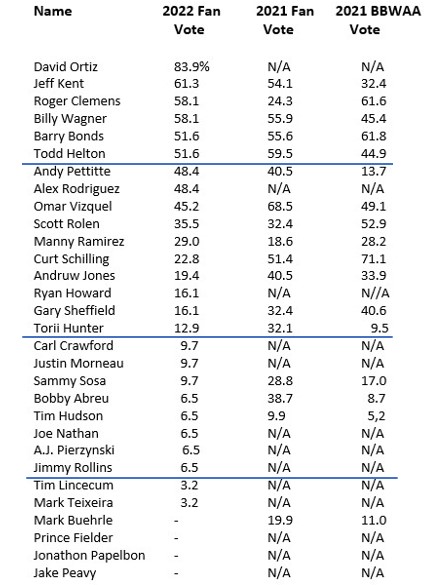
Baseball Roundtable Looks at the Early Baseball Era Hall of Fame Ballot

In early December the Baseball Hall of Fame’s Early Baseball Era (pre-1950) and Golden Days  Era Committees (1950-69) will each vote on a ballot of ten pre-screened candidates for 2022 induction into the HOF.  To be elected a candidate will need to secure at least 12 of the available 16 votes.  In this post, Baseball Roundtable will look at the Early Baseball Era candidates:

  • Indicating whom Baseball Roundtable would vote for if I had a ballot;
  • Profiling and ranking the candidates; and, finally,
  • Attempting to predict which candidate(s), the Committee will select.

For a Baseball Roundtable’s look at the Golden Days Era ballot, and more on the election process, click here.

A Statistical Word(s) of Caution

A  cautionary note, in case readers find what they feel are some discrepancies in the stats presented in this post.

When putting together these bios on Negro League and barnstorming players, there were often differences – both major and minor –  in reported stats.  For example, consider Dick “Cannonball” Redding. The Seamheads.com Negro League Database credits Redding with a record of 8-3 for the 1915 New York Lincoln Stars of the Eastern Independent Clubs League (and credits the Giants with a 24-14-2 record).  The Negro Leagues Baseball Museum profile, however, credits  Redding  with a 23-2 record for the Stars that season, including a 20-game winning streak (which is supported by the clip from the July 24, 1925 edition of the Chicago Defender – referenced in the Center for Negro League Baseball Research‘s Redding bio).  Why the difference?  Negro League teams, like Black players of the time, took games against opponents wherever they could showcase their talents, promote the game and generate revenue. The Seamheads’ stats appear to include only  league games, while the NLBM looked, as much as possible given record keeping in the era, at total contests (all levels of competition).   You can find a similar example in the case of Buck O’Neil: The Negro League Baseball Museum credits O’Neil with a .288 career average, Baseball-Refeence.com with a .283 average and the Seamheads.com Negro League Data Base .263.  As Baseball Roundtable put together this post, I looked at a variety of statistical and anecdotal sources.  Given the  lack of opportunity facing Black players in the period covered by the Early Baseball  ballot, I consistently leaned toward the Negro Leagues Baseball Museum’s profiles. 


BASEBALL ROUNDTABLE’S BALLOT …  IF I HAD ONE

  1. Buck O’Neil (Nov. 13, 1911 – October 6, 2006) … Professional Career: 1B/OF/Mgr., 1934-55

Photo: Public Domain via Wiki Commons.

Buck O’Neil getting my first vote is the only no-brainer  on this list – based on his career, his character and his contributions to the game.

O’Neil began his professional career touring with the Miami Giants in 1934 and also toured with the New York Tigers and Shreveport Acme Giants before signing with the Negro American League Memphis Red Sox in 1937 (although he later moved to the Zulu Cannibal  Giants).

In 1938, he joined the Kansas City Monarchs and remained with the franchise until 1955.  O’Neil also played in the Cuban League, Mexican Winter League and toured  and with the Satchel Page All Stars.

O’Neil led the Negro American League in batting average in 1946 at .353 and followed that up with a .358 average in 1947. Overall, he had four seasons of .330 or better.  He played in three Negro League All Star (East-West) Games and two Negro League World Series. As a manager, he led the Monarch to five Negro League Pennants.

O’Neil  later served as a scout and coach with the Chicago Cubs (the first Black coach in AL/NL history) and as a scout for the Kansas City Royals. He played a key role in the discovery and/or signing of such players as Lou Brock, Oscar Gamble, Lee Smith, Billy Williams and Ernie Banks.

Lou Brock on Buck O’Neil

“He shaped the character of young Black men. He touched the heart of everyone who loved the game. He gave us all a voice that could be hard on and off the field.”

O’Neil, who helped establish the Negro Leagues Baseball Museum, also gained recognition as one of the most eloquent spokesmen for (and advocate of) the national pastime – in particular the history of the Negro Leagues. Over the years, he cemented his reputation as an individual of great energy, spirit, integrity and character.– remaining consistently true to his passion for the game.

Here are just a few of the accolades O’Neil has already received.

  • 2006 … The Presidential Medal of Freedom.
  • 2007 … On the day of MLB’s first “Civil Rights Game,” O’Neil was awarded MLB’s first-ever Beacon of Life Award.
  • 2008 … the National Baseball Hall of Fame established the Buck O’Neil Lifetime Achievement Award – to honor individuals of character, integrity and dignity, who have enhanced baseball’s positive impact on society and broadened the game’s appeal. O’Neil, of course, was the first recipient.

2008 … Induction into the Baseball Reliquary Shrine of the Eternals.

2012 … Induction  into the Hall of Famous Missourians.

2016 … Kansas City’s Broadway Bridge was officially renamed the Buck O’Neil Bridge.

Despite these accolades , there is one well-deserved recognition that is  overdue.  Buck O’Neil belongs in the Baseball Hall of Fame.

  1. Vic Harris (January 10, 1905 – February 23, 1978) … Professional Career: OF/1B/Mgr., 1923-50

Photo: Public Domain via Wiki Commons.

Vic Harris gets Baseball Roundtable’s second vote for a combination of his exceptional playing career and, of notable impact on my decision, his seven Negro  League Championships as manager of the Homestead Grays.

Harris spent the bulk of his professional career with the Homestead Grays (23 seasons as a player and/or manager) – considered one of the elite franchises in Black baseball history.  He was a solid, slash hitter (.299 career average), a good fielder (known for his consistent hustle) and an aggressive base runner. Harris played in six  Negro League All Star (East-West) Games.  A few career highlights:

  • As a Negro Leagues rookie in 1923, Harris hit .304 for the Cleveland Tate Stars.
  • In 1929, he led the American Negro League in hitting, batting .333 for the Homestead Grays.
  • Playing for the Grays, he hit .324 in 1930, .348 in 1932; and .351 in 1933.
  • In 1934, he hit .360 for the Pittsburgh Crawfords.

Harris played with the Homestead Grays from 1925 to 1933.  In 1934, he moved to the  Pittsburgh Crawfords, but that lasted just one season. After his 1934 season with the Crawfords, Harris was convinced to rejoin the Homestead Grays as player-manager.  As a player, Harris hit .370 for the Grays in 1935 and .380 in 1938. As a manager he led the Grays to five seven  Negro League pennants. (He also managed the  Birmingham Black Barons for one season.) Harris also played and  managed in Cuba and Puerto Rico.

Among the teams Harris played for were the: Cleveland Tate Stars; Toledo Tigers; Cleveland Browns; Chicago American Giants; Homestead Grays; Detroit Wolves; and Pittsburgh Crawfords.

  1. John Wesley Donaldson  (February 20, 1891-April 14, 1970) … Professional Career: P/OF, 1908-41

John Wesley Donaldson
Photo: Courtesy of The Donaldson Network.

The number-three spot could easily have been a tie between two premier early Black hurlers –  John Wesley Donaldson and Dick “Cannonball” Redding. Donaldson gets a slight edge, as his accomplishment are, perhaps, the best-documented of any Black player of his era.

Baseball Roundtable first wrote about John Wesley Donaldson in November of 2016 after attending a presentation (before the Halsey Hall Chapter of the Society for American Baseball Research) by Peter Gorton, founder of the Donaldson Network – an organization dedicated to documenting Donaldson’s accomplishments and making the case for his election to the Baseball Hall of Fame. For that full story, click here.  Again, Thanks to the efforts of the Donaldson Network, Donaldson’s achievements – particularly on the mound –  are probably the best documented of any of the Black stars of his era.

Donaldson’s career stretched across four decades, during which time (like many Black players of his day), he took the mound pretty much anywhere he could draw a crowd and collect a paycheck. He played (and starred) for more than two dozen teams including the famous barnstorming All Nations Team, Brooklyn Royal Giants, Chicago America Giants, Los Angeles White Sox, New York Lincoln Giants, Indianapolis ABC’s, Detroit Stars and Kansas City Monarchs.  The southpaw – who possessed a good fastball and an exceptional assortment of drops and curves, is considered one of the top pitchers of his time.

Hall of Fame MLB Manager John McGraw on John Donaldson

“I think he is the greatest (pitcher) I have ever seen.”

The Donaldson Network has documented Donaldson’s appearance in more than 700 cities and towns in the U.S. and Canada – as well as:

  • 422 pitching victories;
  • 5, 177 strikeouts;
  • 14 no-hitters;
  • Two perfect games;
  • A 31-strikeout game; and
  • More than 20 games of 20 or more strikeouts.

On December 9, 1917, John Donaldson, then with the Los Angeles White  Sox, faced  lineup of all major leaguers. He pitched complete-game, six-hitter, striking out 16 in a 5-3 victory.

  1. Dick “Cannonball” Redding (April 15, 1890 -October 31, 1948) … Professional Career: P/OF/1B/Mgr.,  1911-38

Dick Redding’s overpowering fastball earned him the nickname “Cannonball” – and he lived up to it. Among his accomplishments (NLBM profile):

  • 30 no-hitters (multiple levels of competition);
  • 17 consecutive wins in his rookie season with the New York Lincoln Giants in 1911;
  • A 43-12 record, seven no-hitters, and 25 strikeouts in a nine-inning game for the Giants in 1912; and
  • A 20-game winning streak for the Lincoln Stars in 1915.

Redding was also known as a big-game pitcher who consistently  got the better of barnstorming major-league hitters.

Let’s Play Two

Dick Redding was considered a workhorse. His Negro Leagues Baseball Museum profile indicates he nearly always finished what he started, was more than willing to  pitch on back-to-back days and “often pitched doubleheaders two or three days in succession.”

Among the teams Redding pitched for were:  the Philadelphia Giants; New York Lincoln Giants; Indianapolis ABC’s; Brooklyn Royal Giants; Chicago American Giants; Atlantic City Bacharachs;  and New York Bacharachs. He served as a player-manager for the Atlantic City Bacharachs (1920-21) and the Brooklyn Royals (1927-33).  He also played in the Cuban Winter Leagues.

Sit Down Babe

Dick Redding once struck out Babe Ruth three times (on nine pitches) in a game against Ruth’s Barnstorming team (as noted in “Great Pitchers of the Negro Leagues,” by Paul Hoblin, SportsZone 2012).

Redding should meet the Babe again – in the HOF.

Now for the remainder of the ballot.

Actually, a pretty good case could be made for any of these players – but I could only choose four.

  1. Bill Dahlen (January 5, 1870 – December 5, 1950) … MLB Career: SS-3B, 1891-1911

How I wish I had one more vote.  It’s hard to pass on a player who played his last MLB game 110 years ago and still ranks among the top five shortstops all time in career assist and putouts.

Bill Dahlen was considered one of the finest  fielders and most aggressive base runners of his era. He also hit .272 over a 21-season MLB playing career,  with 84 home runs, 1,234 RBI, 1,590 runs scored and 548 stolen bases. He is 59th all-time in runs scored; 33rd in triples (163); and 28th in stolen bases (548). Dahlen scored 100+ runs in each of his first six seasons and 85 or more in a total of nine campaigns.

In 1894, Dahlen hit .359, with 15 home runs,  108 RBI and 150 runs scored and 43 steals. Overall, he hit .300 or better in three seasons  (twice over .350); stole 30 or more bases nine times (a high of 60 in 1892); and had double-digits in triples seven times.

In the field, Dahlen four times led NL shortstops in assists (and still ranks fourth all time with 7,505); finished in the top three among shortstops in putouts five seasons (and still ranks second all-time with 4,856); and led the league’s shortstops in double plays three times, finishing in the top three nine times.

Dahlen also managed the Brooklyn club for four seasons (1910-13), winning 251 and losing 355.

  1. Lefty O’Doul (March 4-1987-December 7, 1969) … MLB Career: P/OF, 1919-20, 1922-23, 1928-34

It’s somewhat surprising that Lefty O’Doul – with MLB’s sixth-highest career average is not yet in the Hall – the short span of his career seems the most likely reason (some early seasons spent on the mound also didn’t help his numbers).  I am sure there are plenty of readers out there who would question O’Doul being rated this low – and a case can be made.  The fact is, all these rankings are close (and subjective).

Lefty O’Doul played 11 MLB seasons, putting up a .349 career average with 113 home runs, 542 RBI, and 624 runs.  He won the NL batting title (and led MLB) with a .398 average in 1929 (Phillies) and again led MLB in 1932 with a .368 average (Dodgers). In his 1929 season, he also led MLB  with 254 hits (the third-most hits ever in an MLB campaign). That season O’Doul also bashed 32 home runs (fifth in the NL); drove in 122 (eighth); and scored 152 times (second in the league).

O’Doul started his career as a good-hitting pitcher. From 1919-23 (Giants and Red Sox), he appeared in 76 games, 34 as a pitcher, 41 as a  pinch hitter and one in the OF.  A 1-1, 4.87 record on the mound resulted in a return to the minors (Salt Lake City, Pacific Coast league) where, in 1924,  he hit .392 in 140 games and was 7-9, 6.54 on the mound.  A chronic sore arm led to his conversion to a full-time outfielder in 1925 – and between 1925 and 1927 (in the PCL), O’Doul  put up averages of .375 (198 games); .338 (180 games); and .378 (189 games). He earned a spot in the New York Giants outfield in 1928, hitting .319 in 114 games – and the rest is history.

O’Doul played in the majors for the Giants, Phillies, and Dodgers.

After his MLB playing career, O’Doul returned to the Pacific Coast League, managing the San Francisco Seals (1935-51), the San Diego Padres (1952-54), Oakland Oaks (1955), Vancouver Mounties (1956) and Seattle Rainiers (1957) – winning 2,094 games (1,970 losses) and two PCL championships.

O’Doul also played a notable role in building a base for baseball in Japan, making many trips to that country – both to create good will (through barnstorming teams of U.S. players) and to train Japanese players. He was credited with helping form the first Japanese professional league. He was the first American  inducted into the Japanese Baseball Hall of Fame (2002).  He is also a member of the San Francisco Bay Area Hall of Fame and the Baseball Reliquary Shrine of the Eternals.

  1. Bud Fowler (March 16, 1858-February 26, 1913) … Professional Career:  INF/OF/P,  1878-1899

Bud Fowler is acknowledged as the first African-American professional baseball player – playing on professional integrated teams as early 1878 (Lynn Live Oaks of the International Association). He is also recognized as the first African-American to captain an integrated team. Fowler was not just an accomplished defender, but a consistent (,300+) hitter.

In his early years, he pitched (and caught)  for teams in Worchester (New England Association); Malden (Eastern Massachusetts League); Guelph (Ontario); Petrolia, Texas; and Stillwater, Minnesota. After a 7-9 record at Stillwater in 1884 (some report it at 7-8, but that’s of little consequence), Fowler came up with a sore arm, prompting his transition to an infielder/outfielder. Between 1885 and 1894, Fowler played for at least 11 teams in nine different leagues – as well as for an independent Findlay, Ohio squad (where he also played from 1896-1899). Fowler’s movement from team to team was not because of his skills, but rather his color.  In Brian McKenna’s Society for American Baseball Research bio of Fowler, he quotes a Sporting Life article of the time as noting “With his splendid abilities he would long ago have been on some good club had his color been white instead of black. Those who know say there is no better second baseman in the country.”

Cooperstown Heritage

Bud Fowler grew up in Cooperstown,New York.

In 1887, Fowler organized the all-Black New York Gothams.  In 1895, Fowler helped organize the all-Black Page Fence Giants.   In that team’s first year, they went 118-36 and Fowler hit .319.   In 1898, Fowler played for the renowned  Cuban Giants. Shortly thereafter, he intensified his focus  on organizing barnstorming Black clubs like the Smoky City Giants (1901); All American Black Tourists (1903); and the Kansas City Stars (1904).

Fowler rates this high on this list both his baseball skills and his leadership and organizational abilities.

  1. George Scales (August 16, 1900-April 15, 1976) … Professional Career:  Inf/OF/Mgr., 1921-58

The versatile George Scales began his  career with the Montgomery Grey Sox in 1919 and went on to play with such squads as the Pittsburgh Keystones; St. Louis Giants; Saint Louis Stars; New York Lincoln Giants; Homestead Grays; Newark Stars; New York Black Yankees; Philadelphia  Stars; and the  Elite Giants.

Reviewing stats from a variety of sources, Scales had a career average of .313 over 25 seasons as a player, hitting  over .300 in 14 full-time seasons (nine of .340 or better, with two of those .400 or better).  Scales also played in Puerto Rico and Cuba and managed in Puerto Rico for a dozen seasons.  In Puerto Rico, he managed the  Ponce Lions for 10 seasons, delivering five pennants. (He also brought one pennant home to the Santurce team.)

Scales played a role in the organization of the New York Black Yankees in 1932 and was the team’s first manager. During his career, he also managed the Baltimore Elite Giants and Birmingham Black Barons.

  1. Grant “Home Run” Johnson (September 23, 1872-September 4, 1963) …Professional Career: SS/2B/Mgr., 1895-1923

Grant Johnson was one of Black baseball’s early stars – a feared slugger of the Dead Ball Era.  Like so many of the early Black baseball heroes, he played with many teams, going where he could showcase his skills and earn a living. He played with the Page Fence Giants; Chicago Columbia Giants; Chicago Unions; Cuban-X Giants; Brooklyn Royal Giants;  LeLand Giants; Chicago Giants; New York Lincoln Giants; Mohawk Giants; New York Lincoln Stars; Pittsburgh Colored Stars of Buffalo; and Buffalo Giants.

Grant was known not only as a disciplined and powerful hitter, but also  a fine fielder and  a natural leader – often managing the teams he played on.  A few highlights from his NLBM profile:

  • In 1895, hit .471 as his Page Fence team went 118-36;
  • He starred in the Cuban Winter league – captaining the Havana Reds and averaging .319 over five seasons and becoming the first American to win the Cuban batting title;
  • He served as captain of the Brooklyn Royals for several seasons;
  • Playing against all level of competition for the New York Lincoln Giants from 1911-13, he put up averages of .374; .413 and .371;
  • In 1894, hit 60 home runs in 112 games for the aptly-named semipro Findlay (Ohio) Sluggers.
  1. Allie Reynolds (February 10, 1917-December 26, 1994) … MLB career: RHP,  1942-54

Allie Reynolds  pitched in 13 MLB seasons, going 182-107, with a 3.30 ERA and 1,423 strikeouts in 2,492 1/3 innings pitched.  He was a five-time All Star, a 20-game winner once (20-8, 2.06 for the 1952 Yankees). He also led the AL twice in shutouts, twice in strikeouts and once in strikeouts per nine innings.

He was known as a “big-game” pitcher. In 15 World Series mound appearances (nine starts), he went 7-2, 2.79 with five complete games and two shutouts. His big-game reputation also followed him to the plate, despite a .163 career batting average, Reynolds hit .306 in 28 World Series plate appearances.

From 1943 through 1954  Reynolds won at least 11 games every year, winning 16 or more in seven seasons.   An “ace” for  the Yankees, Reynolds had his career cut short by a  back injury suffered in a team bus accident in 1953,

What Does Baseball Roundtable Think the Committee Will Do

I anticipate that Buck O’Neil will be elected and would not be surprised if the other candidates split up the votes enough that no one else get the 12 needed endorsements.  My dark horses for election would be John Donaldson (because of the level of documentation) and Lefty O’Doul (two batting titles and a season of 254 hits.) 

Primary Resources: Baseball-Reference.com; Negro League Baseball Museum player profiles; “Dick Redding” by Tim Hagerty, SABR Bio;  “Give Them The heaters – The Dick Redding Story,” by David Barr (November 21, 2017); “Forgotten Heroes: Dick ‘Cannonball;’ Redding,” Dr. Layton Revel & Luis Munoz, Center for Negro League Baseball Research: “Lefty O’Doul, “by Brian McKenna, SABR Bio; “Bud Fowler,” by Brian McKenna; SABR Bio.  


100Baseball Roundtable is on the Feedspot list of the Top 100 Baseball Blogs.  To see the full list, click here.

I tweet baseball @DavidBBRT

Follow/Like Baseball Roundtable’s Facebook Page here.  More baseball commentary; blog post notifications; PRIZES.

Member: Society for American Baseball Research (SABR); Negro Leagues Baseball Museum; The Baseball Reliquary. 
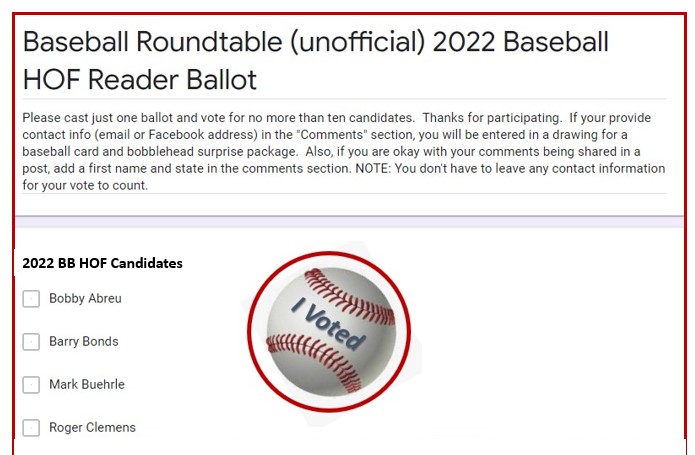
Heavy Metal Club … New Members Marcus Semien and Max Fried

Regular readers know that Baseball Roundtable has a particular fondness for players that bring “lumber and leather” to their game. This post/update (an annual BBRT tradition) will focus on players who have captured what the Roundtable sees as baseball’s “Heavy Metal Doubleheader” – winning a Silver Slugger and Gold Glove in the same season.  You have to admire those players who can earn recognition as the best at their positions both defensively and offensively.

Note: The Hillerich and Bradsby Silver Slugger Awards were first presented in 1980 (the Rawlings Gold Glove Awards were launched in 1957), so the list of double winners is relatively recent (at least  “recent” as defined by someone who went to their first World Series game the year the Gold Glove Awards were initiated).

In 2021, two players achieved “Heavy Metal” status, Blue Jays’ second baseman Marcus Semien and Braves’ pitcher Max Fried.  Let’s look at their 2021 Heavy Metal seasons.

Marcus Semien, 2B, Blue Jays

Marcus Semien’s Heavy Metal campaign encompassed a lot of ‘firsts” for the 30-year-old infielder. While it came in his ninth MLB season, it:

  • Represented Semien’s first Gold Glove and first Silver Slugger Awards;
  • Came in Semien’s first season as a Blue Jay (he signed as a free agent with the Jays in January 2021);
  • Was his first season as a regular at second base. (147 games at the keystone sack, 21 at SS). In his previous eight seasons, he had played  775 games at shortstop and just 29 at second base.

So, let’s look at the performance that punched his ticket into the Roundtable’s Heavy Metal Club.

On the offensive side, Semien hit .265, with 45 home runs (fourth in the AL); 102 RBI (tenth); and 115 runs scored (fourth). He also led the AL in extra base hits (86 … 39 doubles, two triples, 45 homers) and finished second in total bases (351).  He even threw in 15 steals (in 16 attempts). Quite an offensive year for a middle infielder, but not a surprise. In the 2019 seasons, Semien went .285-33-92 for the A’s.

Marcus Semien’s 45 home runs in 2021 are MLB’s most -ever in a season for a player who played primarily at second base. Of those 45 blasts, 41 were as a second basement and four as a shortstop.  Second on the list is Davey Johnson (1973 Braves) with 43 long balls (42 as a second basemen, one as a pinch hitter).

On defense, Semien was third among AL second basemen in Defensive Runs Saved with 11, first in Defensive Wins Above Replacement (1.8) and first in Zone Runs Saved (18). He was also third among AL second baseman in  putouts (202), fourth in assists (317) and second in double plays (86).

Max Fried, LHP, Braves

Fried won his second consecutive G0ld Glove and his first Silver Slugger Award.

At the plate, Fried hit .273 (15-for-55), with three doubles and five RBI. Notably, he was skilled enough with the bat to be used four times as a pinch hitter – going two-for-two (with a walk and a sacrifice)

On Defense, Fried led all NL pitchers in Defensive Runs Saved (six) and was second in pick offs (six).  He also led NL pitchers in assists (37) for the third straight season and was first in Range Factor (1.61). He made just one error in 45 chances.


–A ADDITIONAL BITS OF SAME-SEASON SS/GG TRIVIA–

  • The Chicago White Sox are the only team to never have a player capture a Silver Slugger Award and Gold Glove in the same season.
  • The most players to achieve the GG/SS combo in a season is nine – back in 1984: Lance Parrish, C, Tigers; Keith Hernandez, 1B, Mets; Eddie Murray, 1B, Orioles; Ryne Sandberg, 2B, Cubs; Lou Whitaker, 2B, Tigers; Mike Schmidt, 3B, Phillies; Buddy Bell, 3B, Rangers; Dave Winfield, OF, Yankees; Dale Murphy, OF, Braves.
  • Roberto Alomar (2B) is the only player to win the single-season Gold Glove/Silver Slugger combo with three different teams (Blue Jays-1992; Orioles-1996; Indians-1999, 2000).
  • Scott Rolen (3B) and Zack Greinke are the only players to win the SS/GG combo in a season in which they played for two different teams. In 2002, Rolen was traded from the Phillies to the Cardinals on July 29. He played 100 games for the Phillies and 55 for the Cardinals in what would be his only SS/GG combo season.  Greinke did it in 2019, , when he started the season with the Diamondbacks and was traded to the Astros at the July deadline. Despite moving to the AL with its DH, Geinke’s .280-3-8 season was goo enough to earn him a Silver Slugger.
  • The only team to have three SS/GG winners in the same season is the 1993 Giants (Robby Thompson (2B), Matt Williams (3B), Barry Bonds (OF).

Zack Greinke (2019 Diamondbacks/Astros), Mike Hampton (2003 Braves) and Max Fried (2021 Braves) are the only pitchers to win a Silver Slugger and Gold Glove in the same season. 

__________________________________________________________________

HM Streak

____________________________________________________________

Now that we’ve looked at 2021’s “Heavy Metal” honorees, here’s a look back at those who have won both awards in the same season in the past.  Since 1980, the combination of a Gold Glove/Silver Slugger has been achieved in a season 197 times by 106 different players – with 39 players accomplishing the feat more than once and 26 of those winning two or more consecutive SS/GG combinations.   Here are a couple of lists that might be of interest.  (Note: Since the Silver Slugger is awarded to three outfielders annually regardless of their position, the GG/SS combo lists in this post do not break outfielders out by position.)

—Full List of Same-Year Gold Glove/Silver Slugger Winners by Season—

2021

Marcus, Semien, 2B, Blue Jays

Max Fried, P, Braves

2020

Mookie Betts,RF, Dodgers

2019

J.T. Realmuto, C, Phillies; Mookie Betts, RF, Red Sox; Cody Bellinger, RF, Dodgers; Zack Greinke, P, D-backs/Astros

2018

Nolan Arenado, 3B, Rockies; Mookie Betts, OF, Red Sox; Nick Markakis, OF, Braves; Salvador Perez, C, Royals

2017

Nolan Arenado, 3B, Rockies; Paul Goldschmidt, 1B, Diamondbacks; Eric Hosmer, 1B, Royals; Marcell Ozuna, OF, Marlins

2016

Nolan Arenado, 3B, Rockies; Mookie Betts, Of, Red Sox; Salvador Perez, C, Royals; Anthony Rizzo, 1B, Cubs

2015

Jose Altuve, 2B, Astros; Paul Goldschmidt, 1B, Diamondbacks; Dee Gordon, 2B, Marlins; Nolan Arenado, 3B, Rockies; Brandon Crawford, SS, Giants.

2014

Adrian Gonzalez, 1B, Dodgers

2013

Yadier Molina, C, Cardinals; Paul Goldschmidt, 1B, Diamondbacks; J.J. Hardy, SS, Orioles; Adam Jones, OF, Orioles

2012

Adam LaRoche, 1B, Nationals; Robinson Cano, 2B, Yankees; Chase Headley, 3B, Padres; Andrew McCutchen, OF, Pirates

2011

Adrian Gonzalez, 1B, Red Sox; Brandon Phillips, 2B, Reds; Adrian Beltre, 3B, Rangers; Troy Tulowitzki, SS, Rockies; Jacob Ellsbury, OF, Red Sox; Matt Kemp, OF, Dodgers

2010

Joe Mauer, C, Twins; Albert Pujols, 1B, Cardinals; Robinson Cano, 2B, Yankees; Troy Tulowitzki, SS, Rockies; Carl Crawford, OF, Rays; Carlos Gonzalez, OF, Rockies

2009

Joe Mauer, C, Twins; Mark Tiexiera, 1B, Yankees; Ryan Zimmerman, 3B, Nationals; Derek Jeter, SS, Yankees; Matt Kemp, OF, Dodgers; Ichiro Suzuki, OF, Mariners; Torii Hunter, OF, Angels

2008

Joe Mauer, C, Twins; Dustin Pedroia, 2B, Red Sox; David Wright, 3B, Mets; Grady Sizemore, OF, Indians

2007

Russell Martin, C, Dodgers; Placido Polanco, 2B, Tigers; David Wright, 3B, Mets; Jimmy Rollins, SS, Phillies; Carlos Beltran, OF, Mets; Ichiro Suzuki, OF, Mariners

2006

Derek Jeter, SS, Yankees; Carlos Beltran, OF, Mets

2005

Jason Varitek, C, Red Sox; Mark Tiexierea, 1B, Rangers; Derrek Lee, 1B, Cubs; Andruw Jones, OF, Braves

2004

Ivan Rodriguez, C, Tigers; Jim Edmonds, OF, Cardinals

2003

Brett Boone, 2B, Mariners; Edgar Renteria, SS, Cardinals; Alex Rodriguez, SS, Rangers; Mike Hampton, P, Braves

2002

Todd Helton, 1B, Rockies; Scott Rolen, 3B, Cardinals/Phillies; Eric Chavez, 3B, A’s; Edgar Renteria, SS, Cardinals; Alex Rodriguez, SS, Rangers

2001

Todd Helton, 1B, Rockies; Ichiro Suzuki, OF, Mariners

2000

Roberto Alomar, 2B, Indians; Darin Erstad, OF, Angels

1999

Ivan Rodriguez, C, Rangers; Robert Alomar, 2B, Indians; Larry Walker, OF, Rockies; Ken Griffey, Jr., OF, Mariners; Shawn Green, OF, Blue Jays

1998

Ivan Rodriguez, C, Rangers; Rafael Palmeiro, 1B, Rangers; Ken Griffey, Jr. OF, Mariners

1997

Ivan Rodriguez, C, Rangers; Craig Biggio, 2B, Astros; Chuck Knoblauch, 2B, Twins; Matt Williams, 3B, Indians; Larry Walker, OF, Rockies; Barry Bonds, OF, Giants; Ken Griffey, Jr, OF, Mariners

1996

Ivan Rodriguez, C, Rangers; Roberto Alomar, 2B, Orioles; Ken Caminiti, 3B, Padres; Barry Larkin, SS, Reds; Barry Bonds, OF, Giants; Ken Griffey, Jr. OF, Mariners

1995

Ivan Rodriguez, C, Rangers; Craig, Biggio, 2B, Astros; Barry Larkin, SS, Reds

1994

Ivan Rodriguez, C, Rangers; Jeff Bagwell, 1B, Astros; Craig Biggio, 2B, Astros; Matt Williams, 3B, Giants; Wade Boggs, 3B, Yankees; Barry Bonds, OF, Giants; Ken Griffey, Jr., OF, Mariners

1993

Robby Thompson, 2B, Giants; Matt Williams, 3B, Giants; Jay Bell, SS, Pirates; Barry Bonds, OF, Giants; Ken Griffey, Jr, OF, Mariners

1992

Roberto Alomar, 2B, Blue Jays; Larry Walker, OF, Expos; Andy Van Slyke, OF, Pirates; Barry Bonds, OF, Pirates; Kirby Puckett, OF, Twins

1991

Will Clark, 1B, Giants; Ryne Sandberg, 2B, Cubs; Cal Ripken, Jr., SS, Orioles; Barry Bonds, OF, Pirates’ Ken Griffey, Jr., OF, Mariners

1990

Benito Santiago, C, Padres; Ryne Sandberg, 2B, Cubs; Kelly Gruber, 3B, Blue Jays; Barry Bonds, OF, Pirates; Ellis Burks, OF, Red Sox

1989

Ryne Sandberg, 2B, Cubs; Eric Davis, OF, Reds; Kirby Puckett, OF, Twins; Tony Gwynn, OF, Padres

1988

Benito Santiago, C, Padres; Ryne Sandberg, 2B, Cubs; Andy Van Slyke, OF, Pirates; Kirby Puckett, OF, Twins

1987

Don Mattingly, 1B, Yankees; Ozzie Smith, SS, Cardinals; Tony Gwynn, OF, Padres; Eric Davis, OF, Reds; Kirby Puckett, OF, Twins; Andre Dawson, OF, Cubs

1986

Don Mattingly, 1B, Yankees; Frank White, 2B, Royals; Mike Schmidt, 3B, Phillies; Tony Gwynn, OF, Padres; Kirby Puckett, OF, Twins

1985

Don Mattingly, 1B, Yankees; Ryne Sandberg, 2B, Cubs; Lou Whitaker, 2B, Tigers; Tim Wallach, 3B, Expos; George Brett, 3B, Royals; Willie McGee, OF, Cardinals; Dale Murphy, OF, Braves; Dave Winfield, OF, Yankees

1984

Lance Parrish, C, Tigers; Keith Hernandez, 1B, Mets; Eddie Murray, 1B, Orioles; Ryne Sandberg, 2B, Cubs; Lou Whitaker, 2B, Tigers; Mike Schmidt, 3B, Phillies; Buddy Bell, 3B, Rangers; Dave Winfield, OF, Yankees; Dale Murphy, OF, Braves

1983

Lance Parrish, C, Tigers; Eddie Murray, 1B, Orioles; Lou Whitaker, 2B, Tigers; Mike Schmidt, 3B, Phillies; Dale Murphy, OF, Braves; Dave Winfield, OF, Yankees; Andre Dawson, OF, Expos

1982

Gary Carter, C, Expos; Mike Schmidt, 3B, Phillies; Robin Yount, SS, Brewers; Dale Murphy, OF, Braves; Dave Winfield, OF, Yankees

1981

Gary Carter, C, Expos; Manny Trillo, 2B, Phillies; Mike Schmidt, 3B, Phillies; Andre Dawson, OF, Expos; Rickey Henderson, OF, A’s; Dwight Evans, OF, Red Sox; Dusty Baker, OF, Dodgers

1980

Keith Hernandez, 1B, Cardinals; Cecil Cooper, 1B, Brewers; Andre Dawson, OF, Expos; Willie Wilson, OF, Royals

_________________________________________

If you want to look up your favorite player(s), here is:

Your Same-Season, Gold Glove/Silver Slugger combo winners listed alphabetically:

Alomar, Roberto … 1992; 1996; 1999; 2000

Altuve, Jose … 2015

Arenado, Nolan … 2015; 2016; 2017; 2018

Baker, Dusty … 1981

Bagwell, Jeff … 1994

Bell, Buddy … 1984

Bell, Jay (SS) … 1993

Cody Bellinger … 2019

Beltre, Adrian (3B) … 2011

Beltran, Carlos (OF) … 2006; 2007

Biggio, Craig (2B) … 1994; 1995; 1997

Betts, Mookie (OF) … 2016; 2018; 2019; 2020

Boggs, Wade (3B) … 1994

Bonds, Barry … 1990; 1991; 1992; 1993; 1994; 1996; 1997

Boone, Brett … 2003

Brett, George … 1985

Burks, Ellis … 1990

Caminiti, Ken … 1996

Cano, Robinson … 2010; 2012

Carter, Gary … 1981; 1982

Chavez, Eric … 2002

Clark, Will … 1991

Cooper, Cecil …1980

Crawford, Brandon … 2015

Crawford, Carl … 2010

Dawson, Andre … 1980; 1981; 1983; 1987

Davis, Eric … 1987; 1989

Edmonds, Jim … 2004

Ellsbury, Jacob … 2011

Erstad, Darin … 2000

Evans, Dwight … 1981

Fried, Max … 2021

Goldschmidt, Paul … 2013; 2015; 2017

Gonzalez, Adrian … 2011; 2014

Gonzalez, Carlos … 2010

Gordon, Dee … 2015

Green, Shawn … 1999

Greinke, Zack … 2019

Griffey, Ken Jr. … 1991; 1993; 1994; 1996; 1997; 1998; 1999

Gruber, Kelly … 1990

Gwynn, Tony … 1986; 1987; 1989

Hampton, Mike … 2003

Hardy, J.J. … 2013

Headley, Chase … 2012

Helton, Todd … 2002

Henderson, Rickey … 1981

Hernandez, Keith … 1980; 1984

Eric Hosmer … 2017

Hunter, Torii … 2009

Jeter, Derek … 2006; 2009

Jones, Adam … 2013

Jones, Andruw … 2005

Kemp, Matt … 2009; 2011

Knoblauch, Chuck … 1997

Larkin, Barry … 1995; 1996

LaRoche, Adam … 2012\

Lee, Derrek … 2005

Markakis, Nick … 2018

Martin, Russell … 2008\

Mattingly, Don … 1985; 1986; 1987

Mauer, Joe … 2008; 2009; 2010

McCutchen, Andrew … 2012

McGee, Willie … 1985

Molina, Yadier … 2013

Murphy, Dale … 1982; 1983; 1984; 1985

Murray, Eddie … 1983; 1984

Marcell Ozuna … 2017

Polanco, Placido … 2007

Palmeiro, Rafael … 1998

Parrish, Lance … 1983; 1984

Pedroia, Dustin … 2008

Salvador, Perez … 2016; 2018

Phillips, Brandon … 2011

Puckett, Kirby … 1986; 1987; 1988; 1989; 1992

Pujols, Albert … 2010

J.T. Realmuto … 2019

Renteria, Edgar … 2002

Ripken, Cal, Jr. … 1991

Anthony Rizzo … 2016

Rodriguez, Alex … 2002; 2003

Rodriguez, Ivan … 1994; 1995; 1996; 1997; 1998; 1999; 2004

Rolen, Scott … 2002

Rollins, Jimmy … 2007

Sandberg, Ryne … 1984; 1985; 1988; 1989; 1990; 1991

Santiago, Benito … 1988; 1990

Schmidt, Mike … 1981; 1982; 1983; 1984; 1986

Sizemore, Grady … 2008

Semien, Marcus, 2021

Smith, Ozzie … 1987

Suzuki, Ichiro … 2001; 2007; 2009

Thompson, Robby … 1993

Tiexiera, Mark … 2005, 2009

Trillo, Manny … 1981

Tulowitzki, Troy … 2010; 2011

Van Slyke, Andy … 1988; 1992

Varitek, Jason … 2005

Walker, Larry … 1992; 1997; 1999

Wallach, Tim … 1985

White, Frank … 1986

Whitaker, Lou … 1983; 1984; 1985

Williams, Matt … 1993; 1994; 1997

Wilson, Willie … 1980\

Winfield, Dave … 1982; 1983; 1984; 1985

Wright, David … 2007; 2008

Yount, Robin … 1982

Ryan Zimmerman … 2009

Primary Resources:  Baseball-Reference.com; MLB.com; FanGraphs.com

100Baseball Roundtable is on the Feedspot list of the Top 100 Baseball Blogs.  To see the full list, click here.

I tweet baseball @DavidBBRT

Follow/Like Baseball Roundtable’s Facebook Page here.  More baseball commentary; blog post notifications; PRIZES.

Member: Society for American Baseball Research (SABR); Negro Leagues Baseball Museum; The Baseball Reliquary. 
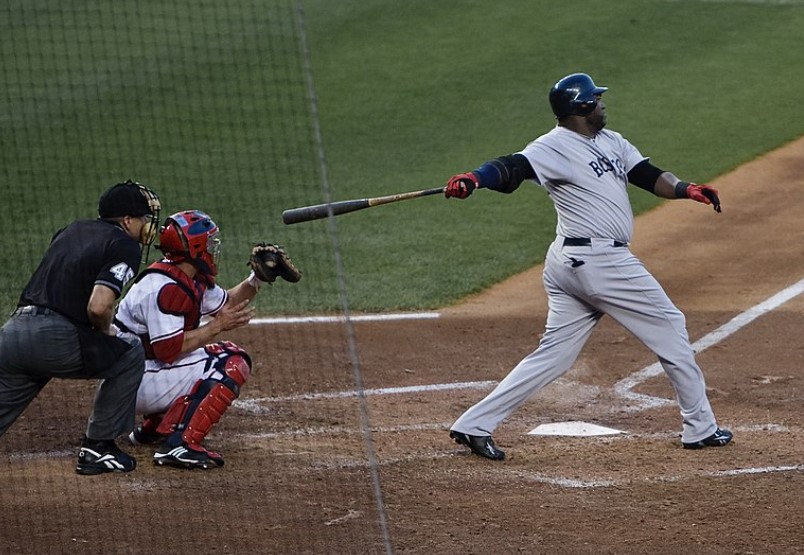
Baseball Roundtable Looks at the Hall of Fame Golden Days Era Candidates

. .

The Baseball Hall of Fame recently announced its candidates for 2022 election by the Golden Days  Era (1950-69) and  the Early Baseball Era (pre-1950) Committees. Voting will take place December 5 for 2022 induction.   In this post, Baseball Roundtable will take a look at the Golden Days Era candidates,  sharing:

  • What Baseball Roundtable’s Golden Days Era ballot would look (if I had one); and
  • Bios, comments and Roundtable rankings for all ten candidates;
  • A thought on what the Golden Days Era Committee might do.

In the coming days, I will do the same for the slate of Early Baseball ERA candidates.

Selecting from among the Golden Days Era candidates proved particularly challenging for several reasons:

  • Since the candidates were pre-screened by an Historical Overview Committee, they all could boast some deserving achievements and attributes;
  • Since I grew up in the Golden Era, I was able to see all the nominated players on the field – and find my choices mixing emotion with reason; and
  • The members of the committee are only allowed to vote for a maximum of four candidates and I limited myself to that same restriction.

The ERA Committees – Background

By way of background, the Hall of Fame Era Committees consider candidates passed over for election to the HOF in the annual Baseball Writers Association of America balloting. The current committees, which meet on a rotating basis are the: Early Baseball Era (prior to 1950);  Golden Days Era (1950-69); Modern Baseball Era (1970-87); and Today’s Game Era (1988 forward). Players to appear on each year’s ballot are selected by an Historical Overview Committee and then are considered by a 16-member Era Committee. Candidates must receive 75 percent support (12 votes) from Era Committee members to achieve election. Candidates whose careers overlap eras are considered on the basis of the time frame in which they made their most significant contributions to the national pastime.

Of the ten candidates  on this year’s Golden Days Era ballot – eight  are returnees from the 2014 Committee ballot (when no candidates were elected):  Dick Allen; Tony Oliva; Jim Kaat; Maury Wills; Minnie Minoso; Gil Hodges; Ken Boyer; and Billy Pierce. Newcomers to the ballot include: Roger Maris and Danny Murtaugh.

HOW BBRT WOULD VOTE IF I HAD A   BALLOT

Let me say, having been born in 1947, I grew up watching most of the candidates on the field.   I have fond memories of Tony Oliva’s knees bent-in stance – and ability to hit pretty much any pitch (in or out of the strike zone);  the drama of the Roger Maris/Mickey Mantle 1961 chase for Babe Ruth’s single-season home run record; the Go-Go White Sox, shaped in part by Minnie Minoso’s speed and never-waning hustle; Danny Murtaugh’s Pirates’  unexpected upset of the Yankees in the 1960 World Series; Maury Wills’ daring on the bases;  Dick Allen’s fierce presence and personality on and off the field; the ability of Gil Hodges and Ken Boyer to change a game with their bats or their gloves; and the way southpaws Jim Kaat and Billy Pierce filled the role of staff “ace” for the Twins and White Sox, respectively.   In rating all these candidates, I did my best to focus on exceptional performance in relation to their Golden Days Era peers – league leadership in key statistical categories, All Star selections, individual awards (Rookie of the Year, Cy Young, MVP, etc.).  I recognize that my selections, which I will present in priority order, may make me look like a bit of a “homer.” (My home base is  Minnesota and two of my top three selections are former Twins.) I do, however, think my reasoning will stand up to scrutiny – and those two candidates were among the top three cote-getters in 2014.

Now, let’s start with the three players, Baseball Roundtable considered no-brainers when deciding how I would vote if I was on the committee.

  1. Jim Kaat (LHP, 1959-83)

Photo: Public Domain via Wiki Commons

Jim Kaat is at the top of my list of players not in the Hall of Fame who should be.  Consider, the southpaw took the big-league mound in 25 seasons; his 283 wins  (237 losses) are 31st all time; his 2,461 strikeouts 44th.   (More than 50 pitchers currently in the HOF have fewer career wins than Kaat.)

A three-time All Star, Kaat won 20 or more games in three-seasons, leading the AL in wins with 25 in 1966.  Kaat also is among MLB’s top 25 hurlers in games started (625, 17th), innings pitched (4,530 1/3, 25th). Then, of course, there are his 16 Gold Gloves (tied with 3B Brooks Robinson) and second only to Greg Maddux for the most Gold Gloves all time. Further, Jim Kaat and Brooks Robinson share the record for consecutive Gold Gloves at 16.

One of the criticisms of Kaat raised during regular BBWAA balloting was that he his win total was inflated by the length of his career (Kaat average 11.3 wins per season over 25 seasons).  From a different perspective, BBRT believes the fact the Kaat had the skills and determination to compete on the major league level from age 20 to age 44 contributes to his Hall of Fame credentials.

In the 2014 Era Committee balloting, Kaat got ten of the necessary 12 votes for election. This should be his year.

Breaking the String – A Piece of Jim Kaat Trivia

From 1972 through 1986,  Steve Carlton started 14 of the 15 Phillies’ Opening Day games. The one year he missed (1976) cost him the record for consecutive Opening Day starts and consecutive opening Day starts for the same team. The pitcher who interrupted the streak was Jim Kaat – a three-time 20-game winner, and a 20-game winner and All Star the year before (for the White Sox). Carlton started the second game of the season.

Jim Kaat played for the: Washington Senators/Minnesota Twins (1959-73); Chicago White Sox (1973-75); Philadelphia Phillies (1976-79); New York Yankees (1979-1980); Saint Louis Cardinals (1980-83).

Jim Kaat’s Best Season: 1966 Twins … A league-leading 25 wins (13 losses), with a 2.75 ERA. That season, Kaat also led the AL in starts (41) and complete games (19). Kaat might have that all-important Cy Young Award on his HOF resume, except for the fact that MLB gave out only one CYA in 1966 (the move to a CYA for each league came the following year) and it went to National Leaguer Sandy Koufax (27-9, 1.73 for the Dodgers).

  1. Minnie Minoso (OF/3B, 1946-49, 1951-64, 1976, 1980)*

*Minoso made brief publicity-focused appearances for the White Sox in 1976 and 1980 – which allowed him to appear in MLB in five different decades.

Photo: Bowman Gum, Public domain, via Wikimedia Commons

In his first full American League  season (split between the Indians and the White Sox), the 25-year-old Minoso hit .326, leading the AL in triples (14), stolen bases (31) and hit by pitch (16) – finishing second to Yankees’ infielder  Gil McDougald in the Rookie of the Year balloting. Minoso had previously played three seasons in the Negro Leagues (111) games, averaging .313, with nine home runs, 66 RBI and 11 stolen bases. He was the starting 3B in the 1948 and 1948 Negro Leagues East-West All Star Games, before joining the Indians in 1949.

Minoso enjoyed  a 20-season MLB career in which he made nine All Star squads (two Negro League, seven American League), earned three Gold Gloves, led the AL in hits once, doubles once, triples three times, stolen bases three times, total bases once and hit by pitch an MLB-record ten times. He finished with 2,110 hits and a .299 average (topping .300 ten times), 195 home runs (hitting 20+ in a season four times), 1,225 runs (scoring more than 100 runs in a season four times), 1,093 RBI (besting 100 four times) and 216 stolen bases. In addition to those offensive marks, Minoso also led AL left fielders in assists six times, putouts four times and double plays four times.  Minoso was well into his career when the Rawlings Gold Glove Awards were established in 1957; yet he still earned Gold Gloves 1957, 1959 and 1960.

Adding to Minoso’s Hall of Fame resume is the fact that he was a groundbreaking “Black Latino” in major league baseball; bringing additional pressure and significance to his on- and off-field performance and persona.  Minoso was the first player of color for the Chicago White Sox (and quickly won over ChiSox fans with his constant hustle), the first Black Cuban to play in the major leagues and the first Cuban to play in the AL/NL All Star game.  His baseball legacy is further enhanced by the fact that he also  played and starred in the Cuban League. He is a member of the Cuban Baseball Hall of Fame; the Latino Baseball Hall of Fame; the Hispanic Heritage Hall of Fame;  The Baseball Reliquary Shrine of the Eternals; and the Negro Leagues Baseball Museum Jackie Robinson Lifetime Achievement Award.

All of this would earn Minoso Baseball Roundtable’s vote for the Hall – plus I’d like to see his full name Saturnino Orestes Armas (Arrieta) Minoso on that HOF plaque.  Minoso got eight votes in the ERA Committee 2014 balloting.

Minnie Minoso played for: New York Cubans (1946-48); Cleveland Indians (1949, 1951, 1958-59); Chicago White Sox (1951-57, 1961, 1964, 1976, 1980); Saint Louis Cardinals (1962); Washington Senators (1963).

Minnie Minoso’s Best Season:  1954 Chicago White Sox … 153 games, .320 average, 182 hits, 29 doubles, 18 triples (league-leading), 19 home runs, 119 runs scored, 116 RBI, 18 stolen bases.

  1. Tony Oliva (OF-DH, 1962-76)

Photo: Public Domain via Wiki Commons

Okay, having two former Twins on my ballot may make me look like a “homer,” but hear me out.  First, it’s ironic that Jim Kaat’s HOF qualifications have been criticized in the past because his career was too long (283 wins over 25 seasons), while Oliva’s HOF credentials have been criticized because – due to injury – his productive career was too short (only 11 seasons out of 15  in which he played at least 125 games, only seven of 140 games or more).

Oliva gets BBRT’s vote because, when he played, he was simply one of the best. In his first eight seasons full seasons (1964-71), he made the All Star team every year.  During that span he produced an annual average of 182 hits (.313 batting average), 22 home runs, 89 runs scored, 90 RBI and ten stolen bases.  During those seasons, Oliva won three batting titles and led the AL in hits  five times. Over his last five seasons, he was hampered by bad knees (eight knee operations) – averaging 96 games per season, with a .278 batting average.

As noted,  Oliva won three batting titles. He led the American League in hits in his first three full seasons and a total of five times. He also led the AL in doubles four times, and topped the AL one time each in runs scored, slugging percentage, total bases and intentional walks.   Tony-O also showed speed on the bases, finishing in double-digits in steals six times, with a high of 19 in 1965.  In his first eight seasons, he received MVP votes every year, finishing in the top six four times. Between 1964 and 1971, He also lead AL right fielders in putouts five times, in assists  twice and in double plays (three times).

Oliva also was a “’plus” defender with a rifle arm in right field, capturing a Gold Glove in 1966.

Oliva played in 15 major-league seasons, retiring with a .304 career average, 1,917 hits, 220 home runs, 870 runs scored and 947 RBI.  He received 11 of the needed 12 votes in the 2014 Era Committee balloting.

While critics might point to the fact that (again due to injury), Oliva’s career included  just 11 seasons in which he played 100+ games and just eight All Star campaigns, Baseball Roundtable would note that the Hall has acknowledge players whose career totals were also impacted by injury issues such as Ralph Kiner  (ten career seasons, six-time All Star) and Sandy Koufax (12 career seasons, six-time All Star.) I believe Oliva’s peak years, three batting titles and five season leading the AL in bits have earned him this vote.)

Tony Oliva played for:  Minnesota Twins (1962-76)

Tony Oliva’s Best Season:  In 1964, 25-year-old rookie, Tony Oliva led the AL in batting average (.323); hits (217); run scored (109); doubles (43); and total bases (374). His nine triples were third in the AL; his 32 home runs sixth; his 94 RBI ninth. He also led AL rightfielder in putouts. He finished fourth in the AL MVP voting. Oliva did not fall prey to the “sophomore jinx.” The following season, he again led the AL in hits and batting average, led the league’s right fielders  in putouts and was second in assists.

______________________________________

I debated on exercising a fourth vote (as allowed to Era Committee members – and once I decided there were additional worthy candidates, I was able to limit my consideration to two – Dick Allen and Gil Hodges.  It was close, but I would give my fourth vote to Allen.

__________________________________________

  1. Dick Allen (1B/3B, 1963-77)

Dick Allen’s traditional HOF candidacy suffered from a combination of career-shortening injuries and career-complicating controversy.  The fact is, Allen had a fierce presence and demeanor both on and off the field.  It is his on-the-field performance – specifically his at-the-plate performance – that earns Allen BBRT’s Golden Days vote. It is generally agreed that none of his peers hit the ball as consistently hard as Allen did in the pitching-dominated 1960s.

Allen came on with a bang, as a 22-year-old,  in his first full MLB season, leading the NL in runs scored (125), triples (13) and total bases (352), while hitting .318 with 29 home runs and 91 RBI.  His performance earned him the Rookie of the Year Award.  He went on to a 15-year MLB career, during which he was a seven-time All Star and collected 1,848 hits, 351 home runs and 1,119 RBI.  His career batting average was .292, and he topped .300 seven times.  He led the NL in home runs twice (hitting 30+ HRs six times), RBI once (besting 100 three times), walks once, on-base percentage twice, slugging percentage three times and total bases once. I would have liked to see a few more benchmark numbers (400 home runs, 1,500 RBI, .300 career average) or a few more instance of leading his league in key categories, but that was offset by his Rookie of the Year and 1972 AL MVP Award.

Allen fell one vote short in the 2014 Committee balloting.

Dick Allen played for: Philadelphia Phillies (1963-1969; 1975-76); Los Angeles Dodgers (1971); Chicago White Sox (1972-74); Oakland A’s (1977).

Dick Allen’ Best Season:  1972 Chicago White Sox … Played in 148 games, hitting .308, while leading the AL in home runs (37), RBI (113), walks (99), on-base percentage (.420) and slugging percentage (.603) – winning the AL MVP Award.

__________________________________________________

So, there are my four votes:  Now, for the remainder of the ballot (in BBRT ranking order).

___________________________________________________

  1. Gil Hodges (1B, 1943-63 – military service 1944-45)

Gil Hodges was a slick-fielding first baseman. (Rawlings launched the Gold Glove Award in 1957 and Hodges, already in his 12th MLB season at age 33, began a streak of three consecutive Gold Gloves at first base.) Hodges was also a potent offensive force – an RBI machine.  For the seven seasons from 1949 to 1955, he topped 100 RBI every year – averaging 112 runs driven in per campaign.   He also logged 11 consecutive seasons of 20+ home runs (1949-59), with a high of 42 in 1954.

Gil Hodges is one of only 18 MLB (NL/AL) players to hit four home runs in one game.

In 18 MLB seasons, Hodges was selected for eight All-Star teams, and helped his Dodgers capture seven NL pennants and two World Series championships.  In post-season play, he is remembered his 21 hitless at bats in 1952, but in his other six World Series, he hit .318, with five home runs and 21 RBI in 32 games.

Hodges’ put up a career average of .273, with 370 home runs, 1,274 RBI and 1,105 runs scored.  Without losing those two years to military service, he may well have exceeded the 400 home runs and 1,500 RBI marks. Hodges’ chances for the Hall are diminished a bit by the fact that he never led the league in any of the key offensive categories. After his playing days, he also managed the Washington Senators (1963-67) and New York Mets (1968-71), leading the “Miracle Mets” to the World Championship in 1969.

Gil Hodges – Respected Leader

Gil Hodges was a respected leader in the clubhouse and on the field.  Hall of Famer and Hodges’ teammate Pee Wee Reese once said of him, “If you had a son, it would be a great thing to have him grow up to be just like Gil Hodges.”

Gil Hodges played for: Brooklyn/Los Angeles Dodgers (1943-61); New York Mets (1962-63).

Gil Hodges’ Best Season:  1954 Dodgers … Hodges played in all 154 games that season, providing sparkling defense along with a .304 average, 42 home runs, 130 RBI and 106 runs scored.


________________________________________

Choosing Between Dick Allen and Gil Hodges

For, Baseball Roundtable, deciding on my  fourth vote – between Dick Allen and Gil Hodges – was a close call. Hodges .273 average worked against him, as did the fact that he never led his league in any of the key offensive categories (average, home runs, RBI, runs scored). His seven consecutive years with 100 of more RBI, his reputation for respected and respectful leadership and his status as a  plus defender worked in his favor, but could no outweigh Allen’s ROY and MVP Awards – and Allen’s .292 career average. How close were these two?  I did a little math, determining each player’s average output over 150 games (pretty much the definition  of a full-time, full season). Allen averaged out at .292-30-96, with 94 runs scored –  Hodges at  .272-27-92, with 80 runs scored.  

______________________________________________

      6. Ken Boyer (3B/1B/CF … 1955-69)

Ken Boyer was a Gold Glove fielder at third base.  In fact, he won five Gold Gloves in a six-season span (1958 to 1963).  He led all NL third baseman in assists twice, putouts once and double plays five times. And I guess he was able to console himself for losing the 1964 Gold Glove to the Cubs’ Ron Santo with the fact that Boyer was voted the NL MVP that season.

You may have heard about (or witnessed) Boyer’s defensive skills at the hot corner, but did you know his MLB career also included time in centerfield (111 games), as well as at first base (65 games) and shortstop (31 games)? In fact, in 1957 – with the Cardinals wanting to develop infield prospect Eddie Kasko and facing a gap in centerfield – Boyer agreed to move to the center of the outfield. In 105 games there, he made just one error and led NL outfielders with a .993 fielding average.  A combination of an injury to Kasko and the Cardinals acquisition of outfielder Curt Flood sent Boyer back to third base in 1958 (and he began a streak of four consecutive Gold Gloves).

In his fifteen-year MLB career, Boyer became known not just as a fine defensive player, but also as a consistent, quality hitter. He retired with 2,143 hits, a .287 average, 282 home runs, 1,104 runs scored and 1,141 RBI – topping .300 five times (with a high of .329 in 1961), hitting 20 or more home runs eight times (with a high of 32 in 1960), driving in 90 or more runs eight times (with a league-leading high of 119 in 1964) and scoring 90 or more runs five times (with a high of 109 in 1961).  The quality of Boyer’s play – in the field and at the plate – earned him seven All Star selections.  He’s held back in the voting by the fact that his offensive numbers are overshadowed by others at 3B – traditionally a power position.

Ken Boyer played for: Cardinals (1955-65); Mets (1966-67); White Sox (1967-68); Dodgers (1968-69).

Ken Boyer’s Best Season: In 1964, Boyer hit .295, with 24 home runs, a league -topping 119 RBI and 100 runs scored – and won the NL MP Award.

  1. Maury Wills (SS/3B, 1959-72)

Maury Wills, in 1962, not only became the first player in the modern era (post-1900) to steal 100 bases in a season (104), he topped the next highest player’s total by 72 swiped bags – and the Dodger shortstop actually stole more bases than every other MLB team.

In 14 MLB seasons, Wills hit .281, with 20 home runs and 458 RBI. However, he was a table-setter, not a middle of the lineup power source.  He scored 1,067 runs and stole 586 bases (20th all time). Wills was  an All Star in five seasons, a two-time Gold Glover and the 1962 National League MVP.  He led the NL in stolen bases six consecutive seasons (1960-65). He also won a pair of Gold Gloves (1961-62).

Wills played for the Dodgers (1959-66, 1969-72); Pirates (1967-68); Expos (1969).

Maury Wills’ Best Season: In 1962, Wills played in an MLB -leading 165 games, hit .299 with 208 hits, led the NL with 13 triples, stole an MLB-leading 104 bases and scored 130 runs. – capturing the NL MVP Award.

  1. Roger Maris , OF (1957-1968)

Roger Maris didn’t put up spectacular career numbers (.260-275-850 in 12 MLB seasons), but he put up some spectacular seasons – winning the American League MVP Award in 1960 and 1961. Maris, of course, is best known for breaking Babe Ruth’s’ single-season home run record, when Maris hit 61 long balls for the 1961 Yankees. He finished that season with a .269 average and leading the league in RBI (141) and runs scored (132). Maris was a four-time All Star and one-time Gold Glover and led the AL in home runs twice, runs scored once, RBI once, slugging percentage once, and total bases once.  He hit 20 or more home runs in six seasons, had 100 or more RBI in three.

Roger Maris is one off just 13 players to win back-to-back MVP Awards. 

Maris played for the Indians (1957-58), Athletics (1958-59); Yankees (1960-66) and Cardinals (1967-68).

Roger Maris’ Best Season: In 1961,Maris went .269-61-141, leading the league in home runs and RBI.  He also led the league in runs scored and total bases.

  1. Billy Pierce (LHP 1945, 1948-64)

Billy Pierce put up a 211-169 line in 18 MLB seasons.  The southpaw starter was an All Star in seven seasons and a two-time 20-game winner – leading the AL in wins (20) for the White Sox in 1957.  He led the AL in ERA (1.97 in 1955), in strikeouts (186) in 1953 and in complete games three consecutive seasons (1956-58). Pierce also led the league in strikeouts per nine innings in 1953 and 1954.

Home Cookin’

In 1962, Billy Pierce (traded to the San Francisco Giants in the off season), proved to really like home cooking – going 11-0 in eleven Candlestick starts, with  his overall 15-6 record helping the Giants tie the rival Dodgers for the pennant. Pierce started Game One of the three-game playoff and ran his 1962 home record to 12-0 (beating Sandy Koufax, tossing a three-hit shutout in an 8-0 win).

Billy Pierce played for the Tigers (1945, 1948); White Sox (1951-1961); and Giants (1962-64).

Billy Pierce’s Best Season: In 1956, Pierce went 20-12, 3.26 – leading the AL in wins, complete games (16)

  1. Danny Murtaugh, Mgr. (1957-64, 1967, 19780-71, 1973-76)

An Historic First

Danny Murtaugh was the first manager to start an entire line up of players of color (September 1, 1971.)  That lineup  included Rennie Stennett, 2B; Gene Clines; Roberto Clemente, RF; Willie Stargell, LF;  Manny Sanguillen, C; Dave Cash, 3B; Al Oliver, 1B; Jackie Hernandez, SS; Dock Ellis, P. The Pirates won the contest 10-7 over the Phillies, with Clemente, Stargell and Sanguillen each collecting two hits and two RBI.

Danny Murtaugh managed in the major leagues for 15 seasons, delivering World Series titles to Pittsburgh in 1960 and 1971. His overall managerial record was 1,115-950 for a .540 winning percentage. His managerial career could have included considerably more victories were it not interrupted (more than once) due to health issues.   Murtaugh was selected The Sporting News Manager of the Year in 1960 and 1970.

As a player, Murtaugh was on the field in nine MLB seasons (1941-43 and 1946-51) going .254-8-219 in 767 games  (playing 2B, 3B and SS). In 1948, he led NL second basemen in putouts, assists and double plays.

Danny Murtaugh managed: Pirates (1957-64, 1967, 1970-71, 1973-76).

Danny Murtaugh played for: Phillies (1941-43, 1946). Braves (1947); Pirates (1948-51).

Danny Murtaugh’s Best Season:  Hard to judge a managers’ best season, but 1960 was Murtaugh’s most memorable. He managed the Pirates to the NL pennant with a 95-59 record and then took on the favored Yankees in the World Series – where Murtaugh and the Pirates prevailed four games-to-three, despite  being outhit (.338 to .256), out-homered (ten-to-four) and outscored (55-to-27).

WHAT WILL THE GOLDEN ERA COMMITTEE DO?

Wow! Tough call here, since that last time there was a slate of Golden Days candidates, it was similar to this year and no one got the necessary 12 votes.  I don’t think that will happen again.  If I had to make a call, I expect no more tan two candidates to make it – and, more likely, just one.  My guess,  only as good as yours, is that Kaat makes it.  I also think Oliva, Minoso and Allen have a chance, but will again fall short. If I had to rate their chances. I’d go: Minoso, Oliva, Allen.

Primary Resources:  Baseball-Reference.com; The Baseball Hall of Fame; MLB.com; the Negro Leagues Baseball Museum.


BASEBALL ROUNDTABLE ON THE TOP 100 BASEBALL BLOG LIST

100Baseball Roundtable is on the Feedspot list of the Top 100 Baseball Blogs.  To see the full list, click here.

I tweet baseball @DavidBBRT

Follow/Like Baseball Roundtable’s Facebook Page here.  More baseball commentary; blog post notifications; PRIZES.

Member: Society for American Baseball Research (SABR); The Baseball Reliquary, The Negro Leagues Baseball Museum.

Baseball Roundtable Rates the 2021 MVP Candidates — With Perhaps a Surprise or Two

With the postseason behind us and the awards season ahead, Baseball Roundtable has devoted some time to looking at  (and rating) candidates for the major awards – as well as predicting the winners.  In this post, I look at Most Valuable Player candidates (sharing my ratings for the top five in each league).  For BBRT’s look at Rookie of the Year candidates, click here.  For the Cy Young Award, click here.

AMERICAN LEAGUE MVP

Baseball Roundtable Choice:  Shohei Ohtani

Baseball Roundtable Prediction: Shohei Ohtani

  1. Shohei Ohtani, DH/RHP, Angels … Let’s face it, this was pretty much a slam dunk – despite the Angels’ fourth-place finish. Ohtani delivered value at the plate, on the mound, on the base paths and in the roster flexibility he provided. Ohtani would be in the running for MVP even if he didn’t take the mound. Consider, not only were his 46 home runs third-best in the American League, he was fifth in steals with 26 – power and speed. He also led the league in triples (8) and intentional walks (20) and was third in total walks (96).  Ohtani produced a 100-100 season (100 RBI/103 runs scored). Add his 9-2, 3.18 mound record (23 starts) and 156 strikeouts in 130 1/3 innings and you have your AL MVP.  (Three things did trouble me: the .257 average, 189 strikeouts as a hitter and the DH position. Still, what he brought to the plate, on the bases and on the mound made him the clear choice.)
  2. Vlad Guerrero, Jr., 1B, Blue Jays … In almost any other year, the 22-year-old Guerrero would have been clearing a spot on his mantle for this award.  He hit a healthy .311, led the AL in home runs with 48 and was fifth in RBI with 111.  In fact, he teased a Triple Crown for much of the season. In addition, his 123 runs led the league, as did his 363 total bases,  .401 on-base percentage and .601 slugging percentage.  The slugging infielder had 52 multi-hit games – and his 188 safeties were second in the league. Side note:  A bit of a second-half decline probably kept Guerrero from claiming the triple crown.  He was .332-28-73 before the break and .288-20-38 after.  Again, Guerrero’s just 22, there is an MVP award (or two) in his future.
  3. Marcus Semien, 2B, Blue Jays … You have to like a middle infielder with power and Semien fits the bill. This season, he delivered 45 home runs, 102 RBI and 115 runs scored.  He even tossed in 15 steals in sixteen attempts. And, he was durable, playing in all  162 games.  Further, he did all of this while making the transition from being primarily a shortstop to primarily a second baseman (or does that matter with all of today’s defensive shifts). His .265 average was a little troubling, but he earned this spot among MVP candidates.
  4. Salvador Perez, C, Royals … What the heck! In his nine previous MLB seasons, Perez was recognized as a Gold Glove defensive catcher with a little pop – 152 home runs in nine seasons, with a high of 27 in both 2017 and 2018. In 2021, the 31-year-old turned on the afterburners. He tied for the league lead in home runs (48) and lead the league in RBI 121,while hitting .273. Those 48 home runs were the most hit in a season by a player who played at least half his games as a catcher (Perez hit 33 while in the game at catcher, 15 as a DH). For those who like to know these things, Javy Lopez – 2003 Braves – hold the single-season record for home runs hit while at catcher, hitting 42 of his 43 home runs that season as a catcher (one as a pinch hitter.
  5. Tie: Aaron Judge Yankees and Rafael Devers, Red Sox. (Well, we should have some players on this list whose teams made the post season.

Aaron Judge, RF, Yankees … Judge helped power the Yankees with a .287-39-98 line, and also scored 89 runs ans stole  six bases.

Rafael Devers, 3B, Red Sox … Devers was a critical piece of the Red Sox offense, going .279-38-113, and scoring 101 runs.  (I do like those 100/100 campaigns.)

Another Blue Jay for the List?

Okay, in my top five AL MVP candidates you find a pair of Blue Jays who delivered 100/100 seasons (Vlad Guerrero 111 RBI/123 runs & Marcus Semien (102 RBI & 115 Runs). I could easily have given a third spot to Bo Bichette, who produced 102 RBI and 121 run scored.


NATIONAL LEAGUE MVP

Baseball Roundtable Choice:  Paul Goldschmidt

Baseball Roundtable Prediction: Juan Soto

  1. Paul Goldschmidt, 1B, Cardinals ….  Placing Goldschmidt here may surprise a few folks, but Goldschmidt delivered a typically golden season: .294, with 31 home runs, 99 RBI, 102 runs scored and 12 steals (in 12 attempts) – plus Gold Glove caliber defense.  Perhaps even more important – from August 10 through October 3, when the Redbirds went 35-16 and put themselves back in the post-season picture, Goldschmidt went .346-13-36, while playing all but two of those contests.  I give Goldschmidt a slight edge over Juan Soto and Bryce Harper because of his contributions down the stretch – and the fact that his Cardinals did make the post season.
  2. Juan Sot0, RF, Nationals … The 22-year-old hit .313 (second in the NL) on the season, with 29 home runs, 95 RBI (tenth in the league) and 111 runs scored (second).  His .465 on-base percentage (he led the league with 145 walks and 23 intention passes) led the league (and MLB).  Those free passes clearly show how valuable his bat was to the Nationals and how determined opponents not to let Soto beat them. Soto had an especially strong second half, going .348-18-53 after the All Star break (with a .525 on-base percentage). That post-break surge may be what sways voters.  It’s hard to deny a player who gets on base more than half the time over half a season.  On the season, Soto had 41 multi-hit games and and 39 multi-walk games.
  3. Bryce Harper, RF, Phillies … Harper put up a .309-35-84 line, with 101 runs scored and 13 steals in 16 attempts. He also had a league-topping 42 doubles and a league-leading .615 slugging percentage. Like Goldschmidt and Soto, Harper finished strong – going .338-20-50 after the break.
  4. Freddie Freeman, 1B, Braves … Freeman had an MVP-candidate caliber season (again): .300-31, 83, with a league-leading 120 runs scored. He had the NL’s third-highest on-base percentage (393), drew the third-most walks (85) and he added steady veteran leadership to the Braves, who had to reshape their lineup after key offensive losses and trade deadline moves. Freeman’s 53 multi-it games, trailed only Trea Turner and Bo Bichette (58 each) in MLB.
  5. Fernando Tatis, Jr. , SS, Padres … Had the Padres not faded from the race, Tatis might have been right near the top of this ranking – thanks to a league-leading 42 home runs, coupled with 25 steals (in 29 attempts). He just missed the 100-100 club – with 97 RBI and 99 runs scored. Still, it was a season worth a top-five spot on the BBRT MVP list.

Special Mention

It’s hard to justify a spot on the MVP list for a player who was traded mid-season. (Why would you trade an MVP candidate?) Still, Trea Turner, who went from the Nationals to the Dodgers at the trading deadline, deserves a shout out here. Turner won the NL batting crown with a .328 average, lead the league with 195 hits, scored 125 runs, hit 28 home runs, stole a league-leading 32 bases and was a spark plug for the Dodgers down the stretch.  Still, he put up more than half of that offense while in a National’s uniform.  If had had done all that for the Dodgers, I’d probably slot him in the top three.

Primary Resources: Baseball Reference.com; STATS

BASEBALL ROUNDTABLE ON THE TOP 100 BASEBALL BLOG LIST

100Baseball Roundtable is on the Feedspot list of the Top 100 Baseball Blogs.  To see the full list, click here.

I tweet baseball @DavidBBRT

Follow/Like Baseball Roundtable’s Facebook Page here.  More baseball commentary; blog post notifications; PRIZES.

Member: Society for American Baseball Research (SABR); The Baseball Reliquary, The Negro Leagues Baseball Museum

Baseball Roundtable Rates 2021 Potential Cy Young Candidates

The post season is over and now it’s awards season.  Here is Baseball Roundtable’s look (ratings, selections, predictions) at potential CY Young Award candidates.  For  a look at potential Rookie of the Year candidates, click here.  Coming soon: MVP candidates.

AMERICAN LEAGUE CY YOUNG AWARD

BBRT Choice: Robbie Ray

BBRT Prediction: Robbie Ray

  1. Robbie Ray, LHP, Blue Jays … Robbie Ray went 13-7, with a 2.84 earned run average (lowest among qualifying AL pitchers). He led the AL in strikeouts (248); innings pitched (193.1); games started (tied at 32); and WHIP (among qualifiers – 1.04). He fanned 11.55 batters per nine innings (third among AL starters). With a bit more run support, his record could have been even better.  He went just 1-0 in August, despite having six starts in which he went six or more innings and gave up two or fewer runs.  For the month, he averaged 6.8 innings per start, with a 1.76 ERA and 11.9 strikeouts per nine.  Ray’s was a dominant season.
  2. Gerrit Cole, RHP, Yankees … Gerrit Cole led the AL with 16 wins (versus eight losses) in 30 starts. He tied for the lead in complete games with two and trailed only Robbie Ray in strikeouts (243 to Ray’s 248 in 181 1/3 innings to Ray’s 193 1/3). Cole was also second in WHIP (among qualifiers) at 1.06 (to Ray’s 1.04) and second in the AL in strikeouts per nine innings  (12.06 to Dylan Cease’s 12.28). He was especially hot in the “dog days of August,” when he got three starts ad gave up one run in 17 2/3 innings (13 hits, four walks and 24 strikeouts.) This should be very close; but Ray and Cole are the front runners.
  3. Lance Lynn, RHP, White Sox … Lynn went 11-6 in 28 starts and, although he was five innings short of qualifying for the ERA title, he turned in a sharp 2.69 ERA, 1.07 WHIP and 10.1 strikeouts per nine innings. Lynn’s chances may be hurt a bit by having just 11 wins.
  4. Jose Berrios,  RHP Blue Jays …. Barrios, who went 12-9, 3.52 was second in the AL only to Robbie Ray in innings pitched (192 to Rays 193 1/3) and his 32 starts tied for the league lead.  He fanned 204 batters (fifth in the AL), his 1.06 WHIP tied for second among AL qualifiers, his 9.56 strikeouts per nine innings were ninth and his 4.53 strikeouts-per-walk ratio was fifth (all among qualifiers). Unfortunately for Barrios, he finished behind Ray and Cole in wins;  ERA; strikeouts and strikeout/nine innings; and WHIP (when you carry it out to three decimal points, Cole was 1.058, Barrios 1.063).  Still, Barrios was a quality, dependable starter for the Twins and Blue Jays and pitched at least six innings in 22 of 32 starts and seven or more frames in eight of those.
  5. Frankie Montas, RHP, A’s … Montas went 13-9, 3.37 (fourth among AL qualifiers) in 32 starts. His 187 innings pitched were third in the AL,  his 207 strikeouts fourth, his 9.96K/9 sixth and his 1.18 WHIP sixth.

NATIONAL LEAGUE CY YOUNG AWARD

I know there are no ties in baseball, but there is a three-way tie for fifth place on this list (with the reasoning explained).

BBRT CHOICE: Zack Wheeler

BBRT: Prediction: Max Scherzer

  1. Zack Wheeler, RHP, Phillies … Wheeler went 14-10, 2.78 (fifth-best NL ERA). His 213 1/3 innings pitched led MLB, and he led the NL in strikeouts with 247. He also tied for the  MLB lead in the “unicorn” categories – complete games (3) and complete-game shutouts (2), He finished fourth in the NL in strikeouts-to-walks ratio at 5.37.  His 14 wins tied for fifth in the NL and three of the four pitchers above him were Dodgers (Julio Urias, Walker Buehler and Max Scherzer).  While Scherzer may be considered a favorite here, the fact that three Dodgers are legitimate contenders may actually help Wheeler – particularly considering that the all of the other starters on this list benefited from higher run support than Wheeler. The Dodgers’ Julio Urias, Max Scherzer and Walker Buehler received more than five runs of support per nine innings (according to STATS), while Wheeler was at 3.67.
  2. Max Scherzer, RHP, Dodgers … Scherzer went 15-4, 2.46 (second among NL qualifies) on the season, with 236 strikeouts (second only to Zach Wheeler’s 247) in 179 1/3 innings pitched. His 0.86 WHIP was the lowest among MLB qualifiers. Scherzer will probably generate a bit of extra support for what he did after moving from the Nationals to the Dodgers (July 30 trade). He was 7-0, 1.98 in eleven starts for the Dodgers (and LA won in his four no-decisions). Notably, this included a hiccup in his final two starts (10 earned run sin 10 1/3 innings).  On the season, Scherzer gave up two earned runs or less in 24 of 30 starts – no earned runs in ten.
  3. Walker Buehler, RHP, Dodgers … Buehler went 16-4, 2.47 (numbers almost identical to Scherzer) in an NL–leading 33 starts. He fanned 212 batters in 207 2/3 innings (second-most IP in the NL), had a 0.97 WHIP and 9.2 strikeouts/nine innings. Finishing behind Scherzer in WHIP, K/9, BB/K ratio will likely deny him the CYA.
  4. Corbin Burnes, RHP, Brewers … Burnes went 11-5, 2.43 (lowest ERA among MLB qualifiers), with 232 strikeouts in just 167 innings.  His 12.6 strikeouts per nine led MLB qualifiers. Burnes also put up a 0.94 WHIP (second among MLB qualifiers to Max Scherzer). Burnes fanned ten or more batters in eight games,  A couple more victories would have helped his case.
  5. (Tie) Julio Urias, Josh Hader, Adam Wainwright

Julio Urias, LHP, Dodgers … There was a time when being MLB’s only 20-game winner would have practically guaranteed the CYA.  Well, Julio Urias was MLB’s only 20-game winner in 2021 (20-3, 2.96) and still finished fifth on this list.  He fanned 195 batters in 185 2/3 innings and put up a WHIP of 1.02. Still, he finished behind all four starters ahead of him on this list in ERA, strikeouts and WHIP.  For BBRT,  20 wins has got to get you at least on the short list.  He could do better than I expect, if enough voters share that old-school sentiment.

Josh Hader, LHP, Brewers … Brewers’ closer Hader went 4-2, with 34 saves in 35 opportunities and 102 strikeouts in just 58 2/3 innings – putting up a 0.84 WHIP and holding hitters to a .127 average.  That kind of lights-relief deserve recognition (and relievers are often underrepresented in the CYA competition.

Adam Wainwright, RHP, Cardinals … The 39-year-old Wainwright finished in the top ten in the NL in wins (second at 17, with 7 losses); ERA (3.05 – tenth); innings pitched (206 1/3 – third); WHIP (1.06 – ninth); complete games (three – tie for first). Have to give a nod to that kind of “veteran” performance (particularly at my age, we oldster need hope).

Primary Resource: Baseball-Reference.com


BASEBALL ROUNDTABLE ON THE TOP 100 BASEBALL BLOG LIST

100Baseball Roundtable is on the Feedspot list of the Top 100 Baseball Blogs.  To see the full list, click here.

I tweet baseball @DavidBBRT

Follow/Like Baseball Roundtable’s Facebook Page here.  More baseball commentary; blog post notifications; PRIZES.

Member: Society for American Baseball Research (SABR); The Baseball Reliquary