Baseball Roundtable June Wrap Up … Immaculate Innings, Three-Homer Games, Cycles, a No-Hitter and More

It’s July first and that means it’s time for Baseball Roundtable’s June Wrap Up – a look at the stats and stories that grabbed The Roundtable’s attention in over the previous month; Baseball Roundtable’s Pitchers and Players of the Month; the Trot Index; and more.

And, there was plenty going on in June:

  • Three cycles and a no-hitter;
  • Two Immaculate Innings in one game;
  • Three Pirates logging three-homer games;
  • One player (Yordan Alvarez), hitting over .400 for the month;
  • A new MLB team record for home runs in June;
  • Two managers named Joe let go;
  • A catcher in June’s NL top three in stolen bases;
  • Three teams playing .700+ ball for the month; and
  • More.

Read on for the stats and stories, but first Baseball Roundtable’s Players and Pitchers of the Month –   starting with a special recognition.

Special Recognition …. It’s Sho(hei) Time

Before, we get into the Players and Pitchers of the Month, Baseball Roundtable needs to give special recognition to Shohei Ohtani. He may not have been the best hitter or best pitcher of the month for June, but he was the best hitter and pitcher in any month in my lifetime.

On the mound, Ohtani went 4-1, 1.52 in five starts – fanning 38 batters in 29 2/3 innings. On June 22, he set a career game high in strikeouts, fanning 13 Royals in an eight-inning, two-hit, no-run performance.  He ended the month with an active 21 2/3-inning scoreless streak.  At the plate, Ohtani hit .298, with six home runs and 17 RBI in 26 games.  His month included an 11-game hitting streak (June 4-16) during which he hit .372 and a career-high eight-RBI game on on June 21 (against the Royals).

Something to Think About … A Royal Bashing

On June 21, Shohei Ohtani hit two home runs and drove in eight runs in a game against the Royals. The very next day, he took the mound against those same Royals and fanned 13 in an eight-inning scoreless outing. 


—–Baseball Roundtable Players and Pitchers of the Month—–

NATIONAL LEAGUE

Player of the Month – Kyle Schwarber, LF, Phillies

Kyle Schwarber put up a .272-12-27 month of June, leading the NL in June RBI and  all of MLB in June home runs and runs scored (27).  Schwarber also drew 19 walks (second in the NL) and put up the NL’s second-best slugging percentage (among qualifiers) at .695. Schwarber had eight multi-RBI games in June and  scored multiple runs in seven contests.

Honorable Mentions:  Braves’ SS Dansby Swanson had a solid month (.330-7-19) – led the NL in June safeties (37) and was in the NL top ten in average, home runs, RBI and runs scored and stole three bases in three tries.. Cardinals’ 1B Paul Goldschmidt hit .323 for the month. his eight home runs were third in the NL, his 22 RBI fourth and his 25 runs scored fourth.  Nationals’ 1B Josh Bell chopped in a (.358-7-18); and, finally, there is Padres’ 2B Jake Cronenworth, whose 24 June RBI were second in the NL, 24 runs scored fourth. Cronenworth hit  .315 with  four home runs.

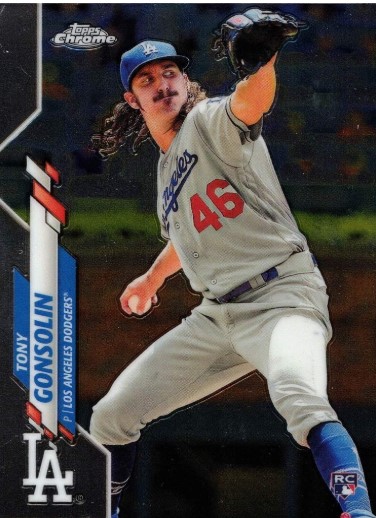
Pitcher of the Month – Tony Gonsolin, RHP, Dodgers

Gonsolin went 4-0 in five June starts (one of just three NL pitchers with at least four June wins), putting up a sterling 1.24 ERA (lowest among NL pitchers with 25 or more June innings). The Dodgers won all five of Gonsolin’s starts, as he gave up just four runs in 29 innings pitched – walking seven and fanning 25. I might have been swayed slightly by Gonsolin’s overall record  at the end of June 9-0, 1.58.

Honorable Mentions: LHP Carlos Rodon of the Giants went 2-0 in five starts, but deserved better.  His 1.25 ERA was the second-lowest among NL moundsmen with at least 25 June innings, his 41 strikeouts (in 36 innings) were third.  Sandy Alcantara of the Marlins put up a stingy 1.89 ERA in six starts – going 3-1 for the month.  He also led the NL in June innings (47 2/3) and was eleventh in strikeouts with 31 (just eight  walks). In his six June starts, he never went less than seven innings.

__________________________________

AMERICAN LEAGUE

Player of the Month – Yordan Alvarez, DH, Astros

Photo: Alvarez Flickr user thatlostdog–, CC BY 2.0 <https://creativecommons.org/licenses/by/2.0>, via Wikimedia Commons

Wow!  I’m also reluctant to pick a DH as Player of the Month, but I also cannot ignore Alvarez’ .418 average for the month (highest in MLB) and his MLB-leading 28 June RBI. His nine  home runs also put him in the AL top five. Alvarez  also scored 19 runs during the month,

Honorable Mentions: Blue Jays’ 1B  Vlad Guerrero, Jr. hit .283 for the month, with nine home runs, 22 RBI (third in the AL) and 22 runs scored (second); Blue Jays’ C Alejandro Kirk had a .341-7-18 June (more on Kirk in the Surprise Player of the Month section).

Pitcher of the Month – Shane McClanahan, LHP, Rays

McClanahan went 3-1, with a 1.36 earned run average in five June starts – fanning 42  (second in the AL) in 33 innings pitched (also second). He went at least six innings in all his starts and struck out at least seven each time out (a high of ten, in seven innings, against the Pirates in his final June appearance).

Honorable Mentions: Nick Pivetta, RHP, Red Sox went 4-1, 2.25 in six June starts. He pitched an AL-tops 40 innings during the month, fanning 40 batters; Emmanuel Clase, RHP, Guardians saved an MLB-high eleven games (in eleven opportunities) in June, giving up no runs on seven hits and no walks (16 whiffs) in 15 innings; Tyler Wells, RHP, Orioles. The Orioles put up a .500+ record in June, thanks in great part to Wells’ 4-0, 2.42 performance (over five starts). The Orioles won all five of those starts. In his final three starts of the month, Wells went 3-0, 1.13 and held opponents to a .158 average.  I would  still like to see a little more length from Wells (averaging just over five innings per starts in June, but he earned this spot.

Baseball Roundtable Extra

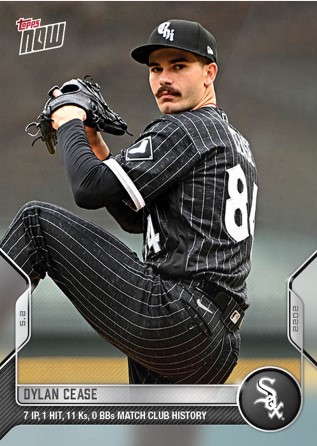
Not sure how to handle Dylan Cease of the White Sox, who put up a minuscule 0.33 earned run average in five June starts (just one earned run in 27 1/3 innings) and also led the league in June whiffs with 45. Still, he was charged with  nine unearned runs and pitched more than five frames in only two of his June starts.

_____________________________________________

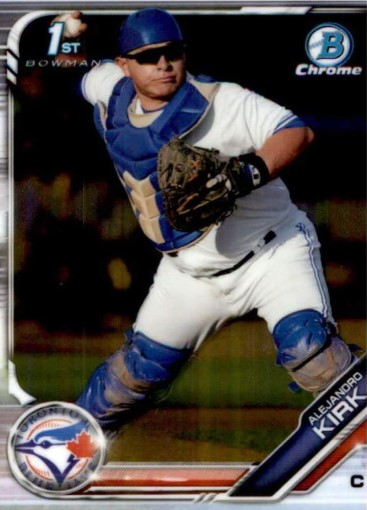
Surprise Player(s) of the Month – Tie: Alejandro Kirk, C, Blue Jays & Michael Harris, CF, Braves

Okay, Alejandro Kirk is not a surprise to Blue Jays’ fans. They have been waiting for  the 23-year-old Kirk, in his second MLB season, to break out.  In four minor-league campaigns, he hit .318-19-114 in 165 games. Last season, a left hip flexor injury hampered his progress and he hit .242-8-24 in 60 games for Toronto. Listed at 5’8” and 245 pounds, Kirk has shown agility behind the plate and ability (and a good eye) at the plate. In June, he went .341-7-18 in 25 games (and his walks outnumbered his whiffs 13-to-11). On the season, he stands at .319-10-31.  Looks like the Jays will be enjoying  Kirk’s exciting brand of play for some time coming.

The Braves’ 21-year-old rookie CF Michael Harris is another player who is probably less of a surprise to home town fans then he is to Baseball Roundtable. Harris, who made his MLB debut May 28, was a .292 hitter over 197 minor-league games (three seasons). He hit just .154 (2-for-13) in four May games, but caught fire in June, goig .347-4-16 in 27 games. His 35 June base hit trailed only teammate Dansby Swanson in the NL.

______________________________________________________

TROT INDEX … A REGULAR BBRT FEATURE

Through June 2022, 34.5 percent of the MLB season’s 85,566 plate appearances ended in a trot (back to the dugout, around the bases, to first base). We’re talking about strikeouts, home runs, walks, hit by pitch and catcher’s interference – all outcomes that are, basically, devoid of action on the base paths or in the field. Here’s the breakout: strikeouts (22.2%); walks (8.3%); home runs (2.8%); HBP (1.1%); catcher’s interference (less than 1%). Personally, I’d like more action in the field of play.

The 34.5 percent figure is down slightly from 2021’s full season 36.3 percent.  2020’s 37.3 percent;  2019’s 36.2 percent and 2018’s 34.8 percent.  

_________________________________________________


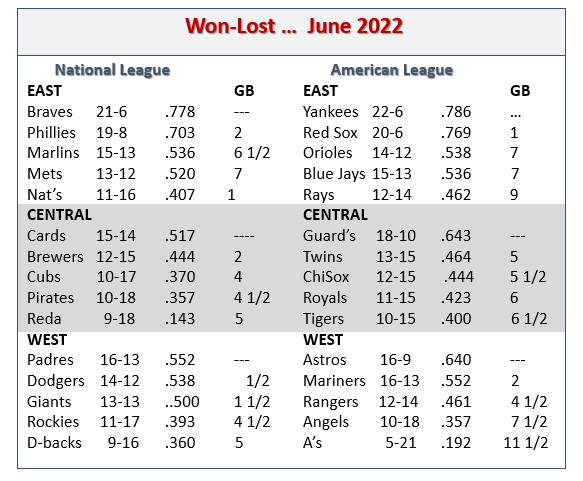
A few observations about the three twenty win squads:

  • The Braves didn’t lose their first game in June until the 17th. In that 14-game in streak, they outscored their opponents 101-41; outhit them .292 to .207; out-homered them 34-11; and put up a 2.72 ERA to their opponents’ 6.80.  The Braves 20+ win month was led by SS Dansby Swanson (.330-7-19), the surprising rookie CF Michael Harris (.347-4-16) and C Travis D’Arnaud (.304-7-19); starter Kyle Wright (5-1, 3.52) and closer Kenley Jansen (eight saves).
  • The Yankees won 15 of their first sixteen game in June, outscoring their opponents 102-37.  They scored ten or more runs five times in the streak and shutout their opponents five times.  They did a lot of their June damage with power.  Their 58 June home runs were an MLB team record for the month, their 155 runs were second in MLB – despite  .235 average (21st in MLB).  Their 2.94 June ERA was the lowest in the majors – and the bullpen led the way. In June, the Yankee starters’ put up a 3.89 ERA, the bullpen ERA was 1.34.  Relievers Micheal King, Clay Holmes and Lucas Leutge made a combined 32 appearances in June and went 4-1, with nine saves and a 0.74 ERA.
  • Boston’s surge was built in a great on their pitching.. Their 3.02 June ERA was the third best in the MLB (and also third-best in their own division), while they were tenth in runs scored. In June, their starters went 16-1, led by Nick Pivetta (4-1, 2.25); Micheal Wacha (3-0. 3.03) ; Rich Hill (3-1, 3.00); and Josh Winckowski (3-0, 2.12). 3B Rafael Devers (.292-6-19) and LF Alex Verdugo (.337-3-19) were keys to the offense.

——-Team  Statistical Leaders for June  2022 ———-

RUNS SCORED

National League – Braves (155); Padres (153); Phillies (146)

American League – Blue Jays (170); Yankees (155); White Sox (137)

The fewest June  runs were scored by the A’s – just 75. The Mets tallied the fewest runs in the NL at 100.

AVERAGE

National League – Cubs (.273); Reds (.272); Braves (.267)

American League – Blue Jays (.285);  White Sox (.281) Red Sox (.267)

The lowest team average for June  belonged to the Diamondbacks at .206.

HOME RUNS

National League – Braves (54); Pirates (44); Phillies (43)

American League –  Yankees (58); Blue Jays (50); Twins (40)

The Tigers  had the fewest home runs for June  at 13. The only other team under 20 for the month was the Guardians at 16.

Toronto led MLB in June slugging percentage at .504.  The Braves led the NL at .449

STOLEN BASES

National League – Marlins (35); Dodgers (22); Phillies (20)

American League – Rangers (23); Guardians (21); Yankees (20); Mariners (20)

The Twins stole the fewest sacks in June   – just three.  The Dodgers  stole 22  bags and were caught only once.  The White Sox pilfered 12 sacks without being caught.

WALKS DRAWN

National League –   Phillies (100); Padres (95); Nationals (93))

American League – Yankees (122); Mariners (111); Astros (95)

The Blue Jays  led MLB  in on-base percentage for June at .353. The Cubs led the NL  at .342.

BATTER’S STRIKEOUTS

National League – Pirates (263); Giants (242); Braves (242)

American League – Angels (279); Mariners (256); Orioles (240)

Astros’ batters fanned the fewest times in June  (178).


Bonus Stat

The  Blue Jays led MLB in total bases in June at 503. By contrast, the A’s were 30th, with 286 total bases in June.

Earned Run Average

National League – Giants (3.37); Dodgers (3.39); Braves (3.53)

American League – Yankees (2.96); Rays (3.01); Red Sox (3.02)

Four teams had June  ERAs of 5.00  or higher– Cubs (5.96); Reds (5.68); A’s (5.25; Tigers (5.07)

STRIKEOUTS

National League – Braves (285); Cubs (252); Reds (240)

American League – White Sox (260); Yankees (254); Angels (249)

The Braves averaged an MLB-best 10.47 strikeouts per nine innings in June. The White Sox averaged an AL-best 9.63.

FEWEST WALKS SURRENDERED

National League  – Giants (56); Phillies (66); Dodgers (68)

American League –  Orioles (67); Rays (69); Red Sox 69)

The Giants walked a stringiest 2.19  batters per nine frames in June.  The Athletics walked an MLB’s highest 4.04 per nine innings for the month.

SAVES

National League – Braves (11); Brewers (8); Nationals (8)

American League – Guardians (12); Orioles (10); Yankees (10); Astros (1)

WALKS AND HITS PER INNING PITCHED (WHIP)

National League – Dodgers (1.12); Phillies (1.12); Braves (1.13); Giants (1.13)

American League – Yankees (1.04); Astros (1.07); Mariners (1.12)

Bonus Stat:

The Braves were the only team to fan at least four times as many batters as they walked in June – 4.07 K/BB.

–JUNE HIGHLIGHTS–

Walk(off) This Way!

The Yankees notched five walk-off wins in June, bringing their total walk-off victories for 2022 to ten.  The record for walk-off victories in a season is 18, by the 78-76 Pittsburgh Pirates. The Pirates had eight walk-off victories through June that season.

Yankees 2022 Walk-Off Victories

April 8, 6-5, 11 innings, over Boston … It all started on Opening Day with a Josh Donaldson (3B)  11th-inning RBI single.

April 23, 5-4, over the Guardians …. The Yankees came into the bottom of the ninth down 4-3, but got an RBI double from SS Isiah Kiner-Falefa and a walk-off RBI single from PH Gleyber Torres.

May 8, 2-1, over the Rangers … A ninth-inning solo home run by 2B Gleyber Torres sparked the win.

May 10, 6-5, over the Blue Jays … A three-run walk-off home run from CF Aaron Judge brought the Yankees back from a 5-3 ninth-inning deficit.

May 24, 7-6, over the Orioles (11 innings) … A walk-off RBI single from C Jose Trevino won this one.

June 5, 5-4, over the Tigers (10 innings) … The gift runner scored on a sacrifice fly by DH Josh Donaldson.

June 10, 2-1, over the Cubs (13 innings) … C Jose Trevino drove in the gift runner with a walk-off single.

June 16, 2-1, over the Rays … A ninth-inning solo home run from 1B Anthony Rizzo put the Yankees in the win column.

June 23, 7-6, over the Astros … The Yanks came into the bottom of the ninth down 6-3. A three-run home run (after two walks) by LF Aaron Hicks tied it and a walk-off RBI single by CF Aaron Judge secured the victory.

June 26, 6-3, over the Astros (10 innings) … CF Aaron Judge poked a three-run homer in the ninth.

Say It Ain’t So, Joe(s)!

On June 3, with the Phillies standing at 22-29, manager Joe Girardi became the first MLB manager  fired in 2022 – with bench coach Rob Thomson named interim manager,

Girardi, who  took over the Phillies with 60 games left in the 2020 season, had a 132-141 record at their helm.  He has a 1,120-936 record in 14 managerial seasons (Marlins, Yankees, Phillies), won the 2006 National League Manager of the Year Award and took the 2009 Yankees to the World Series Championship. Since Girardi left the Phillies, they have gone 15-6.

Just four days later, we saw the second managerial firing of the season, as the Angels let manager Joe Maddon go . (Third base coach Phil Nevin took over.) The Angels were 27-29 at the time – and on a 12-game losing streak. In 19 managerial seasons (Angels, Rays, Cubs), Maddon was 1,382-1,217.  He won the AL Manager of the Year Award in 2008 and 2011 and the NL Manager of the Year Award in 2015. He led the Cubs to the World Series Championship in 2016.  The Angles are 10-12 since Maddon left.

Hmmm! Didn’t know that rule.

In the ninth innings of a Dodgers/Mets clash (In Los Angeles) on June 5 – and LA trailing 9-4 – Dodgers’ skipper Dave Roberts sent utility player Zach McKinstry to the mound to open the inning.   Umpiring Crew Chief C.B. Buckner, however, nixed what would have been McKinstry’s first MLB mound appearance, citing an MLB rule that prohibits managers from using a position player as a pitcher in games in which they face a deficit of five runs or fewer. After some heated discussion, Roberts sent reliever Evan Phillips to the mound and he pitched a one-hit, two-whiff ninth. The Dodgers did not score in the bottom of the frame and lost 9-4.

So-o-o-o Close – I Just Hader to See That.

Photo: D. Benjamin Miller, Public domain, via Wikimedia Commons

When Brewers’ closer Josh Hader came to the mound June 7  to protect a 2-1 Milwaukee lead (over the Phillies), Brewers’ fans pretty much though it was game over.  After all, Hader had not given up a run in his last 40 appearances – tying Ryan Pressly’s record for consecutive scoreless outings (set with the Astros in 2018).   To this point in the season, Hader had made 19 appearances with 18 saves, no blown saves, not a single earned run, just four hits and six walks and 28 strikeouts in 17 2/3 innings.

Well, Phillies’ 3B Alec Bohm ended the scoreless innings  streak with a solo home run leading off the ninth and, two batters later, pinch hitter Max Vierling (hitting .170-0-4 at the time) took Hader deep to tag  him with the loss.

Save the Last Dance for Me

Josh Hader opened the 2022 season by recording a save in his first 18 appearances. That is the record for most consecutive appearances with a save to start a season (more #InBaseballWeCountEverything).  The previous record was 12 – held by Lee Smith (Orioles, 1994) and Jose Mesa (Pirates 2005).

Three Cycles in the Month – Six is Lucky Number.

On June 6 (that’s 06/06),  Mets’ 3B Eduardo Escobar hit the second cycle (single, double, triple, home run in the same game) of 2022 and the first of three cycles this June. In a four-for-five, three run, six-RBI game against the Padres (in San Diego), he hit a two-run single in the first inning; a double leading off the fourth; popped out to short in the fifth; hit a two-run home run in the eighth; added a two-run triple in the ninth.  The Mets won 11-5.

Six also played a role in the third cycle of them month, as Orioles’ leadoff hitter and CF Austin Hays hit for the cycle – in a game that was called after just six innings (rain). (The Orioles beat the Nationals 7-0 in Baltimore.) Hays went four-for-four, with three runs and three RBI. He singled to lead off the bottom of the first; hit a home run to lead off the Orioles’ third; tripled with two-out in the fourth; and rapped a two-run double in the sixth. For more on the quickest and slowest cycles ever, click here.

In between these two cycles – on June 11 – Angels’ 1B Jared Walsh hit for the cycle in a four-for-five, one-run, three-RBI game against the Mets (in Anaheim). Walsh started his day with a swinging strikeout in the first, but it was “all systems go” after that. He singled in the third; doubled in the fifth; homered to lead off the seventh; and lashed a two-run triple in the eight.  The Angels, by the way, triumphed 11-6.

Half Way There

There have been four cycles so far in 2022.  The most cycles in any MLB season is eight (2009): Orlando Hudson (Dodgers); Ian Kinsler (Rangers); Jason Kubel (Twins); Mike Cuddyer (Twins); Melky Cabrera (Yankees); Troy Tulowitzki (Rockies); Felix Pie (Orioles); B.J. Upton (Rays).

Party Likes It’s 2011!

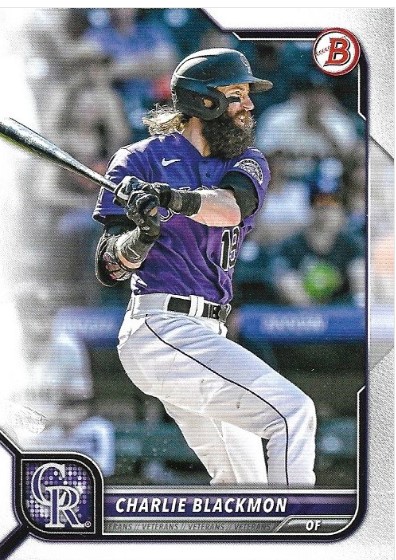
Outfielder Charlie Blackmon made his MLB debut with the Rockies on June 7, 2011; flying out to center on the first MLB pitch he ever saw (off the Padres’ Tim Stauffer).  This June 7, he celebrated the 11th anniversary of his big -league debut by coming off the bench to hit a three-run pinch-hit home run (it gave the Rockies  a 5-3 lead) off the Giants’ Jose Alvarez. It was a noteworthy long ball – the 200th home run of Blackmon’s career. He finished June at .267-12-41 on the season and .299-203-672  on his career.

It’s Sho(hei) Time Again.

Shohei Ohtani just keeps showing up in these highlights – and for good reason(s).  On June 9, he proved one again to be a “stopper” on the mound and at the plate – as he played a key role in stopping an Angels’ 14-game losing streak (their last win had come on May 24). Shohei started on the mound and at DH (batting second). In the 5-2 Angels win (in Anaheim), he went two-for-four, with one home run (his 12th of the season) and two RBI and gave up just four hits (two walks) and one run in seven innings, while fanning six.

Here’s a few stats from the Angels 14-game skid:

  • They were outscored 85-40.
  • They hit .217 to the opponents’ .283 and were out-homered 19-9.
  • The lost eight at home and six on the road.
  • Seven of the losses were by one run.
  • They were shut out three times, including two 1-0 losses.
  • Their pitching staff put up a 6.75 ERA, to the opponents’ 2.69.

Twins Rake Yankee Ace Gerrit Cole … Still Lose.

On June 9, the Twins became just the sixth team to open a game with three straight home runs – and they did it against Yankee ace Gerrit Cole, who had never given up three home runs in any inning (much less consecutively).

Twin’ 1B Luis Arreaz opened the bottom of the first by taking a 2-2 pitch out of the park to deep RF; CF Byron Buxton then ripped the next Cole offering out of the park down the LF line; SS Carlos Correa then launched an 0-1 pitch in the left field stands.   Cole followed with a six-pitch walk to Jorge Polanco before settling down and fanning Max Kepler, Gary Sanchez and Trevor Larnach to end the inning.

The Twins continued their barrage off Cole in the second frame, scoring on a Buxton three-run homer to left. They added a seventh run on a Larnach homer to center in the third. Cole was pulled after 2 1/3 innings, trailing 7-3 and having surrendered five round trippers.  Still, the surging Yankees managed to take Cole off the hook, topping the Twins 10-7.

Wondering about the most home runs surrendered by a pitcher in a single game.  Click here.

Slow Ride … Take it Easy.

On June 12, as the Cubs were absorbing an 18-3 loss at the hands (bats) of the Yankees, Cubs’ 1B Frank  Schwindel made his second MLB mound appearance – pitching a two-hit, one-run ninth.  Why did he make these highlights?  The first pitch he threw in the inning was a 35.1 MPH (knuckleball?) to Yankees’ catcher Kyle Higashioka, who hit to deep left for his first dinger of the season.  It turned out to be the slowest pitch ever tracked by Statcast to be hit for a home run. Higashioka, by the way, came into the game hitting .148-0-5 on the season (88 at bats).  Schwindel made  three mound appearances in June, going 0-0, 18.00 (six earned runs in three innings pitched).

Like Father like Son.

On June 13,  Vlad Guerrero Jr. played his 403rd career MLB game – collecting three hits in five at bats including a home run.  At this point in his career, Guerrero Junior had 87 MLB home runs and a .363 on-base percentage.  After 403 games in his career, Vlad Guerrero Senior had an identical 87 long balls and a nearly identical .364 OBP.  Kind of like father-son combo Cecil and Prince Fielder each retiring with 319 career home runs.,

The Rangers Didn’t have a Prayer.

On June 15, Astros’ pitchers Luis Garcia and Phil Maton pitched their way into the record books. The two Houston hurlers each tossed an “Immaculate Inning” … an inning facing just three batters and fanning the side on nine pitches. It was the first-ever MLB game in which two pitchers each tossed an Immaculate Inning and, of course, also made them the first two teammates to toss an Immaculate Inning in the same game.

Garcia tossed his nine-pitch, three-whiff fame in the bottom of the second, while Maton achieved the feat in the bottom of the seventh. The Astros, by the way, won the game  (started by Garcia) 9-2 and four Houston pitchers notched a total of 14 strikeouts. Also of note is that Rangers Nathaniel Lowe, Ezequiel Duran and Brad Miller (the 6-7-8 hitters) were the victims in both Immaculate Innings – making them, of course, the first three players to be victims in two Immaculate frames in the same game.

For more on this game and Immaculate Innings, click here.

Riley Greene Starts MLB Career with a Bang.

Tigers’ 3B Riley Greene, Detroit’s first-round pick (fifth overall) in the 2019 MLB draft (out of Paul J. Hagerty High School in Florida) made it to the big leagues as a 21-year old – debuting on June 18 – in a Tigers 14-7 win over the Rangers (in Detroit).  In five plate appearances, Greene had two singles and two walks, scoring three runs,  He ended his first MLB month at .286-0-2 in 10 games. The top Detroit prospect hit .291-3-120 in three minor-league seasons (198 games).

Trout Carries Angels Against Mariners.

Fromm June 16 through June 19, the Angels faced off against the Mariners (in Seattle). In that five-game set, Angels’ CF Mike Trout went 6-for-20 (.300). More important, five of his six hits were home runs and, according to STATS, he became the first player to hit four game-winning home runs in a single series. (The Angels won four of the five games).

Happy Fathers’ Day, Dad.

On June 19 ( Fathers’ Day), Pirates’ rookie LF Jack Suwinski was proud to have his father Tim in the stands as the Pirates took on the Giants in Pittsburgh. The younger Suwinski did not disappoint – notching his first-ever three-homer game at any level, including a walk-off home run in the bottom of the ninth to give the Pirates a 4-3 win. For the day, the 23-year-old Suwinski was three-for-three (with a walk) with three runs scored and three RBI.

Old Guys (like me) Say Thank You, Justin Verlander.

Let’s face it, the Yankees are truly the beasts from the Bronx this year – finishing June with a 22-6 record on the month and 56021 for the season.  On June 24, 39-year-old Astros’ starter Justin Verlander faced off against the New Yorkers in Yankee Stadium – with the Yankees on a 15-game home win streak. The veteran right-hander was not intimated, pitching seven four hit, one run innings (three whiffs), as the Astros won 3-1. With the win the two-time Cy Young Award winner ran his age-39 season record to 9-3, 2.22.  Verlander picked up a tenth win on June 29, holding the Mets scoreless over wight innings.  Verlander’s been a true stopped for the Astros, going 6-0 in games he started after a Houston loss.

Astros Combine to No-Hit Yankees Again.

On June 25, Astros’ pitchers Cristian Javier, Hector Norris and Ryan Pressly combined to pitch a no-hitter against the Yankees in Yankee Stadium.  It was the third no-hitter and second combined no-hitter of the 2022 season. It was also the first time the Yankees had been held hitless since June 11. 2003, when the Astros (again) used a record six pitchers in no-hitting the Bronx Bombers.  For more on combined no-hitters, click here.

June  Feel Good Story

Mark Appel was the first overall pick (Astros)in the 2013 MLB draft – after a 10-4, 2.12 senior season at Stanford University. In four NCAA seasons, he had gone 28-14, with a 2.91 ERA and 372 strikeouts in 377 2/3 innings. In his junior and senior years, he went 20-6, 2.35, with 260 whiffs in 229 1/3 innings.  In 2012, he was named the National College Baseball Hall of Fame Pitcher of the Year. Big things seemed right on the horizon.

Nine years, 123 minor-league appearances, a pair of shoulder injuries, elbow surgery, a three-year retirement from baseball and and a two-season comeback later, the thirty-year-old righty  finally received the call to the big leagues (Philllies). At the time, he was 5-0, 1.61 as a reliever for the Triple-A Lehigh Valley Iron Pigs.  On June 29, Appel made his MLB debut and recorded his first big-league strikeout – pitching a scoreless ninth innings in a 4-1 Phillies loss to the Braves. A lesson in perseverance for us all. 

Now, That Was a  Pretty Kuhl Surprise.

Rockies’ 29-year-old right-hander Chad Kuhl came into his June 27 start against the Dodgers with 97 MLB starts on his MLB resume (over six seasons (Pirates/Rockies). He had a 29-35, 4.38 career MLB record, a career average of five innings per start, no complete games – and the deepest he had gone in any 2022 start was 6 1/3 innings.  He was starting for the last-place Rockies, against the first-place Dodgers. Kuhl came into the game 4-5, 3.95 on the season, while his mound opponent –  Tyler Anderson –  was 8-0, 3.00. To top it off, the game was being played in hitter-friendly Coors Field.

Well, Kuhl surprised a lot of people.  He threw his first-ever MLB complete game and his first-ever MLB shutout. He held the powerful Dodgers to just three hits (no walks, five whiffs). Kuhl faced just 29 hitters and only one Dodger got as far as second base as the Rockies triumphed 4-0. It’s one cool game that Chad Kuhl will never forget.

Baseball Roundtable Extra

Philip Humber threw just one complete game in eight MLB seasons (2006-13 … Mets, Twins, Royals, White Sox, Astros). It came on April 21, 2012 for the White Sox – against the Mariners in Seattle – and it was a nine-strikeout perfect game. Humber was an unlikely candidate for a perfecto, he retired with a 16-23, 5.31 record, 14-21, 5.20 as a starter.

Three Is Company

On June 30, Pirates’ catcher Martin Perez, who came into the game against the Reds with a .129-3-6 stat line, enjoyed a four-for-four day, with three runs scored, five RBI … and three home runs. It was his first-ever MLB multi-home run contest (in 184 games over five seasons). Perez hit a two-run homer in the fourth inning; another two-run shot in the sixth; and a solo home run in the eighth.  The Pirates needed all his fireworks, as they topped the Brewers 8-7 in Pittsburgh.

Perez’ offensive outburst came just one day after Pirate CF Bryan Reynolds had a three-homer game (with three runs scored and six RBI) in another 8-7 Pirates win (this one over the Nationals in Washingon D.C. It was Reynolds’ second multi-homer game in 421 MLB games over four seasons.

Earlier in the month , on June 19, Pirates’ LF Jack Suwinski also recorded a three-home game (three runs scored, three RBI), as the Pirates topped the Giants 4-3 in Pittsburgh. Like Perez, it was the rookie outfielder’s first multi-homer game.

Together, Suwinski, Reynolds and Perez made the Pirates the first MLB team to have three players notch three-homer games in the same month.

——-Individual Statistical Leaders for June 2022———

AVERAGE (75 June  at bats minimum)

National League – Garret Cooper, Marlins (.378); Josh Bell , Nationals (.358); Michael Harris, Braves (.347)

American League –  Yordan Alvarez, Astros (.418); Amed Rosario, Guardians (360); Lourdes Gurriel, Blue Jays (.355)

The lowest April  average (among players with at least 75 at bats in the month)  belonged to the Mariners Adam Frazier at .144 (13-for-90).

HOME RUNS

National League – Kyle Schwarber, Phillies (12); Pete Alonso, Mets (9); five with 8

American League –  Aaron Judge, Yankees  (11);  Anthony Rizzo, Yankees (10); Mike Trout, Angles (10)

The Astros’ Yordan Alvarez had the highest June  slugging percentage (among players with at least 75 at bats) at .835.  The NL  leader was the Nationals Josh Bell at .695.

RUNS BATTED IN

National League –Kyle Schwarber, Phillies (27); Jake Cronenworth, Padres (24); Luke Voit, Padres (23)

American League –  Yordan Alvarez, Astros (28); Austin Hays, Orioles (23); Vlad Guerrero, Jr., Blue Jays (22); Kyle Tucker, Astros (22)

Jake Cronenworth of the Padres and Brandon Nimmo of the Mets led MLB in being hit by a pitch in June, with six plunkings each.

HITS

National League – Dansby Swanson, Braves (37); Michael Harris, Braves (35); Trea Turner, Dodgers (35); Bryan Reynolds, Pirates (35)

American League –  Amed Rosario, Guardians (41); Jose Abreu, White Sox (37); Teoscar Hernandez, Blue Jays (35)

The Astros’ Yordan Alvarez led MLB (players (with at least 75 June at bats) in on-base percentage at .510. The NL leader was the Nationals Josh Bell at .447.

DOUBLES

National League –  Jake Cronenworth, Padres (12); Brandon Rogers, Rockies (10): Luke Voit, Padres (10)

American League –  Jose Ramirez, Guardians (14); Ryan Mountcastle, Orioles (11); Andy Rutschman, Orioles (10); Teoscar Hernandez, Blue Jays (10); Luke Voit, Padres (10)

TRIPLES

National League – Jose Azocar, Padres (3); Harrison Bader, Cardinals (3); Didi Gregorius, Phillies (3)

American League – Seven with two

The Orioles’ Ryan Mountcastle led MLB in June extra-base hits with 18.  He had 12 singles, 11 doubles and seven home runs.

STOLEN BASES

National League –  Jon Berti, Marlins (18); Tommy Edman, Cardinals (7); J.T. Realmuto, Phillies (6)

American League – Randy Arozarena, Rays (10): Dylan Moore, Mariners (7); five with six

The Marlins’ Jon Berti was 18-for-19 in steal attempts in June.

WALKS

National League – Juan Soto, Nationals (21); Kyle Schwarber, Phillies (19); Paul Goldschmidt, Cardinals (18); Connor Joe, Rockies (18)

American League – Jesse Winker, Mariners (23); DJ LeMahieu, Yankees (20): Shohei Ohtani, Angels (17); Yandy Diaz, Rays (17)

The Yankees’ Aaron Judge led MLB in June intentional walks with five.

BATTER’S STRIKEOUTS

National League – Christopher Morel, Cubs (42); Luke Voit, Padres (41); Mike Yastrzemski, Giants (36): Joe Suwinski, Pirates (36)

American League – Eugenio Suarez, Mariners (42); Brandon Marsh, Angels (38); Jorge Mateo, Orioles (32); Joey Gallo, Yankees (32)

PITCHING VICTORIES

National League – Kyle Wright, Braves (5-1); Tony Gonsolin, Dodgers (4-0); A.J. Minter, Braves (4-1)

American League – Jameson Taillon, Yankees (4-0); Tyler Wells, Orioles (4-0); Diego Castillo, Mariners (4-1); Logan Gilbert, Mariners (4-11); Alek Manoah, Blue Jays (4-1); Shohei Ohtani, Angels (4-1); Nick Pivetta, Red Sox (4-1); Ross Stripling, Blue Jays (4-1); Justin Verlander, Astros (4-1)

The Giants’ Madison Bumgarner led all pitches in June losses – going 1-5, 4.06 in six June starts. Just to show that life is not always fair, the Braves’ Ian Anderson went 3-2, with a 6.91 ERA.

EARNED RUN AVERAGE (at least 25 innings pitched)

National League –  Tony Gonsolin, Dodgers (1.24); Carlos Rodon, Giants (1.25); Sandy Alcantara. Marlins (1.89)

American League – Dylan Cease, White Sox (0.33); Dean Kremer, Orioles (1.29); Shane McClanahan, Rays (1.36)

Among pitchers with at least 25 May innings, the Reds’  Mike Minor had the highest May ERA at 7.71 – going 1-4 in five starts.

STRIKEOUTS

National League – Charlie Morton, Braves (45 – 30 2/3 IP); Aaron Nola, Philllies (43 – 43 IP); Corbin Burners, Brewers (41  – 28 2/3 IP); Carlos Rodon, Giants (41 – 36 IP)

American League – Dylan Cease, White Sox (45 – 27 1/3 IP ); Jon Gray, Rangers (44 – 37 2/3 IP); Shane McClanahan, Rays (42 – 33 IP); Shane Bieber, Guardians (42 – 37 1/3 IP)

By comparison to the above leaders, the Orioles’ Tyler Wells went 4-0, 2.42 in five June starts and fanned just 15 batters in 26 innings.

SAVES

National League – Kenley Jansen, Braves (8); Josh Hader, Brewers (6); Tanner Rainey, Nationals (6); Tanner Scott, Marlins (6)

American League – Emmanuel Clase, Guardians (11); Clay Holmes, Yankees (8); Ryan Pressly, Astros (8)

AL June saves leader Emmanuel Clase was 11-for-11 in save opportunities with a 0.00 ERA in 14 appearances.

WHIP (Walks +  Hits per Inning Pitched – 25 innings minimum)

National League – Tony Gonsolin, Dodgers (0.72); Mike Mikolas, Cardinals (0.79); Aaron Nola, Phillies (0.83)

American League – Shane McClanahan, Rays (0.70); Justin Verlander, Astros (0.83); Yu Darvish, Padres (0.84)

BONUS STAT

Among pitchers with 25 May innings , the Dodgers Tony Gonsolin held opponents to the lowest June batting average (.141 )

__________________________________________

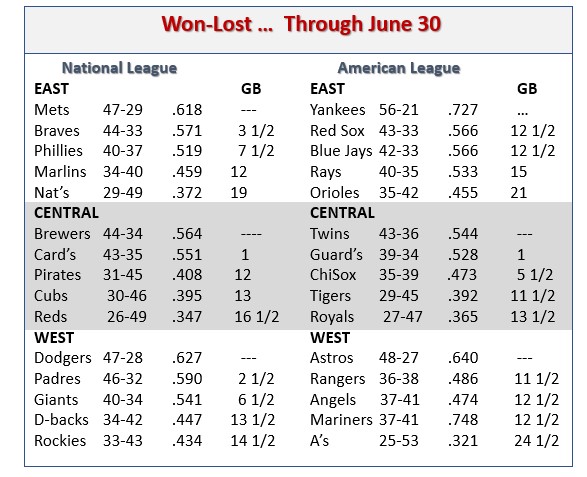
Of the season ended June 30,the post-season teams would be:

American League: Yankees, Astros, Twins.  Wild Cards: Red Sox, Blue Jays Guardians.

Nationals League: Dodgers, Mets, Brewers;  Wild Cards: Padres, Braves; Cardinals


——-Team  Statistical Leaders Through June  2022 ———-

RUNS SCORED

National League – Dodgers (379); Cardinals (373); Phillies (370)

American League – Yankees (384); Red Sox (364); Blue Jays (361)

The fewest  runs (through June) were scored by the Tigers – 222. The Pirates tallied the fewest runs in the NL at 282.

AVERAGE

National League – Rockies (.261); Mets (.256); Nationals (.254); Cardinals (.254)

American League – Red Sox (.261); Blue Jays (.257); White Sox (.253)

The lowest team average through June  belonged to the A’s at  at .212. The Diamondbacks were at the bottom of the NL at .215,

HOME RUNS

National League – Braves (116); Brewers (105); Phillies (99)

American League –  Yankees (127); Astros (103); Blue Jays (101)

The Tigers  had the fewest home runs through June  at 42 – the only team under 50. The Nationals  trailed the rest of the NL at 61.

The Braves led MLB in slugging percentage through June   at .439  The Blue Jays led the AL at .435 .

STOLEN BASES

National League – Marlins (57); Cardinals (577); Dodgers (52)

American League – Rangers (62); Rays (53); Guardians (49)

The Twins stole the fewest sacks through June (13 in 23 attempts  The Rockies were at the bottom of the NL with 14 in 26 attempts.  The White Sox stole 35 bases through June and were caught just twice.

WALKS DRAWN

National League –   Dodgers (287); Padres (275); Giants (274)

American League – Yankees (292); Mariners (285); Astros (264)

The Dodgers  led MLB  in on-base percentage through  June at .328. The Red Sox led the AL  at .326.  The A’s had MLB’s lowest  OBP through June at .274.

BATTER’S STRIKEOUTS

National League –Braves (729); Pirates (695); Brewers (689)

American League – Angels (735);  Orioles (698); Mariners (667)

Guardians’ batters fanned the fewest times through  June  (509).

Earned Run Average

National League – Dodgers (2.98); Padres (3.48); Cardinals (3.77)

American League – Yankees (2.92); Astros (2.96); Rays (3.24)

Two teams had  ERAs through June of 5.00  or higher – Reds (5.51); Nationals (5.10).

STRIKEOUTS

National League – Braves (741); Brewers (723); Mets (701)

American League – Yankees (703); White Sox (700); Rays (656)

The Braves averaged an MLB-best 9.73 strikeouts per nine innings through  June. The White Sox averaged an AL-best 9.53.

FEWEST WALKS SURRENDERED

National League  – Giants (192); Dodgers (193); Mets (224)

American League –  Rays (192); Yankees (198); Blue Jays (205)

The Giants, Rays, Dodgers and Yankees each walked an MLB-lowest 2.6 batter per nine innings through June.

SAVES

National League – Brewers (31); Braves (26); Padres (26)

American League – Yankees (27); Astros (23); Blue Jays (23)

Bonus Stat

Only four pitching staffs gave up 100 or more home  runs through June: Nationals (108); Reds (107); Cubs (107); and Mariners (102). By contrast, the Giants and Astros gave up an MLB-low 64 homers through June.

______________________

 Second Bonus:

The Mariners and Padres committed the fewest errors through June (28) and also tied for the top fielding percentage at .990.  The Rockies committed an MLB-high 58 fielding miscues through June.  


Primary Resources: Baseball-Reference.com; MLB.com; Baseball-Almanac.com; Elias Sports Bureau


BASEBALL ROUNDTABLE ON THE TOP 100 BASEBALL BLOG LIST

100Baseball Roundtable is on the Feedspot list of the Top 1oo Baseball Blogs.  To see the full list, click here.

I tweet baseball @DavidBBRT

Follow/Like Baseball Roundtable’s Facebook Page here.  More baseball commentary; blog post notifications; PRIZES.

Member: Society for American Baseball Research (SABR); The Baseball Reliquary; The Negro Leagues Baseball Museum.


Astros Combine to No-Hit the Yankees … Again

Yesterday (June 25, 2022), the Houston Astros no-hit the New York Yankees – using three pitchers:

  • Starter Cristian Javier went seven innings, walking one and fanning 13 – while tossing 115 pitches.
  • Hector Norris pitched one frame, walking two and fanning none.
  • Closer Ryan Pressly picked up a save with one inning pitched, no walks and two whiffs.

The game was tied 0-0 after six innings, with Yankee starter Gerrit Cole having given up just three hits, while walking two and fanning six. He added two strikeouts in the seventh, but gave up a home run to Astros rookie 1B J.J. Matijevic, who came into the game hitting just .091 with one home run in 11 MLB at bats.  The Astros eventually own the contests 3-0.   A few other notes:

  • Every member of the New York starting lineup fanned at least once and five members of the potent Yankees’ lineup went down on strikes at least twice: Giancarlo Stanton (three whiffs) and Aaron Judge, Anthony Rizzo, Josh Donaldson and Aaron Hicks (twice each).
  • Only one Yankee got as far as second base in the contest.  (Aaron Hicks reached 3B in the eighth).
  • At one point, Javier retired 17 straight batters, with the string broken on a Josh Donaldson error.
  • Notably, it was the first time that Yankees had been no-hit since June 11, 2003, when the Astros set an MLB record (tied in 2012 by the Mariners) by using six hurlers to complete a no-hitter.

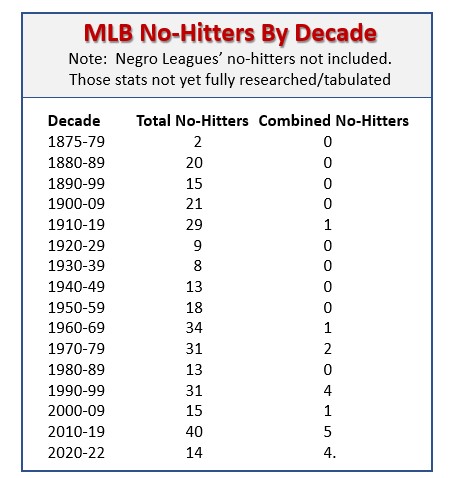
Given today’s pitch count limits and relief specialist, as you might expect, combined no-hitters are on the rise.  In MLB history there have been just 18 combined no hitters. Half of those have occurred since 2012 and fourteen of the eighteen  have been achieved since sine 1990.  Baseball-References.com notes Negro Leagues’ no-hitter stats have not yet been fully compiled/ integrated into MLB records. They are not included in this accounting. 

Now, let’s take  a look back at the previous 17 combined no hitters.  Baseball Roundtable has presented this list before, so if it’s still fresh in your mind, you can skip this portion of the post.,

The First-Ever Combined No-Hitter – Babe Ruth Didn’t Hang Around Long

This took place on June 23, 1917 – with the Red Sox topping the Senators 4-0 in Boston. This game is special for several reasons:

  • It was the first MLB combined no-hitter;
  • Babe Ruth started on the mound;
  • It involved the most meager contribution by the starting pitcher (zero innings pitched- one batter faced); and
  • It is arguably the most “perfect” combined no-hitter ever.

Babe Ruth, at that time plying his trade as a left-handed starting pitcher for the Boston Red Sox, opened the game by walking Washington’s lead-off hitter Roy Morgan.  Ruth, and his catcher Pinch Thomas, took issue with umpire Brick Owens’ strike zone and, during the argument, Ruth made contact with the umpire (a glancing blow, it was reported).  The ultimate result of the confrontation was the ejection of both Ruth and Thomas (with Ruth earning a $100 fine and ten-game suspension).  Red Sox’ pitcher Ernie Shore was called in to replace Ruth and Sam Agnew took Thomas’ spot behind the plate. Morgan decided to test Agnew’s arm and was thrown out stealing, after which Shore retired the next 26 hitters in order – completing the first combined no-hitter within the minimum 27 total batters.  Ruth, by the way, ended the season 24-13, with a 2.01 ERA and a league-leading 35 complete games in 38 starts.

_________________________________________

Second Combined No-Hitter – A Long Time A-comin’

Given the past propensity for pitchers finishing what they started, MLB’s second combined no-hitter came 50 seasons and 70 no-hitters later – on April 30, 1967, with the Tigers defeating the Orioles 2-1 in Baltimore.  This combined no-hitter is unique because:

  • It was not a shutout.
  • The team that threw the no-hitter lost (the only combined no-hitter loss); and
  • It involved the briefest contribution by the relief staff (one pitcher/one-third inning pitched).

Orioles’ starter Steve Barber was effectively wild, walking ten hitters and hitting two in 8 2/3 innings. The opposing hurler was Detroit’s Earl Wilson – who matched goose eggs with Barber for seven innings. In the eighth, Baltimore pushed across a run on three walks and a sacrifice fly (Wilson gave up only two hits and four walks in his eight innings of work) and victory was there if Barber could take it. He didn’t.  Barber walked Tigers’ 1B Norm Cash to start the ninth. He then walked SS Ray Oyler. Earl Wilson, a good-hitting pitcher, bunted the runners to second and third, before Barber got the second out of the inning, inducing PH Willie Horton to pop up to the catcher.  Now, just one out away from a 1-0, no-hit win, Barber uncorked a wild pitch that brought the tying run home. He then walked CF Mickey Stanley, ending his day on the mound. Stu Miller came in to get the final out, but not until an error allowed the go-ahead run to score.

________________________________________

Combined No-Hitter Number Three – Waiting Until the Last Possible Day

This no-hitter came on September 28, 1975, with the A’s topping the Angels 5-0 in Oakland.  This game was unique in that:

  • It is one of only three no-hitters thrown on the final day of an MLB season;
  • It made starting pitcher Vida Blue the first hurler to take part in both a solo and combined no-hitter. (Blue had thrown a solo no-hitter on September 21, 1970.); and
  • It was the first time more than two pitchers were involved in a combined no-hitter.

Blue went five innings  (two walks, two strikeouts) and was followed by Glenn Abbott (one inning,), Paul Lindblad (one inning, one whiff) and Rollie Fingers (two innings, two strikeouts). Note: Blue has been joined by Kevin Millwood, Kent Mercker and Mike Witt as pitchers with both solo and combined no-hitters.)

______________________________________

Combined No-Hitter Number Four – Tea for Two

The next combined no-hitter went back to the two-pitcher formula, as Blue Moon Odom (five innings, nine walks, three strikeouts) and Francisco Barrios (four innings, two walks, two strikeouts) of the White Sox topped the A’s 2-1 in Oakland.  In this July 28, 1976 game, Odom walked seven different players at least once in his five innings of work.

_____________________________________

Combined No-hitter Number Five –  At Witt’s End

MLB’s fifth combined no-hitter came on April 11, 1990 (again just two pitchers), with the Angels topping the Mariners 1-0 in Anaheim.  Mark Langston started the game and went seven (four walks, three strikeouts) and Mike Witt (the only pitcher to throw a perfect game – September 30, 1984 – and take part in a combined no-hitter ) threw the final two (two strikeouts.)

_______________________________________

1991 – The First “Year of the Combined No-Nos” (plural that is)

1991 saw seven MLB no-hitters, including two combined no-nos. On July 13, the Orioles no-hit the A’s 2-0 in Oakland behind Bob Milacki (who threw six no-hit innings – three walks/three whiffs) and was pulled after being hit by a Willie Wilson line drive. Mike Flanagan (one inning, one walk), Mark Williamson (one inning) and Gregg Olson (one inning, two strikeouts) finished up the no-no.

Then, on September 11, the Braves no-hit the Padres 1-0 in Atlanta, led by Kent Mercker (six innings, two walks, six strikeouts), Mark Wohlers (two innings) and Alejandro Pena (one inning).  Greg Harris, who started for the Padres, threw a complete-game seven-hitter.

_______________________________________

Combined No-Hitter Number Eight –  Working Overtime

Combined no-hitter number eight came on July 12, 1997 – with the Pirates topping the Astros 3-0 in Pittsburgh.  It was unique in that it is:

  • The only extra-inning combined “no-no;” and
  • Made Francisco Cordova the (still) only  pitcher to start a combined no-hitter by pitching nine full innings.

Francisco Cordova started and went nine hitless frames (two walks, ten whiffs) and Ricardo Rincon threw one hitless inning in relief (for the win).

__________________________________________

Combined No-Hitter Number Nine … Nearly the Whole Bullpen

The next combined no-hitter was a record breaker – as the then-National League Astros used a record six pitchers (since tied) to no-hit the Yankees 8-0 in an inter-league game at Yankee Stadium (the last no-hitter at Old Yankee Stadium). On June 11, 2003. Roy Oswalt started, but succumbed to a groin injury after just one completed inning (two strikeouts). Joining in the no-hitter were: Pete Munro (2 2/3 innings, three walks, two strikeouts ); Kirk Saarlos (1 1/3 innings, one strikeout); Brad Lidge (two innings, two strikeouts); Octavio Dotel (one inning, four strikeouts); and Billy Wagner (one inning, two whiffs).

Notably, the no-hitter also broke up the Yankee’s record streak of 6,980 games without being held hitless. They had not been held without a safety since September 20, 1958.  The five relievers combined for eight innings pitched, with three walks and 11 strikeouts.  The Houston Chronicle reported that the Yankees took the whitewashing well and that, when the Astros returned to the visiting clubhouse there was a bottle of champagne (courtesy of the Yankees) at each pitchers’ locker.

In the eighth inning of this game, Octavio Dotel recorded a four-whiff frame. He struck out Juan Rivera and Alfonso Soriano on three pitches each; fanned Derek Jeter on a 3-2 pitch only to see him awarded first base on catcher’s interference; and then got Jason Giambi on a 2-2 pitch.  All four were swinging strikeouts.

______________________________________________________

Combined No-Hitter Number Ten – Evening Up the Score

The very next combined no-hitter – another inter-league game – saw the six-pitcher record tied, as the Mariners topped the Dodgers 1-0 in Seattle on June 8, 2012.  In addition, the AL evened up the score in combined inter-league no-hitters at one apiece. Kevin Millwood started that one (six innings, one walk, six strikeouts), followed by Charlie Furbush (2/3 inning, one strikeout), Stephen Pryor (1/3 inning, two walks, one strikeout), Lucas Luetge (1/3 inning), Brandon League (2/3 inning, one strikeout) and Tom Wilhelmsen (one inning).

__________________________________________

Combined No-Hitter Number 11 – The Fab Four

On September 1, 2014, the Phillies used four pitchers to no-hit the Braves 7-0 in Atlanta.  The pitchers involved were Cole Hamels, who started and went six innings (issuing five walks versus seven strikeouts); Jake Diekman (one inning, two strikeouts); Ken Giles (one inning, three strikeouts); and Jonathan Papelbon (one inning, no strikeouts).

__________________________________

Combined No-Hitter Number 12 – On New Turf

This one took place on May 4, 2018, as the Dodgers no-hit the Padres 4-0 in a regular-season MLB game played in Monterrey, Mexico – the first official MLB no-hitter ever thrown outside the United State or Canada.

Right-hander Walker Buehler started for the Dodgers, and the 23-year-old – making just his third major-league start (11th appearance) – went six innings (93 pitches), walking three and fanning eight.  He was followed by relievers Tony Cingrani (one inning, two walks, one whiff); Yimi Garcia (one inning, no walks, two strikeouts) and Adam Libertore (one inning, no walks, two strikeouts).  Buehler, by the way, also collected an unusual sixth-inning single – as his groundball hit base runner Alex Verdugo between first and second, resulting in Verdugo being called out (for the final out of the inning) and Buehler being credited with a single. That single, of course, meant Buehler outhit the entire Padres’ lineup.

_________________________________________

Combined No-hitter number 13 – A Lucky Number

Thirteen was a lucky number for the Angels.  On July 12, 2019, their staff put together MLB’s 13th combined no-hitter and their offense scored 13 runs on 13 hits. Taylor Cole started the game (in the “opener” role) and pitched two clean frames with two strikeouts.  Felix Pena the came on for the Halos and went seven innings (one walk, six strikeouts).

_________________________________________

Combined No Hitter Number 14 – An Unlikely Starter

On August 3, 2019, four Astros’ pitcher no-hit the Mariners 9-0 in Houston. Starting pitcher Aaron Sanchez seemed an unlikely hurler to start off a no-no – he came into the game with a 3-14, 6.07 record in 23 starts (with batters hitting .290 against him – a .382 on-base percentage). Sanchez shut down the  Astros, walking two and fanning six over six no-hit innings, then giving way to Will Harris (one inning pitched, one walk); Joe Biagini (one inning pitched, one walk, one whiff); and Chris Devinski (one inning pitched, one strikeout).

It was, notably, the first appearance for the Astros for Sanchez and Biagini – both had been included in a Blue Jays/Astros trade on July 31 (Sanchez, Biagini and minor-leaguer Cal Stevenson for OF Derek Fisher).  Thanks to this effort, 2019 became just the second season with two combined no-hitters.

____________________________________

Combined No-Hitter Number 15 – Everyone Issued at least one Free pass

On June 24, 2021, the Chicago Cubs no-hit the Dodgers 4-0 in Los Angeles.  Zach Davies started for the Cubs and went six innings, walking five and fanning four. He was followed by Ryan Tepera (one inning, one walk); Andrew Chafin (one inning, one walk); and closer Craig Kimbrel (one inning, one walk, three strikeouts). That these three should close out a no-no is no surprise, coming into the game their earned run averages, respectively, were 2.02, 1.72 and 0.61.

More Proof of that “In Baseball, We Count Everything.” 

STATS, Inc. reported that this was the first no-hitter thrown against a lineup with three former MVP’s (Mookie Betts, Al Pujols, Cody Bellinger).

____________________________________

Combined No-Hitter Number 16 – You’ve Been Burned

On September 11, 2021, Brewers’ ace right-hander Corbin Burnes faced off against the Indians in Cleveland. Burnes tossed eight innings of no-hit ball, before yielding the mound to southpaw reliever Josh Hader, who finished off the no-hitter with a 1-2-3 ninth.  It was the ninth no-hitter of the 2021 season, breaking the MLB single-season record of eight (set back in 1884.)

Burnes tossed eight innings, walking one and fanning 14 – eleven swinging and three looking.  He went to a three-ball count on just five batters and four of those struck out (Cleveland CF Myles Straw walked on a 3-1 pitch to open the seventh inning –  the only Indians’ base runner in the game.  Hader came on in the ninth and retired the Indians on nine pitches (two strikeouts and a foul pop.)

Here are a few tidbits about the Burnes-Hader no-no.

  • The Indians became the first team to be no-hit three times in a single season.
  • Burnes became just the third pitcher in (American League / National League) to be pulled to open the ninth inning after eight hitless frames (Elias Sports Bureau).
  • It was the record seventh no-hitter thrown on the road in a season (an MLB single-season record – although 2021 already had the record at six).

____________________________________________

Combined No-Hitter Number 17 … 159 Pitches

On  April 29, 2022,  five Mets’ pitchers combined to no-hit the Phillies (in New York), as the Metropolitans triumphed 3-0. Tyler Megill started the game and went five innings (three walks, five whiffs), picking up the win. He as followed by Drew Smith, who faced five batters, walking one and fanning four); Joely Rodriguez (one inning pitched, two walks); Seth Lugo (2/3 of an inning); and Edwin Diaz, who fanned the side on 13 pitches in the ninth to save the game and the no-no.

  • It was just the second no-hitter (by the Mets) in Mets’ ‘history.
  • The five pitchers used was just one shy of the record for a no-hitter.
  • The Mets’ pitchers threw 159 pitches (98 strikes), the most pitches in a no-hitter since accurate pitch counts began in the late 1980s.
  • It was the 20th no-hitter tossed against the Phillies – tied for the most against any franchise in MLB history (per the Elias Sports Bureau).

Primary Resources: Baseball-Reference.com; Baseball-Almanac.com; Elias Sports Bureau


BASEBALL ROUNDTABLE ON THE TOP 100 BASEBALL BLOG LIST

100Baseball Roundtable is on the Feedspot list of the Top 1oo Baseball Blogs.  To see the full list, click here.

I tweet baseball @DavidBBRT

Follow/Like Baseball Roundtable’s Facebook Page here.  More baseball commentary; blog post notifications; PRIZES.

Member: Society for American Baseball Research (SABR); The Baseball Reliquary; The Negro Leagues Baseball Museum.
 

Not Even Mother Nature Can Stop Austin Hays … and other MLB Cycle Tidbits

In yesterday’s (June 22) Orioles/Nationals contest (at Camden Yards) – won by the Orioles 7-0 – Baltimore leadoff hitter and CF Austin Hays completed the fourth MLB cycle in 2022 and the third this month.  And, he did it in a game shortened to six innings by weather (one hour and 46 minutes of rain delays).

Hays singled and scored leading off the first inning; homered leading off the third; tripled in the fourth; and hit a two-run double in the sixth and final inning. Hays saw a total of nine pitches in his four at bats, ending the rainy evening four-for-four, with three runs, three RBI and ten total bases.  Not a bad night’s work.  The cycle balanced out Hays’ previous night’s performance, when he went zero-for-four with four strikeouts as the Orioles lost to the Nationals 3-0. On the season, Hays is .287-10-40.


Fastest Cycle Ever

Now, for those who like to know such things, Hays’ six-inning cycle is not the fastest ever,  The yellow Jersey for MLB cycles belongs to the Rockies’ Mike Lansing, who – on June 18, 2000 – completed a cycle in just four innings.   Notably, Lansing was consistently behind in the counts and three of his four hits came with two strikes.

Lansing, hitting second in the order, hit an RBI triple to right in the first inning (getting the most difficult leg of the cycle out of the way ) on a 1-2 pitch; added a two-run home run (0-1 pitch) in the bottom of the second; hit a two-run double (2-2 pitch) in the bottom of the third (as the Rockies scored nine times to take a 14-1 lead); and then completed the cycle with a single (another 1-2 offering) to right in the fourth. Lansing then struck out in the sixth, before being lifted for a pinch-hitter in the eighth. Lansing ended the day four-for-five, with three runs scored and five RBI, as the Rockies torched the Diamondbacks 19-2 in Denver.

In addition to his fastest-ever cycle, Lansing shares the record for the most home runs in an inning (two). On May 7, 1997, he hit a two-run and three-run homer in a 13-run sixth inning as the Expos topped the Giants 19-3 in San Francisco.  That was his best season in the majors, as he hit .281 and recorded his career highs in home runs (20), RBI (70) and doubles (45).

It’s Been a Hard Day’s Night … Longest Cycle Ever

foliThe Expos’ Tim Foli is the only player to start a cycle one day and complete it the next. On April 21, 1976, Foli collected a single, double and triple in a contest against the Cubbies that was suspended (pre-Wrigley lights) in the top of the seventh due to darkness. When play resumed the following day, Foli added an eighth-inning home run. (The Expos prevailed 12-6.)


Hot Damon … Nearly a Cycle … in the First Inning

One of my favorite stories to share focuses on the night Johnny Damon almost completed a cycle – in the first inning of a 25-8 Red Sox win over the Marlins.  On June 27, 2003, Damon was playing CF and leading off for the Red Sox – as they took on the Marlins in Boston.  In a start that brought Boston fans up out of their seats, Damon was three-fourths of the way to the cycle before the 14-run Boston first inning was over.  Damon’s performance also made him just one of five MLB players to collect three hits in an inning.   If this kind of fact interests you, each of the four other players to achieve a three-hit frame did it in the seventh inning of their contests.

Damon ended his game five-for-seven, with three runs scored, three RBI, a double, a triple and three singles.  He, unfortunately, did not get the cycle despite his fast start.

Primary Resources: Baseball-Reference.com; Baseball-Almanac.com.


BASEBALL ROUNDTABLE ON THE TOP 100 BASEBALL BLOG LIST

100Baseball Roundtable is on the Feedspot list of the Top 1oo Baseball Blogs.  To see the full list, click here.

I tweet baseball @DavidBBRT

Follow/Like Baseball Roundtable’s Facebook Page here.  More baseball commentary; blog post notifications; PRIZES.

Member: Society for American Baseball Research (SABR); The Baseball Reliquary; The Negro Leagues Baseball Museum.
 

Baseball Roundtable Visits Nationals Park

Just returned from a ten-day vacation in Maryland, so I am a couple days late on this post  – which relates to my experience at Nationals Park, the 31st major-league ballpark I have visited (some of which, of course, no longer exist) since attending my first-ever MLB game and Milwaukee’s Country Stadium in 1953. Side note: I was at Nationals Park on Saturday June 18; spent Father’s Day with my daughter on Sunday; flew back to Minnesota on Monday; and relaxed by taking in “Top Gun: Maverick” at the bargain movies on Tuesday. (Life can’t quite be all baseball.)

Before I get a brief review of Nationals Park a bit about the game. As noted, I was there on Saturday, June 18 – with the Nationals hosting the Phillies,  I wasn’t expecting a very competitive contest.  The Phillies were on a four-game winning streak, had won eight of their past ten and had been 14-2 since June 1, The Nationals were headed in the opposite direction, coming into the game on a seven-game losing streak and 5-12 since June 1.  On the hill for the Phillies was veteran righty Aaron Nola –  4-4, 3.42 on the season, but 4-0, 2.45 over his last four starts.  For the Nationals it was righthander Josiah Gray in his second big-league season, with a 6-4, 4.33 record on the season.

In the first inning, it appeared the Phillies might dominate: a one-out single by SS Didi Gregorius; a two-out hit-by-pitch (C J.T. Realmuto); and a two-out walk to CF Odubel Herrera loaded the bases. At this point, Gray had thrown 19 pitches – 11 out of the strike zone.  Gray toughened up and stuck out 1B Alex Bohm swinging (on five pitches) and, from that point, it was game on.

After that first inning, Gray pitched five scoreless frames, giving up no hits and just one walk (three whiffs) in those frames.  Phillies starter Nola was even batter, working eight scoreless innings – four hits, one walk and eight strikeouts. The game was 1-0 Phillies after 8 1/2 innings, with the only scoring coming on a home run by number-nine hitter  3B Yadier Munoz (his second of the season). The Phillies brought Brad Hand in for the save, but the Nationals used a walk, a ground out (with the runner advancing) and a single by PH Lane Thomas to tie it up.  The Phillies scored the “gifted runner” in the top of the tenth on a single by pinch hitter Rhys Hoskins (pinch hitters made the managers look good that day).  The Phils went on to load the bases with one out, but did not score again. A 1-2-3- bottom of the tenth  by reliever Seranthony Dominguez gave the Phillies the win.

My Scorecard Blank in the Tenth

My scorecard went blank in the top of the tenth inning.  (Maybe it’s just old school, but I refuse to recognize a gifted runner on my scorecard.)

Now, a bit about the Nationals Park experience.  Normally, I see at least a couple of games at parks I comment on (usually as part of a Ballpark Tours adventure).  This, however, was a one-game visit, so the commentary will be a bit shorter than in the past.

First, getting to the ball park.  Despite its urban location, access  – once you got near the park – was not difficult (the freeways leading to the area were another story).  Traffic, with the assist of police officers at intersections, move fairly well. Parking, however,  is expensive (we paid $40 to part about two blocks from the ballpark, which seemed to be a common rate nearby). There is, however, good Metro service to the area (the Navy Yard Station is just a block away from the ballpark).   If you want to add to your experience, there also  is  water taxi service from Old Town to Diamond League Pier (directly across from the ballyard).

Pre-Game Meeting

Nationals Park is located in the Capitol Riverfront area near the Navy Yard –  and, if you arrive early (I’d suggest it) you will find ample opportunities for pre-game food, libations and entertainment.

A particularly promising pre-game meeting spot is The Bullpen – a stone’s (or baseball’s) throw from the ballpark. This enclosed, but outdoor, venue offers music, adult beverages and food trucks – in a loud and lively atmosphere. If you want something a bit more subdued, there are plenty of alternatives nearby.

The Ballpark

One thing to note about Nationals Park: It does not pay homage to innovative or even eye-catching architecture.  There really are no architectural features that will grab your attention.  It is a ballpark, pure and simple.  That understood, the sight lines are good, the seating and aisles are well-placed,  there are ample restrooms and moving about the park (and finding what you may be looking for) is easy.  It’s a good place to watch a ballgame. Now for a few more specifics.

The ballpark has six entry gates (not counting the media and suite gate) and it is  well set up to handle ticket holders efficiently. The day we were there, the attendance topped 42,000 and there were no long lines or delays getting into the park.  If you enter through the Home Plate Gate, you can take in the nearby bronze statues of Josh Gibson, Frank Howard and Walter Johnson.

Once inside, I’d recommend walking the wide main concourse — which conveniently is open all the way around the field of play.  You can take in the tributes to the heroes of Washington D.C. baseball past and present (Nationals, Senators and Expos) as well as murals acknowledging current Nationals players.

While walking the concourse, I came across the Family Picnic Area (Right Field, Sections 142) – a fan- and family-friendly spot with picnic tables available on a first-come/first-serve bases.

A tour of the concourse will also give you a chance to check out the wide array of concessions – you’ll find everything from traditional ballpark fair (sausages, burgers, pizza) to options like lobster rolls, barbeque and even freshly shucked oysters.   For dessert? There’s everything from soft-serve ice cream to Dippin’ Dots to gelati to funnel cakes. Among the concessions recommended by the locals I talked to were:  Ben’s Chili Bowl … the “Half Smoke,” a quarter-pound sausage of half beef/half pork smothered in Ben’s special-recipe chili; Medium Rare … steak, fries and secret sauce smashed in a toasted bun; Haute Dog and Fries … hot dogs with lots of creative topping combinations; and Jimmy’s Famous Seafood) … shrimp and crab cake rolls and “Crabby Dogs.”.

I went with the Shrimp Roll from Jimmy’s Famous Seafood … and it was a solid choice. A just right sauce and lots of jumbo shrimp.  The shrimp reminded from a line in The Big Bang Theory about casino cocktail shrimp the size of a baby’s arm. When it comes to food options, Nationals Park rates high. I did not visit any of the “sit-down” locations.

As always, I am including a Bloody Mary review in my commentary on the ballpark.  The Nationals could do a little work here.  I stopped first at the District of Cocktails, but they were out of Bloody Mary mix (and this was pre-game).  I did get a Bloody Mary at the Center Field Cocktail Counter.  It was basically one carefully measured shot of vodka topped with bottled mix, not high on my list. On the flip side, for beer lovers, there are multiple District Drafts locations with plenty of solid craft beer options.  In addition, there are the Devils Backbone Left Field Lodge, Budweiser Terrace Bar and Budweiser Brew House … comfortable places to gather and share an adult beverage.

The fans at Nationals Park were active, involved and friendly (and some I talked to still hold a “Bryce Harper Grudge”).  I enjoyed the sea of waving red when the Nationals’ announcer called for fans to wave their caps between innings.  As usual (in all my recent ballpark visits), cell phones and selfies outnumbered scorecards.  Plenty of fans displayed the Nationals “colors” on jerseys (Strasburg jerseys were the most prevalent), t-shirts and hats and there was also a strong (and loud) Phillies contingent in the stands.

BetMGM Sportsbook

Okay I did not go in, but the Nationals partnered with BetMGM to open the first sportsbook at (connected to) an MLB stadium.  The keyword here is “at” as opposed to “in.”  Inside the sportsbook location (just outside of Nationals Park’s center field gate), there are 40 television, a bar (with pub food) and multiple betting windows and kiosks.  While fans don’t  have access to the sportsbook facility while in the stadium (remember that “at” not “in” distinction) they, are  able to bet from their seats using the BetMGM app. The app can be used to make wagers within a two-block radius of Nationals Park

In a statement earlier this year, Lerner Sports Group Chief Operating Officer Alan Gottlieb said “The BetMGM Sportsbook at Nationals Park represents the newest way in which we are providing our fans with the best experiences in sports and entertainment. Upon its opening, the Sportsbook immediately becomes one of the neighborhood’s premier venues for the savvy bettor and casual fan to watch the top events in an upscale and electric atmosphere.”

(Hmmm! Not sure how I feel about this, would love to hear from readers.)

Okay, I hate to be picky, but I did find one significant (for me) shortcoming).  The Nationals sell  a scorecard for one dollar.  It is a stiff paper scorecard, the size of an 8 ½ x 11 inch piece of paper folded in half. Not a lot of room for notations, but more important – there is no listing of the players or numbers .  (It doe include scoring tutorial  on the bag cover.)

Finally, when you leave the park, you may want to stop by one of the local food and drink establishments to left the crowds and traffic disperse.  We stopped long enough for one libation and our drive away from the park was painless.

So, there is a look at Nationals Park.  As noted, there are no spectacular architectural features or views – no McCovey Cove, no Roberto Clemente Bridge, no Green Monster, no fountains beyond right field.  However, it is a fan-friendly ballpark with good sight lines, a wide concourse and plenty of concession offerings.


BASEBALL ROUNDTABLE ON THE TOP 100 BASEBALL BLOG LIST

100Baseball Roundtable is on the Feedspot list of the Top 1oo Baseball Blogs.  To see the full list, click here.

I tweet baseball @DavidBBRT

Follow/Like Baseball Roundtable’s Facebook Page here.  More baseball commentary; blog post notifications; PRIZES.

Member: Society for American Baseball Research (SABR); The Baseball Reliquary; The Negro Leagues Baseball Museum.
 

Baseball Roundtable Looks at Immaculate Innings

Yesterday (June 15, 2022), Astros’ moundsmen Luis Garcia and Phil Maton pitched their way into the record books. The two Houston hurlers each tossed an “Immaculate Inning” … an inning facing just three batters and fanning the side on nine pitches. In these days of relief specialists, 100-mph fastballs and free swingers looking for the long ball, an Immaculate Inning is far less rare than it used to be (there were none in the 1930s and 1940s).  It’s been accomplished more than 100 times.  Garcia and Maton, however, were part of the first game in which two pitchers each tossed an Immaculate Inning and, of course, also will go down as the first two teammates to toss an Immaculate Inning in the same game.

Garcia tossed his nine-pitch, three-whiff fame in the bottom of the second, while Maton achieved the feat in the bottom of the seventh. The Astros, by the way, won the game  (started by Garcia) 9-2 and four Houston pitchers notched a total of 14 strikeouts.

The double Immaculate Innings game was rendered even more unique by the fact that the same three Rangers’ batters were the strikeout victims in both innings – Rangers’ 1B Nathaniel Lowe, 2B Ezequiel Duran and 3B Brad Miller (the 6-7-8 hitters in the Texas lineup).

As always, with Baseball Roundtable, one things leads to another. So, let’s take a look at some Immaculate Innings tidbits.

Note:  The above chart is for the National and American Leagues.  Also, in researching for this post, I did find some discrepancies among trusted sources – and I have worked to resolve those wherever possible (relying on multiple sources for confirmation, checking box scores, etc.)

Immaculate Innings – What’s that?

Only two teams have never recorded an immaculate inning, and both can trace their roots back to Washington D.C.  The Washington Senators/Minnesota Twins and the Washington Senators/Texas Rangers.  The Dodgers, Astros, and Yankees lead MLB with nine Immaculate Innings each. Here are the pitchers who tossed Immaculate Innings for those leading teams:

Dodgers: Pat Ragan (1914); Dazzy Vance (1924); Sandy Koufax (1962, 1963, 1964); Todd Worrell (1995); Kenley Jansen (2017); Zac Rosscup (2018); Max Scherzer (2021).

Astros/Colt .45s: Bob Bruce (1964); Pete Harnisch (1991); Mike Magnante (1997); Randy Johnson (1998); Shane Reynolds (1999); Brandon Backe (2004); Will Harris (2019); Luis Garcia (2022); Phil Maton (2022).

Yankees: Al Downing (1967); Ron Guidry (1984); A.J. Burnett (2009); Ivan Nova (2013); Brandon McCarthy (2014); Dellin Betances (2017); Michael King (2021); Chad Green (2021); Nestor Cortes (2022).

The Third Time’s the Charm. 

While “Immaculate Innings” are indeed becoming less rare, multiple Immaculate Innings remain pretty unique. Only three  MLB pitchers have recorded three immaculate innings in a career – Sandy Koufax (all with the Dodgers); Chris Sale  (all with the Red Sox); and Max Scherzer (Nationals and Dodgers).

Three pitchers recorded two Immaculate Innings during their careers:   Lefty Grove – who did it for the Athletics; Nolan Ryan – Mets and Angels; and Randy Johnson – Astros (NL) and Diamondbacks.

Nolan Ryan is the only pitcher to throw an immaculate inning in both the AL and NL.  

Two pitchers have recorded two Immaculate Innings in one season: Lefty Grove Athletics (1928) and Chris Sale  (2019).

Immaculate on the Big Stage.

The only pitcher to throw a nine-pitch, three-strikeout inning in the World Series is the Royals’ Danny Jackson. On October 24, 1985, Jackson started Game Five of the Series against the Cardinals. He threw a complete-game, five-hitter in beating the Redbirds 6-1.  He walked three and struck out five, including 3B Terry Pendelton, C Tom Nieto and PH Brian Harper on nine pitches in the seventh inning. Jackson had gone 14-12, 3.42 in the regular season He had taken the loss in Game One of the Series, despite giving up only two runs (four hits, two walks, seven strikeouts) in seven innings. His Game-Five win pulled the Royals to 3-2. They eventually won the series four games to three.

Just Give Me a Little More time and I can Do it.

There have been only two immaculate innings tossed in an extra inning.

Sloppy Thurston for the White Sox, August 22, 1923 … Thurston, who came on in the 11th inning, threw an immaculate 12th before giving up a run in the 13th and taking the loss in a 3-2 Athletics victory.

Juan Perez, Phillies, July 8, 2011 … Perez came on (against the Braves) in the top of the tenth of a 2-2 game and fanned the side. The Phillies scored on a Raul Ibanez’ HR in the bottom of the inning to give Perez the win.

Nine pitches and Done for the Day.

Here’s a list of pitchers who have thrown an immaculate inning while facing only three batters in a game – in the ninth inning unless otherwise noted:

Jim Bunning, Tigers … August 2, 1959

Doug Jones, Brewers … September 23, 1977

Pedro Borbon, Reds … June 23, 1979

Jeff Montgomery, Royals … April 29, 1990

Stan Belinda, Royals … August 6, 1994

Todd Worrell, Dodgers … August 13, 1995

Ugueth Urbina, Expos … April 4, 2000

Jason Isringhausen, Cardinals …. April 13, 2002

Rafael Soriano, Rays … August 23, 2010

Juan Perez, Phillies, 10th inning … July 8, 2011

Steve Delabar, Blue Jays, 8th inning … July 30, 2013

Rex Brothers, Rockies, 8th inning… June 14, 2014

Sergio Casilla, Giants … May 7, 2015

Drew Storen, Reds … April 18, 2017

Zac Rosscup, Dodgers … August 19, 2018

Josh Hader, Brewers … March 30, 2019

Chris Martin, Braves, 7th inning … September 11, 2019

Will Harris, Astros, 8th inning … September 27, 2019

Kyle Finnegan, Nationals, 6th inning … May 5, 2021

Phil Maton, Astros, 7th inning …. June 15, 2022


Primary Resources:  Baseball-Reference.com; Baseball-Almanac.com; MLB.com

BASEBALL ROUNDTABLE ON THE TOP 100 BASEBALL BLOG LIST

100Baseball Roundtable is on the Feedspot list of the Top 1oo Baseball Blogs.  To see the full list, click here.

I tweet baseball @DavidBBRT

Follow/Like Baseball Roundtable’s Facebook Page here.  More baseball commentary; blog post notifications; PRIZES.

Member: Society for American Baseball Research (SABR); The Baseball Reliquary; The Negro Leagues Baseball Museum.
 

Joe Wilhoit … One of Baseball’s Greatest Comebacks

Joe Wilhoit. Photo: Public Domain via WikiCommons

Today seems like an appropriate time to revisit one of professional baseball greatest comebacks.  In 1919, Wichita Jobbers’ outfielder Joe Wilhoit’s professional baseball career appeared to be “down and out.” In fact, it was a moral victory and, perhaps, a morale booster, when he beat out an infield single in the first inning of a game played on this date (June 14) in the 1919 Western League season.  Wilhoit, a former major leaguer who had appeared in the World Series just two years before, found himself playing in the low minor leagues (Class A) and struggling to hit his weight (the 6’ 2”, 175-pounder was hitting just .198 at the time).   Little did Wilhoit realize that his scratch hit would start a comeback that stretched all the way to the Boston Red Sox and the baseball record books.  But, I’m getting ahead of myself here.  Let’s take a look at Joe Wilhoit’s baseball journey.

Wilhoit, a “plus” outfield defender got a late start on his professional career (after attending DePaul University), but seemed destined to make the most of it.  In 1916, at age 30, he was signed by the National League Boston Braves after hitting a combined .323 in three minor-league seasons (394 games).

Note: Wilhoit did play semi-pro ball while at DePaul and “late start” may be a misnomer, as Wilhoit’s year of birth – listed as 1885 in the Baseball Encyclopedia – has been noted as being as late as 1891 in other sources.

On Opening Day 1916, Wilhoit found himself batting third and playing RF for the Boston club – going 0-for-3, but driving in a run on a sacrifice fly as the Braves won 5-1 over Brooklyn. Major-league pitching proved tough to handle for Wilhoit, who managed just four hits in 31 at bats in his first month in the big leagues.  He finished his rookie season hitting .230, with two homers, 28 RBI and 18 steals in 116 games.

The following year, Wilhoit truly “hit the road.”  He started the season with the Braves, hitting .274 in 54 games.  Then in late July, the Braves let him go (for the waiver price) to the Pirates, where he played in just nine games (getting two hits in 10 at bats) before moving on again (on August 5) in another waiver move, this time to the contending New York Giants.  Wilhoit seemed to finally find his stroke, finishing up the season by hitting .340 in 34 games (17-for-50) with the Giants.   He even got into two games in the World Series (as a pinch hitter) – lining into a double play in the eighth inning of Game Two and drawing a walk in the fifth inning of Game Six.  In 1918, however, he was unable to repeat his late 1917 magic and he got into just 64 games for the Giants, hitting .274, with no home runs and 15 RBI.

In 1919, the downward slide became steeper, as Wilhoit started the year with the Seattle Raniers of the Pacific Coast League, where he was hitting just .164 after 17 games. Next stop on the slide was Wichita of the Class-A Western League, where (as noted earlier in this post) Joe’s hitting woes continued – until that June 14, 1919, infield single.

From that moment forward, Joe Wilhoit embarked on an unbelievable – and still unmatched – hitting streak.  From June 14 to August 19, Wilhoit hit in a professional baseball record 69 consecutive games.   During the streak, Wilhoit had 50 multi-hit games, compiled a .515 batting average (153 for 297), and collected 37 extra base hits (four home runs, nine triples and 24 doubles).  Wilhoit ultimately led the Western League in batting average at .422 – collecting 222 hits in 128 games. Side note: Some sources indicate Wilhoit went 153-for-299 during the streak (a .512 average).  

The biggest mid-streak threat came in game 62 (the first game of an August 14 double header) at Omaha. Wilhoit was hitless after nine innings – and with the score tied 3-3 in the Omaha half of the ninth, the potential winning (and streak-ending) run was thrown out at the plate. Wilhoit, given new life, continued the streak in style, with a game-winning two-run home run in the 11th inning.

The streak finally ended (at 69 games) on August 20, with Wichita playing Tulsa in Wichita.  Wilhoit came to the plate four times and and recorded a strikeout, fly out and ground out, before drawing an unpopular walk in his final trip to the plate.  The home town fans reportedly gave Joe a long ovation and passed hats through the stands – collecting more than $600 for the popular outfielder (the average monthly pay in Class A at the time was around $200).

Wilhoit’s comeback earned him a return ticket  to the major leagues, where he went 6-for-18 (.333) with five walks in six games with the Boston Red Sox.  Despite the late season look, Wilhoit was back in the minors in 1920, hitting .300 at AA Toledo.  From there, it was three seasons at Salt Lake City of the Pacific Coast League – where he hit .339, .317 and .360, before retiring from baseball.  Wilhoit died of lung cancer in 1930.

Joe Wilhoit stats: Major Leagues – four seasons (283 games), .257-3-74, with 93 runs scored and 28 steals; Minor Leagues – eight seasons (1,101 games), .336, with 33 home runs and 26 steals.

To this day, the longest hitting streak  in baseball history belongs to a guy named Joe – and it’s not DiMaggio.

Primary Resources: Baseball-Reference.com; JoeWilhoit.com; “Where Have You Gone, Joe Wilhoit?”, by John Zant, Santa Barbara Independent, August 11, 2009; Joe Wilhoit bio, by Bob Rives, Society for American Baseball Research.


BASEBALL ROUNDTABLE ON THE TOP 100 BASEBALL BLOG LIST

100Baseball Roundtable is on the Feedspot list of the Top 100 Baseball Blogs.  To see the full list, click here.

I tweet baseball @DavidBBRT

Follow/Like Baseball Roundtable’s Facebook Page here.  More baseball commentary; blog post notifications; PRIZES.

Member: Society for American Baseball Research (SABR); The Baseball Reliquary; The Negro Leagues Baseball Museum.

BASEBALL ROUNDTABLE – BLOGGING BASEBALL SINCE 2012

This Modern Era … Surrendering Six Homers in a Game

Charlie Sweeney” Public Domain via WikiCommons

On this date (June 12) in 1886, the National League St. Louis Maroons’ righty Charlie Sweeney set an all-time MLB record by giving up seven home runs in a single game.  Sweeney gave up 21 hits (including the seven dingers) in a 14-7 loss to the Detroit Wolverines.  Why do I note that “accomplishment” here?  Because, just yesterday, Cubs’ 28-year-old rookie right-hander Matt Swarmer tied the modern (post-1900) MLB record by giving up six homers in an 8-0 loss to the Yankees in New York. More on that in a paragraph or two, but first let’s look at Sweeney. Notably, that season, Sweeney gave up just two more long balls in his other 10 starts (all complete games). On the season, he was 5-6, 4.16.

Sweeney pitched in the major leagues (National League, Union Association and American Association) from 1883-1887 and, in 1884, went a combined 41-15, 1.70 for the NL Providence Grays and Union Association Saint Louis Maroons. That season, he pitched 492 innings (53 complete games) and fanned 337 batters. It was the 21-year-old’s second major league season – he had gone 7-7, 3.13 in 20 games for Providence in 1883 – and there is evidence the heavy 1884 workload took a toll on Sweeney’s arm. (In his final three MLB seasons, Sweeney was 16-30, 4.24 and fanned just 120 in 392 frames). Sweeney is also reported to have had issues with adult beverage consumption and a hot temper.  (In later life, he had several brushes with the law triggered by violent confrontations.)  Notably, over his career, he surrendered just 24 home runs in 1,030 2/3 innings.

Now back to Swarmer. His six-homer game came in his third MLB start. He was 1-1, 1.50 going into the game, and had surrendered three long balls in 12 innings. In  the June 11 contest he gave up a:

  • solo homer to Yankee DH Aaron Judge on his second pitch of the game (Judge led off the bottom of the first);
  • solo home run to RF Giancarlo Stanton with one out in the fourth;
  • solo homer to 2B Gleyber Torres on the very next pitch;
  • solo shot to C Jose Trevino leading off the fifth;
  • solo long ball to Judge with one out in the fifth; and
  • solo shot to 1B Anthony Rizzo with two out in the fifth.

Swarmer pitched five innings and gave up six runs on seven hits, walking none and fanning four.  He became just the tenth pitcher since 1900 to give up six homers in a game and just the second to give up six solo shots in a single game.

Let’s briefly look at the rest of the list of six-homer pitching appearances. As you skim through these you may note that of the ten six-homer games in the modern era:

  • Only one pitcher became a six-homer victim in relief;
  • Three “victims” actually recorded victories in their games;
  • All the pitchers on the list are right-handers;
  • There are two complete games on the list;
  • One pitcher gave up six home runs in his only MLB start;
  • The shortest six-homer outing (tied) was 2 1/3 innings;
  • In three of the games, the opposing pitcher launched one of the long balls.

Larry Benton, RHP, Giants … May 12, 1930

The 34-year-old righty Benton was in his  eighth MLB season, when he started against the Cubs (in Chicago) and gave up nine hits, seven runs (six home runs) in a 6 2/3- inning stint. Notably, Benton, got the win despite giving up the six long balls. He took a 14-0 lead into the bottom of the fifth when he gave up a two-out solo home run to Cubs’ RF Cliff Heathcote.  In the sixth, Benton surrendered three-run shot to 2B Clyde Beck. In the seventh, he gave up  solo home runs to Heathcote; CF Hack Wilson and 1B Charlie Grimm, as well as a three-run blast to Beck (ending Benton’s day after 6 2/3 frames). Benton finished the season at 8-15, 5.50. For his 13 season MLB career, he was 128-128, 4.03 and gave up 0.4 home runs per nine innings. For the Giants in 1926, he went 25-6, 2.73 – leading the league in wins and complete games (28 in 36 starts).

Hollis “Sloppy” Thurston, RHP, Dodgers …  August 13, 1932

The 33-year-old Thurston was in the eighth of nine MLB season when he gave up six homers to the Giants in an 18-9 Dodgers’ road win. Despite the long balls, Thurston pitched a complete game – giving up eight earned runs on nine hits. (The Dodgers collected 24 hits and three home runs of their own.)

Thurston gave up consecutive, one-out, solo home runs to 1B Bill Terry, RF Mel Ott and CF Freddie Lindstrom in the fourth; a solo shot to Terry in the fifth; and solo shots to Terry and Ott with two outs in the ninth.

Thurston went 12-8, 4.06 on the season and 89-86, 4.24 in nine MLB campaigns. Over his career, he gave up 0.5 home runs per nine innings. In 1925, with the White Sox, he went 20-14, 3.80 and led the AL in complete games (28) and innings pitched 330.

Tommy Thomas, RHP, Browns …  June 27, 1936

Wow! Another six-homer complete game. Thomas went the distance for the Browns in a 10-6 loss to the Yankees (16 hits, six walks, two whiffs) in St. Louis. (The Browns did lead 4-1 after four innings).  The home runs included: a solo shot by Yankee P Red Ruffing leading off the third; a solo shot by SS Frankie  Crosetti leading off the fifth and a three-run home later in the inning by LF George Selkirk; solo home runs by RF Joe DiMaggio and 1B Lou Gehrig (the first two batters) in the seventh; a three-run dinger by Crosetti in the ninth.

Thomas went 11-9, 5.26 in 1936 and 117-128, 4.11 in 12 MLB seasons (1926-37). He  gave up 0.6 HR per nine innings over his career. His best season was 1927, when he went 19-16, 2.98 for the White Sox, leading the AL in 307 2/3 innings pitched.

Bill Kerksieck, RHP, Phillies … August 13, 1939

Kerksieck did not last long the big leagues, just one season, with an 0-2 record and a 7.18 ERA in 23 games (two starts). In his first-ever start, he lasted four innings (Phillies versus Giants in New York) and left after giving up seven runs on seven hits (six home runs among them) and four walks. He took the loss as the Phillies fell 11-2. Kerksieck gave up a solo homer to CF Frank Demaree with two outs in the first; a two-run shot to Demaree in the third; and solo shots to 1B Zeke Bonura, 2B Alex Kampouris, P Bill Lohrman and LF Jo-Jo Moore in the fourth (the last three consecutively).

Unique among these six-homer hurlers is the fact that Kerksieck pitched in a second game that day (the Phillies and Giants were playing a twin bill), relieving in the doubleheader’s second game and pitching one scoreless inning as the Phillies lost 6-2.

Kerksieck’s final career line was 0-2, 7.18 in 23 appearances (giving up 1.9 home runs per nine innings). He did pitch one complete game – a 6-1 loss to the Cubs on September 15, 1939 in which he gave up 14 hits in eight innings.

George Caster, RHP, Athletics …  September 24, 1940

Caster’s six-homer game came in a season (1940) when he led the AL with 19 losses (four wins and a 6.56 ERA). Caster has the distinction of tying for the fewest innings pitched while giving up six homers in a game – 2 1/3 frames. Caster came on in relief to open the fourth inning, with his Athletics down 5-3 to the Red Sox (in Philadelphia). That frame, he gave up a two-run home run to Ted Williams in the fourth and a solo shot to Joe Cronin in the fifth. Then in the fifth, the roof fell in.  (Well, there really weren’t any “roofed” ballparks at the time, so maybe the sky tumbled down.)  It went like this:

  • Triple CF Dom DiMaggio;
  • Sacrifice fly, scoring DiMaggio, by RF Doc Cramer;
  • Solo Homer, LF Ted Williams;
  • Solo Homer, 1B Jimmie Foxx;
  • Solo Homer, SS Joe Cronin;
  • Triple, 2B Bobby Doerr;
  • Two-run homer, 3B Jim Tabor;
  • Les McCrabb relievers Caster.

Caster pitched in 12 MLB seasons (1934-35, 1937-46), going 76-100. He twice led the AL in losses (1938 and 1940). He also had a league-topping 12 saves in 1944, when he went 4-4, 2.44 in 42 games (his best MLB season). He gave up 0.8 HR per nine innings over his career.

Tim Wakefield, RHP, Red Sox …. August 8, 2004

Wakefield lasted five innings in his August 8, 2004 start for the Red Sox (versus the Tigers in Detroit), Surprisingly, despite giving up six home runs in five innings, he left with a 10-7 lead and got credit for the ultimate 11-9 victory. Wakefield gave up a solo home runs to C Ivan Rodriguez with two outs in the bottom of the first; consecutive solo shots to RF Craig Monroe and 3B Eric Munson with one out in the second; solo home runs to Rodriguez and 1B  Carlos Pena in the third; and a solo shot to DH Dmitri Young in the fifth. Wakefield was in his 12th MLB season at the time of the six-homer game.  He finished the campaign at 12-10, 4.87 – and his career stat line was 200-180, 4.41. The one-time All Star gave up 1.2 home runs per game over his career.

R.A. Dickey, RHP, Rangers ….April 6, 2006

The 31-year-old Dickey pitched in just one MLB game in 2006 (he had 22 minor-league appearances/19 starts that season).  In fact, Dickey, who broke into professional baseball in 1997, spent at  least part of every season from 1997 through 2010 in the minor leagues – before pitching seven full MLB seasons (2011-17, Mets, Blue Jays, Braves) during which: he went 87-81 in 269 games (226 starts); led the league in starts three times; and won a Cy Young Award (2012 Mets). In his April 6, 2006, start (for the Rangers) versus the Tigers in Texas, he lasted 3 1/3 innings,  giving up seven runs on eight hits and one walk, while fanning one.  The six homers went: solo shot, 3B Brandon Inge leading off the top of the first; solo home run for RF Magglio Ordonez with two out in the first; solo homer by 1B  Chris Shelton leading off the second; solo homer by  Shelton (again) with one out in the fourth; two-run homer by CF Craig Monroe and solo homer by LF Marcus Thames also with one out in  in the fourth.

Dickey pitched in 15 MLB seasons and went 120-118, 4.04 in 400 appearances (300 starts). In 2012, when he won the NL Cy Young Award, he went 20-6, 2.73 and led the league in starts (33), complete games (5), shutouts (3), innings pitched (233 1/3) and strikeouts (230). He gave up 1.1 home runs per nine innings over his MLB career.

James Shields, RHP, Rays … August 7, 2010

Shields started for the Rays (against the Blue Jays in Toronto) on August 7, 2010. He lasted just four innings in a 17-11 slugfest won by the Blue Jays. Shields took the loss, giving up eight runs on nine hits and four walks, fanning two. The home  runs:  a two-run homer by C  J.P. Arencibia in the bottom of the second; a home run (on the first pitch) to DH Adam Lind leading off the second, followed in the inning by a home run by 2B Aaron Hill, a fly out and a home run by 3B Edwin Encarnacion; a home run by RF Jose Bautista leading off the fourth and a home run by Hill with two outs in the inning (both solos).

Shields pitched in 13 MLB seasons (2006-2018) and went 145-139, 4.01, giving up 1.2 home runs per nine innings.  In that 2010 season, he went 13-15, 5.18. In 2016, he tied for the MLB lead in losses with 19 and, in 2018 (his final season), he tied for the MLB lead with 16 losses. His best season was 2011, when he went 16-12, 2.82 for the Rays and was an All Star selection.

Michael Blazek, RHP, Brewers …  July 27, 2017

Blazek lasted just 2 1/3 innings (tied for the fewest among the games in this list) in his July 27, 2017 start for the Brewers (versus the Nationals in Washington D.C.). He gave up eight runs on seven hits and one walk (four whiffs) in a 15-2 Brewers’ loss. It was his only career MLB start.

He gave up just two runs over the first two innings (on a Bryce Harper home run in the first), but things unraveled in the bottom of the third:

  • P Max Scherzer walked;
  • CF Brian Goodwin homered;
  • SS Wilmer Difo homered;
  • RF Bryce Harper homered;
  • 1B Ryan Zimmerman homered;
  • 2B Daniel Murphy flied out;
  • 3B Anthony Rendon, homered;
  • Wily Peralta relieved Blazek.

Blazek pitched  five MLB seasons (2013, 2015-17, 2019) and went 8-6, 4.50 in 113 games (just one start). He gave up 1.4 HRs per nine innings. His best season was 2015, when he went 5-3, 2.43 for the Brewers in 45 appearances.

Primary Resource:  Baseball-Reference.com


BASEBALL ROUNDTABLE ON THE TOP 100 BASEBALL BLOG LIST

100Baseball Roundtable is on the Feedspot list of the Top 100 Baseball Blogs.  To see the full list, click here.

I tweet baseball @DavidBBRT

Follow/Like Baseball Roundtable’s Facebook Page here.  More baseball commentary; blog post notifications; PRIZES.

Member: Society for American Baseball Research (SABR); The Baseball Reliquary; The Negro Leagues Baseball Museum.
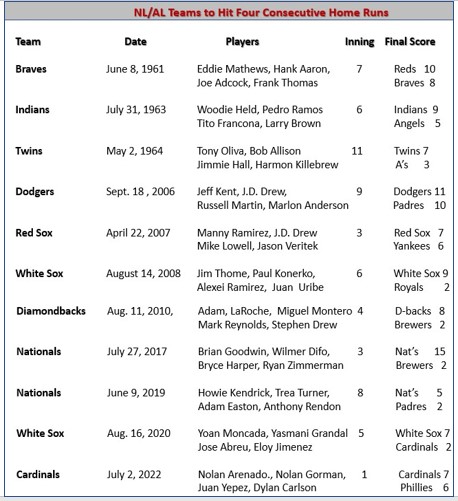
BASEBALL ROUNDTABLE – BLOGGING BASEBALL SINCE 2012


Baseball May 2022 Wrap – No-hitters, .400 hitters, Hitting Streaks and More

It’s June 1, and that means it’s time for Baseball Roundtable’s monthly Wrap Up – outlining the stats and stories that caught Baseball Roundtable’s attention in May, plus the standings, Players and Pitchers of the Month and the year-to-date Trot Index.   This month is a little more challenging, as I am putting this post together while on Ballpark Tours’ 40th Anniversary baseball journey. So, I’m writing from the Intercontinental Hotel in Chicago, while waiting to head out to the Brewers-Cubs game at Wrigley Field. Given that, there may a typo to be discovered here and there.  Those on the tour bus will know who I’m talking about.

There was, as always, plenty to take note of over the past month:

  • Miguel Cabrera’s ever-growing Hall of Fame resume;
  • Angels’ rookie Reid Detmers’ no-hitter;
  • A record-tying five-homer inning by the Astros;
  • Two  qualifying players who hit .400+ for the month and three who hit at least 10 home run;
  • Max Scherzer’s first loss in nearly a year;
  • Two players who ended the month with active 20+ game hitting streaks;
  • The season’s first triple play;
  • Christian Yelich’s record-tying (and, in some ways, record-setting) third cycle;
  • And more.

History Repeats Itself – Kind Of

In the April Wrap Up, Baseball Roundtable noted that on April 7 – National Beer Day – the Diamondbacks’ DH Seth Beer hit a walk-off home run to put the Diamondbacks past the Padres 4-1.  It was his second career homer and first career walk-off long ball.  I also voiced my wish that Beer be traded to the White Sox, who have 3B Jake Burger on the roster, so we could have a Beer and a Burger in the lineup together. (A trade taking Burger to the Diamondbacks would, of  course, achieve the same end. ) Well, I didn’t get that, but on May 28 – National Hamburger Day –  Burger homered in the White Sox 5-1 win over the Cubs. 

—–Baseball Roundtable Players/Pitchers  of the Month—–

National League Player of the Month – Paul Goldschmidt, 1B, Cardinals

Goldschmidt lit it up in May – to the tune of 42 hits (most in the NL) and a .404 average – both tops in the National League.  His 33 RBI led MLB and his ten homers were second in the NL to the Dodgers’ Mookie Betts (12)   Goldschmidt ended the month with an  active  22-game hitting streak, during which he hit a robust .438. During the month, he had 12 multi-hit games and ten multi–RBI contests.  There were some other solid performances, but that .40o  average gave Goldschmidt the edge.

Honorable Mentions: Mookie Betts, RF, Dodgers, put up a .342 May average, led the NL with 12 May homers and was fourth in the NL with 26 RBI for the month, while leading  MLB with 31 May runs scored. It was a close call.   Philllies’ RF Bryce Harper went .47-7-18 and Mets’ 1B Pete Alonso went .315-9-30. A shout out also goes to Dodgers’ SS  Trea Turner, who hit  .314-4-24 month and ended with his 23-game hitting streak still active. He also swiped six bases.

American League  Player of the Month– Tie: Aaron Judge, RF, Yankees and J.D Martinez, LF Red Sox.

Hard to pick between MLB’s top hitters in May average (Martinez, among qualifiers) and home runs (Judge – tied).

Photo: Keith Allison from Hanover, MD, USA, CC BY-SA 2.0 <https://creativecommons.org/licenses/by-sa/2.0>, via Wikimedia Commons

A .400 average is a bright and shiny thing that attracts Baseball Roundtable’s attention – and Martinez hit .406 for the Month of May. His 43 hits were second in MLB  (to teammate 3B Rafael Devers). He also also scored 23 runs,  delivered four home runs and 15 RBI. Martinez collected a safety in all but one of his 26 May games – and he had 13 multi-hit performances.

Photo: DR. Buddie, CC BY-SA 4.0 <https://creativecommons.org/licenses/by-sa/4.0>, via Wikimedia Commons

So why the tie?  Well, Judge didn’t hit.400.  But he did drive in and score  more runs than Martinez.   Judge led the AL and tied for the MLB lead  in May home runs with 12 was second  in the AL in RBI (25), while hitting  a healthy .311  He had three multi-homer games and six games with three or more RBI.

Some may ask why Red Sox’ SS Trevor Story and his AL-topping 32 May RBI did not figure into this ranking.  For me it’s that .218 average for the month.  It is Player of the “Month” and from May 1 through May 15, Story was .156-1-10.

Honorable Mentions: More Red Sox and Yankees here.  Red Sox’ 3B Rafael Devers was a mirror-image of  teammate J.D. Martinez for the month – .381-8-17, with 23 runs scored and an MLB-leading 45 May safeties.  The Yankees’ DH Giancarlo Stanton put up a solid .301-7-21 line  (fourth in AL in RBI).  Also have to give  nod to the Twins’ versatile Luis Arraez, who got in only 23 games, but hit .376 with an MLB topping (among qualifiers) .480 on-base percentage.

National League Pitcher of the Month- Sandy Alcantara, RHP, Marlins

Photo: Ryan Casey Aguinaldo, CC BY-SA 4.0 <https://creativecommons.org/licenses/by-sa/4.0>, via Wikimedia Commons

It was a tough call here. No one really jumped out at me. There were Pirates’ Jose Quintana, Padres’ Joe Musgrove and Phillies’ Zack Wheeler who all pitched at least 25 innings with ERAs under 1.50;  the Phillies’ Aaron Nola with 40 strikeouts and just five walks in 33 innings; and the Mets’ Carlos Carrasco. Diamondbacks’ Zac Gallen and  and Dodgers’ Tony Gonsolin,  Tyler Anderson and Walker Buehler,  who each went 4-0 for the month.,

I decided to go with the Marlins’ Sandy Alcantara, who may have only gone 3-2 in May (keep in mind, he was pitching for the Marlins, who went 7-19 for the month), but put  up a 2.13 ERA, a league-topping 42 1/3 innings pitched (six starts) and 43 strikeouts (second in the NL). In his last four May starts, Alcantara pitched 32 innings (I’ll do the math, that’s eight frames per start) and gave up just three earned runs.

Honorable Mentions; The Padres’ Joe Musgrove went 2-0, 1.64 in five May starts, fanning 33 batters in 33 innings. In his five starts, Musgrove never went less than six full innings and never gave up more than two earned runs. In his three May no-decisions, the Padres scored a total of two runs while Musgrove was in the game.  The Dodgers’ Tony Gonsolin went 4-0, with a tidy 1.93 ERA in five starts and whiffed 31 batters in 28 innings

American League Pitcher of the Month – Martin Perez, LHP, Rangers

Photo: mjl816 on Flickr (Original version) UCinternational (Crop), CC BY-SA 2.0 <https://creativecommons.org/licenses/by-sa/2.0>, via Wikimedia Commons

Another tough decision. with Jameson Taillon, who went 4-0 for the Yankees; Rays Shane McClanahan, who went 4-0, 1.15; New York’s Gerrit Cole who fanned 45 batters (just five walks) in five starts (33 2/3 innings); and Tigers’ Tarik Skubal, Twins’ Sony Gray, Yankees’ Nestor Cortes, who joined McClanahan with at least 25 innings pitched and ERAs under 2.00.

I went with the only pitcher to put up an ERA not just under 2.00, but under 1.00 in six May starts – and also threw one of just two complete-game shutouts in May.  That would be the Rangers’ Martin Perez, who – on May 20, shutout the vaunted Houston Astros’ offense in a nine-inning, eight-hit, 3-0 win.  In five May starts, Perez went 4-0 and allowed only three earned runs in 42 1/3 innings – a stingy 0.64 ERA  (yes, his ERA started with a zero).

Honorable Mentions: The Rays’ Shane McClanahan could easily have this spot – going 4-0, 1.14 in five starts and fanning 39 in 31 1/3 innings. (I just could not resist Perez’ sub-1.00 ERA.)  White Sox’ closer Liam Hendricks also had a solid month, with an MLB-high ten saves (in 12 opportunities), a 2.03 ERA and 21 whiffs in 13 1/3 innings.  I also looked at the Tigers’ Tarik Skubal (2-0, 1.15 in five starts, with 35 strikeouts in 31 1/3 innings) and the Yankees’ Nestor Cortes (3-1, 1.95 with 33 strikeouts in 32 1/3 innings).

Surprise Player of the Month – Tyler Anderson, LHP. Dodgers

The 32-year-old Anderson came into the 2022 season with a 29-68, 4.66 record over six MLB seasons (2016-21 … Rockies, Giants, Pirates, Mariners). Anderson had never won more than seven games in a season and had finished above .500 just once – 4-3, 4.37 in 2020. He had, in fact, been granted free agency by the Mariners before the Dodgers signed him in March. This May, Anderson went 4-0, 3.09 in five starts, fanning 33 batters in 32 innings – bringing his record on the year to 6-0, 2.90 in nine appearances, seven starts. In his final three starts of the month, he went 3-0 and gave up just two earned runs in 21 innings – fanning 21 and walking just one.

________________

TROT INDEX … A REGULAR BBRT FEATURE

Through May, 34.5 percent of the MLB season’s 55,041 plate appearances ended in a trot (back to the dugout, around the bases, to first base). We’re talking about strikeouts, home runs, walks, hit by pitch and catcher’s interference – all outcomes that are, basically, devoid of action on the base paths or in the field. Here’s the breakout: strikeouts (22.3%); walks (8.5%); home runs (2.7%); HBP (1.0%); catcher’s interference (less than 1%). 

Now, to provide a little context (a more detailed post on this topic coming soon). Here are a few selected annual Trot Index scores since I began watching baseball in earnest:  1950  – 22.8 %; 1960 – 25.1%; 1970 – 27.0%; 1980 – 23.1%; 1990 – 26.1%; 2000 – 29.9%; 2010 – 30.3%; 2021 – 36.3%.

______________

Only two teams won 20 or more games in May – the Astros and Dodgers and, no surprise, they each logged their leagues lowest earned run average.

The Astros 21-8 month was fueled included an 11-game wining streak (May 2-13, during which the Houston staff fashioned five shutouts and  put up a 0.91 earned run average.  During that stretch, they gave up three runs in just one contest.  They outscored their opponents 56-12 over the 11 games, outhit them .237-187 and out homered them 18-2.  They were the only team with a May ERA of under 3.00 – at 2.26.

Only six NL starters picked up four wins in May, and three of those pitchers wore Dodger Blue: Tony Gonsolin (4-0, 1.93); Tyler Anderson (4-0, 3.09) and Walker Buehler 4-0, 3.71).

——Team  Statistical Leaders for May 2022 ———-

RUNS SCORED

National League – Dodgers (174); Mets (168); Cardinals (150)

American League – Red Sox (159); Angels (131); Twins (137)

The fewest May runs were scored by the Tigers (74). The Pirates were last in NL scoring (88). The only other team to score less than 100 May runs was the A’s (93), 

AVERAGE

National League – Mets (.278); Nationals (.268);Rockies (.267)

American League – Red Sox (.282); Twins (.262); Royals (.255)

The lowest team average for May belonged to the As at .214.  The lowest in the NL was the Pirates at .218.

HOME RUNS

National League – Brewers (46); Diamondbacks (39); Dodgers (38)

American League –  Angels (41); Yankees (40); Astros (39)

The Padres and Athletics  had the fewest home runs for  May  at 15. 

Boston led MLB in May slugging percentage at .476.  The Dodgers led the NL at .457.

STOLEN BASES

National League – Cubs (30); Braves (18); Brewers (18); Phillies (18); Cardinals (18)

American League – Rangers (28); Athletics (22); Guardians (21)

The Blue Jays stole the fewest sacks in May  – just five.  

WALKS DRAWN

National League –   Dodgers (126); Giants (115); Brewers (104)

American League – Twins (105); Yankees (97); Astros (96)

The Red Sox  led MLB  in on-base percentage for April at .346. The Dodgers led the NL  at .344.

BATTERS’ STRIKEOUTS

National League – Braves (289); Diamondbacks (273); Cubs (267)

American League – Angels (263); Orioles (250);’ A’s (249)

Guardians’ batters fanned the fewest times in May (148).

______

Bonus Stat:

The Mets led all of MLB in May triples (10), while the Red Sox led in doubles (73).

______

Earned Run Average

National League – Dodgers (3.08); Padres (3.26); Brewers (3.59)

American League – Astros (2.26); Yankees (3.06); Rangers (3.32)

Five teams had May ERAs of 5.00 or higher: Royals (5.62); Giants (5.44); Nationals (5.36); Rockies (5.35); Reds (5.00). 

STRIKEOUTS

National League –  Brewers (278); Phillies (276); Dodgers (251)

American League – Twins (256); White Sox (250); Yankees (250)

The Phillies averaged an MLB-best 9.86 strikeouts per nine innings in May. The White Sox  averaged an AL-best 9.15.

FEWEST WALKS SURRENDERED

National League Dodgers (79); Brewers (80); Mets (81)

American League –  Yankees (53); Blue Jays (64); Rays (66)

The Yankees walked a stringiest 1.91  batters per nine frames (the only team under 2.00) The Royals  walked an MLB’s highest 4.32 per nine innings for the month.

SAVES

National League – Brewers (12); Padres (11): Brewers (10); Diamondbacks (9); Dodgers (9)

American League – White Sox (12); Twins (10); Blue Jays (10)

The Marlins recorded just one save in May (just six opportunities). They did win only seven of 25 games.

WALKS AND HITS PER INNING PITCHED (WHIP)

National League – Padres (1.14); Dodgers (1.21); ; Brewers (1.21)

American League – Yankees (1.03); Astros (1.07); Rays (1.11)

——Individual Statistical Leaders for May 2022———

AVERAGE (75  April  at bats minimum)

National League – Paul Goldschmidt, Cardinals (.404); Luis Gonzalez, Giants (.368) Ketel Marte, Diamondbacks  (.363)

American League –  J.D. Martinez, Red Sox (.406); Tim Anderson, White Sox (.385); Rafael Devers, Red Sox (.381)

The lowest April  average (among players with at least 75 at bats in the month)  belonged to the Rays’ Taylor Walls at .103 (8-for-78).

HOME RUNS

National League – Mookie Betts, Dodgers (12); Paul Goldschmidt, Cardinals (10); Jorge Soler, Marlins (9); Pete Alonso, Mets (9); Christian Walker, Diamondbacks (9)

American League –  Aaron Judge, Yankees  (12);  Trevor Story, Red Sox (9);  Jose Altuve, Astros (9)

The Cardinals’ Paul Goldschmidt had the highest May slugging percentage (among players with at least 75 at bats) at .817.  The AL  leader was the Red Sox’ Rafael Devers at .712.

RUNS BATTED IN

National League – Paul Goldschmidt, Cardinals (33); Pete Alonso, Mets (30);  Francisco Lindor, Mets (28)

American League – Trevor Story, Red Sox (32); Aaron Judge, Yankees (25); Jose Ramirez, Guardians (23)

HITS

National League – Paul Goldschmidt, Cardinals (42); Mookie Betts, Dodgers (39); Trea Turner, Dodgers (36)

American League –  Rafael Devers, Red Sox (435); J.D. Martinez, Red Sox (43); Ty France (39)

The Twins Luis Arraez led MLB (players (with at least 75 May at bats) in on-base percentage at .480. The NL leader was the Cardinals’ Paul Goldschmidt at .471.

DOUBLES

National League –  Freddie Freeman, Dodgers (15); Matt Olson, Braves (14); Paul Goldschmidt, Cardinals (13)

American League –  Rafael Devers, Red Sox (13); Bo Bichette, Blue Jays (11); Jackie Bradley, Red Sox (10)

TRIPLES

National League – Brandon Nimmo, Mets (3); ten  with two

American League – Jose Ramirez, Red Sox (3); ten with two

The Cardinals’ Paul Goldschmidt led MLB in extra-base hits in May with 23.

STOLEN BASES

National League –  Ronald Acuna, Braves (7); Harrison Bader, Cardinals (7); Jean Segura, Phillies (7); Tommy Edman, Cardinals (7)

American League – Cedric Mullins, Orioles (8); Kyle Tucker, Astros (7); Eli White Rangers (6); Jose Ramirez, Guardians (6)

WALKS

National League – Juan Soto, Nationals (21); Mike Yastrzemski, Giants (19); three with 18

American League – Jose Ramirez, Guardians (19); Kyle Tucker, Astros (17); three with 16

BATTER’S STRIKEOUTS

National League – Patrick Wisdom, Cubs (40); Kyle Schwarber, Phillies (39); Austin Riley, Braves (38)

American League – Eugenio Suarez, Mariners (40); Trevor Story, Red Sox (39); Mike Trout Angels (36)

No player grounded into more double plays in May than the Nationals Maikel Franc0 (9)

PITCHING VICTORIES

National League – Walker Buehler, Dodgers (4-0); Tyler Anderson, Dodgers (4-0); Carlos Carrasco, Mets (4-0); Tony Gonsolin, Dodgers (4-0); Zac Gallen, Phillies (4-0)Luis Garcia, Padres (4-1)

American League – Martin Perez, Rangers (4-0); Shane McClanahan, Rays (4-0); Jameson Taillon, Yankees (4-0); Justin Verlander, Astros (4-1); Nick Pivetta, Red Sox (4-1); Framber Valdez, Astros (4-1); Drew Rasmussen, Rays  (4-1 ); Kevin Gausman, Blue Jays (4-2)

EARNED RUN AVERAGE (at least 25  May innings pitched)

National League – Jose Quintana, Pirates (1.33); Joe Musgrove, Padres (1.64); Zack Wheeler, Phillies (1.65)

American League – Martin Perez, Rangers (0.64); Shane McClanahan, Rays (1.15); Tarik Skubal, Tigers (1.45)

STRIKEOUTS

National League – Corbin Burnes, Brewers (45); Sandy Alcantara, Marlins (43); Aaron Nola, Phillies (40); Zach Wheeler, Phillies (40).

American League – Dylan Cease, White Sox (48); Gerrit Cole, Yankees (45); Robbie Ray, Mariners (42)

SAVES

National League – Taylor Rogers, Padres (10); Josh Hader Brewers (8); David Bednar, Pirates (7); Edwin Diaz, Mets (7); Craig Kimbrel, Dodgers (7)

American League – Liam Hendricks, White Sox (10); Jeff Barlow, Ranges (8); four with six

WHIP (Walks +  Hits per Inning Pitched) – 25 May innings minimum)

National League – Tony Gonsolin, Dodgers (0.79); Corbin Burnes, Brewers (0.87); Adam Wainwright, Cardinals (1.69)

American League – Triston McKenzie, Guardians (0.74); Shane McClanahan, Rays (0.83); Nick Pivetta, Red Sox (0.83)

BONUS STAT

Among pitchers with 25 May innings, the Dodgers Tony Gonsolin held opponents to the lowest May batting average (.149 )

—–May 2022 Highlights —–

A Veteran Rookie

On May 1, after 11 years and more than 1,000 games in the minor leagues, Giants’ LF Jason Krizan notched his first MLB base hit. The 32-year-old rookie’s wife and two-year-old son were in the stands to share the landmark safety.  Krizan’s April 29 MLB debut came in his twelfth professional season, after 1,132 minor-league games.  Krizan was drafted in the eighth round of the 2011 MLB Draft (Tigers) – out of Dallas Baptist University, where, in 2011,  he hit .413-10-81 in 62 games. Over his 1,000+ minor league games, he hit .275-83-541.  On his lengthy journey to the “show,” Krizan had several solid seasons – including  .293-7-56 at Double-A in 2014; .294-10-65 at Double- and Triple-A in 2016; and .316-16-73 at Triple-A in 2021.

Old Guys Rule

On May 4, the Cardinals starting battery was 40-year-old Adam Wainwright on the mound and 39-year-old Yadier Molina behind the plate. Wainwright got the win, to even his 2022 record at 3-3. It was the 202nd time the Cardinals had won a game with Wainwright and Molina as the starting battery – tying the pair for the MLB record in that category (tied with the Braves’ Warren Spahn and Del Crandall battery.) Molina and Wainwright captured sole position of the record in Wainwright’s very next start – as the Cardinals topped the Giants 15-6 in St. Louis. They continue to add to their own record. On May 20, Wainwright got the win -with Molina catching, as the Cardinals topped the Pirates 5-3. In that one, Wainwright gave up just one run in seven innings and Molina drove in two runs.  More #InBaseballWeCountEverything.

A Giant, Appropriately

On May 6, as the Giants took on the Cardinals in San Francisco, 25-year old rookie right-hander Sean Hjelle made his MLB debut – and tied a major-league record just by taking the mound. At 6’11” tall, Hjelle tied Jon Rauch – another right-handed pitcher – as the tallest major leaguer ever.   Hjelle pitched a 1-2-3 seventh inning (two whiffs and one ground out.). Rauch pitched in 11 MLB seasons (2002, 2004-2013 … White Sox, Expos, Nationals, Diamondbacks, Twins, Blue Jays, Nets, Marlins), going 43-40, 3.90 with 62 saves in 556 games (11 starts).

Miggy Watch goes On

On May 7, in a Tigers 3-2 loss to the Astros, Miguel Cabrera added another line to his Hall of Fame resume. Cabrera hit a two-run double in the top of the third inning.  It was his It was his 600th career double – making him just one of three players (Hank Aaron & Albert Pujols) with 600 doubles, 500 homers and 3,000 hits (he picked up his 3,000th hit earlier this season – as he joined the 3,000 hit, 500 home run .300+ average club). Only two MLB players have retired with at least 3,000 hits, 500 homers and a .300 or better average (Hank Aaron and Willie Mays).  Cabrera finished May with 3,030 career hits, 505 home runs, 603 doubles and a .310 average.

The One That Got Away

On May 8, the Phillies handed Max Scherzer a loss, topping the Mets 3-2 and roughing up Scherzer for three runs on ten hits in six innings. (Scherzer did fan seven New York batters.) This unremarkable fact only makes it here because it was Scherzer’s first loss in 22 days short of a full year (since May 30, 2021). Over that time, Scherzer started 24 games, and went 15-0, 2.55.  Roger Clemens holds the record for the most starts between losses at 30 (June 3, 1998-June 1, 1999.  During that time , he went 20-0, 2.68. 

King Carl

Carl Hubbell holds the record for the most consecutive pitching victories at 24 (three of those wins came in relief).  From July 17, 1936 to May 27, 1937, he went 24-0 in 27 games (22 starts).

Looking for a Big Finish

Photo: Erik Drost, CC BY 2.0 <https://creativecommons.org/licenses/by/2.0>, via Wikimedia Commons

On May 9, the Guardians came to bat in the top of the eighth inning trailing the White Sox 5-1. At this point in the game, Guardians’ 1B Josh Naylor had been to the plate three times and was zero-for-two (a walk and two strikeouts). This is how the rest of his game went:

  • Batting in the eighth with one on and two out, he delivered an RBI double to  cut the White Sox lead to 5-2.
  • Batting in the ninth with the bases loaded, two outs, and the Guardians down 8-4, he launched a Grand Slam home run to tie the contest
  • Batting in the eleventh frame, with two on and two out, he hit a three-run home run to provide the final margin in the Guardians’ eventual 12-9, 11-inning win.

The Elias Sports Bureau reported that Naylor was the first  player since 1920 (when RBI became an official statistic) to drive in at least eight runs in the eighth inning and later in a game. The bigger surprise for me is that all eight RBI were two-out RBI.

2022 Second No-Hitter

On  May 10, Angels’ 22-year-old rookie southpaw Reid Detmers tossed the second no-hitter of the 2022 season and the season’s first complete-game no-no. (On April 29, five Mets’ pitchers combined to no-hit the Phillies.) Note: Detmers made five appearances for the Angels in 2021, but his rookie status was still intact. Detmers walked one and fanned two as the Angels topped the Rays 12-0 in Anaheim. He threw 108 pitches (68 strikes). Coming into the game, Detmers was 1-1, 5.32 in five 2022 starts and had not gone more than five innings in any of those appearances. In his first start after the no-hitter, he gave up three runs on three hits and two walks in 3 2/3 innings. Detmers was signed in the first round (tenth overall) of the 2020 MLB draft out of University of Louisville, where he went 20-6, 3.20 in three seasons. In 2021 he went 3-4, 3.19 at Double- and Triple-A and 1-3, 7.40 with the Angels.

A Walk-Walk-Walk-Off

Photo by Keith Allison

On May 10, the Yankees went into the bottom of the ninth trailing the Blue Jays 5-3 – and facing closer Jordan Romano. Yankees’ SS Isiah Kiner Falefa went down swinging to start the inning, followed by consecutive walks to C Jose Trevino and 3B DJ LeMahieu – setting up CF Aaron Judge for a game-ending, walk-off three-run home run. Which he delivered.  It was the 168th home run of Judge’s career and his first-ever walk-off game-winning four-bagger (and it took those two walks to put him a position to deliver the 6-5 win).

A Tri-Cycle?

On May 11, Brewers DH Christian Yelich hit for the cycle (single, double, triple and home run in the same game), as Milwaukee topped the Reds 14-11.  In the process, he became just the sixth player to record three cycles in an MLB career and also the first to record three career cycles against the same teams (Reds).  For more on that May 11 game and a host of cycle trivia, click here.

How About a Trophy in the Shape of a Roll of Life Savers?

Brewers’ closer Josh Hader  set a new MLB record on Friday, May 13 – starting the season with saves in 13 straight mound appearances.  He extended that record to 18 straight appearances with a save while saving both games of a May 30 doubleheader versus the Cubs.

The Shohei Sho

On May 14, in a 9-1 Angels’ win over the A’s in Oakland, Angels’ DH Shohei Ohtani popped a two-run homer in the top of the fifth. It was his seventh of the season and 100th of his MLB career – and made him just the  third Japanese player to reach the 100 career mark in MLB (following Hideki Matsui with 175 homers and Ichiro Suzuki with 117).  It also made Ohtani just the second  MLB player with 100 or more home runs as a hitter and 250 or more career strikeouts as a pitch (the other being, of course, Babe Ruth). Just more #InBaseballWeCountEverything.

Alert Pujols Takes the Mound

On May 15, 42-year-old future Hall of Famer Albert Pujols (in his 22nd MLB season) – at the time the owner of 3,312 MLB hits, 681 home runs and 2, 156 RBI – took the mound (for the Cardinals) for the first time in his MLB career. It came in the top of the ninth, with Pujols’ Cardinals leading the Giants 15-2.  Pujols inning of work went:

  • LF Darin Ruf, walk.
  • CF Austin Slater, line out to center.
  • 3B Even Longoria, single.
  • SS Thairo Estrada, safe on fielder’s choice (Longoria out at second).
  • P Luis Gonzalez, three-run home run. (Note: Gonzalez started in LF, moved to the mound in the bottom of the eighth.)
  • C Joey Bart, solo home run.
  • RF LaMonte Wade, Jr., ground out third-to-first.

Pujols’ pitches ranged in velocity (if you can use that word) from 46.6 mph-to-66.3 mph. Pujols has now appeared  in the field at the major-league level at every position except catcher and centerfield.

Giving veterans stars a free trip to the mound may be the Cardinals’ theme this year. On May 22nd ten-time All Star C  Yadier Molina – like Pujols in his 22nd MLB season – made his first MLB mound appearance. It came in the  bottom of the ninth inning of a game against the Pirates, with the  Cardinals leading 18-0.  Like Pujols, Molina gave up four earned runs (and two homers) in his inning of work

How about a Nice Walk-(off) in the Park?

Okay, the Orioles aren’t really going anywhere this year.  As of May 22, they were 17-25, in last place in the AL East, 14 ½ game back.  Why did I pick May 22? Because  on that day the O’s picked up their third  Walk-Off win in  four days. They topped the Rays  7-6 in eleven innings, with DH Adley Rutschman (placed on second to start the inning and moved to third on a sacrifice), scoring on a  groundball dribbler (fielder’s choice) by 2B Rougned Odor. On May 20, the O’s walked-off a 13-inning, 8-6 victory against those same Rays.  This time on a two-run home run by Odor. On May 19, they picked up a 9-6  walk-off win against the Yankees (this time in the ninth inning) on a three-run homer by RF Anthony Santander.   Baseball Roundtable note: Five of the Orioles 17 wins through May 22 were walk-offs and they were 4-0 in extra-inning  games .

Two Shots at One Big Shot

In the first inning of the Cubs’ May 16 game against the Pirates (at Wrigley Field) catcher Willson Contreras found himself at DH and in the leadoff spot. He also happened to be sitting on 99 career round trippers.  Contreras  got into one leading off the game, taking the first pitch he saw from Pirates’ starter Dillon Peters to deep right-center for a double. He got another chance later in the same inning, coming to the plate for a second time, this time with the bases loaded, two outs, the Cubs up 4-0 and Bryse Wilson on the mound.   The Willson (Contreras) versus (Bryse) Wilson matchup went in Contreras’ favor, as he smoked the first pitch he saw from Wilson for a Grand Slam home run … and his 100th career regular-season dinger. So, at that point in the game, he had seen two pitchers, had a double and a home run for six total bases, had scored twice and driven in four – and had become just the tenth major-leaguer in the Modern Era to hit a Grand Slam in the first inning while batting leadoff.  Truthfully, I am surprised it’s happened that many times. The Cubs, by the way, scored eight runs in the first inning of that 9-0 win and Contreras had three more at bats (without a hit.)

Morel’s Career Mushrooming

On May 17, Cubs 22-year-old rookie Christopher Morel made  his first MLB appearance, pinch hitting for Patrick Wisdom in the bottom of the eighth with the Cubs up 6-0 on the Pirates.  Morel quickly fell behind the Pirates’ Chase De Jong no balls-two strikes, before working the count full and then hitting a 3-2 pitch to deep left field – to joint the list of major leagues to homering their first-ever MLB plate appearance. Morel had been hitting .306-7-20 at Double-A when e was called up. At the end of May, the rookies’ MLB stat line was .283-2-5 in 11 games.

Brotherly Love

On May 17, brothers Edwin Diaz (Mets) and Alexis Diaz (Reds) both recorded saves.  They were just the third pair of brothers to record major-league saves on the same day. More proof of #InBaseballWeCountEverything. It was the senior (28-year-old) Diaz’ ninth save of the year and 182nd career save (he led the AL in 2018 with 57 saves for the Mariners).  It was the first MLB save, coming in his 17th MLB appearance, for 25-year-old Reds’ rookie Alexis Diaz.

The other pairs of brothers to ramrod a save on the same day? Todd (Dodgers) and Tim (Padres) Worrell on June 13 , 1997 and Ravelo (Pirates) and Josias Manzanillo (Mets), on June 30th 1994.  It was Todd Worrell’s  15 save of the season and 236th career save and Tim Worrell’s first save of the season and second career save.  Todd pitched 11 seasons  and record 256  saves. Tim pitched 14 years and recorded 71 saves. For the Manzanillo brothers, it was Ravelo’s only save (in three MLB seasons, 53 appearances), while  it was Josias’ second save of the 1994 season and his fourth of six career saves (11 MLB seasons, 267 appearances.)

Five Long Balls in One Frame

On May 17, the Red Sox’  Nathan Eovaldi got off to a good start against the Astros in Boston. He got past 2B Jose Altuve, DH Michael Brantley and 3B Alex Bregman on a total of five pitches (all strikes) – a ground out, line out and pop out. The second inning did not go quite as well, as the Astros tied an MLB single-inning record by bashing five home runs (all off Eovaldi). The homers came off the bats of LF Yordan Alvarez, RF Kyle Tucker, SS Jeremy Pena, Brantley and 1B Yuli Gurriel.  For the complete story and a look at the the eight times an MLB team has gone yard five times in an innings, click here.

An Interesting Comeback

Cubs’ 26-year-old rookie Brandon Hughes made quite a comeback – one that brought him all the way to Wrigley field – and the baseball record book.  At the end of Spring Training in 2019, Hughes – drafted out of Michigan State University, as an outfielder, in the 16th round of the 2017 major-league draft – was on the verge of being released by the Cubs.  The strong-armed outfielder, who had hit .237-4-35 in 110 games for  A-level South Bend in 2018, was told he would be released unless he was willing to take a shot at finding success as a pitcher (Side note:  Primarily an outfielder over three college seasons, Hughes had made seven relief appearances for Michigan State – as a freshman, in 2015 – putting up a 7.11 earned run average in 6 1/3 innings.  As a hitter, he  hit .304-13-93 in 159 games in three Michigan State seasons.)

Long story short, Hughes persevered and on May 17, found himself on the mound at Wrigley Field. He came on in the top of the sixth, with none on and one out and the Cubs leading the Pirates 6-0 and his outing wen like this.

Sixth Inning

  • 2B Josh VanMeter, walk.
  • CF Bryan Reynolds, strikeout.
  • LF Ben Gamel, inning-ending strikeout.

Seventh inning

  • DH Dan Vogelbach, strikeout.
  • 1B Yoshi Tsutsugo, strikeout.
  • 3B Michael Chavis, walk.
  • SS Rodolfo Castro, strikeout.

Hughes was replaced to open  the top of the eighth by Mark Leiter, Jr.

Oh, that record-book thing? STATS reported that Hughes was the first MLB pitcher since 1900 to record at least five outs in their MLB debut with all those outs coming via the strikeout.  Just more #InBaseballWeCountEverything.

At the end of May, Hughes had a 3,72  ERA over seven  appearances. Guess that switch paid off.

1-2-3 and You’re Out at the Old Ball Game

On May 20, The Nationals turned 2022’s first MLB triple play in a 7-0 loss to the Brewers (in Milwaukee).  It came in the bottom of the seventh. The inning started with the Nationals’ Carl Edwards, Jr. walking Brewers’ 3B Jace Peterson and 2B Kolten Wong.  On the first pitch in his at bat, SS Luis Urias hit a groundball to third.  Nationals’ 3B Maikel Franco  snagged it, stepped on the bag and fired to 2B Cesar Hernandez, who made the pivot and got the ball to 1B Josh Bell for the triple-killing. The odds, of course, favor this, but Baseball Roundtable did note that all six involved players (batter, base runners and fielders) were infielders.

More #InBaseballWeCountEverything

On May 21, 27-year-old Rockies’ rookie catcher Brian Serven collected his first major-league hit. It came in his second career game since a call up from Triple-A Albuquerque, where he was hitting .273-5-11 in 23 games.  After going zero-for-two in his first MLB games (May 177), Serven hit a two-run home run in his first May 17 at bat (bottom of the second inning versus the Mets).  He then grounded out in fifth, hit another two-run home run in the sixth and flied out in the seventh. According to MLB.com, that performance made Serven  the only player in MLB history whose first two major-league hits were multi-run homers in the same game.

Reeling in a Nice Round Number

On May 21, as the Angels topped the A’s 5-3 in Anaheim, Mike Trout went zero-for-three with a walk with a run scored.  The run scored was the 1,000th of his 12-season (including 2022) MLB career – making him just the third player in MLB history to score at least 1,000 runs, hit at least 300 home runs and steal at least 200 bases by his age-30 season. The others? Willie Mays and Alex Rodriguez.  Pretty good company.  or those who like to know such things, Trout has led the AL in runs scored four times.

Time to buy that “Old Guys Rule T-Shirt.”

In May, 39-year-old Astros’ starter Justin Verlander went 4-1, 2.27 in five starts,  – giving him a 6-2, 2.03 record on the season. 

Reds Leave Cubs Red-Faced

On May 26, the Reds pounded the Cubs 20-5 in front of 3,578 delighted (despite a 59-minute rain delay)  home-town fans. It was the first 20-run game for the Reds since a 22-3 win over the Phillies on September 4, 1999.  What struck Baseball Roundtable about the May 26 game is that five Reds’ hitters drove in three or more runs:

  • SS Kyle Farmer … 4-for-4, five RBI (two home runs)
  • 2B Matt Reynolds … 3-for-3, three RBI (one triple)
  • LF Albert Amora, Jr. … 3-for-5, three RBI
  • DH Tommy Pham … 2-for-4, three RBI (one double)
  • 3B Brandon Drury … 2-for-6, three RBI (one double)

In the September 4, 1999 win over the Phillies (in Philadelphia), six Reds collected at least three RBI:  2B Pokey Reese (3); RF Dmitri Young (4); LF Greg Vaughn (3); C Ed Taubensee (3); 3B Aaron Boone (3); and 3B Mark Lewis, who replaced Boone in the sixth inning (3). In that one, the Reds got home runs from Reese, Young, Vaughn, Taubensee (two homers), Boone, Lewis, CF Jeffrey Hammonds and C Brian Johnson.

Trevor’s Story

On May 15, Trevor Story had appeared in 29 of the Red Sox’ 34 games and was hitting a disappointing .196, with just one home run and 15 RBI. Then, in a ten-game span, between May 16 and May 26, Story went 13-for-39 (.333), with eight home runs and 22 RBI – improving his season line to .232-9-37.  He finished May .220-9-37 on the season. 

Like Father, Like Son – Except on the Other Side of the Pitch

On May 30, the Tigers called up 26-year-old Kody Clemens (Roger Clemens’ youngest son) from Triple-A Toledo. Clemens, a 2018 third-round draft choice out of the University of Texas at Austin, was hitting .283-8-31 (in 45 games) for Toledo. – and had appeared at 1B, 2B, 3B and LF.  Clemens made his MLB  debut May 31, going zero-for three, with one walk.

——Team  Statistical Leaders  Through May 31  ———-

If the season ended May 31, your post-season teams would be”

American League: Yankees, Astros, Twins.  Wild Cards: Blue Jays, Rays, Angels.

National League:  Dodgers< Mets, Brewers. Wild Cards: Padres, Cardinals; Giants.


RUNS SCORED (average 209)

National League – Dodgers (270); Mets (266); Giants (244)

American League – Angels (2356; Red Sox (235); Yankees (229)

Through May, the fewest runs were scored by the Tigers at 138. The next fewest was by the Pirates (166).

AVERAGE (average .240)

National League – Mets (.268); Rockies (.265); Nationals (.254)

American League – Red Sox  (.258); Angels (.250); Twins (.248)

The lowest team average through May belonged to the A’s at .213. The Diamondbacks were the lowest in the NL at .220.

HOME RUNS (average 49)

National League – Brewers (70); Braves (62); Diamondbacks (59); Dodgers (59)

American League –  Yankees (69); Angels (68); Astros (64)

The Tigers had the fewest home runs through May at 29.  The Nationals had the fewest in the NL at 32. 

STOLEN BASES (average 25)

National League – Cardinals (40); Cubs (34); Brewers (31);

American League – Rangers (39); Rays (34); A’s (34)

The Twins and Rockies stole the fewest bass through May at just ten each – in seventeen and eighteen attempts, respectively.  

WALKS DRAWN  (average 156)

National League –   Dodgers (208); Giants (184); Diamondbacks (182)

American League – Twins (181); Mariners (174); Yankees (170)

The Mets led MLB  in on-base percentage through May at .337. The Twins led the AL  at .325. In slugging percentage, the Dodgers were  on top at .430, while the Angels  led the AL at .425.

BATTER’S STRIKEOUTS (average 409)

National League – Braves (487); Diamondbacks (471); Brewers (451)

American League – Angels (451); Orioles (438); A’s (432)

Guardians’ batters went down on strikes the fewest times through May  (324).

EARNED RUN AVERAGE (average 3.93)

National League – Dodgers (2.76); Brewers (3.36); Padres (3.40)

American League – Astros (2.82); Yankees (2.91); Rays (3.36)

Three teams had ERAs through May  of 5.00  or higher – Reds  (5.41); Nationals (5.23); Royals (5.10)

STRIKEOUTS (average 434)

National League – Brewers (500); Mets (463); Phillies (461)

American League – Yankees (449); White Sox (440); Twins (436)

The Brewers  averaged an MLB-best 10.0 strikeouts per nine innings through May. The White Sox averaged an AL-best 9.4.

FEWEST WALKS SURRENDERED (average 156)

National League – Dodgers (125); Giants (136); Mets (146)

American League –  Yankees (121); Rays (123); Blue Jays (122)

The Rays and Yankees walked a stringiest 2.5  batters per nine frames through May. The Reds walked an MLB’s highest 4.3 per nine innings.

SAVES (average 13)

National League – Brewers (23); Padres (19); Braves (15); Rockies (15); Diamondbacks (15)

American League – Blue Jays (21); White Sox (18); Yankees (17)

Bonus Stats – In the Field

The  Pirates  made the most errors through May (39); while  the Padres were guilty of the fewest miscues (16).   

Primary Resources: Baseball-Reference.com; MLB.com; Baseball-Almanac.com


BASEBALL ROUNDTABLE ON THE TOP 100 BASEBALL BLOG LIST

100Baseball Roundtable is on the Feedspot list of the Top 100 Baseball Blogs.  To see the full list, click here.

I tweet baseball @DavidBBRT

Follow/Like Baseball Roundtable’s Facebook Page here.  More baseball commentary; blog post notifications; PRIZES.

Member: Society for American Baseball Research (SABR); The Baseball Reliquary; The Negro Leagues Baseball Museum.

BASEBALL ROUNDTABLE – BLOGGING BASEBALL SINCE 2012


They’re Off and Running – The Tigers’ 35-5 start in 1984

Jack Morris started against the Twins on Opening Day 1984, pitching seven one-run innings for the win.

Taking in this week’s Twins-Tigers series in Minnesota, I was taken back to Opening Day 1984 (remember,  for Baseball Roundtable, one thing always leads to another) – when I sat through an 8-1 Tigers’ (indoor) drubbing of the Twins at the Metrodome. Little did I know, I was witnessing the first game of the hottest start to a season in MLB history – a run that would extend to late May.  The Tigers would get out of the gate with thirty-five wins in their first forty games, never drop out of first place the entire season, finish 104-58, sweep the Royals in the American League Championship series  and top the Padres in the World Series four games-to-one.

In that 35-5 early-season run, the Tigers:

  • Started the season with a nine-game winning streak ;
  • Won 16 of their first 17;
  • Won their first 17 road games (an MLB record);
  • Went 18-5 at home;
  • Went 9-2 in one-run games;
  • Were 2-1 in extra innings;
  • Won ten games by five or more runs; and
  • Produced five walk-off wins.

Over the forty games, the Tigers scored eight or more runs 11 times; and fewer than three runs seven times. The Tigers gave up more than three runs in just 14 contests, and won all but three three of those games.

During that 40-game stretch the Tigers:

  • Outscored their opponents 236-120;
  • Outhit them .299 to .214;
  • Out-homered them 40-29; and
  • Put up a 2.58 ERA to the opponents 5.65.

After those first forty games, the Tigers had an 8 1/2 game lead in the American League East.

A few highlights  of the streak:

  • On April 7, in the fifth game of the streak Jack Morris pitched a no-hitter against the White Sox (in Chicago), as the Tigers won 4-0. Morris started 11 games during the streak and the Tigers won all but one. Morris went 9-1, 1.97 with six complete games during the Detroit run. He finished the season 19-11, 3.60.

  • Closer Willie Hernandez, who would win the American League Cy Young and Most Valuable Player Awards, won one and saved seven games during the forty-game run. He finished the season 9-3, 1.92 with 32 saves, while leading the league in appearances with 80 – pitching more than one inning in 45 of those appearances.
  • Thirteen proved a lucky number for the Tigers. On Friday, April 13, they made an unusual one-game visit to the Red Sox – and scored 13 runs in topping the Sox 13-9. In that one, they plated eight runs in the first inning on four walks, three singles, two doubles and two Red Sox errors. Six Tigers collected RBI in that first frame.

  • During the 35-5 run, the Tigers got plenty of power “up the middle.” C Lance Parrish hit .286-7-25 during the run, SS Alan Trammell went .340-5-23 and CF Chet Lemon put up a .331-7-32 line.

Cuba Libre

The biggest surprise during the Tigers’ early season run may have been the bat of rookie utility player (corner infielder)  Barbaro Garbey – who had left Cuba on a fishing boat in the 1980 “Freedom Flotilla.” The 27-year-old played in 29 games during the streak and hit .355-1-20.  Over a  sometimes troubled MLB career (1984-85, 1988), Garbey hit .267-11-86 in 226 games.


  • On April 24, the Tigers swept a double header in Detroit (versus the Twins )– winning two one-run ball games (6-5 and 4-3). In the first game, the Tigers trailed 5-3 in the bottom of the night, but plated three runs off Twins’ closer Ron Davis.
  • On April 27, the Tigers lost a heart breaker at home – and it took 19 innings and five hours and 44 minutes to do it.  The game (against the Indians) was tied 3-3 in the third.  The Tigers’ usually reliable Willie Hernandez (in his second inning of work) gave  up a single, sacrifice and walk to open the Indians’ tenth, before Aurelio Lopez was brought to the mound. Lopez’ inning went strikeout, wild pitch, walk (loading the bases), walk (forcing in a run), ground out. For the Tigers, Lou Whitaker opened the bottom of the tenth with a double, Alan Trammell singled him to third and he scored on a double play (Darrell Evans). The game then continued scoreless until the top of the 19th, when (with the help of three Detroit errors – two on sacrifice bunts), the Indians turned two hits into four runs.

  • On May 1, as the Tigers topped the Reds Sox 11-2 in Detroit, hitting stars of the early season run – 1B Barbaro Garbey and CF Chet Lemon – each drove in four runs.
  • On May 3, Jack Morris suffered his only loss of the 35-5 run, despite giving up just one run a nine-inning complete game against the Red Sox. Bob Ojeda shutout the Tigers and Boston RF Dwight Evans took Morris deep in the top of the eighth.
  • On May 8, the Tigers topped the Royals 5-2 in Kansas City, led by an eighth-inning Grand Slam by Alan Trammell (off Dan Quisenberry).
  • In a 10-1 win over the Mariners on May 16 (in Detroit) eight Tigers collected RBI: 2B Lou Whitaker, DH Alan Trammell; PH Johnny Grubb; 1B Barbaro Garbey; PH Dwight Lowry; LF Larry Herndon; RF Rusty Kuntz; 3B Marty Castillo.
  • The streak ended with a 7-3 loss to the Mariners (in Seattle).  The Mariners, in fact, swept the May 25-27 series by scores of 7-3, 9-5 and 6-1.

Primary Resource:  Baseball-Reference.com 


BASEBALL ROUNDTABLE ON THE TOP 100 BASEBALL BLOG LIST

100Baseball Roundtable is on the Feedspot list of the Top 100 Baseball Blogs.  To see the full list, click here.

I tweet baseball @DavidBBRT

Follow/Like Baseball Roundtable’s Facebook Page here.  More baseball commentary; blog post notifications; PRIZES.

Member: Society for American Baseball Research (SABR); The Baseball Reliquary; The Negro Leagues Baseball Museum.
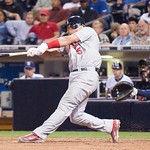


Five Homers in an Inning … The Reds Have the (reverse) Record

Yesterday (May 17, 2022), the Astros exploded for an MLB record-tying five home runs in a single inning.  The outburst came in the second inning of a 13-4 Astros win over the Red Sox in Boston – and all five long balls came off Boston starter Nathan Eovaldi (who had retired the Astros on five pitches in a three-batter first inning). Eovaldi came into the inning with a 3.07 earned run average on the season (it was his eighth start). When the innings was over, is ERA was 6.01. The frame went like this:

  • LF Yordan Alvarez leads off with a home run to Left on a 2-1 pitch.
  • 1B Yuli Gurriel safe on an error by 1B.
  • RF Kyle Tucker takes an 0-1 pitch yard for a two-run home run to right.
  • SS Jeremy Pena, also picking on an 0-1 pitch, homers to left-center.
  • CF Jose Siri flies out to right-center.
  • C Martin Maldonado  singles.
  • 2B Jose Altuve doubles.
  • DH Michael Brantley homers to right (a three-run shot)  on a 1-1 pitch.
  • 3B Alex Bregman grounds out third-to-first.
  • Yordan Alvarez, in his second at bat of the inning, singles.
  • Yuli Gurriel (also in his second at bat of the inning) hits a two-run home run (on an 0-2) pitch) to left-center.

At this point, with nine runs across the plate in the inning, Eovaldi is replaced on the mound by Tyler Danish, who gets Tucker on a ground out to end the inning.

The Inning’s Home Run  Hitters: Yordan Alvarez; Kyle Tucker; Jeremy Pena; Michael Brantley; Yuli Gurriel

Final Score:  Astros 13 -Red Sox 4

Runs Scored in the Five-Homer Inning: 9

It marked the eighth time in AL/NL  history that a team has notched five home runs in a single inning.

Before we detail each of these homer-happy innings, here are a few tidbits about the five-homer frames:

  • The Cincinnati Reds have been the victims of four of the eight five-homer innings.
  • The home team has put on the power display six of the eight times.
  • Seventeen of the 40 home runs have come with two outs.
  • Pitchers have contributed (as hitters) HRs in two of the five five-homer innings.
  • One of the five-homer innings was kept alive by three fielding errors.
  • Four of the five five-homer innings have come in the fourth inning (three of the four against the Reds).
  • The five-homer innings have featured the scoring of 66 runs – the fewest at six, the most at 12.
  • Andy Seminick is the only player to homer twice in a team’s five-homer inning.
  • All five home runs were given up by a single pitcher twice.

Now, let’s take a closer look at those five-homer innings.

_____________________________________________

NATIONAL LEAGUE

June 6, 1939 … NY Giants versus Cincinnati Reds

Pitcher Manny Salvo hit an inside-the-park home run in Giants five-homer inning.

Pitcher Manny Salvo hit an inside-the-park home run in Giants five-homer inning.

The first-ever five-home run MLB inning took place in New York on June 6, 1930, as the sixth-place Giants (20-24 record) surprised the league-leading Reds (29-15) by a 17-3 score, plating all 17 runs in the first five innings.

The record-setting power display came in the bottom of the fourth inning, with the Giants already up 6-0.  Peaches Davis, who had relieved Johnny Vander Meer in the first inning (Vander Meer had given up six hits and three runs in 2/3 of an inning), retired Giants’ LF Jo Jo Moore and SS Billy Jurgess to start the inning. Then the wheels came off.  C Harry Danning laced a home run to center (his sixth). Clean-up hitter Mel Ott drew a walk, 1B Zeke Bonura singled and CF Frank Demaree hit the second home run of the inning (his second of the season).

Wesley Livengood (whose MLB career would consist of five appearances and a 9.53 ERA) then came on to relieve Davis. Livengood was not living so good, as he walked 3B Tony Lazzeri and then gave up a home run to 2B Burgess Whitehead (the first of only two he would it in 1939).  Giants’ pitcher Manny Salvo was up next. A weak hitter, Salvo surprised everyone in the ball park with the only home run of his five-season MLB career – an inside-the-park round tripper off the right field fence.  Next up was lead-off hitter J0 Jo Moore, who hit the fifth and final homer of the inning (and his second of the day).  Notably, all of this damage took place after the first two batters were retired.

The Inning’s Home Run Hitters: Harry Danning, Frank Demaree, Burgess Whitehead, Manny Salvo, Jo Jo Moore

Runs Scored in the Five-HR Inning: Eight

Final Score:  Giants 17 – Reds 3

A couple of Baseball Roundtable tidbits on this one:

  • You have to love the great baseball names of the two pitchers who were victimized: Peaches Davis and Wesley Livengood.
  • The number eight and nine hitters for the Giants – Burgess Whitehead and Manny Salvo, who both homered in the inning, hit a combined three home runs all season and a total of 18 long balls in a combined 14 seasons.

June 2, 1949… Philadelphia Phillies versus Cincinnati Reds

Andy Seminick hit two round trippers in the Phillies' five-homer inning.

Andy Seminick hit two round trippers in the Phillies’ five-homer inning.

Ten seasons passed before the next five-homer inning – and the victims were again the Reds.  This time, the bashing came off the bats of the Phillies (in Philadelphia).  It started out as a close game, with the Reds actually leading 3-2 after seven innings behind a strong performance by starting pitcher Ken Raffensberger (who would win 18 games that season). Things, however, went awry in the bottom of the eighth.

CF Del Ennis (the Phillies’ clean-up hitter) led off the inning with a home run (his 7th of the season), which was followed by C Andy Seminick’s second home run of the game – marking Raffensberger’s exit. Jess Dobernic came on in relief and retired RF Stan Hollmig on a liner to short before giving up a home run to 3B Willie Jones (his third of the year). Dobrenic then induced a soft fly ball out to second base by 2B Eddie Miller, bringing up P Schoolboy Rowe, who had relieved Philadelphia starter Curt Simmons in the top of the eighth.  Rowe promptly slammed a home run to left (the only home run of the year for the 39-year-old veteran, in his last MLB season). Kent Petersen came on in relief of Dobernic and seemed to pour gas on the flames:  walk to CF Richie Ashburn, double to SS Granny Hamner, 1B Eddie Waitkus safe on an error (Ashburn scores), an Ennis single to right (Hamner scores), and Seminick’s second home run of the inning (third of the game and seventh of the season). That was the end of the home runs, but the inning continued with the Phillies adding another run on a hit batsman and a triple.  Suddenly a 3-2 Reds lead was a 12-3 deficit.

The Inning’s Home Run Hitters; Del Ennis, Andy Seminick (2),  Willie Jones, Schoolboy Rowe

Runs Scored in Five-HR Inning: 10

Final Score:  Phillies 12 – Reds 3

A Baseball Roundtable tidbit:

  • Phillies’ catcher Andy Seminick, still the only player to hit two home runs in a team’s five-homer inning, hit 24 homers that season and 164 in 15 career seasons.

August 23, 1961 … San Francisco Giants versus Cincinnati Reds

Jim Davenport contributed a three-run inside-the-park homer to the Giants record-tying inning.

Jim Davenport contributed a three-run inside-the-park homer to the Giants record-tying inning.

Twelve seasons after five-home inning number two, it happened again – and for the third straight time, the Reds were the victims – and this time they were are home.  On August 23, 1961, another close game became a late inning route.  The Reds trailed the San Francisco Giants 2-0 after 8 innings with both starters (Juan Marichal for the Giants and Joey Jay for the Reds) still in the game.  A low-scoring game was no surprise. Marichal came into the contest with a 12-7 record for the third-place Giants, while Jay was 18-7 for the first-place Reds.

In the top of the ninth, the Giants broke the tightly contested game wide open.  1B Willie McCovey started the frame with a double off Jay and then scored on an error by Reds’ 2B Don Blasingame after CF Willie Mays popped out, LF Orlando Cepeda and RF Felipe Alou followed with a pair of deep home runs (to center and left, respectively). It was Cepeda’s 36th of the year and Alou’s 15th.  That brought Jim Brosnan in from the bullpen – and led to a fly ball out by C John Orsino, singles by SS Jose Pagan and Marichal, 2B Joey Amalfitano reaching on an error by Reds’ third baseman Gene Freese (Pagan scoring) and a three-run inside-the-park home run by 3B Jim Davenport (his 8th homer of the year).  McCovey then singled for his second hit of the inning, which brought on Bill Henry in relief. Henry gave up a two-run homer to Willie Mays (his 34th of the season), a single to Cepeda, and had Alou reach on Freese’s second error of the inning (and the Reds’ third miscue of the frame). John Orsino then took Henry deep (just his second of the year) before Pagan struck out to mercifully end the 12-run, ninth-inning uprising.

The Inning’s Home Run Hitters:  Orlando Cepeda, Felipe Alou, Jim Davenport, Willie Mays, John Orsino

Runs scored in the Five-Homer Inning: 12

Final Score:  Giants 14 – Reds  0

April 22, 2006 … Milwaukee Brewers versus Cincinnati Reds

Prince Fielder put the "cherry on top" (old school analogy) for the Brewers.

Prince Fielder put the “cherry on top” (old
school analogy) for the Brewers.

Home cookin’ – with a five homer dessert – was good to the Brewers when they hosted the Reds on April 22, 2006. Milwaukee pounded the visitors 11-0, racking up the fourth five-homer inning against the Reds’ franchise along the way.   The outburst came in the bottom of the fourth inning with starter Brandon Claussen still on the mound and the Reds trailing 3-0.

Milwaukee 3B Bill Hall (the number-six hitter) started it with a home run (his third of the young season). Then 2B Richie Weeks singled to left, scoring on C Damian Miller’s home run (his first of the year). That seemed to establish a (brief) HR-1B-HR pattern, as Brewers’ pitcher Dave Bush followed the Miller home run with a single and CF Brady Clark backed up the Bush single with his first home run of 2006. SS J.J. Hardy broke the pattern with a home run (his third of the year).  At this point, Claussen had faced six batters in the inning, giving up four home runs and two singles.  Chris Hammond came on in relief and provided just that, striking out the first two batters he faced (RF Geoff Jenkins and LF Carlos Lee).  Then Prince Fielder gave the Brewers a piece of the five-homer in one inning record, hitting his third dinger of the year. The carnage ended on a fly out to center by Hall.

The Inning’s Home Run  Hitters: Bill Hall, Damian Miller, Brady Clark, J.J. Hardy, Prince Fielder

Final Score:  Brewers 11 – Reds 0

Runs Scored in the Five-Homer Inning: 7

_________________________________________________

July 27, 2017 … Washington Nationals versus Milwaukee Brewers

This outburst came in the bottom of the third – with all the long balls hit off of Brewers’ starter Michael Blazek – who came into the game having given up no runs in four relief appearances (6 1/3 innings) on the season.  It would be the only start of Blazek’s five-season MLB career. (His career stat line would be 8-6, 4.50 in 113 appearances.)

Blazek started off the inning by walking Nationals’ pitcher Max Scherzer.  Then  CF Brian Goodwin hit a two-run home run; SS Wilmer Difo homered to right-center (his third long ball of just five that season); RF Bryce Harper homered to left-center, his second homer of the game and 27th of the season; 1B Ryan Zimmerman homered to left center (he would homer again the very next inning); 2B Daniel Murphy flied out; and 3B Anthony Rendon homered (his 21st of the season) to to left center.

At this point, Wily Peralta replaced  Blazek on the mound, giving up one run on two singles and a double  before a double play ended thee inning.  Note:  The Nationals scored seven runs that inning and then six more in a two-homer fourth.

The Inning’s Home Run  Hitters: Brian Goodwin; Wilmer Difo; Bryce Harper; Ryan Zimmerman; Anthony Rendon

Final Score:  Nationals 15 – Brewers 2

Runs Scored in the Five-Homer Inning: 7

_______________________________________________

AMERICAN LEAGUE

June 9, 1966 … Minnesota Twins versus Kansas City Athletics

Harmon Killibrew hit more home runs in the 1960s than any other player - powering the Twins to some big innings.

Harmon Killibrew hit more home runs in the 1960s than any other player – powering the Twins to some big innings (including their 1966 five-homer stanza).

The team that flashed all the power this day was the Minnesota Twins, but the game  (June 9, 1966 against Kansas City) didn’t start out all that well.

With the two teams facing off at Metropolitan Stadium (Bloomington, MN), the Athletics got off to a fast start, knocking out Twins’ ace Camilo Pascual in the top of the first. (Pascual lasted 2/3 of an inning, giving up four runs on three hits and a walk.) With Catfish Hunter on the mound, the Twins’ chances looked slim.

The Twins scored one in the fifth and two in the sixth (on a Harmon Killebrew home run) and then, trailing 4-3, broke the game open with five home runs in the seventh.   It started innocently enough with a Catfish Hunter walk to C Early Battey, followed by an infield fly out for 2B Bernie Allen. That brought pinch hitter (for the pitcher) Rich Rollins to the plate, and he hit the inning’s first homer (just the second of ten HRs Rollins would hit in 1966). Lead-off hitter SS Zoilo Versalles followed with his fifth homer of the year – and Paul Lindblad replaced Hunter on the mound. Lindblad got Twins’ LF Sandy Valdespino on a grounder to short, but then gave up consecutive round trippers to RF Tony Oliva (his 14th) and 1B Don Mincher (his 6th).  John Wyatt came in from the bullpen and quickly gave up a home run to 3B Harmon Killebrew (his second of the day and 11th of the year). Wyatt then surrendered a double to RF Jimmie Hall and Battey (in his second plate appearance of the inning) reached on an error before Bernie Allen ended the frame on a ground ball (catcher to first).
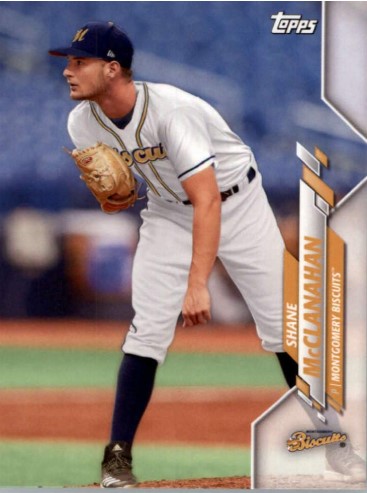
The Inning’s HR Hitters:  Rich Rollins, Zoilo Versalles, Tony Oliva, Don Mincher, Harmon Killebrew 

Runs Scored in the Five-Homer Inning: Six

Final Score:  Twins 9 – Athletics 4

Baseball Roundtable Tidbit:

  • Rich Rollins is the only pinch hitter to contribute a long ball to a five-homer inning.

____________________________________________

September 17, 2020 … Yankees versus Blue Jays

The Yankee outburst came in the fourth inning, with all five home runs coming off the Blue Jays’ Chase Anderson, who had relieved starter Julian Merryweather in the second inning.  3B Gio Urshela opened the inning lining out to center.  Then, RF Clint Frazier walked; C Gary Sanchez hit an RBI double; LF Brett Gardner then rapped a two-run home run (just his fifth of the season); 2B D.J. LeMahieu homered to right; 1B Luke Voit homered to right-center; CF Aaron Hicks fanned on three pitches; DH Giancarlo Stanton homered to center; and SS Gleyber Torres homered to left centers.  At this point, Wilmer Font replaced Anderson on the mounds, giving up a single to Urshela before retiring Frazier on a line out.  Side note:  The homers by Gardner; LeMahieu; Voit and Stanton were all first-pitch home runs.

The Inning’s Home Run  Hitters: Brett Gardner; DJ LeMahieu; Luke Voit; Giancarlo Stanton; and Gleyber Torres

Final Score: Yankees 10 – Blue Jays 7

Runs Scored in the Five-Homer Inning: 7

The Yankee’ five-home run innings was part of a 19-homer three-game series for the Bronx Bombers against  the Blue Jays.

Primary Resource: Baseball-Reference.com; Baseball-Almanac.com

BASEBALL ROUNDTABLE ON THE TOP 100 BASEBALL BLOG LIST

100Baseball Roundtable is on the Feedspot list of the Top 100 Baseball Blogs.  To see the full list, click here.

I tweet baseball @DavidBBRT

Follow/Like Baseball Roundtable’s Facebook Page here.  More baseball commentary; blog post notifications; PRIZES.

Member: Society for American Baseball Research (SABR); The Baseball Reliquary; The Negro Leagues Baseball Museum.