This Modern Era … Surrendering Six Homers in a Game

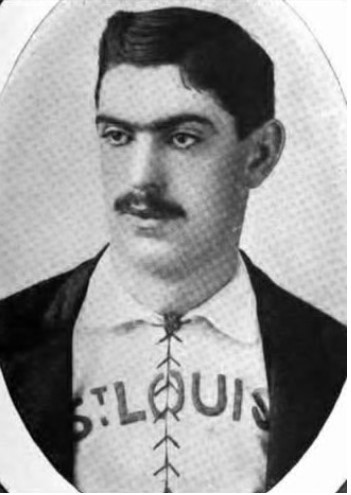
Charlie Sweeney” Public Domain via WikiCommons

On this date (June 12) in 1886, the National League St. Louis Maroons’ righty Charlie Sweeney set an all-time MLB record by giving up seven home runs in a single game.  Sweeney gave up 21 hits (including the seven dingers) in a 14-7 loss to the Detroit Wolverines.  Why do I note that “accomplishment” here?  Because, just yesterday, Cubs’ 28-year-old rookie right-hander Matt Swarmer tied the modern (post-1900) MLB record by giving up six homers in an 8-0 loss to the Yankees in New York. More on that in a paragraph or two, but first let’s look at Sweeney. Notably, that season, Sweeney gave up just two more long balls in his other 10 starts (all complete games). On the season, he was 5-6, 4.16.

Sweeney pitched in the major leagues (National League, Union Association and American Association) from 1883-1887 and, in 1884, went a combined 41-15, 1.70 for the NL Providence Grays and Union Association Saint Louis Maroons. That season, he pitched 492 innings (53 complete games) and fanned 337 batters. It was the 21-year-old’s second major league season – he had gone 7-7, 3.13 in 20 games for Providence in 1883 – and there is evidence the heavy 1884 workload took a toll on Sweeney’s arm. (In his final three MLB seasons, Sweeney was 16-30, 4.24 and fanned just 120 in 392 frames). Sweeney is also reported to have had issues with adult beverage consumption and a hot temper.  (In later life, he had several brushes with the law triggered by violent confrontations.)  Notably, over his career, he surrendered just 24 home runs in 1,030 2/3 innings.
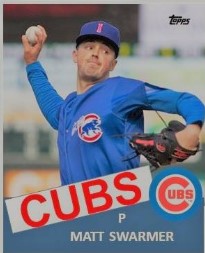
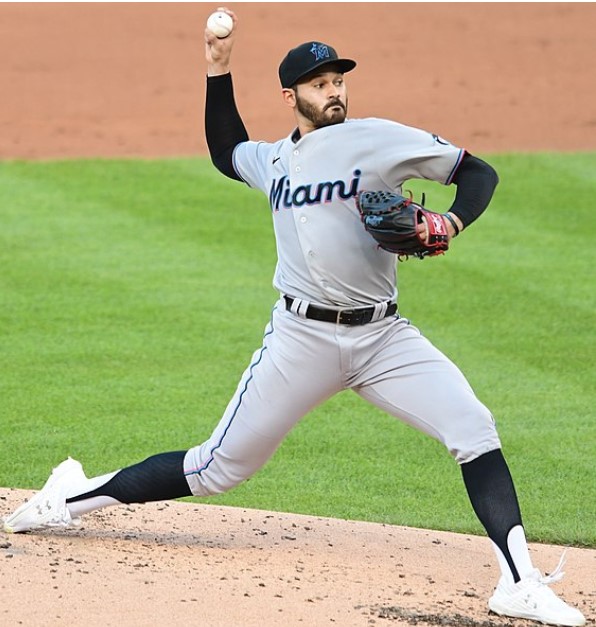
Now back to Swarmer. His six-homer game came in his third MLB start. He was 1-1, 1.50 going into the game, and had surrendered three long balls in 12 innings. In  the June 11 contest he gave up a:

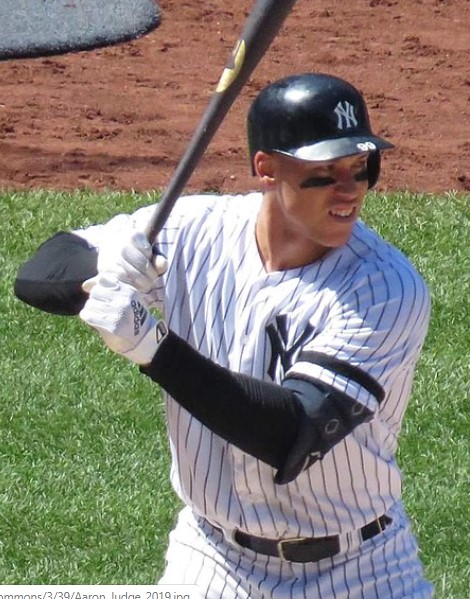
  • solo homer to Yankee DH Aaron Judge on his second pitch of the game (Judge led off the bottom of the first);
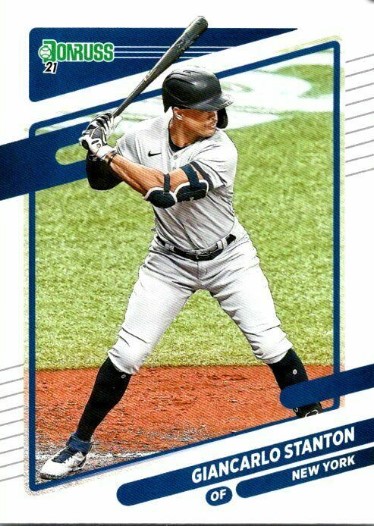
  • solo home run to RF Giancarlo Stanton with one out in the fourth;
  • solo homer to 2B Gleyber Torres on the very next pitch;
  • solo shot to C Jose Trevino leading off the fifth;
  • solo long ball to Judge with one out in the fifth; and
  • solo shot to 1B Anthony Rizzo with two out in the fifth.

Swarmer pitched five innings and gave up six runs on seven hits, walking none and fanning four.  He became just the tenth pitcher since 1900 to give up six homers in a game and just the second to give up six solo shots in a single game.

Let’s briefly look at the rest of the list of six-homer pitching appearances. As you skim through these you may note that of the ten six-homer games in the modern era:

  • Only one pitcher became a six-homer victim in relief;
  • Three “victims” actually recorded victories in their games;
  • All the pitchers on the list are right-handers;
  • There are two complete games on the list;
  • One pitcher gave up six home runs in his only MLB start;
  • The shortest six-homer outing (tied) was 2 1/3 innings;
  • In three of the games, the opposing pitcher launched one of the long balls.

Larry Benton, RHP, Giants … May 12, 1930

The 34-year-old righty Benton was in his  eighth MLB season, when he started against the Cubs (in Chicago) and gave up nine hits, seven runs (six home runs) in a 6 2/3- inning stint. Notably, Benton, got the win despite giving up the six long balls. He took a 14-0 lead into the bottom of the fifth when he gave up a two-out solo home run to Cubs’ RF Cliff Heathcote.  In the sixth, Benton surrendered three-run shot to 2B Clyde Beck. In the seventh, he gave up  solo home runs to Heathcote; CF Hack Wilson and 1B Charlie Grimm, as well as a three-run blast to Beck (ending Benton’s day after 6 2/3 frames). Benton finished the season at 8-15, 5.50. For his 13 season MLB career, he was 128-128, 4.03 and gave up 0.4 home runs per nine innings. For the Giants in 1926, he went 25-6, 2.73 – leading the league in wins and complete games (28 in 36 starts).

Hollis “Sloppy” Thurston, RHP, Dodgers …  August 13, 1932

The 33-year-old Thurston was in the eighth of nine MLB season when he gave up six homers to the Giants in an 18-9 Dodgers’ road win. Despite the long balls, Thurston pitched a complete game – giving up eight earned runs on nine hits. (The Dodgers collected 24 hits and three home runs of their own.)

Thurston gave up consecutive, one-out, solo home runs to 1B Bill Terry, RF Mel Ott and CF Freddie Lindstrom in the fourth; a solo shot to Terry in the fifth; and solo shots to Terry and Ott with two outs in the ninth.

Thurston went 12-8, 4.06 on the season and 89-86, 4.24 in nine MLB campaigns. Over his career, he gave up 0.5 home runs per nine innings. In 1925, with the White Sox, he went 20-14, 3.80 and led the AL in complete games (28) and innings pitched 330.

Tommy Thomas, RHP, Browns …  June 27, 1936

Wow! Another six-homer complete game. Thomas went the distance for the Browns in a 10-6 loss to the Yankees (16 hits, six walks, two whiffs) in St. Louis. (The Browns did lead 4-1 after four innings).  The home runs included: a solo shot by Yankee P Red Ruffing leading off the third; a solo shot by SS Frankie  Crosetti leading off the fifth and a three-run home later in the inning by LF George Selkirk; solo home runs by RF Joe DiMaggio and 1B Lou Gehrig (the first two batters) in the seventh; a three-run dinger by Crosetti in the ninth.

Thomas went 11-9, 5.26 in 1936 and 117-128, 4.11 in 12 MLB seasons (1926-37). He  gave up 0.6 HR per nine innings over his career. His best season was 1927, when he went 19-16, 2.98 for the White Sox, leading the AL in 307 2/3 innings pitched.

Bill Kerksieck, RHP, Phillies … August 13, 1939

Kerksieck did not last long the big leagues, just one season, with an 0-2 record and a 7.18 ERA in 23 games (two starts). In his first-ever start, he lasted four innings (Phillies versus Giants in New York) and left after giving up seven runs on seven hits (six home runs among them) and four walks. He took the loss as the Phillies fell 11-2. Kerksieck gave up a solo homer to CF Frank Demaree with two outs in the first; a two-run shot to Demaree in the third; and solo shots to 1B Zeke Bonura, 2B Alex Kampouris, P Bill Lohrman and LF Jo-Jo Moore in the fourth (the last three consecutively).

Unique among these six-homer hurlers is the fact that Kerksieck pitched in a second game that day (the Phillies and Giants were playing a twin bill), relieving in the doubleheader’s second game and pitching one scoreless inning as the Phillies lost 6-2.

Kerksieck’s final career line was 0-2, 7.18 in 23 appearances (giving up 1.9 home runs per nine innings). He did pitch one complete game – a 6-1 loss to the Cubs on September 15, 1939 in which he gave up 14 hits in eight innings.

George Caster, RHP, Athletics …  September 24, 1940

Caster’s six-homer game came in a season (1940) when he led the AL with 19 losses (four wins and a 6.56 ERA). Caster has the distinction of tying for the fewest innings pitched while giving up six homers in a game – 2 1/3 frames. Caster came on in relief to open the fourth inning, with his Athletics down 5-3 to the Red Sox (in Philadelphia). That frame, he gave up a two-run home run to Ted Williams in the fourth and a solo shot to Joe Cronin in the fifth. Then in the fifth, the roof fell in.  (Well, there really weren’t any “roofed” ballparks at the time, so maybe the sky tumbled down.)  It went like this:

  • Triple CF Dom DiMaggio;
  • Sacrifice fly, scoring DiMaggio, by RF Doc Cramer;
  • Solo Homer, LF Ted Williams;
  • Solo Homer, 1B Jimmie Foxx;
  • Solo Homer, SS Joe Cronin;
  • Triple, 2B Bobby Doerr;
  • Two-run homer, 3B Jim Tabor;
  • Les McCrabb relievers Caster.

Caster pitched in 12 MLB seasons (1934-35, 1937-46), going 76-100. He twice led the AL in losses (1938 and 1940). He also had a league-topping 12 saves in 1944, when he went 4-4, 2.44 in 42 games (his best MLB season). He gave up 0.8 HR per nine innings over his career.

Tim Wakefield, RHP, Red Sox …. August 8, 2004

Wakefield lasted five innings in his August 8, 2004 start for the Red Sox (versus the Tigers in Detroit), Surprisingly, despite giving up six home runs in five innings, he left with a 10-7 lead and got credit for the ultimate 11-9 victory. Wakefield gave up a solo home runs to C Ivan Rodriguez with two outs in the bottom of the first; consecutive solo shots to RF Craig Monroe and 3B Eric Munson with one out in the second; solo home runs to Rodriguez and 1B  Carlos Pena in the third; and a solo shot to DH Dmitri Young in the fifth. Wakefield was in his 12th MLB season at the time of the six-homer game.  He finished the campaign at 12-10, 4.87 – and his career stat line was 200-180, 4.41. The one-time All Star gave up 1.2 home runs per game over his career.

R.A. Dickey, RHP, Rangers ….April 6, 2006

The 31-year-old Dickey pitched in just one MLB game in 2006 (he had 22 minor-league appearances/19 starts that season).  In fact, Dickey, who broke into professional baseball in 1997, spent at  least part of every season from 1997 through 2010 in the minor leagues – before pitching seven full MLB seasons (2011-17, Mets, Blue Jays, Braves) during which: he went 87-81 in 269 games (226 starts); led the league in starts three times; and won a Cy Young Award (2012 Mets). In his April 6, 2006, start (for the Rangers) versus the Tigers in Texas, he lasted 3 1/3 innings,  giving up seven runs on eight hits and one walk, while fanning one.  The six homers went: solo shot, 3B Brandon Inge leading off the top of the first; solo home run for RF Magglio Ordonez with two out in the first; solo homer by 1B  Chris Shelton leading off the second; solo homer by  Shelton (again) with one out in the fourth; two-run homer by CF Craig Monroe and solo homer by LF Marcus Thames also with one out in  in the fourth.

Dickey pitched in 15 MLB seasons and went 120-118, 4.04 in 400 appearances (300 starts). In 2012, when he won the NL Cy Young Award, he went 20-6, 2.73 and led the league in starts (33), complete games (5), shutouts (3), innings pitched (233 1/3) and strikeouts (230). He gave up 1.1 home runs per nine innings over his MLB career.

James Shields, RHP, Rays … August 7, 2010

Shields started for the Rays (against the Blue Jays in Toronto) on August 7, 2010. He lasted just four innings in a 17-11 slugfest won by the Blue Jays. Shields took the loss, giving up eight runs on nine hits and four walks, fanning two. The home  runs:  a two-run homer by C  J.P. Arencibia in the bottom of the second; a home run (on the first pitch) to DH Adam Lind leading off the second, followed in the inning by a home run by 2B Aaron Hill, a fly out and a home run by 3B Edwin Encarnacion; a home run by RF Jose Bautista leading off the fourth and a home run by Hill with two outs in the inning (both solos).

Shields pitched in 13 MLB seasons (2006-2018) and went 145-139, 4.01, giving up 1.2 home runs per nine innings.  In that 2010 season, he went 13-15, 5.18. In 2016, he tied for the MLB lead in losses with 19 and, in 2018 (his final season), he tied for the MLB lead with 16 losses. His best season was 2011, when he went 16-12, 2.82 for the Rays and was an All Star selection.

Michael Blazek, RHP, Brewers …  July 27, 2017

Blazek lasted just 2 1/3 innings (tied for the fewest among the games in this list) in his July 27, 2017 start for the Brewers (versus the Nationals in Washington D.C.). He gave up eight runs on seven hits and one walk (four whiffs) in a 15-2 Brewers’ loss. It was his only career MLB start.

He gave up just two runs over the first two innings (on a Bryce Harper home run in the first), but things unraveled in the bottom of the third:

  • P Max Scherzer walked;
  • CF Brian Goodwin homered;
  • SS Wilmer Difo homered;
  • RF Bryce Harper homered;
  • 1B Ryan Zimmerman homered;
  • 2B Daniel Murphy flied out;
  • 3B Anthony Rendon, homered;
  • Wily Peralta relieved Blazek.

Blazek pitched  five MLB seasons (2013, 2015-17, 2019) and went 8-6, 4.50 in 113 games (just one start). He gave up 1.4 HRs per nine innings. His best season was 2015, when he went 5-3, 2.43 for the Brewers in 45 appearances.

Primary Resource:  Baseball-Reference.com


BASEBALL ROUNDTABLE ON THE TOP 100 BASEBALL BLOG LIST

100Baseball Roundtable is on the Feedspot list of the Top 100 Baseball Blogs.  To see the full list, click here.

I tweet baseball @DavidBBRT

Follow/Like Baseball Roundtable’s Facebook Page here.  More baseball commentary; blog post notifications; PRIZES.

Member: Society for American Baseball Research (SABR); The Baseball Reliquary; The Negro Leagues Baseball Museum.

BASEBALL ROUNDTABLE – BLOGGING BASEBALL SINCE 2012


Baseball May 2022 Wrap – No-hitters, .400 hitters, Hitting Streaks and More

It’s June 1, and that means it’s time for Baseball Roundtable’s monthly Wrap Up – outlining the stats and stories that caught Baseball Roundtable’s attention in May, plus the standings, Players and Pitchers of the Month and the year-to-date Trot Index.   This month is a little more challenging, as I am putting this post together while on Ballpark Tours’ 40th Anniversary baseball journey. So, I’m writing from the Intercontinental Hotel in Chicago, while waiting to head out to the Brewers-Cubs game at Wrigley Field. Given that, there may a typo to be discovered here and there.  Those on the tour bus will know who I’m talking about.

There was, as always, plenty to take note of over the past month:

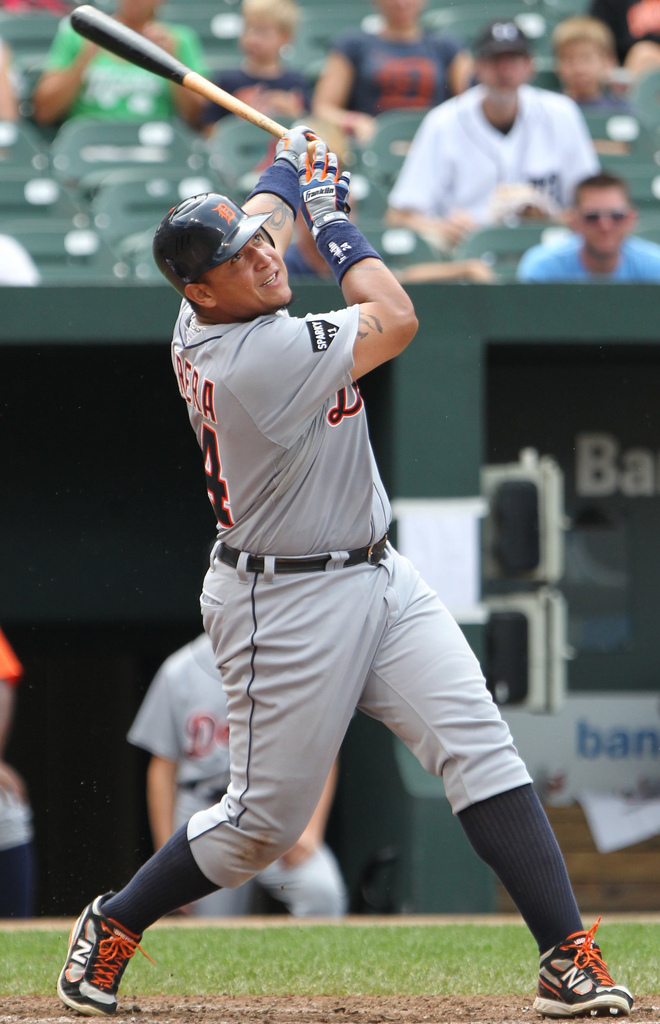
  • Miguel Cabrera’s ever-growing Hall of Fame resume;
  • Angels’ rookie Reid Detmers’ no-hitter;
  • A record-tying five-homer inning by the Astros;
  • Two  qualifying players who hit .400+ for the month and three who hit at least 10 home run;
  • Max Scherzer’s first loss in nearly a year;
  • Two players who ended the month with active 20+ game hitting streaks;
  • The season’s first triple play;
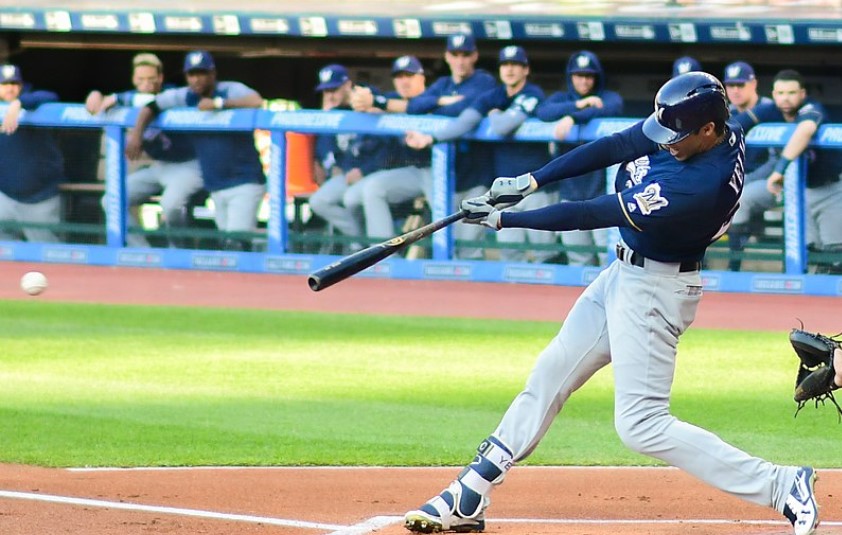
  • Christian Yelich’s record-tying (and, in some ways, record-setting) third cycle;
  • And more.

History Repeats Itself – Kind Of

In the April Wrap Up, Baseball Roundtable noted that on April 7 – National Beer Day – the Diamondbacks’ DH Seth Beer hit a walk-off home run to put the Diamondbacks past the Padres 4-1.  It was his second career homer and first career walk-off long ball.  I also voiced my wish that Beer be traded to the White Sox, who have 3B Jake Burger on the roster, so we could have a Beer and a Burger in the lineup together. (A trade taking Burger to the Diamondbacks would, of  course, achieve the same end. ) Well, I didn’t get that, but on May 28 – National Hamburger Day –  Burger homered in the White Sox 5-1 win over the Cubs. 

—–Baseball Roundtable Players/Pitchers  of the Month—–

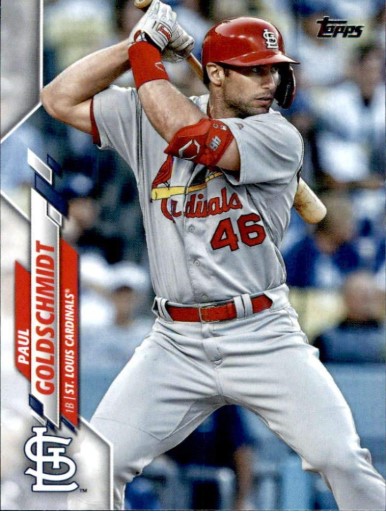
National League Player of the Month – Paul Goldschmidt, 1B, Cardinals

Goldschmidt lit it up in May – to the tune of 42 hits (most in the NL) and a .404 average – both tops in the National League.  His 33 RBI led MLB and his ten homers were second in the NL to the Dodgers’ Mookie Betts (12)   Goldschmidt ended the month with an  active  22-game hitting streak, during which he hit a robust .438. During the month, he had 12 multi-hit games and ten multi–RBI contests.  There were some other solid performances, but that .40o  average gave Goldschmidt the edge.

Honorable Mentions: Mookie Betts, RF, Dodgers, put up a .342 May average, led the NL with 12 May homers and was fourth in the NL with 26 RBI for the month, while leading  MLB with 31 May runs scored. It was a close call.   Philllies’ RF Bryce Harper went .47-7-18 and Mets’ 1B Pete Alonso went .315-9-30. A shout out also goes to Dodgers’ SS  Trea Turner, who hit  .314-4-24 month and ended with his 23-game hitting streak still active. He also swiped six bases.

American League  Player of the Month– Tie: Aaron Judge, RF, Yankees and J.D Martinez, LF Red Sox.

Hard to pick between MLB’s top hitters in May average (Martinez, among qualifiers) and home runs (Judge – tied).

Photo: Keith Allison from Hanover, MD, USA, CC BY-SA 2.0 <https://creativecommons.org/licenses/by-sa/2.0>, via Wikimedia Commons

A .400 average is a bright and shiny thing that attracts Baseball Roundtable’s attention – and Martinez hit .406 for the Month of May. His 43 hits were second in MLB  (to teammate 3B Rafael Devers). He also also scored 23 runs,  delivered four home runs and 15 RBI. Martinez collected a safety in all but one of his 26 May games – and he had 13 multi-hit performances.

Photo: DR. Buddie, CC BY-SA 4.0 <https://creativecommons.org/licenses/by-sa/4.0>, via Wikimedia Commons

So why the tie?  Well, Judge didn’t hit.400.  But he did drive in and score  more runs than Martinez.   Judge led the AL and tied for the MLB lead  in May home runs with 12 was second  in the AL in RBI (25), while hitting  a healthy .311  He had three multi-homer games and six games with three or more RBI.

Some may ask why Red Sox’ SS Trevor Story and his AL-topping 32 May RBI did not figure into this ranking.  For me it’s that .218 average for the month.  It is Player of the “Month” and from May 1 through May 15, Story was .156-1-10.

Honorable Mentions: More Red Sox and Yankees here.  Red Sox’ 3B Rafael Devers was a mirror-image of  teammate J.D. Martinez for the month – .381-8-17, with 23 runs scored and an MLB-leading 45 May safeties.  The Yankees’ DH Giancarlo Stanton put up a solid .301-7-21 line  (fourth in AL in RBI).  Also have to give  nod to the Twins’ versatile Luis Arraez, who got in only 23 games, but hit .376 with an MLB topping (among qualifiers) .480 on-base percentage.

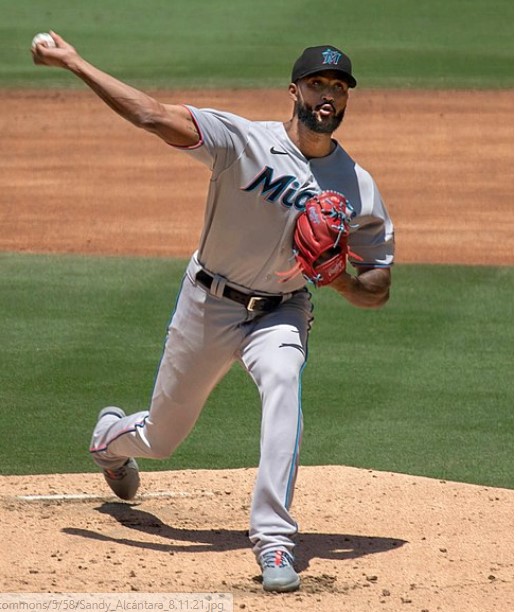
National League Pitcher of the Month- Sandy Alcantara, RHP, Marlins

Photo: Ryan Casey Aguinaldo, CC BY-SA 4.0 <https://creativecommons.org/licenses/by-sa/4.0>, via Wikimedia Commons

It was a tough call here. No one really jumped out at me. There were Pirates’ Jose Quintana, Padres’ Joe Musgrove and Phillies’ Zack Wheeler who all pitched at least 25 innings with ERAs under 1.50;  the Phillies’ Aaron Nola with 40 strikeouts and just five walks in 33 innings; and the Mets’ Carlos Carrasco. Diamondbacks’ Zac Gallen and  and Dodgers’ Tony Gonsolin,  Tyler Anderson and Walker Buehler,  who each went 4-0 for the month.,

I decided to go with the Marlins’ Sandy Alcantara, who may have only gone 3-2 in May (keep in mind, he was pitching for the Marlins, who went 7-19 for the month), but put  up a 2.13 ERA, a league-topping 42 1/3 innings pitched (six starts) and 43 strikeouts (second in the NL). In his last four May starts, Alcantara pitched 32 innings (I’ll do the math, that’s eight frames per start) and gave up just three earned runs.

Honorable Mentions; The Padres’ Joe Musgrove went 2-0, 1.64 in five May starts, fanning 33 batters in 33 innings. In his five starts, Musgrove never went less than six full innings and never gave up more than two earned runs. In his three May no-decisions, the Padres scored a total of two runs while Musgrove was in the game.  The Dodgers’ Tony Gonsolin went 4-0, with a tidy 1.93 ERA in five starts and whiffed 31 batters in 28 innings

American League Pitcher of the Month – Martin Perez, LHP, Rangers

Photo: mjl816 on Flickr (Original version) UCinternational (Crop), CC BY-SA 2.0 <https://creativecommons.org/licenses/by-sa/2.0>, via Wikimedia Commons

Another tough decision. with Jameson Taillon, who went 4-0 for the Yankees; Rays Shane McClanahan, who went 4-0, 1.15; New York’s Gerrit Cole who fanned 45 batters (just five walks) in five starts (33 2/3 innings); and Tigers’ Tarik Skubal, Twins’ Sony Gray, Yankees’ Nestor Cortes, who joined McClanahan with at least 25 innings pitched and ERAs under 2.00.

I went with the only pitcher to put up an ERA not just under 2.00, but under 1.00 in six May starts – and also threw one of just two complete-game shutouts in May.  That would be the Rangers’ Martin Perez, who – on May 20, shutout the vaunted Houston Astros’ offense in a nine-inning, eight-hit, 3-0 win.  In five May starts, Perez went 4-0 and allowed only three earned runs in 42 1/3 innings – a stingy 0.64 ERA  (yes, his ERA started with a zero).

Honorable Mentions: The Rays’ Shane McClanahan could easily have this spot – going 4-0, 1.14 in five starts and fanning 39 in 31 1/3 innings. (I just could not resist Perez’ sub-1.00 ERA.)  White Sox’ closer Liam Hendricks also had a solid month, with an MLB-high ten saves (in 12 opportunities), a 2.03 ERA and 21 whiffs in 13 1/3 innings.  I also looked at the Tigers’ Tarik Skubal (2-0, 1.15 in five starts, with 35 strikeouts in 31 1/3 innings) and the Yankees’ Nestor Cortes (3-1, 1.95 with 33 strikeouts in 32 1/3 innings).

Surprise Player of the Month – Tyler Anderson, LHP. Dodgers

The 32-year-old Anderson came into the 2022 season with a 29-68, 4.66 record over six MLB seasons (2016-21 … Rockies, Giants, Pirates, Mariners). Anderson had never won more than seven games in a season and had finished above .500 just once – 4-3, 4.37 in 2020. He had, in fact, been granted free agency by the Mariners before the Dodgers signed him in March. This May, Anderson went 4-0, 3.09 in five starts, fanning 33 batters in 32 innings – bringing his record on the year to 6-0, 2.90 in nine appearances, seven starts. In his final three starts of the month, he went 3-0 and gave up just two earned runs in 21 innings – fanning 21 and walking just one.

________________

TROT INDEX … A REGULAR BBRT FEATURE

Through May, 34.5 percent of the MLB season’s 55,041 plate appearances ended in a trot (back to the dugout, around the bases, to first base). We’re talking about strikeouts, home runs, walks, hit by pitch and catcher’s interference – all outcomes that are, basically, devoid of action on the base paths or in the field. Here’s the breakout: strikeouts (22.3%); walks (8.5%); home runs (2.7%); HBP (1.0%); catcher’s interference (less than 1%). 

Now, to provide a little context (a more detailed post on this topic coming soon). Here are a few selected annual Trot Index scores since I began watching baseball in earnest:  1950  – 22.8 %; 1960 – 25.1%; 1970 – 27.0%; 1980 – 23.1%; 1990 – 26.1%; 2000 – 29.9%; 2010 – 30.3%; 2021 – 36.3%.

______________

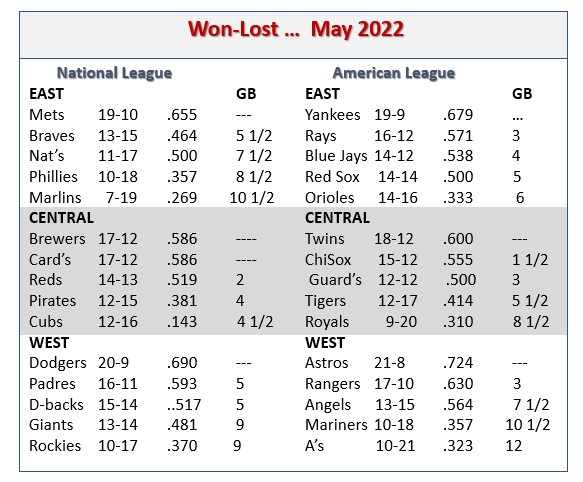
Only two teams won 20 or more games in May – the Astros and Dodgers and, no surprise, they each logged their leagues lowest earned run average.

The Astros 21-8 month was fueled included an 11-game wining streak (May 2-13, during which the Houston staff fashioned five shutouts and  put up a 0.91 earned run average.  During that stretch, they gave up three runs in just one contest.  They outscored their opponents 56-12 over the 11 games, outhit them .237-187 and out homered them 18-2.  They were the only team with a May ERA of under 3.00 – at 2.26.

Only six NL starters picked up four wins in May, and three of those pitchers wore Dodger Blue: Tony Gonsolin (4-0, 1.93); Tyler Anderson (4-0, 3.09) and Walker Buehler 4-0, 3.71).

——Team  Statistical Leaders for May 2022 ———-

RUNS SCORED

National League – Dodgers (174); Mets (168); Cardinals (150)

American League – Red Sox (159); Angels (131); Twins (137)

The fewest May runs were scored by the Tigers (74). The Pirates were last in NL scoring (88). The only other team to score less than 100 May runs was the A’s (93), 

AVERAGE

National League – Mets (.278); Nationals (.268);Rockies (.267)

American League – Red Sox (.282); Twins (.262); Royals (.255)

The lowest team average for May belonged to the As at .214.  The lowest in the NL was the Pirates at .218.

HOME RUNS

National League – Brewers (46); Diamondbacks (39); Dodgers (38)

American League –  Angels (41); Yankees (40); Astros (39)

The Padres and Athletics  had the fewest home runs for  May  at 15. 

Boston led MLB in May slugging percentage at .476.  The Dodgers led the NL at .457.

STOLEN BASES

National League – Cubs (30); Braves (18); Brewers (18); Phillies (18); Cardinals (18)

American League – Rangers (28); Athletics (22); Guardians (21)

The Blue Jays stole the fewest sacks in May  – just five.  

WALKS DRAWN

National League –   Dodgers (126); Giants (115); Brewers (104)

American League – Twins (105); Yankees (97); Astros (96)

The Red Sox  led MLB  in on-base percentage for April at .346. The Dodgers led the NL  at .344.

BATTERS’ STRIKEOUTS

National League – Braves (289); Diamondbacks (273); Cubs (267)

American League – Angels (263); Orioles (250);’ A’s (249)

Guardians’ batters fanned the fewest times in May (148).

______

Bonus Stat:

The Mets led all of MLB in May triples (10), while the Red Sox led in doubles (73).

______

Earned Run Average

National League – Dodgers (3.08); Padres (3.26); Brewers (3.59)

American League – Astros (2.26); Yankees (3.06); Rangers (3.32)

Five teams had May ERAs of 5.00 or higher: Royals (5.62); Giants (5.44); Nationals (5.36); Rockies (5.35); Reds (5.00). 

STRIKEOUTS

National League –  Brewers (278); Phillies (276); Dodgers (251)

American League – Twins (256); White Sox (250); Yankees (250)

The Phillies averaged an MLB-best 9.86 strikeouts per nine innings in May. The White Sox  averaged an AL-best 9.15.

FEWEST WALKS SURRENDERED

National League Dodgers (79); Brewers (80); Mets (81)

American League –  Yankees (53); Blue Jays (64); Rays (66)

The Yankees walked a stringiest 1.91  batters per nine frames (the only team under 2.00) The Royals  walked an MLB’s highest 4.32 per nine innings for the month.

SAVES

National League – Brewers (12); Padres (11): Brewers (10); Diamondbacks (9); Dodgers (9)

American League – White Sox (12); Twins (10); Blue Jays (10)

The Marlins recorded just one save in May (just six opportunities). They did win only seven of 25 games.

WALKS AND HITS PER INNING PITCHED (WHIP)

National League – Padres (1.14); Dodgers (1.21); ; Brewers (1.21)

American League – Yankees (1.03); Astros (1.07); Rays (1.11)

——Individual Statistical Leaders for May 2022———

AVERAGE (75  April  at bats minimum)

National League – Paul Goldschmidt, Cardinals (.404); Luis Gonzalez, Giants (.368) Ketel Marte, Diamondbacks  (.363)

American League –  J.D. Martinez, Red Sox (.406); Tim Anderson, White Sox (.385); Rafael Devers, Red Sox (.381)

The lowest April  average (among players with at least 75 at bats in the month)  belonged to the Rays’ Taylor Walls at .103 (8-for-78).

HOME RUNS

National League – Mookie Betts, Dodgers (12); Paul Goldschmidt, Cardinals (10); Jorge Soler, Marlins (9); Pete Alonso, Mets (9); Christian Walker, Diamondbacks (9)

American League –  Aaron Judge, Yankees  (12);  Trevor Story, Red Sox (9);  Jose Altuve, Astros (9)

The Cardinals’ Paul Goldschmidt had the highest May slugging percentage (among players with at least 75 at bats) at .817.  The AL  leader was the Red Sox’ Rafael Devers at .712.

RUNS BATTED IN

National League – Paul Goldschmidt, Cardinals (33); Pete Alonso, Mets (30);  Francisco Lindor, Mets (28)

American League – Trevor Story, Red Sox (32); Aaron Judge, Yankees (25); Jose Ramirez, Guardians (23)

HITS

National League – Paul Goldschmidt, Cardinals (42); Mookie Betts, Dodgers (39); Trea Turner, Dodgers (36)

American League –  Rafael Devers, Red Sox (435); J.D. Martinez, Red Sox (43); Ty France (39)

The Twins Luis Arraez led MLB (players (with at least 75 May at bats) in on-base percentage at .480. The NL leader was the Cardinals’ Paul Goldschmidt at .471.

DOUBLES

National League –  Freddie Freeman, Dodgers (15); Matt Olson, Braves (14); Paul Goldschmidt, Cardinals (13)

American League –  Rafael Devers, Red Sox (13); Bo Bichette, Blue Jays (11); Jackie Bradley, Red Sox (10)

TRIPLES

National League – Brandon Nimmo, Mets (3); ten  with two

American League – Jose Ramirez, Red Sox (3); ten with two

The Cardinals’ Paul Goldschmidt led MLB in extra-base hits in May with 23.

STOLEN BASES

National League –  Ronald Acuna, Braves (7); Harrison Bader, Cardinals (7); Jean Segura, Phillies (7); Tommy Edman, Cardinals (7)

American League – Cedric Mullins, Orioles (8); Kyle Tucker, Astros (7); Eli White Rangers (6); Jose Ramirez, Guardians (6)

WALKS

National League – Juan Soto, Nationals (21); Mike Yastrzemski, Giants (19); three with 18

American League – Jose Ramirez, Guardians (19); Kyle Tucker, Astros (17); three with 16

BATTER’S STRIKEOUTS

National League – Patrick Wisdom, Cubs (40); Kyle Schwarber, Phillies (39); Austin Riley, Braves (38)

American League – Eugenio Suarez, Mariners (40); Trevor Story, Red Sox (39); Mike Trout Angels (36)

No player grounded into more double plays in May than the Nationals Maikel Franc0 (9)

PITCHING VICTORIES

National League – Walker Buehler, Dodgers (4-0); Tyler Anderson, Dodgers (4-0); Carlos Carrasco, Mets (4-0); Tony Gonsolin, Dodgers (4-0); Zac Gallen, Phillies (4-0)Luis Garcia, Padres (4-1)

American League – Martin Perez, Rangers (4-0); Shane McClanahan, Rays (4-0); Jameson Taillon, Yankees (4-0); Justin Verlander, Astros (4-1); Nick Pivetta, Red Sox (4-1); Framber Valdez, Astros (4-1); Drew Rasmussen, Rays  (4-1 ); Kevin Gausman, Blue Jays (4-2)

EARNED RUN AVERAGE (at least 25  May innings pitched)

National League – Jose Quintana, Pirates (1.33); Joe Musgrove, Padres (1.64); Zack Wheeler, Phillies (1.65)

American League – Martin Perez, Rangers (0.64); Shane McClanahan, Rays (1.15); Tarik Skubal, Tigers (1.45)

STRIKEOUTS

National League – Corbin Burnes, Brewers (45); Sandy Alcantara, Marlins (43); Aaron Nola, Phillies (40); Zach Wheeler, Phillies (40).

American League – Dylan Cease, White Sox (48); Gerrit Cole, Yankees (45); Robbie Ray, Mariners (42)

SAVES

National League – Taylor Rogers, Padres (10); Josh Hader Brewers (8); David Bednar, Pirates (7); Edwin Diaz, Mets (7); Craig Kimbrel, Dodgers (7)

American League – Liam Hendricks, White Sox (10); Jeff Barlow, Ranges (8); four with six

WHIP (Walks +  Hits per Inning Pitched) – 25 May innings minimum)

National League – Tony Gonsolin, Dodgers (0.79); Corbin Burnes, Brewers (0.87); Adam Wainwright, Cardinals (1.69)

American League – Triston McKenzie, Guardians (0.74); Shane McClanahan, Rays (0.83); Nick Pivetta, Red Sox (0.83)

BONUS STAT

Among pitchers with 25 May innings, the Dodgers Tony Gonsolin held opponents to the lowest May batting average (.149 )

—–May 2022 Highlights —–

A Veteran Rookie

On May 1, after 11 years and more than 1,000 games in the minor leagues, Giants’ LF Jason Krizan notched his first MLB base hit. The 32-year-old rookie’s wife and two-year-old son were in the stands to share the landmark safety.  Krizan’s April 29 MLB debut came in his twelfth professional season, after 1,132 minor-league games.  Krizan was drafted in the eighth round of the 2011 MLB Draft (Tigers) – out of Dallas Baptist University, where, in 2011,  he hit .413-10-81 in 62 games. Over his 1,000+ minor league games, he hit .275-83-541.  On his lengthy journey to the “show,” Krizan had several solid seasons – including  .293-7-56 at Double-A in 2014; .294-10-65 at Double- and Triple-A in 2016; and .316-16-73 at Triple-A in 2021.

Old Guys Rule

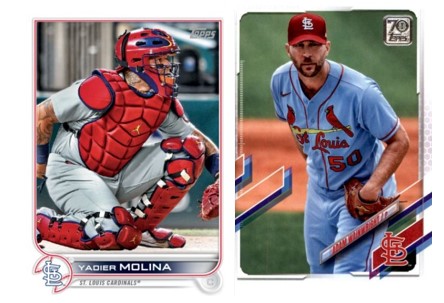
On May 4, the Cardinals starting battery was 40-year-old Adam Wainwright on the mound and 39-year-old Yadier Molina behind the plate. Wainwright got the win, to even his 2022 record at 3-3. It was the 202nd time the Cardinals had won a game with Wainwright and Molina as the starting battery – tying the pair for the MLB record in that category (tied with the Braves’ Warren Spahn and Del Crandall battery.) Molina and Wainwright captured sole position of the record in Wainwright’s very next start – as the Cardinals topped the Giants 15-6 in St. Louis. They continue to add to their own record. On May 20, Wainwright got the win -with Molina catching, as the Cardinals topped the Pirates 5-3. In that one, Wainwright gave up just one run in seven innings and Molina drove in two runs.  More #InBaseballWeCountEverything.

A Giant, Appropriately

On May 6, as the Giants took on the Cardinals in San Francisco, 25-year old rookie right-hander Sean Hjelle made his MLB debut – and tied a major-league record just by taking the mound. At 6’11” tall, Hjelle tied Jon Rauch – another right-handed pitcher – as the tallest major leaguer ever.   Hjelle pitched a 1-2-3 seventh inning (two whiffs and one ground out.). Rauch pitched in 11 MLB seasons (2002, 2004-2013 … White Sox, Expos, Nationals, Diamondbacks, Twins, Blue Jays, Nets, Marlins), going 43-40, 3.90 with 62 saves in 556 games (11 starts).

Miggy Watch goes On

On May 7, in a Tigers 3-2 loss to the Astros, Miguel Cabrera added another line to his Hall of Fame resume. Cabrera hit a two-run double in the top of the third inning.  It was his It was his 600th career double – making him just one of three players (Hank Aaron & Albert Pujols) with 600 doubles, 500 homers and 3,000 hits (he picked up his 3,000th hit earlier this season – as he joined the 3,000 hit, 500 home run .300+ average club). Only two MLB players have retired with at least 3,000 hits, 500 homers and a .300 or better average (Hank Aaron and Willie Mays).  Cabrera finished May with 3,030 career hits, 505 home runs, 603 doubles and a .310 average.

The One That Got Away

On May 8, the Phillies handed Max Scherzer a loss, topping the Mets 3-2 and roughing up Scherzer for three runs on ten hits in six innings. (Scherzer did fan seven New York batters.) This unremarkable fact only makes it here because it was Scherzer’s first loss in 22 days short of a full year (since May 30, 2021). Over that time, Scherzer started 24 games, and went 15-0, 2.55.  Roger Clemens holds the record for the most starts between losses at 30 (June 3, 1998-June 1, 1999.  During that time , he went 20-0, 2.68. 

King Carl

Carl Hubbell holds the record for the most consecutive pitching victories at 24 (three of those wins came in relief).  From July 17, 1936 to May 27, 1937, he went 24-0 in 27 games (22 starts).

Looking for a Big Finish

Photo: Erik Drost, CC BY 2.0 <https://creativecommons.org/licenses/by/2.0>, via Wikimedia Commons

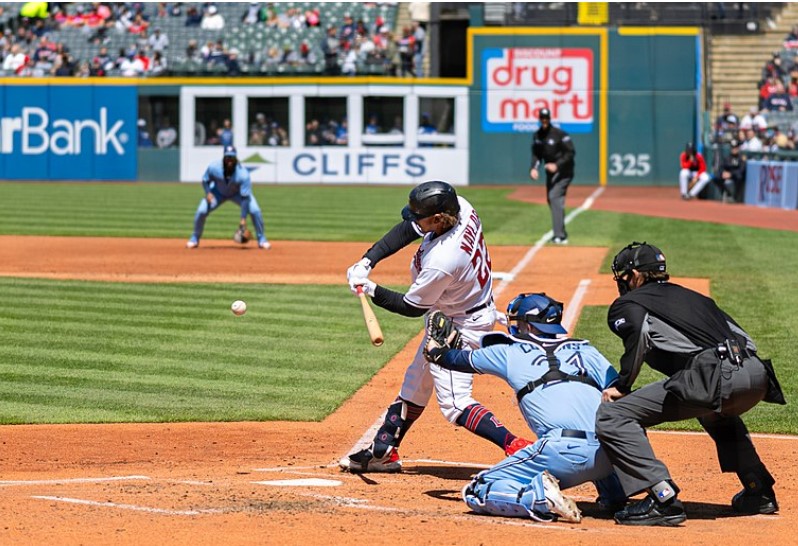
On May 9, the Guardians came to bat in the top of the eighth inning trailing the White Sox 5-1. At this point in the game, Guardians’ 1B Josh Naylor had been to the plate three times and was zero-for-two (a walk and two strikeouts). This is how the rest of his game went:

  • Batting in the eighth with one on and two out, he delivered an RBI double to  cut the White Sox lead to 5-2.
  • Batting in the ninth with the bases loaded, two outs, and the Guardians down 8-4, he launched a Grand Slam home run to tie the contest
  • Batting in the eleventh frame, with two on and two out, he hit a three-run home run to provide the final margin in the Guardians’ eventual 12-9, 11-inning win.

The Elias Sports Bureau reported that Naylor was the first  player since 1920 (when RBI became an official statistic) to drive in at least eight runs in the eighth inning and later in a game. The bigger surprise for me is that all eight RBI were two-out RBI.

2022 Second No-Hitter

On  May 10, Angels’ 22-year-old rookie southpaw Reid Detmers tossed the second no-hitter of the 2022 season and the season’s first complete-game no-no. (On April 29, five Mets’ pitchers combined to no-hit the Phillies.) Note: Detmers made five appearances for the Angels in 2021, but his rookie status was still intact. Detmers walked one and fanned two as the Angels topped the Rays 12-0 in Anaheim. He threw 108 pitches (68 strikes). Coming into the game, Detmers was 1-1, 5.32 in five 2022 starts and had not gone more than five innings in any of those appearances. In his first start after the no-hitter, he gave up three runs on three hits and two walks in 3 2/3 innings. Detmers was signed in the first round (tenth overall) of the 2020 MLB draft out of University of Louisville, where he went 20-6, 3.20 in three seasons. In 2021 he went 3-4, 3.19 at Double- and Triple-A and 1-3, 7.40 with the Angels.

A Walk-Walk-Walk-Off

Photo by Keith Allison

On May 10, the Yankees went into the bottom of the ninth trailing the Blue Jays 5-3 – and facing closer Jordan Romano. Yankees’ SS Isiah Kiner Falefa went down swinging to start the inning, followed by consecutive walks to C Jose Trevino and 3B DJ LeMahieu – setting up CF Aaron Judge for a game-ending, walk-off three-run home run. Which he delivered.  It was the 168th home run of Judge’s career and his first-ever walk-off game-winning four-bagger (and it took those two walks to put him a position to deliver the 6-5 win).

A Tri-Cycle?

On May 11, Brewers DH Christian Yelich hit for the cycle (single, double, triple and home run in the same game), as Milwaukee topped the Reds 14-11.  In the process, he became just the sixth player to record three cycles in an MLB career and also the first to record three career cycles against the same teams (Reds).  For more on that May 11 game and a host of cycle trivia, click here.

How About a Trophy in the Shape of a Roll of Life Savers?

Brewers’ closer Josh Hader  set a new MLB record on Friday, May 13 – starting the season with saves in 13 straight mound appearances.  He extended that record to 18 straight appearances with a save while saving both games of a May 30 doubleheader versus the Cubs.

The Shohei Sho

On May 14, in a 9-1 Angels’ win over the A’s in Oakland, Angels’ DH Shohei Ohtani popped a two-run homer in the top of the fifth. It was his seventh of the season and 100th of his MLB career – and made him just the  third Japanese player to reach the 100 career mark in MLB (following Hideki Matsui with 175 homers and Ichiro Suzuki with 117).  It also made Ohtani just the second  MLB player with 100 or more home runs as a hitter and 250 or more career strikeouts as a pitch (the other being, of course, Babe Ruth). Just more #InBaseballWeCountEverything.

Alert Pujols Takes the Mound

On May 15, 42-year-old future Hall of Famer Albert Pujols (in his 22nd MLB season) – at the time the owner of 3,312 MLB hits, 681 home runs and 2, 156 RBI – took the mound (for the Cardinals) for the first time in his MLB career. It came in the top of the ninth, with Pujols’ Cardinals leading the Giants 15-2.  Pujols inning of work went:

  • LF Darin Ruf, walk.
  • CF Austin Slater, line out to center.
  • 3B Even Longoria, single.
  • SS Thairo Estrada, safe on fielder’s choice (Longoria out at second).
  • P Luis Gonzalez, three-run home run. (Note: Gonzalez started in LF, moved to the mound in the bottom of the eighth.)
  • C Joey Bart, solo home run.
  • RF LaMonte Wade, Jr., ground out third-to-first.

Pujols’ pitches ranged in velocity (if you can use that word) from 46.6 mph-to-66.3 mph. Pujols has now appeared  in the field at the major-league level at every position except catcher and centerfield.

Giving veterans stars a free trip to the mound may be the Cardinals’ theme this year. On May 22nd ten-time All Star C  Yadier Molina – like Pujols in his 22nd MLB season – made his first MLB mound appearance. It came in the  bottom of the ninth inning of a game against the Pirates, with the  Cardinals leading 18-0.  Like Pujols, Molina gave up four earned runs (and two homers) in his inning of work

How about a Nice Walk-(off) in the Park?

Okay, the Orioles aren’t really going anywhere this year.  As of May 22, they were 17-25, in last place in the AL East, 14 ½ game back.  Why did I pick May 22? Because  on that day the O’s picked up their third  Walk-Off win in  four days. They topped the Rays  7-6 in eleven innings, with DH Adley Rutschman (placed on second to start the inning and moved to third on a sacrifice), scoring on a  groundball dribbler (fielder’s choice) by 2B Rougned Odor. On May 20, the O’s walked-off a 13-inning, 8-6 victory against those same Rays.  This time on a two-run home run by Odor. On May 19, they picked up a 9-6  walk-off win against the Yankees (this time in the ninth inning) on a three-run homer by RF Anthony Santander.   Baseball Roundtable note: Five of the Orioles 17 wins through May 22 were walk-offs and they were 4-0 in extra-inning  games .

Two Shots at One Big Shot

In the first inning of the Cubs’ May 16 game against the Pirates (at Wrigley Field) catcher Willson Contreras found himself at DH and in the leadoff spot. He also happened to be sitting on 99 career round trippers.  Contreras  got into one leading off the game, taking the first pitch he saw from Pirates’ starter Dillon Peters to deep right-center for a double. He got another chance later in the same inning, coming to the plate for a second time, this time with the bases loaded, two outs, the Cubs up 4-0 and Bryse Wilson on the mound.   The Willson (Contreras) versus (Bryse) Wilson matchup went in Contreras’ favor, as he smoked the first pitch he saw from Wilson for a Grand Slam home run … and his 100th career regular-season dinger. So, at that point in the game, he had seen two pitchers, had a double and a home run for six total bases, had scored twice and driven in four – and had become just the tenth major-leaguer in the Modern Era to hit a Grand Slam in the first inning while batting leadoff.  Truthfully, I am surprised it’s happened that many times. The Cubs, by the way, scored eight runs in the first inning of that 9-0 win and Contreras had three more at bats (without a hit.)

Morel’s Career Mushrooming

On May 17, Cubs 22-year-old rookie Christopher Morel made  his first MLB appearance, pinch hitting for Patrick Wisdom in the bottom of the eighth with the Cubs up 6-0 on the Pirates.  Morel quickly fell behind the Pirates’ Chase De Jong no balls-two strikes, before working the count full and then hitting a 3-2 pitch to deep left field – to joint the list of major leagues to homering their first-ever MLB plate appearance. Morel had been hitting .306-7-20 at Double-A when e was called up. At the end of May, the rookies’ MLB stat line was .283-2-5 in 11 games.

Brotherly Love

On May 17, brothers Edwin Diaz (Mets) and Alexis Diaz (Reds) both recorded saves.  They were just the third pair of brothers to record major-league saves on the same day. More proof of #InBaseballWeCountEverything. It was the senior (28-year-old) Diaz’ ninth save of the year and 182nd career save (he led the AL in 2018 with 57 saves for the Mariners).  It was the first MLB save, coming in his 17th MLB appearance, for 25-year-old Reds’ rookie Alexis Diaz.

The other pairs of brothers to ramrod a save on the same day? Todd (Dodgers) and Tim (Padres) Worrell on June 13 , 1997 and Ravelo (Pirates) and Josias Manzanillo (Mets), on June 30th 1994.  It was Todd Worrell’s  15 save of the season and 236th career save and Tim Worrell’s first save of the season and second career save.  Todd pitched 11 seasons  and record 256  saves. Tim pitched 14 years and recorded 71 saves. For the Manzanillo brothers, it was Ravelo’s only save (in three MLB seasons, 53 appearances), while  it was Josias’ second save of the 1994 season and his fourth of six career saves (11 MLB seasons, 267 appearances.)

Five Long Balls in One Frame

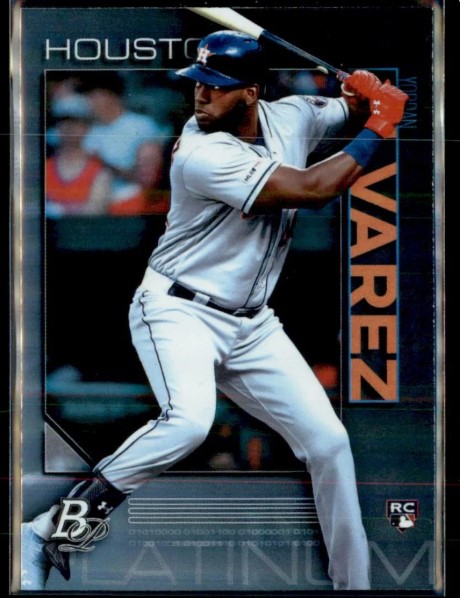
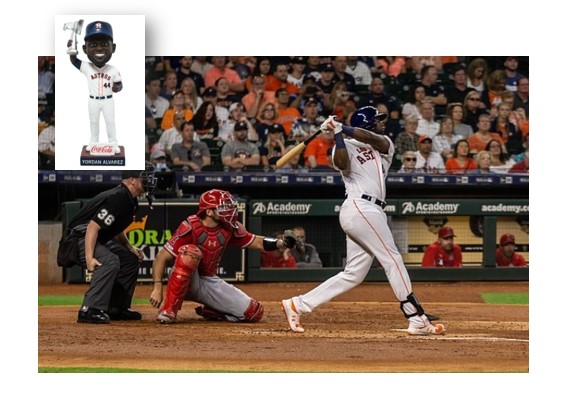
On May 17, the Red Sox’  Nathan Eovaldi got off to a good start against the Astros in Boston. He got past 2B Jose Altuve, DH Michael Brantley and 3B Alex Bregman on a total of five pitches (all strikes) – a ground out, line out and pop out. The second inning did not go quite as well, as the Astros tied an MLB single-inning record by bashing five home runs (all off Eovaldi). The homers came off the bats of LF Yordan Alvarez, RF Kyle Tucker, SS Jeremy Pena, Brantley and 1B Yuli Gurriel.  For the complete story and a look at the the eight times an MLB team has gone yard five times in an innings, click here.

An Interesting Comeback

Cubs’ 26-year-old rookie Brandon Hughes made quite a comeback – one that brought him all the way to Wrigley field – and the baseball record book.  At the end of Spring Training in 2019, Hughes – drafted out of Michigan State University, as an outfielder, in the 16th round of the 2017 major-league draft – was on the verge of being released by the Cubs.  The strong-armed outfielder, who had hit .237-4-35 in 110 games for  A-level South Bend in 2018, was told he would be released unless he was willing to take a shot at finding success as a pitcher (Side note:  Primarily an outfielder over three college seasons, Hughes had made seven relief appearances for Michigan State – as a freshman, in 2015 – putting up a 7.11 earned run average in 6 1/3 innings.  As a hitter, he  hit .304-13-93 in 159 games in three Michigan State seasons.)

Long story short, Hughes persevered and on May 17, found himself on the mound at Wrigley Field. He came on in the top of the sixth, with none on and one out and the Cubs leading the Pirates 6-0 and his outing wen like this.

Sixth Inning

  • 2B Josh VanMeter, walk.
  • CF Bryan Reynolds, strikeout.
  • LF Ben Gamel, inning-ending strikeout.

Seventh inning

  • DH Dan Vogelbach, strikeout.
  • 1B Yoshi Tsutsugo, strikeout.
  • 3B Michael Chavis, walk.
  • SS Rodolfo Castro, strikeout.

Hughes was replaced to open  the top of the eighth by Mark Leiter, Jr.

Oh, that record-book thing? STATS reported that Hughes was the first MLB pitcher since 1900 to record at least five outs in their MLB debut with all those outs coming via the strikeout.  Just more #InBaseballWeCountEverything.

At the end of May, Hughes had a 3,72  ERA over seven  appearances. Guess that switch paid off.

1-2-3 and You’re Out at the Old Ball Game

On May 20, The Nationals turned 2022’s first MLB triple play in a 7-0 loss to the Brewers (in Milwaukee).  It came in the bottom of the seventh. The inning started with the Nationals’ Carl Edwards, Jr. walking Brewers’ 3B Jace Peterson and 2B Kolten Wong.  On the first pitch in his at bat, SS Luis Urias hit a groundball to third.  Nationals’ 3B Maikel Franco  snagged it, stepped on the bag and fired to 2B Cesar Hernandez, who made the pivot and got the ball to 1B Josh Bell for the triple-killing. The odds, of course, favor this, but Baseball Roundtable did note that all six involved players (batter, base runners and fielders) were infielders.

More #InBaseballWeCountEverything

On May 21, 27-year-old Rockies’ rookie catcher Brian Serven collected his first major-league hit. It came in his second career game since a call up from Triple-A Albuquerque, where he was hitting .273-5-11 in 23 games.  After going zero-for-two in his first MLB games (May 177), Serven hit a two-run home run in his first May 17 at bat (bottom of the second inning versus the Mets).  He then grounded out in fifth, hit another two-run home run in the sixth and flied out in the seventh. According to MLB.com, that performance made Serven  the only player in MLB history whose first two major-league hits were multi-run homers in the same game.

Reeling in a Nice Round Number

On May 21, as the Angels topped the A’s 5-3 in Anaheim, Mike Trout went zero-for-three with a walk with a run scored.  The run scored was the 1,000th of his 12-season (including 2022) MLB career – making him just the third player in MLB history to score at least 1,000 runs, hit at least 300 home runs and steal at least 200 bases by his age-30 season. The others? Willie Mays and Alex Rodriguez.  Pretty good company.  or those who like to know such things, Trout has led the AL in runs scored four times.

Time to buy that “Old Guys Rule T-Shirt.”

In May, 39-year-old Astros’ starter Justin Verlander went 4-1, 2.27 in five starts,  – giving him a 6-2, 2.03 record on the season. 

Reds Leave Cubs Red-Faced

On May 26, the Reds pounded the Cubs 20-5 in front of 3,578 delighted (despite a 59-minute rain delay)  home-town fans. It was the first 20-run game for the Reds since a 22-3 win over the Phillies on September 4, 1999.  What struck Baseball Roundtable about the May 26 game is that five Reds’ hitters drove in three or more runs:

  • SS Kyle Farmer … 4-for-4, five RBI (two home runs)
  • 2B Matt Reynolds … 3-for-3, three RBI (one triple)
  • LF Albert Amora, Jr. … 3-for-5, three RBI
  • DH Tommy Pham … 2-for-4, three RBI (one double)
  • 3B Brandon Drury … 2-for-6, three RBI (one double)

In the September 4, 1999 win over the Phillies (in Philadelphia), six Reds collected at least three RBI:  2B Pokey Reese (3); RF Dmitri Young (4); LF Greg Vaughn (3); C Ed Taubensee (3); 3B Aaron Boone (3); and 3B Mark Lewis, who replaced Boone in the sixth inning (3). In that one, the Reds got home runs from Reese, Young, Vaughn, Taubensee (two homers), Boone, Lewis, CF Jeffrey Hammonds and C Brian Johnson.

Trevor’s Story

On May 15, Trevor Story had appeared in 29 of the Red Sox’ 34 games and was hitting a disappointing .196, with just one home run and 15 RBI. Then, in a ten-game span, between May 16 and May 26, Story went 13-for-39 (.333), with eight home runs and 22 RBI – improving his season line to .232-9-37.  He finished May .220-9-37 on the season. 

Like Father, Like Son – Except on the Other Side of the Pitch

On May 30, the Tigers called up 26-year-old Kody Clemens (Roger Clemens’ youngest son) from Triple-A Toledo. Clemens, a 2018 third-round draft choice out of the University of Texas at Austin, was hitting .283-8-31 (in 45 games) for Toledo. – and had appeared at 1B, 2B, 3B and LF.  Clemens made his MLB  debut May 31, going zero-for three, with one walk.

——Team  Statistical Leaders  Through May 31  ———-

If the season ended May 31, your post-season teams would be”

American League: Yankees, Astros, Twins.  Wild Cards: Blue Jays, Rays, Angels.

National League:  Dodgers< Mets, Brewers. Wild Cards: Padres, Cardinals; Giants.


RUNS SCORED (average 209)

National League – Dodgers (270); Mets (266); Giants (244)

American League – Angels (2356; Red Sox (235); Yankees (229)

Through May, the fewest runs were scored by the Tigers at 138. The next fewest was by the Pirates (166).

AVERAGE (average .240)

National League – Mets (.268); Rockies (.265); Nationals (.254)

American League – Red Sox  (.258); Angels (.250); Twins (.248)

The lowest team average through May belonged to the A’s at .213. The Diamondbacks were the lowest in the NL at .220.

HOME RUNS (average 49)

National League – Brewers (70); Braves (62); Diamondbacks (59); Dodgers (59)

American League –  Yankees (69); Angels (68); Astros (64)

The Tigers had the fewest home runs through May at 29.  The Nationals had the fewest in the NL at 32. 

STOLEN BASES (average 25)

National League – Cardinals (40); Cubs (34); Brewers (31);

American League – Rangers (39); Rays (34); A’s (34)

The Twins and Rockies stole the fewest bass through May at just ten each – in seventeen and eighteen attempts, respectively.  

WALKS DRAWN  (average 156)

National League –   Dodgers (208); Giants (184); Diamondbacks (182)

American League – Twins (181); Mariners (174); Yankees (170)

The Mets led MLB  in on-base percentage through May at .337. The Twins led the AL  at .325. In slugging percentage, the Dodgers were  on top at .430, while the Angels  led the AL at .425.

BATTER’S STRIKEOUTS (average 409)

National League – Braves (487); Diamondbacks (471); Brewers (451)

American League – Angels (451); Orioles (438); A’s (432)

Guardians’ batters went down on strikes the fewest times through May  (324).

EARNED RUN AVERAGE (average 3.93)

National League – Dodgers (2.76); Brewers (3.36); Padres (3.40)

American League – Astros (2.82); Yankees (2.91); Rays (3.36)

Three teams had ERAs through May  of 5.00  or higher – Reds  (5.41); Nationals (5.23); Royals (5.10)

STRIKEOUTS (average 434)

National League – Brewers (500); Mets (463); Phillies (461)

American League – Yankees (449); White Sox (440); Twins (436)

The Brewers  averaged an MLB-best 10.0 strikeouts per nine innings through May. The White Sox averaged an AL-best 9.4.

FEWEST WALKS SURRENDERED (average 156)

National League – Dodgers (125); Giants (136); Mets (146)

American League –  Yankees (121); Rays (123); Blue Jays (122)

The Rays and Yankees walked a stringiest 2.5  batters per nine frames through May. The Reds walked an MLB’s highest 4.3 per nine innings.

SAVES (average 13)

National League – Brewers (23); Padres (19); Braves (15); Rockies (15); Diamondbacks (15)

American League – Blue Jays (21); White Sox (18); Yankees (17)

Bonus Stats – In the Field

The  Pirates  made the most errors through May (39); while  the Padres were guilty of the fewest miscues (16).   

Primary Resources: Baseball-Reference.com; MLB.com; Baseball-Almanac.com


BASEBALL ROUNDTABLE ON THE TOP 100 BASEBALL BLOG LIST

100Baseball Roundtable is on the Feedspot list of the Top 100 Baseball Blogs.  To see the full list, click here.

I tweet baseball @DavidBBRT

Follow/Like Baseball Roundtable’s Facebook Page here.  More baseball commentary; blog post notifications; PRIZES.

Member: Society for American Baseball Research (SABR); The Baseball Reliquary; The Negro Leagues Baseball Museum.

BASEBALL ROUNDTABLE – BLOGGING BASEBALL SINCE 2012


They’re Off and Running – The Tigers’ 35-5 start in 1984

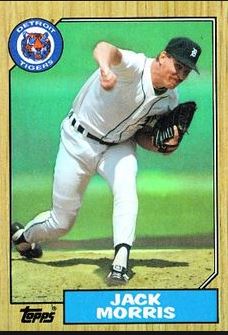
Jack Morris started against the Twins on Opening Day 1984, pitching seven one-run innings for the win.

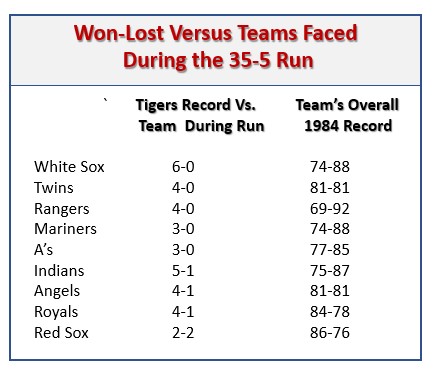
Taking in this week’s Twins-Tigers series in Minnesota, I was taken back to Opening Day 1984 (remember,  for Baseball Roundtable, one thing always leads to another) – when I sat through an 8-1 Tigers’ (indoor) drubbing of the Twins at the Metrodome. Little did I know, I was witnessing the first game of the hottest start to a season in MLB history – a run that would extend to late May.  The Tigers would get out of the gate with thirty-five wins in their first forty games, never drop out of first place the entire season, finish 104-58, sweep the Royals in the American League Championship series  and top the Padres in the World Series four games-to-one.

In that 35-5 early-season run, the Tigers:

  • Started the season with a nine-game winning streak ;
  • Won 16 of their first 17;
  • Won their first 17 road games (an MLB record);
  • Went 18-5 at home;
  • Went 9-2 in one-run games;
  • Were 2-1 in extra innings;
  • Won ten games by five or more runs; and
  • Produced five walk-off wins.

Over the forty games, the Tigers scored eight or more runs 11 times; and fewer than three runs seven times. The Tigers gave up more than three runs in just 14 contests, and won all but three three of those games.

During that 40-game stretch the Tigers:

  • Outscored their opponents 236-120;
  • Outhit them .299 to .214;
  • Out-homered them 40-29; and
  • Put up a 2.58 ERA to the opponents 5.65.

After those first forty games, the Tigers had an 8 1/2 game lead in the American League East.

A few highlights  of the streak:

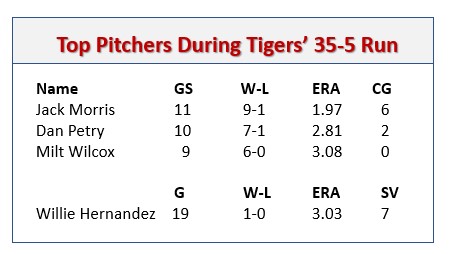
  • On April 7, in the fifth game of the streak Jack Morris pitched a no-hitter against the White Sox (in Chicago), as the Tigers won 4-0. Morris started 11 games during the streak and the Tigers won all but one. Morris went 9-1, 1.97 with six complete games during the Detroit run. He finished the season 19-11, 3.60.

  • Closer Willie Hernandez, who would win the American League Cy Young and Most Valuable Player Awards, won one and saved seven games during the forty-game run. He finished the season 9-3, 1.92 with 32 saves, while leading the league in appearances with 80 – pitching more than one inning in 45 of those appearances.
  • Thirteen proved a lucky number for the Tigers. On Friday, April 13, they made an unusual one-game visit to the Red Sox – and scored 13 runs in topping the Sox 13-9. In that one, they plated eight runs in the first inning on four walks, three singles, two doubles and two Red Sox errors. Six Tigers collected RBI in that first frame.

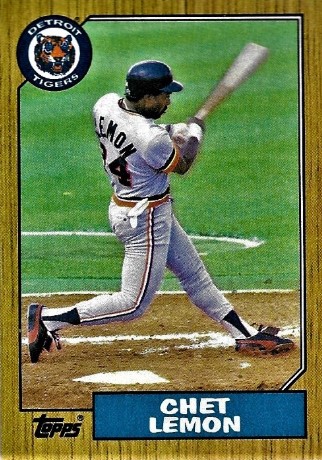
  • During the 35-5 run, the Tigers got plenty of power “up the middle.” C Lance Parrish hit .286-7-25 during the run, SS Alan Trammell went .340-5-23 and CF Chet Lemon put up a .331-7-32 line.

Cuba Libre

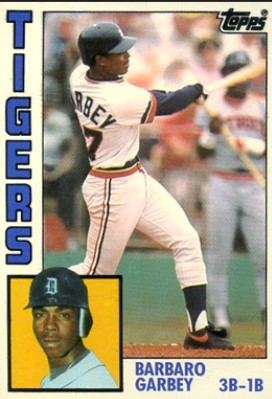
The biggest surprise during the Tigers’ early season run may have been the bat of rookie utility player (corner infielder)  Barbaro Garbey – who had left Cuba on a fishing boat in the 1980 “Freedom Flotilla.” The 27-year-old played in 29 games during the streak and hit .355-1-20.  Over a  sometimes troubled MLB career (1984-85, 1988), Garbey hit .267-11-86 in 226 games.


  • On April 24, the Tigers swept a double header in Detroit (versus the Twins )– winning two one-run ball games (6-5 and 4-3). In the first game, the Tigers trailed 5-3 in the bottom of the night, but plated three runs off Twins’ closer Ron Davis.
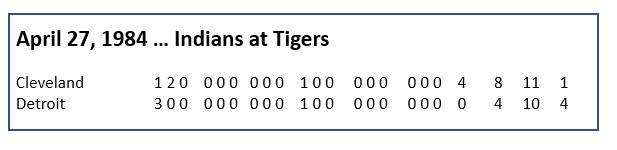
  • On April 27, the Tigers lost a heart breaker at home – and it took 19 innings and five hours and 44 minutes to do it.  The game (against the Indians) was tied 3-3 in the third.  The Tigers’ usually reliable Willie Hernandez (in his second inning of work) gave  up a single, sacrifice and walk to open the Indians’ tenth, before Aurelio Lopez was brought to the mound. Lopez’ inning went strikeout, wild pitch, walk (loading the bases), walk (forcing in a run), ground out. For the Tigers, Lou Whitaker opened the bottom of the tenth with a double, Alan Trammell singled him to third and he scored on a double play (Darrell Evans). The game then continued scoreless until the top of the 19th, when (with the help of three Detroit errors – two on sacrifice bunts), the Indians turned two hits into four runs.

  • On May 1, as the Tigers topped the Reds Sox 11-2 in Detroit, hitting stars of the early season run – 1B Barbaro Garbey and CF Chet Lemon – each drove in four runs.
  • On May 3, Jack Morris suffered his only loss of the 35-5 run, despite giving up just one run a nine-inning complete game against the Red Sox. Bob Ojeda shutout the Tigers and Boston RF Dwight Evans took Morris deep in the top of the eighth.
  • On May 8, the Tigers topped the Royals 5-2 in Kansas City, led by an eighth-inning Grand Slam by Alan Trammell (off Dan Quisenberry).
  • In a 10-1 win over the Mariners on May 16 (in Detroit) eight Tigers collected RBI: 2B Lou Whitaker, DH Alan Trammell; PH Johnny Grubb; 1B Barbaro Garbey; PH Dwight Lowry; LF Larry Herndon; RF Rusty Kuntz; 3B Marty Castillo.
  • The streak ended with a 7-3 loss to the Mariners (in Seattle).  The Mariners, in fact, swept the May 25-27 series by scores of 7-3, 9-5 and 6-1.

Primary Resource:  Baseball-Reference.com 


BASEBALL ROUNDTABLE ON THE TOP 100 BASEBALL BLOG LIST

100Baseball Roundtable is on the Feedspot list of the Top 100 Baseball Blogs.  To see the full list, click here.

I tweet baseball @DavidBBRT

Follow/Like Baseball Roundtable’s Facebook Page here.  More baseball commentary; blog post notifications; PRIZES.

Member: Society for American Baseball Research (SABR); The Baseball Reliquary; The Negro Leagues Baseball Museum.


Five Homers in an Inning … The Reds Have the (reverse) Record

Yesterday (May 17, 2022), the Astros exploded for an MLB record-tying five home runs in a single inning.  The outburst came in the second inning of a 13-4 Astros win over the Red Sox in Boston – and all five long balls came off Boston starter Nathan Eovaldi (who had retired the Astros on five pitches in a three-batter first inning). Eovaldi came into the inning with a 3.07 earned run average on the season (it was his eighth start). When the innings was over, is ERA was 6.01. The frame went like this:

  • LF Yordan Alvarez leads off with a home run to Left on a 2-1 pitch.
  • 1B Yuli Gurriel safe on an error by 1B.
  • RF Kyle Tucker takes an 0-1 pitch yard for a two-run home run to right.
  • SS Jeremy Pena, also picking on an 0-1 pitch, homers to left-center.
  • CF Jose Siri flies out to right-center.
  • C Martin Maldonado  singles.
  • 2B Jose Altuve doubles.
  • DH Michael Brantley homers to right (a three-run shot)  on a 1-1 pitch.
  • 3B Alex Bregman grounds out third-to-first.
  • Yordan Alvarez, in his second at bat of the inning, singles.
  • Yuli Gurriel (also in his second at bat of the inning) hits a two-run home run (on an 0-2) pitch) to left-center.

At this point, with nine runs across the plate in the inning, Eovaldi is replaced on the mound by Tyler Danish, who gets Tucker on a ground out to end the inning.

The Inning’s Home Run  Hitters: Yordan Alvarez; Kyle Tucker; Jeremy Pena; Michael Brantley; Yuli Gurriel

Final Score:  Astros 13 -Red Sox 4

Runs Scored in the Five-Homer Inning: 9

It marked the eighth time in AL/NL  history that a team has notched five home runs in a single inning.

Before we detail each of these homer-happy innings, here are a few tidbits about the five-homer frames:

  • The Cincinnati Reds have been the victims of four of the eight five-homer innings.
  • The home team has put on the power display six of the eight times.
  • Seventeen of the 40 home runs have come with two outs.
  • Pitchers have contributed (as hitters) HRs in two of the five five-homer innings.
  • One of the five-homer innings was kept alive by three fielding errors.
  • Four of the five five-homer innings have come in the fourth inning (three of the four against the Reds).
  • The five-homer innings have featured the scoring of 66 runs – the fewest at six, the most at 12.
  • Andy Seminick is the only player to homer twice in a team’s five-homer inning.
  • All five home runs were given up by a single pitcher twice.

Now, let’s take a closer look at those five-homer innings.

_____________________________________________

NATIONAL LEAGUE

June 6, 1939 … NY Giants versus Cincinnati Reds

Pitcher Manny Salvo hit an inside-the-park home run in Giants five-homer inning.

Pitcher Manny Salvo hit an inside-the-park home run in Giants five-homer inning.

The first-ever five-home run MLB inning took place in New York on June 6, 1930, as the sixth-place Giants (20-24 record) surprised the league-leading Reds (29-15) by a 17-3 score, plating all 17 runs in the first five innings.

The record-setting power display came in the bottom of the fourth inning, with the Giants already up 6-0.  Peaches Davis, who had relieved Johnny Vander Meer in the first inning (Vander Meer had given up six hits and three runs in 2/3 of an inning), retired Giants’ LF Jo Jo Moore and SS Billy Jurgess to start the inning. Then the wheels came off.  C Harry Danning laced a home run to center (his sixth). Clean-up hitter Mel Ott drew a walk, 1B Zeke Bonura singled and CF Frank Demaree hit the second home run of the inning (his second of the season).

Wesley Livengood (whose MLB career would consist of five appearances and a 9.53 ERA) then came on to relieve Davis. Livengood was not living so good, as he walked 3B Tony Lazzeri and then gave up a home run to 2B Burgess Whitehead (the first of only two he would it in 1939).  Giants’ pitcher Manny Salvo was up next. A weak hitter, Salvo surprised everyone in the ball park with the only home run of his five-season MLB career – an inside-the-park round tripper off the right field fence.  Next up was lead-off hitter J0 Jo Moore, who hit the fifth and final homer of the inning (and his second of the day).  Notably, all of this damage took place after the first two batters were retired.

The Inning’s Home Run Hitters: Harry Danning, Frank Demaree, Burgess Whitehead, Manny Salvo, Jo Jo Moore

Runs Scored in the Five-HR Inning: Eight

Final Score:  Giants 17 – Reds 3

A couple of Baseball Roundtable tidbits on this one:

  • You have to love the great baseball names of the two pitchers who were victimized: Peaches Davis and Wesley Livengood.
  • The number eight and nine hitters for the Giants – Burgess Whitehead and Manny Salvo, who both homered in the inning, hit a combined three home runs all season and a total of 18 long balls in a combined 14 seasons.

June 2, 1949… Philadelphia Phillies versus Cincinnati Reds

Andy Seminick hit two round trippers in the Phillies' five-homer inning.

Andy Seminick hit two round trippers in the Phillies’ five-homer inning.

Ten seasons passed before the next five-homer inning – and the victims were again the Reds.  This time, the bashing came off the bats of the Phillies (in Philadelphia).  It started out as a close game, with the Reds actually leading 3-2 after seven innings behind a strong performance by starting pitcher Ken Raffensberger (who would win 18 games that season). Things, however, went awry in the bottom of the eighth.

CF Del Ennis (the Phillies’ clean-up hitter) led off the inning with a home run (his 7th of the season), which was followed by C Andy Seminick’s second home run of the game – marking Raffensberger’s exit. Jess Dobernic came on in relief and retired RF Stan Hollmig on a liner to short before giving up a home run to 3B Willie Jones (his third of the year). Dobrenic then induced a soft fly ball out to second base by 2B Eddie Miller, bringing up P Schoolboy Rowe, who had relieved Philadelphia starter Curt Simmons in the top of the eighth.  Rowe promptly slammed a home run to left (the only home run of the year for the 39-year-old veteran, in his last MLB season). Kent Petersen came on in relief of Dobernic and seemed to pour gas on the flames:  walk to CF Richie Ashburn, double to SS Granny Hamner, 1B Eddie Waitkus safe on an error (Ashburn scores), an Ennis single to right (Hamner scores), and Seminick’s second home run of the inning (third of the game and seventh of the season). That was the end of the home runs, but the inning continued with the Phillies adding another run on a hit batsman and a triple.  Suddenly a 3-2 Reds lead was a 12-3 deficit.

The Inning’s Home Run Hitters; Del Ennis, Andy Seminick (2),  Willie Jones, Schoolboy Rowe

Runs Scored in Five-HR Inning: 10

Final Score:  Phillies 12 – Reds 3

A Baseball Roundtable tidbit:

  • Phillies’ catcher Andy Seminick, still the only player to hit two home runs in a team’s five-homer inning, hit 24 homers that season and 164 in 15 career seasons.

August 23, 1961 … San Francisco Giants versus Cincinnati Reds

Jim Davenport contributed a three-run inside-the-park homer to the Giants record-tying inning.

Jim Davenport contributed a three-run inside-the-park homer to the Giants record-tying inning.

Twelve seasons after five-home inning number two, it happened again – and for the third straight time, the Reds were the victims – and this time they were are home.  On August 23, 1961, another close game became a late inning route.  The Reds trailed the San Francisco Giants 2-0 after 8 innings with both starters (Juan Marichal for the Giants and Joey Jay for the Reds) still in the game.  A low-scoring game was no surprise. Marichal came into the contest with a 12-7 record for the third-place Giants, while Jay was 18-7 for the first-place Reds.

In the top of the ninth, the Giants broke the tightly contested game wide open.  1B Willie McCovey started the frame with a double off Jay and then scored on an error by Reds’ 2B Don Blasingame after CF Willie Mays popped out, LF Orlando Cepeda and RF Felipe Alou followed with a pair of deep home runs (to center and left, respectively). It was Cepeda’s 36th of the year and Alou’s 15th.  That brought Jim Brosnan in from the bullpen – and led to a fly ball out by C John Orsino, singles by SS Jose Pagan and Marichal, 2B Joey Amalfitano reaching on an error by Reds’ third baseman Gene Freese (Pagan scoring) and a three-run inside-the-park home run by 3B Jim Davenport (his 8th homer of the year).  McCovey then singled for his second hit of the inning, which brought on Bill Henry in relief. Henry gave up a two-run homer to Willie Mays (his 34th of the season), a single to Cepeda, and had Alou reach on Freese’s second error of the inning (and the Reds’ third miscue of the frame). John Orsino then took Henry deep (just his second of the year) before Pagan struck out to mercifully end the 12-run, ninth-inning uprising.

The Inning’s Home Run Hitters:  Orlando Cepeda, Felipe Alou, Jim Davenport, Willie Mays, John Orsino

Runs scored in the Five-Homer Inning: 12

Final Score:  Giants 14 – Reds  0

April 22, 2006 … Milwaukee Brewers versus Cincinnati Reds

Prince Fielder put the "cherry on top" (old school analogy) for the Brewers.

Prince Fielder put the “cherry on top” (old
school analogy) for the Brewers.

Home cookin’ – with a five homer dessert – was good to the Brewers when they hosted the Reds on April 22, 2006. Milwaukee pounded the visitors 11-0, racking up the fourth five-homer inning against the Reds’ franchise along the way.   The outburst came in the bottom of the fourth inning with starter Brandon Claussen still on the mound and the Reds trailing 3-0.

Milwaukee 3B Bill Hall (the number-six hitter) started it with a home run (his third of the young season). Then 2B Richie Weeks singled to left, scoring on C Damian Miller’s home run (his first of the year). That seemed to establish a (brief) HR-1B-HR pattern, as Brewers’ pitcher Dave Bush followed the Miller home run with a single and CF Brady Clark backed up the Bush single with his first home run of 2006. SS J.J. Hardy broke the pattern with a home run (his third of the year).  At this point, Claussen had faced six batters in the inning, giving up four home runs and two singles.  Chris Hammond came on in relief and provided just that, striking out the first two batters he faced (RF Geoff Jenkins and LF Carlos Lee).  Then Prince Fielder gave the Brewers a piece of the five-homer in one inning record, hitting his third dinger of the year. The carnage ended on a fly out to center by Hall.

The Inning’s Home Run  Hitters: Bill Hall, Damian Miller, Brady Clark, J.J. Hardy, Prince Fielder

Final Score:  Brewers 11 – Reds 0

Runs Scored in the Five-Homer Inning: 7

_________________________________________________

July 27, 2017 … Washington Nationals versus Milwaukee Brewers

This outburst came in the bottom of the third – with all the long balls hit off of Brewers’ starter Michael Blazek – who came into the game having given up no runs in four relief appearances (6 1/3 innings) on the season.  It would be the only start of Blazek’s five-season MLB career. (His career stat line would be 8-6, 4.50 in 113 appearances.)

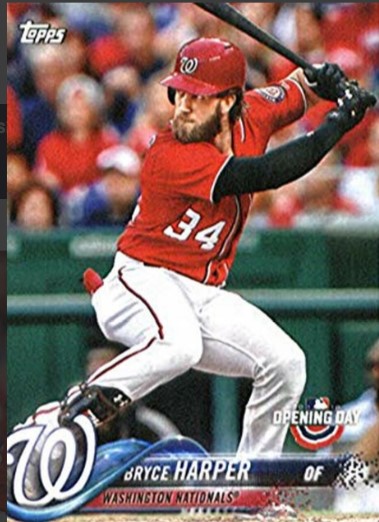
Blazek started off the inning by walking Nationals’ pitcher Max Scherzer.  Then  CF Brian Goodwin hit a two-run home run; SS Wilmer Difo homered to right-center (his third long ball of just five that season); RF Bryce Harper homered to left-center, his second homer of the game and 27th of the season; 1B Ryan Zimmerman homered to left center (he would homer again the very next inning); 2B Daniel Murphy flied out; and 3B Anthony Rendon homered (his 21st of the season) to to left center.

At this point, Wily Peralta replaced  Blazek on the mound, giving up one run on two singles and a double  before a double play ended thee inning.  Note:  The Nationals scored seven runs that inning and then six more in a two-homer fourth.

The Inning’s Home Run  Hitters: Brian Goodwin; Wilmer Difo; Bryce Harper; Ryan Zimmerman; Anthony Rendon

Final Score:  Nationals 15 – Brewers 2

Runs Scored in the Five-Homer Inning: 7

_______________________________________________

AMERICAN LEAGUE

June 9, 1966 … Minnesota Twins versus Kansas City Athletics

Harmon Killibrew hit more home runs in the 1960s than any other player - powering the Twins to some big innings.

Harmon Killibrew hit more home runs in the 1960s than any other player – powering the Twins to some big innings (including their 1966 five-homer stanza).

The team that flashed all the power this day was the Minnesota Twins, but the game  (June 9, 1966 against Kansas City) didn’t start out all that well.

With the two teams facing off at Metropolitan Stadium (Bloomington, MN), the Athletics got off to a fast start, knocking out Twins’ ace Camilo Pascual in the top of the first. (Pascual lasted 2/3 of an inning, giving up four runs on three hits and a walk.) With Catfish Hunter on the mound, the Twins’ chances looked slim.

The Twins scored one in the fifth and two in the sixth (on a Harmon Killebrew home run) and then, trailing 4-3, broke the game open with five home runs in the seventh.   It started innocently enough with a Catfish Hunter walk to C Early Battey, followed by an infield fly out for 2B Bernie Allen. That brought pinch hitter (for the pitcher) Rich Rollins to the plate, and he hit the inning’s first homer (just the second of ten HRs Rollins would hit in 1966). Lead-off hitter SS Zoilo Versalles followed with his fifth homer of the year – and Paul Lindblad replaced Hunter on the mound. Lindblad got Twins’ LF Sandy Valdespino on a grounder to short, but then gave up consecutive round trippers to RF Tony Oliva (his 14th) and 1B Don Mincher (his 6th).  John Wyatt came in from the bullpen and quickly gave up a home run to 3B Harmon Killebrew (his second of the day and 11th of the year). Wyatt then surrendered a double to RF Jimmie Hall and Battey (in his second plate appearance of the inning) reached on an error before Bernie Allen ended the frame on a ground ball (catcher to first).

The Inning’s HR Hitters:  Rich Rollins, Zoilo Versalles, Tony Oliva, Don Mincher, Harmon Killebrew 

Runs Scored in the Five-Homer Inning: Six

Final Score:  Twins 9 – Athletics 4

Baseball Roundtable Tidbit:

  • Rich Rollins is the only pinch hitter to contribute a long ball to a five-homer inning.

____________________________________________

September 17, 2020 … Yankees versus Blue Jays

The Yankee outburst came in the fourth inning, with all five home runs coming off the Blue Jays’ Chase Anderson, who had relieved starter Julian Merryweather in the second inning.  3B Gio Urshela opened the inning lining out to center.  Then, RF Clint Frazier walked; C Gary Sanchez hit an RBI double; LF Brett Gardner then rapped a two-run home run (just his fifth of the season); 2B D.J. LeMahieu homered to right; 1B Luke Voit homered to right-center; CF Aaron Hicks fanned on three pitches; DH Giancarlo Stanton homered to center; and SS Gleyber Torres homered to left centers.  At this point, Wilmer Font replaced Anderson on the mounds, giving up a single to Urshela before retiring Frazier on a line out.  Side note:  The homers by Gardner; LeMahieu; Voit and Stanton were all first-pitch home runs.

The Inning’s Home Run  Hitters: Brett Gardner; DJ LeMahieu; Luke Voit; Giancarlo Stanton; and Gleyber Torres

Final Score: Yankees 10 – Blue Jays 7

Runs Scored in the Five-Homer Inning: 7

The Yankee’ five-home run innings was part of a 19-homer three-game series for the Bronx Bombers against  the Blue Jays.

Primary Resource: Baseball-Reference.com; Baseball-Almanac.com

BASEBALL ROUNDTABLE ON THE TOP 100 BASEBALL BLOG LIST

100Baseball Roundtable is on the Feedspot list of the Top 100 Baseball Blogs.  To see the full list, click here.

I tweet baseball @DavidBBRT

Follow/Like Baseball Roundtable’s Facebook Page here.  More baseball commentary; blog post notifications; PRIZES.

Member: Society for American Baseball Research (SABR); The Baseball Reliquary; The Negro Leagues Baseball Museum.


Winning a Game Without a Hit… A Handful Plus Oone.

Yesterday (May 15, 29022), the Pittsburgh Pirates  pulled out an improbably victory – topping the Reds 1-0, without notching a single base-hit. Going into the bottom of the eighth, Reds’ starter Hunter Greene had held the Pirates in check, giving up no hits, walking three and fanning nine. The Reds were also without a run, as Pittsburgh starter Jose Quintana had pitched seven innings, giving up just three hits and one walk (five strikeouts) and reliever Chris Stratton had pitched a one-hit, one-walk scoreless top of the eighth.

The Pirates scored in the bottom of the eighth, without a hit, in an inning that went like this:

  • RF Jack Suwinski grounded out to first base unassisted.
  • SS Rodolfo Castro walked.
  • C Michael Perez walked, Castro going to second base.

Art Warren replaced Hunter Greene, who had tossed 118 pitches, on the mound.

  • LF Ben Gamel walked, loading the bases.
  • 3B Ke’Bryan Hayes grounded into a fielder’s choice – second to shortstop, as Castro scored and Perez moved to third.
  • CF Bryan Reynolds popped out to shortstop to end the inning.

Pirates ‘Reliever Dave Bednar came on to pitch a 1-2-3 ninth and the Pirates had a win without a hit. Note: Because the Reds pitchers hurled just eight innings (the Pirates did not have to bat in the bottom of the ninth), this game does not go down as a no-hitter for the Reds.

Baseball-Reference.com shows just five other instances (since 1901) in which teams have won without the benefit of a single safety. Here they area:

April 23, 1964, Reds 1 – Colt .45’s 0

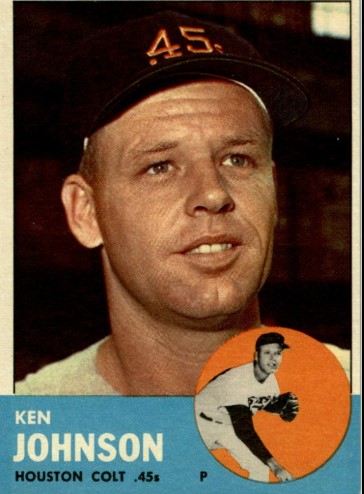
After eight innings this one was knotted 0-0. Reds’ starter Joe Nuxhall had given up five hits and one walk, while fanning four. The Astros’ Ken Johnson had been truly dominant.  Eight no-hit innings with two walks and nine whiffs.

Then, in the top of the ninth, this went down:

  • Reds’ 2B Pete Rose bunted in an attempt to both get the lead runner on and break up the no-hitter. Johnson fielded the bunt, but made a bad throw (error) to first, with Rose ending up at second base.
  • 3B Chico Ruiz, grounded out, Rose moving up to third.
  • CF Vada Pinson was safe on the Astros’ second miscue of the inning, this one by 2B Nellie Fox.
  • RF Frank Robinson flied out to left to end the inning.

Nuxhall  fanned two in a scoreless ninth, pitching around an error by Reds’ 1B Deron Johnson.

Johnson got credit for a complete-game, no-hitter – and is tagged with a loss. Johnson  pitched in 13 MLB seasons (1958-70 … Athletics, Astros,  Braves, Yankees, Cubs, Expos), going 91-106, 3.46.

Ken Johnson remains the only MLB pitcher to get saddled with the loss in an official, complete-game  no-hitter. 

—————–

April 30, 1967, Tiger 2 – Orioles 1

The Tigers were playing in Baltimore and, going into  the top of the ninth, Detroit trailed 1-0 with  Orioles’ starter Steve Barber having twirled  eight no-hit innings (seven walks and three strikeouts).  The Tigers’ Earl Wilson had given just one run on two hits and four walks (four strikeouts) over eight frames. The lone Orioles’ run, by the way  scored in an inning in which Baltimore did not get a hit –   three walks and a Luis Aparicio sacrifice fly in the bottom of the eighth. Barbers’ ninth inning went like this:

  • 1B Norm Cash walked, Dick Tracewski brought in to pinch run.
  • SS Roy Oyler walked.
  • P Earl Wilson, sacrifices (remember those), Tracewski going to third, Oyler to second. Jake Wood brought in to pinch run for Oyler.
  • PH Willie Horton popped out to the catcher.

At this point Barber still has a 1-0 lead and a no-hitter with two outs in the ninth.

  • With CF Mickey Stanley up, Barber threw a wild pitch, scoring Tracewski and sending Wood to third.
  • Stanley walked.

Stu Miller replaces Steve Barber on the mound.

  • 3B Don Wert hit a ground ball to SS  Aparicio, who threw to second for an inning-ending force. However, 2B Mark Belanger couldn’t handle the throw and the go-ahead run scored on his error. Note: Rookie Belanger (who would go on to win eight Gold Gloves at shortstop in his career) had been brought into the game in the top of the ninth.
  • RF Al Kaline grounded out to end the inning.

Fred Gladding replaces Earl Wilson  on the mound for Detroit and pitches a 1-2-3 ninth to save the win.

The Orioles record an official combined no-hitter, but also a loss.  Steve Barber pitched 15 MLB seasons (1960-74 … Orioles, Yankees, Pilots, Cubs, Braves, Angels, Giants), going 121-106, 3.36.  He was a two-time All Star and a 20-game winner  in 1963 – 20-13, 2.75 for the Orioles.

—————-

July 1, 1990. White Sox 4 -Yankees 0

Andy Hawkins managed to give up four runs in a complete-game, no-hit outing – but he had a little “help” from his friends.  It came in a game  played in Chicago and Hawkins’ mound opponent was southpaw Greg Hibbard. After seven  frames, the game was knotted at 0-0, and Hawkins had given up no hits, while walking two and fanning three. Hibbard had also tossed seven scoreless innings (four hits, no walks, four whiffs).

Barry Jones came to the mound for the ChiSox in the top of the eighth and held the Yankees without a run.  In the bottom of the eighth, the baseball Gods began to “mess with” Hawkins’ game.  Here’s how it went:

  • White Sox C Ron Karkovice popped out to 2B.
  • 2B Scott Fletcher popped out to 2B.
  • RF Sammy Sosa reached first on an error by Yankee third baseman Mike Blowers (a bobbled ground ball).
  • SS Ozzie Guillen walked on a 3-2 pitch.
  • CF Lance Johnson walked on four pitches, loading the bases with two out.

Sacks full, but shutout, no-hitter and the chance of a much-needed win still intact.

  • 3B Robin Ventura,  hit a playable fly ball to rookie Jim Leyritz in LF. The ball clanked off Leyritz’ glove for an error and all three runners scored (Ventura ended up on second).
  • DH Ivan Calderon hit a fly to RF that Jesse Barfield lost in the sun and dropped (another error) enabling the fourth run of the inning to score.
  • LF Dan Pasqua popped out to SS to end the inning.

The Yankees went scoreless off reliever Scott Radinsky in the top of the ninth, ending the game. At that moment, Andy Hawkins had a 4-0 loss – despite pitching a complete game, giving  up no hits (walking  five) and no earned runs.

It Was That Kind of Season

In Andy Hawkins’ next start, just five days after his July 1, 1990 no-hit loss, Hawkins carried a NO-HIT, shutout into the twelfth inning (against the Twins in New York).  Unfortunately, the Twins’ Allan Anderson and Juan Berenguer held the Bombers scoreless (despite ten hits).  The Twins got to Hawkins for two runs (two walk and two hits) in the twelfth and Rick Aguilera set down the Yankees without a run in the bottom of the inning. So, 11 no-hit innings for Hawkins and the end result was another loss.  That gave Hawkins a streak of 19 consecutive hitless innings over the two games – with two losses to show for it.

Andy Hawkins pitched in ten MLB seasons (1982-91 … Padres, Yankees, A’s). He went 84-91, 4.22.

—————

April 12, 1992, Indians 2 – Red Sox 1

The Indians jumped out front – without a hit – early in this one.

  • CF Kenny Lofton leads off the bottom of the first walking on four pitches form Red Sox’ starter Matt Young.
  • With DH Glenallen Hill at the plate, Lofton swipes second (on a 2-1 pitch).
  • As Hill fans on a 3-2 offering, Lofton steals third.
  • 2B Carlos Baerga hits a grounder to Red Sox’ SS Luis Rivera, whose errant throw allows Baerga to reach first, while Lofton crosses the plate.
  • LF Albert Belle flies out to right.
  • RF Mark Whiten flies out to right-center.

The Indians score again without a hit – in the bottom of the third.

  • Mark Lewis walks on four pitches.
  • Lofton walks on five pitches, sending Lewis to second.
  • Hill grounds to short, with the Red Sox getting the force at second. Hill is safe at first, Lewis moves to third.
  • With Baerga up, Hill steals second.
  • Baerga hits into a fielders’ choice, with Lewis scoring.
  • Belle strikes out.
  • Whiten grounds out second-to-first.

The Red Sox got one run back in the top of the fourth on a single by CF Ellis Burks, a walk  to 1B Mo Vaughn and an RBI single by SS Luis Rivera.

That was all the scoring in a game in which Matt Young threw eight no-hit innings (seven walks/six strikeouts), but still managed to give up two earned runs. Cleveland starter Charles Nagy gave up eight hits and one run (four walks/ten whiffs) in seven innings and relievers Brad Arnsberg and Derek Lilliquist held the Red Scoreless in the eighth and ninth.

Matt young pitched in 19 MLB seasons (1983-87, 1989-93 … Mariners, Dodgers, A’s, Red Sox, Indians). He went 55-95, 4.40.

————–

June 28, 2008, Dodgers 1 – Angels 0

This one was scoreless after 5 1/2 frames – Angels’ Jered Weaver versus Dodgers’ Chad Billingsley at Dodger Stadium.  The Dodgers broke the ice in the bottom of the fifth:

  • CF Matt Kemp reached on an error by P Weaver.
  • On an 0-1 pitch to 3B Blake DeWitt, Kemp stole second and made it to third on a bad throw by C Jeff Mathis.
  • DeWitt hit a sacrifice fly to deep right, scoring Kemp.
  • SS Angel Berroa flied out to center.
  • P Chad Billingsley walked.
  • LF Juan Pierre grounded out second-to-first to end the inning.

And that was all the scoring in this one. Weaver went six innings, gave up the one earned run, walking three and fanning six. Reliever Jose Arredondo then retired Dodgers in order in the seventh and eighth. For the Dodgers, Billingsley gave no runs on three hits (three walks, seven strikeouts) in seven innings – and relievers Jonathan Broxton and Takashi Soto held the Angels at Bay in the eighth in and ninth.

Jered Weaver itched in 12 MLB seasons (2006-17 … Angels, Padres). He went 150-98, 3.63, was a three-time All Star and won twenty games in 2012 (20-5, 2.81 for the Angels.
Primary Resource: Baseball-Reference.com

BASEBALL ROUNDTABLE ON THE TOP 100 BASEBALL BLOG LIST

100Baseball Roundtable is on the Feedspot list of the Top 100 Baseball Blogs.  To see the full list, click here.

I tweet baseball @DavidBBRT

Follow/Like Baseball Roundtable’s Facebook Page here.  More baseball commentary; blog post notifications; PRIZES.

Member: Society for American Baseball Research (SABR); The Baseball Reliquary; The Negro Leagues Baseball Museum.


.


Yelich Cycle … One for the Record Books … and More Cycle Trivia

Photo: Erik Drost, CC BY 2.0 <https://creativecommons.org/licenses/by/2.0>, via Wikimedia Commons

Yesterday (May 11, 2022),  Brewers’ DH Christian Yelich,  hit for the cycle (single, double, triple and home run all in one game) for the third time in his career.  (Despite, Yelich’s heroics, the Brewers lost to the Reds (in Cincinnati) by a 14-11 scored.  Yelich had a ground-rule double in he first inning; a three-run home run in the third; a single in the fifth; flied out to CF in the seventh; and recorded the often-elusive triple in the top of the ninth.

In the process, Yelich became:

  • Just the sixth player to record three cycles in an MLB career; and
  • the first player to record three career cycles against the same team (Reds).

Before yesterday’s performance, Yelich was already:

  • One of just five MLB players to record two cycles in a season; and
  • the only MLB player to record two cycles in a season against the same team (Reds).

Baseball Roundtable Disclaimer: The MLB records noted in this post have the potential to change as Major League Baseball recognizes and further incorporates Negro League records from 1920-48. 

In celebration of Yelich’s achievement, Baseball Roundtable thought this might be a good time to revisit come cycle trivia.

The Most Cycles Ever

Only six MLB players have hit for the cycle three times in their careers: John Reilly (Red Stockings, twice in 1883 and Reds in 1890); Babe Herman (Brooklyn Robins, twice in 1931 and Cubs in 1933); Bob Meusel (Yankees in 1921, 1922 and 1928); Adrian Beltre (Mariners in 2008, Rangers in 2012 and 2015); Trea Turner (Nationals in 2017, 2019 and 2021); and Christian Yelich (Brewers, twice in 2018, 2022).
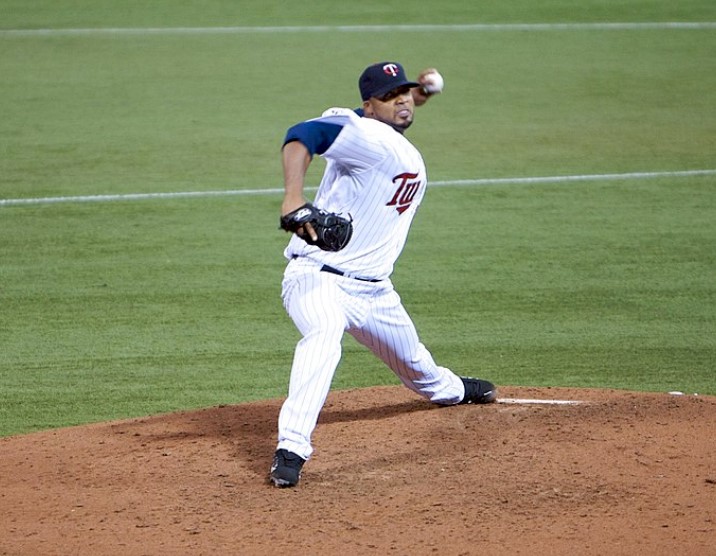
The Most Cycles Ever in One Season

Only five players have collected two cycles in one season. Among those, Brewers’ outfielder Christian Yelich is the only one to hit for the cycle against the same team (the Reds) twice in the same campaign. In Yelich’s 2018 MVP season, he hit for the cycle on August 29, as the Brewers topped the Reds 13-12 in ten innings in Cincinnati. He doubled up on cycles on September 17, as the Brewers topped the Reds 8-0 in Milwaukee.

The  Only Pitcher Ever to Record a Win and Hit for the Cycle in the Same Game

On July 28, 1888 – as the Chicago White Stockings topped the Detroit Wolverines, 21-17 –  Jimmy Ryan  started in CF for Chicago with Mark Baldwin on the mound.  In the bottom of the second – with two out, six runs scored in the inning and the bases loaded – Chicago Manager Cap Anson had Baldwin and Ryan change places.  Ryan fanned Detroit pitcher Charles “Lady” Baldwin to end the inning, with the White Stockings trailing 7-4. Chicago tied the game at 8-8 in the top of the fourth and went on to win 21-17.

Ryan got the victory, pitching 7 1/3 innings, allowing ten runs. He also went five-for-six at the plate (a single, double, two triples and a home run), was safe on error, scored three runs, drove in four and stole a pair of bases.  In the process, he became the first (and still only) player to record a pitching victory and a cycle in the same game.  (For the season, Ryan hit .332, leading the National League in hits with 182, doubles with 33 and home runs with 16). On the mound, he was 4-0, 3.05 in eight appearances (two starts).  For his 18-season MLB career (1885-1900, 1902-03), Ryan hit.308-118-1,093, with 419 steals (2,014 games). On the mound he was 6-1, 3.62 in 24 games (five starts).

The Fastest Cycle Ever

On June 18, 2000, Colorado Rockies’ second baseman Mike Lansing completed the cycle in just four innings – making it  the quickest cycle in MLB history. Notably, Lansing was consistently behind in the counts and three of his four hits came with two strikes. Lansing, batting second in the order, hit:

  • An RBI triple to right in the first inning, on a 1-2 pitch;
  • A two-run home run (0-1 pitch) in the bottom of the second;
  • A two-run double (2-2 pitch) in the bottom of the third (as the Rockies scored nine times to take a 14-1 lead); and
  • A single (another 1-2 offering) to right in the fourth.

Lansing then struck out in the sixth, before being lifted for a pinch-hitter (Darren Bragg) in the eighth. Lansing ended the day four-for-five, with three runs scored and five RBI, as the Rockies torched the Diamondbacks 19-2 in Denver.

The “Slowest” Cycle Ever

The Expos’ Tim Foli is the only player to start a cycle one day and complete it the next. On April 21, 1976, Foli collected a single, double and triple in a contest against the Cubs that was suspended in the top of the seventh due to darkness. When play resumed the following day, Foli added an eighth-inning home run. (The Expos prevailed 12-6.)

Longest Time Ever Between Cycles

Among players with multiple cycles, George Brett went the longest time between cycles – 11 years & 57 days. He hit for the cycle on May 28, 1979 (his age-26 season) and again on June 24, 1990 (his age-37 season).

Something Old … Something New

The youngest MLB player ever to hit for the cycle is the NY Giants’ Mel Ott (age 20 and 75 days) on May 16, 1929).  The oldest player to hit for the cycle is The Angels’ Dave Winfield (age 39 and 264 days) on June 24, 1991.

Three’s a Crowd

Between August 2 and August 14 1933, three MLB players it for the cycle.  Mickey Cochrane (August 2); Pinky Higgins (August 6); Jimmie Foxx (August 14).  All three were suited up for the Philadelphia Athletics.

Sharing the Wealth

Three players have hit for the cycle in both the NL and AL: Bob Watson (NL Astros-1977 and AL Red Sox-1979); John Olerud (NL Mets-1997 and AL Mariners-2001); Michael Cuddyer (AL Twins-2009 and NL Rockies-2014).

Quote the Raven, “Nevermore”

The Marlins are the only MLB team to never have a batter record a cycle.

The Biggest Seasons for Cycles

MLB a record nine cycles in 1933 and 2009.  Here are the hitters.

1933: Pepper Martin, Cardinals; Chuck Klein, Phillies; Arky Vaughn, Pirates; Mickey Cochrane, Athletics; Pinky Higgins, Athletics; Jimmie Foxx, Athletics; Earl Averill, Indians; Babe Herman, Cubs.

2009:  Orlando Hudson, Dodgers; Ian Kinsler, Rangers; Jason Kubel, Twins; Michael Cuddyer, Twins; Melky Cabrera, Yankees; Troy Tulowitzki, Rockies; Felix Pie, Orioles; B.J. Upton, Rays.

Hitting (running) into an Out for the Cycle

Photo by rchdj10

The Yankees’ 1B Lou Gehrig (kind of) earned a cycle by being tossed out at the plate.  On June 25, 1934, as New York topped Chicago 13-2  at Yankee Stadium, Gehrig hit two-run home run in the first inning; a  single in the third; and a double in the sixth. Gehrig came up needing just the triple for the cycle in the seventh and hit a smash to deep center (scoring Yankees’ CF Ben Chapman). Gehrig wasn’t satisfied with a three-bagger and was thrown out at home (8-6-2) trying for an inside-the-park home run – thus getting credit for the triple he needed for a cycle.


Nearly a Cycle – In One Inning

On June 27, 2003, Johnny Damon was playing CF and leading off for the Red Sox  as they took on the Marlins in Boston.  In a start that brought Boston fans up out of their seats, Damon was three-fourths of the way to the cycle bat the end of the first inning – and had tied an MLB record with three hits in an inning.  (The Red Sox scored 14 runs in the first inning, on their way to a 25-3 win over the Marlins at Fenway.) Damon who collected a single, double and triple in the bottom of the first, ended the game five-for-seven, with three runs scored, three RBI, a double, a triple and three singles.  He, unfortunately, did not get the cycle. In his final three at bats Damon: struck out; flied out to center; singled to right; singled past third base.

Here’s how that first inning went:

  • Johnny Damon – Double past first base down the line.  (Off starter Carl Pavano.)
  • Todd Walker – Single, Damon scores.
  • Nomar Garciaparra – Double.
  • Manny Ramirez – Home run, scoring three.
  • David Ortiz – Double.
  • Kevin Millar – Single, Ortiz scores.

Michael Tejera replaces Pavano on the mound.

  • Trot Nixon – Single.
  • Bill Mueller – Walk, loading the bases.
  • Jason Varitek – Single, Millar and Nixon score.
  • Damon – Triple to deep right field, Mueller and Varitek score.
  • Walker – Single, Damon scores.

Allen Levrault takes over for Tejera – at this point, we’ve seen two pitchers, 11 batters, ten hits, one walk, nine runs and no outs.

  • Garciaparra – Foul pop out.
  • Ramirez – Single.
  • Ortiz – Walk, loading the bases.
  • Millar – Sacrifice fly, scoring Walker.
  • Nixon – Walk, loading the bases.
  • Mueller – Double, scoring Ramirez and Ortiz.
  • Varitek – Walk.
  • Damon – Line drive single to left, Nixon scores, Mueller is thrown out at the plate to end the inning.

Red Sox score 14 runs on 13 hits and four walks; Damon collects a single, double and triple.

The Cycle … From a Family Perspective

Only two father-son combinations have hit for the cycle at the major-league level – and both involved rookies.

Gary Ward hit for the cycle as a rookie (in just his 14th game) for the Twins on September 18, 1980. His son Daryle hit for the cycle for the Pirates (against the Cardinals) on May 26, 2004 (in his seventh MLB season).

In 2018, Blues Jays’ rookie Cavan Biggio – in a September 17 game against the Orioles – hit for the cycle.  Cavan’s father, Hall of Famer Craig Biggio, hit for the cycle (for the Astros versus the Rockies) on April 8, 2002.

The Cycle … Sometimes it Skips a Generation

Pittsburgh Pirates’ outfielder Gus Bell hit for the cycle on June 4, 1951 – as the Pirates topped the Phillies 12-4 in Philadelphia. Fifty-three seasons later – on June 28, 2004 – Phillies’ 3B David Bell (Gus Bell’s grandson) hit for the cycle (also in Philadelphia), as the Phillies topped the Expos 14-6.   Gus and David Bell are the only grandfather-grandson combination to achieve MLB cycles.

Cycles … A Big Stage Perspective

Brock Holt is the only player to record a cycle in the post season. He did it on October 8, 2018, as the Red Sox beat the Yankees 16-1 in Game Three of the American League Division Series. Holt grounded out in the top of the second inning; had a single and a triple in the Yankees seven-run fourth; grounded out in the sixth; hit a ground-rule double in the eighth; and managed to finish his cycle  with a home run with two outs in the top of the ninth. It was Holt’s second career cycle.  He had a regular-season cycle for the Red Sox on June 16, 2015, as Boston topped Atlanta 9-4 at Fenway. He also completed that cycle with two outs in Boston’s last offensive inning – hitting a triple with two down in the bottom of the eighth.

Primary Resources:  Baseball-Almanac.com; Baseball-Reference.com; “July 28, 1888: Jimmy Ryan hits for cycle as Chicago White Stockings win 21-17 slugging match, ” by Mike Huber, SABR.

BASEBALL ROUNDTABLE ON THE TOP 100 BASEBALL BLOG LIST

100Baseball Roundtable is on the Feedspot list of the Top 100 Baseball Blogs.  To see the full list, click here.

I tweet baseball @DavidBBRT

Follow/Like Baseball Roundtable’s Facebook Page here.  More baseball commentary; blog post notifications; PRIZES.

Member: Society for American Baseball Research (SABR); The Baseball Reliquary; The Negro Leagues Baseball Museum.


McDougall’s Big Day … One for the Record Books

On this day (May 9) in 1999, Florida State University 2B Marshall McDougall had a game that wrote his name into the NCAA record books.  As Florida State topped Maryland 26-2 in an Atlantic Coast Conference game, McDougall went seven-for-seven.   A pretty good day’s work.  Even more spectacular is the fact that  after a first inning single, McDougall launched six straight home runs: a solo shot in the second; a three-run homer in the fourth; a two-run home run in  the sixth; a three-run homer in the seventh; a Grand Slam in the eighth; and a third three-run shot in the ninth. That outburst gave McDougall the NCAA single-game records for home runs (6); RBI (16); and total bases (25).  You can hear the audio (from YouTube) below.

As surprising as it was, the big day fit right into McDougall’s performance for the season. McDougall, who played his first two college seasons at Santa Fe Community College (Gainesville, FL), came into that May 9 game hitting .405, with 17 home runs and 70 RB in 52 games.  Here are a few other tidbits from McDougall’s 1999 college season:

  • He hit .419 on the year – with 126 hits in 71 games;
  • His average went above .400 in the third game of the season and never dipped below .400 thereafter;
  • His season included a 33-game hitting streak, during which he went .437-13-48;
  • He recorded hits in 63 of f 71 games played, with 34 multi-hit games;
  • McDougall also stole 21 bases in 24 attempts.

A few other noteworthy tidbits from that 1999 season. McDougall was a consensus All-American; the Atlantic Coast Conference Player of the Year; and the 1999 College World Series “Most Outstanding Player.” He was also a finalist for the  Golden Spikes Award and National Collegiate Baseball Writers Association Dick Howser Player of the Year Award.    Note:  The 1999 Golden Spikes and Howser Awards were won by Jason Jennings of Baylor University – who went 13-2, 2.58 on the mound (22 games, 18 starts) and hit .386-17-68 in 65 games at the plate.

The following season, McDougall hit .346-15-67 for Florida State and was a selected (for the second consecutive year) to the ACC All-Conference Team.

For those who are interested, here’s a look at Marshall McDougall’s path to (and from) the major leagues – which gives us all reason to reflect on just how challenging playing ball at the major league level can be; no matter what your past performance and future potential may look like.  

In high school (Valrico, FL), McDougall had already shown his promise as a second-team All-State player (selected by the White Sox in the 41st round of the 1996 MLB Draft). He chose to attend Santa Fe Community College, where he played well enough to be picked by the Yankees in 37th round of the 1997 draft). Once again, he declined to sign, instead moving on to Division I ball at Florida State University;  where, as you’ve already read, he carved out a spot in college baseball history.

After his big 1999 season, McDougall was drafted again (26th round, Red Sox), but chose to play his senior college season.  He was then drafted again (2000, ninth round) and signed with the A’s organization.

After signing with the A’s, McDougall worked his way up to the AA Midland Rockhounds – where, in 2002,  he hit .303-9-56 in 84 games, before being traded to the Indians for Ricardo Rincon during the season. He suffered an injury after the trade and played only nine games in the Indians’ system (Double-A and Low-A). In December 2002, he was taken by the Rangers in the Rule 5 Minor League draft.

The 6′ 1″, 200-lb. McDougall showed solid potential in the Rangers’ system (at Double- and Triple-A). In 2003, he hit .261-15-78 in 140 games; in 2004, .288-21-83 in 112 games; and, in 2005, he was hitting .341-11-64 (75 games) when he got the “call to the show.”   He joined the Rangers as a utility player and manned five positions for Texas (2B/3B/SS/RF/DH). Still, he got only 18 MLB  at bats in 18 games (three hits, three runs, one double, and ten strikeouts.)   Hampered by injury (wrist), McDougall later played in both the Dodgers’ and Padres’ systems, but never made it back to the major leagues.  He also played in the Mexican League, Mexican Winter League and Chinese P{professional Baseball League. In his final professional season (at age 33), McDougall  hit .341,with ten home runs in 35 games  for the Reynosa Broncos of the Mexican League. McDougall’s story clearly reflects how hard it is to get to the big leagues (he made it) and how challenging it is to stay there.  Still, he played the game at the highest level – and still holds a place (several places) in the college record books.

Bonus Tidbit – Professional Baseball’s Only Home Run Cycle 

In the opening story of this post, you may have noted that Marshall McDougall’s six-homer game for Florida State University included a “home-run cycle ” – a solo, two-run, three-run and Grand Slam homer all by the same player in the same game.  That feat has been accomplished only once in professional baseball.  It’s a story I’ve shared before, but bears retelling – especially for those who may have missed the original post.

It happened on July 27,  1998. That day, (Roger) Tyrone Horne, playing for the Double-A Arkansas Travelers, became the only professional player (to date) to hit for the “Home Run Cycle” – bashing a solo, two-run, three-run and Grand Slam home run in a 13-4 win over the San Antonio Mission.  They were the only home runs in the game, in which Arkansas collected 13 hits.  Horne ended the day four-for-five, with four runs scored and ten RBI.

Horne hit three of his four dingers off San Antonia starter Pete Zamora – a two-run shot in the first inning, a Grand Slam in the second and a solo homer in the fifth. His final homer, a three-run long ball, came in the sixth off reliever Miguel Garcia.  Horne came up once more, with two on, in the eighth, but reliever Jeff Kubenka struck him out.

Horne’s feat was the highlight of an outstanding Double-A season, in which the 27-year-old outfielder would go .312 with 37 home runs, 139 RBI, 94 runs scored and even throw in 18 stolen bases in 123 games. His performance at Double-A earned Horne a call up to the AAA Memphis Redbirds at the end of the season, where ht hit .364 (four-for-eleven) in three games, with one double, one run scored and one RBI.  The 5’10”, 185-pounder showed not just power, but also good speed, throughout his minor-league career, racking up 185 steals in 13 seasons, hitting double digits in steals eight times and topping 20 twice.  He also hit double digits in home runs seven times, topping 20 twice.)

Appropriately, right after his historic “homer cycle” game, Horne headed off to the Texas League All-Star Game, where he proceeded to win the Home Run Derby.

Horne never made it to the major leagues – completing a 13-year (1,286 games; 1989-2001) minor-league career (in the Expos, Yankees, Mets, A’s, Marlins, Cardinals and Phillies systems) with a .288 average and 143 home runs.  The bat he used on his historic day with Arkansas, however, did make it to the Baseball Hall of Fame in Cooperstown.

Primary Resources: Baseball-Reference.com; TheBaseballCube.com; “Six Homers, 16 RBI for McDougall,” Bart Jansen, Associated Press, May 10, 1999; MiLB.com; and Nolefan.org.

BASEBALL ROUNDTABLE ON THE TOP 100 BASEBALL BLOG LIST

100Baseball Roundtable is on the Feedspot list of the Top 100 Baseball Blogs.  To see the full list, click here.

I tweet baseball @DavidBBRT

Follow/Like Baseball Roundtable’s Facebook Page here.  More baseball commentary; blog post notifications; PRIZES.

Member: Society for American Baseball Research (SABR); The Baseball Reliquary; The Negro Leagues Baseball Museum.

Manny Banuelos – Perseverance and a Passion for the Game

On May 1, in Baseball Roundtable’s April Update, I shared an upbeat story of perseverance – Giants’ OF Jason Krizan’s first major-league game (April 20), coming in his 12th professional season and after more than 1,000 minor-league appearances. (For the full April Wrap up of Players and Pitchers of the Month, plus stats and stories that caught Baseball Roundtable’s eye, click here.) I’m glad to report that on May 1, in his third MLB game, Krizan recorded his first MLB base hit.

In this post, I’d like to preview another feel-good story of perseverance – one that I hope will become reality during this MLB season. It’s the story of a one-time top MLB prospect who (in a professional career that began in 2008) has suffered a myriad of injuries (at least a dozen trips to the DL), pitched through perhaps the worst inning for an MLB hurler ever, took the mound for teams from the minor leagues to the major leagues and from the Mexican League to the Chinese Professional Baseball League – and is still pursuing the dream. The player’s name is Manny Banuelos. He’s a 31-year-old southpaw, who had a solid Spring Training and is currently pitching for the Triple-A Scranton/Wilkes-Barre RailRiders in the Yankees’ system.

Why focus on Banuelos today? Because it is the third anniversary of the day he set the MLB record for consecutive hits given up in a game by a single pitcher.

On May 2019, Manny Banuelos, pitching for the White Sox (versus the Red Sox) in Chicago – in a span of 32 pitches and ten batters – gave up four singles, three doubles and three home runs.   

We’ll look at that inning in detail in a bit, but first let’s look at how  Banuelos got there – and to where he is today.

In 2008, at age 17, Banuelos signed with the Yankees (out of Gomez, Palacio, Mexico). He showed solid potential (including a high-velocity, high-movement fastball) from the get-go: 4-1, 2.57 in Rookie-Level ball in 2008 and then 9-5, 2.64 at A- and High-A in 2009 – earning a sport in the 2009 All Star Futures game.

In 2010, Banuelos spent some time on the DL after an appendectomy, and ended up going 0-4, but with a promising 2.51 ERA and 85 strikeouts in 64 2/3 innings (at three levels in the Yankees’ system).  After the season, he was rated among the top five prospects in the Yankee system (Baseball America) and was among  the top prospects selected to play in the Arizona Fall League.

In 2011, the 20-year-old Banuelos was in Spring Training with the Yankees, and was recognized with the Jams P. Dawson Award as the best rookie in camp. He was considered one of the Yankees “Killer B’s” – Banuelos, Andrew Backman and Dellin Betances – a trio of young pitchers the Yankees felt had bright futures ahead.

Banuelos began the 2011 season as Double-A Trenton and was promoted to Triple-A Scranton/Wilkes-Barre in August.  He put up a 6-7, 3.75 record, fanning 125 batters in 129 2/3 innings. Then, in 2012, his season was shortened by arm issues ( 0-2, 4.50 ) – which led to Tommy John Surgery, forcing him to miss the entire 2013 season.   Banuelos came in back in 2014, pitching at High-A, Double-A and Triple-A , as he worked his way back from surgery (2-3, 4.11 in 26 games/25 starts).

In January 2015, Banuelos was traded to the Braves. He took the mound for the Triple-A  Gwinnett Braves, where a 6-2, 2.23 record earned him a July call up.  In his first two MLB starts, he went 1-0, 0.82 and fanned eight batters in 11 frames.  He pitched in five games that month (four starts), going 1-2, 2.49 before being benched by bone spurs i(elbow) that eventually required surgery.  He came back in September, but lasted just 4 2/3 innings in two starts (nine earned runs).

In 2016, still in the Braves’ system, Banuelos struggled to an 0-5, 5.33 record at three levels – and was released by the Braves. He signed a minor-league deal with the Angels and  pitched at Triple-A Salt Lake City in 2017 (5-6, 4.93), as well as in the Mexican Pacific Winter League.

In 2018, he seemed to bounce back. After signing a minor-league deal with the Dodgers, Banuelos went 9-7, 3.73  (with 127 strikeouts in 108 2/3 innings) for the Triple-A Oklahoma City Dodgers and was selected to the Pacific Coast League All Star Team.

Then, in  November 2018, the Dodgers traded him to the White Sox and Chicago kept him on the squad after Spring Training. In his first four appearances (March 30—April 15), all in relief, Banuelos went 1-0, 3.48, with nine strikeouts in 10 1/3 innings.  That earned him a starting shot and, in his first two starts, he picked up one win and gave up just two runs, fanning 10 in 9 2/3 frames.

That brought him to his, unfortunately, record-setting May 4, 2019 start against the Red Sox in Chicago.  It started out well enough, He retired the first eight batters he faced on 29 pitches (three strikeouts). His next 32 pitches produced the following results:

  • C Christian Vazquez – Single
  • CF Andrew Benintendi – Single, Vazquez to second
  • RF Mookie Betts – Two-run double
  • DH J.D. Martinez – RBI double
  • SS Xander Bogaerts – Two-run home run
  • 1B Michael Chavis – Solo Home run
  • 3B Rafael Devers – Double
  • LF Steve Pearce – RBI single, Devers to second
  • 2B Eduardo Nunez – Two-run home run
  • Vazquez –  Single

At this point, Carson Fulmer replaced Banuelos on the mound – and Banuelos left having given up nine earned runs in the inning – and having set the MLB record for most consecutive hits given up by a pitcher in a game. Notably, Banuelos pitched in five more games in May – going 1-3, 9,17, giving up 18 runs in 17 2/3 innings.  One wonders if there were some underlying issues since, by mid-June, Banuelos was on the DL (shoulder) and did not pitch for the White Sox  June 15-September 2.  He ended the season 3-4, 6.93.

Banuelos opted for free agency after the 2019 season, signed a minor-league deal with the Mariners, was released in May and ended up finishing 2020 with the Guardians – the Fubon Guardians of the Chinese Professional Baseball League – where he put up a 6-3, 2.60 record, fanning 62 in 52 innings.

In 2021, Banuelos again pitched for Fubon, as well as for Monterrey in the Mexican League  and Culiacan in the Mexican Pacific Winter League – before signing a minor-league deal for 2022 with the Yankees.

Banuelos, now 31-years-old,  had a solid 2022 Spring Training with the Yankees – pitching  9 1/3 innings to a 2.89 ERA, with nine strikeouts. While, he didn’t make the Yankees Opening Day Roster, he’s pitching  well at Scranton/Wilkes-Barre, with (as this is being written) a 2.16 ERA and 16 strikeouts in 16 2/3 innings over four appearances.  I, for one, am hoping to see him on the Yankee mound sometime this season, especially when I see Banuelos’ quotes like this (from a March article in  the New York Daily News):

“I’m glad to be back. Honestly. It’s very special … I’m enjoying every day I come here to the ballpark. … It’s been like ten years since my first Spring Training and I’m enjoying everything I do here. I already said I’m grateful to the Yankees for giving me the opportunity to come back. That’s what I want. I want to take advantage, I want to show them I have something left.”

Now, how can you not root for that guy?

Primary Resources: Baseball-Refeence.com; NationalPastime.com; Baseball-Almanac.com; “White Sox’s Manny Banuelos leaves  loss to Indians with injury,”  Scot Gregor, Daily Herald Media Group, May 15, 2019;  “Ex-Killer B Manny Banuelos returns to the Yankees a decade later armed with experience, perspective,”  Kristie Ackert, New York Daily News, March 31,2022


BASEBALL ROUNDTABLE ON THE TOP 100 BASEBALL BLOG LIST

100Baseball Roundtable is on the Feedspot list of the Top 100 Baseball Blogs.  To see the full list, click here.

I tweet baseball @DavidBBRT

Follow/Like Baseball Roundtable’s Facebook Page here.  More baseball commentary; blog post notifications; PRIZES.

Member: Society for American Baseball Research (SABR); The Baseball Reliquary; The Negro Leagues Baseball Museum.

The Up and Down Career of Francisco Liriano – and an Unexpected No-hitter

Photo: aturkus on Flickr, CC BY 2.0 <https://cPhoto: aturkus on Flickr, CC BY 2.0 <https://creativecommons.org/licenses/by/2.0>, via Wikimedia Commons org/licenses/by/2.0>, via Wikimedia Commons

On this date (May 3) in 2011, Twins’ southpaw Francisco Liriano twirled a gem against the White Sox (in Chicago). It was the first complete game in Liriano’s then six-season MLB career, also his  first shutout and – most important – a no-hitter.  As the Twins triumphed in a tight 1-0 game, Liriano went nine innings, giving up six walks, fanning two and, of course, allowing no hits and no runs.

Liriano’s performance makes its way into the pages of Baseball Roundtable because it was one of the most unexpected and unpredictable no-hitters in MLB history.

Why unexpected?  Coming into the game, Liriano’s record on the season (in five starts) was 1-4, with a 9.13 ERA. In 23 2/3 innings (averaging about 4 2/3 per start), he had given up 27 hits, 24 runs (all earned),  18 walks and one hit-by-pitch,  while also fanning 18 batters. In the start immediately before the no-hitter (April 27), Liriano had lasted just three innings and given up seven runs on six hits and four walks.  To further make my case for the unexpected nature of this no-no, in the start immediately after the no-hitter (May 19), Liriano had again lasted just three frames, giving up four runs on four hits and three walks.  So, his no-hitter was “book-ended” by two games in which he lasted a total of six innings and surrendered 11 runs.

Getting back to that no hitter. In that game,  Liriano threw 122 pitches (66 strikes and 56 balls).  Despite command issues (hence, the six walks), only one White Sox player reached second base. Liriano  was aided by three double plays: 2B Alexi Casilla to SS Matt Tolbert to 1B Justin Morneau in the first and second innings and 3B Danny Valencia to Casilla to Morneau in the eighth.

Liriano finished the 2011 season 9-10,with a 5.09 ERA.  It was a bit of an “up-and-down” campaign for him.  Among his 26 starts, on the upside, he had nine starts in which he pitched at least six innings and gave up two or fewer runs – and, on the downside, six starts in which he pitched less than five frames and gave up four or more tallies.  His two relief appearance were also up and down. In one, he pitched two scoreless innings and in the other gave up five earned runs in two innings.  Also, on the downside was a trip to the disabled list in late August – he didn’t pitch from August 26-September 17 and, in September, made just two relief appearances.

The up-and-down nature of Liriano’s career is reflected in the fact that, since the Comeback Player of the Year Award was established in 1965, Liriano is one of only seven players to win it twice and one of only two  to win it in both leagues. (Note: It was the Sporting News Comeback Player of the Year Award from 1965-2006 and the MLB Comeback Player of the Year Award from 2005-current – with overlapping awards in 2005-06).

So, let’s look briefly at Liriano’s career. Seventeen-year-old Liriano signed with the Giants as an international free agent (out of the Dominican Republic) in 2000.  In the minors, from 2001-2003, he  went 8-12, 3.88 with 170 strikeouts in 160 innings. In November of 2003, the Giants traded Liriano to the Twins (Liriano, Boof Bonser and Joe Nathan for A.J. Pierzynski and cash). The Twins saw Liriano as a top prospect with a hard, tailing fastball, a sharp-breaking slider and an effective curve (as well as with an unorthodox delivery).   After working his way up through High-A, Double-A and Triple-A (in 2005, he was 12-7, 2.63 with 204 strikeouts and just 50 walks at Double-A and Triple-A), Liriano got in six Twins game as a September call up (1-2, 5.70).

In 2005, Francisco Liriano was the International  League (AAA) Rookie of the Year.

In 2006, Liriano had one of his biggest ups, going 12-3. 2.16, in 28 games (16 starts) with the Twins. Observers will agree, his stuff was electric. However, the season was not without its downs. Liriano (known for an unorthodox – often  described as violent – delivery) – came down with arm (elbow) trouble and pitched in only one MLB game after August 7.  After the season, he underwent Tommy John Surgery – and missed all of 2007.

Liriano was back in 2008, but suffered through the down of starting the season in the minors, got an April call up and put down an 0-3, 11.32 record in three April starts for the Twins.   In late April, he was sent back down. However, putting up a 10-2, 3.28 record at Triple-A earned him a call back up to the Twins – where he went  went 6-1, 2.74, with 60 whiffs in 65 2/3 innings (11 starts) the rest of the way.  Plenty of smiles in Minnesota.

Observers point to Francisco Liriano’s original violent delivery, efforts to (alter) smooth that delivery, injury issues and some just plain hard-luck as factors in Liriano’s up-and-down career.

After that strong finish to 2008, things went a bit south in 2009 – a 5-13, 5.80 record in 29 games (24 starts).

Liriano’s 2010 season was primarily an up year (but still had its down moments). He started out 3-0, 0.93 in four April starts, with 27 strikeouts in 29 innings. Then, in six May starts, he seemed to lose his way (2-3, 5.15), but still there was solid promise – as he recorded 39 strikeouts and just nine walks in 36 2/3 May innings.  He righted the ship and was 14-7, 3.28 on September 15 – before losing his last three starts, giving up 12 earned runs in 13 1/3 innings. He finished the season 14-10, 3.62 – and to add another up – won his first Comeback Player of the Year Award.

Then came the 2011 no-hitter season (that we’ve already looked at). This was followed by  a 2012 season in which Liriano went 6-12, 5.34 for the Twins and White Sox. In October of 2012, the White Sox released Liriano and in December, he signed as a free-agent with the Pirates.  Then, another downer.  Shortly after signing with the Pirates, Liriano  broke his non-throwing arm playing with his children. Liriano started the 2013 season (after the Pirates’ contract was voided and renegotiated) on the disabled list and didn’t make  his first start until May 11. It was pretty much all up from there, as Liriano finished the season at 16-8, 3.02 in 26 starts, fanning 163 batters in 161 innings – winning his second Comeback Player of the Year Award.
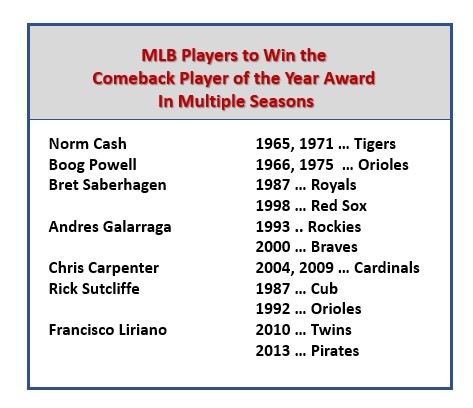
In 2014-15, Liriano was pretty steady – going a combined 17-17, and putting up a 3.38 ERA in both seasons (for the Pirates).   Still, there were ups and downs.  In 2014, Liriano was 1-7, 4.72 through mid-July and then 6-3, 2.20 the rest of the way.

Liriano pitched until 2019 (suiting up for the Pirates, Blue Jays, Astros and Tigers). Over his final four seasons, he went 24-35, 4.68.   His final stat line was 112-114, 4.15, with 1,815 strikeouts and 816 walks in 1,813 2/3 innings. He also went 2-1, 3.96 in 11 post-season games (three starts) for the Twins, Pirates, Blue Jays and Astros.

As a Twins fan, I was privileged to see Liriano in action and when he was on his game, it was a beauty to watch – and he could, at times,  make batters look helpless “up or down” in the strike zone.

Primary Resources: Baseball-References.com; Baseball-Almanac.com; “Roberts Report: Liriano of old won’t be back soon,” April 24, 2008, ESPN.com; “Twins’ Liriano trying to slow down,” Associated Press, August 25, 2009.

BASEBALL ROUNDTABLE ON THE TOP 100 BASEBALL BLOG LIST

100Baseball Roundtable is on the Feedspot list of the Top 100 Baseball Blogs.  To see the full list, click here.

I tweet baseball @DavidBBRT

Follow/Like Baseball Roundtable’s Facebook Page here.  More baseball commentary; blog post notifications; PRIZES.

Member: Society for American Baseball Research (SABR); The Baseball Reliquary; The Negro Leagues Baseball Museum.

Baseball Roundtable April Wrap – Stats and Stories from the 2022 Season’s First Month

It’s May  1, and that means it’s time for Baseball Roundtable’s April Wrap Up –  statistics and stories that caught BB Roundtable’s eye in April; leader boards for the month; BBRT’s Players and Pitchers of the Month; and the monthly Trot Index.

Here’s a hint at the kind of things you’ll read about – if you make it to the end of this post.

  • The season’s first no-hitter, first triple play and first Immaculate Inning;
  • A total of one complete game, and it wasn’t the no-hitter;
  • Miguel Cabrera’s 3,000th base hit;
  • A bases-loaded intentional walk;
  • A walk-off home run by a player named Beer on National Beer Day.
  • A pitcher pulled after 80 pitches, while seven innings into a perfect game.

For all this and more, read on.  If the stats don’t grab you, you can scroll to the Players/Pitchers of the Month and Highlights sections.

BASEBALL ROUNDTABLE PLAYERS AND PITCHERS

OF THE MONTH FOR APRIL


—–Players of the Month—–

National League – Nolan Arenado, 3B, Cardinals

Arenado hint .375-5-17, with nine walks for the month (second in the NL in RBI, fifth in home runs and third, among qualifiers, in batting average.) He led NL qualifiers in slugging percentage (.681) and was also in the top five in  in on-base parentage (.444), Arenado started the month with an eight-game hitting streak and, ultimately, hit in 16 of 19 games; with seven multi-hit contests.  And, let’s not forget, he also flashed some pretty good leather at the hot corner.

Starting  his tenth MLB season, the 31-year-old Nolan Arenado has won nine Gold Gloves at the hot corner.   

Honorable Mentions:  Eric Hosmer, 1B, Padres, led all MLB qualifiers with a .389 average (three home runs, 14 RBI). His 28 hits (in 20 games) tied for third-highest in MLB this April.  Manny Machado, 3B, Padres hit 386 for the month, with four  home runs, 15 RBI and an MLB-best 20 runs scored. His 32 April hits led MLB; Rockies’ first-sacker C.J. Cron led the NL with seven home runs (.273 average and 19 RBI) – a 21-to-5 ratio of strikeouts-to-walks hurt his standing.  Really, for me, it was pretty much a toss up among Arenado, Machado and Hosmer.

American League …  Jose Ramirez, 3B, Guardians

Photo: Erik Drost, CC BY 2.0 <https://creativecommons.org/licenses/by/2.0>, via Wikimedia Commons

Ramirez is a hitting machine. In April, he led MLB in RBI with 28, was second in MLB and led the AL in home runs with seven, led MLB qualifiers in slugging percentage at .722  and hit a robust .342. He also showed good plate discipline with nine walks and nine strikeouts. During the month, he had a six-RBI game and a pair of four-RBI  contests. He collected hits in 17 of 21 games played,with seven multi-hit games.

Honorable Mentions:  Yankees’ 1B Anthony Rizzo, whose nine April home runs led MLB (a .273 average and 21 RBI); Red Sox’ SS Xander Bogaerts, who hit .375-1-9  for the month, collecting 30 hits (second in MLB) and scoring 12 runs.
—–Pitchers of the Month—–

National League – Pablo Lopez, RHP, Marlins

Photo: All-Pro Reels from District of Columbia, USA, CC BY-SA 2.0 <https://creativecommons.org/licenses/by-sa/2.0>, via Wikimedia Commons

Wow! Pablo Lopez put up a 3-0 record, with an MLB-lowest (among qualifiers) 0.39 earned run average. He also fanned 23 hitters and walked just four in 23 1/3 innings and didn’t give p a single home run. In his one no-decision, he gave up one run in five innings against the Giants (his first start, April 9). It was the only run he gave up in four April starts.  His best game came against the tough Cardinals on April 21.  He went seven innings, giving up just three hits and no walks, while fanning nine. The 26-year-old, out of Venezuela, came into the season with an MLB record of 18-21, 4.04, but was 5-5, 3.07 in 2021.

On July 11, 2021, Lopez started against the Braves (in Miami) and set an MLB record by fanning the first nine batters in a game – using just 35 pitches (30 strikes, including foul balls)  to record the nine whiffs. He got the win, as the Marlins topped Atlanta 7-4. Lopez gave up three runs over six innings (five hits, two walks, nine strikeouts).

Honorable Mentions: Carlos Rodon went 3-0 in four starts (pitching 23 innings).  His 1.17 ERA was third in the NL (among qualifiers). Rodon, however, impressed by leading the NL with 38 April strikeouts; Josh Hader, Mets, was 10-for 10 in save opportunities, fanned 15 batters in 9 1/3 innings and did not allow an earned run; Kyle Wright, Braves, went 3-0. 1.13 in four starts, fanning 34 and walking just six in 24 innings; the Met’s Tylor Megill gets a nod as the NL’s only four-game winner (4-0. 1.93 … 27 whiffs and only six walks); finally, there is tough-luck Corbin Burnes. He pitched 25 2/3 innings, walked only six and posted a 1.75 ERA – yet had only one win (no losses) to show for it. In his final three starts in April, Burnes threw 20 2/3 innings and gave up just two runs (29 whiffs) -and got a win and two no-decision for his efforts.

American League – Logan Gilbert RHP, Mariners

Photo: Erik Drost, CC BY 2.0 <https://creativecommons.org/licenses/by/2.0>, via Wikimedia Commons

Okay, maybe I’m a sucker for ERA (see Pablo Lopez above), but 24-year-old righty Logan Gilbert went 3-0 with an AL-best 0.40 earned run average in four April starts.  In 22 1/3 innings, he fanned 22 and walked just four. He  gave up a homer run to the second batter he faced this season – the Twins’ Luis Arreaz – and then didn’t surrender another earned run  for the rest of the month (22 innings). (He did give up one unearned run). Gilbert, by the way, was a first-round draft choice in the 2018 MLB draft (out of Stetson University, where he went 23-3, 2.48 over three seasons). He went 11-5, 2.12 in two minor-league seasons, before being called up to the Mariners  last May. In 2021, he went 6-5, 4.68 in 24 starts for Settle.,
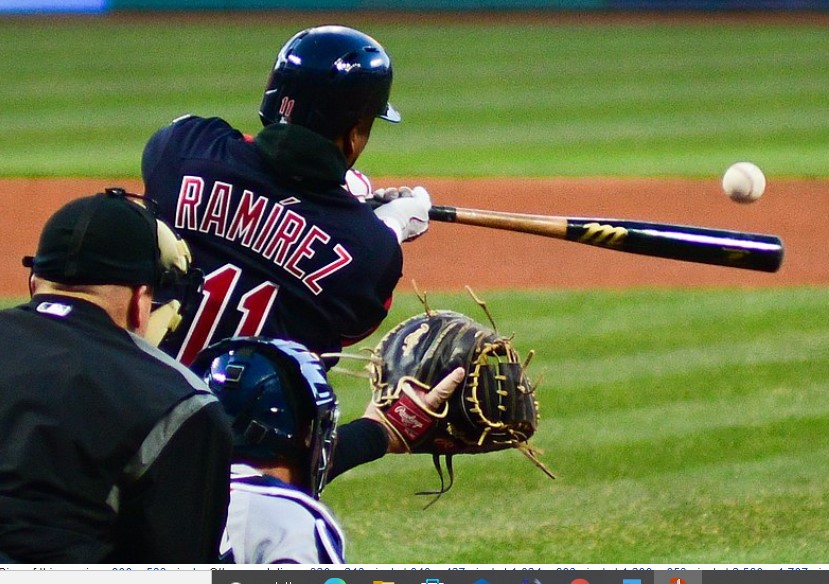
Honorable Mentions: Alek Manoah, RHP, Blue Jays was one of just three MLB four-game winners in April – going 4-0, 1.44 in four starts (25 innings pitched), fanning 25 and walking seven; Joe Ryan, RHP, Twins, who went 3-1, with a 1.17 ERA (second in the AL), 0.70 WHIP (second) and fanned 25 batters in 23 innings; and you have to give a shout out to Astros’ 39-year-old veteran Justin Verlander, who went 2-1. 1.73 in four starts (26 innings) and recorded the lowest WHIP among MLB qualifiers at 0.69.

—–Surprise Player of the Month—-

Ty France , 1B, Mariners

Mariners’ 27-year-old 1B Ty France closed out April with a .337-5-21 line – which placed him fifth in the AL (among qualifiers) in average, eighth in home runs and second in RBI. He was also second in the AL in hits. In  April, he recorded seven multi-it games – including a five-for-six performance, with one home run and five RBI, as the Mariners topped the Royals 13-7 on April 23.  He was especially tough in Seattle, hitting .474 at home – and even tougher with runners in scoring positions (11-for-19, .550).  France’s emergence rates as a Baseball Roundtable surprise, but not for the reasons you might think. After all, in 2021, his first full MLB season, he put up a .291-18-73 line.   What surprises The Roundtable is: 1) How was he available in the 34th round of the 2015 MLB Draft – the 1,017th overall pick (Padres), especially after putting up a .337 average in three seasons (189 games) at San Diego State? and 2) Why were the Padres were willing to trade him to the Mariners during the 2020 season? The Padres traded France, P Andres Munoz, C Luis Torrens and OF Taylor Trammell to the Mariners for P Austin Adams, P C/INF Dan Altavilla and 1B Austin Nola.

When Ty France was called up to the Padres in August of  2019, he was hitting a robust .399 in 76 games for the Triple-A El Paso Chihuahuas (118-for-296, one hit shy of .400+), with 27 home runs and 89 RBI.

Honorable Mention: Angels’ outfielder Taylor Ward came into the season as a .230 career MLB hitter (four seasons/159 games), but put up a .392-5-13 line in 14 April contests. (He started the season on the IL with a groin strain). On April 27, Ward nearly hit for the cycle – ironically missing just the single – as he went three-for-four with a walk, double, triple, home run and four RBI versus the Guardians. This may be the Taylor Ward the Angels were expecting when they made him a first-round pick (out of California State University in Fresno) in the 2015 MLB draft. (Ward did  put up a .299 average in six minor-league seasons … 490 games). In 2021, Taylor hit .250-8-33 in 65 games with the Angels.

________________

TROT INDEX … A REGULAR BBRT FEATURE

Through April, 35.5 percent of the MLB season’s 23,462 plate appearances ended in a trot (back to the dugout, around the bases, to first base). We’re talking about strikeouts, home runs, walks, hit by pitch and catcher’s interference – all outcomes that are, basically, devoid of action on the base paths or in the field. Here’s the breakout: strikeouts (23.0%); walks (8.9%); home runs (2.4%); HBP (1.1%); catcher’s interference (less than 1%). 

Now, to provide a little context (a more detailed post on this topic coming soon). Here are a few selected annual Trot Index scores since I began watching baseball in earnest:  1950  – 22.8 %; 1960 – 25.1%; 1970 – 27.0%; 1980 – 23.1%; 1990 – 26.1%; 2000 – 29.9%; 2010 – 30.3%; 2021 – 36.3%.

______________


It’s a bit early to to make any judgments about how this season is going, but here are a few observations, as well as a trio of charts that may shed some light on April.

  • It’s no surprise that Mets’ starters racked up 11 April wins; but it’s a little surprising that they did it without Jacob deGrom.
  • It’s surprising that the Pirates did not have a single victory from a starter in April.
  • It’s surprising (only just a little) that April saw only one complete-game in MLB; but not surprising that a Dodger threw it.
  • It’s a little surprising to see the Angels leading the NL West and a lot surprising to see the Marlins in second place in the NL East.
  • It’s not surprising to see four NL West teams playing .570+ ball, but it is surprising to see all bu tone  AL Central team below .450.
  • It’s surprising that the Reds have won only three games, but still have more saves (3) than the Rangers (2).

\

——-Team  Statistical Leaders for April  ———-

RUNS SCORED (average 85)

National League – Padres (104); Giants(104); Phillies (100)

American League – Angels (104); Yankees (100); Mariners (95)

The fewest April runs were scored by Royals at 59.  The Red were at the bottom of the NL with 66. 

AVERAGE (average .231)

National League –  Rockies (.261); Mets (.255); Cubs (.250)

American League –Angels (.255); Guardians (.251); Yankees (.250)

The lowest team average for April belonged to the Diamondbacks at .181 – the only team under.200.

HOME RUNS (average 19)

National League – Braves (28); Giants (24); Brewers (24)

American League –  Blue Jays (30); Yankees (29); Angels (27)

The Tigers had the fewest home runs in April, just 8. Lowest in the NL were the Nationals and Pirates as 12 each. 

STOLEN BASES (average 10)

National League – Cardinals (22); Dodgers (16);

American League – Angels (16); Rays (16); Mariners (14); Royals (14)

The Tigers stole the fewest April bases – two (in five attempts).  The Cardinals were safe on 22 of 23 attempts. 

WALKS DRAWN (average 69)

National League –   Padres (92); Diamondbacks (82); Dodgers (82)

American League – Mariners (86); Angels (77); Twins (76)

The Mets led MLB  in on-base percentage for April at .341. The Angels led the AL  at .338. In slugging percentage, the Rockies  on top at .426, while the Guardians  led the AL at .330.

BATTER’S STRIKEOUTS (average 180)

National League – Diamondbacks (198); Brewers (198); raves (198)

American League – Orioles (208); A’s (197); Angels (193)

Royals’ batters went down on strikes the fewest times in April   (138).

EARNED RUN AVERAGE

National League – Dodgers (2.29); Mets (2.85); Giants (2.87)

American League – Yankees (2.70); Twins (3.16); Rays (3.18)

Four  teams had April ERAs of 5.00  or higher– Reds (5.97); Pirates (5.09); Nationals (5.08). Those three teams went a combined (19-46).  Conversely, the three teams with the lowest April ERAs went a combined 43-20. 

STRIKEOUTS (average 180)

National League – Brewers (222); Mets (219); Braves (207)

American League – Yankees (199); Rays (196); Red Sox (196)

The Brewers averaged an MLB-best 10.3 strikeouts per nine innings in April. The White Sox  averaged an AL-best 9.7.

FEWEST WALKS SURRENDERED (average 69)

National League – Dodgers (46); Giants (52); Cardinals (59)

American League –  Guardians (53); Tigers (55); Rays (57)

The Dodgers walked a stringiest 2.3 batters per nine frames. The Reds  walked an MLB’s highest 5.0 per nine innings for the month.

SAVES (average 6)

National League – Brewers (11); Rockies (10); Marlins (9)

American League – Blue Jays (11); Yankees (8); A’s (7); Angels (7)

Bonus Stats – In the Field

The  White Sox and Orioles made the most April errors (21 each); while  the Yankees were guilty of just five April Miscues.


—-APRIL HIGHLIGHTS—-

Climbing the Ladder

On April 30,  Blue Jays’ DH and leadoff hitter George Springer led off the bottom of the first inning with a solo home run off the Astros’ Luis Garcia. He added a second long ball with one out in the third inning, but it was the first-inning shot that drew Baseball Roundtable’s attention.  It was 46th leadoff home run of Springer’ career – moving him into a tie for sixth all-time in leadoff dingers.  Of course, atop that leaderboard is Rickey Henderson with 81.  (Side note: Springer made his lead-off home run more Henderson-like by adding a stolen base after being hit by a pitch in the fifth frame.) Springer is now in position to move further up the ladder this season.  Here is the list of players with the most career leadoff home runs:


  • Rickey Henderson … 81
  • Alfonso Soriano … 54
  • Craig Biggio … 53
  • Ian Kinsler …48
  • Curtis Granderson … 47
  • Jimmy Rollins and George Springer …46

Welcome To The Show

On April 29, 32-year-old Jason Krizan started in LF for the Giants – and his appearance was a tribute to perseverance in following a dream.  It came in his twelfth professional season, after 1,132 minor-league games.  Krizan was drafted in the eighth round of the 2011 MLB Draft (Tigers) – out of Dallas Baptist University, where, in 2011,  he hit .413-10-81 in 62 games. Over his 1,000+ minor league games, he hit .275-83-541.  On his lengthy journey to the “show,” Krizan had several solid seasons – including  .293-7-56 at Double-A in 2014; .294-10-65 at Double- and Triple-A in 2016; and .316-16-73 at Triple-A in 2021. In his first MLB game, Krizan went 0-for-3 with a walk.

First No-Hitter of 2022 A Team Effort

On April 29, the Mets recorded the first no-hitter of 2022, as they topped the Phillies 3-0. It was a true team effort, as five Mets’ pitchers combined to in a no-hit/no-run performance,  giving up six walks and fanning 12.  Starter Tylor Megill got the win and Edwin Diaz the save. For more on this contest, click here.

Sacrifice Hit (Bunt) Still A Weapon

We hear a lot these days about how hitters have lost the art of the bunt. Apparently, fielders have seen a decline in a related skill set. On April 29, with the Twins facing the Tigers in Minnesota, the Twins executed two sacrifice bunts in a game for the first time since August 31, 2018. It came in the fifth inning of a 2-1 game (Twins ahead). DH Trevor Larnach led off with a groundball single (off Tarik Skubal). The next hitter, CF Gilberto Celestino dropped a sacrifice bunt down the third base line. Detroit third sacker Harold Castro fielded the bunt, but his throw hit Celestino (safe on an error) putting runners on first and second with no out. Next up was 2B Jorge Polanco, who also dropped down a bunt.  This time, Detroit C Tucker Barnhardt made the play – and his throw hit Polanco (safe on an error) – loading the bases (on a single and a pair of “sacrifices”).  The next batter, SS Carlos Correa doubled home all three runners.  The Twins eventually won 7-1.

350 – a Round and Crooked Number

More of #InBaseballWeCountEverything. On April 27, in a Yankees’ 5-2 win over the Orioles in New York, Yankee DH Giancarlo Stanton his his 350th MLB home run. I remember a time when we only saw reports on round numbers  (300th, 400th, 500th home runs). Now, we’re getting updates on round-and-crooked numbers – like 350. We even learned that Stanton was the seventh fastest major leaguer (in terms of games played) to reach 350 long balls.  For those who like to know such things, Mark McGwire was the fastest, reaching 350 dingers in his 1,280th contest. Stanton is in his 13th MLB season. He has topped 30 home runs in six seasons – a high of 59 in 2017, when he was National League Most Valuable Player for the 77-85 Marlins; edging Reds 1B Joey Votto by a 302-to-300 tally. Side note:  The Reds were 68-94 that season.

Leave Me In Coach

On April 25, Dodgers’ righty Walker Buehler started against the Diamondbacks (in Arizona).  Walker pitched well and got the win (which, in itself, is not big news.) But, in a reflection of how the game has changed, he pitched a complete-game, shutout – the only MLB complete-game outing in April.  It was also Buehler’s first career shutout (six seasons, 98 starts) and third complete game. (Side note: Again, on how the game has changed. In 2019, Buehler tied for the NL  lead in complete games with two.) In the April 25 game, Buehler threw 108 pitches (75 strikes). giving up three hit and no walks, and fanning ten. He ended April at 2-1, 2.55 in four starts.

Gotta Love Trivia

You can build a host of trivia questions off this situation (plus it’s more of #HowThe GameHasChanged).  In 2008, CC Sabathia led all of MLB in complete games with ten. He also led the NL with seven complete outings.  In addition, he led MLB in shutouts with five and tied for both the NL lead in shutouts with three and AL lead with two.  More trivia, C.C.’s given name is Carsten Charles Sabathia, Jr.  He was a six-time All Star, the 2007 AL Cy Young Award winner and twice led the AL in wins. He finished with a career line of 251-161, 3.74.  

Cabrera Continues to Constructs First Ballot Resume

Photo by Kevin.Ward

On April 23. the Tigers’ Miguel Cabrera added another line to his Hall of Fame resume.  In the bottom of the first inning of Detroit’s 13-0 home win over Colorado, Cabrera singled off Antonio Senzetal for his 3,000th major-league hit.  That made the 39-year-old Cabrera, in his 20th MLB season:

  • The 33rd player in MLB history to reach 3,000 safeties; and
  • The seventh player to reach 3,000 hits and 500 home runs;

He also set himself up to (eventually) become one of one of just three players to retire with 3,000 hits, 500 home runs and a .300+ batting average (joining the lite company of Hank Aaron and Willie Mays).

Cabrera is also:

  • One of just 14 players with four or more batting titles;
  • One of 22 players to win the hitter’s Triple Crown (Avg.-HR-RBI); and
  • One of just 32 players with multiple MVP Awards.

Technology Changes the Game – in Many Ways

A first for me at the ballpark.  In the top of the eighth inning of the Twins’ April 23 game against the White Sox (in Minnesota), the game was delayed briefly (and the players pulled from the field) due to “a drone in the area.”

Also in the category of how the game has changed, I miss real pasteboard tickets, vendors in the aisles and using cash at the ballpark. 

A Nice Three-for-One Deal

On  April 20,the Mariners (at home) were looking to jump on the Rangers early.   2B Adam Frazier opened the bottom of the first inning by drawing a four-pitch walk from Rangers’ starter Dane Dunning. 1B Ty France followed with a single to left, with Frazier moving up to second base. LF Jesse Winker was up next and, on  a 3-2 pitch, hit a hard liner that seemed headed for right field – putting both base runners on the move. Rangers’ first baseman Nathaniel Lowe snagged the liner for the first out, stepped on the first base bag to retire France and fired to SS Corey Seager, covering second, to retire Frazier – completing 2022’s first triple play. Seattle, however, did go on to win the game by a 4-2 score

He Didn’t Bobble That One

Alvarez Photo: Flickr user thatlostdog–, CC BY 2.0 <https://creativecommons.org/licenses/by/2.0>, via Wikimedia Commons

April 18th was the Astros’ home opener and Yordan Alvarez Bobblehead Night at Minute Maid Park.  Alvarez was in the lineup for the first time in more than a week (illness/fever), but he gave the fans what they were looking for.

Alvarez, who came into the game hitting .143 (two-for-14, with one home run and two RBI), celebrated his bobblehead in style – going three-for-five with two home runs, three runs scored and four RBI, as the Astros topped the Angels 8-3. The Astros’ DH hit a two-run homer in the first inning; singled (and scored) in the fourth; struck out in the fifth; hit a two-run homer in the seventh; and struck out again in the eighth.


A Feel-Good Story

On April 25, Tyler Zombro took the mound for the Durham Bulls (against the Norfolk Tides) in Norfolk,Virginia – and it was a big moment.  Early last June, also against the Tides, Zombro was struck above his right ear by a 100+ m.p.h. line drive – an injury that resulted in emergency surgery and the placement of 16 plates and 36 screws to stabilize his skull.  On April 25, He came on in the second inning and pitched a scoreless frame (one double). 

An Immaculate Inning in a Good Outing

On April 17, Yankees southpaw Nestor Cortes had quite an outing against the Orioles (in Baltimore). While he only went five innings, he held the O’s scoreless (three hits, one walk) and fanned a dozen.  He threw 88 pitches (62 strikes).  In the bottom of the fourth, he became the first pitcher of 2022 and the 94th  pitcher overall, to throw an Immaculate Inning – nine pitches, nine strikes, three strikeouts. Note: Sandy Koufax, Chris Sale and ax Scherzer have thrown three Immaculate Innings each, Lefty Grove, Nolan Ryan, Randy Johnson, Kevin Gausman, two each. Cortes’ victims were DH and cleanup hitter Anthony Santander, CF Ryan McKenna and C Robinson Chirinos.

Walk Don’t Run

On April 15th, in the bottom of the fourth inning, with one out and  the bases loaded, in a close game (Angels down 3-2), Angels’ manager Joe Maddon elected to call for an intentional walk to Rangers’ left-handed swinging SS Corey Seager – forcing in a run and bringing up righty C Mitch Garver to face righty Austin Warren.  (Note: after the unorthodox move, the Rangers scored two more runs on a sacrifice fly and a balk. The Angels, however, came back to win the game 9-6.)

The most recent bases-loaded intentional walk? Also called by Maddon, who was managing the Rays at the time.  On August 17, 2008, the Rays were leading the Rangers 7-3 with two outs in the bottom of the ninth (with Rangers on all three bases), when Maddon called on Grant Balfour (appropriate name for this situation) to give an intentional run-producing pass to hot-hitting Rangers’ ‘CF Josh Hamilton. He then brought in Dan Wheeler to face Rangers’ RF Marlon Byrd – and Wheeler struck out Byrd on five pitches to end the game.,

Swing and a Miss, Now that’s Rare

On April 13, Guardians’ rookie outfielder Steven Kwan did something her hadn’t done in his entire MLB career (to that point), he swung and missed a pitch. It came in his sixth MLB game, in his 25th MLB plate appearance and his sixteenth at bat, 117th pitch and 40th swing.  (And actually, he did make some contact, foul tipping the pitch into the catcher’s glove – which counts and a swing and miss.) For those who like to know such things, the first MLB pitcher to get a ball past Kwan was Nick Lodolo of the Reds, the pitch was a low-80s curveball and Kwan ended up striking out in a six-pitch at bat.  As April came to a close, Kwan was hitting .354-0-7, with ten runs scored.

More “In Baseball We Count Everything””

In his first four MLB games, Steven Kwan collected nine hits (two doubles, one triple), five walks and one hit-by-pitch  (a .692 batting average and  .790 on-base percentage). He is the only player in the modern era (since 1900) to get on base 15 times in his first four MLB games.

Kwan was a fifth round draft choice (2018) out of Oregon State University, where he hit .329 over three seasons (156 games). In three minor-league seasons (217 games), he stroked the ball at a .301 pace – including .328-12-44 in 77 games at Double- and Triple-A last season.

Fan Disappointment Up Close and Personal

On April 13, I braved Minnesota’s uber-chilly spring to take in the Twins-Dodgers at Target Field.  Despite the fact that the Twins were down 3-0, there was plenty of drama on the field and plenty of excitement in the crowd – as many of us anticipated a chance to see Dodgers’starter Clayton Kershaw try for MLB’s 24th-ever Perfect Game.  At the time, Kershaw had thrown just 80 pitches (53 strikes) and had fanned 13 batters – and only three balls had been hit out of the infield. He was cruising and it was a masterful performance to watch.

Kershaw, however, did not come out to pitch the eighth. Dave Roberts instead put in Alex Vesia. I might add the change was met with a chorus of boos, from Twins fans and a large contingent of Dodger Faithful seated behind the third base dugout.

Now, there’s never been a combined Perfect Game, so I had a bit of hope. One out and five pitches after Vesia took the mound, Twins’ catcher Gary Sanchez lined a single to right and the Perfect Game and even the no-hitter were gone. (The Twins, ultimately, lost 7-0 and Sanchez’ single was their only safety.)

Later, I learned, via the Elias Sports Bureau, that only twice since 1900 has an MLB pitcher been pulled after the seventh inning with a Perfect Game intact.  Both times, Roberts was the manager.  (The first was on September 10, 2016, when he pulled Rich Hill – a reported finger issue –  after seven innings with Perfect Game intact against the Marlins (and the Dodgers up 5-0). Hill had thrown 89 pitches (62 strikes) and fanned nine. Hill was replaced by Joe Blanton and ten pitches and two outs later, Marlins’ LF Jeff Francoeur collected the first of two Miami hits in the game.

Now, I should make it clear that Kershaw agreed with Roberts’ decision. And, we’ve heard about the impact of the lockout (short Spring Training) and the arm issues that had Kershaw on the shelf for about two months last season. So,it was probably the right decision.  Still, I was disappointed when Kershaw didn’t take the mound in the eighth.  And, I found myself trying to imagine what would have happened in the same situation with the likes of  Jack Morris, Bob Gibson or Don Drysdale on the bump.

It’s a family affair

On April 11, as the Padres topped the Giants 4-2 in San Francisco, new Padres’ closer Taylor Rogers picked up his third save of the season.  It may have come with somewhat mixed emotions in the larger Taylor household, as – in the same game – Taylor’s twin brother Tyler was saddled with his first loss of the season. Tyler pitched a scoreless ninth (one hit, two strikeouts), while Taylor came on in relief in the seventh inning of a 2-2 game and gave up one run on two hits (with one strikeouts).

Hunter Greene Was Made for Statcast

Reds’ number-one prospect Hunter Greene picked up his first MLB victory in his first MLB appearance (and start) on April 10. While he gave up three earned runs on four hit and two walks over five innings – he made quite an impression. The 22-year-old right-hander  looks like a flame thrower at 6’5” and 230 pounds. And, he throws like on as well. Greene threw 20 of his 92 pitched at 100 MPH or more (a high of 101.6 MPH). His fastball averaged 99.7 mph. Perhaps just as important, he mixed in a slider and change up and threw first strike pitches to 15 of 21 hitters. In his first three MLB innings, Greene faced  just ten batters and fanned six. And, he was just getting started.

In his second outing, against the hard-hitting Dodgers in LA, Greene threw 39 of 80 pitches at 100 mph or better, setting a single-game MLB record (since tracking began in 2008) for triple-digit offerings. In that game, he went 5 1/3 innings, giving up three hits, no walks and two earned runs – taking the loss as the Reds fell 5-2.

Greene garnered plenty of attention as a high schooler, regularly hitting triple-digits with his fastball.  He was the number-two overall pick in the 2017 MLB draft )out of Notre Dame High School in Sherman Oaks, California). In his first full minor-league season (Class A Dayton Dragons), he went 3-7, 4.48, but fanned 89 hitters in 68 1/3 innings (and he was just 18-years-old). He did give the Reds brass a scare – needing Tommy John Surgery in 2019. He came back in 2021 and went 10-8, 3.30 with 139 whiffs in 106 1/3 innings at Double- and Triple-A.

How Fast Is Hunter Greene?

Reds’ rookie Hunter Greene has shown major-league hitters a 91-mph change up.

Could He Be More Perfect?

Photo: 飯生琉久 at the Wikimedia Commons, CC BY-SA 4.0 <https://creativecommons.org/licenses/by-sa/4.0>, via Wikimedia Commons

On April 10, 20-year-old righty Roki Sasaki, in just his second season in Japan’s top professional league, tossed a perfect game  – with 19 strikeouts – as his Chiba Lotte Marines topped the Orix Buffaloes 6-0. He fanned 13 straight at one point during the game, in which he used just 105 pitched to dispatch the Buffaloes. Sasaki now holds the Nippon Professional Baseball League record for total strikeouts in a game and consecutive strikeout within a game.

Just a week later, Sasaki (who reportedly can hit triple digits with his fastball and who’s splitter “drops ff the table” ) pitched eight perfect innings (fanning fourteen)  against the Nippon Ham Fighters before being pulled with the score knotted at 0-0. (Chiba Lotte lost the game 1-0 in ten frames.) In his next start, April 24 against the Buffaloes, the string of perfection was broken on as he gave up a single on his first pitch of the game. He went on to pitch five less-than-perfect innings (six hits, three walks, two hit batters and two earned runs) in getting the victory.   In his 2021 rookie season, Sasaki was 4-2, with a 1.84 ERA and 87 whiffs in 83 1/3 innings. Sasaki’s record at the end of April was  3-0, 1.50, with 60 whiffs. 13 hits, five walks ad three hit batters in 36 innings.

It’s About Time! Congratulations!

On April 8, Rachel Balkovec, managed her first game for the Yankees Single-A affiliate Tampa Tarpons – leading the team to a 9-6 win over the Lakeland Flying Tigers. –  winning her first game as the first full-time female manager in affiliated history.  The 34-year-old has been  a coach in professional baseball for a decade and, in 2019, was the first female full-time hitting coach in an MLB organization (coaching the Rookie-Level Yankees of Florida Complex League). Her selection as Tampa Tarpons manager was announced in mid-January.

In another first, on April 12, Alyssa Nakken became the first women to take to the field as a coach in an MLB game, as she took over for San Francisco Giants’ First Base Coach Anton Richardson (ejected in the third inning).  Nakken was hired as an assistance coach with the Giants in January of 2020.

A Big First Week For a Japanese Import

Seiya Suzuki was already a star when the Cubs signed him this March.  At age 27,  he had already played nine seasons in Japan and was a five-time All Star, carrying a .315 professional average.  Over his most recent three seasons in the Japan, his stat lines were : .317-38-88; .300-25-75; and .335-28-87.

In his first week with the Cubs (April 7-13),  Suzuki hit a nice round .400 (15-for-21, with five walks), had an on-base percentage of .524, with three home runs and nine RBI (all in five games).  Though April, he was .279-4-14,

Hi, Mom. Hi,Dad.

Astros’ rookie shortstop Jeremy Pena has some big cleats to fill – those of All Star and Gold Glover Carlos Correa. Fortunately, he’s got a good cheering section to wish him well.  As the  seventh inning of the Astros’ 13-6 win over the Angels opened on April 8, Jeremy’s parents – Cecilia and Geronimo Pena – were being interviewed on the AppleTV+  live broadcast of the game. At that moment, Pena, leading off the inning, hit the first pitch from the Angel Mike Mayers to deep left center for his first MLB home run – with his parents’ elated reaction captured for the audience.  Pena ended up three-for-five on the night.

Ouch!

Only one team went scoreless on Opening Day. On April 7, the Pirates failed to score as they opened in St.  Louis, losing by a 9-0 tally – despite only being outhit 8-6.  In the game, Pittsburgh pitchers gave up eight hits (three home runs) and seven walks and the Pirates added a pair of errors.  It was also the only shutout among this year’s openers.

Getting that First Free Pass Out of the Way

Last season, the Brewers’ Cy Young Award winner Corbin Burnes tallied 49 strikeouts before his first walk of the season – which came on May 13.  He pitched 34 innings and faced 126 batters before issuing that first free pass.  In this season’s  April 7 Brewers’ opener, he walked the first batter he faced – the Cubs’ Rafael Ortega. Burnes got a no-decision, pitching five innings and giving up three runs on four hits and three walks, while fanning four.  Last season, Burnes didn’t give up his third walk until his eighth start.

Old Guys Rule

Photo by bk1bennett

40-year-old Adam Wainwright started the Cardinals’ opener (April 7)  in Pittsburgh and pitched six scoreless frames as the Cardinal won 9-0.  Wainwright is the fifth oldest player on Opening Day rosters this season.  Here are the oldsters:

  • Albert Pujols, DH, Cardinals, turned 42 on January 16;
  • Rich Hill, LHP, Red Sox, turned 42 on March 11;
  • Nelson Cruz, DH, Nationals, will turn 42 July 1;
  • Oliver Perez, LHP, Diamondbacks, will turn 41 august 15;
  • Adam Wainwright, RHP Cardinals, will turn 41 on August 30.

A Bit More Old Guys Rule

In is second outing of the season, 39-year-old Justin Verlander – coming back from Tommy John surgery – pitched eight innings of three-hit ball, walking none and fanning eight as his Astros topped the Mariners 4-0 in Seattle. It was his just his second appearance and first win since July 24, 2020.  Verlander threw 87 pitched (64 strikes) and got first-pitch strikes on 19 of the 27 batters  he faced. In the seventh inning of the April 16 game, the two-time Cy Young Award winner reached 3.000 career innings pitched.

Finding Opening Day Very Special

On April 7, the Astros topped the Angels 3-1, becoming the second team in MLB history and the first since 1896, to win ten consecutive Opening Day games.  The NL Boston Beaneaters won ten straight from 1887-1896.  A few tidbits.  In their still-alive streak, the Astros:

  • Have won five openers at home, five on the road;
  • Have had the starting pitcher record each of the ten wins (Dallas Keuchel and Justin Verlander three each, Zack Greinke, Scott Feldman, Bud Norris and Framber Valdez);
  • Have outscored their opponents 44-13.
  • Scored five or more runs six times, while giving up as many as three runs just once.

A Fistful of Firsts

Photo by shinya

In the April 7 Angels’ game, Shohei Ohtani became the first MLB player to throw his team’s first pitch of the season and also be in the batter’s  box  to take his team’s first pitch of the season – as he started on the mound and lead off at DH.  He also recorded his team’s first strikeout of the season getting the first batter he faced  and made his team’s first out of the season, grounding our short-to-first on the first pitch he saw in the first inning (remember, he was batting first.)

On April 21, Ohtani added to his list of firsts, becoming the first starting pitcher in MLB history to bat twice in a game before throwing his first pitch pitch.  (More #InBasseballWeTrackEverything.) Ohtani started on the mound for the Angels and at DH, batting in the leadoff spot. He led off the game with a six-pitch walk. The Rangers batted around and, by the time Ohtani batted again in the first, were up 4-0.  Ohtani punched a two-run double in his second  plate appearance of the inning. The Angels went on to win the game 6-0, with Ohtani going two-for-four with a walk and two RBI – and pitching six innings, giving up one hit, one walk and fanning 12.

The Ohtani Rule

MLB  has recognized Shohei Ohtani ‘s unique skills with a new rule for 2022.  Basically, it says a team can start a player at pitcher and designated hitter and pull him from the game in one of those roles, while leaving him in the game in the other.  Basically, if Ohtani is pulled as a pitcher, he can stay in the game at DH. I assume – and this would be rare – the Angels could pinch hit for him (as DH) and leave him in a game at pitcher. Pretty nice to be talented and popular enough that they change the rules for you.

Seth Beer Lives Up to His Name

April 7 was National Beer Day – and guess  what? Diamondbacks’ DH Seth Beer (gotta love that baseball name) hit a walk-off home run to put the Diamondbacks past the Padres 4-1.  It was his second career homer and first career walk-off long ball.

A Beer and a Burger

I was at an April Twins game (versus the White Sox) in which Jake Burger started at the hot corner for Chicago. I’d like to see the Diamondback’s Seth Beer traded to the Sox (or the  ChiSox’ Jake Burger to Arizona), so we could have a Beer and a Burger in the lineup together.

——-Individual Statistical Leaders for April———

AVERAGE (50 April  at bats minimum)

National League – Eric Hosmer, Padres (.389); Manny Machado, Padres (.386); Nolan Arenado, Cardinals (.375)

American League –  Xander Bogaerts, Red Sox (.375); Andrew Benintendi, Royals (.373); J.P. Crawford, Mariners (.360)

The lowest April  average (among qualified players) belonged to the Twins’ Miguel Sano at 0.93 (5-for-54). 

HOME RUNS

National League – C.J. Cron, Rockies (7); Ozzie Albies, Braves (6); Joc Pederson, Giants (6); Austin Riley, Braves (6)

American League –  Anthony Rizzo, Yankees (9); Jose Ramirez, Guardians (7);  Yordan Alvarez, Astros (6); Vlad Guerrero, Blue Jays (6); Aaron Judge, Yankees (6); Byron Buxton, Twins (6); George Springer, Blue Jays (6)

The Indians’ Jose Ramirez  had the highest  April slugging percentage (among qualifiers)  at .722.  The NL leader was the Cardinals’ Nolan Arenado at .681.

RUNS BATTED IN

National League – C.J. Cron, Rockies (19); Pete Alonso, Mets (17); Nolan Arenado, Cardinals (17). Trea Turner, Dodgers (17)

American League – Jose Ramirez, Guardians (28); Ty France, Mariners (21); Anthony Rizzo, Yankees (21)

RUNS SCORED

National League –   Manny Machado, Padres (20); Mookie Betts, Dodgers (19); Bryce Harper Phillies (17)

American League – Shohei Ohtani, Angels (17); Miles Straw, Guardians (17); George Springer, Blue Jays (15)

HITS 

National League – Manny Machado, Padres (32); Eric Hosmer, Padres (28); Nolan Arenado, Cardinals (27)

American League – Xander Bogaerts, Red Sox (30); Ty Frances, Mariners (28); three with 27

The Nationals’ Josh Bell led MLB qualifying players in on-base percentage at .460. 

DOUBLES

National League –  Matt Olson, Braves (9); Eduardo Escobar, Mets (8); six with seven

American League –  Yuli Gurriel, Astros (9); Owen Miller, Guardians (9); Wander Franco, Rays (8); Enrique Hernandez, Red Sox (8); J.D. Martinez, Red Sox (8)

TRIPLES

National League – Jazz Chisholm, Marlins (3); Jake Cronenworth, Padres (2); Jesus Sanchez, Marlins (2); Kolten Wong, Brewers (2)

American League – Andres Gimenez, Guardians (2); Josh Lowe, Rays (2); Austin Meadows, Tigers (2)

STOLEN BASES

National League –  Harrison Bader, Cardinals (6);  Tommy Edman, Cardinals (5); six with four

American League – Julio Rodriguez, Mariners (9); Jorge Mateo, Orioles (7);  Aldaberto Mondesi, Royals (5) ; Luis Robert, White Sox (5)

The Mariners’ Julio Rodriguez was 9-for 9 in April  steal attempts. .

WALKS

National League – Juan Soto, Nationals (21); Max Muncy, Dodgers (16); Eduardo Escobar, Mets (15); Matt Olson, Braves (15)

American League – Jesse Winker, Mariners (17); Anthony Santander, Orioles (16); three with 14

BATTER’S STRIKEOUTS

National League – Dansby Swanson, Braves (30); Adam Duvall, Braves (29); Patrick Wisdom, Cubs (28)

American League – Franmil Reyes, Guardians (35); Julio Rodriguez, Mariners (30); Joey Gallo, Yankees (29)

PITCHING VICTORIES

National League – Tyler Megill, Mets (4-0); ten with three wins

American League – Adam Cimber, Blue Jays (4-0); Alek Manoah, Blue Jays (4-0); four with three wins.

Adam Cimber picked up four April wins, despite pitching just 11 innings (in ten games). He also had four holds and a save – and put up a 1.64 ERA.   On the reverse side of the coin, the Royals’ Jake Brentz was charged with three April losses (0-3), despite pitching just 5 1/3 innings.  In those innings, he gave up 11 hits and ten walks, 15 runs (14 earned) and fanned nine.  

EARNED RUN AVERAGE (qualifying pitchers)

National League – Pablo Lopez, Marlins (0.39); Kyle Wright, Braves (1.13); Madison Bumgarner, Diamondbacks (1.17)

American League – Logan Gilbert, Mariners (0.40);  Joe Ryan, Twins  (1.17); Alex Manoah, Blue Jays (1.44)

Among qualifying pitchers, the Senators’ Joe Adon had the highest April  ERA (1-4, 7.33  –19 earned runs, over 23 1/3 innings in five stats.

STRIKEOUTS

National League – Carlos Rodon, Giants (38); Eric Lauer, Brewers (34); Aaron Nola, Phillies (34)

American League – Shane McClanahan, Rays (42); Nathan Eovaldi, Red Sox (32); Kevin Grossman, Blue Jays (31); Frankie Montas, A’s (31)

Among qualifiers, Carlos Rodon of the Giants had the highest K/9 rate at 14.87. The Rays’ Shane McClanahan led the AL at 14.00. 

SAVES

National League – Josh Hader, Brewers (10); Taylor Rogers, Padres (8); Daniel Bard, Rockies (6); Anthony Bender, Marlins (6); Kenley Jansen,Braves (6)

American League – Jordan Romano, Blue Jays (10); Raisel Iglesias, Angels (6); Aroldis Chapman, Yankees (5)

WHIP (Walks +  Hits per Inning Pitched – among qualifiers)

National League – Clayton Kershaw, Dodgers (0.70); Pablo Lopez, Marlins (0.73); Corbin Burnes, Brewers (0.74)

American League – Justin Verlander, Astros (0.69); Joe Ryan,Twins (0.70); Brad Keller, Royals (0.77)

BONUS STAT

Among qualifying pitchers, the Mets’ Max Scherzer  held opponents to the lowest April batting average (.131 )

Primary Resources: Baseball-Reference.com; ESPN.com; MB.com; Elias Sports Bureau

SPOILER ALERT — THE MAY WRAP UP WILL BE A LITTLE LATE.  IN LATE MAY AND EARLY JUNE, I WILL BE ON MY 32ND BALLPARK TOURS BASEBALL JOURNEY. 


BASEBALL ROUNDTABLE ON THE TOP 100 BASEBALL BLOG LIST

100Baseball Roundtable is on the Feedspot list of the Top 100 Baseball Blogs.  To see the full list, click here.

I tweet baseball @DavidBBRT

Follow/Like Baseball Roundtable’s Facebook Page here.  More baseball commentary; blog post notifications; PRIZES.

Member: Society for American Baseball Research (SABR); The Baseball Reliquary; The Negro Leagues Baseball Museum.