Baseball Roundtable Trivia(l) Tidbit Tuesday – Oh, Those Nicknames

It’s time again for Baseball Roundtable’s Trivia(l) Tidbit Tuesday. I hope you are enjoying this weekly presentation of baseball occurrences that for some reason caught The Roundtable’s eye.  (I’m particularly fond of unexpected performances and statistical coincidences.) These won’t necessarily be momentous occurrences, just events, statistics or coincidences that grabbed my attention. I’m also drawn to baseball “unicorns,” one-of-a-kind MLB accomplishments or statistics. This week, rather than digging into (what some might deem) obscure statistics, I decided on something more festive – an updated version of Baseball Roundtable’s all nickname (best and worst) teams.

Ted Williams collected nicknames like he collected base hits – The Kid, Splendid Splinter, The Thumper, Teddy Ballgame.

Nicknames have always been a part of our national pastime – some complimentary (Joe “The Yankee Clipper” DiMaggio and David “Big Papi” Ortiz); some less so (Fred “Bootnose” Hoffman and Dick “Dr. Strangeglove” Stuart). Here are two purely subjective nickname-based lineups – one focused on baseball’s best nicknames, the other on some of the national pastime’s worst.  Keep in mind, obscure or “inside joke” nicknames, did not qualify.  I tried to limit myself to nicknames that were in common use and likely to be recognized by even casual fans of the national pastime. Also, the ranking reflects a rating of the nicknames, not player performance.  Although, as you will see, solid performance often results in a solid (and memorable) nickname.  Let’s lead off with the Roundtable’s Best Nicknames Lineup.

—–BASEBALL ROUNDTABLE’S BEST BASEBALL NICKNAMES—

Starting Pitcher – “Sudden” Sam McDowell

Yes, there are some Hall of Fame Pitchers with great nicknames. Walter “Big Train” Johnson and “Rapid Robert” Feller are just two. However, that “Sudden” nickname is my favorite.  McDowell – whose blazing heater could be past you with amazing suddenness – was a six-time All Star and five-time league strikeout leader. In a 15-year MLB career (1961-75, with the Indians, Giants, Yankees and Pirates), McDowell went 141-134, 3.17 and fanned 2,453 hitters in 2,492 1/3 innings.

Honorable Mentions: Randy “The Big Unit” Johnson; Walter “Big Train” Johnson; Leroy “Satchel” Paige; “Rapid Robert” Feller. Hall of Famers all, they each more than earned a spot on this list. As for the nicknames: The Big Unit comes in at 6’ 10”; The Big Train’s fastball was compared to his era’s powerful and speedy express trains; Satchel held a childhood “job” carrying rail passengers’ luggage; Rapid Robert was recognized as having the quickest fastball of his time.

Relief Pitcher: Mariano “The Sandman” Rivera
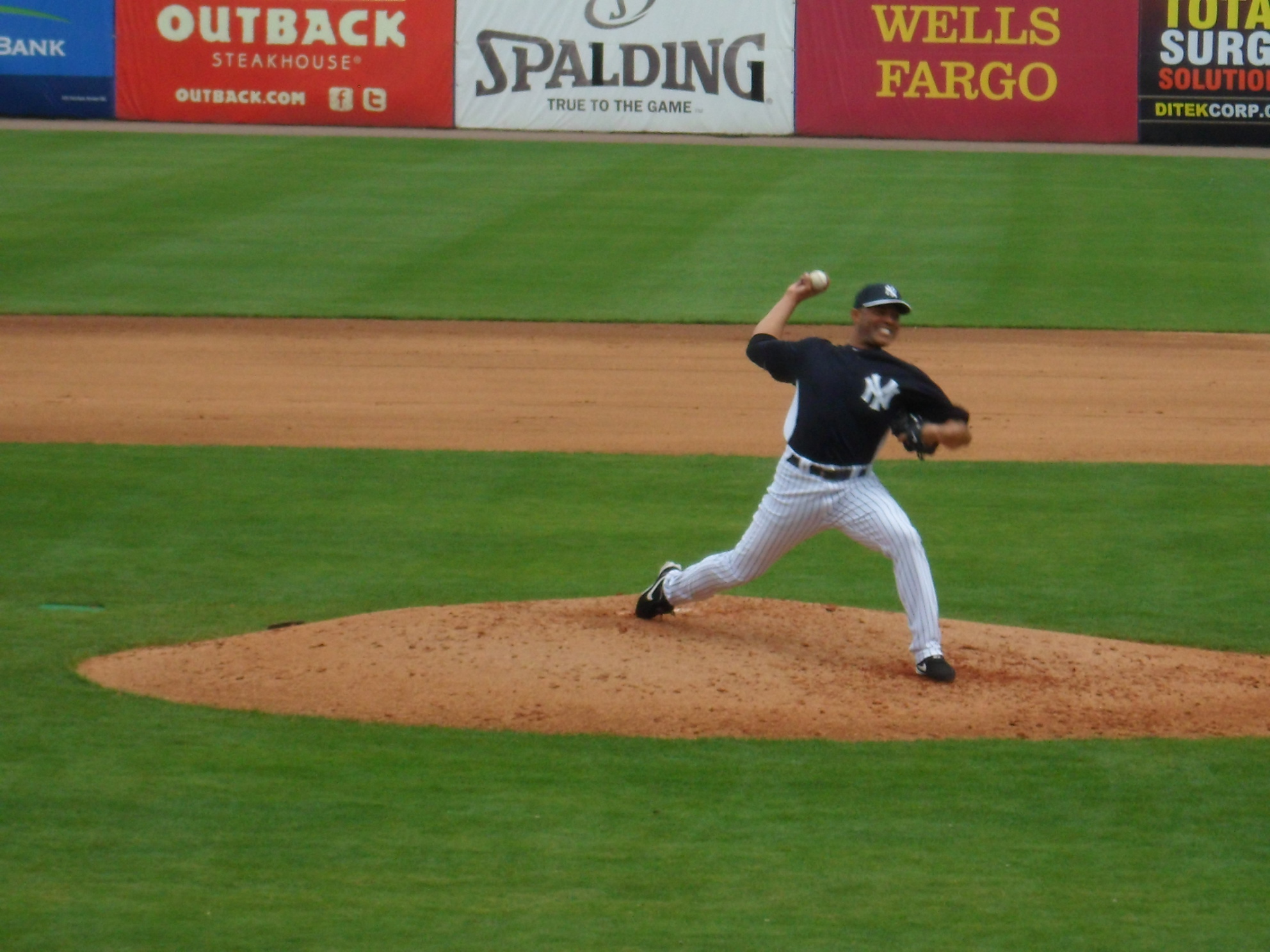
Rivera, who entered games to the tune of Metallica’s “Enter Sandman” was known for his ability to put opponents’ bats “to sleep” with his devastating cutter.  In his 19-season MLB career (1995-2013 … Yankees), the 13-time All Star and Hall of Famer amassed an MLB-record 652 saves (plus 82 wins – versus 60 losses) and a 2.21 earned run average.  He led the league in saves three times and had had 30 or more saves in 15 seasons.

Honorable Mentions: Marc “Scrabble” Rzepczynski and Al “The Mad Hungarian” Hrabosky.  Scrabble was lesser known than many on this list. He put up a 14-27, 3.89 record, with two saves, over ten MLB seasons (2009-2018 … Blue Jays, Cardinals, Indians, Padres, A’s, Nationals, Mariners), but just look at that name. This nickname makes me smile and belongs on any best baseball nickname list. The Mad Hungarian is a nod to Hrabosky’s Hungarian ancestry and his demeanor on the mound.

C – Johnny “The Little General” Bench

Catchers are supposed to take charge on the field and this nickname fits Hall of Famer Johnny Bench both behind and at the plate. Bench was a leader for the Reds for 17 seasons (1967-83). He was a 14-time All Star, ten-time Gold Glover, two-time league HR leader, two-time league MVP, 1968 Rookie of the Year and 1976 World Series MVP.  When Bench was on the field, he was in charge.

Honorable Mention: Cal “The Big Dumper” Raleigh.  Now, here’s a nickname that could have been headed for the “worst” list, but Raleigh turned it into one of the best MLB nicknames. The nickname was coined by a teammate – a reference to the Seattle backstop’s ample backside. Reportedly, Raleigh was not initially pleased with the moniker, but as he began dumping home runs over outfield walls, the nickname took on a very positive life of its own.  In 2025, when Raleigh won the All Star Game Home Run Derby and turned in a 60-homer campaign, the deal was sealed.  The Big Dumper joined MLB’s beat nicknames.  Side note:  Raleigh has not only hit 124 home runs over the past three seasons, he won a Gold Glove in 2024 – and Big Dumper merchandise has been a home run with the fans.

1B – Tie Lou “The Iron Man” Gehrig and Stan “The Man” Musial
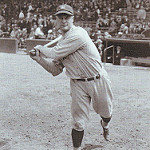
Photo by rchdj10

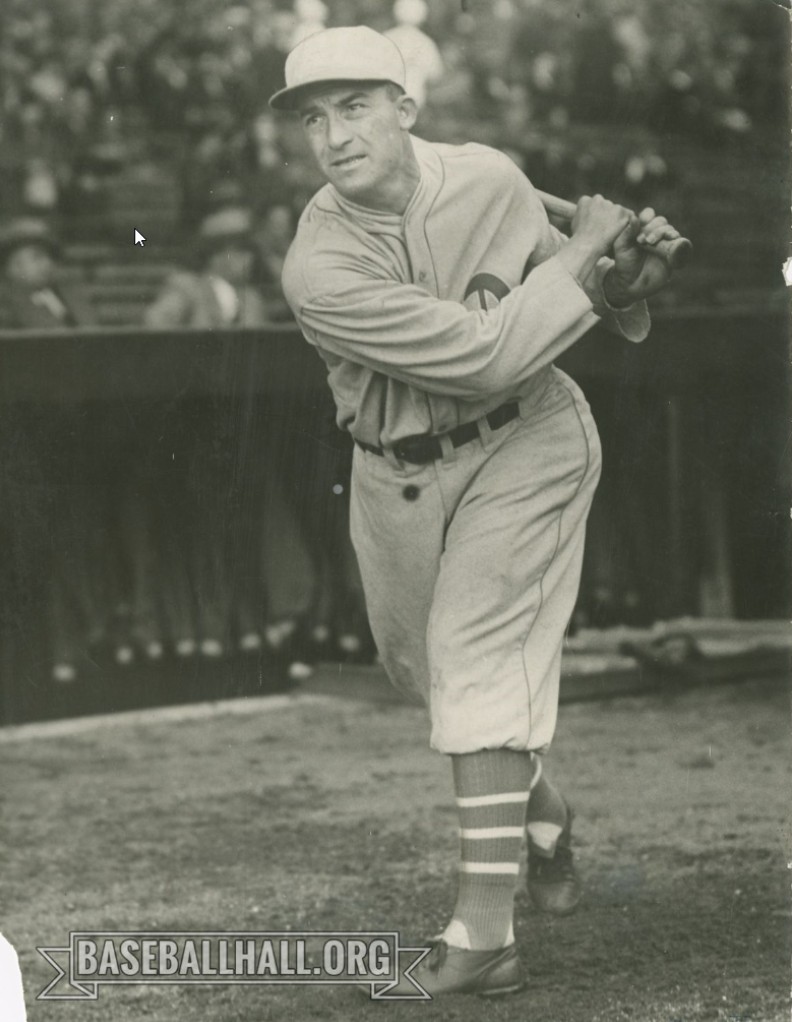
Lou “The Iron Man” Gehrig earned his nickname and spot in the Baseball Hall of Fame for with combination of power and durability (until it was broken by Cal Ripken, Jr. in 1995, Gehrig held the record for consecutive games played at 2,130). Gehrig played 17 seasons with the Yankees (1923-39), producing a .340 career average, with 493 home runs, 1,995 RBI and 1,888 runs scored. He was a seven-time All Star, two-time AL MVP, won one batting, title, led the AL in home runs three times, RBI five times, runs scored four times, doubles three times and triples once.
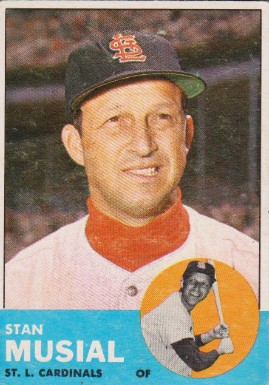
Hall of Famer Stan “The Man” Musial goes head-to head with Gehrig at first base (despite playing more than half his career games in the outfield, I had to put Musial here because he played more games at 1B than any other position).  What could be more of an honor than being simply known as “The Man.”   Musial was indeed The Man – and not just in Saint Louis (where he played from 1941-63).  He was respected for his bat and his attitude around baseball.  Musial was a seven-time batting champ and three-time MVP, who also led the NL in hits six times, runs scored five-times, doubles eight times, triples five times and RBI twice. He retired with a .331 average, 3,630 hits 1,946 runs scored and 1,951 RBI.

Honorable Mentions: Frank “The Big Hurt” Thomas; Jimmy “The Beast” Foxx; Don “Donnie Baseball” Mattingly.  The Big Hurt (at 6’5”/240 lbs.) put the hurt on baseballs and opposing pitchers to the tune of a .301-521-1,704 stat line (and a spot in the Hall of Fame); The Beast, another Hall of Famer, put fear into the hearts of moundsmen with  a .325-534-1,922 stat line; Donnie Baseball was known for his hardworking professionalism and consistent performance at the plate an in the field. (He was the 1985 AL MVP, a six-time All Star, nine-time Gold Glove winner and put up a.307-222-1,099 career stat line.)

2B – Felix “The Cat” Millan

Felix Millan earned his nickname with his catlike reflexes and slick fielding around the keystone sack.  In 12 MLB seasons (1966-77, with the Braves and Mets), Millan was a three-time All Star and two-time Gold Glover. He put up respectable offensive numbers with a career line of .279-22-403, with 699 runs scored.  The tie-in with the popular Felix the Cat cartoon character (and the public acceptance of the nickname) give this moniker a slight edge over the honorable mention.

Honorable Mention: Charlie “The Mechanical Man” Gehringer – noted for flawless, but not flashy All Star level play, Gehringer was given this nickname by Hall of Fame pitcher Lefty Gomez. The 1937 AL MVP, Gehringer finished in the top four in MVP voting five times.  He stat line of .320-184-1,427 outpaced Millan, but this lineup is about nicknames not stats.

Third Base: Brooks “Hoover” Robinson

Brooks Robinson, a Hall of Famer with 16 Gold Gloves and 18 All Star selections, was known as both “Hoover” and “The Human Vacuum Cleaner.” He really did scoop everything up over at the hot corner. He played 23 seasons (1955-77 … all for the Orioles). At the plate, he went .267-268-1,357. He holds the MLB record among third baseman for defensive games played, put outs, assists and double plays.

SS – Ozzie “The Wizard of Oz” Smith

In Ozzie Smith’s 19 MLB seasons (1978-96, with the Padres and Cardinals), the Hall of Famer’s defensive wizardry earned him 13 Gold Gloves. He was truly a Wizard in the center of the diamond. The 15-time All Star had a career average of .262, with 28 home runs, 793 RBI, and 1,257 runs scored.

Honorable Mention:  Ernie “Mr. Cub” Banks. Let’s face it, for close to two decades, Hall of Famer Banks was the face of the Cubbies.

LF – Ted “The Splendid Splinter” Williams
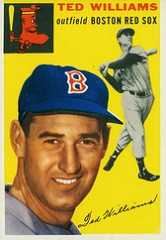
Photo by Wicker Paradise

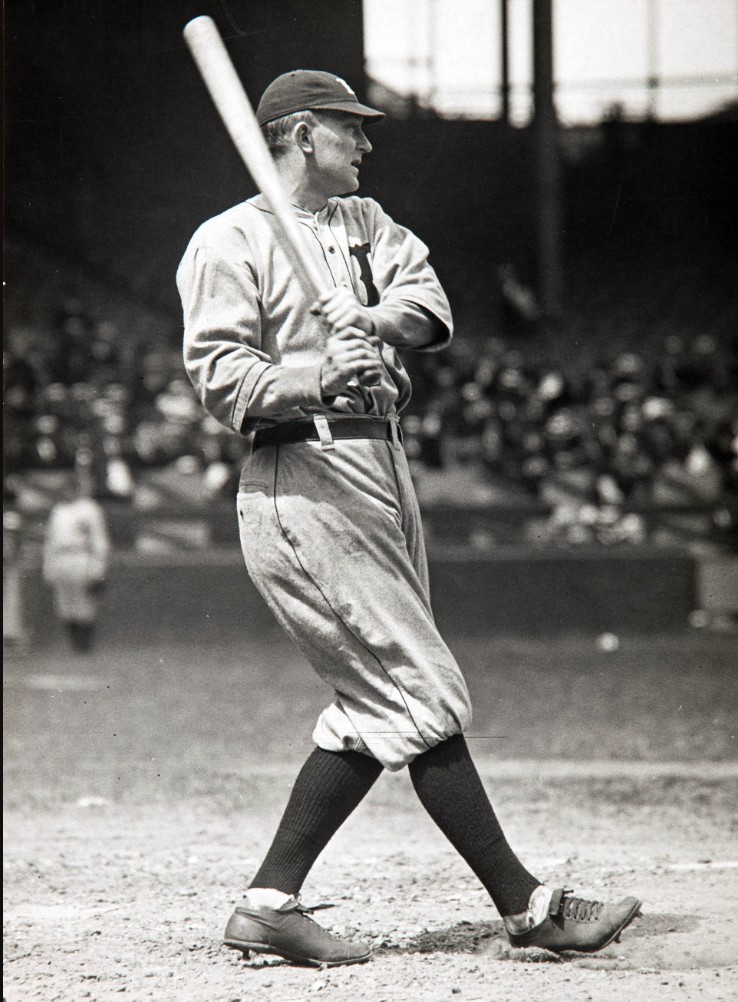
Ted Williams’ nickname – the Splendid Splinter – reflects his lanky, splinter-like build and his splendid skills.  Notably, Williams’ play earned him a team’s worth of nicknames – The Kid, Teddy Ballgame and The Thumper also among them.  Williams’ career on-base percentage of .482 is the best in baseball history.  Think about it – reaching base, basically, one of every two trips to the plate. Williams was a 19-time All Star, two-time MVP and two-time Triple Crown winner.  In 19 seasons with the Red Sox (1939-60, time lost for service in WWII and the Korean Conflict), Williams won six batting titles, and lead the AL in runs six times, RBI four times, home runs four times, doubles twice, walks eight times and total bases six times. He retired with a .344-521-1,839 stat line – and is the last MLBer to hit .400 for a season (.406 in 1941).

CF – Tie – Joe “The Yankee Clipper” DiMaggio and Jimmy “The Toy Cannon” Wynn

I really wanted this to be far-ranging outfielder Franklin “Death to Flying Things” Gutierrez, but his case was hurt by a lack of common knowledge of the nickname and the fact two other players from the 1800s – Jack Chapman and Bob Ferguson – were honored with the nickname before Gutierrez, who played 12 seasons (2005-13, 2015-17 … Indians, Mariners Dodgers).

Joe “The Yankee Clipper” DiMaggio. Pretty much every baseball fan knows this classic nickname for a “class” ballplayer. The Hall of Famer played in 13 seasons for the Yankees (1936-42, 1943-52), losing three seasons to military service. A three-time AL MVP, DiMaggio was thought to be near flawless at the plate, on the field and in the clubhouse. His final stat line was .325-361-1,537. He was an All Star in every one of his 13 seasons. The imagery of this one got my attention.

Jimmy “The Toy Cannon” Wynn’s nickname stems from the cannon-like power he delivered from his small frame (5’20”/160 pounds). He played in 15 MLB seasons (1963-77 … Astros, Dodgers, Braves, Yankees, Brewers), going .250-291-964.

Honorable Mentions:  Willie “The Say Hey Kid” Mays and James “Cool Papa” Bell. The Say Hey Kid emerged in response to a young Willie Mays’ youthful energy, and penchant for greeting everyone with some version of a high-pitched “Say Hey.” Cool Papa was known for his class, composure and “cool” on and off the field – not to mention his Hall of Fame skills and performance.

RF – Henry “Hammerin’ Hank” Aaron

Let’s face, Henry Aaron – who I knew as a kid by the nickname “Bad Henry” and who also was sometime referred to simply as “The Hammer,” did bad things to baseballs (at least from the opposition’s point of view.   Over his 23 seasons MLB career (1954-76 … Braves, Brewers), he hammered 755 (regular seasons) horsehides over the fence, to go along with a .305 average and an MLB-record 2,297 career RBI (also 3,771 base hits). The nickname says it all, and Aaron lived up to its implications on the field.

Honorable Mentions:  Jose “Joey Bats” Bautista.  How can you not like a nickname with “Bats” right there in it? I might have put Joey Bats ahead of Hammerin’ Hank, except I had to consider that Bats had the advantage of social media to promote the nickname, Still, it deserves mention, as does Bautista’s 15-season MLB career (2004-18 … Orioles, Devil Rays, Royals, Pirates, Blue Jays, Braves, Mets, Phillies). He did most of his bat-driven damage while with the Blue Jays, made six All Star teams and put up a career stat line of .247-344-975. Harry “Suitcase” Simpson’s nickname takes us back to a time when playing for six teams, in three leagues, in 11 MLB seasons could earn you the nickname “Suitcase.” (Movement from team to team is not so unusual anymore.)  Simpson played for the Negro National League II Philadelphia Stars (1946-48); the American League Indians (1951-53, 1955); AL Athletics (1955-59); AL Yankees (1957-58); AL White Sox (1959); National League Pirates (1959). He played for two MLB teams in three seasons and three MLB teams in another. His final state line was .269-76-434 (1,012 games)

Utility – Pete “Charlie Hustle” Rose
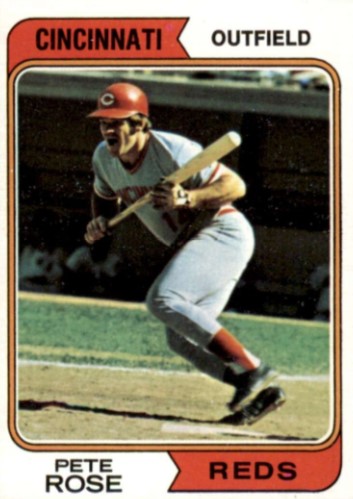
Pete “Charlie Hustle” Rose, MLB’s all-time hits leader (4,256) hustled all over the diamond, playing more than 500 games each at 1B, 2B, 3B, LF and RF. I had to make a place for a player whose nickname so accurately reflected his aggressive style of play. Rose played 24 seasons in the majors (1963-86) – with the Reds (19), Phillies and Expos. Rose was a 17-time All Star, three-time batting champion and two-time Gold Glover, as well as the 1963 NL Rookie of the Year and 1973 NL MVP. He led the NL in games played five times, hits seven times, double five times and runs scored four times.

DH: David “Big Papi” Ortiz

Hall of Famer David “Big Papi” Ortiz earned the nickname and the affection of Boston Fans as one of the best clutch hitters and largest personalities in the history of the game. He played 29 MLB seasons (1997-2016 … Twins, Red Sox), made 10 All Star squads and put up a .286-541-1,768 stat line. And, Big Papi  got big hits, in big spots in big games.,


—BASEBALL’S WORST NICKNAMES LINEUP—


P – Hugh “Losing Pitcher” Mulcahy

Ouch! Hugh Mulcahy “enjoyed” a nine-season major league career (1935-47, minus five WWII years), during which he earned his nickname. He ran up a career record of 45-89, with a 4.49 ERA (all with the Phillies), leading the NL in losses twice, hits allowed once, earned runs allowed twice, walks allowed once, hit batsmen twice and wild pitches once. Notably, he made one MLB All Star squad; in 1944, when he led the NL with 22 losses (versus 13 wins), despite a respectable 3.60 ERA.

C – Gabby “Old Tomato Face” Hartnett

Hall of Fame catcher Gabby Hartnett reportedly picked up his nickname as he gained weight and developed a ruddy complexion. Notably, even “Gabby” was a nickname (real name Charles Leo Hartnett) – reflecting Hartnett’s career-long shyness and reluctance to speak to anyone, particularly reporters. Harnett played 20 MLB seasons (1922-41, all but the last season with the Cubs), hitting .297, with 236 home runs and 1,179 RBI. He was a six-time All Star and the 1935 NL MVP.

1B – Lou “Biscuit Pants” Gehrig

Lou Gehrig was a great player with multiple nicknames –ranging from Biscuit Pants on the low end to Buster in the middle to Iron Man on the high side.  Biscuit Pants – an early Gehrig nickname – acknowledged Gehrig’s baggy uniform pants, thick legs and sturdy derriere. Read about nis career in the Best Nicknames section.

2B – Charlie “Piano Legs” Hickman

At 5’9” and 215-pounds, it’s easy to imagine the source of Charlie Hickman’s nickname. Hickman played 1B, 2B and OF during his 12-year MLB career (1897-1908), delivering a .295 career average, with 50 home runs and 614 RBI. Hickman led the AL in hits and total bases in 1902, when he split time between Boston and Cleveland.

3B – Gary “The Rat” Gaetti

Despite the uncomplimentary nickname, Gary Gaetti was anything but a rat on the field. Also known as G-Man, Gaetti had a 20-season MLB career (1981-2000 with the Twins, Angels, Royals, Cardinals, Cubs and Red Sox). He was a career .255 hitter, with 360 home runs and 1,341 RBI.  Gaetti was a two-time All Star, four-time Gold Glover at third base and the 1987 American League Championship Series MVP.

SS – Bill “Wagon Tongue” Keister

Unlike Gabby Hartnett (see the catcher on this list), Bill Keister earned a reputation as a player who just wouldn’t shut up. Couple Wagon Tongue withKiester and you’ve got quite a baseball name.  In a seven-season MLB career (1896-1903), Keister played for Brooklyn, Boston, Saint Louis and Philadelphia in the NL and Baltimore and Washington in the AL.  He hit .312, with 18 home runs, 400 RBI and 131 stolen bases – spending time at shortstop, third base and second base.

LF – Johnny “Ugly” Dickshot

Not the best looking of men, it’s reported that Johnny Dickshot granted himself the title of the ugliest man in baseball.  Clearly, the combination of his nickname and actual name earns Dickshot a spot on this list of worst baseball nicknames.  In six major-league seasons (spread over 1936-45), he played in 322 games (Pirates, Giants, White Sox), hitting .276, with seven home runs and 116 RBI. More than half his career offensive production came in his final season (1945, White Sox), when he hit .302, with seven home runs and 58 RBI.

CF – Hunter “Captain Underpants” Pence

The story has it that, during a minor-league game, an aggressive heckler thought that (on the minor-league PA system) “Hunter Pence” sounded a lot like “Underpants” and proceeded to taunt him with the Underpants chant, which apparently had more staying power when teammates promoted Mr. Underpants to “Captain.”  Pence played 14 MLB seasons (2007-20 … Astros, Phillies, Giants), going .279-244-292. He was a three-time All Star.  Remember, the “worst” label in this lineup reflects the nickname, not player performance.

RF – “Bucketfoot” Al Simmons

Hall of Famer Al Simmons’ nickname (which he disliked) was drawn from his batting stance.  The bucketfoot stance seemed to work for him. In 20 MLB seasons (1924-1944; Athletics, White Sox, Tigers, Senators, Braves, Reds, Red Sox), Simmons hit .334, with 307 home runs and 1,828 RBI. He led his league in batting average, hits and total bases twice each and RBI once.

So, there is BBRT’s worst nickname lineup. If I had a bench, it would be manned by such notables as: Fred “Bootnose” Hoffman; Walt “No Neck” Williams; Jeff “Penitentiary Face” Leonard; Ernie “Schnozz” Lombardi; Harry “Stinky” Davis; Dick “Dr. Strangeglove” Stuart; and Bris “The Human Eyeball” Lord.

Primary Resources: Baseball-Reference.com; Having Fun with Baseball Nicknames, by Phil Blazovich, MLC Publications 1996.

Baseball Roundtable – Blogging Baseball Since 2012.

Baseball Roundtable is on the Feedspot list of the Top 100 Baseball Blogs. For the full list click here

I tweet (on X) baseball @DavidBaseballRT. Follow me there for post notifications and links.

Follow Baseball Roundtable’s Facebook Page here.  

Member: Society for American Baseball Research (SABR); Negro Leagues Baseball Museum; The Baseball Reliquary.

P 1149
Baseball Roundtable Trivia(l) Tidbit Tuesday … The Circuit Breakers

It’s time again for Baseball Roundtable’s Trivia(l) Tidbit Tuesday. I hope you are enjoying this weekly presentation of baseball occurrences that for some reason caught The Roundtable’s eye.  (I’m particularly fond of unexpected performances and statistical coincidences.) These won’t necessarily be momentous occurrences, just events, statistics or coincidences that grabbed my attention. I’m also drawn to baseball “unicorns,” one-of-a-kind MLB accomplishments or statistics. (Keep in mind the usual disclaimer that Negro League game-by-game records from 1920-48 are not fully incorporated into MLB records.)

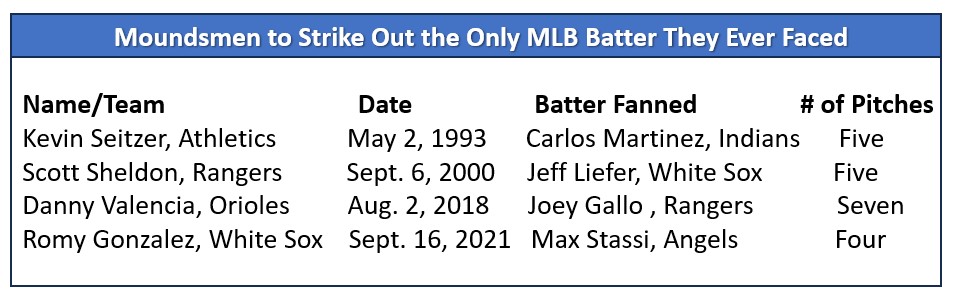
Now, in the spirit of the Baseball Roundtable mantra of “one thing always seems to lead to another,” this post started out to be a look at moundsmen who faced only one batter in their MLB career and struck that batter out.   (Kind of in line with the recent Tidbit on batters who had just one plate appearance and were hit by a pitch.) Turns out only four moundsmen can look back on an MLB career with one batter faced and one strikeout – and they were all position players called on to take to the hill (Kevin Seitzer, 1993 Athletics; Scott Sheldon, 2000 Rangers; Danny Valencia, 2018 Orioles; Romy Gonzalez, 2021 White Sox).

What caught my interest about this group is that Sheldon’s lone strikeout came in a game in which he played all nine defensive positions – a feat which has been documented just five times in MLB history. Of further interest was the fact that Sheldon is the only player to achieve the nine-position feat in a game he did not start.  In fact, he didn’t come into the game until the fourth inning. And that’s how I was sent off on another statistical (for me) adventure. Here’s a bit of what I found.

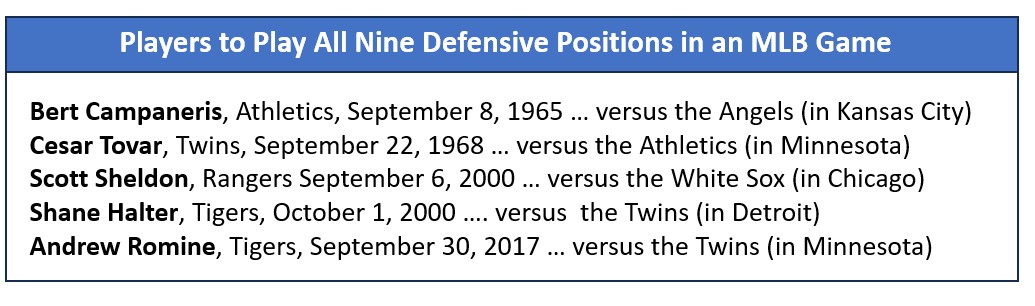
There have only been two “pure” (in my opinion) nine-position games, which I define as a game in which the player makes the circuit of nine defensive positions while playing at least one full inning at each defensive spot. Those belong to the Athletics’ Bert Campaneris (1965) and the Twins’ Cesar Tovar (1968). A full inning on the mound seems the biggest obstacle, as in the other three nine-position games the “traveling” player has faced just one batter from the bump.

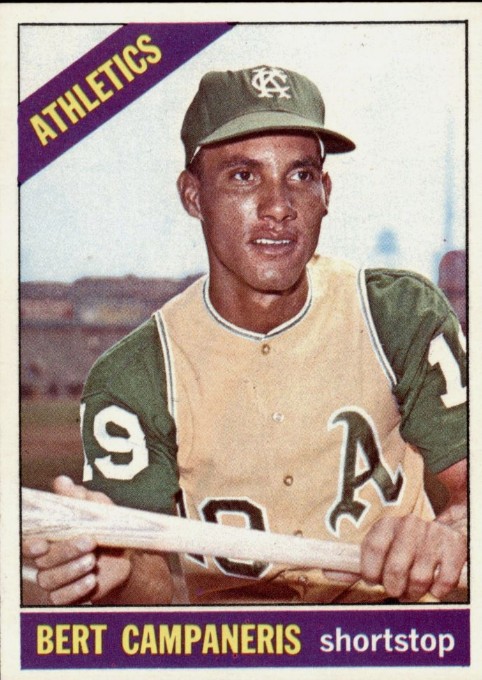
Campaneris – the first player to play all nine defensive positions in a game – is the only one of the five qualifiers who would not be described as a “utility player.”   He appeared at SS in 2,097 of his 2,328 games and no more than 77 (3B) at any other position. His nine-position game marked his only career appearance at P, C 1B or RF.  In 13 of his 19 MLB seasons, the only defensive position he played was SS.

More Campy Tidbits

While Campaneris’ Athletics lost his nine-position game 5-3 to the Angels in 13 innings, Campaneris was not around to see the finish. He moved to catcher (from pitcher) to open the top of the ninth (with the Angels leading his Athletics 3-1).  The catcher position completed his circuit of all nine fielding spots. On the final play of the inning, Campaneris was injured (knocked from the game) in a collision at the plate.  The Athletics tied it up in the bottom of the inning, before losing in the thirteenth.

A few other tidbits:

  • The team with the nine-position player has won three of the five games;
  • The nine-position player has played for the home team in three of the five games;
  • All the nine-position games have been low-impact games played late in the season – all of the teams that have seen a player take all nine positions in a game had losing records and three of the five were in last place;
  • The most players used in a nine-position game are 24 (1965 Athletics), but that game did go 13 innings. In that game the A’s had the fewest players (five) play multiple defensive positions in a nine-position game;
  • The fewest players used in a nine-position game are 13 (1968 Twins) and, as you might expect, the Twins also had the most players to assume multiple defensive positions in nine-position game (seven);
  • In his nine-position game, Scott Sheldon played left field, pitcher and third base in the eighth inning (his Rangers’ final inning in the field);
  • The last two nine-position games have been delivered by Tigers’ players, both times against the Twins;
  • The Twins have been involved in the most nine-position games (three – two against them, one by them).

Side Note: I know these Tidbits may be getting a little deep into the statistical woods, but after more than 1,100 posts, you need to look a little deeper to avoid repetitiveness. 

So, let’s get a little deeper into the details.  Here’s more about those five nine-position games.

Bert Campaneris, Athletics, September 8, 1965 … versus the Angels (in Kansas City)

Bert Campaneris was the first MLB player to field his way through all nine positions in a single game – and he did it in his first full MLB season. (He did play 67 games in 1964 after a late July call up to the Athletics.)

Campaneris started the game at SS, which was his primary position during his 19-season MLB career (1964-81, 1983 … Athletics, Rangers, Angels, Yankees).

In his tour around the field, Campaneris played the first inning at SS; the second at 2B; the third at 3B; the fourth in LF; the fifth in CF; The sixth in RF; the seventh at 1B; the eighth on the mound; and the ninth at C.   To facilitate Campaneris’ feat, four additional Athletics players played more than one position during the game, including Jim Landis and Jose Tartabull, who each played all three outfield positions.  The Athletics used a total of 24 players in the game (eight pitchers, including Campaneris).

There was a certain symmetry to Campaneris’ nine-position game.  He played one full inning at each position (no mid-inning switches).

For the game, Campaneris, batting leadoff, went zero-for-three (with one walk, one stolen base and one run scored) in four plate appearances. In his one inning of mound work, he gave up one run on two hits and a walk and fanned one batter.  In the field, he recorded one putout and four assists with one error (made in RF).

Campaneris was a six-time All Star and put up a .259-79-646 line, with 1,181 runs scored and 649 steals (14th all time). He led the league in steals six times and in hits and triples once each. He also led the league in sacrifice bunts three times (a career-high of 40 in 1977.)  Side note: We’re not likely to see 40 SH in a season again. The last time we saw at least 20 was 2007  and the last time we saw at least 40 – other than Campaneris in 1977 – was 1929.  For those who like to know such things, the single-season record is 67, by Ray Chapman in 1917.

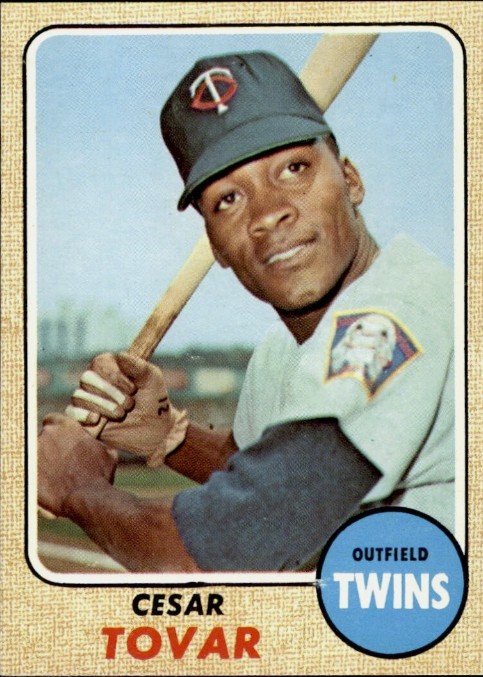
Cesar Tovar, Twins, September 22, 1968 … versus the Athletics (in Minnesota)

The first player to record a nine-position game (Bert Campaneris, above) was on the field when MLB’s second nine-position game went into the books. The Twins’ Cesar Tovar played all nine defensive positions, as the Twins edged Campaneris and the Athletics 2-1 in Minnesota. Unlike Campaneris (primarily a shortstop), Tovar was a true utility man. During his career he appeared in more than 200 games at five different positions (2B, 3B, LF, CF, RF). Over his 12-season MLB career, he had only one season in which he played just one defensive position (1976, his final season, when he played 13 games for the Yankees three at 2B and ten at PH/DH).  Distracting coincidence: Campaneris and Tovar both played their final MLB game in a Yankee uniform, despite each playing just one season with the Bronx Bombers.

In his nine-position game, Tovar started on the mound and pitched a scoreless top of the first inning (a walk and a balk, two foul pop outs and one strikeout).  The strikeout victim was RF Reggie Jackson. Tovar then played the second inning at C; the third at 1B; the fourth at 2B; the fifth at SS; the sixth at 3B; the seventh in LF; the eighth in CF; and the ninth in RF. (No mid-inning switches.) I kind of wish Tovar had gone to 3B the inning before shortstop. Then he would have completed his circuit in scorekeeper’s numerical order.

In the field, he recorded five putouts and one assist, with no errors. At the plate, he went one-for-three, with a walk, a stolen base and a run scored. The Twins used just 13 players (three pitchers, including Tovar) in Tovar’s nine-position game. Seven players, including Tovar, played multiple positions.

In his 12 MLB seasons (1965-76 … Twins, Rangers, Athletics, Phillies, Yankees), Tovar went .278-46-435, with 834 runs scored and 226 steals. He led the AL in hits with 204 in 1971; in 1970 topped the AL in doubles (36) and triples (13); and, in 1972, led the league in HBP (14). Tovar’s nine-position game was the only time he ever appeared at 1B, C or P.

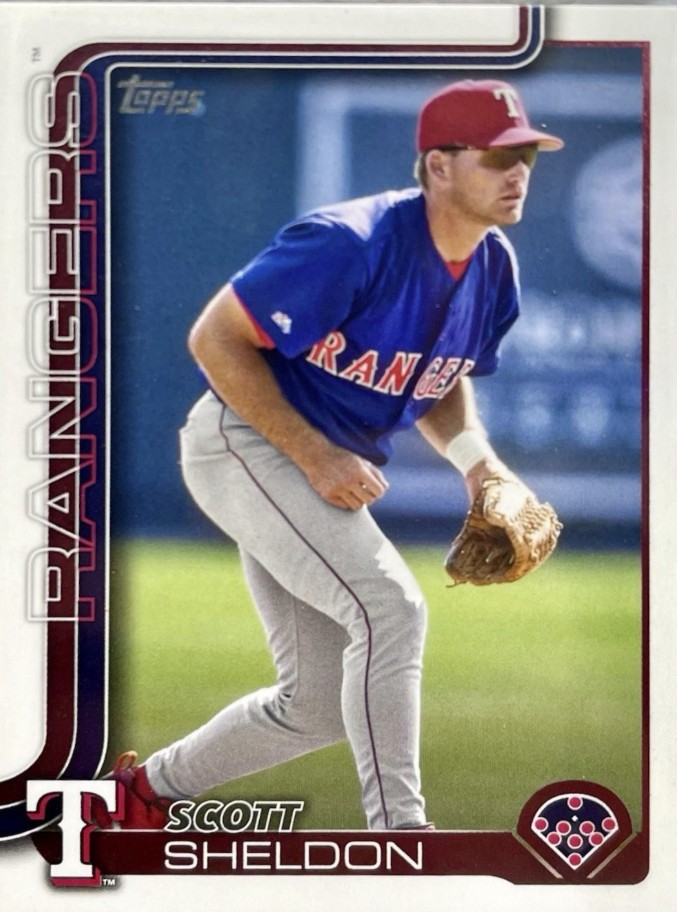
Scott Sheldon, Rangers September 6, 2000 … versus the White Sox (in Chicago)

Okay, now we get to the player whose nine-position game spurred this post. (We’ll go into a little more detail here.)  Scott Sheldon was in the fourth of his five MLB seasons (1997-2001 … Athletics, Rangers) when he became the third player to notch a nine-position game –– and the utility infielder wasn’t even in the starting lineup. In fact, he didn’t enter the game until the bottom of the fourth inning, when he replaced Bill Hasselman behind the plate.  The position-by-position merry-go-round was conjured up by Sheldon and manager Johnny Oates after the White Sox fell behind 7-0 in the first inning and were down 10-1 in the fourth frame of a less than critical game (the Rangers were out of the race and in last place with a 62-76 record at the time).  The Rangers eventually lost 13-1.

Sheldon’s Rangers used 18 players (five pitchers, including Sheldon) in the contest and six players, including Sheldon, played multiple positions.  Sheldon’s game was less “pure” than the previous two nine-position games in that Sheldon did not play a full inning at each position.  He played two positions each in the sixth and seventh innings and three positions in the eighth.

Sheldon’s day went like this:

Bottom of the Fourth: Sheldon replaces Bill Hasselman behind the plate to open the inning and plays the entire frame at backstop.

Bottom of the Fifth:  Sheldon plays the inning at 1B, as B.J. Waszgis comes in at C and 1B Rafael Palmeiro leaves the game.

Bottom of the Sixth:  Sheldon (who had been at 1B) changes positions with 2B Frank Catalanotto.

One out in the Sixth: Sheldon (then at 2B) changes positions with shortstop Kelly Dransfeldt.

Bottom of the Seventh: A true Merry-Go-Round, as the inning opens, Sheldon moves from SS to RF – a move made possible as LF Chad Curtis leaves the game, Ricky Ledee moves from RF to LF, Dransfeldt moves from 2B to SS; Catalanotto moves from 1B to 2B; Waszgis moves from C to 1B; Randy Knorr comes in to C; and Matt Perisho replaces Darwin Cubillan on the mound.

One out in the Seventh: Sheldon (then in RF) changes positions with CF Gabe Kapler.

Bottom of the Eighth: Sheldon (then in CF) changes positions with LF Ricky Ledee.

One out in the Eighth: Sheldon moves from LF to pitcher, Perisho leaves the game. Sheldon faces just one batter – Jeff Liefer – and strikes him out on five pitches.

Two out in the eighth: Sheldon moves from pitcher to 3B, Francisco Cordero replaces Sheldon on the mound and 3B Mike Lamb leaves the game.

Sheldon went one-for-two at the plate in the game and had just one chance in the field (not exactly in the field, he recorded a putout as P Brian Sikorski fanned White Sox’ RF Magglio Ordonez. The game marked the only time Sheldon appeared in an MLB game at pitcher or CF.

Sheldon played five MLB seasons (1997-2001 … Athletics, Rangers).  He hit .235-8-33, with 34 runs scored and one steal in 141 total games. He made the bulk of his appearances at 3B (59) and SS (52), appearing in no more than 13 games at any other position.  His nine posistino game was his only MLB contest at P or CF.

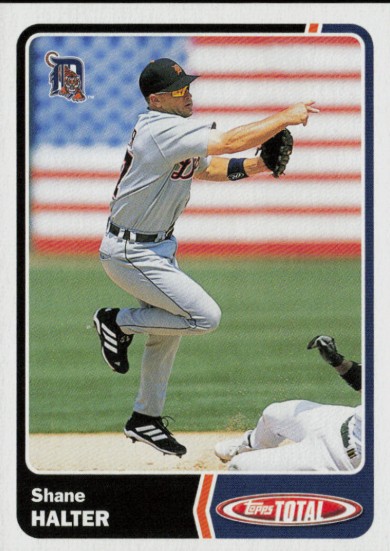
Shane Halter, Tigers, October 1, 2000 …. versus the Twins (in Detroit)

Shane Halter started the his nine-position game at 1B, batting eighth, in a contest that saw his Tigers top the Twins 12-11 in Detroit.  He was at 3B in the second inning; RF in the third; CF in the fourth; LF in the fifth; SS in the sixth; and C in the seventh.

The eighth inning was a little more complicated. Halter (who had ended the seventh at C) moved to the mound replacing Nelson Cruz; Javier Cardona came in to play C; 2B Damion Easley left the game; Brad Ausmus moved from 3B to 2B; Dusty Allen moved from LF to 3B; and Buddy Higginson moved from DH to LF.  Halter pitched to just one batter (Twins’ C Matt LeCroy) and walked him. Then Matt Anderson came in to pitch (1B Robert Fick left the game); Ausmus moved from 2B to 1B; and Halter moved from P to 2B).

The only change in the ninth as saw Todd Jones relieve Anderson with two out and a runner on second.

The Tigers used 23 players in the slugfest (eight pitchers including Halter) and six players (including Halter) played multiple defensive positions.

Shane Halter had the best game of the plate of any player in a nine-position game.  He went four-for-five, with two runs scored and three RBI.  In the field, he recorded one putout and four assists, with no errors.

Halter played in eight MLB seasons (1987-2004 … Royals, Mets, Tigers, Angels), going .246-45-197, with 201 runs scored in 690 games. He played primarily at 3B and SS, but played at least two games at each of the nine positions. (He appeared in 262 games each at 3B and SS, 68 at 2B, 55 at 1B, 61 in the various OF spots, and two each at C and P.) His best season was 2001, when he went .284-12-65 in 136 games for the Tigers.

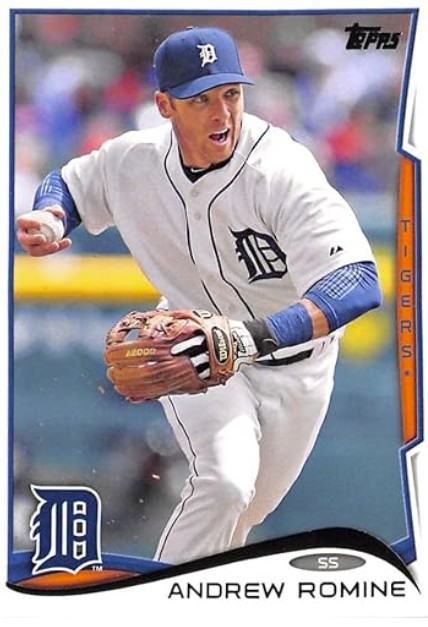
Andrew Romine, Tigers, September 30, 2017 … versus the Twins (in Minnesota)

Andrew Romine was in his eighth of 11 MLB seasons (2010-2018, 2020-21 … Angels, Tigers, Mariners, Rangers, Cubs) when he had his nine-position game – part of a 3-2 win over the Twins in Minnesota.

Romine started the game in LF, batting seventh. He moved to CF for the second inning; to RF for the third (getting the last of the OF spots off his dance card). He was at 3B for the fourth frame; SS for the fifth; and 2B for the sixth.

The seventh and eighth were a bit more complicated.

To open the bottom of seventh, Romine previously at 2B, traded positions with C Bryan Holaday and Blaine Hardy replaced Chad Bell on the mound.  Then, with one out and one run in and two on base, Romine moved back to 2B, Holaday left the game, James McCann moved from DH to C (with the Tigers losing the DH) and Hardy was placed in the sixth spot (Holaday’s) in the batting order.  Note: Romine’s move from 2B to C and then from C back to 2B is the only instance in the five games when the nine-position player returned to a position he had previously played and vacated. Might be a good, but tough, trivia question.

To open the bottom of the eighth, Romine moved from 2B to P (replacing Hardy) and Ian Kinsler took over at 2B. After Romine pitched to one batter (Miguel Sano) and retired him on a groundout, Romine moved to 1B, Daniel Stumpf came in to pitch and starting 1B Efren Navarro left the game.

In the ninth, Shane Greene replaced Stumpf on the mound, but everyone else stayed put.

The Tigers used 16 players in the game (six pitchers including Romine) and six players (including Romine) played multiple positions.

Romine went one-for-three, with a walk in the game and recorded six putouts and one assist. His only miscure was a passed ball.

In his 11 MLB seasons, Romine hit .233-11-86, with 157 runs scored and 40 steals (609 games). His nine-position game marked his only  appearance at C (he actually pitched in eight games). In his MLB career, he played in 75 or more games at 1B (75), 2B (89), 3B (160); and SS (205).  He appeared in a total of 83 games in the OF, more than half of those in CF (48).

Primary Resources: Baseball-Reference.com; Baseball-Almanac.com; September 8, 1965: Bert Campaneris plays all Nine Positions for the Athletics, by Mike Huber, Society for American Baseball Research

Baseball Roundtable – Blogging Baseball Since 2012.

Baseball Roundtable is on the Feedspot list of the Top 100 Baseball Blogs. For the full list click here

I tweet (on X) baseball @DavidBaseballRT. Follow me there for post notifications and links.

Follow Baseball Roundtable’s Facebook Page here.  

Member: Society for American Baseball Research (SABR); Negro Leagues Baseball Museum; The Baseball Reliquary.

P 1148

Baseball Roundtable Trivia(l) Tidbit Tuesday … One Plate Appearance – One Hit By Pitch – A Whole MLB Career

It’s time again for Baseball Roundtable’s Trivia(l) Tidbit Tuesday. I hope you are enjoying this weekly presentation of baseball occurrences that for some reason caught The Roundtable’s eye.  (I’m particularly fond of unexpected performances and statistical coincidences.) These won’t necessarily be momentous occurrences, just events, statistics or coincidences that grabbed my attention. I’m also drawn to baseball “unicorns,” one-of-a-kind MLB accomplishments or statistics.

Special thanks to reader Dean Mauro for asking a question in response to last week’s Tidbit on players who had the longest careers without ever getting hit by a pitch (Mark Lemke – 1,069 games) and sending me on another statistical adventure.  Dean asked “Has there ever been player who was hit by a pitch in his only major league plate appearance?”   Just the kind of question the RoundTable loves to explore.  (Dang, I wish I’d have thought of it myself.)  It sent me off on a journey that took me to players like Charles Victor (Victory) Faust, who made his mark as an eccentric/erratic good luck charm and has a unique tie to Rube Marquard; Cy Malis, who appeared in movies with the likes of Gregory Peck, Lucille Ball, John Wayne and Cary Grant; and Fred Van Dusen, who jumped to the major leagues at age 18.

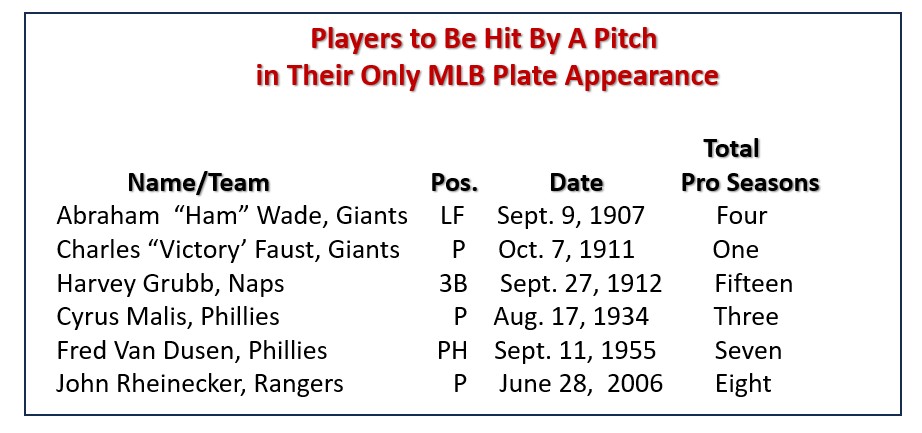
Now, at first I thought I might have a unicorn here, but it turns out a half dozen players (from 1911 to 2006) have been plunked in their one and only MLB plate appearance.

Here’s the obligatory chart, followed a bit about each of the qualifiers – with quite a bit on the unusual life and times of Charlie Faust.

Abraham Lincoln “Ham” Wade – Giants, September 9, 1907

Ham Wade, an outfielder, played in just one MLB game. (He hit .239 in 357 minor-league contests in four minor-league seasons, during which he pitched and played outfield.)  In his lone MLB game, Wade came in as a late-inning replacement for Giants’ starting LF Spike Shannon in a 10-0 loss to the Boston Doves.  A noted, he got just one plate appearance, got plunked (by Doves’ righty Vive Lindaman) and never came to the plate in an MLB game again. Wade also recorded two putouts as an outfielder in his one and only major-league contest. The hit by pitch was probably no surprise, as Lindaman tied for second with 15 HBPs in 1907.


Charlie “Victory” Faust — Giants, October 12, 1911

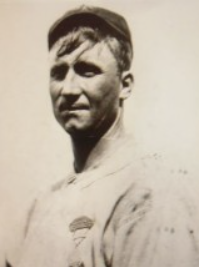
Photo: http://davyjonesbats.com/about-us/memorials, Public domain, via Wikimedia Commons

Charlie Faust is probably the most renowned player on this list – known for his status as a good luck charm, rather than his talents as a ballplayer. His story is one of legend, bordering on myth. And, while the details of its telling are sometimes slightly different, there is enough consistency to validate Faust’s place in MLB history.  My sources for the Faust story are listed under “Primary Resources” at the end of this post; but special recognition goes out to Society for American Baseball Research (SABR) members Thomas S. Busch and Gabriel Schechter, whose work supplied much of the foundation for this Faust-ian tale.   What follows are the most consistently recounted details of his career.

 In 1911, the 30-year-old Faust, who was not a ballplayer at the time, was told by a fortune teller at a country fair that he would pitch the New York Giants to a championship, meet and marry a girl named Lulu and father a future generation of baseball stars.  So, Faust traveled from Marion, Kansas to St. Louis, Missouri (where the third-place Giants were facing the Cardinals) in mid-summer, introduced himself to Giants’ manager John McGraw in a hotel lobby and told him of his predicted destiny.   Perhaps impressed by Faust’s commitment and  enthusiasm, swayed by his own superstitions or merely because McGraw had a sense of humor, the Giants’ placated Faust, inviting him to an on-field tryout before that afternoon’s (July 28) game.  The eccentric Faust showed up in a “Sunday” suit, dress shoes and derby hat. McGraw sent Faust to the mound to display his stuff (or lack thereof) and then sent him to the plate, with instructions to run out anything he hit.  Faust dribbled an easy grounder to short, but the players – essentially “playing along” with the situation, kept mishandling the ball as Faust awkwardly rounded the bases (reportedly having to slide into more than one – again, still in his Sunday suit – before reaching home plate). The crowd and players, it was reported, loved Faust’s stumbling performance.  Faust, however, was not yet established as a good luck charm.  The Giants lost 5-2.

 When the determined and enthusiastic Faust – still convinced of his foretold destiny to lead the Giants to a championship –   showed up the next day, he was outfitted with an ill-fitting uniform, seriously repeated his pregame antics (to the joy of the fans and players alike) and the Giants won the game 8-0.  The next two games, again with Faust in uniform, were won by the Giants 6-0 and 3-2.

 Then the team left for Pittsburgh – without a disappointed Faust – and fell into a slump, going 2-4 in Pittsburgh and Chicago.   (Reportedly, when Faust showed up at the train station, he was told his ticket must have been left at the hotel and, while he was dashing back to the hotel to retrieve the non-existent ticket, the team left without him.)  

Undaunted, and still convinced of his destiny (and apparently short on cash), Faust made his way from St, Louis to New York by hopping freight trains – and a disheveled Faust was waiting for McGraw and the Giants when they returned to the Polo Grounds. McGraw relented and let Faust continue his pre-game “entertainment,” as well as take a spot on the bench during games. The Giants won nine of their next eleven and the die was cast, with the team (somewhere along the way) issuing a uniform, giving Faust a spot on the bench (and even sending him to the bullpen on occasion) and taking him on the road.

Faust became sort of a mascot, pre-game entertainer and good luck charm, shagging flies in warmups, occasionally pitching batting practice and cheering on his teammates during the games. However, he still maintained that his destiny was to pitch the Giants to a championship.   Finally on October 7, with the pennant already clinched, McGraw relented and put Faust into a game. He pitched the final inning of a 5-2 loss to Boston – giving up one earned run.  Five days later, Faust made his second and final MLB appearance, pitching one scoreless inning (the ninth) in a 5-2 loss to the Dodgers. In this one, he made his only MLB plate appearance, reached base on a Hit By Pitch, stole second and third (apparently with the visiting Brooklyn squad “playing along” with the Faust experience) and scored on a sacrifice fly. 

Backtracking a bit, Faust’s reputation as either a good luck charm for the Giants or a bench-bound jinx for opponents (which grew with each New York win) got a boost, when the now very popular (almost folk hero) New York benchwarmer left the team to take on a vaudeville engagement.  The Giants lost the first three games they played during Faust’s foray into show business – and Faust quickly returned to the team (which won the first ten games after his return.).

Was the eccentric (maybe even erratic) Faust really a good luck charm? As Gabriel Schechter reported in his SABR bio of Faust “From the day he (Faust) met McGraw in St. Louis to the day the Giants clinched the pennant, the team had a record of 39-9. When he was in uniform and exerting his jinxing powers, their record as an astonishing n 36-2.” Unfortunately, Faust’s mojo did not work as well in the World Series, which the Giants lost to the Athletics Four Games to two.  When the Giants lost the World Series, his good luck charm status faded a bit and, perhaps the novelty was wearing off.

In 1912, McGraw, kept Faust on the bench, but reportedly did not allow him to don a Giants uniform and the team no longer paid his expense on road trips.  Faust, still convinced of, even obsessed with, the belief that his destiny was as a pitcher, responded by repeatedly asking the league to force McGraw to reinstate him.  The rift was widening. Still, Faust hung in there and the Giants got off to a blazing start, going 54-11 over the first 65 games (through July 3). Still, Faust’s constant, vigorous and unbending insistence that he was a pitcher who belonged on the mound pitching the Giants to a championship was apparently getting on McGraw nerves (and likely causing clubhouse tension). While considerable efforts to convince Faust to voluntarily leave the team were not successful, a bit of deception got him to depart (he thought temporarily) in early July. The players convinced Faust he should go back to Kansas and, when his absence made it clear to McGraw how important he was, a victorious recall would be in the offing. The recall never came. Note: I wasn’t able to pinpoint the date Faust left the team, but after going 54-11, with a 16 ½ game lead over the second-place Cubs through July 3, the club went 49-37 (with the lead dwindling to 10 games) over the remained of the season. Going back to Schechter’s article, he tells us Giants’ pitcher Rube “Marquard won his first 19 decisions in 1912; in the week after Faust’s departure, he lost three times, and he was a sub-.500 pitcher the rest of the season.”   For the sake of timing Faust’s departure, Marquard was 19-0 on July 3 and lost three games between July 7 and 14.

In the end, Giants won the pennant, but lost the World Series to the Red Sox in seven games.

While Faust was out of baseball in 1913, he continued to pursue reinstatement to the Giants and fulfillment of his destiny (some reports indicate he also wanted back pay for his contributions to the Giants’ two pennants.)  By 1914, he had been diagnosed with dementia, spent time institutionalized and he died in June 1915 (tuberculosis) at Western State Hospital (near Tacoma).

 But no matter the final outcome, you can – as they say – look it up, Charlie Faust was a major leaguer.  You’ll also find his name – along with such luminaries as Bob Feller, Catfish Hunter, Al Kaline, Harmons Killebrew and Dave Winfield – among those who bypassed the minor leagues and went directly to the majors.


Now back to the rest of the One Plate Appearance – One Hit By Pitch Club.

Harvey Grubb – Naps, September 27, 1912

Harvey Grubb came into the game at third base in the top of the seventh inning (replacing Terry Turner). At the time, his Naps were leading the Tigers 14-5 (in Cleveland). He immediately saw action in his first (and only) MLB game, as the immortal Ty Cobb led off the inning and popped out to Grubb. Grubb came to the plate in the bottom of the frame with one runner (Ray Chapman) on base and one out.  Grubb was hit by a pitch from Charlie Wheatley, sending Chapman to second. Grubb finished the game (won by the Naps 16-5), but did not come to the plate again and did not get another fielding chance. Grubb’s lone plate appearance came in his fourth professional season. He took the field in a total of 15 minor-league campaigns.

Cy Malis – Phillies, August 17, 1934

Cy Mallis was a right-handed pitcher whose only MLB game – and only MLB plate appearance – came in a 12-2 Phillies’ loss to the Cardinals.  Malis came on with one out in the bottom of the fifth, with his Phillies trailing 7-2, Cardinal runners on second and third and one out.  He gave up a two-run double to the first batter he faced (Ripper Collins) – and went on to pitch 3 2/3 innings, giving up two of his own runs on four hits and two walks (one strikeout). Malis came to the plate leading off the top of the seventh and was hit by a pitch from Paul “Daffy” Dean.

Malis played several seasons of semi-pro ball and information about his professional minor-league experience is sketchy.  However, an article by baseball historian, artist and writer Gary Joseph Cieradkowski indicates he played in the minor-leagues at least in 1927, 1928, 1929, 1935; was a World War II Navy veteran; and built a successful career as an actor (working in movies with the likes of Gregory Peck, Lucille Ball, Cary Grant and John Wayne). A Naval training accident and subsequent treatment for pain (morphine) led to drug and alcohol dependence issues and, ultimately, Malis was among a small group that laid the foundation for Narcotics Anonymous. He also also spurred efforts to build prison-based addiction-treatment programs. I include that here to explain why, in the Primary Resources section, the title for Cieradkowki’s article on Malis is “Cy Malis: The Best Friend We Dope Fiends Have.”

Fred Van Dusen – Phillies, September 11, 1955

And outfielder by trade, Fred Van Dusen’s only taste of the major-leagues came as a pinch hitter – at the tender age of 18.

A highly rated prospect, Van Dusen was signed out OF Bryant High School in Altoona New York, under the “Bonus Baby” rule that existed from 1947-1958 and 1962-65 (before the establishment of the MLB draft). At the time of Van Dusen’s signing a team that signed a player to a contract in excess of $4,000 was required to keep that player on the 25-man roster for two seasons (or expose the player to the Waiver Wire.)  Side note:  Included among past Bonus Babies are: Harmon Killebrew, Roberto Clemente, Sandy Koufax and Catfish Hunter.

In his only MLB appearance (also his first professional plate appearance), Van Dusen came to the plate (pinch hitting for pitcher Lynn Lovenguth) in the top of the ninth inning, with his Phillies’ trailing the Braves (in Milwaukee) 9-1, with one out and one runner on base. Van Dusen was hit by a pitch from Humberto Robinson.  The next two batters went strikeout/flyout, VanDusen was stranded and his MLB career was over.

VanDusen went on to play in six minor-league seasons, going .260-86-350 in 650 games. His best season was in 1957 (his age-19 season), when he went .310-25-93 in 119 games for the Class-B High-Point-Thomasville Hi-Toms (not exactly a creative team moniker).

John Rheinecker – Giants, June 28, 2006

John Rheinecker appeared in the most MLB games of all the players on this list. He secured his spot largely due a combination of the Designated Hitter Rule and interleague play.  A left-handed pitcher, Rheinecker pitched in the major leagues, for the Texas Rangers, in 2006-2007, putting up an 8-9, 5.65 record in 44 appearances (20 starts).  He was in his sixth professional season and first MLB season when he made his one and only plate appearance. At the time, the Designated Hitter rule was in place in the American League only and Rheinecker, in his seventh career MLB appearance, was starting on the mound against the NL Giants in San Francisco, taking the ninth spot in the batting order. Rheinecker found himself at the plate leading off the top of the third inning of a scoreless game. He was plunked on an 0-1 pitch from Noah Lowry, but left stranded. In the top of the fifth, with his Rangers trailing 5-0, Rheinecker was pinch hit for (by Jason Botts) and his game (and his MLB career as a hitter) were over.

Primary Resources:  Baseball-Reference.com; Cy Malis: The Best Friend We Dope Fiends Have, by Gary Joseph Cieradkowski; Charlie Faust, Society for American Baseball Research (SABR) bio, by Gabriel Schechter; Searching for Victory: The Story of Charles Victor(y) Faust, by Thomas S. Busch, 1983 Baseball Research Journal; Destined by a Fortune Teller: Charlie Faust’s Kansas Roots and the Magic That changed the Giants, The Pechko Perspective (the-pechko-perspective.com), June 14, 2025; Farewell: What’s Left of Charlie Faust, FoxSports.com, March 4, 2020.


Baseball Roundtable – Blogging Baseball Since 2012.

Baseball Roundtable is on the Feedspot list of the Top 100 Baseball Blogs. For the full list click here

I tweet (on X) baseball @DavidBaseballRT. Follow me there for post notifications and links.

Follow Baseball Roundtable’s Facebook Page here.  

Member: Society for American Baseball Research (SABR); Negro Leagues Baseball Museum; The Baseball Reliquary.

P 1147

Baseball Roundtable Trivia(l) Tidbit Tuesday – Ya Can’t Hit This

It’s time again for Baseball Roundtable’s Trivia(l) Tidbit Tuesday. I hope you are enjoying this weekly presentation of baseball occurrences that for some reason caught The Roundtable’s eye.  (I’m particularly fond of unexpected performances and statistical coincidences.) These won’t necessarily be momentous occurrences, just events, statistics or coincidences that grabbed my attention. I’m also drawn to baseball “unicorns,” one-of-a-kind MLB accomplishments or statistics.  This week we are focusing on hit-by-pitch – or, more accurately “missed-by-pitch.

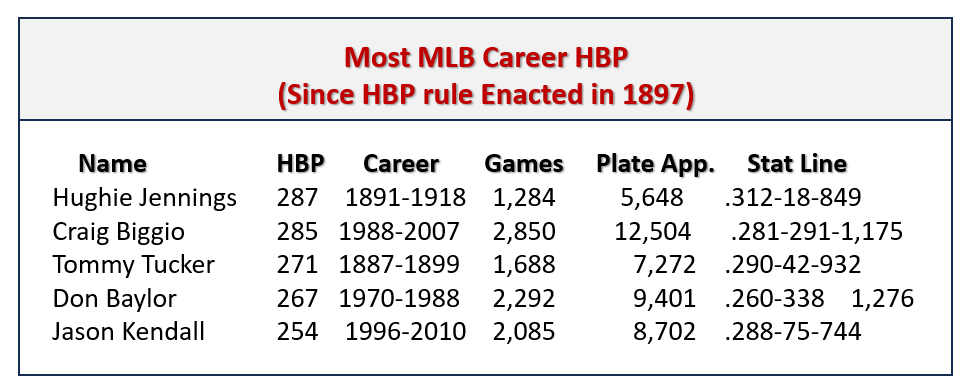
When it comes to “taking one for the team,” nobody did it more often in the major leagues than infielder Hughie Jennings, who was hit by a pitch an MLB-record 287 times in his 18-season major-league career (1891-1903, 1907, 1909-10, 1912, 1918 … AA/NL Louisville Colonels, NL Baltimore Orioles, Brooklyn Superbas, Phillies, Tigers). He took those 287 “hits” over 1,284 games/5,648 plate appearances.  For those who like to know such things, Hall of Famer Jennings was a career .312 hitter, with 18 home runs, 849 RBI and 992 runs scored. He led the league in HBP five times, including a still MLB-record 51 in 1896.

Craig Biggio, while he played quite a few more games, was just a bit behind Jennings at 285 HBP.  He took his “hits” over 2,850 games/12,504 plate appearances. Biggio, also a Hall of Famer, played in 20 MLB seasons (1988-2007 … Astros). His final stat line was .281-291-1,175, with 1,844 runs and 414 steals. (He also had 3,060 hits, 26th all-time.) Biggio led the league in HBP five times, with a high of 34 in 1997.

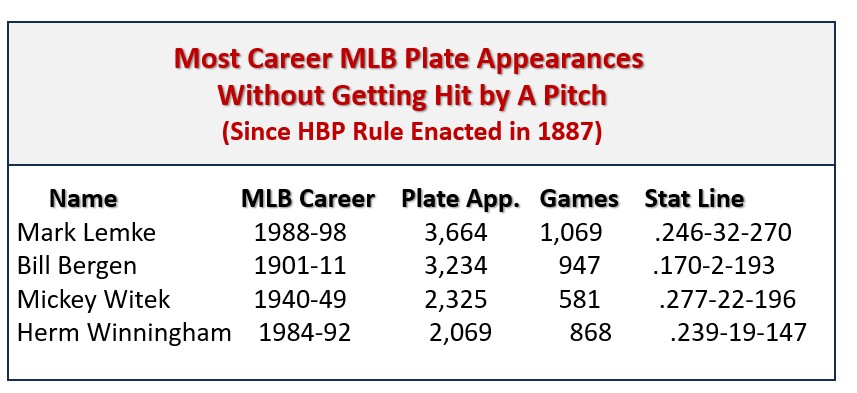
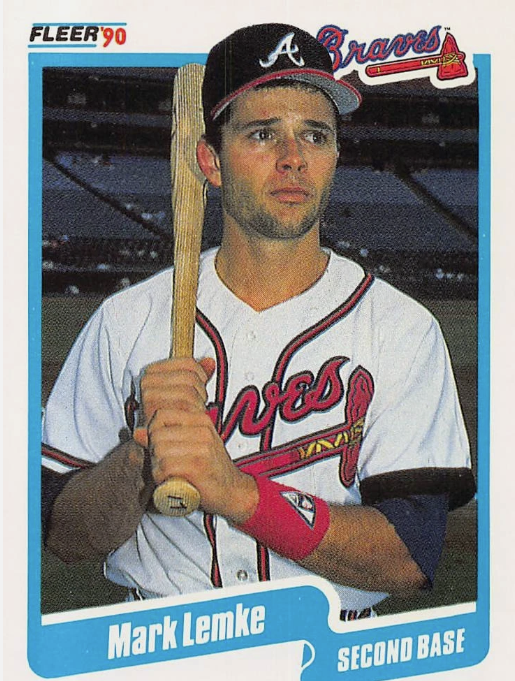
But getting hit by a pitch is not what this Tidbit is about. It’s about the other side of that coin, with a main focus on infielder Mark Lemke, who holds the MLB record for career (regular season) plate appearances without ever being nicked by a pitch (3,664 plate appearances over 1069 games in 11 MLB seasons).  Note: He also had 257 post-season plate appearances without “taking a hit.”\

Lemke played in 11 MLB seasons (1988-1998 … all for the Braves, except 1998 with the Red Sox).  The switch-hitting 2B/3B went .246-32-270, with 349 runs scored over his career.  His best season was 1994, when he went .294-3-31 in 104 games. It was the only season in his career when he hit above .255.  Another “one thing leads to another” from the Roundtable: In 2,209 minor-league plate appearances, Lemke was hit by a pitch 23 times.,

Bill Bergen was a right-handed hitting catcher known for his defensive skills. He played in 11 MLB seasons (1901-1911 … Reds, Dodgers). His career stats were .170-2-193, with 138 runs scored and 23 steals in 947 games. He hit .200 or better in just one season (1903), when he went .227-0-19 in 58 games.

Mickey Witek was a right-handed hitting utility infielder who played in seven MLB seasons (1949-43, 1946-47, 1949 … Giants, Yankees), going .277-22-196, with 239 runs scored in 581 games.  His best season was 1943, when he hit .314-6-55, with 68 runs scored for the Giants. All but one of Witek’s MLB at bats were as a New York Giant.  He also had one at bat (and one hit) as a Yankee 1949).

Herm Winningham was a left-handed hitting outfielder over nine MLB seasons (1984-93 … Mets, Expos, Reds, Red Sox), going .239-19-147, with 212 runs scored and 105 steals. His best season was 1987 (Expos) when he hit .239 and set career highs in home runs (4), RBI (41), hits (83), doubles (20) and stolen bases (29).

A few more HBP tidbits:

  • Only two players have been HBP at least 50 times in a season: Hughie Jennings (51 with the 1896 NL Orioles) and Ron Hunt (50 with the 1971 Expos).
  • Ron Hunt led the league in a record seven consecutive seasons – for three different teams (Expos, Giants, Cardinals).
  • Minnie Minoso led the league in HBP a record ten times – all for the white Sox (1952-54; 1956-1961). His consecutive seasons of leadership were interrupted in 1955 by teammate Nellie Fox.
  • The record for getting hit by a pitch in a game is three – shared by 34 players. The only players to be plunked three times in a game more than once are Reed Johnson (three times); Jurickson Profar (twice). Frank Chance (twice); Damion Easley (twice); Brandon Guyer (twice).

Primary Resources: Sports-Reference.com; Baseball Almanac.com

Baseball Roundtable – Blogging Baseball Since 2012.

Baseball Roundtable is on the Feedspot list of the Top 100 Baseball Blogs. For the full list click here

I tweet (on X) baseball @DavidBaseballRT. Follow me there for post notifications and links.

Follow Baseball Roundtable’s Facebook Page here.  

Member: Society for American Baseball Research (SABR); Negro Leagues Baseball Museum; The Baseball Reliquary.

P 1146

Baseball Roundtable Trivia(l) Tidbit Tuesday … Noodling into MVPs

It’s time again for Baseball Roundtable’s Trivia(l) Tidbit Tuesday. I hope you are enjoying this weekly presentation of baseball occurrences that for some reason caught The Roundtable’s eye.  (I’m particularly fond of unexpected performances and statistical coincidences.) These won’t necessarily be momentous occurrences, just events, statistics or coincidences that grabbed my attention. I’m also drawn to baseball “unicorns,” one-of-a-kind MLB accomplishments or statistics.

This week, for some reason, I found myself noodling around in Most Valuable Player trivia … everything from the positions most and least represented among MVP winners to players to win MVP Awards at different primary positions to MVP winners who did not make that season’s All Star Game (and the players who started the ASG at their positions).

So, let’s get started.

Most MVP Awards by Primary Position

First basemen have garnered the most MVP Awards at 37.  At the other end of the spectrum relief pitchers and designated hitters have taken home the fewest MVP Awards (four each).

Relievers and Designated Hitters

Photo: All-Pro Reels on Flickr (Original version) UCinternational (Crop), CC BY-SA 2.0 <https://creativecommons.org/licenses/by-sa/2.0>, via Wikimedia Commons

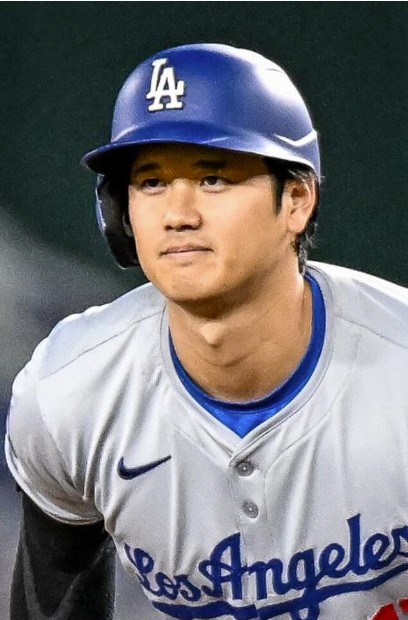
Going a little deeper into DH and reliever MVP’s, Shohei Ohtani is the only DH to win an MVP Award – and he won all four MVP recognitions awarded (to date) to designated hitters.  It is the only position at which one player is the only player to been recognized as a league MVP while playing primarily at that position.  (In baseball, we do love “qualifiers.”)

Shohei Ohtani also qualifies as a “unicorn.” He is the only player to be unanimously selected as a league MVP more than once – and he has earned that status three times (2023, 2024, 2025.) Ohtani has a total of four MVP Awards on his current MLB resume. Ohtani, of course, is a special case. While, in each of his MVP seasons, he played the bulk of his games at DH, he also was recognized for notable contributions as a pitcher in two of them.

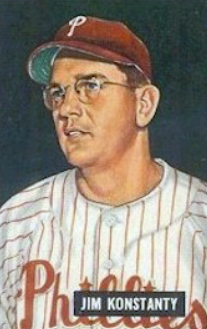
Photo: [[File:Jim Konstanty Bowman card.jpg|Jim Konstanty, pitcher with the Philadelphia Phillies, image from the 1951 Bowman Gum baseball card.]]

As noted earlier, a relief pitcher has been declared MVP just four times.  The first relief pitcher to win an MVP Award was Jim Konstanty of the 1950 Phillies. (In fact, it would be 31 years before a second reliever would win an MVP Award and Konstanty is still the only National League pitcher (unicorn alert) to win MVP recognition.

By today standards, Konstanty’s was an unusual season for a reliever.  In his age-33 campaign, he went 16-7, 2.66, with an NL-best 22 saves (recognized retroactively, saves were not an official stat at the time) in a league-leading 74 appearances (no starts).  Over the course of the season, he made 17 appearances of three innings or more, including one of ten innings (innings nine through 18 of a 19-inning 8-7 win over the Reds on September 15) and one of nine frames (the final nine innings of a 15-inning 9-7 win over the Pirates on August 25).  Notably, at least for the Roundtable, Konstanty was not an “overpowering” pitcher, but relied on his study of hitters’ strengths and weaknesses, solid control and effective off-speed pitches (particularly his palm ball). That season, in 152 innings pitched, he struck out only 56 batters (while walking 50).  Konstanty pitched in 11 MLB seasons (1944, 1946, 1948-56), going 66-48, 3.46 with 76 saves in 433 appearances (36 starts). His MVP season was his only All Star year.

Other relief pitchers to earn MVP Awards (all American League) are: Rollie Fingers, 1981 Brewers (6-3, 1.04, with a league-leading 28 saves); Willie Hernandez, 1984 Tigers (9-3, 1.92, with 32 saves); and Dennis Eckersley, 1992 Athletics (7-1. 1.01 with a league-topping 51 saves).

Sure, I’ll Make a Move

Five players have won league MVP Awards at multiple positions:

  • Aaron Judge as a center fielder in 2022 and 2024 and as a right fielder in 2025;
  • Alex Rodriguez as a SS in 2003 and as a third baseman in 2005 and 2007;
  • Robin Yount as a shortstop in 1982 and as a center fielder in 1989;
  • Stan Musial as a right fielder in 1943 and 1948 and as a first baseman in 1946;
  • Hank Greenberg as a first baseman in 1935 and as a left fielder in 1940.

Let’s Get This Party Started!

Fred Lynn and Ichiro Suzuki are the only players to win the MVP Award in their Rookie season (and by default also the only players to win Rookie of the Year and MVP in the same season.

Lucky Seven

Photo: Bspangenberg, CC BY 3.0 <https://creativecommons.org/licenses/by/3.0>, via Wikimedia Commons

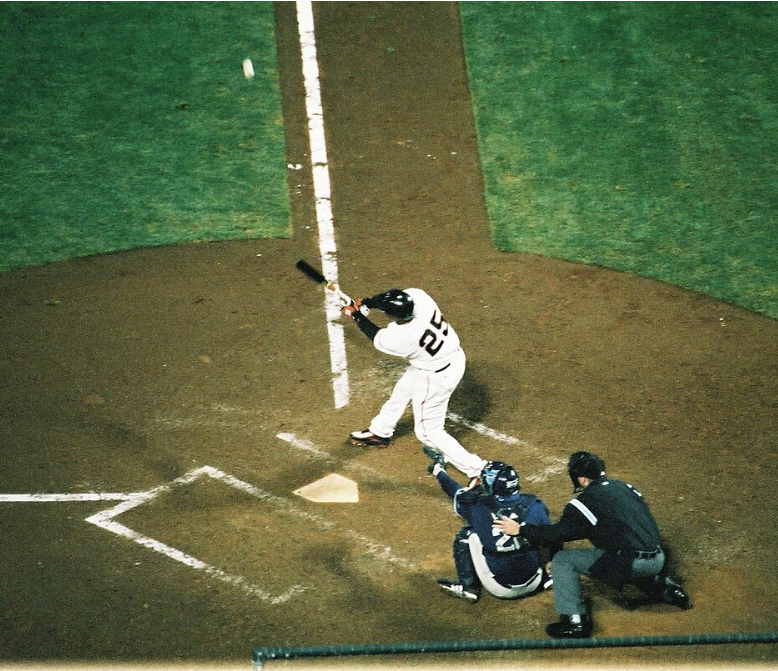
The Giant’ Barry Bonds has the most league MVP Awards at seven (1990, 1992, 1993, 2001, 2002, 2003, 2004). He also holds the record for the most consecutive MVP Awards (four). Bonds also won consecutive NL MVP awards in 1992 and 1993.

Others with consecutive MVP Awards include: Shohei Ohtani (2023-24-25); Aaron Judge (2024-25); Miguel Cabrera (2012-13); Albert Pujols (2008-09); Frank Thomas (1993-94); Dale Murphy (1982-83); Mike Schmidt (1980-81); Joe Morgan (1976-76); Roger Maris (1960-61); Ernie Banks (1958-59); Mickey Mantle (1956-57); Yogi Berra (1954-55); Hal Newhouser (1944-45); and Jimmie Foxx (1932-33).

The Young and The Old of It

Barry Bonds is the oldest player to win a league MVP Award (40-years-old). In fact, if you look at a list of eleven MVP Awards presented to players after their 35th birthday, Bonds name comes up four times (no other name is on the list more than once.)

The youngest player to win an MVP is the Athletics’ Vida Blue, who was named AL MVP at the age of 21 – after a 20-89, 1.82 season, with 24 complete games and eight shutouts in 39 starts.

I’d Rather Have the MVP Award

Just 11 players have won a League MVP Award in a season in which they did not make the All Star Team (does not include seasons in which there was no All Star Game). Here they are, along with the player who started the All Star Game at their position.

  • Hank Greenberg, 1B, Tigers, 1935 (Starter: Lou Gehrig, Yankees)
  • Don Newcombe, SP, Dodgers, 1956 (Starter: Bob Friend, Pirates)
  • Dave Parker, RF, Pirates, 1978 (Starter: Rick Monday, Dodgers)
  • Willie Stargell, 1B, Pirates, 1979 (Starter: Steve Garvey, Dodgers)
  • Kirk Gibson, LF. Dodgers, 1988 (Starter: Vince Coleman, Cardinals)
  • Robin Yount, CF, Brewers, 1989 (Starter: Kirby Puckett, Twins)
  • Terry Pendleton, 3B, Braves, 1991 (Starter: Chris Sabo, Reds)
  • Juan Gonzalez, RF, Rangers, 1996 (Starter: Brady Anderson, Orioles)
  • Chipper Jones, 3B, Braves, 1999 (Starter: Matt Williams, Diamondbacks)
  • Justin Morneau, 1B, Twins, 2006 (Starter: David Ortiz, Red Sox)
  • Jimmy Rollins, SS, Phillies, 2007 (Starter: Jose Reyes, Mets)
  • Bryce Harper, RF, Phillies, 2021 (Starter: Nick Castellanos, Reds)


Primary Resources: Baseball-Reference.com; Goldy Joins List of Oldest MVP Winners, by Sarah Langs, MLB.com; All For One; Unanimous MVP Award Winners, by Dylan Svoboda, MLB.com; Which Position Has Produced the Most MVPs?, by Thomas Harrigan, MLB.com

Baseball Roundtable – Blogging Baseball Since 2012.

Baseball Roundtable is on the Feedspot list of the Top 100 Baseball Blogs. For the full list click here

I tweet (on X) baseball @DavidBaseballRT. Follow me there for post notifications and links.

Follow Baseball Roundtable’s Facebook Page here.  

Member: Society for American Baseball Research (SABR); Negro Leagues Baseball Museum; The Baseball Reliquary.

P 1145


Baseball Roundtable Trivia(l) Tidbit Tuesday …. Not Just a Victory Lap Anymore

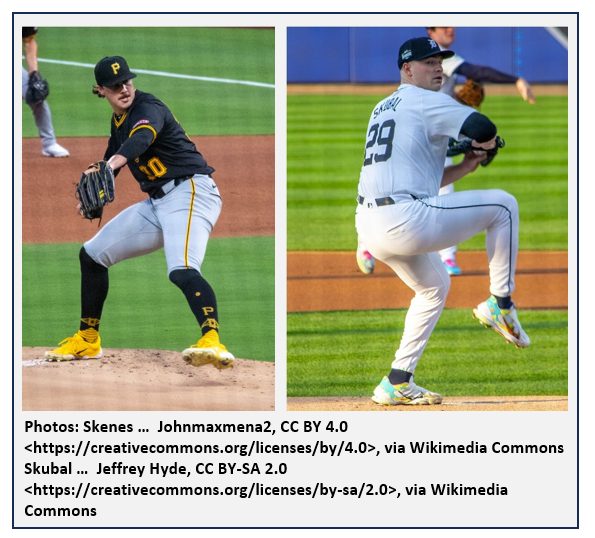
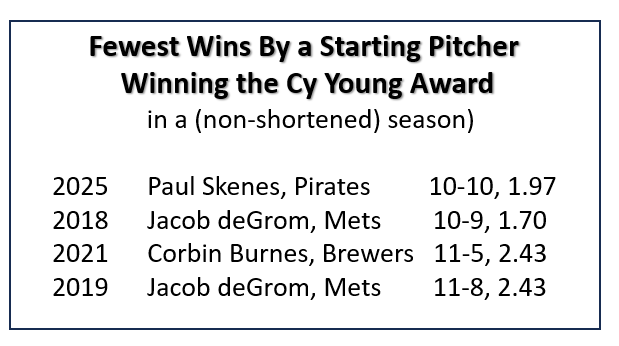
It’s time again for Baseball Roundtable’s Trivia(l) Tidbit Tuesday. I hope you are enjoying this weekly presentation of baseball occurrences that for some reason caught The Roundtable’s eye.  (I’m particularly fond of unexpected performances and statistical coincidences.) These won’t necessarily be momentous occurrences, just events, statistics or coincidences that grabbed my attention. I’m also drawn to baseball “unicorns,” one-of-a-kind MLB accomplishments or statistics.  This week, I got drawn into the Web (pun intended) of Cy Young Award trivia – triggered by the Pirates’ CYA winner Paul Skenes tying for the fewest wins ever by a starting pitcher winning the CYA (in a non-shortened season) and also becoming the first starting pitcher to capture a CYA without posting more wins than losses on the season.

The Pirates’ Paul Skenes, 2024’s NL Rookie of the Year, was unanimously selected as the 2025 NL Young Award Winner – after posting a 10-10, 1.97 record.

In addition, Tarik Skubal of the Tigers won the AL CYA with a 13-6, 2.21 record.  The combined 23 wins notched by Skubal and Skenes set a new record the fewest combined wins ever by a pair of CYA winners in a (non-shortened) season. #AtBaseballRoundtableWeCountEverything.

The previous “record holders?” In 2021, CYA winners the Blue Jays’ Robbie Ray (13-7) and Brewers’ Corbin Burnes (11-5) combined for 24 wins.  And, in 2003, when the NL Cy Young Award winner Eric Gagne of the 2003 Dodgers went 2-3, 1.30 (55 saves), posted the fewest wins ever by a CYA winner and became the still-only only CYA winner who posted more losses than victories, AL winner Roy Hallady chipped in a 22-7 record to bring the combined total to 24.

Now, this post is all about starting pitchers who have won the Cy Young.  Here are a few tidbits that jumped out at me.

  • From 1956 (when the CYA was first awarded) through 1980, there were 37 CYA winners – all starting pitchers and 36 (97.3%) won at least 20 games. The lone exception was Tom Seaver, who won the 1973 NL CYA with a 19-10, 2.08 record; making him, of course, the answer to the trivia question, “Who was the first pitcher to win a CYA, while winning less than 20 games in his CYA season?”
  • From 1981 through 2005 (minus the shortened seasons of 1981, 1994 and 1995), another 37 CYA winners were starting pitchers and 28 (75.7%) won at least 20 games.
  • From 2006 through 2025 (minus the 2020 COVID-shortened season), starting pitchers won 38 CYA’s – and just 14 of those winners (36.8%) won at least 20 games.
  • In the past five seasons, (2021-25), starting pitchers have won all ten Cy Young Awards and not one of those pitchers reached 20 wins in their CYA season.

Why this change among CYA credentials? Let’s look at just a couple of factors.

Pitcher usage is one. There just aren’t that many twenty-game winners anymore, just like there aren’t that many 250+ innings pitched seasons or any double-digit complete-game campaigns. Consider, there have been only three MLB twenty-game winners in the five seasons since 2021: Spencer Strider, Braves (20-5 in 2023); Kyle Wright, Braves (20-5 in 2022); and Julio Urias, Dodgers (20-3 in 2021). By comparison, in 1956 (the year the CYA was launched), there were nine MLB 20-game winners and in the first five years of the CYA’s existence, there were 23 20-game winners. Also, In the five seasons from 1956 through 1960, there were 51 pitcher-seasons of 250 or more innings pitched. In the most recent five MLB seasons, there were zero pitcher-seasons of 250 or more innings pitched and only 24 of 200 or more innings. And, don’t get me started on complete games.

Second, a change in baseball’s statistical menu. With the lack of “big” win totals, voters are looking more toward ERA and (some would say more advanced) stats like WHIP and WAR. Skenes finished 16th in the NL in wins, but led all MLB qualifiers in Earned Run Average (1.97) and led the NL in Walks + Hits Per Inning Pitched (0.95).  Skubal finished fifth in the AL in wins, but led the AL in ERA at (2.21) and led MLB qualifiers in WHIP at 0.89. In addition, Skubal (6.5) and Skenes (7.7) were second and third in WAR (Wins Above Replacement) for qualifying pitchers. Similarly, if you look at Jacob deGrom, who won the 2018 NL Cy Young Award with a 10-9 record, you’ll see that he finished tied for 22nd in the NL in wins, but led the NL in ERA (1.70), was second in the league in WHIP (0.912 to Max Scherzer’s 0.911) and was second in the league in WAR (9.4). Oh, and those three twenty-game winners over the past five seasons I mentioned earlier – Strider, Wright and Urias – finished fourth, tenth and seventh in NL CYA voting, respectively.  The NL CYA winners those seasons won 14, 14 and 11 games, respectively.

How About a Trivia Question for Your Friends?

Q:  There has been only one tie in the voting for the Cy Young Award. Which two pitchers tied for the CYA? Hint: American League; one righty and one lefty.

A:  In 1969, he Tigers’ Denny McLain (23-9, 2.80) and Orioles’ Mike Cueller (23-11, 2.38) each got ten out of possible 24 votes (voters cast a vote for just one pitcher). The following season, a ranked voting system was adopted.   

A few other tidbits, many of which you may already know.

  • The first MLB CYA winner was the Dodgers’ Don Newcombe (27-7, 3.06 in 1956).
  • Only one CYA was awarded from 1956 through 1966.
  • Roger Clemens has won the most Cy Young Awards (seven) 1986, 1987, 1991, 1997, 1998, 2000, 2004. He won 20 or more games in five of those seven seasons.
  • Juan Marichal had three seasons of 25 or more wins (1963, 1966 and 1968) and, in those seasons, never got a single CYA vote. He had three additional seasons of 20 or more wins and never got a CYA vote in those. The Hall of Famer and ten-time All Star, in fact, only got one CYA vote in his 16-season career and it was not a first-place vote (1971, when Marichal finished tied for eighth in the NL CYA balloting). Ironically, he received MVP votes in eight seasons.  The CYA winners Marichal lost to:  Sandy Koufax (three times), Bob Gibson, Dean Chance, Tom Seaver.
  • Randy Johnson and Greg Maddux share the record for consecutive CYA seasons at four. Maddux 1992-95, Johnson 1999-2002. They each won 20 or more games in two of their four consecutive CYA campaign.

A Change of Scenery

In 1984, right-hander Rick Sutcliffe started the season 4-5, 5.15 in 15 starts for the Indians.  In mid-June, he was sent to the Cubs as part of a multi-player trade.  With the Cubs, he went 16-1, 2.69 in 20 starts – earning the NL Cy Young Award – and unicorn status as the only player to win a Cy Young Award during a season during which he was traded, as well as the only pitcher to pitch in both the NL and AL in a season in which he won a Cy Young Award. (NL CYA voters did not hold those 15 AL starts against him.) 

  • Dwight Gooden, 1985 Mets, is MLB’s youngest-ever Cy Young Award winner (20 years-324 days-old at the end of the 1985 season.
  • Roger Clemens, 2004 Astros) is the oldest Cy Young Award winner, 2004 Astros, 42 years/60 days old at the end of the 2004 season. Notably, 41-year-old Randy Johnson finished second and would have been the oldest CYA winner if not for Clemens. Apparently, it was an “Old Guys Rule” kind of season.
  • It was 18 seasons (1986-2004) between Roger Clemens’ first and final Cy Young Awards (an MLB record).
  • To date, nine relief pitchers have won a CYA (no relief pitcher is a multiple winner).

Oh, What A Relief It is.

In 1974, the Dodgers’ Mike Marshall became the first relief pitcher to win a Cy Young Award. That season, Marshall appeared in a still MLB-record 106 games (all in relief) – going 15-12, 2.42, with a league-leading 21 saves. He threw a still-record 208 1/3 innings in relief. He pitched more than one inning in 74 games and three or more innings in 22.


Primary Resource: Baseball-Reference.com

Baseball Roundtable – Blogging Baseball Since 2012.

Baseball Roundtable is on the Feedspot list of the Top 100 Baseball Blogs. For the full list click here

I tweet (on X) baseball @DavidBaseballRT. Follow me there for post notifications and links.

Follow Baseball Roundtable’s Facebook Page here.  

Member: Society for American Baseball Research (SABR); Negro Leagues Baseball Museum; The Baseball Reliquary.

P 1144


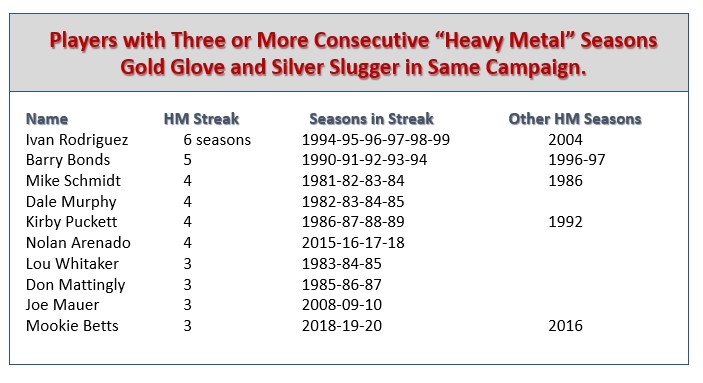
MLB’s “Heavy Metal ” Seasons …Players To Earn a Silver Slugger & Gold Glove Award in the Same Season

Regular readers know that Baseball Roundtable has a particular fondness for players that bring “lumber and leather” to their game. This post/update will focus on players who have captured what the Roundtable sees as baseball’s “Heavy Metal Doubleheader” – winning a Silver Slugger and Gold Glove in the same season.  You have to admire those players who can earn recognition as the best at their positions both defensively and offensively.

Note: The Hillerich and Bradsby Silver Slugger Awards were first presented in 1980 (the Rawlings Gold Glove Awards were launched in 1957), so the list of double winners is relatively recent (at least  “recent” as defined by someone who went to their first World Series game the year the Gold Glove Awards were initiated).

The Unicorn Season

Since the Silver Slugger Awards were established in 1980, 2023 is the only season in which there were no combination Gold Glove-Silver Slugger Award winners. 

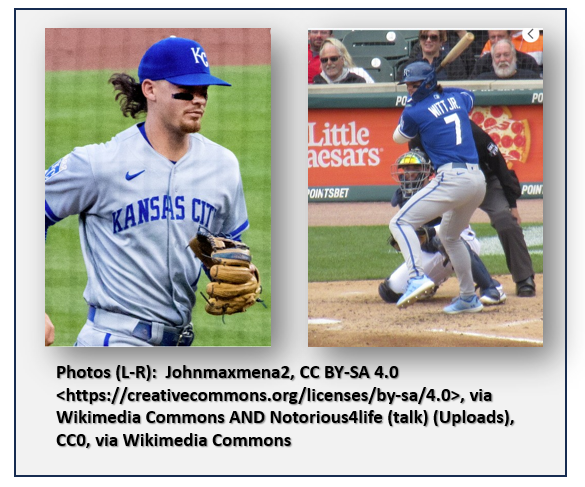
Bobby Witt, Jr.

In 2025, for the second consecutive season, Bobby Witt, Jr., was the only MLB player to  achieve “Heavy Metal” status.  Witt won his second Silver Slugger Award and second Gold Glove (in his fourth MLB campaign).  At the plate, the 25-year-old went .295-23-88, with 99 runs scored. He led the American League in hits (184) and doubles (47) – and for good measure he tossed ins 38 steals. His .852 OPS was first among AL shortops, as was his .501 Slugging Percentage.   Witt’s .295 average was fifth among qualifying American League SS; his 88 RBI third; his six triples first; and his 99 RBI first.

In the field , Witt added an exclamation point to his Gold Glove, by also capturing the American League Platinum Glove (awarded to the best overall fielder regardless of position).  In the  Statcast “Outs Above Average” rating, Witt’s +24 tied Cubs’ CF Pete Crow-Armstrong for the best in MLB. Witt made 153 starts at SS (third in the AL), ranked second among AL SS in assists, second in fielding percentage, fourth in putouts and fifth in double plays.

For Those Who Like Know Such Things

Only four players have won a Platinum Glove and a Silver Slugger Award in the same season: Bobby Witt, Jr. (2025/SS); Adrian Beltre (2011/3B); Anthony Rizzo (2016/3b). The unicorn in the group is 3B Nolan Arenado, who has earned the Platinum Glove/Silver Slugger combo three times (2017, 2018 and 2022).

A Little Background on 2025’s Platinum Glove/Silver Slugger Winner

Bobby Witt, Jr. Witt was the second overall selection (Royals) in the 2019 MLB Draft –  out of Colleyville (Texas)  Heritage High School, where he was named the 2019 Gatorade National Baseball Player of the Year (after a .515-15-54 Senior season).

In two minor-league seasons, Witt hit .283-34-124, with 38 steals.  He made his MLB debut  on April 7, 2022. In his first MLB season, Witt hit .254-20-80, with 30 stolen bases.  Then, in 2023, he joined the 30-30 (HR/SB) Club, with a season of .276-30-96, with 49 steals. In 2024, he became the first shortstop with more than one 30-30 campaign (,332-32-109, with 31 steals) – and led the AL with 211 hits and a .332 average. Of course, we’ve already looked at his 2025 Platinum/Silver season.

Witt, Jr.’s father pitched in 16 MLB seasons (1986-2001 … Rangers, A’s, Marlins, Cardinals, Rays, Indians, Diamondbacks), going 142-157, 4.83. His best season was 1990, when he went 17-10, 3.36 for the Rangers.

— TIDBITS OF SAME-SEASON SS/GG TRIVIA–

  • The Chicago White Sox are the only team to never have a player capture a Silver Slugger Award and Gold Glove in the same season.
  • The most players to achieve the GG/SS combo in a season is nine – back in 1984: Lance Parrish, C, Tigers; Keith Hernandez, 1B, Mets; Eddie Murray, 1B, Orioles; Ryne Sandberg, 2B, Cubs; Lou Whitaker, 2B, Tigers; Mike Schmidt, 3B, Phillies; Buddy Bell, 3B, Rangers; Dave Winfield, OF, Yankees; Dale Murphy, OF, Braves.
  • Roberto Alomar (2B) is the only player to win the single-season Gold Glove/Silver Slugger combo with three different teams (Blue Jays-1992; Orioles-1996; Indians-1999, 2000).
  • Scott Rolen (3B) and Zack Greinke are the only players to win the SS/GG combo in a season in which they played for two different teams. In 2002, Rolen was traded from the Phillies to the Cardinals on July 29. He played 100 games for the Phillies and 55 for the Cardinals in what would be his only SS/GG combo season.  Greinke did it in 2019, when he started the season with the Diamondbacks and was traded to the Astros at the July deadline. Despite moving to the AL with its DH, Greinke’s .280-3-8 season was good enough to earn him a Silver Slugger.
  • The only team to have three SS/GG winners in the same season is the 1993 Giants (2B Robby Thompson, 3B Matt Williams, OF Barry Bonds).

Zack Greinke (2019 Diamondbacks/Astros), Mike Hampton (2003 Braves) and Max Fried (2021 Braves) are the only pitchers to win a Silver Slugger and Gold Glove in the same season. 

__________________________________________________________________

HM Streak

____________________________________________________________

Now that we’ve looked at 2025’s “Heavy Metal” honorees, here’s a look back at those who have won both awards in the same season in the past.  Since 1980, the combination of a Gold Glove/Silver Slugger has been achieved in a season 201 times by 106 different players – with 41 players accomplishing the feat more than once and 27 of those winning two or more consecutive SS/GG combinations.   Here are a couple of lists that might be of interest.  (Note: Since the Silver Slugger is awarded to three outfielders annually regardless of their position, the GG/SS combo lists in this post do not break outfielders out by position.)

—Full List of Same-Year Gold Glove/Silver Slugger Winners by Season—

2025

Bobby Witt, Jr., SS, Royals

2024

Bobby Witt, Jr., SS, Royals

2023

None

2022

J.T. Realmuto, C, Phillies

Nolan Arenado, 3B, Cardinals

Mookie Betts, OF,  Dodgers

2021

Marcus, Semien, 2B, Blue Jays

Max Fried, P, Braves

2020

Mookie Betts, RF, Dodgers

2019

J.T. Realmuto, C, Phillies; Mookie Betts, RF, Red Sox; Cody Bellinger, RF, Dodgers; Zack Greinke, P, D-backs/Astros

2018

Nolan Arenado, 3B, Rockies; Mookie Betts, OF, Red Sox; Nick Markakis, OF, Braves; Salvador Perez, C, Royals

2017

Nolan Arenado, 3B, Rockies; Paul Goldschmidt, 1B, Diamondbacks; Eric Hosmer, 1B, Royals; Marcell Ozuna, OF, Marlins

2016

Nolan Arenado, 3B, Rockies; Mookie Betts, Of, Red Sox; Salvador Perez, C, Royals; Anthony Rizzo, 1B, Cubs

2015

Jose Altuve, 2B, Astros; Paul Goldschmidt, 1B, Diamondbacks; Dee Gordon, 2B, Marlins; Nolan Arenado, 3B, Rockies; Brandon Crawford, SS, Giants.

2014

Adrian Gonzalez, 1B, Dodgers

2013

Yadier Molina, C, Cardinals; Paul Goldschmidt, 1B, Diamondbacks; J.J. Hardy, SS, Orioles; Adam Jones, OF, Orioles

2012

Adam LaRoche, 1B, Nationals; Robinson Cano, 2B, Yankees; Chase Headley, 3B, Padres; Andrew McCutchen, OF, Pirates

2011

Adrian Gonzalez, 1B, Red Sox; Brandon Phillips, 2B, Reds; Adrian Beltre, 3B, Rangers; Troy Tulowitzki, SS, Rockies; Jacob Ellsbury, OF, Red Sox; Matt Kemp, OF, Dodgers

2010

Joe Mauer, C, Twins; Albert Pujols, 1B, Cardinals; Robinson Cano, 2B, Yankees; Troy Tulowitzki, SS, Rockies; Carl Crawford, OF, Rays; Carlos Gonzalez, OF, Rockies

2009

Joe Mauer, C, Twins; Mark Teixeira, 1B, Yankees; Ryan Zimmerman, 3B, Nationals; Derek Jeter, SS, Yankees; Matt Kemp, OF, Dodgers; Ichiro Suzuki, OF, Mariners; Torii Hunter, OF, Angels

2008

Joe Mauer, C, Twins; Dustin Pedroia, 2B, Red Sox; David Wright, 3B, Mets; Grady Sizemore, OF, Indians

2007

Russell Martin, C, Dodgers; Placido Polanco, 2B, Tigers; David Wright, 3B, Mets; Jimmy Rollins, SS, Phillies; Carlos Beltran, OF, Mets; Ichiro Suzuki, OF, Mariners

2006

Derek Jeter, SS, Yankees; Carlos Beltran, OF, Mets

2005

Jason Varitek, C, Red Sox; Mark Teixeira, 1B, Rangers; Derrek Lee, 1B, Cubs; Andruw Jones, OF, Braves

2004

Ivan Rodriguez, C, Tigers; Jim Edmonds, OF, Cardinals

2003

Brett Boone, 2B, Mariners; Edgar Renteria, SS, Cardinals; Alex Rodriguez, SS, Rangers; Mike Hampton, P, Braves

2002

Todd Helton, 1B, Rockies; Scott Rolen, 3B, Cardinals/Phillies; Eric Chavez, 3B, A’s; Edgar Renteria, SS, Cardinals; Alex Rodriguez, SS, Rangers

2001

Todd Helton, 1B, Rockies; Ichiro Suzuki, OF, Mariners

2000

Roberto Alomar, 2B, Indians; Darin Erstad, OF, Angels

1999

Ivan Rodriguez, C, Rangers; Robert Alomar, 2B, Indians; Larry Walker, OF, Rockies; Ken Griffey, Jr., OF, Mariners; Shawn Green, OF, Blue Jays

1998

Ivan Rodriguez, C, Rangers; Rafael Palmeiro, 1B, Rangers; Ken Griffey, Jr. OF, Mariners

1997

Ivan Rodriguez, C, Rangers; Craig Biggio, 2B, Astros; Chuck Knoblauch, 2B, Twins; Matt Williams, 3B, Indians; Larry Walker, OF, Rockies; Barry Bonds, OF, Giants; Ken Griffey, Jr, OF, Mariners

1996

Ivan Rodriguez, C, Rangers; Roberto Alomar, 2B, Orioles; Ken Caminiti, 3B, Padres; Barry Larkin, SS, Reds; Barry Bonds, OF, Giants; Ken Griffey, Jr. OF, Mariners

1995

Ivan Rodriguez, C, Rangers; Craig, Biggio, 2B, Astros; Barry Larkin, SS, Reds

1994

Ivan Rodriguez, C, Rangers; Jeff Bagwell, 1B, Astros; Craig Biggio, 2B, Astros; Matt Williams, 3B, Giants; Wade Boggs, 3B, Yankees; Barry Bonds, OF, Giants; Ken Griffey, Jr., OF, Mariners

1993

Robby Thompson, 2B, Giants; Matt Williams, 3B, Giants; Jay Bell, SS, Pirates; Barry Bonds, OF, Giants; Ken Griffey, Jr, OF, Mariners

1992

Roberto Alomar, 2B, Blue Jays; Larry Walker, OF, Expos; Andy Van Slyke, OF, Pirates; Barry Bonds, OF, Pirates; Kirby Puckett, OF, Twins

1991

Will Clark, 1B, Giants; Ryne Sandberg, 2B, Cubs; Cal Ripken, Jr., SS, Orioles; Barry Bonds, OF, Pirates’ Ken Griffey, Jr., OF, Mariners

1990

Benito Santiago, C, Padres; Ryne Sandberg, 2B, Cubs; Kelly Gruber, 3B, Blue Jays; Barry Bonds, OF, Pirates; Ellis Burks, OF, Red Sox

1989

Ryne Sandberg, 2B, Cubs; Eric Davis, OF, Reds; Kirby Puckett, OF, Twins; Tony Gwynn, OF, Padres

1988

Benito Santiago, C, Padres; Ryne Sandberg, 2B, Cubs; Andy Van Slyke, OF, Pirates; Kirby Puckett, OF, Twins

1987

Don Mattingly, 1B, Yankees; Ozzie Smith, SS, Cardinals; Tony Gwynn, OF, Padres; Eric Davis, OF, Reds; Kirby Puckett, OF, Twins; Andre Dawson, OF, Cubs

1986

Don Mattingly, 1B, Yankees; Frank White, 2B, Royals; Mike Schmidt, 3B, Phillies; Tony Gwynn, OF, Padres; Kirby Puckett, OF, Twins

1985

Don Mattingly, 1B, Yankees; Ryne Sandberg, 2B, Cubs; Lou Whitaker, 2B, Tigers; Tim Wallach, 3B, Expos; George Brett, 3B, Royals; Willie McGee, OF, Cardinals; Dale Murphy, OF, Braves; Dave Winfield, OF, Yankees

1984

Lance Parrish, C, Tigers; Keith Hernandez, 1B, Mets; Eddie Murray, 1B, Orioles; Ryne Sandberg, 2B, Cubs; Lou Whitaker, 2B, Tigers; Mike Schmidt, 3B, Phillies; Buddy Bell, 3B, Rangers; Dave Winfield, OF, Yankees; Dale Murphy, OF, Braves

1983

Lance Parrish, C, Tigers; Eddie Murray, 1B, Orioles; Lou Whitaker, 2B, Tigers; Mike Schmidt, 3B, Phillies; Dale Murphy, OF, Braves; Dave Winfield, OF, Yankees; Andre Dawson, OF, Expos

1982

Gary Carter, C, Expos; Mike Schmidt, 3B, Phillies; Robin Yount, SS, Brewers; Dale Murphy, OF, Braves; Dave Winfield, OF, Yankees

1981

Gary Carter, C, Expos; Manny Trillo, 2B, Phillies; Mike Schmidt, 3B, Phillies; Andre Dawson, OF, Expos; Rickey Henderson, OF, A’s; Dwight Evans, OF, Red Sox; Dusty Baker, OF, Dodgers

1980

Keith Hernandez, 1B, Cardinals; Cecil Cooper, 1B, Brewers; Andre Dawson, OF, Expos; Willie Wilson, OF, Royals

_________________________________________

If you want to look up your favorite player(s), here’s an alphabetical list:

Your Same-Season Gold Glove/Silver Slugger combo winners listed alphabetically:

Alomar, Roberto … 1992; 1996; 1999; 2000

Altuve, Jose … 2015

Arenado, Nolan … 2015; 2016; 2017; 2018; 2022

Baker, Dusty … 1981

Bagwell, Jeff … 1994

Bell, Buddy … 1984

Bell, Jay … 1993

Bellinger, Cody  … 2019

Beltre, Adrian … 2011

Beltran, Carlos … 2006; 2007

Betts, Mookie … 2016; 2018; 2019; 2020, 2022

Biggio, Craig … 1994; 1995; 1997

Boggs, Wade) … 1994

Bonds, Barry … 1990; 1991; 1992; 1993; 1994; 1996; 1997

Boone, Brett … 2003

Brett, George … 1985

Burks, Ellis … 1990

Caminiti, Ken … 1996

Cano, Robinson … 2010; 2012

Carter, Gary … 1981; 1982

Chavez, Eric … 2002

Clark, Will … 1991

Cooper, Cecil …1980

Crawford, Brandon … 2015

Crawford, Carl … 2010

Dawson, Andre … 1980; 1981; 1983; 1987

Davis, Eric … 1987; 1989

Edmonds, Jim … 2004

Ellsbury, Jacob … 2011

Erstad, Darin … 2000

Evans, Dwight … 1981

Fried, Max … 2021

Goldschmidt, Paul … 2013; 2015; 2017

Gonzalez, Adrian … 2011; 2014

Gonzalez, Carlos … 2010

Gordon, Dee … 2015

Green, Shawn … 1999

Greinke, Zack … 2019

Griffey, Ken Jr. … 1991; 1993; 1994; 1996; 1997; 1998; 1999

Gruber, Kelly … 1990

Gwynn, Tony … 1986; 1987; 1989

Hampton, Mike … 2003

Hardy, J.J. … 2013

Headley, Chase … 2012

Helton, Todd … 2002

Henderson, Rickey … 1981

Hernandez, Keith … 1980; 1984

Eric Hosmer … 2017

Hunter, Torii … 2009

Jeter, Derek … 2006; 2009

Jones, Adam … 2013

Jones, Andruw … 2005

Kemp, Matt … 2009; 2011

Knoblauch, Chuck … 1997

Larkin, Barry … 1995; 1996

LaRoche, Adam … 2012

Lee, Derrek … 2005

Markakis, Nick … 2018

Martin, Russell … 2008

Mattingly, Don … 1985; 1986; 1987

Mauer, Joe … 2008; 2009; 2010

McCutchen, Andrew … 2012

McGee, Willie … 1985

Molina, Yadier … 2013

Murphy, Dale … 1982; 1983; 1984; 1985

Murray, Eddie … 1983; 1984

Marcell Ozuna … 2017

Polanco, Placido … 2007

Palmeiro, Rafael … 1998

Parrish, Lance … 1983; 1984

Pedroia, Dustin … 2008

Salvador, Perez … 2016; 2018

Phillips, Brandon … 2011

Puckett, Kirby … 1986; 1987; 1988; 1989; 1992

Pujols, Albert … 2010

J.T. Realmuto … 2019, 2022

Renteria, Edgar … 2002

Ripken, Cal, Jr. … 1991

Anthony Rizzo … 2016

Rodriguez, Alex … 2002; 2003

Rodriguez, Ivan … 1994; 1995; 1996; 1997; 1998; 1999; 2004

Rolen, Scott … 2002

Rollins, Jimmy … 2007

Sandberg, Ryne … 1984; 1985; 1988; 1989; 1990; 1991

Santiago, Benito … 1988; 1990

Schmidt, Mike … 1981; 1982; 1983; 1984; 1986

Sizemore, Grady … 2008

Semien, Marcus, 2021

Smith, Ozzie … 1987

Suzuki, Ichiro … 2001; 2007; 2009

Thompson, Robby … 1993

Teixeira, Mark … 2005, 2009

Trillo, Manny … 1981

Tulowitzki, Troy … 2010; 2011

Van Slyke, Andy … 1988; 1992

Varitek, Jason … 2005

Walker, Larry … 1992; 1997; 1999

Wallach, Tim … 1985

White, Frank … 1986

Whitaker, Lou … 1983; 1984; 1985

Williams, Matt … 1993; 1994; 1997

Wilson, Willie … 1980

Winfield, Dave … 1982; 1983; 1984; 1985

Bobby Witt, Jr. … 2024; 2025

Wright, David … 2007; 2008

Yount, Robin … 1982

Ryan Zimmerman … 2009

Primary Resources:  Baseball-Reference.com; MLB.com; FanGraphs.com

Baseball Roundtable – Blogging Baseball Since 2012.

Baseball Roundtable is on the Feedspot list of the Top 100 Baseball Blogs. For the full list click here

I tweet (on X) baseball @DavidBaseballRT. Follow me there for post notifications and links.

Follow Baseball Roundtable’s Facebook Page here.  

Member: Society for American Baseball Research (SABR); Negro Leagues Baseball Museum; The Baseball Reliquary.

P 1143

Baseball Roundtable Trivia(l) Tidbit Tuesday – Tommy Bryne; Wildly Effective or Effectively Wild? (and other Wild Thing-inspired stories)

It’s time again for Baseball Roundtable’s Trivia(l) Tidbit Tuesday. I hope you are enjoying this weekly presentation of baseball occurrences that for some reason caught The Roundtable’s eye.  (I’m particularly fond of unexpected performances and statistical coincidences.) These won’t necessarily be momentous occurrences, just events, statistics or coincidences that grabbed my attention. I’m also drawn to baseball “unicorns,” one-of-a-kind MLB accomplishments or statistics.  This week, we’re looking at MLB’s original (perhaps) “Wild Thing” –  Tommy Byrne.  Need to add the usual disclaimer: Negro League game-by-game records are not yet fully incorporated into the MLB record books.

Photo: Jay Publishing via tradingcarddb.com, Public domain, via Wikimedia Commons

When it comes to issuing free passes, Byrnes is a bit of an MLB unicorn.  Among pitchers with at least 1,000 MLB innings pitched, his 6.9 career walks per nine innings makes him the only qualifying (1,000+ career innings) pitcher with a ratio of 6+. Further, when you look at MLB pitchers with at least 100 mound innings in a season, Byrne again tops the free pass list. In 1952 (Yankees/Browns), Byrnes walked 150 batters in 143 2/3 innings – or 9.4 per nine frames – making him the only major leaguer to walk nine or more batter per nine innings in a season in which he pitched at least 100 innings. Second on this list would be the Rangers’ Bobby Witt, who (in 1987) walked a league-leading 140 batters in 143 innings (8.8 BB/9).

Further, when you look at “qualifying” pitchers (those who qualified for certain statistical leadership – like earned run average – having pitched at least one inning for each game his team played), Bryne again tops the single-season  list at 8.2 walks per nine innings in 1949 (179 walks in 196 innings).

Bryne may have been at his “peak” from 1949 through 1951, when he led the American League in walks and hit batsmen each season. Surprisingly, during those wild seasons, he won more than he lost – going 36-27, 4.24.  Side note: Byrne led the AL in hit batsman in five straight seasons (1948-52).

Wildly Effective or Effectively Wild? Take Your PIck.

In 1949, Tommy Bryne (pitching for the Yankees) went 15-7, 3.72. That season, he was wild enough to lead  major-league baseball in total walks (179) and hit batsmen (13). as well as to lead MLB qualifying pitchers in most walks per nine innings (8.2). On the flip side, Byrne was effective enough to lead qualifying MLB pitchers in fewest hits allowed per nine innings (5.7) and strikeouts per nine innings (5.9).  The end result?  A 15-7, 3.72 season with 12 complete games and three shutouts in 30 starts (32 appearances).

On June 8 of that season, Bryne walked a season-high 13 batters (and hit one) in an 11-inning, 3-2 Yankee loss to the Tigers (in Detroit).  Bryne gave up just four hits (all singles) and fanned six in his 10 2/3 innings. Fittingly, the Tigers’ winning run scored on three walks and a single. Oh, and the 13 walks tied for the most given up in a game by a pitcher that season.

Byrne shares the record for most walks in a single MLB game at 16. Bryne walked 16 (and gave up 11 hits) in a 3-1, 13-inning Browns’ loss to the Red Sox on August 22, 1951.  There has been only one other 16-walk outing in the Modern Era (post-1900):  The Athletics’ Bruno Haas, in a 15-7 loss to the Yankees on June 23, 1915, in his major-league and professional debut. In that one, Haas gave up 15 runs (eight earned) on 13 hits and 16 walks (the Athletics chipped in seven errors and Haas added three wild pitches), while tossing a nine-inning complete game.  Haas played just the one MLB season (six appearances, two starts … 0-1, 11.93 stat line).  He went on to play in 21 minor-league seasons (including 11 with the Saint Paul Saints), primarily as an outfielder. In his 11 seasons with the Saints, Haas hit .300+ in nine. In 1921-22, Haas also played tailback for the Akron Pros, Cleveland Indians and Daytona Triangles of the American Professional Football Association/National Football League.

Two More, By George

There have been two additional (pre-1900) sixteen-walk games by MLB pitchers: the White Stockings’ George Van Haltren in a 17-11 loss to the Beaneaters on June 27, 1887; and the Giants’ Bill George 1n May 30, 1887 12-11 loss to the White Stockings.

Byrne pitched in 13 MLB seasons (1943, 1946-57 … Yankees, Browns, White Sox, Nationals), going 85-69, 4.11, with 65 complete games and 12 shutouts in 170 starts (281 total appearances). He was also 1-1, 2.53 in six World Series appearances (three starts).  The one-time All Star’s best season was 1955, when he went 16-5, 3.36 for the Yankees.

Bryne seemed to find the plate (at least with more consistency) later in his career. From 1943-53, he played in nine MLB seasons and walked 7.4 batters (while fanning 5.2) per nine innings. In his final four seasons (1954-57), he lowered his walk rate to 5.4 per nine innings (fanning 4.8).

More “With the Roundtable One Thing Always Seems to Lead to Another.”

The most walks Tommy Bryne ever issued in a shutout was eight (in a 7-0 two-hit win over the Tigers (in Detroit) on June 27, 1948. That led to a look at the most walks ever issued in a shutout. The most walks ever issued in an MLB shutout is 11, by Hall of Famer Lefty Grove, who gave up 11 walks and five hits in a 7-0 Yankee win over the Browns on August 1, 1941. Gomez nearly lost the shutout in the ninth, when – after retiring the first two batters –  he issued three straight walks (with a wild pitch tossed in for good measure) before recording the final out.

_____________________________________

Never Expected To Find  This One

The Modern Era record for hit batsmen by a pitcher in a game is four shared by 49 hurlers (only Doc Newton had two four-HBP games, both while with the Reds in 1901). While researching these posts, I often come upon the unexpected. In this case, it was learning Orel Hershiser recorded four hit batsmen, while recording the fewest outs of any of the pitcher who made the list. On April 19, 2000, in a start against the Astros, Hershiser faced just 14 batters (and retired just four), giving up seven runs on four hit batsmen, two walks and four hits (there was a wild pitch in there as well.)  The wild outing  came in  Hershiser’s  final (and age-41) MLB season, when he went 1-5, 13.14 in 10 appearances (six starts).  Over his 18-season MLB career (1983-2000 … Dodgers, Indians, Giants, Mets), Hershiser went 204-150, 3.48.  He won the NL Cy Young Award in 1988 (23-8, 2.26 for the Dodgers), was a three-time All Star and won 15 or more games in six seasons. For those who like to know such things, Baseball-Almanac.com reports a recrod six-hit batsman game by Ed Knouff of the American Association Baltimore Orioles on April 25, 1887.

_________________________________

Postscript:

Of course, you can’t do a post on hard- (and wild) throwing pitchers without at least mentioning Steve Dalkowski – perhaps the hardest and wildest thrower of his time (or all-time) – and said to be the inspiration for Nuke LaLoosh of Bull Durham fame.

Dalkowski, a slight, hard-throwing left-hander, with thick-lensed glasses, was the true definition of a fireballer.  He fastball (and his lack of control) inspired fear in batters and almost mythical stories. Unfortunately, he never harnessed his unprecedented velocity and never made it into a major-league game.  Still, many veteran ballplayers, including Hall of Famer Ted Williams, said Dalkowski was the fastest pitcher they ever saw (or in Williams’ case, didn’t see – the eagle-eyed Williams is reported to haver said he didn’t see Dalkowski’s fastball pass him by).

Baseball-Reference.com documents that in nine minor-league seasons, he fanned 1,324 batters (in 956 innings), but also walked 1,236 and threw 145 wild pitches.  As an 18-year-old in Class-D Ball, Dalkowski went 1-8, 8.13 in 15 games (10 starts) and struck out 121 batters in just 62 innings, but also walked 129 and threw 39 wild pitches. That divided out into 3.2 hits, 18.7 walks and 17.6 strikeouts per nine innings. The following season (at three levels C, B and A), he fanned 203 batters in 104 innings, but also walked 207 and threw 26 wild pitches. In 1960, at C-level Stockton, he fanned 262 batters in 170 innings and also walked 262. Getting the picture?

The stories surrounding Dalkowski’s fire-balling career are many – some are fact, others myth, but all are legend. For example, he reportedly:

  • Once hit a batter with a pitch that tore off part of the hitter’s ear;
  • Threw a baseball through a wooden fence to win a bet;
  • Hit an umpire with a wild pitch that broke the umpire’s protective mask in three places and sent him to the hospital for three days;
  • Once threw a Northern League one-hitter, but lost 9-8 (15 strikeouts, but 17 walks);
  • Once threw a ball from home plate over the centerfield fence at Elmira – some 400+ feet on the fly;
  • Occasionally would throw pitches through the protective netting behind home plate, scattering fans;
  • In one extra-inning contest, threw 283 pitches (fanning 27 and walking 16).

The fact is, while Dalkowski never pitched in the major leagues, his exploits were legendary enough to spur a book “Dalko: The Untold Story of Baseball’s Fastest Pitcher” by Bill Dembski, Alex Thomas and Brian Vikander, as well as a PBS television documentary “Far from Home: The Steve Dalkowski Story” (available on PBS.com and YouTube … see link below).


Primary Resources: Stathead.com; Baseball-Almanac.com; Dalko: The Untold Story of Baseball’s Fastest Pitcher, by Bill Dembski, Alex Thomas and Brian Vikander, Influence Publishers, 2020; A Look Back at Steve Dalkowski, One of Baseball’s Mythical Fireballers, by Matt Monagan, Cut4, MLB.com.

Baseball Roundtable – Blogging Baseball Since 2012.

Baseball Roundtable is on the Feedspot list of the Top 100 Baseball Blogs. For the full list click here

I tweet (on X) baseball @DavidBaseballRT. Follow me there for post notifications and links.

Follow Baseball Roundtable’s Facebook Page here.  

Member: Society for American Baseball Research (SABR); Negro Leagues Baseball Museum; The Baseball Reliquary.

P 1142

Baseball Roundtable Trivia(l) Tidbit Tuesday … The Kings of the Multi-Hit Game

It’s time again for Baseball Roundtable’s Trivia(l) Tidbit Tuesday. I hope you are enjoying this weekly presentation of baseball occurrences that for some reason caught The Roundtable’s eye.  (I’m particularly fond of unexpected performances and statistical coincidences.) These won’t necessarily be momentous occurrences, just events, statistics or coincidences that grabbed my attention. I’m also drawn to baseball “unicorns,” one-of-a-kind MLB accomplishments or statistics.

During the 2025 post-season, the Blue Jays’’ Ernie Clement established double-unicorn status. Clement collected 30 base hits in 18 2025 post-season games – surpassing the Rays’ Randy Arozarena, who collected 29 hits in 18 games during the 2020 post season.    (Side note: The Blue Jays’ Vlad Guerrero, Jr. collected 29 base hits in the 2025 post season.)   Clement also set a new MLB record for most multi-hit games in a single post season with ten – breaking a three-way tie at nine: Marty Barrett, Red Sox, 1986 (in 18 games); Marquis Grissom, Braves, 1996 (16 games); Troy Glaus, Angels, 2002 (16 games). Oh and, again, Vlad Guerrero, Jr., fell one short of Clement’s new record, with nine multi-hit games this post-season.

How hot was Clement and how unexpected was his performance?  After a .277-9-50 stat line in 157 2025 regular-season games, he put up a .411-1-9 for the 2025 post-season.  He also smacked two or more hits in 55.6 percent of his 2025 post-season games, while collecting multiple hits in 26.8 percent of his regular-season games (although he only batted in just 151 of those games, which would improve that percentage to 27.7 percent).

Clement has played five MLB seasons (2021-25 … Indians, A’s Blue Jays), going .260-25-126 (434 games). He was a fourth -round pick in the 2017 MLB draft (Indians), out of the University of Virginia, where he hit .306-4-86 over 179 games in three seasons. He hit.287-19-159 over six minor-league campaigns.

Now, of course, with The Roundtable “one thing always seems to lead to another,” and I got to thinking about what kind of numbers (raw total and percentages), we might see if we looked at multi-hit games over a full season (or career).  My usual disclaimer here:  While the Negro Leagues from 1920-48 have been designated major leagues, the game-by-game statistics  not yet fully documented nor incorporated in the MLB record books. 

MOST MULTI-HIT GAMES – CAREER AND SEASON

Photo: Conlon, Charles Martin, 1868-1945 (Photographer), Public domain, via Wikimedia Commons

The leader in multi-hit g mes in an MLB season  is Al Simmons, who had 85 multi-hit games for the 1925 Athletics – collecting two or more hits in 55.6 percent of his games played.  Simmons put up a .387-24-129 line, leading the major leagues with 253 hits.   Simmons ultimately played in 20 MLB seasons (1924-42, 1943-44 … Athletics, White Sox, Tigers, Nationals, Braves, Reds, Red Sox), hitting .334-307-1,828 over 2,215 games. The Hall of Famer won two batting titles and twice led the league in hits (six times collecting 200 or more hits in a season).  During the 1925 season, Simmons had three streaks of seven straight multi-hit games, including one (September 21-26), during which he went 19-for-33 (.576), with three three-hit, one four-hit and three two-hit games. Surprisingly, he didn’t draw a single walk during the streak.

PhotoJeffrey Hayes, CC BY 2.0 <https://creativecommons.org/licenses/by/2.0>, via Wikimedia Commons:

The list of players with at least 80 multi-hit games in a season pretty much takes us to back to before I was on the scene: Simmons, Ty Cobb (1911); Chuck Klein (1930); Joe Medwick (1937). The unique exception is Ichiro Suzuki, who delivered 80 multi-hit games for the 2004 Mariners – in a season in which he led MLB with a .372 average and collected an MLB single-season record of 262 hits. In a 19-season, MLB career (2001-2019 … Mariners, Yankees, Marlins), Suzuki hit .311-117-780 (1,420 runs scored and 509 steals). He won two batting titles and led the league in hits seven times. From 2001-214, he ran off a streak of ten straight 200+ hit seasons.  Suzuki also collected 1,278 hits (.353 average) in nine seasons in the Japanese Pacific League before joining the Mariners in 2001 (his age-27 season).

For those who like to know such things: The Rays’ Yandy Diaz and Mariners’ Julio Rodriguez tied for the most multi-hit games in the 2025 season at 53. Diaz played in 150 games and went .300-25-83, while Rodriguez played in 160 games and went .267-32-95, giving them multiple hits in 35.3 percent and 33.1 percent of their 2025 games, respectively.  The leader in career multi-hit games among active players is the Dodgers’ Freddie Freeman with 687.  The 36-year-old Freeman has played in 16 MLB seasons (2010-25 … Braves, Dodgers) and gone .300-367-1,322. He has collected multiple hits in 31.5 percent of his 2,179 MLB games. 

Photo: Paul Thompson, Public domain, via Wikimedia Commons

 The leader for most multi-hit games in a career is, as you might expect, Ty Cobb, with 1,293 multi-hit games (out of 3,034 games played for a 42.6 percent career ratio.) Cobb played in 24 MLB seasons (1905-28 … and Tigers, Athletics), and put up a .366-117-1,944 line over 3,034 games. He was a twelve-time batting champion, and led the league in hits eight times, runs scored five times, doubles three times, triples four times and stolen bases six times.

The list of players with 1,000 or more career multi-hit games reads pretty much like a Baseball Hall of Fame brochure (with a notable exception at number-two).  Joining Cobb are Pete Rose, Tris Speaker, Stan Musial, Henry Aaron and Derek Jeter.


George Sisler is the only player with more than one season with ten or more four-hit games (he had three such seasons out of MLB’s 13).  He also he also holds the number-one spot (unicorn) for four-hit games in a season with 12 – and he did it twice (1920 and 1922).  The Hall of Famer played in 15 MLB seasons (1915-22, 1924-30), going .340-102-1,178. He won a pair of batting titles, hitting over .400 both times (.407 in 1920 and .420 in 1922 (both for the Browns).  Sisler also led the league in hits twice, runs scored once, triples twice and stolen bases four times.

What Might Have Been

 George Sisler missed the 1923 season (his age-30 season) struggling with a sinus infection that led to chronic severe headaches and impaired vision. He worked his way back and, while still delivering superior performance, was not as dangerous a hitter as before then illness.  In the season before the illness, he went .420-8-105) and in the first season back after the illness, he went .305-9-74.  Further, in the eight seasons before the illness, he went .361-60-612, in the seven seasons after returning from the illness, he went .320-42-566. 

 As you might expect, Ty Cobb recorded the most career four-hit games, with 95.  As the chart below shows, the “usual suspects” drawn from multiple eras top this list.

FIVE-HIT GAMES

The list of players with four five-hit games in a season contains four of the games purest hitters – Ty Cobb, Stan MUsial, Tony Gwynn and Ichiro Suzuki – among them they have 29 batting titles and career averages of .366 (Cobb), .331 (Musial); .338 (Gwynn) and .311 (Suzuki).

The list of players with the most career five-hit games, includes leader Ty Cobb (with 12 batting titles and a .366 career average); Pete Rose (three batting titles and a .303 career average); and Tony Gwynn (eight batting titles and a career .338 average).

The surprise in the top four is Max Carey, who never won a batting title (.285 career average). Carey played in 20 MLB seasons (1910-29) and went .285-70-802 with 1,5645 runs scored and 738 steals.  The Hall of Famer led his league in steals ten times.

SEVEN- AND NINE-HIT GAMES

Photo: Goudey, Public domain, via Wikimedia Commons

Nine Hits

MLB has seen just one nine-hit game.   On July 10, 1932, Indians SS Johnny Burnett went nine-for-eleven in a Cleveland 18-inning, 18-17 loss to the Athletics. (Burnett had seven singles and two doubles in 11 at bats.) Burnett played in nine MLB seasons (1927-35 … Indians, Browns), going .284-9-213 in 558 games.

Seven-Hit Games and a Unicorn

Photo: Pittsburgh Pirates.jpg|Rennie Stennett, second baseman with Pittsburgh Pirates, circa 1977.]]

There have been four seven-hit games, but only one nine-inning seven-hit game.  On September 16, 1975, as his Pirates rocked the Cubs 22-0 in Chicago, Pittsburgh second baseman and leadoff hitter Rennie Stennett went seven-for-seven, with tw0 doubles, a triple, five runs scored and two RBI. Stennett played 11 MLB seasons (1971-81 … Pirates, Giants), going .274-41-432 in 1,237 games.

Others with seven hit games include; the Tigers’ Rocky Colavito (seven-for-ten in a June 24, 1962, 22-inning, 9-1 loss to the Yankees); the Giants’ Brandon Crawford in an August 8, 2016, 14-inning, 8-7 win over the Marlins; and the Tigers’ Cesar Gutierrez in a June 21, 1970, 12-inning, 9-8 win over the Indians.

Six-Hit Games

There have been 117 six-hit games, but only four players have had two such offensive outbursts:  Jim Bottomley (for the Cardinals in 1924 and 1931); Doc Cramer (for the Athletics in 1932 & 1936); Jimmie Foxx (for the Athletics in 1930 & 1932); and Kirby Puckett (for the Twins in 1987 and 1991).

Primary Resource: Stathead.com

Baseball Roundtable – Blogging Baseball Since 2012.

Baseball Roundtable is on the Feedspot list of the Top 100 Baseball Blogs. For the full list click here

I tweet (on X) baseball @DavidBaseballRT. Follow me there for post notifications and links.

Follow Baseball Roundtable’s Facebook Page here.  

Member: Society for American Baseball Research (SABR); Negro Leagues Baseball Museum; The Baseball Reliquary.

P 1142


Baseball Roundtable Trivia(l) Tidbit Tuesday – Unicorns From World Series Game Three

It’s time again for Baseball Roundtable’s Trivia(l) Tidbit Tuesday. I hope you are enjoying this weekly presentation of baseball occurrences that for some reason caught The Roundtable’s eye.  (I’m particularly fond of unexpected performances and statistical coincidences.) These won’t necessarily be momentous occurrences, just events, statistics or coincidences that grabbed my attention. I’m also drawn to baseball “unicorns,” one-of-a-kind MLB accomplishments or statistics.

Now, last night’s 18-inning World Series battle, as you might expect, offered up some unicorn-qualifying occurrences (although not the game itself, since it was the second-ever 18-frame World Series Game.  And, as he does so often, Shohei Ohtani did some unicorn-qualifying and unicorn-like things.  We’ll get to the Amazing Mr. Ohtani in a few paragraphs, but let’s start with a few obvious and not-so-obvious unicorns from Monday night.

The obvious: the Dodgers became the only team to play in two 18-inning World Series games and the only team to win two-18 inning World Series games with a walk-off home run.  Dodger Stadium became the first/only ballpark to host two 18-inning World Series contests and a  Game Three the only WS Game to go 18-innings. Less obvious:  Brad Paisley became the only professional singer to lead the crowd in the National Anthem before two World Series 18-inning games.

Here’s another Monday unicorn., one that at least borders on obvious.   In Monday’s game, Mookie Betts became the first player to start in 18-inning World Series games for two different teams. He started in RF for the Red Sox in Game Three of the 2018 World Series and at SS for the Dodgers Monday night. (As you will see, if you read on, he is not the only player to start 18-inning World Series games at two different positions.)

Less obvious is the fact that Clayton Kershaw is now the only player (unicorn) to participate in one 18-inning World Series game solely as an offensive player and another solely as a pitcher. Kershaw made a brief appearance in both games and each time he was responsible for exactly one out. Kershaw lined out as a pinch hitter in the 17th inning of the 2018 game (and did not pitch) and retired one batter in a relief role in the 12th inning of the 2025 game (and did not come to the plate).

Now back to some almost-unicorns. Two players were in the starting lineups for both games, each starting at two different positions. We’ve already looked at Betts.  The other two-time starter was Max Muncy, who started at 1B for the Dodgers in 2018 and at 3B for LA in 2025. Then there is Enrique Hernandez, who played in both 18-inning World Series games (for the Dodgers, coming in at 2B in the 11th inning of the 2018 game – later moving to LF – and starting in LF in the 2025 Game).

A Unicorn Extra

Last night’s game saw 19 pitchers take the mound, a new post-season record and 37 stranded runners (another post-season record).

Photo: All-Pro Reels on Flickr (Original version) UCinternational (Crop), CC BY-SA 2.0 <https://creativecommons.org/licenses/by-sa/2.0>, via Wikimedia Commons

Now, let’s move on to the king of MLB unicorns, Shohei Ohtani, who just keeps etching his name into the National Pastime’s history.

Ohtani had quite a night, making nine plate appearances and getting on base nine times (two homers, two doubles, five walks).

  • In almost-unicorn fashion, he tied the record for plate appearances in a World Series game (or any post-season game for that matter) with nine.

For those Who Like To Know Such Things

The record for plate appearances in single MLB regular-season game is 12, shared by Harold Baines, Carlton Fisk and Rudy Law (all for the White Sox in a 25-inning, 7-6 win over the Brewers on May 8, 1984) and the Mets’ Felix Millan and John Milner (in a September 11, 1974, 25-inning, 3-4 loss to the Cardinals).

  • Ohtani also achieved unicorn status as the only player with a 1.000 on-base percentage in a post-season game with nine plate appearances.
  • In a unicorn-worthy move, Ohtani set a new record for walks in a World Series game (five). He also tied the record for walks in a post-season game of any kind. (The Rangers’ Corey Seager drew five walks in Game Two of the 2023 AL Division Series).

For Those Who Like To Know Such Things

The record for walks in a single regular-season MLB game is six, shared by Jeff Bagwell, Jimmie Foxx, Bryce Harper and Andre Thornton. Foxx is the only one of those to collect six walks in a nine-inning contest.

  • Ohtani also tied the record for extra-base hits in a World Series game at four. (In Game 5 of the 1906 World Series, the White Sox’ Frank Isbell had four doubles in a ChiSox’ w8-6 win over the Cubs.)
  • Ohtani set a new record for Intentional Walks in a World Series (or any post-season) game at four. Previously six players shared the post-season single game record for IBB at three. Now a unicorn holds it.

For Those Who Like To Know Such Things

The record for Intentional Walks in a single MLB game is five, by the Cubs’ Andre Thornton in a 16-inning, 2-1 win over the Reds on May 22, 1990.

So, there are some observations from Monday night’s WS Game. I can’t wait to see what happens tonight (especially with Ohtani on the mound).  I have a hunch more unicorn-worthy occurrences lie ahead.

Primary Resource: Stathead.com.

Baseball Roundtable – Blogging Baseball Since 2012.

Baseball Roundtable is on the Feedspot list of the Top 100 Baseball Blogs. For the full list click here

I tweet (on X) baseball @DavidBaseballRT. Follow me there for post notifications and links.

Follow Baseball Roundtable’s Facebook Page here.  

Member: Society for American Baseball Research (SABR); Negro Leagues Baseball Museum; The Baseball Reliquary.

P 1141