Timing Can Be Everything

Timing can be everything, just ask Minnesota Twins’ reliever Jeff Gray.  On April 11th, Gray came in and threw one pitch (inducing a groundout by the Angels Peter Bourjos) to end the seventh inning with the Twins trailing the Angels 5-3.  The Twins scored 3 in the bottom of the inning to take the lead, and held on to give Gray a one batter-one pitch victory.  The very next day, Gray came in with two outs in the eighth and the Twins again trailing the Angels (7-6).  This time, he took two pitches to get Howie Kendrick to ground into an inning-ending fielder’s choice.  The Twins came back with four runs in the bottom of the inning and eventually won 10-9, giving Gray a one batter-two pitch victory.  Two days, two batters, three pitches – and two major league wins.  Now that’s timing.

Gray still has a long way to go to match Pirates reliever Elroy Face when it comes to timing, however.  In 1958, Face set the record for winning percentage for a hurler with at least 15 decisions (.947) going 18-1, with 20 saves, all in relief.  Face didn’t lost his first game until September 11, when he was 17-0 on the season.   For the year, Face appeared in 57 games, throwing 93 innings

Why We Go To The Ball Park!

Attended my first game of the 2012 season yesterday – my Twins versus the Angels at Target Field – and was reminded once again of why we go to the ball park.

First completed scorecard of 2012 ... for more on how BBRT feels about an accurate scorecard, see number five in the Ten Reasons Why I Love Baseball post of March 28, 2012.

It all starts with the camaraderie.  My little group of 20-somethings  included: my daughter, who has been going to games and keeping the scorecard since she was nine-years-old (and has to get there early enough to get all the “snacking” out of the way before we get down to the serious business of watching the game); my son-in-law, who is new to this country (and baseball), a soccer fanatic, player and coach and, who after just two ML games, defended baseball as the national pastime – commenting that “There is so much drama in baseball”; and my co-worker, who still asserts that the Twins/Tigers 2009 “Game 163” matchup for the Al Central crown (which we attended together) represents the greatest day of his life.

There was also the crowd in our section, many keeping meticulous scorecards and debating such topics as whether the Twins should pitch to Pujols in the eighth inning of a one-run game and why Twins’ manager Ron Gardenhire didn’t replace Ryan Doumit (C-1B-OF-DH) with the speedier Ben Revere in right field in the ninth.  

Then there is the game itself.  For the diehard fan, there is something memorable at EVERY game and this one was no exception.

  • The winless (0-4) Twins beat the Angels (and their “ace” Jered Weaver), 6-5 – scoring as many runs in this game as they had in the previous 4.
  • There were plenty of lead changes.  The Angels took the first lead of the game 1-0 in the top of the fourth; The Twins took their first lead of the season (3-1) in the bottom of the inning; the Angels came back to lead 4-3 in the top of the fifth and added an insurance run in the top of the seventh; the Twins came back with three in the bottom of the seventh to take back the lead (6-5).
  • There was a “traditional” 407-foot home run by the Twins Josh Willingham and a 14-second, inside-the-park homer by Pete Bourjos of the Angels.
  • The winning and losing pitchers each faced only ONE BATTER; and the winner, Jeff Gray, threw only ONE PITCH, inducing a groundout to third by the speedy Bourjos.  (The losing hurler, Hisanori Takahashi, gave up a triple to Twins first baseman Chris Parmalee – who scored the winning run – on an 0-2 count.)
  • Albert Pujols was caught in a five-throw rundown between first and second.
  • With fans looking for the “semi-intentional” walk to Pujols in the eighth inning of a one-run ball game, Twins’ fireballer Glenn Perkins struck him out. 

Finally, the game is etched into history by my accurately kept scorecard (for more on how BBRT feels about an accurate scorecard see reason number Five in the Ten Reasons Why I Love Baseball post.  There a links to the post at the top the blog or on the right hand side).

All this and it’s only the fifth game of the season.  It’s going to be a great seven months.

3 Games In – 3 Games Out. Ouch!

"21" was not lucky for the Baltimore Orioles

After the first weekend of the 2012 MLB season, five teams stand at 0-3:  Yankees; Giants; Red Sox; Braves; and Twins (listed in order of BBRT surprise at the slow starts).  All five are the maximum 3 games behind the leaders.

Still, they all have a long way to go to match the 1988 Baltimore Orioles for the worst start in baseball history.  That year the Orioles lost their first 21 games, capturing their initial win of the season (9-0 over the White Sox) on April 29.  The O’s gave indications something momentous could be on the horizon, being outscored 30-2 over their first four games.  They went on to be outscored 129-44 in their record- setting, season-opening losing streak.  The streak included only 4 one-run losses (three in a row April 14-16, losses 9-11).  Eight of the 21 losses were at home, sparing the Baltimore fans, particularly since losses 13-21 were on the road.  The O’s finished the year 54-107, 34 ½ games off the pace.

Back to 2012, our five winless teams, as might be expected, are finding lots of different ways to drop games.  Consider Sunday’s losses, the third for each team.

Baltimore’s Jason Hammel took a no-hitter into the eighth inning, as the Orioles topped the Twins 3-1.

Boston blew a 10-7 ninth-inning lead, before losing to Detroit 13-12 in eleven innings.

San Francisco led 6-0 after three innings, but lost 7-6 to Arizona in a game that featured 8 errors, but no unearned runs.

Jeremy Hellickson came within one out of a complete game shutout as the Rays beat the Yankees 3-0 in an errorless game.

The Braves lost in a more traditional/predictable manner, trailing the Mets 7-0 after six innings (but coming back to make the final score 7-5).

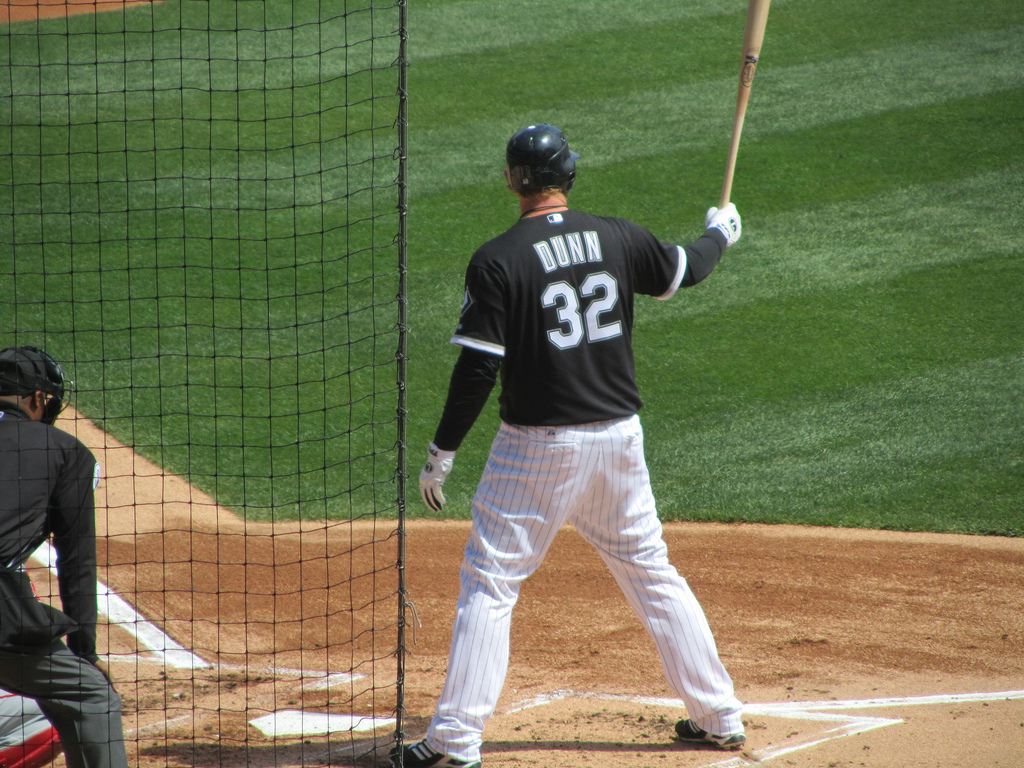
Dunn Ties Opening Day Mark – In Some Powerful Company

Adam Dunn of the White Sox tied the major league record for career  Opening Day home runs (eight) as Chicago lost to Texas on April 6.  Dunn moved into some powerful company, as he now shares the record with Hall of Farmer Frank Robinson and future Hall of Famer Ken Griffey, Jr.   Dunn seemed an unlikely record setter, coming off a 2011 season in which he hit .159 with 11 homers and struck out in more than 40% of his at bats  (177 strikeouts in 415 at bats in 122 games). 

Dunn’s fast start follows a strong spring, in which his off season regimen seemed to pay off – and which may see the imposing (6’6”, 275) slugger begin to pay dividends on his four-year, $56 million contract with the Chisox.  There is good reason to believe in the comeback, as Dunn entered the 2012 season with 365 career roundtrippers and five seasons of forty or more home runs.

So, Dunn is clearly not the most unlikely Opening Day record-setting slugger.  That honor goes to Karl “Tuffy” Rhodes, who shares the single game HR record for Opening Day with three dingers for the Cubs on day-one in 1994. Rhodes hit 13 home runs in his  six-year career and he hit a season high of 8 HRs in 1994.

Looking deeper into Dunn’s record, he has gone deep in six Opening Day games – and shares the record (at two) for multiple home run openers.  Robinson and Griffey each homered in eight openers to earn their share of the record.

Let’s look at some of the Opening Day record holders.


Three HRs in one opener:

George Bell, Toronto Blue Jays, 1988 … Career HRs – 265; Single season high – 47 HRs (24 in 1988).

 Karl Rhodes, Chicago Cubs, 1994 … Career HRs – 13; Single season high – 8 HRs (8 in 1994).

 Dmitri Young, Detroit Tigers, 2005 … Career HRs – 171; Single season high – 29 (21 in 2005).


Multiple Home Runs (2 HRs in each instance) in a season opener more than once:

Eddie Mathews, Milwaukee Braves, 1954, 1958 … Career HRs – 512; Season high – 47.

 Joe Torre, Milwaukee Braves, 1965; Atlanta Braves, 1966 … Career HRs – 252; Season high – 36.

 Juan Gonzalez, Texas Rangers, 1993; Cleveland Indians, 2001 … Career HRs – 434; Season high – 46.

Raul Mondesi, LA Dodgers, 1995, 1999 … Career HRs – 271; Season high – 33.

Adam Dunn, Cincinnatti Reds, 2005, 2007 … Career HRs – 364 (entering 2012 season); Season high – 46.

 Xavier Nady, San Diego Padres, 2005; Pittsburgh Pirates, 2008 … Career HR – 97 (entering 2012 season); Season high – 25.

Albert Pujols, St. Louis Cardinals, 2006, 2010 … Career HRs – 445 (entering 2012 season); Season high – 47.

BBRT Rant: Second Opener Kinda Like the First

One game Cardinals – Marlins Series!  WTH (What the heck?)

In BBRT’s March 30th post, I ranted about how officially opening the MLB season in Japan, only to have the teams (A’s / Mariners) come home and restart thier spring training schedule made no sense.   Yesterday, MLB opened its truly “home” season, with a one-game series between the Cardinals and new-look Marlins.  Yes, the Marlins have a new ballpark to show off, but why not a three-game series?  Maybe this is what they mean by “Moneyball.”

Happy Opening Day!!!

Baseball RoundTable’s “Happy Opening Day” gift to all our fans.  For those who love baseball, this may be as funny as it gets.  Enjoy!!!

Jamie Moyer No. 2 Starter for Rockies – BBRT Celebrates

Jaime Moyer, at age 49, has earned the number-two slot in the Colorado Rockies’ starting   rotation.  BBRT sees this as a cause for celebration for all AARP-sters.  (See BBRT post of March 27 under Rants and Raves or News for more info on Moyer, his stuff and his career.)

Think about it!  On July 16, 1986, Moyer made his debut and earned his first ML victory, as Moyer’s Cubs beat the Steve Carlton and the Phillies 7-5 in Chicago.  Yes, that’s the same Steve Carlton who has been in the Baseball Hall of Fame for 18 years.  Moyer’s line:  6.1 innings pitched, 8 hits, 4 earned runs, 3 walks and 2 Ks.  Oh, and in 1986, gas was 93 cents a gallon and the Mets were baseball’s World Champions.

Moyer, who went 2-0 with a 2.77 era in four spring training appearances, is slated to start April 7 against the Astros (with one more spring tune-up).  If he wins, he’ll become the oldest pitcher to earn a ML victory.  BBRT is hoping he breaks the record many times over in 2012.

BBRT Rant: 2012 Opener Misses the Mark

BBRT Rant:  Season opener in Japan – thought good, execution less so.


Okay, let me start out by admitting I am “old school” when it comes to the opening of the MLB season.  I recall fondly the days when there were two leagues of 8 teams and, year after year, opening day featured two games – the NL in Cincinnati (honoring the first professional team) and the AL in Washington (honoring the national past time in the nation’s Capitol).   Day two then featured a full slate of games, anticipation was served, and the season was off and running.


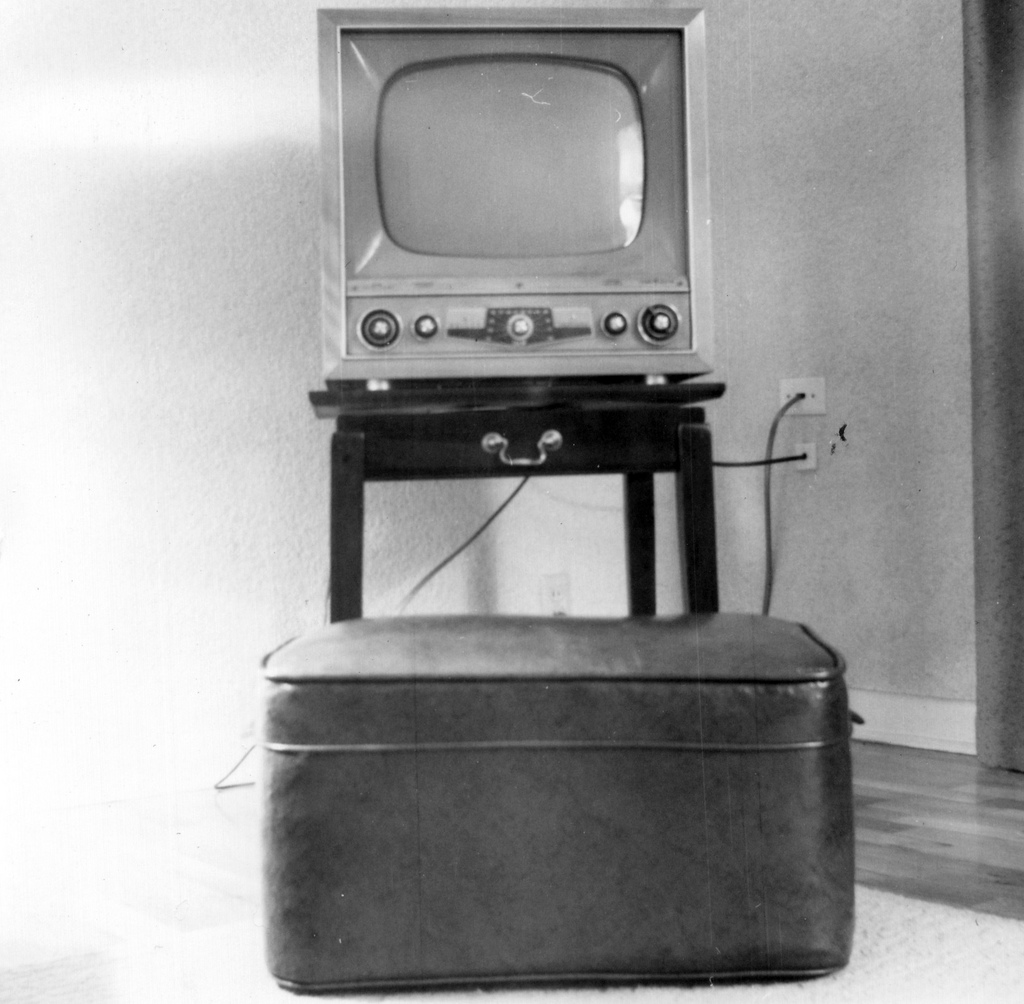
Baseball Was Beautiful in Black and White

We’ve come a long way since thedays of 16 teams, the black and white “Game of the Week” on our big box, small screen televisions and the radio as our primary source of live major league coverage.  And, I appreciate the progress.   I can now get a baseball “fix,” live and in color, every day of the week – usually with multiple choices.  There is baseball news (and views) year-round and the internet makes the exchange of info and insight on our national past time both immediate and (usually) interesting.   More fans, in more cities, have access to major league baseball.  There are more players from more places – and we know more about them – than ever.

Still, somehow, on opening day, I yearn for tradition.  This year, as baseball continues to become increasingly international, MLB chose to have the Seattle Mariners and Oakland As open the regular season March 28 in Tokyo.  Turns out, there was nothing “regular” about it.

First, it was – at its foundation – a good idea: a tribute to Japan, its zealous fans, love of the game and increasing presence in MLB; a logical connection to the Mariners and their ownership; and a great gesture given the continued aftermath of the tsunami devastation.  By all accounts, in Japan, it was a great success.  Large enthusiastic crowds on arrival and at the games (which sold out in 8 hours); Ichiro jerseys everywhere (and four hits for the Japanese star in the opener); a visit to tsunami-ravaged Ishinomaki;  the honoring of a group of true heroes of that disaster; and even the Mariners’ Brendan Ryan’s successful marriage proposal.

The thought was good and, as an exhibition, the games would have been a great success.  But as the MLB’s season opener, the pitch was high and outside.  From a timing perspective, few American fans were up to watch or listen to game coverage (started at 5 a.m. in my time zone).   The games also interrupted (rather than signaled the end of) the exhibition season  –  spring training games continued and even the Mariners and As came back and played additional games that didn’t count.  So, other than some rather weird AL standings that will remain stagnant for a while, it hardly seems the season is underway.

Ultimately, the 2012 MLB season opener seemed like a non-event and I am anticipating the April 5 slate of games, my true season opener(s).

Triple Crown = MVP? Not always.

The Triple Crown (Batting Avg. – HRs – RBI) … Does it spell “R-E-S-P-E-C-T?”  Not if respect is spelled MVP.


Matt Kemp came close in 2011, but MLB has had only 15 Triple Crown winners
– from Paul Hines of Providence in 1878 to Carl Yastrzemski of the Red Sox in 1967.   There have been nine Triple Crown winners since the Baseball Writers Association began voting on the Most Valuable Player award in 1931 and only five of those nine were honored as MVPs.   Let’s take a look at those who didn’t get votes, in order of the “level of injustice.”


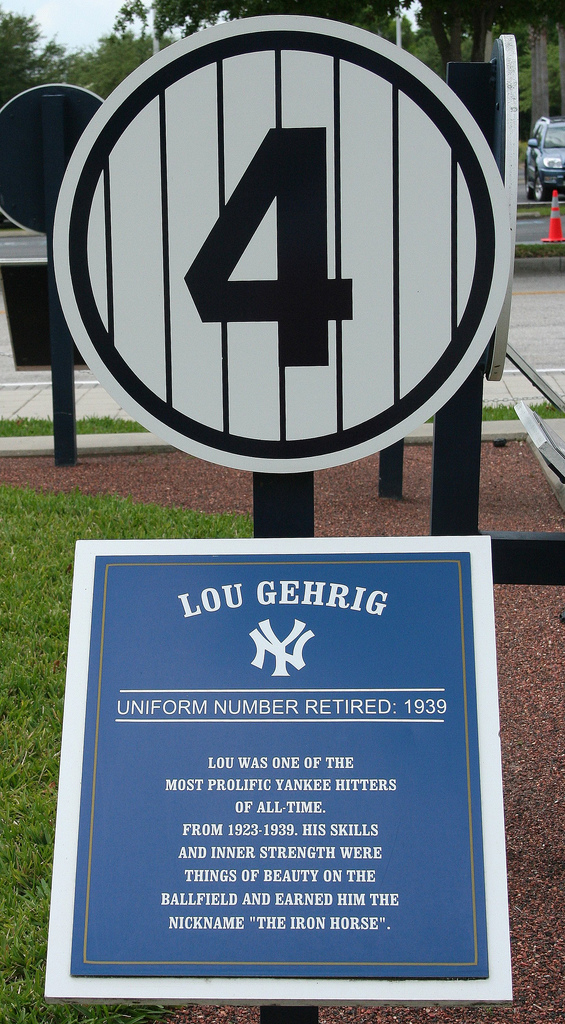
1.  Lou Gehrig, Yankees, 1934.

Gehrig’s .363 – 49 – 165 not only topped the American league in Average, HRs, and RBI, he finished ahead of the NL leaders in all three categories as well.  (Gehrig is one of only five players to win the “Major League Triple Crown.”)   Gehrig also led both leagues in on base percentage, slugging percentage and total bases.  But that’s not what earns him a five-star injustice rating.  Despite capturing the Triple Crown, Gehrig finished a distant FIFTH in the AL MVP voting; behind three members of the pennant-winning Tigers (the Yankees finished, 94-60, seven games out.)

The MVP winner, Detroit catcher Mickey Cochrane, ran up a .320 – 2 – 76 total and did not lead the league in a single offensive category.   Others finishing ahead of Gehrig were Detroit second basemen Charlie Gehringer (at .356 – 11 – 127 and the AL leader in runs and hits,  also probably more deserving than Cochrane); Yankee hurler  Lefty Gomez (26-5, 2.33 era, who led the league in wins, ERA, complete games, shutouts, and innings pitched); and Detroit pitcher Schoolboy Rowe (24.-8, 345).

2.  Ted Williams’ 1942 season earns him second place on the lack-of-respect list among Triple Crown winners. 

In 1942, the Splendid Splinter led both leagues in all three Triple Crown categories (.356 – 36 -137), as well as in runs scored, on base percentage, slugging percentage, total bases and bases on balls.

This dominance earned him a second place finish in the MVP balloting (Boston also finished second, to the Yankees, at 93-59, nine games behind).  The MVP winner?  Yankee second baseman Joe Gordon (.322 – 18 – 103), who led the league in two offensive categories, strikeouts and grounding into double plays.  Williams, like Gehrig, earns a five-star injustice rating.

3.  Ted Williams gets a three-star injustice rating for his 1947 Triple Crown year.

This is not so much because of a lack of respect for his dominance, but because it was the second time he earned the Triple Crown, but was denied the MVP.  In 1947, Williams led the AL with .343 – 32 -114, and also led in runs scored, bases on balls, on base percentage and total bases.   The MVP winner was Yankees’ centerfielder Joe DiMaggio (the Yankees won the pennant, Boston finished third, fourteen games out.)  DiMaggio’s season totals were .315-20-97 and he finished in MLB’s top five in runs, runs batted in, hits, total bases, doubles and triples – trailing Williams, however, in all but triples.  Still, not a major “disrespect,” unless you pile it on top of the 1942 voting.

4.  Chuck Klien is the fourth Triple Crown winner to be denied an MVP award.

Klien, however, was probably not surprised.  First, Triple Crowns were a bit commonplace that year – 1933 – the only season in which both leagues boasted a Triple Crown winner.  They were even from the same city, Jimmy Foxx of the Philadelphia Athletics and Chuck Klien of the Phillies.  Foxx got his MVP, despite the As third-place finish (79-72, 19.5 games behind), but Klien was hurt by the Phillies 60-92 record and seventh place finish (31 games behind the NY Giants).  Klien finished at .368 – 28 – 120, also leading the league in hits, doubles, on base percentage, slugging percentage and total bases.  The MVP went to Carl Hubbell of the pennant-winning Giants, who pitched his way to a 23-12 record and a 1.66 ERA – leading the NL in wins, ERA, shutouts and innings pitched.

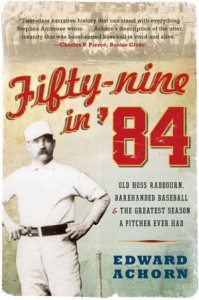
BBRT Review: Fifty-nine in ’84: Old Hoss Radbourn, barehanded baseball & the greatest season a pitcher ever had

Fifty-nine in ’84, by Edward Achorn,  Smithsonian Books (2010)

“Fifty-nine in 84” is story of grit, passion and accomplishment which – if it wasn’t  really true – would be truly unbelievable.  It’s the story of one of the greatest professional baseball players of the 19th century and a story of the (often sordid) conditions of the times.   It’s a story for baseball fans – for historians – and for those who just appreciate a well-written tale of adversity and achievement.

The centerpiece of Fifty-nine in 84 is the 1884 season of the National League pennant-winning Providence Grays  and star pitcher Charles Old Hoss Radbourn – who that season won a  record 59 games (against 12 losses), tossed 678 2/3 innings, struck out 441 and compiled a 1.38 era.  Need more proof of author Edward Achorn’s assertion that this was the “greatest season a pitcher ever had”?   Radbourn started 73 games and completed 73 games – and, as his plaque in the Baseball Hall of Fame notes, Old Hoss pitched the last 27 games of the season, winning 26.   For his 11-year big league career, Radbourn won 309 games, against 195 losses (with a 2.67 era), amassed more than 4,500 innings pitched, completed 489 of 503 starts, and struck out 1,830 batters.

But this book is not about statistical achievements, it’s about American life in the late 1800s – on and off the field.  It’s about a time when both baseball and life were hard fought, dirty and often dangerous undertakings.  It’s about the pain and pleasure of winning at a game that took a tremendous physical toll on its participants.  It’s also about passion, Radbourn’s passion for the game, for victory (at any cost), for recognition, and for Carrie Stanhorpe (who ran a very suspect “boarding house”).   And, it’s about pride, envy, anger, stubbornness, commitment and all the other emotions that go into an “epic” tale.   Ultimately, it provides a vivid picture of American society and culture – and the national pastime  –  in the 19th century.

Again, all of this centers primarily on the 1884 National League season of the Providence Grays, a season in which the Grays’ rotation was initially made up of the proven veteran Radbourn and a hot-shot, up-and-coming young hurler (Charlie Sweeney) who brought out the worst in Radbourn when they were team mates and the best in Radbourn later in the season (after Sweeney was expelled from the team due to a combination of insubordination, alcohol and womanizing).   In a less than altruistic move, Radbourn offers to essentially become a one-man rotation.  In return, Radbourn wants his and Sweeney’s salary and his unconditional release from his contract if he pitches the then second-place Grays to the pennant.   Motivated by arrogance, ambition and his desire to impress Carrie Stanhorpe, he does just that.

In a late-season run, Radbourn started  40 of the final 43 games (winning 36) – often pitching with such pain (primarily with alcohol as a pain reliever) that he needed help just putting on his shirt in the morning.   He followed that up by pitching Providence to victory in what many consider the first World Series – defeating the American Association’s New York Metropolitans three games to none, with (true to form) Radbourn pitching all three games, winning 6-0, 3-1, and 12-2 on consecutive days.  Ultimately, Radbourn retired at age 36, had an equally tumultuous life outside of baseball (dying in his forties of syphilis) and was elected to the Baseball Hall of Fame in 1938.

BBRT recommends Fifty-nine in 84 as a compelling true story about baseball, 19th century society and culture, love and life.