Cain’s Perfect Game – Not So Surprising

So, here we are talking about a no-hitter AGAIN – see BBRT posts of May 3 and June 9 for more on baseball’s no-hit gems.  This time it’s the Giants’ Matt Cain and last night’s perfect game, a 10-0, 14-strikeout win over the Astros.

Perfect games are always surprising, although this one is less so than some others.  It was, after all, the fifth no-hitter and second perfect game already this season.  Second, Matt Cain was a pretty good candidate to toss a “perfecto” or at least a no-hitter.  Cain, who has a truly “nasty” four-pitch repertoire (four-seam fastball, curveball, slider and changeup – complemented by a less frequently used two-seamer) has taken no-hitters into the seventh inning five times in his career.  He has a 2.76 ERA since 2009, and has been touted for having “ace” stuff since he came to the major leagues in 2005.  He was also coming into last night’s game with a victory in each of his past six starts.

A long-time victim of poor run support – a 77-75 career record despite a 3.28 ERA, and 31 losses when he had given up three or fewer runs –  Cain had this moment in the sun (or, in this case, under the lights) coming.  BBRT says congrats Matt Cain, we knew you had it in you.

Now, if you want to talk about surprising pitching performances, how about Mets’ knuckleballer R.A. Dickey’s one-hit (of the infield variety), no-walk,  12-strikeout. complete game performance of last night.  This  makes Dickey – who came into the season with a 41-50 career record and an ERA north of 4.00 – 10-1, 2.20 ERA on the year, with 19 walks and 90 strikeouts in 90 innings.   His ten wins tie Dickey for the league lead with another surprising hurler – Lance Lynn, who last night went to 10-2 (2.42 ERA) for the Cardinals, striking out 12 in 7.1 innings of 3-hit, shutout ball.   On the season, Lynn has walked 27 and struck out 86 in 81.2 innings pitched.  The 25-year-old Lynn, who was slated to spend the year in the Redbird’s bullpen, was called into starting service due to injuries to Carpenter and Wainwright, and he’s made the most of it.

Matt Cain’s perfect fame – mildly surprising.  Dickey and Lynn leading the NL in victories, even more so.

R.A. Dickey’s 10 wins for the Mets. Now there’s a surprising performance.

A-Rod Grand Slam – Historic & Momentous

A-Rod continues his "trot" to the Hall of Fame.

On June 12, 2012, Alex Rodriguez continued his march to the Hall of Fame by stroking his 23rd “Grand Slam” home run.  It was an historic and momentous blast.  Historic because it tied A-Rod with Lou Gehrig for the all-time lead in career grand Slams.  Momentous because it tied a game the Yankees were trailing (4-0 to the Braves in the eighth) and led to a 6-4 win that kept the Yankees in sole possession of first place (one game ahead of the Orioles).

A-Rod acknowledged history and momentum.  “Lou Gehrig is not only one of the all-time greats, but he’s one of ours,” A-Rod said after the game.  “He was a Yankee.”  Noting the Yankees’ building momentum, he said, “I really felt it was a swing for the team.  I feel like everybody needed that hit and we’ve all been waiting for it.”

BBRT says congrats to A-Rod, and would like to share some Grand Slam trivia with it blog followers.

While A-Rod and Lou Gehrig top the career Grand Slam list with 23, they are joined in the top five positions (six actually, a tie for fifth) by Manny Ramirez (21), Eddie Murray (19), Willie McCovey (18 and the NL record holder), and Robin Ventura (18).

Another Yankee, Don Mattingly, set the current single season record in 1987 with six Grand Slams (tied by Travis Hafner of the Indians in 2006).  Notably, Mattingly’s six Grand Slams were the only base-loaded homers of his 14-year career.

Sticking with the Yankees, they are the only ML team to hit 3 grand slams in one game – coming on August 25, 2011 against the Oakland As at Yankee Stadium (Robinson Cano, 5th inning; Russell Martin-6th; Curtis Granderson-8th).  The Yankees, who trailed 7-1 after three innings, won the game 22-9.

The NL record for Grand Slams in a season is 5, held by Mr. Cub, Ernie Banks and former Cardinal Albert Pujols.

Four players have hit a Grand Slam in their very first major league at bat:  Bill Duggleby (Philadelphia, NL, 1898); Jeremy Hermida (Florida, 2005); Kevin Kouzmanoff (Cleveland, 2006); and Daniel Nava (Boston, 2010). Duggleby, Kouzmanoff and Nava all hit their Slams on the first pitch they ever saw in the majors.

In 1961, when the Orioles’ Jim Gentile hit a then record-tying 5 Grand Slams in a season,  Baltimore’s Chuck Estrada was the Orioles’ starting pitcher each time Gentile struck a four-run blow – winning all four games (On May 9, Gentile hit two Grand Slams in a game against the Twins at Minnesota).

Only 13 players have hit two grand slams in a game – and only once did the player accomplish this feat in his home park.  Nomar Garciaparra hit two Slams for the Red Sox at Fenway in a May 10, 1999, win over the Mariners.

Bill Mueller of the Red Sox is the only switch hitter to hit Grand Slams from both sides of the plate in the same game –  in the 7th and 8th innings of a 14-7 Red Sox win at Texas on July 29, 2003.

–  Atlanta Braves pitcher  Tony Cloninger  was the first National Leaguer to hit two Grand Slams in one game – a July 3, 1966,  17-3 complete game victory over the Giants at Candlestick.  He remains the only pitcher with a two-GS game.

Cardinals third baseman Fernando Tatis is the only player to hit two Grand Slams in the same inning – an 11-run third inning as the Cards beat the Dodgers 12-5 on April 23, 1999.   Dodgers’ starting pitcher Chan Ho Park gave up both grand slams (Why was he still in there?) becoming the answer to the question, Who is the only pitcher to give up two grand slams to the same batter in one inning?

Park’s inning went like this:

Single; Hit By Pitch; Single; Tatis Grand Slam; Ground Out; Home Run;  Walk; Walk; Safe on Fielder’s Choice (attempted sacrifice); Safe on Error; Single; Fly Out; Tatis’ Second Grand Slam; Call to Bull Pen; Pop Out.

Grand Slams – a grand part of the grand old game.

Combined No-Hitters – Historic Tidbits

As BBRT considers the concept of a six-pitcher no-hitter, it seems to be more of a statement of the hitters’ collective futility than of pitching quality.

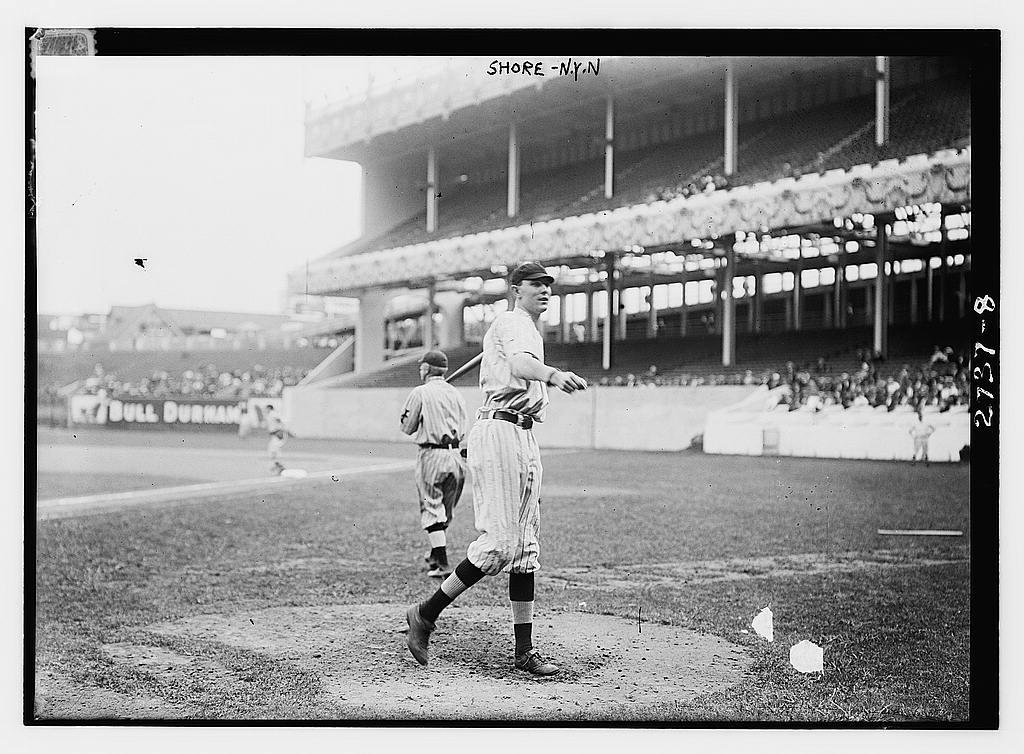
Ernie Shore - while with the Red Sox - finished what the "Babe" started - MLB's first combined no-hitter.

Friday (June 8, 2012), the Seattle Mariners, tied a major league record by using six pitchers to complete a 1-0 no-hit winover the Dodgers in Seattle.  It was the tenth combined no-hitter in major league history, only the second inter-league combined no-hitter, and made Millwood (who left the game after six innings due to a groin injury) one of only three hurlers to start both an individual complete game no-hitter and a multi-pitcher no-hitter.  The others are Kent Mercker and Vida Blue.  As

When BBRT considers the concept of a six-pitcher no-hitter, it seems to be more of a statement of the hitters’ collective futility than of pitching quality.   More than a sustained no-hitter, the six-hurler no-hitter is a collection of good innings.  Still, combined no-hitters do make for interesting score cards and bits of baseball history.  Let’s take a look at past combined no-hitters and what made them unique.

The first-ever combined no-hitter may have been the strangest. It came on June 23, 1917, when Red Sox ace lefty Babe Ruth (Ruth had won 23 games in 1916 and was on his way to a 24-win season in 1917) started on the mound at Fenway, facing the Washington Senators.  Ruth walked the first batter of the game – Senators’ second baseman Ray Morgan – on four pitches.  The hot-headed Ruth quickly earned an ejection for arguing with the home plate umpire, and the Red Sox brought in ErnieShore(on just two-days rest).  Morgan was quickly thrown out stealing and Shore went on to retire the next 26 batters in order (two strikeouts) for a combined no-hitter that was close to a perfect game.

The next combined no-hitter didn’t occur until 50 years later – on April 30, 1967 – when Baltimore Orioles Steve Barber and Stu Miller combined to no-hit the Tigers in Baltimore.  This “gem” is most noted for the fact that it is the only combined no-hitter in which the team that was no-hit managed to get the win.  Barber went 8.2 innings, but walked ten (striking out three) in the 2-1 loss. Despite the walks, it looked pretty good for Barber going into the top of the ninth.  The Orioles had scored in the eighth to take a 1-0 lead.  The ninth went like this.  Barber walked Tiger first basemen Norm Cash to start the inning (Dick Tracewski ran for Cash); Barber then walked light-hitting shortstop Ray Oyler; Tiger pitcher Earl Wilson bunted the runners to second and third; Willie Horton fouled out pinch hitting for second baseman Dick McCauliffe; Jake Wood was brought in to run for Oyler; a Barber wild pitch with center fielder Mickey Stanley at the plate enabled Tracewski to score, tying the game; then Stanley walked and that was all for Barber.  Stu Miller came on and saw third baseman Don Wert safe on an error, with Wood scoring.  Then, finally, right fielder Al Kaline made the third out of the inning.  The Orioles went 1-2-3 in the bottom of the night and the no-hitter was completed – and lost.  The only other losing no hitter came on April 23, 1964, when Houston Colt .45s hurler Ken Johnson was beaten 1-0 by the Reds with an unearned ninth-inning run.  There have also been two eight-inning no-hitter losses (the home team did not bat in the bottom of the ninth), but MLB does not recognize these as official no- hitters.

September 28, 1975, saw the Oakland As’ Vida Blue, Glenn Abbott, Paul Lindblad and Rollie Fingers no-hit the Angels in a 5-0 win in Oakland.  The only tidbit here is that this no-hitter took place on the final day of the regular season – one of only two final day no-hitters (the other being Mike Witt’s 1984 perfect game against the Rangers at Arlington Stadium.)

On July 28, 1976, John “Blue Moon” Odom (pitching for the White Sox) combined with Francisco Barrios to no-hit Odom’s former team, the As. In a 2-1 victory in Oakland, Odom started and went just five innings, walking nine and striking out three. His ninth walk was the lead-off hitter in the sixth inning of a 1-1 tie, which earned Odom an early exit despite the fact that he had not given up a hit.  Barrios tossed the final four innings, giving up 2 walks and striking out two.  (The 11 walks in this game is the most given up in a no-hitter).

On April 11, 1990, Mark Langston started a combined no-hitter for the Angels, playing at home against the Mariners.  The Angels scored in the bottom of the seventh to take a 1-0 lead and Langston, who had thrown 99 pitches in this early-season start, was relieved by Mike Witt, who closed it out with 2 perfect innings (two strikeouts).  Of interest here is that it makes Witt the only hurler to throw a no-hitter as a starter and participate in a no-hitter as a reliever.  (As noted earlier, Witt threw a perfect game for the Angels against the Texas Rangers on September 30, 1984.)

July 13, 1991, the Orioles’ Bob Milacki, Mike Flanagan, Mark Williamson, and Greg Olson no-hit the As 2-0 … notable as one of two combined no-hitters that season.

September 11, 1991, Braves Kent Mercker, Mark Wohlers and Alejandro Pena no-hit the Padres 1-0 in the first National League combined no hitter.

The only extra inning, combined no-hitter came on June 12, 1997 – with the Pittsburgh Pirates downing the Houston Astros 3-0 in ten innings on a walk-off three-run homer by pinch-hitter Mark Smith.  The game was started by Francisco Cordova, who went nine innings with 2 walks and ten strikeouts (121 pitches).  Ricardo Rincon relieved in the tenth, walking one and striking out one.  As you would expect, Cordova’s nine innings are the most pitched by any one hurler in a combined no-no.

On June 11, 2003, Houston Astros’ starter Roy Oswalt aggravated a groin injury in the second inning of what went on to become a combined no-hit, 8-0 victory over the Yankees (at Yankee Stadium). Houston used six pitchers in that game, setting the record tied by the Mariners yesterday.  In addition, it was the first inter-league combined no-hitter.   For more on the Astros’ 2003 feat, see the BBRT May 3, 2012, post on Jered Weaver’ s no-hitter.

And that brings us up to the June 8 Mariners / Dodgers game.

BBRT RANT: The Game Has Changed – Putting the Finish on the Start

Robin Roberts – averaged 300+ innings pitched for a decade.

Will any of today’s – or tomorrow’s – generation of major league pitchers garner 300 wins or complete 150 games?   Toss 20 complete games or pitch 300 innings in a single season?  Given the way the game is played today, any or all seem pretty unlikely.  It is, in many ways, a whole new ball game for pitchers – and it’s not the pitchers’ fault.  (Okay, it’s not that new … a lot of the change occurred  during my lifetime.)

Let’s look at some of the factors.

Five-man Rotations

As we moved into the 1970s, teams started moving from four-man to five-man pitching rotations.  Fewer starts, fewer opportunities for wins, complete games, innings pitched.   (Notably, swifter travel  – trains not planes – has contributed somewhat to this.  With more travel time meaning more days between games, fewer pitchers were needed .   The change, however, goes deeper than five-man rotations and time between starts.  Read on.)

The “Quality” Start

In today’s game, 6 innings and 3 or fewer runs is a quality start.   Starting pitchers, as recently as the 1980s, would have considered six innings pitched a day off.  Pitchers are no longer  expected to finish what they start.

The Advent of the Save

Years ago, relief pitchers were mostly starters past their prime brought in to “mop up.”   In fact, the “save” was not even established as a statistic until 1969 (saves were awarded retroactively for seasons prior to 1969).

The Rise of Relief Specialists

Today, not only does the manager look to the closer (primarily for the ninth inning), the bullpen also features key “set up” men, earmarked for the seventh or eighth inning.  And, not only do most teams have their seventh- and eighth-inning specialists, we also have people on the bench ready for long- and middle-relief.  No wonder managers are so quick with the hook.  They’ve got to keep that multi-million dollar bullpen happy.

The Dreaded Pitch Count

And, of course, there is the “pitch count,” considering the financial investment teams have in pitchers, the thinness of pitching staffs (we do, after all, now have thirty teams), pitchers are treated with great care, often held to pitch counts in the neighborhood of 100 – no matter how well they are throwing.

So, how significantly has all this changed the game?  Here’s some statistical evidence.

The Vanishing Complete Game

It wasn’t until 1955 that we saw a league leader in complete games with less than 20 finished starts (Whitey Ford, Yankees, 18 CGs).  And, 1980 was the first year that a league leader notched less than 14 complete games.  The last time, we saw 20 complete games in a season?  Fernando Valenzuela in 1986.  James Shields, in 2011, became the first pitcher to reach double-digits (11) in complete games in a dozen years – and earned a reputation as an iron man.

Roy Halladay is considered the current king of the complete game having led the AL in complete games in 2003, 2005, 2007, 2008, and 2009 – and led the NL in 2010 and 2011.  He did all of this without ever completing 10 games in a season In his career (as this blog is written), Halladay has started 363 games and completed 66 (18%).  By comparison, in 1975, the average percentage of complete games among all MLB starters (the good, bad and ugly) was 27%.   The 1975 CG leaders, Catfish Hunter and Andy Messersmith, ended up with career percentages of games finished to games started of 38% and 33%, respectively.  If we look at MLB complete game stats over time, we can be pretty sure we’ll never see numbers like those again.

– In 1900, 82.3% of games started were complete games;

– 1925 – 49.2%

– 1950 – 40.3%

–  1975 – 27.2%

–  2000 – 4.8%

– 2011 – 3.6%

We’ll also never see a pitching machine like Jack Taylor.  Between 1901 and 1906 (Cubs and Cardinals), Taylor threw a record 187 consecutive complete games; or Will White (Cincinnati), who in 1879 completed a single-season record 75 complete games (in 75 starts).  White went 43-31 that year, with a 1.99 ERA and 680 innings pitched.  For his career, White completed 394 of 401 starts.  Closer to today’s game, in 1968, Don Drysdale set a record by tossing six consecutive complete game shutouts

The Dwindling of Innings Pitched

Innings pitched?  Think about this.  From 1950-59, Robin Roberts AVERAGED 301 innings pitched per season.  And, if you pick any decade from 1900 through 1979, the average innings pitched for the league leaders was over or near 300.  However, innings pitched have dropped significantly since Steve Carlton became the most recent pitcher to hurl 300 innings in (1980).  For the last decade, the average for league leaders has been shy of 250.   (As you might expect, Will White of the 75 complete games single-season record also holds the single-season innings pitched record at 680.)

Here’s the chart of average innings pitched by league leaders (by decade) with major strike-shortened seasons deleted:

Decade                 Average Innings Pitched by League Leaders

1909-09                                                350

1910-19                                                348

1920-29                                                318

1930-39                                                304

1940-49                                                305

1950-59                                                294

1960-69                                                303

1970-79                                                327

1980-89                                                279

1990-99                                                261

2000-09                                                244

2010-11                                                247

Pitch Counts

You’ll also never see a game line-score like this one again.

 May 1, 1920

Brooklyn              000 010 000 000 000 000 000 000 00           1   9   2

Boston                  000 001 000 000 000 000 000 000 00           1 15  2

What’s so special about this line score?  Starting pitchers Leon Cadore of Brooklyn and Joe Oeschger of Boston (NL) both went the distance –  with the game called due to darkness after 26 innings.  Both starters threw more than 300 pitches (analysts estimate Cardore at 345 and Oeschger at 319). Oh, and here’s another factoid, the time of the 26-inning contest was only 3:50 minutes.

And, with that look at another way the game has changed, I’ll end this rant and just say,  I miss the days when hurlers were expected to finish what they started and when most games did NOT result in a parade of relief specialists.  But, I don’t blame the pitchers – the game has just changed.

Twins Highlight – Pregame Reunion

It was a disheartening 4-3 loss for the Twins on Saturday (May 27th), as Miguel Cabrera hit a two-run homer off Twins’ closer Matt Capps in the top of the ninth.  In the grander “scheme of things,” it was a heartening day for the sell-out crowd – thanks to the Twins, and Minnesota National Guard Master Sergeant Robert Buresh and his family.

The true ‘highlight” of the day began with the Twins’ pregame Kids Day race, in which two youngsters race from home plate to first base, where they don oversized (for them) Twins jerseys; then on to second base, where they struggle into adult-side baseball pants; then to third base for full-sized batting helmets and shoes; and. Finally, on to home plate for the “win.”  Always a fun- and smile-filled pre-game distraction, Saturdays spin around the bases turned to broad grins and even tears (in a good way).

The contestants were sisters Annie (11-years-old) and Alex (8-years-old) Buresh.  The crowd of 38,710 was treated to plenty of cute as the two girls ran, walked and stumbled their way around the bases in the way-too-big baseball apparel.  There was an audible “Aww!” as older sister Annie, rather than go for the win, stopped to help her younger sibling with the troublesome baseball pants at second base.

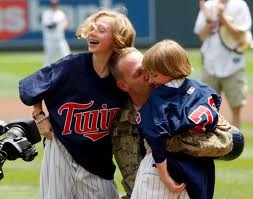
Surpurise Reunion. Photo: Sports@yahoo.com

Then came the best moment of the day.  As the two girls rounded the makeshift third base for the dash to home plate, their dad – Master Sergeant Robert Buresh, just back from a near five-month deployment to Afghanistan, stepped out (in his fatigue uniform) from behind Twins’ mascot T.C. the Bear (who was manning the finish line).  At the same time, the stadium announcer and scoreboard let us all in on what was taking place. More than a few of the crowd “misted up” during the touching on-field family reunion.  After the family shared grins, tears, hugs, kisses, teddy bears and flowers (for the two girls and Buresh’s wife Julie who kept the “secret” until Saturday), Twins players took time to greet the family with hugs and handshakes.

In interviews later, the still emotional Master Sergeant Buresh thanked the Twins and said of the moment, “As a dad, I can’t ask for anything more.  That’s just fantastic.  I can’t tell you how grateful I am.”

He added that once he found out he was going to be at the game (the Twins were supplying free tickets to members of his squadron and their families), he wanted his first meal back in the States to be a hot dog and a beer – with his family.  He, and his family, got much, much more.  And, so did the fans.  You know, every game has its highlights.  That’s what BBRT loves about baseball.  On May 27, 2012, at Target Field, that highlight came even before the first pitch.   Thank goodness I was lucky enough to be there.  Also, thank you Twins.  Thank you Master Sergeant Buresh.  And, on this Memorial Day, thank you to all veterans, active military personnel and reserves

Hamilton’s Streak – Memories of “Hondo”

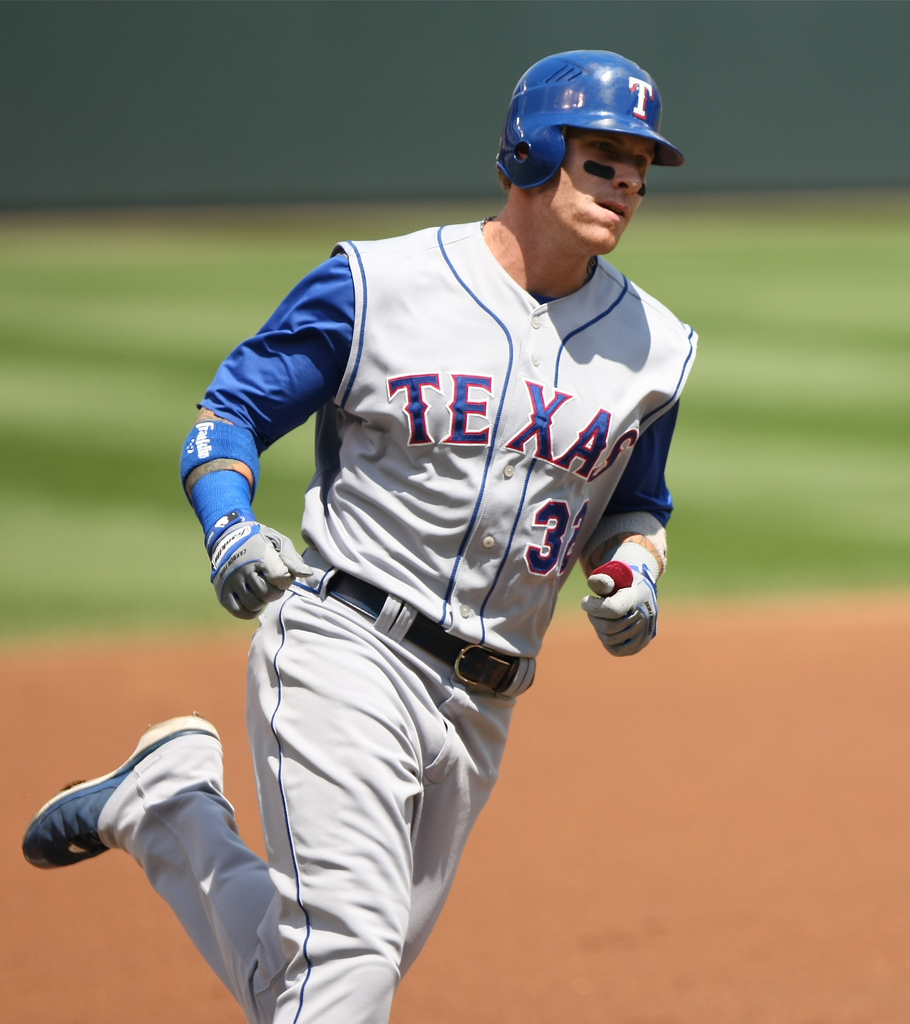
Josh Hamilton trotting home - a familiar site in Texas ... and parks north.

Josh Hamilton’s recent one-week home run binge – 9 homers in seven days, brought back memories of Frank “Hondo” Howard, who holds the record for homers in a week with 10.  Not to take anything away from Hamilton’s dramatic performance, but Hondo’s run may have been even more spectacular.  It came in 1968 – known as the “Year of the Pitcher” for the lack of offensive achievement.   It also was achieved in one less game, primarily on the road (only one home game) and with considerable more travel (Howard’s week included games Washington D.C., Boston, Cleveland and Detroit).

Let’s look at these two momentous long-ball achievements.

Hamilton’s week stretched from May 7-13 (7 games, one doubleheader) and included 14 hits in 30 at bats (.467), 9 HRs, 10 Runs, 18 RBIs, 4 walks and 11 strikeouts.  Hamilton’s total included six two-run homers, and three solo shots.  He homered in 5 of the 7 games, including May 8’s record-tying four-homer performance.  His victims included:  Jason Berken; Jake Arrieta (2); Zach Philips; Darren O’Day; Tommy Hunter; Jerome Williams (2); and C.J. Wilson.

The Ranger slugger’s run included four road games (at Baltimore) and three at home (vs. the Angels) – with the Rangers winning four of six.  In the streak, the Rangers scored a total of 61 runs, with Hamilton driving in 29.5% of that total.

Frank Howard’s 1968 streak also came in May, from the 12th through the 18th.  His week included only six games and he collected 13 hits in 20 at bats (.650); 10 HRs (the one-week record); 10 runs; 17 RBIs; just one walk; and four strikeouts.  He homered in all six games, with 4 solo homers, three 2-run dingers and one 3-run shot.  His victims included:  Fred Lasher;  Mickey Lolich (3); Lee Stange; Ray Culp; Jose Santiago; Sam McDowell (2); and Joe Sparma.

The streak included just one home game (Tigers) and five on the road at Boston (2), Cleveland (1) and Detroit (2).  The Senators went 3-3 and scored 29 runs in the six games (Howard drove in 58.5% of the Senators runs in the streak).


Hamilton’s 2012 streak

Date                      Hits-At Bats        HR             R             RBI         BB           K

May 7                       3-4                    1              1              2              2            2

May 8                       5-5                    4              4              8              0            0

May 10 (1)              1-4                       0              0              0              0            2

May 10 (2)              1-4                       1              1              2              1            2

May 11                    3-4                       2              3              2              1            0

May 12                    1-4                       1              1              1              0            3

May 13                    2-5                       0              0              3              0            2


Howard’s 1968 streak

Date                      Hits-At Bats        HR              R             RBI         BB             K

May 12                   2-4                       2              2              2              0              0

May 13 (off)

May 14                    3-4                       2              2              3              0              0

May 15                    2-4                       1              1              2              0              1

May 16                    2-3                       2              2              4              1              1

May 17                    1-4                       1              1              2              0              1

May 18                    3-5                       2              2              4              0              1

Three-Homer Jump Start – Another 2012 Rarity

J.J. Hardy - Twice the middle man in a three-homer start.

As we move through the 2012 season, rarities abound. A perfect game (one of only 21 in baseball history); a four-homer game (one of just 16 – also making 2012 the only season in which we saw a perfect game AND a four-homer game), and yesterday, for just the fourth time ever, a team started off a game with back-to-back-to-back home runs.

The team was the surprising Orioles, with Ryan Flaherty, J.J. Hardy and Nick Markakis leading off a 6-5 home victory over the Rangers with long balls (number one of the season for Flaherty, number eight for Hardy and number five for Markakis).

Here’s some tidbits about the contests in which a team has started off with three straight dingers.

The first three-homer jump start came on April 13, 1987, as the Padres’ Marvelle Wynn, Tony Gwynn and John Kruk pulled off the feat in a 13-6 home loss to the Giants. The Padres remain the only team to start with three long balls and still lose. They also had the least likely trio to pull of the accomplishment, as Wynn, Gwynn and Kruk (sounds like a law firm to me) totaled only 29 homers for the year. Wynn, in fact, finished the 1987 season with only 2 roundtrippers. It was also the first homer of the 1987 season for all three players.

The second three-homer start came on May 28, 2003, courtesy of the Braves’ Rafael Furcal, Mark DeRosa and Gary Sheffield – in a 15-3 home victory over the Reds. Furcal, DeRosa and Sheffield totaled 60 homers for the year.

The third group of long-ball initiators was made up of the Brewers Rickie Weeks, J.J. Hardy and Ryan Braun. They joined the list on September 9, 2007,  in a 10-5 road win over the Reds – making the Brewers the only team to achieve the feat on the road; the Reds the only team to be victimized by a three-homer start at home, as well as the only team to have the feat accomplished against them twice. (Weeks, Hardy and Braun totaled 76 homers for the year).

Notably, by being part of yesterday’s three-homer Orioles’ start, J.J. Hardy became the only player to twice be part of an event that has occurred only four times in MLB history. (Boy, don’t we keep track of everything in baseball.)

DH Can’t Get a Hit? Send Him to the Mound.

In the category of box scores we like to see, BBRT is adding Sunday’s Baltimore/Boston contest, won by the Orioles 9-6 in 17 innings – a game in which both teams sent their designated hitters to the mound (and each got a decision).

In that game, Baltimore’s designated hitter Chris Davis’ went 0-8 with five strikeouts at the plate, but redeemed himself by taking to the mound (Baltimore’s ninth pitcher of the day) and tossing two scoreless inning (with two hits, a walk and two strikeouts.)  Davis’ sinking fastball, in the high 80s, reportedly touched 91 mph at its fastest.   His strike out victims were Jarrod Saltalamachhia and Adrian Gonzalez – both swinging.

The losing pitcher was also a position player, Boston outfielder Darnell McDonald, who entered the game as a pinch runner (and scored) for DH David Ortiz in the eighth inning, became the DH and finished up as Boston’s ninth pitcher, giving up 3 runs in the top of the 17th.  He position line is interesting: PR-DH-P.   McDonald had a single in four at-bats at DH.

Harper HBP + Harper Steals Home + Hamels HBP + No whining = Good “Old-Fashioned” Hardball

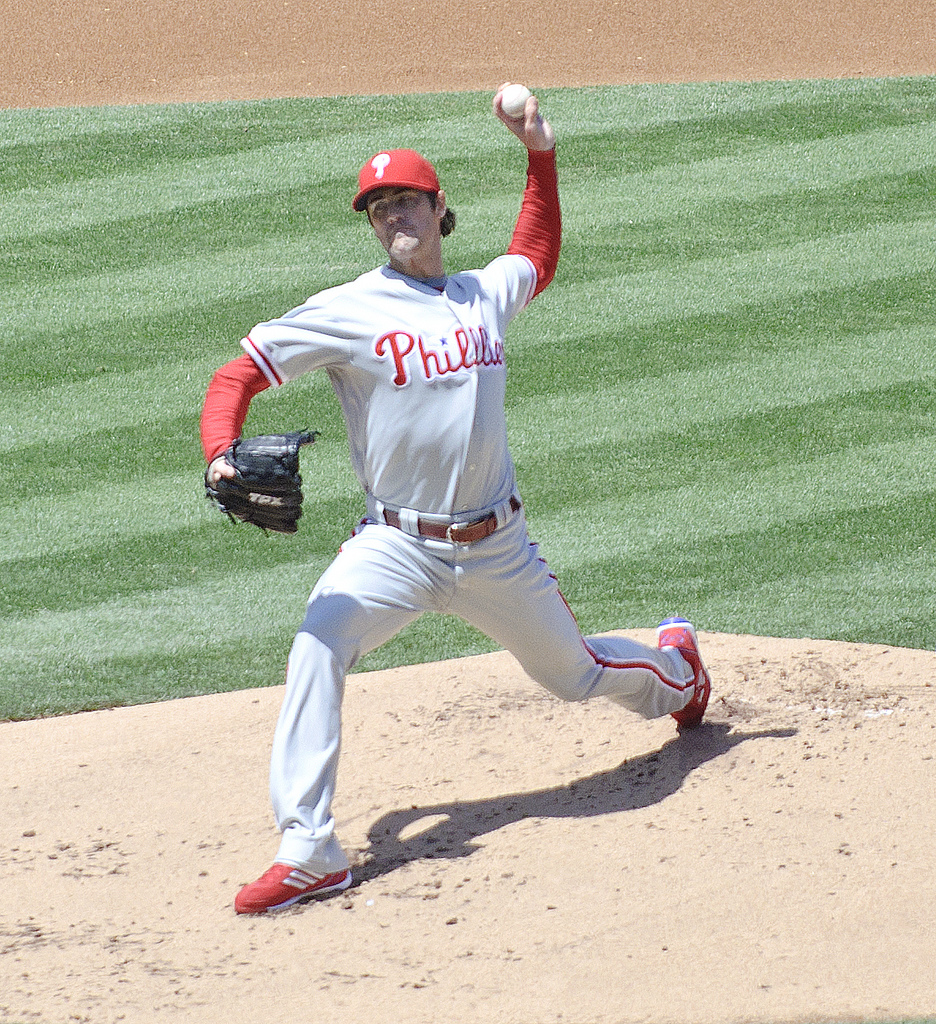
Ouch! Good old-fashioned hardball!

Phillies’ Hurler Cole Hamels gave Nationals’ phenom Bryce Harper an old-style welcome to the big leagues Sunday – drilling the 19-year-old outfielder with a 93-mph fastball (on his first pitch to the rookie) in the bottom of the first inning.  Harper handled it in what BBRT considers true major league fashion.  His didn’t charge the mound, he didn’t glare out at Hamels, he just dropped his bat and took first base.   He then went on to extract his revenge, moving to third on a Jayson Werth single and then taking a big lead and stealing home when Hamel attempted to pick Werth off first.

It all reminded BBRT of when MLB featured “good old-fashioned hardball” – a time when rookies were welcomed to the big leagues by spending time on their backsides in the batter’s box, when a home run by the hitter in front of you meant you were going to hit the dirt, and when a multi-homer game was usually rewarded with a baseball-sized bruise  (and they didn’t wear batting helmets … Yes, I’m that old.)

And, Sunday’s game got even more old school in the third inning when Nationals’ pitcher hit Jordan Zimmerman hit Hamels with a pitch.

After the game, Hamels confirmed his intentions, admitting he meant to hit Harper.  In his own words,  “I was trying to hit him. I’m not going to deny it. It’s something I grew up watching. That’s what happened. I’m just trying to continue the old baseball.”

As Hamels even more succinctly put it, “It’s just, ‘Welcome to the big leagues.”‘  It may cost Hamels (dollars and days off) when the NL reviews his remarks, but BBRT appreciates the honesty and the intent (Hamels indicated he was not trying to injure Harper and he did not go headhunting.)

Still, there will be those who are offended by Hamels action.  Interestingly Harper is not among them. After the game, about the worst thing Harper had to say about Hamels was that he’s a great pitcher – and reports are that he said it with a smile.  Hamels returned the compliment noting that he sees Harper as a player with a lot of talent and energy who’s “going to make a really good name for himself.”

As far as the revenge taken by the Nationals (although Zimmerman denied purposefully hitting Hamels), Hamels was willing to take as good as he gave, saying, “I think they understood the message and they threw it right back. That’s the way, and I respect it.”

Well, BBRT now has two new heroes … Hamels and Harper, who together brought some good old-fashioned hardball to the Phillies 9-3 win.

Mariano Rivera – Pretty Darn Close to Perfect

“As a pitcher, I like to be — I don’t want to say perfect, but I want to know what the ball is going to do.”

Mariano Rivera

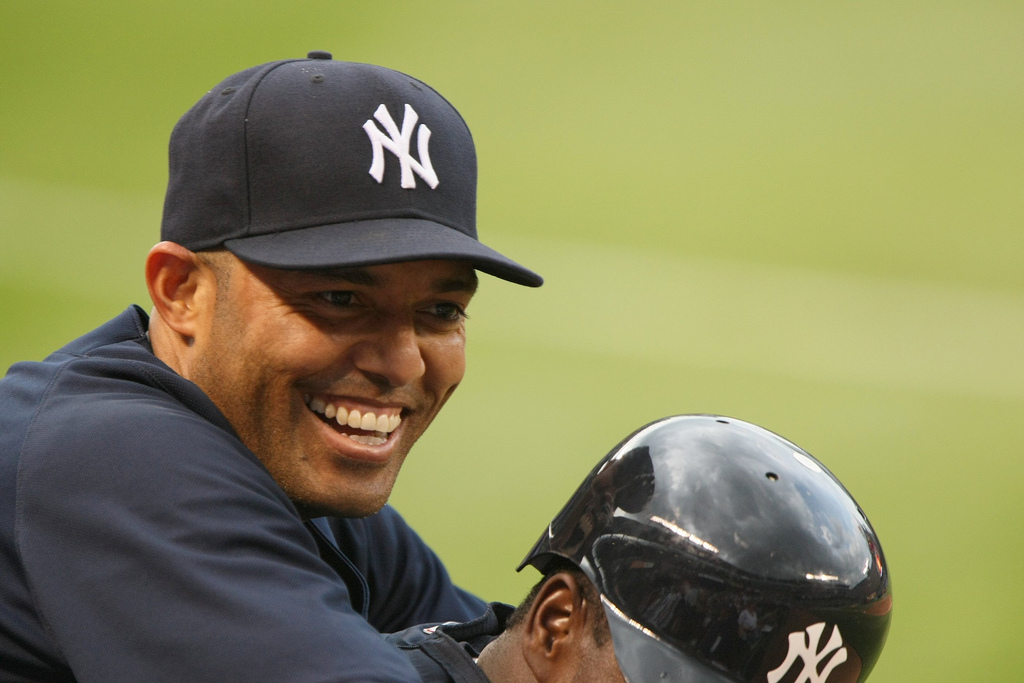
Mariano Rivera ... one of MLB's true heroes ... a great guy, a great player!

When it comes to being perfect at his job, probably nobody in baseball comes closer (no pun intended) than Mariano Rivera, who can throw his primarily one-pitch repertoire (cut fastball) wherever he wants, pretty much whenever he wants.

Batters have long known the cutter was coming at them more than 80 percent of the time and still have not been able to hit it. Not in 1997, at age 27, when Rivera first became a full-time closer for the Yankees and saved 43 games. Not in 2004, at age 34, when he saved a career high 53 games. Not in 2011, at age 41, when he notched 44 saves. And not this season, when he a picked up a win and five saves in 9 appearances (with a 2.16 ERA). And, through all of this stardom, Rivera has been a class act on the field and off – showing respect for the game, the Yankee pinstripes, his team mates, the opposition (even as he was breaking their bats off in their hands) and the fans.

Now as every fan already knows, Mariano Rivera – 12-time all-star closer and career leader in saves – yesterday proved that (despite popular opinion) he is not Superman. Rivera, at age 42, suffered a torn ACL doing something he truly loved, “playing” baseball. He didn’t go down on the mound, but rather while shagging flies in the outfield. Somehow, BBRT feels closer to this future HOFer because of those circumstances. All of us who love the game have spent time shagging flies, taking grounders and just enjoying being out on the ball field. We know Rivera was having fun, and that’s what the game is all about. While few of us have been on the mound with the game on the line, BBRT hopes to see Rivera on the hill closing out games again. If we don’t, however, we’ll see this “as- close-to-perfect” as you can get closer, team mate and gentleman at his Hall of Fame induction.

As we close out this get well card to Rivera, let’s look at just how close to perfection he really is. First, there are the saves: 608, top figure all-time. Then there’s his ERA, at 2.21 thirteenth all-time (among pitchers with at least 1,000 career innings pitched). Moreover, everyone ahead of him on the list retired before 1930. The closest active pitcher is Giants’ starter Tim Lincecum at number 178 (3.05). Rivera is also in the top five (fifth) in strikeouts to walks – a 4.04 – 1 ratio.

For those who like to look a little deeper, how about WHIP (Walks and Hits to Innings Pitched)? Rivera ranks second all-time (again among those with 1,000 or innings) at 0.998. Only two other players have a career WHIP below 1.0 – Ed Walsh (who retired in 1917) and Addie Joss (who left the game in 1910.)

And there’s the post season (30 innings or more pitched), where Rivera is number one in ERA (0.70); number one in saves (42, with second place at 15); number three in WHIP (0.758); and has an 8-1 won-loss record.

Mariano, we wish you well in your recovery. Your presence elevates the game.