2013 NL Preview and Predictions

BBRT has posted its AL predictions (see post of February 28), now let’s shift to the Senior Circuit, where all three division races appear to offer some great  competition.  The East could go to the Nationals or Braves, the Dodgers seem ready to challenge the Giants in the West and the Cardinals may push the Reds in the Central.  Here is BBRT’s take on the NL.

MVP

Matt Kemp puts it all together to lead the Dodgers to the playoffs.  Kemp puts up a .300-30-100 season, and swaps 30 bags.  His main competition comes from Joey Votto of the Reds and a surprising season from the Braves’ Justin Upton.

Cy Young

The Dodgers’ Clayton Kershaw edges out the Nationals’ Stephen Strasburg and the Reds’ Johnny Cueto in a tight vote.

Rookie of the  Year

The Cardinals’ Shelby Miller wins 15 games to take the award from Travis d’Arnoud of the Mets, with the Diamondbacks Tyler Skaggs finishing a surpisring strong third.

Now for the division races:

NL EAST – Nationals
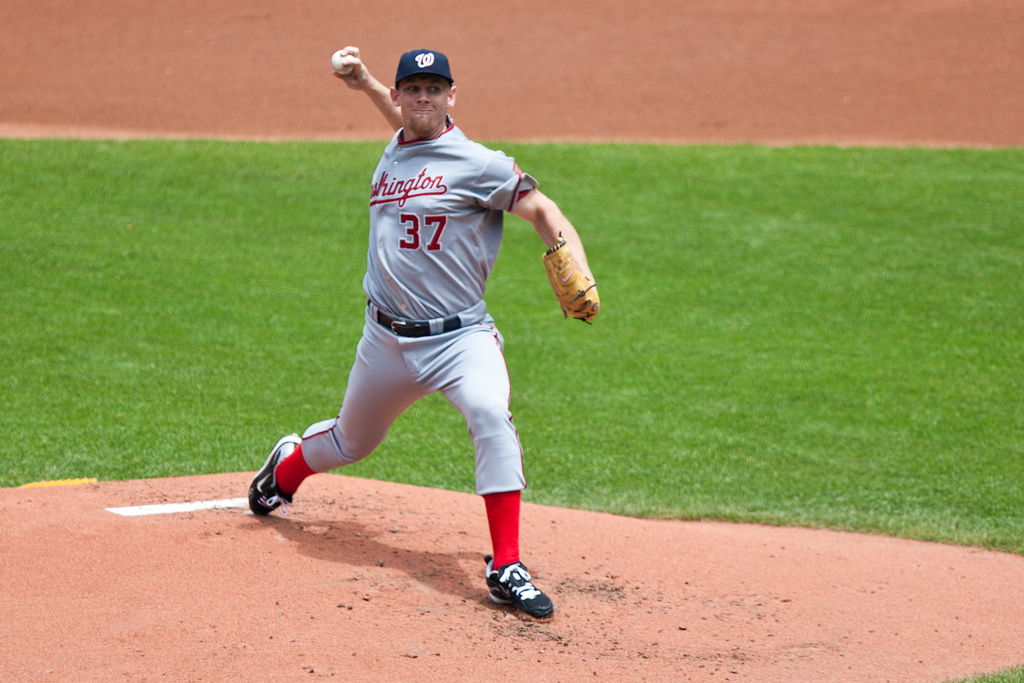
A full season of Stephen Strasburg will make the Nats even better.

The Nationals had the best record in baseball last year, and they appear to have gotten stronger.  With the Nats, it all starts with pitching.  A full year of Stephen Strasburg (no shut down in 2013) should enable the D.C. star to top his 15-6, 3.16 season.  Then there’s 21-game winner (2.89) Gio Gonzalez, Jordan Zimmerman (12-8, 2.94), Ross Detwiler (10-8, 3.40) and newcomer Dan Haren, who had an injury-marred 2012 season with the Angels (12-14, 4.33), but who  has a 3.66 career ERA (10 seasons). The Nationals’ rotation had the lowest ERA in the NL a year ago, and they are likely to retain that crown.

The starting rotation is backed by a strong bullpen, led by closer Drew Storen (back after saving 43 games in 2011, but missing much of 2012). Tyler Clippard, who saved 32 games (3.72 ERA) in Storen’s absence, returns as a top setup man and insurance at closer.  Other key bullpen assets include Ryan Mattheus (5-3, 2.85 in 66 appearances) and Craig Stammen (6-1, 2.34 in 59 games).  Zack Duke, who looked strong in a late season call-up will handle long relief.

While it starts with pitching in the nation’s Capitol, it’s not all about pitching.  Phenom Bryce Harper (.270-22-59, with 98 runs and 18 steals) can be expected to build on his rookie season.  First baseman Michael Morse is coming off a .291-18-62 season – in just 102 games –  and outfielder Jayson Werth is recovered from a broken wrist that limited him to .300-5-31 in 81 games. Full seasons from Morse and Werth should help ease the loss of Adam LaRoche (271-33-100 last year).  Also providing offense are second baseman Ian Desmond (.292-25-73), third baseman Ryan Zimmerman (.282-25-95) and newcomer to the outfield Denard Span (.283, with 71 runs and 17 stolen bases for the Twins).

All in all, the Nationals are more than ready to defend their AL East Crown, they will be chased by (in order) the:

Braves … The Atlanta squad has a chance to upset the Nationals, using a combination of power and – like the Nationals – youth.  The offense starts in the outfield, with 23-year-old Jayson Heyward (.269-27-82, with 21 stolen bases and plenty of room to grow.)  He will be joined in the garden by newcomers Justin (.280, with 17 home runs, 107 runs scored and 18 steals for Arizona) and B.J. (.246-28-78, with 31 steals for Tampa Bay) Upton.  All three are under thirty and have the potential to push each other to greater heights in 2013.  The lineup also includes a couple of additional 23-year-olds in first basemanFreddie Freeman (23 homers and 94 RBI) and flashy fielding shortstop Andrelton Simmons, who hit .289 in 49 games last season.  Dan Uggla at second and Brian McCann behind the plate will add punch to the offense and a veteran presence in the clubhouse  – although there is a hole to file at third (Chipper Jones).

The Braves have perhaps the hardest throwing bullpen in baseball, led by closer Craig Kimbrel (42 saves, 1.01 ERA, 116 strikeouts  in 63 innings).  The difference between the Braves and Nationals is the starting rotation.  The Braves have some quality arms (Kris Medlen, Tim Hudson, Pat Maholm, and Mike Minor, with Julio Teheran and Randall Delgado fighting for a spot), but they have not proven the abilty to perform at the Nationals’ level.

Phillies … The Phils can keep it interesting behind the arms of Roy Halladay, Cliff Lee and Cole Hamels – as good a top three as there is in baseball.  The bullpen, beyond Jonathan Papelbon and newcomer Mike Adams, is suspect and the offense is starting to show  its age.   Comeback seasons from Ryan Howard and Chase Utley would go a long way toward making the Phillies a force in the pennant race.

Mets … The Mets have David Wright (.306-21-93) and Ike Davis (.227-32-90) to power the offense, as well as high hopes for rookie catcher Travis d’Arnaud (acquired in the trade of Cy Young  winner R.A. Dickey) – but a lot of holes to fill beyond that. 

Marlins … Fire Sale – come to see Giancarlo Stanton hit long bombs …  enough said.


NL Central – Reds
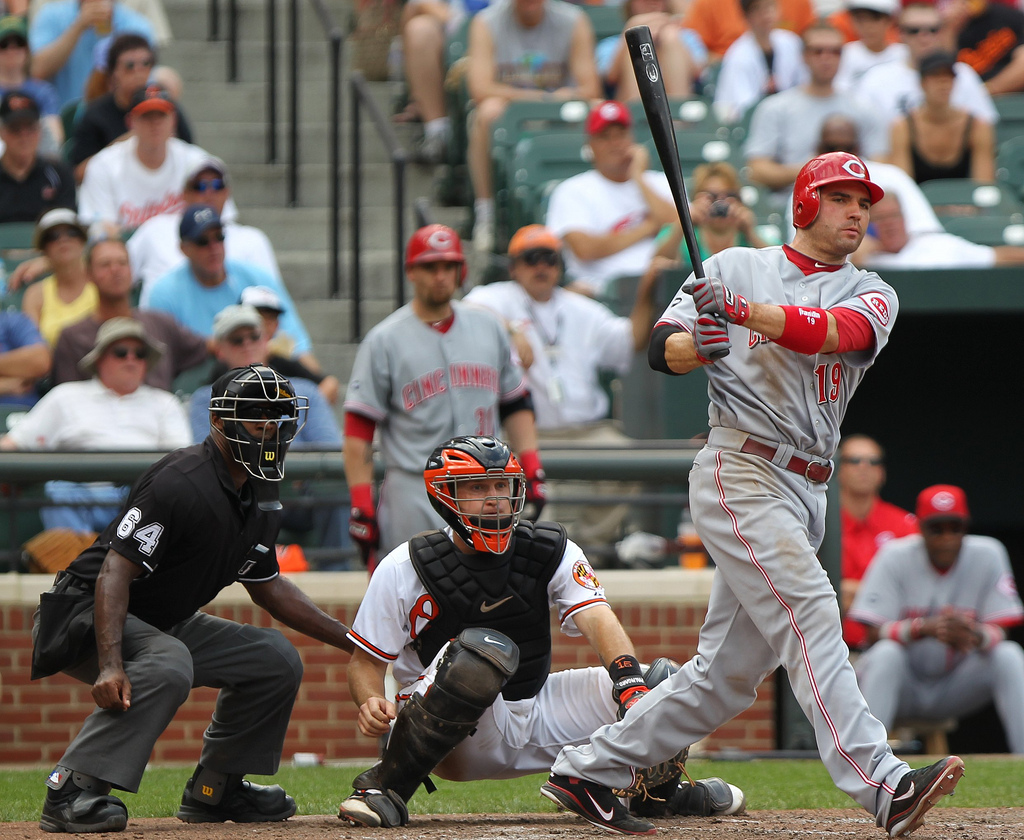
Joey Votto will power the Reds.

The Reds should repeat as NL Central Champs, but not without a fight from the Cardinals.  The Reds return a strong rotation and a solid everyday lineup.  In fact, during the offseason, the one thing the Reds truly were shopping for was a leadoff hitter.  They got one in the Indians Shin-Soo Choo (.283-16-67, with 21 steals for the Indians), who will patrol centerfield in 2013.

The middle of the lineup is once again strong:  first baseman Joey Votto (.337-14-56 in 111 games); left fielder Ryan Ludwick (.275-26-80); and right fielder Jay Bruce (.252-34-99).  With Choo leading off, second baseman Brandon Phillips will add power and speed (.281, 18 homers, 15 steals) from the number-two spot in the order.  At the bottom of the order, frosting on the cake, third baseman Todd Frazier and shortstop Zack Cozart contributed a combined 34 roundtrippers.

This 2013 squad has the ability to put runs on the board – and they have the ability to keep the opposition at bay as well.

The starting rotation is solid, with four starters topping 200 innings.  Number-one is Johnny Cueto, still improving at age 27 and coming off a 19-9, 2.78 season.  Then there’s Mat Latos (14-4, 3.48), Homer Bailey (13-10, 3.68) and Bronson Arroyo (12-10, 3.74).  Most likely joining, and improving, the rotation in 2013 is fire-balling reliever Aroldis Chapman.

The bullpen will be led by Jonathan Broxton, who saved 27 games with the Royals and Reds in 2012.  Support will come from the likes of Sean Marshall (5-5, 2.52, 9 saves in 73 appearances; Jose Arrendondo (6-2, 2.95 in 66 appearances); Alfredo Simon (3-2, 2.66 in 36 appearances; and Logan Ondrusek (5-2, 3.46 in 63 appearances).

Very simply, “The Red are Ready.”  This is a good team, top to bottom, and should repeat as Division champs, followed by the:

Cardinals … The loss of Chris Carpenter is a tough blow, but the Cardinals still have quality pitching with Adam Wainwright, Lance Lynn and Jake Westbrook (a combined 45 wins last year) and  potential Rookie of the Year Shelby Miller expected to make the rotation.  The starters are supported by a solid bullpen, led by closer Jason Motte (42 saves a year ago).  Offensively, Matt Holiday, Carlos Beltran, Yadier Molina, David Freese and Allen Craig all topped 20 home runs in 2013.  The Cards should keep it interesting

Pirates … Every year I expect them to break .500, maybe this is the year, but now I doubt it. It’s really the Andrew McCutchen and Garret Jones show on offense – and A.J. Burnett and Wandy Rodriguez on the mound.  In 2013, newcomer (C) Rusell Martin should boost  the offense and  good seasons by Pedro Alvarez and Neil Walker would help.  There seems to be more hope than help after A.J. Burnett and Wandy Rodriguez in the competition for the starting rotation.   

Brewers … The Brewers will go as far as their offense (Ryan Braun, Corey Hart, Aramis Ramirez) will take them – and drop as far as their pitching  will pull them (Yovani Gallardo will lead a relatively inexperience and unproven starting staff – supported by a bullpen that added fuel to plenty of fires a year ago). 

Cubs …  The Cubs have been headed in the wrong direction – winning fewer games each season since their 2008 playoff appearance.  2013 doesn’t look to reverse that trend.  Still, there are Anthony Rizzo’s bat, Darwin Barney’s glove, Starlin Castro’s speed to watch and Wrigley Field and Wrigleyville to enjoy. Just don’t expect too many wins.


NK WEST – Giants

Buster Posey to help Giants repeat.

It starts with pitching for the defending West Division champs – and there is enough of it to enable the Giants to defend the crown.  First is often unsung Cy Young candidate Matt Cain (16-5, 2.79).  Number-two is lefty Madison Bumgarner  (16-11, 3.37) – as good a right-lefty combo as you’ll findin the NL.  Three and four are Ryan Volgelson and Barry Zito, who won 14 and 15 games respectively in 2012.  The wild card is two-time Cy Young Award winner Tim Lincecum.  The wheels came off last year (10-15, 5.18) and the Giants still led the Division.  If the 29-year-old rights the ship, the Giants’ vaunted rotation gets even stronger.

With Brian Wilson gone, the bullpen is a little less set.  Sergio Romo 4-2, 1.79, 14 saves) has the advantage, but he’ll get plenty of support (and competition) from Santiago Casilla (7-6, 2.84, 25 saves).  Also in the pen are quality veterans Jeremy Affeldt and Javier Lopez.

The offense is not as potent as the pitching, but there is enough to get the job done.  At the 2-4-5 spots, the Giants have hard hitting (but injury prone) Pablo Sandoval, MVP Buster Posey and the overlooked Hunter Pence (.253-24-104 with the Phillies and Giants).  Setting the table are (CF) Angel Pagan and (2B) Marco Scutaro – who both had  career years in 2012.  Also contributing is the improving Brandon Belt.  Another Brandon – shortstop Brandon Crawford – solidified the infield with Gold Glove-caliber defense.  Ultimately, it’s not a flashy, star-powered offense, but it has the pieces to get the job done.  Following the Giants will be:

Dodgers … If things go right, the Dodgers (with MLB’s highest payroll) could unseat the Giants.  There is star power in LA, and not just in Hollywood.

Let’s start with the lineup.  The heart of the order is slated to include Adrian Gonzalez (1B), Matt Kemp (CF), Andre Ethier (RF) … a formidable trio, but not  without issues.  Kemp – with the potential to be a Triple Crown candidate (with speed) – is coming back from offseason elbow surgery and Gonzalez is still figuring out how to hit in Dodger Stadium.  Joining this trio as run-makers are shortstop Hanley Ramirez (.257-24-92, with 21 steals for Miami and LA) and speedy Carl Crawford (coming off elbow surgery). What makes this team even more interesting is bench strength – Jerry Hairston, Jr., Skip Schumaker, and Nick Punto are a high-quality, versatile bunch.

The rotation is sound – but just as the Giants don’t have the offensive stars of the Dodgers, LA’s stardom does not go as deep on the mound.  Still Cy Young candidate (maybe favorite) Clayton Kershaw, newly acquired Zack Grienke, Josh Beckett, Chad Billingsley and Korean Baseball sensation Hyun-Jin Ryu should keep the Dodgers in the race. The bullpen is also deep, with closer Brandon League and a support staff of Kenley Jansen, Javy Guerra and J.P. Howell.

If Crawford and Kemp are healthy and Grienke earns his contract, LA and SF will likely change places … both teams should make the playoffs.

Diamondbacks … Make no doubt about it, this is a pretty good team – just unfortunate to play in the NL West – and newcomer (in the Justin Upton trade) Martin Prado’s bat, versatile glove and attitude will make them better.  Prado – who played five positions last year – should take over third base for the Snakes.  With Atlanta in 2012, he hit .301 (he’s topped .300 in four of the last five seasons and has a .295 career average), with 10 home runs, 70 RBI, 81 runs and 17 steals.  He’ll probably slip into the five- or six-hole in the D-backs’ lineup, which includes quality reliable bats in catcher Miguel Montero (.286-15-88), outfielder Jason Kubel (.253-30-90), still improving first baseman Paul Goldschmidt (.286-20-82) and outfield Cody Ross (.267-22-82), along with platesetters Aaron Hill and Adam Eaton.

The rotation is solid, if not spectacular, led by righty Ian Kennedy (15-12, 4.02 – and a 21-game winner in 2011) and young lefty Wade Miley (16-11, 3.33), runner up to Bryce Harper for NL Rookie of the Year.  Trevor Cahill, Brandon and Patrick Corbin will round out the rotation.  The bullpen is in good hands with closer J.J. Putz (77 saves in the past two seasons), Health Bell and Brad Ziegler.

Padres … The offense is led by third baseman Chase Headley, who broke out with a .286-31-115 season (17 steals) – despite playing a pitcher’s park.  The offense drops off pretty fast.  Only one other Padre topped 50 RBI, rookie first baseman Yonder Alonso (.273-9-62) and only one other Padre reached 10 home run (Carlos Quentin, .261-16-46 in 86 games).  A full season of Quentin would help the Padres and provide some protection for Headley.  The pitching staff is without a true ace, Clayton Richard led the way with a 14-14, 3.99 record, followed by Edison Volquez at 11-11, 4.14.  It’s not a good thing when you play in one of MLB’s most pitcher-friendly parks and still have concerns about your rotation.  Huston  Street heads fairly strong bullpen (Luke Gregerson, Dale Thayer, Brad Bach). 

Rockies … The Rockies are long on offense (Carlos Gonzalez, Troy Tulowitski,  Todd Helton, Wilin Rosario, Micheal Cuddyer) if they are healthy.   Helton, Gonzalez and Tulo all fought the injury bug last season.  Pitching, however, is another story.  Yes, it’s Coors Field, but Colorado starters rang up MLB’s highest ERA at 5.81.  No starter reached 120 innings and reliever Rex Brothers led the team with eight wins.  The relief staff, led by closer Rafeal Betancourt (31 saves) is adequate – but suffers the consequences of overwork (the Rockies set an MLB record  with 657 relief innings last season.)  Still Betancourt, Brothers, Matt Belisle and Wilton Lopez are a game bunch out of the pen. A little improvement in the rotation would move the Rockies past the Padres. 


Wild Cards – Dodgers, Braves

NL Champions – Nationals
AL Division Winners – 2013 Predictions


The next couple of posts will take a look at BBRT’s annual “predictions,” starting with the American League – where I expect quite a shakeup at the top, including a playoff scenario that does not include the Red Sox (new attitude, not as much talent) nor the Yankees (age and injuries catching up).  First the individual awards, then the Division Winners and Wild Cards

MVP – Evan Longoria

Longoria puts in a full season and leads the Rays to a Wild Card spot.  He edges out Mike Trout and Albert Pujols of the Angels (who suffer the fate of playing on a team with three potential MVP’s – Trout, Pujols, Hamilton) and Miguel Cabrera, who splits support with Justin Verlander and Prince  Fielder.  Supporting evidence?  In 2012, the Rays were 47-27 with Longoria in the lineup, 43-45 without him. 

Cy Young – Justin Verlander

Justin Verlander brings home the trophy, finishing in the top three in pretty much every pitching category.  His main competition comes from the Rangers’ Yu Darvish and the Angels’ Jered Weaver

Rookie of the Year – Jurickson Profar

In a close race, Rangers’ switch-hitting infielder Jurickson Profar’s combination of power, speed and defensive ability enables him to not only earn an early season spot in the everyday lineup, but also to squeak by Rays outfielder Wil Myers in the ROY race.

Now for the Division Winners:

WEST – Angels

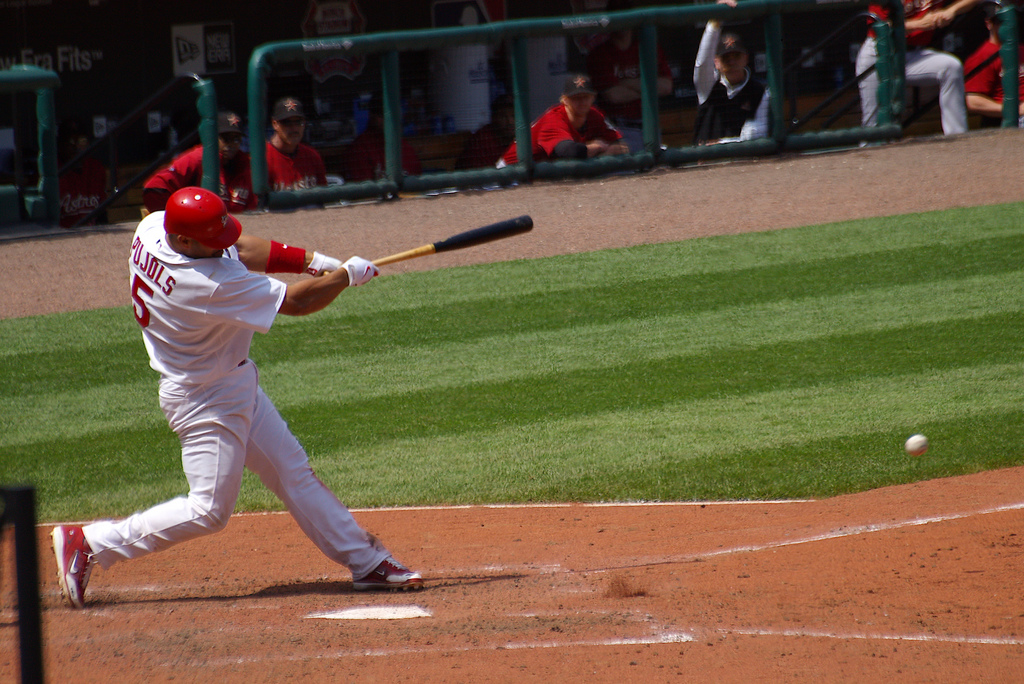
Albert Pujols will have even more help in the Angels lineup this season.

Once again, the Angels went big on the free agent market – adding Josh Hamilton to a line-up that already featured Albert Pujols, Mike Trout and Mark Trumbo.  Last season, that quartet put up 135 home runs and drove in 411 runners.  The Angels also have some speed, with Trout’s 49 steals, second baseman Kendricks’ 14 and shortstop Erick Aybar’s 20.  The starting pitching is solid at the top with Jered Weaver and C.J. Wilson, but it gets a bit thin at 3-5 (Jason Vargas, Tommy Hanson and Joe Blanton).  Of greater concerns is whether the relief corps goes deep enough with off-season acquisition Ryan Madson (tabbed as closer) recently suffering a setback in his Tommy John rehab.  Ernesto Frieri seems ready to fill that gap, having saved 23 games a year ago (80 strikeouts in 54 innings).  Still, BBRT thinks the offense will be enough to bring the Angels home in first place this  time.  The rest, in order of finish:

Rangers … Still plenty of offense (Adrian Beltre, Nelson Cruz, David Murphy, Elvis Andrus and Ian Kinsler) and pitching (Yu Darvish, Matt Harrison, Derek Holland and Joe Nathan.  But losing Josh Hamilton and missing out on Zach Grienke  will see them falling short.

A’s … Young pitching may keep them in the race, but not much offense after Yoenis Cespedes, Josh Reddick and Brandon Moss.

Mariners … Everything pretty thin after King Felix.

Astros … New league, same result.


EAST-Blue Jays

R.A. Dickey takes his knuckler … and Cy Young credentials … to the Blue Jays.

Used to be the off-season for the AL East was all about the Yankees and Red Sox making move and counter move in an effort to finish at the top.  Move over tradition – the Blue Jays are here.  There was the 12-player trade with the Marlins that brought Toronto the likes of shortstop Jose Reyes (considered to have had a bit of an off season in 2012, despite going .287, with 11 home runs and 40 steals); second baseman Emilio Bonifacio (30 steals in 2012); and a pair of solid starting pitchers in innings-eating lefty Mark Buehrle (13-13, 3.74) and Josh Johnson (8-14, but with a 3.81 ERA last season).  Then they added the NL Cy Young Award winner R.A. Dickey from the Mets.  Also new to the team is Melky Cabrera, out to prove his solid pre-suspension numbers for the Giants weren’t all PED-related.

These new cast members joined holdovers like righty Brandon Morrow (10-7, 2.96 in 21 starts); power-hitting Edwin Encarcion and Jose Bautista; and third-baseman Brett Lawrie (just 23), who went .273-11-48 in his first full season in the bigs.  The supporting cast looks just fine as well.  Catcher J.P. Arencibia contributed 18 roundtrippers and 56 RBI; and outfielder Colby Rasmus added 23 homers and 75 RBI.

The bullpen, led by Casey Janssen (1-1, 22 saves, 2.64 and 67 strikeouts in 64 innings), Sergio Santos and Darren Oliver may not have “star power,” but should be strong enough to help move the revamped Jays from last year’s 73 wins to 91 and first place in a very tight AL East.  The rest of the Division: 

Rays … Quality pitching and a full season of big banger Evan Longoria keeps them in the race, but they’re one bat short.

Yankees … Still a lot of talent on this squad, but age and injury  take their toll.

Red Sox … Clubhouse attitude should be vastly improved, product on the field just enough to climb out of the cellar.

Orioles … 2012 Cinderella team here’s the clock strike midnight.  No true ace on the pitching staff (Wei-Yin Chen led starters with 12 wins last year) and – despite balanced lineup, the Orioles comes back to reality.  Two things not likely to repeat:  a 29-9 record in one-run games and 51 saves from Jim Johnson (although 40 is a real possibility).  


AL CENTRAL – Tigers

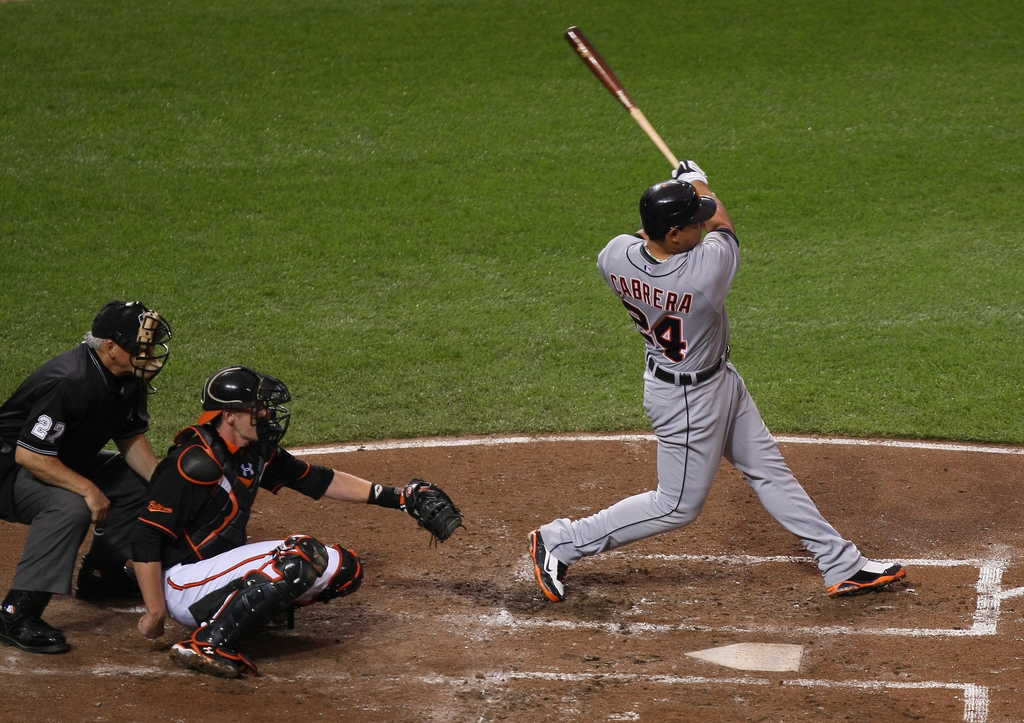
Miguel Cabrera will help power the Tigers back to the World Series.

Not much contention here.  Whether it’s power bats or power arms, the Tigers have what they need to take it all in the AL Central.  The offense is led (at the corners) by Triple Crown and MVP winner Miguel Cabrera (.327-44-139) and Price Fielder (.313-30-108), while the pitching staff boasts consistent Cy Young candidates Justin Verlander (17-8, 2.64) and Max Scherzer (16-7, 3.74) – who finished 1 & 2 in the AL strikeout race.

Offensively, the Tigers also expect solid contributions from centerfielder Austin Jackson in the leadoff spot (.300, with 103 runs, 16 home runs and 16 stolen bases a year ago.) They let post-season hero Delmon Young slip away in the off season, but added veteran outfielder Torii Hunter, who comes into the season at 37-years-old – but also off a .313-16-92 season with the Angels.  He should more than make up for Young’s loss at the plate, in the field and in the club house.  The Tiger are also excited about Andy Dirks and Avisail Garcia (27- and 22-years-old, respectively) – who both performed well in limited time last year. 

The coming season will also see the return of Victor Martinez (at DH), who missed all of last season (knee surgery).  In 2011, Martinez, with a lifetime .303 average over ten seasons, hit .330, with 12 home runs and 103 RBI.  A return to even near-form would be like adding a premier free agent.  At the bottom of the lineup, you’ll likely find steady shortstop Jhonny Peralta, catcher Alex Avila and second baseman Omar Infante, who will hold their own. 

Getting back to the starting rotation, 3-4-5 look to be Doug Fister, Anibel Sanchez and either Rick Porcello or Drew Smyly.  With the offense the Tigers bring to the plate, that rotation should be more than enough.

The only question mark is the relief staff.  The Tigers let closer Jose Valverde leave via free agency and the leading candidate to replace him appears to be 22-year-old flame-throwing rookie Bruce Rondon – who moved from A to AA to AAA a year ago, going a combined 2-1, 1.53 with 29 saves and 66 punch outs in 53 innings.  There’s plenty of experience in the rest of the pen, with Octovio Dotel, Joaquin Benoit and Phil Coke.  But, if Rondon falters, it wouldn’t be surprising to see the Tigers go out and get a bonafide ninth-inning hurler.

All in all, Detroit is a well-balanced squad that should easily win the Central – followed by:

White Sox … Solid starting pitching (Chris Sale, Jake Peavy, John Danks, Gavin Floyd) and some Punch in the lineup (Paul Konerko, Adam Dunn, Alex Rios and youngster Dayan Viciedo), plus off-season pickup (3B) Jeff Keppinger (.325 with the Rays last year) help keep the White Sox in the race.  Still the Sox have more questions (Danks’ recovery from surgery, Konerko’s age, can Flowers replace Pierzynski) and less talent up and down the roster than the Tigers.  

Royals … Took steps forward in the off-season, but after newcomers true “ace” James Shields and Wade Davis, the starting rotation lacks a record of consistency.  Still, a strong  bullpen and the bats of Alex Gordon, Billy Butler and Alcides Escobar should keep them at or near .500.  To go further, they need more from high-potentil corner  infielders Eric Hosmer and Mike Moustakas and a return to form at the back end of the rotation (Ervin Santana, Bruce Chen, Jeremy Guthrie).

Indians … The tribe made strides on offense with the addition of Nick Swisher and Micheal Bourn and they are strong up the middle with (c) Carlos Santana, (2B) Jason Kipnis, (SS) Asdrubal Cabrera and newly acquired speedy center fielder Drew Stubbs.  Questions remain at the corners and in the rotation – number-two looks like Ubaldo Jimenez (9-17, 5.4o last season).

Twins … The Twins’ off-season moves appear good for the future, but the outlook for 2013 is not as bright.  A revamped pitching staff  looks to include acquisitions Vance Worley, and Mike Pelfrey – both coming off surgery – as is holdover Scott Diamond, the Twins’ best 2012 starter.  Could be a lot of work for a solid bullpen, led by closer Glen Perkins. There is some potential in the lineup with former MVPs Justin Morneau and Joe Mauer, slugging outfielder Josh Willingham and steady Ryan Doumit.  Still, there are questions in the infield and center field (where the Twins traded away Denard Span and Ben Revere). But there is hope on the horizon, with prospects like pitchers Trevor May, Alex Meyer and Kyle Gibson (who could make the 2013 rotation) and infielder Miguel Sano in the wings.  

Wild Cards:  Rangers and Rays.

 AL Champion:  Tigers … Verlander and Scherzer provide the edge, as two offensive juggernauts (Angels/Tigers) face off. 

Coming soon … a look at the NL. 

Box Scores – They’re Ba-a-a-ck!

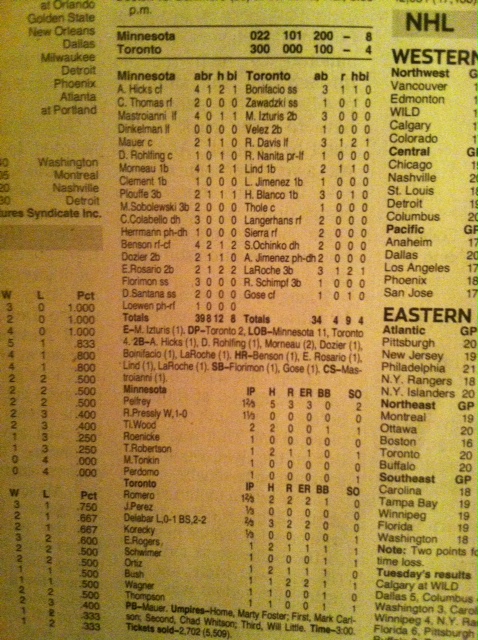
Box scores – in the morning paper of course (online is a second choice) – are one of the things I love about baseball.  Now it’s Spring Training and the box scores are back.    Here’s why I love ’em – my #8 reason in “Why I Love Baseball.” (Click the YILBB link at the top of the page to see all ten reasons.)


The box score – akin to the “orchestra in a box.”

8.  The box score. 

BBRT editor’s  mother used to refer to an accordion as “an orchestra in a box.”  That’s how I view the daily box score – the symphony of a game recorded in a space one-column wide by four inches deep.   Some would say the box score reduces the game to statistics, I would say it elevates the game to history.  What do you want to know about the contest?   Who played where, when?  At bats, hits, stolen bases, strikeouts, errors, caught stealing, time, attendance, even the umpires’ names?   It’s all there and more – so much information, captured for baseball fans in a compact and orderly space.  I am, of course, dating myself here, but during baseball season, the morning newspaper, through its box scores, is a treasure trove of information for baseball fans.

BBRT’s Hall of Fame Balloting – I Stand Corrected

This year, as I noted with disappointment in my January 9 post, the Baseball Writers Association of America threw a shutout in the Hall of Fame balloting. While the steroids era “tainted” the 2013 election process, I felt that there were candidates who deserved election – and that the BBWAA could have made more of a statement by voting in a “clean” candidate or two and denying the “suspect” superstars on the list. I was pretty sure that most fans would feel pretty much the same way – and that a fan vote would have turned out differently. With that in mind, I sent out my own ballot – to Ballpark Tours Hot Stove League Banquet and Annual Tour participants, fantasy baseball league opponents and baseball-fan friends. The results are in – and I stand corrected.

BBRT voters put more zeroes up on the 2013 Baseball Hall of Fame scoreboard.

With just over 50 ballots in, the results of the BBRT balloting were not that different from the official BBWAA vote – and no one was elected. In the BBRT ballot, Craig Biggio topped all candidates with 65.3% of the vote, just as he topped the BBWAA ballot at 68.2%. Jack Morris and Mike Piazza tied for second on the BBRT ballot at 61.5%, while in the official voting, Morris finished second (67.7%) and Piazza fourth (57.8%). The main outlier at the top of the ballot was Jeff Bagwell, who finished fifth in the BBRT vote, but with only 38.5%, while the writers has him third at 59.6%.

BBRT voters were a bit harder than the BBWAA on PED-suspect candidates: Here are some notable with the BBRT vote percentage followed by the BBWAA percentages: Barry Bonds (19.2/36.2); Roger Clemens (19.2/37.6); Mark McGwire 15.4/16.9); Sammy Sosa (11.5/12.5); Rafael Pameiro (11.5/8.8).

I did take part in another mock ballot this year – conducted by the national Baseball Bloggers Alliance. In that vote, one candidate – Jeff Bagwell – was elected, with 76% support. As in the BBRT and BBWAA votes, Biggio and Piazza finished close with 69% each, but Morris fared much worse at only 32% (not too many folks who attended Game 7 in 1991, apparently). The suspect list also fared better with the blogger group.  Bonds got 62%, Clements 56%, McGwire 35%, Sosa 21% and Palmeiro 15%. Also of interest to me was the fact that Lee Smith, who captured 57.6% of the BBRT votes and 47.8% of the writers’ ballots, got only 25% from the bloggers’ group. (Visit the Baseball Bloggers Alliance Website for the full results of thee vote. )

BBRT saw three prevailing attitudes in the balloting, in the following order of frequency (I’ll share some of the comments I received at the end of this post):

1) Don’t let the suspects in, but I will vote for a couple of qualified “clean” candidates;

2) Don’t let the suspects and there are no candidates I see worthy of first-ballot election, and few or no returning candidates that really command my vote;

3) Let the records stand for themselves, as long as MLB has not declared candidates ineligible, like Pete Rose and Shoeless Joe Jackson, I will vote based on the numbers;

4) I think the game’s gone bad and here’s a blank ballot in protest.

So, here are the final BBRT results, with each candidate’s vote percentage followed by the BBWAA’s official tally:

Craig Biggio – 65.3% (68.2)

Jack Morris – 61.5% (67.7)

Mike Piazza – 61.5% (57.8)

Lee Smith – 57.6% (47.8)

Jeff Bagwell – 38.5% (59.6)

Edgar Martinez – 30.7% (35.9)

Alan Trammel – 30.7% (33.6%)

Roger Clemens – 19.2% (37.6)

Barry Bonds – 19.2% (36.2)

Curt Schilling – 19.2% (38.8)

Tim Raines – 19.2% (52.2)

Don Mattingly – 15.4% (13.2)

Mark McGwire – 15.4% (16.9)

Sammy Sosa – 11.5% (12.5%)

Larry Walker – 11.5% (21.6)

Rafael Pameiro – 11.5% (8.8)

Dale Murphy – 7.7% (18.6)

Bernie Williams – 7.7% (3.3)

Fred McGriff – 3.8% (20.7)

Julio Franco – 3.8% (1.1)

Note: The following BBWAA vote-getters did not get votes in the BBRT balloting: Kenny Lofton (3.2%, BBWAA) and Sandy Alomar Jr. (2.8%).

To wrap up, here excerpts from some selected comments BBRT received with its ballots.

I’ve got a real problem with voting for suspected PED-users – particularly on the first ballot. Beyond that I find this year’s HOF class uninspiring – and look forward to next year with Maddux, Glavine and the Big hurt eligible.    BK

If there was ever a year to justify a shutout, this would be it. It’s a pretty uninspiring ballot, all the more compared to recent years and what’s to come. On the drug issue, at this point I’m not willing to vote for them – realizing that ‘them’ is a slippery slope in some cases. My view may change over time as we have a longer historical lens and more knowledge with which to work. In 10 years, will I feel differently about Bonds or Clemens? Can’t answer that.

One other thing: I really believe there’s a distinction between a Hall of Famer and a “first-ballot Hall of Famer,” … I think that first-ballot election signifies being among the elite of the elite in all criteria of the game: Voting shall be based upon the player’s record, playing ability, integrity, sportsmanship, character, and contributions to the team(s) on which the player played.   HS

I’m tired or reading about drugs and money, rather base hits.  They’re spoiling the game, so I vote a blank ballot.   LW

I believe that the steroid users should never get in. If they can continue to keep Pete Rose out for gambling and refuse to acknowledge his accomplishments on the field sans drugs, then there is no way there is justification for putting the druggies in. I don’t care how many others do it and I don’t care how it enhances performance.  KC

Why doesn’t MLB take these guys off ballots? It seems to me that they asking voters to make up minds for MLB. Bud needs to step up and deny these guys (entry) into HOF as a ban.  PC

I agree with the MLB Baseball writers in not electing players into the hall every year. I think that there are some players that should be in, Jack Morris, Jim Kaat but the vote is the best process that can be used and if they do not concur for that year than so be it. It just makes the membership to the hall that much more exclusive … The debate that this year’s vote has brought on is what makes this sport so wonderful and timeless.   SB

 I am of the belief that it is not possible to tell who did or did not inhale, so trying to be drug-cops is, in the end ineffective. So my ballot is based on the fact that these players are part of the history of the game. It seems to me there are three key issues:

1) As fans of the national pastime, we accept the scoreboard as it is, regardless of any extenuating circumstances: no asterisks, no questions. The Game is the Game; the record is the record.

2) Betting on baseball is bad, Bad, BAD, REALLY BAD. Thou shalt forever be banned from the Hall. Is it a greater sin to bet on the game than to use drugs to improve your performance? If you agree, Pete and the Black Sox shall be forever banned, but Sammy, Mark et al. shall be eligible. I am not wise enough to make this call so close to the bag.

3) Performance enhancing drugs are worse /are not as bad as betting on the game. If you used steroids, you should/should not/should/should not/should/should not be admitted to the Hall of Fame. You hit the ball more, you scored more runs, but was it you or the drugs in your body allowed you to be that good? How well would Sammy, Roger, Barry, and Mark done if they had not used drugs? They might have done just as well. They were, after all, really good players. Sadly, we shall never know. What we do know now is that certain players were banned by the Commissioner for betting on the game, regardless of their performance record. End of story. If Pete Rose is ever inducted, I will have watched my last MLB game, unless at the same moment Shoeless Joe is also forgiven his sins. To the best of my understanding, their crimes were only about money.  From my professional perspective, using drugs to enhance performance is a deeper, more fundamental violation of the rules of the game. It seems to me that those who voted this year unambiguously agreed. So it should remain.   JT

BBRT’s 2013 Top MLB Prospects

As we approach Spring Training, it’s time to look ahead to some of the prospects who could make a splash in the season ahead.   Here’s BBRT’s top ten, based not on the long term, but on the potential to have an impact in 2013.

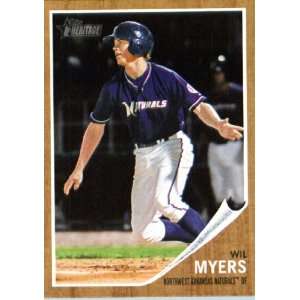
1.   Wil Myers, OF, Tampa Bay … 6’3”, 205 pounds, age 22

The power-hitting Myers should be in the Rays’ line up on opening day.  In 2012, in 124 games split at AA and AAA, Myers hit .314 with 37 homers and 105 RBI.  He’s hit at every level, with a .303 average over four minor league  seasons.

2. Shelby Miller, RHP, Saint Louis – 6’3”, 195 pounds, age 22

Don’t let Miller’s 11-10, 4.74 line at AAA fool you.  Over his last ten AAA starts, Miller went 7-2, 2.88, with 70 strikeout in 59 1/3 innings.  Then, in a late season call-up, he got in six games for the Cardinals, giving up just 2 runs and striking out 16 in 13 2/3 innings.  BBRT is confident the hard-throwing Miller is ready of a full year in the majors.

3.  Jurickson Profar,  SS,  Texas …  6’, 165 pounds, age 20

The young switch hitter (who got in 9 games with the Rangers last season) has shown power, speed and great defense minor league career – three-season totals: .276, 30 homers, 150 RBI, 47 steals.  The Rangers have Elvis Adrus and Ian Kinsler up the middle, but BBRT looks for Profar to get time in at SS and 2B (Kinsler to the OF?) during 2013.

4.  Dylan Bundy, RHP, Baltimore –  6’1”, 195 pounds, age 20

Bundy, who last season moved from class A to the majors (a pair of late season appearances for the Orioles) has been known to top 100 mph with his fastball,  In his first minor league season (2012), he pitched at three levels, going 9-3, 2.08 with 119 strikeouts in 103 2/3 innings pitched.  A solid – consistent – spring should be enough to keep him with the Orioles.  Otherwise, look for a mid-season call-up.  Also expect the Birds to be cautious with Bundy’s innings.

5. Oscar Taveras, OF, Saint Louis – 6’2”, 180 pounds, age 20

With plate discipline beyond his years, Taveras is another youngster to watch in spring.  Despite his young age, he has four minor league seasons under his belt, running up totals of .321, 40 homers, 243 RBI and 29 stolen bases.  Last season, he hit .386 in 78 games at Class A, and .321 (leading the Texas League) in 124 games at AA.  The only thing holding back Taveras may be the Cardinals’ wish to delay his free agency for a year.  BBRT expects to see him in St. Louis at some point during the season.

6. Trevor Bauer, RHP, Cleveland – 6’1”, 185 pounds, age 22

Great stuff, but some say he needs to harness his emotions and his command.  While his MLB debut with the Diamondbacks was a disappointing 1-2, 6.06 in four starts, he did strikeout 17 in 16 1/3 innings.  In two minor league seasons, Bauer has gone 13-4, 3.00 with 200 strikeouts in 156 innings.  BBRT is betting the move to Cleveland serves him well – and that he will crack the Indians rotation either out of spring or by the All Star break.

7. Avisail Garcia, OF, Detroit – 6’4”, 240 pounds, age 21

BBRT is higher on Garcia than some other observers.  Despite being only 21, Garcia has five minor league seasons under his belt (.281, 37 home runs, 242 RBI, 72 steals).  In 2012, he went .299-14-58 with 23 steals in 122 games at A/AA.  What is worrisome are his 95 strikeouts in 481 at bats.  What impresses BBRT is his late-season call up to the Tigers,  when he hit .319 (15 for 47) in 23 games – and followed it up by going .261 in 12 post-season contests.  Major league pitching seemed to handcuff his power a bit – his only extra base hit was a double in the post season – but Garcia showed considerable poise.  He may not be in the line-up every day, but BBRT expects him to be with the Tigers.

8. Billy Hamilton (OF) Cincinnatti – 6’1”, 160 pounds, age 22 Lot of folks – heads turned by Hamilton’s 155 stolen bases in 132 minor league games last season – rate him higher than BBRT.  He does have a strong track record (pun intended) with 320 steals in four minor league seasons – to go along with a .289 average, seven homers and 130 RBI.  No doubt, with his speed, Hamilton can be an MLB game-changer.  BBRT is cautioned by two things:  1) the need for more plate discipline (he struck out 113 times in 512 minor league at bats last year; 2) whether the outfield of Jay Bruce, Ryan Ludwick and Shin-Soo Choo offers the Reds the opportunity to keep Hamilton in the minors one more season to further develop his batting eye and plate discipline.

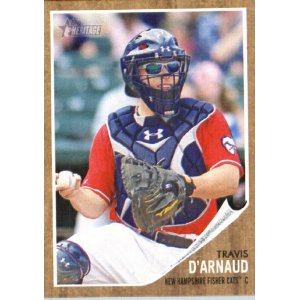
9.  Travis d’Arnaud (C) New York – 6’2”, 195 pounds, age 23

D’Arnaud appears to be a solid defensive catcher with a good bat, who came to the Mets in the R.A. Dickey trade.  In six minor league seasons, he hit .286, with 66 home runs and 289 RBI.  In the offense-heavy AAA Pacific Coast League last year, he rapped .333 with 16 home runs and 52 RBI.  A knee injury that shortened his 2012 season may be of some concern, but the Mets appear confident he’s healthy.  BBRT is betting the Mets will want to show a return sooner-rather-than-later from the Dickey trade, which means d’Arnaud makes the majors soon-rather-than-later.

10.  Take your pick, BBRT sees a trio of hurlers with potential for 2013.

Tyler Skaggs (LHP) Arizona, 6’3”, 195, age 21  

Taijuan Walker (RHP) Seattle – 6’4” 210 pounds, age 20

Gerrit Cole (RHP) Pittsburgh – 6’4”, 220 pounds, age 22

What Were They Thinking?


A DIFFERENT KIND OF BAD HAIR DAY!


BAD HAT DAY!


WORSE HAT DAY!


               BAD LANGUAGE DAY!                     (Read the end of the bat)


ISN’T OUR FANTASY LEAGUE USING A SNAKE DRAFT?


ALL WE NEED IS GLOVE … YA-TA-DA-TA-DA!


JUST FINISHED POLE DANCING 101!


HELLO! IS 1970 THERE?


IS THIS MY GOOD SIDE?          OOPS! STRIKE THREE!


YOUR COMMENT HERE ...


SPBA – Winter Fun While It Lasted

The fall of winter on Minnesota – finally getting those anticipated sub-zero days – brings back fond memories of a season (season-and-a-half, really) of very unique Winter Ball.  It was a season in a league that:

The League has its own logo and …

– featured the teams like the St. Petersburg Pelicans and West Palm Beach Tropics – the Divisional winners;

– played in Florida (and briefly Arizona and California) from early November to the opening of MLB Spring Training;

– allowed no players under the age of 35 (32 for catchers);

– attracted former players like future Hall of Famers (Rollie Fingers and Fergie Jenkins), MVP winners (Vida Blue, Fingers, George Foster), Cy Young Award recipients (Blue, Fingers, Mike Cueller) and Rookies of the Year (Jon Matlock, Bake McBride, Al Bumbry) to name just a few of the marquee names found on the league’s rosters.

… an official ball signed by Commissioner Curt Flood and …

The SPBA’s bevy of managers/player-managers included such baseball men as Earl Weaver, Dick Williams, Clete Boyer, Bobby Tolan, Pat Dobson, Bill Lee, Graig Nettles and Gate Brown.

I’m talking about the 1989-90 (and abbreviated 1990-91) seasons of the Senior Professional Baseball Association (SPBA).  The league, which opened play in November of 1989, had eight teams in two divisions – playing a 72-game schedule.

The teams, and their 1989-90 finishes, were:

Northern Division

St. Petersburg Pelicans            42-30

Brandenton Explorers             38-34

Orlando Juice                          37-35

Winter Haven Super Sox        29-43


Southern Division

West Palm Beach Tropics       52-20

Fort Meyers Sun Sox              37-35

Gold Coast Suns                     32-39

St. Lucie Legends                   20-51

… even a set of baseball cards.

Among the league leaders were:  Tim Ireland (.374 batting average); Jim Morrison (17 home runs); Ron Washington (73 RBI); Kim Allen (33 steals); Milt Wilcox (12 wins); Bill Campbell (2.12 ERA); and Rick Lysander (11 saves).

In the first weekend of February 1990, the league’s top four teams participated in league championship (single elimination) playoffs, with the St. Petersburg Pelicans (managed by Bobby Tolan) ultimately defeating the West Palm Beach Tropics (managed by Dick Williams) 12-4 to take the SPBA’s first and only championship.

For its second (1990-91) season, four of the league’s eight teams (Orlando, Winter Haven, St. Lucie and Gold Coast) folded, the Brandenton team moved to Daytona Beach and the SPBA added one team each in Arizona (Sun City Rays) and California (San Bernardino Pride).  Low attendance continued and, on December 28, less than halfway the season, the league was disbanded.

BBRT still thinks it was a fun – if impractical – idea.  And, it did attract some big “name” (former) players – even if it didn’t attract enough fans.  (The sports page coverage was minimal, which also didn’t help.)  To provide an indication of the quality or  former players in the SPBA, BBRT has put together a career-based starting lineup drawn from the SPBA rosters:

Catcher

Jerry Grote … MLB career 1968-81, two-time All Star, age at start of 1989 SPBA season – 37

First Base

Cecil Cooper … MLB career 1971-87, five-time All Star, two-time home run champion, two-time RBI champion, age at start of 1989 SPBA season – 39

Second Base

Bill Madlock … MLB career 1973-87, three-time All Star, four-time batting champion,  age at start of 1989 SPBA season – 38

Third Base

Graig Nettles … MLB career 1967-88, six-time All Star, one-time home run champion, two Gold Gloves, age at start of 1989 SPBA season – 45

Shortstop

Bert Campaneris … MLB career 1961-81, five-time All Star, six times led the league in stolen bases, once led the league in hits, age at start of 1989 SPBA season – 47

Left Field

Bobby Bonds … MLB career 1968-81, three-time All Star, three gold gloves, twice led the league in runs, age at start of 1989 SPBA season – 43

Center Field

Amos Otis… MLB career 1967-84, five-time All Star, three gold gloves, one time led league in stolen bases, twice led league in doubles, age at start of 1989 SPBA season – 42

Right Field

George Foster … MLB career 1969-86, five-time All Star, 1977 NL MVP, two-time home run champion, three-time RBI leader, one-time runs scored leader, age at start of 1989 SPBA season – 40

RH Starting Pitcher

Fergie Jenkins … MLB career 1965-83, BB Hall of Fame 1991, 1977 Cy Young Award, three-time All Star, seven-time 20-game winner, twice led league in wins, four times led league in complete games, age at the start of 1989 SPBA season – 46

LH starting pitcher

Mike Cueller … MLB career 1965-83, 1969 Cy Young Award, four-time All Star, four-time 20-game winner, led league in wins and complete games once each, twice led league in winning percentage, four times lead league in complete games, age at the start of 1989 SPBA season – 52

RH Reliever

Rollie Fingers … MLB career 1968-85, 1981 Cy Young Award, 1981 AL MVP, seven-time All Star, three times led the league in saves

LH Reliever

Al Hrabosky … MLB career 1970-82, led the league in saves and winning percentage once each, age at start of 1989 SPBA season – 40

Just a few other SPBA player names that might ring a bell: Bill “Spaceman” Lee; Al Bumbry; Jim Rice; Toby Harrah; Dave Kingman; Blue Moon Odom; Vida Blue; Hal McCrae; Steve Busby; Mickey Rivers; Wayne Garland; Louis Tiant; Cesar Cedeno – and the list could go on and on.

Notably, several of the SPBA players eventually signed “second chance” major league contracts, including Ron Washington, Joaquin Andujar, Paul Mirabella, Dave Collins, Dan Boone, Ozzie Virgil, Jr., and Tim Stoddard.

All in all, I wish the idea had worked – it gave fans some “old, but new” baseball to  help warm our hearts in the dreary winter months between the World Series and Spring Training.  BBRT retains fond memories of baseball’s brief senior league.

To learn more about this unique experiment,  I’d suggest Peter Golenbock’s book “The Forever Boys” and David Whitford’s “Extra Innings.”

HOF – No Electees … Wrong Message

“There is no joy in Mudville” … or Cooperstown. The BBWAA has struck out.

Ouch!  The Baseball Writers Association of America has locked the doors to the Hall of Fame – at least for 2013.    With no “winners” in the election, fans and players lose.  Now, at this year’s ceremony, there will be only the ghosts of Hank O’Day, Jacob Ruppert and Deacon White to be honored.  There will be no new, living members to be inducted.  It will be interesting to see how much excitement that event generates among fans.

Yes, the steroid era “tainted” this year’s election process, but there were candidates who were not painted with that brush and who – at least in BBRT’s opinion – deserved election.  BBRT also believes the writers could have made more of a statement – if that is what they were trying to do – by voting in a couple of “clean” candidates, while ignoring those most heavily associated with the PED issue.   Here are two that would have fit the bill.

Craig Biggio

In his 20 MLB seasons, Biggio collected 3,060 hits, scored 1,884 runs and hit 291 home runs, while also stealing 414 bases.  He was a seven-time All Star and a four-time Gold Glove winner, who spent notable time at second base, catcher and in the outfield.  His 668 doubles are the most ever by a right-handed hitter (and fifth all time) and he is one of only two players to collect 50 doubles and 50 stolen bases in the same season.  He holds the NL record (285) for being hit by a pitch.

Lee Smith

Smith’s 478 saves put him third on the all-time list (he was number-one when he retired after the 1997 season).  He also recorded 13 consecutive seasons (in an 18-year career) of 25 or more saves, a 3.03 lifetime ERA and 1,251 strikeouts in 1,289 innings pitched; led the league in saves four times; and made seven All Star Teams.

Slightly behind Biggio and Smith, but also deserving from BBRT’s vantage point is:


Jack Morris

In his 18-year career, he earned a reputation as a big-game pitcher, as well as a 254-186 record with a 3.90 ERA, 2,478 strikeouts and five All Star selections.   A two-time twenty-game winner, Morris led his league in wins twice, games started twice, and one time each in complete games, shutouts, innings pitched and strikeouts.

There were also have two worthy players who appear to have been punished for playing in the steroid era – despite no compelling PED evidence.   It appears for these two, it was guilt by association or suspicion.  


Mike Piazza

Piazza finished his 16-year career with 2,127 hits and a .308 average.  The 1993 Rookie of the Year collected 427 home runs (a Major League record 396 as a catcher) and 12 All Star selections.

Jeff Bagwell

In 15 seasons, Bagwell amassed 2,314 hits and a near-.300 (.297) batting average.  He also collected 429 home runs, and more than 1,500 runs and RBI, as well as 202 stolen bases.  He was a NL Rookie of the Year, MVP and Gold Glove winner.

BBRT would have case a ballot for all of the above.  As for the message from this year’s balloting, from this vantage point it does not seem very well thought out.

Here are this year’s vote recipients and percentages (75% needed for election).

Name

Craig Biggio    (68.2%, first year on ballot)

Jack Morris      (67.7%, fourteenth)

Jeff Bagwell    (59.6%, third)

Mike Piazza     (57.8% first )

Tim Raines      (52.2%, sixth)

Lee Smith        (47.8%, eleventh)

Curt Schilling  (38.8%, first)

Roger Clemens (37.6%, first)

Barry Bonds      (36.2%, first)

Edgar Martinez (35.9%, fourth)

Alan Trammell  (33.6%, twelfth)

Larry Walker   (21.6%, third)

Fred McGriff  (20.7%, fourth)

Dale Murphy   (18.6%, fifteenth)

Mark McGwire  (16.9%, seventh)

Don Mattingly            (13.2%, thirteenth)

Sammy Sosa    (12.5%, first)

Rafael Palmeiro (8.8%, third)

Bernie Williams (3.3%, second)

Kenny Lofton   (3.2%, first)

Sandy Alomar Jr. (2.8%, first)

Julio Franco     (1.1%, first)

David Wells    (0.9%, first)

Steve Finley    (0.7%, first)

Shawn Green  (0.4%, first)

Aaron Sele      (0.2%, first)

They Played Major League Baseball and …

Baseball players are not all one dimensional when it comes to sports.  For example, 305-game (and two-time Cy Young Award) winner Tom Glavine was drafted in the fourth round of the 1984 National Hockey League draft (by the Los Angeles Kings) — two rounds ahead of future National Hockey League Hall of Famer  Brett Hull.   (Glavine scored 232 points and had 111 goals as a high school hockey player).  Hall of Fame outfielder Dave Winfield was drafted coming out of college by the San Diego Padres (MLB); Atlantic Hawks (NBA); Utah Stars (ABA); and Minnesota Vikings (NFL).  Hall of Fame hurlers Bob Gibson and Fergie Jenkins share the distinction of having played for the Harlem Globetrotters.  And the list goes on.  In this post, BBRT would like to look at MLB players who also played another sport at the highest professional level.  Here are BBRT’s favorites in this category.


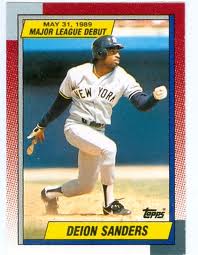
1. Deion Sanders (MLB/NFL)

With his nine-year MLB career and 14-year NFL career (all between 1989-2005), Sanders tops this list on the basis of some unique accomplishments:

Only person to play in the Super Bowl (for the victorious San Francisco 49ers, 1995, and the winning Dallas Cowboys, 1996) and the World Series (for the losing Atlanta Braves, 1992);

Only person to hit a major league home run and score an NFL touchdown in the same week;

Only person to suit up for an MLB and NFL game on the same day – on October 11, 1992, Sanders played for the Atlanta Falcons in an NFL day game against the Miami Dolphins and then flew to Pittsburgh to suit up for the Atlanta Braves’ League Championship Series game against the Pirates that night. (He did not, however, get into the game).

As a MLB player (1989-1995, 1997, 2001) for the New York Yankees, Atlanta Braves, Cincinnati Reds and San Francisco Giants, Sanders played in 641 regular season games, compiling a .263 average with 39 Home runs, 168 RBI and 186 stolen bases.  His best year was 1992, when he played in 97 games for the Braves – going .304, with a league-leading 14 triples, along with 8 home runs, 28 RBI, 54 runs scored and 26 stolen bases.  He followed that up with a great World Series, hitting .533 (8 for 17), with four runs scored, one RBI and five stolen bases.

During his NFL career, Sanders earned his way into the Football Hall of Fame  – intercepting  53 passes, returning nine for touchdowns;  returning 155 kickoffs for 3,523 yards and three TDs; returning 212 punts for 2,199 yards and six TDs; catching 60 passes for 784 yards and three TDs; and recovering four fumbles (one for a TD). He was an eight-time Pro-Bowler and the NFL’s 1994 Defensive Player of the Year.

Factoid:  Sanders, a Florida State University alum, is credited with bringing the “Tomahawk Chop” to the Braves’ fans.


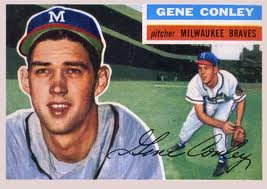
2. Gene Conley (MLB/NBA)

The 6’ 8” right-handed pitcher was edged out for the top spot on this list, only because Sanders made it into one professional Hall of Fame.  Conley excelled at baseball and basketball and holds the distinction of being the only person to play on an NBA Championship squad (Boston Celtics in 1959, 60 & 61) and a World Series Champion (Milwaukee Braves, 1957).

His MLB career spanned 11 seasons:  Boston Braves (1952); Milwaukee Braves (1954-58); Philadelphia Phillies (1959-60); Boston Red Sox (1961-63) – also earning him the distinction of being the only person to play for the Boston Braves, Red Sox and Celtics.

A right-handed hurler, Conley pitched in 276 games in his career (214 starts), winning 91 and losing 96 with a career 3.82 ERA.  He was a three-time All Star and the winning pitcher in the 1955 All Star Game.  His best year was 1954 when he went 14-9 with a 2.96 ERA.  He pitched in just one game in the 1957 World Series, giving up 2 runs in 1.2 innings of relief (the starts for Milwaukee went to Warren Spahn, Lew Burdette and Bob Buhl.)

Conley’s NBA career was as strong as his MLB run.   At forward and center  –  playing for the Boston Celtics (1952-61) and New York Knicks (1962-64) – he came off the bench to score 2,069 points, grab 2,212 rebounds and dish out 201 assists.  He averaged 16.5 minutes, 5.9 points and 6.3 rebounds per game.  In 33 playoff games, he averaged 14.6 minutes, 6.7 points and 5.1 rebounds.

Factoid:  In high school, Conley was All-State (Oklahoma) in baseball and basketball, as well as the state high jump champion.


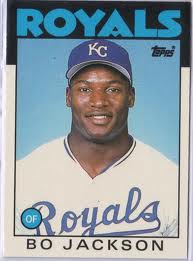
3. Bo Jackson (MLB/NFL)

Bo Jackson (6’1”, 227 lbs.) had an eight-season career as an MLB outfielder:  Kansas City Royals (1986-90); Chicago White Sox (1991, 1993); California Angels (1994) and played at running back for the Los Angeles Raiders for four seasons (1987-90).  In 1989, he was selected as a MLB All Star (and MVP of the 1989 All Star Game) and as an NFL Pro-Bowler.

His best year in MLB was 1989, when he hit .256, with 32 home runs, 105 RBI and 26 stolen bases for the Kansas City Royals.  That same year, he notched 950 yards rushing (5.5 yards per carry) and 4 rushing touchdowns for the Raiders.  That season he also caught nine passes for 69 yards.

In his MLB career, Jackson played in 694 games, hitting .250 with 141 home runs, 415 RBI and 82 stolen bases.

In his four seasons in the NFL, Jackson rushed for 2,782 yards (5.4 years per carry) and 16 touchdowns.  He also caught 40 passes for 352 yards and two touchdowns.

Factoid:  In the NFL, Jackson is most remembered for a 221-yard Monday Night Foot rushing performance (November 30, 1987) in his NFL rookie season.

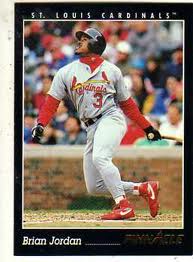
 4.  Brian Jordan (MLB/NFL)

Jordan patrolled considerable territory in his 15 seasons as an MLB outfielder (1992-2006) and three seasons as an NFL safety.  Jordan’s baseball career included time with the St. Louis Cardinals (1992-98); Atlanta Braves (1999-2001, 2005-06); LA Dodgers (2002-03); and Texas Rangers (2004).  He played in 1,456 games, hitting .282 with 184 home runs and 821 RBI.  He was an All Star in 1999, when he hit .282, with 23 home runs, 115 RBI and 13 stolen bases.

His brief NFL career, all with the Atlanta Falcons included 5 interceptions and 4 quarterback sacks in 36 games.

Factoid:  In June 1992, Jordan received a $1.7 million signing bonus as part of a new contract with the St. Louis Cardinals – contingent on Jordan giving up football.

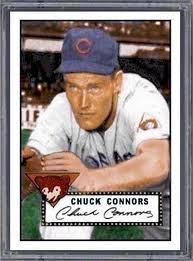
5.  Kevin “Chuck” Connors (MLB/NBA/Hollywood)

Six-foot-five with athletic skills and rugged good looks, Connors played for MLB’s Brooklyn Dodgers and Chicago Cubs and the NBA’s Boston Celtics (and was also drafted by the NFL Chicago Bears) before going on to play before even larger audiences as the star of the hit television series “The Rifleman.”   He makes this list on more on the basis of his acting career, which also included appearances in more than 40  movies, including a starring role in the now classic “Old Yeller,” and guest appearances on dozens of television shows.

His MLB career included one at bat with the Brooklyn Dodgers in 1949 and 66 games as a first baseman/pinch hitter for the Chicago Cubs in 1951.  He chalked up a .239 career average with 2 home runs and 18 RBIs.  In 1946-48, Connors played forward for the Boston Celtics, averaging 4.5 points per game in 53 games played.

In 1966, Connors reemerged on the baseball scene as an intermediary between the LA Dodgers and holdout pitchers Don Drysdale and Sandy Koufax.  The lefty-righty duo had gone a combined 49-20 for the 1965 World Champion Dodgers and decided to leverage their shared success, refusing to attend spring training and demanding a $1 million, three-year contract (split equally) – which would have made them the highest paid players in the game.  Connors is credited with helping end the month-long holdout, with Koufax signing for $125,000 and Drysdale for $110,000.

Factoid:  Connors also is credited with shattering the first professional backboard ever, during a November 1946 Celtics’ pregame warm-up.

Here are some others who reached the highest level in baseball and at least one other sport. No judgments here – alphabetical order.

Danny Ainge (NBA/MLB)

Ainge broke into the major leagues at age 20 (in 1979) with the Toronto Blue Jays.  He played just three seasons in the majors – 211 games, with a .220 average, 2 home runs and 37 RBI.  Primarily a second baseman, Ainge also saw time at third base, shortstop and all three outfield positions.  Notably, Ainge’s MLB career overlapped his college basketball career – Brigham University, 1977-81 – where he ran up average of 20.9 points, 4.6 assists and 4.6 rebounds per game and was the 1981 collegiate Basketball Player of the Year.

Ainge’s NBA career began at age 22 and stretched over 14 seasons (1981-95) with the Boston Celtics, Sacramento Kings, Portland Trailblazer and Phoenix Suns.  The 6’ 4”, 175-pound guard totaled 11,964 points, 1,133 steals, 4,199 assists, 2,769 rebounds.  His per game averages were 26.6 minutes, 11.5 points, 4.9 assists and 2.7 rebounds.  Ainge played in 193 NBA playoff games, averaging 26.1 minutes, 9.9 points, 3.4 assists and 2.3 rebounds.  He was a member of the Celtics 1984 and 1986 NBA Champion teams and a 1988 NBA All Star.

Factoid:  Ainge is the only athlete selected as a first team High School All-American in baseball, basketball and football.

Frank Baumholtz (MLB/BAA)

Frank Baumholtz enjoyed a ten-season MLB career (1947-49, 1951-57) as an outfielder with the Cincinnati Reds, Chicago Cubs and Philadelphia Phillies).  He played in 1,019 games, finishing with a .290 average, 25 home runs, 272 RBI, 450 runs scored and 20 stolen bases.  His best season was his 1947 rookie year, when he played in 151 games, led the league with 711 plate appearances and hit .289 with 5 home runs, 45 RBI and 96 runs scored.

Baumholtz played one season of professional basketball (1946-47), as a guard for the Cleveland Rebels of the Basketball Association of America, forerunner of the NBA. He appeared in 45 games, averaging 14.0 points per game.

Factoid:  Baumholtz was a first-team All American in basketball at Ohio University (1941) and his No. 54  jersey was the first ever retired by the school – on “Frank Baumholtz Day,” February 4, 1995.

Dave DeBusschere (NBA/MLB)

The best basketball player to ever play major league baseball,  DeBusschere played 12 seasons in the NBA (1962-74, Detroit Pistons and New York Knicks), was an eight-time NBA All Star, six-time NBA All-Defensive Player and played on the Knicks’ 1970 and 1973 NBA Championship teams.  DeBusschere is a member of the National Basketball Hall of Fame.  Over his career (875 games), the 6’6” forward/guard averaged 35.7 minutes, 16.1 points, 2.9 assists and 11 rebounds per game.

DeBusschere’s MLB career was considerably shorter than his stellar basketball tenure.  He joined the Chicago White Sox at age 22 in 1962 and pitched in the 1962 and 1963 seasons, logging 36 appearances (10 starts), a 3-4 record and a 2.90 ERA. His brief major league career did include one complete-game shutout.

Factoid:  In the 1964-1965 season, DeBusschere, just 24-years-old, was appointed player-coach of the Detroit Pistons.  From 1964-67, he coached the Pistons to a 79-143 record before going back to a player-only position.  He remains the youngest coach in NBA history

Dick Groat (MLB/NBA)

Groat had a 14-career as an MLB shortstop (1952, 1955-67) with the Pittsburgh Pirates, St. Louis Cardinals, Philadelphia Phillies and San Francisco Giants.  He was a five-time All Star and won the 1960 NL Most Valuable Player Award, while helping the Pirates earn the NL Crown (and World Series).  That season he and led the NL in batting at .325.  Groat was a career .286 hitter, with 2,138 hits, 39 home runs and 707 RBI.   He was on two World Series winners:  the 1960 Pirates and the 1964 Cardinals.

Groat also played one season (1952-53) for the NBA’s Fort Wayne Pistons, averaging 25.5 minutes, 11.9 points, 2.7 assists and 3.3 rebounds per game.

Factoid:  While at Duke University, Groat was a two-time All American in both baseball and basketball.  He was the first person selected to both the College Baseball and Basketball Halls of Fame.

Frank Grube (MLB/NFL)

Grube played catcher for the Chicago White Sox and St. Louis Browns (1931-36), getting into 394 games, but hitting only .154 with one home run and 107 RBI. His NFL career consisted of just one year – 11 games at end for the then NFL New Yankees.

Factoid:  Grube played basketball, baseball and football for Lafayette University – and while he never played football before attending college, Grube was an All-America end on Lafayette’s 1926 National Championship team.

George Halas (NFL/MLB)

While Football Hall of Famer George Halas may have been “Mr. Everything” in professional football for some six decades – player, coach, owner, promoter, innovator and pioneer – his MLB career was shorter and less noteworthy.  Halas played in 12 games (22 at bats, .091 average) as an outfielder for the 1919 Yankees.

During his a pro-football playing career (1919-1928), Halas played defensive end and wide receiver for the Hammond All Stars, Decator/Chicago Staleys and Chicago Bears.  A Bears’ owner from 1920 until his death in 1983, Halas coached the Chicago Bears (and their predecessor Staleys) for 40 seasons (1920-29, 1933-42, 1946-55. 1958-67).  Under his leadership, the Bears won nine Divisional titles, six NFL Championships and only six times finished with a losing record.  He is also credited with co-developing the T-formation.

Factoid:  Halas played basketball, football and baseball at the University of Illinois.

Steve Hamilton (MLB/NBA)

The 6’6” left-handed reliever enjoyed a 12-year (1961-72) career with the Cleveland Indians, Washington Senators, New York Yankees, Chicago White Sox, New York Giants and Chicago Cubs – going 40-31 with 42 saves and a career ERA of 3.05.

Hamilton also played two seasons as a forward for the NBA Minneapolis Lakers (1958-60) – averaging 13.3 minutes, 4.5 points and 3.4 rebounds in 82 games.

Factoid:  As his MLB career was winding down, Hamilton gained notoriety for his “folly-floater,” a slo-o-o-w, high-arcing pitch that would have looked more at home in a slow pitch softball game.


Carroll Hardy

Hardy was a multi-sport talent for the University of Colorado in the early 1950s, lettering in football, baseball and track – earning All-Conference honors in football and baseball.  Immediately out of college, Hardy signed on as a receiver with the NFL San Francisco 49ers.  In 1955, he caught 12 passes for 338 yards and four touchdowns, and returned three punts for  65 yards.  Hardy then chose to concentrate on baseball and played 8 seasons (1957-64, 1967) as a major league outfielder, getting into 433 games for the Indians, Red Sox, Astros and Twins.  His career average was .225, with 17 home runs and 113 RBI.

Factoid:  Hardy is the only player to pinch hit for Ted William, as well as the only player to pinch hit for Williams’ replacement, Carl Yastzremski.  He also hit his first MLB home run, while pinch hitting for Roger Maris.

Mark Hendrickson  (MLB/NBA)

Hendrickson, a 6’9” left-handed hurler, recorded 10 MLB seasons (328 appearances, 166 starts) with a 58-74 record and a 5.03 ERA.  Between, 2002-2011, he pitched for the Toronto Blue Jays, Tampa Bay Devil Rays, Los Angeles Dodgers and Baltimore Orioles.  His best MLB season was 2009, when he went 6-5 with a 4.37 ERA for the Orioles.

Hendrickson also played four seasons (1996-2000) as a power forward in the NBA for the Philadelphia 76ers, Sacramento Kings, New Jersey Nets and Cleveland Cavaliers.  In 114 games, he averaged 13.2 minutes, 3.3 points and 2.8 rebounds per game.

Factoid:  While playing for Washington State University, Hendrickson made the All Pac 10 Conference teams in both baseball and basketball.

Drew Henson (MLB/NFL)

The 6’5″, 225-pounder played quarterback for the Lions (2008), Cowboys (2004-05) and Vikings (2006).  He also appeared in 8 games for the 2002-03 Yankees going one for nine.  His NFL career consisted of just nine games played, and he completed a total of 11 of 20 passes with one TD and one interception.  Despite these less than sterling numbers, he can lay claim to both throwing and NFL Touchdown and collecting an MLB base hit.

Vic Janowicz (MLB/NFL)

Janciwics got in 22 games as a halfback for the Washington Redskins (1954-55), gaining 410 yards on 99 carries with 4 touchdowns.  He also played 83 games at catcher and third base for the Pittsburgh Pirates over the the 1953 and 1954 seasons – hitting .214 with 2 home runs and ten RBI.

Cotton Nash (MLB/NBA)

Nash had brief careers at the top level of pro basketball (NBA/ABA) and baseball (Chicago White Sox, Minnesota Twins).   In baseball, the OF/1B got in 13 games (White Sox, 1967 and Twins, 1969-70) with a .188 average and 2 RBI in 16 at bats.  In basketball,  the 6’5”, 215-pound Nash played forward for the LA Lakers and San Francisco Warriors  of the NBA and the Kentucky Colonels of the ABA between 1964-68.  He averaged 13.6 minutes, 5.6 points and 3.3 rebounds in 84 games.

Clarence “Ace” Parker (MLB/NFL)

Clarence Parker got his MLB career off with a bang, homering in his first at bat for the 1937 Philadelphia Athletics.  It was down hill from there, as Parket played in just 94 games in 1937 and 1938 (SS-3B-OF) hitting .179 with 2 home runs and 25 RBI.

Parker proved more adept at football, making the Hall of Fame as a multiple threat player.  Playing from 1937 to 1946 for Brooklyn, Boston and New York (and winning the NFL MVP Award in 1940), he completed 335 of 718 passing attempts for 30 touchdowns, rushed 498 times for 1,292 yards and 13 TDs, had 8 pass receptions for 229 yards and three TDs, returned 24 punts for 238 yards and one TD, returned five kickoffs for 98 yards, made 25 of 30 point-after-touchdown kicks (but only 1 of 5 field goal attempts) and punted 150 times for a 38.4 yard average.

Ron Reed (MLB/NBA)

The 6’6”, 217-pound, right-handed pitcher enjoyed a 19-year career as an MLB starter and reliever (Atlanta Braves, 1966-75; St. Louis Cardinals, 1975; Philadelphia Phillies, 1976-83; and Chicago White Sox, 1984).  Reed’s MLB career record was 146-140, 103 saves, a 3.46 ERA and 1,481 strikeouts in 2,477.2 innings pitched.  His best season was 1969, when he went 18-10, 3.47 in 33 starts for the Braves.

Reed also played forward for two seasons for the NBA Detroit Pistons (1965-66, 1966-67) averaging 18.9 minutes, 8.0 points and 6.4 rebounds per game.

Factoid: Reed is one of only eight MLB pitchers with 100 wins and 100 saves.

Dick Ricketts (MLB/NBA)

Ricketts, a 6’7”, 216-pound right hander, had just one MLB season, going 1-6 with a 5.82 ERA for the 1959 Saint Louis Cardinals.  He played  in the NBA from 1955-59, scoring 1,974 points and grabbing 1,337 rebounds – for a per game average of 26.8 minutes, 12.5 points, 8.5 rebounds and 2.8 assists.

Howie Schultz (MLB/NBA)

Schultz played major league baseball for six seasons (1943-48), spending time at first base with the Brooklyn Dodgers, Philadelphia Phillies and Cincinnati Reds.  He played 470 games, hitting .241, with 24 home runs and 208 RBI.

In 1949, the 6’6” Schultz switched to basketball, beginning a three-year stint as an NBA center/forward.  He played for the NBA’s Anderson Packers, Fort Wayne Pistons and Minneapolis Lakers, averaging 5.3 points per game.

Favorite Baseball Songs

Here’s a little BBRT holiday present – a link to my favorite baseball song “America’s National Pastime” – immortalizing Dock Ellis’ 1970 LSD-fueled no-hitter.

America’s Favorite Pastime

Here are my top five favorite baseball tunes:

1. ” America’s Favorite Pastime” – Todd Snider (1999).  Tops my list because I love the Dock “Ellis-Dee” story and Todd Snider is also a favorite of BBRT.

2. “Take Me Out To The Ballgame”  – by Jack Norworth/Albert Von Tilzer (1908).  Got to be near the top of any list just for the memories we all have singing this during the seventh-inning stretch at the ballpark.

3. “Talkin’ Baseball” – by Terry Cashman (1981).  A “catchy” look at the gloried history of the game.  What other song “drops names” like: Willie Mays;  Mickey Mantle; Duke Snider; Ted Kluszewski; Roy Campanella; Stan “The Man” Musial; Yogi Berra; Phil “Scooter” Rizzuto; Hank Aaron; Ralph Kiner; Bob Feller; Sal “The Barber” Maglie; Don Newcombe; Casey Stengel; Bobby Thomson; Jackie Robinson; Reggie Jackson; Rod Carew; Vida Blue – and many more, even little Eddie Gaedel – and adds historic context?  A must-hear for any baseball fan.  In a just world, this song would probably top this list.

4. “Centerfield” – by John Fogerty (1985).  We’ve all felt the “Put me in coach, I’m ready to play” emotion of the chorus of this rockin’ baseball anthem.  It just makes me want to grab a glove and hit the field.

5. ” The Greatest” – by Kenny Rogers (1999) –  If you’ve even fanatisized about being a baseball  hero, you’ve got to love this song and the youthful optimism of its hero.

And an honorable mention goes to:

Go Cubs Go – by Steve Goodman (1984).  Love the post-win enthusiasm of Wrigley field fans as they belt this tune out after every  Cubs’ win.