Ballpark Tours 2013 Trek Continues

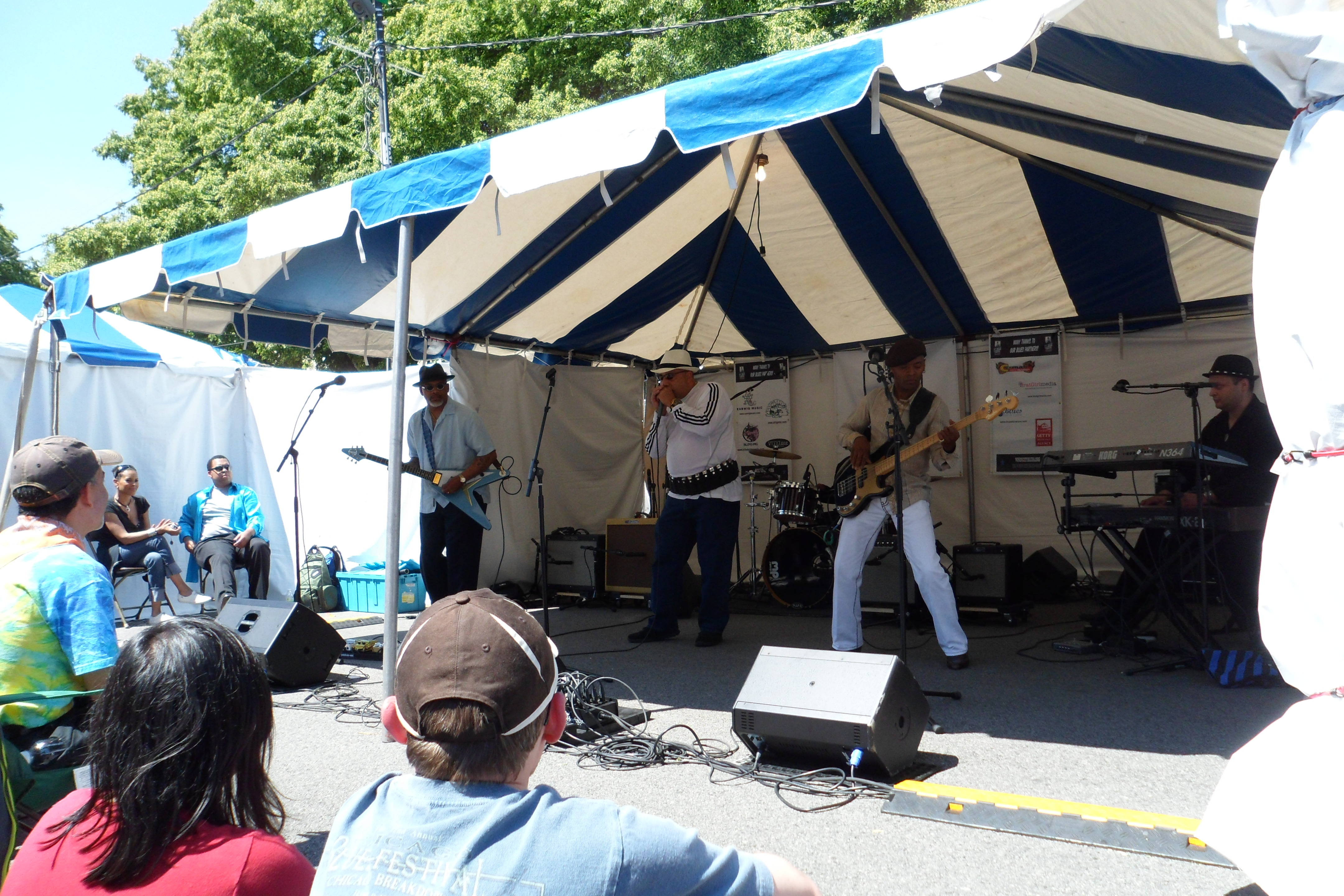
The action was up close and personal at the Chicago Blues Festival

The 2013 Ballpark Tours trek is in its third day – and it was one filled with variety.  As always, our tour operator left us plenty of time to soak in the local culture.  For BBRT, it was a stop at the Art Institute of Chicago and the 2013 Chicago Blues Festival – both within easy walking distance of our hotel (The Palmer House Hilton).  Saw four solid Chicago Blues Rock bands at the (free) festival – highlighted by Liz Mandeville and the Blue Points and Brother Jacob and his Blues Crew.  Also had a chance to be assigned a “Blues Name” (based on your initials) for a mock “talent pass.”  I got “Old Bones Smith.” And, the opportunity for a free Blues Festival poster with your own image.  Great fun, all part of the typical Ballpark Tours experience.
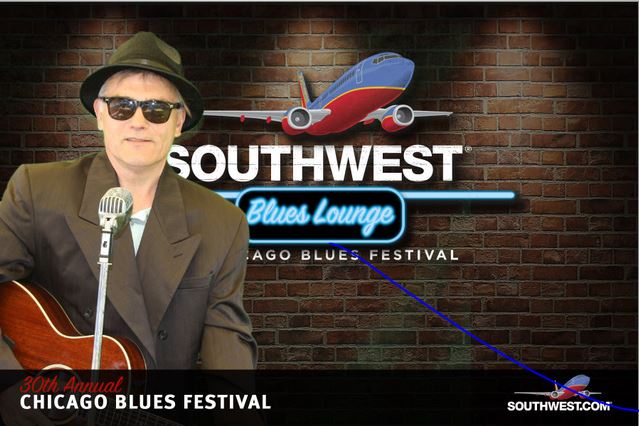
Your own “blues name and poster” … all part of the 2013 trek experience.
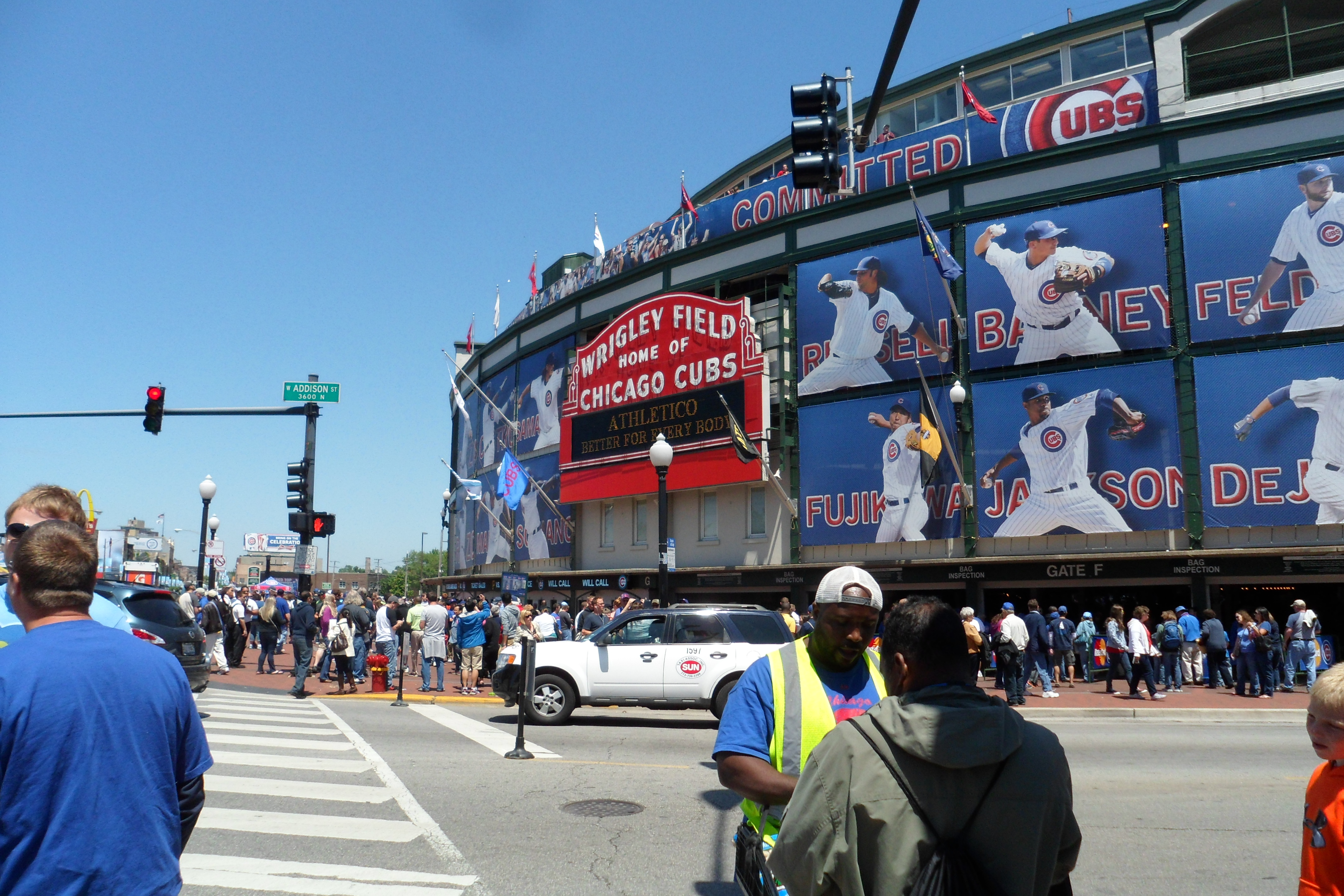
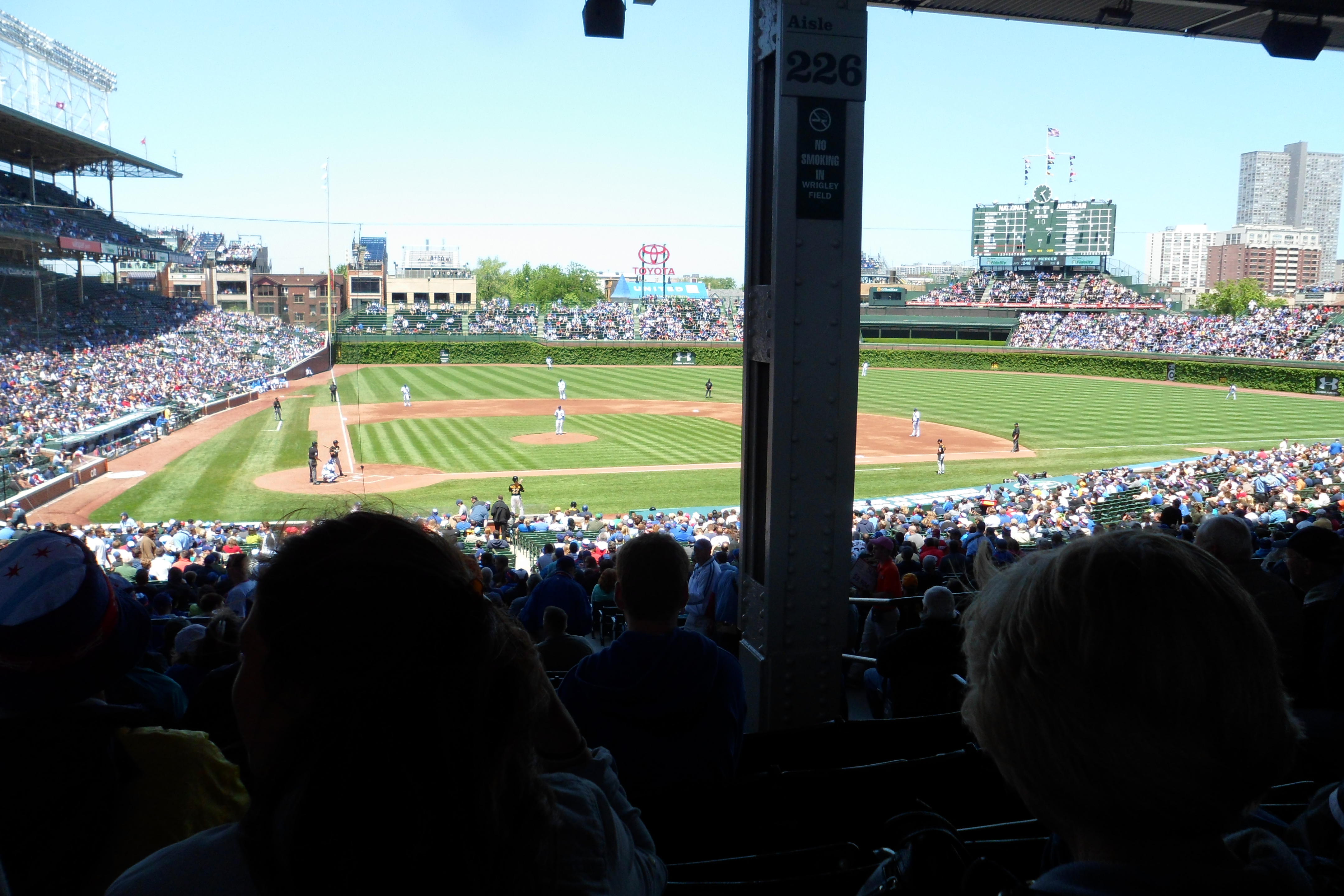
Wrigley Field again the star attraction.

Later in the afternoon it was back on the subway/el to Wrigley for another Cubs/Pirates matchup.  Sunny day, decent upper deck seats (no really bad seats at Wrigley).  We saw the Pirates’ A.J. Burnett dominate the Cubs most of the game.  In fact, when Pirates’ manager Clint Hurdle let Burnett bat (weakly) in the bottom of the eighth, we thought we were going to see an increasingly rare MLB result – a complete game shutout.  (Not so rare on the Pirates, who lead all of MLB with ten shutouts.)  After eight innings, Burnett had a 6-0 lead, having given up just two hits and three walks (with five strikeouts).  After one out in the ninth, he faltered giving up a single to Cubs first sacker Anthony Rizzo and a long home run to center fielder Alfonso Soriano before being relieved.

The game offered plenty for the fan.  The Pirates’ third baseman hit a truly out-of-the-park  two-run homer (his 13th of the season) that landed on Sheffield Avenue beyond right field, while Pirates’ catcher  Russell Martin hit his 100th career (and seventh 2013) round tripper to left.  There were also a handful of good defensive plays including a catch in the outfield ivy by Pirates’ right fielder Travis Snider, a tough diving catch by Cubs’ right fielder Nate Schierholtz and infield gems by the Pirates’ Pedro Alvarez (3B) and Neil Walker (2B).  History was served as the Cubs’ giveaway was a Hall of Famer Ernie Banks flag and Ernie himself led the seventh-inning rendition of “Take me out to the ball game.”   All in all a great day to be at the ball park.

Tomorrow, it’s off to Appleton, Wisconsin for some minor league action.

Ballpark Tours and Memory Lane

Yesterday (June 6), BBRT took off on its annual Ballpark Tours Trek … aboard a coach with 45 other baseball fans and, Julian, our intrepid operator and Phillies fan.  This is a shorter trip than usual (BPT has done as many at 13 games in nine cities in ten days).  This year it’s a long weekend – four games, in three cities (Milwaukee, Chicago, Appleton) in four days. 

Blogging from the lobby of the Palmer House Hilton … Ballpark Tours Travels in Style.

The theme, at least for BBRT, is Blues, Brews and Baseball – not necessarily in that order.  We are in town for the 2013 Chicago (free) Blues Festival, in Grant Park, just a few blocks from the Palmer House Hilton.  (I’m writing this blog in the lobby); our trek includes a brewery visit (Sand Creek Brewing Company in Black River Falls, WI); and there is, of course, the aforementioned baseball.

First stop – a brewery – makes sense to me.

We departed Saint Paul, MN at about 10:00 a.m. and reached the Sand Creek Brewery just before lunch time.  Good tour of the history brewery – and good tasting as well.  It was then a picnic-style lunch in nearby Field of Honor Park (a bit of a gloomy day), before heading off for a night game (Brewers/Phillies – I noted our tour operator is a Phillies fan) at Miller Park in Milwaukee. It was a gloomy day, and roof at Miller Park, was closed, giving you the feel of watching the national pastime in a warehouse or airplane hangar.  It didn’t help that the crowd was small (announced at 21,851 but looking considerable smaller in the cavernous Miller) and subdued (the Brewers are in last place and fell quickly behind the Phillies.  Still, it was baseball, the brats were tasty, the Bloody Mary spicy, we received free Norichika Aoki “fan masks.”  We also saw ex-Twin Delmon Young take one yard and ex-Twin (and hot hitting) Carlos Gomez exhibit the warning-track power we so often saw when he was with the Twins – as the Brewer went down 5-1.  (It was also BBRT’s first chance to see Brewers’ phenom Jean Segura – who looks like the real deal.

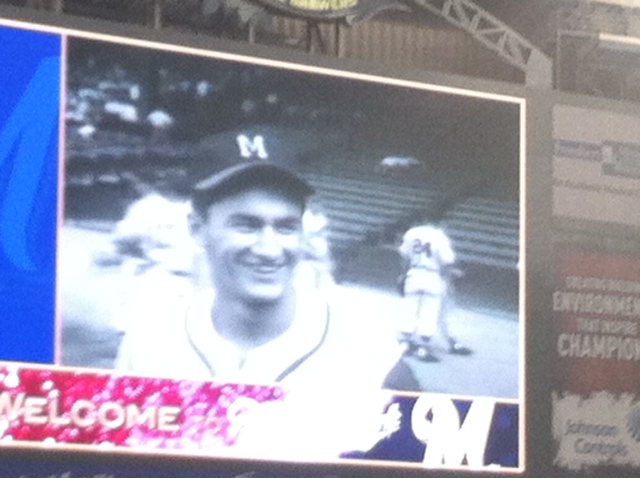
Johnny Logan … highlight of the Brewers’ ga,e.

The real highlight was the induction of former Milwaukee Braves’ shortstop Johnny Logan into Miller Parks’ Milwaukee Hall of Fame. Logan – known as scrappy ballplayer – remained feisty even at age 87.  In his acceptance, he shared stories about such notables as Billy Bruton, Hank Aaron and Stan Musial with enthusiasm – until emcee Bob Eucker had to cut him off.   Logan, whose MLB career stretched from 1951 to 1963, was a four-time All Star and a key player on the Braves 1957 World Championship team and 1958 NL Champs.  For trivia buffs, he was the first batter to face HOFer Sandy Koufax (delivering a single) and – playing in Japan in1964 as a member of the Nankai Hawks – was the first player to play on a MLB World Series champ and a Japanese Baseball championship team.  The return to Japan was a natural for Logan, who had played service ball (for the Army) in Japan in 1945-46.

Former Brave utility man Felix Mantilla was called upon to help present Logan’s honor not only shared stories about Logan’s exploits, but brought back some memories for BBRT.  Mantilla, who eleven-year MLB career included only 89 homers and 330 RBI, made quite a mark in Boston.  After six seasons with the Braves in Milwaukee (1956-61) and one with the expansion Met, Mantilla joined the Red for the 1963-65 seasons.  In a line-up that included such sluggers as Dick Stuart, Tony Conigliaro and Carl Yastrzemski, Mantilla, in 1964, finished second on the team in homers with 30 (to Dick Stuart’s 33) and led the Red Sox in RBI with 94 in 1965 (earning his only All Star selection).  In those two seasons, Mantilla hit 48 of 89 career homers and collected 156 of his 330 RBI – while playing 2B, 3B, SS and all three outfield spots.  Mantilla was traded to Houston in after the 1965 season and was released after the season (and did not play in the major again).  For trivia buffs, Mantilla’s groundball to Pirates’ third baseman Don Hoak leading off the 13th inning (on which Hoak made a throwing error), broke up Harvey Haddix’  May 26, 1959 perfect game.  Mantilla was sacrificed to second by Eddie Mathews, Hank Aaron was intentionally walked and Joe Adcock hit one out of the park.  The elated Braves messed up the base running (Aaron ran off the field, and so was passed by Adcock) resulting in Adcock’s homer becoming a double and the final score reading 1-0.  Still, after retiring 36 consecutive batters, Haddix ended up losing the “perfecto,” the no-hitter, the shutout and the game.

After the Milwaukee game, out intrepid trekkers were back on the bus, swapping baseball tales, as we rolled into Chicago – and a late check in at the Palmer House Hilton.  A long, but truly enjoyable day.  Thanks to Ballpark Tours. 


Old stadiums, like Wrigley, have their faults … but are still the best place to see baseball.

Day two of our trek found us in Chicago, taking the subway/el to Wrigleyville, where we enjoyed a neighborhood of sports bars and baseball-themed shops before the Cubs took on the Pirates in the “friendly confines” – a great place to enjoy a ball game.  It was a good one –with the Pirates winning 2-0.  Ex-Twin Francisco Liriano started for the Pirates as was effectively wild (it didn’t seem that effective, but he went seven scoreless innings, with two hits, 5 walks, a wild pitch and eight strikeouts).  We also got a look at NL saves leader Jason Grilli. The six-foot-four Grilli, who looks even larger on the mound, logged his 23rd save – but made it interesting.  He notched three strikeouts in the inning, but also gave up two hits to bring the winning run to the plate.  Oh yes, another freebie today – Cubs’ floppy hats.


Supper, by the way, for food geeks, was great.  Decided to stay in tonight, at the Hilton’s lobby bar. Had a great grilled flat bread with Mergeuz sausage, Manchego cheese, smoked paprika olive oil and chervil with a very good Garnett Pinto Noir.  Nice finish to the day.   Next on the agenda – Chicago Blues Fest and tomorrow’s Cubs game.

Through May – Surprises, Disappointments, “Or Nots”

Brewers’ Jean Segura – 2013 Surprise “or not.”

Today, BBRT takes a look at the first two months of the MLB season – some surprises, some disappointments and some “or nots.” 

For example, it appears the Pittsburgh Pirates – who are working on a string of 20 consecutive losing seasons – are a 2013 surprise.  They finished the month of May thirteen games over .500 (34-21), tied for second place in the ML Central.  But there’s a big “or not” with this surprise.  The Pirates have proven their ability to turn around a good season in the second half.  In 2012, for example, they were sixteen games over .500 on August 8, only to finish four games under for the season (the “fade” seems to be a Pittsburgh pattern).  BBRT is hoping the Pirates surprise and stay in it until the end.

Here’s a few other surprises, disappointments and “or nots.”

  • Surprise and disappointment – the upside down AL East.  As BBRT looks at the season, many of the surprises at the end of May are consistent with the surprises noted in the end of April blog post, like the upside-down AL East. Most analysts saw the finish – from top to bottom – along the lines of Toronto (active in the off season), Tampa Bay, Baltimore, New York, Boston.  As we entered June, the teams stand in reverse order, with the Red Sox on top.  However, the Yankees, who have led the division much of the way, are starting to show signs that age and injuries may derail their season.  Still, they are getting some key players back, and may still surprise BBRT.
  • The Braves’ Justin Upton, whose power was an April surprise (.298, with 12 homers and 19 RBI), turned disappointment in May (.211-2-10).
  • The Braves and Nationals remained a surprise/disappointment combo – with Atlanta leading the favored (and disappointing) Nationals by six games at the end of May.  The Braves/Nats were expected to fight it out for the division title, but health-related disappointments (Strasburg/Harper) are not helping the Nationals as they work to catch up.
  • Not surprising is Tigers’ third baseman’s Miguel Cabrera’s pursuit of a second Triple Crown (Avg.-HR-RBI).  A bit surprising is that Orioles’ first baseman Chris Davis seems like the main obstacle in that pursuit.  At the end of May, Cabrera let the AL in batting at .372, with Davis second at .356; Cabrera led the AL in RBI with 61, with Davis second at 50; and Davis led the AL in home runs with 19, with Cabrera second at 16.  Really, if it weren’t for Cabrera, we might be talking about Davis as a Triple Crown threat.  A bit of an “or not” for Davis.  His numbers are not a total surprise, the 27-year-old had a breakout season in 2012, going .270-33-85 in 139 games (playing catcher, first base, DH and both corner outfield spots).
  • Brewers’ shortstop Jean Segura is another early season surprise with an “or not” aspect.  Segura finished May at .354, with eight home runs, 22 RBI and 15 stolen bases.  This followed a 2012 season when he went .258-0-14, with 7 steals in 45 games.  The “or not?”  The 23-year-old has shown plenty of promise, with a .313 average in 399 minor league games, a spot in the 2012 All Star Futures Game and this past season’s Dominican Winter League Batting title.  And, think about this.  Segura was an Angels’ prospect, included (after playing one game with the Halos in 2012) in the trade that brought Zack Grienke to LA from the Brewers.  We could have seen Segura and Mike Trout in the top two spots Angels’ line-up.
  • Despite the Braves’ success, the Atlanta outfield has to be considered an early-season disappointment.  BBRT already noted Justin Upton’s April slide.  Then there is B.J. Upton’s horrendous start – hitting .145, with four home runs and just eight RBI through May.  And, of course, Jason Heyward’s .146-2-8 start.  A positive surprise for the Braves has been catcher-outfielder Evan Gattis.   The 26-year-old rookie with the storied past ended May hitting .281, with 12 homers and 32 RBI.
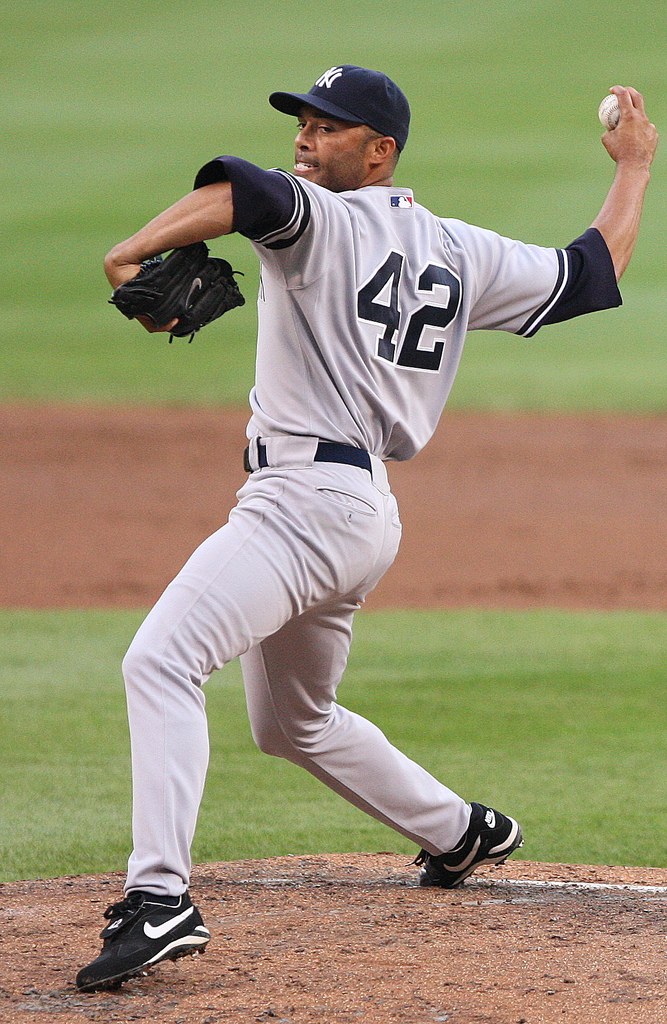
  • Another surprise – with an “or not” – for BBRT is 43-year-old Mariano Rivera’s 1.77 ERA and AL-leading 19 saves through May.  Age apparently is ignoring Rivera’s arm and cutter.  The “or not?” Shouldn’t be too surprising, Rivera is headed for the Hall of Fame as the all-time saves leader.
  • There are a couple of surprising closers in the NL –  the Pirates’ Jason Grilli and the Cardinals’ Ed Mujica.


A tip of BBRT’s cap to surprising saves leader Jason Grilli.

May ended with Grilli leading the NL (and all of MLB) with 22 saves and sporting a miniscule 1.09 ERA and 39 strikeouts in 24 2/3 innings.  Why a BBRT surprise?  Grilli is no new-comer.  He’s 36-years-old and, over his previous 10 big league seasons, he was 21-26, with just five saves and an ERA a bit north of four.  Still, over his three seasons as a Pirate (2011-2013), he has fanned 165 hitters in 116 innings.  This late bloomer has clearly come back even stronger from a severe knee injury that sidelined him for the 2010 season. 

Jason Motte, who saved 42 games in 2012, was penciled in as the Cardinals’ closer until shelved by an arm injury.  Number-two and number-three choices Mitchell Boggs and Trevor Rosenthal fell short of expectations, leaving number-four choice, Ed Mujca – with six saves in seven MLB seasons –  to step up.  Step up he did, since moving up to closer in mid-April, Mujica has notched a surprising 17 saves (good for second in the NL through May) and a 1.88 ERA.

  • The Texas pitching staff is an April-May surprise, finishing May with the lowest ERA in the AL (3.44), with all five starters under 4.00.
  • The Brewers’ Carlos Gomez is another early surprise, hitting .321 with 10 home runs, 27 RBI and 11 stolen bases through May.  This from a player whose highest previous average was .260 in 2012.
  • The Diamondbacks’ Patrick Corbin is a surprise to BBRT.  The 23-year-old hurler ended May at 8-0 with a 1.71 ERA (following a 2012 mark of 6-8, 5.54).  On the disappointment side of the coin, 2012 Cy Young Award winner R.A. Dickey (now of Toronto) finished May at 4-7, 5.18.
  • A few other good surprises through May (you can look up the numbers): Orioles’ third baseman Manny Machado; Mets’ pitcher Matt Harvey; Red Sox’ hurler Clay Bucholz; Phillies’ outfielder Dominic Brown; Seattle pitcher Hisashi Iwakawa; the Arizona Diamondbacks; the Cleveland Indians.
  • Some notable disappointments thus far:  the Angels, Dodgers and Blue Jays; Angels’ outfielder Josh Hamilton; 2012 Cy Young winner David Price; Giants’ Hurler Matt Cain.

Mariano Rivera – Still surprising at 43.

Trout Cycle – More To Come?

Mike Trout – Big Day at the Plate.

Yesterday, May 21, 2013, Mike Trout of the Angels became the youngest American Leaguer (21-years-old) to hit for the cycle (Could this final wake up the lagging Angels).  He now has plenty of time ahead to reach the MLB records of two cycles in a season and three in a career.  In honor of Trout’s achievement, BBRT looks at some “cycling records.”

  •  Youngest major leaguer ever to hit for the cycle – The New York Giants’ Mel Ott – age 20 – on May 16, 1929.
  • Oldest major league to achieve the cycle – the Angels’ Dave Winfield – age 39 –  on June 24, 1991.
  • The record for cycles in a career is three, shared – appropriately – by three players:  Bob Meusel, Babe Herman and John Reilly,
  • Only four players have hit for the cycle twice in a season, including the Diamondbacks Aaron Hill just last year.  The others: Tip O’Neill, Babe Herman and John Reilly.
  • A “natural cycle” – single, double, triple, homer in order – has been achieved 14 times.


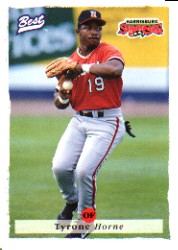
Finally, BBRT would like to revisit a one-time-only cycle event that we touched on in a posting last season. On July 27, 1998, Tyrone Horne of the Double-A Arkansas Travelers hit professional baseball’s only “home run cycle” – banging a solo home run, two-run homer, three-run homer and a grand slam in a single game (a 13-4 road victory over the San Antonio Mission.) 

Horne, at the time, was in the midst of a stellar minor league season in which he would go .313 with 37 home runs, 140 RBI, 95 runs scored and even throw in 18 stolen bases.  Immediately after the historic game, Horne headed off to the Texas League All-Star Game where he won the Home Run Derby.  Horne, by the way, never made it to the major leagues – completing a 13-year (1,286 game) minor league career with a .288 average and 143 home runs.  The bat he used that historic day, however, has made it to the Baseball Hall of Fame in Cooperstown.

Miggy’s Triple Crown Pursuit – Never Been A Repeat

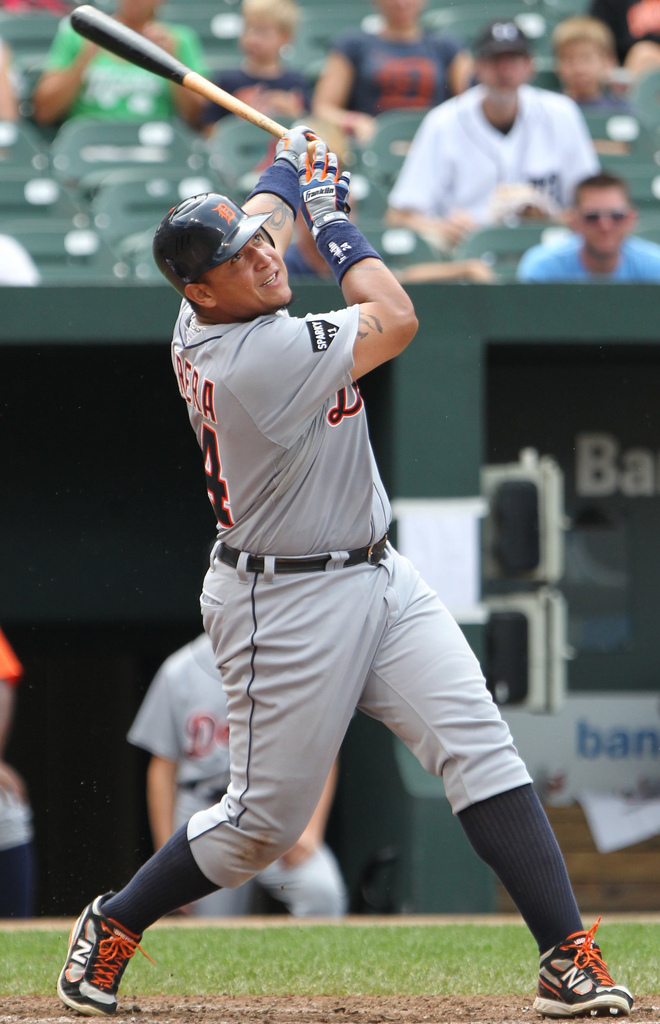
Can Miggy “Three-Peat” to repeat the Triple Crown. Never been done.

As BBRT posts this, 2012 AL Triple Crown winner Miguel Cabrera of the Tigers is in hot pursuit of a second Triple Crown.  His .387 average and 47 RBI lead the AL and his 11 home runs are just one off the pace.   Can Miggy repeat as a Triple Crown winner?  History says “no.”   In fact, if Cabrera tops the AL in two of the three categories, he will be the first MLB Triple Crown winner to accomplish a two-thirds Triple Crown in the next season.  Only seven times has a Triple Crown winner come back to lead his league in at least one of the three categories  – and that has most often been batting average (six of the seven repeats, with one TC winner – the Cardinals’ Joe Medwick – taking the RBI title the year after his Triple Crown).

We’ll take a look at how TC winner have fared in the following season, but first a few TC factoids:


  • Only once in MLB history have both the AL and NL featured a Triple Crown winner and both triple champions played in the same city.  It was 1933, and the TC winners were Chuck Klein of the Philadelphia Phillies and Jimmie Foxx of the Philadelphia Athletics.
  • There have been only two two-time TC winners, Rogers Hornsby and Ted Williams.
  • Twice in MLB history, a TC winner has been foiled in his attempt to “repeat” by a player who achieved a Triple Crown of his own. Jimmie Foxx, who won the AL Triple Crown in 1933, saw his repeat effort overshadowed by Yankee Lou Gehrig’s 1934 Triple Crown season. In 1966, Frank Robinson won the AL Triple Crown with the Orioles, and Carl Yastrzemski followed up in 1967 with a TC of his own for the Red Sox.
  • One TC winner was stopped in his attempt to repeat his achievement by a greater conflict – Ted Williams missed the season following his first Triple Crown due to military service in WWII.
  • In a numbers game, Ty Cobb may have come the closest ever to a Triple Crown repeat.  He won the TC in 1909 and finished second in all three categories the following season.
  • Ty Cobb, at age 22, is the youngest-ever TC winner, while Frank Robinson at 31 the oldest.

Let’s take a look at the TC winners and their follow-up efforts.

Paul Hines, of the NL Providence Grays, won the Triple Crown in 1878 – going .358-4-50.  The following season, he repeated as batting champion at .357, but his 2 home runs and 52 RBI left him fifth in the league in both categories.

Tip O’Neill, of the American Association St. Louis Browns, won his Triple Crown in 1887 – with a line of .435-14-123.  Like Hines, he repeated as batting champ in 1888, despite a 100-point drop to .335, but hit only 5 home runs (failing to make the top ten) and drove in a league fourth-best 98 runs.

In 1901, Nap Lajoie of the AL’s Philadelphia Athletics won the Triple Crown with a .426-14-season. It was the first year of the newly formed American League and Lajoie was one of the premier players who had “jumped” to the rival league – moving crosstown from the NL Phillies to the Athletics.  Lajoie did not remain with the Athletics for long after his Triple Crown achievement – he played only one game for the A’s the following year, thanks to legal wrangles between the NL and AL. In April 1902, the Supreme Court of Pennsylvania overruled an earlier decision by a lower court and reinforced the reserve clause in contracts between players and NL clubs. Under the rule, it appeared Lajoie could only play for the Phillies (the NL team to which he had been under contract).  However, ongoing proceedings found the ruling was only enforceable in the state of Pennsylvania. The Athletics resolved this dilemma by trading Lajoie to the AL’s Cleveland Bronchos. Lajoie repeated as AL batting champ, hitting .378, but dropped to seven home runs and 65 RBI in a season that essentially began for him in June.  

The Detroit Tigers’ Ty Cobb captured the Triple Crown in 1909 with a .377-9-107 performance.  In 1910, he put up a .383-8-91 season, finishing second in all three categories.  He was edged out for the batting by .001 (Nap Lajoie hit .384), fell two home runs behind AL leader Jake Stahl of Boston and trailed teammate Sam Crawford by 29 for the RBI crown.

The Cardinals’ Rogers Hornsby captured the 1922 NL Triple Crown with a .401-42-152 season.  He came back in 1923 with .384-17-83, repeating as batting champ and finishing fifth in home runs.

Rogers Hornsby captured his second Triple Crown in 1925, going .403-39-143. In 1926, he dropped to .317-11-93 (finishing in the top ten in home runs and RBI) and, in 1927, after an off-season contract dispute with the Cardinals, he found himself traded to the New York Giants.

Chuck Klein of the Phillies captured the NL Triple Crown in 1933 at .368-28-120.  The financially troubled Phillies traded Klein to the Cubs for three players and $100,000 in cash following his TC season and he put up with a .301-20-80 season for the Cubs in 1934.

Philadelphia had two TC winners in 1933.  Klein in the NL and Jimmie Foxx of the Athletics in the AL – .356-44-130.  Foxx went a solid .334-44-130 in 1934, finishing seventh in average, second in homers and fourth in RBI (in a season when Lou Gehrig won the AL Triple Crown).

Lou Gehrig captured the 1934 AL Triple Crown, going .363-49-165 for the Yankees.  He had a strong 1935 season … .329-30-119 … finishing sixth in the AL in average, third in home runs and second in RBI.

Joe “Ducky” Medwick earned his Triple Crown for the Cardinals in 1937 – .374-31-164.  He came back with a .322-21-122 season in 1938, leading the league in RBI.  (He is the only TC winner to repeat the following year in a category other than average.) In 1938, he also finished fourth in average and sixth in home runs.

The Boston Red Sox’ Ted Williams earned his first Triple Crown in 1942, with a .356-36-137 season – then missed the 1943 season due to WWII military service.

Ted Williams came back to win a second Triple Crown in 1947, when the Red Sox’ outfielder went .343-32-114.  He repeated as batting champ in 1948 at .360, with 25 home runs (sixth in the AL) and 127 RBI (third).

Yankee great Mickey Mantle took Triple Crown honors in 1957, with a .353-52-130 season.  The following year his .365 average was second only to Ted Williams (.388) and his 34 homers and 94 RBI were third and sixth in the AL, respectively.

Frank Robinson of the Orioles captured the 1966 AL Triple Crown – .316-49-122 and came back with a .311-30-94 campaign in 1967, when Carl Yastrzemski captured the AL Triple Crown.

The Red Sox’ Carl Yastrzemski’s .326-44-121 earned him the 1967 AL Triple Crown.  He won the AL batting title again in 1968 (with the lowest-ever average for a batting champ at .301), while finishing seventh in the AL in HR (27) and eighth in RBI (74). 

Detroit Miguel Cabrera earned the AL Triple Crown in 2012 with a .330-44-139 season – and is off to a great start in 2013  … .387-11-47 through May 19.

Happ Injury Brings Back Memories of Herb Score

Tuesday– May 7. 2013 – Toronto left hander J.A. Happ was knocked from the mound by a Desmond Jennings line drive.  BBRT is glad to hear Happ is already out of the hospital, although he reportedly has a fracture behind his left ear that he indicated doctors say will heal on its own.  BBRT wishes Happ, now on the disabled list, a speedy and full recovery.

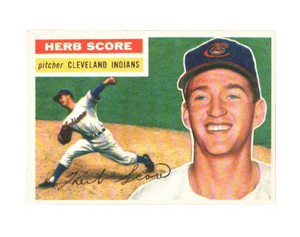
Desmond’s line drive came 56 years to the day that another left-handed hurler – Indians fastballer Herb Score – was dropped by a line drive of the bat of the Yankees Gil McDougald.  The line drive was so vicious, the crack of the ball against Score’s face so loud (even in the stands, according to observers) that McDougald reportedly froze at the plate and had to be urged to run to first.  The baseball struck Score flush in the face, the right eye to be more specific, knocking him to the ground – bleeding from the eye, nose and mouth.  Score never lost consciousness, but had to be helped from the field, his head swathed in a bloody towel.  He spent three weeks in the hospital, having suffered a broken nose, several other facial fractures, and severe hemorrhaging and a swollen retina in the right eye.  After the game, McDougald said he would retire from baseball if Score lost sight in his eye.

It was one of the most publicized, and talked about, baseball injuries ever.  The fact is, Score had rocketed to the top of the national past time even faster than McDougald’s liner had found him on the mound.  Among those of us who took the mound in Little League (I was a nine-year old third baseman/pitcher at the time), the youthful Score had become an instant hero (and the black and white photos of him lying on the mound in pain were downright scary). After the injury, I moved his baseball card to the place of honor – at the very top of my rubber-banded pack of person all-stars.

Score signed a contract with the Cleveland Indians on his 19th birthday – June 7, 1952.  By 1954, as a member of Cleveland’s AAA farm club in Indianapolis, he was making his mark.  That season at Triple A, he went 22-5, with a 2.62 ERA and league-record 330 strikeouts in just 251 innings.  Score, who had already established a record as being nearly unhittable (but also lacking control) in his first two minor league seasons, gave up just 140 hits that season and seemed to gain some control (140 bases on balls).  He earned the Sporting News recognition as Minor League Player of the Year – and was referred to often as “a left handed Bob Feller.”  

Score was called up to the Indians in 1955 and continued to confound hitters.  He went 16-10, with a 2.85 ERA and recorded a league-leading and rookie-record (broken 29 years later by Dwight Gooden) 245 strikeouts.  He made the AL All Star team and was selected Rookie of the Year.  His reputation continued to grow when he followed up his rookie season with a 1956 performance that included a 20-9 record, 2.53 ERA and a league-leading 263 strikeouts in 249 1/3 innings.  Score also tossed 16 complete games and led the league with five shutouts.  In 1957, up to the point of the McDougald line drive, Score was 2-1, 2.00, with 39 punch outs in 36 innings – and hitters like Ted Williams and Mickey Mantle were calling him the toughest left-handed pitcher they ever faced. 

Score returned to the Indians in 1958 at went 2-3, 3.95 with 48 strike outs in 41 innings over 12 starts, before an elbow injury curtailed his season and – eventually – his career. While some speculated that Score’s elbow injury resulted from his changing his pitching motion so he could be better positioned to protect himself from balls hit back up the middle, Score himself rejected those comments. The hard throwing lefty indicated he changed his pitching motion after the 1958 elbow injury – which makes considerable sense. Score had such a violent delivery that he reported that he sometimes wore a basketball knee-pad on his right knee to absorb the shock of a follow through that often saw him bouncing his left elbow off his right knee.  Regardless of the cause, the post 1957 Herb Score wasn’t the same.  In 1955-57, Score went 38-20, with a 2.64 ERA in 73 games.  In the remaining five years of his career, his record was 17-26, with a 4.42 ERA in 77 games.  Herb Score was a true flame thrower, who – for fans, especially young fans – burned brightly, but too briefly.

Score, who passed away in 2008 , kept his passion for the game.  His Cleveland Indians television and radio broadcasting career lasted 34 years, and earned him a spot in the Broadcasting Hall of Fame. 

Rockies Sign Oswalt – Last Repeat 20-Game Winner

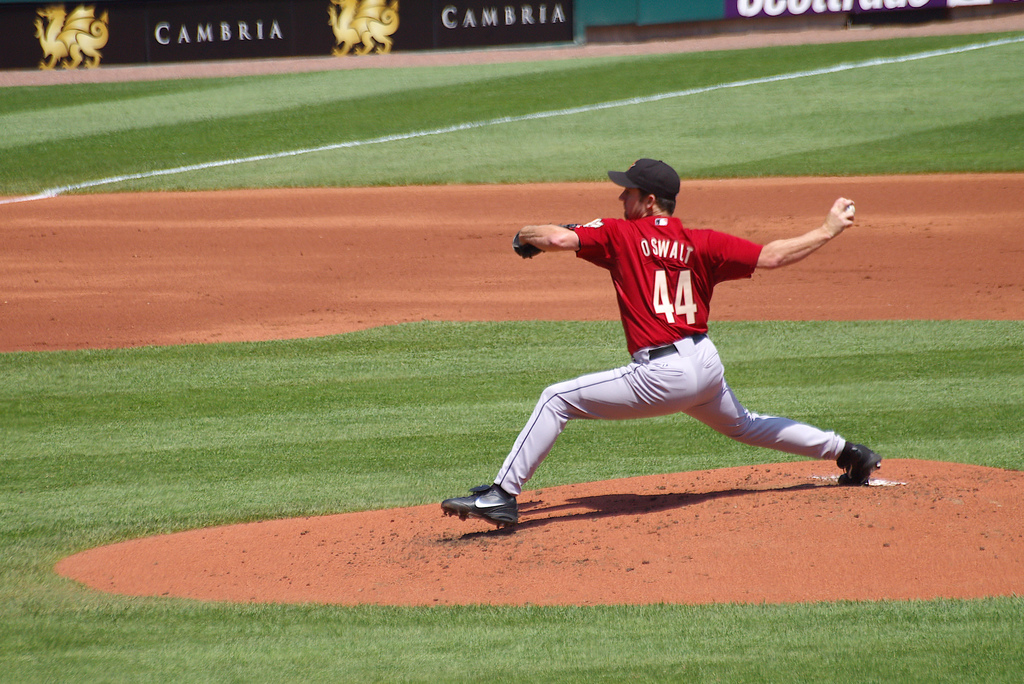
Roy Oswalt … last to win 20 games in consecutive seasons.

After what was described as an impressive throwing session the (currently) first place Colorado Rockies signed 35-year-old right-handed hurler Roy Oswalt to a minor league contract – a move BBRT sees as low risk with a potentially high reward. (I really wish my Twins had been willing to take this “chance.”)  While Oswalt struggled a bit with Texas last season (4-3, 5.80 ERA in 17 appearances/9 starts), his fastball reportedly remains in the 90+ range and 2012 did see him record 59 strikeouts in 59 innings, while walking only eleven.

In 12 MLB seasons, Oswalt has a .629 winning percentage (163-96), with 3.28 ERA.  If he can regain his form, he could pay dividends for the Rockies either as a starter (you can be pretty sure the Rockies will need some help along the way) or in long relief. 

In picking up the three-time All Star, the Rockies also gained the answer to a MLB trivia question.  (BBRT loves to mix a little history into today’s news.)  Oswalt is the answer to the query, “Who is the last major league hurler to win twenty games two seasons in a row?”  Yep, it was Oswalt – 20-10 in 2004 and 20-12 in 2005.  BBRT hopes to see Roy back in the NL sometime this season.

Here are a few other 20-game winner factoids.

– Most 20-win seasons MLBCy Young, as you might expect, racked up a record 15 20-win seasons (five of those were 30 or more), nine in the NL (Cleveland/St. Louis) and six in the AL (Boston).  Young led his league in wins five times, losses once and was a three-time 20-game loser.  In a 22-season career (1890-1911), he went 511-316, with a 2.63 ERA.

– Most 20-win seasons NL … The National League record for 20-win seasons is 13, shared by Christy Mathewson (New York Giants) and Warren Spahn (Boston/Milwaukee Braves).  Mathewson pitched 17 seasons (1900-1916), lead the NL in wins four times, had three straight seasons of thirty wins or more (1903-05) and finished at 373-188, 2.13.  Spahn pitched 22 seasons (1942-65, with three years lost to WWII service), led the NL in wins eight times, including four years in a row (1957-61). Spahn’s career numbers are 363-245, 3.09.

–  Most 20-win seasons AL … The American League record for 20-win seasons –  at 12 – belongs to the Washington Senators’ Walter Johnson.  Johnson pitched 21 seasons (1907-27), led the league in wins six times, including four straight (1913-16).  He finished his career at 417-279, 2.17.

– The oldest pitcher to win 20 games in a season … This honor belongs to Warren Spahn, who – at age 43 – went 23-7, 2.60, leading the NL in complete games with 22.

– The youngest 20-game winnerDwight Gooden of the 1985 Mets won his 20th game at the age of 20 years, 9 months and 9 days – edging out Bob Feller (who won 20 as a 20-year-old in 1939) by just shy of one month.  While it was Gooden’s only 20-win campaign, Feller went on to five more 20-victory seasons.  Notably, both Gooden and Feller led their league in strikeouts as 20-year-olds – and, in the previous season as 19-year-olds, both were 17-game winners and league strikeout leaders.  (Feller, at age 20, was in his fourth MLB season, Gooden in his second.)

A Few April Surprises

Here are a few April surprises – at least from BBRT’s point of view.  This post doesn’t touch on them all, there have been plenty.  For example, there is no commentary on Colorado’s first-place standing (at the end of April) in the NL West, Orioles’ first baseman Chris Davis’ .348–9–28 start, Roy Halladay’s early season difficulties, the Yankees’ unique triple play or the fact that the Tigers have three hurlers averaging better than a strikeout per inning. (Or for my fellow Twins fans, Carlos Gomez hitting .360 through April for the Brewers and Kevin Slowey with a 2.15 ERA, with six walks and 29 strikeouts in six starts for Miami.)

So, here are a handful of April “surprises’ that captured BBRT’s attention. 

Philip Humber … 6 losses by the end of April.

Phil Humber – yes, he of the April 21, 2012, perfect game – started the 2013 tying a different kind of unique record.  In the month of April, the Astros’ Humber started six games and ran up an 0-6 record (29 2/3 innings pitched, 7.58 ERA, 44 hits, 10 walks, five wild pitches).  The only other starting hurler to notch six April losses was the A’s Dave Stewart in 1984, a year in which he went 7-14.    Still BBRT is surprised to see a pitcher get six starts in a single month – to get a decision in every outing – and, of course, to lose them all.  Humber can take solace in the fact that just three seasons after his 0-6 opening month, Stewart started a string of four consecutive 20-win seasons.  Not likely for Humber, however, whose career ERA is north of five.


A surprising ten April saves for the equally surprising Bronx Bombers.

The Yankees … 16-10 in second place in the AL East.

The Yankees – without Derek Jeter, Alex Rodriguez, Curtis Granderson, from day one, and now Francisco Cervelli and Kevin Youkilis – are an early season surprise.  BBRT really thought age and injuries would quickly drag the Bronx Bombers toward the bottom of the division.  However, here they are in second place at the end of April, thanks to some individual surprises, particularly: Vernon Wells, who after two down years with the Angels, hit .300 with six home runs and 13 RBIs in April; and Travis Hafner, showing new life at age 36, sitting at .318-6-17.  (Maybe there is something to the aura of the pinstripes.) Not surprising, Robinson Cano leads the NY offense (.327-7-17).  On the mound, veterans Hiroki Kuroda, C.C. Sabathia and the ageless Andy Pettite (3-2, 2.86) and Mariano Rivera (10 saves, 1.74 ERA) lead the way.  Still, despite the early season surprise, BBRT sees a Yankee fade as we hit the dog days of August.


Adam Wainwright … 3 walks (one intentional) against 43 strikeouts in 44 innings.

The Cardinals Adam Wainwright ran up a 4-2 record with a 2.03 ERA through April.  Not surprising, he has true “ace” stuff.  Surprising to BBRT is that Wainwright notched 35 strikeouts before issuing his first walk of the season – and that’s a record.

Toronto Blue Jays … already 8 ½ out.

The Blue Jays made a statement in the offseason – no more “wait until next year,” 2013 is THE year.  They took advantage of the Marlins’ fire sale to add a quality lead off hitter and two proven starting pitchers: shortstop Jose Reyes and hurlers Mark Buehrle and Josh Johnson.  Then they did some wheeling and dealing with the Mets to acquire 2012 Cy Young Award winner R.A. Dickey.  In addition, they added Melky Cabrera to an offense that was welcoming back power hitters Edwin Encarnacion and a now-healthy Jose Bautista.   Pre-season polls tabbed the Blue Jays East Division favorites.

Ouch!  One month in and that Jays are at 10-17, 8 1/2 games behind division-leading Boston.  What happened?  It starts with Jose Reyes, who was hitting .395 with one home run, five runs scored, five RBI and five stolen bases after 10 games.  Then a severe ankle sprain put him on the disabled list for an expected three months.  Buehrle and Johnson are a combined 1-2, 6.57 in 9 starts; R.A. Dickey at 2-4, 4.50 and has looked more like the pitcher who went 41-50 from 2001-2011 than 2012’s 20-game winner; and PED-free Melky Cabrera is hitting just .250 with no home runs. Couple that with slow starts from just about the whole lineup and the Jays have dug a surprisingly deep hole.  BBRT does expect Josh Johnson to right his ship, but .500 seasons from Buehrle and Dickey would not surprise.


Game changer for the Braves!

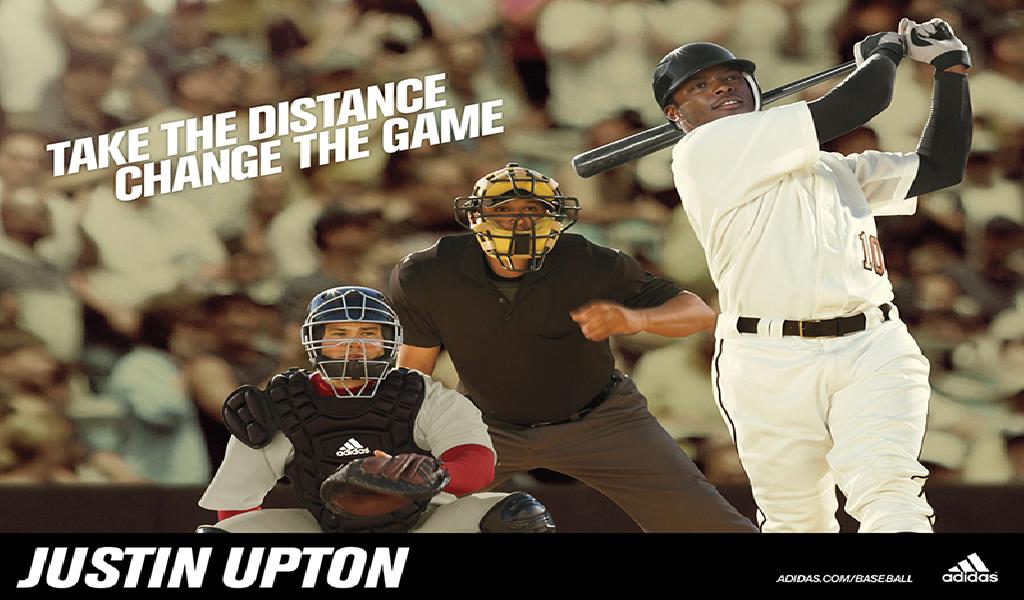
Justin Upton … prestigious power display.

.298, 12 homers, 19 RBI in April.  Enough said.  Well, one more surprise, the average distance of those 12 dingers?  Each exceeded 400 feet, for an average of 423.5 feet. We all knew he’d be good for the Braves – just surprised that he’s this good this fast.

The Washington Nationals … popular pick to win the NL crown, now sitting at 13-14, a surprising 4 ½ games behind the Atlanta Braves.

The Nats’ problem appears to be a lack of offense.  Despite a blistering start by Bryce Harper .(344-9-18 through April), the Nationals finished the month 12th in the league in runs scored (96), 13th in batting average (.234) and sixth in home runs (27).  That lack of offense explains Stephen Strasburg’s surprising 1-4 record, despite a 3.13 ERA and 36 strikeouts in 37 innings pitched.  With their depth of pitching – and the fact the some early bullpen issues seem to be working themselves out – BBRT expects the Nationals to remain in the hunt (and make the playoffs).

Boston … the first-place Red Sox.

Boston ended the 2012 season in apparent disarray, discontent and, according to some sources, outright animosity – finishing last in the AL East at 69-93, 26 games out.   The goal for 2013 was to change the personality of the team – and that meant changing some personnel, from the manager (John Farrell replacing Bobby Valentine) on down.  On the field, the Sox avoided some of the big name opportunities, going for steady, solid performers with equally solid clubhouse reputations.  Among the additions that have paid dividends early:

1B-DH-C Mike Napoli who has driven in 27 runs in his first 26 games; Shane Victorino, out with a back issue now, but sporting a .292 average over 19 games; and reliever Kuji Uehara, with a 1.69 ERA and seven holds in 12 games.  But, in reality, it’s been the core holdovers that have boosted the Sox – particularly strong performances from starters John Lester and Clay Bucholz (who went a combined 20-22 in 2012).  Through April the pair are 9-0 – Buchholz, 5-0, 1.19 ERA and Lester, 4-0, 3.11.  In addition, David Ortiz has come back with a vengeance hitting .500 (18 for 36) with three home runs and 15 RBI in his first nine games back in the lineup.  Then there is Dustin Pedroia, hitting at a .337 clip with 16 runs scored and 12 RBI.  It looks to BBRT that the surprising Red Sox will remain in the hunt in a tight AL East race.

Torii Hunter …  .370 in 23 games.

There was a popular TV commercial that used the line, “You’re not getting older, you’re getting better.”  That describes the surprising 37-year-old Torii Hunter, now patrolling right field for the (not surprising) first-place Detroit Tigers.  In 2012, Hunter surprised us all with a .313-16-92 season (with nine steals) for the Angels.  It was Hunter’s best average ever, and his fifth-highest RBI total in 16 seasons.  In 2013, Hunter is off to a .370-1-12 start.

The Angels (9-17) and Josh Hamilton (.204 average, 32 strikeouts in 108 at bats).

It shouldn’t really be a surprise, the Angels have already proven that you can go deep – and expensive – into the free agent market without guaranteeing the post season.  Still, when the Halos added Josh Hamilton to the Mike Trout, Albert Pujols, Mark Trumbo powerhouse, expectations were high (despite a somewhat iffy starting rotation minus Zack Greinke).  Both Hamilton and the Angels have surprised with their April futility.  Hamilton’s is hitting just .204, with 2 homers and 9 RBI going into May. Even with Hamilton’s slow start, the Angels rank in about the middle of the AL in offensive output.  The pitching, however, ranks 14th (based on ERA) out of 15 teams – and, with ace Jered Weaver on the DL, things don’t look promising.  Fact is, the Angels would have been better off spending some of the Hamilton money on pitching.  Will they bounce back? Doubtful, unless they come up with some arms.  Will Hamilton rebound.  Probably, but he’ll likely fall well short of 2012’s .285-43-128 (but .280-35-102 would not surprise).

Josh Donaldson (.314, 2 HR, 20 RBI) and the Oakland A’s (16-12).

The 27-year-old Oakland third baseman (a converted catcher) has progressed dramatically in the field and at the plate since winning the third base job (after injuries to Brandon Inge and Scott Sizemore) last season.  Still he came into the season with a .232 average in just 306 at bats in two seasons.  Now, he’s not only hitting over .300, he’s driven in 20 runs (sixth in the AL) as of May 1 – and he’s showing solid leather at third base.

The A’s surprise is a little more complicated.  BBRT expected the A’s young pitching (a record 54 wins from rookies a year ago) to falter a bit and, after notching the AL’s second-lowest ERA in 2012, the A’s ranked 12th through April.  On the other hand, they led the AL in runs scored – despite standing a surprising 9th in home runs and 10th in batting average. Over time, BBRT thinks the pitching will pick up, but the run scoring will tick down and the A’s will finish third this season.

Shin-Soo Choo … impervious to pain.

The Reds wanted a leadoff hitter – and they picked up a good one in Shin-Soo Choo (through April, .337 – four homers – 11 RBI – 20 runs scored – 17 walks.)  The surprise for BBRT is Choo has already been hit by a pitch 10 times.  Ouch!  That’s taking one – and then some – for the team.

Got any April surprises you’d like to share?  BBRT welcomes your comment?

How the Game Has Changed – May Day Anniversary

Today, is the anniversary of the longest game (by innings) in MLB history … line score below … a 26-inning, 1-1 tie (called on account of darkness) between the NL’s Brooklyn Robins and Boston Braves, played on May 1, 1920.  It’s also an anniversary that provides a pretty good indicator of how the game has changed over the years.  In this one, both starting pitchers went the distance.


May 1, 1920

Brooklyn              000 010 000 000 000 000 000 000 00           1   9   2

Boston                  000 001 000 000 000 000 000 000 00           1 15  2

Starting pitchers Leon Cadore of Brooklyn and Joe Oeschger of Boston (NL) each threw more than 300 pitches (analysts estimate Cardore at 345 and Oeschger at 319) in completing their 26-inning, record-setting starts. Cadore gave up 15 hits and five walks, while fanning 7; while Oeschger allowed only nine hit and four walks, while also striking out seven batters.   Oh, and here’s another sign of how the game has changed, the time of the 26-inning contest was only 3 hours and 50 minutes.

By way of comparison, there have been two 25-inning games in MLB history, with the Cardinals topping the Mets on September 11, 1974 and the White Sox besting the Brewers on May 8, 1984.  Those contests saw the use of 13 and 14 pitchers, respectively. The Cardinals win took 7 hours and 4 minutes to complete, while the White Sox took 8 hours and 6 minutes to defeat the Brewers.

Your Longevity Leaders – At The Plate & On The Mound

Gary Sheffield – a long ball longevity leader.

What major league players hit home runs both as teenagers and in their forties?  That’s a pretty popular trivia question – and the answer is Ty Cobb, Rusty Staub and Gary Sheffield.  More on those three later in this post, but first a look at an achievement of longevity that is just as rare:  Pitches who earned major league victories as teens and in their forties.  The three masters of mound tenure are Hall of Famers Herb Pennock and Bert Blyleven and, a less likely prospect, Mike Morgan.

Herb  Pennock logged his first win (as an 18-year old) with the Philadelphia Athletics in 1912 and the last of his 241 victories (at age 40) with the Red Sox in 1934.  In 22 MLB seasons, Pennock pitched for three teams and went 241-162, with a 3.60 ERA.  Pennock earned three wins as a teenager and two wins after his fortieth birthday.

Bert Blyleven earned his first MLB victory (at age 19) for the Minnesota Twins in 1970 and garnered his final win in 1992 (age 41) for the California Angels.  In between, in 22 seasons, he pitched for five teams, going 287-250 with a 3.31 ERA. Blyleven captured ten victories as a teenager and eight wins in his forties.

Mike Morgan – the non-Hall of Famer in this elite longevity trio – won his first game in 1979 (at age 19) for the Oakland A’s – after going 0-3 for the A’s as an 18-year-old the previous season.  He picked up his last MLB win in 2002 (at age 42) for the Arizona Diamondbacks.  Morgan pitched in 22 seasons – for 12 different teams.  His longevity is a bit surprising, since he finished above .500 in only 5 seasons – running up a career record of 141-186, with a 4.23 ERA. Morgan picked up two wins as a 19-year-old and seven at 40-plus.

Now back to those long-ball hitters.

Ty Cobb hit his first MLB homer as a member of the Tigers back in 1905 (at age 19) and the last of his roundtrippers for the Philadelphia Athletics (at age 41) in 1928.  He has the fewest home runs of any of this trio, with 117 – but is the only one to lead his league in long balls, with 9 in 1909.  Overall, he put in 24 seasons for two teams (22 with the Tigers) and, of course, captured a dozen batting titles.  Cobb hit two home runs as a teenager and six at age 40-plus.

Rusty Staub punched his first home run for Houston in 1963 at age 19 and his last (at age 41) for the Mets in 1985.  He played 23 seasons (for five different teams) and hit a total of 292 homers.  He hit six dingers before his twentieth birthday and two after his fortieth.

Gary Sheffield is the big bopper on this list, topping 500 homers in his 22-year, 8-team career.  He hit his first homer in 1988 (age 19) for the Milwaukee Brewers and his last in 2009 (age 40) for the Mets.  He finished with 509 homers, but never led the league.  (He did win a batting title, hitting .330 for the Padres in 1992.)  Sheffield popped four homers as a teen and ten as a forty-year-old