April 2017 Wrap – April Showers of Long Balls

April17Well, April is behind us and, while April didn’t necessarily provide the kind of showers that will bring May flowers, it did bring showers of home runs – including three-homer games by Yoenis CespedesMatt Kemp and Anthony Rendon; home runs as part of three cycles (Wil Myers, Trea Turner, Carlos Gomez); double figures in home runs for the month by Eric Thames, Ryan Zimmerman, Khris Davis and Aaron Judge; and even a home run hit by a pitcher being used as a pinch hitter (Michael Lorenzen).

So, let’s get on to BBRT’s traditional review of the previous month of the MLB season. I hope you enjoy this look back at April – and come across a highlight or two you may have missed.  (Note:  April is always the easiest month to “wrap,” since monthly and year-to-date leaders are the same. Future wrap ups will look at month and year-to-date stats.) Before we get into detailed highlights and statistics, here are a few quick observations – events or stats that particularly caught BBRT’s eye. (Appreciation to great sources: Baseball-Reference.com, MLB.com, ESPN.com, Statcast and the Minneapolis Star Tribune.)

  • The Washington Nationals scored more runs in April (170) than the Kansas City Royals had base hits (161).
  • Despite the DH, only one American League team (Yankees) finished among MLB’s top five teams in runs scored.
  • Washington RF Bryce Harper set a new MLB record for runs scored in April (32) – and was arguably not even the best hitter on the Nationals.  In addition to scoring 32 runs, Bryce hit .391, with nine home runs and 26 RBI. Nats’ 1B Ryan Zimmerman, however, put up a .420-11-29 line for the month (topping MLB in average, home runs and RBI, as well as hits and slugging percentage).
  • Run support counts: The Red Sox’ Chris Sale finished April with MLB’s highest strikeout total (52) and second-lowest ERA (1.19) – but won only one game (against two losses).  The Twins’ Phil Hughes and Brewers’ Wily Peralta both went 4-1 for the month – despite ERA’s north of five (5.06 and 5.19, respectively).
  • On the final day of the month, the Nationals’ 3B Anthony Rendon not only had a three-homer day, but also became just the 13th MLB player to drive in ten or more runs in a game – going six-for-six, with three home runs, a double, two singles, five runs scored and ten RBI.  It was a bit of a surprise; Rendon came into the game hitting .226, with no home runs, just five RBI and five runs scored.  In one game, he doubled his runs, tripled his RBI, raised his batting average 52 points – and how do you put a percentage on going from zero home runs to three?  Oh yes, the Nationals pulled out a squeaker over the Mets 23-5.
  • Home cookn’ was good in April. Home teams went 205-165 (.553). More important: Only seven of 30 teams finished the month below .500 at home, while 19 teams finished below .500 on the road.  The Royals were the best example of this – going 5-5 at home and 2-11 on the road.
  • A pair of 32-year-old veterans were the only two batters to finish April with averages north of .400 – the National’s Ryan Zimmerman (.420) and the Dodgers’ Justin Turner (.404).
  • The Twins Erwin Santana was the only qualifying pitcher to record an ERA under 1.00 for the month.  Santana gave up just three runs in five starts, going 4-0, 0.77.  In 35 innings pitched, he gave up just 13 hits.
  • The Rockies have been outscored by six runs this season – but stand six games over .500 (16-10); while the Rangers have outscored their opponents by eight runs, but are three games under .500 (11-14).
  • Only four players reached 25 RBI in April (good start toward that century mark) and three of them hit back-to-back-to-back in the middle of the Nationals’ order. Your 25-RBI guys: Nationals’ 1B Ryan Zimmerman (29 RBI), RF Bryce Harper (26); 2B Daniel Murphy (26).  The outlier on the list? The Twins’ Miguel San0 (25 RBI to go with a .316 aveage and seven homers.)
  • The Astros’ Dallas Keuchel got six starts in April and made the most of them, going 5-0 (April’s only five-game winner) with a 1.21 ERA.
  • Mets’ reliever Hansel Robles finished April tied for second in victories (four), going 4-0, 1.84, while pitching a total of 14 2/3 innings in 13 appearances.

—-LET’S LOOK AT TEAMWORK—-

No team won more games in April than the Nationals – 17-10, .680 – and they literally bludgeoned their opponents into submission. The Nats led MLB in runs scored with 170 (29 more than the second-most productive D-backs); batting average .295 (the Astros were second at .272); hits (265); doubles (58);  on base percentage (.369); and slugging percentage (.510).  The Nationals were  second  in home runs with 43 (two behind the Brewers). Meanwhile, their ERA (4.40) was 24th among MLB’s 30 teams.  Three teams came in with 16 wins on the month: the Astros (16-9);  Rockies (16-10); and D-backs (16-11).

At the othe end of the spectrum, the Royals had April’s worst record 7-16, .304 – with middle-of-the-pack pitching (4.18 ERA, 18th) and a woeful offense.  The Kansas squad was last in MLB in runs scored (63), batting average (.210), hits (161), on base percentage (.270) and slugging percentage (.336). They finished the month on a nine-game losing streak, with a lineup that featured  five hitters batting under .230. Two other teams finished April with less than ten wins: the Giants (9-17) and the Blue Jays (8-17).  Full standings are in a chart at the end of the post.

Nationals RUNning Away from Opponents in April

The Nationals put up the strongest run differential in April, outscoring opponents by 48 tallies.  The only other team to reach even top a plus-30 differential was the Yankees (+43). At the other end of the standings, the Royals had MLB’s worst April run differential at minus-37.  Two other teams came in at minus-30 or worse: the Padres (-31) and Giants (-33). 

IF THE SEASON ENDED APRIL 30, THE PLAYOFF TEAMS WOULD BE:

NL: Nationals, Cubs, Rockies. Wild Cards: D-backs, Dodgers.

AL:  Astros, Orioles or Yankees, Indians. Wild Cards: White Sox, Orioles or Yankees.

Surprises Thus Far

The injury-strapped Mets and undeerperforming Giants and Blue Jays (29th and 28th in runs scored), all in last place in their respective divisions – and the NL West Division Rockies; fifth in rus scored, but 26th in ERA, somehow getting the job done (16-10), despite being outscored 125-119 through April).

________________________________________

BASEBALL ROUNDTABLE PLAYERS AND PITCHERS OF THE MONTH

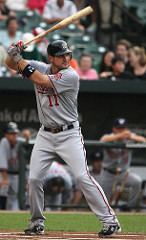
Ryan Zimmerman photo

Photo by Keith Allison

National League Player of the Month – Ryan Zimmerman, 1B, Nationals …  Hard to go against MLB’s top hitter on the season (.420). The 32-year-old Zimmerman – coming off a series of injury-hampered seasons  – has been healthy and scorching hot for the Nationals. Through April he was .420-11-29 – leadinG  MLB in all three Triple Crown categories.  (It’s a great start for the Comeback Player of the Year Award.)  For the 2014-15-16 seasons, Zimmerman averaged 90 games, .242 average, 12 home runs and 53 RBI.  Others in the running  were: Nationals’ Bryce Harper (.391-9-26, with an MLB-best 32 runs scored) and Nationals’ 2B Daniel Murphy (.343-5-26). 

American League Player of the Month – Aaron Judge, RF, Yankees … This big rookie (6’7″, 280-pounds) is playing big for the surprising Yankees.  His April numbers were .303-10-20.  His ten April roundtrippers tied for the AL lead and matched  the MLB rookie record for the month.  Judge also led the AL in runs scored with 23. Others in the running: White Sox RF Avisail Garcia (AL-leading .368 average, five home runs, 20 RBI) and Twins’ 3B Miguel Sano (.316, seven home runs, league-leading 25 RBI).  

National League Pitcher of the Month – Greg Holland, Closer, Rockies … Holland is one of the main reasons the Rockies stand atop the NL West with a 16-10 record. Holland saved 11 of the Rockies’ April victories (in 11 save opportunities) – leading all of MLB in saves.  He pitched in 12 games, with a 1.50 ERA and 13 strikeouts in 12 innings pitched. Also in the running: Phillies’ Jeremy Hellickson (4-0, 1.80) and Dodgers’ Clayton Kershaw (4-1, 2.29, with 39 strikeouts in 35 1/3 innings). 

American League Pitcher of the Month – Erwin Santana, Starter, Twins ... Santana went 4-0 in five April starts, averaging seven innings per outing, with an MLB-low 0.77 ERA and .116 batting average against  In 35 innings pitched, Santana has given up just 13 hits and three earned runs, while walking ten and fanning 26.  Also in the running: Rockies’ Dallas Keuchel (5-0, 1.21) and Mariners’ James Paxton (3-0. 1.39).
—-TEAM STATISTICS – APRIL 2017 —-

MOST RUNS SCORED (MLB Average – 109)

NL: Nationals – 170; D-backs – 141; Brewers 135

AL: Yankees – 128; Mariners – 119; Tigers 118

FEWEST RUNS ALLOWED (MLB Average – 109)

NL: Dodgers – 92; Phillies – 100; Marlins – 103

AL: White Sox – 83; Yankees – 85; Astros – 89

BATTING AVERAGE (MLB Average – .247)

NL: Nationals – .295; D-backs – .269; Braves – .263

AL: Astros – .272; Red Sox – .270; Yankees – .266

HOME RUNS (MLB Average – 29)

NL: Brewers – 45; Nationals – 43; Mets – 37

AL: Yankees – 37; Rangers – 34; A’s – 31; Rays – 31

STOLEN BASES (MLB Average – 13)

NL: D-backs – 32; Brewers – 25; Reds -23

AL: Rangers – 22;  Mariners – 21; Yankees – 18

The Need for Speed

The Rockies swiped an MLB low four bases (eight attempts) in April. 

ON THE OTHER SIDE OF THE COIN

No team has put fewer runners across the plate then the Royals (63). The second-lowest tally belongs to the Giants (87 runs.) As you might expect the Royals were also at the bottom in April batting average (.210).  Their 24 home runs, however, topped seven other teams – with the Big Papi-less Red Sox hitting the fewest April round trippers (15). The Red Sox lack of power led to the sixth-fewest runs among the 30 MLB teams. .

TEAM EARNED RUN AVERAGE (MLB Average – 4.09)

NL: Dodgers – 3.50; Cubs – 3.77; D-backs – 3.81

AL: White Sox – 3.11; Yankees – 3.35; Astros – 3.38

BEST STARTING STAFF ERA FOR APRIL – Cardinals (3.32)

WORST STARTING STAFF ERA – Red (5.96)

BEST BULLPEN ERA FOR APRIL – White Sox (1.94)

WORST BULLPEN ERA – TIGERS (6.43)

STRIKEOUTS (MLB Average – 202)

NL: D-backs – 252; Dodgers – 242; Mets – 239

AL:  Astros – 238; Indians – 236; Angels – 236

FEWEST WALKS ALLOWED (MLB Average – 81)

NL: Phillies – 65; Nationals – 67; Dodgers – 73

AL: Yankees – 65; Indians – 66; Twins – 69

THE OTHER SIDE OF THE COING

The worst team Earned Run Average in April  belonged to the Tigers at 5.19 – the only team over 5.00. The Padres and Angels gave up the most April home runs (38). The fewest pitchers’ strikeouts: Twins (153) and Braves (158). In terms of control, no team has walked more batters than the Orioles (99), although the Reds can see their tail feathers (98 walks allowed). 

______________________________________________

INDIVIDUAL PLAYER PERFORMANCE

Now, let’s take a look at some individual player highlights for April, followed by the statistical leaders.

Here Comes the Judge
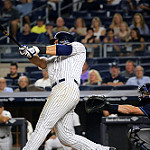
Aaron Judge YANKEES photo

Photo by apardavila

On April 29, Yankees’ rookie outfielder Aaron Judge bashed his tenth homer of the month, tying the April record for MLB rookies (Jose Abreu, 2014 and Trevor Story, 2016). The 6’7”, 280-pound Judge finished the month  at .303-10-20.

Here Comes the Vet

Angels’ 1B/DH Albert Pujols – in his 17th MLB season – put up a .24o average, with three home runs and 22 RBI in April.  The three home runs put him at 594 for his career – six shy of 600 and 13 behind Sammy Sosa for the number-eight spot all time.  The 22 RBI gave him 1,839 for his career and moved him past Al Simmons, Manny Ramirez, Dave Winfield, Rafael Palmeiro, Ken Griffey Jr. and into a tie with Ted Williams for number-fourteen all time.  Side note: Pujols started his career with ten consecutive seasons of a 300+ average – 30+ home runs – 100+ RBI.

OUCH!  OUCH! OUCH!  REALLY?

On April 4, Cardinals’ RF Stephen Piscotty had a tough – if somewhat shortened – day at the office.  It all started with one out in the fifth inning of the Cardinals 2-1 loss to Cubs. First, Piscotty was hit by a pitch (right elbow) by Cubs’ starter Jake Arrieta.  Piscotty then took second base on a wild pitch, but was hit on the left elbow by catcher Wilson Contreras’ throw to the bag.  Cardinals’ 2B Kolten Wong followed with a slow grounder to Cubs’ second sacker Javier Baez, who bobbled the ball – leading Piscotty to round third and scoot for home. Piscotty did  score, but was hit in the head by Baez’ throw the plate. The three “hits” left the Cardinals’ outfielder stunned, shaken up and lying face down near home  plate (and, ultimately, helped from the field and out of the game).

THINGS ARE HOPPING IN SEATTLE

The Mariners 2017 home opener took place on April 10 – and, like most teams, they had some new concession offerings.  One of the most popular new concession was the Chapulines ($4) – grasshoppers roasted and tossed in chili-lime salt. How popular were they?  They sold out – 312 orders per game (reportedly in honor of Edgar Martinez’ career batting average) – at all three games of the opening home stand (roughly 18,000 grasshoppers).

Cycles Built For Three

April saw three players hit for the cycle: the Padres’ 1B Wil Myers (April 10), Nationals’ SS Trea Turner (April 25) and Rangers’ CF Carlos Gomez just under the wire (April 29).

Myers, in the Padres April 10th 5-3 victory over the Rockies (in Colorado), singled to right field  in the first, hit an RBI double to left  in the second, homered to right in the sixth and tripled to left center in the eighth.   He finished the game four-for-four with two runs scored and two RBI.

Turner’s cycle came on April 25 – fueling the Nationals 15-12 win over the Rockies (also at Coors). Turner singled to right in the first inning, hit a two-run double to left in the second inning, smacked a two-run homer to right in the sixth and drove in three more  with a bases-loaded triple in the seventh.  For the day, Turner was four-for-six, with four runs scored and seven RBI.  The very next night, Turner almost became the first player to hit for the cycle two games in a row.  Again facing the Rockies – after striking out in the first and grounding out to third in the second – Turner hit a solo home run in the fifth inning, singled in the seventh and doubled in the eighth.
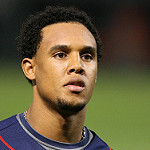
Carlos Gomez baseball photo

Carlos Gomez – Two cycles to his name.  Photo by Keith Allison

Gomez’ April 29th cycle – in a 6-3 win over the Angels in Texas – was the second of his career. Gomez doubled to left in the first inning; lined a single to the right side in the third; hit an RBI triple to right-center in the fifth (later scoring on a Rougned Odor’s home run); and hit a two-run homer to center in the seventh.  Gomez finished the game four-for-four, with two runs scored and three RBI. Gomez’ first cycle came nine seasons ago – May 7, 2008 – when he was with the Twins.


Four-For-Three

Only four players have hit for the cycle three times in a career: the Reds’ John Reilly (1890 and twice in 1893); the Yankees’ Bob Meusel (1921, 1922, 1928); Babe Herman (Brooklyn Robins twice in 1931 and Cubs in 1933); Adrian Beltre (Mariners in 2008 & Rangers in 2012 and 2015).

An Immaculate Inning

On April 18, Reds’ reliever Drew Storen became the 78th MLB pitcher to throw whats is referred to as an immaculate inning – striking out the side on nine consecutive pitches. Storen came on in the top of the ninth (with the Reds leading the Orioles 9-3) and fanned Jonathon Schoop, J.J. Hardy and Hyun Soo Kim.  For more on immaculate innings and those who have thrown them, click here.

Tough to Fan
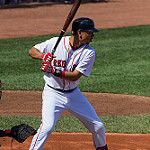
Mookie Betts photo

Mookie Betts – Doesn’t miss much,  Photo by Dennis Heller

On April 19, Boston RF Mookie Betts did something he hadn’t done in 129 regular-season plate appearances (dating back 29 games to September 12, 2016) – strikeout. It came in the top of the fourth inning of the Red Sox’ 3-0 loss to the Blue Jays – on a 2-2 slider from Francisco Liriano. It was the longest “strikeout-free” MLB streak since the Marlins’ Juan Pierre went 147 plate appearances without a K in the scorebook in 2004.


PUTTING THE BAT ON THE BALL

The longest “strikeout-free” stretch in MLB history belongs to outfielder Joe Sewell. Sewell went from May 19 to September 19, 1929 – a streak of 115 games – without striking out. During his 115-game streak, Sewell racked up 516 plate appearances and  436 at bats without making the post-K “walk of shame” to the bench. The 5’6”, 155-pound Indians’ third baseman also collected 143 hits (.328), with 27 doubles, two triples, seven HR and 56 RBI during the whiff-less streak.   On the season, Sewell fanned just four times in 578 at bats – and it wasn’t even his best campaign in terms of at bats/per whiff.   That would be 1932, when Sewell struck out just three times in 503 at bats – or once each 167.7 at bats (the post-1900 MLB record). For his career (14 seasons/Indians and Yankees), Sewell fanned 114 times in 7,132 at bats – or once each 62.6 at bats.

Side note: In 1927, Sewell had a tough year on the base paths.  He was caught stealing in a league-leading 16 times (in 19 attempts).  Notably, he was successful in 17 of 24 attempts the season before and seven of eight attempts the season after.

YA GOTTA SEE THIS!  HOW ABOUT AN UNASSISTED DOUBLE PLAY BY A PITCHER?

More #WhyIHateThe DH

On April 6, Reds relief pitcher Michael Lorenzon was sent to bat for fellow pitcher Cody Reed with two outs and the bases empty in the bottom of the sixth inning of a 4-4 game (Philadelphia at Cincinnati). Lorenzon delivered a go-ahead home run to right center (the Reds eventually won 7-4). Through April 2017, Lorenzen is a .244 MLB hitter (11-for-45, with two home runs and eight RBI.)  Ironically, the Reds did not have a single pinch hit homer in 2016 – and it took a pitcher to break the hex.

On April 21, Cardinals’ pitcher Adam Wainwright blasted a 96-mph fastball from the Brewers’ Wily Peralta into the second deck in left field for a third-inning, two-run home run. The very next inning, he added a two-run single, giving him four RBI in the Cardinals 6-3 win in Milwaukee.  (Wainwright got the win, giving up two runs on six hits in five innings – while fanning nine.) Side note: Wainwright is one of only thirty MLB players to hit a home run on the first MLB pitch they ever saw (May 24, 2006). Notably, eight of those 30 were pitchers.

Run Don’t Walk

Must we track everything?  On April 22,  Oakland A’s 33-year-old SS Adam Rosales  led off the first inning with a home run off the Mariners’ Ariel Miranda.  Miranda’s embarrassment didn’t last long as Rosales rounded the bases – according to Statcast – in just 15.90 seconds.  Statcast notes that this is the fastest over-the-wall home run trot (gallop?) ever.  How fast? Well, Charlie Blackmon of the Rockies hit an inside-the-park home run the night before – and Blackmon’s dash around the bags was less than four-tenths of a second (0.36 seconds to be exact) slower than Rosales’ “leisurely” trot.  Note:  The A’s topped the Mariners 4-3, while the Rockies bested the Giants 6-5.

Walk Don’t Run

Pirates’ starter Ivan Nova hadn’t given up a walk since last September 13 (146 batters faced without a free pass), when he started against the Yankees on April 23. And, he continued his streak – striking out the side in order in the first inning, retiring the side in order (one strikeout) in the second and getting the first two batters in the third (streak now at 154  consecutive batters faced without a walk).  That brought Yankees’ starting pitcher Jordan Montgomery to the plate for his for his first-ever MLB at bat (in fact, his first professional plate appearance at any level).  What happened?  Nova walked him on a 3-2 count.  Nova went seven innings in the contest, giving up four hits and one runs, striking out seven and walking only Montgomery.  As of April 30, Nova has pitched 36 innings in 2017, with just the one walk and 22 strikeouts.

Run or Walk … Just Don’t Ride

On April 20, San Francisco Giants staff “ace” Madison Bumgarner went down (possibly until the All Star break) with rib and shoulder injuries- sustained in a dirt-bike accident.  Ouch!

Just Like Little League

Remember in Little League, when the coach would move pitchers on and off the mound  in a close game – maybe bringing the shortstop in to pitch to a hitter and then moving him back to shortstop? On April 30, the Yankees did something similar. Yankee reliever Bryan Mitchell had come on to pitch a scoreless top of the ninth, with the Yanks down to the Orioles 4-2. The Bombers came back to tie it in the bottom of the inning.  In the top of the tenth, New York went to closer Aroldis Chapman, but instead of sending Mitchell to the bench, they moved him to first base. Chapman pitched a scoreless tenth.  Then, protecting the closer’s arm (I assume), in the top of tjhe eleventh, Greg Bird came in to play first base and Mitchell went back to the mound. (Unfortunately, this  story does not have a Cinderella ending, Mitchell gave up three runs and took the loss.)

Surprise Player of the Season (So Far)

Brewers’ 1B/OF/DH Eric Thames – a 30-year-old outfielder returning the MLB after three seasons in Korea – is one of the first surprises of the 2017 season. (We can expect plenty of surprises … good and bad … between now and October. That’ why we love the game, isn’t it?).  In reality, Thames’ power stroke should not come as a total surprise.  (Although, he did hit just .263, with one home runs and five RBI in 22 Spring Training games.)

Thames – who played college ball in California for West Valley Community College and Pepperdine University (where, in 2008, he hit .407 with 13 round trippers) – was a seventh-round draft pick of the Blue Jays in 2008.  Thames showed his power potential in the Blue Jays’ minor league system. In 2010, for example, he played in 130 games for Double A New Hampshire Fisher Cats and hit .288, with 27 home runs and 104 RBI.  He started the 2011 season with the Triple A Las Vegas 51s, hitting .342-6-30 in 32 games before a callup to Toronto.  He was up and down between Toronto and Las Vegas, finishing his first MLB season with a .262-12-37 line in 95 games. In 2012, he spent time with the Blue Jays and Mariners (he was traded to the Mariners in July), hitting .232, with nine roundtrippers and 25 RBI in 86 MLB games.  He then spent the entire 2013 season in the minors (the Mariners had acquired outfielders Raul Ibanez and Jason Bay in the off season) and was traded by Seattle to the Orioles on June 30, 2013.  The O’s designated Thames for assignment in September and he was picked up by the Astros (who assigned him to Triple A Oklahoma City).

Thames then played in the Venezuelan Winter League, where he was scouted and signed by the NC Dinos of the Korean League.  Thames played in Korea for three season – hitting .348, with 147 homers and 382 RBI.  Oh yes, and tossed in 64 stolen bases.  He was the league’s Most Valuable Player in 2015 – when he hit  .481-47-140, and swiped 40 bags.

In November of 2016, the Brewers signed Thames to a three-year 16 million dollar deal – which has been a bargain thus far – through April, his stat line was .345-11-19 – with 28 runs scored.

_______________________________________

Now the Stats

BATTING AVERAGE (among qualifiers)

NL:  Ryan Zimmerman, Nationals – .420; Justin Turner, Dodgers – .404; Bryce Harper, Nationals – .391.

AL: Avisail Garcia, White Sox – .368; Mike Trout, Angels – .364; Starlin Castro, Yankees – .352

The lowest April average, among players with at least 50 plate appearances, goes to the Yankee’s Greg Bird at .107 (6-for-66). Another New Yorker, the Mets’ Curtis Granderson has the lowest average (at least 50 plate appearances) for April in the NL at .128 (11-for-86).

HOME RUNS

NL: Eric Thames, Brewers – 11; Ryan Zimmerman, Nationals – 11; Bryce Harper, Nationals and Freddie Freeman, Braves – 9

AL: Khris Davis, A’s – 10; Aaron Judge, Yankees – 10; seven with 7.

RBI

NL: Ryan Zimmerman, Nationals – 29; Bryce Harper, Nationals – 26; Daniel Murphy, Nationals – 26

AL:  Miguel Sano, Twins – 25; Nelson Cruz, Mariners – 23; Albert Pujols, Angels – 22

RUNS SCORED

NL: Bryce Harper, Nationals – 32; Eric Thames, Brewers – 28; Adam Eaton, Nationals – 24.

AL: Aaron Judge, Yankees – 23; Mitch Haniger, Mariners – 20; Francisco Lindor, Indians – 20

STOLEN BASES

NL: Billy Hamilton, Reds – 10; A.J. Pollock, D-backs – 10; five with seven

AL: Jarrod Dyson, Mariners – 8; Jose Altuve, Astros – 7; Lorenzo Cain, Royals and Jacob Ellsbury, Yankees – 6

WALKS DRAWN

NL: Paul Goldschmidt, D-backs – 22; Bryce Harper, Nationals – 22; Brandon Belt, Giants and Eric Thames, Brewers – 18

AL: Brad Miller, Mariners – 18; Miguel Sano, Twins – 18; Edwin Encarnacion, Indians – 17

STRIKEOUTS

NL: Trevor Story, Rockies – 39 (90 AB’s); Jonathan Villar, Brewers – 37 (107 AB’s); Kyle Schwarber, Cubs – 35 (93 AB’s)

AL: Edwin Encarnacion, Indians – 35 (85 AB’s); Danny Espisosa, Angels – 34 (88 AB’s); Chris Davis, Orioles -33 (80 AB’s);

—-PITCHING—-

ERA (qualifiers)

NL: Mike Leake, Cardinals – 1.35; Ivan Nova, Pirates – 1.50; Gio Gonzalez, Nationals – 1.62

AL: Erwin Santana, Twins – 0.77; Chris Sale, Red Sox – 1.19; Dallas Keuchel, Astros – 1.21

WINS

NL: Jeremy Hellickson, Phillies – 4-0; Hansel Robles, Mets – 4-0; Clayton Kershaw Dodgers (4-1); Wily Peralta, Brewers – 4-1

AL: Dallas Keuchel, Astros – 5-0; Erwin Santana, Twins – 4-0;  Phil Hughes, Twins – 4-1; Andrew Triggs, A’s – 4-1

STRIKEOUTS

NL: Jacob deGrom, Mets- 44 (31 2/3 IP); Zack Greinke, D-backs – 40 (36 2/3 IP); Max Scherzer, Nationals – 40 (33 2/3 IP)

AL: Chris Sale, Red Sox – 52 (37 2/3 IP); Danny Salazar, Indian – 42 (29 IP); Yu Darvish, Rangers – 41 (38 2/3 IP)

OTHER SIDE OF THE COIN

WALKS ALLOWED: Wade Miley, Orioles  – 19 (31 IP) and Marty Perez, Rangers – 19 (31 2/3 IP).

HOME RUNS ALLOWED: Jered Weaver, Padres – 10 (28 2/3 IP).

ERA (minimum 20 innings): Josh Tomlin, Indians – 8.87  (23 1/3 innings). 

SAVES

NL: Greg Holland, Rockies – 11 (11 ops); Kenley Jansen, Dodgers – 7 (7 ops) Tony Watson, Pirates – 7 (7 ops)

AL: Craig Kimbrel, Red Sox – 8 (9 ops.); Brandon Kintzler, Twins – 7 (7 ops); three with six

STANDINGS – CLOSE OF PLAY APRIL 30

Standing


Follow and Like the Baseball Roundtable Facebook page.  More baseball commentary there – and, in mid-May, the start of some bobblehead give-aways.  (Beginning with Mariano Rivera and Derek Jeter bobbleheads.) 

I tweet baseball @DavidBBRT

Follow the Baseball Roundtable Facebook page.

Member:  Society for American Baseball Research (SABR); The Baseball Reliquary; The Negro Leagues Baseball Museum; Baseball Bloggers Alliance. 


I Remember When … MLB’s Firemen Came to Work Early and Stayed Late

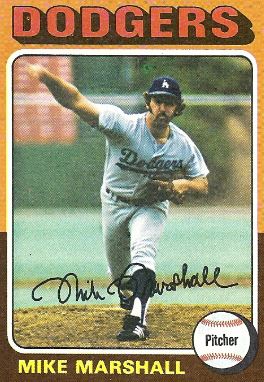
Mike Marshall pitched a record 208 1/3 innings in relief in 1974.

Mike Marshall pitched a record 208 1/3 innings in relief in 1974.

Spoiler alert … or Warning!  This is going to be an “I remember when …” post.  A look back at a time when the national pastime operated a bit differently.  Specifically, when baseball’s top relievers earned The Sporting News “Fireman of the Year Award” … appropriately named because the bullpen leaders of the day often came in (early or late) to put out a fire and then stayed on the scene (and in the game) to make sure the fire stayed out. Multi-inning stints, inherited runners, 100+ inning seasons and 10+ W-L decisions were the rule, rather than the exception for MLB’s top firemen.  (Actually, I’ll be going back a bit further than those Fireman of the Year Days, but they will be at the center of this commentary.)

I do miss those workhorse firemen of the past – who came to work early and stayed late.

                                                                           BBRT April 26, 2017

This post is prompted by my memories of the days when the “end game” belonged to firemen like Lindy McDaniel, Roy Face (we called him Elroy), Wayne Granger, Dick “The Monster” Radatz, Hoyt Wilhelm, Rich “Goose”  Gossage, Dan Quisenberry, Bill “Soup” Campbell, Rollie Fingers, Al “Red” Worthington, Ron Perranoski, Bruce Sutter and, of course, the durable Doctor Mike Marshall.  (There are many more, but this is a pretty good list to start from.)

Note:  The Sporting News Fireman of the Year Award was established in 1960 and became the Reliever of the Year Award in 2001.  Today, we have the Mariano Rivera and Trevor Hoffman Awards, which tend to recognize today’s ninth-inning closers.

Today, of course, the closer is a new kind of pitcher – generally coming in for just the ninth inning, with a clean slate on the bases and tending to accumulate significantly more saves and fewer W-L decisions.  The closer is preceded, most likely, by the seventh-inning specialist, the eighth-inning set-up man and, perhaps, a lefty or righty whose purpose is to retire one or two key hitters (not to mention the possibility of a middle-man or long reliever). Putting this post on paper does not mean I endorse one system over the other.  I recognize baseball has to change and I am willing to accept the new order of things like one-inning closers, the near demise of the complete game and the growing number of infield shifts. (I make an exception to this acceptance for the DH and the new rule – taken right from slow-pitch softball – which sees batters simply waved to first on an intentional walk.)  What this post does signify is that I do truly miss those workhorse relievers who used to came to work early and stay late.

In this post – to make a short story long – BBRT will look at where relief pitching is today – and nostalgically where it has come from.  As is baseball tradition, I’ll try to tell the tale in both stories and statistics.   To begin, here are a few statistics that will help tell the story (and which I will deal with in more detail later):

  • In 1930, MLB pitchers racked up more games started than relief appearances, while in 2016 relief appearances outnumbered starts by more than three-to-one.
  • In 1930, the Athletics’ Lefty Grove tied for the MLB league lead in games won as a starter (23), led MLB in total games won at 28 (thanks to five wins in relief) and topped MLB in saves with nine.
  • In 1959, the Pirates’ Roy Face racked up an MLB record 18 relief wins (against one loss) to go with ten saves.
  • In 1969, the Reds’ Wayne Granger notched 27 saves and, in 90 appearances (then a record), came in 62 times (68.9 percent of his appearances) with runners on base. He inherited an unofficial record 112 runners that season. In contrast, in 2002, the Twins’ Eddie Guardado led the AL with 45 saves, but (in 68 appearances) only once came in with runners (two) on base.
  • 1974, NL saves leader Mike Marshall (21 saves), took the mound as a reliever in a record 106 games, and tossed a record 208 1/3 innings in relief.  In 2016, only nine MLB starters pitched more than 208 innings and no reliever reached even 90 innings. (Brad Hand led all relievers with 89 1/3 innings in 82 appearances.)
  • In 2016, MLB saves leader Jeurys Familia of the Mets (51 saves) pitched more than one inning in just five of 78 appearances (6.4%). In 1980, MLB saves co-leader Goose Gossage (33 saves) pitched more than one inning in 37 of 64 appearances (57.8%).

Those are jusst some of the numbers, but what does this story look like in practice?

GrangerIt was Monday, September 8, 1969 and the Reds were facing the Giants (in Cincinnati) in the first game of a doubleheader.  (Remember those? A baseball fan’s dream.) Jim Maloney had started against the Giants’ Juan Marichal and took a 5-3 lead into the top of the ninth.  (Both starting pitchers were still in the game.  Remember complete games?) Giants’ catcher Dick Dietz led off the ninth and was safe on an error by Reds’ CF Bobby Tolan. Willie Mays pinch hit and drew a walk and then Leon Wagner (also pinch hitting) singled off Maloney to plate pinch runner Don Mason and send Mays to third.  That’s when Reds’ manager Dave Bristol made the call to the bullpen and brought Wayne Granger to the mound. (We didn’t call them “closers” back then – “finishers” would have been a better word.) A quick fly ball and a double play grounder later, Maloney had his 20th save of the season (in his 73rd appearance). 

A nice day’s work.  But wait, Maloney was not done for the day.  Game Two of the twin bill was tied 4-4 after seven innings and – in the top of the eighth – Bristol again called Granger to the mound.  This time, the 6’2”, 165-pound, 25-year-old Granger (who would win the NL Fireman of the Year Award) came in to start the eighth inning – and he was still in there in the 15th, when the Reds won 5-4 and Granger picked up his eighth victory of the season.  Granger gave up no runs, three hits and one walk, while fanning five in his eight-inning stint.  Given that he had gone two innings in relief the day before, Granger had appeared in three games and pitched eleven scoreless innings of relief in two days. He did get September 9 off, but then ran off a string of seven appearances in seven days (September 10-16).

Looking back at Granger’s 1960 season, here are a few numbers to remember:  He pitched 144 2/3 innings in relief; 57.8 percent of his relief appearances were for more than one inning (52 of 90); he came into the game with runners on base in 68.9 percent of his appearances (62 of 90); and he inherited an unofficial record 112 runners – more than one per appearance.

Looking at today’s (April 26) MLB leaderboard, there on top of the saves category is the Rockies’ Greg Holland with nine saves in ten appearances – with exactly ten innings pitched, no outings of more than one inning and no inherited runners.

Zach Britton Orioles photo

Photo by Keith Allison

Holland’s 2017 numbers too small a sample?  Let’s look at one of 2016’s top relievers:  the winner of the Mariano Rivera Award – Zach Britton.  Britton appeared in 69 games for the Orioles – going 2-1, with 47 saves and a 0.54 ERA.  Of those 60 appearances, only seven were of more than one inning and a single two-inning stint was his longest. He threw a total of 67 innings, meaning he averaged just under one inning per outing (0.97). Of Britton’s saves, 41 were of exactly one inning – two were less than one frame. In 69 games, he came in with runners on 12 times.   Holland’s start to 2017 and Britton’s 2016 season accurately reflect the changing order of the guard in the bullpen – with closers replacing firemen and generally coming into the game after a cadre of relief specialists, starting with clean slate on the basepaths and throwing just one inning (the ninth).  Thanks to Baseball-Reference.com, MLB.com and my trusty ESPN Baseball Encyclopedia, there are plenty of statistics available to shed some light on how we got here.  Let’s take a look,

I won’t spend much time on the earliest days of the national pastime, when bullpens really had little role to play.  Starters were expected to put in a full game’s work. Consider the first five years of the National League (1876-1880) – 92.1 percent of starts resulted in complete games.  In 2016?  Last season, there were 83 complete games (in 4,856 starts) for a complete-game percentage of just 1.7 percent.  In fact, 36.7 percent off all innings pitched in MLB season were handled by hurlers coming out of the bullpen. (For BBRT’s take on the vanishing complete game, click here.)

The decline on complete games has amplified the importance of the relief staff (particularly closers) – and prompted the ascendance of the “save.”  In 1900, just 2.2 percent of MLB wins also involved a “save.”  In 1950, the save-to-win ratio was 23.3 percent; and last season, it was 52.5 percent.  The chart below maps the decline of the complete game – and the ascendance of the save. The actual percentages are detailed at the end of this post.

BBCHART

And, as already noted, as relief staffs have taken on more work, they have also seen a division of labor – middle men, set-up men, lefty/righty specialists, closers – more relievers, making more appearances of fewer innings each.

RPU

As you can see from the trend lines in the charts, today’s specialized bullpens did not take form overnight.  The bullpen evolution included times when:

  • Starters were expected to finish each game (witness the 82.1 percent completion rate of 1900) and relievers were primarily lessor or declining pitchers who “mopped up” lost causes.
  • Managers who went to the bullpen when a game was on the line looked primarily to starting pitchers who felt they could “go” that day. (In 1930, Lefty Grove led the AL with nine saves – starting 32 games and coming on in relief in 18 – also leading the league in win with 28, ERA at 2.54 and strikeouts with 209.)
  • Key relievers were true workhorses out of the pen, and multi-inning saves and 100+ inning seasons among relievers were commonplace (In 1980, for example, the saves leaders were Bruce Sutter of the Cubs in the NL and Rich Gossage of the Yankees and Dan Quisenberry of the Royals in the AL. The trio appeared in a combined 199 games, threw 329 2/3 innings and 60 of their 94 combined saves – 63.8 percent – were more than one inning.) At this same time, reliever usage resulted in more won-loss decisions (versus saves) than we normally see today.  (It wasn’t unusual for relievers – even closers – to run up a dozen or more decisions.)
  • Then, relievers became more and more specialized, to the point that new statistics were developed to reflect their changing roles (saves in the 1960s – holds in the 1980s). Note:  Saves were later award retroactively to relievers who proceded the new stat.

STARTING THE FINAL FRAME WITH A CLEAN SLATE

In 1972, the Reds’ Clay Carroll (who led the NL with 37 saves) became the first reliever to starts at least 1/3 of his appearances to open the ninth inning. In 1987, the Reds’ John Franco became the first reliever to start at least 1/2 of his appearances to open the ninth.  In 1994, the Orioles’ Lee Smith (who led the AL with 33 saves) became the first reliever to start at least ¾ of his appearances opening the ninth.


MIPROB


With that background, let’s now take a look at some true workhorse firemen – and the kind of seasons we are not likely to see from bullpen occupants ever again.  (The kind of seasons I kind of miss.)

MIKE MARSHALL – UNIQUE TO THE “Nth” DEGREE

We never saw a closer like Mike Marshall before he came along – and we’re not likely to see one like him again. In 1974, as a Dodger, he put up the grand-daddy of all relief seasons – setting the record for appearances with 106 and innings pitched in a season in relief at 208 1/3. He finished the season 15-12, with a league-topping 21 saves and a 2.42 ERA.  Marshall was called on to go more than one inning in 74 games (68.5 percent of the time); and toiled three or more innings 22 times. A few other facts about Marshall’s remarkable season:

  • His longest stint came on August 19, when he came on in the seventh inning of a 7-7 game against the Cubs – and went six innings, earning the win as the Dodgers topped the Cubs 8-7 in twelve innings.
  • From June 18 to July 3, Marshall relieved in 13 consecutive regular season games –an MLB record later tied (1986) by the Rangers’ Dale M0horcic.
  • From May 17-24, Marshall pitched eight straight days (no off days in that period).
  • On July 7, Marshall picked up a pair of saves, as the Dodgers swept a doubleheader from the Expos. Marshall pitched 1 2/3 innings in Game One and came back to go three innings in Game Two.

Marshall holds the MLB and NL record for games pitched in relief in a season (106 – Dodgers, 1974), as well as the AL record (89 in relief – Twins, 1979 – he also had one start that year).  The Blue Jays’ Mark Eichhorn tied Marshall’s AL record in 1987.

WILLIE HERNANDEZ – CY YOUNG AWARD AND MVP

In 1984, Tigers’ closer Guillermo “Willie” Hernandez won both the Cy Young Award and AL Most Valuable Player Award (for Twins’ fans, he edged out hometown hero Kent Hrbek in the MVP voting). Hernandez appeared in 80 games – going 9-3, 1.92 with 33 saves. He was asked to go more than one inning 45 times (56 percent of his appearances) – and 15 times he pitched at least three frames (twice for four innings.) Hernandez went 140 1/3 innings that season – averaging 1.75 innings per stint.

HOYT WILHELM OFF TO A GOOD “START” IN RELIEF

In 1952, in his rookie season, Hoyt Wilhelm appeared in 71 games in relief for the New York Giants – going 15-3 with 11 saves.  His .833 winning percentage led the league. Of more significance, his 159 1/3 innings pitched (all in relief) qualified him for the Earned Run Average title, which he captured with a 2.43 ERA. Wilhelm won the ERA title again in 1950, when he went 15-11, 2.19 for the Orioles primarily as a starter (32 games, 27 starts).

A MONSTER SEASON FOR DICK RADATZ

In 1964, The Red Sox’ Dick Radatz not only led the AL in saves, with 29, he also picked up 16 wins (versus nine losses) in relief and set the MLB record for strikeouts in a season in relief at 181 (in 157 innings). Radatz’ ERA for the season was 2.29.  In his first four MLB seasons (1962-65), the 6’6”, 230-pound right-hander – pitching only in relief – averaged 109.5 innings a season.

ELROY FACE PUTS UP 18 RELIEF WINS

In 1959, the Pirates’ Elroy Face, pitching solely in relief, set the MLB single-season winning percentage record – going 18-1, 2.70 with ten saves (93 1/3 innings pitched). Face had led the NL in saves in 1958, and would lead in the category in 1961 and 1962, as well.

FOR TWINS’ FANS – WITNESSING THE NEW AGE

In 1976, Twins’ fans had the pleasure of watching Bill “Soup” Campbell come in from the bullpen 78 times – on his way to tying John Hiller’s (1974) AL record of 17 relief wins in a season. And, no Campbell wasn’t a long man, middle reliever or even a set-up man.  He was all of those and the closer – going 17-5, 3.01 with 20 saves.  On the season, Campbell:

  • Had 22 (W-L) decisions and 20 saves;
  • Pitched 167 2/3 innings – 2.1 per appearance;
  • Made 56 appearances (72 percent) of more than one inning and 23 appearances (29 percent) of three or more innings;
  • Came into 45 games (57 percent) with runners on base – inheriting a total of 79 baserunners.

In 2002, Twins fans cheered as “Everyday Eddie” Guardado led the AL with 45 saves (2.93 ERA). In his 68 appearances, Guardado:

  • Had four (W-L) decisions to go with his 45 saves;
  • Pitched 67 2/3 innings – just shy of one inning per appearance;
  • Made just two appearances of more than one inning – none more than two innings;
  • Came into just one game with runners on base, inheriting a total of two baserunners.


DATA FROM COMMPLETE GAME/SAVES CHART

Year                % of CG          % of Wins with Save

1900                82.1                 2.2

1910                62.1                 10.2

1920                56.6                 12.0

1930                44.4                 18.6

1940                44.3                 18.9

1950                40.3                 23.3

1960                26.9                 34.9

1970                21.9                 43.8

1980                20.3                 42.9

1990                10.1                 55.7

2000                4.8                   48.5

2010                3.4                   49.5

2016                1.7                   52.6


Follow and Like the Baseball Roundtable Facebook page.  More baseball commentary there – and, in mid-May, the start of some bobblehead give-aways.  (Beginning with Mariano Rivera and Derek Jeter bobbleheads.) 

I tweet baseball @DavidBBRT


Follow the Baseball Roundtable Facebook page.


Member:  Society for American Baseball Research (SABR); The Baseball Reliquary; The Negro Leagues Baseball Museum; Baseball Bloggers Alliance. 

Five Roundtrippers in an Inning has Hitters Seeing Red(s)!

Updated: April 22, 2017  (originally published June of 2015)

On this date (April 22) in 2006, the Milwaukee Brewers became the most recent team to bash five home runs in a single inning.  It came in the fourth inning of an 11-0 Brewers in over the Cincinatti Reds (in Milwaukee).  The hitters were: Bill Hall; Damian Miller; Brady Clark; J.J. Hardy; and Prince Fielder. The Reds’ Brandon Clausen gave up the first four dingers, while reliever Chris Hammond gave up the finallong ball.

CONSISTENCY IS THE HOBGOBLIN … 

Only five times in MLB history has a team given up five home runs in a single inning. Four of those occured in the National League and – talk about consistency – ALL FOUR  TIMES, the Cincinatti Red were the victims of the power outburst. And, three of the four times, the “handful of homers” against the Reds came in the fourth inning.  The long ball barrages were spread out of the Reds’ history (1939, 1949, 1961 and 2005) – and they are detailed later in the post.  Note, the Minnesota Twins are the only American League team to hit five home runs in a single inning (1966). 

Before we detail each of these homner-happy innings, here are a few tidbits about the five-home frames:

  • The Cincinnati Reds have been the victims of four of the five five-homer innings.
  • The home team has put on the power display four of the five times.
  • Fourteen of the 25 home runs have come with two outs.
  • Pitchers have contributed (as hitters) HRs in two of the five five-homer innings.
  • Twice the victimized team (Reds both times) has been in first place.
  • One of the five-homer innings was kept alive by three fielding errors.
  • One of the five-homer innings included two home runs by one player in the inning.
  • Two of the five power outbursts included an inside the park home run.
  • Three of the five five-homer innings have come in the fourth inning (three of the four against the Reds).
  • The five-homer innings have featured the scoring of 43 runs – the fewest at six, the most at 12.

Now, let’s take a closer look at those five-homer innings.

_____________________________________________

NATIONAL LEAGUE

June 6, 1939 … NY Giants versus Cincinnati Reds

Pitcher Manny Salvo hit an inside-the-park home run in Giants five-homer inning.

Pitcher Manny Salvo hit an inside-the-park home run in Giants five-homer inning.

The first-ever five-home run MLB inning took place in New York on June 6, 1930, as the sixth-place Giants (20-24 record) surprised the league-leading Reds (29-15) by a 17-3 score, plating all 17 runs in the first five innings.

The record-setting power display came in the bottom of the fourth inning, with the Giants already up 6-0.  Peaches Davis, who had relieved Johnny Vander Meer in the first inning (Vander Meer had given up six hits and three runs in 2/3 of an inning), retired Giants’ LF Jo Jo Moore and SS Billy Jurgess to start the inning. Then the wheels came off.  C Harry Danning laced a home run to center (his sixth). Clean-up hitter Mel Ott drew a walk, 1B Zeke Bonura singled and CF Frank Demaree hit the second home run of the inning (his second of the season).

Wesley Livengood (whose MLB career would consist of five appearances and a 9.53 ERA) then came on to relieve Davis. Livengood was not living so good, as he walked 3B Tony Lazzeri and then gave up a home run to 2B Burgess Whitehead (the first of only two he would it in 1939).  Giants’ pitcher Manny Salvo was up next. A weak hitter, Salvo surprised everyone in the ball park with the only home run of his five-season MLB career – an inside-the-park round tripper off the right field fence.  Next up was lead-off hitter Moore, who hit the fifth and final homer of the inning (and his second of the day).  Notably, all of this damage took place after the first two batters were retired.

The Inning’s Home Run Hitters: Harry Danning, Frank Demaree, Burgess Whitehead, Manny Salvo, Jo Jo Moore

Runs Scored in the Five-HR Inning: Eight

Final Score:  Giants 17 – Reds 3 

June 2, 1949… Philadelphia Phillies versus Cincinnati Reds

Andy Seminick hit two round trippers in the Phillies' five-homer inning.

Andy Seminick hit two round trippers in the Phillies’ five-homer inning.

Ten seasons passed before the next five-homer inning – and the victims were again the Reds.  This time, the bashing came off the bats of the Phillies (in Philadelphia).  It started out as a close game, with the Reds actually leading 3-2 after seven innings behind a strong performance by starting pitcher Ken Raffensberger (who would win 18 games that season). Things, however, went awry in the bottom of the eighth.

CF Del Ennis (the Phillies’ clean-up hitter) led off the inning with a home run (his 7th of the season), which was followed by C Andy Seminick’s second home run of the game – marking Raffensberger’s exit. Jess Dobernic came on in relief and retired RF Stan Hollmig on a liner to short before giving up a home run to 3B Willie Jones (his third of the year). Dobrenic then induced a soft fly ball out to second base by 2B Eddie Miller, bringing up P Schoolboy Rowe, who had relieved Philadelphia starter Curt Simmons in the top of the eighth.  Rowe promptly slammed a home run to left (the only home run of the year for the 39-year-old veteran, in his last MLB season). Kent Petersen came on in relief of Dobernic and seemed to pour gas on the flames:  walk to CF Richie Ashburn, double to SS Granny Hamner, 1B Eddie Waitkus safe on an error (Ashburn scores), an Ennis single to right (Hamner scores), and Seminick’s second home run of the inning (third of the game and seventh of the season). That was the end of the home runs, but the inning continued with the Phillies adding another run on a hit batsman and a triple.  Suddenly a 3-2 Reds lead was a 12-3 deficit.

The Inning’s Home Run Hitters; Del Ennis, Andy Seminick (2),  Willie Jones, Schoolboy Rowe

Runs Scored in Five-HR Inning: 10

Final Score:  Phillies 12 – Reds 3

August 23, 1961 … San Francisco Giants versus Cincinnati Reds

Jim Davenport contributed a three-run inside-the-park homer to the Giants record-tying inning.

Jim Davenport contributed a three-run inside-the-park homer to the Giants record-tying inning.

Twelve seasons after five-home inning number two, it happened again – and for the third straight time, the Reds were the victims – and this time they were are home.  On August 23, 1961, another close game became a late inning route.  The Reds trailed the San Francisco Giants 2-0 after 8 innings with both starters (Juan Marichal for the Giants and Joey Jay for the Reds) still in the game.  A low-scoring game was no surprise. Marichal came into the contest with a 12-7 record for the third-place Giants, while Jay was 18-7 for the first-place Reds.

In the top of the ninth, the Giants broke the tightly contested game wide open.  1B Willie McCovey started the frame with a double off Jay and then scored on an error by Reds’ 2B Don Blasingame after CF Willie Mays popped out, LF Orlando Cepeda and RF Felipe Alou followed with a pair of deep home runs (to center and left, respectively). It was Cepeda’s 36th of the year and Alou’s 15th.  That brought Jim Brosnan in from the bullpen – and led to a fly ball out by C John Orsino, singles by SS Jose Pagan and Marichal, 2B Joey Amalfitano reaching on an error by Reds’ third baseman Gene Freese (Pagan scoring) and a three-run inside-the-park home run by 3B Jim Davenport (his 8th homer of the year).  McCovey then singled for his second hit of the inning, which brought on Bill Henry in relief. Henry gave up a two-run homer to Mays (his 34th of the season), a single to Cepeda, and had Alou reach on Freese’s second error of the inning (and the Reds’ third miscue of the frame). Orsino then took Henry deep (just his second of the year) before Pagan struck out to mercifully end the 12-run, ninth-inning uprising.

The Inning’s Home Run Hitters:  Orlando Cepeda, Felipe Alou, Jim Davenport, Willie Mays, John Orsino

Runs scored in the Five-Homer Inning: 12

Final Score:  Giants 14 – Reds  0

April 22, 2006 … Milwaukee Brewers versus Cincinnati Reds

Prince Fielder put the "cherry on top" (old school analogy) for the Brewers.

Prince Fielder put the “cherry on top” (old
school analogy) for the Brewers.

Home cookin’ – with a five homer dessert – was good to the Brewers when they hosted the Reds on April 22, 2006. Milwaukee pounded the visitors 11-0, racking up the fourth five-homer inning against the Reds’ franchise along the way.   The outburst came in the bottom of the fourth inning with starter Brandon Claussen still on the mound and the Reds trailing 3-0.

Milwaukee 3B Bill Hall (the number-six hitter) started it with a home run (his third of the young season). Then 2B Richie Weeks singled to left, scoring on C Damian Miller’s home run (his 1st of the year). That seemed to establish a (brief) HR-1B-HR pattern, as Brewers’ pitcher Dave Bush followed the Miller home run with a single and CF Brady Clark backed up the Bush single with his first home run of 2006. SS J.J. Hardy broke the pattern with a home run (his 3rd of the year).  At this point, Claussen had faced six batters in the inning, giving up four home runs and two singles.  Chris Hammond came on in relief and provided just that, striking out the first two batters he faced (RF Geoff Jenkins and LF Carlos Lee).  Then Prince Fielder gave the Brewers a piece of the five-homer in one inning record, hitting his third dinger of the year. The carnage ended on a fly out to center by Hall.

The Inning;s Home Run  Hitters: Bill Hall, Damian Miller, Brady Clark, J.J. Hardy, Prince Fielder

Final Score:  Brewers 11 – Reds 0

Runs Scored in the Five-Homer Inning: 7

_________________________________________________

AMERICAN LEAGUE

June 9, 1966 … Minnesota Twins versus Kansas City Athletics

Harmon Killibrew hit more home runs in the 1960s than any other player - powering the Twins to some big innings.

Harmon Killibrew hit more home runs in the 1960s than any other player – powering the Twins to some big innings (including their 1966 five-homer stanza).

Only once has an American League team hit five homers in a single inning – but chances have improved with interleague play (AL teams do now get to face the Reds). The team that flashed all that power was the Minnesota Twins, but the day (June 9, 1966 against Kansas City) didn’t start out all that well.

With the two teams facing off at Metropolitan Stadium (Bloomington, MN), the Athletics got off to a fast start, knocking out Twins’ ace Camilo Pascual in the top of the first. (Pascual lasted 2/3 of an inning, giving up four runs on three hits and a walk.) With Catfish Hunter on the mound, the Twins’ chances looked slim.

The Twins scored one in the fifth and two in the sixth (on a Harmon Killebrew home run) and then, trailing 4-3, broke the game open with five home runs in the seventh.It started innocently enough with a Catfish Hunter walk to C Early Battey, followed by an infield fly out for 2B Bernie Allen. That brought pinch hitter (for the pitcher) Rich Rollins to the plate, and he hit the inning’s first homer (just the second of ten HRs Rollins would hit in 1966). Lead-off hitter SS Zoilo Versalles followed with his fifth homer of the year – and Paul Lindblad replaced Hunter on the mound. Lindblad got Twins’ LF Sandy Valdespino on a grounder to short, but then gave up consecutive round trippers to RF Tony Oliva (his 14th) and 1B Don Mincher (his 6th).  John Wyatt came in from the bullpen and quickly gave up a home run to 3B Harmon Killebrew (his second of the day and 11th of the year). Wyatt then surrendered a double to RF Jimmie Hall and Battey (in his second plate appearance of the inning) reached on an error before Bernie Allen ended the frame on a ground ball (catcher to first).

The Inning’s HR Hitters:  Rich Rollins, Zoilo Versallers, Tony Oliva, Don Mincher, Harmon Killebrew 

Runs Scored in the Five-Homer Inning: Six

Final Score:  Twins 9 – Athletics 4


Follow and Like Baseball Roundtable’s Facebook page (bobblehead give-aways coming soon).


I tweet baseball @DavidBBRT


Member:  Society for American Baseball Researc (SABR); The Baseball Reliquary; The Negro Leagues Baseball  Museum; Baseball Bloggers Alliance. 

Humber’s One MLB Complete Game – “Perfect” Timing

HumberFive years ago today (April 21, 2012), the White Sox’ Phil Humber tossed a perfect game in a 4-0 victory over the Seattle Mariners in Seattle.  Humber finished off the Mariners in 96 pitches, 67 for strikes, going to a three-ball count on only three batters.  In his gem, Humber struck out nine (including the final batter) and there were only six outfield putouts.

Humber’s “perfecto” intrigues me – primarily because it was his first AND ONLY career complete game (eight seasons, 97 appearances, 51 starts). Humber ended with a career line of 16-23, 5.30; and his 16 career wins are the fewest ever for a pitcher who tossed a perfect game. Note: The White Sox Charlie Robertson had the fewest career victories at the time of his perfect game (April 30, 1922) – just one. Robertson’s perfect outing came in just his fourth career start (fifth career appearance).

Humber’s also was the first of three perfect games in 2012 – the only MLB season with three perfect games. Note: There has not been a perfect game in MLB since 2012.

FOR MY MINNESOTA FOLLOWERS – THERE IS A TWINS’ CONNECTION

Humber, who pitched in the majors from 2006 to 2013, was a former Twin (2008-09), as was his White Sox battery mate that day – A.J. Pierzynski.  Pierzynski, had been a Twin from 1998 through 2003.

As if often case, contemplating one unique baseball achievement sent me to the record books.   So, here are a few facts about MLB’s 23 perfect games to date. (Thanks to Baseball-Reference.com and MLB.com for lost of statistical resouces._

“Necessity is the mother of concentration.”  More perfect games (seven of 23) have ended in the narrowest of victories, by the score of 1-0.

The highest score in a perfect game?  That would be 10-0, the Giants’ Matt Cain’s margin over the Astros in his May 13, 2012 perfect outing.

PERFECTLY TIMED

On July 18, 1999, the Yankees’ David Cone pitched the first perfect game in interleague play – as New York topped Montreal 6-0 at Yankee Stadium. It couldn’t have come at a more appropriate time.  It was Yogi Berra Day at the stadium and Don Larsen (who pitched the only World Series perfect game) threw out the first pitch to Berra (who caught Larsen’s 1956 perfect outing).

Another perfecto factThe largest attendance for a perfect game was 65,519 for Don Larsen’s 1956 World Series perfect day of work.  The smallest crowd to witness a “perfecto) was 6,298, when Catfish Hunter shut down the Twins in Oakland on May 8, 1968 – although tens of thousands claim to have been there.  The announced attendance for Humber’s perfect outing was 22,472.

Home Cookin’ seems to help. Of the 23 perfect games, 17 were at home.

Reaching high for perfection.  Randy Johnson’s perfect game on May 18, 2004 (Diamondbacks 2 – Braves 0 in Atlanta) made Johnson the oldest 40 years – 256 days) and tallest (6’10”) pitcher to complete a perfect game.

Way to go, Kid! John Montgomery Ward is the youngest player to toss a perfect game. He achieved his feat for the NL’s Providence Grays (in a 5-0 win over the Buffalo Bisons) on June 17, 1880 – at the age of 20 years and 105 days.

Let’s get this over with. Cy Young pitched the quickest perfect game (one hour and 25 minutes), as the Boston Americans topped the Philadelphia Athletics 3-0 on May 5, 1904.

Savoring the moment(s). The most time-consuming perfect game was pitched by David Wells (two hours and forty minutes), with his Yankees besting the Twins 4-0 on May 17, 1998.

ON THE BIG STAGE

Don Larsen pitched the only World Series perfect game on October 8, 1956, at Yankee Stadium – as the Bronx Bombers bested the rival Brooklyn Dodgers 2-0.  Larsen struck out seven, went to a three-ball count only once and saw nine outfield putouts.

JossWho needs to waste a pitch? Addie Joss of the Cleveland Naps used the fewest pitches to log a perfect nine-innings – 74 pitches – just three strikeouts (the lowest ever in a perfect game) – as he beat the White Sox (in Cleveland) on October 2, 1908.  Joss’ perfect game came in the final days of a tense pennat race. With just three game left in the season, Detroit led Cleveland by 1/2 game and Chicago by 1 1/2 – with Chicago playing at Cleveland. It was a tight pitching duel between Joss and Chicago ace Ed Walsh (who gave up just four hits and notched 15 strikeouts in a  losing cause). The only run  was scored by Cleveland in the third inning on a single by Cleveland CF Joe Birmingham. Walsh appeared to have him picked off of  first, but Birmingham took off for second and White Sox’ first baseman Fank Isbell’s throw to second hit the runner  and caromed into the outfield – enabling Birmingham to take third. He then scored the game’s only run on a Walsh wild pitch. Detroit, however, held to take the pennant by 1/2 game over Cleveland. Joss, by the way, finished the season at 24-11, with a leagye-low 1.16 ERA; while Walsh wone a league-high 40 games (15 losses) with a 1.42 ERA. (How times have changed.)

It take a lot of pitches to notch 14 strikeouts.  The most pitches in a perfecto?  Matt Cain’s 125 (86 strikes), as the Giants topped the Astros 10-0 on June 13, 2012.  Cain, tied Sandy Koufax for the most strikeouts in a perfect game.

AS CLOSE AS IT GETS

Sandy Koufax logged a record three immaculate innings.

Sandy Koufax logged a record three immaculate innings.

Perhaps the most dominant perfect game performance (if such a distinction can be brought to perfection) belongs to Dodgers’ lefty Sandy Koufax, who tossed his perfect game against the Cubs in LA – winning 1-0 on September 9, 1965.  Koufax struck out a perfect-game record 14 in that contest, including the last six batters (the last five on swinging third strikes).

The Dodger southpaw’s accomplishment was especially meaningful since he needed every out and every pitch to best Cubs’ Bob Hendley – who himself allowed only two base runners the whole game.  Hendley pitched a one-hitter, giving up a lone double, one walk and one UNEARNED run. The Dodgers scored their lone tally in the fifth on a walk to Lou Johnson, a sacrifice bunt by Ron Fairly (moving Johnson to second), a stolen base (third base) by Johnson and a throwing error by the catcher that let Johnson come in to score. The one hit and two base runners is the record-low offensive output for both teams in any MLB game.

Perfect game record least likely to be broken?  When Jim “Catfish” Hunter tossed his perfect game against the Twins (May 8, 1968, at Oakland), he not only notched 11 strikeouts (including the last batter) – he added insult to injury by collecting three hits in four at bats (a double and two singles) and driving in three of Oakland’s four runs.  The best offensive performance ever by a perfect hurler.The Dodgers’


WHAT’S A GUY GOTTA DO?

HaddixOkay, it’s not an official perfect game, but on May 26, 1959, the Pirates’ Harvey Haddix retired the first 36 batters he faced against the powerful – defending NL Champion – Milwaukee Braves’ line up. That’s right, 12 perfect innings.  The only problem?    The Pirates’ lineup, while managing 12 hits (and putting the ball in play consistently – only two strikeouts) against fidgety Lew Burdette, had not pushed a run across.

Then, in the unlucky bottom of the 13th, Pirates’ third baseman Don Hoak’s throwing error let Braves’ 2B  Felix Mantilla (leading off the inning) reach first. 3B Eddie Mathews sacrificed him to second before RF Hank Aaron was intentionally walked.  Still, one out in the 13th, no-hitter, shutout, complete game and potential win still intact.  Then, 1B Joe Adcock hit a home run – which turned into a game-winning double when Adcock passed Aaron the base paths. All Haddix got for retiring the most consecutive batters from the start of any MLB game?  A complete game loss.

Perfect Games – The List  (Home Team in Bold)

Felix Hernandez, Seattle 1/Tampa Bay 0 … August 15, 2012

Matt Cain, San Francisco 10/Houston 0 … June 13, 2012

Phil Humber, Chicago 4/Seattle 0 … April 21, 2012

Roy Halladay, Philadelphia 1/Florida 0 … May 29, 2010

Dallas Braden, Oakland 4/Tampa Bay 0 … May 9, 2010

Mark Buehrle, Chicago 5/Tampa Bay 0 … July 23, 2009

Randy Johnson, Arizona 2/Atlanta 0 … May 18, 2004

David Cone, New York 6/Montreal 0 … July 18, 1999

David Wells, New York 4/Minnesota 0 … May 17, 1998

Kenny Rogers, Texas 4/California 0 … JUly 28, 1994

Dennis Martinez, Montreal 2/Los Angeles 0 … July 28, 1991

Tom Browning, Cincinatti 1/Los Angeles 0 … September 16, 1988

Mike Witt, California 1/Texas 0 … September 30, 1984

Len Barker, Cleveland 3/Toronto 0 … May 15, 1981

Jim Hunter, Oakland 4/Minnesota 0 … May 8, 1968

Sandy Koufax, Los Angeles 1/Chicago 0 … September 9, 1965

Jim Bunning, Philadelphia 6/New York 0 … June 21, 1964

Don Larsen, New York 2/Brooklyn 0 … October 8, 1956

Charlie Robertson, Chicago 2/Detroit 0 … April 30, 1922

Addie Joss, Cleveland 1/Chicago 0 … October 2, 1908

Cy Young, Boston 3/Philadelphia 0 … May 5, 1904

John Montgomery Ward, Providence 5/Buffalo* 0 … June 17, 1880

Lee Richmond, Worcester 1/Cleveland 0 … June 12, 1980

*Game played in Providence, coin toss made Buffalo “home team.”


Follow and Like the Baseball Roundtable Facebook page – for more baseball talk and, soon to come, drawings for bobble heads.


I tweet baseball @DavidBBRT


Member:  Society for American Baseball Research (SABR); The Baseball Reliquary; The Negro Leagues Baseball Museum; Baseball Bloggers Alliance.
You Ain’s So Bad … Pete Richert’s MLB Debut – One for the Record Books

RichertFifty-five  years ago today, Dodgers’ pitcher Pete Richert made one of the most auspicious MLB debuts ever – setting a couple or records in the process.  In fact, it reminds of one of my favorite lines from the “Rocky” movies – in Rocky III, when Rocky Balboa tells Clubber Lang, “You ain’t so bad!”  That may be how Richert felt after his first couple of innings facing major league “clubbers.”

Richert – a 5’ 11”, 165-pound southpaw – at 22-years-old was already in his fifth pro-season.  He was what every team looked for – a left-hander who could bring some heat. In four full minor league seasons, Richert had gone 44-40, 3.71, with 742 strikeouts in 721 innings.

On April 12, 1962, the rookie came to the mound in the top of the second inning (in relief of starter Stan Williams) with the Dodgers trailing 4-0 and the Reds’ SS Eddie Kasko on second base.  Richert proceeded to fan the first MLB batter he ever faced (CF Vada Pinson) swinging.

Richert came out for the third inning and fanned the next four MLB batters he faced. (Richert remains the only pitcher with a rare four-strikeout inning in his MLB debut.)  It went like this: Reds’ RF Frank Robinson goes down swinging; 1B Gordy Coleman fans swinging, but reaches first on a passed ball; CF Wally Post strikes out swinging; C Johnny Edwards ends the inning by swinging at strike three.  But, Richert wasn’t done yet. 

In the top of the fourth, Richert got the sixth major leaguer to step in against jhim – Reds’ 3B Tommy Harper – on a called third strike. Ironically, it was Reds’ pitcher Joey Jay who ended Richert’s career-opening, MLB-record six straight strikeouts by grounding out to first base. Richert got the final out of the inning on another grounder, 2B Don Blasingame retired second to first.

The top of the fifth was uneventful, although it did include Richert’s seventh strikeout. The rookie hurler got Kasko on a fly to center; Pinson on a foul pop; Robinson reached on an outfield error; and Coleman fanned looking. The Dodgers then scored seven times in the bottom of the inning (during the rally Duke Snider pinch hit for Richert) and Joe Moeller replaced Richert on the mound in the sixth.

Richert’s final line – 3 1/3 innings pitched, no hits, no walks, no runs and seven strikeouts. He faced 12 batters, with two getting on via a passed ball and an error.  He threw 40 pitches – 33 strikes. He set a record for consecutive batters fanned to start a career and became the first (still only) MLB pitcher with a four-strikeout inning in his MLB debut.

Richert went on to finish the season 5-4, 3.87 (19 appearances, 12 starts), with 75 strikeouts in 81 1/3 innings. The southpaw had a 13-season MLB career – 80-73, 3.19, 51 saves and 925 whiffs in 1,165 2/3 innings.  He was primarily a starter from 1962 to 1967 and had his best years (making the All Star team) were with the Washington Senator in 1965 and 1966.  In 1966, he went 15-12, 2.60 for a Senators’ squad that finished eighth at 70-92.

In 1968, his second season with the Orioles, Richert was moved to the bullpen and did not make another start over his final seven seasons. His best year as a reliever was with the O’s in 1970, when he appeared in 50 games, won seven and lost two, racked up 13 saves and had a 1.98 ERA. That season, Richert fanned 66 batters in 54 2/3 innings. From 1968 through his final season (1974), Richert had a 30-21 record in relief, with a 2.68 ERA and 49 saves.

I tweet baseball @DavidBBRT


Follow and like the Baseball Roundtable FaceBook page here.   More baseball and notification and links to new baseballroundtable.com blog posts.  There will also be some baseball-related give-aways as the season progresses.


Member: Society for American Baseball Research (SABR); The Baseball Reliquary; The Negro Leagues Museum; Baseball Bloggers Alliance.

Hitting for the Cycle – Past and Present

Wil Myers photo

Wil Myers – first cycle of 2017. Photo by Minda Haas Kuhlmann

Wil Myers, first baseman for the often offense-starved San Diego Padres, yesterday (April 10, 2017) hit for the cycle (single-double-triple-home run) as the Padres topped the Rockies 5-3 at Coors Field. Myers singled in the first inning, had an RBI double in the second, a solo home run in the sixth and a triple in the eighth – all part of a four-for-four, two-run, two-RBI game.  It was only the second cycle in Padres’ history (Matt Kemp, August 14, 2015 – also at Coors Field).

Myers’ was the first MLB cycle of 2017.  The last cycle was achieved by John Jaso of the Pirates on September 28 of last season (versus Cubs).

Let’s celebrate Myers’ cycle with a look at some cycle trivia.

  • On June 18, 2000, Rockies’ second baseman Mike Lansing set an MLB record by completing a cycle in just four innings. As the Rockies topped the Diamondbacks 19-2, Lansing – hitting second in the order – hit an RBI triple to right in the first inning, added a two-run home run in the bottom of the second, hit a two-run double in the bottom of the third (the Rockies scored nine times in the inning to take a 14-1 lead), and then completed the cycle with a single to right in the fourth. Lansing then struck out in the sixth, before being pinch hit for in the eighth. The Rockies won the contest 19-2.
  • Four players have hit for the cycle a record three times: Adrian Beltre (Mariners-2008, Rangers-2012 and 2015); Bob Meusel (Yankees-1921, 1922 and 1928); Babe Herman (Brooklyn Robins-1931 twice and Cubs-1933); John Reilly (Reds-1883 twice and 1890).

THE HOME RUN CYCLE – IT’S HAPPENED JUST ONCE

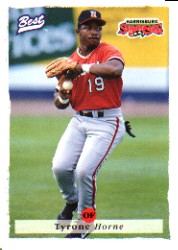
horne

Tyrone Horne – the only professional player to hit for the “Home Run Cycle.”

BBRT has written about this unique feat before, but it deserves repeating.  On July 27,  1998, Tyrone Horne, playing for the Double A Arkansas Travelers, became the only professional player (to date) to hit for the “Home Run Cycle” – bashing a solo, two-run, three-run and grand slam home run all in the same game (a 13-4 win over the San Antonio Mission). For full details, click here.


  • The Expos’ Tim Foli is the only player to start a cycle one day and complete it the next. On April 21, 1976, Foli collected a single, double and triple in a contest against the Cubbies that was suspended in the top of the seventh due to darkness. When play resumed the following day, Foli added an eighth-inning home run. (The Expos prevailed 12-6.)
  • Adrian Beltre has hit a record-tying three cycles – all at Arlington (twice for the hometown Rangers and once for the visiting Mariners, making him the only player to hit for the cycle in the same stadium for two different teams).
  • Four players have hit for cycle twice in the same season: John Reilly (American Association Red Stockings- 1883); Tip O’Neill (American Association St. Louis Browns-1887); Babe Herman (NL Brooklyn Robins-1931);  Aaron Hill (NL Arizona Diamondbacks-2012);
  • John Reilly (Reds) and Tip O‘Neill (St. Louis Brown Stockings, American Association) had the shortest time between cycles at just seven days. Reilly’s came on September 12 and September 19, 1883, while O’Neill’s came on April 30 and May 7, 1887. Reilly and Aaron Hill (Diamondbacks) are the only players with two cycles in the same calendar month.  Hill achieved his on June 18 and 29, 2012.
  • The longest time between cycles goes to the Royals’ George Brett (May 28, 1979 and July 25, 1990) at 11- years/58 days.
  • The youngest MLB player ever to hit for the cycle is the NY Giants’ Mel Ott (age 20, cycle on May 16, 1929).
  • The oldest player to hit for the cycle is The Angels’ Dave Winfield (age 39, cycle on June 24, 1991).
  • Three players have hit for the cycle in both the NL and AL: Bob Watson (NL Astros-1977 and AL Red Sox-1979); John Olerud (NL Mets-1997 and AL Mariners-2001); Michael Cuddyer (AL Twins-2009 and NL Rockies-2014).

THIS CYCLE WAS A STRETCH

Lou Gehrig photo

Photo by dangaken

The Yankees’ 1B Lou Gehrig actually made an out while completing a cycle. On June 25, 1934, as New York topped Chicago 13-2  at Yankee Stadium, Gehrig hit two-run home run in the first inning; a  single in the third; and a double in the sixth.

Gehrig came up needing just the triple for the cycle in the seventh and hit a smash to deep center (scoring Yankees’ CF Ben Chapman). Gehrig wasn’t satisfied with a three-bagger and was thrown out at home (8-6-2) trying for an inside the park home run – thus getting credit for the triple he needed for a cycle.

  • Fourteen players have hit for the cycle in natural order (1B-2B-3B-HR) – the most recent being the Rangers’ Gary Matthews, Jr. (September 13, 2006 versus the Tigers).
  • Just six MLB players have hit for the cycle in reverse order, the most recent being the Indians’ Rajai Davis on July 2, 2016.
  • No team has hit for the cycle more time than the Giants (25). The Marlins are the only team with zero cycles.
  • The most cycles (all MLB teams) in any given season is eight (1933 and 2009).

I tweet baseball @DavidBBRT


Follow and like the Baseball Roundtable FaceBook page here.   More baseball and notification and links to new baseballroundtable.com blog posts.  There will also be some baseball-related give-aways as the season progresses.


Member: Society for American Baseball Research (SABR); The Baseball Reliquary; The Negro Leagues Museum; Baseball Bloggers Alliance.

Holliday Takes A Walk in the Park – Five Times


Yesterday (April 9, 2017), the Baltimore Orioles’ apparently decided to give New York Yankees’ Designated Hitter Matt Holliday a holiday – at least from hitting.  Holliday came to the plate five times and walked five times.  For the day, Holliday was zero-for-zero with zero runs scored and zero RBI – despite being on base five times in five plate appearances.  It was truly a Holliday “walk-in-the-park.”  Oh yes, the Bombers won 7-3.

Here’s how Holliday’s day went.

  • With two out in the top of the first Wade Miley walked Holliday – and then picked him off first for the final out.
  • With one out and Brett Gardner (who had walked) on first in the top of the third, Miley again walked Holliday, but pitched out of the jam. Baltimore up 1-0.
  • In the top of the fifth, with two outs and Aaron Hicks on second, Miley again walked Holliday – and, again, pitched out of the jam (getting Chris Carter on a groundout to shortstop).
  • With one out and no one on in the top of the seventh, the Orioles now up 3-2 and Tyler Wilson pitching, the Orioles brought in Mychal Givens to pitch to Holliday. Givens walked Holliday and then gave up a single to Chris Carter.  Givens, however, worked out of the difficulties, retiring Starlin Castro on a pop up and Chase Headley on an infield liner.
  • In the top of the ninth – game tied 3-3 – Darren O’Day came on to pitch to Holliday (leading off the inning). Surprise! Holliday walked – and was replaced by pinch-runner Jacob Ellsbury (who later scored the go ahead run.)

The Yanks scored four runs in the ninth, delivering the Orioles their first loss of the season.

Holliday’s five free passes, by the way, tied the Yankees’ record for a game, but fell one short of the MLB record of six.  The Red Sox’ Jimmie Foxx (June 16, 1938) and Walt Wilmot of the Chicago Colts (August 22, 1891) share the MLB record for a nine-inning contest. More recently, three players have drawn six walks in an extra- inning contest:  Bryce Harper, Nationals (in a 13-inning game versus the Cubs on May 8, 2016); Jeff Bagwell, Astros (in a 16-inning contest versus the Marlins on August 20, 1999); and Andre Thorton, Indians (in a 16-inning game versus the Orioles on May 2, 1984).

A few other bases on ball tidbits:

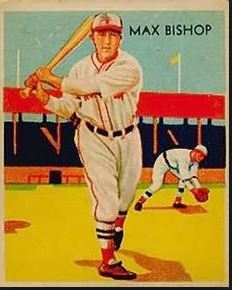
  • Only twice has an MLB player totaled eight free passes in a doubleheader. (Remember those?)  Max Bishop did it for the Philadelphia Athletics (playing 2B and leading off versus the Yankees) on May 21, 1930 and again on July 8, 1934 (playing against the Athletics; at 2B and leading off for the Red Sox).
Max "Camera Eye" Bishop

Max “Camera Eye” Bishop

Max Bishop – whose nickname was appropriately “Camera Eye” – drew 1,153 walks in 1,338 MLB games (over 12 seasons). While he led his league in walks only once (128 in 1929), Bishop topped 100 free passes in seven seasons. Bishop averaged one walk every five plate appearances for his career – helping translate a .271 batting average into a .423 on base percentage.  The only player with a higher percentage of walks per plate appearance than Bishop is Ted Williams.  Note: BBRT found a discrepancy in searching out Bishop’s walk totals.  Sources differ on his overall total (1,153 or 1,156), due to disagreement on his 1928 total – some sources list it as 97 walks, others as 100. I am continuing to dig into this, as the three walk difference in 1928 does make a difference.  With them, Bishop has eight straight 100 or more walk seasons, giving him a share of the MLB record.

  • The MLB career leaders for walks drawn is Barry Bonds, with 2,558 (in 22 seasons). Bonds also holds the single-season record at 232 (in 2004) and, in fact, the top three season totals. Bonds also holds the records for consecutive seasons leading his league (five – 2000-2004); total seasons leading his league (12 – 1992, 1994-97, 2000-04, 2006-07); and total seasons of 100 or more walks (14).
  • The most consecutive walks received by a hitter is seven. Notably, in the NL, all three players to accomplish this played for the Giants: Mel Ott (June 16-18, 1943); Eddie Stanky (August 28-29, 1950); and Barry Bonds (September 14-26, 2004).  In the AL, it was Billy Rogell (Tigers – August 17-19, 1938) and Jose Canseco (A’s – August 4-5, 1992).

WHICH OF THESE IS NOT LIKE THE OTHER ONES?

Only four players have drawn 2,000+ career walks: Barry Bonds (2,558); Rickey Henderson ((2,190); Babe Ruth (2,062); and Ted Williams (2,012).  Of these Rickey Henderson is the outlier – the only right-handed hitter and the only one of the four with less than 500 home runs (297).

I tweet baseball @David BBRT


You can also follow me at the Baseball Roundtable FaceBook page – click here to go the the page – and Follow and/or Like. 


Member:  Society for American Baseball Research (SABR); The Baseball Reliquary; Negro Leagues Baseball Museum; Baseball Bloggers Alliance.
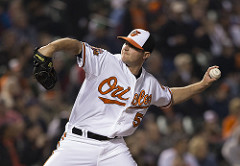
Triple Crown Trivia – When Both Leagues Had a Triple Crown Winner (and more)

BBRT was looking at 2017’s Spring Training Stats and realized that (according to MLB.com) two players came close to earning the 2017 Spring Training Triple Crown (batting average – home runs – RBI) for hitters. The Yankees’ Greg Bird led qualifying AL players in 2017 Spring Training average (.451) and home runs (eight) and was sixth in RBI (15). In the NL, the Brewers’ Jesus Aguilar was the leader in average (.452); second to Bryce Harper in home runs (seven to Harpers’ eight); and second to the Cubs’ Ian Happ in RBI (19 to Happ’s 21).  That got me to thinking about how difficult it is to capture the regular season Triple Crown – it’s happened only 16 times in MLB history. So, I decided to do a post on some bits of Triple Crown trivia.

Jimmie Foxx - one of two 1933 Triple Crown winners.

Jimmie Foxx – one of two 1933 Triple Crown winners.

One thing that stood out was that, despite the relative rarity of the Triple Crown achievement, there was actually one year in which there was a Triple Crown winner in both leagues – and the two players suited up in the same city.  It was 1933, and the Triple Crown winners were Chuck Klein (.368-28-120) of the Philadelphia Phillies (NL) and Jimmie Foxx (.356-48-163) of the Philadelphia Athletics (AL). Foxx’s Athletics finished third at 79-72, while Klein’s Phillies finished seventh at 60-92.

Let’s take a look at some additional Triple Crown trivia.


THERE HAS NEVER BEEN A REPEAT TRIPLE CROWN WINNER

  • Twice in MLB history, a Triple Crown winner has been foiled in his attempt to “repeat” by a player who achieved a Triple Crown of his own. Jimmie Foxx, who won the AL Triple Crown in 1933, saw his repeat effort overshadowed by Yankee Lou Gehrig’s 1934 Triple Crown season.  In 1966, Frank Robinson won the AL Triple Crown with the Orioles, and Carl Yastrzemski followed up in 1967 with a TC of his own for the Red Sox
  • One Triple Crown winner was stopped in his attempt to repeat his achievement by a greater conflict – Ted Williams missed the season following his first Triple Crown due to military service in WWII.
  • Ty Cobb may have come the closest ever to a Triple Crown repeat; winning the TC in 1909 and finishing second in all three categories the following season.
  • Only eight times has a Triple Crown winner come back to lead his league in at least one of the three categories – and that has most often been batting average. Seven of the eight repeats were in batting average; while one Triple Crown winner – the Cardinals’ Joe Medwick – won the RBI title the year after his Triple Crown.

A few other Triple Crown facts:

  • There have been 16 total Triple Crown winners (14 different players). There have been only two two-time TC winners, Rogers Hornsby (1922 & 1925) and Ted Williams (1942 & 1947).
  • Of the fourteen players to win the Triple Crown only two are not in the Hall of Fame:  Miguel Cabrera (2012), still active (the most recent TC winner) and Paul Hines (1878), the very first Triple Crown winner.
  • Five league Triple Crown winners actually led both leagues in all three Triple Crown categories: Ty Cobb (1909); Rogers Hornsby (1925); Lou Gehrig ((1934): Ted Williams (1942); Mickey Mantle (1956).
  • The last six Triple Crown winners have been American Leaguers; the most recent NL Triple Crown winner was St. Louis Cardinals’ outfielder Joe Medwick in 1937 (.374-31-154).
  • Two teams have won six of the 16 Triple Crowns (37.5%) – the St. Louis Cardinals and Boston Red Sox with three each.
  • None of baseball expansion teams has ever had a Triple Crown winner.
  • Ty Cobb, at age 22, is the youngest-ever TC winner, while Frank Robinson at 31 is the oldest.
  • Only five of the sixteen Triple Crown seasons have helped deliver a first place finish: 1909 Tigers (Ty Cobb); 1956 Yankees (Mickey Mantle); 1966 Orioles (Frank Robinson); 1967 Red Sox (Carl Yastrzemski); 2012 Tigers (Migual Cabrera). The other eleven Triple Crown winners contributed to two second-place finishes; four third-place; four fourth-place; and one fifth-place.

TRIPLE CROWN DOESN’T ALWAYS EQUATE TO MVP

There have been ten Triple Crown winners since the Baseball Writers Association began voting on the Most Valuable Player award in 1931 and only six of those were honored as MVPs:  Jimmie Foxx (1933); Joe Medwick  (1937); Mickey Mantle (1956); Frank Robinson (1966); Carl Yastrzemski (1967); Miguel Cabrera (2012).    Let’s take a look at those who didn’t get votes, in order of the “level of injustice.”

  1. Lou Gehrig, Yankees, 1934.

Gehrig’s .363 – 49 – 165 not only topped the American league in average, HRs, and RBI, he finished ahead of the NL leaders in all three categories as well.  Gehrig also led both leagues in on base percentage, slugging percentage and total bases.  But that’s not what earns him a five-star injustice rating.  Despite capturing the Triple Crown, Gehrig finished a distant FIFTH in the AL MVP voting; behind three members of the pennant-winning Tigers (the Yankees finished, 94-60, seven games out.) The MVP winner, Detroit catcher Mickey Cochrane, ran up a .320 – 2 – 76 total and did not lead the league in a single offensive category.   Others finishing ahead of Gehrig were Detroit second basemen Charlie Gehringer (at .356 – 11 – 127 and the AL leader in runs and hits); Yankee hurler  Lefty Gomez (26-5, 2.33 ERA, who led the league in wins, ERA, complete games, shutouts, and innings pitched); and Detroit pitcher Schoolboy Rowe (24.-8, 3.45).

  1. Ted Williams, Boston Red Sox, 1942
Ted Williams photo

Photo by wild mercury

Ted Williams’ 1942 season earns him second place on the lack-of-respect list among Triple Crown winners. In 1942, the Splendid Splinter led both leagues in all three Triple Crown categories (.356 – 36 -137), as well as in runs scored, on base percentage, slugging percentage, total bases and bases on balls. This dominance earned him a second-place finish in the MVP balloting. (Boston also finished second, to the Yankees, at 93-59, nine games behind.)

The MVP winner?  Yankees’ second baseman Joe Gordon (.322 – 18 – 103), who led the league in two offensive categories, strikeouts and grounding into double plays.  Williams, like Gehrig, earns a five-star injustice rating.

  1. Ted Williams, Boston Red Sox, 1947

Ted Williams gets a three-star injustice rating for his 1947 Triple Crown year.  This is not so much because of a lack of respect for his dominance, but because it was the second time he earned the Triple Crown, but was denied the MVP.  In 1947, Williams led the AL with .343 – 32 -114, and also led in runs scored, bases on balls, on base percentage and total bases.   The MVP winner was Yankees’ centerfielder Joe DiMaggio. (The Yankees won the pennant, Boston finished third, fourteen games out.)  DiMaggio’s season totals were .315-20-97 and he finished in MLB’s top five in runs, runs batted in, hits, total bases, doubles and triples – trailing Williams, however, in all but triples.  Still, not a major “disrespect,” unless you pile it on top of the 1942 voting.

  1. Chuck Klein, Philadelphia Phillies, 1933

Chuck Klein may not have been surprised to be passed over for MVP in his Triple Crown year.  First, Triple Crowns were a bit commonplace that year – 1933 – the only season in which both leagues boasted a Triple Crown winner.  They were even from the same city, Jimmy Foxx of the Philadelphia Athletics and Chuck Klein of the Phillies.  Foxx got his MVP, despite the A’s third-place finish (79-72, 19.5 games behind), but Klein was hurt by the Phillies 60-92 record and seventh-place finish (31 games behind the NY Giants).  Klein finished at .368 – 28 – 120, also leading the league in hits, doubles, on base percentage, slugging percentage and total bases.  The MVP went to Carl Hubbell of the pennant-winning Giants, who pitched his way to a 23-12 record and a 1.66 ERA – leading the NL in wins, ERA, shutouts and innings pitched.

Full List of Triple Crown Winners

1878 – Paul Hines, Providence Grays (NL) – .358-4-50

1894 – Hugh Duffy, Boston Beaneaters (NL) – .440-18-145

1901 – Nap Lajoie, Philadelphia Athletics (AL) – .426-14-125

1909 – Ty Cobb, Detroit Tigers (AL) – .377-9-107

1922 – Rogers Hornsby, St. Louis Cardinals (NL) – .401-42-152

1925 – Rogers Hornsby, St. Louis Cardinals (NL) – .403-39-143

1933 – Chuck Klein, Philadelphia Phillies (NL) – .368-28-120

1933 – Jimmie Foxx, Phladelphia Athletics (AL) – .356-48-163

1934 – Lou Gehrig, New York Yankees (AL) – .363-49-165

1937 – Joe Medwick, St. Louis Cardinals (NL) – .374-31-154

1942 – Ted Williams, Boston Red Sox (AL) – .356-36-137

1947 – Ted Williams, Boston Red Sox (AL) – .343-32-114

1956 – Mickey Mantle, New York Yankees (AL) – .353-52-130

1966 – Frank Robinson, Baltimore Orioles (AL) – .316-49-122

1967 – Carl Yastrzemski, Boston Red Sox (AL) – .326-44-121

2012 – Miguel Cabrera, Detroit Tigers (AL) – .330-44-139

Coming Soon – a look at the pitchers Triple Crown (wins – ERA – strikeouts). 

I tweet baseball @DavidBBRT


For more baseball, Follow and Like the Baseball Roundtable Facebook Page


Member:  Society for American Baseball Resarch (SABR); The Baseball Reliquary; Negro Leagues Baseball Museum; Baseball Bloggers Alliance

Twins in First Place – and other Opening Day Musings

THE LAST TIME THE TWINS WERE ON TOP OF THE CENTRAL

Okay the headline may be a bit “over the top.”  But, when was the last time you might have read a headline touting the “First Place Twins?”  Not as long ago as you might think.  That would have been the morning of June 9, 2015 – as the Twins started the day with a 33-24 record, tied with the Royals for first place in the AL Central.  The Twins lost that day (to the Royals) 2-0, to slip out of the lead.  So, Opening Day 2017 was a clash of early June 2015 AL Central Division titans.  This time, however the Twins came out on top.  Side note:  It may seem longer since the Twins topped the Central Division standings since 2015 is the only season between 2011 and 2016 that the Twins avoided 90 losses.  

Here’s BBRT take on yesterday’s game – and other Opening Day musings. (What I chose to highlight may give you some idea about how I watch – and score – a ball game.)

You always get a special kick on opening day, no matter how many you go through. You look forward to it like a birthday party when you’re a kid. You think something wonderful is going to happen.

                                                                       Joe DiMaggio

Yes, indeed, something wonderful can happen on Opening Day.  This year, the Twins topped the Royals 7-1 and ended the day tied for first place.  Compare that to a year ago, when the Twins loss their eighth straight Opening Day game on their way to nine straight season-opening losses and a 59-103 record. No wonder yesterday’s victory seemed truly wonderful.

Opening Day is the most hopeful and optimistic day of each year.  At least for this one day, every team is a contender, every rookie a potential “phenom,”  every fading veteran a potential “Comeback Player of the Year,” and every new face in the lineup or on the bench a welcome addition.

                                                Baseball Roundtable – March 26, 2013

20171The weather, however, was not as wonderful – the low fifties, overcast (the F-16 fly-over was cancelled) with a stiff wind (at least in the second deck where I was seated).  The hooded “Twins Tees” proved handy and the hot chocolate vendors did a “brisk” business.  Still, despite the overcast, it was 51 degrees – although it felt more like 42. (We Minnesotans have a built in sensor for what the day’s temperature “feels like.”)


PRE-GAME

Long lines of fans - anxious for the return of baseball - waited for the Target Field gates to open.

Long lines of fans – anxious for the return of baseball – waited for the Target Field gates to open.

Fans were clearly ready for the return of baseball and the Twins (a sell-out crowd).  Nearby watering holes were packed before the game and long lines of festive fans crowded the Plaza as DJ Advance provided pre-game music.  There was plenty of Twins gear in evidence and, if you weren’t wearing something “Twins,” there was a Twins hooded tee for the first 30,000 through the gates. (For more on Twins – and other unique MLB – give-aways for 2017, click here.)

Once in the park, the pre-game  festivities included a solid rendition of the national anthem by a brass quintet from the Minnesota Orchestra – without scheduled singer Dessa (illness).

Grey sky, no flyover, no Dessa – almost seemed like a bad omen.  But former Twins’ coach Rick Stelmaszek (gotta love a guy with a “Z” in his name) and current coach “Everyday Eddie” Guardado turned it around. Stelly, who spent 32 years with the Twins, tossed out the first pitch (to Guardado) to a notable ovation. There were also a host of traditional Opening Day activities: the introduction of both teams along the sidelines (with mini-fireworks added for Twins’ players); season ticket holders unveiling a giant American flag in the outfield;  a pair of bald eagles at home plate; and 94-year-old World War II veteran Henry Langevin raising the American Flag during the anthem.  In addition, the pregame included a memorial tribute to members of the Twins’ family who passed away since last season’s opener – ending with special recognition of Twins’ pitcher Yorman Landa and Royals’ pitcher Yordano Ventura, who both lost their lives in off-season automobile accident.

THE GAME – THE TWINS STROLLED (WALKED) AWAY WITH IT

Those who follow BBRT know of my contention that there is always something new and/or interesting to see at a ballgame.  This one was no exception.  Here are just a few observations:

  • Twins’ batters struck out 11 times to the Royals four, but still outscored Kansas City 7-1.
  • Twins’ starter Erwin Santana had zero strikeouts over six innings, then fanned the side in the seventh (his final inning).
  • At one point in the deciding bottom of the seventh, the Twins had the bases loaded and three runs across in the inning – and had hit just one ball out of the infield (more on that later).
  • Twins’ Designated “Hitter” Robbie Grossman came to the plate five times, scored once, had an RBI and never put the ball in play (two walks, three strikeouts).
  • Twins’ SS Jorge Polanco went two-for-three in the game – with both his hits coming in the same inning.
  • The sixth inning saw the Twins benefit from their first challenge of the season and their first intentional walk under the new (just wave ‘em to first – like in softball) rule. No-o-o!
  • The Twins revived the bunt as an offensive weapon.
  • In the seventh and eighth, all attempts by fans in left field to start “The Wave” died out quickly. (Yesss!)

THE SEVENTH INNING – A TRUE STROLL (WALK) IN THE (BALL) PARK

In the top of the seventh inning, Twins’ starter Erwin Santana (who had not struck out a single batter – but also had given up just two hits and a walk) walked CF Lorenzo Cain to start the inning and then fanned 1B Eric Hosmer, C Salvador Perez and DH Brandon Moss in order.

In the bottom of the inning, things really got strange. Twins’ SS Jorge Polanco opened the frame with a single to center (off Royals’ reliever Matt Strahm).  It was a 1-1 game at the time, so manager Paul Molitor sent RF Max Kepler up to bunt.  Kepler laid down a beauty to the right of the pitcher’s mound – and beat it out.  (Although it did require Target Field’s first challenge of the season to reverse the original “out” call.) Eddie Rosario (LF and number-nine hitter) was called on to move the runners up, and executed a nice third-to-first sacrifice bunt. Leadoff hitter 2B Brian Dozier was intentionally walked (waved) to first to load the bases. (Apparently, MLB did not publicize the new rule very well, as fans all around me were asking “What happened – How did he get on base?”)  DH Robbie Grossman then walked to drive in Polanco.

That was all for Strahm, with Peter Moylan coming in from the pen to face CF Byron Buxton. Moylan fanned Buxton and was relieved by Travis Wood, who walked 1B Joe Mauer and 3B Miguel Sano – enabling Kepler and Dozier to stroll to the plate uncontested. So, at this point the Twins had three runs in, based loaded – and only one ball out of the infield. New catcher Jason Castro got the game back on a more traditional path with a two-run (Grossman and Mauer scoring) single to left.  Polanco then rapped his second hit of the inning – a single to right which scored Sano. Finally, Kepler fanned to end the carnage.  Twins 7 – Royals 1.  And that was pretty much the ball game.

Just a few other observations:

  • Attendance was 39,615 – Minnesota fans have truly been waiting for baseball to return.
  • BBRT loves double plays and the Twins rewarded me with a 6-4-3 twin killing in the second inning and a 4-6-3 version in the ninth.
  • The Twins used a line up that had a lead off hitter who, last season, hit 42 home runs and drove in 99 – and a cleanup hitter who went .261-11-49 a year ago.
  • For those who like home runs: Mike Moustakas poled one to right-center in the fourth inning to give the Royals a 1-0 lead; and the Twins’ Miguel Sano scorched oen to left in the fourth inning to tie the game.
  • If defense if your game:  two diving catches (highlight reel stuff) by CF Byron Buxton and 2B Brian Dozier’s glove scoop and flip on a bunt.
  • During the Kiss-Cam, only two “gentleman” removed their caps before the kiss.
  • The free Twins Magazine now includes a scorecard – saved a dollar.
  • BBRT likes to rate each park’s Bloody Mary (a full look at Twins concessions, click here.  )  I tried the Bloody Mary at Two Gingers (second deck) and it passed muster.  Not just mix and vodka, but solid spices added and two large olives ($10.50).

A FEW MLB OPENDING DAY TIDBITS

Madison bumgarner photo

Photo by andyrusch

MADBUM GOES DEEP

The first MLB 2017 regular season game produced a first of its own – as San Francisco Giants’ “Ace” pitcher Madison Bumgarner became the first pitcher to slam two home runs on Opening Day (giving him the 2017 MLB lead). Bumgarner was also perfect on the mound through five innings (he retired the first 16 batters in order, striking out eight) before giving up three consecutive hits and three runs with one out in the sixth.

Bumganer ended the game two-for-two with a walk at the plate and threw seven innings of six-hit, three-run ball – striking out eleven and walking no one.  He got a no-decision, as the D-backs won 6-5 on shortstop Chris Owings’ walk-off single in the bottom of the ninth.  The Giants’ new closer Mark Melancon – acquired to reinforce a leaky bullpen – took the loss, giving up two runs in the bottom of the ninth.

MOST HOME RUNS IN AN OPENING DAY GAME

When Giants’ mound “Ace” Madison Bumgarner crushed a pair of home runs in the opening game of the 2017 season, he came within one of the MLB Opening Day record.  Three players – the Blue Jays’ George Bell, Cubs’ Tuffy Rhodes and Tigers’ Dmitri Young share the record for home runs in an opening day game with three.

On April 4, 1988, George Bell – batting clean-up and serving as the DH – became the first major leaguer to hit three home runs in an Opening Day game as his Blue Jays topped the Royals 5-3 in Kansas City. 

On a windy April 4, 1994, Karl “Tuffy” Rhodes (leading off and playing CF for the Cubs in Chicago) hit three solo shots off Mets’ starter Dwight Gooden. Rhodes also had a single and a walk in five plate appearances. Despite Rhodes’ record-tying performance, the Cubs lost to the visiting Mets 12-8. 

On April 4, 2005 the Tigers’ Dmitri Young rapped three Opening Day home runs – as the Tigers topped the Royals 11-2 in Detroit. 

On the other side of the coin (or plate), on March 31, 1996, White Sox catcher Ron Karkovice set an MLB Opening Day record by striking out five times as Chicago lost 3-2 in Seattle.

METS LOVE OPENING DAY

The Mets topped Atlanta on Opening Day 2017, running their season opener record to 36-20 – that .643 Opening Day winning percentage is the best in MLB.

MORE #WhyIHateTheDH

Pitcher Jeremy Hellickson tripled and drove in a run as his Phillies topped the Reds 4-3 on Opening Day 2017 in Cincinnati.  Hellickson got the win.

LET’S GET THIS PARTY STARTED

Phillies’ 2B Cesar Hernandez and Astros’ CF George Springer each led off their teams 2017 opening game with home runs –  becoming the 34th and 35th players to do so. Only Astros’ OF Terry Puhl accomplished the feat twice – 1978 and 1980.

AN OPENING DAY TIDBIT JUST FOR TWINS FANS

AlyeaBeing a Twins fan, one of my favorite Opening Day records is seven RBI in game one of the season – shared by the Twins’ Brant Alyea and the Cubs’ Corey Patterson.

On April 7, 1970 – in his very first game as a Twin – LF Brant Alyea became the first player (and still only American Leaguer) to drive in seven runs in an Opening Day game – as Minnesota topped the White Sox 12-0 in Chicago. Batting fifth, Alyea went four-for-four, with two home runs, two singles and two runs scored.  The game, it turned out, would foreshadow a strong April for Alyea.  In 17 April games, he hit .415, with seven runs, 23 RBI, four doubles and five home runs.

Thirty-three seasons later – on March 31, 2003 – Cubs’ CF Corey Patterson tied Alyea’s record. In a 15-2 win over the Mets in New York, Patterson, batting seventh, drove in seven runs, going four-for-six with two home runs and two runs scored.  Patterson, a career .252 hitter (12 seasons), was an Opening Day All Star. In seven Opening Day appearances, Patterson hit .440, with seven runs, 12 RBI and three home runs.

A LOOK AT THE TRUE KINGS OF OPENING DAY

TED WILLIAMS

Ted Williams photo

Photo by Wicker Paradise

Perhaps no one looked forward to Opening Day more than Ted Williams – the king of the Opening Day batter’s box.  A career .344 hitter, Williams was even better on Opening Day.  Teddy Ballgame played in fourteen openers and was never held hitless.  He compiled a .449 Opening Day average (22 hits in 49 at bats), with three home runs, eight doubles, one triple, nine runs scored, 14 RBI and eleven walks.  His Opening Day on-base percentage was .550 and his season-opener slugging percentage was .837.

WALTER JOHNSON

The Washington Senators’ Walter Johnson can be crowned king of the Opening Day hill.  On his first-ever Opening Day start (April 14, 1910), the 22-year-old Johnson tossed a 3-0 one-hit shutout against the Philadelphia Athletics.  Sixteen years (and 13 Opening Day starts) later, a 38-year-old Johnson fulfilled his last Opening Day assignment with a 15-inning, complete-game, 1-0 win (6 hits, 3 walks, 9 strikeouts) over the A’s.  Johnson holds the record for Opening Day pitching victories with nine (against five losses) and also threw a record seven Opening Day shutouts.

A FINAL THOUGHT

20172I never have minded the naming of ballparks after sponsors – Target Field actually works for me.  But now, it seems like everything at the ballpark has a sponsor – from the challenge/replay to the foul lines (see poto). 


I tweet baseball @DavidBBRT


Follow (and like) Baseball Roundtable on Facebook for more baseball musings.


Member:  Society for American Baseball Research (SABR); The Baseball Reliquary; Negro Leagues Baseball Museum; Baseball Bloggers Alliance. 

New 2017 Target Field Concessions – From Kale to Cookies and Bratwurst to Black Beans

AABloody3

The latest Bloody Mary at Hrbek’s Pub (Section 114). – the Triple Sausage Sampler. Wowza!

Today (March 30), Baseball Roundtable again took part in a new rite of spring. No, it wasn’t the first robin, the day we first heard “Pitchers and Catchers Report,” the Minnesota lakes ice-out, or even MLB’s Opening Day.  It was the Twins’ Eighth Annual Media Food and Beverage Preview.  Sponsored by the Minnesota Twins and Delaware North Sportservice (the team’s exclusive food and beverage partner), this annual event features a look at (and taste of) the upcoming season’s new Target Field food and beverage offerings.

I have neither the space, nor the time, to touch on all the new food and beverage items that were unveiled this afternoon. (They ranged from a traditional Shrimp Broil to an Indian Chicken Tikka Salad to a Shaved Smoked Beef Sandwich.) However, I would like to share a comment or two on some I found especially tasty, interesting or both. For the Twins’ concessions guide, which lists the full and most up-to-date (locations, prices could change) slate of concessions, locations and prices, click here.

WHEN IT COMES TO BALLPARK FOOD – THESE ARE THE GOOD OLD DAYS!

Those who follow BBRT know, when it comes to the national pastime, I can be a bit “old school” – looking back fondly on the days of two-hour ball games, regularly scheduled double headers, high stirrups, complete games, two-dollar bleacher seats and fans who, when they looked down, were filling in a scorecard, not checking their smartphones.  There is, however, one thing I do not memorialize as part of the baseball’s good old days – ballpark food. When it comes to ballpark concession options, these are the good old days – and they just keep getting better.

When I first started attending MLB games, standard fare consisted of hot dogs (not always that hot), beer and soda (not always cold), peanuts, cotton candy, Cracker Jack® and, if you were lucky, maybe ice cream (usually frozen malt cups with a not-so-tasty wooden spoon) or licorice ropes. The culinary tour that was part of the 2017 Target Field Food and Beverage Preview provided ample evidence of just how far ballpark food has come. 

Let’s look at some of Target Field’s new concessions for 2017.

AABloodyThe Triple Sausage Sampler and Double Threat Bloody Mary’s.  If you follow BBRT, you know that I review the Bloody Mary’s at every ballpark I visit.  Of one thing I can assure you, when it comes to Bloody Mary’s, Hrbek’s Pub (near Section 114 at Target Field) continues to raise the bar.  We’ve seen such offerings as the Bigger Better Burger, College Daze, and Cluck and Moo Bloody Mary’s.  For 2017, they are putting forward what I consider the best Bloody yet – The Triple Sausage Sampler Bloody Mary.  Okay, I’m a sausage guy (I am of Polish descent, after all).  This one – $19.95 at Hrbek’s – comes with a healthy portion of skewered Kramarczuk’s Bratwurst, Polish and Andouille sausages (all perfectly spiced), ripe olive, sweet pepper, cheddar and Swiss cheeses and a beef stick – as well as a dill pickle spear and celery stalk. There is also, of course a beer chaser.  Wow! Oh yes, for four dollars more they’ll add a cheeseburger slider. A meal in a glass –with a chaser.

Shrimp Boil samples ready for tasting. It was, indeed, a feeding frenzy.

Shrimp Boil samples ready for tasting. It was, indeed, a feeding frenzy.

4 Bells Shrimp Boil. If you’re hungry and want something a little different at the ballpark, try 4 Bells (Section 114) Shrimp Boil. A generous portion of peel-and-eat shrimp, Butcher and the Boar ® Sausage, red potatoes and corn on the cob – with Creole seasoning. ($14.50 for a generous portion of true southern comfort.)


AAAllNationsRoots for the Home Team “All Nations Lake Street Salad.”  I was particularly fond of the fresh and light taste of the Roots for the Home Team (Near Gate 34 on weekends) All Nations Lake Street Salad – collard greens; red and yellow pepper; roasted corn; tomatoes; carrots; black-eyed peas – with a Tomatillo Lime Cilantro dressing and Crumbled Queso Fresco Cheese topping. Thinking outside the box or want something a little lighter at the ballpark?  The All Nations Lake Street Salad is one of nine new salads that Root for the Home Team has created for 2017.  ($9 of $11 with chicken.) Note: Roots for the Home Team partners with youth garden programs in the Twin Cities to give multicultural teens the opportunity to develop business and entrepreneurial skills.

AAHotIndiaHot Indian Chicken Tikka Salad.  Okay, I’ve got a soft spot for ethnic foods and “Hot Indian Foods” knows how to reach it – even at the ballpark. For this season, they’ve added a Hot Indian Chicken Tikka Salad – baby kale, shredded paneer, crispy chickpeas, superbly spiced chicken.  (Worth a stop at Section 120 – $12.50).


AAcookieCookie Cart.  Dessert, aah, sweet dessert!  Why not stop at the Cookie Cart. Twelve kinds of cookies – six packs for $8 and $3 for a frosted cookie.  These are cookies like grandma used to make (chocolate chip, peanut, oatmeal, they are all here) – and the organization provides areas teens with the opportunity to develop work, life and leadership skills while working with an urban non-profit bakery.  If you are craving a sweet, the Cookie Cart has just what you are looking for.  They will operate in Section 101 during Saturday and Sunday games.


AAZimmernAndrew Zimmern’s Canteen (Section 114) Skewers. These tasty skewers come in Braised Boneless Beef Short Rib; Mediterranean Chicken; and Braised Pork Shoulder – on flat bread, with roasted eggplant spread, herbed yogurt sauce and tomato-cucumber (served with chips).  Easy to eat, and easier to enjoy ($14.50 each). The Canteen’s new 2017 offerings also include a Frozen White Chocolate Mousse ($7.50) for dessert.   I finished the Mousse before I could get a photo of it (dulce de leche, lady fingers, white chocolate) – and then licked away every drop that had slipped from spoon to fingertips.


AAButcherVegan Sriracha Brat. Vegan anyone? For vegan readers, there is “The Herbivorous Butcher” and the Vegan Italian Sausage and Vegan Sriracha Brat (each $12.50).  I preferred the extra “bite” of the Sriracha Brat.  If you’re vegan at the ballpark, this is probably the way to go.  They also carry Hebrew National Kosher Hot Dogs in pairing with MSP Kosher Hot Dog.  (Look for both in Section 129.)

The barrio crew at work,

The barrio crew at work.

Barrio Adobe Grilled Chicken Burrito. Barrio continues to deliver its own special taste to Target Field (Sections 105 and 305).  This year, they are featuring the Adobe Grilled Chicken Burrito (black beans, rice, Monterey Jack, avocado-tomatillo Pico, Pico de Gallo, salsa, fresh jalapeno) – as a Burrito or in a bowl ($11.00). Delicioso!  Add a margarita and you’re ready for extra innings.


AACAPKurd-Marczuk’s (cart in Section 101) is  offering a Twins baseball cap filled with cheese curds, chopped Polish sausage, topped with gravy.  These were tasty, chewy, and easy to carry – I’d buy them without the souvenir mini-cap. (Prices here range from $9.50-$20.00.)


Murray's Shaved Smoked Beef samples ready to go.

Murray’s Shaved Smoked Beef samples ready to go.

Murray’s Shaved Smoked Beef. Murray’s new offering for 2017 is the Shaved Smoked Beef Sandwich on a toasted bun, featuring Murray’s garlic butter and house-cut, dill-seasoned chips.   For all the beef eaters out there, garlic and beef make a pertty good ballpark combo. Murray’s will have a new cart in Section 116. ($14.50.)


These are just some of the new items. There are also such offerings as Buffalo Chicken Poutine; Boneless Barbeque and Buffalo Wings; Barrio Barbacoa Tacos; and Andrew Zimmern’s Sloppy Ko (Korean barbeque). In addition, lots of favorites are back at locations like: Pizza Luce; Red Cow; Minnie and Paul’s; Izzabella’s Gelato; Mac’s Walleye and Chips AND MANY MORE.  Again, for the full list of offering, prices and locations, click here.

If you’re planning a trip to Target Field  and wondering about promotions, event and “deals,” click here.

I tweet baseball @DavidBBRT

Read more BBRT baseball (Follow and Like) on the Baseball Roundtable Facebook Page.

Member:  Society for American Baseball Research (SABR); The Baseball Reliquary; Negro Leagues Baseball Museum; Baseball Bloggers Alliance.