Baseball Roundtable August Wrap – Winning Streaks, Losing Streaks, Ten Straight Whiffs, Another No-Hitter and more.

It’s September 1, and that means it’s time for Baseball Roundtable’s August Wrap Up – a look at August statistics and stories that caught BB Roundtable’s eye; leader boards for the month and Year-to-Date: BBRT’s Players and Pitchers of the Month; and the monthly Trot Index.

Here’s a hint at the kind of things you’ll read about – if you make it to the end of this post.

  • A player tying the MLB record for doubles in a game – and doing it in a seven-inning contest.
  • Another “Cycle” and another “Immaculate Inning.”
  • A rookie tossing a no-hitter in his first start.
  • A player hitting three Grand Slams in a span of 19 plate appearances.
  • A rookie ending the month with a still-active streak of getting on base in 31-straight games.
  • One team recording a 13-game winning streak; another a 19-game losing streak.
  • Miguel Cabrera’s 500th home run, Joey Votto’s 2000th hit and  Aroldis Chapman’as 300th save.
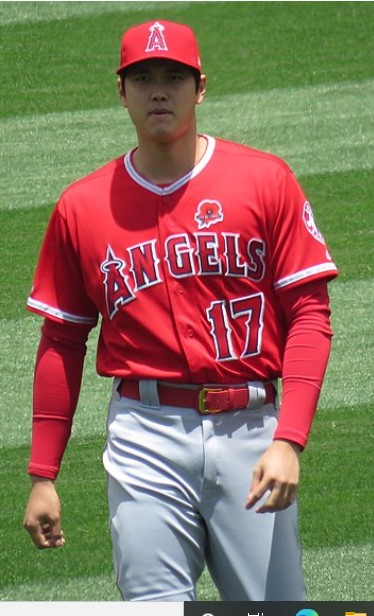
  • Shohei Ohtani’s 42nd home run; eighth mound victory; 22nd stolen base; and first stela of home. 

For all this and more, read on.

—–BASEBALL ROUNDTABLE PLAYERS AND PITCHERS OF THE MONTH – AUGUST 2021—–

National League Player of the Month  (thought August 30) … C.J. Cron, 1B, Rockies.    
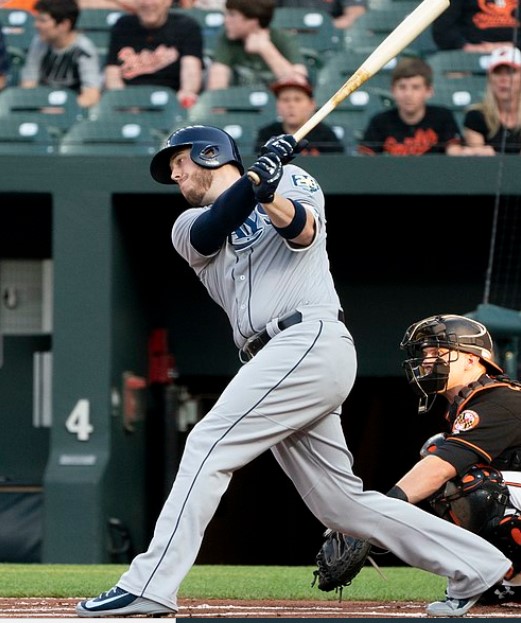
Photo: KA Sports Photos from Hanover, MD, USA, CC BY-SA 2.0 <https://creativecommons.org/licenses/by-sa/2.0>, via Wikimedia Commons

Cron’s 34 August RBI led all of MLB, his .387 average led all MLB players with at least 75 August at bats and his 11 August home runs led the National League. Overall, he put up a .387-11-34 line with 36 hits, 18 runs scored and a .463 on-base percentage in 26 games. He had 12 multi-hit games and  eight multi-RBI games – including a two-home, seven-RBI game against the Marlins on August 8.

Honorable Mentions: Can’t overlook Phillies’ RF Bryce Harper (.337-10-25) and Atlanta’s 3B Austin Riley (.359-6-18), whose 37 August hits led the NL.  Paul Goldschmidt also had a solid month at .350-5-24, with 16 runs scored and four steals.

National League Pitcher of the Month … Adam Wainwright, RHP. Cardinals
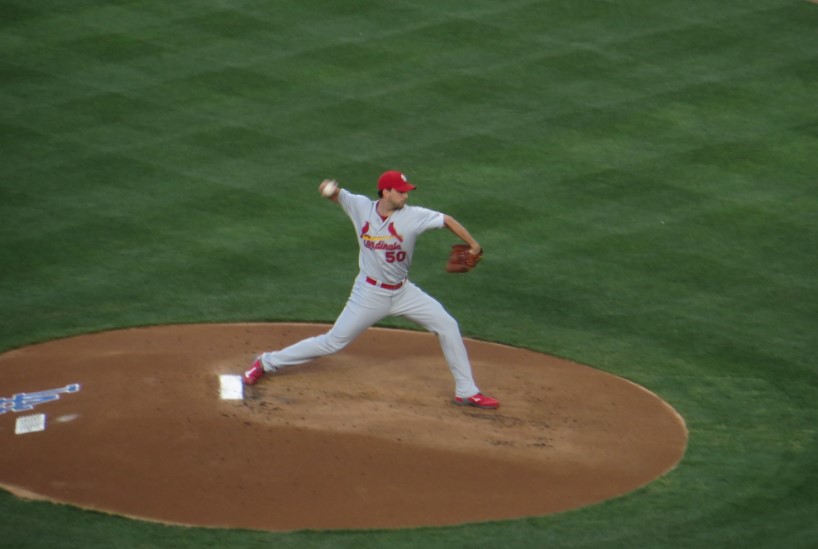
Photo: Ken Lund from Reno, Nevada, USA, CC BY-SA 2.0 <https://creativecommons.org/licenses/by-sa/2.0>, via Wikimedia Commons

Apparently life can being at (or just before )40.  The veteran Wainwright, who  turned 40 on August 30, was the only National Leaguer to notch five wins in August.  Wainwright went 5-1, with a 1.43 ERA over the month. That 1.43 ERA was the fourth-best in the National League among pitchers with at least 20 August innings. You’ll see in the honorable mentions that there were a handful of very worthy candidates for this August recognition, but Wainwright gets the nod on the basis of his MLB-leading 44 innings pitched (averaging just over seven innings per start) and 0.80 WHIP (lowest in the NL among pitchers with at least 20 innings pitched). In his six August starts, he  pitched under seven innings just once (that was a six-inning , two-run stint against the Brewers on August 17, when he was lifted for a pinch hitter with the Cardinal trailing 2-0). He threw a complete-game, two-hit shutout against the Pirates on August 11.  Wainwright fanned 36 batters in his 44 August innings.

Honorable Mentions: A pair of Max(es) put up recognition numbers in August. Max Scherzer came over to the Dodgers from the Nationals on July 30 and went 4-0, 1.55, with 41 whiffs in 29 innings; while the Braves’ Max Fried went 4-0, 1.36 in five August starts (one a complete-game shutout) with 28 strikeouts in 33 innings.  I’ll also give a nod to the Padres’ Blake Snell, who went 3-1. with a 1.72 ERA and whose 54 August strikeouts led MLB.

____________________________________

American League Player of the Month … Salvador Perez, C, Royals
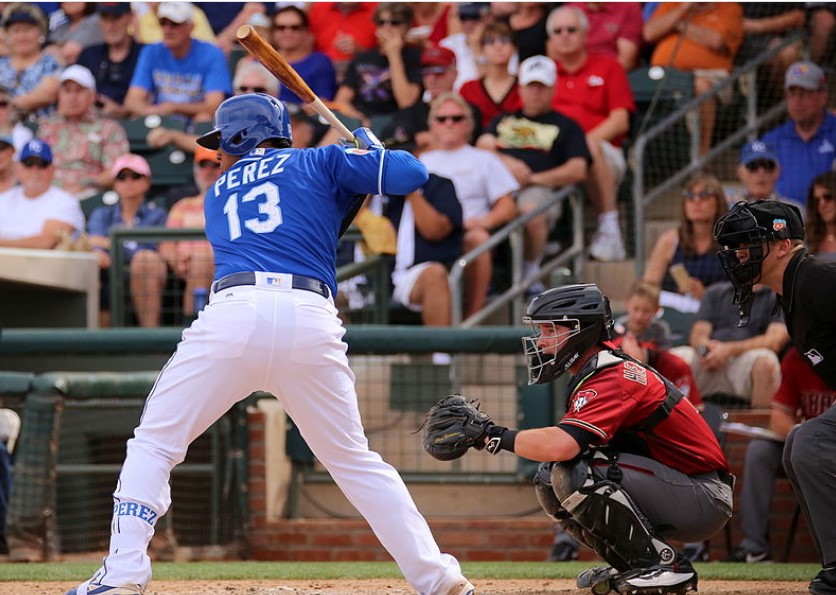
Photo: Arturo Pardavila III from Hoboken, NJ, USA, CC BY 2.0 <https://creativecommons.org/licenses/by/2.0>, via Wikimedia Commons

While Perez hit  only .268 for the month, he led all of MLB with 12 home  runs and his 28 RBI were  second only to C.J. Cron of the NL Rockies.  A lucky thirteen of his 26 August hits went for extra bases. From August 25 through August 29, Perez homered in five straight games – going .381-5-13 in that span. The five-time Gold Glover behind the plate  finished August with 38 home runs and 94 RBI on the season.

Honorable Mentions: Indians’ SS Amed Rosario deserve a shout out for his 42 August hits (26 games), which led MLB. He put up a .372-4-20 line for the month. Oakland CF Starling Marte was right behind Rosario with 41 August hits (.363) in 26 games.  Marte also led MLB with 19 stolen bases (in 19 attempts) for the month. White Sox’ 1B Jose Abreu put it all together in August, going .330-10-25 and scoring 22 runs. Finally, Rays’ SS Wander Franco went .313-3-18, with an MLB-leading 26 runs scored. Notably, he was on base in everyone of his 25 August games (hit, walk or hit by pith.)  More on that in the Highlights section.

American League Pitcher of the Month … Tie: Marco Gonzalez, LHP Mariners & Robbie Ray, Blue Jays
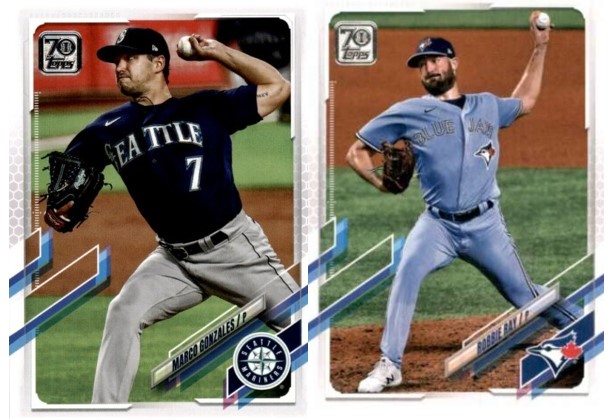
Gonzalez was a workhorse for the Mariners in August, going 3-0, with a 1.58 ERA and pitching the AL’s second-most August innings (40). While he fanned only 27 batters, he walked just six and his  0.80 WHIP was the third-best among AL pitchers with at least 20 innings pitched. Gonzalez is a bit of a surprise here (and the surprise factor may have swayed my selection). He came into August at 3-5, with a 5.48 ERA (13 starts). His August surge included a complete-game, two-hit shutout of the Rangers on August 12.

Ray was perhaps even more effective for the Blue Jays – but with less reward.  He threw 41 innings in six starts (leading the AL in innings pitched). He also led the AL in strikeouts with 52 (one of only three MLB pitchers with 50 or more whiffs this August). In addition, he logged and impressive 0.85 WHIP, gave up just one home run and held opposing hitters to a .188 average.  Yet, he got just one win (five no-decisions). In his five no-decisions, the Blue Jays scored a total of nine runs (Ray did not give up more than two runs in any August start.) 

Honorable Mentions: The White Sox’ Dylan Cease went 4-0, 2.83 in six August starts and had MLB’s third-highest August strikeout total, with 50 strikeouts in 35 innings,  Cease fanned 10 or more batters in three of his six starts .The Rays’ Shane McClanahan went 5-0  in five August starts (more on  McLanahan in the “Surprise Player” section.) The Indians’ Tristin McKenzie pitched 28 August innings (four starts, two wins, one loss and a 1.93 ERA) and delivered a 0.50 WHIP, holding batters to a .126 average.  That WHIP and average were the lowest in August for any pitcher with at least 20 innings pitched.

_____________________________________

Surprise Player of the Month …. Tie: Shane McClanahan, LHP, Rays and Frank Schwindel, 1B, Cubs
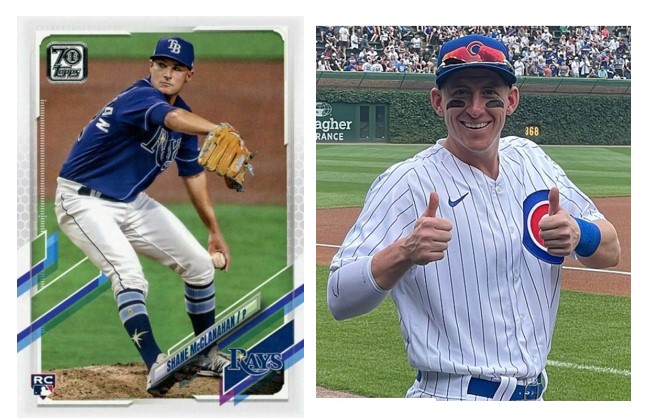
Schwindel Photo: Desposito122, CC BY-SA 4.0 <https://creativecommons.org/licenses/by-sa/4.0>, via Wikimedia Commons

Rays’ 24-year-old rookie southpaw Shane McClanahan (in just his third professional season) came into August with a 4-4, 3.93 record.  The rookie got five starts in August, won all five and put up a 2.76 ERA with 33 strikeouts in 29 1/3 innings. (Word of caution, he had three August starts against the Orioles). Still, 5-0 from a rookie – even if he was a first round draft choice (2018)  – is a pleasant surprise.

When the Cubs picked up 29-year-old 1B Frank Schwindel on waivers from the A’s on July 18, he had 35 MLB at bats, with just four this  (.114 average), one home run and three RBI.  Yet, he was soon in line to replace Cubs’ star Anthony Rizzo, traded to the  Yankees  just 11 days later. In August, Schwindel hit a robust .344, with five home runs, 18 RBI and 16 runs scored. Schwindel hit safety in 22 of 26 August games, with multiple hits in ten of them.  Side note: Schwindel had a .286-135-548 line in eight minor-league seasons and hit .296-17-49 in 54 games at Triple A this season. 

________________________________________________________________________

TROT INDEX … A REGULAR BBRT FEATURE

Through August 2021, 36.6 percent of the MLB season’s 148,181 plate appearances ended in a trot (back to the dugout, around the bases, to first base). We’re talking about strikeouts, home runs, walks, hit by pitch and catcher’s interference – all outcomes that are, basically, devoid of action on the base paths or in the field. Here’s the breakout: strikeouts (23.4%); walks (8.7%); home runs (3.2%); HBP (1.2%); catcher’s interference (less than 1%). Personally, I’d like more action in the field of play.

Now, to provide a little context (a more detailed post on this topic coming soon). Here are a few selected annual Trot Index scores since I began watching baseball in earnest:  1950  – 22.8 %; 1960 – 25.1%; 1970 – 27.0%; 1980 – 23.1%; 1990 – 26.1%; 2000 – 29.9%; 2010 – 30.3%; 2021 – 36.6%.

____________________________________________________________

Now for a look at how team performed in August. 

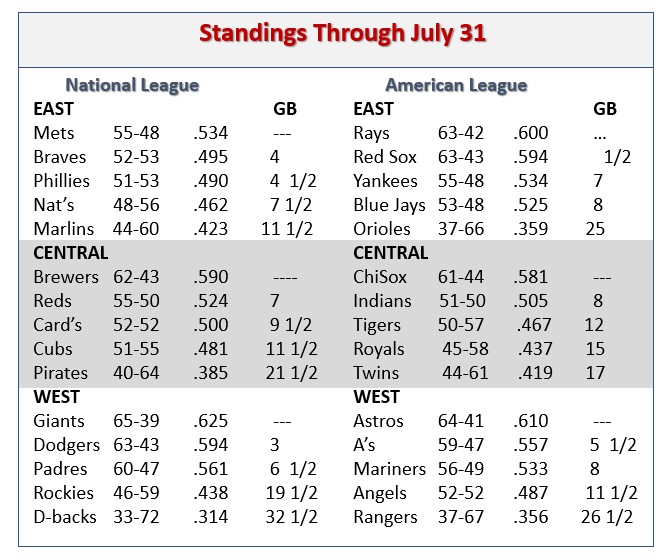
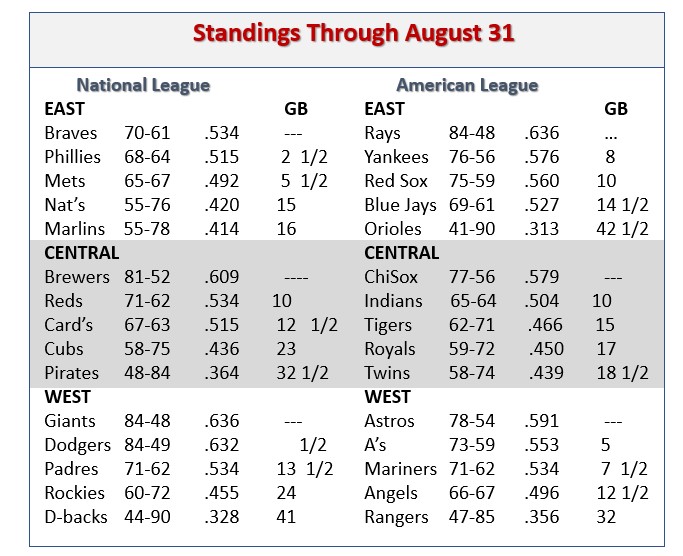
The overall standings did not change a lot, but there was some movement of note.  (You’ll find full year-to-date standings near the end of this post.)  Notably, the Mets’ 19-loss August dropped them from first place (as of July 31) to third in the NL East. The Yankees’ 21-win month, moved them past the Red Sox into second place in the AL East.  However, they actually lost ground on the first-place Rays. And, while the Dodgers’ 21-wins didn’t move them past the Giants (who won 19), they cut the lead from three games to just 1/2-game.

Three teams played .700+ ball in August – Rays (21-6), Dodgers (21-6) and Yankees (21-8).  While we’ve come to expect the Rays to “get it done” with pitching, their August ERA placed tenth in the AL, while their 182 runs scored were first in MLB.  Still they handled their staff well enough to win – using nine different starters and getting saves from seven different pitchers. (And, of course, they had Shane McClanahan, who started five games and won them all – 2.76 ERA). The offensive leaders were 2B Brandon Lowe (.262-9-26); SS Wander Franco (.313-3-19, with 26 runs scored); and RF Randy Arozarena (.362-4-11, with 15 runs scored. The veteran presence of newcomer Nelson Cruz (five homers, 18 RBI) was also felt.

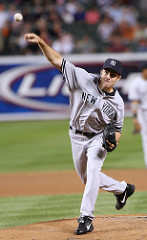
The Yankees must feel frustrated having gained no ground on the Rays.  New York had the AL’s lowest August ERA and second-most runs scored. They did it with a bit of star power and a solid bullpen. The Yankees scored 154 August runs and nearly a third of them were driven in by Aaron Judge (.345-8-26) and Giancarlo Stanton (.327-9-25). On the mound, Gerrit Cole went 3-0, 0.51 in three starts and the Bombers got three saves each from Aroldis Chapman, Chad Green and Wandy Peralta.

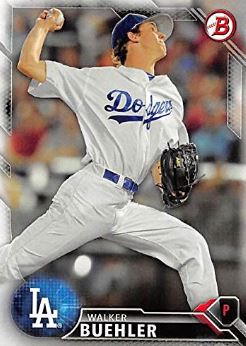
The Dodgers’ pitching fueled their 21-win month. Their 2.25 August ERA was far and away MLB’s best; while their 129 runs were sixth in the NL. Max Scherzer went 4-0, 1,55 in five starts; Julio Arias 3-0, 1.38 in five starts; and Walker Buehler 2-1, 1,56 in six starts. Kenley Jansen picked up a win and eight saves (in eight opportunities)  and Blake Treinen was 3-0, 1.23, with two saves in 14 appearances out of the pen. On offense, LF AJ Pollock, C Will Smith, 1B Max Muncy and SS Corey Seager each had 14 or more August RBI and Muncy, 3B Trea Turner and SS Corey Seager each scored 17 or more  August runs.

——-Team Statistical Leaders for August———

RUNS SCORED

National League – Reds (142); Phillies (142); Rockies (141)

American League – Rays (182); Yankees (154); Red Sox (147); White Sox (147)

Three teams scored fewer than 100 runs in August: Pirates (92); Met’s (95); Tigers (95).  

BATTING AVERAGE

National League – Rockies (.266); Cardinals (.262); Brewers (.256)

American League – Astros (.270); Red Sox (267); Indians (.261)

The lowest August team average belonged to the Pirates  at .217. Lowest in the AL were the Angels at .229.

HOME RUNS

National League – Reds (46); Braves (43); Giants (43); Rockies (43)

American League –  White Sox (47); Rays (44); Red Sox (43)

The Pirates had the fewest August home runs at 17.  Lowest in the AL were the Tigers at 24.

STOLEN BASES

National League –  Marlins (17); Padres (15); Cardinals (13)

American League – A’s (33); Indians (32); Royals (32);

Contrary to expectations – at least Baseball Roundtable’s expectations – the top six teams in August steals were from the American League (as well as seven of the top eight and eight of the top ten).   The Rockies, Reds and Diamondbacks were at the bottom of the stolen base list with three swipes each.

BATTERS’ STRIKEOUTS

National League – Cubs (303); Diamondbacks (282); Reds (267)

American League – Yankees (268); Angels (262); Mariners (258)

Hitters for the Blue Jays fanned the fewest times in August (200).

BATTERS’ WALKS

National League – Nationals (108); Phillies (99); Braves (96)

American League – Yankees (111); Red Sox (104); Twins (97)

EARNED RUN AVERAGE

National League –  Dodgers (2.25); Giants (3.07); Cardinals (3.30)

American League – Yankees (3.16); Blue Jays (3.49); Mariners (3.52)

Two teams had earned run averages over 6.00 for August: The Orioles (7.43) and the Cubs (6.97). No surprise, they combined for 11 wins and 44 losses. At the other end of the spectrum, the two squads with the lowest August ERA’s (Dodgers and Giants) went a combined 40-15.

STRIKEOUTS

National League – Brewers (281); Dodgers (278); Padres (261)

American League – White Sox (292); Red Sox (265); Yankees (265)

The White Sox staff fanned an MLB-highest 10.51 batters per nine innings in August. The Brewers led the NL at 10.32. Ten teams average better than one strikeout per inning for the month.

SAVES

National League –  Brewers (12); Dodgers (12); Giants (11)

American League – Yankees (14); Mariners (9); Rays (9)

 The Orioles had just four save opportunities in August and converted one.

—-August 2021 Highlights —-

Rizzo, Not a Bad Deadline Pickup

Anthony Rizzo, acquired by the Yankees (from the Cubs) two days before the July 29 trade deadline, began paying dividend immediately. Rizzo drove in a run in each of his first six games as a Yankee (July 30-August 4) – becoming the first Yankee ever to collect an RBI in each of his first six games with the Bronx Bombers.  After those six contests, Rizzo was hitting .400 (8-for-20) as a Yankee, with three home runs, eight runs scored, six RBI, four walks and just one strikeout.  He did cool off, however. At the end of August Rizzo was hitting .250-4-12 in his Yankee tenure.

Home Sweet Home

On August 7 – at the Olympic competition in Japan – the Japanese baseball squad top the Americans 2-0 for the Olympic Gold

Burnes Burns Cubbies

On August 11, Brewers’ 26-year-old righty Corbin Burnes was in control, as his Brewers topped the Cubs 10-0 at Wrigley Field. Burnes not only fanned 15 batters in eight innings, he tied an MLB record by fanning ten consecutive batters (from the leadoff hitter in the second inning through the leadoff hitter in the top of the fifth (Cubs’ 1B Fred Schwindel both times).  Burnes used 41 pitches to record the ten straight whiffs (all swinging) and did not go to a three-ball count on any batter. In his eight innings of work, he faced 27 batters and threw 99 pitches – 74 strikes.   Burnes’ 2021 record at the end of August was 9-4. 2.27.

Record are Made to be Broken … or at Least Tied

Hall of Famer Tom Seaver (Mets) set an MLB record by striking out 10 consecutive Padres’ batters on April 22, 1970.  That streak  stood unmatched for more than fifty years – until this season, when the Phillies’ Aaron Nolan fanned ten straight Mets on June 25 and the Brewers’ Corbin Burnes sent ten straight Cubs down swinging on August 11.

Tossing a Maddux

Braves Hall of Famer Greg Maddux had a reputation for efficiency.  That, in fact, is why the term “throwing a Maddux” has come to mean tossing a complete-game shutout in less than 100 pitches.  On August 11, the Cardinals’veteran righthander Adam Wainwright did just that – shutting down the Pirates 4-0 for his 11th win of the season – in just 88 pitches (58 strikes).  Wainwright gave up just two hits, walked no one and fanned seven. Here’s his inning-by-inning pitch count (starting with the first frame); 13; 7; 12; 9; 9; 12; 7; 13; 6. Wainwright appears to have he Pirates’ number this season. Through August, in four 2021 starts against the Pirates, he is 4-0, with a 0.30 earned run average.

Walk Don’t Run

On August 12, A’s 3B Matt Chapman came to the plate six times, saw 31 pitches, never put the ball in play and still scored three runs. Chapman drew a five-pitch walk in the top of the second inning; a seven-pitch walk in the fourth; a four-pitch walk in the fifth; a six-pitch walk in the sixth; and a five-pitch walk in the eighth. He came up in the top of the ninth with a chance to tie the all-time record for walks in game, but struck out looking on a 1-2 pitch from Blake Parker.

THE PROMOTIONAL DAYS OF AUGUST

Field of Dreams with a Dream Finish

On August 12, Baseball came to Dyersville, Iowa – to the farm that was featured in the blockbuster movie Field of Dreams – and baseball did not disappoint. It started, appropriately, with a dramatic entrance – Kevin Costner, lead character from the movie, emerging from a cornfield beyond the outfield with a baseball in hand, followed by the Yankees and White Sox teams (in throwback uniforms). The teams then proceeded to face off in an 8,000-seat ballpark built especially for the event (about 500-feet from the ball field featured in the 1989  movie).

Ultimately, baseball was the star of this event, as the White Sox won a see-saw game  9-8 on a walk-off, two-run home run by SS Tim Anderson. In the contest, the White Sox jumped out to a 1-0 lead in the first, fell behind the Yankees 3-1 after 2 ½ innings, retook the lead in the bottom of the third (5-3) and held it until the top of the ninth, when the New Yorkers tallied four times to move ahead 8-7, before Anderson’s long ball won the game.

The game proved a win, not only for the White Sox, but for MLB – as it drew the largest TV audience of any regular-season MLB game since 2005.  Side note:  Tickets for the game (sold via lottery) had a face value of $375 and $425 and, according to news reports, were going for well in excess of $1,000 on the secondary market.  How this event will fare going forward remains to be seen.  Will the novelty/nostalgia factor decline or will it have staying power?  It will be interesting to see what promotional and ceremonial activities MLB comes up with for future Field of Dreams matchups.

The Little League Classic Shows Its Staying Power

MLB’s fourth Little League Classic (August 22) featured the  Indians and Angels at Williamsport, Pennsylvania’s Muncy Bank Park Ballpark at Historic Bowman Field (the second oldest ballpark in minor league baseball). The game brought major leaguers to Williamsport during the Little League World Series.  The Little Leaguers enjoyed the evening’s game, which saw the Indians top the Angels 3-0.

Just as important, if not more important, the event featured a lot of interaction between the Little Leaguer and Big Leaguers – whether it was  signing autographs; paying ping pong, Wiffle Ball or “Ladder Golf”; sharing batting, pitching and fielding tips; or sliding  down the Lamade Stadium hill on flattened cardboard boxes. A good time, as they say, was had by all.  The Little League Classic, initiated in 2017, has become a baseball tradition that let’s the national pastime shine.   Clearly, the LLC will continue to be an unforgettable experience for big leaguers, little leaguers and all of us who follow the game.

Lucky Friday the 13th

On Friday, August 13th, the Los Angeles Dodgers topped the Mets 6-5 in ten innings (in New York) scoring two runs on a Will Smith leadoff homer (that dreaded and dreadful placed runner scored) in the top of the tenth.  (The Mets came back to tally one run in the bottom of the inning.) The win broke a bad “spell” for the Dodgers, who had lost their past 11 extra-inning games (and had a 1-12 record in extra frames on the season).  Perhaps to prove the spell was truly broken, the Dodgers topped the Mets 2-1 in ten innings the very next day. Then, on August 25, they won their third consecutive extra-inning outing (5-3 over the Padres in 16 innings).

Let’s Get This Party Started- and Tie a Record, Too
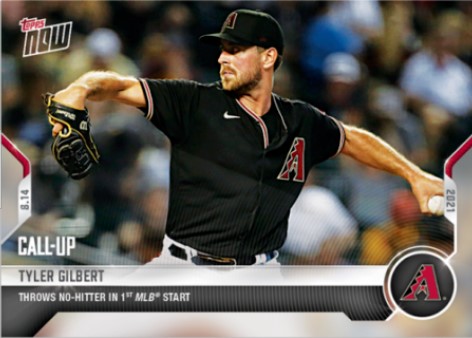
On August 14, Diamondbacks’ rookie southpaw Tyler Gilbert no-hit the Padres (7-0) in his very first MLB start.  Not only did it make him one of just 24 pitchers to hurl a no-hitter as rookie, it also made him  just the fourth player to toss a no-no in his first MLB start. Further, it was the eighth no-hitter of 2021, tying the MLB record for the most no-hitters thrown in a season (set in 1884). Gilbert completed his no-no in 102 pitches, walking three and fanning five. For more on first start no-hitter, click here.

Newman Won’t Four-Get This One

On August FOURteenth, the Pirates hosted the Brewers in a FOURteen-inning doubleheader. Pittsburgh won the first game FOURteen to FOUR. In that game, Pirates’ SS Kevin Newman, who came into the contest hitting .218, went FOUR-for-FOUR, with FOUR runs scored and two RBI. His FOUR  hits were all doubles, enabling him to tie the MLB record for most doubles in a game (and he did it in seven innings). Not only that, he recorded his FOUR doubles in consecutive at bats in FOUR consecutive innings (third, FOURth, fifth and sixth). Newman had just 12 doubles in his first 105 games played this season.  In Game Two of the twin bill, by the way, the Pirates collected just FOUR hits in losing to the Brewers 6-0.

Racking Up the Big Numbers
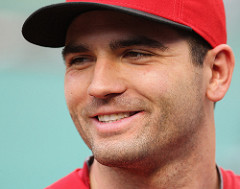
Photo by Keith Allison

On August 16, the Reds’ Joey Votto notched his 2.000 MLB hit (as well as his 1,999th and 2001st), as the Reds pounded the Cubs 14-5.   This was Votto’s third landmark hit of the  2021 season.  On April 30, he smacked his 300th home run and on June 30th, he collected his 1,000th RBI.  According to the Elias Sports Bureau, the only other player to reach the three marks in the same season was the Cubs’ Billy Williams (1971).

Move Over Babe Ruth, Here Comes Brett Phillips

On August 16, as the Rays topped the Orioles 9-2, Rays’ RF Brett Phillips smacked (and ran) an inside-the-park home run leading off the sixth inning.  It was Phillips’ 10th home run off the season and fifth in 19 days. Notably, three of the  immediately preceding four Phillips’ long balls (all of the over-the-fence variety) were Grand Slams (July 29 versus the Yankees; August 9 versus the Orioles; and August 11 versus the Red Sox). Per STATS, 19 days is the shortest period of time in which any MLB player has record three Grand Slams and an inside-the-parker.  Previous record holder?  Babe Ruth (36 days, 1929). Side note: Phillips three Grand Slams came in a span of just nineteen plate appearances. Impressive, but well short of the record – three slams in 14 plate appearances by the Tigers’ Jim Northrup (June 24-June 29, 1968).  All of this, of course, is part of the #InBaseballWeCountEverything” mindset.

Move Over Babe, Here Comes the Sho

On August 18, Shohei Ohtani put on a show in the Motor City. The Angels’ two-way star started on the mound, batting leadoff. In the contest, won by the Halos 3-1, Ohtani pitched eight innings for the victory, giving up six hits and one run while fanning eight.  He also hit his MLB-leading 40th home run of the season. It was Ohtani’s 18th start on the mound this season and he ran his record to 8-1, 2.79.

Shohei Ohtani is the first MLB player to hit 40 home runs and pitch in at least 15 games in the same season.  Second place on the list?  Babe Ruth, who hit 29 homers (leading the AL) and pitched in 17 games in 1919.

Motoring for the Cycle

On August 18, as the Braves topped the Marlins 11-9, Atlanta 1B Freddie Freeman hit for the cycle – going four-for-five with four runs scored and two RBI. It was the second cycle of the 31-year-old Freeman’s career – making him the 28th player (post-1900) to achieve multiple cycles. Freeman doubled in the first, tripled in the fourth, singled in the fifth and went deep in the sixth.

The Beautiful Swan that Turned into an Ugly Duckling

On August 21, the Yankees faced off against the Twins in New York and it was a pretty ho-hum game (at least for Twins fans, as the Yankees held a six-run lead in the seventh inning). That’s when we had the “you see something new at just about every ball game” moment. Yankee 3B Rougned Odor came up with two-on and one out in the bottom of the seventh.  On an 0-2 count Odor called – and was granted – time out as Twins’ pitcher Ralph Garza went into his windup.  Garza completed the pitch, which Odor (still in the batter’s box) launched into the right field bullpen for an apparent three-run home run.  Not so fast! Despite the loud New York celebration, Odor was called back to the plate, with the timeout enforced. He proceeded to strikeout – part of a zero-for-three, two strikeouts game (one HBP).

The Ugly Duckling that Turned into a Beautiful Swan

Okay, this is out of chronological order, but it seems to fit after the Odor story directly above. On August 28, as the Red Sox topped the Indians, recently called up Boston 2B Jonathan Aruaz (starting and batting in the nine-hole) came up in the top of the eighth inning with runners on first and second, no outs and the Red Sox trailing 3-1. Aruaz was called on to bunt and (ugly duckling here) muffed on two bunt attempts.  After those futile bunt attempts, Aruaz hit a 3-2 pitch off  James Karinchak for a three-run homer (beautiful swan)– giving the Red Sox a one-run lead that held up for the win. It was the 23-year-old’s second MLB home run (in 42 games … 2020-21).

500 and Counting

On August 22, Tigers’ DH hit his 13th home run of the season – a solo shot off the Blue Jays’ Steven Matz, in the top of the sixth, that tied the game 1-1.  (This Tigers went on to win 5-3).  Home run number 500 came nine games and 37 plate appearance after number 499 (in the fifth inning of an August 11 5-2 Tigers’ win at Baltimore.) Number 499 broke a scoreless tie in the top of the fifth.  Cabrera did not wait as long between 500 and 501 (which he hit in the Tigers’ very next game, August 24 at St. Louis.). Cabrera’s next target on his Hall of Fame quest?  That would be 3,000 hits.  He stood at 2,961 as August action came to an end.

A long time a coming. 

On August 10, 1971, Harmon Killebrew hit his 500th career round tripper. It came in the first inning, off the Orioles’ Mike Cueller, in a 5-3, ten-inning loss in Minnesota. Killebrew had been sitting on number 499 since July 25 (14 Twins games), a period of 59 plate appearances and 43 at bats between 499 and 500. Number 501, by the way, came just five innings and  two at bats after 500.

There’s a FIRST Time for Everything

MLB’s current ageless wonder – 41-year-old Nelson Cruz (who finished August with a .268-26-71 line on the season) started at first base for the Rays (against the Phillies in Philadelphia). Cruz went three-for-four with two RBI in the game – which is no surprise for the professional batsman.  It was surprising, however, to see Cruz start at first base for the Phillies. It was the first time he started at first base in 17 MLB seasons and 1,852 MLB games. In fact, it was the first time he started at first base in his professional career – so you can add in 741 minor-league games and 98 games in the Dominican Winter League and Caribbean Series.   Cruz handled seven fielding chances without an error, which proved you can teach and old dog new tricks.   (There’s hope for me yet.)

Three K’s – Nine Pitches-Three Times.  That’s a Fire Sale

On August 26, as the Red Sox topped the Twins 12-2 in Boston, Chris Sale threw the fourth “Immaculate Inning” (three up, three down, three strikes on nine pitches) of the 2021 season. Three appeared to be a lucky number as the Immaculate Inning came in the third frame.  The victims were CF Nick Gordon, SS Andrelton Simmons and RF Rob Refsnyder –  the numbers eight, nine and one in the order. Notably, it was the third Immaculate Inning of Sale’s career – tying him with Sandy Koufax for the most such perfect frames. Sales’ previous Immaculate Innings came on June 5, 2019 and May 8, 2019.  In getting the win, Sale itched 5 1/3 innings, giving up two runs on two hits and two walks, while fanning eight.,

They Call It the Streak

August was a streaky a month, at least for a couple of teams.  The Yankees put together a 13-game winnings streak (August 8 through August 27 – during which they outscored their opponents 75-35, outhit them .251 to .215 and out-homered them 25-15. In the streak, Yankees pitchers pit up a 3.19 ERA to their opponents 6.20.  Yankees’ batters went down on strikes 123 times to their opponents’ 135. Notably, the 13-win streak included three one-run victories and five two-run wins.  It involved seven home victories and six on the road.

Aroldis Chapman helped keep the Yankee streak alive with a save on August 26. He came on in the ninth with New York up 7-6 on the A’s and gave up just a harmless single. It was Chapman’s 300th MLB save and 24th of this season. 

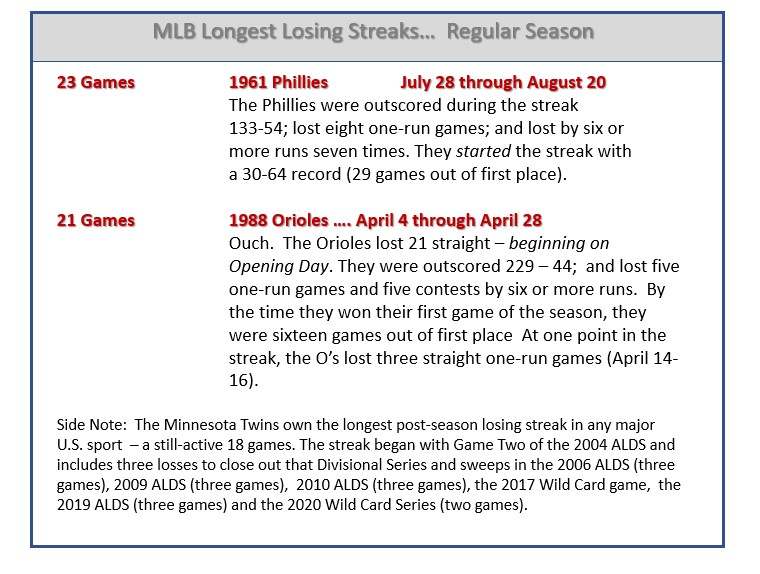
On the other side of the coin, the Orioles dropped 19 consecutive games (August 3 through August 24) – in which they were outscored 163 to 55.  The streak started with four losses in which the Orioles gave up a total of 45 runs, while scoring just 13.  Over the course of the streak they were outhit by their opponents .311 to .245 and out-homered 38 to 27.  The Orioles’ pitching staff put up an 8.67 ERA during the streak, to their opponents’ 2.68. The Orioles gave up ten or more seven times during the losing streak and lost by six or more runs eight times.  They finally made it back to the win column on August 25 with a 10-6 win over the Angels (thankfully in Baltimore). The Orioles trailed in that one 6-5 until scoring five in the bottom of the eighth innings.
More #InBaeballWeCountEverything

On August 27, Yasmani Grandal came off the injured list to get his first start behind the plate for the White Sox since July 5. He did it with a flare – going four-for-six, with a double, two home runs and eight RBI (as the ChiSox topped the Cubs 17-13). The eight RBI were a career-high for Grandal and tied the White Sox single-game record. Now, for the “counts everything” moment, STATS reported that it is the most RBI in the first game back from a player who spent at least a month in the IL.

Happy Birthday to Me

On August 27, Cubs’ rookie first baseman Patrick Wisdom celebrated his thirtieth birthday – on the ball field. Wisdom, whose rookie status is intact, despite brief call ups with the Cardinals, Ranger and Cubs in 2018, 2109 and 2020, celebrated the big 3-0 with a two-homer, four-RBI game against the crosstown White Sox.  (It was his second multi-homer game of the season).  Apparently, he wasn’t done celebrating, as he had another two-homer game against the ChiSox the very next day.

Baseball, It’s a Wander-ful Thing

As August came to an end, Rays’ 20-year-old rookie shortstop Wander Franco could look back on a month in which he got on base in all 25 games he played – via 31 hits, nine walks and two hit-by-pitch.  (Franco went .313-3-19 for the month.  The August performance was part of a still active 31-game streak  of getting on base .

Still A Long Way to Go

In 1949 (July 1 through September 27), Ted Williams set the MLB record for more consecutive games reaching base safely. – an astounding 84 contests. During the streak, Williams hit .371 (112-for-302) with a .518 on-base percentage (92 walks).  He had 24 home runs, 81 runs and 80 RBI over the 84 games. The streak included 14 games in which Williams did not get a hit, but got on base via the walk(s). 

What Doesn’t This Guy Do?

On, August 31, Angels Pitcher/DH Shohei Ohtani  – who leads MLB with 42 home runs and has an 8-1, 3.00 record in 15 2021 starts on the mound –  stole stole two bases (his 21st and 22nd of the season).  The cherry on top of the Sundae – one of those was not really a base, but home plate.

——-Individual Statistical Leaders for August ———

AVERAGE (75 June  at bats minimum)

National League – C.J. Cron, Rockies (.387); Tyler Naquin, Reds (.386); Bryan De La Cruz, Marlins (.384)

American League –  Amed Rosario, Indians (.372); Starling Marte, A’s (.363); Randy Arozarena, Rays (.362)

The lowest August average (among players with at least 75 at bats in the month)  belonged to the Yankees’ Rougned Odor at .146 (12-for-82).

HOME RUNS

National League – C.J. Cron, Rockies (11); Bryce Harper, Phillies (10); Patrick Wisdom, Cubs (9); Brandon Belt, Giants (9)

American League –  Salvador Perez, Royals  (12); Hunter Renfroe, Red Sox (10); Jose Abreu, White Sox (10)

RUNS BATTED IN

National League – C.J. Cron, Rockies (34); Bryce Harper Phillies (25); Joey Votto, Reds (24); Paul Goldschmidt, Cardinals (24)

American League – Salvador Perez, Royals (28); Eloy Jimenez, White Sox (27); Jorge Polanco, Twins (27)

The Rockies’ C.J. Cron had the highest slugging percentage for August (among players with at least 75 at bats) at .828.

HITS

National League – Austin Riley, Braves (39); C.J. Cron, Rockies (36); Paul Goldschmidt, Cardinals (36)

American League – Amed Rosario, Indians (42); Starling Marte, A’s (41); Ty France, Mariners (39)

DOUBLES

National League –  Bryce Harper, Phillies (11); Tommy Edman, Cardinals (11); three with ten

American League –  Jeimer Candelario, Tigers (10); Myles Straw, Indians (9); Starling Marte, A’s (9); Brandon Lowe, Rays (9); Nathaniel Lowe, Rangers (9)

TRIPLES

National League – Bryan Reynolds, Pirates (3); Edmundo Sosa, Cardinals (3); five with two

American League – Amed Rosario, Indians (2); Jose Ramirez, Indians (2); Victor Reyes, Tigers (2); Brandon Marsh, Angels (2)

The Rockies’ C.J. Cron led (players with at least 75 August at bats) in on-bad percentage at .463.

STOLEN BASES

National League –  Trea Turner, Dodgers (5); Jazz Chisholm, Marlins (5)

American League – Starling Marte, A’s (19); Whit Merrifield, Royals (11); Nicky Lopez, Royals (10)

The Royals’ Nicky Lopez was ten-for ten in August steal attempts. .

WALKS

National League – Juan Soto, Nationals (33); Bryce Harper, Phillies (22); Jorge Soler, Braves (18)

American League – Joey Gallo, Rangers (23); Shohei Ohtani, Angels (21); Franmil Reyes, Indians (19)

BATTER’S STRIKEOUTS

National League – Patrick Wisdom, Cubs (45); Ian Happ, Cubs (38); three with 36.

American League – Joey Gallo, Rangers (48); Brandon Marsh, Angels (43); Adolis Garcia, Rangers (42)

Joey Gallo struck out in one-half of his August at bats (48 whiffs / 96 at bats).

PITCHING VICTORIES

National League – Adam Wainwright, Cardinals (5-1); Max Fried, Braves (4-0); Max Scherzer, Dodgers (4-0); Logan Webb, Giants (4-0); Vladimir Gutierrez, Reds (4-2); Kyle Gibson, Phillies (4-2)

American League – Shane McLanahan, Rays (5-0); Dylan Cease, White Sox (4-0); J/T. Chargois, Rays (4-0); Liam Hendriks, White Sox (4-1)

The Orioles’ Spencer Watkins (0-6,  10.80) was the only MLB pitcher to take six losses in August.

EARNED RUN AVERAGE (at least 25 innings pitched)

National League – Max Fried, Braves (1.36); Julio Urias, Dodgers (1.38); Logan Webb, Giants (1.41)

American League – Steven Matz, Blue Jays (1.30); Cal Quantrill, Indians (1.42); Marco Gonzalez, Mariners (1.58)

Among Pitchers with at least 25 innings pitched in August, the Indians Tristin McKenzie held batters to the lowest average (.126) and recorded the lowest WHIP (0.50).

STRIKEOUTS

National League – Blake Snell, Padres (54 / 36 2/3 IP); Sandy Alcantara, Marlins (48 / 39 2/3 IP); Zack Wheeler, Phillies (43 / 43 IP)

American League – Robbie Ray, Blue Jays (52 / 41 IP); Dylan Cease, White Sox (50 / 35 IP); Cal Quantrill, Indians (40 / 38 IP)

SAVES

National League – Will Smith, Braves (8); Kenley Jansen, Dodgers (8); Josh Hader, Brewers (7); Jack McGee, Giants (7)

American League – Alex Colome, Twins (8); Raisel Iglesias, Angels (7); Emmanuel Clase, Indians (6)
 

——Team  Statistical Leaders through   August ———-

RUNS SCORED (average 594)

National League –  Dodgers (676); Reds (658); Braves (636)

American League – Rays (710); Astros (699); Red Sox (675)

Five teams averaged five or more runs per game through August: Rays (5.38) Astros (5.30); Dodgers (5.08); Red Sox (5.04); and White Sox (5.02). The Pirates averaged the fewest runs per game through August at 3.58. Lowest  in the AL was the Rangers at 3.87.

AVERAGE (average .242)

National League – Nationals (.257); Reds (.249); Rockies (.249)

American League – Astros (.267); Blue Jays (.262); Red Sox (.259)

The lowest team average through August  belonged to the Mariners  at .223.  The lowest average in the AL? Rangers – .229.

HOME RUNS (average 160)

National League – Giants (199); Braves (191); Dodgers (186)

American League –  Blue Jays (196); Twins (185); Rays (179)

The Pirates had the fewest home runs through August at 101.

STOLEN BASES (average 60)

National League – Padres (97);  Marlins (96); Phillies (68)

American League – Royals (97); Indians (83); A’s (78)

The Reds stole the fewest sacks through August  at 27 (in 49 attempts).

WALKS DRAWN (average 431)

National League – Dodgers (514); Padres (502); Brewers (483)

American League – Yankees (529); Rays (485); White Sox (482)

The Astros  led MLB  in on-base percentage through  August  at .339. The Nationals led the NL at .333. In slugging percentage, the Blue Jays  were on top at .450, while the Giants  led the NL at .434.

BATTER’S STRIKEOUTS (average 1,155)

National League – Cubs (1,313); Marlins (1,274); Diamondbacks (1,224)

American League – Rays (1,290); Mariners (1,26-); Tigers (1,254)

What do those whiffs mean? In the American League, the team with the most batters’ strikeout is leading its division (Rays, 1,290), as is the team with the least batters’ strikeouts (Astros, 999)

EARNED RUN AVERAGE (average 4.22)

National League – Dodgers (3.01); Giants (3.30);  Brewers (3.35)

American League – Yankees (3.65); Rays (3.67); Astros (3.68)

Three teams had ERA’s through August  at 5.00  or higher– Orioles (5.84), Diamondbacks (5.14); and Pirates (5.05). They have a combined record of 132-262 – and all reside in last place.  Among the six ERA leaders listed above, four are division leaders and two are in second place.  Their combined W-L through August is 474-320.

STRIKEOUTS (average 1,155)

National League – Brewers (1,334); Dodgers (1,327); Padres (1,275)

American League – White Sox (1,322); Red Sox (1,248); Yankees (1,246)

The White Sox  averaged an MLB-best 10.3 strikeouts per nine innings through August. The Brewers  led the NL at 10.1.  The only other team at 10 or better was the Dodgers (10.). The MLB average was 9.0.

FEWEST WALKS SURRENDERED (average 431)

National League – Giants (344); Mets (377); Phillies (413)

American League – A’s (355); Rays (362); Blue Jays (385)

The Giants walked a stringiest 2.6 batters per nine frames through August. The Rays had the best strikeouts-to-walks ratio at 3.40.

SAVES (average 32)

National League – Giants (48); Dodgers (43); Padres (40)

American League – Yankees (41); Red Sox (40); Mariners (38)

The White Sox and Phillies led MLB with four complete games each through August. (There were 44 complete games across MLB and six teams had zero complete games – Pirates, Rangers, Royals, Indians, Angels, Red Sox.

Bonus Stat – Hit By Pitch

Cardinals’ pitchers hit the most batters through August at 82 (the average was 58). Reds batters were hit the most often (92 times). 

——-Individual Statistical Leaders through August 31———-

BATTING AVERAGE (qualifying players – 3.1 at plate appearance for each team game played)

National League – Trea Turner, Dodgers (.322); Nick Castellanos, Reds (.315); Jesse Winker, Reds (.307)

American League – Yuli Gurriel, Astros (.313); Michael Brantley, Astros (.313);  Vlad Guerrero, Jr. , Blue Jays (.313);

The lowest average through August  (among qualifiers) belonged to the Reds’ Eugenio Suarez at .169 (73-for-432).  Notably, it was a productive .169 – as Suarez also had 23 home runs and 66 RBI.

HOME RUNS

National League – Fernando Tatis, Jr., Padres (36); Pete Alonso, Mets (29); Adam Duvall, Braves (29); Max Muncy, Dodgers (29)

American League –  Shohei Ohtani, Angels (42); Vlad Guerrero, Jr., Blue Jays (39); Salvador Perez, Royals (38)

Shogo Akiyama, Reds’ CF has the most at bats without a home run this season (154). He stat line is .201-0-12 in 81 games. Royals’ SS Nicky Lopez ended August hitting .292 in 120 games (373 at bats) with just one home run.

RUNS BATTED IN

National League – Jesus Aguilar, Marlins (92); Adam Duvall, Braves (88); Ozzie Albies, Braves (86); Manny Machado, Padres (86)

American League – Jose Abreu, White Sox (102); Rafael Devers, Red Sox (97);  Vlad Guerrero, Jr., Blue Jays (96)

The Padres’ Fernando Tatis,  Jr.  had the highest slugging percentage among qualifiers at .640.  The only other players above .500 through August were the Angel’s Shohei Ohtani at 623 and Blue Jays’ Vlad Guerrero, Jr. at 602.

RUNS SCORED

National League – Freddie Freeman, Braves (95); Juan Soto, Nationals (88); Fernando Tatis, Jr. , Padres (86); Chris Taylor, Dodgers (86)

American League – Vlad Guerrero, Jr., Blue Jays (98); Bo Bichette, Blue Jays (96); Marcus Semien, Blue Jays (92)

HITS

National League –Trea Turner, Dodgers  (154); Adam Frazier, Padres (148); Freddie Freeman, Braves (144); Austin Riley, Braves (144)

American League – Cedric Mullins, Orioles (151); Vlad Guerrero, Jr., Blue Jays (151); David Fletcher, Angels (150)

DOUBLES

National League –  Tommy Edman, Cardinals (35); Ozzie Albies, Braves (34); Nick Castellanos, Reds (32):  Nolan Arenado, Cardinals (32); Jesse Winker, Reds (32): Nick Costellanos, Reds (32); Bryce Harper, Phillies (32)

American League – Jeimer Candelario, Tigers  (36); J.D. Martinez, Red Sox (35); Rafael Devers, Red Sox (34);  Marcus Semien, Blue Jays (34)

The Angels’ Shohei Ohtani had the most extra-base hits through August (72). The Braves’ Ozzie Albies led the NL with 63 extra-base knocks.

TRIPLES

National League – Dave Peralta, D-backs (8); Ozzie Albies, Braves (6); Jake Cronenworth, Padres (6)

American League – Akil Baddoo, Tigers (6); Amed Rosario, Indians (6); four with five

STOLEN BASES

National League –  Trea Turner, Dodgers (26); Fernando Tatis, Jr., Padres (24); Starling Marte, Marlins* (22);  *Marte is now with the A’s.

American League –Whit Merrifield, Royals (38); Cedric Mullins, Orioles (25); Myles Straw, Indians (22); Shohei Ohtani, Angels (22)

Starling Marte led all MLB players with 42 stolen bases through August, but lead neither league. Marte stole 20 bases in the AL (A’s) and 22 in the NL (Marlins). 

WALKS

National League – Juan Soto, Nationals (105); Bryce Harper, Phillies (74); Max Muncy, Dodgers (73)

American League – Joey Gallo, Yankees (99); Robbie Grossman, Tigers (79); Vlad Guerrero, Jr., Blue Jays (72)

BATTER’S STRIKEOUTS

National League – Javier Baez, Mets (154); Eugenio Suarez, Reds (149);  Chris Taylor, Dodgers (144)

American League – Joey Gallo, Yankees (176); Matt Chapman, A’s (166); Shohei Ohtani, Angels (159)

PITCHING VICTORIES

National League –Julio Urias, Dodgers (15-3); Kyle Hendricks, Cubs (14-6); Walker Buehler, Dodgers (13-2); Adam Wainwright, Cardinals (13-7)

American League – Gerrit Cole, Yankees (13-6); Chris Bassitt, A’s (12-4); Hyun Jin Ryu, Blue Jays (12-8)

The  Orioles’ Jorge Lopez 3-14, 6.18), Orioles’ Matt Harvey (3-14, 6.14), Nationals’ Patrick Corbin (7-14, 6.26) and  Reds’ Luis Castillo (7-14, 4.30) tied for the lead in losses through August.

EARNED RUN AVERAGE (qualifying players … at least one inning pitch for each team game played)

National League – Walker Buehler, Dodgers (2.05); Corbin Burnes, Brewers (2.27); Brandon Woodruff, Brewers (2.35)

American League – Lance Lynn, White Sox (2.59);Robbie Ray, Blue Jays (2.71);  Gerrit Cole, Yankees (2.80)

INNINGS PITCHED

National League – Zach Wheeler, Phillies (182 2/3); Walker Buehler,  Dodgers (176); Adam Wainwright, Cardinals (169 2/3)

American League – Zack Greinke, Astros (159 2/3); Robbie Ray, Blue Jays (159 1/3); Luis Giolito, White Sox (158 1/3)

STRIKEOUTS

National League – Zack Wheeler, Phillies (208  / 182 2/3);  Corbin Burnes, Brewers (189 / 139 IP); Max Scherzer, Dodgers (188 / 140 IP)

American League – Robbie Roy, Blue Jays (202 / 159 1/3 IP); Gerrit Cole, Yankees (200 / 148 IP); Dylan Cease, White Sox (188 / 143 2/3 IP)

Among qualifying pitchers, the Brewers’ Corbin Burnes had the best strikeouts/nine innings ratio through August  at 12.24. The Yankees’ Gerrit Cole  led the AL  at 12.16.

Among qualifying pitchers,  Burnes also had the best strikeouts-to-walks ratio at 7.27.  Cole led the AL at 6.25.

SAVES

National League – Mark Melancon, Padres (36); Kenley Jansen,Dodgers (30); Alex Reyes, Cardinals (29); Jake McGee, Giants (29); Will Smith, Braves (29)

American League –  Liam Hendriks, White Sox (30):  Raisel Iglesias, Angels (29); Matt Barnes, Red Sox (24);  Aroldis Chapman, Yankees (24); Craig Kimbrel, White Sox (24)

Blake Treinen of the Dodger had the most  “holds” through August at 25. The A’s Yusmeiro Petit led MLB in mound appearances through August with 66 (with a record of 8-1, 2.96, with two saves). 

Primary Resources:  MLB.com; Baseball-Reference.com

_______________________________________


BASEBALL ROUNDTABLE ON THE TOP 100 BASEBALL BLOG LIST

100Baseball Roundtable is on the Feedspot list of the Top 100 Baseball Blogs.  To see the full list, click here.

I tweet baseball @DavidBBRT

Follow/Like Baseball Roundtable’s Facebook Page here.  More baseball commentary; blog post notifications; PRIZES.

Member: Society for American Baseball Research (SABR); The Baseball Reliquary; The Negro Leagues Baseball Museum.


Baseball Roundtable “Who’s Your Daddy?” – Steve Carlton Edition

Felipe – Matty – Jesus … The Anti-Carlton Gene

If you were putting together a lineup to face off against Hall of Fame southpaw Steve Carlton, placing the  Alou family across the outfield might be a good place to start.  In  135 at bats against Carlton,  Felipe, Jesus and Matty Alou hit a combined .400 (54-for-135). Individually, Jesus hit .436, Felipe hit .421 and Matty a miserly .333.  

In this post, the 14th in the Baseball Roundtable “Who’s Your Daddy?” series, we’ll look at a Baseball Roundtable-selected  lineup that performed exceptionally well against Steve Carlton over their careers. You might be surprise to find that none of the Alou brothers made the starting nine and Ron Gardenhire came close.  More on that later, but first a look at what “Who’s Your Daddy?” is all about.

Who’s Your Daddy – A Baseball Roundtable Series

In this series, BBRT presents lineups of players who performed unexpectedly well against baseball’s top pitchers. (An explanation of the inspiration behind the Who’s Your Daddy? series can be found the end of this post.)  As always, I would stress that the pitchers included in the Who’s Your Daddy? series are among the “best in the business.”  They are selected not because of the players who performed well against them, but rather because success among hitters when they were on the mound was the exception rather than the rule.  We’ve looked at pitchers from a wide range of eras – from Bob Feller to Nolan Ryan to Max Scherzer.  As noted, in this post, we’re looking at one of MLB’s all-time great southpaws, Steve Carlton.

Before we get started on this edition,  here are links to the previous editions of this series. Please note: For still active pitchers, the stats are as they stood on the date of the post.

  • Nolan Ryan, click here.
  • Sandy Koufax, click here.
  • Pedro Martinez, click here.
  • Bob Gibson, click here.
  • Randy Johnson, click here.
  • Greg Maddux, click here.
  • Justin Verlander, click here.
  • Bob Feller, click here.
  • Roger Clemens, click here.
  • Max Scherzer, click here.
  • Tom Seaver, click here.
  • Mariano Rivera, click here.
  • Warren Spahn, click here.
  • For Lefty Grove, click here.

Lefty (Carlton) was a craftsman, an artist. He was a perfectionist. Stroke, stroke, stroke and when he got through (pitching a game), it was a masterpiece.

Hall of Famer Richie Ashburn

Carlton does not pitch to the hitter, he pitches through him. The batter hardly exists for Steve. He’s playing an elevated game of catch. 

Tim McCarver

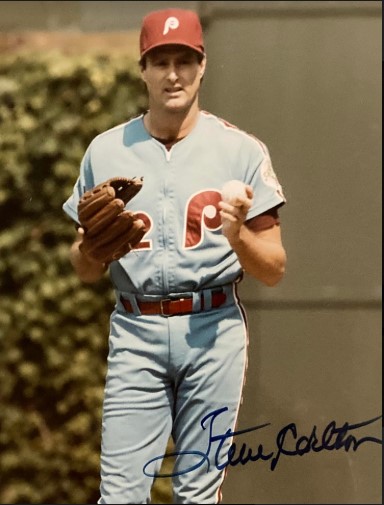
Let’s start with a  look at Carlton’s credentials.   Carlton’s Hall of Fame MLB career spanned 24 seasons (1965-88) … primarily with the Phillies (15 seasons) and Cardinals (seven seasons). He also played briefly, at the end of his career, with the Giants, White Sox and Twins. He won 329 games (11th all-time and second  all-time among left-handers) against 244 losses.  His 4,136 strikeouts are fourth among MLB pitchers and second among lefties. Carlton was a ten-time all Star and four-time Cy Young Award winner. He won 20 or more games in a  season six times, leading the NL in wins four times. He led the league in ERA once, complete games three times, shutouts once, innings pitched five times and strikeouts five times.

A Balancing Act

Steve Carlton racked up MLB’s  fourth-most career strikeouts  (4,136); and the second-most career walks (1,833). Carlton also had the most career pick-offs (144); and the most career balks (90). In addition,  he led the NL in wins in four seasons; and led in losses twice.

_______________________________________________________

1972 – One for the Ages

In 1972, Steve Carlton delivered one of the most dominating  seasons ever. Pitching for the last-pace Philadelphia Phillies – a team that finished with a 59-97 won-lost record – Carlton led MLB with 27 wins (ten losses) and topped MLB with 30 complete games, while also  posting the NL’s lowest earned run average (1.97) and leading the NL in strikeouts (310),  games started (41) and  innings pitched (346 1/3). From June 7 through August 17 of that season, Carlton started 18 games – going 15-0 (the team won 17 of those 18 starts), with a 1.51 ERA, 14 complete games and five shutouts. In games Carlton didn’t start during that span, the Phillies went 9-39. Carlton’s 1972 performance earned him the unanimous selection as the NL  Cy Young Award winner – and he is still the only pitcher ever to win the CYA while pitching for a last-p[lace team. It was indeed a season for the ages.

_______________________________________________________________________

Now, let’s look at the lineup of players who showed they could acquit themselves well against Carlton’s overpowering arsenal.  A  couple of notes here.  As I evaluated hitters (against Carlton), I looked not just at hits or average, but the productivity of those hits (RBI, extra-base hits). I also looked at such factors as plate appearances against Carlton (the bigger the sample size, the stronger the evidence), strikeouts-to-walks ratio and at what point in Carlton’s career the hits were put on the board. Through his age-39 season, for example, Carlton was 313-107, with a 3.04 ERA, while in the three seasons after turning age 40, he went 16-37, 5.21. With that in mind, I adjusted the value of offensive damage done in Carlton’s final three seasons.  (Only regular-season stats are included.) As usual, I expect the choices here to be  the subject of discussion and debate, but aren’t discussion and debate a great part of being a fan of the national pastime?

—-BASEBALL ROUNDTABLE “WHO’S YOUR DADDY?” STEVE CARLTON LINEUP—–

Catcher …  Johnny Bench – 12 homes run and 30 RBI

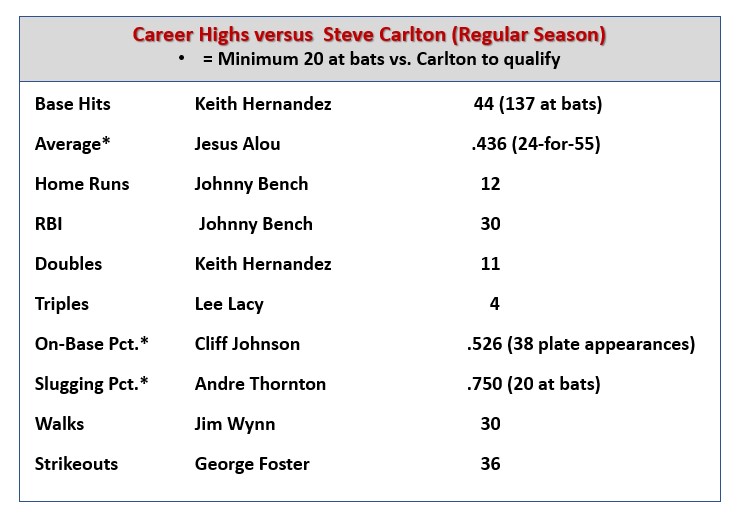
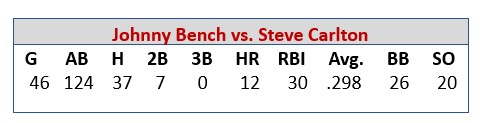
Johnny Bench hit more home runs (12) and drove in more runs (30) against Steve Carlton than any other player. Notably, those were also Bench’s highest total in home runs and RBI against any pitcher over his  own career. (He also hit 12 career long balls against Don Sutton.) Bench hit .300 or better versus Carlton in nine  of the 16 season he faced him. His best season against Carlton was 1970, when he hit .500 (6-for-12), with three home runs and seven RBI in four games.

Two-for-Three

Johnny Bench hit three home runs in a game against Steve Carlton – TWICE.  On July 26, 1970, Bench hit a three-run homer off Carlton in the first inning, a two-run shot in the second and a solo home run in the fifth – as the Reds topped Carlton and the Cardinals 12-5. On May 9, 1973, Bench touched Carlton for a two-run homer in the first inning; a three-run shot in the third; and a another two-run homer in the seventh – as the Reds defeated the Phillies 9-7.  Bench had three three-home run games in his career. 

In  a 17-season Hall of Fame career (1967-83, Reds), Bench hit .267, with 389 home runs and 1,376 RBI. He was the 1968 NL Rookie of the Year,  an All Star in 14 seasons, a two-time MVP and ten-time Gold Glover. He twice led the NL home runs and three times led in RBI.

Catcher Honorable Mentions: Gary Carter, .309-11-23 in 39 games versus Carlton; with 17 walks versus seven whiffs. Cliff Johnson, 14 walks in 12 games versus Carlton, which turned a .250 average (six-for-24) into  a .526 on-base percentage.

I Just Can’t Figure this Guy Out

Catcher Mikey Ryan hit just .193 over his 11-season MLB career (1964-74 …. Phillies, Red Sox, Pirates), and he clearly had trouble with Steve Carlton.  He was 0-for-26 in his career against Carlton (he did draw three walks) – the most at bats of any player with a .000 average versus Carlton. Surprisingly, Ryan did put the ball in play, fanning just four times in those 26 at bats. 

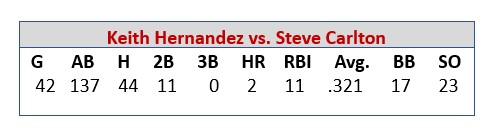
First Base … Keith Hernandez  – 44 hits and a .321 average

No one collected more career hits against Steve Carlton than Keith Hernandez’ 44 safeties (.321 average). Hernandez also collected more hits off Carlton than he did against any other pitcher. Hernandez’ 11 doubles were also the most two-baggers hit off Carlton by any batter. Earlier,  I noted that Carlton’s ERA was 3.04 before his fortieth birthday and  5.21 in the three seasons he played after turning forty. I found in interesting that Hernandez did his damage before Carlton reached forty. Hernandez hit .352-2-11 against Carlton before his age-40 season and was just 1-for-15 after.  In 1980 – when Carlton won his third Cy Young Award –  Hernandez hit him at a .368 pace (7-for-19) and a .500 on-base percentage (five walks/two whiffs). Still, little damage was done (he did not have an RBI versus  Carlton that season).

I’m Keith Hernandez

Keith Hernandez appeared in the last episode of Seinfeld, where his key line was  “I’m Keith Hernandez,” which later became the title of his best-selling memoir.

Keith Hernandez played 17 MLB seasons (1974-90 … Cardinals, Mets, Indians), hitting .296, with 162 home runs and 1,071 RBI. He was the 1979 NL MVP (Cardinals),  when he won the batting title (.344) and led the NL in doubles (48 ) and runs scored (116). He was an All Star in five seasons an 11-time Gold Glover.

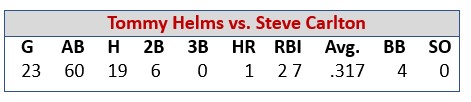
Second Base …  Tommy Helms – 23 games, 65 plate appearances, not a single strikeout

Putting the Ball in Play

Tommy Helms 65 plate appearances without a strikeout against Steve Carlton are the most career PA’s against Carlton of any hitter who never fell victim to a Carlton “K.”

Tommy Helms got off to a good start against Steve Carlton, two singles and a double in his first three plate appearances against him.  He went on to put the ball in play often (and effectively) putting up a .317 average (with one home run and seven RBI) over 23 games.

Tommy Helms played in 14 MLB seasons (1964-77 … Reds, Astros, Pirates, Red Sox). He was a career .269 hitter, with 34 home runs and 477 RBI (1,435 games). He was the 1966 NL Rookie of the Year (Reds), when he hit .284-9-49 in 138 games. He was a two-time All Star and two-time Gold Glover.

Second Base Honorable Mentions: Steve Sax, who hit .423 against Carlton in 26 at bats (an average second only to Jesus Alou among players with at least 20 career at bats against Lefty). The smaller sample size, and the fact that he had only one extra-base hit and and just three RBI, puts him behind Helms in this lineup. Davey Lopes, a career .263 hitter, raked at a .382 pace against Carlton in 55 at bats (.433 on-base percentage), with one home run and five RBI.

Third Base … Ray Knight – .356 average with 20 RBI

Ray Knight hit Steve Carlton at a .356 clip over 30  games. His 31 hits are the 13th most against Carlton and his 20 RBI rank fifth. He batted against Carlton in ten MLB seasons and hit .350 or better against the southpaw in five (.400 or better in four). He hit the second-most career triples against Carlton (3). Thirteen of his 31 hits versus Carlton went for extra buses, giving him a .632 slugging percentage, sixth-highest among players with at least 20 at bats against Carlton.

Oops – For the Win

Ray Knight scored the famous (or infamous) winning run in the tenth inning of Game Six of the 1986 World Series (as the Mets edged the Red Sox 6-5). Knight, who had singled and moved to second on a wild pitch, scored as Mookie Wilson’s ground ball went between the legs of Red Sox’ 1B Bill Buckner. 

Knight played 13 MLB  seasons (1974, 1977-88 … Reds, Astros, Mets, Orioles, Tigers), primarily as a corner infielder.  The two-time All Star hit .271-84-595 in 1,495 games. His best season was 1979, when he hit .318-10-79 for the Reds.

Third Base Honorable Mention: Ken Reitz’ 36 hits were the sixth-most against Carlton, however, his .286 career average, eight extra-base this and 13 RBI all trailed Knight (who had 35 fewer at bats against Carlton than Reitz).

Shortstop …. Tim Foli – 36 hits, .295 average.

Tim Foli’s 36 hits are tied for the sixth-most against Carlton, He was especially strong against Lefty in 1978, when he went 7-for-ten (.700), with one double and two RBI  He also drew six career walks off Carlton, while only fanning seven times in 131 plate appearances.  Foli’s 36 career hits against Carlton are the most he had against any MLB pitcher.

Tim Foli played 16 MLB seasons (Mets, Expos, Giants, Pirates, Angels, Yankees). He was a .251 career hitter, with 25 home runs and 501 RBI.

It’s Been a Hard Day’s Night

The Expos’ Tim Foli is the only player to start a cycle one day and complete it the next. On April 21, 1976, Foli collected a single, double and triple in a contest against the Cubs that was suspended (pre-Wrigley lights) in the top of the seventh due to darkness. When play resumed the following day, Foli added an eighth-inning home run. (The Expos prevailed 12-6.)

Shortstop Honorable Mentions:  It’s nice to have a surprise on this list (especially one with Minnesota Twins ties).  Therefore, Ron Gardenhire gets a shout out.  In nine games against Carlton, Gardenhire went 11-for-30 – a .367 average that ranks 14th  among batters with at least 20 career at bats against Carlton. In his first four games against Carlton, Gardenhire batted  in the eight-hole, but apparently showed something.  In his final five starts against Carlton, he batted lead off twice, second once and in the eight-spot once.  He didn’t do a lot of damage with those safeties – one home run, one RBI.  So why is he a surprise? Gardenhire played in five MLB seasons (1981-85), all with the Mets. He hit .232-4-49 in 285 games (and swiped 13 bases) – but he apparently had Steve Carlton’s number.  Gary Templeton only hit .261 against  Steve Carlton during his career, but he made those hits count, his fourteen RBI are the 17th most against Carlton and his seven doubles place tenth.

Outfield … Henry Aaron – .343 with six home runs and 17 RBI

Henry Aaron’s six home runs are the sixth-most against Carlton, while his 17 RBI are 11th, Add in a .343 average and the fact that he did that damage in just 73 at bats and Aaron leads this outfield.  (Aaron had the fewest at bats against Carlton of any player with at least 15 RBI against him.) In 1971, Aaron had ten at bats in three games against Carlton and hit .500, with three home runs and 10 RBI.  In 1972, Carlton’s sparking CYA season, Aaron again batted .500 against him (7-for-14).

Two is Company

Henry Aaron and Eddie Mathews hit more home runs while teammates (863) than any other pair of teammates in MLB history.  Second place?  Babe Ruth and Lou Gehrig at 859.

Aaron played 23 MLB seasons (1954-76 … Braves, Brewers) and  hit .305, with 755 home runs, an MLB-record 2,297 RBI, 3,771 hits and 240 steals.  He was an All Star in all but his first and final seasons, the 1957 NL MVP and a three-time Gold Glover. He led the NL in hits twice, runs three times, home runs four times, RBI four times, total bases eight times and batting average twice. There’s more, but you get the idea.  No surprise he’s in this lineup.

Outfield … Rusty Staub  32 hits, 25 RBI

Rusty Staub hit .308 and drove in 25 runs in 34 regular-season games versus Steve Carlton. His 32 hits are 11th all-time against Carlton, while his 25 career RBI against the southpaw are second only to Johnny Bench (30). On May 30, 1972 – as Staub’s Mets topped Carlton and the Phillies 7-0 in NY – Staub touched Carlton for a two-run single in the first inning; an RBI single in the third; and a RBI single in the fifth. He added a double off reliever Wayne Twitchell in the seventh to complete a four-for-four day.  In 12 campaigns against Carlton, Staub hit .300 or better six times.

Staub played 23 MLB seasons (1963-85 … Mets, Astros, Expos, Tigers, Rangers), hitting .279-292-1,466. He was a six-time All Star.

Spreading the Hits Around

Rusty Staub is the only MLB player to collect at least 500 hits for four different teams:  Astros (792 hits); Mets (709); Tigers (582); and Expos (531). He had 2,716 total MLB safeties. 

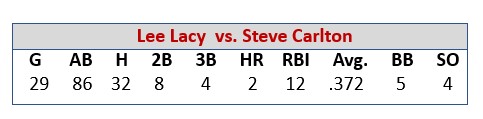
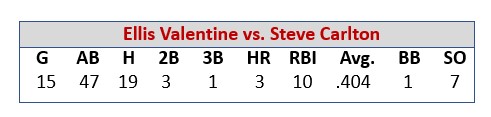
Outfield –Tie:   Lee Lacy (.373 average, 32 hits) and Ellis Valentine (.404 average. .702 slugging percentage).

Lee Lacy’s 32 hits are 11th all-time against Carlton, his eight doubles are fifth, his four triples first and his .372 average eleventh among players with at least 20 career at bats against Carlton.  Lacy first faced Carlton on July 11, 1972. Carlton pretty much handcuffed the Dodgers that day, throwing a five-hit, one-run complete game  (one walk, eight  whiffs) as his Phillies  won 4-1.  He didn’t seem to fool Lacy though, who collected three of the Angels’ five hits (in four at bats) out of the leadoff spot.

That was so Good, I’ll have Another

Lee Lacy recorded ten multi-hit games in the 29 contests in which he faced Steve Carlton.

Lacy played 16 MLB seasons (1971-87 … Dodgers, Pirates, Orioles, Braves), hitting a solid .286, with 91 home runs, 458 RBI and 185 steals. He played in at least 100 games in just nine of those sixteen seasons and his best season was 1984 (Pirates) when he went … .312-12-70, with 21 steals in 138 games (at age 36).

I couldn’t leave Ellis Valentine out of this lineup (maybe I’ll use a designated hitter).  Valentine hit .404 versus Carlton (fourth-highest among player with at least 20 at bats versus the southpaw), with a lofty .702 slugging percentage (second-highest among the “at least 20 at bats” contingent.

Come to the Plate, Hit, Run –  Repeat.

In 1977, Ellis Valentine had two triples, 25 home runs, 76 RBI and 13 stolen bases for the Expos.  The following season, he had two triples, 25 home runs, 76 RBI and 13 stolen bases for the Expos.

Valentine suited up in 10 MLB seasons (1975-81, 1985 …. Expos, Mets, Angels, Rangers).  He hit .278 (894 games), with 123 home runs and 474 RBI.  The one-time All Star’s best season was 1977, when he went .293-25-76, with 13 steals  for the Expos.  Valentine’s 19 hits off Steve Carlton were the most hits he collected against any MLB pitcher.

Outfield Honorable Mentions: Jesus and Felipe Alou hit .426 and .421, respectively, against Steve Carlton – the highest and third-highest averages among players with at leas 20 at bats against the lefty.   They didn’t end up with starting sports because – despite a combined 40 hits – they had just one home run and seven RBI.

A Walk in the Park _ Special Mention

Jim Wynn hit just .265 against Steve Carlton, but he walked thirty times in 100 plate appearance, to put up a .490 on base percentage. He fanned 15 times and five of his 18 hits (in 68 at bats) left the ball yard.

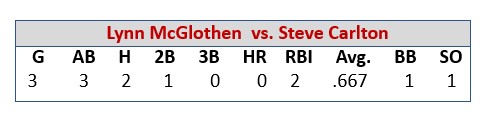
Pitcher – Lynn McGlothen – Two-for-three, with a walk

Lynn McGlothen matched up against Carlton three times (1975, 1977, 1979). At the plate, he went two-for-three with a walk (one double, two RBI.). On the mound, McGlothen was 1-2, 2.79 with six walks and nine strikeouts (19 1/3 innings pitched) in games he matched up with Carlton. Carlton was 2-1, 5.51,  with six walks and nine whiffs (16 1/3 innings pitched).

McGlothen had an eleven-season MLB career (1971-82 … Cubs, Cardinals, Giants, Red Sox, Yankees, White Sox).  He was 86-93, 3.98 on the mound and hit .173-0-25 in 456 at bats. He was an All Star (Cardinals) in 1974, when he went 16-12, 2.69 in 31 starts.

Primary Resource:  Baseball-Reference.com

___________________________________

Who’s Your Daddy?  The Inspiration.

On September 24, 2004, in the middle of a tight pennant race, the Yankees handed future Hall of Famer Pedro Martinez and the Boston Red Sox a tough 6-4 loss.  Martinez went 7 1/3 innings giving up nine hits and five earned runs.  The game came just five days after (in his previous start) Martinez had lasted just five frames against the Bronx Bombers (eight hits, eight earned runs) in a 16-7 loss.

After that second loss, Martinez candidly commented, “What can I say? I just tip my hat and call the Yankees my daddy.”  Little did he know that his comment – and a Yankee fans’ chant of “Who’s your daddy?” would follow him into future starts in New York (all the way to his final MLB start – against the Yankees for the Phillies – in Game Six of the 2009 World Series).

The concept of “Who’s your daddy?” became the inspiration for Baseball Roundtable to take a look at the players who “had the number” of some of MLB’s premier pitchers.  Again, you can find links to the previous “editions” of “Who’s Your Daddy?” near the top of this post. 

_______________________________________


BASEBALL ROUNDTABLE ON THE TOP 100 BASEBALL BLOG LIST

100Baseball Roundtable is on the Feedspot list of the Top 100 Baseball Blogs.  To see the full list, click here.

I tweet baseball @DavidBaseballRT

Follow/Like Baseball Roundtable’s Facebook Page here.  More baseball commentary; blog post notifications; PRIZES.

Member: Society for American Baseball Research (SABR); The Baseball Reliquary; The Negro Leagues Baseball Museum.
 

Double Your Pleasure – Nine Hits, All Two-Baggers

On this date (August 18) in 1998, the Braves faced off against the Giants in Atlanta, with Greg Maddux on the mound – seeking his 200th MLB win.  Little did the fans know they would see a bit of history in more ways than one. Maddux would get win number 200, as the Braves topped the Giants 8-4, but there would be a little more obscure  historic marker put down.

In the bottom of the first, Braves’ SS Walt Weis led off with a double to left (on a 3-2 pitch from Kirk Reuter). Two pitches later, Braves’ RF Gerald Williams brought home Weiss with a another double to left – and the tone was set.  After 8 ½ innings, the Braves had an 8-4 win – and nine hits, all doubles.  In a another “In Baseball We Count Everything” moment, it remains the most doubles ever  in an MLB game by a team whose every hit was a double.  Yep, nine hits – all two-baggers.

The Brave., by the way, finished fourth in the NL in doubles that season – but did not have a single player in the top 25 in two-base hits.  Andruw Jones led the Braves with 33 doubles, 32nd in the league.

So, how about a few more team doubles records:

  • Most doubles in a season, 376 – 2008 Rangers (led by Ian Kinsler with 41 and with nine players with 20+ doubles).
  • Most doubles in a game, 14 – Chicago White Stockings  on July 3, 1883 (in a 31-7 win over the Buffalo Bisons; with four doubles each by Cap Anson and Abner Dalrymple).
  • Most doubles in an inning, 7 – Boston Bees (first inning, August 25, 1936 vs. St, Louis Cardinals)  and Saint Louis Cardinals (seventh inning, July 21, 2012 vs. the Chicago Cubs).

Primary Resources:  Baseball-Reference.com; Baseball-Almanac.com; NationalPastime.com

Baseball Roundtable Disclaimer:  The MLB records referenced in this (and previous) posts have the potential to change (primarily additions) as Major League Baseball recognizes and fully incorporates Negro League records from 1920-48 into the MLB record book.


BASEBALL ROUNDTABLE ON THE TOP 100 BASEBALL BLOG LIST

100Baseball Roundtable is on the Feedspot list of the Top 100 Baseball Blogs.  To see the full list, click here.

I tweet baseball @DavidBBRT

Follow/Like Baseball Roundtable’s Facebook Page here.  More baseball commentary; blog post notifications; PRIZES.

Member: Society for American Baseball Research (SABR); The Baseball Reliquary; The Negro Leagues Baseball Museum.
 

Jim McAndrew … One Hard Luck Rookie Season

The inspiration for this post is the fact that, on this date (August 17) in 1968, Mets’ 24-year-old  rookie  right-hander Jim McAndrew made his fourth professional major-league start (and fourth MLB appearance) – and picked up his fourth MLB loss, despite a 1.82 earned run average.  The fact is, in his four starts, the Mets had not scored a single run.  That got me to thinking about another Mets’ starter, Jacob deGrom, who – fifty  seasons later – managed to finish just one game over .500 (10-9) despite an MLB-lowest 1.70 earned run average. Read on for more on both seasons – particularly how McAndrew’s trying 1968 campaign made deGrom look a bit like “Mr. Lucky” in 2018.  (I suppose I’m dating myself with that television reference,)

Quite a bit was said and written about deGrom and how he “deserved better” in 2018.  In his 10-9 campaign, deGrom gave up more than two earned runs in just six of 32 starts. In the 26 starts in which he limited the opposition to two earned runs or less, he won ten, lost seven and got nine no-decisions.  In May of 2018, deGrom started five games, gave up a total of two runs in 26 innings (0.69 ERA) and won just one game (four no-decisions). Still, his mound excellence, despite the 10-9 record, was recognized, as he was both an All Star and the NL Cy Young Award winner (getting 29 of 30 first-place votes). The Mets, by the way, were 77-85 in 2018.  Notably, the Mets’ Noah Syndegaard (13-4, 3.03) and Zack Wheeler (12-7, 3.31), put up better W-L records despite deGrom’s notably better overall numbers. DeGrom led Mets’ starters in ERA, innings pitched, strikeouts, strikeouts per nine innings, WHIP and strikeouts-to-walks ratio.

Jacob deGrom started the 2018 season 4-0, 1.75 (after nine starts) and went 6-9, 1.68 in his final 23 starts.  The Mets scored two runs or fewer in 12 of his 32 starts. 

Now, fifty years before deGrom’s 2018 campaign, McAndrew found himself looking for more support and ending up on the wrong side of a host of hard luck losses. In many ways, his 1968 season overshadows deGrom’s 1988 campaign in the “hard luck” category.

McAndrew was drafted by the Mets (out of the University of Iowa) in the 11th round of the 1965 MLB draft. By 1968, despite some recurring arm issues,  he had worked his way up to Triple A (Jacksonville Suns) – where he sported a 2.64 earned run average into mid-July (after 112 innings pitched).  That earned McAndrew a call up to the Mets – for a spot start on July 21.  That is where the “hard luck” really began to surface.

In that first MLB start (and appearance), McAndrew drew the Cardinals in St. Louis.  His mound opponent?  Future Hall of Famer Bob Gibson, in the midst of his best MLB season. (Gibson came into the game with a 12-5 record, a minuscule 1.06 ERA and  on a nine-start winning streak that included six shutouts.)

McAndrew acquitted himself well against Gibson, going six innings, giving up six hits and just one run, while fanning five and walking none. Gibson, however, was better – tossing a complete-game, seven-hit shutout and fanning 13, as the Mets lost 2-0.   Little did McAndrew know – a pattern was about to emerge.

After the spot start against Gibson, McAndrew was sent back down to Jacksonville, where he made another start, throwing five scoreless frames and bringing his record at Triple A to 8-3, 2.54.  By August 4, he was back n the majors, starting for the Mets against the Dodgers  in LA.

  • In his second MLB start (August 4), McAndrew was roughed up a bit, going 4 2/3 innings and giving up nine hits, but just two runs. The Dodgers’ Mike Kekich pitched a complete-game, one-hit shutout – fanning 11 and walking two – as the Mets’ fell 2-0.
  • In his third MLB start (August 10),  McAndrew faced the Giants and Bobby Bolin (in San Francisco). McAndrew pitched well, going seven innings and giving up just six its and one run. Bolin, however, like McAndrew’s first two mound opponents, pitched a complete-game shutout – four hits, one walk, nine strikeouts. The Mets lost 1-0.
  • In McAndrew’s fourth start (August 17), he was finally on the mound at home – facing the Astros and Don Wilson. McAndrew again pitched well – seven innings of six-hit, one-run ball. Wilson (seven innings) and reliever John Buzhardt, however, combined on a four-hit shutout.  The Mets and McAndrew lost 1-0.

I Could Use a Little Help from My Friends

In his first four MLB starts. Jim McAndrew was 0-4, despite a 1.82 earned run average (having given up a total of four runs in 24 2/3 innings).  In those starts, the Mets did not provide a single run of offensive support (for McAndrew or those who relieved him); losing by scores of 2-0, 2-0, 1-0,1-0.

McAndrew made a total of 12 starts for the Mets in 1968 and gave up more than two runs just once.  In those 12 starts, the Mets scored a total of 16 runs and were shutout five times.  McAndrew ended the season at 4-7, 2.28.  The Mets averaged 1.33 runs McAndrew’s 12 starts (they averaged just 2.9 runs per game on the season) and were shut out in 41.7 percent of those games.  By contrast, the Mets scored 3.5 runs per game in deGrom’s 32 2018 starts (they averaged 4.39 on the season) and were shut out three times (9.4 percent). Side note: In 1968 (it was the Year of the Pitcher), the Mets had six pitchers who made at least ten starts.  Five of those six had ERAs under 3.00: (Jerry Koosman (2.08); Tom Seaver (2.20); McAndrew (2.28); Dick Selma (2.75); Don Cardwell (2.95).  The outlier? Rookie Nolan Ryan at 3.09.  The Mets finished the season at 73-89-1. 

That First Win

After a painful lack of run support (and an 0-5 record), Jim McAndrew took matters into his own hands (arm). On August 26, 1968, he picked up his first MLB win, tossing a five-hit, complete-game shutout against the Cardinals in St. Louis. The score? No surprise here. Mets 1 – Cardinals 0.

After picking up his first win, shutting out the Cardinals for a 1-0 victory (bringing his record to 1-5, 2.53), McAndrew picked up a 2-1 loss in St. Louis (giving up two-runs on nine hits over eight innings) and a  2-1 loss in Pittsburgh (pitching seven-innings of six-hit, two-run ball).  At that point, he was 1-7, 2.53 and had given up more than two runs just once in eight MLB starts. He finally got win number-two on September 11 – against the Cubs in Chicago.  The score?  You guessed it … 1-0., with McAndrew giving up just two hits in 8 1/3 innings.

In 1968, the overall MLB earned run average was 2.98 and 13 teams had ERAs under 3.00.

Long story short, McAndrew finished his debut season at 4-7, 2.28 in 12 starts.  His only no-decision came in his final start of the year, when he gave up one run in 3 1/3 frames at Philadelphia. (The Mets lost 3-2).

McAndrew fought through a series of health and injury  issues (finger, shoulder, knee, ribs) to pitch in seven MLB seasons (1968-74), all but the final season with the Mets. He went 37-53, 3.65 His best season was 1972, when he went 11-8, 2.80 for the Mets.

Primary Resources:  Baseball-References.com; NationalPastime.com

BASEBALL ROUNDTABLE ON THE TOP 100 BASEBALL BLOG LIST

100Baseball Roundtable is on the Feedspot list of the Top 100 Baseball Blogs.  To see the full list, click here.

I tweet baseball @DavidBBRT

Follow/Like Baseball Roundtable’s Facebook Page here.  More baseball commentary; blog post notifications; PRIZES.

Member: Society for American Baseball Research (SABR); The Baseball Reliquary; The Negro Leagues Baseball Museum.
From Bobo and Bumpus to Ted and Tyler … Baseball Roundtable Looks at Pitchers with a No-Hitter in Their First MLB Start

Photo by andrewmalone

Yesterday (August 14, 2021), as the Diamondbacks topped the Padres 7-0 in Arizona,  the Diamondbacks’ 27-year-old rookie southpaw Tyler Gilbert tossed a no-hitter – one that proved not just memorable, but historic.  It was the eighth no-hitter of 2021, tying the major-league record for no-hitters in a season (set in 1884).  In addition, Gilbert became just the fourth player to toss a no-hitter in his first MLB start.  (Gilbert had three previous appearances this season, tossing 3 2/3 innings in relief.  Finally, for the frosting on the cake, it was Gilbert’s first professional complete game at any level.

Gilbert tossed 102 pitches in his no-hitter, allowing just three walks – all to Padres’ lead off hitter LF Tony Pham. Other than the three free passes to Pham, Gilbert only went to a three-ball count on one other batter.  Pham, by the way, was twice erased on groundball double plays, so Gilbert faced just 28 batters (one over the minimum) in his gem.

The Most – The Least

Although early pitch count records can be  sketchy, the fewest pitches tossed in a no-hitter is 74, by the Indians’ Addie Joss in his October 2, 1908, three-strike out perfect game against the White Sox in Cleveland.  The most pitches in a no-hitter? That would be 149 by the Diamondbacks’ Edwin Jackson – on June 25, 2010, when he no-hit the Rays in Tampa, winning by a 1-0 score.  Jackson  fanned six, walked eight, hit one batter and threw one wild pitch in his no-no.

Now, how about a look at the players before Gilbert who threw no-hitters in their first MLB starts.

Theodore “Ted” Breitenstein

Ted Breitenstein of the (then major-league) American Association Saint Louis Browns accomplished the feat,  as a 22-year-old rookie, on  October 4, 1891. (It was Breitenstein’s sixth  appearance for the Browns.) Breitenstein gave up just one walk as his Browns topped the Louisville Colonels 8-0.   Breitenstein went on to a 11-season MLB career, winning 160 games (losing 170) and putting up a 4.03 earned run average. He was a three-time 20-game winner and one time (1895) thirty-game loser (19-30, 4.37). He twice led the NL in complete games and once led in earned run average.

Charles “Bumpus” Jones

Bumpus Jones is the only player to throw a no-hitter not just in his first MLB start, but in his first MLB appearance. On October 15, 1892, the 22-year-old took the mound for the Reds (versus the Pirates) and tossed a no-hitter, with the Reds winning 7-1. He issued four walks and fanned three. In 1893, he appeared in seven games (Reds and Giants) and went  1-4, 10.19. While he continued to pitch in the minor leagues until 1900, Jones never returned to the “show.”

In 1892, before his MLB debut with the Reds, Jones was 24-3, 0.93 for the Joliet Convicts/Aurora Indians of the Illinois-Iowa League.

Alva “Bobo” Holloman

Bobo Holloman made his first MLB start (at the age of 30) for the St. Louis Browns on May 6, 1953. It was his fifth MLB appearance. That day, he shut won the Athletics 6-0, tossing a no-hitter (five walks, three strikeouts).  Note: In 1952, Holloman’s seventh professional season, he had opened some eyes with a 16-7, 2.51 season at Triple A Syracuse. Holloman finished the 1953 MLB campaign at 3-7, 5.23 in 22 appearances, ten starts. In July of that season, Holloman’s contract was sold to the International League Toronto Maple Leafs and, by the end of the 1954 season, he was out of baseball. Holloman was the first pitcher to toss a no-hitter in his first MLB start at the current pitching distance.

Bobo Holloman had just two its and three RBI in his MLB career and they all came in his May 6, 1953 no-hitter.  That was, as they say, his “day in the sun.”

Primary Resources:  Baseball-Reference.com; MLB.com; Baseball-Almanac.com.

Baseball Roundtable Disclaimer:  The MLB records referenced in this (and previous) posts have the potential to change (primarily additions) as Major League Baseball recognizes and fully incorporates Negro League records from 1920-48 into the MLB record book.


BASEBALL ROUNDTABLE ON THE TOP 100 BASEBALL BLOG LIST

100Baseball Roundtable is on the Feedspot list of the Top 100 Baseball Blogs.  To see the full list, click here.

I tweet baseball @DavidBBRT

Follow/Like Baseball Roundtable’s Facebook Page here.  More baseball commentary; blog post notifications; PRIZES.

Member: Society for American Baseball Research (SABR); The Baseball Reliquary; The Negro Leagues Baseball Museum.
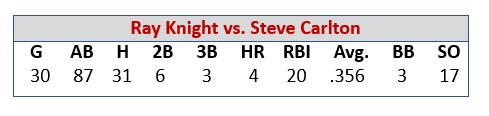


“GAME WON” … Setting the Stage and Bringing it to Life – Baseball Roundtable Book Review

GAME WON– How the Greatest Home Run Ever Hit Sparked the 1988 Dodgers to Game One Victory and an Improbable World Series Title


By Steven K. Wagner


Sunbury Press, Inc., 2021


$16.95

Available through Amazon.com and Sunbury Press


“I was sitting (in the Dodger bullpen) next to Jay Howell and Jesse Orosco, and when (Gibson) came out of the dugout, our reaction was, ‘What in the world is Tommy (Lasorda) doing? This doesn’t make any sense, because he can’t even stand up.’ As teammates, we did not think it was physically possible for him to take an at-bat.

“When we could tell that (Gibson had) hit a home run, Jesse lifted me high in the air, kind of bear-hugging me around my knees or thighs. He lifted me way above him and started running around the bullpen with me in his arms. I don’t know why he did that – I’d only known him for a month for goodness’ sake. I remember him carrying me around the bullpen and thinking we’re both going to fall on the ground and get hurt.  It was such a moment of elation, and he did the first thing that came to his mind: He picked me up  and carried me around”

                                                                                   Dodger Reliever Ricky Horton

This above quote from Dodger reliever Ricky Horton is from Steven K. Wagner’s latest baseball book – GAME WON – How the Greatest Home Run Ever Hit Sparked the 1988 Dodgers to Game One Victory and an Improbable World Series Title.   

In the book, Wagner puts the reader on the scene – and behind the scenes – for Kirk Gibson’s dramatic walk-off, two-run home run that gave the underdog Dodgers a 5-4 victory in Game One of the 1988 World Series (and set the tone for the Dodgers’ ultimate five-game Series win. Wagner makes a good case for Gibson’s long ball being one of the (if not the) most exciting in baseball history, right up there with Giant Bobby Thomson’s 1951 pennant-winning blast off Ralph Branca, Pirate Bill Mazeroski’s World Series-winning home run in 1960 and the 1975 World Series Game Six extra-inning home run that Carlton Fisk of the Red Sox “willed, waved and danced” fair.

If you’re a baseball fan, you remember the iconic six-minutes of baseball history fashioned by Oakland closer Dennis Eckersley and Dodgers’ hobbled pinch hitter Kirk Gibson.   Eckersley, a future Hall of Famer, came to the mound as 1988’s major-league saves leader and one of the game’s toughest relievers.  Gibson, the Dodgers’ 1988 offensive stalwart, came to the plate  not just off the bench, but off the trainer’s table, where  he had been nursing  (and icing down) a swollen right knee and a painful left hamstring.  Gibson made his way gingerly to the batter’s box, fought off visible pain in a grueling eight-pitch at-bat and finally took Eckersley deep (on a 3-2 count with two outs) for a game-winning, two-run homer – and then limped around the bases (in what would be his only at bat in the Series.)

In Game Won, Wagner deftly delivers all we’ve come to expect in a baseball book.  He takes us through the game inning-by- inning, even pitch-by-pitch – building to the big moment with prose that brings the reader into the ballpark.  For example, in setting the stage for a  Terry Steinbach at-bat against Dodger reliever Tim Leary, Wagner writes “As the Goodyear blimp floated listlessly overhead, Leary slowly made his way to the pitching mound. By then the sky was ink black, the tricky afternoon shadows that so often baffled hitters were gone, and the bright bank of stadium lights was fully operational as Steinbach stepped in to face the opposing pitcher.” Throughout  the book, Wagner displays his talent not only for setting the stage, but for bringing the stage to life.

In Game Won, Steven Wagner displays his ability to not just set the stage,

but bring the stage to life. 

Wagner also provides a look at the players involved. He delivers the baseball book staple – the stories and statistics that define how they got to this moment in their careers (and even a look at where the national pastime took them in the years after this moment).

But  Wagner takes his efforts a step further – giving us a look at some of the people behind the scenes who had an impact on Gibson’s on-field moment.  For example,  we get a look at the contributions of 24-year-old Dodger “batboy” and former college pitcher Mitch Poole (assigned primarily to the club house and trainers’ room that day) in helping Gibson get ready for his at-bat and making sure Dodger Manager Tommy Lasorda knew Gibson was determined to make the painful trip to the plate. How important was Poole’s role? Wagner’s book includes a chapter entitled “The Batboy.”

Wagner also gives us a look at how announcer Vin Scully’s eighth-inning on-air announcement that Kirk Gibson “will not see any action tonight, for sure” provided even more impetus for Gibson to get himself off the trainer’s table and up to the plate; as well as how advice from Dodger scout Mel Didier helped Gibson prepare for Eckersley’s final 3-2 offering.

Then there is, what for this reviewer is the crowning touch. Each chapter begins with observations pulled from interviews with fans who were in the stands for the game – just another way Wagner brings the game and its impact to life.

When he came into the on-deck circle, people started standing up and cheering. When he hit the home run, everyone went nuts.

“The second he hit it, I knew it was out because the whole  stadium erupted. Popcorn was flying. Food boxes were flying. Everything was flying around. I don’t think I was even looking at the field because everyone was jumping up and down and hugging. It was awesome being there.

“Afterward, we sat around for maybe a half hour and waited for people to leave.  When we got to the parking lot, people were screaming and going crazy – it wouldn’t end. “

                                                                                             Dodger Fan Brad Kuehfuss

As you can probably tell, I liked this book. It truly brings Gibson’s iconic home run – in fact, the whole game – to life. The detail provided shows the depth of Wagner’s research, as  do the acknowledgements to the literally dozens of players, coaches, managers, team executives and employees, and fans. This is a book that takes the reader beyond the statistics and deep into the story (and feel) of the game – and the emotions of all those who were on the field, in stands and behind the scenes.  I’d recommend it to fans, not just of the Dodgers, but of the national pastime itself. Well done, Mr. Wagner.

Steven K. Wagner has worked as a freelance journalist since 1989. He began his career with the Monmouth Sun-Enterprise in Oregon and worked for the Oregon City Enterprise-Courier and  Portland Daily Journal of Commerce before joining United Press International. He has also worked for the Portland Oregonian and has freelanced extensively for the Los Angeles Times, Oklahoma City Oklahoman, Seattle Times, Baseball America and numerous additional newspapers and magazines. Other books by Wagner include:

“Perfect: The Rise and Fall of John Paciorek, Baseball Greatest One-Game Wonder” (Breakaway Books)

“Seinsoth: The Rough-and-Tumble Life of a Dodger” (Sunbury Press)

“The Four Home Runs Club: Sluggers Who Achieved Baseball’s Rarest Feat” (Rowman & Littlefield)

___________________________________________________________

To scroll through additional Baseball Roundtable book review, click on “Reviews” at the top of the page. 


——An Interview with Steven K. Wagner, author of Game Won.——

What made you decide to include fan comments, and how did you find the fans? Is there any one thought/emotion they all seemed to share?

I wanted a unique lead-in to each chapter, and adding recollections from those who were at the game seemed like a fun and interesting way to do it. I found the fans through friends of mine and Facebook. And, of course, my brother and his son were at the game. A common thread winding through each series of quotes was how thunderous the cheering was perceived after Gibson’s home run, almost shaking Dodger Stadium to its foundation. And, of course, nearly everyone remained inside the stadium for as long as they needed to.

What made this game special for you (special enough to tackle a book on it)?

The game was special because, in my mind, Gibson’s home run was bigger than Bobby Thomson’s. I argue in the book that given the significance of Gibson’s injuries and the fact that he was batting against a nearly unhittable pitcher and a future Hall of Famer made it the greatest home run in baseball history. Bigger than Thomson’s, which didn’t occur in a World Series game.

What spurred your interest in/love of the national pastime? How long have you been a fan?

I’ve been a baseball fan, specifically a Dodger fan, since the 1950s, when my dad took my brother and me to watch them play at the old Los Angeles Memorial Coliseum. More than 60 years, I suppose. I recall carving a square out of a book, placing my transistor radio inside the hole, taking the book to school and listening to the 1963 World Series with my head on the cover. My grades probably suffered, but the risk was worth it.

Do you recall your first baseball game you attended (as a fan)?

My first game was at the Coliseum in Los Angeles, Milwaukee Braves vs. the Dodgers, probably 1959. I remember that Hank Aaron broke a bat and my brother and I walked down to the Braves’ dugout and begged the batboy for the bat. He refused and we left disappointed. I don’t think I’ve cheered for the Braves since.

Do you have a favorite player? Favorite baseball moment?

I always liked Don Drysdale for his intensity. He threw hard, and if he wanted to intimate a batter,  he flattened him. That usually made his point. Drysdale’s and later on Orel Hershiser’s consecutive scoreless innings streaks have to be favorite baseball moments of mine, if you can call them moments, because those feats are so difficult.

200 Wins Without a 20-Win Season …. and a Statistical Rabbit Hole

In this blog, I’ve often written about how, when I  start delving into a hardball topic, “one thing leads to another.”  The main topic of this post was to be “Pitchers with the Most Career Wins Without a Twenty-Victory Season.” Well, as usual, on thing led to another, so I thought I’d give you a brief look at how I get pulled down the statistical rabbit hole.

Once I started looking into pitchers with the most wins without a twenty-win season, I was drawn into the topic of the pitchers with the most twenty-seasons.  On that front, I came up with the list below.


Cy Young – MLB’s winningest pitcher.

Now, I always try to verify stats and info I use in Baseball Roundtable from multiple sources.  And, that’s where I found an intriguing rabbit hole.  At the top of the  list is Cy Young, with 15 seasons of twenty or more victories.  However, I found some disagreement on that figure. While MLB.com, Baseball-Almanac.com, the Society for American Baseball Research (Cy Young by Bill Nowlin and David Southwick) and my most recent print version of The ESPN Baseball Encyclopedia all credit Young with 15 seasons of twenty or more wins, Baseball-Reference.com, the Baseball Hall of Fame’s Cy Young page and the 2021 Edition of the Elias Book of Baseball Records credit Young with 16 such seasons. That, of course, threw me off a bit – especially since the sources all agreed on Young’s 511 career wins.  So, deeper in the rabbit hole I went.  It turns out, those sources citing 15 seasons of 20 or more wins, credit Young with going 19-19 for the 1900 Cardinals, while those reporting 16 such seasons reported Young’s 1900 record as 20-18. That still didn’t explain how they all came to a total of 511 career wins.  So, deeper I went.  It turns out that 15-season cadre reported Young’s 1893 record at 34-16, while the 16-season cadre list Young’s 1893 won-lost total as 33-16.  Notably, if you check out Baseball-Reference.com, you will see Cy Young’s career record at 511-315, while MLB.com  list 511-316. Tough call on what to use in my chart, but (as a SABR member) I leaned toward the 15-season record.  Now, I have some more digging to do to see if I can resolve the discrepancies.  Fortunately, whichever measure you use, Young still holds the record for most twenty-win seasons.

Now, let’s get on with a look at the 20-win season leaders – and then the pitchers with the most career wins without a 20-win season.

Note:  When listing a pitcher’s age, it is their age as of June 30th of the season referenced.

Cy Young – 15 (maybe 16) Seasons of 20 or more Wins

Cy Young notched 511 wins and 315 losses (both MLB career records) in 22 MLB seasons (1890-1911). Young had his first 20-win season (at age 24) for the NL Cleveland Spiders (27-22, 2.85) and his final twenty-win campaign at age 41 for the 1908 Boston Red Sox (21-11, 1.26). He led is league in wins five times and recorded five seasons of 30 or more wins. Now, it you side with those who report that Young had 16 (as opposed to 15) 20-win seasons, he also ran off a record 14 straight seasons of twenty or more wins.  However, if you accept the  15 twenty-win season position, that record goes to the next hurler on this list – Christy Mathewson with 12 consecutive seasons of twenty or more wins.

Seeing the Job Through

Cy Young completed 749 of 815 MLB starts (91.9 percent). He threw forty or more complete games in nine seasons.

Christy Mathewson – 13 seasons of  Twenty or More Wins

Christy Mathewson put up a 373-188 record (with a 2.13 ERA) in 17 MLB seasons (1900-1916). His first twenty-win campaign came in his age-20 season – for the New York Giants (20-17). His final twenty-win campaign came in 1914 (age 33) also for the Giants (24-13.).  Mathewson had four seasons of 30 or more wins and 12 consecutive seasons of at least twenty victories.  From 1903 through 1905, he won at least 30 games in three consecutive seasons – going 94-34, 1.87. In his career, he led the NL in wins four times, ERA five times and strikeouts five times.  In the 1905 World Series, Mathewson threw three complete-game shutouts in three starts (over six days), allowing only 14 base runners (13 hits/one walk) in 27 innings.

One Final Tripe to the Mound

Christy Mathewson pitched in a total of 636 MLB games – in all but his final game, he wore a Giants’ uniform. On July 20, 1916, Mathewson (on the downside of his playing career and having voiced a desire to manage) was traded to the Reds, where he replaced Buck Herzog as manager.  He did take the mound one time for the Reds (September 4), picking up his final MLB win (a complete game in which he gave up 15 hits and eight runs), as the Reds topped the Cubs 10-8.

Warren Spahn – 13 Season of Twenty or More Wins

Warren Spahn went 363-245, 3.09 in 21 MLB seasons (1942, 1946-1965).  He would have put up even more impressive numbers if he hadn’t lost three prime years (1943-45) to military service.  His first twenty-win campaign came for the Braves in 1947 (at age 26), when he went 21-10, with a league-low 2.33 ERA.  His final twenty-win campaign was also for the Braves – 23-7, 2.60 in 1963 (at age 42.).  He was an All Star in 14 seasons. In eight of his 13 20-win season, he won 21 games.

Can’t Touch That

Warren Spahn led his league in wins an MLB record-tying eight times (tied with the Negro Leagues’ Ray Brown) – including five consecutive seasons from 1957 through 1961. 

Walter Johnson – 12 Seasons of Twenty or More Wins

Walter Johnson  pitched 21 MLB seasons (1907-27) – all for the Washington Senators. His 417 wins (279 losses) included two seasons of 30 or more wins –  a high of 36 in 1913, when he led the league in wins, winning percentage (.837), ERA (1.14), complete games (29), shutouts (11) and strikeouts (243). He had his first twenty-win season in 1910 at age 22 (25-17); and his final twenty-win season (20-7) in 1925 (age 37). Johnson led his league in strikeouts a record 12 times, including eight consecutive seasons (1912-19).

King of the Shutout

Walter Johnson’s 110 career-regular season shutouts are an MLB career record, as are his seven Opening Day shutouts and his seven seasons leading the league in shutouts (tied with Grover Cleveland Alexander and Cy Young).

Kid Nichols – Eleven Seasons of Twenty or More Wins

Kid Nichols played 15 MLB seasons (1890-1901, 1904-06), winning twenty or more games  in eleven seasons. He won thirty or more games in seven seasons (including four consecutively from 1891 through 1895). In the eight seasons from 1891 through 1898, he averaged 31 wins per campaign. He ultimately racked up a 362-208, 2.96 record.  His first twenty-win season (27-19) came at age 20 for the 1890 NL Boston Beaneaters.  His  final twenty-win season came in 1904 (age 34) for the Saint Louis Cardinals (21-13).  Nichols led the NL in wins in three consecutive seasons (1896-98). He also led the league in shutouts four times.

I Got This

In three seasons, Kid Nichols completed every game he started – 47 starts in 1890; 43 in 1895; 37 in 1899. Over his career, he completed 532 of 652 starts (94.7 percent). 

_____________________________________________________________________

Staying Power

Don Sutton had the fewest 20-win season of any pitcher with 300 MLB victories,  He won twenty games in a season just once (21-10, 3.06 for the 1976 Dodgers)  in his 23-season career (1966-88), he won 15 or more games 12 times and ten or more 21 times.

_______________________________________________________________________

—-Most Career Wins Without a Twenty-Win Season—–

Now a look at the pitchers who racked up the most career wins, without ever winning twenty games.

Dennis Martinez – 245 Wins

Dennis Martinez pitched in 23 MLB seasons (1976-98.) The four-time All Star, went 245-193, 3.70. He never won more than 16 games in a season, reaching that high mark four times.  He did lead the American League in wins in the strike-shortened 1981 seasons (14-5 for the Orioles. He won ten or more games in 15 seasons.

Whew! That was close.

Photo by Keith Allison

Mike Mussina nearly toppled Dennis Martinez from the top of the list for career wins without a twenty-win season. Going into the 2008 season (Mussina’s last), Mussina was 250-144 – without a twenty-win campaign on his resume (he had led the AL with 19 wins in 1995).  On September 28 of that season, he took the mound for his last MLB start with a 269-153 career record and a 19-9 record on the season (269 wins, with no twenty-win season).   In that final career start, he threw six shutout innings, got the win (his 20th of the season) and disqualified himself from this list.

Frank Tanana – 240 Wins

Frank Tanana started out as a fire-balling (mid-to-high 90’s fastball) workhorse  (lots of innings, strikeouts and complete games). In the late 1970’s, that workload took its toll (elbow and shoulder issues) and Tanana transformed himself into a finesse pitcher – with a skill set that kept him in the big leagues until 1993 (21 seasons). Despite that long career, Tanana, Baseball Roundtable believes, tends to be considerably underrated.   For example, among southpaws, his 240 MLB wins are the 15th most all time; his 2,773 strikeouts rank fifth among lefties; his 4,188 1/3 innings pitched are seventh; and his 616 games started seventh.  His final MLB line was 240-236, 3.66. He won 15 or more games in six seasons; ten or more in 14.

Tanana, a three-time All Star,  while never having a twenty-win season did win 19 games once (1976 Angels … 19-10, 2.43). That season, he took four losses in complete games in which he gave up no more than two runs.

He Deserved better

Detractors point to Frank Tanana’s 240-236 won-loss record, but Tanana spent much of his career pitching for teams that didn’t exactly excel at providing him run support.  Consider, for example, that from April 29 through July 3, 1977, Tanana threw fourteen consecutive complete games for the Angels.  In those contests, he tossed five shutouts, never gave up more than three runs and put up a 1.36 earned run average. This work earned him just nine wins versus five losses.

Jerry Reuss – 220 Wins

Jerry Reuss pitched in 22 MLB seasons (1969-90), going 220-191, 3.64. He was a two-time All Star and won a career-high 18 games in three seasons (and won 15 or more games in five campaigns and ten or more in 12).   His best season was 1980, when he went 18-6, 2.51 for the Dodgers, led the NL with six shutouts and finished second in the NL Cy Young Award voting to Steve Carlton.  Reuss pitched for eight different MLB teams.

So close!

On June 27, 1989, Jerry Reuss started for the Dodgers against the Giants and Vida Blue in San Francisco. The third batter of the game, Giants’ RF Jack Clark, was safe on an error by Dodgers’ SS Bill Russell. Clark would be the only batter to reach base that day, as Reuss pitched a no-hitter (two strikeouts) and missed a perfect game by that one miscue. The Dodgers, by the way, won 8-0.

Kenny Rogers – 219 Wins- LHP

Kenny Rogers went 219-156, 4.27 in 20 MLB seasons (1989-2008). He won a career-high 18 games (18-9, 4.76) for the 2004 Rangers, making just his second All Star team (at age 39). Rogers won 15 or more games in five  seasons and ten or more in fourteen. On July 28, 1994, Rogers threw a perfect game against the Angels (in Texas) – fanning eight. Notably, Rogers started his MLB career as a reliever – appearing in an average of 71.5 games per season from 1989  through 1992.  In 1992, the year before the Rangers converted him to a starter (33 starts in 1993), Rogers led the AL in appearances with 81.

Maturing Very Well

Kenny Rogers made his first All Star team in 1995 (his age-30 season) and didn’t make the All Star Squad again until his age-39 season (2004) – when he began of string of three straight All Star selections.  From his age-39 through his age 41 season, Rogers went 49-25, 4.04 – the moist productive three-season span in his career.

Zack Greinke – 218 Wins – RHP

Zack Greinke, the only active pitcher on this list, is in his 18th MLB season.  His record (as of this writing) is 218-129, 3.38. The six-time All Star, six-time Gold Glover and 2009 AL Cy Young Award winner won a career-high 19 games for the Dodgers in 2015 (when he also led the NL with a 1.66 earned run average). He has won 15 or more games in nine seasons, ten or more in 13.

Almost Dodged this Bullet

In his 19-win 2015 season, Greinke got a no-decision or a loss in eight games in which he pitched at least six innings and gave up no more than one earned run.

Charlie Hough – 216 Wins

Knuckleballer Charlie Hough had to work long (25 seasons … 1970-94) to make this list – at least partly because he spent his first 12 seasons primarily as a reliever (438 games, just 23 starts). He finished his career at 216-216, 3.75, with 61 saves. He was 174-173, 3.82 as a starter and 42-43, 3.45 out of the bullpen. Hough won a career-high 18 games in 1987 (18-13, 3.78) for the Rangers. He won 15 or more games six times and ten or more ten times.

Something Old, Something New

Forty-five-year-old Charlie Charlie Hough started the first regular-season game of the new Marlins’ franchise on April 5, 1993.  He went six innings (three earned runs) to earn the team’s first regular season victory and record the Marlins’ first-ever strikeout, fanning Dodgers’  leader off bitter Jose Offerman on three pitches in the top of the first inning.

Mark Buehrle – 214 Wins

Mark Buehrle won 214 games (160 losses) in 16 MLB seasons (2000-15) – winning a career high 19 in 2002 (19-12, 3.58 for the White Sox). He won 15 or more games six times and ten or more in all but his first season (when he made his MLB debut in mid-July). He was a five-time All Star and four-time Gold Glover.

If You’re Not Perfect – Keep Trying

On April 18, 2007, Mark Buehrle pitched a no-hitter (for the White Sox) against the Rangers (in Chicago). He came about as close to perfection as you can get – allowing just one base runner (a walk to Sammy Sosa, whom he promptly picked off first). Thus, he faced the minimum 27 batters in his eight-whiff masterpiece.    On  July 23, 2009, he did himself one better, tossing a perfect game against the Rays (again for the White Sox, again in Chicago). In that one he fanned six.

Milt Pappas – 209 Wins

Milt Pappas went 209-164, 3.40 in 17 MLB seasons (1957-73). Notably he reached a career-high 17 wins in two of his final three campaigns – both for the Cubs (17-14 in 1971 and 17-7 in 1972). He won 15  or more games in seven seasons and 10 or more in 14. He was an All Star in two seasons.

Another NO-NO one this List

On September 2, 1972, Milt Paper no-hit the Padres (8-0) for the Cubs (in Chicago). He walked one a and fanned six in the game.

Chuck Finley – 200 Wins

Chuck Finley  went 200-173, 3.85 in 17 MLB seasons (1986-2002). He won a career-high 18 games in both the 1990 and 1991 seasons – going 18-9 both times. Finley won 15 or more games in seven seasons and ten or more in 12.

I’ll Have One More, Please

Chuck Finley is the only MLB pitcher to have three four-strikeout innings in his career.

Tim Wakefield – 200 Wins

Knuckleballer Tim Wakefield played 19 MLB seasons (1992-93, 1995-2011), going 200-180, 4.41.  He won a career-high 17 games in two seasons (1998, 2007). The one-time All Star  won 15 or more games in four times and ten or more 11 times.  Wakefield reached 200 career wins despite never having a 20-win season and having an ERA under 4.50 in only eight of 19 campaigns. His best season was 1995, when he went 16-8, 2.95 for the Red Sox and finished third in the AL Cy Young Award balloting. He made his first All Star team at age 42, in his 17th season (2009). That season, he was 11-3, 4.31 in the first half – before injury (lower back straing)  limited  him to just four starts (0-2, 6.00 in the second half).

1992 NLCS

In the 1992 National League Championship series, Wakefield started Games Three and Six for the Pirates (versus the Braves) and pitched a pair of complete-game victories – giving up six runs in 18 innings.   The Pirates, however, lost the Series four games-to-three.

Primary Resrouces: Baseball-Reference,com; Baseball-Almanac.com


BASEBALL ROUNDTABLE ON THE TOP 100 BASEBALL BLOG LIST

100Baseball Roundtable is on the Feedspot list of the Top 100 Baseball Blogs.  To see the full list, click here.

I tweet baseball @DavidBBRT

Follow/Like Baseball Roundtable’s Facebook Page here.  More baseball commentary; blog post notifications; PRIZES.

Member: Society for American Baseball Research (SABR); The Baseball Reliquary; The Negro Leagues Baseball Museum.
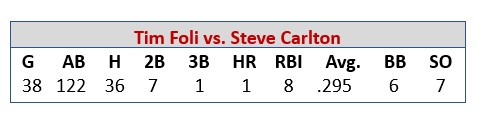


Baseball Roundtable July Wrap – Stories, Stats, Standings and More

It’s August 1, and that means it’s time for Baseball Roundtable’s s July Wrap Up – a look at July statistics and stories that caught BB Roundtable’s eye; leader boards for the month and Year-to-Date: BBRT’s Players and Pitchers of the Month; the monthly Trot Index.

Here’s a hint at the kind of things you’ll read about – if you make it to the end of this post.

  • A pitcher launching a Grand Slam homer for his first MLB hit:
  • A “Cycle” and an “Immaculate Inning” – not in the same game.
  • A new record for wild pitches in an extra inning.
  • A veteran player going yard in seven straight games.
  • A team out-homering the opposition 7-0 – and still losing.
  • The first-ever play to hit his first, second and third MLB home runs in the same game.
  • Despite the DH, the eight lowest team batting averages for July being posted by AL teams.
  • The Yankees, uncharacteristically last in July home runs, but first in stolen bases.

For all this and more, read on.

Baseball Roundtable Pitchers and Players of the Month – July 2021

National League Player of the Month – Joey Votto, 1B, Reds

Photo: Erik Drost, CC BY 2.0 <https://creativecommons.org/licenses/by/2.0>, via Wikimedia Commons

Reds’ 1B Joey Vott0 put up a .326-11-25 month, leading MLB in home runs and tying for the National League in RBI. The 37-year-old,  six-time All Star finished especially  strong – in seven games from July 24 through July 30, he hit .485, with 10 runs scored and  15 RBI.  He also homered in all seven games (eight homers in all) – one game short of the MLB record for consecutive games with a home run. He failed to go deep on July 31. His slugging percentage during the hot streak was a lofty 1.423.

Honorable Mentions: A pair of third baseman also deserved consideration. The Padres’ Manny Machado went .360-8-25, tying for the NL’s most RBI in the month.  Machado’s 24 July runs scored also led MLB. Machado hit safely in 20 of 24 games played in July, with nine multi-hit contests.  Braves’ 3B Austin Riley also had a solid month at .312-9-25, tying for the NL lead in RBI and finishing behind only Votto and the Mets’ Pete Alonso in home runs. The 24-year-old ended the month on a ten-game hitting streak. Finally, a shout out to Braves’ veteran 1B Freddie Freeman, whose .374 July average (six homers, 15 RBI) led all National Leaguers with at least 75 July at bats.

National League Pitcher of the Month – Walker Buehler, Dodgers

Walker Buehler went 3-0 in five July starts, pitching to a 1.67 earned run average and fanning 38 batters, while walking just nine (in 32 1/3 innings. Buehler’s ERA was the second-lowest  among NL pitchers with at least 20 July innings. His final two July starts were against the rival Giants. In those two key games, Walker gave up just one run in 14 1/3 innings, fanning 17 and earning one win (one no decision). Buehler finished July with an 11-1, 2.19 record on the season.

Honorable Mentions: The Brewers’ Corbin Burnes earned a look with a 3-0 July record, a 2.30 ERA and 37 strikeouts (just six walks) in 31 1/3 innings; as did the Reds’ Luis Castillo (2-0, 2.15 in six starts, with 41 strikeouts in 37 2/3 frames.  I also have to put in a word for Mets’ rookie Tylor Megill, who seems to have taken up Jacob deGrom’s role as the NL’s hard-luck pitcher. Megill’s 1.04 July ERA was the lowest among MLB pitchers with at least 20 July innings, but he got only one win (no losses) for his efforts.  In five starts, he never gave up more than one run and fanned 27 batters (seven walks) in 26 innings.

American League Player of the Month – Shohei Ohtani, P/DH, Angels

Photo: Scott U, CC BY-SA 2.0 <https://creativecommons.org/licenses/by-sa/2.0>, via Wikimedia Commons

Ohtani started July off on a roll. On July 2, batting second against the Orioles, he went two-for-four with two home runs, three runs scored, three RBI and one walk. Four days  later, he pitched seven innings of five-hit, two-run ball to earn a win over the Red Sox.  Really, what can you say about a player who tops his league in July home runs (9 – tied) and finishes in the AL July top ten in the league in RBI (19), runs scored (17) and stolen bases (4) – and also puts up a 2-0. 1.35 record, in three starts.  Ohtani hit safely in 17 of 23 games played in July. While Ohtani’s .278 July batting average wasn’t flashy, pretty much everything else he did was.

Honorable Mentions:  Twins’ 2B Jorge Polanco had an all-around solid month at .327-6-20 and his 34 hits in 26 July games were second only to the month’s other Honorable Mention – Angels’ 2B David Fletcher. Fletcher’s 37 hits (in 24 games) were the most for any MLB player in July. His July stat line was .349-2-14.

American League Pitcher of the Month – Jameson Taillon, Yankees

Taillon was one of only two pitchers to log four wins in July – going 4-0, 1.16 for the Yankees in five starts  His ERA was the third-lowed among MLB pitchers with at least 20 July innings. Taillon’s July came as a bit a surprise, he came into the month with a 3-4, 4.93 record. In five July starts he gave up just four earned runs  in 31 innings, holding hitters to a .182 average.

Honorable Mentions: Lance Lynn continued his solid year for the White Sox – going 3-1, 2.10 in five July starts. Matt Harvey deserves mention for going 3-1, 2.45 in four starts for the struggling Orioles. After giving up six earned runs in his first start of the month, Harvey threw 18 1/3 scoreless frames in his next three starts. The Angels’ Alex Cobb went 2-0, 1.09 in four July starts (although his opponents were the Orioles, Twins and Mariners.)

Surprise Player of the Month – Eric Haase, C, Tigers

Eric Haase (who still has rookie status) came into the 2012 season with a .122 average (one home run, six RBI) in 26 MLB games over three seasons.  He showed a bit of what he is capable of by going .234-9-15 through June of this season.  Then, in July, he surprised a lot of people, Baseball Roundtable included. He started the month with a three-hit, two-homer, six-RBI game on July 3 (against the division-leading White Sox). He went on to lead  MLB in July RBI with 29 (in just 23 games) and tie for the most July homers  in the AL (9).  His hit .265 for the month and scored 17 runs.

____________________________________________

TROT INDEX … A REGULAR BBRT FEATURE

Through July 2021, 36.9 percent of the MLB season’s 116,948 plate appearances ended in a trot (back to the dugout, around the bases, to first base). We’re talking about strikeouts, home runs, walks, hit by pitch and catcher’s interference – all outcomes that are, basically, devoid of action on the base paths or in the field. Here’s the breakout: strikeouts (23.6%); walks (8.8%); home runs (3.2%); HBP (1.2%); catcher’s interference (less than 1%). Personally, I’d like more action in the field of play.

__________________________________

If the season ended July 31, your post-season teams would be:

National League: Mets; Brewers; Giants. Wild Cards: Dodgers, Padres.

American League: Rays; White Sox; Astros.  Wild Cards: Red Sox, A’s.

The Rays and Astros had the best record in July, both at 16-8.  The Rays moved from three games behind the Red Sox in the AL East at the end of June to 1/2-game lead; while the Astros extended their lead in the West from a slim 1/2-game over the A’s to 5 1/2.  The Rays played solid all-around ball, scoring the third-most July runs in the AL and putting up the second-best team ERA – despite having only one player with more than 15 RBI and  no starter with more than two July wins.  The Astros had the AL’s fifth-best ERA and fifth-most runs scored. Key contributors were 2B Jose Altuve (.260-8-22, with 21 runs scored); RF Kyle Tucker (.291-7-17); starter Lance McCullers (3-1, 3.86) and Ryan Pressly (six saves in six opportunities).

Over in the NL, the Reds made a big splash with a 16-10 record, while the Giants were at 15-10. The Reds jumped from fourth place in the Central to second (slipping by the Cardinals and Cubs).  They still, however, trail the Brewers (who went 14-10 for the month) by seven games. The Reds success may be a little more surprising, as they had the NL ‘s sixth-best ERA  and eighth-most runs scored. However, they had the NL’s leading home run hitter (11)  and RBI guy (25 ) in Joey Votto; got a nice .319-4-12. 20-run month from 2B Jonathon India – and got a 2-0, 2.15 month from Luis Castillo; 2-0, 2.51 from Wade Miley and seven saves from Heath Embree. The Giants’ 120 runs scored were in the middle of the NL pack, but their 3.38 ERA trailed only the Dodgers (3.2) and Brewers (3.33).Jake McGee gave the Giants seven saves and a 0.00 ERA for the month, while Alex Wood went 3-0, 3.62.

——Team Statistical Leaders For  July———

RUNS SCORED

National League – Dodgers (145); Nationals (135); Phillies (130)

American League – Tigers (147); White Sox (133); Rays (131)

No one scored fewer runs in July than the Rangers, who plated just 76 tallies.

AVERAGE

National League – Nationals (.275); Mets (.265); Dodgers(.263)

American League – Tigers (.264); Blue Jays (.261); Angels (.258)

The lowest July team average belonged to the Rangers at .198. Lowest in the NL were the Rockies at .240.

Notably, the eight lowest July averages were posted by American League teams.

HOME RUNS

National League – Dodgers (42); Phillies (40); Mets (38); Phillies (38)

American League –  Blue Jays (40); Tigers (37); Twins (37)

The Yankees had July’s fewest long balls at 23 – welcome Joey Gallo.

STOLEN BASES

National League –  Marlins (24); Padres (17); Brewers (17)

American League – Yankees (18); Indians (15); A’s (14)

The  Red Sox stole the fewest bases in July – just two (in six attempts).

WALKS DRAWN

National League –  Phillies (111; Brewers (97); Giants (95)

American League – Twins (95); Yankees (92); Mariners (89)

The Brewers led MLB in July on-base percentage at .349.  The Blue Jays led I slugging percentage at .476.

BATTER’S STRIKEOUTS

National League – Reds (248); Marlins (237); Dodgers (235)

American League – Indians (2227); Twins (22); Mariners (.222)

Blue Jays’ batters fanned the fewest times in July – 167.

EARNED RUN AVERAGE

National League –  Brewers (2.56); Dodgers (3.30); Braves (3.59)

American League – A’s (2.98); Rays (3.58); Angels (3.75)

Eight teams had ERA’s over 5.00 in July: Nationals (5.94); Pirates (5.65); Orioles (5.35); Diamondbacks (5.31); Rangers (5.29); Indians (5.25); Phillies (5.13); Royals (5.02); Of these, only the Phillies posted a winning record for the month – at 14-12.

STRIKEOUTS

National League – Reds (237); Mets (235); Dodgers (233)

American League – White Sox (254); Astros (235); Yankees (235)

The Yankees  had the highest strikeouts per nine innings in June  at 10.68. The Giants  led the NL at 9.41.  Thirteen teams averaged more than a strikeout per inning for the month.

SAVES

National League – Reds (10); Giants (9); Mets (8)

American League – Red  Sox (8); Mariners (8); five with seven

The Brewers, despite racking up 14 wins in July, had just one save in six opportunities.

________________________________________________

——-Individual Statistical Leaders for July ——–

AVERAGE (75 June  at bats minimum)

National League – Kyle Farmer. Reds (.395); Freddie Freeman, Braves (.375); Manny Machado (.360)

American League –  David Fletcher, Angels (.349); Bo Bichette,  Blue Jays (.337); Jorge Polanco , Twins (.327)

The lowest July  average (among players with at least 75 at bats) belonged to the Phillies’ SS Didi Gregorius and Twins’ SS Andrelton Simmons, who each went 13-for-80 (.163).

HOME RUNS

National League – Joey Votto, Reds (11); Pete Alonso, Mets  (10); Austin Riley, Braves (9); Juan Soto, Nationals (9)

American League –  Franmil Reyes, Indians (9); Shohei Ohtani, Angels (9); Eric Haase, Tigers (9)

Mariners’ SS J.P.Crawford had the most July at bats without a home run (101).

RUNS BATTED IN

National League – Austin Riley. Braves  (25); Joey Votto, Reds  (25); Manny Machado, Padres (25)

American League – Eric Haase, Tigers (29); Jose Abreu, White Sox (23); Jose Altuve, Astros (22); Austin Meadows, Rays (22); Franmil Reyes, Indians (22)

Reds’ 1B Joey Votto led all players (with at least 75 July at bats) in slugging percentage at .734.

HITS

National League – Freddie Freeman, Braves  (36);  Chris Taylor, Dodgers (33); Kyle Farmer, Reds (32);  Juan Soto, Nationals (32)

American League – David Fletcher, Angels (37);  Jose Polanco, Twins (34); Tim Anderson, White Sox (32)

DOUBLES

National League –  Bryce Harper, Phillies (11); Rhys Hoskins, Phillies (11); Josh Harrison,, Nationals* (11)     *Harrison is now with the A’s.

American League: Jeimer Candelario, Tigers (10); Time Anderson, White Sox (9); five with eight.

TRIPLES

National League – Jake Cronenworth, Padres (3); David Peralta, D-backs (2); Tyrone Taylor, Brewers (2); Josh Harrison, Nationals* (2)    *Harrison is now with the A’s.

American League – Wander Franco, Rays (3); Will Castro, Tigers (2); Nicky Lopez, Royals (2); Francisco, Mejia, Rays (2)

Nationals’ RF Juan Soto had the highest on-base percentage among players with at least 75 July at bats at .487. In addition to his 32 hits (.356 average), he drew 24 walks (versus only 15 strikeouts).

STOLEN BASES

National League –  Starling Marte, Marlins* (10); Raimel Tapia, Rockies (8); Fernando Tatis, Jr. Padres (7)  *Marte is now with the A’s.

American League – Myles Straw, Indians (5); Whit Merrifield, Royals (5); Gleyber Torres, Yankees (5); Greg Allen, Yankees (5). Jose Ramirez, Indians (5)

Starling Marte led MLB with 11 July steals, ten with the Marlins and one with the A’s. (Marte was traded to the A’s on July 28).

WALKS

National League – Juan Soto, Nationals (23); Brandon Nimmo, Mets (20); Joey Votto, Reds (19)

American League – Robbie Grossman, Tigers (22); Josh Donaldson, Twins (18); Shohei Ohtani, Angels (15)

BATTER’S STRIKEOUTS

National League – Brandon Nimmo, Mets (32); Patrick Wisdom, Cubs (30); Chris Taylor, Dodgers (29); Eugenio Suarez, Reds (29)

American League – Trevor Larnach (41); Shohei Ohtani, Angels  (37); Bobby Bradley, Indians (34); Matt Chapman, A’s (34)

PITCHING VICTORIES

National League – Kim Hyun-Kim, Cardinals (4-1); 11 with three

American League – Jameson Taillon, Yankees (4-0); 11 with three

The Rangers’ Kolby Allard, was the only pitcher to pick up five July losses (0-5, 9.13 in five starts.

EARNED RUN AVERAGE (at least 20 July innings pitched)

National League – Tyler Megill, Mets (1.04); Walker Buehler, Dodgers (1.67); Adrian Houser, Brewers (2.05)

American League – Alex Cobb, Angels (1.09); Jameson Taillon, Yankees (1.16); Shohei Ohtani, Angels (1.35)

STRIKEOUTS

National League – Luis Castillo, Reds (41 / 37 2/3 IP); German Marquez, Rockies (40 / 31 1/3); Walker Buehler, Dodgers  (38 / 32 1/3 IP)

American League – Gerrit Cole, Yankees (47 / 28 2/3 IP); Lance McCullers, Astros (42 / 30 1/3 IP); Patrick Sandoval, Angels (41 / 33 1/3 IP). Sean Manaea, A’s (41 / 30 IP).

SAVES

National League – Heath Embree, Reds (7); Mark Melancon, Padres (7); Jake McGee Giants (7)

American League: Raisel Iglesias, Angels (6); Ryan Pressly, Astros (6); four with five.

—-Some July Highlight—–

DH … We Don’t Need to Stinkin’ DH!

On July 4, the Braves went into the tenth inning of their game against the Marlins with a depleted bench. After the Marlins failed to score in the top of the inning, The Braves started their half with Austin Riley placed (ugh) at second base. The Marlins intentionally walked SS Dansby Swanson to put runners on first and second (setting up a double play?). CF Guillermo Heredia then hit a fly to deep right, with Riley going to third after the catch.  LF  Orlando Arcia was walked – loading the bases. Riley was then retired (C-P) trying to score on an errant pitch – with Swanson moving to third base (runners now on first and third with one out). C Kevan Smith was intentionally walked to load the bases and bring up the pitcher’s (Will Smith) spot.  The Braves brought pitcher Max Fried in to pinch hit -and he delivered a walk-off, RBI single.  (And he had more in store for the month).

On July 17, Braves’ southpaw Fried threw seven shutout innings (four hits, one walk, seven strikeouts) as Atlanta topped Tampa Bay 9-0. Fried also sparkled at the plate – going three-for-three, with one double, two runs scored and two RBI. As July closed, Fried as 7-7. 4.32 on the mound and .290-0-5 at the plate for the season.

Green Celebrates Independence Day with an Immaculate Inning

On July 4, the Yankees and Mets faced off in an  all-New York  day/night double header at Yankee Stadium. The Mets took Game One 10-5. In the night cap, the Yankees were up 3-2 after four (of the slated seven) frames.  In the top of the fifth, the  Yankees brought in Chad Green to hold the Mets at bay – and he did it with flash. He retired the side in order  on 13 pitches (including two strikeouts) in the fifth – and the Yankees tied it up in the bottom of the inning.  Green used another 13 pitches to complete a 1-2-3 sixth (with one more whiff).  Then, he topped it all off with an “Immaculate Inning” in the seventh.  Nine pitches, three strikeouts . Stats, Inc. reported that Green was the first pitcher in the Modern Era (since 1900) to pitch three 1-2-3 innings, fan six batters AND thrown an immaculate inning in the same game (more of #InBaseballWeCountEverything). Green’s was MLB’s 104th Immaculate Inning.

Only seven pitchers have thrown multiple Immaculate Innings: Sandy Koufax; Randy Johnson; Max Scherzer; Chris Sale; Nolan Ryan; Lefty Grove; Kevin Gausman. Only Koufax has three such innings.

Pujols Becomes the Fourth on the Fifth

On July 5, as the Marlins topped the Dodgers 5-4, Albert Pujols popped an eighth-inning single to center (off Zach Pop), which made Pujols just the fourth MLB player to accumulate 6,000 or more total bases in his career.  The others? Not a bad group:  Henry Aaron (6,856); Stan Musial (6,134); Willie Mays (6,080).  Pujols ended July with 6,014 total bases. He was also 13th on the all-time hits list, fifth in home runs (675) and third in RBI (2,138).

DH? Why?

On July 8, Padres’ reliever Daniel Camarena was called on to pitch in the top of the  fourth inning, with his squad down  6-0 t0 Nationals’ (now Dodgers’) ace Max Scherzer. In his first inning of work, Camarena gave up a two-run homer to  Nationals’ (now Dodgers’) Trea Turner, extending the LA lead to 8-0. In the bottom of the frame, a Fernando Tatis, Jr. home run and a Will Myers’ bases-loaded walk (following a single and two hit batters) set up a bases-loaded plate appearance for Camarena.  For whatever reason (saving the bullpen, perhaps), manager Jayce Tingler let Camarena bat and he delivered a Grand Slam home run (off a Scherzer 96-mph fastball)  for his first MLB hit (in his second MLB plate appearance). It proved to be a pretty big hit, as the Padres came back to win 9-8. (Camarena pitched a 1-2-3 fifth before being replaced on the mound in the top of the sixth.) Camarena, by the  way, is just the second MLB pitcher to hit a Grand Slam for his first hit in the “show.”

A Couple Dozen Runs Ought to Do it.

On July 16, as the Padres pounded the Nationals 24-8, Padres’ 2B Jake Cronenworth completed the second cycle (single, double, triple, homer in one game) of the 2021 season.  (The first went to the Nationals’ Trea Turner on June 30). After lining out in the first inning, Cronenworth doubled home two-runs in the second; hit an RBI triple in the third; added a solo home run in the fifth; and collected the needed single in the sixth.

Give Him the Yellow Jersey

No one ever completed an MLB cycle faster than Rockies’ 2B Mike Lansing (June 18, 2000). Lansing did it in four innings – RBI triple in the first; two-run home run in the second; two-run double in the third; and single in the fourth.

A Few Tidbits from the All Star Game

Lots has been written about the 2021 All Star Game, so let me just share a few tidbits that caught my eye.

  • The AL is on a hot streak – eight wins in a row.
  • Shohei Ohtani became the ultimate All Star starter – starting on the mound for the AL and batting leadoff.
  • Vlad Guerrero, Jr. became the youngest ever All Star MVP at 22 years, 119 days.
  • Guerrero Jr. also also completed just the third father-son set to both homer in an All Star Game:  the list now includes Vlad Guerrero and Vlad Jr.; Ken Griffey and Ken Jr.; and Bobby and Barry Bonds.
  • In this whiff-crazy era, NL batters only fanned three times. (For those that like to know such things, the record is zero strikeouts for the 1937 NL squad.)
  • A total of 59 players appeared in the game. (For those who like to know such things, the American League used a record low 11 players in the 1942 All Star Game).

______________________________________________________

Don’t Worry, I Got This

On July 18th, Cardinals’ reliever Alex Reyes was called to the mound in the top of the ninth inning, with the Cardinals up 2-1. He pitched around a couple of walks  to record his 22nd save of 2021 and convert the 24th consecutive save opportunity since the start of his career (breaking a record held by the Twins’ LaTroy Hawkins).   Note: Reyes recorded a blown save in his very next opportunity (July 18) – getting touched for three runs in one-third of an inning against the Cubs. To that point in the 2021 season, he had given up just seven earned runs in 40 appearances (43 1/3 innings – 1.45 ERA).

What Kind of Chance? Let’s Say 50-50 He Gets to the HOF

On July 22, as the Padres topped the Marlins 3-2, San Diego SS Fernando Tatis, Jr. picked up his 23rd stolen base of the year. Of more interest was that it was the 50th swipe of his brief MLB career. Coupled with his 68 career homers, it made Tatis the fastest player to reach the 50-50 mark  (at the MLB level) ever (223 games).  Tatis got on base, via a walk, leading off the fifth inning and stole second on the first pitch (from Jordan Holloway) to Padres’ 2B Jake Cronenworth. He later scored on a sacrifice fly off the bat of 3B Manny Machad0.  In his three MLB seasons (as of July 21), Tatis’ line was .297-68-164, with 50 steals in 61 attempts.

100 … That a Nice Round Number

On July 22, the Red Sox faced the rival Yankees at Fenway. After a striking out in the to end both the first and third innings, Rafael  Devers came up in the bottom of the fifth with one runner on base, two outs and the scored tied a 1-1 – and poked a two-run homer to center to give the Sox the lead.  It was the 24-year-old’s 99th career round tripper. He didn’t wait long for number 100. It came on his next at bat, in the bottom of the seventh, when he hit another long ball to center – a three-run shot this time. The Red won 6-2, with Devers two homers plating five of their runs.

A Wild Finish to the For the Yankees

On July 22, The Yankees’ brought in righty Brooks Kriske  to open the bottom of the tenth against the Red Sox – with New York up 4-0. What followed was a wild record-setting and record-tying string of events. The inning started with the Red Sox’ Rafael Devers placed at second base. Kriske uncorked a wild pitch on his first offering to Boston  SS Xander Bogaerts, sending Devers to third. Three pitches later, with a 2-1 count on Bogaerts, Kriske was wild again – enabling Devers to tally the tying run. On the next pitch he walked Bogaerts, bringing DH J.D. Martinez to the plate. After getting a strike over on the first pitch to Martinez, Kniske fired another wild pitch, sending Bogaerts to second. Two pitches later, another wild pitch allowed Bogaerts to advance to third base. So, at this point, Kriske had thrown 16 pitches – 11 balls (including the four wild pitches) and five strikes.  He did manage to fan Martinez (swinging – on a 2-2 pitch), but then RF Hunter Renfroe hit the first pitch he saw for a game-winning sacrifice fly.  Kriske tied the AL record for wild pitches in an inning and set a new MLB record for wild pitches in an extra inning.  All four wild offerings were on splitters in the dirt.  The MLB record for wild pitches in an inning belongs to Bert Cunningham of the Players League Buffalo Bisons (five in the first inning of a game on September 15, 1890).  By the next day, Kriske was sent down to Triple-A.

Kind of a Cycle

On July 23, as the Phillies topped the Braves 5-1, Phillies’ RF Bryce Harper stole third base in the first inning;  and second base and home plate in the fifth. Side note: 43 different players have stolen second, third and home in the same inning.

For Your Viewing Pleasure

Check out this July 23 dash around the Bases by  Rays’ RF Randy Arozarena.

More #WhyIHateTheDH

On July 25, the White Sox topped the Brewers (in Milwaukee) by a 3-1 score.  White Sox’ starter Lance Lynn picked up his tenth win of the season (three losses) – going six innings and giving up six hits and one run (no walks, six whiffs). The game was played, of course, in a National League park, so Lynn found himself going into the batter’s box for the first time this season. He came up in the second inning with runners on second and third and the Sox up 1-0. Lynn drove an 0-2 pitch into right field for a two-run single. He batted once more in the game (fanning on four pitches. Lynn ended July at 10-3, 2.-7 on the season– with a .500 batting average.

Home Runs Not Always the Answer

On July 28, the Minnesota Twins lost to the Tigers 17-14 (in Minnesota). Each team collected sixteen hits in the game. But the Twins out-homered the Tigers 7-0. It was the first time in the modern era (post-1900) that a team had out-homered their opponents by seven and lost the game.  A couple of other notes from the game:

  • Every member of the Tigers’ starting lineup had at least one RBI, at least one hit and at least one run scored.
  • The Twins’ home runs were hit by Miguel Sano (two homers, four RBI); Ryan Jeffers (two homers, six RBI); Max Kepler; Brent Rooker; and Jorge Polanco.
  • In terms of extra-base hits, the Twins had seven home runs and one double; the Tigers had six doubles and one triple.

Making Those Swings Count.

On July 28, Pirates’ rookie  infielder Rodolfo Castro played in his  ninth MLB game. The 22-year-old had a memorable night: tw0-for-four with two home runs and three RBI. To that point in his MLB career, Castro was 5-for-21 (.238), but all five of his hits were home runs.  He is the first MLB ;player to go yard on each of his first five career safeties.  In five minor-league seasons, Rodolfo hit .256, with 50 home runs (385 games).

Votto – Lucky Number Seven

From July 24 through July 30, Reds’ first baseman Joey Votto homered in seven straight games – tying a Reds’ franchise record and falling just one game short of the all-time MLB record.  In those seven games, he had 10 hits in 26 at bats (.385), nine home runs,  six walks, one sacrifice fly and 15 RBI. For those that like to know such things, the record for total home runs in a seven-game span is ten – by the Senators’ Frank Howard (1968. the Year of the Pitcher); the Indians’ Albert Belle (1995); and the Dodgers’ Shawn Green (2002).

Welcome to the Shohei Show

On July 29, Shohei Ohtani – at DH for the Angels against the A’s – stole his fifteenth base of the season.  What doesn’t he do? Through July he is .278-37-82 at the plate (and has those 15 steals).  On the mound, 5-1, 3.04 in fifteen starts, with 100 strikeouts in 80 innings pitched.

If One Is Good, Two is Better and Three is a Record

On July, 31, White Sox rookie catcher Seby Zavala hit his first MLB home run – in his 18th MLB game. It came  as Zavala led of the bottom of the third inning – and added to a White Sox 1-0 lead. Zavala didn’t have wait long for dinger number two. He popped a Grand Slam the very next inning. But he wasn’t done yet.  In his next trip to the plate, leading off the bottom of the seventh, he homered again (this on bringing the White Sox to a three-run deficit – despite Zavala’s earlier heroics, they were down 10-6 at the time). Zavala got one more at bat, but he went into a slump, hitting a mere single. The White Sox lost to Cleveland 12-11, but Zavala gave it his all – four-for-four, with four runs scored and six RBI. In the process, he became the first major leaguer to have a three-homer game in the game in which he hit his first homer.


——Team  Statistical Leaders through  July ———-

RUNS SCORED (average 469)

National League –  Dodgers (547); Reds (514); Padres (507)

American League – Astros (577); Red Sox (528); Rays (528)

Four teams averaged five or more runs per game through July: Astros (5.50); Blue Jays (5.18);and Dodgers (5.16) and Rays (5.03) The Pirates averaged the fewest runs per game through June at 3.65. Lowest  in the AL was the Rangers at 3.86.

AVERAGE (average .241)

National League – Nationals (.258); Reds (.251); Giants (.245)

American League – Astros (.268); Blue Jays (.265); Red Sox (.256)

The lowest team average through July belonged to the Mariners  both  at .221.

HOME RUNS (average 126)

National League – Giants (156); Braves (148); Dodgers (145)

American League –  Blue Jays (157); Twins (152); Astros (139)

The Pirates had the fewest home runs through July  at 84. The only other team under 100 dingers was the Diamondback at 95.

STOLEN BASES (average 47)

National League – Padres (91); Marlins (75); Rockies (62)

American League Royals (65); Rays (61); Tigers (61)

The Reds  stole the fewest sacks through June at 24.

WALKS DRAWN (average 345)

National League – Dodgers (420); Padres (410); Brewers (400)

American League – Yankees (418); Rays (392); White Sox (391)

The Astros  led MLB  in on-base percentage through  July at .341. The Dodgers led the NL at .334. In slugging percentage, the Blue Jays were also on top at .458, while the Giants  led the NL at .436.

BATTER’S STRIKEOUTS (average 920)

National League – Brewers (1.012); Cubs (1,010); Marlins (1,000)

American League – Rays (1,055); Tigers (1,013); Mariners (1,002)

Astros’ batters went down on strikes the fewest times through July  (791).

EARNED RUN AVERAGE (average 4.21)

National League – Dodgers (3.21); Brewers (3.36); Giants (3.37)

American League – Rays (3.53); A’s (3.66); White Sox (3.66)

Two teams had ERA’s through July at 5.00  or higher – Orioles (5.42) and Diamondbacks (5.28)

STRIKEOUTS (average 914)

National League – Brewers (1,053); Dodgers (1,049); Padres (1,014)

American League – White Sox (1,030); Rays (996); Red Sox (983)

The White Sox  averaged an MLB-best 10.3 strikeouts per nine innings through July. The Brewers  led the NL at 10.1.  The MLB average was 9.1.

FEWEST WALKS SURRENDERED (average 345)

National League – Giants (273); Mets (302); Phillies (323)

American League – A’s (282); Rays (289); Yankees (308)

The Giants,  A’s and Rays all walked a stingiest 2.7 batters per nine frames. The Cardinals walked an MLB’s highest 4.4 per nine innings through July.

SAVES (average 25)

National League – Giants (37); Padres (36); Dodgers (31)

American League – Red Sox (34); White Sox (29); Mariners (29)

Bonus Stats – In the Field

The Marlins led MLB in errors through July at 73.  The Red Sox and  Twins led the AL with 71 miscues. The Astros committed the fewest errors (43), while the Giants had the fewest in the NL at 48.

——-Individual Statistical Leaders through July 31———-

BATTING AVERAGE (qualifying players – 3.1 at plate appearance for each team game played)

National League – Nick Castellanos, Reds (.329); Trea Turner, Dodgers (.322); J Adam Frazier, Padres (.318)

American League – Michael Brantley, Astros (330);  Vlad Guerrero, Jr. , Blue Jays (.327); Cedric Mullins, Orioles (.321)

The lowest average through July  (among qualifiers) belonged to the Reds’ Eugenio Suarez at .173 (65-for-375).

HOME RUNS

National League – Fernando Tatis, Jr., Padres (31); Kyle Schwarber, Nationals* (25); Ronald Acuna, He. Braves (24)  *Schwarber now with the Red Sox

American League –  Shohei Ohtani, Angels (37); Vlad Guerrero, Jr., Blue Jays (33); Rafael Devers, Red Sox (27); Matt Olson, A’s (27)

RUNS BATTED IN

National League – Jesus Aguilar, Marlins (75); Manny Machado, Padres (75); Fernando Tatis, Jr., Padres (69)

American League – Vlad Guerrero, Jr., Blue Jays (83); Shohei Ohtani, Angels (82); Rafael Devers, Red Sox (82)

The Angels’ Shohei Ohtani  had the highest slugging percentage among qualifiers at .682.  The only other players over .600 were  the Blue Jays’ Vlad Guerrero, Jr. (.654) and Padres’ Fernando Tatis, Jr. (.651)

HITS

National League – Adam Frazier, Padres (129); Trea Turner, Dodgers  (125); Bryan Reynolds, Pirates (116); Jesse Winker, Reds (116)

American League – Cedric Mullins, Orioles (125); Bo Bichette, Blue Jays (121); David Fletcher, Angels (121)

DOUBLES

National League –  Ozzie Albies, Braves (31); Nick Castellanos, Reds (29):  Adam Frazier, Padres (29)

American League – Xander Bogaerts, Red Sox (29); Rafael Devers, Red Sox (28); J.D. Martinez, Red Sox (28); Cedric Mullins, Orioles (28)

TRIPLES

National League Dave Peralta, D-backs (7); Ozzie Albies, Braves (5); Jake Cronenworth, Padres (5); Garrett Hampson, Rockies (5)

American League – Akil Baddoo, Tigers (5); Nicky Lopez, Royals (5); seven with four.

STOLEN BASES

National League –  Fernando Tatis, Jr., Padres (23); Starling Marte, Marlins* (22); Trea Turner, Dodgers (21);  *Marte is now with the A’s.

American League – Whit Merrifield, Royals (27); Cedric Mullins, Orioles (18); Myles Straw, Indians (17)

The most stolen bases without being thrown out through July was 16  by the Blue Jays’ Bo Bichette.  MLB SB leader Whit Merrifield (Royals) was 27-for-28 in steal attempts.

WALKS

National League – Juan Soto, Nationals (72); Freddie Freeman, Braves (64); Max Muncy, Dodgers (64)

American League – Joey Gallo, Yankees (76); Robbie Grossman, Tigers (69); Carlos Santana, Royals (63)

BATTER’S STRIKEOUTS

National League – Javier Baez, Mets (133); Eugenio Suarez, Reds (128); Dansby Swanson, Braves (116)

American League – Matt Chapman, A’s (134); Joey Gallo, Yankees (128); Shohei Ohtani, Angels (124)

PITCHING VICTORIES

National League –Kyle Hendricks, Cubs (13-4); Julio Urias, Dodgers (12-3); Walker Buehler, Dodgers (11-1)

American League – Chris Bassitt, A’s (11-3); Aaron Civale, Indians (10-2); Lance Lynn, White Sox (10-3); Zack Greinke,  Astros (10-3); Hyun Jin Ryu, Blue Jays (10-5); Gerrit Cole, Yankees (10-6)

The  Orioles’ Jorge Lopez (2-12, 6.19) had the most losses through July.

EARNED RUN AVERAGE (qualifying players … at least one inning pitch for each team game played))

National League –David Peralta, Brewers (2.177); Walker Buehler, Dodgers (2.19); Brandon Woodruff, Brewers (2.26)

American League – Lance Lynn, White Sox (2.07); Kyle Gibson, Rangers (2.87); Sean Manaea, A’s (3.01)

STRIKEOUTS

National League – Zack Wheeler, Phillies (165  / 139 2/3);  Brandon Woodruff, Brewers (152 / 131 1/3); Corbin Burnes, Brewers (152 / 106 IP)

American League – Gerrit Cole, Yankees (176 / 130 1/3 IP); Robbie Roy, Blue Jays (150 / 118 1/3 IP); Carlos Rodon, White Sox (149 / 104 2/2 IP)

Among qualifying pitchers, the Brewers’ Corbin Burnes had the best strikeouts/nine innings ratio through July  at 12.9. Carlos Rodon of the White Sox r led the AL at 12.8.

Among qualifying pitchers,  Burnes also had the best strikeouts-to-walks ratio at 7.60.

SAVES

National League – Mark Melancon, Padres (32); Alex Reyes, Cardinals (24); Craig Kimbrel, Cubs* (23);  Edwin Diaz, Mets (23) *Kimbrel now with the White Sox.

American League: Liam Hendriks, White Sox (26):  Matt Barnes, Red Sox (23);  Raisel Iglesias, Angels (22)

Baseball Roundtable Disclaimer:  Some of the MLB records referenced in this (and previous) posts have the potential to change (primarily additions) as Major League Baseball recognizes and fully incorporates Negro League records from 1920-48 into the MLB record book.


BASEBALL ROUNDTABLE ON THE TOP 100 BASEBALL BLOG LIST

100Baseball Roundtable is on the Feedspot list of the Top 100 Baseball Blogs.  To see the full list, click here.

I tweet baseball @DavidBBRT

Follow/Like Baseball Roundtable’s Facebook Page here.  More baseball commentary; blog post notifications; PRIZES.

Member: Society for American Baseball Research (SABR); The Baseball Reliquary; The Negro Leagues Baseball Museum.
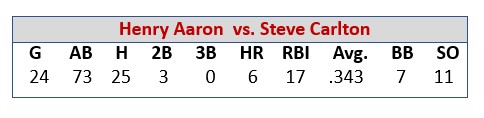


Sammy Sosa’s Long-Awaited First Grand Slam … and “Ducks-Full-Dingers” Tidbits

Photo by Ryosuke Yagi

On this date (July 27) in 1998, Cubs’ RF Sammy Sosa launched his 39th and 40th homers of the season – as the Cubs topped the Diamondbacks 6-2 in Arizona, with Sosa driving in all six runs. Just as significantly, the second of those homers – in the eighth inning off Alan Embree – was a Grand Slam. It came in Sosa’s tenth MLB season and was the 247th homer of his career. It was also Sosa’s first-ever Grand Slam, giving him (more proof of #InBaseballWeCountEverything) the MLB record for the most home runs ever for a player before hitting his first Grand Slam. After waiting more than nine seasons, 1,164 games and 246 home runs to hit his first round tripper with the bases full, Sosa’s next Grand Slam came just six innings later – in the fifth inning of the Cubs’  July 28 game against the Diamondbacks.  This time off Bob Wolcott (as the Cubs won 7-5).  Sosa ended his career with nine Grand Slams among his 609 regular-season home runs.

Now on the very same day that Sosa hit his first MLB Grand Slam, approximately 980 miles away, Tyrone Horne of the Double A Arkansas Travelers became the first (and still only) professional player to complete a home run cycle (solo, two-run, three run and Grand Slam home run all in the same game). He accomplished the feat on the road against the San Antonio Mission – in a 13-4 Arkansas win. For the full story on Horne and career, click here.

Well, these July 27th events, centering on Grand Slams, led Baseball Roundtable to dig a little deeper into “Ducks-Full Dingers.”

Did you know, for example, that hitting two Grand Slams in a game is even rarer than hitting four home runs in a contest or pitching a perfect game.?  Here’s the list.

And, here are a few tidbits about those two-Grand Slam games (you can check the details like teams and dates off the chart above):

  • Fernando Tatis (Sr.) is the only player to hit two Grand Slams in one inning. They were the first two Grand Slams of his MLB career. Tatis’ eight RBI in an inning also remain an MLB record.
  • Twelve of the thirteen two-Grand Slam games were accomplished on the road. Only Nomar Garciaparra hit his pair of bases-full blasts in front of a home crowd.
  • The Red Sox’ Bill Mueller is the only player to hit a Grand Slam from both batter’s boxes in the same game – and he hit them in the consecutive innings. In the seventh inning, right-handed off Rangers’  southpaw Aaron Fultz and, in the eighth inning, left-handed off righty Jay Powell.
  • The first National Leaguer to hit two Grand Slams in a game was Braves’ pitcher Tony Cloninger. He also threw a complete-game, seven-hitter that day (three runs, two walks, five strikeouts).
  • Rudy York and Fernando Tatis are the only two on the list to hit both Grand Slams off one pitcher. The Cardinals’ Tatis hit both of his off the Dodgers’ Chan Ho Park (and, of course, in the same inning – the third). The Red Sox’ York hit both of his Slams off the Athletics’ Ted Shirley (one in the second inning an done in the fifth).
  • Tony Lazzeri, Jim Tabor, Nomar Garciaparra and Bill Mueller each had three home runs in their two-Grand Slam Games.

Career Leaders in Grands Slams

Alex Rodriguez                  25

Lou Gehrig                          23

Manny Ramirez                 21

Eddie Murray                     19

Willie McCovey                 18

Robin Ventura                   18

Leader among active players: Albert Pujols – 15


A couple of single-season Grand Slam tidbits:

  • Yankee Don Mattingly’s single-season record six Grand Slams in 1987 were the only Grand Slams of his 14-season MLB career.
  • When the Orioles’ Jim Gentile hit a then-record-tying  five Grand Slams in 1961, everyone of his five bases-loaded blasts came in a game in which the Baltimore starter was Chuck Estrada.  Gentile, in face, hit only one other Grand Slam in his career – in a game started by (you guessed it) Chuck Estrada.

That’ll Do in a Pinch

Four players share the record for most career pinch-hit Grand Slams (three) – Ben Broussard (Indians/Mariners); Willie McCovey (Giants); Ron Northey (Cardinals/Cubs); and Rich Reese (Twins).

A trivia tidbit on Reese.  His record-tying three pinch hit Grand Slams  were the only Grand Slams in his 10-season MLB career (866 games/2225 plate appearances/200 pinch-hitting appearances).

Let’s Get this Party Started

While 126 players have homered in their first MLB at bat, only four of those long balls were Grand Slams.  The players with Grand Slams in their first at bat include: Bill Duggleby (Phillies – 1898);  Jeremy Hermida (Marlins – 2005); Kevin Kouzmanoff (Indians – 2006); Daniel Nava (Red Sox – 2010).   The last two of those, poked those four-run shots on the very first MLB pitch they ever faced.

  • Kevin Kouzmanoff started his first MLB game at DH (batting seventh) for the Indians on September 2, 2006. The opponents were the Rangers (in Texas), with Edison Volquez on the mound. In the top of the first, Kouzmanoff came to bat with the sacks full and two out – and rapped the first pitch from Volquez over the CF fence for a Grand Slam. It was his only hit in four at bats, as the Indians triumphed 6-5. Kouzmanoff played seven MLB seasons (2006-2011, 2014).  He hit .257-87-371, with three Grand Slams.
  • Daniel Nava made his first MLB start as a member of the Red Sox on June 12, 2010. He was batting ninth and playing left field, as the BoSox faced the Blue Jays (and starter Joe Blanton) in Fenway. In the bottom of the second frame, Nava came to bat for the first time in an MLB game – with the based loaded, no outs and the Red Sox up 1-0. He hit the first Blanton offering deep to RF for a Grand Slam. Nava had a home run and a double in four at bats, as the Red Sox won 10-2. Nava played seven MLB seasons (2010, 2012-17), hitting .266-29-206 in 589 games. He hit two Grand Slams.

The Ultimate Slam

I have often said “In baseball we count everything,” and, if it’s not already counted, we find a way to make it countable.  Hence, the “Ultimate Grand Slam” – a walk-off Grand Slam in the bottom of the final inning of a game when your team trails by three runs.   The “count” shows thirty such Ultimate Grand Slams – by thirty different players.  A handful stand out.

  • Babe Ruth, Jason Giambi and Ryan Roberts notched Ultimate Slam in extra innings.

Ruth hit his in the bottom of the tenth of a September 24, 1925 game against the White Sox at Yankee Stadium. The game had been tied 2-2 after nine frames, the White Sox tallied three in the top of the tenth, before Ruth’s Ultimate Slam put it away for New Yorkers 5-4.

Giambi hit his in the bottom of the fourteenth inning of a May 17, 2002 game between his Yankees and the Minnesota Twins. The game was tied at nine after nine. The Twins, like the White Sox above, plated three runs in the top of the 14th, before the Giambi Ultimate Slam gave New York the 13-12 win,

Roberts hit his Ultimate Slam in the tenth inning of a September 27, 2011 matchup between his Diamondbacks and the Dodgers. The game was knotted at 1-1 after nine innings, when the Dodgers exploded for five runs in the top of the tenth. The game looked safely packed away as Arizona reliever Blake Hawksworth retired the first two batters in the bottom of the inning.  What followed was a single by RF Cole Gillespie, a single by  C Miguel Montero (Gillespie going to third); a walk to CF Chris Young;  PH John McDonald safe on an error with one run scoring; a pitching change (Javy Guerra for Hawksworth); a walk to 2B Aaron Hill forcing in a run (leaving the base loaded and the score 6-3); and, finally, Roberts’ Ultimate Slam –  giving the Diamondbacks a 7-6 win, with six runs scoring after the Dodgers had the Diamondbacks down to their last out, with the bases empty.

  • For sheer excitement no Ultimate Slam can beat the one Roberto Clemente hit on July 25, 1956. The Pirate were trailing the Cubs 8-5, when Clemente came to the plate with the bases loaded and no outs. Facing Jim Brosnan, Clemente drove a high-and-inside pitch off the light standard in left field. As the ball ricocheted off the light standard and rolled along the warning track, all three runners scored – and then a sliding Clemente, beat the relay throw, and slid across the plate.  Note: Clemente ran through the coach’s stop sign at third base. It remains the only inside-the-park Ultimate Slam.
  • 2011 is the only year with three Ultimate Slams (Travis Hafner (Indians); Brian Bogusevic (Astros); Ryan Roberts (Diamondbacks).

Primary Resources:  Baseball-Reference.com; Baseball-Almanac.com

Baseball Roundtable Disclaimer:  The MLB records referenced in this (and previous) posts have the potential to change (primarily additions) as Major League Baseball recognizes and fully incorporates Negro League records from 1920-48 into the MLB record book.


BASEBALL ROUNDTABLE ON THE TOP 100 BASEBALL BLOG LIST

100Baseball Roundtable is on the Feedspot list of the Top 100 Baseball Blogs.  To see the full list, click here.

I tweet baseball @DavidBBRT

Follow/Like Baseball Roundtable’s Facebook Page here.  More baseball commentary; blog post notifications; PRIZES.

Member: Society for American Baseball Research (SABR); The Baseball Reliquary; The Negro Leagues Baseball Museum.
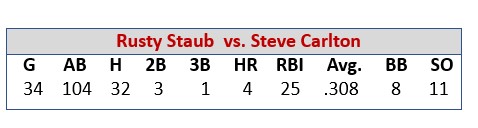


Let’s Play Two -Some Doubleheader Trivia and Tidbits

My Minnesota Twins just came off a stretch in which they played five games in three days – including a pair of doubleheaders.  That sent me to thinking about real doubleheaders. You know, the kind with nine-inning games (Guess you can tell where I stand on this issue). With that in mind, this post will take a look at some doubleheader history.

Now, That’s a Lot of Baseball

The 1945 Boston Braves played an MLB-record 46 doubleheaders. Let’s put that in perspective – 59.7 percent of the games they played that season were part of doubleheaders. How did they do?  They won 42 of those games, lost 48 and tied two.  Basically, they played .466 ball in twin bills, a bit better than their .403 winning percentage on days when they played just one game.  By the way, just so you don’t think those 46 doubleheaders were a one-off event, the 1943 White Sox hold the AL record for doubleheaders in a season at 44.

18 Games in 12 Days

The 1928 Boston Braves played a record nine consecutive doubleheaders over a 12-day span (September 4-15). During the streak, they swept one doubleheader, were swept six times and split two – for a four win-fourteen loss record.  Notably,  six players played every inning of those games (RF  Lance Richbourg; LF Eddie Brown; 1B George Sisler; 2B Rogers Hornsby; 3B Les Bell; SS Doc Farrell). The team used eight different starting pitchers during the 18-game stretch – none more often than Bob Smith, who started four contests (including both ends of one doubleheader).

The stretch of twin bills may have been taxing on the hurlers’ arms. The Braves got just five complete games during the span (27.8 percent of the starts) – well below the MLB average for the year of 50.7 percent and short of the Braves’ average for the rest of the season  (36.2 percent). Bob Smith’s record may be indicative of that wear and tear. In his first start of the stretch (September 5), he tossed a complete-game two-hitter as Boston topped Brooklyn 7-1. On September 10, he tossed a second complete game, a seven-hitter, as Boston lost to the Giants 4-1.  Then on September 14, he failed to make it out of the first inning of the first game against the Giants, giving up four runs without recording an out.  Undeterred, the Braves sent him back out to start the second game of the twin bill – in which he gave up  five runs (three earned) in 6 1/3 innings – taking his second loss of the day.  Side note:  Smith recovered from that tough  two-loss day. He had three more starts that season, pitching 31 1/3 innings in those games (1-2, 2.87). He finished the season 13-17, 3.87 for a Braves team that went 50-103.

One Thing Leads to Another … Bob Smith

Now, I often note how “one thing leads to another” when I embark on research for these posts.  In this case, my interest in Bob (Robert Eldridge) Smith was sparked. Here’s what I learned.  Smith started his MLB career as a shortstop/second baseman, said to have a below average bat and no better than an average glove. He made it to the Braves as a 28-year-old in 1923 and, in his first MLB season, hit .240, with two home runs and 78 RBI. He also was 9-for-20 in stolen base attempts.  He did, however, flash a strong arm and, in 1925, began the conversion to the pitcher’s mound (in 1925, he appeared in 13 games as a pitcher, 15 at second base, 21 at SS and one in CF). By 1926, Smith (at age 31) was pretty much a full-time pitcher – and it saved his career. His mound work kept him in the major leagues until 1937 (age 42) – finishing with a 106-139, 3.94 record and 128 complete games in 229 starts.   In 1928, he was clearly the ace of the Braves’ staff leading the team in wins (13), complete games (14) and innings pitched (244 1/3). From 1926 through 1930, he won at least ten games for the Braves every season. He was traded to the Cubs after the 1930 season and had his career-best season for Chicago in 1931 (15-12, 3.22)

One more tidbit about Mr. Smith.  On May 17, 1927, as the Braves faced the Cubs in Boston, Smith started – and went all 22 innings – as the Braves lost to the Cubs 4-3. Smith gave up 20 hits and four runs (three earned), walking nine and fanning five in this tough loss. It remains the fifth most innings pitched by a starter in an MLB Game.  Here’s the top five:

TIED FOR FIRST– 26 innings.  On May 1, 1920, the Brooklyn Robins (Dodgers) and Boston Braves played 26 innings to a 1-1 tie, with both starters (Leon Cadore – Robins and Joe Oeschger – Braves going the distance.   No one scored in this one after the sixth inning.

TIED FOR THIRD (and first in the AL) – 24 innings. On September 1, 1906, the Philadelphia Athletics and Boston Americans (Red Sox) matched up in a 24-inning duel (in Boston) that the Athletics won 4-1 (with no scoring from the seventh through the 23rd inning). Both starters (Jack Coombs – Athletics and Joe Harris – Americans) went the distance.  Harris took the tough loss (his 18th of the season – versus just two wins). He finished the campaign at 2-21, leading the league in losses. 

FIFTH – 22 innings.  As already noted, on May 17, 1927, Bob Smith pitched all 22 frames as the Cubs topped  Smith’s Boston Braves’ 4-3 in Boston.  Down 3-0 after five innings, Smith held the Cubs scoreless  until the 22nd inning, when a walk, successful sacrifice and single plated the winning run.

Putting Up Crooked Numbers

The record for runs scored in a doubleheader – both teams – is 54.  It has been done twice.  On August 21, 1894,the National League Boston Beaneaters swept a doubleheader from the Cincinnati Reds by score of 18-3 and 25-8. Then, on Independence Day in 1939, there were lots of fireworks on the field in Philadelphia, as the Red Sox topped the Athletics 17-7 and 18-12.

Well, That Didn’t Take Long

The fewest runs scored in a doubleheader? It may surprise you (because it’s not two.)   The answer is one.  On September 4 1902, the Pittsburgh Pirate and Boston Beaneaters matched up in a doubleheader in Boston. Game One went to Boston 1-0 (in one hour and twenty minutes). Game Two ended in a nine-inning 0-0 tie (one hour and 30 minutes).

A Good Days Work

On September 26, 1908, Cubs’ righty Ed Reulbach started both games of a doubleheader against Brooklyn (Superbas).  He went the distance in both contests, giving up just eight hits over the 18 innings.  Reulbach is the only MLB pitcher ever to record two complete-game shutouts in a single day.

Another Good Days Work – or Two

On May 2, 1954, Cardinals’ right fielder Stan Musial hit five home runs in doubleheader (versus the Giants in Saint Louis). Sitting in the stands that day was eight-year-old Nate Colbert who – On August 1, 1972 – would become just the second player ever to hit five home runs in a twin bill. Colbert was playing first base for the Padres, who were taking on the Braves in Atlanta. In his five-homer twin bill, Colbert set the record for RBI in a doubleheader (13). The Cardinals, by the way, split their doubleheader on Musial’s big day, beating the Giants 10-6 in Game One and losing the second game 9-7. The Padres swept the Braves (9-0 and 11-7) on Colbert’s record-tying day.

I Call Trade-Zees

On May 30, 1922, the Cardinals and Cubs matched up in a Memorial Day doubleheader in Chicago. The Cubs took Game One by a 4-1 score – with one of the four tallies driven in by RF Max Flack. Playing CF for the Cardinals was Cliff Heathcote, who went zero-for-three.  In Game Two,  Heathcote and Flack were both starting in the garden – but for the teams they had opposed in Game One.  Traded between games, Flack started in RF, leading off, for the  Cardinals, while Heathcote started in RF, batting fifth for the Cubs. The Cubs won this one 3-1, with Heathcote going two-for-four.  Flack went one-for-four for his new team.

Don’t Worry – I Got This

In August of 1903, the Giants’ Joe McGinnity started  both games of a doubleheader three times – August 1, Augusts 8 and August 31.  In those starts, he picked up six complete-game victories – giving up a total of 10 runs in the six contests. By the way, the Giants played 11 doubleheaders that month. Surprisingly, on the August days when he pitched only one game (another six starts), McGinnity went 1-5 and gave up 28 runs. For the season, he was 31-20, 2.43, with 44 complete games in 48 starts.  No wonder his nickname was “Iron Joe.”
Way Too Much Overtime

On May 31, 1964, Mets fans faced a long day of suffering.  Not only did the New Yorkers lose both ends of a doubleheader to the San Francisco Giants – it took them a doubleheader-record 32 innings (9 hours and 52 minutes) to do it. The Giants won game one 5-3 in a brisk 2:29.  The second game, however, went 23 innings (7:23), with the Giants winning 8-6.   This is the longest doubleheader by innings and the longest in time –  without a weather delay.

On July 2, 1993, the Padres and Phillies split a twin bill in Philadelphia that kept the fans (who stayed on) in the park for more than 12 hours. Consider the patience needed.  The first game was delayed one hour and ten minutes before the first pitch; another one hour and 56 minutes in the fourth inning; and two hours and 48 minutes in the sixth. The teams began play at 4:35 p.m. on Friday, July 2 and wrapped up at 4:40 a.m. Saturday – a doubleheader record 12 hours and five minutes.

Nine-for-Nine

Nine players have collected nine hits in a doubleheader.  The most recent was Lee Thomas of the Angels on September 5, 1961. The Angels’ RF went five-for-five in the first game (on double and four singles), without a run scored or an RBI) as the Angels lost to the Athletics 7-3.  Game Two was more productive for Thomas. He was four-for-six, with three home runs, three runs scored and eight RBI. The Angels, however, still lost 13-12.

Cubs’ Hall of Famer Ernie Banks was quoted often as saying “Let’s play two!”  He was right!

Primary Resources:  Baseball-Reference.com; Baseball-Almanac.com; MLB.com


BASEBALL ROUNDTABLE ON THE TOP 100 BASEBALL BLOG LIST

100Baseball Roundtable is on the Feedspot list of the Top 100 Baseball Blogs.  To see the full list, click here.

I tweet baseball @DavidBBRT

Follow/Like Baseball Roundtable’s Facebook Page here.  More baseball commentary; blog post notifications; PRIZES.

Member: Society for American Baseball Research (SABR); The Baseball Reliquary; The Negro Leagues Baseball Museum.