September In MLB Streaked on By …. Here are the Stats, Stories, Standings and More

Well a new month rolls around, so it’s time for Baseball Roundtable to take a look at the month we are leaving behind – and the stats, stories and standings  that caught the Roundtable’s attention – not to mentions the BBRT Players and Pitchers of the Month and, of course, the Trot Index.

As a teaser, this past month we saw:

  • One player (Juan Soto) hit ,400+ for the month.
  • A 17-game winning streak (Cardinals).
  • The season’s ninth no-hitter and fourth cycle.
  • Max Scherzer’s 3000th strikeout and Adam Wainwright’s 2000th.
  • A 43-game on-base streak by 20-year-old Wander Franco.
  • Shohei Ohtani’s 2021 ninth mound victory; 45th home run; eighth triple; and 26th stolen base.
  • New single-season home runs records for a catcher (Salvador Perez) and second baseman (Marcus Semien).
  • One team with an ERA under 3.00 for the month (Dodgers); eight with ERA’s north of 5.00.
  • Three teams (Cardinals, Dodgers, Giants) playing .700+ ball for the month,

For all this and more, read one.  Here’s a little preview of the kind of tidbits you will find sprinkled among the numbers.

Below the Mendoza Line, But Still Productive

The lowest average through September (among qualifiers) belonged to the Reds’ Eugenio Suarez at .192 (95-for-494).  Notably, it was a productive .192 – as Suarez also had 30 home runs and 77 RBI – in 142 games.

Over in the AL, the lowest average among qualifies belongs to Joey Gallo of the Yankees at .199 (97-for-488). Gallo has 38 long balls and 76 RBI in 149 games.

——Baseball Roundtable Players and Pitchers of the Month—–

National League Player of the Month – Juan Soto, RF, Nationals 
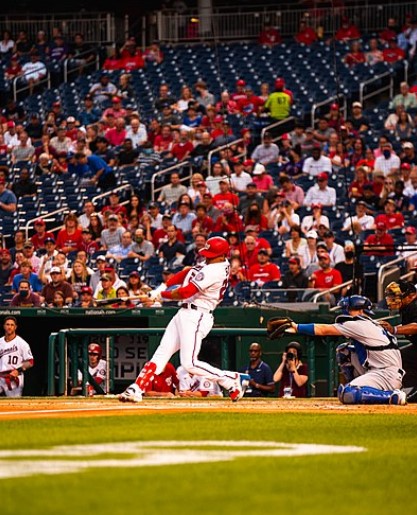
Photo: All-Pro Reels from District of Columbia, USA, CC BY-SA 2.0 <https://creativecommons.org/licenses/by-sa/2.0>, via Wikimedia Commons

Juan Soto led all batters (with at least 75 September at bats) with a .404 average. He was second in MLB in hits to the Cubs’ surprising 1B Frank Schwindel (but Schwindel drew only eight September walks to Soto’s MLB-leading 35.)  Soto also racked up 23 September RBI and 22 runs scored (seven home runs) – and fanned just nine times in 27 games.  Soto led all of MLB players with at least 75 September at bats in on-base percentage (.565) and his September slugging percentage of  .691 was fourth among National Leaguers with at least 75 September at bats.  Soto had 11 multi-hit games in September and was on base via hit or walk in all but two games. From September 14 through September 23, he had a nine-game hitting streak in which he hit .567, with four homers, nine RBI, nine runs scored, 12 walks and just one strikeout.

Honorable Mentions: Tyler O’Neill, LF, Cardinals –  who led the NL in September home runs (11) and RBI (27), while hitting .303.; Paul Goldschmidt, 1B, Cardinals, who put up a .340-9-19 line, and led MLB in Septembers runs scored with 29.

National League Pitcher of the Month – Eric Lauer, LHP, Brewers
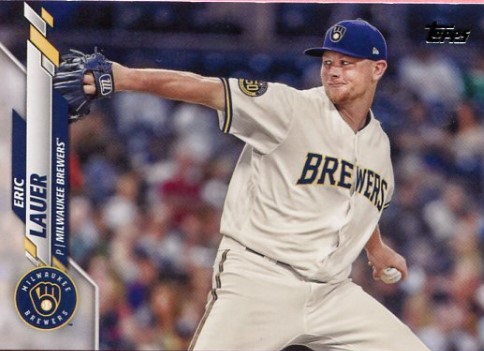
The Brewers’ Eric Lauer came into September with a 4-5, 3.61 record, but gave up no more than one earned run in any of this five September starting assignments. – going 3-0, 1.15 for the month. That ERA was the lowest among MLB pitchers with at least 20 September innings. Lauer’s WHIP of 0.70 was also the best among pitchers with 20 innings pitched for the month, as was his .133 opponents’ batting average. Lauer fanned 32 batters (eight walks) in 31 1/3 innings pitched.

Honorable Mentions: The Dodgers’ Max Scherzer went 3-0, with a 2.29 ERA and an MLB-leading 48 September strikeouts (and only three walks) in 39 1/3 innings in six September starts. The Phillies’ Zack Wheeler was also in the running at 3-1, 1.47 with 39 strikeouts (just six walks) in 30 2/3 September innings; as was the Braves’ Max Fried, 3-0, 1.54, with an MLB-high 41 innings pitched in September (36 whiffs/seven walks).

___________________________________________

AL Player of the Month  – tie: Luis Robert, CF, White Sox & Salvador Perez, C, Royals
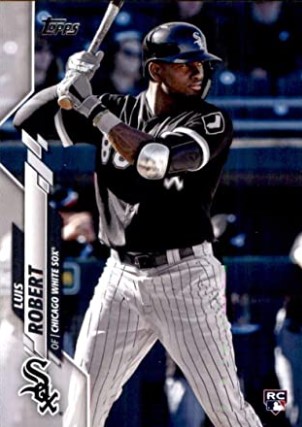
Luis Robert‘s .367 average led all American Leaguers with at least 75 at bats. He  hit safely in 20 of 23 September games – with 11 multi-hit games. His 36 September hits were sixth in MLB and fourth in the AL. He had six home runs, 20 RBI and 14 runs scored. His  eight doubles were fifth in the AL and his .633 slugging percentage was  third among AL players with at least 75 September at bats.
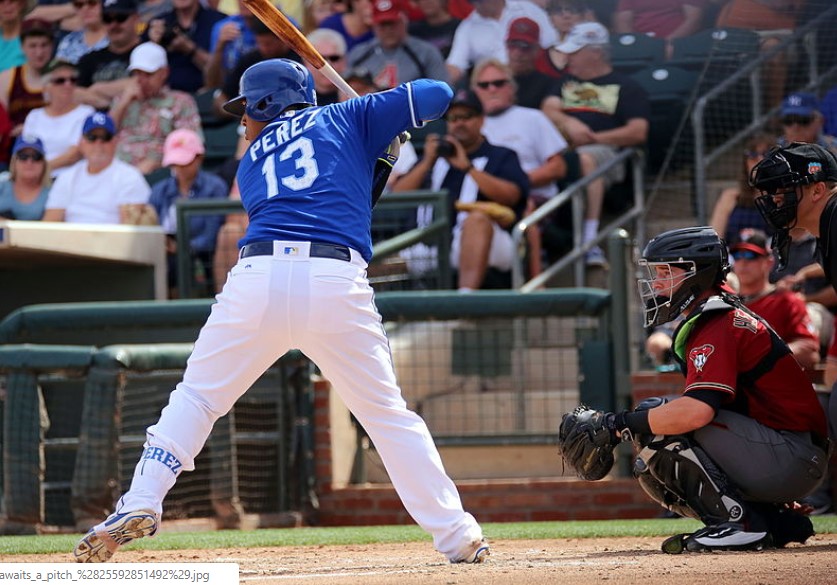
Photo: Arturo Pardavila III from Hoboken, NJ, USA, CC BY 2.0 <https://creativecommons.org/licenses/by/2.0>, via Wikimedia Commons

Salvador Perez had a .284-10-27 month for the Royals. His 27 RBI were second only to Lourdes Gurriel in MLB and his ten long balls second only to the Blue Jays’ Marcus Semien.  Perez’  ten September home runs gave him 48 on the season, a new record for catchers.  Perez hit safely in 22 of 28 games played in September and had nine multi-hit contests.

Honorable Mentions: Lourdes Gurriel, Jr.  led all of MLB with 30 September RBI, despite a late-September hand injury that cost him a handful of games played.   His line for the month was .329-7-30, with 18 runs scored in 24 games. The Blue Jays’ Teoscar Hernandez hit .301 for the month, with nine home runs and 26 RBI in 28 games. The Royals’ Andrew Benintendi put up a  343-5-27 line.

AL Pitcher of the Month – Frankie Montas, RHP, A’s
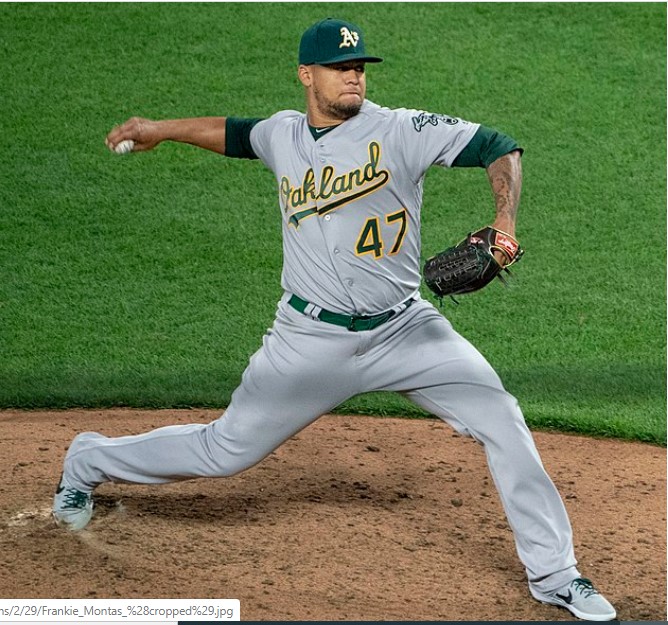
Photo: Keith Allison from Hanover, MD, USA, CC BY-SA 2.0 <https://creativecommons.org/licenses/by-sa/2.0>, via Wikimedia Commons

Frankie Montas went 3-0, 2.19 in six September starts. His ERA was third among AL pitchers with at least 25 September innings, his 37 innings pitched second, and his 40 strikeouts fifth.  He threw five quality starts in his six games and finished strong – a 0.45 ERA in his final three starts (one win, two no decisions). He came up big in a key game against the division-rival (and first-place) Astros in Houston on September 24 – going seven innings, giving up just two  hits and one walk and  fanning eight – enabling the A’s to take a 3-2 lead into the bottom of the seventh.  (The A’s eventually won 14-2. )

Honorable  Mentions: Cal Quantrill of the Indians was contender at 4-1, 2.73 in five starts (33 innings), with a 1.06 WHIP and a .215 average against. I also looked at the Twins’ Michael Pineda, the only AL pitcher with five September wins (5-0 in five games/four starts). Pineda had a nifty 1.85 ERA for the month, but pitched only 24 1/3 innings.


Surprise Player of the Month … Giovanny Gallegos, RHP, Cardinals
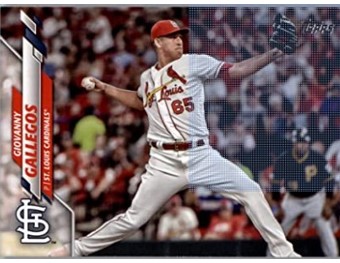
Thirty-year-0ld Giovanny Gallegos took over the Cardinals’ closing role (replacing a struggling Alex Reyes) in late August (he recorded his third save – in 58 appearances on August 30). In September, Gallegos  recorded 11 saves (in 12 opportunities), fanning 21 batters in 13 2/3 innings, holding batters to a .149 average and putting up a 3.29 ERA. Why the surprise? As of September 1, Gallegos – in five MLB seasons and  162 appearances – had a 10-10 record with just nine saves.  He, however, became the end-of-game, go-to guy, as the Cardinals ran off a 22-7  September record that put them in the post-season. He took the ball and saved a lot of big games for the Redbirds.

Honorable Mention: Cubs’ 1B Frank Schwindel earned this recognition in August with a .357-7-21 month.  (When picked up on waivers from the A’s on July 18, he was four-for-35  as a major leaguer with just one home run and three RBI.)  After his big August, September is less of a surprise, but Schwindel gets a HM for a month in which he led MLB with 40 hits. Clearly, he surprised a lot of people in August – and then surprised even more by keeping up the pace in September.

________________________________________________________________________

TROT INDEX … A REGULAR BBRT FEATURE

Through September  2021, 36.3 percent of the MLB season’s 178,446 plate appearances ended in a trot (back to the dugout, around the bases, to first base). We’re talking about strikeouts, home runs, walks, hit by pitch and catcher’s interference – all outcomes that are, basically, devoid of action on the base paths or in the field. Here’s the breakout: strikeouts (23.2%); walks (8.7%); home runs (3.3%); HBP (1.2%); catcher’s interference (less than 1%). 

Taking the Trot Index one step further – to the slow walk back to the dugout 0 so far this season there have been 2,656 more strikeouts than base hits (41,356 to 38,700). 

____________________________________________________________
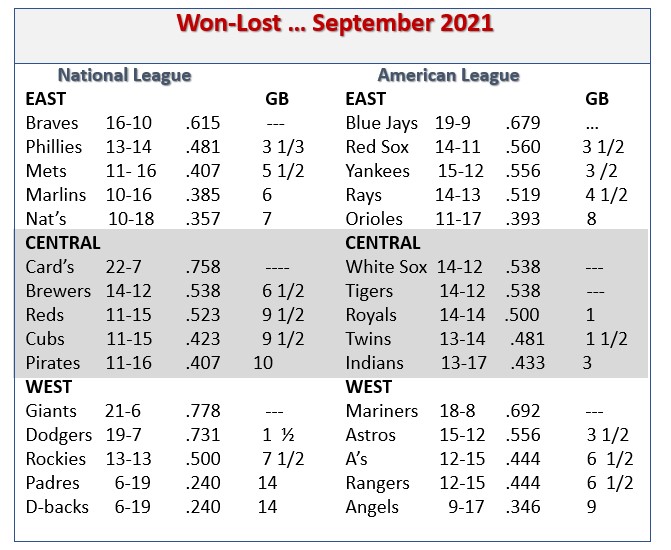
If you’ve been following Baseball Roundtable, you’ve read a lot about streaks this year.  This season, the  Yankees have run off a 13-game winning streak, the Rays have had a 11-game victory streak and the Orioles have suffered through  14- and 19-game losing streaks. And, there are more examples of this streaky season. The Padres won all nine contests in a nine-game homestand; the Dodgers, at one point, had lost 11 straight extra-inning game; and the list goes on.

Well, the Cardinals added the cherry on top of the sundae in September.  Their 22-7 month (which propelled them into a post-season berth) included a 17-game winning streak (September 11 through September 28). Surprisingly, at least for BBRT, the streak included just six home games., During the streak, the Cardinals outscored their opponents 115-53, outhit them .293 to .221 and out-homered them 32-17; while their pitching staff put up a 2.90 ERA to the opponents’ 6.53.  If you are looking for the heroes of the September Redbird surge, there were plenty. Here are just a few with their September stats: LF Tyler O’Neill (.303-11-27); 1B Paul Goldschmidt (.340-9-19); CF Harrison Bader (.340-6-18); 3B Nolan Arenado (.260-8-21); Adam Wainwright (4-0, 3.44); Alex Reyes with five wins out of the bullpen; and Giovanny Gallegos with an MLB-high 11 September saves.  You get the idea, it was a true team effort.

There was also a good story in the NL West, where the Giants and Dodgers continue to duke (Snider-pun intended) it out for the division crown.  Both played .700+ ball and were never separated by more than 2 1/2 games during the month. (The Giants appear set to hold on.) The Dodgers had seven players with ten or more RBI during the month, led by Corey Seager’s .366-8-19. But the pitching staff – led by Julio Urias (4-0, 2.20) and Max Scherzer (3-0, 2.29) and a solid bullpen – was the key. The Dodgers put up MLB’s lowest ERA and WHIP for the month., The Giants still outperformed the Dodgers in the won-lost columns, while tying for the NL lead in September runs scored and putting up an ERA second only to the Dodgers.  On offense a pair of Brandons led the way. 1B Brandon Belt hit.349-9-18 for the month and SS Brandon Crawford went .352-5-16. On the mound a trio of relievers (Camilo Doval, Zack Littell and Tyler Rogers) chipped in 10 wins, three saves (no losses) and a combined 2.36 ERA in 43 combined appearances.

The Mariners surprised many with a near .700 month in the AL (.692) and propelled themselves back into what should be a “wild” wild-card race as the season goes into its final weekend. The Mariners scored the AL’s sixth-most runs in September and gave up the eighth fewest – which doesn’t sound like the formula for a near-.700 month. Looking at the scoreboard provides some explanation.  In September the Mariners were 6-2 in one-run games, 3-0 in games decided by two runs and 2-4 in lopsided (five or more runs difference) games.  A few key contributors: RF Mitch Hanniger (.260-9-22), SS J.P. Crawford (.315-3-14, with 21 runs scored); Marco Gonzalez (4-0, 3.90); and Chris Flexen (3-1, 4.40).

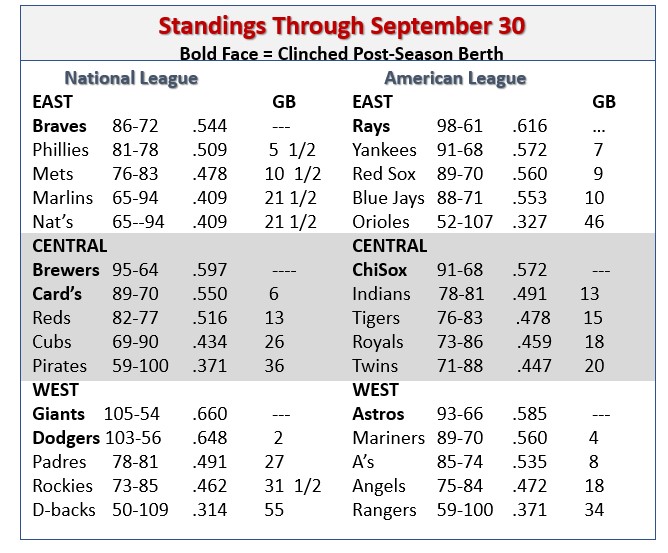
FULL STANDINGS AND STATS THROUGH SEPTEMBER

CAN BE FOUND AT THE END OF THIS POST. 

——-Team Statistical Leaders for September———

RUNS SCORED

National League – Cardinals (158); Giants (158); Nationals (137)

American League – Blue Jays (167); Astros  (141); Red Sox (138(

Two teams scored fewer than 100 runs in September: Marlins (90); Diamondbacks (97). 

BATTING AVERAGE

National League – Giants (.277); Cubs (.266); Nationals (.265)

American League – Blue Jays  (274); Red Sox (.273); White Sox  (.269)

The lowest September team average belonged to the Marlins  at .213. Lowest in the AL was the Angels at .222.

HOME RUNS

National League – Cardinals (52); Dodgers (43); Braves (42)

American League –  Blue Jays  (55); Yankees (51); Astros (43)

The Rangers had the fewest September home runs at just 16 – the only MLB team under 20.  

STOLEN BASES

National League –  Cubs  (22); Cardinals (19); Pirates (17)

American League – Rangers (29); Royals (24); Indians  (20)

No team stole fewer bases in September than the Braves – just three swipes in six attempts. Notably, like the Braves, the Rangers (with MLB-best 29 September steals) were also caught just three times.  

WALKS DRAWN

National League –  Nationals (129); Giants (114); Pirates (106)

American League – Astros (97); Blue Jays  (96); White Sox  (93)

The Giants had MLB’s top September on-base percentage at .363. Tops in the AL were the White Sox at .349.

BATTER’S STRIKEOUTS 

National League – Cubs (260); Marlins  (255); Cardinals (253)

American League – Orioles (270); Indians  (268);  Twins (241)

The Padres and Reds fanned the fewest times in September (189).

BONUS STAT

The Blue Jays racked up the most September total bases (488). The Cardinals led the NL at 461. The Angels had the fewest September total bases (303).

EARNED RUN AVERAGE

National League –  Dodgers (2.91); Giants (3.09); Braves (3.39)

American League – White Sox (3.69); Rays  (3.81);Tigers (3.92)

A surprising (at least for BBRT) eight teams (five in the NL, three in the AL) had September earned run averages north of 5.0.  The teams: Cubs (5.86); Padres (5.82); Orioles (5.42); Nationals (5.36) Pirates (5.34); Rangers (5.32); A’s (5.15); Rockies (5.06). 

STRIKEOUTS

National League – Brewers (265); Philllies (265); Giants (248)

American League – Yankees (291); Blue Jays  (260); Red Sox (245)

The Yankees’  staff fanned an MLB-highest 10.76 batters per nine innings in September. The Brewers led the NL at 10.32. Ten teams average better than one strikeout per inning for the month.

WALKS ALLOWED (most)

National League – Nationals (115); Pirates (110); Cubs (101)

American League – Astros (112); Tigers (102); Royals (93); Orioles )93)

The Giants walked the fewest batters per nine innings in September (2.47). The Rays held that distinction in the AL (2.58)

SAVES

National League –  Cardinals (14; Dodgers (11); Rockies (8); Braves (8)

American League – Mariners  (12); Twins (9); Tigers (9)

 The Padres had eight save opportunities in September and converted just one.

WHIP (Walks + Hits per Innings Pitched)

National League – Dodgers (1.08); Braves (1.09); Brewers (1.13)

American League – Rays (1.17); Blue Jays (1.21); White Sox (1.25)

BONUS STAT

The  Braves held opposing hitters to an MLB-lowest .207 batting average in September; while the Pirates staff had the worst of that stat at .284 for the month.

—– Some September Highlights—–

Just Another Day at the Office

The Shohei Ohtani stories just keep coming.  On September 3, the Angels’ DH/P started  on the mound against the Rangers (in LA). While he went zero-for-four at the plate, Ohtani threw 117 pitches in his seven-inning stint (seven hits, two earned runs, two walks and eight strikeouts) – getting the win, as the Angels triumphed 3-2. He ran his 2021 mound record to 9-1, 2.97 with the victory.

Goose Eggs – What a Rare and Beautiful Sight

On September 4, Brewers’ righty Adrian Houser pitched a three-hit shutout (no walks, seven strikeouts). as the Brew Crew topped the  Cardinals 4-0. The significance? It was not only Houser’s first MLB complete game, but also the Brewers’ first complete-game shutout since September 24, 2014 – a span of 1,011 games.   How dominant was Houser.? He threw 100 pitches, 76 for strikes – and recorded a first-pitch strike on 25 of 29 batters.  Houser, who came into the 2021 season with a 7-13 record over four MLB seasons, was 10-6, 3.22 on the 2021 season at the close of September.

100 for Pete Alonso
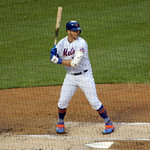
Photo by slgckgc

On September seventh, Mets’ 1B Pete Alonso, hit a two-run home run in top of the first inning of the Mets game against the Marlins,  It was his  100th MLB long ball – and    He reached 100 home runs balls in the second-fewest games in MLB history.  It was Alonso’s 347th  MLB game. The Phillies’ Ryan Howard did it in 325 games. (Side note:  Alonso reached 101 in the ninth inning of the same game – a Mets 9-4 win.)

No, No – Not Another No-No!

On September 11, Brewer’s right-hander Corbin Burnes (eight innings) and southpaw reliever Josh Hader (one inning) combined to throw a no-hitter as the Brewers topped the Indians 3-0 in Cleveland. A few tidbits from that game:  It was the ninth no-hitter of the 2021 season – the most no-hitters ever in a single campaign, breaking a record that dated back to 1884. It was also the seventh no-hitter tossed on the road this season (another record); and made the Indians the first team to be no-hit three times in one season.  For the full story of the game (and other combined no-hitter tidbits) , click here.

3,000 and Counting

On September 12, the Dodgers’ Max Scherzer topped the Padres 8-0 in LA – going eight innings, giving up just one hit and no walks, while fanning nine. In the process, he hit a couple of milestones. He recorded his 3,000th strikeout (his sixth of the game) in the top of the fifth inning, getting Padres’ 1B Eric Hosmer (swinging on a 3-2 change up). But that wasn’t all.  In the third frame, he tossed an Immaculate Inning (three up, three down, three strikeouts on nine pitches) – getting the four, five and six hitters (SS Fernando Tatis, Jr., Hosmer and LF Tommy Pham). In doing that,  Scherzer became just the third pitcher to throw three immaculate Innings in his career – joining Chris Sale and Sandy Koufax in that somewhat exclusive club.

Max Scherzer ended September with 3,020 strikeouts – 18th all time.

Just Ask Siri … or the Elias Sports Bureau
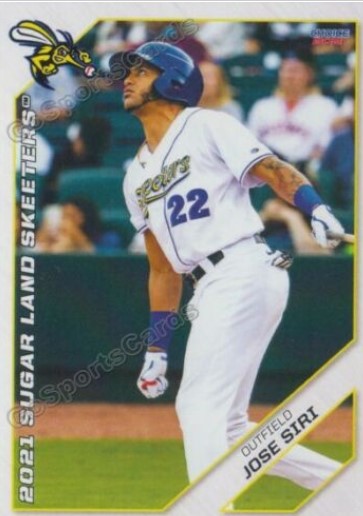
On September 13, 26-year-old Jose Siri of the Astros made his first MLB start – in LF, batting eighth, against the Rangers. He went four-for-five in the game (a 15-1 Astros win), with two home runs, three runs scored and five RBI. In another, #InBaseballWeCountEverything moment, the Elias Sports Bureau reported that Siri was the first player to record two homers and five RBI in his first MLB start.  It was, by the way, Siri’s sixth MLB game since his September 2 call up to the team. He previously had been used as a pinch runner twice, a pinch hitter once, a defensive replacement once (CF) and had come as an injury replacement in the second inning of a September 11 game against the Angels.  It was, notably, Siri eighth professional season and he was hitting .318-16-72, with 24 steals, at Triple-A Sugar Land (Skeeters) when called up.  He finished September with a  .289-4-9 MLB line.

Old Guys Rule

On September 13, two 40+-year-olds started as mound opponents, as  Rich Hill (41 years-186 days old on game day) started for the Mets versus Adam Wainwright (40 years-14 days) of the Cardinals. Wainwright got the win with six scoreless innings (four hits, three walks, four strikeouts), while Hill took the loss (giving up three runs on six hits and two walks over five innings, with four strikeouts). It was the first time two pitchers over forty started against each other since 2015 (R.A. Dickey, Blue Jays versus Bartolo Colon, Mets).

The Oldest Match Up Ever

The Angels’ Don Sutton  (42 years-67 days) and the Indians’ Phil Niekro (48 years-68 days) were starting mound opponents – a combined 90 years 135 days old – on June 8, 1987. Both pitchers acquitted themselves well in that one. Niekro got the win (7 1/3 scoreless innings, three hits, five walks, four strikeouts) and Sutton took the loss (eight innings, six hits, two earned runs, no walks, two whiffs).

Bringing the Heat, Right Where it Hurts

On September 17, Padres’ reliever Austin Adams had quite an innings against the Cardinals. Adams came on in the bottom of the eighth with the Padres trailing 4-2. He gave up a double to  1B Paul Goldschmidt to open the inning, then fanned LF Tyler O’Neill on three pitches. Then things got a little “wild.”  He walked  3B Nolan Arenado on four pitches, threw a wild pitch on an 0-2 count to C Yadier Molina (with Goldschmidt and Arenado moving up a base) and then hit Molina on a 1-2 count.  At that point, he was relieved by Ross Detwiler, who gave up a grand slam to RF Dylan Carlson.

Adams’ plunking of Molina earned him a touch of fame.  It was his sixth hit batsman of September (in four innings pitched)  and his 24th HBP of the season (in just 49 2/3 innings pitched). According to sources, it was the most hit batters by any pitcher in a season in the live ball era (since 1920), breaking the record (23) of Howard Ehmke, who hit 23 batters in 279 2/3 innings in 1922. Interestingly, despite all the plunked hitters, Adams has pitched pretty well – as of September 17, he had a 3-2, 4.17 record on the season (63 appearances. Also, previous to 2021, he had pitched 42 MLB innings (2017-2020) and hit only two batters.  And, in eight minor-league seasons (340 innings pitched), he had hit just 32 batters. (I’ll do the match, coming into this season he had hit 34 batters in 382 minor- and major-league innings (one every 11.24 innings). This season, through September 17, he had hit one batter every 2.05 innings. For those that like to know such things, the most batters hit in a single MLB season is 51, by Phil Knell (Columbus Solons – 1891).

Staying in the Hit by Pitch Lane

On September 17, the Astros went into the bottom of the tenth inning trailing the Diamondback 3-2 – with, of course, runner (Manny Maldonado) placed at second (do not like that rule). After Tyler Clippard got SS Carlos Correa on a line out to CF, DH Yordan Alvarez was intentionally walked (not much for that new wave ‘em to first rule either).  CF  Jake Meyer’s single then scored Maldonado with the tying run, with Alvarez going to second. Pinch hitter Aledmys Diaz the walked loading the bases. Clippard got ahead of LF Chas McCormick 0-2 and then plunked him with a pitch to bring in the winning run.  The pain was probably worth it, it was McCormick’s first-ever MLB walk-off RBI.

Perez Goes Deep

On September 20, Royals ‘catcher Salvador Perez his eighth home run of September giving him 46 on the season and the record for home runs in a season by a player who played 75 percent to f his games at catcher (topping Johnny Bench’s 45 in 1970.) Perez finished the month with a total of 48 long balls on the season, extending his own record.

As with most things’ baseball, there is some debate, as Perez has hit 33 of his 48 home runs in 122 games at catcher, 15 in 36 games as a DH. Still, to be fair, Bench’s ‘s 45 1970 home runs included 38 in 137 games at catcher, one is seven games at first base, five in 14 games in LF, one in seven games in RF and one as a pinch hitter. The most home runs hit in a season while in the game as a catcher is 42 by the Braves’ Javy Lopez  in 2003.  (He also had one home run as a pinch hitter.)

Another  Cycle

On September 20, Braves’ LF Eddie Rosario achieved the fourth cycle (single, double, triple and homer run in one game) of the 2021 season as Atlanta topped San Francisco 3-0. Rosario doubled in the second inning, tripled in the fifth, homered in the seventh and singled in the ninth,  for some “cycling” trivia, click here.

2,000 for Waino
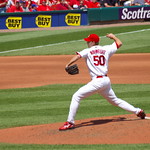
Photo by bk1bennett

September 23 was a bit of a rough day for Cardinal’s right-hander Adam Wainwright. The forty-year-old  Wainwright is having a solid 2012 season (17-7, 3.05), but on the 23rd, he lasted just four innings, giving up five runs on four hits and two walks. Still, there was a right spot,. While Wainwright fanned just one batter ( Brewers’ 3B Luis Urias on a 2-2 pitch in the bottom of the fourth), it was his 2,000th career strikeout.   Urias, by the way, did not make it easy,  After the count reached 2-2, Urias fouled off three Wainwright offerings before swinging and missing on a curveball for the landmark whiff.  Surprisingly, despite the Cardinals’ long history, Wainwright is only the second player to record 2,000 strikeouts for the Redbirds. The Cardinals won the game 8-5, coming back from a 5-0 fourth-inning deficit.

The Shohei Show Continues – and It’s a Walk in the Park
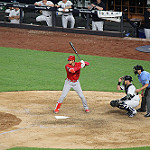
Photo by shinya

On September 24, Angels DH/P Shohei Ohtani came to the plate five times and drew four walks (two intentional), as the Angels lost to the Mariners 6-5 in LA.  In the process, he tied the MLB record (Bryce Harper – 2017) for most walks in three consecutive games – 11.  On September 23, Ohtani drew three walks in four plate appearances and on September 22, he her drew four walks in six plate appearances (two intestinal passes).  In the four  plate appearances  over those three games that he didn’t walk, Ohtani struck out three times and grounded out once.

More Ohtani

On September 25, Shohei Ohtani showed off his wheels, legging out two triples in three at bats in an Angels 14-1 win over the Marines. The performance gave him a league-leading seven triples on the season. )He added an eighth three-bagger later in the month.) He also displayed a good eye at the plate – walking twice in the game, giving him 13 walks over a four-game span, tying an MLB record shared by Babe Ruth (1930), Bryce Harper (2016) and Yasmani Grandal (earlier this season).

Max – Maddux Light

Greg “The Professor” Maddux was the master of efficiency on the mound.  In fact, MLB has informally coined the term “Tossing a Maddux” to indicate throwing a nine-inning complete- game shutout in 100 pitches of less. Well, on September 24, Braves’ lefty Max Fried tossed his second “Maddux” of the 2021 season. He used just 98 pitches (66 strikes)  to shutout the Padres in a 4-0 Braves’ win. Fried gave up just three hits, walked none and fanned four. In the game, just one Padre got as far as second base. Fried tossed a similar game on August 20 – as the Braves beat the Orioles 3-0 in Baltimore. In that one, he used just 90 pitches (66 strikes)  – giving up four hits, walking and fanning four.

Streak-us Interruptus

On September 11, Rays’ SS Wander Franco went down with a tight hamstring.  At the time, he had a thirty-nine game streak of getting on base (via it, walk or HBP) – four games short of the MLB record for a player who had not yet reached 21 years of age (more of #InBaseballWeCountEvferything) – a distinction held by Hall of Famer Frank Robinson.  Wander returned to the field on September 24 and picked up right where he left off, running his streak to 40 games with a sixth inning walk (he also had a double in the eighth) – as the Rays bested Miami 8-0.

Wander did not play on September 25 and then on September 26, as the Rays topped the Marlins 4-2, he collected a double and a home run in four at bats – extending the streak to 41 contests. He went on to reach base via a walk on September 28,. Then, with three hits on the 29th , he tied Robinson’s 43-game streak. On the final day of the month, Wander’s streak ended with an zero-for-four versus the Astros. Strangely, despite the streak ending he did reach first base (more than once).

He reached first on a fielder’s choice in the fourth inning (fielder’s choice plays do not extend the streak). In the sixth inning, he reached first on what appeared to be an infield single, but was ruled out on replay. Then in the ninth,  he again got on base via a fielder’s choice.

For those who like to know such things, Hall of Famer Ted Williams holds the longest “getting on base” streak at 84 games (July-September 27, 1949). During his streak, he hit .317, with 112 hits and 92 walks. He hit 24 homers during the streak, scored 81 runs and drove in 80.  During his streak, Franco hot .329 (55 hits), with four home runs, 26 RBI, 39 runs scored and 17 walks.

100 – That a Nice Round Number

On September 26, the Dodgers won their 100th game of the season, besting the Diamondbacks 3-0 in Arizona.  In the first inning of that contest, Dodgers’ SS Corey Seager popped a home run (on a 1-2 pitch from Humberto Mejia)  to give the Dodgers a 1-0 lead.  It was Seager’s 11th long ball of the season and the 100th home run of his career.  On the very next pitch, 2B Trea Turner hit his 25th home run of the season – which was also the 100th of his MLB career. Landmark long balls, back-to-back, on two pitches).  Side note:  the Dodgers completed their scoring with a second  solo home run from Seager in the third inning.

Brotherly Love

‘On September 27, Cleveland outfielder Bradley Zimmer faced his older broth Kyle Zimmer (pitching for the Royals) for the third time this season. The previous two brother-to-brother matchups had basically ended in a draw – a walk and a strikeout. The third matchup came in the bottom of the eighth, when Kyle was brought into the game in relief.  Younger brother Bradley led off the inning and a 1-1 pitch for a solo home run. Elias Sports Bureau indicated it was the fourth time in MLB history that a brother has homered off a brother:

October 7, 1904 … Naps’ George Stovall goes deep off the Tigers ‘Jesse Stovall.

July 19, 1933 …  BoSox’ Rick Ferrell homers off the Indians’ West Ferrell.

May 29, 1975 … Astros’ Joe Niekro goes deep off the Braves’ Phil Niekro.

Well-Timed Move, Marcus

On September 29, as the Blue Jays picked up a much- needed 6-5 win over the Yankees. Toronto SS Marcus Semien, hit his 44th  home run of the season. Semien who had appeared defensively solely at SS (for the A’s) over the previous six seasons (2015-2020), had been moved to second base by the Blue Jays, who saw Bo Bichette as their regular shortstop. Why was that such a good move?  That 44th home run gave Semien for the record for the most home runs by a second  baseman in an MLB season (breaking a tie with the Braves’ Davey Johnson -1973). If Semien had hit them as a shortstop, he would he would still be short of Alex Rodriguez’ record tor the position (57 in 2002).

——Individual Statistical Leaders for September———

AVERAGE (75 September at bats minimum)

National League – Juan Soto, Nationals (.404); Corey Seager (.366); Javy Baez (.361)

American League –  Luis Robert, White Sox (.367); Luery Garcia, White Sox (.360); Bo Bichette, Blue Jays (.345)

HOME RUNS

National League – Tyler O’Neill, Cardinals (11); Nick Castellanos. Reds (9); Brandon Belt, Giants (9); Paul Goldschmidt, Cardinals (9); Francisco Lindor, Mets (9)

American League –  Marcus Semien, Blue Jays (12); Salvador Perez, Royals (10); Giancarlo Stanton, Yankees (10); Aaron Judge, Yankees (10)

The Giants’ Brandon Belt had the highest  September slugging percentage (among players with at least 75 at bats) at .721.  The Al leader was Lourdes Gurriel, Jr. at .694.

RUNS BATTED IN

National League – Tyler O’Neill, Cardinals (27); Nick Castellanos, Reds (25); Austin Riley, Braves (25); Francisco Lindor, Met (25)

American League – Lourdes Gurriel, Jr., Blue Jays (30); Andrew Benintendi, Royals (27); Salvador Perez (Royals (27)

HITS

National League – Frank Schwindel, Cubs (40); Juan Soto, Nationals (38); Alcides Escobar, Mets (36)

American League – Nicky Lopez, Royals (378); Bo Bichette, Blue Jays (38); Andrew Benintendi, Royals (37)

Juan Soto led MLB (players with at least 75 September at bats) in on-base percentage at .565.

DOUBLES

National League –  Luis Garcia, Nationals (11); Jonathan India, Reds (10); Harrison Bader, Cardinals (10)

American League –  Whit Merrifield, Royals (11); Jose Altuve, Astros (10); Kyle Tucker, Astros (10)

TRIPLES

National League – Brandon Nimmo, Mets (3); Bryan Reynolds, Pirates (3); Steve Duggar, Giants (3)

American League – Kevin Kiermaier, Rays (4); Shohei Ohtani (3); six with two

STOLEN BASES

National League –  Tommy Edman, Cardinals (7); Trea Turner, Dodgers (6); Ian Happ, Cubs (6)

American League – Aldaberto Mondesi, Royals (13); Myles Straw, Indians (7); Jose Ramirez, Indians (7); Yonny Hernandez, Rangers (7); Adolis Garcia, Rangers (7)

The Royals’ Aldaberto Mondesi was 13-for 13 in September steal attempts. 

WALKS

National League – Juan Soto, Nationals (35); Bryce Harper, Phillies (25); Josh Bell, Nationals (24)

American League – Yasmani Grandal, White Sox (22); Shohei Ohtani, Angels (22); Matt Olson, A’s (21)

BATTER’S STRIKEOUTS

National League – Patrick Wisdom, Cubs (40); Tyler O’Neill, Cardinals (38); Adam Duvall, Braves (38)

American League – Miguel Sano, Twins (37); Franmil Reyes, Indians (36); Ryan Mountcastle, Orioles (36)

PITCHING VICTORIES

National League – Alex Reyes, Cardinals (5-1); Adam Wainwright, Cardinals (4-0); Julio Urias, Dodgers (4-0); Camilo Doval, Giants (4-0); Jacob Webb Braves (4-2)

American League – Michael Pineda, Twins (5-0); Adam Ottavino, Red Sox (4-0); Marco Gonzalez, Mariners (4-0); Cal Quantrill, Indians (4-1)

The Angels’ Packy Naughton led MLB in September losses, going 0-4, 7.79 in five starts.

EARNED RUN AVERAGE (at least 25 innings pitched)

National League – Eric Lauer, Brewers (1.15); Ranger Suarez, Phillies (1.41); Zach Wheeler, Phillies (1.47)

American League – Wily Peralta, Tigers (1.75); Kris Bubic, Royals (2.08); Frankie Montas, A’s (2.19)

Among pitchers with at least 25 innings pitched or at least four starts in September the Cubs’ Zach Davies had the highest September ERA (0-2, 15.32 – 21 earned runs, over 12 1/3 innings in four stats.

STRIKEOUTS

National League – Max Scherzer, Dodgers (48 / 39 1/3 IP); Kevin Gausman, Giants (46 / 33 IP); Aaron Nola, Philllies (42 / 32 IP)

American League – Robbie Ray, Blue Jays (46 / 34 IP); Gerrit Cole, Yankees (43 / 33 1/3 IP); Jose Berrios. Blue Jays (42 / 39 IP)

SAVES

National League – Giovanny Gallegos, Cardinals (11); Will Smith, Braves (7); Carlos Estevez, Rockies (7); Kenley Jansen, Dodgers (7)

American League – Jordan Romano, Blue Jays (8); Joe Barlow, Rangers (8); Liam Hendriks, White Sox (7); Alex Colome, Twins (7)

WHIP (Walks +  Hits per Inning Pitched – 25 innings minimum)

National League – Eric Lauer, Brewers (0.70); Max Fried, Braves (0.73); Max Scherzer, Dodgers (0.81)

American League – Joe Ryan, Twins (0.79); Jose Berrios, Blue Jays (0.79); Michael Wacha, Rays (0.80)

BONUS STAT

Among pitchers with at least 25 September innings, the Indians’ Eric Lauer held opponents o the lowest batting average (.133)

———-Year To Date———

—Team  Statistical Leaders through  September ———-

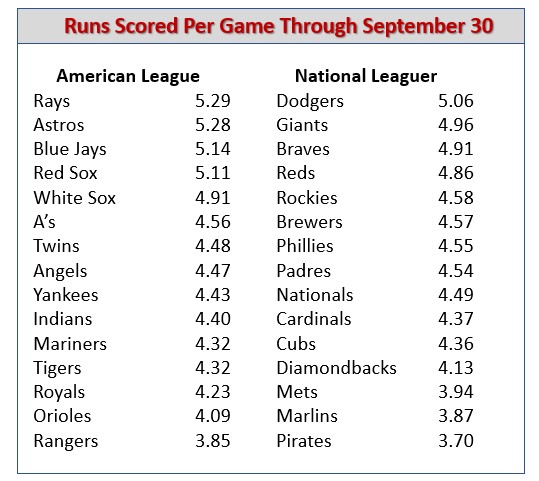
RUNS SCORED (average 719)

National League –  Dodgers (804); Giants (788); Braves (776)

American League – Rays (841); Astros (840); Blue Jays (818)
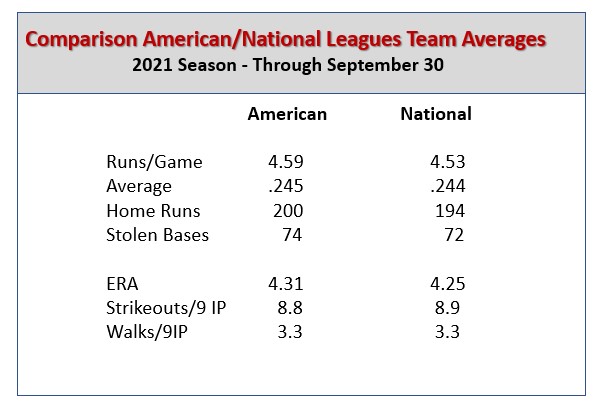
AVERAGE (average .244)

National League – Nationals (.259); Giants (.250); Reds (.249); Rockies (.249)

American League – Astros (.266); Blue Jays (.264); Red Sox (.261)

The lowest team average through September  belonged to the Mariners  at .226.  The lowest average in the NL?  Marlins at .233.  Side note:  The Brewers (in first place in the NL Central) and the Pirates (in last place in the NL Central – 36 games out) tied for the second-lowest NL team average at .234.

HOME RUNS (average 194)

National League – Giants (238); Braves (234); Dodgers (229)

American League –  Blue Jays (251); Twins (224); Yankees (221)

The Pirates had the fewest home runs through September  at 122.

STOLEN BASES (average 72)

National League – Padres (110);  Marlins (105); Cardinals (85)

American League – Royals (121); Rangers (106); Indians (103)

The Reds  stole the fewest sacks through September  at 36 (in 59 attempts).

WALKS DRAWN (average 517)

National League – Dodgers (603); Giants (592); Padres (582)

American League – Yankees (616); White Sox (575; ); Rays (573)

The Astros led MLB  in on-base percentage through  September  at .338. The Nationals led the NL at .337. In slugging percentage, the Blue Jays  were on top at .461, while the Giants  led the NL at .442.

BATTER’S STRIKEOUTS (average 1,379)

National League – Cubs (1,573); Marlins (1,529); Diamondbacks (1,443)

American League – Rays (1,510); Tigers (1,483); Mariners (1,466)
EARNED RUN AVERAGE (average 4.25)

National League – Dodgers (2.99); Giants (3.27);  Brewers (3.39)

American League – Rays (3.70); Yankees (3.71); White Sox (3.73); Astros (3.73)

Pitching Counts

Three teams had ERA’s through September at 5.00  or higher – Orioles (5.77), Diamondbacks (5.11), and Pirates (5.09). They have a combined record of 161-316 – and all reside in last place.  Among the seven ERA leaders listed above, six have clinched post-season berths. Their combined W-L through September is 676-437. 

STRIKEOUTS (average 1,379)

National League – Brewers (1,599); Dodgers (1,566); Reds (1,493)

American League – White Sox (1,557); Yankees (1,537); Red Sox (1,493)

The Brewers and White Sox  each averaged an MLB-best 10.2 strikeouts per nine innings through September. The MLB average was 8.9.

FEWEST WALKS SURRENDERED (average 517)

National League – Giants (412); Mets (468); Dodgers (481)

American League – Rays (431); A’s (431); Blue Jays (468)

The Giants walked a stringiest 2.6 batters per nine frames. They also  had the best strikeouts-to-walks ratio at 3.39.

SAVES (average 39)

National League – Giants (55); Dodgers (54); Cardinals (50)

American League – Mariners (50); Yankees (47); Red Sox (46)

BONUS STATS – WILD ONE

The Royals led all of baseball in wild pitchers through September (86), while the Cubs led in hit batters with 96. The MLB averages were 61 and 69, respectively. (Side note: The Reds’ and Dodgers’ hitters were plunked most often – 103 times.

——-Individual Statistical Leaders through September ———-

BATTING AVERAGE (qualifying players – 3.1 at plate appearance for each team game played)

National League – Trea Turner, Dodgers (.325); Juan Soto, Nationals (.318); Nick Castellanos, Reds (.310)

American League – Yuli Gurriel, Astros (.316);  Vlad Guerrero, Jr. , Blue Jays (.313); Michael Brantley, Astros (.312)

HOME RUNS

National League – Fernando Tatis, Jr., Padres (42); Adam Duvall, Braves (38); Pete Alonso, Mets (37)

American League –   Salvador Perez, Royals (48); Vlad Guerrero, Jr., Blue Jays (46); Shohei Ohtani, Angels (45)

RUNS BATTED IN

National League – Adam Duvall, Braves (112); Nolan Arenado, Cardinals (105); Austin Riley, Braves (105)

American League – Salvador Perez, Royals (121); Jose Abreu, White Sox (113); Teoscar Hernandez, Blue Jays (112)

The Padres’ Fernando Tatis, Jr. had the highest slugging percentage (among qualifiers) through September at .614).  Another Jr. – Vlad Guerrero of the Blue Jays led the AL at .596. 

RUNS SCORED

National League – Freddie Freeman, Braves (119); Juan Soto, Nationals (110); Trea Turner, Dodgers (102); Ozzie Albies, Braves (102)

American League – Vlad Guerrero, Jr., Blue Jays (120); Bo Bichette, Blue Jays (118); Jose Altuve, Astros (114)

HITS

National League –Trea Turner, Dodgers  (190); Freddie Freeman, Braves (177); Austin Riley, Braves (176)

American League – Bo Bichette, Blue Jays (186); Vlad Guerrero, Jr., Blue Jays (185); Whit Merrifield, Royal (180)

DOUBLES

National League –  Tommy Edman, Cardinals (41); Bryce Harper, Phillies (40); Ozzie Albies, Braves (38)

American League – Jeimer Candelario, Tigers  (42);   J.D. Martinez, Red Sox (42); Whit Merrifield, Royals (41)

The Blue Jays’ Marcus Semien had the most extra-base hits through August (85). The Braves’ Ozzie Albies led the NL with 75 extra-base knocks.

TRIPLES

National League – Dave Peralta, D-backs (8); Jake Cronenworth, Padres (7); Bryan Reynolds, Pirates (7); Ozzie Albies, Braves (7)

American League – Shohei Ohtani, Angels (8); Akil Baddoo, Tigers (7); five with six

STOLEN BASES

National League –  Trea Turner, Dodgers (32); Tommy Edman, Cardinals (28); Fernando Tatis, Jr., Padres (25)

American League –Whit Merrifield, Royals (40); Cedric Mullins, Orioles (30); Myles Straw, Indians (29)

The most stolen bases without being thrown out through September was 21  by the Royals’ Nicky Lopez.

Starling Marte leads the  major leagues in steals with 45 – 22 with the Marlins and 23 with the A’s.   

WALKS

National League – Juan Soto, Nationals (140); Bryce Harper, Phillies (99);  Freddie Freeman, Braves (84)

American League – Joey Gallo, Yankees (110); Robbie Grossman, Tigers (96); Shohei Ohtani, Angels (91)

BATTER’S STRIKEOUTS

National League – Javier Baez, Mets (182); Adam Duvall, Braves (174); Eugenio Suarez, Reds (169)

American League – Joey Gallo, Yankees (209); Matt Chapman, A’s (201); Adolis Garcia, Rangers (191)

PITCHING VICTORIES

National League –Julio Urias, Dodgers (19-3); Adam Wainwright, Cardinals (17-7); Walker Buehler, Dodgers (15-4); Max Scherzer, Dodgers (15-4)

American League – Gerrit Cole, Yankees (16-8); Chris Flexen, Mariners  A’s (14-6); seven with thirteen

The  Reds’ Jorge Lopez (8-16, 4.05) and Nationals’ Patrick Corbin  (9-16, 5.82) led MLB in losses through September.

EARNED RUN AVERAGE (qualifying players … at least one inning pitched for each team game played)

National League – Corbin Burnes, Brewers (2.29); Max Scherzer. Dodgers (2.46); Walker Buehler, Dodgers (2.49)

American League – Robbie Ray, Blue Jays (2.84);  Lance McCullers, Astros (3.16)’ Gerrit Cole, Yankees (3.23)

INNINGS PITCHED

National League – Zach Wheeler, Phillies (213 1/3 IP); Adam Wainwright, Cardinals (206 1/3 IP); Walker Buehler,  Dodgers (202 2/3 IP)

American League – Robbie Ray, Blue Jays (193 1/3); Jose Berrios, Blue Jays (192);  Frankie Montas, A’s (187)

STRIKEOUTS

National League – Zack Wheeler, Phillies (247  / 213 1/3 IP);  Max Scherzer, Dodgers (236 / 179 1/3 IP); Corbin Burnes, Brewers (230 / 165 IP)

American League – Robbie Ray, Blue Jays (248 / 193 1/3 IP); Gerrit Cole, Yankees (243 / 181 1/3 IP); Dylan Cease, White Sox (221 / 161 2/3 IP)

Among qualifying pitchers, the Brewers’ Corbin Burnes had the best strikeouts/nine innings ratio through September  at 12.55. The White Sox’ Dylan Cease  led the AL  at 12.30.  The only other pitcher at 12.0 or higher was Gerrit Cole of the Yankees(12.06). Fourteen qualifying pitchers averaged 10+ strikeouts per nine innings through September.

Among qualifying pitchers,  Burnes also had the best strikeouts-to-walks ratio at 6.97.

SAVES

National League – Mark Melancon, Padres (38); Kenley Jansen, Dodgers (37); Will Smith Braves (37)

American League – Liam Hendriks, White Sox (37):  Raisel Iglesias, Angels (33);  Aroldis Chapman, Yankees (30)

WHIP (among qualifiers)

National League – Max Scherzer, Dodgers (0.86); Corbin Burners, Brewers (0.93); Brandon Woodruff, Brewers (0.96)

American League – Robbie Ray, Blue Jays (1.04); Gerrit Cole, Yankees (1.06); Jose Berrios, Blue Jays (1.06)

Primary Resources: Baseball-Reference.com; MLB.com; Elias Sport Bureau

_____________________________________

Baseball Roundtable Disclaimer:  The MLB records referenced in this (and previous) posts have the potential to change as Major League Baseball recognizes and incorporates Negro League records from 1920-46 into the MLB record book.

______________________________________________

BASEBALL ROUNDTABLE ON THE TOP 100 BASEBALL BLOG LIST

100Baseball Roundtable is on the Feedspot list of the Top 100 Baseball Blogs.  To see the full list, click here.

I tweet baseball @DavidBBRT

Follow/Like Baseball Roundtable’s Facebook Page here.  More baseball commentary; blog post notifications; PRIZES.

Member: Society for American Baseball Research (SABR); The Baseball Reliquary; The Negro Leagues Baseball Museum.


Dodgers Topped the NL in 1966 … But Couldn’t Touch Larry Jaster

On this date (September 28) in 1966, 22-year-old southpaw Larry Jaster  (in his first full MLB season) took the mound for the sixth-place Cardinals – against the first place (and eventual NL Champion) Dodgers.  His mound opponent was future Hall of Famer Don Sutton. While the odds may have seemed to be against him, Jaster prevailed that Saint Louis evening, blanking the Dodgers 2-0 on four hits and two walks, while fanning four.

So, why is this game the focus of a Baseball Roundtable  post? Well, the whitewashing marked Jaster’s league-leading fifth shutout of the 1966 season, as well as his fifth complete-game shutout in five starts against the Dodgers that campaign.  That made Jaster the first (and still only) MLB pitcher to shutout the same team five consecutive times in one season and just one of three pitchers to shutout out the same team five times in a season (Senators’ Tom Hughes versus the Indians in 1905 & Phillies’ Grove Cleveland Alexander versus the Reds in 1916).  In his five games against the Dodgers that season, Jaster gave up just 24 hits (.157 average) – ALL SINGLES.

Here’s how Jaster fared against the Dodgers in 1966:

April 25 at LA …. 2-0 win, seven hits, no walks, seven strikeouts.

July 3 at LA … 2-0 win, three hits, one walk, one HBP, five strikeouts.

July 29 in St. Louis … 4-0 win, five hits, two walks, eight strikeouts.

August 19 at LA … 4-0 win, five hits, three walks, seven strikeouts.

Sept. 28 in St. Louis … 2-0 win, four hits, two walks, four strikeouts.

Jaster was a multi-sport star in his youth, turning down multiple college football scholarship offers to sign with the Cardinals for what was then the princely bonus of $50,000 as an 18 year-old. The top prospect was on the mound for the Cardinals in just his fourth professional season.  He enjoyed a seven-season (1965-70, 1972) MLB career (Cardinals, Braves, Expos) – going 35-33, 3.65 in 138 games (80 starts), with 15 complete games and seven shutouts. In his 1966 season, he set his career highs in wins (11), complete games (6), shutouts (5) and strikeouts (92).  Jaster’s  career took a southward turn in the middle of the 1968 season – when he developed shoulder problems.  From 1965 through 1967, he was 23-12, 3.01 for the Cardinals.  In 1968, he was 7-4, with a 1.79 ERA On July 14. Then went 2-9, 6.36 for the remainder of the campaign. After the 1968 season, he got  in just 43 more MLB games (12 starts) going 3-8, 5.72. He did pitch in the minors through 1974, but did not make it back to the majors.

On April 14, 1969, Larry Jaster – starting for the Expos against the Cardinals –  threw the first regular-season MLB pitch ever in Canada.

After retiring as a player, Jaster earned a Masters Degree in Physical Education from the University of New Mexico and went on to enjoy a long career coaching at the  high school, college and professional levels.

Primary Resources: Baseball-Reference.com; Baseball Almanac.com


Baseball Roundtable Disclaimer:  The MLB records referenced in this (and previous) posts have the potential to change as Major League Baseball recognizes and incorporates Negro League records from 1920-46 into the MLB record book.

BASEBALL ROUNDTABLE ON THE TOP 100 BASEBALL BLOG LIST

100Baseball Roundtable is on the Feedspot list of the Top 100 Baseball Blogs.  To see the full list, click here.

I tweet baseball @DavidBBRT

Follow/Like Baseball Roundtable’s Facebook Page here.  More baseball commentary; blog post notifications; PRIZES.

Member: Society for American Baseball Research (SABR); The Baseball Reliquary; The Negro Leagues Baseball Museum.



Why I Love Baseball … Guest Post by Baseball Author/Lecturer Jason Love

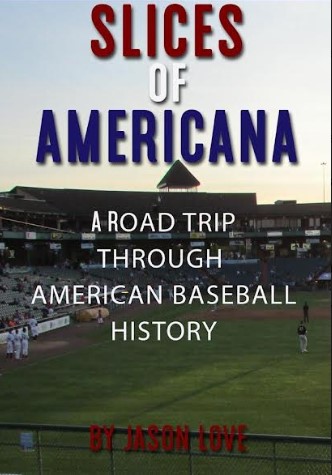
As regular Baseball Roundtable readers know, Baseball Roundtable invites and encourages guest contributions to its “Why I Love Baseball” page. Today, BBRT is pleased to present a post from Jason Love, author of the book “Slices of Americana – a Road Trip Through American Baseball History“published this year by Sunbury Press.

Love is a lifelong Phillies fan who lives in New Jersey. Love combines his passion for baseball and history (he has history degree from West Chester University) to his approach to the National Pastime and the road trip genre of baseball writing.   In addition to “Slices of Americana,” Love has authored “A Visit to New Jersey’s Minor League Ball Parks.”   He also presents lectures on baseball history at local libraries and other community venues (more than 50 communities to date.)  You can find him at TalkingBaseballWithJasonLove.com and  on Twitter @jason_love1.   You’ll find a brief Baseball Roundtable review of Love’s latest book at the end of this post. 


WHY I LOVE BASEBALL

By Jason Love

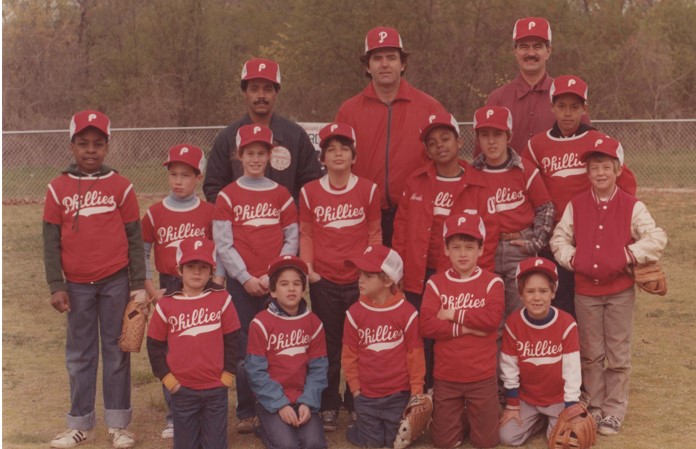
My first memories of baseball are not of going to my first professional game or watching the Phillies on television.  Although I do have some vague memories of the Phillies winning the World Series over the Kansas City Royals in 1980. I remember watching the final game with my family and wondering why the Philadelphia Police Department brought German Shepherds onto the field prior to the final out. The police were anticipating the fans at Veterans Stadium storming the field. As a seven-year-old, I had a feeling that something special was happening. I can remember Tug McGraw leaping into the air after striking out Willie Wilson.

Playing Little League baseball is what I remember most about the game as a child. I have fond memories of my teammates, the snack bar, my first uniform and glove, and the game itself. Playing baseball in my youth laid the foundation for my love of America’s Pastime. I was never a great player (not even a good one), but I loved playing as a kid. In the early 1980s I had visions of being the next Pete Rose or Manny Trillo (we both played second base). In addition to Little League,  I played Wiffle Ball with my buddies throughout the summer. I remember Saturday mornings spent watching This Week in Baseball narrated by the great Mel Allen and The Baseball Bunch with Johnny Bench. Collecting baseball cards was also a big part of my childhood. The 1985 Topps Dwight Gooden card was considered gold. Baseball was woven into the fabric of my childhood.

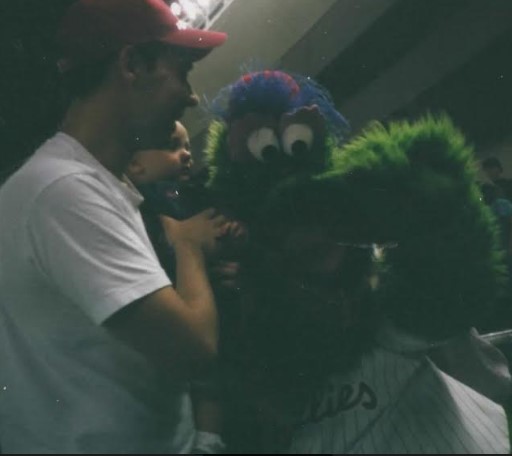
When my oldest daughter Delia was born in 1999, I started taking her to games at Veterans Stadium. One of my favorite photos is of me holding Delia up to meet the Phillie Phanatic in the 700-level of The Vet. She has a confused look on her face. Who is the green, fuzzy creature roaming about the stadium? When Sophia and Ian were born, I started taking them to games as well. We always enjoyed time spent at the ballpark. The game itself was just the backdrop. My kids had fun getting hot dogs, ice cream and cotton candy. And all of us still get a laugh out of watching the Phanatic. We always have fun and simply enjoy our time spent together at the ballpark.

The main reason I love baseball is the way it connects different generations. Baseball connects people of all ages and of all  different social and economic backgrounds. Sitting at the ballpark, you can strike up a conversation with the person next to you about a favorite player, team, moment, or whatever. It does not matter if the person in the seat next to you is a CEO, bus driver, or visiting from another city. I like going to the ballpark with a friend, having a beer or two, and enjoying the moment. I enjoy watching my son Ian play Little League, just as I did 30 years ago. Baseball, at all levels, provides an instant connection between people.

I also love the timelessness of the National Pastime. Baseball today is essentially the same as it was in the 1880s. Yes, there have been some rules changes and the stadiums are bigger and the scoreboards more elaborate, but the atmosphere, the camaraderie of fandom, the discussion and debate and even the sense of history remain the same.

Over the years, I have visited several minor league ballparks and I make sure to watch several games each season at Citizens Bank Park in Philadelphia. This past year, my children and I took a road trip to PNC Park to watch the Phillies play the Pirates in Pittsburgh.

Ultimately, the final score does not matter much to me. Of course, I hope the Phillies win; however, it is more about spending an afternoon watching some baseball with my family and creating wonderful memories.

For More Why I Love Baseball posts, click the link at the top of the Baseball Roundtable home page.

_______________________________________

Baseball Roundtable looks at Jason Love’s “Slices of Americana – A Road Trip Through American Baseball History.

It’s clear author Jason Love has a passion for the national pastime, a love of history and the ability to tell a good story.  Toss in a perspective shaped by personal/life challenges, a rancorous political climate and the impact of the surging Coronavirus epidemic (not to mention a penchant for The Waffle House) and you have a unique and entertaining entry into the baseball “road trip” genre.

In the book’s series of seven “essays,” Love shares the tales of 2019/2020 family road trips that taken him all the way from  the Babe Ruth Hall of Fame and Museum and the National Baseball Hall of Fame in Cooperstown to Love’s own Little League field in New Jersey and the minor-league home of the Reading Fightin’ Phillies.  He shares the emotions baseball brings to him – from the reverence of entering the Baseball Hall of Fame to the joy of a Father’s Day game of catch with his son on a professional diamond.  And, he touches on baseball history and personal memories along the way – from Babe Ruth’s childhood, to Hall of Famer Judy Johnson’s stellar Negro League career to Ken Griffey, Jr.’s 500th home run …  all the way to some of his personal favorite players  like Manny Trillo and Steve Jeltz and even his own Little League career.

On the pages/posts of Baseball Roundtable, I often note that when researching a baseball topic “one thing always seems to lead to another.”  That describes Love’s book – one thing baseball always seems to lead to another and Love ties these stories (big and small) together well.  For example, the book appropriately comes to a close with Opening Day (July 23, 2020) and Love uses this chapter to consider the sense of hope that each Opening Day brings to fans. He also recognizes such “one thing leads to another” topics as the first official Opening Day (April 22, 1876 – Boston Red Stockings versus Philadelphia Athletics), Howard Taft’s first Presidential first pitch (1910), Walter Johnson’s 15-inning Opening Day (1926) shutout, Bob Feller’s 1940 Opening Day no-hitter and more.

All in all, a good read for the baseball fan – penned by an individual who clearly “loves” the game. (Pun intended.)  Love’s book ($14.95) is available from Amazon.com and Sunbury Press.

BASEBALL ROUNDTABLE ON THE TOP 100 BASEBALL BLOG LIST

100Baseball Roundtable is on the Feedspot list of the Top 100 Baseball Blogs.  To see the full list, click here.

I tweet baseball @DavidBBRT

Follow/Like Baseball Roundtable’s Facebook Page here.  More baseball commentary; blog post notifications; PRIZES.

Member: Society for American Baseball Research (SABR); The Baseball Reliquary; The Negro Leagues Baseball Museum.


Rosario Hits for the Cycle – and some “Cycling” Trivia

Yesterday (September 20, 2021),  Braves’ LF Eddie Rosario hit for the cycle (single, double, triple and home run all in one game) as Atlanta topped Giants 3-0  in San Francisco.  Rosario doubled to right in the second inning; tripled to right in the fifth; hit a solo home run to right in the seventh; and singled to center in the ninth.  It was the fourth cycle of the 2021 season and 333rd regular-season cycle in MLB history.

In celebration, Baseball Roundtable thought this might be a good time to revisit come cycle trivia.

The  Only Pitcher Ever to Record a Win and Hit for the Cycle in the Same Game

On July 28, 1888 – as the Chicago White Stockings topped the Detroit Wolverines, 21-17 –  Jimmy Ryan  started in CF for Chicago with Mark Baldwin on the mound.  In the bottom of the second – with two out, six runs scored in the inning and the bases loaded – Chicago Manager Cap Anson had Baldwin and Ryan changed places.  Ryan fanned Detroit pitcher Charles “Lady” Baldwin to end the inning, with the White Stockings trailing 7-4. Chicago tied the game at 8-8 in the top of the fourth and went on to win 21-17.

Ryan got the victory, pitching 7 1/3 innings, allowing ten runs. He also went five-for-six at the plate (a single, double, two triples and a home run), was safe on error, scored three runs, drove in four and stole a pair of bases.  In the process, he became the first (and still only) player to record a pitching victory and a cycle in the same game.  (For the season, Ryan hit .332, leading the National League in hits with 182, doubles with 33 and home runs with 16). On the mound, he was 4-0, 3.05 in eight appearances (two starts).  For his 18-season MLB career (1885-1900, 1902-03), Ryan hit.308-118-1,093, with 419 steals (2,014 games). On the mound he was 6-1, 3.62 in 24 games (five starts).

The Fastest Cycle Ever

On June 18, 2000, Colorado Rockies’ second baseman Mike Lansing completed the cycle in just four innings – making it  the quickest cycle in MLB history. Notably, Lansing was consistently behind in the counts and three of his four hits came with two strikes. Lansing, batting second in the order, hit:

  • An RBI triple to right in the first inning, on a 1-2 pitch;
  • A two-run home run (0-1 pitch) in the bottom of the second;
  • A two-run double (2-2 pitch) in the bottom of the third (as the Rockies scored nine times to take a 14-1 lead); and
  • A single (another 1-2 offering) to right in the fourth.

Lansing then struck out in the sixth, before being lifted for a pinch-hitter (Darren Bragg) in the eighth. Lansing ended the day four-for-five, with three runs scored and five RBI, as the Rockies torched the Diamondbacks 19-2 in Denver.

In addition to his fastest-ever cycle, Lansing shares the record for the most home runs in an inning (two). On May 7, 1997, he hit a two-run and three-run homer in a 13-run sixth inning, as the Expos topped the Giants 19-3 in San Francisco.  That was his best season in the majors, as he hit .281 and recorded his career highs in home runs (20), RBI (70) and doubles (45).

The “Slowest” Cycle Ever

The Expos’ Tim Foli is the only player to start a cycle one day and complete it the next. On April 21, 1976, Foli collected a single, double and triple in a contest against the Cubs that was suspended in the top of the seventh due to darkness. When play resumed the following day, Foli added an eighth-inning home run. (The Expos prevailed 12-6.)

The Most Cycles Ever

Only five  MLB players have hit for the cycle three times in their careers: John Reilly (Red Stockings, twice in 1883 and Reds in 1890); Babe Herman (Brooklyn Robins, twice in 1931 and Cubs in 1933); Bob Meusel (Yankees in 1921, 1922 and 1928); Adrian Beltre (Mariners in 2008, Rangers in 2012 and 2015); and Trea Turner (Nationals in 2017, 2019 and 2021).

The Most Cycles Ever in One Season

Only five players have collected two cycles in one season. Among those, Brewers’ outfielder Christian Yelich is the only one to hit for the cycle against the same team (the Reds) twice in the same campaign. In Yelich’s 2018 MVP season, he hit for the cycle on August 29, as the Brewers topped the Reds 13-12 in ten innings in Cincinnati. He doubled up on cycles on September 17, as the Brewers topped the Reds 8-0 in Milwaukee.

Longest Time Ever Between Cycles

Among players with multiple cycles, George Brett went the longest time between cycles – 11 years & 57 days. He hit for the cycle on May 28, 1979 (his age-26 season) and again on June 24, 1990 (his age-37 season).

Shortest Time Between Cycles

John Reilly (Reds) and Tip O‘Neill (St. Louis Brown Stockings, American Association) had the shortest time between cycles at just seven days. Reilly’s came on September 12 and September 19, 1883. O’Neill’s came on April 30 and May 7, 1887.

Something Old … Something New

The youngest MLB player ever to hit for the cycle is the NY Giants’ Mel Ott (age 20, cycle on May 16, 1929).  The oldest player to hit for the cycle is The Angels’ Dave Winfield (age 39, cycle on June 24, 1991).

Sharing the Wealth

Three players have hit for the cycle in both the NL and AL: Bob Watson (NL Astros-1977 and AL Red Sox-1979); John Olerud (NL Mets-1997 and AL Mariners-2001); Michael Cuddyer (AL Twins-2009 and NL Rockies-2014).

Quote the Raven, “Nevermore”

The Marlins are the only MLB team to never have a batter record a cycle.

Hitting (running) into an Out for the Cycle

Photo by rchdj10

The Yankees’ 1B Lou Gehrig (kind of) earned a cycle by being tossed out at the plate.  On June 25, 1934, as New York topped Chicago 13-2  at Yankee Stadium, Gehrig hit two-run home run in the first inning; a  single in the third; and a double in the sixth. Gehrig came up needing just the triple for the cycle in the seventh and hit a smash to deep center (scoring Yankees’ CF Ben Chapman). Gehrig wasn’t satisfied with a three-bagger and was thrown out at home (8-6-2) trying for an inside-the-park home run – thus getting credit for the triple he needed for a cycle.


Nearly a Cycle – In One Inning

On June 27, 2003, Johnny Damon was playing CF and leading off for the Red Sox  as they took on the Marlins in Boston.  In a start that brought Boston fans up out of their seats, Damon was three-fourths of the way to the cycle bat the end of the first inning – and had tied an MLB record with three hits in an inning.  (The Red Sox scored 14 runs in the first inning, on their way to a 25-3 win over the Marlins at Fenway.) Damon who collected a single, double and triple in the bottom of the first, ended the game five-for-seven, with three runs scored, three RBI, a double, a triple and three singles.  He, unfortunately, did not get the cycle. In his final three at bats Damon: struck out; flied out to center; singled to right; singled past third base.

Here’s how that first inning went:

  • Johnny Damon – Double past first base down the line.  (Off starter Carl Pavano.)
  • Todd Walker – single, Damon scores.
  • Nomar Garciaparra – Double.
  • Manny Ramirez – Home run, scoring three.
  • David Ortiz – Double.
  • Kevin Millar – Single, Ortiz scores.

Michael Tejera replaces Pavano on the mound.

  • Trot Nixon – Single.
  • Bill Mueller – Walk, loading the bases.
  • Jason Varitek – Single, Millar and Nixon score.
  • Damon – Triple to deep right field, Mueller and Varitek score.
  • Walker – Single, Damon scores.

Allen Levrault takes over for Tejera – at this point, we’ve seen two pitchers, 11 batters, ten hits, one walk, nine runs and no outs.

  • Garciaparra – Foul pop out.
  • Ramirez – Single.
  • Ortiz – Walk, loading the bases.
  • Millar – Sacrifice fly, scoring Walker.
  • Nixon – Walk, loading the bases.
  • Mueller – Double, scoring Ramirez and Ortiz.
  • Varitek – Walk.
  • Damon – Line drive single to left, Nixon scores, Mueller is thrown out at the plate to end the inning.

Red Sox score 14 runs on 13 hits and four walks; Damon collects a single, double and triple.

The Cycle … From a Family Perspective

Only two father-son combinations have hit for the cycle at the Major-league level – and both involved rookies.

Gary Ward hit for the cycle as a rookie (in just his 14th game) for the Twins on September 18, 1980. His son Daryle hit for the cycle for the Pirates (against the Cardinals) on May 26, 2004 (in his seventh MLB season).

In 2018, Blues Jays’ rookie Cavan Biggio – in a September 17 game against the Orioles – hit for the cycle.  Cavan’s father, Hall of Famer Craig Biggio, hit for the cycle (for the Astros versus the Rockies) on April 8, 2002.

The Cycle … Sometimes it Skips a Generation

Pittsburgh Pirates’ outfielder Gus Bell hit for the cycle on June 4, 1951 – as the Pirates topped the Phillies 12-4 in Philadelphia. Fifty-three seasons later – on June 28, 2004 – Phillies’ 3B David Bell (Gus Bell’s grandson) hit for the cycle (also in Philadelphia), as the Phillies topped the Expos 14-6.   Gus and David Bell are the only grandfather-grandson combination to achieve MLB cycles.

Cycles … A Big Stage Perspective

Brock Holt is the only player to record a cycle in the post season. He did it on October 8, 2018, as the Red Sox beat the Yankees 16-1 in Game Three of the American League Division Series. Holt grounded out in the top of the second inning; had a single and a triple in the Yankees seven-run fourth; grounded out in the sixth; hit a ground-rule double in the eighth; and managed to finish his cycle  with a home run with two outs in the top of the ninth. It was Holt’s second career cycle.  He had a regular-season cycle for the Red Sox on June 16, 2015, as Boston topped Atlanta 9-4 at Fenway. He also completed that cycle with two outs in Boston’s last offensive inning – hitting a triple with two down in the bottom of the eighth.

Primary Resources:  Baseball-Almanac.com; Baseball-Reference.com; “July 28, 1888: Jimmy Ryan hits for cycle as Chicago White Stockings win 21-17 slugging match, ” by Mike Huber, SABR.


Baseball Roundtable Disclaimer:  The MLB records referenced in this (and previous) posts have the potential to change as Major League Baseball recognizes and incorporates Negro League records from 1920-46 into the MLB record book.

BASEBALL ROUNDTABLE ON THE TOP 100 BASEBALL BLOG LIST

100Baseball Roundtable is on the Feedspot list of the Top 100 Baseball Blogs.  To see the full list, click here.

I tweet baseball @DavidBBRT

Follow/Like Baseball Roundtable’s Facebook Page here.  More baseball commentary; blog post notifications; PRIZES.

Member: Society for American Baseball Research (SABR); The Baseball Reliquary; The Negro Leagues Baseball Museum.


“From Both Sides Now” … First Two Career Homers from Each Side of the Plate in the Same Game

Johnny Lucadello St. Louis Browns: Public domain, via Wikimedia Commons

On this date (September 16) in 1940, Saint Louis Browns’ 21-year=old infielder Johnny Lucadello made a bit of baseball history.  (Spoiler alert: We’re in  #InBaseballWeCountEverything territory here.). On that day, as the Browns topped the Yankees 16-4 in St. Louis,  Lucadello – playing second and batting second, went three-for-five with two runs scored, five RBI and two home runs.  The history?  Lucadello was the first switch-hitting major leaguer to hit his first two home runs from opposite sides of the plate in the same game.  (At this point in his career, Lucadello was in his third MLB season and, going into the September 16 game, he had played in a career total of 23 games (63 plate appearances). His first homer in the game  (a solo shot) came in the bottom of the first inning off  southpaw Marius Russo (a 14-game winner that season) and the second round tripper came in the seventh frame (a two-run blast off righty Steve Sundra (the Yankees fourth pitcher of the game).

Lucadello would finish the 1940 season at .317-2-10.  He would enjoy a six-season MLB career (1938-47, losing 1942-45 to military service), hitting .264-5-60 in 239 games.  His best season was 1941, when he went .279-2-31 in 107 games for the Browns.

Oh, Those Lost Years

Johnny Lucadello was considered a solid prospect until a four-year stint in the military interrupted his career. From 1936-1940, he hit .312 in 557 minor-league games and was selected to his league’s All Star team each season.

I should add that hitting your first two career home runs, from opposite sides of the plate in the same game is a rare occurrence. Here are the other five instances I was able to uncover.

____________________________________

U L  Washington

Washington marked his third MLB season, 172nd game and 424th plate appearance before he hit his first MLB home run.  It was a three-run shot in the top of the second inning of a game (September 21, 1979) in which his Royals would topple the A’s 13-4 in Oakland. It came left-handed off A’s righty Rick Langford. In his very next at bat – top of the third inning – Washington hit another three-run shot, this one right-handed off southpaw reliever Craig Minetto. Washington, playing SS and batting ninth, finished the game four-for-five with three runs scored and six RBI. The two dingers, by the way, would be the 25-year-old Washington’s only long balls in 101 games played that season.  He would go .254-2-25, with 32 runs scored and ten steals.

Washington would have a 11-season MLB career (1977-87), going .251-27-255, with 358 runs scored and 132 steals. His best season was 1982, when he went .286-10-60, with 23 steals for the Royals.

What does U L stand for?

U L were not U L Washington’s initials, they were his given name. 

_______________________________________

Bret Barberie

Barberie had his notable game on August 2, 1991 – as his Expos lost to the Phillies 6-5 (in 11 innings) in Montreal. The 23-year-old was playing SS and batting seventh. He went three-for-four with two runs and two RBI. It was Barberie’s 17th MLB game (all in 1991) and he had 26 plate appearance up to that date. His first homer came leading off the bottom of the third inning  (against righty Danny Cox).  The second (another solo shot) tied the game at 4-4 in the bottom of the seventh (hit off left-hander Wally Ritchie). Barberie finished the season at .353-2-18 in 57 games. He played in six MLB seasons (1991-96), hitting .271-16-133.  His best season was with the Marlins in 1994 (.301-5-31 in 107 games).

That Would Be A first

Bret Barberie recorded the first base hit in the expansion Marlins’ history, a first-inning single off the Dodgers’ Orel Hershiser on Opening Day (April 5) in 1993.

___________________________________

Brian Simmons

Simmons, playing center field and batting in the eight spot, led the White Sox to a 13-5 win over the Royals (in Kansas City) on September 26, 1998. The 25-year-old outfielder was in his first MLB season and just his fourth MLB game (he had ten MLB plate appearances – four singles – going into the game.)

In the game, Simmons went three-for-five with two runs scored, five RBI and, of course, those two home runs. Like Lucadello, they would be Simmons ‘only home runs of the season.  The first homer was a two-run shot off righty starter Brian Barber in the top of the fourth – breaking a 4-4 tie. Simmons went yard again in the seventh (off southpaw Allen McDill) – another two=run homer.  He finished 1998 at .368-2-6 in five games.  Simmons played in two more MLB campaigns (1999 & 2001) and put up a career line of .218-8-31 in 119 games. A ruptured Achilles tendon cut short his career.

___________________________________________

Aaron Miles

Miles had his “both sides now” first-two-career-homers day on April 14, 2004 – as his Rockies topped the Diamondbacks 14-4 in Denver. Miles, batting leadoff and playing second base went three-for-five with two runs scored and six RBI. He led off the bottom of the first with a home run off right-hander Elmer Dessens; then added a three-run homer of lefty Steve Randolph in the fifth.  Miles had earned a late season call up in 2003, going four-for-twelve with three doubles in eight games. He had added five more MLB games and 22 plate appearances before his April 14 outburst. Miles had a solid season for the Rockies in 2005, hitting .293-6-46, with 75 runs scored in 134 games. He played nine MLB seasons (2003-2011), hitting .281-19-229. He hit a high of .317 in 134 games for the Cardinals in 2008.

Put Me In Coach

Primarily a utility infielder, Aaron Miles played every position except catcher during his MLB career.  He appeared in five games on the mound, pitching five innings and putting up a 3.60 ERA.

___________________________________________

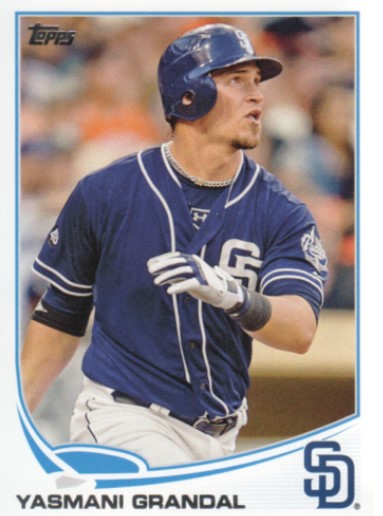
Yasmani Grandal

Grandal – still active – is easily the biggest name on this list. A two-time All Star the 32-year-old catcher is in his tenth MLB season. Grandal had his noted day on June 30, 2012, as his Padres topped the Rockies 8-4 in Denver. Gandalf did not wait long to make this particular page in the record books, he hit his first two career home  runs (from each side of the plate in the same game) in just his second MLB game and his first MLB  start. (He had one previous MLB at bat). On his big day, Grandal went two-for-four with two runs scored and three RBI. He hit a solo homer in the top of the fourth inning off lefty Christian Friedrich and a two-run homer in the sixth off right-hander Jeremy Guthrie. He went on to finish the season at .297-8-36 in 60 games. As of this writing – end do play September 16, 2021 – Grandal’s MLB line is .240-169-500. Notably, his rookie season is the only only which he had hit at .250 or better, he does however, have five seasons of 20 or more home runs (including 2012) on his resume. He now has homered from both sides of the plate in four MLB games.

Anything You Can Do, I Can Do Better

Yasmani Grandal did Johnny Lucadello one better. Not only did Grandal join the list of players getting their first two career home runs, one from each side of the plate, in the same game.  He is the only player whose fist two major leagues hits (of any kind) were home runs, from each side of the plate in the same game.


Primary Resources:  Baseball-Reference.com; Baseball-Almanac.com

Baseball Roundtable Disclaimer:  The MLB records referenced in this (and previous) posts have the potential to change as Major League Baseball recognizes and incorporates Negro League records from 1920-46 into the MLB record book.

BASEBALL ROUNDTABLE ON THE TOP 100 BASEBALL BLOG LIST

100Baseball Roundtable is on the Feedspot list of the Top 100 Baseball Blogs.  To see the full list, click here.

I tweet baseball @DavidBBRT

Follow/Like Baseball Roundtable’s Facebook Page here.  More baseball commentary; blog post notifications; PRIZES.

Member: Society for American Baseball Research (SABR); The Baseball Reliquary; The Negro Leagues Baseball Museum.


Celebrating the Burnes-Hader NO-NO … and Other Combined No-Hitters

CORBIN BURNES. Photo: Ian D’Andrea on Flickr, CC BY-SA 2.0 <https://creativecommons.org/licenses/by-sa/2.0>, via Wikimedia Commons

Yesterday (September 11, 2021), Brewers’ ace right-hander Corbin Burnes faced off against the Indians in Cleveland. Burnes tossed eight innings of no-hit ball, before yielding the mound to southpaw reliever Josh Hader, who finished off the no-hitter with a 1-2-3 ninth.  It was the ninth no-hitter of the 2021 season, breaking the MLB single-season record of eight (set back in 1884.)  It was also the 314th MLB no-hitter and the 16th combined no-hitter (the second combined no-hitter of 2021).

JOSH HADER. Photo: Dirk Hansen, CC BY-SA 4.0 <https://creativecommons.org/licenses/by-sa/4.0>, via Wikimedia Commons

Burnes tossed eight innings, walking one and fanning 14 – eleven swinging and three looking.  He went to a three-ball count on just five batters and four of those struck out (Cleveland CF Myles Straw walked on a 3-1 pitch to open the seventh inning –  the only Indians’ base runner in the game.  Burnes threw a total of 115 pitches (his highest pitch count of the season), 78 for strikes. Hader came on in the ninth and retired the Indians on nine pitches (two strikeouts and a foul pop.)

Side note:  Baseball Roundtable is trying to imagine the response from such pitchers as Bob Gibson, Don Drysdale or Jack Morris if they had been asked to turn over the ball after eight no-hit, 14-strikeout innings.  Might mayhem have ensured? For those who like to know such things, the most pitches thrown in a no-hitter is 149 by the Diamondbacks’ Edwin Jackson on June 25, 2010. In that game, Jackson was still around to throw a complete-game no-hitter after tossing 70 pitches over the first three innings (seven walks).  For the game he walked eight and fanned six.

Baseball Roundtable Disclaimer:  The MLB records referenced in this (and previous) posts have the potential to change as Major League Baseball recognizes and incorporates Negro League records from 1920-46 into the MLB record book.

Here’s a few tidbits about the Burnes-Hader no-no.

  • The Indians became the first team to be no-hit three times in a single season.
  • Burnes became just the third pitcher in (American League / National League) to be pulled to open the ninth inning after eight hitless frames (Elias Sports Bureau).
  • It was the seventh no-hitter thrown on the road this season (an MLB single-season record – although 2021 already had the record at six).

Zach Plesac … Chuck Estrada in Reverse

The Indians have been no-hit a record three times this season and Zach Plesac was the starting pitcher for the Indians in all three contests. The first came on April 14 versus the White Sox in Chicago. In that one, Plesac was destined for a loss (even without the no-no)  – giving up six  runs in just 2/3 of an inning, as the Indians fell 8-0 and the White Sox’ Carlos Rodon went the distance walking none and fanning seven (then only base runner was Indians’ C  Roberto Perez, hit by a pitch on an 0-2 count with one out in the ninth. Next, on May 7, the Reds’ Wade Miley no-hit the Indians (one walk, eight whiffs) in Cleveland, winning by a 3-0 score. Plesac started and took a no-decision after pitching  eight scoreless innings (three hits no walks, seven strikeouts). In that one the Indians had just two base runners (both in the sixth frame) – SS Amed Rosario, who reached on an error, and 2B Cesar Hernandez, who reached on a full-count walk.  Then, on September 11, Corbin Burnes and Josh Hader no-hit the Indians 3-0 in Cleveland, with the only Cleveland base runner being CF Myles Straw, who walked in the seventh. In this one, Plesac went six innings and gave up three  runs (two earned). Plesac ended the day at 10-5, with three of the five losses in games in which the Indians were no hit.

Why is that Chuck Estrada in reverse.? It’s a matter of support.  In 1961, Orioles’ 1B Jim Gentile hit a then-record (since topped) five Grand Slam home runs in a season. Chuck Estrada was the Orioles’ starter on the mound – and got the victory –  in each of the four games in which Gentile connected for a Grand Slam. (Gentile had one two-Slam game.)

Now, let’s revisit the  fifteen MLB combined no-hitters that preceded the Burnes-Hader game – and the touch upon circumstances that made many of them unique.  Baseball Roundtable has lo0ked at combined no-hitter before, but this seems like a good time for review. 

The First-Ever Combined No-Hitter – Babe Ruth Didn’t Hang Around Long

This took place on June 23, 1917 – with the Red Sox topping the Senators 4-0 in Boston. This game is special for several reasons:

  • It was the first MLB combined no-hitter;
  • Babe Ruth started on the mound;
  • It involved the most meager contribution by the starting pitcher (zero innings pitched- one batter faced); and
  • It is arguably the most “perfect” combined no-hitter ever.

Babe Ruth, at that time plying his trade as a left-handed starting pitcher for the Boston Red Sox, opened the game by walking Washington’s lead-off hitter Roy Morgan.  Ruth, and his catcher Pinch Thomas, took issue with umpire Brick Owens’ strike zone and, during the argument, Ruth made contact with the umpire (a glancing blow, it was reported).  The ultimate result of the confrontation was the ejection of both Ruth and Thomas (with Ruth earning a $100 fine and ten-game suspension).  Red Sox’ pitcher Ernie Shore was called in to replace Ruth and Sam Agnew took Thomas’ spot behind the plate. Morgan decided to test Agnew’s arm and was thrown out stealing, after which Shore retired the next 26 hitters in order – completing the first combined no-hitter within the minimum 27 total batters.  Ruth, by the way, ended the season 24-13, with a 2.01 ERA and a league-leading 35 complete games in 38 starts.

_________________________________________

Second Combined No-Hitter – A Long Time A-comin’

Given the past propensity for pitchers finishing what they started, MLB’s second combined no-hitter came 50 seasons and 70 no-hitters later – on April 30, 1967, with the Tigers defeating the Orioles 2-1 in Baltimore.  This combined no-hitter is unique because:

  • It was not a shutout.
  • The team that threw the no-hitter lost (the only combined no-hitter loss); and
  • It involved the briefest contribution by the relief staff (one pitcher/one-third inning pitched).

Orioles’ starter Steve Barber was effectively wild, walking ten hitters and hitting two in 8 2/3 innings. The opposing hurler was Detroit’s Earl Wilson – who matched goose eggs with Barber for seven innings. In the eighth, Baltimore pushed across a run on three walks and a sacrifice fly (Wilson gave up only two hits and four walks in his eight innings of work) and victory was there if Barber could take it. He didn’t.  Barber walked Tigers’ 1B Norm Cash to start the ninth. He then walked SS Ray Oyler. Earl Wilson, a good-hitting pitcher, bunted the runners to second and third, before Barber got the second out of the inning, inducing PH Willie Horton to pop up to the catcher.  Now, just one out away from a 1-0, no-hit win, Barber uncorked a wild pitch that brought the tying run home. He then walked CF Mickey Stanley, ending his day on the mound. Stu Miller came in to get the final out, but not until an error allowed the go-ahead run to score.

________________________________________

Combined No-Hitter Number Three – Waiting Until the Last Possible Day

This no-hitter came on September 28, 1975, with the A’s topping the Angels 5-0 in Oakland.  This game was unique in that:

  • It is one of only three no-hitters thrown on the final day of an MLB season;
  • It made starting pitcher Vida Blue the first hurler to take part in both a solo and combined no-hitter. (Blue had thrown a solo no-hitter on September 21, 1970.); and
  • It was the first time more than two pitchers were involved in a combined no-hitter.

Blue went five innings  (two walks, two strikeouts) and was followed by Glenn Abbott (one inning,), Paul Lindblad (one inning, one whiff) and Rollie Fingers (two innings, two strikeouts). Note: Blue has been joined by Kevin Millwood, Kent Mercker and Mike Witt as pitchers with both solo and combined no-hitters.)

______________________________________

Combined No-Hitter Number Four – Tea for Two

The next combined no-hitter went back to the two-pitcher formula, as Blue Moon Odom (five innings, nine walks, three strikeouts) and Francisco Barrios (four innings, two walks, two strikeouts) of the White Sox topped the A’s 2-1 in Oakland.  In this July 28, 1976 game, Odom walked seven different players at least once in his five innings of work.

_____________________________________

Combined No-hitter Number Five –  At Witt’s End

MLB’s fifth combined no-hitter came on April 11, 1990 (again just two pitchers), with the Angels topping the Mariners 1-0 in Anaheim.  Mark Langston started the game and went seven (four walks, three strikeouts) and Mike Witt (the only pitcher to throw a perfect game – September 30, 1984 – and take part in a combined no-hitter ) threw the final two (two strikeouts.)

_______________________________________

1991 – The First “Year of the Combined No-Nos” (plural that is)

1991 saw seven MLB no-hitters, including two combined no-nos. On July 13, the Orioles no-hit the A’s 2-0 in Oakland behind Bob Milacki (who threw six no-hit innings – three walks/three whiffs) and was pulled after being hit by a Willie Wilson line drive. Mike Flanagan (one inning, one walk), Mark Williamson (one inning) and Gregg Olson (one inning, two strikeouts) finished up the no-no.

Then, on September 11, the Braves no-hit the Padres 1-0 in Atlanta, led by Kent Mercker (six innings, two walks, six strikeouts), Mark Wohlers (two innings) and Alejandro Pena (one inning).  Greg Harris, who started for the Padres, threw a complete-game seven-hitter.

_______________________________________

Combined No-Hitter Number Eight –  Working Overtime

Combined no-hitter number eight came on July 12, 1997 – with the Pirates topping the Astros 3-0 in Pittsburgh.  It was unique in that it is:

  • The only extra-inning combined “no-no;” and
  • Made Francisco Cordova the (still) only  pitcher to start a combined no-hitter by pitching nine full innings.

Francisco Cordova started and went nine hitless frames (two walks, ten whiffs) and Ricardo Rincon threw one hitless inning in relief (for the win).

__________________________________________

Combined No-Hitter Number Nine … Nearly the Whole Bullpen

The next combined no-hitter was a record breaker – as the then-National League Astros used a record six pitchers (since tied) to no-hit the Yankees 8-0 in an inter-league game at Yankee Stadium (the last no-hitter at Old Yankee Stadium). On June 11, 2003. Roy Oswalt started, but succumbed to a groin injury after just one completed inning (two strikeouts). Joining in the no-hitter were: Pete Munro (2 2/3 innings, three walks, two strikeouts ); Kirk Saarlos (1 1/3 innings, one strikeout); Brad Lidge (two innings, two strikeouts); Octavio Dotel (one inning, four strikeouts); and Billy Wagner (one inning, two whiffs).

Notably, the no-hitter also broke up the Yankee’s record streak of 6,980 games without being held hitless. They had not been held without a safety since September 20, 1958.  The five relievers combined for eight innings pitched, with three walks and 11 strikeouts.  The Houston Chronicle reported that the Yankees took the whitewashing strike and that, when they returned to the visiting clubhouse there was a bottle of champagne (courtesy of the Yankees) at each pitchers’ locker.

In the eighth inning of this game, Octavio Dotel recorded a four-whiff frame. He struck out Juan Rivera and Alfonso Soriano on three pitches each; fanned Derek Jeter on a 3-2 pitch only to see him awarded first base on catcher’s interference; and then got Jason Giambi on a 2-2 pitch.  All four were swinging strikeouts.

______________________________________________________

Combined No-Hitter Number Ten – Evening Up the Score

The very next combined no-hitter – another inter-league game – saw the six-pitcher record tied, as the Mariners topped the Dodgers 1-0 in Seattle on June 8, 2012.  In addition, the AL evened up the score in combined inter-league no-hitters at one apiece. Kevin Millwood started that one (six innings, one walk, six strikeouts), followed by Charlie Furbush (2/3 inning, one strikeout), Stephen Pryor (1/3 inning, two walks, one strikeout), Lucas Luetge (1/3 inning), Brandon League (2/3 inning, one strikeout) and Tom Wilhelmsen (one inning).

__________________________________________

Combined No-Hitter Number 11 – The Fab Four

On September 1, 2014, the Phillies used four pitchers to no-hit the Braves 7-0 in Atlanta.  The pitchers involved were Cole Hamels, who started and went six innings (issuing five walks versus seven strikeouts); Jake Diekman (one inning, two strikeouts); Ken Giles (one inning, three strikeouts); and Jonathan Papelbon (one inning, no strikeouts).

__________________________________

Combined No-Hitter Number 12 – On New Turf

This one took place on May 4, 2018, as the Dodgers no-hit the Padres 4-0 in a regular-season MLB game played in Monterrey, Mexico – the first official MLB no-hitter ever thrown outside the United State or Canada.

Right-hander Walker Buehler started for the Dodgers, and the 23-year-old – making just his third major league start (11th appearance) – went six innings (93 pitches), walking three and fanning eight.  He was followed by relievers Tony Cingrani (one inning, two walks, one whiff); Yimi Garcia (one inning, no walks, two strikeouts) and Adam Libertore (one inning, no walks, two strikeouts).  Buehler, by the way, also collected an unusual sixth-inning single – as his groundball hit base runner Alex Verdugo between first and second, resulting in Verdugo being called out (for the final out of the inning) and Buehler being credited with a single. That single, of course, meant Buehler outhit the entire Padres’ lineup.

_________________________________________

Combined No-hitter number 13 – A Lucky Number

Thirteen was a lucky number for the Angels.  On July 12, 2019, their staff put together MLB’s 13th combined no-hitter and their offense scored 13 runs on 13 hits. Taylor Cole started the game (in the “opener” role) and pitched two clean frames with two strikeouts.  Felix Pena the came on for the Halos and went seven innings (one walk, six strikeouts).

_________________________________________

Combined No Hitter Number 14 – An Unlikely Starter

On August 3, 2019, four Astros’ pitcher no-hit the Mariners 9-0 in Houston. Starting pitcher Aaron Sanchez seemed an unlikely hurler to start off a no-no – he came into the game with a 3-14, 6.07 record in 23 starts (with batters hitting .290 against him – a .382 on-base percentage). Sanchez shut down the  Astros, walking two and fanning six over six no-hit innings, then giving way to Will Harris (one inning pitched, one walk); Joe Biagini (one inning pitched, one walk, one whiff); and Chris Devinski (one inning pitched, one strikeout).

It was, notably, the first appearance for the Astros for Sanchez and Biagini – both had been included in a Blue Jays/Astros trade on July 31 (Sanchez, Biagini and minor-leaguer Cal Stevenson for OF Derek Fisher).  Thanks to this effort, 2019 became just the second season with two combined no-hitters.

Combined No-Hitter Number 15 – Everyone Issued at least one Free pass

On June 24 of this season, the Chicago Cubs no-hit the Dodgers 4-0 in Los Angeles.  Zach Davies started for the Cubs and went six innings, walking five and fanning four. He was followed by Ryan Tepera (one inning, one walk); Andrew Chafin (one inning, one walk); and closer Craig Kimbrel (one inning, one walk, three strikeouts). That these three should close out a no-no is no surprise, coming into the game their earned run averages, respectively, were 2.02, 1.72 and 0.61.

More Proof of that “In Baseball, We Count Everything.” 

STATS, Inc. reported that this was the first no-hitter thrown against a lineup with three former MVP’s (Mookie Betts, Al Pujols, Cody Bellinger).

Primary Resources:  Baseball-Reference.com; MLB.com; Baseball-Almanac.com

BASEBALL ROUNDTABLE ON THE TOP 100 BASEBALL BLOG LIST

100Baseball Roundtable is on the Feedspot list of the Top 100 Baseball Blogs.  To see the full list, click here.

I tweet baseball @DavidBBRT

Follow/Like Baseball Roundtable’s Facebook Page here.  More baseball commentary; blog post notifications; PRIZES.

Member: Society for American Baseball Research (SABR); The Baseball Reliquary; The Negro Leagues Baseball Museum.


Seth Beer’s Long Ball in his First MLB At Bat … The Roundtable Has Been Waiting

Yesterday (September 10, 2021), Seth Beer made his MLB debut for the Arizona Diamondbacks. He came on as a pinch hitter (for Christian Walker) in the top of the eighth inning with one out, no one  on and  the Diamondbacks trailing the Mariners 5-3.  Beer got his MLB career off with a bang, hitting a 1-1  pitch from Diego Castillo to deep right field for a home run. For Baseball Roundtable that was a much-awaited long ball.  Why? … you might ask.  After all, more than 120 players have homered in their first MLB at bat. True enough, but Baseball Roundtable had recommended readers keep an eye on Beer as long ago as 2017 – after his freshman year at Clemson University.  With that in mind, I’d like to:

  • Revisit that original post (from January 26, 2017); and
  • Update readers on Beer’s path to the big leagues.

First, that original post.

________________________________________________________________

Baseball and Beer – Clemson Baseball and Seth Beer – A Winning Combination

Published January 26, 2017 in Baseball Roundtable

Robin Ventura, Jason Varitek, Todd Helton, Mark Teixeira, Jered Weaver, Alex Gordon. David Price, Buster Posey, Stephen Strasburg, Kris Bryant.  What ballplayer wouldn’t want to be mentioned in the same breath as these stars?  Well, a young outfielder with a perfect baseball name – Seth Michael Beer – and tremendous baseball potential already is.

Seth Beer – first freshman Dick Howser Trophy winner – helped lead the Clemson Tigers to the 2016 ACC Title. Photo courtesy Clemson University.

Playing right field and batting in the three-spot for 2016 Atlantic Coast Conference (ACC) Champion Clemson University, the 6’3”, 200-pound Beer joined the previously noted MLB All Stars in earning the Dick Howser Trophy as the national college baseball player of the year.  And, he did it in dramatic fashion. Not only did Beer become the first freshman to earn the recognition, he did it after leaving high school early to attend Clemson.  Basically, he earned collegiate player of the year honors when he very well could have been enjoying  his senior year at Lambert (GA) High School.

Now, as regular followers of Baseball Roundtable know, during the off-season, this blog has a tendency to look back nostalgically at what some members of my family call “antique baseball.” Witness recent posts on Hall of Famer Richie Ashburn (click here) and 1957 Braves’ hero Bob “Hurricane” Hazle (click here). In this post, however, I’d like to look toward the future – and share with readers a little bit about an individual who is truly a player to follow as he continues his college – and moves on to a major league – career.

THE NUMBERS

A lot of Roundtable readers are deep into statistics, so let’s start our look at Seth Beer with a few numbers.

As a college freshman, Beer played in 62 games – hitting .369, with 13 doubles, 18 home runs, 70 RBI, 57 runs scored, 62 walks (versus 27 strikeouts) and 15 hit-by-pitches. He led Clemson to the Atlantic Coast Conference title, being selected team MVP – after leading the squad in batting average, home runs, slugging percentage, on-base percentage and outfield assists.  Can I say it again – as a freshman.

High School – A Precursor

Seth Beer’s performance on the diamond for the Clemson Tigers should be no surprise. In two seasons of high school baseball, Beer hit .537, with 12 home runs, 61 RBI, 44 runs scored, 30 walks (15 strikeouts) in 48 games.  As a pitcher, he went 3-1, with a 1.80 ERA, striking out more than a batter an inning. (High school stats from maxpreps.com.) Beer earned six high-school athletic letters (three in baseball, two in football and two in swimming) and was a national high-school All American in baseball as a sophomore and a junior.

THE CHARACTER

Seth Beer. Photo: Courtsy of Clemson University.

Then, of course, there is character.  Majoring in Parks, Recreation and Tourism Management, Beer was an Atlantic Coast Conference Academic Honor Roll Member and All-ACC Academic selection.

And, while he definitely has his sights set on a major-league career (and cites his parents as the biggest influence in his life and baseball), Beer told Baseball Roundtable that “After my playing career, I want to be involved in helping others, specifically with homeless shelters.”

Beer’s coach at Clemson, who has called Beer the best freshman he’s ever seen, also praised the young star’s work ethic and quiet leadership.  “Seth is more of a quiet leader and leader by example,” Clemson Coach Monte Lee said. “As he gets older, he will become more of a vocal leader. Players really look up to him because of his work ethic.”

Character is also reflected in Beer’s Dick Howser Trophy selection.  In presenting the Award, DH Trophy Chair David Feaster said “Seth Beer truly deserves this national honor.  His status as a national player of the year as a freshman is a history-making moment. In just a short time, he has exhibited the Dick Howser traits of excellent performance on the field, leadership, moral character and courage.”

ADDITIONAL RECOGNITION

I should emphasize here that the Dick Howser Trophy was not the only recognition Seth Beer earned as a college freshman.  Here are just a few of the additional honors Beer received in his first season at Clemson:

  • College Sports Madness Player of the Year (first freshman winner);
  • First Team All American by American Baseball Coaches Association, Baseball America, College Sports Madness, D1Baseball, National College Baseball Writers Association, and Perfect Game;
  • Atlantic Coast Conference Player of the Year (first freshman winner); and, of course;
  • A host of awards reserved for college freshman, including National Freshman Player of the Year by Baseball America, College Sports Madness, D1Baseball and Perfect game, as well as several freshman All-American honors.

Baseball Roundtable is introducing readers to Seth Beer in this post because I believe he is a player and young man to watch – and that, someday, you will be able to see his baseball skills, leadership and positive character on a major-league field near you.  I might add (see the box below), the odds seem to be in his favor.

The Dick Howser Trophy

The Dick Howser Trophy was established in 1987 to honor the national college baseball player of the year. The Award is named after Dick Howser – twice an All American shortstop at Florida State University, an eight-season major-league player (1961 All Star) and eight-season major league manager (1985 World Series Champion) – who passed away in 1987, at age 51, of brain cancer. From 1987-1998 the winners were selected by the American Baseball Coaches Association.  Since 1999, the National Collegiate Baseball Writers Association has made the selection.

How much of an indicator of future success is this honor?  Of the 28 winners (Brooks Kieschnick of the University of Texas is the only two-time winner):

  • 24 became MLB First-Round draft picks;
  • 24 went on to play in the major leagues;
  • 13 became MLB All Stars;
  • Three became Rookies of the Year – Jason Jennings, Buster Posey, Kris Bryant;
  • Two were selected first overall in the MLB draft – David Price,  Stephen Strasburg;
  • One went on to win a league MVP Award – Buster Posey; and
  • One captured a Cy Young Award – David Price.

Base ball Roundtable’s advice?  Track Seth Beer’s sophomore season – and beyond. If you are in a fantasy league with “reserve keepers,” consider drafting him now.  Start saving now for an MLB jersey with “Beer” and his number proudly displayed on the back.

In the meantime, BBRT says congratulations to Clemson and Seth Beer on a tremendous 2016 season – and the best of luck for the coming campaign.

______________________________________________________________________

So, that post was Baseball Roundtable’s readers’ introduction to Seth Beer (I have to get a Beer jersey, that just says baseball all the way). Now an update on Beer’s path to the “bigs.”

In 2017, Beer hit .298, with 16 homers and 53 RBI, 64 walks and 14 hit-by-pitches  (.478 on-base percentage). He led his Clemson squad in home runs, RBI, total bases, slugging percentage (.606), walks, intentional walks (17), hit by pitch and on-base percentage.  After winning the Dick Howser Trophy as a Freshman, Beer was a semi-finalist for the recognition in his second college season. Among his honors were a second-team all American selection by the National College Baseball Writers Association and a second-team All Atlantic Coast Conference Selection.

Target Practice

In three collegiate baseball seasons (188 games), Seth Beer was hit by a pitch 42 times. 

In 2018, Beer was once again a semi-finalist for the Dick Howser Award and was selected a first-team All American by the American Baseball Coaches Association, Baseball America, College Sports Madness, Collegiate Baseball, d1Baseball and the National College Baseball Writers Association – and was a first-team All Atlantic Coast Conference selection. He earned these (and more) honors with a .301-22-54 season, leading the Atlantic Coast Conference in homers, total bases (145) and slugging percentages (.642) – and finishing in the top five in walks (54), on-base percentage  (.456) and  runs scored (64). He was also hit by a pitch 13 times.

In 2018, Clemson was 20-2 in games in which Seth Beer hit a home run.

The list of collegiate accomplishments could go on and one, but you get the idea.

All of this earned Beer a first round (28th overall) selection in the 2018 MLB draft (Astros).

He launched his pro career (as an OF/1B) as a 21-year-old in 2018 – putting up  a .304-12-42 line at A and High-A (67 games). In 2019, he played at High-A and Double-A and went .289-26-103 in 122 games.  (He was traded to the Diamondbacks in July of that season, in a transaction that sent 2009 AL Cy Young Award winner Zack Grienke to the Astros).

Beer began the 2021 season at Triple A Reno and hit.287-16-59 in 100 games before his call up to the D-backs.

Still a Target

In three-minor-league seasons (289 games), Seth Beer has been hit by a pitch 72 times. 

All I can say is keep watching. It looks like  this might be quite a ride – a major-league Beer run.

Primary Resources: Baseball-References.com; ClemsonTigers.com


BASEBALL ROUNDTABLE ON THE TOP 100 BASEBALL BLOG LIST

100Baseball Roundtable is on the Feedspot list of the Top 100 Baseball Blogs.  To see the full list, click here.

I tweet baseball @DavidBBRT

Follow/Like Baseball Roundtable’s Facebook Page here.  More baseball commentary; blog post notifications; PRIZES.

Member: Society for American Baseball Research (SABR); The Baseball Reliquary; The Negro Leagues Baseball Museum.


Baseball Roundtable Looks at Team Single-Season Home Run Records

Yesterday (September 24), as the Braves fell 7-6 to the Rockies in Colorado, MLB had another of those #InBaseballWeCountEvrything moments. In the third inning, Braves’ 2B Ozzie Albies took Rockies’ starter German Marquez deep for his 25th home run of the year.  The “moment?” The solo shot made the Braves just the second team in MLB history to have its entire starting infield hit at least 25 home runs each.  For the Braves, it was:

1B Freddie Freeman – .292-28-72

2B Ozzie Albies – .261-25-88

3B Austin Riley – .305-28-84

SS Dansby Swanson – .258-26-80

At the close of play that day, the Braves (NL East Division leaders) were third overall and second in the National League in home runs with 198 (three behind the Giants and six behind the Blue Jays).

The only other team to accomplish this infield feat?  That would be the 2008 Miami Marlins.

1B Mike Jacobs – .247-32-93

2B Dan Uggla – .260-32-92

3B Jorge Cantu – .277-29-95

SS Hanley Ramirez – .301-33-67

That season, the Marlin finished third in the NL East at 84-77. Like the current Braves, they were third  overall and second in the National League in home runs (with 208).

As usual, with Baseball Roundtable one thing led to another and I was spurred on to look at some other team home run records.


The Yankees finished in first place in the American League that season (109-53), and won the World Series. Their 240 home runs were (at the time) MLB’s single-season team record.

Despite leading MLB in home runs with 206 and in runs scored with 799, the 1973 Braves finished in fifth place in the NL West with a 76-85-1 record. Their team earned run average of 4.25 was the worst in the NL and third-worst in MLB that season.

The 1996 Rockies’ 243 home runs led the NL and were fourth in MLB. The Rockies finished third in the NL West with a 83-79 record.  The Padres, who led the West Division at 91-71 hit 147 round trippers.

The 1997 Rockies’ 239 long balls led the NL and were second only to the Seattle Mariners’ 264 in MLB. The Rockies finished at 83-79, third in the NL West.  The Giants won the Division at 90-72 – hitting 172 home runs.

The 2019 Twins set a new MLB single-season record with 307 home runs – edging the Yankees by one. The Twins won the AL Central with a 101-61 record, while the Yankees topped the East at 103-59.  On the final day of the season, the Yankees got just one home run (Aaron Judge) in a 6-1 loss to Lance Lynn and the Rangers; while the Twins got home runs from C.J. Cron, Jake Cave and Jason Castro (in a 5-4 loss to the Royals) to claim the home run record. The Yankees got their revenge, sweeping the Twins three games-to-none in the ALDS.

The 2019 Yankees, who finished just one home run behind the Twins for MLB’s all-time single-season high, set the record for the most players on a team with ten or more home runs. Notably, the Yankees used 18 players at DH (seven for ten or more games) – and got 41 home runs out of the position in the lineup.


Primary Resources: The Elias Book of Records, 201 Edition (Elias Sports Bureau, Inc.); Baseball-Reference.com


BASEBALL ROUNDTABLE ON THE TOP 100 BASEBALL BLOG LIST

100Baseball Roundtable is on the Feedspot list of the Top 100 Baseball Blogs.  To see the full list, click here.

I tweet baseball @DavidBBRT

Follow/Like Baseball Roundtable’s Facebook Page here.  More baseball commentary; blog post notifications; PRIZES.

Member: Society for American Baseball Research (SABR); The Baseball Reliquary; The Negro Leagues Baseball Museum.
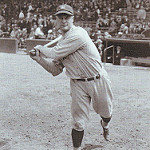
 

Kenny Lofton – An “Thorn” at the Plate, in the Outfield and on the Bases

Photo; Jerry Reuss, CC BY-SA 2.0 <https://creativecommons.org/licenses/by-sa/2.0>, via Wikimedia Commons

As a baseball fan, I’ve always though it was important that (every once in a while) you take the time to acknowledge (and even applaud) a player who has been a thorn in the side of “your” team. As a long time, Twins’ fan, it always seemed to me that Indians’ center fielder Kenny Lofton continually wreaked havoc on my Twins – at the plate, in the field and on the bases.

The proof, of course, is not in the pudding, but in the statistics.  So, I looked it up. Turns out, my recall was pretty solid. Over his career, Lofton had more hits against the Twins (180) than against any other team and his .347 average was the third-best against any team.

But I’m getting ahead of myself here.  Let me first note why I chose today to recognize Lofton’s lofty (see what I did there) accomplishments against the Minnesota squad(s).

On this date (September 3) in 2000, Lofton had quite a day against the Orioles in Cleveland – a contest he topped with a walk-off home run in the bottom of the 13th inning.  (The Indians won 12-11.) On the day, he was four-for-seven, with a walk, four runs scored and five stolen bases.  He also made a bit of history that day.  The run he scored in the first inning – driven in by a Jim Thome single after Lofton collected a leadoff single and stolen base – gave him a tie for the American League record of scoring a run in 18 consecutive games (August 15-September 3). During that streak, Lofton hit .380 (30-for-79), with six home runs, 20 RBI, 26 RBI, 26 runs scored, 11 walks and just four strikeouts. Notably, for me, not a single of those 18 contests was against the Twins.

With this in mind, today seemed a good day to recognize Lofton’s career and, in particular his accomplishments, against the Twins.

Lofton’s 180 hits are the he had against any team; as are his 58 RBI and 251 total bases.  His 100 runs are second-most;  as are his 34 doubles, eight triples and 43 stolen bases.

In 132 games against the Twins, Kenny Lofton never grounded into a double play.

Lofton’s best season against the Twins was 1994, when he hit .500 (23-for-46) in 12 games, with three home runs, 13 RBI, 15 runs scored, 11 walks and ten steals (in 11 attempts).  He played in 13 seasons against Minnesota and hit over .340 in six of them.  Over his career, Lofton collected his  most, second-most and fourth-most hits against a trio of hurlers who spent considerable time (and gave up considerable hits to Lofton) in a Twins’ uniform:  Keven Tapani (22 hits – .489 average), Scott Erickson (21 hits – .362) and Brad Radke (19 hits – .407).  Note: Not all of the hits surrendered to Lofton were during their Twins’ tenure.

Now a little more about Lofton’s career.

He played 17 MLB seasons (1991-2007 … Indians, Pirates, Giants, Phillies, Braves, Rangers, Dodgers, Cubs, Yankees, Astros, White Sox). He was a six-time All Star and four-time Gold Glover in CF. He finished with 2,428 hits and a .299 average (four more hits would have put him at .300). He hit .300 or better in eight seasons, scored 100 or more runs in five and stole 50 or more bases in six seasons – 30 or more in nine. On defense,  Lofton led AL center fielders in assists four times and double plays twice.

Kenny Lofton led the Al in stolen bases in five consecutive seasons … 1992-1996. During that span he swiped 325 bags and was caught 70 times … and average of 65 steals in 79 attempts per campaign.

Lofton appeared in the post-season with six different teams (Indians, Braves, Giants, Cubs, Yankees, Dodgers). He hit .247-7-34, with 65 runs scored and 34 steals in 95 games.

In his final (age-40), season, Kenny Lofton hit.296 in 136 games, scored 86 runs and stole 23 bases.

Lofton appears among MLB’s top 150 players  all time in: runs scored (63rd); stolen bases (15th); outfield putouts (31st); triples (108th); offensive and defensive WAR (109th and 108th, respectively); hits  (121st); at bats (141st); walks (147th).

Given personal observation – and statistical evidence – I am surprised that in his one and only year on the Hall of Fame ballot, Lofton got only 18 votes (3.2%).  Plenty of Twins fans would probably agree.

Primary Resource:  Baseball-Reference.com

Baseball Roundtable Disclaimer:  The MLB records referenced in this (and previous) posts have the potential to change (primarily additions) as Major League Baseball recognizes and fully incorporates Negro League records from 1920-48 into the MLB record book.


BASEBALL ROUNDTABLE ON THE TOP 100 BASEBALL BLOG LIST

100Baseball Roundtable is on the Feedspot list of the Top 100 Baseball Blogs.  To see the full list, click here.

I tweet baseball @DavidBBRT

Follow/Like Baseball Roundtable’s Facebook Page here.  More baseball commentary; blog post notifications; PRIZES.

Member: Society for American Baseball Research (SABR); The Baseball Reliquary; The Negro Leagues Baseball Museum.
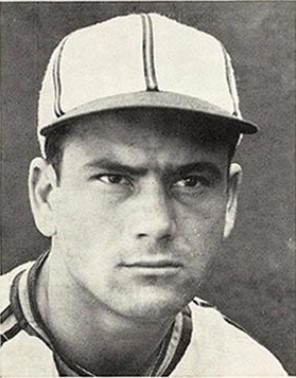
 

Ted Williams 1949 Streak … Some Kind of Wander-ful

Yesterday, Rays’ 20-year-old rookie SS Wander Franco got on base for his 32nd straight game (hit, walk or HBP) – a remarkable achievement, particularly for a 20-year-old rookie.  At this point in the still-active streak, which began July 25, Franco has hit .320 (40-for-125) with a .388 on-base percentage (12 walks and two hit-by-pitch).  He has hit four home runs, driven in 25 runs and scored 31 during the streak, which has included ten multi-hit games and  five games in which he did not get a hit. During the streak, the Rays have gone 23-9.

Wander’s streak sent me looking back at Ted Williams’ record-setting streak of safely reaching base in 84 games (July 1 – September 27, 1949).

Here are Williams’ stats during the astounding run:

Batting Average … .371

Hits … 112 (302 at bats)

On-base Percentage … .518

Walks … 92

Total Times on Base … 204 (2.43 times per game)

Home Runs … 24

RBI … 80

Runs Scored … 81

Slugging Percentage … .695 (20 doubles, three triples, 24 home runs)

Strikeouts … 19

Hit By Pitch … 0

Games Without a Hit …. 14

Multi-hit games … 30

Ted Williams – an on-base machine.

The longest hitting streak (base hits) Williams achieved during the 84-game on-base streak was nine games. During the streak, Williams had two stretches in which he recorded five consecutive multi-hit games: August 6-11, when he went 12-for-18 (plus four walks), with three homers and six RBI; and August 26-29 (doubleheaders in there), when he went 12-for-24 (plus one walk), with four homers and 11 RBI. For the month of August that season, William put up a .405-10-34 stat line. During William’s streak, his Red Sox won 60 and lost 24.

The streak ended on September 28. When Ray Scarborough of the Senators pitched a four-hit complete game, as Washington topped Boston 2-1. In three plate appearances, Williams had two strikeouts and an infield fly out against Scarborough.  Note: Williams was on deck when Johnny Pesky made the last Boston out in the top of the ninth.

In the 1949 season, Ted Williams played in 155 games and got on base in 149 of them. For the season, the 30-year-old Williams led the league in games (155); plate appearances (730); runs (150); doubles (39); home runs (43); RBI (159); walks (162); on-base percentage (.490); slugging percentage (.650); total bases (368) – and was the AL MVP. Williams barely missed the batting title losing to George Kell of the Tigers (.34291 to Williams’ .34276).

Primary Resource: Baseball-Reference.com

_______________________________________


BASEBALL ROUNDTABLE ON THE TOP 100 BASEBALL BLOG LIST

100Baseball Roundtable is on the Feedspot list of the Top 100 Baseball Blogs.  To see the full list, click here.

I tweet baseball @DavidBBRT

Follow/Like Baseball Roundtable’s Facebook Page here.  More baseball commentary; blog post notifications; PRIZES.

Member: Society for American Baseball Research (SABR); The Baseball Reliquary; The Negro Leagues Baseball Museum.