Baseball Roundtable August Wrap – Little Leaguers Meeting Big Leaguers, Weddings, Grand Slams, Triple Plays, No-Hitters and More

The Dog Days of August are behind us and we’ve moved into September.  That means it’s time for Baseball Roundtable’s August Wrap Up – a look at the stories and statistics the caught Baseball Roundtable’s attention over the past month, as well as the standings, The Roundtable’s Players and Pitchers of the Month, the Trot Index and more.

And, there was plenty to see around MLB in August:

  • Two no-hitters;
  • A cycle;
  • A pitcher surrendering home runs on each of his first two MLB pitches;
  • A player getting married and hitting a Grand Slam on the same day;
  • A player stroking a record 17 hits in a four-game stretch;
  • A player becoming the first member of the 30-60 Club (HR-SB), with a month to go;
  • A team winning a game despite giving up a Grand Slam with the game tied and later hitting into a triple play with the game tied;
  • A team stealing 39 bases in 28 games and another stealing just one base (in just one attempt) over the entire month;
  • One team playing .800+ ball and one under ,300 for the month;
  • Two qualifying hitters hitting over .400 for the month; and
  • More.

For these tales – and the more – read on.  As usual, we’ll start with a look at Baseball Roundtable’s Players and Pitchers of the Month.

BASEBALL ROUNDTABLE PLAYERS AND PITCHERS OF THE MONTH

AUGUST 2023

NATIONAL LEAGUE

PLAYER OF THE MONTH – Mookie Betts, RF, Dodgers
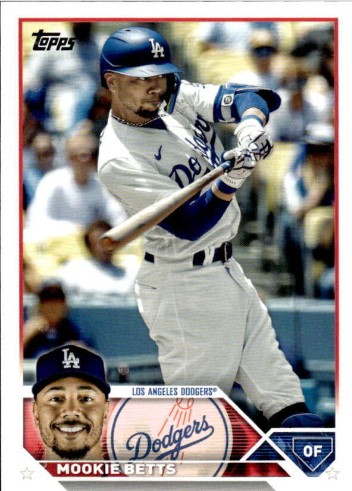
Easy choice here,  The Dodgers’ Mookie Betts hit (literally) a whopping .455, leading all MLB players with at least 75 August at bats (he had 112). He also led MLB with 50 August safeties and, for the month, was first in runs scored (35),  first in home runs (11); and second in RBI (30). He also led all MLB players (with at least 75 August at bats) in on-base percentage (.516) and slugging percentage (.839). His month included a 15-game hitting steak (August 10-27), during which he hit .542 (32-for-59), with four home runs, 16 RBI and 17 runs scored. In the course of the month, he raised his average from .277 to .317. Betts, who was the AL MVP (with the Red Sox) in 2018, put himself into the race for NL MVP in 2023. He  finished August at .317-36-98, with 116 runs scored on the season.


Honorable Mentions:   Cubs’ CF Cody Bellinger led MLB in August RBI with 31, while hitting .324 with five home runs and six steals in seven attempts. Braves’ DH Marcell Ozuna put up similar numbers with a .358-9-25 month – tied for fifth in NL HRs and was fourth in RBI. The Phillies’ Bryce Harper rapped an MLB second-best (tied) ten August home runs, while hitting .361, with 24 RBI. The fact is, there were plenty of outstanding Augusts in the NL  – Ronald Acuna, Jr.; Trea Turner; Freddie Freeman and more – but Betts .400+  month clearly rates the top spot.

PITCHER OF THE MONTH – Freddy Peralta, RHP, Brewers
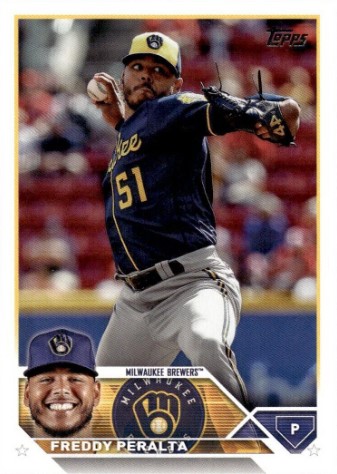
This was a close call. Freddy Peralta and the Braves’ Spencer Strider were the only MLB pitchers to record five wins this August and they also tied for the NL lead in August strikeouts (46). Peralta got his wins in five starts (5-0), which edged Strider’s six starts and 5-1 record.  Peralta also put up a 2.10 earned run average (second-lowest in the NL among pitchers with at least 25 August innings) to Strider’s 2.97. Peralta  had a stingy 0.90 WHIP (third among NL pitchers with at least 25 innings) and held hitters to a .162 average (tied for first). After giving up three runs in six innings in his first start of the month (a 6-4 win over the Nationals), Peralta gave up just four runs over his next four starts (24 innings).

Honorable Mentions: The Braves’ Spencer Strider (5-1, 2.97) and  Charlie Morton  ( 4-1, 1.91 in five August starts) were both solid.  The Nationals’ righty Kyle Finnegan pitched in 14 August games and went 2-0, 2.63 with ten saves in ten opportunities.

AMERICAN LEAGUE

PLAYER OF THE MONTH – Julio Rodriguez, CF, Mariners

Another easy choice – another .400+ hitter.  Mariners’ 22-year-old CF (and 2022 AL Rookie of the Year) Julio Rodriguez hit .429 for the month (highest among AL players with at least 75 at bats). His 45 hits led the American League, as did his 30 RBI (in 23 games). He also popped seven round trippers and led the AL with 11 stolen bases (in 15 tries) in August. He also led the AL (minimum 75 at bats) in on-base percentage (.474) and slugging percentage (.724). From August 17 through August 28, he  put together a 13-game hitting streak – during which he hit .516 (32-for-62), with five home runs and 21 RBI. The streak included a five-for-five, five RBI day on August 17. Rodriguez finished August at .286-24-87, with 35 steals on the season.

Honorable Mentions: Rangers’ SS Corey Seager led the AL with ten August home runs, to go with a .337 average, 22 RBI and 21 runs scored. Royals’ SS Bobby Witt, Jr. combined speed and power, hitting .324 for the month, with nine homers, 22 RBI, 20 runs scored and nine steals (in ten attempts).  Finally, Mariners’ RF Teoscar Hernandez went .365-7-22 in 26 games.

PITCHER OF THE MONTH – Cole Ragans, LHP, Royals
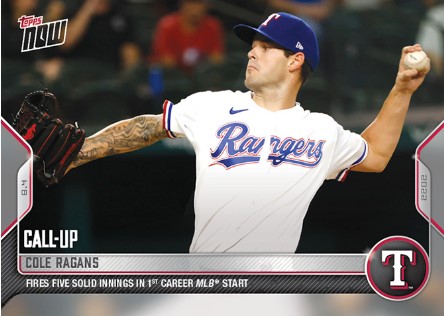
Royals’ southpaw Cole Ragans could also have qualified as the MLB surprise of the month, but it made more sense to slot him here. Ragans, pitching for the last-place Royals, went 3-1, 1.72 in six starts. That ERA was the lowest among major leaguers with at least 25 August innings (he had 36 2/3). Ragan also led MLB with 53 August strikeouts, gave up just one home run and walked only nine. Ragans fanned nine or more batters in four of his six August starts  and only once walked more than two. So why did I also think Ragans could have qualified for the Surprise of the Month? He came into August with a 2-3, 5.22 record on the season (after a 0-3, 4.95 record in his MLB debut 2022 season). The Royals acquired the 2016 First Round Draft pick (by the Rangers, out of North Florida Christian High School) in the June trade that sent Aroldis Chapman to the Rangers.  Looks like it’s working out for both squads.

Honorable Mentions: Orioles’ RHP Kyle Bradish went 3-0, 2.12 in five August starts (with the Orioles winning all five games), fanning 35 batters in 29 1/3 innings. Sonny Gray of the Twins only went 3-2 for the month, but he put up a 2.04 ERA (second in the AL among pitchers with at least 25 August innings) and fanned 41 batters (third in the AL) in 39 2/3 innings (second). He put up a 0.86 WHIP (second among AL pitchers with 25 August innings) and held hitters to a .189 average.

______________________________________

SURPRISE OF THE MONTHN …. Nolan Schanuel, 1B, Angels
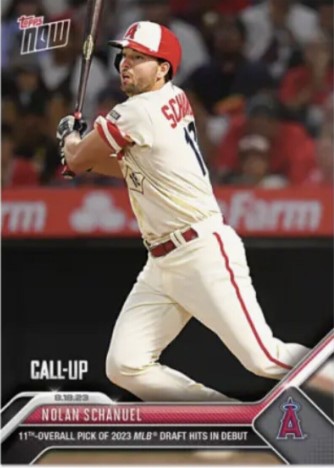
Okay, the fact the Nolan Schanuel is in the major leagues should be  no surprise.  He was, after all, a First Round Draft choice (Angels, out of Florida Atlantic University) and he did hit .386-46-176 over three college seasons (172 games).   What is surprising is how fast he made to the majors. Schanuel was a first rounder THIS JUNE and made his MLB debut August 18  – after just 22 minor-league games,

How has he done?  Well, ten games into his MLB career, he has yet to be held hitless in any contest. In August, he was 12-for-37 (.324), with two home runs, seven RBI and 11 runs scored. Further, his walks (7) outnumbered his whiffs (6) – a .457 on-base percentage. That’s a  pretty surprising  start.  And, of course, that start-of-career hitting streak is still alive.

Honorable Mention:  Tigers’ outfielder Kerry Carpenter had a booming August – going .347-9-20, with 21 runs scored in 27 games. He came into the month hitting .258-11-35 on the season (53 games played), after going .242-6-10 in 31 games for the Tigers in 2022.  Why the surprise?  After all, the 25-year old outfielder did hit .313-30-75 at Double-A and Triple-A a year ago.   The surprise comes because Carpenter (a .272 hitter in his only college season) was a rather unheralded and unnoticed 19th Round pick in the 2019 MLB Draft.

________________________________________

THE TROT INDEX … A REGULAR BASEBALL ROUNDTABLE FEATURE

Through August,  35.6 percent of the MLB season’s 151,954 plate appearances ended in a trot (back to the dugout, around the bases, to first base). We’re talking about strikeouts, home runs, walks, hit by pitch and catcher’s interference – all outcomes that are, basically, devoid of action on the base paths or in the field. Here’s the breakout: strikeouts (22.7%); walks (8.5%); home runs (3.2%); HBP (1.1%); catcher’s interference (less than 1%). Strikeouts, by the way, outnumbered base hits 3,4519 – 33,761.

The 35.6 percent figure is up from 2022’s full season 34.6 percent.  Other recent seasons: 2021 – 36.3 percent; 2020 –  37.3 percent;  2019 – 36.2 percent; and 2018 – 34.8 percent.  By further comparison, in 1990, the Trot Index was 26.1 percent.  

____________________________________
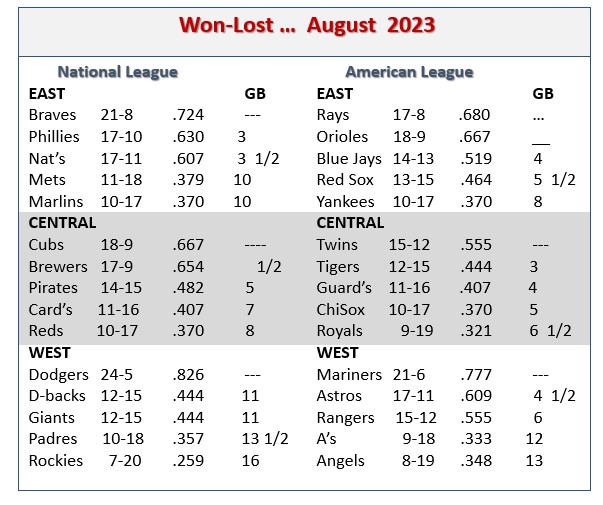
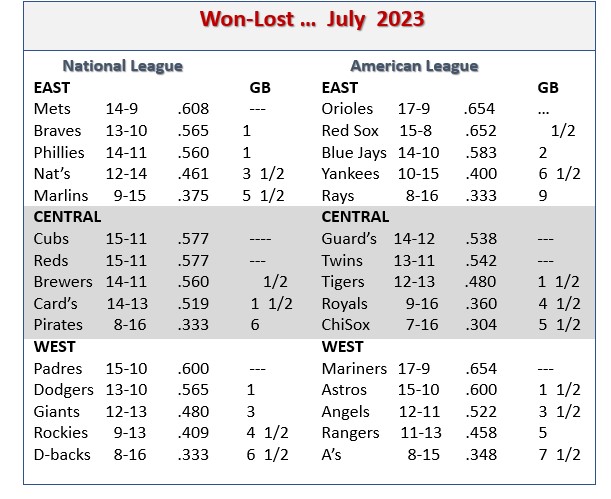
A few observations,  The Dodgers, Braves and Mariners were the teams to watch in August – all winning 20+ games.

The Dodgers pretty much blew up the NL West race – playing .800+ ball and expanding their Divisi0n lead from 2 1/2 games to 13 1/2.  They were led by the bats of Mookie Betts (.455-11-30) and Freddie Freeman (.374-4-16), but a balanced lineup saw nine players contribute 12 or more RBI during the month (and nine scoring ten or more runs). On the mound, they got four wins each out of starters Lance Lynn and Julio Urias, but just as important, solid work out of the bullpen: Evan Phillips (2.89 ERA and eight saves in eight opportunities);  Brusdar Graterol (0.00 ERA in 11 appearances); Ryan Brassier (0.79 ERA in 11 appearances); Ryan Yarbrough (1.86 ERA and three wins in six appearances).

The AL West Mariners played .777 ball, but they were catching up not running away.  Thanks to a 21-6 month, they moved from fourth place (five games out ) at the end of July to a tie for the Division lead with the Astros. It looks like a good race (Mariners, Astros, Rangers) to the finish. Key contributors to the Mariners’ surge were CF Julio Rodriguez (.429-7-30) and RF Teoscar Hernandez (.365-7-22).  They also got nine homers and 21 RBI out of catcher Cal Raleigh, despite a .221 average for the month. Starters Luis Castillo (4-0, 3.55) and Logan Gilbert (3-0, 2.97) led the mound staff – which also got contributions from Justin Topa (3-1, 0.73 in 14 relief appearances); Isaiah Campbell (3-0, 2.31 in ten relief stints): and Andres Munoz (nine saves and a 1.93 ERA).

Then there are the Braves (21-8 in August), padding a comfortable lead in the NL East. What can you say about a team with Spencer Strider (5-1, 2.92 in August); Charlie Morton (4-1, 1.91);  Max Fried (3-0 3.58); and Raisel Iglesias (7-for-7 in save opportunities and a 0.00 ERA in 13 appearances)? Then there’s that offense: DH Marcell Ozuna (.358-9-25 for the month); 1B Matt Olson (.290-7-23); RF Ronald Acuna, Jr. (.352-6-22) and more;. The Braves had five players with six or more homers in August; eight with 16 or more RBI; five with 20+ runs  scored; and six players who played 15 or more games and.310 or better.

Other notes:

  • The Twins were the only AL Central above .500 for the month (but the Guardians made some interesting waiver moves);
  • The Cardinals and Yankees continue to flounder;
  • The Brewers/Cubs race has gotten interesting; and
  • The Orioles continue to surprise, leading the AL East.

——-Team  Statistical Leaders for August  2023 ———-

RUNS SCORED

National League –  Braves (194); Philllies (176); Dodgers (176)

American League – Astros (170); Mariners (159); Rays (152)

The fewest  runs in August  were scored by the Marlins and A’s (96). The only other team under 100 was the Cardinals (98).

AVERAGE

National League – Braves (.299); Dodgers (.292); Phillies (.285)

American League – Astros (.286); Mariners (.285); Rays (.281)

The lowest team average for August belonged to the Yankees at .220. The lowest in the NL was the Reds (.225). 

HOME RUNS

National League – Phillies (59); Braves (53); Dodgers (44)

American League –  Twins (46); Mariners (46); Yankees (44)

The Guardians had the fewest home runs in August at 21.  The Giants were at the bottom of the NL at 22.

The Phillies led MLB in slugging percentage for August at .547.  The Mariners led the AL at .493. 

STOLEN BASES

National League – Reds (35); D-backs (29); Braves (27)

American League – Royals (39); Mariners (31); Guardians (25)

The Giants  stole the fewest sacks in August   – just one  in one  attempt.   The Rangers were at the bottom of the AL, with 11  in 14  attempts. 

WALKS DRAWN

National League –   Pirates (113); Dodgers (107); Braves (105)

American League  Astros (118); Yankees (108); Mariners (107)

The Mariners led MLB in on-base percentage for August at .371. The Braves led the NL  at .368.  The Angels had MLB’s lowest  OBP for August  at .279.  The Marlins were at the bottom of the NL at .288.

BATTER’S STRIKEOUTS

National League – Rockies (286); Reds (285); Pirates (271)

American League – Tigers (275); Yankees (275); Twins (275)

Brewers’ batters fanned the fewest times in August (192). The only other team under 200 was the Nationals at 195.

Bonus Stats

  • Braves’ batters racked up the most total bases in July at 533.  The Giants were at the bottom of MLB at 311.
  • Four teams (Rays, Yankees, Twins and Brewers) recorded zero sacrifice bunts in August. The Braves have recorded an MLB-lowest two sacrifice bunts all season. Five teams have fewer than five.
  • The Mariners had 26 hit batters in August to lead MLB. The Phillies led the NL with 20.  The Mariners have had an MLB-high 94 hit batters this season. The Tigers have the lowest total at 36.

_______________________________________

Earned Run Average

National League – Dodgers (3.00); Brewers (3.36); Braves (3.60)

American League –  Mariners (3.03); Blue Jays (3.43); Rangers (3.53)

The Angels had the highest August ERA at 6.14.  Eight teams were over  5.00 including the Angels and:  White Sox (5.95); Rockies (5.87): Red Sox (5.33); A’s (5.30); Cardinals (5.28); Royals (5.23); Reds (5.03).

STRIKEOUTS

National League – Braves (279); Pirates (256); Brewers (252)

American League –  Ranges (264); Yankees (259); Angels (250)

The Braves averaged an MLB-best 9.85 strikeouts per nine innings in August. The Rangers averaged an AL-best 9.70.  Ten teams averaged nine whiffs per nine or better (down from 12 in July).

FEWEST WALKS SURRENDERED

National League  – Dodgers (67); Giants (68); Cardinals (69)

American League – Rays (47); Mariners (50); Blue Jays (63)

The Mariners  walked an MLB-lowest 1.83 batters per nine innings in August.  The Angels walked an MLB-worst 4.88 batters per nine frames.

SAVES

National League – Dodgers (14); Cubs (11); Nationals (11)

American League – Mariners (14); Blue Jays (10); Red Sox (9); Tigers (9)

Bonus Stats:

  • The Nationals gave up an MLB-high 51 home runs in August – The  Braves gave up an MLB-low 25.  On the season, the Nationals have given up an MLB-high 204 long balls, the Cardinals  an MLB-low (136).
  • The Brewers held opponents to an MLB-low .206 average in August; the Rockies’ staff was touched for an MLB-high .300 during the month.
  • The Mariners’ strikeouts-to-walks ratio for August topped MLB at 4.82. The White Sox had MLB’s worst ratio at 1.79.

——AUGUST 2023 HIGHLIGHTS——

Another No-Hitter
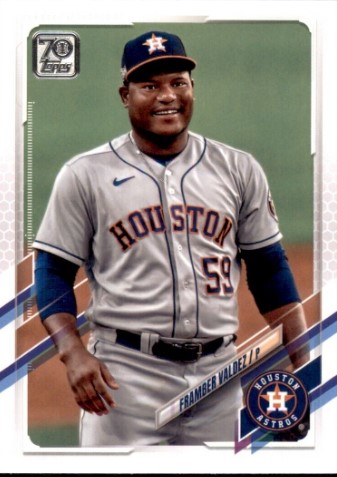
Astros’ southpaw Framber Valdez got August off to a good start, tossing a no-hitter on August 1, as the Astros topped the Guardians 2-0. It was the third no-hitter of the 20232 MLB season. Valdez threw 93 pitches (65 strikes), while walking one and fanning seven.  He actually faced the minimum 27 batters, the only baserunner (walk) was erased on a double play. The first (and only batter) to reach a three-ball count was SS Gabriel Arias (leading off the ninth). Arias  grounded out on a 3-2 pitch. Valdez ended August with a 10-9, 3.38 record on the season,

We Really Do Count Everything

On August 4, Bobby Witt, Jr. went two-for-five with one run scored, two RBI, a stolen base and a home run (his 20th ). MLB later reported that the home run made Witt the first AL/NL player to have at least 20 home runs and at least 30 stolen  bases in each of his first two seasons. (The Royals, by the way, bested the Phillies 7-5. ) Witt ended August at .276-27-82, with 38 steals on the season. (Headed for the 30-30 club.)

A Great Start

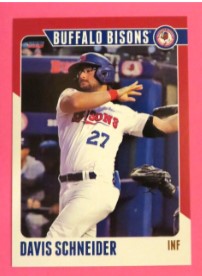
Davis Schneider made his MLB debut with the Blue Jays  on August 4 – being called up after going  .275-21-64 in 87 games for the Triple-A Buffalo Bisons. The 24-year-old 2017 28th-Round Draft pick (out of Eastern High School in Voorhees, NJ) did not disappoint. Starting at 2B versus the Red Sox (in Boston), he homered off James Paxton in his first MLB plate appearance, joining a host of players to accomplish that feat.

What he did after that, however, set Schneider apart. In his first three MLB games, Schneider went 9-for-13  (.692), with two home runs, three runs scored and five RBI – becoming the first player to collect nine hits and two home runs in his first three MLB games.  (Yes, #InBaseballWeCountEverything.) He’s cooled off a bit, but at the end of August he was still hitting .426, with six homers and 14 RBI in 14 games.

Side note:  In six minor-league seasons, Schneider hit .253-59-218.  Apparently, he likes major-league pitching. 

Bring Those Ducks On Home

On August 5, Mariners’ 3B Eugenio Suarez went zero-for-three as Seattle bested the Angels 3-2.  The O-Fer was notable because it marked the first time since July 24 that Suarez went without an RBI.  In the ten games from  July 25 through August 4, Suarez went 13-for-42 (.310), with tw0 home runs and 13 RBI (at least one RBI in each game), setting a new franchise record for consecutive games with an RBI. I wanted to note this achievement because gives me a chance to give a shout out to  Cubs’ 1B Ray Grimes, who holds the MLB record for consecutive games with an RBI at 17.  From  June 27 through July 23, 1922, Grimes played in 17 games, going 29-for-66 (.439), with three home runs and 27 RBI (at least one ribby in 17-straight contests.  Grimes finished the season with 99 RBI (his highest single-season total). In an injury-interrupted  six-season MLB career, Grimes hit .329-27-263 in 433 games.

A Nice Round Number

On August 5, Orioles’ righty Kyle Gibson picked up is 100th career win, as the O’s topped the Mets 7-3 in Baltimore.  Gibson went seven innings, giving up three runs on four hits and a walk, while fanning nine.  Gibson picked up two more wins in August, running his record to 13-8, 5.15 and his 11-season MLB career record to 102-99, 4.58. The 13 wins leads the AL and also ties Gibson’s single-season career high.

A Not So Great Start

On August 6. Reds’23-year-old righty Lyon Richardson made his MLB debut – starting against the Nationals in Cincinnati.  His performance, while not what he had hoped for, did attract the attention of baseball trivia buffs. Richardson started his MLB career by giving up home runs on each of his first two MLB pitches – to Nationals’ shortstop CJ Abrams (his 11th HR of the year) on a 95.5-mph fastball and to RF Lane Thomas (his 19th) on a 96.7-mph heater.  Ultimately, Richardson went three innings and gave up four hits, three walks and four runs, while fanning two, in the Reds’ 6-3 loss.

According to STATS, Richardson is the only pitcher in the past fifty years to give up homers on his first two MLB pitchers.  Baseball Roundtable took another step and searched box scores of the for the 79 pitchers listed by Baseball-Almanac.com as having allowed a home run to the first MLB batter they ever faced and found only one other pitcher who allowed home runs to the first two batters he faced – the Yankees’ Danny Rios on  May 30, 1997 – and he did it in a span of nine pitches.  For more on Richardson, Rios  and a few pitchers who gave up dingers to the first MLB batter they faced, click here.

Yandy is Dandy On His Birthday

On August 8, Rays’ first baseman Yandy Diaz celebrated his 32nd birthday in style – going four-for-four (tying his career high for hits in a game) with a run scored and an RBI as the Rays beat the Cardinals 4-2 in Tampa Bay. Diaz finished August with a .327-17-66 stat line on the season.

Another Feel-Good Debut

Phillies’ left fielder Westin Wilson made his MLB debut on August 9 – after seven minor-league seasons (713 games, 2,866 trips to the plate).  The 17th-round 2916 Draft pick (out of Clemson University) had an enjoyable first MLB outing.   In his first MLB plate appearance – leading off the bottom of the second inning, Wilson hit a 1-1 pitch off McKenzie Gore for a home run to left-center. Two innings later he drew a walk off Gore and picked up his first MLB stolen base four pitches later.  For the game, Wilson was one-for-three, with two walks, three runs scored and one RBI.  Oh yes, and his two outfield putouts, were part of Mike Lorenzen’s no-hitter. (Over his seven minor-league seasons, Wilson hit .255-97-372, with 80 steals.)

Welcome Home, Mike
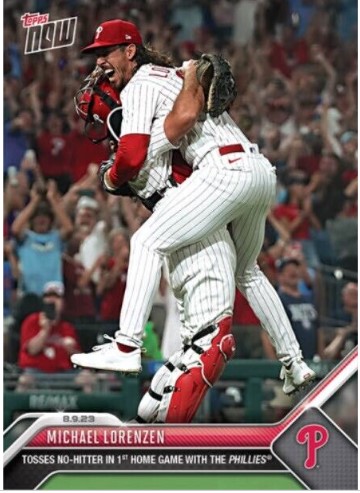
On August 9, Mike Lorenzen picked up by the Phillies (from the Tigers) in an August 1 trade, made his first home start in a Phillies’ uniform. (He had picked up a road win as a Phillie on August 3.)  In that first start in front of Philadelphia fans, Lorenzen pitched the fourth no-hitter of the 2023 season (the third single-pitcher no-no). He threw 124 pitches (76 strikes), walking four and fanning five as the Phillies won 7-0. It was, by the way, the first complete game  of Lorenzen’s nine MLB seasons (335 games/66 starts).  As August came to a close, Lorenzen was 8-8, 3.73 on the season and 3-1, 4.22 with the Phillies.

Obligatory Ohtani News

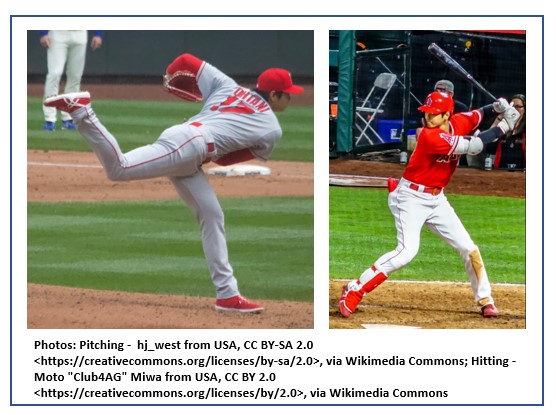
On August 9, the Angels’ Shohie Ohtani  picked up his tenth mound win of the season – going six innings and giving up just one run (unearned), as the Angels topped the Giants 4-1 in Los Angeles. In the process, Ohtani recorded another first – becoming the first MLB player to get ten pitching victories and slug 40 or more home runs in the same season.  Side note:  A elbow injury (August 23) will keep Ohtani off the mound for the remainder of this season, but he’ll still be in the lineup at DH.  

More #InBaseballWeCountEverything
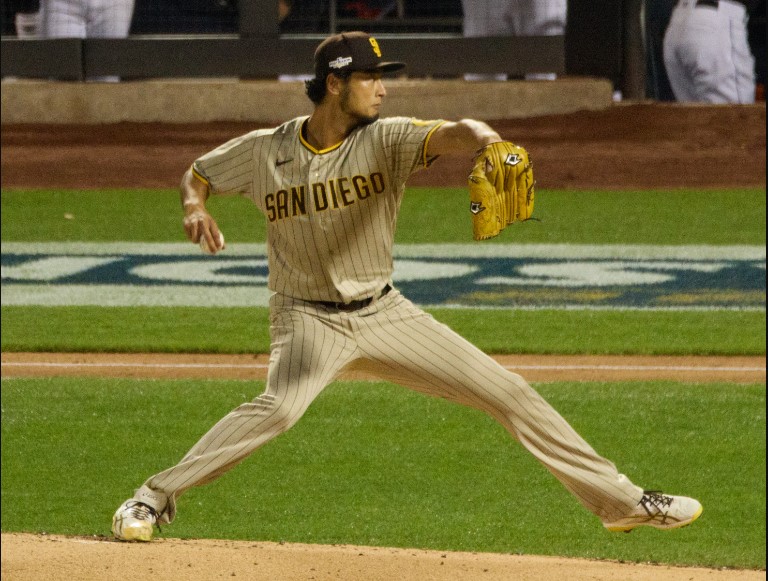
Photo: D. Benjamin Miller, Public domain, via Wikimedia Commons

In the sixth inning of the Padres August 14  4-1 loss to the Orioles, Padres starter Yu Darvish fanned Orioles’  3B Ramon Urias for his sixth strikeout of the game, 131st of the season and 1,919th of his career. That final number made Darvish the All-Time MLB Strikeout Leader  among players born in Japan (surpassing Hideo Nomo). Darvish, now in his 11th MLB season, ended August with a career record of 103-85, 3.59 – with 1,929 strikeouts in 1,624 1/3 innings pitched.  He took the loss in that August 14 game, giving up four runs over seven innings.

Oops, My Bad!

Cardinals’ top prospect, 21-year-old SS Masyn Winn, made his MLB debut on August 18, as the Redbirds faced the Mets in St. Louis. Winn connected for his first MLB hit (an infield single) in the fifth frame.  Unfortunately, the Cardinals lost the game 7-1. Fortunately, Winn did not lose the ball he tagged for his first hit – but he almost did. Apparently not knowing it was Winn’s first MLB hit, Mets’ 1B Pete Alonso threw the ball (which the umpire indicated would be taken out of play) into the stands. (As Alonso often does with scuffed balls taken out of play.) Goodbye first hit memento. All turned out well, as Cardinals’ security traded the lucky fan an autographed ball, jersey and hat for Winn base-hit horsehide.

The One That Didn’t Get Away

There are a lot of ways to blow the opportunity to win a ball game.  If you have a flair for the dramatic, you might give up a Grand Slam with the game tied or muff a scoring opportunity (with the game tied) by hitting into a triple play. On August 18, the  Rays did both – and still came away with a 9-6 win (over the  Angels).

In the bottom of the second, with the game tied at one apiece, Rays’ starter Erasmo Ramirez gave up a two-out Grand Slam to Angels’ DH Shohei Ohtani (who else?).The Rays fought back and finally retied the game at five apiece in the fifth frame – and even took the lead 6-5 in the top of the seventh.  The Angels retied it at six in the bottom of the inning.  Then, the Rays opened the ninth with a pair of singles (1B Yandy Diaz and LF Randy Arozarena) and seemed poised to move back into the lead (runners on first and second and no outs). A triple play ended the threat. DH Harold Ramirez grounded to SS Luis Rengifo, who tossed to second (Brandon Drury) to force Arozarena, the relay to first retired Ramirez and Diaz, who tried to score from second  on the play, was tossed out 1B Nolan Schanuel  to C Logan O’Hoppe.   Boom – inning and rally over. The Rays, however, held the Angels scoreless in the bottom of the ninth and then scored three in the top of the tenth, earning a 9-6 win.

The Elias Sport Bureau reported that the Rays were only the second team  in AL/NL history to allow a Grand Slam and hit into a triple play in the same  game and still win the contest. (The other was the Indians on September  7, 1979.)

Trea Turner Tees (off) for Two

On August 19, as the Phillies topped the Nationals 4-3 in Washington, Phillies’ SS Trea Turner hit his 13th and 14th home runs of the season.  The two blasts were especially memorable since they both came in the eighth inning and made Turner just the third Phillie ever to homer twice in one frame. Turner led off the eighth inning by raking a 2-0 from Cory Abbott for a home run to left field. By Turner’s second at bat of the inning (with Abbott still on the mound), the Phillies had added six more runs and had a 10-3 lead. This time, Turner took knocked a 1-1 pitch from Abbott for another left field round tripper. (The Phillies eventually won 12-3.) For those who like to know such things, the other Phillies with two-homer innings are: Von Hayes (June 11, 1985) and Andy Seminick (June 2, 1949).

Two-for-Two

Andre Dawson, Edwin Encarnacion, Jeff King, Willie McCovey and Alex Rodriguez are the only AL/NL players to homer twice in one innings twice in their careers – and only Encarnacion accomplished the feat for two different teams (Blue Jays – 2013 & Mariners – 2019).  The others: Rodriguez (Yankees (2007 & 2009); Dawson (Expos 1978 & 1985); King (Pirates 1995 & 1996); and McCovey (Giants 1973 & 1977).

When You’re Hot, You’re Hot

On August 19, the Mariners’ 22-year-old CF  Julio Rodriguez went four-for-six with a stolen base and two runs scored as  Seattle topped  the Astros 10-3 in Houston. It marked Rodriguez’ fourth straight game with at least four hits and gave him  a new (#InBaseballWeCountEverything) MLB record for hits in four consecutive games (17). Rodriguez’s stat line for the four games? He was 17-for-22 (.773) with two doubles, two home runs, five runs scored, eight RBI and five steals (in six attempts). Surprisingly, at least to The Roundtable, he did not draw a single free pass over the four contests.

The four games were part of a 10-game hitting streak (August 13-25), during which Rodriguez hit .500 (25-for-50), with eight  runs scored, 14 RBI ands eight steals.

Little League Classic … An Annual Highlight

Okay, the highlights of the August 20 Sixth Annual Little League Classic took place more off the field than on … as players from the Phillies and Nationals were greeted at the Williamsport Regional Airport on arrival Sunday morning (and rode buses to the Little League World Series Fields with the Little Leaguers); mingled with Little Leaguers and fans (playing catch, signing autographs, taking selfies and more); took to the stands to watch the youngsters play; and took part in the traditional slide down the hill beyond the outfield fences on cardboard boxes.  When big leaguers and Little Leaguers get together, it’s always a joy to behold.

During the big-league game itself, played that evening at Muncy Bank Ball Park at Historic Bowman Field;  several players used custom-decorated bats (allowed just for this event) to commemorate the occasion. Among the more popular models: Phillies Bryson Stott and Weston Wilson used bats painted to look like a number-two pencil (right down to a red eraser at the top of the bat and a black handle to represent the pencil lead); the Nationals’ Joey Meneses had a bat designed to look like a blue Crayon; and Phillie Bryce Harper used a unique green Phillie Phanatic bat.  Among the nearly 20 custom bats, you could also find aliens, liberty bells, stars and stripes and more.

The Nationals prevailed in the actual MLB game (played in front of a crowd of about 2,500 Little leagues and their families) by a 4-3 score.

A Shoutout to the California Little League Squad

Congrats to the Little League squad from El Segundo, California, which defeated Curacao 6-5 in the Little League World Series Final.

Minor-League Extra – More Grand Clam News

On August 27th, Tai Peete –  the Mariners 2023 first-round draft pick –  hit his first two home professional home runs as his Single-A Modesto Nuts topped the San Jose Giants 12-11.  Why are they mentioned in this wrap up.? Those long balls came in consecutive innings (seventh and eighth) and were both Grand Slams.  As of August 31, Peete’s minor-league record was .339-2-18 in 16 games.  Not a bad start for the young man.

More #InBaseballWeCount Everything

On August 27, Diamondbacks’ Rookie of the Year Candidate RF Corbin Carroll went two-for-three and scored a pair of runs as the D-backs topped the Reds 5-2 in Arizona.  Notably, he also swiped his 40th base of the seasons (in 45 tries) – which made him just the  fourth rookie with a 20-homerun, 40-steal season.  (Corbin had 23 home runs and 41 steals to go with a .279 average at the end of August). Other rookies with 20-40 campaigns include: Mike Trout (2012); Mitchell Page (1977); and Tommy Agee (1966).

Now Isn’t That Grand?

The  Minnesota Twins have had a host of home run hitters grace their lineup – Harmon Killebrew, Jim Thome, Nelson Cruz, Bob Allison and  Jimmie Hall  to name a few.  But only one player has ever hit a Grand  Slam in consecutive games while wearing a  Twins’ uniform. Royce Lewis – Twins 24-year-old rookie infielder – hit his ninth and tenth career home runs in games on August 27th and 28th and both were Grand Slams (and crucial to Twins’ victories). In the process, Lewis, with just 50 MLB games under his belt, became the first  MLB rookie  and the first Twin to hit a four-run blast in consecutive games.

Another String of Zeros

On August 28, Pirates’ righty John Oviedo pitched his first MLB complete game – and it was a two-hit shutout, as Pittsburgh topped the Royals 5-0 in Kansas City. Oviedo now 8-13, 4.20 on the season and 12-24, 4.27 over four seasons, notched the the third MLB single-pitcher shutout this August and the 18th of the season. By comparison, there were a total of 16 complete game shutouts in all of the 2022 campaign.

Altuve Hits For The Cycle
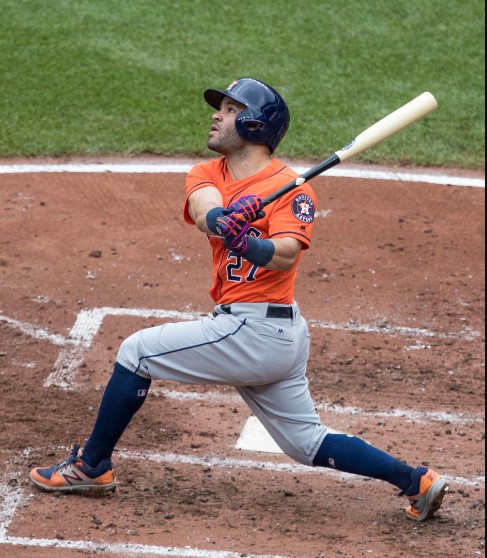
Photo: Keith Allison from Hanover, MD, USA, CC BY-SA 2.0 <https://creativecommons.org/licenses/by-sa/2.0>, via Wikimedia Commons

On August 28, as the Astros topped the Red Sox 13-5 in Boston, Houston second baseman Jose Altuve hit for the cycle – although it didn’t look that way as the game opened.  Altuve led off the contest with a five-pitch strikeout against Chris Sale. But things got better. Altuve:

  • Doubled to right (later scoring) on the first pitch he saw from Sale leading off the third frame;
  • Singled to left on a 2-0 pitch from Sale leading off the fifth;
  • Came up with two on and one out in the sixth and tripled to center (later scoring) off the first pitch from Kyle Barraclough;
  • Popped out to first off Barraclough on an 0-1 pitch in the seventh;
  • Completed the cycle in the ninth, with a one-out, two-run home run off a 1-1 offering form Barraclough.

Just as a reminder of how good Altuve has been.  He is a three-time batting champion, four-times led the NL in hits and twice led in steals, is an eight-time All-star and was the NL MVP in 2017 (when he hit .346-24-81, with 32 steals and 112 runs scored).

Rolling  a 300

On August 30, as his Phillies lost to the Angels 10-8, Phillies’ 1B Bryce Harper popped his 15th home run of the year – and the 300th of his career.  (Harper finished August at .308-15-55 on the season.) In his 12th MLB season, the 30-year-old Harper has logged four seasons of 30+ home runs (a high of 42, when he was the NL MVP for the Nationals in 2025 – going .330-42-99).

Betts Hits Number 250

On August 31, as the Braves topped the Dodgers 8-7 in LA, Mookie Betts continued his drive toward the NL MVP Award, going two-for-four with two home runs, two runs scored and four RBI.  They were Betts 37th and 38th long balls of the season.  Of note is the fact the his first homer of the game – a three-run shot off Spencer Strider in the fifth inning – was the 250th of his 10-season MLB career.  His 38 homers thus far in 2923 represent his career high.

Ronald Acuna Celebrates A Grand Day in Grand (Slam) Fashion
Ronald Acuna Jr. –
Photo by IDSportsPhoto

Apparently, marriage agrees with Ronald Acuna, Jr.   The Braves’ star got married early on the morning of August 31.  Then, that evening, he hit a Grand Slam home run to help the Braves topple the Dodgers 8-7 in LA. Acuna was three-for-four in the contest, with a stolen base and a walk.  The home run was Acuna’s 30th of the season. Coupled with his 62 stolen bases, it makes Acuna the first-ever member of the 30-60 club (At least 30 homers and 60 stolen bases in a season. )


——Individual Statistical Leaders for August 2023———

AVERAGE (minimum 75 August at bats)

National League – Mookie Betts, Dodgers (.455); Freddie Freeman, Dodgers (.374); Bryce Harper, Phillies (.361)

American League –  Julio Rodriguez, Mariners (.429); Donovan Solano, Twins (.368); Teoscar Hernandez (Mariners (.365)

The lowest August average (among players with at least 50 at bats in the month)  belonged to the Giants’ Paul DeJong  at .086 (6-for-70).

HOME RUNS

National League – Mookie Betts , Dodgers (11); Bryce Harper, Phillies (10); Kyle Schwarber, Philllies (10); Jorge Soler, Marlins (10)

American League – Corey Seager, Rangers (10); six with nine

The Dodgers’ Mookie had the highest August slugging percentage (at least 75 at bats) at .839.  The AL leader was the Mariners’ Julio Rodriguez at .724.

HITS

National League – Mookie Betts, Dodgers (51); Ronald Acuna, Jr., Braves (43); Freddie Freeman, Dodgers (43)

American League –  Julio Rodriguez, Mariners (45); Jose Altuve, Astros (40); Teoscar Hernandez, Mariners (38)

RUNS BATTED IN

National League – Cody Bellinger, Cubs (31); Mookie Betts, Dodgers (30); Trea Turner, Phillies (26)

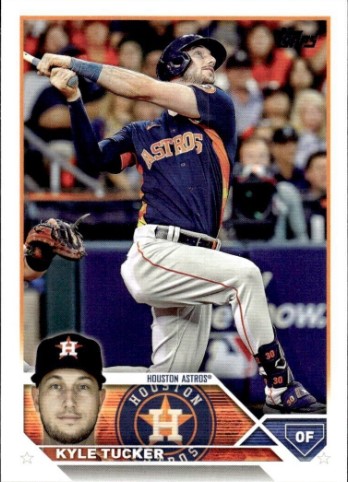
American League –  Julio Rodriguez, Mariners (30); Kyle Tucker, Astros (25); three with 22

The Dodgers’ Mookie Betts led MLB (at least 75 August at bats) players in on-base percentage at .516. The AL  leader was the Mariners’ Julio Rodriguez at  .474.  

DOUBLES

National League –   Freddie Freeman, Dodgers (16); Spencer Steer, Reds (11); Mookie Betts, Dodgers (10); William Contreras, Brewers (10)

American League – Julio Rodriguez, Mariners (10); Alex Bregman, Astros (9); Teoscar Hernandez, Mariners (9); Nathaniel Lowe, Rangers (9)

TRIPLES

National League – Corbin Carroll, Diamondbacks (3); Elly De La Cruz, Reds (3); eight with two

American League –  Steven Kwan, Guardians (3); six with two

The Dodgers’ Mookie Betts led MLB in August extra-base hits with 21. The  Red Sox’ Adam Duvall and Mariners’ Julio Rodriguez led the AL in August with 17.

STOLEN BASES

National League –  CJ Abrams, Nationals (13); Ronald Acuna, Jr., Braves (11); Nico Hoerner, Cubs (9)

American League – Julio Rodriguez, Mariners (11); Esteury Ruiz, A’s (10); Dairon Blanco, Royals (9); Bobby Witt, Jr., Royals (9)

The Guardians’ Jose Ramirez stole the most August bases without being caught (8).

WALKS

National League –  Kyle Schwarber, Philllies (25); Matt Olson, Braves (23): Pete Alonso, Mets (18)

American League –  Aaron Judge, Yankees (20); Alex Bregman, Astros (18); Shohei Ohtani, Angels (18); Jorge Polanco, Twins (18)

The Nationals’ Ildemaro Vargas  led in walks/strikeouts ratio (among batters with at least 75 August plate appearances)  at 1.20 … 6 walks versus 5 whiffs in 26 games.

BATTER’S STRIKEOUTS

National League – Elly De La Cruz, Reds (44); Brenton Doyle, Rockies (39); Christian Encarnacion-Strand, Reds (37); Nolan Jones, Rockies (37)

American League – Eugenio Suarez, Mariners (43); Adolis Garcia, Rangers (39);  Mickey Moniak, Angels (38)

PITCHING VICTORIES

National League – Freddy Peralta, Brewers, (5-0);  Spencer Strider, Braves (5-1); six with four

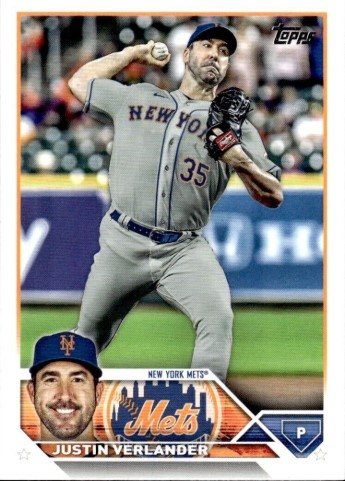
American League –  Luis Castillo, Mariners (4-0); Pablo Lopez, Twins (4-1); Justin Verlander, Astros (4-1)

The Cardinals’ Adam Wainwright (0-5, 10.89) led MLB in August losses. 

EARNED RUN AVERAGE (minimum 25 July innings pitched)

National League –  Charlie Morton, Braves (1.91); Freddy Peralta, Brewers (2.10); Jake Irvin, Nationals (2.35)

American League – Cole Ragans, Royals (1.72); Sonny Gray, Twins (2.04); Kyle Bradish, Orioles (2.12)

The Braves’ Raisel Iglesias  threw the most August innings without giving  up an earned run (13). In 13 August appearances, he gave up 7 hits and no runs, while walking four and fanning 17.  

STRIKEOUTS

National League – Freddy Peralta, Brewers (46K / 30 IP); Spencer Strider, Braves (46K / 36 1/3 IP); Justin Steele, Cubs (41K / 34 1/3 IP)

American League – Cole Ragan, Royals (53K  / 36 2/3 IP); Dane Dunning, Rangers (43K / 33 2/3 IP); Sony Gray, Twins (41K / 39 2/3 IP)

SAVES

National League – Adbert Alzolay, Cubs (10); Kyle Finnegan, Nationals (10); David Bednar, Pirates (8); Evan Phillips, Dodgers (8)

American League – Andres Munoz, Mariners (9); Emmanuel Clase, Guardians (8); three with six

The Nationals’  Kyle Finnegan had the most saves without a blown save in August at ten.

WHIP (Walks +  Hits per Inning Pitched – minimum 25 August innings)

National League – Brandon Woodruff, Brewers (0.80), Julio Urias, Dodgers (0.87); Freddy Peralta, Brewers (0.90)

American League – George Kirby, Mariners (0.80); Sonny Gray, Twins (0.86); Grayson Rodriguez, Orioles (0.91)

Three pitchers with at least 25 August innings pitched held hitters to an MLB -low .162 average: Freddy Peralta, Brewers (30 IP); Charlie Morton, Braves (28 1/3 IP); Brandon Woodruff, Brewers (28 2/3 IP).

________________________________________
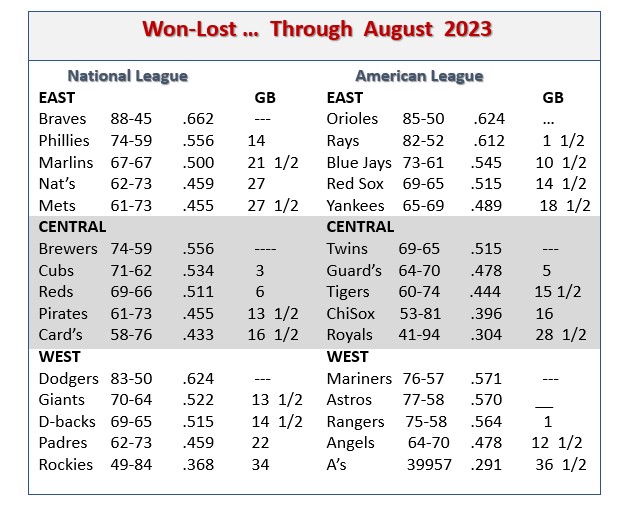
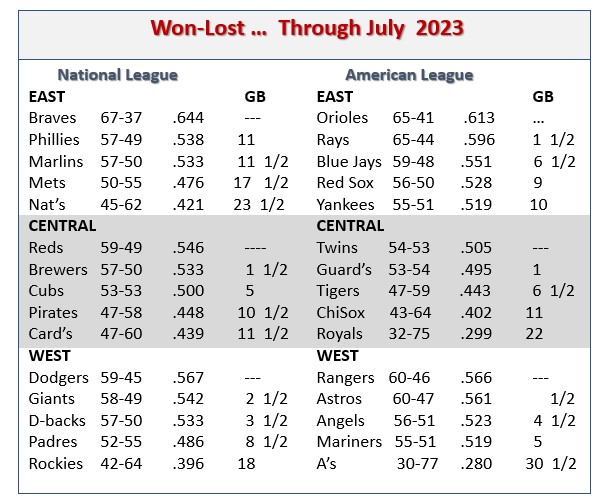
If the season ended August 31, you playoff teams would be:

National League: Braves, Dodgers, Brewers.  Wild Cards: Phillies, Cubs, Giants.

American League: Orioles, Mariners, Twins.  Wild Cards: Rays Astros, Rangers.

Primary Resources:  Baseball-Reference.com; ESPN.com; MLB.com; Baseball-Almanac.co

Baseball Roundtable – Blogging Baseball Since 2012.

100Baseball Roundtable is on the Feedspot list of the Top 100 Baseball Blogs.  To see the full list, click here.

Baseball Roundtable is also on the Anytime Baseball Supply Top 66 Baseball Sites list.  For the full list, click here

I tweet (on X) baseball @DavidBaseballRT

Follow/Like Baseball Roundtable’s Facebook Page here.  Find More baseball commentary; blog post notifications; PRIZES.

Member: Society for American Baseball Research (SABR); Negro Leagues Baseball Museum; The Baseball Reliquary.


P1001

Baseball Roundtable 1,000th Post – a Potpourri of MLB Unexpected Occurrences and Coincidences

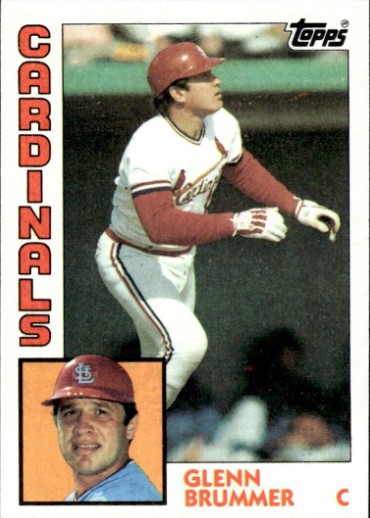
This day (August 22) in 1982, Cardinal’s backup catcher Glenn Brummer  produced an unexpected performance that still stands as a unique moment in Redbird lore. Let’s start this tale with a bit of  a bit of background.

First, Brummer was not just the Cardinals’ backup catcher, he was the backup to the backup – with starter Darrell Porter and backup Gene Tenace ahead of him.  He had, in fact, spent part of the early season as a backup catcher at Triple-A until an injury to Porter led to Brummer’s callup (when Porter recovered, the Cardinals kept Brummer on the team as a third-string backstop and defensive replacement).

Second, Brummer did not start behind the plate that day. In fact, he didn’t enter the game (Giants at Cardinals) until the bottom of the eighth, when he came on as a pinch runner for pinch hitter Steve Braun (who had hit for Tenace) and stayed in at catcher.  (Keep that pinch runner designation in mind, it will play later in this tale.)

Coming into the game, Brummer had one career stolen base (it had come on June 4 of that year) and he had notched just one plate appearance (in nine game appearances) since June 23 (when he delivered a single after coming in as a defensive replacement).

In that August 22 game, the Cardinals trailed 4-3 when Brummer entered, but tied it at four in the bottom of the ninth, which – ultimately – set up Brummer to deliver the unexpected (as a runner).

Brummer opened the bottom of the tenth with a strikeout (versus Gary Lavelle) and when his spot in the lineup came around in the twelfth inning, it was still 4-4 and Lavelle was still on the mound.  Brummer delivered a one-out single, then moved to second on a single by CF Willie McGee. After a foul pop out by 3B Julio Gonzalez, an infield single by SS Ozzie Smith loaded the bases (Brummer on third) with two outs. Brummer noticed that Lavelle didn’t seem to be paying much attention to him. (Drummer after all had one career MLB stolen base at the time.) So, he worked to extend his lead. Then, with a 1-2 count on LF David Green, Brummer made a successful straight steal of home to win the game. (It was his second and final steal of the season.)

The play, by the way , was not without controversy. As Brummer broke for home, Giants’ catcher  Milt May stepped in front of the plate to catch the pitch and attempt a tag on Brummer and umpire  Dave Pallone stepped to the side to better see and make the call. The Giants argued that Pallone had not made a “call” on the pitch – which would have been out number-three and negated the run if it was a strike. The Cardinals argued that since the pitch never reached the plate, it could not be a strike (or even a pitch). Pallone then called the pitch ball to end the debate and the steal became part of Redbirds’’ lore.

Brummer, by the way, played in 178 games in five MLB seasons (1981-85) – during which he hit .251-1-27 in 347 at bats and stole just four bases in 12 tries (including one memorable swipe for a 12trh inning victory).

So, why is this story her today?  Because, I’m pretty sure anyone would have given you odds of 1,00-to-one or better against Brummer swiping home (particularly with two outs and two strikes on the batter and the bases loaded) to win an extra-inning game. And I like that 1,000 number because this is the 1000th Baseball Roundtable post.

With that, I’m going to dedicate this post to some unexpected on-field occurrences or coincidences that I have particularly enjoyed coming across while researching the previous 999 offerings. These tidbits are presented in no particular order – like looking  at a series of unrelated slides (remember slides) – but I hope readers find some of them interesting or entertaining.

I Call Your Steal of Home and Raise You One

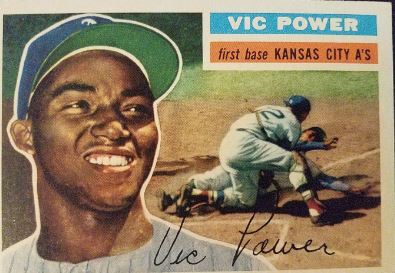
On August 14, 1958, the Indians’ Vic Power tied an MLB record by stealing home an MLB record-tying twice in one game – the second of which came in the bottom of the tenth inning, giving the Indians a “run-off” 10-9 win over the Tigers.  Why does this feat find a place on my unexpected list?   Power stole only three bases during the entire 1958 season.

Do You Want Fries With That?

On Opening Day, April 7 – 2022, Diamondbacks’ DH Seth Beer hit his second MLB home run – a walk-off, three-run shot in the bottom of the ninth (as  the Diamondbacks topped the Padres 4-2 in Arizona). Notably, Beer’s blast came on National Beer Day.  About a month-and-a half later, on National Hamburger Day (May 28), White Sox’ 3B Jake Burger hit his fifth career home run (as the White Sox lost to the Cubs 3-1 at Guaranteed Rate Field). Hmmm.  When is the next National French Fry Day?

An Oddly Even Game

On August 13, 1910, the Pittsburgh Pirates and Brooklyn Superbas (Dodgers) played perhaps the most “even” MLB game ever.  The first game of that day’s twin bill was pretty tight – a 13-inning,3-2 Pirates’ win.  Game Two put Game One  to shame.  It ended after nine frames in an 8-8 tie (called due darkness).  In the game:

  • Each team scored 8 runs;
  • Each team recorded 13 hits in 38 at bats;
  • Each team made two errors;
  • Each team recorded 13 assists and 27 putouts;
  • Each team gave up three walks;
  • Each team suffered one hit batsman;
  • Each team fanned five times;
  • Each team was charged with one passed ball;
  • Each team was awarded five RBI among their eight runs scored.

Another Oddly Even Game

On April 15, 1968, The Astros topped the Mets 1-0 in 24 innings.  In that one:

  • Each team had 11 hits in 79 at bats;
  • Each team had ten singles and one double;
  • Each team left 16 men on base;
  • Each squad made on error;
  • Each team threw two wild pitches;
  • Each team turned one double play.
  • Each team used four pinch hitters.

Oh, and by the way, the wining tally scored on a groundball error.  So, each team scored zero “earned” runs.

Won’t See This Again. Probably Wasn’t Expected Even Then.

On May 1, 1920 The Brooklyn Robins and Boston Braves played the longest game (in innings) in MLB history – a 26-inning 1-1 tie.  The unexpected?  Both starting pitchers (Brooklyn’s Leon Cadore) and Boston’s Joe Oeschger) went the distance.

Probably Won’t See This Either

Photo: Bowman, Public domain via WikiCommons

From 1950-59, The Phillies’ Robin Roberts averaged just over 300 innings pitched per season (3011 2/3 innings pitched in ten seasons). Further, in a six-year span (1950-55), he averaged 323 innings pitched per season and led the NL in innings logged five times  – never throwing less than 304 1/3 innings in a season.

Timing is Everything

Sammy Sosa is the only player to  hit 60 or more home runs in three seasons 1998, 1999 and 2001 – and he didn’t lead his league in home runs in any of those campaigns. In 1998, as a Cub,  he finished with 66 home runs to the Cardinals’ Mark McGwire’s 70. In In 1999, it was Sosa with 63 homers and McGwire with 65. In 2001,Sosa had 64 homers to the Giants’ Barry Bonds 73.

More timing – Shortest Solo Reign as MLB Home Run King

On September 25, 1998 Sammy Sosa hit his 66th homer of the season off Jose Lima – taking sole possession of the all-time lead for home runs in an MLB season.  Just 45  minutes later, Mark McGwire tied Sosa for the lead with his 66th homer  of the season and the very next day McGwire took sole possession of the record with his 67th.

As ESPN Classic reports,  at 8:39 p.m. (CDT) Sosa hit his 66th longball of the1998 season (fourth inning off Astros Jose Lima) – moving one ahead of McGwire as the all-time single-season record holder.  At 9:24 p.m. that same night, McGwire moved back into a tie with a home run off Nationals’ Shayne Bennett.   (McGwire eventually hit 70 that season, a record that stood until 2001, when Barry Bonds hit 71.) Note: Babe Ruth held the single-season  home run crown from September 28 1919 until October 1, 1961 (breaking his own record several times that span).

An Unexpectedly Tense Game

On September 9, 1965 future Hall of Famer Sandy Koufax pitched a perfect game against the Cubs (in LA). Unexpectedly, he pretty much needed to be that good.  His mound opponent that day was Bob Hendley (who would go on to a 48-52, 3.97 record in seven MLB seasons). Hendley gave up just one hit and one walk in the game – surrendering just one unearned run. Thus Hendley, perhaps unexpectedly, shares the record with Koufax for the fewest (combined) hits ever allowed in an MLB game (one).

Some Milestone Homers

  • Brothers B.J. and Justin Upton both hit their 100th career home runs on the same day – August 3, 2012.
  • On April 13, 2009. White Sox RF Jermaine Dye and 1B Paul Konerko each hit their 300th career home runs – and they did it back-to-back in the top of the second inning.

Stan and Nate – The Grandaddy of  All MLB Coincidences

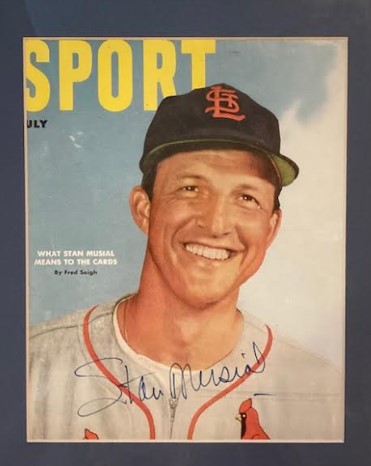
This story has been told often, but it remains The Roundtable’s favorite baseball coincidence. On May 2, 1954, Stan “The Man” Musial had one of the greatest days at the plate in major-league history.  That day, the New York Giants faced Musial’s Cardinals in a double header before 26,662 fans at Busch Stadium (I). Game One, a 10-6 Cardinal win, saw Musial go four-for-four with three home runs (his first-ever three-homer game) and six RBI. In Game Two, a 9-7 Cardinals’ loss, Musial went two-for-four, with two home runs and three RBI – becoming the first player ever to hit five home runs in a doubleheader. 

Among the 26,662 fans witnessing Musial’s feat was eight-year-old Nate Colbert – who, on August 1, 1972, would become the second player in MLB history (and there are still only two) to hit five round trippers in a double header. In Game One of that doubleheader (Padres at Braves), Colbert went four-for-five, with two home runs and five RBI, as the Padres won 9-0.   In Game Two, an 11-7 Padres’ win, Colbert went three-for-four with three home runs and eight RBI.  Stan Musial, however, was not in the crowd.  (Now, that would really have been a coincidence.)

 A Royal Coincidence?

The Kansas City Royals  were the first AL expansion team to win a Division Title; a League Championship; and a World Series Crown – and they did it in three different seasons –  1976, 1980 and 1985, respectively.

Like Father, Like Son

Cecil  (father) and Prince (son) Fielder were both big-league power hitters.  Cecil enjoyed a 13-season MLB career, while Prince played in 12 MLB season. Cecil’s career stat line was .255-319-1,008, while Prince was .283-319-1,028.  The key coincidence for me here is that home run number.

Father and son:

  • Each hit 319 carer homers;
  • Each had one season of 50 or more homers;
  • Each had one season of 40-49 homers;
  • Each had four seasons of 30-39 home runs.

And, they were “closers:”

  • Each hit 97 home runs with two outs;
  • Each hit 18 ninth-inning long balls.

Are You Sure about That?

The winning pitcher in the first and only MLB Hispanic American All-star game was Alvin O’Neal McBean.  Click here for the full story on that one.

Consistently Is Not always A Hobgoblin

In 1996, the Rockies’ Vinny Castilla’s’ stat line was .304-40-113.  In 1997?  .304-40-113.

Statistics Can Be Fun

Placido Polanco is the all-time leader (Minimum 500 games) in fielding percentage at third  base and second base.

A Good Day To Be Born

In 1994, White Sox’ 1B Frank Thomas was the American League MVP and Astros’ 1B  Jeff Bagwell was the National League MVP – both were born on  May 27, 1968.

By George, That’s a Good one

Hall of Famers Tom  Seaver, Sparky Anderson, Ken Griffey, Jr., Babe  Ruth and Rube Waddell are all “Georges.”  George Thomas Seaver; George Lee Anderson; George Kenneth, Griffey, Jr.; George Herman Ruth; and George Edward Waddell.

That’s Your Uncle Bob

Bob Lemon, who made the Hall of Fame as pitcher, played CF when the Indians’ Bob Feller  no-hit the Yankees (1-0) – marking the first time the Yankees were no hit at Yankee Stadium. (Lemon started his career  as a 3B-OF. ) Makes a good trivia question:  What Hall of Famer played CF in Bob Feller’s second career no-hitter?

That was Fun, Let’s Do It Again.

On May 2, 2002 2B Brett Boone and CF Mike Cameron were batting in the two and three holes in the Mariners’ lineup, as they faced off against the White Sox in Chicago. After Mariners’ RF Ichiro Suzuki was hit by a pitch (on the first pitch) to open the game, Boone took the very next pitch from White Sox starter Jon Rauch to deep RF for a two-run home run.  It took four pitches, but Cameron followed up with a solo home run – a couple of back-to-back blasts.  Six runs and two outs later, Boone came up again and delivered another two-run home run (this time off Jim Parque) and Cameron followed with a solo shot to center.  Back-to-back twice in the same inning – an unexpected MLB first and still only.  Cameron, by the way, went on to hit an MLB single-game, record- tying four home runs in the contest – won by the Mariners 15-4.

Let Me Show You How its Done

Photo by gomarky

On June 18, 1999, the Yankees’ David Cone pitched a perfect game, as New York downed Montreal 6-0 at Yankee Stadium. It came on Yogi Berra Day and the ceremonial first pitch was thrown by Don Larsen – who pitched a Perfect Game in the 1956 World Series – to  Berra.

Perfectly Unexpected

The White Sox’ Phil Humber pitched eight seasons in the big leagues – going 16-23, with a 5.31 earned run average.  He made 51 starts and tossed just one career complete game.  It as a good one though – a perfect game against the Mariners (in Seattle). Humber completed the masterpiece in 96 pitches (67 strikes) with nine strikeouts. In the game, Humber did not go to a three-ball count on any batter until the ninth (two 3-2 counts) and only  seven balls were hit out of the infield.

I Like The Pressure

Twenty-year-old righty Francisco Rodriguez made his MLB (with the Angels)  on September 18, 2002. He pitched in just five games – 5 2/3 innings, three hits, two walks, 13 whiffs – but he made it the post-season roster. In the 2002 post-season he pitched in 11 games, 18 2/3 innings, giving up ten hits and two runs, while walking five and fanning 28. More importantly, he had five post-season wins – all before he recorded a regular-season decision (win or save).  He went on to pitch in 16 MLB seasons, going 52-53, 2,86, with 437 saves (leading the league three times) with 1,142 strikeouts in 976 innings.

On A Last Place Team. Kind Of Unexpected,  But It Was Lefty.

On (August 21, 1972, Phillies’ lefty Steve Carlton, on his way to his first Cy Young Award, lost a heartbreaker to the Braves (2-1 in 11 innings) in Philadelphia. Carlton went all 11 innings (two runs, seven hits, three walks, ten whiffs, as did his mound opponent Phil Niekro (one run, nine hits, three walks, ten strikeouts.) So, why does a Carlton loss appear in this post?

Because it broke a string of 15 consecutive winning decisions (with four no-decisions tossed in) since his last loss (which came on May 30).   In those 19 starts. Carlson had gone 15-0 and the Phillies had gone 17-2.  What attracted The Roundtable’s attention was that during that same time period between Carlton losses (June 1 – August 21), the Phillies had gone  27-47 … 17-2 in games Carlton started and 10-45 in those he didn’t. For the season, Carlton went 27-10, 1.97 and the Phillies went 29-12 in Carlton’s starts and 30-85 when he didn’t take the mound. Carlton, while pitching for the last-place Phillies led the NL in wins (27), ERA (1.97), starts (41), complete games (30); innings pitched (346 1/3); and strikeout 310. It earned him the Cy Young Award.

Getting A Late Start On A Strikeouts Lead

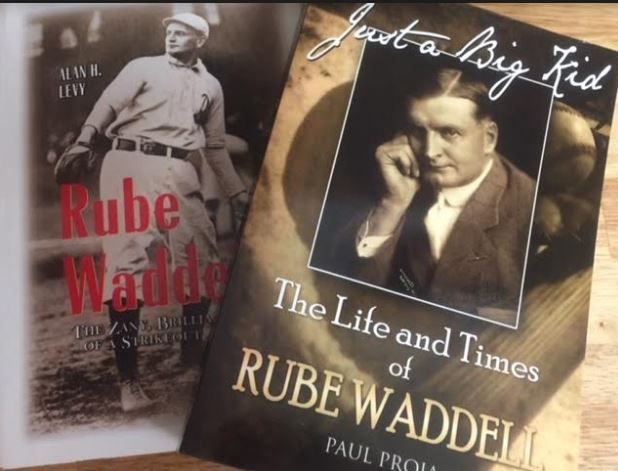
Had there been a Cy Young Award in 1902, Rube Waddell – like Steve Carlton above, would have won it.  And, his accomplishment would have been as unlikely as a pitcher on a last place club capturing that honor. Waddell started the 1902 season in the California League and didn’t make his first MLB start of the season until June 26 – for the fourth place Philadelphia Athletics (who were just one game over .500 at 26-25).

Despite missing more than 40 percent of the MLB season, Waddell went on to lead the league in strikeouts (210) and finish second in wins (24 versus seven losses); while putting up the league’s second-best ERA at 2.05. Oh, and he led the Athletics to the AL pennant. For more on the amazing and zany career of Waddell, click here.

Don’t Worry Boys, I’ll Handle This

In 1920, Babe Ruth, hit 54 home runs for the Yankees  Not a surprise – unless, of course, you factor in the fact that no other American League  team hit more than 50 and Ruth also outhomered all but one of the National teams (the Phillies had 64 team homers.)  The second-most home runs by any player in 1920 was the Browns’ George Sisler’s  19.

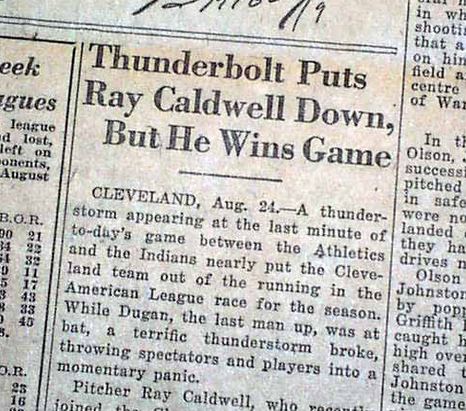
Ray Caldwell Hit By  Lightning  – Finishes Game

On August 24, 1919 hard-nosed righty Ray Caldwell made his first appearance on the mound for the Cleveland Indians (he had been released the Red Sox) – and it was electrifying (even death-defying) .  He started  against the Philadelphia Athletics – under threatening skies.  He got to the bottom of the ninth with a 2-1 lead.  With two outs and the A’s number-five hitter Joe Dugan at the plate, the skies delivered on their threat.  As witnesses reported, a lightning bolt blazed from the sky, hit near the press box, traveled down the ballpark railing, exited and crossed the field, dropping Caldwell (some said it hit him in the top of the cap).  Caldwell was on the ground for about five minutes, then slowly sat up, got to his feet, shook his head to clear the cobwebs (or perhaps th eclectic buzz), demanded the ball and promptly retired Dugan on a ground out to third.  For the full story on Caldwell unexpected finish to this game, click here.

Gotta Love them Zeroes

In 1968, Dodgers’ righty Don Drysdale pitched a record six consecutive complete-game shutouts between May 14 and June 4. In those 54 innings, he gave up just 27 hits and nine walks, while fanning 42. Surprisingly, the Big D finished the season at just 14-12 (but with a 2.15 ERA), despite the six straight whitewashings.  In all, eight of his 14 wins were shutouts.

Who Says Pitchers Can’t Hit?

The first National Leaguer (any position) to hit two Grand Slams in a game was a pitcher – Tony Cloninger, who did it in a Braves 17-3 win over the Giants  on July 3, 1966.  Cloninger collected a pitchers’ record nine RBI in the game – and also threw a complete-game seven-hitter. This tidbit gets “extra credit”  when you add the fact that, after retiring from MLB, Cloninger became a world-class slow-pitch softball player. In 1978 (six years after his MLB retirement), playing  for the United States Slow-Pitch Softball Association’s Slow-Pitch World Series Champion Howard & Carroll team, Cloninger was selected as the third baseman on the Series All-World Team.

Got Any More Bob millers Out in the Pen?

On August 15, 1962, as the Philllies topped the Mets 9-3 in the first game of a twin bill, Phillies’ starting left fielder Don Demeter touched up starting pitcher right-hander Bob Miller (Robert Lane Miller) for a third-inning, solo home run. In the ninth frame, Demeter (who had now moved to CF) hit a three-run home run, this time off  left-handed reliever Bob Miller (Robert Gerald Miller). So, two home runs in one game off two Bob Millers, one southpaw and one righty, one starter and one reliever, while in the lineup at two different positions.

The Jim and Chuck Show

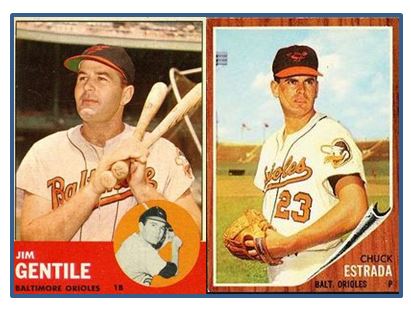
In 1961, the Orioles’ Jim Gentile tied the MLB record and set a new AL mark (both since broken) for Grand Slams in a season with five bases-loaded long balls.  Every one of Gentile’s five four-run blasts was hit in a game started by  Orioles’ righty Chuck Estrada (who, as you would expect, picked up a victory in all four contests).  Added credit for the fact that Gentile hit only one other Grand Slam in his career (June 26, 1960) and – you guessed it – the starting and winning pitcher in that contest was Chuck Estrada.


More Grand Slam Surprises

In 1987, Yankees’ first baseman Don Mattingly set an MLB single-season record (since tied) with six Grand Slams. Despite a 14-season career that included 163 bases-loaded plate appearances, Mattingly did not hit another Grand Slam before or after those record-setting six.

Wha-a-at?

Babe Ruth had more inside-the-park home runs and more steals of home than Ricky Henderson.

A Couple Of Bookends

John Miller hit just two home runs in his MLB career – one for the Yankees in 1966 and one for the Dodgers in 1969.  Those blasts made him one of just two MLB players to homer in their first and last MLB plate appearance.

This Seems Unlikely, I Guess.

Only five times in MLB history has a pitcher fanned 20 batters in nine innings  – Roger Clemens (twice); Kerry Woods; Max Scherzer; and Randy Johnson. (Johnson was the only non-complete game. He fanned twenty in nine innings, but was relieved by Byung-Hyun Kim in the top of the tenth with the score tied 1-1.) The tidbit that attracted me here is that is that in those five nine-inning, 20-strikeout outings, these dominating pitchers did not walk a single batter. That’s right, 100 whiffs and not a single walk.

Side Note; Om  September 12 1962, Tom Cheney of the Washington Senators set the MLB record for strikeouts in a single game at 21. Cheney pitched a 16 -inning complete game, one run on ten hits and four walks, with 21 strikeouts – as the Senators won 2-1.

It’s Good To Have Backup

In 1961, when Roger Maris hit 61 homers to break Babe Ruth’s  homerun record, he drew zero intentional  walks. (He was batting in front of Mickey Mantle.)

Casey Got A Good Start at Yankee Stadium

Casey Stengel, while a member of the New York Giants, hit the first-ever inside-the-park and over-the-fence post-season home runs in Yankee Stadium, (Games One and Three of the 1923 World Series.)

Just Start Me In Twin Bills

In August of 1903, the Giants’ Joe McGinnity started both games of a double header three times (August 1, 8 and 31), pitched six complete games and won them all, giving up just ten runs.  What puts this on this list is, that same month, McGinnity pitched just one game on six other occasions – going 1-5 and giving up 28 runs. Apparently, he liked a full day’s work.

Primary Resources:  Baseball-References.com; Baseball-Almanac.com; MLB.com; ESPN.com

_________________________________________________

About Baseball Roundtable:  Over the span of 1,000 posts, Baseball Roundtable has published a combination stats and stories,  observation and opinion (mine and the readers’).   On these pages, The Roundtable has launched:

The Annual John Paciorek Award – honoring players with brief, but in some way notable, baseball careers. For the latest JPA post – with a link to all the JPA offerings, click here.

The “Who’s Your Daddy?” Series – presenting position-by-position lineups of players who performed exceptionally well against some of the best pitchers of all time. For the latest “Who’s You Daddy?” post, which includes links to the entire series, click here.

The Baseball Roundtable Trot Index – tracking the percentage of plate appearances that result in a “trot” – around the bases (home run); back to the dugout (strikeout); or to first base (walk, hit by pitch, catcher’s interference.)

The annual Baseball Roundtable Unofficial Fan Hall of Famed Ballot, as well as fan surveys on the baseball experiences (time of game, concessions, etc.), proposed rule changes and the general state of the game.

Lists covering topics from Baseball Roundtables’ favorite baseball quotes, nicknames and baseball cards.

Baseball Roundtable has also offered month-by-month MLB season summaries – with stats, stories (highlights) and Baseball Roundtable’s Players, Pitchers and Surprise of the Month.  Baseball Roundtable has also featured guest posts by former players; coaches; sportswriters; writers from such websites as LiftYourGame.net, CatcherHome.com; The BaseballReviews.com; OldSportCards.com; I70Baseball.com; and even an Emmy Award Winner.

Looking forward to the next 1,000 posts.  Thanks to all for reading The Roundtable.


Baseball Roundtable – Blogging Baseball Since 2012.

100Baseball Roundtable is on the Feedspot list of the Top 100 Baseball Blogs.  To see the full list, click here.

Baseball Roundtable is also on the Anytime Baseball Supply Top 66 Baseball Sites list.  For the full list, click here

I tweet (on X) baseball @DavidBaseballRT

Follow/Like Baseball Roundtable’s Facebook Page here.  Find More baseball commentary; blog post notifications; PRIZES.

Member: Society for American Baseball Research (SABR); Negro Leagues Baseball Museum; The Baseball Reliquary.


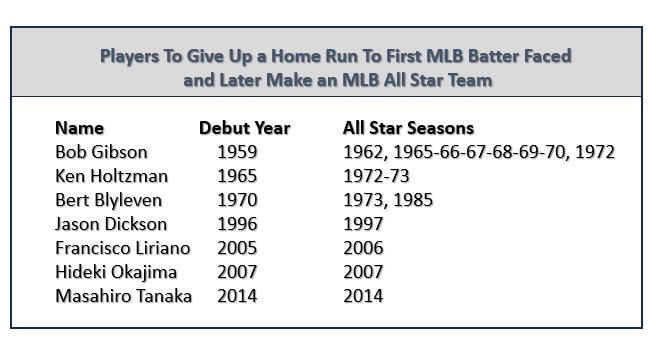
From Bob Gibson to Jason Dickson … Some Stories about Pitchers Who Gave Up Homers to the First MLB Batters They Faced

On Sunday (August 6). Reds’23-year-old righty Lyon Richardson made his MLB debut – starting against the Nationals in Cincinnati.  His performance, while not what he had hoped for, did attract the attention of baseball trivia buffs. Richardson started his MLB career by giving up home runs on each of his first two MLB pitches – to Nationals’ shortstop CJ Abrams (his 11th HR of the year) on a 95.5-mph fastball and to RF Lane Thomas (his 19th) on a 96.7-mph heater.  Ultimately, Richardson went three innings and gave up four hits, three walks and four runs, while fanning two, in the Reds’ 6-3 loss.

Now for that trivia “hook.” According to STATS, Richardson is the only pitcher in the past fifty years to give up homers on his first two MLB pitchers.  Taking it a step further, it appears he is the only MLB pitcher ever to “accomplish” that feat.

Baseball Roundtable searched box scores of the for the 79 pitchers listed by Baseball-Almanac.com as having allowed a home run to the first MLB batter they ever faced and found only one other pitcher who allowed home runs to the first two batters he faced – the Yankees’ Danny Rios on  May 30, 1997 – and he did it in a span of nine pitches.  More on that in a bit, but first  some background Richardson.

Richardson was a second-round Reds’ draft pick in 2018 (out of Jensen Beach, FL, High School – where he was 7-0, 0.58 as a senior). Richardson got off to a bit of a rocky start and missed the 2022 season after Tommy John surgery. He came back strong this season, working his way up through A, Double-A and Triple-A – going a combined 0-2, 1.86 with 81 strikeouts in 58 innings over 19 starts. In those 58 minor-league frames, Richardson gave up just two home runs. As far as the rough start to his MLB career, two observations:  1) He is now officially a major-leaguer and that puts him at the highest level of his profession; 2) a fellow name Bob Gibson gave up a home run to the first MLB batter he ever faced and he did pretty well as a major-leaguer.

Now back to the only other player I could find who had  given up long balls to the first two MLB batters he faced.  Danny Rios, a 72nd Round pick in the 1990 Draft, made his MLB with the Yankees on May 30, 1997. He relieved starter Ramiro Mendoza in the top of the fourth inning, with New York trailing Boston 4-0, two-on and one out.  The first batter Rios faced was SS and number-three batter Will Cordero, who hit a three-run homer on a 2-0 pitch.  Next up was 1B Mo Vaughn, who went deep on a 3-2 offering. Rios ended up pitching 1 2/3 innings, giving up three runs on four hits (three home runs), walking two and fanning one. Rios pitched in just two MLB seasons (1997 Yankees & 1998 Royals). He went 0-1, 9.31 in seven appearances.

As I noted, Rios and Richardson are the only two pitchers I could find who gave up long balls to the first two MLB batters they faced, but along the way I did find some interesting things about a few of  the pitchers who gave up a home run to the first MLB batter they faced.

Turn About Is Fair Play

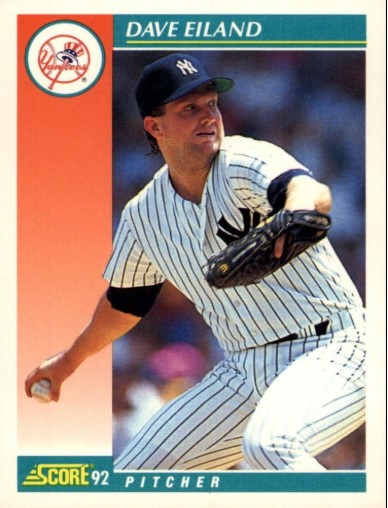
Dave Eiland made his MLB debut with the Yankees on August 3, 1988 – starting on the mound against the Brewers In Milwaukee. The first batter he faced was Milwaukee 2B and future Hall of Famer Paul Molitor. Molitor welcomed Eiland to the big leagues with a home run to center on a 1-2 pitch. That  home run would be the only run Eiland gave up in seven innings of work (three hits, two walks, three whiffs). Eiland went on to pitch in ten MLB seasons (1988-93, 1995, 1998-2000), going in 12-27,  5.74.  The reason he caught The Roundtable’s eye was for something that happened four seasons after his MLB debut.

It was on August 10, 1992, when Eiland was with the Padres.  They were facing the Dodgers, in San Diego, and Eiland drew the start against Bob Ojeda. This was back when pitchers came to the plate in the National League and Eiland got his first MLB at bat with two out and one on in the bottom of the second inning. He drove a 2-2 offering from Ojeda to deep left center for a two-run homer.  In the process, Eiland became the only player to give up a home run to the first batter he faced as a pitcher and hit a home run the first time he came to the plate as a hitter.  It was, by the way, Eiland’s only career MLB home run (he had just 27 MLB plate appearances)>

Boom!  Then on to the All Star Game. Two Times.

Only two players have made an MLB All Star team in the same season they gave up home run to the first MLB batter they faced in their careers.

Hideki Okajima made his MLB debit for the Red Sox on April 2, 2007 (after 12 seasons in Japan).  He came on to open the bottom of the sixth, with the Red Sox down 5-1 to the Royals. Royals’ C John Buck laced Okajima’s first major-league pitch to deep CF for a home run. Okajima went on to pitch 1 2/3 innings that game, giving up just one more hit.  Why does he rate a mention here? Okajima may have given up a home run on his  first MLB pitch – but after that booming 2007 start to hit MLB career- he went on to make the 2007 American League All Star team. (He was 2-0, 0.83 with four saves -in 39 games – at the break.) Okajima pitched in six MLB seasons (2007-11, 2013, going 17-8, 3.09 with six saves (266 appearances).

Like Okajima, Masahiro Tanaka came to MLB after starting his career in Japan (seven seasons). He made his MLB debut with the Yankees on April 4, 2014 – starting against the Blue Jays in Toronto. Blue Jays’ leadoff hitter LF Melky Cabrera took Tanaka deep on a 1-1 pitch to welcome Tanaka to the majors.  Tanaka was unfazed by the rude introduction to MLB.  He went on to pitch seven innings of three-run (two earned), six-hit, eight-strikeout ball to pick up the win. Tanaka, who made the All Star team that season, was a sparkling 12-4, 2.51 at the break. He suffered elbow pain that July and went on the disabled list. He returned in September and finished the season at 13-5, 2.77. He pitched in seven MLB seasons (2014-20 … Yankees), going 78-46, 3.74. He made one more All Star team, (2019).

Oh, Come On, I have to Start My Career Against This Guy

Okay, if your story has Babe Ruth in it, it’s probably a good one.

Philadelphia A’s righty Bobby Coombs took to an MLB mound for the first time on June 8, 1933 – and the first batter he faced was none other than Babe Ruth.

Coombs came on in the top of the ninth, with the Athletics up 14-10. The Bambino took him to  deep to right for his 664th career round tripper. After Ruth’s blast, Coombs retired 1B Lou Gehrig, RF Ben Chapman and 2B Tony Lazzeri in order (all on ground outs).

Coombs had an unusual, career. He went directly from Duke University – where he had excelled in football, basketball, track and baseball (where he was 19-1 on the mound) – to the major leagues.  So, Ruth was also the first batter Coombs ever faced as a professional. After going 0-1, 7.47 in 21 games for the 1933 Athletics, Coombs opened the 1934 season at Double-A Syracuse. He did not return to the major leagues for ten seasons (a 122-124, 4.06 minor-league record, primarily at Double-A). In 1943, he was back in the majors, this time with the Giants, where he went 0-1, 12.94 in nine games. Coombs went on to  coach baseball at Williams College from  1946-73.

Williams College plays its home baseball games at Bobby Coombs Field.

Bob Gibson – Yeah, He Did Okay

Bob Gibson made his MLB debut with the Cardinals on April 15, 1955 – relieving in the seventh inning, with the Cardinals trailing the Dodgers (in LA) 3-0. The first batter he faced was the number-eight hitter, 3B Jim Baxes, who lashed a 2-0 pitch for a home run to left-center.  Baxes, by the way, went .246-17-39 in 88 games in 1959, his only MLB season. Gibson, of course, went on to the Hall of Fame. Gibson was 251-174, 2.91 over his 17-season MLB career – with 255 complete games, 56 shutouts and 3,117 strikeouts in 3,884 1/3 innings. He was a two-time Cy Young Award winner and the 1968 NL MVP.

Bert Blyleven – Maybe Less of a Surprise Than Gibson

Bert Blyleven, like Gibson, pitched his way into the Hall of Fame after giving up a dinger to the first MLB batter he faced.  It came on June 5, 1970, with the 19-year-old Blyleven starting for the Twins in Washington. The first MLB batter he faced was Senators’ RF Lee Maye, who homered to right. Blyleven seem unperturbed, as he pitched seven five-hit, one-run innings for the win. He walked one and fanned seven. The Maye homer would be one of 430 (ninth all-time in MLB) Blyleven would surrender in his 22-season MLB career.  Blyleven holds the record for the most home runs allowed in an MLB season at 50 (1986 Twins). Over his career, Blyleven went 287-250, 3.31, with 3,701 strikeouts in 4,970 innings. He also notched 242 complete games and 60 shutouts.

Bill Macdonald – Turned Things Around Pretty Quickly

Righty Bill Macdonald made his MLB debut for the Pirates on May 6, 1950. He came on in eighth inning, facing the Giants’ Bobby Thomson, who would (of course) become known for a different home run.  Anyway, Thomson touched Macdonald for a three-run homer. Macdonald was then replaced on the mound by Woody Main.  Macdonald is mentioned here because, in his next appearance – a May 23 start at Philadelphia – he twirled three-hit shutout (one walk – seven whiffs), lowering his MLB earned run average from infinity to 1.00. The righty pitched in two MLB seasons (1950 & 1953 Pirates), going 8-11, 4.66.

Not a Pretty Scorecard

John Wasdin made his MLB debut for the A’s on August 24, 1995. The A’s, playing the Red Sox in Oakland, trailed 8-2, with two-on and one out in the top of the third.  That’s when the call went to Wasdin in the pen.  The first four MLB batters Wasdin faced went like this:

  • SS John Valentin – three-run home run;
  • 1B Mo Vaughn – walk;
  • DH Jose Canseco – two-Run home run;
  • LF Mike Greenwell – walk.

Wasdin then fanned RF Troy O’Leary and got 3B Tim  Naehring on a pop fly. He  settled down nicely and ended up giving up three runs on four hits and three walks over 6 2/3 innings. (No runs after that the first three batters he faced.)

In and Out of Trouble

Jason Dickson broke into the majors with the (then) California Angels on August 21, 1996, He started against the Yankees in New York) and the first batter he faced was SS Derek Jeter, who popped a home run to left.  Despite that beginning, Dickson was around into the seventh pitching  in and out of trouble.  In 6 1/3 innings, he gave up ten hits and two walks, but only that lone first-inning run. Dickson left the game with a 2-1 lead and got the win as the Angels prevailed 7-1.

Dickson pitched in four MLB seasons (1996-98, 200) and went 26-25, 4.99. He was an All Star in 1997,  when he went 13-9, 4.29.

Primary Resources: Baseball-Reference.com; Baseball-Almanac.com; Bobby Coombs Obituary, Berkshire Eagle, October 23, 1991 .


Baseball Roundtable – Blogging Baseball Since 2012.

100Baseball Roundtable is on the Feedspot list of the Top 100 Baseball Blogs.  To see the full list, click here.

Baseball Roundtable is also on the Anytime Baseball Supply Top 66 Baseball Sites list.  For the full list, click here

I tweet (on X) baseball @DavidBaseballRT

Follow/Like Baseball Roundtable’s Facebook Page here.  Find More baseball commentary; blog post notifications; PRIZES.

Member: Society for American Baseball Research (SABR); Negro Leagues Baseball Museum; The Baseball Reliquary.


Starting With A Bang – First-At Bat Home Runs

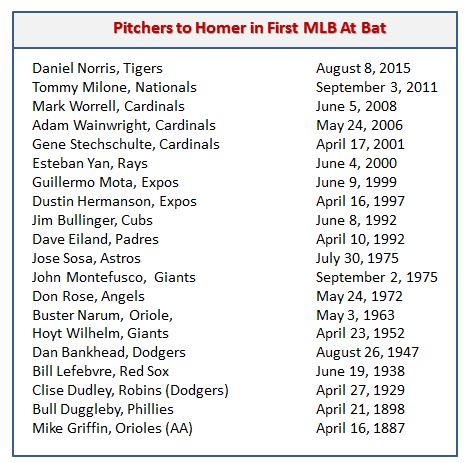
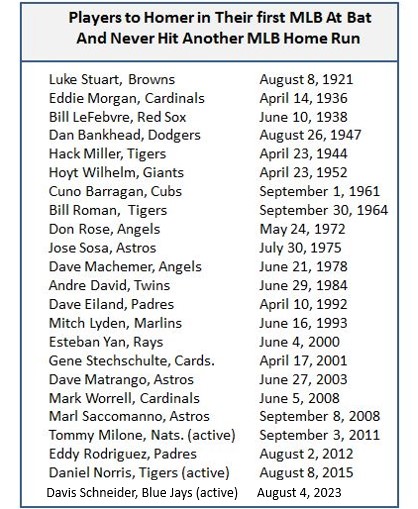
Yesterday (August 4, 2023), the Toronto Blue Jays’ 24-year-old rookie 2B Davis Schneider, became the 138th major-leaguer to hit a home run in his very first MLB at bat.  Note:  I expect this list to expand as Negro Leagues’ records from 1920-48 are further documented and incorporated into the MLB record books.  The 138 include 79 National Leaguers, 57 American Leaguers and two from the old American Association. 

Schneider’s call up from the Triple-A Buffalo Bisons followed a recent injury to Blue Jays’ SS Bo Bichette. The Blue Jays – in a tight AL-East battle for a playoff spot –  responded by trading for  Cardinals’ SS Paul DeJong, as well as adding Schneider (who can play 2B, 3B and LF), who appears ready to add some offense in Bichette’s absence. Schneider was hitting .275-21-64 in 87 games at Buffalo. He also drew 72 walks – for a .416 on-base percentage. Schneider was a 28th Round pick (number 894 overall) in the  2017 MLB draft (out of Eastern High School, Voorhees, NJ). The versatile defender has steadily worked his way up the Jays’ minor-league system and, as he matured, has shown surprising power for a 5’9″, 190-pounder.

In that August 4 game – Jays versus Red Sox in Boston – Schneider got his first MLB at bat with one out in the second inning and the Blue Jays up 2-0. He drove  a 1-1 pitch from southpaw Jame Paxton high into the seats above the left field green monster.  Davis went on to line out to CF (off Paxton) in the third inning; strikeout in the fifth (Paxton); single in the seventh (Mauricio Liovera); and foul out in the ninth (Richard Bleier). The Blue Jays won the game 7-3.

Now, how about some more first-at bat homer tidbits.

Start a Season and a Career with a Bang – Change Sides and Repeat

On April 19, 1938, the Dodgers opened the season against the Phillies in Philadelphia.  Yes, that’s right, Opening Day on April 19 (How the times have changed).   That day a couple of rookies showed they truly knew how to “get a party started” – hitting home runs in their first MLB at bats on Opening Day.

Batting third for Brooklyn was 28-year-old rookie left fielder Ernie Koy. In his first-ever MLB at bat, he took Phillies’ starter Wayne LaMaster deep to give the Dodgers a 1-0 lead.  Leading off for Philadelphia in the bottom of the inning was 25-year-old rookie second baseman Heinie Mueller.  In his first MLB at bat, Mueller homered off Dodgers’ starter Van Lingle Mungo to tie the game.  It was the first time in MLB history that two players homered in their first MLB at bat in the same game – a feat that would not be matched for nearly 80 years (2016).

The Dodgers, by the way, won 12-5; with Koy going 3-for-5 with two runs scored and an RBI. Mueller went 2-for-3, with two walks, three runs scored and one RBI. In that rookie season, Koy hit .299, with a career-high 11 home runs.  He played six MLB seasons (558 games) and put up a .279-36-260 line. Mueller finished 1938 with a .250-4-34 stat line and went .253-17-127 in four MLB seasons.

How About Starting Back-to-Back, Jack(s)?

Aaron Judge photo

Aaron Judge. Photo by Keith Allison

Photo by slgckgc

Tyler Austin. Photo by slgckgc

On August 13, 2016, MLB saw two players homer in their first MLB at bat in the same game for just the second time. This time, they were on the same team – and accomplished the feat back-to-back. It came in the bottom of the second inning, with the Yankees facing the Rays. With two outs and the bases empty, Yankee rookie 1B Tyler Austin took Rays’ starter Matt Andriese deep to right field to give the Bronx Bombers a 1-0 lead.  Rookie RF Aaron Judge immediately followed up with a home run of his own (also in his first MLB at bat); this one to straight-away center.  Austin ended the season with five home runs in 31 games, while Judge got in just 17 games and hit just .179 with four home runs.  Note: By virtue of that limited playing time, Judge kept his rookie status for 2017 – when he went .284-52-114, setting a new MLB rookie record for home runs (since broken) and leading the AL in runs scored (128), home runs, walks (127) and whiffs (208), while winning the AL Rookie of the Year Award. 

Here are a few other first-at bat home run factoids.

  • Thirty players hit a home run on the very first MLB pitch they ever saw.

For a deep dive into those first-pitch-ever homers, click here. 

  • Just four players have hit a Grand Slam home run in their first MLB at bat: Bill Duggleby, Phillies, April 21, 1898; Jeremy Hermida, Marlins, August 31, 2005; Kevin Kouzmanoff, Indians, September 2, 2006; and Danial Nava, Red Sox, June 12, 2010. Notably, Kouzmanoff and Nava put a little icing on the cake, hitting their Grand Slams on the first MLB pitch they ever saw.
  • Twenty pitchers, including the first player to hit a Grand Slam in his first at bat, homered in their first-ever MLB at bat.

PitcherHr

  • Only two players have homered in their first two at bats: Bob Nieman, Browns, 1952 and Keith McDonald, Cardinals, July 4, 2000. Note: McDonald collected just three base hits in his MLB career – and they were all home runs.  For that story, click here.

A COUPLE OF BOOKENDS

Only two players have gone deep in their first and last MLB at bats, Paul Gillespie and John Miller.

Gillespie hit his first-at bat homer for the Cubs on September 11, 1942 and his last-at bat homer for for the Cubs on September 30, 1945.  In three MLB seasons, he hit .283, with six home runs and 25 RBI (in 75 games).

Miller Hit his first-at bat homer (for the Yankees) on September 11, 1966 and his last-at bat long ball for the Dodgers on September 23, 1969,  He played in 32 MLB games and those were his only MLB homers (.164-2-3). For more on Miller, click here. 

  • The first recorded/documented instances of a player homering in their first MLB at bat came on (American Association) Opening Day (April 16) in 1887 – Orioles’ OF Mike Griffin and Red Stockings’ OF George Tebeau (in separate games).
  • Twenty-three of the players to homer in their first MLB at bat ever have only one MLB home run on their resumes (three are still active).


Primary Resources: Baseball-Reference.com; Baseball-Almanac.com; MLB.com


Baseball Roundtable – Blogging Baseball Since 2012.

100Baseball Roundtable is on the Feedspot list of the Top 100 Baseball Blogs.  To see the full list, click here.

Baseball Roundtable is also on the Anytime Baseball Supply Top 66 Baseball Sites list.  For the full list, click here

I tweet (on X) baseball @DavidBaseballRT

Follow/Like Baseball Roundtable’s Facebook Page here.  Find More baseball commentary; blog post notifications; PRIZES.

Member: Society for American Baseball Research (SABR); Negro Leagues Baseball Museum; The Baseball Reliquary.


Some August 4 Musings Focused on Travel and Trades

It seemed appropriate to celebrate my (76th) birthday (August 4) with a blog post. So, I looked for some kind of theme from baseball events that took place on August 4 in years past – at least as a starting point.  As regular readers know, when The Roundtable starts looking into an event or topic “one thing always seem to lead to another.”

At any rate, the most unique baseball event to take place on August 4 relates to travel and trades. So, that was my starting point.

What’s That Starting Time Again?

On August 4, 1982, outfielder Joel Youngblood made MLB history by becoming the only player to collect a base hit for two different major-league teams in two different cities – on the same day.

Youngblood started the day with the Mets, playing an afternoon game against the Cubs at Wrigley Field. Youngblood opened the game in center field, batting third in the order.  After striking out in the first inning, Youngblood drove in two runs with a single in the top of the third.

Youngblood was then replaced in centerfield by Mookie Wilson in the bottom of the fourth – and was told by Mets’ manager George Bamberger that he had been traded to the Expos (for a player to be named later), who were scheduled to play the Phillies in Philadelphia that night.

Youngblood immediately set out to join his own team – catching a 6:05 flight to Philadelphia – eventually arriving at Veterans Stadium with the game in progress. To his surprise, there was an Expos uniform, with his name already sewn on the back, waiting for him.  And, the Expos wasted no time getting their newest player into the game. Manager Jim Fanning sent Youngblood into right field and the number-two spot in the batting order (replacing Jerry White) in the sixth inning. In the top of the seventh, Youngblood singled in his first Expos’ at bat.

Two hits, for two different teams in two different cities in one day – an historic accomplishment.  Youngblood’s day was even more amazing when you consider the pitchers he touched for his two safeties. In Chicago, it was future Hall of Famer Fergie Jenkins, while in Philadelphia, it was future Hall of Famer Steve Carlton. So, base hits for two different teams, in two different cities, off two future Hall of Famers in one day.

Youngblood played in 14 MLB seasons (1976-89 … Reds, Cardinals, Mets, Expos, Giants). He was also a true utility player, making 100 or more MLB appearances at second base, third base, left field, center field and right field – as well as 402 pinch-hitting appearances. His final stat line, in 1,408 games, was .265-80-422.

He made one All Star team (in the strike-shortened 1981 season, when he hit .350 in 43 games for the Mets).  He best season was 1983, when he hit .292, with 17 homers and 53 RBI in 124 games (at four positions) for the San Francisco Giants.  Youngblood was an All Star in the strike-shortened 1981 season, when he went .350-4-25 for the Mets.

Just Point Me Toward The Mound.  I’ll Find It.

In another travel/trade-related August 4 event, when southpaw Jaime Garcia started on the mound for the Yankees (in Cleveland) on August 4, 2017, he became the first pitcher in the modern era to make a series of three consecutive pitching starts – each one for a different MLB team (and he did it in a span of 15 days).

  • On July 21, Garcia, who opened the season with Braves, started for Atlanta (at Los Angeles) and went seven innings in a 12-3 Braves’ victory.
  • On July 24, Garcia was traded to the Twins.
  • On July 28, Garcia started for the Twins at Oakland) and went 6 2/3 innings in a 6-3 victory.
  • On July 30, the Twins traded Garcia to the Yankees.
  • On August 4, Garcia started for the Yankees (at Cleveland) and went 3 2/3 frames in a 7-2 loss.

Overall, Garcia was 5-10, 4.41 in 27 games (all starts) in 2017. He played 10 MLB seasons (2008, 2010-18 … Cardinals, Braves, Twins, Yankees, Blue Jays, Cubs).  His final stat line was 70-62, 3.85 and his best season was 2010, when he went 13-8, 2.70 for the Cardinals.

Side note: In 1895, Gus Weyhing was on the mound for the Phillies, Pirates and Louisville Colonels in consecutive  starts.  Of interest to me, was that prior to that well-traveled 1895 season, Weyhing had an MLB record of 216-154, 3. 55 with 242 complete games in eight seasons – averaging and apparently arm-draining 407 innings pitched per campaign. From 1895 through his retirement  in 1901, he went 48-78, 4.90 with 107 complete games.

Now, for the one thing leads to another portion of our programming.

Five Tams in One Campaign

Oliver Drake with the Rays. Photo: Keith Allison, CC BY-SA 2.0 <https://creativecommons.org/licenses/by-sa/2.0>, via Wikimedia Commons

In 2018, 32-year-old right-hander Oliver Drake set a major-league mark by playing for five MLB teams in a single season.

Drake began the season with the Brewers (where he finished the previous campaign).  After going 1-0, 6.39 in eleven appearances, he was designated for assignment on May 2 and, on May 5, purchased from the Brewers by the Indians.

He was with the Tribe until the final week in May – going 0-0,with a 12.46 ERA in just four appearances – before again being designated for assignment.

May 31, he was selected off waivers by the Angels. Sixteen days (and 0-1, 10.13 record) later, he was again designated for assignment.  He went unclaimed and reported to the Angels’ Salt Lake City Triple-A affiliate – where he was pretty much lights out.  That earned him a trip back to Anaheim, where he added four more appearances, with an 0-0, 3.00 record – and was again designated for assignment.

He was picked up (off waivers) by the Blue Jays on July 26 and was there for just two appearances (giving up three runs in 1 2/3 innings) before again being designated for assignment.

On August 3, he was selected off waivers by the Twins – his fifth MLB team of the season – where he found a bit more success and stability. Pitching for his fifth MLB team of the year, Drake finished the season with Minnesota, getting in 19 games and posting a 2.21 earned run average and  fanning 22 batters in in 20 1/3 innings pitched. What did that get him?  In the off-season, he was again designated for assignment.

Drake finished the 2018 season with an 1-1 record, a 5.29 ERA and 51 strikeouts in 47 2/3 innings.  Drake pitched in six MLB seasons (2015-20 … Orioles, Brewers, Indians, Twins, Angels, Blue Jays, Rays). Over those six campaigns, he went  10-10, 4.27, with five saves in 196 appearances.

Changing Clubhouses in Mid-Doubleheader

Clliff and MaxAnd, finally, Joel Youngblood does not stand alone in playing for two teams in a single day. On May 30, 1922, the Cubs and Cardinals made a trade that made MLB history. The two squads were facing off (in Chicago) in a Memorial Day doubleheader. Remember those?
The Cubs won Game One 4-2 – and batting fifth in their lineup (collecting one RBI, despite going 0-for-4) was RF Max Flack.  The CF for the Cardinals that game (batting seventh) was Cliff Heathcote – who went 0-for-3. Flack was in his ninth season for the Cubs, while Heathcote was in his fifth season for the Cardinals.

In between Games of the twin bill, Flack and Heathcote were traded for each other. The two outfielders each crossed over to their new team’s clubhouse and  suited up against their previous team for Game Two – becoming the first two players to take the field for two major-league teams in a single day.  Both collected hits for their new teams in the second game (Flack a single in four at bats, Heathcote a pair of singles in four trips to the plate).

Flack played in 12 MLB seasons (1914-25 … Chicago Chi Feds of the Federal League, Cubs, Cardinals) and went .278-35-391 in 1,411 games. Heathcote played in 15 MLB seasons (1918-32 … Cardinals, Cubs, Reds, Phillies), going .275-42-448 in 1,415 games.

The trade, by the way, seem to be a positive for both teams and both players. Prior to the exchange, Flack was hitting .222-0-6 in 17 games for  the Cubs,  Post-trade, he hit .292-2-21 in 66 games for the Cardinals. Heathcote was hitting .245 (in 34 games) for the Cardinals. After the trade, he went .280-1-34 in 76 games for the Cubs

Primary Resources:  Baseball-Reference.com; NationalPastime.com.

Baseball Roundtable – Blogging Baseball Since 2012.

100Baseball Roundtable is on the Feedspot list of the Top 100 Baseball Blogs.  To see the full list, click here.

Baseball Roundtable is also on the Anytime Baseball Supply Top 66 Baseball Sites list.  For the full list, click here

I tweet (on X) baseball @DavidBaseballRT

Follow/Like Baseball Roundtable’s Facebook Page here.  Find More baseball commentary; blog post notifications; PRIZES.

Member: Society for American Baseball Research (SABR); Negro Leagues Baseball Museum; The Baseball Reliquary.


Baseball Roundtable July Wrap UP – Stories, Stats, Stars and More

It’s August 1 and that means it’s time for the Baseball Roundtable July Wrap up – the stats and stories that caught The Roundtable’s attention in July – as well as the Players and Pitchers of the Month and the ongoing Baseball Roundtable Trot Index.

Notably, there was plenty to write about for July:

  • A triple play;
  • A 250th home run and 250th career win;
  • a 300th home run;
  • A combined no-hitter;
  • A four-strikeout inning;
  • A player swiping second, third and home in one plate appearance;
  • Some “Long Ball “birthday celebrations;
  • Three bases on a strikeout; and
  • More.

For the stats and stories, read on.

_______________________________________

Let’s start, as usual, with the Roundtable’s Players and Pitchers of the Month.

BASEBALL ROUNDTABLE JULY PLAYERS/PITCHERS OF THE MONTH

NATIONAL LEAGUE

Player of the Month … Tie: Manny Machado, 3B, Padres and Cody Bellinger, CF, Cubs

Manny Machado led MLB with 11 July home runs and 29 July RBI, while also putting up a .309 average and scoring 20 runs – all in just 25 games.   Machado truly made his hits count, driving in those 29 runs on 29 hits.  Machado’s month included six multi-RBI games. In a seven-game stretch (July 3-14), when the Padres recorded six wins, Machado went 12-for-27 (.444), with five home runs and 14 RBI.  Machado also walked more often (16) than he struck out (14).

A .400+ average is the kind of a bright and shiny thing that attracts Baseball Roundtable.

Cubs’ CF Cody Bellinger spurred the Cubs’ 15-11 record in July,  with – among other stats – an MLB-best (among players with at least 50 at bats) .400 average for the month. He led all of MLB in July hits (40), while stroking eight home runs (tied for fourth in the NL) and driving in 24 (second in the NL). Bellinger also scored 21 runs.  Bellinger recorded at least one base hit in 23 of 26 games and had 13 multiple hit games. During the month he was never held hitless in consecutive games.

Honorable Mentions: We start here with a couple of brothers from “The Catching Contreras Family.” Brewers’ catcher William Contreras finished second in the NL in July hits (35), batting .365, with three homers and 18 RBI in 23 games. Willson Contreras, of the Cardinals- went .429-3-9 in 17 games.  (He had only 49 at bats, so didn’t make the Roundtable leader board.) The Roundtable also took a look at Nationals’ 22-year-old SS CJ Abrams, who led MLB in July stolen bases (16 in 16 attempts) and added a .327 average, with 32 hits (sixth in the NL) and 24 runs scored (tied for first in the NL).  Abrams, notably, came into the month hitting just .230 on the season, with 11 multi-hit games, he raised his average to .257 by months end.

Pitcher of the Month … Corbin Burnes, RHP, Brewers

Burnes went 4-1, 1.85 for the month (six starts). He also fanned 47 batters (second only to Spencer Strider in the NL) versus 13 walks in 39 innings. Burnes’ 0.72 WHIP (Walks & Hits per inning pitched) was the lowest among NL pitchers with at least 20 July innings, as was his batting average against (.115). Burnes went at least six innings in each of his six starts and his 39 July innings led MLB.

Honorable Mentions:  The Padres’ Blake Snell went 4-1 in six starts – and put up a 0.56 earned run average, lowest among MLB pitchers with at least 20 July innings. Snell fanned 42 batters in 32 innings. So, why – despite that bright and shiny ERA –  Burnes over Snell?  I couldn’t get past the fact that Snell walked an MLB-highest 26 batters in July and his WHIP (1.50) and Batting Average Against (.196) trailed Burnes. Still, he pitched his way into and out of trouble, an deserves mention here.  Snell’s teammate, RHP Joe Musgrove, also deserves recognition  for his  4-1, 1.45 in five July starts – fanning 36 and walking just five in 31 innings.

AMERICAN LEAGUE

Player of the Month … Kyle Tucker, RF, Astros

Tucker put up a .359 average in July (fourth in the AL among hitters with at least 50 at bats), with seven home runs (tied for fourth in the AL) and 21 RBI (also tied for fourth). In addition, his 33 July hits were third in the AL and his 19 runs scored tied for second. Tucker’s month included a three-homer game on July 15, two four-hit games and two four-RBI games.  He reached base safely in 21 of 25 games. During an 11-game hitting streak (July 14-25), he hit .439-5-13.  Tucker also stole six basses in eight attempts. Tucker drew 14 walks and his .448 on-base percentage was third among AL hitters with at least 50 July at bats.

Honorable Mentions: Royals’ SS Bobby Witt, Jr. made this a tough call.  Witt hit .327-6-21 for the month, with six steals in eight attempts.  He 32 hits tied for fourth  in the AL and his three triples tied for the July league lead. What separated Tucker and Witt, from The Roundtable’s, perspective, was that Witt had just three walks (and 20 strikeouts), while Tucker had 14 walks and 14 strikeouts. Justin Turner, DH, Red Sox hit .337, with five homers and an AL-best 28 July RBI.

Pitcher of the Month … Tyler Glasnow, RHP, Rays

Glasnow went 3-2 for July, putting up a 2.11 earned run average and fanning an AL-highest 51 batters, while also throwing an AL-highest 38 1/3 innings. Notably, he walked only eight batters in his six July starts. His 0.89 whip was fifth-best in the AL and he held hitters to a .186 average.  His two losses came to two of MLB’s hottest teams – the Braves and the Orioles.  In those two contests, he gave up just three earned runs in 12 2/3 innings and fanned 17 batters while walking just one.

Honorable Mentions: The Roundtable also looked at a couple of effective relievers here. The Red Sox’ (RHP) Nick Pivetta, serving primarily as a long-reliever, went 3-1, 1.91 in six appearances (one start) and fanned 43 batters, against just six walks, in 28 1/3 innings.  He put up a 0.71 WHIP and held batters to a .144 average, The Orioles’ closer, Felix Bautista, saved eight games in eight opportunities and fanned 25 batters in 14 innings – giving up just three hits, four walks  and zero runs.

__________________________________________

Surprise Player(s) of the Month 

Tie: Triston Casas,1B, Red Sox & Tanner Bibee, RHP, Guardians

The Roundtable went with a couple of rookies here.

Triston Casas  – The 23-year-old Red Sox 1B (rookie status still intact) – came into July hitting just .227.  For the month, he went .348-7-13, with 16 runs scored.  He hit safely in  13  of the 17 games he started and logged seven multi-hit contests. Casas was a Red Sox first-round pick in the 2018 MLB Draft – out  of American Heritage High School. (He also played for the U.S. Team in the 2020 Summer Olympics.) The 6’5”, 244-pound Casas hit .269-46-181 over four minor-league seasons. Last season, he hit .273-11-38 in 72 games at Triple-A in 2022 and .197-5-12 in 27 games with the Red Sox.

Tanner Bibee. The Guardians’ 24-year-old rookie RHP had a stellar month, going 3-0, 1.78 in five starts. He fanned 33 batters (10 walks) in 30 1/3 innings, put up a 0.99 WHIP and held hitters to a .183 average. Bibee was a fifth-round  pick (out of California State University, Fullerton) in the 2021 MLB Draft. Bibee may be a bit less of a surprise. In 2022, he went 8-2, 2.17 at High-A and Double-A, and, this season,  was 2-0, 1.76 at Triple-A before being called up.  He finished July 7-2, 3.11 on the season. Even given his high status as a prospect, it’s a surprise when a rookie does so well so quickly.

________________________________________

THE TROT INDEX … A REGULAR BASEBALL ROUNDTABLE FEATURE

Through July 30,  35.6 percent of the MLB season’s 120,859 plate appearances ended in a trot (back to the dugout, around the bases, to first base). We’re talking about strikeouts, home runs, walks, hit by pitch and catcher’s interference – all outcomes that are, basically, devoid of action on the base paths or in the field. Here’s the breakout: strikeouts (22.7%); walks (8.6%); home runs (3.1%); HBP (1.1%); catcher’s interference (less than 1%). Strikeouts, by the way, outnumbered base hits 27,465 – 26,787.

The 35.6 percent figure is up from 2022’s full season 34.6 percent.  Other recent seasons: 2021 – 36.3 percent; 2020 –  37.3 percent;  2019 – 36.2 percent; and 2018 – 34.8 percent.  By further comparison, in 1990, the Trot Index was 26.1 percent.  

____________________________________

The Orioles are no longer a surprise – and their 17-9 July record, coupled with the Rays’ slump – have vaulted the Birds into first place in the East. In July, the O’s scored the second-most runs in the AL and gave up the fourth fewest tallies.  As a team, they made their hits count – scoring the second-most July runs with the league’s fifth-lowest team batting average and fifth-fewest home runs. It’s also notable that their starting pitchers went 7-6 for the month, while the bullpen staff put up a 10-3 record (with ten saves).  There may be some vulnerability there. The stretch run should be interesting.

The biggest surprise in the AL may have been the slumping Rays – who scored the fewest runs in the AL in July (just 87, as compared to the Orioles’ 126). Looking at the starting lineup, only 1B Yandy Diaz (.324) and 2B Brandon Lowe (.284) hit .250 or better in July.  A couple of other AL observations:  The Central Division Title seems like the crown no one wants to wear.  The Astros seem to be coming to life in the West (or maybe the Rangers are just fading a bit). In July, Houston topped the AL in home runs (40) and runs scored (131) – led by RF Kyle Tucker (.359-7-23 in July) and CF Chas McCormick (.351-6-23). On the mound J.P. France led the way, going 4-0, 2.30 in five July starts.

Over in the NL, the Cardinals began to show some life.  Though they remain in last place, they had a winning month of July – scoring the NL’s second-most runs. Third baseman Nolan Arenado provided the most firepower (.295-6-23 for the month). The pitching staff, however, put up the NL’s fifth-highest ERA. Meanwhile, the Reds continue to play well, putting up the NL’s third-lowest July ERA (3.51) and scoring the fifth-most runs. A couple key July contributors were RHP Graham Ashcraft (3-1, 1.84 in five starts) and closer Alexis Diaz (ten saves in ten opportunities). On offense, they shared the load, with six players driving in ten or more runs in July. In the West, the Dodgers are back on top, while in the East the Braves continue to bash home runs (an MLB-highest 47 in July) and Spencer Strider continues to fan batter at a dizzying rate.

——Team  Statistical Leaders for July  2023 ———-

RUNS SCORED

National League –  Cubs (150); Cardinals (138); Padres (135)

American League – Astros (131); Orioles (126); Red Sox (124): Mariners (124)

The fewest  runs in July  were scored by the Giants – 83. The Rays tallied the fewest runs in the AL at 87.  

AVERAGE

National League – Cardinals (.275); Marlins (.272); Cubs (.268)

American League – Red Sox (.285); Rangers (.270); Guardians (.269)

The lowest team average for July belonged to the Giants at .209. The lowest in the AL was the Rays (.216).  The only other team under .220 was the Pirates (.218).

HOME RUNS

National League – Braves (47); Padres (39); Dodgers (38)

American League –  Angels (41);  Astros (40); three at 34

The Marlins had the fewest home runs in July at 17.  They were the only team under 22.

The Braves led MLB in slugging percentage for July at .497.  The Red Sox led the AL at .475. 

STOLEN BASES

National League – Nationals (31); Reds (29); Cubs (27)

American League – Guardians (27); Red Sox (25); Royals (23)

The Pirates stole the fewest sacks in July  – just four in eight attempts.   The Angels  were at the bottom of the AL, with eight in eleven  attempts. 

WALKS DRAWN

National League –   Padres (107); Cardinals (101); Dodgers (100)

American League  Yankees (96); Blue Jays (92); Angels (90)

The Cardinals led MLB in on-base percentage for July  at .353. The Blue Jays led the AL  at .341.  The Rays had MLB’s lowest  OBP for July  at .288.  

BATTERS’ STRIKEOUTS

National League – Reds (241); Phillies (239); Pirates (234)

American League – Mariners (272);Twins (258); Angels (251)

Guardians  batters fanned the fewest times in May  (163).

Bonus Stats

  • Cardinals’ batters racked up the most total bases in July at 422.  The Giants were at the bottom of MLB at 278.
  • The Diamondbacks led in sacrifice bunts for July with eight. Three teams (Rockies, Tigers and Rays) recorded zero sacrifice bunts
  • The Mariners had 25 hit batters in July to lead MLB. The Mets led the NL with 23.  The Marlins had just four.
  • The Cardinals grounded into an MLB-high 30 double plays in July.

_______________________________________

Earned Run Average

National League – Padres (3.25); Mets (3.49); Reds (3.51)

American League –  Blue Jays (3.27); Marines (3.35); Orioles (3.61)

The Nationals had the highest July  ERA at 6.04.  Others over 5.00 were:  Rangers (5.64); D-backs (5.46); Pirates (5.28); Royals (5.07).

STRIKEOUTS

National League – Brewers (255); Padres (247); Marlins (225)

American League –  Mariners (247); Blue Jays (246); Twins (242)

The Brewers  averaged an MLB-best 10.34 strikeouts per nine innings in July. The Rays averaged an AL-best 10.16.  Others over 10.00 were the Twins (10.07)  and the Blue Jays (10.06). Twelve teams averaged nine whiffs per nine or better.

FEWEST WALKS SURRENDERED

National League  – Giants (51); Rockies (65); Phillies (66); Brewers (66)

American League – Rays (49); Mariners (62); Twins (62); Tiers (62)

The Giants walked an MLB-lowest 2.06 batters per nine innings in July.  The Padres walked an MLB-worst 4.21 batters per nine frames.

SAVES

National League – Brewers (12); Reds (12); three with eight

American League – Astros (11); Orioles (10); three with nine

Bonus Stats:

  • The Nationals gave up an MLB-high 46 home runs in July – The  Mets gave up an MLB-low 20.
  • The Mariners held opponents to an MLB-low .226 average in July; the Nationals’ staff was touched for an MLB-high .300 during the month.
  • The Rays strikeouts-to-walks ratio for July topped MLB at 4.90. The Nationals had MLB’s worse ration at 1.95.
  • The Cardinals and Marlins led in blown saves in July at eight each: Cardinals five saves in 13 opportunities; Marlins three saves in 11 opportunities.  By contrast, the Red Sox and Mariners were each nine-for-ten in converting save opportunities.

______________________________________________

—–JULY HIGHLIGHTS —- –

Abreu Hits number 250

On July 3, as his Astros topped the Rangers 12-11 in Texas, Houston 1B Jose Abreu went two-for-five with a double, a home run, four RBI and two runs scored.  It was Abreu’s seventh home run of the season and 250th of his ten-season (2014-2023) MLB career. Abreu was the 2014 AL Rookie of the Year (White Sox), is a three-time All Star and was the 2020 AL Most Valuable Player.

More Complete-Game Shutouts

July saw four more complete-game shutouts – Mariners’ Logan Gilbert; Angels’ Shohei Ohtani; Twins’ Pablo Lopez; Giants’ Logan Webb.  That brings 2023 CG Shutouts to 15.  One  year ago, there were six complete-game shutouts through July and 16 for the full season.

One for the Record Books

On July 7, the Braves topped the Rays 2-1 on the strength of C Sean Murphy’s two-run homer in the fourth inning.  It was Murphy’s 16th long ball of 2023 and, more notably, the Braves 167th long ball of 2023. That total gave them the Modern Era record for home runs before the All Star Break.

Three-for-Four

On July 7, the Tyler Glasnow of the Tampa Rays became the record the 102nd four-strikeout inning in NL/AL history.  It came in the second inning, as the Rays faced the first-place Braves in Tampa Bay. Glasnow fanned Matt Olson (looking ) on five pitches to open the frame.  He then got catcher Sean Murphy on four pitches (also looking) and DH Marcell Ozuna swinging on three pitches.  The final pitch to Ozuna was a wild pitch, with Ozuna making it safely to first base and paving the way for Glasnow’s  fourth whiff of the inning – LF Eddie Rosario, swinging on five pitches.  For those who like to know such things, Glasnow also had a four-strikeout inning for the Rays – versus the Blue Jays – on April 23, 2021.

In the game, won by the Braves 2-1, Glasnow went 5 2/3 innings, giving up two runs (one earned) on two hits and one walk, with eight strikeouts. While Baseball-Almanac.com  lists 102 four-strikeout innings in MLB history, only 35 of those (like Glasgow’s) have involved four consecutive strikeouts.

Players with Multiple Four-Strikeout Innings

Chuck Finely (3); A.J. Burnett (2); Tyler Glasnow (2); Zack Greinke (2).


I’ll Have the Combination Plate

On July 8, the Tigers notched the second no-hitter of the 2023 season, this one a combined no-n0 involving Matt Manning (6 2/3 innings), Jason Foley (1 1/3 innings), and Alex Lange (1 inning).  It came against the Blue Jays, who fell to the Tigers (in Detroit) by a 2-0 score. The three Tiers pitchers fanned seven and walked three. It was the 20th combined no-hitter in MLB history – the first for the Tigers.

Stop, Thief

On July 8,with the Reds and Brewers tied 5-5 in the seventh inning , Reds’ 21-year-old rookie SS Elly De La Cruz  took the game into his own hands (and feet). With two outs and a runner on third, De La Cruz stroked an RBI single off  the Brewers’ Elvis Peguero.  Then with  Jake Fraley at the plate, De La Cruz swiped second based on an 1-0 pitch and third base (without a throw) on a 1-2 pitch. But he wasn’t done yet. De La Cruz broke for home after Peguero took the return throw from catcher William Contreras and turned his back to return to the mound.  De La Cruz beat the surprised Peguero’s throw to home plate for his third steal of the inning. (The Reds, by the way, prevailed 8-5 and De La Cruz was two-for-four with two runs scored and one RBI.)

De La Cruz became the 47th MLB Player to steal first, second and home in the same inning.  Only four players have accomplished the feat more than once in their careers. (De La Cruz has lots of time to work on that. )

Stealing Second, Third and Home In an Inning More than More Than Once


Ty Cobb (4X), Tigers                                                1909, 1911, 1912, 1924

Honus Wagner (4X), Colonels, Pirates            1899, 1902, 1907. 1909

Max Carey ( 2X), Pirates                                        1923, 1925

Jackie Tavener (2X), Tigers                                  1927, 1928


Machado Rolls a 300

On July 15, as the Padres dropped the first game of a twin bill 6-4 to the Phillies, Manny Machado went one-for-five with a home run. It was Machado’s 17th long ball of the season and the 300th of his career. Machado ended July at ,280-303-915 for his 12-season MLB career.

Yeah, You Can Tell They’re Brothers 

On July 14, as the Guardians lost to the Rangers 12-4 in Texas, Cleveland’s 26-year-old 1B Josh Naylor and his brother, 23-year-old C Bo Naylor, made a bit of history, becoming just the 13th pair of Brothers to homer in the same game for the same MLB team – and the first to do it in the same inning.The Naylor’s  homers came just four batters apart in the third inning. The other pairs of brothers to homer for the same team in the same game include: B.J. and Dustin Upton (six times); Jason and Jeremy Giambi (four times); Henry and Tommie Aaron (three times); Lloyd and Paul Waner (three times); Adrian and Edgar Gonzalez (two times); Cal (jr.) and Billy Ripken (two times); Tony and Billy Conigliaro (two times); Adam and Andy LaRoche; Benji and Jose Molina; Matty and Jesus AlouMatty and Felipe Alou.

More #InBaseballWeCountEverything

On July 17, Christian Encarnacion-Strand made his MLB debut – starting art DH for the Reds.  In that zero-for-three performance, he became the player with the longest name in MLB history. Encarnacion-Strand gets credit for 27 characters in his uniform back name (hyphen included), breaking the record of 22 characters by 2022 rookie Simeon Woods Richardson of the Twins. As the end of July, Encarnacion -Strand was hitting .244-17 in 13 games.

13 Can Be A Lucky Number

On July 17, Red Sox’ righty Nick Pivetta came on in relief in the bottom of the third inning, with Boston leading Oakland 2-0.  It was the start of an historic outing. Pivetta went six scoreless/hitless innings, walking two and fanning 13. The thirteen strikeouts were the most ever in a relief appearance by a Red Sox hurler.  (The AL/NL record is 16, by Randy Johnson in a seven-inning relief stint on July 18, 2001.) Pivetta got the win  as Boston triumphed 7-0. For those who like to know such things, the A’s got just one hit in the contest and fanned 18 times.

Wow.  Eons ago, in a Faraway Baseball Galaxy

On July 18, four MLB games ended with both teams scoring at least ten runs.  Three of those games barely made the qualifying mark, ending 11-10. Here are the scores:

Mets 11- White Sox 10;

Diamondbacks 16 – Braves 13

Royals 11 – Tigers 10

Giants 11-Red 10

Here are the previous instances:

July 4, 1894

Colts (Chicago) 16 – Phillies 10

Pirates 13 – Beaneaters (Boston) 11

Phillies 12 – Colts 11

Giants 12 – Spiders (Cleveland) 11

July 9, 1894

Orioles 14 – Pirates 10

Spiders 16 – Senators 15

Colts 13- Beaneaters 11

Phillies 11 –  Browns 10

Turn Up the Contrast

In contrast to the recent day of double-digit scoring games (above) , The most shutouts ever recorded in a single MLB day (modern era) was eight (out of sixteen games) on June 4, 1972 – two of those coming with the A’s topping the Orioles 2-0 in both games of a doubleheader. More contrast?  The eight shutouts involved  a total of 14 pitchers for the winning teams.   On July 30 of this season, MLB saw five shutouts – and the winning teams used a total of 19 pitchers.

A Swing and a Miss … and he Slides into Third

On July 18, the Diamondbacks won a wild game at Atlanta 16-13. The game featured, among other things, one wild pitch and one wild scurry to third base. In the second inning, with the score knotted at five apiece, Diamondbacks’ rookie OF Corbin Carroll came to the plate – against Bryce Elder – with a runner on second and one out. Carroll swung and missed a nasty 2-2 slider from Elder.  The pitch (a wild pitch) bounced in the dirt and skipped away from catcher Sean Murphy. Murphy got to the ball and with Carroll hustling down the first base line, fired the ball past 1B Matt Olson and down the RF line.  By the time RF Ronald Acuna, Jr. got the ball back into the infield, Carroll was at third base.

I Can Do You One Better

On April 25, 1970, I was “privileged” to see Detroit pitcher Earl Wilson circle the bases (well, almost) on a strikeout. It happened in the top of the seventh, with two outs, no one on base and the Twins  up 2-1 over the Tigers.  Wilson was at the plate and the good-hitting pitcher was fanned by Twins’ starter Jim Kaat (yes, both starters were still in the game in the seventh frame).

Twins’ catcher  Paul Ratliff, however, had trapped the ball  (as signaled by home plate umpire Marty Springstead).  Only nobody, except third base coach Grover Resinger, saw (or, at least registered) the safe call. Resinger instructed Wilson to stay put at home plate (not unusual for the pitcher to dawdle, and wait for someone to bring his glove from the dugout.). As Ratliff rolled the ball back to the pitcher’s mound,  the fans applauded the whiff and the Twins headed into the dugout. When the bulk of the Twins squad was off the field, Resinger told Wilson to run. As Wilson rounded first and headed toward second, only Twins slow-moving left fielder Brant Alyea was on the field (near first base on his way in from the, apparently far-off, region of left field).  It was an odd sight, Wilson  – instead of taking the mound – running the bases with most of the Twins in the dugout.

Alyea managed to corral the ball as Wilson rounded third and a welcoming party of now-awakened Twins (led by SS Leo Cardenas) was headed toward home plate.  As Alyea threw to Cardenas, Wilson put on the brakes and headed back toward third base, pulled a hamstring and was tagged out by Alyea (who took a return throw from Cardenas). So, we had a play that was scored K-E2-7-6-7.

My dad and I were at the game and on the play were: First, confused; second, entertained; and third, a little miffed, when Twins’ Bob Allison was ejected during the heated discussion that followed Wilson’s circuit of the bases.  The Twins, by the way, won the game 4-3.

Conjugate This  – Fast, Fastest, Fastest

On July 19, when Twins’ closer Jhoan Duran came on in the bottom of the ninth to protect a 6-3 lead in Seattle, he had already tossed the 2023 season’s four fastest pitches  – ranging from 104.4 mph to 104.6 MPH.

Mariners. SS J.P. Crawford opened the frame with a single and Duran then hit CF Julio Rodriguez with a pitch. Duran next  fanned LF Jarred Kelenic after a tough nine-pitch battle. Next, on an 0-2 count to 3B Eugenio Suarez, Duran set a new fastest-pitch-of-2023 mark, with a 104.8 mph fastball (which Suarez grounded to short for out number two).  Duran then fanned Mike Ford on three pitches (the last at 104.0 mph) to end the inning and the game.

Variety is the Spice of Life

On July 21, Astros’ RF Kyle Tucker, batting in the three-hole, had his first career three-homer game – going three-for-four with four RBI as the Astros beat the A’s 6-4 (in Oakland). What caught The Roundtable attention was that he rapped those long ball off three different types of pitches.

  • A solo homer in the first off an 0-1 fastball from JP Sears;
  • A two-run shot in the fifth on a 2-1 slider (again from Sears);
  • A solo shot in the seventh on a 1-1 change up from Taylor Scott.

The Century Mark

On July 21, Astros’ closer Ryan Pressley pitched a scoreless ninth inning, as the Astros bested the A’s 6-4 in Oakland.  It was Pressley’s 23rd save of the 2023 season – and the 100th of his career. Pressley, who had just eight saves (3.38) over his first seven seasons (362 appearances, 2013-19), has saved  101 games (2.84 ERA) in 184 appearance since 2020.

Give Me Five, Bro

On July 22, Braves’ 3B Austin Riley went 2-4, with a home run and three RBI, as the Braves lost to the Brewers 4-3 in Milwaukee. A home run in a loss, not such a big deal.  In this case, Riley’s homer marked his fifth straight game with a home run tying the Braves record of consecutive games with a long ball (Others: Rogers Hornsby; Hank Aaron; Chipper Jones; Ronald Acuna, Jr.; Joe Adcock; Brian McCann; Jeff Burroughs; Ozzie Virgil; Eddie Mille.)

Over that five-game stretch (July 18-22), Riley went 10-for-21 (.476), with six homers, one double, one triple, nine runs scored  and 16 RBI. The string was broken when Riley went zero-for-four versus the Brew Crew on July 23. Riley ended the month .274-24-64 on the season.

One-Two-Three and You’re Out at the Old Ball Game

July 25 saw the first triple play of the 2023 season. It was turned  by the Braves in the bottom of the third inning of a 7-1 loss to the Red Sox.

The inning opened with a single by Red Sox’ LF Masakata Yoshida and a walk to RF Adam Duvall (Charlie Morton was on the mound). Then Boston 1B Triston Casas hit a fly ball to Braves’ CF Mitchell Harris II for out number one.  Duvall, who misread the ball, was caught too far off first, with Harris throwing to 1B Matt Olson for out number two.  On that play, Yoshida attempted to move up to third and Olson threw across the diamond to Braves’ 3B Austin Riley, who tagged Yoshida for out number three – an 8-3-5 twin killing.

Happy Birthday, Mom

Phoenix-born Nolan Gorman – now the St, Louis Cardinals’ starting second baseman, returned home in late July, as the Cardinals faced the Diamondbacks. On July 26, Gorman’s mother celebrated her birthday (with a large group of family and friends) by watching her son take the field against the D-backs. (Reportedly, she had indicated she that seeing a home run from her son would be a great birthday gift.) Gorman gave her plenty to celebrate, going three-for-five, with three RBI and a pair of home runs (his 21st and 22nd of the season).  As July came to a close, Gorman had a .241-22-65 on the season.

There’s Always a Shohei Show to Report

It’s only fitting that, in a two-game day, the Angels’ two-way player Shohei Ohtani would do something remarkable.

On July 27, in the first game of a doubleheader versus the Tigers (in Detroit), Ohtani pitched the first complete game of his MLB career – a  one-hit shutout (three walks/eight whiffs).  It ran his record on the season to 9-5, 3.43, with 156 strikeouts in 120 2/3 innings (20 starts). The Angels prevailed 6-0).

In Game Two of the  twin bill, Ohtani (appearing as the Angels’ DH) went two-for-three, rapping two home runs (37th and 38th of the season) and driving in three. The Angels won that one 11-4.

As usual, Ohtani’s feat continued his rewriting of the MLB record books:

  • Ohtani became the first player to throw a shutout in one game of a doubleheader and hit two home runs in the other (Elias Sports Bureau).
  • Ohtani became just the fifth player to throw a shutout and hit two-homers on the same day. (The other four all did it in one game: Milt Pappas, Orioles, August 27, 1961; Pedro Ramos, Indians, May 30, 1962; Rick Wise, Phillies, June 23, 1971; and Sonny Siebert, Red Sox, September 2, 1971. )

Take It Easy, Boys,  I Got This

On June 23, 1971, Phillies’ righty Rick Wise, tossed a no-hitter as the Phillies topped the Reds 4-0 in Cincinnati. Wise also knocked a pair of homers and drove in three of the Phillies four runs.  I might note:  No-hitting the Reds was no easy task.  The lineup featured the likes of RF Pete Rose; CF George Foster; C Johnny Bench; and 3B Tony Perez.

A Burger and (Big) Flies

On July 28, White Sox 3B Jake Burger went one-for-three as Chicago topped the Guardians 3-0 (in Chicago). The homer was Burger’s 25th of the season and it marked the third time this season Burger has homered in three straight games (July 26-28), May 14-17 and April 14-16).  The 27-year-old Burger finished July with a .214-25-52 line on the season.

Hop On, Boys, I’ll Carry You … or More #InBaseballWeCountEverything

On July 29, as the Dodgers topped the Reds 3-2 in LA, Dodgers’ 3B Max Muncy went two-for-three with two home runs (Muncy’s 26th and 27th long balls of the season). Muncy’s two home runs were the only Dodger hits of the game. According to the Elias Sport Bureau, the performance made Muncy the first Dodger (since RBI became an official stats 103 years ago) to record all of the Dodgers’ hits and RBIs in a victory (minimum two hits).

Verlander Hits the 250 Mark

On July 30, the Mets’ Justin Verlander picked up his sixth win of the season (against five losses). The forty-year-old righty went 5 1/3 innings, giving up five hits and one run (one walk/five whiffs) as the Mets bested the Nationals 5-2.  It was the 250th career win (versus 138 losses) for the three-time Cy Young Award winner and 2006 Rookie of the Year.  Verlander now strands 49th all-time in career MLB wins, 13th in career strikeouts (3,279,  The nine-time All Star has led his league in wins four times, ERA once, complete games once, innings pitched four times and strikeouts five times.  It was apparently Verlander’s last outing as a Met, as it’s been reported that he has been was traded to the Astros.


Happy Birthday To Me

Pirates’ CF Josh Palacios, drafted (by the Blue Jays) in the fourth round of the 2916 MLB draft finally made his MLB debut in for the Blue Jays in 2021. Over the past three seasons (2021-23), he has played for Blue Jays, Nationals and Pirates.  On July 30 , he celebrated his 28th birthday, with a game-winning , two-run walk off home run in the bottom of the tenth inning – giving his Pirates a 6-4 win over the Philllies. It was Palacios’ second career MLB long ball (in 86 games over three seasons).  (Palacios has played in seven minor-league seasons – going .294-34-254 in 478 games.)

——-Individual Statistical Leaders for July 2023———

AVERAGE (minimum 50 July at bats)
National League – Cody Bellinger, Cubs (.400); Wilmer Flores, Giants (.383); William Contreras, Brewers (.365)
American League – Jarren Duran, Red Sox (.384); Edouard Julien, Twins (.369); Corey Seager, Rangers (.365)

The lowest June average (among players with at least 50 at bats in the month) belonged to the Orioles’ Colton Cowser at .098 (5-for-51).

HOME RUNS
National League – Manny Machado, Padres (11); Max Muncy, Dodgers (9); Austin Riley, Braves (9)
American League – Shohei Ohtani, Angels (9); Jake Burger, White Sox (8); Isaac Paredes, Rays (8)

The Red Sox’ Tristan Casas had the highest July slugging percentage (at least 50 at bats) at .758. The NL leaders was the Rockies Randal Grichuk at .700.

HITS
National League – Cody Bellinger, Cubs (40); William Contreras, Brewers (35); Luis Arreaz, Marlins (34)
American League – Steven Kwan, Guardians (35), Bo Bichette, Blue Jays (34); Kyle Tucker, Astros (33)

RUNS BATTED IN
National League – Manny Machado, Padres (29); Cody Bellinger, Cubs (24); Nolan Arenado, Cardinals (23)
American League – Justin Turner, Red Sox (28); Chas McCormick, Astros (23); Kyle Tucker, Astros (23)

The Twins’ Edouard Julien led MLB (at least 50 July at bats) players in on-base percentage at .461. The NL leader was the Padres’ Ha-Seong Kim at .449. .

DOUBLES
National League – William Contreras, Brewers (10); Nolan Arenado, Cardinals (9); four with eight
American League – J.P. Crawford, Mariners (11); Jarren Duran, Red Sox (10); Luis Robert, Jr., White Sox (9)

TRIPLES
National League – Ketel Marte, Diamondbacks (3); Padres Jake Cronenworth (3); nine with two
American League – Drew Waters, Royals (3); Bobby Witt, Jr., Royals (3); 12 with two

The Astros’ Kyle Tucker, Royals’ Bobby Witt, Jr., Cardinals’ Nolan Arenado, Dodgers’ Freddie Freeman and Brewers’ Christian Yelich led all hitters with 15 extra-base hits in July.

STOLEN BASES
National League – CJ Abrams, Nationals (16); Ronald Acuna, Jr., Braves (14); Corbin Carroll, Diamondbacks (9)
American League – Will Castro, Twins (11); Andres Gimenez, Guardians (9); Jarren Duran, Red Sox (8)

The Nationals’ CJ Abrams was 16-for-16 in July steal attempts.

WALKS
National League – Juan Soto, Padres (23); Kyle Schwarber, Philllies (20); three with 18
American League – Shohei Ohtani, Angels (22); Matt Chapman, Blue Jays (20); J.P. Crawford, Mariners (17)

The Dodgers’ Mookie Betts led in walks/strikeouts ratio (among batters with at least 50 July plate appearances) at 1.64 … 18 walks versus 11 whiffs in 21 games.

BATTER’S STRIKEOUTS
National League – Elly De La Cruz, Reds (39); Christopher Morel, Cubs (37); Nick Castellanos, Phillies (35); Kyle Schwarber, Phillies (35)
American League – Josh Jung, Rangers (35); Eugenio Suarez, Mariners (35); Teoscar Hernandez, Mariners (35)

PITCHING VICTORIES
National League – Corbin Burnes, Brewers, (4-1); Joe Musgrove, Padres (4-1); Blake Snell, Padres (4-1); Justin Verlander, Mets (4-1)
American League – Logan Gilbert, Mariners (4-0); Clark Schmidt, Yankees (4-0); Logan Gilbert, Mariners (4-0)

Mitch Keller, Pirates (0-4, 6.28) and Alex Marsh, Royals (0-4, 6.16) led MLB in July losses.

____________________________________

Right Place Right Time & Vice Versa
Mets’ reliever Greg Hartwig went 3-0 – with a 6.76 ERA in July. Royals’ reliever Carlos Hernandez went 0-2 – with a 1.35 ERA.

_____________________________________________

EARNED RUN AVERAGE (minimum 20 July innings pitched))
National League – Blake Snell, Padres (0.56); Joe Musgrove, Padres (1.45); Justin Verlander (1.69)
American League – Mike Lorenzen, Tigers (1.14); Aaron Civale, Guardians (1.45); Tanner Bibee (1.78)

Among pitchers with at least four July starts or 15 innings, pitched the Yankees’ Luis Severino had the highest July ERA at 11.22 (27 earned runs in 21 2/3 innings in five starts).

The Rockies’ Peter Lambert threw the most July innings without giving up an earned run (14). In three June starts, Lambert pitched 14 innings and gave up no earned runs (eight hits, three walks, seven strikeouts).

STRIKEOUTS
National League – Spencer Strider, Braves (53 K / 31 1/3 IP); Corbin Burnes, Brewers (47 K / 39 IP); Blake Snell, Padres (42 K / 32 IP)
American League – Tyler Glasnow, Rays (51 K / 38 1/3 IP); Nick Pivetta (43 K / 28 1/3 IP); Joe Ryan, Twins (43 K / 25 1/3 IP

Among qualifying players, the Twins’ Joe Ryan had the highest strikeout per nine innings ratio for July at 15.28. The Braves’ Spencer Strider led the NL at 15.22.

SAVES
National League – Devin Williams, Brewers (10); Alexis Diaz, Reds (10); Adbert Alzolay, Cubs (8)
American League – Ryan Pressley, Astros (9); Felix Bautista, Orioles (8); Kenley Jansen, Red Sox (7); Paul Sewald, Mariners (7)

The Reds’ Alexis Alzolay had the most saves without a blown saves in July at ten.

WHIP (Walks + Hits per Inning Pitched – minimum 20 June innings)
National League – Corbin Burnes, Brewers (0.72); Christopher Sanchez, Phillies (0.75); Kodai Senga, Mets (0.86)
American League – Nick Pivetta, Red Sox (0.71); Gerrit Cole, Yankees (0.80); Aaron Civale, Guardians (0.80)

BONUS STATS
• The Mets’ Max Scherzer(now a Ranger) gave up an MLB-high ten home runs in July (over 31 innings).
• The most July innings pitched without giving up a single home run was 32 by the Padres’ Blake Snell.
• Among players with at least 20 June innings pitched, the Brewers’ Corbin Burnes held hitters to the lowest average (.115) – 15 hits in 39 innings.

_____________________________________________________


If the season ended July 31, your post-season teams would be:

American League:  Orioles, Twins, Rangers  Wild Cards: Rays, Astros, Blue Jays

National League: Braves, Reds, Dodgers   Wild Cards: Giants, Phillies (Tie: Diamondbacks, Marlins, Brewers)

Primary Resources:  Baseball-Reference.com; MLB.com; Baseball-Almanac.com


Baseball Roundtable – Blogging Baseball Since 2012.

100Baseball Roundtable is on the Feedspot list of the Top 100 Baseball Blogs.  To see the full list, click here.

Baseball Roundtable is also on the Anytime Baseball Supply Top 66 Baseball Sites list.  For the full list, click here

I tweet (on X) baseball @DavidBaseballRT

Follow/Like Baseball Roundtable’s Facebook Page here.  Find More baseball commentary; blog post notifications; PRIZES.

Member: Society for American Baseball Research (SABR); Negro Leagues Baseball Museum; The Baseball Reliquary.


Bad News Can Come In Threes … Even If You’re A Hall of Famer

Bad news can come in threes – even if you’re a Hall of Famer like Three like Stan Musial or Brooks Robinson.  Further, bad news can find you on July 28 – again, even if you’re a Hall of Famer like Stan Musial  or Brooks Robinson. That date marks two unlikely outcomes – the only time that Musial struck out three times in a game and the only time Robinson made three errors in a contest.  I’ve touched on these instances in the past. In this post, I’ll add a little more detail.

Stan Musial’s Three Whiffs… July 28, 1963

StanleySixty year ago today, Musial recorded the only three-strikeout game of his career. In his 22 MLB seasons, Musial fanned only 696 times.  It came in the career .331 hitter’s final season – and in his 2,980th MLB game. Further, the strikeouts came in three consecutive plate appearances (Musial’s only trips to the batter’s box in the game).

The three-strikeout game came in the first game of a Cardinals/Cubs doubleheader at Wrigley Field. Twenty-three-year-old southpaw Dick Ellsworth (on his way to a 22-10, 2.11 season for the Cubs) started for Chicago.  Musial started in LF, batting sixth. Here’s how it went:

In the second inning, with the scored tied 0-0, Ellsworth fanned  Musial with no one on base and one out.

In the fourth inning, with the score tied 1-1, a runner on second a no outs, Ellsworth again fanned Musial.

In the sixth inning, with the Cardinals trailing 2-1, a runner on second and two out, Ellsworth whiffed Musial to end the frame.

In the bottom of the sixth, Cardinals’ starting RF Charlie James moved to LF, Gary Koth came into to play RF and Musial went to the bench. 

The Cubs, by the way, won 5-1 and Ellsworth pitched a complete-game, seven-hitter, with one walk and ten strikeouts.

How unexpected was Musial’s three-whiff game?  Well, Musial fanned just 696 times in 3,026 games (12,721 plate appearances). Put away your calculators, I’ll do the math – that translates to one strikeout every 4.3 games or every 18.3 plate appearances.

Ellsworth, by the way, faced Musial in a total of 12 games and – in 32 plate appearances – Musial hit just .219 against him, with ten strikeouts (more than five times Musial’s career strikeout rate).  To be fair, all those plate appearances came in Musial’s final four MLB seasons –  his age 39-42 campaigns.

Baseball’s Up and Downs

Southpaw Dick Ellsworth, who went 22-10, 2.11 in 1963 (when he fanned Stan Musial three times in one game) had lost twenty games the year before (9-20, 5.09). In his 13-season MLB career (1958, 1960-71), Ellsworth went 115-137, 3.72.  He won more games than he lost in just two seasons. In the 1963 season, when he fanned Stan Musial three times in one game, Ellsworth recorded his career-bests in wins (22), earned run average (in qualifying seasons … 2.11), games started (37), complete games (19), shutouts (4), innings pitched (290 2/3) and strikeouts (185),  

A little refresher on why Hall of Famer Stan Musial was “The Man.”  He was an All Star in 20 seasons (24 selections), a three-time Most Valuable Player (finishing in the top two in MVP balloting seven times) and a seven-time batting champion. He finished with a .331 average (3,630 hits), 475 home runs, 1,951 RBI and 1,949 runs scored. He led the NL in hits six times, doubles eight times and triples five times, total bases six times, on-base percentage six times, slugging percentage six times and intentional walks five times.

So-o-o Close to an Offensive Sweep

In 1948, Stan Musial led the National League in average (.376), hits (230), doubles (46), triples (18), runs scored (135), RBI (131), on-base percentage (.450), slugging percentage (.702), and total bases (429).  Musial’s 39 home runs that season,  fell just one long ball short of NL home run leaders Ralph Kiner and Johnny Mize  Notably, Musial lost one homer to a rain out that season.  Without that rain out, Musial would have had an offensive sweep, Oh, and he struck out just 34 times in 698 plate appearances. 

From those who saw Musial play:

  • “He could have hit .300 with a fountain pen.”  (Joe Garagiola)
  • “How good was Stan Musial? He was good enough to take your breath away.” (Vin Scully)
  • “I had pretty good success with Stan by throwing him my best pitch and backing up third.”  (Carl Erskine)
  • “Once Musial timed your fastball, your infielders were in jeopardy.” (Warren Spahn)

___________________________________________________

Brooks Robinson’s Three Boots …  July 28, 1971

Photo: Baltimore Orioles via tradingcarddb.com, Public domain, via Wikimedia Commons

Sixteen-time Gold Glover Brooks Robinson made just 263 errors in his 23 MLB seasons. However, on July 28, 1971 (eight years, to-the-day after Stan Musial’s only three-strikeout game), Robinson had the only three-error game of his career. Even more surprising, all three errors came in the same inning, in a span of two batters.

It all came down with the A’s batting against Robinson’s Orioles in the top of the fifth inning of a scoreless game.

It started out harmlessly enough, with Orioles’ starter Mike Cueller getting the first two A’s batters (the number seven and eight hitters).  Cueller then walked A’s pitcher Blue Moon Odom.  Speedy SS CF Bert Campaneris bunted for a base hit, but (attempting to make the play) Robinson threw the ball past first baseman Boog Powell for an error that let Odom go to third and Campaneris to second. Next up was CF George Hendricks, who grounded to third.   Robinson fumbled the grounder (error number two) and then threw wildly to first (error number three). Odom and Campaneris both scored and Hendrick ended up on second base. Cueller then RF fanned Reggie Jackson to end the inning.

The score stayed 2-0 until the bottom of the ninth when Frank Robinson bailed out Brooks by rapping a three-run, walk-off home run off A’s closer Rollie Fingers.

A Bad Day at the Office

In Brooks Robinson’s only career three-error day, he also accounted for five outs in three  trips to the plate (that number three again). He popped out to the catcher leading off the bottom of the second; hit into a 6-4-3 double play to end the fourth; and hit into a  6-4-3 double play in the seventh. 

How unexpected was Robinson’s three-error day (inning)? Again, Robinson was a 16-time Gold Glover, who made just one error each 10.9 games over his career. (It’s also one error every 34.8 chances – .971 fielding percentage). He committed more than one error in just 14 games (once in every 205 contests). In 1971, he would win the twelfth of his sixteen consecutive Gold Gloves and make just sixteen errors in 156 games.

Robinson was the  1964 AL Most Valuable Player and an All Star in 15 seasons. He finished with a .267-268-1,357 career stat line. He is the all-time leader at third base in games played, putouts, assists and double plays.  He led AL third sackers in fielding percentage 11 times, putouts four times, assists nine times and double plays four times.

From those who saw him play:

  • “I’m beginning to see Brooks in my sleep. If I dropped a paper plate, he’d pick it up on one hop and throw me out at first.” (Sparky Anderson)
  • “Brooks Robinson belong in a higher league.” (Pete Rose
  • “He’s not at his locker yet, but four guys are over there interviewing his glove.” (Rex Barney)
  • “I will become a left-handed hitter to keep the ball away from that guy.”  (Johnny Bench)


Primary Resources … Baseball-reference.com; NationalPastime.com; Baseball-Almanac.com

Baseball Roundtable – Blogging Baseball Since 2012.

100Baseball Roundtable is on the Feedspot list of the Top 100 Baseball Blogs.  To see the full list, click here.

Baseball Roundtable is also on the Anytime Baseball Supply Top 66 Baseball Sites list.  For the full list, click here

I tweet (on X) baseball @DavidBaseballRT

Follow/Like Baseball Roundtable’s Facebook Page here.  Find More baseball commentary; blog post notifications; PRIZES.

Member: Society for American Baseball Research (SABR); Negro Leagues Baseball Museum; The Baseball Reliquary.


BASEBALL ROUNDTABLE – RESULTS FROM MID-SEASON MLB RULES SURVEY

Back in March, when MLB announced a number of rules changes for 2023 (along with making the placed runner at second base in extra innings permanent), Baseball Roundtable asked readers for their opinions on MLB’s actions (118 readers responded). At the All Star Break, with fans having just over a half season to judge the new rules, The Roundtable repeated the survey (101 readers responded).

The All Star Break survey also included an open-ended question, asking readers what they felt were the most pressing issues facing MLB today.  (Forty-nine of the respondents answered that question and – spoiler alert, this post will cover those responses in detail later) – the cost of attending a game and the predominance of the “three true outcomes” (strikeouts, home runs and walks) led the way.

As noted, we’ll take a look at those open-ended responses later. Let’s get back to the new rules. The reader survey results indicate that, in practice, the new rules have gained fans among the fans.

For example, while just over half of the pre-season survey respondents (51%) said they Did Not Like or Hated the restriction on infield shifts – at the All-Star Break, that figure was down to 23.5%.  Similarly, in the pre-season survey, 56.8% said they Liked or Loved the idea of a pitch clock.  After seeing it in action, at the All-Star Break that group was up to 75%. The (now permanent) extra-inning placed runner at second base did not fare as well, with those who Don’t Like or Hate the rule dropping just slightly – from 78% percent to 72%. But, I’m getting ahead of myself.  Let’s look at the questions and responses.  Note: Due to rounding percentages do not always total 100%.

INFIELD SHIFT RESTRICTIONS

Two infielders must be on each side of second base and within the boundaries of the infield as a pitch is thrown.  Also, infielders may not switch sides during a given inning (you can’t move your best infielder to the opposite side of the second base bag for a specific hitter).  Side note:  A team may still choose to bring an outfielder into the infield as a fifth infielder. Penalty:  A Ball is called.

Big gains were seen in the support for the restrictions on infield shifts. While the pre-season split was fairly even (51% in the Dislike It/Hate It groups and 48.4% in Like It/Love It), at the All Star Break, the Like It/Love It cadre was up to 64.4%, while the Don’t Like It/Hate It groups were down to 22.8%

Baseball Roundtable Take:  Originally, I was in favor a modified version of this rule – putting the new restrictions in place, but allowing managers to use an exaggerated shift a limited number of times (two or three) per game. (Making using the shift a strategic decision.) I do like the way that new rule has affected game play, so put me in the convert group.

PITCH CLOCK

This change put in place a 30-second time limit between each batter, 15-second pitch clock with bases empty (pitcher must deliver the ball within 15-seconds of receiving it), 20 seconds with runner(s) on base.  Also, batters must be in the batter’s box and ready by the time there are eight-seconds left on pitch clock.  Note: With runners on base, the timer resets if the pitcher steps off the rubber or attempts a pickoff (these are  “disengagements), with a limit of two disengagements per plate appearance (more on that later). The timer is also reset  if a baserunner advances  during a plate appearance. In addition,  batters are allowed one time out during a plate appearance.  Penalties: Pitcher violation – called Ball; Batter violation – called Strike.

Wow, the percentage of  respondents saying they Hated the idea of a pitch clock dropped from 18.6% in the pre-season survey to 7.0% in the All Star Break survey.  At the same time, the Love It group jumped from 27.1% to 46%.  Overall, this one looks like a winner, with the Love It/Like It cadres at the All Star Break standing as 75%.

Baseball Roundtable Take:  Clearly, fans appreciate the quicker pace of the game under the new rules. It does create a challenge for those of us who maintain a scorecard.  (I took a stopwatch to a couple of  games and found that if you took a seven-minute break – starting with the final out of a half inning – to go to the concession stands or restroom  – you could count on missing 3-4 batters before you got back to your seat.  Still, it seems to be working (even better than I expected), the fans like it and the players adjusted quickly, so I’m on board.  What I would like to see is a return of vendors to the stands (my hometown Twins do not have vendors in aisles), to reduce the potential for missing plays.

DISENGAGEMENT RULE

Pitchers are allowed just two “disengagements” (pick-off attempts, fake pick-offs, stepping off the rubber, defensive time out) per plate appearance – with the disengagement count reset if a runner advances a base within the plate appearance. No penalty on a third pick-off  attempt if it produces an out. Penalty: If a pitcher steps off or attempts a pick-off a third time, it is treated as a Balk (runners advance) – unless the pick-off is successful (an out is recorded), then there is no penalty.

Lots of opposition (pre-season) here, with the Don’t Like/Hate It groups at 72.3%. That opposition was down to  42.6%t at the All Star Break. Still, lots of room for debate on this one. At the All Star Break, the Like It/Love It and Don’t Like It/Hate it groups were fairly evenly split, 44.5% and 42.6%, respectively.

Baseball Roundtable Take: I’m not a big fan of limiting pick-off attempts.  I like the pitcher-base runner “cat and mouse” game – and consider pick-off plays to be on-field  “action.”  I do appreciate the third pick-off not being a violation if an out is recorded (which prevents runners from taking extraordinary leads after the allowed two disengagements).  I, personally, would like to see MLB disengage itself from this rule.

RUNNER PLACED AT SECOND BASE IN EXTRA INNINGS

Still unpopular – but now “permanent.”  In the pre-season survey 75% of respondents said they Disliked or Hated this rule.  At All Star Break, that figure was  down only slightly –  to 70.2%.  Not a lot of movement and still plenty of disgruntled fans.

Baseball Roundtable Take:  Totally agree with the bulk of  survey respondents.  To me, this rule change is a step too far. My stance is that  “earned” runners, not “gift” runners, should decide a ball game.  Yes, it does seem to be  shortening extra-inning contests (I’m not convinced that’s a good thing). However, it also changes the basic structure and strategy of the game, not to mention skewing statistics. Heck, a relief pitcher can get tagged with a loss without allowing a baserunner (bunt and sacrifice fly) and a batter can make an out to end an inning and be credited with a run scored in the next inning – without making a plate appearance.

RESTRICTIONS ON POSITION PLAYER PITCHING APPEARANCES

Last season, position players could only be brought in to pitch in extra innings or if the player’s team was trailing by at least six runs. In 2023, position player can be brought in to pitch in extra innings or if the player’s team is trailing by at least eight runs (at any time) or ahead by at least ten runs in the ninth inning.

The Don’t Like It /Hate it group was down from 53.4% pre-season to 27.7% at the All-Star break. Notably, the biggest part of that jump came in a move to the Neutral/No Opinion group (up from 28.8% to 46.5%).

Baseball Roundtable Take:  Very close to a distinction without a difference.

WAVE ‘EM-TO-FIRST INTENTIONAL WALK

Okay, I threw this one in there (get the pun) just because I don’t like this  rule. The last time I surveyed readers on this one was in 2022 and the split was 48.0% Like and 41.2% Dislike.  It hasn’t changed much, it’s now 46.5% Like to 40.6% Dislike.

Baseball Roundtable Take:  I still don’t like it, but it’s not a big deal.

INCREASED BASE SIZES

MLB bases are up to 18 x 18 inches – from 15 x 15 inches. I was actually surprised by the number of responders to the pre-season survey who voiced opinions on this one (only 35% answered Neutral/No Opinion).  Apparently, once in action, fewer fans noticed a difference – as the Neutral/No Opinion percentage was up  to 45.5% at the All Star Break. The gain in “neutrality” came among those who initially were opposed to the change.

Baseball Roundtable Take:  If you consider this a safety issue, giving fielders and runners more space to operate in, I’m on board.  If the argument is that it increases action on the base paths, my answer is “Yawn.” Baseball may be a game of inches, but I don’t think these few inches make much of a difference.  (For the running game, the disengagement rule will have much more of an impact.)

ELECTRONIC  BALL/STRIKE CALLS

MLB has been talking about an electric strike zone and a few options seems to be on the table.  Here are how those options fared with the fans.

35.6% … Have umpires continue to make the call, but allow a specific number of ball/strike challenges per game. The umpire would the refer to the electronic system to resolve the challenge.  (Successful challenges would not count against the limit.)

29.7%  … Leave things the way they are. Let the umps make the call.

28.7%Have all ball/strike calls made electronically and relayed to the home plate umpire.

5.9%Neutral/No Opinion.

Baseball Roundtable Take: Not a fan of this potential  change.  I do like to watch those pitchers with the skills to “expand” the strike zone. Still, if it comes to this, I can live with it. I do miss the days, however, when the philosophy was that – whether at the plate or on the basses – the umpires’ “calls” would even out.  I just hate to see MLB take more and more of the human factor out of the game.  Plus, if we ever get to an all-electronic umpiring system, where will all the in-game “great debates” come from?

—-MLB’S MOST PRESSING ISSUES – OPEN-ENDED QUESTION—-

Forty-nine respondents answer the open-ended question “What do you, as a fan, see as the most important issue(s) facing major league baseball today?”

The clear leaders, in terms of times mentioned, were the cost of going to a game and a desire to see for more balls in play (too many strikeouts/too many “True Outcomes” … K/BB/HR).

Here are the issues that came up on more than one survey.

Cost of Going to a Game … 14 Responses

Too Many Strikeouts/Too Many ”True Outcomes” (K/BB/HR) …. 12 Responses

Too Many Rules Changes … Seven Responses

Local TV Blackouts … Seven Responses

Competitive Imbalance Among Teams … Five Responses

Balancing “Tradition” with the Need to Respond to Today’s Reduced Attentions Spans/Tech Options  … Four Responses

Inaccurate Ball/Strike Calls … Three Responses

Revenue Disparity Among Teams … Three Responses

Player Salaries … Two Responses

Too Many Pitching Changes … Two Responses

Need to Expand/Realign — Two Responses

Here a few answers that Baseball Roundtable found particularly interesting:

“Economics. Small-market teams can’t compete because local-market TV income is exponentially smaller than a well-managed large market rights package. Make all media income distributed between the teams and institute a minimum total player salary structure to go along with the soft salary cap (with graduated penalties when exceeded). The teams have  to cooperate in getting a viable product on the field, or else only the rich market teams can survive.

_________________________

“Relocation and expansion. The question of too many teams making the playoffs that it makes the regular season mute to some degree”

__________________________________

“MLB getting into bed with big gambling is a Faustian Bargain and an existential threat. It is not a matter of IF but WHEN there will be a major scandal that will harm MLB’s version of the game. MLB needs to drop all ties with gambling companies, fantasy sports, etc. They told us for a hundred years that gambling and baseball don’t mix and now it’s all good in the hood, because they are making tons of $$$ from gambling. Not only that, MLB has made and its customers potential marks for the gambling operators.”

 ——————————-

I think the most important issues are around diversity and inclusion. Too few Black managers – a legacy of systemic racism. Not enough acceptance of LGBTQ+ players, coaches, and staff (no major league players has come out), even with Pride Nights at all levels. I would also like to see women playing, not just coaching, and managing at the major league level.

So, there you have it.  Thanks to all those who responded, as well as to those who are reading the results.


Baseball Roundtable – Blogging Baseball Since 2012.

100Baseball Roundtable is on the Feedspot list of the Top 100 Baseball Blogs.  To see the full list, click here.

Baseball Roundtable is also on the Anytime Baseball Supply Top 66 Baseball Sites list.  For the full list, click here

I tweet (on X) baseball @DavidBaseballRT

Follow/Like Baseball Roundtable’s Facebook Page here.  Find More baseball commentary; blog post notifications; PRIZES.

Member: Society for American Baseball Research (SABR); Negro Leagues Baseball Museum; The Baseball Reliquary.


Baseball Roundtable Musings – MLB’s Stingiest Pitchers – No Free Passes Here

On this Date (July 17) in 1914, 23-year-old righty Charles “Babe” Adams started for the Pirates against future Hall of Famer Rube Marquard (of the Giants).  To that point in the season, Adams had gone 7-9, 1.96 – and had walked only 22 batters in 142 1/3 innings pitched (1.4 walks per nine innings). He would be a lot stingier with the free passes on that day.  Adams, in fact, would set the MLB record for the most innings pitched in a single outing without giving up a walk.  Adams went the distance in a 21-inning, 3-1 Pirates’ loss (the Giants’ Marquard also pitched the full 21 innings). In the 21 frames, Adams gave up just 12 hits – and zero walks – while fanning six,. Marquard gave up 15 hits and two walks, while fanning just two. The game was tied at one apiece after 20 innings, but the Giants got to Adams for two in the top of the 21st – on a single by CF Bob Bescher and an inside-the-park homer by 2B Larry Doyle.

Adams pitched in 19 MLB seasons (1906-07, 1909-16, 1918-26).  He pitched for the Pirates in all but the 1906 season (Cardinals). Adams went 194-140, 2.76 and led the NL in fewest walks per nine innings in four straight seasons (1919-22), finishing the league’s top-three in the category in nine times.  Side note:  If Adams came back to the mound and walked 160 straight batters, he would still have a better career walks-per-nine innings ratio than Hall of Fame corner-painter Greg Maddux.

As always, when Baseball Roundtable researches  a topic, one thing always seem to lead to another – and, this time, it led to three trivia questions that can all be answered “Babe Adams.”  We’ll get back to our originally scheduled topic – walk-stingy hurlers – but first a look at some Babe Adams not so trivial trivia.

  • Who was the first rookie to start a deciding Game Seven of a World Series?
  • Who was the first pitcher to throw a shutout in a deciding seventh game of a World Series?
  • Who was the fist rookie to win three games in a single World Series?

Adams came into the 1909 seasons having had brief  MLB “looks” in 1906-07 — no wins, three losses, 7.96 ERA in five games (so, his rookie status was intact.). Pitching in the minors in Louisville in 1908, he went 22-12. In 1909, he stuck with the Pirates, getting in 25 games (12 starts/seven complete games) and putting up a 12-3, 1.11 record.  Adams was far from the star of the Pirates’ staff, which included Howie Camnitz (25-6, 1.62), Vic Willis (22-11, 2.24) and Lefty Leifield (19-8, 2.37).  But manager Fred Clarke like liked Adam’s steady composure on  the mound, his strong finish to the season and how the rookie’s  stuff  and style matched up against the Tigers.  So, Adams got the Game One start and the rest is history.

Adams earned complete-game wins in Games One and Five, giving up just four earned runs. Then came the deciding Game Seven.  (The World Series’ first-ever deciding seventh game.) Adams again went the distance, shutting out the Tigers on six hits (one walk and one whiff).  Thus, he pitched and threw a shutout to win the first deciding Game Seven (as a rookie) and also became the first rookie to win three games in a best-of-seven World Series.

Back to our Originally Scheduled Topic … How about 22 Innings Without a Walk?

While Babe Adams holds the single-pitcher, single-game record for most innings pitched without issuing a walk, on  August 23, 1989, the Expos’ staff set an MLB record by going 22 innings without issuing a single walk (intentional or non-intentional).  The Dodgers, who had 20 hits in the game (the Expos had 13) won the contest on a Rick Dempsey home run (off Dennis Martinez) in the top of the 22nd frame. In the game, Montreal starter Pascual Perez went the first eight innings and only went to a three-ball count on one batter (3-2 before fanning Dodgers’ LF Lenny Harris in the first frame). In fact, over the first 18 innings, Expos’ hurlers – they used six in the game –  reached three balls on only three batters.  (The Baseball-Reference.com pitch-by-pitch only goes through the first 18 innings, so I need to do a bit more research on this one.) 

Side Note: In this game, Youppi – the Expos’ mascot –  was ejected in the 11th inning. (Perhaps he had a date.)

More on Stingy Pitcher .s

Here’s another trivia question:  “What qualifying pitcher has the lowest single-season walks per nine innings mark since the four-ball walk rule was instituted?” (Four balls became a walk in 1888, prior to that walks were – at varying times – nine, eight, six and five balls. Thanks to great research by Society for American Baseball Research member Richard Hershberger.)  The answer? Carlos Silva, who – as a Twin in 2005 – walked just nine batters (and one of those was intentional) in 188 1/3 innings – a stingy 0.430 walks per nine frames rate.  Note: Baseball-Reference.com indicates Negro League rankings are not yet complete. 

You could follow up this question with: “How many right-handed hitters did Carlos Silva walk in 2005?”  The answer is one – the Tigers’ Craig Monroe – and that was Silva’s one intentional walk.  So, not a single righty was able to “work him” for a walk all-season.  Monroe, by the way, drew only 40 walks in 623 plate appearance n 2005.   You might also be interested to know that Silva is the only pitcher – among the 25 best single-season walks per nine rates – whose landmark season came after the four-ball walk rule came into effect.

Silva pitched nine MLB seasons (2002-10 … Phillies, Twins, Mariners, Cubs) and went 70-70, 4.68. He walked 238 batters in 1,241 2/3 innings – 1.5 per nine frames.

Another One Thing Leads to Another  – No “True Outcomes”

Looking at walks takes you right into – in today’s terminology – the “Three True Outcomes.”  That would be walks, strikeouts and home runs – which have become an increasingly frequent part of the national pastime.

I decided to go on a search (Baseball-Reference.com and Retrosheet.org) for games in which there were no “True Outcomes.” Focusing on the Modern Era – post 1900 – I was only able to confirm two games of at least nine innings in which neither team recorded a walk, a strikeout or a home run.

On August 28, 1924 – as the Indians topped the White Sox  7-0 in the first game of a double header – the two teams combined for 21 hits, seven runs and four errors – but not a single walk, whiff or long ball.  The White Sox had eight hits (seven singles and a double), while the Indians knocked 13 hits, including two doubles and a triple. The winning pitcher was Sherry Smith (nine innings pitched, eight hits and, of course, no walks or strikeouts), while the losing hurler was Hollis Thurston (eight innings pitched, 13 hits, seven runs/five earned). The second game of that twin bill, by the way, also saw no round trippers, but did include a combined total of 16 walks and ten strikeouts. 

On June 20, 1922, as the Braves topped the Robins (Dodgers)in Boston 3-2, the two squads put up a combined 16 hits and three errors, but no walks, strikeouts or home runs. All five runs in the contest were unearned. The winning pitcher in this one was Dana Fillingim, who gave up seven hits and two unearned runs in nine innings.  The loser was Leon Cadore (eight innings, nine hits, three unearned runs.) Each team had just one extra base hit – a double. The day after their no true outcome contest, the two teams combined for just one run (Robins 1 – Braves 0) on 14 hits, no home runs, four walks and six whiffs.

Primary Resource:  Baseball-Reference.com

WE WANT YOUR OPINION

THERE IS STILL TIME TO VOTE IN BASEBALL ROUNDTABLE’S POLL COLLECTING FAN OPINIONS ON MANY OF MLB’S NEW RULES.  CLICK HERE TO ACCESS THE BALLOT. 


Baseball Roundtable – Blogging Baseball Since 2012.

100Baseball Roundtable is on the Feedspot list of the Top 100 Baseball Blogs.  To see the full list, click here.

Baseball Roundtable is also on the Anytime Baseball Supply Top 66 Baseball Sites list.  For the full list, click here

I tweet (on X) baseball @DavidBaseballRT

Follow/Like Baseball Roundtable’s Facebook Page here.  Find More baseball commentary; blog post notifications; PRIZES.

Member: Society for American Baseball Research (SABR); Negro Leagues Baseball Museum; The Baseball Reliquary.


Baseball Roundtable Wants Your Opinion on the New MLB Rules


The new MLB rules, how are they working for you?

The Roundtable surveyed readers when the new rules were announced in March.  Now that we’ve had half a season to see them in play, we want to follow up and get your reactions. The brief survey also looks at some recent (pre-2023) rule changes, as well as a potential change on the horizon (electronic ball/strike calls)  Click here to take the survey.