Welcome to another edition of Baseball Roundtable’s Trivia(l) Tidbit Tuesday, a weekly presentation of baseball occurrences that for some reason caught The Roundtable’s eye. (I’m particularly fond of unexpected performances or statistical coincidences.) These won’t necessarily be momentous occurrences, just events, statistics or coincidences that caught my interest. To view earlier Trivia(l) Tidbit posts, type Trivia(l) in the search box on the righthand side of the page.
This week, we’re leading with a bit of statistical coincidence/symmetry related to MLB’s shortest-ever (by time) nine-inning game. That would be the Giants’ 6-1 win over the Phillies (in New York) on September 28, 1919. The game took a brief 51 minutes to complete. The statistical coincidence/symmetry? Since the hometown Giants had the lead and did not have to bat in the bottom of the –ninth, there were 51 outs recorded. Fifty-one outs in 51 minutes, making it one-out per minute – and making it easy to relate to exactly now fast the contest went.
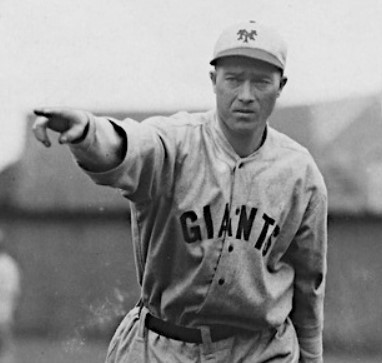
Jesse Barnes … Photo: Yi Auctions, Public domain, via Wikimedia Commons
Also catching the Roundtable’s eye was the pitching matchup. It featured the 1919 National League’s winningest and losingest hurlers. The Giants’ Jesse Barnes came into the game at 24-9, leading the NL in wins and looking for a benchmark 25th win. The Phillies’ Lee Meadows came into the game at 12-19, leading the NL in losses and looking to avoid a benchmark 20th loss. (Barnes, of course, prevailed). Surprisingly, Meadows actually came into the game with the lower earned run average: 2.41 to Barnes’ 2.48.
Now, why the quick pace? It was the first game of a doubleheader on each team’s final day of the 1919 season – and neither team was headed for the post-season. The Giants were in second place at 87-53 and the Phillies in last at 47-90. (Remember when just the league champions qualified for the post-season?) The players were anxious to get the season over and head for home. Reports from the time indicted the two teams had a sort of gentlemen’s agreement to speed things up and get the season over with.
How fast was the pace? Well consider, 8 ½ innings in 51 minutes. If each team rushed on and off the field in just 30 seconds between half innings (and it likely took longer), that would mean a playing time of 47 minutes or about Two minutes and 45 seconds each half inning. Taken a step further, 70 batters came to the plate in the game, again given just 30 seconds to change sides between innings, that would mean the average plate appearance lasted just 40.3 seconds. (Again, my 30 seconds between innings may be a bit low, so I consider these numbers at the lower end of the possible pace of the game.)
Sorry guys, but I gotta get my hits.
Despite the shortness of the game, there was time for every member of the Giants’ lineup, including pitcher Jesse Barnes, to collect least one base hit.
A few other facts about the contest:
- Seven runs were scored;
- There were 18 hits (13 for the Giants, five for the Phillies);
- The Giants put runners on base in six of the eight innings in which they batted;
- There were also three walks and three strikeouts;
- There was only one double play an it was a time-consuming 6-5-6-3-4;
- Each team used the minimum nine players.
Efficiency Expert
Giants’ starter used just 64 pitches to notch a complete game on September 28, 1919. He faced 33 batters – that’s a stingy average of 1.9 pitches per batter.
The point being that the game was not a low-it, low-run affair, there were plenty of baserunners. (Side note: According to Baseball-Reference.com, the average time of a nine-inning game in 1919 was one hour-and-36 minutes.)
A Super Maddux?
On August 10, 1944, Braves’ righty Red Barrett shut down the Reds 2-0 on just two hits (no walks/no strikeouts) in Cincinnati. He used just 58 pitchers to complete the game – the fewest pitches ever in an MLB nine-inning complete game.
Now, how about the other end of the spectrum?
Longest Nine-Inning Game
The longest nine-inning MLB game on record took four hours-and-45 minutes. It was played August 18, 2006, and was the second game of a Fenway doubleheader. The Yankees topped the Red Sox 14-11.
That game featured:
- 17 hits by each team;
- Twelve pitchers (seven Yankees, five Red Sox);
- Thirty-four players (19 Yankees, 15 Red Sox);
- Three New York errors;
- A combined 13 walks and 15 strikeouts.
FREE BASEBALL
Now, let’s look at extra innings.
The longest game (by time) * – May 8, 1984 …
Milwaukee Brewers versus Chicago White Sox
This one gets an asterisk – because it was not a “continuous” contest.
MLB’s longest-ever (time-wise) game started on May 8, 1984 and was played at (old) Comiskey, with the hometown White Sox prevailing 7-6 in 25 innings (tied for the second-most MLB innings) – in a record-long eight hours-an- six minutes of game time. The game started at 7:30 p.m. and was suspended after 17 innings (at 1:05 a.m.) due to the American League curfew rule then in force. Play was resume the following day.
Rollie Fingers’ blown save helped send this game into the record books.
There were plenty of chances for this one to end earlier. The game was tied 1-1 going into the top of the ninth, when the Brewers scored twice off-White Sox’ reliever Britt Burns to take the lead. With a 2-0 lead, the Brewers brought in future Hall of Fame closer Rollie Fingers and the die seemed cast. Oops! The bottom of the ninth saw the White Sox tie the game with two tallies of their own.
No one scored between the ninth and the seventeenth innings (when the game was suspended). The goose eggs continued when play resumed, going on until the until the top of the 21st, when the Brewers put up a three-spot on a three-run homer off Ron Reed by Ben Oglivie (scoring Cecil Cooper and 1B Ted Simmons) – and the game again appeared to be over. The White Sox, however, scored three of their own in the bottom of the inning. and the game continued its march toward the record books.
Finally, with one out in the bottom of the 25th White Sox’ RF Harold Baines hit a walk-off home run (making it, of course, the latest walk-off long ball ever) against Chuck Porter (starting his eighth inning of relief) to win it for the ChiSox. A few tidbits:
- White Sox’ CF Rudy Law, C Carlton Fisk and 2B Julio Cruz, as well as Milwaukee DH Cecil Cooper each had an MLB record-tying 11 at bats in the game. They had three, one and two hits, respectively.
- Rudy Law, Carlton Fisk and Harold Baines each had a record-tying 12 plate appearances. Law and Fisk each had one walk, Baines had two free passes.
- Chicago’s Dave Stegman, who came on as a pinch runner for DH Greg Luzinski in the eighth inning and stayed in to play LF, struck out a game-high five times in eight at bats.
- The teams used a combined 14 pitchers (six for the Brewers, eight for the White Sox).
- Two relievers went seven or more innings: losing pitcher Chuck Porter of the Brewers (7 1/3); Juan Agosto of the White Sox (7 innings) – both logged more innings than their team’s starting pitcher.
- The White used four first basemen: Greg Walker (started); Mike Squires replaced Walker in the top of the ninth; Marc Hill (pinch hit for Squires in the 14th and stayed in at 1B); in the 22nd inning, Tom Paciorek, who had replaced Ron Kittle in LF in the top of the fourth inning, moved to 1B, replacing Hill.
Tom Terrific for the Win(s)
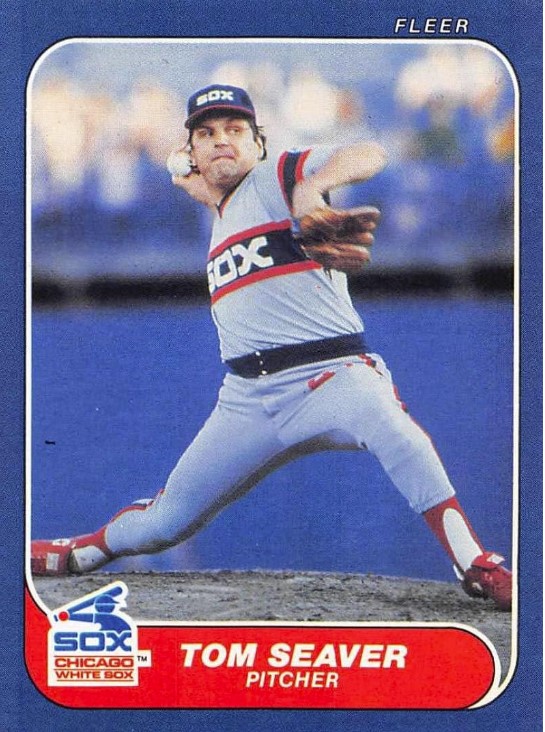 The winning pitcher in the longest-ever MLB game (by time, not innings) was future Hall of Famer Tom Seaver, who pitched the 25th inning for the ChiSox (on May 9). It was Seaver’s only relief appearance of the season (one of just nine in his career) and his only career win in relief (he also had one save and two losses in that role).
Notably, Seaver then started the regularly scheduled May 9 contest and went 8 1/3 innings (three hits, one walk, four earned runs) to pick up a victory as a starter. (White Sox won 5-4).
____________________________
The Longest (by time) Continually Played Game – May 31, 1964 …
San Francisco Giants versus New York Mets
The San Francisco Giants topped the New York Mets 8-6 in 23 innings on May 31, 1964 – and took seven hours and 23 minutes to do it. Not only that, it was the second game of a doubleheader. It is the longest National League game (by time), MLB’s second-longest game (by time) and the longest continually played (by time) game. Remember, that Brewers/White Sox 25-inning, eight hours-plus game was suspended after the 17th frame.
Gaylord Perry tossed ten scoreless innings in relief (seven hits. one walk, nine whiffs).
This one looked to be over early, as the Giants led 2-0 after just three batters had faced starter Bill Wakefield. LF Harvey Kuenn led off with a walk, RF Jesus Alou stroked a run-scoring double and CF Willie Mays hit a run-scoring single. The Mets came back with one-run in the second and San Francisco added four more runs on six singles in the top of the third to take a 6-1 lead. The Mets plated two runs in the fifth (on a one-out single by RF Joe Christopher, a run-scoring triple by 1B Ed Kranepool and a two-out run-scoring single by 3B Charley Smith). They tied it in the seventh (Giants’ starter Bobby Bolin was still in the game) on a three-run homer by Christopher. That ended the scoring until the top of the 23rd inning, when the Giants launched a two-out rally against Galen Cisco: SS Jim Davenport, triple; 3B Cap Peterson, intentional walk; PH Del Crandall, run scoring double; RF Jesus Alou run-scoring single. Bob Hendley took the mound for the Giants in the bottom of the inning and retired the Mets in order (two strikeouts and a fly ball) to save the game for Gaylord Perry, who had tossed ten scoreless frames in relief.
Some tidbits:
- Each team used six pitchers in the contest;
- There were ten pinch hitters and one pinch runner used;
- Tom Sturdivant and Larry Bearnath of the Mets pitched in both games of the doubleheader – with Bearnath throwing seven scoreless innings in the second game after giving up one run in two innings in Game One.
- Galen Cisco, who took the loss for the Mets, pitched nine innings in relief (giving up two runs on five hits).
- Gaylord Perry got the win for the Giants, tossing ten scoreless innings in relief (seven hits, one walk, nine strikeouts). That season Perry started 19 games and relieved in 25.
- Gil Garrido, Jim Davenport and Willie Mays all spent some time at SS for the Giants during the game.
Quite A List
The list of pinch hitters used by the Giants was pretty impressive: Duke Snider; Willie McCovey; Matty Alou; Del Crandall; Cap Peterson. Mets’ pinch hitters were not as well known: Jesse Gonder; George Altman; Dick Smith; Hawk Taylor; John Stephenson
Primary Resources: Baseball-Reference.com; Baseball-Almanac.com; “Nine Innings in 51 Minutes: Major League Baseball’s Fastest Game Ever,” by Dave Caldwell, The Guardian.com, July 4, 2023; “September 28, 1919: Giants and Phillies Record 51 Outs in 51 Minutes, The Fastest Game in Major-League History” , by Larry DeFillipo, Society for American Baseball Research.
Baseball Roundtable – Blogging Baseball Since 2012.

 Baseball Roundtable is on the Feedspot list of the Top 100 Baseball Blogs. To see the full list, click here.
Baseball Roundtable is also on the Anytime Baseball Supply Top 66 Baseball Sites list. For the full list, click here.
I tweet (on X) baseball @DavidBaseballRT
Follow Baseball Roundtable’s Facebook Page here. More baseball commentary; blog post notifications.
Member: Society for American Baseball Research (SABR); Negro Leagues Baseball Museum; The Baseball Reliquary.
P1046