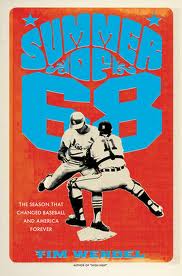
 Summer of ’68: The Season that Changed Baseball, and America, Forever
By Tim Wendel
Da Capo Press, 2012 ($25)
No doubt, 1968 was one of the most challenging in America’s recent history – the assassinations of Martin Luther King and Robert Kennedy, riots in major cities, the violence surrounding the Democratic National Convention in Chicago, the Oakland shootout between the police and Black Panthers, and the public division over the Vietnam conflict.
It is against this backdrop that author Tim Wendel presents his chronicle of the 1968 MLB season – Summer of 68: The Season that Changed Baseball and America, Forever – told primarily from the perspective of that year’s League Champions and World Series competitors, the Detroit Tigers and Saint Louis Cardinals.
I read this book while riding the bus on my annual Ballpark Tours baseball trip (see earlier posts). It proved to be an enjoyable, thought-provoking and fast-paced read – going beyond the traditional on-the-field and in-the-locker room look at our sport, and drawing some important and interesting historical ties.
In 1968, baseball like America was making history. For many fans, 1968 was the last pure season – when two league champions were crowned and went directly to the World Series. ( Expansion in 1969 led to Divisional play and playoffs.) It was also, for baseball, “The Year of the Pitcher” – highlighted on the field (and in Wendel’s prose) by the exploits of Denny McLain (a 31-game winner), Bob Gibson (1.12 ERA), Louis Tiant (.168 opponents’ batting average) and Don Drysdale (six consecutive shutouts and 58 consecutive scoreless innings). Pitchers were so dominant that Carl Yastrzemski was the only American Leaguer to hit .300 – winning the batting crown at .301. As a result, 1969 saw a smaller strike zone, lower mound and the establishment of the “save” as an official statistic. And, there were other changes coming in the national past time, as players became increasing vocal on a wide range of issues – both within and outside the game. Indeed, those controversies led to the resignation of Baseball Commissioner William Eckert after the 1968 season (with three years left on his contract) and marked a beginning in a shift of power toward the players.
Wendel does a fine job of tying the tumult in the nation with the changing face of baseball – and the interaction between the two. Perhaps the most telling story of this relationship is tied to the Robert Kennedy assassination. President Lyndon Johnson had declared a National Day of Mourning (June 9) and, for some reason that is still unclear, Baseball Commissioner William Eckert decided to respond by postponing only two games on the MLB schedule: The Angels/Yankees in New York and the Senators/Twins in Washington. The result was a chaotic day for baseball, with some players (like the Rusty Staub, Maury Wills and Bob Aspromonte) and some teams (like the Mets, even under threat of forfeiture of the game) refusing to play. As Wendel writes, the issue was most contentious in Cincinnati, where player representative Milt Pappas led a group opposed to playing that day’s contest against the Cardinals. The first vote on whether to take the field was 12-12, with one player abstaining. A second vote led to a 13-12 decision to play the game – despite continued protests from Pappas (who, within 72 hours, resigned as player representative and was traded to Atlanta).
Just as public happenings affected baseball, Wendel makes a case for baseball events impacting the public – providing a cooling escape from the controversies of the day. As Mickey Lolich of the Tigers tells it; “I had some friends on the police. They were in the city and had a good feel for what was going on. They told us to please keep winning – that things were smoldering, like how it is before it starts burning all over again. But if we could keep on winning then things might not explode like they had the year before. In ’67, you’d see four or five guys standing on a street corner and they’d be looking for trouble. In ’68, you’d see the same kind of guys standing on a street corner, but they’d have a transistor radio and they’d be gathered around, listening to Ernie (Harwell) calling a Tiger game, and waiting to see if we could come back and win another one.”
Note: 1967’s Detroit riots had resulted in 43 deaths, more than 450 injuries, 7,000-plus arrests and more than 2,000 buildings burned. Stepping back briefly into 1967, Summer of ’68 includes a look at the courage and commitment of Tiger outfielder Willie Horton, who left Tiger Stadium immediately after a June 23, 1967 doubleheader and showed up in full uniform (and at great personal risk) in one of the most strife-torn Detroit neighborhoods, urging calm amid the violence.)
In the process of exploring a changing society and the changes taking place in baseball, Wendel also provides the traditional sportswriter’s look at two of 1968’s most prominent teams – the Tigers and the Cardinals. Through interviews with and the observation of players on both teams he gives us a look at how they made their way to the Fall Classic.
For baseball fans and trivia buffs, there is also insight into some of the 1968 season’s highlights – like a rare umpire’s ruling (on a hit batsman) that kept Don Drysdale’s string of scoreless innings and complete-game shutouts alive, Denny McLain’s “gift” home run to Mickey Mantle, Catfish Hunter’s perfect game, Frank Howard’s ten-homer week (defying the Year of the Pitcher) and Detroit Manager Mayo Smith’s then controversial move of Gold Glove center fielder Mickey Stanley to shortstop for the World Series.
Your BBRT editor also enjoyed the “Aftermath” chapter of Summer of ’68, with Wendel giving an update on what happened to many of 1968’s principals (inside baseball and out) in the years and decades that followed. The chapter examines the lives of such diverse characters as baseball’s Milt Pappas, Bob Gibson, Denny McLain, Curt Flood, Frank Howard and Catfish Hunter; football’s Joe Namath; basketball’s Bill Russell; Olympic runner Jim Ryun; sportscaster Roone Arledge; and political activist Tom Hayden.
All in all, Summer of ’68 is an enjoyable read – particularly for fans of the Tigers or Cardinals. But there is also plenty for those who want to get a better feel for the culture of the nation and the state of baseball in 1968.