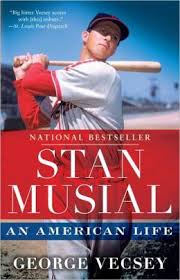
 STAN MUSIAL – An American Life
By George Vecsey
2011
Ballantine Books. $26 (paperback $16)
Stan Musial – An American Life provides ample evidence that “nice guys can finish first,” but, perhaps, won’t be remembered as long (or revered as much) as their more controversial counterparts. In 1999, Major League Baseball launched a fan vote to select the top twenty-five players of the twentieth century. Saint Louis Cardinals’ outfielder/first baseman Stan Musial – a 20-time All Star, seven-time batting champ, three-time MVP and more – did not make the top twenty-five (in fact, he did not even make the top ten outfielders).
What were Musial’s credentials? It starts with a 22-year MLB career with the aforementioned 20 All Star selections, three MVP Awards and seven batting titles. He also “finished first” in the NL in games played nine times; hits six times; runs five times; doubles eight times; triples five times; RBI twice; and total bases six times. He ended his career with 3,630 hits and a .331 career average. He collected 1,377 extra base hits (475 home runs), and struck out only 696 times – never striking out 50 times in a season, and topping forty strikeouts only three times.
So, why didn’t the fan vote place Stan Musial among the top twenty-five? What made him in this instance (unlike such peers as Joe DiMaggio and Ted Williams) forgettable?
Most speculate it’s because Stan Musial’s “story” was less compelling than his statistics. He was substance without flash, competence without controversy, results without razzle-dazzle. Musial was married to his high school sweetheart for more than 70 years, was never tossed out of a game, was an astute businessman who did not squander his money, never forgot his Catholic and Polish-American roots,and consistently avoided confrontation and controversy. In short, while he was long on professionalism, he was deemed to be short on personality.
Fortunately, Baseball Commissioner Bud Selig had anticipated there would be “oversights” in the 1999 fan vote and had established a knowledgeable committee to add five players to the All–Century Team. Their first addition was Stan Musial (followed by Christy Mathewson, Warren Spahn, Honus Wagner and Lefty Grove).
Notably, Musial remained true to form in handling the fans’ slight. When reminded of how he was added to the All-Century Team, Musial (as always) took the high road. “I wasn’t upset. Not really. There are 100 million fans, and only three million of them voted. It’s what the fans wanted, and I’m happy to be here. It’s human nature to look at your own generation. It’s hard to analyze what happened fifty-sixty years ago.”
In Stan Musial –An American Life, New York Times sports columnist and best-selling author George Vecsey gives us a deeper look at Stan Musial. It’s not your usual baseball biography – filled with on-field conflict and off-field controversy. As you might expect, Musial comes off in the book as more interesting than exciting – and, in fact, the tales from Musial’s off-field life seem more compelling than what takes place on the field. (BBRT would have liked to have seen a bit more on Musial’s on-field play and passion in the book.)
Still, readers will find plenty of anecdotes they will want to share. In the process, you will also gain some insight into the many individuals – some celebrities/some night – that became part of Musial’s life story. Here are a few snippets that BBRT found interesting.
It’s pretty common knowledge that Musial started out as a pitcher and moved to outfield full-time after an arm injury. What is less known is how well Musial did throw. In his final season on the mound, playing for Daytona Beach (Class D) in 1940, Musial went 18-5, 2.62 with 223 innings pitched, 19 complete games and 176 strikeouts. The minor league team carried only a 14-man rosters, so pitchers often found themselves in the outfield, where young Musial hit .311 in 113 games (and injured his arm diving for a ball).
Stan Musial was given his nickname Stan “THE MAN” not by Cardinals’ fans, but rather by Brooklyn Dodgers’ fans – out of respect for the way he manhandled Brooklyn pitching over the years.
Musial never forget his Polish and Catholic roots, making multiple trips to Poland; meeting with Nobel Prize winner Lech Walesa and even enjoying dinner and a small group private mass at the Vatican with Pope John Paul II (in 1988). One of Musial’s travel mates on the trip described the Hall of Famer’s approach to the Pope as like “an altar boy in awe of the Pontiff.”
Musial was s staunch Democratic, hitting the presidential campaign trail for John Kennedy in 1960 as part of a group that included: Byron White (former football player and later Supreme Court Justice); James A. Michener (who became a close and long-time friend and traveling companion of Musial); Arthur Schlesinger; Ethel Kennedy; Joan Kennedy; actor Jeff Chandler; and actress Angie Dickinson. (Musial was also a George McGovern supporter in 1972).
Musial was a horrible poker player, a not-so-good magician and a decent harmonica player (who often, serenaded fans with “Take Me Out to the Ball Game.”
Musial trimmed his eyelashes to help him see the ball better.
Musial, always accommodating to the fans, began carrying autographed photos of himself to hand out, an idea he picked up during lunch with actor John Wayne.
Musial was always ready to model his unique corkscrew stance – even in later years, when he used his cane as a bat.
In presenting a mostly positive (openly admiring) picture of Stan the Man, Vecsey does not gloss over all criticism – acknowledging Musial’s apparent avoidance of controversy and confrontation, particularly as it related to racial issues (or even general players’ rights) within baseball. Vecsey notes that some players, while seeing Musial as an inherently just man, felt he could have taken a stronger stance in relation to the issues facing baseball in his playing days. As the Cardinals’ Curt Flood put it: “We admired Musial as an athlete. We liked him as a man. There was no conscious harm to him. He was just unfathomably naïve.”
Ultimately, Stan Musial – An American Life is an appropriate tribute to Stan the Man – a confident, gracious individual, who never forgot his humble roots and who choose quiet efficiency and inner optimism over controversy and the potential pitfalls of the limelight.
BBRT feels privileged to have seen Musial play – and to have felt the tension and anticipation that rippled across the stands when he went into his unique corkscrew stance. BBRT wishes that tension could have emerged from the pages of Stan Musial – but, ultimately, the book reflects the inner character of its subject. It’s a good read, especially if your interest is in the “man” and not just the ballplayer.
BBRT’s favorite anecdote from the book? One of Musial’s team mates is reported to have told Stan that he felt so good, “I feel like going four-for-four today.” To which Musial quickly replied, “Hell, I feel like that every day.” And, as the statistics tell us, justifiably so.