Sam “Toothpick” Jones – the definition of “effectively wild.”
On May 12, 1955, Cubs’ right-hander Sam “Toothpick” Jones came into the top of the ninth of a game against the Pirates having given up no-hits, with four walks and three strikeouts. Despite the four free passes, he had faced only one more than the minimum number of hitters. The Pirates’ number-five hitter, power-hitting first baseman Dale Long, had walked in all three of his plate appearances. In the second inning, Long was tossed out on an attempted steal; in the fifth he was the lead out in a short-to second-to first double play; and, in the eighth, he was doubled off first on a line drive to third. The only other Pittsburgh base runner to that point was catcher Toby Atwell, who led off the third with a walk, but was stranded as Jones induced a pop out, strikeout and ground out. Meanwhile, the Cubs had scored four runs on fifteen hits off the Pirates’ Nellie King and Vern Law.
With a 4-0 lead and the eight, nine and lead-off hitters scheduled to bat, Jones –ironically, you will see – seemed in control. That would not last long. Jones started the inning by walking the number-eight hitter, second baseman Gene Freese. The Pirates sent Preston Ward (hitting .152 at the time) up to hit for pitcher Vern Law and, during the at bat, a Jones’ wild pitch sent Freese to second. The WP didn’t matter much, since Jones went on to walk Ward, bringing up lead-off hitter/center fielder Tom Saffell (zero-for-three on the day and zero-for-fifteen on the season). Jones walked Saffell to load the bases with no outs.
Coming up? The heart of the order. Shortstop Dick Groat (a future batting champion and NL MVP, who would strike out only 26 times in 151 games that season); future Hall of Famer RF Roberto Clemente (who came into the game hitting .304); and left fielder/clean-up hitter Frank Thomas. With the bases loaded and the no-hitter, shutout and even the game in jeopardy, Cubs’ manager Stan Hack made a trip to the mound. Apparently, whatever he said, struck a chord with Jones. After the visit, Jones used just 11 more pitches to strike out Groat (looking), Clemente (swinging) and Thomas (looking) – putting the final touches on his no-hitter.
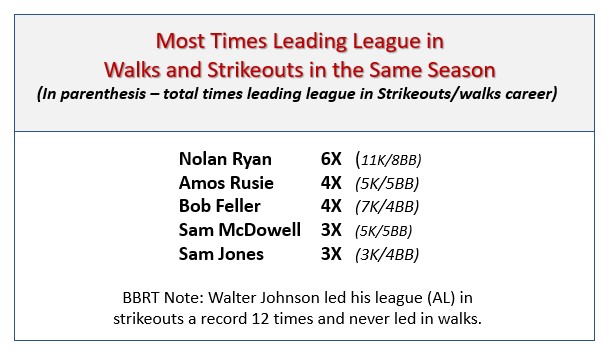
The final inning of Jones’ no-hitter – three walks and three strikeouts – was pretty indicative of Jones’ pitching style. Jones, would in fact, lead his league in strikeouts and walks in the same season three times – 1955, 56, 58. The year of the no-no was Jones‘ first full MLB season (he had pitched in two games for the Indians in 1951 and 14 games for the Tribe in 1952). In 1955, Jones led the National League in walks (185 in 214 2/3 innings), strikeouts (198), hit batsmen (14) and losses (20 against 14 wins). Let me do the math for you. During the season, Jones walked 6.5 batters and fanned 7.4 per nine innings.
One Thing Leads to Another …
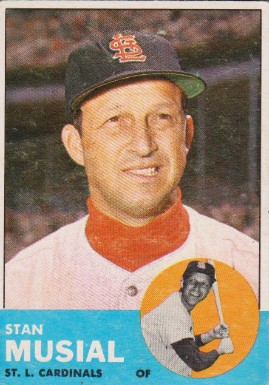
Baseball Roundtable readers know that often, when I am researching one topic, I get drawn into another. In this case, I was working on a post on hitters who had Hall of Famer Warren Spahn’s “number.” (See that post here). One of hitters was Stan Musial, who had the most career base hits off Spahn. In the process, I saw that Sam Jones had been particularly effective against Musial – holding the career .331 hitter to a .122 career average (6-for-49, with 11 strikeouts). That prompted me to look a little deeper into the career of Sam “Toothpick” Jones.
Jones’ early professional experience was garnered with the Negro American League Cleveland Buckeyes – whom he signed with in 1947 after leaving the Army. He also pitched in Panama and the Southern Minnesota League (semipro) before signing with the Indians.
As an Indians’ farmhand, Jones had a pair of solid minor league seasons (17-8, 2.71 for the Class A Wilkes-Barre Indians in 1950 and 16-13, 2.76 for the Triple A San Diego Padres in 1951). He then made his MLB debut with the Indians (in Detroit) on September 22, 1951. During this period, Jones also pitched in the Puerto Rican Winter League – topping that circuit (1951-52 season) in strikeouts (146), while putting up a 13-5, 2.51 record.
A bit of Irony …
Sam Jones was truly Stan Musial’s nemesis, (as noted earlier) holding the Hall of Famer to a .122 career average over 49 at bats. That was Musial’s lowest average against any pitcher he faced at least 15 times. Jones also fanned Musial him in one of very 4.5 at bats – compared to Musial’s career average of one whiff for every 15.8 at bats. In a bit of irony, Jones and Musial were teammates on the Cardinals from 1957-58. (Jones had been part of a nine-player Cubs/Cardinals trade in December of 1956.) At that point, “Stan the Man” was 1-for-14 against Jones.
On May 13, 1958, Musial was on the Redbirds’ bench as they took on the Cubs in Chicago. Musial was not only sitting on the bench, he was sitting on 2,999 career hits and manager Fred Hutchinson wanted to give him the opportunity to collect the landmark safety the next day in St, Louis. Starting on the mound that day was none other than Sam “Toothpick” Jones. In the sixth inning, with the Cardinals trailing 3-1, a runner on second, one out and Jones due to hit, Hutchinson decided to act and put in Musial to pinch hit. Musial doubled, collecting his 3,000th hit while pinch-hitting for Jones (who would deny Musial plenty of hits over his career.)
Jones spent the early part of 1952 with the Indians (a 7.25 ERA and 37 walks in 36 innings before being sent down to Triple A Indianapolis). He then spent the 1953 and 1954 seasons at Indianapolis (before being traded to the Cubs). While he continued to have control issues, Jones did show significant potential. In 1954, he was 15-8, 3.75 at Triple A, throwing 12 complete games (31 starts) and four shutouts. In 199 innings, he walked 129 and fanned 178.
Warming Up in the Winter
Sam Jones pitched in the 1954-55 Puerto Rican Winter League season, leading the league in wins (14 versus four losses), ERA (1.77) and strikeouts (171). Side note: Tommy Lasorda finished third in the league in strikeouts that season with 86.
Then came Jones’ first full MLB season (1955 Cubs), when, as noted, he led the league in walks and strikeouts – showing swing-and-miss stuff and miss-the-plate command. He followed up with a 9-14, 3.91 season in 1956, again leading the league in walks and strikeouts. Following the 1956 season, the Cubs traded Jones to the Cardinals. For the Redbirds in 1957, Jones pitched trough elbow issues (getting just 27 starts (to go 12-9, 3.60). In 1958, he got his full complement of starts and finished 14-13, 2.88 – and, for the third time in four years, led the league in both strikeouts and walks.
Shortly before the 1959 season opened, the Cardinals traded Jones to the Giants, where he continued to be dangerously – but even more effectively – wild. In 1959, he tied for the league-lead in wins (21 versus 15 losses), recorded the league;s lowest warned run average (2.83), finished second in strikeouts (209) and, true to form, led the league with 109 walks. He followed that up with an 18-14, 3.19 season in 1960.
In 1961, Jones went 8-8, 4.49 – and got only 17 starts in 37 appearances. The decline was enough for the Giants to leave him unprotected in the expansion draft and he was taken by the Colt .45’s, who traded him to Detroit.
Effectively Wild Even as an All Star
In his two All Star appearances, (1955, 1959) Sam Jones’ line was consistent with the term “effectively wild” – 2 2/3 innings pitched, one hit, one run (unearned), four walks, four strike outs, one hit by pitch.
During Spring Training 1962, Jones was diagnosed with cancer of the lymph nodes and subsequently underwent surgery and radiation treatments. Although Jones did go into remission, from 1962-64, he appeared in only 48 more MLB games, going 4-4, 4.12; but still striking out 87 batters in 102 2/3 innings. His last major-league appearance came on October 3, 1964 for the Orioles. He pitched 1 1/3 scoreless innings of relief, striking out one batter (the Tigers’ Gates Brown). Between 1963 and 1967, Jones also pitched in Triple A, as well as in Nicaragua and the Dominican Republic. One wonders what Jones’ career would have looked like without that bout with cancer. (Jones died from cancer in 1971 at age 45.)
The Times They Are A’Changin’
With Major League Baseball designating Negro League records from 1920-1948 as major-league records – a couple of Sam Jones “landmarks” may bite the dust. On May 3, 1951, Jones came on in relief for the Indians (versus the Senators). His catcher was Quincy Trouppe – and, together, they formed the first all African-American major league battery. In addition, Jones’ 1955 no-hitter was the first major -eague no-hitter by an African-Americana pitcher. As noted, those records may soon be changing.
Jones pitched in MLB in all or parts of 12 seasons (1951-52, 1955-64), taking the mound for the Cleveland Indians, Chicago Cubs, St. Louis Cardinals, Detroit Tigers, San Francisco Giants and Baltimore Orioles. Jones finished his MLB career with 102 wins, 101 losses and a 3.59 ERA. He led the league in wins once, earned run average once, strikeouts three times, strikeouts pr nine innings pitched four times and walks four times.
Primary Resources: Baseball-reference.com; Baseball-almanac.com; Beisbol101.com, January 24, 2020 Tom Van Heyning,
 Baseball Roundtable is on the Feedspot list of the Top 100 Baseball Blogs. To see the full list, click here.
I tweet baseball @DavidBBRT
Follow/Like Baseball Roundtable’s Facebook Page here. More baseball commentary; blog post notifications; PRIZES.
Member: Society for American Baseball Research (SABR); Negro Leagues Baseball Museum; The Baseball Reliquary.