Baseball Roundtable Preview Week – Day Two – NL Central

The season is almost upon us and it’s time for some BBRT predictions. Things, of course, can change – particularly since there are still some “difference makers” out there on the free-agent market (Like Dallas Keuchel and Craig Kimbrel). Over the coming week, BBRT will look at each MLB Division, and then wrap up with predictions for the major awards (ROY, CYA, MVP).   We’re starting with the National League, going from East to West (Division-wise).  Today, we are looking at the NL Central Division.  For the  NL East Preview, click here.   Tomorrow: National League West.

After each divisional predicted order of finish – for those who want more detail or justification – I’ll move on to a team-by-team evaluation.  Keep in mind, these are just BBRT’s opinions and conjecture – not the result of any inside insight or info.

For the NL East, click here.

For the NL West, click here.

For the AL East, click here.

For the AL Central, click here.

For the AL West, click here. 

For the major awards, click here.

NATIONAL LEAGUE CENTRAL

Cardinals

Cubs (Wild Card)

Brewers

Pirates

Reds

In 2018, the Cardinals offense was right up there with the Cubs and Brewers. Eliminating the Cubs/Brewers Game 163 the Cardinals scored 759 runs, the Cubs 760 and Brewers 751.  Then the Cardinals went out and traded for six-time All Star first baseman Paul Goldschmidt – who will improve their offense and defense.  The Redbirds also bolstered their bullpen with free agent Andrew Miller; while the Cubs and Brewers were less active in the off-season market. I think this will be enough to put the Cardinals on top of what may be MLB’s best – and most competitive – division.  I wouldn’t be surprised to see just a couple of games separating the top three teams (or another Game 163). Really, you could pick the Cardinals, Cubs or Brewers and make a good case. The Pirates and Reds will be watching this race.  (Although the Reds did add some key players – particularly in their trade with the Dodgers – like Yasiel Puig, Matt Kemp Tanner, Roark and Alex Wood.

Now, let’s take a team-by-team look at the Central Division.

__________________________________________

Cardinals – First place

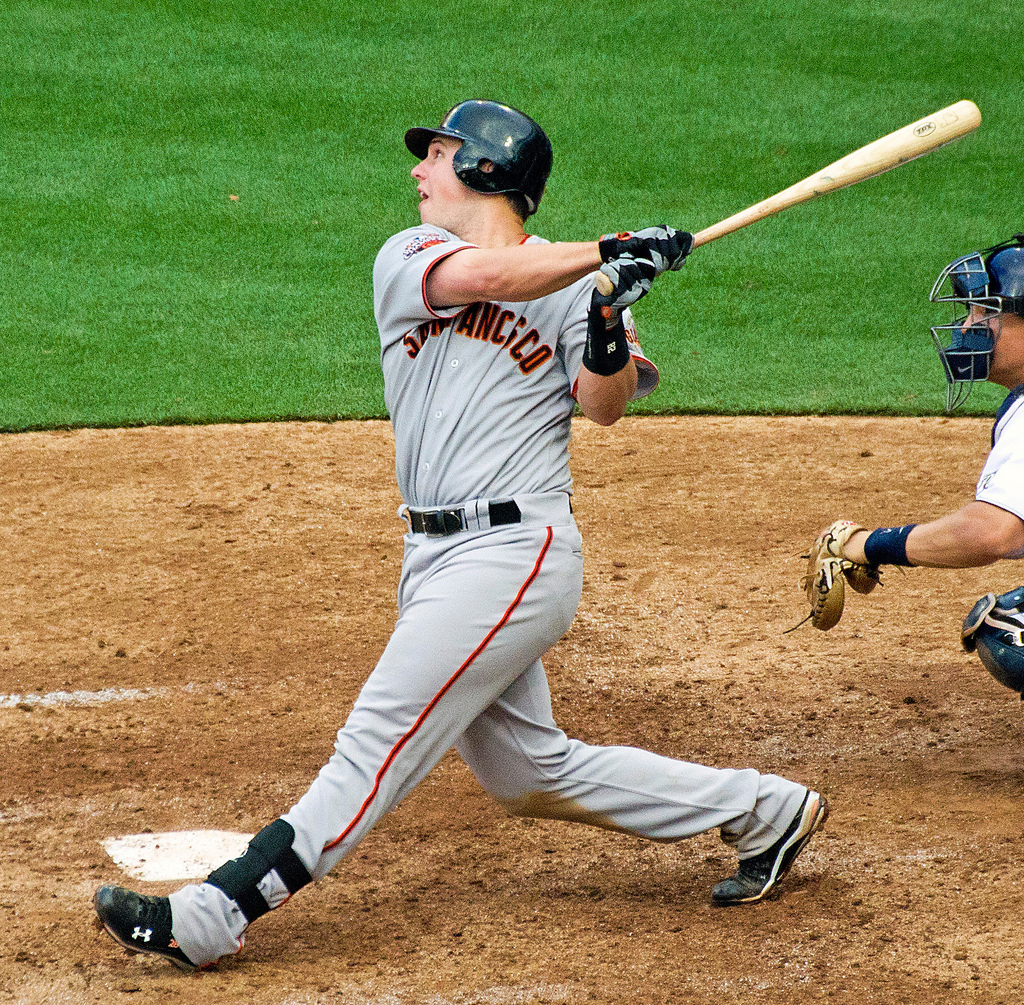
Paul Goldschmidt ... will lead Redbirds back to the top.Photo by Keith Allison

Paul Goldschmidt … will lead Redbirds back to the top.Photo by Keith Allison

We heard and read a lot about the signings of Manny Machado and Bryce Harper, but let’s not forget another marquis off-season move – the Cardinals trading for 1B Paul Goldschmidt – a six-time All Star, three-time Gold Glover and four-time Silver Slugger.

Goldschmidt hit .290-33-83 last season (Diamondbacks) and there is no reason not to expect similar numbers as a Redbird.  The fact is, Goldschmidt will improve both the Cardinals’ offense and their infield defense (enabling the move of Matt Carpenter back to 3B.) Keeping in mind that the Cardinals won 88 games without Goldy’s big bat a season ago, you can see why BBRT likes the Cardinals to finish atop the NL Central.

In 2018, Cardinals’ first basemen committed 20 errors in 162 contests, new first sacker  Paul Goldschmidt has committed a total of 20 errors since July 5, 2014  (652 games played).

Goldschmidt joins an already potent lineup that includes: LF Marcell Ozuna (.280-23-88 a year ago); 3B Matt Carpenter (.257-36-81); and RF Jose Martinez (.305-17-83). Note:  The Cardinals have a significant investment in Dexter Fowler, but BBRT does not seem him unseating Martinez – although others disagree.  If Fowler does bounce back – he hit .180 in a season shortened by a fractured foot – it give the Cardinals more lineup, pinch-hitting and substitution options.  Not an insignificant thing in the NL.  CF belongs to 25-year-old Harrison Bader, who is a plus defender and hit .264-12-37, with 15 steals, in his first full MLB season. Look for his glove and speed to keep him in the lineup – at the seventh or eighth spot.

Yadier Molina (.251-20-74 and a nine-time Gold Glover, including 2018) is back behind the plate.  The 36-year-old may need a little more rest, but he shows no signs of slowing down.  Also playing in the middle will be plus defender Kolten Wong (.249-9-38) at 2B and SS Paul DeJong (.241-19-68). The 25-year-old DeJong hit .285-25-65 in 108 games in his 2017 rookie season – and could improve on his 2018 numbers. The versatile Jedd Gyorko (.262-11-47) provides backup around the diamond.  Last year, he saw started games at 1B, 2B and 3B and even took a turn on the mound.

The pitching rotation is headed by Miles Mikolas – who spent 2015-17 in Japan, where he went 28-13, 2.18.  Mikolas went 18-4, 2.83 for the Cardinals and looks to be the real deal. The number–two spot goes to 23-year-old Jack Flaherty (8-9, 3.34 in 28 starts). There is also plenty of quality in the rest of the rotation – as well as potential health issues.  Depending on health, the remaining three spots will come from among: Michael Wacha (8-2, 3.20 in 15 starts last season); Adam Wainwright (2-4. 4.46 in eight starts); John Gant (7-6, 3.47 in 19 starts); and Alex Gomber (6-2, 4.44 in 29 appearances/11 starts).  The Cardinals will also be watching the progress of Carlos Martinez (8-6, 3.11 in 33 appearances/18 starts), who is expected start the season on the IL (shoulder). The point here is that the Cardinals, whose 3.52 starter’s ERA was the NL Central’s best and the NL’s third-best, have plenty of arms to choose from.  The rotation should prove an asset (and those that don’t fill in starting roles will provide bullpen strength and backup in case health issues emerge).

Speaking of the bullpen, the Cardinals added depth with free-agent (Indians) Andrew Miller (2-4, 4.24 in 37 appearances.) Miller suffered through some shoulder issues last season, but the Cardinals say he is healthy going into 2019.  If that’s the case, he will be a great asset in key innings. In the four seasons from 2014-17, Miller went 22-11, 1.72, with 51 saves in 260 appearances. Coming from the right side, the Cardinals will look to Jordan Hicks – perhaps MLB’s hardest-throwing pitcher. (Statcast credits Hicks with 15 of the 20 fastest pitches of 2018, with a high of 105.1 mph.) Hicks Hick went 3-4, 3.59 in 73 games a year ago, fanning 70 batter in 77 2/3 innings. Other likely contributors include Dakota Hudson, Luke Gregerson and Brett Cecil. The bullpen is definitely set to close out games.

KEY OFF-SEASON MOVE

Clearly, the Cardinals improved significantly – on offense and defense – by adding Paul Goldschmidt.  

PLAYER TO WATCH

BBRT will be watching Dakota Hudson and John Gant (a pair of right-handed pitchers) with interest – to see just how they fit into the Cardinals’ plans.  Gant (a 26-year-old righty) went 7-6, 3.47 in 26 appearances (19 starts) for the Cardinals last season. He was 5-1, 1.65 at Triple A in 2018 and 44-28, 3.28 over eight minor league campaigns. The 24-year-old Hudson went 4-1, 2.63 in 26 appearances for the Redbirds.   He could fit into the bullpen (as he did last year), but has perhaps more potential as a starter. At Triple A last season, Hudson went 13-3, 2.50 in 19 starts.   Both these pitchers appear to have the potential to deliver the goods for the Cardinals.

_______________________________________

CUBS – Second Place

Javier Baez ... possibly the NL's best second baseman. Photo by DandreaPhotography

Javier Baez … possibly the NL’s best second baseman. Photo by DandreaPhotography

The Cubs’ strength starts at the corner infield spots.  First baseman Anthony Rizzo (.283-25-101) is one of MLB’s most reliable power sources – and, when he’s healthy, Kris Bryant can claim that same distinction.  Unfortunately, shoulder issues limited Bryant to 102 games (.272-13-52). If he stays in the lineup, he should return to numbers closer to .290-30-90. Joining the infield power party is 2B/SS Javier Baez (.290-34-111), who just seems to keep getting better (14 homers in 2016, 23 in 2017, 34 in 2018). If Baez improves his plate disciple (29 walks and 167 whiffs last season), look out!  (Note: Baez is likely to start the season at SS, due to Addison Russell’s suspension.) Filling out the infield, at 2B, will be versatile veteran Ben Zobrist (.305-9-58) in 139 games.  When Zobrist spends time in the outfield, free-agent signee (D-backs) Daniel Descalso (.238-13-57) in 138 games will fill in at the second sack.  The catching will be handled by the capable Wilson Contreras (.249-10-54).

The outfield belongs to: LF Kyle Schwarber (.238-26-61) – a solid power source, who also struck out in about one-third of his 2018 at bats; RF  Jason Heyward (.270-8-57) – an average hitter, but a five-time Gold Glover; and CF Albert Almora, Jr. (.286-5-41) – another solid defender (but also a free swinger, with 24 walks against 83 strikeouts in 2018).

Over the past four seasons, the Cubs have averaged 98 wins a campaign. 

The Cubs look to a veteran pitching staff to get them to the late innings.  It starts with southpaw Jon Lester, in his 14th MLB season, who led the NL with 18 wins (six losses) last season, with a 3.32 ERA. Then there is Cole Hamels, also in his 14th MLB campaign, who went 9-12, 3.78 for Texas and the Cubs. Filling out the rotation are a pair of 29-year-olds:  righty Kyle Hendricks (14-11, 3.44) and southpaw Jose Quintana (13-11. 4.03). A kind of a wild card is Yu Darvish, who had elbow surgery last September  (1-3, 4.95 in eight starts), but is a four-time All Star with top of the rotation stuff when healthy. At 32-years-old, you wonder a bit about how he will bounce back.

The bullpen should be headed by closer Brandon Morrow (0-0, 1.47, with 22 saves last season). Morrow, however is rehabbing from off-season elbow surgery and likely will not be ready until May. Pedro Strop seems the most likely (6-1, 2.28, 13 saves) to step in. In addition, Steve Cishek (4-3, 2.18 in 80 games) and Brandon Kintzler (3-3, 4.60 in 70 games) both have closer experience. Carl Edwards, Jr. (3-2, 2.60 in 58 games) should also get plenty of work.  Still, the uncertainty in the bullpen is a slight worry.

KEY OFF -SEASON MOVE

The Cubs were not very active in the off-season, but did bring in free-agent infielder Daniel Descalso (Diamondbacks) to provide some flexibility as they deal with the Addison Russell suspension.

PLAYER TO WATCH

Keep an eye on Yu Darvish, coming back from elbow surgery.  If he rebounds, the Cubs rotation suddenly gets a lot more effective.  A healthy Darvish – a four-time All Star –  could give the Cubs 12-15 wins. 

the Cubbies will remain in the NL Central dog fight (Cardinal, Cubs and Brewers).  BBRT just thinks the Cardinals may have a slight edge in defense, plate discipline and pitching.

________________________________________

BREWERS – Third Place

Wow!  The Brewers surprised a lot of people in 2018 and, no doubt, they’ll be in the hunt again.  They will do it with a combination of:

  • Power bats.   In the NL, only the Dodgers hit more home runs, with 235, than the Brewers, with 218. There is no reason to expect the Brewers not to reach 200 round trippers again.
  • Power arms in the bullpen.  The Brewers’ relief staff had the NL’s second-best earned run average (3.47 to the Cubs 3.35), second-most innings pitched (614 to the Padres 635) and best strikeouts-per-nine-inning ratio (10.38).

The players who put up the above numbers are, for the most part, back.  The question mark for the Brew Crew is the starting rotation (after Jhoulys Chacin) and whether all that work will eventually catch up with the pen.   Let’s take a look, starting with the offense.

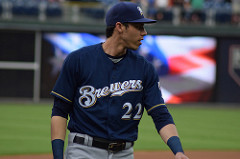
MVP Christian Yelich will again lead the Brewers' offense. Photo by DandreaPhotography

MVP Christian Yelich will again lead the Brewers’ offense.
Photo by DandreaPhotography

The Brewers have a potent offense – up and down the lineup – and the focal point is RF Christian Yelich, the 2018 NL MVP, who had a career year.  In his sixth season (at age 26), Yelich won the batting title with a career-high .326 average and also reached new career marks in hits (187), runs scored (118), home runs (36), RBI (110) and stolen bases (22). It might be a bit unfair to expect him to repeat those numbers, but he will remain a force in the lineup. Lorenzo Cain, who hit a career-high .308, is back in center field and the lead off spot. Cain scored 90 runs and stole a career-high 30 bases.  Ryan Braun (LF/1B) adds some pop (.254-20-64) and will probably see time in both corner outfield spots and third base.  Newcomer Ben Gamel (trade with Mariners) and returnee Eric Thames are the leading backups (Thames with more power, Gamel with the steadier bat).

Plenty offense around the infield as well. At the corners, there are Travis Shaw at third base (.241-32-86) and Jesus Aguilar (.274-35-108) at first. Both Shaw and Aguilar notched career highs in long balls in 2018. Mike Moustakas is back to play 2B, coming off a .251-28-95 season for the Royals and Brewers.  Orlando Arcia (24-years-old and entering his fourth MLB season) will handle shortstop.  He got off to a slow start, but came on in the second half to finish .268-3-30 in 119 games.  He has notable upside, having gone .277-15-53, with 14 steals in 2017.  Look for him to finish somewhere in the middle of those two stat lines. The Brewers filled a big need at catcher when they signed free-agent Yasmani Grandal (Dodgers) – a veteran backstop with power (more on that signing later).

Jhoulys Chacin (15-8, 3.50) leads the rotation – and was the only starter with more than nine wins.  The rest of the staff looks to be Zach Davies (looking to bounce back after shoulder issues limited him to 13 starts and 2-7, 4.77 record); Chase Anderson (9-8, 3.93); Jimmy Nelson (who missed all of 2018 rehabbing from shoulder surgery, but did go 12-6, 3.49 in 2017); and Brian Woodruff (3-0, 3.61 with the Brewers – after 3-2, 4.04 at Triple A).  If any of these falter, a couple of young arms are looking to step up:  24-year-old Corbin Burnes (7-0, 2.61 in 30 relief appearances) and 23-year-old Freddy Peralto (6-4, 4.25 in 16 appearances/14 starts).

One thing seems for sure.  The Brewers’ bullpen will get a lot of work – and it’s a good one.  The Brewers’ pen is led by three pitchers with closer stuff:  Corey Knebel (4-3, 3.58, with 16 saves and 88 strikeouts in 55 1/3 innings); Josh Hader (6-1, 2.43, 12 saves and 143 strikeouts in 81 1/3 innings); and Jeremy Jeffress (8-1, 1.29, 15 saves, with 89 strikeouts in 76 2/3 innings).  Long story short, the Brewers have plenty of bullpen weapons; let’s just hope overwork doesn’t lead them to run out of ammo.

The Brewers have a lot going for them.  However, three things have BBRT placing them third; 1) The starting pitching; 2) The continuing workload that could face the bullpen; 3) The fact that so much went right in 2018 (so many “career high marks,” more than can be expected in 2019.  Then again, the Brewers pulled of the unexpected in 2018.  Who’s to say it can’t happen again.  No matter the outcome, the Brew Crew will make interesting.


KEY OFF-SEASON MOVE

The Brewer’s faced the 2019 season with a need to upgrade at the backstop position – adding seven-year veteran Yasmani Grandal’s potent (switch-hitting) bat to an already powerful lineup took care of that need.  The 30-year-old has topped 20 home runs in each of his last three campaigns (.241-24-68 for the Dodgers in 2018).

PLAYER TO WATCH

It makes sense to keep an eye on 29-year-old RHP Jimmy Nelson – coming back from shoulder surgery after missing all of the 2017 season. Nelson was 12-6, 3.49 in 2017 – fanning 199 batters in 174 1/3 innings. If his mid-90’s fastball and effective sinker are back, he could go a long way toward helping the Brewers repeat.  It will be interesting to see: 1) if he breaks camp with the team; and 2) if he starts the season in the bullpen or rotation.

_______________________________________________

PIRATES – Fourth Place

Could the Pirates be the Brewers of 2019?  Pittsburgh plays in, arguably, the toughest division in baseball.  As a result, they tend to be overlooked.  But, the fact is, the Pirates have a pretty good ball club with solid pitching (in the rotation and the pen).  The club has some talent in the lineup, but absolutely needs to add some “punch” if they are going to move up in the standings. (The Pirates finished 13th in home runs and tenth in runs scored in the NL a year ago.) Still, this is a team that finished two games over .500 in 2018 – and won 16 of their last 24 games. Let’s take a look at the Buccos.

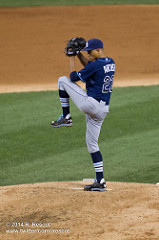
Chris Archer, a key member of the Pirates' strong rotation. Photo by rrescot

Chris Archer, a key member of the Pirates’ strong rotation. Photo by rrescot

The Pirates pitching can be a real strength – led by starters Chris Archer, Jameson Taillon and Trevor Williams. The “ace” of the staff is Jameson Taillon, who had a breakout season in 2018 (his third MLB campaign), going 14-10, 3.20.  Trevor Williams also looked strong in 2018 – 14-10, 3.11 in 31 starts.  The 30-year-old Archer is the veteran of the group (6-8, 4.31 in 27 starts).  Archer, acquired in a July trade (with the Rays), is a two-time All Star and looked good closing 2018. In his final five starts of the season, he went 2-1, 2.70, striking out 36 batters in 30 innings.  He’s look good this spring and may be ready to return to the form that has delivered a 3.63 ERA over his first six MLB seasons.  The rotation should be filled out from among Joe Musgrove (6-9, 4.06); Jordan Lyle (3-4, 4.11); and prospect Mitch Keller.  Keller, just 23, went 12-4, 3.48 at three minor league levels last season.

The bullpen looks solid, led by closer Felipe Vazquez – who went 4-2, 2.70 with 37 saves and 89 whiffs in 70 innings. Kela Keone, who has also shown closer stuff (he had 24 saves for the Rangers before being traded to the Pirates in late July), will pitch key innings, as will Richard Rodriguez (4-3, 2.47 in 63 games as a rookie.)

On offense, the Pirates look to be outgunned.  Last season, no one hit more than 23 home runs nor drove in more than 81 for the Pirates – and the player that reached those marks was Gregory Polanco (.254-23-81 in 130 games), who is recovering from shoulder surgery.  They do have a bonafide star in CF, where Starling Marte produced a .277 average with 20 home runs, 72 RBI and 33 steals. Joining him in the outfield are LF Corey Dickerson (.300-13-55, eight steals), who also brings plus defensive skills, and Lonnie Chisenhall (in right field until Polanco returns), who put up a .321-1-9 line in 29 games for the Indians.  The Pirates are looking for a rebound from 25-year-old 1B Josh Bell – who went .261-12-62, after hitting .255-26-90 in 2017. Second baseman Adam Frazier showed a little pop last season, .277-10-35 in 113 games.  The likely lead-off man, Frazier needs to solve some road woes (he hit .336 at home and .230 on the road). His 2018 home/road numbers reflect his career splits (.306/.258). SS will go to either Erik Gonzalez (.265-1-16 in 81 games with the Indians) or Kevin Newman (.209-0-6 in 31 games.); while 3B belongs to Colin Moran (.277-11-58).  Moran may be spelled against tough lefties. Jung Ho Kang, coming back after missing the 2017 and most of 2018 season (just six at bats in three games), could also play into the 3B picture. He has shown 20-home power.  A bright spot in the lineup is catcher, where Francis Cervelli, who went .259-12-57 in 104 games a year ago, and Eliz Diaz (.286-10-3 in 82 games) hold sway.

Overall, the Pirate can put a competitive team on the field, but they really need another power bat or two to contend with the top three in the tough NL Central.

KEY OFF-SEASON MOVE

The Pirate did not make any flashy off-season moves.  Picking up Lonnie Chisenhall to hold down RF until Gregory Polanco returns from injury may very well prove to be the best move.

PLAYER TO WATCH

In early February, the Pirate signed free-agent Francisco Liriano (5-12, 4.58 with the Tigers last season). Liriano has twice won the Comeback Player of the Year Award (2010 AL and 2013 NL).  One of those times was with the Pirates – in 2013, when he went 16-8, 3.02 for Pittsburgh after a 6-12, 5.34 season with the Twins and White Sox the year before.  Can Liriano (and the Pirates) catch lightening in a bottle again?  At age 35, it seems unlikely, but it will be interesting to watch.

________________________________________

REDS-Fifth Place

The Reds made some moves to bolster both the offense (adding Matt Kemp and Yasiel Puig) and their pitching woes (adding Tanner Roark, Alex Wood and Sony Gray).  All four came over via trade.  While, Kemp and Puig should thrive in The Great American Ballpark, Roark and Wood may not be enough to address the “elephant in the room” – the fact that the Reds’ pitching staff gave up an NL-worst 819 runs last season and had the second-worst team ERA at 4.63.

There are those that maintain the hitter-friendly Great American Ballpark played a major role in the Reds’ pitching problems – but the team had a 4.62 ERA at home and 4.68 on the road.

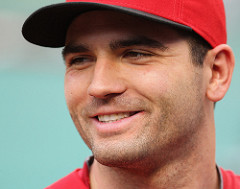
Joey Votto photo

Joey Votto – face of the Reds. Photo by Keith Allison

Let’s take a look at the Reds, staring with the offense. There is a lot to like there, starting with 1B Joey Votto a six-time All Star. Still, Votto had a bit of an off year in 2018 (.284-12-67), but should be good for a .300 average and 25-30 long balls. Having Yasiel Puig (.267-23-63 in 125 games for the Dodger) in the lineup behind him may help Votto get more pitches to hit (he has led the NL in walks five times since 2011).  With the addition of Puig and Kemp (.290-21-85), the Reds are, in fact, overstocked in the garden. They also have Jesse Winker (.299-7-43 in 89 games); Scott Schebler (.255-17-49 in 107 games); and prospect Nick Senzel – a natural infielder (2B/SS) who has been seeing some time in the OF.  Senzel, who has been discussed as a center fielder, hit .310 in 44 games at Triple A last year and .321-14-65 in 119 minor league games in 2017. (Note: Senzel has had some health issues – a couple of bouts with vertigo and a fractured finger.)  If Senzel is ready to go, we could see the Reds looking to trade some outfield talent for pitching.

Looking to the infield, Votto has plenty of company in the power category there.  Scooter Gennett (2B) went .310-23-92 a year ago; 3B Eugenio Suarez went .284-34-104; and SS Jose Peraza’s line was .288-14-58, with 23 steals. Tucker Barnhardt looks to again handle backstop duties – after a .248-10-46 season.

As you can see, there is plenty of offense here. Ah, but that pitching.  Luis Castillo is the staff leader after a 10-12, 4.30 season. The 26-year-old, entering his third MLB season, appeared to come of age in the second half of 2018, when he went 5-4, 2.44 and fanned 69 batters in 66 1/3 innings.  Newcomers Tanner Roark (9-15, 4.34 with the Nationals), Sonny Gray (11-9, 4.90 with the Yankees) and Alex Wood (9-7, 3.68 with the Dodgers) give a whole new look to the rotation. Also among the potential Reds’ starters are Anthony DeSclafani (7-8, 4.93) and Tyler Mahle (7-9, 4.98).  Overall, the rotation should be improved, but not enough to put the Reds in contention.  If the newcomers contribute, however, the Reds could pass the Pirates.

The bullpen will be led by closer Raisel Iglesias, who went 205, 2.38 with 30 saves in 2018. Others who are likely to be called on for important outs include Jared Hughes (4-3, 1.94, 7 saves in 72 games); David Hernandez (5-2, 2.53 in 57 games); and Mike Lorenzen (4-2, 3.11 in 45 games).

Overall, the Reds are notably improved, but face the challenge of a tough Division.  Fourth place is a possibility, but Cincy is not likely to contend.

KEY OFF-SEASON MOVE

The Reds addressed two key needs in their off-season trade with the Dodgers– adding a much needed starter in Alex Wood (9-7, 3.68) and protection in the linkup for Joey Votto in Yasiel Puig.  In addition, they picked up a solid outfielder in Matt Kemp (giving them some lineup and trade options going forward) and a utility infielder in Kyle Farmer. In return, they sent the Dodgers Homer Bailey and two of their leading prospects in Jeter Downs and Josiah Gray.  Puig hit .267 with 23 home runs and 15 steals last season and should benefit from hitter-friendly Great American Ballpark (as should Kemp, who went .290-21-85 for the Dodgers). 

PLAYER TO WATCH

Nick Senzel, a 24-year-old outfield prospect, was .314, with six home runs, 25 RBI and eight steals at Triple A Louisville in a 2018 season shortened by a broken finger. In three minor-league seasons, Senzel has hit .314-27-130, with 40 steals, in 231 games.  He looks like the real deal and could contend for the NL Rookie of the Year Award.

TOMORROW – THE NATIONAL LEAGUE WEST


BASEBALL ROUNDTABLE ON THE TOP 100 BASEBALL BLOG LIST

100Baseball Roundtable is on the Feedspot list of the Top 1oo Baseball Blogs.  To see the full list, click here.

I tweet baseball @DavidBBRT

Follow/Like Baseball Roundtable’s Facebook Page here.  More baseball commentary; blog post notifications; PRIZES.

Member: Society for American Baseball Research (SABR); The Baseball Reliquary; The Negro Leagues Baseball Museum.
PREVIEW WEEK – DAY ONE – NATIONAL LEAGUE EAST

The season is almost upon us and it’s time for some BBRT predictions. Things, of course, can change – particularly since there are still some “difference makers” out there on the free-agent market (Like Dallas Keuchel and Craig Kimbrel). Over the coming week, BBRT will look at each MLB Division, and then wrap up with predictions for the major awards (ROY, CYA, MVP).

We’ll start with the National League – it is the “Senior Circuit” after all – and move from East to West.   After each divisional predicted order of finish – for those who want more detail or justification – I’ll move on to a team-by-team evaluation.  Keep in mind, these are just BBRT’s opinions and conjecture – not the result of any inside insight or info.

For the NL Central, click here.

For the NL West, click here.

For the AL East, click here.

For the AL Central, click here.

For the AL West, click here.

For the major awards, click here.

NATIONAL LEAGUE EAST

Nationals (Division Champions)

Phillies (Wild Card)

Mets

Braves

Marlins

A rotation headed by Max Scherzer, Stephen Strasburg and newcomer Patrick Corbin – plus a deep lineup (even without Bryce Harper) should bring Washington the East Division crown.  The Phillies – after adding Bryce Harper, Jean Segura, Andrew McCutchen and J.T. Realmuto – signaled they are serious about contending.  And, they will.  Their pitching may fall just a bit short of the Nationals, but they do have some solid young arms.  If Philadelphia goes out and gets Dallas Keuchel, this could be a real dog fight. The Mets have a solid pitching staff (led by Jacob deGrom, Noah Syndergaard, Zack Wheeler and free-agent signee closer Edwin Diaz).  I just don’t think they added enough offense to catch the Nationals or Phillies.  The Braves have a solid offense, but need more pitching (particularly with Mike Foltynewicz’ health concerns).  The Marlins just don’t have the horses for this race.

COME BACK TOMORROW – FOR THE NL CENTRAL.

________________________________________

NATIONALS – First Place

Max Scherzer again leads the Nationals' Staff. Photo by Keith Allison

Max Scherzer again leads the Nationals’ staff.
Photo by Keith Allison

The Nationals, who underachieved (82-80) in 2018, and then lost six-time All Star Bryce Harper (.249-34-100) to free agency, appear well-positioned to reclaim the top spot in the NL East – thanks, in most part, to the strength of their pitching.

It all starts with a rotation with a penchant for missing bats.  Three-time Cy Young Award winner Max Scherzer last season went 18-7, 2.53 – and fanned 300 hitters in 220 2/3 inning (12.2 K’s per nine). Next up is Stephen Strasburg (10-7, 3.74), who fanned 156 in 130 innings (10.8 K’s per nine). New to the rotation is southpaw free-agent (D-backs) and 2018 All Star Patrick Corbin, who won 11 (versus seven losses), put up a 3.15 ERA and whiffed 246 batters in 200 innings. The rotation is rounded out by free-agent signee (Braves) Anibal Sanchez (7-6, 2.83), who fell just two strikeouts short of nine-per–nine (135 K’s in 136 2/3 innings) and, possibly, Joe Ross, who is coming back after 2017 Tommy John Surgery.

The bullpen is led by lefty closer Sean Doolittle (3-3, 1.60, with 25 saves last season).  How reliable is the Nationals’ ninth-inning guy?  In the past two seasons, Doolittle is 49-for-52 in save opportunities. Other pen notables include free-agent signee Troy Rosenthal, who has a 99-mph fastball and 121 saves on his resume, but missed the 2018 season recovering from Tommy John surgery; Justin Miller (7-1, 3.61 in 51 games); Matt Grace (1-1, 2.87 in 56 games); Koda Glover; and Kyle Barraclough.  Overall, expect this group to be handed plenty of leads to protect.

There are a number of new faces in what looks to be a deep lineup.  This is particularly true “up the middle.”  At catcher, the Nats picked up 2018 AL All Star Yan Gomes from the Indians (trade) and signed free agent (Braves) Kurt Suzuki.   The stat lines for these two are .266-16-48 (Gomes) and .271-12-50 (Suzuki).  Last season, the Nationals got a .214 average with 12 home runs and 60 RBI out of their catching corps. At the keystone sack, free-agent signee (Dodgers) Brian Dozier takes over.  While Dozier went just .215-21-72 in 2018, the one-time Gold Glover has topped 20 home runs in five straight seasons, with a high of 42 in 2016.  He played much of 2017 with a troubling bone bruise (knee) and looks ready to bounce back.  In center field there is top prospect 21-year-old Victor Robles, a speedy plus-defender, who hit .288-3-10 in 21 games after a September call up (and is considered a Rookie of the Year candidate by many). Joining Robles in the outfield will be 20-year-old Juan Soto. The left-handed swinger hit .292, with 22 long balls and 70 RBI in 116 games in his rookie season. Not bad for a teenager.  The final garden spot will go to Adam Eaton, who went .301-5-33, with nine steals in 95 games a year ago.

Adding to the offensive fire power will be 3B Anthony Rendon (.308-24-92, with an NL-leading 44 doubles) and classic table-setter SS Trea Turner (.271-19-73, with a league-topping 43 steals). This is a pair of proven run producers – and Rendon could easily be in the MVP picture. The Nationals are hoping veteran 1B Ryan Zimmerman can rebound from 2018 health issues (.264-13-51 in 85 games in 2018, after .303-36-108 in 2017). If the 34-year-old can’t go every day, look for Matt Adams (.239-21-57 in 121 games) to pick up the slack.

Overall, the Nationals’ power-pitching should carry them back to the top of the NL East – and there is plenty of offensive potential to back that up (even without Bryce Harper).

KEY OFF-SEASON MOVE

Some would say letting Bryce Harper leave via free agency was the most significant off-season move by the Nationals.  BBRT is going with the signing of number-three starter Patrick Corbin. Corbin was 11-7, 2.15 with the Diamondbacks a year ago. He lengthens the top-end of the Nationals’ rotation.

PLAYER TO WATCH

BBRT will be watching CF Victor Robles. The 21-year-old went .276-2-14, with 19 steals in three minor league stops last season – before going .288-3-10 in 21 September games for the Nationals.  No question about his defensive skills, but it will be interesting to see how his bat fares in a full MLB season.

_______________________________

PHILLIES – Second Place

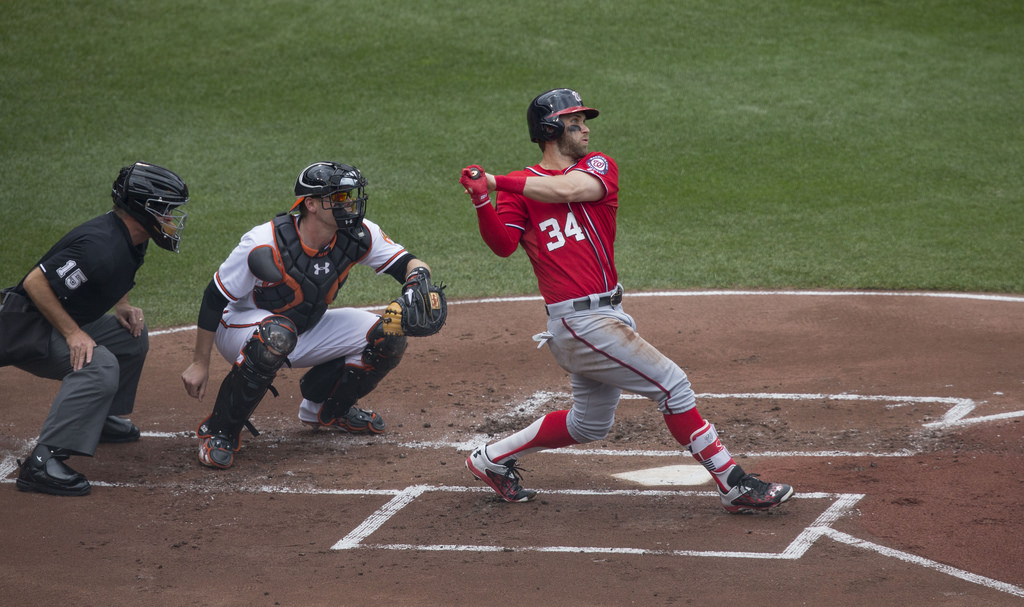
Bryce Harper - Big score for the Phillies.

Bryce Harper – Big score for the Phillies.

Bryce Harper (free agent), Jean Segura (trade), Andrew McCutchen (free agent), J.T. Realmuto (trade). This off season, the Phillies proved they were serious about winning. Of course, it all centers on Harper, who will take over right field.  He hit only .249 a year ago (after .319 in 2017), but the six-time All Star and 2015 NL MVP popped 34 home runs, scored 103 times and drove in 100 tallies.  He also walked a league-leading 130 times – turning that .249 average into a .393 on-base percentage. Harper will be joined in the outfield by newcomer (LF) McCutchen – who should improve the garden defense.  The 2013 NL MVP doesn’t carry the bat he once did, but still brings 20-homer pop (.255-20-65 a year ago).  CF looks to belong to a combination of Odubel Herrera and Roman Quinn; with Herrera providing the better offense (.255-22-71) and Quinn superior on defense.

J.T. Realmuto is another key addition.  The 2018 All Star (.277-21-74), acquired in a trade with the Marlins, solidifies the backstop position. The Phillies have plenty of additional punch with 25-year-old 1B Rhys Hoskins (.246-34-96) still having plenty of upside and Maikel Franco (.270-22-68) at the other corner. Newcomer Jean Segura will handle shortstop and set the table for the boppers (.304 with ten homers and 20 steals in 2018). Look for Cesar Hernandez at the keystone sack (.253-15-60, with 19 steals).

The Phillies have a lineup that can challenge the Nationals, but they may fall a bit short on the mound.  A year ago, the Phillies’ 4.14 ERA was 11th in the NL and they didn’t do much to upgrade the staff.

WHY THE 2018 PHILLIES PHADED?

The Phillies’ pitching staff put up a 3.85 earned run average before the All Star break (and the team was 11 games over .500) and then slumped to 4.56 and 13 games under .500 post-break. The drop off was particularly significant in the back end of the rotation:  Nick Pivetta went from a 4.58 ERA in the first half to 5.05 in the second half; Vince Velasquez went from 4.39 to 5.68; and Zach Elfin from 3.15 to 5.76. Keep an eye on how the staff holds up in the second half of this season.

At the top of the all-righty rotation will be Aaron Nola – at 25-years-old a true ace (17-6, 2.37, with 224 K’s in 212 1/3 innings). The number-two slot goes to veteran Jake Arrietta (10-11, 3.96). These two will be followed by Nick Pivetta (7-14, 4.77), Vince Velasquez (9-12, 4.85) and Zach Elfin (11-8, 4.36).   A number of analysts have pointed to the potential of the arms at the back end of the rotation, I just don’t see enough there to close the gap on the Nationals.  Then again, Dallas Keuchel is still out there.

Nine different relievers notched saves for the Phillies a year ago.  That worries me (I prefer more defined roles in the pen).  Still, there is talent and I expect free-agent (Yankees) signee David Robertson (8-3, 3.23 with five saves) and returnees Seranthony Dominguez (2.95 with 16 saves) and Hector Neris (5.10 with 11 saves) to all be asked to record “big outs.”  And, of course, as I write this, Craig Kimbrel is still out there. (Although I think the Phillies may be done spending for this season.)

Overall, the Phillies should score more and win more, but BBRT is not sure they have the pitching to keep pace with the Nationals.

KEY OFF-SEASON MOVE

This one’s easy – Bryce Harper (six-time All Star and 2015 NL MVP) was the prize. 

PLAYER TO WATCH

Keep an eye on Nick Pivetta.  The Phillies need him to deliver on his potential – a mid- to upper-90’s fast ball and a crisp curve.  He has shown signs, notching 188 strikeouts in 164 innings last season. If he can improve on his 7-14, 4.77 mark, the Phillies could move a bit closer to the Nationals.

________________________________________

METS – Third Place (tie)

I’ve got the Mets and Braves pretty much finishing in a dead heat for third place – the Braves counting on their run producers and the Mets on their run prevention.

Jacob deGrom ... could use a little more run support.

Jacob deGrom … could use a little more run support.

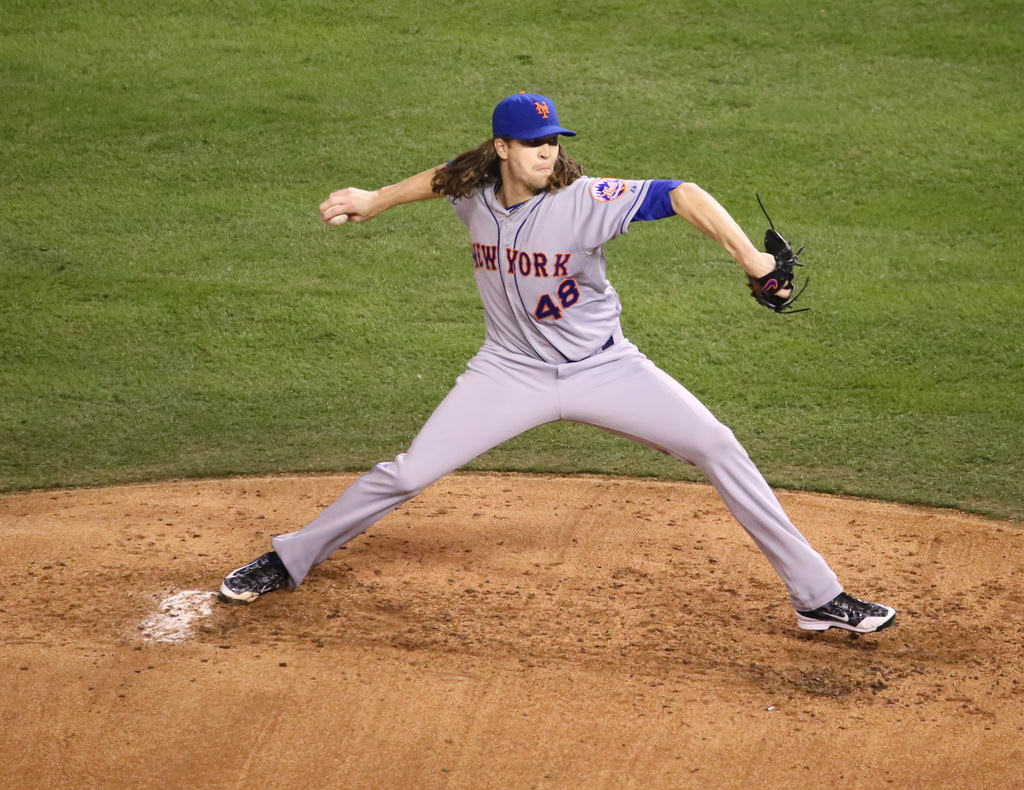
For the Mets, the key is pitching and it starts with 2018 NL Cy Young Award winner Jacob deGrom, who put up an MLB-best 1.70 earned run average and fanned 269 batters in 217 innings.  How important is it for the Mets to improve their offense (more on this later)?  Despite those numbers, deGrom won only ten games (nine losses) in 32 starts. The number-two spot in the rotation goes to Noah Syndergaard. The 6’6” righty went 13-3, 3.03 in 2018, with 155 strikeouts in 154 1 /3 innings. And there is plenty more behind the front two. Zack Wheeler went 12-7, 3.31 in 29 starts. He went 9-1, with a 1.68 ERA after the All Star break and seems poised for an even better season in 2018.  Southpaws Steven Matz and Jason Vargas, who both have the potential to turn in solid seasons, round out the starting five.  Matz was 5-11, 3.97 a year ago and (like deGrom) deserved much better. Vargas was 7-9, 5.77 for the Met last season, but won 18 games for the Royals.

In games in which he gave up two or fewer earned runs, Steven Matz won three, lost four and had eight no decisions.  

If you think the starting rotation looks good, consider what the Mets did to bolster the bullpen in the off-season. They signed free-agent closer Edwin Diaz, who posted 57 saves and a 1.96 ERA for the Diamondbacks (124 whiffs in just 73 1/3 innings).  They also brought back Jeurys Familia – who started 2018 as the Mets closer and had 17 saves before being traded to Oakland in July.  How much does he bring back to the Mets?  Familia had 51 saves as recently as 2016.  Other key bullpen arms will be Robert Gsellman (6-3, 4.28 with 13 saves in 68 appearances) and Seth Lugo (3-4, 2.66 in 54 games). When the Mets hold the lead after six innings, they should be in good shape to pick up the win.

DON’T TAKE OFFENSE … BUT THESE NUMBERS ILLUSTRATE THE PROBLEM

In 2018, the Mets scored the fourth-fewest runs in the National  League – and had no batters reach 150 hits, 30-home runs, 80 runs scored nor 90-RBI. The highest batting average among Mets to qualify for the batting title was Brandon Nimmo’s .263.

The Mets’ Achilles heel last season was offense. Surgeries on both heels cost them their most proven run producer – Yeonis Cespedes – most of last season; and his status for 2019 is not clear.  The Mets took steps to address that issue, signing free agents Robinson Cano (Mariners), Wilson Ramos (Phillies) and Jed Lowrie (A’s).  Cano, of course, is coming off an 80-game suspension, but is a proven performer. He hit .303, with ten home runs and 50 RBI in just 80 games a year ago – and has seven All Star selections, eight 20+ home run seasons and four 100-RBI campaigns on his resume.  He should help offset the time Cespedes misses. Ramos gives the Mets the reliable everyday catcher they have been seeking.  The 2018 All Star hit .306 with 15 home runs and 70 RBI in 111 games last season.  Lowrie may be the choice at 3B after a .267-23-99 seasons with the A’s. Amed Rosario (.256-9-51, with 24 steals) will be back at short. Todd Frazier (.213-18-59) and Jeff McNeil (.329-3-19 in 63 games) will also see some infield playing time. .

Looking to the outfield, LF Michael Conforto (.243-28-82) will provide some middle of the lineup pop, as should anticipated 1B Peter Alonso. In 2018, the 23-year-old prospect hit .285-36-119 in 132 games at Double A and Triple A. Brandon Nimmo (.263-17-47) should hold down RF and the lead off spot. Others in the OF mix are 2014 Gold Glover Juan Lagares, Rajai Davis and Carlos Gomez.

The Mets clearly have the pitching to contend. The offense remains the question mark.

KEY OFF-SEASON MOVE

Hard to go wrong picking a guy who saved 57 games in 61 opportunities, put up a 1.96 earned run average and fanned 15.2 batters per nine.  The Mets’ most significant move had to be signing Edwin Diaz.

PLAYER TO WATCH

BBRT will be watching the progress of Peter Alonso – .285-26-119 in 132 minor league games last season; and a .290 average with 59 home runs over three minor league seasons (255 games).  This 24-year-old has the potential to reshape the Mets’ lineup.

____________________________________

BRAVES – Third Place (tie)

The young Braves surprised a lot people by taking the NL East title one year ago.  Youth again will be served in Atlanta – and generate plenty of offense.  I’m just not sure the pitching will be strong enough to repeat.

Freddie Freeman , steady power source. Photo by dougandme

Freddie Freeman , steady power source. Photo by dougandme

The Braves have a solid nucleus of young players starting with 21-year-old LF Ronald Acuna, Jr. (2019 NL Rookie of the Year), who put up a .293-26-64, 16 SB season, and 22-year-old 2B Ozzie Albies, who went .261-24-72 with 14 steals. OF Ender Inciarte (just 28 and entering his sixth major league season) won his third consecutive Gold Glove in center and put up a .265-10-61, 28-steal stat line. SS Dansby Swanson (the number-one draft pick in 2015) continues to improve his defense and launched 14 long balls last season. With a bit more plate discipline (44 walks and 122 whiffs a year ago), he could add some spark to the lineup.

The Braves balance this youth with solid and stable veterans.  Bringing back veteran OF Nick Markakis (35-years-old and entering his 14th MLB season) was a plus.  Markakis hit .297-14-93 last season and picked up his third Gold Glove. In 13 MLB campaigns, he’s never played less than 147 games, has hit .290 or better eight times and reached double-digit home runs in all but two seasons.  He will continue as a steadying influence on the youngsters in the lineup. Left-handed hitting veteran Freddie Freeman (.309-23-98) will provide plenty of offense at first base and another veteran, free-agent signee Josh Donaldson, will play at the opposite corner. Donaldson had a tough 2018 (shoulder, calf and arm issues) – playing in only 52 games (Indians/Blue Jays), but he is a three-time All Star, who has topped 30 home runs  in three of the past four seasons. Tyler Flowers and free-agent signee Brian McCann will handle the catching.

The Braves also boast an all under-30 rotation led by righty Mike Foltynewicz (13-10, 2.85) and southpaw Sean Newcomb (12-9, 3.90).   However, late in Spring Training the Braves announced that “Folty” may not be ready by Opening Day.  Ouch.  Among the Braves other projected starters are the reliable Julio Teheran (9-9, 3.94 a year ago) and Kevin Gausman (5-3, 2.87 in ten starts for the Braves, after coming over from the Orioles, where he was 5-8, 4.43). Hoping to round out the rotation is 23-year-old right-hander Touki Toussaint (gotta love that name), who came up in August last season and went 2-1, 4.04 in seven games – five starts.  Toussaint showed swing-and-miss stuff, fanning 66 in 65 innings for the Braves. (He went 9-6, 2.38 at Double and Triple-A last season – with 163 K’s in 136 1/3 innings.)  The Braves lack a proven ace, but – given their lineup and a bullpen that includes closer Aroldys Vizcaino (2-5, 3.11 with 22 saves), A.J.  Minter (3.23 in 65 games), Darren O’Day (3.60 in 20 games), Dan Winkler (3.43 in in 69 games) and Jonny Venters (3.61 in 50 games for Blue Jays and Braves) – they should be competitive.  Still, they won’t surprise as many people this year – and both the Nationals and Phillies look to be in better position to make the post season.

KEY OFF-SEASON MOVE

The Braves were relatively quiet this off season, but picking up Josh Donaldson to handle the hot corner could prove to be a real plus. Donaldson is coming off a difficult season, with shoulder and calf injuries limiting him to 52 games and a .246-8-23 line.  Over the previous three campaigns, he hit .285, with 111 home runs.  Donaldson’s on a one-year contract, so he has plenty of incentive to bounce back. That potential and his veteran presence should bolster this young Atlanta squad.

PLAYER TO WATCH

BBRT is going with RHP Touki Toussaint here.  Toussaint, with a 98-mph fastball and a plus curve, could surprise a lot of hitters.  The key will be command.  He walked 21 batters in 29 MLB innings last season (just 53 in 136 minor league frames, however).  Side note:  The Braves face a similar situation with Sean Newcomb, who went 12-9, 3.90 a year ago – but walked 81 batters in 164 innings. He also fanned 160. In two MLB seasons, Newcomb has walked 138 batters in 264 innings – 4.7 walks per nine frames.  If he can improve his command of the strike zone, Newcomb could be a solid number-two in the rotation. 

 ____________________________________________

MARLINS – Fifth Place

The Marlins had one All Star in 2018 – catcher J.T. Realmuto – and he’s now a Phillie.  The Fish are rebuilding – and they still have a ways to go (they did make some interesting splashes in the international talent pool).  This will be another long year in Miami.

They did add a couple of veteran free agents in OF Curtis Granderson and infielder Neil Walker (who last year spent time at 1B, 2B, 3B, RF and LF for the Yankees).   Walker, 33-years-old, had a tough year in New York (.219-11-46 in 113 games), but has shown better in the past and does give the Marlins lineup flexibility. Granderson, at 38-years-old, is showing some signs of injury issues.  In 2018, he went .242-13-38 in 123 games.  Both should see notable playing time (Walker probably at both corner infield spots), as the Marlins juggle the lineup.

In 2018, the Marlins scored the fewest runs in the National League (589) and gave up the second-most tallies (809) – for the NL’s worst run differential at minus-220.

Starlin Castro photo

Starlin the Marlin. Photo by dougandme

Others likely to see plenty of playing time include 2B Starlin Castro (.278-12-54), who still has plenty of life in his bat; SS J.T. Riddle (.231-9-36), a plus defender, who may split time with Miguel Rojas (.252-11-53); 3B Brian Anderson (.273-11-65), who could also see time in the OF if 3B Martin Prado (.244 in 54 games) is healthy;  and outfielders Lewis Brinson, Austin Dean and Peter O’Brien (who all still have to prove themselves at the MLB level).  Catcher looks to go to newcomer Jorge Alfaro, who went .262-10-37 in 108 games for the Phillies. (Note: Alfaro suffered a knee injury in Spring Training and may not be ready for Opening Day.)

There is a little some potential on the mound – particularly among the starters, where 27-year-old Jose Urena went 9-12, 3.98 (following a 14-7, 3.82 season in 2017) and 23-year-old Sandy Alcantara showed a high-90’s heater in a September call up (2-3, 3.44 with 30 strikeouts in 34 innings).  Others looking for a spot in the rotation include: Wei-Yin Chen (6-12, 4.79); Trevor Richards (4-9, 4.42); Dan Straily (5-6, 4.12); Pablo Lopez (2-4, 4.14); and Caleb Smith (5-6, 4.19). It should be an interesting competition.  I personally would really be working with Alcantara on consistency in the strike zone.

CAN’T I JUST STAY HOME?

Southpaw Wei-Yin Chen apparently likes home cooking. In 13 home starts last season, he went 5-3, with a 1.62 earned run average, 22 walks and 74 strikeouts in 78 innings.  In an equal number of road starts, he lasted 22 2/3 fewer innings and went 1-9, 9.27, with 37 strikeouts and 25 walks.

The bullpen has strike-zone problems of its own.  Miami relievers walked more batters than any other NL bullpen staff in 2018. Closer Drew Steckenrider went 4-4, 3.90 in 2018 (five saves). He showed swing-and-miss stuff (74 strikeouts in 64 2/3 innings), but his 27 walls created late-inning tension.    Southpaw Adam Conley (3-4, 4.09), a converted starter, should get some meaningful innings.  There are also Tayron Guerrero (1-3, 5.43, with 68 whiffs and 30 walks in 58 innings) and Nick Wittgren (2-1, 2.94 in 32 appearances.)

KEY OFF-SEASON MOVE

Picking up Neil Walker not only added some much-needed pop to the lineup (he has reached double-digits in home runs in nine straight seasons), but his versatility gives the Marlins some lineup flexibility (as they, perhaps, work to look at some young talent). It would not surprise BBRT to see Walker return to a .250-15-60 level season.

PLAYER TO WATCH

I’d keep an eye on right-hander Sandy Alcantara, whose fastball has reached triple digits on occasion (and is regularly in the high-90’s).  He was 6-3, 3.90 in two minor league stops last season – before his 2-3, 3.44 with the Marlins.  If he can master his command (at the MLB level last season, he fanned 30 in 34 innings, but also walked 23), he could put some victories up on the board.

_________________________________________________

For Day Two – NL Central … Click Here

BASEBALL ROUNDTABLE ON THE TOP 100 BASEBALL BLOG LIST

100Baseball Roundtable is on the Feedspot list of the Top 1oo Baseball Blogs.  To see the full list, click here.

I tweet baseball @DavidBBRT

Follow/Like Baseball Roundtable’s Facebook Page here.  More baseball commentary; blog post notifications; PRIZES.

Member: Society for American Baseball Research (SABR); The Baseball Reliquary; The Negro Leagues Baseball Museum.
Baseball Roundtable Trivia Teaser – Spring Training’s Only Perfect Game

Trivia Teaser

On this date (March 15) in 2000, the Boston Red Sox defeated the Toronto Blue Jays 5-0 in a Spring Training game at City of Palms Park.  Nomar Garciaparra was the offensive hero – driving in four of the five runs on a three-run home run and a run-plating single.

Your question:  Who were the Red Sox pitchers in that game?


Garciaparra photo

Photo by dizzy-eyed

Garciaparra’s four RBI on March 15, 2000, were  hardly the highlight of the day for the just over 7,100 fans in attendance.  What they saw that day was the first – and still only – perfect game pitched in MLB Spring Training.

Pedro Martinez started the game and went three perfect frames, fanning six.  He was followed by five more Boston hurlers, who fanned another five batters, while recording 18 more consecutive outs.


Here’s the lineup of Boston pitchers for the contest:

Pedro Martinez … 3 innings pitched – Six strikeouts

The future Hall of Famer would go on to win the 2000 AL Cy Young Award (his third CYA) with an 18-6 record and a league-low 1.74 earned run average. In an 18-season MLB career, Martinez would go 219-100, 2.93 and lead his league in wins once, winning percentage three times, strikeouts three times and ERA five times.

Fernando de la Cruz … Two innings – One strikeout

De la Cruz would never play in the major leagues.  He would put up a 16-27, 6.40 record in seven minor league seasons.  He would also play in Japanese Pacific League; Mexican League; Mexican Pacific Winter League; Dominican Winter League; and Atlantic League (Independent). In 2000, after taking part in that perfect outing, he played for the Trenton Thunder of the Eastern league – going 3-5, 6.37.

Dan Smith … One Inning – One strikeout

Smith spent the bulk of the 2000 season in the minors –at Triple A – where he went 7-10, 4.84.  He pitched in four MLB seasons, going 7-12, 5.23.   His claim to fame is probably the fact that he gave up Tony Gwynn’s 3,000th hit (August 6, 1999).

Rheal Cornier … One inning

Cornier enjoyed a 16-season MLB career (making his final MLB appearance at age 40). He was 71-64, 4.03 in 683 appearances (108 starts).  In 2000, he went 3-3, 4.61 in 64 games for the Red Sox. His best season was 2003, when he finished 8-0, with a 1.70 earned run average for the Phillies (64 appearances).  In 1984, he appeared in 84 games for the Phillies (4-5, 3.56).

Rich Garces … One inning – One strikeout

Garces won eight games in relief for the 2000 Red Sox (8-1, 3.25 in 64 appearances). In ten MLB seasons, he went 23-10, 3.74 in 287 relief appearances.

Rod Beck … One Inning – One Strikeout

Beck went 3-0, 3.10 in 34 appearances for the Red Sox in 2000. Over his career, he was 38-45, 3.30, with 286 saves. Between 1993 and 1998, he was one of the premier closers in the National League, saving 232 games for the Giants and Cubs.  In 1999, he logged 51 saves for the Cubs, fanning 81 batters in 80 1/3 innings.

Primary Resources: Remembering Pedro Martinez’ perfect Spring Training Game, by David Dorsey (new-press.com) January 6, 2015); Baseball-Reference.com


STARTING TOMORROW – PREVIEW WEEK. 

A LOOK AT BBRT’S 2019 PROJECTIONS FOR EACH MLB DIVISION

AND THE MAJOR AWARDS. 

BASEBALL ROUNDTABLE ON THE TOP 100 BASEBALL BLOG LIST

100Baseball Roundtable is on the Feedspot list of the Top 1oo Baseball Blogs.  To see the full list, click here.

I tweet baseball @DavidBBRT

Follow/Like Baseball Roundtable’s Facebook Page here.  More baseball commentary; blog post notifications; PRIZES.

Member: Society for American Baseball Research (SABR); The Baseball Reliquary; The Negro Leagues Baseball Museum.
Ball Three, Take Yer Base – Courtesy of Charlie Finley and Joe Cronin

How about another Spring Training memory – this one a dream for hitters and a nightmare for pitchers?  Today (March 9) marks the 48th anniversary of a Charley Finley-Joe Cronin production known as the “three-ball walk.”

Oakland A’s owner Charlie Finley was, of course, a bit of a maverick – with all kinds of ideas for changing the game.   He pioneered colorful uniforms (when the practice was white at home, grey on the road); and lobbied (ahead of his time) for inter-league play, the designated hitter (he was also in favor of designated runners); and post-season night games.

He also thought an “Alert Orange” baseball might be easier for fans to track and that a three-ball walk might add some excitement (and offense to the game).  And, that brings us to March 7, 1971, with the Brewers facing Finley’s A’s in a Spring Training match-up.  Finley was successful in getting then AL President Joe Cronin to approve using the “three-ball walk” for that contest.   The results were less than impressive – and the experiment was not tried again. Oh, there was more offense.  The A’s won 13-9, but the game also featured 19 walks.  (Perhaps Spring Training – when pitchers are still working out “command” issues – was not the best time to try out a three-ball walk.

Tony La Russa - holds the unofficial MLB record for three-ball walks.

Tony La Russa – holds the unofficial MLB record for three-ball walks.

With pitchers focused on the “short counts,” the game also featured five home runs, including two (one a Grand slam) by Reggie Jackson.  (See the box score below for details.)  Poor Jim Slaton, a rookie with the Brewers that season, lasted just 1 2/3 innings – giving up six runs on two hits and eight walks (no strikeouts). The 21-year-old would go on to a 10-8, 3.78 record for the Brewers in the regular season – and would win 151 games (158 losses) in 16 MLB campaigns.  By the way, nobody took greater advantage of the three-ball walk than Oakland lead off hitter and second baseman Tony La Russa – who drew four walks in the contest. During the 1971 regular season, La Russa would draw one walk in 32 games (only 16 plate appearances).

Notably, considering the shape of today’s game, the 19-walk, 24-hit, 19-run, seven-pitch, 37-player contest was completed in two hours and 41 minutes.


_________________________________________

Box1Box 2

Box 3

Box 4

______________________________________________________

EVOLUTION OF BASEBALL’S WALK RULE

1879 – Nine “called balls” to achieve a walk; walks do not count as a time at bat.

1880 – Eight balls to achieve a free pass.

1884 – Six balls for a walk.

1887 – Five balls for a walk; bases on ball counted as hits and a time at bat (this season only).

1889 – Four balls for a walk.

1971 – Three ball for a walk approved for one American League Spring Training game.

Primary Resources: Rule Great For Reggie, by Ron Bergman, Oakland Tribune, March 7, 1971; Baseball-Reference.com; Baseball-Almanac.com.

BASEBALL ROUNDTABLE ON THE TOP 100 BASEBALL BLOG LIST

100Baseball Roundtable is on the Feedspot list of the Top 1oo Baseball Blogs.  To see the full list, click here.

I tweet baseball @DavidBBRT

Follow/Like Baseball Roundtable’s Facebook Page here.  More baseball commentary; blog post notifications; PRIZES.

Member: Society for American Baseball Research (SABR); The Baseball Reliquary; The Negro Leagues Baseball Museum.
Sweet Memories – When Cotton Candy and Lemonade Picked up a Save and Johnny Damon almost Recorded a Cycle in One Inning

Spring Training gets the old baseball memory banks running and here’s a coupe – the first one from seven years as a day ago.

To Bee or Not to Bee

eb3cb30e2bf61c3e81584d04ee44408be272e7d411b1134094f5_640_BeeIt was March 4, 2012, and the Giants were taking on the Diamondbacks at Salt River Field in Scottsdale, Arizona. An SRF record (sold-out) crowd of 12,568 was on hand for the contest – on what would turn out to be a memorable afternoon for all those involved.

Ian Kennedy was on the mound for the D-backs in the top of the second inning of a scoreless contest (there were runners on second and third and one out).  It was then that a dark and buzzing cloud appeared in right-center field.  Center fielder Chris Young recognized it quickly as a swarm of bees and made his way to the relative safety of left field.  (“I didn’t see them at first, I just heard them,” Young would say later, indicating the size of the swarm precipitate his retreat.)  The bees took a turn toward the right field line, then traveled toward the infield before settling in a camera well near the Giants’ dugout.  Two sections of fans in the area were evacuated and play had to bee suspended.

Making Bee-utiful Music

As the grounds crew worked to lure the swarming bees away from the game, the stadium operations staff piped in the Beatles “Let it Be” for the entertainment of the fans.

The grounds crew surveyed the situation and came up with one sweet plan to lure the intruders away from the field and “save” the game – drawing the swarm to a pair of utility carts liberally smeared with lemonade and cotton candy.  It worked and, after a 41-minute delay, play resumed.

By the way, the Giants eventually racked up 21 hits and won the game 11-1. Not sure who got the win, but the grounds crew – relying on a combination of lemonade and cotton candy – got the save.

Here’s another different kind of memory that BBRT finds equally sweet.

——————————————————

Hot Damon – Nearly a Cycle … in the First Inning

On June 27, 2003, Johnny Damon was playing CF and leading off for the Red Sox – as they took on the Marlins in Boston.  In a start that brought Boston fans up out of their seats, Damon was three-fourths of the way to the cycle before the first inning was over.  (Ironically, he also hit the ball on which the final out of the frame was made).

Johnny Damon, notched three hits in one inning for the Red Sox.

Johnny Damon, notched three hits (a single, double and triple) in one inning for the Red Sox.

On June 27, 2003, Johnny Damon became just the fifth player (only the second since 1900 and the first since 1953) to collect three hits in an inning.  He accomplished the feat in the first inning of a 25-8 Red Sox win over the Marlins. If this kind of fact interests you, each of the four other players to achieve a three-hit frame did it in the seventh inning.

Damon who collected a single, double and triple in the bottom of the first, ended the game five-for-seven, with three runs scored, three RBI, a double, a triple and three singles.  He, unfortunately, did not get the cycle.


Here’s how that first inning went:


Johnny Damon – Double past first base down the line.  (off starter Carl Pavano)

Todd Walker – single, Damon scores.

Nomar Garciaparra – Double.

Manny Ramirez – Home run, scoring three.

David Ortiz – Double.

Kevin Millar – Single, Ortiz scores.

                   Michael Tejera replaces Pavano on the mound.

Trot Nixon – Single.

Bill Mueller – Walk, loading the bases.

Jason Varitek – Single, Millar and Nixon score.

Damon – Triple to deep right field, Mueller and Varitek score.

Walker – Single, Damon scores.

         Allen Levrault takes over for Tejera – at this point, we’ve seen two pitchers, 11 batters, ten hits, one walk, nine runs and no outs.

Garciaparra – Foul pop out.

Ramirez – Single.

Ortiz – Walk, loading the bases.

Millar – Sacrifice fly, scoring Walker.

Nixon – Walk, loading the bases.

Mueller – Double, scoring Ramirez and Ortiz.

Varitek – Walk.

Damon – Line drive single to left, Nixon score, Mueller thrown out at the plate to end the inning.

Red Sox score 14 runs on 13 hits and four walks; Damon collects a single, double and triple.


Primary Resource:  FoxSports.com; NBCSports.com; Baseball-Reference.com; Baseball-Almanac.com.

BASEBALL ROUNDTABLE ON THE TOP 100 BASEBALL BLOG LIST

100Baseball Roundtable is on the Feedspot list of the Top 1oo Baseball Blogs.  To see the full list, click here.

I tweet baseball @DavidBBRT

Follow/Like Baseball Roundtable’s Facebook Page here.  More baseball commentary; blog post notifications; PRIZES.

Member: Society for American Baseball Research (SABR); The Baseball Reliquary; The Negro Leagues Baseball Museum.
The Cowboy Who Helped the Dodgers Win the 1966 NL Pennant

On this date (February 28) in 1966, Los Angeles Dodger pitchers Sandy Koufax and Don Drysdale began what it arguably the most notable holdout in MLB history. The pair refused to report to Spring Training unless the Dodgers signed them to a $1 million, three-year contract – with each receiving $167,000 annually. The hurlers also said neither would sign separately, the deal was to be a two-fer.  Remember, this was at a time when player bargaining rights were considerably restricted – a strong reserve clause, no free agency and no arbitration.  Further, Willie Mays was MLB’s highest-paid player at $125,000 annually and no pitcher had ever made a six-figure salary.

KoufaxNow, Koufax and Drysdale did have some bargaining power. The year before, the two had led the Dodger to the NL pennant and a World Series Championship. During the 1965 season, Koufax had gone 26-8, with a 2.04 earned run average and 382 strikeouts in 335 2/3 innings. The lefty had led the NL in wins, winning percentage, earned run average, complete games, innings pitched and strikeouts.  Drysdale, meanwhile, had gone 23-12, 2.77, with 210 whiffs in 308 1/3 innings – leading the NL in starts, finishing third in victories and placing in the top ten in nearly every pitching category.  Koufax had also won his second Cy Young Award and finished second to Willie Mays in the MVP voting.  The pair would not sign until March 30 – and only after a noted television cowboy (no not Gene Autry) had ridden in to help save the day. The haggling had gone back and forth and the pair of hurlers had even signed on to appear in a movie (with actor David Janssen) – with filming slated to start about a week before the season opener – to make clear their willingness to sit out the season. Reports indicate that Chuck Connors – star of the hit television series The Rifleman – played a key role setting up the late March meeting  between Buzzie Bavasi and Drysdale (at Nicola’s, a popular restaurant near Dodger Stadium) that led finally broke the impasse – with Koufax signing for $125,000 and Drysdale for $100,000.

What followed the signings was a combination of good news and bad news.

  • The Good News was that Koufax and Drysdale did help the Dodgers repeat as NL Champions. The Bad News was that Los Angeles lost the World Series to Baltimore in four games.
  • The Good News was that Koufax delivered a 27-9, 1.73 season. The Bad News was that Drysdale went 13-16, 3.42.
  • The Good News was that, in 1966, Koufax won his third Cy Young Award and led the league in wins (27), ERA (1.73), starts (41), complete games (27), shutouts (5), innings pitched (323) and strikeouts (317).  The Bad News was that, due to an arthritic elbow, that spectacular season would be Koufax’ last.  Note: Drysdale pitched for the Dodgers until 1969 – going 45-48, 2.92 over his final four seasons.
The Rifleman - 1958-63 - was one of televisions most popular westerns.

The Rifleman – 1958-63 – was one of televisions most popular westerns.

Now back to the television cowboy – Kevin Joseph “Chuck” Connors was much more than a TV sod buster. Yes, he was the as star of the successful TV western series The Rifleman and had roles in such classic movies as Old Yeller and television presentations like Roots (which earned him an Emmy nomination).

The 6’5” left-hander, however, also played first base for the Chicago Cubs (and made one pinch-hitting appearance for the Dodgers), took the courts as a forward and center for the Boston Celtics, and was drafted by the Chicago Bears.

Here are a few other Connors tidbits:

AS AN ACTOR

  • In 1959, Connors won a Golden Globe Award (Best Television Performer) for his work in The Rifleman.
  • Connors starred in four television series: The Rifleman; Arrest and Trial; Branded; and Cowboy in Africa.
  •  In 1984, Connors was honored with a “star” on Hollywood’s Walk of Fame.
  • Connors made guest appearances on television shows ranging from Gunsmoke to Spenser for Hire to the Sonny & Cher Comedy Hour.
  • Connors’ movie credits include such films as Pat and Mike; Old Yeller; Geronimo, Flipper; The Big Country; Solyent Green; and Airplane II.
  • Connors is a member of the Western Performers Hall of Fame of the National Cowboy and Western Heritage Museum.

AS AN ATHLETE

  • In a four-season span at AAA (1948-51), Connors’ batting averages were: .307; .319; .290 and .321.
  • In 1951, Connors hit .321, with 22 home runs and 77 RBI in just 98 games for the Triple A Los Angeles Angels.
  • Connors was known to turn cartwheels while circling the bases after a home run.\
  • Connors is credited with shattering the first NBA glass backboard ever, during a November 1946 Celtics’ pregame warm-up.

chuck


For the full story on Chuck Connors, click here.

Primary Resrouces:  Baseball-Reference.com; “Fifty years ago, Dodgers’ Sand Koufax and Don Drysdale engaged in a salary holdout that would change baseball forever” – Los Angeles Times, March 28, 20166;  OurChuckConnors.com; Society for American Baseball Research.

BASEBALL ROUNDTABLE ON THE TOP 100 BASEBALL BLOG LIST

100Baseball Roundtable is on the Feedspot list of the Top 1oo Baseball Blogs.  To see the full list, click here.

I tweet baseball @DavidBBRT

Follow/Like Baseball Roundtable’s Facebook Page here.  More baseball commentary; blog post notifications; PRIZES.

Member: Society for American Baseball Research (SABR); The Baseball Reliquary; The Negro Leagues Baseball Museum.

A New Deal for Cuban Baseball – A Safer Path to The Diamonds to the North

The Cuban Baseball Federation, Major League Baseball and the Major League Baseball Players Association in December reached an agreement that would provide a smoother and safer path to major league franchises for Cuban players – who have been facing often nightmare-ish hardships (smuggling, extortion, kidnapping and banishment from the ball fields of their home land) in pursuing their major league dreams.

Saint Paul,Minnesota-based Ballpark Tours is planning its third Cuban baseball adventure for this fall and recently posted an article on the deal, its implications and the hazards Cuban players have been facing – and they even threw in an All-Cuban-Defector MLB All Star team.  A good read.

To get the full story, just click here.

Baseball Roundtable Trivia Teaser … Walk – Don’t Run (but put a run on the board)

A Baseball Roundtable Trivia Teaser to celebrate

the opening of Spring Training workouts.


VenturesWho is the only player to collect two bases-loaded walks in a single World Series game?

Hint:  Sandy Koufax may have considered him a spoiler.


Answer:

PalmerThe only player to draw two bases-loaded walks in a World Series game is Orioles’ pitcher Jim Palmer, who walked with the sacks full in the fourth and fifth innings, as the Orioles topped the Pirates 11-3 on October 11, 1971.  Notably, Palmer walked only three times in 116 1971 regular season plate appearances. Palmer, in fact, never walked more three times in any of his 19 MLB seasons.

For those interested in details the walks were were issued by

  • Bruce Kison in the bottom of the fourth.  It was a tough inning for the Pirates.  Bob Johnson started on the mound and, after an inning-opening ground out by Oriole’s 1B Boog Powell, gave up a single to RF Frank Robinson, hit C Elrod Hendricks with a pitch, walked 3B Brooks Robinson and gave up a two-run single to 2B Davey Johnson. Bruce Kison was brought on in relief and walked SS Mark Belanger to load the sacks and then issued a free pass to Palmer to force in a run.
  • Bob Veale in the bottom of the fifth. By the time Palmer batted in the bottom of the fifth, the Orioles had a 7-0 lead and had already collected five hits and a walk in the inning. Veale had come on to replace Bob Moose and immediately walked Belanger to load the bases with one out. Palmer batted next and drew his second bases-loaded walk of the game.

The Orioles drew seven walks and had 14 hits in the contest. Palmer, however, did not exhibit any greater control.  He pitched eight innings of three-run ball, but walked eight (and surrendered seven hits).

We’ll take a deeper look at Jim Palmer later in this post (and reveal the story behind the Koufax hint), but first a few more base-loaded free-pass tidbits.

A little more on base-loaded free passes …

  • The record for bases-loaded walks in a single game (and a single inning) is eight – all by the White Sox  in a 20-6 victory over the Kansas City A’s on April 22, 1959. In the seventh inning of that game, the White Sox drew eight bases-loaded walks, while scoring eleven runs on just one hit. (For a full accounting of the inning, click here.)
  • In the above April 22, 1959 White Sox/A’s game, Nellie Fox had a record two bases-loaded walks in a single inning.
  • Ellis Burks holds the record for bases-loaded walks in game. On, September 2, 2000 – as his Giants beat the Cubs 13-2 – Burks drew three bases-loaded walks (in the first and second innings off Reuben Quevedo and in the sixth off Felix Heredia). The Giants drew five bases-loaded free passes in the contest.

INTENTIONAL BASES-LOADED WALKS

Only six players have been intentionally walked with the bases loaded (Baseball-Almanac.com):

Abner Dalrymple, Chicago (NL), August 2, 1881

Napoleon Lajoie, Philadelphia (AL), May 23, 1901

Del Bissonette, Brooklyn (NL), May 2, 1928

Bill Nicholson, Chicago (NL) July 23, 1944

Barry Bonds, San Francisco (NL), May 28, 1998

Josh Hamilton, Texas (AL), August 17, 2008

_____________________________________________________________

A FEW JIM PALMER TIDBITS …

  • In 1971, Palmer was one of four twenty-game winners on Orioles. Palmer went 20-9. 2.68; Dave McNally went 21-5, 2.89; Pat Dobson went 20-8, 2.90; and Mike Cueller went 20-9, 3.08. The only other MLB team to boast four twenty-game winners was the 1920 White Sox (Red Faber, 23-13, 2.99; Lefty Williams, 22-14, 3.91; Dickey Kerr, 21-9, 3.37; and Eddie Cicotte, 21-10, 3.26).
  • On October 6, 1966 – at age 20 – Jim Palmer became the youngest pitcher ever to pitch a World Series complete-game, shutout – topping the Dodgers (and Sandy Koufax) 6-0. Palmer gave up four hits and three walks, while fanning six.

EXPLAINING THE KOUFAX SPOILER HINT …

On October 6, 1966, when Jim Palmer – at age 20 – became the youngest pitcher ever to throw a World Series, complete-game shutout, there was plenty more going on. (As I’ve noted before, in baseball “There is always something.”  So often, when looking into one baseball fact or event, even more of interest emerges.) 

In this case, Palmer was coming off just his second MLB season (after going 15-10, 3.46 with six complete games in 30 starts and recording 147 strikeouts in 208 1/3 innings). His opponent was 30-year-old Sandy Koufax, about to win his third Cy Young Award – after a season in which he went 27-9, 1.73, with 27 complete games in 41 starts and 317 whiffs in 323 innings. In the regular season, Koufax had led all of MLB in wins, earned run average, games started (tie), complete games, shutouts (tie), innings pitched and strikeouts.  What fans didn’t realize at the time – particularly given Koufax’ 1966 performance:

            That 1966 match-up against Palmer – which ended in a loss for Koufax –

would be Koufax’ last major league appearance.

Chronic arthritis in his pitching arm would lead Koufax to retire before the 1967 season.

A couple of other interesting bits of trivia from that game:

  • Koufax gave up four runs in six innings, but three were unearned – largely the result of Dodgers’ center fielder Willie Davis’ World Series’ record of three errors in one inning (the fifth). It was clearly a bad day for Davis, who also went zero-for-four at the plate and was the victim of two of Palmer’s six strikeouts.
  • In addition, Palmer’s shutout was part of a World Series’ record for offensive futility – the Dodgers scored just two run (both in Game One, which they lost 5-2) in the entire World Series. The Dodgers, in fact, did not score after the third inning of Game One – a World Series’ record 33 straight innings without touching the plate. Games Three and Four both went to the Orioles by 1-0 scores.
  • Jim Palmer won more games in the 1970’s (186) than any other pitcher.
  • Jim Palmer is the only pitcher to win World Series games in three decades – 1960’s-70’s -80’s.

Jim Palmer, a solid all-around athlete – was a high school all-stater in baseball, basketball and football.

  • Jim Palmer was a three-time Cy Young Award winner and six-time All Star and four-time Gold Glover.
  • Jim Palmer led his league in wins three times (and won 20 or more games in eight seasons); winning percentage twice; innings pitched four times; complete games once; shutouts twice; earned run average twice.

Jim Palmer, inducted into the Baseball Hall of Fame in 1990, finished his career with a 268-152 record, a 2.86 earned run average, 211 complete games, 53 shutouts and 2,212 strikeouts in 3948 innings pitched.

Primary Resources:  Baseball-Reference.com; Baseball-Almanac.com


BASEBALL ROUNDTABLE ON THE TOP 100 BASEBALL BLOG LIST

100Baseball Roundtable is on the Feedspot list of the Top 1oo Baseball Blogs.  To see the full list, click here.

I tweet baseball @DavidBBRT

Follow/Like Baseball Roundtable’s Facebook Page here.  More baseball commentary; blog post notifications; PRIZES.

Member: Society for American Baseball Research (SABR); The Baseball Reliquary; The Negro Leagues Baseball Museum.
Baseball Roundtable’s All Polish-American Team

If are Milwaukee-born (particularly into the Karpinski family), you are very likely to be a baseball fan and proud of your Polish heritage.  (I learned a great deal about both from my Aunt Irene.)  With that in mind, this post will be dedicated to my personally selected Polish-American MLB All Star squad – one player at each position in the field, two starting pitchers (a lefty and a righty) and two relievers (again, a right-hander  and a southpaw).

The team I came up with looks pretty competitive. The twelve players played a combined 204 major leagues seasons (none fewer than nine). The lineup includes six MLB Hall of Famers.  Together, this dozen major leaguers garnered 79 All Star selections, 24 Gold Gloves and 12 batting titles.  They also can point to four Most Valuable Player Awards and one Triple Crown. In addition, eleven of the twelve have been inducted into the National Polish-American Sports Hall of Fame in Orchard Lake Village, Michigan.

Note: For a look at an All Star squad picked on the basis of

the ability to handle Nolan Ryan’s heat, click here

We’ll go through the All Star Squad first, but there are a couple of special mentions (detailed at the end of the post): 1) Moe Drabowsky – The best-ever major leaguer actually born in Poland; and Art “Pinky” Deras – the Polish-American youngster acknowledged as the Best Little League Player Ever (there’s even a documentary about him).  So, let’s get to it.

PlayersNew

—–THE BASEBALL ROUNDTABLE  POLISH-AMERICAN ALL STAR TEAM—– 

Catcher – A.J. Pierzynski

AJ OneI’ve got a special spot in my heart for the catcher on my All Polish-American squad – a hard-nosed player who started his MLB career with my Minnesota Twins.  A.J. Pierzynski was a consistent and quality performer who always came to win

_______________________________________

If you played against him, you hated him.  If you played with him, you hated him a little less …. He’s worth the work because he always shows up for you.”

                                           Ozzie Guillen, Manager, Chicago White Sox

__________________________________


Pierzynski, signed by the Twins out of high school in 1994, made his MLB debut with Minnesota (as a 21-year-old) in 1998. The 6’3”/250-pound, left-handed hitter (right-handed thrower) played in 19 MLB seasons – for the Twins (1998-2003); Giants (2004); White Sox (2005-2012); Rangers (2013); Red Sox (2014); Cardinals (2014); and Braves (2015-16).

A.J.

Pierzynski was a two-time All Star.  He collected 2,043 hits in 2,059 games (for a .280 career average), hit 188 home runs and drove in 909.  His best season came with the Twins in 2003, when he hit .312, with 11 home runs and 74 RBI (although he did hit a career-high 27 home runs for the White Sox in 2012).  He ranks eighth all time in games played at catcher. He holds the AL record for most consecutive games (by a catcher) in a season without an error at 117 in 2005 (tied with Buddy Rosar, Athletics, 1946).  Pierzynski was about as steady at the plate as you can get.  For his career, he hit .280:

  • .283 at home – .277 on the road
  • .282 in the first-half of the season; .278 in the second half.
  • .287 with runners on base; .287 with runners in scoring position; .275 with the bases empty.

______________________________________________________

First Base – Ted Kluszewski

KluTed “Big Klu” Kluszewski was a rare breed – a true power hitter who also practiced exceptional plate discipline.  In 1954, for example, Kluszewski hit .326, with 49 home runs and 141 RBI – a season made even more remarkable by the fact he struck out only 35 times (versus 78 walks). I doubt if we’ll ever see another player top 40 home runs without reaching 40 whiffs.  Kluszewski, in fact, had a streak of four seasons (1953-56) when he hit over .300, drove in 100+ runs, bashed 35+ home runs – and struck out no more than 40 times in any season.  In those four seasons, Kluszewski hit 171 home runs – and fanned 140 times (average 43 HR’s and 35 whiffs a season). It should also be noted that Kluszewski led NL first baseman in fielding percentage every year from 1951 through 1955.  Unfortunately, a back injury in 1956 hampered his performance in the later years of his career (he played until 1961). He played for the Reds (1947-1957); Pirates (1958-59); White Sox (1959-60);  and Angels (1961).

Kluszewski – a big man for his time at 6’2”/225-pounds – is also noted for adding a bit of flair to the game, making his own intimidating fashion statement. Big Klu complained that his uniform jersey was too tight for his large and powerful biceps. He went on to have the sleeves cut from his jersey – exposing his bare arms from the shoulder.  (This was considered a bold move at that very conforming time in the game’s history.)

Klu

Kluszewski only appeared in one post-season – hitting .391, with three homers and ten RBI in the 1958 World Series (for the White Sox).  True to his form – Big Klu did not strike out even once (25 plate appearance) in the Series.

Big Klu was an Angel

Taken by the Angels in the 1960 expansion draft, Kluszewski hit the first-ever home run for the expansion team (a two-run shot in the first inning of the Angels’ first game – April 11 versus the Orioles). He added a punctuation mark, by hitting the Angels’ second–ever home run (a three-run shot) the very next inning. The Angels won 7-2 and, of course, Kluszewski did not strikeout.

The big left-hander hit .298 over his 15-season MLB career, with 279 home runs and 1,028 RBI. The four-time All Star topped .300 in seven seasons, drove in 100+ runs  in four seasons and hit 40 or more long balls in three campaigns.  His best season was 1954, when he hit .326-49-141.  Ultimately, however, Big Klu is best remembered for those sleeveless jerseys, muscular arms and exceptional bat control.

_________________________________________

Second Base – Bill Mazeroski

MazpicConsidered the best fielding second baseman of all time by many, Bill Mazeroski was inducted into the Baseball Hall of Fame in 2001.He played 17 MLB seasons – all with the Pirates – hitting .260, with 138 home runs and 853 RBI.  It was, however, his glove the earned him a spot on this squad. “Maz” was a seven-time All Star and an eight-time Gold Glover at the keystone sack.  He led NL second baseman in assists nine times, putouts five times and double plays turned eight times. (He is the all-time career leader in double plays by a second baseman, fifth in assists, seventh in puts and tenth in games played at the two-bag. The 5’11”/183-pound right-hander’s best season at the plate was probably 1962, when he hit .271, with 14 home runs and 81 RBI.

Maz

Bill Mazeroski is best remembered for two things – his unmatched skill at turning the double play and his walk-off home run in the bottom of the ninth inning of Game Seven of the 1960 World Series – which gave the Pirates a 10-9 win and an unlikely World Championship.  In the Series, the Yankees outhit the Pirates .338 to .256, out-homered the Pirates 10 to four and outscored Pittsburgh 55 to 27. Mazeroski hit .320 in the seven-game set, smacked two of the Pirates’ four home runs and drove in five tallies.  Bobby Richardson of the losing Yankees hit .367 and drove in 12 runs to win the Series MVP Award – still the only player on a losing team to take home the World Series MVP Trophy.

____________________________________________________

Third Base – George Kurowksi

whitgeypicGeorge “Whitey” Kurowski played in nine MLB seasons (1941-49), all for the Cardinals.   In the six seasons that he played at least 100 games, he was an All Star four times. In the three seasons from 1945 to 1947, Kurowski hit .311, with 62 home runs and 295 RBI.  For his career, he hit .286 (in 916 games), with 106 home runs and 529 RBI. He led NL third baseman in putouts in three seasons, as well as in assists and doubles plays once each. He finished in the top ten in home runs in the league five times, RBI four times and batting average three times. His best season was 1947, when he hit .310, with 27 home runs, 104 RBI and 108 runs scored.

Whitey Kurowski had to overcome the effects of a childhood injury and osteomyelitis in his right (throwing) arm in his quest to reach the major leagues. The surgery required to save his arm left his right wing about three inches inches shorter than his left.  His determination is reflected in the fact that he made the major leagues as a third basemen – a position the demands a strong throwing arm. Arm problems most likely shortened his career. (The Society for American baseball Research reports Kurowski “underwent 13 operations on the arm so he could continue playing.)

Whitey

_________________________________________________

Shortstop – Alan Trammell

TrampicThe shortstop selection for this team – Alan Trammell – was inducted into the Baseball Hall of Fame in 2019.  The 6’/165-pound Trammell (a right-hander) was a Tigers’ second round draft pick right out of high school in 1976.  He made his MLB debut in September of 1977 and went on to play 20 MLB seasons – all for the Tigers.

Trammell was a six-time All Star and a four-time Gold Glover. Over his career, he collected 2,365 hits (.285 average), with 185 home runs, 1,003 RBI, 1,231 runs scored and 236 stolen bases.  He hit over .300 seven times (a high of .343 in 1987), hit 20 or more home runs twice, scored 100+ runs in three seasons and stole 20 or more bases three times.  His best season was 1987, when Trammell hit .343, collected 205 hits, knocked 28 home runs, drove in 105 and scored 109.

Trammell

Allen Trammell (SS) and Lou Whitaker (2B) played together for 19 seasons – MLB’s longest every SS-2B teammates run.

______________________________________________________________

Honorable Mention at Shortstop – Troy Tulowitzki

Troy Trevor Tulowitzki earns honorable mention here with his glove (a two-time gold Glover) and bat (topping 20 home runs in seven of 12 MLB seasons). Still active, “Tulo” may someday take Alan Trammell’s spot in this lineup.  Tulowitzki has played for the Rockies (2006-2015) and Blue Jays (2016-17). He missed the 2018 season (ankle surgery) and signed with the Yankees for 2019.

Tulowitzki is a five-time All Star, whose best season was 2014, when he hit .340 with 30 home runs and 105 RBI for the Rockies.  For his career, he is .290 (in 1,286 games), with 224 home runs and 779 RBI.  His numbers would be even stronger if not for the injury bug. His past injuries include: a torn left quadriceps, fractured wrist, groin surgery, fractured rib, hip surgery, cracked shoulder blade.

Troy Tulowitzki … Rare Feats

Troy Tulowitzki is one of only two players to both hit for the cycle and turn an unassisted triple play (the other is John Valentin).

____________________________________________________

Outfield – Stan Musial

stanpicYou can’t go wrong with Stan “The Man” Musial on your team. One of the greatest players in MLB history (inducted into the Hall of Fame in 1960), Musial played 22 MLB seasons (all for the Cardinals) between 1941 and 1963 (he missed 1945 to military service).

Musial was an All Star in 20 of his 22 seasons and a three-time NL Most Valuable Player. He won seven batting titles and led the NL in hits six times, runs scored five times, RBI two times, doubles eight times and triples five times. He also topped the NL in total bases, on base percentage and slugging percentage six times each.

Stan

Stan Musial hit .347 in 1944 – missed the 1945 season due to military service – and came back to hit .365 in 1946. 

Musial hit over .300 in 17 full seasons and over .350 in five campaigns (a high of .376 in 1948). He topped 20 home runs ten times, with a high of 39 in 1948. He also hit 50 or more doubles twice, 20 triples twice, had 200 or more hits in six seasons, 100+ RBI in ten seasons and 100+ runs scored in 11.  For his career, Musial had 3,630 hits (.331 average), 475 home runs and 1,951 RBI. and 1,949 runs scored. He is in MLB’s top ten all time in games played, hits, runs scored, runs batted in, doubles and  total bases.

How good was Stan Musial?  He was good enough to take your breath away.

                                                                                              Vin Scully

_____________________________________________

Outfield – Al Simmons (Szymanski)

simmonspicAl Simmons is the second Hall of Famer in our Polish-American All Star outfield – and he put up Musial-like numbers (Musial-lite?).  However, Simmons did not enjoy as notable a nickname as “Stan the Man.”   Due to his unusual batting style (front foot pointed toward third base), he became known as “Bucketfoot Al.”   (Note: It’s reported Simmons went with Simmons over Szymanski because of the difficulty people had pronouncing Szymanski.)

Simmons played 20 MLB seasons (1924-41, 1943-44) and ended just 73 hits shy of 3,000 – with a .334 career average and 307 home runs. Simmons played for the Athletics (1924-32, 1940-41, 1944), White Sox (1933-35); Tigers (1936), Senators (1937-38), Braves (1939), Reds (1939) Red Sox 1943)

Simmons was a two-time batting champ, who hit over .300 in 13 seasons – and over .380 in four campaigns. The 5’11”/190-pound righty also led his league in hits twice, and had 200 or more hits six times. In addition, he led his league in runs scored once, and RBI once.  He hit 30 or more home runs in three seasons, drove in 100+ runs in 12 and scored 100 or more runs in six.   Simmons’ best season was 1930, when he hit .381, with  36 home runs, 165 RBI and 152 runs scored.In the seven seasons from 1925 through 1931, Simmons averaged .372 (never hitting below .341).

Al Simmons holds the MLB record for hits in a season by a right-handed batter – 253 in 1925, when he hit .387  at age 23, in (in just his second MLB season.)

__________________________________________________________

Outfield – Carl Yastrzemski

YazpicCarl Yastrzemski enjoyed a 23-season MLB career (1961-83) – all with the Boston Red Sox. The Baseball Hall of Famer was an All Star in 18 seasons, a seven-time Gold Glover and the 1967 AL Most Valuable Player (when he won the batter’s Triple Crown – Avg.-HR-RBI).

Yastrzemski was a three-time batting champ and topped .300 in six seasons. He had 100+ RBI in five campaigns, 100+ runs scored in three and 40 or more home runs in three. He led the AL in runs scored three times, doubles three times, hits twice and home runs and RBI once each.  His best year was 1967, when he won the AL Triple Crown with a .326-44-121 stat line. Yaz finished his career with 3,419 hits (.285 average), 452 long balls and 1,944 RBI. He also hit .369-4-11 in 17 post-season contests. He is among MLB’s top ten (career) in games played, at bats, hits, total bases, doubles and walks.YazIn 1968 – known in baseball lore as “The Year of the Pitcher” – Carl Yastrzemski won the American League batting title with a .301 average  – the lowest ever for a league leaders.

Side Note:

I have my own memories of Yaz.  With two games left in the 1967 season, my Twins went into Boston with a one-game lead over the Red Sox and lost two games (and the pennant) to Boston by scores of 6-4 and 5-3.  All Yaz did was go 7-for-8 with a double, a home run, two runs scored and six RBI.  Ouch-ski!

_____________________________________________________

RH Starting Pitcher – Phil Niekro

NiekropicPhil Niekro spent 24 seasons on the MLB mound: Braves (1964-83, 1987); Yankees (1984-85); Indians (1986-87); Blue Jays (1987).  During that time, Niekro earned 318 wins (16th all time) versus 274 losses – and put up a 3.35 ERA.  The 6’1”/180-pound knuckleballer won 20 or more games three times and 15 or more in 13 seasons.  His nickname was “Knucksie,” but I would have preferred “Knuck-ski.”

Niekro led the National League in wins in 1974 (20) and 1979 (21)  He was also the league leader once each in earned run average (1.87), winning percentage (17-4, .810 in 1982 – at age 43) and strikeouts (262 in 1977). Working with the tireless ease of a knuckleballer, he also led the NL four times each in games started, complete games and inning pitched. Niekro’s best season was 1974, when he went 20-13, 2.38 – leading the NL in wins, complete games (18) and innings pitched 302 1/3.

Niekro

Phil Niekro Trivia …

Phil Niekro is the last MLB pitcher to lead his league in both wins and losses in the same season – going 21-20, 3.39 in 1979.  That season, he also led the league in starts (44), complete games (23) and innings pitched (342).

Phil Niekro and his brother Joe Niekro hold the record for the most MLB wins by brothers, with 539. Phil went 318-274, while Joe went 221-204.

In 1979, Phil and Joe Niekro tied to the NL lead in victories with 21 each.

On May 29, 1976, Joe Niekro hit the only home run of his 22-season (1,165 plate appearances) MLB career.  The opposing pitcher? His brother Phil.

On August 5, 1973, Phil Niekro threw the first no hitter for the “Atlanta” Braves – defeating the San Diego Padres 9-0.

____________________________________________

LH Starting Pitcher – Ed Lopat (Lopatynski)

LopatpicEddie Lopat pitched in 12 MLB seasons – for the White Sox (1944-47), Yankees (1948-55) and Orioles (1955).  He went 166-112, with a 3.21 earned run average.  It’s reported that Eddie used Lopat over Lopatynski because the latter did not fit into a box score.  Lopat also picked up the nickname “The Junkman,” because of his ability to both change speeds and deliver a wide range of breaking pitches.

The 5’10’/180-pound southpaw was an All Star with the Yankees in 1933, when he went 21-9, 2.91 (his only 20-win season – although from 1947 through 1953, he won 15 or more games in six of seven seasons). In 1953, again with the Yankees, Lopat went 16-4 and led the American League in winning percentage (.800) and ERA (2.42).

Lopat

In seven World Series starts, all with the Yankees, Lopat went 4-1, 2.60 with three complete games.

______________________________________________________

RH Reliever – Jim Konstanty

JimKpicJim Konstanty has the distinction of being the first MLB relief pitcher to win a league MVP Award. He accomplished the feat in 1950, when he was called on in relief a league-leading 74 times by the Phillies. Konstanty won 16 games (seven losses) and led the league with 22 saves.  That season, the Phillies won the NL pennant with a 91-63 record – which means Konstanty won or saved 42 percent of Philadelphia’s wins.

In his eleven MLB seasons, the 6’1”/202-pound righty went 66-48, 3.46 and saved 76 games (152 innings pitched in relief).  By the way, James was Konstanty’s middle name – his first name was Casimir.

Konstsanty

A Man for All Seasons …

In his senior year in high school, Jim Konstanty was captain of the Arcade High School basketball, baseball and football teams.  Then, at Syracuse University, he lettered in baseball, basketball, soccer and boxing.

_______________________________________________

LH Reliever – Ron Perranoski

RonPpicRon Perranoski – a 6’/180-pound southpaw – went 79-74, 2.79 with 178 saves in 13 MLB seasons. He played for the Dodgers (1961-67, 1972); Twins (1968-71); Tigers (1971-72); and Angels (1973).

Perranoski led his league in games pitched in three seasons and games saved twice (with a high of 34 saves for the 1974 Twins). In 1963, he led the NL in winning percentage at .842 – picking up 16 wins (three losses) and 21 saves, all in relief.    Add in his 1.67 earned run average and it is clearly his best season.

Perrastats


————————-A COUPLE OF SPECIAL MENTIONS ———————

Moe Drabowsky – Best Polish-Born Major Leaguer

MoepicMiroslav Drabowsky was born in Ozano, Poland on July 21, 1935, to a Jewish (American citizen) mother and a Polish father.  His family moved to the United Stars in the late 1930’s, as Adolf Hitler was gaining momentum in Eastern Europe.  Growing up in Connecticut, Drabowsky played high school baseball at Loomis Chaffee School and college baseball at Trinity College in Hartford.  He signed with the Cubs in July of 1956 and made his MLB debut on August 7 of that year (at age 21).

The 6’3”/190-pound righty was a starter his first four seasons, going 29-40, 3.81, with 22 complete games in 83 starts. Drabowsky switched to the bullpen in 1960 (seven starts in 32 appearances) and made a name for himself coming in from the pen.  From 1960-72, he went 59-65, 3.66, with 54 saves (421 appearances in relief, 71 starts).

In 17 MLB seasons, Drabowsky went 88-105, 3.71 with 54 saves. He struck out 1,162 batters (702 walks) in 1,641 innings.  Drabowsky pitched for the Cubs (1956-60); Braves (1961); Reds (1962); Athletics (1962-65); Orioles (1966-68, 1970); Royals (1969-70); Cardinals (1971-72); and White Sox (1972).

Moe Drabowsky, a member of the National Polish-American Sports Hall of Fame (NPASHOF), gave up the 3,000th hit of Stan Musial (another NPASHOF inductee).

____________________________________________

Art “Pinky Deras – Best-Ever Little Leaguer

PinkypicArt “Pinky” Deras was inducted into the National Polish-American Sports Hall of Fame  in 2011 – recognizing his exploits as a 12-year-old Little Leaguer  – leading the Hamtramck, Michigan team to the 1958 Little League National  Championship.   Now, Deras was big for his age, six-feet tall and 135 pounds as a 12-year-old.  He was also a dominant force – going 18-0 on the mound (16 shutouts and ten no-hitters) and whiffing 298 batters in 108 innings.  That means 92 percent of his outs came via the strikeout.  He also hit a resounding .641, with 33 home runs and 112 RBI.

Deras signed a contract with the Cardinals right out of high school, declining of football scholarship to Michigan State. He played five minor league seasons, hitting .243, with 32 home runs in 518 games. He did not pitch in professionally ranks.


______________________________________________________

Primary resources: Baseball-Reference.com; Society for American Baseball Research; National Polish-American Sports Hall of Fame. 

BASEBALL ROUNDTABLE ON THE TOP 100 BASEBALL BLOG LIST

100Baseball Roundtable is on the Feedspot list of the Top 1oo Baseball Blogs.  To see the full list, click here.

I tweet baseball @DavidBBRT

Follow/Like Baseball Roundtable’s Facebook Page here.  More baseball commentary; blog post notifications; PRIZES.

Member: Society for American Baseball Research (SABR); The Baseball Reliquary; The Negro Leagues Baseball Museum.
The Ryan Express … The Ryan Nemesis (Nemeses?) … A World Versus Nolan Ryan All Star Lineup

Will clarkOn this date (April 8) in, 1986, Will Clark, a 22-year-old rookie, stepped into the batter’s box for his first-ever major league at bat.  He was the second batter in the top of the first inning, as his Giants took on the Houston Astros.  On the mound was the imposing presence of the Astros’ right-handed flamethrower 38-year-old future Hall of Famer Nolan Ryan – who already had 241 MLB wins and more than 4,000 strikeouts to his credit. Clark took the first two pitches and then – with a one-and-one count – took his first MLB regular-season swing.  The result was a home run – and it set the tone for future Ryan-Clark confrontations.

Over his career, Clark would face Ryan 39 times and collect 12 hits in 36 at bats – for a .333 average. More impressive, eight of those 12 hits would go for extra bases, six leaving the park.  Clark’s six home runs are those most any batter hit off Ryan – despite the fact that 163 hitters had more plate appearances versus Ryan than Clark.

That story, and those statistics, led Baseball Roundtable to look into which batters had found the most success against Ryan – and come up with a “World Against Nolan Ryan” All Star lineup. The nine-man, Nolan-centric squad I uncovered went 136-for-390 against Ryan (.349 average), with 22 home runs and 80 RBI.  They range from Hall of Famer (and career .328 hitter) Rod Carew at second base to career .158 hitter Ron Reed on the mound. It’s an experienced squad – each of them played more than a dozen seasons  in the major leagues (averaging better than 17 MLB seasons); all but one made at least one All Star squad; three were league MVPs; two were Rookies of the Year and two are in the Hall of Fame.  (Only one – Rod Carew – checks all four of those boxes.)

A Brief Semi-Commercial Message

This look at batters who “handled” Nolan Ryan’s outstanding stuff was the first step toward Baseball Roundtable’s ongoing “Who’s Your Daddy?” Series of blog post – looking at some of the best pitchers of all time and presenting position-by-position lineups of hitter who fared the best against these elite arms.  The links below will take you to other “edition” of the series. 

                     Sandy Koufax, click here

                    Pedro Martinez, click her

                    Bob Gibson, click here.

                    Randy Johnson, click here.

                   Greg Maddux, click here.

                   Justin Verlander, click here.

                  Bob Feller, click here.

                 Roger Clemens, click here.

                 Max Scherzer, click here.

                 Tom Seaver, click here

                 Mariano Rivera, click here.

                Warren Spahn, click here.

                 Lefty Grove, click here. 

DISCLAIMER

Nolan Ryan photo

Photo by Mike Overall

I must note that the fact that I chose to pursue this topic is actually a compliment to Nolan Ryan.  It is Ryan’s excellence that supports this lineup’s exceptionalism against him.  Let’s consider just how difficult it was to put up “good numbers” against Ryan.  Among qualifying pitchers, Ryan has the lowest career batting average against – a mere .204.  He also led his league in fewest hits per nine innings a dozen times – and has the career record for the lowest H/9 at 6.56.  Only five times in MLB history has a qualifying pitcher given up less than 5.5 hits per nine frames in a season. Two of those five campaigns belong to Ryan – and they came 19 years apart (at ages 25 and 44).
Hitsnine

Ryan also amassed 324 MLB victories, threw a record seven no-hitters and holds the all-time record for strikeouts (5,715). In his 27 MLB seasons, he led his league in strikeouts 11 times, set the post-1900 record for whiffs in a season at 383 and six times fanned 300+ batters in a season.  Over his career, Ryan fanned just over one of every four batters he faced.  The eight-time All Star also led the league in shutouts three times, earned run average twice and WHIP twice. It is Ryan’s consistent excellence that makes the success of the batter noted here worth noting.

Longevity – Good News/Bad News

When  you pitch for 27 seasons, you sometimes end up on the wrong side of a record.  Nolan Ryan, for example, not only holds the MLB record for strikeout (5,714), but also for walks (2,795) . In addition, he is the recognized record holder for MLB Grand Slams allowed (10) and the post-1900 record holder for wild pitches at 277 (leading his league in WP six times).

We’ll soon move on to the “World Versus Nolan Ryan” All Star squad, based solely on success against Ryan – but first a look at some of the “record holders” when it comes to matching up against the Hall of Famer.

Career vs, RyAN


THE BIG HURT – OUCH!    

Frank Thomas faced Nolan Ryan 15 times in his career and put the ball in play just once.

Frank Thomas photo

Photo by rchdj10

On August 17, 1990, 22-year-old White Sox Rookie Frank Thomas (in the early days of a Hall of Fame career that would earn him the nickname “The Big Hurt“) stepped into the batters’ box against another (much more experienced) future Hall of Famer  – 43-year old Nolan Ryan.  Thomas was in his 14th MLB game – and was hitting .357.  Ryan was in his 24th MLB season, pitching in his 732nd game.  On the 1990 season, he was 11-6, 4.10 with 150 strikeouts in 134 innings. At that point in his career, Ryan was 300-269, 3.17 with 5,226 whiffs in 4,919 1/3 innings. 

Thomas faced Ryan four times that day, saw 18 pitches and struck out swinging in all four plate appearances. (Ryan, by the way, went ten shutout innings, giving up just three hits and fanning 15, as his Rangers topped the White Sox 1-0 in 13 frames.) Notably, that four-whiff day was a sign of things to come.  Thomas faced Ryan 15 times in his  career (Ryan retired after the 1993 season.) In those fifteen plate appearances he went zero-for-twelve.  His results included two walks, one hit by pitch, 11 strikeouts (nine swinging) and an infield pop out.  In fairness to Thomas, he did go on to hit .301, with 521 home runs and 1,704 RBI over 19 MLB seasons. He was a five-time All Star, a two-time AL MVP and the 1997 AL batting champ. (In the three seasons in which he went 0-12 with 11 whiffs against Ryan, Thomas hit .322-63-255 overall.)


Now that World Versus Nolan Ryan squad.

—–The World Versus Nolan Ryan All Star Team—–

Catcher – Rick Cerone, RHH, 5’11”/192 pounds

In his 18-season MLB career (1975-92), Rick Cerone faced Ryan 33 times (29 at bats).  He collected 11 hits, for a .379 average – including one double, one triple and two home runs, producing seven RBI.  He also did okay in the walks-to-strikeouts ratio, with four of each.

Cerone

Cerone’s success against Ryan comes as somewhat of a surprise.  Over his 18 seasons, he played in 100 or more games only four times and hit .245, with 59 home runs and 436 RBI.  He played in the major leagues from 1975 to 1992 –  (Indians… 1975-76; Blue Jays … 1977-79; Yankees…1980-84, 1987 & 1990; Braves … 1985; Brewers …1986; Red Sox 1988-89; Mets 1991; Expos 1992). His best season was 1988, when he hit .277, with 14 home runs and 85 RBI for the Yankees.

Rick Cerone’s two home runs and seven RBI against Nolan Ryan are the second-most he accumulated against any pitcher in his career. (He had three homers and ten RBI against Larry  Gura, whom he faced 55 times.)  

______________________________________________

First Base – Will Clark, LHH, 6’2”/190 pounds

As noted earlier, six-time All Star Will Clark got his MLB career off to a good start, homering off Nolan Ryan in his first-ever MLB at bat. He went on to prove the first round tripper was no fluke, hitting six home runs off Ryan between 1986 and 1988. Overall, Clark went 12-for-36 versus Ryan (.333), with eight extra-base hits and 11 RBI.  In 1988, Clark reached Ryan for a .600 average (six-for-ten), with two doubles, three home runs and five RBI. (That season, the 41-year-old Ryan went 12-11, 3.52, with NL leading 228 strikeouts in 220 innings.)

Clark

Over his MLB career (1986-2000), Clark collected 2,176 hits (.303 average), with 284 home runs and 1,205 RBI. He averaged .300 or better in ten of 15 campaigns, topped 20 home  runs six times and 100 RBI three times. Clark played for the Giants (1986-93); Rangers 1994-99), Orioles (1999-2000); and Cardinals (2000).

Will Clark’s six home runs versus Nolan Ryan are not only the most home runs any batter hit against Ryan, but also the most home runs Clark hit against any MLB pitcher.

___________________________________________

.300 – .400 – .400 …

Most at bats versus Nolan Ryan while maintaining a .300 or better average

Rod Carew –  93 at bats, .301 average

Most at bats versus Nolan Ryan while maintaining a .400 or better average

Gary Sutherland – 24 at bats, .417 average

Most at bats versus Nolan Ryan while maintaining a .500 or better average

Lonnie Smith – 24 at bats, .500 average

Most at bats versus Nolan Ryan while maintaining a .600 or better average

Carlos Baerga – 10 at bats, .600 average

__________________________________________

Second Base – Rod Carew, LHH, 6’/170 pounds

Okay, no surprise to see Rod Carew here.  He is, after all, a seven-time batting champ, who retired with 3,053 hits and a .328 career average. Carew has more at bats versus Ryan (93) than any other player who hit at least .300 against him. He also had the second-most career hits against Ryan with 28 – trailing only George Brett, who had 29 hits  in 101 at bats against Ryan (.287 average). Of course, getting touched for a .300 average versus Carew (.328 career average) is nothing to be ashamed of. The Hall of Famers  Carew hit at least .300 against (regular season) include Fergie Jenkins (.362 in 58 at bats); Jim Palmer (.358 in 95 AB); Catfish Hunter (.347 in 101 AB); Dennis Eckersley (.321 in 56 AB); Gaylord Perry (.316 in 76 AB); and, of course, Ryan.

Carew

Slow Starter?

In his first MLB game, Rod Carew struck out three times and grounded out pitcher-to-first.  Not a sign of things to come.

Carew was an 18-time All Star (in 19 MLB seasons … 1967-85). He hit .300 or better in 15 seasons (a high of .388 in 1977) and reached 200 or more hits in four campaigns. He was the AL Rookie of the Year in 1987, and league MVP in 1977. Carew played for the Twins (1967-78) and Angels (1979-86)

In 1974, when he won his fourth batting crown with a .364 average, Rod Carew hit .538 (seven-for-thirteen) versus Nolan Ryan – with a home run, four walks and four whiffs.

______________________________________________

Whiff – le Ball

Nobody struck out more times against Nolan Ryan than Claudell Washington, who faced Ryan 102 times and fanned 39. In those appearances (90 at bats), Washington hit .144. Nobody faced Ryan more times without striking out than Julian Javier, who stepped in the batter’s box 18 times against Ryan  and never fanned, but hit only .124 (two-for-sixteen). 

Here’s list of those who stepped in against Ryan at least a dozen times and never fanned.

Name                                      PA           AB               H            Avg.

Julian Javier                       18              16                  2            .125

Tommy Helms                    13               13                 2            .154

Carlos Baerga                      12                10               6            .600

________________________________________________

Third Base – Dick Allen, RHH, 5’11”/187 pounds

Thank goodness for Dick Allen’s 652 games at the hot corner, which enable me to keep both Allen and Will Clark in this lineup. Allen hit a robust .364 versus Ryan (16 hits in 44 at bats). He also hit three home runs versus The Ryan Express and drove in 16 tallies.  Only Darrell Porter and Rusty Staub had more career RBI (17 each) versus Ryan.  In 1968, Allen was perfect in eight plate appearances versus Ryan (then a 21-year-old rookie) collecting three hits (two home runs) and five walks.  Allen’s competition for this spot in the lineup came primarily from George Brett, who had the most career hits versus Ryan (29), but trailed Allen in HR (Brett had zero) and RBI (Brett had 8). In addition, Brett hit .287 against Ryan, well below his career .305 mark.

Allen

Allen was a seven-time All Star in 15 MLB seasons (1963-77). He collected 1,848 hits (.292 average, reaching .300+ in seven seasons), 351 home runs (topping 30 six times, a high of 40 in 1966) and reaching 100+ RBI three times.  He led his league in home runs twice, RBI once, runs scored once and triples once. He was the NL Rookie of the Year in 1964 and AL MVP in 1972. He played for the Phillies (1963-69 & 1975-76); Cardinals (1970); Dodgers (1971); White Sox (1972-74); and A’s (1977).

Despite striking out nearly twice as many times as he walked in his career (1,556 strikeouts to 894 walks), Dick Allen drew 22 walks versus just 11 strikeouts versus Nolan Ryan.  Those were the most walks Allen drew from any MLB pitcher – only one of the free passes was intentional.

________________________________________________

Shortstop Rafael Ramirez, RH, 6’/170-pounds

Rafael Ramirez, a .261 hitter in 13 MLB seasons (1980-92), is a bit of a surprise on this list – but put up a .333 average (18-for 54) versus Ryan, with two home runs and seven RBI.

During his career,  Ramirez was an All Star just once (1984, Braves). He reached double digits in home runs just once (10 in 1982) and hit over.270 in three campaigns.  He played for the Braves (1980-87) and Astros (1988-92). His best season was with the Braves in 1983, when he hit .297, with seven home runs, 58 RBI, 82 runs scored and 16 stolen bases in 152 games.

Ramirez

Rafael Ramirez hit two or more home runs against only four pitchers in his career. Don Robinson (3); Nolan Ryan (2); Bob Forsch (2); Dave Dravecky (2).

________________________________________________

Outfield – Carl Yastrzemski, LHH,  5’11’/175-pounds

Carl Yastrzemski is no surprise on this list. In 23 MLB seasons (1961-83, all with the Red Sox), he collected 3,419 hits (.285 average), 452 home runs and 1,844 RBI. He touched Nolan Ryan for a .340 average (17-for-50), four home runs and 14 RBI.

Yaz was the AL MVP in 1967 (when he won the AL Triple Crown) and an All Star in 18 seasons. He won three batting titles (and hit .300 or better six times), twice led the AL in hits and three times topped the league in runs scored.

Yaz

Carl Yastrzemski was awarded a basketball scholarship by Notre Dame University.

_____________________________________________

Outfield – Lonnie Smith, RHH, 5’9”/170-pounds

Lonnie Smith was a bit of a journeyman over his 18-season MLB career (Phillies …1978-81; Cardinals … 1982-85; Royals … 1985-87; Braves … 1988-92; Pirates … 1993; Orioles … 1993-94). He was a steady performer throughout, putting up a .288 career average (1,488 hits) with 98 home runs, 909 runs, 553 RBI and 370 stolen bases. He hit over .300 in six seasons. As an All Star in 1982, he led the NL in runs (120) and hit .307 with eight home runs and 68 stolen bases.

Smith

Smith did a good job against Nolan Ryan facing him 31 times and going 12-for-24 (.500 average), with one home run and five RBI. He also walked five times (versus five strikeouts) versus Ryan.

Lonnie Smith batted against Nolan Ryan in five different seasons (1980-84) and never hit under .333 against him.

_______________________________________________________

HALL OF FAMERS WHO DID WELL VERSUS NOLAN RYAN (minimum three at bats)

These Hall of Famers hit .333 or better versus Nolan Ryan:

Catfish Hunter –  .667 (2-for-3)

Eddie Murray  –  .389 (7-for 19)

Harold Baines –  .364 (8-for-22)

Barry Larkin – .357 (5-for-14)

Tony Perez – .346 (9-for-26)

Paul Molitor – .341 (14-for-41)

Carl Yastrzemski – .340 (17-for-50)

Phil Niekro – .333 (1-for-3)

Fergie Jenkins- .333 (1-for-3)

Joe Torre – .318 (7-for-22)

Hank Aaron – .308 (12-for-39)

Tony Gwynn – .302 (19-for-63)

Rod Carew – .301 (28-for-93)

Luis AparIcio – .300 (3-for-10)

Al Kaline – .300 (3-for-10)

These Hall of Famers hit .150 or lower against Ryan (minimum three at bats): 

Frank Thomas – .000 (0-12); Don Sutton – .000 (0-for-5); Jim Thome – .000 (0-for-4); Willie Mays – .000 (0-for-3); Edgar Martinez – .053 (1-for 19); Willie Stargell – .071 (1-for-14); Steve Carlton – .111 (1 for 9); Dave Winfield  – .115 (3-for-26); Rickey Henderson – .118 (2-for-17); Roberto Clemente – .125 (2-for-16); Willie McCovey – .133 (2-for 15); Johnny Bench – .138 (4-for-29); Jim Rice – .150 (6-for-40); Kirby Puckett – .150 (3-for-20).

_________________________________________________

Outfield – George Hendrick, RHH, 6’3”/195-pounds

George Hendrick play 18 seasons in the major leagues (1971-88) – collecting 1,980 hits (.278 average), 267 home runs and 1,111 RBI. He was an All Star four times, hit .300 or better four times, reached at least 20 home runs six  times and drove in 100 or more runs twice. Hendrick played for the A’s (1971-71); Indians (1973-76); Padres (1977-78); Cardinals (1979-84); Pirates (1985); Angels (1985-88).

Hendrick

Against Nolan Ryan, Hendrick collected 19 hits in 53 at bats (.345), with two homers and six RBI.  The 19 hits were his sixth-most against any pitcher in his career.

George Hendrick, a .278 lifetime hitter, collected more hits off Hall of Famer Steve Carlton (38) than against any other pitcher.  He hit .345 against Carlton. He collected his third-most hits regular-season hits (22) off another HOFer, Bert Blyleven (.367 average) and his sixth-most (19) off Nolan Ryan.

________________________________________________

Pitcher – Ron Reed, RHH, – 6’6”/215-pounds

In his 19 MLB seasons, Reed went 149-140, with a 3.46 earned run average.  He stepped up to the plate seven times versus Nolan Ryan and produced two successful sacrifice bunts, one hit by pitch, three hits in seven at bats (a .429 average), one triple and three RBI.  In his career, Reed came to the plate 695 times and produced 98 hits (.158 average). In 1968, when he collected two of his three hits off Nolan Ryan (including the lone triple), he hit just .161 (10-for-62).  Reed’s main competition for a spot on this squad came from Catfish Hunter, who faced Ryan three times and produced a pair of singles and a foul ball pop out.

Reed

Ron Reed’s triple off Nolan Ryan was the only three-bagger of his career – and his three RBI versus Ryan were the most runs he plated off any opposing pitcher.

Primary Resources:  Baseball-Reference.com; MLB.com

Additional “Who’s Your Daddy?” looks at top lineups versus top pitchers:

  • Sandy Koufax, click here.
  • Bob Gibson, click here.
  • Pedro Martinez, click here.
  • Randy Johnson, click here


BASEBALL ROUNDTABLE MAKES TOP 100 BASEBALL BLOG LIST

100Baseball Roundtable has made the Feedspot list of the Top 1oo Baseball Blogs.  To see the full list, click here.

I tweet (on X) baseball @DavidBaseballRT

Follow/Like Baseball Roundtable’s Facebook Page here.  More baseball commentary; blog post notifications; PRIZES.

Member: Society for American Baseball Research (SABR); The Baseball Reliquary; The Negro Leagues Baseball Museum.