Baseball Roundtable July Wrap – Stories, Stats, Standings and More

It’s August 1, and that means it’s time for Baseball Roundtable’s s July Wrap Up – a look at July statistics and stories that caught BB Roundtable’s eye; leader boards for the month and Year-to-Date: BBRT’s Players and Pitchers of the Month; the monthly Trot Index.

Here’s a hint at the kind of things you’ll read about – if you make it to the end of this post.

  • A pitcher launching a Grand Slam homer for his first MLB hit:
  • A “Cycle” and an “Immaculate Inning” – not in the same game.
  • A new record for wild pitches in an extra inning.
  • A veteran player going yard in seven straight games.
  • A team out-homering the opposition 7-0 – and still losing.
  • The first-ever play to hit his first, second and third MLB home runs in the same game.
  • Despite the DH, the eight lowest team batting averages for July being posted by AL teams.
  • The Yankees, uncharacteristically last in July home runs, but first in stolen bases.

For all this and more, read on.

Baseball Roundtable Pitchers and Players of the Month – July 2021

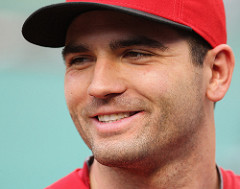
National League Player of the Month – Joey Votto, 1B, Reds

Photo: Erik Drost, CC BY 2.0 <https://creativecommons.org/licenses/by/2.0>, via Wikimedia Commons

Reds’ 1B Joey Vott0 put up a .326-11-25 month, leading MLB in home runs and tying for the National League in RBI. The 37-year-old,  six-time All Star finished especially  strong – in seven games from July 24 through July 30, he hit .485, with 10 runs scored and  15 RBI.  He also homered in all seven games (eight homers in all) – one game short of the MLB record for consecutive games with a home run. He failed to go deep on July 31. His slugging percentage during the hot streak was a lofty 1.423.

Honorable Mentions: A pair of third baseman also deserved consideration. The Padres’ Manny Machado went .360-8-25, tying for the NL’s most RBI in the month.  Machado’s 24 July runs scored also led MLB. Machado hit safely in 20 of 24 games played in July, with nine multi-hit contests.  Braves’ 3B Austin Riley also had a solid month at .312-9-25, tying for the NL lead in RBI and finishing behind only Votto and the Mets’ Pete Alonso in home runs. The 24-year-old ended the month on a ten-game hitting streak. Finally, a shout out to Braves’ veteran 1B Freddie Freeman, whose .374 July average (six homers, 15 RBI) led all National Leaguers with at least 75 July at bats.

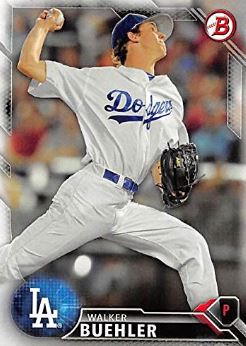
National League Pitcher of the Month – Walker Buehler, Dodgers

Walker Buehler went 3-0 in five July starts, pitching to a 1.67 earned run average and fanning 38 batters, while walking just nine (in 32 1/3 innings. Buehler’s ERA was the second-lowest  among NL pitchers with at least 20 July innings. His final two July starts were against the rival Giants. In those two key games, Walker gave up just one run in 14 1/3 innings, fanning 17 and earning one win (one no decision). Buehler finished July with an 11-1, 2.19 record on the season.

Honorable Mentions: The Brewers’ Corbin Burnes earned a look with a 3-0 July record, a 2.30 ERA and 37 strikeouts (just six walks) in 31 1/3 innings; as did the Reds’ Luis Castillo (2-0, 2.15 in six starts, with 41 strikeouts in 37 2/3 frames.  I also have to put in a word for Mets’ rookie Tylor Megill, who seems to have taken up Jacob deGrom’s role as the NL’s hard-luck pitcher. Megill’s 1.04 July ERA was the lowest among MLB pitchers with at least 20 July innings, but he got only one win (no losses) for his efforts.  In five starts, he never gave up more than one run and fanned 27 batters (seven walks) in 26 innings.

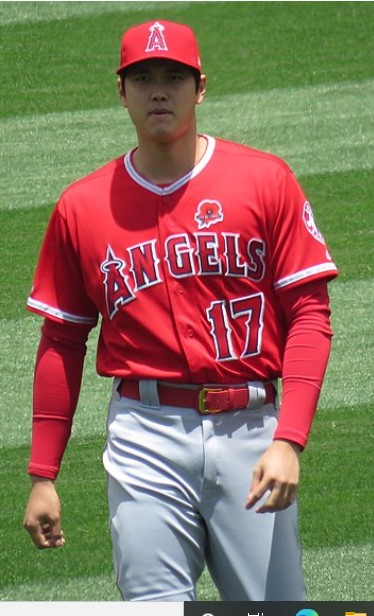
American League Player of the Month – Shohei Ohtani, P/DH, Angels

Photo: Scott U, CC BY-SA 2.0 <https://creativecommons.org/licenses/by-sa/2.0>, via Wikimedia Commons

Ohtani started July off on a roll. On July 2, batting second against the Orioles, he went two-for-four with two home runs, three runs scored, three RBI and one walk. Four days  later, he pitched seven innings of five-hit, two-run ball to earn a win over the Red Sox.  Really, what can you say about a player who tops his league in July home runs (9 – tied) and finishes in the AL July top ten in the league in RBI (19), runs scored (17) and stolen bases (4) – and also puts up a 2-0. 1.35 record, in three starts.  Ohtani hit safely in 17 of 23 games played in July. While Ohtani’s .278 July batting average wasn’t flashy, pretty much everything else he did was.

Honorable Mentions:  Twins’ 2B Jorge Polanco had an all-around solid month at .327-6-20 and his 34 hits in 26 July games were second only to the month’s other Honorable Mention – Angels’ 2B David Fletcher. Fletcher’s 37 hits (in 24 games) were the most for any MLB player in July. His July stat line was .349-2-14.

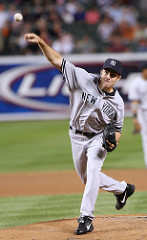
American League Pitcher of the Month – Jameson Taillon, Yankees

Taillon was one of only two pitchers to log four wins in July – going 4-0, 1.16 for the Yankees in five starts  His ERA was the third-lowed among MLB pitchers with at least 20 July innings. Taillon’s July came as a bit a surprise, he came into the month with a 3-4, 4.93 record. In five July starts he gave up just four earned runs  in 31 innings, holding hitters to a .182 average.

Honorable Mentions: Lance Lynn continued his solid year for the White Sox – going 3-1, 2.10 in five July starts. Matt Harvey deserves mention for going 3-1, 2.45 in four starts for the struggling Orioles. After giving up six earned runs in his first start of the month, Harvey threw 18 1/3 scoreless frames in his next three starts. The Angels’ Alex Cobb went 2-0, 1.09 in four July starts (although his opponents were the Orioles, Twins and Mariners.)

Surprise Player of the Month – Eric Haase, C, Tigers

Eric Haase (who still has rookie status) came into the 2012 season with a .122 average (one home run, six RBI) in 26 MLB games over three seasons.  He showed a bit of what he is capable of by going .234-9-15 through June of this season.  Then, in July, he surprised a lot of people, Baseball Roundtable included. He started the month with a three-hit, two-homer, six-RBI game on July 3 (against the division-leading White Sox). He went on to lead  MLB in July RBI with 29 (in just 23 games) and tie for the most July homers  in the AL (9).  His hit .265 for the month and scored 17 runs.

____________________________________________

TROT INDEX … A REGULAR BBRT FEATURE

Through July 2021, 36.9 percent of the MLB season’s 116,948 plate appearances ended in a trot (back to the dugout, around the bases, to first base). We’re talking about strikeouts, home runs, walks, hit by pitch and catcher’s interference – all outcomes that are, basically, devoid of action on the base paths or in the field. Here’s the breakout: strikeouts (23.6%); walks (8.8%); home runs (3.2%); HBP (1.2%); catcher’s interference (less than 1%). Personally, I’d like more action in the field of play.

__________________________________

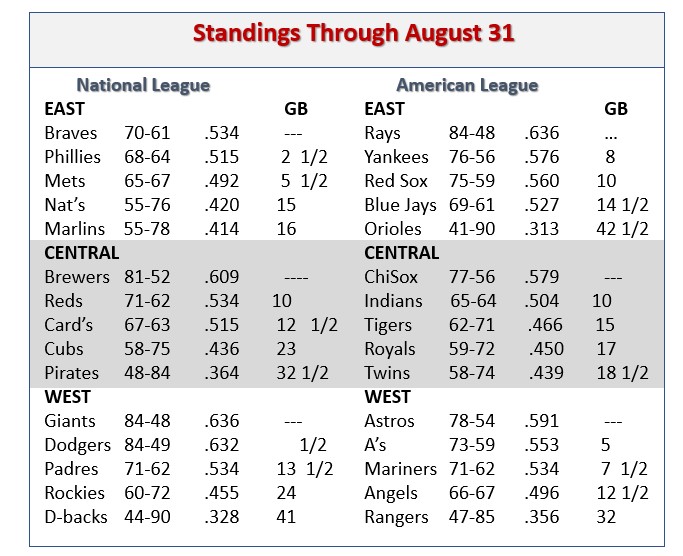
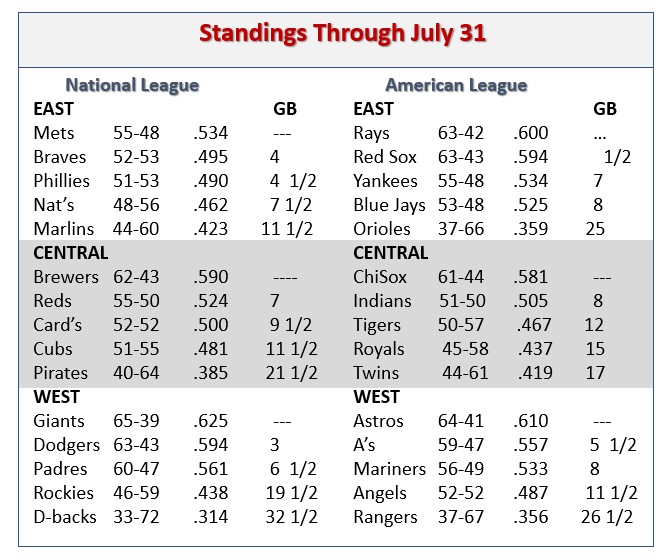
If the season ended July 31, your post-season teams would be:

National League: Mets; Brewers; Giants. Wild Cards: Dodgers, Padres.

American League: Rays; White Sox; Astros.  Wild Cards: Red Sox, A’s.

The Rays and Astros had the best record in July, both at 16-8.  The Rays moved from three games behind the Red Sox in the AL East at the end of June to 1/2-game lead; while the Astros extended their lead in the West from a slim 1/2-game over the A’s to 5 1/2.  The Rays played solid all-around ball, scoring the third-most July runs in the AL and putting up the second-best team ERA – despite having only one player with more than 15 RBI and  no starter with more than two July wins.  The Astros had the AL’s fifth-best ERA and fifth-most runs scored. Key contributors were 2B Jose Altuve (.260-8-22, with 21 runs scored); RF Kyle Tucker (.291-7-17); starter Lance McCullers (3-1, 3.86) and Ryan Pressly (six saves in six opportunities).

Over in the NL, the Reds made a big splash with a 16-10 record, while the Giants were at 15-10. The Reds jumped from fourth place in the Central to second (slipping by the Cardinals and Cubs).  They still, however, trail the Brewers (who went 14-10 for the month) by seven games. The Reds success may be a little more surprising, as they had the NL ‘s sixth-best ERA  and eighth-most runs scored. However, they had the NL’s leading home run hitter (11)  and RBI guy (25 ) in Joey Votto; got a nice .319-4-12. 20-run month from 2B Jonathon India – and got a 2-0, 2.15 month from Luis Castillo; 2-0, 2.51 from Wade Miley and seven saves from Heath Embree. The Giants’ 120 runs scored were in the middle of the NL pack, but their 3.38 ERA trailed only the Dodgers (3.2) and Brewers (3.33).Jake McGee gave the Giants seven saves and a 0.00 ERA for the month, while Alex Wood went 3-0, 3.62.

——Team Statistical Leaders For  July———

RUNS SCORED

National League – Dodgers (145); Nationals (135); Phillies (130)

American League – Tigers (147); White Sox (133); Rays (131)

No one scored fewer runs in July than the Rangers, who plated just 76 tallies.

AVERAGE

National League – Nationals (.275); Mets (.265); Dodgers(.263)

American League – Tigers (.264); Blue Jays (.261); Angels (.258)

The lowest July team average belonged to the Rangers at .198. Lowest in the NL were the Rockies at .240.

Notably, the eight lowest July averages were posted by American League teams.

HOME RUNS

National League – Dodgers (42); Phillies (40); Mets (38); Phillies (38)

American League –  Blue Jays (40); Tigers (37); Twins (37)

The Yankees had July’s fewest long balls at 23 – welcome Joey Gallo.

STOLEN BASES

National League –  Marlins (24); Padres (17); Brewers (17)

American League – Yankees (18); Indians (15); A’s (14)

The  Red Sox stole the fewest bases in July – just two (in six attempts).

WALKS DRAWN

National League –  Phillies (111; Brewers (97); Giants (95)

American League – Twins (95); Yankees (92); Mariners (89)

The Brewers led MLB in July on-base percentage at .349.  The Blue Jays led I slugging percentage at .476.

BATTER’S STRIKEOUTS

National League – Reds (248); Marlins (237); Dodgers (235)

American League – Indians (2227); Twins (22); Mariners (.222)

Blue Jays’ batters fanned the fewest times in July – 167.

EARNED RUN AVERAGE

National League –  Brewers (2.56); Dodgers (3.30); Braves (3.59)

American League – A’s (2.98); Rays (3.58); Angels (3.75)

Eight teams had ERA’s over 5.00 in July: Nationals (5.94); Pirates (5.65); Orioles (5.35); Diamondbacks (5.31); Rangers (5.29); Indians (5.25); Phillies (5.13); Royals (5.02); Of these, only the Phillies posted a winning record for the month – at 14-12.

STRIKEOUTS

National League – Reds (237); Mets (235); Dodgers (233)

American League – White Sox (254); Astros (235); Yankees (235)

The Yankees  had the highest strikeouts per nine innings in June  at 10.68. The Giants  led the NL at 9.41.  Thirteen teams averaged more than a strikeout per inning for the month.

SAVES

National League – Reds (10); Giants (9); Mets (8)

American League – Red  Sox (8); Mariners (8); five with seven

The Brewers, despite racking up 14 wins in July, had just one save in six opportunities.

________________________________________________

——-Individual Statistical Leaders for July ——–

AVERAGE (75 June  at bats minimum)

National League – Kyle Farmer. Reds (.395); Freddie Freeman, Braves (.375); Manny Machado (.360)

American League –  David Fletcher, Angels (.349); Bo Bichette,  Blue Jays (.337); Jorge Polanco , Twins (.327)

The lowest July  average (among players with at least 75 at bats) belonged to the Phillies’ SS Didi Gregorius and Twins’ SS Andrelton Simmons, who each went 13-for-80 (.163).

HOME RUNS

National League – Joey Votto, Reds (11); Pete Alonso, Mets  (10); Austin Riley, Braves (9); Juan Soto, Nationals (9)

American League –  Franmil Reyes, Indians (9); Shohei Ohtani, Angels (9); Eric Haase, Tigers (9)

Mariners’ SS J.P.Crawford had the most July at bats without a home run (101).

RUNS BATTED IN

National League – Austin Riley. Braves  (25); Joey Votto, Reds  (25); Manny Machado, Padres (25)

American League – Eric Haase, Tigers (29); Jose Abreu, White Sox (23); Jose Altuve, Astros (22); Austin Meadows, Rays (22); Franmil Reyes, Indians (22)

Reds’ 1B Joey Votto led all players (with at least 75 July at bats) in slugging percentage at .734.

HITS

National League – Freddie Freeman, Braves  (36);  Chris Taylor, Dodgers (33); Kyle Farmer, Reds (32);  Juan Soto, Nationals (32)

American League – David Fletcher, Angels (37);  Jose Polanco, Twins (34); Tim Anderson, White Sox (32)

DOUBLES

National League –  Bryce Harper, Phillies (11); Rhys Hoskins, Phillies (11); Josh Harrison,, Nationals* (11)     *Harrison is now with the A’s.

American League: Jeimer Candelario, Tigers (10); Time Anderson, White Sox (9); five with eight.

TRIPLES

National League – Jake Cronenworth, Padres (3); David Peralta, D-backs (2); Tyrone Taylor, Brewers (2); Josh Harrison, Nationals* (2)    *Harrison is now with the A’s.

American League – Wander Franco, Rays (3); Will Castro, Tigers (2); Nicky Lopez, Royals (2); Francisco, Mejia, Rays (2)

Nationals’ RF Juan Soto had the highest on-base percentage among players with at least 75 July at bats at .487. In addition to his 32 hits (.356 average), he drew 24 walks (versus only 15 strikeouts).

STOLEN BASES

National League –  Starling Marte, Marlins* (10); Raimel Tapia, Rockies (8); Fernando Tatis, Jr. Padres (7)  *Marte is now with the A’s.

American League – Myles Straw, Indians (5); Whit Merrifield, Royals (5); Gleyber Torres, Yankees (5); Greg Allen, Yankees (5). Jose Ramirez, Indians (5)

Starling Marte led MLB with 11 July steals, ten with the Marlins and one with the A’s. (Marte was traded to the A’s on July 28).

WALKS

National League – Juan Soto, Nationals (23); Brandon Nimmo, Mets (20); Joey Votto, Reds (19)

American League – Robbie Grossman, Tigers (22); Josh Donaldson, Twins (18); Shohei Ohtani, Angels (15)

BATTER’S STRIKEOUTS

National League – Brandon Nimmo, Mets (32); Patrick Wisdom, Cubs (30); Chris Taylor, Dodgers (29); Eugenio Suarez, Reds (29)

American League – Trevor Larnach (41); Shohei Ohtani, Angels  (37); Bobby Bradley, Indians (34); Matt Chapman, A’s (34)

PITCHING VICTORIES

National League – Kim Hyun-Kim, Cardinals (4-1); 11 with three

American League – Jameson Taillon, Yankees (4-0); 11 with three

The Rangers’ Kolby Allard, was the only pitcher to pick up five July losses (0-5, 9.13 in five starts.

EARNED RUN AVERAGE (at least 20 July innings pitched)

National League – Tyler Megill, Mets (1.04); Walker Buehler, Dodgers (1.67); Adrian Houser, Brewers (2.05)

American League – Alex Cobb, Angels (1.09); Jameson Taillon, Yankees (1.16); Shohei Ohtani, Angels (1.35)

STRIKEOUTS

National League – Luis Castillo, Reds (41 / 37 2/3 IP); German Marquez, Rockies (40 / 31 1/3); Walker Buehler, Dodgers  (38 / 32 1/3 IP)

American League – Gerrit Cole, Yankees (47 / 28 2/3 IP); Lance McCullers, Astros (42 / 30 1/3 IP); Patrick Sandoval, Angels (41 / 33 1/3 IP). Sean Manaea, A’s (41 / 30 IP).

SAVES

National League – Heath Embree, Reds (7); Mark Melancon, Padres (7); Jake McGee Giants (7)

American League: Raisel Iglesias, Angels (6); Ryan Pressly, Astros (6); four with five.

—-Some July Highlight—–

DH … We Don’t Need to Stinkin’ DH!

On July 4, the Braves went into the tenth inning of their game against the Marlins with a depleted bench. After the Marlins failed to score in the top of the inning, The Braves started their half with Austin Riley placed (ugh) at second base. The Marlins intentionally walked SS Dansby Swanson to put runners on first and second (setting up a double play?). CF Guillermo Heredia then hit a fly to deep right, with Riley going to third after the catch.  LF  Orlando Arcia was walked – loading the bases. Riley was then retired (C-P) trying to score on an errant pitch – with Swanson moving to third base (runners now on first and third with one out). C Kevan Smith was intentionally walked to load the bases and bring up the pitcher’s (Will Smith) spot.  The Braves brought pitcher Max Fried in to pinch hit -and he delivered a walk-off, RBI single.  (And he had more in store for the month).

On July 17, Braves’ southpaw Fried threw seven shutout innings (four hits, one walk, seven strikeouts) as Atlanta topped Tampa Bay 9-0. Fried also sparkled at the plate – going three-for-three, with one double, two runs scored and two RBI. As July closed, Fried as 7-7. 4.32 on the mound and .290-0-5 at the plate for the season.

Green Celebrates Independence Day with an Immaculate Inning

On July 4, the Yankees and Mets faced off in an  all-New York  day/night double header at Yankee Stadium. The Mets took Game One 10-5. In the night cap, the Yankees were up 3-2 after four (of the slated seven) frames.  In the top of the fifth, the  Yankees brought in Chad Green to hold the Mets at bay – and he did it with flash. He retired the side in order  on 13 pitches (including two strikeouts) in the fifth – and the Yankees tied it up in the bottom of the inning.  Green used another 13 pitches to complete a 1-2-3 sixth (with one more whiff).  Then, he topped it all off with an “Immaculate Inning” in the seventh.  Nine pitches, three strikeouts . Stats, Inc. reported that Green was the first pitcher in the Modern Era (since 1900) to pitch three 1-2-3 innings, fan six batters AND thrown an immaculate inning in the same game (more of #InBaseballWeCountEverything). Green’s was MLB’s 104th Immaculate Inning.

Only seven pitchers have thrown multiple Immaculate Innings: Sandy Koufax; Randy Johnson; Max Scherzer; Chris Sale; Nolan Ryan; Lefty Grove; Kevin Gausman. Only Koufax has three such innings.

Pujols Becomes the Fourth on the Fifth

On July 5, as the Marlins topped the Dodgers 5-4, Albert Pujols popped an eighth-inning single to center (off Zach Pop), which made Pujols just the fourth MLB player to accumulate 6,000 or more total bases in his career.  The others? Not a bad group:  Henry Aaron (6,856); Stan Musial (6,134); Willie Mays (6,080).  Pujols ended July with 6,014 total bases. He was also 13th on the all-time hits list, fifth in home runs (675) and third in RBI (2,138).

DH? Why?

On July 8, Padres’ reliever Daniel Camarena was called on to pitch in the top of the  fourth inning, with his squad down  6-0 t0 Nationals’ (now Dodgers’) ace Max Scherzer. In his first inning of work, Camarena gave up a two-run homer to  Nationals’ (now Dodgers’) Trea Turner, extending the LA lead to 8-0. In the bottom of the frame, a Fernando Tatis, Jr. home run and a Will Myers’ bases-loaded walk (following a single and two hit batters) set up a bases-loaded plate appearance for Camarena.  For whatever reason (saving the bullpen, perhaps), manager Jayce Tingler let Camarena bat and he delivered a Grand Slam home run (off a Scherzer 96-mph fastball)  for his first MLB hit (in his second MLB plate appearance). It proved to be a pretty big hit, as the Padres came back to win 9-8. (Camarena pitched a 1-2-3 fifth before being replaced on the mound in the top of the sixth.) Camarena, by the  way, is just the second MLB pitcher to hit a Grand Slam for his first hit in the “show.”

A Couple Dozen Runs Ought to Do it.

On July 16, as the Padres pounded the Nationals 24-8, Padres’ 2B Jake Cronenworth completed the second cycle (single, double, triple, homer in one game) of the 2021 season.  (The first went to the Nationals’ Trea Turner on June 30). After lining out in the first inning, Cronenworth doubled home two-runs in the second; hit an RBI triple in the third; added a solo home run in the fifth; and collected the needed single in the sixth.

Give Him the Yellow Jersey

No one ever completed an MLB cycle faster than Rockies’ 2B Mike Lansing (June 18, 2000). Lansing did it in four innings – RBI triple in the first; two-run home run in the second; two-run double in the third; and single in the fourth.

A Few Tidbits from the All Star Game

Lots has been written about the 2021 All Star Game, so let me just share a few tidbits that caught my eye.

  • The AL is on a hot streak – eight wins in a row.
  • Shohei Ohtani became the ultimate All Star starter – starting on the mound for the AL and batting leadoff.
  • Vlad Guerrero, Jr. became the youngest ever All Star MVP at 22 years, 119 days.
  • Guerrero Jr. also also completed just the third father-son set to both homer in an All Star Game:  the list now includes Vlad Guerrero and Vlad Jr.; Ken Griffey and Ken Jr.; and Bobby and Barry Bonds.
  • In this whiff-crazy era, NL batters only fanned three times. (For those that like to know such things, the record is zero strikeouts for the 1937 NL squad.)
  • A total of 59 players appeared in the game. (For those who like to know such things, the American League used a record low 11 players in the 1942 All Star Game).

______________________________________________________

Don’t Worry, I Got This

On July 18th, Cardinals’ reliever Alex Reyes was called to the mound in the top of the ninth inning, with the Cardinals up 2-1. He pitched around a couple of walks  to record his 22nd save of 2021 and convert the 24th consecutive save opportunity since the start of his career (breaking a record held by the Twins’ LaTroy Hawkins).   Note: Reyes recorded a blown save in his very next opportunity (July 18) – getting touched for three runs in one-third of an inning against the Cubs. To that point in the 2021 season, he had given up just seven earned runs in 40 appearances (43 1/3 innings – 1.45 ERA).

What Kind of Chance? Let’s Say 50-50 He Gets to the HOF

On July 22, as the Padres topped the Marlins 3-2, San Diego SS Fernando Tatis, Jr. picked up his 23rd stolen base of the year. Of more interest was that it was the 50th swipe of his brief MLB career. Coupled with his 68 career homers, it made Tatis the fastest player to reach the 50-50 mark  (at the MLB level) ever (223 games).  Tatis got on base, via a walk, leading off the fifth inning and stole second on the first pitch (from Jordan Holloway) to Padres’ 2B Jake Cronenworth. He later scored on a sacrifice fly off the bat of 3B Manny Machad0.  In his three MLB seasons (as of July 21), Tatis’ line was .297-68-164, with 50 steals in 61 attempts.

100 … That a Nice Round Number

On July 22, the Red Sox faced the rival Yankees at Fenway. After a striking out in the to end both the first and third innings, Rafael  Devers came up in the bottom of the fifth with one runner on base, two outs and the scored tied a 1-1 – and poked a two-run homer to center to give the Sox the lead.  It was the 24-year-old’s 99th career round tripper. He didn’t wait long for number 100. It came on his next at bat, in the bottom of the seventh, when he hit another long ball to center – a three-run shot this time. The Red won 6-2, with Devers two homers plating five of their runs.

A Wild Finish to the For the Yankees

On July 22, The Yankees’ brought in righty Brooks Kriske  to open the bottom of the tenth against the Red Sox – with New York up 4-0. What followed was a wild record-setting and record-tying string of events. The inning started with the Red Sox’ Rafael Devers placed at second base. Kriske uncorked a wild pitch on his first offering to Boston  SS Xander Bogaerts, sending Devers to third. Three pitches later, with a 2-1 count on Bogaerts, Kriske was wild again – enabling Devers to tally the tying run. On the next pitch he walked Bogaerts, bringing DH J.D. Martinez to the plate. After getting a strike over on the first pitch to Martinez, Kniske fired another wild pitch, sending Bogaerts to second. Two pitches later, another wild pitch allowed Bogaerts to advance to third base. So, at this point, Kriske had thrown 16 pitches – 11 balls (including the four wild pitches) and five strikes.  He did manage to fan Martinez (swinging – on a 2-2 pitch), but then RF Hunter Renfroe hit the first pitch he saw for a game-winning sacrifice fly.  Kriske tied the AL record for wild pitches in an inning and set a new MLB record for wild pitches in an extra inning.  All four wild offerings were on splitters in the dirt.  The MLB record for wild pitches in an inning belongs to Bert Cunningham of the Players League Buffalo Bisons (five in the first inning of a game on September 15, 1890).  By the next day, Kriske was sent down to Triple-A.

Kind of a Cycle

On July 23, as the Phillies topped the Braves 5-1, Phillies’ RF Bryce Harper stole third base in the first inning;  and second base and home plate in the fifth. Side note: 43 different players have stolen second, third and home in the same inning.

For Your Viewing Pleasure

Check out this July 23 dash around the Bases by  Rays’ RF Randy Arozarena.

More #WhyIHateTheDH

On July 25, the White Sox topped the Brewers (in Milwaukee) by a 3-1 score.  White Sox’ starter Lance Lynn picked up his tenth win of the season (three losses) – going six innings and giving up six hits and one run (no walks, six whiffs). The game was played, of course, in a National League park, so Lynn found himself going into the batter’s box for the first time this season. He came up in the second inning with runners on second and third and the Sox up 1-0. Lynn drove an 0-2 pitch into right field for a two-run single. He batted once more in the game (fanning on four pitches. Lynn ended July at 10-3, 2.-7 on the season– with a .500 batting average.

Home Runs Not Always the Answer

On July 28, the Minnesota Twins lost to the Tigers 17-14 (in Minnesota). Each team collected sixteen hits in the game. But the Twins out-homered the Tigers 7-0. It was the first time in the modern era (post-1900) that a team had out-homered their opponents by seven and lost the game.  A couple of other notes from the game:

  • Every member of the Tigers’ starting lineup had at least one RBI, at least one hit and at least one run scored.
  • The Twins’ home runs were hit by Miguel Sano (two homers, four RBI); Ryan Jeffers (two homers, six RBI); Max Kepler; Brent Rooker; and Jorge Polanco.
  • In terms of extra-base hits, the Twins had seven home runs and one double; the Tigers had six doubles and one triple.

Making Those Swings Count.

On July 28, Pirates’ rookie  infielder Rodolfo Castro played in his  ninth MLB game. The 22-year-old had a memorable night: tw0-for-four with two home runs and three RBI. To that point in his MLB career, Castro was 5-for-21 (.238), but all five of his hits were home runs.  He is the first MLB ;player to go yard on each of his first five career safeties.  In five minor-league seasons, Rodolfo hit .256, with 50 home runs (385 games).

Votto – Lucky Number Seven

From July 24 through July 30, Reds’ first baseman Joey Votto homered in seven straight games – tying a Reds’ franchise record and falling just one game short of the all-time MLB record.  In those seven games, he had 10 hits in 26 at bats (.385), nine home runs,  six walks, one sacrifice fly and 15 RBI. For those that like to know such things, the record for total home runs in a seven-game span is ten – by the Senators’ Frank Howard (1968. the Year of the Pitcher); the Indians’ Albert Belle (1995); and the Dodgers’ Shawn Green (2002).

Welcome to the Shohei Show

On July 29, Shohei Ohtani – at DH for the Angels against the A’s – stole his fifteenth base of the season.  What doesn’t he do? Through July he is .278-37-82 at the plate (and has those 15 steals).  On the mound, 5-1, 3.04 in fifteen starts, with 100 strikeouts in 80 innings pitched.

If One Is Good, Two is Better and Three is a Record

On July, 31, White Sox rookie catcher Seby Zavala hit his first MLB home run – in his 18th MLB game. It came  as Zavala led of the bottom of the third inning – and added to a White Sox 1-0 lead. Zavala didn’t have wait long for dinger number two. He popped a Grand Slam the very next inning. But he wasn’t done yet.  In his next trip to the plate, leading off the bottom of the seventh, he homered again (this on bringing the White Sox to a three-run deficit – despite Zavala’s earlier heroics, they were down 10-6 at the time). Zavala got one more at bat, but he went into a slump, hitting a mere single. The White Sox lost to Cleveland 12-11, but Zavala gave it his all – four-for-four, with four runs scored and six RBI. In the process, he became the first major leaguer to have a three-homer game in the game in which he hit his first homer.


——Team  Statistical Leaders through  July ———-

RUNS SCORED (average 469)

National League –  Dodgers (547); Reds (514); Padres (507)

American League – Astros (577); Red Sox (528); Rays (528)

Four teams averaged five or more runs per game through July: Astros (5.50); Blue Jays (5.18);and Dodgers (5.16) and Rays (5.03) The Pirates averaged the fewest runs per game through June at 3.65. Lowest  in the AL was the Rangers at 3.86.

AVERAGE (average .241)

National League – Nationals (.258); Reds (.251); Giants (.245)

American League – Astros (.268); Blue Jays (.265); Red Sox (.256)

The lowest team average through July belonged to the Mariners  both  at .221.

HOME RUNS (average 126)

National League – Giants (156); Braves (148); Dodgers (145)

American League –  Blue Jays (157); Twins (152); Astros (139)

The Pirates had the fewest home runs through July  at 84. The only other team under 100 dingers was the Diamondback at 95.

STOLEN BASES (average 47)

National League – Padres (91); Marlins (75); Rockies (62)

American League Royals (65); Rays (61); Tigers (61)

The Reds  stole the fewest sacks through June at 24.

WALKS DRAWN (average 345)

National League – Dodgers (420); Padres (410); Brewers (400)

American League – Yankees (418); Rays (392); White Sox (391)

The Astros  led MLB  in on-base percentage through  July at .341. The Dodgers led the NL at .334. In slugging percentage, the Blue Jays were also on top at .458, while the Giants  led the NL at .436.

BATTER’S STRIKEOUTS (average 920)

National League – Brewers (1.012); Cubs (1,010); Marlins (1,000)

American League – Rays (1,055); Tigers (1,013); Mariners (1,002)

Astros’ batters went down on strikes the fewest times through July  (791).

EARNED RUN AVERAGE (average 4.21)

National League – Dodgers (3.21); Brewers (3.36); Giants (3.37)

American League – Rays (3.53); A’s (3.66); White Sox (3.66)

Two teams had ERA’s through July at 5.00  or higher – Orioles (5.42) and Diamondbacks (5.28)

STRIKEOUTS (average 914)

National League – Brewers (1,053); Dodgers (1,049); Padres (1,014)

American League – White Sox (1,030); Rays (996); Red Sox (983)

The White Sox  averaged an MLB-best 10.3 strikeouts per nine innings through July. The Brewers  led the NL at 10.1.  The MLB average was 9.1.

FEWEST WALKS SURRENDERED (average 345)

National League – Giants (273); Mets (302); Phillies (323)

American League – A’s (282); Rays (289); Yankees (308)

The Giants,  A’s and Rays all walked a stingiest 2.7 batters per nine frames. The Cardinals walked an MLB’s highest 4.4 per nine innings through July.

SAVES (average 25)

National League – Giants (37); Padres (36); Dodgers (31)

American League – Red Sox (34); White Sox (29); Mariners (29)

Bonus Stats – In the Field

The Marlins led MLB in errors through July at 73.  The Red Sox and  Twins led the AL with 71 miscues. The Astros committed the fewest errors (43), while the Giants had the fewest in the NL at 48.

——-Individual Statistical Leaders through July 31———-

BATTING AVERAGE (qualifying players – 3.1 at plate appearance for each team game played)

National League – Nick Castellanos, Reds (.329); Trea Turner, Dodgers (.322); J Adam Frazier, Padres (.318)

American League – Michael Brantley, Astros (330);  Vlad Guerrero, Jr. , Blue Jays (.327); Cedric Mullins, Orioles (.321)

The lowest average through July  (among qualifiers) belonged to the Reds’ Eugenio Suarez at .173 (65-for-375).

HOME RUNS

National League – Fernando Tatis, Jr., Padres (31); Kyle Schwarber, Nationals* (25); Ronald Acuna, He. Braves (24)  *Schwarber now with the Red Sox

American League –  Shohei Ohtani, Angels (37); Vlad Guerrero, Jr., Blue Jays (33); Rafael Devers, Red Sox (27); Matt Olson, A’s (27)

RUNS BATTED IN

National League – Jesus Aguilar, Marlins (75); Manny Machado, Padres (75); Fernando Tatis, Jr., Padres (69)

American League – Vlad Guerrero, Jr., Blue Jays (83); Shohei Ohtani, Angels (82); Rafael Devers, Red Sox (82)

The Angels’ Shohei Ohtani  had the highest slugging percentage among qualifiers at .682.  The only other players over .600 were  the Blue Jays’ Vlad Guerrero, Jr. (.654) and Padres’ Fernando Tatis, Jr. (.651)

HITS

National League – Adam Frazier, Padres (129); Trea Turner, Dodgers  (125); Bryan Reynolds, Pirates (116); Jesse Winker, Reds (116)

American League – Cedric Mullins, Orioles (125); Bo Bichette, Blue Jays (121); David Fletcher, Angels (121)

DOUBLES

National League –  Ozzie Albies, Braves (31); Nick Castellanos, Reds (29):  Adam Frazier, Padres (29)

American League – Xander Bogaerts, Red Sox (29); Rafael Devers, Red Sox (28); J.D. Martinez, Red Sox (28); Cedric Mullins, Orioles (28)

TRIPLES

National League Dave Peralta, D-backs (7); Ozzie Albies, Braves (5); Jake Cronenworth, Padres (5); Garrett Hampson, Rockies (5)

American League – Akil Baddoo, Tigers (5); Nicky Lopez, Royals (5); seven with four.

STOLEN BASES

National League –  Fernando Tatis, Jr., Padres (23); Starling Marte, Marlins* (22); Trea Turner, Dodgers (21);  *Marte is now with the A’s.

American League – Whit Merrifield, Royals (27); Cedric Mullins, Orioles (18); Myles Straw, Indians (17)

The most stolen bases without being thrown out through July was 16  by the Blue Jays’ Bo Bichette.  MLB SB leader Whit Merrifield (Royals) was 27-for-28 in steal attempts.

WALKS

National League – Juan Soto, Nationals (72); Freddie Freeman, Braves (64); Max Muncy, Dodgers (64)

American League – Joey Gallo, Yankees (76); Robbie Grossman, Tigers (69); Carlos Santana, Royals (63)

BATTER’S STRIKEOUTS

National League – Javier Baez, Mets (133); Eugenio Suarez, Reds (128); Dansby Swanson, Braves (116)

American League – Matt Chapman, A’s (134); Joey Gallo, Yankees (128); Shohei Ohtani, Angels (124)

PITCHING VICTORIES

National League –Kyle Hendricks, Cubs (13-4); Julio Urias, Dodgers (12-3); Walker Buehler, Dodgers (11-1)

American League – Chris Bassitt, A’s (11-3); Aaron Civale, Indians (10-2); Lance Lynn, White Sox (10-3); Zack Greinke,  Astros (10-3); Hyun Jin Ryu, Blue Jays (10-5); Gerrit Cole, Yankees (10-6)

The  Orioles’ Jorge Lopez (2-12, 6.19) had the most losses through July.

EARNED RUN AVERAGE (qualifying players … at least one inning pitch for each team game played))

National League –David Peralta, Brewers (2.177); Walker Buehler, Dodgers (2.19); Brandon Woodruff, Brewers (2.26)

American League – Lance Lynn, White Sox (2.07); Kyle Gibson, Rangers (2.87); Sean Manaea, A’s (3.01)

STRIKEOUTS

National League – Zack Wheeler, Phillies (165  / 139 2/3);  Brandon Woodruff, Brewers (152 / 131 1/3); Corbin Burnes, Brewers (152 / 106 IP)

American League – Gerrit Cole, Yankees (176 / 130 1/3 IP); Robbie Roy, Blue Jays (150 / 118 1/3 IP); Carlos Rodon, White Sox (149 / 104 2/2 IP)

Among qualifying pitchers, the Brewers’ Corbin Burnes had the best strikeouts/nine innings ratio through July  at 12.9. Carlos Rodon of the White Sox r led the AL at 12.8.

Among qualifying pitchers,  Burnes also had the best strikeouts-to-walks ratio at 7.60.

SAVES

National League – Mark Melancon, Padres (32); Alex Reyes, Cardinals (24); Craig Kimbrel, Cubs* (23);  Edwin Diaz, Mets (23) *Kimbrel now with the White Sox.

American League: Liam Hendriks, White Sox (26):  Matt Barnes, Red Sox (23);  Raisel Iglesias, Angels (22)

Baseball Roundtable Disclaimer:  Some of the MLB records referenced in this (and previous) posts have the potential to change (primarily additions) as Major League Baseball recognizes and fully incorporates Negro League records from 1920-48 into the MLB record book.


BASEBALL ROUNDTABLE ON THE TOP 100 BASEBALL BLOG LIST

100Baseball Roundtable is on the Feedspot list of the Top 100 Baseball Blogs.  To see the full list, click here.

I tweet baseball @DavidBBRT

Follow/Like Baseball Roundtable’s Facebook Page here.  More baseball commentary; blog post notifications; PRIZES.

Member: Society for American Baseball Research (SABR); The Baseball Reliquary; The Negro Leagues Baseball Museum.


Sammy Sosa’s Long-Awaited First Grand Slam … and “Ducks-Full-Dingers” Tidbits

Photo by Ryosuke Yagi

On this date (July 27) in 1998, Cubs’ RF Sammy Sosa launched his 39th and 40th homers of the season – as the Cubs topped the Diamondbacks 6-2 in Arizona, with Sosa driving in all six runs. Just as significantly, the second of those homers – in the eighth inning off Alan Embree – was a Grand Slam. It came in Sosa’s tenth MLB season and was the 247th homer of his career. It was also Sosa’s first-ever Grand Slam, giving him (more proof of #InBaseballWeCountEverything) the MLB record for the most home runs ever for a player before hitting his first Grand Slam. After waiting more than nine seasons, 1,164 games and 246 home runs to hit his first round tripper with the bases full, Sosa’s next Grand Slam came just six innings later – in the fifth inning of the Cubs’  July 28 game against the Diamondbacks.  This time off Bob Wolcott (as the Cubs won 7-5).  Sosa ended his career with nine Grand Slams among his 609 regular-season home runs.

Now on the very same day that Sosa hit his first MLB Grand Slam, approximately 980 miles away, Tyrone Horne of the Double A Arkansas Travelers became the first (and still only) professional player to complete a home run cycle (solo, two-run, three run and Grand Slam home run all in the same game). He accomplished the feat on the road against the San Antonio Mission – in a 13-4 Arkansas win. For the full story on Horne and career, click here.

Well, these July 27th events, centering on Grand Slams, led Baseball Roundtable to dig a little deeper into “Ducks-Full Dingers.”

Did you know, for example, that hitting two Grand Slams in a game is even rarer than hitting four home runs in a contest or pitching a perfect game.?  Here’s the list.

And, here are a few tidbits about those two-Grand Slam games (you can check the details like teams and dates off the chart above):

  • Fernando Tatis (Sr.) is the only player to hit two Grand Slams in one inning. They were the first two Grand Slams of his MLB career. Tatis’ eight RBI in an inning also remain an MLB record.
  • Twelve of the thirteen two-Grand Slam games were accomplished on the road. Only Nomar Garciaparra hit his pair of bases-full blasts in front of a home crowd.
  • The Red Sox’ Bill Mueller is the only player to hit a Grand Slam from both batter’s boxes in the same game – and he hit them in the consecutive innings. In the seventh inning, right-handed off Rangers’  southpaw Aaron Fultz and, in the eighth inning, left-handed off righty Jay Powell.
  • The first National Leaguer to hit two Grand Slams in a game was Braves’ pitcher Tony Cloninger. He also threw a complete-game, seven-hitter that day (three runs, two walks, five strikeouts).
  • Rudy York and Fernando Tatis are the only two on the list to hit both Grand Slams off one pitcher. The Cardinals’ Tatis hit both of his off the Dodgers’ Chan Ho Park (and, of course, in the same inning – the third). The Red Sox’ York hit both of his Slams off the Athletics’ Ted Shirley (one in the second inning an done in the fifth).
  • Tony Lazzeri, Jim Tabor, Nomar Garciaparra and Bill Mueller each had three home runs in their two-Grand Slam Games.

Career Leaders in Grands Slams

Alex Rodriguez                  25

Lou Gehrig                          23

Manny Ramirez                 21

Eddie Murray                     19

Willie McCovey                 18

Robin Ventura                   18

Leader among active players: Albert Pujols – 15


A couple of single-season Grand Slam tidbits:

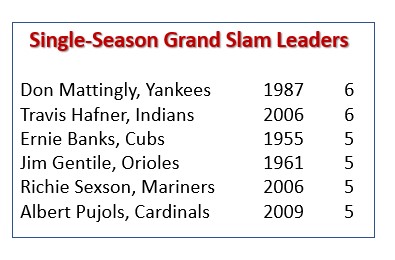
  • Yankee Don Mattingly’s single-season record six Grand Slams in 1987 were the only Grand Slams of his 14-season MLB career.
  • When the Orioles’ Jim Gentile hit a then-record-tying  five Grand Slams in 1961, everyone of his five bases-loaded blasts came in a game in which the Baltimore starter was Chuck Estrada.  Gentile, in face, hit only one other Grand Slam in his career – in a game started by (you guessed it) Chuck Estrada.

That’ll Do in a Pinch

Four players share the record for most career pinch-hit Grand Slams (three) – Ben Broussard (Indians/Mariners); Willie McCovey (Giants); Ron Northey (Cardinals/Cubs); and Rich Reese (Twins).

A trivia tidbit on Reese.  His record-tying three pinch hit Grand Slams  were the only Grand Slams in his 10-season MLB career (866 games/2225 plate appearances/200 pinch-hitting appearances).

Let’s Get this Party Started

While 126 players have homered in their first MLB at bat, only four of those long balls were Grand Slams.  The players with Grand Slams in their first at bat include: Bill Duggleby (Phillies – 1898);  Jeremy Hermida (Marlins – 2005); Kevin Kouzmanoff (Indians – 2006); Daniel Nava (Red Sox – 2010).   The last two of those, poked those four-run shots on the very first MLB pitch they ever faced.

  • Kevin Kouzmanoff started his first MLB game at DH (batting seventh) for the Indians on September 2, 2006. The opponents were the Rangers (in Texas), with Edison Volquez on the mound. In the top of the first, Kouzmanoff came to bat with the sacks full and two out – and rapped the first pitch from Volquez over the CF fence for a Grand Slam. It was his only hit in four at bats, as the Indians triumphed 6-5. Kouzmanoff played seven MLB seasons (2006-2011, 2014).  He hit .257-87-371, with three Grand Slams.
  • Daniel Nava made his first MLB start as a member of the Red Sox on June 12, 2010. He was batting ninth and playing left field, as the BoSox faced the Blue Jays (and starter Joe Blanton) in Fenway. In the bottom of the second frame, Nava came to bat for the first time in an MLB game – with the based loaded, no outs and the Red Sox up 1-0. He hit the first Blanton offering deep to RF for a Grand Slam. Nava had a home run and a double in four at bats, as the Red Sox won 10-2. Nava played seven MLB seasons (2010, 2012-17), hitting .266-29-206 in 589 games. He hit two Grand Slams.

The Ultimate Slam

I have often said “In baseball we count everything,” and, if it’s not already counted, we find a way to make it countable.  Hence, the “Ultimate Grand Slam” – a walk-off Grand Slam in the bottom of the final inning of a game when your team trails by three runs.   The “count” shows thirty such Ultimate Grand Slams – by thirty different players.  A handful stand out.

  • Babe Ruth, Jason Giambi and Ryan Roberts notched Ultimate Slam in extra innings.

Ruth hit his in the bottom of the tenth of a September 24, 1925 game against the White Sox at Yankee Stadium. The game had been tied 2-2 after nine frames, the White Sox tallied three in the top of the tenth, before Ruth’s Ultimate Slam put it away for New Yorkers 5-4.

Giambi hit his in the bottom of the fourteenth inning of a May 17, 2002 game between his Yankees and the Minnesota Twins. The game was tied at nine after nine. The Twins, like the White Sox above, plated three runs in the top of the 14th, before the Giambi Ultimate Slam gave New York the 13-12 win,

Roberts hit his Ultimate Slam in the tenth inning of a September 27, 2011 matchup between his Diamondbacks and the Dodgers. The game was knotted at 1-1 after nine innings, when the Dodgers exploded for five runs in the top of the tenth. The game looked safely packed away as Arizona reliever Blake Hawksworth retired the first two batters in the bottom of the inning.  What followed was a single by RF Cole Gillespie, a single by  C Miguel Montero (Gillespie going to third); a walk to CF Chris Young;  PH John McDonald safe on an error with one run scoring; a pitching change (Javy Guerra for Hawksworth); a walk to 2B Aaron Hill forcing in a run (leaving the base loaded and the score 6-3); and, finally, Roberts’ Ultimate Slam –  giving the Diamondbacks a 7-6 win, with six runs scoring after the Dodgers had the Diamondbacks down to their last out, with the bases empty.

  • For sheer excitement no Ultimate Slam can beat the one Roberto Clemente hit on July 25, 1956. The Pirate were trailing the Cubs 8-5, when Clemente came to the plate with the bases loaded and no outs. Facing Jim Brosnan, Clemente drove a high-and-inside pitch off the light standard in left field. As the ball ricocheted off the light standard and rolled along the warning track, all three runners scored – and then a sliding Clemente, beat the relay throw, and slid across the plate.  Note: Clemente ran through the coach’s stop sign at third base. It remains the only inside-the-park Ultimate Slam.
  • 2011 is the only year with three Ultimate Slams (Travis Hafner (Indians); Brian Bogusevic (Astros); Ryan Roberts (Diamondbacks).

Primary Resources:  Baseball-Reference.com; Baseball-Almanac.com

Baseball Roundtable Disclaimer:  The MLB records referenced in this (and previous) posts have the potential to change (primarily additions) as Major League Baseball recognizes and fully incorporates Negro League records from 1920-48 into the MLB record book.


BASEBALL ROUNDTABLE ON THE TOP 100 BASEBALL BLOG LIST

100Baseball Roundtable is on the Feedspot list of the Top 100 Baseball Blogs.  To see the full list, click here.

I tweet baseball @DavidBBRT

Follow/Like Baseball Roundtable’s Facebook Page here.  More baseball commentary; blog post notifications; PRIZES.

Member: Society for American Baseball Research (SABR); The Baseball Reliquary; The Negro Leagues Baseball Museum.


Let’s Play Two -Some Doubleheader Trivia and Tidbits

My Minnesota Twins just came off a stretch in which they played five games in three days – including a pair of doubleheaders.  That sent me to thinking about real doubleheaders. You know, the kind with nine-inning games (Guess you can tell where I stand on this issue). With that in mind, this post will take a look at some doubleheader history.

Now, That’s a Lot of Baseball

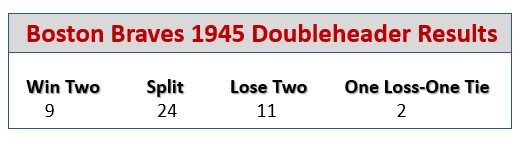
The 1945 Boston Braves played an MLB-record 46 doubleheaders. Let’s put that in perspective – 59.7 percent of the games they played that season were part of doubleheaders. How did they do?  They won 42 of those games, lost 48 and tied two.  Basically, they played .466 ball in twin bills, a bit better than their .403 winning percentage on days when they played just one game.  By the way, just so you don’t think those 46 doubleheaders were a one-off event, the 1943 White Sox hold the AL record for doubleheaders in a season at 44.

18 Games in 12 Days

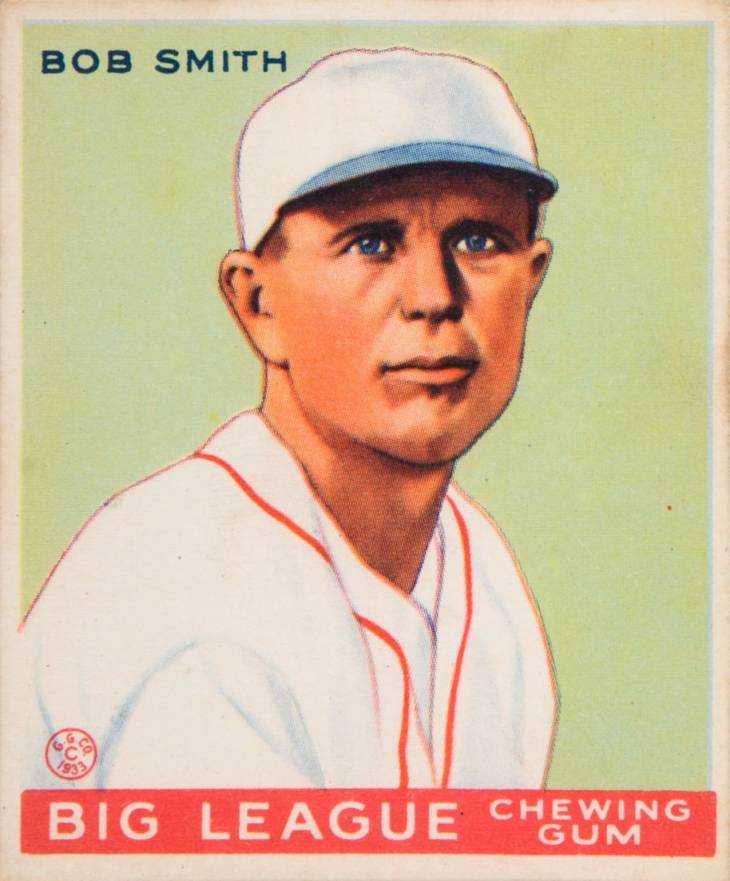
The 1928 Boston Braves played a record nine consecutive doubleheaders over a 12-day span (September 4-15). During the streak, they swept one doubleheader, were swept six times and split two – for a four win-fourteen loss record.  Notably,  six players played every inning of those games (RF  Lance Richbourg; LF Eddie Brown; 1B George Sisler; 2B Rogers Hornsby; 3B Les Bell; SS Doc Farrell). The team used eight different starting pitchers during the 18-game stretch – none more often than Bob Smith, who started four contests (including both ends of one doubleheader).

The stretch of twin bills may have been taxing on the hurlers’ arms. The Braves got just five complete games during the span (27.8 percent of the starts) – well below the MLB average for the year of 50.7 percent and short of the Braves’ average for the rest of the season  (36.2 percent). Bob Smith’s record may be indicative of that wear and tear. In his first start of the stretch (September 5), he tossed a complete-game two-hitter as Boston topped Brooklyn 7-1. On September 10, he tossed a second complete game, a seven-hitter, as Boston lost to the Giants 4-1.  Then on September 14, he failed to make it out of the first inning of the first game against the Giants, giving up four runs without recording an out.  Undeterred, the Braves sent him back out to start the second game of the twin bill – in which he gave up  five runs (three earned) in 6 1/3 innings – taking his second loss of the day.  Side note:  Smith recovered from that tough  two-loss day. He had three more starts that season, pitching 31 1/3 innings in those games (1-2, 2.87). He finished the season 13-17, 3.87 for a Braves team that went 50-103.

One Thing Leads to Another … Bob Smith

Now, I often note how “one thing leads to another” when I embark on research for these posts.  In this case, my interest in Bob (Robert Eldridge) Smith was sparked. Here’s what I learned.  Smith started his MLB career as a shortstop/second baseman, said to have a below average bat and no better than an average glove. He made it to the Braves as a 28-year-old in 1923 and, in his first MLB season, hit .240, with two home runs and 78 RBI. He also was 9-for-20 in stolen base attempts.  He did, however, flash a strong arm and, in 1925, began the conversion to the pitcher’s mound (in 1925, he appeared in 13 games as a pitcher, 15 at second base, 21 at SS and one in CF). By 1926, Smith (at age 31) was pretty much a full-time pitcher – and it saved his career. His mound work kept him in the major leagues until 1937 (age 42) – finishing with a 106-139, 3.94 record and 128 complete games in 229 starts.   In 1928, he was clearly the ace of the Braves’ staff leading the team in wins (13), complete games (14) and innings pitched (244 1/3). From 1926 through 1930, he won at least ten games for the Braves every season. He was traded to the Cubs after the 1930 season and had his career-best season for Chicago in 1931 (15-12, 3.22)

One more tidbit about Mr. Smith.  On May 17, 1927, as the Braves faced the Cubs in Boston, Smith started – and went all 22 innings – as the Braves lost to the Cubs 4-3. Smith gave up 20 hits and four runs (three earned), walking nine and fanning five in this tough loss. It remains the fifth most innings pitched by a starter in an MLB Game.  Here’s the top five:

TIED FOR FIRST– 26 innings.  On May 1, 1920, the Brooklyn Robins (Dodgers) and Boston Braves played 26 innings to a 1-1 tie, with both starters (Leon Cadore – Robins and Joe Oeschger – Braves going the distance.   No one scored in this one after the sixth inning.

TIED FOR THIRD (and first in the AL) – 24 innings. On September 1, 1906, the Philadelphia Athletics and Boston Americans (Red Sox) matched up in a 24-inning duel (in Boston) that the Athletics won 4-1 (with no scoring from the seventh through the 23rd inning). Both starters (Jack Coombs – Athletics and Joe Harris – Americans) went the distance.  Harris took the tough loss (his 18th of the season – versus just two wins). He finished the campaign at 2-21, leading the league in losses. 

FIFTH – 22 innings.  As already noted, on May 17, 1927, Bob Smith pitched all 22 frames as the Cubs topped  Smith’s Boston Braves’ 4-3 in Boston.  Down 3-0 after five innings, Smith held the Cubs scoreless  until the 22nd inning, when a walk, successful sacrifice and single plated the winning run.

Putting Up Crooked Numbers

The record for runs scored in a doubleheader – both teams – is 54.  It has been done twice.  On August 21, 1894,the National League Boston Beaneaters swept a doubleheader from the Cincinnati Reds by score of 18-3 and 25-8. Then, on Independence Day in 1939, there were lots of fireworks on the field in Philadelphia, as the Red Sox topped the Athletics 17-7 and 18-12.

Well, That Didn’t Take Long

The fewest runs scored in a doubleheader? It may surprise you (because it’s not two.)   The answer is one.  On September 4 1902, the Pittsburgh Pirate and Boston Beaneaters matched up in a doubleheader in Boston. Game One went to Boston 1-0 (in one hour and twenty minutes). Game Two ended in a nine-inning 0-0 tie (one hour and 30 minutes).

A Good Days Work

On September 26, 1908, Cubs’ righty Ed Reulbach started both games of a doubleheader against Brooklyn (Superbas).  He went the distance in both contests, giving up just eight hits over the 18 innings.  Reulbach is the only MLB pitcher ever to record two complete-game shutouts in a single day.

Another Good Days Work – or Two

On May 2, 1954, Cardinals’ right fielder Stan Musial hit five home runs in doubleheader (versus the Giants in Saint Louis). Sitting in the stands that day was eight-year-old Nate Colbert who – On August 1, 1972 – would become just the second player ever to hit five home runs in a twin bill. Colbert was playing first base for the Padres, who were taking on the Braves in Atlanta. In his five-homer twin bill, Colbert set the record for RBI in a doubleheader (13). The Cardinals, by the way, split their doubleheader on Musial’s big day, beating the Giants 10-6 in Game One and losing the second game 9-7. The Padres swept the Braves (9-0 and 11-7) on Colbert’s record-tying day.

I Call Trade-Zees

On May 30, 1922, the Cardinals and Cubs matched up in a Memorial Day doubleheader in Chicago. The Cubs took Game One by a 4-1 score – with one of the four tallies driven in by RF Max Flack. Playing CF for the Cardinals was Cliff Heathcote, who went zero-for-three.  In Game Two,  Heathcote and Flack were both starting in the garden – but for the teams they had opposed in Game One.  Traded between games, Flack started in RF, leading off, for the  Cardinals, while Heathcote started in RF, batting fifth for the Cubs. The Cubs won this one 3-1, with Heathcote going two-for-four.  Flack went one-for-four for his new team.

Don’t Worry – I Got This

In August of 1903, the Giants’ Joe McGinnity started  both games of a doubleheader three times – August 1, Augusts 8 and August 31.  In those starts, he picked up six complete-game victories – giving up a total of 10 runs in the six contests. By the way, the Giants played 11 doubleheaders that month. Surprisingly, on the August days when he pitched only one game (another six starts), McGinnity went 1-5 and gave up 28 runs. For the season, he was 31-20, 2.43, with 44 complete games in 48 starts.  No wonder his nickname was “Iron Joe.”

Way Too Much Overtime

On May 31, 1964, Mets fans faced a long day of suffering.  Not only did the New Yorkers lose both ends of a doubleheader to the San Francisco Giants – it took them a doubleheader-record 32 innings (9 hours and 52 minutes) to do it. The Giants won game one 5-3 in a brisk 2:29.  The second game, however, went 23 innings (7:23), with the Giants winning 8-6.   This is the longest doubleheader by innings and the longest in time –  without a weather delay.

On July 2, 1993, the Padres and Phillies split a twin bill in Philadelphia that kept the fans (who stayed on) in the park for more than 12 hours. Consider the patience needed.  The first game was delayed one hour and ten minutes before the first pitch; another one hour and 56 minutes in the fourth inning; and two hours and 48 minutes in the sixth. The teams began play at 4:35 p.m. on Friday, July 2 and wrapped up at 4:40 a.m. Saturday – a doubleheader record 12 hours and five minutes.

Nine-for-Nine

Nine players have collected nine hits in a doubleheader.  The most recent was Lee Thomas of the Angels on September 5, 1961. The Angels’ RF went five-for-five in the first game (on double and four singles), without a run scored or an RBI) as the Angels lost to the Athletics 7-3.  Game Two was more productive for Thomas. He was four-for-six, with three home runs, three runs scored and eight RBI. The Angels, however, still lost 13-12.

Cubs’ Hall of Famer Ernie Banks was quoted often as saying “Let’s play two!”  He was right!

Primary Resources:  Baseball-Reference.com; Baseball-Almanac.com; MLB.com


BASEBALL ROUNDTABLE ON THE TOP 100 BASEBALL BLOG LIST

100Baseball Roundtable is on the Feedspot list of the Top 100 Baseball Blogs.  To see the full list, click here.

I tweet baseball @DavidBBRT

Follow/Like Baseball Roundtable’s Facebook Page here.  More baseball commentary; blog post notifications; PRIZES.

Member: Society for American Baseball Research (SABR); The Baseball Reliquary; The Negro Leagues Baseball Museum.


Padres’ 24 Runs … What if Both Teams Plated Twenty?

Yesterday, July 16, 2021, The San Diego Padres bashed the Washington Nationals 24-8 in Washington D.C.  That set me to thinking about high-scoring contests – and led me to seek out information on the highest-scoring game in MLB history.

Turns out, the highest-scoring game in the modern era (post-1901) took place on August 25, 1922 – as the Cubs topped the Phillies 26-23 at Wrigley Field (not so “friendly confines” for pitchers that day).  In the game, the teams combined for a modern-era record 51 base hits.

A few quirky tidbits:

  • The Phillies tallied there 23 runs without the benefit of a single home run – the Cubs had three long balls.
  • The Cubs jumped out to a 25-6 lead after just four innings, but had to hold on for the 26-23 win.
  • In addition to the 51 hits, the game “featured” 21 walks and one hit batsman.
  • The teams scored 49 runs, but still managed to leave 25 runners on base.
  • The Phillies went 15-for-31 with runners in scoring, position; the Cubs 14-for-24 for a combined average with RISP of .527.

Phillies’ starting pitcher Jimmy Ring gave up 16 runs (12 earned)  in 3 1/3 innings for the loss; Cubs’ starter Tony Kaufmann was awarded the win, despite giving up six runs (three earned) in four innings.

  • The Phillies used just two pitchers, the Cubs five.
  • The two teams sent 125 batters to the plate – and only nine struck out.
  • The teams scored a combined 23 two-out runs (12 Cubs, 11 Phillies).
  • The game took only three hours and one minute.
  • There were nine errors and 21 of the 49 runs were unearned.
  • Two Cubs – SS Charlie Hollocher and LF Hack Miller each drove in six tallies.

That Was Fun, Let’s Do It Again Someday

Notably, 57 seasons later – on May 17, 1979 – the Phillies were again matched against the Cubs at Wrigley Field and the two teams produced the second-highest scoring game (and second-most hits) in modern MLB history. This time, the Cubs lost to the Phillies 23-22 in ten innings.

For comparison:

  • The two teams hit a combined eleven home home runs (six for the Cubs, five for the Phillies) – with Dave Kingman hitting three for the Cubs and Mike Schmidt poling two for the Phillies.
  • The Phillies led 15-6 after three innings, still ended up facing extra-innings.
  • The game featured 50 hits, ten walks and one hit batter.
  • The teams scored 45 runs, leavings 22 runners on base.

This game looked like a slugfest from the start.  Cubs’ starter Denis Lamp retired only one batter  –  giving up six earned runs. Phillies’ starter Randy Lerch likewise lasted only one-third inning – giving up five earned. At the end of the first frame, it was Phillies 7 – Cubs 6.

  • The Phillies were ten-for-25 with runners in scoring positions (.400), the cubs were seven-for-19 (.368).
  • The teams used 11 pitchers (Cubs-six … Phillies-five).
  • 127 batters came to the plate, only 11 fanned. Cubs’ batters struck out just four times in 59 plate appearances.
  • The Cubs scored ten two-out runs, the Phillies six.
  • Game time was four hours and three minutes.
  • There were four errors and five unearned runs.
  • The Phillies had four players with at least four RBI: Four each for Pete Rose, Mike Schmidt and Garry Maddox.  Five RBI for Bob Boone.
  • Bill Buckner drove in seven for the Cubs. Dave Kingman plated six.
  • Rawley Eastwick pitched a scoreless ninth and tenth for the win. Bruce Sutter pitched the ninth and tenth for the Cubs and gave up a solo home run to Mike Schmidt for the loss.

Primary Resources:  Baseball-Reference.com; Baseball-Almanac.com.


BASEBALL ROUNDTABLE ON THE TOP 100 BASEBALL BLOG LIST

100Baseball Roundtable is on the Feedspot list of the Top 100 Baseball Blogs.  To see the full list, click here.

I tweet baseball @DavidBBRT

Follow/Like Baseball Roundtable’s Facebook Page here.  More baseball commentary; blog post notifications; PRIZES.

Member: Society for American Baseball Research (SABR); The Baseball Reliquary; The Negro Leagues Baseball Museum.
All About “Cycling” … and It’s Not the Tour de France

Photo: Ryan Casey Aguinaldo, CC BY-SA 4.0 <https://creativecommons.org/licenses/by-sa/4.0>, via Wikimedia Commons

Yesterday (July 16, 2012) – as the Padres scored 24 runs, demolishing the Nationals 24-8 – Padres second baseman  Jake Cronenworth hit for the cycle (single, double, triple, home run in the same game). The 27-year-old, in his second MLB season, went four-for-five, with one run scored and four RBI. Cronenworth, batting in the three-hole, lined out to shortstop in the first inning, hit a two-run double in the second, added a run-scoring triple in the third, poked a solo home run to right-center in the fifth and and beat out a ground ball single in the sixth to complete the cycle.  (Jurickson Profar replaced Cronenworth in the bottom of the seventh.) Cronenworth came into the game hitting .276-12-34 on the season.

Cronenworth’s cycle gives Baseball Roundtable a good excuse to look at some MLB cycle trivia and tidbits.  So, let’s get to it.

Baseball Roundtable Disclaimer:  The MLB records referenced in this (and previous) posts have the potential to change (primarily additions) as Major League Baseball recognizes and fully incorporates Negro League records from 1920-48 into the MLB record book.

Over the years, the cycle has been a rare, but no exceedingly rare, occurrence.  In fact, the shortened 2020 season was the first campaign since 1983 that was completed without a cycle.  The cycle has been accomplished a total of 332 times by a total of 293 MLB players.  Twenty-seven players have hit for multiple cycles.

The Cycle, Let’s do it Again … and Again … and again

Only five  MLB players have hit for the cycle three times in their careers: John Reilly (Red Stockings, twice in 1883 and Reds in 1890); Babe Herman (Brooklyn Robins, twice in 1931 and Cubs in 1933); Bob Meusel (Yankees in 1921, 1922 and 1928); Adrian Beltre (Mariners in 2008, Rangers in 2012 and 2015); and the still active Trea Turner (Nationals in 2017, 2019, 2021).

Happy Birthday to Me

When “just-turned-28” Trea Turner hit for the cycle on June 30 of this season, he became the first MLB player to hit for the cycle on his birthday. 

Yellow Jersey to the Fastest Cycle Ever

On June 18, 2000, Colorado Rockies’ second baseman Mike Lansing completed the cycle in just four innings – making it  the quickest cycle in MLB history. Notably, Lansing was consistently behind in the counts and three of his four hits came with two strikes.

Lansing, batting second in the order, hit:

  • An RBI triple to right in the first inning, on a 1-2 pitch;
  • A two-run home run (0-1 pitch) in the bottom of the second;
  • A two-run double (2-2 pitch) in the bottom of the third (as the Rockies scored nine times to take a 14-1 lead); and
  • A single (another 1-2 offering) to right in the fourth.

Lansing then struck out in the sixth, before being lifted for a pinch-hitter (Darren Bragg) in the eighth. Lansing ended the day four-for-five, with three runs scored and five RBI, as the Rockies torched the Diamondbacks 19-2 in Denver. Lansing came into the game hitting .274, with ten doubles, three triples and nine home runs on the season.

In addition to his fastest-ever cycle, Lansing shares the record for the most home runs in an inning (two).  On May 7, 1997, he hit a two-run and three-run homer in a 13-run sixth inning, as the Expos topped the Giants 19-3 in San Francisco.  That was his best season in the majors, as he hit .281 and recorded his career highs in home runs (20), RBI (70) and doubles (45).  Lansing had a nine-season MLB career (1993-2001 … Expos, Rockies, Red Sox), hitting .271, with 84 home runs, 440 RBI, 554 runs scored and 119 stolen bases.

Fastest Cycle Ever … From a Career Perspective

Minnesota Twins’ outfielder Gary Ward hit for the cycle in just his 14th MLB game (September 18, 1980, against the Brewers) – the earliest in an MLB career anyone has ever accomplished the feat.

Two Cycles in One Season

Christian Yelich photo

Photo by IDSportsPhoto

Only five players have collected two cycles in one season. Among those, Brewers’ outfielder Christian Yelich  (photo) is the only one to hit for the cycle against the same team (the Reds) twice in the same campaign. In Yelich’s 2018 MVP season, he hit for the cycle on August 29, as the Brewers topped the Reds 13-12 in ten innings in Cincinnati. He doubled up on cycles on September 17, as the Brewers topped the Reds 8-0 in Milwaukee.

The Cycle … A Family Affair

Only two father-son combinations have hit for the cycle at the Major-league level – and both involved rookies.

Gary Ward (as noted above) hit for the cycle as a rookie for the Twins on September 18, 1980. His son Daryle hit for the cycle for the Pirates (against the Cardinals) on May 26, 2004 (in his seventh MLB season).

Blues Jays’ rookie Cavan Biggio – in a September 17, 2019 game against the Orioles – hit for the cycle in just his 89th MLB game.  Cavan’s father, Hall of Famer Craig Biggio, hit for the cycle (for the Astros versus the Rockies) on April 8, 2002.

The Cycle … Sometimes it Skips a Generation

Pittsburgh Pirates’ outfielder Gus Bell hit for the cycle on June 4, 1951 – as the Pirates topped the Phillies 12-4 in Philadelphia. Fifty-three seasons later – on June 28, 2004 – Phillies’ 3B David Bell (Gus Bell’s grandson) hit for the cycle (also in Philadelphia), as the Phillies topped the Expos 14-6.   Gus and David Bell are the only grandfather-grandson combination to achieve MLB cycles. The Bell’s were a three-generation MLB family.  However, David Bell’s father (Gus Bell’s son) Buddy Bell did not achieve a cycle in his career. (Neither did David’s brother Mike, who played in 19 MLB games in the 2000 season).

More #InBaseballWeCountEverything

Adrian Beltre hit a record-tying three career cycles – all at Arlington  Stadium (twice for the Rangers and once for the visiting Mariners, making him the only player to hit for the cycle in the same stadium for two different teams).

On the Big Stage

Brock Holt is the only player to record a cycle in the post season. He did it on October 8, 2018, as the Red Sox beat the Yankees 16-1 in Game Three of the American League Division Series. Holt grounded out in the top of the second inning; had a single and a triple in the Yankees seven-run fourth; grounded out in the sixth; hit a ground-rule double in the eighth; and managed to finish his cycle  with a home run with two outs in the top of the ninth. It was Holt’s second career cycle.  He had a regular-season cycle for the Red Sox on June 16, 2015, as Boston topped Atlanta 9-4 at Fenway. He also completed that cycle with two outs in Boston’s last offensive inning – hitting a triple with two down in the bottom of the eighth.

Shortest Time Between Cycles

John Reilly (Reds) and Tip O‘Neill (St. Louis Brown Stockings, American Association) had the shortest time between cycles at just seven days. Reilly’s came on September 12 and September 19, 1883. O’Neill’s came on April 30 and May 7, 1887.

It’s Been a Hard Day’s Night

The Expos’ Tim Foli is the only player to start a cycle one day and complete it the next. On April 21, 1976, Foli collected a single, double and triple in a contest against the Cubbies that was suspended (pre-Wrigley lights) in the top of the seventh due to darkness. When play resumed the following day, Foli added an eighth-inning home run. (The Expos prevailed 12-6.)

Patience is a Virtue

The longest time between cycles for a player with multiple cycles goes to the Royals’ George Brett (May 28, 1979 and July 25, 1990) at 11-years-58 days.

Something Old … Something New

The youngest MLB player ever to hit for the cycle is the NY Giants’ Mel Ott (age 20, cycle on May 16, 1929).

The oldest player to hit for the cycle is The Angels’ Dave Winfield (age 39, cycle on June 24, 1991).

Sharing the Wealth

Three players have hit for the cycle in both the NL and AL: Bob Watson (NL Astros-1977 and AL Red Sox-1979); John Olerud (NL Mets-1997 and AL Mariners-2001); Michael Cuddyer (AL Twins-2009 and NL Rockies-2014).

Same City – Different League – Same Result

John Reilly collected three MLB cycles. Two for the American Association Cincinnati Red Stockings in 1883 and one for the National League Cincinatti Reds in 1890. 

Quote the Raven, “Nevermore”

The Marlins are the only MLB team to never have a batter record a cycle.

Hitting (running) into an Out for the Cycle

Photo: Library of Congress

Photo: Library of Congress


The Yankees’ 1B Lou Gehrig (kind of) earned a cycle by being tossed out at the plate.  On June 25, 1934, as New York topped Chicago 13-2  at Yankee Stadium, Gehrig hit two-run home run in the first inning; a  single in the third; and a double in the sixth. Gehrig came up needing just the triple for the cycle in the seventh and hit a smash to deep center (scoring Yankees’ CF Ben Chapman). Gehrig wasn’t satisfied with a three-bagger and was thrown out at home (8-6-2) trying for an inside-the-park home run – thus getting credit for the triple he needed for a cycle.

So Close … and Yet So Far

DAmonOn June 27, 2003, Johnny Damon was playing CF and leading off for the Red Sox  as they took on the Marlins in Boston.  In a start that brought Boston fans up out of their seats, Damon was three-fourths of the way to the cycle before the first inning was over – and had tied an MLB record with three hits in an inning.  (The Red Sox scored 14 runs in the first inning, on their way to a 25-3 win over the Marlins at Fenway.) Damon who collected a single, double and triple in the bottom of the first, ended the game five-for-seven, with three runs scored, three RBI, a double, a triple and three singles.  He, unfortunately, did not get the cycle. In his final three at bats Damon: struck out; flied out to center; singled to right; singled past third base – ending the game five-for-seven, with three runs and three RBI.


Primary Resources: Society for American Baseball Research; Baseball-Reference.com; MLB.com; Baseball-Almanac.com

BASEBALL ROUNDTABLE ON THE TOP 100 BASEBALL BLOG LIST

100Baseball Roundtable is on the Feedspot list of the Top 100 Baseball Blogs.  To see the full list, click here.

I tweet baseball @DavidBBRT

Follow/Like Baseball Roundtable’s Facebook Page here.  More baseball commentary; blog post notifications; PRIZES.

Member: Society for American Baseball Research (SABR); The Baseball Reliquary; The Negro Leagues Baseball Museum.
A Starting Catcher Going 15 Innings – and Other All Star Game Oddities

Tuesday night’s MLB  All Star Game is just around the corner, which led me to reflect on some events from past All Star contests that we are not likely to see again (as well as a few other All Star Game tidbits). For example. how about a 15-inning All Star Game in which ten of the starting 16 position players played the entire contest – including the  AL’s starter at catcher Bill Freehan.   Or an All Star pitcher and future Hall of Famer giving up seven consecutive hits? Or maybe a hurler starting two All Star games in a single season?  Let look at these stories, other oddities and some All Star stats and records.

—–WE WON’T SEE THAT AGAIN—–

A Catcher Behind the Plate for 15 Innings

In 1967, when the National League topped the junior circuit 2-1 in 15 innings  (at the time, the longest All Star Game ever, later matched by the 2008 All Star contest), the following All Stars started the game and played the entire 15 innings. (Don’t think you’ll be seeing that again).

American League

Bill Freehan, Tigers, C  (Yes, Freehan caught all 15-innings)

Brooks Robinson, Orioles, 3B

Tony Oliva, Twins, Twins, CF

Harmon Killebrew, Twins, 1B

Tony Conigliaro, Red Sox, RF

Carl Yastrzemski, Red Sox, LF

National League

Roberto Clemente, Pirates, RF

Hank Aaron, Braves, started in CF and finished in LF

Orlando Cepeda, Giants, 1B

Gene Alley, Pirates, SS

A Quality Start

MLB defines a quality start as one of six innings or more with three of fewer earned runs given up.  Now, you can argue (correctly, I believe) that 4.50 ERA may not constitute a quality start. Given today’s All Star Game expected one, two or at the very most three-inning pitching appearances, you can confidently say we will not see another quality start in the All Star Game. Historically, there has only been one.  The Yankees’ Lefty Gomez tossed an All Star Game-record six innings in 1935 – giving up just three hits and one run. Also falling into the “We’ll never see that again” category – the American League used just two pitchers in their 4-1 win, Gomez and the Indians’ Mel Harder.

A Pitcher starting two All Star Games in a Single Season

From 1959-1962, MLB featured two All Star Games each season. In 1959, Don Drysdale became the only pitcher to start two MLB All Star Games in a season.  On July 7, he started at Forbes Field and held the AL hitless – with four strikeouts – for three innings. (The NL won 5-4). On August 3, he started at the Los Angeles Coliseum and again went three innings, this time giving up three runs on four hits and three walks (fanning five).

One Team Using Only Eleven Players

When the American League won the 1942 All Star Game, they used an ASG record-low 11 players. All eight position players went the distance and the team used one pinch hitter and one relief pitcher.

Here’s the lineup:

Lou Boudreau SS

Tommy Henrich RF

Ted Williams LF

Joe DiMaggio CF

Rudy York 1B

Joe Gordon 2B

Ken Keltner 3B

Birdie Tebbetts C

Spud Chandler P

Bob Johnson PH

Al Benton P

A Future Hall of Famer Giving Up Seven Straight Hits

Hall of Famer Tom Glavine started the 1992 All Star Game (he came in with a  13-3, 2.57 record). After retiring American League leadoff hitter 2B Robert Alomar on a grounder to second, he surrendered seven consecutive hits – all singles, by the way – to 3B Wade Boggs, LF Kirby Puckett, RF Joe Carter, 1B Mark McGwire, SS Cal Ripken Jr., CF Ken Griffey Jr. and C Sandy Alomar; with the AL plating four runs.  In the process, Glavine set the (still) All Star Game record for hits allowed in an inning – seven.  Surprisingly, he finished the frame and came out for the second inning – giving up two more hits and another run before being pulled.  He set another record – most hits allowed in an All Star Game appearance at nine. I suppose it could happen, but I seriously doubt in manager would leave pitcher in for this kind of treatment any longer.

Atlee Hammaker, holds the record for the most runs surrendered in an All-star Appearance. In the 1983 All Star contest, he  gave up seven earned runs on six nits and a walk in just 2/3 of an inning. The big hit was a Fred Lynn Grand Slam – still the only bases-loaded blast in an All Star Game.  1983 was Hammaker only All Star selection in a 12-season MLB career. 

A Ted Williams-style Record Setting Day

Photo by wild mercury

Ted Williams went the distance in the 1946 All Star game – played in front of the home-town fans at  Fenway and – thanks to that full-game experience – wrote his way into the ASG records books in a way we are unlikely to ever see again. Williams came into the game hitting .347, with 23 home runs, 82 runs scored and 71 RBI in 79 regular-season games.  Compared to the day he was about to have that would look like a slump. Here’s how Williams’ day went.

In the first inning, batting third and facing the Cubs’ Claude Passeau, Williams drew a walk and then scored on a home run by the Yankees’ Charlie Keller.

In the bottom of the fourth, leading off against new NL hurler Kirby Higbe of the Dodgers, Williams homered to give the AL a 3-0 lead.

In the bottom of the fifth, with Higbe still in the game, Teddy Ballgame came up again – this time with one out the Senators’ Stan Spence on third and the Browns’ Vern Stephens on second.   This time, Williams delivered a run-scoring single.

In the bottom of the seventh, facing the Reds’ Ewell Blackwell with none on and two out, Williams singled again.

Finally, in the bottom of the eighth – facing the Pirates’ Rip Sewell and his Ephus pitch – with Stephens and the Browns’ Jack Kramer on base, William capped off his day with a three-run homer.

The AL squad prevailed by a 12-0 score – and Williams’ final tally was:  four-for-four, plus a walk, two home runs, four runs scored and five runs driven in.   In the process, Williams set or tied the following All Star Game single-game records:

  • Runs Scored (four – Williams still stands alone); total bases (ten – Williams stands alone);
  • Runs Batted in (five – later, 1954, tied by the Indians’ Al Rosen);
  • Base Hits (four – tying the Cardinals’ Ducky Medwick, 1937, and later matched by the Red Sox’ Carl Yastrzemski, 1970);
  • Home Runs (two – tying Pirates’ Arky Vaughn, who did it in 1942; later tied by the Indians’ Al Rosen in 1954; Giants’ Willie McCovey in 1969; and Expos’ Gary Carter in 1981).

The youngest and oldest All Stars ever were both pitchers: Dwight Gooden (19 years-seven month-24 Days) and Satchel Paige (47 years-seven days).

Playing in 24 All Star Games – Amassing 25 All Star Squad e Selections

Willie Mays, Hank Aaron, Stan Musial all played in 24 All Star Games each    A couple of things are against seeing this record ever matched. 1) It takes an unexpectedly long career to reach these numbers; 2) With 30 teams (rather than the sixteen – or even 24– of the past), it is harder to make an All Star squad. Note: There is some confusion here since, in some years (1959-62), there were two All Star Games.  Aaron holds the record for seasons on an All Star Game team (21), and total All Star Game rosters made (25). Mays and Musial each played in 24 AS Games in 20 All Star seasons.

Willie Mays and Hank Aaron played on the most winning All Star teams (17); while Brooks Robinson player on the most losing squads (15 in 18 All Star appearances).

Fanning Six Future Hall of Famers

The record for strikeouts by a pitcher in an All Star Game is six – Carl Hubbell (1934); Johnny Vander Meer (1943); Larry Jansen (1950); Fergie Jenkins (1967.) Given today’s hard-throwing/free swinging brand of baseball, we may very well see that six-whiff record equaled or surpassed. But I doubt if anyone will match Carl Hubbell ‘s 1934 feat of fanning six future Hall of Famers in the same All Star Game. King Carl, on his way to a 21-win season (the second of five straight 20+ win campaigns), came into the game with a 12-5, 2.76 ERA regular-season stat line. Hubbell had struck out 58 hitters in 156 1/3 innings pitched to that point (it was, indeed, a difference game back then), but he was about to make the strikeout a much bigger part of his game.

The game was played on July 10, 1934 at New York’s Polo Grounds – with screwball-specialist Hubbell starting for the NL and Yankee Lefty Gomez starting for the AL.  Facing an AL line up stacked with some of the game’s greatest hitters, Hubbell got off to a rocky start, giving up a lead-off single to Detroit’s Charlie Gehringer, followed by a walk to the Senators’ Heinie Manusch. Then the fun began, as Hubbell set down five straight future Hall of Famers – all on strikeouts – the Yankees’ Babe Ruth, Yankees’ Lou Gehrig, and Athletics’ Jimmie Foxx to close out the first. The White Sox’ Al Simmons and Senators’ Joe Cronin to open the second.  Hubbell then gave up a single to Yankees’ Bill Dickey, before whiffing Lefty Gomez (also a future Hall of Famer) to end the inning. After an uneventful third inning – two fly outs, a ground out and walk – Hubbell left the game credited with three scoreless innings, two hits, two walks and six strikeouts – all six future Hall of Famers (although Gomez made it as a pitcher – not a hitter).

Oh yes, the AL won the game 9-7, and Hubbell’s feat was amplified by how those HOF whiff victims fared over the rest of the game?  Against pitchers not names Hubbell, they went seven-for-sixteen, with four doubles, five runs scored and three RBI.

—-A FEW ALL STAR GAME “FIRSTS” AND STILL “ONLYS”—–

First and still only All Star Game Steal of Home … 1934 AS game, fifth inning, two out, two on, NL trailing 8-6, NL 3B Pie Traynor (Pirates)  notches the first (and still only) AS Game steal of home. (AL won game 9-7.)

First and still only All Star Game Grand Slam … 1983 All Star Game, third inning, bases loaded, two outs, AL leading 5-1, AL CF Fred Lynn hits first – and still only – AS Game Grand Slam. (AL wins 13-3)

First and  still only All Star Game Inside-the-Park Home Run … 2007 All Star Game, fifth inning, one on, one out, AL CF Ichiro Suzuki hits first – and still only – AS Game inside-the-park home run.

First and still only two-triple All Star Game … 1978 ASG, Rod Carew, Twins, triples leading off the first and third innings, both off the Giants’ Vida Blue.

—ALL STAR GAME TARGETS—–

Most Hits in an All Star Game … Four – Joe Medwick (1937); Ted Williams (1946); Carl Yastrzemski (1970)

Most Doubles in an ASG … Two – Nine players (Most recently, the Brewers’ Jonathan LeCroy in 2014.  No surprise, LeCroy had a league-leading 53 doubles that season.)

Most Triples in an ASG …  Two – Rod Carew (1978)

Most Home Runs in an ASG … Two – Arky Vaughn (1941); Ted Williams (1946); Al Rosen (1954); Willie McCovey (1969); Gary Carter (1981)

Most RBI in an ASG … Five – Ted Williams (1946); Al Rosen (1954)

Most Walks in an ASG … Three – Charlie Gehringer (1934); Phil Cavarretta (1944)

Most Batters Strikeouts in an ASG …  Four  (consecutively) – Roberto Clemente (1967)

In the 1967 All Star Game, Roberto Clemente fanned in four consecutive at bats against four different pitchers: Dean Chance (third inning); Gary Peters (sixth); Al Downing (ninth); Catfish Hunter (eleventh). He also had a single in the first (Chance) and a ground out in the fourteenth (Hunter).

Most Stolen Bases in an ASG …  Two – Willie Mays (1963); Kelly Gruber (1990); Roberto Alomar (1992); Kenny Lofton (1996); Starlin Castro (2011)

Most Innings Pitched in an ASG …  Six –  Lefty Gomez (1935)

Most Strikeouts in an ASG … Six –  Carl Hubbell (1934); Johnny Vander Meer (1943); Larry Jansen (1950: Fergie Jenkins (1967)

Most Consecutive Strikeouts in an ASG …  Five – Carl Hubbell (1934); Fernando Valenzuela (1986)

Babe Ruth, appropriately, smacked the first-ever All Star Game home run.

—CAREER ALL STAR GAME RECORDS—–

AS Game Hits Willie Mays – 23

AS Game Doubles Dave Winfield – 7

Gary Sheffield and Moises Alou were selected All Stars while with the most teams at five.     Sheffield – Padres, Marlins, Dodgers, Braves and Yankees; Alou – Expos, Marlins, Astros, Cubs and Giants.

AS Game Triples …Willie Mays and Brooks Robinson – 3

AS Game Home Runs … Stan Musial – 6

Stan Musial hit .317 in 24 All Star games with two doubles, six home runs,10 RBI, and 11 runs scored.

AS Game RBI… Ted Williams – 12

AS Game Walks …Ted Williams – 11

Ted Williams hit .304 in 19 All Star Games, with two doubles, one triple, four home runs, 12 RBI and a.439 on-base percentage. 

AS Game Stolen Bases … Willie Mays – 6

Willie Mays stole six ASG bases in seven attempts. The most ASG steals without being caught belong to Roberto Alomar and Kenny Lofton at five each. 

The Most Positions Played (career) in All Star Games … Pete Rose – 5 (1B, 2B, 3B, LF RF)

AS Game Runs Scored …Willie Mays – 20

PHOTO: New York World-Telegram and the Sun staff photographer, William C. Greene, Public domain, via Wikimedia Commons

Willie Mays hit .307 in 24 All Star games, with two doubles, three triples, three home runs, nine RBI, 20 runs scored and six stolen bases.

AS Game Pitcher Wins … Lefty Gomez – 3

AS Game Total Pitching Appearances … Roger Clemens – 10

AS Games Started (pitcher) … Lefty Gomez, Robin Roberts, Don Drysdale – 5

Lefty Gomez went 3-1, 2.50 in five All Star Game starts (18 innings pitched). 

AS Game Saves ... Mariano Rivera – 4

AS Games Innings Pitched … Don Drysdale – 19 1/3

AS Game Strikeouts … Don Drysdale – 19

Don Drysdale went 2-1, 1.40 in All Star games, fanning 19 batters in 19 1/3 innings (10 hits, four walks). 

Most All Star Games Managed … Casey Stengel – 10 (Stengel also managed the most losses at 6)

Most All Star Winning Teams Managed … Walt Alston – Seven (in eight games)

Note: It’s hard to pick AS Game career leaders in such areas as ERA and batting average. (How many at bats or innings pitched do you use to qualify?) However, here are two BBRT nominations. If you use 20 at bats as a standard, your batting average leader is Charlie Gehringer at .500 (ten-for-twenty in six AS games, plus nine walks). If you use ten innings pitched as a qualifier, only Mel Harder can  boast a 0.00 ERA (13 innings).

All Star Game Scoring Bookends

The highest scoring All Star Game ever took place in 1998 at (Where Else?) Coors Field – as the teams combined for 21 runs in a 13-8 American League win.  Side note: Thirteen is the highest run total ever up by an All Star squad, accomplished by The AL in 1983, 1992 and 1998.

The lowest scoring game (combined) took place in (When else?) in 1968 (The Year of the Pitcher) – as the NL topped the AL 1-0. with the only run scoring on a double play (no RBI in the contest).

______________________________________________________

Finally, to wrap up, here’s a dozen AS Game firsts from 1933.

First Venue: Comiskey Park 1 (July 6, 1933).

First AS Game Attendance: 47,595

Final Score of First AS Game: AL 4 – NL -2

First Batter/Pitcher Match Up: NL 3B Pepper Martin (Cardinals) versus Lefty Gomez (Yankees). Gomez retired Martin on a grounder to shortstop.

First Starting Pitchers: AL, Lefty Gomez (Yankees) – NL, Bill Hallahan (Cardinals). Gomez got the first All Star win, Hallahan the first loss.

First Hit: Cardinals’ Chick Hafey (leading off second inning – off the Yankees’ Lefty Gomez). Hafey was starting in LF and batting fourth for the NL.

First Run Scored: AL starting 3B Jimmy Dykes (White Sox).

First RBI: AL starting pitcher Lefty Gomez (Yankees) – drove home Jimmy Dykes (White Sox), who had walked, with a single to center field. Take that, DH Rule.

First Double: Pie Traynor (Pirates), NL pinch hitter – top of seventh off Lefty Grove (Yankees).

First Triple: NL pitcher Lon Warneke (Cubs) – top of the sixth inning off Alvin Crowder (Senators). Take that again, DH Rule.

First Home Run: AL RF Babe Ruth (Yankees), two-run home run, bottom of the third, off Bill Hallahan (Cardinals). So, your first All Star Game double, triple and homer were hit by pitchers or former pitchers.

First Stolen Base: Bottom of first, AL 2B Charlie Gehringer (Tigers).

First Strikeout: Final out, top of second. Pitcher – Lefty Gomez (Yankees). Hitter – NL SS Dick Bartell (Phillies).

Primary Resources: Baseball-Reference.com; Baseball-Almanac.com


100Baseball Roundtable is on the Feedspot list of the Top 100 Baseball Blogs.  To see the full list, click here.

I tweet baseball @DavidBaseballRT

Follow/Like Baseball Roundtable’s Facebook Page here.  More baseball commentary; blog post notifications; PRIZES.

Member: Society for American Baseball Research (SABR); The Baseball Reliquary; The Negro Leagues Baseball Museum.
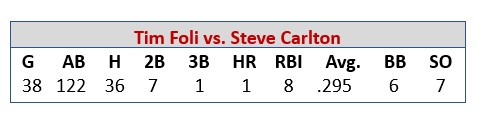


Whiffing Your Way into the Record Books – Fifty Years Ago Today

On this date (July 9), fifty years ago, the California Angels were in Oakland to take on the A’s.  It didn’t seem like much of a matchup.  The A’s were 55-29 in first place in the AL West, while the Angels were in fourth place, nine games under .500 (40-49) and 17 ½ games out.  Further, the A’s were starting ace Vida Blue 17-3, 1.51 at the time, while the Angels starter was Rudy May at 4-5, 3.24. Side note:  The 21-year-old Blue was on his way to a 24-8, 1.82 season that would earn him the AL Cy Young and MVP Awards.  The 26-year-old May would end the season 11-12, 3.02.

It proved, however, to be a very competitive matchup – going just over five hours (20 innings) and ending in a 1-0 score. Ironically the Angels lost to the A’s on a walk-off, run-scoring single by a player named Angel (A’s rookie RF Angel Mangual). In the process:

  • The two teams fanned a total of  43 times, at the time the MLB record for combined whiffs in a game (since broken) – and still the American League record. (On May 7, 2017, the Yankees and Cubs fanned a combined 48 times.)
  • Angels’ batters  whiffed 26 times – still a single-game, single-team record, but since tied by the: Yankees (vs. White Sox – May 7, 2017); Dodgers (vs. Brewers – June 2, 2017); and Mets (vs. Braves – August 8, 2019).
  • Career MLB strikeout leader Reggie Jackson started for the A’s, but did not strikeout in four plate appearances (one walk).
  • Twenty different batters struck out during the game (nine for the Angels, 11 for the A’s); 12 of those 20 struck out more than once.
  • The number-three and number-four Angels’ hitters accounted for just over  one-quarter of all the strikeouts: LF Billy Cowan, batting third, went 0-for-8, with six strikeouts and RF Tony Conigliaro, batting cleanup, went 0-for-8 with five strikeouts.
  • There were 18 hits in the contest – 17 singles and one double (Angels’ catcher Jerry Moses).
  • The hitting “star” of the game was the A’s Angel Mangual, not only did he drive in the winning run, he had three hits and a walk in nine plate appearance and did not strikeout. (The only other player to play the full game and not fan at least once was A’s 3B Sal Bando – four walks in four plate appearances).
  • 36 players were used: 20 by the A’s; 16 by the Angels.
  • A couple of A’s pitchers with good nicknames appeared, but not on the mound. Blue Moon Odom was used as a pinch runner and Catfish Hunter as a pinch hitter.
  • Tony LaRussa came into the game for the A’s at SS in the tenth, struck out in his only at bat (to end the 12th) and was lifted for a pinch hitter with the bases loaded and two out in the 14th.

In the game, Vida Blue threw 11 scoreless frames (seven hits, no walks, 17 strikeouts; while May went 12 innings (just three hits, six walks and 13 strikeouts). Rollie Fingers pitched seven innings in relief (zero runs, two hits, one walk, seven strikeouts). The win went to Darold Knowles, the loss to Mel Queen.

Twenty Strikeouts by One Team in a Nine-Inning Game.

The record for strikeouts by a team in a nine-inning game is twenty and it’s been done six times. Five of those were AL teams and one was an NL squad (and the NL team that fanned twenty times  has since moved to the AL).  Notably, in four of those games the starting pitcher went the distance.

In the four nine-inning games in which a single pitcher recorded 20 strikeouts – not a single walk was issued.

Side note: On May, 2001, Randy Johnson of the Diamondbacks fanned 20 batters  (no walks) over nine innings, but left the game with the scored tied 1-1.  The Diamondbacks eventually won 4-3 in 11 innings, with five D-backs’ relievers fanning only more batter over two innings. 

Primary Resources:  Baseball-Reference.com; Baseball-Almanac.com; NationalPastime.com


100Baseball Roundtable is on the Feedspot list of the Top 100 Baseball Blogs.  To see the full list, click here.

I tweet baseball @DavidBaseballRT

Follow/Like Baseball Roundtable’s Facebook Page here.  More baseball commentary; blog post notifications; PRIZES.

Member: Society for American Baseball Research (SABR); The Baseball Reliquary; The Negro Leagues Baseball Museum.
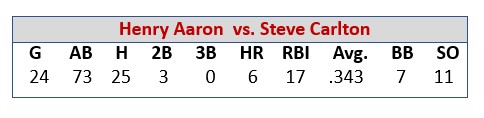


A Four-Time All Star’s Lost Weekend in San Francisco

Baseball Roundtable is drawn, at times, to unusual MLB events and box scores – the kind of things  you just don’t expect to see.  This post is about one of those times.

On this date (July 6) in 1958, Cardinals’ right-hander Larry Jackson (who would be a four-time All Star in his 14-season MLB career) put the finishing touches on what had to be a “lost” weekend in San Francisco. Here’s now it went down.

First, the Cardinals faced off against the Giants in a pair of games – Saturday, July 5 and Sunday July 6 – and would lose both by 5-4 scores in walk-off fashion.  However, there was no walk-off hit, but rather a walk-off walk and a walk-off hit by pitch, with Jackson being the victim in both games.  In fact, Jackson, coming on in relief, pitched a total of one inning and   retired just three of  11 batters he faced –  giving up two hits, five walks and one hit batter and getting charged with two losses.  (But it wasn’t all hit fault.)

Here’s how it went.

On July 5, Jackson was called to the mound in the bottom of the ninth with  the Cardinals ahead 4-3, one out and a runner (Willie Mays)  on first.  The first hitter to face Jackson was 3B Ray Jablonski, who tripled to RF scoring Mays with the tying run. Remember I said, it wasn’t all Jackson’s fault.  Jackson was then told to intentionally walk SS Daryl Spencer and LF Leon Wagner – loading the  bases (and setting up a double-play possibility.)  He then got C Bob Schmidt on a foul pop out. Next was pinch-hitter Willie Kirkland, who walked – bringing in the winning run and giving Jackson his first loss of the weekend.

Jackson got the call in the ninth inning again on Sunday, July 6, this time starting the inning – with the game knotted at 4-4. He got C Valmy Thomas on a grounder to second, then walked P Al Worthington and gave up a single to 1B Whitey Lockman – putting runners on first and second. He got the previous day’s hero – Willie Kirkland (in RF in this game) – to ground into a force at second, leaving runners on first and third with two out. CF Willie Mays was next up – and was gifted an intentional walk, loading the sacks.  Jackson then hit 3B Larry Davenport with a pitch – giving the Giants another 5-4 walk-off win and Jackson another loss.

One of the things that made this pair of box score interesting to me is that those July 5 and 6 games with the Giants last two before the All Star Game – and Jackson’s next appearance would come on July 8, when he relieved Bob Friend in the bottom of the sixth in the All Star Game and with runners on first and second, one out and Gil McDougald at the plate.  Jackson got McDougald to hit into an inning-ending double play – and was pinch hit for (by Johnny Logan) in the top of the seventh.  Note: Jackson came into that weekend in San Francisco with a 5-4, 3.40 record and eight saves in nine opportunities.

Jackson didn’t pitch after the All Star break until July 13, when he relieved in both ends of a doubleheader (Pittsburgh at St. Louis). In the first game of the twin bill, he took a third consecutive regular-season loss.  This time he came on in the bottom of the fifth with two outs, the bases loaded and the Cardinals ahead 5-1.  In that contest, Jackson faced four batters and gave up four singles (five runs scoring, two charged to Jackson). So, in three regular-season games, Jackson had now faced 15 batters, retiring just three and giving up six hits, five walks and one hit batsman (and, again, in the middle had pitched in the All Star Game). The Cardinals went right back to Jackson in the top of the ninth inning of Game Two – bringing him in with the Pirates leading 8-6. He righted his ship, pitching a scoreless frame, with one hit and one strikeout.

By the way, that lost weekend in San Francisco was not an indication of Jackson’s career.  As noted, that season, he was an All Star selection and went  13-13, 3.68 with eight saves (23 starts and 26 relief appearances). He pitched 14 MLB seasons, going 194-183, 3.40. He  was an All Star four times and won 15 or more games in six seasons – going 24-11, 3.14 in 1964 (leading the NL in wins and finishing second in the Cy Young Award voting. All that makes that weekend in SF so much more unexpected.

Primary Resource:  Baseball-Reference.com; NationalPastime.com

_____

100Baseball Roundtable is on the Feedspot list of the Top 100 Baseball Blogs.  To see the full list, click here.

I tweet baseball @DavidBaseballRT

Follow/Like Baseball Roundtable’s Facebook Page here.  More baseball commentary; blog post notifications; PRIZES.

Member: Society for American Baseball Research (SABR); The Baseball Reliquary; The Negro Leagues Baseball Museum.
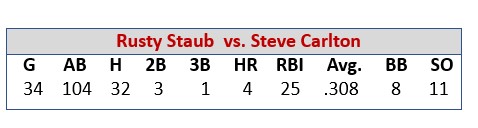
 

Rube Marquard and the (possibly) Unlucky Opal

RUBE MARQUARD.   Photo: Bain News Service, publisher, Public domain, via Wikimedia Commons

On this date (June 3) in 1912, New York Giants’ southpaw Rube Marquard ran his 1912 season record to 19-0, with a complete game 2-1 win over the rival Brooklyn Dodgers (at the Polo Grounds). In nine frames, Marquard gave up nine hits and one run (unearned), walked five and fanned three.  Marquard’s nineteen wins (before a loss) to start a season remains the MLB record.

Marquard, coming off a 24-7, 2.50 season in 2011 had (grasp of the obvious here) been dominant through July 3, winning all 18 of his starts (16 complete games) and picking up one win in relief. In those 18 starts, he had given up a total of 40 runs (29 earned). Marquard was particularly tough in May, going 7-0, with a 0.73 earned run average and six complete games in seven starts.  In his non-complete start, he went seven shutout innings (six hits, one walk, nine strikeouts) and left with an 11-0 lead. During his streak, Marquard earned at least two wins versus every National League team (except the Giants, of course). Things didn’t get any easier as the streak went on. The 19 wins included five one-run victories – all coming in the final seven games of the streak.

Hmm?  Legend or reality?  Legend has it that Marquard bought himself a fancy opal stickpin to celebrate after his nineteenth win – and that, when  a friend told him opals were a jinx, he threw the pin away. Whether the story is true (or not), Marquard did take a loss in each of his next three appearances (two starts) and, in fact, went 7-11 for the remainder of the season.  He still led the NL in wins with 26.

Side note  There are some well-known superstitions about opals– such as that white opals are bad luck, but black opals are lucky; if an opal is included in an engagement/wedding ring, the bride will soon become a widow; if diamonds are included in the setting, they negate the negative powers of the opal.

As the chart below shows, Marquard was “exceptional” by league standards through July 3 of the 2012 season – and then pitched slightly below NL season averages for the remainder of the campaign. He did pitch well in the 1912 World Series (which the Giants lost to the Red Sox 4-3-1). Marquard started and won Games Two and Six – picking a pair of complete games – giving up just one run.

Marquard, a Hall of Famer, pitched 18 MLB seasons (1908-25) – going 201-177, 3.08. He had three 20+ win seasons (1911-13) all for the Giants.  In that three -season span, he went 73-28, 2.52. He also led the NL in strikeouts once.

For those who like to know such things, the record for consecutive victories is 24 by Carl Hubbell (July 17, 1936 – May 27, 1937) –  a streak during which Hubbell made 27 appearances (22 starts), threw 19 complete games and put up a 1.82 ERA.

Primary Resource:  Baseball-Reference.com


Baseball Roundtable Disclaimer:  The MLB records referenced in this (and previous) posts have the potential to change as Major League Baseball recognizes and incorporates Negro League records from 1920-48 into the MLB record books.

_____________________________________________

100Baseball Roundtable is on the Feedspot list of the Top 100 Baseball Blogs.  To see the full list, click here.

I tweet baseball @DavidBaseballRT

Follow/Like Baseball Roundtable’s Facebook Page here.  More baseball commentary; blog post notifications; PRIZES.

Member: Society for American Baseball Research (SABR); The Baseball Reliquary; The Negro Leagues Baseball Museum.
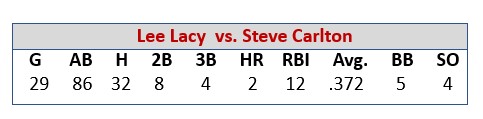
 

Baseball Roundtable June Wrap Up … Three-Homer Games, Triples Plays, a No-Hitter and more

It’s June 1, and that means it’s time for Baseball Roundtable’s s June Wrap Up – a look at:

  • June statistics and stories that caught BB Roundtable’s eye in the past month;
  • Leader boards for June and Year-to-Date:
  • BBRT’s Players and Pitchers of the Month;
  •  BBRT’s monthly Trot Index.

Here’s a hint at the kind of things you’ll read about – if you make it to the end of this post.

  • One MLB team playing .700+ ball in June (Brewers) and one playing .111 ball (Diamondbacks).
  • One qualifying batter topping .400 for the month – and one team hitting below .200 (Cubs).
  • One qualifying pitcher putting  up a June ERA under 0.75 – and three teams putting up ERA’s of 6.00 or higher.
  • An “Immaculate Inning.”
  • Four three-homer games.
  • Three triple plays.
  • A record-tying ten consecutive strikeouts.
  • A record-tying third career “cycle.”

So, let’s get started.

———–Baseball Roundtable Players and Pitchers of the Month … June 2021————

National League

Player of the Month …. Kyle Schwarber, LF, Nationals

Photo: All-Pro Reels from District of Columbia, USA, CC BY-SA 2.0 <https://creativecommons.org/licenses/by-sa/2.0>, via Wikimedia Commons

In June, Schwarber led all of MLB in home runs (16) and RBI (30), while putting  up a .280 average and scoring 22 runs. Schwarber came into June hitting just .230, with nine home runs and 23 RBI. In fact, as of June 11 (after 51 games), his stat line was .218-9-26.  From June 12 to the end of the month (19 games), he raked at a .329 pace, with those 16 home runs and 27 RBI. His hot streak included five multi-homer contests, including a three-homer game on June 20.  The Nationals went 15-4 during the Schwarber surge. From June 19 through June 30, he hit 12 home ruins and drove in 19 tallies in a dozen games.

Honorable Mention(s): Braves’ 2B Ozzie Albies hit .327 in June, with six home runs and 29 RBI (second in MLB to Schwarber’s 30). His 36 hits were third in the NL, as were his ten doubles.  For good measure, he tossed in eight steals. Pirates’ CF Bryan Reynolds hit .376 for the month (best among NL qualifiers), was fourth in the NL in hits (35) popped seven home runs, His 22 RBI trailed only Schwarber and Ozzie Albies (29) in the NL.

In June, 57 percent of Kyle Schwarber’s hits were home runs (28 hits.16 homers). Surprisingly, Schwarber did not have a single double or triple). See what I did there – single, double triple?

Pitcher of the Month … Jacob deGrom, RHP, Mets

Photo: David from Washington, DC, CC BY 2.0 <https://creativecommons.org/licenses/by/2.0>, via Wikimedia Commons

Another easy pick, Jacob deGrom was lights outs in June – going 3-0 in five starts, with a minuscule 0.67 ERA, a 0.44 WHIP and an opponent’s average against of 0.90 – all MLB’s best among qualifying pitchers for the month. He also fanned 40 batters in 27 innings, while walking just four. In his first two starts of the month, deGrom fanned 23 batters and walked just one in 13 frames.  Oh, and let’s not forget, deGrom hit .333 for the month (three-for-nine, with three RBI) – which was a bit of a slump for him. He was averaging .450 (9-for-20) going into June.

Honorable Mention: The Cubs’ Kyle Hendricks and Dodgers’ Walker Buehler deserve recognition  after being Junes’ only five-game winners. Hendricks was 5-0, 2.97 in six starts; while Buehler was 5-1, 1.85.


_____________________________________________________________

American League

Photo: All-Pro Reels from District of Columbia, USA, CC BY-SA 2.0 <https://creativecommons.org/licenses/by-sa/2.0>, via Wikimedia Commons

Player of the Month – Vlad Guerrero, Jr., 1B, Blue Jays

Vlad Guerrero, Jr.  hit .371 for the month, bashed ten homers (second only to Shohei Ohtani in the AL ), drove in 24 runs (third in the AL), and scored 24 runs (tied for first in the AL). From June 11-14, Guerrero homed in four straight games – driving in eight runs against Toronto’s division rival Red Sox. In June, Guerrero had ten multi-hit games. Just 23 and already in his third season, he ended the month leading MLB (ytd) in  RBI and  was second in the AL in home runs and average.  Could a Triple Crown chase be in the works?

Honorable Mentions(s). This was no easy call. Guerrero’s competition included the Angels’ Shohie Ohtani, who hit .309, with an AL-leading 13 June homers, along with 23 RBI and 20 runs scored (and started five games on the mound, going 2-0, 4.94, with 33 strikeouts in 23 2/3 innings).   Then there were the:  Astros’ LF Michael Brantley, who hit .410 for the month (one homer, 15 RBI); Orioles’ CF Cedric Mullins, .380 in June, with eight homers, 16 RBI and seven steals;  Royals’ 2B Whit Merrifield, who had an MLB-high 40 hits in 27 games (.351-4-17, with seven steals); and Tigers’ 1B Jonathon Schoop (.340-10-27). All deserving candidates.

_________________________________________________________

Pitcher of the Month – Sean Manaea, LHP, A’s

DR. Buddie, CC BY-SA 4.0 <https://creativecommons.org/licenses/by-sa/4.0>, via Wikimedia Commons

Despite a 3-2 record, Manaea had an exceptional June, putting up a 1.13 ERA (lowest among AL qualifiers), a 0.97 WHIP (second-best in the AL) and fanning 34 batters in 32 innings – while holding opponents to a .181 average (lowest in the AL among qualifiers). In his two June losses, he gave up three earned runs in 11 1/3 innings, while fanning 18 batters.  He gave up more than one earned run in only one start. On June 3, he tossed a complete-game shutout against the Mariners (four hits, two walks, eight strikeouts). He ended June leading the AL (ytd) in complete games with two – both shutouts.

Honorable Mention(s): Robbie Ray went 4-1, 2.86 in six June starts for the Blue Jays – fanning 53 (best in MLB) and walking just nine in 34 2/3 innings. The Astros’ Framber Valdez went  4-1 in June, with a 2.10 earned run average and 31 strikeouts in 34 1/3 innings He walked only seven batters and fashioned a 0.99 WHIP. Chris Bassitt of the A’s also deserved consideration with a June line of 4-0, 2.70, with 35 strikeouts in 36 2/3 frames. Manaea gets the edge with that 1.13 ERA and 0.97 WHIP.

_________________________________________________

Surprise Player of the Month – Raimel Tapia, LF, Rockies

Tapia hit .356 for the month, leading the NL with 37 safeties, 15 doubles and 26 runs scored – although he did not show home run power, with no homers and 12 RBI for the month. He also stole six bases in  tries and fanned only 15 times in 113 at bats. Signed as an international free agent back in 2010, Tapia has shown a solid bat (.319 in eight minor league seasons). In his first four looks at major-league pitching (2016-19), he hit .274 in 255 games. Given a chance in the 2020 COVID season, he upped his game (.321 average in 51 games). Through May of 2021, he struggled a bit – .259-5-26 in 52 games, but he turned it around in June, raising his season average to .294.  He was always considered a strong prospect, but I was surprised to see him leading the NL in hits and MLB in doubles and runs scored for June.


____________________________________

TROT INDEX … A REGULAR BBRT FEATURE

Through June 2021, 37.1 percent of the MLB season’s 89,197 plate appearances ended in a trot (back to the dugout, around the bases, to first base). We’re talking about strikeouts, home runs, walks, hit by pitch and catcher’s interference – all outcomes that are, basically, devoid of action on the base paths or in the field. Here’s the breakout: strikeouts (23.9%); walks (8.9%); home runs (3.2%); HBP (1.2%); catcher’s interference (less than 1%). Personally, I’d like more action in the field of play.

The 37.1 percent figure compares with 2020’s (full season) 37.3 percent;  2019’s (full season) 36.2 percent and 2018’s 34.8 percent Trot Index.  

__________________________________

Three teams won 19 games in June (Nationals, Astros and Brewers). A few comments on those teams in a bit, but of more interest is the Diamondbacks, who managed just three wins (against 24 losses) in June.  Pitching seems to have been the biggest culprit, as the Diamondbacks were one of three teams with  June ERAs of 6.00 or higher. Then again, only two teams scored fewer runs in June than the Diamondbacks, so there is plenty of “credit” to go around.  The Diamondbacks suffered through a 17-game losing streak from June 2 to June 20 – and ended the month on an active four-game loss string.

The Brewers were the only team to play .700 ball for the month – and were led by an offense that scored the most June runs in the NL.  They did it primarily with power (hitting and pitching). Their 39 home runs  were fourth in the NL and staff’s 286 strikeouts first, while their .233 team average was ninth and their team ERA fifth.  Surprisingly, the key offensive contributor may have been SS Willy Adames (.265-5-19), who led the team in June home runs an RBI. (The Brewers had five players with five June homers.) Relievers carried the day pretty often for the Brew Crew. Of the four Brewers with at least three wins in June, three were relievers.

The Astros finished at 19-9 for the month, despite closing June on an active four-game losing streak. As a team, they led the MLB in June runs scored, were third in home runs and first in average, on-base percentage and slugging percentage. They also notched the third-lowest ERA (best in the AL).  LF Michael Brantley hit .410 for the month – and the Astros had five qualifying players hit .330 or better. Starters Framber Valdez, Zack Greinke and Luis Garcia made 16 starts and went 10-3, with a combined 2.92 ERA.

The Red Sox built their 19 wins on the AL’s fourth-best batting average and runs scored (ninth in home runs) and sixth-best ERA. Like the Brewers, they brought the heat on the mound – with their staff leasing the AL in strikeouts. A pair of relievers made key contributions. Hirokazu Sawamura went 3-0, 2.25 in 12 appearances (fanning 14 in 12 innings) and Garrett Whitlock went 3-0 0.66 in nine appearances, fanning 15 in 13 innings. Closer Matt Barnes chipped in two wins and six saves. On offense, 3B Rafael Devers, RF Hunter Renfroe, SS Xander Bogaerts and LF J.D. Martinez all had at least fifteen June RBI.

——Team Statistical Leaders For  June———-

RUNS SCORED

National League – Brewers  (147); Reds (137); Nationals (131)

American League – Astros (170); Angels (154); Blue Jays (142)

No one scored fewer runs in June than the Cardinals, who had just 86 runners safely touch home plate. 

AVERAGE

National League – Rockies  (.267); Giants (.259); Nationals (.257)

American League – Astros (.294); Blue Jays (.282); Angels (.270)

The lowest June  team average belonged to the Cubs – well below the Mendoza Lines at .188. The Rays had the lowest June average in the AL at .228.  The Cubs, notably, were second  in the NL in June home runs (40), Nearly one of four (24.5%) of the Cubs’ June hits left the park. 

HOME RUNS

National League – Padres (43); Cubs (40); Nationals (40)

American League –  Yankees (44); Angels (44); Astros (43); Twins (43)

The Diamondbacks  had the fewest June  home runs at 17. The only other teams with less than 20 homers for the month was the Cardinals (19). .

STOLEN BASES

National League –  Braves (22); Marlins (19); Padres (15); Rockies (15); Nationals (15)

American League – Tigers (24); Rays (23); Royals (14); Mariners (14)

The Diamondbacks  stole the fewest bases in June – just four (in eight attempts).

WALKS DRAWN

National League –   Brewers (118); Dodgers (111); Braves (108)

American League – Astros (126); Yankees (113); Rays (102)

The Astros led MLB in on-base percentage in June at .378, as well as in slugging percentage at .488.

BATTER’S STRIKEOUTS

National League – Cubs (283); Mets (265; Braves (261)

American League – Mariners (275); Rays (253); Tigers  (250)

EARNED RUN AVERAGE

National League –  Giants (3.04); Dodgers (3.17); Nationals (3.40)

American League – Astros (3.34);  A’s  (3.55); Rays (3.,88)

Three teams had ERA’s of 6.00 or higher June: Royals (6.00); Diamondbacks (6.10); Orioles (6.38). 

STRIKEOUTS

National League – Brewers (287); Reds (273); Dodgers (272)

American League – Red Sox (258); Angels (251); Rays (50)

The Dodgers had the highest strikeouts per nine innings in June  at 10.78. The White Sox led the AL at 10.09.  Fourteen  teams averaged at least a strikeout per inning for the month.

SAVES

National League – Nationals (12); Dodgers (10); Brewers (10)

American League – Red  Sox (10); White  Sox (9); three with seven

 As you might expect, the Diamondbacks, who won only three games in June, had the fewest saves for the month.  That would be zero, with only two save opportunities.

——————————June Highlights—————————-

A Complete Game for the Rays? No Way!

On June 3, Ryan Yarbrough started against the Yankees in New York.  Was anyone expecting a complete game?  Hardly. It was the 32nd start of Yarbrough’s four-season MLB career and he had yet to toss a complete game.  Further, the Rays were not known for letting pitchers go the distance.  Their last complete game had come on May 14, 2016 –five seasons and  731 games ago. Yarbrough, however, went the full nine, as the Rays pounded the Bronx Bombers 9-2. He tossed 113 pitches (74 strikes), gave up two runs on six hits (no walks) and fanned six.  His mound opponent, by the way, was none other than Yankee ace Gerrit Cole. Yarbrough ended June 4-3, 4.48 on the season.  The June 3 game was Yarbrough’s first win as a starting pitcher since August 11, 2019.

Immaculate As Can Be

On June 4, Yankee starter Michael King got off to a rocky start giving up a three-run home run to the Red Sox’ Rafael Devers in the top of the first inning. He then settled down and pitched a scoreless second and third frame, before pitching an immaculate inning (three strikeouts on nine pitches) in the fourth. In that inning, he got Red Sox’ RF Hunter Renfroe on swinging on a sinker; 1B Marwin Gonzales on  curve ball; and C Christian Vazquez on  another curve. Despite that sparkling inning, King took the loss (the Yankees fell 5-2), going 5 1/3 innings and giving up six hits and four runs (no walks, five strikeouts). At the end of June, King was 0-4, 4.06.

Going Four-for-Three … Not that Easy

In June, four players had three-homer games – bringing the season total of three-homer contests to nine.

On June 6, the Reds’ LF Jesse Winker popped three home runs in four at bats, driving in six runs as the Reds topped the Cardinals 8-7 in St. Louis.  It was Winker’s second three-homer games of the season. He finished June with a .325-19-48 line on the season – and one shy of Sammy Sosa’s 2001 record of three three-homer games in a season (for the Cubs).

On June 19,  Orioles ‘rookie (although he did play 35 games for the O’s in 2020) Ryan Mountcastle went 4-4 with three home runs as the Orioles  lost to the Blue Jays 10-7 at home.  Mountcastle ended June with a stat line of .263-14-47 on the season. The three-homer game was just Mountcastle’s second multi-homer MLB contest.

On June 20, the Nationals’ Kyle Schwarber (see the NL Player of the Month)  went three-for-four with three home runs and four RBI, as the Nationals topped the Mets 5-2 in Washington D.C.  It was one of five multi-homer games in June for Schwarber. As of June 30, his 2021 stat line was .249-25-53.  Schwarber has had 12 to-homer games.

On June 25, Fernando Tatis Jr., went four-for-five, with three home runs, four runs scored and three RBI – as the Padres topped the Diamondback 11-5 in San Diego.  As the end of June, Tatis stat line for 2021 was .300-26-56.  Tatis was is the tenth-youngest player to log a three-homer game.

Three-for-Three – Triple Plays that Is

June saw a trio of triple plays in major-league baseball – two by the Yankees.

On June 6, the Minnesota Twins escaped the Royals 2-1 – and needed the help of a third-inning triple play to do it. Twins’ rookie Brady Ober was on the mound, with a 1-0 lead, when the Royals’ CF Jarrod Dyson led off the inning with a single to right. C Cam Gallagher followed with another one-bagger, sending Dyson to second. Next up was SS Nicky Lopez, who tried to bunt the runners along – only to have his bunt caught on the fly by Twins’ 1B Miguel Sano (charging in toward the plate). With the runners moving, Sano tossed to SS Andrelton Simmons to double off Dyson, who then threw to second baseman Nick Gordon (who had moved to cover first as Sano charged the bunt attempt) to retire Gallagher for the final out.

On June 17, in an 8-4 win over the Blue Jays in Toronto, the Yankees turned an unusual triple play– going pitcher  to first base to shortstop to catcher to third base to shortstop. It happened in the bottom of the first inning, like this:

  1. Blue Jays’ 2B Marcus Semien opened the inning by drawing a five-pitch walk.
  2. SS Bo Bichette followed with a single.
  3. A Michael King wild pitch moved the runners up to second and third.
  4. DH Vlad Guerrero, Jr. tapped back to the Yankee pitcher (King), who threw to first baseman D.J. LeMahieu for the first out.
  5. LeMahieu then threw to shortstop Gleyber Torres covering second, with both runners trapped off base.
  6. Torres threw to catcher Gary Sanchez, who then threw to third baseman Gio Urshela – who tagged Semien between third and home.
  7. In the meantime, Bichette was trying for third and Torres was moving over to cover the bag.
  8. Urshela threw to Torres, who tagged a sliding Bichette for the third out.

https://youtu.be/XxflvIEbhzk

On June 20, the Yankees turned their second triple play of June – and third of the season – and it was a game-ender and game-saver. It came in the top of the ninth with the Yankees holding on to a 2-1 lead over the A’s in New York – and it was a bit more traditional than the play on the 17th. Yankee closer Aroldis Chapman came on to open the ninth and walked A’s 2B Jed L0wrie and LF Tony Kemp on nine pitches.  Chapman fell behind C Sean Murphy 1-0 (and, at that time had thrown only one strike in ten pitches) and then  Murphy hit a sharp grounder to Gio Urshela at third base. Urshela tagged the bag for out number-one and relayed the ball to DJ LeMahieu covering second (for out number-two), who made the throw to Chris Gitten at first for the final out of the 2-1 victory.

Collecting Number 1,000

On June 14, Oakland DH Mitch Moreland rapped a one-out single to left on a 2-2 pitch from the Angels’ Sean Manaea in the  bottom of the second inning and came around to score on a Juan Lagares home run.  The hit gave the A’s a 2-1 lead in a game they would win 8-5. The hit was also the 1,000th safety of Moreland’s 12-season MLB career. Moreland didn’t stay on 1,000 for long,  In  the very next inning, he rapped a two-run single through the infield for number 1.001. Moreland is in his 12th MLB season – and ended June with a .252-182-610 stat line – and 1,0004 hits.

Astros Flying High – and So Is The Baseball

On June 17, as the Astros topped the White Sox 10-2 in Houston, 2B Jose Altuve, LF Michael Brantley and 3B Abraham Toro all went deep.  It marked an MLB record-tying ten consecutive multi-homer games for the Houston squad.  (The following night the White Sox held the Astros to five hits and no long balls in a 2-1 Astros’ win). During the streak, the Astros hit 26 home runs and won eight of ten games, outscoring their opponents 75-40.  The home runs were hit by:

  • Joe Altuve – 8 HR
  • Chas McCormick – 4
  • Carlos Correa – 2
  • Kyle Tucker – 2
  • Yordan Alvarez – 2
  • Yuli Gurriel – 2
  • Alex Bregman – 1
  • Myles Straw -1
  • Abraham Toro – 1
  • Michael Brantley – 1
  • Martin Maldonado – 1
  • Robel Garcia – 1

History in the Making

Angels’ Pitcher/Designated Hitter Shohei Ohtani seems to be making “making history” a personal trademark. He did it again when he started on the mound against the Giants on June 23 and also batted in the number-two spot in the order,  in another example of “In baseball we count everything,” it marked the first time in an MLB game that an American League team chose not to employ a DH, while a National League team used on. Ohtani got no decision after pitching six one=run innings (six, hits, two walks, nine strikeouts) and went zero-for-three at the plate.

Let’s Get This Party Started

Number-one prospect Wander Franco made his long-awaited MLB debut at 3B for  the Rays on June 22 (if anything can be long awaited when you are just 20-years-old).  Franco showed his “stuff” in the game. Franco went two-for-three (including a double, three-run home run and a walk) and contributed a web gem in the field. Wander made it to the majors after 214 minor league games – during which he hit .332-27-145, with 27 steals.  He is still adjusting to major-league pitching, hitting just .194 in eight June games.

Hold the Fireworks

Om June 23, the Angels were down 2-1 to the Giants  in the bottom of the twelfth inning (n Anaheim), when the “placed” runner (SS Jose Iglesias), moved to third on a (LF) Griffin Cannon bunt and scored on a CF Juan Lagares’ single (tying the game at two).  Lagares then went to third on a single 2B David Fletcher and dashed home on a grounder to 1B by RF Luis Rengifo.  Shortly after  Iglesias slid across the plate, fireworks filled the sky and “Angels Win”  flashed brightly across the video boards. Oops! A review of the play showed that Giants’ C Buster Posey had put the tag on Lagares before he crossed the plate.  Back to your seats everyone. Angels’ P Dylan Bundy fanned to end the inning – and the game went on.

The Giant added insult to injury by plating seven runs in the top of the thirteenth and “coasting” to a 9-3 win.

Redemption

On June 23, Giants’ LF Michael Tauchman came very close to etching his way into the MLB records. He fell just a bit short, but he probably considered that a sort of redemption.  Here’s how his day went – as the Giants topped the Rangers 9-3 in 13 innings:

  • Second Inning – Strikeout looking on a 3-2 pitch.
  • Fifth inning, strikeout swinging on a 2-2 pitch.
  • Seventh Innings – (Things go a little worse) – Strikeout swinging on three pitches.
  • Ninth Inning – Strikeout swinging on three pitches.
  • Eleventh Inning – Strikeout swinging on a 1-2 pitch.

When Tauchman came up again with two outs and two on in the 13th inning, he was just one whiff from tying the MLB record for strikeouts by a batter in a game (of any length). Further, a whiff would give him a six-strikeout game in the fewest innings of any batter ever.  Ultimately, he came within one strike of the record, but on a 2-2 pitch from reliever Junior Guerra, Tauchman launched a three-run homer to deep right-center. Tauchman, by the way, had come into the game hitting just .174, with 47 strikeouts in 167 plate appearances (57 games).

No, No! Not Another N0-NO

On June 24, when the Chicago Cubs no-hit the Dodgers 4-0 in Los Angeles,  it marked  the seventh no-hitter of the 2021 season, tying the modern era (since 1900) single-season record for no-hit games. Note:  There were seven no hitters thrown in 1990, 1991, 2012 and 2015 – and eight in 1884.   It was also this season’s first combined no-hitter, with Zach Davies starting  for the Cubs and going six innings, followed by Ryan Tepera (one inning); Andrew Chafin (one inning); and closer Craig Kimbrel (one inning). For more on this game, and other combined no hitter, click here.

Whiff N’Poof

On June 25, in the first game of a doubleheader against the Mets in New York, Phillies’ right-hander Aaron Nola did something that Walter Johnson, Nolan Ryan, Sandy Koufax, Bob Feller and more never  did.  In fact, he did something that has only been done once on an MLB field – and that was back in 1970 by Hall of Famer Tom Seaver. Nola fanned ten consecutive  hitters in an MLB game, starting with the third batter in the first inning and stretching to the second batter in the fourth.  Notably, the first two Mets’ hitters of the contest gave no indication that Nola was about to start on his historic streak. Mets’ leadoff hitter 2B Jeff McNeil was hit by Nola’s second pitch of the game and two pitches later SS Francisco Lind0r lined a double to left (McNeil going to third).  Then this sequence of outcomes occurred:

  • RF Michael Conforto, strikeout swinging on a 1-2 curve.
  • 1B Pete Alonso, strikeout swinging on a 2-2 curve.
  • LF Dominic Smith, strikeout looking on an 0-2 sinker.
  • C James McCann, strikeout looking on a 1-2 sinker.
  • CF Kevin Pillar, strikeout swinging on a 1-2 change up.
  • 3B Luis Guiillorme, strikeout swinging on a 3-2 curve.
  • P Taijuan Walker, strikeout looking on a 3-2 fastball.
  • 2B McNeil, strikeout swinging on a 1-2 sinker.
  • SS Francisco Lindor, strikeout swinging on an 0-2 curve.
  • Conforto, strikeout swinging on a 2-2 change up.
  • Alonso breaks the streak with a double to left.

Overall, Nola used 46 pitched to log his ten strikeouts.  Only two players pushed him to six pitches in their at bats: number-eight hitter 3B Luis Guillorme and number-nine hitter P Taijuan Walker.

Nola, by the way, went 5 1/3 innings, giving up two hits and no runs, while walking 1 and fanning 12. He left with a 1-0 lead, but got no decision as the Mets won 2-1 in eight.

What Took You So Long?

On June 26, the Diamondbacks topped the Padres 10-1 in San Diego.  It was their first win on the road in more than two months (since April 25) and ended their MLB record 24-game road losing streak.

A Sticky Situation

On June 27, Mariner’s southpaw Hector Santiago became the first pitcher ejected  (and have his glove confiscated) for the use of an illegal, grip-enhancing substance since MLB instituted mandatory umpire checks for the dreaded sticky substances. Santiago has since received a ten-game suspension, which he said he will appeal.

Baseball Roundtable Extra – Happy Birthday to Me

On June 29, Jose Miranda, just called up from Class AA Wichita to the Twins’ AAA squad in Saint Paul, started his first Triple A game – on his 23rd birthday.  Miranda, who had been hitting .345, with 13 home runs and 38 RBI (47 games) at Wichita, certainly knew how to celebrate. In his first Triple A game, he went five-for-six, with three home runs, a double, four runs scored and six RBI – as the St. Paul Saints toppled the Omaha Storm Chasers 15-4 in St. Paul.  Happy Birthday Jose – and welcome to Triple A.

I get By with a Little Help from My Friends

On June 29, the Padres were taking on the Reds in Cincinnati, with Blake Snell slated to start on the bump for the Friars. Oops! Snell took ill and that opened the door to a true “bullpen game.” The Padres pretty much emptied the pen, using eight pitchers to defeat the Reds 5-4. No pitcher tossed more than two innings. Craig Stammen started (his first start since 2018) and went two frames.  Then Nick Ramirez came on for another two innings. Each gave  up three hits and one run. They were followed in succession by Nabil Crismatt (1/3 inning); Austin Adams (2/3 inning); Pierre Johnson (one inning); Drew Pomeranz (one inning); Emilio Pagan (one inning, for the win); and closer Mark Melancon (one inning, for the save.). Reds’ rookie starter Tony Santillan lasted just three frames  (six hits, two walks, three runs, two earned.)  He was followed by seven relievers – putting the game total of pitchers at sixteen.

Sixteen Pitchers … That’s Nothing!

On September 24, 2019, the Rockies topped the Giants 8-5 in sixteen innings (in San Francisco).  The two teams used a record 25 pitchers in the contest – 12 by the Rockies and 13 by the Giants (despite the fact that starter Madison Bumgarner went seven frames). This in contrast to the May 1 1920  26-inning game between the Brooklyn Robins (Dodgers) and Boston Braces, when both starters  (Leon Cadore, Brooklyn and Joe Oeschger, Boston) went the full 26 innings as the tam played to a 101 ties.

A Good Way to End the Month

On June 30, Nationals’ SS put an exclamation point on the month of June. He went four-for-four – with a single in the first inning,a double in the third, a home run in the fourth and a triple in the sixth.  In the process, he became just the fifth MLB player to hit for the cycle three times in their career.  The Nationals, by the way, won the contest 15-6.  As of June 30, Turner’s stat line was .318-14-38, with a league=leading 18 steals.

——-Individual Statistical Leaders for June ——-

AVERAGE (75 June  at bats minimum)

National League – Bryan Reynolds, Pirates (.376); Raimel Tapia, Rockies (.345); Trea Turner, Nationals (.345)

American League –  Michael Brantley, Astros (.410); Cedric Mullins, Orioles (.380); Nelson Cruz, Twins (.380)

HOME RUNS

National League – Kyle Schwarber, Nationals (16); Fernando Tatis, Jr,, Padres (10); Adam Duvall, Marlins (9)

American League –  Shohei Ohtani, Angels (13); Jonathan Schoop, Tigers (10); Jose Altuve, Astros (10); Vlad Guerrero, Blue Jays (10); Joey Gallo, Rangers (10)

The Rockies’ Raimel Tapia had the second-most at bats in June (113) and the second-most hits (39), but not a single home run (.345-0-12, with 26 runs scored and six steals for the month). 

RUNS BATTED IN

National League – Kyle Schwarber, Nationals (30); Ozzie Albies, Braves (29); Adam Duvall, Marlins (23)

American League – Jonathon Schoop, Tigers (27); Ryan Mountcastle, Orioles (26); Vlad Guerrero, Jr. , Blue Jays (24); Yordan Alvarez, Astros (24)

The Angels’ Shohei Ohtani had the highest slugging percentage (among players with at least 75 June at bats) at  .889. Kyle Schwarber of the Nats led the NL at .760.

HITS

National League – Raimel Tapia, Rockies (39);  Trea Turner, Nationals (39); Ozzie Albies, Braves (36)

American League – Whit Merrifield, Royals (40); Cedric Mullin, Orioles (38); J.P. Crawford, Mariners (38)

DOUBLES

National League –  Raimel Tapia, Rockies (15); Nick Castellanos, Res (12); Ronald Acuna, Jr. Braves (10); Ozzie Albies, Braves (10)

American League – Xander Bogaerts, Reds Sox (10); Elvis Andrus, A’s (10); J.P. Crawford, Mariners (10)

TRIPLES

National League – Sergio Alcantara (Cubs 3); many with two

American League –Luis Arreaz, Twins (3); many  with two

The Blue Jays’ Vlad Guerrero, Jr. led all batters (with at least 75 June at bats) in on-base percentage for the month at .465.

STOLEN BASES

National League –  Ronald Acuna, Jr. Braves (10): Starling Marte, Marlins (9); Ozzie Albies, Braves (8)

American League –Cedric Mullins, Orioles (7); Whit Merrifield, Royals (7); Myles Straw, Astros (6) .

Whit Merrifield and Cedric Mullins were each seven-for-seven in May steal attempts.

WALKS

National League – Christian Yelich, Brewers (25); Abraham Almonte (Braves 20); Jonathon India, Reds (19); Juan Soto, Nationals (19)

American League –  Jose Altuve, Astros (24); Joey Gallo, Rangers (23); Carlos Correa, Astros (19); Giancarlo Stanton, Yankees (19)

BATTER’S STRIKEOUTS

National League – Javier Baez, Cubs (37); Ronald Acuna, Jr. (36); Ryan McMahon, Rockies (36)

American League – Jared Walsh, Angels (40);Kyle Seager, Mariners (39); Bobby Dalbec, Red Sox (32)

PITCHING VICTORIES

National League – Kyle Hendricks, Cubs (5-0); Walker Buehler, Dodgers (5-1); Devon Williams, Brewers (4-1); German Marquez (4-1); Anthony DeSclafani, Giants (4-1); Dylan Cease, White Sox (4-2)

American League – Chris Bassitt, A’s (4-0); Framber Valdez, Astros (4-1); Robbie Ray, Blue Jays (4-1); Dylan Cease, White Sox (4-2)

The Diamondbacks Matt Peacock (0-5) and Cardinals’ Carlos Martinez (1-5) had the most June losses.

EARNED RUN AVERAGE (at least 25 innings pitched)

National League – Jacob deGrom, Mets (0.67); Zack Wheeler, Phillies (1.44); Anthony DeSclafani, Giants (1.69)

American League – Sean Manaea, A’s (1.13); Kyle Gibs0n, Rangers (1.52); Framber Valdez, Astros (2.10)

STRIKEOUTS

National League – Clayton Kershaw, Dodgers (47 / 32 IP); Aaron Nola, Phillies (42 / 30 IP); Tyler Mahle, Reds (41 / 29 IP); Trevor Bauer, Dodgers (41 / 31 1.3 IP)

American League – Robbie Ray, Blue Jays (53 / 34 2/3 IP); Nick Pivetta, Red Sox (40 / 31 2/3 IP); Dylan Cease, White Sox (37 / 30 1/3 IP)

SAVES

National League – Brad Hand, Nationals (10); Craig Kimbrel, Cubs (8); Kenley Jansen, Dodgers (8); Josh Hader, Brewers (8); Edwin Diaz, Mets (8); Mark Melancon, Padres (8)

American League: Liam Hendriks, White Sox (8):  Matt Barnes, Red Sox (6); Lou Trivino, A’s (6)

Brad Hand was 10-for-10 in save opportunities in June. 


____________________________________


If the season ended June 30, your playoff teams would be:

American: Red Sox, White Sox, Astros.  Wild Cards: -A’s, Rays

National: Mets, Brewers, Giants;  Wild Cards; Dodgers, Padres

——Team  Statistical Leaders through  June ——-

RUNS SCORED (average 355)

National League –  Dodgers (402); Reds (393); Giants (385)

American League – Astros (454); Red Sox (410); Blue Jays (403)

Four teams averaged five or more runs per game through June: Astros (5.60); Blue Jays (5.17); Red Sox (5.06); and Dodgers (5.03). The Pirates averaged the fewest runs per game through June at 3.51.

AVERAGE (average .239)

National League – Nationals (.252); Reds (.249); Rockies (.245)

American League – Astros (.276); Blue Jays (.266); Red Sox (.260)

The lowest team average through June belonged to the Brewers and Mariners  both  at .216).

HOME RUNS (average 94)

National League – Giants (116); Braves (114); Cubs (107)

American League –  Blue Jays (117); Twins (115); Angels (110)

The Pirates had the fewest home runs through June  at 59. No other team was under 71.

STOLEN BASES (average 36)

National League – Padres (74);  Marlins (51); Phillies (46)

American League – Rays (55); Royals (53); Tigers (50)

The Yankees stole the fewest sacks through June at 17 (in 21 attempts).

WALKS DRAWN (average 265)

National League – Dodgers (346); Padres (319); Brewers (303)

American League – Yankees (326); Rays (315); Astros (307)

The Astros  led MLB  in on-base percentage through  June at .351. The Dodgers led the NL at .336. In slugging percentage, the Blue Jays were also on top at .453, while the Giants  led the NL at .429.

BATTER’S STRIKEOUTS (average 702)

National League – Brewers (790); Cubs (787); Marlins (763)

American League – Rays (877); Tigers (799); Mariners (780))

Astros’ batters went down on strikes the fewest times through June (592).

EARNED RUN AVERAGE (average 4.16)

National League – Dodgers (3.19); Giants (3.21); Padres (3.24)

American League – White Sox (3.47); Rays (3.54); Astros (3.68)

Four teams had ERA’s through June at 5.00  or higher– Orioles (5.44); Diamondbacks (5.28); Angels (5.04); and Twins (5.00).  Side note: You don’t want to be a hitter in the NL West.  The three teams with the lowest ERA’s through June were the Dodgers, Giants and Padres.

STRIKEOUTS (average 690)

National League – Brewers (841); Padres (817); Dodgers (816)

American League – White Sox (776); Angels (775); Rays (767)

The Brewers  averaged an MLB-best 10.4 strikeouts per nine innings through June. The White Sox led the AL at 10.3.  Eighteen  teams average at least one whiff per inning.

FEWEST WALKS SURRENDERED (average 265)

National League – Giants (206); Mets (220); Marlins (235)

American League – A’s (220); Yankees (226); Rays (226)

The Giants’  2.4 walks per nine innings through June were MLB’s lowest.  The Cardinals staff walked an MLB-high 4.5 per nine frames through June.

SAVES (average 19)

National League – Padres (29); Giants (28); Dodgers (28)

American League – Red Sox (26); Rays (23); White Sox (23)

No staffs surrendered more home runs through June than the Orioles and Twins at 121. At the other end of the spectrum Marlins’ pitchers had given up an MLB-low 63 dingers. .


——-Individual Statistical Leaders through June 30———-


BATTING AVERAGE (qualifying players – 3.1 at plate appearance for each team game played)

National League – Nick Castellanos, Reds (.346); Adam Frazier, Pirates (.327); Jesse Winker, Reds (.325)

American League – Michael Brantley, Astros (340);  Vlad Guerrero, Jr. , Blue Jays (.339); Xander Bogaerts, Red Sox (.330)

The lowest average through June  (among qualifiers) belonged to the Brewers’ Jackie Bradley at .165 (33-for-231).

HOME RUNS

National League – Fernando Tatis, Jr., Padres (26); Kyle Schwarber, Nationals (25); Ronald Acuna, He. Braves (22)

American League –  Shohei Ohtani, Angels (28); Vlad Guerrero, Jr., Blue Jays (26); Adolis Garcia, Rangers (20): Matt Olson, A’s (20)

No player had more at bats without a long ball through June than Angels’ 2B David Fletcher – .288-0-24 in 292 at bats.

RUNS BATTED IN

National League – Ozzie Albies, Braves (56); Adam Duvall, Marlins (56); Fernando Tatis, Jr., Padres (56)

American League – Vlad Guerrero, Jr., Blue Jays (66); Rafael Devers, Red Sox (64); Shohei Ohtani, Angels (63)

The Padres Fernando Tatis, Jr.  had the highest slugging percentage (among qualifiers)) through  June  at .705.  The only other players at even .600+ were Angels’ Shohei Ohtani (.685); Blue Jays’ Vlad Guerrero, Jr. (.675); Reds’ Nick Castellanos (.607); and Braves ‘Ronald Acuna, Jr. (601)

HITS

National League – Nick Castellanos, Reds (102); Adam Frazier, Pirates (100); Trea Turner, Nationals  (100)

American League – Cedric Mullins, Orioles (99); Vlad Guerrero, Jr., Blue Jays (96); Xander Bogaerts,. Red Sox (94)

DOUBLES

National League –  Nick Castellanos, Reds (27): Nolan Arenado, Cardinals (24); Adam Frazier, Pirates (24)

American League – Xander Bogaerts, Red Sox (24); Rafael Devers, Red Sox (24); Michael Brantley, Astros (22); Cedric Mullins, Orioles (22)

The Angels’ Shohei Ohtani had the most extra-base hits through June (49). The Reds’ Nick Castellanos led the NL (44).

TRIPLES

National League – Ozzie Albies, Braves (5); Dave Peralta, D-backs (5); Garrett Hampson, Rockies (5)

American League –Luis Arraez, Twins (4); Akil Baddoo, Tigers (4); Mark Canha, A’s (4); Shohei Ohtani, Angels (4); Amed Rosario, Indians (4); Nick Madrigal, White Sox (4)

STOLEN BASES

National League –  Trea Turner, Nationals (18); Fernando Tatis, Jr., Padres (12); Ronald Acuna, Jr., Braves (16); Fernando Tatis, Jr., Padres (16)

American League –Whit Merrifield, Royals (22); Isiah Kiner-Falefa, Rangers (15); Cedric Mullins, Orioles (15)

The most stolen bases without being thrown out through June was 12  by the Blue Jays’ Bo Bichette.  MLB SB leader Whit Merrifield (Royals) was 22-for-23 in steal attempts.

WALKS

National League – Max Muncy, Dodgers (52); Freddie Freeman, Braves (48); Juan Soto, Nationals (48)

American League – Joey Gallo, Rangers (62); Yasmani Grandl, White Sox (59); Carlos Santana, Royals (52)

BATTER’S STRIKEOUTS

National League – Javier Baez, Cubs (107); Eugenio Suarez, Reds (99); Dansby Swanson, Braves (90)

American League – Matt Chapman, A’s (100); Joey Gallo, Rangers (98); Brandon Lowe, Rays (97)

Only one player in the top 25 in strikeouts has fewer than ten home runs through June. The Royals’ Michael Taylor has 84 whiffs (fifteenth in MLB) to go with a .237-7-29 line.

PITCHING VICTORIES

National League –Kyle Hendricks, Cubs (10-4); Julio Urias, Dodgers (9-3); Clayton Kershaw, Dodgers (9-7)

American League – Aaron Civale, Indians (10-2); Chris Bassitt, A’s (9-2); Zack Greinke,  Astros (8-2);  Gerrit Cole, Yankees (8-4); Nathan Eovaldi, Red Sox (8-4)

The Reds’ Luis Castillo (3-10, 5.14) and Orioles’ Jorge Lopez (2-10, 5.92) tied for had the most losses through June.

EARNED RUN AVERAGE (qualifying players … at least one inning pitch for each team game played)

National League – Jacob deGrom, Mets (0.69); Kevin Gausman, Giants (1.68); Brandon Woodruff, Brewers (1.87)

American League – Kyle Gibson, Rangers (2.00); Gerrit Cole, Yankees (2.66); Tyler Glasnow, Rays (2.66)

If you are looking for the likes of The White Sox‘ Lance Lynn or Carlos Rodon (both at 2.06), they are each 1/3 inning short of qualifying (78 2/3 IP, with the White Sox having played 79 games). The highest ERA among qualifiers through June belonged to the Royals’ Brad Keller (6-8, 6.67).

STRIKEOUTS

National League – Trevor Bauer, Dodgers (137 / 7107 2/3 IP); Zack Wheeler, Phillies (130  / 106 1/3);  Clayton Kershaw, Dodgers (124 / 102 1/3 IP)

American League – Shane Bieber, Indians (130 / 90 2/3 IP); Gerrit Cole, Yankees (129 / 101 2/3 IP); Tyler Glasnow, Rays (123 / 88 IP)

Among qualifying pitchers, the Metes’ Jacob deGrom had the best strikeouts/nine innings ratio through May at 14.08. Carlos Rodon of the White Sox r led the AL at 12.93.

Among qualifying pitchers,  deGrom also had the best strikeouts-to-walks ratio at 11.09. No other qualifiers even reached 8.0.  deGrom also led in strikeout per nine innings at 14.08, with no other qualifier reaching 13.

SAVES

National League – Mark Melancon, Padres (25); Craig Kimbrel, Cubs (20);  Josh Hader, Brewers (20); Kenley Jansen, Dodgers (20); Alex Reyes, Cardinals (20)

American League: Liam Hendriks, White Sox (21):  Matt Barnes, Red Sox (18);  Aroldis Chapman, Yankees (16)

The Brewers’ Josh Hader  has the most saves of any pitcher without a blown save (20 saves in 20 opportunities).

Primary Resources:  MLB.com; Baseball-Reference.com


Baseball Roundtable Disclaimer:  The MLB records referenced in this (and previous) posts have the potential to change as Major League Baseball recognizes and incorporates Negro League records from 1920-46 into the MLB record book.

_____________________________________________

100Baseball Roundtable is on the Feedspot list of the Top 100 Baseball Blogs.  To see the full list, click here.

I tweet baseball @DavidBaseballRT

Follow/Like Baseball Roundtable’s Facebook Page here.  More baseball commentary; blog post notifications; PRIZES.

Member: Society for American Baseball Research (SABR); The Baseball Reliquary; The Negro Leagues Baseball Museum.