The inspiration for this post – looking at some of MLB’s lost records – is Hugh “Losing Pitcher” Mulcahy. Here’s why.
 Mulcahy “enjoyed” a nine-season major league career (1935-47, minus five WWII years), primarily for the Phillies. He was given the unfortunate nickname “Losing Pitcher” by Philadelphia sportswriters for the frequency “LP” appeared beside his name in box score. That moniker (as you will see as you read on) was overly critical. Still, Mulcahy ran up a career record of 45-89, with a 4.49 ERA, leading the NL in losses twice, hits allowed once, earned runs allowed twice, walks allowed once, hit batsmen twice and wild pitches once.
So, why does BBRT say that nickname may have been overlay critical? Keep in mind that in his peak years (1937-1940 – when Mulcahy went 40-76; a .345 winning percentage), Mulcahy’s Phillies’ squads went 201-406 (.331 percentage). Notably, he made one MLB All Star team – in 194o, when he led the NL with 22 losses (versus 13 wins), despite a respectable 3.60 ERA. (That season the MLB earned run average was 4.11.)
A Phillie in the Philippines
Hugh Mulcahy was the first MLB regular to be drafted for service in World War II. A National League All Star in 1940, Mulcahy was inducted on March 8, 1941. He served 53 months in the U.S. Army, including time in New Guinea and the Philippines, missing nearly five full seasons. He was drafted at age 27, and missed what should have been his prime season. Returning to MLB in 1945, Mulcahy pitched in just 23 more MLB games (1945-47).
In this post, BBRT will take a look at some additional pitchers, who made a notable mark in the “lost” column.
Note: For a post outlining BBRT’s Best and Worst Nickname lineups, click here. Spoiler. Lou Gehrig plays first base in both lineups based on a pair of nicknames he carried – “Biscuit Pants” and “Iron Man.”
———————————————————-
Terry Felton – Most MLB Career Losses Without Ever Reaching the “W” Column (16)
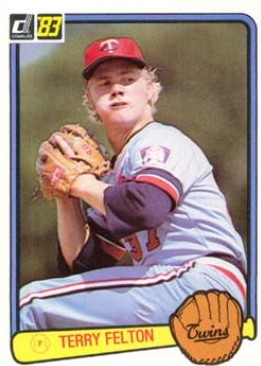 Terry Felton was drafted right out of high school (by the Minnesota Twins) in the second round of the 1976 MLB draft. He began his professional career at age 18 and made his MLB debut on September 28, 1979 (as a 21-year old). Before being called up, he had gone 26-34, 3.50 in four minor league campaigns.
Felton made just one appearance for the Twins in 1979 and it was promising – two innings pitched (versus the Brewers), six up, six down and one strikeout. Felton opened the season with the Twins in 1980 and his first start (April 14) also showed promise. He went a strong seven innings (six hits, three earned runs, one walk, three strikeouts) in a Twins ‘5-3 road win versus the Angels. (Felton left the game with the Twins trailing 3-0. but Minnesota scored five runs over the last two inning for the victory.) Things started to unravel from there. In his next three starts, Felton lasted a total of 9 2/3 innings, giving up 12 runs (eight earned), on 11 hits and seven walks, while fanning ten) – picking up his first three career losses.
Felton spent most of the rest of the season in the minors, appearing in just one more game for the Twins, giving up three runs in one inning of relief on May 2. He also appeared in just one game at the major-league level in 1981, giving up six earned runs in 1 1/3 innings. In those two seasons, he went 14-19, 4.09 for the AAA Toledo Mudhens.
In 1982, he stuck with the big club, appearing in 48 games (six starts); while he often showed “swing-and-miss” stuff, he had command issues (in 117 1/3 innings, he fanned 92 batters, but also walked 76 and hit four). Felton also had a little trouble keeping the ball in the park, giving up 18 home runs. He finished the season 0-13, with a 4.99 ERA (three saves). How much did his command issues affect his outcomes? Hard to say, but American League hitters batted just .230 against him that season (as compared to an overall league average of .264).
Felton played two more minor-league seasons, but did not appear in the major league after 1982 His final MLB stat line: no wins, 16 losses, three saves and a 5.53 ERA in 55 appearances.
As you will see is often the case for the pitchers appearing in this post, the teams they played for had an impact on their (lack of) success. In Felton’s 0-16 season, for example, the Twins were a woeful 60-102 (5-43 in games in which Felton appeared). Felton, by the way, was 0-7, 5.79 in ten career starts and 0-9, 5.40 in 45 relief appearances.
————————————————————-
Anthony Young – Most Consecutive MLB Losses Between Wins (27)
 From May 6, 1992 to July 24 1993, Mets’ righty Anthony Young lost a record 27 consecutive decisions. There was a lot of (bad) luck involved in setting this dubious record. Consider, for example, that his streak included a stretch in which he threw 23 2/3 scoreless innings (without picking up a win), as well as a game (loss number 26 on July 7, 1993) in which he retired 23 of the first 24 batters he faced. With two outs in the bottom of the eighth (against the Padres), Young had allowed just one base runner (a single to lead off the game), while fanning seven. At that point, however, the game was tied at zero and Young’s mound opponent (Andy Benes) was in the process of pitching a one-hit, complete-game shutout. Young ultimately gave up a single and home run and ended up with a 2-0 loss (three hits, two runs, no walks, seven strikeouts over eight innings).
Just One Win Could Save Me
Anthony Young’s 27-decision losing streak included a stretch from July 7 through August 28,1992, when (as the Met’s closer) he pitched 23 2/3 consecutive scoreless innings and recorded 12 saves in 12 opportunities.
Now for some background. The right-handed Young was selected in the 38th round of the 1987 MLB draft (by the Mets) out of the University of Houston (where he played football and baseball.) He made his professional debut in 1987, at age 21 (A Level). In 1990, he had his best professional season, going 15-3, 1.65 in 23 starts at Double A. The following season, he was 7-9, 3.73 in 25 starts at Triple A, earning an August call up to the Mets.
Young made his MLB debut on August 5, 1991 – pitching 2 1/3 innings of one-run relief in a Mets’ 7-2 loss to the Cubs. He pitched in ten games for the Mets that season (eight starts) and put up a 2-5 record, with a 3.10 ERA.
In 1992, he started the season with the Mets and after five appearances (two starts), he was a solid 2-0, 3.26. On May 6, he took his first loss of the season giving up five runs in six innings in a 5-3 loss to the Reds. Little did he know that it would be 76 more appearances and 26 more losses before he would see a “W” next to his name again.
Young really didn’t pitch like an 0-27 hurler during the streak. (He put up a 4.36 ERA during the span.) You have to allow for the fact that he was pitching for a Mets’ team that went 72-90 in 1992 and 50-103 in 1993. During Young’s 27-loss streak, the Mets went 90-144 (and Young saved 16 of those wins).
Bad Luck CAN be Better than No Luck at All
Ironically, it took a bit of bad luck to bring Young’s losing streak to end. In a July 28, 1993 game against the Marlins, Young was summoned to the mound to open the top of the ninth with the game knotted at three runs apiece. The Marlins scratched out an unearned run to take a 4-3 lead (and put Young in line for a 28th consecutive losing decision). However, the Mets came back with two in the bottom of the ninth to give Young (who had finished the top of the inning) the win.
During his streak, Young showed true balance – going 0-14 as a starter and 0-13 as a reliever. He did, however, put up a 3.51 ERA in 60 relief appearances, versus a 5.01 ERA in 17 starts. For his MLB career (1991-1996, Mets/Cubs/Astros), Young went 15-48, 3,89 in 181 appearances (51 starts). Notably, in 1993, when he went 1-16, his ERA was 3.77, compared to an overall National League ERA of 4.04. He clearly deserved better.
———————————————————-
Jack Nabors – Most Consecutive Losses in a Single Season (19)
Right-hander Jack Nabors made his debut on August 9, 1915 – at age 27 – with the Philadelphia Athletics. He earned his call up with a 12-1 season at the D-Level Georgia-Alabama League (Talladega Tigers/Newman Coweta)– a stint which included a 13-inning, complete-game, no-hit, no-walk, 11-strikeout victory (two batters reached on errors). Things did not go well for Nabors at the MLB-level. He went 0-5, 5.50 in ten appearances for the lowly Athletics (who finished with a 43-109 record).
The following season started off better for Nabors. After three starts, he had a 1-1 record with a 1.42 earned run average – but he was still pitching for the inept Athletics (who would finish the season 36-117). Little did Nabors know that his April 22, 1916 victory over the eventual 1916 World Series Champion Red Sox would be the only time he would notch a “W” in his MLB career. After his win on April 22, Nabors would take the hill 37 more times in 1916 – going a 0-19.
The Sad Case of Jack Nabors
Consider this. In nine of his 20 losses in 1916, Jack Nabors pitched seven or more innings and gave up two or fewer earned runs. Or this. In 15 of his 20 losses, the Athletics scored two or fewer runs in the game; being shutout I five of those contests.
On the season, Nabors was 1-20, with a 3.47 earned run average – slightly better than the league ERA of 3.68.
In 1917, Nabors started the season with the Athletics, but was traded to Indianapolis of the Double-A American Association after just two appearances. Indianapolis sent him on the Denver of the Single-A Western League, where his 9-17 record did include a no-hitter. 1918 saw him make brief appearances in with Indianapolis and with Sioux City of the Western League before enlisting in the U.S. Army. During his Army stint, he came down with the flu (influenza epidemic of 1918-19) and would never pitch again. He died of tuberculosis in 1923 at the age of 35.
Nabors career MLB mark was 1-25, with a 3.97 earned run average in 52 games (37 starts).
______________________________________
John Coleman – Most Losses in a Season (48)

Library of Congress.
John Coleman was a 20-year-old rookie for the 1883 Philadelphia Quakers – a squad that finished the National League season with a dismal 17-81 record. Coleman started 61 of those games and appeared on the mound in 65 – going 12-48, with a 4.87 ERA. He led the league in hits allowed (772), runs allowed (510) earned runs allowed (291) and home runs allowed (17) – while pitching 538 innings. He also appeared in 31 games as an outfielder and one at second base. The game was indeed different then.
Like a Broken Record
John Coleman holds the MLB single-season record for runs allowed, earned runs allowed, hits allowed and losses – all set in 1883.
In 1884, Coleman started 21 games on the mound (relieving in three more) and went 5-17, 4.72. He also appeared in 51 games in the OF, and four at 1B. He played six more MLB seasons, primarily as an OF, appearing on the mound in just 18 more contests. For his career, Coleman was 23-72, 4.68. As a hitter, he was .257-7-29 in 629 games.
——————
Vic Willis – Most Losses in a Season Since 1900 (29)
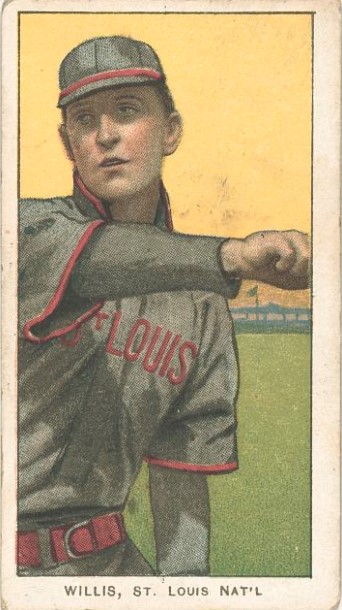
Library of Congress .
When the 1905 season rolled around, Boston Beaneaters’ RHP Vic Willis was already a four-time 20-game winner. However, he had also led the NL in losses in 1905, going 18-25. 2.85 for a Boston team that went 55-98. (Note: The NL ERA in 1904 was 2.73). It was more of the same for Willis in 1905, when he went 12-29, 3.21 (the league average ERA was 2.99) and the Beaneaters were 51-103 – finishing last in run scored (averaging just 3.0 runs per game – the league-topping Giants average 5.1 RPG).
Fate smiled on Willis the next season, as he was traded the Pittsburgh Pirate, where he went on to four consecutive 20-win seasons (a four-year record of 89-46, 2.08) forging his Hall of Fame resume.
Elected to the Baseball Hall of Fame in 1995 (Veteran’s Committee), Willis finished with a 13-season MLB record of 249-205, 2.63. He was an eight-time 20-game winner, one-time ERA leader, two-time leader in complete games and one-time leader in strikeouts.
———————————————————–
Bobo Newsom, Pedro Ramos, Phil Niekro – Most Seasons Leading the League in Losses (4)
Bobo Newsom
Of the three MLB pitchers who led their leagues in losses four times, two did it while playing with with one team/franchise and in four consecutive seasons. The one who accomplished the feat first, however, spaced his four loss-leading seasons over a span of 11 years and four different teams. That was right-hander Bobo Newsom – a large, tough and colorful right-hander who lasted 20 MLB seasons, pitched for nine different teams and picked up 211 wins and 222 losses along the way.

How much of a workhorse was Newsom? He not only notched 433 decisions (211-222) on the major-league level, but had a 139-105 minor league record. Newsom took the mound as a professional every season from 1928 through 1953.
Newsom started his professional career in 1928 (as a 20-year-old). In his early minor-league campaigns, Newsom showed notable potential earning (very) brief call ups to the big leagues in 1929 and 1930 (Dodgers) and 1932 Cubs. In 1933, he really punched his ticket to the big leagues with a 30-11, 3.18 record for the LA Angels of the Pacific Coast League. In 1934, he was pitching for the Saint Louis Browns – going 16-20, 4.01 and leading the AL in losses for the first time. (The Browns went 67-85 that season.) Still, he led the Browns in wins, earned run average, complete games, shutouts, innings pitched, strikeouts and (retroactively determined) even saves. The following season, Newsom started 0-6 for the Browns and was sold to the Washington Senators in May. He went 11-12 for the Senators (who finished 67-86) and his 18 losses again led the league.
Newsom went on to pitch a total of twenty seasons in the major leagues (for nine different franchises) – often suiting up for second-division squads. Still, when he had a solid team behind him, he showed what he could do. In 1940, for example, pitching for the first-place Tigers, Newsom went 21-5, with a 2.83 ERA. The very next season, as Detroit slumped to a fourth-place (75-79 season), Newsom went 12-20, 4.60 and led the AL in losses. He would top his league in the “L”column one more time. In 1945, toiling for the last-place Philadelphia Athletics, Newsom put up a 8-20, 3.29 record.
On the Big Stage
In the 1940 World Series, as his Tigers lost to the Reds four games to three, Bobo Newsom pitched three complete games, winning tw0. He gave up just four runs over 26 innings (1.38 ERA) on 18 hits and four walks, while striking out 17.
Over his career, Bobo Newsom was a four-time All Star and three-time 20-game winner. He led his league in games started four times, complete games twice and innings pitched once. His career MLB record was 211-222, 3.96 with 600 appearances and 246 complete games in 483 starts.
———-
Pedro Ramos
Cuban-born Pedro Ramos led the American League in losses four consecutive seasons (1958-61 -… Senators Twins). Over those four seasons, his teams finished a combined 88 games under .500.
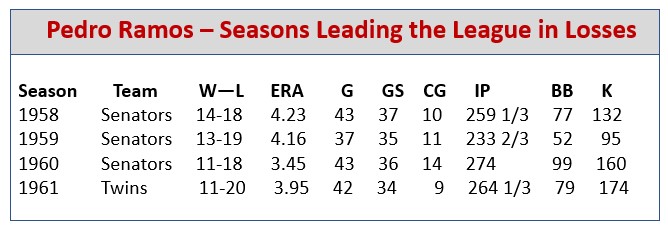
In 1959, Pedro Ramos made his only All Star team. That season, he was 9-7, 4.29 at the break. Ramos went 4-12, 3.95 over the second half and his 19 losses led the league. For his career, Ramos was 117-160, 4.08; posting a winning record in two of 15 campaigns.
Pedro Ramos’ Day(s) in the Sun
Pedro Ramos did find success as a reliever for the Yankees. Traded from the Indians to the Yankees in September of 1964, Ramos notched one victory and eight saves for the Bombers in the stretch drive (13 appearances, 1.25 ERA) – helping New York hold off the White Sox (who finished just a game behind). Ramos went on to save 18 games for New York in 1965 and another 13 for the Yankees in 1966.
______________________________________________________________________
A Special for BBRT’s Minnesota Readers – a Different Kind of Last-to-First
When the Senators moved to Minnesota, Ramos did make a bit of Senators/Twins’ history. On October 2, 1960, Ramos pitched the original Washington’s franchise’s last official game – going the distance in a 2-1 loss (four-hits, one earned run) to the Orioles in Baltimore.
On April 11, 1961 Ramos was the starting pitcher in the Twins’ first-ever MLB game. Opening against the Yankees in New York, Ramos started the franchise off on the right foot, pitching a three-hit, complete-game shutout in a 6-0 win.
______________________________________________________________
Phil Niekro
Future Hall of Famer Phil “Knucksie” Niekro finished his MLB career (1964-87) with 318 wins (274 losses) and a 3.35 ERA. The knuckleball specialist started a lot of games and tossed a ton of innings. One particularly notable stretch included four consecutive seasons (1977-80), when he pitched for a Braves’ team that went a combined 277-368. Niekro led the league in games started and losses all four years and in complete games and innings pitched in three of the four seasons (as well as in strikeouts once.)

Niekro was a well-rounded athlete, playing baseball basketball and football in high school – going 17-1 as a high school pitcher. He was signed by the Braves out of a tryout camp in July of 1958 and made is professional debut at Class D Wellsville in 1959 and reached the major leagues (as a Milwaukee Brave) in 1964. In his first three seasons with the Braves, he was used primarily as a reliever (79 appearances/one start), going 6-6, 3.54 with eight saves. In 1967, he finally got a shot at starting in the major leagues (he had been a starter in the minors), moving from the pen to the rotation in June. He tossed a two-hit, complete-game shutout in his first 1967 start (June 13). The rest is, well, history, Niekro finished the 1967 season at 11-9, with ten complete games in 20 starts. His 1.87 ERA in 207 innings was the best among league qualifiers. He was on his way – starting 30 or more games in 18 of the next 19 seasons.
Every Coin has Two Sides
In 1979, Phil Niekro led the National League with 20 losses, but he also led the league in victories (21) – the most recent pitcher to lead his league in both categories in the same season. As a further twist, Niekro actually tied for the NL lead in wins with his brother Joe, who was 21-11 for the Houston Astros.
In a 24-season MLB career, Niekro was an All Star five times, led his league in wins twice, wining percentage once, ERA once, games started four times, complete games four times, innings pitched four times and strikeouts once. In true knuckler fashion, he also led the league in walks, wild pitches and hit batsmen three times each. He also won five Gold Gloves.
Primary Resources: Baseball-Reference.com; Baseball-Almanac.com; Jack Nabors, by Stephen V. Rice (SABR); Bobo, Newsom, by Ralph Berger (SABR).
Note: BBRT published its 2020 American League Preview before the suspension of Spring Training and the upcoming MLB season (for that preview click here.) The National League Preview will be coming closer to the resumption of play.
 Baseball Roundtable is on the Feedspot list of the Top 100 Baseball Blogs. To see the full list, click here.
I tweet baseball @DavidBBRT
Follow/Like Baseball Roundtable’s Facebook Page here. More baseball commentary; blog post notifications; PRIZES.
Member: Society for American Baseball Research (SABR); The Baseball Reliquary; The Negro Leagues Baseball Museum.