You’ve heard it before, when Baseball Roundtable starts researching a hardball topic “one thing often leads to another.” In this case, the recent Roundtable post on exceptional, unique or interesting relief appearances (to see that post click here) – intended to provide a bit of relief from news of the CBA impasse – led reader Leon DeHaven to point The Roundtable in the direction of Dean Stone’s 1954 All Star Game relief stint, when Stone picked up a win without retiring a single batter.
Thirteen pitchers were used in the 1954 All Star Game. It was the only career All Star selection for six of them: Carl Erskine; Marv Grissom; Sandy Consuegra; Bob Keegan; Bob Porterfield; and Dean Stone.
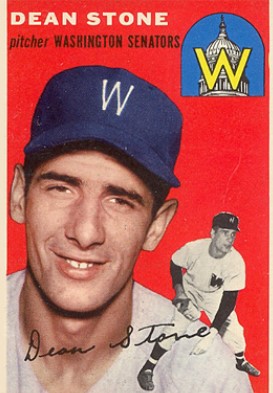 The game proved to be one of the highest scoring in All Star history – an 11-9 American League win – featuring home runs by Ted Kluszewski, Gus Bell, Al Rosen (two homers and five RBI), Ray Boone and Lary Doby. But back to Stone’s appearance. Stone was called in to replace Bob Keegan with two outs in the bottom of the eighth inning, with runners on first (Al Dark) and third (Red Schoendienst). (Earlier in the inning, Keegan had given up a two-run, pinch-hit home run to Gus Bell to give the National League a 9-8 lead.) The pitching change put the southpaw Stone up against lefty batting Duke Snider (who already had three hits and a walk in the game).
As Stone prepared to fire his third pitch to Snider, Schoendienst (apparently hoping to catch the rookie unaware) broke for home. Stone stepped off the rubber and threw to catcher Yogi Berra to retire Schoendienst and end the inning. In the bottom of the ninth, the AL scored three runs to take the lead – putting Stone in line for the win. The White Sox’ Virgil Trucks pitched a scoreless top of the ninth to save the victory.
Virgil Trucks, who went 177-135, 3.39 in 17 MLB seasons (1941-43, 1945-58) won 14 or more games in eight MLB seasons (a high of 20 in 1954). He is best known for throwing two no-hitters for the Tigers in 1952 – a season in which he won only give games (19 losses).
Over the years, Stones’ All Star Game win has not been without controversy. While some report that Stone picked up an All Star Game victory “without retiring a batter,” others assert that – since Snider did not complete a plate appearance – Stone’s win came without “throwing an official pitch.” That demanded further digging. Where did I go to seek an answer to this “thorny” question? To the best source I know for getting an accurate assessment of such issues – Stew Thornley. Thornley is one of MLB’s official scorers (assigned to then Twins), a datacaster for the MLB.com website and a member of the MLB Official Scoring Advisory Committee. He also has authored dozens of books and articles on professional baseball and basketball (for a list, click here.) Thornley has won national awards for his baseball research from McMillan Publishing Company, the Society for American Baseball Research, USA Today Baseball Weekly and The Baseball Reliquary. How did Thornley answer the Stone question? Here it is. “There is no ‘official count’ on pitches, but since he (Stone) stepped off, this was a play and not a pitch, so there were only two pitches … It is correct that Stone got a win without retiring a batter, but too often it’s been written that he got a win without throwing a pitch.”
Thanks For This Story, Stew
In replying to my question on Dean Stone (Remember in Baseball roundtable, one thing always seems to lead to another), Stew Thornley recalled witnessing Jeff Gray pick up two MLB wins on just three pitches.
I did some digging, and here’s the story. Gray was drafted (by the A’s) out of Missouri State University in the 32nd Round of the 2004 MLB Draft. At Missouri State, the 6’3”, 205-pound righty had gone 23-13, 4.29 over four seasons. Gray made his MLB debut with the A’s on September 8, 2008 (as a 26-year-old). He was up and down from 2008-11, going 1-2, 4.57 in 66 games (all in relief) for the A’s, Cubs White Sox and Mariners. In October of 2011, the Twins selected him off waivers (from the Mariners), which is how he came to Thornley’s attention.
Gray’s 2012 season with the Twins was his best in MLB, at least from a W-L standpoint (it was also his final season in the majors). He went 6-1 (but with a 5.71 ERA). Gray pitched in 49 games for the Twins, but two games in April caught Thornley’s eye (and stuck in his memory). In those two games, Gray tripled his career win total (going from one to three). Put another way, after just one win over four-plus seasons, Gray picked up two victories in the span of three pitches. It went like this:
- On April 11, 2012, the Twins faced the Angels (in Minnesota) and Gray was called in to relieve Carl Pavano in the top of the seventh inning with the Angels up 5-3, two outs and a runner on second. The Angels’ batter was CF and number nine-hitter Pete Bourjos and Gray induced a weak ground out (third-to-first ) on the first pitch he threw. In the bottom of the inning, the Twins scored three to take the lead. Glen Perkins replaced Gray in the top of the eighth and set the Angels down 1-2-3. Closer Matt Capps came on for the Twins in the ninth and held the Angels scoreless. So, Gray picked up the win on one pitch (Perkins got the hold and Capps the save).
- The very next day, again against the Angels, Gray was called in to replace reliever Brian Duensing with the Angels up 7-6, two outs and a runner on first. The hitter wa 2B (and number-two in the lineup) Howie Kendrick. Gray got Kendrick to ground into a force out (short-to-second) on just his second pitch. In the bottom of the eighth, the Twins scored four runs to take a 10-7 lead. Capps pitched the ninth and picked up a save, despite surrendering two runs on three hits. Gray got the win.
Two days, two wins, three pitches. That’s being in the right place at the right time. Jeff Grays’s career stat line was 7-3, 4.99, with one save (115 appearances.)

Let’s close with a little more a little more on 1954 All Star Game winner Dean Stone. He signed with the Cubs in 1949, right out of high school, but was released that May and signed as a free agent with the Senators in June. Stone pitched pretty well in the Senators’ minor-league system – including a 17-10, 3.16 season for the Class-B Charlotte Hornets in 1952. He earned a September 1953 call up after an 8-10, 3.33 season at for the Double-A Chattanooga Lookouts. He appeared in three games for Washington (one start) and went 0-1, 8.31 in 8 2/3 innings.
In 1954, Stone made the Senators squad out of Spring Training. He jumped out to that 7-2, 3.47 start (before the 1954 All Star Game) and finished at 12-10, 3.22 (31 appearances, 23 starts, ten complete games, two shutouts). It would be his best season in the majors. In fact, it would be one of only two seasons in which he recorded a winning record.
From 1955-57, Stone pitched in 104 MLB contests (52 stars), going 12-23, 5.08 for the Senators and Red Sox.
From 1957-1963, Dean Stone pitched for six major-league clubs and four Triple-A squads.
Stone spent most of 1958-61 in the minor leagues (Red Sox and Cardinals systems.) He did into 18 games for the Cardinals in 1959, going 0-1, 4.20. At Triple-A, he showed promise, pitching in 153 games (81 starts) – going 43-31, 3.28. That got the attention of the expansion Houston Colt .45s, who picked him up in the November 1961 Rule Five Draft. Stone started the 1962 season with the Astros and threw a pair of complete-game shutouts in his first two appearances – 18 innings pitched, eight hits, three walks,12 whiffs. He struggled after that hot start, going, 1-2, 6.82 in his next 13 appearances (five starts). He was traded to the White Sox on June 25, where he pitched well out of the pen (1-0, 3.26 with five saves in 27 appearances). After the season, he was sold to the Orioles and, in 1963 (his final MLB season), he went 1-2, 5.12,with one save in 17 relief stints.
Stone played in eight MLB seasons (1953-57, 1959, 1962-63 … Senators, Cardinals, Red Sox, Orioles, Colt .45s, Orioles) – and put up a career line of 29-39, 4.47 in 215 games (85 starts), with ten complete game and five shutouts.
Primary Resources: Baseball-Reference.com; The BaseballCube.com
 Baseball Roundtable is on the Feedspot list of the Top 100 Baseball Blogs. To see the full list, click here.
I tweet baseball @DavidBBRT
Follow/Like Baseball Roundtable’s Facebook Page here. More baseball commentary; blog post notifications; PRIZES.
Member: Society for American Baseball Research (SABR); Negro Leagues Baseball Museum; The Baseball Reliquary.