Baseball Roundtable apologizes for being a little light on posts over the past week or so. My hometown Twins have been in a tight division title race and I’ve spent most of my time at Target Field or glued to Fox Sports North’s television coverage. It’s an off day today, so here some BBRT Baseball Musings from the past ten days.
Boomstick … On Cruz Control
Yesterday (September 22), as the Twins topped the Royals 12-8 in Minnesota, Twins’ DH Nelson Cruz launched a fourth-inning solo home run. It was part of a two-for-three (with two walks) game that left Cruz with a .303 average, 40 home runs and 105 RBI on the season. It was also a landmark blast for Cruz, his 400th career long ball. Further, it made Cruz just one of three players to reach the 40-home run mark in a season at age 39 or older. The others? Hank Aaron, who hit an even forty round trippers in his age-39 season (1973 Braves) and Barry Bonds, who hit 45 long balls in his age-39 campaign (2004 Giants). No player has hit forty home runs in his age-40 or later season – although 40-year-old David Ortiz came close with a .315-38-127 campaign in his final season (2016 Red Sox). Cruz may have a target to next season.
It’s Miller Time – or Making those Tators Count
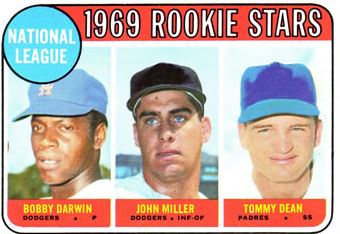
John Miller (center) made his two MLB home runs historic.
On this date (September 23) fifty years ago (1969), the Dodgers’ John Allen Miller popped a pinch-hit home run (off the Reds’ Jim Merritt) in the top of the eighth inning of an LA 6-3 loss to the Reds. It was one of just two career home runs for Miller – who made both of his long balls count big time.
Miller played just parts of two seasons in the major leagues (1966 and 1969, with the Yankees and Dodgers, respectively). An outfielder/first baseman, he appeared in a total of 32 major league games, getting 61 at bats and just ten hits (.164 career average), two home runs and three RBI. With that output, however, Miller earned a special place in the MLB record books. Miller’s two round trippers came in his very first and very last MLB at bats – making him just one of two players in MLB history to homer in their first and final big league at bats. The other is Paul Gillespie – whose MLB career spanned three seasons during World War II (1942, 1944, 1945), all with the Cubs. Gillespie, a catcher, appeared in 89 games – hitting .283, with six home runs and 31 RBI; and went zero-for-six in the 1945 World Series.
Miller made his MLB debut with the Yankees on September 11, 1966. The 22-year-old was in his fifth professional season and had hit a promising .294, with 16 home runs and 59 RBI in 113 games at AA and AAA that season. Miller started that debut game (against the Red Sox at Fenway) in LF, batting seventh. In his very first big league at bat, he hit a two-out, two-run home run off of Red Sox starter Lee Stange. Despite the Yankees’ long heritage of home run hitters, Miller’s long ball made him the first Yankee to homer in his first MLB at bat. (Little did Miller know he would not get another home run nor another RBI until the final at bat of his MLB career.) Miller got in five more games with the Yankees in 1966, ending the season at .087 (two-for-23), with one home run and two RBI.
In April of 1967, Miller was traded (along with pitcher Jack Cullen and $25,000) to the LA Dodgers for utility infielder John Kennedy. Miller spent 1967 and 1968 at Triple A Spokane – putting up respectable numbers. In 1969, he made it back to the big leagues, getting in 26 games (just 38 at bats) for the Dodgers. In the first 37 of those at bats, Miller collected seven hits (one double and six singles), scored twice, but did not collect an RBI. Miller’s last at bat of the season (and what turn out to be the last at bat of his MLB career) was that September 13, 1969 pinch-hit appearance.
Miller appeared in one more box score for the Dodgers after his pinch-hit long ball, but did not come to the plate. On September 27, the Dodgers and Giants faced off in a contest tied 1-1 in the bottom of the eleventh inning. Southpaw Ron Bryant was on the mound for the Giants and, after getting Dodgers’ SS Maury Wills to pop out, he gave up singles to LF Manny Mota and CF Willie Davis. Dodgers’ manager Walt Alston sent the right-handed hitting Miller up to hit for LA pitcher Jim Brewer. Giants’ skipper Clyde King –playing the percentages – brought in veteran righty Don McMahon to pitch. Alston countered by calling Miller back and sending up left-handed swinging Len Gabrielson (who singled in the winning tally.) Without the switch, that final at bat home run could have become just an obscure next-to-last at-bat dinger.
How About a 100th Anniversary Involving the Great Bambino – and a Touch of Irony
This September (September 20 to be exact) marks the 100th Anniversary of the first-ever Babe Ruth Day at a ballpark. In this case, it was at Fenway Park and Ruth suited up as a member of the Boston Red Sox. By this time, Ruth: was in his sixth season in a Red Sox jersey; had already twice been a twenty-game winner; had led the league in ERA, complete games and shutouts once each; had led the AL in home runs the year before; and was on the verge of setting a new MLB single-season high in long balls.
With all of this in mind, the Knights of Columbus sponsored “Babe Ruth Day” for the BoSox hero, with ceremonies and gifts to presented between games of a double-header against the White Sox. The Babe did not disappoint – breaking a 3-3 tie with a walk-off home run in the bottom of the ninth of game one; his 27th home run of the season, tying the MLB single-season record. (Ruth, by the way, started the game on the mound, giving up three runs in 5 1/3 innings before moving to left field.) In Game Two, Ruth started in left field and went one-for-three with an RBI, as the Red Sox prevailed again 5-4. By season’s end, he would extend the MLB home run record to 29 (.322-29-113.)
Oh yes, the irony I noted in the header? The Red Sox’ Babe Ruth Day would mark the last time Ruth ever appeared in Boston in a Red Sox uniform. The team finished out the season on the road and, that December, Ruth was sold the Yankees. (The rest, of course, is history.)
Cole Rolls a 300
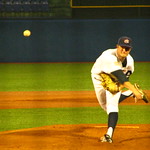
Photo by boomer-44 
On September 18, Astros’ right-hander Gerrit Cole notched his 19th game with ten or more strikeouts this season. – beating the Texas Ranger 3-2 (six hits, one walk, two earned runs), while fanning ten batters in eight innings. It was also his seventh consecutive start with ten or more whiffs – and brought his season total to 302 strikeouts in 200 1/3 innings pitched.
The performance made Cole the 41st pitcher in MLB history and just the 18th since 1893 (when the pitching distance was increased to 60’ 6”) to reach the 300 mark. (Side Note: Most baseball historians divide MLB records into pre-1900 and 1900-present. BBRT prefers to use 1893 for this record, since that is when the pitching distance was extended to 60’6”. However, it really makes no difference in record-keeping, since there were no 300K seasons between 1892 and 1903.)
Here, in honor of Cole’s feat, are a few 300-strikeout tidbits.
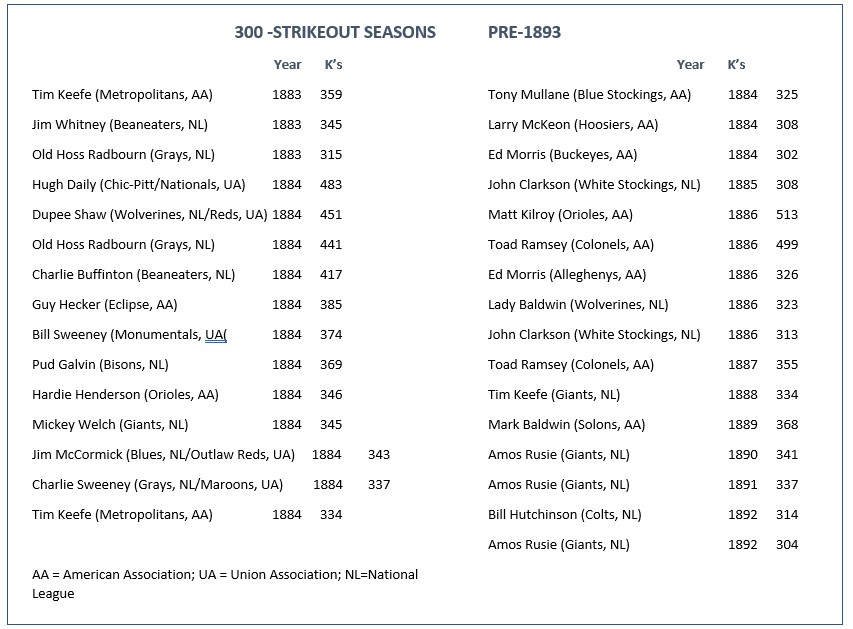
- 41 MLB pitchers have turned in 68 seasons of 300 or more strikeouts – 31 of those before 1893.
- 1884 saw a record 15 pitchers notch at least 300 strikeouts.
- Since 1893, there have never been more than two 300K pitchers in any one MLB season.
The Exclusive 500 Club
Only one MLB pitcher has ever fanned 500 batters in a season – and that was Matt Kilroy, who whiffed 513 batters in 583 innings as a 20-year-old rookie with the 1884 American Association Baltimore Orioles. Of course, it was a different game back then. The pitching distance was shorter, hurlers threw from a box and not from a rubber and it took six balls to draw a walk.
In his record-setting season, Kilroy started 68 of the Orioles 139 games (49 percent) – and completed 66 of them. (That season, American Association starting pitchers finished an average of 96 percent of their starts.) Despite five shutouts and a 3.37 earned run average (the league ERA was 3.44), Kilroy finished 29-34 for the last-place (46-85) Orioles.
- There were no 300-strikeout campaigns between 1912 (Walter Johnson – 303) and 1946 (Bob Feller – 348).
- Rube Waddell’s 349 strikeouts in 1904 stood as the post-1893 (or post-1900, as most MLB historians prefer) record for 61 years (Sandy Koufax – 382 in 1965). Koufax’ record held for just eight seasons (Nolan Ryan – 383 in 1973, still the post-1900 MLB record). Koufax still holds the NL post-1900 record for whiffs in a season.
Rube Waddell – The Man Could Bring it
How good was Rube Waddell? In 1902, he joined the Philadelphia Athletics in June – making his first start on June 26 (with just 86 games left in the season). Waddell proceeded to win 24 games (the league’s second-highest total) against seven losses, with a 2.05 ERA. Despite his shortened season, he led the AL with 210 strikeouts, fifty more than the runner-up (none other than Cy Young).
The 6’1”, 195-lb. lefty (figures Waddell, known as one of the zaniest players in MLB history, would be a southpaw) went on to lead the AL in strikeouts six consecutive seasons (1902-1907) – by a wide margin. In 1904, when he set the MLB strikeout record (which stood for 61 years) at 349, he outpaced the runner up by 110 K’s.
Final note: Rube Waddell was born on Friday the 13 of October in 1876 and died on April Fool’s Day 1914. There is some symmetry there.
- The only team to boast two 300+ strikeout pitchers in the same season is the 2002 Diamondbacks – Randy Johnson (334) and Curt Schilling (316).
- The most 300-K seasons by any one pitcher is six – and two hurlers share the record: Nolan Ryan (1972-73-74-76-77-89) and Randy Johnson (1993-98-99-2000-01-02).
- Randy Johnson reached 300 strikeouts in a record five consecutive campaigns.
- The oldest player ever to record a 300-strike out season ewes 42-year-old Nolan Ryan in 1989 (301 whiffs for the Texas Rangers).
Youth will be Served
The youngest pitcher ever to record 300+ strikeouts in a season was 18-year-old rookie Larry McKeon, who fanned 308 batters in 512 innings for the American Association Indianapolis Hoosiers in 1884. Despite all those whiffs (and a 3.50 ERA) McKeon led the AA with 41 losses (versus 18 wins) that season. In 1884, the overall AA earned run average was 3.24 – and Guy Hecker was the league’s premier hurler.
The youngest pitcher to notch 300 whiffs in a season since 1900 was 21-year-old Vida Blue, who fanned 301 batters (312 innings pitched) for the A’s in 1971. That season, Blue went 24-8, with an AL-best 1,82 ERA, a league-topping eight shutouts and 24 complete games in 39 starts.
Primary Resources: Baseball-Reference.com; ESPN.com; MLB.com

BASEBALL ROUNDTABLE ON THE TOP 100 BASEBALL BLOG LIST
 Baseball Roundtable is on the Feedspot list of the Top 100 Baseball Blogs. To see the full list, click here.
I tweet baseball @DavidBBRT
Follow/Like Baseball Roundtable’s Facebook Page here. More baseball commentary; blog post notifications; PRIZES.
Member: Society for American Baseball Research (SABR); The Baseball Reliquary; The Negro Leagues Baseball Museum.