More short-season musing from Baseball Roundtable – and another example of how, when looking at baseball stats and stories, one thing invariably leads to another. This one started when I was working on a post related to Mookie Betts’ recent record-tying sixth three-homer game. Clearly, not an unexpected event, but one that got me thinking of players who unexpectedly wrote their name in the record books. In the process, I drew a line between Betts and Kirk Nieuwenhuis, Honus Wagner and Vic Power and Sandy Koufax and Philip Humber.

From Mookie Betts to Kirk Nieuwenhuis
A week ago (August 13), when the Dodgers’ Mookie Betts (“Dodgers” and “Betts” still sound a little weird to me) popped three home runs in a game against the Padres, no one was really surprised. It wasn’t like hadn’t done it before. After all, the 27-year-old Betts came into the contest with 146 long balls on his MLB resume. And, he’d gone deep three times in a game five times already. (For a deeper look at Betts’ MLB record-tying achievement, clicker here). All in all, Betts seemed like a likely candidate (at least more likely than most) to go yard three times in a contest.
But this post isn’t about what might be expected, it’s about the “unexpected.” And, when it comes to three home-run games, Mets’ outfielder Kirk (“Captain Kirk” Nieuwenhuis is the most unexpected name on the list. Back on July 12, 2015, Nieuwenhuis had a three-home run, four-RBI game against the Diamondbacks, as New York topped Arizona 5-3 in the Big Apple. Nieuwenhuis, starting in LF and batting fifth, led off the second inning with a home run; hit a two-run shot in the third; and led off the fifth with his third long ball. He went down swinging on four pitches in his final at bat (seventh inning).
So, why does BBRT see Nieuwenhuis (he should buy a “consonant”) as the most unexpected member of the three-home run club? As Rod Serling would say, “For your Consideration.” In 2015, Nieuwenhuis played in 74 games (Met & Angels). That July 12 game was his 43rd of the season and, at that point, he had zero home runs. Further in his next 31 games he added just one round tripper – making his four home runs the fewest in a season by any player with a three-homer game in that season. Overall, Nieuwenhuis played in 414 games in six MLB seasons (2012-2017 …. Mets, Dodgers, Brewers); hitting .221, with 31 home runs and 117 RBI. He hit at least five home runs in only two seasons – his rookie campaign (2012), when he hit seven for the Mets, and 2016, when he hit 13 for the Brewers.
Like A Rubber Ball I Come Bouncing Back to You
Kirk Nieuwenhuis started the 2015 season in the Mets organization, then (on May 27), his contract was purchased by the Los Angeles Angels of Anaheim. On June 13, the Angels placed Nieuwenhuis on waivers and the Mets snatched him back.
Nieuwenhuis played at Triple A in 2017 and 2018 and for the Atlantic League (Independent) Long Island Duck in 2019.
________________________________________________
From the Honus Wagner to Vic Power
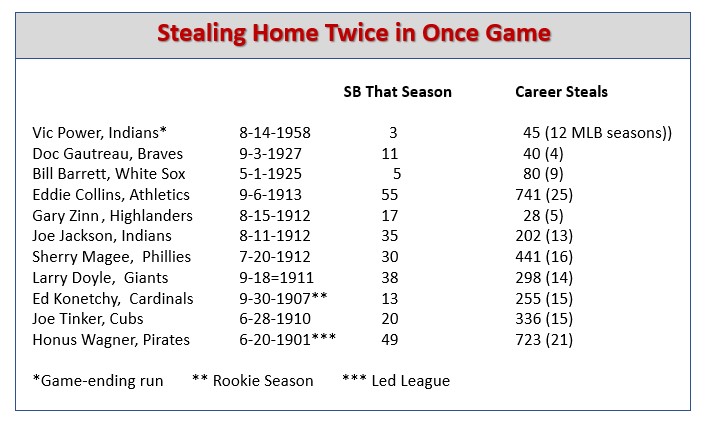
When Honus Wagner stole home twice in one game (on June 20, 1901) it really wasn’t much a surprise. In his fifth major-league season, the future Hall of Famer already had 144 stolen bases in his career (he would end up with 723 steals, five stolen base titles and 27 steals of home). At the time of his two-steals-of-home game, Wagner also was one of just two players to steal second, third and home in one inning. He still shares the career record for stealing second, third and home in an inning at four times (tied with Ty Cobb.) Wagner becoming the first player to steal home twice in a game? Not a total surprise.
More of an unexpected surprise was the last (most recent) player to accomplish the feat – the Indians’ Vic Power. (I’ve written about this before, but it deserves revisit in the context of this post.) On August 14, 1958 Power became just the eleventh player in MLB history to steal home twice in one game – a feat that has not been accomplished since. This is especially surprising since Power stole a total of three bases all season. Here’s how it went down.
In a game against the Tigers (in Cleveland), Detroit on top of the Tribe 7-4 going into the bottom of the eighth inning – but the Indians fought back. Cleveland RF Rocky Colavito started the inning with his second home run of the game (his 26th of the season). Then pinch-hitter Gary Geiger (hitting for SS Woodie Held) walked. Next up was another pinch hitter – Vic Wertz. Wertz tied the contest with a two-run long ball.
After a Detroit pitching change, the Indians’ 2B Bobby Avila reached on an error by Tigers’ 1B Gail Harris. Cleveland 1B Mickey Vernon sacrificed Avila to second and Power singled him home – moving to second on an error by Detroit catcher Charlie Lau. And, the pesky Power was just warming up. He went to third on a wild pitch by Fischer and then stole home (after a short fly out to center by catcher Russ Nixon) to run the lead to 9-7. LF Minnie Minoso was up next and was hit by a pitch and stole second before CF Larry Doby flied out to end the inning. The Tribe bullpen, however, could not hold the two-run lead – and the Tigers tied it in the top of the ninth. That opened the door for Power’s historic second steal of home – which came in the bottom of the tenth, with the bases loaded, two outs and one of the AL’s most dependable RBI men (Rocky Colavito, with 74 driven in on the season) at the plate. On the fourth pitch to the Indians’ slugger, Power – who had been scampering up and down the third base line – broke for the plate and ended the game on a “run off” steal of home.
Going into that August 14 tilt, Power had exactly one stolen base on the season – and he did not steal a single a bag after the two steals of home that campaign. The fact is, he was much more likely to beat you with his glove (seven Gold Gloves) or his bat (.284 career average) than his legs. In twelve MLB seasons, Power stole just 45 bases (and was caught 35 times). He was a four-time All Star, who collected 1,716 hits, scored 765 runs and drove in 658.
_____________________________________
Sandy Koufax to Philip Humber
When Sandy Koufax tossed a perfect game on September 9, 1965, very few baseball fans were surprised. After all, Koufax – working his way to the Hall of Fame – had already thrown three no-hitters – one in each of the previous three seasons. (The perfect game gave him the MLB-record for career no-hitters – later broken.) Then, of course, there were other credentials that seemed to make a perfecto more of a possibility. He was in the process of leading the NL in earned run average for the fourth straight season and had led the league in complete-game shutouts in each of the previous two campaigns. Koufax retired (after 12 seasons, due to arm issues) with a 165-87, 2.76 record having led his league in wins three times, ERA five times, complete games twice, strikeouts four times and shutouts three times, Clearly the potential for a perfect game was there.
The most unexpected perfect game? Some might go with Don Larsen’s World Series perfect outing, but BBRT is going with the perfect outing notched by the White Sox’ Philip Humber in a 4-0 win over the Mariners April 21, 2012. Why? Primarily because it was the only complete game in Humber’s eight-season MLB career (97 games, 51 starts). Humber finished 2012 at 5-5, 6.44 and his final career stat line was 16-23, 5.31.
Koufax’ Perfect Game – He Pretty Much Needed It
When the Dodgers’ Sandy Koufax tossed a perfect game on September 9, 1965, he pretty much needed it. He was opposed by Cubs’ right-hander Bob Hendley (who went 48-52, 3.97 in a seven-year MLB career), who was on top of his game as well.
After eight innings, Hendley had given up just one hit and one walk (versus three strikeouts). The only hit had been a harmless double by Dodgers’ LF Lou Johnson in the bottom of the seventh. Hendley had allowed just one run in eight frames – and even that wasn’t his fault. The pesky Johnson had led off the fifth with a walk; moved to second on a sacrifice by RF Ron Fairly; stole third; and then scored as Cubs’ catcher Chris Krug made a wild throw past third baseman Ron Santo.
Hendley’s efforts, however, weren’t nearly enough that day. Koufax, who came into the game already a 20-game winner (21-7 on the season), threw a perfect game – striking out 14 Cubs. While his ill-timed one-hitter didn’t even get Hendley a win, he does share the record (with Koufax) for playing/pitching in the MLB game with the fewest combined hits ever.
Primary Resources: Baseball-Reference; Stathead.com.
 Baseball Roundtable is on the Feedspot list of the Top 100 Baseball Blogs. To see the full list, click here.
I tweet baseball @DavidBBRT
Follow/Like Baseball Roundtable’s Facebook Page here. More baseball commentary; blog post notifications; PRIZES.
Member: Society for American Baseball Research (SABR); The Baseball Reliquary; The Negro Leagues Baseball Museum.