BASEBALL ROUNDTABLE PRESENTS A GUEST POST FROM LIFT YOUR GAME
We’ve come a long way since that day in the summer of 1940, when a motorcycle sped past Bob Feller (going into his wind up in Chicago’s Lincoln Park) motoring loudly toward a paper barrier, while Feller launched his fastball toward an adjacent paper target. It was a race of man against machine (and an attempt to illustrate just how blisteringly fast Feller’s heater was). Click here to see a video of that match up.
Today, we have the means to measure not just pitch speed, but also pitch spin rate, launch angle and velocity off the bat and much more. But really, this fascination with measuring velocity started with the radar gun and raw pitch speed. With that in mind, Baseball Roundtable is pleased to present this guest post – looking at radar guns – from Matt Brown of Lift Your Game (liftyourgame.net), a website dedicated to providing sport equipment reviews, performance tips and advanced tutorials. Click here to visit liftyourgame.net. Now for that guest post. Hope you enjoy Matt Brown’s thoughts, insights and opinions on radar guns.
Everything You’d Ever Wanna Know about Radar Guns in Baseball
By Matt Brown
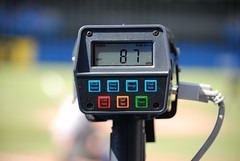
Photo by james_in_to 
Being able to track pitch speed in baseball wasn’t always as important as it is today. But since Michigan coach Danny Litwhiler began using police radar technology as a training tool in the early ’70s, pitch velocity has become one of the most important stats in baseball. (This July, for example, 23-year-old Oakland A’s fan Nathan Patterson – who hadn’t played baseball since high school – took a turn against the radar gun in the Fan Zone at an A’s game. He lit it up at 96 m.p.h. and earned a contract with the A’s franchise.)
As a pitcher, knowing your velocity obviously allows you to see how hard your fastball is – as well as how much variation there between your fastball, change-up and breaking pitches. And obviously, this information is invaluable for scouts. As a coach or scout, radar readings can help you gauge velocity and speed variation from one pitcher to another (using the same model radar gun, of course) – a key tool in helping to gauge each hurler’s potential ability to miss bats or produce weak contact.
But whether you’re a scout, a parent, or a coach, it’s not as simple as just going online and buying a $50 radar gun, pointing it at the pitcher, and pulling the trigger. You’ve got to know which type of gun to buy, and how to actually use it to get accurate readings. (There still are no tools to measure grit and heart, but technology can help measure “stuff.”)
What types of radar guns are used?
Radar guns come in all shapes and sizes. However, most of them struggle to track baseballs with much accuracy. Oddly, it’s often the devices advertised as being perfect for baseball that are the least accurate options.
For example, you can get little radar chips to put on the back of the catcher’s mitt, which are supposed to pick up ball speed on entering the mitt. While these things are great for kids, they’re not something you’d ever see an MLB coach using. This particular technology has a very short range (just a few feet in front of the mitt), and can often produce a slow reading.
There are even actual baseballs with gyros and LCD screens, which claim to show you pitch speed after a throw. As you might expect, these devices can break quite easily.
And finally, there are “pocket radars.” These products can take an accurate measurement, but are often quite inconsistent. Like in-the-glove radars, they normally produce a slightly slow reading – about 5 m.p.h. below actual pitch speed.
So, where do the readings used by scouts and put up on scoreboards around the major and minor league come from?
MLB scouts and coaches use police-style, hand-held radar guns. Most good-quality options from companies like JUGS (the first company to measure baseball velocity), Stalker and Bushnell. These radar guns generally cost anywhere from $500 up to $1500.
The most popular gun out there among the pros right now is the Stalker Sport II, a gun which is actually designed with baseball in mind. This gun is popular because it’s calibrated to pick up smaller objects like baseballs – as opposed large moving objects like cars and trucks – even at long distances (more on this below). It’s by no means cheap though! Teams may invest up to north of $1,000 in each of these radar guns and purchase them in multiples for use throughout their systems.
How do scouts use radar guns?
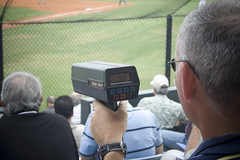
Photo by Aasen Ryan Family
Scouts (and anyone else using a radar gun) need to consider two basic issues to ensure that they get an accurate reading.
First, they’ve got to ensure that they’re aiming the gun at the right angle, relative to the pitcher and their throw. This is because all radar guns use something called Doppler Radar. Essentially, they work by firing radar beams at the ball. The time it takes for successive beams to return to the radar gun is then used to calculate pitch velocity. Therefore, for the readings to get back to the gun, rather than bouncing off at an angle, you need to be as straight-on with the line of the pitch as possible.
The further off-center the scout is, the slower the pitch will read. However, the better the gun, the more leeway you have with the angle of the shot. Some radar guns even allow you to compensate for the angle in the settings, in case you’re unable to get exactly in-line. Time to break out the protractor!
Lift Your Game is a sports website, made by athletes, for athletes. Since 2017, they’ve been providing gear reviews, tutorials, and other hints and tips for a variety of different sports.
For baseballers specifically, you’ll find tutorials for pitching, fielding, and batting techniques – like how to throw a split-finger fastball. They also do product tests and reviews, helping players and coaches find the right equipment to use to improve performance on the field.
Second, scouts need to consider the distance between the gun and the pitcher. Top of the line radar guns (think $1,000+) should be able to get an accurate reading at 200-300 feet – the Stalker Sport II mentioned earlier claims to work at up to 500 feet. However, for coaches or parents who have slightly cheaper models, you’ll want to be less than 150-feet away to ensure a good measurement.

Photo by Redheaded Amateur
Even the best radar guns out there are never 100 percent accurate all the time, so it’s crucial to get multiple measurements. Different scouts have different techniques, but one method is to take at least 10 readings and then find the median. This method, as opposed to using the average, ensures that the measurement is not skewed by outliers, bad readings, or change ups. With this in mind, as a fan checking out scoreboard velocity reports, you may want to look for the middle of the range of a few fastballs when evaluating a pitcher.
For Lift Your Game’s review of specific radar guns, click here.
BBRT Note: As of this posting, the Cardinals’ 22-year-old righty Jordan Hicks held the top 21 spots (and 28 of the top 30) on the 2019 Statcast pitch velocity leaderboard – and had posted a top pitch speed of 104.3 m.p.h. (Hicks underwent Tommy John Surgery in June.) In 28 2/3 innings, he had thrown twenty pitches of 103 m.p.h. or faster. The only other pitcher currently credited with a 103-m.p.h. pitch this season is the Marlins’ Tayron Guerrero, with one pitch at 103.0 mph.
_______________________________________
A Few Questions BBRT asked of Guest Poster Matt Brown.
BBRT: What is your baseball background?
Matt: I played a heap of Little League as a kid, but since then I’ve spent a lot more time watching baseball, and studying how good players become great, rather than playing … except for the occasional get-together at the park!
I have a bit of a soft spot for the Cubs, as most of my family is in Chicago, but I try to be a neutral so I can try to look at players’ performance, and analyze games, without too much bias.
For me, the beauty of baseball lies in the mental side of the sport. When two great teams come up against each other, the game is normally decided by the mental aspect of individual match-ups between players – especially pitcher versus batter. If you ask me, no other sports really have such a level of direct mental competition to them.
BBRT: What equipment advances to you think have had the greatest impact on the game?
Matt: On the field, the biggest change that you might not have thought about has probably been how gloves have evolved over the years – unless you’re a believer in the juiced ball theory! Tinfoil hats aside though, advances in baseball gloves now make it much easier to collect and throw the ball. Since they first came into baseball in the late 1800s, gloves are now bigger, lighter, and have much deeper pockets, which is part of the reason why batting averages are lower today than they were in the early years of MLB.
However, there’s a hidden impact of technological advances on baseball: training is now a lot more scientific. It’s not just about radar guns – there are now pitching machines, for example, that can throw the ball in exactly the same spot, again and again and again. The human factor is – for the large part – being taken out of the equation, allowing coaches to sort of act like doctors: diagnosing the problem (improper launch angle, for example) and prescribing a solution (sessions with a weighted bat, perhaps).
BBRT: What type of technology is used to measure exit velocity and launch angle off the bat – and how much accuracy can we expect?
Matt: To get a good measure of a batter’s exit velocity, you need to use a good-quality batting tee – one that won’t add drag to the ball as you hit it. You can technically record exit velocity off of a pitched ball, but this will normally add around 15 m.p.h. to the measurement.
Next, set up your radar gun directly behind the line of where the ball will travel when you hit it. You want to avoid measuring bat velocity if possible. If you think you are measuring bat speed, try to bring your radar gun in a little closer. You can also hit the ball into a net that’s hanging a few feet in front of you, and then use the last-recorded measurement on the gun to try and find your exit velocity. The issue with doing this is the ball will have slowed down a little by the time it reaches the net.
Measuring launch angle is a bit trickier. You’ll need specialized hardware – normally a sensor that clips onto your bat. There are a few options out there, but the good ones cost around $100, and will connect with your phone. Accuracy varies by product, but on the whole, these devices are generally quite good.
The cheaper way to do this is to try and film yourself hitting in slow motion and measure your angle manually. However, this takes a long time, and it’s hard to take an accurate measurement. If possible, it’s worth investing in a specialized sensor to measure your launch angle.
BBRT: Lots of young (and older) baseball and softball players out there. What basic advice might you give them on selecting a glove and breaking it in?
Matt: Comfort is absolutely crucial when selecting a glove. If you use something that doesn’t fit, or that isn’t the right shape, this is going to distract you in the field, which will impact your performance.
The next most important thing to consider is your position. As an infielder, you’ll want something with a shallower pocket, so you can more quickly grab the ball and make a great throw. On the other hand, for outfielders and first basemen, you’ll want a bigger, deeper glove, in order to manage different types of throws, or to reach over the fence and claw back those homers. Catcher’s mitts as you might expect are much tougher, designed to handle 80 m.p.h.+ balls on a consistent basis.
If you go for a top-of-the-line glove, chances are, the leather will be quite stiff to begin with. To break in a glove, there are a few different techniques you can use. The simplest one is to play catch with it, or repeatedly throw your ball into the palm when doing something else, like watching TV. If this just isn’t working, you can also work to soften the leather with a flat-headed mallet. Pound the pocket and also pound the web to begin making a fold where you want it on the glove. From this point, you can begin flexing specific areas repeatedly if they’re not as soft as you’d like them. If this still isn’t working, you can apply some hot water (around 160 degrees) to certain areas of the glove before flexing it repeatedly, in order to speed up the softening process.
BBRT: What would you look for in selecting a bat? And, how does it differ between wood and metal?
Matt: Finding the right bat really comes down to who you are as a player. The key is being able to find something that feels right – something that feels like it’s the correct length and weight for you as a player. How far you can hit is more a function of your strength and technique, rather than what bat you’re using. This is why the pros don’t all use the same bat.
Be sure to go into a store and actually feel the bat before buying. For kids, something in the 18-24-ounce range is normally your best bet. But for high-school level and above, you can go for heavier options, depending on the strength of the player.
As for length, you generally want the longest bat you feel comfortable using, provided it isn’t too heavy. This ensures that you can cover your entire strike zone, without having to lean or reach for the ball. Reaching for the ball will severely limit the amount of power you can generate.
BBRT: Any thoughts on wood versus metal bats?
Matt: Of course, in most instances, the league you play in will determine whether you can use a metal bat. If both wood and metal are allowed, it becomes a matter of personal preference. Some people – like me – are old-school, and just prefer the feeling of wood.
However, metal bats are on average going to produce a better hit. They’re lighter, meaning you can aim them easier, while maintaining your swing velocity. Plus, they offer a complete sweet spot.
Let me put it this way: If you’re really used to how wood bats feel, and you like having that extra bit of weight, stay with wood. Otherwise, it’s probably a better idea to go for an aluminum-alloy bat.
BBRT: Lift Your Game, BBRT has noticed, covers a wide range of sports? How does Lift Your Game select its writers?
Matt: We sure do! We specialize in all-American classics like baseball and football, but our range of coverage also includes everything from soccer to billiards.
Our writers each have a lot of experience with a number of different sports, which allows us to cover such a wide variety of topics. But when selecting writers, the team always wants to find people who have that extra work ethic – who are prepared to seek additional expertise when they need help on a certain article. We’re all athletes at the end of the day – and that’s why I think the 100+ articles we’ve put together so far make our website such a valuable resource.
BASEBALL ROUNDTABLE ON THE TOP 100 BASEBALL BLOG LIST
 Baseball Roundtable is on the Feedspot list of the Top 100 Baseball Blogs. To see the full list, click here.
I tweet baseball @DavidBBRT
Follow/Like Baseball Roundtable’s Facebook Page here. More baseball commentary; blog post notifications; PRIZES.
Member: Society for American Baseball Research (SABR); The Baseball Reliquary; The Negro Leagues Baseball Museum.